In Japan, an Industrial City’s Amazing Transformation 16 Updating Land-Use Codes for Positive Change 18 A Small Town’s Billion Dollar Street Replacement Plan 26
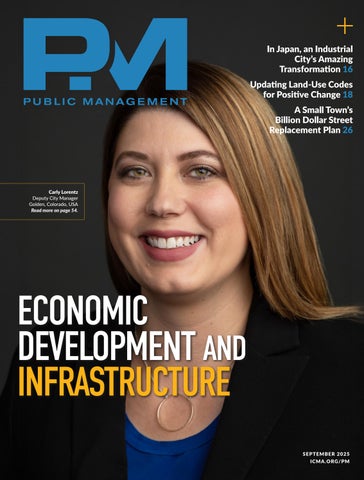
Carly Lorentz Deputy City Manager Golden, Colorado, USA Read more on page 54.
ECONOMIC DEVELOPMENT AND INFRASTRUCTURE SEPTEMBER 2025 ICMA.ORG/PM
We recover costs of service for your Fire Department! These costs can be significant and can support your budget. How much can you recover? Fire Recovery USA can help your municipality recover costs for fire and emergency service runs, including motor vehicle accidents, even when utilized by non-city residents. On average Fire Recovery USA recovers $715 dollars per billable run. Do some quick math, and see how much revenue is possible.
$715 Average recovered per billable run.
X
Billable runs per year.
=
1,900
97%
clients in 41 states and growing
collection rate for inspections
Fire Recovery USA is the leader in cost recovery billing services for the fire industry. Contact us to find out how much we can help you recover. info@firerecoveryusa.com
Potential revenue for your municipality.
$
715
average cost recovered per billable run
Calculate your cost recovery
www.firerecoveryusa.com
SEPTEMBER 2025 VOL. 107 NO. 9
CONTENTS
F E AT U R E S
16
From Environmental Crisis to Green Economy Through Grassroots Activism The transformation of Kitakyushu, Japan, demonstrates how industrial cities can leverage their heritage to foster sustainable development. Fernando Ortiz-Moya, PhD
18
Five Tips for Community Leaders to Update Land-Use Codes for Positive Change Land-use and building code updates can encourage diverse housing options, promote long-term affordability, improve energy efficiency, preserve existing housing, and engage the community effectively. Jessica Garrow
22
Local Leadership to Boost Financial Literacy Local governments can be critical connectors of ready, willing partners to promote the economic stability of families and communities. Celeste Benitez and Laura Goddeeris, , AICP
26
The Fate of Our Streets— A Billion Dollar Journey Ahead A small town’s street replacement plan is focused on strategic funding and proactive maintenance to extend road life and minimize future financial burdens. Michael Kovacs, Omar Williams, and Berlynn Wirtzberger
30
36
Designing Responsive Transportation Systems for Older Adults and Individuals with Disabilities Examining the 3 “C’s” of understanding the challenges, assessing community capacity, and making the commitment. Laura M. Keyes, Ph.D., AICP
40
Franklin County’s Commitment to Economic Opportunity and Innovative Workforce Development By integrating creativity, technology, and social support, the county is building career pathways for residents by focusing on inclusivity, emerging industries, and removing barriers to employment. Kenneth N. Wilson
44
Logical Pitfalls in Decision-Making Part three of our series on practical decision-making strategies for city/county managers Jon Quinday, ICMA-CM
50
From Roots to Branches: The Local Government Hispanic Network Local government leadership capacity-building through the growth of LGHN chapters Christine Butterfield
22 D E PA RT M E N T S 2 Executive Director’s Corner
The Backbone of Thriving Communities
4 Ethics Matter!™
Why You Can’t Rely on Your Attorney
6 Senior Advisors
Negotiating Your Employment Agreement
8 Women in Leadership Stepping into Your Power
26
10 AI
From AI to Data Strategy: Back to Basics
54 Assistants and Deputies Rethinking the Workweek
56 Professional Services Directory
Beyond Politics, Toward a Resilient Fairfield The city has developed a pragmatic, nonpartisan sustainability plan aimed at ensuring long-term community resilience, fiscal responsibility, and enhanced quality of life by integrating sustainability into core city operations. Scott Timmer
International City/County Management Association
36
S E P T E M B E R 2 0 2 5 | O F F I C I A L P U B L I C AT I O N O F I C M A | 1
EXECUTIVE DIRECTOR’S CORNER
The Backbone of Thriving Communities The importance of infrastructure and economic development in driving sustainable growth and community prosperity BY JULIA D. NOVAK, ICMA-CM
This month, Public Management is truly focused on
JULIA D. NOVAK, ICMA-CM, is executive director of ICMA.
the basic building blocks of thriving communities— infrastructure and economic development. It’s no accident that professional local government has its origin in engineering—people who saw the universal need to ensure that local communities had adequate infrastructure to accommodate growth and development. In the early 1900s, the United States transitioned from an agricultural to industrial economy. Cities faced immense pressure from in-migration and immigration. Political machines in charge of our cities were ill-equipped to manage that growth. Enter individuals focused on the building blocks of successful communities—roads, drainage, water, wastewater—the things that everyone takes for granted and that we must get right to have a successful community. Economic development is built on sustainable infrastructure. When infrastructure needs are met, economic development occurs and that creates jobs and opportunities for our residents. Thriving communities emerge when basic needs are met and people have opportunities to prosper.
We respect your commitment to building a solid foundation for your community, and at ICMA, we are focused on maintaining a solid foundation for our community, which is you, our members. Today our members remain focused on basic service delivery and work diligently to move their communities forward. What are the basic building blocks of success in your community? Is your foundation (infrastructure) built to support a thriving community? At ICMA, we focus on our infrastructure as well. We are committed to your success, and our mission is to support professional local government through leadership, management, innovation, and ethics. Our organizational infrastructure Public Management (PM)
International City/County
Public Management (PM) (USPS: 449-300) is published monthly by ICMA (the International City/County Management Association) at 777 North Capitol Street. N.E., Washington, D.C. 20002-4201. Periodicals postage paid at Washington, D.C., and at additional mailing offices. The opinions expressed in the magazine are those of the authors and do not necessarily reflect the views of ICMA.
icma.org
COPYRIGHT 2025 by the International City/County Management Association. All rights reserved. Material may not be reproduced or translated without written permission.
EDITORIAL OFFICE: pm@icma.org
September 2025
REPRINTS: To order article reprints or request reprint permission, contact pm@icma.org.
Management Association
SUBSCRIPTIONS: U.S. subscription rate, $60 per year; other countries subscription rate, $155 per year. Printed in the United States. Contact: 202/289-4262; subscriptions@icma.org. POSTMASTER: Send address changes to Public Management, ICMA, 777 N. Capitol Street, N.E., Suite 500, Washington, D.C. 20002-4201. ARTICLE PROPOSALS: Visit icma.org/writeforus to see editorial guidelines for contributors. For more information on local government leadership and management topics, visit icma.org.
2 | PUBLIC MANAGEMENT | SEPTEMBER 2025
icma.org/pm ICMA 777 North Capitol Street, N.E. Suite 500 Washington, D.C. 20002-4201
ADVERTISING SALES: Justin Wolfe, The YGS Group 717-430-2238 justin.wolfe@theygsgroup.com ICMA MEMBER SERVICES: 800.745.8780 | 202.962.3680 membership@icma.org
ICMA Creating and Supporting Thriving Communities ICMA’s vision is to be the leading association of local government professionals dedicated to creating and supporting thriving communities throughout the world. It does this by working with its more than 13,000 members to identify and speed the adoption of leading local government practices and improve the lives of residents. ICMA offers membership, professional development programs, research, publications, data and information, technical assistance, and training to thousands of city, town, and county chief administrative officers, their staffs, and other organizations throughout the world. Public Management (PM) aims to inspire innovation, inform decision making, connect leading-edge thinking to everyday challenges, and serve ICMA members and local governments in creating and sustaining thriving communities throughout the world.
Fate, Texas, USA
revolves around ensuring these programmatic areas are positioned to be successful. Our roads and water lines are a massive database of membership information: who, where, how many years of service, credentialing statistics, engagement with ICMA. From there we offer people at all points in their career (including those just thinking about a career in professional local government represented by our student chapters) learning and development programs, opportunities to volunteer and serve the profession, and of course, connection with one another.
All of this is built on the foundation of a shared commitment to ethical leadership. Our Code of Ethics is what sets us apart. In fact, it’s what makes this business of managing communities a profession at all! We emerged as a profession from the conditions of corruption and patronage to rebuild people’s trust in government. That is our history, and that is our legacy! We respect your commitment to building a solid foundation for your community, and at ICMA, we are focused on maintaining a solid foundation for our community, which is you, our members.
PRESIDENT
Midwest Region
Southeast Region
Tanya Ange* County Administrator Washington County, Oregon
Michael Sable* City Manager Maplewood, Minnesota
Jorge Gonzalez* Village Manager Village of Bal Harbour, Florida
PRESIDENT-ELECT
Jeffrey Weckbach Township Administrator Colerain Township, Ohio
Eric Stuckey City Administrator Franklin, Tennessee
ICMA Executive Director
Julia D. Novak, ICMA-CM
Cynthia Steinhauser* Deputy City Administrator Rochester, Minnesota
Chelsea Jackson Deputy City Manager Douglasville, Georgia
Managing Director, Brand Management, Marketing, and Outreach
Lynne Scott lscott@icma.org
Mountain Plains Region
West Coast Region
Dave Slezickey* City Manager The Village, Oklahoma
Jessi Bon City Manager Mercer Island, Washington
Senior Managing Editor
Kerry Hansen khansen@icma.org
Senior Editor
Kathleen Karas kkaras@icma.org
Pamela Davis Assistant City Manager Boulder, Colorado
Nat Rojanasathira* Assistant City Manager Monterey, California
Sereniah Breland City Manager Pflugerville, Texas
Elisa Cox* Assistant City Manager Rancho Cucamonga, California
Michael Land* City Manager Coppell, Texas PAST PRESIDENT
Lon Pluckhahn* City Manager Vancouver, Washington VICE PRESIDENTS
International Region
Colin Beheydt City Manager Bruges, Belgium Doug Gilchrist City Manager Kelowna, British Columbia, Canada Lungile Dlamini Chief Executive Officer Municipal Council of Manzini, Eswatini
Northeast Region
Dennis Enslinger Deputy City Manager Gaithersburg, Maryland
Graphics Manager
Delia Jones djones@icma.org
Design & Production
picantecreative.com
*ICMA-CM ** ICMA Credentialed Manager Candidate
Steve Bartha* Town Manager Lexington, Massachusetts Brandon Ford Assistant Township Manager Lower Merion Township, Pennsylvania
S E P T E M B E R 2 0 2 5 | O F F I C I A L P U B L I C AT I O N O F I C M A | 3
ETHICS MATTER!™
Why You Can’t Rely on Your Attorney It’s not unusual when a public official accused of misconduct defends his or her actions by saying that they sought and obtained a green light from the organization’s attorney. BY KEVIN DUGGAN, ICMA-CM
It’s not unusual when a public official accused
of misconduct defends his or her actions by saying that they sought and obtained a green light from the organization’s attorney. While that defense might be helpful in justifying the official’s actions and decisions, in many cases it will be inadequate to convince others the actions were appropriate and ethical. Focusing too heavily on what is legal and your attorney’s opinion can cause serious problems for local government managers who wish to be viewed in a positive ethical light.
Just because something is legal does not make it ethical.
Sources of Problems Legal does not mean ethical. The ethical bar
for those in the public arena is much higher than “what is legal.” There are many types of conduct that don’t actually violate the law but are deemed unacceptable conduct from an ethical perspective. Your attorney may not fully appreciate your ethical obligations. Each profession has
its own ethical obligations and expectations. While your attorney, hopefully, fully understands his or her professional obligations, they may not understand your obligations, especially under the ICMA Code of Ethics. Your attorney may be inclined to tell you what you want to hear. A positive and KEVIN DUGGAN, ICMA-CM, is a senior advisor for ICMA; former director, ICMA West Coast Region; and former manager of Mountain View, California (kcduggan@ katesbridge.com).
mutually supportive relationship between the attorney and staff is good. But it can also influence the type of advice offered. An attorney may be motivated to find a rationale to support what the manager would like to do. This could cause the attorney to stretch to provide legal advice supportive of the manager’s proposed actions. In particular, if counsel doesn’t determine a specific legal barrier to the conduct, he or she could underestimate and understate the other potential pitfalls associated with the proposed action.
4 | PUBLIC MANAGEMENT | SEPTEMBER 2025
You can be part of the problem if you succumb to “selective listening.” Your attorney may offer you
a variety of thoughts on the ethical dilemma you raise. It can be tempting to focus on the observations and opinions that best match what you want to hear. How to Address These Challenges
Give your attorney permission to tell you something you may not want to hear. Make it clear
that you always want their frank opinion regardless of whether or not it is favorable to your proposed action. You need to rely on their unvarnished opinion. Make it clear to your attorney that you want the best legal advice as well as an assessment of other potential impacts that could result from your actions. Make your attorney aware of all your ethical obligations. Make it clear to your attorney that you
view your obligations to extend beyond the “floor” of the action being legal. Informing attorneys of the requirements of the ICMA Code of Ethics and other criteria can help them understand the broader context of your obligations. Listen carefully and ask probing questions.
Again, avoid selective listening. Listen to and carefully probe all that your attorney has to offer, even those opinions and observations you would rather not hear. If his or her rationale is not clear or compelling, dig deeper. Confirm that your attorney feels so comfortable with the approach that he or she is willing to put it in writing or explain it publicly. Get a second opinion. Getting an opinion from an impartial source can provide a valuable perspective. This type of “nothing to lose or gain” advice can help supplement your assessment and the opinion of your attorney. Your Ultimate Responsibility
The advice of your organization’s attorney can be a critical component in your ethical decision making. It is not, however, always the final answer. Just because something is legal, does not make it ethical. Ultimately, you are responsible for your conduct. As a public official, stating that someone else said it was
Ultimately, you are responsible for your conduct.
okay, even if that someone else is an attorney, is not good enough. Actions that may be sufficient to keep you out of jail may still damage your reputation and potentially result in you losing your job, and even more importantly, your professional reputation. While I had the good fortune in my public management career to work with excellent city attorneys who not only were well-informed regarding laws, regulations, and policies governing my work, they also had a similar sense of what was the right thing to do in regard to ethical questions. We shared a similar set of values on this topic. They were my partners in helping keep our organizational ethical missteps to a minimum. No two individuals, however, will always view complex and grey-area challenges in the same fashion. Regardless of how good a working relationship you may have with your legal counsel, never forget that there is only one person ultimately responsible for your ethical decision making—you.
Communications Empower and Equip Your Team with 3CMA WHAT IS 3CMA?
With almost 2,000 members nationwide, the City-County Communications & Marketing Association (3CMA) is the nation's premiere network of local government communicators. Effective public communicators are vital to local government success, linking residents to the essential information they need to access services and be part of the democratic process.
3CMA IS ESSENTIAL FOR LOCAL GOV COMMUNICATIONS STAFF
Education Give your team access to high-quality learning opportunities that keep them sharp in a fast-changing field. 3CMA offers workshops, webinars, and conferences focused on the latest trends in public communication, storytelling, digital engagement, and more — ensuring staff stay current and confident in their roles.
Resources Equip your staff with practical, ready-to-use tools developed specifically for local government communicators. From design templates and editorial calendars to case studies and communication plans, 3CMA’s resource library saves time and helps your team work smarter and more effectively.
Career Development Help your team grow professionally with access to exclusive members-only training, certifications, and leadership opportunities. Whether someone is early in their career or ready to level up, 3CMA supports long-term growth through targeted learning and recognition.
Networking Plug your team into a national network of peers who do exactly what they do. Whether they're facing a new challenge, looking for fresh ideas, or just want to connect, 3CMA’s network provides support, shared experience, and valuable collaboration for teams of any size.
www.facebook.com/3CMAPage
703-707-0830
www.3CMA.org
S E P T E M B E R 2 0 2 5 | O F F I C I A L P U B L I C AT I O N O F I C M A | 5
SENIOR ADVISORS
Negotiating Your Employment Agreement
BY GREG SCHULTE
Don’t hesitate to use an ICMA senior advisor for help in reviewing your next employment agreement. The phone rings. The mayor is on the line to offer
you the job! There really isn’t anything like the emotional high of being offered a city/county manager position, particularly if it is your first one. You think you’re ready to go, but are you really? There is the matter of negotiating your employment agreement. And if you are not thinking of one, or have never had one, it should be at the top of your list of next steps. As ICMA senior advisors, we assist with a wide variety of issues and it’s not uncommon for us to offer insight on employment agreements. While the senior advisor is not going to give you actual legal advice, he or she should be able to offer common sense advice and wisdom on what is normal and what is definitely not normal, and perhaps some pitfalls to avoid when crafting your employment agreement. What’s in a typical employment agreement? Generally, most agreements outline the term of employment, duties to be performed, compensation and benefits, working conditions, and what happens in the event of employment separation. How do you approach negotiating your employment agreement? Let’s explore some different strategies. Understand Your Bargaining Position
GREG SCHULTE has over 30 years of local government experience in California and Colorado. He is a senior advisor for ICMA and the Colorado City/County Management Association.
• Understand your bargaining power and what kind of leverage you might have, which requires true self-honesty. The last thing you want to do is inadvertently negotiate yourself out of a job offer. • Stay at the table and always consider the whole deal. Be certain of the “hills you’ll die on.” • Be aware of the employer’s sensitivities and constraints. • Is there a way to create options for mutual gain? Take the Initiative
• Volunteer to write the first draft. Use the wonderful ICMA Model Employment Agreement (icma.org/ documents/icma-model-employment-agreementeditable) as a template. • “Go high” on your demands, knowing you may be willing to dial it back at a later point. • It is an entirely different vibe having to respond back to a low offer and then having to negotiate upward.
6 | PUBLIC MANAGEMENT | SEPTEMBER 2025
Do Your Homework
• Information is power. • Ask an ICMA senior advisor (icma.org/senior-advisors). He or she may know the background to the position and maybe even the council or commission members. • Ask the current or prior manager about the position. Ask the state association or ICMA. Is there a local managers’ group? • Is the prior manager’s employment agreement available? Read the budget. • Scour the internet about the employer. Contract for the Worst
• An employment agreement is very much like a marital prenuptial agreement; you are negotiating with your exit in mind. • A decent severance payment can make all the difference in the world for you—and your family—to transition to the next step in your employment journey. • Beware of ambiguous definitions of reasons to terminate for “cause.” As a final note, having an employment agreement is not weird or strange. Indeed, I would suggest that not having an employment agreement is atypical. Don’t be swayed by the suggestion that “our word is our bond” or a “handshake deal” is good enough. Accepting a new position is too important and you are more than likely making significant changes to your life and, perhaps, the life of your family not to take all the steps possible to secure your future. You do not have to confront this issue alone. There are resources out there to help you navigate the journey to a mutually satisfactory and executed employment agreement. Reach out to your senior advisors or to the great staff at ICMA. We are here to help!
Calendar of Events
UPCOMING EVENTS The Current State of Student Debt and Forgiveness September 4 | Free Webinar
ICMA Innovation Bootcamp September 23–October 17 | Online Cohort Program
Legal Considerations for Federal Funding Challenges September 8 | Free Webinar
Leveraging NASPO for Impactful Procurement Strategy: Resources and Cooperative Procurement Overview September 23 | Free Webinar
A Roadmap for Community Engagement in Small Cities and Towns September 9 | Free Webinar
Charging Smart 101 September 25 | Free Webinar
Better Public Meetings Training Series September 10–October 1 | Webinar Series
Compliance in Crisis: How Public Agencies Are Adapting to Funding Uncertainty in 2025 September 25 | Free Webinar
New Job Overnight: How to Make the Successful Transition September 17 | Free Coaching Webinar
Effective Supervisory Practices Training Series October 8 | Fall 2025 Live Online Webinar Series
Turning Resident Priorities into Budget Action: Exclusive Insights from a New National Survey September 18 | Free Webinar
A Budgeting Guide for Local Government 3-Part Series (Fall 2025) October 9 | Live Online Webinar Series
For a full listing of events and details, visit icma.org/events. Shop all courses at learning.icma.org.
S E P T E M B E R 2 0 2 5 | O F F I C I A L P U B L I C AT I O N O F I C M A | 7
WOMEN IN LEADERSHIP
Stepping into Your Power
Self-advocacy, boundary-setting, confidence, and a support network are key elements for success, especially for women in local government. BY MELISSA MURPHY-RODRIGUES
It rarely feels like the right time to take the dive into the management seat. I clearly remember the what-ifs that ran through my mind when I took the jump a decade ago. I had an infant and a toddler when I took a job that involved a multi-hour commute in a form of government I had never served in. I felt a lot like Stuart Smalley from Saturday Night Live walking around town hall silently reminding myself that “I’m good enough, I’m smart enough, and doggone it, people like me.” Turns out, I was right, but imposter syndrome is a real thing, folks. And the only person who can heal that is you, and apparently, Al Franken. I learned a lot when I took a nosedive into the management pool, and while at times it has felt like an epic belly flop, most of the time it has been the ultimate cannonball. 1. If you don’t advocate for yourself, no one else will (except your mom). Asking for what you
MELISSA MURPHYRODRIGUES is town manager of North Andover, Massachusetts, USA.
deserve or need is awkward, and for some reason, it’s even more awkward for women. Lean into the awkward. You know what you deserve. You have done the comparisons. You know the market. You know when it’s the right time. Come ready and with facts, but never be embarrassed to ask. I’d go to war for so many of the women in my life. Why wouldn’t I go to war for myself? 2. It is possible to set boundaries. Sometimes it feels impossible. And sometimes you do miss things when you’re distracted at the dinner table. It goes with the job. Set the boundaries before you even arrive. When I introduce myself at job interviews, I start with who I am, which is the mom to two school-aged children. If you choose me, that is who you are getting. Setting those initial boundaries can be hard with a new board that you want to impress and employees you are seeking to earn respect from. Model the behavior you expect. “I will be leaving at 4:00 P.M. because I need to attend a softball game.” “If this isn’t an emergency, I need to call you back because I’m doing a French braid.” (Phrases literally uttered by me this
8 | PUBLIC MANAGEMENT | SEPTEMBER 2025
week.) We are professionals. We do what we need to do to get the work done and done well. You get to set the terms of how that happens. You may find at the end of the day that you have more flexibility at the top. And, while I don’t recommend the multi-hour commute, finding a sweet spot that allows you to refresh on the way home is key to finding balance. 3. You can be the smallest but strongest person in the room. There are still many meetings where I am
the only woman in the room, and often I can be the first woman to have even been at this table. To combat that, I show up prepared, homework done. I project my voice even if it might be the softest. I ask questions. I project confidence, but I know what I don’t know, and I admit when I’m wrong. There have been exactly two times when I have had to rise out of my seat to capture the attention of a rowdy meeting. I’ve never yelled or lost my temper. Just the mere act of coming to my full size and doing the unexpected redirects the attention and restores order. 4. Bring your sense of humor and a short memory. You will need both. The ability to shrug off the
small stuff, to see the humor in your own actions, and to move on quickly will take you far in municipal land. Forget what you read on social media in the same amount of time it took you to read it. 5. Find your gang. The people who will build you up every day. Who you can vent to when it is hard and who will applaud even the smallest victories. The ones who will tell you an idea is bad and who will bring perspective to the room. The champions when you aren’t there and the realist when you are. Find those people, hold on to them, and be them.
CALL FOR SESSION PROPOSALS ICMA is seeking forward thinking, solution driven sessions for these upcoming events. Share your expertise! Submissions may be considered for multiple conferences
Local Government Reimagined Conference
Local Government Reimagined Conference
Ai In Local Government April 8-10, 2026 Orlando, FL
Democracy In Local Government May 13-15, 2026 Philadelphia, PA
ICMA 2026 112th Annual Conference October 17-21, 2026 Long Beach, CA
SUBMISSION DEADLINE: NOVEMBER 7, 2025 Learn more Submit Your Proposals
conference.icma.org/call-for-presentations Questions: conferenceteam@icma.org
AI
From AI to Data Strategy:
Back to Basics If your goal is to strengthen your community through transformative tools like AI, then starting from a strong foundation, with basics such as citywide data strategies, could help you go a long way. BY KEL WANG
From the launch of ChatGPT to the iterations
of presidential executive orders on artificial intelligence (AI), local governments can see firsthand the importance of this breakthrough technology now more than ever. Andrew Ng once said, “AI is the new electricity,” which makes good sense as it has shown great potential in revolutionizing many aspects of our work (e.g., the productivity gains by automating call center tasks, smarter infrastructure management through predictive maintenance of roads and water systems, and real-time monitoring for potential threats on social media. To help AI systems achieve their potential, we need good data. According to the European Union Agency for Fundamental Rights, algorithms used in AI systems can only be as good as the data used for their development. High-quality data can also mitigate bias and error and protect people’s fundamental rights when operating AI systems. Yet, the call for high-quality data is often hit-ormiss or lacks clarity and actionability. Before I delve into the suggestions for improving the data quality, I will share some context. KEL WANG is manager of applied data practices for Bloomberg Center for Government Excellence at Johns Hopkins University.
Data Governance and Data Literacy
Data governance provides organizational oversight of data management. When an organization has good data governance, leaders of the organization have a good sense of data quality and have a place to go to for data-related issues and questions such as data availability, data access, data security, regulatory compliance, and much more. While data governance takes a top-down approach by setting organizational standards or approaches for managing data, data literacy takes a bottom-up approach
10 | PUBLIC MANAGEMENT | SEPTEMBER 2025
by developing critical individual capacity to generate, collect, store, analyze, use, and share data—the various practices to manipulate data. Both are equally important for developing high-quality data. But according to the State Chief Information Officer (CIO) 2023 Survey from the National Association of State Chief Information Officers (NASCIO), the majority, 69% of the state IT chiefs, reported they were only in the “beginning stages” of their data governance structure. The survey also revealed that 84% of states surveyed did not have a formal data literacy program. As I reflect on these survey results, I continue to wonder how local governments compare to their state counterparts— worse off, perhaps? Quite likely. Unless similar research is done with local CIOs, this will only continue to be my best guess. Data Quality and AI
Reading up to this point, you may have already gotten a sense that the organizational AI effort can go a long way when it has good data. But how does data quality affect the adoption of AI? Let me explain. According to the AI Accountability Framework released by the Government Accountability Office, “Data used to train, test, and validate AI systems should be of sufficient quality and appropriate for the intended purpose to ensure the system produces consistent and accurate results.” AI-based machine learning models begin with data and infer rules or decision procedures that predict outcomes. If your city were to develop an AI tool for pothole recognition, Figure 1 describes a simplified process for the project.
Figure 1. Key Steps of a Pothole AI (Machine Learning) Project
1. Collect data
•
Collect many pothole images and other images that are not potholes.
2. Train model
•
Use a machine learning algorithm to learn an input-to-output or A-to-B mapping, where the input A would be an image and the output B would be the label identifying the image as being a pothole or not.
•
Iterate many times until the model has a reasonable level of accuracy for recognizing a pothole.
•
Share real images from city streets with the AI program and send the pothole location to the appropriate city department for repair.
3. Deploy model
As shown in Figure 1, this pothole AI project uses two types of images (pothole vs. non-pothole) as source data and comes up with image recognition algorithms to help identify potholes in city streets. When the algorithms are accurate and the real images from city streets are of high quality, the repair crew can have reliable pothole location information and save much travel time by going directly to the places that have potholes and repairing them to make city streets safer.
In fact, AI is applied at least as much to tables of data (i.e., structured data) as to images, audio, and text (i.e., unstructured data). Let’s say one of your AI projects was asked to predict service call patterns and staffing levels for the upcoming week and they are given the data as shown in Figure 2. What issues might they run into? They are going to run into three issues: • Consistency: The call date and time are presented inconsistently between the two data entries.
Figure 2. Simplified 311 Call Data Sets
Service ID
Date & Time
Request Type
Post Code
Department
454975
5/28/17 13:22
Animals
22202
Animal Services
454983
June/03/26 14:26
Garbage Bin
-
Waste Management S E P T E M B E R 2 0 2 5 | O F F I C I A L P U B L I C AT I O N O F I C M A | 11
• Accuracy: The second entry, call 454983, has a recorded date of “June/03/26,” which is in the future, so it can’t be the actual date the call happened. • Completeness: Call 454983 doesn’t record the post code. So, one of the first activities many AI teams would undertake is data cleaning and organization. According to CrowdFlower, data scientists spend about 60% of their time cleaning and organizing data. Imagine if a good portion of that time could be saved or repurposed. What You Don’t Know About the DATA Act
Now, let’s circle back on ways to improve data quality. There has been an extraordinary piece of work done at the federal level, the Digital Accountability and Transparency Act of 2014 (i.e., the DATA Act), which has standardized and published accessible and machinereadable federal spending data through USASpending. gov. The goal of the act was to increase the accessibility, quality, and usefulness of online information regarding federal spending. The implementation of the act included three main bodies of work: • The development of a consistent government-wide data standard. • The development the data collection and validation tool. • The development of USASpending.gov to display the data and facilitate public use. The U.S. Treasury Department used agile methodology in each of these critical efforts, featuring rapid development and deployment and then incrementally, iteratively, and flexibly enhancing the work over time. Led by Amy Edwards Holmes, the deputy assistant secretary of accounting policy and financial transparency at the
time, this effort was documented and published by the National Academy of Public Administration.1 What can be learned from this journey if we were to pursue a similar approach in local government? The good news is we don’t have to come up with a solution that needs to track more than $4 trillion (in 2014) in annual spending on a quarterly basis (the original scope of the DATA Act), but we do have to come up with tools that can address the data fundamentals citywide. And similar to the federal government, we will also need to address the uneven amounts of effort across departments. Every department is unique, in terms of its service offerings, staffing, data maturity, and even buy-in. It requires the approach to meet departments where they are and help them move along. Last and perhaps most critically,
Figure 3. An Example from the Seattle Action Plan Table
Strategic effort
What it means
Rollout
Status
Data Quality Playbook:
City best practices for consistent data quality result in a One Seattle, bird’s eye view of the needs on the ground.
Short term
Published Draft
Demographic Data Standards:
Seattle models best practices for use of demographic information to identify and address disparities in services and investments while protecting privacy.
Short term
Published Draft
Guidelines and minimum standards for maintaining and collecting demographic and person-level data and best practices to make disaggregation and equity analysis the norm. As a component of the Data Quality Playbook, specific preliminary standards, and guidance for the collection of race and ethnicity data. 12 | PUBLIC MANAGEMENT | SEPTEMBER 2025
stakeholder engagement matters. Stakeholders, such as elected officials, academia, community partners, residents, and cross-agency staff, must play an important role in this process, not only supporting the development and adoption of the required data standard but also adopting a user-centered design principle through their unique, diverse, and critical contribution to this work.
etc.) To make this work actionable, the strategy has identified 19 projects, policies, and processes between 2024 and 2026 along with associated timing (in short, medium, and long terms) and statuses (see Figure 3), and presented 20 examples of how the teams have advanced the use of data and achieved better and more equitable outcomes for residents.
Citywide Data Strategy
Conclusion
We have already seen successes coming off the aforementioned approach. In December 2023, the city of Seattle released its One Seattle Data Strategy: 2024–2026, “a three-year vision and action plan to advance our use of data, scale data excellence across the city, and achieve better and more equitable outcomes for residents.”2 The strategy has identified four key pillars to address: data quality and governance, data literacy and culture, data use and equity, and data and community engagement, representing a holistic approach to data. The strategy starts off with a critical question—Why does Seattle need a data strategy?—to set a tone for this work. The document further responded with a two-part answer: a series of organizational and community goals come with data and then a series of opportunities when marrying data with values (e.g., Data + Innovation, Data + Collaboration, and Data + Equity and Inclusion,
We’ve heard it time and time again: Rome wasn’t built in a day, and similar to that, the work of data and AI cannot be accomplished overnight. If your goal is to improve residents’ lives and build a sustainable community through transformative tools like AI, then starting from a strong foundation, with basics such as implementing citywide data strategies, could help you go a long way. The work in Seattle and in the federal government speaks to this. Now, the real question is, how could you leverage this approach and build a culture of data and datainformed decision-making in your own organization and beyond? ENDNOTES AND RESOURCES
https://napawash.org/grand-challenges-blog/data-act-implementation-thefirst-government-wide-agile-project 2 https://seattle.gov/mayor/one-seattle-initiatives/one-seattle-data-strategy 1
DOJ Deadline is April 2026 Is Your Website Ready? Achieve Compliance and Build Resident Trust Just like your community, your website is always evolving. But with every new document, form, or update, accessibility risks can grow. CivicPlus® Web Accessibility simplifies compliance with integrated quality assurance tools designed specifically for local governments. Whether your team is one or twenty, our automated, easy-to-use platform empowers content contributors to catch issues early, meet WCAG and ADA standards, and build trust with every resident—regardless of ability.
Use the QR code to get in touch with us and learn more about web accessibility solutions. You can also call 888-228-2233 or visit www.CivicPlus.com for more information.
S E P T E M B E R 2 0 2 5 | O F F I C I A L P U B L I C AT I O N O F I C M A | 13
From Environmental Crisis to Green Economy Through
Grassroots Activism The transformation of Kitakyushu, Japan, demonstrates how industrial cities can leverage their heritage to foster sustainable development. BY FERNANDO ORTIZ-MOYA, PhD
14 | PUBLIC MANAGEMENT | SEPTEMBER 2025
W
hat happens to manufacturing cities after their core industries vanish? Several economic crises have devastated old industrial cities since their heydays in the early twentieth century. Starting in the 1950s, the giants that had fueled economic development up to that point underwent severe decline, with massive job losses and economic hardship, often leading to population shrinkage. Places such as Detroit and Pittsburgh in the United States, Liverpool and Manchester in the United Kingdom, the Ruhr region in Germany, and Hakodate and Kitakyushu in Japan saw their livelihoods dwindle as factories, mills, and warehouses shut down one after another. These (and countless other) cities had to reinvent
themselves, finding alternative sources of economic activity away from manufacturing. Most invested in research and innovation, diversified into technology and healthcare, and implemented social inclusion initiatives to heal the scars of deindustrialization. Kitakyushu City, Japan, took a different path. Rather than distancing itself from manufacturing, the city leaned into its industrial know-how and history of pollution abatement to build a green economy. Kitakyushu’s transformation did not happen overnight. It unfolded over decades, shaped by environmental crises, grassroots actions, and local leaders’ willingness to rethink what economic development means. This transition was driven by the most unexpected actors: a group of housewives
with a vision for cleaner air and bluer skies.
The City that Built Modern Japan In less than five decades, Kitakyushu transformed itself from a small, impoverished fishing village—formerly known as Yawata—into the steel capital of Japan. Located at the northernmost tip of Kyushu, the country’s third largest island, Yawata’s distance from Tokyo—both politically and geographically—made it seem an unlikely place for Japan to stake its industrial future. Why Yawata? And why then? Seeking rapid industrialization, the government of Japan decided to open a state-run iron and steel mill in the 1890s. Even though Yawata had no significant industrial and urban development at that time, its
proximity to coal, water, and established transport routes provided key geographical and logistical advantages. To begin with, it was close to the castle town of Kokura, a key regional economic and administrative hub. It was also close to Moji, at the time emerging as a crucial international trading port. And more importantly, it was close to the Chikuho coalfield, Japan’s largest coal field before World War II. These advantages tipped the scales in Yawata’s favor, starting the transformation of Northern Kyushu into a buoyant industrial region. Yawata Steelworks opened in 1901. Ever since, the mill and the city developed a symbiotic relationship. The need for workers pulled people from all over Kyushu. Yawata’s population exploded, jumping from some 6,000
Kitakyushu, the northernmost city on Japan’s Kyushu Island
S E P T E M B E R 2 0 2 5 | O F F I C I A L P U B L I C AT I O N O F I C M A | 15
residents in 1901 to more than 100,000 in 1920. Other heavy industries followed soon after in surrounding towns, giving birth to a highly industrialized and well-integrated industrial region. Air raids during World War II inflicted great damage to housing, infrastructure, and factories. The city rebuilt itself, once again upon the shoulders of iron and steel throughout the 1950s. During the post-war period, the constant smoke rising from factory chimneys became a symbol of progress and recovery. Locals called it the “smoke of seven colors,” echoing a rainbow that represents growing prosperity and national pride. It was seen as a sign that Japan’s recovery was underway. But behind the colorful haze, the price of progress was becoming clear: rapid reindustrialization was destroying Kitakyushu’s air, rivers, and sea.
Women’s Associations Fight for a Cleaner Environment Kitakyushu was an industrial powerhouse and a national success story. But its success was harming its people. When the smoke turned from a rainbow to a health hazard, women began fighting for a different future. Industrial pollution was causing health problems, especially in children and the elderly. Despite persistent traditional gender roles, the Allied Occupation forces granted women new rights, encouraging the formation of women’s associations to foster political education, civic participation, and advocacy for women’s rights. The establishment of the Tobata Women’s Association in 1950
Rather than chasing service industries— the common tactic deployed by other deindustrializing cities—Kitakyushu chose to promote new industrial sectors centered on sustainable development, further action from other including waste women’s associations. The high point of their management fight for environmental and recycling. justice came in 1965 with the A storefront in Kitakyushu
kickstarted a movement to restore the sky to its blue color. Tobata Women’s Association began by conducting research to demonstrate the connection between pollution and health hazards. They hung white shirts on the rooftops of public schools to observe changes in color after a few days and placed milk cartons and cans to measure soot and ashfall. They then compared the shirts’ discoloration and soot collected in relation to their distance from factories. To validate their findings, women’s associations also partnered with university researchers and published their results. Their research created a platform to lobby local officials for change. Their first victory came in 1952, when local authorities mediated to compel a power station to install smokestack cleaners. This first step toward a cleaner environment encouraged
16 | PUBLIC MANAGEMENT | SEPTEMBER 2025
publication of the “We Want Blue Skies” report. Authored by 13 women’s associations in Kitakyushu and representing more than 6,000 members, the report summarized data collected from 1961 and 1964 on the pollutants plaguing the city. They also produced an independent documentary that aired on national television that year, raising awareness of the human cost of pursuing economic development at any price. The determination of these women’s associations drew politicians into the story. Their movement influenced policymaking from the bottom up. They lobbied politicians and private companies to strengthen antipollution measures, reaching settlements through mediation by Kitakyushu City. Their actions laid the groundwork for a broader shift where environmental restoration became a pillar of Kitakyushu’s future. Galvanized by public pressure, city leaders began to act: not simply to reduce
pollution, but to reimagine Kitakyushu’s future.
Becoming a Green City The “We Want Blue Skies” campaign coincided with Kitakyushu’s reckoning with its economic model. The city’s heavy industries were destroying its environment while also beginning to stagnate. Growing international competition and the gradual concentration of production in Tokyo weakened Kitakyushu’s industrial base. From the late 1960s, Japan’s industrial geography shifted toward the Tokyo region, whose factories expanded often at the expense of older sites in more remote areas. Yawata Steelworks was progressively downgraded, losing its research and development functions and shedding workers who were reassigned to other plants. The merger of Yawata Iron & Steel and Fuji Iron & Steel to form Nippon Steel Corporation further consolidated operations in and around Tokyo. The local officials soon grasped the magnitude of the challenge ahead of them. They were facing not only the legacy of unchecked industrialization and widespread pollution, but also the collapse of the
city’s primary industry—and employer. For decades, the local economy had revolved around Yawata Steelworks, either directly or through its supply chain. As the mill declined, so did Kitakyushu. Outmigration followed, driven by vanishing job opportunities and harsh environmental conditions. The city’s population peaked at 1,065,078 in 1980 and had fallen to 902,358 by 2025. In the 1970s, local authorities joined forces with private companies to restore Kitakyushu’s natural environment. As local companies developed innovative solutions to meet stricter national and local standards, they gained expertise in pollution control and environmental remediation. City leaders soon recognized that this emerging environmental know-how offered a pathway to diversify Kitakyushu’s economic base. Rather than chasing service industries—the common tactic deployed by other deindustrializing cities— Kitakyushu chose to promote new industrial sectors centered on sustainable development, including waste management and recycling. This approach bridged the city’s manufacturing past with its hard-won experience cleaning up its environment, aligning Kitakyushu’s industrial future with the urgent need to build more sustainable and resilient cities. In seeking to usher in a new era, local authorities looked to Pittsburgh, Pennsylvania, USA, for inspiration. Pittsburgh had followed a similar development trajectory to Kitakyushu. Like Kitakyushu, the steelbuilt city had suffered severe environmental degradation.
But Pittsburgh’s renaissance plan, launched in the late 1940s, had addressed both economic and environmental challenges. After a field visit to Pittsburgh, Kitakyushu approved its own “Renaissance Masterplan” in 1988, leveraging its industrial past to pave the way for a future centered on green industries. To solidify its green turn, Kitakyushu joined several prefectural and national programs supporting green economic development. As a first step, and framed within the Renaissance Masterplan, the city established the Kitakyushu Techno Park and the Techno-Center in 1990, to support the transition of its manufacturing from heavy to high-tech industries. In 1997, Kitakyushu joined a national initiative promoting the creation of “eco-towns.” The eco-town program encapsulated Kitakyushu’s new ethos by promoting local economic development through environment-related enterprises. Kitakyushu’s eco-town became the cornerstone of the city’s green growth revitalization efforts. It combined research and development, manufacturing, and commercialization capabilities in a single location to support green businesses. The eco-town promoted valueadded activities, opening new avenues for growth for existing and new businesses alike. Ever since, Kitakyushu has replicated this model to advance its green economy, joining different national programs—gaining recognition and, in some cases, funding— to advance local sustainable development. Initiatives such as the Eco-model City in 2008, the FutureCity Initiative in 2011, and the SDGs Future
Instead of abandoning its manufacturing identity, Kitakyushu redefined it.
global competition to attract knowledge-based industries, the city looked to its distinct advantages: deep manufacturing expertise and environmental cleanup know-how. What can other cities facing deindustrialization learn from Kitakyushu?
City Initiative in 2018 built upon existing efforts to expand the city’s green industrial capacity. These strategies were export-oriented, aimed at internationalizing Kitakyushu’s economy and opening new markets for its companies. Decades after the smoke of seven colors and the women’s associations’ fight for a cleaner environment, Kitakyushu had managed to turn its environmental crisis into the foundation for a new kind of prosperity.
1. Build on existing strengths rather than discarding them entirely. Kitakyushu
Lessons Learned and Future Challenges Kitakyushu’s transformation from steel to green industries was a steady, layered process. Following the destruction of its natural environment during the years of rapid post-war reindustrialization and the associated health hazards, women’s associations fought to claim back the sky’s blue color. Facing economic decline and environmental collapse, city leaders recognized the potential in their pollution control expertise. Unlike other cities that sought advanced service industries and complete rebranding, Kitakyushu restructured from within, anchoring their revitalization policies in grassroots action and its industrial heritage. Rather than abandoning its manufacturing identity, Kitakyushu redefined it. Amid the growing national and
3. Embrace grassroots movements as policy drivers. Women’s associations
reimagined its industrial capabilities for emerging green sectors instead of abandoning manufacturing altogether.
2. Transform crises into competitive advantages.
Environmental pollution became the catalyst for developing cleanup knowledge, turning past problems into the foundation for future economic opportunities.
provided the research and pressure that legitimized major policy shifts, creating space for bold economic transformation.
While Kitakyushu still faces population decline, its experience demonstrates that cities need not conform to pre-established development models. By drawing on their unique history, listening to local voices, leveraging existing capabilities, and maintaining long-term vision, cities can transform their greatest challenges into distinctive pathways forward.
FERNANDO ORTIZMOYA, PHD, is a chief policy researcher at the Institute for Global Environmental Strategies in Japan.
S E P T E M B E R 2 0 2 5 | O F F I C I A L P U B L I C AT I O N O F I C M A | 17
Five Tips for Community Leaders to Update Land-Use Codes for Positive Change Land-use and building code updates can encourage diverse housing options, promote long-term affordability, improve energy efficiency, preserve existing housing, and engage the community effectively. BY JESSICA GARROW, FAICP
As community leaders struggle with the housing crisis, balancing development with environmental protection, how can they create a positive change through updated landuse and building codes? Communities large and small face similar challenges related to housing affordability— home prices continue to increase and interest rates remain high, making home ownership out of reach for many. Couple that with limited rental home supply, and there is a tightening of the housing market that forces many community members to live farther away from their jobs. This has implications for our
transportation systems as well as our sense of community. While the challenges are real, and local governments don’t have control over many macroeconomic factors like interest rates, there are tangible ways local governments can take action. Depending on your state regulatory framework, you can use your local land-use and building codes to require or encourage development that aligns with your goals. From housing density and affordability to green building codes and community engagement, here are five tips and real-world examples to
18 | PUBLIC MANAGEMENT | SEPTEMBER 2025
empower community leaders to create more equitable and sustainable communities. Each of these tools can be scaled to your community to meet your specific challenges and goals.
1
Create a by-right land-use process for the housing typologies you want to see in the community. Addressing affordability requires a true mix of housing options, and creating a clear and quick process for different housing types can incentivize the creation of new and different housing types. Analyzing your land-use codes is the first step to understanding what unit types it supports and which it disincentivizes.
If a single-family home can go straight to building permit, but a duplex requires a review with the planning commission, you are not going to have as many duplex units. If duplexes are permitted by-right, you will encourage more to be built. An important consideration when expanding the types of housing that can be developed in a neighborhood is the scale. New housing types—such as a cottage court, fourplex, or townhomes— must be scaled appropriately for a community, and often a neighborhood-by-neighborhood approach is needed. In 2023, the city of Aspen updated its land-use codes to allow up to four units of deed-restricted housing in all single-family neighborhoods by right. If a fourplex is built to the
same allowed square footage as a single-family or duplex home, it can proceed straight to a building permit review. This approach creates the opportunity for additional residential density that is scaled appropriately to each neighborhood. Before this change, a fourplex was not allowed in these zones so a property owner looking to develop one would have faced a months-long review process with the planning commission and city council. Other communities looking to adopt a similar change might select a larger, allowed by-right density; may determine a deed restriction is not needed; and may be comfortable with allowing larger buildings for more density. The key strategy is to remove process barriers to incentivize additional housing options.
2
Incentivize the creation of deedrestricted housing to ensure long-term affordability. In communities with an existing affordable housing or deed restriction program, there is an
opportunity to use the code to create more deed-restricted housing. In communities that don’t already have such a program, creation of a program is worth exploring. One way to incentivize deedrestricted housing through the land-use code is to provide dimensional benefits, such as additional height or building floor area, or lower setback or parking requirements, for these units. When changing dimensional allowances is not possible, reduced landuse, permit, and tap fees for affordable housing can help incentivize its creation by a private developer. For any of these tools to be successful, the benefits received need to offset the revenue difference anticipated between a freemarket housing unit and the deed-restricted unit. Another way to incentivize deed restrictions is to work directly with existing or prospective property owners by providing down payment or other financial assistance in exchange for a deed restriction. This is typically completed in conjunction with an existing housing program and requires
Addressing affordability requires a true mix of housing options. Creating a clear and quick process for various housing types can incentivize the creation of new and different housing types.
funding streams from grants or taxes. A number of mountain communities in Colorado, including Frisco, Vail, and Summit County, have each successfully implemented such programs, and others, including Basalt, are exploring them.
3
Update building codes to the latest ICC code cycle and consider going beyond. The International Code Council (ICC) has continued to increase energy efficiency requirements in their updated codes. Moving to the latest code cycle can help your community reach greenhouse gas goals, while ensuring development is as energy efficient as possible. In addition, many communities can adopt local amendments that can go further in meeting specific climate and greenhouse gas goals. In Pitkin County, Colorado, local building code
amendments have created energy budget limitations for outdoor amenities. In a community that sees large homes (up to 9,250 square feet in some areas of the county), they have determined it is critical to address the energy impacts these homes have. These new codes, adopted in 2024, allow a homeowner to select the types of exterior amenities that require gas or electricity to function—such as pools, hot tubs, fire pits, and snowmelting patios or driveways—up to a specific threshold. Once they reach their energy budget, additional outdoor amenities cannot be constructed. This code change strikes a balance between limiting the potential impacts from large residential development and allowing homeowners to use their property as they
S E P T E M B E R 2 0 2 5 | O F F I C I A L P U B L I C AT I O N O F I C M A | 19
desire. It also ensures that all residential development is part of the solution in addressing greenhouse gas emissions and energy efficiency.
4
Limit demolition allowances to preserve existing housing stock. In many communities, older homes that may have traditionally housed families and working residents are being demolished. The new homes that are constructed in their place are often larger and more expensive than what was there before, making them out of reach for community members. One tool to help limit these conversions is creating limitations on the number of full demolition and replacement projects that can move forward in a given neighborhood or in a given timeframe. Aspen, Colorado, adopted an annual limit on full demolitions that can occur each year. For
Code Solutions Communities can implement land use and building code changes related to incentivizing housing creation, addressing demolition, and requiring building performance metrics. Photo credit: Design Workshop
the homes that are demolished and replaced, the codes require that they meet strict waste diversion requirements, and the new construction must meet additional energy efficiency requirements. Calculation of embodied carbon and energy reporting is also required.
5
Engage the community on code changes. Any changes to these codes must be informed through a community engagement process to build consensus, support, and an understanding of the impacts. Each of the
Community Engagement Stats With thousands of individual touch points, the city of Aspen’s land-use and building code project focused on bringing the community’s voice into the process. The team used online surveys, in-person focus groups, and a series of neighborhood pop-ups to hear from a broad audience. Photo credit: Design Workshop
20 | PUBLIC MANAGEMENT | SEPTEMBER 2025
examples in this article included community engagement, which has led to success in implementation in the adoption phase. Aspen utilized broad community surveys and community pop-up events to reach community members. Pitkin County (Aspen/ Snowmass) convened a 26-member community growth advisory committee to craft broad recommendations related to the county’s climate goals. Both used a series of focus groups and open houses to inform recommendations for the neighborhood where code changes were anticipated. Each of these engagement processes ensured community understanding of the issues when codes were proposed for adoption. JESSICA GARROW, FAICP, is a community planner with 20 years of experience. She is a principal with Design Workshop and a former community development director.
Join 5000+ local government professionals in vibrant, dynamic Tampa, Florida,
Come to Tampa and be Energized
one of the nation’s leaders in innovation, maritime commerce, healthcare technology, and sustainable urban development.
Register online at conference.icma.org Best value rate ends September 17. 15% discount off each registration for teams of 4 or more!
Exhibit at ICMA Contact: ICMA@corcexpo.com 312-265-9648 Partner with ICMA Megan Sherman, Senior Manager Conferences & Sponsorships sponsorshipteam@icma.org Connect with us
#ICMA2025
Special Discount for New Members! Save 50% off your first-year membership fee!
LOCAL LEADERSHIP TO
BOOST FINANCIAL LITERACY BY CELESTE BENITEZ AND LAURA GODDEERIS, AICP
Local governments can be critical connectors of ready, willing partners to promote the economic stability of families and communities.
E
arlier this summer, ICMA hosted the inaugural National Economic Mobility and Opportunity Conference (emoconference.org) in Baltimore, Maryland. Three
hundred-fifty leaders from local governments across the country convened with representatives from nonprofits, academia, think tanks, and organizations supporting public servants. They explored strategies and
ICMA’s 2025 Economic Mobility and Opportunity Cohort
22 | PUBLIC MANAGEMENT | SEPTEMBER 2025
partnerships to overcome common challenges faced by local residents working to move up the economic ladder. Financial empowerment and financial literacy were key threads across many of these conversations. And for good reason: the ability to understand and manage one’s personal finances through budgeting, managing debt, saving, and investing is foundational to long-term economic success. While top-level local government managers may be steeped in related knowledge and skills, a 2024 Pew Research Center study noted only 54% of U.S. adults say they have a strong or fair understanding of financial principles. This share drops below half for those in lower income households, Hispanic adults, and adults under age 50.1 As local governments consider investments of resources in economic development strategies, it is critical to not overlook potential gaps in financial literacy among residents. Several members of ICMA’s Economic Mobility and Opportunity Peer
Gaithersburg, Maryland
Learning Cohorts have used their mini grant funding toward such capacity-building efforts.
Gaithersburg, Maryland Located 20 miles outside of Washington, D.C., the midsized city of Gaithersburg is home to an economically and ethnically diverse community. The city’s strategic plan prioritizes advancing equitable outcomes for people in the community, particularly for those who have been historically underserved. Financial wellness programming is a well-established example in support of that objective, and the city now works with a broad network of more than 30 public, private, and nonprofit partners to provide training and resources to residents. Early efforts included partnering with the national Bank On program to make it easier for residents to access low-cost, secure savings and checking accounts.2 This collaboration grew into a Financial Wellness Coalition, and establishment of a Financial Empowerment Center in 2022. The national Cities for Financial Empowerment Fund
serves as a consistent source of technical expertise and funding for local programming. Through its offerings, local government partners are taught how to establish free stand-alone financial services and incorporate the financial empowerment center model into other social services like housing, workforce development, and more. More recently, as a participant in ICMA’s 2024 Economic Mobility and Opportunity (EMO) Cohort, Gaithersburg zeroed in on a specific financial knowledge gap among their Spanish-speaking recent immigrant community. Over 40% of Gaithersburg residents were born outside the United States, about half of whom are from Latin America. Financial Empowerment Center counselors and Gaithersburg Elementary School personnel had observed that newcomer families were struggling financially, and that a lack of understanding U.S. financial systems led them to avoid mainstream financial products, pay high interest rates for car loans, and sometimes be victimized by scams. Leveraging their mini
grant resources provided by ICMA, leaders worked to scope out and deliver a three-session program targeting the specific needs of and barriers impacting these families. City staff engaged 20 representatives of school and nonprofit partners with close ties to the immigrant community in a meeting to inform content, delivery, and promotion of the series. Participants noted the importance of building trust with the intended audience. Taking this to heart, the city tapped the local Housing Initiative Partnership nonprofit to develop and deliver the interactive workshops, led by native Spanish speakers that themselves had come to the U.S. as immigrants. They recruited participants using Spanish language materials through school/community liaisons and similar trusted staff. The sessions themselves— (1) banking and budgeting, (2) understanding credit, and (3) creating a financial future— were held in the evening at the local elementary school and were designed to accommodate entire families. Participants were treated to dinner from a
local Peruvian restaurant, and the school’s after-school program provider assisted with childcare while parents attended the workshops. Participants received a $25 grocery store gift card at the conclusion of each session. The series engaged at least 30 adults at each session, with a majority attending all three, and approximately 35 children were present at each session as well. Leaders used pre- and post-workshop surveys to refine content and gauge feedback, and participants consistently reported high levels of engagement and increased knowledge and confidence from the materials presented. At the series’ conclusion, families completing all three workshops received an additional $100 grocery store gift card and a certificate of completion from the city while sharing cake with their children. Leaders noted how meaningful the celebration was to participants and felt that future iterations should plan to emphasize that aspect even more, ensuring that children got to watch their parents receive certificates. Despite the program’s short duration, the city achieved its goal of reaching and empowering a specific segment of their population. They were also able to connect residents with other related services available through the city and its partners. Since the conclusion of the program, the Financial Empowerment Center has seen increased engagement with their financial coaches, enrollment in English language classes, and use of Gaithersburg Community Services.
Lisbon, Maine Located in the southern region of the state, the town of Lisbon, Maine, is home to approximately 9,700 residents—small by many
S E P T E M B E R 2 0 2 5 | O F F I C I A L P U B L I C AT I O N O F I C M A | 23
Source: Pew Research Center, pewresearch.org/?p=195428.
standards, but among the state’s relatively larger towns. Though the town boasts a higher median income and lower overall poverty rate compared to Androscoggin County, local leaders observed a widening gap between residents with wealth-generating property, investment, or business assets and those without. As Lisbon’s team applied for and eventually entered the 2024 ICMA EMO Cohort, staff considered various options for using their $20,000 mini grant to build capacity of lower-
income residents to accumulate assets and wealth. Initial thoughts surrounded how they might expand local ownership of property and businesses. Ultimately though, they settled on the fundamentals, designing and implementing the Lisbon Empowerment and Achievement Program (LEAP). Officially launched in November 2024, LEAP is a monthly series of 90-minute, free workshops on financial literacy and empowerment topics. Like the workshops offered by Gaithersburg and
24 | PUBLIC MANAGEMENT | SEPTEMBER 2025
other communities, LEAP was designed to eliminate as many barriers to participation as possible and create a welcoming environment for residents to access coaching on skills that equip them to manage personal finances and work toward home and/or business ownership. Town leadership hired a facilitator and solicited resident feedback via surveys and social media on priority topics, timing, and features (e.g., childcare and meals) for their workshops. The series of workshops began with the topic of financial literacy with the vice president of lending from the local credit union speaking to participants. From there, LEAP dedicated eight classes directly to personal finances, eventually expanding to include additional topics such as entrepreneurship, adult education pathways, navigating homeownership, and meal planning on a budget. A recent session, “Overcoming Hard Times: Building Personal Resiliency,” even featured one of the police department’s addiction counselors as a facilitator. Town leadership was intentional about all their partnerships in delivering the program, tapping local subject matter experts, institutions, and restaurants. This exposure helped build a network for workshop attendees to access resources after their participation in the program. Many partners contributed their time and services for minimal or no cost, stretching the town’s modest budget to cover additional workshops and offer participation incentives such as gift card raffles. Those who attended 10 or more workshops were also eligible to
win a grand prize of $500 for heating assistance. A new, free program like this was an atypical offering of Lisbon to its residents. It has taken some time to grow participation in the workshops, possibly also owing to potential stigma of acknowledging literacy gaps. But attendance has been increasing and feedback has been positive. Leaders are grateful to offer something to residents that isn’t a tax bill, and are proud of their efforts to learn, adapt, and creatively partner to best meet resident needs. Despite being resourceconscious and having exhausted the initial mini grant budget from ICMA, the town is strategizing how they may sustain the program and the good will it generated among the community. They are considering what might be pared back (such as the gift cards), whether partners would continue to donate to something meaningful, and even allowing some blue-sky thinking about potential expansion. “This is so valuable,” said economic and community development director Ross Cunningham. “Whether you reach five people or 20 people per class, those people are feeling the impact, and you’re teaching them something they didn’t know yesterday.” Assistant town manager Sarah Bennett agreed and highlighted how the pilot program has helped strengthen community relationships, especially during a challenging budget year. “Lisbon certainly has a mix of income, but we’re not a wealthy community,” she said. She sees the program as a meaningful way to engage with residents and show that the
Morgan Hill, California
town cares about them. Bennett expressed that it has been a heartfelt experience to offer this opportunity to the community.
Financial Literacy in Other Communities These are by no means isolated examples. Among our network of current and former EMO Cohort members, local governments of varying sizes and types have offered their own versions of financial literacy programming, oriented to both those seeking and providing services: Chesterfield County, Virginia, provided financial
literacy training and resources as part of a mini conference series, also referred to as LEAP: Learn, Explore, and Advance with Possibilities. While each one-day event centered on a unique audience/focus area such as Latinx youth or careers in childcare, content on personal money management was included in all as part of a program spanning other essential elements of economic mobility and opportunity. Chesterfield leaders reported similar success in finding partners excited to donate their expertise and time to serve the community. Morgan Hill, California,
recently launched a new business support services program as part of their ELEVATE Morgan Hill economic mobility and opportunity initiative. Offered in partnership with the Renaissance Entrepreneurship
Center and the Morgan Hill Unified School District, the program provides training workshops on financial and business fundamentals and mentoring to emerging and existing entrepreneurs. All marketing and program content is offered in Spanish as well as English, given ELEVATE’s particular focus on boosting upward economic mobility and opportunity for their Spanish-speaking community. The school district provided an in-kind donation of leased space for the program at the Morgan Hill Adult School, valued at $25,000. The Twin Cities suburb of Maplewood, Minnesota,
is currently partnering with their Local Initiatives Support Corporation – Twin Cities NGO on a “train the trainer” approach. Next month, they will host a two-day intensive workshop to build capacity for teaching financial literacy among their local business and workforce development organizations that support entrepreneurs. Participants in their workshop will then receive access to a self-paced, six-part online series, enabling them to offer similar coaching to others. Maplewood leaders anticipate this approach will eventually help target needed support to prospective BIPOC and immigrant business owners, which are currently underrepresented in their local economy. Financial literacy is also just one element of more
Maplewood, Minnesota
comprehensive financial empowerment strategies supported by local governments and their partners. The National League of Cities conducted a 2024 field scan—including a national survey, roundtable of elected officials and staff, focus groups, and interviews—on how these priorities and examples have evolved over the last decade.3 Several of their top-level findings are evident in the brief preceding examples, such as: • Cities across regions and of all sizes have successfully established financial empowerment programs. • Municipalities are engaging in creative partnerships to strengthen financial empowerment efforts within communities. • BIPOC communities are a growing focus of financial empowerment programs. NLC’s research also notes continued maturation of the field from individual programs to broader systems change, and that changes to local government policies are pivotal components of these strategies. If you are not currently leading or connected to financial literacy or empowerment efforts in your community, consider learning about why and how other local governments have
embraced this priority for their residents and employees. ICMA will continue to feature examples, guidance, and resources on this topic as part of our economic mobility and opportunity programming. Attending the ICMA Annual Conference in Tampa? Hear from administrators and ICMA EMO Cohort members representing these and related examples at the session, “Boosting Financial Literacy and Entrepreneurship in Local Communities,” on Sunday, October 26. ENDNOTES AND RESOURCES
Khadijah Edwards, “Roughly half of Americans are knowledgeable about personal finance.” Pew Research Center. December 9, 2024. https://pewrsr. ch/4iqQ9zA 2 https://joinbankon.org/ 3 National League of Cities, A Decade of Municipal Financial Empowerment Strategies: Findings from a 2024 Field Scan. https://www.nlc.org/ resource/a-decade-of-municipal-financialempowerment-strategies-findings-from-a2024-field-scan/ 1
CELESTE BENITEZ is an assistant program manager at ICMA (cbenitez@icma.org). LAURA GODDEERIS, AICP is director of research at ICMA (lgoddeeris@icma.org).
S E P T E M B E R 2 0 2 5 | O F F I C I A L P U B L I C AT I O N O F I C M A | 25
The Fate of Our Streets—
A Billion Dollar Journey Ahead A small town’s street replacement plan is focused on strategic funding and proactive maintenance to extend road life and minimize future financial burdens. BY MICHAEL KOVACS, OMAR WILLIAMS, AND BERLYNN WIRTZBERGER
26 | PUBLIC MANAGEMENT | SEPTEMBER 2025
N
early $1 billion in road infrastructure obligations is an alarming number to fathom for a small town. But that’s the estimated cost to replace all 103 road miles of streets in the city of Fate, Texas, USA, over the coming decades. Like many communities, Fate has postponed long-term planning for road repairs as infrastructure was built out. Now, with rapid growth
adding more infrastructure and older streets nearing the end of their lifecycle, it was crucial to develop a sustainable, strategic plan to address these challenges. To get ahead of this issue, the city developed the first phase of its street replacement plan that outlines the estimated costs of replacing all its roads, highlights ongoing efforts to extend road lifespans, and identifies conceptual funding strategies to prepare for future maintenance and reconstruction. The goal is to ensure that Fate is positioned to meet these infrastructure demands without placing an unmanageable financial burden on future generations. A unique challenge for Fate and its neighboring cities is the expansive nature of the soil. The soil’s swelling (water
foundations and roadways. These environmental factors create engineering challenges that are both costly and difficult to predict. The city’s expansive soils significantly shorten pavement lifespans. This accelerates subgrade failures and edge deterioration, leading to costly repairs and full replacements sooner than expected. Given these challenges, Fate’s street replacement plan prioritizes proactive maintenance and strategic funding to extend road life and delay reconstruction wherever possible. For this analysis, we used a 40-year road life span, consistent with our asset life for roads in our annual comprehensive financial report. Fate, Texas, USA
absorption) and shrinkage (contraction due to extreme heat) causes significant ground movement. Additionally, poor infiltration due to these soils contributes to the instability and shifting around
What Is Considered a Failed Road? A failed road is one that has significantly deteriorated to the point where it no longer meets safety, functionality, or aesthetic standards. Two major characteristics of a potentially failed road:
Compromised edges:
Cracking, crumbling, or the loss of structural integrity at the road’s sides create safety hazards and accelerate the needs for repairs or replacement.
Subgrade failure: This is caused by shifting soil and poor drainage. Once the base has failed, anything on top will also deteriorate, leading to pavement cracks, potholes, and further structural damage.
Understanding the Cost of Road Replacement To project future replacement costs, city staff used GIS mapping to determine road lengths and calculated reconstruction expenses based on an estimated $4.2 million per 12-foot lane mile, as recommended by the city engineer. This estimate accounts for paving, drainage, water and wastewater lines, and other essential infrastructure like sidewalks and/or adjacent roadway trails. Applying this methodology to Fate’s 103 road miles, the total projected cost to replace S E P T E M B E R 2 0 2 5 | O F F I C I A L P U B L I C AT I O N O F I C M A | 27
all roads is $973,584,729— a staggering number that underscores the necessity of a long-term funding strategy.
Ongoing Maintenance Efforts As new neighborhood phases throughout Fate expand to their authorized levels, the new road infrastructure grows, leading to increased road-related expenses. Roads built to support these developments will eventually require regular maintenance and, ultimately, reconstruction. Recognizing that preventative maintenance is the most cost-effective way to extend pavement life, the city has ramped up its road maintenance program. In fiscal year (FY) 2025, the budget includes $1.9 million for road maintenance. Over the past decade, Fate has steadily increased
road maintenance funding, understanding that every dollar spent on preservation saves multiple dollars in future replacement costs. Methods of road maintenance that the city has used include: Replacing Concrete Panels: Precast or cast-
in-place concrete panels are placed in roadways to repair or replace damaged sections. This method is fast,
Figure 1.
28 | PUBLIC MANAGEMENT | SEPTEMBER 2025
minimizing disruption to traffic, and it offers a durable, long-term solution. Polyurethane Foam Injection: Polyurethane
foam is injected beneath concrete slabs to fill voids, lift sunken sections, and stabilize the pavement. It’s a quick solution that provides almost immediate traffic return. The city is also leveraging new pavement condition
software and asset management tools to better assess which roads need attention, what level of treatment is appropriate, and how resources should be allocated as the FY 2026 budget is being considered. It is likely that continued six or seven figure annual increases in maintenance funding will be needed to maintain pavement conditions.
Challenges and Considerations One of the biggest challenges in planning for road replacement is Fate’s development history. Many of the city’s existing streets were built with traditional suburban development patterns that do not generate enough tax revenue to support long-term infrastructure obligations. The city is actively working to align land-use decisions with fiscal sustainability, encouraging higher-density, mixed-use developments that contribute more to the tax base per acre. The city’s new development fiscal analysis tool is available at fatetx.gov/473/FiscalAnalysis. Additionally, Fate’s expansive soils remain a major contributor to premature road failure. Up to 90% of road failures in Fate are linked to soil movement, making it critical to incorporate improved materials and design methods in future road construction. Long-Term Planning and Next Steps With road replacement costs expected to surge in the coming decades, Fate is taking proactive steps to address long-term funding needs. Fortunately, the city council recognizes that this is not a challenge that can be deferred to future generations and fully supports the staff’s efforts to further develop a detailed sustainable strategy that will become the second phase of the plan. To mitigate financial impact and distribute costs over time, several key funding strategies are under consideration: Capital Reserve Funds—
Establishing dedicated savings for road replacement to reduce reliance on debt. Fate has dedicated reserves for water and
sewer infrastructure replacement equal to annual depreciation costs in its utility fund budget, but nothing in its general fund budget now for streets. Debt Issuance—
Evaluating options for future bond measures to finance major replacements. Water and Sewer Coordination—Aligning
street replacement with underground utility projects to maximize capital replacement funds. Together, these approaches form a multi-pronged strategy to responsibly manage infrastructure costs while minimizing future taxpayer burden. While these measures do not eliminate the need for significant future investments, they provide a framework for managing costs strategically. To ensure that Fate’s road network remains viable, the city is committed to a datadriven approach, including phased funding strategies to spread financial impact over time and minimize strain on future budgets.
Conclusion As shown in the Street Replacement Obligations graph (Figure 1), there are several periods where a significant concentration of road replacement obligations will arise. To proactively address this, the city has made considerable efforts to build up its road maintenance funding, and the public works department routinely performs maintenance that extends the lifespan of roads, delaying the need for full replacements. These efforts will intensify with the use of new asset management software to integrate pavement
Figure 2. Pavement Condition Assessment Map The map uses a color-coded system to indicate Fate road conditions. Green: Roads in good condition with minimal wear. Yellow: Roads showing moderate deterioration, likely requiring maintenance soon. Orange/Red: Roads in poor condition, with significant wear, cracks, or structural failures, likely requiring major repairs or full reconstruction.
conditions with scenario tools to recommend asset management strategies and funding allocations to maximize pavement life. The city of Fate is at a pivotal point in planning for its street infrastructure future. With a clear understanding of replacement costs, funding challenges, and ongoing maintenance needs, the street replacement plan provides a roadmap for sustainable infrastructure investment. While the financial road ahead is steep, the city’s commitment to proactive planning, engineering adaptation, and strategic investment lays the groundwork for a resilient and
fiscally responsible transportation system. Adapted and expanded from an article originally published in Texas Town & City, a publication of the Texas Municipal League. MICHAEL KOVACS is city manager of Fate, Texas, USA. OMAR WILLIAMS is assistant to the city manager of Fate, Texas, USA. BERLYNN WIRTZBERGER is a city manager’s office intern, Fate, Texas, USA.
S E P T E M B E R 2 0 2 5 | O F F I C I A L P U B L I C AT I O N O F I C M A | 29
Beyond Politics, Toward a Resilient Fairfield The city has developed a pragmatic, nonpartisan sustainability plan aimed at ensuring long-term community resilience, fiscal responsibility, and enhanced quality of life by integrating sustainability into core city operations. BY SCOTT TIMMER
F
rom my office at the Fairfield Municipal Building, I have a clear view of our community in motion. I can see residents heading to work, trucks making deliveries to local businesses, and families enjoying our town center. It is a daily reminder of what local government is all about: creating and maintaining a place where people can build a life, run a business, and feel a genuine sense of belonging.
In my role as city manager, my days are filled with the practical, often unglamorous, realities of making that happen. The phone rings with concerns about everything from a delayed trash pickup to the complex logistics of a major road improvement project. My calendar is a mosaic of budget meetings, infrastructure planning sessions, and staff check-ins. Just last year, an unexpected delay of a major road improvement project generated hundreds of negative
Marsh Park in Fairfield, Ohio, USA
30 | PUBLIC MANAGEMENT | SEPTEMBER 2025
comments on everyone’s favorite medium, social media. These challenges—aging infrastructure, volatile energy markets, and the increasing frequency of extreme weather—are not theoretical or political. They are operational hurdles that demand pragmatic, forward-thinking solutions. It is through this lens of on-the-ground, practical governance that we in Fairfield have come to fully embrace sustainability. For us, this is not about conforming to a partisan ideology or chasing a trend. It is about a disciplined and strategic approach to ensuring our community can thrive not just today, but for generations to come. It is about deep-seated fiscal responsibility, aggressive economic competitiveness, and a fundamental commitment to the health and safety of our residents. We have codified this common-sense approach in our recently developed Fairfield Sustains Sustainability Action
Plan, a document that is less a political statement and more an operational manual for a resilient future. I want to share our story in detail because I am convinced that our journey in Fairfield offers a powerful model for other local governments. It is a story of how sustainability, when stripped of its oftencharged rhetoric, reveals itself to be the next logical evolution of effective public administration. It provides a framework for managing resources efficiently, mitigating risks intelligently, and enhancing the quality of life
for the people we serve—the very core of our responsibilities as public servants.
The Common-Sense Case: Four Pillars of a Sustainable Community For too long, the concept of sustainability has been misconstrued in some circles as a luxury or a niche environmental concern that is somehow separate from the core business of a city. We see it in precisely the opposite way. A well-crafted sustainability plan is one of the most powerful and versatile tools a municipality
can wield to achieve its most fundamental objectives. We have come to explain it to our community through four pillars of value. 1. Fiscal Responsibility and Efficiency
First and foremost, for me, this entire endeavor starts with the bottom line. As a former finance director and a steward of taxpayer and ratepayer dollars, my primary goal is operational efficiency. At its heart, sustainability is the art and science of eliminating waste, and waste, in all its forms, costs money. When we systematically pursue energy efficiency in our public buildings, we lower our utility bills. When we reduce the volume of solid waste we send to the landfill, we cut our tipping fees. These are not abstract environmental wins; they are tangible savings that can be redirected to other essential services. A prime example we are advancing in Fairfield is the development of a solar array to help power our wastewater treatment plant. Anyone in municipal operations knows that these facilities are among a city’s largest energy
S E P T E M B E R 2 0 2 5 | O F F I C I A L P U B L I C AT I O N O F I C M A | 31
Fairfield’s Wastewater Treatment Plant
consumers, particularly the massive aeration blowers required for the treatment process. By harnessing solar power, we can significantly reduce our exposure to volatile energy prices. This is not a symbolic gesture; it is a capital project with a clear, calculable return on investment. With an estimated return-oninvestment of 9–12 years on a 30-year system, this project is projected to deliver $2.9 million in savings. Furthermore, this solar array is proudly cityowned—a strategic decision that offers greater long-term control and financial benefit compared to typical power purchase agreement. Likewise, our plan to systematically convert all city streetlights to high-efficiency LEDs will cut our energy consumption and maintenance costs for years to come, while concurrently improving nighttime visibility
and safety. This is the definition of a win-win. 2. A Climate for Economic Competitiveness and Vibrancy
In today’s economy, cities are in a constant state of competition. We are competing with our neighbors, both near and far, for new businesses, private investment, and skilled talent. In this search for our future resident, a commitment to sustainability has become a distinct competitive advantage. I have sat in meetings with site selectors who ask pointed questions about our commitment to renewable energy, the quality of our green spaces, and our plans for multi-modal transportation. They know that the next generation of skilled workers are “voting with their feet,” choosing to live in communities that offer a high quality of life.
32 | PUBLIC MANAGEMENT | SEPTEMBER 2025
Investing in sustainability sends a clear signal that Fairfield is a forward-thinking, wellmanaged city. Furthermore, these investments directly strengthen our local economy. Expanding our trail networks and enhancing our parks not only improves public health but also increases property values, strengthening our tax
base. A reputation for innovative leadership is an invaluable economic development tool. 3. Enhancing Public Health and Quality of Life
The connection between a healthy environment and a healthy population is direct and undeniable. As a city government, we are the primary stewards of
critical public health assets. In Fairfield, none is more important than the Great Miami River Buried Valley Aquifer, a sole-source aquifer designated by the U.S. EPA that provides all our pristine drinking water. Protecting this resource from contamination is not just an environmental goal; it is a public health obligation. Our sustainability plan formalizes our commitment to protecting our air and water, which directly impacts the well-being of our residents and can help reduce long-term community healthcare costs. But it goes further. When we invest in expanding our city’s trail network and building out safe, protected routes for bicycles and pedestrians, we are directly combating sedentary lifestyles and improving cardiovascular health. When we implement a strategic treeplanting initiative to expand our urban canopy, we are not only beautifying the city but also actively improving air quality and reducing the urban heat island effect, which disproportionately affects our most vulnerable residents. These are not fringe benefits;
they are core investments in the long-term health of our community. 4. Building Community Resilience and Proactive Risk Management
As a city manager, I have to plan not just for the best of times, but for the worst of times. We are witnessing a tangible shift in weather patterns, with more intense rain events, prolonged heatwaves, and sudden, violent storms. Building resilience to these shocks and stresses is perhaps the most critical, if least understood, benefit of sustainability. Diversifying our energy sources with renewables and exploring microgrids for critical facilities can reduce our vulnerability to regional power outages. A key focus of our plan is a strategic shift toward green infrastructure for stormwater management. For decades, the standard approach was “gray infrastructure”—a costly and ever-expanding network of pipes to move rainwater away as quickly as possible. Fairfield historically struggled with urban flooding issues and utilized
For us, this is not about conforming to a partisan ideology or chasing a trend. It is about a disciplined and strategic approach to ensuring our community can thrive not just today, but for generations to come. significant gray infrastructure solutions to address these problems. While these solutions have been successful in mitigating flood damage for the past few decades, the intensity of recent storms is now pushing the limits of this existing infrastructure. Moving forward, we are embracing green infrastructure,
such as permeable pavements, rain gardens, and bioswales. This approach mimics natural hydrology by absorbing and filtering rainwater where it falls. Paired with our existing systems, this is a more cost-effective, proactive way to manage stormwater, reduce the strain on our pipe systems, and minimize the risk of costly urban flooding. This is not about politics; it is practical, forwardlooking risk management to protect lives, property, and municipal finances.
A Playbook for Pragmatic Progress Knowing the why is one thing; navigating the how in today’s polarized climate is the real challenge. The success of the Fairfield Sustains plan was not accidental. It was the result of a deliberate, comprehensive, and consciously nonpartisan strategy. We began by forming an internal task force composed of leaders from all key city departments—public works, parks and recreation, development services, and public utilities. This ensured that the plan was not an isolated
S E P T E M B E R 2 0 2 5 | O F F I C I A L P U B L I C AT I O N O F I C M A | 33
silo but was integrated into the core operational DNA of the city from day one. Additionally, we engaged the city’s environmental commission as vested stakeholders, garnering their participation in the planning and development aspects of our strategy. But a plan is only as good as the structure in place to execute it. To ensure Fairfield Sustains was not just a document that would sit on a shelf, we made a foundational commitment to its success through a strategic reorganization of our city government in 2024. We established a new assistant city manager
The Fairfield Sustains plan is not a collection of vague aspirations; it is a strategic document with clear goals, timelines, and key performance indicators to track our progress.
Village Green Park
34 | PUBLIC MANAGEMENT | SEPTEMBER 2025
position with direct oversight of our core infrastructure departments: public works, public utilities, and parks and recreation. Crucially, we formally placed sustainability under this new leadership role, structurally embedding it within the very departments responsible for maintaining our city. This move ensures that a sustainability mindset is not an add-on, but a central component of all infrastructure planning and operations. To drive the day-to-day progress, we also hired our city’s firstever sustainability program manager, a dedicated professional tasked with
implementing the plan’s initiatives, tracking our metrics, and coordinating efforts across departments. This ensures accountability is built directly into our organizational chart. To engage our community further, the city established the sustainability commission, a group made of community volunteers, to help guide our decision making and prioritization moving forward. With this leadership structure in place, we made a very conscious choice about the language we used. We knew that certain words have become lightning rods for political division. So,
we intentionally shifted the lexicon. Instead of “climate action,” we talked about “emergency preparedness” and “disaster resilience.” Instead of “environmental protection,” we emphasized “public health” and “natural resource stewardship.” We framed every proposal in terms of its cobenefits: fiscal responsibility, operational efficiency, and common-sense improvements. Our public engagement was designed as a conversation, not a top-down directive. We heard skepticism, and we addressed it not with rhetoric, but with data and a focus on tangible, local results. By listening and incorporating feedback, we built a sense of shared ownership. When residents could see how the plan would lower their utility bills, improve their park, or make their street safer, they became its most effective advocates. Finally, our entire approach is grounded in data and measurable outcomes. In public administration, results speak louder than anything else. We started by benchmarking our current performance—our city’s overall energy consumption, our community-wide waste diversion rate, the number of miles in our trail network. The Fairfield Sustains plan is not a collection of vague aspirations;
it is a strategic document with clear goals, timelines, and key performance indicators to track our progress. This evidence-based approach builds credibility and moves the conversation from the realm of opinion to the realm of objective fact.
The Fairfield Sustains Plan: A Framework for Action The plan itself is structured around five clear and interconnected frameworks, each with specific, actionable goals:
Mobility and Transportation: To create a
connected and accessible city with diverse transportation options. This includes everything from expanding our bike and pedestrian network to developing a citywide plan for electric vehicle charging infrastructure and ensuring safe routes to all our schools. Buildings and Energy:
To enhance the efficiency of our public and private building stock. This involves conducting energy audits of all city facilities, exploring renewable energy installations like the solar array at our wastewater treatment plant, and providing resources for residents and businesses to improve their own energy efficiency.
Resource Conservation:
To responsibly manage our material resources and protect our water supply. Key actions include enhancing our curbside recycling program, launching a pilot program for organic waste and composting, and implementing water conservation education initiatives. Nature and Green Community: To protect
and enhance our natural ecosystems and green spaces. This framework focuses on our commitment to protecting the Great Miami River Buried Valley Aquifer, strategically increasing our urban tree canopy, and ensuring every resident has safe and easy access to a high-quality park. Business and Community Resilience:
To foster a vibrant local economy and a community prepared for future challenges. This includes supporting local businesses in adopting sustainable practices, updating our emergency management plans to account for new weather realities, and fostering local food systems through community gardens and farmers’ markets.’
A Blueprint for Modern Governance I am incredibly proud of the Fairfield Sustains plan, not just for its ambitious content,
Phrasing Matters We made a very conscious choice about the language we used, framing every proposal in terms of its co-benefits: fiscal responsibility, operational efficiency, and common-sense improvements. Instead of
We talked about
Climate action
Emergency preparedness, disaster resilience
Environmental protection
Public health, natural resource stewardship
but for the pragmatic, collaborative, and unifying process that created it. It is a testament to what our community can achieve when we set aside divisive labels and focus on our shared values and a collective vision for a better future. For my colleagues—the dedicated city and county managers across the country who are on the front lines of public service—the lesson from Fairfield is clear: we can and must lead on this issue. By framing sustainability in the language of fiscal prudence, economic vitality, public health, and community resilience, we can build the broad, nonpartisan coalitions needed to make meaningful progress. The journey requires a conscious effort to use language that unites, a steadfast commitment to a comprehensive and data-driven process, and an unwavering focus on the tangible, on-the-ground benefits that matter to every single resident we serve. This is more than just a plan in a binder; it represents a change in mindset. It is a blueprint for modern public administration—one that is proactive, efficient, and above all, deeply committed to its role as a steward of the public trust for generations to come. It is how we build a Fairfield that is not just sustainable, but also stronger, more vibrant, and truly ready for the future.
SCOTT TIMMER is city manager of Fairfield, Ohio, USA.
S E P T E M B E R 2 0 2 5 | O F F I C I A L P U B L I C AT I O N O F I C M A | 35
Designing Responsive Transportation Systems for Older Adults and Individuals with Disabilities
36 | PUBLIC MANAGEMENT | SEPTEMBER 2025
E
verything in a community ages, including its residents. In 2000, 12% of Americans were 65 or older. By 2030, more than 21% will be over that age, and by 2040, more than 12 million Americans are projected to be 85 or older. Economists and actuaries are already issuing warnings about pension shortfalls and rising entitlement costs. But there’s another age-related issue that local communities must face: helping residents remain healthy, socially engaged, and independent as they grow older. Mobility is a key aspect of independence. Local government managers who develop multiyear capital spending plans need to consider now how well their transportation infrastructure and services will serve aging residents in the future. For example, a six-lane, 45-m.p.h. thoroughfare with a mile between stoplights is a perilous asphalt moat for slow-moving pedestrians, whether they’re a 75-year-old using a walker or a harried parent shepherding young children across the street. Public administrators must consider key questions to effectively serve our elderly and disabled residents: 1. How well does current transportation infrastructure support their mobility and independence? 2. What barriers prevent access to transportation services in our communities? 3. What policy and funding steps can we take to ensure transportation systems are responsive to the unique needs of older adults and those with disabilities? This article outlines the 3 C’s—challenges, community capacity, and commitment—that public managers must address to create comprehensive and responsive community transportation systems.
Examining the 3 “C’s” of understanding the challenges, assessing community capacity, and making the commitment. BY LAURA M. KEYES, PH.D., AICP S E P T E M B E R 2 0 2 5 | O F F I C I A L P U B L I C AT I O N O F I C M A | 37
Understanding Challenges Local government administrators and planners must first evaluate how their current transportation systems meet the needs of older people and individuals with disabilities. This includes assessing pedestrian facilities, transit options, bus stop amenities, and crosswalk intersections. The design of transportation infrastructure directly impacts the ability of older people and individuals with disabilities to move safely and independently in our communities. However, mobility challenges go beyond physical barriers like poorly designed intersections or broken sidewalks. They’re also bureaucratic, logistical, and financial. Identifying and addressing the transportation difficulties faced by people who cannot drive expands mobility options for all residents, promoting independence for people of all ages, incomes, and abilities. Assessing Community Capacity Our research team has been
working with partners in the San Antonio–Bexar County region of Texas to understand and improve transportation options for its older and disabled residents. San Antonio, a city of about 1.5 million people, joined the World Health Organization’s Age-Friendly Communities Network in 2014. The network aims to produce safer and more livable places for people of all ages, from toddlers to nonagenarians. Since adopting the Age-Friendly model, the city has launched several planning initiatives to better meet the needs of its older adult residents. Our team was asked to evaluate the region’s readiness for a One-Call, One-Click (1C1C) transportation system. The goal of a 1C1C program is to make it easy for people who need specialized transportation to register for services, schedule trips, and pay for rides with a single phone call or a single visit to an online app. Using census data, we estimated the Bexar County population most in need of this service— people with disabilities or over age 65 and who live below
By 2030, more than 21% of Americans will be 65 or older, and by 2040, more than 12 million Americans are projected to be 85 or older.
Kickoff meeting at the San Antonio Area Foundation with the Successfully Aging and Living in San Antonio Committee
38 | PUBLIC MANAGEMENT | SEPTEMBER 2025
the federal poverty line— at 74,487 residents. We analyzed 21 One-Call, One-Click systems nationwide to see how other communities provided mobility services to their “transportationdisadvantaged” populations. Each community’s system was unique. As an example, we found the cost per ride varied tremendously from less than $10 in Manitowoc County, Wisconsin, to more than $70 in the Puget Sound region of Washington state. Some systems included nonprofits agencies with volunteer drivers, some included contracts with forprofit ride-providers, and some had both. Each cobbled together funding from a variety of federal, state, and local sources. When we focused on Bexar County, we found that many public and private organizations recognized the region’s need for improving specialized transit. In fact, 13 different groups were trying to meet that demand by providing mobility services. But because the agencies worked mostly independently and sometimes competed for the same limited pools of funding, Bexar County had an urgent need for better coordination and more collaboration. Each of the 13 agencies in the region used different technologies to register clients and schedule trips. Some provided curb-to-curb service, while others offered door-to-door assistance. One organization required that rides be scheduled two weeks in advance; another needed only 48 hours’ notice. The age, income, and disability criteria to qualify for rides varied from agency to agency. Many users, and potential users, reported being confused and frustrated in our surveys and focus groups.
pertinent client information, such as if a rider uses a wheelchair. Different agencies’ technology platforms must be able to interact with one another. 5. Decide who will manage the initiative.
A focus group at a San Antonio senior center hosted by our research team, where older adults and individuals with disabilities shared firsthand experiences with mobility barriers and offered insights on how a One-Call/One-Click system could improve access to medical care, groceries, recreation, and social activities.
Community Commitment The transportation difficulties facing low-income older or disabled Bexar County residents are not unique. We believe a well-designed, wellfunded One-Call, One-Click system could resolve many of them. But the challenges of establishing a regionwide system all at once are myriad, so we recommended starting with a pilot project in San Antonio. The “No Rider Left Behind” experiment would develop and test a coordinated process for scheduling trips, sharing data, and providing rides in one city council district. Almost 9,000 transportationdisadvantaged residents live in the target district. That figure is small enough to be manageable, but large enough to prove whether a streamlined, comprehensive transportation system can make a meaningful difference in residents’ quality of life. As researchers interested in overcoming mobility challenges, we are encouraged that San Antonio’s public and philanthropic leaders wanted
to better understand the transportation issues facing older and disabled residents. Funders’ willingness to invest in our study underscores their commitment to develop practical, data-driven solutions. We hope more communities follow San Antonio’s example.
Lessons Learned The following are five takeaways for public managers who want to make their communities more accessible to residents who need specialized transportation or just don’t own cars: 1. Bring everyone into the conversation.
Talk to everybody involved before trying to develop or improve a comprehensive community transportation system. Consult with users and potential users, transit agencies, charitable foundations, medical system executives, nonprofit and public social service providers, for-profit ride services, area agencies on aging, and regional planning councils. Well-designed,
well-maintained infrastructure matters, so bring public works and streets departments into the conversations. 2. Minimize barriers.
The most useful transportation system minimizes geographic and jurisdictional barriers so users can reach regional facilities, such as hospitals or airports. It also minimizes transfers from one mode of transportation to another. 3. Continue to look for new funding and collaborators.
Federal funding is critical but precarious; consistently seek new sources of funding and new collaborators. Expect service providers to be wary of cooperating because they often compete for the same funding. Always budget for ongoing staff training and technology updates. 4. Integrate technology to share key information.
Transportation providers need to harmonize registration procedures and eligibility criteria as much as possible and find ways to share
Find a backbone organization to oversee the effort to build and maintain a comprehensive community transportation system. The backbone organization can ensure that service providers standardize data collection and reporting and help develop and monitor system-wide performance metrics to guide improvements. Find civic champions to promote the system to the public, funders, and politicians. Acknowledgment: I would like to thank our partners, the San Antonio Area Foundation, which manages the Successful Living and Aging in San Antonio (SALSA) collaborative, and Ride Connect Texas, a nonprofit transportation provider, for their support and assistance. I also want to acknowledge team members who contributed to the research project and the writing of this article: Dr. Simon A. Andrew, professor and chair, UNT Department of Public Administration; Dr. Jintak Kim, UNT Research Team; Dr. Sara Ford, UNT Research Team; Jennifer Nagorka, UNT Center for Public Management; and Dr. Sowmya Balachandran, UMass Boston.
LAURA M. KEYES, PhD, AICP, clinical assistant professor, Department of Public Administration, University of North Texas
S E P T E M B E R 2 0 2 5 | O F F I C I A L P U B L I C AT I O N O F I C M A | 39
Franklin County’s
Commitment to Economic Opportunity and Innovative Workforce Development By integrating creativity, technology, and social support, the county is building career pathways for residents by focusing on inclusivity, emerging industries, and removing barriers to employment. BY KENNETH N. WILSON
For years, Franklin County, Ohio, USA, has built its reputation on service, progress, and excellence—three guiding principles that have shaped its approach to governance. Recently, the county has been embracing a fourth defining value: opportunity. Under the leadership of the Franklin County Board of Commissioners, the county has always been a driver in workforce development supporting economic growth and community empowerment. As the largest county in Ohio and a growing center for innovation, Franklin County is redefining what it means to create opportunity. By investing in nontraditional workforce program pipelines, focusing on emerging industries, and removing systemic barriers to employment, the county is proving that economic success isn’t just about job creation—it’s about ensuring that all residents have access to meaningful, good paying, sustainable careers.
A Workforce Strategy Built for the Future Franklin County’s workforce development initiatives address the realities of today’s labor market. The county has embraced 40 | PUBLIC MANAGEMENT | SEPTEMBER 2025
a multi-pronged approach that combines economic innovation with social impact, ensuring that workforce programs don’t just fill jobs but create long-term career pathways. Three standout and proven initiatives—Columbus Fashion Alliance, Broadband Futures, and the Service! Café Overlook Mission—exemplify Franklin County’s dedication to preparing residents with the skills and support needed to prosper in the evolving workforce while addressing the demands of local businesses.
Columbus Fashion Alliance: Creativity as Economic Power The Columbus Fashion Alliance (CFA) is positioning Franklin County as a leader for entrepreneurship and innovative local business models by offering resources, training, and industry connections for emerging designers, seamstresses, and
S E P T E M B E R 2 0 2 5 | O F F I C I A L P U B L I C AT I O N O F I C M A | 41
apparel businesspersons. Recognizing fashion as both an economic driver and a powerful form of cultural expression, Franklin County supports CFA’s efforts to cultivate a thriving ecosystem where creative talent can flourish. Columbus Fashion Alliance provides production labs, mentorship programs, and business development services, empowering local creatives with the resources and support needed to thrive in an industry historically dominated by a few major cities. “One of the things that I’ve learned in business over several years is that having a great idea, product, or service isn’t enough,” said Commissioner Kevin L. Boyce. “Business planning is often the difference between success and failure. With entrepreneurial work comes a level of attention to planning and detail that can make or break an idea.” Franklin County’s investment in CFA reflects a broader commitment to expanding economic opportunity through innovative and emerging industries. “We’ll continue to invest in small businesses,” said Commissioner and Board President Erica C. Crawley. “We have done that before this climate, and we’ll continue to do that, well into the future.” By supporting Columbus Fashion Alliance, Franklin County is ensuring that local talent can build careers without leaving home, strengthening both the local economy and the city’s standing as a hub for fashion and the creative industry.
Broadband Futures: Expanding Digital Access for Economic Mobility While the Columbus Fashion Alliance fosters opportunities in the creative economy, another major challenge Franklin County is tackling is digital accessibility. With technology shaping the future of work, the Broadband Futures program ensures residents aren’t left behind in an ever-growing digital economy. Broadband access is no longer a luxury; it’s a necessity for economic participation. Yet, many Franklin County residents remain disconnected due to affordability issues or lack of infrastructure. The Broadband Futures program is tackling this challenge by investing in digital equity initiatives designed to bridge the digital divide. By expanding affordable high-speed internet, supporting digital literacy programs, and training residents for in-demand tech careers, Broadband Futures is ensuring that no one is left behind in the digital economy. Broadband Futures goes beyond lowering unemployment; it equips residents with the skills for lasting technology careers. The program also provides ongoing support and mentoring through the first year of employment, ensuring long-term success. Broadband Futures is also developing a pipeline of skilled fiber-optic technicians to support the county’s growing need for broadband infrastructure. By treating broadband as essential infrastructure, Franklin
42 | PUBLIC MANAGEMENT | SEPTEMBER 2025
“We believe that economic opportunity should not be dictated by zip code, background, or past circumstances.” —Erica C. Crawley, commissioner and board president
County is expanding access while developing a workforce that meets the demands of a growing economy.
Café Overlook: Workforce Development with a Second-Chance Model Not all workforce development happens in traditional industries or settings. While tech careers open new doors for many, some residents face systemic barriers that prevent them from entering the workforce at all. That’s where the Café Overlook program comes in. Café Overlook is a workforce initiative designed to provide secondchance employment for individuals who have faced systemic barriers to work, including those who were previously incarcerated or economically disadvantaged. Since launching in 2022, the program has provided over 150 individuals with job training and a pathway to sustainable careers,
starting with livable wages. “Café Overlook has been transformational for many of our neighbors who want to move up the economic ladder with a rewarding job they can take pride in,” said Erica C. Crawley. “This program provides basic assistance, training, and opportunities for entrepreneurship, allowing many to enter right into a new, middle-class career.” Located in the Franklin County government complex, Café Overlook is run by local restaurateurs and food service innovators through a nonprofit organization, Service! Relief for Hospitality Workers. The program connects participants with culinary training, career coaching, and wraparound support services such as housing assistance and healthcare access. “The restaurant’s success is thanks to the passionate local restaurateurs and social service organizations who go above and beyond to help employees,” said Commissioner Kevin L. Boyce. “Their dedication shows in everything they do, such as helping employees with housing, healthcare, and other services.” Many graduates of the program have secured higherpaying jobs in the restaurant industry or transitioned into other stable career fields. “About 150 employees have completed the program thus far, with many now working in higher-paying jobs in the industry,” said Commissioner John O’Grady. “Others have been able to use what they’ve learned and moved onto stable middle-class careers in other fields.”
With a continued focus on equity, accessibility, and innovation, Franklin County is setting a national example for how local governments can lead the way in workforce development. These efforts reaffirm a simple truth: when you invest in people, you invest in the future.
By eliminating employment barriers, Café Overlook is equipping participants with industry skills and access to career advancement opportunities.
The Future of Workforce Development in Franklin County These programs—Columbus
Fashion Alliance, Broadband Futures, and Service! Café Overlook—reflect Franklin County’s holistic approach to workforce development. Whether through creative industries, digital access, or second-chance employment, the county is investing in people, industries, and infrastructure to build an economy that works for everyone.
“In Franklin County, we believe that economic opportunity should not be dictated by zip code, background, or past circumstances,” said Erica C. Crawley. “Through these initiatives, we’re not just helping individuals find jobs—we’re building an economy that works for everyone.”
KENNETH N. WILSON has served as Franklin County administrator since 2015. He currently serves as the immediate past president of the National Association of County Administrators, and serves on the board of directors of the Ohio City and County Management Association and the National Forum for Black Public Administrators.
Available in many sizes & styles. Call for a consult!
Locks With Your Brand & Keycode Protect Against Copper & Brass Theft!
800-422-2866
www.laigroup.com sales@laigroup.com
S E P T E M B E R 2 0 2 5 | O F F I C I A L P U B L I C AT I O N O F I C M A | 43
Logical Pitfalls in Decision-Making BY JON QUINDAY, ICMA-CM
Part three of our series on practical decision-making strategies for city/county managers
44 | PUBLIC MANAGEMENT | SEPTEMBER 2025
P
art two of this series, “Cognitive Biases, Heuristics, and Fallacies in Municipal Decision-Making,” explored how cognitive biases and heuristics, such as confirmation bias and anchoring, can distort decisionmaking and impact governance. Recognizing these tendencies is essential for making more objective and informed choices. Flawed reasoning does not stop with cognitive biases; logical fallacies and inferential heuristics can further complicate decisionmaking for city managers. This final installment explores common logical pitfalls, such as ad hominem attacks and illegitimate appeals to emotion, while offering actionable strategies to improve reasoning and foster sound decision-making. By adopting these tools, city managers can enhance their leadership, uphold transparency, and guide their communities toward inclusive and effective governance. Fallacies are a “common and tempting way of reasoning badly” or flaws in reasoning that weaken an argument.1 Unlike cognitive biases, which are often unconscious and
automatic, fallacies are explicit errors in logic that can be identified and corrected. They typically arise in debates or persuasive contexts, where faulty argumentation can mislead others. “The presence of flawed arguments— fallacies—works as an indicator of misleading information.”2 For example, an ad hominem fallacy occurs when someone attacks the person making an argument rather than addressing the argument itself. Another common fallacy is an illegitimate appeal to emotion, where a person attempts to arouse emotions to divert attention from the real issues.3 In both cases, the fallacies create the illusion of a valid argument while diverting attention from the actual issues.
Ad Hominem: Attacking the Person Instead of the Argument The argument against the person, or ad hominem fallacy, occurs when an argument attacks an individual’s character, circumstances, or position rather than addressing the issue. This fallacy diverts attention from the main problem and often produces unproductive outcomes. As Southworth and Swoyer note, One of the most effective ways to shift the focus is to attack
the other person in a way that triggers various emotions like anger because when we are angry or otherwise negatively emotionally aroused, it is difficult to remain focused on the real issue.4 Consider a scenario where the city manager deals with a condemned residence in a highly visible location, and the owners refuse to abate the conditions or vacate the property. If city officials, including the city manager or city council, attack the residents personally instead of focusing on the core issue—the public safety concerns surrounding the condemned building—an ad hominem fallacy will emerge. In this case, the residential property, located along a main traffic corridor, has had repeated nuisance violations over the past few years, requiring the city to intervene after the residents refused to abate the nuisances themselves. Recently, the city building inspector inspected the residential structure and found numerous issues, resulting in the condemnation of the property. Once a property is condemned, the process requires issuing a notice of violation, holding a public hearing, providing an opportunity to correct the issues, and the city repairing
S E P T E M B E R 2 0 2 5 | O F F I C I A L P U B L I C AT I O N O F I C M A | 45
or demolishing the structure if the issues are not addressed. The former is almost always the city’s chosen disposition. The owners did not engage in the hearings or abatement process despite this process. Instead of focusing on the safety risks associated with the condemned building or exploring potential solutions, such as offering relocation assistance, someone may say, “The residents are stubborn and irresponsible. They do not care about their safety or the safety of their neighbors. If they were responsible, we would not have spent thousands of taxpayers’
victims deserve a particular situation they find themselves in,” a consequence of the just world fallacy.5 Such fallacious reasoning could lead the city council to order the structure to be vacated, repaired, or demolished without considering all relevant information, potentially resulting in the owners’ forceful eviction. However, the city manager can intervene by bringing the discussion back to the core issue—the unsafe conditions of the condemned structure—without attacking the residents’ character or
personal attacks or perceived flaws. The city manager can work with city staff to ensure they recognize the ad hominem fallacy, focus on the facts, consider all alternatives, and avoid reducing complex situations to personal criticisms of community members or others involved.
Illegitimate Appeal to Emotion: Manipulating Emotions to Influence Decisions When a person or group cannot see a way to refute someone else’s view using good arguments, they may exploit
and materials, and overall, the proposal promised to lower costs for the city, potentially reducing the need for future rate increases. A public forum was held to gather community feedback. However, only about 50 out of 2,000 customers attended, and the responses were overwhelmingly negative. Interestingly, the opposition did not address the proposal’s logical and financial benefits—such as cost savings, increased efficiency, or reduced alley damage. Instead, the objections were based on emotional concerns and
As the responsibilities of city/county managers grow in scope and complexity, so do the challenges they face in navigating evolving information environments and minimizing the impact of cognitive biases, logical fallacies, and heuristics. dollars cleaning up their junk twice yearly. How can someone live in a house without running water, sewer, or electricity? The longer we let them stay, the more problems we will have. We cannot keep catering to people who refuse to follow the rules.” This statement represents an ad hominem attack by focusing on the residents’ character rather than addressing the actual issue—the unsafe conditions of the property. The residents’ reasons for refusing to vacate, which could include financial hardship, emotional attachment to the home, mental illness such as hoarding, or uncertainty about where to go, are not considered in this attack. The argument undermines meaningful dialogue and problem-solving by focusing on the residents’ perceived personal flaws. Some people like to believe that
motivations. The city manager can acknowledge the residents’ specific circumstances and explore the reasons behind their refusal to leave. This approach shifts the conversation away from labeling the residents stubborn or irresponsible. Next, the city manager can suggest that he and the city staff bring potential solutions back to the council at their next meeting. Solutions such as offering temporary relocation assistance or working with the department of families and children to help the residents find safe housing would focus on solving the issue with empathy rather than attacking the residents’ character or motivations. To avoid falling into the ad hominem fallacy in the future, the city manager must ensure that discussions and decisions are based on the facts of the situation rather than on
46 | PUBLIC MANAGEMENT | SEPTEMBER 2025
people’s emotions—such as anger, pity, or fear—to divert attention from the issue at hand.6 Such was the case in City A, which provides sanitation services to its residents, businesses, and industry. The sanitation department employees and their supervisor proposed a new idea to make trash collection more efficient. They planned to move all trash pickup to the curbside, shifting away from the current system, which uses both alley and curbside collection. The sanitation department presented the city manager data showing that switching to curbside pickup would reduce the miles driven, saving on fuel and vehicle maintenance costs. Additionally, it would eliminate the costly repairs to alleyways damaged by the heavy trash trucks. The savings would extend to reduced person-hours, equipment time,
exaggerated scenarios. One person claimed, “You are going to make an elderly lady walk her trash can to the street.” This argument appeals to sympathy and concern for older people. Instead of addressing the benefits of curbside collection, the argument emphasizes an emotional scenario that imagines hardship for vulnerable people. While it is a valid concern to consider accessibility, it ignores that the proposal is intended to improve overall efficiency and reduce costs for the community. Another worried, “What if it snows? The city guys pile snow up along residential driveways. How is my elderly mother supposed to drag her trash can over a three-foot pile of snow you put there?” This response takes a hypothetical, worstcase scenario about snow to create an emotional argument
about the difficulty of using curbside collection. While it raises a legitimate concern, it does not engage with the core proposal’s potential benefits or solutions, like the possibility of snow removal being addressed separately. It is a speculative concern designed to evoke fear or anxiety rather than a logical argument. Others complained, “Trash cans lined up curbside will make the neighborhood look junky. It looks junky enough now.” Or, “The wind will blow the trash cans all over the place. Who is going to go find my trash can when it disappears?” Some residents even expressed frustration with the department’s past performance, stating, “You guys do not take care of the alleys now, so how do you expect to save money?” Finally, one person declared, “I don’t care if you raise rates; I’m not changing from alley pickup to curbside.” The opposition experienced at the public forum exemplifies an illegitimate appeal to emotion. In each response, the opposition focuses on emotional triggers—such as concerns for older people, aesthetics, and fear of inconvenience and loss—to dismiss the proposal. These emotional appeals avoid engaging with the logical reasons behind the proposal, such as reduced fuel consumption, lower maintenance costs, and improved efficiency. The focus is on evoking emotional reactions rather than discussing the merits of the proposal itself or its potential benefits. While some concerns raised may be valid, they are presented in a way that appeals to emotions rather than rational arguments.
The illegitimate appeals did not stop when the public forum concluded. They shifted to attention-grabbing misinformation on social media. Misinformation tends to be emotional and grabs the reader’s attention, making it attractive and easy to process, which was the case locally.7 The negativity was compounded as the misinformation was repurposed from one platform to another, making it difficult for users to identify truth claims from misinformation. The proliferation of misinformation aligns with the proposition that “misinformation is more prevalent, influential, and persistent on topics/issues that are controversial and politically charged than neutral or nondivisive ones.”8
Mental Shortcuts and Their Consequences Inferential heuristics are mental shortcuts or rules of thumb that help people make decisions quickly. These shortcuts are generally helpful and efficient, allowing us to navigate complex decisions without analyzing every detail. While heuristics save time, they can also lead to flawed reasoning through biases or errors in judgment.9 Heuristics can lead to cognitive biases, such as hindsight bias, where people perceive events as being more predictable once they have occurred.10 Individuals may confine their attention to only a subset of considerations to expedite decision-making, which can lead them to overlook complexities.11 Representative Heuristics: Judging by Similarity A representative heuristic occurs when we conclude that the more like a representative or
The consequences of flawed reasoning can undermine public trust, misallocate resources, and hinder long-term community development. typical member of a category something is, the more likely it is to be a member of that category.12 In city management, a representative heuristic is present when people judge the probability of an event based on how similar it is to a typical case and overlook other relevant information, which is often committed when discussing blight or general nuisances. This heuristic presents itself when people assume that a neighborhood with older homes and a high percentage of residents receiving public assistance is more likely to have problems with crime. In law enforcement, this is known as the broken window theory—a broken window or blighted area sends cues to potential offenders that community residents are not vested in the neighborhood.13 Using representative heuristics can lead to bias about groups that can promote stereotypes, leading to prejudices. For example, during a discussion on blight, a participant said that one man’s trash is another man’s treasure, and another participant in the discussion quickly responded that the blighted area is due to a higher percentage of the residents receiving public assistance—a crude stereotype. The person’s stereotype of people receiving public assistance and the correlation to blighted areas could be the result of the validity effect—
the mere repetition of a claim increasing people’s tendency to believe it without giving the topic any thought.
Availability Heuristic: Overweighting Vivid and Recent Events An availability heuristic occurs when individuals base judgments or make decisions based on the frequency with which examples come to mind. However, the frequency judged by individuals may not align with the actual frequency of events.14 Recent experiences or media reports often influence this heuristic, mainly when those events are surprising, salient, or personally relevant. Even if the information is not representative or relevant to the situation, it can still impact decision-making. Winter Storm Uri is a vivid and memorable event that led some city managers to fall prey to the availability heuristic. From February 12–16, 2021, the storm brought widespread snowfall and damaging ice across the midwest, with temperatures plummeting to their coldest in decades in the south-central United States. The storm severely disrupted natural gas and electric utilities, especially in Kansas. The extreme cold led to a significant surge in natural gas prices—over 20 times higher than previous records, along with production disruptions and challenges in electricity
S E P T E M B E R 2 0 2 5 | O F F I C I A L P U B L I C AT I O N O F I C M A | 47
generation, mainly due to ice affecting wind power. One affected area ordered rolling blackouts to protect the grid, leaving many customers without power.15 In the aftermath, municipal, cooperative, and investorowned utilities faced significant financial strain due to record-high natural gas and energy prices, infrastructure repairs, and overtime staffing costs. These utilities, including City A, undertook efforts to reduce the risk of future storm impacts, improve internal and external communication, and alleviate the financial burdens customers experienced due to recovery costs. Decision-makers often use heuristics to cope with complex and uncertain environments, which can lead to inappropriate or suboptimal decisions.16 The recovery and mitigation efforts following Winter Storm Uri present such a complex and uncertain environment for decision-making. The availability heuristic will likely continue influencing decisions made by city managers and utility general managers long after Winter Storm Uri. This heuristic leads individuals to overestimate the likelihood of events based on how easily they come to mind. The widespread media coverage and vivid memories of the storm’s impacts—such as power outages, water supply disruptions, and infrastructure damage—could cause decision-makers to focus disproportionately on these immediate and dramatic consequences. This could lead them to prioritize preparation for winter weather risks, such as ice storms and snow, while downplaying other severe
The key to success lies in acknowledging the influence of biases and fallacies while committing to continuous learning, selfawareness, and adaptive leadership.
weather threats like tornadoes or thunderstorms, which may seem less immediate or memorable by comparison. To mitigate the impact of the availability heuristic, city managers can implement strategies that encourage more balanced, data-driven decision-making. These safeguards help counteract the natural tendency to prioritize emotionally vivid events, such as Winter Storm Uri, and ensure a more comprehensive approach to risk management. For example, the midwest is frequently impacted by severe weather events, such as tornadoes, flooding, grassfires, and high winds. City managers can create a robust system for continuously collecting data on these risks, ensuring that risk assessments are informed by broader data sets rather than just emotional or recent events. City managers and utility directors can also incorporate historical data and predictive models into their planning processes. Engaging experts, such as
48 | PUBLIC MANAGEMENT | SEPTEMBER 2025
meteorologists, engineers, and risk analysts, in decisionmaking can help ensure that plans are based on diverse expertise rather than memories of a single event.
Conclusion City/county managers are critical in governance, community building, and decision-making. As their responsibilities grow in scope and complexity, so do the challenges they face in navigating evolving information environments and minimizing the impact of cognitive biases, logical fallacies, and heuristics. The consequences of flawed reasoning can undermine public trust, misallocate resources, and hinder long-term community development. However, managers can mitigate these risks by embracing strategies prioritizing critical thinking, evidence-based decision-making, and transparent communication and fostering resilient, inclusive communities. The key to success lies in acknowledging the influence of biases and fallacies while committing to continuous learning, self-awareness, and adaptive leadership. City managers must address immediate operational needs and build frameworks for collaboration and long-term planning that align with their communities’ diverse values and priorities. In doing so, they reaffirm their role as stewards of the public trust, ensuring that governance remains equitable, effective, and responsive to the needs of all citizens. Whether managing a community of 5,000 or
500,000, the strategies outlined here can help city and county managers address these universal challenges. By applying these principles, local government professionals can strengthen their leadership, ensure accountability, and provide high-quality community services. ENDNOTES AND RESOURCES
Southworth, J., & Swoyer, C. (2020). Critical reasoning: A user’s Manual, V.4.0. Philosophy Open Educational Resources, 1–669. https://doi. org/10.58809/qgvo1509 2 Musi, E., Carmi, E., Reed, C., Yates, S., & O’Halloran, K. (2023). Developing misinformation immunity: How to reason-check fallacious news in a human–computer interaction environment. Social Media + Society, 9(1). https://doi. org/10.1177/20563051221150407 3 Ibid, note 1. 4 Ibid, note 1. 5 Moss, S. A., Wilson, S. G., & Davis, J. M. (2016). Which cognitive biases can exacerbate our workload? Australasian Journal of Organisational Psychology, 9. https://doi.org/10.1017/orp.2016.1 6 Ibid, note 1. 7 Zhou, Y., & Shen, L. (2024). Processing of misinformation as motivational and cognitive biases. Frontiers in Psychology, 15, 1–10. https://doi.org/10.3389/ fpsyg.2024.1430953 8 Ibid, note 7. 9 Ibid, note 1. 10 Berthet, V. (2022). The impact of cognitive biases on professionals’ decision-making: A review of four occupational areas. Frontiers in Psychology, 12. https://doi.org/10.3389/ fpsyg.2021.802439 11 Ibid, note 5. 12 Ibid, note 1. 13 Konkel, R. H., Ratkowski, D., & Tapp, S. N. (2019). The Effects of Physical, Social, and Housing Disorder on Neighborhood Crime: A Contemporary Test of Broken Windows Theory. ISPRS International Journal of Geo-Information, 8(12), 583. https://doi. org/10.3390/ijgi8120583 14 Ibid, note 1. 15 Mahlberg, P. (2021, May 5). Back to normal?. KMEA. https://kmea.com/ back-to-normal/ 16 Ibid, note 10. 1
JON QUINDAY, ICMA-CM, is interim city manager of Abilene, Kansas, USA.
THRIVE IN LOCAL GOVERNMENT 2025 COACHING PROGRAM
UPCOMING FREE WEBINARS – Register at icma.org/coachingwebinars WEDNESDAY, SEPTEMBER 17 New Job Overnight: How to Make the Successful Transition WEDNESDAY, OCTOBER 15 Mastering Your Growth: Proactive Career Development Strategies WEDNESDAY, NOVEMBER 19 Trends Transforming the Workforce: What You Can’t Afford to Overlook All Webinars start at 1:30pm Eastern time. Miss a webinar? Watch it anytime! Register and watch digital recordings from your ICMA Learning Lab Dashboard.
Don’t miss out on these FREE 2025 coaching webinars.
REGISTER TODAY!
Additional free coaching resources at ICMA Coaching: • Access digital recordings on ICMA’s Learning Lab • Career Compass monthly advice column • CoachConnect for one-to-one coach matching • Live speed coaching events, talent development resources, and more.
Join our list for coaching program updates and more. Email coaching@icma.org.
Learn more at icma.org/coaching
From Roots to Branches:
The Local Government Hispanic Network Local government leadership capacity-building through the growth of LGHN chapters
BY CHRISTINE BUTTERFIELD
50 | PUBLIC MANAGEMENT | SEPTEMBER 2025
T
he Local Government Hispanic Network (LGHN) is a local government leaders’ professional association that promotes excellence in government and cultural competency of community leaders that are Hispanic, as well as those who serve Hispanic populations. LGHN currently has about 2,200 members nationwide and its international committee partners with community leaders in the Caribbean and Latin America. Established in 1989, LGHN offers members a premier structured mentorship program, virtual webinars, networking events, leadership opportunities and in-person regional and national conferences. When someone joins a chapter, they automatically are enrolled in national membership, a unique feature of LGHN chapter membership. With below-market rate dues, LGHN collaborates closely with its affiliates and partners—including GFOA, NFBPA, NACA, MMANC, I-NAPA, and of course, ICMA—to meet its mission and scale its programs and services.
New Phase in LGHN Membership Growth Through Chapters LGHN President Marcus Steele recently said, “The question that I hear most often from local government leaders is, ‘Why don’t we have an LGHN chapter in my state, region, or community?’ Since 2022, our membership has quadrupled. One reason is the LGHN board of directors and membership committee transitioned its chapter development strategy from community-based to statewide, and for larger states, we have focused on existing regions established by legacy associations like ICMA.” LGHN chapters fall into four categories: legacy, growth, new, and emerging. We spoke to leaders from each category,
Andrea Alicoate
the city manager at that time charged him—along with current LGHN Board Member Andrea Alicoate and a group of employees— with the responsibility of growing an LGHN chapter in Mesa. “What made the work manageable was the city manager’s and executive team’s endorsement of the chapter. They believed that employee resource groups like LGHN provided the organization with another mechanism for developing homegrown leaders. The LGHN chapter provided direct benefits to the city and augmented the organization’s staff development and mentorship programs.”
Marcus Steele
and these are the insights they shared about their LGHN chapter and the benefits of membership. Legacy Chapters: Mesa Hispanic Network
When Marcus worked for the city of Mesa, Arizona,
Lucy Lopez
David Peña
Today, the Mesa Hispanic Network (MHN) is LGHN’s largest chapter with more than 600 members and is now eight years old. Lucy Lopez serves as chair and David Peña serves as vice-chair to MHN’s 14-member board. We spoke with them recently to hear about their journey with MHN. Both reaffirmed that the city manager’s continuous support remains critical to the success of MHN. They also shared that LGHN has been and continues to be a safe place to grow, learn, expand their skills, and build professional confidence. With specific membership and engagement goals, Lucy and David know that what is important to members today will change in the next five years. To anticipate the needs of the chapter, MHN is focusing on building the leadership capacity of younger team members to assume board positions to sustain the culture of the association, as well as prepare their members for growth opportunities within the city. David and Lucy know the benefits of LGHN firsthand.
S E P T E M B E R 2 0 2 5 | O F F I C I A L P U B L I C AT I O N O F I C M A | 51
David offered that in his membership and board service journey he has grown and learned to step back, listen, and offer compassion as a leader. Lucy noted that her service with MHN taught her how to speak with and engage members of the city manager’s office. She said, “We need to have staff members at the table when meeting with community members to build and sustain trust and put on display Mesa’s high-quality commitment to an inclusionary climate and culture.” Lucy and David are active in other local government membership associations, but noted that their hearts are with LGHN.
Growth Chapters Juntos Colorado
LGHN’s Juntos Colorado Chapter was formed in 2023, and is the fastest growing chapter in the network. The chapter is led by Joe Camacho, who had previously worked in academia but left in 2022 to join Adams County, Colorado. His membership in the chapter allowed him to meet people and grow his new professional network quickly. Joe’s advice to anyone interested in starting a chapter is to know your why. “LGHN is an association for any local government leader. I think this is unique to LGHN. Most associations focus on functional areas or simply executives. LGHN offers access to professional
To learn more about the conference, visit lghn.org.
New Chapters Unidos NorCal
Joe Camacho
development, opportunities to celebrate culture, and methods and events to grow their own network.” Like Marcus, Lucy and David identified and Joe also emphasized the importance of the support from his department director to maintain his membership with LGHN and now his leadership role with the Juntos Colorado chapter. “I am in a leadership position with Juntos, and it has taught me about budgeting, fundraising, board governance, and how to have difficult conversations. Without LGHN, I would not have had these learning opportunities at this point in my career.” In addition to serving as president of the Juntos Colorado Chapter, Joe is leading the host committee and duties for the LGHN 2026 annual conference, April 7–9, 2026, at the Westin Resort in Westminster, Colorado. Joe hopes to leverage the annual conference to meet the chapter’s growth plans but also fine tune services and programs to retain current members.
52 | PUBLIC MANAGEMENT | SEPTEMBER 2025
Unidos NorCal launched in 2025, led by Ariana Adame of West Sacramento, California, who serves as its president. “Our chapter wants to be known as the change-makers in Northern California. We provide connectedness, career development, and belonging to our members.” Like LGHN’s other chapter leaders, Ariana maintains memberships with several professional associations, but she believes that Unidos NorCal speaks to her “purpose-driven goal of being part of an association with members that have a shared experience that emanates belonging.” She remarked, “I am part of something special.” Ariana joined LGHN two years before the chapter
started. During that period, she encountered professionals in Northern California who were seeking more support, and like MHN’s focus on developing younger leaders, Ariana also saw a similar need in the region to help develop future local government leaders. “Starting something new brings some fear of the unknown. It is challenging to make the time to lead a professional association. Additionally, given the turbulence at the federal level, it was a crucial time to be part of a greater network that reaches throughout the United States. In the first six months of our chapter’s life, there is the feeling of positive energy among our board members, and it has deepened my purpose and reaffirmed my decision to lead Unidos. The investment of resources and time is worth it, along with how important it is to support other local government professionals. Now with Unidos NorCal, I have a professional home that is safe that I can go to for support!”
Emerging Chapters: Southern California and North Texas
Ariana Adame
LGHN board members and staff are currently working to stand up chapters in Southern California and North Texas. Aarón Zavala, LGHN board member and vice-president of membership, with the city of Pleasanton, California, shared that “typically, we begin the
process by holding in-person and virtual interest meetings to share LGHN’s mission and benefits of membership and to field prospective member questions. After we have compiled a list of interested folks, we share tools and discuss technical support services that LGHN can offer the emerging chapter as it identifies initial members of its board. Our conversations with members in Southern California are scheduled for late summer and North Texas in early fall. LGHN’s intent is to make it easy for new chapters to form, and we invest the time to position each for sustained success!”
LGHN Chapter Growth: The Ingredients for Success! We know several key ingredients are essential to stand up a chapter. Executive endorsement is critical, as is programming that meaningfully boosts the growth and development of members and adds value to the governments that they serve. LGHN provides a safe place to network and belong. Partnerships remain important to LGHN and our chapters.
They help the association to scale services through joint learning opportunities and membership promotion and growth. Marcus Steele offered some final thoughts. “Whether our members are Hispanic or serve communities with Hispanic populations, we know that our members are attracted to LGHN’s mission of promoting excellence in local government. Our programs meet the needs of local government leaders wherever they are in their career journeys and wherever they sit functionally in their organization. Some associations focus on functional areas and others on
executive leadership. LGHN is an association for all!” To learn more about membership, contact cbutterfield@lghn.org or send us a request at info@lghn.org.
CHRISTINE BUTTERFIELD is executive director of the Local Government Hispanic Network.
Newly revised by the ICMA Task Force on Manager Evaluations, this guide highlights the value of a formal manager evaluation process and assists local elected officials in the design of an effective evaluation tool.
Scan to download! S E P T E M B E R 2 0 2 5 | O F F I C I A L P U B L I C AT I O N O F I C M A | 53
ASSISTANTS AND DEPUTIES
Rethinking the Workweek
BY CARLY LORENTZ
How one local government is taking a risk on innovation When I first entered local government years ago, I
braced myself for what I thought would be a slow-moving world: outdated technology, risk-averse leadership, and the ever-present stereotype of the “lazy government worker.” To my surprise, I found something very different: passionate, community-minded professionals, a constant variety of challenges, and a deep sense of purpose. Still, one thing held true: innovation was often stifled by political caution and tight budgets. As someone who values forward thinking, I’ve occasionally wondered whether I truly fit in. But over the past year, my organization has taken a bold step that speaks directly to those values—we’re experimenting with a compressed workweek. What We’re Doing and What It’s Not
The compressed workweek pilot began in our police department and has since expanded. The concept: Schedule employees for 32 hours per week while continuing to pay them for 40.
CARLY LORENTZ is deputy city manager of Golden, Colorado, USA.
54 | PUBLIC MANAGEMENT | SEPTEMBER 2025
Let me pause here because this is not the model you may be picturing. We’re not closing city hall on Fridays or shifting everyone to four 10-hour days. Most employees are working four eight-hour days, with the fifth day off, and they’re still meeting expectations, if not exceeding them. We work with teams to be more efficient in their time, whether in meetings or daily tasks. A main focus is not reducing hours of operation or doing less work, but working smarter. We ask whether meetings are really needed, how long they should be, and how technology can help maximize efficiency. I know this raises a lot of questions. The idea is rooted in private-sector research showing that a four-day workweek can improve well-being, reduce burnout, and even increase productivity. So far, that’s largely held true for us. Service levels haven’t dropped. Overtime spending has decreased. And employee satisfaction is up.
Still a Work in Progress
From the beginning of this project, I was excited about the opportunity to try something new. At the same time, I was nervous. Most of my concerns boiled down to a single idea: we weren’t in a “perfect” enough place to take a risk like this. I worried a bold initiative like this would put a magnifying glass on our staff and services, potentially exposing gaps or creating new challenges when we already had plenty on our plates. Our city manager took the lead in one-on-one conversations with each councilmember before the pilot launched. We also held community meetings to listen and respond to concerns. To my surprise and relief, those meetings were sparsely attended. It became clear the community didn’t see this as a negative lightning rod. That early signal gave us room to focus on thoughtful implementation rather than damage control. We might be the first, or one of the first, local governments to try this model, and we’re still figuring it out. We don’t have all the answers yet. But we’re committed to flexibility and equity, recognizing that what works for one department may need to look different in another. Our internal working group includes the HR director, police chief, city manager, and me, the deputy city manager. We’re approaching this with curiosity, collaboration, and the understanding that we’re building something new in real time. The Deputy’s Role in Driving Culture Change
The deputy city manager role is often called the “best job in local government,” and this project has been a reminder of why. We get to sit in that critical space between strategy and execution, supporting departments while navigating political realities. In this initiative, my role has focused on change management: • Helping department heads think through operational and human impacts. • Facilitating clear, consistent communication. • Encouraging flexibility while maintaining accountability. • Addressing concerns around equity, workload, and performance. Unsurprisingly, the pilot has surfaced deeper challenges that already existed: differences in productivity, uneven workloads, and outdated definitions of what it means to “get the job done.” But it’s also sparked new conversations about how to work smarter, define success, and better support our teams. I think this project has brought new light into conversations we were already having. Tips for Success
If you’re considering a bold shift, whether a compressed workweek or something else, here are a few lessons from our experience:
As employers, we have a responsibility to show our teams that local government can be the innovative, people-focused workplace they’ve been looking for.
Build a strong internal team. Involve people with different perspectives early on: HR, department leaders, operational staff. Over-communicate. Change can be confusing, even when positive. Repeat key messages and clarify what’s flexible versus non-negotiable. Be flexible, not vague. One-size-fits-all rarely works. Tailor your approach by department, but stay grounded in clear principles and goals. Name the tensions. Don’t avoid hard conversations. Be transparent about challenges like fairness and performance. People respect honesty. Focus on the long game. This isn’t just about scheduling. It’s about building a more resilient, modern, people-centered workplace. Government Can Be Bold
COVID introduced a level of workplace flexibility that permanently changed how people think about work—even in government. Employees now expect more autonomy, more trust, and a greater focus on results instead of hours. This pilot isn’t just about reducing the workweek. It’s about continuing that evolution, moving from reactive flexibility to intentional, values-driven design. You might think this kind of change is impossible, politically risky, or just not the right fit for your community. And you might be right. Compressed workweeks are not a magic fix, but I encourage you to think bigger. Not just about shorter schedules, but about any bold idea that might re-energize your workforce, improve well-being, or modernize operations. Sometimes the most important thing isn’t the initiative itself. It’s the act of trying—of taking a risk, of showing your team and community that you’re willing to challenge the status quo in service of something better. As employers, we have a responsibility to show our teams that local government can be the innovative, people-focused workplace they’ve been looking for. Our tagline for this project is “The Best for Golden,” and I believe there is real power in that. Our employees’ wellbeing directly contributes to the service we provide to our community. That is our ultimate goal. Innovation in government is never easy, but it’s worth it. S E P T E M B E R 2 0 2 5 | O F F I C I A L P U B L I C AT I O N O F I C M A | 55
MARKETPLACE | professional services
IS YOUR COMMUNITY MISSIN OUT ON CRITICAL RANT FUNDIN ? BellTower Consulting Group specializes in helping cities and counties WIN with grants.
SERVICES: Grant Research Grant Writing Grant Award Management Grant Training and Coaching
www.grantsforcities.com
WIN MORE GRANTS S By Building Staff Capacity
The Grants Lab 8-week, online, live training 1 flat rate for up to 5 participants from each agency 2 hours of 1-on-1 coaching Learn more at: haydayservices. com
56 | PUBLIC MANAGEMENT | SEPTEMBER 2025
Budgeting is one of the most important responsibilities that local government managers undertake every year. The new book, A Budgeting Guide for Local Government, Fourth Edition, provides new tools and methodologies to produce effective budgets that yield the desired results.
MARKETPLACE | professional services
Budget season is upon us!
Learn more at icma.org/budgetingguide.
Trusted advisors transforming communities + Organizational assessment + Strategic planning + Executive recruitment, coaching, and performance evaluations + Communication and outreach + Financial analysis and rate studies + Technology and data management www.raftelis.com / info@raftelis.com
Providing Executive Search and Consulting Services to Local Governments nationwide since 1972
Ralph Andersen & Associates 9 1 6.63 0 .4 9 0 0 w ww. ra lph an de rse n . co m
Scan to download it for free! S E P T E M B E R 2 0 2 5 | O F F I C I A L P U B L I C AT I O N O F I C M A | 57