Fire Recovery USA can help your municipality recover costs for fire and emergency service runs, including motor vehicle accidents, even when utilized by non-city residents. On average Fire Recovery USA recovers $715 dollars per billable run. Do some quick math, and see how much revenue is possible.
2,100+ clients in 43 states and growing
97 % collection rate for inspections CALCULATE YOUR COST RECOVERY
Avoiding the Utility Fiscal Cliff
How cost-plus pricing helps align rates, infrastructure, and long-term financial stability.
Max Fisher
The Human Cost of Fiscal Shifts: A County Perspective on H.R. 1 (the “One Big Beautiful Bill Act”)
Pushing more responsibility and cost onto counties, reducing federal funding, tightening eligibility for safety-net programs, and accelerating the impact on our communities.
Monica Nino
Clarity, alignment, and accountability when every dollar has to work harder.
Chris Fabian
Service Design in an Era of Fiscal Constraint
How journey mapping and segmentation help cities and counties serve better—especially when budgets tighten.
Quisha Light
Internal control vulnerabilities that quietly invite embezzlement—and how to close them Eden Ratliff, ICMA-CM Brian Robinson, PhD, and David Ross, PhD, ICMA-CM
within their
When you’re ready to
but not quite ready to park the
In celebration of the 25th anniversary of ICMA’s Credentialed Manager program, we’ll be acknowledging each author that holds the credential with this gold icon ICMA-CM in each issue of 2026.
Budgeting for the Government We Want
BY JULIA D. NOVAK, ICMA-CM
Every budget season forces a reckoning. Not just with numbers, but with priorities, values, and the kind of government we intend to build. A budget is never just a spreadsheet—it’s a statement of purpose.
I was inspired by a commitment made by Haley Kadish, policy and budget manager for Bernalillo County, New Mexico, to ask leadership if they are “funding the government they need or the government they have had?”
JULIA D. NOVAK, ICMA-CM is executive director of ICMA.
That question lands with particular weight this month as Public Management explores the fiscal cliff and the evolving landscape of public finance. The articles in this issue remind us that the pressures facing local governments are not abstract— they are structural, human, and urgent.
“Avoiding the Utility Fiscal Cliff” challenges us to rethink costplus pricing as a tool for longterm stability, not just cost recovery. It’s a reminder that infrastructure doesn’t crumble overnight; it erodes slowly when we fail to align rates with reality.
“The Human Cost of Fiscal Shifts” brings the impact of federal policy changes into focus. Fiscal cliffs are not just financial events; they are also the consequences
International City/County Management Association
icma.org
May 2026
Our new address: 660 N Capitol St NW Suite 700, Washington, DC 20001
Public Management (PM) (USPS: 449-300) is published monthly by ICMA (the International City/County Management Association) at 660 North Capitol St NW, Suite 700, Washington, DC 20001. Periodicals postage paid at Washington, D.C., and at additional mailing offices. The opinions expressed in the magazine are those of the authors and do not necessarily reflect the views of ICMA.
COPYRIGHT 2026 by the International City/County Management Association. All rights reserved. Material may not be reproduced or translated without written permission.
REPRINTS: To order article reprints or request reprint permission, contact khansen@icma.org
SUBSCRIPTIONS: U.S. subscription rate, $60 per year; other countries subscription rate, $155 per year.
Printed in the United States.
Contact: 202/289-4262; subscriptions@icma.org.
POSTMASTER: Send address changes to Public Management, ICMA, 660 North Capitol St NW, Suite 700, Washington, DC 20001.
ARTICLE PROPOSALS: Visit icma.org/writeforus to see editorial guidelines for contributors.
For more information on local government leadership and management topics, visit icma.org.
of policy choices. When local governments are expected to deliver services and the funding stream dries up, it is the lived experience of some of our most vulnerable populations.
“Navigating Financial Challenges Through Priority-Based Budgeting” pushes us to be
Public Management (PM) icma.org/pm
ICMA 660 North Capitol St NW Suite 700 Washington, DC 20001
EDITORIAL: khansen@icma.org
ADVERTISING SALES: Natalie Matter Bellis The YGS Group natalie.matterbellis@ theygsgroup.com 717-580-8184
ICMA MEMBER SERVICES: 800.745.8780 | 202.962.3680 membership@icma.org
Creating and Supporting Thriving Communities
ICMA’s vision is to be the leading association of local government professionals dedicated to creating and supporting thriving communities throughout the world. It does this by working with its more than 13,000 members to identify and speed the adoption of leading local government practices and improve the lives of residents. ICMA offers membership, professional development programs, research, publications, data and information, technical assistance, and training to thousands of city, town, and county chief administrative officers, their staffs, and other organizations throughout the world.
Public Management (PM) aims to inspire innovation, inform decision making, connect leading-edge thinking to everyday challenges, and serve ICMA members and local governments in creating and sustaining thriving communities throughout the world.
intentional about outcomes. When every dollar must work harder, we cannot afford budgets that merely reflect history. We need budgets that reflect intention.
“Rethinking Service Design in an Era of Fiscal Constraint” reminds us that innovation is not a buzzword; it’s the creative process that solves real problems! Journey mapping and segmentation are not just the tools of “innovation”—they are survival strategies when we must deliver more with less.
“Fraud Risk Hides in Operations” exposes the internal control vulnerabilities that quietly invite embezzlement. Fiscal responsibility is not only about balancing budgets; it’s about protecting the public trust. I don’t usually plug documentaries, but if you have not watched All the Queen’s Horses, I would invite you to do so. It chronicles how a trusted member of the community, and comptroller of tiny Dixon, Illinois, embezzled $53 million over 20 years. The lack of internal controls allowed her to steal public funds without detection. It’s available on multiple streaming platforms—and brings important lessons for local government professionals to the forefront!
When every dollar must work harder, we cannot afford budgets that merely reflect history. We need budgets that reflect intention.
Across all these themes runs a common thread: outcomes matter, and achieving those intended outcomes requires stewardship.
I heard Mark Funkhouser— former Kansas City auditor and later its mayor— speak at a priority-based budgeting conference several years ago, and he named this truth with characteristic clarity: “If you want to take care of the people, you have to take care of the money.” Fiscal responsibility is not about austerity; it’s about capacity. It’s about ensuring that the services our communities depend upon are sustained and accessible to everyone in the community.
As public managers, we are stewards of both public resources and public trust.
The choices we make today—how we price utilities, how we design services, how we prioritize investments, how we safeguard assets—shape the government our communities will inherit tomorrow.
So, as you read this month’s issue, I encourage you to sit with that question from Bernalillo County. Let it challenge you. Let it provoke honest reflection. And let it guide your work. Are we funding the government we need or the government we’ve had? The answer will define not just our fiscal future, but our collective one.
PRESIDENT
Michael Land* City Manager Coppell, Texas
PRESIDENT-ELECT
Andy Pederson*
Village Manager Bayside, Wisconsin
PAST PRESIDENT
Tanya Ange*
County Administrator
Washington County, Oregon
VICE PRESIDENTS
International Region
Meighan Wark
County Administrative Officer
Huron County, Canada
Lungile Dlamini
Chief Executive Officer
Municipal Council of Manzini, Eswatini
Jānis Lange
Chief Executive Officer
Riga City Municipality, Latvia
Midwest Region
Jeffrey Weckbach*
Township Administrator Colerain Township, Ohio
Cynthia Steinhauser*
Deputy City Administrator Rochester, Minnesota
Cori Burbach*
Assistant City Manager Dubuque, Iowa
Mountain Plains Region
Pamela Davis
Assistant City Manager Boulder, Colorado
Sereniah Breland
City Manager Pflugerville, Texas
Penny Postoak Ferguson*
County Manager Johnson County, Kansas
Northeast Region
Steve Bartha*
Town Manager Lexington, Massachusetts
Brandon Ford
Assistant Township Manager Lower Merion Township, Pennsylvania
How Members Commit to Being Professionally Grounded in Political Neutrality
Serving the needs of the entire community demands this from local government professionals.
BY ED BROUSSARD, ICMA-CM , PAM DAVIS, AND MICHELLE FERGUSON
We were the speakers on a recent coaching webinar focused on how we commit to political neutrality amid polarization and incivility in order to best serve the needs of the entire community. The topic requires personal authenticity and vulnerability, and we approached this webinar in ways that have helped our communities—Boulder, Colorado and Tyler, Texas— find positive ways forward.
Tenets 4 and 7 professionally grounded this conversation and they remain our guideposts:
Tenet 4. Serve the best interests of all community members.
Tenet 7. Refrain from all political activities which undermine public confidence in professional administrators. Refrain from participation in the election of the members of the employing legislative body.
Organizational Values
ED BROUSSARD, ICMA-CM is city manager of Tyler, Texas.
PAM DAVIS is assistant city manager of Boulder, Colorado.
MICHELLE FERGUSON is executive vice president of Raftelis Financial Consultants, Inc.
Local government management is complex because it requires successfully leading through both internal and external pressures.
As examples, members must navigate divisive federal issues, such as governing bodies adopting supporting or opposing policy statements, employees who express frustration if their employer is not supporting stances they think to be morally correct, and relationships among levels of government that may no longer feel like the partnerships of the past. Add to the difficulty the fact that local government professionals are unfairly and increasingly viewed as having a political bias that clouds their judgment. While the situation can feel untenable, we recommend using these tips as a starting point:
Emphasize areas of agreement. Michelle talked about how polarization thrives in areas of noise and conflict. Focus on the common ground to create an environment of positive engagement. Be the neutral convener to find solutions that turn down rhetoric.
Since budgeting is one of the most important actions in local government, there may be perceptions of partisanship that can be successfully mitigated through transparency with stakeholders.
Model political neutrality for the organization. Our professional roles require that we stay above the fray to serve everyone, so we expect our employees to act in a nonpartisan way just as we do. Demonstrate that how a task is accomplished is just as important as what gets done. Be attuned to how employees mistakenly think they are being politically savvy when their solution is really overtly political. Develop employee trust. Likely not every policy or procedure will cover every situation, resulting in gray areas. Set appropriate guardrails so departments have agency to resolve some issues without your input. Exercise trust!
Follow local or state law/policy that addresses employee legal rights with professional obligations. Do new provisions require the organization’s legal counsel to offer revised guidance? Ensure employees are provided with consistent advice on permissible activities during work and personal time. Assess the organization’s strategic plan as a reflection of community values. Is a proposed action inconsistent with stated principles? Lead regular conversations about the strategic plan, as well as the organization’s mission and values, while recognizing there may be healthy conflict. Create and foster a culture where disagreement is not disagreeable.
Strategies for Budget Transparency
Since budgeting is one of the most important actions in local government, there may be perceptions of partisanship that can be successfully mitigated through transparency with stakeholders. An underscoring theme is to emphasize the role of the local government manager as a steward of the process and less over outcomes of a policy decision.
Tyler engages media in advance of releasing the budget to share the facts and explain how budgetary decisions impact someone’s day-to-day life. A successful strategy is to use storytelling and visual aids to help simplify complex information.
Individuals who have inaccurate AI information or misconceptions of the administrative decision-making process may perpetuate those during the public comment period at governing body meetings and over social media. Since this creates more work in the long run for the local government to address the facts of the matter, Ed suggested being proactive about sharing information about the process to get ahead of this issue.
This advice also extends to elected state and other local officials who may lack some facts or have incorrect impressions of organizational funding priorities. Extend an invitation to work sessions on the annual budget to
take any mystery out of the process. Equip those elected officials with the correct background and data because we see how disinformation spreads rapidly on social media.
Perceptions of Diversity, Equity, and Inclusion Work
While diversity, equity, and inclusion terminology has become extremely partisan, ICMA’s Declaration of Ideals adopted in 1982 explicitly embraces equity and inclusivity as core professional values, so this ethical obligation has not changed. Pam shared how this work matters, explaining that past government policies and practices created many of the inequities that impact our communities today.
Pam recommended leveraging the organization’s communications experts for clear definitions of what this work is—and what it is not—to make the words more applicable to the local community and less susceptible to misuse. The commitment to diverse, equitable, and inclusive voices in Boulder means community-building and focusing on shared goals rather than politically divisive language.
Pam explained that while any one issue may not provide a person with their own individual solution just the way they want it, Boulder’s framework is to
While the topics are difficult, our positions of public trust mean these crucial conversations are required of us.
tackle problems that aim to understand someone’s lived experiences. To do so, Boulder uses tools like a benefitburden analysis to guide equitable decision-making.
There was a coaching webinar participant comment that summarized this issue and their own effective approach in their community:
“I know there’s conversation about changing our language based on political landscape shifts and its stigmatizing of DEI. We had a resident that was adamant that DEI would destroy America. [They] sent me an article and I responded, ‘I can’t speak to what is happening at the national or state level, but in our city, DEI means ensuring seniors have access to affordable programming, that young people are reflected in our governance, that people who enter our buildings can get the services they need regardless of their language, and making sure that residents feel safe and welcomed in their own home and city regardless of their religion or race.’ They said, ‘Oh, if that’s what DEI means, then I can support that.’”
Personal Conduct
ICMA’s Committee on Professional Conduct (CPC), of which Pam is a co-chair, is the Executive Board subcommittee that determines whether a member’s conduct has violated the Code of Ethics. The CPC has consistently concluded that a member cannot effectively serve the organization when the member engages in political activity such as financially supporting or endorsing candidates or running for office themselves. There is no exception for supporting a candidate who is running for office outside the jurisdiction where a member is employed.
This profession in the public eye means individual choices, and our household dynamics could have an impact on the perception of political neutrality. Michelle, who was the assistant county manager in Arlington, Virginia, and is now a consultant, indicated her political party affiliation as independent on her voter registration to avoid the appearance of political bias.
That step, as well as openly participating in public electoral primary systems like caucuses, require personal
consideration. While there are no easy answers to this dilemma, keep in mind that the decision made in one election cycle can always be modified in the next.
Many members have households with strong political leanings. While a member’s spouse and children are not members required to uphold the principles of political neutrality, unfortunately, the public does not make this distinction when they see a yard sign for an elected official or record of a household financial campaign contribution. A solution that works in Pam’s household is displaying signs that reflect her family’s beliefs without endorsing specific candidates.
Think about your alignment with your community and governing body beyond the recruitment phase. If a member finds themselves disagreeing with many of the governing body’s actions during employment, it is time to reevaluate whether it is a good idea to remain in a position with responsibility for implementing their decisions. The PM article, “When to Stay and When to Go,” is a guide in this assessment (icma.org/articles/pmmagazine/when-stay-and-when-go).
What’s Your North Star?
In this phase of heightened polarization at local, state, and national levels of government, we encourage members to focus on the high ethical standards demanded of their role, specifically Tenet 7 emphasizing the importance of political neutrality.
Personal mentors, experiences, and principles have served as our North Star in guiding our careers. Together, they shape our self-awareness and help our long-term thinking in this profession.
Ed’s mentor, Tom Brymer, who was an assistant city manager in College Station, had a difficult pair always come to the council’s public comments. Tom emphasized to Ed how an individual’s pain influences their behavior and requires empathetic leadership to best serve them. Pam’s inspiration is “little Pam.” She tries to be the leader that her younger self needed her government officials to be at that time. Michelle stays grounded by focusing on the unique values of each community and ensuring that all deserve an opportunity to have a voice in shaping their local government.
While the topics are difficult, our positions of public trust mean these crucial conversations are required of us. We embrace them and the many resources ICMA offers as tools, such as those listed at https://bit.ly/4cRGlN6.
If you have any ethics questions, contact ICMA’s ethics director, Jessica Cowles, at jcowles@icma.org for confidential advice on the matter. These conversations are free as an ICMA membership benefit.
For more information about ICMA’s free coaching webinars series for 2026, visit icma.org/page/icmacoaching-program-webinars and mark your calendar for May 20, when the webinar topic is “The Changing Role of Mid-Managers.”
Calendar of Events
LAST CHANCE TO REGISTER!
In-Person Workshop
Tapping into Your Primal
Intelligence: Better Decision-making in Uncertain Environments
June 4–5, 2026 • Columbus, Ohio
Join us for a two-day, in-person workshop based on Angus Fletcher’s bestselling book, Primal Intelligence, and learn to unlock the “storythinking” powers unique to the human brain: intuition, imagination, and common sense.
Walk away with the tools to:
• See the Future Faster: Recognize patterns before they become crises.
• Navigate Volatility: Maintain clarity in high-stakes environments.
• Lead Innovation: Solve challenges that data alone cannot address.
Register by May 15.
UPCOMING EVENTS
AI Myth Busting: From Misconception to Measurable Impact: A Practical Guide for Public Sector Leaders
May 6 | Free Webinar
Current State of Student Debt and Forgiveness
May 7 | Free Webinar
Local Government Reimagined Conference
May 13 | Democracy and the Public Trust | Philadelphia, Pennsylvania
Leading into the Future Series, Session 2: Building Resilience for Challenging Times
May 13 | Webinar
ACAO Masterclass Series, Session 2:
New ACAO Bootcamp—The Strategic Number Two
May 19 | Webinar
De-Escalation Strategies for Public Employees: Supporting Residents During Conflict, Stress, and Crisis
May 20 | In-Person Workshop
Strategic Crisis Communications for Local Government Managers
May 21 | In-Person Workshop
The Icebergs Conspiring to Sink Your RoAI
May 28 | Free Webinar
A Budgeting Guide for Local Government, 3-Part Series
June 11–24, 2026
Learn the fundamentals that every local government manager should know. Back by popular demand, this three-part series takes a forward-looking, strategic approach to budgeting while showing you how to improve the process and promote economic vitality in your community.
Scan QR code (to Right) to Register!
For a full listing of events and details, visit icma.org/events. Shop all courses at learning.icma.org.
When Resources Aren’t Enough
What local government leaders must do to make mental health support real, visible, and usable.
BY PHIL URRUTIA, ICMA-CM
In 2022, shortly after stepping into my role as an assistant city manager for Garland, Texas, I received a call that I will always remember. A long-tenured employee had died by suicide.
Garland was not an organization without support. The department had peer support, an embedded social worker, and a chaplain program. Citywide, we offered an employee assistance program and access to licensed mental health clinicians through our internal city clinic. On paper, we had the right resources in place.
But resources alone were not enough. The loss hit hard. The employee had grown up in the organization. Colleagues who had worked alongside this employee for years were grieving. Questions came quickly: Were there warning signs? Did anyone miss something? Did this person feel unable to ask for help? The ripple effects were felt across multiple
departments as the question grew about how to honor this employee’s service and life.
Later that same week, I received another call. A second employee—newer to the organization and in a different department—had also died by suicide. The circumstances were unrelated, but the result was the same. This employee had not reached out for help either.
The second loss was especially personal. The employee worked in a department I oversee, and I had to deliver the news directly to the staff. The room was filled with shock, anger, sadness, and disbelief. Again, the same question surfaced: What could we have done differently?
Peer support was deployed immediately. I encouraged the department director—who led a team known for being tough and rough around the edges—to personally meet with the peer support team. He did so without hesitation. That decision mattered. When employees saw their leader openly accept support, many followed. In that
PHIL URRUTIA, ICMA-CM is assistant city manager of Garland, Texas.
moment, stigma dropped in a way no memo or training ever could.
Both departments shared a common culture: pride, resilience, and a belief that asking for help was weakness. That mindset is still common across public safety, operations, field services, and government workplaces more broadly.
Losing one employee is too many. Losing two in a single week is devastating.
Today, I serve on the Texas City Management Association’s Mental Health Task Force. Groups like this can keep the conversation going. The discussion around mental health needs to advance. Local government must have honest conversations about the warning signs leaders and coworkers should recognize, how organizations respond when employees are struggling, and whether the programs we offer are truly reaching the people who need them.
These losses reinforced several hard truths. Having resources is not the same as having a culture where people will use them. An organization can check every box and still fall short if vulnerability is discouraged. Leaders must go first. When leaders model help-seeking behavior, they normalize it for everyone else. Tough cultures require intentional outreach—not generic wellness messaging. Silence is dangerous. Conversations
about stress, trauma, depression, and suicide risk are not optional; they are prevention. Support must be active, relational, and consistent.
Supporting employees through mental health challenges is also complex. Cities must balance compassion with personnel policies, confidentiality requirements, and HIPAA regulations. That reality demands coordination. Human Resources must play a central leadership role, working alongside management, department leaders, legal counsel, and support providers to ensure efforts are both compliant and genuinely supportive.
Every city and county should take a hard look at how it supports its people—not just what programs exist, but whether employees feel safe using them. Leaders set the tone. When leaders are honest about their own mental health and take responsibility for it, they send a clear message: seeking help is not weakness; it is part of the job.
Losing one employee is too many. Losing two in a single week is devastating. If open and direct conversations about mental health prevent even one family from experiencing that loss, then the discomfort of those conversations is worth it.
The Strength to Serve
Wise words from a state association president on leading with courage, supporting one another, protecting your well-being, and never losing sight of why you chose this path in the first place.
Bryan Heck, ICMA-CM, city manager of Springfield, Ohio, addressed the Ohio City/County Management Association for the first time as president at their annual conference in February. We found his words so inspiring that we wanted to share them with PM readers:
It is truly an honor to stand before you today as the incoming president of the Ohio City/County Management Association. When you look around this room, what you see is more than just conference attendees. You see decades of experience. You see perseverance and resolve. You see communities across Ohio represented by people who have chosen—deliberately—to serve. That choice matters.
Every one of us could have taken a different career path. I am sure many had options that may have been easier, quieter, and more lucrative. But we chose public service. We chose local government. We chose to work at the level closest to the people. And that is something to be proud of. Local government is where life happens 24/7. Where snow gets plowed at 3:00 a.m. Where a family’s water service gets restored. Where a new business gets its first permit. Where a community gathers after a tragedy. The decisions we
make shape daily life in ways that are immediate and tangible. We don’t deal in theories. We deal in trust, accountability, and impact.
Now let’s focus a minute on trust. We are living in a time when trust in public institutions is strained across this country. People are skeptical. They are frustrated. They are watching closely. And yet…local government continues to be one of the most trusted forms of governance. That’s not by accident. That’s because of you. And because of your leadership team and other public servants who serve alongside you every day. Because of the steady way you lead. Because of the professionalism you model. Because you show up—day after day—even when it’s hard. Trust doesn’t happen in headlines. It’s built in budget meetings. In council chambers. In honest conversations with residents. And you build it every single day. It is because of your professionalism. Your integrity. Your steady leadership—especially when the moment is anything but steady.
But also, let’s be honest with each other. This profession has changed. The environment we operate in today is different than it was even just 10 years ago. The expectations are higher. The pace is faster. The scrutiny is constant. And the amplification power of social media has fundamentally altered how public service feels. A budget decision that once required careful explanation at a meeting can now be summarized in a 10-second clip and shared thousands of times. A personnel decision can turn into online commentary overnight. A misunderstanding can become a narrative before you’ve had a chance to provide context. A total lie about cats and dogs can become viral overnight. And while transparency is important—and accountability is critical—the emotional toll of this environment is real. Many of us have felt it. The late-night emails or calls from your police chief. The personal attacks. The comments that follow you home. Public service has always required thick skin. But today, it often requires emotional endurance
at a level we were never formally trained for. And yet, here you are. Still leading. Still showing up. Still choosing professionalism over politics. That resilience is remarkable. But resilience does not mean isolation.
This is why organizations like OCMA and ICMA matter so much. We are not just members of an association. We are part of a professional community. A support system. A network of people who understand the weight of the job in a way few others can. When you call a colleague in another city to ask how they handled a major challenge, when you reach out for advice about a difficult council relationship, when you ask someone, “Have you ever dealt with this before?” That is OCMA at work. This association exists not only to advance the profession, but to sustain the professionals.
And sustaining the professionals must include something we have not talked about enough in our field: mental health and well-being. If I could emphasize one priority during my time as president, it is this. We need to protect the people who protect our communities. The expectations placed on city managers, county administrators, township administrators, and the teams we lead are extraordinary. We are asked to be financially disciplined, politically neutral, emotionally intelligent, operationally excellent, and constantly available. We manage crises. We absorb conflict. We mediate disputes. We carry institutional memory. And we often do so without a space to process the emotional impact of that work.
Burnout in our profession is not hypothetical. It is real. Anxiety. Chronic stress. Fatigue. The subtle erosion of worklife boundaries. For years, many of us were conditioned to believe that endurance was the standard. That long hours equaled commitment. That exhaustion meant we were doing it right. But that model is not sustainable. If we want talented young professionals to enter this field—and stay in this field—we must create a culture where well-being is not an afterthought. Taking care of your mental health is
Public service is not easy. It never has been. But it is meaningful. It is impactful. And when done well, it changes lives, often in quiet ways that history will never record, but families and communities will always feel.
Despite the challenges, despite the pressure, despite the changing environment, I am incredibly optimistic about our profession.
not a lack of toughness. Setting boundaries does not signal a lack of dedication. Seeking support does not undermine your credibility. In fact, it strengthens it. A clear mind makes better decisions. A healthy leader builds healthier organizations. A supported professional sustains a longer career.
During my presidency, I want OCMA to continue advancing conversations and resources around mental health. That means education. It means peer support. It means sharing best practices not only for operational excellence but for personal sustainability. It also means we check on each other. If a colleague seems overwhelmed, reach out. If someone withdraws on your team, notice. If you are struggling, speak up. We are excellent at solving community problems. We must become equally intentional about supporting one another. Because the future of local government depends on people who are not just capable but whole.
And here is the good news. Despite the challenges, despite the pressure, despite the changing environment, I am incredibly optimistic about our profession. I see innovation happening across Ohio. I see collaboration between local governments and the professionals who lead them. I see emerging leaders bringing fresh ideas. I see seasoned professionals mentoring the next generation. We are evolving and we are doing so with integrity. Public service is still one of the most meaningful callings available. Few professions allow you to look at a neighborhood, a park, a thriving downtown, or a balanced budget and say, “I helped make that happen.” That is impact. And it is impact that lasts far beyond any single news cycle or social media post.
As we leave this conference and return to our communities, we will step back into full inboxes, complex challenges, and difficult conversations. That is the nature of this work. But I hope you leave here reminded of something important. You are not alone. You are part of a profession grounded in integrity. You are part of a network that supports one another. And you are part of a calling that still matters deeply. Public service is not easy. It never has been. But it is meaningful. It is impactful. And when done well, it changes lives, often in quiet ways that history will never record, but families and communities will always feel.
So lead with courage. Support one another. Protect your well-being. And never lose sight of why you chose this path in the first place. Because at the end of the day, the work we do strengthens communities and strong communities strengthen our state. It is an honor to serve alongside all of you, and I look forward to the work we will do together.
The Next 250 Years: Open-Source Civic Technology for Small Municipalities
Closing the gap between how residents live and how city hall works
BY ALTON HENLEY
It was 1976, and my dad wanted to teach me how the city worked. We noticed a broken streetlight on our block, and dad decided this was the perfect lesson in civic responsibility. He pulled out the phone book, found the number for city hall, and dialed. I watched as he waited on hold, got transferred twice, and finally reached someone who might be in the right department. He described the location as best he could: the corner of Margaret Street and William Avenue, near the concrete planter with the big tree. The person on the other end said they’d make a note of it.
ALTON HENLEY is dean of business and hospitality at Montgomery College. With more than 20 years in the IT industry and a decade in higher education, he focuses on making technology accessible to all and bridging the gap between digital innovation and public service.
Then we waited. Days passed. Weeks. My dad had no way knowing if anyone had logged his complaint, whether a crew had been dispatched, or if the light had simply been forgotten. Eventually, my dad called into a radio program that was interviewing the city manager. After waiting on hold for 30 minutes, my dad had a chance to speak. Turns out the city manager was someone that my father knew from high school. They chatted, and then my dad got his chance to complain about the streetlight. Two weeks later, it was fixed. By then, I’d learned my lesson about how the city worked, though perhaps not the one my dad intended.
Now picture that same town in 2026. A parent notices a broken streetlight and wants to show their child how the city works. They pull out a phone, open an app, drop a pin on the map, snap a photo, and tap submit. Within hours, a notification arrives: request received, work order created, estimated repair by Thursday. On Friday morning, another notification arrives with a photo of the repaired light and a simple question: “Does this resolve your issue?” The child learns a different lesson: that their voice matters, and their government listens.
Fifty years separate these two moments. The streetlight is the same. The lesson is not.
The founders who gathered in Philadelphia 250 years ago placed a bet on democracy closest to home. They understood that self-governance would thrive not in distant capitals but in the towns, villages, and counties where citizens could see their government at work and hold it
accountable face to face. Two and a half centuries later, that bet still holds. Local government remains the front porch of American democracy, the place where residents are most likely to know their elected officials by name, attend a public meeting, or knock on the mayor’s door.
But the porch needs updating. Today’s residents live in a digital world. They track packages in real time, manage their finances from their phones, and expect every institution they encounter to meet them where they are. Yet many local governments, especially smaller ones, still operate with tools and processes designed for an analog age. The gap between citizen expectations and municipal capacity isn’t just an inconvenience. Left unaddressed, it risks eroding the trust that makes local democracy work.
This is where open-source civic technology comes into play. Open-source software (freely available, communitysupported, and designed for adaptation) offers small municipalities an affordable path to digital transformation without surrendering control to vendors or straining already-tight budgets. These tools won’t replace the human connections that define small-town governance. Thoughtfully implemented, they deepen them
What follows is a practical framework for that work, organized around three democratic imperatives as old as the republic itself: the people must be able to speak and be heard, the people must be able to see what their government does, and everyone (not just those with time and privilege) must be able to participate. Call them citizen voice, radical transparency, and accessible participation.
Read the rest of the article at bit.ly/4eyd3Wi.
At Cigna, we understand that better health, convenience and savings shouldn’t have to be a choice. Through a deep understanding of benefits management in the public sector, we’re equipped to deliver an experience that’s tailored to your needs.
Together, we’ll look for opportunities to help improve the health of your employees and their families, create innovative programs for collaboration and engagement, and help you reduce your total health care costs.
Learn more about ICMA’s partnership with Cigna at icma.org/cigna.
ICMA is the leading organization for those committed to creating and sustaining thriving communities throughout the world—and seeking the right solutions to make it happen. Learn more at icma.org/strategic-partners.
What Happens in Local Government During an International Conflict?
The hidden municipal workload created by international instability
BY CASEY LUCIUS, PhD
We are all watching the news as the U.S. attacks Iran, Israel attacks Lebanon, and Iran attacks several Gulf States. For many of us, we are consumed with our daily work in local government and don’t have the time to make sense of U.S. intervention in the Middle East. While we may want to avoid the political arguments for or against this war, we can’t ignore the impact it will have on our residents and employees.
Military Deployments
When active-duty soldiers and sailors deploy overseas, families are left behind, and some of those family members are likely our employees and our residents. Children who are in school and have a parent deployed often become anxious and easily distracted. Meanwhile, the parent who stays behind while a spouse deploys instantly becomes a single mom or dad, juggling work, home, kids, and finances. Costs for the new single parent may increase due to the need for additional childcare support. If these individuals are working in local government, it’s important for city or county managers and department heads to recognize that they may have employees who are now constantly worried or preoccupied with national news, which can detract from their daily work of meeting residents’ needs.
Many local governments may have National Guard or Reservists on their staff. These service members are often recalled to active duty to deploy or backfill stateside positions when active-duty service members deploy. This could create staffing shortages in essential positions within the city or county, impacting other employees who must take on extra work.
Increased Cost of Gas and Everyday Goods
This particular conflict in the Middle East led to a 14% increase in U.S. gas prices in the first week alone, and gas prices continue to rise each week. Because of the cost of gasoline, local government employees and our residents will see an increase in the price of goods that are transported across the nation and internationally. For residents who are hit by these unplanned price escalations, they may turn to local government for additional assistance with food, housing, and
healthcare costs. The delay in the delivery of goods can also affect local government budgets and potentially delay projects.
Cyber Vulnerabilities
Many large technology companies have operations in the Middle East and some of those data centers have already been struck by Iranian drones impacting cloud services here in the United States. City and county governments likely have cloud services as a back-up to their networks, but these back-ups are now at risk. While a drone attack is a physical attack on property, cyber attacks are even more likely in the coming months. Cyber attacks are not limited to malware on our computers; hackers also target public utility facilities. Advisories from federal authorities have already warned about protecting critical infrastructure including energy and water facilities. In 2024, a small town in Texas was targeted by Russian hackers who manipulated the water control system, changing flow levels and causing tanks to overflow. Many hackers can obtain information easily through public records requests and currently only 34 states have made critical infrastructure exempt from public information disclosure.
What You Can Do
All politics are local—and so are the impacts of war. National and international events are not just distant issues happening in other places. Major global events impact our employees and have a trickle-down effect on our residents. We all have a responsibility as government leaders to check in on employees who have family members deployed. Consider offering these employees EAP support services or flex time. Being in the military is always risky, whether in training or in a military environment. The ultimate sacrifice could be given.
Local residents may also feel on edge, especially Jewish communities who are often threatened during conflicts in the Middle East. Recently there was an attack on a synagogue in West Bloomfield, Michigan, connected to the Israeli attacks in Lebanon. Local leadership should check in with local houses of worship and synagogues to see what support their members
CASEY LUCIUS, PhD, is a U.S. Navy veteran and interim city manager in Marco Island, Florida.
may need. Residents who are simply feeling stress due to political chaos may need to be connected to local churches, food pantries, or emotional support networks.
If you haven’t done so already, develop internal policies and procedures to enforce cyber security requirements on utility systems and ensure that assets connected to the internet are protected. Don’t have these discussions at a public meeting; establish the policies internally and brief elected officials privately on the importance of staff following procedures that will protect city or county assets.
As much as we may want to, we can’t turn the channel and ignore conflict in other countries. Local governments take on responsibilities that many residents are not even aware of, and during international conflicts, there may be even more responsibilities added to our plates. Consider ways that this conflict may be impacting your employees, residents, or vulnerable assets, and proactively offer assistance.
Raising a Future Public Servant
A mother and daughter duo of local government managers reflects on their shared occupation.
BY KATE FITZPATRICK, ICMA-CM AND MOLLY FITZPATRICK
Kate
In the 2000s, Mary Kate and Ashley Olsen had a series of detective movies in which they touted, “Olsen and Olsen Detective Agency: We’ll solve any crime by dinner time.”
My daughter Molly Fitzpatrick and I both majored in history and dreamed of one day opening the “Fitzpatrick and Fitzpatrick History Agency.” But then she followed me into the local government management field, so instead of solving historical mysteries we found ourselves solving municipal ones.
Molly and I have now spent the first third of her career, and the last third of mine, leading in neighboring communities. And somewhere along the way, we ended up back to saying, “We’ll issue any fine by dinnertime.”
I wanted to be an archivist. As a senior in college, I was working at the National Archives transcribing pension requests from the American Revolution. Turns out…that career path is a little narrow.
I graduated from college on a Saturday and interviewed the following Monday for what would become my first municipal job. I’d love to say my archival background got me the interview. In reality, the town manager knew my mom and absolutely interviewed me out of respect for her. But I can confidently say that my mom did not get me the job. I can say this because I, in fact, did not get the job. The town manager called to tell me I was in no way
KATE
FITZPATRICK, ICMA-CM is ICMA’s northeast regional director.
MOLLY FITZPATRICK is assistant town administrator/ director of human resources of Westwood, Massachusetts.
We are by no means the first parent/child CAO/ ACAO team, although I personally don’t know of another mother/daughter combination. People routinely ask us how this possibly happened, what lessons we have learned over the past decade, how can they get their children interested in local government, and what happened to the “other daughter.” (She does something in science. Real science. We are in awe of her.)
Where did it begin? With two working parents and a lot of conflicting schedules, my kids sat through more public meetings than most residents. Molly insists she has attended more library trustee meetings than any resident of Needham, Massachusetts. She grew up around my colleagues, witnessed their challenges and passions, and it rubbed off.
I distinctly remember her calling me on the way to her first day as an intern at the town hall in Hopkinton, Massachusetts. “I’ve got my iced coffee and an unreasonable number of tote bags. I’ve officially turned into my mother.”
I recruited Molly to be the volunteer coordinator for the 2013 ICMA Annual Conference in Boston. It was a way that she could use her organizational (and spreadsheet) skills, drawing a link between her talents and my work. Because of her forced labor, she was able to fly home from college to attend the conference. Nothing energizes a young professional more than attending an ICMA conference. (Note to leaders: Bring your interns to the conference.)
“I’ve got my iced coffee and an unreasonable number of tote bags. I’ve officially turned into my mother.”
qualified, but she liked my attitude and would take me on part-time while they looked for someone permanent. She made me prove to myself that I deserved to be there. From there, I climbed the same local government ladder as mom: HR, then HR director (back then known as personnel director), then assistant town manager, and eventually town manager (interim, in my case, but I’ve got time). We have close to identical resumes, and we even won the same human resources excellence award 30 years apart. Some days it felt like I’d never do anything she didn’t do first—until I had a son, something she never did. (The “other daughter” managed this as well.)
Not all the sameness is great. I vividly remember attending a budget meeting where a resident stated, “I don’t know why we’re paying this girl such a high salary.” I called my mom on the way home, “Can you believe they said this?” to which she replied, “Wow. I remember when that happened to me 30 years ago.”
Molly
I still spend a lot of time in rooms where people don’t look like me. I hear stories about women pumping in bathrooms, taking only one month off after having a baby and being refused flexible schedules to accommodate daycare drop-off. While we are miles better than in the 1990s, there are still miles to go.
The best things about sharing this occupation are:
• Both: We get to see each other on a regular basis at area meetings and conferences.
• Kate: Molly always drives.
• Both: We have built-in roommates for overnight conferences, saving money for our communities.
• Kate: Molly is excellent at making dinner reservations for 12 people on a moment’s notice.
• Both: We can share ideas, problems, and challenges with a peer who is a trusted confidant.
• Molly: Mom learned the hard lessons first and can warn me when I’m about to walk into a lesson she had to learn the hard way.
• Molly: The friends she introduced me to became my friends and trusted mentors.
Of course, there are also some challenges:
• Vacations can be doubly interrupted by pressing issues (like the dueling command centers in our hotel in Belize circa March 2020).
• Kate had awkward 13-year-old photos of Molly displayed in her office.
• Molly: It can be daunting living up to mom’s incredible legacy.
• Kate: The shift of “Oh, you’re Kate’s daughter” to “Oh you’re Molly’s mom” was a little disconcerting.
How Do You Encourage Children to Consider Public Service?
We are asked this question a lot, often by colleagues who care deeply about the work but worry that local government feels invisible, unglamorous, or downright discouraging to young people.
1. Talk about public service early and often. Not just when something goes wrong or when you’re venting after a long night meeting, but when something goes right. Talk about the new playground, the repaired road, the family helped quietly behind the scenes. Let kids see that government is not an abstract concept, but people solving real problems for their neighbors.
2. Bring them along. While they are young enough to be seen with you, bring them to community events, parades, public
meetings, and volunteer days. Let them see the faces behind the titles and understand that leadership is less about authority and more about listening. Yes, they may sit through more library trustee meetings than any child should reasonably endure, but they’ll absorb more than you realize.
3. Tell the stories. Read books that center empathy, fairness, and collective responsibility. We recommend Mike Mulligan and His Steam Shovel early and often. Help kids understand that caring about a place, and the people in it, is a worthy way to spend a career.
4. Model the values you hope they’ll carry forward: curiosity, humility, resilience, and empathy. Show them that public service is not about recognition or perfection, but about showing up, again and again and again and again, for a community you love.
Did we intentionally set out to create a mother/ daughter local government management duo? Not exactly. But we did grow up (and grow older) believing that this work matters. That belief, more than anything else, is what gets passed down. We may never open the “Fitzpatrick and Fitzpatrick History Agency,” but it turns out that solving municipal mysteries together has been a pretty good second act.
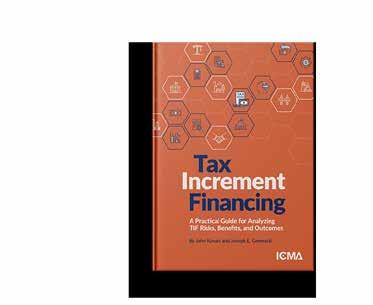
A Step-by-Step Guide to Tax Increment Financing
Tax increment financing is one of the most complex, controversial, and widely used economic development tools utilized by local governments. Written for local government professionals and practitioners in training, this book presents a practical approach to analyzing TIF projects by offering a stepby-step guide alongside real-world case studies that help readers unpack and decipher the complexities of TIF.
• Best practices from across the country
• Ways to make conversations and decisions less subjective and more objective
• The “inside baseball” of how TIF deals get vetted
• Downloadable spreadsheet templates that accompany the text
Avoiding the UTILITY Fiscal Cliff
How cost-plus pricing helps align rates, infrastructure, and long-term financial stability.
BY MAX FISHER
On a rainy Tuesday night in GeneriCity (our fictional municipality for this article), the council chamber was packed. A routine agenda item—utility rates—had drawn an unexpectedly large crowd. Residents insisted the city should “tighten its belt” and questioned why previous increases had not solved the problem. When the finance director walked through the numbers, even seasoned councilmembers admitted they were unsure how the current rates had been set. Staff left the meeting with a clear lesson: without a transparent methodology, rate-setting becomes a political minefield.
This scene is familiar across the country. Local governments of all sizes are navigating long-term inflation, supply-chain instability, aging infrastructure, and an ever-
widening set of federal and state regulatory expectations. These forces converge to create a looming fiscal cliff for many utilities: costs rising faster than revenue structures that were never designed to withstand sustained economic pressure. Yet rate-setting remains politically sensitive in almost every jurisdiction.
The result? Many communities rely on ad-hoc adjustments, postpone rate increases, or defer capital maintenance. Over time, these decisions create rate deficiencies: underpricing, thin reserves, and operational vulnerabilities that erode service reliability and public trust.
These challenges affect all utilities, whether serving 2,000 residents or 200,000. Leaders must balance affordability with financial sustainability, equity with operational reality, and political considerations with stewardship. As costs rise and regulatory expectations increase, CAOs need a ratesetting model that is adaptable and defensible.
This article introduces cost-plus pricing as a practical framework that addresses these needs. The method aligns with ICMA’s core values, particularly honesty, stewardship of public resources, and informed decisionmaking, while providing a clear, replicable process accessible to staff at all levels. The sections that follow outline why traditional approaches fall short, explain the costplus model in practical terms, and provide implementation steps and communication strategies for CAOs, assistant
managers, and analysts. And, as GeneriCity learned, the difference between stability and conflict often hinges on whether rate-setting is guided by transparent methodology or political momentum.
When Incremental Rates Fall Short
Local governments frequently rely on familiar rate-setting methods that appear manageable but fail to be fiscally sustainable. Understanding these limitations helps leaders recognize why a structured approach is needed.
Incremental Adjustments Mask Underpricing
Many communities increase utility rates incrementally—4% here, 7% there—without reassessing the underlying cost structure. This approach feels intuitive because it avoids spikes, but it rarely reflects real conditions. Over time, the gap between revenue and cost widens. Utilities become vulnerable to operational disruptions, emergency repairs, and depleted reserves. The central problem is simple: incremental adjustments respond to comfort, not reality.
Benchmarking Alone Is Insufficient
Benchmarking, comparing rates to nearby or similar cities, is a common tool to provide utility pricing context. However, it is not a rate-setting method. Benchmarking cannot account for local cost drivers; its focus is external.
A community operating a 40-year-old wastewater treatment plant cannot sustainably price service by
Cost-plus pricing offers a transparent and defensible framework for aligning utility rates with the cost of service while supporting long-term financial stability.
mimicking a neighbor with new facilities and lower operating costs. Therefore, benchmarking is most effective when paired with a cost-based method, such as cost-plus pricing, that ensures internal needs are met before comparing external prices.
Misalignment of Fixed vs. Volumetric Charges
Many systems unintentionally misalign cost recovery. Fixed costs, like personnel, plant operations, electricity, debt service, often represent a
majority of utility expenses. Yet some municipalities unintentionally recover these costs through volumetric rates.
This pricing creates financial volatility. A wet year or conservation mandate can reduce utility consumption, cutting revenue despite fixed costs remaining unchanged. Conversely, in a dry year, volumetric rates may burden residents during times of necessity. While an intentional conservation strategy can be to shift some fixed costs into the volumetric rate, accidental misallocation exposes the system and people to risk.
Political and Communication Barriers
Rate-setting discussions often begin only when expenditures exceed revenues or after contentious public meetings. If staff cannot explain how rates are calculated, skepticism grows. Residents may default to assumptions that the city is overspending or that rates fluctuate arbitrarily. Without a defensible methodology, staff are left reacting to public frustration rather than leading informed discussions. City/county managers and analysts need tools that simplify complex financial realities and build a foundation for transparent, proactive engagement.
What Is Cost-Plus Pricing?
Cost-plus pricing is a structured pricing method that begins with the actual cost of providing a service. It is widely used in industries
where input costs fluctuate or where major infrastructure requires periodic renewal. For local governments, the method creates transparent, predictable rates that support operational and capital stability. Cost-plus pricing aids in designing a rate that reflects present operating costs and can account for future needs.
Cost-plus pricing divides total utility costs into fixed and variable components. It then applies the following formulas: Fixed Cost Charge: (Fixed Costs × Margin) ÷ Number of Consumers
Volumetric Cost Charge: (Total Variable Costs × Margin) ÷ (Consumers × Average Consumption) Costs must match the billing period. For monthly billing, annual costs should be divided by 12; for bi-monthly billing, by 24. This ensures that revenue aligns with the time scale of expenses.
The margin represents reserve needs, inflationary pressures, and capital cycles. It is not profit; it is strategic reinvestment that protects the system from shocks and supports long-term
renewal. As Utpal Dholakia with Harvard Business Review notes, the method works best when organizations require stable revenue for reinvestment and when transparency can strengthen trust, conditions common to municipal utilities.1
Core Components
The model has four main steps:
1. Identify all fixed and variable costs. Include utility operations, personnel, insurance, electricity, chemicals, plant maintenance, and administrative overhead.
2. Allocate administrative and overhead expenses. Utilities often rely heavily on citywide services such as finance, HR, payroll, legal review, and IT. These costs should be allocated appropriately.
3. Determine the margin. The margin should reflect long-term capital needs, inflationary risks, and reserve requirements. It creates predictable, responsible funding for system renewal.
4. Translate costs into fixed and volumetric charges. This ensures that fixed costs are recovered through fixed
fees and variable costs through volumetric rates, providing stability and effective cost allocation.
Why the Method Is Defensible
Cost-plus pricing is defensible as a method as pricing is transparent and based on the system’s needs. It is able to link utility rates to costs, supporting planning and minimizing the need for emergency increases. Moreover, it is grounded in honesty and transparency, core tenets of the ICMA Code of Ethics, providing a consistent pricing framework. By aligning revenue with the cost of service, cost-plus pricing prevents the march toward fiscal cliffs caused by deferred maintenance and chronic underpricing.
Pricing
Utilities for the
Long-Term
This section provides a sixstep outline for the process of applying the cost-plus pricing model. Unique about the framework is its adaptability to local governments and simplicity to update through spreadsheet tools.
Step 1: Gather Data
Begin by collecting the utilityrelated expenditures, including operating costs, debt service and capital item costs, and administrative overhead. In addition, collect the number of utility consumers and the average level of consumption per billing period.
Step 2: Determine Fixed vs. Volumetric Components
Classify each cost as fixed or variable. Fixed costs are necessary for system operation regardless of consumption; variable or volumetric costs change with output. Assistant city/county managers, budget analysts, or general analysts can create a simple matrix sorting charges into categories. This is often the first step in illuminating unrecognized cost pressures.
Step 3: Select the Margin (“The Plus”)
Margin selection is strategic. You should consider capital renewal cycles, regulatory mandates, reserves and financial risk, equity and affordability, and inflationary pressures. Managers should engage councils early to explain what the margin represents and why it matters. Analysts can run sensitivity tests showing how different margins affect revenue and customer bills.
Step 4: Set the Tiers
Communities commonly use uniform rates or tiered structures. Tier design influences consumption behavior and equity outcomes. Leaders should compare percentage increases in each tier to regional peers and internal goals. Comparing percentage differences between your government and comparable
1. Examples of Total Cost by Consumption
governments’ tier percentage increase or decrease can help provide suggestions for making a rate more or less aggressive).
Step 5: Model Rate Scenarios
Using the cost-plus formulas, consider developing multiple rate scenarios. Options may include:
• A steady phase-in approach.
• An immediate adjustment.
• A more aggressive rate structure that anticipates inflation.
• A less aggressive structure emphasizing affordability. Analysts should provide scenario tables showing revenue stability, impact on different customer classes, and effects on reserves.
Step 6: Phase-In Strategy
Most communities benefit from multi-year rate transitions. Phase-in strategies reduce public resistance, ease cashflow shocks, and support long-range planning.
Leadership and Communication Strategies for CAOs
A strong rate model requires strong leadership. CAOs and their teams must guide councils and residents through a complex but essential process.
Transparency Tools: Effective tools include onepage rate explanation sheets, scenario comparison sheets, public-facing dashboards, and
annual methodology updates.
Basic spreadsheet software can generate tables showing cost allocations, average consumption, and the resulting rate calculations. Analysts play a key role in preparing clear, visually accessible materials. These tools reinforce ICMA principles of honesty, openness, and informed decision-making.
Council Engagement:
Rate-setting should be framed as stewardship, not politics. Managers should engage councils early, consistently, and annually, emphasizing how cost-plus pricing aligns with fairness, reliability, and fiscal responsibility. Managers can facilitate workshops where councilmembers walk through simplified versions of the model, improving understanding and buy-in.
Public Communication:
Transparent communication reduces resistance. Staff should explain the difference between fixed and variable costs, why the margin is necessary, and how gradual increases avoid crisis-driven spikes. Connecting rates to reliability and regulatory compliance helps residents understand value beyond cost.
GeneriCity Example:
A Fictional Scenario
GeneriCity, a mid-sized municipality with 10,000 accounts, provides a clear illustration. After years of incremental adjustments, staff
discovered revenue shortfalls and deferred capital needs.
Cost Classification
• Fixed costs:
$4 million annually.
• Variable costs: $2.5 million annually.
• Administrative overhead: $1.2 million.
• Combined fixed costs: $5.2 million.
• Total consumers: 10,000.
• Average monthly water consumption: 7,000 gallons.
Applying the Cost-Plus Model
GeneriCity selects a 5% margin to support capital replacement. The calculations are:
Fixed Cost Charge: ($5.2M × 1.05) = $5,460,000 ÷ 10,000 = $546 per year = $45.50 per month.
Volumetric Rate: ($2.5M × 1.05) = 2,625,000 ÷ (10,000 × 7,000 gallons × 12 months) = $0.003125 per gallon, or $3.125 per thousand gallons. The city then develops three scenarios:
1. Immediate implementation, raising average bills by 22%.
2. Three-year phase-in, increasing bills by about 7.5% annually.
3. Five-year gradual transition, emphasizing affordability. GeneriCity implements the three-year phase-in. Staff prepare clear summaries and host public workshops. The model’s transparency turns a contentious issue into an
informed and manageable dialogue. And on the next rainy Tuesday, GeneriCity found something unusual: a quiet council meeting.
Conclusion
Accurate and transparent ratesetting is essential for protecting community assets and ensuring reliable utility service. As inflation persists, infrastructure ages, and regulatory requirements expand, cities need a defensible and adaptable framework. Cost-plus pricing provides that structure. By classifying costs, selecting margins, and aligning rates to costs, the model helps avoid crisis-driven increases and supports long-term planning. City leadership plays a crucial rate-setting role. Implementing cost-plus pricing enables them to present clear, data-driven recommendations and avoid crisis-driven rate spikes. Municipalities that adopt structured methodologies and commit to routine updates can strengthen public trust and improve long-term outcomes.
ENDNOTE
1 Dholakia, Utpal M. 2018. “When Cost-Plus Pricing Is a Good Idea.” Pricing Strategy. Harvard Business Review, July 12. https:// hbr.org/2018/07/when-cost-plus-pricingis-a-good-idea.
MAX FISHER is assistant to the city manager of Levelland, Texas.
Figure
The Human Cost of Fiscal Shifts
A County Perspective on H.R. 1 (the “One Big Beautiful Bill Act”)
Pushing more responsibility and cost onto counties, reducing federal funding, tightening eligibility for safety-net programs, and accelerating the impact on our communities.
BY MONICA NINO
Contra Costa County, California, is a community of balance. We have waterfront cities and rural communities, heavy industry and open space, and innovation and agriculture.
But what defines us most is our role as the community’s safety net—where policy becomes practice and essential services meet real lives. In recent decades, Contra Costa County has had the ability to deliver services beyond what is mandated. County government is integral to providing healthcare systems and social services within their respective communities.
Our county government is at the center of the federal, state, and local partnerships that deliver healthcare, food assistance, safety-net services, and other important services to nearly 1.2 million residents in the Bay Area.
H.R. 1 at the federal level (also known as the “One Big Beautiful Bill Act” enacted in July 2025) and California’s fiscal year (FY) 2025–2026 state budget both represent a significant shift in that partnership. Together, they push more responsibility and cost onto counties, reduce federal funding, tighten eligibility for safety-net programs, and accelerate impacts to our communities. For counties like ours, the implications are operational, fiscal, and deeply human.
A Structural Shift, Not a Short-Term Adjustment
This is not a routine budget challenge. It is a structural realignment that will have long-lasting negative impacts on parts of the community served.
H.R. 1 reduces federal support for Medi-Cal (Medicaid) and CalFresh (SNAP). It reinstates work requirements, narrows eligibility for certain
Pittsburg, a city in Contra Costa County, California. Matt Gush - stock.adobe.com
populations, and cuts federal reimbursement for administration. Reduced federal participation combined with greater local responsibility applies more pressure on county services funded by the county general fund.
Out of a $7 billion budget for FY 2025–2026, general purpose revenues total $822 million, which is primarily funded by property taxes and used to meet required match requirements for federal- and state-funded programs, along with meeting public safety needs in the community.
Behind every data point and every dollar lost is a person who depends on these supports.
Costa Health Plan, serving approximately 270,000 members—265,000 of whom are Medi-Cal enrollees. We operate a public hospital and nine community clinics.
a conservative annual 3% expense growth factor. We also anticipate additional costs for uncompensated care to disenrolled residents.
In Contra Costa County, we locally administer CalFresh and Medi-Cal eligibility and operate the Contra
The estimated fiscal impacts of state and federal policy changes and funding reductions to Contra Costa Regional Medical Center are substantial. This includes cumulative impacts of more than $500 million in FY 2026–2031 and cumulative operating deficits of more than $1 billion during that same timeframe when these funding reductions are combined with
These losses occur while demand rises and operating costs continue to increase.
The Fiscal Cliff Facing Counties
Beginning October 1, 2026, federal administrative funding for CalFresh drops from 50% to 25%. At the same time, work requirements are reinstated for able-bodied adults without dependents. Administrative costs to the county are
Fall colors in the San Ramon Valley of Northern California.
projected to increase as reimbursement declines.
H.R. 1 has created new eligibility costs for Medi-Cal and CalFresh that are currently not funded. The unfunded mandates include assessing and monitoring work requirements and exemptions for both programs and adding a second annual renewal for Medi-Cal. Medi-Cal eligibility changes begin in 2026 and expand in 2027, including expanded work requirements and elimination of eligibility for certain non-citizen populations. By 2029, as many as 93,000 Contra Costans could lose health coverage.
For CalFresh, approximately 110,000 residents rely on the program each month. An estimated 11–16% of cases may lose eligibility, increasing food insecurity. Federal policy will also shift a portion of food benefit costs to states.
These changes do not happen all at once, but they begin soon and compound quickly. Counties are required to administer these programs regardless of federal participation levels. When reimbursement drops abruptly, the fiscal gap must be absorbed locally through service reductions, staffing reductions, hiring freezes, or deferred investments.
County reserves alone will not solve these ongoing, structural challenges. The scale and duration of the impacts require structural planning, advocacy, and operational adjustments.
The Human Consequences
These supports were designed to help encourage economic self-sufficiency. Our social safety net helps bolster the broader
When the federal-statelocal balance changes, the effects are felt first, and longest, at the county level.
declines, more uninsured residents will seek care at county-operated clinics and emergency departments at the same time that reimbursement is shrinking. We recognize these changes will also impact other health facilities run by other organizations.
The result has a double impact: reduced revenue and increased demand.
This is why we are planning early and looking within for efficiencies and effectiveness. Waiting would put both services and fiscal stability at risk.
economy and build brighter futures for people and families.
Most importantly, behind every data point and every dollar lost is a person who depends on these supports.
It’s the senior relying on in-home support to remain independent. It’s the working parent navigating the CalWORKs Temporary Assistance for Needy Families (TANF) program while trying to keep food on the table. It’s the individual in behavioral health crisis seeking care at our public hospital.
New eligibility rules could affect roughly half of MediCal enrollees. As coverage
Our social workers will manage larger caseloads. Eligibility workers will process more complex and more frequent eligibility reviews. Health systems will absorb greater uncompensated care. These pressures directly affect service access, wait times, and long-term community outcomes.
What This Means for County Government
H.R. 1 signals a lasting recalibration of intergovernmental finance. More residents will need county services as fewer qualify for federal and state healthcare and food programs. Counties must absorb higher administrative workload, reduced reimbursement, and increased pressure on health systems—all while maintaining fiscal stability.
Our focus is protecting essential services while preparing responsibly for what lies ahead. That means strengthening fiscal forecasting, monitoring implementation timelines, advocating with state and federal partners, and communicating clearly and transparently with our board of supervisors and our community.
County government operates closest to the people we serve. We are where federal policy becomes local reality. When the federal-state-local balance shifts, the effects are felt first, and longest, at the county level.
Our responsibility now is to navigate that shift with discipline, transparency, and an unwavering commitment to the residents of Contra Costa County.
MONICA NINO
is county administrator and clerk of the board for Contra Costa County, California.
Navigating Financial Challenges Through Priority-Based Budgeting
Clarity, alignment, and accountability when every dollar has to work harder.
BY CHRIS FABIAN
ocal governments are entering a more constrained fiscal era. Federal stimulus funding has receded; costs for labor, infrastructure, and services continue to rise; and workforce limitations persist. At the same time, demand for services has not declined.
This is not a short-term cycle. It is a structural condition.
The traditional response has been to reduce services or increase taxes. That approach limits strategic choice and often weakens public confidence when tradeoffs are unclear. Priority-based budgeting offers a different model. It is not simply a budgeting technique. It is a governance approach that enables leaders to allocate resources based on outcomes, service impact, and community priorities.
Moving Beyond Line-Item Budgeting
Line-item budgeting remains essential for financial control. It ensures accountability and compliance. However, it does not clearly show how spending translates into results.
Priority-based budgeting builds on the foundation of line items by connecting spending to the services it enables. It organizes financial inputs around programs and outcomes, adding context such as populations served, funding sources, mandates, and alignment with strategic goals. This changes how decisions are made. Leaders are no longer limited to incremental adjustments. They can evaluate the full portfolio of services across departments, compare relative impact, and make deliberate tradeoffs.
The question shifts from “What can be reduced?” to “What delivers the greatest value?”
From Financial Data to Operational Clarity
Local governments already have extensive financial data. The limitation is visibility.
At the line-item level, information is fragmented across departments. It is difficult to identify duplication, assess impact, or compare services. Tradeoffs are often implicit rather than explicit.
Cutting-edge software such as Tyler’s Priority Based Budgeting uses AI to organize this information into a program-level view. It creates a system-wide understanding of services, including cost, purpose, and alignment with community priorities. This enables three critical shifts: • Tradeoffs become visible and defensible.
• Redundancies and gaps can be identified across departments.
• Alternative funding strategies can be evaluated with clarity. Leaders can explore options beyond cuts or taxes, including fee structures, partnerships, and service redesign. Financial data becomes actionable.
Case in Point: Liberty Lake, Washington
Liberty Lake, Washington, implemented Tyler’s Priority Based Budgeting to prepare for future fiscal pressure rather than react to it.
Since its incorporation in 2001, the city has grown to approximately 14,000 residents with a rapidly expanding commercial base. Its budgeting process relied on detailed line-item reviews and extensive council analysis of large financial documents. This approach provided control but limited strategic insight.
“It was mechanical, very antiquated, and not very strategic,” says Mark McAvoy, city administrator for Liberty Lake. “We’re a young city, so we haven’t gone through that first round of infrastructure rebuild or replacement. When that time comes, we might not be able to budget from a surplus position.”
City leadership recognized a risk. As infrastructure ages and replacement cycles accelerate, the city will not be able to rely on surplus fund balances to fund infrastructure preservation. A more strategic and forwardlooking approach was needed.
By shifting to a programbased framework, Liberty Lake created a clear link between spending and strategic priorities. Priority Based Budgeting used AI to translate line items into programs and then to determine costs and evaluate the programs based on alignment and impact.
This changed how budget discussions occurred. Instead of reviewing hundreds of line
items, leaders assessed services based on cost and value.
Quadrant analysis allowed decision-makers to see which services delivered high impact relative to cost and which required reconsideration.
The effect was measurable. During the 2026 budget process, 76% of new funding requests were tied to programs rated as most or more aligned with city priorities.
This shift influenced behavior. Departments framed requests in terms of outcomes and alignment rather than inputs. Council discussions focused on investment strategy rather than line-item detail.
Liberty Lake established a system designed to function under constraint before constraint arrived. “We wanted to convert to a process and a system that we knew was agile enough to allow us to adjust when times weren’t as great as they are now,” says McAvoy. “Implementing
Priority Based Budgeting allows an organization to focus on investment and return on investment.”
Case in Point:
South Jordan, Utah
South Jordan, Utah, faced immediate fiscal pressure and needed to act quickly. During the 2007–2008 economic downturn, leadership was asked to reduce the budget by $3 million without clear direction. Most expenditures were tied to personnel. A traditional approach would likely have resulted in acrossthe-board reductions affecting core services.
“We needed a holistic approach that provided elected officials and other decisionmakers a new lens to ensure our community maintains and preserves its highly valued programs and services,” says Sunil Naidu, South Jordan’s chief financial officer.
The limitation was not effort. It was the lack of a clear view of service impact.
By reorganizing the budget around programs such as police operations, fire response, and community services, South Jordan created a direct connection between funding and outcomes. Like the Liberty Lake process, Priority Based Budgeting applied AI to the city’s financials and was able to link spending directly to priorities.
This changed the nature of decision-making. Leaders could evaluate scenarios based on service impact rather than department totals. They could explain tradeoffs in terms residents understood, such as response times and service levels.
The city also incorporated resident feedback. Survey
“We wanted to convert to a process and a system that we knew was agile enough to allow us to adjust when times weren’t as great as they are now.”
data was linked to service performance, allowing leaders to align funding decisions with community expectations.
The outcome differed from neighboring jurisdictions.
South Jordan maintained its full-time workforce while others implemented layoffs and program reductions. Decisions were targeted and informed rather than broad and reactive.
Trust improved as well. Leaders could clearly show how resources were allocated and what changes would mean in practical terms.
“The ability to provide clarity to elected officials and the community is invaluable,” says Naidu. “Priority-based budgeting has transformed how we communicate our priorities, and Tyler’s solution makes that communication possible.”
What Changes for Government Leaders
This approach changes how managers operate, not just how budgets are presented. Budget discussions shift from
departments to services. Tradeoffs become explicit and supported by data, and resource allocation is tied directly to outcomes and priorities.
In addition, communication with elected officials and residents becomes more clear and precise. Leaders are able to explain not just what decisions were made, but why they were made.
Enabling Faster, More Informed Decisions
In both cities and counties, governments are adopting tools that support program-level analysis and accelerate implementation. These capabilities allow jurisdictions to:
• Build inventories of programs and services quickly.
• Evaluate cost and impact across the organization.
• Identify opportunities for consolidation or alternative funding.
• Move from analysis to decision-making within compressed timelines. The result is faster alignment between strategy and execution.
A Shift in Perspective
Adopting the priority-based budgeting approach requires a change in perspective.
Traditional budgeting emphasizes scarcity and incremental change. This approach emphasizes optimization and intentional allocation. Departments define their work in terms of outcomes. Leaders engage directly with tradeoffs, and organizations develop a consistent framework for evaluating services across the enterprise.
The result is greater clarity and stronger alignment between spending and community priorities.
Navigating the Fiscal Cliff
Fiscal uncertainty is now a defining condition for local government. The question is not whether constraints will emerge, but how prepared organizations are to respond.
Priority-based budgeting equips leaders to act with precision. It connects resources to results, makes tradeoffs visible, and supports decisions that can be explained and defended.
In the next budget cycle, the central challenge will not be identifying cuts. It will be determining which services are sustained, which are adapted, and which are reduced.
That requires more than incremental budgeting.
It requires a system that can clearly answer a fundamental question: which investments deliver the greatest value to the community and why.
CHRIS FABIAN is senior director of product strategy for Priority Based Budgeting at Tyler Technologies. He has helped more than 300 government entities and schools implement priority-based budgeting. Chris is the co-founder of what is now Tyler’s Priority Based Budgeting. This budgeting methodology leverages machine learning and AI to predict and identify prioritybased budgeting opportunities and savings. He has served as an internal business consultant for local government. (chris.fabian@tylertech.com)
Rethinking Service Design in an Era of Fiscal Constraint
How journey mapping and segmentation help cities and counties serve better—especially when budgets tighten.
BY QUISHA LIGHT
Across the country, local governments are being asked to do more with less. Costs are rising, revenues are uncertain, and communities are navigating increasingly complex challenges. In these moments, it is easy to turn inward and focus on budgets, staffing, and structure.
I have felt that pull myself. But I have also learned something important. Residents do not experience our budgets. They do not experience our organizational charts. They experience us in moments. Moments when they need help, when they are confused, and when something
is not working the way they expected. And in those moments, they decide whether they trust us.
What we often underestimate is that the experiences people have in those moments are shaped long before those moments ever occur. They are shaped by the systems, tools, and decisions we design when pressure is lower and options feel broader.
That realization has shaped how I think about leadership, especially during times of fiscal constraint. If we make changes without understanding how people experience our systems, we risk making
things harder, not better. We risk increasing the friction and fragmentation that may already exist in public service delivery, especially in moments when resources are constrained and the margin for error is smaller.
This is why the work of understanding and designing experiences cannot wait until times of constraint. It must begin earlier, when we have the space to see clearly, test approaches, and build systems that can hold up under pressure. Because the systems we design in stable times determine how well we serve in constrained ones.
The question, then, is where does this work begin?
When Change Feels Different on the Inside and Outside
In Portland, we are navigating both fiscal pressure and structural change. Our form of government has shifted, roles have evolved, and we are exploring ways to centralize services like human resources, procurement, and technology. These are necessary changes, but they do more than improve efficiency. They reshape how work happens and how those changes are felt by both residents and employees.
From a leadership perspective, these efforts are about alignment and responsible use of limited resources—and they should be. But they also influence something less visible and just as important: how those changes are experienced in practice.
And that has led me to ask some different questions. What
does this feel like to the employee trying to do their job? What does this feel like to the resident/ business trying to get help? Because those answers are not always the same as what we see on paper.
A process that looks streamlined in a chart can feel very different to the person navigating it. What appears efficient on paper can translate into multiple handoffs, delays, and uncertainty in practice. And when that happens, the burden does not disappear. It shifts. And it often lands on employees, and ultimately, on the residents we serve.
That tension creates a critical leadership responsibility. When our systems tell one story but experiences tell another, leadership must close that gap. And it starts by looking at the experience of the people closest to the work.
Every Experience Starts with an Employee
The closest place to see that difference is through our employees. Behind every resident interaction is a public
employee trying to help someone solve a problem. It might be someone calling because they are struggling to pay their bill or trying to understand whether they qualify for assistance. It could be a developer trying to make their way through the city’s permitting process. These are not simple transactions. These are moments where people may already feel stressed, uncertain, or even embarrassed.
Our employees want to help in these moments. But too often, they are navigating systems that were not designed with their experience in mind; systems that become even more difficult to navigate when resources are stretched and demands increase: multiple databases, disconnected platforms, layered policies, and processes that require coordination across teams. Over time, those systems force employees to create workarounds.
When resources are limited, those workarounds are not just frustrating, they are costly and consume resources that
If we make changes without understanding how people experience our systems, we risk making things harder, not better.
organizations can no longer afford to lose. And, from the inside, those workarounds become normal. From the outside, they feel like friction and fragmentation.
Within the Portland Water Utilities’ Customer Service group, I introduced journey mapping as a way to help a few employees step back and look at our financial assistance program differently.
We did not complete a full end-to-end journey map, but we did begin exposing employees to what it means to look at and experience a service from the customer’s or resident’s perspective. And even that initial work was enough to surface important insights.
We know that some residents are unsure whether they qualify for assistance. Others delay applying because of stigma, language, and other barriers. Some struggle to gather the documentation required to complete an application. These are realities our employees encounter every day as they try to help people navigate the system.
What became clear is that we had already learned many of these things through years of experience, and we often keep learning them the hard way. Journey mapping provides a way to learn them more intentionally. It gives us a tool to understand, empathize, and analyze the experience end to end, so that when pressure increases, we are not reacting blindly but operating from a clearer understanding of how our systems really work for customers. That clarity becomes especially important when resources are constrained and decisions must be made quickly and with confidence.
When we begin to see the experience comprehensively, we can identify issues more quickly and address them more holistically, rather than responding to problems one at a time. It creates space for us to step back, see the full experience, and move beyond piecemeal fixes toward solutions designed for how people actually interact with our services.
That powerful shift in perspective allows us to
Segmentation helps us understand who we are serving. Journey mapping helps us understand how they experience us. Together, these tools can fundamentally change how cities design programs and services.
identify where we’re asking too much of residents and where employees are compensating for gaps in the system. And, it helps us see where our programs may not always be delivering the outcomes we intend. We move from reacting to individual challenges to designing systems that better support both residents and employees from the start.
Journey mapping does not replace what we learn from experience, but it helps us see thing sooner, more clearly, and more consistently across our organization.
Seeing People Clearly Changes How We Design
As we began looking more closely at our financial assistance program, it became clear that we were not serving one type of customer. We were serving many, and needed to start identifying these different customer profiles, understanding that each is navigating our programs and the city in their own way.
A single mother living in an apartment and receiving SNAP benefits experiences the city differently than a retired couple who has lived in their home for 40 years and is managing rising costs on a fixed income. A small business owner balancing both their home and business costs, while planning for retirement has yet another experience.
When we treat these residents as if they are all the same, we miss what matters: how they experience our services, how they interpret our actions, and how those interactions shape their trust in us.
The same is true for our employees. A recent college graduate entering their first public service role brings different expectations and needs than someone who has worked for the city for 25 years and is looking for ways to continue making an impact as they approach retirement. Another employee may be mid-career and ready to take on more responsibility and grow into leadership.
We also see differences in how supervisors, middle
managers, frontline staff, and executive leaders experience the organization. There are differences between represented and nonrepresented employees, between those who are closest to the work and those shaping it.
Each of these perspectives matters because each one experiences the system differently. When we treat employees as if they are all the same, we miss what matters most: how they experience their work, what they need to be effective, and how well our systems support or hinder them.
This is where segmentation, or identifying different profiles, becomes a critical tool. When we begin to understand these different profiles through segmentation, we start to see patterns. We see where policies land differently. We see where communication does not connect. We see where systems support people and where they slow them down. And once we see those patterns, we can no longer (or should no longer) design the same way.
That understanding allows us to design programs and services differently. It helps us
In times of fiscal constraint, trust becomes the foundation for effective decision-making.
about how decisions are made, who is involved, and how consistently and clearly those decisions are explained.
Trust is not built in a single decision or moment. It is built across many small moments and decisions. If experience is where trust is felt, then decision-making is where trust is won or lost.
Designing Through Constraint
align the way we work with how people experience us, allowing us to serve both employees and residents more effectively. And, when budgets are tight, it allows leaders to direct limited resources where they will have the greatest impact.
It also changes how we make decisions. Once we begin to see what it is like for residents and employees to experience our systems, we have to ask a different set of questions. Not just what works, but for whom. Not just what is efficient, but what is clear, consistent, and trustworthy. And that is where data, technology, and governance begin to matter in a different way.
Building trust is not just about the tools we use. It is
Fiscal constraint forces difficult decisions. There is no way around that. But I have come to believe that how we decide matters just as much as what we decide.
Before we centralize a service, we must understand how people are using it today. Before we reduce staffing, we must understand where employees are already carrying invisible burdens. Before we redesign a process, we must understand how it feels to move through it. This is not about slowing down decision-making. It is about making better decisions, especially when resources are limited.
When we take the time to understand experiences, through tools like segmentation and journey mapping, and by
listening to what employees and residents are already telling us, we can reduce unnecessary complexity and cost for governments and our communities. We can identify where services are not working as intended and address issues more holistically rather than through piecemeal fixes.
Segmentation helps us understand who we are serving. Journey mapping helps us understand how they experience us. Together, these tools can fundamentally change how cities and counties design programs and services.
We can support employees more effectively. We can make it easier for residents to navigate services. We can also ensure that the resources we do have are used in ways that create the greatest and best impact. In doing so, we protect something that is easy to lose and hard to rebuild—trust.
Residents may not remember the details of a budget decision or a structural change. But they will remember how it felt to interact with their city, and whether the system worked when they needed it most. Those experiences shape trust.
So, in times of fiscal constraint, trust becomes the foundation for effective decisionmaking. It allows us to make difficult choices, stand behind them, and move forward with our communities. That trust is built by understanding how people actually experience our services, and using that insight to design and deliver them in ways that truly work.
QUISHA LIGHT is the public works customer service division manager for Portland, Oregon.
Fraud Risk Hides in OPERATIONS
Internal control vulnerabilities that quietly invite embezzlement—and how to close them
BY EDEN RATLIFF, ICMA-CM BRIAN ROBINSON, PhD, AND DAVID ROSS, PhD, ICMA-CM
Accountability
Without Blame
Local government leaders often face the harshest public scrutiny when unforeseen problems arise. When fraud or financial misconduct happens, they must ask themselves: how did this occur on my watch?
The problem is that many internal control weaknesses go unnoticed until a loss happens. Demonstrating true integrity requires more than good intentions. It demands a willingness to identify risks that are not yet visible and to go beyond the assumption that everything is fine because we have an annual audit, trust our employees, follow policies, and nothing has been found before.
Internal control resiliency is a leadership responsibility. It protects public trust, safeguards employees from suspicion or accusations, and reduces the likelihood of costly insurance claims or damage to reputation.
Palm Bay, Florida, with a population of approximately 157,814, provides a compelling example of how organizations can proactively strengthen their internal controls before issues develop into crises. On the flip side, some communities find themselves doing everything they can to recover from an embezzlement by a trusted employee or official.
The Worst Day
Imagine you are an official in a small community renowned for its rural charm, situated near a charming downtown area. With 9,000 residents, it feels like everyone is your neighbor. Your local government works together to make marginal progress in a place people love to call home. Your administration is focused on preserving open space, building trails and greenways, managing land development pressures, and maintaining your community’s sense of pride and place.
Then one day, the bank calls. They have three checks totaling $750,000 written directly to a township employee. Your name is a signatory on the checks. A few hours later, you are in the township building, where law enforcement finds a hidden stamp with your name on it. This is what happened in Kennett Township, Pennsylvania, where the township manager was discovered to have embezzled $3.2 million in taxpayer funds over a seven-year period. The scheme utilized credit cards, signature stamps, payroll manipulation, e-trade accounts, direct deposits, and check-writing practices. The former manager was a long-time employee who was trusted by the governing body, staff, and community. There was nothing in the financial oversight practices, reporting, or operations to suggest there was an ongoing theft.
An award-winning community that was once viewed as a leader in the local government space spent the next several years trying to restore community
trust, participating in the investigation and prosecution process, rebuilding its institution, and working to recover as much of the stolen funds as possible. The embezzlement had a devastating impact on the organization and the community.
The State of Fraud Risk in Local Government
Each year, governments in the United States experience hundreds of cases of embezzlement, procurement manipulation, utility billing fraud, cyberattacks, ACH vendor payment fraud, and other theft of public funds. Many of the largest losses ever seen by public sector insurance carriers involved highly trusted and respected employees. Several welldocumented cases have resulted in eight-figure losses, including those exceeding $53 million in Illinois and $39 million in Arizona. These incidents demonstrate a universal reality. Serious fraud risk vulnerabilities exist across governments of every size. Fraud is almost always committed by someone who is
Only about 3% of fraud is detected through external audit, according to the Association of Certified Fraud Examiners.
respected and known. This is not because public employees are untrustworthy. It is because opportunity exists quietly within operations, and strong controls determine whether that opportunity can be exploited. When internal pressure and rationalization to commit the fraud have already occurred, the only thing reducing risk is opportunity.
Why Leaders Believe Vulnerabilities Do Not Exist
Many executives feel confident that their organizations are protected. That confidence is typically grounded in several assumptions:
• The government receives a clean annual financial audit that would alert management to major problems.
• The staff reports that controls are functioning properly.
• Employees are trusted and long tenured, creating the belief that misconduct is unlikely.
• Nothing concerning has ever surfaced before.
• Policies have been written and are believed to be sufficient. These beliefs are understandable. They are also incomplete. Audits are not intended to be fraud risk assessments, as management is solely responsible for establishing and maintaining internal controls within the organization. Policies often exist on paper but may not reflect current technology or workload realities. Most importantly, risk evolves faster than oversight mechanisms,
unless leaders intentionally update them.
These assumptions do not indicate that risk is under control. They are evidence that risk has not yet revealed itself.
Understanding Why Fraud Happens
The fraud triangle describes three conditions that allow misconduct to occur: An individual experiences pressure, the individual is able to rationalize the behavior, and most importantly for public managers, there is opportunity. Opportunities arise when oversight is inconsistent, access is excessive, or duties are consolidated without adequate review. Leaders cannot eliminate personal pressure or rationalization. Leaders can significantly reduce opportunities.
Palm Bay, Florida’s Proactive Commitment to Integrity
Palm Bay, Florida, recognized that safeguarding its organizational integrity required a deeper understanding of its control environment.
Management launched a fraud risk vulnerability study targeting several highexposure areas. This initial review demonstrated the importance of independent analysis and uncovered previously unidentified control weaknesses.
Rather than stopping there, leadership elected to expand the review to the entire organization. The expanded study evaluated internal control design and oversight throughout every department and function. The findings
Figure 1.
Internal Control
Vulnerability
Inadequate segregation of duties
Excessive system access permissions
Vendor management
Manual approvals
Limited data analytics
Cybersecurity gaps
No job rotation
Internal control weaknesses remain one of the highest causes of fraud and embezzlement events in public operations.
Shell companies, inflated invoices, ACH vendor payment fraud
Forged signatures, check tampering
P-Card misuse
Social engineering, phishing, spear phishing
Long-term concealment
created a roadmap for corrective action. The city used the results to:
• Clarify roles and responsibilities.
• Strengthen separation of duties.
• Improve system permissions and supervisory review.
• Modernize policies and procedures.
• Enhance cyber and social engineering defenses.
• Increase internal transparency and accountability.
• Implement a new enterprise resource planning (ERP) software with advanced security controls.
The benefits extended beyond operations. The commitment to integrity increased confidence among insurance carriers, improved credibility with rating agencies, reassured elected officials, and strengthened trust among employees and residents.
Root Cause
One person controls multiple steps
Access not aligned with job changes
Weak MFA controls
No real-time audit history or or access control logs, no exception reporting
Analytics not applied
Training not updated to current threats
Pattern remains invisible
A Call to Responsible Governance
Public trust is built on prevention, not recovery. Leaders are judged not by whether fraud attempts occur, but whether controls exist that make misconduct difficult to execute and easy to detect. A clean audit does not mean operational protection. What leaders do not know can truly harm them, their employees, and their communities.
Palm Bay’s example reinforces a timeless lesson. Integrity requires action long before a crisis emerges. Every local government c an strengthen confidence, stability, and credibility by taking a proactive approach to internal control resiliency so that hopefully your worst day never materializes.
EDEN RATLIFF, ICMA-CM is a manager currently in transition.
BRIAN ROBINSON, PhD, is deputy city manager of Palm Bay, Florida. (brian.robinson@ palmbayfl.gov)
DAVID ROSS, PhD, ICMA-CM CFE, CICA, is president and CEO of 65th North Group, a local government consulting firm specializing in internal control resiliency, fraud risk vulnerabilities, and public sector operational efficiency. (dross@65thnorth.com)
CONFERENCE
Apply for a Conference Assistance Scholarship
Ready to grow your network and bring new ideas back to your community? ICMA scholarships can help make your trip to the 2026 ICMA Annual Conference possible. If you serve a small community, are early in your local government career, bring a unique perspective to the profession, or are pursuing a graduate degree, you may be eligible!
SCHOLARSHIPS AVAILABLE:
Conference Assistance Scholarships
Available to ICMA members who meet one or more of the following criteria:
• Serve a small community with limited financial resources.
• Have three years or less of experience as a full-time local government employee.
• Represent diverse backgrounds, identities, or experiences.
Edwin O. Stene Scholarship
For ICMA student members who are full-time graduate students.
Apply today and take the next step in your local government career!
LEAD UP, LEAD OUT, AND LEAD WITHIN
City/county managers must have courage to lead up with their governing body, lead out into the community, and lead within their organization.
BY JAN PERKINS, ICMA-CM AND TAMARA LETOURNEAU, ICMA-CM
In the early days of the council-manager form of government, city managers such as L.P. Cookingham, who was hired by a reform city council in Kansas City, had to have great courage to clean up a corrupt city hall. He was fulfilling the will of that new city council, but he was leading up as well. He was not sitting back to take direction; he saw what needed to be done, proposed new policies, encouraged the council to do their best on their reform agenda, and turned that government around. He also led outwardly in the community. It is no accident that multiple public buildings are named after him, or that community members at the time and later not only knew about him but knew him personally. He was out in the community. While he was simultaneously leading up and out, he was also leading within the organization. He had to provide leadership for building a new structure, creating solid purchasing and hiring practices, instilling professional management, and modeling the ICMA Code of Ethics. Generations later, he is considered a legend.
City and county managers today also do much more than implement governing body policies. Too often we simplistically describe the dichotomy of roles as setting policy (council) and implementing policy (chief executive). Not only is it far more complicated than that, but it ignores the leadership imperative that our form of government requires if we are to truly serve all the people and leave our communities better than when we found them. So let’s talk differently about the role of the city or county manager. Let’s start our description of the role as that of a leader.
How Has Local Government Changed?
There have always been challenges—some bigger than others—for our local governments. That is the nature of the business. It is more complicated today, and that is likely true of every generation.
There is more turnover on our governing bodies. In some cities, very few people want to run for office. And when they do, they have not had any prior experience on an appointed volunteer city board, school board, or other place where they could get some experience with government. It is not uncommon for some people to run for local office who have a disdain for their city government and are uninterested in the process of governing.
In today’s world, communication travels instantly. We often see people leaping to conclusions without checking facts. There is little grace shown. The default seems to be to assume the worst.
Many are quick to post a “fact” online and get their neighbors riled up. Too often, city officials hear demands from people and in the same breath hear them say, “and don’t ask me to pay for it.”
Leaders—not administrators—are needed to solve the big challenges. Here are a few challenges to think about.
Re-energizing what it means to be a resident of the community: This goes beyond promoting civil discourse, which is baseline. Leaders must first turn the temperature down on the rising incivility if we are to protect our local democratic institution of local government. But communities are formed so that people can tackle common interests in ways that they cannot do alone. So, energizing a sense of “we are individuals together for a common purpose” is important in tackling the big issues of the community. This also means city/county managers must take the lead with the governing body to aid them in focusing mostly on what values they share rather than their differences. For community problems to be solved and beneficial results to be gained, civil discourse and a greater sense of “we’re in it together” is needed.
Pulling back from the infrastructure cliff: Streets, sewer systems, parks, and buildings that were shiny and new in the 1950s and ’60s are on life support in many towns and communities. No one wants to pay for something that is underground. But if it doesn’t work, then people notice (and complain). The impacts of climate change will only make
the infrastructure gap worse. Only through speaking the truth about this and creating a real long-range plan within the community will collapses be averted. It should not have to wait until a failure occurs.
Conducting long-term financial planning: Financial precarity is real. Looking at the short term (fewer than five years) does not give the chief executive and governing body enough of an understanding of the choices that will have to be made at some point with rising pension rates, compounding salary increases, higher maintenance costs, revenue dips, and other factors. With recession cycles, unexpected loss of grants, long-term liabilities, and more, planning beyond five years is essential. The best organizations prepare 10-year financial forecasts or longer, which they update annually. Long-range forecasting provides critical context for the decisions made today that will impact the local government’s financial position in future years. Shortterm focus gets a municipality into trouble!
Expecting external shocks: Big things happen that cannot be predicted. Too often, local governments plan as if all will be well. But in looking back over any local government’s history, there are likely at least two or three major shocks that will require an infusion of unplanned dollars. What can be counted on is that something will occur. It may be another pandemic, a devastating flood or earthquake, a dismantling cyberattack, or a surge in homelessness that causes stores to shutter. Leaders need to set time and money aside to respond to these crises quickly.
Embracing regional solutions: Problems do not stop at a town’s border. Complex issues can be shared with solutions created through regional collaboration. City and county managers can pool knowledge and resources to optimize public dollars. It might mean letting go of control, but it can result in better results for the people in the region.
Anticipating an increase in aging populations: The predominant focus of recreational and community services in local governments has been on activities for young people. That will always be an important priority. But increasingly, communities are experiencing an aging demographic that will require a well-thought-out plan to address the needs of this important segment of the population. Many seniors are active and we see a proliferation of pickleball courts and outdoor activities geared toward them. But some seniors will need greater accessibility to transportation, such as locally provided ride share services and more. There is a growing market for senior-oriented housing at all levels, from upscale to low-income. Meeting the interests of an older population will require different types of planning and resources.
Keeping up with and utilizing technology: This is moving at a very fast pace. How do we use AI ethically and practically? How do we utilize automation and analytics? It is likely local governments will have fewer employees doing routine work due to automation and pure affordability. Technology will continue to provide avenues for streamlining routine transactions, drones
are already being used for some law enforcement tasks, AI is eliminating many jobs in the private sector, and this likely will occur in public organizations as well. Leaders should embrace the power of analytics to make more informed decisions, creating dashboards that explain, through visualizations, not only “what” we are doing but “how well” and “what we need” for the community.
Supporting employees’ success: As the job market gets tight in all industries, local governments will have an opportunity to recruit from a wider pool. A key will be to not only go for the expertise, but for people who care about public service. Local government works best when the entire team of staff embrace the mission of the organization, as well as strive to do their best work as professionals. Creating a positive work environment that fits the local government’s values, as well as providing the coaching and training needed for staff to be successful supervisors, will be an ongoing challenge.
What Does This Mean for the Chief Executive?
The chief executive will need to have courage to lead up with their governing body, lead out into the community, and lead within the organization. The last category is our traditional role. Here is what we mean by each.
Lead Up
City councils, county boards, and town commissions have traditionally looked to their appointed chief executive for advice and recommendations. With the complex challenges facing our communities, the
chief executive will need to actively engage their governing bodies in finding policy solutions. Some solutions will be really tough, requiring courage. Any long-range forecasting or getting a city off the infrastructure cliff will need not only strategic planning, but clearheadedness about why the common good of the community required action. Elected officials will want to know what you think, but the imperative will be greater given the extent of some of the challenges. Here are some steps you can take:
It starts with respect. Assume each elected official has the best interests of the community in mind. Start with that and find out what their hopes and dreams are for the community.
Have a vision. Create a common vision with the governing body for how they see the community well into the future. Use that as the guide, the “true north” for how you talk with them about the tough issues.
Establish goals. Lead the council or board in short- and long-term goal setting and strategic planning. Knowing where they want to go and how to get there will be key to
solving problems that have a financial impact.
Create norms for governing. Initiate with your governing body a process to create a set of norms or principles for governing and working together and with staff. Teamwork is key to the success of the small things and crucial to solving big challenges.
Thoroughly orient new elected officials. Start when candidates are on the ballot to orient them to the form of government. They may not have any idea what it means to be in a council-manager form of government. Then once elected, provide sufficient orientation and training so that on day one in the council or board meeting, the newly elected member can understand their role. Continue to orient and support their understanding as they get their “sea legs” as a new member of the elected body. Do not assume they understand the protocols, your role as chief executive, or their own role.
Conduct one-on-ones.
Schedule and conduct regular individual conversations with each governing body member. This is foundational—not only for building trust, but as you deal with the tough issues, you will have a base from which to convey solid information and context. The “no surprise” rule can be supported by these one-on-ones, which means no surprises from you or from the elected official.
Lead Out
A truism is that “people trust people they know” and conversely do not trust people they do not know. While the council’s role is that of community representative, it is also essential that the city or county manager be engaged
Employees want a leader who shows they care, as well as a leader who inspires confidence that the tough issues of the day will be handled.
and show they care about the people of the community. During a crisis, or when you need the community to rally around a common good, being a real person, not just a “name behind a desk” matters. Here are some steps you can take: Be visible. The extent will vary by locality, but find those venues to be in person with people. It might be at special events, service club meetings, a neighborhood watch or community emergency response team (CERT) activity, or the farmers market. Introduce yourself. Ask people what is on their minds. Listen to understand. This allows you to get a direct line into the community so that all of your views are not filtered through your front line staff.
Get your staff out there. The demands of daily work often get in the way of executive staff and managers being out in the community. But that is at our peril as a local government. When times are tough, if our executive staff are not known, they can be misunderstood and not given the benefit of the doubt. Find ways for constructive dialogue, as well as simply having staff get to know community members.
Use this as a way to build alliances with businesses, local organizations, schools, and other community groups. As the leader of the organization, it is important to train your staff on how to do this effectively. Your executive staff need to be out there for direct awareness of how community members are viewing local government. Expand ways to gain community input. Public hearings are required but not sufficient for truly understanding the desires of the community. Online methods are useful but not adequate either. People are busy working, getting their children to school, and just living their lives, so find ways to go to them. It might be at a local shopping center, farmers market, a religious center, or homeowners association meeting. Use multiple avenues. And keep in mind that the loudest voices, or even the “most” voices, are not all the voices that you need to be mindful of. The silent ones must also be cared for.
Lead Within
Your staff want and need connection with you. The same truth about trusting people you know also applies to the leader of an organization. To build this, getting to know the people who do the daily work for the community matters. In a small organization this may be easier, but even in a large organization, there are ways to engage. We rely not only on the skills of our employees, but on their commitment and belief in the work and mission. Employees want a leader who shows they care, as well as a leader who inspires confidence that the tough issues of the day will be handled. Here are some steps you can take:
Be friendly. Get out there—visit the corporation yard, police briefings, planning department, finance team, or fire stations. You don’t need to make a presentation (but you could if you chose); the point is to meet the employees and interact with them on a regular basis and show that you care about them.
Do your own employee temperature check. Have direct contact with employees. Don’t only get a sense of how employees are feeling from your department heads. By being out among your employees, you will have your own wellness gauge. You can also do a more formalized version of this through an employee survey, which can be useful from time to time, as a confidential method of measuring their satisfaction with the organization.
Create opportunities for employees to grow. Allocate time and resources for development at all levels and in all disciplines. Provide support for staff to learn how to manage and supervise both projects and people. Create an environment that supports success and expects high performance.
Deal with problems. When an employee’s performance or behavior is either not meeting expectations or values, or even worse is damaging others, don’t let it fester. Not every employee is a good fit for every organization. A supervisor can be the catalyst for high performance or for driving great employees away. Consider the greater good of the team when you are up against a tough employee situation.
Be transparent. When good things happen in the organization, celebrate
them. When tough news is about to land, tell the truth so that employees can trust the information.
Plan for the future. Employees want confidence that the chief executive is looking out for the long term. Create a multi-year plan, communicate it, and update it regularly. Engage staff in creating the plan or, at the minimum, in understanding how they fit into its execution. When uncertainties arise, provide clarity that you will be dealing with them, even if the answer is unclear.
Conclusion
Each decade brings new opportunities and challenges. Our governing bodies, communities, and staff within our organizations look to the top appointed leader for guidance. Courage can be needed to speak the hard facts at times, but it is necessary if the community’s interests are going to be well served. It takes the entire team of the elected body, appointed executive, staff team, and members of the community to continually improve the place in which residents live their lives each day.
JAN PERKINS, ICMA-CM is a former city manager in two California cities and currently vice president of Raftelis, serving cities, counties, and special districts.
TAMARA LETOURNEAU, ICMA-CM is an experienced city manager, currently serving as city manager for Laguna Niguel, California.
Transitioning into Semi-Retirement Before Retirement
When you’re ready to downshift but not quite ready to park the car.
BY MARK CRAWLEY
When considering the inevitable end of my working career and retirement, I thought I would do things a little differently. I decided to have a transitional period—what I call semiretirement—before the onset of full-time retirement. I am now 18 months into my semi-retirement and thought it might be useful to share my experience with others who may be considering retirement but still have much to offer the profession.
When first deciding what semi-retirement would look like, I considered my family, who have supported me throughout my career and often moved with me across the state. I wanted to spend more time with them, which would be possible if we relocated to where they live. I was 63, still young enough to spend time with the kids and grandkids and do a bit of travel. My home country of Australia is a big place and there is so much of it that I haven’t seen with my bride (my wife of 41 years).
Local government has been so good to me, and I didn’t want to just ride off into the sunset. I wanted to be available to assist local governments, and over the past 18 months, I’ve provided consulting and locum services to councils (filling short-term roles while the recruitment process is undertaken to find the permanent replacement).
The Pre-Retirement Phase
My last role in local government was as chief executive officer (CEO) at Carpentaria Shire Council in Queensland. I initially signed on for a
15-month engagement to see the council through the last year of their councillor term and assist with recruitment for a more permanent replacement. However, I was fitting into the organization and community and was offered a four-year contract to remain. That’s when the idea of semi-retirement first began to take shape. It was at that time that my bride and I made a plan to begin our semiretirement at the completion of those four years.
As the end date approached, so too did the requests to consider staying on for another contract term, even offers to sign on at other councils. However, my bride and I remained committed to the plan. (We always considered our options together. It’s a team effort, right?)
In preparing for the end of my role, I composed a strategic intent document for the last 300 days, which was made available to the community in the council agenda and on the council website. As part of my monthly report to council, I provided progress update on each of the items in that document and asked the staff and community to hold me accountable in my last days. There was much to be proud of and powering through to the end was important to me.
Farewells are hard. They always will be when you grow connections to people in smaller rural communities. One of the gifts I received at my send-off had a strong emotional connection to some of the work I was doing with the council, and it nearly floored me—something I wasn’t expecting.
Advice for Planning for Semi-Retirement
The New You: Letting go of my professional identity was made a little easier by being well prepared emotionally and financially. Sure, you’re not the person with the job title you had for many years, but you prepared for that. I realized I no longer had responsibility for all the residents in my council area, but I had the more enviable role of being a more present son, brother, hubby, dad, and poppy. (I really enjoy that last one—my grandkids keep me grounded and are one of life’s treasures.)
Staying Busy: Having the consulting business as part of my semi-retirement plans to provide services to local government was a great way to continue to engage with local government. Although I didn’t start any consulting work until six months in, once I started it became more regular. The first six months after the end of my CEO contract was mostly spent unpacking boxes and setting up the house as our new full-time home.
One of the things that was a bit of a challenge was filling the day with meaningful activity, but this soon passed. I had to agree with other retirees that I had spoken to who told me that they were so busy in their retirement that they don’t remember how they had once had time to actually go to work.
The daily routine changed almost immediately. I had more time to do work around the house and the yard and gardens. It was also rewarding to be able to sleep in occasionally. I spend more time with my immediate family, even having the opportunity to provide
“poppy pick-up” for the grandkids after school and to visit my Mum more regularly. And I know when it’s time to remove myself from being under the feet of my bride.
Staying Involved with the Profession: I continue to be a member of the ICMA Global Engagement Committee, which provides an opportunity to experience local government from an international perspective, which is very rewarding. The more I travel to other countries and learn about the impacts facing their local governments, the more I realize the impacts are the same. I encourage you to stay involved with ICMA and other local government organizations in any way you can, be it volunteering on a committee, serving as
a mentor or career coach, writing an article, etc.
Maintaining Social Connections: I found that after having built strong connections over my local government career there was a sense of comradery that needed to be maintained. I had strong professional connections through LinkedIn and continue to grow them in semiretirement. Through my consulting work at various locations, I’m always meeting new people, and through the Global Engagement Committee, I’m making connections internationally as well.
Physical and Mental Health: Managing your physical and mental health and well-being are very important. Without caring
will need to consider the tax impacts and benefits of your decisions. There will be moments when you look at your bank account and notice it’s starting to reduce without the regular pay check coming in, but all the added time spent with family certainly compensates and is a rewarding distraction.
Conclusion
for both, your ability to enjoy semi- or full retirement will be a difficult task. During my time as CEO, I undertook mental health first aid training and will soon take the refresher course to remain accredited. This is something I didn’t want to let lapse as mental health has become an important aspect of wellbeing for me and one I wish to continue. At Carpentaria Shire Council, all staff would undergo annual wellness exams, blood tests, and skin cancer checks—something I plan to continue for the rest of my life.
Financial Preparedness: Obtain good advice in relation to your finances and investments to ensure you have sufficient funds for a healthy pre-retirement and subsequent retirement. You
I can honestly say that after preparing for this new stage of life, I have found it very rewarding and satisfying. If I can offer one final piece of advice, it would be to take the time to properly plan your retirement (or semiretirement). I understand this is not always possible with the volatility and current turnover in senior executive positions; sometimes unchosen change is thrust upon us. If you find yourself in this position, I hope that this insight into my journey helps in some small way to start a plan for the balance of your career and beyond.
My bride and I have made our plan for what comes next and have set a date for the closure of the consulting business in a few years. This will allow time to continue with the interim work and begin a slow transition— another downshift—to full-time retirement.
MARK CRAWLEY is a seasoned local government executive with more than 45 years of public service experience, including more than two decades as a CEO across various councils in Queensland, Australia.
Boost Recruitment & Retention through Student Loan Benefits
Join Savi and ICMA on the first Thursday of every month for a webinar designed for local government employees and HR leaders. See how Savi streamlines Public Service Loan Forgiveness (PSLF) enrollment and helps employees navigate student debt with confidence while giving HR leaders a meaningful financial wellness benefit that strengthens recruitment, retention, and workforce stability. Enhance your benefits strategy and empower your employees’ financial future. Scan the QR code below to register.
PSLF applications have been accepted since 2020
BENEFITS FOR YOU
An Inspirational Read for Local Government Leaders
BY KATE FITZPATRICK
An ICMA regional director shares the book that taught him that leadership is less about having all the right answers and more about creating a climate where honest dialogue can occur.
“In Our Region” is PM’s new column written by ICMA’s regional directors. In this edition, Midwest Regional Director Matt Fulton reflects on the book Love Your Enemies by Arthur Brooks, after hearing him speak at the 2025 ICMA Annual Conference in Tampa. The message of making connections with those who may disagree with us is more important now than ever.
As a reminder to ICMA Credentialed Managers, you can receive 10 hours credit for each professional book that you read.
What book did you choose to highlight and why?
I enjoyed listening to Arthur Brooks at the ICMA Annual Conference last October and decided to choose his book, Love Your Enemies. Given the polarization and division we see and experience in our communities today, we can all benefit from learning how to turn contempt into warm-heartedness. It is especially important for those serving in local government where challenging conversations are occurring more frequently. This book offers both practical tools and a hopeful message.
The book also brings up the value of storytelling and striving to find a more personal and relatable connection. Brooks’s idea that “contempt is the conviction of another’s worthlessness” helped me recognize moments where I have observed, and likely participated in, public discussions that devolved into personal conflicts with nothing being accomplished. The book helped me appreciate the value of listening with an open and respectful mind. Its message reminded me how useful intentional listening is when working to strengthen and improve civic leadership.
Can you identify practical strategies from the book that could be applied in local government? There are a few examples in which my career in local government would have benefited from implementing the recommendations from the book:
Warm-heartedness in Disagreement: In this disruptive local government environment, it is important to handle challenging discussions in a way that builds trust rather than destroying it. Instead of approaching conversations with contempt for the other party, find a way to use warm-heartedness and respect for the other party’s perspectives before reacting.
Frameworks for Better Disagreements: Find a way to structure conversations in a way that make all parties feel seen and heard.
KATE FITZPATRICK
is ICMA’s northeast regional director (kfitzpatrick@ icma.org).
How did the book encourage you to think more broadly or change your mind about an issue? This book helped me reflect on my too-frequent tendency to react to a conversation or discussion without much consideration or appreciation for the reasonable interests of the other person. As this book guides us, with intentional listening and approaching a conversation with warm-heartedness instead of contempt, there is much greater opportunity to create a more positive personal connection and appreciation for the conversation. This approach will undoubtedly help find a more respectful and acceptable solution to whatever issue is being discussed.
Authentic Listening: In any conversation, talking instead of listening becomes a barrier to reaching resolution. Learning to use questions instead of rebuttals will help defuse tension during council meetings, community forums, and difficult negotiations.
Leading by Example: Elected bodies, the organization, and community members are always watching the actions of executive leadership. Leading by example is an essential part of successfully building trust. Always model and support a positive and respectful civil dialogue, making it a consistent norm for staff, councils, and the public.
Matt Fulton, Midwest Regional Director
Did you find anything in the book that was particularly relevant to your region?
The book’s message and practical strategies are applicable universally. Within the Midwest region, there have been numerous communities that have considered a change in their form of government. These types of conversations and decisions can have generational impacts on the direction and success of the community. As a result, there can be intense feelings on the topic, and discussions can easily become contentious. Reframing discussions to find the value underlying someone’s argument can help bridge divides in difficult conversations.
Have you already implemented any ideas from the book?
My intent is to use the opportunities I have meeting with city managers, student chapters, state associations, and community leaders in the Midwest to practice the strategies from this book. The book will also resonate with our Managers in Transition community, who are already navigating numerous challenges in their job search. Helping this community of professionals
appreciate the value of warm-heartedness versus contempt may be helpful in building their confidence levels and in developing a more personable approach to securing their next opportunity.
Did any part of the book spark a memory or experience you’d like to share?
I was reminded of a handful of community conflicts I navigated as a city manager, including advocating for the construction of a community center and working toward a community referendum. These were situations where I used data and relevant community demographics, which, in my mind, clearly supported the issue. Both were unsuccessful. I wonder what the results would have been if I had focused more on finding a way to create personal connections on the value of these topics and ensuring that all voices were being heard. The book reinforced to me that leadership is often less about having the perfect answer and more about creating a climate where honest dialogue can occur.
Elevate Your Impact
If you care about community planning, you belong at APA. Membership connects you to trusted resources, meaningful networking, and opportunities to grow your influence in the field.
Transitioning to a Council–Manager Form of Government— The Ultimate Road Trip
Anticipating what’s ahead and overcoming challenges along the way
BY ROB CARTY, JENNY HARUYAMA, CHRISTOPHER SHORTER, AND TATE WHITE
Transitioning to a council–manager form of government (or strengthening professional management) is a multi-faceted, multiyear organizational effort extending beyond the charter amendment, ordinance, or referendum.
The council–manager model offers longterm benefits in professionalism, accountability, and performance, but the transition period can be marked by ambiguity, strain on institutional capacity, and disruption to political and administrative norms. Turning those challenges into anticipated positives can help everyone enjoy the journey and better grasp “Are we there yet?!”
Who’s the Navigator? Do We Have Maps?
Who Packed Snacks?
Strengthen Role Clarity and Governance Alignment
A successful transition following a charter change is aided by establishing clear role definitions and reinforcing governance alignment at the outset. Proactively clarifying the responsibilities of the governing body, chief elected official, and manager or administrator—and ensuring those roles are consistently applied—helps prevent misunderstandings and builds confidence in leadership structures.
Providing governance training for the governing body, clearly defining the operational authority of any full-time elected officials, and updating codes to align with charter changes are critical early steps. Ensuring that checks and balances are well-articulated and that all governing documents are synchronized creates stability, reduces the risk of power struggles, and supports timely, effective decision-making.
Prioritizing clarity and alignment fosters a culture of accountability and collaboration, turning potential uncertainty into an opportunity for stronger governance.
Did We Discuss All This in Advance?
Does Everyone Know Where We’re Going?
Create Strategic and Organizational Readiness
Creating a strategic roadmap will help mitigate or avoid
challenges to adopting a form change. Work with the governing board to articulate council goals, audit council policies for gaps our outdated ordinances, and create pre or postcharter organizational assessment. Communities often attempt to operate under a new governance model using structures designed for the old one; aligning strategy, budget, staffing, and service delivery to a roadmap and milestones.
Be patient and flexible given analytical capacity and changing executive management structures to ease implementation. Be patient and consider building an interim strategy. It’s a long ride and burdens will need to be shared, routes adapted, communications lines open, and make sure everyone is fed!
How Much Can We Pack? Where Will We Refill on the Way?
Manage Capacity During Implementation
Communities frequently describe a form of government transition as “flying the plane while building it” (or in our example, building the car while driving). Implementing change occurs with external stressors like fiscal uncertainty while the organization is simultaneously restructuring departments, creating new leadership roles, and updating systems.
Mitigate risks and manage expectations by understanding capacity limits on financial reserves, staff, organizational infrastructure/assets, and organizational design. Be patient and design with intent; consider adding temporary capacity or consulting support during the change. (You might need to add a roof rack for extra storage).
Can I Get Off Here?
Turnover and Managing People and Positions Leadership and staff turnover is common during governance transitions. Executive teams and key managers may depart or change roles, and newly created roles will take time to fill and stabilize.
JENNY HARUYAMA is city manager of Eugene, Oregon.
ROB CARTY is director of The Fund at ICMA.
CHRISTOPHER SHORTER is county executive officer of Prince William County, Virginia.
TATE WHITE is acting deputy city administrator of Portland, Oregon.
(Wait…I’m the navigator now?) Governing boards may also experience turnover, with new elected officials unfamiliar with the council–manager model or why it changed. The value of institutional knowledge cannot be underestimated, and retaining or transitioning knowledge will help calm uncertainty, reduce strain on remaining staff, and stabilize the changing organizational culture and morale. Be sure to frequently support staff and listen. Also, don’t lose sight of advisory board members during the disruptions and impacts that come with change. Bringing our volunteers along for the journey will help them become stronger advocates and allies, given their relationship and influence with the elected officials, staff, and community. (“Hey everyone, we’re going to the Happiest Place on Earth, remember?!”)
Can We Even Get There?
Financial and Operational Uncertainty
Form of government transitions occur because a community is interested in change to address challenges, such as constrained revenues, limited reserves, government efficiency, or financial shortfalls. It’s a long journey, but it’s critical to demonstrate early wins and keep communications open and proactive. Communicating progress and milestones will reduce skepticism among the governing board, advisory group, employees, and the public. Otherwise, “Are we there yet?” could turn into “We’ll never get there…let’s turn around.” Share progress in forecasting, fiscal sustainability planning, and disciplined budget alignment to build confidence in the new model.
We’re Almost There and We’re Not the First Ones to Make This Trip
Build Trust in Cultural Change
Change will impact longstanding work culture and identity, but positioning it as evolution will help maintain or build trust. (Think how people fear loss more than change.) Employees and elected officials will need to be on board with the new norms around authority, accountability, and decisionmaking. Internal services like HR, finance, IT, and communications can be the strongest asset in the transition (food, fuel, and a good stretch break). Identifying and supporting organizational and community change champions will bolster progress and moderate setbacks. (“Hey everyone, look at all we’ve seen along the way! And we’re almost there. Here, have a snack.”)
Wasn’t That Worth the Drive? On to the Next One! Sustain Momentum Over Time
Form transitions do not end with implementation: it’s a journey not a destination. (Think of the epic poem, Ithaca).1 Ongoing work is required to refine roles and responsibilities, delegate authority appropriately, centralize services where needed, and continue governance and leadership training.
To show success in form change, keep communications active. Emphasize continuous improvement, flexibility, and a longterm vision that integrates governance reform with community outcomes and organizational capacity. Keep sharing success stories and positive outcomes from challenges. Remind stakeholders that the council–manager form is adaptable, flexible, ethical, and accountable.
Inspiration and insights from women leaders in local government
BY MONICA SPELLS
ICMA maintains affiliate relationships with many notable associations, including the National Forum for Black Public Administrators (NFBPA). The purpose of these affiliate relationships is to highlight the value of the relationship between ICMA and its affiliated associations, as well as the benefits of membership in both; and to enhance support and service delivery for local government management professionals.
ICMA and NFBPA are currently led by women, Julia D. Novak, ICMA-CM, and Marcia L. Conner, respectively, who have extensive experience in local government and track records of championing women in the profession. ICMA and NFBPA often collaborate on joint initiatives to offer leadership development and networking opportunities for their members.
Recently, as a member of both organizations and on behalf of ICMA’s SheLeadsGov Committee, I had the opportunity to moderate an education session highlighting the journeys of women leaders in local government management at NFBPA’s FORUM 2026. The session’s panelists were Chelsea Jackson, deputy city manager, Douglasville, Georgia; India Adams-Jacobs, town manager, Bowling Green, Virginia; and Alethea Predeoux, deputy city manager, Alexandria, Virginia.
MONICA N. SPELLS, MPA, ICMA-CM is a deputy county administrator for Loudoun County, Virginia, and co-chair of the ICMA SheLeadsGov Committee.
Each panelist highlighted specific experiences from their backgrounds, including the impact of mentors, pivotal career moments, and the values that drew them to public service. Sharing these stories illustrated the diverse paths that can lead to meaningful work in local government and the importance of personal passion and commitment to serving others. Our discussion covered three main ideas about advancing and supporting women in local government:
Leverage mentorship and networking opportunities to advance your career and support the profession.
• Seek mentors (of all backgrounds) both within and outside your organization to gain diverse perspectives and guidance.
• Actively participate in networking events, professional associations, and workshops to build valuable connections.
• Foster mutually beneficial relationships by offering
support and sharing knowledge with peers and mentors.
• Utilize mentorship and networking to identify growth opportunities, gain insights into career advancement, and stay updated on industry trends.
• Take advantage of the many training and professional development opportunities offered by ICMA, NFBPA, and other ICMA affiliate associations like the Government Alliance on Race and Equity (GARE), the Government Finance Officers Association (GFOA), the International Network of Asian Pacific Islander Public Administrators (I-NAPA), the Local Government Hispanic Network (LGHN), and more.
Leading roles also bring unique challenges that women in local government executive positions confront and overcome.
• Recognize and address gender biases by advocating for yourself and supporting other women in the workplace.
• Build resilience through continuous professional development and seeking allies among colleagues and leadership.
• Utilize support networks and affinity groups to share experiences and strategies for overcoming obstacles.
• Promote transparent communication and policy changes that foster inclusiveness and equal opportunities.
Step out of your comfort zone and focus on the future.
• Develop confidence by seeking leadership training and taking on challenging projects.
• Embrace opportunities to lead, even if they are outside your comfort zone, to build skills and visibility.
• Stay informed about current issues in local government and cultivate a strong professional network to support your journey.
• Be an active member of ICMA and its affiliates and volunteer your time and talents.
Sisterhood and Family Reunions
Our discussion also shed light on the fact that India
These ongoing connections reflect a broader sisterhood in public management and of women’s deep contributions to the profession.
and Chelsea met more than a decade ago as ICMA Local Government Management Fellows. Since that time, they have maintained a close sisterhood grounded in supporting one another’s professional and personal pursuits. Many years ago, I had the pleasure of working with Chelsea on ICMA’s Assistant Chief Administrative Officers (ACAO) Committee. I felt like a proud “big sister” when Chelsea succeeded me as a co-chair and helped take the committee to its next level. When I received a “cold email” from Alethea years ago about
an initiative of mutual interest to our jurisdictions, I never envisioned that would eventually segue into a great friendship. After meeting India at a state association meeting years ago, I didn’t know that our initial introduction would lead to discussions today about planning efforts to increase the diversity of MPA students involved in our state association and other activities in local government.
I shouldn’t be surprised by these ongoing connections because they reflect a broader sisterhood in public management and of women’s deep contributions to the profession. Getting to see these women, as well as so many other cherished colleagues, at conferences is what makes those events so special. Each gathering feels less like a routine professional responsibility and more like a joyful reunion with extended family, where bonds are strengthened, stories are shared, and memories are created together. By embracing mentorship, building strong networks (and nourishing your “sisterhood”), and leading with confidence, women in local government can continue to serve their communities and organizations with excellence, break barriers, and inspire future leaders while creating lasting, positive change.
Monica Spells, Chelsea Jackson, India Adams-Jacobs, and Alethea Predeoux at NFBPA’s FORUM 2026.
The Value of an Assistant Chief Administrative Officer
A leadership role that strengthens local government
BY JESS WILDES
Local government organizations are more complex than ever. City/county managers and administrators oversee operations, guide strategic initiatives, support governing bodies, manage personnel, engage the community, pursue economic development, and navigate evolving social media, regulatory, and financial environments.
As expectations continue to grow, many cities and counties are expanding executive leadership capacity through the assistant or deputy city/county administrator/ manager role, often referred to as an ACAO.
When thoughtfully structured, this key leadership position strengthens organizational performance, enhances coordination across departments, advances strategic priorities, and provides continuity during leadership transitions. The ACAO is a member of the executive leadership team and an effective utility position that helps organizations operate at a high level.
Expanding Leadership Capacity
City/county managers are responsible for a broad range of municipal operations that include public safety, public works, finance, community development, utilities, communications, information technology, human resources, and more. The breadth of these responsibilities can quickly become overwhelming for a single individual. Even the most experienced administrators face limits on time and strategic focus. The ACAO plays a critical role in addressing this challenge. By taking leadership responsibility for specific departments or operational areas, the ACAO allows the city manager or administrator to maintain a strategic overarching perspective while ensuring departments receive consistent executive support.
In many cities and counties, ACAOs directly supervise multiple department heads, lead cross-functional
By taking leadership responsibility for specific areas, the ACAO allows the city/county manager to maintain a strategic overarching perspective while ensuring departments have executive support.
initiatives, and coordinate policy implementation. This shared leadership structure improves responsiveness, strengthens communication, and reduces decisionmaking bottlenecks. It creates clearer accountability and supports department directors with accessible executive leadership. The city/county manager remains the chief executive, while the ACAO enhances and multiplies execution and day-to-day effectiveness.
JESS WILDES is a partner at Innovative Public Advisors and a former assistant city administrator for West Bend, Wisconsin.
Maximizing Individual Strengths
In addition to department or operational oversight, the ACAO role provides flexibility to align leadership strengths with organizational needs. Every executive leader brings a unique skill set, and this position allows organizations to deploy those strengths where they are most impactful.
Depending on the organization, the ACAO may oversee administrative departments or focus on areas such as operational improvement, budget development, strategic planning, committee and commission coordination, communications, or economic development. With the right structure in place, a dynamic ACAO can drive both innovation and implementation.
In my experience, this role created the opportunity to focus on administrative department oversight, grant writing, strategic communication, and economic development. With dedicated attention to these areas, we secured millions of dollars in grant funding to support a revitalized Downtown Riverwalk, implemented an integrated marketing campaign to support local businesses during a full Main Street reconstruction, strengthened public perception, and enhanced communication with residents, staff, and stakeholders. These efforts advanced major projects across the organization and improved transparency and trust within the community.
Transitional Leadership Stability
ACAOs provide stability during leadership transitions. Turnover in local government is inevitable, whether due to retirements, career advancement, or unexpected departures. Without internal leadership capacity, these transitions can greatly disrupt operations, delay projects, and strain staff and governing bodies.
A strong ACAO provides continuity. They understand organizational priorities, maintain relationships with department leaders, and support operations during periods of change. The ACAO is often well-positioned to serve as interim city administrator or manager when needed. This continuity benefits both staff and elected officials. Projects remain on track, decision-making continues, and the organization maintains momentum. The presence of an ACAO also reduces the need for emergency interim arrangements and supports a smoother transition process. ACAOs also are positioned to step in for vacant or transitioning department head positions, ensuring continuity of service levels.
Beyond short-term transitions, the ACAO role supports long-term succession planning. While not every ACAO will move into a city/county manager
With the right structure in place, a dynamic ACAO can drive both innovation and implementation.
or administrator role, the position provides valuable leadership development. Individuals in this role gain experience working with governing bodies, managing departments, overseeing budgets, and leading strategic initiatives. This exposure builds the competencies needed for future executive leadership roles.
In some cases, the ACAO becomes the next city/ county manager. In others, the individual advances to lead another organization. In either case, the community benefits from stronger leadership development and reduced risk during future transitions. Succession planning is about preparing capable leaders. The ACAO role provides that preparation in a structured and practical way.
Clarifying the Role
Because the title can create confusion, it is important to clearly define the ACAO as an executive leadership position. This role is not clerical or limited to administrative support functions. It is designed to provide operational leadership, strategic coordination, and executive-level decision-making support.
ACAOs frequently oversee departments, lead major initiatives, coordinate cross-functional projects, and represent the organization both internally and externally. When structured effectively, the role strengthens communication, improves execution, and supports organizational alignment.
A Powerful Tool for Organizational Success
The ACAO is a strategic investment in leadership capacity, operational effectiveness, and organizational continuity. By alleviating executive workload, aligning leadership strengths, supporting transitions, and developing future leaders, this role helps cities and counties perform at a higher level.
Communities that embrace this model are better positioned to manage growth, implement strategic initiatives, respond to challenges and change— resulting in overall community and organization success. With clear expectations and thoughtful implementation, the ACAO becomes a valuable force that strengthens leadership, supports staff, and delivers improved outcomes for the community.
The National Economic Mobility and Opportunity (EMO) Conference is a field-building gathering for those working to create communities where every resident can thrive. Join local practitioners, national thought leaders, and other key stakeholders for this three-day event addressing pressing issues in:
• Community development • People-centered economies