Director Journal
A P U B LI CATI O N O F TH E I N STITUTE O F C O R PO R ATE D I R ECTO R S
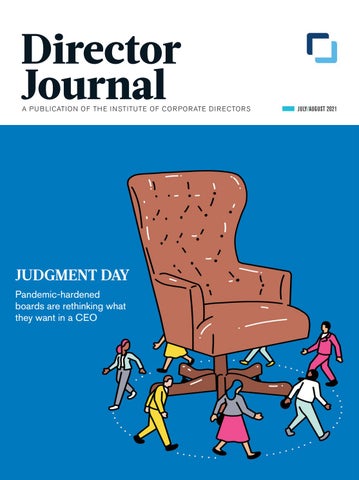
JUDGMENT DAY Pandemic-hardened boards are rethinking what they want in a CEO
JULY/AUGUST 2021
BOARD DYNAMICS FOR EXECUTIVES OPTIMIZE YOUR IMPACT IN THE BOARDROOM
BUILDING STRONGER INTERACTIONS BETWEEN LEADERSHIP AND THE BOARD
“
Optimizing the dynamics between Management and the Board is essential to achieving better outcomes.
A fresh perspective on optimizing management-board effectiveness.
JANET YALE President and CEO, Arthritis Society Former Executive VP, Telus
FORMAT
APPLICATION DEADLINE
COURSE DATES
Online
July 27, 2021
August 23-26, 2021 (Half-days)
”
Understand management-board dynamics: clearly define roles and accountabilities of both management and the board Optimize interactions with board members: develop strategies to effectively communicate and inform both inside and outside of board meetings Improve organizational decision-making: learn how to bridge the information gap between management and the board
For more information: 1.877.593.7741 x230 I education@icd.ca To apply today, visit ICD.ca/BDE
CONTENTS
Director Journal Editorial EDITOR Simon Avery ART DIRECTOR Lionel Bebbington CONTRIBUTORS Richard Blackwell, Jeff Buckstein, Jane Gadd, Virginia Galt, Sam Island, Denise Militzer, Gordon Pitts, Serge Rivest, Barbara Smith, Prasanthi Vasanthakumar, Heather Wilson
Executive Lead Matthew Fortier Vice-president, policy and public affairs
Institute of Corporate Directors Rahul Bhardwaj - President and CEO Patricia Fletcher - Vice-president, education Ken Gibson - Chief administrative officer Jan Daly Mollenhauer - Vice-president, sales, marketing and membership Kathryn Wakefield - Vice-president, chapter relations
Finally Content Eric Schneider - President Abi Slone - Creative director Dana Francoz - Advertising sales dana.francoz@finallycontent.com 416-726-2853
Departments Editor’s note
What was and what will be
CEO insights
Rahul Bhardwaj on the importance of hitting the right tone
Dispatches
Small talk, what women want, glacial change, and the science gap in Parliament
Issues
Rick Hansen on where boards fall short
Directors’ dilemma
Heather Wilson on orientation programs for new board members in a virtual world
Directors on the move
Recent board appointments across the country
Policy perspective
Matthew Fortier on integrating climate change issues into decision making
Parting shot
Will flying cars ever really get off the ground?
04 05 06 11 12 43 49 50
Features
COVER ILLUSTRATION: SAM ISLAND
Building trust and confidence in Canadian organizations is imperative. At the Institute of Corporate Directors (ICD), we believe that this starts with the right leadership and good governance. Directors must lead by being informed, prepared, ethical, connected, courageous and engaged with the world. In the pages that follow, you will find thoughtful and provocative articles that explore these essential leadership qualities. Bâtir la confiance envers les organisations canadiennes est primordial. À l’Institut des administrateurs de sociétés (IAS), nous croyons que cela commence par un bon leadership et une bonne gouvernance. Les administrateurs doivent gouverner en étant informés, préparés, intègres, connectés, courageux et ouverts sur le monde. Dans les pages qui suivent, vous trouverez des articles réfléchis et provocateurs qui explorent ces qualités de leadership essentielles. 2701 – 250 Yonge Street, Toronto, Ontario M5B 2L7 T: 416-593-7741 F: 416-593-0636 E: info@icd.ca ISSN 2371-5634 (Print) www.icd.ca ISSN 2371-5650 (Online) The ICD welcomes a diversity of opinion for inclusion in Director Journal. The contents of this publication do not necessarily reflect the opinions of the ICD, its partners, its sponsors, or its advertisers. Readers are encouraged to consider seeking professional advice and other views. To request reprints of articles, please contact info@icd.ca
ICD Fellow’s profile
14
Data security
22
Cover story
28
The pandemic
38
Recommended reading
44
James Fleck says the benefits of globalism outweigh its costs, and he sees a day when borderless commerce will ultimately prevail over protectionism and populism
Cyberattacks on infrastructure companies should be a wake-up call for all directors
The pandemic has taught boards plenty about whom they want leading their organization, resulting in new succession planning and greater scrutiny of CEOs
A historian and a futurist offer different lessons from the Covid-19 crisis
In The Day the World Stops Shopping, author J.B. MacKinnon offers readers the deal of a lifetime
ICD.CA | 3
EDITOR’S NOTE
What was and what will be As Canada eases pandemic restrictions, the potential for change is everywhere AFTER RIDING OUT MULTIPLE waves of APRÈS AVOIR TRAVERSÉ les vagues d’inCovid-19 infections, most of us have done at fection à la Covid-19, la plupart d’entre least some thinking about how we lived and nous ont réfléchi à nos modes de vie et de worked before the pandemic and what we’d travail avant la pandémie et à ce que nous like to change. voudrions changer. For individuals, it’s a healthy process when Il s’agit d’un processus sain lorsque we’re honest with ourselves and when we nous sommes honnêtes et transformons turn introspection into appropriate action. l’introspection en gestes appropriés. Des Similar processes occurring at the board level processus similaires à l’échelle des conof organizations can also have a positive efseils peuvent avoir un effet positif sur les fect on business and broader society. entreprises et l’ensemble de la société. Our cover story about CEO leadership Notre article principal sur le leadership (page 28 ) describes some of the thinking des dirigeants (p. 28 ) décrit certaines rétaking place inside boardrooms. As Virginia flexions qui ont lieu à la table des conseils. Galt explains, the past 18 months have caused Comme l’explique Virginia Galt, les 18 derboards to review not only the strategic plans niers mois ont incité les conseils à réviser Simon Avery of their organizations, but also whether their les plans stratégiques de leurs organisaEditor CEOs are still the right fit. At the same time, tions, mais aussi à vérifier si leurs chefs de savery@icd.ca senior executives are reassessing their own la direction sont toujours aptes à occuper goals and careers. As a result, some in the leur poste. Au même moment, des cadres executive search business say there is more de haute direction réévaluent leurs propres objectifs et leurs carrières. En conséquence, movement in the leaderships ranks today certaines personnes évoluant dans la recherthan they have seen in many years. Throw che de cadres affirment qu’il y a plus de mouvement dans les postes de in the dynamic social, political, technological and environmental leadership qu’il y en a eu depuis plusieurs années. Ajoutons-y les forforces at play and it has become more important than ever that dices sociales, politiques, technologiques et environnementales et il est rectors ensure their organizations have the right succession prodevenu plus important que jamais que les administrateurs s’assurent cess, as well as an effective structure to support their leaders. que leurs organisations comptent sur les processus de succession In his column, Rahul Bhardwaj, CEO of the Institute of Corpoadéquats et une structure efficace de soutien à leurs leaders. rate Directors, makes the case that it’s become essential that boards Dans sa chronique, Rahul Bhardwaj, chef de la direction de l’IAS, fait ensure their CEO and the entire organization are attuned to social valoir qu’avec le volume de changements, il est essentiel pour les condevelopments and expectations. “If your board is tone deaf, all its seils de faire en sorte que leur organisation tout entière soit accordée efforts to oversee culture, strategy and risk will be undermined.” aux attentes en matière sociale. Dans notre profil (p. 14), l’administraIn our profile (page 14 ), veteran director James Fleck is optimisteur chevronné James Fleck est résolument optimiste dans sa convictic that despite rising populism and protectionism, the world will tion qu’en dépit de la montée du populisme et du protectionnisme, eventually decide that the benefits of open commerce outweigh its le monde décidera éventuellement que les avantages du commerce costs, and that globalization will flourish again. ouvert dépassent ses coûts et que la mondialisation reviendra en force. But before readers re-embrace their old consumer ways, and reMais avant que les lecteurs en reviennent à leurs habitudes de conignite their unquestioning faith in economic growth, author J.B. sommation, l’auteur J.B. MacKinnon propose quelques idées alternaMacKinnon offers some alternative ideas about how we can prostives sur la manière de prospérer dans le monde post-pandémie. per in the post-pandemic world (page 44 ). Où que mène cette réévaluation, elle offre sûrement la possibilité Wherever all this re-evaluation leads, it certainly offers the pod’un monde meilleur. DJ tential for a better world. Whether we get there is up to us. DJ
4 | DIRECTOR JOURNAL
CEO INSIGHTS
The winds of change
ILLUSTRATIONS BY AARON MCCONOMY
Boards must seek the right tone as society’s expectations evolve DURING THE PAST SEVERAL WEEKS, I CES DERNIÈRES SEMAINES, j’ai reçu nomhave continued to receive positive feedback bre de commentaires positifs de nos memabout our national conference in June, which bres à propos du succès de notre congrès naattracted 1,500 registrants from across Cantional tenu en juin. L’un des thèmes qui ont ada and beyond. One of the themes that resrésonné le plus fortement lors des discussions onated at the event was accelerated change. a été le rythme accéléré du changement. Today’s directors must be more informed Nous le ressentons tous dans chaque than ever. It is no longer sufficient for board aspect de notre vie professionnelle et les members just to oversee their organization’s conseils savent, ou en tout cas devraient financial performance and reporting – they certainement comprendre, que cet envinow also have a duty to keep a close watch on ronnement en changement rapide exige corporate culture, strategy and risk. But none des administrateurs qu’ils soient mieux of these can be handled successfully without informés que jamais auparavant. Il ne sufa firm grip on another key element: tone. fit plus de se pencher sur la performance et Times are changing and boards need to les rapports financiers de leur organisation; Rahul Bhardwaj understand social developments and their ils ont maintenant le devoir d’en surveiller LL.B, ICD.D drivers as never before, because if your board étroitement la culture, la stratégie et le risPresident and CEO, is tone deaf, all its efforts to oversee culture, que. Mais aucune de ces tâches ne peut être The Institute of Corporate Directors strategy and risk will be undermined. exécutée avec succès sans une prise ferme ExxonMobil did not lose a proxy fight to sur un autre élément clé, soit le ton. add new board members because of activist Les temps changent et les conseils doivent environmentalists. It lost because shareholdcomprendre comme jamais auparavant les ers came together to say: “Your strategy to développements sociaux et ce qui les provohandle changes occurring in the world, including the market around que. Car si votre conseil est sourd à ces événements, tous ses efforts climate change, is tone deaf. You are not adjusting fast enough to pour surveiller la culture, la stratégie et le risque ne serviront à rien. benefit shareholders.” Ce n’est pas à cause d’activistes environnementaux qu’Exxon In Canada, some companies have shown themselves similarly Mobil a perdu une course aux procurations pour ajouter des memtone deaf through a series of ill-considered actions – taking govbres à son conseil. Elle a perdu parce que des actionnaires se sont ernment support, refusing to give refunds and awarding senior regroupés pour dire : « Votre stratégie de gestion du changement management lucrative bonuses after significant staff layoffs. This – y compris la manière dont le marché est affecté par les changecan erode trust, damage brands and weaken corporate culture. ments climatiques – est sourde et aveugle. Vous ne vous ajustez pas At the Institute of Corporate Directors, we have long highlighted assez rapidement aux intérêts de vos actionnaires. » the importance of “tone at the top.” Today, the emphasis has to be Au Canada, certaines entreprises ont fait preuve d’une telle suron the tone of the entire organization, which will find itself judged dité. En acceptant le soutien du gouvernement pendant la panagainst fresh societal expectations. These have emerged in the form démie tout en refusant de rembourser leurs clients et en accordant of broadly supported movements such as #MeToo and Black Lives à leurs équipes de direction de généreux bonis après d’importantes Matter, in intensified efforts at reconciliation, and in court rulings mises à pied d’employés. and shareholder proxy fights. As employees return from the panÀ l’Institut des administrateurs de sociétés, nous soulignons demic to face a new normal in the workplace, we should also andepuis longtemps l’importance d’une direction qui donne le ton. ticipate and respect different perspectives on the future of work. Aujourd’hui, c’est l’organisation tout entière qui est jugée selon de If boards and management are going to thrive coming out of this nouvelles attentes sociétales. Il faudra porter attention aux vents pandemic, they’d be wise to pay attention to the winds of change. DJ du changement. DJ
ICD.CA | 5
COMPILED BY Prasanthi Vasanthakumar
Dispatches A digest for diligent directors
SMALL TALK, BIG BENEFITS LAST HEARD IN MARCH 2020, small talk has all but disappeared, owing to the perils of close-proximity conversation. Idle chit-chat is often dismissed as mindless and boring, but perhaps that isn’t fair, Hannah Seo writes in The Walrus. Several scientists back her up. Defined as lighthearted, superficial, polite and predictable, small talk is a crucial social ritual, says behavioural scientist Jessica Methot. She found that when employees chatted more, their moods and energy levels improved, while burnout decreased. According to Gillian Sandstrom, a psychologist, people feel a stronger sense of connection and community when they engage with strangers in public. Simply smiling at your barista can make a difference. However, it’s hard to take small talk online, says Andrew Guydish, a PhD student in psychology. When we schedule time for a casual gab, we take the fun and spontaneity out of it. A bad internet connection only makes things worse. But something is better than nothing. Whether it’s having a virtual coffee with a colleague or tweeting at strangers on social media, initiating small talk can help us feel less isolated. As the majority of Canadians become vaccinated, it won’t be long before we rediscover the joys of casual conversation. And when we do emerge from our Covid cocoons, the once mindless “How are you?” will be much more meaningful.
6 | DIRECTOR JOURNAL
Victoria’s Secret is bidding farewell to its Angels, the winged Barbie-doll lookalikes who have been central to its brand for nearly two decades. A diverse group of accomplished women, including soccer star Megan Rapinoe and Hollywood A-lister Priyanka Chopra Jonas, will take their place as brand ambassadors. The lingerie giant’s move to become an advocate for female empowerment may be the most extreme attempt at a brand makeover in recent memory, say Sapna Maheshwari and Vanessa Friedman in The New York Times. But its survival depends on it. With more than US$5billion in annual sales, 32,000 jobs, and 1,400 stores, Victoria’s Secret has been losing market share to competitors that have embraced inclusivity, diversity and a wider range of body types. It’s also trying to distance itself from accusations that its former male executives presided over a misogynistic corporate culture, rife with bullying and harassment. “We needed to stop being about what men want and to be about what women want,” Victoria’s Secret CEO Martin Waters told The New York Times. A new executive team and female-dominated board of directors is all part of its plan to break with history. The queen of lingerie has made billions by objectifying the female body. Have female consumers had enough?
PHOTOGRAPHY BY VICTORIABAR/ISTOCK (LEFT), GOODBOY PICTURE COMPANY/ISTOCK (RIGHT)
FALLEN ANGELS
NEWS
STILL PALE, MALE AND STALE? American boardrooms are diversifying at a snail’s pace, according to a study by the Alliance for Board Diversity and Deloitte. White women enjoyed the biggest gains, increasing their presence on the boards of Fortune 500 companies by 21 per cent last year. Nonetheless, they still represent only one-fifth of all board seats. Women of colour occupy the fewest seats at 6 per cent, while white men made up more than half of all newly appointed directors last year. However, an ISS Corporate Solutions (ICS) study shows progress in one important respect. Its research finds the number of Black directors at S&P 500 companies jumped by nearly 200 per cent since July 2020 – representing 32 per cent of all newly appointed directors. Both reports agree that last year’s spotlight on racial inequities has made a difference in the boardroom. “The real question is are we experiencing a trend, or is this the beginning of sustainable progress?” says Michael Hyter, a member of the Alliance for Board Diversity.
MINORITY REPORT The percentage of board seats by gender and minority status shows that progress on board diversity at Fortune 500 companies is painfully slow.
333
694
1,226
3,627
5.7%
11.8%
20.9%
61.7%
MINORITY WOMEN
MINORITY MEN
WHITE WOMEN
WHITE MEN
Percentage of Fortune 500 board seats by gender and minority status in 2020. Source: Missing Pieces Report: The Board Diversity Census of Women and Minorities on Fortune 500 Boards, Alliance for Board Diversity and Deloitte, June 2021.
ICD.CA | 7
SCIENTIFICALLY PROVEN LEADERSHIP THE COVID-19 PANDEMIC has shown us that rational thinking doesn’t always win out. With an insatiable desire to be liked, many politicians base decisions on opinion polls instead of scientific data. This refusal to follow science has consequences, including prolonged shutdowns and economic pain, says Phil De Luna in Corporate Knights. The same can be said for decisions on climate change. A former director at the National Research Council, De Luna notes that Canada’s goal to reduce emissions by 40 per cent by 2030 is good, but not great. As the only G7 country to increase greenhouse gas emissions since the Paris Agreement, Canada has to aim higher to play catch-up. It should also be investing more in global clean technology, a sector that is expected to be worth over US$2.5-trillion by 2022. Whether it’s a global pandemic or global warming, we need politicians with a scientific background to make evidence-based policy decisions, says De Luna. However, the stereotype of the nerdy, awkward scientist locked away in her lab hardly inspires political confidence. For this reason, De Luna has left his post at the National Research Council to run for office in the next federal election. And he’s calling on other scientists to enter the political fray.
&
Source: iPolitics, November 2019
8 | DIRECTOR JOURNAL
Ag 7% ric ul t Bu ure/ Tr sin ad es es s 2% 17 %
ST EM
So ci H al S um c an ien itie ce s s 49 %
21 % La w
H ea lth
ca re
4%
NOT BACKED BY SCIENCE Of Canada’s 338 Members of Parliament (MPs), only 21 (7.4 per cent) were identified as having their highest accreditation in science, technology, engineering or math (STEM).
Readers looking for dirt on the boardrooms of big companies may be disappointed by Dambisa Moyo’s latest book. How Boards Work: And How They Can Work Better in a Chaotic World is true to its title though, says business columnist Dasha Afanasieva. According to her Reuters review, the book does a good job of explaining how corporate boards at listed companies operate, and the important role directors play in defining checks and balances, strategy and corporate culture. But something is missing. Although Moyo has served on boards of large companies such as Barclays, Chevron and Barrick Gold for years, the serial director doesn’t look closely at them, says Afanasieva. For example, Moyo describes how the board helped Barrick Gold stabilize its share price following a collapse in gold prices, but doesn’t touch on how it addressed repeated criticism of the company’s human rights and environmental track record. Moyo cites confidentiality agreements to explain why the book isn’t a tell-all. But for Afanasieva, that’s no excuse. “Surely, there’s a middle ground between divulging board secrets and not evaluating those situations at all,” she writes. Would board directors agree?
PHOTOGRAPHY BY MALCOLM LIGHTBODY/UNSPLASH (TOP LEFT), MADDIE LEOPARDO/UNSPLASH (RIGHT)
DAMBISA MOYO DOESN’T TELL ALL
NEWS
THE BEEF WITH MEAT Republicans and right-wing news outlets stoked a rumour this spring that U.S. President Joe Biden’s climate change plans would include a law to curb beef consumption by 90 per cent. The White House debunked the rumour, but it showed that our American neighbours are having a serious conversation about the effect of meat production on the planet, says animal advocate Jessica Scott-Reid in The Globe and Mail. In 2018, a study in Nature called on Western countries to replace the bulk of beef, pork, poultry and milk consumption with beans and pulses. This April, the popular recipe website Epicurious announced it would no longer publish new recipes using beef, committing to “not give airtime to one of the world’s worst climate offenders.” Soon after, a world-renowned Manhattan restaurant took meat off the menu, prompting the famous foodie Ruth Reichl to speculate about the future of American restaurant cuisine. For Scott-Reid, this is good news. What’s troubling her is that this dialogue isn’t happening here at home. Governments across Canada have supported a few plant-protein-positive initiatives, but they continue to heavily fund meat, dairy and egg production. According to the United Nations, 15 per cent of global greenhouse gas emissions come from animal farming, with cattle accounting for more than two-thirds of the livestock sector’s emissions. Is it time to leave beef behind? To truly tackle climate change, Canada needs to have that conversation now, says Scott-Reid. ICD.CA | 9
WHO BENEFITS FROM ICD BOARD MEMBERSHIP?
ENRICH YOUR BOARD WITH THE COLLECTIVE INTELLIGENCE AND SHARED WISDOM OF DIRECTORS ACROSS CANADA DEVELOPMENT Member Education – ICD-Rotman DEP; Canada’s leading program for directors Committee Education – One day courses on board effectiveness and topical issues Board Education – Custom learning tailored to the unique challenges of your board Governance Portfolio – Board opportunities via the ICD Directors Register RESOURCES Digital Resource Centre – Providing information by topic/area of expertise BoardInfo – Customized governance research service Board Member Recruitment – Confidential and cost-effective searches Director Journal – Bi-monthly magazine featuring thought leadership editorials National Webinars – Navigating critical areas of governance NETWORKING Expand your professional network through our 11 Chapters across Canada Gain insights and real-world perspectives through the ICD National Conference
LEARN MORE AT ICD.CA/BOARDMEMBERSHIP OR CONTACT MEMBERSHIP@ICD.CA FOR A PERSONALIZED CONSULTATION
ISSUES
Where boards fall short Thirty-four years ago, RICK HANSEN traversed the world in his wheelchair to prove the potential of people with disabilities. As today’s boards begin to address diversity, equity and inclusion, he offers them a reminder DISABILITY AFFECTS EVERYONE, directly or indirectly. There are an estimated 1.3 billion people living with a disability in the world today. Representing 15 per cent of the global population, they comprise the world’s “largest minority group.” Factor in age-related disabilities, or even temporary disabilities, and it’s the only minority group that nearly everyone can expect to join some day. In Canada, one in five Canadian adults lives with a disability, representing 6.2 million people. This number is expected to grow exponentially as our population ages. Canada’s Charter of Rights and Freedoms states that people with physical or cognitive disabilities are considered equal. Over the years, our country has made strides in ensuring that the rights of people with disabilities are upheld. Provincially, British Columbia, Manitoba, Ontario and Nova Scotia have all passed accessibility legislation. Federally, the Accessible Canada Act recently marked its second anniversary. Yet, there are still significant physical and attitudinal barriers that prevent people with disabilities from fully contributing to and participating in our society. A recent report by the Return on Disability Group revealed that while 90 per cent of employers claim to prioritize diversity and inclusion, only 4 per cent specifically consider people with disabilities in their efforts. Diversity, equity and inclusion strategies that encompass people with disabilities begins with representation at the board level. An annual diversity-disclosure study by Osler Hoskins & Harcourt LLP found that just 5.5 per cent of directors in Canada were visible minorities, and only 0.4 per cent were directors with disabilities. Improved accessibility for people with disabilities is not just a question of human rights; it’s also an economic imperative. As a group, they represent an untapped work force that can provide enormous benefits to the country. A 2018 Conference Board of Canada report found that 57 per cent of Canadians with physical disabilities are unemployed due to barriers in the workplace. The report also noted that if these barriers were removed, the 550,000 working-age Canadians with a disability could add $16.8-billion to our gross domestic product by 2030. The boost would fuel a $10-billion increase in consumer spending and $4.4-billion rise in government revenue. When we leave people with disabilities behind, we create an economic burden that isn’t sustainable. Given that people with disabilities represent a global market force greater than the whole of China, these stats are a wake-up call for leaders in the private and public sector.
Corporate directors across our country have an essential social and economic responsibility to demonstrate their leadership by ensuring that disability and accessibility are part of their organization’s diversity, equity and inclusion plans. Establishing accessibility metrics and ensuring accountability across the corporate continuum will allow organizations to know where they stand and where they need to go to effect meaningful change. Our country and businesses are stronger when we include people of all abilities. DJ
Diversity, equity and inclusion strategies that encompass people with disabilities begins with representation at the board level, says Rick Hansen.
RICK HANSEN is best known as the “Man In Motion.” His epic 26-month, 40,000kilometre wheelchair journey around the globe aimed to make the world more accessible and inclusive for people with disabilities, and to help find a cure for paralysis after spinal cord injury. He is a six-time Paralympic medalist and the founder of the Rick Hansen Foundation - an organization committed to creating a world without barriers for people with disabilities.
ICD.CA | 11
The dilemma How do we provide an effective orientation program for a new board member in a virtual environment?
Heather Wilson ICD’s Director of Research Services
HELPING TO ESTABLISH good interpersonal relationships among board members and other key staff should be a crucial part of the director orientation process. But the task becomes more difficult in a virtual environment, says Lisa Talbot, who leads the employment practice at business law firm Torys LLP. “It can be harder for a new director to get to know fellow directors and management and to get integrated.” Dale Weil, an experienced corporate and not-for-profit director, says that the virtual environment makes things harder for new directors. Site tours, informal meetings and in-person learning opportunities with peers have been shelved during the pandemic. Concerns about cybersecurity may discourage directors from speaking candidly during online meetings, which can also be fatiguing, and home environments offer distractions. As a result, online orientation programs need to be structured to include engaging tools to help overcome these challenges and to bring directors up to speed as quickly as possible. While the current health emergency presents obstacles for new directors, “even before the pandemic, in my experience, direc-
12 | DIRECTOR JOURNAL
tor orientation programs were not always as effective as they could be,” says Weil. A good orientation program, she adds, should give a new director all the “big picture” documentation they need before their first board meeting. This package should include strategic plans, organizational charts, information on senior team members and what they do, committee mandates, the board governance manual, and insight on the culture and organizational values, as well as key statistics. It’s also helpful to have a one-on-one virtual meeting with the CEO to share background information on the other board members, including their areas of expertise. Photos can help new directors know who’s who at their first meeting. “It’s a small thing but it makes a big difference,” Weil says. One advantage of the virtual environment is that it may make scheduling one-on-one meetings with other key organizational personnel easier and help new directors become familiar with organizational issues before they have their first formal board meeting. Weil recommends that organizations enhance their orientation by having a new director complete the online orientation
program and then assigning him or her a fellow director as a mentor. She also says that one-on-one meetings with committee chairs can be helpful, not only for gaining different perspectives on the organization but also because they allow other board members to share responsibility for orientation activities. Prior to the pandemic, new board members would often use more informal meetings such as board dinners, coffee chats and oneon-one lunches to find out about the organization and to develop a rapport with board colleagues. Although formal virtual introductory meetings are currently being scheduled for new directors, opportunities for more informal interactions may not be planned as part of the online orientation program. Creating chances for board members to have one-on-one “get to know you” conversations, even virtually, are important elements of a good program in order to build trust among board members. What used to happen naturally may now need to be more deliberate. Weil notes that even organizations that had good programs on paper weren’t always following through with the outlined orientation activities. She recommends that once the elements of a good program have been developed, someone in the organization should be made accountable for ensuring that new directors have the resources they need and are meeting with the right people. Even when the threat of Covid-19 eventually recedes, the trend toward using virtual tools will likely continue for many, if not most, organizations. A hybrid approach is likely as each organization decides what online activities will be maintained. Boards will need to evaluate and adjust their director orientation programs to recognize this new reality. DJ
ILLUSTRATION BY AARON MCCONOMY
Q.
DIRECTORS’ DILEMMA
DIRECTOR LENS • It is more difficult for a new director to become integrated onto a board in a virtual environment.
UN ÉLÉMENT CRUCIAL du processus d’orientation de l’administrateur est la capacité d’établir de bonnes relations interpersonnelles parmi les membres du conseil et d’autres membres clés du personnel. Mais la tâche devient plus difficile dans un environnement virtuel, soutient Lisa Talbot, qui dirige la pratique d’emploi au cabinet juridique Torys LLP. « Il peut être plus difficile pour un nouvel administrateur de connaître ses collègues et les membres de la direction et ainsi de s’intégrer à son environnement. » Dale Weil, administratrice d’expérience dans l’univers des sociétés à but lucratif et à but non lucratif, reconnaît qu’un environnement virtuel rend les choses plus difficiles pour les nouveaux administrateurs. Les visites de site, rencontres informelles et occasions d’apprentissage en personne avec les pairs ont été mises de côté durant la pandémie. Les préoccupations relatives à la sécurité informatique peuvent décourager les administrateurs de s’exprimer franchement durant les réunions en ligne, ce qui peut aussi être fatigant, en plus du fait que les environnements familiaux comportent des distractions. Ainsi, les programmes d’orientation en ligne doivent proposer des outils qui contribuent à surmonter ces problèmes et à assurer la mise à niveau des administrateurs le plus rapidement possible. Même si l’urgence sanitaire actuelle présente des obstacles pour les nouveaux administrateurs, « même avant la pandémie, selon mon expérience, les programmes d’orientation de l’administrateur n’étaient pas toujours aussi efficaces qu’ils auraient pu », affirme Mme Weil. Un bon programme d’orientation, ajoute-t-elle, devrait offrir à un nouvel administrateur toute la documentation globale dont il a besoin avant qu’il assiste à sa première réunion du conseil. Cette trousse devrait comprendre les plans stratégiques, organigrammes, renseignements sur les membres
chevronnés de l’équipe et ce qu’ils font, mandats des comités, le guide de gouvernance du conseil ainsi que des renseignements sur la culture et les valeurs organisationnelles et des statistiques clés. Il est aussi utile d’avoir une réunion virtuelle en tête-à-tête avec le chef de la direction et de partager des informations de base sur les autres membres du conseil, y compris leurs domaines d’expertise. Des photos permettront aux nouveaux administrateurs d’identifier leurs collègues lors de la première réunion du conseil. « Ce n’est pas grand-chose, mais ça peut faire une grande différence », explique Mme Weil. L’un des avantages de l’environnement virtuel est qu’il peut faciliter l’organisation de rencontres en tête-à-tête avec du personnel clé de l’organisation et aider les nouveaux administrateurs à se familiariser avec les enjeux organisationnels avant qu’ait lieu leur première réunion formelle du conseil. Mme Weil recommande que les organisations optimisent leur orientation en demandant à un nouvel administrateur de suivre le programme d’orientation en ligne destiné aux nouveaux employés et de lui attribuer un collègue administrateur à titre de mentor. Elle ajoute que des rencontres en tête-à-tête avec les présidents de comité peuvent aussi être utiles, non seulement pour obtenir des points de vue différents sur l’organisation, mais aussi parce qu’elles permettent à d’autres membres du conseil de partager la responsabilité des activités d’orientation. La création d’occasions de dialogue en face à face afin de mieux se connaître, même de façon virtuelle, est un élément important d’un bon programme afin de bâtir la confiance parmi les membres du conseil. Même si la menace de la Covid-19 s’amenuisera éventuellement, la tendance à utiliser des outils virtuels se maintiendra sans aucun doute pour beaucoup, sinon la majorité des organisations. DJ
• Online director orientation programs should try to overcome certain constraints, such as the lack of informal meeting opportunities, by scheduling informal virtual meetings for new directors. • Directors should be given the “big picture” documentation they need (organizational charts, strategic plans, and so on) prior to their first meeting. • Virtual environments may make scheduling one-on-one meetings with key organizational personnel easier. • Ensure that someone in the organization is accountable for the delivery of the director orientation program. • Il est plus difficile pour un nouvel administrateur de s’intégrer à un conseil dans un environnement virtuel. • Les programmes d’orientation en ligne des administrateurs devraient prévoir l’organisation de rencontres informelles virtuelles pour les nouveaux administrateurs. • Les administrateurs devraient recevoir de la documentation globale (organigramme, plans stratégiques, etc.) avant d’assister à leur première réunion du conseil. • S’assurer qu’un membre de l’organisation est responsable de la livraison du programme d’orientation de l’administrateur.
Presented in partnership with Torys LLP.
Send your comments or ideas to: Heather Wilson Director of Research Services boardinfo@icd.ca Every issue, we will feature a question from readers or one from ICD’s complimentary research service, ICD BoardInfo icd.ca/boardinfo
ICD.CA | 13
PHOTOGRAPHS BY Denise Militzer
UNAPOLOGETIC GLOBALIST An early champion of globalism, ICD Fellow JAMES FLECK talks to business author Gordon Pitts about its costs and benefits, and why he remains a firm believer in borderless commerce, even as populism and protectionism flourish around the world. Champion précoce du mondialisme, JAMES FLECK s’entretient avec l’auteur Gordon Pitts de ses coûts et bénéfices et des raisons pour lesquelles il demeure un fervent partisan d’un commerce sans frontières, alors même que le populisme et le protectionnisme prolifèrent dans le monde. JAMES FLECK has crammed a lot of careers into his 90-year lifespan: entrepreneur, senior bureaucrat, academic leader, arts maven. Along the way, he found time to be a busy and influential director — serving on boards whose organizations ranged from tech companies to think tanks. Yet a constant theme winds its way through his labyrinthine journey: He has been a student of globalization and its transformative upheaval. As a business academic and practising manufacturer, Fleck was a forerunner in navigating – sometimes controversially – the borderless world of commerce. Today, the relentless surge of free trade and global supply chains has stalled, blocked by populist politics, protectionism and a bias toward shorter supply lines in a global pandemic. Yet Fleck is not convinced that the retreat is permanent. Still engaged and vigorous as he roars into his 10th decade, he sees plenty of evidence the world remains on a globalist track.
14 | DIRECTOR JOURNAL
JAMES FLECK a embrassé plusieurs carrières au fil de ses 90 années : entrepreneur, haut fonctionnaire, leader universitaire, expert du domaine des arts. En cours de route, il a trouvé le temps d’être un administrateur occupé et influent – siégeant aux conseils d’organisations allant d’entreprises technologiques à des groupes de réflexion. Mais un thème constant se profile dans ce parcours labyrinthique : l’étude de la mondialisation et des bouleversements durables qu’elle a suscités. À titre de spécialiste du commerce et de manufacturier d’expérience, M. Fleck a fait figure de pionnier en fréquentant – parfois dans la controverse – l’univers du commerce sans frontières. Aujourd’hui, la montée incessante du libre échange et des chaînes logistiques mondiales a connu un temps d’arrêt, bloquée par les politiques populistes, le protectionnisme et un parti pris en faveur de chaînes logistiques plus courtes en temps de pandémie mondiale.
James Fleck was a forerunner in navigating – sometimes controversially – the borderless world of commerce.
ICD.CA | 15
The inexorable drive to lower costs and lower prices for consumers means globalization will continue, he says. “Long term, globalization may go through some tough periods, but it makes just so much economic sense – if you can handle some of the disadvantages.” Those disadvantages, as always, reflect the human factor. “We need to do a better job of looking after those displaced,” he says, acknowledging the powerful political backlash from people worldwide whose skills are suddenly obsolete and whose jobs disappear or are outsourced to lower-wage locales. The comments capture the essence of Fleck, a unique melding of thought and action. To call him a Renaissance Man is understating his breadth and depth. His rich, complex legacy is recognized in his induction as a 2021 Fellow of the Institute of Corporate Directors. Summing up his multifarious career, he has always thought of himself as “a business person first and the other things kind of happened.”
'I used to tell people we didn't move the jobs to Mexico. The jobs themselves moved to Mexico,' James Fleck says of his company's decision to offshore jobs.
The Tillsonburg touch They started happening in 1954, when a 23-year-old Fleck, fresh out of the University of Western Ontario, headed to Tillsonburg, a southwestern Ontario town where he had spent part of his boyhood. There, he founded a business making electrical cord sets, which evolved into producing wire harnesses and related devices for auto and other manufacturers. Part of his reasoning was that seasonal tobacco workers would welcome the yearround employment in his fledgling business. As Fleck Manufacturing grew, he sold half its shares to Toronto investment banker George Gardiner. In this private company, he learned that directors should not try to run the company they serve. Their role is to monitor senior management, and help set strategic direction, but not to manage. As the company prospered, he went off to indulge his interest in business studies, through stints at Harvard and other institutions, before becoming associate business dean in the early days of York University in Toronto. He led a groundbreaking study of public service productivity for the Ontario
16 | DIRECTOR JOURNAL
Et pourtant, M. Fleck n’est pas convaincu que ce recul soit permanent. Toujours engagé et vigoureux alors qu’il entre avec force dans sa dixième décennie, il perçoit plein d’indices que le monde demeure sur un parcours mondialiste. L’inexorable trajet vers de faibles coûts de production et des prix plus bas pour les consommateurs signifient que la mondialisation va se poursuivre, assure-t-il. « À long terme, la mondialisation peut traverser des périodes difficiles, mais elle est tellement plus logique au plan économique – si on peut gérer certains de ses inconvénients. » Ces inconvénients, comme toujours, sont issus du facteur humain. « Nous devons faire mieux à l’égard des travailleurs déplacés », dit-il, reconnaissant le puissant effet politique négatif de tous ces gens dont, partout dans le monde, les compétences sont soudainement devenues obsolètes et dont les emplois disparaissent ou sont externalisés dans des pays à faible coût de main-d’œuvre. Ces commentaires résument bien la pensée de Jim Fleck, un amalgame unique de réflexion et d’action. Ceux qui le qualifient d’homme de la Renaissance sous-estiment l’étendue et la profondeur de ce qu’il représente. C’est en reconnaissance de son héritage riche et complexe qu’il est intronisé à titre de Fellow 2021 de l’Institut des administrateurs de sociétés.
government, which propelled him into Queen’s Park and, under then-premier William Davis, to the post of secretary of the cabinet. That opened up an array of public and private assignments, while he gained an academic reputation for his work on international manufacturing.
Jobs versus low costs Meanwhile, Fleck Manufacturing itself had become a focal point for some seminal debates of the era, such as a bitter 1978 plant strike, contested around the principle of mandatory union-dues checkoff – while Fleck was Ontario industry deputy minister. A decade later, in the middle of wage negotiations, the company closed the plant and shifted its production to Mexico. Fleck says pricing demanded by the plant’s biggest customer, Ford Motor Co., dictated the transfer of production to Mexico’s maquiladora zone, a low-cost, tariff-advantaged enclave along the U.S. border. As a supplier, he says, Fleck Manufacturing had to decide whether to keep the Ford business or lose it. “I used to tell people we didn’t move the jobs to Mexico. The jobs themselves moved to Mexico; the question was whether we would be able to capture them. “We didn’t have an option of keeping them in Canada – they were gone. But it was whether we could pursue them and get them rather than someone else.” By the time the company was sold in 1994, it employed 3,500 people in North America, he says, and 500 positions remained in Tillsonburg. “The brain was in Tillsonburg and the brawn was in Mexico,” Fleck would say. Today, the costs of globalization are sharply defined by bitter workers and bypassed communities, whose anger has helped elect populist leaders such as Donald Trump and Boris Johnson. Fleck says the issues defy easy solutions. Globalization has lowered poverty in many parts of the world, “but people who have voting strength were hurt and not taken into account. “The easy answer is to train them to do other jobs, but it is very difficult to train people working on a [factory] line to do knowledge work, especially in their 50s and 60s.” Similarly, there is no simple rescue for shops on Main Street devastated by Amazon. Trumpism has not gone away, he warns, which means public policies to ease economic transitions have to get better. “But the benefits [of globalization] are so great – just look at what you are able to get and the costs are so low.”
Specialization versus pragmatism As a corporate director for seven decades, he sees a basic imperative in organizations he serves: “The biggest challenge is survival: How do we hang in there and not become obsolete and disappear?” In his own company, “we came close one time. We had our dark days and they were not fun.” Fleck brought this real-world perspective to boards, as someone who grasped the flux of global economics and the emergence of multi-stakeholder governance. He likes to say that the most important role of a board is “to
Résumant sa carrière si variée, il s’est toujours considéré comme « un homme d’affaires d’abord et le reste est arrivé. »
La touche Tillsonburg Ces choses ont commencé à arriver en 1954, lorsque M. Fleck, alors âgé de 23 ans, frais émoulu de l’Université Western Ontario, s’est rendu à Tillsonburg, une petite ville du sud-ouest de l’Ontario où il avait passé une partie de son enfance. C’est là qu’il a fondé une entreprise de fabrication de jeux de fils électriques qui, avec le temps, a élargi ses activités en produisant des faisceaux de câbles et des appareils apparentés pour des manufacturiers d’automobiles et d’autres types de fabricants. Une partie de son raisonnement tenait au fait que les travailleurs saisonniers du tabac allaient apprécier cette occasion d’occuper un emploi à temps complet dans son entreprise naissante. Alors que Fleck Manufacturing poursuivait sa croissance, il vendit la moitié de ses actions au banquier d’investissement George Gardiner. Dans cette entreprise privée, il a appris que les administrateurs ne devraient pas tenter de diriger l’entreprise. Leur rôle consiste à surveiller la haute direction et à établir une direction stratégique, mais non à gérer. Pendant que son entreprise prospérait, il est allé satisfaire son intérêt pour les études commerciales en faisant des séjours à Harvard et dans d’autres institutions, avant de devenir doyen associé de l’école de gestion dans les premières années de l’Université York de Toronto. Il a ensuite mené une étude historique sur la productivité de la fonction publique pour le compte du gouvernement de l’Ontario, qui l’a mené à Queen’s Park et, sous le règne du premier ministre William Davis, au poste de secrétaire du cabinet. Cela lui a ouvert une foule de mandats aussi bien publics que privés, lui gagnant une réputation dans le monde académique pour ses travaux sur l’activité manufacturière internationale.
Emplois et faibles coûts Entre-temps, Fleck Manufacturing devenait le point central de certains des débats fondamentaux de cette époque, comme
ICD.CA | 17
‘LONG TERM, GLOBALIZATION MAY GO THROUGH SOME TOUGH PERIODS, BUT IT MAKES JUST SO MUCH ECONOMIC SENSE – IF YOU CAN HANDLE SOME OF THE DISADVANTAGES.’ « À LONG TERME, LA MONDIALISATION PEUT TRAVERSER DES PÉRIODES DIFFICILES, MAIS ELLE EST TELLEMENT PLUS LOGIQUE AU PLAN ÉCONOMIQUE – SI ON PEUT GÉRER CERTAINS DE SES INCONVÉNIENTS. » appoint and dis-appoint the CEO.” These functions are best achieved in corporate boards where the reporting lines are relatively clear and transparent. It is more difficult in many public-service boards. The boards often do not choose or dismiss the CEO – that is the job of government. The CEO decision is “the most important thing [the board] should be doing and you don’t get to do it.” As he would tell his students in business-government relations, consider the interests of the parties involved. “The minister is looking for votes and the deputy minister is looking for the minister not to get into any trouble. Just try to align what you are trying to achieve with that [reality].” As a chair, he dealt with the cacophony of
18 | DIRECTOR JOURNAL
celui qui a eu cours lors d’une dure grève à son usine en 1978, articulée autour du principe de la contribution syndicale obligatoire – alors que M. Fleck était sous-ministre de l’Industrie de l’Ontario. Une décennie plus tard, au milieu de négociations sur les salaires, l’entreprise ferma son usine et déplaça ses activités de production au Mexique. M. Fleck affirme que les prix exigés par Ford Motor Co., le plus gros client de l’usine, avaient motivé le transfert de la production dans la zone mexicaine Maliquadora, une enclave située le long de la frontière américaine offrant des coûts de production moindres et des avantages tarifaires. Comme fournisseur, dit-il, Fleck Manufacturing devait décider si elle voulait conserver Ford comme client ou le perdre. « Je disais aux gens que nous n’avions pas déplacé ces emplois au Mexique. Les emplois eux-mêmes sont déménagés au Mexique. Nous n’avions pas l’option de les garder au Canada. » Quand la compagnie a été vendue en 1994, elle employait plus de 3 500 personnes en Amérique du Nord et 500 emplois étaient demeurés à Tillsonburg. « Le cerveau était à Tillsonburg et les muscles au Mexique », dit-il. Aujourd’hui, les coûts de la mondialisation sont brutalement définis par des travailleurs amers et des communautés oubliées dont la colère a permis d’élire des leaders populistes comme Donald Trump et Boris Johnson. James Fleck soutient qu’il n’y a pas de solutions faciles. La mondialisation a réduit la pauvreté dans plusieurs parties du monde, « mais les gens ont la force de leurs votes quand ils souffrent et ne sont pas pris en compte. » « La réponse facile, poursuit-il, est de les former pour accomplir d’autres tâches, mais il est très difficile de former des gens qui travaillent sur une chaîne de montage à effectuer un travail basé sur le savoir, en particulier s’ils sont dans la cinquantaine ou la soixantaine. » Les politiques publiques visant à faciliter les transitions économiques doivent s’améliorer, convient-il. « Mais les avantages de la mondialisation sont si grands. Songez à tout ce qu’on peut acquérir à faible coût. »
Spécialisation et pragmatisme Administrateur de sociétés pendant sept décennies, James Fleck croit que le grand défi des organisations consiste à survivre : « Comment réussir à ne pas devenir obsolète et à ne pas disparaître? » Il a apporté aux conseils où il a siégé la perspective d’un administrateur qui a saisi les tendances de l’économie mondiale et l’émergence d’une gouvernance à parties prenantes multiples. M. Fleck aime dire que le rôle le plus important d’un conseil consiste à accueillir et à remercier le chef de la direction. Cette responsabilité s’accomplit le mieux quand les structures hiérarchiques sont relativement claires et transparentes. Comme président du conseil, il a eu à gérer la cacophonie d’opinions représentées par les administrateurs. Il a tenté de s’assurer que chacun a son mot à dire, mais ne prend pas toute la place. Après tout, les gens sont généralement sincères lorsqu’ils tentent de faire progresser l’organisation. M. Fleck représente aujourd’hui une espèce menacée d’extinction, soit celle de l’administrateur généraliste. De nos jours,
viewpoints represented by directors. He tried to make sure everyone got their say but didn’t hog the spotlight. After all, people are usually sincere in trying to advance the organization. “You just have to channel that a little.” He never sat on big bank boards, but he was a director of important Canadian technology companies, including ATI Technologies, Alias Research and Certicom. “I was into one high-tech company and people thought I knew something about tech,” he says with a laugh. He believes his role at these companies was his most important legacy as a director. The proudest moments came in negotiating the sale of ATI and Alias to U.S. corporations, and doing it in a way that maximized the protection of Canadian jobs. Fleck represents a now-threatened species, the generalist director. Today’s boards often look for specialized experience in, say, technology, risk or finance. He acknowledges that generalist skills don’t necessarily meet these complex needs, but he still sees value in a wide skill set, particularly in the role of the chair, “who has to try to bring it all together.” He worries about directors who are so narrowly focused on their particular area of expertise. It’s like he tells students: Their first educational program should make them an interesting person and the second should help them become a specialist.
les conseils sont souvent à la recherche de gens spécialisés dans des domaines comme la technologie, le risque ou les finances. Il reconnaît que les compétences généralistes ne répondent pas nécessairement à ces besoins complexes, mais il attache de la valeur à un ensemble élargi de compétences, en particulier pour les personnes qui occupent le poste de président du conseil, « qui doit essayer de réunir l’ensemble ». Il s’inquiète par ailleurs des administrateurs qui sont très étroitement concentrés sur leur secteur particulier d’expertise. Comme il le dit à ses étudiants : « Leur premier programme de formation devrait faire d’eux une personne intéressante et le deuxième, les aider à devenir un spécialiste. »
Obtenir des résultats Au cours de toutes ces années en affaires, M. Fleck a suivi l’évolution des conseils qui, après avoir joué des rôles consultatifs,
Board Leadership Centre – from insight to oversight Our new reality demands more from boards. We have the answers to help you address today’s key issues.
Learn more: home.kpmg/ca/blc
ICD.CA | 19
JAMES FLECK Former chair of ATI Technologies and Alias Research Ancien président du conseil d’ATI Technologies et d’Alias Research BACKGROUND Born in Toronto, Feb. 10, 1931.
NAISSANCE Né à Toronto le 10 février 1931.
EDUCATION Earned a BA in business from the University of Western Ontario in 1953.
ÉDUCATION Baccalauréat en administration des affaires de l’Université Western Ontario en 1953.
Awarded a doctorate of business administration in finance from Harvard in 1964. BUSINESS In 1954, he founded Fleck Manufacturing; sold his interest 40 years later. DIRECTOR CAREER Boards included Certicom, specializing in encryption, acquired by BlackBerry Ltd. (formerly Research In Motion) in 2009. Chaired ATI Technologies, maker of graphics chips, until its acquisition by Advanced Micro Devices in 2006; also chaired Alias Research, a computer graphics software company, acquired by Silicon Graphics in 1995. Served as a director of numerous other public and private companies, and is a former international president of the Young Presidents’ Organization (YPO). GOVERNMENT CAREER In the late 1960s, led committee studying government productivity that spurred reorganization of Ontario bureaucracy. Under then-premier Bill Davis, became CEO of the Office of the Premier; secretary of cabinet for Ontario; deputy minister of industry and tourism. Founding director, Public Policy Forum; former director of the Niagara Institute, and the Institute for Research on Public Policy. ARTS Founding president of the Power Plant, a contemporary art gallery in Toronto. Past chair of the Council of Business and the Arts in Canada; past chair of the Art Gallery of Ontario; former chair of the Canadian Museum of History and the Canadian War Museum; past director of the National Ballet of Canada.
Doctorat en administration des affaires de Harvard en 1964. AFFAIRES En 1954, il fonde Fleck Manufacturing, dont il vend les intérêts 40 ans plus tard. CARRIÈRE D’ADMINISTRATEUR Certicom, entreprise spécialisée en cryptage, acquise par BlackBerry Ltd. (auparavant Research In Motion) en 2009. Président du conseil d’ATI Technologies, fabricant de puces graphiques, jusqu’à son acquisition par Advanced Micro Devices en 2006; président du conseil d’Alias Research, une entreprise de logiciels graphiques acquise par Silicon Graphics en 1995. Administrateur de nombreuses autres sociétés publiques et privées et ancien président international de Young Presidents’ Organization (YPO). CARRIÈRE GOUVERNEMENTALE À la fin des années 1960, il a dirigé un comité d’étude sur la productivité du gouvernement qui a déclenché une réorganisation de la fonction publique ontarienne. Sous le premier ministre Bill Davis, il fut chef de la direction du Bureau du premier ministre, secrétaire du cabinet de l’Ontario, sous-ministre de l’Industrie et du Tourisme. Directeur fondateur, Forum des politiques publiques; ancien administrateur du Niagara Institute et de l’Institut de recherche en politiques publiques. ARTS Président fondateur de Power Plant, galerie d’art contemporain à Toronto.
Co-led public-private collaboration to build the Toronto Music Garden; former director of the Banff Centre and Harbourfront Centre.
Ancien président du conseil du Council of Business and the Arts in Canada; ancien président du conseil du Musée des beaux-arts de l’Ontario; ancien président du conseil du Musée canadien de l’histoire et du Musée canadien de la guerre; ancien administrateur du Ballet national du Canada.
ACADEMIA Currently, professor emeritus of business-government relations at the University of Toronto’s Rotman School of Management.
MONDE ACADÉMIQUE Professeur émérite en relations gouvernement-entreprises à la Rotman School of Management de l’Université de Toronto.
At Harvard Business School, taught first-year finance in the MBA program from 1964-1966; was a visiting scholar at business schools in Japan and France; taught at Western and University of Toronto.
De 1964 à 1966, il a enseigné la finance au programme de première année du MBA; professeur invité a des écoles de gestion au Japon et en France; il a enseigné à la Western University et à l’Université de Toronto.
In 1966, helped found what is now the Schulich School of Business at York University.
En 1966, il a participé à la création de la Schulich School of Business de l’Université York.
20 | DIRECTOR JOURNAL
The bottom line Over his years in business, Fleck has seen the evolution of boards from advisory roles to professional bodies. He believes in term limits for directors, to make way for new people with fresh perspectives, but at age 90, he says with a laugh, he is not so sympathetic to age limits. Fleck’s incredibly varied, trail-blazing career has today been narrowed to a single not-for-profit board. He is chair of University of Toronto Schools, the university-preparatory academy in downtown Toronto which he attended in the 1940s. He recently led a fundraising campaign that rescued the 111-yearold merit-based institution, and led the renegotiation of its affiliation with the University of Toronto. “My legacy project was to make sure it didn’t disappear and to refurbish it.” It may conjure up the image of a silver-haired gent with a big personality and a long contact list who can raise money. But he quickly dismisses any notion he is a one-trick fundraiser. “I get things done,” Fleck declares, which may be the most fitting definition for a career that defies definition. DJ GORDON PITTS is a Toronto journalist whose latest book, Unicorn in the Woods: How East Coast Geeks and Dreamers Are Changing the Game, was published this fall by Goose Lane Editions.
représentent aujourd’hui un corps professionnel. Il croit aux limites de mandat imposées aux administrateurs, afin de laisser place à de nouvelles personnes offrant des perspectives novatrices. Mais à 90 ans, il affirme en riant qu’il n’est pas si sympathique à l’idée d’une limite d’âge. La carrière incroyablement diversifiée et pionnière de James Fleck est réduite aujourd’hui à un seul conseil d’administration d’une organisation à but non lucratif. Il préside en effet le conseil de l’University of Toronto Schools, une académie préparatoire à l’université, située au centre-ville de Toronto, qu’il a fréquentée dans les années 1940. Il a récemment dirigé une campagne de financement pour sauver cette institution de 111 ans basée sur le mérite et mené la renégociation de son affiliation à l’Université de Toronto. « Mon projet de legs consistait à m’assurer qu’elle ne disparaisse pas et qu’elle soit rénovée. » « Je fais arriver les choses », conclut James Fleck, ce qui est sans doute la meilleure définition d’une carrière qui défie les définitions. DJ GORDON PITTS est un journaliste d’affaires dont le dernier ouvrage, Unicorn in the Woods : How East Coast Geeks and Dreamers Are Changing the Game, a été publié l’automne dernier par Goose Lane Editions.
Centre des leaders pour conseils d’administration – de clairvoyance à surveil ance Notre nouvelle réalité exige davantage des conseils d’administration. Nous avons les réponses qui vous aideront à résoudre les principaux enjeux d’aujourd’hui. Pour en savoir plus : home.kpmg/ca/clca
Réalisons-le.
ICD.CA | 21
Hackers at the gate RECENT HIGH-PROFILE RANSOMWARE attacks on critical infrastructure targets have heightened global concerns about the potential devastation, including loss of life, that may result from cyberattacks. Companies in the energy, food, transportation and utility sectors, among others, are now on high alert as they grapple with growing risk. Any board of a critical infrastructure-related business in Canada needs to be prepared for their organization to become the next target, warns Jeff Thomas, a cybersecurity partner with KPMG LLP in Calgary. “We are definitely at systemic risk in terms of how we’ve built our critical infrastructure.” Although some governments and utilities have taken steps to contain an electrical grid outage, the critical infrastructure industry as a whole is not ready for the disruption that could be caused by a major cyberattack, he says.
22 | DIRECTOR JOURNAL
Criminals are now targeting specific highvalue companies to collect big payouts. It’s nothing but extortion, says Owen Key, a director of KPMG’s cybersecurity practice in Calgary. Ransomware attackers have grown skilled at spotting targets that are both vulnerable and valuable. These businesses tend to have deep pockets and they are willing to pay a nominally high ransom that represents a “drop in the bucket” compared to the financial and reputational risk of having their business face a serious disruption, says Michael Parent, a professor of management information systems at Simon Fraser University’s Beedie School of Business in Vancouver.
PHOTOGRAPHY BY PESHKOV/ISTOCK
A spike in cyberattacks on key infrastructure companies should be a wake-up call for all boards to boost their knowledge and strengthen their organizations’ defences, Jeff Buckstein writes
ICD.CA | 23
24 | DIRECTOR JOURNAL
PHOTOGRAPHY BY INCHENDIO/ISTOCK
As victims have shown a willingness to pay up, and criminal organizations have found their endeavours can be extremely lucrative, more attacks will follow, KPMG’s Thomas predicts. The trend means that boards of directors across industries should be upping their game and their defences to avoid financial and reputational crises.
Alarming events One of the most alarming ransomware attacks in recent years was launched in May against Georgia-based Colonial Pipeline Co., resulting in the shutdown of some 5,500 miles of pipeline carrying about 2.5 million barrels of gasoline, diesel and jet fuel daily from the Gulf of Mexico to the eastern seaboard in New York. Colonial’s billing system was hacked as the result of a compromised password, but management feared the perpetrators might have acquired information that could also endanger the safety of its pipeline operations, so it shut down the entire pipeline as a precaution. The consumer impact was devastating, resulting in gasoline shortages, higher prices and long lineups at the pump lasting for several days. Even though the company said it found no evidence that its operations were compromised, it decided to pay the US$4.4-million ransom to prevent the public release of stolen private information and to resume operations. Another high-profile cyberattack occurred at the end of May against the information technology (IT) system of Brazil-based JBS SA, one of the world’s largest meat-processing companies. JBS’s operations in the United States, Australia and Canada – in Alberta – were all briefly affected. The FBI said the cyberstrike was carried out by REvil, a Russian criminal organization. Even though the company found no evidence of compromised data, JBS paid a ransom of US$11-million to alleviate fears that the attackers would disrupt supply chains. The RCMP says it continues to see an increase in ransomware activity in Canada. “Since June 2020, the National Cybercrime Co-ordination Unit has received over 1,000 requests for assistance from law enforcement partners. Of these requests, over 30 per cent related to ransomware,” the RCMP said in a statement to Director Journal. “I think these attacks have served as a wake-up call. But we’re already behind the curve, and scrambling to take a look at what was,” says Beedie professor Michael Parent.
Mounting a defence Antoine Aylwin, a partner at Fasken Martineau DuMoulin LLP in Montreal, and co-leader of the law firm’s privacy and cybersecurity group, says corporate board members need to have a good assessment of the risks their organization faces, and ensure the right personnel are in place to mitigate those risks. “There is no silver bullet to stop a hacker,” says Terry Cutler, an ethical hacker and the Montreal-based founder and CEO of Cyology Labs Inc. However, he adds, there are many things that boards can do to reduce the risk of their companies falling victim to a devastating ransomware attack.
Even the bestprepared company may find that prevention isn’t enough to stop a cyberattack. Risk mitigation is another key element of the board’s oversight responsibility. Prevention starts with ensuring only authorized people can get into the company’s information technology systems. One way to do this is with multi-factor authentication, which requires that employees signing in give their username and password followed by a secure code sent to their mobile device, Cutler says. He also recommends implementation of a strategic methodology known as “zero trust,” whereby companies secure their data by restricting all entry, including from employees working from home, until proper policies and procedures, including monitoring and auditing, are in place. When entry is authorized, boards should then ensure management is employing the “principle of least access,” whereby users are only provided with minimal access to a company’s systems for an exclusive purpose. For example, an employee should only be able to access the data necessary to perform authorized tasks, Cutler says. Key operating systems also need to be separated from other systems that could be subject to attack. “Operational technology systems that run critical functions of the business should be segregated off your corporate network, so
ICD.CA | 25
Ransomware attackers have grown skilled at spotting targets that are both vulnerable and valuable.
Prepare for a breach But even the best-prepared company may find that prevention isn’t enough to stop a cyberattack. Risk mitigation is another key element of the board’s oversight responsibility. Directors must ensure their company has a cybersecurity-preparedness plan in place that is continually reviewed, tested and updated to meet current trends in the cyberworld, including evolving attacks, Masch says. Many companies mainly invest in “traditional” protection, such as anti-virus software, firewalls and encryption. But once cybercriminals get past these traditional barriers, organizations lack detection technology to catch them. The worst part is, they don’t have a proper response plan to get the hackers out, Cutler says. If companies are breached, directors and management need to have systems in place capable of quickly identifying the attack and removing the perpetrator before they gain a foothold and find sensitive data. “The longer the attacker dwells in the environment, the worse the situation and the long-term repercussions,” Masch says. Well in advance of any breach, “it is vital that you have agreements already hammered out with a larger partner ecosystem. For example, crisis communications agencies, digital forensic firms, cyberinvestigations teams, and outside counsel that specializes in security incidents,” Cutler says.
26 | DIRECTOR JOURNAL
Another must: an incident response plan mapped out for when systems go down, which clearly defines, for example, the systems that need to be put back online first, he says.
Monitor your allies Another contemporary risk that the board needs to be aware of is the level of cyber-readiness of third parties providing services to the organization. Directors should oversee due diligence of third-party risk management and cybersecurity controls before entering into any alliance – and also conduct periodic assessments once those partnerships are established, says Masch. “It involves working hand-in-hand with the vendor to make sure they continue to understand what your security policies are as an organization, and they’re adhering to those,” he says. Companies in the power and utility sector, for example, must comply with the North American Electric Reliability Council’s Critical Infrastructure Protection (NERC-CIP) standards, which now include requirements for supply-chain risk management. It is also important for board members to make sure that there is independent assurance – beyond management’s word – about the quality of cybersecurity controls used by third-parties as well as by their own organization. “Over the last five years, we have seen [Canadian] boards get much better at asking good questions of management and demanding that management have good processes and controls to manage risk to an acceptable level. But they’re still weak in getting real independent assurance on the effectiveness of cybercontrols,” says KPMG’s Thomas. “Around operational technology controls, like the critical infrastructure controls, there is still a long way to go,” he adds. Another key element of risk mitigation for directors is cyberinsurance. Directors
PHOTOGRAPHY BY MF3D/ISTOCK (TOP LEFT), SOLARSEVEN (TOP RIGHT)
that an attack on your corporate network doesn’t lead to an exposure or compromise of your operational networks,” explains Brian Masch, a partner at EY Canada in Calgary, and leader of the firm’s cybersecurity energy practice. “There has been a lot of work within the energy sector to keep those networks separate,” he adds. Corporate board oversight should also extend to ensuring that the company’s data files are backed up correctly. That includes having a secondary or even a tertiary copy of critical files at offline locations, with tests conducted to ensure those files are recoverable in the event of a cyberattack, Cutler says. Having the right technology in place is also crucial. Cutler says many companies in critical infrastructure industries in Canada are vulnerable to a ransomware attack because they have archaic or unsupported operating systems and lack the proper technology to defend themselves. “One of the biggest problems is that they’re not allocating enough budget to IT. They need to be looking at technology called end-point detection and response (EDR). This [type of] software is designed to look for adversarial attackers that are trying to gain privilege into the network and attack other systems. They’re pretty expensive, but nowhere near as expensive as surviving a data breach,” he says.
CYBERSECURITY RESOURCES FOR BOARDS The Canadian Centre for Cyber Security (CCCS), a unit of the Communications Security Establishment (CSE) agency of Canada, provides cybersecurity advice and guidance to Canadians and Canadian organizations, including critical infrastructure partners, to help them better protect themselves. The CCCS monitors and shares threat information.
need to understand what coverage is available to them, the appropriate level needed to protect their company, as well as coverage available for exposure to personal liability, says Masch. “Insurance is important, especially if you look at the financial losses that can come from some of these attacks,” he says.
Speed matters The recent spate of cyberattacks, including in June against the IT systems of Humber River Hospital in Toronto, are a warning sign to boards that this threat continues to worsen. “I would say to the board, ‘The question is not if we’ll be attacked, but when we’ll be attacked. [So] how can we limit the impact of an attack as much as possible?,” Fasken’s Antoine Aylwin says. The negative effects of a cyberattack on a critical infrastructure firm’s operations can be enormous, so it is essential that the board and management are prepared. “You cannot stop activities for two weeks. You need to be able to operate. So you need to set your teams, so that when you’re attacked, you’ll be able to recover activities in [a] 48-to 72-hour window,” Aylwin says. DJ JEFF BUCKSTEIN is an Ottawa-based freelance business writer with a CPA, CGA designation. He writes about personal finance, accounting and other business-related issues and current events.
KEY PUBLICATIONS: • “Cyber Threat Bulletin: Modern Ransomware and its Evolution.” • “Ransomware: How to Prevent and Recover.” • “National Cyber Threat Assessment 2020.” Public Safety Canada (PSC) works with other government partners and consults with both the public and private sectors to help identify and prevent cyberattacks. In collaboration with the CSE and CCCS, it developed the “Canadian Cyber Security Tool.” Initially offered to health-care organizations last summer, it’s now available to all critical infrastructure sectors as a quick means to assess overall cybersecurity readiness. KEY PUBLICATIONS: • “Canada’s National Strategy for Critical Infrastructure.” • “Action Plan for Critical Infrastructure.”
ICD.CA | 27
28 | DIRECTOR JOURNAL
ILLUSTRATIONS BY Sam Island
Under the microscope Across the country, CEOs are being re-evaluated as never before. The past 18 months have taught boards a lot about the kind of people they want leading their organization and what their ideal profile should be. Succession pipelines have changed significantly as a result, Virginia Galt writes Partout au pays, les chefs de la direction sont réévalués comme jamais auparavant. Les 18 derniers mois ont appris beaucoup aux conseils sur le genre de personnes qu’ils souhaitent pour diriger leurs organisations et le profil idéal qu’ils recherchent. Les canaux de succession ont beaucoup changé, explique Virginia Galt
ICD.CA | 29
THE PRINCESS MARGARET CANCER FOUNDATION took its time filling the vacancy when its CEO departed early this year. “You can’t be rushed on this,” says foundation chair Janice Fukakusa. “The position is too important.” Especially now. Fukakusa, a former bank executive, stepped in as interim CEO to ensure that the foundation’s board of directors had enough time to choose the right chief executive officer for these changing times — someone who could dream big, plan strategically, expand the donor base and confidently lead the organization into the post-pandemic future. In (virtual) boardrooms across Canada — whether their organizations have been hammered by the pandemic or struggling to keep up with exploding demand — directors are reviewing strategic plans and reassessing the ability, agility and fit of their CEOs, especially if they have to change course, says veteran corporate director Ian Bourne. More often than not, directors will conclude that the CEO who performed with aplomb throughout the pandemic is the best person to carry on, says Bourne, a director at the Canadian Public Accountability Board, which oversees public auditing firms, and chair of the board at Tiene Energy Ltd., a privately owned, Calgary-based oil and gas company. Boards that delayed necessary changes until economic conditions stabilized are now hitting the recruitment market for a variety of pent-up reasons: the CEO left; directors have lost confidence in their current CEO; the business plan has shifted to such an extent that new skills are needed; the chief executive who postponed retirement to steer the organization through the worst of the crisis feels it is finally a good time to exit.
Star candidates The executive search conducted on behalf of the Princess Margaret Cancer Foundation produced a diverse slate of excellent candidates, said Fukakusa, who also serves as chancellor of Ryerson University, as a director of Cineplex Inc. and as a trustee of RioCan Real Estate Investment Trust. The foundation supports patient care and leading-edge research at Toronto’s world-renowned Princess Margaret Cancer Centre. In June, 2021, the foundation announced that Miyo Yamashita – an accomplished executive with a depth of experience in organizational growth and transformation – was taking over as CEO. Formerly a managing partner and chief transformation officer at Deloitte Canada, Yamashita was, most recently, director of strategy and operations at the University of Toronto’s Schwartz Reisman Institute for Technology and Society. “She has extensive corporate experience … and she definitely is used to dealing with the science. We thought that would be an extremely good fit going into the future,” Fukakusa said. In other recent CEO transitions, selection committees were dazzled by rising stars within their own organizations. Vancouver-based Endeavour Silver Corp. promoted chief financial officer Daniel Dickson to the CEO position in March, 2021, when company founder Bradford Cooke stepped down to become executive chair. Cooke had given two years’ notice to ensure an orderly succession. “It was pretty clear that Dan was far and away the front-runner,” Cooke says.
30 | DIRECTOR JOURNAL
LA PRINCESS MARGARET Cancer Foundation a pris son temps pour pourvoir le poste laissé vacant par le départ de son chef de la direction, plus tôt cette année. « Il ne faut pas se précipiter, assure la présidente du conseil de la Fondation Janice Fukakusa. C’est un poste trop important. » Surtout maintenant. Mme Fukakusa, une ancienne banquière, a assumé l’intérim pour s’assurer que le conseil d’administration ait assez de temps pour choisir le bon candidat en cette époque de changement – quelqu’un qui puisse rêver grand, planifier stratégiquement, élargir la base de donateurs et diriger avec confiance l’organisation dans l’avenir postpandémie. Dans les conseils (virtuels) à travers le Canada – que leurs organisations aient été frappées par la pandémie ou se soient démenées pour répondre à une demande en explosion – les administrateurs revoient leurs plans stratégiques et réévaluent la capacité, l’agilité et l’adéquation de leurs chefs de la direction, en particulier s’ils doivent changer de cap, souligne l’administrateur chevronné Ian Bourne. La plupart du temps, les administrateurs concluront que le chef de la direction qui s’est tiré d’affaire avec aplomb tout au long de la pandémie est la meilleure personne en poste, explique M. Bourne, administrateur du Conseil canadien sur la reddition de comptes et président du conseil de Tiene Energy Ltd, une entreprise pétrolière et gazière privée de Calgary. Les conseils qui retardent des changements nécessaires au moment où la situation économique se stabilise se lancent aujourd’hui sur le marché du recrutement pour une variété de raisons : le chef de la direction a quitté son poste; les administrateurs ont perdu confiance dans l’actuel chef de la direction; le plan d’affaires a été modifié à tel point qu’on recherche de nouvelles compétences; le dirigeant qui a remis à plus tard sa retraite afin de mener l’organisation pendant le pire de la crise croit que c’est maintenant le temps de partir.
Des candidats vedettes La recherche de cadres menée au nom de la Princess Margaret Cancer Foundation a produit une liste diversifiée d’excellents
In other recent CEO transitions, selection committees were dazzled by rising stars within their own organizations. Dans d’autres cas de transition de chefs de la direction, les comités de sélection ont été épatés par des vedettes montantes au sein même de leurs organisations. In January, 2021, after a comprehensive search, Vancouver City Savings Credit Union officially appointed Christine Bergeron as CEO owing to her performance as interim CEO over the previous six months. “She had excelled [as interim CEO]. She earned it; we didn’t hand it to her,” says Vancity board chair Anita Braha.
CEO of the future Similar to the Princess Margaret Cancer Foundation, Endeavour and Vancity followed a careful, disciplined succession-planning process. All three organizations are now focusing on the roles of their respective boards in supporting the success of these new CEOs.
candidats, admet Mme Fukakusa, qui a aussi été chancelière de l’Université Ryerson, administratrice de Cineplex Inc. et fiduciaire de la société d’investissement RioCan. La fondation appuie les soins aux patients et la recherche de pointe au Princess Margaret Cancer Centre de Toronto, une institution de réputation mondiale. En juin 2021, la fondation a annoncé la nomination de Miyo Yamashita – une cadre douée possédant une vaste expérience dans la croissance et la transformation des organisations – à titre de cheffe de la direction. Auparavant associée principale et cheffe de la transformation chez Deloitte Canada, Mme Yamashita a été plus récemment directrice de la stratégie et des opérations à la Schwartz Reisman Institute for Technology and Society de l’Université de Toronto. « Elle possède une vaste expérience des sociétés… et elle connaît clairement les enjeux scientifiques, affirme Mme Fukakusa. Nous
ICD.CA | 31
‘Boards have learned a lot in the last 18 months about who is in their CEO succession pipeline and who shouldn’t be.’ « Les conseils ont beaucoup appris au cours des 18 derniers mois sur ceux qui se trouvent dans les canaux de succession du chef de la direction et ceux qui ne devraient pas s’y trouver. » —Guy Beaudin, RHR International
32 | DIRECTOR JOURNAL
CEO succession has always been a high-stakes responsibility for directors. Now the stakes are even higher, governance advisory and search firm Spencer Stuart says in a new report, “Too Important to Fail.” “The risks for CEO succession are increasing as expectations for CEOs grow and businesses operate in increasingly dynamic conditions,” wrote Spencer Stuart partners Cathy Anterasian and Robert Stark. “Technological disruption, shifting business models and the rise of new competitors were already shaping business. Now social, political and environmental forces are accelerating their impact on businesses – requiring CEOs to lead on issues such as social justice and equity, climate change and other ESG [environmental, social and governance] issues,” they wrote. As boards determine the most critical challenges and opportunities facing their organizations, many are also revising succession plans in accordance with their profile of the CEO of the future, says organizational psychologist Guy Beaudin, a Toronto-based partner of management consulting firm RHR International. “Boards have learned a lot in the last 18 months about who is in their CEO succession pipeline and who shouldn’t be,” says Beaudin, who is a former director of the Heart and Stroke Foundation of Canada. “Who has been able to operate through ambiguity, who has risen in a crisis and been able to do it in a way that is consistent and aligned with issues such as #MeToo, Black Lives Matter, ESG and all these other [social] issues . . . For some boards, the CEO succession list does not look the same today as it did 18 months ago.” Boards that Beaudin works with are also looking at management style, the flexibility of leaders in accommodating employee expectations for new hybrid work models (where they alternate between remote work and time at the office), and their ability to attract and retain talent. “There is a lot of mobility currently. I haven’t seen the talent market like this in a long, long time,” Beaudin said. Strength of character should be considered – along with areas of competency – in the assessment of incumbent CEOs and contenders for their jobs, says Gerard Seijts, a professor at the University of Western Ontario’s Ivey School of Business and director of the school’s Ian O. Ihnatowycz Institute of Leadership. Lapses of judgment, such as queue-jumping to receive the Covid-19 vaccine, have cost some Canadian CEOs their jobs, Seijts noted. Some leaders have been called out for bullying and toxic workplaces. Some are simply tone deaf to the hardships and glaring inequities laid bare by the pandemic. Increasingly, this behaviour cannot be tolerated. “It so upsets me when people say ‘We’re all in this together.’ Well, no, we’re not. We are in the same storm. But you might have a luxury yacht, my neighbour might have a canoe and there are some people who are swimming for their lives,” he says. “Character has always been important, but these days, with crisis after crisis, it is perhaps more salient than ever.”
croyons qu’elle s’inscrira extrêmement bien dans l’avenir de l’organisation. » Dans d’autres cas de transition de chefs de la direction, les comités de sélection ont été épatés par des vedettes montantes au sein même de leurs organisations. Endeavour Silver Corp., une société de Vancouver, a promu son chef de la direction financière Daniel Dickson au poste de chef de la direction en mars 2021, quand le fondateur de l’entreprise Bradford Cooke a quitté son poste pour devenir président exécutif. « Il était très clair que Dan était de très loin le meilleur candidat », soutient M. Cooke. En janvier 2021, après une recherche exhaustive, la Vancouver City Savings Credit Union (Vancity) a annoncé officiellement la nomination de Christine Bergeron comme cheffe de la direction en raison de sa performance comme cheffe par intérim au cours des six mois précédents. « Elle a excellé dans son intérim. Elle l’a mérité; nous ne lui avons pas offert le poste sur un plateau », assure la présidente du conseil Anita Braha.
Le chef de la direction de l’avenir La Princess Margaret Cancer Foundation, Endeavour et Vancity ont toutes trois suivi un processus soigneux et discipliné de planification de la succession. Ces organisations se concentrent désormais sur les rôles que joueront leurs conseils respectifs pour soutenir la réussite de ces nouveaux chefs de la direction. La succession du chef de la direction a toujours été une responsabilité considérable pour les administrateurs. Aujourd’hui, les enjeux sont encore plus élevés, soutient la firme de consultation en gouvernance et de recherche de cadres Spencer Stuart dans un récent rapport intitulé Too Important to Fail (Trop important pour échouer). « Les risques reliés à la succession du chef de la direction augmentent à mesure que croissent les attentes envers le poste et que les entreprises évoluent dans des conditions de plus en plus dynamiques », écrivent les associés de Spencer Stuart Cathy Anterasian et Robert Stark.
ICD.CA | 33
Grooming talent For boards, one of the big advantages of robust succession planning and promoting from within is that “you have a known quantity” in your new CEO, says Rex McLennan, lead director at Endeavour Silver, which operates high-grade gold and silver mines in Mexico. However, this requires a deep commitment to leadership development as employees rise through the ranks, says McLennan, who chairs the board’s governance and nominating committee and serves on the audit and safety and sustainability committees. The transition was seamless when Dickson took over as Endeavour Silver’s CEO and company controller Christine West replaced him as chief financial officer. Both are adept at crisis management – it comes with the territory in the mining industry as metal prices fluctuate, Cooke said. And in spite of the global uncertainty in 2020, the company was profitable for the first time in two years, while supporting the Mexican communities in which they operate through donations of medical supplies to local clinics and computer tablets to children who had to switch to online learning. Just as important, in McLennan’s view, is that Dickson and West are steeped in the company culture. “Investors have high expectations for financial success, but they also have high expectations for how the company conducts its business and the benefits it brings, not only to its shareholders, but to its other stakeholders – the employees and, obviously, the communities that we are doing business in,” said McLennan, who also serves on the board of Vancouver-based mortgage brokerage First Circle Financial Group. At Vancity, the executive search confirmed that Bergeron, who stepped in as interim CEO when her predecessor left for another role, was indeed the best person for the job. “Having led the credit union successfully through one of the most challenging times in global history, while delivering a renewed business plan, Christine has already proven she is the right leader with the vision and the strategy to lead Vancity into the future,” the member-owned co-operative – which has a social justice mission built into its mandate – said at the time of her appointment. “We were looking for a transformative
34 | DIRECTOR JOURNAL
« La perturbation technologique, les modèles d’affaires changeants et l’émergence de nouveaux concurrents façonnaient déjà les entreprises. Aujourd’hui, les forces sociales, politiques et environnementales accélèrent leur impact sur les entreprises, exigeant des chefs de la direction qu’ils montrent la voie sur des enjeux comme la justice sociale et l’équité, les changements climatiques et d’autres questions ESG (environnementaux, sociaux et de gouvernance) », écrivent-ils. Alors que les conseils sont à déterminer les défis et opportunités les plus importants pour leurs organisations, plusieurs d’entre eux révisent aussi leurs plans de succession en fonction de leur profil du chef de la direction de l’avenir, affirme le psychologue des organisations Guy Beaudin, associé du cabinet de consultation en management RHR International de Toronto. « Les conseils ont beaucoup appris au cours des 18 derniers mois sur ceux qui se trouvent dans les canaux de succession du chef de la direction et ceux qui ne devraient pas s’y trouver », explique M. Beaudin, un ancien administrateur de la Fondation des maladies du cœur du Canada. « Qui a été en mesure de gérer l’ambiguïté, qui s’est levé en situation de crise et a su le faire de façon constante et alignée sur des enjeux comme #MeToo, Black Lives Matter, les ESG et toutes ces autres questions [sociales]… Pour certains conseils, la liste de candidats à la succession du chef de la direction n’est pas la même qu’elle était il y a 18 mois. » Les conseils avec lesquels travaille Guy Beaudin sont aussi à la recherche d’un style de gestion, de la flexibilité d’un leader capable de répondre aux attentes des employés à l’égard de modèles de travail hybrides et de la capacité d’attirer et de conserver les talents. « Il y a présentement beaucoup de mobilité », signale-t-il. Il faut aussi tenir compte de la force de caractère dans l’évaluation des chefs de la direction en exercice et des prétendants à leur succession, souligne Gerard Seijts, professeur à l’Ivey School of Business de l’Université Western et administrateur de l’Institut du leadership Ian O. Ihnatowycz de la même école. Des erreurs de jugement – comme de se livrer à du resquillage pour recevoir le vaccin contre la Covid – ont coûté leur poste à certains chefs de la direction au Canada, note M. Seijts. Certains leaders ont été dénoncés pour de l’intimidation et le fait d’avoir entretenu des lieux de travail toxiques. De plus en plus, ce genre de comportement ne peut pas être toléré.
Former le talent Pour les conseils, l’un des grands avantages d’une planification robuste de la succession et d’une promotion à l’interne est que votre nouveau chef de la direction « est une entité connue », explique Rex McLennan, administrateur principal chez Endeavour Silver, qui opère des mines d’or et d’argent à haute teneur au Mexique. Toutefois, cela exige un engagement approfondi envers le développement du leadership à mesure que des employés grimpent dans la hiérarchie. La transition a été transparente lorsque Dan Dickson est devenu chef de la direction d’Endeavour Silver et que la con-
leader, somebody who really shared our DNA, someone who could really help us grow with positive social and economic impact,” said Braha, a lawyer and educator who has devoted her career to systemic change on social and economic justice issues. In guiding the overall direction of the credit union, “we [the board] have Christine’s back, absolutely,” Braha said. Bergeron replaced Tamara Vrooman, who was appointed CEO of the Vancouver Airport Authority in July, 2020.
Truly connected RHR’s Beaudin says that well-run boards recognize the importance of surrounding their CEOs with strong executive teams to round out the collective strength of the C-suite. “Boards really have to
trôleuse de l’entreprise Christine West l’a remplacé au poste de chef de la direction financière. Les deux savent gérer une crise, dans une industrie minière où le prix des métaux fluctue fréquemment. Et les deux sont fermement ancrés dans la culture de l’entreprise, fait remarquer M. McLennan. « Les investisseurs ont des attentes élevées de réussite financière, mais ils sont tout aussi préoccupés de la manière dont l’entreprise mène ses activités et des avan-
ICD.CA | 35
‘Investors have high expectations for financial success, but they also have high expectations for how the company conducts its business’ « Les investisseurs ont des attentes élevées de réussite financière, mais ils sont tout aussi préoccupés de la manière dont l’entreprise mène ses activités » —Rex McLennan, lead director at Endeavour Silver
36 | DIRECTOR JOURNAL
think of the CEO in the context of his or her team. I think, too often, we do these kind of profiles of ‘unicorn people’ who don’t exist.” The focus of succession planning at Endeavour has always been to ensure that “we have no gaps in expertise and that we have no gaps in leadership qualities,” McLennan says. “We have been very fortunate in having a strong executive team and board that can work together.” When the Princess Margaret Cancer Foundation CEO Michael Burns left to lead the first Canada’s Valour Games, a competition for injured service members set to take place in 2022, the board needed someone to lead a new fundraising campaign and build on the foundation’s success. Fukakusa created a selection committee of board members who had enough time left in their terms “to be there for the CEO, because that’s so important.” The committee was gender balanced. “I have always been an advocate for diversity and inclusion because I believe you have better discussions with people from diverse backgrounds.” The committee spent considerable time discussing future leadership requirements as the foundation expands its donor universe. At the end of the search process, conducted entirely over Zoom, the committee met the new CEO – well spaced out – in Fukakusa’s backyard. “Thank God it was a nice day.” At Endeavour, Cooke felt the time was right to make way for the next generation of leaders. They were ready. “The risk was, if we didn’t give them these opportunities, they’d be poached by another company.” Cooke, a geologist, said the executive chair role allows him to step away from day-to-day management and concentrate “on what I love – doing the deals.” “I have just said to Dan, ‘I’ll be your pinch hitter if there is anything you need.’” And, like any founder, Cooke says he will pop into the office every so often to kick around ideas. DJ VIRGINIA GALT, a former business and education reporter for The Globe and Mail, covers legal, education and management issues for a number of publications.
tages qu’elle procure non seulement à ses actionnaires, mais à ses autres parties prenantes », souligne M. McLennan. Chez Vancity, la recherche de cadres a confirmé que Christine Bergeron – qui a assumé la direction de l’entreprise quand son prédécesseur a quitté son poste – était en effet la personne désignée pour être cheffe de la direction. « Nous étions à la recherche d’un leader capable d’opérer une transformation, quelqu’un qui partageait vraiment notre ADN, qui pouvait réellement nous aider à croître tout en ayant un impact positif sur le plan social et économique », affirme Anita Braha, une avocate et éducatrice qui a consacré sa carrière aux questions de changements systémiques en matière de justice sociale et économique.
Véritablement branché Guy Beaudin affirme que les conseils bien dirigés reconnaissent l’importance d’entourer leurs chefs de la direction de solides équipes de cadres afin de compléter la force collective de l’équipe de direction. « Les conseils doivent envisager le chef de la direction dans le contexte de son équipe. » L’objectif principal de la planification de la succession chez Endeavour a toujours été de faire en sorte « qu’il n’y ait pas d’écarts dans l’expertise et qu’il n’y ait pas d’écarts dans les qualités de leadership », souligne M. McLennan. « Nous avons été très chanceux de compter sur une solide équipe de cadres et un conseil qui soient capables de travailler ensemble. » Quand le chef de la direction de la Princess Margaret Cancer Foundation Michael Burns a quitté son poste pour diriger les premiers Jeux de la vaillance du Canada, le conseil avait besoin de quelqu’un pour diriger une nouvelle campagne de financement et bâtir sur les succès de la fondation. Mme Fukakusa a créé un comité de sélection composé de membres du conseil disposant d’assez de temps « pour être là pour le chef de la direction, parce que c’est tellement important ». Le comité comptait autant de femmes que d’hommes. Les membres du comité ont passé beaucoup de temps à discuter des exigences futures à l’endroit du leadership au moment où la fondation élargit sa base de donateurs. À la fin du processus de recherche, mené entièrement sur Zoom, le comité a rencontré la nouvelle cheffe de la direction – avec respect de la distanciation – dans la cour arrière de Mme Fukakusa. « Dieu merci, c’était une belle journée. » Chez Endeavour, M. Cooke a senti que c’était le bon moment de passer le flambeau à une nouvelle génération de leaders. Ils étaient prêts. « Il y avait le risque que si nous ne leur donnions pas leur chance, ils allaient être débauchés par une autre entreprise. » « J’ai simplement dit à Dan : ‘Je serai ton frappeur de relève si tu as besoin de quoi que ce soit.’ » DJ VIRGINIA GALT, ancienne journaliste de The Globe and Mail pour les affaires et l’éducation, traite de problèmes juridiques, éducatifs et de gestion pour le compte de plusieurs publications.
ICD.CA | 37
38 | DIRECTOR JOURNAL
BY Richard Blackwell
LESSONS FROM THE PANDEMIC
PHOTOTOGRAPHY BY LOUIS MANIQUET/UNSPLASH
A historian and a futurist examine the Covid-19 crisis from different perspectives THE COVID-19 PANDEMIC has disrupted life around the world. It is an international calamity with death and misery on a scale not seen since the Second World War. Still, there are many lessons to be learned from this catastrophe that can perhaps advance the way we behave as individuals, enhance the way we conduct business, improve our medical systems, and make us more enlightened in the running of our domestic and international institutions. Sometimes, those lessons — and the way leaders can put them into practice — become clearer if we look beyond the immediate landscape of today, to examine the sweep of history and the direction we are heading in the years to come. To explore that broad context of the pandemic from sharply different perspectives, journalist Richard Blackwell spoke separately to historian Francine McKenzie and futurist Vivek Wadhwa about Covid-19, crisis leadership, communications and where we go from here.
one, and that a higher purpose was being served, and that we all had to do our part, even though we might suffer in the short term. [In the pandemic], there was the same kind of attempt to create a civic commitment and support for the cause, while framing the situation as something bigger than any individual. Another similarity between previous wars and the pandemic is that, in a democracy, the effort to confront a threat can’t be sustained unless your public accepts the reasons for it, believes in it and supports it.
THE BEST DECISIONS CAN STILL CAUSE HARM
The ones I’ve been most impressed with are the public health leaders. One of the things they’ve done extremely well is communications. It has been challenging because information changes, and messaging changes, and people lose confidence. But someone like [British Columbia’s provincial health officer] Bonnie Henry has been effective in making people see what’s at stake, keeping them calm, while awakening a civic sense. That is a really hard balance to strike. Many public health leaders knew
FRANCINE McKENZIE is a professor and chair of the department of history at the University of Western Ontario. Her work focuses on international organizations, global trade and Canada’s engagement in world affairs. Her most recent book is GATT and Global Order in the Postwar Era. Is this a different kind of crisis than those of the past?
Everyone wants to compare this pandemic to the world wars. There are similarities and differences. In the Second World War, political leaders spent a lot of time explaining why their cause was a noble
Which leaders have performed well during the pandemic?
ICD.CA | 39
how important it was to build public support and civic engagement. In some cases, they have done this more effectively than the politicians. Should leaders have taken more time with key decisions?
It is not easy for leaders to admit they are in over their heads and they haven’t dealt with something like this before, and to ask people to be patient. That can create a crisis of confidence. But the scale and urgency of the decisions that leaders had to make wasn’t conducive to slow decision-making. What are the key lessons from the pandemic for all leaders?
Business leaders and world leaders need to think about well-being from many angles — how to advance the well-being of your corporation, your country, your health-care system. But how do you support well-being when a decision related to one consideration of well-being adversely affects another kind of well-being? Let’s take the example of schools. Kids go to school remotely, and people work remotely. We know there are issues of mental health, fatigue, productivity and domestic violence that have arisen as a result of this decision. Staying at home unleashes a whole new set of challenges: How do you shut down work, and yet ensure that people can live? That kind of public health challenge has been around since the 19th century, when there was a series of international “sanitary conferences” where doctors, scientists and leaders tried to figure out how to control economic activity to stop the spread of a virus or a disease, and yet allow the economy to keep going just enough so that people had some measure of security. This has been an interesting case study for decision making: How to make decisions, how to stick with them, and how to think about them in all their complexity. There are tough calls to make, and there will be downsides to all of them. At the end of the day, leaders have to ask if they made the best decision in the short and long term, and address the harmful consequences of those decisions.
40 | DIRECTOR JOURNAL
WHAT THIS PANDEMIC HAS SHOWN IS THAT THERE ARE STRONG IMPULSES TO CO-OPERATE, AND STRONG IMPULSES TO ACT NATIONALLY, OR SELF-INTERESTEDLY. THE MAIN CHALLENGE OF THE POSTWAR INTERNATIONAL SYSTEM HAS BEEN TO TRY TO BALANCE THOSE IMPULSES.
Will the pandemic increase our reliance on international co-operation?
What this pandemic has shown is that there are strong impulses to co-operate, and strong impulses to act nationally, or self-interestedly. The main challenge of the postwar international system has been to try to balance those impulses. For example, there have been cases of vaccine nationalism and hoarding of PPE [personal protective equipment], but we have also seen extraordinary calls for co-operation, for instance in developing a vaccine that would be reasonably priced so that everyone has access to it. You see both those impulses playing out still. There is a persistent need for international institutions (like the World Health Organization), but they cannot solve things on their own. We have limited their authority, but if they had more authority, there would be a backlash against them. They generate information, they put out recommendations, they try to shape public discourse, they try to facilitate international co-operation. But at the end of the day, they cannot do it on their own. Has the pandemic shifted the global approach to free trade and supply chains?
I’m not sure if there has been a shift as a result of the pandemic. Certainly, there is a lot more talk about self-reliance. There was already a move to make supply chains shorter, before the pandemic. But the World Trade Organization and the World Bank are calling for companies to maintain international supply chains and they
argue that making them shorter creates a false sense of security. Long supply chains create vulnerabilities, but they also create opportunities and efficiencies that can’t be replicated. In Canada, we are going to be developing a facility to produce our own vaccines. That’s a big development. But it doesn’t totally disrupt the long supply chains that exist to produce vaccines. It is an adaptation, because even if we build this capacity, we will need goods and knowledge from all over the world to produce the vaccines. Trade is constantly being affected by shocks and disruptions, whether it be a huge cargo ship that gets stuck in the Suez Canal, or environmental challenges, or a drought, or a new government that shifts policy in new directions. We see those same nationalist and internationalist impulses playing out in relation to trade. Sometimes they are discordant and they clash, but often there is a way to move forward. For example, Canada will still need export markets; we will continue to import things we can’t mass-produce domestically. But there will be areas where we can be more self-reliant than we have been in the past. Is the pandemic a major turning point in history?
I am a bit skeptical about turning points. There aren’t many clear-cut moments in history where everything changes. The pandemic has been an accelerant of change, and it has amplified certain issues and problems that have long existed. But at some point, interest in the pandemic will fade, or other things will draw our attention. It is a really crowded world in terms of what gets our attention; what we think is important. One thing we learned during the Second World War was that we can’t live in a state of crisis, with a singular focus, all the time. In England, people would go dancing, even though it was dangerous to make their way through London to get to a party or dance hall. People have many needs. A singular focus on a crisis is something that we just can’t sustain. This experience will stay with us, but how it will affect us moving forward, I wouldn’t hazard a guess.
BOARDS HAVE A NEW ROLE VIVEK WADHWA is a Distinguished Fellow at Harvard Law School’s Labor and Worklife Program. He is a frequent speaker about advancing technologies that are changing our world, and he gave a keynote presentation at the 2021 ICD national conference. He is the author of five best-selling books including The Driver in the Driverless Car: How Your Technology Choices Create the Future. How well did business leaders respond to the pandemic?
There were really two categories of CEOs. Some were in a state of shock and denial. They were basically deer in the headlights. Then there were other people who were saying, “It is time for us to accelerate change. We’ve got to figure this out and move very, very fast.” That second group of executives now run the most valuable companies in the world. An example is Eric Yuan of Zoom. He was in the right place at the right time, but [even in the middle of the pandemic], he was already thinking about what disruption could hit next. He had to start thinking about new products and technologies. He was doing that when things were really, really good for him. He was already worrying about what would happen when usage declined and when the same factors weren’t at play. Other companies saw that some parts of their businesses were completely declining, while other parts were picking up. They started working extremely hard from the get-go, to figure out what the impact would be, then they started investing massively in those areas where there would be more need for their services. These are the success stories. But many others were doing the complacent thing. Their CEOs were saying: “Well, we have to have a board meeting. We’ll have to discuss it with them. Oh my God, we’ll have to give bad news to the board that our revenue may decline.” The reaction was all over the map. Some are riding the wave. Others saw their stock prices decline and they are still in a funk. You have been advising companies for years about the potential disruption from exponential growth in technologies. What has the pandemic taught us about this?
It is like the whole world got a crash course in exponentials overnight because of the pandemic. We saw what exponentials mean. [Initially], leaders in Canada and elsewhere were in denial that anything was happening. “There are just a few hundred cases in this country,” they said. “It can’t happen to us.” Then a few hundred became a few thousand, and a few thousand became hundreds of thousands. Then it was into the millions before we knew it. It was an example of how exponentials work. And everyone saw how entire industries were being disrupted. What we learned from the pandemic is that this is just a taste of what is to come. We have a broad range of technologies that are advancing exponentially now, and they are converging. They are going to hit industry after industry very, very hard. We have seen it in computing. And now everything that computing touches is on an exponential path. Every industry is becoming information-based,
ICD.CA | 41
as information technology is advancing exponentially. This is the dynamic we have in play, in industry after industry. Are there any sectors that are not going to be affected by exponential change?
What is the central message here for directors?
The message is that the role of the director has changed. Before, a director’s job was to audit, more than anything else — to make sure that the company was on track. Now directors have to lead. Here is what the problem is: Most commonly, CEOs rose through the ranks. So, they focused on their own industry and their own needs. And company divisions focused on the division’s needs. Everyone was looking narrowly into their domains. It is the same old thinking that we have had for the last 100 years or so. But the disruptions now come at you from outside your industry. They come out of nowhere and take you by surprise. So, a director’s job now is to get their CEO to start looking outside their industry. The CEO may not be able to figure this out, because the CEO is worried about keeping the board happy, and meeting the numbers. This is why the board members’ job has become more important than ever. Is this another reason why boards need to be as diverse as possible?
We need diversity, not only in gender, but also in the industries that directors are from. We need to bring in cross-industry thinking, to help get executives to think outside the box in new ways. You can’t be focused on your single market, and your specific opportunities. You’ve got to be able to think much more broadly than that. This is a fundamental shift in the way companies think and plan.
42 | DIRECTOR JOURNAL
Employers’ response to the pandemic has shown that small teams of focused individuals can outperform larger groups of workers.
Will working from home become the norm?
People are going to get back to the office for sure. Work from home was a nice thing, but there are other factors at play. Employees still need to socialize. They need to interact with each other. To get ahead you need to suck up to your boss, and to do that you need to be at work. But you don’t have to be there five days a week. Again, this is something that board members need to advise companies on, because they have broad experience. You have been a big promoter of using small teams to boost innovation. Has the pandemic changed your views?
No, not at all. In fact, the reason that companies have been able to allow work from home is because they essentially made their teams small. You interact with two or three people online, on Skype or Zoom. During the pandemic, small teams often meant one person, or one person talking to another person. When you have large teams they’ve got to be together, in large conference rooms, and that doesn’t work any more. It never has worked — it makes companies lethargic and limits their productivity. What’s your central message to directors?
The simple message is that your job description has changed. You now have to lead change, and if you don’t lead change, your company is going to be out of business. DJ RICHARD BLACKWELL is a former business reporter at the Financial Post and The Globe and Mail. Over three decades, he covered many sectors, including technology, financial services, media and energy.
PHOTOTOGRAPHY BY MATTEO VISTOCCO/UNSPLASH
Every industry that is information-based is affected. Look at meat packing. That’s one I would have said would not be affected, but look what happened in the United States. There was a crisis because of an information technology failure [at JBS, one of the biggest meat-packing companies in the world], when ransomware hit their servers, causing the industry to slow to a crawl. Even meat packing is dependent on technology.
ICD DIRECTORS ON THE MOVE
DIRECTORS ON THE MOVE The ICD would like to congratulate the following members on their recent board appointments Government
Harpinder Sandhu, ICD.D DIRECTOR BC PENSION CORP.
Monika Merz DIRECTOR CANADIAN FORCES LIAISON COUNCIL CONSEIL DE LIAISON DES FORCES CANADIENNES
Joe Gagliardi, ICD.D
Renah Persofsky, ICD.D
DIRECTOR FAMILY FUTURES RESOURCE NETWORK
DIRECTOR ALKEMY
Tom Bryk, ICD.D CHAIR MANITOBA BLUE CROSS
John Gallinger, ICD.D
Jane Skoblo, ICD.D DIRECTOR TERANET INC.
Financial Services Ken Chan, ICD.D
Agriculture
Renah Persofsky, ICD.D DIRECTOR HYDROFARM
Energy
Trudy Curran, ICD.D DIRECTOR BAYTEX ENERGY CORP.
DIRECTOR CANADIAN PROFESSIONAL SALES ASSOCIATION
DIRECTOR ALTERNA SAVINGS
Amanda Walton, ICD.D
Metals & Mining
DIRECTOR TARION WARRANTY CORP.
Birks Bovaird, ICD.D
DIRECTOR COAST CAPITAL SAVINGS
DIRECTOR STONE GOLD INC.
Stephen W. Baker, ICD.D
Monika Federau
DIRECTOR DT MIDSTREAM
Not-for-Profit
Ian Berzins, ICD.D
Verity Pringle
DIRECTOR CANADIAN PULMONARY FIBROSIS FOUNDATION
Tom Hunter DIRECTOR CANADIAN PULMONARY FIBROSIS FOUNDATION
DIRECTOR KLONDIKE SILVER CORP.
Cynthia Johnston, ICD.D DIRECTOR RUSSEL METALS
Dean Chambers, ICD.D
Ken Chan, ICD.D
DIRECTOR GLOBAL ATOMIC CORP.
DIRECTOR ALS CANADA
Susan Mathieu
Susan Dujmovic, ICD.D
DIRECTOR ONTARIO TEACHERS’ PENSION PLAN
Rita Achrekar, ICD.D DIRECTOR FARM CREDIT CANADA
Insurance
William Chinery, ICD.D DIRECTOR IA FINANCIAL GROUP
Suzanne Rancourt, ICD.D
Ken Chan, ICD.D
DIRECTOR MAG SILVER CORP.
DIRECTOR IA FINANCIAL GROUP
DIRECTOR OPEN FOR BUSINESS
Elise Rees, ICD.D
Monika Federau
Jennifer Brooy, ICD.D
DIRECTOR ARTEMIS GOLD INC.
DIRECTOR ASSURIS
DIRECTOR PARLIAMENTARY CENTRE
Technology
Neil Parkinson, ICD.D
Jennifer Brooy, ICD.D CHAIR OTTAWA HUNT AND GOLF COURSE
Jacques Saint Laurent, ICD.D DIRECTOR GLOBALSTEP
CHAIR GORE MUTUAL INSURANCE CO.
Trudy Curran, ICD.D DIRECTOR TRICAN WELL SERVICES
André Hudon DIRECTOR VADIMUS
Biotechnology
Barbara Munroe, ICD.D DIRECTOR WILLOW BIOSCIENCES INC.
Communications
Hazel Claxton, ICD.D DIRECTOR TELUS CORP.
Real Estate Kay Brekken
DIRECTOR ALLIED PROPERTIES REIT
Jim Keohane, ICD.D DIRECTOR ALBERTA INVESTMENT MANAGEMENT CORP.
Consumer Products & Manufacturing Lisa Swartzman, ICD.D DIRECTOR SOL CUISINE
Beena Goldenberg, ICD.D DIRECTOR SOL CUISINE
Annie Thabet, ICD.D DIRECTOR HÉROUX-DEVTEK INC.
Medical & Healthcare David Collie
DIRECTOR ONTARIO MEDICAL ASSOCIATION
Carmen Rossiter, ICD.D DIRECTOR ONTARIO MEDICAL ASSOCIATION
Denise Carpenter, ICD.D DIRECTOR ONTARIO MEDICAL ASSOCIATION
Diversified
Errol Wilson, ICD.D DIRECTOR SIKSIKA RESOURCE DEVELOPMENT
Send your board appointment publication requests to: Sheldon Mahabir, Director of Member Engagement, smahabir@icd.ca ICD.CA | 43
44 | DIRECTOR JOURNAL
RECOMMENDED READING
The deal of a lifetime: Buy less, save the world ‘It is not the man who has too little, but the man who craves more, that is poor.’ The ancient Roman thinker Seneca has the first word in Canadian author J.B. MacKINNON’s exploration of how we can stop consuming resources at almost twice the rate the Earth can sustain. He makes a wide-ranging case for why we must resist business’s post-pandemic call to buy more stuff, and he tells Director Journal’s Jane Gadd why he believes we can not only solve the ‘consumer dilemma’ posed by the Western economic model but also make ourselves happier by doing so.
Isn’t shopping essential to keeping our economy healthy and growing? Why should we stop – or radically cut back – our shopping?
We see instantaneous effects on the health of the planetary environment with every degree of consumption we can reduce.
Because it’s now the biggest driver of environmental problems in the world: larger even than population growth. We’re in a situation where the planet clearly needs us to slow down our consumption. But it remains true that consumption is also the biggest driver of our economy, so we’re caught in quite a dilemma.
Why is simply greening our consumption not the answer?
Is it enough to cut our frivolous and unnecessary spending?
Is it in our nature to keep wanting more?
No. We need to challenge the consumer mentality as a whole, but cutting down on the most frivolous would be a good start.
In the last 20 or so years, we’ve seen that our efforts in green technologies or cleaner energy can’t keep pace with how rapidly our consumer appetites are growing. There’s no indication we’re going to catch up through those efforts.
No, definitely not. As part of the research for this book, I spoke to Indigenous people in the Kalahari Desert [in Africa] who had 150,000 years of continuous culture with
ICD.CA | 45
‘THERE IS A DISASTER-MOVIE QUALITY TO MY BOOK, YES. IF WE TURN OFF THE TAPS OF CONSUMER CULTURE ABRUPTLY, OVERNIGHT, AS WE SAW IN THE PANDEMIC, THEN IT CAN BE A GLOBAL CATASTROPHE. BUT THERE ARE ALL KINDS OF GRADUAL CHANGES WE CAN MAKE WITHOUT THESE KINDS OF CATASTROPHIC RESULTS.’ radically fewer possessions than we have today. We know from other cultures, and even from Western cultures in the past, that we don’t need to consume anything like the way we’re consuming today.
businesses are starting to conclude that their efforts to green their production and consumption models aren’t succeeding and that we need to start talking about consuming less.
Has the pandemic brought us closer to seeing it’s possible to buy less and still have a good life?
How can these ideas gain traction?
I think a lot of people had a reckoning during the pandemic with what their priorities are, what their values are. We have a clearer sense of the parts of the consumer economy that are important to us and the parts we hardly missed. And we clearly saw the environmental effects of reducing consumption – bluer skies and the biggest drop in carbon emissions ever recorded. The World Resources Institute has labelled consumption “the elephant in the boardroom.” Why don’t business leaders want to talk about it?
It challenges them to change. It puts up barriers to short-term profits. But more
46 | DIRECTOR JOURNAL
Courageous people need to raise their voices within the culture of business and within their workplaces. Business is going to be hearing more and more from their clients, particularly those businesses working with a disposable product model or goods that have to be constantly upgraded. These are the businesses that are the most vulnerable. But there’s not a business out there that couldn’t take a steady look inward. What has a decade of happiness research taught us about how the earn-and-spend imperative of modern life has affected our well-being?
One thing that’s very clear from the research is we’re not adding a lot of happiness to our lives beyond a certain point of
consumption. It’s feeding back in a less and less valuable way, yet it’s feeding back to the planet in a more high-impact way. More and more consumers are realizing that consumerism isn’t delivering the goods in terms of life satisfaction. Can economies be significantly shrunk without triggering terrible hardship for people?
There is a disaster-movie quality to my book, yes. If we turn off the taps of consumer culture abruptly, overnight, as we saw in the pandemic, then it can be a global catastrophe. But there are all kinds of gradual changes we can make without these kinds of catastrophic results. We can take concrete steps towards producing more durable products. To get there, we can mandate lifespan labelling of products. We can mandate that products be made more easily repairable. We can change tax regimes so the higher environmental costs of disposable goods are accounted for in the price, making durable goods more competitive. Ideas
RECOMMENDED READING
tionships, volunteering, enjoying the natural world. And slowing down consumer culture doesn’t mean nobody gets to watch a movie or go dancing or listen to music. The pandemic may have primed people to think along those lines. What if we miss this moment?
It’ll be a terrible missed opportunity. A lot of people discovered the satisfaction of simpler pleasures. I hope this is a moment when a lot of people will engage with this subject. But I have to acknowledge that there are really powerful forces lined up against that outcome: the advertising industry, government stimulus cheques to get us back shopping, and lifestyle media. Just today I noticed how much messaging – [such as] The 10 Best Products for Summer – is trying to get us back. A lot of people are going to meet these calls for a consumption binge with a lot of discomfort, maybe even a sense of despair. What gives you hope?
The value shifts we saw in people during the pandemic. But also seeing some companies coming out of it and not joining in this clarion call for a consumer binge. One I spoke to in the book was Levi Strauss & Co. This year they launched a new campaign, “Buy Better, Wear Longer.” They acknowledge that overconsumption is a serious challenge to sustainability. What is One Planet Living?
can be drawn from the capitalist end of the spectrum, the socialist end, and anywhere in between. What does a post-consumerism world look like? What are people doing for fun, and work?
The Utopian vision is we have a lot of people doing more satisfying work and work-
ing less. They then have the time to be more self-sufficient, whether that means producing food for themselves in a community garden or doing a lot more of their own child care or elder care. It probably means a slower-growing economy or one that doesn’t grow at all. And for fun? Probably a lot more of the things research shows we find more satisfying: deepening our rela-
It’s living on a scale where everyone on Earth can have a lifestyle that can be sustained by one planet. People in the U.S., Canada, Europe are living on a scale where we need multiple Earths to sustain it. A number of highly developed countries live at a one-planet level. In the U.S., Canada and Europe, a lot of people were living at that scale even up to the 1970s. For those who remember it, that was not hell on Earth. DJ JANE GADD is a former editor and reporter for The Globe and Mail. Over three decades, she covered local, national, international, business and legal news, and was the newspaper’s Facts and Arguments editor for four years.
ICD.CA | 47
ICD-ROTMAN DIRECTORS EDUCATION PROGRAM
Better your skills.
BETTER YOUR BOARD. Canada’s Leading Program for Directors “The ICD-Rotman DEP is a best-in-class program for experienced directors looking to enhance their governance capabilities. The curriculum continues to be highly relevant and I was impressed when they were able to seamlessly pivot to digital delivery. The DEP gives participants tangible skills to be better directors and I highly recommend the program.” STACEY E. MCDONALD, ICD.D DIRECTOR, BIRCHCLIFF ENERGY LTD
Although it is too soon to resume in-person, peer-to-peer learning, the ICD and the University of Toronto’s Rotman School of Management are working closely with Canada’s top business schools to co-ordinate the digital delivery of DEP modules until such time as we can return to the classroom. Our faculty of leading governance experts will provide participants with the same dynamic curriculum and experiential learning that has made the DEP Canada’s leading program for directors.
BE MORE EFFECTIVE AS A DIRECTOR. APPLY FOR THE DEP TODAY.
Applications are now open for the 2021/22 DEP academic year: CITY
MODULE 1 DATES
APPLICATION DEADLINE
Calgary
October 14 -16, 2021 (online)
August 19, 2021
Vancouver
Oct. 25-27, Nov. 1-3, 2021 (online)
August 28, 2021
Toronto
Oct. 25- 27, Nov. 1-2 2021 (online)
September 2, 2021
Toronto
February 7-9, 2022
December 16, 2021
Montreal
April 1- 3, 2022
January 13, 2022
Please note that the Montreal offering will be delivered in both English and French.
icd.ca
CONTACT THE ICD AND APPLY TODAY. 1.877.593.7741 x230 I education@icd.ca I icd.ca/DEP
POLICY PERSPECTIVE
Why climate change is core
ILLUSTRATION BY AARON MCCONOMY
Even if you’re not a large emitter, you need to have a strategic plan
IN THE LATEST ICD Director Lens surLastly, boardroom discussions on climate vey, 64 per cent of directors identified clichange are invariably tied into sustainability mate change as a critical challenge facing accounting frameworks. While useful and Canada over the next 10 to 15 years. Somevaluable, these frameworks are not straightwhat paradoxically, only 27 per cent rated forward and may, in fact, be intimidating to climate change as a top challenge to their many directors. The real challenge with these organization’s growth, trailing work force/ numbers-based frameworks is that they human capital issues (56 per cent), the pace dominate the discussion of climate-based of technological change ( 44 per cent), and issues, crowding out strategic responses access to capital (28 per cent). such as how best to invest in technological Certainly, awareness of climate change solutions. The more time boards spend dishas grown exponentially among memcussing which reporting framework is best bers of the Institute of Corporate Directors for their company and industry, the less time since we began surveying directors severthey spend discussing what they are actually Matthew Fortier al years ago. In 2017, only 10 per cent said going to do in the face of climate disruption. ICD’s Vice-President that their board had discussed the issue. The ICD operates the Canadian chapof Policy Still, it is hard to fathom how directors can ter of the Climate Governance Initiative, see climate change as a massive challenge a partnership with the World Economfor the country, but a much smaller one for ic Forum that has released a set of eight the companies and employers that constiClimate Governance Principles. These are tute our economy. straightforward measures that cut through Here are three possible reasons. First and much of the confusion. Corporate leaders foremost, addressing climate change is seen as a large-emitter should take particular note of Principle 5, which calls on the board problem. Because most companies in Canada are not heavy to “ensure that climate systemically informs strategic investment emitters, many directors and senior executives may not see planning and decision-making processes and is embedded into the themselves on the “front lines” of this battle. But they may management of risk and opportunities across the organization.” not have fully reflected on the downstream effects of climate Simply put, the board should direct management to integrate change, from supply chain upheaval to rising insurance costs climate change considerations into its core decision-making. for their businesses. There’s a lot that goes into this, of course, including board eduSecond, instead of being clearly defined as a strategic requirecation and materiality assessments, but at the heart of the matter ment, climate change oversight has been lumped into the ESG are two related questions: “What’s our plan to reduce our carbon (environmental, social and governance) bucket. This was a confootprint (and help get Canada to net-zero by 2050 )?” and “How venient shorthand 10 or 15 years ago when directors first began are we going to make money?” getting pushed out of their comfort zones by talk of stricter cliThe second question is crucial if businesses are going to prosmate-related policies, but it may now be unhelpful. “Environper. The Economist recently noted that US$178-billion flowed into mental” and “social” are as different from each other as are efgreen investment funds in the first quarter of 2021. That’s a lot of forts to reduce greenhouse gas emissions and plans to eliminate money in a short span of time and Canada’s directors should be gender inequality within organizations. Tying them together curious about how their management teams plan to capitalize on dilutes the significance of both. this massive opportunity. DJ
ICD.CA | 49
PARTING SHOT
Will flying cars ever really get off the ground?
The Canadian government recently vowed that all new cars and light trucks sold in the country will be zero-emission vehicles by 2035, following similar commitments from other jurisdictions, including Britain and California. But with technology developing so quickly, policymakers could find their efforts out of date well ahead of their deadlines. One novelty on the horizon is the flying car. Eccentric inventors began working on prototypes decades ago, but today the concept has attracted the attention of global automakers, as well as billions of dollars of investor capital directed at entrepreneurs working on ways to bypass congested roads. Early variations
include both self-flying drones and piloted planes, operating with either internal combustion or electric engines. Early this summer, Stefan Klein, CEO of KleinVision, piloted the company’s AirCar on a 35-minute intercity test flight in Slovakia. The “dual-mode car-aircraft vehicle” requires a little more than two minutes to morph between forms. Meanwhile, Hyundai Motor Co., General Motors Co., Toyota Motor Corp., Daimler AG and China’s Geely Automobile Holdings have their own flying-car plans – with Hyundai aiming to have an air-taxi service airborne as early as 2025. Let’s hope that policymakers are keeping up with developments. DJ
KleinVision’s AirCar takes 2 minutes 15 seconds to transform from car to aircraft. It has clocked approximately 40 hours of flying time to date, with a cruising speed of 170 kilometres an hour at an altitude of 2,500 metres.
50 | DIRECTOR JOURNAL
PHOTOGRAPHY COURTESY KLEIN VISION
Companies are betting billions that tomorrow’s cars will be airborne
CONNECTING BOARDS WITH EXPERIENCED DIRECTOR CANDIDATES
n
n
n
n
ICD members have substantial governance experience and leadership credentials to offer prospective boards Update your profile to showcase your qualifications and enhance your visibility in board searches Search and apply for open board roles, create personalized alerts and benefit from board career guidance Post your board director roles to ICD’s vast member community across Canada
LEARN MORE AT ICD.CA/DIRECTORSREGISTER
Institute of Corporate Directors Institut de administrateurs de sociétés 2701-250 Yonge St., Toronto, Ontario M5B 2L7
40047045