All rights reserved to authors and artists. Published November 2026. Digital & Print. Any use of this publication to “train” generative artificial intelligence (AI) technologies to generate text or images is expressly prohibited. No part of this publication may be reproduced in any form or by any other means. www.icaruswritingcollective.com
2
3
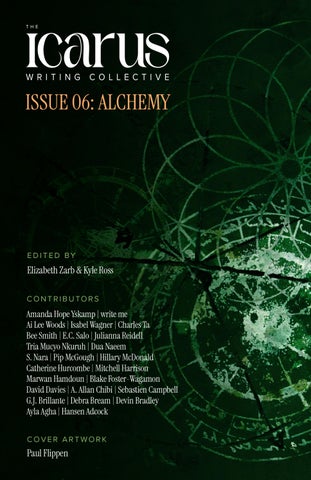
The Icarus Writing Collective Issue 06: Alchemy
🜁🜄🜂🜃
4
5
To our collective of contributors, readers, and everyone who has supported our mission, thank you for transforming our lives for the better.
6
🜛 Letters from the Editors 🜚 I’ve been thinking a lot about transformation while preparing for this issue—not the big overnight transformations of folklore and fairy tales, but the minute changes, the ones we don’t notice as they occur but only when we look back and see who we once were. I’ve thought a lot about who I was publishing our first issue vs. who I am now. My mind is sharper, my ability to do my job as an editor more refined and calculated; I’m more assertive; there is a level of stability present in my life that didn’t exist four years ago. I didn’t realize I was changing until I already had, a transformation marked only by hindsight. I cannot wait to see who I'll become for our next issue.
Elizabeth Zarb
I’m a little bit of an alchemist myself, I joke to the air as I rub Testosterone gel on my shoulders in the morning. Wait ten minutes. Put on a shirt to continue with my day. A little rebellion against the flesh; mind over matter; human ingenuity devising the solutions to what some would call the boundaries set by god. Or God. Or Gods. Whether it’s capitalized, plural, hyphened, it’s all the same to me. (In that it doesn’t matter and I’ve long since stopped caring about what religion has to say.) Transitioning to me was my own little act of creation, my own becoming. HRT is a marvel, a life-affirming, lifesaving marvel. And maybe a bit like alchemy? Read through these pages, and tell me what you think.
Kyle Ross
7
8
🝊 Table of Contents 🝊
“Air”
13
Paul Flippen What the Tongue Keeps
13
Dua Naeem Rubedo
20
E.C. Salo The Witch’s Cat and the Spirit’s Cloche
27
G.J. Brillante “Pull”
48
Amanda Hope Yskamp The Periodic Table of Mixology
49
David Davies Death’s Portrait
51
Hansen Adcock Brother and Sister
62
Blake Foster-Wagamon “Mourning Wood”
69
Ayla Agha
9
In the Eyes of God
70
S. Nara De lo que aconteció a la mente de la mujer muy fuerte y muy brava que se casó con el mancebo
75
Mitchell Harrison The Missing Piece of Osiris
95
Marwan Hamdoun “Toad in a Bubble”
108
Debra Bream Her Garden
109
Hillary McDonald Heir to Paragon
114
Charles Ta “Fire”
134
Paul Flippen “Water”
135
Paul Flippen Deal With a Demon
136
Catherine Hurcombe Pygmalion
150
Ai Lee Woods The Woman Who Learned to Turn Gold Back into Skin
154
Tria Mucyo Nkuruh The Painter and the Pale
159
A. Allan Chibi
10
In Her Golden Eyes
173
Isabel Wagner “Offering”
190
write me Circa 1858: Silver Lining
191
Devin Bradley Creatrix
197
Bee Smith A Note on the Snakes of Thebes
199
Pip McGough “Concoct”
207
Amanda Hope Yskamp Petronelle Flamel Contemplates Radium Water
208
Julianna Reidell The Raven Comes to Visit
218
Sebastien Campbell “Earth”
220
Paul Flippen
🜁🜄🜂🜃
11
12
“Air” Paul Flippen
13
What the Tongue Keeps Dua Naeem
Mireille had been translating for the Ostend family for six years before she understood what she was actually doing to their letters. It started, as these things do, with a word that would not go over. The word was saudade, and the letter was from a dying grandmother in Porto to a granddaughter in Antwerp who had never learned Portuguese, and Mireille sat with the word for eleven minutes before she wrote homesickness for a place that no longer exists and felt something leave her hand as she wrote it. Not metaphorically. She felt it leave. A warmth, low in the wrist, gone by the time the pen lifted. She did not think much of it. Translators get tired. The hour was late and the coffee had gone cold an hour before that. But the next morning there was a small grey stone on her desk that had not been there when she went to bed, and she lived alone, and the window was locked. She put it in a drawer and told herself she was overworked.
14
The second time it happened she was paying attention. A businessman in Seoul was writing to his estranged son in Marseille, and buried in the third paragraph was a word, jeong, that does something no English word does, that means the bond that grows between people whether they want it or not, love that accumulates like sediment rather than arriving like weather. Mireille turned it into the tie between us that neither of us chose, which was accurate and complete and utterly hollow, four words standing where one word used to stand with a whole civilization behind it. As she set down her pen there was a sound like a struck glass, very faint, and when she looked down her hands smelled of rain on hot pavement, which is not a smell that hands are supposed to have. There was a second stone on the desk the next morning. Smaller than the first. Warm, though the radiator was off. She started keeping them in a jar. By the end of that year the jar was a third full, and Mireille had worked out, in the unscientific way a person works out the rules of a fever dream, that it was not the words that produced the residue. It was the gap. Every language carved up the world differently, and most of the time the seams lined up close enough that nothing was lost crossing over, only bent a little, the way light bends going into water. But sometimes a word held a piece of the world that the other language had never bothered to name, had never needed to, because the people who spoke it had drawn their boundaries somewhere else.
15
And when she forced that unnamed piece through the gap anyway, flattened it down to fit a shape that did not fit it, something was left behind. A residue. The part of the meaning that could not be carried. It collected in her hands like calcium collects in a kettle. She should have stopped. She told herself, several times, in the flat grey hour before dawn with the jar catching streetlight on her desk, that she should stop, take a leave, translate contracts and instruction manuals for a year, things that meant exactly one thing in every language they touched. But the letters kept coming, forwarded through the agency, and she was good at the thing that was slowly hollowing her out, and there is a particular vanity in being the only person who can carry a feeling across a border even badly, even at a cost you do not fully understand. The stones changed. That was the part she never told anyone, not that there was anyone left by then to tell. A stone born of a Finnish letter, sisu carried into English as stubborn endurance, its whole architecture of gritted, joyless persistence lost in the crossing, came out the color of an unlit stove. A stone born of the Welsh hiraeth, a homesickness for a home that maybe never existed, came out translucent, and if she held it to the window in the right light she could see, she was almost certain, a country that was not on any map, green and folding away from her at the edges like a page turning itself.
16
She began to understand that she was not losing meaning. She was storing it. Every gap she failed to close did not vanish, it accumulated, in her hands, in the jar, in the small grey weight that had started, by the second year, to show up in her dreams as a second set of hands moving under her own, doing something patient and precise that she could not see. The letter that changed things came from a woman in Tehran writing to her sister in Toronto, and the word was one Mireille had encountered before and always dreaded, a word that describes the elaborate, ritualized offering and refusal of hospitality, the dance of insisting someone stay and eat and take more even as both people understand the insistence is partly performance and partly the truest form of love a house can offer a guest. There is no single English word for it. There has never needed to be. Mireille sat with the sister's line, an ordinary line, come, you must eat, I will not hear otherwise, and knew that whatever she wrote down would be thinner than what had been sent, and for the first time in six years she found that she minded, not abstractly, but the way you mind a small cruelty done to someone you have come to know only through the shape of what they leave unsaid. She wrote the plainest sentence she could. Come, eat, I insist. The residue that came off her hands this time was not a stone. It was warmth, ordinary warmth, the kind a kitchen has when something has been in the oven a long time, and it did not collect in
17
the jar. It went into her, instead of out of her, and she sat very still at her desk afterward, strange and warmed, and understood something she should have understood on the very first night, with the dying grandmother's saudade turning cold in her palm. The loss had never been going somewhere else. It had been going into her all along. Every gap she closed badly, she closed with a piece of herself standing in for the part that would not fit, and the jar was not evidence of meaning leaving the world. It was a record of every time she had donated something of her own understanding to patch a hole that the words alone could not cover. The grief she had felt over the grandmother's saudade, that had not been sympathy. It had been payment. She took the jar down from the shelf that night and opened it for the first time in a year. The stones were warm. All of them, together, warmer than any single one had ever been alone, as if six years of unspoken things had been quietly keeping each other's company in the dark while she was not looking. She poured them out across the desk and they arranged themselves, or she arranged them, she could never afterward say which, into something like a shape, not a word exactly, nothing that would translate into any language she knew, but a shape that meant, unmistakably, if you had asked her to explain it she would have failed exactly as she had failed six years of senders and
18
their sisters and their dying grandmothers: here is what could not be carried, and here is who carried it anyway. She did not stop translating. She could not have said, if pressed, why not, except that somewhere in the year of the jar she had come to think of the residue less as a wound and more as a tithe, a small tax the world charged for the privilege of being understood at all across the places where it had never agreed to be simple. She kept the stones on the windowsill after that, where the light came through them in the evenings and threw small, warm, untranslatable colors across the far wall, and when people asked what they were, glass paperweights, worry stones, she told them the truth in the plainest sentence she had, the same kind of sentence she gave to hospitality and grief and the ache for a home that had never existed. They are what I could not carry across, she said. I kept them anyway. Most people nodded and let the sentence stand, unexamined, the way people do with things that sound like metaphors. Only one visitor, years later, a young man translating for his own dying grandmother, picked one up and held it to the light and went very quiet, and did not ask what it was made of, because by then he already knew.
🜁🜄🜂🜃
19
Rubedo E.C. Salo Content Warnings: Stalking, Blood
Smoke curls up into the beam of light coming through the window of what she considers her cell. She’s well aware she shouldn’t be smoking, but pulls another drag down into the depths of her windpipe, into the raw meat of her lungs. She has been looking for a way out of her own mind. One might think that explains the chemicals around her—and the forest of glass and metal—but most of them do nothing worthwhile if huffed. That is not the high she is after. She knows alchemy is a relic from a bygone time. By the dim light of a flickering bulb—in this laboratory, cell, workspace, never home—she’s been trying it anyway. Her sagging bookshelf has the Hermetica stuffed among it, the Emerald Tablet, the works of Cleopatra, Maria, and none of them have helped. They talk too much of immortality—God, no—but the
20
homunculus didn’t work out, so she’s settled on the creation of gold instead, to keep her occupied. For sleepless nights she’s studied the process and its four steps: black to white to yellow to red. Rot, to purification, to illumination, then creation. Union. Rubedo. For that, one needs the sunlight, to direct and tame its divine force, hold something which could not be held. To be God, really. Maybe that’s why none of it ever worked. It’s certainly not working now. She, for all her efforts, is not fucking God. There are other things she can catalyze, plenty that she has the power to change herself, but they’re not enough. Her life has gained a new contaminant. Out there, someone is forcing her to contend with what she’s been tamping down her entire life: the ways in which she is powerless. Shaking, she puts the cigarette out in the overflowing tray at the edge of the table. Her hand is pale and bone-white. She’s been told she has the hands of an artist, but is incapable of seeing herself this way. Standing up at the window, she peers at the pavement below. It’s a bright afternoon, with sparse handfuls of passers-by on the street beneath her. She’s checked just in time—there’s a flash of scarlet. Shoving the pane and craning her neck, she can see more. If the woman watching from her cell is the prima materia—the rot, the chaos—then the one making her way down the street was sunlight incarnate, whole and perfect, inescapable.
21
Her breath catches as she keeps watching. At times like this she feels she’s become a pair of eyes alone—existing inanimate, inert and taking in without acting upon. The woman in the street is alive in a way that she herself is not. Eventually she can take no more of the dark and makes her way downstairs, out and into the world she preferred hiding above. The scarlet is the hem of a skirt, winks of red undertones in hands with skin that saw the sun more often. She follows that color, around a corner, and knows she shouldn’t. Shouldn’t has always been enough to stop her before. All her life she has been good, as defined by those around her. It has never been difficult until this other woman entered her life, something in those jewel-green eyes making everything difficult. So now, keeping her distance and caring about nothing else, she follows. They wander through the city’s veins. Here is life and entropy, an ancient pulse at a modern pace, which terrify and entice her. Although she grew up above the masses of its inhabitants, it is the only home she, the follower, has ever known. She assumes that for the followed, it is one home out of many. There’s never been an opportunity to ask. Hours pass. They go far. The sun overhead sinks. Her quarry disappears into doors and leaves, one building, then another. That skirt catching the slightest breeze, jewelry on wrists and ankles still
22
catching the last of the light. This woman is adorned in gold, already perfect. She is breathless from the sight and the walking, and turns to go back. 🝊 She wakes herself up at her desk with a coughing fit, having dreamt again of the sun, those eyes. The feeling that constricts her chest and bathes her in sweat is alien to her. This time, to try escaping it, she leaves with her cigarettes in hand. It’s half-guess and half-intuition, but she goes to a bridge where she finds her target dancing on a bit of cardboard, with an old speaker and duffel bag left open for the cash of passers-by. Others are watching, so she keeps to the back of the sparse crowd. Her upbringing whispers to her of evils to avoid, both in the body dancing and in herself for watching. They’re both transgressing. Like for like. As above, so below—even when her pounding heart and light head make it hard to tell up from down. Dancing and watching, twirling in confidence and stiff with fear, their eyes meet. She’d been dreaming of the two of them in a massive crucible, or the two of them small enough to sit entwined in a normal one. The all-encompassing heat had been like what she felt now, intense and gone just as quickly.
23
In the dream they’d melted together, liquid gold and running mud, and they were clean and made filthy. The heat made them something new, blended their cells together into one being that stepped out and into a better life for them both. She is at least sane enough to know that eye contact is not an invitation to say any of this. So she looks away. 🝊 The sun sets, the dance ends. She is the last one standing, smoking like mad, her head emptied of everything but the form of the woman in front of her. “Those will kill you.” A bullet couldn’t have rattled her harder out of her reverie. That voice was never so close, let alone directed at her. The cigarette falls from her mouth, and the other woman smiles. It’s better and worse than in her dreams and thoughts, it’s rapture, and it’s horrible. “I’ve seen you around.” Head tilted curiously. “You live close by?” She’s out of words, wondering if this is what purification feels like. Something is burning through her, and she can’t tell what it’s taking or leaving behind. After an awkward minute, she shrugs. She doesn’t realize how badly she’s trembling. “You’ve been here all day.” “Just—watching,” she stammers, coming closer. Close enough for the smell, sweat and floral body spray and something unique.
24
There is a distiller among the equipment in her cell, and she thinks briefly of using it to bottle that smell, to always have it. “Right.” “You’re beautiful.” “—Thanks. You too.” She’s never been called beautiful in her life and can’t digest the compliment. It nauseates her, almost coming up and out. Maybe the yellowing, being bathed in this woman’s light, is supposed to hurt. Illumination might just be accepting that someone has this power over her. She says nothing. The silence stretches and grows awkward, both of them shifting uncomfortably on their feet. “So, what’s your name?” She lies. “Did you enjoy the show?” “I think so.” Those eyes examine her, cautious now. “—Can I help you, then? What do you want?” She can only come up with one answer but her words fail her. When she grabs the other woman’s arm, a pale claw around the skin, it’s far too tight. The response is instant—flailing, kicking, fabric flying and tugging until it rips—but no one else is around. They can melt together, alone. Blows rain down on her, but she holds on. “Just take the money—”
25
A wild laugh escapes her, hearing that, because she has no use for gold now. Another plea, “Whatever you want, take it and leave me alone—” What she wants is to hurt her, to hold her, to run, and to absolutely never let go. What tears from her throat is, “no.” In this mess, a little switchblade appears like magic and suddenly her side is alight with pain. She falls and her light hesitates, steps back, but runs away. Against the metal railing of the bridge, alone, she collapses to sit in agony and relief. Every breath radiates pain, but that’s fine. She reaches under her coat, swipes a hand over her hot, wet skin and brings it to her face smeared with red. There, at last, is rubedo. The end, the fulfillment, warm and bright even by the lesser light of the moon.
🜁🜄🜂🜃
26
The Witch’s Cat and the Spirit’s Cloche G.J. Brillante
Alveric Olveron the great wizard served no master, but Alveric the cat, unfortunately, did; or, rather, he had to pretend that he did if he ever wanted to attain even a sliver of his former dignity. Pattering forward on four tiny excuses for legs, he flicked his tail irritably as he and the witch emerged from the bushes. Dahlia refused to carry him. It would have been so much easier to sit upon her shoulder, keeping a watchful eye on the lone, wandering king, but as it was, she would rather have him tread along at her side like some mangy dog even though he was a cat—a situation, granted, that he did not consider to be any better than being a dog—than risk his claws tearing the delicate fabric of her bright gown. Too bright gown. The king would notice them approaching. She was dressed like the sunrise, after all, in yellow silk overlaid with petal-soft, sheer pink fabric woven from the full morning
27
clouds. Her hair was long and golden, and she had it bound in garlands of thorned vines. “Who’s there?” the unfortunate king called, unsheathing his sword. Alveric suppressed a growl. Wyrm and weather! They had been seen prematurely just as he had warned her they would be if she did not, at least, don a cloak. Yet, Dahlia did not like stealth. She wanted to be a rising star, and he knew she hated, above all else, that there was a ceiling to how high her powers could take her. She, for one, could not hope to touch the power of the true stars, those spirits of the Realm of the Stars. Yet, tonight, she shone. She swept forward with her arms outspread and said, “He who seeks to live like a god among men, mortal king, if you are him, come to my home on the hill that the crescent moon touches, and there I shall unveil a secret to accomplish your quest in return for a place among your court and the jewels filled with twilight you keep in your hoard.” Alveric sighed. Such petty rewards for the secret she offered, but it was not his problem what she offered the king. He would get his boon in the end. The king opened and closed his mouth, starved of words to say. Rumor was he hadn’t slept or eaten in weeks, nor had he spoken to anyone since the strange idea filled his head of capturing a spirit from the Realm of the Stars. The king’s advisors, whom he had dismissed
28
before falling mute, had said the king had once dreamed of a dark world with no sun and had ever since then fallen under an unbreakable spell to wander with his head lifted toward the sky in search of a glimpse of the Realm of the Stars, longing for a spirit to capture. The advisors were right about the spell. The king was enchanted, of course. Alveric was the one who had cursed him. “My magic has taken effect!” Dahlia said with a squeal. Alveric wrinkled his nose. Well, it was her magic, but his curse. “It’s time, kitty.” Dahlia grinned and flicked her dress at him. Alveric hissed. He knew his cue, and he knew his mark even better. The king would fall prey for his trap. Although the king had read plenty of stories on how to approach the Realm of the Stars, he did not know how to capture a spirit from the Realm of the Stars and keep the spirit from fading as soon as she breathed mortal air or touched mortal ground. So, it did not surprise Alveric when the king said, “Aye, witch. I’ll be there, and I’ll give you all my jewels in exchange for this secret. Make me immortal, not a king of ash and bone but of gods!” “Come. Come then!” Dahlia cried, throwing up her hands. Alveric rolled his eyes and flicked his tail. He drew on his magic, and with the rapid falling of mist that sounded like the hush of a
29
waterfall, they vanished from the king’s sight. He made them appear on the hill that the crescent moon touches. “Sit and await him. I must tend to my collection,” Dahlia said no sooner than they had arrived. Alveric hissed but did not respond otherwise. Oh, Dahlia could do what she liked for all he cared. The poor, unfortunates she called her “collection” had his pity, but he was living the nightmare, for, you see, Dahlia really only knew how to cast one spell on her own, and that spell turned people into beasts; to make matters worse for him, it was the first and only spell he had chosen to teach her. Dahlia went on her way, and he stayed waiting for the king. It was not long before he heard footsteps walking up the hill that the crescent moon touches. Alveric lifted an eyelid and fixed the king with a golden-brown eye. He narrowed the abyss of his slitted, black pupil. He did not rise to bow to the king; rather, he waited for the king to address him. “Where is your master?” the king said. Alveric hissed and wrinkled his pink nose. Slowly, he rose to his feet, stretched his striped orange and tan body, and lifted his long tail into the air. Then, to the king’s annoyance, he sat and licked his paw. “Dumb beast, you would dare ignore a command from your king?”
30
Alveric set down his paw, opened his fanged mouth, and said, “I roam between worlds as I please, I serve as I want, and I sleep when I have need. You have interrupted my nap. Begone. The witch is out, but I may still curse you.” The king raised his fist as if to strike him—the fool!—but he stopped when he arched his back and the hairs on his body rose. He opened his mouth to utter a great curse when the ground swallowed the king whole. Thus, the king fell into the terrible witch Dahlia’s lair as did he. With a hiss and a sputter, Alveric landed on his feet and immediately took to licking his paw again, but the king fell flat on the stone ground carved with runes. “You have marched up my hill that the crescent moon touches, stomped on my roof, and have insulted my cat,” the witch said in a deep and echoing voice. “I should curse you for that.” The king glanced up, beheld the witch, and hid his trembling hands behind his back. It was clear he was not afraid though, for a boyish grin had overtaken his face. Between Dahlia and him, they were giving the king the adventure he had craved. “Forgive my trespassing, oh terrible witch Dahlia, on your humble abode. I went tromping up your hill touched by the crescent moon as you commanded to seek the knowledge you promised.” “Hmph!”
31
The witch snorted and folded her arms, but since she did not turn the king into a frog, the king, wisely, took it as a sign to continue. “Oh, great one with hair like golden grain, irises like tiger’s eye, and face like a rose, if you would tell me how to capture a spirit of the Realm of the Stars, I would share the magic given to me with you.” Dahlia laughed and waved a hand. “I should sooner turn you into a pig than believe that you would share any of that place’s magic with me. Besides, what use have I of magic from the Realm of the Stars? It would only fade under our sun that never sets, and I could take no pleasure in the mischief it would cause, for its effects would be brief, more brief than a rose destined to wither, a rose like you have called me.” Yet, in the witch’s eyes a green flame flickered and sparked. Alveric knew she wanted to be ever powerful and did not want to die as all mortals do in this realm, but she had no knowledge to offer the king in order to strike this bargain. She needed him. “I will hear your wisdom, or I will not leave,” the king said. Dahlia laughed. “Ooh, you are a pest! I’ll turn you into a rat if you do not go!” The king was petulant and sat where he stood, tilting up his chin at Dahlia’s words. Yet, Alveric knew the witch was all talk, for the idea of capturing a spirit from the Realm of the Stars had taken root in her
32
heart. He bowed his head and began to lick his paw as Dahlia tromped up to him. With her hands on her hips, she said in a whispered voice, “Alveric, this thing that the king wants, to capture a spirit from the Realm of the Stars and keep her fresh with magic and untouched by the power of death in our mortal land, is it truly possible? I thought it was only a scheme… but how can it be done? How can I get this power? “If I deliver the king this method—forget the jewels!—I would have half the power of that realm. I could rule both the Realm of the Stars and the kingdom where the sun never sets. So, offer up this information. Then, when I possess the magic of the other realm and have no need of your powers, I may release you.” Alveric went on licking his paw. “Useless, stubborn cat!” The witch threw up her arms. Alveric paused and said with a hiss, “To keep her magic and her life, this thing cannot be done.” The witch frowned. “There is no way that you know of? It was all a fool’s errand! Useless—” Alveric stared at her and flicked his tail. The witch looked away. “To capture a spirit from the Realm of the Stars, tell the king to trap a siren’s song in a seashell, to gather foxgloves when they chime, and to walk just before moonlight when the sun is fully hidden by the Realm of the Star’s shadow. Then, he must set the
33
seashell and foxgloves on a dish, waiting for the first star of night to rise, and when the spirit hears the siren’s song and sees the flowers, she will fall to the mortal realm. And while she is all shadow and mist, he must drop the dome of ensorceled glass. Then, will he capture a spirit from the Realm of the Stars and be able to keep her in a cloche.” The witch turned away without a word of thanks to inform the king of how he may proceed. Alveric sighed, but he was biding his time and wanted the king’s mission to succeed even more than the witch. He longed for the Realm of the Stars in which he had spent the many joyous years of his youth before he had become tethered to the kingdom where the sun never sets. 🝊 “What could this be? What is this melody?” came a voice from faraway, carried to the kingdom where the sun never sets by a wayward gust of wind from the Realm of the Stars. A man walked before moonlight apart from the fields of men, bearing foxgloves in his gauntleted fist that chimed little notes with every step he took and a seashell that whispered songs with inhuman melodies when pressed to the ear. The small man held up both items on a dish made from human bone. She watched him as he walked until the first star shone before even the moon of her realm made herself known. Then, the man grew as still as stone. Curious.
34
Oh, she was very curious, for a moment later she caught a glimmer of starlight moving below and heard the tinkling laughter of flower bells ringing. She laughed too, delighting at the polished gleam of the bone-white dish and drew even closer to the man, no, king of dust and bones. Mother Star had always told her that humans were deadly, dangerous things, always trying to glut themselves on the magic of their people beyond the twilight. Yet, this spirit had observed the seashell and heard the siren’s call, so she approached the dish despite Mother Star’s warning. Thus, she formed eyes, two of them, to mimic the humans she had so often seen from afar, and then she made a mouth to make faces at her reflection. A nose to smell the flowers and two ears to listen to birdsong followed next. Her long hair, which was colored like the reflection of a sunset on a frozen lake—a sight never before seen in this kingdom—waved behind her as if caught in an unfelt breeze. Then, the spirit formed a body, not much larger than a seashell, out of the night’s mist and decided to place two small feet on the dish to walk across it. She smiled and laughed as the foxgloves rang furiously in alarm, but she did not heed their warning cries. So, when the king dropped the magic reinforced cloche onto the dish, she was surprised to find herself sealed inside.
35
“Oh!” The spirit leaped into the air and bumped her head on the cloche’s glass top. She drifted back down to the dish, like a leaf shed from a tree. The king picked up the dish, holding the lid tight. “I have caught you, spirit!” he said. The spirit climbed up the stem of a flower and placed her hands on her hips. Yet, standing before the large eye that seemed sure to swallow her whole, she shied away from the glass and hid behind a petal. “Let me out!” she said. “Mortal of dust and bones, I command you to release me, or I’ll work terrible magic and curse you!” The king laughed and tapped the glass. “Curse me, fair one? No. You will serve me.” The spirit growled and raised a hand to curse the king, but with a snap of her fingers and a blink of her eye, the magic fizzed and popped and sank to the bottom of the cloche, settling like a miasma of despair. To her utter horror, the king then began carrying her away, but as they walked, she beheld the sun in all its glory as it made the world golden. This made the spirit forget her worries for a time, for she had never seen the sun before. It reminded her of the molten fire in a dragon’s eye or the golden dew of the trolls’ precious garden of honeysuckles.
36
“Ooh! Won’t you let me out, so I may dance with the colors of the sun?” the spirit asked, daring to appear before the king’s two monstrous eyes. “No. Your magic is mine,” the king replied. As they approached the castle, the spirit saw for the first time men working the fields. So, she said, “What gems could I unearth if I were to walk upon Mother Earth? Oh, won’t you let me out to play with the farmers and their tools?” “No,” the king said. “Your magic is mine.” And for every new thing her eyes of burning light beheld, whether it was a shiny stone like a moon’s teardrop, a cloak flapping in the wind like fairy wings, or a cane tapping unwittingly to the heartbeat of the trolls, she asked to be let out and the king denied her. So, after three nights and three days of travel, the king came back to the castle, weary of the spirit’s whimsy, and, to her horror, he summoned his aged advisors to commence with his plan of capturing her magic. And although he did not call for them, the witch and the witch’s cat came too. 🝊 “Now,” the king said, holding up the spirit’s cloche. “Let us have magic. Make me immortal, so I will rule those of dust and bone and never join them in the earth.”
37
Alveric watched closely as the spirit frowned. She walked on the stems of the foxgloves and stood at her full height, no taller than the spiral shell in the cloche, and said, “I cannot. If I have no magic to curse you, then I have no magic to bless with.” The first advisor to approach the cloche had a long, grey beard, which made his back bend at an odd angle. He said, “Spirit, can you mend my bad back with a flick of your wrist?” The spirit raised her hands, but her magic just fizzed and popped as soon as it touched the ensorcelled glass. “No. I cannot,” the spirit said with a growl. The second advisor with a nose like a vulture’s beak came forward. “How about my aching teeth?” Again, the spirit’s magic fizzed and popped. So, the second advisor went away gnashing and grinding his teeth. The third advisor, whose turn it was to approach the spirit from the Realm of the Stars, would not come forward. She stared with dark eyes, almost as black as twilight, at the spirit and then went away, wandering across nameless fields until she came to rest by wild foxgloves, whose bells tinkled with laughter. Thus, the wisest of the advisors died in the land where the sun never sets and she died under a sky veiled by clouds and mist. When the third advisor went silently away, Dahlia came forward and inspected the cloche and the spirit trapped inside. Alveric held back a laugh as she wrinkled her nose and tsked.
38
“It is little wonder this creature does anything at all aside from hissing and growling when you chose such a dull shell and dying flowers.” The king tapped the cloche and said, “Do my bidding, spirit, for I am your king.” “You are a mortal king, and you will sooner settle into the kingdom of dust and soil ruled over by maggots and worms than I will ever find a reason to obey you!” “Can you not work magic then?” Dahlia asked the spirit with a yawn. “Of course I can work magic!” the spirit said, and the foxgloves began to chime. “But not while I am trapped in this cloche full of mortal things.” Alveric purred as he watched the king’s face turn a burning shade of red. The king raised the cloche to smash it against the ground, but at that moment, Dahlia intervened. The spirit grinned and gathered the loose petals of her dress to swirl about her, so she might catch the witch’s eye, but Dahlia wouldn’t give her any attention. Alveric looked instead, and when the spirit’s eyes met his, she squealed in delight, making the foxgloves chime. “What is this?” Dahlia demanded of the king. “For instructing you on how to capture the spirit, you promised me half of its magic!” “It has no magic to give,” the king grumbled.
39
He again hefted the cloche, but this time threw it at the ground. Yet, the glass did not break and the dish did not separate from the lid. The spirit giggled as she flipped in the air, unharmed and still trapped inside. “What’s this?” the king said. “It will not break! The spirit cannot be killed!” Dahlia eyes glowed an unnatural shade of green. “You would dare try to break our bargain, and in my presence, too!” The witch threw up her hands to curse the king, but glanced at Alveric first and caught his eye. He meowed, so she turned away from the king to approach him. “What is it, servant?” Alveric went on licking his paw. Dahlia frowned and said, “Well, is it true what the king has said? The spirit has no magic to give.” Alveric flicked his tail and twitched his whiskers. He said, “What the king has said is a lie.” “What should I do?” “Curse him,” Alveric said, “and take the spirit to your house where you might learn its magic through observation.” Dahlia grinned. Without a word more, she turned the king into a rat. Alveric’s eyes narrowed to slits and he pounced. He batted the rat between his paws once, twice, and then swallowed it whole. The entire time this was happening, the spirit cackled inside her cloche
40
and clapped her hands, enjoying the show of magic; although with her own power, Alveric knew she would have delivered a curse that was a thousand times worse. Thus, Dahlia seized the cloche with the captured spirit and they returned to the hill that the crescent moon touches all as Alveric had designed. 🝊 Alveric could feel the buzz of magic in the air, making his fur stand on end. He twitched his whiskers and feigned indifference, though, as the witch continued to demand that the spirit surrender her magic, and just like the spirit had answered the king, she said, “I cannot.” “Cannot or will not?” Dahlia demanded. “Both,” the spirit replied. Dahlia’s eyes flashed green as she placed the spirit on a shelf in her study. “Then, I will read how to extract your magic from you! Hmph!” Dahlia seized three books from the shelf and went to read by the light of her cookfire as she baked bread and stirred a potion— all by Alveric’s design. The spirit, who was floating in the cloche, sank to the bottom and sat upon the dish with her hands of mist pressed against her face. She sniffled then and Alveric knew what she must be thinking: that if one who knew magic would not release her, then what hope
41
was there of ever seeing the stars and dancing with the colors of the sky again? Just as it had struck him centuries ago, she must have arrived at the conclusion that she was trapped in the kingdom where the sun never sets, for her eyes began to well with tears and the colors slowly bled from her hair, splashing like rain against the bottom of the cloche. Alveric, however, saw that this was his moment. With the witch distracted, he approached the spirit. “Greetings spirit from the Realm of the Stars, do you have a name my mortal tongue can say?” The spirit looked up and wiped gem-shaped tears from her eyes, which shattered into sparkling dust as soon as they collided with the dish. “Speak again, mortal of bone and dust. To my ears, your words have not settled, and to my eyes, you do not exist.” So, Alveric came closer and again asked for her name. This time she saw him. The spirit’s magic was greater than the magic she perceived in the cat’s eyes, so she did not fear him. Therefore, she said, “A name of mine, which you may say, is Zira, though I am called by many other names that have no meaning in this world and others that would take an eternity to say.” “Then, I shall call you Zira.” Alveric moved away from the spirit’s cloche to sit by the fireplace as he often did at this time of
42
day. After hours of sifting through daydreams, Alveric drifted back to reality. “I can free you,” he said from his seat by the fire, “but I will require a favor in turn.” Zira placed her hands against the glass of the dome, and despite wanting to be free, was wary of the cat’s desires. She asked, “And what would you ask of me, little lion of Earth?” Alveric turned and looked her in the eye. “I want you to free me in turn. I was once a great wizard in possession of magic from your realm, for I had been whisked away there as a child before Death sent me back to the mortal realm. “And being so great and so terrible, laying blessings and curses on this earth, I grew tired of the fear and awe that I had inspired and wished for something new. Therefore, I found a young witch, new to her magic, and made her my apprentice, but believing myself to be immortal, I did not take heed of her vain and violent ways, so I had not foreseen that she would trap me in this terrible form, so I might surrender all my magic to her. Yet, though years have passed, I will not yield, and she cannot undo the curse, so I am stuck as you see me: as a cat.” Zira trembled as she looked closer and saw the vast pools of knowledge in the cat’s eyes and felt the thrum of magic flowing through his veins. She shed a tear and again the foxgloves in her cloche began to chime. This time, however, they kept on chiming. “I will do it,” she said. “Free me, and I will free you.”
43
Alveric’s mouth curled into a grin. He leaped from his spot before the fireplace onto the shelf where the spirit’s cloche rested. Then, like others of his kind, he took his paw and knocked the cloche clean off of the shelf. Zira closed her eyes as she fell and felt at peace as the siren’s song from the seashell washed over her. Then, crash! Clang! Thud! The cloche shattered into thousands of pieces of glass. The cat hissed and the hairs on his back stood up while Zira lay full sized on the ground. She was free of her prison and held the foxgloves clasped in her hand like a bouquet. Her eyes were closed as if she were sleeping. All was silent as Alveric leaped onto the ground and stood beside Zira. He pawed at her arm. His voice replaced the chime of the flower’s bells, “Awaken, Zira, and use your magic to free me as you have promised.” She did not move. She did not breathe. Her heart did not beat. Alveric hissed, and his eyes widened. A shard of glass had fallen onto her chest, and as if it were guided by the power of some creature of the Realm of the Stars, it had stabbed her through the heart. So, Zira, an immortal spirit from the Realm of the Stars, had died in mortal lands.
44
What will happen now? Will the sun set? Will the stars forget to shine? Will the sea grow wrathful and turn to conquest in the spirit’s name? he wondered and began to tremble in fear. Alveric meowed and hissed until the witch came from reading her books and glanced into her study and saw the shattered cloche. Dahlia screamed at the sight and raised her hands as if to ward off powerful magic, but in breathing the air that the spirit of the Realm of the Stars could not, she relaxed. The spirit’s life had fled and with it her magic also, or so Dahlia thought. “You did this,” she said, facing Alveric with her hands on her hips. He twitched his nose and unsheathed his claws. “I did.” “You killed the spirit!” she yelled at him. “I was reading what I could do to steal her magic!” “Yes, I know,” he said. “Now you will work yours on her.” Dahlia frowned and glared at the orange tabby. She crossed her arms and said, “What’s this? You’d have me turn her into a dumb beast?” Alveric did not reply but narrowed his eyes on Dahlia’s face, waiting for her to do his bidding. She groaned and shook her head. “I have no idea why I don’t just throw you to the dogs!”
45
Yet, Dahlia, accustomed to doing as Alveric said, obeyed him. She cast up her hands and, by inspiration of the foxgloves, turned Zira into a fox. “There. It is done,” Dahlia said. Suddenly, the blood dripping down Zira’s chest turned to green stems, and foxgloves sprouted all around her, their purple bells ringing. Dahlia covered her ears with her hands. “What is this? None of my curses have gone awry before!” Alveric meowed loudly and a grin overtook his face. His eyes alighted when he first saw the fox’s chest rise and fall. Then, Zira’s eyes opened and she looked at him with an emerald wilderness in her gaze as she sprang to her feet. With a flick of her tail, she cast her spell. Dahlia screamed again, eyes overtaken by green. “Free! At last!” Alveric exclaimed, standing on his own two feet. Before Dahlia could turn him back into a cat, he uttered his own curse and turned her into a flower who loved the stars and bloomed with sunburst colors. Without waiting for Alveric to follow, Zira leaped into the air and the roots of the earth pulled her through the soil until she stood atop the hill that the crescent moon touches. Then, she ran across the fields toward the same twilight where magic flows, and as she ran, her tail painted the sky in hues of orange and red. And when
46
Alveric emerged from the mound swathed in a mantle of shadows and armed once more with his own magic, thinking to undo the curse on Zira, he beheld the world’s first sunset and knew the Realm of the Stars had separated from the mortal lands, leaving what magic it had given behind but no more than that. Alveric stood there on that hill that the crescent moon touches for a long time after the sun had set and the first night of darkness had fallen. With a sigh, he released his magic, freeing it so it may pass with the twilight, and by the dawn of the first sunrise in a kingdom where the sun had never set before, he turned to dust to travel on the breeze still connected to fairyland. Still, whenever the foxgloves chime, a seashell sings, or the wind whispers, the story of the witch’s cat and the spirit’s cloche is told and the magic of the Realm of the Stars silently lives on.
🜁🜄🜂🜃
47
“Pull” Amanda Hope Yskamp
48
The Periodic Table of Mixology David Davies
Beginning at the top left inert cordials and tinctures so next day it’s hard to be sure
with the lighter liquids, few free electrons, that you indulged at all.
Next, into the common elements of cocktails, widespread across the spiral arms and bottled in all places in-between. Lustrous drams of buoyant nuclei, reactive to mixers from a million worlds, aperitifs in alkali or acid, whatever excites your palate. Drink on down through the halogens, salt forming on the rims of glass, numbers atomic and alcoholic rising as we work along this stocked shelf. Deeper still, dark liquors that weigh down the mood and breath, found exclusively in shady bars that orbit dying stars. Lanthanides, shedding their neutrons to kill off the neurons, served in finest lead-
49
lined crystal, recommended only for those with self-restorative biologies. Now at the bottom, in the realm of the true connoisseur, digestifs that don’t exist in nature, that degrade like decency in tenth-of-asecond shots—the half-life of inhibitions. A nightcap? Sip on caramel-colored actinides barely liquid at room temperature. One for the road as you slip under the table and wobble off wondering if gravity is askew here, hoping this world has a slow spin to keep the morning after far away.
🜁🜄🜂🜃
50
Death’s Portrait Hansen Adcock Content Warnings: Death, Terminal Illness
A creeping shadow gazed out of the frame at its maker, a miasma of subtle fear, dark pain incarnate. The eyes were burning brands, searching the body’s essence from end to existential end. The entity who commissioned the painting was on its way. This was George’s third attempt. He hoped for mercy this time. One resonant knock on the black-painted front door, almost as if by accident. George remained where he was and the thing-thatwas-but-could-not-be swirled into the room. It wiped vestigial feet on the black-dyed doormat and came to rest between the painting and the painter. “Hmm,” said Death. “A tolerable likeness. I accept.” George uttered silence. He stared rigidly ahead, red-eyed, filthy, sore with guilt and grief.
51
“You are well again,” Death spoke, “in return for what you have done for me. The people in this town speak the truth. You are a gifted artist.” “My wife.” The voice of the artist couldn't move the lump in his throat. “What did you do with my wife?” Death seemed deaf. “Where is she? Where’s Andrea? What have you done with her?” The tower of twisting evil moved towards the door, past the black-painted furniture, past the blackened curtains. Even the ceiling was now black. It felt quite at home. “I can see from the interior of your abode that you know full well. Her years have become yours alongside your own.” “That wasn’t the bargain we made!” George stormed upright and cracked hoarsely. “The portrait for my life! That was all!” The towering column of deeper night stood still. The artist expected to be swallowed and half-welcomed it, but Death keeps its word, even if it has its own morals. “If I did that, and took no life, there would be an imbalance. I had to use extra time from another being. The closest being to you was more than willing to accept. The woman understood my terms.” George could give no argument for that. He knew Andrea far too well. Of course she would sacrifice her life for him. He’d do the same for her.
52
“This is a con.” Death placed its hand on the doorknob. George noticed the painting remaining in its place of origin. “Aren’t you going to take it? Aren’t you going to remove the revolting thing from my sight?” Death paused, rotating soft upon the threshold. “You and I both know that is not how I work.” Then the apparition was gone. 🝊 Terror ended and madness began. It crept in through the silence and fulfilled itself in George’s dreams, until waking hours merged fitfully with the small hours of morning, when dreams and reality exist in symbiosis. He opened his eyes. He lay in the bed he shared with Andrea, unable to stir. The old pain and sickness ate away at his insides, pooling in acid fire in the insides of his elbows, his knees, behind his eyelids. He hardly cared. Someone began washing his face. “Andrea?” His voice, unrecognizable. “It was a bad dream. You’re safe.” “Andrea. Am I dying?” He opened his eyes. It all rocketed back to him: she wasn’t there any more. He’d stolen her life.
53
At daybreak, he seized the picture of Death, removed the frame, and braced himself to tear the canvas in two. It wouldn’t rip. After lunch, he bought a hacksaw from the hardware shop on the next street and sawed and sawed at the countenance glaring out of the abomination he’d created until he was a storm of feverish movement and sweat, until he felt like an automaton. He gave in to exhaustion as the sun migrated further west and surveyed his handiwork. The portrait squatted unharmed, the saw blunted, his hands raw and bleeding. He kicked the saw into a corner in disgust. “There must be a logical way out of this. Think.” He huddled at the window, watching the day’s end. He remembered the days months after the onset of his disease, when too much movement pained him and he slept half-days and nights. He remembered the doctor’s verdict, though it felt more like a sentence. He remembered the arguments and the tears and the kindness. Andrea never left him even when he hated the world and everything in it. George remembered the first time they saw Death. It was a horrible shock for both of them, though he'd been pushing for it, though he'd warned her. Life is never even.
54
He’d strewn salt and sand, acquired books with great difficulty, spent endless hours with them in dusty consultation. The signs he’d had to draw on the door in ash mixed with his own blood. The words he had to repeat until his tongue was lead. The first tendrils of Death slithered in one Tuesday morning. Death had heard rumors that his next client was a renowned artist. They made a bargain: George would have three chances to paint Death’s likeness—which was nigh on impossible—and if he succeeded, Death would spare his life. Even George could see the first attempt was atrocious. “No better than a child’s drawing,” he said aloud scornfully, and when Death looked at it, the painting withered, rotted, and peeled away in strips, like wallpaper from damp bricks. 🝊 Her breath in his ear. George turned his back to the sunset and faced the room. Nobody there. 🝊 Andrea stood with her back to him, in front of his easel. He could see her and his heart overflowed. “Andrea! What are you doing?” She carried on, oblivious, painting something. Then he realized, ice thrilling his veins, that it was the portrait of Death.
55
It took an effort to move. He walked past the mirror and there was no reflection. He came to an uneasy rest behind her. She didn’t turn around. Breathing in the scent he missed, he reached out to touch her hair and failed. His fingers slipped right through... because he had no fingers. He was a patch of floating nothingness. Death billowed in, a smoky cloud, and regarded her work. George could see the figure of a man in the spiraling storm of silence—a man in a dark grey suit, a pallid man who turned, his cold eyes stabbing through him— George opened his eyes and wept. The moon burned into the room, as the knowledge burned into his brain: she was the one who had died and not him. In the silver light, he stood in front of the portrait of his enemy and attacked it with a large sable brush and an entire tube of titanium white. The following morning, Death glared from its canvas, unchanged. It was as if it shrugged off the layer of extra paint like a shroud. The picture seemed to gloat. Trembling now, scared, George crept into the tiny bathroom and washed his hands. Again. And again. And again. He remembered the circumstances surrounding his second attempt. Andrea was still present. They had a cruel argument. She didn’t want him to let Death in anymore. He wouldn’t listen. The
56
painting was better, though still not accurate; he reasoned with her that if only he could persuade Death to stand still, he’d at least have a model to work from instead of a petrified memory. She stormed out. Death stormed in, rotted the canvas as before, and turned to exit. “Wait. Stand there for a few minutes.” George's heart hammered in his mouth, expecting to be stilled for disrespect, but a blow wasn’t forthcoming. “I can’t stay long,” Death replied, a gentle tornado of gloom in the center of the carpet. “I must not be late for my next appointment.” 🝊 Her face in the mirror above the sink. He muffled a gasp. Turned. Gone. 🝊 Convinced he was doomed to see another world where Andrea was forced to live without him as he was forced to live without her, George dared not sleep, but by week’s end, he couldn’t resist closing his eyes for a moment. A palace at the edge of the world, where shadows met darkness. He seemed to be a fixture in a claustrophobic passage. Through a narrow doorway, two skeletal assistants were measuring his wife.
57
They were fitting her into a wedding dress. Her face gazed back at him in the looking glass but she said not a word. The assistants left. George tried to cross the threshold. He couldn’t. “You can’t be getting married,” he tried to say. “You’re married to me!” No sound came from his mouth. “Who is it?” he yelled and jerked awake, seated at his desk. There was no point in asking the question. He knew who. Death had cheated him twofold. It didn’t need Andrea to keep a balance. It wanted Andrea for itself. His blood thickened and boiled. He emptied the white spirits— usually for cleaning brushes—over Death’s portrait until it was sodden, struck a match, and flicked it at the canvas. Fire mushroomed around it but refused to touch the picture in the center. Dizzy, mist-minded, he watched the flames spread and claim everything he’d ever owned. 🝊 Her face blossomed out of the flames. George’s head hit the floor with a nauseating thud. She vanished. 🝊 “I need your help.”
58
“I know. You aren’t really going to live with—” “I’ll have to. I don’t want to. It’s that portrait you did. It needs destroying. Then we’ll both be free.” “I set light to it.” “Well, that was silly.” “Why?” “You’ve burnt down the entire house. Our entire house. And you almost burned to death.” “How come we're here?” They were sitting opposite one another at a table outside a cafe they used to frequent on their honeymoon, in their early twenties. Customers and waiters passed around them as strange, vague blurs. No one disturbed them. “This is the last time I can talk to you unless we do something. I’ve got to marry—him—tomorrow morning.” “It is destroyed! The painting’s gone. I burned it.” “No. You burned everything down around it.” “If flames won’t touch it, and paint won’t stay on it, and I can’t break it into pieces, what can I do?” “The only thing that can destroy Death’s portrait is himself.” 🝊 They stretched a plan between them, between their two worlds and hearts and minds.
59
George opened his eyes to the sounds of a heart monitor and knew what to do. Outside the hospital window, darkness crept to the horizon. He discharged himself. The structure where his house once stood—now a charred, smoking ruin—was as black on the outside as he’d painted it within. The portrait of Death stood untouched upon the singed easel, mocking him. A fresh breeze caressed his face as he took the foul creation under one arm and began to walk in an anticlockwise direction, chanting the mantra he learned so long ago, remaining watchful. The ashes on the ground skirled and skirmished into a black column. George smiled to himself, recalling the pale man in the suit from his dreams, and when he judged the timing to be right, he threw the portrait into the amassing tendrils of malice. Death’s head tore through its own portrait. 🝊 Breathe, beat. Move. Fast. 🝊 “YOU!” Death roared with a thousand voices as George sped away, triumph and terror warring for supremacy in his heart. He could feel Andrea running with him. She was him, he was her– A dead end—
60
A dark, threatening coil enveloping, pulling him back— He hoped for mercy this time. 🝊 Death keeps its word. It has its own morals. Sunlight streamed in through a café window. A man and a woman sat, side by side, gazing at the view. No one disturbed them. They didn’t disturb anyone else. “You’ve graduated,” the woman said, “why aren’t you happy?” The man hesitated. “I want to do something no one’s ever done before. Carve an angel or paint Love. Or Death. I could paint Death, in the future. When I’m practiced.” “Mmm,” the woman said. “Perhaps not.” They grew silent, both half-remembering the other’s thoughts. In there somewhere, the memory of a chase. “You’re right,” he said. “I doubt I’d get away with it, anyway.”
🜁🜄🜂🜃
61
Brother and Sister Blake Foster-Wagamon Content Warnings: References to Domestic Abuse, Blood
My brother, once human, is now a deer. I had no other choice but to change him. It was that blue filth that begat his transformation, that gluey sap that filled his water bottle, the obscene stream he’d squirt into his gaping maw and gargle, gulp and swallow. Day and night, he downed electrolytes and salt and salt and salt. I remain clueless as to where he garnered his affinity for the stuff. We were muddy children together. The odd shrinking lake would tide us over in the summer heat. Fresh water was our friend. Within that long stretch of nothing between school years, we stumbled barefoot over cracked asphalt to the muddy shore where we played mermaids. His tail was purple with shimmering scales. Mine was semi-translucent, blue. We would splash each other with thick, green water, laden with pollen and amoebas and invent new dangers which we spied through ancient bottles of Bud Light. These
62
were our kaleidoscopes, brown and green visions through which the world’s borders warped and split. We took the rare blue bottles we unearthed home to show our mother who, in the singular act of mercy she ever showed us, reluctantly displayed them on the kitchen windowsill. There, they would refract the short winter days, rays of holy light cast like waves on the orange peel wall. Those were the years before my brother learned that mermaids are for girls. Men, he told me at the tender age of nine, are built for battle. They are beasts. They don’t pretend. They only sparkle with the shark tooth shine of a medal after a war well-won. Guys like him fight and win. “Like dad did,” he proclaimed while puffing his chest and shoulders, with his mouth drawn tight and his tiny toes dug into the sandy lakebed. I had my doubts. Such small feet couldn’t possibly carry a soldier, but I was at a loss to counter him. My ten-year-old tongue and girlish demeanor weren’t accustomed to talking back. I had only begun to learn about war from the long hours that our mother spent unconscious, dreaming to the tune of talk radio. By the time school years gum-stretched into graduation, I’d long stopped paying attention to his plans. Jobs for young people, my primary concern, had become scarce, and so did my brother. He was in-demand among his peers. I heard him called a “social wonder.” He was, in short, a popular douche, and I could not wait to leave him behind with our aging mother. She was wasting away,
63
then, but her backhand still packed the punch it always had. I walked away as soon as I could, eager to roll down my sleeves and never explain a single bruise to a nosy swim coach again. I abandoned my brother that year and I didn’t look back until he had already applied to enlist. “Like dad did?” I asked. He hummed on the other end of the call. He wanted to stay with me before bootcamp if I had extra room. Two weeks later, he was napping on my couch while I worked within the confines of my bedroom. Even muffled, his snoring carried through the walls, a guttural growl. I had invited something dangerous into my home. Over our first dinner, following a first course of failed small talk, I asked him if he was afraid of dying. He cried out, offended at the insinuation that he would ever die, much less feel fear. The image of him sobbing at age six struck me. He cradled his sliced-up foot, still bearing shards of the shattered corelle bowl, white knives tipped in blue, that neither of us had seen protruding from the lakebed. He feared his own blood more than anything. I feared our mother would make him bleed more. It occurred to me that I still wanted to protect him. I cleared my throat of the thick steak he insisted on for dinner and asked him if he knew what a drone strike looked like. He beamed. What he said next wasn’t clear, or wasn’t coherent, or I wasn’t listening because I was too preoccupied with the bomb hanging over both of our heads, the arcs our country’s missiles
64
carved in the sky every day. I saw craters crafted by warplanes chiseled into his dimples and so I changed my resolve. Protection would be granted. All I had to do was to keep him from himself. If he wanted to be a beast, a beast my brother would be. The next morning, before the sun rose, I incanted the word tiger into his protein powder. I enunciated clearly and imbued the shifting pile of powder with the certainty that he would become something mighty but respectable. He would have eyes that glowed and teeth to tear me to shreds but he would resemble my brother more than the deceitful scorpion that had wriggled into his flesh. I replaced the container quietly and tiptoed back to my bedroom so as not to wake him. When he rolled off the couch around ten, he decided to skip his shake, and the spell faded by the time he left for the gym. Next, I told him he should be a wolf. I spent three days spewing facts about how they’re misconstrued creatures, how rare a lone wolf is, why the concept of alphas makes no sense. “Wolf packs are composed of complex social networks. It was a dickface scientist who deemed them misogynists and we’ve all lived that lie ever since.” I barked this information to his stubbled face which sank into boredom by the third syllable. He responded with a hum and left in search of drinks, one last hurrah with his boys before he was sent off. He did not see the importance of these facts, the way we map our desires onto rocks, trees, and people until they become our own
65
demons and must be destroyed. I wondered what parts of him he saw in my face. What part of him was it that he wanted to kill? I saw nothing of value in the destruction he craved. I recused myself entirely from his sense of justice. I excused myself from life. My brother had been transformed, by life or memory or worse, his own doing. He occupied his own body, but had grown strange. And what is my country if not a strange body, a mess of nerves and ventricles pulsing with a common land that demands and takes and sucks the life from its people, promising more? How could I go about untangling a national nervous system? I pictured nerve endings laid out neatly side by side like embroidery floss, that I could braid them back together like my own brittle hair. The final day of his stay came and I was hopeless before the softer side of my brother appeared. I caught him shaving in the bathroom in which he had made a fine mess and he cut himself, a thin rivulet of red carving his face in two. He froze. Blood dripped from his jaw down his neck, and I had no idea what was bothering him so much until I realized we were both looking at our father’s face, clear in the mirror for the first time in fifteen years. I loved my brother. And I finally understood what he’d spent his life chasing. I wanted to scream at him, to tell him patriotism was an illusion. There was still time to fix things! He could sleep on my couch forever if he wanted. I would have found a way to put up with the gym smells and the fake smiles and how he kept the news on all
66
the time just to sleep. I would have told him anything to keep him out of that war but I couldn’t, so in a last-ditch effort I made him thirsty. I hid his water bottle. I stuffed our father’s canteen out of sight. I shut off the tap and told him a water main had broken down the street. For a whole day, I deprived him of so much as a drop until finally he broke down, weeping on the floor without his brackish medicine. That’s when I pulled out the good stuff: a bottle of Powerade I’d kept hidden in the back corner of the fridge. I knew he wouldn’t resist and in doing so cast my spell. He practically cried when I produced it, a neon blue marvel of beverage engineering. I smiled and handed it to him. I ruffled his hair and he took three grateful swigs, suspecting nothing. It was simple, then: a wish uttered with my eyes closed, calling upon every gentle thing there ever was. The bottle fell to the ground. I squealed with glee. When I opened my eyes again, there was one less human in the kitchen. A deer stood in my brother’s place. I set to work quickly. I tied him up with kitchen rags, encircled his strong, furry neck and resolved to keep him there, sparkly, docile, the way every man should be. Finally, his forlorn eyes and uncertain, gangly fawn legs were plain for the world to see. He brayed and I consoled him by mussing his head and regaling him with tales of beer bottles and mermaids, how there will never be sea glass in the midwest but we could pretend for the rest of our lives if that was
67
enough for him. I tied him to the fridge handle so he could feed himself if needed, and I told him over and over again how glad I was that he chose to stay with me, how happy I was to be related to such a gentle soul. The forgotten Powerade spread between us. It coated my toes—his hooves—sticky and sweet, a thin sheet of blue expanding across tile like the rolling tides neither of us had ever seen. I could think of my brother better this way, with an ocean between us and without the teeth or guns of a predator. The calls would come. Friends and acquaintances would ask what happened to my magnetic, ferocious brother and I would tell them that nothing had changed. He was still there with me. I had taken him and one less man would leave this country a murderer. There would be one pawn fewer in the war game and I had made my brother a peaceful creature at last. I wouldn’t lose him. Yes, all would be just fine.
🜁🜄🜂🜃
68
“Mourning Wood” Ayla Agha
69
In the Eyes of God S. Nara
God loves all of her creations, but I am not one of them. Which is why she’s looking at me the way she is. Her beautiful, unearthly face frozen, her eyes wide and brows perplexed. I can see it in the curl of her mouth, the imbalance of me. I’m a cuckoo in her nest. She may have long since abandoned said nest, but she’d put it together with so much love. She’d balanced the Sun and the Moon, picked the trees and flowers, arranged the layers of the soil. She’d made every bird and every worm by hand, carefully calculating how they’d fit into her terrarium. She knew every face she’d ever designed, every name she’d never been told, and she’d never made something like me. “What have they done now?” She says. God knows all and sees all, so she knew when she saw me, how I had come to be and at whose hand.
70
“You barred every man, every woman, every animal, every bird from your court,” I say. God accepts all, but she stopped wanting to see her children even as they cried at her doorstep. She closed her gates to us, closed her ears to our prayers, and curled her hands away from our offerings. She was tired of us. Us with our infighting and rage. Us with our chaos and noise. Us with our constant suffering. Which was why she was here now, soaking in a hot spring in the depths of her domain, beneath rocky mountains and stone sediments. God doesn’t live in the sky, there’s nothing up there for her. All her materials and designs are here. Even if she wished they weren’t. I’m standing over her, my feet aching with the weight of my body, my shoulders struggling to keep the bulk of my head upright. The stitching around my neck is imperfect, the one across my torso is already unraveling. My left arm is banded across my front, fingers holding the threads together lest they come apart and I collapse in pieces. God creates all life. But she gave life the ability to make more life. And there, perhaps, was her ultimate mistake. No man, no woman, no child, no animal, no bird was allowed in God’s domain anymore. But she’d never said anything about all of us together.
71
She pulls out of the spring and towers over me, fascinated despite herself. By her standards, I’m an abomination, a thing that shouldn’t exist. Head of a lion, body of man, wings of an eagle, heart made of an engine that is running out of fuel. It took a lot for me to get here, but I’m the first to make it this far. I wonder if God knows about the chimeras littering her doorstep. “What do you want?” She asks me now, because she knows we always want. Pilgrimage is never really selfless although it pretends to be. All the projected suffering of making a procession trip, all the calculated difficulty, and the heavy-handed offerings; they don’t come from love as much as they come from trying to create an obligation. Me as well, I’m an offering of responsibility. A painfully put together act of desperation that is hoping that she will take pity. Hoping she will see our dire straits and come fix what we broke. “Help,” is all I say to her. God knows all and she knows our follies the best. She doesn’t want to, I can see it. She doesn’t want to go upstairs and see the mess. She wants to be here, cocooned in the heat and the salt. She can wait us out, after all. Time means nothing to her, one year or one thousand are all the same. One day, everyone who knows where God is will be dead and she will still be here.
72
One day, she will feel the last breath stutter out and stop, and then she can go check. Then she can decide what she wants to do next. “It hurts,” I say to her in the hopes that this will galvanize her. God is loving, but she is not kind. She takes my hand and pulls it away to see through the stitching across my heart. The widening cut reveals the gears and dials that whirl around in my chest. She leans forward to look inside and smiles. “I hate this,” she says. “Why are you all like this?” “You made us this way,” I say and I wish it didn’t sound accusatory but it was. It was hard not to be. “Resourceful and tenacious and clever. Is this not what you wanted? Ingenuity?” “I don’t know what I wanted,” she plucks at the thread unraveling around my chest and pulls, the skin seals together painfully, hiding away the machinery of me. It’s like she can’t bear to see it. “I just wish you learned how to be happy with what you had.” God forgives all. But it’s hard to forgive betrayal, even for her. I suppose it’s difficult to have ungrateful children. She watches the seam of skin curiously. “You’re not even bleeding,” she breathes out with a laugh. “Are you in pain?” “I am always in pain,” I tell her because you can’t lie to God. “But all of us are in pain and we need you.”
73
God is life and God is destruction. It does not surprise me when she starts to undo my stitches. I don’t move, because you can’t fight God. You can only accept her as she undoes you. It took us decades to make me the way I am and it takes God seconds to unmake it all. My machine heart crashes to the rocks, whirring violently among the mess of flesh, bone, mane, and feather. God lets me look at her as I shut down, and I know that she will not help us. God is eternal. We mean nothing to her.
🜁🜄🜂🜃
74
De lo que aconteció a la mente de la mujer muy fuerte y muy brava que se casó con el mancebo Mitchell Harrison Content Warnings: Violence Against Animals, Sexual Content
“Si al comienzo no muestras quien eres Nunca podrás después, cuando quisieres.” Don Juan Manuel, El conde Lucanor Al-Andalus, 1031 In the first place—the primary unmovable place where motion was once and suddenly stimulated—we can locate the sole statement towards which my nature—precarious and accidental—may be reduced: I render my thanks to Allah, for the supremacy of His creation, the sheer abundance of His benefits. In the second place—this humble peasant house where my new husband is at last at rest, blood caking the expanse of his face, his
75
rough hands, his turquoise rings and previously golden ceremonial sleeves—I find recourse in devices, old and new. My plump body, ravaged and spent, feels corpse-like. My mind, having been atomized by delirium-inducing fear, is a little husk of dead matter, the shy twin sister of the cute pleasure point—that minuscule territory as mysterious to Ibn Sina as a thousand celestial spheres—that has been my sole companion. It is my eyes that remain alive, banging around in my skull, motivated by the raw potency of the universe of dreams that have on this night, my wedding night, been exposed to me. That I have comprehensively grasped the violent heart of this man without words or logic and only with desire seems significant. I possess a looking glass capability with which I can peer with precision into the masculine past and untangle the self-conscious web of its future. 🝊 Father and son were heaped in a playful tussle bound for escalation on the dirt floor of the home that would later be the setting of my transformation. The dog circulated the scene, yelping. The cat simply stretched, lazy and spoiled. Outside, the horse regarded the heavens or otherwise munched on hay. The battle had been provoked by the elder, a show of errant strength, in the dominant manner of his past incursions, but unlike
76
those skirmishes, out of which he always rose the victor, his son had for once gained the upper hand. Which is to say that the boy, gripping his father’s hair and pressing the leathery face of the man—verging on old age—into the dirt, had come to symbolize the totality of failure that had been the father’s peasant life, his silver and gold robbed from him by misfortunate speculation and invisible schemes, his strength wrested from him by a cruel twist of paternal fate and a, “Have you had enough?” The father tacitly acknowledged defeat, his mind secretly scanning opportunities to turn the tables on the boy. The boy read these machinations through scheming currents in the old man’s grey hair and therefore did not release his grip without adding, his voice cracking, childlike still and disproportionate to his manly body, “You will not try this again. I have surpassed you.” “Get your hands off me!” The boy’s hand spidered across his father’s face, pressing it infinitesimally deeper into the dirt, to where congealed matter might give way to broken bone. Pain flourished in the old man’s cheek and nose, and he let out a mute wail. Only then, on the knife-edge of real violence, did the boy release his father’s head. The two stood, the old man wiping the dirt off his face, the son off his threadbare clothes. They sat down at the table, in front of a meager meal of pulse stew.
77
The boy stared into the murky soup as if it were a mirror into the future and caught a bored vision of field labor. Capable now, it would soon break his back and his spirit. What he needed a mirror for to appreciate this when his father was across the table, I do not know. He responded by throwing the bowl out the window at his beloved horse. “What is it now? The stew too cold, the sun too hot, the dirt too tough, the work too hard?” The father said. The boy replied, “We are too poor.” “You might improve our fortunes by leaving this village, joining some campaign or procuring us some cattle.” “I’ll have my fortunes here.” The father slurped his soup. “How unlike you to limit yourself.” He chuckled to himself. “I’ll marry the boss’ unruly daughter,” the boy said. The father laughed again and, looking at his son’s stone-like face, intuited that the boy had been serious. “You think that if someone less fortunate than even you could have improved their lot in life by marrying that wench, they wouldn’t have managed it by now? She’s poison! Any position you gain, she’ll topple it with her bad behavior. If she doesn’t discombobulate you with jealousy, she’ll destroy your reputation with shame. You’ll end up right back here in my place where you belong,” said the father, memories of his absent,
78
dark-eyed wife and her licentiousness imbuing his opinion with sharp bitterness. “She is not fit to marry.” “She is fit to fill the pockets of new clothes, so you will arrange it with your old war buddy, who Allah graced with innumerable wealth, and I will marry the disobedient tart who has been the true price he has paid for his riches.” “Allah, help him understand,” the father appealed to the wood beams. To his son he said, “That tart will rip you to shreds!” “Tonight is the last night I lift a ringless finger! Go to her father in the morning and arrange the wedding.” Outside in the milky moonlight, the barren plots studded the land. The boy joined his horse and petted it with bewitched affection. The creature had up to this moment been the sole symbol onto which he displaced his ambitions, a tired workhorse whose yield was restrained by basic arithmetic. The boy had his dreams affixed to multitudes. Inside by spurious candlelight, the father stewed over his stew and divided his witlessness into a single, pitiful sentiment from the strange developments that had struck between this dawn and dusk. What will pass, will pass. 🝊 My name is Muhja bint al-Mustakfi—poetess, mathematician and amateur astronomer—and I came into this world holding such silence in the air that my father began preparing me for burial,
79
spraying my body with perfume and covering it in a shroud, when at last the first whimper from my mouth was expelled in the form of a bleat. For this, during my innocent spring, my parents and servants called me their little goat. Nobody calls me this anymore. They wield cruel and misinformed diminutives. The little brat is emitted with bountiful derision. As for being a brat, I have been long prepared to expand my horizons and I’m not afraid to say so! The little whore is a favorite under the breath, though there is nothing at all whore-like about me (whores, of course, feel no desire for the act that makes their economy and I am rich with desire). Who would not flower into desire in such a decorous, splendorous house that sits on the brow of frenetic Córdoba? I’m told I advanced in the art of crawling, standing, walking, sprinting faster than the average baby, and this is because this geometry demands to be explored and its explorations doubled, tripled, repeated endlessly. Crepuscular tiles line the halls. Unnatural, cellular stalagmite hangs above the magic portals that give unto the colonnaded garden—where my father often lurks, attending to his flowers—quartered by thin pools of contemplative water in which I nightly, nakedly bathe. The marbled columns are adorned with verses from the Qur’an, which I have read a thousand times and have memorized and written on the walls of my interior palace in pretty calligraphy. The arched window of my room frames the lunar city.
80
My first encounters with desire were marked by a juvenile fixation on the fruit that marked Adam’s temptation and then with morose attachment on Eve’s instrument, my little point of pleasure. Instructed in the art of self-pleasure by a pretty slave girl—who was jealously beheaded after my father discovered her private tutelage— I became a master at it and it has served me with unmatched comprehension. Unmatched, that is, till this night, my wedding night. I have held in my arms many men reduced to boys. One boy elevated to a man in a single night joined both the fleeting primary and sustained second pleasures of my life into delicious sensation. May Allah forgive me. To cure me of my supposed ills, my father consulted the myopic canon, examined my urine and the pistachio color of my stool, and once ridiculously drew from these observations some idea of a foreheaded excess of black bile that plagued me with a dog disease. He attempted to balance my lasciviousness with marriage which only spurred my capacity to undo the fragility of the men who would otherwise make a match. When it was clear I had no desire for tradition, he sought to diminish me overall by inundating me with knuckled suppressants. The truth is, no matter his methodology, my desire multiplies against his more brutal techniques into something altogether wonderful, dark and strange. A new passageway into the fire-lit chambers of my mind, carved into the hill under the palace, unadorned with arabesque markings.
81
My father, of course, has his own diseases. He is no Imam and like me lacks spiritual fulfillment that he compensates for by engaging in sexual proclivities with the slave girls. He covets me because he believes he cannot have me. This belief stirs ill-humors inside. His diagnoses and treatments are therefore not for me but for him. It is yet another divisor that splits me into plain chunks of matter. When he arrives at my star to practice his medicine, an abundance of possibilities lies impotent between us, teased yet abandoned, the fruit plucked and left to rot. And yet, I am partially to blame. I treat him with the same courtesy I would a physician. I allow myself to be examined, split apart, my vulgar insides displayed, my inner pungencies filling the air. Him, I do not explore. I know nothing of how he looks on the inside, how he really smells behind the civet with which he perfumes his beard. Here I find my true wickedness. Incuriosity. May Allah forgive me. 🝊 The boy’s father approached on the winding path lined with orange and oak and could be spied from my horseshoe window. His indecision, his sweaty brow, his nervous demeanor indicated another of my father’s peasant pals, one of that fallen sect of sidekicks that campaigned with him against Umayyad pretenders. Even without my new perceptions, the nature of his visit was clear. So too, the low station he inhabited on this plane despite a feeble stab at cleanliness.
82
I perceived in his dizzy gait the slight juncture of riches, in his dirty forehead the fickle nature of victory. I was awash with a feeling that control over your destiny was a vanity that was quick to fade. I employed a slave girl to invite him in and lead him to the garden where my father would shortly arrive to attend to his sickened olive. As she led him down the hall, I trilled a dreadful giggle from a secret corner, startling him into asking the girl for the source of the distressing ululation. “It is nothing, sayyidi.” I sent it again and he asked again. “It is perhaps a bird, sayyidi, but I don’t know anything about the songs of birds, so I can’t really say which it is.” It is no bird, it is the wheezing of some devil, he roughly said. “If it is anything at all, sayyidi, I’m certain it is not that.” The slave girl left him in the garden to dwell on the machinations of fear and the precariously fluid nature of lordship. He, no doubt ashamed of how his drowsy appearance diminished the magnificent courtyard, withdrew to the comfortable shadows of the loggias and awaited his once bloodthirsty and presently starved friend. There I made my approach, swathed in silence, pregnant with mischief. “And who do we have here?” I whispered behind his back, startling him to such a degree that he leaped up and spun around in the air to face my impish grin. “It’s you,” was all he said. I pretended to pout and admonished him for his disappointment. “Where is your father, little one? I remember when you were as tall as my knee.”
83
“I’m not so little anymore. At this hour, my father is nowhere to be found.” I stepped towards him and he stepped back with caution, as if I were a hot branding iron. “I can take you to him, if you’d like,” I said. “You can point me in the right direction.” I raised my eyes, “This place can be a maze to the uninitiated. Shall I initiate you in her mysteries?” “That’s quite all right, my dear.” “My dear! How sweet you are with me.” Still, I approached and still, he maintained the distance between us. I stepped aside and he mirrored himself into a corner where I held the key to all exits. “Maybe you can help me with something,” I stepped as close to him as possible without touching him. He tried to slip out, but I raised my arm and pushed him back with planetary influence. “I’ve been having these awful dreams and I need to unburden myself.” I smelled his dirty beard. It smelled like dust and camphor. It was not not intoxicating. His features were charred and overall exhausted, a scar threatened periodically to open under his left, waning eye, his nose bore the crookedness of a thousand blows and the lines on his forehead were sharp signifiers of a life of disappointments. But he was not not attractive. “Father, perhaps you can help me. Can I call you father?” I put my hand on his chest, which stirred within him a rush of suppressed desire.
84
“Well, I am not your father, though I am here to see him.” His resistance to my pressure was admirable. With my free hand, I took a handful of delicate, swelling matter. He squealed with a curious mixture of delight and pain. “You are not my father, but you are strong like him. Perhaps stronger!” I dug my hand inside and took his erect penis in my hand, squeezing it. He said nothing, but only closed his eyes. “When my father beats me, I make like I’m shocked, hurt, and broken by his lashes and all his yelling. But really it excites me! With each strike—” I started to massage his penis “—my excitement grows. I curl up in a little ball and I cry out, ‘Why papa, why!’ With my hand between my legs I await his response, ‘Because you are little more than a common whore!’ How pleasurable it is to hear those words! He thinks I’m in pieces, crying on the floor, and in a sense I am, but not how he thinks. He thinks, ‘this time I’ve shown her! This time I’ve broken her! There will be no next time!’ But I am not shaking and writhing on the floor in pain and by the time he leaves, I’m already planning my next mischief!” He ejaculated in my hand. I will pause here to add that I am of the belief that one of the most pleasurable forms of love can occur without ever setting eyes on the beloved. I first experienced this faceless affection after overhearing my father admonish the works and character of a scholar thrice my age. What struck me was his description of the scholar’s silent, piercing gaze, the power of which dumbfounded his
85
detractors and clearly struck my father with jealousy. When I at last met the scholar’s famous gaze, after months of imagining it on my body, it shied away when it ought to have been transfixing. The illusion was shattered. This kind of love either is everything you imagined it to be or nothing at all. I took my hand out of the man’s tattered clothes and in the yellowed semen pooled up in my palm, I saw a small, ugly, and idiotic young husband. I allowed him to slink away and I retreated into the shadows where I tilted my hand and let the ethereal material that might have transformed into deformed skin and bone and a dull mind, reflectively drip with a leaden thud on the marble floor. Soon my father arrived to attend to his dying olive tree and the man surprised him with his presence in the garden. They hugged like the old companions they are, the present degrees of difference proffered by fate melting away. The man made his case to my father’s shock—he broke a branch of his olive tree when the man had finished babbling about his son’s intentions. The calculations were readable on my father’s face. What it might do for him to be rid of me written in a pleased, relieved smile. What it might do to him to lose me written in a drunk measure of sadness. The advantages won out against the disadvantages. My father would be cured of his melancholy, the man would be raised above his current station to give some impression of an equal
86
arrangement and I would be given away to a lowly creature born of liverish semen. That is—roughly—how I became betrothed to the boy. 🝊 Of course, the boy is not at all equal to my seminal vision. Where my mind’s eye intuited a gangly, hair-less monster, the man before me, full beard, giant arms, and long, dark hair, was not abandoned by the sculptor before the work was done. His face was a little ugly, but in tune with my secret preference for gapped teeth, shallow eyes, and long noses. Rough, swollen fingers with finely treated nails fell out of the sleeves of his healthy, cream-colored jubbah. He bore none of the father's rugged, albeit faded, handsomeness, but was instead a horizon of beauty I had yet to encounter. Perhaps, I girlishly considered, this is how the men of Cairo, Baghdad or Tabriz look. The ceremony was as brief as it was bewildering. I had not been given the opportunity to dismantle the affair in advance and was thus abruptly wedded to a stranger. As is customary, the bride spends the first evening in the groom’s home. My father, stepmother and the boy’s father accompanied us to the humble house on the fringe of weathered territory. My stepmother, that villain, approached and whispered in my ear, “Try to be good this once.” Never!
87
My father and his sturdy companion, with hidden odds as to the survival of my new husband, devised a scheme to get drunk and ask Allah for forgiveness later. With these dubious portents hanging in the air, the boy took me by my silk adorned arm and led me inside, the rickety door quivering shut behind us, favoring darkness. The slaves who set the dinner table with leg of lamb, rice, dates, grapes, filled a water basin with clear water from my father’s garden and took their leave. It was only the boy and me at the table breathing by candlelight. A beggar dog sat at the boy’s side, impatiently awaiting scraps, a lazy cat stretched on a nearby bench, and outside the window, I could see a malnourished horse grazing in the parched fields. The room smelled faintly of rat shit and wet, animal hair. Webs mapped each corner with the inane routes of trigonometric instinct. The skirt of my delicate silk stuck to the splintered chair and tore when I adjusted my ass. “I’ve clearly benefitted from this marriage,” I joked. The boy was not amused. He sat perfectly still, his piercing eyes stabbing the silence that settled between us like dust in a suddenly airless room. “Dog!” He shouted, startling me in my seat with the blunt force of his hammer-voice. “Bring me the bowl of water, so that I might wash my hands before dinner.” The dog tilted his head and gave my husband a bewildered glance. “I will not ask again,” he said.
88
“If it’s water you need, I’ll collect it for you,” I replied, aware of the ridiculous task he requested of his canine. He ignored me, stood swiftly and lunged towards the dog, who scurried away in fear. My husband cornered him, unsheathed his sword and… well, I covered my face with my hands when the slashing and hacking began in the shadowed corner. Deathly yelping swarmed my ears and abruptly ceased, followed by the muted thud of the dog’s head as my husband dropped it on the dirt floor. He ensheathed his sword and sat back down at the table. My fingers fell away from my eyes like cloth and I beheld the bloodsmeared edifice of my husband, a dull, locked-away look on his face. “You’re trying to scare me. I’m not scared of earthly violence,” I lied. The same, unmoved, dull face met my resistance. “Cat!” I jumped as if he were commanding an imitation. “Bring me the bowl of water, so that I might wash my hands before dinner.” The cat lay on the bench, as still as my husband’s fierce anger. “I should have known, you’d be a traitor too, Cat!” He stood and unsheathed his sword. He pressed the cat by the belly into the bench and… the hacking and slashing began. The cat’s shriek drew my hands to my ears. I shut my eyes firmly, but briefly saw the sword, wild and bent, glittering like lightning in the dark sky. Again the all-encompassing silence of death filled the room,
89
followed by the minute thud of a children’s ball bouncing on the dirt. He ensheathed his sword and took his seat anew. I shouted, “You’re just putting on a brave face to frighten me into submission!” I wanted to believe this, but in fact I cowered against the brutish behavior of this man I had been forced to call my husband. I looked over at the dog’s body, its head resting crudely in front of her own nipples. A tingling sensation grew in the back of my head, as if my hair was infested with lice. My intestines suddenly stuffed with the fecal stuff of fear. I persisted in futile rebellion, “A cat and a dog make an easy sacrifice!” “Horse! Get in here and fetch me a bowl of water so that I might wash my hands before this first supper with my wife.” My eyes darted to the window. The delicate creature grazed, unfazed. “Traitors all!” He stood, knocking the table over, food flying in upsetting directions, and unsheathed his sword. He flew out the back, trailed by a gold-fringed shadow. Moved by the loco-motion of my own fear, I took to the window as the hacking and slashing began. The horse made no hideous remark, but only exhaled as if to say, ‘About time.’ In the moonlight, the blood sprayed out from the horse’s neck in a black spray, which read as less violent than the red puddles that accumulated under the necks of the cat and dog. I suddenly understood the virtues of assassinating by night.
90
He carried the head inside and dropped it at my feet, before turning back and seating himself where the table ought to have been. “Wife!” He said. “Bring me water to wash my hands.” I gazed into the back of his turbaned head, sculpted into a malevolent black ball. “You’re crazy,” I said. “I am not crazy,” he said. “That’s what a crazy person would say,” I replied. A cloud passed over my moon, the candles flickered as candles do. “Bring me the water to wash my hands, or I will cut off your head.” Without a further thought given over to rebellion, I stepped over the horse’s head and crossed the room to the bowl. I bowed to pick it up. I knew myself well, had drawn self-portraits in the sand, and at long intervals had taken in my features in polished silver. The moles that arched from cheek to cheek, my sunken eyes with their mismatched irises, my long, unflattering nose, my fleshy, chapped lips. Nothing had changed, and yet the reflection that I caught in the murkiness of the bowl’s water, was as unfamiliar to me as Christian verse. The golden crescent that dangled over my brow flashed brightly and there by its Andalusian moonlight, an incision was cut by an unpracticed hand, tissue torn away from rib, silk from limb, foul insides revealed, odorous and thickly coated in black bile. The outer
91
self of the bride was refashioned by proficient stitching, identical in face and body but in spirit alone a new, mathematically promiscuous intelligence. How to mark this passage that gives unto the courtyard of myself? It cannot be marked! It cannot be followed! It is stumbled upon. I lowered the bowl and turned to face the boy. His expression had not changed. I let fall my silk and my shiny black hair and approached as he unsheathed his sword. I sat on his lap, the sword against my throat. I looked into his animal eyes. He threw down the sword and took me into his arms, his hand between my legs, fingers overwhelming me with insertions. Like that, having returned me to the pleasures that harkened the end of my innocence, he carried me to the room. As the celestial sphere covered itself with a blue blanket, he turned to me and said, “After all this excitement, I don’t think I’ll sleep until morning leaves. Do not permit anyone to wake me after I’ve fallen asleep, or I will cut off your head and the heads of the others.” “I believe you, my love,” I said, a smile thinly stretched across my color-deepened face. 🝊 He sleeps now at my side. I may never sleep again. My dreams have been made real.
92
When my parents and his father arrive and assess the damage, thinking first that it was I who undid him, my father bemoaning his ruined reputation and his loss of the horse, they will proceed through the rotten carnage into this bedroom and their shocked glances will reanimate me and I will raise myself delicately so as not to interrupt the dreams of my husband, that they may find reality too. I will raise my fingers to my lips and whisper with believable falseness, “Quiet, you traitors! He will kill us all!” 🝊 My husband conducts the business he inherited from my father—who has occupied himself with the severing of chicken heads in a vain attempt to impress my new stepmother—with casual cruelty and is all over stalked by fearful associates that quiver when his icy words saunter out of his calculated mind. He never drinks. His poetry is severe, sad, and funny. The moon is my enemy, I cannot destroy it—he once scribbled. I am dark and strange, a bald ibis— he confessed in another verse. Your date is a sweet and decadent treat— he wrote to me in a private stanza. With this same poet’s care, he handles me with the abuses I require for stimulation but knowing I am ever-verging on deafness never aims to frighten me with the volume of his voice, as had my father in the years past. He frightens me only when I desire it and only then with echoes—and never repetitions—of his threefold sacrifice the night of our wedding. As if in repentance for his viciousness, he has been witnessed whipping
93
servants that maltreat their horses. In the universe of our bedroom, he teeters on the threshold of violence, his sword ever at my throat but never piercing my skin. I read sacks and conquests in his everfiery glances and to him I say, “Yes, my love.” To me, he replies with loving distances and allowances that have flourished into a life of the mind that I share in the garden with great scholars, poets, mathematicians—masters all—who come from all corners of the Muslim expanse. Day by day, Córdoba is transformed by infighting, but I know that the presence of factions and contention between them drive advances in science, mathematics and poetry. In my freedom, I will be there to meet these new ideas with the invigorating attention of my liberty—Praise Allah and praise Him alone! Though my body is here in the garden with my illustrious friends, my spirit is in Mecca where I accept the chains again.
🜁🜄🜂🜃
94
The Missing Piece of Osiris Marwan Hamdoun
The observation room smelled of ozone and cold coffee, and Nadia had grown to hate both smells without ever telling anyone. She sat across the steel table from him with a tablet she didn't need, because she already knew the answers. She was asking anyway. That was the protocol. Protocols were the only thing keeping her upright these days. “Full name,” she said. “Youssef Kamal Rashid.” His voice hadn't changed. That still undid her a little, every time—the particular gravel in it, the way he lingered half a beat on the second syllable of his own name, as if even he found it faintly absurd. “Childhood address.” “Fourteen Mahmoud Bassiouny, third floor. There was a balcony that dropped things. I lost a slipper off it once and my
95
mother made me climb down four flights to get it back rather than let me leave it in the street overnight.” “Name of your first teacher.” “Ustaza Hoda. She hit tables with a ruler, never children. The sound alone was enough.” “The café where we met.” A small pause—not hesitation, she told herself, just breath. “ElHorreya. You were reading a paper on protein folding and getting angry at it. I asked if the paper had personally wronged you.” “The name I used for you. Privately.” He said it. She did not write it down, because some data does not belong on a tablet, but she felt the muscles along her jaw loosen slightly, the way they did only for that word. Every answer correct. Every answer delivered with the small human imperfections that made a memory feel lived rather than recited—the wrong emphasis corrected mid-sentence, the detail volunteered that she hadn't asked for. She set the tablet face-down on the metal. “Do you know who I am?” “Nadia Fahmy.” He looked at her with an expression she couldn't yet name, though she would spend the next several weeks trying. “You're a reconstructive neuroscientist. You ran the project that synthesized me. And you were,” he said, and here something in
96
his face closed like a door drawn carefully rather than slammed, “married to a man I have a great deal of information about.” “You loved me,” she said. It came out sharper than she intended. “I remember loving you.” He held her eyes as he said it, which somehow made it worse. “I don't know if that's the same thing.” That was the rupture. Nothing broke audibly. No machine screamed, no monitor flashed an alarm. But something in the room's temperature shifted, and Nadia understood, with the cold clarity of a diagnosis she had not wanted, that the procedure had succeeded and failed in the same instant. 🝊 She told herself, for the first two weeks, that this was neurological. Reconstruction always carried a baseline risk of dissociative artifact—she had drafted the risk disclosures herself, back when the protocol was still an unratified experimental petition in the late 2030s and existed only as an extreme medical answer to catastrophic trauma. Dissociation had clinical markers. Dissociation was treatable. So she tested him the way she would test any patient recovering a fractured self. She showed him photographs. He named the shoreline in each one—Marsa Matruh, the striped umbrella that had blown away in
97
2019, the week they'd fought about nothing and made up over grilled fish they never finished. She played the song from their wedding, an old Abdel Halim record her mother-in-law had insisted on. Before he consciously placed the melody, his pulse spiked on the sensor pad taped beneath his collar. His left hand drifted across the table toward where her hand would have rested, moved by pure autonomic impulse, and found only empty steel. She asked him about the argument they'd had over his mother's estate, the one where he'd said something cruel and apologized for three days straight. He remembered not only his exact words, but the private mortification afterward—the specific, nauseating shame of having heard his father's voice come out of his own mouth. She placed his father's old barometer on the table between them, the heavy brass one with the hairline scratch across the mounting plate. He picked it up without prompting and ran the pad of his thumb along the groove. “I did that,” he said softly, “trying to pry open the back with a butter knife when I was nine. My father never found out. I always meant to tell you and never did.” Every test confirmed him. The data was clean, replicated, unambiguous. By every metric she had spent fifteen years building, the man sitting across from her was Youssef.
98
Except that he continued, gently and without cruelty, to disagree. 🝊 She went back into the reconstruction logs the way she used to go back into failed clinical trials—hunting not for what had worked, but for the flaw that explained what hadn't. The synthesis had drawn from everything: the preserved genomic architecture, seven years of full-body scans from his cardiac monitoring, the high-density neural mapping sessions he had sat for as an early volunteer in her own research, a decade of digital telemetry—messages, keystroke cadences, the small compulsive residue a modern life leaves behind—along with handwriting samples and sensory-response profiles dating back to his early twenties. Yet there was one blind spot. A stubborn, eleven-week gap in the neural mapping corresponding to the period immediately preceding the highway collision—baseline telemetry that should have synced from his final clinical checkup and had simply vanished, corrupted in transit between the university hospital's servers and hers in the ordinary, unglamorous way data degrades. Eleven weeks. Any peer reviewer would have dismantled her conclusion in minutes: seventy-seven missing days out of forty-five years could not account for an existential divide when decades of childhood, grief,
99
and marriage remained intact. But an intact record offered no recourse; a corrupted file did. She clung to those missing weeks, not because the science demanded it, but because an error was something she knew how to repair. It behaved, in her chest, like grief wearing a lab coat. Years ago, during the first pilot phase, Youssef had looked over the sprawling schematic on her screen, with its dozens of dispersed data nodes waiting to be integrated, and laughed into his coffee. The Osiris project, he'd called it, teasing her habit of treating human consciousness like scattered pottery that could be gathered from the mud and glued back into a god. She had dismissed the joke then as cheap cynicism. Staring at the blank interval now, the comparison returned without the humor. She was assembling pieces, and there was one she didn't have. 🝊 He started refusing procedures before she had finished calibrating them. “What exactly do you think is missing?” he asked her one evening, in the observation room that had become, without either of them naming it, the place where they had their real conversations. “A memory? A synaptic pattern? A soul?” “I don't deal in souls,” she said. “I deal in information. If something is incomplete, it's because the data is incomplete. That isn't mysticism. It's an unfinished file.”
100
“And if nothing is missing?” She had no answer ready, which unsettled her more than the question itself. “What if there's no gap to close,” he said, “because I was never partially him to begin with? What if your synthesis gave you continuity of information without continuity of whatever makes a man the same person waking up tomorrow as he was falling asleep tonight? What if I'm not a damaged copy of your husband, but someone new, holding another man's memories the way a rented room holds the previous tenant's furniture?” “That's not scientific,” she said, too quickly. “Neither is refusing to look at it,” he said, not unkindly. “You built me. You didn't build my agreeing with you.” She left the observation bay angrier than she had been in months, and did not examine that either. 🝊 Three days later, she remembered the conversation they'd had a year before the accident, lying in the dark after an argument about her department's grant renewal. He had asked her, half-amused, in the loose way he got after two glasses of wine: “If you built an identical copy of me right now, while I'm still lying here, which one of us would be me?” “That's not a real problem,” she had said. “You're quoting an introductory philosophy syllabus, not designing an experiment.”
101
“Humor the syllabus.” “Fine. You would be you. The copy would be a copy.” “Even if the copy remembered this conversation better than I will tomorrow morning? Even if he woke up and lived your life more attentively than I do?” “Memory isn't the hinge,” she had told him, turning away to sleep, dismissing him the way people dismiss questions they assume will never carry a cost. “Memory can be duplicated. Whatever thread carries you through time—that can't be. That's the part that doesn't transfer.” The memory sat in her throat like a stone swallowed in the dark. He had given her the diagnosis before she ever had the patient, and she had filed it under hypothetical, not urgent. 🝊 By the fourth month, her predictive models were finished. The missing eleven weeks had been synthesized through behavioral extrapolation, ready to be encoded into a bio-synthetic neural graft—a cultured cortical substrate mapped to integrate directly with his frontal lobes. The ethical crisis arrived late, the way it often does with people who have spent years convincing themselves they are only solving technical puzzles. He had been awake for four months. In that time, he had developed small habits that had never belonged to Youssef: he
102
arranged his cutlery in parallel before eating, spent hours listening to late-night radio serials Youssef had always found tedious, and carried a quiet, deliberate wariness around her clipboard that her husband had never possessed. If she implanted the graft, she could not predict what would happen to that mind. It might draw him closer to the man she mourned. Or the collision between his current consciousness and seventy-seven days of simulated history might simply erase him, leaving a third stranger in his place. “Do you understand,” she asked him the night before the scheduled infusion, “that I might be able to finish this?” “Do you understand,” he answered, “that I might already be finished?” 🝊 The confrontation, when it came, had no heat in it. “Everyone in this facility,” he said, “keeps asking whether I remember being your husband. Whether the telemetry aligns. Whether the scan matches the baseline. Nobody—not you, not the ethics board, not the technicians drawing my blood—has asked whether I want to be him.” “Do you?” “I don't know. I feel something toward you that behaves like love. It has his shape. I can't tell you whether it's mine or whether I'm just wearing it the way I'm wearing his coat.” He spoke without
103
self-pity, which gave every word the weight of iron. “You treat this as a technical fault because a technical fault has an engineering solution. If it isn't technical, you have to bury him. And you don't know how to do that.” She wanted to dismantle his logic. She stood beneath the flat fluorescent tubes of the observation bay and realized she had nothing to argue with. 🝊 The morning of the procedure, the preparation suite was cold. The biological graft sat in the cleanroom incubator, its neural pathways stabilized, cleared by three regulatory panels. He refused consent. She considered, for sixty long, unbearable seconds, overriding him. The legal framework of the Continuity Protocol was entirely unsettled; a subclause in the foundation's clinical charter defined him as an experimental construct rather than an autonomous subject, permitting intervention for “corrective stabilization.” The thought did not sicken her because it was unthinkable. It sickened her because it was practical—because the administrative machinery had already handed her the authority before her conscience had time to object. And that was where the contradiction closed around her like a vice.
104
If she insisted he was truly Youssef—if that was the conviction driving her grief, her science, her fifteen years of work—then she owed him what she had always owed Youssef: the sovereign right to refuse her. And if she granted him that right, she could not force him to become the man she wanted back. The two beliefs could not exist in the same room. She shut the console down and canceled the protocol. 🝊 He left the facility on a Thursday morning. An administrative assistant brought him a canvas bag with two changes of clothes and a manila envelope from the legal office: temporary identity papers to navigate an administration that still recorded Youssef as deceased, enough cash for three months, and the key to a small apartment in Dokki. At the reinforced exit door, he paused. “What do I call myself?” he asked. “Out there. When someone asks my name.” The answer sat on her tongue, heavy with four months of silence. She had spent a year and the entire architecture of her life trying to earn the right to give him that name again. She let it go. “That's yours to decide,” she said. He nodded once—the quick, quiet nod Youssef had always given when he had received the answer he anticipated rather than
105
the one he wanted—stepped through the security portal, and walked out into a city that had gone on, indifferently, being a city. 🝊 Nadia went down to the sub-basement laboratory that evening, driven by the mechanical momentum of the body when the mind has run out of destinations. The cryo-storage rack hummed in the far corner. Inside, sealed within an insulated cassette, lay the cultured neural substrate—the synthesized seventy-seven days, the algorithmic answer to the gap she had once convinced herself was the boundary between loss and recovery. It had not been used. It would not be used. She rested her hand on the cold thermal latch for a long time. She did not destroy it. To destroy it would require a certainty she no longer possessed about what was real, what was lost, and whether restoration had ever been the right word for what she had attempted. She stepped back, and the magnetic seal settled with a soft, dull click. Somewhere across the river, a man who carried her husband's memories was learning to live in his own custody, answering to no name at all until he chose one for himself. She had assembled every fragment there was to gather. The body had risen, whole and coherent, walking under its own weight into the evening air.
106
It was a resurrection executed with absolute precision that restored nothing at all.
🜁🜄🜂🜃
107
“Toad in a Bubble” Debra Bream
108
Her Garden Hillary McDonald Content Warning: References to Domestic Violence
Her toenails are painted the color of moss. “I’m a witch, don’t you know,” she chants to her children as she spins them around in circles, their blond hair flying. The children giggle and shriek until they are near hysterics. The idea of their mom in black robes on a broom is unfathomable. But when they wake late at night, they remember the dark sheen of her eyes, and they cry themselves silently back to sleep. In the morning, she pats their cheeks and runs a thumb under their puffy eyes. “My little babies,” she croons, buttering their toast and pouring tall glasses of orange juice. 🝊 Her garden makes the neighbors talk. A collection, a jumble of plants and trees intertwined into an uncanny balance of perfection. English rose garden meets Amazon jungle. Delicate pink blossoms
109
wreathe drooping birds of paradise. Green ferns border winding paths of smooth grey river rocks. Young maples and birches wave their branches while bright dahlias nod their colorful heads in the breeze. In the center of her garden, surrounded by thick grass, is an oak tree. Broad branches support a tree house and a rope swing. Her children often rest against its wide trunk, listening to the murmuring of its leaves. 🝊 Her children sometimes ask where their father is. “Here and there,” she replies, gesturing broadly. She glances at the garden and then smiles widely. “Let’s go play a game.” And soon, they are all laughing, running barefoot on the soft grass under the oak tree. When they finally all collapse in giggles and exhaustion, she tickles their noses with long blades of grass and tells them stories of fairies that live amongst the flower petals. Only after they are asleep does she look broodily around her. She stalks through her garden, whispering, breaking a branch here, pulling up a plant there. 🝊 Her sisters come to visit once a month. One is a year older, one is a year younger. They all look the same. Shiny black hair and eyes the color of night. Long arms and dancers’ legs. They rarely wear shoes and flit through the house on the tips of their toes. The sisters
110
always bring plants with them, seedlings in trays and pots. Hours are spent in the garden, planting and pruning. They never water anything. “If it’s meant to survive, the earth will make sure it does,” their mother always says. Her sisters leave when their last plant is in the soil. “Until next time,” they wave, bracelets clinking. 🝊 “Her taste in men leaves something to be desired,” the old lady from across the street sometimes whispers to the children. She babysits them when their mother goes out, trading her time for plant cuttings from their mother’s garden. The children usually ignore her, eating dinner and going straight to bed, just as their mother asked them to. But sometimes, the eldest daughter listens, hoping for words of their father. “Easy on the eyes, he was, your dad. Tall as a tree, and those shoulders, whew. He would pick your mother up, toss her over his back, made her laugh, let me tell you.” “But those nights, oh dear. The shouting. I heard glass breaking one time.” The old lady scratches her whiskery chin. “And then he just disappeared.” She wrinkles her nose. “Best not think of him, dear; your mom is better off without him.”
111
🝊 Her eldest, her beautiful daughter, brings her first boyfriend home when she is fifteen. He struts into the garden, ignoring her mother as she is digging up a flax. “Bit of a mess, isn’t it?” he says, pulling the daughter in for a kiss. The eldest smiles up at him, her hand on his broad chest. The mother’s mouth tightens. 🝊 Her phone rings at midnight, and she picks it up on the first ring. “I’ll be right there,” she answers. Her hands are steady as she pulls on her boots and buttons her jacket. She tucks a small trowel in her pocket. 🝊 Her daughter’s fingernails are rimmed with blood and dirt. The hole in the garden bed is finally deep enough. ”You can plant him now,” her mother reassures. “Fill the dirt around the roots and pat it down.” Her daughter lifts the oak sapling from its blood-soaked wrappings and settles it in the earth. A tear drips down her bruised face. “But,” she starts, then falters. Her mother reaches across to tuck a strand of damp hair behind her ear. She gently traces a finger down her daughter’s cheek. “He has another chance now, a chance to do better.”
112
Together, they break up the last clods of dirt and scatter them on the ground.
🜁🜄🜂🜃
113
Heir to Paragon Charles Ta Content Warnings: Blood, War, Violence, Gore, Cannibalism, Mentions of Mass Murder
RASHID, FRENCH OCCUPIED EGYPT – JULY, 1799 To: General Jacques-Francois Menou From: Lieutenant Pierre-Francois Bouchard, Army of the Orient (Translated from French): To My Most Highly Respected General, I have the honor of reporting a most curious and momentous discovery on the banks of the Nile Delta. Yesterday morning at about nine o’clock, while on patrol around Fort Julien, my officers were ambushed by a horde of armored Mamluks on horseback wielding abilities that could only be described as supernatural.
114
We barely won the ensuing battle thanks to the quick thinking of Colonel d’Hautpoul, who ordered us to hide inside the fort for cover. Indeed, it took several musket and cannon shots for us to thoroughly compel our enemies to retreat, and we incurred casualties so enormous we were almost forced to surrender. By the time hostilities ended, I had lost nearly my entire platoon to all sorts of curses. Some men were burned to ashes by fire, and others were turned to stone. Most of them vanished beneath the sands of Egypt without a trace. The fort itself was also greatly damaged, with its exterior being reduced to mere rubble. At some point while assessing the carnage, my remaining officers, the Colonel, and I recovered and looted the body of one of the Mamluk commanders we’d slaughtered. We found among his possessions a collection of artifacts of unknown make. One such artifact that piqued my interest was a dark red stone sealed within a glass container engraved with various hieroglyphs and letters—which was small enough to fit in my hands. Curious, I ordered a savant among those accompanying us on our expedition to inspect the gem, as well as the other artifacts previously mentioned. When the savant came back to me later from his study, he was ecstatic beyond all reason, praising the Lord our God, and our Supreme Commander Napoleon with fervor I’d never seen from him. In his hands were the red stone and a collection of round musket shells made not of metal, but soft, glittering gold. From his pocket he further revealed a leather-bound journal written in Arabic, Greek, and Latin from his library, and flipped the pages to an image of the jewel surrounded by occult geometric symbols.
115
Upon viewing the image and the stone, my face went pallid, and the Colonel’s look was one of utter disbelief. I recalled Berthollet’s theories on chemistry and my studies of Nicolas Flamel, Zosimos of Panopolis, Paracelsus, and other ancient alchemists. It was here that I realized we had unearthed the fabled elixir of life. The philosopher’s stone. The key to immortality, magic, and turning metals into gold. The legendary crystal sought after by countless magicians and thinkers for centuries, and finally perfected. Without hesitation, I bid the savant to hand me the stone, his book, and his transmuted metals for safekeeping. Afterwards, I retreated to my camp quarters, where I am now writing this letter for you to read at the earliest available opportunity. It is hard to believe what I have just stated plainly, and I do not expect you to take my word so easily. But the truth about what the Colonel and I discovered is beyond reproach. You will see that this is the case with a fragment of the philosopher’s stone that I have sent to you alongside this letter. Test it on any metal and there your proof will be. I strongly urge you to contact the Egyptian Scientific Institute and the Supreme Commander immediately to discuss the implications of our finding. Napoleon may well use this newfound knowledge to the benefit of our revolutionary cause. History has been forever changed from this day forward, General. The burgeoning Scientific Enlightenment has clashed against the revival of alchemy
116
and magic—things of the world that learned men of this era have attempted to discredit with empirical inquiry, only for their theories to come undone by a mere mystical rock. We as the Army of the Orient must seize the moment before it is too late. The land of Egypt must never leave our grasp and return to Ottoman control— for only our Father above knows what other secrets its deserts may hold for us. I await your reply within the next several days in assurance of our imperial victory. Long live Napoleon! Long live the Revolution! Long live France: our new empire eternal! QUEBEC CITY, CANADA, BRITISH IMPERIAL REMNANT – JANUARY, 1842 “Steady, like we practiced!” Colonel Ingeborg von Krieger demanded, standing at the edge of a large battle arena where she watched her pupil train against moving targets. “Neither Napoleon’s state alchemists nor his Homunculi will show you any mercy. One slip-up could mean certain death, Lucy.” Lucianne nodded. Assuming an attack stance, she surveyed the area, took a deep breath, and let herself channel transmuted flames from her own body heat through her gauntlets’ impure philosopher’s stones.
117
Moments later, she blasted her targets with quick bursts of fire. They were soon replaced, however, by targets wielding water cannons. “Assume your enemy knows your weaknesses!” the Colonel advised. “Never let your guard down!” The targets shot at Lucianne from all directions, but with a shout in ancient tongue, she summoned a blazing dome. Water met fire, creating a fog that filled the arena. Breathless, Lucianne stood in the middle of the haze searching for opponents. Sweat trickled down her forehead. The arena was silent. A shower of icicles from Lucianne’s left caught her off guard. They pinned her to the ground, forming rings around her hands, feet, and mouth. She tried to cast fire, but couldn’t feel her limbs. From the shadows, the Colonel ambushed Lucianne with an ice sword. Wincing, Lucianne readied for the blade to slice her neck. Instead, the Colonel melted away her ice shackles, and dispersed the fog. Lucianne gasped, struggling back to her feet. “I said never let your guard down,” Colonel Krieger scolded. “If this was a real battle, you’d already be dead. Remember the Fall of Europe, Lucy—then Arabia, Africa, Russia, America, and Mexico in their wake. Remember your parents’ sacrifice.” Lucianne did remember—too well.
118
Her father had been a General who staged a coup to overthrow Emperor Napoleon ten years ago. The coup failed, however, when Napoleon’s Homunculi foresaw it, leading his alchemists to massacre thousands of rebels, and Napoleon himself to consume their souls. That left Lucianne an orphan and she fled to British Canada for refuge. She was only thirteen. “I understand,” Lucianne said. The Colonel smiled. “That being said, your form and fighting skills have improved significantly. But you still have much to learn before you can join the Knights of Paragon.” Lucianne beamed. She’d come a long way since enrolling at the Royal Alchemical Academy at the age of sixteen, by which point mainland Britain had long fallen to Napoleon’s Empire during the ongoing Sorcerer Wars. Now the Knights of Paragon were the only thing standing between His Majesty and the world’s remaining unconquered territories. To the west stood Britain’s and Spain’s last overseas colonies. To the east, China, East Russia, India, Australia, and Japan all held the line. Altogether they formed the Seventeenth Coalition against France, after the previous sixteen had failed.
119
All empires had to fall someday, she thought. They always did. Suddenly, the doors to the Academy’s fighting arena swung open, and an alchemist-soldier in full dress hurried towards the Colonel. “Colonel,” he saluted. “An urgent matter requires your attention.” “What is it, Captain?” she asked. “The Franco-American Confederation has breached our defenses at the Niagara Walls. French airships have been spotted bombing Loyalist cities. Estimated casualties are fifty thousand minimum.” The sound of cannons firing reverberated in the distance, meaning Napoleon’s Army was close by. The Colonel cursed under her breath. Quebec’s Capital was in danger. “Tell our soldiers to regroup here. I’ll join them.” “I’m coming too,” Lucianne interrupted, staring at the Colonel. “You’ll need all the help you can get defending Quebec City. I can handle it.” The Colonel hesitated, but eventually relented. She was short on personnel—and Lucianne was no beginner. She locked eyes with her apprentice. “Alright, Lucy. You may join me, but only if you do as I say. Don’t do anything rash. Understood?”
120
“Yes, ma’am,” Lucianne replied, following the Colonel and Captain outside the Academy to prepare for battle. LOUISIANA ANNEXATION – NOVEMBER, 1848 From the Journal of Lucianne, Knight of Paragon: Thundering flame. Shattered earth. Blistering wind. Rushing waves. The Sorcerer Wars have dragged on for decades, but finally appear to be concluding. Last week, my Royal Alchemists crushed three armies of Homunculi and chimeras spread out across the Louisiana Territory, forcing them to surrender. The Homuncular Revolution, meanwhile, continues to rage in the FrancoAmerican Confederation. There is also shocking news from the homeland: Excess alchemy has depleted the world’s life force, and destroyed the gold economy, leading to poverty, famine, and civil unrest. Violent riots have erupted all across Napoleon’s Europe, and there are rumors that even his own Homunculi have grown weary of being treated like slaves. To be bred for war only to be discarded is a horrible fate. No wonder so many despise their creators. These developments have forced Emperor Napoleon to recall troops from British soil to deal with the internal chaos, allowing the Knights of Paragon to corner his Grand Army along England’s southern coastline.
121
London is finally free from French control. Still, the War is far from over. Shapeshifting spies from Paris have informed me that Napoleon has grown more inhuman with each soul he has devoured. The more souls he reaps from the masses, the more insatiable his hunger for immortality. Even on the cusp of godhood Napoleon fears death and powerlessness. Rumors abound that he’s now on a quest to find the World Soul. Should he succeed, he may gain dominion over all life, and become God. If the Colonel were here, she'd recoil at the madness this War has wrought, but feel proud seeing how much I’ve grown. I still miss her after she sacrificed her life saving my own in the Battle of Quebec City. Now I’m a Knight of Paragon myself. A master of flame and starlight. And being so, I pray I will see this War through to the bitter end. No matter the cost. TWILIGHT OF THE EMPEROR – PARIS – SEPTEMBER, 1859 Emperor Napoleon Bonaparte was as hideous as he was wretched when I saw him in the flesh—or rather the marrow and bone. He was an emaciated, skeletal thing: diseased and rotting beneath his robes, much like his decrepit Imperial Palace. Getting inside was the easy part. Most of his Homunculi had long abandoned him, and instead joined the Seventeenth Coalition
122
against his tyranny. Only a few fanatical alchemists remained fighting in the smoldering ruins of Paris, but they were no match for the Coalition’s overwhelming numbers. I readied my gauntlets, soaking in the power of the morning Sun as I crept into Napoleon’s throne room. Upon entering, I was greeted by a foul stench, and the grim sight of bloody, disemboweled cadavers everywhere. The sound of teeth tearing into flesh turned my attention towards one corner of the room. There, a shadowy mass lay hunched over a corpse, gathering its life force. Holding my breath, I stepped closer. The black mass sensed me, stood up, and turned around. Aghast, I beheld the creature that was Napoleon Bonaparte in all his depravity. His mouth dripped with luminous blood from the headless corpse of his wife, Empress Josephine—who twitched beneath him. Horrified, I realized Napoleon’s pursuit of immortality had transformed him into a grotesque vampire. A lich. A cannibal demon. “You should not have come,” Napoleon growled. “I have foreseen your demise and my eternal victory. I am invincible. Even if my Empire dies today, I no longer care for it. Not when godhood is within my grasp.”
123
I shuddered at Napoleon’s philosopher’s stone fused to his chest, which crackled with the energy of countless screaming souls. I felt a pull towards the stone—towards the souls of my parents suffering inside. They would soon be avenged. I simmered with flames. Napoleon’s wickedness would end today. But how could I defeat a demigod like him? “I won’t let you have the world—not when you’re killing it,” I replied. “You’re nothing without the philosopher’s stone and you know it. It wasn’t yours to begin with. Your officers robbed it from Egypt, and now you think you’re some supreme deity above humans, when you’re neither god nor human. You’re a monster.” Napoleon sneered. He amassed unholy energy into himself as the ground rumbled and the air thickened. “Do you wish to die then, witch?” he asked. “I’ll devour your soul like I have so many useless others. And you will serve me forever.” “Never!” I cried, sending explosive lava plumes his way, which he dodged—vanishing like a ghost, before reappearing behind me. “So be it, Knight of Paragon,” the Emperor declared. He tried to envelop me, but I sensed his body heat and ignited the air surrounding us in a teleportation spell, blinding him momentarily.
124
“Is that all you’ve got?” I asked, reappearing far from the Emperor in a fire column. “You’ll have to try harder than that to defeat me.” We circled each other for the next hour, evenly matched. My blades of fire were extinguished by his corpse blades. His undead hordes fell to my ball lightning barrage. We clashed in the air at unfathomable speeds,
and struggled against each other’s
shapeshifting—his tenebrous eagle-like form against my phoenix avatar. The Imperial Palace collapsed as our fighting intensified. Finally, the hour passed, and the Sun reached its highest point. But Napoleon still stood, and I remained unscathed—out of breath, but unscathed. Still able to fight. Still keeping up. “Getting tired are we?” the Emperor taunted. I shook my head. “Quite the opposite. I’m filled with excitement—at the prospect of defeating—no, annihilating you.” Napoleon cackled. “Then come closer. I promise to make your death quick. You won’t even feel me consuming your life force.” I chuckled. “Sounds about right. You’re a little ‘short’ for a Dark Lord.” The Emperor lunged at me like a wild beast. I cast a lightning field to protect myself, but he assumed a phantomlike form and phased through it unharmed.
125
Before I could react, he rematerialized and blasted me with a pulse of necromantic energy. I flew backwards into a wall, and hit the ground in agony. I was paralyzed and mortally wounded. Conscious, but trapped. I wanted to scream. “All too easy,” Napoleon said with a grin, grabbing my limp body by the neck and placing his other hand over my heart to siphon my soul. His grip on my throat felt like burning poison. I grew weaker by the second, becoming corpselike. “Say goodbye, foolish rebel,” Napoleon gloated. “Now you will spend eternity bound to me—a worthy punishment for your treachery. Just like your worthless, ungrateful parents who abandoned you!” Darkness overcame me as I watched Napoleon pull my soul and memories into his philosopher’s stone. Then I thought about my late mentor, Colonel Krieger—who trusted me to finish what she’d started. A memory of my Academy days with her soon emerged from the depths of my subconscious. My mind latched onto a conversation we’d once had: “You can perform alchemy using the energy that exists in everything,” the Colonel said. “Indeed, all the elements of alchemy
126
exist within us in harmony, reflecting the wider cosmos. Water exists in our tears and blood, air in our breath, and earth in our bones.” “What about fire?” I asked. “Where does it reside?” “Ah… Fire,” the Colonel replied. She pointed at her heart. “Fire is the most primal of all the elements. It shines deep inside you—in your passion and resolve, love and hate. It’s the thing that makes life worth living. The thing that is life itself.” My eyes widened as I had an epiphany. “The soul,” I said. “Precisely.” “Then that means… It can be manipulated.” The Colonel nodded. “In theory, though not even the Knights of Paragon have gone that far. It is alchemy’s last taboo. Dangerous and immoral. Only Emperor Napoleon has attempted such an atrocity.” I returned to reality as my memory faded, knowing now what had to be done. The answer to defeating Napoleon had been in front of me the whole time. I just hadn’t realized it.
127
ANIMA MUNDI – TIME AND PLACE UNKNOWN Against Napoleon’s conjurings I invoked my soul in my mind, and the souls of a million innocents trapped in his philosopher’s stone. I called out to the primal fire—the World Soul that burned inside all beings, and summoned it from within me. Instantly, I found my consciousness before the World Soul: a woman clothed in flames surrounded by a raging inferno of souls. God herself. SPEAK, ACOLYTE, she commanded with a billion echoing voices. WHAT BRINGS YOU BEFORE MY REALM? “I wish for the power to wield souls,” I said. “The Earth is dying, and Napoleon is responsible. I must undo the damage.” YOU SEEK POWERS BEYOND THAT WHICH YOU DESERVE, the World Soul replied, indignant. THE EARTH IS LOST, AND HUMANITY IS TO BLAME. LEAVE, OR YOU SHALL BE DESTROYED. “No, wait!” I pleaded tearfully before the World Soul. “Don’t give up on us. Please. If I don’t gain power over souls, Napoleon will destroy everything. I only seek to liberate his victims and defeat his Empire. I’ll do anything you ask.” The World Soul studied me. ANYTHING? she asked. I nodded.
128
“Anything. My life, soul, body, and alchemy—I’ll give it all up. I don’t care if the world remembers me after I’m gone. Only that a world remains at all. For what is my life worth compared to billions? What is the blowing out of one candle when countless remain lit? I am merely part of the Absolute Whole—as all beings are.” The World Soul smiled. She approached me and placed her fiery hand on my chest. The inferno around her strengthened. VERY WELL, she said. I HAVE JUDGED YOUR SOUL PURE, AND WILL GRANT YOU THE LAST SECRET OF ALCHEMY—THE
POWER
OVER
SPIRIT.
BUT
IN
EXCHANGE, YOU AND THE EMPEROR WILL BOTH BE ERASED FROM EXISTENCE. DO YOU ACCEPT YOUR FATE?” I lifted my head, determined. “I do.” My chest burned as the World Soul marked me with a sigil, and her inferno spun faster, its souls increasingly agitated. A celestial light soon enveloped me as I left the World Soul’s domain. THEN GO NOW, PARAGON OF ETERNITY, she ordered. CLEANSE THE WORLD WITH FIRE, AND REBIRTH IT ANEW.
129
EKPYROSIS – FIAT IUSTITIA, ET PEREAT ALCHYMIA I awoke suddenly, my eyes flaring white with the power of souls, and shattered Napoleon’s necromancy. Defying his will, I pulled my soul back into my body and sent him flying with a shock wave. Napoleon crashed through what remained of his palace ceiling with a loud boom. He quickly recovered and reappeared some distance away, raging as he watched me float in his throne room as an astral being. His furious expression was priceless. “Impossible!” Napoleon roared. “Your soul belongs to ME! Why aren’t you dead?” BECAUSE, I replied, I HAVE COMMUNED WITH THE ABSOLUTE. NOW… I AM ALL THAT WAS, IS, AND SHALL BE. I AM THE WORLD SOUL, AND THE SOUL OF WORLDS. Napoleon gasped and retreated, but I teleported to him at lightspeed. His next pulse of necromancy had no effect, and no matter how many times he disappeared and reappeared, I always materialized in front of him. There was nothing he could do to evade me, and he knew it. YIELD, I commanded, easily deflecting his every attack. YOU ARE FINISHED. YOUR JUDGMENT IS AT HAND.
130
Napoleon rushed to flee his throne room, but I seized him first and mercilessly threw him hard against the floor, forming a deep crater. “Spare me!” he begged fearfully. “Please! I don’t want to die! I’ll do anything—renounce my throne, relinquish my powers! Anything! Just don’t kill me!” DEATH IS AN INSUFFICIENT PUNISHMENT FOR DROSS SUCH AS YOURSELF, I declared. YOU ARE BEYOND SALVATION, AND MUST PAY THE ULTIMATE PRICE. FIRST, YOUR SOULS SHALL BE FREED. Napoleon cried as I motioned my hand over his philosopher’s stone. The jewel cracked open, letting millions of souls burst outwards towards a giant portal in the sky, where they escaped into the burning World Soul. SECOND, I continued—witnessing Napoleon melting into black ooze—YOU SHALL BE IMPRISONED IN THE PHILOSOPHER’S STONE. FOREVER! Napoleon screamed as I forced his philosopher’s stone to grow until it encased the Emperor in a crimson slab, then fused its crack shut and boiled it with heat. The Emperor wailed in pain inside his new prison, condemned to eternal confinement. Forever burning. Immobile. Alone.
131
FINALLY, I concluded, YOU SHALL BE EXILED FROM THIS REALITY, DOOMED TO WANDER THE VOID. I tore open a portal next to Napoleon’s slab, leading to an empty, infinite abyss, then pushed the crystal into oblivion. The mad Emperor was no more. Satisfied, I closed the portal to Napoleon’s hell and looked up. The World Soul beckoned for my return as my body began gradually disappearing. But there was one last thing I needed to do before my departure. I raised one hand, invoking the Sun’s power. As long as alchemy existed, I thought, humanity would continue to be corrupted by its power, birthing future Napoleons. To prevent such horrors from repeating, I had to reset civilization. Eliminate alchemy itself. It was the only way. With golden tears streaking my face, I envisioned myself casting the Sun’s flares upon the Earth. The Sun complied, growing brighter until it released a massive flare that incinerated planet Earth, wiping out all alchemy worldwide. Within a few hours, humanity’s memories would also burn away, and the Earth would replenish the life energy it had lost, and all would be well.
132
My work now complete, I peacefully ascended the scorched heavens above Paris towards the World Soul, and surrendered to the oneness of the inferno. The paragon of eternal flame.
🜁🜄🜂🜃
133
“Fire” Paul Flippen
134
“Water” Paul Flippen
135
Deal With a Demon Catherine Hurcombe Content Warnings: Blood, References to Addiction and Death
The witch was not born with her powers, despite what her father said. He relished in the prospect of her having some supernatural gift, and forever boasted of how his daughter could “call in the sheep with her song,” or that “thanks to her, his chickens laid twice as much as their neighbors.” Every meal she cooked was sensational; the house gleamed when she cleaned it; and the straw she spun turned into gold. But it was not magic that made Sieglinde so exceptional, it was work. She had sung to the sheep until her voice grew hoarse, until she learned which tune would bring them running. She adjusted the chickens’ portions to encourage their growth, and brought in fresh straw when theirs was spoiled. She diligently tended her herb garden, and she purchased a special cleaning polish from the village washerwoman. What she did not know, she learnt, and while her
136
father called it a “natural gift,” Sieglinde knew it to be otherwise. And she knew that there was no price too dear to pay for knowledge. So when the prince was due to visit and her younger sister lamented that she had no fine clothes for the occasion, she set to work. They didn’t have much of anything on the family farm. Her father used to have a keen eye for such things; he was once a shrewd man, not content to rest on his laurels, but eager to seek out new opportunities. But then Sieglinde’s mother had died, and he became too busy searching for her at the bottom of a bottle to run his own lands. Now Sieglinde managed the sheep and the chickens, and her sister, Berthild, managed the vegetables and the goat—insisting the latter was as much of a handful as all the chickens combined. As such, Sieglinde could not very well buy her sister a dress, nor could she make one out of the fabric scraps she had to hand. But when earthly powers failed her, she turned to knowledge of another sort. That night, leaving her sister in their bed, she tiptoed down to the cellar, careful not to wake their snoring father as she passed. There she sat on the moon-cooled cobbles and held her father’s hunting knife against her fingertip. Then she began to pray. “Spirits of the night, grant me your succor. “Witches of the darkened wood, guide me in your ways. “Children of the old gods, lend me your ears.
137
“O, demons of foul magic, I ask for your power.” A single bead of blood, dark as the last apple before winter, welled against her skin and slowly, painstakingly, splashed to the ground. The stone drank it clean away. Who has summoned me? A rancid smell filled the air, like rotten eggs or fresh manure, but Sieglinde did not flinch. Nor did she flinch at the impossibly large, scaled feet in front of her and the winged demon attached to them. Instead, she pushed aside her fear and met the being's eyes with a steady gaze. “I am no one. A farmer’s daughter.” Even a farmer’s daughter has a name. “Cannot the same be said of a demon? And I doubt you would give me your name so willingly.” The creature laughed at that, a great bellowing roar that rang in her ears, and showed off a mouthful of pointed teeth. He did not answer for a moment, instead, taking in the scene around them. The shelves of neatly marked preserves; the protective circle in which Sieglinde had cast her magic; the moonlight streaming through the window, perfectly calculated to maximize its power. You are a clever one, then. For that, I may even grant your first boon for free. “I need a fine dress for my sister.” And you shall have one made of the finest spun gold.
138
He—for she had now decided the demon was indeed a “he”— took in a deep breath and raised one crooked talon to the heavens. Smoke began to circle around him and Sieglinde could not tell if the shiver that shot through her was terror or excitement. As if lit by a fire she could not see, the smoke began to glow, until it coalesced into a light so blinding it was almost painful to see. When the brightness subsided, she held out her arms and into them fell a gleaming golden dress. She turned towards the demon. “Thank–” Say nothing. His voice was low with warning. Never offer thanks to me, or any of my kind. This is not a gift, but a flavor of my power. When next you need me, I will not be so forthcoming. Sieglinde frowned. “And what if I do not need you again?” You will. He shot her a knowing look, too knowing by far, as though those blazing eyes could see into the very depths of her soul. The ones like you always do. 🝊 The next day, her sister shrieked with delight at the dress she had been given. “Sieglinde, however did you afford something so beautiful?” “Oh, it is not so precious as all that.” She could not hold back the smile from her face at Berthild’s boundless glee. “It is only straw, I simply spun it well.” “Straw!”
139
Their father guffawed. The day was still early enough that he had not yet turned to drink and he watched with evident interest his daughters’ exchange. “Sieglinde, my girl, if that is straw, then I am the king himself!” His eyes twinkled knowingly, and for a moment, Sieglinde could see the ghost of the father she once knew, the man eager to spin any situation to his advantage. “I have always said you had a gift, but perhaps I have underestimated you. Who knows where such power could take us…” By the end of that day, Sieglinde’s skill was the talk of the village and beyond. Those who did not even know her whispered of her magical prowess. To some, yes, it was an unnatural, sinister thing, but to many it was a marvel. Had everyone not already been so abuzz with news of the king and prince’s coming, she would have doubtless had them waiting outside her door, towing buckets of straw behind them. Nevertheless, she continued her work about the farm, and once her sister could be persuaded to take off the gold-spun dress, Berthild reluctantly joined her. Only a two-day later, Sieglinde was tending to her herb garden, thinking on what the demon had said. About how “the ones like her” would always come back. What could he mean by that? Had he taken her for some spoiled creature, frivolous enough she would soon summon him for more petty riches? She thought of the hours she had spent learning the ways of the farm’s animals, sharpening her
140
skills as an executioner sharpens his blade, and found his presumption angered her. Lost in her thoughts as she was, it took her a moment to hear her sister's shout as she returned from the market. Every so often, when they had excess crops, Berthild would take them into the village to sell. Even before his latest tales of her supernatural craftsmanship, there had been those in the village who shunned Sieglinde, no doubt encouraged by her father’s eager boasts about her power. So after several incidents of name-calling, spitting, and sabotage to their market stall, the sisters had agreed it was best to leave their trade to Berthild. But she had left a mere hour before. As she approached, Sieglinde noted that her basket was only half-emptied, her face red from the exertion of running all the way home. “They are here! In the village! The baker’s wife said—” Berthild paused for a moment, taking a gasping breath before she could continue. “The baker’s wife said the king and his son have heard tales of a maiden who can spin straw into gold and the king would like to meet her!” As her sister hurried upstairs to lace herself into the golden dress, Sieglinde did not move. Fear was rank and sour on her tongue, her bed of herbs long forgotten. She looked down to her hand and the still puckered scar from her encounter with the demon. When Berthild had asked, she had told her it was a kitchen accident, which
141
her sister had readily accepted. The wound did not pain her, but the skin seemed to tingle under the weight of her gaze; the promise of her blood singing louder as the king drew ever closer. There was no time for the full ritual. She could only hope that the demon still lingered somewhere nearby, that her blood alone might be enough to bring him forth. She did not dare to attempt her work inside, not even in the cellar—not while her sister was still rushing about in her efforts to ready herself. Instead, she took the blade she had been using to trim the herbs and dashed it across her palm. I knew you would be back, but I did not expect to visit again so soon. The demon seemed even larger outside the house, his monstrous shape incongruous in the pale light of day. “I need more.” Another dress so quickly? Why, have you torn the first? His voice rumbled with amusement, which she loftily ignored. “I do not need a dress, only the power to create my own.” She met his eyes, and tried not to flinch at the unearthly flames within. “To spin straw into gold.” I cannot simply give away such magic for free. That is a power many would give their lives to possess. “Then what do you require as payment? As I have said, a life. That of your firstborn child.
142
Another might have thought longer over such a proposition. But whether it was the sound of the king’s horses that spurred her on, or some deeper shadow within her soul, Sieglinde did not hesitate. “Done.” If he was surprised at her boldness, he did not show it. Instead, he once more raised his talon, resting it against the tip of her temple. Smoke engulfed her, so dense and sulphuric she almost retched. But before she could pull away, it dissipated, and she gasped at the incredible power shooting through her veins. I shall return to claim my prize, Sieglinde. It was not until the demon had vanished and Sieglinde returned to the house that she realized she had never told him her name. 🝊 As expected, the king was enamored by her new gift. Where others might shy away from witchcraft, he seemed content not to question the source of his luck and focus instead on its benefits. “A talent such as this must be rewarded!” The king had declared. “You shall be married to my son and return with us to the palace.” Berthild, still in her golden dress, looked as though she might faint from shock, and Sieglinde could sense her father’s glee at the prospect of his daughter’s newfound wealth and connections. But although this should have been her fairytale ending, Sieglinde could
143
not help but feel as though she were still waiting. As though part of her were still out there, with the demon in the herb garden. And it was not long after her wedding that she was reminded of the deal she had made that day. The commonfolk were delighted by their prince’s choice of bride and the nobility marveled at the sudden influx of golden clothes and tapestries pouring from the palace—even if at times, Sieglinde felt more like their tailor than their future queen. When she discovered she was pregnant with the prince's child, it was as though an icy bucket of water had been poured over her head. The prince was not a bad man. A little entitled, perhaps, as she might have expected, and content to enjoy the luxuries of his position rather than spend his time readying for the day he became king. He was not so very odious that she could not bear to carry his child; she knew he would be thrilled with the news, as would his father. And her sister (newly married to a nobleman of the court) would delight in her role as aunt. Even Sieglinde, who had never thought of herself as a mother, found herself strangely enamored with the life growing inside of her. If only the child were hers to keep. But Sieglinde had not been one to sit idle when she was poor, nor would she do so when she was rich. As a princess, and the soonto-be mother of heir to the throne, she found there were plenty of resources at her disposal. So once again, she got to work. The
144
months of her pregnancy passed, yet despite her husband’s constant urging, Sieglinde did not stop to rest. In between her royal engagements, she studied, and she learned, and as the babe quickened inside her, she knew she was running out of time. She had not expected to love the child so, at least not before she was born. But when the court doctors determined Sieglinde carried a girl, the prince began talking about her future—one of endless gold and luxury, with suitors lining up at her door. It was then Sieglinde found herself imagining a different life for her daughter. The prince’s words, as pretty as they were, seemed strangely hollow. Sieglinde did not want these empty riches or noble frivolities for their child. When she felt her daughter kicking, she felt her drive, her determination. Ambition that the prince would never understand. A storm bellowed on the night she gave birth. Handmaidens rushed to her side and soothed her through the pain, and the midwife was sent for as soon as her pangs began. Sieglinde braced herself for each agonizing wave, breathing in the sharp, rain-scented air as she gripped the frame of her bed. Several of the maids had tried to convince her to lie down or had offered to pull closed the balcony doors. But even as rain slicked the floors, she refused them, relishing in the thunder that roared in time with her birthing cries. Her daughter was whisked away moments after she was born— not by a demon, but by palace officials, who took her to meet her
145
father and grandfather, and have her assessed by the doctors. By the time she was returned to her mother’s breast, Sieglinde’s bloodied sheets and robe had been changed, and she had regained enough energy to marvel at the baby girl cradled in her arms. “Your father has not yet given you a name.” Her voice was soft as she addressed her child, who gurgled sleepily in response. “But it does not matter. Whatever they call you, or wherever you go, you will remain my daughter.” The storm winds had long since abated, but as she spoke, the balcony doors slammed open once more. Hello, Sieglinde. The demon stood at the foot of her bed, that toothy smile stretched over the skin of his face. Sieglinde inclined her head. “Hello.” You knew I would come. I hope you will not fight me for taking that which is rightfully mine. “I will not fight you. But I should like to amend our bargain, if I may?” The creature chuckled. A bargain, once struck, cannot be broken. “No, indeed. But even a demon’s world is governed by rules, is it not? Rules that say to know a demon’s name is to have dominion over him, and undo any bargains he might have made.”
146
It was difficult to tell with them glowing as they were but Sieglinde could have sworn the demon’s eyes narrowed. Who have you been speaking to, little witch? Sieglinde had, in fact, spoken to many people. Magic was not as prominent in the kingdom as it once was, and yet when the news of the princess’ strange power had spread, there were those who were all too eager to see her, and her gift, for themselves. Scholars at the University had been quick to invite her to tour their campus, and in return, she sought from them all that they knew about the demonic powers that governed the magical world. She spoke to servants who knew someone who could cure any sickness or predict the weather days before it came. She consulted with magic-users from all walks of life, drawing on knowledge from the furthest reaches of the kingdom, until she had pieced together a picture of the creature she had summoned a year ago. “Others who know your story far better than I. Rumplestiltskin.” The demon roared and the force of it was enough to shake the very walls of the palace. Guards began to hammer on the door and she could hear the frightened wails of servants in the corridors outside. Very well, princess. You have won your freedom.
147
Sieglinde could not help but marvel at how one single word had elicited such a change in him. Rumplestiltskin seemed almost frozen with tension, like a clockwork toy waiting to be wound. I am at your command. “Wait.” Sieglinde held up a hand, heart thundering. But, she reminded herself, she had prepared for this moment. “Perhaps, in light of this new information, we might make a new deal. The stories I have heard go far beyond a little magical dressmaking. You are a powerful creature.” What do you suggest? “Teach me. Make me your apprentice. And my daughter in turn, and her daughter, so that we might learn even a modicum of your power.” The gleam of Rumplestiltskin's eyes seemed to dim as he thought on what she had said. She was no monster; she would allow him to leave if he so wished. But she hoped he would remember her not for her kindness, but her intelligence. Her skills that he could readily use, if he were wise enough to see that they might both work better together. It will not be easy work. It will not be the life of a queen. The thumping on the door faded into the background as the pair assessed one another. The demon Rumplestiltskin, talons still clenched into fists, and Sieglinde, the one who bested him. The
148
farmer-turned-princess-turned-witch, looking up at him with her daughter still asleep against her chest. “I should hope not.” Carefully, so as not to wake the child, she rose from her bed. “So, when do we begin?”
🜁🜄🜂🜃
149
Pygmalion Ai Lee Woods
When I arrive, the meadow is still waking up. It’s early spring, and the world has just begun to remember itself, bursting into yellowgreen leaves, covering the hills with patches of frothy white flowers. The sweet scent of grass mixes with last night’s rain. It smells like her. I let myself relish in it, ignoring the unpleasant sensation of the dew soaking my pants, but the memory doesn’t last. I take another step, and my boot sinks into mud, squelching. The sound makes me think of Pygmalion. He was a sculptor, not a potter, but he liked the feeling of clay beneath his hands. He would mold it into faces. It took him so long that the clay would dry out, then squelch as he added water. It took weeks for him to make a face that satisfied him, delicate features set in smooth serenity. When he did, he approached me. He studied the grain of my marble, looked down at the face he planned to carve and finally, he began to chip away.
150
I left hours before dawn and the sun is just now peeking over the hills, warming my cheeks as I reach my destination. With a sigh, I squat in front of the half-buried statue. I’ve never gotten used to the sensation of seeing my own kind—statues. And though I was never buried like this one, I was once trapped within a block of marble. Pygmalion thought he made me, but I think he only set me free. And yet when he saw the face he had spent weeks perfecting, he pressed his lips to it. He thought he deserved some reward for his creation, and when he kissed me, I came to life. This statue must have once been distinct, but now it lies halfsunk into the earth, the rest of it speckled with mud. If I were to dig, I might unearth a garden where this statue once stood guard, but I don’t care to know those types of things. Neither do the farmers who called me. They know that when I leave, they won’t lose their land to hordes of students and archaeologists, all clamoring to learn what lies beneath their soil. All but the statue’s head and shoulders are buried beneath the dirt. I run my hands over the vague contours of the long-forgotten face. There is a mouth, an eroded ridge of nose, two indents for eyes, lumps where ears should be, and a raised circle around the head. It might be a coronet, a crown of leaves, but I want it to be a circle of braided black hair, pinned into place by a lover. But the longer I touch her, the more I fear that I have wasted my time. The stone is cool to the touch, cold even, as a stone should
151
be before the sun warms it, and I become certain that the statue’s eyes were never as dark as the night sky. Pygmalion’s eyes were blue. Blue like the ocean, like the sky, like a forgetme-not. When my stone became flesh, marble-white settling to soft brown, the soft expression he had carved shifting from wonder to joy, to fear, he looked at me with all that blue and was disgusted. Then my hands brush the statue’s cheeks. They are somehow warm, almost soft in their smoothness. Almost, I think, like flesh. I have never grown used to having flesh, though mine is not like most. It does not burn, does not age. It just stays as it is—brown and somewhat smooth. Pygmalion hated that. So he found a paler marble. When he kissed her, I thought she was the most beautiful thing. I don’t let myself feel hope. All this means is that I have more work to do before being disappointed. Her skin was warm and soft like mine, but when I stepped up to speak to her, Pygmalion held me back. He was so pleased with the way her skin almost glowed. But as she drew breath, the expression he chose melting into one of her own design, I could see his heart break. As her arms dropped from their artful poses, he tried to smile as he pushed them back into place, kissing her again and again. As I unwind the leather strap that binds my tools, the wind ruffles my hair. I set out my shovel and brushes and finally begin.
152
Pygmalion was never content for long. He left me and her to our own devices. We danced through his workshop, laughing as we trailed our hands through paint, smearing each other in patterns of yellow, green, red, but never blue. By the time I finish unearthing the statue, I have convinced myself that it is not her, despite the familiarity of her well-preserved hands. Hands that soothed me, that pleasured me. Finally, I let myself try it. I kneel before her, cup my hands around her worn away face and press my lips to where hers would be. He saw us together, saw our happiness, and he cast me out, screaming that I sought to hurt his more beautiful creation. When I raged against him, tearing at his arms, screaming for the help of whatever god had fulfilled his wish, he only saw the wildness he could not carve out. I woke up far away, and when I went back for her, he said she had changed back into stone, that he had sold her. The stone beneath my lips is cold and unrelenting. He died a thousand years ago, but stone made flesh does not wither. I begin to pull away just as the kiss turns soft. Stone becomes flesh, and I feel her hands grip my neck, pulling me closer. Finally, we break apart, and I blink at her dark eyes. She smiles, her features restored, no stone but flesh, covered in tiny imperfections. I press my face to hers and she says my name. Galatea.
🜁🜄🜂🜃
153
The Woman Who Learned to Turn Gold Back into Skin Tria Mucyo Nkuruh
The first thing my father turned to gold was not a cup or a crown or one of the useless things men usually want preserved forever. It was my mother's hand. She had reached for him across the breakfast table because he was crying. This was before the palace guards began calling the curse a blessing, before merchants travelled three days to stand outside our gates with things they hoped he might touch, before the priests decided that whatever had happened to my father must have happened because the gods had noticed him. She was still his wife then, not the woman who lived beside the miracle. She put her hand over his and told him it would be all right. He looked at her. She looked at him. Then the skin beneath his fingers hardened into something bright and cold. My father screamed. My mother did not. That was the first thing I learned about transformation: the transformed thing is not always the thing making the noise.
154
By sunset, the palace had become unbearable. Every object he touched changed. Bread became gold in his mouth. Water became liquid metal inside the basin. The wooden arm of his chair became too heavy to move. The servants began wrapping cloth around everything, then leather, then thick layers of wool, as if enough fabric could persuade the world not to become itself. My father stopped touching people. This was considered noble. The kingdom called it restraint. I knew better. He was terrified. My mother remained gold until winter. They put her in the eastern room because that was where the morning light was strongest. People came to see her. They whispered about how beautiful she looked. The court jeweler said her fingers were extraordinary. The king's advisers said perhaps the gods had intended it. Someone suggested she be moved into the treasury. My father almost killed him. Almost. That word became another thing we inherited. Years later, when people asked me what my father was like before the gold, I could never answer. They wanted to know whether he had always been ambitious, whether there had been signs, whether some secret hunger inside him had called the gods down. They wanted the curse to have a moral explanation. People prefer disasters that can be traced to a character flaw because it makes the world feel governable. The truth was less satisfying: my father had simply wanted more. More grain. More land. More certainty. More
155
of the things everyone wants until wanting itself becomes indistinguishable from hunger. When I was twelve, I discovered that gold could be reversed. I had been sent to the eastern room to polish my mother's face. The palace had stopped pretending she was alive; they had begun calling her an heirloom. My father never entered anymore. He said he could not bear the sight of her. I hated him for that, although I understood it. I hated the way everyone spoke about her as though she had become valuable only after she stopped being a person. That morning, I was angry enough to be careless. I pressed my palm against her cheek. The gold softened. Not melted. Softened. For one impossible second, I felt warmth beneath my hand. Then skin. Then the small roughness beside her mouth, where she used to bite her lip when she was thinking. I fell backward so hard that I struck the floor. My mother opened her eyes. She looked at me. She did not ask what had happened. She only said my name. I think that was the moment I understood what my father never did: gold was not the opposite of death. Gold was simply another way of being unable to change. After that, I practiced in secret. A gold spoon became silver. A gold coin became clay. A necklace became thread. A dead bird my father had accidentally touched one afternoon became feathers and bone and, briefly, the frantic movement of something that had forgotten how to breathe. I buried it beneath the fig tree. I never told anyone. People imagine alchemy as the art of
156
making something more valuable. They are wrong. The real terror of transformation is that it does not care about value. It only asks whether you are willing to let the thing become something else. By the time I was twenty, the kingdom had become rich enough to be sick. We had golden gates and golden statues and golden roofs. People travelled from neighboring countries to touch the palace walls. Children were taught that my father had been chosen by the gods because wealth was the highest evidence of divine favor. The poor still went hungry. The river still flooded. People still buried their children. Gold had solved none of it; it had simply made the palace easier to admire. Then my father came to me one night. He looked old. Not the magnificent old age painted by court artists, but the ordinary kind, the kind that lives in the hands and knees and the small hesitation before standing. He sat across from me and asked whether I remembered my mother. I said yes. He looked at the floor. “I miss her,” he said. It was the first time he had ever admitted it. I wanted to tell him that she was still alive. That I had been returning her to skin for years. That she lived in a small house beyond the northern fields under another name because she could not bear to be looked at as a miracle anymore. I wanted to tell him she had learned to bake bread again. That she hated gold. That she laughed loudly now. Instead, I asked him what he wanted. He said, “Undo it.” So I took his hand. For the first time since the gods had answered him, my father became afraid of losing what he had asked
157
for. That is the part the old stories leave out: a person can become so accustomed to a curse that freedom begins to feel like another form of death. I held his hand anyway. The gold left him slowly. His fingers became brown again. The rings fell loose. His nails changed. The strange brightness beneath his skin disappeared until there was only the ordinary body of an ordinary man sitting in front of me. He stared at his hands. Then he began to cry. Not because the gold was gone, but because he could finally feel how much of his life had been spent believing that permanence was the same thing as love. I did not tell him where my mother was. Some transformations are not mine to reverse. I have kept the palace treasury open since then. The gold is being melted down now, piece by piece, and turned into roofs, tools, medicine, bridges, grain stores. People complain that it is sacrilege. Perhaps it is. But I have begun to distrust sacred things that require people to remain broken. My mother says this is what alchemy was always supposed to be. Not turning lead into gold. Not making the worthless valuable. Not escaping death. She says the real work is learning when to stop preserving what has already become a prison. I think she is right. Sometimes the miracle is not making something precious. Sometimes it is giving it permission to become ordinary again.
🜁🜄🜂🜃
158
The Painter and the Pale A. Allan Chibi
13 June 1679 – The Pale, Dublin John Michael Wright, formerly of London, stepped off the merchant ship and onto the bustling Dublin docks. The morning air was dense with the scent of brine and fish, thick with dockworkers shouting, seagulls wheeling overhead, and carts clattering over cobblestones. Though jostled with every step, Wright moved purposefully through the throng to the travel company’s agent’s office. There, amid a queue of impatient travelers, he exchanged his papers for a promised cart and horses. Funds were tight—tight enough that hiring a driver was out of the question—so Wright led the team back to the ship himself and waited for the bulk of his belongings to be off-loaded. While he waited, he opened a sketchpad and, with a thin graphite stick, began capturing the faces of dockworkers, travelers, and idle gentlemen haggling over crates. The weathered expressions,
159
sun-lined and world-weary, delighted him more than the powdered nobility of London or Edinburgh ever had. John was a practiced portraitist, not widely celebrated in England but well regarded among patrons across Europe. He had painted kings, clerics, cardinals, and at least one pope. But lately, something had shifted. His dreams had turned uncanny—vivid images of a pale, green island, a man in elegant black robes, and whispered promises that Dublin would unlock his full artistic potential. His family, of course, thought this simply another of “Johnny’s retreats.” His father, Robert Wright—barrister of Liverpool and patriarch of Wright & Sons, Solicitors—had long accepted that his youngest son was not fit for law. Rome had been a phase. Edinburgh another. And now Ireland. His mother, of Cork blood, seemed to understand it better, though she said little. Wright himself was unsure what part of him carried this itch, this ancestral yearning. He had never met his Irish relatives, but he carried their name and, perhaps, something deeper. As the last crate was lowered onto the cart, a voice in Irish jolted him from his thoughts. “Go maith, sin é uile, a dheirfiúr.” A man in a grey cloak, speaking to someone unseen, turned to Wright and gave him a hard once-over.
160
“English?” John hesitated. He had been called many things— Scotsman in London, Englishman in Edinburgh. Finally, he just nodded. “Right then. You’re all set to go, Master Wright,” the man said, passing over stamped papers. “You know where you’re heading, lad?” Lad. At over thirty, John didn’t know whether to bristle or laugh. He handed the man a slip of paper. “Molesworth Street?” the agent raised his brows. “Posh enough. Just beyond St Stephen’s Green. That way—” he pointed vaguely west. “Should be a half hour if the roads are kind.” With a tip of his hat and a pat on the horses, the man sent him off. John nodded his thanks, settled into the driver’s seat, and clucked the horses forward, the wheels creaking into motion. He already had a commission waiting—Sir Neil O’Neil, a flamboyant Jacobite, and his prized Irish wolfhound. A dramatic subject. Something to get him started here. Unbeknownst to Wright, or the dock agent, or the bustling crowds, two alley cats watched the entire exchange from atop a nearby stone wall, although they pretended disinterest. “I like artists,” said the taller one, mostly orange with a white bib. His voice was odd—not a meow but the faint, rustling tone of dry leaves in wind. “That one paints faces.”
161
The smaller, stockier one, a brown tabby with glinting eyes, snorted. “May the banshees mock your every move and the pixies twist your tail into knots! He doesn’t paint faces, you woollie-brained acorn. He paints likenesses of faces. There’s a difference!” The orange cat blinked, affronted. “What? That’s what the Winter King said to me.” “Oh, great Danu spare me,” the tabby muttered. “The King didn’t mean he collects faces like coins. He meant the mortal captures their essence. Their truth. That’s what makes him valuable.” Just as their spat threatened to turn into a full-blown feline brawl, the creak of the cart startled them. “He’s leaving!” the brown one hissed. “Come on, Tiddles!” “Don’t call me that!” The two launched from the wall, landing lightly in the cart’s shadowy rear among crates and canvases. They melted into the gloom, invisible to mortal eyes, their shapes slowly shifting from feline form to something subtler—shadows with glimmering eyes. As the cart jostled through Dublin’s uneven streets, Wright felt a curious tingle at the back of his neck, as though being watched. He looked behind him once or twice, but saw only linen and lumber. Still, he couldn’t shake the sensation that his arrival had not gone unnoticed. And it hadn’t.
162
Perched atop the ruined tower where ley lines crossed and time frayed thin, the Fae King—still bearing the likeness from Wright’s dreams—smiled faintly. “Let him paint. Let him see. The Painter had arrived. And the Pale would never look the same again.” 🝊 Sir Neil O’Neil’s townhouse on Molesworth Street was imposing, its stone façade more Continental than Irish, with tall windows and shuttered balconies. The butler, a thin man with a narrow beard and immaculate gloves, received John at the door without a word and led him through corridors dense with tapestries and the scent of beeswax and dried lavender. John was ushered into a sitting room where Sir Neil awaited, dressed in muted finery—a subdued plum frockcoat and boots polished to near blinding. The man’s face was lean, aristocratic, with eyes that gave nothing away. “And this,” he said, gesturing to the beast at his feet, “is Bran.” The wolfhound looked up at John with strange eyes, amber and almost human in their gaze. He did not bark, only flicked an ear. There was something regal and unsettling in his stillness. John unpacked his materials, shaking off the residual chill of sea salt and uncertain dreams. As he prepared his canvas, he noticed Bran’s ears twitching—left, then right—as if he were listening to something no human could hear.
163
Outside, unseen on a back garden wall, two cats watched intently through the window. “I don’t trust that dog,” muttered the orange one, licking his paw. “You don’t trust anyone,” replied the brown one. “Besides, it’s not really a dog, is it?” The orange cat blinked. “Not anymore.” Back inside, John began to sketch. Sir Neil held his pose without complaint. The long braid of his hair tucked neatly over one shoulder. Bran, however, did not stay still. He would not bark or growl, but from time to time his eyes would flick toward a shadow in the corner—or follow something that clearly wasn’t there. Once, he stood and padded directly up to the canvas, stared hard at the charcoal lines, and then huffed, returning to the hearth as if unimpressed. “I believe,” said Sir Neil quietly, “he’s taken a dislike to you. Or perhaps a strong interest.” John gave a weak smile, but a sliver of unease ran through him. That night he dreamed of the wolfhound, but this time it was standing upright, in a field of long grass, beside a man in shadowed silver, both watching a black stag drink from a spring beneath a thorn tree. 🝊
164
When he woke the next day, John set out to begin his first true landscape of Ireland in the time before his next sitting with Sir Neil and Bran. He found himself drawn beyond the Pale, past farmsteads and rolling green, to a low, mist-wrapped hill west of the city. The trees here grew knotted and ancient. When he set up his easel and began to work, time seemed to slip sideways. The wind was strange. His hands moved faster than he could think. Light didn’t behave as it should—shadows bent where they shouldn’t and colors clung too long to the eye. On a, not too distant, branch, two cats perched. “I think he’s starting to see it now,” the orange one whispered. “See what?” “The shape of the land beneath the land. What the king wants him to see.” The brown cat purred. “Good. Then it’s starting.” 🝊 Back in Dublin, John’s days were filled with portraits, but the landscapes called to him louder with each brushstroke. His portraits were meticulous and lifelike—noble faces captured with exquisite detail, their vanity and secrets laid bare in the glaze of paint. But his landscapes... they were changing. More than scenery, they began to pulse with something ancient, a subtle energy that made those who glimpsed them uneasy.
165
One afternoon, Sir Neil visited John’s rented studio to inspect the progress on his portrait. Bran was not far behind, resting silently in the corner, eyes half-closed but watchful. “I trust your hands serve you well,” Sir Neil said, nodding toward the nearly finished canvas. “You capture more than a likeness there, Mr. Wright.” John looked up, unsettled by the tone. “I do my best to honor my subjects.” Sir Neil smiled thinly. “More than that, perhaps. I see something... alive in your work. Like the man, but also something beneath.” John nodded slowly, sensing the weight behind the words. “Sometimes I see more in my landscapes than I do in the faces.” Sir Neil’s eyes flicked toward Bran, who raised his head at the mention of landscapes, ears twitching. “You should be wary, young John. There are things in this land older than the kings and lords. Things that watch.” 🝊 That evening, as John cleaned his brushes, the two cats slipped quietly through the shadows into his studio. They settled atop a pile of blank canvases, watching. “Tell me,” said the orange cat, voice low and curious, “why do you chase shadows in your paintings?”
166
John blinked, startled to hear the soft voice in his mind rather than in the air. “Who’s there?” he asked aloud, but the room was empty. “You do not hear us,” the brown cat purred. “We are pookas, watchers of the land, keepers of its secrets.” John’s heart raced. He had heard tales of the fae, but never imagined their presence so close. “We have followed you since the docks,” the orange cat continued. “You are touched by the old magic, whether you know it or not.” John hesitated, then whispered, “What do you want from me?” “To see. To understand. To paint what is hidden.” The cats’ eyes gleamed. “But beware, artist. To see too much is to risk losing yourself.” 🝊 Days passed, and John found his dreams growing more vivid. The silver-clad figure returned, offering cryptic guidance. “Trust the land beneath your feet,” the figure said. “Paint not what the eye sees, but what the heart knows.” John felt his brush guided by unseen hands, painting the ancient hills, the twisted trees, the hidden springs where the fae danced unseen by mortal eyes. His landscapes began to glow faintly with an otherworldly light, a secret woven into the strokes. Those who visited his studio
167
whispered of strange feelings—unease, wonder, a deep longing—as if the paintings called to something buried in their own souls. 🝊 One evening, as John worked late, a sudden chill filled the room. Bran appeared at the door, eyes bright with purpose. Outside, the pookas leapt silently from rooftop to rooftop, watching. The orange one whispered, “he’s ready.” The brown nodded. “Then the blessing begins.” John felt a sudden rush of inspiration. He set his brush to canvas and painted feverishly—rolling mist, silver stag, thorn tree, and the wolfhound standing watch. As dawn broke, the first light caught the canvas, and something shifted. The painting shimmered, and for a moment John glimpsed the hidden fae realms beneath the world. He smiled, his heart full. For he was no longer just a painter of faces, but a chronicler of the ancient magic that lived still in Ireland’s land and blood. The days turned to weeks, and John Michael Wright found himself increasingly entangled in the currents of Dublin’s uneasy politics and the shadowed histories carried by Sir Neil O’Neil. The Jacobite nobleman was a man both formidable and enigmatic, his loyalty fierce but bound by a past heavy with loss and betrayal. Yet beneath his austere exterior, John glimpsed a man haunted—not just
168
by mortal enemies but by a curse woven into the very land he claimed. Their conversations often took place late into the night, by firelight in the study lined with tomes and relics. Sir Neil spoke of the old rebellions, of kings deposed and exiled, of bloodlines tangled in secrets older than the crown itself. John listened, fascinated and wary, feeling the weight of history settle upon his shoulders like a mantle. One evening, as the rain tapped gently against the windowpanes, Sir Neil confided something he had never spoken aloud before. “There was a bargain made, long ago,” he said quietly, eyes fixed on the flickering flames. “Between my ancestors and the fae. A pact born of desperation and pride. It binds us still. The wolfhound, Bran, is the living token of that bond. He is no mere dog.” John regarded Bran, who lay curled beside the hearth, his amber eyes reflecting the firelight, seeming to pulse with a knowing intelligence. “A guardian,” John breathed. Sir Neil nodded. “Yes, but also a warning. The fae watch us, and we watch them. We are all prisoners in this dance. Us more so, of course.” 🝊
169
Meanwhile, in the winding alleys and rooftops of Dublin, the two pookas—Tiddles and Soot—kept their vigil. Their feline forms allowed them to slip unseen among mortals, observing and occasionally nudging events toward their mysterious ends. “I wonder,” mused Soot one misty night, tail flicking, “if the artist truly understands the gift and the curse he carries.” Tiddles, ever impulsive, twitched his whiskers. “He does not. But he will learn. We must be patient.” Their plans were subtle—slight alterations in John’s path, whispered dreams sent to Sir Neil, the occasional nudge to a curious stray dog that might cross the painter’s path. The world of the fae was fragile and volatile, and the pookas knew that the balance must be maintained. One evening, as John prepared to paint a new landscape on the outskirts of the city, a small bundle of ancient herbs and a folded note appeared atop his canvas. The note bore a simple message in looping script: Remember the roots, the blood, and the soil beneath your feet. John’s fingers trembled as he read the words. He sensed that the pookas had made their presence known—not to frighten, but to guide. 🝊 As John continued to explore the landscapes that spoke to him in dreams, his fame grew in Dublin’s salons. Nobles and merchants
170
alike sought his portraits, yet whispered of his strange new works— paintings that seemed to shift when not observed directly, landscapes that shimmered with a life of their own. One night, Sir Neil invited John to accompany him beyond the city walls, to a place where ancient stones stood in a circle beneath a sky thick with stars. “This is where the pact was sealed,” Sir Neil explained, voice low and reverent. “Where my ancestors met the fae and pledged their loyalty. It is also where the blessing may be renewed—or broken.” John looked around at the moss-covered stones, feeling the weight of centuries settle over him. The air hummed with unseen energy, and for a moment, he saw the faint outline of figures dancing in the shadows—fae shapes that flickered between the worlds. Bran growled softly, moving protectively beside Sir Neil. Suddenly, the pookas appeared, no longer in feline guise but as shimmering figures, their forms flickering like heat waves. “Your art reveals the veils,” Tiddles said to John, eyes bright as stars. “But beware—the more you see, the more you risk.” Soot nodded solemnly. “The fae are not kind to those who pry too deeply. Yet, you have a part to play.” John swallowed hard. “What do you want from me?” “To remember,” they intoned in unison. “To bind the worlds with your truth. The blessing of the fields, the blood of the past, the eyes of the future. You must choose which path to walk.”
171
🝊 That night, alone in his chambers, John wrestled with the weight of his dreams and the reality before him. The fae were not mere myth; they were woven into the land, the bloodlines, and now, his very brushstrokes. Bran’s soft breathing at the door reminded him he was not alone. John picked up his brush and began to paint, not what the eye could see, but what the heart could feel—the old magic, the silent watchers, the fragile threads that bound mortal and fae alike. In the morning, the sun rose over Dublin, casting light on a world forever changed by the strokes of a painter who dared to see beyond the veil. Watching from the shadows, Sir Neil O’Neil rested a hand on the great hound’s head. In his pocket, a silver coin worn smooth by time pressed against his palm. He said nothing, only hummed a tune so old it had no words, and Bran’s amber eyes flickered as if remembering.
🜁🜄🜂🜃
172
In Her Golden Eyes Isabel Wagner Content Warnings: Body Horror, Death, Implications of Assault and Sexual Content
The poets write of my jealousy, but do not mention my love. I no longer begrudge them their bias. It is easier to imagine me jealous. The spiteful sorceress, the scheming witch. My darkest qualities siphoned from my soul and presented as the whole truth. And, perhaps, I was jealous. Jealous of the way my father’s light limned her hair until it shone like polished bronze. Jealous of the way sea foam clung to her delicate skin, caressed her gentle limbs. Of the way she moved through the world like it was built for her, like every joy and blessing were hers to devour. Including me. I shall tell you my truth of things. Long before the island, the swine, the man of many turns, and the stories your world remembers me by. An early thread in the skein of my immortal life. Her golden
173
beauty, his brine-soaked desire, and my love, transmuted to jealousy by those who would shroud me in my flaws. For when men hold the pen, the ink is not kind to women. 🝊 The figs were still small and green on their branches when I first saw her bathing in the pool. I had made my home in Colchis, my brother’s lands, in a seaside grove hidden from the heat of my father’s gaze. The nearest town was a day’s journey north, but I never wandered into the fertile valley. I was content in the weeds, dirt beneath my nails as I gathered the tools of my trade. I understood the language of nature before the language of man. Mugwort and mint, yarrow and sage. All the many children of the earth whispered their true essence to me, and I learned how to reveal it. Drying, crushing, fermenting, boiling. My mortar and pestle gave me a power that I was not meant to possess. Power that was not inherited, and therefore wholly mine to control. I loved my work. I believed I could love nothing more. As I rinsed my soil-stained skin in a pool near my cottage, basket of fresh rosemary nestled in the crook of my elbow, ripples pulled my attention. A fish, I thought. But then, auburn hair crested the water’s surface, followed by bare, creamy skin and a face that only the gods could have molded.
174
I knew immortal beauty when I saw it. My father’s halls had been filled with beautiful and terrible creatures. The nymph stepped gently onto the silty banks, her eyes closed as she wrung out shimmering hair. It had been so long since another person wandered through my hidden grove that her nakedness astonished me. Zephyrus whispered a breeze through the trees, and I watched gooseflesh prickle across the beautiful bend and curve of her body. On instinct, I edged back. A branch snapped. Her eyes flashed open and met mine, shining and golden. She made no move to cover herself. Instead, she offered me a brilliant smile. “The water is lovely today. Won’t you join me?” I clutched my basket to my chest and continued creeping back through the greenery. “Wait,” she called. “I mean you no harm.” Flashes of my father’s marbled halls swam, dizzyingly, through my mind. The slap of bare feet, the naiads’ tinkling laughter as they chased me, their spindly fingers pinching cruelly at my skin. I knew the games her kind played. They delighted in humiliation. Gorged on its bitter ache. I would not be her victim. And so I ran. 🝊
175
Days later, I sat at my workbench, crushing rosemary sprigs as dried thyme boiled in honeyed wine, when the cottage door’s rusted hinges screamed. My paring knife was in my hand in an instant. A girl stumbled through the threshold, hunched and wheezing. When she lifted her head, my grip loosened. The knife hit the floor with a dull thud. Before me, the nymph from the pool struggled to hold up a tattered tunic. Red lines, bright as ripe pomegranate seeds, crisscrossed her skin beneath the fabric. Blood bloomed from her bottom lip. Marks left by the covetous fingers of a god—perhaps a man—so sure the world was theirs to take. “I have nowhere else to go,” she whispered. Fear swam in her golden eyes and I saw myself reflected: the young girl who hid behind columns to avoid becoming a lesser god’s toy. The woman who hid at the edge of society to keep herself safe. I knew what it was to be hunted by powerful beings. She and I were the same. My misplaced fear from before evaporated like smoke. I dragged my wooden chair beside the hearth. “Sit. The fumes will calm you.” She stepped forward, struggling to keep herself covered by her ruined clothes. It seemed silly, considering her willingness to bare
176
herself at the pool. But then, her body had been her power. Now, it showed weakness. Now, it was a source of shame. I turned back to my workbench. “I have a balm that can ease your pain.” “I can not pay you.” I scoffed, plucking a jar from the precariously stacked shelves. Rosemary and aloe. A soothing balm, one I had made for the deer I freed from nomadic hunters’ traps. “I do not work for anything so tawdry as coin. Here. Give me your arm.” I examined the scrape near her wrist, turning it back and forth in the light. I swiped on a thin layer of balm. Split skin restitched itself. Red faded to pink, faded to smooth cream. I could not help but grin. The nymph let out a sigh woven with relief and awe. “How did you learn this magic?” “The halls of my father’s palace were not kind to me,” I said, dipping my fingers into the jar. “I spent most of my childhood in the gardens, speaking with the herbs. They’re good listeners.” With calloused hands, I rubbed the balm into the rest of her wounds. My fingers passed over her arms, her chest, the deep gash near her throat. I could feel the nymph’s eyes on me as I worked. When I finished, she stretched languidly, reaching her arms over her head and around her back. In the firelight, her clear skin shone like honey. I was overcome with the ridiculous desire to bottle its
177
essence, add it to my collection, drink from it to feel her warmth again. I paused, eyes widening at these unfamiliar thoughts. I could hardly stand to be around other beings, but something about her eroded my defenses. As twilight cloaked the cottage in its bruised shadow, I refused to let her return to the woods. “Tomorrow you may go,” I said. “Tonight, take my bed.” Cicadas chattered in the grove, a frenetic song that plucked my nerves as we went about our nightly rituals. She braided her long hair with deft fingers. I piled my thickest winter blankets on the floor beside my bed. She wrapped herself in one of my spare robes, her ruined tunic burning in the hearth, while I savored the dregs of my valerian root tea. We orbited each other like hesitant planets, meeting only with a brush of skin, a brief flash of downturned eyes. After I had doused the candles and settled into my makeshift cot, her voice broke through the silence. “May I know your name?” My name is a loaded thing. Hawk, to some. Encircle, to others. Snaring and predatory. Fitting for the myth they have made of me. But that came later. In the small cottage, it passed through my lips without worry. “Circe,” I said. “And yours?”
178
She leaned over the side of the bed and smiled, blinking those wondrous golden eyes. “Scylla.” 🝊 Scylla did not leave the next morning. Nor the following. I allowed her to stay under the guise of recovery. As the days passed, my flimsy excuse gave way to the truth. I had grown fond of the brightness she brought to my cottage. She took to gardening and gathering quickly. The loom proved a challenge, so I showed her the art of basket weaving instead. She mended my herb baskets with ease. While she worked, she would sing. Where my voice was reedy, hers carried like a lyre, and I found the song helped me focus. At my father’s palace, to be alone was to be safe. With Scylla, I learned a different way to be. I do not know when I moved from my makeshift cot to the bed. It was an unspoken thing. One night, as we spun our orbits, Scylla pulled back the covers and bade me enter. Selene’s silver glow, filtering through the open window, turned her fair skin white as the moly flower. My desire burned dark as its root. The hot press of her lips on mine dissolved the last of my hesitation. I lost all sense of where her body ended and mine began. Just as fire turns herbs to ash, we were reduced to essence and purified in each other’s embrace.
179
🝊 “Why do you not share your talents with the townsfolk?” Scylla knelt beside me in the grove, plucking mushrooms from the soft undergrowth while I explained their uses. “My work is my own.” The answer came swiftly. One I had repeated to myself countless times. “I seek knowledge, not obligation. Becoming beholden to the needs of others would only slow me down.” She rolled a mushroom between her fingers. “And besides,” I continued. “I have much to learn before this power is worth much of anything.” I had repeated those words countless times, too. They rumbled with my father’s deep timbre. “You can learn by helping,” Scylla said, fixing me with her piercing stare. “Power of any kind is a rare thing to have in this world, and even rarer in the hands of one who does not wish to abuse it. You should not keep your talents hidden.” “I do not hide,” I snapped, rising to my feet. Even I could hear the petulance staining my lie. 🝊 When the first townswoman rapped at my door, I answered with my paring knife raised. “Are—are you her? The healer?” She wrung her hands fearfully.
180
Irritation crawled up my spine. I whipped my head toward Scylla, braiding willow leaves by the hearth. She flashed an innocent smile, but her golden eyes twinkled. I wanted to groan, to turn the woman out, and never again open my door to a stranger. But I could sense the pain radiating from her. Ribs, broken. A bruise tracing the hollow of her eye. “Sit by the hearth. I have a tonic that can set bones.” More women came after. Many more. Scylla was correct, of course. I did learn. They sought all sorts of remedies—for themselves, their children, their loved ones—that pushed my knowledge to its limits. Days were for consults and gathering. Nights became my haven for experimentation. Scylla took to sleeping with a band of cloth around her eyes so as not to be disturbed by flickering candlelight. My power flourished, but that was not all that changed. For the first time in my immortal life, I felt needed. News of my talents spread quickly through the valley. The woman in the grove who coaxed miracles from herbs. I had no interest in traveling, but Scylla, bright Scylla, was all too eager to be my merchant. Most days, she returned with the only payment I required. Stories. A shepherd’s son, plagued by nightmares, now sleeping soundly with a satchel of lavender under his pillow. The aging baker,
181
hands once too gnarled to move, kneading as she had in her youth with the help of turmeric paste. There were other days, however, that Scylla brought fear through our doorway. Hollowed eyes, leaden feet, the scent of brine clinging to her hair. On those days, she did not kiss me until she had bathed in the pool, scrubbed her fair skin raw with rough moss. I trusted her to tell me in her own time. But then she returned with more than just fear. “Darling, who hurts you?” I asked, rubbing a rosemary tincture into the bruises circling her wrists. Plush lips brushed the column of my throat. A distraction. I stood from the bed. “Why do you keep this from me? Why do you not let me offer aid greater than mere healing balms?” My voice trembled. With anger or fear, I did not know. She rolled her wrists. “This is the curse of my birth. Nymphs are beautiful prey. Playthings fated to run until we’re caught.” “Your beauty can also be your power,” I countered. “Beauty has swayed even the strongest of men.” “What about when those men decide to use their strength?” She raised her wrists into the sun’s dying light. I could not help but think of my father. “Beauty is a power without teeth.” “Then I shall protect you. My magic, my herbs, can have the teeth you need.” I knelt between her bare thighs, resting my palms against her cool skin.
182
“Thank you, Circe,” she whispered. “But I do not wish to be a helpless thing forever.” 🝊 One late summer afternoon, I busied myself packing satchels of mugwort tea while Scylla was out. It had become one of my most popular offerings, dispersed among the many women who wanted their wombs untainted by roaming men. The cottage door swung open in an unnatural rush. Power crackled through the air, followed by the suffocating scent of the sea. I did not reach for my paring knife. This was a god’s touch, tugging me forward. Someone was calling, and I had learned in my father’s house that gods did not call pleasantly twice. He waited at the edge of the pool, the same place I had first seen Scylla. Algae-soaked hair, thick and green as kelp, hung in clumps around his hardened face, knotted with small fish and shells. Brawny muscles flexed as he lounged atop a smooth rock, tail flicking languidly in the water. The sour brine of his skin slithered up my nose and burned my sinuses. He said his name was Glaucus. He said he required my aid. A nymph had caught his eye but feared his form. He needed a potion to sway her guarded heart to see the truth of their fated love. I knew he spoke of my Scylla.
183
Fury wrapped my tongue in stinging barbs, but I kept quiet. I was not yet sure enough in my power to deny a god outright, even one who had once been mortal. I had heard the tale of his ascension. A humble fisherman and lover of the sea who ate a magical herb, leaped into the waves, and was welcomed as a god. Transformed by the power of his devotion. Taught that his yearning, his longing, would deliver whatever his heart desired. That type of boon does not come without its curses. In his muddy eyes, I could see he believed he owned her already. That he was entitled to her love simply by virtue of being a god. He wanted her, and so he would have her. The world had never denied him. He did not expect it to start now. But I was not the world. A plan began to crystallize in my mind. 🝊 Scylla did not react when I told her about the visitor from the sea. “I will not let him take you.” “He is a god.” Her gaze drifted somewhere I could not follow. “He takes what he wants.” “You forget that I, too, have the blood of gods within me. But more than that, I have my witchcraft.”
184
We spent the next day gathering potent herbs from the darkest corners of my garden. Wolfsbane, asphodel, moly. We would prepare two vials, I explained. One, a decoy filled with rose water, to lure him close. The second, a monstrous poison, to pour into the pool before his arrival. A poison that would turn god to monster, revealing the truth he could not see. Scylla was quiet during our work. Without her bright optimism, a long-dormant fear flared within my gut. The fear that, no matter how my magic had grown, I could never rival a god. That night, under the swollen moon, I whispered the intent of my plan while the dark elixir bubbled in an iron cauldron. How, when Glaucus swam into the pool to retrieve the love potion, the poisoned waters would paralyze him. His brawny skin would burst open as the hunger in his soul turned tangible, clotting into six violent heads with rows of gnashing teeth, layered upon his shoulders like a royal mantle. His tail, of which he was so proud, would split and tangle into twelve flailing tentacles. How the tides would carry him to the cave of his eternal rest, where he would snap up men who thought they owned the seas, leaving young nymphs free. As I spoke, the firelight glittered in Scylla’s golden eyes, turning them molten.
185
When we tumbled into bed, Eos just reaching her rosy fingers across the sky, Scylla whispered into my wild hair, “Never again let man or god convince you that you are powerless.” 🝊 Seemingly overnight, autumn had kissed our grove with its crisp tongue. Leaves rustled a gentle sigh as we picked our way toward the pool. Fat figs swung heavily on their branches. We would need to harvest soon. That morning, in the hearth’s tender light, I had urged Scylla to stay behind. The plan would not work if Glaucus saw her with me. He needed to believe I served his interests. She brushed my concern aside. “I have hidden long enough,” she said, stoppering the vial of rose water. “I will retreat within the trees when he arrives, but I deserve to see this justice done.” So there we stood, together at the pool’s edge, bare toes nestled in damp grass. Glaucus was to retrieve the love potion when my father’s chariot reached its zenith. Some part of me, a dark part, reveled in the thought that Helios might bear witness to my power. How surprised he would be to know the fearful girl he spurned now wore her fear as Heracles wore the pelt of the Nemean Lion. I offered Scylla the poison vial. She shook her head. “Do this for me, won’t you?”
186
I had never been able to deny her. I would not start now. Dark and thick as tar, the elixir dissolved into the clear water, turning it murky. Shadowed. Like a fish had churned up silt. Like a maiden had rinsed her laundry. When Glaucus swam into the tainted waters, he would be none the wiser. The sun rose higher, rays of light slicing through the trees. We sat in wait as the hunters do. Scylla laid her head in my lap, letting me weave small braids into her hair to occupy my nervous fingers. She was more beautiful now than when I had first seen her bathing. Now, I knew the constellation of freckles that bloomed across her nose after long days tending the garden. I knew she bit her lip when she was deep in thought, knew she would only drink tea with honey. I had memorized the rhythm of her breath during sleep and learned how to match mine to its gentle song. All the little magics that made up the woman I loved. For a precious eternity, the grove was still. Then Zephyrus exhaled, carrying the tang of brine on his latesummer breath. My ribs constricted around my heart. “He is coming. Go, before he sees you.” Scylla nodded as we stood. She brushed her lips against my neck, the spot she loved most, then grabbed my hands in an unwavering grip.
187
“You have given me a gift, Circe. Never doubt that, not for one moment.” I rubbed my thumb across her fingers, my brow furrowing. Something strange flickered in her golden eyes. “And what gift is that, my dear?” Scylla smiled sadly. “Teeth of my own.” She stepped into the water. 🝊 You know what follows. The poets got that part correct, at least. But even as the poisoned water seeped into her skin and cracked her open like a rotten fig, even as her spine stretched taller than the willow trees, as her many necks flailed and barking dogs burst from her waist, even through my echoing shrieks and tears, I still saw her beauty. When an unsuspecting Glaucus arrived and she tore him apart with her violent mouths, staining the pool with his ichor, I could not bring myself to fear her. Only to delight in his punishment. A different end than I had planned, but just as fitting. A vengeance that was as much mine as it was hers. Monstrous thing that Scylla became, I would never see her as such. In her scales I saw the shimmer of her luminous skin, only stronger. Her tentacles swayed as her hips had, powerful and
188
mesmerizing. I saw all of her, clearer than before, and was overwhelmed by love. She had her teeth at last. As the tides pulled her seaward, Scylla turned her six heads to look at me. And in her golden eyes, I saw peace.
🜁🜄🜂🜃
189
“Mourning Wood” write me
190
Circa 1858: Silver Lining 1 Devin Bradley
Sing. Child. The hymns. Let them lead. Let them guide your heart. Let the melody remember The forgotten words sung to you in your infancy. They still exist somewhere deep inside you. Even if you cannot recall, your heart will. Follow the path of your elders, to the clearing in the forest. Take this candle so that it may light the way, should you ever fall behind. The blacksmith will cool his fires, and the saloon keeper will cork his open bottles. The tanner soaks the last of his hides for the
191
night, while the sheriff unlocks the jail. All the townsfolk will come, leaving behind their doors wide open. They walk single file, their voices silent. Their footsteps silent. Look for their candles twinkling along and through the forest. Keep up. Each person travels the path in their own way, and they walk alone amongst all the others. You will too. With hidden tears and a heavy heart. Take with you dried meat and some biscuits and a skein of water to fill yourself when you feel empty. Miles and hours will pass, it will feel like a lifetime before you arrive. Take in your surroundings, give the night permission and let it wrap you in its embrace. And as it holds you, take deep breaths and breathe in the moon as it begins to rise. Breathe in the stars enveloping this shroud over the sky. Breathe in the chirps of crickets and frogs, the scurrying of lizards and field mice. Breathe in the fallen pinecones and the manzanita, the autumnal flowers of wild aster and goldenrod and Joe-Pye weed. These things will fill your lungs, calm your soul. Accept this gift, this mysterious night surrounding you. You are a part of it now. Just as those in the steady line before you, these folks you think you know so well. Watch for the clearing. As you walk the path, the trees will become sparse before fading into the open. You will know this place by the pyre burning at the very center. Flames will reach up and up and up, keeping at bay the moonshadows cast over the forming congregation. Each of the townsfolk will stand there, shoulder to shoulder, hand to hand, feet frozen to
192
the ground and you will recognize friends and neighbors—though they give no acknowledgement of your presence. Don’t speak, child. Not yet. Fight back the tears that want to fall to the ground. A time will come for all of that, but not yet. Stand with the others and wait as the rest of the town trickles in. Lower your head and close your eyes and wait as the penitent child you are. You are not alone in these silent prayers of forgiveness. Soon, when the words dry like the well on the homestead, the last of townsfolk will arrive. Wait… Calm yourself, child. All in due time. Breathe in the stillness and exhale the last of your troubles unto this world. Let your heart know peace. Here. Now. In this moment. Feel the earth beneath your feet, the chill of the full moon air. Feel each fold and the layers of your clothes, how each fiber intertwines to become one. Feel the prayers of others around and the warmth of the fire before you. Know that the night no longer holds sway. You belong, you have arrived. Leave your eyes closed and your head lowered and become fully part of the collective beating of hearts. A people, one, together in time. In this moment. Only then will the song begin to take form. It will rise and grow from the empty spaces. It will fill that place between breaths, take hands and pull them together. It will still the noises far beyond the clearing. Listen for the sound of one voice rising from beyond the pyre. Listen for the sound of two voices. For the sound of three. They will cascade together and will wash over you and then, my child, then will come your time to sing. It is Well
193
and Be Thou My Vision and All Creatures Of Our God and King, one folding into the other and you will sing each hymn because every inch of you remembers. Sing! Sing! Sing! Be in this gathering of melodies and watch as the songs tumble to the Earth. The words fall like bricks and the melody like mortar and around the clearing a wall is built. These projections of faith come without echo or reverberation. Every tone, every sound, every word, nothing ventures back into the woods nor does anything touch the heavens. Clouds will creep over the sky. Without a breeze, without a sound, without a warning. Black masses with silver edges to outline each intruding shape. Sung in by your voices. The stars vanish, one by one, nothing left to navigate you home. Shadows disappear into shadows while the pyre before you casts no light, it merely burns. Where once images might flicker and dance in the night’s firelight, now only darkness remains. The clouds will push, will shove, will press into each other until it seems they can no longer remain suspended in the air. The songs have brought them in, the melody holding them in place. Continue to lift your voice and the words will soon lift up and become raindrops and the raindrops will fall like stars tumbling down. Like silver. Like light. As if the full moon itself has melted into one singular waterfall and here you stand beneath it. The fire will grow taller and taller in the coming wave, the rain like kerosene upon it. Each of the townsfolk will shudder, a flash of lightning moving from one to the next. Your feet will begin to shake,
194
your knees pumping, kept in motion as if by some invisible coupling rod. Your whole body in a trance. Now is the time. Now! Open your eyes. Look around you. At the fire and the rain and the people with whom you share this space. Look beyond, into the clearing, past this congregation. Watch as the rain takes shape in achromatic outlines across the perimeter. The top of heads will appear and the broad plain of shoulders, the water will trickle down, and you will see moments of cheekbones and a nose, lips and ears. A chest and torso will appear, as will legs and feet. This shimmering visage of a person. Of people. Of those who have gone. So many souls outlined in the rain. Standing. Watching. Unmoved and unmoving. They have followed you here, as they follow everywhere without your notice. Invisible in their wandering. Each of you singing, each of you who have come, watched over. Now, in this rain, a singular body of souls. The songs will come to an end, and the weeping will begin. Mothers over their children and husbands over wives. A long wail through the storm and across the heavenly plane and into the blackest night. These silver forms will lift their heads and silver waters will wash over their eyes and they will cry silver tears as they know they are being witnessed as if for the first time, remembered in a way unlike any memory before. You, too, will weep. It is something you can not control. It will happen, then, in that moment…
195
This, child—this is where you will see me again.
🜁🜄🜂🜃
________________________________________________________________________________________ 1 This piece has been written in strict syllabic adherence to the Fibonacci
sequence, sometimes referred to as the golden spiral. It is meant to spiral both in thought and existence. The sequence in this piece follows the syllable count of 1, 1, 2, 3, 5, 8, 13, 21, 34, 55, 89, 144, 233, 377, 610.
196
Creatrix Bee Smith
The Cailleach collected stones in her apron, tidying up after all the messiness of Chaos. She put her back into it, making a land mass until finally, the Quarrywoman took a rest. All that order out of mess. And it was good. A maiden clambered up to her winter nest. Ma, she said, your time is coming to an end. Old woman, give me your blessing to bring a gentleness to the land, for moss to soften the stone, for springs to leap and kiss thirsty lips. The Cailleach huffed and puffed a freezing blast. She liked the cold. She liked her quiet stones. She liked being alone. She did not want to let go. No, she wouldn’t. No, she couldn't leave it all well alone. Ma, said the Maid, everything ends so something can begin. You need to leave now.
197
Let me grow as strong and tall and old as you until one day another maid comes to claim me. Your work is done. You did well. Something softened, warmed inside the Cailleach, uncurling like a snake. She shed her skin before sliding under her favorite stone where she could be quiet and alone. Where she could rest and wait. There would be a call again for a Mighty Woman, strong enough to make a world out in the cold. Who might tut and grumble over Chaos’ mess, clearing the rubble, giving it some structure. To make a world over and over, again and again.
🜁🜄🜂🜃
198
A Note on the Snakes of Thebes Pip McGough Content Warning: Sexual Content
Euenos of Corinth came to Thebes because of a sentence. He had found it in a damaged copy of Pherecydes, between an account of the daughters of Minyas and a catalogue of rivers. The sentence concerned the blind prophet Tiresias and was perhaps an interpolation. It said: He remembered both pleasures. Nothing more. Euenos copied the words onto a scrap of papyrus. For several months he carried it with him. In Thebes he was directed to a chamber below the ruined temple of Hedone beyond the Electran Gate. It was circular and faced with bronze. Whether the chamber belonged to the temple or had preceded it was disputed. One priest told him that the bronze had been brought from Sidon. Another said the bronze was already there before men knew what it was.
199
Tiresias was waiting for him. Euenos had expected blindness to make the old prophet’s face vacant. Instead it seemed crowded. “You are here about the snakes,” Tiresias said. “I found a sentence in Pherecydes,” said Euenos. “Read it aloud.” Euenos cleared his throat. “He remembered both pleasures.” Tiresias smiled. “Is it false?” asked Euenos. “No,” said Tiresias and stopped smiling. The bronze walls gave back two men. In one place, where the metal darkened, Euenos thought he saw a third figure standing between them. When he moved his head, the figure vanished. Tiresias touched the wall. “I was young when I found the snakes. I remember that because I thought striking them mattered.” “Did it?” “Everything matters, once. Then it becomes a story.” He told Euenos what was already known: the mountain, the coupling snakes, the blow of the staff, the alteration of his body. Seven years passed. The snakes appeared again. A second blow restored what the first had taken. The familiar account ended there.
200
Euenos waited. “At first,” Tiresias said, “I believed the greater marvel was that I had become a woman. I was mistaken. The greater marvel was becoming a man again.” “Why?” “Because so little was restored.” He took Euenos’s hand and placed it against his chest. “Here,” Tiresias said. There was only an old man’s breastbone, the sparse white hair, a slow beat beneath it. “What am I meant to feel?” “Nothing. That is the difficulty.” Then Tiresias moved Euenos’s hand a few inches lower. “I know this old body of mine. I have occupied it longer than you have occupied yours. But there are places in it which remember what is no longer there.” Euenos thought of soldiers who still felt pain in amputated limbs. “The breasts?” “Yes.” “And the rest?” Tiresias smiled. “Oh the rest most of all.”
201
Euenos had imagined this meeting many times. In some versions he asked questions. In others he merely listened. None had included the calm with which Tiresias now removed his robe. Euenos understood that he was being offered neither proof nor seduction. The distinction embarrassed him. He too undressed. The bronze multiplied their nakedness around the room. Age beside youth, youth beside age. The curvature of the walls made some bodies narrow and others broad. One reflection seemed to give Tiresias the hips of a woman. Euenos knew this was an imperfection in the metal. Knowing it did not prevent him from looking. Tiresias reached over and touched the young man’s face. “You want to know whether the body recalls what it has lost.” “Yes.” “That isn’t what you really want to know.” Euenos said nothing. The prophet kissed him. The kiss was without mystery. As Tiresias’s hands travelled over him, Euenos became conscious of an error in the room. He could not locate it. At moments the hand upon his back seemed to belong to the old man Tiresias; at others it seemed to arrive from the bronze. Once,
202
unmistakably, he felt the pressure of other fingers against his chest while both of Tiresias’s hands were at his waist. He stepped away. “What was that?” “I don’t know. But I remember it.” Euenos almost laughed. “That isn’t an answer.” “No.” Tiresias kissed him again. Something followed which Euenos could never afterward arrange into a reliable sequence. He remembered kneeling. He remembered Tiresias drawing him upright and turning him around. He remembered the old man’s mouth against his shoulder and the peculiar certainty that another mouth, softer and unknown to him, had occupied the same place. He remembered Tiresias entering him. At that instant the room altered. The bronze continued to return the same bodies, but Euenos felt, with an assurance more certain than sight, that the same act was occurring twice. Tiresias was behind him. Tiresias was also receiving him. Euenos gazed into the bronze. His reflection faced him at the distance of a hand. Behind it stood Tiresias; behind Tiresias another Euenos; behind that another blind man; and so on, into the dim curve of the chamber.
203
Among them, intermittently, was a woman. Euenos could not describe her face because whenever he tried to look directly at it he saw Tiresias. “Who is she?” The movement behind him stopped. “Where?” “The woman in the bronze.” Tiresias turned his blind eyes toward the wall. For the first time since Euenos had entered the chamber, the prophet looked afraid. “Don’t look for her.” “Why?” “Because I did.” They remained motionless. Then Tiresias put his mouth against Euenos’s neck and began again. Pleasure complicated the error. Euenos could no longer say with certainty which sensations belonged to him. There was the pressure within his body; there was also, impossibly, the sensation of exerting that pressure. His hands against the bronze seemed touched from the opposite side. He shut his eyes. The woman remained.
204
He understood then what Pherecydes had omitted. The two pleasures were not greater than one. Nor were they opposites. The terror lay precisely in their resemblance. Euenos cried out. The woman answered. Silence followed. When Euenos opened his eyes, Tiresias was beside him. Euenos could not remember the moment at which they had separated. The bronze showed two men. He searched the reflections. Two men. Again. Two. Tiresias dressed. Euenos found his robe on the floor with the scrap of Pherecydes beneath it: He remembered both pleasures. He turned it over. There was writing on the reverse. Euenos was certain there had been none before. The hand resembled his own. The snakes were not two. He read the sentence twice. “What does this mean?” he asked. Tiresias had already reached the stair.
205
“I don’t know.” “But you are Tiresias.” The blind man stopped. “That is how I know.” Then he climbed out toward the daylight. Euenos remained in the circular room. On the bronze wall his reflection waited with him. He raised his hand. It did not.
🜁🜄🜂🜃
206
“Concoct” Amanda Hope Yskamp
207
Petronelle Flamel Contemplates Radium Water Julianna Reidell Content Warnings: Suicidal Thoughts, Depression, Mild Body Horror
Radithor! An amber-tinted bottle, faded lettering stamped onto its peeling label: A Cure for the Living Dead. It’d been enthusiastically pushed into her hand by some socialite—a washed-up golfer-turnediron-magnate, if she recalled correctly—and as his eyes interestedly drank in her figure, her mind had skipped over the silly oxymoron of those two words: living/dead. This must have been 1928 or so; afterwards, she and Nicolas had made one of their morbid little bets as to just how long Mr. Golfer, if he continued with the regimen at his current rate, had before the Radithor washed him over that ultimate divide: from living to decidedly dead. She’d been pessimistic in her assessment, and so Nicolas won the bet. The poor man lasted four more years; when he went, it was after having already suffered the loss of most of his teeth, as well as his cancerous, crumbling jaw. She wonders now
208
what was done with it. Did they place the jaw—gingerly, gingerly— in the coffin, atop the dead flesh and isotopic half-lives that had so recently been a man devoted to medicinal quackery? Or was it stashed in a jar somewhere (perhaps a box? The Pandora analogy felt all-too relevant)—slated for an impersonal identifying label and further study? Perhaps Nicolas knew. Perhaps it had even passed through Nicolas’s laboratory, through his hands, at some point; he’d eased himself into and out of academic and federal-funded work in the decades leading up to the Second World War, and sometimes made a habit of retaining small souvenirs from his various posts. He wouldn’t have kept the jaw himself, though; they’d never been keen on human remains, even relics, even when they were still calling themselves Catholics. It was common enough knowledge that certain cantrips could be cast, certain remedies could be obtained, with a bit of bone here or digit there—blood was always wonderfully potent—but (and perhaps this was illogical, really), it made their work feel tainted, somehow, as though their pursuits had never been about a deeper knowledge of the Lord God and the glories of His creations, but for something profane. Menial, even, depressingly narrow-minded. Illicit knowledge, endless power, deals with the devil… no, Monsieur and Madame Flamel had never been those kind of alchemists. But it was still hard to tell yourself that while, say,
209
washing your hands of the stinking fruits of the charnel house, or methodically dicing away at the ring-finger of a saint. All the same, she didn’t think of herself as Catholic anymore. She’d had too many mixed feelings during the Reformation, met too many churchmen of all stripes since. Watched religious wars unfold—and probably helped fund a few too, inadvertently, what with Nicolas always trying to pick the right side to support in his (their) endless good-versus-evil crusade. This world, this life is naught but a battle between kindness and cruelty, righteousness and sin. And we must do our part. This was what they’d rationalized together, when the giddy astonishment of having perfected the recipe—the philosopher's stone! Eternal life, eternal health, eternal youth—finally faded, and the significance (not to mention the logistics) of living forever began to really rear its head. It seemed they might even have damned themselves, after a fashion: for who (she thought), really, was so short-sighted as to deny themselves the pleasures of eternal rest and Heaven? But everyone had their role to play, they reasoned, and if they themselves were fated never to face Judgement, to move on to another place, then the least they could do before seeing Judgement Day itself was to fulfill that purpose: to influence things (quietly, quietly) for the better here on earth. The trouble, though, was that there were just so many conflicts, so many sides, and so few pure-hearted souls, so few saints. And still
210
Nicolas, in the boundless enthusiasm of the first few centuries, had thrown himself into this project, their dreams, this improvement of humanity. It wasn’t so hard to shift things this way and that, behind the scenes, under an endless string of aliases, when gold practically sprang from baser metals at your touch (they had caused the odd case of wild inflation, and probably those terrible, later conflicts in the Black Hills too, but that was the kind of mistake you only made once or twice). And with their nudging, things happened. Manuscripts translated from the Arab world hinted at better medicine. The old arts of antiquity began to flourish again. Petronelle herself had founded schools for girls, and taught them to write. Then rumblings of republicanism; Nicolas was all but aglow with these radical new concepts, these freshly-proclaimed natural rights. But then came the French Revolution. And for the first time in a long time, the two of them—newly-minted citoyen and citoyenne— began to wonder what it might feel like to die. There had been other horrors, of course; they’d even been in England for the plague of 1666. But illness didn’t really touch them. They’d been regularly exposed to smallpox for over a century, with no consequences. Nicolas, who’d once been terribly allergic to bees, now kept an apiary. Alcohol had no effect, either pleasurable or pathetic. Even Radium Water, when that came along over a century later, only ever gave them a slightly fizzy feeling—a tingling of the
211
tongue, a buzz—they’d tested their levels afterward, and still, they never built up. Perhaps that tipsiness, she came to think, was whatever fortified their bodies combatting the deadly rays, the cancer that should’ve been insidiously worming its way in. But before Radithor, there was 1794, and surely even the astonishing properties baked into their bodies couldn’t really save them if the Revolutionary Tribunal decided to brand them traitors, to unceremoniously dispose of their heads? Nicolas had had so much hope, at the beginning of the thing. But by 10 Thérmidor, the moment of Maximilien Robespierre’s rather spectacular last hurrah, it had all gone out. They’d been in the room, both of them, where the last surviving architects of the Terror had been brought to wait until morning for their turn at the guillotine. Robespierre had tried to pre-empt the thing by shooting himself—or perhaps somebody had shot him? Even then, the reports were contradictory—but whoever it was, they were a lousy shot, because all that had been blown off was a sizable chunk of his jaw (not unlike, she thinks now, poor Mr. Golfer, incessantly chugging his Radithor). They’d done their best to tend to the injury, so the infamous Jacobin could at least put his face back together before he went and lost his head. But Nicolas’s own countenance was so worn and lined that night, wrapping bandages around the man they’d called the Incorruptible, that her own hands had not been as careful as they
212
ought; her knuckles bumped persistently at splinters of jawbone as she worked, undoubtedly hurting their patient. Since their patient was the now-much-reviled Robespierre, she wasn’t sure how much guilt to reasonably feel about that. In any case, though, he hadn’t whimpered or tried to cry out—not until the guillotine, when their hasty bandaging had been unceremoniously ripped off, and what was left of the jaw lurched into its horrible distention once again. Then he died screaming. France felt freshly, truly rotten for them, after that. Perhaps it was a new side effect of the immortality, or just experience catching up with them, but the shape of events to come seemed clearer than ever before. They saw Napoleon’s inevitable rise, and the Bourbon kings after him. They left. Could the guillotine have killed them? They were more careful after that. But that wasn’t really what came to trouble her, in the days that followed Thérmidor, as they set out for the New World and tried to forget they’d ever known their broken France, known her so deeply, for so long, and loved her in a way that could’ve broken them too. The question she came to mull over, deep in the night, was instead: Might Nicolas have wanted the guillotine (and the men behind it; always, there were these men) to kill them? Perhaps it was foolish to have still been an idealist, after all this time. She herself had always been more hesitant, with greater
213
judgement and increased reservations. Nicolas seemed to believe that all men were kind souls like himself—and this was endearing, but she could not have survived her life before him, those first two marriages, by seeing men as brimming only with untapped potential and a desire to do good. Still, this sweet current of thinking, his thinking, had been intertwined with hers for so long now, that she had to admit it was a little startling, this botched Revolution and the way it had cannibalized its own leaders—and with it, a cold and clammy notion… What if time, this linear march, does not mean that progress will persist? What if all we have is this crucible, this combustion of violence and hopes and dashed hope—and the dead, ever the dead—over and over again, and we really have doomed ourselves to see it all? Have we ever, truly managed to do good? Real good? At all? They never discussed it together, not really. But 151 years later, when the United States dropped its new atomic weapons on Hiroshima and Nagasaki, when the footage of the camps in Germany and further east became known, when former Nazi scientists were brought to America to help the Land of the Free beat the Soviets in sending missiles into space, Nicolas had, one evening, suddenly crumpled, folding to the carpet and clutching at her arms, and he had finally answered the question.
214
“Rien,” he choked out, as she held him and fought back her surprise. She herself didn’t cry at anything, not anymore. “Nothing we’ve done has made a damn—a damn bit—of difference.” And now here they were, in 1955. Homosexuals and so-called communists were being chased out of government, out of Hollywood; down in Mississippi, rats who dared call themselves men were able to mutilate and murder a Black teenage boy with apparent impunity. Nicolas doesn’t work for the government anymore; he barely tinkers with anything scientific (or alchemical; in their day, there wasn’t much difference) at all. He holds smaller jobs—a grocer, or a librarian—and she hopes that he’s realized that there can be meaning in these day-to-day things all the same. Petronelle has thought of trying to pray again, but she’s not quite sure who to, and why. To beg forgiveness? And in the end, what’s their sin—hubris, or stupidity? Perhaps she should pick up a pen again. She used to write, fervently, but eventually, she decided that if nobody could ever read her work, there wasn’t much point to keeping it around, and she burned it all—parchment and vellum, pamphlets and plays and typewritten half-manuscripts. It was only a little bit of her soul, really, in the scope of things. Perhaps she and Nicolas should have a talk. She’s been watching him more carefully these days, half-afraid that he will do something drastic, and that in doing so he will leave her behind. But
215
if they come to some decision… Well. Perhaps they could go to one of those peaceful little islands, the ones the military is blowing to bits testing their even shinier and newer terrible bombs, and just manage to find themselves in the right place at the right time. Their magically enhanced bodies wouldn’t withstand that, surely. It must be like being inside of a dying sun, a forming star. There’s got to be some way, still, to get to Judgement. In the meantime, though, she glances again at the little bottle of Radithor. She’s not even sure why she tucked it away, back in the so-called Roaring 20s; perhaps as a little memorabilia of her own. Radithor was banned after Mr. Golfer’s death; that, as much as anything, should serve as a sign that change is possible, that progress can be achieved. Though who knows? Give or take another 100, 150 years, and perhaps they’ll be drinking radium again. Or daubing glow-in-the-dark paint on watches and letting working girls die for the privilege of doing so. Hard-won science could mean nothing; literacy could plummet; women could be forced out of the vote like they were forced home from their factory jobs when the men came home after the last war. Can progress ever be linear? Can we make it so? Could we ever? Did we ever, ever, do the right thing? Nicolas will be home soon. And still, there it is. A Cure for the Living Dead.
216
She sighs, wrenches the cork off the old bottle, and takes a swig. A familiar fizzing on her tongue, that oh-so-slight blurriness already doing its darndest to numb the terrible sting of her thoughts. It can’t kill her, but still—everybody needs to get drunk somehow.
🜁🜄🜂🜃
217
The Raven Comes to Visit Sebastien Campbell
The raven comes to visit. He never stays for long, just long enough. He watches while I work, takes the things I offer him, yet his presence is all I ask for in return. He is a constant collaborator, one I cite in every academic paper I write. How could I not? Without him, my work would be incomplete. When customers come with their requests, he is never there. He’s my dark little secret. I fear that, if they found out, they wouldn’t trust me with their gifts. Yet I pass each one on to him. He takes what he wants and leaves enough for me to work with. The red of a rose. The promise of a ring. The memory of a bone. I know not what he does with these gifts, but I know I cannot stop him, lest he take something he shouldn’t. So here I sit, watching my alembic bubble away. The raven visits again. Watching. Waiting. We do not speak. As the solution
218
begins to cloud, he moves. At precisely the right moment, he swoops down and snatches away what he desires. Such a peculiar little fellow. I cannot help but be fond of him. Yet we are not friends. We are colleagues. Perhaps one day I will offer him something he finds wanting, something he refuses, and he may take more than I give. But do I fear him? No. He is simply an essential part of my work, and as I watch him pick through my offerings, I wonder: am I merely the vessel for this creature? My master claims that he is not alone out there. That there are other corvids doing Saint Albert’s great work, taking offerings freely given. Part of me had hoped that I was special, that the raven was just for me. Yet there is comfort in knowing that his presence admits me into the circle, that my offerings are enough for him. Today he brought a friend. I made a simple adjustment, stirring the mixture three seconds longer, or perhaps the water was extra pure today. Otherwise, everything was as it usually was. I left my humble donation in the flask, as always, and watched him swoop down and pluck the color from it like thread from a spool, little by little. I stirred, lowering the flame, as my colleague’s white twin took his place upon the shelf. Albedo.
🜁🜄🜂🜃
219
“Earth” Paul Flippen
220
221
🝊 Biographies 🝊 The Icarus Writing Collective Staff Editor-in-Chief, Kyle Ross (he/him) is an award-winning author who specializes in creative nonfiction and carries a deep love for folklore, mythology, and history. As a graduate of Emerson College, he received his BFA degree in Creative Writing. A copywriter and social media manager by trade, he is also a regional Writing Juror for the Scholastic Art and Writing Awards. As a writer, Kyle explores themes of queerness, grief, and love in his projects, such as an always in-progress memoir collection. His published prose can be found in The Underground, EveryDayFiction, Gauge Magazine, Wack Mag, Vocivia Magazine, and The Hooghly Review. You can visit him at www.thekyleross.com. Editor-in-Chief, Elizabeth Zarb (she/her) is a writer, editor, and content creator based out of New York. She received her BFA in Creative Writing from Emerson College in 2021 and her MSc in Literature and Society: Enlightenment, Romantic, and Victorian from the University of Edinburgh in 2023, and now splits her time between writing and making literature-based videos on TikTok under the handle @liz_zarb. Her debut collection of flash fiction stories, “A Meditation on Mortality,” is available on Amazon, and she runs the blog: twentybluffing.substack.com, a place dedicated to twenty-somethings who are feeling lost and aimless as they navigate this decade of their life.
222
Publishing Associate, Lindsey Simmons (she/her) is a writer and bookworm with a degree in Comparative Ancient Civilizations and Language and Literature from the University of California, Riverside, where she developed a deep appreciation for history, myth, and storytelling traditions. Her love for historical-inspired fantasy guides her writing, mixing echoes of the past with imaginative new worlds. Lindsey’s published short stories can be found in two Creative Writer’s Guild anthologies: “Tarot: A Story in Twenty-Two Parts” and the 2024 Club Anthology, available on Amazon and Barnes & Noble. Graphic Designer, Emily Brown (she/her) is a graphic designer, art director, and artist from Pittsburgh, Pennsylvania. She earned her BFA in Graphic Design with a minor in Advertising & Branding from the Savannah College of Art and Design in 2022. Since then, she’s grown into a career where she gets to solve problems, tell stories, and bring ideas to life through thoughtful design. Her work spans marketing assets, social media, digital and print design, branding, and the occasional traditional art project. You can visit her portfolio of work at www.emilyalanebrown.com. Business Consultant, Greyson Haswell (he/they) is a British writer and technology consultant based in Brighton, England. His professional background spans business analysis, organisational change, and digital transformation across the public and private sectors. With a love for speculative fiction, folklore, and mythology, Greyson enjoys exploring complex characters and imagined worlds. An avid tabletop roleplaying enthusiast, he has a particular passion for collaborative storytelling, worldbuilding, and creative communities.
223
🝊 Issue 06: Alchemy Contributors 🝊 Author and artist Amanda Yskamp (she/her)’s work has been published in such magazines as Threepenny Review, Hayden’s Ferry Review, The Georgia Review, Boxcar Review, Rattapallax, and Caketrain. She is a poetry editor and frequent cover artist for WordRunner EChapbooks. Living on the 10-year flood plain of the Russian River, she teaches writing from her online classroom, Wordwise Instruction. An independent artist and poet, write me (he/they) enjoys writing and drawing. Currently, they find pleasure in art and other related endeavors, including film photography, printmaking and zinemaking. At night, Ai Lee Woods (she/her) is a writer of dreamlike fiction and poetry. Her writing has won several awards at her alma mater, but during the day, she sews and researches historical clothing. Isabel Wagner (she/her) is a writer, editor, and marketer based in Los Angeles who writes darkly decadent fantasy. She studied Psychology and Folklore & Mythology at Harvard University, then honed her craft with a creative writing residential program at the University of Oxford. She is currently working on her debut fantasy novel and, when time permits, haunting local music venues and bookstores. Her most recent work has been published online by Woodland Writers.
224
Charles Ta (he/him) is a writer, illustrator, and educator based in NJ. He has had stories published in Sci-Phi Journal, 365 Tomorrows, Storm Dragon Publishing, Flame Tree Press, HEXFILED Magazine, and Fifth House Press, as well as written freelance nonfiction pieces for clients on LinkedIn. When not writing, Charles teaches special education middle school students. Bee Smith (she/her) writes and facilitates creative writers as Word Alchemy in West Cavan, Republic of Ireland. Poetry and short fiction has been published in the UK and Ireland. E.C. Salo (they/them) is a Latine author based on the east coast of the United States, as well as a lifelong horror fan forever chasing the highs brought to them by certain Stephen King books or their fiftieth rewatch of Hannibal. They write primarily in contemporary lit, horror, erotica, and sometimes terrible mixes of all three. When not clacking away at a keyboard, they like digital painting and design. They’re currently at work on a to-be-self-published novel. Julianna Reidell (she/her) is a recent graduate of Arcadia University, where she majored in English and French. Her work has appeared or is forthcoming in Moss Puppy Magazine, Roi Fainéant Press, For Page and Screen, Flowermouth Press, and Baubles from Bones. In her free time, she enjoys reading speculative fiction and learning about everything from Mary Shelley to the French Revolution. Tria Mucyo Nkuruh (she/her) is a Rwandan writer and essayist whose work explores memory, inheritance, embodiment, and the architecture of emotional survival. She is the creator of mucyosounds: I’m Not Supposed to Say This on Substack, where she publishes creative nonfiction and lyric prose exploring psychological survival, human nature, identity, and the geography of belonging.
225
Dua Naeem (she/her) is a Pakistani writer and computer science student whose work explores memory, identity, girlhood, and the strange places where technology and imagination meet. She is drawn to stories that find the extraordinary in ordinary emotions, often blending elements of fantasy, folklore, and quiet darkness. When she isn't writing, she can usually be found building something on the internet, learning Korean, or falling hopelessly in love with fictional characters. S. Nara (she/her) is a writer of horror and magical realism. She is based out of Toronto, Canada. Pip McGough (he/him) is a UK-based poet and freelance writer. His poem “Render Error: After Gaza” was nominated for the 2026 Pushcart Prize. His work has been published in The Brooklyn Rail, The Madrid Review, Wildscape, Azarao, numerous other magazines, and likewise featured in several anthologies. In his poetry and prose he explores the intersections of myth and modernity, gender and identity, politics and folklore. He has established a large following for his writing on Instagram as @manifest_gothic. Hillary McDonald (she/her) lives in the South Island of New Zealand Aotearoa, where she teaches secondary students outdoor skills. She spends her free time exploring the outdoors with her family, as well as reading and writing. She has had short stories published in takahē magazine, Inglenook, Penelle Magazine, Emerald City Ghosts, Hollow and Sky, and Folklore Review. Catherine Hurcombe (she/her) is a fantasy writer based in the UK. Her work is inspired by a love for the mythical and the magical, particularly Greek mythology, and she is currently querying her debut novel.
226
Mitchell Harrison (he/him) is a writer from La Porte, Indiana. His poetry can be found in the Michigan City Review of Books and Slash Magazine. Fiction in the York Literary Review. Marwan Hamdoun (he/him) is an Egyptian writer and academic whose work explores memory, identity, heritage, landscape, and the intersections between the human and non-human worlds. His fiction includes psychological, speculative, and myth-inflected narratives, alongside public cultural and environmental writing in Arabic and English. He is based in Fayoum, Egypt. Blake Foster-Wagamon (they/them) is a fiction writer and library technician working in the Denver area. Their work has been published in Partially Shy Magazine and COOP: Chickens of our Poetry. Paul Flippen (he/him) was born in Berlin, Germany and as an Army Brat bounced around between Germany, Texas, and California at the whim of the Pentagon. Now living in Colorado, Flip is a painter whose work features layers of imagery that invite the viewer to enter a dialog with the work. Flip has participated in residencies at the Vermont Studio Center, Kimmel Harding Nelson Foundation, and Millay Arts. He published work in Ilanot Review, The Gateway Review District Lit, and the Keywords/Keyimages in “Graphic Medicine” anthology from Penn State University Press. His first book, 36days, was published by Shanti Arts Press in 2019. David Davies (he/him) is a first-generation immigrant to Texas, and has been writing since he left home in Somerset, England. His stories and poems have appeared in diverse places, including Rise Up Review, Granfalloon, Green Lantern Press and The Other Side Of Hope. His books include “Shadow Atlas” published by Hex Publishers, and “Sir David and the Green Card” published by Wipf & Stock. He is the recipient of a 2022 Colorado Book Award and has twice won the King Edward Prize for Youth Poetry.
227
A. Allan Chibi (he/him) is a Canadian writer whose short fiction has appeared in House of Long Shadows, Altered Reality Magazine, Infinity Wonders, Tut Social, The Wise Owl Magazine, and Thin Places. He is the author of two historical fiction novels and two fantasy novels. He lives in Windsor, Ontario. Sebastien “Seb” Campbell (he/him) is a student and amateur author with a particular interest in speculative and dark fiction. He writes short stories that explore the strange, the unsettling, and the spaces where folklore, symbolism, and imagination intersect. G.J. Brillante (she/her) is a book-dragon who enjoys adding books to her hoard and daydreaming of epic adventures. She writes fantasy novels and fairytales. She has had a short story, “A Song of Silence for the Mother of Grendel,” published in “Currents,” the fourth issue of The Icarus Writing Collective. To read more of her work, feel free to visit her Instagram @gjb.creates or her website: https://gjbcreates.wixsite.com/gjbcreates. Debra Bream (she/her) is an award-winning artist, wife and mother. A graduate of Washington University in St. Louis with a BFA in fine arts, she also attended John Carroll University and has a CPA (inactive) and worked as financial analyst. She has written travel articles for aviation periodicals, including GANews, Private Pilot Magazine and Flyer Newspaper. Her artwork has appeared in numerous gallery shows and been published in periodicals including GANews, Flyer Magazine, and Superpresent (online). The world around her provides a never-ending source of inspiration for her paintings, drawings and cyanotypes. Color and light call to her as the framework with which to tell a visual story.
228
Devin Bradley (he/him) is an author and educator. He earned his Master of Arts in English and Creative Writing from Southern New Hampshire University and currently teaches high school English and creative writing in the foothills of Northern California, where he resides with his wife and two sons. His debut novel, Beyond the Fallen Timber, is an exploration of loneliness and life in the mountains of northern California. Ayla Agha (she/her) is an artist from New York City. She studied creative production at NYU and currently works at the NYPL. She loves myths, the moon, and liminal spaces. Hansen Adcock (he/him) writes short fiction and longer works under the name Han or Hansen Adcock. He runs, edits, and illustrates Once Upon A Crocodile e-zine. His fantasy-horror novel “A Dark Heritage – The Nighthunter” is available on Amazon from Golden Storyline Books.
229
230