All rights reserved to authors and artists. Published May 2026. Digital & Print.
Any use of this publication to “train” generative artificial intelligence (AI) technologies to generate text or images is expressly prohibited. No part of this publication may be reproduced in any form or by any other means. www.icaruswritingcollective.com
The Icarus Writing Collective
Dedicated to all the times we’ve stopped and smelled the roses, to our lovers and our lost ones, and to the beautiful nature that inspires us.
✿ Letters from the Editors ✿
My husband calls me his adversity flower. Not only inspired by Disney’ s Mulan, but also because ‘weed’ as a pet name isn’t as cute. And might turn a few heads. My favorite flowers are dandelions, you see, and technically, they’re weeds unwanted by many but unable to be destroyed. Despite the hardships, they still bloom. Early into our relationship, I sent him a photo of a dandelion growing through the concrete on my way to the nearest T Station. It was pretty I was (and still am) not a morning person and also pretty stressed during my last year of college. The little flower sparked something in me. “Do you know what that’ s called?” He texted in response.
“ no what?” I replied.
“Adversity” So, it stuck.
Kyle Ross
The arrival of spring is something that I ache for each year. I have pretty brutal seasonal affective disorder waking up on a rainy/overcast/dreary day impacts my body the same way a college-esque all-nighter might so those first days where the sun stays just a bit longer offer a much needed relief from the exhaustion of winter. My bones are a little less achey, my eyes are a little less groggy, and I am able to participate in the world again. I am much like a hibernating animal in that way spring is a time to stretch my limbs after the long sleep of winter and in preparation for a much more active summer. I hope this issue offers a similar reprieve, a moment of warmth as we slowly eke out of the cold.
zabeth Zarb
Defrosting
Haley Wartalski
Orpheus' song is pounding behind my eyes and throughout my ear drums. A melody once beloved but haunts my dreams and reality. The primary message is about his beloved Eurydice, the underlying meaning if you listen deep enough is about crossing the barrier between the living and the dead. No small feat and nearly impossible.
While I’ve grown accustomed to the darkness, the stillness, even finding solace in it, today there’s no comfort. My skin feels tighter than usual, the luminous glow of my pale skin appears to have more color. More rosy and warm. Everything’s shifting and growing, like a caterpillar molting into a butterfly.
The sense of urgency picks up, the tempo becoming more pressing. The air stale and suffocating. Dry enough where no amount of liquid will help my parched throat. I stumble at first, away from the Palace of Hades, a tug from my sternum like an invisible string pulling me forward. My surroundings pass in a blur; the Fields, the Furies, the Rivers, Charon and lastly Cerberus, who
lets out a low whine that rumbles across the Underworld. The ground is marginally softer. I can see a glow, actual sunlight emitting through the cracks and darkness. My bare foot catches on a root and then another. Before I can think to catch my next breath, I’m soon pulled to the ground.
The thorny vines latch around my ankles, digging into the flesh of my skin. Though their intent is never to intentionally harm, a warm wetness follows suit. Their wails echo around me, bouncing off the half dead trees and persistent darkness. I dig my nails into the ground, enough to leave claw marks and slide my body across the cold ground. Behind me flowers spring up just to wither away as the coarse ground cuts up my clothes and skin. The soil’s not enough to keep life abundant.
At last my fingers brush real, living flowers. Birds chirping and animals scurrying across the ground are the first real things I hear. My ribs rasp with defrost, creaking and shifting little by little. The cold is slowly diminishing while warmth fissures throughout. I drag myself into an upright position, gaining spirit quicker than I could’ve anticipated. The ground begins to thaw, patches of brown, yellow and green emerge. The bewitching smell of narcissus penetrates my nose. The musky and sweet smell that I’ve missed so dearly. Helianthus and cyclamen are visibly sprouting across the meadow. Their magenta, mahogany and white popping up like colored specks in the field.
Orpheus' song fades quietly into the background now that there’s no longer a barrier. The melody’s softer, like a lullaby, instead of a constant drum. A girlish laugh escapes me, light and airy. I raise my arms above me, and twirl. My previously darker ragged dress turns into a pastel color that swirls around my ankles. The cuts on my feet softened by the growing grass. Helios shining warmly against my cheeks as I turn towards the light blue sky. A mild spring breeze ruffles my chestnut hair that’s already more full and vibrant. The crown weaved into my hair has become softer, instead of thorns and twigs it’s blossomed with wildflowers once again.
Behind me there’s a small grove of poplar and willow trees, but above the branches, in a dark corner, is a soft gentle purr. At a closer look, I notice vibrant orange eyes. A black and white striped patch on its neck. The most prominent feature is the chestnut and black diamonds on the bird's wings. A turtle dove. Seems I'm not the only one awaiting spring.
Running Through Bluebells
Alex Glebe
The dare was simple: make it through the swathe of bluebells to the other side of the woods and the boys would leave her brother alone. They’d shaken on it, Patrick’s hand rough in her own, but it was the snigger and the wicked look he’d given the others that made her flinch inside. They stood back from the woodland’s edge, dusk blurring the far trees. Overhead a blackbird sang, breaking the silence between them, and Aisling set off, shoes in hand, and only turned once to glance back at the four of them watching, making sure she didn’t slip away. When she was almost out of earshot they hollered red, red, you’ll soon be dead their laughter scaring wood pigeons into flight. She was always mocked for the color of her hair, for that and for Seamus. The thought of him made her grit her teeth and push on into the restless sea of blue.
People disappeared in this part of the bluebell woods and to enter it was to risk being snatched by faeries or “The Good Folk” as they were reverentially known as by villagers. Aisling’s teacher Mrs. Winter said it was just a rumor, a convenient excuse
for villagers to run away from bad marriages, jilt someone or escape their debts. But at home no one was allowed to speak of the faeries, especially in front of her brother and yet no one could grow up in the village without knowing some faerie lore. The most important being don’t be cutting any deals with them. Some of the older women even blamed her mother for not preparing her rowan sprig correctly as the source of her misfortune. She cut it with a knife, they’d tell each other incredulously and shake their heads. Aisling’s mother no longer tied the berries above their door to ward off faeries.
“What’s the point of the berries now anyway?” Patrick’s mother had said within earshot one day. “When the worst has happened already, a changeling for a son.”
Her mother had pulled Seamus away by the hand and Patrick had trailed after them shouting profanities to make their misery complete.
Aisling shivered; bluebells swayed in a gentle breeze around her and the woods appeared infinite like something conjured from a dream. Halting she tried to take her bearings but as soon as she did it was as if her gaze slid from the landmark to settle back on the dancing flowers. Taking a deep breath, she turned her coat inside out to ward off enchantment and kept to the animal tracks, stepping carefully to avoid crushing the bluebells. The flowers brushed against her ankles, the sensation like icy fingers tickling her skin. Dusk crept on deepening the bluebell-
filled shadows between the trees until it seemed as if she were surrounded by rippling pools of darkest indigo, fathomless and belonging to another world. The music of rain pattered through the leaves and settled on her hair as a halo of raindrops. The sensation of being followed crept upon her slowly until it was unmistakable; soft, even breath and the rustle of something slipping through the sea of flowers behind her. Against her better instinct, she looked over her shoulder.
A white hound with red ears was tracking her, the bluebells parting in front of it to ease its path. Her chest tightened as she glimpsed more faerie hounds streaming towards her. With a cry, she stumbled off the track, dropping her shoes and crushing flowers underfoot. The sea of bluebells quivered as one and then swayed together, ringing with a silvery sound that made her skin tingle. It was an unearthly sound, high and painful for human ears. Aisling ran, blindly, unthinkingly, the hounds giving chase behind her, howling with glee. She plunged onwards cutting diagonally through the woods heading for the shelter of a clump of ash trees. Perhaps she could climb one and wait out the hounds that were now flowing alongside her. Beneath the trees the flowers were dew-damp making her feet slip and the lower branches that promised safety now seemed impossibly high to climb. With a cry of frustration she turned and slipped, glimpsing the faeries emerging from the shadows as she fell.
Long fingers snatched her coat and threw it away as they span her, pushing her from one to another with unnatural speed. She dared to look from the corners of her eyes as the world blurred and their laughter echoed through the woods. A tall twig-like man with a mane of ash tree leaves, a stooped wizened woman with twitching hare ears, the faeries pressing round her, some no bigger than a dragonfly and others towering over her with patterned moth wings that shed powder on her as they shoved her. The more Aisling kicked and bit the more they laughed and danced around her, as the bluebells rang so loudly it made the trees quiver. Something heavy and wet was flung over her with such force that she stopped struggling. It reeked of honeysuckle, sap, wine, and a mucky scent she couldn’t place. It was her coat but as she tried to pull it off her it melded to her skin and as it did so the world as she knew it vanished.
At first she fell, unused to her deer legs but then she found her footing as she fled, leaping over fallen trees and streams. She glimpsed their faces in the trees, a boy with dark badger stripes down his face, a girl with the head of a pine marten, all throwing withered leaves on Aisling as she passed beneath. Faeries ran alongside her shrieking and yelling, urging on the hounds, some no bigger than shrews with their buzzing wings, some riding stoats, and carrying streaming banners, others far larger than human hunters. They chased her to the point of exhaustion. She sank to her knees somewhere at the farther end of the woods where the
heads of the bluebells were clotted in darkness and the nightjar let out its mournful call. The scent of the hounds mingled with the dew-soaked shadows and the sharpness of sap. She flicked away the buzzing of the tiny faeries with her ears and tail, but her breathing came too fast and she closed her eyes, defeated.
“This is no way to treat a guest. Leave her be and bring her to me.” The voice was sarcastic but the faeries reluctantly obeyed.
Pinching fingers took hold of her and she was lifted out of the mud and grass back onto her human feet, her coat once more unenchanted. Aisling shook herself free of the faeries and stood before their king. She balled her hands up in her coat pockets to stop their shaking and held him with a fierce gaze. His bright red hair was garlanded with bluebells and he gave her a vulpine smile.
“Why do you trespass in my woods?”
Aisling barely heard the question, taken as she was by his face. The curve of her mother’s lips was echoed in his features as well as her distinctive upturned nose. The match of her father’s startling blue eyes looked back at her. It was as if they realized the truth at the same moment. She stared up at her blood brother, king, lord of the woods.
“People torment Seamus my brother. They call him a filthy changeling,” the word lingered in the air between them as the faerie king narrowed his eyes. “They said if I made it across the woods they would leave him alone.”
“And you didn’t wonder if they lied?” His expression was the same as her father’s when he’d told a joke that he knew she hadn’t quite understood.
You don’t understand, she wanted to say. Memories of Seamus being trailed by the others after school flooded her. Rumors and whispers followed him wherever he went, his shadow has wings, he talks in riddles in his sleep, milk curdles at his touch. She squared her shoulders at her brother-now-king and thought of Seamus handed away by the faeries to be forgotten among the humans. Of how he comforted her when she was called names, his sharp features and gentle smile.
“It was worth the risk.”
The faerie king drew close and his breath was hot against her ear. “How about we strike a bargain then, sister, and you don’t return to these woods?”
Aisling backed away, her human instinct recoiling at the faerie-man before her, brother or not.
“Choose,” he said, “I won’t offer twice.”
Aisling was careful to wash away any trace of the bluebells when she returned home at nightfall. Her mother met her with worried fury and her father was already asleep in his chair near the fire, Seamus watching the embers. When they were alone Seamus spoke without taking his gaze from the dying flames.
“You’ve been through the bluebell woods.”
She didn’t ask him how he knew. He turned, his unearthly eyes upon her.
“I was worried that you wouldn’t come back.” The heaviness in his voice took her by surprise. That night Aisling dreamt of elderly Miss Walsh passing away in her farmhouse on the hill. She wandered through the house as if pulled by an invisible string until she found the woman lying dead, the air full of the silvery ringing of the bluebells. In the morning the village was abuzz with news of the old woman’s death.
A few weeks later Aisling dreamt of Sam Reilly falling from his horse and soon it became known that anyone she dreamt of was soon to be in death’s jaws. The taunting stopped, people kept their distance and whispered to each other that it was better not to attract her attention. Even Patrick and his friends gave her a wide berth. No one bothered Seamus anymore, instead they fell silent when brother and sister passed by arm in arm, the soft ringing of the bluebells still in her ears.
Hyacinthus Isabelle Knops
Hyacinthus felt the promise in Apollo's rays when they kissed his leaves, as they burst from their confinement one by one. It was his lover's way of saying that they would be reunited once more, and telling him to be patient.
Patience.
The irony wasn't lost on him; his beloved Apollo had never been good at practicing patience when it came to the matters of the flesh, his impulses often consuming reason. Yet, when Hyacinthus had still been human, Apollo had always been there for him, sweet and amorous, unlike the god that had been described to him. Even after his transformation into a flower, he continued to visit. Hyacinthus felt electric at the thought of seeing him once more; to doze accompanied by the sweet melody of his lyre, instead of the cold rhythm of the earth that housed and isolated him.
Still he fretted.
Please stay, was all Hyacinthus could think, as Apollo's warmth started to dwindle.
The centuries had made him fluent in reading Apollo's behaviour, and while the warmth of his rays were a sign of affection and comfort, a complete drop in temperature told him that Apollo had left. Apollo's love had never been of a fleeting nature when it concerned Hyacinthus, but he had little to offer in conversation or looks until he had fully blossomed to wholly recapture his love's attention. In earlier years Hyacinthus had been sporadically left to fend for himself for days on end, until his first petal flowered. Only then Apollo would stay for good. But, there had been that one year, when Apollo had been distracted for too long, and Hyacinthus had frozen before his buds even had the chance to sprout.
Don't leave me.
Hyacinthus didn't know if it was an act of love or luck, but the cold spans became shorter and he grew at a steady pace. As his buds developed, everyday sounds started to reach him, hushed at first until he finally heard the comforting lilt of Apollo's voice, “You can't stay for much longer.”
A high pitched giggle was the response, and a feeling of dread replaced the calm that had existed in Hyacinthus up until that point. He realized it had been neither love nor luck, but lust that had kept Apollo.
“I'm being serious,” sounded the steady answer of Apollo. “You have to go.”
“But why?”
Apollo considered the question and took a moment to really look at his companion for the first time. A sweet natured dryad a vision of soft curves, lips, and curls. It hadn't come as a surprise when he hadn't been the only god drawn to her.
“Why?” She repeated when her question went unanswered. “You won me fairly. And I have nowhere else to be…” She droned on, hands reaching for his.
It had been her eyes that had captivated him, had driven him to fight for her and beat his own brother Ares. They were the same shade of purple as Hyacinthus' petals how he longed to hold them between his fingers.
His eyes drifted to the buds that would soon carry all that was left of his Hyacinthus, a love that had ended abruptly without his doing. In that moment he regretted his impulse to bring the dryad he couldn't remember her name to their spot.
My love why?
Hyacinthus remembered the last day of spring they had spent together. The sound of Apollo's cries; the weight of his tears as they landed on his bronzed petals, pressing down until they tore
from his stalk. The apologies that followed, the promise to help him outlive the short three weeks they had spent together, next year.
Had they meant nothing to him? They had meant everything to him.
Hyacinthus silenced the sounds of the world that awaited him, allowing his mind to rest and prepare himself for a reunion he wasn't sure he was ready for.
Apollo sat on a tree stump next to Hyacinthus, alone, his silence had driven the dryad to seek the company of a passing satyr. He hadn't moved in days Hyacinthus was late. His petals were blossoming, but his voice wasn't forthcoming.
“Where are you my darling?”
His question was met with silence.
“Please, don't do this to me… Hyacinthus, I beg you. Don't leave me.”
“Finally.” Hyacinthus had longed to hear Apollo utter these words for years
“Hyacinthus!” Apollo dropped to his knees in front of the trembling flower. “My love, you had me worried. I thought I feared that you had decided not to return this year. I did not mean to burn you so badly last year! Please forgive me.”
Hyacinthus had considered it. But even in his heartbroken stupor he wasn't that cruel, it was not in his nature
“I will take breaks this year, I promise! I'll sit over near the orange tree no, I'll move the orange tree so you may rest near it. I'll stand somewhere else, far from here, but not too far, so it may provide you with shade… And…”
“Stop.”
“I'll do whatever it takes please.” Apollo continued, not hearing what Hyacinthus had said.
“Please stop! That's not why I waited.” Hyacinthus continued when Apollo fell silent. “Yes, it was devastating having had such little time, but I didn't mind. I got to spend time with you that's all I ever want. For us to be together.”
“Then why did you make me wait? Why didn't you speak up?”
“Because it hurt.”
“What did?”
“Hearing you speak to a lover right next to me.”
Silence and then a soft, “You heard.” Apollo didn't offer an excuse. There were none he could give.
“Of course I did, I was already close to blossoming.”
“I hadn't noticed.”
“You rarely do.”
“What can I do to make this up to you?”
“Promise me that when spring comes around again, it is only me you'll have eyes for.”
“I promise.”
The words were uttered with such conviction that Hyacinthus wanted to believe them. He may get upset with Apollo, but his love never wavered. It wasn't easy to be in love with a god, never mind being loved by a god.
“I will be there, patiently waiting from the moment you break through the earth.”
Signs of Spring
S. Leigh Ann Cowan
Sparks spray beneath the hammer’s blow, brilliant golden drops alighting in the grass beyond the forge. Warmed by the shining sun, the sparks pulse and surge out into crowns of soft petals. The smither smiles, and dips a ladle into the slack tub. The water glitters clear when she casts it over them. Rather than quenching them, the sparks press roots ever deeper into the soil.
Thus we perdure.
Aodhnait shrieked. Birds exploded from the trees demarcating her family’s farmstead, scattering leaves and feathers. She laughed. Peripherally, Aodhnait spotted Mamaí glaring, bouncing the sleeping baby on her lap as she spun flax into thread. Her sister Bláthnat was sitting beside her on the ground, struggling to secure flax to her own distaff.
Finally, Mamaí took pity. Nudging Bláthnat with her toe, she pointed to her, then to Aodhnait, who now was throwing small stones into the pond and antagonizing the geese. She frowned toward Aodhnait, then pointed toward their cow, mimed milking, and gestured again at each daughter, pasting a peaceful expression on her face.
Bláthnat gladly traded the distaff for the pail and raced to Aodhnait. They exchanged a series of signs which they had developed between themselves, more fluid and expressive than those used by their mother. Together, the sisters traipsed across the field.
The cow, brown and shaggy as a friar, tossed her head at their approach. Aodhnait greeted her with a handful of sweetgrass. Bláthnat set the pail below the udder. Her sister frolicked about, picking the field clean and inhaling the pungence of spring as Bláthnat worked. Apron pockets overflowing with dandelions, Aodhnait created a basket of her lifted skirt.
She pressed her face into the cool pile, tickling her nose with the bittersweet grassiness. They could make tea from it, lovely to sip first thing in the fresh cold morning. Perhaps with milk, she thought, and promptly dumped some into Bláthnat’s pail.
The elder raised an angry fist. Aodhnait sheltered behind the cow, hopping excitedly foot-to-foot. Only the sight of their mother, still sitting outside their wattled house, stayed her hand.
Scowling, Bláthnat fished the floating dandelion heads from the warm milk. Aodhnait ducked and crawled beneath the cow. With many signs and an animated face, she reminded her sister of the teas their mother made, and how the dandelions could steep also in milk, for a new and interesting flavor. Bláthnat stared. Then she threw the milk-drenched flowers at Aodhnait.
The younger fled with playful bursts of voice as Bláthnat chased and easily caught her. They both tumbled to the ground laughing.
The cow trotted past them. They sat up in surprise. Beyond, the geese too scuttled toward a woman in a green gown. She walked alongside the road. The cow and geese greeted the stranger, who stroked them each in turn. As she continued walking, they flanked her. In wonderment, the girls moved closer.
Bláthnat came up short and grabbed Aodhnait. Apprehensively, she pointed, then cupped her hands, and made the sign for fire. Indeed the woman’s bowl, which she carried before her, contained a live flame, but she seemed untouched by the heat. The stranger’s path curved toward them. When her foot trod on a dandelion, it sprang back up, petals straightening, and more yellow heads propagating beside. The flowers closest to her took on a sunny glow.
Frightened, the sisters fled to Mamaí, gesturing and crying out urgently. Mamaí saw the fae woman.
She leapt up from the stool and fell to her knees, laying the swaddled baby aside. Hands clasped, she began to speak. The anxious girls watched as Mamaí tearfully gestured to her children, then to her ears, words buzzing from her lips.
The woman stopped, knelt before them, and smiled. All around, the dandelions shone, and more burgeoned from the earth. With one hand, she beckoned the sisters forward; Mamaí gave them a push. The stranger set the bowl of fire between them, then plucked a dandelion in each hand. She gave these sundrops to each girl, then gestured that they should drop them into the bowl. They did so Aodhnait with gusto and Bláthnat more timidly. The flame neither leapt nor wavered as the dandelions, suspended, turned to ash, which the woman rubbed between her palms.
Good, good, she signed.
The girls gaped. Never before had any stranger communicated to them in their language!
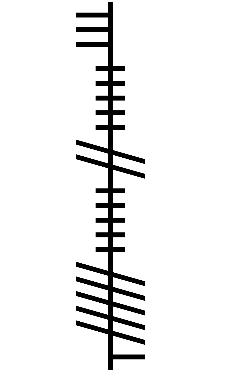
Through signs the woman made them understand who she was. With her finger, she scratched out her name:
Then Brigit spoke to Mamaí, hands and face moving in tandem. Go and summon all the people here, she commanded, and bring each of them some drinking vessel.
Tears streaming, Mamaí obeyed, hollering into the house and calling out as she crossed the field, babe clutched to her chest.
Soon thereafter, nineteen faces well known to Aodhnait and Bláthnat were gathered before Brigit, standing or kneeling reverently, each holding a cup or bowl.
Around them, dandelions puffed into golden flames. Brigit plucked two, and placed these balls of fire in the bare hands of the girls. She commanded in signs, Pass these to each one here.
Aodhnait and Bláthnat flitted about with pollen-stained fingers, dropping a flame into a vessel held out to them and returning to Brigit for the next. The flaming dandelions turned to liquid. At Brigit’s cue, the nineteen lifted their cup or bowl and drank.
Good, good, signed an old farmer.
For by drinking the dandelion tea everyone had gained the knowledge of signs. Aodhnait and Bláthnat rejoiced most of all to see that Mamaí could finally truly understand them.
The remaining dandelions exploded in showers of golden sparks, which burnished to white, and floated far and wide. Brigit was gone, as though she had never been there.
The girls cupped their hands before them, and their fingers wiggled like flames. And we all understood that the sign meant Brigit.
“When I’m alone, I cannot say.”
Nasta Martyn
Arriving
Content Warning: Blood
Nobody knew he was taking a stroll through the forest, for he delighted in breathing the fresh spring rain, as well as admiring the hopeful, pink buds scattered along his path. Nobody aside from you, reader, and me knew that he fell down with comical suddenness, brought down by a strange rock that had seemingly appeared out of nowhere. He swore he hadn’t seen it at first. It resembled a cone, sharp and twisted, its color so vivid it oddly recalled gold.
Then, with his body still pressed to the ground, the earth began to tremble. Leaves and branches shuddered, as frightened as he was. The soil split open. A hole formed.
That day, nobody except him saw the creature that rose from the hill.
Sam Williamson
First, a head emerged. It swayed from side to side, until it fixed upon a target. Then, with astonishing speed, the rest of the creature burst free, scrambling out of its burrow and breaking into a run. With what intentions, he didn’t know, but it seemed wise to stay out of its way. Galloping on four legs, it thundered past him and vanished from sight.
He pushed himself upright, brushing dirt from his clothes with his fingers. Scratches appeared on both palms, though nothing serious something he could tend to once he got home.
A violent shake, accompanied with the sound of a heavy collision, nearly made him fall again. In the distance, a flock of birds had flown away. The man moved on, crossing creeks and shallow valleys, following a trail of peculiar, singular destruction. At the end of it, he found once again the creature, now lying motionless on the ground.
Before, it had been little more than a blur, an unstoppable streak of green lightning. Now he could see it clearly. It could have been described as a unicorn, but it bore little resemblance to the elegant beings of fantasy books: tall, graceful horses with flowing manes and gleaming horns. The creature at his feet reminded him of a calf, its hide the deep green of moss clinging to tree trunks.
The horn, once majestic, was now beside its unconscious body; only a small fragment remained in its head. Blood seeped from the wound, the rest smeared across a bald, metallic structure, possibly some kind of boiler.
The man closed his eyes, searching his memory. He was certain he had something like this before: a wooden sculpture, perhaps one that had belonged to his grandfather. Beneath it, a small plaque bore a name: Camahueto. Yes, it had to be a Camahueto. A strange animal indeed, the material which myths are made of. But stranger creatures had walked this planet, many of which we sadly never had the chance to meet. With gentle care, he wrapped the creature in his long jacket. Tucking the broken horn safely into his backpack, he began the walk home, praying the poor being would survive the night.
When he arrived home, the creature continued to sleep deeply. The wound had stopped bleeding; a scab was forming faster than he ever anticipated. In the bathtub, he cleaned it using the shower head, dried it and wrapped a bandage over its head. He improvised a bed using old pillows and blankets, and tucked the creature in. After checking once more that it was breathing, he changed his clothes and tended to his own wounds.
When he examined his hands, he froze. His right palm was completely healed. Puzzled, he tried to recall what he had done differently. Later, he remembered gripping the Camahueto’s horn with that hand. He retrieved it from his backpack and, somewhat clumsily, reattached it using copious tape and a modest amount of glue. The result was far from promising, but trying felt better than doing nothing
That night, he slept on the couch instead of his bed. The rain was thinner, rather polite, tracing lines along the windows. He woke up several times, unaccustomed to this extra breath; steady, deep, oddly comforting.
Sometime before dawn, a faint sound pulled him fully awake: fabric dragging, something shifting. He rose slowly, careful not to startle the creature that might now be watching him. The Camahueto was upright, wobbling on its four legs, one blanket trailing behind it. When it noticed him, it froze, not in fear really, perhaps intrigue. Its eyes were small, dark and reflective, catching what little light there was. There was no panic in them. Only a kind of waiting.
“It’s all right,” he said, surprised by the softness in his own voice. He tried to sound as reassuring as possible.
The creature blinked once, studying him, then lowered itself carefully back onto the pile of pillows. Its head tilted slightly, the bandage still secure, the taped horn clinging on by faith more than craftsmanship. He adjusted the blankets, sat beside it for a while, and eventually returned to the couch. Sleep found him quickly this time.
Days followed in a quiet procession. He asked for a few days off from work, a decision that felt both irresponsible and inevitable. The world beyond the apartment seemed suddenly less urgent. At the moment, all his thoughts were occupied elsewhere.
He learned the Camahueto’s habits little by little: how it preferred the light dim, how it drank water by dipping its snout carefully, how it flinched at sudden sounds but relaxed when he hummed, tunelessly, while moving around.
The wound continued to heal faster than it should have. He continued to be amazed by the fact that the animal had not died in the first place. Each morning, when he removed the bandage to clean it, the scab had shrunk further, darkening, retreating before his eyes. The horn, however, remained stubbornly fragile. He tried different adhesives and wrapping techniques, even going so far as to bind it the way one might wrap a Christmas present. The result was always the same: a horn that looked like a kid’s art project.
Still, the Camahueto bore it without complaint. It moved slowly at first, favoring one leg, then the other, testing its weight against the floorboards. By the end of the week, it followed him from room to room, close but never touching, like a duckling following its mother.
He began to speak to it. Not because he expected answers that would be weird but because silence had started to feel awkward. He told it about his grandfather and the wooden sculpture, about the forest trails he used to walk as a child. When the subjects would narrow down, he talked about the breakfast he was making and how he liked to do his laundry. The Camahueto
listened with its entire body, ears angled, tail still, eyes half-lidded in what he chose to interpret as attention.
Sometimes, he caught it staring at the windows.
Not at the glass itself, but through it. Beyond it. The Camahueto would stand there for long minutes, head tilted, nostrils flaring slightly. Once, he found its nose pressed gently against the pane, fog blooming across the glass.
“You can’t go out there,” he said, more to himself than to it. “Not yet. You need to recover first.”
The Camahueto stepped back, obedient but unconvinced.
He began taking it out onto the balcony in the mornings, when the sun warmed the concrete and the neighbors were already at work. From there, it could see more sky. Sometimes birds passed close enough to leave shadows on the railing, and the Camahueto would follow them with its eyes until they vanished.
When he returned to work, he claimed that he was dealing with a personal issue. That phrase always ensured there were no follow-up questions. Oddly enough, he found his tasks easier, that conversations required less effort. Everything felt smoother, as if something in him had been quietly tuned. He did not attribute this to the Camahueto. Or rather, he did, but without ceremony. It felt natural, like the way spring insists itself upon winter.
Weeks passed. The Camahueto grew stronger, its movements surer, its presence more assured. It developed
preferences, which he found very amusing: apples over pear; sitting near his feet while he read; sleeping curled against the couch even when the bed was available. He began to think of it as a pet, though the word felt inadequate. Pets obey, he told himself. Pets belong.
This creature did neither.
The attempts were subtle at first. A nudge toward the door as he put on his shoes. A lingering pause in the hallway. Once, he found the latch on the balcony door turned not fully open, but altered, as though tested. He scolded it gently, felt foolish immediately afterward, and rewarded it with a slice of apple. The longing in its eyes, the uncalled melancholy, did not diminish.
On a Sunday night, when the town lay asleep, he decided to try something different. He clipped a leash, unused since a childhood dog, onto an improvised harness and opened the door. The Camahueto stepped into the hallway with a reverence that surprised him. Its hooves made no sound on the tile. Outside, the world unfolded in layers. The Camahueto paused at every threshold: the building entrance, the sidewalk, the park at the end of the street. It walked slowly, deliberately, as though each step required consultation with something deeper than instinct.
In the park, he unclipped the leash. The Camahueto did not bolt as it once had. It did not run, or leap, or test its freedom. It simply walked forward, nose low, tail steady, choosing a
direction with quiet certainty. He followed, hands in his pockets, unsure what was going to happen.
They walked for hours, through streets that softened into paths, paths that thinned into trails. The town loosened its grip gradually. Grass replaced asphalt. Trees gathered in earnest. The air shifted, faintly salted with something unfamiliar. It was only when the sound reached him (rhythmic, endless), that concern settled in.
The sea.
He stopped, but the Camahueto did not. It neither hurried nor hesitated. Its pace remained unchanged, a measured advance toward something it had already decided upon. He quickened his steps and called out without thinking.
“Wait.”
The creature paused. Turned its head slightly, just enough to acknowledge him. Its eyes were clear, resolved. Then it continued.
He followed with a growing unease, thoughts colliding before they could fully form. Animals did not do this, he told himself. Not unless something was wrong. Not unless they were lost, or sick, or driven by some broken compass. He remembered the countless nature documentaries he had watched, where it was common to find an animal abandoning the pack and wandering off alone toward almost certain death. Yet the Camahueto walked with
no sign of confusion. There was no panic in its body, no desperation. Only purpose.
The forest thinned, opening suddenly onto a stretch of pale sand. The sea lay beyond, immense and patient, shifting its colors in an effort to mimic the sky. It was mainly yellow, slightly pink, like the buds he had found that day in the forest.
He felt absurd standing there, shoes sinking slightly, jacket flapping in the wind. The Camahueto stepped onto the sand and paused, hooves pressing shallow impressions that filled almost immediately. It lifted its head, nostrils wide, tasting the air as if it were memory. But memory of what?
Was this defiance? He wondered. A refusal to accept the boundaries of flesh and bone, an animal walking, calmly, toward what would surely undo it? Or was it obedience, to something older than fear, older than survival itself?
He thought again of outcasts, of creatures born slightly wrong, slightly apart. Of forests that no longer made room for myths, of a world that was no longer interested in keeping them. Perhaps this Camahueto had been alone long before it met him. Perhaps it had always been heading toward this moment, even when it lay unconscious in his bathtub, even when it slept curled among borrowed blankets.
Or perhaps this was not an ending at all. Perhaps the sea was not death, but a return; a threshold rather than a conclusion.
The Camahueto slowed at the water’s edge. Foam brushed its hooves and withdrew, leaving a darkened trace behind. It stood there for a long moment, perfectly still. Then it turned its head back toward him.
In its gaze there was no plea. No farewell. Only acknowledgment.
Thank you, the creature seemed to show through its gentle look, for loving me… And trusting me.
Slowly, carefully, it lifted one hoof and placed it into the sea. Then another.
Little Limbs Jason
Telese
That one there’s my boy, yeah. He’s twenty-nine all grown up now. Not too long ago, though, he was just a sapling, you know? It doesn’t seem like that long ago, but goodness, twenty-nine years is a really, really long time, huh?
I remember that day we planted him so vividly. It was this really brisk April morning and John kept having to grab his hat or the wind would have just whisked it right away. The older trees were starting to wake back up, but weren’t quite there, just barely green. They watched us so closely, I could feel it. We had his spot all cleared out and ready, and John’s hand was shaking so bad he could barely hold the spade as he dug out Elijah’s little, tiny hole. It was so cute! I laid his roots down nice and soft, and John patted down the topsoil with his palms. We sat there next to him for a little while until we couldn’t stand the wind any longer it felt like wind was grinding us down to a fine, fine powder. We gushed our
goodbyes and hastened home for the day. Eli looked at us so sadly as we left, but he knew we’d be back.
And of course, he was right. Every day, that spring and summer, at least one of us was there. We had to be young ones need nourishment. We would sing to him and read him stories and he would sway so happily in the breeze. His baby leaves they rustled so easily then. Now? I mean look at him! It takes a gale force wind to shake those humongo-boughs.
But his baby leaves, oh! They were so small. We have his first trimmings in one of the baby books somewhere. We took them that August, just before his first color change. You should’ve seen his surprise! We had to explain that it happens every year to every tree, and that they would come right back in a few months totally normal stuff. I don’t think he believed us, but, well you know mothers always know best. Sure, I’m no tree, but I know the leaves come back, and they come back stronger and more vibrant than before. I had to keep reminding myself that during Eli’s first winter. God, it was so hard to see him out there, like a cold little skeleton, just waiting for a bit of sun to warm his bones back to life. We stopped by every week to shovel around him, and tried our best to not to wake him, but he might as well have not been there.
I cried so much. It felt like we’d lost him, but you just have to remember it’s in their nature. All children go through phases, but especially when your kid is a tree. Of course, like I had told him,
and like I should’ve remembered myself, he woke back up when the spring sun decided to show face again. Seeing his buds return after the winter, even to this day, is one of the most fulfilling, amazing feelings in the whole world. That first hug is like magic. It’s barely warm out, and his bark is still damp from melted snow, and yeah, there’re lichens brushing against your cheek, but it doesn’t matter. To hold your baby again is… You know.
Something about the soil here it’s different. The young ones shoot up like magic beanstalks. I think it’s enchanted. For instance, see that big oak over there? He’s only sixty-eight! And the size of him? Such a sweetie, but you’d never know it by looking at him. Just a big galoot of tree, and at that age! Anywhere else, a tree that size is a hundred plus, if not hundreds of years old. I’m telling you, there’s something special about this place. You made a real good choice planting here, doll.
I still come every day, if I can, even after all these years.
Not all the parents do, you know. I’ve seen them come and go. I find that after about ten years, they’ve usually gotten what they needed from this place, and they try to move on. Some come back, but a lot leave for good, and it tears the kids to bits. They slouch against the sun and dry up, and then you’ve got these poor, grieving trees, leafless in June as if it’s January, waiting for their parents to come back and sit in their shade one last time. It just breaks my heart. So yeah, I still come and visit Eli every day, but
he’s a grown man now. I know that he’d be fine if I didn’t visit every day, but the everyday visits are more for me than him.
This everything… It all sounded so crazy to me at first. We held the service at our synagogue, and this older woman, who…oh lord, she was probably my age now, she came up to me while I was sitting in one of the back pews, just staring straight through the walls into space. I didn’t know her. But she sits down next to me and tells me about her son and how cancer took him away at five. As bad as it sounds, I god, I was annoyed at her! I was just so empty, and it had happened so recently, and then some yenta from the congregation makes my son’s funeral about her own kid? I listened anyways. She told me about this place here and how it gave her this sense of purpose and allowed her to sit with and hug her boy again. She told me her name was Ruth and handed me a small shred of paper with her number scribbled on it. She looked quietly at me for just a moment before kissing my forehead and standing up to leave, but before she did, and I’ll never forget it, she told me, “They only die if you let them.”
So, I took her advice. We called her up, purchased a plot here, and a week after the burial, John and I were out in the wind planting a tree on top of our son’s grave. We were so lost and just threw ourselves at this place, hoping it might fix the nightmare we were living in. It felt wrong at first, no matter how hard we tried not to let it. Calling a little twig our Eli felt as if… I don’t know, in a weird way, it was as if we were taking his name in vain. But with
each passing moment we spent with him, we realized it was him. And we got back what was taken from us: the chance to see Eli grow.
I uh, I’m so sorry, by the way. About your daughter. Here I am going on and on and you’ve sat there, cute as can be, and just listened. Thank you for that. You know, ever since John passed, I don’t talk to many people that aren’t trees, and, well, tragic as the circumstances may be, I’m always happy to see parents here trying. Not trying to bring their kids back, no, but trying to keep their memory alive.
Life is so beautiful. There were times that I couldn’t imagine feeling this way, but I mean it, I do. Life really is beautiful. …It goes on, even when the world tries so hard to stop it. Life grows, even in the cold of winter when the leaves fall off and it looks nothing short of dead. Where lightning strikes, and termites nest, and weeds cluster; where two dumb kids take a pocketknife and carve their initials into its side: life keeps going. Sometimes it seems as if it’s gone, you know, like when the cars in the road out front don’t slow down and then, in an instant, all the sound in the world gets sucked away like it’s in a vacuum, and when you’re holding him in the ambulance and your throat is torn to shreds from screaming so hard but not ever letting the sound out. And of course, when you’re sat in the very back of his funeral wondering how you can ever live another day of your life without him. Even then, life continues. It grows from the ground and explodes those
leaves into the sky like fireworks, and… Well, almost thirty years later, sitting in this playground of a cemetery, life persists, because they only die if you let them.
Hanataba Kelly Murashige
You and I may be family, our souls like strangleweed, but you don’t really know me. I wear the same mask around you as I do around everyone else, afraid if I let you see the real me, you will rip out your own roots just to disentangle yourself from me. I am not your sister’s child; I’m just her worst mistake. I stand in the supermarket, goose bumps rising from my skin. I imagine my unease bursting out of my body, perturbation protruding from my arms like roots.
My mother calls my name. She’s almost ready to check out. Cans of soup. Bottles of Ensure. Ginger ale for the nausea. Once we leave the market, we will make our way to you.
I turn back to the flowers. A small bouquet of daisies weeps neon colors onto the tile.
When I was young, I never understood why people send flowers when someone is sick. Perhaps I would find the gesture more poignant if my mother and I didn’t have such sensitive noses.
If the poppies and baby’s breath didn’t end up in the garbage before their stems could dry. The only plants we could keep in the house were dry anthuriums.
I wonder now, as I stand alone in the market’s floral department, if you would like any of these. Maybe men want flowers too.
When I was still in high school, I read up on hanakotoba. A marriage of the Japanese words for flower and language, it’s a way to communicate with someone without speaking aloud. As someone whose grades were consistently pulled down by low scores in participation, I wished I could have used it all the time. It would be nice, I found myself thinking, if I could get away with saying nothing but shyness and truth and secret love.
My mother, ecstatic to see me showing an interest in something for once, bought my an ikebana kit with fake flowers made of silk. I made my own bouquet in Japanese, hanataba.
“Hanabata?” is what you said, your eyebrows rising in feigned dismay.
Unlike hanakotoba, ikebana, and hanataba, hanabata is not Japanese. It’s just a pidgin word for snot.
You laughed as my face turned bright red. I could see my reflection in the mirror mounted on the far wall of the apartment.
“Shut up,” my mother said to you. “I told you she hates being teased.”
“Aw, come on,” you said, winking at me. “She knows I’m just playing around.”
I did. I knew. I didn’t mind.
I still stopped making bouquets.
Despite what my mother has always believed, it wasn’t because of you. The flowers in that ikebana kit were soft and made of silk. They were fake, in other words. I often worried I was too.
If I could make you a bouquet now, I’d tell you everything. Sunflower for love. Peonies for bravery. Primrose for desperation. No sweet peas or spider lilies when I can’t yet say goodbye.
“Come on,” my mother says to me now. “We really have to go.”
I cast another look at the flowers, then grab a lone anthurium. Its plastic sleeve crinkles with surprise.
I haven’t studied hanakotoba in years. I don’t know what an anthurium could mean. All I know is that it’s pretty. All I know is that it’s safe. All I know is that, if looked at right, it’s shaped just like a heart.
The whole drive to your place, I try to think of what to say. We climb the stairs, reach your front door. My mouth holds nothing real.
I follow my mother up the stairs, winding my fingers around the plant. The second you open the door, I thrust it out at you.
You watch me for a moment, then take the flower with both hands.
“What is this?” you ask. “A gift,” I say. “A special hanabata.”
You blink, your lashes tangling. You then cough out a laugh. You wrap your arms around me, the anthurium still clutched in one hand. The plastic wrapper whispers, I love you even after you let go.
“I remember the moments of long ago...”
Nasta Martyn
Petals for the Girl Who Refused to Turn into a Flower
Pravy Jha
When the oracle said I would blossom, my mother began sewing. Not clothes. Not shrouds. Petals.
She stitched silk into crescents and pinned them to my shoulders so that when the wind caught, I would look almost convincing. Our village had lost three girls already that spring. One became wisteria and strangled the well. One became foxglove and poisoned her own brothers. One became a climbing rose and tore the roof off her father’s house with the insistence of her growth.
It was considered an honor.
It was considered inevitable.
“Blossoming,” the elders said, as if it were the most natural thing in the world for a girl to split open and root herself to the earth.
But I did not want to root. I wanted to walk.
The first sign is always the scent.
You begin to smell sweet even when you sweat. Bees begin hovering too close to your mouth. Ants trail your footprints as if you are already leaking nectar. I noticed it in the mornings. My pillow damp with something fragrant. My hair sticking together like damp pollen. I would shake it loose and pretend it was just oil. Just adolescence. Just ordinary growing.
But in the market, the old women began nodding knowingly.
“She’s almost in bloom.”
The way they said bloom made my spine itch.
In the old stories, it is always framed as a gift. Persephone swallowed seeds and the world split into seasons. Daphne ran and turned to laurel to escape a god’s hands. The girl who refused a prince became a chrysanthemum that bloomed only at night.
They call it transformation.
They never call it disappearance.
The fever comes next.
It arrived on a Tuesday.
My skin burned but I did not shiver. Instead, I felt pressure. A pushing from inside, like fists pressing against the lining of my ribs.
I ran to the river, because if I was to become anything, I wanted it to be something wild. Something with teeth. Something that moved.
I submerged myself to the neck. The water steamed faintly around me. For a moment, I thought I could feel stems pressing beneath my skin. I bit my own arm to make sure it was still flesh.
Blood came. Red, not sap.
I laughed so hard the river carried the sound downstream.
That night, I dreamt of the Fae. Not the winged, delicate kind. The old kind. The kind who live under root systems and braid their hair with worm-cast and bone. They stood at the edge of my bed and inspected me.
“Too stubborn,” one of them muttered.
“She won’t open,” said another.
“Crack her,” a third suggested.
I woke up with dirt under my fingernails.
My mother watched me constantly after that.
She kept windows closed so pollen wouldn’t “trigger” me. She fed me broth with crushed basil, as if herbs could convince other herbs to behave.
“You’ll be beautiful,” she whispered once, pressing her palm to my cheek.
“I already am,” I replied. She flinched. Because blossoming is not about beauty. It is about control.
The day the bees arrived in earnest, I understood what the oracle meant. They swarmed the apple tree first, then the fence posts, then me. Not stinging. Just waiting.
I stood very still in the courtyard while the village gathered. “She’s ready,” someone whispered.
Ready for what? To split open? To root myself in the dirt where everyone could admire me without ever asking what I wanted? The pressure in my chest surged again.
For one terrifying second, I thought I would give in. That petals would tear through my collarbones. That my mouth would fuse shut and become a blossom center. That I would feel the horror of stillness forever.
Instead
Something else happened.
My feet did not root. They cracked the stone. Not gently. Not delicately. The courtyard tiles split under my heels. The bees scattered. A tremor rippled outward from my body, through the earth, through the orchard, through the fields.
The apple trees did not bloom. They shed their blossoms entirely. A snowfall of white petals drifted around us. Every flower in the village dropped itself at once. Silence fell so thick it felt like soil packed in the lungs.
The Fae returned that night. This time they were smiling. “She did blossom,” one said. “Just not into what they expected,” another replied. Because blossoming is not always about becoming a flower.
Sometimes it is about becoming weather.
In the days that followed, nothing grew. Seeds refused to sprout. Vines curled back into themselves.
The elders panicked. “You’ve cursed us.”
“No,” I said. “I’ve interrupted you.”
Because here is the secret no one writes in the old myths: Blossoming is a transaction. The girl becomes static. The village receives abundance. She roots; they harvest. She flowers; they feast.
I refused to pay.
Eventually, things began to grow again. But differently.
Wildflowers pushed up between floorboards. Mushrooms appeared in the granaries. Vines climbed inward, not outward. Growth no longer obeyed fences. It no longer decorated doorways politely. It spread like laughter. It spread like rebellion.
My mother no longer sews petals. She gardens. Carefully. Respectfully. She asks before pruning. She thanks me before cutting.
When the oracle passes me in the market now, she does not meet my eyes. Because she had predicted a blossom. She had not predicted a season.
Some nights, I still feel the pressure beneath my ribs. But it is not petals anymore
It is thunder.
And when I walk, grass bends toward me not because I am sweet, not because I am nectar but because I am a movement. Because I refused to root.
Because sometimes the most mythic thing a girl can do is to stay human.
Cassie Lipton
The woman in the tree, whose years numbered nearly too many to count, knew her role in the manner of things. She was an observer to Time itself, a watcher. This was a duty that all tree spirits took on with solemnity: to bear witness to the world in its loneliness, to see all the living things that would find their way into the woods and allow their soul to be heard. Silently, she held the universe.
Many souls spoke of dreams. The flowers dreamed of growth: that they would one day rise to greet the sun. They stretched out near her roots, inching, straining, waiting for the day they could meet the star that gave them life. The woman in the tree knew this was futile: she’d seen thousands of flowers live and die without ever even reaching her branches. Yet the flowers continued, generation after generation, eternally separated by the same world as the Moon when she tried to kiss the Ocean. Each flower was a flare, an explosion of color doomed to burn away. The woman in the tree remembered every one of them.
The Woman in the Tree
The animals dreamed of wandering, and this they largely achieved. The worms wanted to burrow through rich soil. The deer wanted to run through meadows and forests and forever feel new dirt under their hooves. The birds wanted to brush their wings against the leaves of the trees as they whirled through the air. They were the heirs to the kingdom of the earth, inheriting absolute freedom. The woman in the tree knew all of their journeys.
The humans dreamed of love. Many lovers had lain at her roots, whispering their affections to each other, entangled to the point where she couldn’t tell where one human ended and another began. Many humans came alone and sat quietly beneath her, and she could hear their soul longing for someone who would never be with them. The flowers were trapped, the birds were free, and the humans somewhere unfathomably in between, victims of choice. The woman in the tree witnessed their joy and sorrow.
The woman in the tree saw all of this. She rode the currents of the feelings that swelled around her constantly, she held them all in her mind with sympathy and love. The woman in the tree dreamed of companionship. She saw the flowers bloom together in dozens, she saw the doe with the fawn, she saw the humans with their lovers. This made her wish for someone to share the burden she carried, the burden of knowledge. The hopes and dreams and memories of every living thing that had ever passed under her branches. Yet she lived in solitude, her roots unable to
connect with any others of her kind with whom she might speak. She could hear everything but could speak nothing.
Years passed and seasons changed and the woman in the tree grew weary. Her branches felt heavy, her bark brittle. Slowly but surely, the woman was dying. She felt herself breaking down, felt the worms burying into her bark. With her final act, she gave the stories back to the universe: giving the flowers and the animals and the humans back to Time, who is the only immortal being in the end.
The woman’s spirit became soil, nestled under rocks and trees, quietly remembering and releasing until everything was gone. Then, she began to grow: a flower, beautiful and alive.
The woman in the flower stretched to reach the sun. ❀✿❀
“Gaialesia” Ritiksha Sharma
Equinox Tiffany Chu
Once, she was Chloris, who is now called Flora.
My time with the material was to be brief. I could not make my home among the dull and insipid. The very earth groaned with the ache of being, and I rode upon the wind of my own making, through leaves of emerald and golden orbs.
She came before my eyes as twilight fell, in those moments of stillness between the night and dawn, when all the world holds its breath and stands still. She waltzed before me on the eve of spring, a being of ethereal beauty. Her hair of woven amber glistened beneath the light of the moon.
I saw her. I loved her. I determined she should be mine.
For I was Zephyrus, and where the west wind blows, there my will cannot be denied.
In the ecstasy of existence, she danced beneath the eaves. I wrapped my arms of cold about her waist and released her from her lowly station. Worthy, I deemed her, worthy of eternity.
Once, she was Chloris.
A nymph was she, until I cast my gaze upon her form and bid her rise above the lot of earthly things. I lifted her from the mire to the heavens.
She wept often in those early days. She turned her face from me, and I could not understand her sorrow. I clothed her in wings of forever and bestowed upon her the gift of deification, yet still she shed tears of crystal that would not dry.
I saw her. I loved her. I took her and made her my goddess of spring.
Now called Flora.
Her first flower she made from Therapnean blood, Hyakinthos the hyacinth, etched her lament upon its petals. Her touch melted the snow into the season of new life, and sleeping buds remembered their purpose and burst into bloom. From death to life to death to life. And she, eternal, unchanging as I.
I saw her. I loved her. One day, she will see what I have done for her.
Once, I was Chloris, who is now called Flora.
From beneath my own will, I came to walk in another’s.
He saw me. He took me. I, whose existence radiated beauty in its brevity, now linger in the land of the living in perpetuity.
Once, I embraced the wisdom of time. Now, he threads immortality into my veins
And I paint ephemerality on the canvas of the seasons, willing him to look.
A lifeless nymph that lay hidden in a thick forest clearing, death amidst life, I know it well. And from her death, I brought forth the first roses, beauty imprisoned by thorns.
She is Flora.
I saw her. I loved her. I took her.
She is mine.
Tied to the Otherworld Jess Evans
Content Warnings: Death, Substance Abuse
Not a soul in my drowned kingdom had known their king was visited by the Tylwyth Teg.
I sat shivering at the base of a ragged cliff, staring down towards the storm-tossed bay which, only a few days ago, had been my kingdom of Cantre'r Gwaelod.
After months of battle, horror, and pain, I had reluctantly agreed to give the order to return home, leaving the frontier behind. The journey had taken two weeks, my heart growing heavier with every day we drew closer to home. My host weakened as the miles sapped the last of their strength. Yet still they pushed on, driven by the thought of warm fires and the faces of their loved ones.
Only to find nothing.
The few coherent survivors we found described it to us: the ocean had disappeared, as if drawing in its final breath. Then
surged forward with a vengeance that had drowned Cantre'r Gwaelod from the earth. This land had always been weathered, its torn edges brutalized by time and the relentless turn of the seasons. It had fought for centuries to keep its place on the precipice where land met sea, but now it seemed nature had finally won.
My kingdom was drowned and my secret safe beneath the waves.
Many long nights I had prayed for freedom. For an end to my rule. Wishing that somehow I’d never have to see Cantre'r Gwaelod again. But never like this.
I lifted my battered waterskin to my lips and tipped the rough alcohol down my throat, trying to focus on its burn. Hoping it would distract me from the afterimages of the wounded survivors I had abandoned with my soldiers, their mutilated bodies lying on cloths in our makeshift medical tents at the base of the hill. I pictured my general, rushing from tent to tent, searching for me.
They all seemed to stare at me through the mist, faces frozen in laughter and screams. I took another swallow.
If ever there was a day I needed you truly needed you it would be this day, Gwyn.
The thought came before I could stop it, bringing such a painful ache to my chest that tears blurred my vision. My secret.
Ice wind whistled across the hilltop like the wails of Gwyllion spirits. I sobbed, thinking of my people drowning
beneath the wall of water, their king a hundred miles away fighting an endless border-pursuit they cared nothing about.
I do not know how long I sat there, watching the waves, picking out the dark pinpricks of rock marking all that remained of Sarn Badrig, the dyke that had acted as our fortification for generations. The air was heavy with the tang of salt and the smell of it tinged every breath I took with nausea.
Gwyddno, the wind whispered. Gwyddno Garanhir.
A chill pierced the barren hilltop and fear sunk into my bones. Gwyllion. The spectral figures said to haunt the mountaintops. I had never seen one, but I knew better than to doubt the existence of hidden things.
I rose, straining my eyes as I tried to gaze through the mist. As I watched, it seemed to shift fluid and malleable, as if a hand were twisting it. Gwyddno, the wind whispered.
But it was not the voice of the Gwyllion.
Shapes formed in the mist. At first I saw soldiers. Ghosts of the frontier toying with me, dragging corpses from my dreams and bringing them to life on the hilltop. I blinked away the visions, realising there was only a single figure approaching.
As I watched, the shade came towards me through the mist. Tall, thin, dark. His body seemed to twist with the tendrils of fog, simultaneously controlling them and composed of them, as if tugging one vaporous thread would unravel him. My breath caught.
Heart beating a deep pulse that seemed to throb with the landscape.
It was him.
At war, in the cold still nights whilst my soldiers dreamed of home and family, it had not been Cantre'r Gwaelod that my heart ached for, but memories. Whispered conversation in the firelight. Thin fingers laced with mine. Cold, fathomless eyes swirling gates to the passing of centuries. Moments that came with no human rhythm or reason. So I waited for his visits, clutching them tight when they came, yet losing them all the same.
Gwyn ap Nuud. Lord of the Tylwyth Teg of Annwn.
The mist solidified as he approached, throwing him into sharp relief. His long delicate hair was ebony black, as was his skin and knotted clothes. Fabric trailed from his tight, supple armour like rags, drifting in the chill wind. Pale white eyes shone like will o’ wisps.
When he saw me, he ran to me.
“Gwyddno.” His voice blended with the wind, hollow, and light, and then he was there, embracing me. I held on, my mind falling back to one hundred lost moments. One hundred dreams and hopes. His arms felt fragile around me. One could never guess this delicate being had seen the ages rise and fall.
“Did you hear me?” I choked out. I wasn’t sure if I meant this time, or another, or all of them. Perhaps it didn’t matter.
Gwyn drew back and searched my face, his eyes boring into mine. They were what truly set him apart from humankind. Behind his eyes burned the memory of every soul he’d ever loved, shifting in the pale mist of Annwn the Otherworld. Eyes like those could only belong to the Tylwyth Teg.
“I am sorry,” he said gently.
I cried for a while, I think, although I am not sure how long. Time moves differently near the fair folk. Eventually, Gwyn lifted my chin with a long finger.
“Come,” he whispered. There was a strange weight to his words that made me wonder. Gwyn stretched his hand towards me. Strips of black fabric tied up his forearm and around his wrist, twisting between his fingers.
Even before I spoke I knew that I wouldn’t disobey. We were both kings of our land, but no king refused the lord of Annwn. As if you would ever consider saying no to him. I nodded. “Where?”
“You will need to bring something,” Gwyn replied. “Something from this world. So you do not become lost in mine.”
Lost in mine. “You’ll take me to Annwn?” My blood ran cold. I had asked him, before, as we lay in the dark. He had seen my kingdom, I’d tried could I not see his? But his answer had always been the same. Not yet.
“You need hope, Gwyddno,” Gwyn brushed my arm. “You lost it along with your home. But perhaps you could find it in
mine. Choose something, to tether you to the land of the living. Or you may never return.”
I felt guilty. Gwyn saw my anguish and believed I mourned Cantre'r Gwaelod and I did. Truly. I was sorry for the lives lost in the disaster. It was just… More complicated than that. I tightened my grip on the waterskin. My feelings about home were twisted and painful, a barbed web I tried to bury as deep as possible. After so many years, speaking of it felt impossible. Even to Gwyn.
Gwyn mistook my pause for hesitation. “Do not fear,” he said. “When you return no time will have passed.”
I cast around the hilltop, searching the rubble and brown grasses. Eventually, my eyes fell on a spill of red blodau. I bent down and plucked one. “Will this do?”
Gwyn smiled and nodded. “Now come.”
So I took his hand and let him lead me into the shadows.
The journey to Annwn was long and dark. Gwyn guided me through the liminal space of the world; down through the earth, deep within the oceans, and across the night sky. All that existed was his hand in mine, anchoring me to the path, and the blodyn clutched in my other, tying me to the land of the living.
Eventually, we emerged from the shadows and the world solidified.
Annwn, the Otherworld. Land of spirits and the Tylwyth Teg.
Gwyn smiled at me, his eyes dancing as he watched my mind attempt to grasp the wonder stretched out before me.
Black sand covered the earth, rising in hills and valleys, sliced with rivers dark as roiling tar. The sky was a web of stars, billions more than were ever visible in my world. We stood atop a rise, just as we had on the other side, surrounded by shadowy trees with leaves of twisting smoke.
But Annwn was not colorless. For before us, a little further up the hill, rose Caer Wydyr: a great fortress taller than any castle I had ever seen. Gwyn had told me stories of it the Caer of glass tears, splitting the spectrum into piercing beams of color. It spiralled up into the heavens, colors shifting in its glass walls, its peak disappearing into the vaporous clouds.
“My home,” Gwyn said with quiet pride.
“It’s beautiful.”
“Is it as I described?” he asked. “I admit I struggled to find the words in your language.”
I nodded. “As near as anyone could make them.”
Gwyn stepped closer. His eyes seemed to glow brighter in Annwn. “Gwyddno… I am so sorry for what happened to your home. And your people.”
“I know,” I said, squeezing his hand tighter.
“You are upset,” Gwyn continued. Human emotions often puzzled him, but he was improving at reading them. I almost smiled despite everything as I remembered attempting to explain
them to him. “That is understandable. But there is something else isn’t there?”
I sighed and squeezed my eyes closed, picturing Cantre'r Gwaelod for a moment. Perhaps explaining human emotion had been a mistake.
“Do you remember when we first met?” I asked.
“Of course.” I could not see his face, but I heard the puzzlement in his voice. “You found me, in the woods.”
I nodded. “Your ankle was broken, so I took you back to my camp to heal and rest. After a few days you trusted me enough to reveal yourself. I should’ve been surprised, or scared but I wasn’t. Because how could you not be who you were?”
Gwyn stayed silent, waiting for me to continue. After a moment I did, the words coming quicker now, spilling from my lips. Everything I could not say whilst I waited for him. Everything I had kept hidden from my siblings and my mother. The truth, forming a path to the barbed knot deep inside.
“After that first meeting I did not stop thinking of you. I wondered if perhaps you’d enchanted me. But when you visited me again and we talked and I got to know you better, I knew that wasn’t what had happened. I simply loved you.”
“And I loved you too, Gwyddno,” Gwyn’s voice cracked. “I still do. But you know I told you that I cannot visit more often, no matter how much I wish to. The veil between the worlds is not often thin…”
“I know,” I interrupted. “This isn’t about that. I understand why we can’t see each other more and that’s okay.
What I’m trying to tell you is… I’m trying to say…” How could I find the words? How could I admit how I truly felt? Not about Gwyn, no he already knew how much I loved him but about... Home.
“Cantre'r Gwaelod was my prison, Gwyn,” I said softly, opening my eyes but not looking at him. “No one really knew me, even before I met you. When I became king, I fought wars, visited allies, established trade routes anything to leave and to stay away. I don’t know why exactly. Why I felt so separate there, so trapped. I think perhaps it was thinking of the future my place on the throne. A fate I could never steer away from. The feeling that my life was not truly mine.
“And I tried to forget. You know that. I drank. I drank so much Gwyn. When we gave up the campaign and were on the journey home, I drowned myself, dreading our return. I wished…”
My voice wavered and I stopped. It took a moment before I could continue.
“Then when we did arrive, and my kingdom was gone… Despite the disaster, the deaths, the land we’ll never get back…
Part of me was…” A bitter taste filled my mouth but I forced out the words. “Part of me was glad. ”
It was a painful relief. The barbed knot torn out by force, ripping my insides as it did so, but leaving bleeding solace in its wake. I breathed hard, as if I’d run the journey from the frontier.
For a while Gwyn said nothing. There was no wind in Annwn, nothing to stir the silence.
Perhaps this is it, I thought. Perhaps I’ve finally pushed him away for good. He thinks me a monster and perhaps I am.
“Would you like a new one?” he asked.
I startled and looked up at him. “What?”
“A new one,” he repeated. Gwyn took a breath and spread his hands. “Leave it all behind. Your people will need to start anew either way. Leave it to your brothers or sister. You could stay here. With me.” He motioned up at Caer Wydyr, shining in the darkness.
I lifted my head, the fortress of glass tears rising before me. Stay here, in the Otherworld. Abandon my siblings and what was left of my people to rebuild without their king.
What good a king were you anyway? Always drunk. Always off fighting pointless wars. And what good a sibling? Distant. Distracted.
Leaving them would be a mercy.
I could find all the reasons I wished, but I knew what they were. Conjured justifications and excuses. Could I really be this selfish? Was there really nothing about my world that I would miss?
The thought of it made my heart skip. Could I really do this? It felt dangerous. It felt possible.
Gwyn held his hand out to me, just as he had on the hilltop at Cantre'r Gwaelod, ready to lead me to Annwn. And just like I had then I knew I wouldn’t say no to him.
I looked down at the flower clutched in my palm. My last link to the other side. Gwyn’s gaze followed mine.
“Would you like to think about it?” he asked. “You can take all the time you need. As I told you, time flows differently in Annwn when you return to your world, it will be as if you never left.”
As if I never left.
No. I lifted my hand and took his, crushing the blodyn between our fingertips. Gwyn’s lips parted in surprise and his eyes darted to mine. “Gwyddno…” I stared into the swirling mists of his irises the memories of the loved ones he’d lost and I knew in that moment that my memory would join them, burning behind his eyes forever.
Gwyn drew my hand to his chest, red petals slipping between our fingers. I could feel the cold emptiness where a human heart would be. We could have been the only beings in existence, standing there in the cold of Annwn.
And so, although my breath quickened and my cheeks flooded with heat, I felt a matching stillness in my own chest. A
rhythm that I had never quite realized was there, suddenly halted. A part of me lost.
On the hilltop, King Gwyddno Garanhir’s heart stopped beating.
The bottle slipped from his fingers and fell to the ground.
Giver
of Joy K.M. Hale
“Do you ever dream?”
If Hermes were to have asked a millennia ago the answer would have been a simple no. For how could Charon have dreamed when he was obliged to the dead? His feet stayed firmly on his skiff as it bobbed and swayed on the river while he waited for the next shade to board. Mortals were so often impatient to meet death.
Now, however, it was complicated and the ferryman felt ashamed. His eyes trailed so easily upward to the entrance of the Underworld where the sun parted the darkness. Waiting, he was always waiting, not for the moaning spirit but for the soft fluttering of winged sandals. For delicately tanned feet to land on the ashen ground and leave small pockets of green and crocus and wild strawberries with every step. When Hermes smiled, by the gods, Charon felt the brittle vines and roots that wove through his ribcage shiver with a flicker of life. What right did he have? This
Chthonic daemon, this decomposing man, filled with a fluttering seed of hope nestled in his cavities.
He could not pinpoint the moment when this began. These hazes, filled with thoughts of when Hermes might return to him, as sweet as liquid sunshine. How Charon might leave his post to drag his tired bones and half flesh across the docks to meet the flying god at the edge.
Were these dreams?
“I find myself wishing more than dreaming,” Charon’s chin tilted towards his willowy half-skeleton chest as he gazed down at the messenger god on the dock. If the ferryman took one step backwards, he would be back on the safety of his skiff, but he felt bold with his wanting. Had Hermes noticed how the ferryman leaned towards him like a poppy towards the light? How the pale of Charon turned pink with desire?
“A wish is but a yearning of the heart, a dream spoken,” Hermes grinned. “Tell me, friend, what is it you wish for? A larger boat? The river brimming with coin? I can only imagine having insatiable desires in such a place as this.”
They were arrogant, Charon’s wishes; the quiet pleading he invoked to the gods to bring the mortal realm to heel. For flood, plague, war for death to march through their cities and drag them down through the earth to his docks. The gods thought it work, reclaiming souls, yet to Charon it was an act of selfish pleasure. The shades beg and scream for mercy, but he would not hear them
over the beat of sandal wings. The coin was worth nothing to him. The shades only means to an end.
It was Hermes that Charon paddles for all of time, wades through the river of souls and rocks against the lapping wakes. For the moment he delivered, passing between hands, a small but holy touch. To Charon those moments, fleeting as they may be, were everything. He wishes, dreams, of Hermes.
It seemed so impossible to articulate.
“I wish…” Charon turned his face slightly so that the fleshy man of himself could be seen. He knew he was not handsome, not as the other deities and nymphs and gods. He understood the stark white of his bones and the glowing blue of his eyes made him less. Made him horrible. For Hermes he wished to soften. “To see the world as you do, perhaps. The wind bends to you. There is nowhere you cannot go. The world is yours as it is for the birds and the sun and the moon. While I… Well. There is only so far the river flows. It bends as it pleases and I am only to follow it.”
Hermes moved closer to the space where the dock met ground; the grass and flowers and berries bloomed joyously under his warmth. Charon felt something akin to jealousy towards the fluttering green.
“There is beauty here too. There is something to be said about the comforts of steadiness, to know there is something
always promised when you turn. Your eyes have just grown accustomed.”
“How easy for a god with no tethers. You are not beholden to stillness, your opinion is soaked in luxury!”
Hermes laughed brightly. It reminded Charon of the trumpet of daffodils. “Believe me, my friend! There is something enchanting here and I find myself missing it terribly when I’m away. The skies call, of course, but so do the dark waters of the Styx.”
Charon felt a nagging question catch in his throat. A budding of something scarlet and tender. How could he articulate it? Hermes gazed back at him with a mischievous smile, an auburn curl falling between his brows. The ferryman could ask, simply and without suspicion, what it could possibly be that brought him over and over, other than his messenger duties. He could scoff and yawn and act as if the answer did not tear him up inside. Pull out the roots of his heart.
Before Charon could utter a sound, Hermes took a deep inhale until his chest ballooned with his own words. His feet left the ground and Charon felt a sudden coldness at the realization of his departure. It was too soon, their time too short
A golden hand reached out towards the ferryman.
“Come with me?”
Charon stared at the hand. The improbable, small, soft, godly hand.
“Come with me, Charon? I want to take you somewhere.”
“I cannot “
“Of course you can!” Hermes lunged forward and wove himself around Charon before he could refuse in earnest. “The dead have nothing but time.”
The open air pulling at his limbs reminded Charon of the river. He had fallen once and the water took him; the strength of it, the lost shades that swam through it, had pulled his body so easily that he was helpless. It wasn’t until he had washed up on a muddy bank that he could right himself again. It had humiliated him so deeply that he had not fallen since. Yet as he gazed upon Hermes, who cut through the thundering stream of air with ease, Charon felt that Hermes needed no bank. He was not helpless. Lake, valley, field, and shooting star passed them like shadows as the messenger god led them through the Underworld. Though it was not earth’s beauty beneath them, Charon felt a sense of gratitude still. Hermes was granting the ferryman’s wish What did he get out of it, Charon wondered. For he could not return a fraction of such majesty.
It wasn’t until they came upon a curtain of stars and gates of horn that Charon knew where they were. Hermes took them down until their feet met plush, damp moss. The ground did not
bloom as it did by the river, the air did not glow as it did at the dock when Hermes arrived; the land just was.
Hermes released Charon to walk towards the gate through which mountainous trees glowed in the fog. “The Land of Dreams!”
“You are clever,” Charon mumbled. He stood unmoving as Hermes went to enter.
“Come, come! The sands of your freedom fall slowly, but I do not wish to waste another grain.”
Charon could not refuse him. Did not wish to. So he moved a few paces behind the messenger god who skipped with the excitement of a boy. Inside the fog draped over them like wool. It was warm and heavy and almost brought Charon to his knees.
“Only a little further and you may rest your bones with me, my friend.”
The words came so easily as if they did not rattle Charon from the inside out. So charming was Hermes with his sweet words picked from the vine. It made the ferryman feel drunk and sick and perhaps a bit hazy as he felt when Hermes was nothing but a memory in his mind. Charon should thank the gods for such a gift.
Hermes stopped at a shorter tree whose branches and leaves grew wider than the rest. He removed his hat and satchel, laid down against the roots, and pulled his cloak into a blanket across his lap. With a smile he patted the ground next to him;
Charon obediently followed. They laid side-by-side on the bed of moss and faced each other.
It was so quiet.
“Dream with me,” Hermes whispered. The soft meat of his cheeks grew pink and round with his happiness. It had felt like a dream from the moment Hermes came to the river and whisked Charon away like a beautiful nymph. How much further could he sink?
Charon felt the rush of boldness twist in his chest again. Something tapped against his ribs, something balmy and verdant. “I understand why the poets call you Giver of Joy.”
“They only wish to adulate because I am a god. The poets know nothing of my wicked tongue and nimble fingers.”
There came an itching at Charon’s chest again and he slid a hand under his cloak to press against his tunic. “Joy can be found in your mischief. Your laugh is like wind through willow branches.”
Hermes grew brighter. Drew closer. “Do not tell me you bend for my godhood too?”
“I would not stoke your ego. Your pride would make you too heavy to fly,” Charon grinned.
“Hark! He blasphemes the god of travel! Of message and shepherds!”
They laughed together. Their legs kicked and tangled under the cloak. Charon spoke honestly: “My compliments are true. I would bend not for your blood but for you, Hermes.”
Perhaps it was far too raw. Perhaps when he returned to the river and his skiff and his souls, Charon would come to hate himself for speaking so affectionately. Still, he could not contain the ivy of emotions that spilled from his heart and climbed out of his throat looking for Hermes.
Charon opened his mouth to weed his sincerity from their dreaming. All that came out was a croaked sigh.
Pain shook his fragile frame as something in his chest forced its way against his skin. It thumped and throbbed panicked, Charon threw the blanket and his cloak from himself. A gaping hole ripped through his tunic along his chest as green serpents slithered between his ribs and the fingers that tried to hold them in. Their heads drew closer to Hermes who stared in wonder.
Charon coughed at the pain expanding in his chest. When he looked into his boney hand it was dotted with delicate red. The serpents wriggled and barbed and twisted further towards Hermes’ warmth. They trembled and strained against Charon, starved for the messenger gods touch. His affection. At last their heads popped. The flesh of them fluttered in a quiet massacre of silky, wine red to their laps.
Hermes reached out and caressed their heads, dripping with viscera. “Roses.”
“In the Land of Dreams”
Chelsi Fiore
Here There Be Fairies
S.E. Roberts
There are fairies in the costume shop, of that much I am certain. I have never seen them (you are not supposed to) but their presence lingers, promise and threat, safety and danger. Shadows move wrong and something hover in the corners of your eyes, and if there is any sure thing, it is that you are never alone once you’re through the front door.
The shop is a warehouse three stories tall and besieged by nooks and crannies, shelves and drawers, cabinets and racks all of them stuffed with costumes. Dresses from every era, of every color and cut. Suits, for men and women both. Skirts and blouses, vests and corsets, pants and slips and shoes and loose fabric and an inconceivable number of buttons. That’s to say nothing of the props, stacked against the walls and fighting for space in hidden bins.
And the fairies keep track of it all.
That’s why you have to be nice to them. My mom used to call me silly when I dropped something and apologized to it, but the fairies like that. The kindness is expected, not surprising. Required, even, or the garments you’re looking for vanish off the rack, rip apart at the seams, grow stains the color of muddy water. Maybe you’ll trip on an upturned corner of carpet that has always laid flat, bang your elbow against a rack that used to be taller, slip for a heart stopping moment on the top step of a ladder. Lots of things can happen in a costume shop.
There are ways to protect yourself, of course. Fresh fourleaf clovers sewn into the seams of your clothes, or printed on your shirt. Red berries tangled in your hair or woven into the flower crowns hanging on the second floor. A pinch of salt in the bottom of your shoes, or in the snacks you bring for long shifts. Iron in the blood that wells at a needle’s prick, or a rusty brooch tucked in your pocket, a silver necklace absentmindedly wound round your hand. It’s a building full of bent rules and broken expectations even fairies have to allow for what that means.
But only being polite helps you find what you’re looking for.
As in bad faith, even their benevolent magic is only capable of small feats, but small feats are all you need. A hat that matches perfectly, though you’ve never seen it before. Careful eyes itching at your nape, guarding your step, winking in mirrors. A summer breeze with the windows closed that sends the shawl you
need fluttering. Quiet tittering footsteps, something warm that curls around your shoulders like an old, weathered scarf, the garment you’ve been thinking of so intently seeming to appear in front of you. Some of them are good at finding the pair for a shoe, or the tie for a jacket. They polish the pearls, push earring pairs together, tighten screws and stitches, tugging sequins tighter and hems neater.
But they’re still fairies. They are possessive of the things they own, and if you work in the shop long enough, you count as just another piece of the hoard. When you clock out they stick with you, drag at the echoes of your steps like they’re displeased you’ve left at all, never mind without taking them with you.
The lingering, unfortunately, is harder to protect against, but there’s little need. Their power lies in patterns and sashes, not bad luck or spring flowers or ancient forests. Besides, you’ll be back soon enough.
Now we’re moving. I don’t know what will happen to them when we’re gone. Maybe it’s the costumes they’re attached to, and they’re settling in among the rafters we can’t reach in the new building. Maybe it’s us, after all these years. Or maybe it’s the warehouse that holds them, and they’ll be waiting for their next tenant as eagerly as fairies ever do anything. But all these stories, these fragments of history gathered in one place and itching to be brought to life, can’t be left alone for long. If we lose these fairies,
more will find us. New rules. Different protections. We collect, they come.
There are fairies in the costume shop, that much I know: in the hats, tucked between dresses or spools of thread, in the toes of boots or the gauze of skirts. They watch, and they work, and they make sure you are never, ever alone.
Spring Pilgrimage
Atlas Schultz
Content Warning: Body Horror
Can you hear the singing?
Does the melody skitter beneath your skin, prickling like insects’ tread, an itch you cannot scratch?
Do you stare at the ceiling, fighting off the quiet hum of gray slumber…?
We set off at dawn, before the streets became overcrowded with the chirp of voices, the metallic clatter of gears, and the heavy rumble of automatons rolling along the cobblestones.
The glow of the nascent sunlight was stifled by a looming shadow the everpresent veil of ominous black smog that blanketed the city.
Tick. Tick. Tick.
The rhythmic echo of the Sentinel Clock, towering above the sleeping streets like a watchful mother, kept time with our steps as we hurried along.
“Where are we going?” I heard one of the pilgrims behind me whisper to his companion.
“Shh, don’t speak,” she hushed him. “There must be silence for the Prophet to listen properly.”
I paused at a corner, head cocked, as the little group halted behind me.
I listened.
The rustle of their cloaks. The anxious shifting of their feet upon the cobblestones. The distant melody
The Sentinel Clock.
Tick. Tick. Tick.
I started off again, and like eager schoolchildren, my followers rushed to catch up with my quick stride.
We made swift progress, halting periodically as we went so I could check our course. I felt their gazes fixed on my back each time. Always, they watched with apprehension in the arch of their brows. Always, they glanced about, or at each other, as if seeking some external confirmation that they were doing what they should. Always, I know, they wondered why. Each and every time I have led this journey, some young soul has plucked up the courage to ask me why.
“Why, Prophet?” I heard a small voice whisper, a gentle tug at my sleeve. I crouched down, my cloak gathering about my feet. The child met my gaze with more clarity than any adult ever can. Dark ringlets fell into her face from the hastily wound bun I’d seen her father try to tie mere minutes ago. “Why me?”
As always, I took no joy in answering. I could feel the other pilgrims leaning in, waiting with baited breath to hear the glorious reason for it all…
“Because you are tainted. I am sorry, little one.”
She bit her lip, eyes welling. I carefully took her small hand, speaking with a softness that felt rusty in my throat.
“It is no fault of yours, child, no fault of yours. And it shall be remedied. Your note will join the song soon enough. Come now.” I straightened and set off again, trying to ignore the shift in mood of the group following behind me.
Tainted, they whispered. We are tainted.
What does that mean? they whispered. How does it happen?
I pretended not to hear, leading ever onwards through the quiet streets.
Tick. Tick. Tick…
We started across the Transterra Bridge, every few steps darkened by the shadows of its arches high above us, the rasp of rushing water replacing the now distant metronome of the clock. The song pulsed through my skull with each heartbeat as we neared the other side, the melody tingling behind my eyes. Some of the
more receptive pilgrims ceased their whispering, their faces showing recognition as the resonances now swelled in their ears.
Then the stone and metal of the bridge was gone, replaced by rough earth beneath our feet. We climbed the gentle slope, the group now moving in silence apart from our footfalls upon the soil and the ripple of our cloaks in the breeze. And the song.
Every hair upon my skin raised every drop of blood in my veins swirling every breath in my throat buzzing
like a dragonfly on the wing.
No sound I heard but the singing.
These are the moments when I feel like laughing and crying and falling and flying and living and dying and getting back up only to dance myself right back into the grave again.
These are the moments I know why I am here.
We reached the crest of the hill. I felt the miniscule shift in the air as my followers gaped soundlessly at the sight I have seen far too many times (yet never seem to tire of)
The valley lay open below us, a bowl of green ringing with the voices of an unseen chorus. The ground shivered. The air hummed.
I breathed in and out.
Filling my lungs with the perfect harmony. Yes.
I felt a shudder pass through the pilgrims as the sound washed over us like a wave. It was the music, yes, that made them tremble, but too the green.
I always forget and they had never known how much green there is. I like to think it is due to my hard work, but of course, not all the credit is mine to take.
And, I have seen time and time again the shock and confusion that comes with the realization that it has been here, so close, all along.
It is strange and beautiful, I suppose, that so near to the dull soot and oppressive noise of the city lies such a lush paradise as this.
I began to sing along, the familiar wordless melody flowing like water from my lips, my steps growing lighter as I set off down into the green. In a trancelike state, the pilgrims followed, eyes
glassy with awe. As golden rays of sun punctured the fading clouds, we tread, gilded like kings, into the valley’s welcoming embrace.
The maples bore their small red blooms, the clovers gleamed pale, and the aptly named lily-of-the-valley swayed delicately in the dappled light.
I reached the first tree and turned, the song still pouring from my mouth. Carefully, I settled myself at the roots, arching ferns brushing my legs, petals floating down upon me from above.
I turned my eyes towards the pilgrims coming down the slope. They were nearly at the forest’s edge, then, one by one, they fell like stones.
Their knees struck the grassy hillside. Their faces turned skyward, fearful eyes reflecting the sunlight.
In times past, I had offered words of comfort and encouragement at this juncture. I have learned that such niceties are a waste of precious breath. These are people of crowded shops and clamoring streets. Their lungs are lined with coal dust, hearts made of corroding tin, minds of rigid clockwork.
Nothing can ready them for what must ensue.
But it will cleanse them of the ink-dark stains on their souls.
It will send shimmering nectar through their veins.
I closed my eyes and sang louder. It’s for their own good, I know.
Crack!
One.
Crack! Crack! Crack!
Two, three, four.
I counted the snapping crunches that used to sicken me, used to feel like icy water in my ears. Now, they merely add percussion to the deafening, pulsing melody all around me.
One by one, I felt them appear. Their voices echoed, fresh and ethereal, through the valley. The little girl with ringlets, now a sweet trill in the chorus. The red maple blooms hummed. The clovers glowed. The lilies rippled like a wave, then stilled once again.
I opened my eyes. The familiar sight of bodies strewn upon the grass, mere empty shells, met my gaze. I let the song trail from my tongue as the harmonies faded in my ears, until all that remained was the usual constant thrum in the back of my mind.
Well done, as always, my little songbird, she said, voice like sweet chimes in my ear. I rose, turning towards the trees, away from the broken and empty tainted husks. I said nothing. As the shadows of the trees closed over me, I glanced back at the forest’s edge.
Already, the shoots were sprouting curving towards the sun from vacant, upturned skulls like strands of glistening emeralds in the light.
The forest looks wonderful. Thriving, thanks to you.
I shook my head and turned my back on the new sprouts. “You humble yourself. I am nothing without you, and you know this.”
Too kind, songbird. She chuckled, like the tinkling of bells. Now rest. I know these journeys drain you so…
I withheld a cough, thinking bitterly of the sooty city air I’d been inhaling. “I have a year to rest. I wish to see the birds, I have missed their cheerful plumage.”
Of course, songbird.
The rustling of feathers sounded nearby. I slipped between the trees like a phantom, feeling my insides start to settle again.
But I know, come springtime again, she will send me out once more to seek those who hear her call: the chorus of her garden, a garden of souls.
So tell me this.
Can you hear the singing?
“Sun-struck” Beverley Ann Abrahams
Ode on a Faery Queen
Catherine Hurcombe
Content Warning: Death
I have wandered, he thinks, for too long. The sun hangs heavy in the sky, like an overripened peach, left too long to be plucked, and the birdsong has almost the cadence of a lullaby. Yet he cannot bring himself to return home not yet, at least. Perhaps the sky could grant him another hour of light; he just needs a little more time
He does not know why tonight feels so important. Earlier, he could scarcely mutter an excuse to his mother and sisters before he was out the door, off into the hills. It must be the muses speaking to him, he decides. They must have some particular tale to offer him this evening, if only he has the patience to hear it. Yes, that must be it. It is not in him to question it beyond that. It is as if by some instinct, he knows he cannot return home until the itch has been scratched.
A twig snaps behind him, and his head whips towards the sound. A man stands across from him. Silent. Watching.
“Good evening, sir. I say, you gave me quite a fright.”
Sir seems fitting for the mute figure, although his appearance is decidedly worse for wear. His frame carries the memory of strength, but it has withered away caused by some kind of malady, no doubt. Much of the man’s flesh is covered by ragged chainmail and threadbare trousers, although, he notes with some relief, he carries no weapons. His hair is grown wild and unkempt, and even from across the meadow, he notes an almost feral look in his visitor’s eyes.
His heart quickens. An exiled knight, perhaps, condemned for crimes he did not commit? Or a son, unable to part with the armour of his departed father? Already his mind whirs with new ideas and his fingers itch to pick up his quill. But he restrains himself; he must earn this stranger’s trust. There is something about the man that draws him in and he can almost hear a voice inside his mind, urging him forwards. The muses, then. They have not finished with him yet.
“Are you quite well, sir? I have some food in my saddlebags.” He smiles, more to himself than to his companion.
“My sister, you see. She refuses to let me go off on such wanderings without an adequate supper.”
At the prospect of food, the man’s initial reticence seems to fade, and he approaches with the desperate exhaustion of a
starving beggar. Whoever he is, he has evidently been away from home for some time.
“I am Sigric. What is your name?”
The man does not answer at first, his gaze transfixed on the parcels of food Sigric is now retrieving from his bag. Beatrix has treated him once again; the smell of freshly-baked loaves wafts towards him, and he carefully removes the paper wrapping from his feast of goats’ cheese and gooseberry preserve. It is not until the meal is in his hands that the man speaks, in a hoarse voice that grates like the cawing of a crow.
“I am was Sir Brendbourne.”
Sigric nods slowly, waiting for him to continue. He pops a crumb of cheese into his mouth as he does so, the sharpness exploding across his tongue.
“I… Do not know if my title still stands.”
“Do you mind my asking, sir, what happened to you? I have lived in these parts a long while, and I have never seen the likes of yourself before. And I would surely recall if you pardon my saying so seeing someone so… Afflicted.”
Sir Brendbourne brushes off the latter comment, much to Sigric’s relief. “I am aware of my current shortcomings. But I fear the worst is yet to come.”
He chews on Sigric’s proffered hunk of bread, and Sigric notices that despite his sickly countenance, the sun has lent a ruddy hue to his gaunt cheeks.
“I find I am rather thirsty, my friend. I would be happy to tell you how such a fate befell me, if you could spare some water?”
Sigric almost jumps up in his haste to fetch his waterskin, and pass it to his companion. Sir Brendbourne ducks his head in acknowledgement, but winces, as though even the slight movement has caused him pain. He takes a deep swig, and Sigric catches himself leaning forwards like a child hearing tales around the campfire.
“It started,” he speaks hoarsely, “with a woman.”
Thus began his story.
“I had not known many women before. My mother, of course, and my younger sister, but I was still a boy when I was sent away to train, and as a knight, I grew up largely in the company of men. The others made no secret of their trysts with the local girls, and more than a few wasted their coin on the whores in the next village, but I was loyal to my lord, and my vows to serve him came above any cravings I might have had for anything more.
“That was until I met her.
“I was on a patrol when I spotted her, so uncommonly beautiful, she should have seemed out of place amongst the woodlands near which she wandered. Yet her presence there seemed fitting, somehow. As though she did not merely wander there but was of the land itself.
“Describe her? No, friend, I cannot. There are some beauties in the world that even the poets cannot do justice; they
would go mad in the trying of it. But a mere glimpse of her stole the breath from my body, and even in that first moment, I would have laid waste to a dozen lives just to see her smile.
“And, to my surprise, she appeared to feel the same. For when she saw me, her eyes glittered, and she held out a golden hand to greet me. Of course, I was glad to take it.
“I cannot say how long I lingered at her side, and I will spare you the blushes of the more… Intimate details. But the days passed, and I remained drunk on the giddy pleasure of her love. They say it is the faery fruit that corrupts you, but I was under her spell long before a morsel ever touched my lips. Her very song was like a siren’s call, her honeyed kisses a poison to my feeble flesh. I would not have dared to deny her, the faery magic within her was so potent.
“But one night as we lay, our bodies coiled as one, I dreamt, and in my dreaming, I saw the truth my waking heart denied. Swathes of men, women too, surrounded me. Their pale bodies writhed like worms, so numerous that I could scarcely see past them into the darkness of the world beyond. The air stank of sweat and urine, yet with a sickly undercurrent of honey wine.
“‘Help us…’ One cried.
“‘Spare me, cruel maiden!’ Another begged.
“‘She has us in her thrall!’ An old man’s voice quavered.
“With my scream clawing up my throat, I awakened in a cold sweat. But my faery-wife no longer lay beside me. Instead, I
was alone on this very hillside, a terrible, impossible loneliness blazing in my heart. Yet my dream had been too late to save me.
“I called for her until my shouts turned to whispers, long after reason told me I must leave this place. Yet I had not the will. And where the strength of my mind failed me, the strength of my body soon followed. I was a starving man, unsated by the mortal world through which I stumbled. With each day, I weakened, until some days, I would collapse from the exertion. Still, I could not relinquish my efforts to find her. My beauty. My faery queen.
“And this is how you find me now: no longer the lord I was, unknowing if the world from which I came still lives at all. Yet with all the knowledge I bear, I cannot leave. Not when she might someday come back.
“Heed me, my friend, go. Do not linger here, not when night has come. Return to your family while you can.”
“Well,” Sigric mulls on his companion’s story, feeling it wash over his tongue like a fine mead. “That is certainly an interesting tale. And a tragedy, of course.”
“You understand my plight, yes?” There is an urgency to the man’s speech that was not there before, and he grips Sigric’s wrist with a grip tight enough to bruise. “You understand that you must go, must not risk the same fate which has struck me?”
He glances down at the fingers holding him, dirt and blood caked beneath the nails. “I understand.”
Sir Brendbourne’s shoulders sag, and for a moment, he feels a surge of pity for the man. For a moment. Then he smiles.
“Unfortunately, it is too late.”
He allows the features of the farm boy to slip off, like an actor’s mask, and his– her– true form shines against the dying light.
“It seems your wisdom comes too late, my knight. A shame he could not hear it before I found him. Before I made him mine.”
Sir Brendbourne’s eyes widen at the softness of that voice, like bells and birdsong and the first strawberry of the summer all rolled into one. The last of Sigric falls away, and she breathes in a contented sigh as her own body embraces her once more. These mortal men, so weak and pathetic; their flesh cannot withstand a might such as hers. And their minds fare little better, as both Sigric and her knight have proven.
“You…”
“Yes.” She smiles, the same smile he swears he would have slain armies to see, perhaps if he had, she might have spared him. But she has no purpose for faint-hearted men, knight or otherwise. “Me.”
He moves as if to scramble away, but he is so frail now that the attempt is laughable. The men’s remaining feast is knocked to the ground, and she frowns. A pity the boy’s sister had indeed put together quite a spread.
Her knight still has questions, but she does not listen to them. She has heard the same spiel before, a dozen times, and from a dozen mouths.
What do you want from me?
Why are you doing this?
The man is begging now, or crying, some kind of grotesque human plight. She does not care what, precisely. Was this not what he wanted, only moments before? For his lady love to come back? Someone ought to have warned him to choose his wishes carefully.
Night beckons ever closer, and in a flash of her sharptoothed smile, the faery’s hills turn to silence.
I wasn’t always this way lonely, fragile, hungry. Wasting away in this cave, concealed by the rushing waterfall which hides my hideous form from those who might try to harm me. Though, they’ve already harmed me… Long before I took this shape.
My tranquil cove lies at the heart of these mountains. This wild and isolated part of the country sees gorgeous warm summers of lush green filled with the buzzing of cicadas and snow-dusted winters that settle the land in an eerie calm. Though the frigid winter cold doesn’t halt the rapid flow of the falls, ice still forms at the edges of the sky-blue pool at its base. The trout come during spring when the wasabi are in bloom, their small white flowers dotting the verdant banks of the basin. In autumn, the cedar and maple transform, displaying leaves of bronze, gold, and fiery scarlet. Their change follows the arrival of crisp evening breezes
and passersby like the macaque, who stop for a drink at the water before moving along. Each change moves my spirit in an indescribable way, though none can compare to what I feel when the Autumn Equinox brings its blooms.
Over the many years of living here, I have been blessed to have witnessed the gradual increase of the spider lilies the higanbana that grow like a vibrant red carpet around my cove. Their blossoms are radiant, their petals spindling and delicate. It is as if the grotesque form of their namesake had metamorphosed into something ethereal. I remember when the very first spider lily appeared here, commemorating the life that lies beneath it. My heart aches to look at the spot.
I don’t get visitors often. Hardly anyone came to this place before I took up residence, since the rumors persisted even then. But my lady didn’t fear the old gods. She brought me here once, in the first year of my marriage, when our husband had left our home here in the countryside to take his place at the court in Edo. This space was our place of respite, our hideaway from the duties required of us as the daimyo’s wives.
And it was where we fell in love.
At fourteen years of age, I was sent from my family home to be a shokushitsu for our daimyo. As his third wife, I didn’t have all the pressure of responsibility that was forced upon the seishitsu, though I was expected to produce him male heirs. My father was the strongest vassal among my husband’s retainers, a great samurai
warrior who had proved his loyalty time and time again. Our union strengthened our family bonds and entrapped me in the world of politics and high society.
At just twenty-three years of age, the daimyo was at a cursory glance young and handsome. However, a deeper observance of his mannerisms and countenance revealed his brutish nature. I flinched at his slightest movements. He would stomp about the castle, his feet thump, thump, thumping on the wooden floors and echoing through the building. I often heard his shouts, whether at servants, guests, or sometimes to no one in particular. I endured his overwhelming strength and suffocating breath as best I could. My feelings toward him were cold, and he was quite detached from any feelings toward me. My presence was to serve a purpose, and serve I must.
We were married for only a few weeks when a great illness spread throughout the castle and surrounding village. It took hold of many, and while most were quick to recover, I was not. Once winter became spring, he left for Edo as was required of him by the shogun. Daimyo spent alternating years at the capital and their homes, while their families permanently resided in Edo. His second wife, Keiko, was living there. She had borne him a son in the previous year and was already pregnant with his second child.
I should have gone with him, but his first wife advised against it, expressing her concern for my well-being during the long journey. She had returned just before the disease descended on the
town to attend the funeral of a family member and contracted a less-severe case of the illness as well. Our husband allowed us to remain behind, expressing that upon our recovery, we were to journey to Edo and rejoin him.
Aki was her name, like the season I’ve grown so fond of. She was only a few years older than me and had been married to the daimyo for nearly three years. Of his wives, he loved her best and coveted her most. Like the fall, she glowed a rosy hue, her tall and slender figure a graceful presence, if a stark one, next to our beastly husband. He was accustomed to a life led by the sword, and her elegance brought out his vulgarity.
During the day, Aki would often visit me, assisting the servants in bringing me food, refreshing the moist towel on my head and neck, and even reading to me. In my dark room of the castle, her presence was a warm ray of light. Looking back now, I can’t help but feel that though we were not yet close, our love was like a seed ready to sprout. My body could sense this energy, and my health quickly returned.
During this time, I began noticing one of the servants, an older woman, who always seemed particularly restless as she worked around me. She was of stocky build and had rounded shoulders that left her back in an unfortunate hunch. She muttered to herself constantly, shuffling around the castle with her hands clasped together behind her back. For a long while, I could not
hear what was being said. The other servants were deferential toward her and she ordered them around with strict authority.
Once, when I was returning to my room after relieving myself, I noticed her scrubbing away at the threshold of Aki’s room. I waited and watched, listening intently. There was a rhythm to her words… A prayer. She stood and took out a small pouch at her waist and sprinkled something at the spot, then left. I reached down, suspecting what it was, and lifted some of the small white granules to my mouth.
Salt.
Though the castle was dark, I thought that the oppressive air was due to our lord’s presence, since I felt entirely at ease with his absence. It was odd, then, to see someone conducting purification rituals. I began to pay more attention to her and a few times caught her scattering the particles upon the threshold of my room, too, when she thought I was not around.
When I began feeling more like myself, Aki accompanied me in my day to day. She sat beside me at meals and while practicing calligraphy. In the evenings we worked on our poetry together, reading aloud to one another the odes we had written to the forest and its spirits.
We often walked in the castle gardens. Several times, I saw the older servant woman visit the hokora, the small stone shrine nestled underneath the bright pink petals of a plum tree.
I leaned close to Aki, lowering my voice so the servant wouldn’t hear.
“What can you tell me about that woman?” I asked.
Aki looked up from admiring a cluster of daffodils and glanced over to where the servant stood.
“That’s Oto,” she said, watching the woman return to the house. “She was our husband’s wetnurse practically raised him. She’s worked here longer than any of the other staff, perhaps before even his father was daimyo. ”
I nodded, unsure whether to tell Aki about my recent observations.
Without prompting, she continued. “Though I am the first wife, and therefore supposed to run the household, Oto would not relinquish that role after I was married,” Aki said. “As long as she lives, I believe that woman will do her best to stand between our husband and everyone else. Though, I’m not sure what she’s protecting him from.”
Oto bustled her way back into the castle, shouting at some unfortunate servant as she stepped through the door. Aki and I finished our stroll in silence.
Since his departure, we had received word from our husband that we were to set off to Edo as soon as possible. Aki wrote back to him with reassurances that we would soon return once I was fully recovered and that the countryside was doing wonders for my constitution.
Before long, our garden walks turned into long hikes. We would slip out into the forest beyond the confines of our small castle, hitching up our skirts to navigate the wild mountainside. It was late spring, and the ice of winter had fully melted. The branches and undergrowth crunched under our bare feet as we held our geta in our hands. When we reached the waterfall that first time, it was like I had entered an entirely different world, and only Aki with her long dark locks, round eyes that brightened at the sound of my voice, and giggling laugh truly saw me.
She told me how the locals believed this place to be cursed. The legends were too old and too many that no one really knew why the cove was damned, but people avoided it just the same. Aki said that she believed it belonged to the spirits, and that the spirits didn’t actually mind the visits of the living, as most people believed.
“Fearing them makes them fearful, so instead, I adore them,” she said, standing at the edge of the pool. She then bowed to the waterfall, laughing as she reached out her hand and splashed me with water.
Our first embrace in early summer was the culmination of months of shy glances over tea ceremonies and gentle smiles while we embroidered. She held me there, next to the crashing waterfall, the grass glittering from its misty spray. As I laid in her arms, I watched a tiny hatchling spider float high through the air on
strands of billowing silk, ready to land somewhere new and begin its life journey.
Like that tiny creature, I was soaring. Aki had led me down a new path I didn’t know was possible for me to experience. That summer we spent much time in the woods, my heart full and my spirit renewed. In these moments with her, I completely forgot that this time would not last, that we would soon be forced back to a rigid life that demanded we live together, but separate. Aki and I snuck out only when we thought there weren’t any preying eyes to discover us. We assumed that most people would easily consider us as close friends sisters who shared a husband.
Though they had been married several years, Aki had born the daimyo no children. When we walked through the streets that surrounded the small castle, I saw her often watching the little ones who played there. Boys competed with their kendamas and komas, while girls held their kokeshi dolls and paired up to make intricate designs of ayatori. Her gaze melted longingly at the children, and she would sometimes stop to join them. I didn’t share her maternal instincts, so I usually continued through the village, greeting its residents on behalf of the daimyo, before returning to the castle.
Once, after one of these outings, I walked past Aki’s room. The shoji door was open, and she was sitting, working on some calligraphy. With her right hand she guided the brush, and her left hand held back the long sleeve of her bright yellow robe. Her elegant movements left smooth strokes on the paper, so second
nature was her skill. I caught a glimpse of her face before she managed to catch my presence.
Her cheeks were tear stained.
“Anata?” I called to her.
She jumped up, quickly wiping at her face with the back of her sleeve.
I reached out to try and hold her, but she backed away. Her wide eyes looked past me and I turned to see Oto staring at us from outside the door. The old woman quickly bowed and excused herself, then hurried down the hall, muttering to herself.
Not sure if Oto had heard me, Aki and I decided that we ought to keep our distance for a while. This hardly lasted a week. It was too difficult to stay away.
It was about this time that I sensed I was not alone in my body. The monthly visitor that afflicts women had always been an infrequent guest of mine. When my husband first laid with me, I bled a little then but hadn’t experienced anything since. It was because of my irregularity that I didn’t think anything of these months that passed without event. I began to feel some quiet stirrings within me, but I kept these to myself.
We found ourselves in the forests again, now strolling under changing leaves. Those sensations in my womb became more frequent but I kept my condition a secret. In my heart, there remained some doubt that this was all in my head and I feared
that announcing it would make it fully real. I feared the experience of childbirth. I feared what would happen if I told Aki.
My darling Aki, who wanted children of her own so desperately. I did not fear that she would despise me for it. She often shared how she loved doting on Keiko’s child and how she looked forward to having yet another little one running around the home.
I did fear that I would be the cause of further pain for her. That my fertility was a reminder of her sterility. That because I did not want to bear his children, she might have felt that I thought less of her for desiring so. That, maybe, I was waiting for my mind to change. So, I did not tell her.
One day under these turning colors, I felt a warning sense wash over me, that this time would soon come to a terrible end. That evening, when we arrived back to the castle, our husband was there waiting for us. Standing beside him was Oto.
Everything that happened next is a blur to me now. Oto’s suspicions of our relationship had been confirmed weeks prior, and we learned that she had secretly sent word to her master of the treachery and licentiousness of his wives who were quite well and had been for some time. His cruelty justified, he attacked us, beginning with Aki. He raged, screaming about how we’ve brought dishonor to his name, that our behavior was betrayal. I threw myself on him, scratched at him, bit him, until he was forced to turn his attention away from her.
Dragging me by my hair, he brought me out to the garden and beat me. I cannot recall how long he continued as I slipped in and out of consciousness. Eventually, after he had left me there, I regained some strength and stumbled out into the woods. With all my heart I wanted to return inside and find Aki, but I knew that I would not be allowed near her. More importantly, I did not want her to witness what came next.
My body throbbed with sharp pangs in the places of our husband’s assault, but a deeper pain had erupted in my abdomen. I made my way in the dark, stumbling and tripping over gnarled roots and jutting rocks before reaching the waterfall. I collapsed near the water’s edge and noticed the blood that flowed from between my legs onto the dirt below me. I laid there in the cold and wept as my child left my body.
My shivering worsened with the spray of the waterfall and chill autumn air. The spots where his punches had landed my left shoulder, my stomach, my right thigh and hip, and several places on my back pulsed with growing intensity as my consciousness faded. I stared up at the night sky, the moon casting a soft light upon the glade. In the maple tree above my head, something glinted between the branches. A small, dark shape descended toward me, and as it grew closer, I could make out thin, gangling legs and a round body.
A spider landed on my outstretched arm.
It was a glowing yellow, with black stripes along its legs and back. An intricate red pattern adorned its underside. It remained there on my sleeve, and I simply looked at it, mesmerized by its silhouette.
I awoke sometime later, dizzy, unfocused to the world around me. My body screamed in agony in those same places. There was a dull cramping in my stomach. The world spun, a swirl of pink and orange from a sunrise that hadn’t yet cleared the mountaintops. Cool air passed over my body. I could feel the soft breeze all over, where my bare skin was exposed, though I did not comprehend then that my clothes should have been intact. The familiar thrum of the waterfall woke my senses slightly and I realized that I was parched. I reached out my arms to crawl toward the water when I began to feel something several things pushing against me in all directions.
It was then that I dared to look at my bloodied and broken body, and what I saw made me doubt that I was in my right mind.
From the bruised marks of my husband’s strikes, there protruded long spidery limbs.
I recoiled at the sight, first noticing the appendages that had grown from my stomach and right hip, ripping through my delicate robes. Then I saw another at my thigh. The new legs shifted with me, as natural as if I were moving my human limbs. I could feel the ones that stretched out behind me from my left shoulder and back, and with these, I lifted myself up off the
ground. Each was the length of my entire body, and I hovered in the air and stared at them, disoriented. My bare feet dangled several inches from the ground, and that’s when I saw it for the first time.
Just below me, where the contents of my womb had spilled out into a pulp of blood-sodden silk threads, a flower with spindly and curling red petals had bloomed.
The Queen of Elfan Nourice
Alexandra Lopez
Content Warning: Death
The cries of her son fill in the gaps of silence between her own wails of pain. She lays on her bed, sweat lining her body like a second skin. The cold cloth that the midwife had used to cool her fiery forehead lays dry and useless, tangled in her hair. With a shaking hand she rubs her neck, forcing her throat to swallow and fight back against the gag that would cause her whole body to convulse. Shameful tears roll down her cheekbones, burning her tender flesh. With her free arm, the woman wraps slender fingers around the moist sheets. She takes in a shallow, shaky breath before pulling her body closer to the edge of the bed where her sobbing son thrashes. A scream rips from her lungs as she tugs her body weight forward, abdominal muscles contracting, twisting her enlarged uterus. Lungs heave for air but the briny, putrid smell secreting from her infected body causes her to choke on bile,
aggravating the sores the stomach acid had melted into the back of her throat. The woman groans and drags her eyes to her son who is now whimpering, his hazel eyes staring at her sickly figure. Though he is wrapped in cloth, she can still see his frail body poking beneath the wrappings. Despite how his intestines beg for sustenance from his mothers’ bosom, she is too weak to produce milk. The least she can do, she reprises, is to hold him.
The woman’s eyelids are like stone, but she does not let them shut, instead profusely rubbing them with her damp hands until her vision spots. The inside of her cheek rests between her teeth and she plants her hands in front of her, pushing her body forward. Blood pools on her tongue and she releases the flesh punctured by her canines. Fingers brush against her wailing child and she drags him into her embrace, her vision falling out of focus. Between the black that absorbs her room, she sees her midwife enter, a bowl of stew and bread clenched within her calloused hands. She urgently slams the wooden bowl onto the nightstand and rushes towards her. The cool hand of the midwife provides her skin some respite as she grabs hold of her, inspecting her limp body. The woman’s cracked lips upturn as the midwife calls out her name, holding her head up to her chest as she lightly slaps her cheeks. She smells of lard and flour, her bosom lifts rhythmically like that of the woman’s mother. The guttural noises leaking out her mouth cease. Looking at herself through her hazed vision, she no longer sees a woman but a girl, who is healed through the
suffocating embrace of her mother, never imagining having to live years without her. She envisions her mother squishing her full cheeks against her chest while stroking the crown of her head, nagging at her about becoming a lady and embracing duty.
The candlelight cast shadows of her hunched back, heavy with grief, onto dirt walls. With eyes that could no longer produce tears, she simply whimpers while holding herself within her arms. The woman could not appreciate the beauty of the quarters she found herself in when she first peeled her eyes open. The bed of moss is a lush green, with pillows and blankets weaved out of sweet grass. Vines climb the walls, blossoming white flowers. Yet, despite all the life surrounding her, she feels as if her soul had expired, leaving her body a husk. She had been entrapped within the realm of the fairies, forced to be a wet nurse for the Queen of Elfan. Her distress bubbles in her throat and she begins to moan, her arms feel too light without the weight of her son within them.
Reflexively, the woman’s back straightens as the wooden door swings open. Emerging from the illuminated hallway is the Queen of Elfan. On her head of golden strands rests a crown weaved from thistle branches. Blue bonnets outline the bustles of primroses that protrude from each peak. Dragging her eyes down, she sees the velvet mantle gripped in her first, contrasting her skirt of grass-green silk. She rubs her arm, silently admiring her milky
skin, free from the mark of the sun that covers the back of her shoulders.
“Why do you moan, nurse?” The queen’s voice flows from her mouth as if it were the warm wind carrying forth spring. “Do you moan for a meal, or rather for compensation?” Tears well in the eyes of the nurse, anguish shaking her legs. She slaps her hands on her thighs, sinking her nails into the plump flesh to force composure.
“No,” she mutters, her head hanging from her neck.
“Very well,” the queen replies. Her thumb begins to rub against the velvet mantle. “Then do you cry because you received no bounty for becoming my wet nurse?”
“No” she croaks, her voice cracking as she swallows the sob that threatens to rattle her. The queen wordlessly walks past the nurse, the pads of her feet noiselessly gliding across the room. She lowers herself onto the cushioned moss and signals for the nurse to approach her. Exhaling lightly, she rolls her shoulders to rid herself of the annoyance that flutters in her chest, kneeling in front of the queen.
“Why do you moan, nurse? I have heard your cries from my castle, shattering my heart and I long to help you, but I dinnnae ken what bothers you.”
Tears, like the waterfall in the isle of skye, cascade down her cheeks. “I do not moan for meat, nor do I mean for a fee, but to return to Christen land and away from the land of fairies.” She
hiccups, her sobs running through her body in waves. “I moan for my bairn, who I left at four nights old.” Her open palms reach to cover her face but the queen extends her hand down, pushing away the nurse’s self soothing.
“Cease your crying,” she coos with her hand now at her cheek, lightly stroking the bones in her face. “I hear your cries but I require your aid.” The nurse lifts her stare to the queen that gazes down at her, existing as if she were constructed from all the beauty in the forest.
“So you shall never send me home?” Her voice is tainted with bitterness but she pays no regard, the sound of her son’s cries ring in her ears, drowning out reason.
“Though I understand your grief, you must heed my words.” The queen’s tone did not shift but her eyes demanded reverence. With the nod of the nurse's head satisfying her, the queen begins to speak again.
“Nurse my bairn till he can stand at your knee and then you shall return to Christen land, and to your son that you had left at four days old.” The nurse’s eyes widen with thrill, never hearing of a stolen mother returning home from the fairies. Yet, still weary of the words shared by the queen, she bites her bottom lip.
“How should I find my way home when your wee bairn can stand at my knee.” A coy smile lifts the queen's cheeks and she reaches down for the nurse's hand. The fingers that wrapped around her palm warms her frigid skin.
“Follow me nurse, I will show you.” The queen lifts herself from the bed and guides the nurse through the winding halls. They step outside to a sky wrapped in night, and the queen mounts on her dapple-gray horse, beckoning for the nurse to mount behind her. As they ride, her hair, full and loose with spirals like strings of gold, whips behind her, the ends caressing the face of the nurse. They reach their destination as the horizon births the early morning sun. Hopping off of her stead, she offers the nurse a hand and leads her deeper into the meadow they had arrived at.
“Nurse, come lay your head upon my knee.” The queen lowers herself onto her shins, tapping her thighs lightly as if she were coaxing a dog to sit in her lap. Apprehensively, the nurse approaches the queen. She bends her legs, feeling the long grass kiss her kneecaps as she plants them onto the ground. Extending her limbs out, she places her head on the lap of the queen. She hears the queen expel a breath of satisfaction before she strokes the nurse's mousy, disheveled hair. Her throat swells, not with the same pain that is brought forth by the memory of her son, but rather with wistfulness. Her lungs are tight as she remembers from the days of her youth and she realizes how joyous she felt during the ride to the meadow. The queen narrated their journey, explaining the breathtaking Elfan views while the nurse gasped, her joints aching with juvenility. Closing her eyes, her mind wonders how she would act if she was brought here as a girl. The nurse smiles softly, imagining her small body rolling in the meadow,
staining her skin green, and wearing it home a souvenir. The memory of her son’s hazel eyes interrupts her merry imaginings and she snaps her eyes open.
“Queen of Elfan, where is the path?” She whispers. Her hand anxiously makes its way to blades of grass and she weaves her fingers between them.
“Do you see that narrow road, up by that bonnie tree?” The queen extends out her arm, pointing to a path dense with darkness. Briers and thorns twist and extend along the path, slicing out the maternal sun rays that desire to feed them. The queen’s hand temporarily ceases its movements on her scalp.
“This road is the road the righteous takes, the path to heaven.” Swinging her arm, she redirects her finger.
“Do you see that road, where the sun falls, fully enveloped in its warmth?” The nurse squints her eyes, making out the broad road that at first glance appears simply as land. Lilies spring from the path, as if clouds leading to heaven. She feels her heart flutter, and her skin wonders how the warmth would feel on her shoulders as she journeyed through this path. The queen unexpectedly reaches to pull at the nurse's ear, redirecting her attention back onto the queen.
“The road your heart seems so content venturing upon is one for the wicked, as it leads to hell, though many mistake its beauty to mean heaven.” The nurse's skin pricks, repulsed by the deceptivity of the devil. She reaches her foot to her other ankle and
begins to scratch her skin. Her face grows tight with concern but the queen resumes running her fingers through her hair, offering momentary comfort.
“Once you journey on the path of righteousness you shall return to where you desire to be, along with being reunited with your bairn.” Before the nurse can respond, the queen’s palm flows from the crown of her head to her eyelids, pushing them shut.
“But for now, you will remain here as my nurse and at this moment, you will rest.” The nurse opens her mouth to protest but the queen’s finger presses up against her lips, commanding her silence.
“Now, you must rest.”
Reluctantly, the nurse allows her body to melt into the tender pets of the queen. Her breathing matches the tempo of a song the queen sweetly hums, sweeping her body into sleep.
Her arms are crossed in front of her face as she pushes herself through the thicket. She feels thorns dig into her skin, ripping through, leaving jagged wounds. She lowers her torso and lifts her aching foot, checking on the sore that festers on the bridge. Exhaustion has made her limbs heavy and tears are caught by her bottom lashes. She is unsure on whether her will is strong enough to haul her decrepit body through the path. Interrupting her moment of self doubt is a familiar cry. It fills her ears and echoes within her mind. The nurse flinches, spinning her head to
find the source of the wails. As the cries persist, recognition makes her lips quiver. This is the cry that accompanied her misery after birth and now resided within her memory. This is the cry of a hazel eyed boy whose tears could be lulled from a poke from his mother. With determination numbing her physical pain, she pushes through the wires of thorns, her heartbeat traveling into her throat, beating against her esophagus.
Stumbling out from the path, scratches cover her arms and legs like the stripes of a raccoon tail. Her body sways but she catches herself, kneeling on the ground. With a hand on her chest to slow her rapid breathing, she raises her eyes. The nurse’s throat constricts as her vision lands on the expansive fields of dancing wheat, welcoming the wind that carries their seed. Turning her head up, she admires the clear sky, mimicking a seafoam ocean with birds passing along their song. Her chest swells and she folds at the waist, covering her mouth to muffle the wails that course through her body, expelling the torment that ate away at her intestines. With her body cleansed she lifts her head, spotting a stout body in front of her. Her arms quiver as she reaches to latch onto the forearms of the person in front of her, holding something compressed to their chest. The nurse carelessly pulls them down to her line of vision, too desperate for politeness. There, compressed to the bosom, is her son with his big hazel eyes opened wide and his gummy smile widening at the sight of his mother. Shifting her
eyes upwards, she lands on the face of her mother. Her eyebrows are furrowed with concern but her smile is full and welcoming.
“I have returned,” she weeps, as she pulls them onto the ground, shifting to wrap her arms around them both. She feels the vibration of her mother’s voice against her cheek.
“You have returned, Elspeth.”
“Outgrow”
Lynsey France
“To Mother Oneself”
Lynsey France
“Growing Container” Lynsey France
Ostara
Brittany Redd
I waited impatiently for that first blood, the one I knew would mean freedom. For years, I hid my ambitions in the shadows of corners, tucked under pillows, buried beneath blackberry bushes. By day, I played the part of the obedient child; by night, I whispered my prayers to the moon. Left offerings of bread, milk, and sun-ripened peaches.
When I got my blood the night of the equinox, I knew I had been chosen. I climbed through the window, barely managing to slip on my shoes before running for the grove of trees where I knew my coven would be waiting. The beady red eyes of my kin watched in silence from behind the trees as I stepped into the moonlight.
Hands trembling, I removed my human trappings. Cold, sky-clad, free, I felt the impulse to dance to the beat of tides rising and falling and felt myself settle into the shape of my second skin.
Children of the moon, my sisters and I turn to the fields, leaping fast into the night to take what will be ours.
Of Weeds and Wombs Jennifer Ansara
Content Warnings: Blood, Nonconsensual Drug Use, Body Horror
I was young when he found me. A mere child, dallying in the summer fields, abound with speckled color, bright against the dry browns of wild wheatgrass. I danced under the sunlight, collecting meadowsweet and celandine in bundles in my arms, meandering in the stretch between the paths to town and the weathered windmill of my family’s property.
I heard the thrumming of hooves first, the creaking of a cart in tow. I remember the hazy, smoky aroma of incense that washed over me when he dismounted, the plume of dirt that billowed into the air the moment his boots struck the earth. He wore strange, angle-cut attire, complete with a glittering silver merkaba pinned to his lapel.
Never before had I been so ashamed of my ill-fitting chemise, wild black ringlets, and barren feet. My cheeks started to burn, and I found myself unwilling to meet his gaze.
“Do you know the way to the port?” he asked. His voice was gentle, and it frightened me. I forced my chin up and summoned my voice, though it came no louder than a kitten’s mew.
“The next town. Iudnerth. Take the highway.”
The smile he flashed told me he wasn’t really in dire need of directions. But what could he want with a poor, disfigured girl gathering weeds along the roadside? I squinted at him, uneven brows creased, resisting the urge to stare into the depths of his honeyed gaze.
“What’s your name?” he prompted, cocking his head. Dark curls bounced with the motion, perfectly framing the sharp planes of his face.
“Gwentwyfar.” My voice was scarce, but curiosity and fixation drew my courage out from hiding. “Gwen. And yours?”
“Auryn. Just Auryn.”
“Auryn…” I tasted the name, not quite realizing I had echoed him. I liked the feel of it on my lips.
“Ficaria verna,” Auryn stated. “Celandine. Lesser celandine. And horribly out of season. How did you find it?”
My unburdened hand wandered towards the tear along my hem, wringing it in my grasp. I didn’t find the celandine. I grew it. In complete honesty, I didn’t know how speaking sweet nothings to the seeds I gathered last fall had caused sprouts to emerge and blossom into full maturity in a matter of mere hours. I didn’t want
to tell him I had craved celandine to soothe the ache in my abdomen, that dull pain that appeared every month with a wash of blood, and left within a week, only to arrive again next moon cycle. And in that moment, I couldn't fathom how that desire for relief had manifested into these bright yellow blooms.
“Gwen,” Auryn began. He had drawn closer to me. I hadn’t noticed. “What can you tell me about magick?”
“Magick?” Recollections of the fragmented, ancient knowledge my gran had imparted to me flooded my mind. I recited what I believed. “The sun shines on the earth, and flowers bloom. That is the simplest form of magick. A transference of energy, making something beautiful.”
I found that ache had crawled its way up to my chest, and I banished the threat of tears that accompanied every bittersweet memory of Gran to face Auryn. And to my surprise, he didn’t laugh or scoff. Instead, he nodded along sagely before beckoning me over.
He knelt onto the ground. I winced at the earth embedding itself into the fine fabric of his trousers. “Come here.”
I followed. I didn’t care to hike my skirts, embracing the stains that were sure to follow. What was a privilege to me was a mere trifle to him. I set my precious bundles to my left, blinking up at Auryn with wide, pale blue eyes.
“Can I have your hands?”
Heart thudding, I obeyed. He brought my hands into his, cupping them around a stalk of buds.
“Breathe,” he instructed, “and focus your energy here. ”
I squeezed my eyes shut, searching my body for that spark of vitality, trying to lure it from my chest and through my veins, down my arms all the way to my fingertips. I envisioned it snaking through my veins, messy but strong, like the wild reach of nightshade roots.
It was Auryn’s hum of approval that snapped me from my trance. And when I fluttered open my eyes, I watched in utter astonishment as the foxglove unfurled, each pendent opening one by one. Magenta petals yawned to the skies, reaching for the rays of the sun in all their delicate beauty. Did… did I do that?
Auryn withdrew his hands and sat back on his heels. He looked upon me proudly, as his newly picked student had succeeded in a lesson delivered with six words. “Yes, Gwen. That was all you.”
He stood, snapping a dandelion from its roots. A drop of golden sunlight, like my sweet celandine.
“And you’re right. Magick is a transference of energy.” He examined the little thing, weeping with white ichor. “But it’s not always beautiful.”
The dandelion withered, writhing as though pained, curling in on itself, and crumbling into dust. The breeze stole it away. Auryn stood taller.
He smiled that bright, dazzling smile again. “May the blessings of Meraudia shine down upon you, Gwen. Farewell.” With that, he headed back to his cart.
Realization hit me faster than my mind could keep pace.
“Wait!” I called after him. The uniform the merkaba on his lapel it should have clicked sooner.
“You’re a student of the Akademi, aren’t you?”
He looked pleased to receive some recognition, to be acknowledged without scorn but with wonder. And if he was traveling this way, it must mean he was headed towards the island Kybries. To Arethya.
“Are you going there now?” I ventured, waiting for his answer with bated breath.
Auryn understood the true question layered beneath the facade. He saw it on my dirtied rags, in the weeds that ravaged the once-tilled soil. He saw it in the spots of sunlight that penetrated the shadows cast by the windmill’s unmoving sails, in the hollows of my cheeks upon my scarred and disfigured face, through the black and barren trees that stood like skeletons through my broken village. The unspoken desire of reprieve and escape hung heavy in the air. And he felt it. I know he did.
To my disbelief, he took me with him.
I treasure that memory. Six years ago, I begged the strange man to steal me away in the night, and by some miracle, he did.
And for six years, I trained under Headmistress Elestren’s strict guidance. The cold, stone walls and tall, stretching archways of Arethya Akademi had become my home. For once in my entire existence, I felt as though I belonged somewhere. I wore that merkaba proudly, on a ribbon around my neck. Six years and I have learned to bottle lightning, part seas, summon storms. And for six years, I have pushed my body to the extremes to accomplish feats deemed ordinary to any other mage. Not once did I consider returning to Terithien. Fleeing Arethya countless times, but returning home? Never.
I drew myself from the milk bath. It had gone cold and I was shivering. Cloudy water beaded off my ill-formed body, dripping onto the smooth marble floors. Today, I would trade my human mortality for magehood at Meraudia’s altar. Today, I would ascend.
A tap at the door alerted me that Elestren was here. Not a second later, the headmistress let herself in. I always stood in awe of her grace, how every footstep seemed intentional. Not a single silver strand of hair ever appeared out of place.
Elestren had a gown folded over her arm. Two female students filed in after her. Demelza and Senara. My peers. Somehow, I succeeded them. In fact, I succeeded the entirety of my class.
“Get dressed. And sit down.” Elestren’s tone was just as firm as the tongue of her lessons. “We’ll have to tame those wild curls of yours.”
Elestren pushed the folded gown to my chest. Her icy nature didn’t dampen my anticipation. Elestren may have guided hundreds of young sorceresses to ascension, but for me, this was my day. I savored the feeling of the cool, silken fabric, the planes of glossy black waves only interrupted by the white stitches surfacing along the neckline. It draped awkwardly on my crooked frame, smoothed only by the chemise beneath.
The two girls worked to detangle the mess of my hair. They carefully pinned every curl into place, weaving winter blooms into my hair. Elestren paced behind me. I didn’t look in the mirror. I never did.
“You’ve come this far, hwenn.” She always called me that. At first, I thought it was her accent, but I came to learn it meant "perennial," as in the botanical sense. “One final task awaits you.”
I knew this. One final sacrifice. A sacrifice directly to Meraudia, goddess of the night, the stars, of transformation, and of magick, in exchange for awoken power and fully-fledged magehood. No longer would I draw on the vitality of worldly figments. Soon, I would be the source of my own power, and a lifeline to the goddess herself.
I looked through the mirror at Elestren, surprised to see a smile grace her lips. It was the same smile Auryn gave me when I willed foxglove to unfurl. My heart swelled with pride.
“Go now.” Elestren tossed her head towards the door. The circlet round her head jingled with the motion. “The others are waiting for you downstairs.”
I failed to banish the giddy smile that stretched across my face, even as the scar pulled my lip into a strange direction.
Music and laughter wafted aloft from the floors below. Winter’s breath wound through the halls and pulled at my dress, but the chill at my heels only spurred me onward.
I came to stand behind the double doors. My pulse quickened, my chest tightened. I trained my face into idle contentment and squared my shoulders. This was it.
“Gwentwyfar of Terithien!”
I stepped forth through the threshold, bathed in glittering moonlight. The world was awash in diamonds as fine mica powder drifted from the heavens, welcoming me in a vibrant display of conjured snow.
Applause and cheers rang out. Bundles of flowers were thrust into my arms; viburnums, hellebores, daphnes, I was anointed with crowns of thorns, adorned with wreaths of mistletoe twined with precious stones. My appearance was no longer so plain.
I was embraced by everyone who crossed my path, congratulated by old teachers and praised by elders and ascended mages whom I had met even briefly during the duration of my studies. It all morphed into a blur around me, for my attention was elsewhere. My gaze weaved through the merry crowd, skittering over the sea of brocade and jacquard with my breath held suspended.
“Gwen.”
My heart seized. I knew that voice anywhere. I spun on my heels, practically tripping over my own feet. Auryn stood there with a bundle of lilacs in his arms.
“Auyrn,” I breathed, drinking in the sight of him, feeling as parched as that summer day we met. “You came.”
“Of course. I couldn’t miss your ascension. On the winter solstice, no less. You are a lucky girl.” His words sent warmth and tingles rushing through my body, akin to the sensation of magick itself. “I brought these for you.”
“Lilacs.” I adored lilacs. How he came to know that I hadn’t the slightest idea. “But they don’t bloom until spring?”
I realized the idiocy of my words as soon as they tumbled from my lips. He was a fully ascended mage. Of course he could summon lilacs. But these were the most convincing mage-crafted lilacs I had ever seen.
“Syringa vulgaris. I preserved them. From last spring. Tricky things, they are. I wasn’t even sure if they would bloom. Terithien’s
winter was harsh, and the heavy snowdrifts could have killed them… or awoken them…” He trailed off, distracted, looking sheepish. He appeared to remember the lilacs in his grasp and placed all but one gently into my arms. “They reminded me of you, Gwen,” he professed. “Even the most delicate things can be the most powerful. And they’re blue, like your eyes.”
That admission robbed me of my speech. Damn this ascension. I had never felt more power than I did in this very moment. Did I really need to pledge myself to a distant goddess when the only person who mattered was standing right in front of me?
Auryn turned over the lilac in his hand. He only deliberated for a moment more before reaching over and tucking it into my hair.
“Radiant. Like a lilac in the spring.”
Elestren cleared her voice as she drew near. “Gwen,” she said, as solemnly as ever. “It’s time.”
I stood before the entirety of Arethya gathered to witness my ascension. I was jealous of the onlookers. I have never bore witness to this ceremony before. I desperately wished to know what to expect. Magick always came with a price, that was one of the first lessons I had learned, but the tithe I’d pay tonight, that was uncertain.
Meraudia’s star pieced the sky behind me, accompanying the rising moon. My reapings lay scattered at my feet. Candles burned at the points of the merkaba engraved deep into the marble beneath my slippers.
Elestren poured wine into a goblet and passed it over to me. I noticed how she evaded crossing over the white lines of the merkaba as she approached. The bitter aroma of the wine made my nose crinkle, though I masked it with all my might.
“Arethya,” Elestren began, her voice low, resonant, and threaded with reverence. “Tonight, we do not merely celebrate the winter solstice. Tonight, we bear witness.” She only paused to let the swell of applause die down, silencing the crowd of magicians with but a raised hand. She always had that sort of command over a room. “Gwentwyfar stands on the threshold of magehood. She has mastered the disciplines set before her. She has surpassed her peers, bent theory into practice, and learned the first and truest law of magick: power is never taken without a cost.”
Elestren turned, her gaze settling on me. It sent a chill up my spine.
“Tonight, Gwentwyfar will offer what all mages must. Not a demonstration, nor a devotion. A sacrifice. The final sacrifice.”
A murmur rippled through the crowd. My attention snagged on Auryn. He wasn’t looking at me. He stared at the ground, shifting his weight.
“From this moment forward,” Elestren continued, “She will no longer draw from her surrounding world. Instead, she became a living conduit of Meraudia’s power: shaped by it, bound to it, and changed forevermore.”
Elestren’s voice softened by a degree. She dabbed at a tear, and paused to recollect herself.
“As her mentor, I speak with pride. As Headmistress of Arethya, I speak with certainty. There is no student more worthy to be placed into the hands of our goddess. Magick is not begged for. It is earned. It is answered. Hwenn, speak your vow and drink.”
I held the goblet to the heavens, even as tremors wracked my body. I filled my lungs and exhaled, speaking the lines that I had rehearsed for months.
“I offer myself to Meraudia.” My voice waivered, but it did not break. “I vow to become her conduit, empty of want, open to will. I lay down what is mine so her power may pass through me unbroken.”
I swallowed, seeking out Auryn for encouragement. His grimace sent ice through my veins.
“I I swear devotion without limit, service without end. I seek power not for comfort, nor mercy, nor love, but to honor magick in its truest form. Let what is taken from me take root in the world, and rise again as power.”
I raised the goblet to my lips and applause arose. Every instinct screamed at me to drop it, to spatter wine across the sacred
altar, to renounce my vows that I had only just spoken. But I stood there and I forced myself to drink. The acrid liquid burned my mouth and lips, dragging heat down my throat. I choked back my coughs even as nausea hit my stomach.
I told myself I wanted this. I needed this. If there is one thing women are born without, it’s power. And I shouldn’t shy away from my one chance to seize it.
The world tipped and blurred around me. Cheers distorted into animal cries. The marble rushed up to meet me. The crack that followed resonated long into the darkness that encompassed me.
A scream tore through me.
The sound of my own wailing jolted me awake. And yet, I couldn’t stop it. White-hot pain ripped down my body. Sweat beaded on my brow as shivers took hold. My eyes failed to register that I was back in my room, lying flat on my bed, stripped down to my chemise.
Viscera seeped between my legs. I turned over in my bed and retched the remainder of the wine onto the floor, sending fresh spikes of pain through my abdomen. A peculiar coldness jabbed at my limbs, and only then did I find my bed laden with ice.
I braced myself onto my forearms, willed my legs to gain purchase beneath me. My room heeled like a ship on uncertain waters and I thrust out an arm to catch myself against the wall. My
hand collided with the mirror, sending shards clattering to the floor.
The need for breath nullified my outcries. I pulled a fragment free from the framing and nearly forgot my pain entirely.
I didn’t recognize the girl who peered back at me. Instead of angry, red, lacerated webbing across the leftmost side of my face, there was smooth, fair skin. Instead of a crooked spine pulled wayward by fused scar tissue, a straight, slender figure, though doubled over in pain. I stared at my own eyes. Lilac blue, the same as always.
Radiant, glowing, beautiful. The only assurance that the woman in the mirror was me.
Power had morphed me. Meraudia had changed me. Magehood she had granted me true and final magehood, but at what cost?
The world went hazy around me. The agony was so constant that it robbed me of proper thought. Darkness threatened the edges of my vision. Half-blind, I stumbled towards my wardrobe. Muscle memory kicked in. I have dealt with monthly bleeding for years. I grabbed for a cloth and stumbled towards the wash basin.
Crimson streamed down my legs. It stained the bottom of my feet and puddled beneath me, welling like a spring.
Blood. Was that the price? A menstruation period, maybe that was what Meraudia claimed. But it was far too early for mine. I briefly considered the idea of a miscarriage and quickly shoved
away the memory of my one and only night with Auryn. No, that was far too long ago.
A hollowness settled itself in my lower abdomen.
“No,” I breathed, refusing to entertain the thought. “No, they wouldn’t. Arethya wouldn’t. Elestren wouldn’t.”
Tears prickled at her eyes. Betrayal melded into rage, and that anger carried me through the anguish. I finished packing my underthings with rags and discarded my soiled chemise. I yanked my winter dress from its hanger, sending the wire frame orbiting around the rod. It’s amazing how much the body can do when flooded with adrenaline and reliant on patterns developed by routine. After I jerked the lacing close, I stared into my wardrobe. My gaze, burning with the fresh prickling of tears, lingered on the little possessions that I had. I relented. I grabbed my cloak and gloves and anything else I deemed worthy in my state of neardelirium.
My door swung open on its hinges, colliding into the wall behind it as I stumbled through. I had only managed three steps further when gravity wrapped its wretched claws around me and dragged me down. I caught fistfuls of the unicorn tapestry before I hit the floor. Golden rings snapped and showered down from above, clinking onto the ground, but I forced another breath into my lungs and righted myself. Bracing one arm against the tapestry, my head swirled with visages of the beastly thing. My gaze locked onto the beautiful ivory horn, tipped with a pearl of blood. How I
had never noticed it before eluded me. Once, I thought it was beautiful. Now, it is violent. And I, once horrid, now beautiful but bleeding.
Unsummoned magick calefacted through me. What started as a tingle smelted into a sear. It rooted itself deep in my chest, branching out through every blood vessel, entwining itself like vines around my soul, reaching blindly for sunlight in the dead of night. The stray fibers of the thread began to recoil near my hand. I worried it might burst into flames, but I hadn’t the strength to pull away. Instead, I brought my other torrid hand to my abdomen and sighed in relief. I must have brought fresh burns to newly mended skin, but I couldn’t care. I was familiar with the agony of flame, but this pain was a creature most unfamiliar.
“Gwen?” A soft voice echoed down the chamber. “Gwen!”
Panic transfigured Auryn’s tone into something ugly. I snapped my gaze up at him. Penetrating, wintery blue eyes pierced right through him, and though he faltered for a moment, he still rushed to my aid.
“Gwentwyfar,” he breathed, hovering his hands over my shoulders. “You shouldn’t be up you need to be resting! Let me carry you back to bed ”
“Why didn’t you tell me?” My words were broken and dangerously sharp and colored by fury, like a shattered stained-glass window.
“We need to get you ”
“Why. Didn’t. You. Tell. Me.” Betrayal tasted bitter in my mouth. I shoved him as far away from me with every ounce of strength I could muster, forgetting all about the agony. “Why didn’t you tell me what the price was?!”
Sympathy softened the features of his face. Or was that pity?
“It’s forbidden, Gwen,” he said softly. “And it will be forbidden for you to speak further of it.” He tried to smile, hands out in a placating gesture. “You did the right thing. Meraudia called to you, and you answered.”
It took every bit of control to keep my voice level. “What price did you pay?”
“The same as you.”
“But what did they take from you?”
Auryn looked away. I gritted my teeth. By a physician’s definition, I am no longer female. And by society’s belief, I am no longer human. But Auryn, he was both his sex and his profession, regardless of the price he paid. Magick seared at my fingertips, threatening to escape. Ozone and static electricity thickened the atmosphere. Lightning flashed in the distance, casting long shadows behind us. The unspoken threat weighed heavily in the space between us.
He looked at me, lovelorn, the honey in his expression crystallizing into trepidation.
“Let me go, Auryn,” I whispered. But I was begging. I was warning him. A small part of me yearned for him to keep me here, to cradle me in his arms, to wipe away the tears. But the fear in his eyes solidified that it was too far past that point.
And to my disbelief, he let me go.
I ran. I ran through the halls, down the dizzying, spiral staircase. I ran through the courtyard, crunching snow beneath my boots. I ran to the stables. I mounted with great difficulty before spurring my mare into a gallop.
The rocking motion wore severely on my condition. Every fiber of my being either buzzed with budding magick or burned with great anguish. Icy winds whipped past me, but I rode on, far, far away from the Arethya and the remnants of my servitude.
I didn’t get very far before I yanked the reins and slid from the saddle, staggering into the snow. I crumpled.
Sweat dripped from my brow and sizzled into the snow. It already turned into slush beneath my hands.
The lilac blossom tucked into my braid freed itself and dropped beneath me. It had only been a day, possibly a few hours, since Auryn placed that into my hair. I picked it up and stood. The urge to cast it aside itched at me, but for some reason, I clung to it.
Syringa vulgaris, Auryn’s voice rippled through my memories. They remind me of you. Even the most delicate things can be the most powerful
Even lilacs needed a cold shock to bloom.
I faced the Arethya. Snow soaked the hem of my gown and cloak, blood darkened the white beneath my boots, blooming outward like spilled wine. Lighting no longer fizzled through my blood. Clarity returned to me in the silence of winter. It lodged in my heart like a shard of ice.
The sacrifice wasn’t meant to awaken my magick. Like the perennial weed ripped from the ground and absorbed into its ravisher, it sustained Arethya.
I snapped the merkaba from my neck.
I don’t remember leaving Kybries. I don’t remember riding to the port, demanding I take passage with the next ship off the island. I don’t remember riding through Iudnerth and the gasps of awe that echoed me. I don’t remember the cries of fear or exclamations of witch when my blazing gaze swept through the village, and the smell of ozone permeated the air.
But I do remember my first steps back onto Terithien soil, how the ice thawed beneath my feet, how wildflowers sprang from my footsteps. I had thought the magick would leave me once I crossed the water. I had thought it belonged to the island, to its stone towers and sanctified altars, to the hands that cut and consecrated and called it holy.
It did not. The sacrifice didn’t awaken my magick. I did.
Frost softened where I walked. Snow collapsed into dark puddles that seeped into earth. Buds manifested, hyacinths and bluebells and something unnamed, petals still silvered with melt. They did not wait for spring. They answered me. Here, at home.
For a moment, I could not move.
I had been told that magick was drawn, borrowed, siphoned, earned in careful measures. That it lived in groves and relics and blood-marked stone. That it must be begged from a goddess who kept strict account of every gift. But the earth did not demand trade from me.
They had meant to hollow me. Blood still yet clung rustbrown at the hem of my gown. It marked each step behind me like a second trail, darker than the flowers.
I had not understood. Now I did. If something had been taken, it had not vanished. It had changed its shape. The ache in my body was not emptiness. It was wintered ground, split open.
They had tried to make me an offering. They had made me into winter.
Lilacs untwined out of rock, out of frost, out of the longsleeping roots beneath Terithien’s hills. Wrong season. Wrong place. And yet they bloomed with ferocious certainty, as if the world itself had been waiting for my arrival.
I did not belong to the Akademi. I did not belong to Meraudia.
If magick required a price, then I would decide where the cost was paid.
Behind me, the island would still be singing with wine and applause and the hum of stolen power threading its foundations.
Let it. Let them wonder, when their spells thinned and faltered, why the current no longer answered as it once had.
Magick is not owned. It is cultivated.
I stepped forward again, and spring followed.
White Like Lilies, Red Like Blood
Florian P.
I explore the world by its colors. Bright, dim, everything in between, connected to their own hue. I yearn and take in the day, each moment that creates the explosion of a painter’s palette, coming alive and revealing themselves to me in pieces, bit by bit. This is how I try to keep learning, to keep dreaming. I’m not often allowed to see people, when they visit the house, outside of the doctors that come each month. And even less so, am I allowed to leave my family’s home at all. With each cough and the pain in my chest growing worse, stronger the illness that is, not my own body Mama too grows sterner regarding my condition.
I stare out at the window and watch as the world turns. It's so big, and so grand, I think. I don't really know, that is to say, I really want to find out. Mama says I’m not even allowed to go outside. Mama cares, I know she does, but her presence is more stifling than any of my trembling breaths. It feels like the ceiling is
falling, every wall closing in. The bandages on my skin itch. I scratch them when no one is looking.
It's hard to find an escape from this claustrophobia, even in our big house. The Greenhouse: looming plants and wet air, the itchiness that comes with the creepy crawlies from the dirt. The Brown Study: more of a bedroom to Papa than his own, the old scent of worn paper, pages filled with words I can’t understand, and the lock on the door keeps me out most of the time. The Yellow Room: where the sun filters through the curtains, casting the glow of light across the pale wallpaper shining like gold; the chaise lounges, and the silken rugs sitting in wait to come alive each dawn. The Grey Library: more books, but never touched, and the sadness that lingers because they can’t fulfill their purpose, seeing the shadows of forgotten spirits drift along the books, long fingers curling around bookshelves, and the weeping that hangs in the air like the portraits, the ghosts can’t move on. The dust in every unused room makes me feel worse. All these rooms with all these colors make up the world for me now and so still it all is.
I spend time in the Brown Study to keep away from the Grey Library and still, find myself distracted from any reading. So little matters these days, the ticking clock I am nevertheless aware of. The Greenhouse is my favorite. Letting the damp warm air settle against me as I move through the plants and the flowers. Perhaps, the freshest air that I’m fortunate in this space to fill up my lungs will somehow reverse the decay that’s trapped within me.
I wonder. That life itself will heal me, green vines, green stems, green leaves, all wrapping around me to rejuvenate my soul. I can't imagine too hard, I think, because then I'd break reality for everyone else. Break free from this sickness, break free from this prison.
Today, however, I wipe off the condensation from the windows and stare out at the flower fields. The Rose bushes are in full bloom, speckled with blushy pinks and red. Weeds of Rue like the leftover splatter of yellow across the land. Orchids and Peonies and Chrysanthemums and Tulips. Most impressive of all, the bright and shining Lilies that remain at the center of it all. Ever growing, their large petals pour out past their stem, reaching out. Their absence of color is a stark contrast to the world around them, forcing your attention. In their eeriness, they remain still so unearthly beautiful. The groomed gardens that sprawl across the estate. Who takes care of them, I do not know. And why they are so carefully manicured and well kept, I could only guess. Yet, it still is an awe to watch the light shift, their hues changing ever so slightly from dawn to dusk.
Overheard, a band of Blue jays soar above me. I want to feel as free as they do, swooping against the clouds, and balancing on the breeze. They’re beautiful, a dark wash of color against the ever light blue of the sky. It makes me think of leaving the nest, and I hold a palm against my aching chest. One bird flies away from the flock, dives down to meet me, like it can see me and
know me. I want to open my arms to it, to meet it in the fresh air, and hold it close. To leave this place, and fly higher than ever before.
It crashes against the glass, so suddenly. What once seemed so graceful, now a smear of feathers. I watch, in horror, as it slips down. And once it falls, the bird doesn’t get up. It doesn’t fly away. The flock continues, past the trees. There’s no one to wrap its wings in bandages. No one to help it back on its feet, or help it learn how to fly again. With the glass panes between us, unsure which of us it’s meant to keep safe, I can only stare down at its mangled body in the dirt, its broken wings. I watch until I can’t any longer, feeling my own tears roll down my cheeks. The humidity of the Greenhouse makes me choke on my breath.
A crash. A suffocation. All that’s left of me. And the flowers? They must be the bouquet of my ending. White like lilies, red like blood.
I cough into my own hand and, like a painter’s brush to falling petals, sweep the blotches of color across my trousers.
“Nightly Blossoms” write
Daughter of Saule
Lou Gallaher
Daughter of the Sun was weaving capes as in mid-air she stood; she applied two drops of pure gold, and the third drop of pure silver.
Saule gathers her daughters at her side, and together, they bring life to the world each dawn. This particular day, the daughters sit at their looms in companionable silence and weave gold into linen.
In the Baltic villages and surrounding farms below, shutters open and stoves are lit. Līga dresses and goes to her garden. Standing in the damp grass, she hears a rooster crow. Soon the village will celebrate the Midsummer Festival of Jāņi by making crowns of wildflowers and oak leaves, building large bonfires, and celebrating the triumph of light over darkness. Līga and her fiancé, Jānis, will marry in St. Catherine's Lutheran Church, whose foundation was first laid in 1252. The pastor will bless their union
before family and friends. And, if the Gods are willing, Saule will shine her light on them.
Jānis opens his eyes this morning to dread. With warmer weather, the students in his classroom pay little attention to the lessons. Chalk dust has settled in a fine layer over everything. He tastes it even when he is at home, and it sours his suppers. He spends each night unable to fall asleep as the Soviet authorities hunt nearby for the Forest Brothers, resistance fighters hiding throughout the countryside. Around the edges, destruction waits.
Sun, oh Sun! And Earth, oh Earth!
Why are thee not even-handed?
Some live lightly, some have hardships, others have iron hands and feet.
Spotting something amiss, Saule's youngest daughter cries out, "Mother, come look!" A dust storm moves low over the fields. Saule knows this is not the work of Pērkons, the God of Thunder and guardian over the skies he only brings storms meant to purify and awaken the earth. Red Army soldiers kick in doors. They yell, "Enemies of the people, come out!" Screams fill even the tiniest nooks in the sky as they round up men, women, and children. Her daughters cover their ears and beg, "Mother, please make it stop."
Līga is in the barn when her neighbor runs into the yard, shouting, "They have taken Jānis." She runs for the village as she begs Pērkons for a wind at her heels to carry her there faster. She is too late. She stands in the village center, gasping for breath. The butcher runs out of his shop to pull Līga away from prying eyes. He touches her arm gently before whispering, "Jānis. Taken. East."
The world tilts on its axis. Līga comes to on her knees in the dirt.
As her eyes focus again, the butcher helps her stand. She cannot formulate words to thank him.
The soldiers cram prisoners into the backs of trucks, pressed so tightly they can hardly breathe. Jānis feels something small press against his chest a baby. He doesn’t know what to do with it until a woman calls out from the tangle of bodies, “My baby!” He lifts the child toward the sound, and someone takes it. The trucks stop and soldiers order them out. A freight train stands in front of them. For a moment, everyone stands in stunned silence before the shouting begins soldiers wave rifles and bark commands. They drive them toward the open cars.
When the storm passes, the daughters are left dazed. The eldest approaches Saule and says, “Mother, we can't possibly weave light on this doomed day.” Saule tells them to rest. Both daughters retreat to a corner of the sky where she grieves for those suffering below.
25 MARCH 1949
OPERATION PRIBOI
IMPLEMENTATION OF THE SECOND MASS
DEPORTATION FROM THE LATVIAN SSR
42,125 PERSONS RELOCATED TO SPECIAL SETTLEMENTS IN REMOTE AREAS OF THE USSR
EXECUTED IN ACCORDANCE WITH DIRECTIVES OF THE MINISTRY OF STATE SECURITY
Oh, dear masters and rich folk, do not flog a man at night, flog him in the morning sunshine so the Sun can weep for him.
Months have passed and autumn nears. Līga walks to the river and sits on a bench near the weathered footbridge. It was Jānis's favorite spot for picnics he would fish while she read aloud the now-banned poems of Aspazija. Līga would call out to him, “Red flower, where are you blooming?” Now she sits alone. None of the missing have returned, and no letters have been received. But bread must be baked, the garden tended. It is only alone near this river that she can cry. She throws her head back and releases a loud and wretched sob.
The eldest daughter's loom shudders, golden thread snaps mid-air. She calls Saule over for help. The two peer through the clouds searching for the source of the interruption. Saule's eyes fall on Līga. She weaves a flaxen linen to envelop Līga and the forest around her.
Wiping her eyes, Līga looks up and realizes the sun is shining. Daisies and cornflowers grow before her eyes, reaching towards the sun's rays. Līga raises her arms with them as if to embrace the sun. With certainty, she says out loud, “Jānis lives.”
Oh, sweet Sun, thou shimm’ry one, where didst thou step o’er the sea? Did not see thee walk the bridge, not even tiptoeing a plank.
Refusing to lose hope, Līga takes daily comfort from the sun. As leaves begin to fall from the birch trees, she receives a letter. Jānis writes that he is a prisoner and received a sentence of five years of hard labor in the forests of Tomsk in Siberia. He tells her, “Go on with life without me.” And, “I love you.”
Jānis sits on his bed, his body a single ache after endless days felling trees. He wonders if he will ever feel full again. His pen hovers over the paper as he thinks about home. He remembers Līga as she was at their last picnic. She was sitting on a rough
bench, still wearing her coat, surrounded by budding oaks. He looks up from this reverie and out the small window near his bed. He sees the stars, and it's as if they wink only at him.
“I spend my days thinking of you.” Līga writes, “There’ s a shortage of teachers since the deportations, but I guess there are fewer students as well.” She describes the meager harvest despite the sun that appears every day. Soon, the sun will fade as winter settles over them.
Rise, sweet Sun, oh rise, sweet Sun do!
Shine also on our dear place; truly thy dear brightness for us is so badly needed.
✿With the arrival of another spring, Saule approaches her daughters. She whispers, “Time to wake, the land depends on us.”
Together they weave their golden linens. The eldest daughter seeks out Līga and finds her in her kitchen, hunched over a cold stove. She sends light across the floor planks.
Months have passed since Jānis received Līga's letters. Despite the days getting longer, each morning he counts to ten before he forces himself upright. “What did we do to deserve such sickness and rot?” he wonders. And, “I will not survive" is his last thought before he falls into restless sleep at night, where Līga
whispers, “Red flower, where are you blooming?” Some nights he wakes to find himself calling back to her in the dark.
In a letter, he writes to Līga that he is fine and includes news of others taken from their village. She brings this news to their families. Jānis doesn't say if he has been sick, if he is warm, or if he is full. Līga walks out to her gate, letter in hand, and lets the light soothe her.
All is well when I sleep in the white burial hill; sweet winds play upon the flute, thunder rumbles his big drums.
A year has passed when the daughters decide to visit Jānis. They first weave a golden blanket for him, the camp, and its surrounding forests. They plan to present him with an image of Līga reading by the fire when the God Pērkons appears before them to deliver an edict. Looking at Saule and speaking loud enough for all to hear, he says, “There won't be light today. You will stand aside for rain.”
There is a knock at the cottage door. A librarian from the neighboring town of Kuldīga clutches a letter to her chest. It is from her brother, a prisoner and friend of Jānis. Līga invites her in. With trembling hands, the librarian sets the letter down and
smoothes it out. She says, “My brother writes that sickness is rampant in the camp. Jānis won't be coming home.” There is a loud rush in Līga's ears; her vision blurs. She looks up to the ceiling and screams, "Why?" then crumples to the floor.
25 MARCH 1950 DEATH OF PRISONER JĀNIS SERBIS
CAUSE OF DEATH: PNEUMONIA (AS STATED BY CAMP
MEDICAL UNIT)
BURIAL CONDUCTED WITHIN CAMP PERIMETER
FILE CLOSED
Jānis's body will forever lie in the forests of the Tomsk Oblast in an unmarked grave. Despite this, Līga arranges a funeral for him in the same church where they were to be married. He has a small plot, a simple headstone, and a bench where Līga can sit.
Singing a funeral lament for him, she lays fir branches at the site.
Give, Deargod, easy sleeping to the one we’re burying; give a loving life to kinfolk who are now left behind.
Years pass, and Pērkons calls on Saule and her daughters. “There will be a gentle rain today for the death of a gentle woman,” he tells Saule, “You can find her by the river.”
Saule calls Līga to rise. She says, “You have lived a virtuous life. Join me and my daughters; give your light to the world.”
Līga, with her gray hair and papery skin, has waited faithfully for Saule. Tilting her head back, she raises her arms to the heavens. She breathes in and exhales a single word, “Mother.”
Halcyons K.A. Vasquez
Content Warnings: Suicide, Infertility
Between the endless rows of fruit-bearing apple trees her husband had planted for her, Alcyone prayed to her goddess.
“Goddess Hera,” she murmured, her head bent in supplication, knees muddied by the soft soil surrounding the apple trees. It was springtime in Trachis, Persephone having returned from the Underworld at last, and the earth was upturned in preparation for the growth of new life. “Queen of the Heavens, beautiful goddess, protector of marriage and the joining of hands, would you hear my prayer?”
Wind sent from the god Aeolus whispered in between the branches of the apple trees, stirring Alcyone's hair around her face.
Gentle was her father's touch. From above, apple blossoms velvety soft and pink as the sunrise over the Aegean sea fluttered down to find places of rest around the Queen of Trachis. Alcyone took that as her sign to continue.
With a quiet, shuddering breath, Alcyone began the same prayer she had begged every day since her wedding to the King of Trachis nearly four years prior.
“Hera, goddess of fertility, I ask that you might let me bear a child.” The wind whistled in her ear again. She dug her fingers into the loamy soil, feeling the moist earth beneath her fingertips. “Please, goddess. I will do anything, sacrifice anything at your altar, if I could only be blessed with a child. Please, please…”
“Alcyone.”
A hand touched her shoulder. Warm. Familiar. Alcyone sucked in air and hurriedly wiped the tears she hadn't realized were beginning to stain her cheeks, then rose to greet her husband.
“Ceyx, my love,” she said. Her lips curved upwards with a smile, but it was weak. The ache of her prayer continued to echo through her veins louder than her voice in the halls of their empty palace when Ceyx was away at sea.
“Beloved,” he greeted, dipping his head to place a kiss atop her forehead. Gently, he swiped a finger on her cheek, but he did not ask her what had caused her to quietly weep. They both knew. Like a shard of broken ceramic wedging a hole in their hearts, the empty loneliness of missing the child they had never met could not be taken away, nor could it be filled. Instead, day by day, the hole only grew. And day by day, they buried the unsaid pain deeper within themselves. Alcyone feared it would eventually
swallow them whole and that no god or kingdom would be able to save them then. She had never voiced this to Ceyx, though.
“Must you be alone in the orchard so early?” Ceyx asked. His voice was fond, loving, still lazy with the last dregs of sleep. “I find myself missing you every morning when I awake alone.”
As he spoke, he wound a lock of her hair around his finger. It was a mindlessly comforting gesture, and she knew he didn't realize he was doing it, but it sent a pang of guilt through her nonetheless.
“I'm sorry,” Alcyone said sincerely. He had only been on land a week since his last venture on the Aegean, which had lasted a month's time, yet Alcyone already found herself worrying about the next time he would leave her. The loneliness was suffocating when he wasn't in Trachis. “It's a habit I developed in your absence.”
Ceyx smiled. It was the smile he saved especially for her, not belonging to the council or the people of their kingdom, and selfishly, she cherished it. In a world that demanded from her relentlessly because she could not give her people the heir they wanted, it felt good to call one small thing her own. “Do not apologize,” he said. “I will try to wake earlier so that I may join you, beloved.”
He loosened the strand of hair he had wound and it fell against her face, featherlight. Ceyx turned to the apple tree they stood under and began to pluck pink blossoms from the branches.
She allowed herself to admire him as he did. It felt like the taste of sweet honey on her tongue, indulging in the sight of him after so long being apart; his skin was darker, rougher from being at sea, and the strong muscles along his back and shoulders stretched as he reached to pull the delicate blossoms from the tree. His hair, which she loved to run her hands through, was lighter than she remembered and gave him the look of one of Apollo's lovers. When he turned back to her, his calloused hands holding a bundle of apple blossoms, she drank in the expression of love coloring his eyes melted amber flushed with a gold as bright as the wedding band on his finger.
If there was one thing Alcyone yearned for their child to inherit, it was not the kingdom they ruled over. Not the loneliness of the palace’s empty halls. Not the frowns of the royal council, as the line of inheritance remained unsettled.
Rather, Alcyone hoped that their child would inherit Ceyx’s eyes. And more desperately than that, Alcyone wished to hold a child and be able to marvel at a life she and Ceyx had created.
But when Alcyone pressed a hand to her stomach and felt her body, unlike Ceyx’s, unchanged by the passing of a month, the ceramic shard in her heart only dug deeper still.
Two weeks came and went. Spring took over Trachis, coming in bursts of flowers that painted the land with their many
shades and hues, and in onslaughts of rain that mellowed the air with the smell of petrichor. The days slipped in between her fingers like the apple blossoms from their orchard, ephemeral.
Duties stole them away from each other. Ceyx took breakfast with the council while Alcyone attended her morning prayer; he heard the bereavements of their people while she planned the festival they would hold on the day of the spring equinox; he met with the militia while she visited the less fortunate women and children.
It was only when the sun had dipped below the horizon that they were fully able to bask in the company of each other.
One night when they lay entangled beneath the sheets of their bed, Ceyx said quietly, “The council advised me to seek another for… The purpose of bearing an heir to the throne.”
Alcyone curled her fingers into the sheets. The ceramic shard in her heart twisted. It was not the first time her husband's council of advisors had suggested Ceyx bed another, nor would it be the last. Despite this knowledge, Alycone was unable to keep the pain from festering deep within her.
“And what did you tell them?” Alcyone asked. It was the same question she asked every time.
“I told them I would not be unfaithful to you, beloved,” Ceyx said, his response as familiar to her as her own heartbeat. He reached in the darkness for her hand and tenderly uncurled her fingers from the sheets. He placed his hand in hers. For a beat,
silence filled the room, only broken by the sound of their quiet breathing.
Alcyone waited a moment, then turned her head to look at her husband, thinking he had fallen asleep. Instead, she found him watching her in the gentle dark of their bed chamber.
“What is it?” she whispered.
Ceyx rubbed his thumb across her skin. He hesitated, then said, “They also urged me to consult the Oracle. This… I do wish to do.”
“You would leave so soon?”
He drew in a ragged breath, the ceramic shard in his heart evident. “I'm doing this for us, Alcyone.”
“I know,” she said quickly, “I know. And I love you for it.”
“Then do I have your blessing to sail for Delphi?”
She chewed her lip. “When would you leave?”
“In two days’ time. They have already begun preparations for the journey.”
“Let me at least pray to my father in the morning, and ask what weather you will bear,” Alcyone murmured. “For my peace of mind and for your safety.”
“Of course,” Ceyx agreed.
He brushed a kiss across her forehead, then turned on his side. Soon, the quiet sound of his snores filled the air. Alcyone watched the shift of his shoulders beneath the sheets, studying the rise and fall as he breathed slowly. She fell asleep watching him.
In the morning, when she arose to find his side of their bed already empty, she swallowed her disappointment and dressed to go down to their orchard. A chill nipped the air, and the sky was unusually gloomy, tired clouds creeping across and keeping the sun from breaking through. Alcyone knew it was leftover from the previous night's storms, but a knot formed in her stomach all the same.
“Father,” she prayed, addressing Aeolus, “god of the four winds, guide of ships, would you give me a sign? Ceyx wishes to sail, but I must know that he will be protected.”
The wind steadily blowing through the apple trees hesitated. Then, with grim force, a sudden gust swept through the orchard. It was harmful, knocking newly budding apples from their branches, tearing the blossoms, and throwing them to the ground. Alcyone shuddered.
“Is there nothing you can do to keep his ship safe, Father?” she asked. “Or are the other gods at play?”
The relentless gale slowed. The branches shook, knocking one final apple free. Alcyone caught it between her hands, remembering all of the times she had prayed to the gods beneath that very tree. Thumbing the tender flesh of the newly created fruit, now no longer able to grow, Alcyone could sense her father's answer in the small sign.
The apple fell from her hands as she broke into a run. She needed to find Ceyx. She needed to convince him not to journey.
Yet when she stumbled through the palace, searching first their chambers, then the council room, then the throne room, she saw no sign of him.
Alcyone caught the hand of a passing maid. “Please,” she said, drawing in a sharp breath, “where is the king?”
The maid blinked, clearly alarmed by Alcyone's harried state. “My queen. I heard that he had gone down to the docks, but ”
Alcyone was gone before the maid finished her sentence.
When she arrived at the shoreline, Alcyone found the sails of the royal ship already drawn. The wind that her father sent billowed through them, and she felt a roil of sickness watching the sails waver. Sailors and soldiers alike bent when they caught sight of her, murmuring greetings of ‘my queen’ as she passed them to find Ceyx.
He stood at the mast of the ship, holding a map in one hand and using his other to point out the route to the captain of the ship. “If we sail through here ”
The captain noticed her first, dipping his head in respect.
Ceyx cut off. His amber eyes met hers.
“Alcyone,” he started, his tone placating.
But she stopped him before he could continue. “I thought you were leaving at high tide tomorrow.”
“We were,” Ceyx said. “But the winds are favorable today and the ship was still prepared from our last voyage. There was no point in delaying.”
“No point?” Alcyone's mouth dried. The wind whistled in her ear. “I prayed to my father this morning. He gave me a sign that this journey is not safe for you to make. Not yet, at least. Please, Ceyx, don't go. Please.”
She took his hand, squeezing it tightly.
His gaze softened. “Alcyone, I ”
“My king,” the captain spoke. Ceyx turned his gaze away from her, and she felt the ceramic shard dig deeper. The echo of the apple hitting the ground played in her ears. “The ship is ready. At your word, we sail.”
Ceyx hesitated. She watched two emotions war in his amber eyes, flickering between his desire to uphold his duties as king and his determination to be a faithful husband. But when he looked at her again, she knew with painful certainty which one had won.
“Tell the sailors to get in position. We sail for Delphi today.”
“No, no,” Alcyone breathed. She scrabbled for his hands. “Ceyx, please.”
“I know, beloved,” he said. His voice was almost drowned out by the onslaught of conversation from the sailors boarding the
ship. Ceyx moved to cradle her head, their foreheads touching. “But it will only be to Delphi. I'll return to you soon. I promise.”
He brushed a featherlight kiss over her lips, and then he was pulling away. The swarm of sailors and soldiers separated them immediately. Alcyone was pushed away from her husband, powerless to stop the tide from taking him, and she blinked back tears as she descended the ship. Somewhere near the bottom, her stomach heaved, and she lost its contents over the side. The taste of sickness soured her mouth.
She didn't stay to watch the ship leave the dock.
It should have been a five day journey. Yet a week passed; seven mornings spent praying to the gods, seven nights falling asleep alone, and there was no word from Ceyx. Rain poured relentlessly over Trachis in that time, bending the spring flowers, and watering the fertile earth.
On the eighth morning Alcyone ventured to their orchard only to find the apple tree she prayed under every morning ripped forth from the ground by the storm. A mess of roots and branches and half-grown fruit reached out to her desperate, even in death.
Alcyone pressed a hand to her mouth to swallow a wave of nausea. She had been feeling more sickly in the mornings, but she blamed it on the stress of waiting for Ceyx to return.
She knelt and pressed her hands on the bark of the tree. It was rough against her fingers and moist from the rain, yet Alcyone kept her hands placed against it as she began to pray.
“I ask only for a sign,” she begged whichever god would listen. “Let me know where my husband is. Let me know how he fares.”
Alcyone closed her eyes. And in the darkness behind her eyelids, a vision began to bloom.
She saw Ceyx on the royal ship, looking back at the dock and finding her missing. She saw the sails billowing furiously as a storm began to pick up the further they departed from Trachis; sailors tugged at the ropes, trying to control the sails, but the storm was relentless. A torrent of rain washed over the boards of the ship, the waves threatening to capsize it entirely. She heard the cries of the people aboard the ship some cried out to Poseidon, others to Zeus.
One voice his voice rose above it all, pleading with Aeolus that he might calm Zeus’ storm and deliver them from Poseidon's waves.
She saw Ceyx standing at the wheel of the ship, looking out at his crew, at his people, when the sea overcame them at last. She watched as his amber eyes were swallowed by the waves. She watched as the glint of his wedding band was snuffed.
The ship was gone in an instant.
“I'll return to you soon. I promise.” Ceyx's final words to her were taken by the storm.
With a cry, Alcyone ripped her hands away from the fallen apple tree. She stumbled backwards, her feet not feeling like her own, her body moving on its own accord. The pain in her chest became guttural. The ceramic shard split her heart entirely. Sobs racked her as she ran away from their orchard, crushing apple blossoms beneath her feet. Desperation carried her towards the shoreline.
There, Ceyx's body waited for her, washed ashore by the tide. Returned by the gods. Dead.
Alcyone collapsed beside him. She sobbed until it felt like her lungs would give out. Her fingers ran over his cool skin, searching, searching for the warmth and love he had always given her. She kissed his mouth again and again, trying to breathe life back into him, but it only left the taste of salt water on her lips. Never again would his mouth curve into the smile he saved for her. Never again would he present her with apple blossoms from their orchard, or wrap her in his arms, or dry the tears from her eyes when she cried for the child they could not have. Never again would he call her beloved.
And knowing those cruel things, knowing what had been stolen from her, was a fate somehow worse than death.
Alcyone wept until she could no longer. Then she placed her hands on Ceyx's shoulders and began to drag him back into the sea. Only this time, she went with him.
The water lapped first at her ankles, then her thighs, and finally her chest. She continued to hold Ceyx to her, unafraid, even when the waves began to beat at her face. Alcyone let the water pull her and Ceyx further from the shore. She let the gods have them. Both of them, together, even in death.
The last thing Alcyone saw before the sea took her into its watery depths was Trachis, shining in the resplendence of spring.
From the bottom of the Aegean sea arose two birds, new life born from the recesses of death. Their feathers glinted as they shook off the water they had come from; their blue plumage shone in the sun as they took flight, their underbellies painted amber and gold by the gods.
Aeolus helped them to shore, letting the wings of these new birds drift with his currents of wind. In the wind, he made a quiet promise to his daughter. He would hold back the water and calm the waves for her so she could bring forth the life she had prayed for the life that she had been growing unknowingly inside of her when she had stepped into the sea with her husband. Kingfishers, Hera had called the birds, for the gods had pulled the king from the water. But as Aeolus watched the two birds begin to
circle the land that had once been their kingdom, deciding where to settle and nest, Aeolus gave them a name of his own. Halcyons.
Cherry Blossom Time (or, “Hanami in Osaka”)
Taria Karillion
The first time you proposed, I laughed. But then, we were all of eight years old. The cherry blossom fell like confetti and my dress was lacy and white, save for grass-scuffed knees and the missing bow that we’d tied to the top of our maple tree fort.
The second time you proposed, we both wept. Beneath the sakura “our” sacred cherry tree with salty kisses and breathless vows that after the war was over and you came back home, we’d get married, right there, amid the swirling, dancing drifts of palest pink and white.
The next time you proposed, my love, was seven summers later, when they finally, finally found you rescued your squadron from that unspeakable place and brought the shell-shocked, living ghost of you back to me. They were the only words you spoke. You didn’t even know you were home, or that I was really there.
Your family chose a convalescent home, and again I promised I’d wait. There were as many tears as petals that Spring.
Therapy, countless prayers and visits spanned a youth missed, a chance of children fading, and a heartache as heavy as the tanks that had caused it. Time passed, but my love for you did not.
Then, the last time you proposed, I squealed so loudly that the medics had to shush me. You were holding the slender, budding twigs that I’d left in your room, in the lumpy, clay vase we’d made in kindergarten; its finger paint colors as joyful as the smile on your face. Your eyes had lost their catatonic glaze, and you saw me, really saw me. The years dissolved in moments and it was as if your soul had at last re-inhabited your body. You laughed, and you had, finally, truly, come home.
So, this time, my love, I’m proposing. Right here, beneath our tree and the wind-whipped confetti of tiny, dancing blooms on this glorious spring day. We may be much older than we’d planned, but one is never too old for love, and it is cherry blossom time.
“I dedicate it to myself.”
Nasta Martyn
Dainty-Boned Vultures
Riley Shin
A pair of vapid, long-lashed eyes blink at me blankly from the equally lifeless page. I blink back, unsure whether the strange sensation bubbling up in my stomach is indigestion or murderous rage. Heat rises from my intestines to the confines of my cold little heart. Ah, it is murderous rage.
I cannot bear to live in my own scaly skin! It is as if invisible spiders are biting at every square inch exposed on my tiny body. My head pulses, wavering on the precipice of a venominduced coma. I would certainly rather be in a coma right now.
Excuse my melodrama, but the Fairyfolk have been defamed nay, disgraced in print and color!
If I had not promised my nephew a trip to the Stormingale Seas, I would flutter my ancient, moth-torn wings and punch the man responsible immediately. Perhaps I shall settle things right now. Young Jiminy won't mind waiting for his auntie to beat up on a crook, surely.
Though, I must confess that this tragedy is partly my fault. The incident, if you can call it that, occurred a treacherous fortnight ago. I remember that awful day in sticky, retrospectively shameful detail:
A buck-toothed and slimy old fellow from the Town Beyond, waltzed into the middle of Fairyfolk Central. His name was Mr. Artist. Now, a man with terrible posture and greasy side burns in the middle of a daisy meadow is not a sight to be ignored. And so we could not ignore Mr. Artist who came with a posh leather briefcase in tow, a despicable arrogance in his stride, and the presumption to demand a Fairyfolk representative.
I, with my superior wealth of human language skills, nobly obliged and asked him what he was looking for.
“A muse,” Mr. Artist answered, barring those awfully pointy teeth of his. I thought him like a wolf (if wolves were innately awkward and repulsive as he!).
But, for all his deficiencies in personality, the rude stranger piqued my interest. For us Fairyfolk, amusement stretches a longer way than silver or gold. Laughter is our most precious currency: whether we beguile a group of lost travelers or spook a Prince Charming, it is all in good fun.
So, out of sheer fascination, I allowed Mr. Artist to capture the likeness of several of our notable community members. Titania, the old vixen, reveled in having her portrait taken. Mr. Artist shuddered a little when Titania stretched out her wrinkly, barklike
legs on the rock. I rather enjoyed myself on that agreeable afternoon, watching Mr. Artist wrinkle his nose at the reality of fairy anatomy.
Soon, the sun had set into blazing tangerine, and the bluejays returned to their nests for the night. I waved Mr. Artist goodbye (not daring to shake his grimy hand). Strangely, Mr. Artist asked if he might paint my portrait. Now, my beauty is far from interesting or notable, but I agreed heartily. An impish grin on my lips as I watched him strain in concentration by dying daylight.
When the whole affair was finished, Mr. Artist thanked me and assured the Fairyfolk that we would receive an advance copy of a “truthful, flattering depiction of the mythical creatures classified as fairies.”
On the wings of gluttonous pigs!
What a load of pretentious poppycock! Well, the copy we got came weeks after the prints were published in the Town Beyond and it was far from either truthful or flattering. Mr. Artist had erased every interesting aspect of our physical likeness and covered us in a guise of false humanoid plasticine! I have never seen such demure expressions, frail features, nor smooth, hairless skin on any Fairyfolk.
And, to my abject horror, my personal contribution was the worst offense of all: I was the bland, witless blonde thing in the center of the page staring stupidly at the reader! The ambrosia in
my veins darkened to cool, unfeeling blood. So this is the anger which drives humans to do despicable things.
To think of fairies as benign, thoughtless dainty-boned vultures is a grave mistake. No fairy in all of history is as such. Take the Kibaan in the Southeast, with backwards feet and a penchant for thievery. Or, even the Light Elves in Norse. Sure, they may be fairer than the sun as many poets are apt to write, but they are infamous for taking mortal sight with their dangerous wattage.
It is important that the human children of this generation understand the biological and psychological necessity of fearing Fairyfolk. None of this “Tooth Fairy” nonsense. I should, at the very least, haunt a few children in the Town Beyond with night terrors of shadowy creatures. Sleep paralysis is a more merciful fate than confusing those vile, dainty-boned vultures for the fearsome creatures we are. Humans are such fickle, fragile things.
I must depart immediately. Huzzah! A toast to the ruination of many a childhood!
After all, we mustn't let our dear Mr. Artist have all the fun.
Babes, Saints, and Madmen
Charlie Freelander
Sir Arthur shifted awkwardly to ease the oppressing tightness in his chest. He opened one reluctant eyelid with great effort. Cool air wafted through the ajar window. It was still morning, though seeing anything but gray, blurred shapes was now beyond him.
There was no coming back from this, Sir Arthur knew it.
Taxing as it was, he tried to smile, in case his loved ones were in the room. He was not sure. He heard only faint buzzing whether it was someone speaking, flies, or merely the murmur of his own exhausted mind, he could not tell. During a lucid hour he had told Jean she was wonderful. The smile came easier, remembering he had managed to tell her.
The buzzing grew louder. Light faded. Sir Arthur drew a labored breath and slid to darkness.
Until soft, shifting light shone through heart-shaped leaves. Sir Arthur extended his hand towards the clusters of
abundant violet flowers. He suddenly felt light and vigorous; nothing oppressed him anymore. Air filled his lungs without effort, as it had in youth, when he was quite the sportsman and journeyed the world for work and for pleasure. He inhaled the subtle sweet scent of the blossoms and ran one gentle finger over the leaves: the texture was delicate yet perfect. A smile spread on his face as it dawned on him. This is it. I’ve crossed the threshold. I have arrived.
It seemed that Summerland was no mere figure of speech! As Sir Arthur looked around, he found himself in a garden not unlike the one where he had loved, entertained, and pursued his craft. But everything was more vibrant and without blemish; no ailing plants with browning leaves, just a lush abundance of peonies and roses in the flowerbeds. The lawn likewise looked soft and inviting. Sir Arthur removed his shoes and enjoyed the grass under his bare feet. He smiled as he noticed croquet hoops pinned in the lawn and a cozy table beneath a gnarled apple tree in blossom.
The wooden table was painted white, and a blue china pot upon it was still warm. But curiously, the cups and saucers on the table were tiny, a child’s tea service. The dregs of tawny tea lingered in one thimble-sided polka-dotted cup.
A red admiral butterfly descended on Sir Arthur’s hand and flapped its wings. It seemed to beckon him to follow towards a lavender bush by a weathered shed farther in the garden, where the lawn blended into a meadow. Even as the red paint chipped and a few boards were loose, the shed too felt more vibrant and perfect
than its earthly counterparts. Thyme crept around a few cobbles marking the herb patch. The sturdy rosemary released its aroma as Sir Arthur rubbed a sprig in his fingers.
Another scent blended with the resinous aroma. It was faint but familiar. A thread of violet in midair, almost imperceptible, led towards the meadow, over a plank bridge crossing a bubbling brook. Sir Arthur and the butterfly followed. He recognized the scent now. “Lilac,” he said aloud, remembering the first thing that had greeted him.
“That’s my name! How did you know?” A little girl’s voice spoke up. A diminutive child with chestnut hair and a foxglove hat peeked from behind a cluster of daisies. She fluttered a pair of gossamer wings. The red admiral landed beside her and transformed into another winged child, who somersaulted in midair and hung upside down, pale curls hanging down.
A big man that he was, Sir Arthur kneeled down, speechless. Yet another little creature materialized, completely clad in green. A boy barely older than a toddler, he had stood completely still in the grass, only movement betraying his presence.
“You are real, after all!” Sir Arthur said.
The child who had spoken laughed. “Of course we are! Aren’t you?”
No, not a child. Beneath the light-hearted mischief the green eyes were ancient and wise. “Pardon me, I forget my manners. Sir Arthur Conan Doyle, at your service.”
“My name you know already,” said Lilac, adjusting her foxglove hat. “This is Tomtom.” The little boy extended a clover leaf for Sir Arthur. “We know who you are, anyway.”
“We do, we do, we do!” sang the blond fairy, spinning in a few pirouettes before plucking a blowball.
“What’s your name then, little one?” asked Sir Arthur, but the fairy didn’t answer, just blew all the dandelion seeds to wind and laughed.
“Echo,” said Tomtom and grinned, drumming a plantain leaf with his tiny fingers, the echo a sensation rather than sound.
“I am, I am, I am,” sang the blond fairy.
Lilac shook her head and smiled. “Echo is aptly named.”
“And is Echo a boy or a girl?” Sir Arthur enquired, tucking the clover leaf behind his ear. He couldn’t quite make that out, as the fairy was in constant motion.
Lilac shrugged. “Boy. Girl. Both. Neither. Whatever strikes Echo’s fancy. Today, I think, she’s more of a she.”
Sir Arthur turned his attention to the clover patch where Tomtom had hidden. “As a boy I used to look for four-leaved ones, for luck.” He smiled wistfully, eyes growing distant. “It must have worked, for I had a wonderful life. I suffered grief and loss, yes. But I was hardly alone. All England grieved. Yes, I had a wonderful life,” he repeated.
Tomtom tipped his feathered, green felt cap. “Try.” The tiny boy grinned and parted a few clover stalks. “Can’t have too much luck.”
“I don’t suppose you can, at that. Even in the Summerland.” Sir Arthur started to study the clovers and soon discovered that they all had four leaves.
As Sir Arthur looked up, Tomtom was rolling in the grass and laughing. “Made you look!”
Echo flitted around, eyes twinkling. “He made, he made, he made!”
Lilac tilted her head, smiled and shrugged.
“Well! Glad that I was able to be of amusement, I suppose. What’s over there?” At the edge of the meadow, beyond a copse of hawthorn trees in bloom, a lone sturdy oak stood apart from beeches.
“Follow us to the edge of the forest and you will see,” Lilac said.
Sir Arthur raised an eyebrow. “Come away, O human child! To the waters and the wild. With a faery, hand in hand, for the world's more full of weeping than you can understand. ”
“Ah, the Irish poet, who dreams of Sidhe monds. Come on, come on!”
Sir Arthur followed the little creatures, bees buzzing in the flowers and the brook bubbling in the background. “I wonder if Yeats could see you, like the girls who took the photographs.”
Tomtom snorted. “Those were not real.”
Echo snapped her fingers and produced a flute she started to play in a parody of the first photograph.
Lilac hopped on sir Arthur’s shoulder. “Come, now. There were hair pins in the picture. Where they had pinned the cardboard cuts. In plain sight.”
Sir Arthur flushed. That was, exactly, what so many had said to him. Even genteel friends who had shared his many interests. They had started to consider him an embarrassment and quietly drifted away.
“It was a jolly jest, though,” said Tomtom. “We laughed and laughed.”
“We did! We did! We did!” Echo had put away her flute and landed on Sir Arthur’s nose tip.
“We almost wanted to show ourselves to those girls for making us laugh so,” said Lilac. “But they were too old. Babes too young to talk see fairies. And saints. And madmen.”
“I suppose I can take solace in that this proves I was not the latter, either,” Sir Arthur mumbled.
Lilac nuzzled his earlobe. “Don’t feel bad. You have the earnest heart of a child in the mind of a fine, smart gentleman. Not many can say the same.”
Tomtom had dropped his grin and hung from Sir Arthur’s sleeve. “That’s why we love you. That’s why we are here.”
Sir Arthur’s embarrassment melted away like morning dew. He paused to admire a treehouse up the lone oak, a rope ladder leading up there. A rope swing hung from a lower branch and a blackened stone ring bespoke campfires long put out. “I should have loved that as a boy.”
“You should, you should, you should!”
Tomtom lightly swatted her. “You’re annoying.”
“I am! I am! I am!” Echo laughed and spun through the air, then landed on the oak branch.
“Well, do you want to be a boy? You can be anything you like,” Lilac said.
“Don’t mind if I do!” Arthur grinned as he now was the boy he had been so long ago, a joyful, adventurous boy. Knees full of small cuts and bruises he hadn’t the slightest idea where he had got them from, short trousers, summer shirt, sun-bleached hair caressed by the wind. He glanced up at the treehouse.
“Come on, you can climb there later! Follow us to the forest’s edge first!”
It occurred to Arthur that he had not asked about his loved ones. His handsome soldier son Kingsley. Gentle Louise, his first wife taken by tuberculosis. And so many others. But somehow the matter didn’t seem urgent. The vibrancy permeating everything in this corner of the Summerland seemed to carry something of their essence. They were around. He would meet them. What was time or distance anymore?
After following the fairies through a fern thicket, the meadow gave way to rolling hills and beech copses. A green river flowed through the hills and into a lake, reeds lining its shores. A simple white pavilion stood where the waters met. Arthur gasped as he saw a crumbling ruin of a medieval tower, ivy creeping over the masonry. Two yews flanked a heraldic shield and sword carved in limestone, a lone thistle at the base. A statue of a ponderous seated gentleman gazed at the tower from a short distance. Another gasp, as Arthur recognized his beloved Sir Walter Scott.
“It was always real, you know,” said Lilac. “All that you so desperately wanted. Not just fairies. Wonder. Whimsy. Mystery. Broader horizons.” As if to corroborate her words, a silhouette of a brigantine shimmered at the other side of the lake, then disappeared again. “But it doesn’t answer to summons or experiments.”
Echo flew in front of Arthur’s face and looked him in the eye, face solemn for once. The eyes were deep cobalt, like the waters of the Aegean sea where Arthur had once sailed. “Poor, tired man,” she said. “You don’t have to fight anymore.” Then her eyes shifted to quicksilver color again. “No more, no more, no more,” she sang.
They had arrived at the edge of a thicker forest, where a mossy footpath wound into the foliage. The forest sighed and shuddered. The fairies had vanished, and only the bees buzzed faintly. In front of Arthur stood three tall, regal, luminous
creatures like Ireland’s Sidhe that Yeats wrote about. Arthur frowned then revelation dawned. A chestnut-haired female elf. A blonde one with silver eyes that could be either male or female. And a young, handsome man clad all in green. His friends: Lilac, Echo and Tomtom. “What happens now?” he asked. “Now,” said Lilac, “an adventure begins.”
To Bloom Amongst Mortals
Lin Laguna
Humans are simple creatures, echoed her father’s words.
Bighari smelled their mortality, the scent of sweat and soil and blood, when they stumbled into her garden. The sanctuary lay at the center of a verdant, mist-veiled island; every decade, or every century, for time was of no consequence to a goddess, a wayward fisher or two would beach upon its shores. But this time, there were more bodies, young and old, exuding a sullenness about them as oppressive as the thick, tropical humidity.
Peeking behind the garden’s ring of ylang-ylang trees, the humans gawked at the sea of blossoms before them, too stunned to move.
“Look!” called a child. “A lady!”
The humans startled, realizing that a lone woman knelt by the flowers. Amused, Bighari beckoned them closer. They only stared back, eyes wide as a tarsier’s.
She scanned their emaciated silhouettes and tattered garments marks of a suffering they had escaped from, but much else she could not intuit. For a moment, she thought these might be the first humans to scorn her invitation. Yet, cautiously, one by one stepped forward, curiosity eclipsing trepidation. A dozen humans soon huddled around her.
Bighari held one hand out, palm facing up. In the center, a ruby pinprick grew larger and larger, forming a pert bud that swelled until five silken petals sprung forth, birthing a vibrant hibiscus. The humans oohed and aahed, heaping adoration upon the goddess.
“Again! Again!” demanded the children. Beaming, Bighari obliged.
Long ago, when she had shown the same trick to her siblings, they weren’t quite as impressed.
“But what are flowers to stars?” sang Tala, her graceful older sister. Gently, she lifted Bighari’s chin and gestured to the billions of glittering lights all around them, punctuating the fathomless dark. The enormity of the heavens sent a chill down her spine.
“Charming,” scoffed her older brother, Araw, “but what are those pinpricks to the earth’s beacon of life, the brightest star in the sky?” He spread his arms wide like an eagle and blazed with such intensity that Bighari shielded her eyes with one hand and
cradled the hibiscus in the other. A plume of celestial fire licked her skin, a searing heat that would have set a mortal aflame.
Beacon of life indeed!
“Brother!” she hissed. “Tigil na!”
Araw hooted in laughter, but lowered his arms. “You sounded like our father there,” he chided, cocking an eyebrow. “Didn’t know you had that in you.”
Bighari grimaced, but said nothing to provoke further teasing. When she glanced down at her palm, her breath caught: the hibiscus had crumbled into a small mound of fine white ash. Before she could close her hand over the remnants, they slipped through her fingers and fell away, not to be denied their freedom.
A dull pang of jealousy coursed through her.
She mourned her precious flower, but did not resent her siblings for their power and pride. Still, she couldn’t help seeing herself as an imposter in their midst. She had no interest in wielding command over humankind, not as they did. Certainly not as their father did.
Instead, she spent as much time as she could far below, cultivating her garden and entertaining stray souls. When she would rush into her father’s council, ever tardy, he would shoot her a scowl.
Humans are simple creatures, he’d proclaim. We strike fear into their prideful hearts, reward them when they are worthy, and discipline them when they dare act our equal. He would narrow his eyes at her, as if
trying to make sense of his soft-hearted daughter. They are to entertain you, not you them.
✿
Bighari shook her head free of his words. Why torment herself with his perpetual dissatisfaction when she was surrounded by smiles and laughter? She resumed her conjuring of flowers, summoning one of every shape and color that suited her fancy.
So delighted was she to captivate her new friends that she took no heed of the wind that howled caution, nor the lightning that flashed a warning her brothers, Kidlat and Hangin, making their way to their father’s council. She took no heed of the darkening sky as Tala and Araw acquiesced to their father’s beckoning. Bighari hummed to herself, resisting the iron tug on her body to follow his command.
Defying that tug sent a thrill through her. How far could she go in ignoring these pesky summons? How long could she cradle this joy in her garden? And… What would happen if she never gave in?
Lost in thought, she formed a white lily in her palm and tucked it behind a human’s ear. When Bighari’s fingers brushed the curve of the woman’s jaw, their eyes met and cheeks flushed in tandem. The lily complemented the woman’s copper skin, amber gaze, and lotus lips a palette of harmony. The fickle flame of mortality glowing beneath her skin only made her more breathtaking and so alive in a way Bighari would never be
Suddenly, a bolt of lightning struck the center of her garden. A deafening clap of thunder rang through the air and scattered the humans like mice, darting behind bushes. The lilywoman tugged Bighari’s arm to no avail, so she ducked behind the nearest tree.
The goddess remained still. Her brother’s divinity rang across the space between them like a reverberating gong.
Bighari did not look at him when he spoke and could not breathe until he departed. She knew what he had come to say before the word “exiled” left his lips.
First, ire jolted through her, fierce as Kidlat’s electric lash. Whatever love her father once had for her, his pride clearly outweighed it. After all, what was the loss of one misbehaving dove when he tended a flock of falcons?
Then, grief blew through her, as cutting as Hangin’s gusts and gales. She wept not because she had lost her place at her father’s council, a birthright she had never desired, but that she could not be with her family again, not as they truly were in the heavens.
Through her tears, she saw a shadow emerge from a bush. A chubby-cheeked boy toddled forward and shoved a fistful of fallen jasmine blossoms at her. The lily-woman followed suit, tucking the lily behind the goddess’ ear. More and more humans came forward bearing flowers. Bighari managed a grin through her tears.
How simple it was to lift her spirits. How simply she lifted theirs.
Defiance surged within, a warmth blooming from her heart and bursting through every limb. Bold as the sun, with the hope of a billion glimmering stars, she placed her palm where lightning had marred the earth and shot a wide arc of flowers across the sky, slicing the gloom. The humans gasped, their fear forgotten, and marveled at the sweeping curve of colors, eight bright beams arching up and into the heavens.
She knew her father would only scowl upon her creation. He would find no value in her power, as he never had. Perhaps her siblings would see it too and find solace in the sign she was well.
Spent, she collapsed upon a bed of flowers. The humans hovered over her, concern creasing their brows. She only smiled up at them in gratitude.
She could not give them a new home.
She could not paint constellations to guide their voyage, nor blow wind into their sails.
She could not shine rays from above to nurture the land they would cultivate.
But their despair would be her adversary, every flower and rainbow a reminder of life’s enduring beauty.
“Elpis, or Hope, at the Bottom of Pandora’s Jar”
Chelsi Fiore
�� Biographies ��
The Icarus Writing Collective Staff
Editor-in-Chief, Kyle Ross (he/him) is an award-winning author who specializes in creative nonfiction. As a graduate of Emerson College, he received his BFA degree in Creative Writing. A copywriter and social media manager by trade, he is also a regional Writing Juror for the Scholastic Art and Writing Awards. Continuously grappling with his past, Kyle explores themes of childhood grief, love in all its forms, and trans identity. His published prose can be found in The Underground, EveryDayFiction, Gauge Magazine, Wack Mag, Vocivia Magazine, and The Hooghly Review. You can visit him at www.thekyleross.com.
Editor-in-Chief, Elizabeth “Liz” Zarb (she/her) is a writer, editor, and content creator based out of New York. She received her BFA in Creative Writing from Emerson College in 2021 and her MSc in Literature and Society: Enlightenment, Romantic, and Victorian from the University of Edinburgh in 2023, and now splits her time between writing and making literature-based videos on TikTok under the handle @liz_zarb. Her debut collection of flash fiction stories, “A Meditation on Mortality,” is available on Amazon, and she runs the blog: twentybluffing.substack.com, a place dedicated to twenty-somethings who are feeling lost and aimless as they navigate this decade of their life.
Publishing Associate, Lindsey Simmons (she/her) is a writer and bookworm with a degree in Comparative Ancient Civilizations and Language and Literature from the University of California, Riverside, where she developed a deep appreciation for history, myth, and storytelling traditions. Her love for historical-inspired fantasy guides her writing, mixing echoes of the past with imaginative new worlds. Lindsey’s published short stories can be
found in two Creative Writer’s Guild anthologies: “Tarot: A Story in Twenty-Two Parts” and the 2024 Club Anthology, available on Amazon and Barnes & Noble. When she’s not writing, she can be found sewing costumes and indulging in fantasy novels.
Graphic Designer, Emily Brown (she/her) is a graphic designer, art director, and artist from Pittsburgh, Pennsylvania. She earned her BFA in Graphic Design with a minor in Advertising & Branding from the Savannah College of Art and Design in 2022 turning concepts into visual experiences ever since. Her work spans marketing assets, digital and print design, branding, and the occasional traditional art project. You can visit her portfolio of work at www.emilyalanebrown.com.
Away from the screens, you’ll find Emily getting creative with crafts and recharging through yoga and pilates.
Issue 05: Blossom Contributors ��
Beverley Ann Abrahams’ (she/her) first publication was a painting entitled "Moon Drops" in The Icarus Writing Collective, December 2023 issue, and it was nominated for Best of the Net 2024. She has a photographic submission recently accepted by an online magazine that will be published in May 2026.
Jennifer Ansara (she/her) is a historian with a fixation on the ancient world and the stories that refuse to stay buried. With degrees in Ancient Civilizations and Language & Literature, she draws inspiration from myth, empire, and forgotten worlds to craft fantasy steeped in historical influence and immersion. Her writing explores feminine rage, destiny, and the thin veil between divinity and mortality. When she isn’t writing about scorned lovers or reincarnated kings, she’s reading fantasy, adding to her library, and embracing her witchy tendencies.
A.K. Aspen (she/her) is a genre fiction editor based in New York. She holds an MLitt in Fantasy Literature from the University of Glasgow. You can read her musings on her website at www.akaspen.com.
Tiffany Chu (she/her) is a Taiwanese American literary fantasy author of stories about evergreen themes of grief, belonging, and what it means to be human. Her work has been published by San Diego Writers, Inc., Chicago Story Press, and Renewal Missions. Tiffany is publishing her first book in September 2026, an anthology she wrote with her son, who died in 2021.
S. Leigh Ann Cowan (����/✋�� ; she/her) is a white, deaf, aroace, middle class, liberal arts-educated ciswoman. Her passion is for stories not just the entertaining ones, but the stories that we tell about ourselves and others, and the hows and the whys and the whos behind the messages we send. Her creative works have appeared in the Disability in Dystopia anthology and the Deaf Poetry Now! anthology, among other places.
Jess Evans (she/her) writes mini sci-fi and fantasy stories. She lives in Wales, where she reads books and imagines the rain hides all manner of mystical realms.
Chelsi Fiore (she/her) is a VCUarts alumni, living and working in Richmond, Virginia. She primarily makes fantasy and horror comics, as well as anime fan art, and spends a majority of her time playing visual novels.
Lynsey France (she/her) is a teen writer and textile artist living in Kentucky where she attends her local college studying language and the arts.
Charlie Freelander (she/her) writes historical fiction shaped by myth, legend, and liminal spaces. A wanderer at heart, she is drawn to ruins, coastlines, and the traces history leaves behind. She splits
her time between Spain and Finland and volunteers for marine conservation and heritage projects.
Lou Gallaher (she/her) is originally from Des Moines, Iowa and now resides in Riga, Latvia, with her two daughters and two small dogs. She is a diplomat who has served in several countries across Latin America and the former Soviet Union. She enjoys snow and cold weather, but only when it comes with sunshine.
Alex Glebe (she/her) loves all things gothic and the fantastical. Her fiction and poetry are featured in The Lit Nerds, 101 Words, Crow & Cross Keys, Eternal Haunted Summer, Spellbinder, Club Plum Literary Journal, Fiction On The Web, The Fantastic Other and is forthcoming in Flash Fiction Magazine. Find her on Instagram @alex_book_treasure.
K.M. Hale (they/she) is a 27-year-old writer from the East Coast. They are constantly testing the bounds of genre and storytelling with queerness and self-reflection. Their work has been accepted by: The Icarus Writing Collective, Missive Mag, and All Existing.
Catherine Hurcombe (she/her) is a fantasy novel and short story writer based in the UK, currently working on a debut novel inspired by her fascination with Greek mythology.
Pravy Jha (she/her) is a student writer from India whose work has appeared or is forthcoming in Brilliant Flash Fiction, Blue Marble Review, Last Syllable Literary Journal, and the anthologies Upon Learning That and Rooted In: Rite. She won second place in Writers’ Hour Magazine’s “The Doorway” contest for her piece “The Door That Waited.”
Taria Karillion (she/her) grew up surrounded by far more books than is probably healthy for one person. A Literature degree and some gratuitous vocabulary overuse later, her stories have appeared in a Hagrid-sized handful of anthologies and have somehow won
enough literary prizes to fill his other hand. Despite this, she has no need as yet for larger millinery.
Isabelle Knops (she/her) is a trilingual author based in Edinburgh, Scotland. She is the author of “Icarus and Asterion” and “Displacement,” both featured in Ekklesia; “The making of the Dioscuri Twins” published in Agora; “Thetis Reborn” published by The Orpheum Collective; and “Harpies” published in Glyph. While Isabelle is of the opinion that a pen is the most powerful weapon a human can wield, she can regularly be found on piste fencing.
Lin Laguna (she/her) is a Filipino American writer based in Florida. Fueled by matcha, she spins speculative tales of wayward women. When not worldbuilding, she enjoys capturing poignant moments through microfiction and poetry. Her work has been featured in wildscape. literary journal, Cosmic Daffodil Journal, Yīn Literary, and elsewhere. She is pursuing an MSt in Creative Writing from the University of Cambridge. Connect with her @linlagunawrites.
Cassie Lipton (she/her) is a poet currently based in Nashville, Tennessee. She is a graduate of the University of Virginia and has work appearing or forthcoming in Vellichor Literary, The Orange Rose, and Flowermouth Press. In 2023, she was the second place winner of the One Page Poetry Contest.
Alexandra Lopez (she/her) recently earned her Bachelor of Arts in English at the University of Calgary. Inspired by allegorical storytelling, her writing hopes to explore ways in which storytelling can be used to disseminate feminist theoretical thought. Alexandra finds that going on long walks with her dogs Koda and Arlo is when she comes up with her best ideas.
Nasta Martyn (she/they) is an artist, graphic artist, illustrator, poet, and writer. She graduated from the Academy of Slavic Cultures and has a bachelor's degree in design. She is currently pursuing a master's degree in art history. In 2022, she participated in
international exhibitions in China, Taiwan, and the United States. In 2024, she received the Jury's Special Prize for her poster in China.
Born and raised in Hawaiʻi, Kelly Murashige (she/her) is the author of the award-winning YA novel THE LOST SOULS OF BENZAITEN and Adam Silvera’s July 2025 Allstora Book Club Pick, THE YOMIGAERI TUNNEL. Her work has been nominated for Best Small Fictions.
Florian P. (he/him) writes sometimes. He hopes, sometime soon, that “sometimes” will turn into “more often than not.” You can find his work here or there.
Brittany Redd (she/her) is a teacher and writer in Thailand. Her work appears or is forthcoming in Pithead Chapel, Flash Fiction Magazine, Corvid Queen, and elsewhere.
An avid lover of fairy tales, mythology, and anything that explores the fantastic, S. E. Roberts (she/they) is a queer writer who is most interested in work that brings the inexplicable into contact with the human experience. Currently, she is vibing in central Jersey, where she works as a part-time tutor, part-time parkour coach, and fulltime cat wrangler.
Atlas Schultz (any/all) is a high schooler and avid enjoyer of fantastical, whimsical, and strange fiction. They have been writing for most of their life, but this is their first published piece (other than the occasional article for their school newspaper). Their other hobbies include daydreaming, listening to music, drawing, and spending time in nature.
Ritiksha Sharma (she/her) is a person. She enjoys scribbling and doodling. Her work has appeared in Illustrated Worlds Magazine, Penumbric, The Stygian Lepus Magazine, and Journ-E: The Journal of Imaginative Literature.
Riley Shin (she/her) is a teenage miscreant who, like most teenage miscreants, possesses an intense passion for poetry and Poe. She has been critically recognized by the Alliance for Young Artists and Writers, and her work is published in various magazines including Sonder Literary and ManicWorld. Riley hopes you find something worthwhile in what you read of hers.
Jason Telese (he/him) is a writer and MFA candidate in Creative Writing at The University of Alabama. His stories often explore varying portraits of masculinity, addiction, and existential discomfort. His work can be found under large rocks or sometimes if you don’t floss daily between your teeth, causing serious decay.
K.A. Vasquez (she/her) is a young writer with a passion for literature, writing, and music. She hopes to query her long-form novel, and fills her days weaving short stories in her head. Her prose piece “A Composition of Love” was recently published in the Pink Ochre Literary Magazine. “Halycons” is her second published work. She is a founder of the Dualiterary Magazine, a literary magazine focusing on dualities and dichotomies.
Haley Wartalski (she/her) writes fantasy romance. You can read her drabble "Journey Softly" from Manawaker Studio and "Entombment to the Myth" in The Icarus Writing Collective Magazine.
Sam Williamson (she/her) is a Chilean writer currently studying Medicine and pursuing a minor in Literature. Her work has appeared in Ionosphere, Amazine, The Literary Hatchet, and other literary magazines. Her short story “The Blonde of Kennedy” is also featured on the Kaidankai Podcast.
write me (they/them), a poet and artist, is passionate about capturing what once was, but is now non-existent. They aim to express the feeling of lack and alienation, through portrayals of objects out of place, places out of shape, and the body out of sync.