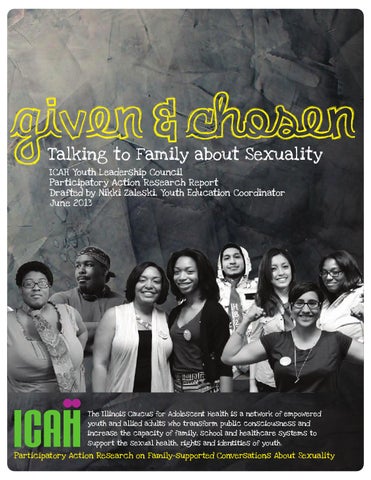
given & chosen Talking to Family about Sexuality ICAH Youth Leadership Council Participatory Action Research Report Drafted by Nikki Zaleski, Youth Education Coordinator June 2013
T he Illinois Caucus for Adolescent Health is a network of empowered youth and allied adults who transform public consciousness and increase the capacity of family, school and healthcare systems to support the sexual health, rights and identities of youth.
Participatory Action Research on Family-supported Conversations About Sexuality
Introduction During October 2012 - June 2013, the Illinois Caucus for Adolescent Health (ICAH) Youth Leadership Council conducted a Participatory Action Research study focusing on family-supported conversations about sexual health, rights, and identities. ICAH is a network of empowered youth and allied adults who transform public consciousness and increase the capacity of school, family, and healthcare systems to support the sexual health, rights, and identities of youth. ICAH YLC members implemented a Participatory Action Research process in order to act as the primary investigators of their own lives and communities.
Who is the Youth Leadership Council?
What is PAR?
The Youth Leadership Council (YLC) is ICAH's education, advocacy, and organizing youth cohort. The YLC engages youth and their communities through peer education, online and offline campaigns, and systems change work. Members of the YLC gain expert knowledge around sexual health education, through rigorous training on the subjects of sexual health, and reproductive justice.YLC members take the lead in facilitating ICAH’s For Youth by Youth and For Adults by Youth sexual health education trainings.
Participatory Action Research (PAR) is a process of engaging a community in defining questions important and meaningful to their lives, gathering information and ideas about those questions and coming to an understanding that generates insights that can be used to create social change. ICAH believes that youth are the experts of their own experiences and that PAR enables individuals to act as authors of their own narratives. ICAH hosted this PAR project to support families in understanding a core value: that young people need to be safe, affirmed and healthy. This report outlines the YLC research process and findings, calling for a clear need to support healthier conversations between youth and their given and chosen families around sex and sexuality.
T he Illinois Caucus for Adolescent Health’s Vision: We envision a world in which all young adults in Illinois use their power to achieve health and well-being in their own lives and for their communities.
ity mmun o c g n trusti king to Mo: “Aupport wor ealthier of s ur lives h ople e o make he lives of p and t around us.”
Ranita: “Where we learn about ourselves and each other… and where we can just be ourselves without judgment.”
Tiera: "The YLC is a fierce group of youth who fight for equality and what they believe in!"
Juan: “We’re a group of youth who work towards promoting safer sexual health practices and community engagement.”
What is th e Y LC to it s mem bers ?
2
October - December 2012
Defining Our
Question
During the first months of YLC programming, ICAH youth leaders explored a wide array of family-focused questions surrounding adolescent sexual health, rights, and identities. At the start of the research, ICAH youth were already engaging in systems change work in schools (through Peer Education workshops) and healthcare settings (through clinic-friendliness projects). For this reason, the group intentionally focused on investigating families as a third venue for systems change work, noting that families of origin and choice are significant influencers in navigating sexual identity, health and rights. The YLC asked broad questions about what family meant to them, and how this differed from dominant cultural definitions. Some of the earliest questions in beginning the research included:
•
How can I improve my relationships with my family so we can talk more?
•
Does fear or respect enforce your family rules?
• • • •
Can we stay healthy without the “typical” components of family?
Why do some family members use religion as an excuse to disrespect my sexual identity and beliefs?
Why are the resources for my family hidden/ hard to gain? What does blood have to do with love?
These initial questions generated by individual ICAH youth leaders led the group to a deeper conversation about redefining the concept of family. Before crafting a point of inquiry or conducting any research, the YLC had to define what family actually meant to them. Diverting from dominant notions of family as the support system a person is born into, the YLC began investigating the difference between chosen and given families. They defined each as such:
Given Family: the family you live at home with and/or the family you were born into such as your parents, grandparents, siblings, etc.
3
Chosen Family:
the supportive community you put together outside of the family you were given. This can sometimes include friends, but also adult allies, boyfriends, girlfriends, etc.
After defining the difference between given and chosen families,YLC youth developed their research question. In connecting family-related questions to adolescent sexual health, rights, and identities, the youth asserted that the most significant barrier they experienced (and that they perceived their peers experienced) to making healthy sexual decisions was not having familial support to talk about sex. This lack of support looked different for each youth—sometimes it was caused by judgment around a young person’s sexual identity, sometimes it was caused by awkwardness in having the conversation—but it was a consistent barrier experienced by youth across given and chosen families. This led the YLC to craft their question:
YLC members identified their research topic in December 2012, hoping to understand where youth go when they can’t talk to their given families about sex. The research began by investigating the conversations that youth had or didn’t have with people they live at home with. It continued by investigating who youth talk to about sexuality outside of their given families. Linked to this question are the primary research goal and objectives. Main Goal for Research:
Assessing the perceived barriers and benefits among youth in starting family-supported conversations about sex and sexuality. Key Objectives for Research:
1. To compare the comfort levels among youth in talking with their given families about sexuality versus talking with their chosen families.
2. To compare support provision between youth and their given families versus youth and their chosen families related to sexual health, rights, and identities.
3. To assess the various sexualityrelated topics discussed between youth and their given and chosen families
4. To legitimize the concept of chosen families alongside given families for ICAH youth and all research participants
4
Beginning
After defining the central question and objectives, ICAH youth began their research process. They used a primary cross-sectional study design, which combined qualitative (conversations and observations) and quantitative (survey and demographic responses) data collection. In order to meet the research goal of assessing the perceived barriers and benefits among youth in starting family-supported conversations about sexuality, the following methods were utilized:
Research
•
80 Individual Interviews: 20 youth leaders each conducted four one-on-one interviews with their Chicago peers
•
387 Online Surveys: 20 youth leaders disseminated an online comfort-assessment survey to youth ages 16-22 from across the country, supported by ICAH staff
•
1 Focus Group: 20 youth leaders participated in one in-person focus group, facilitated by the Youth Education Coordinator, focusing on connecting the online comfort-assessment survey to positive sexual decision-making among youth
Our
Study Objectives:
5
Screenshots from video interviews by YLC members
Objective:
Tools Utilized:
To compare the comfort levels among youth in talking with their given families about sexuality versus talking with their chosen families.
Online Survey, One-on-one interviews
To compare support provision between youth and their given families versus youth and their chosen families related to sexual health, rights and identity
Online Survey, One-on-one interviews
To assess the various sexuality-related topics discussed between youth and their given and chosen families
Online Survey, One-on-one interviews
To determine the leading factors that cause youth to form chosen families
Online Survey, One-on-one interviews
To legitimize families of choice alongside families of origin
One-on-one interviews, online survey, focus group, internal reflection
One-on-one interviews: Questions for the interviews were created collectively by the Youth Leadership Council.Youth identified four of their peers (convenience sample) in the 16-22 age range who they could interview for the project. The group created criteria for diversity (including age, race, class, ability, gender identity, and sexual identity) and mapped out which community connections they had with each diverse group. When the group didn’t have internal connections to specific populations in the diversity criteria, the YLC recruited individuals from partnering organizations to meet demographic requirements. Online survey: Questions for the survey were created collectively by the Youth Leadership Council, taking into account relevant discoveries about the research questions during the one-on-one interviews.Youth disseminated the survey to their personal networks, including schools and colleges, and ICAH disseminated to national networks, including partnering organizations, movement-building organizations, and school systems across the country that ICAH works with (convenience sample). Focus Group: After analyzing the demographic breakdown of the population that completed the online survey,YLC members participated in a focus group on their primary responses to the research (convenience sample). Crafted and facilitated by the Youth Education Coordinator, the questions for this focus group built on those asked in the one-on-one interviews and online survey. These questions were also created collaboratively by the Youth Leadership Council.
Bias
Implementation
&
Logistics
NOTE: ICAH’s YLC primarily used a convenience sample in targeting populations to research.This means that ICAH youth built on existing connections and relationships, rather than researching a randomized sample.
The study does carry some potential for ascertainment bias, meaning that it can’t be fully generalized to reflect all youths’ perspectives on family-supported conversations about sexuality. While the target population was representative, with only 500 participants between one-on-one and online interviews, it is difficult to capture the sweeping perspectives of diverse youth. The YLC research was also envisioned and implemented by a group of politically and socially progressive youth. This means that after extensive sexual health, rights and identity training from ICAH, the majority of YLC members take on a core set of beliefs that align with ICAH’s mission and values. These beliefs include increased sex positivity, increased positivity and support toward young parents, and increased values from anti-adultist, anti-homophobic, and antioppressive frameworks.
While the YLC trained to bring an objective stance to their one-on-one interviews, the questions asked reflect their subjective values. Because the YLC used a convenience sample, it is possible that the perspectives of the youth interviewed reflected those of ICAH’s YLC (the group conducting the research). ICAH believes that progressive values are strong family values, so this bias supports the research goals in understanding barriers to healthy conversations about sexuality. It is also possible that since many of the youth interviewed their friends, the intimate relationships may have clouded or enhanced the interview responses. This could have led to social desirability bias. A friend might be more willing to disclose personal information about why they talk to their given and chosen families about sexuality, but might also be less willing if they anticipated judgment from the youth researcher. In the one-on-one interviews, the youth also interviewed some actual members of their chosen family (close friends, partners, etc). Because the YLC interviewed their chosen family members about what it means to be in someone’s chosen family, this could have skewed responses. The comfort levels that close relationships had in talking about sex and sexuality made this potential bias a worthwhile risk.
6
Our
F indings
The following analysis outlines the relevant data from the YLC Participatory Action Research, connected to each research objective. The statistics are compiled from the online and offline interviews.The quotes were pulled from the YLC focus group.
Objective 1: To compare the comfort levels among youth in talking with their given families about sexuality versus talking with their chosen families.
1. Youth are more comfortable talking with their chosen families about sex and sexuality, but both families generally lack the skills necessary to host accurate conversations.
a. 73.4% of youth talk with their chosen families about sex, while only 52.8% talk with their given families. i. Breaking it down by sexual identity: 52.2% of Heterosexual-identified youth indicated that they talk with their given families about sexuality, while 55.6% of LGBQ youth talked with their given families, a minor difference between the two. Only 70.4% of Heterosexual-identified youth indicated that they talk with their chosen families about sexuality, while 81.6% of LGBQ youth talked with their chosen families. This suggests that LGBQ youth communicate more directly with their families about sexuality, especially their given families. 1. In addition, only 20% of youth who identified as asexual indicated that they talk with their given families about sexuality. Oppositely, 80% of asexual youth indicated that they talk with their chosen families about sexuality. This points to a clear need for greater education and awareness about the legitimacy of asexual identities for older generations in particular.
7
ii. Breaking it down by gender identity: 51.7% of Female-identified youth, 55.8% of Male-Identified youth and 59.1% of Transgender, Gender Non-conforming and Genderqueer youth talked with their given families about sexuality. 76.6% of Female-identified youth, 63.2% of Male-Identified youth 81% of Transgender, Gender Non-conforming and Genderqueer youth talked with their given families about sexuality. This suggests that youth in general talk more with their chosen families about sexuality, especially Transgender, Gender Non-conforming and Genderqueer youth.
b. 63.2% of youth indicated that they feel more comfortable talking with their chosen families about sex and sexuality, compared to 9.7% who said they felt more comfortable talking with their given families, 14.5% who said they felt comfortable talking with both families, and 4.2% who said they felt comfortable with neither. i. Alfredo -- “You feel more comfortable
with your chosen family because you’ve
known your given family for longer, and
you remember when these conversations were awkward before. So you’re always thinking back to the time when it you were judged or felt weird.”
ii. Ranita -- “When parents say, ‘I’ve
been there, done that,’ you feel like they won’t understand you. Chosen families are going through the same stuff as
you right now- it’s not like they already did it. T his can be positive.”
c. 50.3% of youth perceived that the information presented by chosen families was only “Somewhat Accurate,” with exactly 50% of youth reporting the same for given families. Only “Somewhat Accurate” was the majority response for both families (and nearly identical for given and chosen families), demonstrating a need for more accurate conversations in both spaces.
2. Youth experience particular
difficulty talking with their given
families about sexuality, even when they trust their given families.
a. 21.36% of youth feel more trust for their given families, 36.3% of youth feel more trust for their chosen families, and 32.3% feel trust for both. The minimal variation in each response shows that the quality of given or chosen familial relationships is not a leading factor in whether or not youth talk with their families about sexuality. Even the majority of youth who indicated that they trust their given families did not feel comfortable talking with them about sexuality. i. Jessica- “We want to talk to both of
our families about sex. When you talk to another person it gives you
emotional support that you can’t get from the internet.”
Discussion Both given and chosen families need adequate training and information to support healthy conversations about sexuality with youth in their lives. Youth perceive that both families are only able to provide “Somewhat Accurate” information, which could be a major deterrent in reaching out to both groups for information. Even when youth have strong relationships and trust in their given families, it remains particularly difficult to talk about sex and sexuality with them. This data points to a need for a cultural shift in the expectations laid-out for given families to have conversations about sexuality. Conversations between youth and their given families must be normalized and expected at a cultural level. The YLC expressed that the culture they live in expects young people to talk to their chosen families and friends about sex, but that it does not promote conversations between youth and their given families. In removing the stigma surrounding these conversations, youth may feel more comfortable reaching out to their given families. Cultural and public consciousness campaigns about given family-supported sexuality conversations with youth could lead to this transformation.
8
Our
F indings
The following analysis outlines the relevant data from the YLC Participatory Action Research, connected to each research objective. The statistics are compiled from the online and offline interviews.The quotes were pulled from the YLC focus group.
Objective 2: To compare support provision between youth and their given families versus youth and their chosen families related to sexual health, rights, and identities.
1. Youth see their chosen families as strong emotional and advice- giving supports and their given families as strong financial and educational supports, both of which are needed for responsible conversations about sexuality.
a. When asked to list the top three types of support provided by each family, the majority of youth listed Emotional, Advice, and Intellectual support for their chosen families. For their given families, the majority of youth listed Educational, Financial, and Emotional as the main types of support provided. i. Kami- “We depend on both families in
thinking about what we need emotionally or socially. It’s easier to point out what’s
wrong or what needs to be added, which is
when chosen families come in- they give us what our given families don’t.”
Discussion Youth see each family structure as distinct in meeting different sets of their personal needs. All 5 areas of support listed are necessary in hosting responsible conversations about sexuality, and can be provided through uniquely weaving together given and chosen family supports. Given and chosen families must collaborate on sexuality-related conversations. This often means given families reaching out to know and understand the chosen families of the young people in their lives (parents getting to know their kids’ friends, etc).
9
Objective 3: To assess the various sexualityrelated topics discussed between youth and their given and chosen families
1. While youth are able to talk to both given and chosen families about relationships and love, they are overwhelmingly unable to talk with their given families about personal sexual experiences.
a. 50.6% of youth responded that they can’t talk with their given families about their personal sexual experiences, and 44.7% said they can’t talk with them about being sexually active. 63.29% can, however, talk with their given families about love and relationships. b. When asked, “What CAN’T you talk to your chosen family about?” 75.7% of youth responded “Nothing, I can talk to my chosen family about anything.” i.Omar- “Adults in general, but parents especially, automatically come in and say I know better than
you. T his kind of just shuts the door on the whole conversation, and definitely makes you not want to talk about sex.”
Discussion Youth have abbreviated conversations with their given families about sex and sexuality. Even when the door opens to talking about love and relationships, youth still feel unable to discuss the sexual behavior(s) that might be involved in those relationships, and thus have difficulty accessing strong information on their bodies and health. Chosen families set a high bar for comfort in accessing any topic related to sexual health, rights, and identities, pointing to a need for more peer education models within chosen family relationships. This means chosen families are uniquely situated to give and receive information about sex. Youth, especially those who already have accurate sexuality information, should be encouraged to educate their chosen families about their bodies and health in informal settings (outside of classroom or program spaces). Organizations can support this need by providing alternative peer education models that can plug into already existing chosen family spaces (sleepovers, sports events, lunchrooms, media based strategies, etc).
10
Our
F indings
The following analysis outlines the relevant data from the YLC Participatory Action Research, connected to each research objective. The statistics are compiled from the online and offline interviews.The quotes were pulled from the YLC focus group.
Objective 4: To legitimize the concept of chosen families alongside given families for ICAH youth and all research participants
1. T he concept of Chosen Families is relevant, applicable and necessary in building resilience strategies for youth.
2. After trust and bonding, youth reported that they knit together chosen families to fill in gaps from their given families.
a. 80.7% of youth responded that they had formed a chosen family.
a. When asked to select the three top reasons for creating a chosen family, the majority of youth responded with: “Because I trusted them,” (53.5% of participants listed this as one of top 3), “Because I bonded with them,” (53.5% of participants listed this as one of top 3), and “Because I could talk to them about things I couldn’t talk to my given family about” (52% of participants listed this as one of top 3).
b. The majority of responses listed “Support” as the most important quality looked for in forming a chosen family, at 31.3%.
i. Kami- “A lot of chosen families are made as a
survival mechanism. I go to them first instead of my
given family because I’m
surviving with them—these
are the people who helped you overcome something that you didn’t necessarily express.”
ii. Erica- “You expect them to have your back— it’s a
survival game. It’s a game of being out the “normal” box and trying to run away as
fast as possible while others try to throw you in. Your
chosen families are in that game with you.”
11
i. Jacob- “Given families have a
different understanding than chosen families and might not be able to connect. T heir problems were
different than ours. We’re still dealing
with the stuff they dealt with but also have to worry about gender identity and sexuality.”
ii. Anthony- “T he social problems were different when our parents were
growing up. Now, we think about gay marriage, equal rights among trans
people, that kind of stuff. When they
were kids, racism was the huge thing. T hey aren’t as ready to talk about
sexuality as we are, or as our chosen families are.”
3. Adult Allies play a large role in the chosen families of youth.
a. 33.5% of participants indicated that adult allies were included in their chosen family, moving past the perception that chosen families just include friends and peers.
Discussion The ability of youth to creatively knit together support structures when their given families fall short is one example of youth resilience strategies. Programs and policies in family support systems within human services, schools etc. need to affirm youth in creating chosen families in order to plant seeds for healthy support structures in young peoples’ lives. When possible, youth can knit these chosen families together in recognition of the gaps in support provision from their given families. In honoring that no one family structure is perfect, strong family-centered programs must acknowledge the flaws of prioritizing given families and offer suggestions for creating chosen families that address those flaws. Noting the drastic amount of youth that reported having adult allies in their Chosen Families opens a large opportunity for adults to support safe, accessible conversations with youth about sex and sexuality. The YLC research proves that youth look to adults as resources in these conversations, and expect that they will be more accurate than their peers. Adults need to receive medically accurate, inclusive, and non-shaming sexuality information so they can pass it on to youth. The National Sexuality Standards created by FoSE (Future of Sex Education) outlines the core content and skills needed for best practice in Sexuality Education in grades K-12. The standards indicate a clear need to build healthy relationships between youth and their peers, as well as youth and adult allies. The YLC research aligns with this standard, emphasizing the need for affirming youth and adult relationships outside the given family structure. NOTE: During the YLC research on given and chosen families, the majority of youth participants also responded that they experience equal amounts of judgment by both their chosen and given families.While the YLC hypothesized that youth would feel less judgment from their chosen families, they were surprised to learn that judgment was listed as a barrier for sexuality-related conversations with chosen families just as frequently as it was with given families.This is potentially because youth play out similar habits with their chosen families that they learn with their given families. If youth experience judgment in their given families, they might take this quality into their relationships with their chosen families. Again, this finding points to a need for more affirmation of youth forming chosen families in strategic, creative ways.
12
“Found Poem” collages created by YLC members inspired by research questions. Spring 2013
What’s Next? This research will help ICAH's YLC create action to change the way youth talk about sex with their given and chosen families and help ICAH build the capacity of adult decision-makers to better talk to, support, and advocate for youth about their sexual health, identities and rights. From the findings on family-supported conversations about sexuality, ICAH will better understand how to craft sexual health, rights, and identities trainings and campaigns for youth and the adults in their lives. The YLC will take each recommendation in the discussion portion of this report to build concrete action next year. They will focus on the research objectives to shape cultural advocacy and education strategies to transform the way youth and their families talk about sex and sexuality. Stay tuned for what’s to come in the YLC 2013-14 programming year as we transform public consciousness and build capacity around our research findings.
Connect with ICAH Online: Tweet @ICAH @ICAHYouthVoice using #youthvoice Instagram @TeamICAH email: nikki@icah.org facebook.com/illinoiscaucusforadolescenthealth
Š Illinois Caucus for Adolescent Health 2013 www.icah.org info@icah.org 312-427-4460 facebook.com/illinoiscaucusforadolescenthealth