Monthly Edition
Issue 26 • October 2026
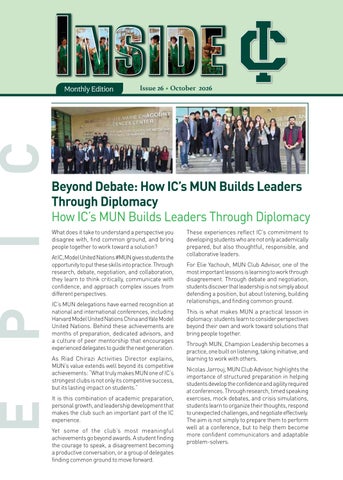
Beyond Debate: How IC’s MUN Builds Leaders Through Diplomacy How IC’s MUN Builds Leaders Through Diplomacy What does it take to understand a perspective you disagree with, find common ground, and bring people together to work toward a solution? At IC, Model United Nations #MUN gives students the opportunity to put these skills into practice. Through research, debate, negotiation, and collaboration, they learn to think critically, communicate with confidence, and approach complex issues from different perspectives. IC’s MUN delegations have earned recognition at national and international conferences, including Harvard Model United Nations China and Yale Model United Nations. Behind these achievements are months of preparation, dedicated advisors, and a culture of peer mentorship that encourages experienced delegates to guide the next generation. As Riad Chirazi Activities Director explains, MUN’s value extends well beyond its competitive achievements: “What truly makes MUN one of IC’s strongest clubs is not only its competitive success, but its lasting impact on students.” It is this combination of academic preparation, personal growth, and leadership development that makes the club such an important part of the IC experience. Yet some of the club’s most meaningful achievements go beyond awards. A student finding the courage to speak, a disagreement becoming a productive conversation, or a group of delegates finding common ground to move forward.
These experiences reflect IC’s commitment to developing students who are not only academically prepared, but also thoughtful, responsible, and collaborative leaders. For Elie Yachouh, MUN Club Advisor, one of the most important lessons is learning to work through disagreement. Through debate and negotiation, students discover that leadership is not simply about defending a position, but about listening, building relationships, and finding common ground. This is what makes MUN a practical lesson in diplomacy: students learn to consider perspectives beyond their own and work toward solutions that bring people together. Through MUN, Champion Leadership becomes a practice, one built on listening, taking initiative, and learning to work with others. Nicolas Jarrouj, MUN Club Advisor, highlights the importance of structured preparation in helping students develop the confidence and agility required at conferences. Through research, timed speaking exercises, mock debates, and crisis simulations, students learn to organize their thoughts, respond to unexpected challenges, and negotiate effectively. The aim is not simply to prepare them to perform well at a conference, but to help them become more confident communicators and adaptable problem-solvers.
2
FROM POTENTIAL TO PERFORMANCE
Issue 26 | October 2026
In the News
TedxInternationalCollegeBeirut: Ideas That Inspire Growth, Empathy, and Leadership On Saturday, October 10, the Irani Auditorium at IC Beirut became a space for curiosity, reflection, and discovery as students, faculty, staff, parents, and guests gathered for TEDxInternationalCollegeBeirut under the theme “Unlocking Humanity.” Through a diverse range of talks, student speakers explored questions that shape the way we see ourselves and the world around us. From the courage to embrace the unknown and the importance of looking beyond grades to the role of curiosity, creativity, and communication in personal growth, each talk offered a different perspective on the human experience. Some speakers challenged conventional ideas of success, reminding audiences that achievement cannot be reduced to a number and that growth often begins when we stop measuring ourselves against others. The talks also ventured into more complex questions of identity, belonging, choice, and the world we are
building. Speakers examined the meaning of home, the pressures of growing up, the expectations we place on ourselves, and the decisions that shape our lives. As artificial intelligence continues to transform how we learn, think, and create, the conversations also raised an essential question: What makes us uniquely human, and how do we preserve that human edge? At IC, learning extends beyond the classroom. TEDxInternationalCollegeBeirut gave students a platform to share their ideas, explore personal experiences, and spark conversations around questions that matter. By offering different perspectives on the human experience, the event encouraged the IC community to look beyond assumptions, listen with curiosity, and consider new ways of seeing the world. Ultimately, the power of an idea lies not only in what it reveals, but also in what it inspires us to reconsider.
3
FROM POTENTIAL TO PERFORMANCE
Issue 26 | October 2026
In the News
From IC’s First BFI Cohort to the Ivy League Excel Academically. Think Beyond Borders. Prepare for What’s Next. The world our students are preparing for is bigger than one country, one language, or one way of thinking. Their education should be too. At IC, the Baccalauréat Français International (BFI) gives students the opportunity to build a rigorous academic foundation while developing the intellectual curiosity, cultural awareness, and multilingual skills to move confidently in an international world. Demanding coursework, critical thinking, analysis, independence, and depth of learning. The BFI takes that experience further. It enriches the French Baccalauréat by opening students to a broader range of languages, cultures, perspectives, and ways of understanding the world. Students are encouraged to look beyond the French curriculum, make connections across disciplines, and engage with their learning through an international lens. “The BFI challenges students to look beyond what they already know, to question, connect ideas, and understand different perspectives. It develops students who are not only strong academically, but increasingly confident in how they think and communicate.” commented Boualem Maizia, Director of Curriculum and Instruction, French Program. “The BFI builds on the strength of the French Bac while opening students to a wider world, a world of different languages, cultures, and perspectives. Through courses taught in English, AP examinations, and “Connaissance du monde” projects developed with international partners, students are encouraged to step beyond what is familiar, broaden their outlook, and grow further into curious, independent learners”, said Malda Halawi, High School Assistant Principal and Head of French Program. For Matteo Chirazi ’26, now at Brown University, that combination was exactly what he was looking for. “I chose the BFI because it offered the synthesis I was
looking for in my education, the rigor and intellectual discipline of the French Baccalaureate, paired with the directness of the American academic tradition and its emphasis on writing and independent thought.” Inar Zein, Head of College Counseling and University Acceptances commented: “When we work with students on their college plans, we look beyond grades. We look at how prepared they are to enter a new academic and cultural environment. The BFI helps students develop the adaptability, confidence, and international perspective that become valuable as they move into higher education.” The results are already speaking for themselves. As IC’s first BFI cohort graduates, our students have earned admission to highly selective universities including Brown University, Columbia University, and the University of Southern California. These acceptances reflect not only academic achievement, but the depth, independence, and international perspective students develop throughout their journey at IC.
4
FROM POTENTIAL TO PERFORMANCE
Issue 26 | October 2026
In the News
Taking Learning Further in IC’s American Program Deeper Learning, Greater Challenge, and More Choice for What Comes Next IC’s American Program is expanding opportunities for students to pursue their academic interests at greater depth through the introduction of Advanced Placement (AP) courses. Offered by the College Board, AP gives students the opportunity to experience college-level learning while still in high school, develop higher-level thinking skills, and potentially earn university credit based on their AP exam results and university policies. At IC, AP is built around choice. Students can explore subjects they are passionate about, take on greater academic challenge, and shape their learning according to their interests and goals. “AP courses give students the unique opportunity to step beyond general studies and immerse themselves deeply in subjects they are truly passionate about. It’s about taking an area of interest and exploring it with
real rigor and focus.” Trisha Hofmann, PhD, Head of the American Program, Advanced Placement Coordinator Lauren Bowers, Director, Curriculum and Instruction, American and IB Program, adds: “It really allows students to personalize their learning experience in high school based on their interests. Students can choose to take one AP course or several, depending on the level of challenge that is right for them.” With current offerings in Human Geography, World History, Precalculus, Biology, and English Literature and Composition, and plans to expand the program further, IC is creating more pathways for students to challenge themselves and prepare for what comes next. This is Excel Academically in action: going deeper, thinking differently, and taking ownership of the learning journey.
FROM POTENTIAL TO PERFORMANCE
Issue 26 | October 2026
5
Ali Ghandour Center for Leadership, Diversity, and Civic Engagement
IC Responsibility Wellbeing
AGC Welcomes Its Newest Cohort: Inspiring Young Leaders to Make a Meaningful Difference Over the past few weeks, the Ali Ghandour Center for Leadership, Diversity, and Civic Engagement (AGC) has been buzzing with interviews as Grade 10 applicants stepped forward, eager to go the extra mile in developing their leadership skills, exploring their potential, and making a meaningful difference in their communities as part of the 2026–2027 AGC cohort. It was encouraging to see students come forward with such enthusiasm, confidence, and thoughtful ideas about the social issues they care about. Through their presentations, they explored a wide range of challenges, from access to healthcare, Lebanon’s waste crisis, and bridging educational gaps to teen mental well-being, inclusion, sustainable farming innovations, migrant workers’ rights, and women’s entrepreneurship. They connected these issues to the UN Sustainable Development Goals and shared creative ideas and possible solutions for making a difference in their communities. Beyond their presentations, the selection process considered each applicant’s preparedness, critical
thinking skills, character, motivation, previous civic engagement experiences, and overall application. We are excited to welcome 45 students to this year’s Grade 10 AGC cohort, making it our largest cohort to date! The excitement continued on Wednesday, October 28, 2026, as the new cohort came together for its first Icebreaker and Orientation Session. Students introduced themselves through an object of their choice, each carrying a story that revealed something about their personality, interests, values, or experiences. From the objects they chose to the stories they shared, the activity offered a fun and personal way to break the ice and discover more about one another. The session also introduced students to AGC’s three-year program, the opportunities and experiences awaiting them, and the expectations and commitments that come with being part of the AGC community.
Civic Commitment and Service Learning
IC Responsibility Wellbeing
FROM POTENTIAL TO PERFORMANCE
Issue 26 | October 2026
6
Grade 11 Students Explore Volunteering Opportunities at the CCSL NGO Fair: Inspiring Service Through Meaningful Community Engagement The High School Civic Commitment and Service Learning team (CCSL) hosted the NGO Fair for Grade 11 students. The event brought together 13 NGOs operating across diverse fields, including humanitarian aid, education, environmental protection, and healthcare. Students from both the French Baccalaureate and Lebanese programs attended to explore the missions of participating organizations and learn about available volunteering opportunities, including required hours and locations. By speaking directly with NGO representatives, students gained valuable insight into how they can meaningfully contribute to their communities. To meet their CCSL requirements, Grade 11 students must register with an NGO and complete a minimum of 15 volunteering hours by the end of January as a promotion requirement. The fair helped guide students toward NGOs aligned with their personal interests, values and areas of concern. Beyond fulfilling this requirement, the event encouraged broader community engagement and social responsibility while introducing potential NGO partnerships for upcoming interdisciplinary Service Learning projects. Initiatives like the NGO Fair reflect IC’s ongoing commitment to empowering students to practice active citizenship and translate their learning into impactful action.
FROM POTENTIAL TO PERFORMANCE
Issue 26 | October 2026
7
Civic Commitment and Service Learning
IC Responsibility Wellbeing
Student Led Anti Bullying Awareness Initiative: Students Take a Stand Against Bullying Building a Culture of Empathy, Respect, and Inclusion This week, a group of our senior students, Matthew Barsoum, Mia El Mawla, Lucas Barsoum, Hadi Toufeily, Ossen Al Ahmar, and Jana Bdeir, stepped forward to take a meaningful stand against bullying. Recognizing that creating a safe and inclusive school community is not the responsibility of one person, they took the initiative to raise awareness through simple yet purposeful activities that invited everyone to participate. On Tuesday, October 6, the students launched an Anti Bullying Board, encouraging members of the school community to leave positive messages and personal pledges on sticky notes. Although simple in design, the initiative carried a powerful message: everyone has a role to play in making our school a place where kindness, respect, and inclusion are actively practiced. Speaking on behalf of the initiative, Mia El Mawla said: “Everyone deserves to feel welcomed, respected, and comfortable being themselves.”Building on this message, Ossen Al Ahmar highlighted an important reality: bullying is not always immediately visible. It can take the form of a whispered rumor, deliberate
exclusion, or a hurtful online comment. His message encouraged students not to remain passive bystanders, but to actively contribute to a culture in which harmful behavior is challenged and those who may be struggling are supported. The Anti Bullying Board therefore became more than a display. Each sticky note represented a small commitment, a promise to speak up, include others, offer support, or simply choose kindness. Through this collective participation, the students demonstrated that meaningful change does not always begin with a large campaign. Sometimes, it begins with one message, one decision, or one student choosing to take a stand. This simple initiative opened the door to a much deeper conversation about the kind of community we want to build. Raising awareness is only the beginning. The true impact comes from carrying these values into our everyday interactions, choosing empathy over exclusion, courage over silence, and kindness over hurtful words or actions.
8
FROM POTENTIAL TO PERFORMANCE
Issue 26 | October 2026
Wellbeing Outreach
Who Funds the Future of Education? IC Outreach is pleased to share the launch of the school’s new podcast series - From Potential To Performance: Best Practices for Education Funding. Each week, key education stakeholders from Lebanon and worldwide will share their knowledge and perspectives with our global audience. These interviews will also act as qualitative research for a policy recommendations paper by summer 2027 as well as helping to galvanise financing for education of all learners in Lebanon and the region. Institutions already primed to feature include the Ministry of Education and Higher Education, Gates Foundation and World Bank.
You will be able to find each recording available on Apple Podcasts (and other platforms) every Wednesday at 12 noon Beirut time. Thank you to President Dr. Wait for his direction and support of this important initiative, with the podcast aiming to positively impact Lebanon’s education sector. Episode #1 of Series #1 comes directly from the President in IC’s Audio Room in the STEAM Innovation Centre. We look forward to you joining us each week!
Stay tuned for the episodes!
Civic Commitment and Service Learning
IC Responsibility Wellbeing
FROM POTENTIAL TO PERFORMANCE
Issue 26 | October 2026
9
Student Voices, Student Choices: Championing Leadership Through Class Representative Elections Congratulations to our newly elected Class Representatives! Following an exciting election process, students had the opportunity to listen to their classmates deliver speeches, share their ideas and goals, and explain how they hope to represent their peers. The voting process was a wonderful opportunity to experience democracy in action, as students exercised their right to vote, made informed choices, and learned the importance of respecting different perspectives and election outcomes. We are especially proud of all our nominees for demonstrating the courage to step forward, share their voices, and take on a leadership challenge. Whether elected or not, their willingness to participate is already an example of leadership in action! Aligned with our Champion Leadership goal, this experience reminds us that leadership is about service, responsibility, listening to others, and making a positive difference. We wish our newly elected representatives a successful year as they take on the responsibility of being the voice of their classmates!
Civic Commitment and Service Learning
Issue 26 | October 2026
Promoting Wellbeing Through Food Safety and Hygiene
FROM POTENTIAL TO PERFORMANCE
10
The Food Safety and Hygiene Workshop has officially started for our grade 10 students. The session is divided into two main parts: a theoretical session and a practical session, allowing students to develop both essential knowledge and hands-on skills related to food safety and hygiene. During the theoretical part, students learned about the importance of using color-coded cutting boards to prevent cross-contamination, maintaining proper personal hygiene, and ensuring appropriate storage temperatures for dry goods. They were also introduced to essential food safety practices that help maintain cleanliness and prevent foodborne illnesses.The practical part allowed students to put their knowledge into action. They practiced sanitizing vegetables properly and learned how to handle and use kitchen knives safely and correctly.Through this interactive workshop, students are developing essential life skills and gaining a better understanding of the importance of food safety, hygiene, and safe food preparation practices.
IC Responsibility Wellbeing
Civic Commitment and Service Learning
IC Responsibility Wellbeing
FROM POTENTIAL TO PERFORMANCE
Issue 26 | October 2026
11
Championing Responsibility: Grade 12 Students Prepare for Safer Roads with Kunhadi A general orientation session on road safety, given by the Kunhadi NGO, was held for Grade 12 students, aimed at preparing them for the responsibilities that come with driving. Many students are about to start driving or already ride with friends, so the session stressed that safe habits begin before getting behind the wheel. This was the first session in a series of workshops on road safety, to be followed by sessions on traffic law and a simulation day. During the simulation day, students will experience how to get out of a flipped car, see firsthand the importance of seatbelts, try drunk-effect goggles, and learn how distractions affect a driver. The Kunhadi team explained that speed is one of the leading causes of road accidents. The faster a car moves, the less time a driver has to react and the longer it takes to stop. Arriving a few minutes late is always better than not arriving at all.Seatbelts are among the simplest and most effective ways to save lives. In a collision, they keep passengers from being thrown from the vehicle or hitting the dashboard or windshield. Students were encouraged to buckle up every time, whether they sit in the front or back seat. A major part of the session focused on distracted driving. Using a phone to text, scroll, or take calls takes the driver’s eyes, hands, and mind off the road. Applying
makeup, eating, or drinking while driving creates the same danger. A moment of distraction at high speed can be enough to cause a serious crash, so students were urged to finish these tasks before the trip or wait until the car is safely parked. The session also explained how alcohol affects the body. It slows reaction time, blurs vision, weakens judgment and coordination. Students were clearly told never to drive after drinking and never to ride with a driver who has been drinking. They were encouraged to arrange a sober driver or another way home.The message was clear: road safety is a shared responsibility, and every decision behind the wheel affects the driver, the passengers, and everyone else on the road.
Civic Commitment and Service Learning
IC Responsibility Wellbeing
FROM POTENTIAL TO PERFORMANCE
Issue 26 | October 2026
12
Akle W Bassme Returns: Grade 10 Students Drive Community Action Turning Compassion into Action and Making a Difference in the Community A general orientation session on road safety, given by the Kunhadi NGO, was held for Grade 12 students, aimed at preparing them for the responsibilities that come with driving. Many students are about to start driving or already ride with friends, so the session stressed that safe habits begin before getting behind the wheel. This was the first session in a series of workshops on road safety, to be followed by sessions on traffic law and a simulation day. During the simulation day, students will experience how to get out of a flipped car, see firsthand the importance of seatbelts, try drunk-effect goggles, and learn how distractions affect a driver. The Kunhadi team explained that speed is one of the leading causes of road accidents. The faster a car moves, the less time a driver has to react and the longer it takes to stop. Arriving a few minutes late is always better than not arriving at all.Seatbelts are among the simplest and most effective ways to save lives. In a collision, they keep passengers from being thrown from the vehicle or hitting the dashboard or windshield. Students were encouraged to buckle up every time, whether they sit in the front or back seat. A major part of the session focused on distracted driving. Using a phone to text, scroll, or take calls takes the driver’s eyes, hands, and mind off the road. Applying makeup, eating, or drinking while driving creates the same danger. A moment of distraction at high speed
can be enough to cause a serious crash, so students were urged to finish these tasks before the trip or wait until the car is safely parked. The session also explained how alcohol affects the body. It slows reaction time, blurs vision, weakens judgment and coordination. Students were clearly told never to drive after drinking and never to ride with a driver who has been drinking. They were encouraged to arrange a sober driver or another way home.The message was clear: road safety is a shared responsibility, and every decision behind the wheel affects the driver, the passengers, and everyone else on the road.
Civic Commitment and Service Learning
IC Responsibility Wellbeing
FROM POTENTIAL TO PERFORMANCE
Issue 26 | October 2026
13
Student Volunteers Bring Halloween to Life for a Good Cause As part of the CCSL program, the Ain Aar Middle School annual Halloween fundraising party was organized and hosted by a group of Grade 8 and Grade 9 volunteers. For weeks, students planned the event, divided tasks, and chose their committees. They worked in groups, and rather than limiting themselves to their own tasks, they reached out to support other committees whenever help was needed. The event was entirely student-led. From posters, communication and public announcements to decoration, food, music, and the haunted and escape rooms, everything was designed and made by the students themselves.
Throughout the process, the volunteers invested their talents, skills, and creativity, while building key skills such as time management, teamwork, communication, and problem-solving. On the day of the party, the volunteers were well prepared and delivered, creating a fun and safe environment for the younger students to enjoy. Alongside the fun, the event carried a clear message: it was organized to raise funds for the CCSL projects. More fundraising events are coming throughout the year, involving student volunteers from different grade levels.
14
FROM POTENTIAL TO PERFORMANCE
Issue 26 | October 2026
IC Responsibility Wellbeing
From Awarenss to Action: Service Learning at Middle School Ain Aar At Middle School Ain Aar, the school year began with a renewed focus on Civic Commitment and Service Learning (CCSL), encouraging students to move beyond understanding the importance of service to actively making a difference in their communities. Our newly appointed CCSL Coordinator, Ms. Cynthia, launched the year by meeting with students from Grades 6 to 9, introducing the program and exploring what meaningful service looks like. These sessions encouraged students to recognize community needs, develop empathy, and understand that service learning is not simply about volunteering, but about taking initiative, collaborating with others, and turning ideas into meaningful action. Students soon had the opportunity to put these ideas into practice through the Back-to-School Campaign, the first student-led CCSL initiative of the year. Students collected gently used school supplies to give them a second life and support children in need. Beyond
contributing donations, students took ownership of the process by designing campaign posters, sorting and organizing supplies, taking inventory, and preparing packages for distribution through an NGO. The experience provided an authentic opportunity to develop teamwork, organization, communication, and problem-solving skills while putting IC’s core values of Responsibility, Integrity, Empathy, and Respect into action. Building on this momentum, Grade 8 and Grade 9 students have begun preparing for the Halloween Fundraising Event, which aims at raising funds for interdisciplinary service learning projects. Students have been signing up for organizing committees, taking responsibility for different aspects of the event, and developing their leadership and organizational skills. Families have also been invited to participate, strengthening the partnership between school and home in supporting student-led initiatives.
15
FROM POTENTIAL TO PERFORMANCE
Issue 26 | October 2026
Athletics
Tryouts are done. Teams are formed. Practices started. The tryouts for the 2026-2027 IC Athletics Season have officially come to an end, and our teams are ready for the season ahead! With more than 1,600 student-athletes across 12 sports disciplines, our ICougars are stepping into a new season
and are ready to represent IC in local and international events. Practices are now underway, across both campuses and in LAU for swimming, AUB for track and cross-country, and Tennis World for our Ain Aar tennis players.
16
FROM POTENTIAL TO PERFORMANCE
Issue 26 | October 2026
Athletics
ACS Cross Country Races & Aquathlon Our student-athletes delivered outstanding performances at three competitions organized by ACS: the Cross Country and Aquathlon Races on October 3 at AUB, followed by the Cross Country Race on October 10 at the Golf Club. Our Middle School and JV/Varsity swimming teams took part in the Aquathlon Race as they geared up for their upcoming NESAC competition in November. Our
swimmers made a strong statement, claiming podium finishes across the U14, U16, and U18 categories. Meanwhile, our track and field athletes excelled on the cross-country courses, securing impressive podium finishes in both the U16 and U18 categories. Congratulations to all our student-athletes for their dedication, determination, and outstanding achievements!
17
FROM POTENTIAL TO PERFORMANCE
Issue 26 | October 2026
Athletics
Friendly Volleyball Games Our JV Volleyball teams played friendly games against ACS as a preparation for their trip to NESAC in November.
18
FROM POTENTIAL TO PERFORMANCE
Issue 26 | October 2026
Athletics
Strength & Conditioning testing for JV & Varsity Athletes As part of its ongoing commitment to student-athletes’ physical development and athletic excellence, IC Athletics has launched a Strength and Conditioning Program for JV and Varsity athletes. The initiative aims to build a strong physical foundation, enhance fitness, and prepare athletes to meet the demands of their respective sports. Through structured training sessions, athletes will develop key physical attributes, including strength, speed, power, agility, and explosiveness, all of which contribute to improved performance and injury prevention.
The program kicked off with a series of physical performance assessments, including jumping and speed tests, to evaluate athletes’ current abilities and establish individual performance baselines. These assessments provide valuable insights into each athlete’s strengths and areas for improvement, enabling the coaching staff to tailor training to their needs and development potential. Through this structured, data-driven approach, IC Athletics aims to help its JV and Varsity athletes build confidence, maximize their potential, and take their performance to the next level as they represent IC.
Next on the Radar: NESAC Season 1 Our student-athletes are gearing up for NESAC Season 1, with Volleyball and Swimming teams preparing to represent IC in the upcoming competitions. • JV Volleyball: Abu Dhabi | November 11–15 • JV/Varsity Swimming: Dubai | November 12–15
Wishing our athletes the best as they prepare to compete, challenge themselves, and make IC proud!
19
FROM POTENTIAL TO PERFORMANCE
Issue 26 | October 2026
Students Life
IC High School Elects Its Student Program Leaders Championing Leadership One Voice at a Time A week of vibrant campaigns, inspiring speeches, and lively celebrations brought the High School Student Program Leaders elections to life! Throughout the week, candidates took the stage to present their ideas, visited different grade levels to connect with students, and shared their vision for representing their peers. Students across the High School cast their votes to elect one representative for each of IC’s four programs: the American Program, French Bac, Lebanese Bac, and International Baccalaureate Diploma Programme (IBDP). Congratulations to our four newly elected Student Program Leaders: Jana Bdeir, Yousif Arouni, Mazen Alameddine, and Mia El Mawla! Beyond the excitement of the campaigns and election day, the experience offered students a meaningful opportunity to engage in the electoral process, express their voices, consider different perspectives, and take an active role in their school community. As they step into their new roles, the four representatives will have the opportunity to bring forward their peers’ ideas, contribute to school life, and help shape the student experience across their respective programs. At IC, leadership is developed through participation,
responsibility, and action. These elections reflect our commitment to empowering students to take initiative and make their voices count. Championing Leadership, One Voice at a Time.
20
FROM POTENTIAL TO PERFORMANCE
Issue 26 | October 2026
Outreach
Supporting Bayssour Public School’s IB Journey Inspiring Service Learning Through Educational Outreach and Partnership On October 14th, IC Outreach coordinated the donation of 19 Lenovo Desktops and Monitors to Bayssour Public School, in support of the school’s journey towards IB PYP authorisation. As IC finalises its transition to Apple Mac, these 2023 Windows 10 models with 22-inch screens will support quality teaching and learning at Bayssour. Of the 12 Ministry-selected schools for PYP candidacy, this Chouf school is one of those taking substantial steps forward so far. IC continues to partner with MEHE, the Association of IB World Schools and the Hariri Foundation, donating EdTech devices, learning resources and soon playground equipment alongside offering professional development to public school colleagues.
21
FROM POTENTIAL TO PERFORMANCE
Issue 26 | October 2026
Art
Shaping Creativity Through Hands On Artistic Exploration The IBDP2 Visual Arts students have had the privilege of welcoming Mrs Majdoline Hatoum, a talented artist and ceramicist and the mother of Maeve Mourad, an IBDP2 student, who has generously volunteered her time and expertise to work with them for two periods on Wednesdays. During these sessions, she will introduce students to the art of ceramics, guide them in working with clay and glazes, demonstrate how to use the kiln safely, and help them make the most of the facilities and resources available in our Art Centre. This is a valuable opportunity for students to develop new artistic skills, experiment with different materials and techniques, and expand their creative practice under the guidance of a practicing artist. Her expertise and hands-on guidance will enrich their learning experience and open up new possibilities for artistic exploration and expression.
FROM POTENTIAL TO PERFORMANCE
Issue 26 | October 2026
22
IC Talents
Hala Sharafeddine Earns International Young Eco-Hero Award Congratulations to IBDP2 student Hala Sharafeddine, who has become the first Lebanese recipient of the International Young Eco-Hero Award, earning second place in the 15–16 age category. Hala was recognized for her award-winning project, “Code for Earth,” which combines coding and environmental education. Through the initiative, she teaches girls coding skills and encourages them to use technology to address environmental challenges. As part of the project, Hala independently organized and led a three-day virtual workshop in August 2025, bringing together 50 girls from across the Middle East, North Africa, and South Asia. We are incredibly proud of Hala for this outstanding international achievement and for using technology to inspire young people and contribute to meaningful environmental change.
Haya Ramadan Explores Technology’s Potential in Healthcare
Haya Ramadan, an IBDP 2 student at IC, is exploring the intersection of technology and healthcare through an innovative application that transforms a mobile phone into a spectrophotometer, with the potential to detect signs of anemia or dehydration from images of blood or urine. Inspired by her hospital job-shadowing experience and her interest in pursuing medicine at
university, Haya began researching the idea to explore the field and test her concept. Developed with reference to World Health Organization (WHO) guidelines, her project reflects the potential of student-led research to address real-world healthcare challenges. Haya recently shared her initiative on MTV’s Alive, bringing her work and ambitions to a wider audience.
FROM POTENTIAL TO PERFORMANCE
Issue 26 | October 2026
23
IC Talents
Taking His Passion for Padel to the International Stage Sherif Daniel, an Ain Aar 3ème student, has reached an exciting milestone in his sporting journey, having been selected to join the Lebanese U14 National Team and represent his country at the FIP Junior Asia Padel Cup in Indonesia. Having started playing padel just two years ago, Sherif has quickly developed a passion for the sport, winning several junior tournaments in Lebanon. His selection is a recognition of his dedication and progress, offering him the opportunity to gain international experience and compete on a wider stage.
24
FROM POTENTIAL TO PERFORMANCE
Issue 26 | October 2026
Elementary School - Ain Aar
Who Are We? Grade 5 Begins a New Journey of Inquiry Who am I? How have I changed? What makes me who I am? What choices help me feel and stay well? These were some of the questions Grade 5 students began exploring as they launched their new Who We Are unit through an interactive provocation designed to get them thinking, talking, questioning, and most importantly wondering. Students stepped into four different experiences that invited them to explore themselves and the world around them. From Baby to Grown-Up: How Do We Change? At the first station, Change: How Have I Changed?, students explored a visual timeline showing people at different stages of life. As they moved along the timeline, they observed how people change as they grow older. Students noticed physical changes, but their conversations quickly went beyond appearance. They began wondering about changes in the way people think, feel, communicate, build relationships, and become more independent. It opened the door to questions such as: What changes as we grow? Why do these changes happen? Do all people develop in the same way? Healthy… or It Depends? At the second station, Well-Being: Healthy Choices, Healthy Me, students were challenged to look at everyday choices from different perspectives. They sorted picture cards showing different lifestyle choices into three categories: choices that support well-being, choices that do not support well-being, and choices that depend on the situation. The “it depends” category quickly became a conversation starter!
Students discovered that some choices are not always as simple as “good” or “bad.” They had to explain their thinking, listen to their classmates, and consider different points of view. What Makes Me, Me? The third station took students into the world of identity and culture. In the Culture Corner, students explored artifacts, images, and symbols connected to Lebanon and other cultures represented in the classroom. They discussed the many influences that can shape a person’s identity, including family, language, traditions, interests, and experiences. Students began to recognize that while we may share some similarities, every person has a unique combination of experiences and influences that makes them who they are. Can You Say No? The final station brought an element of role-play to the provocation. At Refusal Skills: Making Responsible Choices, students encountered different scenarios that challenged them to think about how they might respond when faced with a difficult or uncomfortable situation. They practiced four refusal skills: Say no clearly. Give a reason. Suggest an alternative. Walk away if needed. Through role-play, students experimented with different ways of communicating their choices and began thinking about what it means to make decisions that are responsible and support their well-being. And the Inquiry Begins…
25
FROM POTENTIAL TO PERFORMANCE
Issue 26 | October 2026
Elementary School - Ain Aar
À travers mes lunettes d’été! Les élèves de CE1 ont commencé l’année en partageant un petit morceau de leur histoire à travers une activité pleine de créativité : « À travers mes lunettes d’été ». Chacun a pris le temps de se remémorer deux souvenirs qui ont marqué son été, puis de les représenter sur les verres de ses lunettes. Un voyage, une aventure, un moment en famille, une découverte, un jeu ou simplement un instant précieux… chaque enfant a choisi ce qui avait une place particulière dans son histoire. Après avoir dessiné et mis des mots sur leurs souvenirs,
les élèves ont créé leur propre portrait et y ont placé leurs lunettes. En partageant leurs créations avec leurs camarades, ils ont découvert que nous pouvons tous vivre des expériences différentes et porter un regard unique sur le monde. Chaque regard est unique. Chaque souvenir raconte une histoire. À travers leurs lunettes, les élèves nous invitent ainsi à découvrir un petit morceau de leur été… et une petite partie de leur univers.
26
FROM POTENTIAL TO PERFORMANCE
Issue 26 | October 2026
Elementary School - Ain Aar
Une pelote, des liens, une classe ! Durant les premiers jours de l’année, les élèves de CE1 ont participé à une activité qui leur a permis de tisser des liens, de partager et de mieux se connaître. Petit à petit, la pelote de laine est passée de main en main, formant une grande toile entre les élèves. Cette toile symbolise les liens qui se créent au sein du
groupe et rappelle une belle idée : chacun a sa place, chacun compte et chacun contribue à construire notre classe. Un fil après l’autre, nous construisons une classe où grandir et apprendre ensemble prend tout son sens.
27
FROM POTENTIAL TO PERFORMANCE
Issue 26 | October 2026
Elementary School - Ain Aar
Problem-Based Math: Exploring Volume Starting with What We Know What does it really mean to understand volume? Grade 5 students began their learning about volume by using the What Do You Know About...? thinking routine. Before learning any new rules or formulas, students had the opportunity to share what they already knew about unit cubes and volume. Their ideas gave us a starting point and helped students listen to and build on one another’s thinking. Investigating with Our Hands Students then worked in small groups to explore different figures made with unit cubes. They used a variety of tools, including unit cubes, water, and rulers, to investigate and decide which figures were larger. Rather than simply being told how to determine volume, students had to figure it out. They built, counted, compared, measured, and discussed their ideas. As they worked, they began to notice that the number of unit cubes used to build a figure tells us how much space it takes up. This hands-on investigation helped students develop an important understanding: volume is the amount of space a three-dimensional figure takes up. Thinking, Comparing, and Explaining
In the second activity, students worked in pairs to build and compare three-dimensional figures. They were challenged to explain why one figure had a greater volume and what it meant when two figures had the same volume. Some figures looked completely different but had the same number of unit cubes. This led students to an important discovery: figures can look different and still have the same volume. The focus was not just on finding an answer. Students had to explain their reasoning, listen to their partner’s ideas, and use evidence from their models to support their thinking. Mathematics Through Problem-Based Learning Problem-based learning gives students the opportunity to be mathematicians. Instead of following a procedure first and asking questions later, students begin with a problem, explore different possibilities, and use discussion and evidence to make sense of their learning. Through thinking routines, hands-on exploration, partner talk, and problem solving, Grade 5 students were not only learning what volume is. They were developing the habits of mind that help them become confident mathematical thinkers.
28
FROM POTENTIAL TO PERFORMANCE
Issue 26 | October 2026
Middle School - Ain Aar
Finding Our Voice: Communication Beyond Words How do we communicate without speaking? And how can our voice, body language, and facial expressions bring a story to life? During the Drama session in Grade 9 , our students explored the art of communication through a miming exercise and individual monologue performances. They practiced coordinating movements, using intonation, and expressing emotions to convey meaning and connect with their audience. Through rehearsal and repetition, they gradually gained confidence and performed the sequence independently.
Beyond the performance itself, these activities offer valuable opportunities to develop essential communication skills: expressing ideas clearly, adapting our delivery to an audience, listening attentively, and learning from feedback. By reflecting on their own performances and offering constructive feedback to their peers, students can become more intentional communicators who take ownership of their growth. Because effective communication is not just about what we say, but also how we say it, how we listen, and how we connect with others!
Turning Ordinary into Extraordinary What is recess for if not to get creative? While some students spend their break chatting or playing, this little group of artists chooses to unleash their creativity! Their latest mission? Transforming a dull piece of art room equipment into a one-of-a-kind work of art. Armed with markers, imagination, and plenty of artistic flair, they’re turning the ordinary into extraordinary, one doodle at a time! Who said art has to happen only during art class?
29
FROM POTENTIAL TO PERFORMANCE
Issue 26 | October 2026
Middle School - Ain Aar
Navigating the Middle School Years: A Conversation with Parents At Middle School Ain Aar, we recently welcomed parents for an engaging session focused on navigating the opportunities and challenges of the Middle School years. More than a presentation, the gathering provided an opportunity to open a meaningful conversation about the changes students experience as they grow academically, socially, and emotionally. The discussion explored questions that many parents face as their children enter adolescence: How do we encourage independence while remaining supportive? How do we help students navigate friendships, peer pressure, conflict, and feelings of exclusion? How do we respond when academic expectations become more demanding? At the heart of the conversation was an important
question: How do we help our children become more capable without protecting them from every challenge? The session emphasized the importance of allowing students to take responsibility, make decisions, learn from mistakes, and develop the resilience needed to navigate challenges with growing confidence. By creating opportunities for open dialogue with families, we continue to strengthen the school-home partnership, recognizing that supporting adolescents requires a shared understanding of their evolving needs. Ultimately, our goal is not simply to help students succeed in Middle School, but to empower them with the independence, confidence, resilience, and sense of responsibility they need to thrive beyond it.
FROM POTENTIAL TO PERFORMANCE
Issue 26 | October 2026
30
Middle School - Ain Aar
Unlocking the Secrets of Genetics: A Classroom Escape Room! How do you turn genetics into an adventure? Our students in 3e B with Ms. Rita Hajj, Science Teacher and Environmental Sustainability Chairperson, stepped into an exciting Genetics Escape Room, where science, problem-solving, and teamwork came together! The classroom was transformed into an immersive escape room, complete with themed decorations, mysterious music, low lighting, and a countdown timer. Working in teams, students tackled a series of riddles and challenges based on real-life genetics scenarios, applying their scientific knowledge to find solutions and progress through the different stages. Beyond applying what they had learned, students practiced critical thinking, collaboration, and perseverance. Every solved riddle brought a new wave of excitement, with students proudly celebrating their progress and encouraging one another when challenges became difficult. This hands-on learning experience reminded us that learning goes beyond memorizing concepts. It is about asking questions, exploring possibilities, learning from one another, and having the confidence to tackle a challenge.
Dear Future Me: A Letter Across the Middle School Years At Middle School Ain Aar, Grade 6 students embarked on a meaningful journey of self-reflection through a special English class activity: writing letters to their future selves. As they begin their Middle School journey, students took a moment to capture who they are today—their thoughts, dreams, goals, interests, and hopes for the years ahead. Through their writing, they reflected on their aspirations, the challenges they might face, and the individuals they hope to become. But these are no ordinary letters! They will be carefully kept and returned to students in Grade 9, as they prepare to complete their Middle School journey at Ain Aar and transition to High School. Imagine the excitement of opening a letter written three years earlier, rediscovering forgotten dreams, revisiting personal goals, and realizing just how much has changed along the way.
Beyond developing their writing skills, this activity encourages self-awareness, goal-setting, and personal growth, reminding students that leadership begins with understanding themselves and taking ownership of their journey.
FROM POTENTIAL TO PERFORMANCE
Issue 26 | October 2026
31
Early Childhood - Ras Beirut
Building Big Ideas with Magna-Tiles in KG1 Our KG1 learners kicked off their STEAM journey this year on a roll, literally! Armed with colorful MagnaTiles and one small ball, the children set out to build a ball run that could carry the ball from top to bottom. Working together on the classroom carpet, they built two tall towers and joined them with zig-zag ramps. Each time a ball got stuck or flew off the track, the young engineers leaned in, studied the problem, tilted a ramp or moved a tile, and tried again. There were loud cheers every time a ball made it all the way down! Beyond the fun of building, the activity was a powerful first taste of STEAM learning. Our KG1 students explored gravity and motion, named shapes, compared heights, and played with color and pattern. They also practiced teamwork, patience, and perseverance. It was a marvelous start to a year of building, testing, and discovering!
32
FROM POTENTIAL TO PERFORMANCE
Issue 26 | October 2026
Early Childhood - Ras Beirut
Building Confidence Through Structured, Joyful Learning in KG2 A KG2 language lesson in Lena’s class, using the Amplify resource, offered a valuable opportunity to observe how structured literacy instruction can support young learners’ engagement, confidence, and progress. The lesson stood out for its thoughtful structure, purposeful pace, and variety of instructional strategies. Children demonstrated impressive stamina and participated actively, with frequent opportunities to respond, practise, and engage with the material. Beyond the instructional techniques, what was most evident was the children’s enthusiasm, motivation, and growing confidence in their learning. The experience also highlighted an important principle of educational leadership: the value of observing, asking questions, evaluating evidence, and remaining open to new perspectives. Meaningful reflection requires educators to look beyond initial assumptions and consider how different approaches can contribute to student learning and development. At the heart of this approach is the understanding that self-efficacy grows when children experience agency, joy, and success in their learning. When students feel capable and actively involved, they develop greater confidence in their ability to learn and progress. The KG2 team continues to explore how the school’s
established approach to learning centers, tactile experiences, and meaningful engagement can be integrated with the carefully structured instruction informed by the science of reading and writing. Rather than viewing these approaches as competing models, the focus is on finding the right balance for young learners. Some centers naturally leaned toward the more teacherdirected end of the play continuum, highlighting an ongoing opportunity for reflection and adaptation. As implementation of the new resource progresses, the KG2 team will continue to consider how structure, play, student agency, and joy can coexist while maintaining fidelity to the program. This work reflects a shared commitment to thoughtful teaching, professional growth, and placing children at the center of educational decisions. In the coming weeks, KG2 classrooms will also serve as laboratory classrooms for KG1 teachers. These visits will provide opportunities to observe how sounds are introduced and taught, and how learning progresses throughout the year. The insights gained will help inform the thoughtful adaptation of these approaches as KG1 students begin their own journey into letters and sounds.
33
FROM POTENTIAL TO PERFORMANCE
Issue 26 | October 2026
Early Childhood - Ras Beirut
Exploring Play in the Art Room The EC Art room is buzzing with playful artistic experiences as we explore different ways to make learning through play a meaningful part of our students’ artistic journeys. We are noticing how children inquire, experiment, make choices, share ideas, solve problems, and discover new possibilities through their interactions with materials and with one another. Through open-ended, hands-on exploration, our Pre-K and PS students investigated lines using pipe cleaners, discovering how they can bend, twist, move, and take different forms. In another playful exploration, they used cars and paint to create lines, experimenting with movement, direction, color mixing, and markmaking. Building on our exploration of Piet Mondrian, students also used wooden sticks and coloured shapes to investigate the relationships between lines, shapes, and colors. Through collaborative play, they contributed to a shared composition inspired by Mondrian’s artwork, exploring how different art elements can come together to create a composition. Our KG I / MS students explored lines through playful experimentation with playdough and pipe cleaners, manipulating, bending, and shaping materials to
discover the different forms they could create. A playful dice-rolling activity encouraged them to experiment with different types of lines and draw from observation, connecting playful actions to artistic expression. Through these experiences, they discovered that when a line bends, a shape begins. KG II/ GS students continued to explore play through inquiry, creativity, and collaboration. At a Well-Being Walk dot, they experimented with lines, movement, and scribbling, discovering connections between playful mark-making, self-expression, and well-being. Their artistic inquiries also extended to exploring Paul Klee’s Castle and Sun, using loose parts, plastic shapes, and wooden sticks to playfully investigate lines, shapes, colors, and composition. Through these experiences, students made choices, tested possibilities, and discovered how play can nurture both artistic expression and well-being. By embracing the continuum of play, we aim to nurture an artroom where every child’s ideas are valued and where learning unfolds through exploration, agency, creativity, collaboration, reflection, and artistic discovery.
34
FROM POTENTIAL TO PERFORMANCE
Issue 26 | October 2026
Early Childhood - Ras Beirut
The Play Continuum in Action Building Confidence, Collaboration, and Creative Expression Through the Arts Play takes many forms in early childhood classrooms, from child-led imaginative experiences to carefully structured activities that develop specific skills and knowledge. At Early Childhood, Ras Beirut, a focused professional-development journey is helping teachers reflect on the different forms of play and, importantly, on their role in supporting children’s learning across the play continuum. Through recent professional-development sessions, teachers have explored how play unfolds in their classrooms and how their involvement can shape children’s experiences. Across the school, children are engaging in opportunities to explore, imagine, collaborate, experiment, and solve problems, with teachers adapting their roles to suit the purpose and nature of each experience. A key insight from these discussions is that all forms of play can invite inquiry. Children naturally ask questions, test ideas, imagine possibilities, and make meaning of the world around them. What changes across the play continuum is the degree and nature of the teacher’s involvement. In free play, children take the lead, choosing their materials, roles, activities, and stories. The teacher observes, protects time for exploration, and offers support when needed. In inquiry play, the teacher introduces a question, material, or new possibility to extend children’s thinking without taking control of the experience. During collaborative play, the teacher joins the children as a co-player, contributing to their ideas and building meaning alongside them. In purposeful learning, the teacher intentionally designs an experience around a particular learning objective, often targeting specific skills or subject-related knowledge. Learning through games, meanwhile, combines play with clear rules, a shared goal, and
opportunities to engage with challenge, strategy, or chance. Classroom experiences illustrate how these different approaches come to life. A STEAM challenge, for example, may sit closer to purposeful learning when the teacher establishes the procedure, steps, and expected outcome, while children still have opportunities to experiment, think critically, and solve problems. When a teacher joins children playing in the mud as an active participant, the experience shifts toward collaborative play. Activities built around faces or structured games demonstrate how children can learn through games, with rules and goals providing a framework for playful engagement. In contrast, a potion-making experience offers a glimpse into free play. When children imagine themselves as witches and invent their own stories, they direct the experience through their interests, ideas, and interactions. Such an experience can also evolve into inquiry play through a gentle teacher intervention. Asking, “What do we call the big pot a witch uses?” or introducing the word cauldron, simple potion recipes, or unfamiliar ingredients can enrich children’s vocabulary, imagination, and thinking without displacing their original ideas. The purpose of exploring the play continuum is not to classify experiences as good or bad, but to develop greater intentionality in teaching. Understanding where an experience sits on the continuum, why it takes that form, and how the teacher can contribute allows educators to create learning environments that balance structure with exploration and guidance with independence. At Early Childhood, Ras Beirut, this ongoing reflection supports a shared commitment to preserving children’s agency while extending their learning through purposeful, meaningful, and joyful play.
FROM POTENTIAL TO PERFORMANCE
Issue 26 | October 2026
35
Elementary School - Ras Beirut
How We Express Ourselves – Why Stories Matter During the first Unit of Inquiry under the Transdisciplinary Theme How We Express Ourselves, Grade 2 students embarked on an inquiry titled “Why Stories Matter.” Throughout this unit, our young learners explored how human feelings, values, traditions, and culture are expressed through literature—specifically fairy tales and tall tales from across the globe. By diving into diverse narratives, students discovered that stories are far more than entertainment: they are living vessels that preserve history, teach life lessons, and connect communities across time and geography.
Interactive Classroom Highlights 1. The Book Nook: Nurturing Critical Readers & Reviewers To build literary independence and foster a community of active readers, Grade 2 students created their classroom Book Nook. After exploring each story, Grade 2 students stepped into the shoes of literary critics. They evaluated each narrative using a 5-star rating system, analyzing character motivations, plot structures, and core morals.
Mini-book reviews were clipped onto our Book Nook display lines for classmates to discover! Featured Favorites: If Kids Ruled The World, Beauty and the Beast, The Fisherman and His Wife, Paul Bunyan, and Casey Jones. 2. Stories Around the World: Mapping Global Traditions To visualize the global origins of literature, students maintained an interactive “Stories Around the World” map display. Mapping Literature: Using color-coded pins, yarn, and sticky notes, students traced stories back to their original countries—from North American tall tales in Minnesota (Paul Bunyan, Casey Jones) to classic European folklore by Hans Christian Andersen in Denmark (The Ugly Duckling, The Little Mermaid, The Emperor’s New Clothes) and traditional tales from France and Germany (Beauty and the Beast, The Fisherman and His Wife).
FROM POTENTIAL TO PERFORMANCE
Issue 26 | October 2026
36
Elementary School - Ras Beirut
Computer Science in the PYP: Building Digital Literacy for a Connected World In the PYP, learning goes beyond acquiring knowledge; it empowers students to become curious, responsible, and reflective learners who can apply their understanding in meaningful, real-world contexts. In our Elementary School Computer Science classes, students develop essential digital literacy skills that help them navigate an increasingly connected world with confidence, curiosity, and responsibility. Through inquiry-based, hands-on learning experiences, students explore how technology can be used to create, communicate, collaborate, and solve problems. They learn not only how to use digital tools, but also how to think critically about the information they encounter, make informed choices, protect their privacy, respect others online, and understand the impact of their digital
actions. These experiences foster key Approaches to Learning (ATL), including research, communication, collaboration, and critical thinking, while encouraging students to take ownership of their learning and become principled, caring digital citizens. The first Computer Science unit this year focused on Digital Citizenship, providing students in Grades 3, 4, and 5 with opportunities to explore what it means to use technology safely, responsibly, respectfully, and confidently. Through creative digital activities, investigations, and collaborative discussions, students connected their learning to everyday online experiences and began developing the skills needed to make thoughtful choices in the digital world.
Taking Action: “Protecting Our Stories” In the Primary Years Programme (PYP), student learning naturally culminates in Action. For our taking action initiative, titled “Protecting Our Stories,” students took learning beyond the classroom by connecting directly with their families and elders. Students interviewed parents and grandparents to record a family or cultural story passed down through generations. These meaningful oral traditions were brought to school and celebrated on our classroom Taking Action Wall: Intergenerational Connections: •
A student recorded her grandparent’s memory of growing up without iPads or phones, playing outdoors, riding bikes with friends, and discovering that joy and connection don’t depend on technology.
•
Another student shared a playful family legend featuring his grandma’s cautionary tale of “Mr. Frog.”
•
A third student documented a hilarious family story about her mother sleepwalking at midnight dressed for school!
•
Preserving Heritage & Folklore: The display proudly features family photos, student illustrations, and write-ups of timeless cultural stories, including Jiha and His Donkey ()حمار جحا, Ali Baba and the 40 Thieves, The Olive Tree, The Pied Piper of Hamelin, Jedo Kamel, and tales of kindness, sharing, and presence.
Issue 26 | October 2026
37
Elementary School - Ras Beirut
Digital Citizenship in Action: Superpowers, Smart Choices & Curious Minds
FROM POTENTIAL TO PERFORMANCE
We kicked off the year in Computer Science with our first unit on Digital Citizenship, giving students in Grades 3, 4, and 5 opportunities to explore how to use technology safely, responsibly, and respectfully.
Grade 3: Creating, Sharing & Reflecting Grade 3 students explored their Digital Citizen Superpowers and Kryptonites, reflecting on their strengths, challenges, and roles and responsibilities within a community. Using Padlet, they responded to digital citizenship questions creatively, using a variety of tools and media to express their ideas, share their perspectives, and reflect on what it means to be responsible digital citizens.
Grade 4: Hunting for Clickbait Grade 4 students especially enjoyed becoming Clickbait Detectives! They examined posts, images, and headlines, searched for clues, and used evidence to determine whether content was designed to grab attention or mislead viewers. They also reflected on their Digital Superpowers and Kryptonites, identifying challenges they might encounter online and exploring strategies to make informed, thoughtful choices when navigating the digital world.
Grade 5: Tackling Digital Dilemmas Grade 5 students worked collaboratively to explore real-life digital dilemmas they may encounter when using iPads, laptops, and online platforms. Through scenarios involving copyright and fair use, clickbait, cyberbullying, honesty and integrity, privacy, responsible sharing, and digital footprints, students applied their critical-thinking and communication skills to consider different perspectives, justify their choices, and reflect on the potential consequences of their actions online. Across all three grade levels, students were encouraged to question, investigate, collaborate, reflect, and think critically, developing essential skills for responsible and informed digital citizenship. From Padlet reflections
and digital superpowers to clickbait investigations and real-life digital dilemmas, students engaged in meaningful learning experiences that set a positive tone for the year in Computer Science.
38
FROM POTENTIAL TO PERFORMANCE
Issue 26 | October 2026
Middle School - Ras Beirut
Les 15 minutes de lecture Les 15 minutes de lecture. Le dispositif des 15 minutes de lecture qui a eu lieu ce jeudi 15 octobre dans toutes les classes de section française, s’impose aujourd’hui comme un rendez-vous annuel incontournable au sein du réseau AEFE. Le principe consiste à suspendre toute activité pédagogique ou administrative durant un quart d’heure pour permettre à l’ensemble de la communauté scolaire de se plonger dans l’ouvrage de son choix.Cette initiative poursuit trois objectifs fondamentaux: • Valoriser le plaisir de lire : sans contrainte de notation, l’accent est mis sur l’évasion culturelle et la liberté de choix. • Ancrer un rituel durable : cette pause régulière stimule le vocabulaire, la mémoire et l’esprit critique de manière durable.
Les 15 minutes de lecture
• Instaurer un climat serein : ce moment de silence partagé crée une bulle de calme propice à la concentration et à la cohésion. Cette activité s’inscrit en lien direct avec les objectifs de l’IC, notamment en matière d’excellence éducative et d’épanouissement global des apprenants. À travers le choix de lectures en français, en arabe ou en anglais, elle reflète et soutient pleinement le plurilinguisme et l’ouverture culturelle de l’établissement. L’espoir demeure que cette action annuelle portera pleinement ses fruits, en transmettant durablement le goût des livres et de la découverte.
FROM POTENTIAL TO PERFORMANCE
Issue 26 | October 2026
39
Middle School - Ras Beirut
Nutrient Team Challenge As part of our Grade 8 Life Science class, learners explored the Positivity Project character strength of Teamwork while learning about nutrients. Through the Nutrient Team Challenge, each learner represented an essential nutrient and investigated its role in keeping the body healthy. By imagining what would happen if one
nutrient were missing, learners discovered that every nutrient has a unique and important role, yet all must work together for the body to function effectively. This provided a meaningful connection to teamwork: just as the body depends on different nutrients, a successful team depends on the contribution of every member.
Today’s Learners, Tomorrow’s Guides Our Grade 6 students stepped into the role of tech consultants to create a Google Classroom Survival Guide for incoming students. Their goal was to help future Grade 6 learners navigate the challenges of digital schoolwork, including finding assignments, keeping track of deadlines, remembering to click “Turn In,” and communicating respectfully with teachers. With the freedom to choose how to present their advice, students used their knowledge creatively to explain everyday tasks in ways other students could understand. The project encouraged them to consider what a new learner might find confusing and how clear, practical guidance could help. Through this work, our students demonstrated leadership by using what they had learned to support others. Their guides are resources for the next group
of Grade 6 students, designed to help them begin with greater confidence and independence.
40
FROM POTENTIAL TO PERFORMANCE
Issue 26 | October 2026
High School
Investigating Empirical Formulas: Learning Through Inquiry and Discovery IBDP1 Chemistry students explored the concept of empirical formula through an engaging, inquirybased activity structured around the 5Es of Science: Engage, Explore, Explain, Elaborate, and Evaluate. The lesson began with an engaging bracelet activity in which students analyzed colored beads to determine the percentage composition of each color and then established the ratio of different colored beads, making a meaningful connection between ratios in everyday objects and chemical composition. Students then explored the concept using molecular models, constructing different molecules that shared the same carbon-to-hydrogen-to-oxygen ratio. During the Explain phase, students watched a video and
worked collaboratively to identify and formulate the rules and steps required to determine an empirical formula from mass or percentage composition. They then elaborated on their understanding through a differentiated activity that allowed students to apply the process at an appropriate level of challenge. Finally, students evaluated their learning through an exit ticket, reflecting on their understanding and ability to apply the concept. This hands-on, student-centered approach encouraged inquiry, mathematical reasoning, collaboration, and conceptual understanding while making the abstract idea of empirical formula more tangible and accessible.
41
FROM POTENTIAL TO PERFORMANCE
Issue 26 | October 2026
High School
Doctors for a Day: 11C Investigates Blood Glucose Regulation Bringing Biology to Life Through Critical Thinking, Collaboration, and Real-World Applications What happens when biology students step into the role of doctors? After completing their unit on regulating glycemia, or blood glucose levels, students in 11C put their knowledge into practice through a collaborative medical role-play activity. Working in teams of “doctors,” students investigated six cases related to blood glucose regulation. They studied the cases in class, discussed possible explanations, and connected the information provided to the biological mechanisms they had learned. The task encouraged them to think beyond memorized facts and use scientific reasoning to support their conclusions. Each team then presented its findings to the class, explaining its reasoning and showing how the case illustrated aspects of glycemia regulation. These presentations allowed students to practise communicating scientific ideas clearly while learning from their classmates’ investigations. The activity supported our goal of “Excel Academically” by challenging students to deepen their understanding, apply their knowledge to unfamiliar situations, and develop evidence-based explanations. By combining
critical thinking, teamwork, and communication, this experience brought biology to life and helped students connect classroom learning to human health.
42
FROM POTENTIAL TO PERFORMANCE
Issue 26 | October 2026
High School
Introducing Interdisciplinary Projects: Connecting Ideas Across Disciplines to Deepen Learning and Inspire Innovation During the first interdisciplinary sessions, students from the Lebanese and American Programs in grade 11 learned how different subjects can collaborate to address community needs, connect with relevant SDGs, and create meaningful impact. The students were provided with an overview of the five steps of Service Learning: Investigation, Planning, Action, Demonstration, and Reflection. These steps will guide students throughout the development and implementation of their projects. Teachers who will
coach the students throughout the process also introduced their respective fields of teaching and explained how their expertise can support students in developing their ideas, conducting research, and creating effective solutions. The sessions marked the beginning of an engaging journey in which students will collaborate across disciplines, apply their learning to real-world needs, and develop their skills as global citizen leaders.
43
High School
Issue 26 | October 2026
الذات والعالقة باآلخر» في إطار العمل على محور «صورة ّ ّ وتحديدا موضوع «تأثير الفرنسية، ضمن منهج البكالوريا ً ّ طاّلب االجتماعي وسائل ّالتواصل على العالقات» ،شارك ّ ّ ّ تفاعلي جمع بين اإلبداع الص ّف العاشر في نشاط تربوي ّ والتفكير الن ّ ّ االصطناعي. للذكاء الواعي واالستخدام قدي ّ ّ ّ ّ االصطناعي، بالذكاء دة مول صورة عرض من شاط الن انطلق ّ ّ ّ الط ّاّلب إلى تحليلها ومناقشة مضمونهاّ ،ثم محاولة ُدعي ّ استخدمت إلنشائها .بعد ذلك، تحديد ّالتعليمات ّالتي ُ عمل الطاّلب في مجموعات ّ ثنائية على تصميم صور ّّ ّ ّ االصطناعيُ ،تجسد الذكاء أدوات باستخدام بهم خاصة ّ ّ االجتماعي على العالقات األسريةّ ّ تأثير وسائل ّالتواصل والصداقات والعالقات داخل المدرسة ،مع إبراز جوانبها ّ اإليجابية ّ والس ّ ّ الط ّاّلب إلى انتقل ثانية، مرحلة ة.وفي لبي ّ ّ ًّ شفويا عرضا حضر العمل الفردي ،حيث ّ كل طالب ً ّ
ويحلل رسالتها، الصورة ّالتي أنشأها مع زميلهّ ، يصف فيه ّ ّ ّ االجتماعي على ويعبر عن رأيه في تأثير وسائل ّالتواصل ّ اإلنسانية.لم يقتصر الهدف من هذا ّالنشاط العالقات تعداه إلى تنمية التكنولوجيا في ّالت ّعلم ،بل ّ على توظيف ّ عبير الشفويّ، ّ ّالتفكير ّالنقدي واإلبداع ومهارات ّالت ّ ّ ّ االصطناعي بطريقة الذكاء بأهمية استخدام ّ وتعزيز الوعي ّ مسؤولة وهادفة ،باعتباره أداة تدعم ّالتفكير واإلبداع وال تحل محلهماويكتسب هذا النشاط ّ خاصة في ظل ّ ّ ّ ّ أهمية ّ ًّ ّ المدرسي خاليا سياسة المدرسة القائمة على جعل الحرم من الهواتف المحمولة ،بهدف تشجيع ّالتواصل المباشر ّ شكلت الط ّاّلب .وهكذاّ ، وتعزيز ّالتفاعل اإلنساني بين ّ للتأكيد ّأن ّالتكنولوجيا ،عندما ُتستخدم ّالتجربة فرصة ّ والت ّعلم ،من بوعي وتوازن ،يمكن أن تكون وسيلة لإلبداع ّ ّ ّ الحقيقية. اإلنسانية بدياًل عن العالقات دون أن تصبح ً
FROM POTENTIAL TO PERFORMANCE
ّ االصطناعي في خدمة ال ّتع ّلم: الذكاء ّ إنساني رقمي وتواصل إبداع ّ ّ
44
FROM POTENTIAL TO PERFORMANCE
Issue 26 | October 2026
High School
IBDP Biology Lab Investigation In a student-centered lab investigation, DP1 Biology students examined how substrate concentration affects catalase activity. Working in groups to collect and analyze data, they developed scientific inquiry skills and
exercised agency by identifying variables, evaluating results, and suggesting improvements. Their work will be assessed through individual lab reports using the IB Biology IA criteria.
45
FROM POTENTIAL TO PERFORMANCE
Issue 26 | October 2026
High School
Social Studies Gallery Walk Students in Ms. Mounira Yamout’s Grade 10, Section C Social Studies class took part in an exhibition-style gallery walk exploring the achievements of ancient Egyptian civilization. Organized into five groups, students researched and presented a range of topics, including Akhenaten and religion, the role of women, and the development of timekeeping tools and their influence on agriculture and the economy. Each group created a visual display featuring research, explanatory cards, and supporting materials. As the gallery walk unfolded, group representatives visited the other stations to share their findings and exchange knowledge with their peers. The activity highlighted students’ subject knowledge, research skills, and ability to communicate ideas confidently. Their carefully prepared displays reflected the thought, effort, and attention to detail invested in bringing ancient Egyptian civilization to life.
46
FROM POTENTIAL TO PERFORMANCE
Issue 26 | October 2026
Wellbeing
Words from the Wellbeing Department October has been a busy and meaningful month for wellbeing at IC! October is recognized as Bullying Prevention Month, and the Wellbeing team collaborated with our counselors and deans to raise awareness and promote a culture of kindness, respect, and belonging. Across our schools, students participated in lessons, activities, and assemblies focused on understanding the difference between conflict and bullying, learning how to be upstanders, and finding the courage to speak out when they see bullying. We also emphasized the importance of supporting those who may be experiencing bullying through kindness, encouragement, and compassion. We wrapped up the month by wearing BLUE to celebrate belonging and remind everyone that they matter. On Friday, October 10, we celebrated World Mental Health Day by wearing GREEN and focusing on the importance of understanding and managing our emotions. Our school specialists provided lessons on the power of emotions and strategies for persevering through big feelings and managing stress. One fun activity in RB Middle School invited students to write down a stressor, crumple up the paper, and shoot it into a basket—a playful way to acknowledge and let go of some of the things that weigh on us! We also invited our staff, faculty, and students to wear PINK in recognition of Breast Cancer Awareness Month, using another opportunity to build awareness and show support for an important cause. Beyond these special events, the IC Wellbeing Center continues to provide a supportive space for
conversations about mental health, bullying, and the challenges our community members may face. We work with individuals and groups to explore strategies, develop plans, and build the skills needed to navigate difficult circumstances and thrive. We are grateful to be able to offer encouragement, guidance, and basic support to those who need it. At IC, wellbeing is about more than special events or wearing a particular color. It is about creating a community where everyone feels safe, supported, and that they belong—and where we continue to learn how to care for ourselves and one another. Because at IC, everyone matters! — The Wellbeing Department
47
FROM POTENTIAL TO PERFORMANCE
Issue 26 | October 2026
Wellbeing
World Mental Health Day Making Wellbeing a Priority, Every Day On Friday October 9, in recognition of World Mental Health Day, the Middle School Counselors organized several interactive activities to promote mental health awareness, encourage healthy coping strategies, and create opportunities for students to reflect on their emotional well-being. Students participated in “ Throw Your Stress Away,” where they were invited to write down something causing them stress, crumple the paper, and throw it into a basketball hoop as a symbolic way of letting go of their worries. The counselors also prepared a “Take What You Need” station, where students could choose positive and supportive messages such as “You are enough,” “You
are not alone,” “Take a deep breath,” and “It’s okay to ask for help.” In addition, mental health Q&A posters were displayed around the school to provide students with simple, accessible information about emotional well-being, coping with stress, seeking support, and knowing who they can approach when they need help. Through these activities, we aimed to normalize conversations around mental health, encourage students to recognize and express their emotions, and reinforce the message that well-being comes first as we support students in moving from potential to performance.
Creating Space to Thrive: Nurturing Wellbeing at IC In celebration of World Mental Health Day, our High School students came together with the Counseling Department to take a moment to reflect, connect, and prioritize their mental well-being. Through three meaningful activities, “Take What You Need,” “I Commit to Better Mental Health,” and “Throw Your Stress Away”, students were encouraged to embrace positivity, make personal commitments to their well-being, and let go of the stress they carry. These simple yet powerful moments reminded us that mental health matters, self-care is essential, and no one has to face their challenges alone. Because taking care of our minds is just as important as taking care of our bodies!
A special thanks to all those who contributed to writing the articles
FROM POTENTIAL TO PERFORMANCE
Issue 26 | October 2026
48
IC in Focus LITTLE BEGINNINGS. EPIC FUTURES.
Admissions open 2027-2028 Pre-K & Petite section
Apply Now!
@internationalcollegelb
@IC_Lebanon
@InternationalCollegeLB
www.ic.edu.lb
ICLebanon
International College