IC ALUMNI
MAGAZI N E WINTER 2025
2
WINTER 2025
IC ALUMNI MAGAZINE WINTER 2025
Contents Message from the President
3
Blast From the Past: IC’s Journey to Co-education
4
From Mountains to Meaning: Rami Rasamny ’05 Transforms Adventure Travel
7
The Eco Hub: How one family is transforming Beirut
10
Tarboush Jedde Maalak: From Dream to Curtain with Marwa Khalil ’98 and Riad Chirazi
13
The Boy Who Would Not Stop Running Adel Arakji ‘64
16
Through the Corridors of Time A conversation with Raja Bekhazi ’48
18
Jihan Chehayeb’93: Where History Meets Design
20
Nurturing Character, One Lesson at a Time: 22 The Positivity Project #OtherPeopleMatter New Parents’ Committees
The Inauguration of the Ain Aar Gymnasium 26 Halloween at IC
28
Happy Lebanese Independence Day!!
29
A Record-Breaking Start to the 25/26 IC Athletics Season!
30
Dinners & Events
32
Alumni Updates
36
In Memoriam
38
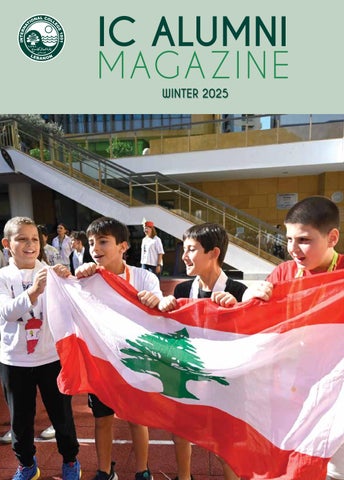
EDITOR/WRITER: Reem Haddad | LAYOUT: Tala Tabbara PHOTOS: Mazen Al Sabbagh COVER PHOTO: Lebanese Independence Day celebration 2025 at the Ras Beirut Elementary School playground. PHOTO CREDIT: Mazen Al Sabbagh
Board of Trustees Donald J. Selinger, Chairman Imad Taher, Vice Chairman Frederik O. Crawford, Treasurer Bayard Dodge, Secretary Gerrit Keator, Assistant Secretary Selim A. Bassoul Wael O. Bayazid ‘70 Walid Daouk ‘76
25
T.M. (Mac) Deford Dr. Samer Doughan ‘83 (Ex-Officio) Amal A. Ghandour Melissa Gordon Marylana Saadeh Helou ‘04 John Khabbaz Marwan A. Marshi ‘79 Dr. Safwan Masri John G. McCarthy, Jr. Christopher McGrath
Maher Mikati ’98 Mirna B. Noujaim Mouhamad Rabah Ian Reed Matthew A. Reynolds Mutaz Sawaf ‘69 Talal K. Shair ‘83 Dr. Rabih Shibli Maya Tohme (Nassar)
WINTER 2025
3
Message from the President There is a growing feeling among parents and educators that children today are navigating a world far more complex than the one they grew up in. Youngsters are surrounded by news of conflict, shaped by the fast pace of social media, and exposed to public figures who do not always model the values the school hopes to pass on. At IC, we understand how these pressures can weigh on young people, making it harder to nurture empathy, integrity, and a strong sense of character. For a school that has stood as a leader in education for more than a century, stepping forward feels both natural and necessary. We believe our responsibility goes beyond teaching strong academics. It includes helping our students grow into grounded, kind, and resilient individuals. Character-building programs are essential, providing guidance and support that prepare students for the world they are inheriting. To guide our students and the entire school community, we introduced the EPIC goals, which now serve as the foundation of IC’s mission: Excel Academically: providing rigorous learning, high-quality instruction, and the tools students need to grow intellectually. Promote Wellbeing: fostering an environment where students feel safe, supported, and encouraged to develop confidence, resilience, and balance. Inspire Service Learning: empowering students to engage with their communities, broaden their perspectives, and make a positive difference. Champion Leadership: cultivating initiative, integrity, and responsible citizenship so students can lead with purpose and vision. Through these EPIC goals, students are continuously challenged, encouraged, and inspired to Unlock Their Potential, our theme for this year, and they consistently demonstrate their achievements through top academic results, impressive university acceptances, leadership in clubs, team competitions, service learning, and innovative projects. At the same time, we have revitalized the ethos that IC was founded on over 130 years ago. What was once called moral character has reemerged today as the Positivity Project (p. 22). While the methods have evolved to meet the needs of a new generation, the mission remains unchanged: to graduate students who are academically capable, ethical, empathetic, and ready to lead communities in ways that inspire others. None of this would be possible without the generosity of our donors. Your support strengthens programs, resources, and opportunities, helping students thrive academically, grow socially and personally, and explore their passions while developing into innovators and global citizens. IC remains a dynamic institution with a rich and enduring legacy. Our community spans the globe, from students, faculty, and administrators in Lebanon to trustees and alumni worldwide. Despite distance and diversity, we are united by our shared commitment to education and the IC spirit. These achievements reflect the integrity, respect, and responsibility that define the IC community. Together, we are nurturing a generation ready to lead with compassion and confidence. Excellence at IC is more than a standard; it is a culture made possible by your support. Thank you for your generosity, your belief in IC, and your investment in the future of our students. Tobin Wait President of International College
Trustees Emeriti
Administration
School Leadership
Makram N. Alamuddin ‘61 Tobin Wait – President Zeina Abou Khalil Achkar - Principal, Early Childhood and Anwar Al Mulla ‘63 Moufid Beydoun ’64 - Vice President for Major Gifts, Elementary School Ain Aar Mohamad S. H. Al Soleiman ‘59 Interim Director Alumni and Advancement Maya Chebaro ’05 - Principal, Middle School Ras Beirut Khalid Al-Turki ‘61 Talal Jundi ’86 - Vice President and Chief Financial Officer Mona Bawarshi ‘67 Dr. Michael Caleb Earnest - Principal, High School Said S. Darwazah ‘76 Michael Murphy - Vice President for Administrative Kathleen Khayatt - Principal, Elementary School Ras Peter H. Gerard Services Beirut Anthony Jones Dr. Mahmud Shihab - Vice President for Educational Lara Kmeid Al Alam - Principal, Middle School Ain Aar Aida Reed (Luce) Services Dr. Ghada Madhoun Yafi Sabeh ’97 - Principal, Early William H. Turner Hanan Ouri - Chief of Staff Richard Ward Childhood Ras Beirut
4
WINTER 2025
BLAST FROM THE PAST
IC’s Journey to Co-education
In
1967, International College officially began admitting girls into the three upper classes, later expanding enrollment to lower classes in 1974. However, exceptional female students were occasionally accepted as early as 1934, with Suzanne Farhi being the first recorded female graduate. Initially, girls were only admitted into the Baccalaureate II classes, as most girls’ schools stopped at Bacc I. But these cases were few, and IC remained an all-boys school.
Suzanne Farhi
But for those few lucky girls, it was a year of academic challenge, newfound friendships, and a glimpse into a world they were rarely part of.
1956 Soumaya Makdessi scanned the room shyly. Dozens of boys stared back, then scrambled to outdo each other in charming manners. She smiled. This was going to be an interesting year. Her Ahliah School teacher had recommended skipping freshman year to join IC. “It’s a tough program but you’ll benefit more,” he had said. With perfect math grades, she was instantly accepted. No entrance exam required. The young girl had a memorable year, maintaining top grades and enjoying occasional outings with the boys. She still laughs about one who disappeared for a quick 10-minute nap in his dorm room between classes. Years later, she met the daughter of one of the boys, who said, “My father often spoke of the girl who scored perfectly in math and always told me not to let anything hold me back because I’m a girl.” After earning her BS in mathematics from AUB, Makdessi pursued a Master’s at Cambridge and a PhD at Yale, becoming a professor at AUB and later at East Carolina University. She credits IC for challenging her math skills. “It was tough, with nine hours a week of intensive math, but I enjoyed it,” she said. She later married Dr. Raja Khuri, a renowned physician and dean of AUB’s Faculty of Medicine, and she had three children. Their firstborn son, Fadlo ’81, currently serves as the president of AUB. In 1958, the IC Board began considering going co-ed, but it was still just a thought. During a Board meeting, construction plans for a new campus included “instructional facilities for no more than 1,000 students and boarding facilities for 200 male students, keeping in mind that a co-educational section might be
WINTER 2025
established in ten years, with the corresponding need for facilities for an additional 200 female students.”1 Their prediction came true one year earlier than expected. In 1967, 79 girls were admitted to the 5th, 6th, and 7th secondary classes. Initially, then-IC president Thomas Schuller had reported to the Board that complete co-education couldn’t be accomplished as the campus facilities weren’t ready for such an expanded program. However, once the girls arrived, the change on campus was immediately noticeable. With amusement, Schuller observed that the boys’ usual boisterous antics suddenly took a nosedive. Moreover, the faculty appeared eager to admit girls, likely pleased to see the boys trying to behave well to impress them. This intriguing development prompted Schuller to note in his report to the Board that “An interesting trend has been developing on campus: an inclination among the majority of faculty for IC to go co-educational throughout all grades.”
5
Ultimately, it was decided that since the addition of girls had been so successful, more would be admitted to the first secondary school, and a much broader program would be made available. But it seemed that girls were seen as a different species, bringing with them a nervous sense of uncertainty. What exactly would they do here? How should they be integrated? Should they have separate activities? This nervousness was eased by creating an Office of the Dean of Women tasked with assisting the girls in academic and personal matters, providing general counseling, and organizing social activities throughout the year.
In a subsequent report, Schuller declared, “There are no serious limitations of physical facilities to keep us from admitting girls at IC. There is an increased demand for good English schools for girls from all sectors, including international groups such as embassies, large business firms, and others.” 1 Special meeting of the Board of Trustees of International College, Landon Room, Dartmouth Club, New York City, January 7, 1958
6
WINTER 2025
Miss Rosa La Sorte, an American, was appointed Acting Dean of Women at IC. She oversaw the girls’ records, chaperoned co-ed events, and supervised social activities. In her book “Crossing Boundaries - Beirut and Beyond”2, La Sorte noted that one of her main tasks was organizing activities solely for girls or where girls could participate—always under strict supervision. Among the activities was a co-ed spring dance at Mary Dodge Hall on the AUB campus, though she noted that generally, the girls danced together while the boys mostly watched.
Still, having girls around wasn’t without some commotion. At one point, a staff meeting was called to discuss a girl at IC wearing ‘culottes.’ The director of the French section insisted on expulsion, but La Sorte argued they were less revealing than the popular miniskirts. In the end, the girl stayed and was told to wear skirts. A year later, La Sorte returned to the US, and the position of Acting Dean of Women seemed to disappear, never to be filled. Class photos in TORCH gradually reflected more girls. Few initially appeared among boys in upper classes, but by 1975, girls were in all grades and even had a “Young Ladies’ Club.”
“I never had difficulty controlling or disciplining them, as Lebanese girls seemed more mature to me than American girls of the same age,” she wrote. “They always showed great respect for individuals with professional degrees.” Her main role, however, was to advise the girls on academic and personal matters. She quickly realized that for most of them, post-graduation plans were limited to marriage. Determined to open new possibilities, she organized IC’s first Career Day for women, featuring careers in airlines, banking, journalism, health, law, and the arts.
The news made headlines in The Daily Star3: “Feminine Influx at IC: Miniskirts have suddenly and gloriously blossomed on the predominantly male campus of International College,” it stated. Today, IC proudly boasts nearly 48% female students from K-12, a far cry from its days as an all-boys school.
2 La Sorte, Rosa. Crossing Boundaries: Beirut and Beyond. Self-Published, 2005. 3 ”Feminine Influx at IC.” The Daily Star, July 18, 1967.
FEATURES
WINTER 2025
7
FROM MOUNTAINS TO MEANING:
Rami Rasamny ’05 Transforms Adventure Travel
By
his own admission, Rami Rasamny ’05 was overweight, a chain smoker, and a lost teenager with no clear direction, until he returned to the mountains that once made him feel alive.
Rami Rasamny on the summit of Chimborazo in Ecuador
These were the mountains of his childhood—the mountains of carefree days. They were the mountains where he spent at adventure camps, sent by a mother who had a go-get-skills-and-comeback-broken-you-are-youngenough-to-heal attitude. It was these same majestic Lebanese mountains that witnessed the last moments of innocence slipping away. The boy became a teenager, and yet, as adolescence arrived, he suddenly felt lost, as if the mountains themselves had disappeared.
Rami Rasamny on the summit of Kilimanjaro before completing his record breaking run up and down in 14 hours and 23 minutes
It would take much soul-searching and many wayward journeys for Rasamny to rediscover the happiness his soul had longed for: mountains, adventure, challenge. He quit smoking, lost weight, and rebuilt his body.
“ The outdoors literally
saved my life.It taught me to try, to fail, and to keep building. Climbing a mountain shows you that you face bad weather, take wrong turns, and encounter setbacks, but the challenge is to keep going.
”
It wasn’t just a physical change. Rasamny experienced a deep, sudden clarity, a connection with his true self and his place in the world. The next step was building a business to give others the same chance to challenge themselves and feel alive. He was young, only a few years out of his teens, armed with one idea, one personal turning point, and a stubborn belief that it could succeed. Well, it worked. In 2015, Rasamny founded Life Happens Outdoors (LHO), leading climbing and hiking expeditions that encouraged people to reconnect with their adventurous side. True to LHO’s spirit, the groups weren’t filled with twentysomethings but with people in their thirties, forties, fifties,
8
WINTER 2025 Women now make up a large proportion of participants, from Emiratis to Singaporeans, challenging the stereotype that adventure travel is only for men. “Women in the region have only recently gained freedom to travel independently,” Rasamny notes. “We present adventure differently, less about adrenaline-fueled stunts, more about transformation, discovering yourself, challenging your limits, reconnecting with life.” This was by no means Rasamny’s first venture. Before founding LHO, he had already built a promising career as a consultant in Libya. During what he calls his “lost phase,” he went to the UK, where he earned both a bachelor’s and a master’s degree in law. Yet neither spoke to him.
Fred Sfeir becomes first blind Lebanese on the summit of Kilimanjaro with Rami and the LHO Team
even seventies, many navigating divorces, empty nests, personal crises, or a sense that time was moving too fast. They came looking for a spark, a challenge, a reason to feel alive again. That spark comes from climbing Kilimanjaro, trekking Mont Blanc, chasing the northern lights, or learning to ice-climb in Cogne. Where else can someone in midlife feel youth surge back through their veins, confidence returning to a body quickly aging? LHO delivers empowerment through real experience, walking through forests, sleeping in crowded mountain huts, or stepping beyond comfort zones. Every detail is curated, including the best trail sections, unique local meals, and carefully chosen accommodations, so participants fully experience the journey. At first, Rasamny led every trip himself, completing up to 40 climbs of Mt. Kilimanjaro in a single year. As demand grew, he trained 14 leaders, 11 of whom were women, many of them former clients. LHO’s main markets are the UAE and Singapore, with the US market expanding rapidly and attracting professionals seeking authentic adventure.
After returning to Lebanon, and in the wake of Gaddafi’s fall in 2011, he decided impulsively to drive into Libya, his mother’s birthplace. “I sort of just rocked over the border from Tunisia,” he recalls. “There were no border police, so I just kind of ran into Libya.”
Rami Rasamny climbing above Chamonix with a colleague
A short visit turned into four years, during which Rasamny represented various international companies in Libya. Drawing on his law and UN experience, he handled oil audits, property research, and site assessments, eventually opening an office with IC friend George Elias ’02. By late 2014, Libya was once again in turmoil. A coup had ousted the country’s first elected prime minister, Ali Zaydan, who fled into self-imposed
WINTER 2025 exile in Germany. Overnight, Libya had become a different world. Men with guns lurked everywhere — at airports, outside buildings, on the streets. Reports of carjackings and kidnappings were no longer rare headlines; they were everyday reality.
LHO group in Chamonix
The chaos reached Rasamny and Elias quickly. One afternoon, while driving a visiting Lebanese colleague to meet the Minister of Tourism, a man stepped onto the road with a grenade and chased Rasamny’s car. Days later, Elias was jogging along the boardwalk when a knife-wielding assailant came after him. Then came the worst moment: outside his home, Rasamny was pinned against a wall at gunpoint as a man demanded his car, wallet, and phone. Elias heard the commotion over the intercom and buzzed him into the building, giving him just enough time to slip inside. The attackers fled with the car and some cash. A week later, militia forces kidnapped Rasamny and Elias again, this time over their second car, and, oddly, they demanded the dog in the back seat. Rasamny refused. They left without car and money, but the dog was released. The next morning, Rasamny and Elias returned to Beirut and never looked back. That was 2014. After a brief and unsuccessful start-up, Rasamny went on to found LHO, as if destiny had been waiting for him. “The outdoors literally saved my life,” said Rasamny. “It taught me to try, to fail, and to keep building. Climbing a mountain shows you that you face bad weather, take wrong turns, and encounter setbacks, but the challenge is to keep going. I want to show others what the outdoors can do because of what it did for me.” For more information, go to: https://lifehappensoutdoors.com/ https://www.instagram.com/lifehappensoutdoors/?hl=en
9
10
FEATURES
WINTER 2025
How one family is transforming Beirut
If
any family is truly determined to make a difference in Beirut, it is Imane Assaf and her two children, Wadad ’19 and Ziad ’16. Together, they run Ahla Fawda Association’s Eco-Hub in Hamra, a vibrant community center where recycling meets creativity. Part recycling center, part workshop, part mini-market, part boutique, and part library, the hub hums with activity as machines transform discarded materials into new items. Teachers guide, students experiment, and 400 to 700 volunteers take part in this sustainable ecosystem.
Wadad, Imane and Ziad Assaf
The project initially focused on distributing essential items to those in need, but soon evolved into a sustainable model to prevent dependence and donor fatigue. At the same time, Assaf sought to turn Lebanon’s growing waste problem into a community resource. Her solution brought the two efforts together: people brought recyclables to the Eco-Hub, earning credit points to spend at a small market, while the materials were sold to recycling companies, generating funds that returned to the community through Ahla Fawda’s Food Security Program. “It wasn’t easy at first,” said Assaf. People hesitated to bring their recyclables. “You really want me to bring you my trash?” they asked. “Yes,” she said firmly. “You do your part. We do ours.” Word of the initiative reached the Ghandour family in the US, who offered an unused piece of land in Hamra for the project, rent-free. It was music to Assaf’s ears, and the dream she had long held finally had a way to take shape. By 2023, the prime Hamra property had become an island of its own, centered on the Eco-Bank. Community members drop off recyclables and earn ‘eco currency.’ The twist is simple: no cash, pay with trash, and use your earnings to buy groceries and household items at half price at ‘Dekkanet’ Ahla Fawda. The ground also hosts Hamra Bella boutique and Souk Al Khlanj by FabricAid, offering affordable secondhand clothing, the We Deserve Better Bookstore with books, toys, and educational materials, and the EcoPlayground, built from recycled materials. Workshops and cultural events teach upcycling, sustainability, and creativity. Putting environmental stewardship at the heart of its efforts, the NGO launched the ‘Give and Receive’ initiative and ‘Positive Plastic’, transforming discarded materials and inspiring hands-on learning.
WINTER 2025 However, sales from local recyclables weren’t enough to keep the projects going. And so, the Green Heroes Program was launched, enlisting businesses, offices, households, schools, hospitals, and embassies to drive change, boost corporate social responsibility, and support the community. “Be a Green Hero,” Assaf told them. “Let us pick up your recyclables each month for free, and you will receive a report showing how many kilograms of recyclables you helped redirect from landfills and the number of families you have helped feed.” The program started with just four Green Heroes. Today, that number has grown to 120. On October 1, 2025, the family inaugurated their latest pride, the Eco-Lab, an educational space where students from schools and universities take part in hands-on workshops transforming plastics, glass, damaged clothes, and other materials into bags, lampshades, glassware, keychains, cloth items, and refurbished furniture. These creations are displayed and sold, with proceeds supporting the community through Ahla Fawda’s Food Security Program. As program manager, Wadad organizes workshops for
11
schools and universities, charging a small fee to sustain the initiative while expanding public education, the heart of the Eco-Hub’s mission. After earning an International Relations degree from IE in Spain, she realized no NGO abroad could make the impact she wanted in Lebanon, so she returned home. When the war broke out a year later, she joined the team and found her purpose. Eldest brother Ziad, who returned from London after working as a producer and sound engineer, now leads Eco-Lab’s upcycling projects. “I am finding ways to blend my worlds by turning recycled materials into musical instruments,” he said. “I have so many ideas and see so much potential.” It is no surprise that the Assaf children took to NGO work. From a young age, they watched their mother buzzing around the house, holding meetings and planning projects for various charitable organizations. In 2013, Assaf had no idea what she was starting. A Halloween-loving mom, she took her children and their friends—up to 90 at one point—trick-or-treating in Hamra
12
WINTER 2025
and realized the street itself could become a community celebration. That idea sparked Ahla Fawda, “the best chaos,” which has since grown into this vibrant NGO blending humanitarian aid, cultural celebration, and environmental stewardship.
Distribution of food and clothing to vulnerable communities across Mount Lebanon, Bekaa, and Akkar: Ahla Fawda.
The once garbage-strewn lot off Hamra Main Street transformed into a green oasis with olive trees and flower beds: Ahla Fawda.
Hospital concerts during the COVID-19 pandemic, under the banner ‘You Are Not Alone,’ bringing much comfort to patients: Ahla Fawda.
Twenty-three festivals across Lebanon, including Halloween, Summer, Eat Play Laugh, Life Beat Festival, Hamra Got Talent, Toot Toot A Beirut, Hamra Nostalgique and Aley-Z Let’s Go that has become part of the town’s vibrant cultural scene: Ahla Fawda. Street accessibility campaigns making ramps and sidewalks usable for everyone: Ahla Fawda. Over 120 murals across the country, including tributes to icons like Sabah, turning blank walls into free, open-air galleries: Ahla Fawda.
Renovating homes, delivering aid, and supporting those affected by the 2020 Beirut port explosion: Ahla Fawda.
Beach and street cleanups: Ahla Fawda. Driven by a deep devotion to Lebanon, this family finds the journey worthwhile. “Sometimes it’s hard, and I want to take a break,” said Wadad. “But when I see my mom pouring her heart into every moment, it gives me the strength to keep going.”
For more information about Ahlah Fawda, go to: https://ahlafawda.org/
FEATURES
WINTER 2025
Tarboush Jedde Maalak From Dream to Curtain with Marwa Khalil ’98 and Riad Chirazi
C
all it fate. Call it the stars aligning. Whatever it was, it brought together two brilliantly talented individuals, an actor and a producer, on IC grounds. It started in 1999, though fate had not yet come calling. Riad Chirazi was in his first year teaching drama at IC, preparing his class’s annual play.
13
14
WINTER 2025 Enter Marwa Khalil ’98, who had come to watch her younger sister perform. She was captivated. The theater bug had bitten her a few years earlier at IC but had lain dormant. Her original plan had been a degree in business and marketing. Acting was the last thing on her mind. “I didn’t even have a passion for it,” she said. It was Betty Toutel, an IC drama teacher, who had inspired Khalil. The 12th-grade student was lost in teenage chaos, but the teacher showed her that emotions could breathe on stage. She handed her a monologue so close to her own life that it stopped her in her tracks. When Khalil performed it, the words rose naturally.
“If anything came
out of all this, it’s that I finally found myself here, in Lebanon, through theater.
”
The applause came, and she knew: “I want to be an actress.” A year later, she enrolled in theater at USJ, much to her parents’ displeasure, and added diplomas in “psychology, journalism, you name it,” she said, to appease them. That year, Riad Chirazi came to IC and worked his theatrical magic on his students. “I was shocked by the high level of performance,” Khalil said. “He wrote the play himself, and the way he brought it to life left me mesmerized.” Still, the two had yet to join forces.
After studying cinema in New York and Paris, Khalil returned to Beirut, determined to pursue a career in acting. In 2006, she moved to Morocco for a TV job, but soon appeared in Moroccan films and international projects, including “Un Balcon sur la Mer” and “The Bible”. She also produced her first play, “A Woman Alone”. Back in Lebanon in 2012, she starred in “Yalla 3abelkoun” and “Yalla 3abelkoun Chabeb”, winning a Best Casting award. In 2016, she led “Are You Glad I’m Her?“ touring festivals worldwide. In 2018, she founded the Acting Lab, a theatre academy for children, teens, and adults. (It also operates as a production company and is currently producing its first professional show, “Tarboush Jedde Maalek”.) Meanwhile, Chirazi was on his own path. Originally a biology major at LAU, he discovered his passion for theater while improvising through a forgotten scene. He completed his degree, returned to study drama, acted in nine plays in a single year, and later wrote a trilogy that won first prize at the Casablanca Theater Festival. After joining IC, he became a beloved theater teacher and head of activities, writing and directing more than eleven student plays. In 2019, a phone call pulled him back into professional theater. On the line was Marwa Khalil. She and a friend had written “Mafroukeh”, a play about a Lebanese woman’s struggles after divorce, but they needed a producer. “Of course! Riad Chirazi from IC!” Khalil exclaimed. “No one else could take this on. It has to be him.” Fate had finally stepped in. “Mafroukeh” was an instant hit, selling out every show. But fate wasn’t finished. Khalil turned to Chirazi. “I have notes for a new play. Do you
WINTER 2025
15
want to see them?”
explosion, the pain and chaos, this play is a witness to all.
As a throwback to her Paris days, where she grew up after her family left Lebanon during the civil war, Khalil began turning her memories into theatrical anecdotes, calling it “Tarboush Jedde Maalak on the Eiffel Tower” (Grandfather’s Fez hung on the Eiffel Tower). It was a dream on paper, one she thought might never leave the page. She showed her notes to Chirazi. “I don’t know how to go on from here,” she admitted.
The question was always the same: to stay or to go. Lebanon is for the Lebanese. We love it. We stay. But no, we go. Like a yo-yo, Lebanon pulls us back, then flings us abroad again. It was only an 80-minute theatrical ride, yet “Tarboush Jedde Maalak” managed to stir tears of deep-seated memories and provoke laughter that cut straight to the heart.
Chirazi saw its potential immediately. “You’re limiting it to Paris,” he said. “Let’s make it a story everyone can relate to.” Together, they expanded the world: Dubai, Canada, Lebanon – the tale of the Lebanese, those who stay and those who leave. And so “Tarboush Jedde Maalak” was born: a love forged in wartime shelters between Hala and Ibrahim, spanning decades and interrupted by Lebanon’s instabilities, starring Marwa Khalil and Junaid Zeineldine. On the surface, the plot seemed deceptively simple: boy meets girl, boy loses girl, boy gets girl, boy loses girl again. Yet, for those Lebanese who watched the play and who grew up amid Lebanon’s sixteen-year civil war, it was a grim yet unexpectedly comedic journey into the past. For those lucky enough to have missed the civil war, the play opened eyes, linking earlier struggles to more modern crises: the revolution, the explosion, the crisis, and finally the Israeli onslaught. Those of us who truly understand, who had been there, hiding in basements through nights that felt endless, hearing missiles fall without aim, and sensing in every sound the life and fear of those days; who remembered long hours of Matchbox cars and cards and the small, fleeting joys of sharing meals and fears in a basement, and for those younger Lebanese who survived the port
The lines were not written lightly. Every scene grew from dozens of interviews, some going deep beneath the surface, including one that recorded the sounds of bombs from the civil war. Chirazi and Khalil confronted the emotions of others while facing their own. One had lived through the war, the other’s family had watched from afar. One stayed. One left. One returned. One never left. Raw emotions were laid bare yet balanced with the wisdom to see humor even in darkness. They shaped words into action, and actions into the play “Tarboush Jedde Maalak”. Its overwhelming success surprised them: packed houses, repeated sellouts, and now preparing an international tour. “If anything came out of all this, it’s that I finally found myself here, in Lebanon, through theater,” said Khalil. “This is where I belong. I know that for sure now. I love Lebanon. I love it here.”
For information about the Acting Lab, go to: https://www.instagram.com/actinglabeirut To see Tarboush Jedde Maalak, the play will be performed at: • Lebanon: Théâtre Al Madina, Hamra, December 26 and 27, 2025 • Dubai: Zabeel Theater, February 7, 2026 • Paris: Théâtre de la Tour Eiffel, April 14 and 15, 2026
16
FEATURES
WINTER 2025
The Boy Who Would Not Stop Running: Adel Arakji ‘64
“I
am the oldest marathon runner in the Middle East”. That line came with a grin from Adel Arakji ‘64, affectionately known to his IC classmates as Abou Al Aoud, a playful twist on his name.
His story could easily be the title of a children’s book: “The Boy Who Would Not Stop Running”. He ran past his teachers. He ran past his friends. He ran past his family. “Stop!” they shouted. But he didn’t stop. He ran through the city streets. He ran up mountain trails. He ran in marathons. He ran and ran. People tried to catch him, but nobody could. He ran in the rain. He ran under the scorching sun. And now, 67 years later, he is still running. But this isn’t a storybook. This is Arakji’s life. “It all comes down to one word: lifestyle,” he said emphatically. “I am an 80-year-old buzzard, and I don’t take any medications because I lead a healthy lifestyle. My secret? One thing above all: regular aerobic exercise. And I mean regular. I want to emphasize that. On and off will not cut it.” It all began at IC. Much like the storybook, he simply started running. He ran through high school and university. Even during his years in Vancouver, British Columbia, the mountains beckoned. Up Grouse Mountain he ran—thirty-eight minutes to the top, breaking the standard forty-two-minute record. Rain turned to snow halfway up, but still he ran. Over the years, running became more than a sport. It became his refuge, his release, his way to breathe. When he learned his father was ill while studying for his PhD in Iowa, he ran through his grief. Later, he returned to Lebanon to take over his father’s business and establish his own alongside his cousin Adnan Arakji ‘55. In 1975, as the civil war began, millions of his goods at the port were stolen, leaving him devastated. To stay sane, he ran. Crises came again and again. He ran. “I’m a type A personality,” he said. “A perfectionist living in a country full of imperfections. How do you deal with that? You run. Running is a mood changer. I am always after the endorphin release. I couldn’t have survived all the country’s problems otherwise.” During the war, he emigrated to Vancouver. Upon returning to Lebanon in 1994, he teamed up with fellow runner Roger Bejjani and formed the Inter-
WINTER 2025
17
Adel Arakji won first place in the Internal Security Forces Half-Marathon. The trophy was presented by a representative of the Army General.
Lebanon Road Running Club. Three times a week, he trains with near-religious discipline. Up at 5 a.m., he spends an hour rubbing ointment on his joints, warming up, and stretching almost every muscle. “It protects your knees,” he says. Then comes the run. Ten to fifteen kilometers on Tuesdays and Thursdays, twenty-five kilometers on Sundays. Always. No exceptions. It is this strict regimen that allows him, even at 80, to participate in 10 to 15 races across Lebanon each year, including mountain runs. His favorite, he says, is the ‘mother of all races,’ the Kfardebian Half Marathon, where the oxygen level is very low, and the run is tough, starting at nearly 2,000 meters above sea level, where the thin air makes every step a true test of endurance. “As I run, I listen to my body. Your body sometimes gives you warning signs. You have to heed those warning signs,” he advises. “It may tell you that you are not ready. You slow the pace. If your body is ready, you quicken the pace.”
“ You got problems? Don’t smoke. Don’t do drugs. Regular aerobic exercise. Continuous exercise. There is no other way.
”
By 2025, he had participated in 21 full marathons with the Beirut Marathon Association, and in most of them, he placed first in his age group. He carefully records every run in a notebook, noting his weight, time, and pace with meticulous precision over the past 30 years. His living room tells the story of over a hundred marathons worldwide, each cup proudly displayed. Every trophy stands as proof of his relentless training and unwavering perseverance. “You got problems?” he said. “Don’t smoke. Don’t do drugs. Regular aerobic exercise. Continuous exercise. There is no other way. It is the number one exercise in the world.” So experienced was he that he emerged as the guru of running, stopping to give advice when needed and serving as a mentor to many. “It’s all I have to give now,” he said. “I love passing on all I know.” He had become such a local legend that runners along the Corniche called out, “Ya Batal! Ya Inspirator! Ya Motivator! Ya Champ!” This did not go unnoticed by an army general stationed nearby. Finally, one day, the general stopped him and asked, “Just who are you exactly?” Arakji laughed. “I’m just a marathon runner.” Then he added, “The oldest one in the Middle East.”
Arakji won first prize in the javelin throw in 1961. L To R: Kamal Shaykh Al Ard ‘65, Adel Arakji ‘64, Majeed Deeb ‘65, Raja Shaffo ‘64
18
WINTER 2025
FEATURES
THROUGH THE CORRIDORS OF TIME A conversation with Raja Bekhazi ’48
At
97, Raja Bekhazi ’48 sits surrounded by nearly a century of memories, from the corridors of International College in the 1940s to the ever-changing Beirut skyline. He leans back in his chair, memories arriving in sudden flashes as he is interviewed: the French Mandate; World War II; foreign soldiers on the streets, including Senegalese, Australian, and British troops; bombings; childhood friends lost; Palestinian refugees arriving, and years of civil war. Yet through it all, there was the joy of finding the love of his life. It is IC, or rather “the Prep School” as it was called then, that holds his heart. “It was a simple school that belonged to AUB,” he said. “We loved it. I was so happy.” The stone hallways of IC saw his boyhood and the making of a man. The IC of the 1940s was all boys, though he remembers two Cypriot girls joining the final-year class to study mathematics. Rare, but unforgettable.
A young Raja Bekhazi with his parents (photo provided by Bekhazi)
Beirut was different then, a seaside village before concrete towers. Stone houses with gardens of jasmine and fruit trees lined the streets. Trams clanged, donkey carts passed, cafés opened to the warm breeze, and beyond, the Mediterranean sparkled. The neighborhood felt calm, airy, and alive. Bekhazi lived in a two-story house in Ras Beirut with a lush garden at its center, a huge mulberry tree rising above everything. The family ate whatever his father, with Raja’s help, planted. “Potatoes, lettuce, tomatoes,” he recalled. A pond in the garden teemed with fish, glinting in
the sunlight. The police sometimes checked to make sure the fish were still there because stagnant water bred mosquitoes. Very few cars passed by, if at all. World War II reached Beirut quietly but unmistakably. Vichy French Senegalese troops patrolled the streets under curfew, rifles slung, red fezzes bright. “They were harsh,” said Bekhazi. “One time, our neighbor sent her husband to cook kibbe despite the curfew. Three Senegalese soldiers marched behind him with bayonets, forcing him home, kibbe and all. I was on the balcony watching.” In 1941, Australian troops arrived as part of the Allied push against the Vichy French. “I was in Beit Mery visiting a cousin,” he said. “They looked so big and strong. They put mattresses and mosquito nets under their cars. I offered them figs.” By the time Bekhazi joined IC in 1942, the Prep School had merged with the college from Turkey six years earlier. Boys came from Lebanon and across the Arab world: Palestine, Iraq, Syria, Egypt, Iran, Transjordan, Cyprus, and IC in the 1940s (photo provided by Bekhazi)
WINTER 2025
the Gulf. “I remember the blue lights around the campus,” he said slowly. “The windows were all blue, and even the car lights were painted blue.” These lights let students move safely during blackouts while keeping the building hidden from enemy aircraft. West Hall offered daily movies, with two American soldiers keeping watch.” Friends came easily. Shaul Yahuda’48, a Jewish boy from Wadi Abu Jmil, was close. “We never thought about religion,” Bekhazi recalled. “We visited each other’s homes. Christians, Muslims, Jews. We never had problems.” Another friend was Salim El Hoss’48, who would become the country’s prime minister. “He was a simple boy,” Bekhazi said. “He came from a modest family.” He remembered teachers and school leaders vividly: George Shahla, Leslie Leavitt, Archie Crawford, Shafic Jeha, Faiz As’ad, Alexander Wuthier, Musa Sleiman, and even Bayard Dodge, though only as the university president carrying his shoes in his hands to cross the street to the shoe repairer. “We went to West Hall to learn French,” he recalled. “I can’t remember why.” “At first, chapel was mandatory three times a week. Then it gradually decreased until it stopped,” he said. By then, boys were old enough to visit the famous Faisal, the historic Ras Beirut restaurant, known for philosophical and political discussions. Too young to join in, they
19
enjoyed the meals. Life on the streets of Beirut had its own surprises. The tramway ferried boys to and from IC, especially downtown. On one ride, a woman entered. Bekhazi stayed in his seat. A French soldier yanked him up and shoved him aside so she could sit. “I was very upset,” he laughed.
IC school boys 1940s (photo provided by Bekhazi)
In the summers, he worked at the British Army Intelligence Office, answering calls and translating, thanks to his IC education. “It made me money,” he said. “A major, two captains, and two lieutenants gave me orders.” They even gave him a British Army bicycle, which he used to commute to and from work. In 1948, Bekhazi graduated alongside Yahuda. Soon after, Yahuda was gone, no warning, no goodbye, like so many Jewish families at the time. Life went on, but tragedy was never far behind. When Bekhazi was just 15, his father died. While on the tramway, the elder Bekhazi was found dead by an English soldier who had stopped to light his cigarette. It was a difficult time for the young boy, but he continued on to AUB to pursue his studies. After graduating from AUB, Bekhazi worked as an accountant for Tapline for 26 years, then at a brokerage for Marwan Iskandar. He retired during
Class of 1948 (photo provided by Bekhazi)
the chaos of the 1989 battles in the civil war, only to find a few part-time accounting jobs afterward. In 1964, he married Renee Abdel Nour, the love of his life. They had one son, Nicholas. Sadly, Renee passed away in 2012. Every so often, Bekhazi fell silent, memories of friends, family, and teachers alive only in his mind. A final question: Do you miss IC? He silently lowered his head, then slowly nodded, eyes shimmering with unshed tears.
20
WINTER 2025
FEATURES
JIHAN CHEHAYEB’93: WHERE HISTORY MEETS DESIGN
J
ihan Chehayeb’s journey was never planned, yet it led her to a unique crossroads of history, philosophy, design, and heritage preservation. She is now the founder of Jihan C, a creative house that blends Lebanese heritage with contemporary architecture. Her handcrafted bookmarks, jewelry, and objets d’art, inspired by Middle Eastern motifs and the Phoenician and Arabic alphabet, have been celebrated nationally and internationally for their elegance and storytelling.
She wasn’t among the top students academically, but she always felt a strong creative drive and a clear sense of what she wanted to become. “The school system didn’t fully reflect my potential at the time”, she said, “yet the experience at IC eventually proved invaluable, even if the results didn’t show immediately.”
a museum conceived as a park, a space where visitors could experience history in an open, engaging, and unconventional way. She called it “The Museum of Lebanon Throughout History,” or AGROBAICO— Antique, Greco-Roman, Byzantine, AraboIslamic, Crusader, Ottoman. Little did she know that this project would later guide her own path.
What she wanted to be was an architect. Now, the well-trodden path from IC would have been to AUB, but her grades led her to the Lebanese University instead. As it turned out, it was a blessing. She built close friendships with people from all walks of life, many of whom are now highly successful in their fields. “My time there taught me to look at things from a different perspective,” she said. “It was such a rich experience.”
After graduating, she worked briefly at Khatib & Alami and, during that time, survived a major, life-threatening accident, an experience that would profoundly shape her life goals. She then moved to Canada, where, between jobs in Montreal and Edmonton, she completed her architectural equivalency and joined Kasian Architecture in Edmonton.
At university, a new passion emerged: exploring Lebanon’s layered history. For her final-year project, she designed
In 2008, she returned to Lebanon to join SKP (Samir Khairallah and Partners) Architecture, working with renowned architects such as Zaha Hadid, Richard Rogers, and Norman Foster. Her projects included the Summerland
WINTER 2025
Kempinski Hotel, the Orient Building, the Three Beirut Towers, and the Zaha Hadid Building at Beirut Souks. “My experience at SKP was truly formative,” she said. “It shaped so much of who I am today.” One evening, after a long day at SKP, she was lost in one of her favorite pastimes: reading. Suddenly, she realized she needed a bookmark as beautiful as the reading experience itself. At the time, she was working on a project preserving traditional Lebanese doors and windows, and their intricate details sparked an idea. Almost instinctively, she crafted four small gold-plated replicas of archaic doors as bookmarks. The result was enchanting. “It just came together,” she said. “I love reading. I love history. I love architecture. And I love Lebanon.” Destiny might never have caught up with her if a friend had not noticed her first bookmark. “These are amazing,” he said. “Brand them.” The friend was a branding professional. He should know. Chehayeb carefully produced a few more, each in its own small box, and hesitantly approached the Sursock Museum gift shop. “Would you be interested?” she asked. The response was immediate. Yes! How about creating a Sursock Museum bookmark? Still in awe, she agreed. That was October 2018. From that moment, the idea took root: Lebanese bookmarks, each paired with its own story, a reflection of her love for storytelling. The collection quickly expanded from her original four doors and windows to include the Sursock Museum, Mandaloun, Baalbek, Beirut City Hall, the Al Rifai Mosque, the Holy Kaaba, the Elie Saab triple-arch window, and the Armenian khachkar. Sales took off. “The best part of this journey,” Chehayeb said, “is discovering that so many people still read books!” She soon began exhibiting her gold-plated bookmarks at various shows, consistently selling out all designs. As her reputation grew, she participated in international exhibitions and was featured in numerous magazines, drawing even more attention to her work. One client even commissioned a bookmark made entirely of gold. Expanding the niche market she had stumbled into, Chehayeb began creating letter openers, wall art displays, tabletop sculptures, collectible art boxes and jewelry. Each
21
piece reflected Lebanese heritage and the ideas she drew from her intensive readings of religion, philosophy, and history. In 2020, she officially established her Jihan C business in Lebanon and the Gulf. And as a throwback to her university days, she aptly added: AGROBAICO. In 2021, Chehayeb stepped away from her job to focus on her growing business. “I never thought I would leave architecture,” she said. “But that doesn’t mean I stopped being an architect. I am still preserving Lebanese architecture, aren’t I?” The economic crisis hit hard. Bookmark production, entirely reliant on electricity, turned into a daily battle. International clients had no patience for Lebanon’s endless power outages. A deadline was a deadline. Night after night, Chehayeb and her artisans waited in the shadows for a flicker of electricity, whether from the grid or a shaky generator. Then, like a sudden storm, the work would explode into frenzied motion, cramming a month’s worth of production into a few frantic hours. Meanwhile, Chehayeb poured days of dedicated research and intense study into creating a singular tablet that bridges Lebanon’s Phoenician and Arabic alphabets with the elements, the zodiac, and the Hermetic principle of “As Above, So Below.” Today, research and artistry have come together, with every piece of her jewelry celebrating the Phoenician alphabet. In 2025, International College commissioned Chehayeb to create a gold-plated tabletop model of Rockefeller Hall, incorporating the school’s history. The finished piece was proudly presented to Lebanon’s Prime Minister, Dr. Nawaf Salam ‘71, during the Gala Dinner last May. “My journey in architecture and with Jihan C. has been and continues to be sublime,” she reflected. “It has been full of surprises, challenges, and discoveries. Yet I must credit one constant source of inspiration: Lebanon. It has always been Lebanon.”
To explore Jihan Chehayeb’s work, go to: https://www. jihanc.com/; Instagram: https://www.instagram.com/ jihanc.design/. Available at Sursock Museum , Lebanon National Museum , AUB Archeological museum and Louvre ABudhabi RMN Boutiques.
22
EDUCATIONAL INSIGHTS
WINTER 2025
NURTURING CHARACTER, ONE LESSON AT A TIME The Positivity Project #OtherPeopleMatter
I
C in Turkey called it “Moral Character”. The Prep School in Beirut called it “Character Development”. Today, it returns with a fresh name and renewed energy: the Positivity Project (P2). Rooted in Chris Peterson’s Positivity Model, P2 promotes well-being through character education and social-emotional learning, cultivating 24 character strengths across six core virtues: wisdom and knowledge, courage, humanity, justice, temperance, and transcendence.
Step into a second-grade classroom in the Ras Beirut elementary school. As in every class across both campuses, today’s focus is gratitude. After a short discussion or video, the students eagerly raised their hands, each wanting to share something they were grateful for with their teacher, Carla Asfour. “When we are having a bad day, how do we turn it into a good day?” she asked. “By being thankful for what we have!” the class replied “Let’s give some examples,” said Asfour. “I am grateful for having water,” said one student. “I am grateful for my parents,” another added.
WINTER 2025
“I am grateful for everything, small or big,” said a third. “I am grateful for having a freezer!” someone exclaimed. “I am grateful for food,” another piped up. “I am grateful for my bed,” said a quiet voice. “I am grateful for my dog!” came another. Feeling a sudden burst of gratefulness, one little boy jumped up and hugged his teacher. “I am grateful for my teacher,” he said. Watching on, Stephanie Wait, IC’s Well-being Coordinator, smiled broadly. “You are amazing,” she told the class. “I think you could go out and teach some adults!” The class laughed. The gratitude exercises are just the beginning. Through the P2 Project, students are learning a simple but powerful lesson: every person matters. From
23
sharing thankfulness in class to noticing someone sitting alone at recess, the lessons spill beyond the classroom walls. “Even something as simple as picking up trash or saying hello to someone sitting alone can make a huge difference,” said Wait. “When children understand that everyone matters, it changes the way they see and treat the world around them.”
“ Walking into classrooms, you see students using the vocabulary and ideas from their lessons, with key concepts posted on the walls. It fills me with joy to see them putting these ideas into practice.
”
The P2 Project has exceeded even Wait’s expectations. Parents tell her about changes they see at home, and teachers say students look forward to their daily positivity sessions. Wait first discovered the Positivity Project while teaching in California, where she saw how simple, consistent work on character could transform a classroom. When she arrived in Lebanon last year, she recognized exactly what IC needed: a renewed,
24
WINTER 2025
structured approach to character education, now reimagined as P2. “Walking into classrooms, you see students using the vocabulary and ideas from their lessons, with key concepts posted on the walls,” Wait said. “It fills me with joy to see them putting these ideas into practice.” With just 15 minutes a day, P2 gives schools the tools to strengthen culture across divisions. Teachers introduce one character strength per week through ready-to-use lessons and watch as attendance, behavior, and overall school culture improve. Since its earliest days, whether in Turkey, where IC was founded, or at the AUB Prep School before the two merged, character came first. The school’s first principal, William Hall, put it plainly: “A human life is the most real thing that you and I are acquainted with, and the training of that into worthy character is the most real thing that you and I will ever have to do or that we shall ever be called upon to give an account of before the great judgment seat.” This guiding principle shaped both campuses. IC in Turkey emphasized cultivating “straightforward, selfreliant characters,” while the AUB Prep School in Ras Beirut placed character development at the heart of its mission alongside academic and physical growth. By 1921, the school aimed to cultivate the “body, mind, and soul,” offering non-sectarian instruction to awaken students’ spiritual consciousness while preparing them for citizenship and service. By 1931, this focus extended to faculty, with the school seeking teachers who were “sincerely interested in the development of character in their students.” In 1936, the AUB Prep School in Ras Beirut formally merged with International College, solidifying IC’s identity as a center for character building and high educational standards.
The emphasis on character continued until the Lebanese Civil War, when it was set aside. Occasional revival efforts appeared over the years, but never fully took hold. In 2025, the Positivity Project was introduced at IC, renewing the school’s long-standing commitment to character education. “Adults who visit the campus often comment that they notice it immediately,” said Wait. “They sense that everyone is friendly, everyone is saying hello, and everyone is smiling.”
CAMPUS NEWS
WINTER 2025
25
New Parents’ Committees
Ras Beirut L to R top row: Maya El Solh, Nadine Katabi Beydoun, Rima Ghali Kanbar, Hiba Nakib Shabarek, Nadine Fawaz Ramlawi, Dalia Ghawi Arab, Rima Morkis Rabah, Celina Balaa Jilwan. L to R bottom row: Lamah Bourji El Hariri, Nour Bitar Hajj, Pamela Abi Khalil Maalouf, Nadia Itani Arabi, Inaam Yehia Humaidan, Maya Hariri Hallab, Youmna Gharzouzi Alem. Absent: Marwan Naffi, Jennifer Makdessi Sayegh
Ain Aar L to R: Chirine El Debs Deeb, Elsa Patricia Correales Balla Harb, Hala Abou Farhat Abouzeid, Elie Fawaz, Mirianne Hawa El Kallassi, Lisa Wehbe Jreissati, Etienne Nassar Haddad, Gretta Estephan Karam, Ralph El Fadl
26
WINTER 2025
CAMPUS NEWS
The Inauguration of the
Ain Aar Gymnasium
T
he new and long-awaited Ain Aar gymnasium was inaugurated in September. With advanced materials, sustainable design, and a sea view, it is the first of its kind in Lebanon. Administrators, board members, and the Parents’ Committee watched as students took their first steps on the court.
“This gymnasium represents the bridge between our history and our future,” said IC President Tobin Wait. “It honors the past while opening new doors for generations yet to come. It is a place where our students will continue to grow as learners, leaders, and human beings.” Chairman of the Board, Don Selinger, came to Lebanon especially for the occasion. “We dreamed of giving our community a facility that would reflect IC’s spirit of excellence,” he said. “The Ain Aar gymnasium is proof that when vision is matched with dedication, the results are extraordinary.”
WINTER 2025
As a special symbol of gratitude, the IC community also honored Vice Chairman Imad Taher for his pivotal role in bringing the project to life. Indeed, Taher has been the driving force behind many of IC’s building projects. “I have long known what this gymnasium meant to generations of students, and to see it now, renewed and alive again, is deeply moving,” he said. “This is more than concrete and glass; it is a space of memories, dreams, and endless possibilities.” For her part, AA Parents’ Committee President Johanna Ghali highlighted the gymnasium as a symbol of the strong bond between the school and its families. “Together, we dream, we support, and we celebrate. Our children now have a space that inspires them to aim higher, to play harder, and to believe in themselves, and that is the greatest gift we can give them,” she said.
27
28
CAMPUS NEWS
WINTER 2025
HALLOWEEN AT IC
O
n November 1st, the Ras Beirut Parents’ Committee hosted a spectacular Halloween party for the entire school! Students enjoyed games, a parade, stilt walkers, a haunted house, and plenty of candy.
CAMPUS NEWS
WINTER 2025
29
Happy Lebanese Independence Day!!
Photo credits: RBPC
30
ATHLETICS
WINTER 2025
A RECORD-BREAKING START TO THE 25/26 IC ATHLETICS SEASON! T
he new season has already shattered records with the highest signups in IC Athletics history. This incredible surge is not just about numbers; it reflects how our students value athletics and their excitement to be part of this growing program.
Our Ras Beirut (RB) and Ain Aar (AA) campuses are buzzing with energy. We received an astonishing 2,560 applications across 14 disciplines. After a highly competitive tryout period, more than 1,650 dedicated athletes have earned spots on 84 teams. The season kicked off with the ACS x IC Friendly Swim Meet at LAU. Our JV and Varsity Swimming teams dove into the spirit of competition, gearing up with the perfect preparation for their upcoming NESAC trip. After regularly attending NESAC Seasons 2 and 3, this year marked the IC Cougars’ return to Season 1 after three years away due to circumstances in Beirut. Students and athletes were thrilled to represent IC on the international stage:
• Varsity Volleyball in Bahrain • JV Volleyball in Kuwait • Varsity and JV Swimming in the UAE- Leadership Conference in Egypt
The students’ trips always matter. At IC, we take pride in working together to provide these opportunities. Competing, traveling, learning, and representing the school are experiences that truly set IC apart. They not only foster a sense of belonging but also shape character, build confidence, and give students memories and lessons that last far beyond the trip itself.
Volleyball Bahrain
WINTER 2025
31
UAE Swimming
JV Volleyball Kuwait
During the Board of Trustees meeting in Beirut, they had the chance to see the newly refurbished tennis court. The official court is now ready to support our growing tennis program of 55 players. With this upgrade, we have added extra training sessions from Monday to Saturday, allowing more students to join and benefit from the program. At the heart of IC Athletics, we value much more than winning. Our grassroots program is built on discipline, teamwork, and, above all, genuine sportsmanship. That is why we provide the right platform for students to
develop these traits. This commitment shines over the weekends as our Middle School Soccer teams from Ain Aar (AA) and Ras Beirut (RB) take to the field. The MS tournament kicked off right after tryouts, with AA and RB athletes participating in mixed games. These matches were less about competition and more about connection, focusing on positive play and strengthening bonds between the two campuses. It was wonderful to watch our younger athletes from AA and RB connect, cheer for each other, and grow together as both players and members of the wider IC family!
Submitted by Director of Athletic, Coach Omar Shmaitilly
32
WINTER 2025
DEVELOPMENT NEWS
DINNERS and EVENTS
THE IMAD TAHER COURT PLAZA The Imad Taher Court Plaza was recently rededicated in a ceremony attended by Imad Taher and fifteen IC Board of Trustees members. The event followed the recent renovation of the tennis court.
Board members: L to R: Matthew Reynolds, Frederik Crawford, Christopher McGrath, Wael Bayazid ‘70, Bayard Dodge, Maya Tohme, Imad Taher, Don Selinger, John McCarthy, Mutaz Sawaf ‘69, Walid Daouk ‘76, Amal Ghandour, Mirna Noujaim, Talal Shair ‘83, Marwan Marshi ‘79, Mouhamad Rabah
Imad Taher and Toby Wait among membes of the Board of Trustees
WINTER 2025
CLASS REUNIONS 2003, 2004, AND 2005 On July 17, 2025, the Classes of 2003, 2004, and 2005 gathered in the Martin House garden for an evening of conversation, laughter, and reconnecting with old friends.
33
34
WINTER 2025
CLASS OF 1975 REUNION – SEPTEMBER 2025 The Class of 1975 gathered in the Martin House garden to celebrate decades of friendship and shared memories. Laughter and stories filled the evening as alumni reminisced about school days and favorite teachers. At last, they were presented with their diplomas, 50 years delayed by the outbreak of the civil war. With music playing, the garden came alive with dancing and celebration. Special guest Samia Sullivan, the beloved director from their elementary school years, joined the festivities, adding warmth and nostalgia to a truly unforgettable night.
WINTER 2025
35
NEW PARENTS’ RECEPTION – OCTOBER 2025 IC welcomed its newest families in October with a warm reception. Parents met administrators, faculty, and fellow families over coffee and light refreshments at the Martin House garden, learning about school traditions and programs. The evening set the tone for the year ahead, leaving everyone feeling connected, inspired, and excited to begin their IC journey.
36
WINTER 2025
ALUMNI
1961
UPDATES
Nicolas Khairallah sent the following photo:
The list of students in the video is incomplete, only those names starting with As.” https://drive.google.com/file/d/1O92IeqvNPkUzNjk6b1g6tD kKnUUYLbO2/view?usp=sharing (To watch the video click on the online version of this issue on the IC website)
1966
Nabil Abboud ‘61, Gaby Gharzouzi ‘62, Ziad Hafez ‘62, Nassim Afeich ‘62, Sami Nasr ‘61, Nicolas Khairallah ‘61, Jean Claude Sacy ‘63, Malek Mahmassany ‘62, Wassef Kassem ‘63, Nadim Afeich ‘61
1962 Samir Grizi sent the following:
“Greetings from Cairo where I have retired but am still active. Recently I received a video (link below) through my close friend, neighbor and classmate Prof. Adnan Tamime ’62. The video is dedicated to our beloved IC and those who inspired us to become who we are today. Lovely and wonderful memories. Every time I watch the video my eyes tear up. All my best to a wonderful IC, a school with great teaching. Those were the days. Have a good day. Enjoy” “NB: So as not to wonder, I lived in Jeddah for five years, in Dammam/Alkhobar/Dhahran for 15 years and in Riyadh for 23 years, before retiring to Cairo. Sadik Umar became Principal of King Faisal Schools in Riyadh. Najwa Sayyed became advisor at Dhahran Ahliyya Schools, a top school in Saudi, which my daughters attended. Habib Hourani’s son Walid became a famous pianist and composer. Chafic Jeha wrote a book dedicated to his son Reda titled إسمع يا رضا I met Nadi Nader’s daughter in Dhahran, late 1980s early 1990s, she was a doctor. I can still hear Shawki Dammous calling: “Ball please!”
Dr. Gabriel G. Haddad received his early education in the IC French Section, graduating in 1968–69, before earning his medical degree from AUB in 1974. He has lived in the United States since 1975 and held academic positions at Columbia University for 13 years, Yale University for 14 years, and Einstein College of Medicine for three years. For the past 21 years, he has served at the University of California, San Diego as Distinguished Professor of Pediatrics and Neurosciences, Chairman of the Department of Pediatrics, and Vice Dean of Children’s Academic Programs. He is also Physician-in-Chief and Chief Scientific Officer at Rady Children’s Hospital–San Diego.
1982 Suha Beidas Zehl was inducted into the North Carolina State University Computer Science Alumni Hall of Fame on November 6. The NCSU CS Alumni Hall of Fame was established to celebrate and recognize the exemplary contributions its outstanding graduates have made to their profession, their community, and to the world at large. With more than 10,000 CS alumni overall, Suha joins the 2025 induction class as one of three honorees selected this year to receive the department’s highest recognition for its alumni. Suha is also an award-winning executive leader, speaker and author. She is the founder of Z Technology Solutions, a consulting practice that helps organizations harness innovation and data to transform how they lead, serve and grow. Suha is currently pursuing a doctorate in Organizational Leadership and Development, focusing on the transformative role of AI in leadership, strategy and organizational effectiveness. If you’d like to get in touch with Suha, please email her at suha@ztechnologysolutions. com - she would love to hear from you!
1988
Samer Khodr sent in the following: “I am honored to have been elected as a Member of the Laqlouq Municipality and to serve as President of the Municipal Committee. In commitment to enhancing my leadership and administrative capabilities, I pursued and successfully completed the Municipal Administration & Finance Diploma at the Lebanese American University.”
1989 Lamia Rassi Kamel is currently the General Manager of Planet News Business (PNB), a media company she co-founded in 2010 in Qatar. PNB began by creating smart content for companies before launching KelYom, the first and only Arabic-language newspaper for children (7-11 years) in the region. Since 2013, the company’s main offices have been based in Beirut. Driven by a passion for making complex ideas accessible to young audiences, she later launched Yomkom, a multimedia platform designed for teenagers, empowering them with their rights and duties. She is also the founder of Loubnan eFactory, an initiative that empowers women by providing work opportunities from their homes. In addition to her entrepreneurial work, she serves on the board of Lycée Abdallah Rassi, an MLF- AEFE accredited school in Akkar.
1998
Tarek Barhoum is the Executive Director - Tourism Assets & Experience Design at the Saudi Tourism Authority and sent in the following: “Last week marked a defining moment for the tourism sector in Saudi Arabia with the successful and immaculate first edition of TOURISE in Riyadh — an inspiring gathering that brought together thought leaders, innovators, and partners shaping the future of global tourism. Standing there and witnessing its impact, I felt a deep sense of pride in being part of the organizations that brought this landmark event to life — the Ministry of Tourism of Saudi Arabia and the Saudi Tourism Authority | الهيئة السعودية للسياحة. Their unwavering commitment and drive set the stage for what is now one of the world’s most influential tourism platforms. A more personal highlight was seeing the mock-up unveiling of the ‘Dream of the Desert’ luxury train, a project that began as a concept I was privileged to conceive, initiate, and lead in 2022 onwards, along with my team at the Experience Development sector at STA — empowered by our CEO and XD Chiefs. From its earliest sketches to its realization on the TOURISE floor, this journey has been one of collaboration, dedication, and belief in Saudi Arabia’s potential to create world-class, globally distinctive experiences.
WINTER 2025
37
Launching at the end of 2026, the ‘Dream of the Desert’ will journey across 1,300 km of breathtaking landscapes, offering bespoke on-board and off-board itineraries that celebrate the Kingdom’s rich culture and natural beauty. The train will feature 33 private suites, a Majlis lounge, and two restaurants offering Michelin-level dining — bringing a new standard of luxury travel to Saudi Arabia. Working closely with Saudi Railway Company and Arsenale Group, we were able to develop and carry this vision all the way to execution — a testament to what strong partnerships can achieve. Seeing it presented at TOURISE was more than a milestone; it was a reminder of how far our sector has come and how much possibility and potential still lie ahead. Proud of what we’ve achieved. Excited for what comes next!”
Tarek Barhoum (left) with Mr. Ashraf Aljabri (Project Director at Saudi Arabian Railways - SAR) and Pietro Cartoni (International Business Development Manager at Arsenale Group)
2003
Maher Abdel-Sattar moved to California after graduating from IC, where he earned a BS degree from UCLA, followed by a Doctor of Pharmacy degree from UCSF. He then moved to Florida to complete a 2-year post-graduate fellowship program while concurrently earning an MS degree in Applied Pharmacoeconomics. He started his career by working for 10 years as a consultant supporting various research efforts for the pharmaceutical industry. In the last 2 years, Maher has served as the North America Real-World Evidence Strategic Partnerships Lead at Indivior, a pharmaceutical company focused on the treatment of opioid use disorder. He cherishes his memories from IC and is grateful for the wonderful education he got to enjoy there.
2017
Georges Kanaan (known as Gio) earned his PhD in Oceanography and Astrobiology from the University of Washington on December 4th. Dr. Kanaan studied the ways in which bacteria acclimate to very cold and very saline conditions found within Arctic sea ice and permafrost. His work has led him on expeditions aboard icebreakers to central Arctic Ocean. By studying the ways in which bacteria acclimate to sea ice on Earth, he informs the habitability of analogous extraterrestrial environments such as those found in the icy moons of our solar system. Dr. Kanaan expects to continue research in this field at the Êcole Normale Supérieure and University of Tromsø in Paris at the start of the next year.
WINTER 2025
In Memoriam
38
It is with deep sorrow that we share the passing of the following members of our community: George Yacoub ’53 - June 2025 Dr. Shawki Graizi ’55 - October 2025 Khalil K. Khalil ’60 - November 2025 Najwa El Haddad - former Office Manager/Secretary to the Director (RB Elementary School) – November 2025 Dr. Ismail Khalil ’64 - December 2025 IC faculty and staff extend their heartfelt condolences to the families during this difficult time.
Lina Chehab Alaili passed away on October 27, 2025 after fighting her illness. She was a graduate of the class of 1979. She set up our chat group, connecting all 1979 graduates. A very positive and encouraging person, always smiling. She will be missed greatly. Suzy Tchalabi ‘78
Najwa al Sayyed, former Arabic teacher and middle school director, was an exceptional lady. She exuded strength, confidence and purpose. She broke through the glass ceiling that set expectations to limit women. A Lebanese pioneer, she loved a challenge and devoted her life to education. Loyal to her community and country, Najwa was a woman of intelligence and purpose who was a proud member of the IC family. She was always elegant, and ever the leader. Najwa, as a person, was kind hearted and generous. I was honored to be her colleague and learn from her. We have lost a Lady: I say this with love and respect. She was one of a kind. Mishka Moujabber Mourani
WINTER 2025
Celebration of a Life Well Lived In Loving Memory of George Touma Yacoub ’53 My Uncle George passed away on June 6, 2025, at the age of 90. His was a life shaped by adversity, guided by unwavering principles, and defined by a deep and steady love for his family. He came from humble beginnings, growing up in a one-bedroom home in Ras Beirut shared with six family members. His parents, both refugees, worked tirelessly to provide for their children. Although his father was illiterate, he understood the transformative power of education and urged Uncle George not only to read, but to think. Uncle George spent countless evenings reading aloud to him (literature, history, politics, philosophy). After each session, his father would remind him: “Think before you commit what you read to memory.” He would also say, “No matter what you achieve or know, never forget that knowledge must be matched with humility, because both are endless.” Uncle George carried those lessons for the rest of his life. He didn’t simply follow them; he embodied them. Society often measures success by titles, degrees, or wealth. Uncle George had his share, but what truly defined him was his unwavering moral compass and his absolute integrity. To my siblings and me, he was more than an uncle; he was a confidant, a guide, an anchor, and a friend. We will miss him deeply, but we carry with us his wisdom, his humility, and his fierce devotion to what is right. Rest in peace, Uncle George. Yours was, in every sense, a life well lived. Your forever grateful and loving nephew, George Oueijan’90
39
40
WINTER 2025
“I AM IC” is a touching story of a school looking for a place it could finally call home.
Sold at Antoine Bookstores, IC Advancement Office and online at: www.antoineonline.com All proceeds go towards the IC Scholarship Fund International College P.O. Box 113-5373, Beirut, Lebanon. Tel. 961 1 367420/33, Email: alumni@ic.edu.lb 305 East 47th Street, 10th Floor, New York, NY 10017 Tel. : 212 529 3005, Fax: 212 529 8525. Email: icny@intlcollegeny.com www.ic.edu.lb
@IC_Lebanon
@InternationalCollegeLB
@internationalcollegelb
@international-college