Winter 2026
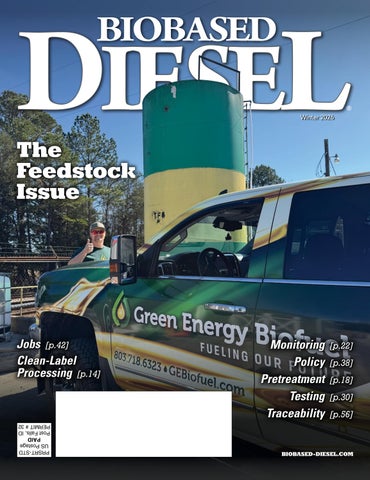
The Feedstock Issue
Jobs [p.42] Clean-Label Processing [p.14]
Monitoring [p.22] Policy [p.38] Pretreatment [p.18] Testing [p.30] Traceability [p.56] BIOBASED-DIESEL.COM
PRSRT-STD US Postage PAID Post Falls, ID PERMIT # 32
Are you prepared to win... Can Imerys biofuel feedstock pretreatment solutions help you get ahead? CYNERSORB®, CELITE® AND HARBORLITE® Our range of mineral filter aids and filterable adsorbents improve throughput rates and allows dirtier fats and oils to meet feedstock specifications of renewable diesel, biodiesel and other oleochemical plants. Where preparation meets opportunity. ANY QUESTIONS? Contact us at: www.imerys.com marketingna@imerys.com Linkedin/@imerys
SCAN ME [2]
www.biobased-diesel.com
Biobased Diesel® Winter 2026
[3]
Let your Biodiesel Business flourish.
Growth in renewable fuels like biodiesel is unstoppable. So are your partners at Evonik – with reliable supplies of alkoxides to keep your biodiesel business up and running. And targeted technical support when and where you need it. With production facilities in all major markets, we’re never far away. Let’s talk about boosting your business in this key source of renewable energy. Let’s talk about what Evonik can do for you. Evonik Catalysts. Let’s make a difference.
[4]
www.biobased-diesel.com
Are you interested in learning more? Please contact us at: Evonik Corporation Phone +1 331 666-8235 fabio.tufano@evonik.com evonik.com/catalysts
ADVERTISERS: For advertising sales please call 218-745-8347, email editor@biobased-diesel.com or visit our website at www.biobased-diesel.com.
Features
EDITOR AND PUBLISHER: Ron Kotrba editor@biobased-diesel.com GRAPHIC DESIGN: Doug Conboy Raised Brow Productions MAGAZINE PRINTING: Century Publishing COVER PHOTO: BioJoe Renwick, co-founder of Green Energy Biofuel, is looking to add staff and take his company to the next level. PHOTO: GREEN ENERGY BIOFUEL LLC Biobased Diesel® is published by RonKo Media Productions LLC. Subscriptions are free of charge to those in the United States and Canada. To subscribe, visit biobased-diesel.com and fill out the contact form in the website footer. For subscribers outside the United States and Canada, a digital version of the magazine will be emailed. For those located outside the United States and Canada who wish to have a print version of Biobased Diesel® mailed, please email editor@ biobased-diesel.com with the request. A nominal postage fee may be required. For mail correspondence, write to: RonKo Media Productions PO Box 86 Warren, MN 56762 All rights reserved. No part of this publication may be transmitted or reproduced in any form without written permission from the publisher. The information contained within has been obtained from sources believed to be reliable. Neither the publisher nor any other party assumes liability for loss or damage as a result of reliance on this material. Appropriate professional advice should be sought before making personal, professional, or financial decisions. Outside of our staff authors, articles written by providers or professionals are invited authors and represent the opinions of that particular individual, business, group or organization. ©Copyright 2026 RonKo Media Productions LLC
VOL. 6 ISSUE 1 | CONTENTS
14 The Future of Clean-Label Oilseed Processing Is Here...14 Introducing CPM|Crown’s revolutionary alcohol-based extraction process: Monarc Clean Oilseed Processing™. By Alex Danelich and Kris Knudson
Improving Renewable Diesel Production: The Role of Sorbsil® Silicas in Feedstock Pretreatment..........................18 The performance of PQ Corp.’s Sorbsil® silicas boosts the efficiency and lifespan of the hydrotreating process. By Vinit Sodhi and Arnold Wong
Turning UCO Collection into a Data-Driven Business......... 22 Otodata’s monitoring model aims to remove the barriers for UCO collectors in adopting tank telemetry. By Eric Wise
The Road Less Taken: Iowa Moves High Biodiesel Blends Forward..................................26 The adoption of B30 in Iowa through state policy and industry collaboration provides a roadmap for the nation. By Jenna Rose
Departments Editor’s Note.......................... 6 News....................................... 8 Perspective.......................... 48
26 22 Feedstock Quality for Biobased Diesel Isn’t Always What’s Expected or What It Appears...................................30 R.W. Heiden Associates offers advanced feedstock-testing services that flag impurities often missed by common screening tests. By Richard W. Heiden
IQT®: Powering the Next Era of SAF and Renewable Research............34 IQT-FLEX allows labs to seamlessly switch between standard compliance mode and research mode on the same instrument. By Conrad Kader
How New Subsidy Guidelines Could Make Brown Grease the New Gold..........................38 Recent pending federal-policy changes are fundamentally rewriting feedstock economics. By Kristof Reiter
BioJoe Wants You!..................42 Green Energy Biofuel is looking for the right leaders to round out its dream team. By Ron Kotrba
Advertiser Index American Lung Association....................12 Baker Commodities Inc..........................62 Biobased Diesel Daily®............................6 CFR Engines Inc....................................37 Clean Fuels Alliance America........... 10, 53 CPM|Crown Global Companies...............64 Dicalite..................................................7 EcoEngineers.......................................13 Engine Technology Forum.......................59
Evonik...................................................4 Green Energy Biofuel LLC.........................3 Imerys...................................................2 Iowa Biodiesel Board/ Iowa Soybean Association......................29 Iowa Renewable Fuels Summit...............61 Michigan Advanced Biofuels Coalition........51 Myande Group......................................63 Ocean Park..........................................49
Otodata Inc..........................................25 PQ Corp...............................................21 Reiter USA...........................................41 Render magazine..................................46 R.W. Heiden Associates LLC...................33 Saint Paul Commodities........................11 Teikoku USA Inc....................................55 Veriflux................................................57 WWS Trading........................................47
Biobased Diesel® Winter 2026
[5]
EDITOR’S NOTE |
NO MONKEY-WRENCH MIRACLE As a trade-magazine editor and publisher for industries such as these, in which good or bad years are so often dictated by the whims of politics and policy, it is a harrowing experience when big government decisions can happen at a moment’s notice nearly every time we go to print—throwing a monkey wrench into months of planning. But these major decisions upon which we are all waiting—final Renewable Fuel Standard volumes for 2026-’27, half or full values on renewable identification number (RIN) credits for imports under RFS, reallocation of volumes waived under small-refinery exemptions granted, section 45Z guidance and implementing regulations—are critical for the survival of some and the success of others in this space, so this is one monkey wrench I would have welcomed. But it never came. Several of the editorial contributors in this edition of Biobased Diesel®—which fortuitously coalesced as “the Feedstock Issue” in late-stage editing—did a fantastic job naming and navigating the uncertainty. As indicated on the magazine cover, we have no less than seven feature articles and columns focused on various aspects of feedstock. From high-level job openings at a well-known feedstock collection and processing company (p. 42) to strange substances in feedstock and advanced testing methods to detect them (p. 30), the growing importance of traceability (p. 56), used cooking oil (UCO) monitoring equipment and services (p. 22), how silica gels perform in feedstock pretreatment (p. 18), a new alcohol-based extraction technology (p. 14) and—the
[6]
www.biobased-diesel.com
pièce de resistance in terms of the crossroads between policy and feedstock—how new regulations could incentivize a feedstock once thought remarkably unworkable and highly improbable for these industries: trap brown grease (p. 38). In this special edition of the magazine, we present to you a record eight feature articles and seven perspective columns by yet another record 17 contributing writers, plus yours truly. Outside of feedstock and policy, other important topics covered include Iowa state policy and B30 (p. 26), cutting-edge lab equipment (p. 34), an overview of the sustainable aviation fuel (SAF) landscape (p. 48), why Michiganders are bullish on biodiesel (p. 50), how quality and performance drive biodiesel adoption despite policy uncertainty (p. 52), best practices for optimal pump performance (p. 54), an engine association’s perspective on policy (p. 58), and how many of these topics will be addressed at an upcoming event in Iowa (p. 60). Speaking of events, if you’re in Orlando for the Clean Fuels Conference in January, stop by the Biobased Diesel® booth (No. 6) and say hi, we’d love to see you there.
Ron Kotrba Editor and Publisher
Correction: In the Summer 2025 print issue, we stated on page 37 that “One restaurant owner reported losing $40,000 from the theft of 20,000 pounds of UCO…” This should be gallons, not pounds.
Boost Your Bio-Based Diesel Success with Dicalite! Looking for premium filtration solutions for your FAME, HVO, or SAF operations? Dicalite has you covered! Our complete range of DE and Perlite filter aids is designed to optimize your production and deliver exceptional results. Tailored Support: Free trial materials | On-site testing & optimization Flexible Shipping Options: Paper bags, bulk bags | Tank trucks, rail, or export containers—your choice! With 17 facilities across North America and Europe—including 5 mining sites and 12 processing hubs—we’re ready to deliver directly to your plant, quickly and reliably. Partner with Dicalite Management Group— the trusted name in industrial minerals. Your success starts here!
Contact Gary Smith today! 208-409-8661 | gsmith@dicalite.com | Dicalite.com
Biobased Diesel® Winter 2026
[7]
NEWS |
SAF News Briefs
Global production projections revised down, U.S. expansions underway and air-cargo firms sign big deals. The International Air Transport Association released new estimates for sustainable aviation fuel (SAF) production in December showing that, in 2025, SAF output is expected to reach 1.9 million metric tons (634 million gallons), nearly double the 1 million tons produced in 2024. In 2026, however, SAF production growth is projected to slow down and reach 2.4 million tons. The estimated SAF output for 2025 of 1.9 million tons is a downward revision from IATA’s earlier forecasts due to lack of policy support to take full advantage of the installed SAF capacities. “Europe’s fragmented policies distort markets, slow investment and undermine efforts to scale SAF production,” said Willie Walsh, IATA’s director general. “Europe’s regulators must recognize that its approach is not working and urgently correct course. … Regrettably, many airlines that have committed to use 10 percent SAF by 2030 will be forced to reevaluate these commitments.” With eSAF mandates approaching in the U.K. (2028) and EU (2030), The association stated that it’s essential not to repeat the policy missteps seen with SAF. Without strong production incentives— as opposed to mandates—supply will fall short of targets, warned IATA. [BBD]
DHL Express signed a three-year deal with Phillips 66 for delivery of over 240,000 metric tons of SAF. PHOTO: DHL EXPRESS
XCF Global Inc. announced in December new development milestones at its New Rise Reno 2 site in Nevada, the company’s second SAF production facility and the next deployment of its scalable, modular production platform. XCF has completed initial site work at New Rise Reno 2, including grading of the 10-acre parcel and construction of new access roads. Engineering, design and project planning are underway, positioning construction to begin in 2026. XCF is expected to invest $300 million in New Rise Reno 2 to enable SAF production capacity to double to 80 million gallons per year (mgy). [BBD] Calumet subsidiary Montana Renewables said in November that it remains on track to achieve 120 mgy to 150 mgy of SAF production before mid-2026. “Strategically, the transformation of Montana Renewables is poised to accelerate in the coming year as we plan to bring our MaxSAF™ 150 expansion online in the second quarter of 2026, which will allow us to dramatically increase our SAF production versus today,” said Calumet CEO Todd Borgmann. “With approximately 100 million gallons of SAF fully contracted or in final review, our SAF marketing program is progressing ahead of schedule, and we expect to complete the contracting at strong premiums well before the expansion.” In October, Montana Renewables commissioned onsite blending and shipping facilities to offer a nominal 50/50 blend of SAF. The product is initially being distributed through AEG Fuels’ network to select aviation hubs in Montana, Washington and Oregon. MaxSAF™ sales from the truck rack allow local and regional service and opens the SAF market outside of major airports. [BBD] DHL Express has signed a significant SAF agreement with Phillips 66, the company announced in November. The agreement will see the delivery of more than 240,000 metric tons of SAF over a three-year period. The majority of the SAF will be delivered to Los Angeles International Airport (LAX), with [8]
www.biobased-diesel.com
future intended deliveries to other West Coast airports where DHL maintains operations, such as San Francisco International Airport (SFO). Utilizing a book-and-claim approach, DHL Express is able to manage its carbon footprint through the use of sustainable fuels in the aviation sector. The SAF will be produced at Phillips 66’s Rodeo Renewable Energy Complex in California, which has a production capacity of 150 mgy of neat SAF. The agreement represents one of the largest SAF deals by a U.S. producer and for the overall air-cargo sector. [BBD] FedEx began to take delivery of blended SAF in October at two additional U.S. airports for the first time: Chicago-O’Hare International Airport (ORD) and Miami International Airport (MIA). As such, FedEx became the first U.S. all-cargo airline to purchase and deploy SAF at O’Hare. The start of these fuel deliveries in October marked the company’s second and third deployments of blended SAF at a major U.S. airport in six months. In May, FedEx announced its first major U.S. SAF deployment at LAX. At O’Hare, FedEx will receive a blend to include a total of 1 million gallons of neat SAF at a minimum 30 percent blend from Air BP. In Miami, FedEx has started to take delivery of around 3 million gallons of blended SAF at a 30 percent blend minimum from AEG. [BBD] The Civil Aviation Authority of Singapore is introducing a levy on SAF for all origin-destination passengers, origindestination cargo shipments, and general- and business-aviation flights departing Singapore from Oct. 1, 2026, applicable for tickets or services sold from April 1, 2026. The amount of the SAF levy is set based on the volume of SAF needed to meet the 1 percent SAF target for 2026 and the projected price premium of SAF over conventional jet fuel and other associated costs, including the cost of certification, blending and delivery. The SAF levy varies based on the distance traveled. [BBD]
Renewable Diesel News Briefs New projects, updates, a switch back and U.K. tariffs.
Love’s Travel Stops has assumed 100 percent ownership of Heartwell Renewables, an 80-million-gallon-per-year (mgy) jointventure renewable diesel project between Love’s and Cargill that was first announced in 2021. The project broke ground in late 2022 and operations are expected to start in the second half of 2026. Although Cargill is no longer part owner, it will still provide tallow feedstock to the plant, which will use multiple feedstocks. [BBD] CVR Energy said in its third-quarter 2025 earnings report that it plans to stop renewable diesel production at its Wynnewood, Oklahoma, refinery late this year due to “unfavorable economics of the renewables business and to optimize feedstock and relieve certain logistical constraints within the refining business.” The company will revert the Wynnewood unit, capable of producing approximately 80 mgy of renewable diesel, back to hydrocarbon processing during a scheduled catalyst change in December. The company said it expects to maintain the option to switch back to renewable diesel service if incentivized to do so. CVR has long indicated that it may switch its renewable diesel unit in Wynnewood back to petroleum refining if the economics were unfavorable. [BBD] Italy-based supermajor Eni announced this fall it has received approval from the Italian ministry of the environment and energy security to convert selected units at the Sannazzaro de’ Burgondi refinery, in the Italian province of Pavia and region of Lombardy, into a biorefinery. The project involves converting the existing hydrocracker unit using Ecofining™ technology and constructing a pretreatment unit. Traditional fuel production will continue alongside the new production of renewable diesel and sustainable aviation fuel (SAF), expected to begin in 2028. The biorefinery will have a processing capacity of 550,000 metric tons per year of feedstock. Today Eni produces hydrotreated biofuels at biorefineries in Venice and Gela in Italy and at the St. Bernard Renewables biorefinery (a 50/50 joint venture) in Louisiana. A third Italian biorefinery is due to come on stream in Livorno in 2026, followed by two plants currently under construction in Malaysia and South Korea. A further biorefinery in Italy has been announced for Priolo, Sicily. [BBD]
Eni received approval from the Italian government to construct a pretreatment unit and convert a hydrocracker at the Sannazzaro de’ Burgondi refinery in the province of Pavia to produce renewable diesel and SAF. PHOTO: ENI S.P.A.
at the Prince George Refinery. Once the credits are sold, the B.C. LCFS credits are expected to fund half the cost of the renewable feedstocks required to operate the FCC coprocessing infrastructure from May 2026 to April 2028, at rates of up to 300 barrels per day (bpd). The new FCC agreement is in addition to a similar, previous hydrotreater-coprocessing agreement that is expected to fund half the cost of renewable feedstocks to operate the hydrotreater-coprocessing unit during 2026 and 2027 at the same 300 bpd rate. [BBD] The U.K. Trade Remedies Authority published in late November its statement of essential facts on imports of renewable diesel from the U.S. The investigation was launched in March. Following evidence that subsidized imports are causing material injury to U.K. producers, TRA is proposing countervailing duties of between £257.80 and £303.56 (USD$340.64 and USD$401.11) per metric ton. Separately, TRA has terminated its parallel investigation into dumped renewable diesel imports from the U.S. due to a lack of significant evidence. [BBD]
Pengerang Biorefinery, a joint venture between Petronas, Enilive and Euglena, held a groundbreaking ceremony in November for the development of the new biorefinery in Pengerang, Johor, Malaysia. The biorefinery will have the capacity to process up to 650,000 metric tons of renewable feedstock annually to produce renewable diesel, SAF and bionaphtha. The new facility is scheduled to begin operations by the second half of 2028. [BBD]
In related news, the U.K.’s Secretary of State for Business and Trade accepted TRA’s final recommendation in November to apply a new antidumping duty on imports of biodiesel and renewable diesel from China. The investigation was launched June 2024, following an application from the Renewable Transport Fuels Association on behalf of U.K. producers. TRA found that Chinese biodiesel has been dumped in the U.K. at unfairly low prices, causing material injury to U.K. producers, including Argent Energy and Olleco. The measures recommended by TRA are ad valorem duties of 14.79 percent for the Zhuoyue Group and nonsampled cooperating exporters, and 54.64 percent for all other exporters. [BBD]
Tidewater Midstream and Infrastructure Ltd. announced in December that it has entered into an initiative agreement with the government of British Columbia that will provide Tidewater with B.C. Low Carbon Fuel Standard credits to support the production of low-carbon renewable gasoline and renewable diesel from the fluid catalytic cracking (FCC) coprocessing infrastructure
New data from California’s greenhouse-gas (GHG) emissions inventory shows that biobased diesel—primarily renewable diesel—accounted for 56 percent of on-road diesel fuel used the state in 2023. California saw a dramatic 17 percent decline in emissions from heavy-duty trucks due largely to the increased use of biofuels. [BBD]
Biobased Diesel® Winter 2026
[9]
NEWS |
Biodiesel News Briefs
Greater adoption of B100, higher blends and recognizing a biodiesel pioneer. Optimus Technologies, a leader in advanced biodiesel engine technology, announced in December the signing of a memorandum of understanding (MOU) with Mitsui & Co. Ltd., one of the world’s most diversified and respected trading and investment companies operating across approximately 62 countries. Under this agreement, Mitsui has secured the exclusive rights as a distributor of Optimus’ Vector System™ and related products in Japan, India and Southeast Asia. The system is a bolt-on upgrade that enables diesel engines to operate on 100 percent biodiesel (B100), achieving near-zero carbon emissions without compromising performance or reliability. This expansion builds on the strong collaborative foundation between the two companies. [BBD] CyRide, the public bus system for Ames, Iowa—a collaboration between the city of Ames and Iowa State University—has been awarded $14.6 million through the Federal Transit Administration’s Bus and Bus Facilities Competitive Program to expand its administrative, maintenance and bus-storage facility and convert 20 buses to B100. This includes installation of an underground B100 fuel tank and on-site blending equipment to support year-round use. CyRide is currently operating five buses on B100 as part of a pilot program launched in 2024. Early results have been promising, showing strong performance and reduced emissions. “B100 continues to perform well in our pilot, and this funding allows us to build on that success across more of our
[10]
www.biobased-diesel.com
fleet,” said Transit Director Barbara Neal. “It is a practical, costeffective approach to lowering emissions using a fuel produced here in Iowa.” [BBD] Banks Mining has partnered with biodiesel supplier Argent Energy to lower carbon emissions from its mining operations. Banks operates one of the U.K.’s largest wholly owned fleets of earthmoving machinery. The company is phasing out standard fossil diesel in favor of Dieselite, a new brand of higher biodiesel blends Argent introduced in October. Dieselite contains between 10 percent and 30 percent biodiesel. A total of 2,084 metric tons of CO2 has been reduced through the switch to Dieselite. [BBD] AltWheels has named Ed Burke, chairman of the board of Dennis K. Burke Inc., the 2025 recipient of the AltWheels Green Fleet Award, honoring his trailblazing leadership in biodiesel. For more than two decades, Burke has been at the forefront of clean-fuel innovation in Massachusetts. In the early 2000s, he worked hand-in-hand with Harvard University piloting some of the first biodiesel programs in the region. Burke also played a critical role in the development of an ASTM specification for biodiesel, helping to set national benchmarks for quality and performance. Burke was honored at AltWheels Fleet Day Oct. 6 in Norwood, Massachusetts, where leaders across the energy and transportation sectors again gathered to celebrate innovation and progress toward a cleaner future. [BBD]
Marine Biofuel News Briefs
IMO delays adoption of net-zero framework. The International Maritime Organization’s Marine Environment Protection Committee adjourned discussions in October on the adoption of the net-zero framework for one year. The net-zero framework was approved at the MEPC 83 session in April as a new Chapter 5 of the Draft Revised Annex VI of the International Convention for the Prevention of Pollution from Ships (MARPOL). It comprises a set of international regulations aimed at reducing greenhouse-gas (GHG) emissions from ships in line with IMO’s 2023 strategy for the reduction of GHG emissions from vessels and includes two key elements: a global fuel standard and global GHG-emissions pricing mechanism. The IMO’s extraordinary session of the MEPC Oct. 14-17 was expected to adopt the amendments, including the net-zero framework, but instead agreed to adjourn the discussion for a year. In the interim, member states will continue to work towards consensus on the IMO framework. The Intersessional Working Group on the Reduction on Greenhouse Gas Emissions from Ships met Oct. 20-24 and continued to work on the guidelines for implementing the net-zero framework. Various organizations responded to the IMO’s decision to delay the adoption of the framework. The Singapore-based Global Centre for Maritime Decarbon ization was disappointed in the outcome. “Fundamentally,
GCMD believes nothing has changed in the industry’s ultimate destination—net-zero emissions,” it stated. “Regional efforts, such as EU regulations, remain in force and are expanding, and other regions will likely also step up to take leadership in light of what happened last night. While a global framework would have provided uniform clarity sooner, the direction of travel is clear and should drive action—the work does not stop simply because the vote is postponed.” Lloyd’s Register said the IMO’s adoption of the framework “would have provided a global regulatory framework for the reduction of GHG energy intensity of international shipping. The least disruptive and most equitable route for the maritime industry’s energy transition is through a global, multilateral, transparent policy with the IMO. This will provide the framework for how the industry should decarbonize, creating the consistency, confidence and collaboration needed to drive investment and accelerate progress.” Biodiesel producer Argent Energy urged the shipping industry to stay on course with decarbonization. A delay in regulation doesn’t mean a delay in action, the company stated. “The industry must not stand still,” said Dickon Posnett, Argent Energy’s director of corporate affairs. “The IMO’s efforts remain vital, but regulatory delays should not deter shipping companies from acting now. Solutions exist now. Companies can act now. The climate crisis isn’t waiting, and neither should we. No single country or interest group should hold back global progress.” Argent Energy said momentum must continue. The company supports those working to improve the IMO framework over the next year, but it urged the industry to act in parallel. “We applaud those driving efforts to strengthen the IMO framework and set more ambitious targets,” Posnett said. “In the meantime, we’ll keep providing fuel for shipping companies who want to lead, not wait.” [BBD]
Logistics. Quality. Trading. Supply. Compliance.
One team. One partner. One system. One phone call.
www.stpaulcommodities.com
Biobased Diesel® Winter 2026 [11]
Start Your Biobased Journey Today! "Biobased Academy is a great way to expose fleet and facility professionals to the environmental, health, and safety benefits of transitioning to biobased products." - Sarah Mark, Fleet and Facilities Manager for the City of Moline, Illinois
Enter discount code USB23 at checkout to receive complimentary access to the course!
[12]
www.biobased-diesel.com
Biobased Diesel® Winter 2026 [13]
FEATURE |
The Future of Clean-Label Oilseed Processing Is Here Safe, scalable, sustainable and alcohol-based, Monarc technology leads the clean oilseed-processing industry. By Alex Danelich and Kris Knudson CPM|Crown recently released Monarc Clean Oilseed ProcessingTM, a revolutionary technology that delivers what the industry has long waited for: an alcohol-based extraction process that enables clean-label production at scale. Crown has been a global leader in equipment and innovative technologies for over 75 years in oilseed processing for consumer products, animal feed and biofuels. As the world’s population continues growing, we recognize the need for innovative solutions for cooking oils, proteins and other ingredients to feed our people. Over the past five years, our experts have developed this industry-changing technology, honing it with cutting-edge process-simulation software and continuous steady-state processing runs in our best-in-class Global Innovation Center. Monarc Clean Oilseed ProcessingTM, our new patent-pending technology, is competitive with traditional hexane systems while delivering significant advantages in cost and efficiency. This shift makes clean-label food production economically viable and provides benefits in safety, environmental impacts and consumer appeal. “The world increasingly wants food to be manufactured in a safe, responsible and sustainable way,” says Dave MacLennon, the former CEO of Cargill. “That’s why Monarc is such a remarkable innovation and is going to be game-changing for the industry.” [14]
www.biobased-diesel.com
With Monarc, companies can adopt the cleanest technology for their production of meal, oil and protein concentrates. Elian Barcelona recently did just that. Installation of Monarc technology has begun for its commercial-scale facility this year. Elian Barcelona will meet the growing demand for clean-label products while moving rapidly into the future of clean oilseedprocessing technology.
Sustainable Quality, Yields Crown’s most recent efforts were aimed at maintaining economic competitiveness to provide on a global scale premium clean-label food at a lower production cost. To do this, Crown needed a solution that was scalable and sustainable so that producers would adopt this industry-leading technology. Richard Petro, commercial director at Elian Barcelona, says, “To make our sustainability vision real, we knew we needed a partner that shared our passion for innovation, for safety and for environmental leadership—and that partner is Crown. Monarc is going to allow us to leverage ethanol to unlock new possibilities for product quality and consumer trust.” Crown experts are pioneers in oilseed extraction, a critical step in producing high-quality edible oil and meal. Our advanced extraction technologies ensure efficient removal of oil from a variety of oilseeds and are designed to maximize yield and quality. Our continuous solvent-extraction methods
set the standard in the oilseed-extraction industry. This unique approach gives producers the opportunity to meet their customers’ demands for improved speed to market, highquality products and more reliable service.
“
Clean oilseed processing Monarc Transforms Market Dynamics using an alcohol-based Market forces, including the need for clean foods, are converging to drive clean-food labeling using Crown’s innovative solvent-extraction method equipment solutions. Using Monarc, producers can increase clean-label options while utilizing legacy oilseed-processing impacts human food, methods. By being proactive in creating new ways to process foods, Monarc delivers a solution that incorporates safe animal feed and biofuels in facilities, regulatory resilience and cost-effective innovations to align with consumer values. Scaling operations and improving a positive way. product characteristics enable companies to expand existing markets and enter new ones, including organic offerings. Clean oilseed processing using an alcohol-based solventextraction method impacts human food, animal feed and biofuels in a positive way. Consumers want clean-label foods and look to companies for innovative ways to accomplish it. By being proactive in creating new ways to process foods, Monarc delivers a solution that incorporates safe facilities, regulatory resilience and cost-effective innovations to align with consumer values. Consumers on a global basis consistently ask for products made with superior characteristics, including:
• Lighter color and lower gums content in oils. • Higher-protein content meal. • Neutral taste in protein concentrate. Monarc Clean Oilseed ProcessingTM provides producers with the opportunity to deliver what consumers want in a costeffective, environmentally safe and high-quality marketplace.
Why Use Alcohol-Based Solvents?
Monarc helps processors future-proof their operations because of the advantages offered by alcohol-based processing.
With Monarc, companies can adopt the cleanest technology for their production of meal (shown), oil and protein concentrates.
Biobased Diesel® Winter 2026 [15]
Using Monarc, producers can increase clean-label options while utilizing legacy oilseed-processing methods.
They gain flexibility to meet growing clean-label, regulatory, sustainability and safety demands competitively without abandoning traditional systems. Crown helps companies grow at their own pace by supplementing traditional processes with our innovative processing solutions through robust technology and our superior customer service and support. Benefits of alcohol-based extraction include: • Alcohol is already present in or utilized to produce many foods and beverages. • The use of an alcohol-based solvent enables companies to produce clean-label products that appeal to healthconscious consumers. • Alcohol-based solvents significantly improve worker-safety profiles at factories. • Alcohol-based solvents reduce environmental impact compared to petroleum derivatives like hexane. • Alcohol-based solvents better align with sustainability goals. • Alcohol is a renewable source material, as ethanol can be produced from plants. • Alcohol-based solvents facilitate easier permitting of new extraction facilities compared to hexane.
The Clean Oilseed Trifecta
Monarc Clean Oilseed ProcessingTM uses alcohol as a solvent, affording producers the flexibility of scaling their clean-label products to satisfy market demand while
[16]
www.biobased-diesel.com
meeting and exceeding regulatory and safety requirements. Producers can adapt and evolve at their own pace, building new plants, retrofitting existing lines or creating new, premium products to enhance revenue-growth opportunities. They have options that align cost targets with proven performance using innovation that also allows new-product creation and market differentiation. Market-leading technology combined with reliability and speed to market makes Monarc the best choice for clean oilseed processing. Seize the opportunity to meet growing public demand for clean-label products while improving your operational and capital expenditure (opex and capex) results. Some companies report a 15 percent boost in overall revenue based on higher margins and optimized product pricing.
Consumers Demand It
Consumer demand for cleaner ingredients is growing as they seek transparency in labeling as well as ingredients they can recognize and pronounce. The rise of internet influencers creates a new opportunity for companies to be transparent about their food-processing standards and techniques. Telling a story enables companies to control the narrative, using authentic data, to educate consumers about clean foodprocessing technology. Companies that lead the conversation about next-generation food-processing technology are aligned with consumer values and social-media trends.
“
By choosing Monarc, companies exceed current regulatory requirements and anticipate changing and more stringent future standards.
Using Monarc Clean Oilseed ProcessingTM technology, producers are positioned to capture this market opportunity. Their labeling reflects authentic, clean processing and customers will recognize that. It opens doors to new market segments that bring greater industry recognition, higher margins and improved brand loyalty.
overall safer working environment and meet sustainability goals— all at the scale and economics of current solvent technology. The technology allows customers to future-proof their operations while seizing the opportunity to meet growing public demand for clean-label products. Crown enables companies to expand cleanlabel options without abandoning legacy oilseed processing.
Proactive, Safe, Sustainable
Learn More About Monarc
Crown has been the global leader in oilseed processing for 75-plus years, and we continue to lead the way in cleanlabel technology. Using Monarc Clean Oilseed ProcessingTM to produce high-value, clean-label products creates a safer working environment and meets sustainability goals without sacrificing scale and economic factors. Employee safety is a top concern of companies that operate food-processing facilities. Using Monarc’s alcohol-based solvents demonstrates a proactive approach to reducing the negative side effects experienced by employees. By choosing Monarc, companies exceed current regulatory requirements and anticipate changing and more stringent future standards. It safeguards employees’ well-being and positions the company as the employer of choice in the clean food-processing marketplace. Plus, potential liability exposure is reduced as producers send a clear message about valuing employees.
Trust Crown for Clean Oilseed Processing
Monarc Clean Oilseed ProcessingTM is a proven, patented alcohol-based process that enables companies to replace current solvents in their extraction supply chains, deliver high-value, clean-label ingredients and products (including organic), create an
Our first Monarc plant installation is already in progress and is projected to provide economic viability comparable to traditional extraction technologies. We support companies throughout facility retrofits of existing plants or greenfield construction. Companies plan with confidence and serve emerging markets with ease knowing they are at the leading edge of this innovative technology. Partner with us on your key initiatives including reducing carbon footprint, emissions and energy use along with improving operational performance. Additionally, Crown solutions create renewable resources, supply-chain resiliency and sustainability while supporting zerowaste targets and social responsibility. Crown is the industry’s trusted partner in helping companies gain competitive advantage. Our expertise, equipment and worldclass Global Innovation Center in Blaine, Minnesota, is where companies can test and sample products using Monarc Clean Oilseed ProcessingTM technology. Adopt the cleanest oilseedprocessing technology for humans, animals and biofuels. Crown invites customers to test and sample their products using Monarc technology at CPM|Crown’s Global Innovation Center. For more information about Monarc, contact crownsales@cpm.net or 651-639-8900.
Authors: Alex Danelich Global Vice President of Sales-Specialty Segment CPM|Crown 651-638-5462 adanelich@cpm.net
Kris Knudson President CPM Engineered Solutions 651-638-5442 kris.knudson@cpm.net Biobased Diesel® Winter 2026 [17]
FEATURE |
Improving Renewable Diesel Production: The Role of Sorbsil® Silicas in Feedstock Pretreatment The integration of Sorbsil® silicas into the feedstock-pretreatment process for renewable diesel production offers several key benefits. By Vinit Sodhi and Arnold Wong [18]
www.biobased-diesel.com
Feedstock pretreatment is a critical step in renewable diesel production, designed to remove impurities from crude feedstocks such as fats, oils and greases prior to refining. This process typically involves two main stages: degumming, which eliminates bulk impurities, followed by bleaching, which reduces contaminants to trace levels that meet hydrotreater-catalyst specifications through adsorption and filtration. In the bleaching step, adsorbents play an essential role by capturing and removing impurities such as metals, phosphorus and organic compounds. This significantly improves the quality of the feedstock, ensuring it meets the stringent requirements for downstream processing. Without this crucial step, impurities could harm the hydrotreating catalysts or compromise the quality of the final renewable diesel product. The combined use of adsorbents and filter aids ensures thorough purification and effective filtration. Silica-gel adsorbents stand out for their high surface area, excellent adsorption capacity, purity and consistency. Their superior performance boosts the efficiency and lifespan of the hydrotreating process, making them a preferred solution in renewable diesel production.
PQ Sorbsil® Silica: Consistency, High Purity, Reliable Quality
PQ offers Sorbsil® R40F and R92F for the renewable fuels markets. While both products have similar physical properties, R92F contains citric acid that increases the efficiency of metals removal. As Sorbsil® silicas are engineered materials, PQ carefully controls the physical properties to ensure consistent highquality adsorbents for our customers.
SOURCE: PQ CORP.
SOURCE: PQ CORP.
For example, PQ precisely controls product particle-size distribution (PSD) during the milling process, ensuring excellent consistency that reduces batch-to-batch variation. In the depicted laser diffraction particle-size data, a narrower particlesize distribution was observed in PQ’s Sorbosil® silica hydrogel than competitors’ activated bleaching earth (ABE). The reduced population of fine particles less than 1 micron (µm) allows for an increased filtration rate versus competitor products.
Filtration Performance
Permeability and filtration performance are improved by controlling the PSD in the milling process. In PQ’s laboratory filtrationtesting procedure, we directly compare the filtration rate of PQ Sorbsil® silica hydrogel versus ABE and demonstrated over 10 percent faster filtration rate at equivalent adsorbent dosages. With Sorbsil® silicas’ increased efficiency in contaminant removal, reducing the silica-gel dosage would further improve filtration rate. In addition to a faster filtration rate and lower adsorbent dosage, the plant benefits from longer filtration runs, reduced oil losses, decreased waste disposal and increased product throughput.
Removal of Impurities
SOURCE: PQ CORP.
PQ’s Sorbsil® silica hydrogel offers high surface area and pore volume, enhancing its efficiency in removing impurities. Silica has a distinct advantage over ABE by removing an averaged 85 percent of phosphorous at a 0.5 percent dosage compared to ABE’s 3 percent dosage level. PQ’s Sorbsil® R92F with citric acid outperforms ABE by removing 96 percent of trace metals at a Biobased Diesel® Winter 2026 [19]
0.5 percent dosage and 99 percent at a 1 percent dosage by weight.
Cost Efficiency
Sorbsil® silica hydrogel delivers a cost-effective solution by improving plant efficiency through superior impurity removal and faster filtration rates. Their use helps reduce oil losses, minimize waste-disposal costs and boost the throughput of high-quality oil to your hydrotreater.
Safety
As an amorphous silica, our synthetic silica hydrogel offers a safer alternative to competitors’ bleaching earths. Amorphous silica is not known to have any adverse health effects and is not prone to autoignition, or smouldering, once spent.
SOURCE: PQ CORP.
Improved Feedstock Pretreatment Performance
The integration of Sorbsil® silicas into the feedstock-pretreatment process for renewable diesel production offers several key benefits: • Cost-effectiveness: Sorbsil® silica decreases operating expenses by increased operational throughput, lower oil losses, and higher efficiency in impurities removal, which protects and extends the life of the catalyst for superior renewable diesel production. • Impurities removal: Sorbsil® silica effectively removes impurities, such as phosphorus and metals, at lower dosages than bleaching earth, enhancing feedstock quality and downstream processing. • Filtration: Increased filtration and operational throughput are possible thanks to Sorbsil® silicas’ tightly controlled PSD. Overall, the use of Sorbsil® silicas in renewable diesel production maximizes efficiency and reduces costs, highlighting their strategic value in the process.
SOURCE: PQ CORP.
SOURCE: PQ CORP.
Authors: Vinit Sodhi North America Adsorbents Sales Manager, Global Silicas PQ Corp. vinit.sodhi@pqcorp.com
[20]
www.biobased-diesel.com
Arnold Wong Global Marketing Director, Global Silicas PQ Corp. arnold.wong@pqcorp.com
Improving Improving Renewable Diesel Processing Processing Sorbsil® Sorbsil® Silica Adsorbents Are Key Key SSoorrbbssili® l®hhiigghhaaddssoorrppttiioon n cca ap pa ac city for m maannyy im imppuurriittiieess,, iinnccllu ud diin ng g m metals mp poou un nd dss.. aannddpphhoosspphhoorroouuss ccoom
Ideal Ideal for for use use in in renewable renewable diesel diesel and biodiesel biodiesel processing processing for for the the pre-treatment pre-treatment of of oils, oils, fats fats and and waste waste products, products, such such as UCO, UCO, to to extend extend catalyst catalyst life life and and minimize minimize catalyst catalyst consumption. consumption. Sorbsil® Sorbsil® silica hydrogels hydrogels also also aid aid in in the the post-treatment post-treatment "polishing" "polishing"of ofproducts. products.
Advantages Advantages of Sorbsil® Silicas Cost-Effectiveness Cost-Effectiveness
Impurities Impurities Removal
Quality Quality
Decrease Decreasecost costby by increased increasedoperational operational throughput throughputwith withlower lower oil oillosses losses
Effectively Effectively remove impurities, impurities, such as phosphorus phosphorus and metals, metals, at lower dosages
High purity purityand and High reliable product product reliable with a a global globalsupply supply with network network
For For more more information informationon onPQ’s PQ’s adsorptive adsorptive solutions solutionsfor forbiofuel biofuel processing, processing,contact contactus: us: Americas: Americas:+1 +1847 847312 3121050 1050 EMEA: EMEA:+33 +33743 743269681 269681 AsiaPac: AsiaPac: +86 +8613322806747 13322806747 Technical Technical inquiries inquiries can can also alsobe bedirected directedto: to: oilprocessing@pqcorp.com oilprocessing@pqcorp.com ® Winter 2026 [21] Biobased www.pqcorp.com Diesel www.pqcorp.com
FEATURE |
Turning UCO Collection into a Data-Driven Business How Otodata is simplifying monitoring for used cooking oil collectors. By Eric Wise Most readers of Biobased Diesel® have heard plenty about the rise of used cooking oil (UCO) as a critical feedstock for renewable diesel and biodiesel. You’ve heard about tightening supply chains, rising demand and the growing importance of verifiable, well-documented material. What you may not have heard much about is Otodata—a company that has spent more than a decade modernizing liquid-tank monitoring in other sectors and is now bringing that expertise to UCO collection. What makes Otodata noteworthy for this industry isn’t simply its hardware or software, though both are mature and field-tested. It’s something much simpler: they’ve made UCO-tank monitoring easy. At a time when collectors are managing tight labor markets, rising operating costs and increasing demands for transparency, Otodata’s model aims to remove every barrier to adopting tank telemetry. And in an industry where not every innovation is truly plug-and-play, the difference is noticeable. [22]
www.biobased-diesel.com
Why UCO Collection Is Ready for Telemetry
The UCO market has become more sophisticated in recent years. As more renewable diesel and biodiesel producers rely on waste-based feedstocks, collectors are facing new expectations around consistency, documentation, service quality and supply predictability. Yet despite these pressures, most UCO collectors still rely on manual checks or fixed routing cycles—practices that can lead to inefficiencies such as: • Unnecessary stops at low-volume locations. • Inefficient routing and dispatching. • Labor spent checking tanks that don’t need service. • Occasional customer concerns around cleanliness or overflows. Tank monitoring brings a simple solution: visibility. If you know how full every tank is, you can build smarter routes, deploy trucks and drivers more efficiently, and eliminate surprises that cause stress for both collectors and restaurant partners.
“
At a time when collectors are managing tight labor markets, rising operating costs and increasing demands for transparency, Otodata’s model aims to remove every barrier to adopting tank telemetry.
Otodata’s Core Advantage: Making Telemetry Accessible to Everyone
Many companies sell tank monitors. Some provide monitoring portals and application programming interfaces (APIs). Only one has combined affordable devices, installation services and a financing model that eliminates upfront capital requirements. Put simply, Otodata has figured out how to remove the friction.
HaaS: No Capital Upfront
Otodata’s Hardware-as-a-Service (HaaS) program removes a longstanding barrier: cost. Instead of purchasing hardware outright, collectors can lease monitors at a low monthly rate, which includes hardware, connectivity, access to the monitoring portal, API integration, a customized app and ongoing support. This eliminates large upfront capital projects and converts telemetry into a simple operational expense. For many collectors—especially independents—this shifts telemetry from “a someday investment” to “a decision we can make today.”
Dynamic Routing Cuts Costs Naturally Once Otodata’s monitors are installed, collectors can adapt their routing strategy. Instead of running fixed schedules or stopping by accounts “just to check,” fleets can transition to data-driven dispatching. Trucks only visit tanks that are actually ready for service. Low-volume customers are automatically deprioritized. High-volume locations are serviced optimally, and route density improves naturally over time. This isn’t a theoretical benefit either. Collectors who switch to telemetry often see: • Fewer miles driven per gallon collected. • Lower fuel and labor expenses.
Installation Services: ‘Give Us the List, We’ll Do the Rest’
Most collectors agree that telemetry is valuable—but they don’t have spare technicians or installers waiting around to install monitors. Otodata recognized that this labor bottleneck is often the single-biggest reason collectors delay or abandon telemetry projects. In response, the company now provides full installation services for UCO monitors. Collectors don’t need to schedule internal crews, coordinate equipment or manage field logistics. They simply provide Otodata with a list of sites and Otodata handles the deployment—including communication testing, tank integration and system activation. For collectors operating lean, this alone is a significant differentiator. Together, installation services in addition to HaaS means collectors can begin receiving real tank data without spending capital or adding work to their internal team. Many early adopters see a return on investment (ROI) in a matter of weeks or months.
The combination of no upfront capital plus installation services from Otodata makes monitoring as simple as giving the go ahead. In the setup shown, the monitor is placed on top of the UCO-collection bin. PHOTO: OTODATA INC.
Biobased Diesel® Winter 2026 [23]
“
Tank monitoring helps UCO collectors deliver service that feels modern, responsive and data-backed—qualities increasingly valued by national accounts.
• Increased collection efficiency. • Less wear on trucks and equipment. Some collectors also use the data to create seasonally adjusted routes or to rebalance geographic territories.
platforms. The API is simple and scalable for deployment on fleets of any size. Flexibility is central to Otodata’s approach: The technology adapts to the collector’s workflow, not the other way around.
Better Experience for Restaurant Partners
Why It Matters for the Broader Biobased Diesel Value Chain
Many collectors see Otodata’s system as more than an operational tool—it’s also a customer-service enhancer. Otodata offers a white-labeled mobile app that collectors can brand with their own logo and colors. Restaurants can check tank levels, view tank activity over the past 90 days, and even request pick-ups or call customer support. For large chains or franchise groups, this transparency reduces inbound service calls and builds confidence that the collector is monitoring their locations proactively. Tank monitoring helps UCO collectors deliver service that feels modern, responsive and data-backed—qualities increasingly valued by national accounts. With monitors in place, kitchens experience stronger trust in the collector’s professionalism.
Theft Detection: Still Important but Not the Whole Story
Theft is undeniably part of the UCO landscape, and telemetry plays a useful role in identifying sudden, unexplained tank drawdowns. While most collectors view theft identification as an added benefit compared to the primary value of collection efficiency, Otodata’s system can send alerts for rapid drops in tank level as well as GPS location of the monitor itself. The monitors also give an objective view into how much UCO was stolen and when. This data provides collectors with better awareness and better records of where theft may be occurring and in what pattern. Often the ability to detect a pattern of theft is the first step towards preventing it in the future.
Integration, Data Flexibility
Many UCO collectors already use specialized routing, enterprise resource planning (ERP), or rendering-management software. Otodata doesn’t replace these systems. It enhances them. Its monitoring portal includes an API for automatic data ingestion and integration with commonly used industry [24]
www.biobased-diesel.com
While tank monitors sit at the very beginning of the supply chain, they support outcomes that matter downstream. They allow for more consistent UCO-volume deliveries, which leads to smoother supply chains. For feedstock buyers trying to manage risk and maintain high-quality sourcing, telemetryenabled collectors may become preferred partners.
Simpler Path to Modernizing UCO Collection
The promise of tank monitoring has been talked about in the UCO world for years. What’s been missing is a practical, low-friction way for collectors to adopt it at scale. Otodata has stepped directly into that gap. Its combination of no upfront capital and installation services makes monitoring as simple as giving the go ahead. It has made telemetry accessible to collectors of every size on every tank. For many collectors, the question is no longer whether data can improve their business. It’s whether they can afford to continue operating without it. With barriers removed and ROI measured in weeks or months, the path toward a more efficient, predictable and customer-friendly UCO operation has never been clearer.
Author: Eric Wise Vice President of Commercial Solutions Otodata Inc. 412-779-9998 ewise@otodata.com
UCO Monitoring and Theft-Alert No money down. Free installation. Just $6 a month.
We’ll take care of everything. Get accurate level data to detect theft and optimize efficiency, all for one low monthly price.
No Upfront Cost
Free On-Site Install
Dashboard Setup
Get our super accurate radar monitor for no money down.
We’ll drive out to every site and install our monitor for you free of charge.
We’ll set it up for you! Just sit back and watch the data flow in.
Contact us for your free demo kit today! go.otodata.com/UCO
+1 (844) 763-3344
info@otodata.com
Minimum orders and terms apply. Biobased Diesel® Winter 2026 [25]
FEATURE |
Members of the Iowa Biodiesel Board meet with State Sen. Pat Grassley at the Iowa State Capitol. PHOTO: IOWA SOYBEAN ASSOCIATION
The Road Less Taken: Iowa Moves High Biodiesel Blends Forward State-level policy and industry collaboration position Iowa as a model for B30 adoption. By Jenna Rose As Iowa’s biodiesel producers continue to weather a difficult year marked by federal-policy uncertainty and challenges, the state of Iowa continues to cement its position as a state-policy leader—and is now blazing a trail for B30 adoption that could reshape the industry nationwide. Iowa’s eight operating biodiesel plants faced significant headwinds in 2024 and 2025 as federal Renewable Fuel Standard obligations remained uncertain, the guidance for the federal 45Z tax incentive remained elusive, and market volatility challenged producers. Yet even amid these challenges, the state’s commitment to biodiesel has never been stronger, driven by robust state-level legislation and innovative publicprivate partnerships.
Record-Breaking Growth Built on State Support
The results speak for themselves. According to “Iowa’s Biofuel Tax Credits Program Evaluation Study,” published by the Iowa Department of Revenue, biodiesel sales in Iowa reached 486.5 million gallons in 2023—nearly tripling from 160.8 million gallons in 2007. Biodiesel blends now represent 58.7 percent of Iowa’s total diesel market, up from just 22.6 percent in 2007. “This remarkable growth reflects Iowa’s forward-thinking legislation and sustained commitment to renewable energy, solidifying the state as a national leader in biodiesel production and consumption,” says Grant Kimberley, executive director of the Iowa Biodiesel Board and senior director of market development for the Iowa Soybean Association. Iowa’s success stems from a comprehensive approach to biodiesel incentives. The state offers a producer’s credit, a fuel[26]
www.biobased-diesel.com
tax differential for B20 and higher blends, and retailer credits at three tiers: • 5 cents per gallon (cpg) for B11-B19. • 7 cpg for B20-B29. • 10 cpg for B30 and above. Iowa is the first state in the nation to incentivize B30 blends. These incentives run through Dec. 31, 2027. Additionally, the Iowa Renewable Fuels Infrastructure Program has funded over 1,300 biofuel projects across the state, providing critical support for retailers to upgrade equipment for higher blends. “Biodiesel has long been fighting with one hand tied behind its back as federal policy has whipsawed the industry,” Kimberley notes. “In spite of that, thanks to Iowa’s proactive biofuel policies, we’re at least seeing impressive growth in biodiesel usage at the state level.”
Tackling Implementation of B30 Labeling
As Iowa pushes toward broader B30 adoption, IBB has formed a working group of leading experts from Casey’s, Chevron and Clean Fuels Alliance America to address an important step in the journey: pump labeling. Current Federal Trade Commission guidance, established during the original RFS implementation circa 2008, requires exact concentration labeling (within 1 percent) for blends over 20 percent. This creates some practical difficulties for retailers, as concentration varies when adding biodiesel to existing tanks with lower blends, experts say. The working group has developed a more flexible label that would indicate “contains biomass-based diesel or biodiesel
in quantities between 5 percent and 35 percent.” This would allow for up to B36 blends without having to change the label while maintaining consumer information and meeting regulatory needs. The working group collaborated with Iowa’s Weights and Measures Bureau, housed in the Department of Agriculture, which enforces FTC labeling regulations, to secure its support for the proposed label. The group plans to approach the FTC with a request for a trial period to demonstrate the label’s effectiveness and gather feedback. Supporters hope Iowa’s push for B30 helps serve as a market driver. In August, John Deere approved the use of B30 biodiesel blends in all modern Tier 4 Power Systems engines equipped with the latest diesel-exhaust aftertreatment used in Deere’s heavy-duty farm equipment including tractors, combines and sprayers. Deere also confirmed support for B100 in all older Tier 3 emissions-compliance engines (i.e., those without modern aftertreatment). “This milestone decision by one of the world’s leading agriculture and construction equipment manufacturers represents a major step forward for farmers and fleets pursuing ways to reduce their environmental impact through higher blends of biodiesel,” Kimberley says.
“
Supporters hope Iowa’s push for B30 helps serve as a market driver. Breaking New Ground with B100
Iowa’s commitment to pushing biodiesel boundaries extends beyond B30. In May, IBB and ISA celebrated the launch of a B99 pump at Pilot Travel Centers’ Des Moines location—one of only a few in the nation dispensing almost pure biodiesel to commercial fleets. (The question of potential tax benefits influenced Pilot’s decision for B99 instead of B100.) IBB and ISA contributed $25,000 in soybean-checkoff funding to support the project, showcasing the agriculture sector’s investment in expanding market opportunities. “This B99 pump is a symbol of progress,” says Dave Walton, a soybean grower from Wilton, Iowa, and board member of both IBB and ISA. “It’s proof that when you combine innovation
John Deere announced B30 acceptance at the 2025 Farm Progress Show. PHOTO: CLEAN FUELS ALLIANCE AMERICA
Biobased Diesel® Winter 2026 [27]
CLEAR BLENDS B20 AND HIGHER SOLD IN IOWA (MILLION GALLONS)
Iowa Biodiesel Board, Pilot, PepsiCo and Optimus officials cut the ribbon on a new B99 pump in the Des Moines area. PHOTO: JOCYLN KUBOUSHEK, IOWA SOYBEAN ASSOCIATION
Economic Impact, Future Outlook
CLEAR BLENDS B20 AND HIGHER SOLD IN IOWA Chart Title (MILLION GALLONS) Chart Title
Axis Title
Axis Title
with the right incentives, and partner with companies truly committed to their goals, you can make a big impact.” The initiative brings together Pilot, PepsiCo—operator of one of North America’s largest private fleets—and Optimus Technologies, whose engine technology enables trucks to run on 100 percent biodiesel. PepsiCo will use the pump, which is near one of its major distribution facilities.
37 0
69 0
72 0
Axis Title
238 108 0
238 0 2024
The biodiesel sector’s impact extends well beyond fuel 2016 2020 2022 2018 108 pumps. By increasing soybean-oil value, biodiesel supports 72REVENUE 69 DEPARTMENT OF DATA SOURCE: IOWA 37 an estimated 13 percent of the price per bushel of soybeans, Axis Title directly benefiting Iowa’s farming communities. 2016 2020 2022 2024 2018 Iowa’s biodiesel industry supports 12,000 jobs and level policy can drive meaningful change even when federal generates approximately $3.5 billion in economic opportunity, support falters. “This isn’t just about adding another pump—it’s about according to a national study commissioned by Clean Fuels. In 2024, the state’s 10 operating biodiesel plants produced an transforming how we fuel the future,” Kimberley says of estimated 350 million gallons, making Iowa the top biodiesel- the B99 pump. “By supporting higher blends, we’re helping fleets decarbonize today using Iowa-grown fuels while also producing state in the nation. “U.S. biomass-based diesel adds value to every acre of strengthening our rural economy.” As Iowa continues pioneering pathways for B30 adoption and soybeans grown, accounting for roughly 10 percent of each bushel’s worth—a contribution that is especially vital this beyond, the state offers a blueprint for how strategic legislation, year as America’s soybean farmers face record yields amid industry collaboration and farmer investment can help build a more unpredictable global markets,” Kimberley says. IBB Chair Nathan Nolte, sales manager of renewable fuels sustainable energy future. for biodiesel producer Ag Processing Inc. (AGP), emphasized the state’s role as a national model. “As Iowa continues to invest in biofuels and strengthen its Author: legislative framework, the state stands as a testament to how Jenna Rose renewable energy initiatives can successfully integrate into and Communications Lead bolster local economies,” Nolte says. Iowa Biodiesel Board With 905 clear biodiesel retail locations in 2024—a 226 573-808-0815 percent increase since 2009—and blends of B20 and higher jenna@rosemedia.biz more than doubling in on-road diesel sales, according to the Iowa Department of Revenue, Iowa demonstrates that state0
[28]
www.biobased-diesel.com
0
0
0
0
HIT THE ROAD — AND TH E F I E L D S —
WITH BIODIESEL. DRIVEN TO DELIVER sustainable soy solutions for every life, every day.
IOWABIODIESEL .ORG
IASOYBEANS .COM Biobased Diesel® Winter 2026 [29]
FEATURE |
Richard Heiden, principal investigator and owner of R.W. Heiden Associates LLC, performs testing with a gas chromatograph. PHOTO: R.W. HEIDEN ASSOCIATES LLC
Feedstock Quality for Biobased Diesel Isn’t Always What’s Expected or What It Appears By Richard W. Heiden
R.W. Heiden Associates LLC, a Lancaster, Pennsylvania-based provider of laboratory and consulting services to the diesel and biodiesel industry for over 20 years, offers advanced feedstock-testing services that flag impurities common screening tests miss. [30]
www.biobased-diesel.com
Attention biodiesel and renewable diesel producers: The arrival of a feedstock lot is accompanied by expectations of quality that ensures optimum reactor performance and predictable production yields of fatty acid methyl esters (FAME), fatty acid ethyl esters (FAEE), or renewable diesel fuels. Caveat emptor: Feedstocks can contain foreign substances that slow reaction progression or introduce noncompliant components and unsafe impurities, or they can contain substances that compromise eligibility to generate renewable identification number (RIN) credits under the federal Renewable Fuel Standard program. Yet, these feedstocks can still pass common screening tests, suggesting suitability for purpose and the legitimacy of feedstock providers. This warning applies to all feedstocks in varying degrees. Overall, however, the predictability of virgin seed-oil feedstock compositions is usually quite high, and pretreatment processes that reduce possible impurities are well defined and highly efficient. In contrast, incoming lots of feedstock oils considered used, recycled or from other ill-defined sources can have varying or unexpected properties imparted by foreign substances that fail to be converted to renewable diesel or FAME. Moreover, these feedstocks also can contain significant amounts of discarded FAME from unsuccessful attempts to make fuel that meets quality specifications. Still, despite varying preferences for feedstock that depend on specific feedstock pretreatment and fuel-producing reactions and reactor conditions for conversion to fuel, the feedstock is expected to exclusively contain a collection of free fatty acids, mono-, di- and/or triglycerides. When the organic palette contains substances outside of these classifications, or if the ratios are unacceptable, feedstock can fail to convert to the desired fuel product at expected conversion rates—or fail to undergo conversions to fuel altogether. In this short, descriptive essay, a newer type of feedstock testing is described. This testing elucidates feedstock authenticity with a detailed scan of the organic constituents and has undergone extensive evaluation as a gauge of feedstock identity and vendor reliability. Importantly, this testing provides a potentially attractive quantitative molecular fingerprint of feedstock composition. Initially used as a screening tool to help identify lots of feedstock contaminated with wasted FAME at levels down to 0.1 percent, this testing approach can help fuel manufacturers identify reliable feedstock sources and minimize reactor downtime while providing verifiable evidence of compositions meeting RINgeneration requirements for feedstock authenticity. As such, the developed tests—based upon modified approaches to common advanced test methods—provide a clear record of feedstock authenticity. Such testing in a confidential setting has assisted fuel producers in vetting feedstock providers for nearly 10 years. Mentioned here are a few examples of discoveries this advanced testing has uncovered. While feedstock providers vary in their ability to deliver reliable products, in the end the fuel producers potentially suffer from poorly defined feedstocks resulting in unexpectedly low product yields or undetected impurities that compromise RINs eligibility. Fuel producers have varying fatty-acid requirements, depending on the process used. Substances in feedstocks that fall outside of these compositional requirements can
“
The developed tests— based upon modified approaches to common advanced test methods— provide a clear record of feedstock authenticity. result in products that fail to meet specifications or allow entry of substantial percentages of substances that fail to undergo the expected conversion reactions to fuel. Feedstock providers have varying skills and tools needed to assess the purity necessary to meet fuel-production requirements. Up to now, an assessment of feedstock quality mainly rests on the fuel manufacturer, particularly in order to meet RINs requirements for monetary reimbursements. Feedstock cleanliness and authenticity are essential prerequisites for smooth reactor performance including maximum yields and uncompromised fuel quality. This is true whether the feedstock is for renewable diesel or FAME, or whether the fuel-production process is batch or continuous. Acceptable feedstock quality is very much married to the processes used to make fuel. As such, this can vary considerably. Many classical tests can be feedstock specific, are developed for food-grade oils or fats, and yet fail to provide sufficient detail suited for fuel manufacturing. Some are useful, such as free fatty acid content, in gauging the quality of feedstock needed for some reactors. Despite major process variations and differences, both renewable diesel and FAME production require the organic components of feedstock to be comprised of various forms of fatty acids, mono-, di- and triglycerides, and in some cases, even free fatty acids that are convertible to fuel. Each process for making fuel has its own specific requirements for feedstock fatty acids. While the processes for conversions to fuels and the chemical composition of the end products differ, the certainty of feedstock composition prior to manufacturing the fuel is critical for predictable product yields and hydrocarbon or fatty-acid distributions that define physical and combustion properties of the fuel. Using sophisticated modifications of chromatographic test methods, impurities that compromise feedstock organic compositions—at levels above 0.1 percent mass per mass (m/m)—can be sought. Also, undesirable components can be flagged and the quality of feedstock sources ascertained. When impurity levels appear sufficiently high to alter feedstock purity or compromise RINs eligibility or reaction progression, foreign substances can be identified or quantified by more advanced analysis techniques, such as gas chromatographyBiobased Diesel® Winter 2026 [31]
“
Using sophisticated modifications of chromatographic test methods, impurities that compromise feedstock organic compositions—at levels above 0.1 percent mass per mass (m/m)—can be sought. mass spectrometry (GC-MS). The same concerns apply to small batch reactors or large continuous processes. Both are susceptible to yield losses from contaminants but, in reactors requiring large volumes of feedstock, significant dollars can be lost due to downtime when the produced fuel unexpectedly fails to meet tough fuel-product specifications, or when it contains undesirable impurities—or even those undetected by common wet-chemistry methods—that compromise fuel properties. An appropriate approach to identify the key fatty-acid components and quantify potentially troublesome lots of feedstock is clearly required to reduce effects on product quality and help fuel manufacturers find reliable feedstock vendors. In addition to FAME contamination of feedstock at levels well above 0.5 percent m/m, unexpected foreign components have frequently appeared at remarkable concentrations. Using such methods, feedstocks for fuel manufacturing have undergone detailed scrutiny and startling examples are revealed and discussed below. While numerous low-level organic impurities in feedstock are likely innocuous or have little significance, some fail to participate in reactions that produce fuel and pose as important diluents that are potentially illegal if allowed into the feedstock stream. The range of impurities detected is considerable and often, as hoped, is below 1 percent m/m. In summary, UCO feedstocks frequently can contain high levels of lubricants, hydrocarbons of various types, and fatty acids at times outside the molecular-weight range needed to produce compliant fuels. Also detected were FAEE and FAME at low (less than 1 percent m/m) to high (in excess of 10 percent m/m) percentages. Feedstocks containing the FAEE components were associated with corn oil derived from ethanol plants and are likely considered legitimate byproducts of ethanol manufacturing—but they are also variable in percentages, occasionally reaching levels of over 10 percent in corn-oil feedstock products. Such high levels of ethyl esters might influence feedstock conversions to FAME, for instance, by altering the amounts of reactants needed for conversions.
[32]
www.biobased-diesel.com
FAME, on the other hand, is also a common feedstock contaminant but of suspicious origin. These unsuspected contaminants are possibly sourced from FAME reactors that for whatever reason fail to complete the conversion of feedstock to fuel. FAME contaminants in feedstock are of questionable origin at best and potentially invalidate calculations for RINs reimbursements. These FAME contaminants can be difficult to detect at low percentages in feedstock and require more sophisticated testing than commonly used today. The impurities from illegitimate feedstock sources also should be considered when calculating RINs reimbursement dollars. In another example of unusual feedstock adulteration at a FAME plant, a liquid visually resembling feedstock left handlers at the fuel factory itchy, some requiring medical attention. An initial screening by a specially developed gas chromatographyflame ionization detector (GC-FID) method revealed substantial percentages of a substance compositionally different from expected feedstock components. Detailed follow up analyses including GC-MS confirmed that the active (itchy) components were similar or identical to those found in poison ivy. Follow-up investigations revealed the feedstock supplier was provided liquid waste from a pharma company and the provided liquid “looked pretty good” to unsuspecting observers.
“
In another example of unusual feedstock adulteration at a FAME plant, a liquid visually resembling feedstock left handlers at the fuel factory itchy, some requiring medical attention.
Author: Richard W. Heiden Owner, R.W. Heiden Associates LLC 717-940-0834 rwheidenphd@aol.com
Biobased Diesel® Winter 2026 [33]
FEATURE |
IQT®: Powering the Next Era of SAF and Renewable Research With IQT-FLEX, laboratories can seamlessly switch between standard compliance mode and research mode, eliminating the need to operate separate instruments for certification and scientific discovery.
By Conrad Kader The global fuel landscape is transforming at record pace. From groundbreaking work in sustainable aviation fuel (SAF) to the development of renewable diesel, eFuels, hydrotreated vegetable oil (HVO) and complex synthetic blends, researchers worldwide are being challenged to uncover cleaner, more efficient combustion pathways. The need for precision ignitionquality evaluation has never been greater—and neither has the need for flexibility when exploring fuels that operate beyond the limits of established standards. For decades, the IQT®-Ignition Quality Tester, powered by CFR Engines Inc., has been synonymous with accuracy in derived cetane number (DCN) testing, supporting global compliance under ASTM D6890, EN 15195, and IP 498. Yet as universities, national labs and R&D centers increasingly investigate novel low-reactivity and renewable fuels, the demand has evolved from standardization to scientific exploration. In response, the IQT brand has not only been modernized to meet today’s SAF-focused world, but it has also expanded to unlock the next frontier of combustion research.
Expanding Beyond Standard Cetane Testing The introduction of the IQT-XLM marked a significant step forward in data acquisition, process control and fuel handling— including the ability to conduct full DCN analysis using just 10 milliliters (mL) of fuel, or partial evaluation with 5 mL. This ultra-low volume requirement has been transformational for SAF projects where production runs are small and precious. The platform has been rapidly adopted across the globe, including leading institutions such as Southwest Research Institute (SwRI), Sheffield University and Trinity College Dublin, all of which rely on the IQT for routine DCN evaluation of nextgeneration jet-fuel candidates. But with the SAF and synthetic-fuels market accelerating faster than expected—driven by aggressive global initiatives such as the EU’s RefuelEU aviation plan, the U.S. SAF Grand Challenge, the U.K. Jet Zero Strategy, and similar national programs in India, Japan and Canada—researchers need more than just compliance. They need the freedom to push boundaries, simulate real-world engine conditions and deeply examine how alternative fuels behave across temperature, pressure and ignition-delay gradients not covered by certification protocols. [34]
www.biobased-diesel.com
The new IQT-FLEX is a purpose-built research configuration designed as a software upgrade to the standard IQT-XLM system (shown). PHOTO: CFR ENGINES INC.
Introducing IQT-FLEX: Unlocking Research Freedom To fully support the scientific community, the IQT brand has launched the IQT-FLEX—a purpose-built research configuration designed as a software upgrade to the standard IQT-XLM system. With IQT-FLEX, laboratories can seamlessly switch between standard compliance mode and research mode, enabling both regulated DCN testing and advanced combustion experimentation within a single hardware platform. This dual-mode approach provides unmatched cost-efficiency for universities and innovation labs, eliminating the need to operate separate instruments for certification and scientific discovery.
IQT-FLEX dramatically expands operating capabilities and user control, enabling experimental work across: • Charge air pressure up to 375 pounds per square inch (psi). • Combustion-chamber temperatures up to 750 degrees Celsius. • Ignition delays up to 600 milliseconds (ms) for challenging, low-reactivity fuels. • User-configurable injection profiles (pre-injection, main, timing, duration). • Nonstandard calibration curves for developmental fuels. • Full-cycle pressure-trace capture for every combustion event. Together, these capabilities deliver a research platform engineered specifically for studying fuel formulation, combustion kinetics, low-temperature ignition chemistry and alternative combustion regimes. More importantly, they enable researchers to evaluate how real-world engine parameters affect ignition delay and combustion phasing—insights essential to accelerating new-fuel development.
“
As manufacturers, refiners, clearinghouses and governments push to scale SAF production, the value of reliable cetane-based ignition analysis has become unmistakable.
IQT supports a future where innovation and certification can progress in parallel rather than sequentially. PHOTO: CFR ENGINES INC.
Biobased Diesel® Winter 2026 [35]
A Platform Built for SAF, Emerging Fuels SAF qualification requires rigorous evaluation under ASTM D4054, including assessment of lean-blowout risk—a potentially catastrophic failure mode tied to poor ignition quality in turbine engines. The DCN metric generated by IQT testing remains a primary input for understanding lean-stability behavior. As manufacturers, refiners, clearinghouses and governments push to scale SAF production, the value of reliable cetane-based ignition analysis has become unmistakable. The IQT platform has become central to SAF development because of its: • High stability and throughput. • Ability to test multiple chemical families. • Repeatability across geographically distributed research programs. • Low fuel-volume requirement—critical during early-stage synthesis. • Compatibility with certified and experimental pathways, including hydroprocessed esters and fatty acids (HEFA), Fischer-Tropsch, alcohol-to-jet (ATJ), power-to-liquids (PtL), and future novel molecules. Beyond aviation, IQT also plays a crucial role in evaluating renewable diesel and gas-to-liquid (GTL) fuels. In Europe, the EN 15195 method on IQT instruments is the referee method for ignition quality under EN 15940—the diesel standard for paraffinic and synthetic fuels. With deployments across North America, South America, the U.K., Europe, South Korea, Singapore, Asia Pacific and the Middle East, IQT has become a shared global platform that harmonizes cetane determination across continents. This shared platform is mutually beneficial, as shared infrastructure and shared data are foundational to accelerating certification and commercialization. A sample of SAF tested in the U.S. should produce equivalent ignition-analysis results in Japan, Singapore, the U.K. or the EU.
The Future of Collaborative Fuel Research A sweeping wave of collaboration is now defining synthetic and renewable fuel development. Government-backed sustainability programs, original-equipment manufacturer (OEM) technology roadmaps, university consortia and national laboratories are aligned by common objectives: reduce lifecycle carbon intensity, lower emissions and ensure combustion reliability in existing fleets. Resources like the RMI SAF Database, International Civil Aviation Organization data sets, and International Air Transport Association sustainability initiatives are giving researchers unprecedented access to global SAF trends—allowing institutions to build on one another’s findings rather than starting from scratch. The IQT-FLEX is engineered to serve this collaboration. By enabling researchers to work beyond the limits of standard conditions while maintaining trusted IQT precision, it supports a future where innovation and certification can progress in parallel rather than sequentially. [36]
www.biobased-diesel.com
“
The development of the IQTFLEX was driven directly by researcher demand. Long-Term Commitment to the Scientific Community The development of the IQT-FLEX was driven directly by researcher demand. Universities and laboratories planning new IQT-XLM installations requested a research mode with full experimental control. The IQT engineering team responded by designing a future-ready architecture that preserves operator safety and hardware integrity while opening the door to unprecedented customizability. This mirrors a longstanding principle of the IQT brand: Researchers should never be forced to choose between precision and exploration. With the IQT-FLEX, they can have both.
Looking Forward: Discovery, Data, Decarbonization The next decade of transportation decarbonization will be defined not by competition but by shared progress. SAF and advanced renewable fuels are essential bridging technologies—allowing aircraft, ground fleets and heavyduty engines to operate more cleanly while long-term energy infrastructure develops. Reliable, repeatable, high-resolution combustion data is the foundation of that progress. Whether research is focused on fundamental ignition chemistry, new synthetic pathways, blended-fuel behavior or certification of next-generation SAF candidates, the tools powering this work must deliver precision and flexibility. The IQT and the new IQT-FLEX together achieve that balance. From standardized global compliance to advanced experimental capability, they equip researchers with everything needed to accelerate the world toward cleaner combustion—one test, one dataset and one breakthrough at a time.
Author: Conrad Kader Cetane/IQT Product Manager +44-7765454967 conrad.kader@cfrengines.com
Middle Distillate Fuel Types
Testing Biofuels?
SAF
Biofuel
Diesel
Research
Derived Cetane Number Test Methods: ASTM D6890 • EN 15195 • IP498 SAF • SATF • Diesel • Biofuel • CARB Renewable Diesel • HVO • GTL +1 262.501.5998 iqt@cfrengines.com Biobased Diesel® Winter 2026 [37]
FEATURE |
How New Subsidy Guidelines Could Make Brown Grease the New Gold Recent changes, including replacing the blenders tax credit with 45Z, removal of the indirect land-use change penalty, and potential reductions in subsidies to foreign fuel and feedstock under both 45Z and RFS programs, are fundamentally rewriting feedstock economics. By Kristof Reiter [38]
www.biobased-diesel.com
In June 2025, the U.S. EPA shocked the renewable fuel world with proposed changes to the Renewable Fuel Standard including record-high mandates in forward years, and a 50 percent reduction in standard renewable identification number (RIN) credit-generation values to imported feedstock. A month later, as part of the “big, beautiful bill,” the clean fuel production credit (section 45Z) was modified to exclude feedstock from outside of North America. Industry groups have argued both for and against the changes. Five months later, in late November, the administration was said to be considering a two-year delay on implementing many of these changes. Exclusion of imported feedstock, which makes up about 30 percent of the U.S. supply, would have an impact on the markets. The initial announcement caused the soybean-oil market to jump 16 percent over the course of a few trading days. Since then, however, prices have slowly
fallen back to the prior range, leaving some concerned that a reversal of the pro-North American policy changes could be an unwelcome wet blanket to a soybean market needing demand for its outputs and a domestic recycling industry simultaneously fighting input-cost inflation and lower-cost import competition. As of late November, it’s unclear exactly how 2026 will play out. In the worst-case scenario, we could see a continuation of the global dynamics we’ve seen in 2025, leading to an average year in the oilseed complex. In the best-case scenario, with a reduction of imports, we’d see a strong year with high prices and demand for domestic feedstock. If both the 45Z and RFS policies are implemented as proposed, purchasers will be considering two distinct categories of feedstocks. Collecting full subsidies will be U.S.based feedstocks such as domestic soybean oil, used cooking oil (UCO), yellow grease, tallow, and trap brown grease (TBG). Collecting the least subsidies, a 50 percent reduction in RINs and a 100 percent reduction in 45Z would be feedstocks from outside North America. At present, there are two major demand centers for commodity oilseeds at the current price levels: European-subsidized biofuels, and U.S.-subsidized biofuels. The effect on non-U.S. and EU markets would be particularly dramatic if the EU simultaneously reduced its subsidy availability to poorly regulated foreign markets. And while this “keep subsidies domestic” push in both the EU and U.S. would decimate demand for external suppliers, the resulting domestic “booms” would be substantial. Initially, producers in the U.S. would need to turn to soybean oil to fill the majority of the feedstock gap left vacant by foreign feedstock exclusion. This would elevate bean-oil prices, improving margins for the crusher, the farmer and the other markets that follow the lead of soybean oil such as UCO, yellow grease and TBG. The elevated margins in these industries will then trigger further investment in these industries, particularly the TBG industry where substantial efficiency and volume gains are still possible. Everyone already knows that UCO and yellow grease are “liquid gold,” but only some have recognized that even lowerquality oils are now the equivalent of “sour crude.” What makes TBG such a huge opportunity is that so much of it remains unharvested. While soybean oil and other betterknown domestic feedstocks would be the immediate winners in a “reduced subsidies for imports” regime, the medium- to longer-term winners will be alternate feedstocks such as brown grease that are currently untapped but have the potential to fill major gaps in domestic supply. While it was common to see TBG trading at 50 percent or less of these higher-grade feedstocks in past decades, its value has been steadily rising for over five years relative to UCO, soybean oil and other international feedstocks. Reducing the value of subsidies generated from nondomestic fuel and feedstock imports would open the door to a flood of entrepreneurs ready to find ways to capture and refine “dirty” feedstocks such as TBG. Keep reading to learn how you can help your company turn TBG into a valuable revenue stream, regardless of the regulatory landscape.
EPA, IRS Policy Shift to Disfavor Subsidizing Foreign Markets One USDA analysis found that roughly a third of biomassbased diesel feedstock used in the U.S. was imported— including UCO from Asia and Europe. The newly proposed RFS rules state that imported feedstocks would be eligible for half the RIN subsidies of domestic feedstocks. The value of the D4 RIN varies—over the past two years it has ranged from 38 cents per gallon (cpg) to $1.27 per gallon, and in November 2025, one RIN was worth $1. At that rate, a gallon of biofuel earns 1.74 RIN credits or $1.74 per gallon. But for biofuel made outside the U.S., or made with feedstocks from outside the U.S., a biofuel producer would only earn 0.87 RINs, or 87 cpg. To be worth buying, the foreign feedstock would need to be 87 cpg cheaper than domestic feedstock.
“
Everyone already knows that UCO and yellow grease are ‘liquid gold,’ but only some have recognized that even lower-quality oils are now the equivalent of ‘sour crude.’
Plus, the U.S. treasury department may also restrict tax incentives to those of North American origin only. The 45Z subsidy is worth around 50 cpg for domestic feedstocks, but feedstocks coming from outside of the U.S., Canada and Mexico would be completely ineligible. If the feedstock or fuel comes from outside North America, the producer would forfeit this credit. Anticipating these changes, producers pushed foreign feedstock through the system before the end of 2025 to avoid the penalty, causing a temporary spike in foreign feedstock run rates and a drop in domestic run rates. But we could have far fewer cargoes carrying foreign feedstock coming into the U.S. going forward. If these new regulations are realized, we at Reiter USA expect imports of renewable diesel, biodiesel, and fats and oils—at least from outside North America—to plummet. We could see some imports for edible oil and livestock, but the economics into fuels likely won’t work. The demand for domestic feedstocks would climb and there would be a gap in supply. Biofuel producers will want to find domestic feedstocks that qualify for full credits under the new guidelines. The result could be sustained higher fats, oils and grease (FOG) prices. While TBG is often more difficult to harvest and transform into biofuel, the high cost of today’s soybean oil and UCO incentivize the extra effort. Biobased Diesel® Winter 2026 [39]
The TBG Solution Soybean oil and domestic UCO are already major contributors to the U.S. market. But if a significant volume of imported UCO is phased out of the subsidy program, producers will still need more feedstock. One attractive option is TBG. Your facility might need some updates to handle it, but it’s better than not having feedstock. The U.S. produces an estimated 1.5 billion to 2 billion pounds of trap grease annually, much of which is still landfilled or sent to anaerobic digestion. That’s a lot of untapped feedstock. For years, TBG—the low-grade waste oil collected from grease traps and wastewater—was seen as too costly to clean and process, but with help from Reiter USA, that doesn’t have to be the case. Even if the regulations stay exactly the same, the investment can be worth it for many in the industry. Reiter USA spent years working with fuel producers to scrub TBG preproduction, but more recently the company has started helping grease-trap pumpers implement low-cost TBG recovery systems. We are in a unique position to help because we don’t represent a specific equipment company. We focus on designing the process that best fits your situation, then source the commonly available components you need to make it happen. Working with Reiter USA saves clients time and can cut your costs in half.
How to Start Collecting TBG, Maximize Revenue Reiter USA’s consulting division guides companies through facility design and equipment procurement at a fraction of the cost of other companies. Often, we will outfit an entire facility for a client for less than the cost of a single component sold by competitors. That’s because Reiter USA is unbiased. We’re not selling equipment—we are designing solutions. An unbiased advisor like Reiter USA can guide your component purchases, putting together a process and plant that is tailored to your location and needs, and you’ll still pay less than what you would if you were purchasing offthe-shelf equipment. Once you’ve gotten your facility built, you’ll need to be able to track your pickups in order to get the greatest return on investment. EPA and California Air Resources Board require “cradle to grave tracking” for TBG just like for UCO. Without records, which need to be stored for 10 years in case of an audit, your grease is less valuable to biofuel producers. We have low-cost and easy-to-use software dedicated to this purpose accessible to clients of all sizes. We even offer a free “starter tier” to help companies get off the ground at minimal cost while still maintaining sound regulatory footing. Records matter. It was a unique situation, but near the end of 2025, Reiter USA was able to offer clients contracts that paid 6 cents more for TBG with records on Route Simplified—a software we offer to collectors—than we could offer for TBG without documentation. The records are worth it. You don’t want your material shipped to animal-feed producers in nearby countries with [40]
www.biobased-diesel.com
“
The U.S. produces an estimated 1.5 billion to 2 billion pounds of trap grease annually, much of which is still landfilled or sent to anaerobic digestion. less strict feed-control rules and then sold back to us as pork, chicken or beef. This is where the low-quality, “untraceable” material often ends up to avoid domestic feed regulations. If you want to be successful in collecting and selling TBG, no matter where you are in the process, your first step is to call Reiter USA at the number below. We’ll walk you through facility design and setup. We’ll help you find the right equipment at the right prices to get you into production quickly and easily, and in compliance with common fire and environmental-design standards. Once you’re ready to collect, we’ll get you on the Route Simplified software so you can gain 20-plus percent operational efficiency and easily track the data necessary to sell into the domestic renewable fuel market. And when you’re ready to sell, we’ll make sure you capture the full market value. Reiter USA is here to help you, from start-up through the ultimate sale of your company and transition into retirement. Our 18 years in the biofuel and feedstock space mean we can help our clients capitalize on opportunities and avoid mistakes at all points in their development process. From consulting to software and trading, Reiter is committed to the success of our clients. Reiter USA is prepared to support UCO collectors and biofuel producers throughout their lifespans. Give us a call if you are looking to build, expand, improve operational efficiency and maximize revenue every step of the way.
Author: Kristof Reiter CEO, Reiter USA 888-428-5617 kristof@reiterscientific.com
Reiter USA POWERING THE UCO AND GREASE TRAP INDUSTRY: SMARTER COLLECTION, SEAMLESS SALES, SUCCESSFUL STARTUPS.
Trading
Software
Consulting
Sell your UCO effortlessly with our streamlined trading system and network of buyers.
Safeguard your client data while complying with regulations.
Expert guidance to grow a grease business, from licensing and regulations to operational best practices.
ReiterUSA.com (888) 428-5617
Biobased Diesel® Winter 2026 [41]
FEATURE | BioJoe Renwick, co-founder of Green Energy Biofuel, is searching for the right people to round out his staff and take the company to the next level. PHOTO: GREEN ENERGY BIOFUEL
[42]
www.biobased-diesel.com
BioJoe Wants
You!
Green Energy Biofuel—an awardwinning, vertically integrated grease collection, processing and recycling company based in South Carolina—seeks talented individuals to fill key positions. By Ron Kotrba Green Energy Biofuel LLC, a vertically integrated grease collection, processing and organics recycling company based in South Carolina, has been on an impressive growth trajectory over the past 18 years, transforming from a smallscale biodiesel producer with a single processing facility in Winnsboro, South Carolina, to a multistate operation providing a variety of services and one of the largest biofuel companies on the East Coast with four locations and growing. The company, co-founded and run by “head honcho” BioJoe Renwick, is looking to fill multiple key positions with the right people who can help take its operations to the next level and scale. The award-winning recycling firm is currently searching for a chief operations officer (COO), industrial sales manager, operations manager, plant manager at their fats, oils and grease (FOG)-processing facility, sales staff, and a compost sales and service manager. For the fourth year in a row, Green Energy Biofuel has been named one of the best places to work in South Carolina by SC Biz News. This recognition means a lot to Renwick, and rightly so. “The designation feels good because being chosen for the list depends heavily on an employee survey, so our team members clearly value working here,” he says. “I think this is because of the culture we’ve created. Sure, we pay well, provide 401k, profit sharing and health benefits, but it’s the feeling that we’re a family that our people appreciate.” The appreciation, however, is a two-way street. Employees enjoy working for Renwick because of the culture, but what the staff provides back to the company is invaluable. This reciprocal respect helps foster an environment where people are loyal and want to work, and where ideas are welcomed and rewarded. Biobased Diesel® Winter 2026 [43]
Renwick, holding the 2025 Innovator of the Year Award given to Green Energy Biofuel by the South Carolina Manufacturers Alliance, with his wife Beth, fourth from left (middle), and flanked by GEB staff. PHOTO: SOUTH CAROLINA MANUFACTURING EXTENSION PARTNERSHIP
Innovator of the Year In addition to Green Energy Biofuel being named one of the best places to work in the state, the company has won the South Carolina Manufacturers Alliance’s 2025 Innovator of the Year Award. The prestigious award was presented to Renwick at the 2025 SC Manufacturing Summit held mid-October in South Carolina’s capital city of Columbia. “I’m still on cloud nine,” Renwick says. “Of all the awards we’ve gotten over the years, this has to be the one I’m most proud of.” The annual awards program, hosted by SCMA and the
“
Employees enjoy working for Renwick because of the culture, but what the staff provides back to the company is invaluable.
[44]
www.biobased-diesel.com
South Carolina Manufacturing Extension Partnership, honors the state’s leading manufacturers and industry professionals, recognizing exceptional achievements in innovation, operational excellence, leadership and community impact. SCMA President and CEO Sara Hazzard says the honorees represent the best of what South Carolina manufacturing stands for. “Each one of our award winners—just like each one of our manufacturers—represents the very best in our state’s innovation and creativity,” she says. “They drive our economic achievements, and they are the lifeblood of so many of our communities. In celebrating these award winners, we celebrate the success of an entire industry—and the future of manufacturing across our great state.” Renwick says Green Energy Biofuel epitomizes innovation at work and sustainability in action. “From recycling to renewable fuel, we’re proud to keep pushing boundaries with zero-landfill solutions,” he says. “Turning waste into energy isn’t just our mission—it’s our promise for a cleaner future.” SCMEP President and CEO Andy Carr praised the recipients for their commitment to continuous improvement. “The manufacturers and professionals honored today represent what makes South Carolina’s industrial base so strong—they
“
While Renwick accepted the Innovator of the Year Award on behalf of his company, he says Green Energy Biofuel staff members are really the ones who deserve the credit.
lead with purpose, invest in their people, and never stop striving to be better,” he says. “Their accomplishments elevate our entire manufacturing ecosystem and set a standard of excellence for others to follow.”
Building the Dream Team While Renwick accepted the Innovator of the Year Award on behalf of his company, he says Green Energy Biofuel staff members are really the ones who deserve the credit. “We really have a lot of awesome people to talk about,” Renwick says. “The foundation for next-level growth is in place. Now we are ready to bring on experienced managers to push production volumes even higher on grease we originate from the market, refine and sell.” Green Energy Biofuel has focused much attention recently on building out its grease-processing capability and throughput at the Warrenville facility, as well as vertically integrating ReSoil Compost into the business’ recycling operations and expanding industrial service offerings such as tank cleaning. For instance, this fall, the company sold over 4 million pounds of refined, recycled biofuel feedstock out of Warrenville in a single month. This focus left little room for enhancing the performance and services provided out of its flagship location in Winnsboro—until now. Green Energy Biofuel recently hired Seth Moon as the operations manager in Winnsboro. “This guy is a machine, he gets it on Day One,” Renwick says. The Winnsboro site is the location out of which Green Energy Biofuel performs all its restaurant service, line jetting, pressure washing and even industrial tank cleaning. “Seth’s role is controlling a big part of our business,” Renwick says. “Seth is changing the whole company and culture on a level we won’t even know for a long time.” The company has had several employees leave over the years to seek “greener grass” on the other side, but it has been able to bring them back. Barbara Clark, the operations administrator, was with the company for years. She left, was gone for a few months and was rehired. “She is like fireworks for our plant in Winnsboro— and I shot some fireworks in the parking lot on her first day back,” Renwick says. If Green Energy Biofuel had a COO, larger sales team and additional management to help carry out its expansion plans, Renwick says the company could really grow. “We’re ready to
hire people and even buy competitors—to kick the tires and light the fire,” he says. Jeff Benton, a long-time friend who helped Renwick build the first biodiesel processor in his garage in 2007 and was hired in 2022, has been recently named director of logistics. He presides over Green Energy Biofuel’s newly established ECB Trucking, whose initials stand for the names of Benton’s three children. Finally, Suzanne Yates, the company’s human resources manager, was in large part responsible for finding and hiring so many of Green Energy Biofuel’s talented staff members. “I never met a person who works harder than me—until I met Suzanne,” Renwick says. “She is tenacious, and she cares about us so much.” Renwick hopes to round out the dream team soon once additional management and a full sales team are hired. Having the right people in these key positions takes the burden off of him to land bigger and better contracts. “I can level up and not always have to get dirty,” he says. “Now I can be running the business, not working within it.” Despite the nearly two-decade-long journey growing from a local, small-scale grease collector and biodiesel producer in Winnsboro to a vertically integrated solid and liquid recycling operation and service provider spanning multiple sites in South Carolina and into Tennessee, Renwick says Green Energy Biofuel is just getting started. “It’s just the beginning for us,” he says. “We have big plans to unveil over the next six to 18 months and I can’t wait to share them when the time is right. Stay tuned.”
Author: Ron Kotrba Editor, Biobased Diesel ® 218-745-8347 editor@biobased-diesel.com
Biobased Diesel® Winter 2026 [45]
What’s Affecting Tallow and UCO Markets? Find out in Render magazine! Render is the only print publication to serve the international rendering industry. Subscriptions to Render are complimentary. If you’re in the biofuels business, then you should know what’s going on in rendering.
r e d n Re RA
December
2024
tion of NA
ial Publica
The Offic
wledge o n K f o ll e A Deep W
sents vention Pre NARA Con l Market Indatetes on All Markets Speaker Up ce te Conferen FPRF Innovach, New Leadership sear Exciting Re and More 3.indd 1
Render_rev0
December24
Contact Render at (888) 927-3634 e-mail: editors@rendermagazine.com www.rendermagazine.com [46]
www.biobased-diesel.com
11/19/24
5:38 PM
Biobased Diesel® Winter 2026 [47]
PERSPECTIVE |
Clearing the Skies
The flight toward SAF. By Eric Ouyang
The aviation industry stands at a pivotal juncture: It’s trying to balance growth in passenger traffic and cargo volumes with pressure to decarbonize. According to U.S. DOE, global aviation accounts for 2 percent of CO2 emissions and 12 percent of all CO2 emissions from transportation. The International Air Transport Association has set a goal of net-zero carbon emissions by 2050. Sustainable aviation fuel (SAF) is poised to play a critical role. As a drop-in replacement for conventional Jet A fuel made from nonpetroleum-based renewable feedstocks such as used cooking oil (UCO), animal fats and woody biomass, SAF works in existing jet engines and airport-fueling infrastructure and could reduce greenhouse-gas (GHG) emissions by up to 80 percent. The first SAF test flight occurred in 2008. Since then, over 50 airlines around the world have collectively operated over 500,000 commercial flights with SAF blends.
Production
The U.S. burned approximately 18 billion gallons of jet fuel in 2024, with SAF accounting for roughly 112 million gallons, or less than 0.1 percent. SAF usage in the U.S. has increased from around 5 million gallons in 2021 to 16 million gallons in 2022 and 25 million gallons in 2023. In early 2024, U.S. SAF production capacity was limited to approximately 30 million gallons per year (mgy), with just two plants capable of producing SAF—World Energy in California and Montana Renewables in Great Falls. By late 2024, two renewable diesel plants capable of producing SAF came online—Phillips 66 in Rodeo, California, and Diamond Green Diesel in Port Arthur, Texas. In 2025, new SAF facilities that have either commenced or are launching include New Rise Renewables in Reno, Nevada; Par Pacific in Oahu, Hawaii; and LanzaJet in Soperton, Georgia. Global SAF production capacity is approximately 1.4 billion gallons, a fraction of jet-fuel demand. IATA projects SAF will account for 0.7 percent of total jet fuel in 2025, an increase from 0.3 percent in 2024. Neste is the world’s largest SAF producer with 515 mgy of production capacity, which is expected to grow to 750 mgy in 2027.
Technology
There are currently 11 ASTM-approved methods to produce SAF, for use in blends of up to 50 percent with conventional Jet A fuel. These technologies allow feedstock flexibility while making the end product chemically identical to fossil jet fuel. Hydroprocessed esters and fatty acids (HEFA) is the most commercially developed and widely used pathway, representing approximately 80 percent of global SAF volumes, due largely to its adaptability to existing refineries and pipelines. HEFA producers convert waste feedstocks, including UCO, animal fats and certain vegetable oils into SAF or renewable diesel. The availability of waste feedstocks, however, is inherently limited, necessitating the scale-up and commercialization of other SAF technologies. [48]
www.biobased-diesel.com
Another SAF technology that has attracted investment is the alcohol-to-jet (ATJ) pathway. Ethanol is an abundant feedstock as U.S. production alone exceeds 16 billion gallons per year. It is produced from various sources including corn, sugarcane and cellulosic biomass. Several companies are actively developing and commercializing ATJ, including LanzaJet, which recently announced the world’s first production of SAF using ethanol feedstock at its commercial-scale plant in Georgia. Separately, Gevo is targeting final-investment decision in mid-2026 on its planned ATJ facility in North Dakota, to be co-located alongside its ethanol plant and carbon-capture and sequestration assets acquired in February 2025.
Economics, Policy Support
SAF is pricier than conventional Jet A fuel—often two to five times more—due to its limited availability, capital-intensive technology and higher feedstock costs. This presents a significant challenge for airlines that operate on tight profit margins and seek costs comparable to fossil Jet A. Therefore, steadfast government support and durable economic incentives are needed to accelerate SAF development. Across major markets, policymakers are deploying a combination of subsidies and mandates. In the U.S., SAF demand is shaped by a combination of federal policies, state programs and tax credits incentivizing its use ranging from the Renewable Fuel Standard, low-carbon fuel standards (LCFS) in states like California, and federal incentives like the section 45Z tax credit, which was extended to 2029 in the “big, beautiful bill” and whose value was reduced from $1.75 to $1 per gallon for SAF to be at parity with other clean transportation fuels. In Europe, binding blending mandates drive SAF demand. Under new EU and U.K. rules, airlines face escalating mandates to use SAF on flights departing from European airports. The ReFuelEU SAF mandate starts with a 2 percent minimum blend in 2025, rising to 6 percent by 2030 and eventually reaching 70 percent by 2050. The mandated SAF demand in the EU and U.K. is expected to grow from 400 million gallons in 2025 to approximately 1.3 billion gallons in 2030.
Conclusion
Airlines need SAF to make jet travel business sustainable. According to IATA, airlines will require approximately 165 billion gallons of SAF annually by 2050 to achieve net-zero emissions. The SAF industry has entered a critical phase. Commercialization and scale-up require capital investment, policy support and improved supply chains and production capacity. The future of aviation is green, but it will take collective action to get there.
Author: Eric Ouyang Managing Director Ocean Park 310-670-7910 eouyang@oceanpk.com
PERSPECTIVE |
Michigan Producers Bullish on Biodiesel Policy changes and new demand opportunities create optimism in the Great Lakes state.
By Karen Potratz After months of uncertainty, Michigan’s biodiesel industry is reporting a positive outlook for 2026, thanks to updated policies and new market opportunities. “We see many reasons to be optimistic going into 2026, as conditions have become more favorable for producing and using biodiesel,” says Hanna Campbell, market-development director for the Michigan Soybean Committee and managing director for the Michigan Advanced Biofuels Coalition (MiABC). W2Fuel LLC, a biodiesel producer in Adrian, Michigan, resumed biodiesel production in September after pausing production at the beginning of 2025. The company is now ramping up in hopes of reaching its full 15-million-gallon capacity by January 2026. A few hours northeast in Sandusky, Michigan, biodiesel producer Thumb BioEnergy also looks to rebuild production after scaling back earlier this year. At full capacity, Thumb BioEnergy can produce an estimated 1 million gallons of biodiesel. Used cooking oil (UCO) collected by the company’s B20-powered collection fleet serves as the feedstock.
Scaled Back Production in 2025
Several policy changes affected these biodiesel producers, starting at the end of 2024 when the biodiesel blenders tax credit (BTC) expired. “The $1-per-gallon blenders tax credit had been in place for the past 10 to 15 years,” says Roy Strom, president and CEO of W2Fuel. “It was critical to maintaining positive margins for W2 Fuel. Without the blenders credit, we watched our revenue drop by an estimated 70 cents per gallon. It cost more to produce biodiesel than we could get in return.” The BTC was replaced with the 45Z clean fuel production credit (PTC), but the value of that credit requires calculations under rules that had not been finalized for much of 2025.
Positive Market Impacts
W2Fuel and Thumb BioEnergy now have a brighter outlook, thanks to new federal policies. These include proposed higher renewable fuel use requirements under the federal Renewable Fuel Standard, new legislation to extend the PTC and a reinstated agri-biodiesel producer tax credit. “We remain optimistic as these policies are clarified and can begin to offer more stability to the industry,” says Alex Ritter, vice president and co-owner of Thumb BioEnergy. Strom adds, “For now, we’re bullish on biodiesel. Policies are pointing in the right direction, and I expect our markets to come back.”
New Demand Opportunities
Meanwhile, demand opportunities are opening. For example, earlier this year John Deere announced approval of B30 biodiesel blends in all its Tier 4 John Deere Power Systems engines for farm and construction equipment—a 10 percent increase over the previously approved B20 blend. Other manufacturers and organizations support biodiesel [50]
www.biobased-diesel.com
as well. For example, Volvo, a manufacturer in the heavy-truck sector, approves the use of B100 in several truck models, and ADM uses B100 in Mack trucks equipped with the proprietary Vector System from Optimus Technologies. Growing interest in the marine sector also bolsters local demand in a state surrounded by the Great Lakes. The Detroit/Wayne County Port Authority (Port Detroit) recently completed its second round of carbon-emissions reporting as part of its Decarbonization and Air Quality Improvement Plan. The decarbonization plan aims to reduce greenhouse-gas emissions from port activity to net zero by 2040. “Biodiesel is a key component of our action plan to reach net-zero emissions,” says Mark Schrupp, executive director of Port Detroit. “That includes use of biodiesel to fuel trucks that support the port, as well as in large shipping vessels that transport goods on the Great Lakes.”
MiABC Continues Biofuel Support
The work of MiABC is another positive force in the Michigan biodiesel industry. Founded in 2022 by MSC and the Michigan Soybean Association, MiABC works to increase understanding and adoption of biodiesel and other advanced biofuels produced from renewable resources such as soybean oil. MiABC supports the biofuels industry through education, technical expertise, networking and promotion. Fuel experts available from MiABC help answer questions and guide the transi tion to biodiesel. They also collect and report data to quantify the health and environmental benefits of advanced biofuels. Stakeholders in MiABC include fleets, advanced biofuel producers, feedstock suppliers, fuel distributors, fuel equipment and technology providers, as well as nonprofit organizations and individuals with an interest in improving air quality and reducing carbon emissions in Michigan. The ups and downs of the biofuels market make the mission of MiABC even more important, according to Campbell. “Although we’re feeling optimistic about opportunities for biodiesel in Michigan as we head into 2026, we will continue to invest in efforts to support biodiesel adoption,” she says. “We provide training and educational resources for users and potential users of biodiesel, renewable diesel and sustainable aviation fuel.” For more information about MiABC, visit miadvancedbiofuels.com.
Author: Karen Potratz Communications Director Michigan Advanced Biofuels Coalition 262-470-3709 klpotratz@gmail.com
Biobased Diesel® Winter 2026 [51]
PERSPECTIVE |
Fueling Growth Despite Policy Uncertainty
With the domestic supply of soybean oil increasing, growth in the biomass-based diesel market is more important than ever. Since 2023, the soybean-crush industry has invested more than $6 billion to expand processing capacity. Meanwhile, U.S. biodiesel, renewable diesel and SAF producers have more than 6 billion gallons of production capacity built and ready to operate. These investments ensure that, when policy clarity is provided, the industry can immediately scale production to meet demand—supporting farmers, rural economies and U.S. energy security.
Fuel quality, reliability and performance Policy Uncertainty Remains a Challenge drive adoption while robust production Despite technical readiness, federal and state policy capacity and domestic feedstock supplies uncertainty limits market growth. Key programs, such as position the industry for a rapid increase the 45Z clean fuel production credit, experienced untenable delays in rulemaking, leaving farmers, feedstock providers and in output. By Scott Fenwick The U.S. biomass-based diesel industry is at a critical juncture. Biodiesel, renewable diesel and sustainable aviation fuel (SAF) are proven, scalable solutions that cut emissions and strengthen energy security. Yet despite the growing domestic supply and production capacity, policy uncertainty continues to cast a shadow over the market. Even amid this uncertainty, one truth is clear: The industry is ready to turn on, backed by technical confidence, proven performance and essential value for farmers.
Quality, Reliability: the Backbone of Adoption
Fuel quality drives confidence across all markets. The eighth annual BQ-9000® Biodiesel Quality Report confirmed that accredited producers consistently deliver fuel exceeding ASTM standards. This assurance enables original-equipment manufacturers (OEMs) and fleets to adopt higher blends with confidence. In 2025, John Deere announced the approval of B30 biodiesel use across its entire portfolio of Tier 4 engines. Engine models older than 2010 are approved to use biodiesel blends up to B100. Partnerships with the National Oilheat Research Alliance have expanded that confidence into the heating sector. Underwriters Laboratories certifications now allow equipment to operate on blends up to B100, and heating-oil dealers in the Northeast and Mid-Atlantic are successfully marketing B40 and higher blends. There’s also growth in the marine sector. The International Organization for Standardization’s specification ISO 8217:2024 now approves B100, enabling increased biodiesel adoption in global shipping. These technical advances highlight that regardless of policy delays, biomass-based diesel performs reliably and safely across sectors, proving its readiness to scale.
Essential to Farmers, the Agricultural Economy
Biomass-based diesel is not only a climate solution but also essential to farm security. As farmers face high input costs, the domestic market for biodiesel and renewable diesel is crucial. Production represents roughly 10 percent of the value of all U.S.-grown soybeans, consuming on average 1 billion pounds of soybean oil each month and adding $42.4 billion to the U.S. economy, according to GlobalData. [52]
www.biobased-diesel.com
producers unable to plan contracts or operations ahead of the start of the year. Similarly, the Renewable Fuel Standard was not finalized before the start of the compliance year. U.S. EPA proposed robust biomass-based diesel volumes for 2026 and 2027, the first proposals aligned with industry growth, but final rules were delayed. Full reallocation of small-refinery exemptions (SREs) is also essential. Failure to reallocate 100 percent of recently granted exemptions could undercut 500 million to 1 billion gallons of production in 2026-’27 and reduce soybean prices by 10 cents to 40 cents per bushel. Farmers cannot afford to lose this value. Yet there is reason for optimism. For the first time in a long time, U.S. policy positions biomass-based diesel for growth. The industry has both the technical readiness and production capacity to immediately respond to policy and market signals, benefiting farmers across the board and driving adoption across transportation, heating and industrial sectors. The industry continues to demonstrate its readiness to scale. Cold-flow technologies, BQ-9000® accreditation and high-blend certifications ensure biodiesel performs reliably across sectors, giving fleets, OEMs and heating operators confidence. These technical achievements show that quality and reliability remain constant, enabling market adoption and maintaining investor and consumer trust, even amid regulatory uncertainty. The combination of robust production capacity, advanced technical programs and strong domestic feedstock supply positions the industry to scale rapidly with policy certainty. Fuel quality, reliability and proven performance will continue to drive adoption, protect farm income and support decarbonization, demonstrating that the biomassbased diesel industry is ready to turn on and deliver.
Author: Scott Fenwick Technical Director Clean Fuels Alliance America 573-635-3893 sfenwick@cleanfuels.org
Chart a cleaner course. Biodiesel and renewable diesel can lower greenhouse gas and particulate matter emissions today in your marine fleet’s existing fueling systems.
Better. Cleaner. Now!® cleanfuels.org
Biobased Diesel® Winter 2026 Materials supported by United Soybean Board, soybean farmers and their checkoffs.
[53]
PERSPECTIVE |
Pump Operating Best Practices Follow these practices routinely for high reliability and low maintenance costs.
By Matthew Jenkins and John Warner Across all plants, pumps sit center stage in operations. Teikoku cannedmotor pumps (CMPs) have emerged as the industry’s preferred solution as they are emission-free and offer true secondary containment, providing the safest pumping solution for demanding environments common in biofuels. Customers also benefit from a compact footprint and unrivaled run time, which all but eliminates unplanned downtime. This article outlines the best operating practices that help facilities get the most out of their Teikoku pumps. These practices have enabled many plants to run for years without spending a single dollar on pump maintenance, a result virtually unheard of with conventional pump technologies. In pumping systems, simplicity is often the key to reliability. Every additional component adds upfront cost, increases potential points of failure and expands maintenance requirements. With a hermetically sealed motor and pump integrated into a single unit, Teikoku pumps require no mechanical seal, no seal pot, no external bearings, no lubrication system and no coupling alignment. Product-lubricated sleeve bearings replace ball bearings, reducing mechanical complexity and virtually eliminating wear items. This simplicity serves a dual purpose: It enhances safety through true zeroemissions operation while reducing both operational and lifecycle costs. Teikoku pumps are designed for minimal intervention, yet they provide operators with one key indicator of internal health: the Teikoku Rotary Guardian bearing-condition display. This straightforward green-yellow-red signal provides real-time visibility into bearing wear. • Green: Operating within spec— continue monitoring. • Yellow: Early signs of wear—plan for inspection. • Red: Potential of metal-to-metal wear—stop and service. Regularly checking the TRG display is often the only daily maintenance [54]
www.biobased-diesel.com
required. Facilities that build this habit into their routine inspections often achieve dramatically longer mean time between failure (MTBF) intervals. Across the pump industry, poor inlet conditions are one of the leading causes of performance issues. Insufficient netpositive suction-head available (NPSHa) can lead to cavitation, excess vibration and ultimately reduced bearing life. Best practice begins with a proper review of fluid properties (vapor pressure, temperature, viscosity) and by comparing the system’s NPSHa with the pump’s net-positive suction-head required (NPSHr), including a suitable safety margin. Teikoku engineers regularly assist customers with these evaluations and can recommend design improvements. While NPSHa is the catch-all value for suction performance, routine checks remain essential, including ensuring strainers and suction piping remain clean, verifying suction pressure, and preventing buildup or restrictions. When fluid properties shift due to feedstock variability or seasonal conditions, these checks are especially important. Operating within the proper parameters is essential for maximizing life. No centrifugal pump is designed to run dry. Instead of bump-starting the pump to check rotation, use a rotation checker to avoid shaft contact with the bearing. Discharge valves should not be fully open or fully closed during start-up. Deadheading can cause overheating while running off the curve can create excess thrust. A best practice is to
begin with the discharge valve closed 70 percent to 80 percent. Following these simple practices prevents most operational issues. Energy efficiency is becoming increasingly important. Reducing flow resistance by keeping filters and strainers clean, implementing variablefrequency drives (VFDs) for variabledemand conditions and optimizing operating points to reduce unnecessary load are simple adjustments that can decrease power consumption while maintaining safe operating conditions. Managing internal-temperature balance can significantly extend MTBF, especially with light hydrocarbons and compressed gases common in renewable processes. To maintain this balance, customers should limit starts to fewer than six per hour and allow 5-10 minutes between starts for cooling. These steps not only ensure temperature stability in the pump but also protect the bearings from rapid thermal cycling. Even the most reliable equipment benefits from informed operation and well-documented procedures. Providing operators and maintenance personnel with training on best practices, early warning signs and emergency procedures ensures consistent performance. Teikoku places significant emphasis on this and offers start-up support and complimentary training for its customers. Plants that follow these operating practices routinely achieve exceptional reliability, some reporting years of continuous service without spending a single penny on pump repairs or parts. That level of reliability is a hallmark of the Teikoku canned-motor design, and following these best practices unlock the full value of Teikoku pumps.
Authors: Matthew Jenkins Field Service Manager Teikoku USA Inc. mjenkins@teikokupumps.com John Warner Midwest Regional Business Manager Teikoku USA Inc. jwarner@teikokupumps.com
Process Pumping Solutions
as Green as your Feedstock PROCESS CHEMICAL SERVICES
HIGH TEMPERATURE SERVICES
PLAN 1-S PLAN 23-S
OFF THE SHELF
HIGH TEMPERATURE & HIGH PRESSURE REACTOR SERVICES PLAN 53-S
■ Safety by Design ■ True Secondary Containment ■ Increased Reliability ■ Real-time Condition Monitoring ■ Zero Emissions ■ Low Total Cost of Ownership ■ Space-Saving Design
215-343-6000 info@TeikokuPumps.com www.TeikokuPumps.com Biobased Diesel® Winter 2026 [55]
PERSPECTIVE |
2026: The Year of Differentiated Opportunity The regulatory fog has thinned enough to invest in—and reap the benefits of— systems intentionally built for adaptability and traceability.
By Dani Charles This is my third year contributing to the Winter Edition of Biobased Diesel®. Each year, I’ve tried to forecast how the next 12 months might unfold—whether from a market perspective, a regulatory one, or both. In the 2023-’24 issue, I argued that 2024 would be the year traceability goes global, and the year proved the point: Verification stopped being aspirational and became structural. In the 2024-’25 issue, I wrote about the regulatory fog hovering over the industry and predicted that traceability would become nonnegotiable in 2025. Now that 2025 is behind us, I think it’s fair to say I’m twofor-two—impressive, but not quite enough to start calling me Nostra-Dani. Which is why, as 2026 begins, I’m ready to make my boldest prediction yet: 2026 will be the year that the compliance groundwork of the past two cycles becomes a strategic advantage. Not generic opportunity but differentiated opportunity—the kind available only to operators who built the systems, visibility and optionality to capitalize on it. The kind others simply won’t be able to access, no matter how much they want to. This doesn’t mean 2026 shows up with regulatory clarity. Anything but. As of Nov. 22, California’s Low Carbon Fuel Standard updates remain unresolved, U.S. EPA hasn’t finalized renewable volume obligations (RVOs) or half renewable identification number (RIN) credit treatment, the EU’s Union Database for Biofuels is slowly implementing, the Renewable Energy Directive (RED III) is inching its way through EU member states, and the Regulation on Deforestation-free Products (EUDR) and Carbon Border Adjustment Mechanism continue to shift. The fog hasn’t lifted—but it has thinned enough to see the outline of what’s coming and to accept a truth the industry likes to avoid: The fog, though thinned, is likely permanent. Regulations will keep evolving, rules will keep changing. What matters now is that we have directional clarity—clear enough to invest with intent. Not in fixed tools, but in systems designed to adapt in a world where compliance never stands still. That directional clarity is reflected across the major frameworks shaping market access. These systems are not fully technically aligned—if anything, their differences are becoming more pronounced—but they are moving in the same direction: toward evidence-based eligibility. Toward attestations that actually attest. Toward shapefiles that anchor claims to geography. Toward documented point-of-origin validation. Toward nondefault carbon-intensity (CI) values supported by real operational data. The specifics differ, but the expectation is uniform: Claims must be proven, not asserted. And that clarity reveals something the industry has quietly known for a while: Not all traceability platforms are [56]
www.biobased-diesel.com
equal. Some merely store and anonymize records or act as data couriers to other systems and databases. That’s not traceability. It’s the same administrative overhead with a nicer user interface. And if that’s all it is, let’s stop pretending it’s accretive. If your “traceability solution” is basically a glorified Excel file or Dropbox folder, then you should be paying Excel or Dropbox prices—about $99 a year. Because you’re not gaining market access, you’re just repackaging your headaches. And regardless of how aggressively the software markets itself as “sustainability technology,” there’s nothing sustainable about paying more to stay exactly where you are. By contrast, real traceability systems—the ones that matter in 2026—make operators more money. They expand optionality, unlock eligibility, reduce risk, accelerate audits, validate CI pathways and open doors to higher-value markets. They let one load be credibly considered for the Renewable Fuel Standard, California LCFS, the federal 45Z clean fuel production credit, sustainable aviation fuel (SAF), maritime demand, and RED III without juggling spreadsheets. The old idea that traceability is a “compliance cost” collapses here: It is either a revenue enabler, or it is not worth using. Which brings us back to the operators. For those who invested early in infrastructure, documentation discipline, credible point-of-origin practices and repeatable sustainability management, 2026 is the year the gap widens. They can route feedstocks to the most valuable endpoints, pivot among markets and reoptimize in real time based on CI scoring, eligibility and demand. Their systems create agility—and in 2026, agility is a competitive moat. Others will be stuck waiting for clarity while opportunity passes by. That’s the nature of differentiated opportunity: It doesn’t arrive evenly, and it doesn’t wait. 2026 won’t be the simplest year, but it will be the first in a long time where the direction is clear enough—and the stakes high enough—that investment in adaptability and traceability creates real competitive separation. This is the year differentiated operators—and differentiated tech nology providers—pull ahead. Author: Dani Charles Co-founder, Veriflux 720-838-7233 dani@veriflux.io
THE FUTURE OF TRACEABILITY & SUSTAINABILITY MANAGEMENT IS FINALLY HERE!
Are you tired of managing traceability and sustainability data in spreadsheets and folders or scattered across multiple systems? Manually reconciling multiple site-specific EPA, LCFS, CFR, and ISCC ledgers? Keeping track of biomass attestations, SFWCs, SDs, PoSs, CFR declarations and more? Are you worried about proof of RIN eligibility? 45Z CI calculations? LCFS pathway
verification? UDB connectivity? Do you wish you could have a single interface for all your
traceability and sustainability needs? Automate assignment and allocation of materials and products? Validate addresses? Manage inventory and what products qualify in which markets? Auto-report to UDB? Imagine preparing for audits in minutes versus days and weeks!
WHY SETTLE FOR LESS? WHEN YOU CAN HAVE SO MUCH MORE! U.S. BASED
EPA-FUNDED
GLOBALLY USED
END-TO-END
FULLY FEATURED FOR RFS, 45Z, LCFS, CFR, ISCC, CORSIA, UDB, B&C AND MORE!
OVER 4 BILLION LBS. TRACED! 7+ MILLION TRANSACTIONS 29 COUNTRIES 500,000+ POINTS OF ORIGIN
support@veriflux.io www.veriflux.io
Biobased Diesel® Winter 2026 [57]
PERSPECTIVE |
Keep on Going
The lyrics of a popular 20-year-old country-music song provide guidance to help navigate the pit of uncertainty and tumult.
By Allen Schaeffer It’s been a challenging year for anyone hoping for clarity on vehicle and fuels policy in the U.S. 2025 has been a bit of a rollercoaster ride of elation and disappointment with sudden stops that leaves us hanging. The prevailing uncertainty has left a certain kind of feeling best captured in a popular No. 1 country song, “If You’re Going Through Hell,” by Rodney Atkins from 20 years ago. Those lyrics—“If you’re goin’ through hell, keep on going. Don’t slow down, if you’re scared don’t show it…”—fit pretty well with where we are and what we have to do. When that song came out in 2006, the U.S. biodiesel industry was producing about 250 million gallons of fatty acid methyl esters. Today, the industry is producing well over 3 billion gallons of biobased diesel. In that year, the vision of the then-National Biodiesel Board was “by 2015, biodiesel will be viewed as an integral component of a national energy policy, which increasingly relies on clean, domestic, renewable fuels. Positive market dynamics coupled with federal counter-cyclical policy will support a significant and stable market. Sales, primarily in the form of low-level biodiesel blends, will replace 5 percent of diesel demand by 2015. Energy security and environmentally driven uses, such as B20, remain a significant and visible source of demand. Grassroots involvement remains a strong and vital strength of the industry.” The biodiesel industry delivered on its 2015 vision and then some. Some would say you crushed it (no pun intended). Fast forward to now, and the federal slate has been wiped clean of any remnants of decarbonization policy. Electrification of cars and trucks has been left largely now in the hands of the private sector. Carbon is not even a topic acceptable for public discussion in certain policy circles. All of this has cast a shadow of unease and uncertainty for how renewable fuels might fare under the second Trump administration but, as it turns out, unleashing American energy includes not only oil and gas but also a growth-oriented renewable fuels sector. The U.S. EPA’s Set 2 proposed rule for the Renewable Fuel Standard seemed to deliver all the industry wanted—a robust projected 5.61 billion gallons of biomassbased diesel (BBD) in 2026. But as of this writing and the calendar edging closer to the end of 2025, uncertainty prevails with no signs yet of a final rule for 2026 BBD volumes or clarity on the implementation of new 45Z production tax credit. New trade policies announced in late spring 2025 delivered a gut punch to American soybean producers, resulting initially in no orders for U.S. soybeans from the biggest consumer: China. In 2024, China purchased nearly 27 million metric tons of U.S. soybeans. The most recent interim trade deal resolved some issues and since then China committed to purchase 12 million metric tons of soybeans by the end of 2025, with additional targets through 2028. Engine, vehicle and equipment manufacturers are faring [58]
www.biobased-diesel.com
equally unwell, with pervasive policy uncertainty leading to major questions about future product plans and emissions requirements. President Donald Trump’s revocation of three landmark vehicle-emissions and greenhouse-gas (GHG) rules impacting cars and commercial trucks and the revocation of California’s emissions waivers have sent fleets and their new equipment-purchase plans into a long holding pattern. All of these rules were driving cleaner or more efficient versions of cars and heavy-duty trucks and to some extent increased use of low-carbon renewable fuels as well. Legal challenges to all these rules are now pending in various courts, leaving heavy-duty truck and automakers—and most importantly their customers—in a state of (you guessed it) uncertainty. And then there is the potential repeal of the endangerment finding for GHG emissions. This finding underpins all policies centered on reducing carbon emissions. It is the most closely watched EPA action this year and will itself be subject to legal challenges creating more time of uncertainty until final rulings are made. Certainty is the foundation for any business success. Knowing that milestones and legal requirements are solid and in place makes for confident planning and investment today and for tomorrow. Industry knows what emissions targets it must hit and when, and the implications of not hitting the targets. Uncertainty is the opposite, leaving business leaders wondering how to navigate shifting economic, trade and energy policy while planning for future production. Stopgap trends we can see emerging include states regulating vehicles indirectly through targeting emissions associated with warehousing including truck and rail traffic, as we are already seeing in California. Surely the policy pendulum will swing back at some point. Until then there are plenty of motivating interests to use more renewable biofuels to meet corporate sustainability and other goals. All we need is some clarity on policy and a renewed supply of determination and grit, which the biodiesel sector practices every day. We know what we have to do: “…Keep on going. Don’t slow down, if you’re scared don’t show it.” Author: Allen Schaeffer Executive Director Engine Technology Forum 301-668-7230 aschaeffer@ enginetechforum.org
Innovation in advanced internal combustion engines, fuels, and technology lead us toward a sustainable future. Faster. That’s a powerful message and our mission at the Engine Technology Forum.
Join us.
enginetechforum.org Biobased Diesel® Winter 2026 [59]
PERSPECTIVE |
Renewable Fuels at Work: Iowa Renewable Fuels Summit 2026 The 19th annual summit, the Midwest’s largest biofuels policy conference, will be held Feb. 5 in Altoona, Iowa.
By Hannah Love With commodity prices dropping every year and the agriculture outlook uncertain, it is easy to feel discouraged. At the 2026 Iowa Renewable Fuels Summit, we’ll showcase how “Renewable Fuels at Work” can turn challenges into opportunities and help strengthen the future of farming and domestic energy security. The 19th annual Iowa Renewable Fuels Summit, the Midwest’s largest biofuels policy conference, will be held Feb. 5, 2026, at the Prairie Meadows Event Center in Altoona, Iowa. It is free to attend and open to the public with registration. Every year, the summit draws attendees from over a dozen states that represent every sector of renewable fuels, including biofuel producers and supporters, farmers, policy experts, elected officials and media. As global energy demands rise, renewable fuels offer a practical, scalable answer. Biofuels such as ethanol and biodiesel remain a leading solution for boosting commodity demand and reducing carbon emissions, making the summit more relevant than ever. From emerging markets to national policy, we’ll tackle the big issues and explore the future role of these fuels in shaping U.S. energy independence. Participants will hear from industry leaders who will discuss a range of topics, including: • Unlocking demand in new markets such as marine, aviation and heavyduty equipment. • How leadership lessons honed during adversity can be applied to today’s renewable fuels landscape. • What’s next for national policy surrounding the clean fuel production credit (section 45Z), the federal Renewable Fuel Standard, small-refinery exemptions (SREs), and year-round E15. [60]
www.biobased-diesel.com
Industry leaders donned the mainstage during the 2025 Iowa Renewable Fuels Summit last February. PHOTO: IOWA RENEWABLE FUELS ASSOCIATION
“
Every year, the summit draws attendees from over a dozen states that represent every sector of renewable fuels, including biofuel producers and supporters, farmers, policy experts, elected officials and media.
• How renewable fuels can accelerate progress towards low-carbon goals from the perspective of a major auto executive. In addition to the exclusive speaker program, the summit is the secondlargest biofuels trade show uniquely situated in the heart of the Midwest. Attendees will gain access to cuttingedge technologies and numerous networking opportunities.
The Iowa Renewable Fuels Summit isn’t just a conference—it’s driving change. Whether you are a farmer, policymaker or industry leader, this is your chance to learn how “Renewable Fuels at Work” can shape the next chapter of energy innovation. To learn more about the summit, visit IowaRenewableFuelsSummit.com.
Author: Hannah Love Communications Manager Iowa Renewable Fuels Association 515-322-0435 hlove@iowarfa.org
Biobased Diesel® Winter 2026 [61]
Where Yesterday’s Grease Becomes Tomorrow’s Fuel Baker Commodities provides low-CI feedstocks for renewable diesel, biodiesel, and SAF. New Leaf Biofuel collects used cooking oil from local restaurants, now a leading recycled low-CI input, and converts it into cleaner feedstocks for biomass-based diesel. These materials help producers meet CI targets and support California’s transition to low-carbon fuels. New Leaf has partnered with MHX for over seven years to transload renewable fuels at the Fontana terminal. Operating 24/7, the site handles over 120 million gallons annually, with dedicated storage, automated truck loading, and efficient ethanol transloading. Dual UP and BNSF rail service ensures fast railcar turnaround, giving distributors the logistics needed to compete in California’s expanding renewable fuel market.
Corporate Address: 4020 Bandini Blvd. Vernon, CA 90058 Corporate Phone: 323-268-2801 Call Toll Free: 855-422-5370 www.bakercommodities.com
[62]
www.biobased-diesel.com
Biobased Diesel® Winter 2026 [63]
Clean-label processing at scale.
Achieve It.
Safe. Scalable. Sustainable. Alcohol-based. Monarc Clean Oilseed ProcessingTM is a proven, patented alcohol-based process that enables companies to replace current solvents in their extraction supply chains, deliver high-value cleanlabel ingredients and products (including organic), create an overall safer working environment and meet sustainability goals – all at the scale and economics of current solvent technology. Futureproof your operations while seizing the opportunity to meet growing public demand for clean-label. Products made with Monarc show superior characteristics. CPM|Crown enables you to expand your clean-label options without abandoning legacy oilseed processing. Our first plant installation is already in process.. Adopt the cleanest oilseed processing technology for humans, animals and biofuels.
Feeding, Fueling and Building a Better World. crownsales@cpm.net | +1.651.639.8900 | OneCPM.com [64]
www.biobased-diesel.com