THE
QUARTERLY Q3 2026
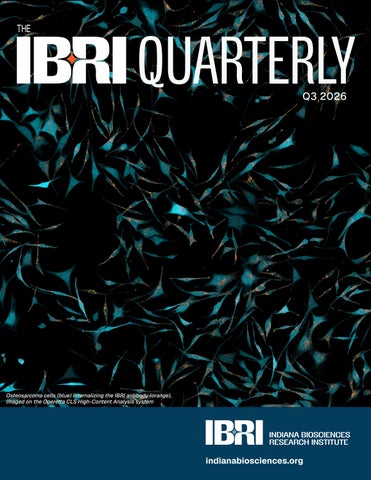
Osteosarcoma cells (blue) internalizing the IBRI antibody (orange), imaged on the Operetta CLS High-Content Analysis system
indianabiosciences.org
Q3 2026 THE
QUARTERLY
1
A MESSAGE FROM ALAN PALKOWITZ, PhD
Dear colleagues, We are pleased to share the third edition of The IBRI Quarterly. This quarter reflects the continued momentum of our long-term strategy and the significant progress being made across IBRI, both in achieving near-term scientific and business milestones and in laying the groundwork for future impact. In this issue, we celebrate the completion of the fourth year of the IBRI Internship Program. The 2026 class contributed profoundly Alan Palkowitz, PhD to the diversity of work ongoing at IBRI while gaining unique skills, President, CEO, & CSO building lasting connections with fellow interns and mentors, and Indiana Biosciences Research Institute broadening their awareness of possible career paths—growth that can only be achieved through experiential learning. The 2026 class of 30 students was selected from more than 650 applicants, and collectively, more than 100 interns have completed the program since its inception. IBRI also continues to strengthen Indiana’s emerging life sciences economy through our biotech incubator, Future Legends Lab. Currently, 16 companies are co-located in the IBRI facility. Four of those represent the largest therapeutics startups in the state by capital raise, underscoring IBRI’s importance as a key resource for supporting growing companies and retaining them in Indiana. Libris Innovations, IBRI’s venture creation subsidiary, continues to build on its early progress. We are pleased to announce a new Libris office at the Cambridge Innovation Center in Kendall Square, Cambridge, Massachusetts. This important step positions IBRI and Libris within one of the world’s leading life sciences hubs and connects Indiana’s growing life sciences ecosystem to the broader national innovation landscape. We hope you enjoy this quarterly update, and we thank our many partners and stakeholders whose continued support makes IBRI’s mission possible. Your collaboration and commitment remain essential to building a stronger future for biomedical innovation and improving lives through science. Sincerely, Alan D. Palkowitz, PhD President, CEO, & CSO Indiana Biosciences Research Institute
2
THE
QUARTERLY Q3 2026
SCIENCE
PHILANTHROPY
INVESTMENT
OCTOBER 8:00 to 10:00 AM Regristration for29, the2026 inagural EITELJORG INDIANAPOLIS IBRI Global Forum is MUSEUM, now open! The inaugural IBRI Global Forum on Science, Philanthropy, and Investment explores how collaboration across sectors can accelerate the path from breakthrough research to patient impact. Keynote speaker Dr. William G. Kaelin Jr., a recipient of the 2019 Nobel Prize in Physiology or Medicine, will be joined by other senior leaders to discuss how collaboration enables progress in translational medicine and drug development.
As a thank you to our readers, we’re offering 25 complimentary registrations to the IBRI Global Forum*. Use code 2026FORUM to claim yours. *Available on a first-come, first-served basis.
Learn more and register
�
Keynote Speaker William G. Kaelin Jr., MD Harvard Medical School Dana-Farber Cancer Institute
Q3 2026 THE
QUARTERLY
3
Advancing Metabolic Disease Research Distinct Brain Regions Behind GIPR-Based Weight Loss This quarter, IBRI’s metabolic translational research team helped explain a puzzling observation: both activating and blocking the same biological target—glucose-dependent insulinotropic polypeptide receptor (GIPR)—can enhance weight loss when paired with GLP-1-based therapies. The study, published in Nature Metabolism by a team at the University of Cambridge with key contributions from IBRI scientists Scott Dodson, Jonathan Douros, PhD, and Patrick Knerr, PhD, demonstrated that GIPR agonism (activating) and antagonism (blocking) act through different neuroanatomical pathways in mice. Investigators showed that GIP receptors in the area postrema, a brainstem region involved in appetite control, contribute to the appetitesuppressing effects of GIPR agonists. Separately, GIP receptors in the hypothalamus are critical for the additional weight loss seen when GIPR antagonists are combined with a GLP-1 drug or a similar drug that targets the amylin receptor. Together, these findings clarify the distinct roles of GIPR signaling within specific brain regions and further our understanding of the central pathways that regulate energy balance. Notably, this research was selected for presentation at the European Incretin Study Group Meeting in Porto, Portugal, providing an opportunity to share these findings with an international audience of leading experts. The presentation generated significant scientific discussion and highlighted the growing importance of understanding the tissue- and circuitspecific actions of incretin therapeutics as nextgeneration obesity treatments continue to evolve.
Dr. Douros and Dr. Knerr at the European Incretin Study Group Meeting
Beyond this study, IBRI researchers also contributed to seven additional projects presented at the Porto conference, ranging from mechanistic investigations to new drug discovery. These projects represent collaborations with scientists based in Germany, Denmark, and the UK, highlighting the global reach of IBRI research.
4
THE
QUARTERLY Q3 2026
Protecting β-Cells in Type 1 Diabetes Type 1 diabetes (T1D) is a life-threatening disease affecting more than 2.1 million people in the United States. In patients with T1D, the body’s own immune system destroys insulin-secreting pancreatic islet β-cells. IBRI researchers are working to change that outcome by learning how to protect the very cells the disease destroys. IBRI scientists and collaborators have identified novel genes, including SDF2L1, whose depletion could prevent β-cell death. In their Breakthrough T1D-funded project, Michael Kalwat, PhD (IBRI) and Erica Cai, PhD (Indiana University School of Medicine) are testing whether genetically targeting SDF2L1 will prevent β-cell death in T1D disease models. They are also exploring strategies to inhibit SDF2L1 using novel drugs. Further collaborative work between Dr. Kalwat and Travis Johnson, PhD (IBRI) is leading to high-resolution spatial maps of gene expression in the human pancreas with support from the Network for Pancreatic Organ Donors with Diabetes (nPOD) and the Helmsley Charitable Trust. By developing AI tools, IBRI scientists will use these spatial maps of the pancreas to predict new ways to protect β-cells in diabetes. Johnson’s team has recently published aspects of this approach in Bioinformatics.
Human pancreas stained for insulin (red) and DNA (blue)
Q3 2026 THE
QUARTERLY
5
Thank You, Summer 2026 Interns! In August, we celebrated the culmination of the 2026 IBRI Summer Internship Program with scientific poster sessions, final presentations, and an awards ceremony honoring this year’s cohort. Over the past few months, students from seven universities worked alongside 24 mentors across 14 focus areas, bringing fresh energy and curiosity to projects spanning IBRI’s research and operations. To our 2026 interns, thank you for all the hard work, great questions, and real contributions you brought to IBRI this summer. We can’t wait to see what you do next!
95%
of interns said they would recommend the IBRI Internship Program to a friend or fellow student. iPSC intern Ananya Ramanujapuram presents her research at the 2026 Inten Poster Presentations As our summer cohort wraps up, we’re also excited to welcome three interns to IBRI this fall. Welcome, Fall 2026 Interns! As our summer cohort wraps up, we’re also excited to welcome three interns to IBRI this fall.
6
THE
Hadley Hawkins
Sebastian Grammas
Macy Paton
Legal
Artificial Intelligence
University of Iowa
Rensselaer Polytechnic Institute
Philanthropy & Communications
QUARTERLY Q3 2026
Purdue University Global
IBRI on the National Stage Testimony Before the United States Senate In August, IBRI President, CEO, and CSO Alan Palkowitz, PhD, testified before the United States Senate Committee on Finance Subcommittee on Health Care, joining witnesses from the National Security Commission on Emerging Biotechnology, Dartmouth Health, and Boston University’s CARB-X program to discuss strengthening the nation’s biotechnology ecosystem.
Watch the hearing
OncoDaily Feature Around the same time, OncoDaily, an oncology-focused news platform, sat down with Dr. Palkowitz for an in-depth interview on IBRI’s translational research model, its growing work in pediatric cancer, and the philosophy behind the upcoming IBRI Global Forum on Science, Philanthropy, and Investment.
Alan Palkowitz, PhD at the US Senate
Read the full interview
First Major Disclosure from the ITCC-P4 Platform The Innovative Therapies for Children with Cancer Pediatric Preclinical Proof-of-Concept Platform (ITCC-P4) published the first major disclosure from its pediatric cancer drug-testing platform. IBRI’s own Lou Stancato, PhD, Vice President of Enabling Technologies and Leader of the Pediatric Rare Disease Platform, co-led the consortium—first at Eli Lilly and Company and now at IBRI—and currently chairs its Scientific Advisory Board. The platform has built 353 molecularly characterized patientderived xenograft (PDX) models covering nearly every high-risk pediatric cancer type, including neuroblastoma, sarcomas, and brain tumors. Grown directly from patients’ tumor tissue rather than standard lab cell lines, these models give researchers a more realistic way to predict how a drug will perform.
Read the publication
Q3 2026 THE
QUARTERLY
7
Publication in Science Advances A new publication in Science Advances reveals how Coxsackievirus B (CVB), a virus linked to type 1 diabetes, evades the immune system in the gut, where it first enters the body. The study, co-authored by Read the IBRI’s Roberto Mallone, MD, PhD, and Sylvaine You, PhD—INSERM publication investigators who also lead a satellite lab at IBRI—found that CVB dodges detection from CD8+ killer T cells while still triggering lasting CD4+ helper T-cell responses. This offers insight into how the virus may set the stage for type 1 diabetes, and points toward gut-targeted vaccine strategies.
Libris Innovations Expands Libris Innovations and IBRI have announced the opening of new offices in Cambridge Innovation Center in Kendall Square, Massachusetts, one of the world’s most active life sciences hubs. “This is about bringing Indiana innovation to a global network while attracting new talent, capital, and partnerships back to Indiana’s growing life sciences ecosystem,” said Ramani Varanasi, CEO of Libris Innovations. Libris also welcomed four new team members this quarter: •
Chris Pacheco, PhD — Venture Partner
•
Brian Albrecht, PhD — Operating Partner
•
Heer Joisher, PhD — Venture Associate
•
Vanita Goyal — Executive Administrator
Cambridge Innovation Center in Kendall Square
IBRI at AAIC London At the Alzheimer’s Association International Conference in London, postdoctoral fellow Mackenzie Rysted, PhD, presented IBRI/IU School of Medicine research on how diet-induced obesity, weight loss, and GLP-1 receptor signaling may influence Alzheimer’s disease biology. The team found sex-dependent metabolic differences, including better glucose control and obesity resistance in female mice, pointing to new ways incretin-based approaches may modify disease pathology.
8
THE
QUARTERLY Q3 2026
Mackenzie Rysted, PhD presents at AAIC 2026
IBRI Member Spotlight: Syndeio Biosciences About Syndeio Syndeio Biosciences launched in 2025 through the combination of Boost Neuroscience and Gate Neurosciences. The company pairs Nobel Prizewinning synapse science from the laboratory of cofounder Dr. Thomas Südhof with a clinical-stage pipeline focused on restoring synaptic function. The team is advancing a new generation of synapse therapeutics for major depressive disorder, Alzheimer’s disease, and other diseases of synaptic dysfunction (synaptopathies). Syndeio, which has grown to approximately 40 employees, has raised more than $130 million from a leading biotechnology investor syndicate including Innoviva, Catalio Capital Management, Tenmile, Palo Santo, BioCrossroads, Luson Bioventures, and others.
2026 Milestones •
Two Phase 2b studies of Syndeio’s lead program, zelquistinel, in major depressive disorder are now enrolling across approximately 50 US sites.
•
Syndeio received FDA clearance for a Phase 1b study of zelquistinel in early Alzheimer’s disease, starting October 2026. It is the first multimodal biomarker study of synapse restoration in Alzheimer’s patients and is run in collaboration with the Alzheimer’s biomarker group at the Stark Neuroscience Research Center at Indiana University School of Medicine, with Dr. Jared Brosch and Dr. Jeff Dage leading the collaboration.
•
Syndeio discovered what it believes are the industry’s first de novo small-molecule synapse adhesion modulators, building directly on biology discovered in Dr. Südhof’s lab.
•
The company established its proprietary Boost Platform™, believed to be the first clinical translation and biomarker platform built to determine whether a therapy is engaging and restoring synaptic networks in humans. A key paper related to this platform was published in Journal of Psychopharmacology in July. “2026 has been an important year for Syndeio as we move from establishing the company and its scientific foundation to demonstrating what a dedicated synapse therapeutics platform can become. Our goal is to translate decades of extraordinary progress in synapse biology into therapies that meaningfully restore brain function for patients, and we are proud to be doing that work in Indiana.” - Derek Small, Co-Founder & CEO
Q3 2026 THE
QUARTERLY
9
IBRI in the Community IBRI team members continue to give back to our community and make an impact across the life sciences ecosystem. •
Staff and interns volunteered with Gleaners Food Bank of Indiana, IndyHumane, and the Indianapolis Cultural Trail as part of our annual Day of Service.
•
IBRI Board Chair Dan Evans was named one of Indianapolis Business Journal’s 2026 Nonprofit Board Members of the Year.
•
IBRI President, CEO, and CSO Alan Palkowitz, PhD, was named a 2026 Indiana 250 honoree in the Life Sciences & Health Care category.
Dan Evans, IBRI Board Chair
Follow IBRI on LinkedIn for more updates
Volunteering at Gleaners Food Bank
IBRI & IEDC Launch New Business Development Role IBRI and the Indiana Economic Development Corporation (IEDC) have partnered to create a new Senior Director, Business Development role, filled by Lisa Davis. Grantfunded, the position connects Indiana life sciences startups with strategically aligned investors to fuel the state’s growing biotech ecosystem. Interested in investing in Indiana life sciences? Connect with Lisa at ldavis@indianabiosciences.org
10
THE
QUARTERLY Q3 2026
Lisa Davis Senior Director, Business Development
Brain assembloid generated from iPSC-derived neurons, astrocytes, and microglia
Fueling Discovery Through Philanthropy IBRI’s foundation is rooted in the generosity of philanthropists, whose support fuels every discovery we make. Philanthropic contributions not only accelerate the pursuit of cures and empower our scientists but also drive meaningful impact for individuals and families affected by disease.
“Without donor generosity, our scientists could not pursue bold ideas. Philanthropy makes the impossible possible.” - Alan Palkowitz, PhD President, CEO, & CSO Indiana Biosciences Research Institute
Q3 2026 THE
QUARTERLY
11
Stay connected with IBRI Visit our website
1210 Waterway Blvd., Ste 2000 Indianapolis, IN 46202
indianabiosciences.org