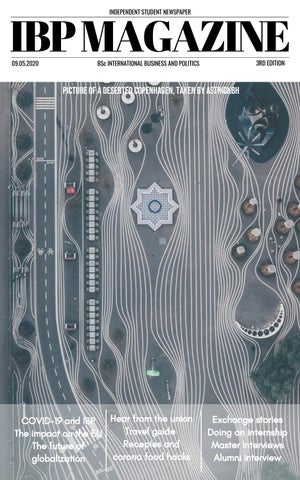
IBP MAGAZINE INDEPENDENT STUDENT NEWSPAPER
09.05.2020
3RD EDITION
BSc INTERNATIONAL BUSINESS AND POLITICS
Picture of a deserted Copenhagen, taken by AstridKBH
Hear from the union COVID-19 and IBP Travel guide The impact on the EU Recepies and The future of corona food hacks globalization
Exchange stories Doing an internship Master Interviews Alumni interview
in this issue
IN THIS ISSUE EVERYTHING IBP 5 IBP of the issue 7 Keeping up with the Union 10 Eddies letter 13 Creative writing 14 Proffessor notes
IBP AROUND THE WORLD
16 Exchange interview 20 Guide to Düsseldorf 22 Internship in Brussels
MASTER & ALUMNI SECTION 24 Master inverview 27 Alumni interview
SOCIAL SECTION 31 Introducing: IBP Book Club 35 Recepies from IBPs 39 Crossword
IBP OF THE ISSUE MEET BENEDICTE
ON THE PANDEMIC
Hear from several contributors about their view of COVID-19 and its impact. Ranging from the programme director Eddie to a first year student, we cover some opinions about the current situtation. Moreover, we get to hear from two prominent CBS professors about the impact on the EU, as well as some predicitons concerning the future of our globalized world.
in this issue
EXCHANGE Dream yourself away to distant corners of the world by reading about some IBP students exchange semester. We cant promise that this one will make your home isolation feel any better!
MASTER INTERVIEWS ALUMNI INTERVIEWS INTRODUCING THE IBP BOOK CLUB
Welcome to the IBP Book Club, where book reviews are offered by your peers. We hope that it brings inspiration to a good read outside the curriculum.
and much more
editors letter
Dear reader, Who could have imagined the grim reality which would be facing us in this semester? Due to the Corona Virus crisis our lives have changed in ways most of us did not anticipate just months ago. At the beginning of the year we were still dealing with more trivial problems and minor annoyances from today's perspective, but now we must think seriously about more essential issues such as our health and our livelihood. Since campus is closed and our classes have been moved from lecture halls to online platforms, the narrow IBP community seems to have dissolved: Contacts on a personal level are limited, public events have been canceled and many foreign students have returned to their home countries. With the third edition of our IBP Magazine we want to react to this environment by presenting ideas of
how to get along with the almost inevitable boredom during the ongoing lockdown: Amongst a bunch of other interesting topics, we give you recommendations and brain teasers and reveal recipes for quiet hours. Further, we want to spice up the IBP community spirit by sharing the stories of an alumni and a master's student with you as well as showing positive future perspectives by giving you an overview of various options for exchange semesters. On a subject-specific level, two of our professors give us ideas to think about how the world will develop further due to the Corona Virus. We are all looking forward to seeing you again and hope that until then this magazine will promote our cohesion a little bit. With that in mind, we hope that you all take good care and will enjoy reading this issue. See you soon!
Best, the communications team
4
EVERYTHING IBP
IBP OF THE ISSUE MEET BENEDICTE Benedicte von Wildenrath Løvgreen is a second year BSc IBP student from Denmark. She is one of the founding members as well as the co-president of CBS Startup Hub. Apart from this, Benedicte is a Junior Consultant at Valcon. What is the story behind CBS Start-up hub? When I started at CBS and walked through the first student society day at SP, I wondered why there was no organisation emphasising entrepreneurship. So, after the first semester, my sister and I sat down and initially agreed upon starting a student organization
together that should focus on entrepreneurship. We both identified a lack of the more unusual and cool creating-a-startup-in-a-basement stories at CBS, as it is more likely to find events with successful CEOs as speakers who often have had somewhat similar career paths. By creating an organization that facilitated the talks and events with the odd startup stories, we believed we could inspire many students to become an entrepreneur one day. We founded the organization a bit over one year ago and we are now 11 people on the administrative team behind it.
"It is more likely to find events with successful CEOs than the more unusual creating-a-start up-in-the-basement stories" What is CBS Startup Hub’s mission? Our mission is to inspire as many students at CBS as possible. Not only those who already dream of becoming an entrepreneur but also those who don’t consider it a career path. We host events with inspiring key figures from the startup environment
5
EVERYTHING IBP that come and give a talk about their startup experiences and their ups and downs. We want to show CBS’ students that navigating the “ups” are just as important and likely as the “downs”. So far, we have had events with Lennart Lajboschitz (Flying Tiger), Ken Klausen (Lunar), Heini Zachariassen (Vivino) and Henrik Isaksen (GreenMobility). We have a lot of exciting potential collaborations in the pipeline, so we might also host some more applicable workshops in the future for student entrepreneurs or even host a Shark Tank/Løvens Hule night.
We want to show CBS’ students that navigating the “ups” are just as important and likely as the “downs”. Can you tell us about your student job at Valcon Management Consultants? I really enjoy working at Valcon as I love how “flat” the structure of the company is. One year ago, Valcon initiated an ambition to become the happiest company in the world, meaning that us employees have been surveyed by the Happiness Research Lab on a regular basis. It may sound cheesy, but I really think it’s such a cool goal for nearly every business to have, instead of measuring success only through EBIT and other economic indicators, as employer happiness might increase economic performance as well. It is a really exciting project to be a part of and to follow closely while working there. Is there a general interest that ties together all the things you do? Throughout my studies I have developed a big passion for tech. Even though the digital aspect of tech really has triggered my interest, I find the politics of big tech so fascinating as well. I try to keep myself up to date with recent tech innovation, so when biking around in Copenhagen, I often listen to audio books about tech innovation or author’s takes on how our everyday looks in 50 years’ time. I find that so interesting.
6
What are your plans for the fifth semester? Next semester, I am going to take a “Project Management Internship” with Amazon at their EMEA headquarter in Luxembourg (“hopefully” I want to say with this pandemic putting everything at risk). So right now, I am just crossing my fingers, like many of my fellow students, for being able to go abroad and take the internship. I am really looking forward to work in a big tech company like Amazon that has enormous impact on a global level. I enjoy being a part of a busy working environment, so I am positive that it will be learning a lot next semester. When you were young, what did you think you would be doing at this age? When I was young, I wanted to become a midwife just like my mother is. So, I guess I thought I would be studying to become a midwife by now. In my teenage years I actually thought for a long period of time that I wanted to study law, which I suddenly turned away from before choosing IBP. Nevertheless, I am beyond happy for where I am and what I am doing right now. What is year dream scenario for the next ten years? Given my interest right now, I would love to work within the field of tech. I don’t know specifically what I want to work with yet but hope it will be somehow be related tech, business and politics. Also, in ten years’ time I hope to have worked or studied a bit more abroad.
Lastly, if you could give one good advice for people considering applying for IBP, what would it be? IBP is such a broad and interdisciplinary programme meaning that you professionally can work with so many things after you graduate. So my advice would of course be “just do it”.
EVERYTHING IBP
Keeping up with
THE IBP UNION
PRESIDENT NATALIA BECH
Why run for President? It started as a curiousity about how an organization of volunteers could be so efficient and well structured. Quickly I realized how many hours and people stood behind, where Cirkelines role seemed like the glue. I hoped to be as inspiring and to create as much value for my fellow students as I saw she and the rest of the board did. What do you want to change in the Union? I want to bring more progressiveness and creativity to our projects and events. Our study program holds such a diversity of ideas and thinking, something which I hope to be able to use to inspire one another and further brighten and challenge ourselves.
What has been your favorite moment in the IBP Union so far? I must confess, I love sneak-peaking and listening to all the creative heads working together when sharing ideas on events or collaborations. All members of the Union are remarkably committed to their group and put a lot of effort, energy and heart in everything they do. Almost every student of IBP is involved in some way or another in the Union, which I think differentiate us from other student organizations. It’s like a family!
Why run for Vice President? Put briefly, I decided to run since the first semester at IBP completely blew me away. I love the people here and I am continuously both impressed and inspired by my co-students. The Union empowers all the things I love about IBP, a position as VP was my chance to give something back. Biggest challenges so far? Natalia is a big challenge for sure. She has A LOT of bad ideas, that I just need to shoot down. Corona, preventing us from doing any actual work, comes in at clear 2nd place though.
VICE PRESIDENT JAKOB MOLLERUP
Imagine you had an unlimited budget: What would you do? Sounds cheesy, but for sure an IBP Festival. With corona paralyzing all of our plans, imagine filling one week with plain-out full-on IBP events. I’m talking Gala Monday, Polar Swim (!) Tuesday, Spring-Dinner Wednesday, Nexus Thursday (of course) and then, most importantly a cabin trip from Friday to Sunday.
7
EVERYTHING IBP
HEAD OF ACADEMIC CAROLINE BESSERMAN
What do you want to change in IBP Academic? I will like to widen our horizon through the collaborations we do with companies, institutions and organizations. Who we invite to talk should be able to inspire and enlighten about a variety of topics so all IBP student can be able to reflect some of their interest in our events. Imagine you had an unlimited budget: What would you do? Under those circumstances I would post-corona invite all students on a free extended study trip and plan to go on a several destination trip to an array of places – I think that could be quite lovely.
What do you want to change in IBP Social? The Society already runs extremely well so I do not want change anything. S/O to my boy Carl btw. However, I wish to add things to our work. Social Society will begin to setup events with other study programs for everyone to expand their network and in order for us to have an even better social environment on CBS.
HEAD OF SOCIAL MAGNUS MAILAND
Imagine you had an unlimited budget: What would you do? Secret open-air party in the forest. So, everyone’s at their pre parties getting super fucking lit, but yet not knowing where to go exactly. The location has to be kept secret until a certain point because otherwise the authorities could prevent us from arranging la fiesta. At one point during the pre-drinks, a GPS location is published, and everyone rushes, and I said RUUUUUUSHES, to the location. Navigating towards the party, the music gets louder, and you know you’re on the right track. You stumble across Karl-Emil throwing up by a tree, so this must be right. You are suddenly met with colorful lights, Mollerup as DJ, and a large crowd getting fucked up and dancing – in the middle of a beautiful forest. No drugs tho. .
HEAD OF COMMUNICATIONS JAN SPANHOLTZ
Imagine you had an unlimited budget: What would you do? I would probably make an attempt to rent the Copenhagen Opera House for a huge IBP networking event / symposium. Following the example of a Ted Talk, current IBP students as well as IBP graduates and prominent guest speakers from different backgrounds and professions would be invited. The goal would be to create connections across all generations of IBP and to share thoughts on various topics relating to business, politics and philosophy.
8
TREASURER KIA KHATIBI Favorite moment as a Treasurer so far? Well, our first meeting was cancelled due to Covid-19 and I haven’t been fully enrolled as Treasurer yet, so I don’t really have any favorite moments. But I do thoroughly enjoy drinking my morning coffee from an IBP Union mug.
COVID-19 AND IBP
The consequences of the COVID-19 pandemic prove to be severe and will likely reshape society in lasting ways. In this context, we have gathered some comments and opinions about the current situation. In the following pages, you can read about Eddies view on the pandemic, as well as a students humourous take on it. Further, two of our IBP professors have contributed with their comments concerning the impact of the Corona Virus crisis from the point of view of their field of study.
PROGRAMME DIRECTOR
PANDEMIC PONDERING As I write this, Denmark has had a ”good” crisis. Admissions to hospital and the mortality rate have been relatively low. The Danish government has secured praise from across the spectrum for its speedy and decisive response at the outset. Certainly, there is a striking contrast between Denmark and events in my home country, the UK, where a delay in introducing measures appears to have contributed to high rates of infection. The challenge of a “good” crisis is that it fuels a belief that things will return to normal relatively quickly. There was certainly little sign of a lockdown in Frederiksberg Have at the weekend. And students have been talking optimistically about graduation ceremonies in June, long summer holidays overseas, and a return to normality at CBS or an exchange university in the Autumn. I would like to be proved wrong but this seems unlikely.
10
Viruses stick around, come in waves, and mutate. I would recommend Laura Spinney’s book, 'Pale Rider: The Spanish Flu of 1918 and How It Changed the World'. It brilliantly charts the “Spanish” flu epidemic at the end of the First World War which despite “social distancing” measures in many cities killed far more than the war itself. It came in three waves of which the second was the most deadly. And, although the pandemic took place many decades before the word “globalization” was invented it quickly spread across continents and region hitting those in poverty most severely. You can find a US timeline at https://www.cdc.gov/flu/ pandemic-resources/1918commemoration/pandemic -timeline-1918.htm
PROFESORS PAGE
What does this mean for us? The pandemic will be with us for a while. “Social distancing” and face masks will probably become the new normal for a year or two. Biking and walking might well be the best ways to get around. There will be travel restrictions limiting our holidays and more importantly curtailing the movement of foreign students. Heaving, crowded bars (my favourite in Charlie’s on Pilestræde which is always particularly crowded) will lose their appeal or remain closed. And I won’t be shaking anyone’s hand for a long time to come.
'We may have to rethink the character of classes' In higher education, we may have to rethink the character of classes and the physical architecture within the buildings. Arguably, lectures requiring large numbers to be squeezed into tiered lecture theatres will have to be abandoned. Now these things have gone online they may need to stay online. Perhaps only exercise classes will continue in their traditional form.
PROGRAMME DIRECTOR
Let’s return to the 1918 – 1919 pandemic. There is an upside (but then a downside a bit later on) to the story. Once the final wave had passed, and despite the countless deaths, it was quickly forgotten. It is after all just a footnote in studies of the period. Although there were personal losses the social and economic fallout was limited. The early 1920s were marked by intense social and political conflicts but there was growing prosperity in at least some countries. In the US it was the jazz age. Electricity and spin-off such as radio became widespread. On the back of this stock prices rose, rose, and rose again. So much so that in 1929 Irving Fisher announced that "stock prices have reached what looks like a permanently high plateau”.
'History has a way of punishing those who make pronouncements like that.'
EDWARD ASHBEE
11
STUDY BOARD
Subject: A message from the study board Hi Team! Truly an odd period we are going through. From the study board, I want to thank each and every one of you for your adaptability and patience while we all try to figure out how to keep the program as strong as possible. On the study board, the pandemic has naturally raised hundreds of questions and fires to be put out. Digitization has been a hot topic for a long time; and now, its relevance could not be clearer. We have already been discussing chief examples when it comes to bringing digitizing into our education. Now, the ideas are forced into practice. This also means that your constructive feedback on the different approaches to distant and digitized education becomes extremely valuable. Do you have any thoughts on your current form of education? Do you have a fantastic professor? Then tell your course representatives and tell us – such that these ideas and approaches can be spread across the program and not just within a single course. Thank you to everyone who participates from a distance and for the feedback we have already received. This situation is unique, however it should not prevent us from keeping the IBP spirit alive. Best, Line, Vice Chair of the IBP Study Board
to do: - put on pants - buy toiletpaper
12
CREATIVE WRITING
LEAKED SILVERMAN BACHS REPORT
Dear investors, I’d like to put this bluntly, we are fucked and we fear that your assets (totaling around $2.2 Billion) may drop at least 50% in value. See after 2008, we decided to do the exact same thing that led us into the financial crisis post-bailouts, which was giving out toxic loans with very little verification and creating a derivative to sell to some other assholes on Wall Street. Now, I want to reiterate this was a good plan simply because when the next financial crisis would hit (Our analysts said it would be 2021) we could blame low-income individuals, immigrants, left-wing individuals, and all those people and get big bailouts from the government. However, this virus has not only screwed the lower-class over (aka“temporarily embarrassed millionaires”) it has completely screwed us over and has created a culture where our usual tactics will not work. I’ll explain, apart from the obvious stop of commerce you may all know that many things have changed over the last 12 years. Firstly, Senator Bernie Sanders decided to wage a campaign against us on Wall Street and decided to do one of the most ridiculous things I’ve ever seen and advocated for working class individuals instead of us. Secondly, while we thought
Donald Trump’s presidency signaled some stability and growth for the market since he quite simply told us he’d let us do “whatever the fuck we want as long as we supported him”, the public is quite anti-Trump apart from the general trailer trash which never really supported us in the first place. Thirdly, since we have too many toxic assets and loans in place, people will start defaulting on the loans and even if we do take everything they own, no one will buy any of their shit because no one has a job anymore. We also can’t sue people anymore because the Courts aren’t open and the optics of major hedge funds and banks suing “everyday Americans” might cost us some of our share values. Now, you may ask why the stimulus isn't keeping us afloat. The small business loans that we’ve been taking will in no way cover the asset loss we are facing. We’ve already furloughed and fired around 2000 workers and have denied them severance in order to finance purchases of new assets in case the market turns around. But currently, we feel as if our firm might go the way of Lehman Brothers if the changes aren’t very soon. The analysts share my doubt on an incoming bailout of our firm due to the change in political culture. We can thank Sanders for putting his own lust for power over everyday American such as you and me. We are currently trying to pursue plan C, where we are rallying state governors to open the economy. Some feel as if this will prolong the pandemic and lead to an excess of 250,000 deaths, but this is a necessity to preserve our financial standings. As such, we’d like your support in lobbying and use your connections to follow this through. Sincerely, John Krepshaw, CEO of Silverman Bachs
AUTHOR: SHAUNAK SARKER, 1ST YEAR IBP
This is a piece of satire written to make fun of the behavior that Wall Street enables. As such, this piece is completely fictitious and any resemblance to anyone living or dead is purely coincidental.
13
PROFESSORS NOTE
Incoming: Onshoring, regionalization, deglobalization The coronavirus highlighted absurd levels of societal vulnerability to the combination between just in time production of medical sector supplies and global supply chains that were highly concentrated across a handful of Asian countries. No one in their right mind will come out of this crisis thinking that just in time deliveries of protection equipment, ventilators and testing kits for pandemic situations is the way to go. One either has Cold War style stockpiles of these, as Finland had, or, alternatively one develops a national capacity to manufacture them locally, as did Germany or South Korea. The situation of the extensively deindustrialized US with its New York doctors clothed in garbage bags and its special forces snapping planes of critical supplies in China destined to their European allies is almost a caricature of this state of affairs in what is supposedly the global superpower that had pushed for this fragile health supply system in the first place. At the same time, this situation should not be an invitation to economic nationalism across the board. The protectionist barriers that would follow would be a disaster for both emerging markets as well as for rich open economies like Denmark.
hear more @cornelban73
14
Indeed, if anything, the crisis highlights the lack of international research and economic cooperation in an area that is the most urgent right now: an anti COVID 19 vaccine. If the world is to survive future pandemics and the predictable health disasters that will accompany the climate chaos, will need to walk a fine balance between anti-fragile national capacities as well as international cooperation on big ticket crisis-fighting items such as vaccines.
about the author Cornel Ban is an associate professor of IPE at the Department of Organization His most recent book (Ruling Ideas: How Neoliberalism Goes Local, Oxford University Press, 2018) received the political economy award for 2017 of the British International Studies Association.
PROFESSORS NOTE
The corona virus in the EU: Increasing divides between core and periphery The impact of the corona virus on the European Union should be seen in the context of the divides that surfaced with asymmetrical impact of the 2008 financial crisis. During the financial crisis, a difference between the ‘core’ – led by Germany – and the ‘periphery’ – including southern Europe, emerged. EMU governance criteria was strengthened, under the leadership of Germany, entailing tightened surveillance of member state public budgets and more focus on reducing (high) public debt. The measures were designed to prevent future financial crises, especially in the countries worse hit by the crisis, notably Italy and Spain. Yet, these countries, that have to a degree regained control of yearly public budgets, have a higher public debt in 2019, compared to 2009. In Italy, the public debt was 117% of GDP in 2009, which has increased to 135% in 2019, while Spain’s public debt was 53% of GDP in 2009, and has increased substantially to 96% of GDP. Italy, Spain and other countries, including France, have argued for mutualisation of debt, notably in the form of Eurobonds. Yet, other countries, under the lead of Germany,
are not willing to comprise on debt, enhancing tensions with the countries that have high debt. The EU leaders have agreed on being flexible on budgetary rules in the short-term, but it will worsen the problem of accumulated debt, which remains a major challenge in countries, such as Italy and Spain. It could contribute to rolling back the strengthened EMU regime following the 2008 financial crisis, leaving questions about the future of EMU governance open. The EMU finance ministers agreed - instead of Eurobonds - that countries could take loans, through the European Stability Mechanism, if required. Other emergency measures have also been developed, especially for supporting the health care sectors in tackling the corona virus. Yet, in countries that have high levels of accumulated debt, and are now in deep financial difficulty, due to the corona virus, public opinion is increasingly skeptical about the EU, and feel there is a lack of solidarity from the EU and other member states. Thus, due to the corona virus, the difference between core and periphery not only persists, but is enhanced.
about the author
Caroline de la Porte is a professor with special responsibility at the Department of International Economics, Government and Business, Copenhagen Business School. She is a leading scholar on EU governance and public policy.
15
EXCHANGE INTERVIEWS
THE FREEMOVER FREDERIK HYLDGAARD THOMSEN
My stay at Columbia University, New York, USA Courses
> War, Peace & Strategy > Inside the Security Council: Inequality at work > Middle East Conflicts and Global Security > Global Emerging Markets
How was the study environment at your exchange university compared to CBS? Columbia was intense. Not to say anything bad about CBS, but it was completely different. Courses had an average syllabus of 1500 pages for 7,5-10 ECTS and except for one course, all teaching was in seminars or discussion groups of 10-25 people with a single professor, who was truly an expert in the course. I think an example best elaborates this: In my Middle East course, we all submitted questions to the assigned reading the night before class which would then be the basis for discussion in class. Our professor (who was part of the Backchannel negotiations of the Oslo Accords) spent about 20 minutes giving some background information to the conflicts we covered and then guided the discussions for two hours. Discussions get quite interesting when one of your classmates works part-time in the office of the UN High-Commissioner for Refugees, and another classmate was an officer in the Israeli Navy for about 10+ years.
Why did you choose to be a freemover? I started looking at the exchange agreements CBS had, but I didn’t find a perfect fit with my GPA, the university, and the city all matching what I wanted. Then I went with CBSMUN to New York, and visited the Columbia Campus, and I was sold. How did you manage to take care of all the practicalities yourself? I didn’t find it overwhelming or particularly hard. I had quite some help for the application from EDU-Denmark, who acts on behalf of many universities around the world. They were very helpful. And then for bureaucratic matters Danish Students Abroad (DSA) was a massive help. What was the greatest experience during your stay? Academically, it was to experience the crazy resources those top-tier universities have. In my UN course, my professor had worked with the UN on-and-off since the 1970s, with his last posting being as Special Advisor to the Secretary-General, Ban Ki-Moon. Due to his profile we had one of our classes at the Finnish Mission to the UN meeting 5 different Ambassadors to the UN Security Council for an informal Q&A about the work of the SC. Socially, it was when 10 of us students rented two cars and an AirBnB in the Catskill Mountains, upstate New York, and we spend a long weekend walking in the mountains and just forgetting about courses, readings and assignments for a weekend.
What is your best advice for future IBP freemovers? Do it! Yes, CBS has some great exchange agreements, but if your dream university/exchange semester isn’t there, then look outside those confines. There is plenty of help to get from organizations such as EDU, NSAC, and DSA, and in the end it is all worth it. Start early, dream big, and go do it!
16
EXCHANGE INTERVIEWS
Sunset in New York My UN course
Thanksgiving
The infamous friends building
Speech by president of Georgia
Katskill Waterfall
On campus
17
EXCHANGE INTERVIEWS
EXCHANGE FREDERIK S. OHRT
My stay at Istanbul Bilgi University in Istanbul, Turkey Courses Why did you choose Istanbul as your destination? First of all, what it offered in terms of experiences were to me extremely appealing. The fact that you have a broad variety of cultures and religions makes the city a vibrant place to visit. Further, the food scene, bars, football derbies and other types of cultural institutions ensured the absence of boredom. How was the study environment at your exchange university compared to CBS? The study environment is socially comparable to that of CBS which I found amusing. However, when it comes to the student engagement in class, my experience was that the Turkish students, to a much larger extent, practiced a laissez-faire approach. Being a private university, Bilgi University has a combination of extremely bright students who are given scholarships to study there, and unfortunately, also students who pay the school fees themselves and thus have fewer academic merits.
18
Among other courses, Frederik studied Turkish Foreign Policy and Culture and Politics in Modern Turkey
What was particularly interesting about the political courses you took in Istanbul? In the very first class of Turkish Foreign Policy we discussed country goals, where I rather naively pointed towards Danish goals of low employment and an inflation rate around two percent. To that the professor, with a smile on his face, answered that those goals are universal for many countries. Following this, the professor asked the Turkish students what goals Turkey has. A brave student yelled from the back that the goal of Turkey is to increase the personal wealth of President Erdogan. I was fascinated by this statement, as I had spent some time considering and studying the freedom of speech in Turkey when it comes to the topic of the current regime. So, what was my experience of restrictions when studying Turkish politics? The student was cut off by the professor, who calmly expressed that it was a personal goal – not a national goal. The actions of the current regime were actually debated frequently in the course Turkish Foreign Policy, as Turkish troops entered northern Syria two weeks after my arrival in Turkey. Furthermore, the Turkish position against the European Union was discussed. Domestic politics and actions by the current government was however not part of the syllabus. A reason for this is that current political affairs in Turkey are not researched in the
EXCHANGE INTERVIEWS
same manner as we know from Danish and European politics. With this being said, both professors in my political courses made cocky references to current days politics when going over rather absurd historical events in Turkey. It was obvious that the professors at Bilgi University supported the opposition, which actually did allow for critical discussions of political actions, at least to some extent. The content of both of these courses, and not least practices of the government, therefore made it a necessity for the students to read between the lines. Being curious, attending these political courses was actually fun and as time went by students also increased the intensity of their critical questions. Discussing current political issues is however a grey area, as Turkish political practices have from the secession of the Ottoman Empire been radical and often absurd. Consequently, going on exchange in Turkey and studying Turkish politics at a private university will broaden your horizon, it will surprise you, and it will make you appreciate living in Denmark.
How did you spend your time while you were abroad? Istanbul offers endless opportunities and you will get far with a Danish budget. I dined out about six days a week, in the company of other exchange students. The many different bars and cafes tempted me to go have a beer more often than what seemed healthy. This was also a great way to interact with the Turkish youth, who was interested in other cultures and were happy to talk about Turkish culture and not least Turkish politics. I was surprised to talk to many young students who considered migrating out of the country and settling elsewhere. The primary reason for such considerations was the fact that they felt suppressed by the government. What was the greatest experience during your stay? I must say that the inhabitants of Istanbul know how to support their local football teams. Istanbul has the country’s top three football teams. Local derbies, therefore shut down parts of the city, and the upcoming game is on everyone’s lips. I had the pleasure of attending a derby between Besiktas and Galatasaray, which was beyond insane.
What is your best advice for future IBP exchange students? Try going somewhere on your exchange, you wouldn’t otherwise settle. By choosing Istanbul I gained everything from cultural insights, political insights of a different regime than what I come from, low costs of living and not least an incredible city of endless possibilities.
19
Travel guide
In this issue, Marcus Broman, a 2nd year bachelor, introduces his hometown Dusseldorf in an interview with us. Originally from Finland, Marcus has lived in Dusseldorf for 12 years before eventually moving to Copenhagen. Come along!
When to go I recommend going to Dusseldorf in spring, since you do not want to miss the Carnival season. Carnival is a great event and lasts up to 5 days. There are parades as well as festivities across the city and everyone dresses up for it. If you are not really interested in that, then I recommend you go to Dusseldorf in late summer. While temperatures in Copenhagen are already starting to drop at that time of year, the weather in Germany is just right.
where to stay
In an Airbnb in either the city center or in Flingern, which is a part of Dusseldorf that is located northeast of the city center. Flingern is pretty much the Nørrebro of Dusseldorf and there are lots of good bars as well as restaurants.
How to get there Take a plane! This may not exactly help the environment, but it is the cheapest and fastest way to get there. A plane ticket to Dusseldorf usually does not cost more than 20 – 60 ₏ and you are there within 2 or 3 hours.
20
Travel guide Best restaurant for a good meal I used to work as a bartender in a bar/restaurant called Beethoven, which serves really good local food. Located in Flingern, the place is only 10 minutes away from the city center.
Best club or bar Aside from Beethoven, I strongly recommend Bar Cheri. It is a cozy wine bar, which is neither too expensive nor too hectic. Other good places are located around the famous street BolkersstraĂ&#x;e, which is basically the Gothersgade of Dusseldorf. There you will be likely able to get Altbier, the typical Dusseldorf beer. It tastes amazing and is probably one of the most consumed alcoholic beverages in the city.
best museum
DĂźsseldorf has a large art scene and there are always different exhibitions in the city. I suggest you visit the Kunstpalast or K20 museums.
other cool tips
ZAKK is a socio-cultural center in Dusseldorf, which organizes hundreds of events per year. The event program is composed of different topics, such as art, music and literature. In addition, it is definitely worth watching a football game of the Dusseldorf home team and you may also want to consider going on top of the Rhine Tower to get a good view of the city and its surroundings.
good to know
If you are having an Altbier in one of the many bars in Dusseldorf, then your glass will be refilled until you cover it with a coaster.
favourite sunday activity I like hanging out with friends close to the river Rhine. We often have our own barbecue there or just go for a beer in one of the nearby bars.
21
INTERNSHIP INTERVIEW
LOUISE THEILADE THOMSEN
INTERNSHIP AS EU POLICY ASSISTANT AT DANISH SHIPPING IN BRUSSELS Why did you choose to do an internship on your 5th semester? I wanted to use some of the skills and knowledge, I have obtained during the IBP program in practice and I wanted a break from studying and instead try to be part of an office fulltime. I chose Danish Shipping as the organisation works with how business and politics influence each other. I also wanted to learn more about the EU. Even though I thought I knew quite a lot about the EU, you learn so much more when working with it directly, and you get a totally different and much better understanding of how thinks actually work in practice. It was a great opportunity to learn more about political representation of interests, and I really think shipping is an interesting industry as Denmark is a very large shipping nation, and it is one of most global industries in the world perfect for an IBP-student. What were your tasks as an interning EU Policy Assistant? Danish Shipping is an interest organisation representing the interests of vessels flying the Danish flag. The Brussels office handles the interests of Danish shipping in relation to the EU institutions. My tasks included making political analyses, political communication, follow meetings in the EU institutions and making news monitoring.
22
What does a typical day in Brussels look like? I normally work from 9 AM to 5 PM. I mostly work from the office, but every 2-3 days I have activities outside the office, which can be e.g. covering committee meetings in the parliament, attending conferences or participating in meetings in other organisations Danish Shipping is a member of. After work I would return to the dormitory where we would eat together and often play a board game or watch a movie after dinner. What was the greatest experience during your stay? Workwise, I really enjoyed being able to watch the hearing of trade Commissioner Phil Hogan in the European Parliament. It is also really cool to have your own badge to the Parliament! Socially, I was really surprised by the sense of community you feel with all the other Danish interns. Every Thursday we met at the bar street ‘Plux’ and drank beer, we went to parties at each other’s houses and eat lunch together in the European Parliament. Furthermore, the friendship we all got at the dormitory was really great, everyone got along, and we had a great time - much better than I had ever expected.
INTERNSHIP INTERVIEW What is your best advice for future IBP interns? I cannot recommend being an intern in Brussels enough. It’s a great city with a lot of young people, and you get knowledge and practical experience with the EU which cannot be obtained by reading books. However, do not choose to be an intern because you think it is easier than being on exchange. You have to write a long and detailed internship report to get credits for your internship, which is very demanding and can be quite a struggle when you also want to explore the city and drink beer with your friends.
23
MASTER PROFILE
THE IBP MASTER MEET SAARA BARBERENA Saara Barberena is 21 years old, half Nicaraguan-half Finnish and has been living in Nicaragua until starting her IBP bachelor in 2016. She is currently studying the IBP Master along with also pursuing the CEMS Master’s in International Management. Read along to hear how the interest in developing economies, passion for one’s home country and skills gained from IBP has led Saara to this combination. Why did you choose the IBP master over others? And what streams? I really enjoyed the environment at CBS and wanted to stay here rather than going to Copenhagen University. I realized during my bachelor that ‘hardcore business and finance’ were not my key interests but I was more pulled towards the interplay between politics and institutions. I was debating whether to do a master’s in business and development, but I stuck with the Politics due to my interest in public policymaking which also led me to choose the International Political Economy stream. I have always been conflicted about working within a state bureaucracy since my home country Nicaragua is not a democracy at the moment,
SAARAS JOURNEY
however, I hope that the knowledge I gain about international institutions is something that can can hopefully be leveraged to one day allow me to work for my own government. Also, I was curious about the new IBP Master structure and the IPE stream offers great professors, critical thinking and I have come to find our work within network analysis very interesting. What is the biggest difference between the IBP bachelor and master? There is definitely a lot more interaction with professors since classes are smaller. For my stream, we are only 18 people which results in very constructive and interesting discussions. In general, I really feel that the master is more engaging with students being more engaged and
BSC IBP
Internship at an impact startup with the aim of integrating refugees into the Danish labor market
24
Student job: Facer at UNICEF
Extracurricular activities: CBS Diversity and Inclusion, ISA, IBP Social, tutor, buddy, volunteer for the exchange program
MASTER PROFILE
participating more. The social environment is very chilled and inclusive also due to the various different backgrounds we have. Obviously, we don’t arrange or attend the same amount of social activities as you have the option to do on your bachelor, but that is fine I would say. Why should one hire an IBP graduate? I’m still trying to figure this out myself but basically, I think it sums to the versatility point also emphasized in the IBP competence profile. We are able to communicate with and bridge different parts in the organization from the finance people to management and legal teams. This together with the ability to present our reasoning and solutions in ways that are understandable for our audience.
IBP can be really theoretical, and I think I just wanted to get a more pragmatic perspective on the world What was the motivation for applying for CEMS? Can you also elaborate a bit on the selection process? CEMS is a partnership between universities, corporations and some NGOS which besides a lot of networking opportunities gives you a way more hands-on experience and interaction with the “real world”. This I found very exciting and important since, even though I do have fun reading theories, IBP can be really theoretical, and I think I
MSC IBP
In this issue we have a focus on the CEMS Master which is an opportunity the MSc in IBP opens up for. CEMS is a one-year Master program in international management delivered by 31 of the best business schools around the world and in corporation with around 70 leading corporations. The aim is to bridge theory and practice, it includes a mandatory exchange stay at one of the partner universities. A requirement for applying is the ability to master three languages written and orally.
just wanted to get a more pragmatic perspective on the world so to say. I wanted more exposure to what is out there, both in terms of professional networks, corporations and other The application process: First, you go send your application with your motivational letter, recommendations, proof of three languages, and other requirements. If selected from here, you are sent to the CEMS assessment center. Here your interview will take place which includes you giving a short presentation of a topic of your choice to several corporate partners followed by a discussion. Afterwards, you receive two cases to be solved on the spot in a team with other applicants. Afterwards you will be selected.
Recently started a CBS student society called “CBS Vamos” with the aim of connecting students with an interest in Latin America
Employed at GAN Integrity since last summer, a tech startup
25
MASTER PROFILE
university systems. CEMS provides you with this both during the first semester that takes place at CBS and also when going abroad where you will have to conduct a business project with a local business in your country of exchange. Another motivation for me was the opportunity to go Sau Paulo in Brazil since I decided not to go during my bachelor, and I have been lucky enough to get the spot there for next semester. Brazil is located in my home continent, the biggest economy there and an emerging one so exposure to a very different institutional set up is definitely something I will receive and look forward to. Also, job security was part of my motivation.
What do you hope to achieve and in what way does the CEMS program apply to your future career dreams? My dream is to one day go back and work for my home country. The CEMS expands my international network, and in particular it allows me to get a taste of how business works in Latin America. It is a way of acquainting myself with other parts of the world, their organizational cultures and academic systems, which I think is very important as I’ve received most of my upper secondary education in Scandinavia.
26
What is helping you maintain a healthy work-life-study balance as many students today struggle with this? I have struggled with this myself, especially when I had too many extracurricular activities on my plate. I would say, try to figure out what your top priorities are and then remember to make time for yourself whatever this might mean to you. Yoga, running, reading a book or watching a Netflix series. You can definitely schedule in time for yourself if you, like me, are one of those google calendar fanatics. I had meditations classes booked in my calendar for a while. Most of my free time however I do spend with other people because that always cheers me up, but I do think it’s very important to also spend time with yourself.
Try to figure out what your top priorities are and then remember to make time for yourself How do you utilize the opportunities and also the freedom that comes with being a (IBP) student at CBS? I think the student environment is one of the greatest things about CBS. You are able to gain skills by joining a student organization that you can apply to a real working environment. I am definitely also enjoying the flexibility for instance in terms of writing home exams which allows me to go back to Nicaragua more often than if I had to do sit exams only. Also, I think we should really appreciate being allowed the time to read all these interesting academic papers and learning in this way since that will probably change when entering the labor market.
ALUMNI INTERVIEW
IBP ALUMNI MEET JEPPE
Jeppe Thøgersen, BSc, MSc International Business and Politics, Intern at the US Embassy in D.C. during his Master, currently working at the Danish Trade Council in Chicago.
2014 BSC IBP
2017 MSC IBP
ALUMNI
Bachelor exchange at University of South Carolina Studet job at Ministry of Foreign affairs
Master internship at the Danish Embassy in Washington D.C Thesis at Halder Topsøe
Career path after university: Danish Trade Council in Chicago
In this edition we will hear from alumnus Jeppe Thøgersen who after finishing his BSc and MSc in IBP was offered a job at the Danish Trade Council in the US and is now located in Chicago helping Danish businesses understand the ‘American way’ of doing business. If that sounds like a position you could see yourself pursue, read along and maybe also read Srilata Zaheer’s article “Overcoming the Liability of Foreignness”. I began my studies at CBS in 2014, when I got admitted into the IBP Bachelors program. My first three years on campus were filled with lectures by Eddie Ashbee and long nights at Nexus. However, I decided on a change of scenery during the fall of 2016, where i exchanged the campus at Solbjerg Plads with University of South Carolina. My 5th semester exchange was a definite highlight of my bachelor’s degree,
and I would recommend that everyone with the opportunity seize it, even though it might feel a bit daunting at first. On a personal level I learned a lot about myself and how to adapt and thrive in changing surroundings, which I have learned, will definitely come in handy later both in terms of my career, but also in my private life. In 2017, I went straight on to the IBP Masters program. To be honest I did not spend much time looking into other master’s programs, as I felt the IBP program was the right choice for me. I chose the business specialization, as I throughout the bachelor’s program found out that this was my main area of interest. Particularly, how businesses can adapt its strategies in order to optimize their modes of operating in a given economic and political context. Once again,
27
ALUMNI INTERVIEW I looked towards the US for new opportunities, and ended up getting an internship at the Danish Embassy in Washington D.C. The college parties were exchanged with formal sit downs and networking events, but the lessons were of similar character: the unknown territory once again proved as a fruitful, particularly, since my time in Washington played a vital part in landing my current job as a commercial advisor for the Danish Trade Council in Chicago this I come back to. During my studies I found it very important to compliment my academic work with practical experience as well. I got a student job at the Ministry of Foreign Affairs, which I enjoyed very much. However, I am aware of the pressure that University students, particularly those at CBS, face, and therefore I strongly encourage you to find a way that compliments you the best. Whether it is working at a coffee shop, volunteering on the side, making sure you get all your readings in, joining a student organization or getting a relevant student job. I believe that both you and your future employers will be much better off with an employee that knows how to balance work-life and can prioritize tasks rather than one stressing in order to tick of all the boxes.
I believe that both you and your future employers will be much better off with an employee that knows how to balance work-life and can prioritize tasks rather than one stressing in order to tick of all the boxes. The focus on the practical side of the academic work was also an important parameter when deciding on the subject of my Master thesis. Therefore, my Master thesis partners, Jens, Jesper and myself, seized the opportunity to write our thesis in collaboration with Haldor Topsøe. I would recommend everyone to work with a company when writing your thesis as I see it as an invaluable experience for your work life post CBS.
28
Why did you choose IBP in the first place? I chose IBP, as I have always been very interested and curious about our society and the dynamics and structures that shape it. I felt the IBP program had a lot to offer in terms of broadening students’ understanding on how political and economic forces are shaping the world we live in. I was not particularly sure what type of job this would lead to, but I found the academic topics interesting. When talking to my peers, and my friends that still attends university, this seems like a more general concern. What will all this academic knowledge mold into? It’s hard to pinpoint when your degree is not a craft as such. But I can confidently say that the knowledge I have acquired during my 5 years at CBS and IBP, is being put to use in my current job. What do you find as a very valuable “IBP competence”? Reading through your past interviews with IBP alumni, I as well want to emphasize that being a generalist within the many areas of politics, economics and business stands out as a key competence. When working in large organizations and in a job where you have wide variety of stakeholders to manage, I have found my ability to understand the perspectives of people with different backgrounds to be very useful in order to smoothen collaboration. Having someone in an organization who can bring people to the table and make them feel heard and understood is very valuable in order to make things happen. I believe the IBP template enables you to be that person who can drive change in a world and society where economics, business and politics are more interconnected than ever before. I believe the IBP template enables you to be that person who can drive change in a world and society where economics, business and politics are more interconnected than ever before.
ALUMNI INTERVIEW
Why the Danish Trade Council in the US? And walk us through a usual workday of yours. I do not know whether it is just random or the fact that my parents played “Go West” by Village People on repeat every day for 18 years, but for the third time in four years I decided to the U.S. I got offered a job at the Danish Trade Council in Chicago where I am a part of the energy and environment team. In short, I assist Danish companies in succeeding on the U.S. market. Very much inspired by Srilata Zaheer’s article “Overcoming the Liability of Foreignness” my task lies within advising Danish companies on how to adapt their Danish way of doing business into a U.S. context. Depending on the client the specific tasks vary a lot. One day you are standing in a slaughterhouse in Iowa trying to understand whether the owners perceive automation as an opportunity to decrease labor costs or a threat to the local community. Another day you are trying to wrap your head around how the Buy American and Hire American Executive Order is affecting Danish companies. I took this job as saw it as an opportunity to go abroad and get international experience and have now realized that there is much more to it. One thing I find very rewarding is the feeling of making a difference for the companies you work with and world you live in. In general, Danish companies have been very vocal on the sustainability agenda around the world. To go to work every day with a meaningful purpose of spreading this important message really motivates me to spend that extra hour at work.
Danish companies have been very vocal on the sustainability agenda around the world.
How do you maintain a sustainable work-life balance? Maintaining a sustainable work-life balance is quite easy here at the Trade Council in Chicago. When deadlines are coming up you do work long hours, but in general you have a plenty of free time to explore the city and hang out with friends. One of the great things about the US is that people are very open minded and are welcoming newcomers, so it is quite easy to meet people. Currently, my life is turned upside down, due to the contamination of the coronavirus. Despite the good effort of my boss and co-workers here, a month of isolation and social distancing had made it quite hard not to miss Denmark, particularly having my girlfriend, family and friends around. What differences between working in the US and Denmark do you find most challenging and most inspirational? I actually believe that the biggest challenges in the US, are also the ones I find the most inspiration in. The American idea about ‘making it’ is indeed manifested within the work culture here. This seemingly requires an aggressive approach to sales considering the fact that the competition is so hard. Myself, being a 26-year-old young man from the dark parts of Lolland, it really forced my out of my comfort zone and it was challenging to fully adapt to this strategy once I first came to Chicago. However, I have found the ability to adapt to this fast-paced environment a valuable skill and I am still inspired, and frankly a little intimidated, by the notion of ‘making it’, it is indeed a somewhat of all or nothing gamble.
29
ALUMNI INTERVIEW In retrospect, is there anything you would have done differently as a student? Any advice to give current IBPs? If I was to start all over again, I would definitely spend more time participating in many of the different case competitions. These competitions provide a great opportunity to learn and refine practical problem-solving techniques to real-life challenges. Besides useful skills, you also get to meet and know a lot people from different programs, which I believe is not very common at CBS. I remember as a student I’d rather spend my time watching everything on Netflix. In retrospect, I believe that these hours would have been way better spent partaking in the various case competitions. A lot of people are spending countless hours on planning and executing these big events, and from what my peers are telling me it is a great experience.
AND A SHORT COMMERCIAL BREAK
30
The homebound lifestyle lends itself well to picking up those books that have been collecting dust. We asked some IBPs to tell us about what they would recommend their fellow students to read. Add it to your to-read list and enjoy!
ANDREAS SCHIERSING, 2ND YEAR
MAIN CURRENTS OF MARXISM BY LESCEK KOLAKOWSKI If one has an interest in Marxism and wants to explore the earliest roots of it and follow it until the 1970’s, this is a must read. Kołakowski has assembled the history, thought and philosophers of Marxism in this majestic volume (1206 pages long), starting not with Marx, or even Hegel, but with Plotinus and German Mysticism. It then goes through Marx and Engels and their struggles with publishing and rivalries, through Kautsky and Lenin and ending with Horkheimer and Adorno in the Frankfurt School. I cannot recommend this enough, if you want to explore an ideology that is still very, and perhaps increasingly, prevalent today and has some sort of merit to it. It is, however, also a criticism of Marxism and it is a criticism that, from my knowledge, has not been refuted.
WHEN GENIUSES FAILED ‐ THE FALL OF LONG‐TERM CAPITAL MANAGEMENT BY ROGER LOWENSTEIN This piece describes the fall of one of the most impressive hedge funds ever, namely, Long-Term Capital Management, that through Financial Haircuts and Arbitrage gains enormous returns. They saw their mathematical models as infallible, and thus levered up to astronomical ratios. The collective arrogance of Hillibrand, Haghani and Rosenfeld commandeered by John Merriweather - brought down the hedge fund, that very well could have taken the entire world’s economy with them. This extraordinary and seemingly fantastic book comes to life by Roger Löwenstein’s well written prose, and if ones focusses, it is quite understandable. Highly recommended by me.
31
THE IBP BOOK CLUB
FREDERIK HYLDGAARD THOMSEN, 3RD YEAR
12 RULES FOR LIFE – AN ANTIDOTE TO CHAOS BY JORDAN B. PETERSON The easiest choice, though probably also a somewhat controversial choice. Jordan Peterson writes in a heavy, but well-articulated way about connections between religion/theology, psychology, neuroscience, philosophy, and economics, and distills this into easily recallable “rules” (such as “Stand up straight with your shoulders back”). The result is an expansion of your perspective on politics and economics, and how we think. It is enlightening and a good read, but it should not be approached as a light read.
THE LIFE CHANGING MAGIC OF NOT GIVING A F*CK BY SARAH KNIGHT Sarah Knight writes with a humor and straightforwardness that is a welcome break from the heavy reading on the curriculum. The content is not completely revolutionary(it is essentially arguing that you shouldn’t do what you don’t want to do) but Knight’s different take on this central makes it easy to clear up time for what you want to do, by simply allowing you to say f*ck it to what you don’t want to do. Or, at least prioritizing between what you spend your f*cks on and applying the “not sorry method” without being an asshole!
32
THE IBP BOOK CLUB
ADAM THYSSEN, 2ND YEAR
SKIN IN THE GAME (2018) BY NASSIM NICHOLAS TALEB “Skin In The Game” is an invigoratingly unorthodox and thought-provoking book about, risk, uncertainty, and symmetry. The Lebanese-American author Nassim Taleb poses both a critique of individuals and systems lacking “skin in the game”. With this aphorism, he calls for societal symmetry: if people (or systems) are isolated from the impact of their decisions, they do not learn and progress. Coming from the background as a mathematician and a trader, he employs the aphorism to criticize both the financial world, especially the bailout of the banks post the 2007-08 crash, but also a large group of politicians, journalists, intellectuals etc., who do not face consequences when their ideas and decisions backfire. The exploration of the junction between mathematics, economics and politics makes this a first-rate read for IBP’ers :)
SEROTONIN (2019) BY MICHEL HOUELLEBECQ Michel Houellebecq has become notoriously known as the French provocateur, who in April 2019 authored “Serotonin”, his claim-to-fame plunging him in the hot seat not only in France, but also in much of the Western world. The main character, Florent-Claude, epitomizes what many today desire and envy: he’s a privileged, middle-aged rich white male with a 20-year younger girlfriend. Nonetheless, he’s profoundly depressed and on the constant brink of suicide, only held back by his strong antidepressants, which in return kills his libido. With this misanthropic anti-hero on a path towards his own annihilation, Houellebecq criticizes, among other things, the liberalization of values of the economic and sexual revolutions of the 1960s to the 1980s. Serotonin gained further status due to its prophesizing of the yellow-vests movement, and is with its grotesque black humor and tenacious political vision definitely an amusing and worthwhile contemporary read.
33
THE IBP BOOK CLUB NEDA PAVLOVA, 2ND YEAR METRO 2033 BY DMITRY GLUKHOVSKY
THE STORY OF STUFF BY ANNIE LEONARD The book explores the threat of overconsumption on different aspects, such as the environment, the health and the economy. The author goes to dumps and factories around the world, visits textile factories or mines that have child labour in different countries, to highlight each step of the economy and production of stuff to show the effect over the lives of people who work or live near these sites. The book offers guidance for individual and political action for community health, sustainability, and the economy.
Have you ever wondered what will happen in the case of nuclear war? You can find an answer to that question in Glukhovsky’s book “Metro 2033”. Running away from the radiation, the people of Moscow have moved in the metro, where they face a variety of dangers, such as mutated rats, hunger and misery, but as well some inherent for the human nature – hunger for power, the folly of believing in gods and devils, and following the ideas of this or that “right” social order.
NATALIA CHRISTINA BECH, 1ST YEAR CAPITAL AND IDEOLOGY BY THOMAS PIKETTY As an IBP student, most of you have probably had your first encounter with Thomas Piketty and his work ‘Capital’ (2014). In his new book with same foundation as before: wealth inequality, Piketty continues to shed light on the ideology Capitalism and its structural creating of wealth inequality – likewise his first book, Piketty has chosen the fitting (and revealing) name ‘Capital and Ideology’ to his new thousand paged work. While this may seem like a bit much, Piketty actually manage to keep one entertained and indeed informed, when his field of research scopes from fiction, statistics and art. This comprehensive analysis, becomes the backbone for the progressive ideas he shares, aiming for equal distribution of the capital in our society. This book will not only be a massive show-off on your table-counter, but actually update you with one of the biggest economist of our time and the trouble he worries of our society. Whether you share the view of Piketty and his socialistic project or not, this book is not to be neglected.
34
RECIPIES FROM IBPS
Spanish tortillas The Spanish potatoe omelette known as ”Tortilla de patatas” is one of the quintessential dishes of Spanish gastronomy. To make it we only need three ingredients: eggs, potatoes and a good olive oil ... Each one prepares the potato omelette in its own way: some with onion, others without onion, juicy, well done... some freshly made to eat it warm and others cold.
Ingredients for 4 servings 5 eggs 500 g of potatoes 1 onion Salt Extra virgin olive oil
1. Put a large non-stick frying pan on a low heat. Cook the onion slowly in the oil and butter until soft but not brown – this should take about 15 mins. Meanwhile, peel the tomatoes (if using) by scoring the skins with a cross, putting them in a bowl and pouring over just-boiled water. Drain the water after 2-3 mins and the skins will peel away easily. You can then coarsely grate them. 2. Add the potatoes to the pan, then cover and cook for a further 15-20 mins, stirring occasionally to make sure they fry evenly. When the potatoes are soft and the onion is shiny, crush 2 garlic cloves and stir in, followed by the beaten eggs.
3. Put the lid back on the pan and leave the tortilla to cook gently. After 20 mins, the edges and base should be golden, the top set but the middle still a little wobbly. To turn it over, slide it onto a plate and put another plate on top, turn the whole thing over and slide it back into the pan to finish cooking. 4. Once cooked, transfer to a plate and serve the tortilla warm or cold, scattered with the chopped parsley. To accompany the tortilla, take slices of warmed baguette, stab all over with a fork and rub with the remaining garlic, pile on the grated tomatoes and season with sea salt and a drizzle of olive oil.
Enjoy! - Saga Bjork Frimannsdottir
35
RECIPIES FROM IBPS
Swedish chocolate balls
s t n e i Ingred
These are, except for cinnamon buns and gingerbread probably the most Swedish treat there is. It is the perfect snack, since it is both delicious and super easy to make since all you need is a bowl and a fridge! For decoration you can use anything from coco flakes, granulated sugar or sprinkles. (If you are a bit lazy, just eating the dough without shaping them or garnishing them is perfectly delicious as well).
100g butter 1 dl sugar 3 tbs cocoa 1 tbs vanilla sugar 3 tbs cold strong coffee 3 dl oats For garnish: coco flakes / sprinkles / granulated sugar
Instructions
Melt the butter in either a microwave/stove or just let it be outside the fridge until it is soft enough to blend. Then mix together sugar, vanilla sugar, cocoa, oats and the coffee together with the melted butter. Pour your chosen garnish on a plate and then start shaping the dough into round balls (the size is up to you, but small ones make the perfect snack). Then roll these in the garnish so that they cover the entire surface and there you have them!
36
Enjoy! - Karin Stromholm
RECIPIES FROM IBPS
FOOD RECOMMENDATIONS
FOR CORONA TIMES In extraordinary times we tend to seek comfort. Certainly, one of the best reassurances is food and many of us have eaten a lot of it in this time already. Maybe you have eaten a little too much of the around-the-corner take-away or grown tired of the broccoli, rice, chicken meal prep that is too rich in protein for this stay-at-home strategy. To help you experience the large selection of food and drinks still available around town, we have provided you with a small guide! In addition to the culinary adventure, you can support great individuals and businesses that struggle during the crisis. Many of them have fantastic ideas on how to adapt to the current situation, and as IBP students, what is not to like about international cuisines and innovative businesses while staying inside and showing ‘society spirit’?
Go to a good park or forest and gather your own vegetables! We recommend wild garlic for pesto, berries or mushrooms for a risotto. Of course, be very careful of picking something poisonous, but there are many great options for returning to our hunter-gatherer roots. Look up online what is offered in a forest near you.
Freezing foods in big portions is a first-class idea during corona. The urge for cookies, cinnamon rolls and banana bread is apparent among us. Instead of making and eating an entire batch every day, why not freezing cinnamon rolls before proofing? Of course, you need to take them out again the night before eating and start the proofing process then. Making an 8-hour simmer dish and then freezing it in portions suitable for one or two persons is also highly recommended. Inspiration for dishes: Daal, Chili con/sin Carne, Butter Chicken or Stroganoff.
Recipes on Instagram from chefs! We suggest @frederikbillebrahe and his co-chef, who both share amazing recipes from their Copenhagen-based restaurants, which include Apollo bar and Atelier September. Some of the recipes may include slightly more expensive ingredients, whereas others are based on cheaper products like white beans or oats.
Make your own Kombucha! Find a recipe online and begin fermenting today. You will need a scoby, which can be purchased in helsam/helsemin-stores. When you have finished your immune-boosting drink, you may continue with Kimchi or other vegetables. This quarantine will take a while, so you might as well have a lot of exotic foods in your fridge by the end of it!
37
RECIPIES FROM IBPS
Wolt is indispensable during these times and provides great options. Have it delivered for a fair price, but do not forget to tip your delivery-person! We recommend Mahalle, Olioli and Grød for a diverse culinary experience.
Did you know? Wine can be brought to your door (on a bike!). Buy your favorite wine online from vinsupernatural.com or rosforth.dk and have it ‘biked’ for free when you purchase at least 6 bottles. Both sides offer exquisite wine varieties from all around the world. Vin Supernaturel’s store is even not too far away from Solbjergplads campus in case you should be taking your daily Last but not cheap: A World I-miss-school walk around there Championship winner, the so called anyway. “Sashi AAA butter steak” is available for take-away from Madkastellet.dk. The meat is supposedly the best in the world, so you better know how to prepare a steak! If the weather is good you, may consider grilling outside with a limited number of friends, but do not forget to disinfect thoroughly. Consider grilling Tag us in your pictures under on bamboo single-use grill to help save @IBPunion and share your own the planet. ideas for eating and drinking during this pandemic. Or send us pictures of some of your own suggestions!
Stay home!
CHEAP
Forest finds
Kombucha
Big batches
Instagram inspo
EASY
Wolt A fancy steak
Natural wine EXPENSIVE
38
HARD
Now that our campuses are closed and all subjects are taught online due to the Corona Crisis, it is easy for students to become less productive and get too comfortable spending most of their time at home. Therefore, we have created a crossword for all you IBP students to test your mental acuity and make sure you get some much-needed cerebral exercise.
ACROSS
Answ ers ar e on the b ottom of the m agazi ne's backs ide
1) Number of children Donald Trump has 2) South Korea-based company that started out as a trading company 4) The only country in the world with a non-quadrilateral flag 5) The philosopher who said: ‘One of the penalties for refusing to participate in politics is that you end up being governed by your inferiors.’ 8) First US President to occupy the White House 9) The company, which Blockbuster had the opportunity to buy for $50M, but turned down 11) Surname of the male co-founder of the Danish political party ‘Alternativet’ 12) The company founded by Bill Bowerman and Phil Knight 14) The first Latin American country to adopt the US currency as its own 15) Surname of the former British Prime Minister who said: ‘Like Indiana Jones, I don’t like snakes – though that might lead some to ask why I’m in politics.’
DOWN
2) Number of US Presidents named James 3) First country to elect a female as president 6) The company, which was originally called BackRub 7) Former President who used Whitney Houston’s ‘I Will Always Love You’ as their campaign song 8) The country in which the minimum voting age was 20 until 2016 10) Swedish company that legally is considered a non-profit organization 13) The company, which Ronald Wayne was a co-founder of
39
Across: 1) five 2) Samsung 4) Nepal 5) Plato 8) John Adams 9) Netflix 11) (Uffe) ElbĂŚk 12) Nike 14) Panama 15) (Theresa) May Down: 2) six 3) Iceland 6) Google 7) Saddam Hussein 8) Japan 10) IKEA 13) Apple