Klaus H. Sames
Cryopreservation Future Perspectives from Organ Transplantation to Cryonics
APPLIED HUMAN CRYOBIOLOGY Edited by Klaus H. Sames ISSN 2195-5700 1
Klaus H. Sames (ed.) Applied Cryobiology—Human Biostasis ISBN 978-3-8382-0458-1
2
Klaus H. Sames (ed.) Cryopreservation and Lifespan Extension Human and Animal Projects and Results ISBN 978-3-8382-0721-6
3
Klaus H. Sames Cryopreservation Future Perspectives from Organ Transplantation to Cryonics ISBN 978-3-8382-2058-1
Klaus H. Sames
CRYOPRESERVATION Future Perspectives from Organ Transplantation to Cryonics
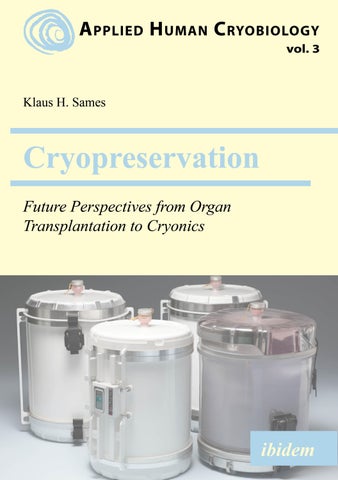
Bibliografische Information der Deutschen Nationalbibliothek Die Deutsche Nationalbibliothek verzeichnet diese Publikation in der Deutschen Nationalbibliografie; detaillierte bibliografische Daten sind im Internet über http://dnb.d-nb.de abrufbar. Bibliographic information published by the Deutsche Nationalbibliothek The Deutsche Nationalbibliothek lists this publication in the Deutsche Nationalbibliografie; detailed bibliographic data are available on the Internet at http://dnb.d-nb.de. The Cover illustration shows containers used in cryonics for the cryopreservation and storage of biological samples. The term cryopreservation is used in this book for the preservation of biological entities by cooling them to temperatures below 0°C, preferably to cryogenic temperatures, and storing them at such temperatures. Translated from “Kryokonservierung – Zukünftige Perspektiven von Organtransplantation bis Kryonik, Springer Spektrum 2022
ISBN (Print): 978-3-8382-2058-1 ISBN (E-Book [PDF]): 978-3-8382-8058-5 © ibidem-Verlag, Hannover • Stuttgart 2025 Alle Rechte vorbehalten
Leuschnerstraße 40 30457 Hannover Germany / Deutschland info@ibidem.eu
Das Werk einschließlich aller seiner Teile ist urheberrechtlich geschützt. Jede Verwertung außerhalb der engen Grenzen des Urheberrechtsgesetzes ist ohne Zustimmung des Verlages unzulässig und strafbar. Dies gilt insbesondere für Vervielfältigungen, Übersetzungen, Mikroverfilmungen und elektronische Speicherformen sowie die Einspeicherung und Verarbeitung in elektronischen Systemen. All rights reserved. No part of this publication may be reproduced, stored in or introduced into a retrieval system, or transmitted, in any form, or by any means (electronic, mechanical, photocopying, recording or otherwise) without the prior written permission of the publisher. Any person who commits any unauthorized act in relation to this publication may be liable to criminal prosecution and civil claims for damages.
Printed in the EU
Table of Contents Foreword .............................................................................................. 13 Preface................................................................................................... 15
1 2 3
Introduction ................................................................................. 17 How does cryonics work and what abilities are hidden in it? ............................................................................................... 21 Bridge to the future: distant goals of cryobiology and cryonics, unlimited times—unlimited possibilities. ............ 25 3.1 A cryonics scenario .............................................................. 25 3.2 Cryonics perspectives in medicine .................................... 26 3.2.1. Deep cooling of the whole body .............................. 29 3.3 Cryonics perspectives in spaceflight ................................. 29 3.4 Cryonics perspectives in agriculture ................................. 31
4
The Physical Basis of Cryonics and the success of Related Methods ........................................................................................ 35 4.1 Amazing benefits of the cold.............................................. 40 4.2. Thousands of years storage in liquid nitrogen ................ 41 4.3 Glass hard, pointed, physically and chemically dangerous: ice crystals ........................................................ 42 4.4 Cryonics as a project design of modern biomedical research ................................................................................. 43
5
Cryonics under the microscope—processes during cooling .......................................................................................... 49 5.1 Deep-cooling of biological tissues ..................................... 50 5.1.1 Crystallization nuclei ................................................ 50 5.2 Diffusion, the migration of dissolved substances ........... 53 5.2.1 What happens during slow cooling of biological tissues below freezing point? ................................... 54 5.2.2 What happens during rapid cooling? ..................... 55
5
5.2.3 Somewhere is the end, cooling makes the cell membrane tight .......................................................... 56 5.3 Survival of the cell on the narrow ridge of the cooling rate ........................................................................... 57 5.4. Bone-hard liquid—vitrification.......................................... 58 6
Tools for cryonics: Cryoprotectants—A big step forward but not yet the complete solution to our problems .............. 67 6.1 Small but effective ............................................................... 69 6.2 What makes a cryoprotectant? ........................................... 70 6.3 Large cryoprotectant molecules also have advantages .. 72 6.4 Molecule gathering up: individual cryoprotective agents and their effect ......................................................... 73 6.5 Side effects of cryoprotectants ........................................... 79 6.6 Critical concentration changes of cryoprotectants .......... 81 6.6.1 What is actually damaged and how? ...................... 84 6.7 Increasing of the cryoprotectant concentration protection or death? Reduction of damaging effects Reduction of harmful effects .............................................. 85
7
Other methods for protecting the cells and preventing ice crystals .................................................................................... 95 7.1 Protection of vital membranes ........................................... 95 7.2 Chemical fixation? ............................................................... 96 7.3 Methods to cope with huge amounts of data .................. 97 7.4 How cryoprotectants help with glass formation (vitrification) ......................................................................... 99 7.4.1 Bound water ............................................................. 103 7.4.2 Ice crystals are not tasty .......................................... 104 7.5 Another advance: No more ice crystals? The ice blockers ............................................................................... 105 7.5.1 Too good to be true. ................................................ 108 7.6 Clathrates: Water locks guest molecules in cages, ice must stay out—another chance? ...................................... 109
6
8
Remaining hurdles and surprising solutions...................... 117 8.1 How cells are fed, mass transfer between blood and cells ............................................................................... 117 8.1.1 Role of the cell membrane as the "mouth" of the cell ................................................................... 118 8.2 Obstacles to the storage of cells and tissues ................... 121 8.2.1 Feasibility problems with vitrification and rewarming ................................................................ 121 8.3. Problems with object size, chilling injury and cold shock .................................................................................... 123 8.3.1 Long distances, uneven structures ........................ 126 8.4 Chilling injury and cold shock ......................................... 128 8.4.1 Living beings protect themselves .......................... 130 8.5 Daring step to success: warming up ............................... 131 8.5.1 Recrystallization, the comeback of ice crystals .... 131 8.5.2 How warming leads to ice ...................................... 132 8.5.3 Does warming challenge the total advantages of deep cooling? ....................................................... 133 8.5.4 Cryonics strategies to mitigate "devitrification". . 134 8.6 Premature use or experiment? Cryonics for prolonging the lives of people living today ................... 136
9
A widely unknown success story: cryopreservation of cells embryos, tissues and small organs—many people have been "frozen" before.......................................... 143 9.1 Cells ..................................................................................... 143 9.2 Embryos .............................................................................. 146 9.2.1 Breakthrough in human reproduction.................. 147 9.3 Organs or parts of organs ................................................. 148 9.3.1 Tissue fractions from ovaries and testes ............... 148 9.3.2 Whole small organs ................................................. 149 9.3.3 Different sized organs, different temperatures from frosty to cryogenic.......................................... 149
7
10 Important and promising starting points in the laboratory as well as in nature ............................................... 169 10.1 Our irreplaceable biocomputer, the brain and nervous system ................................................................ 169 10.1.1 Nervous tissue ..................................................... 169 10.1.2 The Brain .............................................................. 170 10.2 A market for cryonics: artificially produced tissue and organs ............................................................. 172 10.3 An early success: cooling to freezing temperatures and reanimation ............................................................... 174 10.4 Nature a teacher for cryopreservation— is it better than our laboratories? ..................................................... 176 10.4.1 Hibernation .......................................................... 181 11 The body during oxygen deficiency...................................... 193 11.1 Ions and the electropotential of the normal, living cell........................................................................... 193 11.2 Without oxygen, cells work against themselves: Failure of the ion pumps ................................................ 196 11.3 Exhausted batteries ......................................................... 198 11.4 Why is human resuscitation no longer possible after 9 minutes of cardiac arrest at the latest?.............. 199 11.4.1 Fatal medical resuscitation: the reperfusion syndrome............................................................. 199 11.4.2 Luck in misfortune for the cerebral cortex....... 205 12 Saving the human body: how is cryonics currently used to cryopreserve the human body? .......................................... 211 12.1 The second worst thing that can happen to us: practice of cryopreservation a saving emergency procedure .......................................................................... 211 12.2 Prerequisites for cryoprotectant perfusion .................. 218 12.2.1 Influence of the carrier solution during perfusion............................................................... 218 12.2.2 Effects of substances in a cell protection solution such as Viaspan .................................... 220 8
12.2.3 Uptake of cryoprotectants from the blood into the cell ........................................................... 222 13 When taken over by cryonics: condition of a medically abandoned body ....................................................................... 227 13.1 When is a person dead? .................................................. 227 13.1.1 Life is still in it ..................................................... 227 13.1.2 Biological definition of death and dying ......... 228 13.1.3 Evidence of death ................................................ 229 13.2 More than dead? How dead is finally dead? ............... 230 13.2.1 A small difference ............................................... 230 13.2.2 How do cells die? ................................................ 232 13.2.3 The sensational survival of nerve cells ............. 234 13.2.4 Resurrection of the pigs—survival of animal nerve cells ................................................ 234 13.2.5 Human nerve cells .............................................. 239 13.2.6 A suicide that lasts millions of years ................ 241 13.2.7 Not only nerve cells are masters of survival ... 242 13.3 The new death .................................................................. 244 14 Cryonics can start to play along—intervention options after total organ failure ............................................................ 253 14.1 Cooling still the best conservation method even after "death". ..................................................................... 253 14.2 Prevention of vascular occlusion ................................... 255 14.3 Agents against cell death ................................................ 258 15 Restoration ................................................................................. 267 15.1 Rewarming, recovery and reanimation ........................ 267 15.2 Thawing and reanimation .............................................. 268 15.3 The finishing touch: Nano repair .................................. 270 16 Outlook: encouraging progress in cryonics research ......... 277 Index ................................................................................................... 287
9
Dedicated to Ben Best, a renowned promoter of cryonics who provided me with inspiration and knowledge.
In Memoriam the "father of retina transplantation" and practicing cryonics proponent Peter Gouras and an unforgotten analytical mind and gifted gerontologist Bernhard L. Strehler.
Foreword Cryopreservation of living objects is an evolving field of medicine and biology that offers decisive steps towards a revolutionary extension of medical methods. This textbook is easy to read and describes the many different aspects of cryopreservation, the methods of cooling and rewarming, cryoprotection, and the study of freeze-resistant organisms in nature. The astonishingly high number of such organisms listed here is widely unknown. The basic knowledge of cryopreservation is poor in the general public although there are an astonishing number of successful scientific experiments with cooling and rewarming of cells, tissues, organs and small organisms in different temperature ranges, facts that will visibly amaze the reader. The book begins with an exciting description of the possibilities that would open up once cryopreservation and resuscitation of organisms were fully and easily developed and could be compared, for example, to anesthesia and reawakening, so that life could be stopped and restarted at will. Along those lines, one chapter deals with the state of preservation of the human body for minutes or a few hours after oxygen deprivation. It shows a sensational survival even of nerve cells of the brain during the observation period. Importantly, the book provides a detailed observation of the behavior of biological tissues during slow or rapid cooling as well as vitrification at the cellular and molecular level. The role of a large number of cryoprotectants through their different properties and chemistry during such processes is presented. It is also worth reading the book with regard to the preservation of the whole human organism (cryonics), describing in serious medical terms the opportunities and difficulties of cooling and rewarming patients who wish to be preserved after death to stop decay due to lack of oxygen as well as the cooling procedures themselves preserving the state after organ failure, where in many cases promising structural viability can be observed. The possibilities of future restoration of human bodies preserved and reanimated with 13
14
CRYOPRESERVATION
new methods are assessed. Moreover, a professional assessment of today's cryonics methods is given. Their methods are presented realistically, their limitations, but also their opportunities are discussed. The last chapter provides an outlook on the upcoming development of new methods. A fascinating extension of our ability to avoid damage during cooling and reheating, as well as to repair and initiate revitalization, is revealed. Medicine cannot afford to miss out on such progress. Furthermore, progress is also possible in space travel as well as, for example, in agriculture and the preservation of biodiversity. Roman Bauer Guildford (UK), November 2024
Preface To stop aging, to rejuvenate their body and to prolong life is a dream goal of many people. However, through research and literary work, it became clear that the renewal of organs cannot be done by today's means, neither by drugs nor by gene therapy or stem cells. In principle, rejuvenation of our body is not impossible, but not in a short time frame. Aging and dying are still inescapable. The only way available today to preserve the body of a deceased person is to cool it to -140°C or below, after introducing cryoprotectants into the blood circuit. We call this procedure cryonics. It seems a somewhat desperate measure, however, since no larger animal, and no warm-blooded animal at all, has yet been brought back to life from such temperature. On the other hand, this is a thoroughly appealing field of research, not only because the seemingly impossible presents an intellectual challenge. However, the preservation of biological entities by deep cooling (cryopreservation) opens up completely new possibilities for medicine and biology and associated technologies. The related field is cryobiology and where this targets the whole human being, we speak of cryonics. Today we can already cool a little more gently than 10 years ago and that's what we do first and we do it with people in practice after death, because we have no other choice. But perhaps we are laying the foundation for achieving an incredibly big goal. The book intends these topics to become common knowledge excluding prepossession as well as blue-eyed or even utopic belief. I want to thank my colleagues and friends for encouragement, support and stimulation: Peter Bezler, Paolo Brenner, Michael Dettmann, Matthias Erber, Benjamin Hampel, Wolfgang Krause †, Karlheinz Poch, Ramon Risco, Ludger Schmidt-Riese, Sebastian Sehte, Ralf Spindler, Alexandra Stolzing, Daniel Streidt and Robert Vöht.
15
16
CRYOPRESERVATION
My thanks for comfortable cooperation go in particular to Renate Scheddin and Dr. Sarah Koch from Springer Verlag, who advised me competently and purposefully, and to Mr. Padmanaban, who edited the text and Mr. Devarajan for production with technical expertise. For production/publication of the English version I am indebted to Christian Schön publishing Director and Christoph Ohlwärther of ibidem publishers for advice and assistance. Klaus Hermann Sames Hersbruck, November 2024
1 Introduction Summary Today, when organs fail, medicine often has to give up. However, there is an emerging possibility of preserving the body in an unaltered state rather than leaving it to decay. The limitation of medical options need not be final. Medicine continues to evolve. What is incurable today may be repairable tomorrow. For long-term preservation of the body, there is only one currently applicable method: deep-cooling. We name the procedures concerned “cryopreservation” they will be described in chapters of this book. Biological units (for example transplant organs) could be preserved by this method, because cooling stops chemical processes. When applied to humans, we speak of cryonics. The methods are not yet fully developed, but cryonics is without alternative. Scientists are working intensively on methods to cure diseases, stop aging processes and rejuvenate. Those alive today will only be able to participate in this if their bodies are preserved in as unaltered a state as possible when their organs fail. This book is intended to show the current effectiveness of procedures concerned. The preservation of life is the dominant task of medicine, but aging and diseases cannot be stopped definitively today. This could change with a method that stops the decay of the body even after the circulation stops, such as cryonics. Today, cryonics can only be carried out using methods that are not yet perfect. First of all, flow of cryoprotectants through the blood circuit and other complicated measures are necessary. We will deal with the circulation of organs in various ways and discuss the methods of cryonics in detail below. Cryonics can at least be seen as an opportunity to maintain the body in a state of potential resuscitation through deep freezing. It is interesting to ask whether cryonics will not be superfluous one day due to gerontological methods such as stopping the aging
17
18
CRYOPRESERVATION
processes, regenerative medicine and rejuvenation—or will become pure emergency medicine. Can we now stop time our own time (measured by changes of our body) by deep-freezing? Or how could we personally enjoy the possible success of gerontology in 100 years or even later? Deep freezing is actually a method that stops the changes in the body as far as that is possible. However, the body is then also not alive and that cannot be what we want in the long run. In each case, we want to keep the body in a functional state. Of interest to us is only a technology that can be used immediately, i.e. also for people living today, and does not rule out resuscitation, even if it is perhaps not yet fully developed and thus contains a major risk. A significant impact on aging or even rejuvenation for the generations living now is not yet possible, even if the media and scientific portals are buzzing with promises and premature announcements. The problems can only be solved over a long period of time. A renewal of all components of the body in their special structure and function is not yet conceivable. As long as rejuvenation methods do not work on the living, they can only be postponed to the future. All people must still die for the foreseeable future. However, to the best of our knowledge, there is no fundamental obstacle to life extension or rejuvenation. Repair of the body could be effective mainly with the help of gene therapy or stem cell manipulation, but with certainty only by nanotechnology. In order to preserve a body even after the organs have failed until then, it must be saved from final decay, dying must be interrupted death must be postponed, biological time must be stopped. Cryonics is not a particularly elegant option, but it is the only one that is already within reach. We hope that a restoration of the structures and sufficient energy will also make the functions of the organs possible again, just as in surgery the heart recovers after bloodlessness and a standstill of function when it is warmed up and receives blood again. Like a car that runs again after repair and refueling. Whether the car has a
INTRODUCTION
19
soul can be debated if one is so inclined. It does not (yet) possess a self-repair like a living organ. It must be emphasized: Cryonics today represents the only possible way to significantly prolong our lives and reach an age of more than 123 years. For this purpose, the body must be preserved after organ failure and pronouncement of death, whether it is old or young, sick or healthy at the time of failure of life processes. Other methods are conceivable, but not yet ready for application (see also Fischer R. 2019). Cryonics is a young method that still has a long development ahead of it. However, this development could be exciting. Cryonics advocates hope that methods can be used to restore a body that has been cryonically stored even if it has various damages. The failure of all our organs ("death"), lack of oxygen, aging and diseases cause more or less severe damage, which today is only partially analyzed and cannot be repaired. So, resuscitation and healing are still left to the future. Cryonics is often mistakenly referred to as the freezing of bodies after death. Through cryonics there would then be a resurrection. Of course, human beings do not have the resurrection from the dead in their hands. However, we can partially preserve what is still viable and interrupt the dying process. Cryonics is not about corpses, because the purpose of freezing is to preserve living cells and structures of the body as well as possible—no more, no less. Freezing is not the right term either, rather we intend crystalfree deep-cooling that allows cells and tissues to survive.
Literature Fischer R (2019) Sterben war gestern – ein praktischer Ratgeber ISBN 9783-9820734-0-8 (www.sterben-war-gestern.de)
2 How does cryonics work and what abilities are hidden in it? Summary The future-oriented cryonics project is defined. Its goal is described. Realistic steps towards its realization are envisaged and the present situation is outlined. Cryonics is the name given to the preservation of living beings at very low temperatures and their intended rewarming and resuscitation when these include humans as the center. It must from the beginning also include all living beings and biological materials existing to develop its methodology. It also involves an application of methods that are still immature, but which are currently the best according to the state of the art (reviews on cryonics: Best 2008; -2013; Bojic et al. 2021; Fahy 2021; Fahy, Wowk 2021; Mathwig, Sames 2013; Reinhard 1987; Sames 2011a; Sames 2013a; -b; -2018; Sames et al. 2022). Cryonics can only prolong human life by interrupting the dying process. It does not have a direct effect on stopping aging or on rejuvenation. Today, among all life-sustaining methods, the most perfect deep-cooling is undoubtedly a priority, while other problems are still reserved for research. Cryonics aims to store the human body unchanged until medicine is able to heal the damage caused by aging, disease, death and by the cooling processes themselves. The success of cryonics cannot (yet) be guaranteed. In contracts, it is even legally essential that the patient takes note: neither future resuscitation nor funding into a more distant future can be guaranteed. The principle of cryonics is biostasis. This means a reduction or, strictly speaking, a standstill of life processes, for example, by desiccation (aestivation) or by lowering the temperature deep below zero (cryostasis) or near zero but still above (hibernation). All states of biostasis should allow a revival of the living being. 21
22
CRYOPRESERVATION
Cryobiology and cryonics do not use biostasis by desiccation. They rely on cryostasis (deep temperature biostasis), which is the only method that already works in the laboratory today. Since the resuscitation of mammals after deep cooling is not yet possible, cryonics on living humans cannot be allowed today. Death must be awaited and with it usually the consequences of aging, causes of death and dying, the most important obstacles to prolonging life. The inspection of the corpse must also be completed, so that in Germany the start of cooling is often only allowed after two hours, which runs counter to the concept of preservation. However, the damage caused by long periods without cooling storage could be significantly reduced if the inspection for cryonics candidates would be performed in cold rooms. After early inspection of the head, it should be cooled with ice if there are no findings on the head. At most, virtopsy (virtual biopsy) a form of dissection with only the smallest of interventions should be used before cryonics, if already possible and urgently needed. The rapid development of these methods is to be demanded on the part of cryonics. Aside from the personal desire of people alive today for selfpreservation, cryonics is an experimental scientific project with a very broad goal. But what about the possibilities that would be offered by functioning cryonics with people and their organs being deep-cooled, stored in the cold, and resuscitated?
Literature Best BP (2008) Scientific justification of cryonics practice. Rejuvenation Res 11:493-503 Best B (2013) Cryonics: Introduction and technical challenges. In Sames KH (ed) Applied Human Cryobiology, vol. 1., ibidem, Stuttgart, pp 61-77 Bojic S et al (2021) Winter is coming: the future of cryopreservation. BMC Biol 19, 56 Fahy GM (2021) Principles of vitrification as a method of cryopreservation in reproductive biology and medicine. In Donnez J, Kim SS (eds) Fertility preservation principles and practice, section 2-Reproductive biology and cryobiology. Cambridge University Press, pp 35-66
HOW DOES CRYONICS WORK?
23
Fahy GM, Wowk B (2021) Principles of Ice-Free Cryopreservation by Vitrification. Methods Mol Biol 2180:27-97, doi: 10.1007/978-1-0716-0783-1_2 Mathwig K, Sames K (2013) Kryonik. In Sun MJ, Kabus A (eds) Reader zum Transhumanismus. Books on Demand, Norderstedt, Berlin, pp 113129 Reinhard K (1987) Wie der Mensch den Tod besiegt. Technische Verfahren zur Unsterblichkeit. Orac, Wien Sames KH (2011) “wollt ihr ewig leben?“ durch die Kryonik zum ewigen Leben? Innsbrucker Forum für Intensivmedizin und Pflege (IFIMP) Univ. Klinik für Allgemeine und Chirurgische Intensivmedizin. Medizinische Universität Innsbruck 09-10 Juni http://www.intens iv-innsbruck.at/meetings/IFIMP2011_bilder.htm Sames KH (2013a) General mechanisms of mortality and aging and their relation to cryonics. In Sames KH (ed) Applied Human Cryobiology, vol. 1, ibidem, Stuttgart, pp 145-169 Sames KH (ed) (2013b) Applied Human Cryobiology, vol. 1, ibidem, Stuttgart Sames KH (ed) (2018) Applied Human Cryobiology, vol. 2, ibidem, Stuttgart Sames KH et al (2022) Safe preservation of organs by cryogenic cooling, a chance of the future not only of medicine. In Willmann TA, El Maleq A (eds) Sterben 2.0 (Trans-)Humanistische Perspektiven zwischen Cyberspace, Mind Uploading und Kryonik. De Gruyter, Basel, pp 221-238