• Customize and Distribute Your Ethics Approved Media Release
• Display Your Certificate
• Leverage Your Status Prominently and Often
• Add Ethics Approved to Your Social Media Profiles
In This ISSUE Register Profile
New MRFC®s, RFC®s, RFA®s, RFS,and Association Members
John Michael Candy, RFC ® , TX
Michael J. Christensen, RFS, FL
Zachary Lee Shristensen, RFC ® , UT
Wisvensky Dabady, RFS, FL
Valeria Diaz, RFS, FL
Grant A. Fossum, RFC ® , MN
Gary Alan Fusz, RFC ® , IL
Michelle Gracy, RFC ® , CA
Donald Grigsby Thornton, RFC ® , GA
William Jason Urbanik, Assoc., PA
Aldo Venturacci de Mattos, RFC ® , FL
William T. Wright, RFC ® , ID
Christopher Logan Houghton, RFC ® , AL
Matias Leiva, RFC ® , NV
James Ronald Przewlocki, RFC ® , AZ
Sandy Schussel, Assoc., NJ
Lindsday Stone, RFA ® , SC
From
the EDITOR
International New Members
Indonesia - 7
Philippines - 13
China - 51
Sri Lanka and UAE - 7
Reflecting on the Importance of Referrals and Our Global Community
Susan
M. Cappa, Editor
This issue brings forward a thoughtful blend of ideas designed to support you as an individual member, strengthen our Chapters, and further connect our growing global community. At the heart of every successful financial practice lies one constant: referrals. They remain the lifeblood of your business, built on trust, credibility, and the meaningful relationships you cultivate over time.
Much has been written about how to ask for referrals, and for many, it can still feel uncomfortable. Yet because referrals are so vital, it is worth revisiting this topic with a fresh perspective. Within these pages, you may discover an approach or insight you have not previously considered—something that resonates with your personal style and enhances your existing “referral plan.” Sometimes, even a small shift in how we think about referrals can lead to significant results.
We also feature updates on the IARFC’s continued evolution into a truly growing global community. Chapters around the world are doing remarkable work to expand the reach and impact of the Association within their respective countries. Their efforts are a testament to the power of shared purpose and professional collaboration.
Behind the scenes, Headquarters plays an important role in supporting this growth. Through ongoing communication and strategic guidance, and we work to ensure that each Chapter remains connected—not only to us, but to one another. There is a dedicated team meeting with every Chapter on a quarterly basis, with structured agendas guiding each discussion and clear action items assigned. Following up on these items can be a daunting task, yet each Chapter is supported by a centralized portal that tracks key initiatives, deadlines, and responsibilities. From coordinating next steps to providing the resources and information Chapters need to succeed, the level of organization and commitment is substantial. It is, in fact, quite impressive how much is accomplished by such a small, dedicated team working diligently behind the scenes.
As you are reading, I encourage you to reflect on both your personal practice and your place within this broader community. Together, we continue to grow stronger.
Social Security Timing® helps financial professionals expertly streamline the complexities of Social Security into powerful solutions that will maximize client benefits and satisfaction.
A subscription to Social Security Timing® gives you access to our industry-leading, patented software and our team of Social Security experts. Social Security Timing allows advisors to sort through the thousand of Social Security claiming options and identify the one that offers the highest lifetime value to clients. The difference between what most people do and what Social Security Timing® would suggest they do is often over $100,000.
To receive 20% off an annual subscription, use coupon code IARFC.
Vice Chair, Michael Jay Markey Jr., MRFC® Treasurer, Dominique Vercaemert, RFC® Secretary, Nathan Boyle, MRFC® Director of Ethics, Gary Padussis, RFC® Trustee, Kai Yuan Tu, RFC® Trustee, Lea Smith Johnson, RFC® CEO, Leonard Simpson, RFC® COO, Charlotte Isbell
MRFC CERTIFICATION BOARD
Chair, Mary Anne Redmond, MRFC® Vice Chair, Melvin Mills Jr., MRFC® Treasurer, Daniel Courson, MRFC® Secretary, Larry Roby, MRFC® Director, Sean Clark, MRFC® Director, Pamela Mayfield -Kizzee, MRFC®
Public Member, Kat Moore
Certification Administrator, Rachel Gibbs
IARFC HEADQUARTERS TEAM
Chief Operating Officer, Charlotte Isbell
Editorial Coordinator/Public Relations, Susan M. Cappa
Director of Membership Services, Vicki Caplinger
Membership Services, Judi Nelson and Rachel Gibbs
Information Technology, Randy Kriner
WEBSITES
China — www.iarfc.cn
Hong Kong — www.iarfc-hk.org Indonesia — www.iarfcindonesia.com
Philippines — www.iarfc.org/about/philippines Taiwan — www.iarfc.org.tw United States — www.iarfc.org Vietnam — www.iarfc.com.vn
Article Submission
The average reader has more than four years of experience in financial services and possesses at least one professional designation/credential. Articles provide specific planning techniques, practice management suggestions, or educational content about financial services which might include advisory professional responsibilities, industry news, insurance, investment, software, or compliance. For the entire Register General Article and Editorial Policy, visit www.iarfc.org/register.
President, Lisa Ford, MRFC® Executive VP., Lemuel W. Kornegay III, RFC® Vice President, Mike Zaino, RFC® Treasurer, Jeffrey Bettermann, RFC® Secretary, Paul Wharf, RFC® Director, Gregory Kurinec, RFC®
Vietnam
President, Dr. Frankie Lo C.F., RFC® Executive VP, Kenny Lam C.H., RFC® Vice President, Prof. Jeslie Chui T.K., RFC® Treasurer, Ramen Chim P.H., RFC® Secretary, Tracey Nguyen B.T., RFC® Director, Ben So S.H., RFC®
Editor Susan M. Cappa susan@iarfc.org
The Register is published by the IARFC® 2026 and circulated around the world. It includes articles and advice on technical subjects, economic events, regulatory actions, and practice management.
The facts and opinions in the IARFC’s Register articles represent the author’s views and are not endorsed by the publisher.
Editorial Advisory Committee
Michelle Blair, RFC®
Alan Kifer, MRFC® Greg Glista, RFC® Send
The IARFC makes no claim as to accuracy and does not guarantee or endorse any product or service that may be advertised or featured.The IARFC makes no claim to the current status of any designation or credential that is issued in the titles of contributors listed in the Register other than those issued by the IARFC®
Barry Dayley, MRFC ® & Isaac Dayley, RFC ® Stacy Kahan, RFC ® - Alana Kahan, RFC ® - Cara Kahan, RFC ®
Thursday, May 7, 2026
Emotions Beat Math
Host: Michael Markey, MRFC ® Presenters: Michael Markey Jr., MRFC ® Dr. James Flanagan, MRFC ®
Friday, May 1, 2026
The Augmented Intelligence Advisor
Host: Jeremy Nason, RFC ® Presenters:
Jeremy Nason, RFC ® & Sandy Schussel
Greg Glista, RFC ®
Thursday, May 15, 2026
She Leads and the Firm Wins Host: Cheryl Fainelli, RFC ® Presenters: Becky Swansburg
Juli McNeeley
Register
for Free
Get Published
The average reader of the Register has more than four years of experience in financial services and possesses as least one professional designation/credential. The readership is educated, experienced, knowledgeable, and involved in the industry.
Articles benefit the reader by providing specific planning techniques, practice management suggestions, or educational content about financial services, which might include the consultant’s profession responsibilities, industry news, insurance, investments, software, or compliance.
Redtail Technology, Inc. is the leader in Web-Based Client Relationship Management solutions for the financial adviser. Redtail is bringing next generation technology to the financial consultant to help them better manage their client base so that they can have MORE TIME, earn MORE MONEY, and have MORE FUN!
Whether you are looking to strengthen your client relationships, improve your team’s collaboration efforts and overall efficiency, increase your revenues and profitability, decrease client attrition, or engage in any number of other business building activities, Redtail CRM offers tools to assist in your efforts. You’ll also be happy to know that Redtail integrates widely and deeply with other popular tools in the financial services industry, which helps to eliminate redundant data entry and create consistency across the platforms you use in your daily operations.
https://corporate. redtailtechnology.com/
The International Association of Registered Financial Consultants (IARFC ® ) honors select financial services professionals from around its global membership annually who have shown unwavering allegiance to the Association’s mission, ideals, and guiding principles.
The Loren Dunton Lifetime Achievement Award recognizes an individual whose career dedication and commitment to financial stewardship model the exemplary ethical standards of conduct expected of our members and who continues working to ensure an environment of exceptional consumer experiences.
The Founder’s Award acknowledges a member who has given undeniable time, energy, and service to our profession and whose distinct contributions to the IARFC enhance its growth and identity as the desired financial services professional association of choice.
The Global Ambassador Award highlights the extraordinary efforts of select people who selflessly support IARFC’s mission of “Growing a Global Community”. These people are true shepherds of our flocks.
The Chapter Ambassador Award honors individuals who actively promote financial education and literacy among their countrymen, distinguishing themselves as true advocates of consumer personal security.
The Editor’s Choice Award attests to an individual’s ability to capture readers’ attention through command of financial topics that are both current and relevant. They are true financial services messengers.
These IARFC annual awards serve as a powerful testament to the educational commitment of its members. Honorees are recognized not only for their accomplished credentials but also for their dedication to furthering financial education within their communities. Through seminars, workshops, and mentoring, these professionals elevate industry standards and inspire others to pursue continuous learning. The awards highlight the Association’s belief that a welleducated financial consultant is essential to client success and the overall advancement of the profession.
Training is another pillar celebrated by the IARFC awards. Recipients are often those who actively participate in developing, delivering, or enhancing training programs that keep consultants abreast of regulatory changes, technological advances, and innovative planning strategies. Their efforts ensure that the membership remains adaptable and well-prepared to navigate the evolving landscape of financial services. By spotlighting these individuals, the IARFC underscores the importance of ongoing professional development as a key differentiator in the marketplace.
Experience is a hallmark of IARFC award recipients. The recognition often reflects decades of dedicated service, real-world client outcomes, and leadership within the profession. These veterans embody the wisdom and practical knowledge that only comes from years of practice. They serve as role models for emerging consultants. By honoring experience, the IARFC emphasizes the value of learning for those who’ve demonstrated sustained excellence and a lasting impact on the profession.
Ethics is the foundation upon which the IARFC stands, and the annual awards spotlight those who exemplify unwavering ethical standards. Recipients are lauded for their integrity, transparency, and commitment to putting clients’ interests first. This public recognition reinforces the Association’s code of conduct and encourages all members to uphold these values. By celebrating ethical leadership, the IARFC ensures that trust remains at the core of every clientconsultant relationship, strengthening the reputation of the profession worldwide.
IARFC remains keenly attentive to the accomplishments and contributions our members make. These annual awards not only elevate the recipients’ reputations but also bring great credit to our Association. These honors are an inspiration to our global membership. Who do you know is eligible? Help IARFC celebrate these true pathfinders to Financial Independence and Personal Security. Prepare now to submit your nomination letter and help us to truly praise these leaders of Financial Consultancy services to our communities worldwide.
Award Winners are Celebrated on pps. 10 and 11.
Global Connectivity
“Being part of IARFC’s global community connects the Canada Chapter to a network of international expertise, cuttingedge insights, and best practices. It strengthens credibility, enhances professional development, and empowers members to deliver world-class financial advice. Together, we grow our influence, expand opportunities, and bring greater value to clients across Canada.” Sisi Chakrabarti, RFC ® - IARFC Canada Chapter President
“As the President of IARFC Vietnam, I believe the true value of our global community lies in its unified integrity, which ensures that our professional standards are never fragmented into isolated regional silos.
By maintaining a direct partnership with Headquarters rather than thirdparty intermediaries, our chapter can offer members a "gold standard" credential that is globally consistent and trusted. This structure creates vital opportunities for cross-border synergy, allowing us to bridge cultural and logistical gaps and truly ‘gather the wisdom of many.’
By actively fostering these regional collaborative initiatives, we ensure that every chapter remains a connected cell of a transparent global body. This is a far more powerful value proposition for our members than being part of an isolated regional office, as it guarantees their growth within a world-class professional ecosystem.”
Dr. Frankie Lo, RFC ® - IARFC Vietnam Chapter President
“Having seen and heard different concepts and values of Financial Planning with IARFC’s Growing Global Community ensures alignment with shared mission and vision of stakeholders. Financial Planning with its complexities does not have only one solution and by sharing different expertise and best practices, the Philippines Chapter is excited to learn and adapt ideas and innovation that will help us in our practice and services to the community that we serve.” Grace de Vera Escobar, RFC ® - IARFC Philippines Chapter President
Growing a Global Community Strength Through Connectivity
Leonard Simpson, RFC® IARFC CEO
As we work through 2026, one of my important goals is clear: continuing to grow a truly connected global community. This vision goes beyond increasing membership numbers, it is about building meaningful relationships, fostering collaboration, and creating a network of professionals who learn from and support one another across borders.
At the heart of this initiative is the development of strong, active chapters. Chapters are where our mission becomes real. They serve as the local touchpoint for members, providing opportunities for engagement, education, and leadership. More importantly, they create a sense of belonging—something that cannot be achieved through digital communication alone.
Connectivity is the true value of a global community. When chapters are engaged and aligned, they become bridges—connecting members across countries, fostering collaboration, and opening doors to new opportunities. Whether it is sharing best practices, mentoring emerging professionals, or collaborating on solutions to common challenges, these connections create benefits for everyone.
Equally important is leadership development. Chapters provide a pathway for members to step into leadership roles, contribute their talents, and shape the future of the organization. As we expand globally, we are also cultivating the next generation of leaders who will carry our mission forward with vision, integrity, and purpose.
Our commitment is to support and empower every chapter, new and established, to thrive. This means providing resources, maintaining open lines of communication, and ensuring that every chapter feels connected to the larger global community.
Growth is not just about expansion—it is about connection with purpose. By building strong chapters around the world, we are creating a unified, collaborative, and forward-thinking community that reflects the very best of who we are and what we stand for.
“Since IARFC Indonesia was established in 2003, the support of the IARFC and the leadership of chairmen like Ed Morrow, Barry L. Dayley, and Alan C. Kifer have played an important role in our growth.
Programs such as APAC and quarterly global meetings, along with insights from the The Register, help us stay connected with developments across the world. Through this global community, we’ve also been able to collaborate with other chapters, podcasts with the IARFC Philippines and expanding opportunities in ASEAN alongside IARFC Vietnam.
Being part of this global network also positions us in a way that universities, industry partners, and financial authorities in Indonesia OJK (Otoritas Jasa Keuangan) dan Bank Indonesia (Indonesia Central Bank) recognize and respect us, making them more open and willing to collaborate with our chapter ” Aidil Akmar Madjid, RFC®, IARFC Indonesia Chapter President.
Director of Ethics
Gary Padussis, RFC® IARFC Trustee
Ethics Question
What is the importance of taking the IARFC Code of Ethics Exam and why should I take it?
Answer
In today’s increasingly complex financial landscape, technical knowledge alone is not enough to build a lasting and trusted practice. Clients, colleagues, and the public at large are placing greater emphasis on integrity, transparency, and accountability. This is precisely where the IARFC Code of Ethics Exam becomes not just relevant—but essential.
At its core, the IARFC Code of Ethics is built upon foundational Canons that define the professional and moral responsibilities of its members. These Canons are more than guidelines—they represent a commitment to act in the best interest of clients, uphold the dignity of the profession, and maintain the highest standards of conduct. Taking the Code of Ethics Exam ensures that you are not only aware of these principles but fully understand how they apply in real-world situations.
The importance of taking the exam begins with familiarity. Many professionals may agree with ethical standards in theory, but the exam requires you to engage with the Canons in a meaningful way. It challenges you to think critically about ethical dilemmas, client relationships, confidentiality, disclosure, and professional responsibility. This process strengthens your ability to make sound decisions under pressure—decisions that reflect both competence and character.
Another critical reason to take the exam is its role in achieving Ethics Approved Status . Passing the Code of Ethics Exam is one of the requirements for this designation, signaling to clients and peers that you have gone beyond basic membership expectations. It demonstrates a verified understanding of ethical principles and a willingness to be held accountable to them. In a profession where trust is the currency, this distinction can set you apart.
Beyond designations and credentials, the exam is a reflection of personal and professional growth. It invites you to evaluate your own practices and align them more closely with the IARFC. It encourages ongoing self-awareness and a proactive approach to ethical decision-making. In many ways, it is not just a test—but a reaffirmation of why you chose this profession in the first place: to serve others with integrity and purpose.
Ultimately, taking the IARFC Code of Ethics Exam is an investment in your credibility, your clients, and your future. It equips you with the knowledge and confidence to uphold the highest standards, strengthens the reputation of the association, and reinforces the trust that is essential to every successful advisor-client relationship.
In a profession that is defined by responsibility, choosing to be ethically grounded is not optional—it is imperative. The exam is your opportunity to demonstrate that commitment.
Advisor Controls prioritizes improving efficiency and productivity with easy-to use solutions for understanding and advancing clients’ retirement income stories: The Retirement Plan Simulator. In just minutes, a consultant can input data and walk their clients through the retirement planning process, engaging them every step of the way, and identifying strengths and weaknesses.
Advisor Control’s proven processes will simplify and seamlessly deliver a compliant and optimized retirement income plan.
Use code IARFC at checkout for a $20 discount on your monthly subscription — available exclusively to IARFC members.
Member Link: https://advisorcontrols.com/iarfc/ Phone: (309) 633-2308 email: support@advisorcontrols.com
per month
2026 Loren Dunton Lifetime Achievement Award Recipient
Aidil Akbar Madjid, RFC® President, IARFC Indonesia Chapter
To receive the Loren E. Dunton Lifetime Achievement Award is not simply a personal honor, it is a reflection of a shared journey, a shared mission, and a shared belief in the power of financial planning to transform lives... Aidil Akbar Madjid, RFC ®
Distinguished members of the Nominating Committee, respected colleagues, and fellow members of IARFC around the world:
Loren Dunton did more than establish a profession, he ignited a global movement. At a time when financial planing lacked structure and unity, he brought people together under a single purpose: to serve others with knowledge, integrity, and care.
He saw what many did not yet see, that financial planning is not merely about numbers, but about people, about dreams, and about the future we help shape.
His vision has inspired generations, and I count myself among those deeply influenced by his legacy.
When I began my journey and returned to Indonesia in 2000, the profession was still in its infancy. Yet I carried with me a conviction that financial planning could become a force for good, grounded in ethics, education, and responsibility.
I still remember the early days when IARFC Indonesia was first established, and the opportunity to connect with the leadership of this global organization, particularly Chair of the Board of Trustees, Ed Morrow, whose support and trust gave legitimacy and direction to our efforts.
In the years that followed, we went through challenges, transitions, and a rebuilding phase, strengthened under the leadership of Barry L. Dayley. And today, we
look forward with renewed optimism and purpose, ready to move further and stronger together with the guidance of Alan C. Kifer.
This journey reflects not only growth, but resilience, and the enduring spirit of this profession.In 2005, inspired by the same spirit of innovation and service that Loren Dunton embodied, I initiated the development of Sharia Financial Planning in Indonesia.
It was a step toward making financial planning more inclusive, more relevant, and more aligned with the values of the communities we serve. Today, that initiative is no longer just a national effort, it is a growing framework with the potential to be shared globally. And this is where our collective responsibility begins, because the future of this profession will not be built alone, but through collaboration across borders, cultures, and perspectives.
This award, therefore, does not belong to me alone. It belongs to every member of IARFC around the world, especially to my colleagues in IARFC Indonesia, specially to Bareyn Mochaddin who is doing a very good job helping me managing the organization, thank you for being the trusted person, Mirzan Hasan, Arya Harris, Kharisma and Mada that continue to uphold the standards, the ethics, and the spirit of this profession. It belongs to those who choose integrity over convenience, service over self-interest, and purpose over profit.
I would also like to express my deepest gratitude to my family, my wife, Maura Syiffa Aulia, and my two daughters, Alicia Safira Madjid and
Audrey Shania Akbar Madjid. They are my constant source of strength, patience, and inspiration. Behind every step of this journey, there has been their unwavering support and sacrifice. This recognition is as much theirs as it is mine.
Because at its core, financial planning is not about wealth. It is about stewardship. It is about protecting families, guiding decisions, and giving people the confidence to face the future. It is about ensuring that financial knowledge is not reserved for a few, but accessible to all.
As we honor Loren Dunton, we must also carry forward his unfinished work. The world is changing, faster than ever. But the need for trusted, ethical, and knowledgeable financial planners has never been greater. And so we are called, not just to adapt, but to lead. Not just to grow individually, but to grow together.
Let us continue to build this profession as Loren Dunton envisioned it
A profession of integrity. A profession of service. A profession that stands for something greater than itself.
And let us move forward with a shared commitment: to collaborate, to innovate, and to expand the reach of financial planning so that it may serve humanity in all its diversity.
2026 Founder’s Award Recipient
Alan Kifer, MRFC®
Alan Kifer, a dedicated member since 2008. has exemplified professionalism, leadership, and an unwavering commitment to advancing the financial services profession. His contributions reflect not only deep industry expertise, but also a passion for supporting fellow consultants and strengthening the Association’s global community.
Alan’s long-standing service to the IARFC perfectly aligns with the criteria required of a Founder’s Award recipient. He has played a key role in advancing the Association’s mission, supporting chapter development, and helping expand its global reach. His unwavering adherence to the IARFC Code of Ethics and his commitment to professional integrity further underscore why he is so deserving of this honor.
As the 2023 Dunton Lifetime Achievement Recipient, member of the MRFC Certification Board, and now serving as Trustee Chair, Alan actively engages with the Association’s global community, helping position the IARFC as a truly worldwide presence.
He is also a consistent contributor to IARFC publications, sharing insights that support professional growth and thought leadership across the membership. His ongoing efforts continue to drive Association goals forward, making a lasting impact on both the Association and the financial professionals it serves.
2026 Editor’s Choice Award
Barry L. Dayley, MRFC®
Honors outstanding contributions to IARFC publications and videos, recognizing excellence in writing, editing, research, and creative vision that enhances the Association’s public presence.
2026 Chapter Ambassador Awards
Bestowed to those persons who endeavor to represent their Chapter in carrying out the mission of the IARFC.
Hong Kong/Macau
Kei Hoi Schum, RFC®, MRFS
2025 Member’s Award
First Place
Matthew Dixon, RFC®
Second Place
Jeremy Nason, RFC®
The Member’s Award recognizes excellence, professionalism, and a deep commitment to expanding membership. These honors set a benchmark for achievement and inspire fellow members to elevate their knowledge, ethics, and service to clients—especially through referring their peers.
Referrals drive the growth and strength of the Association. When members introduce like-minded professionals, they help build a community grounded in integrity and shared values. This not only expands the IARFC’s reach, but also ensures its future is shaped by dedicated consultants committed to upholding the highest standards.
Hong Kong/Macau Brian Man Pong Chan, RFC®, MRFS
USA
Alan Kifer, MRFC®
Indonesia Bareyn Mochaddin, RFC®
Building Client Loyalty and Advocacy Through Trust and Communication
When we combine trust, open communication, and genuine care, we not only strengthen current relationships but inspire clients to share our impact with others.
As an experienced financial consultant, I have witnessed firsthand the critical importance of client retention and referral as the foundation of a thriving practice. In today’s global financial services landscape, these strategies are vital for sustainable growth. Industry research, such as the 2025 Deloitte Insights report, demonstrates that retaining valued clients is far more cost-effective than acquiring new ones, with loyal clients driving up to 80% of a firm’s revenue (Deloitte, 2025; McKinsey & Company, 2024). At the heart of meaningful client retention and enthusiastic referrals is the ability to foster loyalty through consistent communication and unwavering trust. It’s up to you to allow clientele to proudly proclaim their satisfaction.
In my consulting career, I have found that loyalty is most powerfully built through transparent, regular communication. Data supports this: PwC’s 2025 Global Wealth Management Survey reveals that clients who receive proactive updates feel more valued and demonstrate a 40% higher retention rate (PwC, 2025; J.D. Power, 2024). By engaging clients with timely
ongoing performance reports, regulatory changes, and truly personalized advice, we not only increase satisfaction but also lay the groundwork for enduring partnerships across cultures and markets.
Trust is the bedrock of every advisor-client relationship— especially in our profession, where clients’ personal security and independence are paramount. In my years of service, I have learned that trust must be earned daily, through both words and actions. The 2025 Edelman Trust Barometer affirms this, with 75% of clients citing trust as the main reason for staying with their consultant (Edelman, 2025; CFA Institute, 2024). Full transparency in fee structures and investment strategies is not just best practice; it is an ethical obligation that reassures clients their interests come first and cultivates lasting security.
Effective communication means listening just as much as speaking. In my experience, taking the time to understand clients’ evolving goals and concerns is fundamental. Recent insights from the Forbes
Finance Council highlight that consultants who actively seek feedback and adapt services accordingly see referral rates rise by 30% (Forbes, 2025; Accenture, 2024). This two-way dialogue signals genuine commitment to each client’s financial independence and personal security, making them more likely to become advocates within their own networks.
Personalized client experiences are what set exceptional consultants apart. The 2024 Capgemini World Wealth Report underscores that clients who sense their advisor is genuinely invested in their unique journey are twice as likely to remain loyal—and to refer others (Capgemini, 2024; EY, 2024).
Observing and interacting with peers worldwide, technology helps deliver tailored advice while anticipating client needs consistently strengthens bonds and fosters advocacy.
Education is a consultant’s most empowering tool. By regularly schooling clients about market trends, regulatory changes, and planning strategies, we enable them to make informed unique decisions with confidence. Morningstar’s research indicates that wellinformed clients feel more in control and are 25% more likely to remain with the same consultant (Morningstar, 2025; Financial Planning Association, 2024). This active empowerment promotes retention and transforms clients into passionate advocates for our expertise. Sharpening one’s skills thru continuing education makes
you a student of your profession and over time a true specialist
Ultimately, clients across the globe remain loyal to—and refer— consultants who help them feel financially secure and independent. When we combine trust, open communication, and genuine care, we not only strengthen current relationships but inspire clients to share our impact with others. As leading voices in our industry remind us, the greatest marketing asset is a client who feels secure, empowered, and proud to recommend their consultant to their community (Barron’s, 2025; Investment News, 2024).
There is a profound moment in every consultant’s career when referrals flow not because we ask, but because our client families genuinely want their closest friends and loved ones to experience the same peace of mind, trust, and attentive service that they enjoy. When our commitment to candid, honorable, and respectful communication is unwavering, clients become enthusiastic advocates—eager and proud to introduce us to those they care about most. This is the highest compliment our profession can receive, and it is earned only through steadfast dedication to placing clients’ best interests at the very heart of our work.
Featured Thought Leaders on Client Referrals & Relationships
Brian Tracy
Sales Expert | Author | Speaker
“A referral is the highest compliment a client can give you .”
A globally recognized authority on sales and personal development, Brian Tracy has authored over 80 books and trained millions of professionals worldwide. His expertise in sales psychology and performance makes him a leading voice on building trust-driven referral businesses.
Katherine Barchetti
Retail Executive | Customer Experience Advocate
“Make a customer, not a sale.”
A former president of LaSalle Extension University, Katherine Barchetti is known for her practical wisdom on customer service and loyalty. Her philosophy centers on creating lasting relationships that naturally generate repeat business and referrals.
Jeff Bezos
Founder | Innovator | Business Leader
“Your brand is what other people say about you when you’re not in the room. ”
As the founder of Amazon, Jeff Bezos revolutionized customer-centric business strategy. His emphasis on reputation and customer experience underscores the power of word-of-mouth and referrals in scaling success.
Peter Drucker
Management Pioneer | Author | Educator
“The aim of marketing is to know and understand the customer so well the product or service fits them and sells itself. ”
Widely regarded as the “father of modern management,” Peter Drucker’s work shaped how organizations approach leadership and marketing. His focus on deeply understanding clients aligns directly with referral-driven growth.
“Satisfied customers are your biggest advocates and can become your most successful sales team.”
Founder of TECHmarc Labs, Lisa Masiello helps financial professionals grow through modern marketing and client engagement strategies. She is a strong advocate for leveraging satisfied clients as a primary source of referrals.
Richard Branson
Entrepreneur | Founder | Visionary Leader
“Clients do not come first. Employees come first. If you take care of your employees, they will take care of the clients.”
Founder of Virgin Group, Richard Branson is known for building a global brand rooted in culture and people-first leadership. His philosophy highlights how strong internal teams lead to exceptional client experiences—and more referrals.
How to Use These Insights:
These leaders collectively reinforce a key principle: referrals are the natural result of trust, service, and consistent client value. For financial consultants, this means focusing less on asking for referrals and more on earning them through exceptional relationships
What is Your Real Wealth? Emotional Quotient vs Intellectual Quotient
We all possess a finite period of time that is unique and different than any other person. As individuals, we have a specific purpose and meaning in this world. We are the authors of our lives. As authors, we have certain authorities to scribe our journey. However, overcoming the obstacles we all face determines how you find authentic meaning in your life while trying to help others find theirs.
This relates specifically to how you approach your business and what you are reflecting towards the prospective clients. We tend to direct the majority of effort in the wrong direction, and we are left wondering why your “plan” has fallen stagnant.
As a point of encouragement, you must first step back and realize an important fact. You are an original that will never be duplicated. Why is that important to understand? Because when you truly realize this, you grasp the power and meaning of your competitive advantage. You have been given specific talents and attributes that allow you to elevate and become bigger than you ever imagined. The question that I get asked most often is why do some people elevate while others stagnate?
There is a very fine line between the balancing act of E.Q. (emotional quotient) versus I.Q. (intellectual quotient). Of course, it is vital that you are
well schooled and up to date on industry standards, trends, taxes, and products. We spend A LOT of time working on those areas. But how much time do you spend working on the more essential topics which is your personal development, thoughts, feelings, and messaging you are creating and projecting? This is the difference between those who “X” their life and those who drag anchors around.
What has baffled me for my 3 decades plus of coaching, is the fact that people in our industry talk a good game of “holistic planning” when in reality they simply offer products and services. Don’t get me wrong, there is tremendous value in that, however, there is nothing “holistic” about that. You are an important piece of their tangible asset life plan which is necessary, but you fail to capture the REAL WEALTH proposition.
“Real Wealth” as I often refer to it, is the intangible value that money CAN’T buy. Everyone has it but professionals run from it because it is too “personal” or they can’t monetize it. Really? There are 3 innate gifts that your clients and prospective clients desire the most from you and others. We all have these three things that drive our lives. They are to be loved, accepted, and appreciated. Somehow, we feel if we can make their accounts go up, we have changed their lives dramatically. In some ways you
have but not in the ways that make the biggest impact. What clients should be asking you is how you define success for them. Is it money solely? It has been my experience that people suffer from various degrees of SUCCESS PANIC. On one hand they get everything they want and realize that is not what life is about. On the other hand, there are those who never think they can be secure financially, emotionally, or relationally. Tangible wealth has to be paired with your intangible “Real Wealth” for confidence, clarity, and motivation. Self, health, and wealth are like a 3-fold cord. It is not easily broken when structured properly. This is how holistic wealth needs to be taught, embraced and implemented for a quality life. Those who understand this concept will enjoy a great 2026 and beyond.
What then is your value story? If products and services is all you offer, you better have a backup plan when the markets get volatile or experience prolonged repricing. If you don’t, then you become a commodity and commodities are judged by price and are bought and sold every day.
Smart people understand that real relationships are centered on the real wealth concept. It would be a good idea to take a piece of paper and draw a line down the middle. List all of your tangible assets on the left.
(house, car, boat, 401k, savings, business, etc.). The on the rightside list everything else you own that has life changing value (faith, experiences, beliefs, education, family, networks, values etc.,) As your review, ask yourself this question: “Would I trade more of the right side for more of the left side”. I promise you the answer would be NO! So, what you are telling me is that your clients “Real Wealth” IS the very thing you don’t address in your relationship. Take it a step further. If they died, which side of the ledger would they want to leave as a legacy. Of course, you would say both sides, but for this example you had to pick one. That answer is easy. The right side. Why? Because if you gave them all the money you have accumulated without the right side, the money will vanish. We see this every day. However, if you were rich on the right side, you could learn to accumulate the left side easily. So, what conversations are you having with your clients? Does it include depth beyond what they can Google themselves?
You probably made resolutions at the beginning of the year. Let’s review them again through a different lense. Allow the E.Q. to enter the picture in your business plan and experience the attraction of new clients. This is something people will talk about and clearly differentiates you!
Empowering “Real Wealth” Lifestyles, Creator of the “W.O.W. 33 Experience”, Investment Coach, Husband,Dad, Action Activation Coach, Creator 532 Project, All American, Motivational Speaker, Follower of Christ, FCA leader.
Our Strategic Alliances
Affect Your Bottom Line
The Association continually seeks and forms alliances with other organizations and businesses to provide members with discounts for services and products necessary to their practice. Members can log into their IARFC membership profile for a complete listing and more explanation.
• Advisor Controls (discount of $20 per month)
• Advisorshare
• BuyingPower AT&T, Office Depot (discounts up to 50%)
• Copytalk (discount of $20 per month)
• DACFP (discount of 20%)
• Envestnet MoneyGuide ($300 off the Pro and Elite version)
• EP Navigator (discount of 25%)
• FMG Suite (discount of at least $20 per month)
• Group Insurance Benefit (highly affordable Group Rates, Open Enrollment for new members)
• Income Insight (discount of 20%)
• Integrated Advisor (15%)
• Kwanti (discount of 10%)
• Liberty Publishing
• MyRepChat (discount of $15 per month)
• Nitrogen (discount 10%)
• Redtail Technology, Inc. (discount of 10%)
• RightCapital (discount of 10%)
• Selling without Wrestling
• Smarsh Archiving (discount of 10%)
• SmartRisk (discount of 20%)
• Social Security Timing (discount of 20%)
• Success CE (“Package Pricing” of $29.95)
• Tax Clarity (discount of 20%)
• VSA (discount over 16%)
Lea Smith Johnson, MBA, RFC®, CFP®, FIC
Lea Smith Johnson is the founder of Triple Crown Wealth Finance, with a background spanning corporate finance, tax auditing, and independent advisory work. She leads her practice with a values-based approach rooted in integrity, stewardship, and longterm client relationships. A strong advocate for ethics in financial services, Lea serves on the IARFC Board of Trustees and supports the organization’s global mission. Guided by faith, family, and balance, she is committed to leaving a lasting legacy of trust and leadership in the profession. Let’s find out more how she navigated her personal and professional journey.
Register: Give us a summary of your career journey to becoming a Certified Financial Planner Professional and Investment Advisor.
Lea: My life did not begin with a plan to enter financial services, but financial strife found me at a young age and encouraged me in this direction. I learned that if I wanted clothes or tack equipment in high school, I had to pay for it myself. How to fully pay for four years of college was an early goal. It would not be given to me.
I started working 30 hour weekends at 13 and full-time work during school at age 15. Once in college, course work in physical sciences, accounting and insurance were fun for me. I applied for and received a position during the college year working for the insurance department of the University and returned home summers to work sometimes three part-time jobs to pay for the future year.
After receiving a duel undergrad degree, an Assistantship to continue working for the Insurance Department was offered if I entered the MBA program. I leaped at the opportunity to study further. I was elected to the Board of Governors for my MBA class as well and because of activities and academic score was selected for a corporate position after graduation.
My new position moved me partway across country where I started and completed the company’s corporate financial training program.
During this time at home, my father was proud of me as I was the first of his nine children to attend college, and he respected that I graduated twice. He had no formal financial planning arranged and he and mother had my younger sister who was mentally handicapped, educable to age 7. Her care was a concern and great worry, especially for my mother if something were to happen to her and Dad. I was able to convince my father and mother that a will was necessary to provide care for my sister and offered to set the appointment with Dad’s choice of attorney. We worked to establish their wills providing that what they owned would go entirely to my younger sister’s care. I also began research into SSA for her later years.
After knowing a plan was in place now to provide for my sister, it brought great relief to me and both of my parents. It was this completion of their wills that served as the introduction to estate planning. It provided appreciation and respect for Financial Planning. This changed my parents’ lives and the life of my sister. It was an honor that my parents thanked me before they passed.
Register: Your career spans corporate finance, tax auditing, and independent financial advisory—what pivotal moments shaped your decision to start Triple Crown Wealth Finance?
Lea: My parents went through eighth grade and could not supply help or direction with education. It was always my position for me to figure out anything that I had to pay for. I wanted a family and after marriage and two children, I believe it was an innate desire to raise my
two children giving them more and providing better than I was raised.
I was at home after the children had left for school one day when a knock on my door came; it was an insurance agent. He wanted to sell me a life insurance policy. After meeting for some time, he learned of my background and described his company’s need to cover the territory where I was living that was more north than he wanted to travel. He asked if he could come back the next day to bring his manager out to meet with me. The manager talked with me, reviewed my resume, and hired me at that meeting. That is how I started back to work after having children.
Working out of my home, I could still put my family first, be involved in charity work, and have a meaningful life outside of the family helping families. It felt great to be back at work and I diligently put in the hours gladly. I found I loved financial planning helping families become financially more secure and stronger. Cold calling in those days was tough work but the method to use to build clients. It took hours on the weekends to do well. After making MDRT my first year out and again my second year, my picture was added to the Company’s publication showing agent production. I thought I had found my life career in insurance.
My enthusiasm was to curtail my third year, however, after a merger of the company with another that placed a new regional manager over Florida. He had never had a woman agent before. You may try to imagine the crashing blow to my heart when he had his manager
Lea Smith Johnson, RFC®
downline tell me there were bringing in a man from another state and they were taking over half of my clients away to give to him. Not only was there no mention that you did a wonderful job of acquiring these clients for the company, but the Regional Manager also later said to me “You have a husband. You do not need to work.” As if this was not enough, he also said where in the counties I was not permitted to market prospects as it may interfere with the production of the other agent he was bringing into the area. He threatened to put a negative mark on my record if I did not follow his way. Yes, this was a tough blow to my head and heart. I had worked so hard for those clients and could not take them with me when I left.
Starting over, I began Triple Crown Wealth Finance and located an RIA broker dealer. Although I had to report to the Office of Outside Jurisdiction, OSJ, I could keep my own clients and work out of my home office. It was not easy but helping clients became a purpose. Few had a CFP ® designation at the prior company, but to help my clients, much like the MRFC ® , I would learn the broad range of financial planning and be able to offer a better and more comprehensive solution to my clients. Study materials had to be purchased while working to again start a book of clients. Supplies, computers, and marketing had to be bought, and fees had to be paid.
When I hired my first part-time employee, it was a celebration. So tough was it to cover expenses at that time, I said to her no matter how tough it gets, I promise you will always be paid. There were no women mentors and few woman advisors then. Woman who were working as advisors often started working first in their father’s or the family business. Alone, to learn financial planning, I attended every education event offered by the company and other conferences as well. I joined professional organizations like NAIFA. I served locally as Treasurer and then President and joined the FPA. I sat for Security licenses. Although challenging, it truly was interesting study of company financials, markets, economies, investments and taxes. Mostly, I enjoyed working with clients and changing their lives for the better.
Register: Is there a story behind the name Triple Crown Wealth Finance ?
Lea: Triple Crown Wealth Finance was chosen as a logo because:
Triple Crown represents the 3 “Ps” of first planning , then protection, and then portfolio management.
Wealth is what follows a properly implement financial plan.
Finance is the art and science of creating, managing, and investing money and other assets.
The aforementioned items are further reflected in the Logo of the beautiful horse successfully reaching the finish line, an analogy for those who implement a well drafted financial plan.
Register: Can you describe a leadership challenge you faced in building your firm and what you learned from it?
Lea: I learned through “hard knocks” that some employees may not be prepared or want to work cases for the betterment of the clients. Hiring good people is
crucial to your success and pulling together a team that functions in sync leads to company growth.
A leadership challenge for me came in 2019 when my husband suffered a stroke. Fifty percent of his body was paralyzed. Our life was forever to be changed. The challenge was to keep the company operating as close to before for the clients while keeping a spouse alive was put first.
It demanded getting up earlier, going to bed later, and taking rare breaks for several years. Rehab was long and grueling. Following years after the stroke he suffered seizures from the stroke. One so bad that he passed out, was unresponsive, and not breathing; I thought he had died. He had so many CAT scans, I wondered if he had a brain left.
A difficult part of work was again the upline. When I shared with my OSJ that my husband had a stroke, instead of any empathy he said immediately, “Well, it sounds like your production is going to slowdown. I am going to have to lower your percentage payout four to six percentage points.” These were points that would go directly to his benefit.
Register: More specifically, what advantages/disadvantages did you experience as a female consultant?
Lea: Prior disadvantages mentioned earlier, I will talk of an advantage. Woman can be by nature more sensitive. This can enable them to hear clients’ wants, needs, and goals. They are keen to understand the importance and priorities of taking care of family and emotions that come with that as well.
Register: What is your secret in keeping your clients’ long term and at times, retaining heirs as clients? In essence why do your clients stay loyal?
Lea: I reach out to my clients in several ways throughout the year in addition to financial reviews. Children of those clients who live
Vacationing with Husband Glenn and one Grandson Abe.
locally do normally become clients as well. This happens because they know I work for them as a fiduciary. They know how much I care that they achieve their goals.
I would like to be able to say I keep all clients and their children, but to be honest, I do not. When someone moves to another state, they may want an advisor geographically close to them. Similarly, when children live in other states and already have an Advisor or Planner they have worked with for years, it is not always possible to become their Advisor and Financial Planner. When they do not have a planner or advisor yet, it is more normal that they will become clients.
Register: Referencing to your website, you rely on “Biblical Wisdom About Money” to influence your attitudes toward money. Where did those influences come from?
Lea: My father and my mother’s sides of family ancestry came to America as settlers in the early 1700’s when there was widespread religious persecution in Europe. It was valued highly to be free to practice a religion of choice. Those principles have been handed down from one generation to the next as also has pride in this country. My ancestors fought in the Revolutionary War and many following wars. There is a cost to have Freedom. We were raised attending church on Sundays. God knew about money and that we need money; it is mentioned over a thousand times in the Bible. Many are common sense principles
Register: Why did you join the IARFC initially and then decide to serve on the Trustee Board?
Lea: Early in my career as a planner, I was looking to serve my clients in the best way possible possessing results of designations after my name. Clients deserve a professional who is credential bearing, and who continues to keep up with the many changes every year in tax laws, markets, economies, and estate rules.
The following guiding principles of the IARFC are why I want to serve
on the Board: Vision, Love, Servant, Integrity, Innovation, Proactive, Authentic, and Relevant.
Register: How do you feel you can support the Trustees and the IARFC Mission?
Lea: There are many people who are struggling and unprepared for retirement in the US with higher proportions of these beyond our borders. Families are not saving enough. Serving as a Trustee, our Guiding Principles can be brought to younger consultants who will learn the beauty and joy of bringing financial solutions to their clients early.
Register: What is the benefit of the IARFC’s expanding their Global reach and embracing consultants who represent different cultural values.
Lea: I look forward to exploring differing cultural values and how they relate to different thoughts and beliefs about money and assets. With faster technologies, our relationships can expand worldwide to encompass more countries. Study, learning and working with the world could have value-based leadership for peace.
Register: As the IARFC is looking to engage young people starting their education in financial services, what insights would you have to get them motivated?
Lea: Begin your work in this field with an experienced Advisor and MRFC ® or CFP ® designated one.
Register: What emerging trends in wealth management or financial advising are you most excited about for the next 5–10 years?
Lea: The opportunity to invest successfully utilizing knowledge of building out AI. I use an AI system now to record my meetings. It has been a good addition to the systematization of my office. It saves me time every week. However, I believe AI will not take over a one-to-one meeting with a client for those who hold the MRFC and CFP ® Hearing from a person you trust who has experience and training
and who can connect with you is far more fun than working by oneself or with a computer.
Register: How do you prepare your clients for those changes? All while emotionally supporting your clients for changes, good or bad?
Lea: My clients have readily adapted to the AI recording of our meetings. It helps both of us to not let anything fall through the cracks but remember all the details they have shared to incorporate into the financial plan. When explained well, clients can adapt positively.
Register: What legacy do you hope to leave in the financial planning profession?
Lea: The best legacy I can leave is a legacy of having helped thousands of people financially in this country and maybe in other countries as well. Providing for their successful transfer of wealth to future generations is a purpose for which I will be proud. Teaching my children the importance of teaching their children how to acquire financial knowledge about planning is rewarding as well.
Register: What do family and fun activities look like for Lea? How do you decompress?
Lea: I exercise Monday through Friday by walking/jogging 1.5 miles at 6:00 a.m. listening to motivation videos. My husband and I exercise on Saturday mornings. We participate in activities at our clubhouse and at our church like cards, comedy nights, and pickleball. These last few years, we are doing more traveling both abroad and around the US.
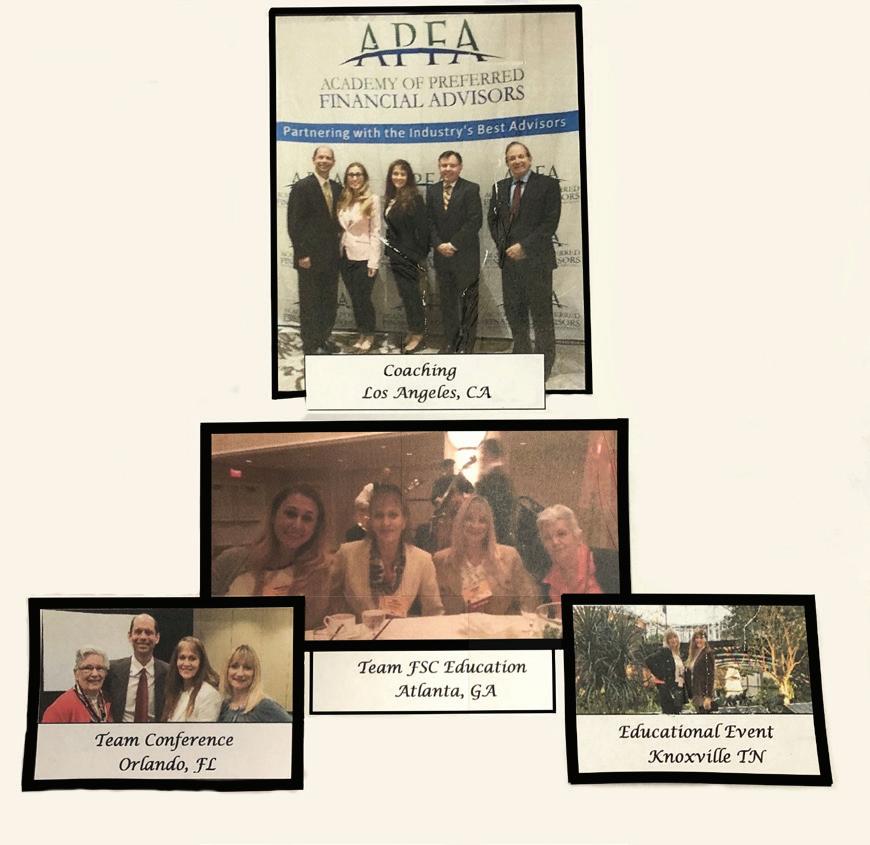
Pictures from our Educational Events
Website Solutions
Marketing Content Sales Tools
At less than $20/month, the VSA offers a collection of sales and educational tools designed to enhance customer-facing conversations.
Members gain full access to monthly newsletters, client presentations, financial calculators, fact finders, and so much more when they take advantage of the exclusive IARFC member benefit offer.
Get started with the VSA today at: https://fsonline.com/iarfc.php
Growing Global Community How to add Opportunity and Value to Your Chapter
From Our Global Ambassador
Barry L. Dayley, MRFC®, CFP®
Being part of the International Association of Registered Financial Consultants (IARFC)’s growing global community offers numerous opportunities and value for a chapter. Here’s how:
1. Global Networking: Chapters gain access to a worldwide network of financial consultants, fostering collaboration, knowledge sharing, and professional relationships across borders.
2. Enhanced Credibility: Affiliation with a respected global organization like the IARFC enhances the chapter's reputation, attracting more members and partnerships.
3. Educational Resources: Chapters benefit from access to IARFC’s extensive resources, including training programs, certifications, and industry insights, which help members stay ahead in their field.
4. Professional Development: Members can participate in international conferences, webinars, and workshops, gaining exposure to global best practices and emerging trends.
5. Cultural Exchange : Being part of a global community allows chapters to learn from diverse perspectives, fostering innovation and adaptability in financial consulting practices.
6. Advocacy and Influence: Chapters can contribute to shaping the global financial consulting profession by participating in IARFC initiatives and discussions.
7. Business Opportunities: The global network opens doors to cross-border collaborations, partnerships, and client referrals, expanding the chapter’s reach and impact.
8. Recognition and Awards: Chapters and their members can gain recognition through IARFC’s awards and honors, boosting their visibility and prestige.
By leveraging these opportunities, chapters can enhance their value proposition, attract more members, and contribute meaningfully to the financial consulting profession on a global scale.
The IARFC Canada Chapter has officially taken an important step forward with its inaugural Board Meeting, marking the beginning of a new era for financial professionals across Canada. The meeting brought together a strong and diverse leadership team committed to advancing the mission and global standards of the International Association of Registered Financial Consultants (IARFC ® ).
IARFC Canada Newly Appointed Board of Directors
President: Chanchal Chakrabarti, RFC ®
Executive VP: Rhona Konnelly, RFC ®
Vice President: To Be Determined
Treasurer: Harris Jones, RFC ®
Secretary: Vishal Taneja, RFC ®
Director: Richard Knabenschuh, RFC ®
Director: Greg Glista, RFC ®
Advisor to the Board: Jim Ruta
Thought Leadership from the Board The Emergency of Policyholder Stewardship
By Rhona Konnelly, RFC ® Executive Vice President, IARFC Canada
As the life insurance industry continues to evolve, a critical and often underemphasized responsibility is coming into sharper focus: the stewardship of in-force policyholders.
Life insurance policies are designed to last for decades—sometimes generations. Yet historically, the ongoing care of these policies has relied heavily on individual advisors rather than structured, industry-wide practices. This approach, while often effective on a personal level, introduces inconsistency and risk—particularly as advisor succession accelerates and books of business transition between professionals.
Today, the industry stands at a pivotal moment . With increasing regulatory attention, demographic shifts among advisors, and the growing complexity of insurance products, the need for formalized stewardship frameworks has never been greater. Policyholders require—and deserve— proactive, consistent service that ensures their coverage remains aligned with their evolving needs and objectives.
My current work explores how advisors, insurers, and regulators can collaborate to strengthen long-term policyholder care. This includes developing proactive servicing models, enhancing accountability during advisor transitions, and embedding stewardship into the core expectations of professional practice.
Stewardship is not simply an operational function; it is a professional obligation. It represents a commitment to ensuring that the protection clients purchase continues to deliver value throughout the life of the policy. By embracing stewardship as a defining standard, our industry has the opportunity to reinforce trust, elevate professionalism, and ultimately provide better outcomes for the clients serve.
Chapter Communications & Media
I n support of the official announcement of the IARFC Canada Chapter, Global Ambassador Jim Ruta led a coordinated media rollout on March 16–17. This included both a professionally produced announcement PDF and an introductory video designed to build awareness and engagement among financial professionals and the public.
All materials were strategically distributed across IARFC Canada’s official communication channels, ensuring broad visibility and accessibility:
Website: www.iarfccanada.com
LinkedIn: IARFC Canada
Instagram: @iarfcanada
Facebook: IARFC Canada
This multi-channel approach reflects a modern, proactive communications strategy aimed at fostering connection, credibility, and growth within the Canadian market.
Upcoming Milestone
Momentum continues to build as the IARFC Canada Chapter prepares for its official virtual launch on May 22. This milestone event will formally introduce the chapter to the broader financial services community and highlight opportunities for membership, collaboration, and professional development.
Further details will be released in the coming weeks. Members and interested professionals are encouraged to stay connected through official channels for updates and registration information.
Regional Progress Update: RFC Development in Greater China
Dear Chairman Alan C. Kifer, MRFC ® :
On behalf of the Greater China Chapter of the International Association of Registered Financial Consultants (IARFC), I would like to extend our warmest congratulations on your new appointment as Chairman. We look forward to your leadership as we continue to elevate the professional standards of financial consultancy globally.
As we conclude the first quarter of 2026, I am pleased to provide you with a strategic summary of our progress and promotional initiatives within the Greater China region (comprising Taiwan, Mainland China, Hong Kong, and Macau).
1. Strategic Partnership & Regional Mandate
Since January 2002, the IMM International has been the authorized representative of the IARFC development center in the Greater China region. For over two decades, we have remained committed to the rigorous promotion and certification of the Registered Financial Consultant (RFC ® ) designation, ensuring it remains the gold standard for financial professionals in this market.
2. Membership Statistics
As of March 30, 2026, the Greater China region has reached a cumulative total of approximately 24,500 RFC members. The distribution is as follows:
• Mainland China: 17,100 members
• Taiwan: 4,800 members
• Hong Kong & Macau: 2,600 members
3. Key Developmental Initiatives
To maintain the prestige and practical value of the RFC designation, we have implemented several high-impact projects:
• Conferment Ceremonies:
Annual RFC Conferment Ceremonies are held in several cities across the region. These events serve not only as a prestigious recognition of our members' achievements but also as a platform for elite members to share practical insights, thereby strengthening the RFC brand influence.
• Financial Planning Forums at IMCC:
At the annual Insurance Marketing Century Creation Ceremony (IMCC), we host dedicated Financial Planning Forums. These sessions combine real-world case studies from top-tier members with theoretical analysis from RFC instructors, helping attendees master core financial planning competencies.
• Digital Learning via WCIT Lab: Launched in July 2021, our YouTube channel, "WCIT Lab," provides 15-minute specialized modules. This initiative allows members to engage in continuous professional development through "microlearning," overcoming geographical barriers.
• RFC Seminar Series (Mainland China): Beginning in 2024, the China Development Center has launched a series of Financial Planning Seminars. These are designed to attract high-potential candidates to the RFC curriculum by showcasing the practical application of our certification standards.
• Global Integration & Local Summits: In addition to our exclusive Greater China RFC Annual Meeting—a restricted, invitationonly summit for our most distinguished members across China, Taiwan, Hong Kong, and
Macau—we have established a robust, multi-layered engagement strategy:
• Local Cities Summits:
Throughout our 12 annual regional summits, we host dedicated RFC Forums as a core component of the agenda. These sessions feature high-caliber practitioners who share their successful career transformations—demonstrating the evolution from traditional insurance sales to professional financial consultancy.
• International Presence: At both the Worldwide Chinese Life Insurance Congress (WCLIC) and the International Dragon Award (IDA) Annual Meeting, we host high-profile Exclusive RFC Forums. These sessions feature top-tier practitioners from across Greater China who share their successful career transformations into professional financial consultants. By presenting these proven methodologies and real-world success stories, we provide a strategic roadmap for the next generation of advisors, further solidifying the RFC’s position as the premier designation in the Chinesespeaking financial world.
We are incredibly proud of the growth and professional integrity of the RFC community in this region. We remain dedicated to aligning our local efforts with the global vision of the IARFC and look forward to your guidance in our future endeavors.
Sincerely,
Liang, Ten-Lung Chairman IARFC Greater
China Chapter
Greater China
China * Taiwan * Hong Kong * Macau
Hong Kong / Macau
Executive Certificate in Contemporary Financial Planning Program Graduation cum Master Registered Financial Specialist Conferment Ceremony Friday, January 9, 2026 The Hang Seng University of Hong Kong
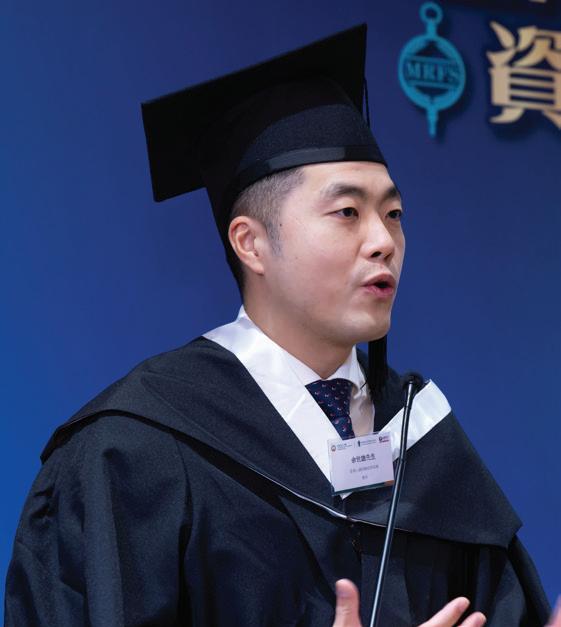
The Executive Certificate in Contemporary Financial Planning Program Graduation cum Master Registered Financial Specialist (MRFS) Conferment Ceremony jointly organized by IARFC Hong Kong and Macau Centre and School of Business, The Hang Seng University of Hong Kong was successfully held on Friday, January 9, 2026. The spotlight event held at the main campus of the organizer university acknowledged the accomplishments of program graduates, especially those who were conferred the prestigious MRFS certification according to the IARFC requirements.
The program, receiving advisory support from the Hong Kong InsurTech Association, focuses on two pivotal pillars of modern financial planning - Trust and FinTech. It is meticulously designed to enhance the professional capabilities of financial planners. The MRFS certification is a top-up honor to IARFC members who are preequipped with the RFC designation and have further completed this advanced curriculum on Trust and FinTech.
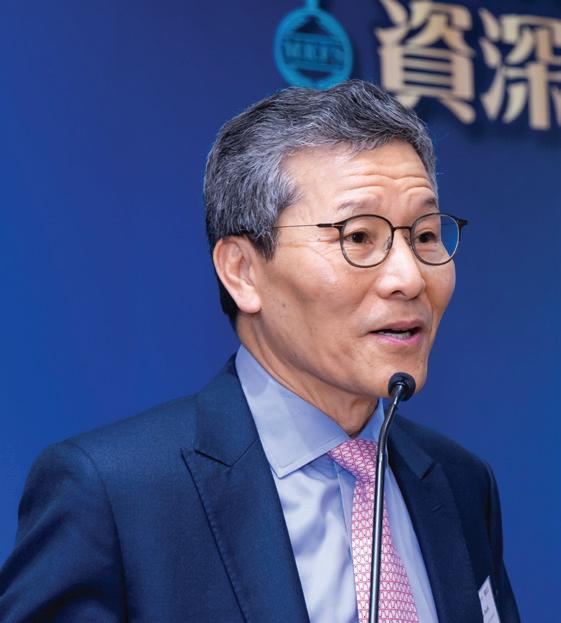
The ceremony commenced with opening addresses by Professor Sam Park, Distinguished University Professor and Dean of School of Business, The Hang Seng University of Hong Kong; Dr. Teresa So, RFC ® , MRFS, Chairman, Hong Kong and Macau, IARFC and Mr. Peter Yu, President, General Agents and Managers Association of Hong Kong. This was followed by an applauded keynote speech by Dr. Hugo Chan, RFC ® , MRFS, Chairman, IARFC Hong Kong and Macau Centre Company Limited.
The ceremony was then proceeded to the presentation of program certificates and the MRFS conferment, officiated by Dr. Teresa So and Dr. Andrew Wu, Associate Dean (Executive Education and Continuous Learning), School of Business, The Hang Seng University of Hong Kong. Ms. Anita Yiu, RFC ® , MRFS representing the graduates, delivered a heartfelt speech highlighting the practicality of the program.
The ceremony exemplified the constructive partnership between the joint program organizers in advancing cerificate in Contemporary Financial Planning Program and the MRFS certification.
Dr. Teresa So, RFC ® , MRFS delivered her inspiring words.
Dr. Hugo Chan delivered his applauded keynote speech.
Mr. Peter Yu deliverd his opening speech.
Professor Sam Park addressed the graduates.
Q1 2026 Events
Jakarta, Indonesia – In the first quarter of 2026, International Association of Registered Financial Consultants (IARFC) Indonesia carried out several key initiatives aimed at strengthening the professionalism of financial planners and promoting financial literacy across Indonesia. These initiatives included the Graduation Ceremony and the launch of MOJANG (Modul Bijak Keuangan), a financial literacy module designed for younger generations.
Graduation
Ceremony, January 31, 2026
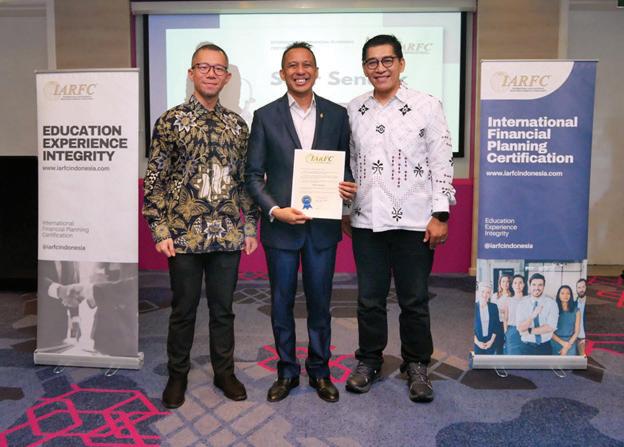
IARFC Indonesia held the Graduation Ceremony that marked an important milestone for newly certified financial professionals who have successfully completed the certification process and demonstrated their competence in financial planning.
The ceremony also featured several important activities, including: Signing of a strategic partnership agreement with Finetiks, a financial application focused on supporting better financial management.
• A talk show session featuring two pioneers of financial planning in Indonesia, Safir Senduk and Aidil Akbar Madjid, who shared insights on the development of the financial planning industry and the importance of professionalism in the field.
• The graduation procession for the newly certified participants.
• The recitation of the professional code of ethics oath, led by Aidil Akbar Madjid, reinforcing the commitment of financial planners to uphold integrity and professional responsibility.
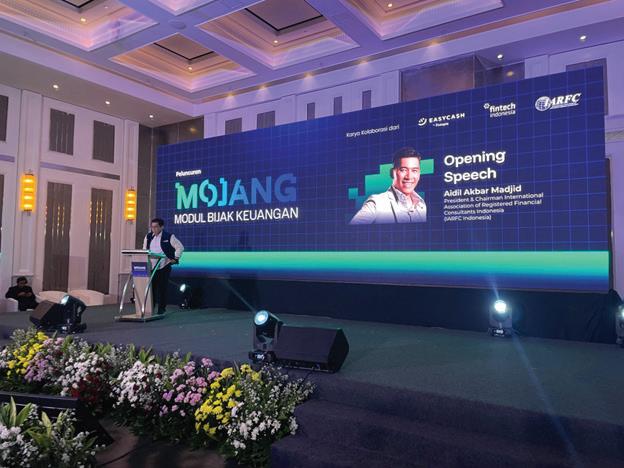
Launch of MOJANG (Modul Bijak Keuangan) February 10, 2026
As part of its commitment to expanding financial literacy, IARFC Indonesia officially launched MOJANG at The Langham Hotel, Central Jakarta. MOJANG is a practical financial literacy guide designed specifically for Gen Z and Millennials. The initiative is a collaboration between IARFC Indonesia, Asosiasi Fintech Indonesia (AFTECH), and PT Indonesia Fintopia Technology (Easycash).
Through this graduation ceremony, IARFC Indonesia continues to encourage the growth of competent and ethical financial planners who can contribute to improving financial awareness and education within society.
The module aims to deliver financial education that is relevant to the everyday realities of young people. MOJANG encourages young generations to learn about personal finance in a supportive community environment, helping them develop a better understanding of financial decision-making from an early stage. The launch event was attended by representatives from the Financial Services Authority (OJK), members of the public, and more than 20 national media outlets, reflecting the strong interest and support for initiatives that promote financial literacy in Indonesia.
Bridging the Gap: Introducing the Registered Financial Student (RFS) Program… A report from the US Chapter on RFS Initiatives
Preparing the next generation of financial planning professionals requires more than classroom instruction— it demands real-world exposure, mentorship, and early engagement with ethical and client-focused standards. Recognizing this need, the US Chapter of the IARFC is proud to introduce the Registered Financial Student (RFS) program, a new initiative designed to complement academic coursework and bring students closer to the professional financial planning community.
A New Path for Aspiring Professionals
The RFS program provides students with access to the same resources and professional insights available to designated IARFC members, creating a bridge between theory and practice. RFS members gain entry to a wealth of educational materials, invitations to professional programs and events, and access to publications such as The Register and the Journal of Personal Finance
In addition, RFS students receive access to development opportunities tailored to their unique needs, including:
• Career Foundation: Geared toward students who are serious about building a strong career in financial services.
• Networking: Connects you with like-minded peers, mentors, and professionals.
• Internship Opportunities: Supports in securing internships, which are critical for real-world experience.
• Professional Growth: Encourages personal and professional development early in your career.
• Recognition: Signals commitment and ambition to future employers.
• Global Community: Taps into the Global Registered Financial Student Community.
By offering these resources, the RFS program reinforces classroom instruction with practical insights, ethical guidance, and a deeper understanding of professional standards, helping students gain confidence and competence as they prepare to enter the field.
Faculty Engagement Shapes the Future
The RFS program is currently in its beta phase, and faculty participation is essential. Educators are invited to provide feedback on how the program can best support student learning outcomes, professional readiness, and curriculum objectives. Insights on the skills students need most, classroom resources that enhance learning, and opportunities for collaboration between academics and practitioners are all highly valued.
A Thoughtful, Engaged Student Cohort.
Greg Kurinec, RFC® - an IARFC US Chapter Board Director hosted a
discussion on March 6th with faculty and students to share the program’s vision and explore ways to strengthen its impact. Thanks to committee members Greg, Mike, Alan, Charlotte, and Vicki who put the effort into this valuable “discovery” session.
Looking Ahead
The RFS program reflects the US Chapter’s commitment to cultivating professional excellence and ethical standards in financial planning. By connecting students to industry professionals early in their careers, the program aims to prepare a generation of financial planners who are both knowledgeable and ethically grounded—ready to contribute to a dynamic, evolving profession.
The introduction of the RFS program marks an exciting step forward for financial education, offering students, educators, and practitioners a platform to collaborate, grow, and shape the future of financial planning.
Contact: Vicki@iarfc.org if you have any questions and to sign up for ASK an RFC®.
Sign up as an RFS and get notifications of “Ask an RFC® ”sessions. Learn by asking the right questions to those who have been there, done that.
The IARFC is proud to announce that the Sri Lanka and UAE Chapter is now ready to begin advancing the Mission of the Association across the region. This exciting development marks an important step in expanding the IARFC’s global footprint and strengthening its international community of financial professionals.
Under the leadership of Sussil Liyanage, RFC ® , and a dedicated Board of Directors, the Chapter is well-positioned to build momentum and drive meaningful growth. With a clear vision and strong commitment to excellence, the leadership team is focused on successfully recruiting financial professionals who are aligned with the IARFC’s guiding principles and standards of ethics.
The launch of the Sri Lanka and UAE Chapter reflects the growing demand for connection, education, and professional development on a global scale. By fostering relationships and creating opportunities for collaboration, the Chapter will serve as a hub for engagement and advancement within the financial services profession. We look forward to seeing the impact this Chapter will have as it brings together like-minded professionals and champions the value of IARFC membership throughout the region.
Welcoming 2 New IARFC Global Ambassadors
The International Association of Registered Financial Consultants (IARFC ® ) is proud to announce the appointment of two distinguished professionals as Global Ambassadors: William Wright, RFC ® , and Dr. Sanjay Tolani ® . Both are internationally recognized leaders in the financial services profession, bringing a wealth of experience, insight, and global perspective to this important role.
William and Dr. Tolani have been valued contributors to numerous IARFC initiatives, including our Virtual Summits and in-person Financial Forums. Their consistent participation and enthusiastic support have helped elevate the quality and reach of these events, while reinforcing the value of professional collaboration across borders.
As Global Ambassadors, they will play a key role in expanding awareness of the IARFC’s mission and guiding principles. Their strong international presence and respected voices within the industry position them uniquely to influence and inspire financial professionals around the world.
We are confident that William Wright and Dr. Sanjay Tolani will continue to champion the importance and benefits of IARFC membership, fostering meaningful connections and advancing the profession globally. Their dedication exemplifies the spirit of service and leadership that defines the IARFC community.
Philippines International Series
Get ready for an exciting international season of the Philippines Tuesday Podcast, launching this June! This upcoming series brings together respected voices from across the globe to share insights, strategies, and perspectives that matter to today’s financial professionals.
The four-part lineup features Greg Glista, RFC ® , representing the Canada Chapter, who will explore timely and impactful AI topics shaping the future of financial services. From Indonesia, Aidil Akbar Madjid, RFC ® , and Farizy Yunaz will highlight the importance and value of the RFA Program and its role in professional development.
IARFC Trustees Nathan Boyle, MRFC ® , and Dominique Vercaemert, RFC ® , will also join the series. Nathan will discuss the power of international connections and how building relationships across borders strengthens the profession. Dominique will share practical insights on how to better serve clients through a financial coaching approach.
This dynamic podcast series reflects the IARFC’s commitment to global collaboration, education, and growth. Don’t miss the opportunity to learn from these distinguished professionals and gain valuable knowledge you can apply in your own practice.
Watch for it starting in June.
William Wright, RFC®
Dr. Sanjay Tolani, RFC®
Want Introductions? Earn Them
Whenever I work with a consultant—a life insurance agent or financial advisor—I ask them to list their Top 20 clients. These aren’t just good clients. They’re the ones you’d most want to replicate. Your A+ clients. If your practice were filled only with people like them, you’d love every day of your business.
Once the list is complete—whether it ends up being 10, 20, or 30 names—I ask a simple question: How many of these clients have introduced you to someone they care about?
Usually, there are one or two strong advocates. But most of the others, even if they’re happy, haven’t introduced anyone. Yet according to research from industry expert Julie Littlechild, when clients are fully engaged, there is nearly a 100 percent likelihood they will introduce you—even without being asked. When you get engagement right, you can clone your best clients and double your income in a year.
So, the million-dollar question is: What creates engagement? After interviewing top producers and diving deep into the research, the answer became clear:
Clients are engaged when two things are happening:
• They’re receiving extraordinary service.
• They are regularly surprised and delighted by something their agent does for them.
Both are required. Miss either one and engagement drops.
EXTRAORDINARY SERVICE
When I review an advisor’s Top 20
list, there are almost always gaps— important conversations that should have happened but didn’t. Maybe the advisor never revisited a term conversion. Maybe they never discussed Long Term Care or disability, even though the need is obvious. Maybe they opened a single case with good intentions to circle back, but time slipped by.
Maybe client rejected Long Term Care years ago—before living benefits were available in insurance products—and now the advisor hesitates to bring it up again, even though he believes they still need this protection.Maybe a policy review is long overdue.
Whatever the reason, the service was good, but not extraordinary. Extraordinary means nothing is left undone. It also means serving beyond transactions you get paid for. When your client needs a trusted attorney, CPA, realtor, or chiropractor, do you have someone to recommend? Being a resource is service and builds extraordinary value quickly.
SURPRISE AND DELIGHT
Engagement also requires moments that make clients talk about you— moments that spark stories.
“Do you know what my advisor did yesterday?” a client might ask a friend or relative.That sentence is gold. It creates curiosity. It positions you as different from every other advisor they’ve ever met.
Meaningful, personal touches create these stories: a custom tag for their dog, a frame for a new grandchild’s photo, a guidebook for their upcoming trip, or anything that shows you know them and care. Creative appreciation events also
work. Tickets to a game or show. Dinner at their favorite restaurant. A beer or wine tasting. A golf lesson. A summer picnic. A birthday or retirement celebration. Many of these are opportunities for clients to invite guests—your future introductions.
CREATING THE CAPACITY TO ENGAGE
To serve your Top 20 at this level, you must free yourself from some of the noise we all deal with. That means putting your other clients on an efficient, automated service model. When your calendar opens up, engagement with your best clients becomes easy and natural. Some introductions from engaged clients will come without you ever asking. But when you have simple, comfortable language for bringing up introductions, you’ll get even more—because you’ve earned the right to have that conversation. Engage your Top 20, and you’re almost guaranteed at least one high-quality introduction from each of them every year.
Sandy Schussel sandy@sandyschussel.com
Sandy Schussel is an advisor performance coach who has been working with life insurance agents and financial advisors for more than 25 years and has helped several grow their gross revenues to the high six figures and beyond. Questions can be addressed to him at sandy@sandyschussel.com.
Step up to Serve on the MRFC Board
The MRFC Board is calling on leaders to step forward.
We are actively seeking driven, forward-thinking individuals to serve on the MRFC Board of Directors— individuals who are ready to influence direction, spark growth, and help define the future of MRFC Certification Program.
This is more than a volunteer role, it’s a chance to lead, to give back at the highest level, and to leave a lasting impact on the profession. Your voice, your experience, and your leadership are needed now more than ever to strengthen the MRFC Certification Program and attract the next generation of members.
MRFC Liaison, Rachel Gibbs, will be sending an email shortly outlining Board responsibilities and the nomination process.
Don’t sit on the sidelines. Step up. Get involved. Lead. Apply. Take action.
Look for the email with all the info or contact Rachel@iarfc.org to declare your candidacy. Deadline is May 31.
Exam Study Guide
$79.95 plus shipping and handling
Prepare for the MRFC® Exam
Exam Study Guide In Stock Contact Membership Services
The MRFC Exam Study Guide is now available for those who wish to take the Master Registered Financial Consultant (MRFC®) Exam. Presented in a condensed outline format and designed for the professional in mind who has limited study time, the Study Guide addresses every task of the MRFC Blueprint Exam Content to help you focus on exam topics. These are tasks derived from the most current 2021 MRFC Job Task Analysis.
Features
300 pages After topic questions for comprehension
Easy to read, outline format Organized by Blueprint tasks
Published by
Why Bonus FIAs to “Pay the Tax” on Roth Conversions
are a Failure
This topic is white hot right now in the insurance industry. It’s being pushed by several large Insurance Marketing Organizations (IMOs) as a way to sell massive amount of FIAs.
The Sales Pitch is Powerful and Simple
• Total Social Security gross income = $70,000 starting at age 65
• Annual expenses when in retirement, starting at age 65 = $95,000
• No state income tax
• 2.7% inflation annually
• 2.7% Social Security COLA increase annually
Tax-Equilibrium
If I convert an equal amount each year and for as long as the money will last, where the income taxes paid by the client are equalized (minimized), how did that work out?
Advisor: Client…how’d you like me to show you a concept where I will find you the money to pay the taxes on a Roth IRA conversion?
Client: That sounds awesome. Please tell me more!
Advisor: The concept uses a unique type of annuity. It’s an annuity with a 20% bonus on premiums paid. That 20% bonus will be used to pay the taxes on your conversion.
Client: That’s interesting. How exactly does that work?
Non-Roth IRA
Conversion Example
The best way to understand why bonuses FIAs to pay the tax doesn’t work is with an example. Let’s build a baseline client and then apply a conversion to see if:
1. A conversion of any kind works; and
2. If using a 20% bonus FIA improved conversion numbers
Example client:
• Couple, age 60 (both are still working and plan to retire at age 65)
• Life expectancy age 90
• $500,000 in tax-deferred IRA
• Joint gross income is $120,000
• Net investment rate of return inside their IRA = 6%
What does their retirement cash flow situation look like WITHOUT a conversion?
The couple runs out of money at their assumed ages of death (age 90).
Does a Roth IRA Conversion Make Sense with NO Bonus FIA?
This is the 1st question that needs to be answered BEFORE trying to figure out if a bonus FIA product will help or hurt the Roth IRA conversion math.
Lump Sum Conversion —Let’s look at the numbers if the client converts all $500,000 in the IRA at age 60.
Because of the conversion, the client runs out of money at age 84 (six years early with a cash flow shortfall of $210,456). This is an obvious mathematical loser.
Convert equal amounts over 10 years
When they convert equal amounts over 10 years, the couple runs out of money at age 88 (three years early). Still a mathematical loser.
The baseline numbers for this client are that Roth IRA conversions DO NOT work!
It’s the best outcome of the bunch, but this couple is still projected to have $44,626 less in assets at age 90 due to the conversion. Again, still a mathematical loser.
Roth IRA Conversion WITH a 20% Bonus Annuity?
Now let’s see how well using a 20% bonus FIA to “pay the tax” does to improve (or not) the numbers (remember that I’m only putting $350,000 of the $500,000 in the bonus FIA).
Lump Sum Conversion
Let’s look at the numbers if the client converts all $500,000 in the IRA at age 60 (remember, after the conversion, the Roth IRA won’t have $500,000 or $570,000 in it because taxes due on the conversion have to be paid out of Roth IRA assets).
Because of the conversion, the client runs out of money at age 78 (12 years early).
Differences between the conversion with NO FIA vs with a 20% bonus FIA: With the bonus annuity, the example client runs out of money four years earlier than the example without the bonus annuity (proving that using the bonus annuity is a financial loser).
Convert equal amounts over 10 years with a bonus annuity
A lump sum didn’t work when illustrating the use of a 20% bonus annuity, so let’s try to convert equal amounts over 10 years with the bonus annuity and see if that helps.
Because of the conversion, the client runs out of money at age 83 (seven years early).
These numbers are slightly better; however, in both examples, when using a 20% bonus annuity, the outcome was significantly worse than doing a conversion WITHOUT using the bonus annuity.
Tax-Equilibrium with 20% bonus annuity
Because of the conversion, the client runs out of money at age 85 (five years early).
Again, the numbers improved, but are still far worse than when NOT using the bonus annuity.
Summary of the numbers for all examples
Age the Couple Runs out of Money
• No Conversion, No Bonus Annuity — Age 90
• No Annuity Lump Sum Conversion — Age 84
• No Annuity Convert over a 10year period — Age 88
• No Annuity Tax-Equilibrium — Age 90*
• With 20% Bonus Annuity Lump Sum Conversion — Age 78
• With 20% Bonus Annuity Convert over a 10-year period — Age 83
• With 20% Bonus Annuity Convert using Tax-Equilibrium — Age 85
*At age 90, with this example, the couple had $44,626 less in assets than the no-conversion example.
Two conclusions are crystal clear:
1. A Roth IRA conversion for this client in any scenario is a mathematical loser.
2. The conversion numbers are not only worse, but are much worse when using the 20% bonus annuity to “pay the tax.”
Obvious additional conclusion… DO NOT use this awful Roth IRA conversion scheme!
Historical Rates of Return—Bonus FIA vs. Non-Bonus FIA
Because the annual point-to-point investment cap on bonus FIAs is so much lower than non-bonus FIAs, the expected rate of return over time is much lower. The lower rate of return destroys the use of the bonus annuity as a beneficial tool in Roth IRA conversions.
Historical return of the 20% bonus FIA vs. a non-bonus FIA
The hot bonus product right now has a 20% bonus and a 6.25%* annual point-to-point S&P 500 cap (and it’s with a carrier that has a track record of dumping caps on renewal).
*Just before the publishing of this article, the cap on the bonus annuity I’m using for example purposes dropped to 5.5% (which would make the use of a bonus annuity even more futile).
A good non-bonus FIA product with a carrier that has a track record of keeping caps high is 10.25% for its annual point-to-point S&P 500 cap product.
Here are the historical investment returns going back 10 years, IF the carrier keeps the caps at the same rate: Average Return (CAGR)
• FIA with a 5.50% cap — 4.38%
• FIA with a 9.5% cap — 7.53%
CAGR is the Compounded Annual Growth Rate (how money actually grows over time).
The difference in return? 3.15% annually!
If you paid a $350,000 premium into each one of these products, the
following would be the account values after 10 years using the compounded annual growth rate (CAGR):
• Non-bonus FIA = $723,405
• 20%-bonus FIA = $644,569
Also, the insurance carriers who push bonus to pay the tax, also happen to be the ones who have a history of dumping cap on renewal.
Summary
While using bonus annuities to pay the tax on conversions may sound like it make sense on its face, when you dive into the numbers, the reality is that it is a guaranteed mathematical loser.
Roccy M. DeFrancesco, Jr., JD
Roccy is nationally recognized as a consumer advocate and industry watchdog and is the Founder of The Wealth Preservation Institute, the creator of the, Certified Roth Conversion Specialist (CRCS), Certified Wealth Preservation Planner (CWPP™), Certified Asset Protection Planner (CAPP™), Certified Medicaid Planner (CMP™) designations and the Co-Founder of the Asset Protection Society.
Disclaimer
“IARFC does not endorse, recommend, approve or accredit any financial software, training programs or curriculums, services, processes or products of any commercial financial organization. The material presented in the article represents perspectives solely of the author, and is provided for informational purposes only.” To download the14-page White Paper detailing specifically why bonus (Fixed Indexed Annuities (FIAs) to “pay the tax” does NOT work, click on the following link: https://advisorshare.com/bonus-annuities-topay-the-tax-iarfc/
Responsible Innovation:
Guardrails for Using Artificial Intelligence in Financial Advice
In two recent articles for the Register I explored how artificial intelligence is beginning to influence the practice of financial advice.
In the first article, I shared the story of how our firm used AI to empower a student intern to produce a meaningful compliance deliverable in the highly regulated world of capital accumulation plans. In the second article, I discussed how AI tools can help advisors process complex financial information and communicate clearer insights to clients.
Both experiences pointed to the same conclusion: when used thoughtfully, artificial intelligence can enhance productivity, it can accelerate learning, and ultimately improve the service we provide to our clients.
However, as AI becomes more embedded in everyday professional life, it is worth stepping back to consider another dimension of this technology: the guardrails that responsible advisors must establish around its use.
Financial advice has always been a profession built on trust. As we incorporate powerful new tools into our practices (whether by choice or by default), maintaining that trust requires careful attention to confidentiality, ethics, and transparency.
Protecting Client Confidentiality
The first and most important responsibility is protecting client information.
At our firm, we have adopted a simple but strict principle using AI tools: client identities are never shared with external systems
If we are analyzing documents or planning scenarios using AI, all client names and identifying details are redacted before information is entered into a system. In effect, the technology is being used to analyze financial structures and planning concepts - not personal identities.
This approach allows us to benefit from AI’s ability to organize and summarize complex information while maintaining the confidentiality clients rightly and legally expect.
Another example arises when capturing meeting notes. Tools such as Otter or Plaud can help ensure that advisors do not miss important details during client discussions. However, before using any recording technology, we ask the client’s permission and explain exactly how the information will be used.
Typically, the recording exists only long enough to extract accurate notes and action items. Once the summary is prepared, the recording is deleted. The purpose is not to create permanent records but to ensure the advisor accurately captures the substance of the discussion. The client notes produced are amazing and thorough.
In short, technology must adapt to professional ethics—not the other way around.
Containing Sensitive Information
Another important safeguard relates to how information is processed by AI systems. Many modern AI platforms learn from the information they receive. For advisors working with confidential financial data, that raises an obvious concern. You must ensure sensitive information does
not become part of a broader training dataset.
For this reason, our firm takes steps to ensure that information used in AI tools remains within secure environments and is not retained for platform training purposes.
Advisors must understand how the technology they use handles information and must make informed choices about the platforms they adopt.
Remember, if you’re not sure about the data security, ask your AI system how it handles data – then ask another system about the answer you received from the first AI system.
The responsibility here is not purely technical. It is also professional. Advisors must treat client data with the same care in digital environments as they would in physical files or confidential conversations.
A Practical Example in Client Communication
One area where AI has proven especially helpful is in organizing complex investment information.
For example, portfolio analysis platforms such as CapIntel generate detailed reports that contain a significant amount of data— performance metrics, risk indicators, asset allocation details, and historical comparisons.
While these reports are extremely valuable, they can also overwhelm clients if presented without context.
AI can help advisors synthesize that information and translate it into clearer explanations. Instead of walking through dozens of charts
and tables, the advisor can quickly organize key insights and focus the conversation on what truly matters: how the portfolio aligns with the client’s long-term financial goals.
Importantly, the advisor remains responsible for interpreting the information and guiding the conversation. AI helps organize complexity—but professional judgment remains essential.
These systems are built by training models on vast amounts of publicly available information. Much of that knowledge originates from researchers, authors, and professionals who have contributed insights to their fields. This raises thoughtful questions about intellectual contribution, attribution, and the evolving nature of knowledge sharing in the digital era.
There are also questions about the environmental footprint of largescale computing infrastructure. AI systems require substantial processing power, and the longterm implications for energy consumption are still being understood.
And, of course, there are important considerations regarding how technology companies treat the people who develop, maintain, and train these systems.
These are not issues any single advisor can resolve alone. But they are reminders that adopting powerful technology requires reflection about its broader impact. Don’t shy away from this conversation—its an important consideration to be aware of.
Practical Guardrails for Advisors Using Artificial Intelligence
As artificial intelligence becomes more integrated into advisory practices, it is important to establish clear operating principles that align with the ethical standards of our profession. IARFC Members are committed to high standards of integrity, professionalism, and client
care. When incorporating AI into our work, those same principles must guide how these tools are used.
While each firm may develop its own procedures, several foundational guardrails stand out as essential.
Five
Guardrails for Responsible AI Use in Financial Advice
1. Protect Client Confidentiality
Client identities and sensitive financial information should never be directly entered into external AI systems. Documents should be anonymized or redacted before analysis.
2. Ensure Client Awareness and Transparency If technology such as transcription or recording tools is used during meetings, clients should be informed and their consent obtained.
3. Maintain Professional Oversight AI outputs must always be reviewed and interpreted by the advisor. Technology can assist analysis, but it cannot replace professional judgment.
4. Safeguard Data Handling and Security Advisors should understand how the AI platforms they use process and retain data, ensuring client information is not used to train external systems.
5. Use AI to Enhance Advice—Not Replace It
Artificial intelligence should support clearer thinking and better communication. It should not become a short-cut or a substitute for our expertise, experience, and ethical responsibility as advisors.
The Advisor’s Role in an AI Era Artificial intelligence is rapidly becoming part of everyday life. Many tools we use - search engines, communication platforms, and professional software—they all now incorporate AI capabilities.
For financial advisors, the question is no longer whether AI will influence the profession. It has arrived and it’s embedded in much of the technology we use.
The real question is how we integrate these tools responsibly.
Establishing thoughtful guardrails around confidentiality, transparency, and professional oversight allows advisors to harness the benefits of AI while preserving the trust that defines the advisor-client relationship.
Artificial intelligence can process vast amounts of information, identify patterns, and organize complex data.
AI cannot replace the responsibility each of us has accepted on behalf of our clients that comes with providing advice.
Clients do not simply need information. They need clarity, judgment, and a trusted partner who understands the broader context of their lives.
Artificial intelligence can help advisors reach those meaningful conversations more quickly.
The responsibility for the decision— and the relationship—will always remain human. Its our job to honour that premise and to keep it human.
President Cornwall Financial Partners Inc, Executive Consultant at IG Private Wealth Management, Partner Cornwall Group Benefits, Cornwall Life Insurance and Cornwall Group Savings, GIC Plus Inc.
Contact: (905) 338-1660
greg.glista@cfpinc.ca www.cornwallweath.ca
Author’s Note:
The views expressed here reflect practical experience implementing AI within a regulated advisory environment. Technology doesn’t replace judgment. It sharpens it. Used with intention, AI helps professionals do what they’ve always done best, only with greater clarity, consistency, and accountability.
Greg Glista, RFC®, FSA
Jargon scares people. Sometimes they zone out because they don’t know what you are talking about. If a client was comparing CDs or credit card interest rates, you would not talk about basis points. They are comfortable talking percentages. Referrals is an industry term. Your client has similar terms in their own profession. They would not use them at home when asked: “How was your day?” Work terms stay at work. Simplified, friendlier terms are used with friends and family. How can you ask for referrals without using the word referrals?
Fortunately there are plenty of ways to make this happen. They should be comfortable among your HNW and UHNW friends at the country club or the gang who drifts over to your grill when you are tailgating in the stadium parking lot.
1. Timing is everything. Many years ago, a cynic suggested asking for referrals at the moment you have introduced a new product to your client. Their rational was: “This might be the happiest they will ever be with this product!” That implies the product might not work out, but it makes another, subtler point: Your client is sold on the idea. They are convinced. They are enthusiastic. This is a good time to ask: “Who else do you know…”
8 Ways to Get Referrals Without Mentioning Referrals
2. The event introduction.
You are attending an event as a guest of your client. It might be a trade association dinner or a museum exhibition opening. You can tell they are home territory. You have been sticking close because you don’t know anyone else in the room. You cannot say: “Who is the most important person in the room?” You can ask: “Is there anyone here you think I should meet?” It’s highly likely they will walk you over to the most important person!
3. The prompted referral.
This is more of an introduction, but it works the same way. You know about a person who lives in their neighborhood, works in their office or belongs to the same golf club. You bring up their name and say: “This is the type of person I may be able to help. Could you introduce me?”
4. The subtler prompted referral. Uh oh! That last idea sounded like a step too far. You worry your client might ask: “How do you think you can help them?” You would need an answer. Most answers sound like: “He would become a client and I would get business.” You need a subtler approach. You volunteer the name and ask “This is a person I would like to get to know. Would you introduce me?” It is vague
enough that your client might assume you would line them up as a potential charity donor. Maybe even a client is an afterthought.
5. The “shared problem” referral. Your client wants to help. They would want to send referrals, but don’t know how. They need some coaching. Remind them of a problem where you found a solution. You remind them: “Fred, you were worried about your wife having a regular income if you passed away first.” Ask them who else they know with a similar concern. They approach their friend and say: “You know I have been worried about Betty having a regular income if I passed away. I solved that problem thanks to advice from my financial advisor. I know you feel the same way about your spouse too. I think you both should meet (your name). I think you would like them.”
6. The restaurant referral. You have a client who likes fine dining. You invite them to a restaurant where it is impossible to get a reservation on short notice. (You booked far in advance for this reason.) You plan their portfolio review for that day. The meal follows afterwards. They tell their friend: “Bill, you have been talking about that new Italian restaurant for months. I am going next Thursday!
My financial advisor is taking me after my portfolio review is done. He said I can bring a guest. Why don’t you come? The three of us can have a great time together.”
7. The anxiety reduction approach
As a financial professional, you are great at hand holding. Your client would never admit that because no one wants people to know they need hand holding. If you have this skill, it can be repackaged. Your client approaches a friend and says: “You know I get anxious about the stock market. I’ve told you plenty of times. Fortunately I found a good advisor at (firm). When I get uneasy, I give him a call. He puts things into perspective. He gets me thinking long term. He sometimes points out opportunities others are missing. I know you feel the same way about the stock market. I’m having drinks with him tonight. If you come along, I will introduce you.
8. The retirement lunch referral. You have a client who is retiring in a few weeks. Offer to take them out for lunch to celebrate. Lets share the joy. Suggest they invite one of two co-workers who are retiring later this year. You toast your client’s retirement. (With iced tea!) You ask them what they are going to do on the first day of their
retirement. When they answer, they provide a great, unsolicited endorsement because you helped them get prepared. The other guests at the table realize they should probably talk with you too.
There are many ways to get the right referrals. These are strategic, targeted referrals. Best of all, the word “referral” was never used!
Bryce M. Sanders
Bryce Sanders is president of Perceptive Business Solutions Inc. He provides HNW client acquisition training for the financial services industry. His book, “Captivating the Wealthy Investor” is available on Amazon.
Copytalk can help members take their business to the next level. Copytalk works with tens of thousands of Broker/Dealers, Agencies, and Producers, helping them increase their productivity while being more compliant.
They selectively partner with companies and organizations who see the value in helping their members and field producers improve their success
A Structural Perspective on Financial Planning, Income, and What May be Missing
Introduction
In today’s financial consulting landscape, certain phrases have become synonymous with professionalism and trust: “We are fiduciaries.” “We operate on a fee-based model.” “We do not use commission-based products.” For many investors—and increasingly among professionals—these statements signal alignment, objectivity, and discipline. And in many respects, they should. But they also raise a quieter question—one that is rarely explored with the same level of confidence with which those statements are made: Does identifying as a fiduciary automatically mean the planning process itself is complete? Or more directly: Are we, as an industry, sometimes defining integrity by structure rather than by the completeness of evaluation?
Fiduciary Responsibility: A Standard, Not a Strategy
Fiduciary duty establishes a legal and ethical obligation to act in the client’s best interest. Professional standards, including those reflected in the IARFC Code of Ethics, emphasize integrity, objectivity, diligence, and care. This standard governs how advice is delivered. It does not, by itself, define what a complete financial plan should include.
In practice, many fiduciary-based models emphasize portfolio construction, asset allocation, investment management, and cost efficiency. These are essential—but they are not the entirety of financial planning. And yet, in many cases, the portfolio is asked to carry responsibilities beyond its intended role—particularly when it comes to income, protection, and long-term risk.
What the Profession Teaches and What Happens in Practice
Financial planning is widely
presented both academically and within the profession as a structured, layered discipline. This framework includes protection (risk management), income stability, accumulation, distribution, and legacy. These are not optional components. They are foundational.
Protection, in particular, exists for a reason. It is designed to address risks that cannot be efficiently absorbed through investments alone. Which leads to a very direct question:
If risk management and protection are part of the very framework the industry teaches, what does it mean when entire categories of strategies associated with that function are excluded from the process—while still presenting the outcome as comprehensive? At that point, the issue is no longer philosophical. It becomes structural.
What I’m Seeing in Practice
In my practice, particularly through second-opinion conversations with individuals approaching or already
in retirement, a consistent pattern emerges. The portfolios themselves are often not the issue. They are typically well-constructed, costefficient, and aligned with widely accepted models.
But when the conversation shifts to income, the picture changes. In many cases, strategies designed to provide income stability— particularly those associated with risk transfer or insurance-based structures—were never meaningfully evaluated. Not because they were inappropriate, but because they were excluded early in the process or framed in a way that discouraged consideration.
Clients will often say:
“ My consultant doesn’t do that .” “ I was told those are not in my best interest, ” without ever having gone through a structured evaluation of whether those strategies were appropriate for their situation.
So what remains is a plan that is well-managed from an investment standpoint, but incomplete from an
income standpoint. Investmentcomplete, but not incomecomplete.
The Industry Shift—and Its Side Effects
The move toward fiduciary and fee-based advice has brought real improvements to the profession. Transparency is better. Alignment is clearer.But it has also introduced something else: standardization and scale: model portfolios, Centralized investment approaches, and repeatable processes designed for efficiency.
At the same time, access to investment solutions has become widely available. Portfolio construction, asset allocation, and institutional strategies are no longer exclusive, they are commoditized. Which means the differentiator is no longer access. It is the depth and scope of the planning process.
And when that process becomes confined to what fits within a particular model, it may unintentionally limit what is evaluated—even when those excluded areas are part of the very framework the profession teaches.
Perception vs. Process
Statements such as “we are feeonly” or “we do not use commission-based products” are often presented as indicators of objectivity. But they can also shape perception. They can create the impression that certain types of solutions—particularly those involving insurance or income guarantees—are inherently less appropriate, rather than simply different in structure.
Over time, this framing can influence both consultant behavior and client understanding. And when that happens, the planning process may no longer be fully open. it becomes guided by what is allowed within the model, rather than what should be evaluated for the client.
The Income Question Most Plans Don’t Fully Address
Every financial plan must answer a fundamental question: Where does the income come from—and how reliable is it? Investment portfolios provide growth and flexibility. But when income is drawn from them,
that income remains dependent on market performance.
In many retirement scenarios, however, a portion of income is intended to behave differently—to function in a predictable, pensionlike manner, similar to Social Security. When that need is identified, it represents a planning decision. Not a product decision. At that point, certain strategies designed to provide income durability naturally become part of the evaluation.
And this is where an important distinction must be made. The question is not whether those strategies should be considered. The question is how they should be implemented. Whether that implementation occurs within a fee-based structure, through alternative arrangements, or a combination of both is a separate decision—one that should be made between the consultant and the client based on what is available, appropriate, and aligned with the overall plan. Need is determined first. Structure follows.
But if the structure is predefined, the evaluation never happens. And if the evaluation never happens, the client is not choosing between options, they are choosing within limitations.
Where Real Advice Actually Matters
Clients do not stay with consultants because of performance alone. They do not stay because of fees alone.They stay where they feel understood. Where their full financial picture is considered— income, cash flow, family dynamics, long-term objectives. Because financial planning is not just about managing assets. It is about structuring outcomes.
Conclusion
This is not a critique of fiduciary standards. It is not a critique of fee-based planning. And it is not an argument for any specific product or strategy. It is a question of process—because completeness in financial planning is not defined by the model being used, but by whether all relevant considerations have been evaluated.
If certain strategies, particularly those designed to address income stability and risk are excluded before that evaluation occurs, then the process itself may be structurally limited. And if the process is limited, the outcome,no matter how well constructed,may not be fully complete.
Financial planning is not about choosing sides. It is not about fee versus commission. It is not about one model being superior to another. It is about ensuring that the client has access to a fully evaluated framework —and the ability to make informed decisions within it.
Because in the end, the goal is not to defend a structure. It is to serve the individual.
With over 30 years of experience serving pre-retirees, retirees, families, and business owners, Amine Mabsout has built a respected practice devoted to helping clients understand, prioritize, and achieve their financial goals. He is driven by a belief that trust and understanding are the foundation of meaningful financial guidance. He later founded Ametrine Financial & Insurance Services, which evolved into Ametrine Wealth Strategies—a firm known for combining technical precision with genuine human care.
Disclosure
IARFC Guiding Principles
Vision Clarity of purpose and direction will trigger our service to current members and stimulate consistent growth by attracting new members.
Love Love is a matter of the heart. Our work matters and we are committed to serve our members and the public with a brand of love we call a Committed Benevolent Interest (CBI) in everyone. We are truly concerned about the outcomes for others and ourselves.
Servant Leadership is about service. We are committed to serve our members with servant leadership as we provide resources to help them achieve their career and business objectives.
Integrity Honesty, morality, and fairness are a bellwether of what we stand for and how we serve our members and affiliates.
Innovation In an ever-changing profession, we are committed to introducing new ideas and methods to disrupt the status quo and support financial professionals and their business.
Proactive In a profession of constant change, action is essential. We are constantly alert to changes and seek to become the catalyst for change and the opportunities they create.
Authentic We are who we say we are. We invite our members to be so as well. This vulnerability builds a bedrock of trust with our members and the public.
Relevant Relevance is essential to survival. We provide practical, thought leadership in an effort to make our membership relevant to practitioners and business owners.