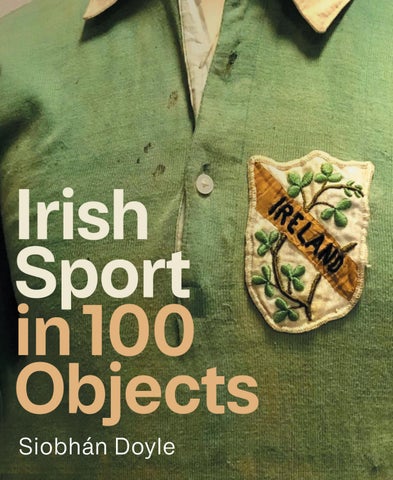
Irish Sport
in 100 Objects
Siobhán Doyle is a cultural historian and curator who works in the National Museum of Ireland. A regular contributor to RTÉ Television, she has appeared on The Late Late Show, The Tommy Tiernan Show, Ireland’s Hidden Treasures, Museum of Me and Today. She also works with RTÉ’s Brainstorm platform and regularly appears on Today FM, RTÉ Radio and Newstalk. Her 2022 book, A History of the GAA in 100 Objects, was shortlisted for the An Post Irish Book Awards.
Irish Sport
in 100 Objects Siobhán Doyle
MERRION PRESS
First published in 2026 by Merrion Press 10 George’s Street Newbridge Co. Kildare Ireland www.merrionpress.ie © Siobhán Doyle, 2026 978 1 78537 605 4 (Hardback) 978 1 78537 612 2 (eBook) A CIP catalogue record for this book is available from the British Library. All rights reserved. No part of this publication may be reproduced, stored in a retrieval system, or transmitted, in any form or by any means (electronic, mechanical, photocopying, recording or otherwise), without the prior written permission of both the copyright owner and the publisher of this book. Images in the Introduction: Olive Whitmore, Dublin Horse Show poster design, courtesy of RDS Library and Archives. Leather football, courtesy of Jim Whitty and Corach Ramblers. Bertie Messitt’s memorabilia, courtesy of the Messitt family. Hand-carved hurl, c. 19th century © National Museum of Ireland (F:1930.33). Soccer jersey worn by John Webster, 1936, courtesy of Eddie O’Mahony and the James Nolan Memorial Collection. Typeset in Garamond Premier Pro Cover design by riverdesignbooks.com Front cover image: Lacrosse Jersey (1880s), see page 20 Back cover image: Jason Smyth’s Paralympic Medal (2021), see page 196 Merrion Press is a member of Publishing Ireland.
For my nephew Éanna – the biggest sports fan in Ireland.
Acknowledgements
Thousands of miles have been travelled; hundreds of emails and texts have been sent to gather the stories within this book. There are many, many people who helped to make this book a reality. Most of them helped me in their own spare time. The amount of goodwill I received will not be forgotten. To the following people, thank you for your thoughts, time and help as I tormented you all with random ideas and requests: Clare Ablett, Helena Byrne, Jim Carroll, Gerry Farrell, Conor Heffernan, Derek Nagle, Daragh Ó Conchúir, Donal J. O’Driscoll, Eddie O’Mahony, Barry Rojack, Paul Rouse, Connell Vaughan, Muiris Wade and Valerie Wilson. To the staff of Merrion Press, thank you for your unending patience and professionalism. To my colleagues in the National Museum of Ireland (past and present), thank you for your encouragement as always. To my wide circle of incredible family and legendary friends, go raibh míle maith agaibh. To Graham, who will be absolutely raging that Denis Irwin didn’t make the cut in the 100 objects. Maybe next time.
vi
IRISH SPORT IN 100 OBJECTS
List of Objects
1. Lifting Stone (Ancient) ��������������������������������������������������������������������������������� 10 2. Bone Ice Skate (c. 9th or 10th century) ������������������������������������������������������� 13 3. Statute of Galway (1527) ����������������������������������������������������������������������������� 14 4. Maurice Davin’s Rowing Boat (1860s) ��������������������������������������������������������� 17 5. Collector’s Card (1887) ��������������������������������������������������������������������������������� 18 6. Lacrosse Jersey (1880s) ����������������������������������������������������������������������������� 21 7. Lansdowne Road Turnstile (c. 1880s) ���������������������������������������������������������� 22 8. Donnelly’s Hollow Monument (1888) ���������������������������������������������������������� 25 9. Letter Proposing Penalty Kick (1890) ��������������������������������������������������������� 26 10. Tennis Trophy (1890s) ��������������������������������������������������������������������������������� 29 11. Hockey Ball (1895) ��������������������������������������������������������������������������������������� 30 12. Cockfighting Spur (c. 19th century) ������������������������������������������������������������ 33 13. Napier 100-hp Gordon Bennett Racing Car (1903) ������������������������������������ 34 14. Tom Crean’s Tug-of-War Medal (1907) ������������������������������������������������������ 37 15. Archery Quiver and Scorecard (1908) ������������������������������������������������������� 38 16. Charlie Harris’s Kit Bag (1910s) ����������������������������������������������������������������� 41 17. Cycling Trophy (1912) ������������������������������������������������������������������������������������ 42 18. Grand National Race Card (1916) ��������������������������������������������������������������� 45 19. Cricket Bat (1916) ���������������������������������������������������������������������������������������� 46 20. Maurice Reidy’s Throwing Weight (1916) ��������������������������������������������������� 49 21. The Liffey Swim by Jack B. Yeats (1923) �������������������������������������������������������� 50 22. Bertie Donnelly’s Bicycle (1927) ���������������������������������������������������������������� 53 23. Tailteann Games Blazer (1928) ������������������������������������������������������������������ 54 24. George Brockerton’s ‘Bitza’ Motorcycle (c. 1929) ������������������������������������ 57 25. Mick the Miller Mosaic (c. 1930s) ��������������������������������������������������������������� 58 26. Lawn Bowls (1932) ������������������������������������������������������������������������������������ 61 27. Showjumping Medal (1935) ������������������������������������������������������������������������ 62 28. Poster for the Galway Races (1936) ���������������������������������������������������������� 65 29. Souvenir Scarf (1936) ��������������������������������������������������������������������������������� 66 30. Bracelet of Racecourse Badges (c. 1937) ������������������������������������������������� 69 31. Ireland v Poland Match Programme (1938) ������������������������������������������������ 70 32. Basketball Medal (1944) ������������������������������������������������������������������������������ 73
vii
33. Mick Murphy’s Stone Weight (1946) ��������������������������������������������������������� 74 34. Olympic Boxing Official’s Armband (1948) ������������������������������������������������ 77 35. Rugby Match Ticket (1948) ������������������������������������������������������������������������ 78 36. An Tóstal Trophy (1953) ����������������������������������������������������������������������������� 81 37. Road Bowling Ball (c. 1955) ������������������������������������������������������������������������ 82 38. Ronnie Delany’s Running Shoes (1956) ��������������������������������������������������� 85 39. Rás Tailteann Flag (1956) ��������������������������������������������������������������������������� 86 40. Canada Cup (1958) ������������������������������������������������������������������������������������ 89 41. George Best’s Football Boots (c. 1958) ������������������������������������������������������ 90 42. Tom Cleary’s Suitcase (1961) ��������������������������������������������������������������������� 93 43. Kevin Cavey’s Surfboard (1962) ���������������������������������������������������������������� 94 44. Pat Taaffe’s Racing Cap (c. 1960s) ������������������������������������������������������������ 97 45. Desmond Byrne’s Workbench (1968) ������������������������������������������������������� 98 46. McDaid’s Football Special (c. 1960s) �������������������������������������������������������� 101 47. Illustration of Camogie Uniforms (1969) �������������������������������������������������� 102 48. Weight Bar (c. 1970s) ������������������������������������������������������������������������������� 105 49. Waterford Crystal Golf Trophy (1970) ������������������������������������������������������� 106 50. Commemorative Rugby Cap (1972) �������������������������������������������������������� 109 51. Stade de Reims Pennant (1973) ����������������������������������������������������������������� 110 52. Golden Apple of the Sun Yacht (1974) ������������������������������������������������������������ 113 53. Swimming Regatta Trophy (1978) �������������������������������������������������������������� 114 54. Sports Illustrated Magazine (1979) ����������������������������������������������������������������� 117 55. The Superstars Singlet (1979) ����������������������������������������������������������������������� 118 56. Homemade Rowing Equipment (c. 1970s) ����������������������������������������������� 121 57. John Treacy’s Singlet (1979) ���������������������������������������������������������������������� 122 58. Cue Ball Electronic Game (1981) ���������������������������������������������������������������� 125 59. Dublin City Marathon Plaque (1980) ������������������������������������������������������� 126 60. Joey Dunlop’s Toolbox (c. 1980s) ������������������������������������������������������������� 129 61. Barry McGuigan’s Robe (1985) ���������������������������������������������������������������� 130 62. Galtee Tea Towel (1987) ���������������������������������������������������������������������������� 133 63. Davy Keogh Says Hello Flag (1988) �������������������������������������������������������� 134 64. Deirdre Gogarty’s Punchbag (1980s) ������������������������������������������������������ 137 65. Ken Doherty’s Snooker Cue (c. 1980s) ���������������������������������������������������� 138 66. Packie Bonner’s Jersey (1990) ����������������������������������������������������������������� 141 67. Jordan 191 Race Car (1991) ������������������������������������������������������������������������� 142 68. Skateboard (1991) ������������������������������������������������������������������������������������� 145 69. Netball Socks (1991) ���������������������������������������������������������������������������������� 146
viii
IRISH SPORTS IN 100 OBJECTS
70. Team Ireland Bobsleigh (1992) ���������������������������������������������������������������� 149 71. Garda Riot Helmet (1995) ������������������������������������������������������������������������� 150 72. Sonia O’Sullivan’s Bodysuit (1997) ���������������������������������������������������������� 153 73. Maeve Kyle’s Blazer (2000) ���������������������������������������������������������������������� 154 74. Sonya McGinn’s Badminton Racquet (2000) ������������������������������������������ 157 75. Statue of Danno Mahony (2001) �������������������������������������������������������������� 158 76. International Rules Jersey (2002) �������������������������������������������������������������� 161 77. Special Olympics Mascot (2003) ������������������������������������������������������������� 162 78. Rory McIlroy’s Headcover (c. 2003) �������������������������������������������������������� 165 79. Puissance Fence (2004) �������������������������������������������������������������������������� 166 80. Rule 42 Voting Card (2005) ���������������������������������������������������������������������� 169 81. Alain Rolland’s Referee Jersey (2007) ����������������������������������������������������� 170 82. Claire Walsh’s Diving Mask (2010s) ��������������������������������������������������������� 173 83. Robert J. Howard’s Taekwon-Do Belt (2011) �������������������������������������������� 174 84. Laura Corrigan’s AFL Jersey (2011) ����������������������������������������������������������� 177 85. Katie Taylor’s Boxing Shorts (2012) ��������������������������������������������������������� 178 86. Hugh Russell’s Camera (2013) ����������������������������������������������������������������� 181 87. Statue of Jim Stynes (2014) ���������������������������������������������������������������������� 182 88. William Porterfield’s Cricket Jersey (2015) ���������������������������������������������� 185 89. World Cup Silver Hockey Medal (2018) �������������������������������������������������� 186 90. Tess Arbez’s Ski Suit (2018) �������������������������������������������������������������������� 189 91. Tennis Ball (2019) �������������������������������������������������������������������������������������� 190 92. Becky Lynch Action Figure (2020) ���������������������������������������������������������� 193 93. Rachael Blackmore’s Saddle (2021) �������������������������������������������������������� 194 94. Jason Smyth’s Paralympic Medal (2021) �������������������������������������������������� 197 95. Damian Browne’s Rowboat (2022) ���������������������������������������������������������� 198 96. Women’s World Cup Draw Paper Strip (2022) ��������������������������������������� 201 97. Rhys McClenaghan’s Wrist Straps (2022) ��������������������������������������������� 202 98. Weeds in Casement Park (2023) ����������������������������������������������������������� 205 99. Rhasidat Adeleke’s Hair Ribbon (2024) ������������������������������������������������ 206 100. Roller Skates (2025) ����������������������������������������������������������������������������� 209
ix
x
IRISH SPORT IN 100 OBJECTS
Introduction
In 1974, John Ryan bought a leather football so that it could be used in the new soccer club in south Co. Wexford. That club would be named Corach Ramblers after the River Corach, which runs through the townlands where its players and members live, work and socialise. Almost forty years later, a horse was bred in that same area by Paul Hillis. The horse was known as Corach Rambler and would go on to win the most famous race in the world: the Aintree Grand National. Corach Rambler, as the 2023 champion, joined a roll of honour that includes some of the greatest horses in living memory and cemented the name of the Corach in the annals of sports history. These are just two sports stories flowing from one small river, and they led me to imagine the potential tales that all the rivers of Ireland must encompass. This book is a look into the vast treasure chest of sports objects that are scattered
around this country and beyond. I wrote it to fulfil the curiosity of sports and history fans, but also for people who just love a good story. Each object has been chosen as a springboard to an insight into a person, a remarkable moment or a particular sport. Taken together, their tales form a rich tapestry that allows us to reflect on the Irish identity created through sport in all its aspirations and achievements, and all its complexities and failures. Sport isn’t just entertainment or exercise that distracts us from our daily lives – it is a
1
vibrant space that articulates our shared hopes, joys and pain. Troy Parrott scoring a hat-trick to keep alive the Republic of Ireland soccer team’s hopes of qualifying for the 2026 World Cup for another few months had the nation cheering with the eternal optimism of underdogs everywhere. Shane Lowry jumping around the green after sinking the winning putt in the 2025 Ryder Cup radiated complete and utter joy at its best. Seeing the dejection of the women’s 4x400m relay team in their post-race interview after narrowly missing out on a medal at the 2024 Olympic Games brought viewers to tears in empathy with them. And these moments are only from the very recent past. The volume of sports stories that are either available to be shared or waiting to be uncovered is overwhelming. As we continue to play sport, break records, establish new clubs and add new rules, this is expanding all the time. It is up to writers, journalists, archivists, librarians and museum practitioners to record and safeguard for future generations the memories, and the physical artefacts, that emerge from these events – that’s their job after all. But an underrated contributor is the everyday memory keeper – the mothers who hold onto their child’s first jersey, the pubs that display photographs of football teams from the local parish, and the match-goer who collects programmes and stores them in their garage just in case. These everyday
2
IRISH SPORT IN 100 OBJECTS
archivists can offer a broader perspective on the diverse world of Irish sport, one that goes beyond the headlines and into people’s attics, into the good presses, into the boxes under the bed and into collections behind closed doors to uncover the memorabilia cherished enough to be kept for decades. Sometimes it is difficult for such memories to be verified. Sure, we can check the scores of matches and the dates of fixtures, but that doesn’t afford space for the personal memories that we attach to these occasions. My brother Mark recalls watching the last match in a fourmatch saga between Meath and Dublin in the first round of the 1991 Leinster Senior Football Championship as ‘the day I ate four apples’. My father Pat takes every opportunity to recall how he scored four goals in five minutes during a soccer match in the school yard in the 1950s. I faked illness from my weekend job in the local SuperValu so that I could see Sonia O’Sullivan race in the 5000m at the 2002 European Athletics Championships. None of these personal memories can be verified. There is no way of fact-checking them, because we each have our own standpoint on our experience of certain sporting moments. We can, of course, ask whoever else was there, but the details of those memories are so unique, and often so long ago, that it is unlikely anyone else will remember things in quite the same way. Those
memories are personal, but, most importantly, they are lasting. Only a small percentage of sports stories enter the national consciousness. These are usually occasions where there is a massive controversy, or when sportspeople prove that they are among the best in the world in their given discipline. Good examples would be Ronnie Delany winning gold at the 1956 Olympic Games, champion racehorse Shergar being kidnapped in 1983, the Republic of Ireland reaching the quarter-finals of the 1990 FIFA World Cup, and Katie Taylor defending her world championship title. Outside of these national stories, how we measure the import ance of a sports event is pretty much down to individual interests. For some, the Dublin Horse Show is an unmissable event and the highlight of the summer. For others, it doesn’t even register on their radar. My father’s tug-o’war medals would be of little interest to the National Museum of Ireland, but to him they represent an important sporting achievement in his life that won’t be replicated. Sports stories are formed collectively, nationally and personally. In this book, I have tried to write about them from all three perspectives over as wide a time frame as possible, from the ancient right up to the present day. One thing that can assist us in verifying, interpreting and understanding sports stories
and memories is objects. When the Ireland rugby team ended a forty-nine-year wait to win what was then the Five Nations Grand Slam at Ravenhill, Belfast, in 1948, J.C. Daly (1917–88) scored the winning try. After the match, he was carried around the field shoulder high. Excited supporters reacted to the victory by ripping Daly’s shirt to shreds and keeping the fragments as souvenirs. Difficult to track down, supposedly spread around the country and possibly no longer in existence, those jersey fragments mirror my journey in writing this book. Starting with one small shred of information from an oral testimony, a newspaper clipping or a passage of a book, I travelled around the country to track down objects that show what sport really means to people, and to reassemble the story behind them. As a historian, I’m used to dealing in fragments. It’s my job to stitch those fragments together in the hope of forming a viable, interesting and entertaining story. There were objects that I wanted to include in this book that I simply couldn’t track down. One that was top of my list from the very start was the flag that Peter O’Connor raised at the 1906 Intercalated Olympic Games. Peter was one of the Irish athletes who (reluctantly) participated under Team Great Britain at the games in Athens. He won silver in the long jump competition and when the Union Jack was
3
raised at the medal presentation, he scaled the flagpole and unfurled his Erin Go Bragh flag. Many years later, Peter reflected: ‘It caused a great sensation – it received wide publicity in the world’s press and turned the spotlight very much on the Irish political situation at a period when very few dared to raise a protest against the British domination of our country.’ I followed many different leads on the location of the flag, none of which brought me to it. I issued public call-outs on radio and social media to no avail. The flag it out there somewhere, but it is simply out of reach for me at this moment in time. In contrast, in October 2024, I made my way to Shankill, Co. Wicklow, to view a collection of objects belonging to Bertie Messitt (1928–2012) – champion runner, Olympian and organiser of the first Dublin marathon in 1980. Before I visited, I thought that I might see some medals and trophies, maybe a uniform or certificate if I was lucky. What I was met with was Bertie’s entire career laid out in the family home. Medals, plaques, singlets, blazers, documents, newspaper cuttings, photographs, trophies, handwritten training notes – an entire lifetime of sports objects collected by Bertie and cherished by his family. To have such a complete collection in one place and to have so much information, such a clear chronology and so many objects readily available is extremely rare.
4
IRISH SPORT IN 100 OBJECTS
There are significant objects that have been lost in the mists of time. Broadcaster Bill O’Herlihy’s clap-hand hat that he wore during live studio coverage when Ireland beat Romania on penalties at the FIFA World Cup in 1990 is one of these objects. In an impromptu move by the RTÉ floor manager, the hat was thrown to Bill, and it became an iconic image of the joy and elation that the tournament brought nationwide. The hat was even immortalised in a mural in Dublin 7 by graffiti artist Omin. Unfortunately, Bill didn’t take the hat home and presumably it was tossed aside as a funny prop that had fulfilled its purpose. A similar hat surfaced on Bill’s last broadcast in 2014, but, having spoken to the O’Herlihy family, it seems unlikely this was the same hat that he wore in 1990. They have lamented that neither hat was collected. It is often long after the occasion or after someone’s death that we realise something was worth keeping. A similar fate met Seán Mannion’s boxing shorts with ‘Rosmuc’ on their waistband. Seán was once the highest-ranked middleweight boxer in America and rejected a $25,000 sponsorship fee because he wanted his native Rosmuc to feature prominently on his shorts. It earned him the affectionate nickname of Rocky Rosmuc. I contacted Seán in the hope that he had treasured those shorts, but he told me he had given them away to someone
5
in the local pub one night and is unsure of their trajectory thereafter. Of course, we have photographs of Seán in his shorts and we have footage of Bill in his hat. But being able to take something in our hands or to see it in person stirs a deeper nostalgia and creates links to a place and time now passed. Objects can also give an insight into a time when there were few or no visual representations available. They reveal what Irish sporting life looked like before the advent of TV and colour photography. Their fascinating kaleidoscope of materials, styles, conditions and attendant stories exudes life and suggests the character of both bygone eras and the people who used these objects. A hand-carved hurl from Tuam, Co. Galway, battered from use and with a narrow
6
IRISH SPORT IN 100 OBJECTS
shape to serve the style of play in the nineteenth century, reminds us of the evolution of a native game and the importance of those who came before us in creating and nurturing such sports. Often, such objects cannot be fully appreciated by viewing historical photographs. Take the jersey John Webster wore during a soccer international against Switzerland in 1936. It is baffling to think of a goalkeeper having to play a match wearing a long-sleeved woollen poloneck, but its aesthetic appeal is much more apparent up close than in old photographs of the team lining out before kick-off. These artefacts can also provide valuable insights into the history of Irish sport and remind us of people worth remembering who have never been properly recognised. One such
sportsperson is Joan Horan (1918–65), who won two gold medals – one in archery and one in swimming – at the first ever Paralympic Games held in Rome in 1960. Such a sporting achievement would likely have led to intensive media coverage had it concerned an athlete without a disability. But, due to the lack of knowledge of Paralympic sport at the time, sports journalists were unable to interpret the event in a historic context or understand its significance. Joan’s achievements were never
covered in the sports sections and were confined to short articles in a small scattering of newspapers. Joan was honoured at the Caltex Sports Stars Awards in 1961. This was an annual ceremony to recognise outstanding personalities in Irish sport. Award-winners that year included Down’s Jim McCartan in Gaelic football, Christy O’Connor in golf, John Caldwell in boxing and Mick Mackey, who was inducted into the Hall of Fame for his hurling prowess.
7
All these male award-winners were celebrated with a large caricature of them displayed on stage and were presented with trophies by An Taoiseach Seán Lemass. So, what did Joan Horan receive to mark her success as an international double gold medallist? A trophy, a bronze plaque or a piece of Waterford Crys tal perhaps? Actually, it was a bouquet of flowers. Ireland’s first Paralympic medallist was presented with a gift that would last, at best, a week or two, while her male, able-bodied counterparts were given permanent souvenirs to mark their achievements. Joan’s achievements could still be properly recognised retrospectively, something we have seen happen in recent years. In 2023, women who played on Republic of Ireland senior soccer teams were presented with commemorative hand-stitched caps because the Football Association of Ireland (FAI) had previously failed to honour them. In 2024, a bronze statue of Deirdre Gogarty was unveiled in Drogheda to celebrate her commitment and dedication to boxing. Deirdre was forced to leave Ireland in the 1980s to pursue her ambition of becoming a professional boxer, because the Irish boxing authorities refused to allow women to compete
8
IRISH SPORT IN 100 OBJECTS
at that time. These people now have tangible objects to recognise their contribution to Irish sport. So far, there’s nothing for Joan Horan – no plaque, trophy or statue. Hers is one of the many stories that cannot be represented by the objects in this book, but maybe by the time I write volume two, an object to represent her will either have been uncovered or created. You won’t find the hundred objects in this book lined up for perusal in one museum or even brought together in the same city or town. They are a wonderful pick ’n’ mix of things that reflect the Irish experience in the arena of sport. Walking, running, winning, losing, joy, sorrow – all of these are represented in this whistle-stop tour. By sharing them with you, I hope to draw attention to the fascinating array of sports objects in both public and private collections, and give them the attention they deserve as tools for exploration. I have enlisted the help of museum practitioners, historians, collectors and sportspeople to provide additional perspective on what makes these objects especially significant. My hope is that this assembly of objects will provide an opportunity for people to come together and share their memories of and passion for Irish sport.
100 Objects
9
1. Lifting Stone (Ancient) Image courtesy of Remnants of Our Past/Deirdre O’Neill
For centuries, the stones on Ireland’s rugged landscape have played a central role in communities and traditions through the practice of stone lifting. This involves lifting heavy stones from the ground to either waist or chest height. The ability to lift a particular stone was used as a test of strength and to physically demarcate the strongest and weakest men in the community. It was often done as a rite of passage at events like weddings and funerals. The practice can also be found in various guises in Scotland, Iceland and parts of Asia and Oceania. Each culture of stone lifting is distinguished by its own strict rules on how to perform a lift and how to classify successful and unsuccessful lifts. This lifting stone is at Mouilín Port Bhéal an Dún on Inis Mór, one of the Aran Islands. It weighs 171kg and is believed to have been part of the stone-lifting tradition on the island
10
IRISH SPORT IN 100 OBJECTS
for centuries. It features in Liam O’Flaherty’s short story The Stone, written in 1937, which describes how ‘from time immemorial it had been the custom of the young men of the village to test their strength by lifting it’. The story describes an old man’s attempt to ‘give wind to the stone’ (lift it from the ground) and how he manages to do so but dies in the process. At his funeral, the young men from the town begin to lift the stone in his honour. Stone lifting began to disappear in Ireland in the eighteenth and nineteenth centuries during British colonisation, and it vanished almost entirely around the 1840s when the Great Hunger devastated the country. David Keohan is currently leading a revival of Irish stone lifting by rediscovering, lifting and documenting Ireland’s lifting stones.
12
IRISH SPORT IN 100 OBJECTS
2. Bone Ice Skate (c. 9th or 10th century) The Hunt Museum Collection, Limerick
The precursor to roller-skating – ice-skating – can be dated as far back as 1800 bc. Skates were worn so that people could more easily navigate their surroundings during the coldest parts of the year. Archaeologists have found evidence that people fashioned ice skates from animal bones, pioneering the oldest human-powered means of transport. This bone ice skate is thought to be made from antler bone. It has a tapered, upturned head with two perforations, one on either side. Leather straps would have been threaded through these holes to attach the skates to a shoe or sled. It has been suggested that Viking Age skaters propelled themselves across the ice with sticks akin to skiing, rather than gliding across the ice as is done with modern metal skates. While the exact provenance of this bone
skate within Ireland is unknown, it is almost identical to examples recovered in other parts of Europe, such as Birka in Sweden, Přerov in the Czech Republic and York in England. The Irish Annals – texts that provide the primary witness for much of early medieval Irish history – record many instances of heavy snowfall; in the year ad 1338, the cold weather was so severe that the River Liffey froze over. People are recorded as dancing, playing ball and running races on the river at the time. Ireland’s first built ice rink was established in 1876 in the grounds of the Mourne Hotel in Rostrevor, Co. Down. This was followed in 1878 by one in Cork. Ireland’s first permanent ice facility was built in Rialto, south Dublin, in 1980; it was converted from an old cinema and originally catered primarily to public skating.
13
3. Statute of Galway (1527) Galway Corporation
In 1484, Richard III (1452–85), King of England, granted the city of Galway the right to elect their own mayor and corporation; they would be responsible for the governance of the town. As the local authority, Galway Corporation issued local laws that regulated life in the city. These laws were written in a statute book, which was handwritten in medieval English. In 1505, some of the streets of Galway were paved, which made playing sports attractive to inhabitants of the city. It is, perhaps, no surprise then, that one of the laws in the statute book from 1527 forbids hurling from being played. It reads that ‘at no time to use nor occupy the hurling of the little ball with hockey sticks or staves, nor use a handball to play outside the walls, but only the great football’. So the walls of
14
IRISH SPORT IN 100 OBJECTS
the city could not be used for playing handball, but soccer was permitted. Any person caught playing hurling or handball would be issued a fine of eight pence – the equivalent of about €20 today. Other by-laws from the time insist that all men speak English, shave their upper lip weekly, and that no boats or weapons be sold to Irishmen. The statute gives an insight into the importance British colonisers awarded Irish sport when it came to everyday life. If they were to achieve total control of the country, the Irish people’s connection to their native trad itions, including Irish sport and language, would have to be broken and replaced with English equivalents.
15
16
IRISH SPORT IN 100 OBJECTS
4. Maurice Davin’s Rowing Boat (1860s) Tipperary Museum of Hidden History
Maurice Davin (1842–1927) is well known as a founder of the Gaelic Athletic Association (GAA) in 1884 and for being its first president. He came from a distinguished sporting family and, along with his two brothers, Tom and Pat, he dominated Irish athletics for over a decade. In the 1870s, it was said that they held half the world’s records for running, jumping, hurdling and weight-throwing. Maurice also excelled at water sports, and his home near the River Suir in Co. Tipperary allowed him to develop a passion for rowing. In the 1860s, Maurice built and designed a fouroared racing boat, which his mother called the Crúiscín. Originally, the boat did not perform as well as expected, and it was later modified and extended. Maurice explained these changes
in an interview with The New York Daily News in 1906: ‘I built the boat over forty years ago. Somehow or other she was not a success […] I held onto her, I had faith in her, for she was a sweet boat. Last year I lengthened her bow a bit, and the boys took her to this year’s Regatta in Waterford and won.’ The boat was stored in the rafters of a shed at Deerpark in Davin’s homeplace for many years. It was removed from the shed in 2006 and underwent lengthy conservation treatment. When it was installed in South Tipperary County Museum later that year, a large contingent of people eagerly awaited its display. Due to the boat’s size and weight, it took approximately twenty-five people to manoeuvre it into its permanent position in the museum gallery.
17
5. Collector’s Card (1887) The Jefferson R. Burdick Collection, gift of Jefferson R. Burdick
During the 1870s and 1880s, one of America’s most popular spectator sports was competitive walking, also called pedestrianism. Inside soldout arenas, competitors walked around dirt tracks in massive tests of endurance that often lasted several days. One of the most famous athletes in this sport in the 1870s was Daniel O’Leary (1846–1933). He is depicted on a collector’s card issued in 1887 by W.S. Kimball & Company. Tobacco companies like Kimball & Co. included these colourful cards in cigarette packs to encourage brand loyalty as smokers collected the entire series. The 1887 series included jockeys, baseball players and wrestlers, amongst other athletes. Born in Clonakilty, Co. Cork, at the onset of the Great Hunger, Dan participated in hurling and rowing before moving to New York at the age of twenty. He made his name in pedestrianism because of a chance encounter in a shop in Chicago. There, he overheard people talking about the achievements of champion
18
IRISH SPORT IN 100 OBJECTS
walker Edward Payson Weston and claiming that only an American could walk 100 miles in 24 hours. Determined to prove them wrong, the Corkman hired a roller rink and completed the challenge with 43 minutes to spare. His only refreshments were iced water and brandy. In 1875, Dan and Weston met in a 500-mile race. Billed as ‘The Great Walking Match for the Championship of the World’, it attracted such interest that it was held in Chicago’s mammoth Interstate Exposition Building. The contest took place over six days and, throughout, each competitor slept for between 3 and 5 hours a night in small rooms assigned to them in the Expo building. They stopped for meals occasionally but usually took their nourishment while they walked. Dan won easily and was declared Champion of the World. His triumph was celebrated widely and helped Irish immigrants gain acceptance in Chicago at a time when discrimination against Irish people in America was rife.
19
20
IRISH SPORT IN 100 OBJECTS
6. Lacrosse Jersey (1880s) Ulster Museum Collection; image courtesy of National Museums NI
The first playing of lacrosse – a stick and ball game – can be traced back as early as the twelfth century to various indigenous tribes in North America, where the game was played for centuries before it emerged in Europe. In Ireland the first club to be established was the Ards Lacrosse Club in Newtownards, Co. Down, in 1872, and from there the popularity of the game spread. The Ards club would become the dominant force in the domestic scene as the playing of lacrosse expanded, mainly in Belfast and throughout the north, but with regular fixtures in Dublin as well. At this stage the game was exclusively male. This international lacrosse jersey, with its button-up collar and a hand-sewn crest with embroidered shamrocks, dates to the 1880s – a time when lacrosse was flourishing in Ireland. The Irish team travelled to the USA and Canada in summer 1886 to play a number
of matches and wore this jersey on the tour. During their boat journey to America, the team played a game of lacrosse on deck; when they lost the ball overboard, they used onions to continue playing. Men’s lacrosse died out in Ireland in the early 1900s; women’s lacrosse then emerged in the 1920s but disappeared again in the 1970s. In 2001, the Irish men’s lacrosse team was re-formed to compete in the European Championships tournament in Wales. The men’s senior team has since continued to participate in major tournaments worldwide. In a gesture of remarkable generosity, the Irish lacrosse team pulled out of the 2022 World Games in Birmingham, Alabama, so their place could be given to the Iroquois Nationals – a confederacy of Native American tribes – in an act of solidarity and support between the Irish and Native American peoples.
21