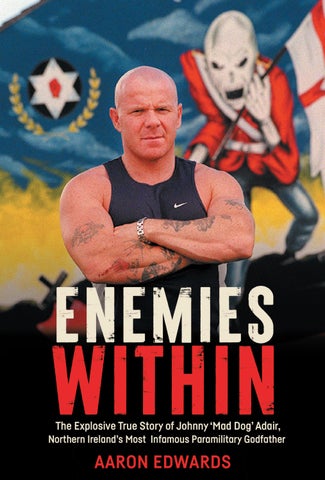
ENEMIES
WITHIN
‘Do heroes remain in the modern world? Alas, they do. They call themselves “freedom-fighters”, but their activities are … usually more an assertion of deranged personality than calculated service to a political cause.’ Michael Howard, ‘Death of a Hero’, London Review of Books (1988)
CONTENTS
A Note on Terminology
ix
Preface
xi
Introduction
1
1.
Vigilantes
9
2.
Terrorising the Terrorists
18
3.
Shooting Fathers and Creating Orphans
26
4.
Small Cells Are Only as Good as the Weakest Link
36
5.
‘I’m fuckin’ central’
44
6.
A Legitimate Target of War
54
7.
‘Youse are the UFF!’
61
8.
Death of the Architect
72
9.
Grumpy Old Men
79
10. ‘Tucker keeps the bin lid on you lot’
86
11. C Company Reborn
92
12. ‘It would have been a bloodbath!’
100
13. Beirut
107
14. ‘I love a wee bit of ethnic cleansing, so I do’
115
15. A Magnet for the Cops
124
16. ‘Where’s Johnny Adair now?’
132
17. An Intelligence Target
140
18. ‘Can you slow down, son?’
147
19. A Cult Figure
155
20. ‘What do we do to Taigs? We spray them!’
166
21. One Behind the Ear Keeps Them in Line
174
22. ‘The ball is at my foot’
184
23. Who Shall Separate Us?
191
24. Enemies Within
200
25. The Powers That Be
212
26. ‘Kill ’em all, let God sort ’em out!’
219
27. Their Only Crime Loyalty
232
28. Removing the Engine
240
29. ‘I’m not finished with the Provos’
247
30. A Gangland Execution
255
Epilogue: All Those Wee Men Are Dead
266
Endnotes
277
Select Bibliography
295
Acknowledgements
299
Index
302
A NOTE ON TERMINOLOGY
THERE WERE A RANGE OF ARMED groups involved in the Northern
Ireland Troubles. On the republican side the parent group was the Irish Republican Army (IRA), which came into existence in the early twentieth century. In 1969/70 the IRA split into the separate left-leaning Official IRA and the extreme nationalist Provisional IRA (PIRA). The Official IRA split again in 1974, with a new group emerging called the Irish National Liberation Army (INLA), which claimed to be revolutionary Marxist in orientation. The INLA would split again into the Irish People’s Liberation Organisation (IPLO) in the mid-1980s. Meanwhile, the Provisional IRA split in 1986, with the dissidents this time forming a political wing known as Republican Sinn Féin and sprouting an armed wing, the Continuity IRA, after the Provisional IRA ceasefire in 1994. The Provisionals split again in 1997, with those who walked away known as the Real IRA. Meanwhile, loyalist paramilitaries remained largely cohesive. The Ulster Volunteer Force (UVF) was formed in 1965 and took its name from a mass paramilitary army formed to oppose Home Rule for Ireland in the early twentieth century. Another group, the Red Hand Commando (RHC), emerged in the early 1970s and came under the controlling influence of the UVF at around the same time. Meanwhile, the Ulster Defence Association (UDA) was formed in 1972 out of a disparate array of vigilante groups that emerged in Protestant areas in 1969. The Ulster Freedom Fighters (UFF) was a cover name used
x
A Note on Terminology
by the more extreme members of the UDA from 1973 onwards. Sometimes seen as the group’s ‘armed wing’, nom de guerre, or, indeed, as a separate organisation, it is better thought of as a relatively small group of militantly minded people who were motivated and prepared to kill. The Loyalist Volunteer Force (LVF) emerged when the UVF’s Mid Ulster unit was ‘stood down’ after violence associated with the Drumcree parading dispute in Portadown in 1996. Another purported loyalist group was the Red Hand Defenders (RHD), which was largely a cover name for unsanctioned attacks carried out by paramilitaries associated with the UDA/UFF and UVF/ RHC.
PREFACE
JOHNNY ‘MAD DOG’ ADAIR HAS LOOMED large in the public
imagination of the Northern Ireland Troubles. It could even be said that he continues to haunt the lives of many of those affected by political violence. For most people who have heard of him, Adair remains the quintessential paramilitary godfather, one who played a key role in the terrorism unleashed on both communities from the early 1990s until the mid-2000s. He was easily recognisable with his shaven head, Popeye-style muscular frame and arms adorned with tattoos. Although most press photographs of Adair make him look massive in stature, I was surprised to note he is only 5’7”, which earned him the nickname ‘Wee Johnny’ amongst his oldest friends. His appearance aside, unanswered questions remain about his motivations for becoming involved in one of Ulster’s most notorious terror campaigns, his personal involvement in killings, and the impact and consequences of his own actions and those of his infamous C Company gang. We know much more about the ‘armed struggle’ of the Provisional IRA, so it’s hard to comprehend that in 1991–94 loyalist paramilitaries actually killed more people than their republican opponents. I was born in Belfast in 1980 and grew up in the Rathcoole estate on the city’s northern outskirts, an area not far from Adair’s principal stomping ground in the lower Shankill. A dominant loyalist personality in our estate was John ‘Grug’ Gregg, a one-time inspiration
xii
Preface
for the young Adair as he was drawn into the ranks of the UDA. Grug was infamous for his attempted assassination of Gerry Adams in March 1984. I was approaching my fourth birthday when he and his accomplices, including Colin Gray, a neighbour who lived directly opposite my family home, were arrested, charged and convicted of this attack. Another former resident of the Rathcoole estate, Jim Gibney – a one-time advisor to Adams – wrote of Grug that he was ‘one of the crudest sectarian bigots to emerge from loyalist circles for many years’.1 I was never a fan of Grug or his gang. They terrorised and intimidated people in our estate more than they did those in the nationalist community. What I would learn while writing this book was that Adair had come to detest Grug just as much as his republican opponents. The two men became locked in a deadly feud in the early 2000s, though the animosity between them started much earlier. According to South Belfast UDA brigadier Jackie McDonald, who I interviewed for this book, Grug told him in late January 2003 that he believed Adair’s crew were going to assassinate them both. A week later, on 1 February, gunmen from Adair’s C Company shot and killed Grug in a gangland-style execution. It happened within a mile of where Grug and his accomplices had attempted to kill Gerry Adams almost two decades earlier. Such are the perverse circumstances of the violence in Northern Ireland – loyalists had gone from targeting republicans to turning their guns on each other. This book is an attempt to make sense of what motivated Johnny Adair as a paramilitary godfather and why he is still widely regarded as having fuelled two of the most consequential feuds within Ulster loyalism. It is also an attempt to find out what contributed to his rise to prominence, and, crucially, how the British security forces used agents and informers to precipitate his fall. As Adair told me over a coffee the first time I met him, ‘My war was with the republicans but, first and
Preface
xiii
foremost, the war was within. That was my biggest threat, the enemy within, I used to call it.’ As with my other books on paramilitarism, Enemies Within is a personal attempt to understand why members of the UDA/UFF, such as Adair and Grug, felt the need to take up the gun to defend their community, only to turn it on that community and on each other. As well as this, it is an attempt to examine how Adair’s charisma intersected with his power and influence in loyalism and why people, even today, seem mesmerised by him. I interviewed scores of paramilitaries while researching and writing Enemies Within. That the people who joined paramilitary organisations were just ‘ordinary guys’ has never been lost on me in the decades I have been studying armed groups. The vast majority of those who became gunmen also had other dimensions to their character. They were sons, brothers, cousins, husbands, fathers, lovers; many held down jobs as window cleaners, bricklayers, warehouse workers, tailors, businessmen, taxi drivers, labourers and so on. For me, it was difficult to square who they were with what they were long suspected of having been involved in. What I really wanted to know was: How did these individuals become involved in paramilitary activity and what drove them to commit violent acts? Although this book is primarily about Adair, it is also an attempt to understand why people followed him and to explain how he enabled them to become killers. Terrorism, like other forms of extremism, is a kind of deviant behaviour. And deviancy, according to sociologist Howard Becker, is ‘behaviour some disapprove of and others value’.2 What I’m interested in is understanding the reasons why people went down that path and how they reconcile what they did with how they feel about it today, all these years later. The history of the UDA is not a straightforward story of cudgelwielding vigilantes turned killers. As a social movement born out of
xiv
Preface
intense intercommunal violence, it was also the by-product of an interaction between different types of people, all vying to recreate the UDA in their own image. As different individuals moved up the ranks and assumed command, their style of leadership would have far-reaching consequences for those below them and in the community beyond.3 In the case of Adair and C Company, I discovered that they had started off as a small, close-knit group of friends who then moved collectively into the ranks of the UDA to become one of the most ruthless terror squads of the Troubles. The original members of Adair’s gang, nicknamed the ‘Dream Team’, were incredibly motivated, disciplined and deeply committed to what they were doing. Some were quiet, others were boisterous – many demonstrated self-control, a few didn’t. One or two were intelligent individuals who, in another time and place, could have been successful entrepreneurs or businessmen. A handful were deeply troubled souls, and a tiny number exhibited classic signs of megalomania and even psychopathy. All were prodigious when it came to terrorism. While I accept that most of them would attribute their actions to ‘circumstances created at the time’, that is not the whole story. Many of the reasons they gave for becoming involved in paramilitary groups were a variation on wanting to defend what they saw as their community from attacks by the IRA. In this sense, those who joined the UDA all shared a similar motivation to defend their communities, even if they disagreed over how to do it. They remained involved for a whole range of reasons, some overlapping and reinforcing, including peer pressure, internal paramilitary discipline and what military historians would call ‘primary group cohesion’, which remains a ‘major source of social and psychological sustenance throughout adulthood’.4 The sense of being motivated by patriotism, ideology or politics was usually of secondary concern, though, in the case of C Company, the divisive sectarian structure of North and West Belfast made cruelty easier.
Preface
xv
The enemy were ‘Provies’ or ‘taigs’ and, therefore, not worthy of sympathy or moral consideration.5 One of those who had at one time been in Adair’s inner circle, Tommy Potts, told me that what made C Company so effective was ‘the friendship, trust and willingness to work with other areas and, indeed, organisations’. Paradoxically, what led to their downfall was ‘a breakdown in that friendship, mistrust and an inability to work with other areas and organisations’.6 At a time when the UDA had become more involved in gangsterism than paramilitarism, Adair saw an opportunity to seize control from what he called ‘the aul’ jinnies’. These were old-school UDA vigilantes who ran the organisation like a trade union. Others he saw as ‘thugs’ and ‘shitty bastards’, only interested in ‘robbing sweet shops’ and ‘stupid things like that’. Adair’s bid to move the dial towards greater targeting of republicans saw him break with these two main groups inside the UDA, specifically over tactics and strategy, but also in terms of organisational purpose. He represented a new breed of extremist who believed in the efficacy of killing rather than compromise. Some of those like him would have killed without a political flag of convenience. Many more needed to be conditioned. And that’s where Adair came in. He saw himself as a ‘soldier’, a ‘commander’, and he treated ‘each and every one of those volunteers as an equal’. He moulded them into a band of what he called ‘true loyalists’ who were ‘dedicated to the core’. They had to be, because Adair put them to work, not by ‘extorting a Protestant builder of £5,000 every other month’ but, as he was at pains to tell me, by ‘going into the heart of republican West Belfast’ and ‘letting rip’. Crucially, Adair said, ‘they never questioned the orders they were given’; they were ‘just dedicated and loyal’. Together, Adair and these ‘Young Turks’ tolerated the old-style UDA vigilantes and mercenaries until they became powerful and influential
INTRODUCTION
IT’S A FREEZING WINTER’S DAY IN January on the west coast of
Scotland. As my train nears Troon station, I look out at the vast blanket of frost covering the ground. This isn’t the first time I’ve visited Ayrshire in winter. It’s my third visit at this time of year. Last January it was covered in a thick blanket of snow and looked more like the Arctic than Scotland. It even felt as empty, as desolate, with people huddled indoors, shielding themselves from the cold snap. I get off with one or two other passengers and make my way from the platform to the car park. I’ve only enough time to briefly put my hands in my pockets for warmth when a sporty-looking car with big alloys and pumping music breezes past, before turning around and pulling up. The driver beeps the horn and waves. He gestures me over. I recognise him immediately. I make my way across with a degree of trepidation to the person I’ve come to see on this cold January morning. I’ve trekked all the way from Edinburgh, via Glasgow, to the Scottish coast to meet him. He’s someone I haven’t seen in a few years but who looms large in my research into terrorism and political violence. Johnny ‘Mad Dog’ Adair is a veteran paramilitary gang leader considered one of the most infamous protagonists of the Northern Irish ‘Troubles’, a euphemism for what amounted to a civil war that lasted for over thirty years. Almost 4,000 people died, the vast majority at the hands of people like Adair. Some of the tens of thousands who
2
ENEMIES WITHIN
survived terror attacks suffered life-changing injuries; others remain deeply traumatised by what they experienced and, in certain cases, what they inflicted on others. Adair was at the heart of such paramilitary violence and headed a revamped terror campaign by the group he belonged to, the UDA, from the 1980s through to the early 2000s. He is regarded as ubiquitous, one of the most recognisable personalities from those dark times. According to one former Special Branch officer I interviewed, Toby, who manned the republican intelligence desk in Royal Ulster Constabulary (RUC) headquarters in the 1990s, PIRA members were frightened of Adair and his gang. Toby told me some state agents inside the Provisionals reported multiple sightings of Adair to their handlers in places as geographically diverse as Dungannon, Cookstown and Derry. ‘Adair wasn’t anywhere near those places,’ Toby told me, ‘though it demonstrates how feared he was amongst republicans.’ As I discovered in writing this book, Adair’s fanatical dedication to shifting the dial in his war against militant republicanism placed enormous strain on the PIRA and hastened their decision to re-enter secret talks with the British government.1 It’s rumoured that Adair personally oversaw the murders of dozens of people – men, women and even children. At the height of his notoriety in the early 1990s, detectives put the number at twenty.2 A decade later that number was revised to around forty.3 Others believe it was much higher. For understandable reasons the Irish Independent newspaper once called him ‘the ultimate bogeyman for Catholics’.4 And here he is, as close to me now as this book is to you. Face to face, eyeball to eyeball. He hasn’t changed much in the years I’ve known him by reputation and on a personal level. His head is still shaven, his physique one of a man who takes care of himself. Today he is wearing a pair of flashy aviator sunglasses and a black leather jacket, looking like a veteran member of a once-revered boy band.
Introduction
3
The Sunday Times journalists Kenny Farquharson and Carissa Casey met Adair here a year after he had been banished from his native Belfast. ‘When news broke of Adair’s presence in Troon, the reaction in the town was a combination of bewilderment and anxiety,’ they wrote.5 That was certainly the impression I got the first time I met Adair in his émigré lifestyle, a decade later, in January 2016. We went to a local supermarket for a coffee. I couldn’t help but be distracted by the old folk who walked zombie-like past him, still bewildered he had chosen their quiet coastal town to serve out his exile. My visit came a few months after three republicans were convicted for their part in a plot to murder Adair and his close friend, Sam ‘Skelly’ McCrory.6 One of the plotters, Antoin Duffy, would later be extradited from Scotland to the Republic of Ireland to face charges for his alleged involvement in the murder of a former British agent inside the IRA, Denis Donaldson, in April 2006.7 A mutual friend of ours first introduced me to Adair. I met him all those years ago to talk about his friendship with another prominent loyalist paramilitary, the Mid Ulster UVF leader, Billy Wright. The first time I interviewed Adair I found the experience somewhat disconcerting. He was so friendly, helpful, warm even, in so far as an infamous paramilitary can be. He is all smiles and charm now, perhaps because we’ve got to know each other reasonably well over the past decade. And yet, Adair will always be someone I associate with his fearsome reputation. I was just a teenager when Adair and his crew were stalking the streets in search of victims. They had a saying, sometimes printed on T-shirts: ‘Yabba-dabba-doo, any taig will do!’ It was a play on the popular 1960s’ cartoon character Fred Flintstone, depicting the caveman as an AK47-toting terrorist. Looking back, it seems abhorrent that we, as kids, knew the catchphrases of sectarian murder gangs like C Company, though this was part of the abnormal society created over many bloody decades.
4
ENEMIES WITHIN
The Guardian journalist Maggie O’Kane quoted Adair admitting, ‘Once you get your first Fenian blood it was easy after that,’ in an interview he gave a few days before the Shankill Road bombing on 23 October 1993.8 It was on that fateful day that the IRA sent two of its volunteers to kill Adair and his top lieutenants. The Provos instead murdered nine Protestant civilians, including two young children, and scored an own goal when the IRA bomber, Thomas Begley, blew himself up in the attack. At that time, it was regarded as just another attempt on Adair’s life. Earlier that year he had narrowly survived two targeted assassinations, one by the IRA, who riddled his car outside the UDA’s headquarters on the Shankill in March 1993, and one, a few weeks later, by an undercover soldier, who opened fire on him outside his home. On both occasions Adair’s close friend ‘Big Donald’ Hodgen was wounded. Adair, miraculously, escaped serious injury. There were countless attempts on Adair’s life. The IRA tried to kill him outside his home but were intercepted by an RUC patrol. The Irish National Liberation Army (INLA), the republican splinter group responsible for assassinating Tory MP Airey Neave in March 1979, also attempted a drive-by shooting of Adair in the Shankill estate. This book details at least another four attempts, three at the hands of the IRA and another at the hands of his own comrades in the UDA. For a time, Adair was at the top of the hit list for just about every paramilitary group. ‘So, you’re doing another book then, mate?’ he enquires. ‘Are you still at Sandhurst?’ He laughs and looks excited as we drive off. I get this a lot. My workplace often merits a mention in dispatches in conversation with former paramilitaries on both sides of the divide. Much of my work is about teaching the principles of counterterrorism to army officers at home and to a range of civilian and military audiences overseas. One of my interests is to try and see matters from
Introduction
5
the terrorist’s perspective, as well as from their victim’s point of view. Few of my students are aware of my research on terrorists and former terrorists, as I explain what makes people like them tick and how the Tactics, Techniques and Procedures (TTPs in security parlance) employed by state security agencies work – and sometimes don’t – against terrorist groups. Getting right to the heart of terror networks is what I do best, and it is what has brought me to this windswept, freezing Scottish coastal town to interview one of the world’s most notorious terrorists. The car comes to an abrupt halt by a gate decorated with a warning sign featuring a picture of an Alsatian guard dog. ‘I live here’, the sign reads. It’s a touch of irony. A mad-looking canine guarding a mad dog. Life comes at you fast, especially when studying one of the world’s longest-running ethnic conflicts. The ironies, coincidences and dark humour are part and parcel of the experience of writing about people like Johnny Adair. We get out of the car and I follow Adair to his house, dodging a boxing bag hanging in his backyard. He obviously keeps himself fit. Even in his sixties, Adair looks well for his age. The life of an exiled paramilitary godfather obviously has its advantages. We arrive in his lounge, where he invites me to take a seat while he makes himself busy preparing a cup of tea and laying out a few biscuits. It’s a Northern Irish cultural fixation – tea and biscuits. I remember once visiting a retired general in Wiltshire who said it was an Ulsterism to offer biscuits with tea. Then, as now, my host was charming and hospitable. Adair and I indulge in small talk about a mutual contact and then I explain what I’m doing with the project. ‘Still feeling my way,’ I tell him. He’s keen to help and lets me cross-examine him on a range of issues connected to his rise and fall as a UDA commander. Amidst the obvious ego trip, he is incredibly candid about his motives and,
6
ENEMIES WITHIN
crucially, what he now thinks about the terror campaign he presided over for so many years. We soon get on to talking about those whom he directed to carry out attacks. Adair seems primed and ready to open up: I can understand what them men went through. Billy Wright says to me, ‘Three things come with taking a man’s life. The first one is the easy bit – going into a room and shooting somebody … That’s easy. Second is preparing yourself if you get caught going or coming and getting life in prison – could you do it? The third and final and most important, can you live with it for the rest of your life?’ And that’s where a lot of people fail. Billy was a clever man. When I think about all them things, he’s fucking right. It’s the last bit. Living with it. Some people get caught up with bravado, ‘Oi, I shot your man!’ Let’s see you two years down the road. Can you live with it? There’s very few who can. How does Adair feel about what he has done? Does he have any regrets? I’m well aware of the tendency for former paramilitaries to say what they did was necessary and they’d do it again. In a heartbeat. I’m not sure Adair has ever been asked this question. I know enough people affected by his group’s violent campaign who, rightly, would want answers about why their loved ones were killed. So, I ask him outright. I may not get the chance again. I don’t want to leave his company without knowing whether what he presided over pangs his conscience all these years later. What he tells me is surprising: Without naming names, I know people where it’s probably haunted them. I mean I couldn’t knock somebody for being haunted for doing something like that because it’s a big thing and it’s something – it’s not like stealing an apple from a fruit
Introduction
7
shop, eating and swallowing it. It’s something you’ve done – it’s human life. You’ve taken it, whether he’s a cop, a soldier, a Provo or a loyalist. You have to live with that on your conscience for the rest of your life. And I think people do it, but I don’t think they realise – they just don’t know. I’ll be honest with ye … I do have nightmares – I call them bad dreams – I don’t have them all the time … Again, it makes sense [to me] … It’s the fear [I spread] – and the damage I did to the republican movement, but I always have these dreams. And when I do have them it’s what they’re about. [They’re] about the IRA catching me and it’s so real – it’s ever so real – and I get hit and I manage to get away and then one of them fires a gun at me and the rounds miss me. And it’s all so real. I’m reliving all this. It’s all so real. And then they get ye and you’re fucked and there’s no fighting. And they’ve got ye tied to a chair and then it’s all different ones. The last one there was old IRA men – I think your man [Brian] Keenan (he’s dead) and they got me in Divis and there’s hundreds of taigs all outside, but the IRA men had me tied to a chair. And there was no windows or nothing in the room. There’s no escape. That was scary. And that’s the effect it has had on me. So, I’ve never woke up, ‘Ahh, I’ve fucking shot somebody!’ I’ve never had that, like. And I hope I never do … So maybe it’s that fear I feel subconsciously, which is like, ‘They’re going to get me for what I’ve done to them.’ And that’s some of the dreams I have … [laughs], they’re fucking real too. Thank fuck for that because they are so real at the time. Fuck me. So that’s because of all that was going on then and I still have that in my head. It’s a powerful lesson in how the Troubles still affect the perpetrators of paramilitary violence, as well as their victims. On this occasion, I
8
ENEMIES WITHIN
manage to get Adair to disclose much more about the drivers behind his radicalisation. It’s clear he’s not the one-dimensional caricature he is often portrayed to be. His reputation precedes him, that’s true, but it doesn’t mean we know everything about him. We don’t yet have a good understanding of what goes on inside his head. Where Adair and others like him differ from law-abiding people is in their extremism. Adair never accepted the need for compromise. In November 1993, he was quoted as saying ‘shove your dove’ in response to the IRA’s plea for a truce with him.9 What is not widely known was that he was a hawk and had been working secretly with other likeminded extremists to escalate loyalist violence and prevent the move towards peace throughout the 1990s. Acting on intelligence from informers inside the UDA, the security services initially moved clumsily against Adair, though the police did manage to build a successful case against him and he was arrested and charged with directing terrorism in May 1994 and convicted in September 1995. What few realised was that Adair continued to call the shots from inside prison and, by the end of the decade, he posed a significant challenge to those on the search for peace. If the security services had not maintained a watching brief on Adair in the aftermath of the Good Friday Agreement (1998), it is highly likely he would have persuaded loyalists to break their ceasefire and turn their backs on the peace process.10 Perhaps for that reason alone it’s worth exploring why he and others did what they did.
CHAPTER 1
VIGILANTES
IT WAS 21 APRIL 1969, AND night was drawing in as a small knot
of people began to form up at the foot of Divis Tower flats, a few hundred metres from Belfast city centre. Those assembling began their slow, stoic march along the Falls Road. Their destination was the new police station at Violet Street off the Springfield Road. As they arrived outside, a protest leader handed over a petition complaining of police brutality, not in Belfast but in Londonderry. As the marchers made their way back down the Falls Road to Divis Street, the crowd began to swell in numbers, with estimates of atten dees ranging from several hundred to several thousand. The mood suddenly turned hostile. Then came the crashing noise of windows being smashed as part of the crowd broke away and swarmed the nearby Hastings Street police station. Angry shouts reached fever pitch as some of the more intemperate amongst the crowd jostled with police officers standing guard outside the two-storey building. Bricks, bottles and other debris flew through the air, bouncing off the station walls. Suddenly, the door opened and police officers with batons drawn and riot shields held tightly to their chests appeared outside. It only served to escalate matters. Just then the senior police officer for the area, District Inspector Frank Lagan, arrived on the scene. Lagan was a tall, imposing figure
10
ENEMIES WITHIN
with a long face; he exuded an air of authority. He complemented his smart appearance by carrying a long blackthorn stick under his arm. It was an indication of his seniority in the administration of law and order in the city. In front of his men, Lagan made a brave attempt to calm the crowd. Sensing the red mist descending across the younger onlookers, he quickly started to make his way over to speak to Paddy Devlin, the local Stormont MP for the Lower Falls area, who was watching proceedings. Devlin was a long-time trade unionist and member of the Northern Ireland Labour Party. Powerfully built like Lagan, he had chubby cheeks and a receding hairline, long bushy sideburns and thick, black-rimmed glasses. He was a well-known and respected figure in the local area, though even he had his work cut out when it came to dampening down the collective anger now evident. As Devlin looked on, a section of the crowd broke away and made their way west towards Northumberland Street, where at least three petrol bombs were thrown at police officers. Devlin attempted to intervene to calm a group of youths, but they rushed forward and punched and kicked Inspector Lagan. Some then retreated, before turning to pelt the RUC officer with stones. ‘This type of behaviour is the antithesis of what the civil rights campaign represents,’ Devlin told reporters.1 Lagan quickly sought refuge in a house in Balaclava Street. Meanwhile, alerted to the noise of angry shouts, smashing glass and the flash of petrol bombs exploding on the nearby streets, Protestants from the nearby Shankill Road began to mass on Northumberland Street. They were curious about what was going on and had come to investigate. The RUC managed to block them from crossing over to the Falls Road in a bid to prevent sectarian clashes. Several of those who attended the scene included close followers of the Reverend Ian Paisley, who, five years earlier, had been involved
Vigilantes
11
in a major confrontation in the same area. He was now languishing in prison, along with his right-hand man, Major Ronald Bunting, for taking part in an illegal assembly in Armagh city on 30 November 1968. The Stormont Unionist authorities hoped their three-month sentence would take the sting out of the tail of escalating tensions between rival mobs. In the absence of her husband, it was left to Eileen Paisley to articulate loyalist concerns. Mrs Paisley was a formidable politician in her own right, having been elected to Belfast Corporation as a councillor for the Protestant Unionist Party. In the wake of the violence outside Hastings Street police station, she publicly rebuked Unionist Prime Minister Terence O’Neill for his soft approach to the burgeoning civil rights movement, saying he had ‘sown the wind and is now reaping the whirlwind’. Mrs Paisley warned that if Protestants did not ‘exert themselves now the Province will be taken over by the IRA’, further urging them to ‘band together to protect their wives, families and places of worship’.2 A number of loyalists on the Shankill were only too happy to follow Mrs Paisley’s advice. After all, it wasn’t just rioting at the end of their streets that concerned them. There was also the small matter of the coordinated bombing of critical national infrastructure by extremists. A series of explosions at the Castlereagh electricity sub-station in March, the main water pipeline at Silent Valley reservoir in the Mourne mountains and at an electricity pylon at Kilmore near Portadown all suggested something more ominous was afoot. Terence O’Neill quickly convened his Cabinet for a crisis meeting, after which a formal request was made to Downing Street to deploy troops to protect key installations. Stormont’s Minister for Home Affairs, Robert Porter, told the House of Commons these acts were ‘planned operations by persons skilled in sabotage’. As far as he was concerned, it was the ‘work of a subversive organisation’, with the RUC
12
ENEMIES WITHIN
briefing him that the IRA was responsible. Further explosions followed in Clady and at ten sub-post offices across Belfast, leaving Porter no other option than to inform the press how ‘expert opinion’ was confirming this was definitely ‘the IRA or one of its splinter groups’.3 Amidst considerable speculation about the real perpetrators behind the explosions, Porter dismissed any suggestion that Protestant extremists might be involved. ‘There was no evidence yet to support that conclusion,’ he told reporters emphatically. This was reinforced in the minds of the RUC’s intelligence department, known as ‘Special Branch’, and the general public following a call to the Belfast News Letter from a man giving the name ‘S. McKenna’. He claimed, ‘The recent military offensives … were carried out by personnel of the People’s Revolutionary Army, comprising IRA veterans and members of Republican and Socialist movements. Further operations can be anticipated.’4 The IRA in Dublin denied involvement, as did loyalists connected to the UVF, though, in reality, the attacks had been carried out by loyalists pooled from the UVF and Ian Paisley’s Ulster Protestant Volunteers. In the wake of the explosions and Eileen Paisley’s call to action, several local men met in the Shankill on 30 April 1969 to establish a vigilante grouping with the explicit aim to ‘defend Protestant lives and property against intrusion from rioters’. The name they gave themselves was the Shankill Defence Association (SDA). Its inaugural chairman was Leonard Kane, who said the new ‘association will, where possible, help the forces of law and order and will be available, if necessary, to assist the RUC to keep the peace’.5 Apart from pledging itself as an unarmed auxiliary force, the SDA also sought to ‘campaign for better conditions for Protestants in the Shankill area where homes are to be demolished under a redevelopment plan’.6 Billed as a ‘new type of civil rights organisation’, Kane hoped the SDA would attract 6,000 members in the first few months of its formation.