
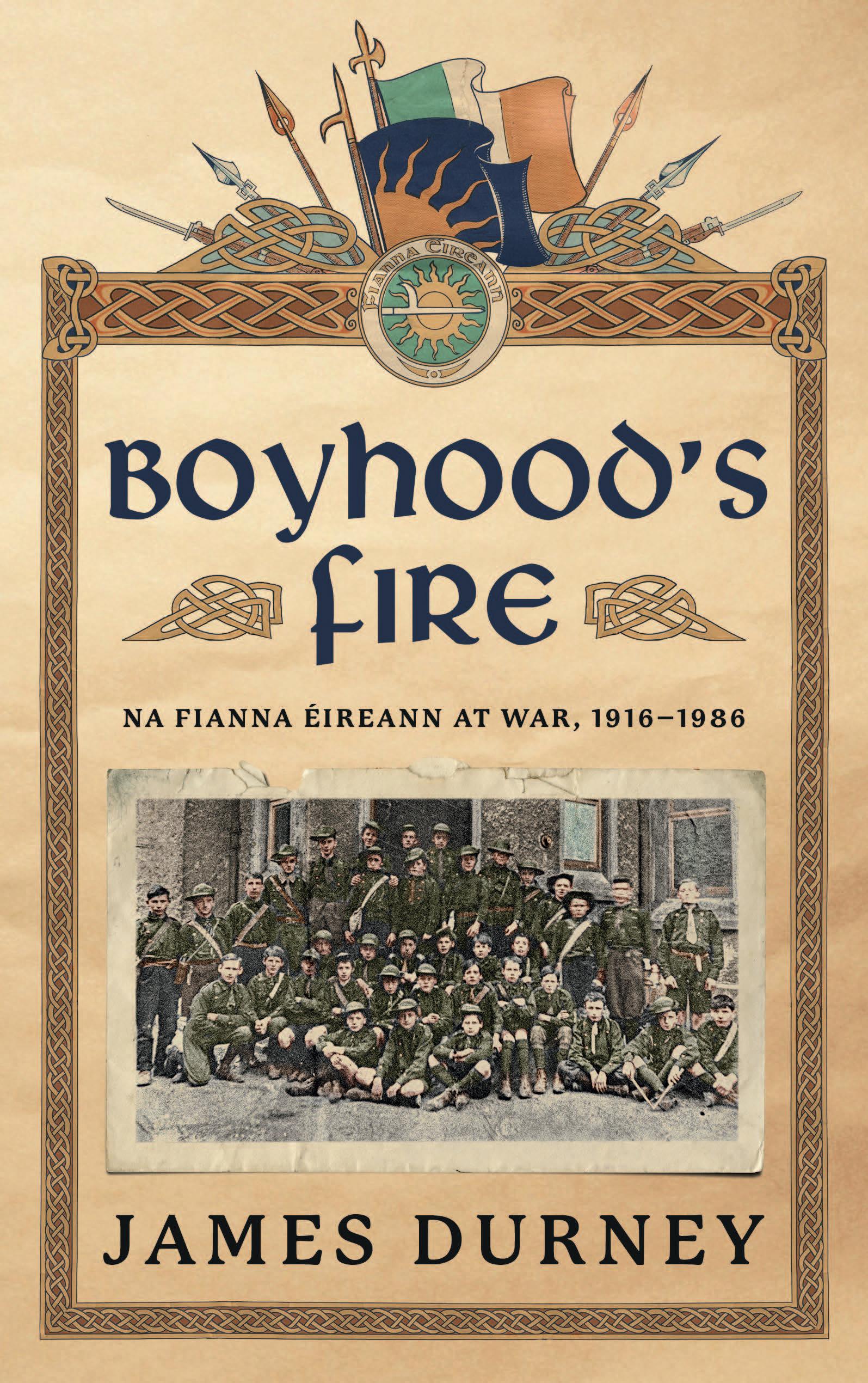
BOYHOOD’S FIRE
James Durney is an award-winning author of over thirty books on Irish national and local history, including Jailbreak: Great Irish Republican Escapes 1865–1983 (Merrion Press, 2024). He works as a librarian for County Kildare Library & Arts Service.
On for Freedom, Fianna Éireann!
Set our faces to the dawning day; The day in our land, when strength and daring Shall end for evermore, the Saxon sway.
From ‘The Marching Song of Na Fianna Éireann’ by Brian O’Higgins
PREFACE
On24 April 1916, 1,600 men, women and children assembled in Dublin and proclaimed an Irish Republic. They occupied a series of locations around the city that had been chosen for their strategic importance. Dozens of the rebels were youthful members of Na Fianna Éireann, a nationalist scouting organisation formed in 1909 to train the youth of Ireland for future military action. During Easter Week the Fianna took part in all the major actions in the city and four of them were killed in action – including fourteen-year-old Seán Healy, the youngest rebel to die in the Easter Rising.
Throughout the Irish revolution of 1916–23, Na Fianna Éireann recruited, trained and nurtured a core of young republican activists who made an essential contribution to the Irish Republican Army’s (IRA’s) armed struggle. The Fianna embraced the Irish revolution, the fight for freedom that had eluded previous generations. Many of the leading members of the IRA in the War of Independence had been experienced members of the Fianna, including Paddy O’Daly, Liam Mellows and Roger McCorley. The later Civil War and the northern pogroms would decimate the organisation, but out of the ashes arose a new generation of youthful warriors such as Tommy Woods and Peter Daly, who died in the Spanish Civil War, and
x Preface
boyhood pals Cathal Goulding and Brendan Behan, who would take the fight to England.
The new generation of Fianna warriors were young, enthusiastic and inexperienced. When Belfast and Derry erupted in 1969, the first republican killed in action was fifteen-year-old Fianna member Gerald McAuley, shot dead defending Bombay Street in Belfast from a loyalist mob. A further thirty Fianna members would lose their lives in the Troubles, while six of the ten hunger strikers who died in 1981 were former members. They were children of their time, young lions facing the might of a ruthless government and a dying British Empire.
In the course of seventy years, over eighty Fianna members would give their lives to free Ireland. Many of their stories are unknown and unsung. Drawing on primary sources, oral testimony and interviews from participants, this book tells the story of Na Fianna Éireann at war from 1916 to 1986.
SONS OF GODS AND FIGHTING MEN
On 16 August 1909 the Irish National Boy Scouts (Na Fianna Éireann) was formed by two nationalist activists, Bulmer Hobson and Countess Constance Markievicz,1 as an alternative to directly counteract the influence of Sir Robert Baden-Powell’s Boy Scout movement in Ireland. Na Fianna Éireann membership was open to male children from eight years old to eighteen, regardless of class, creed or political party. While the Fianna was initially for boys, some girls did join, although, by 1922, membership had been limited to boys aged between twelve and eighteen. Each member was given the title Fian (warrior) and the boys were offered a combination of military training, outdoor pursuits and Irish cultural activities. The aim of the semi-military movement was to train the youth of Ireland for armed conflict against British rule.2
Hobson, who had already founded a similar organisation in Belfast, recalled:
Early in August, 1909, in Sherrard Street, Dublin, in the house of Frank Moloney [sic], brother of Miss Helena Moloney, I told the Countess Constance Markievicz of the
BOYHOOD’S FIRE
organisation which I had founded some years before in Belfast, and she suggested that a boys’ national organisation should be started in Dublin on the same lines.
On my explaining that the chief difficulty was one of money, she said that she would rent a hall at her own expense. This she did, the hall chosen being in 34 Lower Camden Street, Dublin, formerly the home of the Irish National Theatre Society.3
An Claidheamh Soluis, an Irish nationalist newspaper published by Conradh na Gaeilge (the Gaelic League), reported on the foundation of the organisation:
We are glad to hear that on Monday evening a large number of Dublin boys met at their new hall, 34 Camden Street, to form a boys’ brigade. It was decided to call the organisation Fianna Eireann, and officers and a provisional committee were appointed. The Fianna will be conducted on National non-party lines, and will be managed by the boys themselves. In addition to drilling, route-marching, and camping, classes for the teaching of the Irish Language and History will be started. The subscription has been fixed at one penny per week, so that no national boy will be debarred from joining.4
Seventeen-year-old Eamon Martin (Island Villas, Great Brunswick Street, Dublin), a member of the Father Anderson branch of the Gaelic League, was present at the inaugural meeting. It was his schoolteacher, William O’Neill, who had informed Martin of the new organisation being established by Hobson and Markievicz. He said:
The name by which the organisation was to be known, ‘Na Fianna Éireann’, was proposed and adopted. This, as is well known, was the name of the Army of ancient Ireland, commanded by Finn Mac Cumhaill, and it had been chosen by Hobson for a somewhat similar association which he had organised seven years before in Belfast but which had not survived.5
A further meeting was held at the hall the following week to which ‘all Irish boys’ were invited. By September of that year, a growing number of boys were meeting at the Camden Street Hall every Tuesday and Thursday evening for military drill. Limerickborn Con Colbert, who had enrolled at the inaugural meeting, was the first instructor in elementary drill formations for the first troop, or branch. The boys also received drill instruction from Seán Kavanagh, an ex-member of the British Army. Regular activities included weekly meetings, route marches, camping trips and céilí dances.6
On 1 October a special general meeting was held at the Camden Street Hall to elect the officers and committee for the year. Hobson was elected president, Colbert and Joseph Robinson were elected treasurers, and Pádraic Ó Riain and Countess Markievicz secretaries. It was decided that the section leaders would form an organisational committee.7
James ‘Séamus’ Pounch, joined the original branch in Camden Street, An Cead Sluagh, in 1909, aged fifteen. He recalled:
To attract recruits a boy stood outside the Hall at 34 Lower Camden St. with a flag and answered queries and directed boys inside. The flag was green with a harp on it, but later the Fianna got its own flag, which was sky-blue
BOYHOOD’S FIRE
with a sunburst and the words ‘Fianna Eireann’ inscribed on it. Many joined and fell away, but those who remained formed a close comradeship and became the nucleus of the Irish Army and were destined to see a free Ireland, the hope and aspiration of centuries.8
Within a year there were five sluaighte (troops) in Dublin and branches in Waterford, Belfast and Clonmel; the first Ard-Fheis (high assembly) had also been held. Subsequently, Na Fianna Éireann developed branches in nineteen counties in Ireland as well as in Glasgow and Liverpool.9 Joe Robinson was founder of the Glasgow Sluagh and was, therefore, appointed officer commanding (OC). Early members were Joe’s brother, Séamus, Eamonn Mooney, Séamus Reader and Margaret Skinnider, a militant suffragist.10 Most branches did not accept girls at the time, but Glasgow did. Along with Reader, Glasgow-born Skinnider trained and drilled the boys. Scotland had always been a vital link in the planning, arming and organising of militant Irish nationalism, and Glasgow, with its large emigrant population, was central to the smuggling of weapons and explosives to Ireland.
In Ireland, outside Dublin, Micheál O’Neill formed a Fianna branch in Waterford in October 1909, while a Belfast branch was officially established on 7 March 1910 in the Dungannon Club. Within three months, Belfast’s Na Fianna had seventy members. They met in the rooms of O’Neill’s Pipe Band, above a tobacconist’s shop in Mill Street, but as their numbers increased they moved to the former British cavalry huts at Willowbank, on the Falls Road.11 Belfast was another of the places that accepted girls and had the only all-female branch of the Fianna in Ireland. Sisters Nora and Ina Connolly, daughters of the socialist James Connolly, were enthusiastic members of the Betsy Gray Sluagh.12
On 24 November 1910, after Con Colbert had given the students at the Irish-speaking St Enda’s School for Boys in Rathfarnham their first lesson in military drill, the school’s founder, Patrick Pearse – a nationalist teacher, poet and writer – announced plans to form a body of the Fianna in the school. A branch was duly organised with Pearse as commander-in-chief. The list of activities included drill, shooting, gymnastics, fencing, boxing, wrestling, swimming, first-aid, scouting, route marches and camping out.13
Uniforms, kilts and equipment were also provided for all Fianna members. The uniform was designed by Michael Lonergan, who worked in Clerys Department Store. It consisted of an olive-green, double-breasted shirt with brass buttons, riding breeches, puttees and boots. The usual scout hat, also in green, was fastened up on the right side to help the boys when shooting.14 Ellen ‘Nellie’ Bushell, a member of the Abbey Theatre group, said, ‘I was attached to Fianna, on the Committee, making their kilts and general equipment from early 1910 till Volunteers started, then I helped them also.’ Former diplomat Roger Casement’s money paid for the Fianna’s kilts, Con Colbert provided the material, and Nellie supplied her labour for free. She also made kilts for the pupils at St Enda’s, as well as creating bandoliers out of mail bags to hold their ammunition.15
The Fianna spent a lot of time training, with tough route marches across the Dublin Mountains. On Saturdays and Sundays, weather permitting, this open ground was their training area. Summer brought longer camp times, with bell tents or just a length of tarpaulin propped against a hedge. The Fianna also frequently camped in the grounds of St Enda’s and formed a pipers’ band; among its members was Peadar Kearney, the future composer of Ireland’s national anthem ‘Amhrán na
BOYHOOD’S FIRE
bhFiann (A Soldier’s Song)’.16 Training was based on British Army training manuals and the Baden-Powell handbook, Scouting for Boys.
Organisation was quite simple. The smallest unit was a squad of about six boys commanded by a veteran of fourteen to sixteen years old. Two squads made a section, two or more sections a troop or sluagh under a lieutenant or captain, generally an eighteen-to twenty-year-old. In large centres the various sluaighte in an area were administered by a district council, and the entire movement was governed by a central council sitting in Dublin.17 Their flag was inspired by the Fianna of Irish mythology, a band of warriors led by the Celtic hero Fionn Mac Cumhaill.18
The boys’ reasons for joining the Fianna were varied. In 1911 Seán Prendergast joined Sluagh Emmet, also known as North Dock Sluagh. He said:
I had previously become aware of the existence of this boys’ organisation, by reports in the public press, by seeing them on their several route marches and at public processions and demonstrations. It made a very special appeal to me, and of course boy-like I readily succumbed to the feeling that I could do worse than joining an organisation of boys with a true Irish outlook and pledged to work for Irish Independence, which was its principal aim and object. I own that I was particularly attracted because it was distinctly Irish, non-political and non-sectarian, its main characteristic being to inculcate a love for Ireland and for things Irish and national.19
In his seminal study of Irish republicans in both the Fianna and the IRA, Peter Hart maintained that:
This youth subculture was a collective one, formed along long-lived groupings and brothers, cousins, neighbours, schoolmates, and the like who played, and often worked together … A young man’s status in the community depends to a great extent on being accepted by this group and by his full participation in its activities. Such cliques, and their territory, bands and team, were a very powerful focus for individual and collective identities and loyalties.20
This analysis fits what is known about the Fianna.
In his witness statement Roger McCorley outlined why he joined the Seán O’Neill Sluagh of the Fianna ‘in 1912 at the age of eleven’:
At this time the Parliamentary Party was at the height of its power. Home Rule was on everybody’s lips and although I was an ardent Home Ruler I was much too young to appreciate the pros and cons of the Parliamentary campaign. All I knew about the matter was that Ireland was struggling for freedom and I was for Ireland. The tradition of my family leaned rather towards armed insurrection and I had been taught that some day when I grew up I would have the honour of ‘Striking a blow for Ireland’. It was natural, therefore, that I should join the Fianna. In the Fianna I was taught that Ireland had never got anything and never could expect to get anything from England except by physical force; that the Parliamentary campaign was doomed to failure and it was, therefore, the duty of the boys in the Fianna to make themselves proficient in the use of arms so as to be in a position to form the spearhead of the revolution when the country eventually came to its senses.21
BOYHOOD’S FIRE
He was not the only one thinking like this. From his introduction to republicanism in Belfast in 1905, Seán MacDiarmada devoted his life to the cause of Irish independence. For MacDiarmada, the Fianna was not simply an Irish answer to the Boy Scouts but the junior wing of the Irish Republican Brotherhood (IRB), with boys being schooled in military drill and exercises, target practice – initially in a shooting range in Markievicz’s basement – and Irish history. His view was that the Fianna needed to be brought under the control of the IRB.22 Behind the scenes, Fianna officers who were also members of the IRB gained control. Subsequently, the Fianna grew increasingly militant and when the Irish Volunteers were formed in November 1913, five instructors and senior Fianna officers were appointed to the committee of the new organisation: Liam Mellows, Con Colbert, Pádraic Ó Riain, Eamon Martin and Michael Lonergan.
Mellows, an IRB activist, was a particularly important figure for Na Fianna Éireann. It was not until he was appointed as fulltime organiser in 1913 that the organisation progressively grew nationally. Born at Ladysmith military barracks in Hartshead, Ashton-under-Lyne, Lancashire, the son of a serving British soldier, he quit his job to take up his new appointment.23 From April to November that year, Mellows cycled all over the country organising meetings to form new sluaighte. Branches were formed in Cork, Derry, Athlone, Maryborough (Portlaoise), Enniscorthy and Newry. However, some later collapsed due to insufficient funding, opposition from other national organisations and pressure from the Catholic Church.24
Young men who were in the Fianna gained experience in the organisation that led to them being appointed as Volunteer officers. Eamon Martin said, ‘With the founding of the Irish Volunteers in 1913 the contributory value of the Fianna was
immediately recognised. Wherever a Company was formed the Fianna was in a position to, and did, supply an officer as Instructor.’25 Martin had joined the original branch of the Fianna but later set up his own branch, which became known as Wolfe Tone Sluagh.26 Concerning the five senior officers appointed to the Volunteers, he continued:
[They] were also attached to the Military Sub-Committee and having been given the rank of Captain, they went around the various halls night after night to instruct the N.C.Os. and generally to direct the course of training. It was only to be expected that the members of the I.R.B. who had received the earlier training were, for the most part, selected as N.C.Os. It was not unusual for these five officers to find themselves in some or other part of the country during the week-ends getting newly formed Companies into shape. Liam Mellows was loaned to the Volunteers as Organiser and he repeated his Fianna successes in this work.27
With the appointment of Mellows as national organiser, the militant republican Seán MacDiarmada had effectively taken control of the Fianna away from its founder Bulmer Hobson, though the latter would continue to play a role in the Dublin Fianna with Countess Markievicz. Hobson was also a member of the Supreme Council of the IRB, but he would eventually resign, giving MacDiarmada and the veteran Fenian Tom Clarke free rein both in the leadership of the two organisations and their plans for an armed insurrection against British rule.28
Not only did the Fianna supply officers and instructors to the Irish Volunteers, it also augmented the rank and file of the new
organisation. A rule was introduced at this time, which stated that any Fianna member on reaching the age of eighteen who had not attained the rank of lieutenant was automatically transferred to the Volunteers. This arrangement was very successful, as it gave the Volunteers recruits who were already fully trained and solved the problem of what to do with those Fianna members who had reached eighteen and over, for whom there were not sufficient officer positions.29
The expertise of the Fianna in military training was much sought after. Many had several years’ training in military drill, signalling and weapons handling. John Kenny, born in Dublin on 5 March 1897, said, ‘My parents had strong national tendencies, especially my mother, who regarded the English as responsible for the fall of man. Early in 1912, my brother, Michael, and I joined the Irish National Guards, an off-shoot of Fianna Éireann with rooms then in Blackhall Place.’ At the 1913 pilgrimage to the grave of Theobald Wolfe Tone at Bodenstown, County Kildare, Kenny recalled how the Irish National Guards ‘marched openly through the streets of Dublin in full uniform with dummy rifles to which were affixed French bayonets carried at the “slope” in true military fashion and dragging a hand-truck behind us in which our tent and other supplies were stored’. Later that same year, ‘at the inaugural meeting of the Irish Volunteers in the Rotunda Rooms, most of us attended and joined up … The O’Rahilly enlisted our services to help to train “B” Company, 3rd Battalion, for we were all well drilled in the use of firearms and side arms, while some of us were expert semaphore signallers and were familiar with the “dumb alphabet”.’30
Even at this early stage, membership was not without its hazards. Thirteen-year-old William Davern, from Limerick, drowned in an accident on 2 July 1913, while Patsy O’Connor
(18) died on 15 June 1915, after being injured by a police baton blow inflicted during the Dublin Lockout. Many Fianna played a supporting role in the Dublin workers’ actions during that industrial dispute, which took place mainly in the city in the latter half of 1913. O’Connor had gone to the aid of an injured person following a police baton charge and was hit on the head by a constable.31
Along with the growth of the Irish Volunteers countrywide, the Fianna’s momentum continued into 1914. Its increasing membership at this time was connected to that of the Volunteers, as many sons of the adult movement joined the youth organisation. From January to autumn 1914, eleven new sluaighte were formed: Gorey (Wexford), Ballybunion (Kerry), Cashel, Tipperary Town, Carrick-on-Suir (Tipperary), Mitchelstown (Cork), Athy (Kildare), Sandyford, Tallaght, Chapelizod and Clontarf (Dublin). In a letter printed in The Nationalist and Leinster Times, the Fianna stated:
We believe as every Irish boy whose heart has not been corrupted by foreign influence must believe that our country ought to be free. We do not see why Ireland should allow England to govern her either through Englishmen as at present or through Irishmen under an appearance of self-government. We believe that England has no business in this country at all – that Ireland, from the centre to the zenith, belongs to the Irish … We believe, then, that it is the duty of Irishmen to struggle always, never giving in or growing weary, until they have won back their country again … The object of Na Fianna Eireann is to train the boys of Ireland to fight Ireland’s battle when they are men.32
BOYHOOD’S FIRE
The Fianna also began to reorganise along more military lines, with the Dublin Fianna first to move from the sluaighte system to a more formal military structure. By February 1914, the Dublin Fianna had formed a battalion consisting of two companies, A and B, to bring themselves in line with the emerging organisational structure of the Irish Volunteers. A further company was added to the Dublin Battalion in July 1914.33
In Cork city a sluagh had been started by the IRB’s O’Growney branch. Tadhg Barry, from Blarney Street, was involved from the beginning in training the youths, aged from twelve to seventeen and numbering over thirty. An early member, P.J. Murphy, recalled a committee of Barry, Seán O’Hegarty, Tomás MacCurtain and Seán O’Sullivan ‘keeping a fatherly eye on our conduct and general behaviour’. The sluagh paraded twice weekly, conducted a route march on Sundays and had weekend camps during school holidays. In June 1914 Barry became chairman of the Cork sluagh. He said it was an opportune time ‘as with their fathers and their elder brothers flocking to the ranks of the Volunteers the younger boys should prepare for the time when they too would take their place in Ireland’s National Army’.34
The Cork Fianna started to become more militant according to Seán Healy and Liam O’Callaghan. ‘After [1915] it became more of a military body and a training ground for the Volunteers.’ Prior to this the sluagh had a scoutmaster at its head, but in 1915 Healy became captain, a purely military title. When the Fianna held its annual Ard-Fheis in July 1915, Eamon Martin suggested that the presidency of the organisation should be abolished and replaced with a Fianna chief, as the movement had become ‘essentially a military one’. A compromise retained Markievicz as president but saw the formation of a twelve-member committee
to appoint a headquarters staff and a Fianna chief. Under this new organisational structure, the Fianna continued to extend and intensify its military training programme.35
The previous year, at Bodenstown Graveyard, on 21 June 1914, a 200-strong contingent of Na Fianna Éireann headed by Countess Markievicz had stood to attention to hear IRB leader Tom Clarke address the crowd. Clarke, who had spent fifteen years in British prisons, said:
The spirit of Wolfe Tone still lives. That spirit is moving through the length and breadth of the land to-day. The tramp of marching men eager to grasp the rifle is evidence of that spirit … We are here to honour Wolfe Tone’s memory, and no one, I am sure, has come to the graveside but with feelings of reverence. The time of speechmaking is rapidly passing. The drilling and arming of the people of Ireland is what is going to count and what is going to be the determining factor as to just how our national ambition is going to be fulfilled.36
In order to fulfil Clarke’s prophecy, the republican movement needed arms. In the north-east of Ireland, the Ulster Volunteer Force (UVF) had already armed itself to resist the imposition of Home Rule. This followed a declaration by some British Army officers stationed at the Curragh Camp that they would rather resign or be dismissed than enforce Home Rule on a hostile province.37 The UVF landed 25,000 rifles and five million rounds of ammunition at Larne, Donaghadee and Bangor on the north-eastern coast in April 1914. Their successful gunrunning convinced the Irish Volunteers that they too needed to arm, in their case to protect the cause of Home Rule.