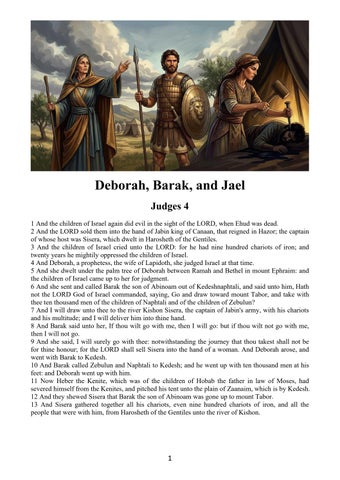
Deborah, Barak, and Jael Judges 4 1 And the children of Israel again did evil in the sight of the LORD, when Ehud was dead. 2 And the LORD sold them into the hand of Jabin king of Canaan, that reigned in Hazor; the captain of whose host was Sisera, which dwelt in Harosheth of the Gentiles. 3 And the children of Israel cried unto the LORD: for he had nine hundred chariots of iron; and twenty years he mightily oppressed the children of Israel. 4 And Deborah, a prophetess, the wife of Lapidoth, she judged Israel at that time. 5 And she dwelt under the palm tree of Deborah between Ramah and Bethel in mount Ephraim: and the children of Israel came up to her for judgment. 6 And she sent and called Barak the son of Abinoam out of Kedeshnaphtali, and said unto him, Hath not the LORD God of Israel commanded, saying, Go and draw toward mount Tabor, and take with thee ten thousand men of the children of Naphtali and of the children of Zebulun? 7 And I will draw unto thee to the river Kishon Sisera, the captain of Jabin's army, with his chariots and his multitude; and I will deliver him into thine hand. 8 And Barak said unto her, If thou wilt go with me, then I will go: but if thou wilt not go with me, then I will not go. 9 And she said, I will surely go with thee: notwithstanding the journey that thou takest shall not be for thine honour; for the LORD shall sell Sisera into the hand of a woman. And Deborah arose, and went with Barak to Kedesh. 10 And Barak called Zebulun and Naphtali to Kedesh; and he went up with ten thousand men at his feet: and Deborah went up with him. 11 Now Heber the Kenite, which was of the children of Hobab the father in law of Moses, had severed himself from the Kenites, and pitched his tent unto the plain of Zaanaim, which is by Kedesh. 12 And they shewed Sisera that Barak the son of Abinoam was gone up to mount Tabor. 13 And Sisera gathered together all his chariots, even nine hundred chariots of iron, and all the people that were with him, from Harosheth of the Gentiles unto the river of Kishon.
1
Deborah, Barak, and Jael
14 And Deborah said unto Barak, Up; for this is the day in which the LORD hath delivered Sisera into thine hand: is not the LORD gone out before thee? So Barak went down from mount Tabor, and ten thousand men after him. 15 And the LORD discomfited Sisera, and all his chariots, and all his host, with the edge of the sword before Barak; so that Sisera lighted down off his chariot, and fled away on his feet. 16 But Barak pursued after the chariots, and after the host, unto Harosheth of the Gentiles: and all the host of Sisera fell upon the edge of the sword; and there was not a man left. 17 Howbeit Sisera fled away on his feet to the tent of Jael the wife of Heber the Kenite: for there was peace between Jabin the king of Hazor and the house of Heber the Kenite. 18 And Jael went out to meet Sisera, and said unto him, Turn in, my lord, turn in to me; fear not. And when he had turned in unto her into the tent, she covered him with a mantle. 19 And he said unto her, Give me, I pray thee, a little water to drink; for I am thirsty. And she opened a bottle of milk, and gave him drink, and covered him. 20 Again he said unto her, Stand in the door of the tent, and it shall be, when any man doth come and enquire of thee, and say, Is there any man here? that thou shalt say, No. 21 Then Jael Heber's wife took a nail of the tent, and took an hammer in her hand, and went softly unto him, and smote the nail into his temples, and fastened it into the ground: for he was fast asleep and weary. So he died. 22 And, behold, as Barak pursued Sisera, Jael came out to meet him, and said unto him, Come, and I will shew thee the man whom thou seekest. And when he came into her tent, behold, Sisera lay dead, and the nail was in his temples. 23 So God subdued on that day Jabin the king of Canaan before the children of Israel. 24 And the hand of the children of Israel prospered, and prevailed against Jabin the king of Canaan, until they had destroyed Jabin king of Canaan.
Judges 5 1 Then sang Deborah and Barak the son of Abinoam on that day, saying, 2 Praise ye the LORD for the avenging of Israel, when the people willingly offered themselves. 3 Hear, O ye kings; give ear, O ye princes; I, even I, will sing unto the LORD; I will sing praise to the LORD God of Israel. 4 LORD, when thou wentest out of Seir, when thou marchedst out of the field of Edom, the earth trembled, and the heavens dropped, the clouds also dropped water. 5 The mountains melted from before the LORD, even that Sinai from before the LORD God of Israel. 6 In the days of Shamgar the son of Anath, in the days of Jael, the highways were unoccupied, and the travellers walked through byways. 7 The inhabitants of the villages ceased, they ceased in Israel, until that I Deborah arose, that I arose a mother in Israel. 8 They chose new gods; then was war in the gates: was there a shield or spear seen among forty thousand in Israel? 9 My heart is toward the governors of Israel, that offered themselves willingly among the people. Bless ye the LORD. 10 Speak, ye that ride on white asses, ye that sit in judgment, and walk by the way. 11 They that are delivered from the noise of archers in the places of drawing water, there shall they rehearse the righteous acts of the LORD, even the righteous acts toward the inhabitants of his villages in Israel: then shall the people of the LORD go down to the gates. 12 Awake, awake, Deborah: awake, awake, utter a song: arise, Barak, and lead thy captivity captive, thou son of Abinoam. 13 Then he made him that remaineth have dominion over the nobles among the people: the LORD made me have dominion over the mighty.
2
Deborah, Barak, and Jael
14 Out of Ephraim was there a root of them against Amalek; after thee, Benjamin, among thy people; out of Machir came down governors, and out of Zebulun they that handle the pen of the writer. 15 And the princes of Issachar were with Deborah; even Issachar, and also Barak: he was sent on foot into the valley. For the divisions of Reuben there were great thoughts of heart. 16 Why abodest thou among the sheepfolds, to hear the bleatings of the flocks? For the divisions of Reuben there were great searchings of heart. 17 Gilead abode beyond Jordan: and why did Dan remain in ships? Asher continued on the sea shore, and abode in his breaches. 18 Zebulun and Naphtali were a people that jeoparded their lives unto the death in the high places of the field. 19 The kings came and fought, then fought the kings of Canaan in Taanach by the waters of Megiddo; they took no gain of money. 20 They fought from heaven; the stars in their courses fought against Sisera. 21 The river of Kishon swept them away, that ancient river, the river Kishon. O my soul, thou hast trodden down strength. 22 Then were the horsehoofs broken by the means of the pransings, the pransings of their mighty ones. 23 Curse ye Meroz, said the angel of the LORD, curse ye bitterly the inhabitants thereof; because they came not to the help of the LORD, to the help of the LORD against the mighty. 24 Blessed above women shall Jael the wife of Heber the Kenite be, blessed shall she be above women in the tent. 25 He asked water, and she gave him milk; she brought forth butter in a lordly dish. 26 She put her hand to the nail, and her right hand to the workmen's hammer; and with the hammer she smote Sisera, she smote off his head, when she had pierced and stricken through his temples. 27 At her feet he bowed, he fell, he lay down: at her feet he bowed, he fell: where he bowed, there he fell down dead. 28 The mother of Sisera looked out at a window, and cried through the lattice, Why is his chariot so long in coming? why tarry the wheels of his chariots? 29 Her wise ladies answered her, yea, she returned answer to herself, 30 Have they not sped? have they not divided the prey; to every man a damsel or two; to Sisera a prey of divers colours, a prey of divers colours of needlework, of divers colours of needlework on both sides, meet for the necks of them that take the spoil? 31 So let all thine enemies perish, O LORD: but let them that love him be as the sun when he goeth forth in his might. And the land had rest forty years.
Commentary The account of Deborah, Barak, and Jael found in Judges chapters 4 and 5 records one of Israel’s most striking deliverances from foreign oppression. It highlights divine sovereignty, courageous leadership, and how God uses unexpected instruments to accomplish His purposes.
Part 1: Verse-by-Verse Breakdown Judges Chapter 4: The Narrative of Deliverance Verses 1–3: Israel's Sin and Cruel Oppression After the death of the judge Ehud, the Israelites again do evil in the sight of the Lord. As a consequence, God delivers them into the hand of Jabin, king of Canaan (who reigns in Hazor),
3
Deborah, Barak, and Jael
whose military commander is Sisera. Sisera severely oppresses Israel for twenty years using a formidable military force of 900 chariots of iron. The children of Israel cry out to the Lord for help. Verses 4–9: The Call of Deborah and Barak Deborah, a prophetess and the wife of Lapidoth, is judging Israel at this time, sitting under the palm tree of Deborah. She sends for Barak the son of Abinoam and delivers a command from God: he is to take 10,000 men of Naphtali and Zebulun to Mount Tabor, and God will draw Sisera and his chariots to the river Kishon. Barak responds conditionally: “If thou wilt go with me, then I will go: but if thou wilt not go with me, then I will not go”. Deborah agrees to go, but prophesies that the journey will not bring him personal honor, because the Lord will sell Sisera into the hand of a woman. Verses 10–16: The Battle at Mount Tabor and Kishon Barak summons Zebulun and Naphtali to Kadesh, gathering 10,000 followers with Deborah accompanying him. When Sisera hears of this, he gathers his 900 iron chariots and all his troops to the river Kishon. Deborah tells Barak to arise, declaring, "Is not the LORD gone out before thee?" Barak leads his men down the mountain, and the Lord discomfits (routes) Sisera and his army. Sisera’s army is utterly destroyed by the edge of the sword, leaving not a man alive, while Sisera abandons his chariot and flees on foot. Verses 17–22: Jael and the Defeat of Sisera Sisera flees to the tent of Jael, the wife of Heber the Kenite, because there is peace between Jabin's kingly house and Heber's family. Jael goes out to meet him, invites him in, and covers him. Sisera asks for water; instead, she gives him butter (curdled milk) in a lordly dish. Exhausted and trusting, Sisera falls fast asleep. Jael quietly takes a tent nail (peg) and a hammer in her hand, goes softly unto him, and drives the nail through his temples into the ground, killing him instantly. When Barak arrives in pursuit, Jael shows him the dead enemy commander, fulfilling Deborah's prophecy. Verses 23–24: Subdual of King Jabin On that day, God subdues Jabin the king of Canaan before the children of Israel, and the hand of Israel prospers and prevails against him until he is destroyed. Judges Chapter 5: The Song of Deborah and Barak Verses 1–5: Praise to the Lord Deborah and Barak sing a song of triumph, praising God for the voluntary leaders and willing people of Israel. They recall God’s majestic, earth-quaking presence when He marched from Seir and Edom. Verses 6–11: The Desolation of Israel Turned to Justice The song recalls the dark days of oppression when highways were vacant and villagers hid until Deborah arose "a mother in Israel". It invites rulers, judges, and ordinary townspeople gathered at the watering places to recount the righteous acts and acts of deliverance by the Lord. Verses 12–18: Willing Tribes vs. Complacent Tribes A triumphant call goes out to Barak to lead captivity captive. The song details which tribes eagerly volunteered—Ephraim, Benjamin, Machir, Zebulun, Issachar, and Naphtali—and sharply rebukes those who stayed behind by their sheepfolds or coastlands, such as Reuben, Dan, and Asher.
4
Deborah, Barak, and Jael
Verses 19–23: The Cosmic Battle and the Curse of Meroz The kings of Canaan fought, but "the stars in their courses fought against Sisera" (implying divine intervention, likely torrential rain turning the Kishon river into a flood that immobilized the iron chariots). The ancient river Kishon swept the enemy away. A bitter curse is pronounced on the city of Meroz because they did not come out "to the help of the LORD against the mighty". Verses 24–27: Honoring Jael's Courage Jael is celebrated as "blessed above women" in the tent. The song vividly describes her decisive action—reaching for the hammer and driving the nail through Sisera’s head, where he sank and fell dead at her feet. Verses 28–30: The Irony of Sisera's Mother A dramatic, ironic vignette shifts to Sisera’s mother looking out her lattice window, anxiously wondering why her son's chariot is so slow in returning. Her wise ladies comfort her with the illusion that he is merely dividing the spoils—captives and rich embroideries—unaware that he is already dead. Verse 31: Concluding Prayer The song concludes with a powerful prayer: "So let all thine enemies perish, O LORD: but let them that love him be as the sun when he goeth forth in his might." Following this victory, the land has rest for forty years.
Part 2: Key Lessons and Life Applications God Uses the Unlikely and Ordinary: Deliverance did not come through a traditional imperial army with elite weapons, but through an ordinary woman (Jael) using a household tent peg and hammer, demonstrating that God delights in using humble tools for extraordinary purposes. The Peril of Spiritual Neutrality and Complacency: The song of Deborah fiercely criticizes the tribes who stayed home (like Reuben and Dan) and curses Meroz for refusing to help. Spiritual neutrality in times of moral crisis is treated as opposition; believers are called to active engagement rather than comfortable spectator status. The Power of Partnership and Encouragement: Barak recognized his need for spiritual grounding, asking Deborah to accompany him into battle. God often designs our spiritual and practical victories around community, mutual accountability, and godly partnership rather than isolated individualism. Returning the Glory to God: Immediately after achieving massive military success, Deborah and Barak did not boast of their own tactical brilliance; instead, they burst into a song of worship attributing all glory, historical power, and victory back to the Lord. In seasons of personal or professional triumph, intentional praise and humility keep our focus anchored on the true source of our strength.
5