News
Books
Organic Agriculture Food and nutrition Fisheries Agriculture
Documentation Center
Aquaculture
MAIB MAI
Library Library
Newsletter
Documentation Center
Natural resources
Economic
from the LibraryAquaculture Organic Agriculture
Mediterranean Agronomic Institue of Bari
Newsletter
Books
Newsletter
Documentation Center
Food and nutrition Fisheries Agriculture
Documentation Center
Natural resources
Economic
News from the library is a bimonthly newsletter providing timely, lively and informative articles on new releases from CIHEAM Bari Institute, the latest additions to the library's collection of books and articles, focus on the most important scientific journals, news from the world's libraries and international associations' activities.
Mediterranean Agronomic Institue of Bari DOCUMENTATION CENTRE - CIHEAM BARI
Press Review
Contents
FAO Repository library: Food safety and nutrition
www.iamb.it
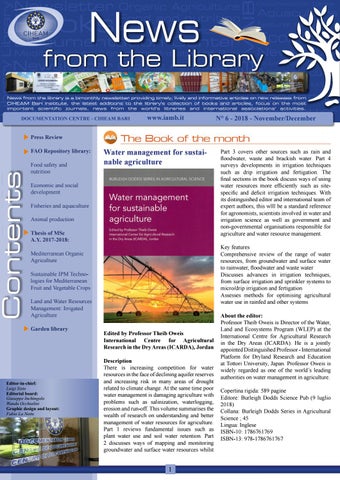
The Book of the month Water management for sustainable agriculture
Economic and social development Fisheries and aquaculture Animal production Thesis of MSc A.Y. 2017-2018:
Sustainable IPM Technologies for Mediterranean Fruit and Vegetable Crops
Land and Water Resources Management: Irrigated Agriculture
Editor-in-chief: Luigi Sisto Editorial board: Giuseppe Inchingolo Wanda Occhialini Graphic design and layout: Fabio La Notte
Part 3 covers other sources such as rain and floodwater, waste and brackish water. Part 4 surveys developments in irrigation techniques such as drip irrigation and fertigation. The final sections in the book discuss ways of using water resources more efficiently such as sitespecific and deficit irrigation techniques. With its distinguished editor and international team of expert authors, this wlll be a standard reference for agronomists, scientists involved in water and irrigation science as well as government and non-governmental organisations responsible for agriculture and water resource management. Key features Comprehensive review of the range of water resources, from groundwater and surface water to rainwater, floodwater and waste water Discusses advances in irrigation techniques, from surface irrigation and sprinkler systems to micro/drip irrigation and fertigation Assesses methods for optimising agricultural water use in rainfed and other systems
Mediterranean Organic Agriculture
Garden library
Newsletter
N° 6 - 2018 - November/December
Edited by Professor Theib Oweis International Centre for Agricultural Research in the Dry Areas (ICARDA), Jordan Description There is increasing competition for water resources in the face of declining aquifer reserves and increasing risk in many areas of drought related to climate change. At the same time poor water management is damaging agriculture with problems such as salinization, waterlogging, erosion and run-off. This volume summarises the wealth of research on understanding and better management of water resources for agriculture. Part 1 reviews fundamental issues such as plant water use and soil water retention. Part 2 discusses ways of mapping and monitoring groundwater and surface water resources whilst
1
About the editor: Professor Theib Oweis is Director of the Water, Land and Ecosystems Program (WLEP) at the International Centre for Agricultural Research in the Dry Areas (ICARDA). He is a jointly appointed Distinguished Professor - International Platform for Dryland Research and Education at Tottori University, Japan. Professor Oweis is widely regarded as one of the world’s leading authorities on water management in agriculture. Copertina rigida: 589 pagine Editore: Burleigh Dodds Science Pub (9 luglio 2018) Collana: Burleigh Dodds Series in Agricultural Science ; 45 Lingua: Inglese ISBN-10: 1786761769 ISBN-13: 978-1786761767
OrganicAgriculture Food and nutrition Fisheries Agriculture
Library
News Books
Documentation Center
Aquaculture
MAI
Newsletter
Natural resources
Economic Documentation Center from the Library
Newsletter Mediterranean Agronomic Institue of Bari DOCUMENTATION CENTRE - CIHEAM BARI
Press Review
back to index
Table of contents Part 1 Fundamentals 1.Understanding and measuring plant water use: Gretchen R. Miller, Texas A&M University, USA; 2.Dynamics of water storage and retention in soil: K. Rajkai, Hungarian Academy of Sciences, Hungary; F. Ács, Eötvös Loránd University, Hungary; B. Tóth, Hungarian Academy of Sciences and University of Pannonia, Hungary; and A. Makó, Hungarian Academy of Sciences, Hungary; 3.Climate change and water resources for agriculture; Luis Garrote, Universidad Politécnica de Madrid, Spain; Part 2 Sustainable use of groundwater and surface water for irrigation 4.An integrated approach for the estimation of crop water requirements based on soil, plant and atmospheric measurements: N. Jovanovic, S. Dzikiti and M. Gush, Council for Scientific and Industrial Research (CSIR), South Africa; 5.The economics of groundwater development and governance; T. Shah, International Water Management Institute (IWMI), India 6.Managing surface water for irrigation; A. Qureshi, International Center for Biosaline Agriculture, United Arab Emirates Part 3 Other sources of water for irrigation 7.Rainwater and floodwater harvesting for crop irrigation: Dieter Prinz, Karlsruhe Institute of Technology (KIT), Germany; 8.The use of treated wastewater for crop irrigation: Alfieri Pollice and Ramy Saliba, IRSA-CNR, Italy; and Antonio Lonigro, Università degli Studi di Bari, Italy; 9.Use of brackish and marginal water for irrigation in water-scarce areas: Z. Gao, China Institute of Water Resources and Hydropower Research, China; Part 4 Irrigation techniques 10.Dev elopments in surface irrigation techniques: Taffa Tulu, Addis Ababa University, Ethiopia; 11.Trickle irrigation systems: Megh R. Goyal, formerly University of Puerto Rico, Puerto Rico; 12.An overview of subsurface irrigation techniques: Andrea Dührkoop and Oliver Hensel, University of Kassel, Germany; 13.Fertigation techniques for efficient water and nutrient use in agriculture; Munir J. Mohammad Rusan, Jordan University of Science and Technology, Jordan and International Plant Nutrition Institute (IPNI), USA; Part 5 Managing water use on the farm 14.Modelling water use on farms; L. S. Pereira and P. Paredes, University of Lisbon, Portugal; 15.Improving water productivity in rainfed agriculture:
2
challenges and opportunities for small-scale farmers in dry lands: John Gowing, University of Newcastle, UK; 16.Improving water use in tropical rain-fed systems: the situation in India: Suhas P. Wani, Kaushal K. Garg, Girish Chander and K.H. Anantha, International Crops Research Institute for the Semi-Arid Tropics (ICRISAT), India; 17.Deficit irrigation and site-specific irrigation scheduling techniques to minimize water use: Susan A. O’Shaughnessy, USDA-ARS, USA; and Manuel A. Andrade, Oak Ridge Institute for Science and Education, USA; 18.Drainage systems to support sustainable water use: Henk Ritzema, Wageningen University, The Netherlands; Part 6 Managing water resources 19.Increasing water productivity in agriculture: an overview: Wayne S. Meyer, University of Adelaide, Australia; 20.Regional strategies in sustainable water management for irrigation: the eco-efficiency approach: Mladen Todorović, Centre International de Hautes Etudes Méditerranéennes (CIHEAM), Mediterranean Agronomic Institute of Bari, Italy; 21.The challenge of sustainable water resources management under water scarcity: Pasquale Steduto, Food and Agriculture Organization of the United Nations (FAO), Italy; and Chris Perry, Former Research Director, International Water Management Institute (IWMI), UK; 22.Assessing the cost of supplying water for agriculture: the food supply cost curve: Roberto Roson, Ca’ Foscari University of Venice, Italy;
Books
OrganicAgriculture Food and nutrition Fisheries Agriculture
Documentation Center
Aquaculture
MAI
Library
Newsletter
Natural resources
Economic Documentation Center www.iamb.it N° 6 - 2018 - November/December
Call for contribution: Agrosym 2019 Save the date: 3-6 October 2019 Call for Abstract Agrosym 2019: X International Agriculture Symposium “AGROSYM 2019” Jahorina, 3-6 October 2019, Bosnia and Herzegovina For further Information please contact: Dr. Noureddin Driouech, CIHEAM Bari, Organizing Committee Email: driouech@iamb.it Learn more: http://agrosym.ues.rs.ba/index.php/en/ A-NEW RELEASE: Proceedings
Agrosym
2018
Book
of
Book of Proceedings : IX International Scientific Agriculture Symposium “AGROSYM 2018”. Jahorina, October 04 - 07, 2018, Bosnia and Herzegovina.
Newsletter
ISBN 978-99976-718-8-2 Website: http://agrosym.ues.rs.ba The Proceedings of the 9th International Scientific Agricultural Symposium “AGROSYM 2018” held on 4-7 October 2018 in Jahorina, Bosnia and Herzegovina. The Symposium gathers about 1200 participants from 85 different countries and organizers received over 1200 abstracts/full papers. Symposium themes covered all branches of agriculture and were divided into seven sessions: 1) Plant production, 2) Plant protection and food safety, 3) Organic agriculture, 4) Environmental protection and natural resources management, 5) Animal husbandry 6) Forestry and Agro-forestry, and 7) Rural Development and Agro-economy. In the plenary lectures was presented the importance of new information and communication technologies for agriculture in the 21st century and biological protection in plant production. Furthermore, a particular attention was devoted to avoiding knowledge waste through networking and partnership. Agriculture has a complex relationship with natural resources and the environment, thus attributing specific environmental effects to agriculture is difficult and not fully understood. Today, it is obvious that conventional methods of agricultural production, in addition to providing sufficient food and other products, have led to a number of negative impacts, including direct or indirect effects on human health. Excessive use of agrochemicals can cause various disorders in the biological equilibrium of agroecosystems and beyond. These negative impacts raise serious questions about long-term sustainability of high-input agriculture. Measures to protect soil and water in agriculture include comprehensive and complex undertakings and pre-planned measures. These problems are a constant reason for ‘popularisation’ of all ecological trends in agriculture (e.g. organic agriculture, permaculture, biodynamic agriculture, conservation agriculture, regenerative agriculture, integrated farming, agroecology, etc.). Meanwhile, there are also calls for a genuine, deep transformation of agrofood systems that goes beyond ‘ecologisation’ of agricultural production. All these developments in agricultural research field, as well their implications on farmers’ fields, were discussed during the 4 days of AGROSYM 2018. All papers included in the Proceedings were peer-reviewed. Full texts of the accepted contributions are available in electronic form on AGROSYM website (http://agrosym.unssa.rs.ba). About AGROSYM
Editor in Chief: Dusan Kovacevic Technical editors: Sinisa Berjan, Milan Jugovic, Noureddin Driouech, Rosanna Quagliariello.
AGROSYM is, since nine years, an annual platform for international scientific discussion on agriculture, food, rural development, environment and forestry. AGROSYM represents a good opportunity to exchange ideas, to strengthen existing and to create new academic
3
back to index
Press Review
Mediterranean Agronomic Institue of Bari
OrganicAgriculture Food and nutrition Fisheries Agriculture
Library
News Books
Documentation Center
Aquaculture
MAI
Newsletter
Natural resources
Economic Documentation Center from the Library
Newsletter Mediterranean Agronomic Institue of Bari DOCUMENTATION CENTRE - CIHEAM BARI
Press Review
back to index
networks, and to foster dialogue between the academia, public institutions, the private sector and civil society organizations on the recent global and regional trends in the agro-food sector. AGROSYM covers the following thematic areas: plant production, plant protection and food safety, organic agriculture, environment protection and natural resources management, animal husbandry, rural development and agro-economy, and forestry and agroforestry. Multidisciplinary results reported during AGROSYM will contribute to the dissemination of knowledge and good practices to all actors of the agrofood chain (e.g. farmers, extension agents, researchers, policy makers) as well as the general public about the importance of agriculture and food science, one of the most important strategic areas of many national research strategies. Download the Proceedings B- NEW RELEASE: AgroFor International Journal
ر
E-mail: agroforjournal@gmail.com, agrofor@ pof.ues.rs.ba Phone: +387(0) 57 490 401 / Fax: +387 (0) 57 342 701 http://www.agrofor.rs.ba Indexed in: AGROFOR International Journal is submitted for consideration in the CABI databases, AGRICOLA, AGRIS, and Islamic World Science Citation Center (ISC) First published: 2016 Issues/Year: 3 issues Publisher: Faculty of Agriculture, University of East Sarajevo Web address: www.agrofor.rs.ba ISSN: 2490-3434 (Printed) ISSN: 2490-3442 (Online) Publisher address: Faculty of Agriculture, University of East Sarajevo Vuka Karadzica 30, 71123 East Sarajevo Republic of Srpska, Bosnia and Herzegovina
Partner Institutions: University of Belgrade, Faculty of Agriculture, Serbia; Mediterranean Agronomic Institute of Bari (CIHEAM - IAMB) Italy; International Society of Environment and Rural Development, Japan; Balkan Environmental Association, B.EN.A, Greece; University of Applied Sciences Osnabrück, Germany; Selçuk University, Turkey; Perm State Agricultural Academy, Russia; Voronezh State Agricultural University named after Peter The Great, Russia; Biotehnical Faculty, University of Montenegro, Montenegro; Institute of Field and Vegetable Crops, Serbia; Institute for Science Application in Agriculture, Serbia; Institute of Lowland Forestry and Environment, Serbia; Academy of Engineering Sciences of Serbia, Serbia; Agricultural Institute of Republic of Srpska - Banja Luka, Bosnia and Herzegovina; Maize Research Institute „Zemun Polje“ Serbia; Faculty of Philosophy, Balkan Scientific Association of Agricultural Economics, Serbia; Institute of Agricultural Economics, Serbia Full Journal Title: AGROFOR International Journal Editor-in-Chief: Vesna MILIC (BOSNIA AND HERZEGOVINA)
Managing editors: Dusan KOVACEVIC (SERBIA), Sinisa BERJAN (BOSNIA AND HERZEGOVINA), Noureddin DRIOUECH (ITALY)
4
Aims & Scope:
AGROFOR International Journal publishes scientific and expert papers on agriculture, rural development, environmental protection and management of natural resources, animal husbandry and veterinary medicine, forestry, and biology. It is the endeavor of the Journal to give place to
Books
OrganicAgriculture Food and nutrition Fisheries Agriculture
Documentation Center
Aquaculture
MAI
Library
Newsletter
Natural resources
Economic Documentation Center www.iamb.it N° 6 - 2018 - November/December
Newsletter
papers of high scientific quality and international interest, authored by international scientist in order to stimulate contacts and exchange of knowledge fostering scientific productivity.
quality and the chemical composition of breast and thigh meat in two lines of slow-growing male chickens - La Belle (LB) and Bresse Gauloise (BB) reared conventionally or outdoors, having access to pasture. The birds were slaughtered at For citation: AGROFOR International Journal, 12 weeks of age. Two-way ANOVA was used Volume 3. Issue No. 3. pp. 1-162, East Sarajevo, to assess the effect of the rearing strategies as 2018 well as the line on the carcass quality and meat chemical composition. Rearing system affected Download vol. 3, issue 3, 2018 significantly the carcass traits of the birds. The lines reared on pasture had lower live and carIn this issue: cass weight as well as lower dressing percentage (P<0.01). The percentage of the breast meat was Investigating the effect of substrate, mycorsignificantly reduced in the birds that had access rhizal application and bulb separation on to pasture (P<0.01) … [read more] the growth of the wild orchid anacamptis pyramidalis Using of fuzzy logic for determining the appropriateness of planting different agriculElie KHOURY, Tony Kevork SAJYAN, Peter tural crops ZHELEV, Youssef Najib SASSINE Pyramidal orchid (Anacamptis pyramidalis) is a wild terrestrial orchid widely found in Lebanon and the Mediterranean zone. Random collection and trade of the orchid for medicinal and edible use (salep) subjected it to a risk of extinction. Consequently, the current work aimed to propagate this orchid in vivo. Orchid bulbs were transplanted from the wild into four different soil substrates (Pinebark, Pinebark-Peat (1/1), Peat-Sand (1/1) and control: soil from the collection site) under controlled conditions of temperature and humidity. The effect of mycorrhizal application (MY: Yes) was tested in the different substrates except in control and orchid bulbs (son bulb and mother bulb) were planted combined (SB+MB) or after separation of the mother bulb (SB). Same treatments were repeated over two consecutive years … [read more] Difference in the carcass quality and meat chemical composition in two lines of slow-growing chickens with or without access to pasture Teodora POPOVA, Evgeni PETKOV, Maya IGNATOVA
Bojan ĐURIN, Anita PTIČEK SIROČIĆ, Nikola SAKAČ, Marko ŠRAJBEK Selection of a particular agricultural crop for the food production is a complex problem. This is usually conditioned not only by the financial claims, but also other requirements should be taken into the account, i.e. environmental criteria, sustainability, etc. Fuzzy Logicis one of the many appropriate tools/procedures for solving such task(s).Such a procedure will be implemented within decision-making algorithm for the selection of an appropriate agricultural crop. The paper deals with the implementation of the mentioned tool/procedure for selection and ranking of the particular sort of crops, regarding different decision-making structures. Within this, there is an intention to reduce all possible biases and subjectivities to minimum by using Fuzzy Logic … [read more] Organic sugarcane cultivation in Tahiti Marotea VITRAC, Taivini TEAI, FrançoisRégis GOEBEL, Ines SHILI-TOUZI
The study was carried out to compare the carcass Organic sugarcane has a strong economic po5
back to index
Press Review
Mediterranean Agronomic Institue of Bari
OrganicAgriculture Food and nutrition Fisheries Agriculture
Library
News Books
Documentation Center
Aquaculture
MAI
Newsletter
Natural resources
Economic Documentation Center from the Library
Newsletter Mediterranean Agronomic Institue of Bari DOCUMENTATION CENTRE - CIHEAM BARI
Press Review
back to index
tential in Tahiti. However, there is no model for small-scale organic cultivation, and the rules enforced by the applicable standards don’t always respect the agroecological principles. To determine whether a small organic sugarcane farming system is profitable or not, especially in terms of productivity, control of bioagressors (weeds, rats and pests) and human resource costs, a 1ha field of sugarcane was planted in 2015, with nine different varieties, in a machineable context under European organic standards. After two years, the cultivars used showed yields from 40 up to 100 tons/ha of cane. Regarding the control of bioagressors results were the following: 1) manual removing of weeds required 4 to 6 months after planting or after the first ratoon; 2) study of rat attacks during the maturation period showed that in a dirty field, for early varieties (18° Brix at ten months of cultivation) … [read more] The effect of compaction on water retention in the vineyard’s root zone Markela KOZAITI, Sofia KOSTOPOULOU In vineyards, frequent machinery traffic between the vine rows results in spatial and temporal changes in soil structure that affect the water retention properties in the root zone. Compaction effects on the soil water characteristic curve in the root zone were evaluated in three vineyards of different soil types (a Cl, a ClL, and a SiL with increased sand percentage). Soil cores were collected from a) the tilled soil on the vine-row and b) the compacted soil of ruts produced by machinery traffic within the inter-row distance. Sampling was carried out at two depths (0- 15cm and 15-30cm) and at two time intervals, the first in spring when agricultural vehicles had accomplished 6-8 passes and the second in autumn, after ca 20 passes. The results of the first sampling in the beginning of the cultivation period revealed that compaction increased soil bulk density of the three vineyards in both depths … [read more]
6
Land cover based watershed health assessment Zeinab HAZBAVI, Seyed Hamidreza SADEGHI, Mehdi GHOLAMALIFARD The adoption of appropriate managerial approaches mainly depends upon proper monitoring and consequent assessment of ecosystems health. Towards that, the watershed health monitoring has gained recognition among regulating agencies such as Environmental Protection Agency (EPA). However, its importance has not been considerably taken into account by authorities in developing countries where the outcome of such approach is essentially needed for effective and efficient management of the ever-degrading ecosystems. To this end, the present article introduces a simple and standardized approach of describing the overall watershed health situation using risk based RelResVul framework. Towards this, three indicators of reliability (Rel), resilience (Res) and vulnerability (Vul) have been conceptualized and calculated based on the normalized difference vegetation index (NDVI) for the Shazand Watershed, Markazi Province, Iran, as a case study. NDVI is an important and commonly used vegetation index in research on global environmental change … [read more] Spatiotemporal analysis of small scale greenhouse microclimate based on smart agriculture system Denis PASTORY RUBANGA, Katsumori HATANAKA, Sawahiko SHIMADA There is a need for high cutting-edge technological ICT application in agriculture in order to embark on the current decline in agriculture labor force in Japan. However, few small-scale farmers are able or willing to risk significant capital on sensing technologies. There is a challenge in horticultural greenhouse farming to provide a well-controlled microclimate environment to meet well-developed crops with high yield and quality crop production while using fewer
Books
OrganicAgriculture Food and nutrition Fisheries Agriculture
Documentation Center
Aquaculture
MAI
Library
Newsletter
Natural resources
Economic Documentation Center www.iamb.it N° 6 - 2018 - November/December
Newsletter
resources. In this study, a cost-effective simplified smart agriculture system was developed and deployed in small-scale tomato greenhouse farming in Nara, Japan. The system real-time information capability is used for monitoring crop environment for proper … [read more]
the landscape lost spirit of place. Taking pictures from the same place during a year, after monthly visits, revealed the river scape dynamic temporalities. And the Cultural Value Method and Knowledge Attitude Practice method determined the social … [read more]
Development of the data warehouse architecture for processing and analysis of the raw pig production data
Isolation, characterization and formulation of antagonistic bacteria against fungal plant pathogens
Vitalijs KOMASILOVS, Armands KVIESIS, Aleksejs ZACEPINS, Nikolajs BUMANIS
Natalija ATANASOVA-PANCEVSKA, Dzoko KUNGULOVSKI
Precision Livestock Farming (PLF) approach requires immense amount of data collection, aggregation and processing, using various hardware and software solutions, and is applied in many farms trying to achieve the most efficient and effective way of production. Hardware and software compatible systems capable of achieving this goal are called Farm Management Information Systems (FMIS), and are a necessity for a complete and successful implementation for Precision Agriculture (PA) branch approaches. However, most of commercially available FMIS do not only focus on crop management, but also have limited availability to small and average sized farms, in terms of price, supported language and specific features. Simpler FMIS, on the other hand, do not have necessary capabilities to fully support … [read more]
Concerns regarding food safety and the environment have led to reduced use of agrochemicals and the development of sustainable agriculture. In this context, biological control of fungal plant pathogens can improve global food availability, one of the three pillars of food security, by reducing crop losses, particularly for low-income farmers. Antagonistic bacteria are common soil inhabitants with potential to be developed into biofungicides for the management of fungal plant pathogens. In this study, antagonistic bacterium was isolated from the commercial compost from a Resen factory for compost and screened for its growth inhibition of fungal pathogens in laboratory tests. The zone of inhibition (mm) was recorded by measuring the distance between the edges of the growing mycelium and the antagonistic bacterium … [read more]
Decompression versus compression fouar antelias: a gushing water river
Trace elements distribution in heirloom paddy pandasan cultivated under field conditions of dry and wet soil
Anna HOURANI, Emil GALEV, Marlene CHAHINE
Diana Demiyah MOHD HAMDAN, Nurain Nabihah ROSLAN, Amirah Syuhada MOHD The adopted theme in this study is the re-con- AZMAN, Fazilah MUSA quest of the Fouar Antelias river scape, the river with gushing water. After exploiting its resourc- Trace elements phytoavailability depends on the es in an irreversible way, today humans are physical and chemical properties of soil. At the facing a stage of reconciliation with the river. Crocker range of West Coast Sabah, Malaysia, The materials and methods used to understand the Pandasan paddy variety can be cultivated the site Fouar Antelias were firstly a speleolog- as flooded rice paddies or upland rice on acidic ical analysis of its springs. Then, the numeric soil. Pandasan paddy samples were collected in study of the historical evolution of the bank in- Kiulu subdistrict from traditional farmer at two terventions and elements using arcGIS showed different locations. Available sources of trace 7
back to index
Press Review
Mediterranean Agronomic Institue of Bari
OrganicAgriculture Food and nutrition Fisheries Agriculture
Library
News Books
Documentation Center
Aquaculture
MAI
Newsletter
Natural resources
Economic Documentation Center from the Library
Newsletter Mediterranean Agronomic Institue of Bari DOCUMENTATION CENTRE - CIHEAM BARI
Press Review
back to index
elements were from weathering, fertilizers and pesticides. Soil and plant samples were collected after two months of seed sowing and during harvest season which was five months old for heavy metal analysis by inductively coupled plasma optical emission spectrometry (ICPOES). Translocation factor of arsenic from root to grain indicated this trace element was very mobile in Pandasan paddy cultivated at dry soil compared to wet soil followed by zinc … [read more]
high pharmacological potential supported by its chemical composition. Phytochemicals of phenolic structure, in particular anthocyanins, are among the strongest antioxidant compounds with large biological and industrial applications. Because their conventional extraction involves the use of high amounts of polar organic solvents, there is a strong requirement for development of new strategies based on greener solvents. The aim of the present paper was to extract valuable compounds of polyphenolic structure from red onion wastes using deep eutectic Ecosystem services within a key subtropical solvents, as green strategy for their isolation. In region affected by the yacyreta dam in Par- addition, the total antioxidant activity as meaaguay sured by ferric reducing antioxidant capacity María Rosa SERVÍN NASICH, Juan Francisco assay was investigated. Extraction performed at 40oC in the selected solvent system was optiFACETTI mized for two parameters, solvent/sample ratio One of the most striking features of the ecosys- and extraction time … [read more] tem concept is that their components, through natural structures and processes, render ecolog- Comparative biodiversity between no-till and ical functions, which are valued by society. The conventional till on a crop rotation objective of this research was to identify and Manuel MORENO-GARCÍA, Miguel Ángel describe ecosystem services provided by the REPULLO-RUIBÉRRIZ DE TORRES, Rosa Natural Reserve Yacyretá, in accordance with María CARBONELL-BOJOLLO, Rafaela ORthe goal of Paraguay’s National Law Nº 3,001 DÓÑEZ-FERNÁNDEZ of 2006 of conservation, protection, recovery and sustainable development of national natural The technological development that agriculture resources and biological diversity through fair, has suffered in recent decades has affected biotimely and adequate valuation and payment for logical diversity in agricultural fields. In particecosystem services. The study was conducted ular, the life on the soil surface, that is mainly during an environmental monitoring campaign constituted by invertebrates. This loss of bioin October 2016 in the reserve, using an eco- diversity entails the disappearance of natural system services checklist constructed based on processes that this organisms support. For this the classification provided by The Economics reason, it is necessary to implement agronomic of Ecosystems and Biodiversity. This reserve management that reduces impacts on agriculturis part of the conservation, protection and com- al soils. One of these alternatives is no-tillage pensation actions carried out by the Yacyretá Bi- system, which is characterized by the absence national Entity in the area … [read more] of soil ploughing and the maintenance of crop residues on soil surface. In this sense, the presPhenolic composition and antioxidant activi- ent work has compared the existing biodiversity ty of greensolvents-based extracts of red on- in a crop rotation (sunflower-wheat-legume) beion wastes tween plots under notillage and plots under conventional tillage systems … [read more] Simona OANCEA, Maria RADU Onion represents one of the most important Identification of in silico mirnas in four plant crop, based on its production, consumption and species from fabaceae family 8
Books
OrganicAgriculture Food and nutrition Fisheries Agriculture
Documentation Center
Aquaculture
MAI
Library
Newsletter
Natural resources
Economic Documentation Center www.iamb.it N° 6 - 2018 - November/December
Newsletter
Bihter AVSAR, Danial ESMAEILI ALIABADI
Oumaima ASSOULI, Hamid EL BILALI, Aziz ABOUABDILLAH, Rachid HARBOUZE, Nabil Plant microRNAs (miRNAs) are small non-cod- El JAOUHARI, Mohamed CHAOUI, Rachid ing RNAs, about 21-24 nucleotides, which have BOUABID critical regulatory roles on growth, development, metabolic and defense processes. Their identifi- Agriculture uses more than 80% of water recation, together with their targets, have gained sources in Morocco. The sector is inefficient in importance in exploring their parts on functional terms of water use due to the dominance of surcontext, providing a better understanding of their face irrigation. To address this issue, there have regulatory roles in critical biological processes. been efforts in Moroccan strategies to convert With the advent of next-generation sequencing surface irrigation to localized one. This paper technologies and newly developed bioinformat- analyses the dynamics of conversion from surics tools, the identification of microRNA studies face irrigation to drip irrigation in Fez-Meknes by computational methods has been increasing. region (north-eastern Morocco) through the lens In the presented study, we identified some puta- of the Multi-Level Perspective (MLP) on sotive miRNAs for Cicer arietinum, Glycine max, cio-technical transitions. MLP framework sugMedicago truncatula and Phaseolus vulgaris ge- gests that transitions are the results of dialectic nomes. We also provided the similarity between interactions among a niche (cf. novelty of drip those organisms regarding common/different irrigation), a regime (cf. traditional system of miRNAs availability … [read more] surface irrigation) and the socio-technical landscape (e.g. policies). MLP was complemented A study on plant height control of iris flowers with a multi-capital approach … [read more] Sevim DEMİR, Fisun Gürsel ÇELİKEL
Mechanisms and economic consequences of We investigated the effect of paclobutrazol as public intervention in agricultural holdings preplant bulb soaks on plant height of Iris x hol- in poland during the period of eu memberlandica cv. ‘Frans Hals’ and ‘Blue Magic’culti- ship vars which were grown in pots. Bulbs of iris were Marek WIGIER, Adam WASILEWSKI soaked into gibberellin inhibitor paclobutrazol solution at 0, 15, 30 ppm before planting. Effect The concept of public intervention in agriculture of paclobutrazol on the flowering time, flower can be understood very broadly, as any act or diameter and length, leaf length, plant height, omission of the operation of public state instiflower life, and chlorophyll content of leaves tutions. The article discusses the economic reawere determined. The shortest plant height was sons for the public intervention, then presents obtained from the ‘Blue Magic’ cultivar treated the types and effects of intervention implementwith 30 ppm paclobutrazol which gave plants ed by the CAP as well as the impact of intervenwith 11.3 cm, 68% shorter than untreated con- tion policy on economic decisions of agriculturtrol. ‘Frans Hals’ cultivar treated with 30 ppm al producers. In the further part of the article, paclobutrazol was 20.9 cm and 50% shorter than based on the statistic data from 2004-2016, were control. In ‘Blue Magic’ and ‘Frans Hals’culti- presented the changes in agriculture sector. A vars the lower dose of 15 ppm paclobutrazol characteristic feature of this process is the deagrarisation the national economy and the develwere also effective on height … [read more] opment of rural areas. Throughout this process, Transition from surface to drip irrigation in it is extremely important for the ongoing strucmorocco: analysis through the multi-level tural changes to result in the improvement of the perspective competitive position … [read more]
9
back to index
Press Review
Mediterranean Agronomic Institue of Bari
OrganicAgriculture Food and nutrition Fisheries Agriculture
Library
News Books
Documentation Center
Aquaculture
MAI
Newsletter
Natural resources
Economic Documentation Center from the Library
Newsletter Mediterranean Agronomic Institue of Bari DOCUMENTATION CENTRE - CIHEAM BARI
Press Review
back to index
Library Design for the 21st Century. Collaborative Strategies to Ensure Success
carefully crafted approaches, wide-ranging skills, a unified vision and productive teamwork. The IFLA Library Buildings and Equipment Section has selected the best papers presented by award-winning architects and international thought leaders from the academic and public library sector at our recent satellite conferences and seminars: “Collaborative Strategies for Successful Library Design” (Chicago, Illinois), “What comes after the Third Place?” (Columbus, Ohio); “Key Issues for Library Space: International Perspectives” (Maynooth, Ireland); “Storage, the final frontier” (Munich, Germany) and “Telling and selling the space story” (Wrocław, Poland). The stories by the library and design professionals within this publication illustrate how powerful a role partnerships, outreach and cooperation play in a library project’s success. About IFLA Publications Series: Publisher: De Gruyter Saur Series editor: Janine Schmidt Frequency: 2-3 titles per year ISSN: 0344-6891 The series deals with many of the means through which libraries, information centres, and information professionals worldwide can formulate their goals, exert their influence as a group, protect their interests, and find solutions to global problems. Volumes are available in print or electronic format.
by Diane Koen and Traci Engel Lesneski (Eds) Publisher: Berlin/Munich: De Gruyter Saur, 2019 Pages: 236 ISBN 978-3-11-061465-7 Series: IFLA Publications Series ; 179 Subjects: Library and information science; Book studies; Libraries and library sceince Library design in the 21st century has one common theme: collaboration is at the heart of innovation. Designing modern libraries is a complex process involving many stakeholders and participants. Libraries of all types work with an almost limitless range of constituent groups for input, buy-in and successful implementation. Securing support for new library buildings and renovations of libraries engages many people: library clients, community members, faculty, funding agencies, donors, governing authorities, librarians, architects, interior designers and planners. Telling the right story and getting to the end game demand
10
Books
OrganicAgriculture Food and nutrition Fisheries Agriculture
Documentation Center
Aquaculture
MAI
Library
Newsletter
Natural resources
Economic Documentation Center www.iamb.it N° 6 - 2018 - November/December
Newsletter
FAO Repository Library reviews: Food safety and nutrition Home-grown school feeding resource frame work Type of publication: Book: technical document Publishing house: FAO and WFP Other Entities Involved: WFP; WFP Centre Excellence in Brazil (WFP CoE); IFAD; Global Child Nutrition Foundation (GCNF); Partnership for Child Development (PCD); New Partnership for Africa’s Development (NEPAD) Year of publication: 2018 Pages: 170 ISBN 978-92-5-130846-2 (FAO) Agrovoc: School Children; Human Nutrition; Nutrition Policies; Programmes; Community Involvement; Sustainable Development Goals. SDG (Sustainable Development Goal): 01. End poverty in all its forms everywhere; 02. End hunger, achieve food security and improved nutrition and promote sustainable agriculture; 04. Ensure inclusive and equitable quality education and promote lifelong learning opportunities for all; 05. Achieve gender equality and empower all women and girls; 08. Promote sustained, inclusive and sustainable economic growth, full and productive employment and decent work for all; 10. Reduce inequality within and among countries; 17. Strengthen the means of implementation and revitalize the global partnership for sustainable development. Abstract: This Resource framework is intended as a guidance tool for stakeholders involved in programme design, implementation and monitoring of Home-Grown School Feeding Programmes and the related policy and institutional environment, including, inter alia: governments and development partners providing technical and financial assistance, as well as civil society, community based organisations and the private sector. It is a knowledge product that harmonizes the existing approaches and tools, and builds on the wealth of expertise and experience with home grown school feeding models i.e. those designed to provide children in schools with safe, diverse and nutritious food, sourced locally from smallholders, with multiple impacts on Sustainable Development Goals. This knowledge product contains a discussion of concepts, issues and experience , as well as other considerations and elements of relevance to home grown school feeding programmes. This lays the ground for a community of practice to support innovation and learning, as well as replication, adaptation and expansion of successful models of interventions, for impact at scale. This publication is the result of a broad based collaborative effort initiated and coordinated by the World Food Programme. It is authored by a team composed of experts from Rome-based Agencies including the Food and Agriculture Organization of the United Nations, the International Fund for Agricultural Development and the World Food Programme and from other partners including the Global Child Nutrition Foundation, the Partnership for Child Development, the New Partnership for Africa’s Development and the World Food Programme Centre of Excellence in Brazil. It has benefited from comprehensive reviews and wide consultations among the partner organizations at global, regional and country level, as well as with experts and members of various governments and relevant stakeholders at several relevant venues for learning and policy dialogue. Download file Cite this publication as: FAO & WFP. 2018. Home-Grown School Feeding. Resource Framework. Technical Document.
11
back to index
Food Safety and Nutrition
Mediterranean Agronomic Institue of Bari
OrganicAgriculture Food and nutrition Fisheries Agriculture
Library
News Books
Documentation Center
Aquaculture
MAI
Newsletter
Natural resources
Economic Documentation Center from the Library
Newsletter Mediterranean Agronomic Institue of Bari DOCUMENTATION CENTRE - CIHEAM BARI Strengthening nutrition action. A resource guide for countries based on the policy recommendations of the Second International Conference on Nutrition (ICN2).
Food safety and nutrition
back to index
Type of publication: Book Author(s): FAO/WHO; under the direction of Anna Lartey, Director of FAO’s Nutrition and Food Systems Division, and Francesco Branca, Director of WHO’s Department of Nutrition for Health and Development. Publishing house: FAO & WHO Year of publication: 2018 Pages: 112 ISBN 978-92-5-130956-8 (FAO) ISBN 978-92-4-155025-3 (WHO) Agrovoc: Nutrition; Nutrition Education; Nutrition Policies; Guidelines; Governance. SDG (Sustainable Development Goal): 02. End hunger, achieve food security and improved nutrition and promote sustainable agriculture. Abstract: The resource guide is part of the follow-up to the Second International Conference on Nutrition (ICN2) that was held in November 2014 in Rome, Italy. It aims at guiding countries to translate the 60 recommended policy options and actions of the ICN2 Framework of Action into country-specific commitments for action. This process is done according to the national needs and conditions, and builds on existing policies, strategies, programmes, plans and investments in order to achieve the 10 commitments of the Rome Declaration on Nutrition, under the UN Decade of Action for Nutrition 2016-2025 (www.un.org/nutrition). Download file Cite this publication as: FAO & WHO. 2018. Strengthening nutrition action. A resource guide for countries based on the policy recommendations of the Second International Conference on Nutrition (ICN2). Rome.
Asia and the Pacific Regional Overview of Food Security and Nutrition 2018. Accelerating progress towards the SDGs. Type of publication: Report Author(s): This report was jointly prepared by the Food and Agriculture Organization Regional Office for Asia and the Pacific (FAORAP), United Nations Children’s Fund, East Asia and Pacific Regional Office (UNICEF EAPRO) and the Regional Office for South Asia (UNICEF ROSA), the World Food Programme Regional Bureau for Asia and the Pacific (WFP RBB) and the World Health Organization South East Asia Regional Office (WHO SEARO) and the Western Pacific Regional Office (WHO WPRO). Publishing house: FAO/WFP/WHO/UNICEF EAPRO Year of publication: 2018 Pages: 82 Serial Title: The State of Food Security and Nutrition ISBN 978-92-5-130845-5 Agrovoc: Food security; Nutrition; Nutrition Education; Nutrition Policies; Guidelines; Governance. Abstract: Recent trends in food insecurity and malnutrition in Asia and the Pacific are at odds with the region’s high economic growth. The region has maintained its leadership position as the economically fastest-growing region with declining poverty. However, progress towards the targets for the 2030 Sustainable Development Goals (SDGs) is less than satisfactory. The 2016 Asia-Pacific regional report on Food Security and Nutrition indicated that only a handful of countries were likely to meet the 2030 SDG 2 target with the recent rates of hunger reduction (FAO, 2016a). Data for the last few years show that, rather than improving, the rate of hunger reduction is slowing down and even reversing for some countries. The situation is similarly challenging for a number of other nutrition indicators and a large majority
12
Books
OrganicAgriculture Food and nutrition Fisheries Agriculture
Documentation Center
Aquaculture
MAI
Library
Newsletter
Natural resources
Economic Documentation Center www.iamb.it N° 6 - 2018 - November/December
Newsletter
of countries in the region risk missing the SDG 2 and World Health Assembly (WHA) global nutrition targets. Poverty and inequity remain the principal causes of hunger and malnutrition. According to the World Bank’s Poverty and Shared Prosperity 2016 report, the global poor are predominantly rural, mostly employed in agriculture, young, poorly educated, and living in larger households with more children (World Bank, 2016a). It finds, based on data from household surveys, that the share of the total poor living in rural areas was 75 percent in East Asia and the Pacific, and 83 percent in South Asia. Poverty rates are more than three times higher among rural than urban residents and agricultural workers are over four times more likely to be poor relative to people employed in other sectors of the economy. This means that agriculture and the rural economy still deserve the attention they received in the past despite the shrinking share of agriculture in national economies. The 2016 edition of the FAO Asia-Pacific regional report had pointed out that most countries in the region were under-spending on agriculture relative to its contribution in the economy. Download file Cite this publication as: FAO. 2018. Asia and the Pacific Regional Overview of Food Security and Nutrition 2018. Accelerating progress towards the SDGs. Bangkok.
FAO Repository Library reviews: Economic and Social Development Enabling regulatory frameworks for contract farming Type of publication: Book Edited by: Teemu Viinikainen (for the Development Law Service FAO Legal Office) Publishing house: FAO Year of publication: 2018 Pages: 125 Serial Title: Legislative study ; 111 ISBN 978-92-5-130335-1 Agrovoc: Legislation; Contract farming; Farming systems; Agricultural and rural legislation; Farmers; Small scale farming. Abstract: FAO’s previous contribution to the development of contract farming saw the publication in 2015 of the UNIDROIT/FAO/IFAD Legal Guide on Contract Farming, which focused on the bilateral relationship between an agricultural producer and a contractor. This Legislative Study develops that research and focuses on the regulatory frameworks for contract farming, aiming to highlight different possible approaches for different contexts. Responsible contract farming can be a powerful tool for small scale farmers in developing countries to move towards larger scale commercial production. It can create economic wealth, contribute to supply chain efficiency through the production of higher quantities of better quality products, and contribute to achieving domestic food security objectives. Maximizing these benefits while minimizing the inherent risks of contract farming is reliant upon the forging of an enabling environment, a key part of which is the domestic regulatory framework. This Legislative Study provides guidance to domestic regulators and other interested readers on how to appraise and potentially reform domestic regulatory frameworks to achieve responsible contract farming. Recognising that different countries and contextual realties may benefit from different regulatory solutions, this Study provides several examples, supported by representative case studies, on how contract farming can be regulated, without promoting a single solution as the most appropriate. Download file Cite this publication as: Viinikainen, T. 2018. Enabling regulatory frameworks for contract farming. Rome, FAO.
13
back to index
Economic and social development
Mediterranean Agronomic Institue of Bari
OrganicAgriculture Food and nutrition Fisheries Agriculture
Library
News Books
Documentation Center
Aquaculture
MAI
Newsletter
Natural resources
Economic Documentation Center from the Library
Newsletter Mediterranean Agronomic Institue of Bari DOCUMENTATION CENTRE - CIHEAM BARI Food security and nutrition in the age of climate change
Economic and social development
back to index
Type of publication: Book Edited by: Alexandre Meybeck, Elizabeth Laval, Rachel Lévesque, Geneviève Parent Publishing house: FAO Year of publication: 2018 Pages: 132 ISBN 978-92-5-130931-5 Agrovoc: Food security; Nutrition; Nutrition Education; Malnutrition; Nutrition Policies; Climate change; Guidelines; Governance. Abstract: Thanks to the participation of 250 experts from all around the world, the International Symposium on Food Security and Nutrition in the Age of Climate Change (hereafter “Symposium”) highlighted the importance of food and agricultural systems in the fight against climate change and presented concrete multi-sector solutions to address this global issue. As noted during the Opening Conference under the auspices of FAO, after steadily declining for over a decade, global hunger is on the rise again, while various forms of malnutrition coexist: two billion people suffer from micronutrient deficiencies; 815 million are in a state of caloric deficit; nearly one in four children suffers from chronic malnutrition; 52 million children suffer from acute malnutrition; and two billion adults are overweight. Climate change is already exacerbating this grim picture, which is why food security and food production will be a major focus of the Intergovernmental Panel on Climate Change’s 6th Assessment Cycle. The Opening Conference thus set the tone for the four days of discussions that followed by providing an overview of the importance and complexity of the links between climate change, agricultural production (taken here to mean crops, livestock, forestry, fisheries, and aquaculture), food security, and nutrition. The Symposium placed special emphasis on the regional realities of West Africa and the Canadian North, as well as to the presence of young people and members of Indigenous and Northern communities directly affected by these issues. The summaries of these four days of plenaries, interactive workshops, and special events have been grouped under seven major themes for this publication: 1) Climate change, food security and nutrition: the issues; (2) The agriculture sectors in the context of climate change; (3) Food systems in the face of climate change; (4) Natural resources: challenges and solutions; (5) Food security and nutrition in a changing North; (6) Summary of solutions; (7) Strengthening and adapting regional and international cooperation. Download file Cite this publication as: Meybeck, A., Laval, E., Lévesque, R., Parent, G., 2018. Food Security and Nutrition in the Age of Climate Change. Proceedings of the International Symposium organized by the Government of Québec in collaboration with FAO. Québec City, September 24-27, 2017. Rome, FAO. Pastoralism in Africa’s drylands Type of publication: Book Edited by: Abdal Monium K. Osman, Emmanuella Olesambu and Camille Balfroid Publishing house: FAO Year of publication: 2018 Pages: 37 ISBN 978-92-5-130898-1 Agrovoc: Pastoralism; Livestock production; Arid zones; Climate change; Feed crops; Natural resources; Sustainable livelihoods. Abstract: Pastoral livestock production is crucial to the livelihoods and the economy of Africa’s drylands. It developed 7 000 years ago in response to long-term climate change. It spread throughout Northern Africa as an adaptation to the rapidly changing and increasingly unpredictable arid climate. It is practised in an area representing 43 percent of Africa’s land mass in
14
Books
OrganicAgriculture Food and nutrition Fisheries Agriculture
Documentation Center
Aquaculture
MAI
Library
Newsletter
Natural resources
Economic Documentation Center www.iamb.it N° 6 - 2018 - November/December
Newsletter
the different regions of Africa. In some regions it represents the dominant livelihoods system. It covers 36 countries, stretching from the Sahelian West to the rangelands of Eastern Africa and the Horn and the nomadic populations of Southern Africa, with an estimate of 268 million pastoralists. The mobility of pastoralists exploiting the animal feed resources along different ecological zones represents a flexible response to a dry and increasingly variable environment. It allows pastoral herds to use the drier areas during the wet season and more humid areas during the dry season. It ensures that pastoral livestock access sufficient high-quality grazing and create economic value. The objectives of this paper are twofold: first, to investigate the current situation of pastoralism and the vulnerability context in which it functions; second, to outline the policy, the programming and the research areas of intervention to enhance the resilience of pastoral livelihood systems. Scholarly views of pastoralism’s ecological impact have grown more positive since the early 1990s, when a new understanding of dryland dynamics led to the so-called new rangeland paradigm. The new rangeland paradigm represents a shift in the wider discourse on pastoralism from the earlier debates based on the “tragedy of the commons.” The new rangeland paradigm has provided a more comprehensive understanding of the drylands and shown that mobility is an appropriate strategy to sustainably exploit the natural resources in these areas. In recent decades, the adaptability and mobility of pastoralists in relation to resource variability have been undermined by factors that are embedded in the institutional and policy environments which shape a context where pastoralists are vulnerable. The paper analyses factors that undermine the pastoral livelihoods resilience and the implications of these factors for the viability of pastoralism. Download file Cite this publication as: FAO. 2018. Pastoralism in Africa’s drylands. Rome.
The Linkages between Migration, Agriculture, Food Security and Rural Development Type of publication: Book Published by: FAO, IFAD, IOM, WFP Year of publication: 2018 Pages: 80 ISBN 978-92-5-130832-5 (FAO) ISBN 978-92-9072-849-8 (IFAD) ISBN 978-92-9068-770-2 (IOM) Agrovoc: Food security; Nutrition Education; Nutrition Policies; Migration; Agricultural sector; Social policies; Rural development. Abstract: Understanding contemporary migration, both international and internal, remains a challenge. The decision by people to migrate either within their own countries or across borders is influenced by an intricate set of factors. This report examines the complex interlinkages between migration, agriculture, food security and rural development and the factors that determine the decision of rural people to migrate; including economic factors, employment opportunities, conflict, poverty, hunger, environmental degradation and climate shocks. The relationship between food security and migration can be direct, when people do not see viable options other than migrating to escape hunger. The linkages between agriculture, food security and migration can also be indirect as a strategy by households to cope with income uncertainties and food insecurity risks. Sending one or more family member to work in economic sectors other than agriculture can increase their capacities to cope in the event of adverse shocks. Moreover, migration gives rise to both opportunities and challenges. The report assesses the impact of migration on the countries of origin and destination, with a focus on rural areas and the agricultural sector. It also discusses how agricultural and social policies can address these challenges and capitalize on the opportunities created by migration trends. Download file Cite this publication as: FAO, IFAD, IOM, WFP. 2018. The Linkages between Migration, Agriculture, Food Security and Rural Development. Rome.
15
back to index
Economic and social development
Mediterranean Agronomic Institue of Bari
OrganicAgriculture Food and nutrition Fisheries Agriculture
Library
News Books
Documentation Center
Aquaculture
MAI
Newsletter
Natural resources
Economic Documentation Center from the Library
Newsletter Mediterranean Agronomic Institue of Bari DOCUMENTATION CENTRE - CIHEAM BARI
back to index
FAO Repository Library reviews: Fisheries and Aquaculture
Fisheries and aquaculture
Impacts of climate change on fisheries and aquaculture. Synthesis of current knowledge, adaptation and mitigation options Type of publication: Book Author(s): Barange, M., Bahri, T., Beveridge, M.C.M., Cochrane, K.L., Funge-Smith, S. & Poulain, F. Publishing house: FAO Year of publication: 2018 Pages: 654 Serial Title: FAO Fisheries and Aquaculture Technical Paper ; T627 ISBN 978-92-5-130607-9 Agrovoc: Climate Change; Fisheries; Aquaculture; Climate Change Adaptation; Climate Change Mitigation; Fishery Resources. SDG: 14. Conserve and sustainably use the oceans, seas and marine resources for sustainable development. Abstract: The 2015 Paris Climate Agreement recognizes the need for effective and progressive responses to the urgent threat of climate change, through mitigation and adaption in mediterranean country and adaptation measures, while taking into account the particular vulnerabilities of food production systems. The inclusion of adaptation measures in the fisheries and aquaculture sector is currently hampered by a widespread lack of targeted analyses of the sector’s vulnerabilities to climate change and associated risks, as well as the opportunities and responses available. This report provides the most up-to-date information on the disaggregated impacts of climate change for marine and inland fisheries, and aquaculture, in the context of poverty alleviation and the differential dependency of countries on fish and fishery resources. The work is based on model projections, data analyses, as well as national, regional and basin-scale expert assessments. The results indicate that climate change will lead to significant changes in the availability and trade of fish products, with potentially important geopolitical and economic consequences, especially for those countries most dependent on the sector. Download file Cite this publication as: Barange, M., Bahri, T., Beveridge, M.C.M., Cochrane, K.L., Funge-Smith, S. & Poulain, F., eds. 2018. Impacts of climate change on fisheries and aquaculture: synthesis of current knowledge, adaptation and mitigation options. FAO Fisheries and Aquaculture Technical Paper No. 627. Rome, FAO.
The global status of seaweed production, trade and utilization Type of publication: Book Author(s): Ferdouse, F., Lovstad Holdt, S., Smith, R., Murua, P., Zhengyong, Y. Publishing house: FAO, Fisheries and Aquaculture Policy and Resources Division Year of publication: 2018 Pages: 120 Serial Title: FAO Globefish Research Programme ; vol. 124 ISBN 978-92-5-130870-7 Agrovoc: Seaweed culture; Fishery Resources; Seaweed products; Fish industry; Fish processing; Markets. Abstract: This report is an update of the status of the global seaweed market: production figures from culture and capture, the size of the international market for seaweed and its commercially important extracts, the leading nations by region, developments in processing and utilization technology,
16
Books
OrganicAgriculture Food and nutrition Fisheries Agriculture
Documentation Center
Aquaculture
MAI
Library
Newsletter
Natural resources
Economic Documentation Center www.iamb.it N° 6 - 2018 - November/December
Newsletter
and innovations in the industry, as well as the challenges and outlook for the industry. As it is not possible to feature all individual countries of importance in the seaweed sector, several have been selected as being representative of the different regions of the world: Asia [China, Indonesia, the Republic of Korea, Malaysia, the Philippines, Singapore and Thailand); South America (Chile); Europe (Denmark, the European Union); and Africa (Morocco, South Africa and Zanzibar (Tanzania)]. The sections on Chile, China, Denmark and South Africa are based largely on previous studies commissioned by the Food and Agriculture Organization (FAO). Download file Cite this publication as: Ferdouse, F., Lovstad Holdt, S., Smith, R., Murua, P., Zhengyong, Y. 2018. The global status of seaweed production, trade and utilization. Rome, FAO.
FAO Repository Library reviews: Animal Production and Health Transforming the livestock sector through the Sustainable Development Goals Type of publication: Book Editor(s): A. Acosta Co-editors: B. Besbes, J. Lubroth, H. Steinfeld and B.G. Tekola FAO core advisory team: A. Acosta, P. Ankers, R. Baumung, B. Besbes, P. Boettcher, M. Bruni, G. de’ Besi, F. Distefano, A. ElIdrissi, J. Lubroth, R. Mattioli, H. Makkar, A. Mottet, J. Pinto, A. Saez, H. Steinfeld and B.G. Tekola. Publishing house: FAO Year of publication: 2018 Pages: 220 Serial Title: World Livestock ; 3 ISBN 978-92-5-130883-7 Agrovoc: Livestock Production; Sustainable Livelihoods; Production Possibilities; Economic Development; Resource Management; Sustainable Development Goals. SDG: 01. End poverty in all its forms everywhere; 02. End hunger, achieve food security and improved nutrition and promote sustainable agriculture; 03. Ensure healthy lives and promote well-being for all at all ages; 04. Ensure inclusive and equitable quality education and promote lifelong learning opportunities for all; 05. Achieve gender equality and empower all women and girls; 06. Ensure availability and sustainable management of water and sanitation for all; 07. Ensure access to affordable, reliable, sustainable and clean energy for all; 08. Promote sustained, inclusive and sustainable economic growth, full and productive employment and decent work for all; 09. Build resilient infrastructure, promote inclusive and sustainable industrialization and foster innovation; 10. Reduce inequality within and among countries; 11. Make cities and human settlements inclusive, safe, resilient and sustainable; 12. Ensure sustainable consumption and production patterns; 13. Take urgent action to combat climate change and its impacts; 14. Conserve and sustainably use the oceans, seas and marine resources for sustainable development; 15. Protect, restore and promote sustainable use of terrestrial ecosystems, sustainably manage forests, combat desertification, and halt and reverse land degradation and halt biodiversity loss; 16. Promote peaceful and inclusive societies for sustainable development, provide access to justice for all and build effective, accountable and inclusive institutions at all levels; 17. Strengthen the means of implementation and revitalize the global partnership for sustainable development. Abstract: The report “Transforming the livestock sector through the sustainable development goals” examines the sector’s interaction with each of the SDGs, as well as the potential synergies, trade-offs, and complex interlinkages involved. The publication is intended to serve as a reference framework for Member States as they move forward to realize livestock’s potentially major contribution to the Agenda 2030. Download file Cite this publication as: FAO. 2018. World Livestock: Transforming the livestock sector through the Sustainable Development Goals. Rome.
17
back to index
Animal Production and Health
Mediterranean Agronomic Institue of Bari
OrganicAgriculture Food and nutrition Fisheries Agriculture
Library
News Books
Documentation Center
Aquaculture
MAI
Newsletter
Natural resources
Economic Documentation Center from the Library
Newsletter Mediterranean Agronomic Institue of Bari DOCUMENTATION CENTRE - CIHEAM BARI Global rinderpest action plan
Animal Production and Health
back to index
Type of publication: Book Author(s): Lee Myers, Samia Metwally, Mariana Marrana, Carla Stoffel, Gunel Ismayilova, Tianna Brand Publishing house: FAO Other Entities Involved: OIE Year of publication: 2018 Pages: 85 ISBN 978-92-5-131033-5 Agrovoc: Rinderpest; Animal Diseases; Disease Prevention; Disease Eradication; Action Plans; Disease Surveillance. Abstract: The Food and Agriculture Organization of the United Nations (FAO) and the World Organisation for Animal Health (OIE) declared in 2011 the global eradication of rinderpest and resolved to implement follow-up measures to maintain world freedom from the disease. Rinderpest is the only animal disease that has been globally eradicated. The greatest risk for rinderpest (RP) re-emergence is the release, whether intentional or unintentional, of infectious material from a Rinderpest Holding Facility (RHF) among susceptible animal populations. The re-emergence of disease would be a global animal health emergency, leading to the loss of global disease freedom and threatening livelihoods, food security, international trade and national economies. The Global Rinderpest Action Plan (GRAP) aims to ensure continued global freedom from rinderpest by outlining the actions necessary to prepare for, respond to and recover from a RP outbreak. Download file Cite this publication as: Myers, L., Metwally, S., Marrana, M., Stoffel, C., Ismayilova, G., Brand, T. 2018. Global rinderpest action plan. Rome, FAO.
18
Books
OrganicAgriculture Food and nutrition Fisheries Agriculture
Documentation Center
Aquaculture
MAI
Library
Newsletter
Natural resources
Economic Documentation Center www.iamb.it N° 6 - 2018 - November/December Mediterranean Agronomic Institue of Bari
Newsletter
Thesis submitted for the degree of Master of Science: Mediterranean Organic Agriculture, Academic Year 2017-2018
back to index
Author: ALLALI Tarek Supervisors: L. Guarrera Title: A New organic legislation for Algeria: a proposal
Abstract: In recent years, interest of governments and farmers’ associations about organic farming has rapidly increased worldwide, so that it has become one of the fastest growing agricultural sectors. Studies about organic agriculture in Algeria are very few, but interest about it is rising in the country, and - as a response to this need - we have prepared a proposal based on the new Regulation (EU) 2018/848. This study first outlines the situation of legislation on organic farming in the world. It then describes the local conditions in Algeria and the need of having a national legal framework concerning organic production. As an innovation, it includes a number of environmentally-friendly practices and labour “ethical rules” to make the proposal more compliant with the original “philosophy” of organic agriculture. As a result, the Law proposal includes 52 Articles divided into 9 Chapters inspired by the EU Regulation with additional requirements related to environment sustainability and workers’ rights. An adaptation that we believe would be helpful also for a possible, future negotiation for equivalence with the EU legislation. Finally, this work is just the starting point for a series of studies and research projects to help the growth of the organic farming sector in the largest African country. Keywords: Algeria, Farmers associations, Organic farming, Organic production, Regulations, Sustainability.
Author: ZYBA Fitim Supervisors: R. Callieris and R. Roma Title: Value chain analysis for organic medicinal and aromatic plants in Kosovo Master of Science Thesis n. 836, CIHEAM Bari, 2018 Abstract: Kosovo has rich resources of organic Medicinal and Aromatic Plants (MAPs). Emerging markets of organic MAPs are typically suffering from inefficiencies and ineffectiveness, resulting in supply and demand mismatches. The objectives of the study are to map the value chain of Kosovo’s organic MAPs, and to explore factors that could contribute to higher value chain integration (VCI) and value chain performance (VCP). This study is based on field survey with 40 chain actors in April-May 2018. Based on scientific literature, three conceptual value chain subjects contributing to VCI were proposed. Qualitative analysis was used to measure the level of importance and agreement of the MAP chain’s actors with regard to factors allowing value chain integration and performance. First, the organic MAPs sector was mapped to illustrate product flows and relationship dynamics. Most important requisites for achieving better VCI are: ‘Goal alignment’ and in particular risk sharing; hybrid ‘governance structures which tend to be most suitable, minimizing transaction costs and enable strong relationships; and high level of ‘Information sharing’ which improves the coordination between chain partners and leads to higher levels of VCI. Finally, VCI is confirmed to be a vital contributor to the overall VCP improvement.. Keywords: Kosovo, Marketing, Medicinal plants, Organic farming, Sustainability, Value chain.
19
Thesis of Master of Science: Mediterranean Organic Agriculture, Academic Year 2017-2018
Master of Science Thesis n. 835, CIHEAM Bari, 2018
OrganicAgriculture Food and nutrition Fisheries Agriculture
Library
News Books
Documentation Center
Aquaculture
MAI
Newsletter
Natural resources
Economic Documentation Center from the Library
Newsletter Mediterranean Agronomic Institue of Bari DOCUMENTATION CENTRE - CIHEAM BARI
back to index
Author: DAHER Elissa Supervisors: M. Tucci, V. Verrastro and V. Mazzoni Title: Use of vibrational signals to interact with the mating behaviour of Philaenus spumarius, vector of Xylella fastidiosa
Thesis of Master of Science: Mediterranean Organic Agriculture, Academic Year 2017-2018
Master of Science Thesis n. 837, CIHEAM Bari, 2018 Abstract: Following the devastating consequences of Xylella fastidiosa outbreak in Europe, the need for novel strategies to control its insect vectors has grown. Accordingly, the aim of this study is to unveil some aspects of the vibrational communication of Philaenus spumarius L. (Hemiptera: Aphrophoridae), the key vector of X. fastidiosa, mainly those related to its mating behaviour. The trials consisted on stimulating males of P. spumarius with playbacks of his naturally emitted calls, in order to elicit responses. Trials were done in two different periods. Signals were recorded with a laser Doppler Vibrometer, and analysed with Raven 1.2 for an advanced understanding of their typology and composition. Results show a higher percentage of emitted signals in October compared to June suggesting a higher activity and interest in mating in October. Moreover, the analysis reveal four types of signals constantly emitted for two purposes: advertisement and interaction. Signals are composed of two elements (Pulses and harmonics) arranged in different configurations. They construct a complex language adopted by P. spumarius to accomplish its main biological functions. To conclude, by succeeding to stimulate P. spumarius with playbacks, this study showed a possibility to manipulate the vibrational channel of P. spumarius in order to develop, in the future, a tool to disrupt its mating system. Keywords: Mediterranean region, Pest management, Philaenus spumarius, Xylella fastidiosa.
Author: HAMIE Najwane Supervisors: V. Verrastro and L. Tarricone Title: Extend storage period and maintain quality of organic table grapes produced in Apulia region. Master of Science Thesis n. 838, CIHEAM Bari, 2018 Abstract: Table grapes are perishable and non-climacteric fruits with low physiological activities. During postharvest period, they are susceptible to severe quality loss. Although the application of sulphur dioxide proved to be an effective control method, this is not allowed in organic agriculture. The focus of this study is on maintaining the quality of organic table grapes and extending their storage period, using safe alternative control strategies. The effect of CO2 pre-treatment at 50%, combined with active Modified Atmosphere Packaging (MAP) with different gas mixtures (18% O2 - 8% CO2 and 10% O2 - 10% CO2), and improved package with Blow®, smart breathing device, was tested on organic early and late-season table grape varieties, Superior seedless® and Scarlotta seedless®, respectively. Results showed that Blow® was more effective on Scarlotta® than Superior® in terms of O2/CO2 gaseous exchanges. Blow® combined with MAP (10% O2 -10% CO2) extended the storage period of Superior® till 60 days, with 10% decay incidence, 14.4 (°Brix) sugar content, and 37:1 sugar to acid ratio. In parallel, better effect of Blow® was detected on Scarlotta®, with an extended storage life till 75 days, 6% decay incidence, 16.4 (°Brix) sugar content, and 41:1 sugar to acid ratio, without significant differences between MAP treatments. Keywords: Apulia, Organic viticulture, Quality, Storage, Sustainability, Table grapes.
20
Books
OrganicAgriculture Food and nutrition Fisheries Agriculture
Documentation Center
Aquaculture
MAI
Library
Newsletter
Natural resources
Economic Documentation Center www.iamb.it N° 6 - 2018 - November/December Mediterranean Agronomic Institue of Bari
Newsletter
Author: FENNINE Chaymae
back to index
Supervisors: N. Baser, G. Anfora and G. Tait Title: Evaluation of entomopathogenic fungi and sterile insect technique as effective managements of the invasive pest Drosophila suzukii.
Abstract: Drosophila suzukii (Matsumura) (Diptera: Drosophilidae) is an alien invasive pest that threatens soft fruits production. To date, it is a key economic pest, which requires urgently, the development of sustainable efficient strategies for its management, considering consumer safety, producers’ income and environmental challenges. This study tested the effectiveness of foliar application of Metarhizium anisoplia, Beauveria bassiana, pyrethrin and potassium silicate, against D. suzukii oviposition in tunnel (organic strawberry) and field conditions (organic cherry), as they have been previously proved effective in laboratory conditions in CIHEAM Bari. Moreover, this study evaluated via re-mating experiments, the last sperm precedence in D. suzukii, for the development of Sterile Insect Technique (SIT) program. The results showed that M. anisopliae, pyrethrin and potassium silicate were not effective against D. suzukii in tunnel and field conditions, while B. bassiana has significantly reduced D. suzukii infestations in tunnel and field conditions. However, it is recommended to study different application methods of these treatments. Furthermore, D. suzukii females showed the capability to select and use sperms obtained from previous mating over the sperms gained from the last mating, which is a new finding for this species. Therefore, further research is needed to support evidence-based decision making to integrate SIT in D. suzukii management. Keywords: Biological control, Diptera, Drosophila, Entomogenous fungi, Monitoring.
Author: SABRANE Fatima Zohra Supervisors: P. Pugliese, M.R. Bteich, C. Rota and E. Veen Title: Assessing vulnerability of urban and Peri-Urban Agriculture (UPA) projects in Morocco - a focus on organic initiatives. Master of Science Thesis n. 840, CIHEAM Bari, 2018 Abstract: Urban and Peri-urban agriculture (UPA) is as old as imperial cities in Morocco. Today, UPA is threatened in Morocco by different pressures and neither acknowledged nor supported by the authorities. The literature reveals that multiple synergies may exist between UPA and organic agriculture (OA) concepts and practices. The aim of the present work was to (i) investigate the origin and degree of vulnerability of UPA projects by assessing the exposure, sensitivity and resilience level and; (ii) to understand the added value of OA in these projects in Morocco. A quantitative and qualitative analysis was performed on four organic UPA projects selected as case studies, using a semi-structured interview which featured the main perturbations found in literature. Hypothesis and Magnitude coding were used and the “NVivo” software helped to code qualitative data. Results show that: (i) 16 out of the 19 original perturbations are confirmed and five new emerged from the field work; (ii) projects vulnerability scores range from 2.5 to 4.1; (iii) OA can bring added value to UPA projects in terms of marketing opportunities and support through networking, but it can also make projects vulnerable when inputs, technical knowledge and marketing skills are lacking. Finally, recommendations are made for policy makers to encourage UPA projects. Keywords: Morocco, Organic agriculture, Resilience, Sustainability, Urban agriculture. Author: MOHAMED HUSSEIN Abdi
21
Thesis of Master of Science: Mediterranean Organic Agriculture, Academic Year 2017-2018
Master of Science Thesis n. 839, CIHEAM Bari, 2018
OrganicAgriculture Food and nutrition Fisheries Agriculture
Library
News Books
Documentation Center
Aquaculture
MAI
Newsletter
Natural resources
Economic Documentation Center from the Library
Newsletter Mediterranean Agronomic Institue of Bari DOCUMENTATION CENTRE - CIHEAM BARI
back to index
Supervisors: F. Lamaj and F. Baldacchino Title: Bioassay of natural substances as alternatives to paraffinic oil for the control of Planococcus spp. and their impact on beneficial arthropods.
Thesis of Master of Science: Mediterranean Organic Agriculture, Academic Year 2017-2018
Master of Science Thesis n. 841, CIHEAM Bari, 2018 Abstract: The aim of this study was to evaluate alternative natural substances to paraffinic oil for sustainable control of Planococcus spp. and their impact on natural enemies. The repellent and lethal effects of paraffinic oil (a.i. 98.8%), potassium salts of fatty acids (PSFA) (a.i.47. 8%), orange oil (a.i. 5.8%), powder sulfur (a.i. 95%), and zeolite (a.i. 100%) were tested in laboratory bioassays on Planococcus ficus, Cryptolaemus montrouzieri (Mulsant) and Anagyrus pseudococci (Girault). The products with best performance on P. ficus, extract of Chenopodium ambrosioides (a.i. 16.7%) and black soap (a.i. 100%), were evaluated on Planococcus citri as a case study on sour orange plants. In laboratory conditions, paraffinic oil, PSFA and orange oil were effective against P. ficus but PSFA was the most effective comparing to the others. Although the orange oil efficacy was lower than paraffinic oil, it was effective against pest and harmless to natural enemies. The results obtained from sour orange plants showed that the products were effective against P. citri. However, there were no significant differences between them. These results can propose that, between tested substances, orange oil, PSFA, extract of C. ambrosioides and black soap may be good alternatives of paraffinic oil for the control of scale insects. Keywords: Citrus fruits, Essential oils, Natural enemies, Pseudococcidae, Sustainability.
Author: AMEUR Hana Supervisors: I. Cavoski, P. Filannino and R. Di Cagno Title: Date seed flour as value-added ingredient for organic sourdough breadmaking. Master of Science Thesis n. 842, CIHEAM Bari, 2018 Abstract: Organic dates production and processing continuously increase in the world generating different by-products such as seeds that have a high potential for the exploitation as novel functional ingredient. This study aimed at setting up a protocol based on sourdough biotechnology to exploit the organic date seeds flour (DSF) as an ingredient for bread-making. Autochthonous lactic acid bacteria (LAB) and yeasts were isolated and identified from DSF, spontaneously fermented DSF dough, and DSF type I sourdough. Among 110 isolates based on their pro-technological performances, Leuconostoc mesenteroides DDL1, Lactobacillus plantarum DCL9 and Saccharomyces cerevisiae DSNc1 and DDNd10 were selected for DSF sourdough bread-making. A novel bread type was developed, which included 20% (w/w) of DSF as substitution of durum wheat flour using selected starters (SDB-DSF). Features of this novel bread were compared to the common counterpart. The combined use of DSF and sourdough biotechnology improved nutritional, texture and sensory features of breads. Based on findings of this study, SDB-DSF bread may be defined as a “high fibre content, source of protein, no added salt and sugar; and traditional bread�. These characteristics encourage further development of this, novel and healthy, functional leavened bread. Keywords: Byproducts, Dates, Organic farming, Organic foods, Quality, Sustainability.
22
Books
OrganicAgriculture Food and nutrition Fisheries Agriculture
Documentation Center
Aquaculture
MAI
Library
Newsletter
Natural resources
Economic Documentation Center www.iamb.it N° 6 - 2018 - November/December Mediterranean Agronomic Institue of Bari
Newsletter
Author: ZAABAR Rihem
back to index
Supervisors: J. Calabrese and A. Scardigno Title: Evaluation of agroecosystem services: analysis of organic and conventional Apulian farms.
Abstract: Over the last decades the concept of Ecosystem Services has become more and more important as they contribute to human wellbeing thanks to the interactions among biotic and abiotic components of the ecosystems. For this reason, there is growing interest in identifying quantitative indicators and evaluation methods to inform decisionmakers and stressing the importance of ESs for long-term sustainability. Agriculture is a major driver of land use change and of degradation of Ecosystem Services. Organic farming relies on natural capital and on Ecosystem Services to achieve sustainable production. The present research identified, quantified and evaluated eleven ESs - among provisioning, regulating and cultural one - delivered by six farms located in Puglia region (Southern Italy) under different management systems, i.e. organic and conventional. By considering only the structure of the farms, their size and the applied specific agricultural practices did not affect our results. Results showed that the value of ESs from organic farms is equal to 6,078.35 euro/ha while the value of ESs from conventional farms is equal to 13,759.19 euro/ha although organic farms performed better in some regulating services such as Pollination, Air Quality regulation and Water purification. Keywords: Apulia, Ecosystem services, Farm size, Farms, Natural resources, Organic farming.
23
Thesis of Master of Science: Mediterranean Organic Agriculture, Academic Year 2017-2018
Master of Science Thesis n. 843, CIHEAM Bari, 2018
OrganicAgriculture Food and nutrition Fisheries Agriculture
Library
News Books
Documentation Center
Aquaculture
MAI
Newsletter
Natural resources
Economic Documentation Center from the Library
Newsletter Mediterranean Agronomic Institue of Bari DOCUMENTATION CENTRE - CIHEAM BARI
Thesis of Master of Science: Sustainable IPM Technologies for Mediterranean Fruit and Vegetable Crops, Academic Year 2017-2018
back to index
Thesis submitted for the degree of Master of Science: Sustainable IPM Technologies for Mediterranean Fruit and Vegetable Crops, Academic Year 2017-2018 Author: SEVARIKA Milos Supervisors: S. Colazza, E. Peri and K. Djelouah Title: Measuring intrapopulation genetic variation of several behavioural traits in an egg parasitoid. Master of Science Thesis n. 844, CIHEAM Bari, 2018 Abstract: The parasitoid females’ ability to find their hosts is related to adopted searching behaviour strategy based on specific host-derived kairomones while foraging on a patch with the potential presence of a host. Phenotypic variation of behavioural response is associated with variation in the environmental factors. However, it is unclear whether this variation could be mediated by a genetic factor. In this study, we analysed this hypothesis by quantitative genetic methods, mother-daughter regression analysis and family analysis in the population of Trissolcus brochymenae (Hymenoptera: Platygastridae), the main egg parasitoid of the harlequin bug, Murgantia histrionica (Heteroptera: Pentatomidae). Twenty-one families were established, within which 424 daughters’ behaviour was analysed. Searching behaviour was analysed with 4 parameters: residence time; linear and angular speed, turning rate and parasitoids size. We demonstrated the existence of a statistically significant degree of intra-population genetic variation in analysed traits within the studied population. The ecological and evolutionary aspects of these results are discussed. Keywords: Intra-population genetic variation, Parasitoids size, Searching behaviour, Trissolcus brochymenae.
Author: ALASADI Ghazwan Jalil Supervisors: F. Valentini, D. Frasheri and M. Gallo Advisor: S. Minutillo Title: Evaluation of the use of Sap extraction method for detection of Xylella fastidiosa & endophyte pathogens (Fungi)Associated with Olive Quick Decline Syndrome. Master of Science Thesis n. 845, CIHEAM Bari, 2018 Abstract: The finding of X. fastidiosa (Xf) in Puglia and in other areas of the European Union encouraged the necessity to investigate the presence of this pathogen in different host plants, through the application of serological and molecular techniques.Due to the fastidious behaviour of this bacterium to be isolated and/or extracted from infected plants, the detection remains one of the critical points for a successful diagnostic. Therefore, it has been necessary to use several approaches different from those used till now in conventional analysis. One of these approaches is the patented extraction method (CIHEAM/MAIB Patent number WO2017017555A1) for which the bacterium can be isolated and/or detected in the crude sap of infected plants.The patented extraction method of plant sap was evaluated during this thesis to investigate both the presence of X. fastidiosa and other endophytic microorganisms associated with this bacterium in olive, i.e. the tracheomycotic fungi (Phaeoacremonium spp., Neofusicoccum parvum, Pleurostomophora richardsiae, Phoma supp.), all found to be associated with CoDiRO. One hundred forty-one samples collected from different host species were assayed for the presence of X. fastidiosa, while the isolation of endophytic microorganisms associated with this bacterium was performed only in olive plants. Plant sap extracted by conventional methods (crushing and print) and patented method was used for the diagnosis of the bacterium by DAS-ELISA and RT-LAMP as well as for
24
Books
OrganicAgriculture Food and nutrition Fisheries Agriculture
Documentation Center
Aquaculture
MAI
Library
Newsletter
Natural resources
Economic Documentation Center www.iamb.it N° 6 - 2018 - November/December Mediterranean Agronomic Institue of Bari
Newsletter
the isolation of X. fastidiosa and endophytic microorganisms. Furthermore, conventional PCR assays and DTBIA were used to support positive sample confirmation.
back to index
Author: MASHA Rreze Supervisors: F. Santoro, V. Verrastro and K. Djelouah Advisors: A. Proscia and S. Gualano Title: Evaluation of a predicting model to control B. oleae in Taranto province (South Italy) condition. Master of Science Thesis n. 846, CIHEAM Bari, 2018 Abstract: An effective and sustainable management of B. oleae is a challenge, particularly in zones where high quality oil is pursued and environmental standards are practiced. The principal aim of this study was to evaluate the conditions and pest lifecycle as a first step for adapting Petacchi`s phenology dependent model (applied in Liguria), in Taranto province (South Italy). Four-year historical data (2015 - 2018), at the province level, were analyzed (infestation and agroclimate), and confronted with the data collected in a specific area in Maruggio. The degree-day of daily average temperature with the threshold of 9 °C (November - February) in South Italy resulted to be four times higher (~550), than in Liguria (~140). This indicates that the cumulative degree-day (CDD) model of Petacchi (379.01°C are needed for the simulation of the insect cycle, starting from October oviposition till the complete development), cannot be applied to our region. However, the period of the adult emergence based on the trap male catches complies with that of the model (middle of April). Analysis of collected data of juvenile form infestation showed an earlier attack, compared with the provincial database (at least 15 days). ANOVA test was used to evaluate the total infestation in the seven fields of the studied area. Statistical analysis indicated no significant difference between them (p-level = .43270), showing a relatively homogeneous infestation condition. The work will proceed by extending the infestation and weather data in the next seasons, to better analyse the relationships between temperature pattern and insect development in the winter. Keywords: Bactrocera oleae, Cdd model, Phenology model, Predicting b. Oleae Author: MAACHI Ayoub Supervisors: T. Elbeaino and D. Gallitelli Co-advisors: R. Spanò and T. Mascia Title: Construction of a synthetic infectious cDNA clone of Artichoke Italian latent virus for RNA silencing studies. Master of Science Thesis n. 847, CIHEAM Bari, 2018 Abstract: Samsun tobacco plants, infected by the grapevine strain of artichoke Italian latent virus (AILV-V), recover from severe disease symptoms by three weeks after inoculation. Recovery is thought to be a feature of the ability of the virus to suppress the plant defence response based on RNA silencing. A recent study showed that AILV-V is able to interfere with the cell-to-cell movement of the RNA silencing but no evidence has been provided for long distance movement of the silencing signal. In order to investigate if AILV-V codes for any viral suppressor of RNA silencing protein, an infectious clone has to be constructed. The dscDNA of RNA1 and RNA2 were synthesised and cloned into pUC19 and pGEMT-Easy vector based on the AILV-V sequence available on the GenBank. Then, a screening was carried out in order to identify the clones of interest. Two clones covered the 5’ and the 3’ of the RNA 2 of AILV-V, which was placed under T7 and SP6 promoters that are necessary for the in vitro transcription of a biologically
25
Thesis of Master of Science: Sustainable IPM Technologies for Mediterranean Fruit and Vegetable Crops, Academic Year 2017-2018
Keywords: Das-elisa, Dtbia, Pcr, Rt-lamp, Tracheomycotic fungi, Xylella fastidiosa.
OrganicAgriculture Food and nutrition Fisheries Agriculture
Library
News Books
Documentation Center
Aquaculture
MAI
Newsletter
Natural resources
Economic Documentation Center from the Library
Newsletter Mediterranean Agronomic Institue of Bari DOCUMENTATION CENTRE - CIHEAM BARI
Thesis of Master of Science: Sustainable IPM Technologies for Mediterranean Fruit and Vegetable Crops, Academic Year 2017-2018
back to index
active viral RNA. The sequence of the putative full-length clone of AILV-V RNA-2 fragments was deduced from eleven overlapping fragments and found to be 99% similar to the sequence under the accession number LT608396.1. Despite the several attempts done, cloning of RNA-1 was unsuccessful. Keywords: Artichoke italian latent virus, Biologically active tran script, Full genome cloning, Viral suppressor of RNA silencing. Author: MOJAHID Hajar Supervisors: M. Digiaro, K. Djelouah and T. Elbeaino Advisor: D. Frasheri Title: Set-up and evaluation of different molecular and serological techniques for the detection of plum pox virus (ppv) in different phenological stages. Master of Science Thesis n. 848, CIHEAM Bari, 2018 Abstract: The ability to detect the presence of Plum pox virus (PPV) in stone fruit trees was evaluated over a period of six months (from February to August) using four different diagnostic techniques, namely DAS-ELISA, real-time PCR, real-time LAMP and DTBIA. To this aim, 25 infected samples from commercial orchards and 24 samples (of which only 18 were actually infected) from a collection of PPV strains stored in screenhouse were analysed monthly. Of the 4 methods, the real-time LAMP proved to be the most sensitive and reliable, followed in turn by real-time PCR, ELISA. DTBIA seemed to be not very suitable for PPV diagnosis from stone fruit tissues. The high number of false negative results obtained in July and August (7% and 30.8% with LAMP, 38.5% and 69.2% with real-time PCR, and 69.2% and 84.6% with ELISA, respectively) confirmed the poor reliability and effectiveness of the PPV diagnostic analyses carried out in the hottest months of the year. Due to the uneven distribution of PPV in the plants, especially in those recently infected, samples to be tested should be composed of tissues from different parts of the canopy. Finally, the promising results highlighted with LAMP technique open the possibility for its use during the winter period, to allow diagnosis also on nursery material ready for trading. Keywords: Detection, Dtbia, Plum pox potyvirus, Real-time lamp, Real-time PCR.
Author: OUALGUIRAH Lahsen Supervisors: M. Gallo, A. Ippolito, F. Santoro and F. Valentini Advisors: S. Gualano and S. Piazza Title: Evaluation of forecasting models for Monilinia fructicola in stone fruits and monitoring of Erwinia amylovora using RT-LAMP in Sicily. Master of Science Thesis n. 849, CIHEAM Bari, 2018 Abstract: Brown rot and fire blight diseases cause enormous losses for pome and stone fruit crops. Chemical treatments generally fail without predicting the infection risk, and understanding the inoculum dynamic and its relationship with the environmental variables. In this study fire blight and brown rot diseases caused by Monilinia fructicola were respectively monitored from March until August in pear and peach orchards located in Maniace and Bronte (Catania province, Sicily, Italy) using rt-LAMP. Two different trapping methods (Gravitational spore trap and Burkard spore trap) were used to capture the airborne conidia of M. fructicola. Two risk infection models (Tate brown rot model and Monilinia fructicola infection risk criteria) were applied in the study area. A meteorological station provided the climate data needed for their evaluation. Fire blight disease was detected in July and August. Brown rot was observed
26
Books
OrganicAgriculture Food and nutrition Fisheries Agriculture
Documentation Center
Aquaculture
MAI
Library
Newsletter
Natural resources
Economic Documentation Center www.iamb.it N° 6 - 2018 - November/December
Newsletter
on flowers and shoots. The gravitational spore trap was more efficient than the volumetric trapping method. A temporal heterogeneous distribution of conidia was observed during the growing season. Correlation between the inoculum presence, and the weather parameters was obtained (e.g. soil moisture: R2 = 0.82, active radiation: R2 = 0.29, etc.). M. fructicola infection risk criteria were close to predict the disease occurrence in the peach orchards. Keywords: Brown rot, Climate data, Fire blight, Models, Monilnia fructicola, Monitoring, Trapping method. Author: MUJAHED Sami S.M. Supervisors: F. Santoro, D. Frasheri and S. Gualano Title: Analysis of variables of DTBIA-processed membranes for developing an automatic reader. Master of Science Thesis n. 850, CIHEAM Bari, 2018 Abstract: Serological tests are a simple and rapid method for the detection of many plant viruses and bacterial diseases. ELISA and DTBIA have been used to perform screening of a large number of samples. In this work, an analysis of the five main components of variability detectable by membranes processed with standard EPPO protocols DTBIA (CTV and X. fastidiosa) was conducted, useful for the development of an algorithm for the recognition of positive print, through the use of normalized images. Statistical analyses of “brand” variability showed a significant influence of the media used in microscopic reading, also highlighted through optical characteristics. CTV Plant-Print membranes express warmer and more defined colors. Similarly, for the variable “beckground”, the results show a significant difference between laboratory and field operating conditions, highlighting the possibility of coding false positives. Membranes containing var-3 (duration of membrane staining) showed significantly clearer and more evident impressions than the control, while those processed after 1, 2 and 3 months (storage) showed no significant statistical change. Finally, the variability “sampling period” for CTV print confirmed the experimental evidence in which the perception of positivity increases linearly from the coldest month, while for Xylella the statistical analysis did not detect any upward trend of positives towards the hottest periods. The optical tests carried out on the normalized images have always confirmed the statistical results highlighted by the variability introduced. Keywords: Automatic recognition procedure, DTBIA standard protocols, Membranes, Normalized images, Variability. Author: BEN SLIMEN Amani Supervisor: T. Elbeaino Co-supervisor: A. Minafra Title: Frequency of occurrence and genetic variability of Grapevine fanleaf virus satellite RNAs in isolates associated with ‘yellow mosaic’ and ‘infectious malformation’ syndromes in grapevine. Master of Science Thesis n. 851, CIHEAM Bari, 2018 Abstract: In this study, an investigation has been carried out on the occurrence of satellite RNAs of GFLV, supposed to have a role in the yellow mosaic (YM) and\ or malformation (MF) symptoms caused by the two chromogenic and distortion strains of GFLV, respectively. The serological and molecular investigations conducted on samples collected from naturally infected grapevines, based on YM and\or MF symptoms, showed that 58% of the samples were GFLV-positive. In particular, eight samples were with satRNA out of 19 YM-diseased grapevine and, more importantly, none was found in those with MF. This was considered as a preliminary indication on the possible association between the presence of satRNA and symptoms differentiation. At the diagnostic level, the newly
27
back to index
Thesis of Master of Science: Sustainable IPM Technologies for Mediterranean Fruit and Vegetable Crops, Academic Year 2017-2018
Mediterranean Agronomic Institue of Bari
OrganicAgriculture Food and nutrition Fisheries Agriculture
Library
News Books
Documentation Center
Aquaculture
MAI
Newsletter
Natural resources
Economic Documentation Center from the Library
Newsletter Mediterranean Agronomic Institue of Bari DOCUMENTATION CENTRE - CIHEAM BARI
Thesis of Master of Science: Sustainable IPM Technologies for Mediterranean Fruit and Vegetable Crops, Academic Year 2017-2018
back to index
designed primers had faithfully amplified the satRNAs in GFLV-YM plants despite the molecular variations found in their sequences. The genetic analysis of the satRNA showed the appearance of a new group (subclade V) containing sequences obtained only from two infected grapevines analyzed in this study. Based on the outcome of this study, it seems more than legitimate to include GFLV-YM isolates with satRNA molecules in future analyses for their potential role in symptoms differentiation. Keywords: Grapevine fanleaf virus, Satellite RNA, Sequences and phylogenetic analyses, Yellow mosaic. Author: MOUROU Marwa Supervisor: A. Giampetruzzi and F. Valentini Advisor: G. Cavallo Title: Isolation and molecular characterization of Xylella fastidiosa from different host plant species in Apulia region (Italy). Master of Science Thesis n. 852, CIHEAM Bari, 2018 Abstract: The identification of one single strain, De Donno ST53, in southern Italy and the continuous spread of the bacterium to new areas prompted the necessity to isolate and further ascertain if we still have the same sequence type ST53 in the region. Additionally, population variability is poorly understood in the epidemic area. Thus, highly discriminative typing methods such as Variable Number of Tandem Repeat analysis (VNTR) are needed. In this thesis, isolation throughout six months from different host species was performed using printing and patented sap extraction methods. Subsequently, Multilocus Sequence Typing System (MLST) was conducted for four olive isolates obtained from samples collected from the latest outbreak area. Besides, PCR amplification for eleven VNTRs loci was performed in 4 olive isolates and amplicons were sequenced by Sanger sequencing. All the sequences sizes of VNTR loci were validated and compared to the expected size of VNTR already predicted in silico. Results indicate that besides Olea europaea, Nerium oleander and Polygala myrtifolia seem to have a great potential for isolation and the successful isolation rate was achieved in the late spring time. Printing method has presented significantly better results with 26 isolates. Whereas, only 12 isolates have occurred using patented sap extraction method. MLST results have confirmed genetic commonality with De Donno (ST53) strain. After the validation of VNTR loci sequences, discrepancies were observed between our experimentally derived amplicon size and the predicted sizes in silico. Only around 50% of the expected results screened in silico proved to be correct after validation by Sanger sequencing. Keywords: Apulia, Bacteria, Disease control, Mediterranean region, Species, Xylella fastidiosa. Author: TOUMI Oumayma Supervisor: K. Djelouah and F. Di Serio Title: Investigations on further or other causal agent/s of viral citrus diseases expressing leaf symptoms in the main Mediterranean countries. Master of Science Thesis
, CIHEAM Bari, 2018
Abstract: Most of the virus and virus-like diseases in the Mediterranean region express a particular type of leaf symptoms, which are often considered as an indicator of specific diseases affecting the citrus trees. However, the mixed infections of plant viruses are common in nature, and a number of important viral diseases of plants are the outcomes of interactions between causative agents. Consequently, the mixture of synergistic and antagonistic interactions usually creates unpredictable biological consequences. Relatively and in consideration of the new findings on the putative agents of citrus diseases in the Mediterranean area, an investigation on the presence of four citrus viruses CVV, CCGaV, CCDaV and SDV was performed in citrus plants
28
Books
OrganicAgriculture Food and nutrition Fisheries Agriculture
Documentation Center
Aquaculture
MAI
Library
Newsletter
Natural resources
Economic Documentation Center www.iamb.it N° 6 - 2018 - November/December
Newsletter
Thesis submitted for the degree of Master of Science: Mediterranean Organic Agriculture, Academic Year 2017-2018 Author: SENGOUGA Asma Supervisor: A. Coppola Advisor: N. Lamaddalena Title: Identifying optimal irrigation water needs at district scale by using a physically based agro-hydrological model. Master of Science Thesis n. 854, CIHEAM Bari, 2018 Abstract: This thesis illustrates an irrigation management tool simulating district-level irrigation water scheduling. The tool is based on a daily model for simulating flow of water and solutes in heterogeneous agri-environmental systems (named FLOWSHAGES). The model simulates the daily evolution of: soil water contents and pressure heads in the soil profile; water uptake and actual evapotranspiration; stress periods for each crop; return fluxes to the groundwater and their quality in terms of solute concentrations (e.g. nitraes). For specific input data (LAI, Potential Evapotranspiration…), the model may interact with remote sensing maps. FLOWS-HAGES provides a list of hydrants to be operated daily according to some water or crop-based criteria. The daily optimal sequence of hydrants opening may be thus established by passing the volumes to be delivered to a model for simulating the hydraulics of the irrigation network (the COPAM model, for example), in order to guarantee that the discharges flowing inside the distribution pipes network are delivered under optimal pressure head distribution. To illustrate the potentiality of the modeling tool, the methodology has been applied to establish irrigation scheduling over the irrigation season for a selected sector of the Irrigation District 10 in the “Sinistra Ofanto” irrigation system (Apulia region, Italy). Keywords: District-scale irrigation, Irrigation networks modeling, Soil hydrological properties, Soil water flow modeling, Stochastic simulations.
Author: ABOODA Majid Hameedi Mnadee Supervisor: A. Coppola Advisor: N. Lamaddalena Title: Monitoring and modelling water and salt infiltration and redistribution in soils irrigated with saline water. Master of Science Thesis n. 855, CIHEAM Bari, 2018 Abstract: The purpose of this study was monitoring spatio-temporal distributions of water and salt during an infiltration process at plot-scale. Monitoring of the temporal wetting front during water and salt infiltration into soil was done by using Time Domain Reflectometry (TDR) technique. The main aim was to develop a practical and relatively simple methodology to regulate farm practices for salinity management based on coupling: 1) field data of water contents and salinity concentrations observed in a soil plot irrigated with saline water by using TDR sensors; 2) a physically based agro-hydrological model (FLOWS-HAGES) for simulating water flow and solute transport in the soil-plant-atmosphere system. Simultaneous Time-Domain Reflectometry (TDR) readings of bulk electrical conductivity (σb) and water content were used for converting TDR measurements to soil water electrical conductivity (σw) estimations to be used for assessing salt leaching and the actual distribution of salts with depth along the whole soil profile for calibration of the model. Once the model has been properly calibrated and validated, it may be used
29
back to index
Thesis of Master of Science: Sustainable IPM Technologies for Mediterranean Fruit and Vegetable Crops, Academic Year 2017-2018
Mediterranean Agronomic Institue of Bari
OrganicAgriculture Food and nutrition Fisheries Agriculture
Library
News Books
Documentation Center
Aquaculture
MAI
Newsletter
Natural resources
Economic Documentation Center from the Library
Newsletter Mediterranean Agronomic Institue of Bari DOCUMENTATION CENTRE - CIHEAM BARI
back to index
extensively to simulate field conditions for understanding both the actual and long-term effects of various management and application alternatives on the distribution of salts at either farm or district-scale.
Thesis of Master of Science: Land and Water Resources Management: Irrigated Agriculture Academic Year 2017-2018
Keywords: Agrohydrological models, Reflectometry, Salinity distribution, Soil water content. Author: IZZADDIN Aras Botan Supervisor: V. Iacobellis Advisor: N. Lamaddalena Title: Probabilistic Regional Evaluation of Monthly Flow Duration Curves In Iraqi Kurdistan Region. Master of Science Thesis n. 856, CIHEAM Bari, 2018 Abstract: Prediction of hydrological variables in ungauged catchments is getting a lot of attention from hydrologists and researchers around the world; it is a fundamental and recurrent hydrological task for addressing problems related to hydropower generation, river and reservoir sedimentation, water-use assessment, water allocation and habitat suitability. A regional hydrologic model developed for estimating flow duration curves (FDCs) at ungauged and unregulated basins in Iraqi Kurdistan Region, FDC often exhibits complex shapes, requiring probability density functions with three or more parameters. This research evaluated monthly FDCs using two parameters lognormal probability density function. Annual FDCs approach has been adopted with the evaluation of Intrannual and interannual frequency. Fitting lognormal density functions to the observed FDCs at sixteen watersheds. Regional model is developed to describe the lognormal model parameters regarding measured basin characteristics. The resulting regional model requires estimates of catchment characteristics and climatic index which have been obtained by using GIS techniques and data from catchment characteristics and climate. The validity of the regional model has been checked by using Jack- Knife method. The validation experiment reveals that the resulting regional hydrologic model can provide remarkably precise estimates of an FDCs at an ungauged site in Iraqi Kurdistan region, considering the simplicity of the model and its ease of application. Keywords: Annual flow duration curve, Iraqui kurdistan region, Local model, Probabilistic flow duration curve, Regional model. Author: CHBIB Nabil Supervisor: L.S. Pereira Advisor: D. D’Agostino Title: Effective management of irrigation water under water scarcity conditions in the Sinistra Ofanto irrigation scheme (Southern Italy). Master of Science Thesis n. 857, CIHEAM Bari, 2018 Abstract: The present research aims to assess the soil water balance (SWB), adopting the FAO-56 dual crop coefficient approach, and the behavior of the farmers in relation to irrigation scheduling. The SIMDualKc model was used to evaluate the crop transpiration and soil evaporation components of three crops (olive, peach, and grapevine), cultivated in an irrigation district located in Apulia region (Southern Italy) and was parametrized for 5 years (2013-2017) based on field visits and previous studies. Crop transpiration was 8 mm for olive, 9 mm for peach and 10 mm for grapevine during the initial crop stage, 18 mm, 27 mm and 12 mm respectively for the vegetative growth period, 239 mm, 163 mm and 167 mm respectively for the mid-season, and 49 mm, 12 mm and 10 mm for the end season. Soil evaporation represented 24%,37% and 25% of ETc for olive, peach and grapevine respectively. Models’ results of evapotranspiration were used to assess the effectiveness of farmers’ irrigation
30
Books
OrganicAgriculture Food and nutrition Fisheries Agriculture
Documentation Center
Aquaculture
MAI
Library
Newsletter
Natural resources
Economic Documentation Center www.iamb.it N° 6 - 2018 - November/December
Newsletter
plan, by comparing it with the volume of water supplied by the consortium. The comparison pointed out that farmers, in most cases, are applying less water than required due to different conditions that can occur. Keywords: Crop evapotranspiration, Dual crop coefficients, Irrigation requirements, Simdualk model, Soil water balance. Author: MJALLAL Mohammad Supervisor: M. Todorovic Advisor: V. Cantore Title: Water Footprint of winter wheat grown under different precipitation regimes and irrigation and Nitrogen practices in a Mediterranean environment. Master of Science Thesis n. 858, CIHEAM Bari, 2018 Abstract: The aim of this study was to assess water footprint of winter wheat crop using daily weather data collected from 1997 to 2017 in Valenzano (Southern Italy). The study considered different precipitation regimes, water and nitrogen (N) inputs. AquaCrop growth model was used to estimate biomass, yield, and water balance components. The statistical parameters indicated a very strong relationship between measured and simulated canopy cover, dry aboveground biomass, and soil moisture content. Crop evapotranspiration (green, blue, total) and yield obtained under N were greater than without N for different water practices. WFgreen demonstrated to be particularly linked to the precipitation in December whereas WFblue showed a relevant correlation (R2 around 0.60) with the precipitation availability in March, April, and May. WF results under different water management practices and N scenario were improved in respect to scenarios without N. Total WF for RF was 6.5% greater than FI if N was applied and around 7.0% if not. WP confirmed the total WF results. However, as WP does not recognize the irrigation input, it is less suitable to compare irrigation strategies. This study reveals that WF promotes the effective use of green water. Moreover, it allows the identification of the best management practices for providing the most efficient irrigation scheduling addressed to a sustainable use of water resources. Keywords: Aquacrop growth model, Blue water footprint, Deficit irrigation, Full irrigation, Green crop evapotranspiration, Green water footprint, Nitrogen management, Rainfed cultivation, Water productivity, Yeld.
Author: CHERRADI Soumiya Supervisor: S. Borin Advisors: G. Dragonetti and R. Choukr Allah Title: Plant Growth-Promoting Bacteria (PGPB) inoculation: assessment of soil and tomato plant responses under water stress and greenhouse conditions. Master of Science Thesis n. 859, CIHEAM Bari, 2018 Abstract: Plant Growth Promoting Bacteria (PGPB) may establish close associations with plant to protect it from abiotic stresses and enhance its growth. This study evaluated the effect of PGPB on plant’s physiological and growing parameters as well as on soil physical properties, under different water stress levels. The experiment has been conducted in experimental greenhouse, inoculating two bacteria strains (Micrococcus yunnanensis (M1); Pseudomonas stutzeri (SR7-77)) on tomato plants and applying three water regimes: full irrigation (100% Pot Capacity - PC) and two deficit regimes at 75% and 50% PC. Overall, the two strains showed a significance decrease in soil permeability comparing to the control, but they made soil water availability (AW) more efficient under water stress periods, besides increasing root surface density, especially for SR7-77. Furthermore, the combination of bacteria and specific water regimes had a significance response on shoot and root dry weight ratio and on leaf water use efficiency (WUE), whereas, they did not show positive effect on other parameters as yield but in terms of water regime it shows a slight effect of (M1) at 75% and 50% PC comparing to the control. Due to uncontrolled factors, the bacteria’s tests compared to the control showed a high variability that often influences the significance. Once the two
31
back to index
Thesis of Master of Science: Land and Water Resources Management: Irrigated Agriculture Academic Year 2017-2018
Mediterranean Agronomic Institue of Bari
OrganicAgriculture Food and nutrition Fisheries Agriculture
Library
News Books
Documentation Center
Aquaculture
MAI
Newsletter
Natural resources
Economic Documentation Center from the Library
Newsletter Mediterranean Agronomic Institue of Bari DOCUMENTATION CENTRE - CIHEAM BARI
back to index
variability (control and bacteria) were made comparable such parameters as AW and WUE showed a high significance.
Thesis of Master of Science: Land and Water Resources Management: Irrigated Agriculture Academic Year 2017-2018
Keywords: Greenhouse variability, Physiological and growing parameters, Plant growth promoting bacteria (pgpb), Pot capacity, Soil physical properties. Author: EL YAIKOUBI Salah Eddine Supervisor: A. Hammani Title: Performance assessment and enhancement of a sprinkler irrigation district converted to drip irrigation during the transition phase. Master of Science Thesis n. 860, CIHEAM Bari, 2018 Abstract: Recently converted to drip irrigation, the C3 district in the perimeter of Gharb Morocco is home to two irrigation modes operating simultaneously. During this transition phase, the on-farm drip equipment is not yet installed on all farms, some farmers still irrigating by sprinklers using either the old existing hydrants or the new farm outlets. This study has a double aim. firstly, is to assess the irrigation system performances under different operational conditions by means of hydraulic simulation models in COPAM and AKLA using relative pressure deficit and reliability as performance indicators. Secondly, is to enhance the service quality to conduct the on-farm irrigation in an appropriate way. Five scenarios were prepared according to the spatial-temporal evolution of the on-farm drip and sprinkler equipment also structural improvements were tested. Fields measurements and surveys were conducted to compare between experimental and simulation results. Different levels of pressure drop were noticed at some critical zones of the network. Reinforcing pipe size or increasing the total piezometric elevation at the pumping station showed satisfactory results. Keywords: Critical zones, Farm outlets, Hydrant, Performance indicators, Reinforcin, Relative pressure deficit, Reliability, Service quality. Author: OUBELKACEM Abdellah Supervisor: R. Choukr Allah Advisors: A. Scardigno, G. Dragonetti and R. Khadra Title: Treated wastewater use on citrus in Morocco: assessing the economic feasibility of irrigation and nutrient management strategies. Master of Science Thesis n. 861, CIHEAM Bari, 2018 Abstract: Treated wastewater (TWW) reuse for irrigation represents one strategy for Mediterranean countries to overcome pressure on fresh water resources. However, an appropriate irrigation and nutrient management must be determined and the economic feasibility must be assessed to promote its use. In this work, the assessment of the economic feasibility of irrigation and nutrient management with TWW reuse has been carried out on Citrus in Souss Massa region, Morocco, identifying appropriate scenarios predicted by two models. The first model, Safe Irrigation Management (SIM), was used to simulate the effect of TWW reuse on yields and on water and fertilizers requirements. The second one, a non-linear mathematical optimization model, was used to assess the economic feasibility of TWW reuse. Different scenarios of water pricing and irrigation technology policies have been simulated. The overall results indicated that TWW reuse has no significant effect on yield, but helps to preserve considerable amounts of fertilizing elements. Results also demonstrate that TWW reuse has to be subsidized in order to be proposed as a convenient alternative for irrigation. Subsidizing the price of TWW, rather than the irrigation equipment, enhances the switch of areas from fresh water to treated wastewater with considerable savings in freshwater.
32
Books
OrganicAgriculture Food and nutrition Fisheries Agriculture
Documentation Center
Aquaculture
MAI
Library
Newsletter
Natural resources
Economic Documentation Center www.iamb.it N° 6 - 2018 - November/December Mediterranean Agronomic Institue of Bari
Newsletter back to index
Author: ALSHAWA Izziddin M.I. Supervisor: H. Al-Najar Advisor: M. Todorovic Title: Assessment of climate change impact and seawater intrusion on the agricultural water demand in Gaza strip. Master of Science Thesis n. 862, CIHEAM Bari, 2018 Abstract: This study investigated the expected change of the crop water requirement due to possible impact of climate change and seawater intrusion in Gaza Strip [GS]. The elaborations were performed in ArcGIS through the integration of climate data, agricultural classification and water quality maps. Crop evapotranspiration, Net Irrigation Requirements [NIR] and Leaching Requirement [LR] were estimated following the standard FAO methodology. These data were compared by the effectively applied irrigation volumes [AIV], acquired on the field at more than 300 locations, to estimation Irrigation Efficiency [EI]. The analysis considered the baseline of (1990-2010) and the climate data projection (2025-2035) corresponding to the A1B scenario. The water quality data were obtained from on field measurements and a groundwater quality model. The results revealed that NIR would increase by 14.2% from 56.81 to 64.93 Mm3/year. LR is expected to increase by 58% from 7.69 to 12.11 Mm3/ year due to worsening of water quality. An overall increase of NIR and LR would be 19.5% from 64.494 to 74.044 Mm3/year. The actual AIV of 97.25 Mm3/year indicated an overall EI of 66% (for Olive, Citrus, Fruits, GH-Vegetables and Open field vegetables was 59%, 60%, 68%, 65%, 72%, respectively). EI should increase in the future to 79% to keep unchanged AIV and to respond to NIR and LR increase. Keywords: Crop water requirements, Irrigation efficiency, Leaching requirement, Reference evapo-transpiration, Salinity.
Author: HAMOUDA Fatma Supervisor: O. Boussadia Advisor: I. Oueslati Title: Olive tree water use efficiency under Tunisian abiotic stresses conditions (Drought and Salinity). Master of Science Thesis n. 863, CIHEAM Bari, 2018 Abstract: In Tunisia, irrigated olive trees are cultivated mostly in semi-arid regions were orchards face the big problem of climate change that affect negatively the water quantity (Drought) and quality (Salinity). This work aims to optimize the water use efficiency of olive trees “Olea europaea L; cv Koroneiki”, a Greek introduced cultivar, under Tunisian abiotic stresses conditions (Drought and salinity). In this context, experimentation was conducted (three water treatments, 100%, 50% and 0% Available Water Content (AWC) compared with the farmer treatment). The results confirmed that, at canopy scale, olive trees irrigated at 100% AWC present the best intrinsic and extrinsic Water Use Efficiency, the best results for the chlorophyll index, and the best fructification rate. At the soil scale, the results confirmed that olive trees irrigated at 100% AWC present the most efficient treatment, indeed, we recorded the best results for the soil sodium and potassium analysis and a relationship between soil electrical
33
Thesis of Master of Science: Land and Water Resources Management: Irrigated Agriculture Academic Year 2017-2018
Keywords: Irrigation and nutrient management, Optimization models, Sim model, Treated wastewater reuse, Water policy.
OrganicAgriculture Food and nutrition Fisheries Agriculture
Library
News Books
Documentation Center
Aquaculture
MAI
Newsletter
Natural resources
Economic Documentation Center from the Library
Newsletter Mediterranean Agronomic Institue of Bari DOCUMENTATION CENTRE - CIHEAM BARI
Thesis of Master of Science: Land and Water Resources Management: Irrigated Agriculture Academic Year 2017-2018
back to index
conductivity and leaf electrical conductivity (R2=0.93). These results indicate that the Koroneiki cultivar requests high quantities of water (T100%) rather than low quantities (T50%) and that it tolerates the highly saline irrigation water. Keywords: Drought, Fructification rate, Koroneiki cultivar, Leaf electrical conductivity, Salinity, Soil characteristics, Water use efficiency. Author: MOUJAHED Hazar Supervisor: M. Todorovic Advisor: R. Albrizio Title: Application of remote sensing techniques for monitoring the growth of potato (Solanum tuberosum L.) crop under different water regimes. Master of Science Thesis n. 864, CIHEAM Bari, 2018 Abstract: The aim of this study was to apply two remote sensing techniques (satellite and ground-based) for monitoring the growth of potato crop under three water regimes: rainfed, deficit irrigation and full irrigation. The study was carried out at the CIHEAMBari experimental fields (Valenzano, Italy) in the spring of 2018. The results indicated a significant difference in yield and biomass between the two irrigated treatments and the rainfed one. Water deficit index (WDI) was well correlated with the leaf gas exchanges measurements whereas the normalized difference infrared index (NDII) showed tolerable correlations with the gas exchanges measurements. Four satellite-derived vegetation index (NDVI, EVI, SAVI and OSAVI) demonstrated good performance when plotted against the satellite derived LAI. The best performance was obtained with EVI with R2=0.89. Both ground based and satellite VIs showed a significant difference between the two irrigated and rainfed treatments. The ratio between NDVI of potato field and NDVI of grass grown at the nearby agro-meteorological station resembled well the crop coefficient (Kc) behavior of potato for three different water regimes. Therefore, it is expected that Sentinel 2 could permit further investigations in this direction in the future. Keywords: Crop coefficients, Deficit irrigation, Irrigation, Rainfed treatments, Water availability. Author: SAWASSI Aymen Supervisor: R. Khadra Advisor: N. Lamaddalena Title: Addressing the gaps and opportunities of the re-modernization program in Tunisia: The case of Manouba irrigation scheme. Master of Science Thesis n. 865, CIHEAM Bari, 2018 Abstract: The Tunisian government embarked in the re-modernization of the irrigation schemes in the lower basin of Medjerda, foreseeing their on-demand operation. In this context, the Mediterranean agronomic institute of Bari was assigned the technical assessment of Manouba scheme, implemented in 2013. The modernized scheme is facing the challenge of the inadequacy of the service reported by the users and thus, their refusal to respect the technical and financial terms of the contract signed with the Government, and posing a threat to the continuity of the program. To this aim, a semi-quantitative assessment based on the Rapid Appraisal Procedure was performed in the field, followed by a thorough study of the design criteria and an analysis of performance of the designed system. The results of all the studies were aligned, reporting on a restrictive use of the following parameters of the first formula of ClÊment used to compute the discharges: the hydrants’ elasticity, the coefficient of use of the network and the probability of occurrence of the discharges. The main objective of this study is to assess the correlation between these parameters and their impact on the network performance and cost. The results demonstrate that assigning
34
Books
OrganicAgriculture Food and nutrition Fisheries Agriculture
Documentation Center
Aquaculture
MAI
Library
Newsletter
Natural resources
Economic Documentation Center www.iamb.it N° 6 - 2018 - November/December
Newsletter
higher flexibility at hydrant and network level insures a higher performance level, with a minor impact on the cost, the main cause lying behind the restrictive choice of design criteria. It is recommended to apply the same methodology on other on demand pressurized systems to generalize and thus, mainstream the findings into the modernization program. Keywords: Costs, Flexibility, Modernization, On-demand schedule, Service quality, Tunisia. Author: ARTIRAN Murat Supervisor: S. Asik Advisor: N. Lamaddalena Title: Evaluation of Izmir Province Treated Municipal Wastewater as an Irrigation Water Sources. Master of Science Thesis n. 866, CIHEAM Bari, 2018 Abstract: In this study, usage possibilities of treated municipal wastewater for irrigation purposes was investigated. In this scope, the outlet water parameters of the Menemen, Kemalpaşa, Torbalı, Havza and Bayındır wastewater treatment plants were evaluated according to technical procedures of the Official Gazette of the Turkish Government, March 20, 2010, Issue 27527 and international guidelines for wastewater treatment plants compliance in terms of irrigation water quality criteria. Parameters were included pH, electrical conductivity (EC), basic cations (Na+, K+, Ca2+, Mg2+), basic anions (Cl-, SO42-, CO32-, HCO3-) and boron (B) during irrigation season. As a result, the outlet waters of Menemen Wastewater Treatment Plant exceeded the tolerance limit of many plants especially in terms of salinity. The outlet waters were not convenient using for irrigation purposes. On the other hand, Kemalpaşa, Bayındır, Havza and Torbalı Wastewater Treatment Plant’s outlet waters were possible to use for irrigation purposes. Keywords: Irrigation water quality, Municipal wastewater, Treated wastewater reuse. Author: ÖNCEL Çayan Sabahattin Supervisor: H. Orta Advisor: M. Todorovic Title: Irrigation scheduling based on Crop Water Stress Index (CWSI) for Cool and Warm Season Turfgrass under sub-drip irrigation method. Master of Science Thesis , CIHEAM Bari, 2018 Abstract: This study was conducted to determine the irrigation scheduling based on the Crop Water Stress Index (CWSI) of cool (CS) and warm-season (WS) turfgrass species under sub-drip irrigation method in Turkey. Field experiment was carried out during the summer period of 2018 in the Agricultural Production and Research Centre (TURAM) of Silivri municipality, Istanbul, -Turkey (41°03ʹN; 28°00ʹE; 46 masl). Three irrigation strategies [I1:30%, I2:50%, and I3:70%) were tested in a split-plot randomized complete block design with three replications. These strategies corresponded, respectively, to 30%, 50% and 70% of total available soil moisture depletion at 0-30 cm of effective root zone and returning soil moisture back to field capacity. The results indicated that colour, quality, fresh yield, dry matter yield, irrigation water use efficiency, water use efficiency and vegetation height and mowing were significantly different in terms of irrigation strategies for both species. The most appropriate irrigation strategies were I2:50% for CS and I3:70% for WS turfgrass which corresponded to the CWSI of 0.47 and 0.45, respectively. The amount of applied irrigation in WS turfgrass was 53% less than in CS turfgrass. Actual evapotranspiration was 26% lower for WS than for CS turfgrass. Keywords: Actual evapotranspiration, Canopy temperature, Irrigation schedulino, Landscape irrigation, Water use efficiency.
35
back to index
Thesis of Master of Science: Land and Water Resources Management: Irrigated Agriculture Academic Year 2017-2018
Mediterranean Agronomic Institue of Bari
OrganicAgriculture Food and nutrition Fisheries Agriculture
Library
News Books
Documentation Center
Aquaculture
MAI
Newsletter
Natural resources
Economic Documentation Center from the Library
Newsletter Mediterranean Agronomic Institue of Bari DOCUMENTATION CENTRE - CIHEAM BARI
back to index
CIHEAM Bari : Garden Library Intergovernmental panel on Climate Change: Global Worming of 1.5°C.
Garden library
Type of publication: Report Publishing house: Intergovernmental Panel on Climate Change (IPCC) Year of publication: 2018 Pages: 32 ISBN 978-92-9169-151-7 Abstract: This Report responds to the invitation for IPCC ‘... to provide a Special Report in 2018 on the impacts of global warming of 1.5°C above pre-industrial levels and related global greenhouse gas emission pathways’ contained in the Decision of the 21st Conference of Parties of the United Nations Framework Convention on Climate Change to adopt the Paris Agreement. The IPCC accepted the invitation in April 2016, deciding to prepare this Special Report on the impacts of global warming of 1.5°C above pre-industrial levels and related global greenhouse gas emission pathways, in the context of strengthening the global response to the threat of climate change, sustainable development, and efforts to eradicate poverty. This Summary for Policymakers (SPM) presents the key findings of the Special Report, based on the assessment of the available scientific, technical and socio-economic literature relevant to global warming of 1.5°C and for the comparison between global warming of 1.5°C and 2°C above pre-industrial levels. The level of confidence associated with each key finding is reported using the IPCC calibrated language. The underlying scientific basis of each key finding is indicated by references provided to chapter elements. In the SPM, knowledge gaps are identified associated with the underlying chapters of the Report. https://report.ipcc.ch/sr15/pdf/sr15_spm_final.pdf Cite this publication as: IPCC, 2018: Summary for Policymakers. In: Global warming of 1.5°C. An IPCC Special Report on the impacts of global warming of 1.5°C above pre-industrial levels and related global greenhouse gas emission pathways, in the context of strengthening the global response to the threat of climate change, sustainable development, and efforts to eradicate poverty [V. Masson-Delmotte, P. Zhai, H. O. Pörtner, D. Roberts, J. Skea, P. R. Shukla, A. Pirani, W. Moufouma-Okia, C. Péan, R. Pidcock, S. Connors, J. B. R. Matthews, Y. Chen, X. Zhou, M. I. Gomis, E. Lonnoy, T. Maycock, M. Tignor, T. Waterfield (eds.)]. World Meteorological Organization, Geneva, Switzerland, 32 pp. Food & Cities: the Role of Cities for Achieving the Sustainable Development Goals Type of publication: Book Author(s): Marta Antonelli, Chiara Cecchin, Egal Florence, Andrea Magarini, Elisa Porreca Publishing house: Barilla Center for Food & Nutrition Foundation (BCFN) and the Milan Food Policy Office Year of publication: 2018 Pages: 171 ISBN 978-88-9439-940-0 Abstract: Today, over 50% of the world’s population lives in cities and by 2050, urban centres will increase by 80%. It is widely believed that current food systems cannot sustainably meet the growing food demands of cities. We need transformative change to nourish people sustainably, while simultaneously preserving and restoring our ecosystems. Urban residents consume the largest share of food and experience constantly growing requirements for environmentally intensive diets, all of which leads to increased competition for land and water resources. City dwellers face not only urbanisation, but also a nutritional transition, where increased income shifts diets towards more animal-source foods and processed foods, rich in salt, sugar and fats. Agriculture is already in the spotlight as a major contributor to GHG (greenhouse gas) emissions, water scarcity and land degradation. In fact, the amount of greenhouse gas emissions linked directly to food production ranges between 18% and 51% 2,3 , thus living this sector the most significant impact. Food production also affects global water use and accounts for a global average4 of some 92% of
36
Books
OrganicAgriculture Food and nutrition Fisheries Agriculture
Documentation Center
Aquaculture
MAI
Library
Newsletter
Natural resources
Economic Documentation Center www.iamb.it N° 6 - 2018 - November/December
Newsletter
our daily individual water footprint. Land is severely impacted by food production, with the pollution of arable areas with fertilisers and antibiotics or with an excessive discharge of animal waste having the most direct effect. Currently, up to 80% of the available cropland worldwide is used for animal farming, either to grow animal feed ingredients or as pasture. Another crucial issue is adequate nutrition. While cities have more food, jobs and social services, these benefits are unevenly distributed. Excessive energy consumption, coupled with limited physical activity, leads to rising problems of obesity and chronic, diet-related diseases in most cities. These problems are increasingly found among the poorer sectors of society, where it is not uncommon to find overweight and obese adults living with underweight children, amid widespread micronutrient deficiencies. In September 2015, 193 world leaders adopted the 2030 Agenda for Sustainable Development. This descrive 17 Sustainable Development Goals (SDGs) with 169 corresponding targets to achieve by 2030, in order to end poverty, protect the planet and establish prosperitĂ and peace. For the first time, the global community agreed to work together on the same agenda to tackle common challenges and build a sustainable future for all. Healthy, sustainable food systems are crucial if we are to achieve all the SDGs. Cities are vital in transforming food systems if we are to achieve the SDGs by the year 2030. The challenges and opportunities in urban and peri-urban systems endorse the transformative approaches put forward by numerous players. In 2015, a number of pioneer cities took part in rafting the Milan Urban Food Policy Pact, which recommended 37 actions to identify food policies for the city. In the same context, this publication aims to investigate the role of cities in achieving the SDGs and to suggest healthier, more sustainable food systems, which will benefit both people and the planet. This joint initiative by the Barilla Center for Food & Nutrition Foundation and the City of Milan will use the Food Policy Office and the Milan Urban Food Policy Pact (MUFPP) and the experience of both institutions as leverage for healthy, sustainable food systems. https://www.barillacfn.com/media/material/food_cities.pdf Cite this publication as: BCFN, MUFPP. 2018. Food & Cities. The role of cities for achieving the Sustainable Development Goals. Milan. Benefits of the Mediterranean Diet in the Elderly Patient Type of publication: Book Author(s): Antonio Capurso, Gaetano Crepaldi, Cristiano Capurso Publishing house: Springer International Publishing Year of publication: 1st ed. 2018 edizione (23 luglio 2018) Pages: XVII, 439 Number of illustrations: 16 b/w illustrations, 24 illustrations in colour Series title: Practical Issues in Geriatrics Series editor: Stefania Maggi Series ISSN 2509-6060 Hardcover ISBN 978-3-319-78083-2 eBook ISBN 978-3-319-78084-9 DOI: 10.1007/978-3-319-78084-9 Copyright Holder: Springer International Publishing AG, part of Springer Nature Abstract: This book illustrates the role of Mediterranean diet in connection with well-being and particularly its impact on health and elderly care, as well as on the mechanisms of aging. Aging is a natural process of human life. The knowledge that a healthy dietary regimen like the Mediterranean diet can effectively prevent or delay many diseases typically affecting aging people may help to better manage the aging process. From this point of view, knowledge of the numerous benefits of the Mediterranean-style diet may effectively promote better management of the burden of elderly care. As early as the 1950s, Ancel Keys pointed out the effectiveness of the Mediterranean diet in helping to control, and possibly avoid, myocardial infarction and/or cholesterol metabolism. Quite soon after the first studies were published, it became clear that the Mediterranean diet was beneficial not only in connection with cardiovascular disease but also many other diseases, from diabetes to hypertension, from cancer and thrombosis to neurodegenerative diseases, including dementia. Examining those benefits in detail, this book offers a valuable educational tool for young professionals and caregivers, as well as for students and trainees in Geriatrics and Nutrition. Cite this publication as: Capurso, A., Crepaldi, G., Capurso, C. 2018. Benefits of the Mediterranean Diet in the Elderly Patient. Cham, Springer.
37
back to index
Garden library
Mediterranean Agronomic Institue of Bari
OrganicAgriculture Food and nutrition Fisheries Agriculture
Library
News Books
Documentation Center
Aquaculture
MAI
Newsletter
Natural resources
Economic Documentation Center from the Library
Newsletter Mediterranean Agronomic Institue of Bari DOCUMENTATION CENTRE - CIHEAM BARI
back to index
Andare per i luoghi della dieta mediterranea
Garden library
Type of publication: Book Author(s): Elisabetta Moro, Marino Niola Publishing house: il Mulino Year of publication: 2017 Pages: 152 ; ill. b/n 21 cm Series title: Ritrovare l’Italia ISBN 978-88-15-27045-0 Abstract: Convivialità, stagionalità, sostenibilità. Sono i segreti della dieta mediterranea. Uno stile di vita che ha conquistato il mondo. Scoperta negli anni Cinquanta tra Napoli e il Cilento da due scienziati americani. Fondata sugli alimenti-simbolo della triade mediterranea - cereali, olio e vino - questa dieta che non è una dieta combina felicemente eredità del mondo classico e tradizioni locali. Scopriamola nei suoi luoghi sacri: dalla Campania, con Amalfi e le acciughe di Cetara, o con Pozzuoli, regno dei frutti di mare, alla Puglia, con le orecchiette di grano arso di Tricase e con la pasta di mandorle di Lecce, dalla Lucania, con il suo pane antico, alla Sicilia, con i tonni di Favignana, le panelle di Palermo e gli arancini di Catania - oltre che in quegli autentici empori di tipicità che sono Napoli, Genova, Venezia. Cite this publication as: Moro, E., Niola, M. 2017. Andare per i luoghi della dieta mediterranea. Bologna, il Mulino. Economic development in Africa. Report 2018. Migration for structural transformation. Type of publication: Book Publishing house: United Nations Year of publication: 2018 Pages: 178 ISBN 978-92-1-112924-3 eISBN 978-92-1-363308-3 Abstract: Images of thousands of African youth drowning in the Mediterranean, propelled by poverty or conflict at home and lured by the hope of jobs abroad, have fed a misleading narrative that migration from Africa harms rather than helps the continent. The latest edition of the UNCTAD flagship Economic Development in Africa Report takes aim at this preconceived notion and assesses the evidence to identify policy pathways that harness the benefits of African migration and mitigate its negative effects. This year, 2018, offers the international community a historic opportunity to realize the first global compact for migration, an intergovernmentally negotiated agreement in preparation under the auspices of the United Nations. Our contribution to this historic process is the Economic Development in Africa Report 2018: Migration for Structural Transformation. Migration benefits both origin and destination countries across Africa. The report argues that African migration can play a key role in the structural transformation of the continent’s economies. Well-managed migration also provides an important means for helping to achieve the Sustainable Development Goals, both in Africa and beyond. The report adopts an innovative, human-centred narrative that explores how migrants contribute to structural transformation and identifies opportunities for absorption of extra labour in different sectors across the continent. African migrants include from highly skilled to low-skilled persons, who migrate through legal channels and otherwise. These migrants not only fill skills gaps in destination countries, but also contribute to development in their origin countries. Children remaining in the origin country of a migrant parent are also often more educated than their peers, thanks to their parent’s migration. The connections that migrants create between their origin and their destination countries have led to thriving diaspora communities. They have also opened up new trade and investment opportunities that can help both destination countries and origin countries to diversify their economies and move into productive activities of greater added value. Contrary to some perceptions, most migration in Africa today is taking place within the continent. This report argues that this intraAfrican migration is an essential ingredient for deeper regional and continental integration. At the same time, the broad
38
Books
OrganicAgriculture Food and nutrition Fisheries Agriculture
Documentation Center
Aquaculture
MAI
Library
Newsletter
Natural resources
Economic Documentation Center www.iamb.it N° 6 - 2018 - November/December Mediterranean Agronomic Institue of Bari
Newsletter
patterns of extra-continental migration out of Africa confirm the positive contribution of migrants to the structural transformation of origin countries.
back to index
https://unctad.org/en/PublicationsLibrary/aldcafrica2018_en.pdf Cite this publication as: UNCTAD. 2018. Economic development in Africa. Report 2018. Migration for structural transformation. New York.
Type of publication: Book Author(s): Giuppi Pietromarchi Photos by: Giulio Pietromarchi Preface by: Madison Cox Publishing house: Idea Books Year of publication: 2018 Pages: 255 ISBN 978-88-8803-376-1 Abstract: Illustrato da fotografie e stampe antiche questo libro non è unicamente un’opera sulla bellezza e la ricchezza della flora e dei giardini del Marocco. È anche un manuale pratico per la coltivazione, la creazione e la cura dei giardini del Sud mediterraneo, dalla Provenza alla Tunisia, Spagna, Grecia, comprendendo anche le coste del Cile e della California e parte del Sudafrica. Scritto come un almanacco, il lettore viene guidato mese per mese, grazie all’esperienza dell’autrice, troverà consigli pratici per i lavori di potatura, semina, piantagione e per far fiorire le più belle e rare specie botaniche del clima mediterraneo. Cite this publication as: Pietromarchi, G. 2018. Marocco in fiore. Lucca, Idea Books.
Editor-in-chief: Editorial board:
Luigi Sisto e-mail: l.sisto@iamb.it Tel. 080/4606265
Giuseppe Inchingolo e-mail: inchingolog@iamb.it Tel. 080/4606269 Wanda Occhialini e-mail: occhialini@iamb.it Tel. 080/4606266
Graphic design and layout:
Fabio La Notte e-mail: lanotte@iamb.it Tel.080/4606221
La presente newsletter non viene considerata una “testata giornalistica” e neppure un “prodotto editoriale” ai sensi della legge n° 62 del 7.03.2001. I testi e le immagini inserite nella sezione “news” sono tratte da siti internet e, pertanto, considerate di pubblico dominio. Tuttavia i curatori della presente si impegnano a citarne le fonti tramite link ai siti web di riferimento non ritenendosi quindi responsabili del loro contenuto che può essere soggetto a variazioni nel tempo. This newsletter is neither deemed to be a “newspaper” nor an “editorial product” under the terms of law no. 62 of 7 March 2001. Texts and images in the “news” section are taken from Internet websites and are thus considered to be in the public domain. However, the editors of this newsletter are committed to quote the sources through links to the reference websites and, therefore, they shall not be held liable for their content that may be subject to possible changes over time.
39
Garden library
Marocco in fiore