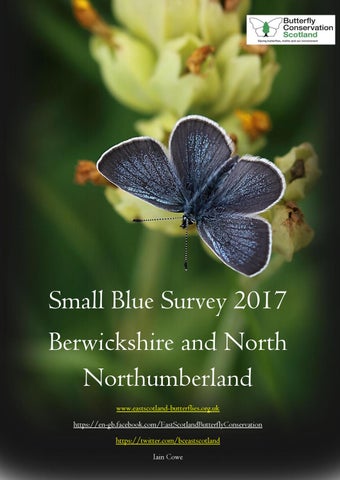
Small Blue Survey 2017 Berwickshire and North Northumberland www.eastscotland-butterflies.org.uk https://en-gb.facebook.com/EastScotlandButterflyConservation https://twitter.com/bceastscotland Iain Cowe
Introduction This is the sixth year that this survey of the Berwickshire coast has been running and a clear ten years since the discovery of the first Small Blues back in June 2007 on the coastal path south of Burnmouth. In that time we have discovered much about the species yet are really no closer to understanding just how the Small Blue react to rapid changes in the environment and fluctuating, at times turbulent changes in seasonal climate. If I was to have seen the Small Blue back in 2007 (which I did) then fast forward to 2017 without any surveying at all, what I would find now is something quite extraordinary. Year on year, watching this Butterfly expand in increments without much of a retreat has been eye opening, but it has to be said, it’s been more than that. It seems almost impossible looking at the Small Blue butterfly that it has the ability to fan out into the open countryside and colonise far flung spots with suitable habitat, and not only that, but to hold on and establish the colony year on year after. It is remarkable.
Contents i. ii. iii. iv. v. vi. vii. viii. ix.
Kings Gardens 3rd May 2017 Hilton Bay The Eyemouth coastal peninsula Small Blue Butterfly Walk Small Blue extreme! Second Brood Butterflies? A 2017 Round up The Northern Brown Argus Thank You
Kings Gardens 3rd May 2017 2017 once again threw at the Berwickshire coast curve ball after curve ball by way of weather conditions, though the early spring period was favourable for a change. How early do you look for Small Blue adults?, how early is too early? On average I look from about the 10th of May, with reasonable confidence, though there are so many sites to look at now I have been searching earlier and earlier each year. This year, 2017 I was out along the coast at Burnmouth, Kings Gardens, a site that has not done so well this past few years with very few Butterflies on any given visit, but, as I said, spring conditions were good. So, the 3rd of May, and tucked away along the shore under the towering slopes and precipitous cliffs in the long grasses between the sea and slope I found 2 sparkling Small Blue males, about fifty feet apart. What a difference that fair weather can make. However, the 3rd of May is ridiculously early. Given fair weather it seems that Butterflies are emerging earlier every year, and mild winters as 2016/17 was, perhaps it’s no surprise. This early emergence of Small Blue was matched by an early emergence of the Northern Brown Argus on the 25th of May, yet another early record.
Hilton Bay Hilton Bay sits at the base of an extremely sharp amphitheatrically shaped slope that rises from sea level to 200 meters less than a quarter of a mile inland on Lamberton Moor. As a result, weather from the west just seems to skip over the Bay and land in the sea, so the Bay itself is quite uniquely sheltered. It has been prone to landslips and therefore has been engineered to prevent these slips with a revetment of large rocks to break the waves and prevent erosion. There is also revetment of the slopes with wire and caging; now deteriorating in places to prevent slippages. These manmade modifications were to safeguard the road and especially rail routes north and south from disruption, yet the sea still chews at the slopes base and erosion does still occur.
Hilton Bay, looking north. The darker grey band on the shoreline is the rock revetment supposedly brought in by boat in order to fortify the slopes. As a result of this stabilisation, Gorse has been able to out compete the grassland on the south facing slopes.
The upper slopes of Hilton Bay have been much searched for evidence of Small Blue this past decade and we have found that the Small Blue occasionally settles around the coastal path and railway line wall. Most of the Kidney Vetch visible seemed to be on the upper slope, so the lower slopes have always been ignored, though the truth is, it’s a very steep and tricky descent and ascent just to find nothing. However, in 2016 I as alerted that there were a few Kidney Vetch plants scattered along the base of the Bay, and photographs of the heads taken by my brother Robin revealed a single egg tucked between the buds of the flower…so….I would need now to investigate further. On the 14th of May I set off from the shoreline further north at Catcairn and Heathery Carrs at low tide and worked my way precariously around the headland and into the Bay. Looking for Small Blue is never easy, though it’s always best to look for the rankest grassland you can find, a ditch, a hollow, a south facing shrub with long grasses. As it turned out, after much wandering up and down, I could only really find one probable area, a wet flush spring strewn in Bramble, so I waited a while and watched. That did not work. Small Blue can sit perfectly still for far too long…so plan B is always flushing the Butterfly from cover. I took just one step in the thicker grass and up popped a single male Small Blue…like magic!! I watched it a while before it settled again and just a few moments later another Small Blue from further up the slope appeared and disappeared with the one I had originally flushed in hot pursuit. So this is technically a new site for the Butterfly as the area had not been previously searched.
The Eyemouth Coastal Peninsula From Blaikie Heugh and Fancove Head that sit at 103 metres above sea level to the south of Eyemouth runs a number of headlands, and coves running north past the Golf course. They are all now being colonised by Small Blue, and it’s been a job to keep up. Despite the huge abundance of Kidney Vetch, the Butterfly is never seen in any great numbers all along the way, yet, its now been seen quite readily by a growing number of observers on that very popular stretch of coastline this past few years. The strongholds are at Daring, Scout Point and Agate Point, with very regular singles being seen now.
During 2017, several singles were seen at Daring, a rash of sightings at Scout Point, a few at Agate Point and perhaps culminating in the most interesting record of a single at Elgy Loch (see map, it’s the farthest north point) by Robin Cowe on the 9th of August, this sighting being the latest of 2017 and the farthest north on this Peninsula so far.
Rock strewn low lying coastal grassland between Agate Point and Whalt Point, saturated in Kidney Vetch. Too many heads to investigate for eggs.
Small Blue Butterfly Walk On the 27th May we, Butterfly Conservation in conjunction with the Edinburgh Natural History Society held a walk from Burnmouth, taking in the coastal path south towards one of the strongest Small Blue colonies at Catcairn. Despite a threat of Thunder storms forecast for later that day a large number of 27 turned out, testament to how popular this Butterfly has become.
Photo: Dinah Iredale
The Small Blue was seen in numbers along with a good few other species, and we all managed to stay dry, but only just. The highlight of the day, and there were many, was perhaps not a Small Blue, but a rather unexpected and newly emerged Small Elephant Hawk-Moth. My many thanks to Neville Crowther of the Edinburgh NATS, and to David and Patricia Littlewood for after walk refreshments at the village hall, and all who travelled from near and far all helping to make the day a great success.
The magnificent Small Elephant Hawk-Moth spotted during the walk along the coastal path at Catcairn.
Small Blue Extreme! The Small Blue are very normally quite dull looking little creatures with only the males sporting any signs of blue with a scant dusting of scales radiating out from the body. The amount of scales can vary, and I have seen some spectacular examples, however this year, May 17th, I came across an all-star Small Blue male. He was sporting a full set of iridescent bright blue scales that seemed to shimmer in the light. I was quite excited. So here are a few photos of this ridiculous example of Cupido minimus at its very finest.
The angle of the wings and light hitting the scales, quite often dictates just how blue they are. Small Blue are quite often a lot bluer in overcast light.
Second Brood Butterflies? It’s something I don’t have hard evidence for, but when you consider that we have now recorded the Butterfly still flying in August on several occasions it does seem ever more likely. A very good example will be my sighting of 2 Small Blue at Kings Gardens, Burnmouth on the 3rd of May. I would not be expecting to find the species still flying in the exact same spot some 3 months later…but I did. 3 Adults were seen on the 7th of August flying among the remnants of the later flying Northern Brown Argus and outliving the Small Heath population. It’s extraordinary to say the least to see this species so late. There does appear to be a clear gap in records of a month, with the last records before these August sightings being the 5th of July on average. I can say that it is typical of Lycaenid Butterflies in general to keep popping out new ones for a long period of time. The Northern Brown Argus season for example can be prolonged from late May and into September…but are we missing something here. Could we be seeing partial second broods of all our coastal Lycaenids and just failing to recognise some evidence for it.
An August 2017 Small Blue male at Kings Gardens.
A 2017 Round up The species once again was seen at all its previously discovered sites during 2017, with only the one additional site at Hilton Bay discovered, though the sighting of a late adult at Elgy Loch was notable and in line with the direction they seem to be moving. Only a few adults could be found at the inland quarry site at Causewaybank on the 1st of June and despite numerous visits before and after that date no more evidence could be found. Kidney Vetch on all sites appears to be thriving as per normal. These past few years we have had Rabbit trouble with a huge population explosion but that dynamic has suddenly changed with a few Rabbits found showing signs of Myxomatosis in early spring. The number increased, and dead and dying Rabbits were being seen everywhere around Burnmouth especially. By mid-summer the vegetation was completely unchecked by grazers and as a result, barren, often Kidney Vetch free slopes had greened up considerably. This will change things considerably going forward unless the Rabbits recover to some degree.
Many searches were carried out both north and south of known locations without much success. I find it hard to believe that we cannot refind them around Coldingham Bay, Linkim Shore for example. 10 years of trying on that stretch of coast north of Eyemouth and nothing so far and that frustration I suppose can be doubled with no evidence yet in North Northumberland. It has got to the point that it is highly probable that we have not been looking hard enough, as I am sure they are further afield awaiting discovery.
Northern Brown Argus Next year, as well as continuing with the Small Blue Survey, I will look to set up a preliminary survey for Northern Brown Argus as well. The Northern Brown Argus is a far more widespread, but never common Butterfly that frequents much of our coast in Berwickshire and inland on the hill burns of the Lammermuirs as well as some of the Volcanic plugs, wherever its sole food plant Common Rockrose, the District flower of Berwickshire, resides. As opposed to the Small Blue, the Northern Brown Argus is a northern species‌clues in the name I suppose, and its whereabouts are known, yet many of its sites have been neglected, grassed over, had trees planted where the food plant grows etc. So as a preliminary to a larger Borders wide survey I will look to Berwickshires colonies for now and would appreciate some help visiting sites if just to confirm their presence. More details to follow I hope.
Thank you A big thank you to all those contributing to the Survey with records and general support all much appreciated. Inspired and supported by all below and more besides Barry Prater Barbara Prater Nick Morgan Abbie Marland Ian Campbell Jim Montana Danny and Emma Spring Richard Aspinall Robin Cowe Dinah Iredale Berwick Wildlife Group Burnmouth Community Edinburgh Natural History Society
Iain Cowe e-mail: bordersbutterflies@eastscotland-butterflies.org.uk
Small Blue Survey 2017 Berwickshire and North Northumberland www.eastscotland-butterflies.org.uk https://en-gb.facebook.com/EastScotlandButterflyConservation https://twitter.com/bceastscotland