2013
Small Blue Survey
Berwickshire and North Northumberland
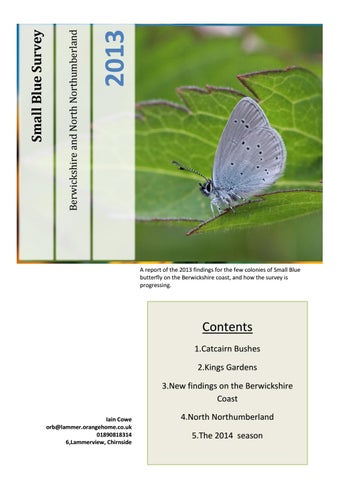
A report of the 2013 findings for the few colonies of Small Blue butterfly on the Berwickshire coast, and how the survey is progressing.
Contents 1.Catcairn Bushes
2.Kings Gardens 3.New findings on the Berwickshire Coast Iain Cowe orb@lammer.orangehome.co.uk 01890818314 6,Lammerview, Chirnside
4.North Northumberland 5.The 2014 season
Catcairn Bushes
Small Blues at Catcairn by Darren Woodhead
The Catcairn Bushes site, situated a few kilometres south of Burnmouth is a scree detritus created by railway works. There are several terraces down the sharp slope towards the sea that must be the remains of a track way forged in the once eroding slope to allow the engineers to create a rock and boulder coastal defence at the foot of the cliff. The disturbance caused has benefited the Kidney Vetch quite well over the years. I still can’t quite work out when the work was done on this site, but as of now the site is beginning to settle down, and that is not good news, as the Gorse and Brambles are becoming and will eventually strangle the open areas. From the discovery, rediscovery of the butterfly in 2007, little has changed on this site. The butterfly emerges in mid to late May in some of the more sheltered hollows ,and by early to mid June they reach peak numbers before fading slowly towards July. In 2013 the Small Blue was on the wing a little later than usual the 26th of May. A peak number of 42 butterflies were counted on the 3rd of June, though only 20 of these on the Catcairn slope, the others were seen a little to the south on the coastal path. When grazing allows the Small Blue butterflies will quite readily utilise any Kidney Vetch plants that escape the hungry sheep. The butterfly was seen a little south of Hilton Bay again this past season, following on from observing a single female egg laying in 2012. Some railwork in 2013 caused a little damage to the coastal path above the site, but I would think that this disturbance may benefit the Kidney Vetch seedlings and should heal nicely. I must mention trampling on the site. As the popularity of seeing the butterfly increases, along with that comes disturbance. Trampling of the vegetation is at the moment the most concerning. The Small Blue need areas of undisturbed grass to roost, and these patches are usually where folks are likely to tread when trying to catch a glimpse of the butterfly. I am very aware that I am just as guilty of adding to the problem. The worst of the trampling is just of the coastal path at the moment. If you are visiting these sites please keep trampling in mind. On a lighter note, one of my visits to the site in 2013 I met the wildlife artist Darren Woodhead based at Aberlady. I was astounded to see that he was painting the Small Blues. Darrens website can be found at http://www.darrenwoodheadartist.co.uk/
Kings Gardens
The Kings Gardens site is situated along the shoreline north of Burnmouth Harbour and Partanhall. The main site sits under sheer grass slopes and is quite tricky to survey what with tides and uneven ground to negotiate. Never the less, this is a superb site, quite exposed and remote. The Small Blue, despite undoubtedly harsh winter storms does not just survive, it seems to thrive. The butterfly was first observed on May 31st on the site. A field trip organised for June 9th was very successful with the group seeing upwards of 30 Small Blue on the steep slopes and along the strand line. These were the highest numbers seen so far in any year since there discovery , rediscovery in 2011. The Kidney Vetch on the upper slopes is extensive but is threatened by Blackthorn and Bramble encroachment. Few scrub species survive on the lower slopes as the winter storms will dictate the future of this habitat, the Kidney Vetch clings to every outcrop with a determination, and the Small Blue tend to use these seaward plants a lot for egg laying…..but how do the overwintering larvae survive tidal incursions…perhaps they don’t. There were no concrete signs of the butterfly spreading north or south from the core of the site in 2013, only one scratchy report of a single butterfly on the slopes of Partanhall. There is very little Kidney Vetch on the Partanhall slopes so I do not expect a colonistaion there. Searches at nearby Fancove and Blaikie to the north turned up nothing despite the habitat being very suitable…in theory.
New Findings on the Berwickshire Coast There were no discoveries of the butterfly away from the known colonies in 2013, otherwise that would have been headline news. A few new areas of interest were looked at more closely. These sites at Hilton Bay lower slopes, Linkim shore, Halllydown Shore and Blaikie Heugh are so very likely to have once seen Small Blue as Linkim Shore has in the 1950s. The chances of seeing the butterfly on these sites in the future is in my view very high when you consider the sightings of possibly 2 adults on the Eyemouth Fort slopes a few years back. They can be a highly mobile species given the right conditions. I will look a little more closely at the stretch of coastline between Linkim and Killiedraught next season as I am yet more convinced every season that passes that they do lurk somewhere along that shoreline. I visited St Abbs Head and drew a very quick conclusion that Small Blue are unlikely on the site.; Kidney Vetch was not quite up to the standard of other sites. Further north at Lumsdaine Shore, Rough Heugh and Brander a far more likely situation exists. A search of flowerheads for eggs though revealed nothing but grazed knees and muttered curses. The flowering Kidney Vetch this past season did not really get anywhere near the spectacular bloom of 2012, all along the coastal strip after a wild set of easterly winds ravaged large swathes of the coastal grassland especially so towards Eyemouth.
Northumberland A few trips down into North Nothumberland this year on Spittal Cliffs and Holy Island. Spittal Cliffs has varying amounts of Kidney Vetch and there are some very suitable sheltered pockets for adults‌potentially. A few of the flowerheads were examined in vain. Still worth looking at in future years. Holy Island was quite a surprise as I had understood there were just a few scattered clumps of Kidney Vetch. Among the dunes there were huge amounts, more than enough for Small Blue to find a foothold. The problem here is that so many naturalists have visited Holy Island over the years that it seems very improbable that they have escaped the millions of keen eyed observers throughout the years. I did check as many flowerheads as is possible for eggs without, unsurprisingly, the slightest hint of hope. The Berwick Wildlife Group who carry out annual surveys and a butterfly transect at Cocklawburn ( a very excellent site) had nothing doing on the Small Blue front. So its just a case of keep looking I guess.
The 2014 Season Nothing is planned in the way of field trips this season. It will be mostly about resurveying and monitoring the known and potential sites. I have recently been contacted by a UK wide Butterfly Conservation initiative that includes various folks whom all have some experience of the Small Blue butterfly its likes and dislikes, conservation concerns, successes and failures. This will be invaluable as the season progresses, sharing knowledge from all corners of the country. I am still looking to involve Burnmouth community somehow garner some interest in the wellbeing of the butterfly. I know that most of you are active enough looking for the butterfly when you are out and about, and I know you are all aware of its existence and where to find it. I hope you all have decent idea of what to look for and when….if not…there is a ton of information on the East Scotland Butterfly Conservation website…..or contact me at the email address above…or phone…and I will be very happy to send you the info you need. Please let me know if you would be interested in carrying out any specific surveying…I can help…and let me know if you discover anything while you are out and about this coming season.
My thanks to all who contacted me throughout 2013 with information…very gratefully received. A happy new year to you all. Iain Cowe, January 2014.