the university of north carolina at chapel hill
J oin the conversation
2013 AN NUAL HIGHLIG H TS
t h e i n s t i t u t e f o r t h e a rt s a n d h u m a n i t i e s
strengthens UNC’s commitment to the liberal arts by supporting and honoring Carolina faculty’s innovative research, inspirational teaching and imaginative leadership.
“ an iah fellowship not only provides time for one’s creative and
scholarly work, but also revitalizes ideas about teaching, about the worth and mission of the University and its place in the community.” — ALLEN ANDERSON, WHITTON FAMILY FELLOW/CREATIVE CAMPUS FELLOW (SPRING 2013), DEPARTMENT OF MUSIC
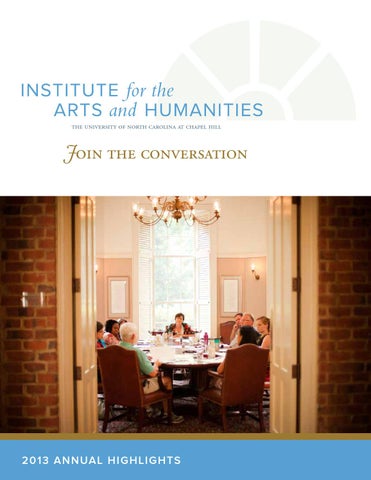
Above: Allen Anderson presents his work to other spring 2013 Faculty Fellows. Photo by Justin Cook. Front cover: The fall 2012 Faculty Fellows gather for breakfast and conversation at their first seminar. Photo by Chris Carmichael.
J oin the conversation
FRO M TH E D I R EC TO R
It is no secret that American higher education is going through a period of profound transformation. What we teachers do in our classrooms is changing almost as rapidly as the world for which we are preparing our students. Is a liberal arts education still the best way to prepare young people for the complex world in which they will live and work? Should—and can—our state and federal governments invest as heavily in higher education as they have over the past fifty years? If public support is no longer there, who will bear the costs? Can online methods of delivering educational content provide a way to cut costs without sacrificing effectiveness? The Institute for the Arts and Humanities believes that the communication skills, the creativity and the broad knowledge imparted by a liberal arts education are more crucial than ever, but also that the forms a liberal arts education takes must adapt to current realities. Working with Carolina faculty in our Leadership Program, our Innovation Initiative, and the Faculty Fellows Program, the IAH strives to support new ideas in teaching and scholarship that are creative responses to our students’ and society’s needs and aspirations. So I encourage you to read here about our collaboration with Carolina Performing Arts for The Rite of Spring project, about our initiatives in medical and digital humanities, about bringing the Process Series under the IAH umbrella, and the varied work our Fellows and faculty working groups are doing. And I would be remiss not to mention the excitement on campus surrounding the arrival of our new Chancellor, Carol Folt. I have no doubt that she is the leader who can help UNC navigate the changes the times demand. What we do here at the Institute is made possible by a wonderful group of loyal friends and donors, people who love UNC and want to see it continue to be a world-class university serving students, North Carolina, the nation, and the world. My heartfelt thanks to all our donors — you make our work possible. I am also pleased to announce that Allison Burnett Smith is our new Director of Development. Mary Flanagan, during her 17 years of service to the IAH and almost 25 years working at UNC, played a huge role in making the Institute what it is today. There is every reason to believe the IAH is equipped to keep building upon the incredible foundation she established, and I know that Allison is the person to make that happen. Intellectual curiosity is the first step toward intellectual courage, and I think the Institute consistently has been the place on campus where faculty can plan the most audacious projects and imagine the most transformative ideas. Hyde Hall is a happening place. We host countless events, almost all of which are free and open to the public, that span a huge range of interests and questions. So check out our web site for details and come join the conversation.
INSTITUTE FOR THE ARTS AND HUMANITIES
OUR VISION
Who We Are and What We Do The Institute for the Arts and Humanities strengthens UNC’s commitment to the liberal arts by supporting and honoring UNC faculty’s innovative research, inspirational teaching and imaginative leadership.
page 2 page 6
The IAH’s signature programs, the Faculty
Fellowship Program and the Ruel W. Tyson Jr. Academic Leadership Program, build collegial
relationships among faculty through interdisciplinary seminars that address teaching methods and goals, research interests and leadership responsibilities.
The IAH sponsors events that celebrate Carolina’s grand liberal arts tradition and foster page 10
challenging conversations
on campus.
The IAH supports innovative scholarship and cutting-edge research through initiatives page 12
and funding opportunities that help faculty find necessary resources to create and disseminate new knowledge, promoting the spirit of the liberal arts more generally.
page 19
The IAH assists in the recruitment and retention of a world-class
faculty at UNC
by supporting and celebrating the work of our best professors while also developing campus leaders from among the faculty. page 22 page 24
We rely on our advisory
boards and staff to shape and fulfill the IAH’s mission. Philanthropic support from donors and foundations help make all of our programs
and events possible, and we are grateful to our board members and Friends for their generous support.
“ it was just sheer pleasure being with a group of incredibly
smart, articulate, interesting and interested scholars. My fellowship was intellectually rejuvenating and an experience that has made me a sharper writer, keener researcher, and more engaged teacher.” — JENNIFER HO, CHAPMAN FAMILY FELLOW (FALL 2012), DEPARTMENT OF ENGLISH AND COMPARATIVE LITERATURE
2013 ANNUA L HIGH LIGHTS
1
OUR PROGRAMS
Spring 2013 Faculty Fellows. Photo by Justin Cook.
Michele Tracy Berger Michele Tracy Berger, associate professor of women’s and gender studies and adjunct professor in the Department of City and Regional Planning, will serve as the associate director of the Faculty Fellows Program beginning in the fall of 2013. Berger currently serves on the IAH Faculty Advisory Board, received a Chapman Family Faculty Fellowship in spring 2012, and was an Academic Leadership Fellow in spring 2009. She is also the founder of a coaching practice that focuses on innovation and resourcefulness development, helping individuals and organizations to understand and harness the power of creativity. These skills and practices, along with her firsthand experience as a Fellow, will undoubtedly be put to good use around the Fellows table during weekly seminars, and we look forward to having her expertise, thoughtfulness and leadership here at the Institute.
The IAH aims to be a full-service faculty center, providing resources to support faculty initiatives and a place for enriching intellectual exchanges. Our core programs—the Faculty Fellows Program and the Ruel W. Tyson Jr. Academic Leadership Programs—highlight our collegial model, with faculty developing their talents and goals through interaction with one another. We also remain dedicated to expanding our reach through initiatives that respond to emerging trends in various academic fields, to issues of concern to the UNC and global community, and to promoting the spirit of the liberal arts more generally.
Faculty Fellows Program Faculty Fellowships provide on-campus semester leaves that offer faculty the unique opportunity to pursue exciting research, redesign course offerings and programs, and work on scholarly and creative projects. Each semester’s Fellows meet weekly for a meal and wide-ranging conversation with peers from across the College of Arts and Sciences, exchanging ideas and new perspectives in a lively, multidisciplinary setting. IAH fellowships are a critical component of UNC’s efforts to retain the best faculty at Carolina, providing the invaluable gift of time in order to refresh, renew and reinvigorate their teaching as they draw upon the conversations and camaraderie they’ve shared in Hyde Hall. For more information about our fellowships, please visit iah.unc.edu/programs/fellowships
conversations time camaraderie
For a listing of this year’s Faculty Fellows, turn to page 4.
Photo by Justin Cook. 2
INSTITUTE FOR THE ARTS AND HUMANITIES
OUR PROGRAMS
The Gift of Time Lisa Lindsay, Wilmer Kuck Borden Fellow, Department of History Lisa Lindsay is thankful for the invaluable gift of time that her IAH fellowship provided. Time away from research and teaching, time to make the transition from planning to writing, and time to connect with a community of scholars. Lisa’s book focuses on an African American named James Vaughan who left his home in South Carolina in the 1850s for a life in Africa, settling first in Liberia and later in present-day Nigeria. There, he survived slave raids and political upheaval, saw the imposition of British colonialism, led a revolt against white missionaries, built a business, and founded a family of activists. This project brings together the histories of the United States, Africa and the African diaspora. It casts American slavery as part of a connected, Atlantic world of bonded labor, one where slavery and freedom were not stark opposites but rather framed a continuum of dependency relations; and it probes the complicated relationship between diasporic Africans and the politics of African colonialism. This project required research from many different places and sources, a process that took a lot of time and kept her from digging into the writing itself. “I was so pleased during my IAH semester to have the breathing space to figure out what I actually wanted to do with all of my sources and to begin writing the manuscript in earnest.” The other gift that her time at the IAH awarded her is a deeper connection with peers and a spirit of University community as a faculty member. “This is the first time in my 13 years at UNC that I have really felt like part of a community that reached beyond my department. It has increased my interest in faculty governance and in other matters that affect the College of Arts and Sciences faculty at large.” Lisa Lindsay is an associate professor of history and was an IAH Faculty Fellow in fall 2012. Thanks to her fellowship, Lisa is now deep into writing her book and working on a chapter centered in Liberia; in summer 2013, she traveled to Liberia for research, courtesy of UNC African Studies Center. Photo by Chris Carmichael.
The Gift of Conversation Todd Ramon Ochoa, Edith Lewis Bernstein Fellow, Department of Religious Studies “The IAH is where co-creation happens at UNC. A semester of conversation with 10 other people inevitably results in new ideas for every scholar involved.” Todd Ramon Ochoa, assistant professor of religious studies, has a deeper appreciation for the value of conversation and collaboration after his spring 2013 fellowship at the IAH. Todd used the semester to work on a book about an African-inspired Cuban religion, Bembé, in which he explores how to characterize a religion that cultivates cultural and ethnic differences inherited from slave history as resources for the production of new ritual forms. This project is the product of years of ethnographic research intended to challenge how we think about Afro-Cuban religion, the religions of the African Diaspora as a whole, and how these concepts are intertwined with contemporary philosophy. “The Fellows program encourages faculty members to explore ideas at the limit of their knowledge, and it can help take a project that is low on energy and lift it into a new light. Faculty grow in the fellowship. The energy and growth from the semester as a Fellow makes a difference not only in terms of goals met, but also in the quality of ideas produced.” Todd is currently working with the Institute to help develop a program for new faculty in the College of Arts and Sciences. Photo by Justin Cook. 2013 ANNUA L HIGH LIGHTS
3
OUR PROGRAMS
The Gift of Camaraderie by Heather Williams Nelson Schwab III Fellow, Department of History
Photo by Justin Cook.
I was fortunate to have a fellowship at the IAH in spring 2013. Although I am a historian of African Americans in the 19th century, I have begun a new project in which I am interviewing Jamaicans who migrated as adults to the United States in the 1950s and 1960s and are now in their 70s, 80s and 90s. I am videotaping the interviews and plan to produce a documentary film that revolves around these oral histories. People have shared with me poignant memories of childhood in Jamaica, their decisions to migrate, and the conditions they encountered in the United States, including racism and segregation. They have also told me of their adjustment to life in a new country in which they found both opportunity and challenge. Following my fellowship semester, I traveled to Jamaica to research photographs and archival footage in the National Library of Jamaica and to interview several people who made the decision to return home – some after a few years in America, some after several decades. Given my prior scholarly work, this project is daunting. I had never used a video camera and I have never made a film. My fellowship semester at the IAH was incredibly helpful. Not only did I have an opportunity to hear about the research of a wide range of scholars from all over the College, but I also benefited by receiving input and reflection from each of the participants. They helped me to think about the narratives that I might develop from the interviews, they asked tough questions about my voice and my position in the telling of the stories, they recommended films that I should study, and they gave me technical advice. They wanted to know about my progress throughout the semester and they always seemed interested in my reports of the interviews. More than anything else, though, they encouraged me. I loved our interactions and exchanges on topics related to our research, writing and performance, as well as our conversations about the state of the University as we and it transitioned through a very difficult period. I consider myself fortunate indeed to have spent a semester with such knowledgeable, thoughtful and curious scholars.
Meet the IAH Fellows for 2012–2013 Neel Ahuja, T. Winfield Blackwell Jr. Fellow Assistant Professor, Department of English and Comparative Literature, “Planetary Specters: Species War and the Human of Precarious Futures” Allen Anderson, Whitton Family Fellow/ Creative Campus Fellow, Professor, Department of Music, “11 Developments: Composition for Winds, Brass and Percussion” William Andrews, D. Earl Pardue Fellow Professor, Department of English and Comparative Literature, “Class Awareness in Pre-Civil War Slave Narratives” Misha Becker, L. Richardson Preyer Family Fellow, Associate Professor, Department of Linguistics, “Animacy, Agency, and the Acquisition of Language” 4
Jessica Berman, Mellon Visiting Fellow Professor, University of Maryland, Baltimore County, “Modernism in Performance” Erin Carlston, Epsy Family Fellow/Creative Campus Fellow, Associate Professor, English and Comparative Literature, “Antipodal Modernisms” Patrick Curran, Chapman Family Fellow Professor, Department of Psychology, “Applied Multilevel Modeling for the Behavioral and Social Sciences” Emilio Del Valle-Escalante, Wilmer Kuck Borden Fellow, Associate Professor, Department of Romance Languages and Literature, “Before and After Genocide in Guatemala: Rebuilding the Contemporary Maya World through Literature (1960–2012)”
Florence Dore, Irwin and Carol Belk-First Union Fellow, Associate Professor, Department of English and Comparative Literature, “Forms of Privacy: Reading Transparency in the Postwar Southern Novel” Jennifer Ho, Chapman Family Fellow Associate Professor, Department of English and Comparative Literature, “Telling Stories, Making Knowledge: Racial Ambiguity in Asian American Culture” Carmen Hsu, Burress Faculty Fellow, Associate Professor, Department of Romance Languages and Literatures, “Kingdoms, Peoples, and Manners in Distant Lands: Chronicles of East Asia in Early Modern Spain”
INSTITUTE FOR THE ARTS AND HUMANITIES
OUR PROGRAMS
“ iah fellowships are of the highest value to faculty teaching and research.
Their interdisciplinary nature encourages faculty to imagine and discover new and unexpected dimensions of their research, and as a result they may find ever more interesting and engaging ways to present material to students in the classroom.” — HASSAN MELEHY, VALINDA HILL DUBOSE FELLOW (FALL 2012), DEPARTMENT OF ROMANCE LANGUAGES AND LITERATURE
Photo by Chris Carmichael.
Jordynn Jack, John W. Burress III Fellow, Associate Professor, Department of English and Comparative Literature, “Neurorhetoric: Behind the Persuasive Power of Neuroscience”
Hassan Melehy, Valinda Hill Dubose Fellow Associate Professor, Department of Romance Languages and Literature, “Jack Kerouac, Quebec in New England, and the Poetics of Exile”
Hong-An Truong, J. Scott and Nancy Cramer Fellow/Creative Campus Fellow, Assistant Professor, Department of Art, “A Chilly Night at a Desolate Palace”
Jim Ketch, Chapman Family Fellow, Professor, Department of Music, “Jazz Trumpet Essentials: Straight Forward Information to Develop Improvisational Skills”
Mai Thi Nguyen, Taylor Family Fellow Assistant Professor, Department of City and Regional Planning, “Local Policing of Immigration”
Heather Williams, Nelson Schwab III Fellow Professor, Department of History, “Jamaican Journeys”
Lisa Lindsay, Wilmer Kuck Borden Fellow, Associate Professor, Department of English and Comparative Literature, “Atlantic Bonds: A Family History through Slavery, Freedom, and Colonization”
Todd Ramon Ochoa, Edith Lewis Bernstein Fellow, Assistant Professor, Department of Religious Studies, “Bembé: Creole Becoming and the Limits of Representation”
Genna Rae McNeil, Nelson Schwab III Fellow Professor, Department of History, “Who Is She and What Is She to You? State vs. Joan Little and the ‘Free Joan Little’ Movement, 1974–75” 2013 ANNUA L HIGH LIGHTS
Kennetta Perry, Visiting Fellow, Assistant Professor, Department of History, East Carolina University, “London Is The Place For Me: Black Britons, Citizenship and the Politics of Belonging” 5
OUR PROGRAMS
The Ruel W. Tyson Jr. Academic Leadership Programs The Ruel W. Tyson Jr. Academic Leadership Programs identify, develop and support faculty who serve as academic and institutional leaders both on and off campus. Academic leadership extends to all facets of University life, and as UNC continues to face new challenges and move forward, providing opportunity for honest discussions among current and emerging leaders is as critical as ever.
Academic Leadership Program The Academic Leadership Program cultivates leadership skills through an intensive year-long program that helps leaders identify their strengths, clarify their career and leadership goals, and build a peer network across UNC and in the community. Eight Fellows are selected annually to participate in weekly seminars that provide a forum for crucial conversations and guidance, as well as a series of retreats and off-site leadership development training. Each group of Fellows continues to meet regularly and support each other after their fellowship semester at the Institute.
Chairs Leadership Program The Chairs Leadership Program supports newly appointed and returning department chairs through a year of monthly confidential conversations in which they can explore important issues related to the roles they play within the University. The program incorporates a unique mentoring component, offering new chairs the benefit of learning from their more experienced colleagues and allowing returning chairs to share in the development of future leaders, all while discussing their own challenges and opportunities.
Faculty Learning Community
Top: Chancellor Emeritus James Moeser speaks during a spring 2013 seminar of the Academic Leadership Program Above: Spring2013 Academic Leadership Fellows Photos by Justin Cook. 6
The Faculty Learning Community on Strategy and Leadership — helping schools, departments, institutes, programs, or centers make the journey “from good to great” — is sponsored by the Institute for the Arts and Humanities in partnership with the Center for Faculty Excellence (CFE). Eight leaders are chosen annually for the year-long program, during which they explore pressing issues amongst colleagues with the guidance and support of the facilitator team. The program culminates with presentations to senior UNC administrators outlining their strategies and visions for improving Carolina.
INSTITUTE FOR THE ARTS AND HUMANITIES
OUR PROGRAMS
IAH Associate Director Kim Strom-Gottfried leads a conversation on leadership challenges and transitions with Chancellor Emeritus Holden Thorp during an ALP convocation entitled “Holden Unplugged”. Photo by Justin Cook.
Leadership Challenges During a year of transitions and challenges, the Academic Leadership Program proved itself to be more essential than ever. The ALP provides a forum for faculty across campus to learn about and understand different perspectives on current events, forging a stronger bond between peers and creating closer ties to the UNC community. Perhaps more importantly, it has developed a new generation of leaders who are prepared to face challenges head-on and serve the University in a variety of critical roles. IAH Associate Director Kim Strom-Gottfried is a co-facilitator of the ALP and has been vital in encouraging tough conversations and furthering the relationships amongst UNC’s leaders. “The readings and conversations in ALP seminars put our local challenges and successes in a broader context. When we face legislative, administrative or fiscal challenges, ALP Fellows can always articulate the value of UNC and the work we do. I’ve had Fellows describe the experience as ‘constructively self-conscious,’ and many say that they share more with each other than with other colleagues. They feel that they’ve created a community. ALP Fellows are making remarkable contributions to the University, and it gives me confidence that our core is strong.” — Kim Strom-Gottfried, Smith P. Theimann Jr. Distinguished Professor of Ethics and Professional Practice, School of Social Work
“I had the great fortune to be a part of both the Academic Leadership Program and the Chairs Leadership Program in the past year. The ALP was a tremendously supportive space in which we reflected on our goals and values and worked towards developing the mindset and skills that will serve us well not only as leaders, but as people. The CLP is often compared to group therapy, and it really is wonderfully therapeutic to share one’s trials and triumphs with colleagues who understand the challenges and pleasures of the chair’s position; the CLP is also an incredibly valuable forum for sharing management strategies and best practices. The two programs have very different goals, but they both allowed me to develop as a leader and, just as importantly, to meet so many amazing colleagues. The programs were intense and gratifying, and I am grateful to my fellow fellows, the facilitators, and the IAH for making this past year a deeply meaningful one for me.” — Mark Katz Photo by Justin Cook.
2013 ANNUA L HIGH LIGHTS
7
OUR PROGRAMS
“ the iah provides faculty fellows the remarkably valuable
gift of time. Time to consider, time to write and edit, time to read and sharpen the saw, time to connect with fellow academics — all of this is ours to enjoy in Hyde Hall. In the end, we advance our work and the work in our disciplines, but the greatest outcome may be this: the IAH teaches a faculty member how to become a University citizen.” — JIM KETCH, CHAPMAN FAMILY FELLOW (FALL 2012) AND ACADEMIC LEADERSHIP FELLOW (2002), DEPARTMENT OF MUSIC
Leadership Fellows
Chairs Leadership Program Participants
Cheryl Mason Bolick School of Education
Valerie Ashby Department of Chemistry
Jan Boxill Chair of the Faculty, Philosophy
Gina Carelli Department of Psychology
Kia Caldwell College of Arts and Sciences, African and African American and Diaspora Studies
Chris Clemens Department of Physics and Astronomy
Michael Gerhardt School of Law Janet Guthmiller School of Dentistry Mark Katz College of Arts and Sciences, Music Randall Styers College of Arts and Sciences, Religious Studies Anthony Viera School of Medicine, Family Medicine Nadia Yaqub College of Arts and Sciences, Religious Studies
Patrick Conway Department of Economics Evelyne Huber Department of Political Science Mark Katz Department of Music Roberto Quercia Department of City and Regional Planning James Rives Department of Classics Paul Roberge Department of Linguistics Eunice Sahle Department of African and African American and Diaspora Studies Harvey Seim Department of Marine Sciences
8
INSTITUTE FOR THE ARTS AND HUMANITIES
OUR PROGRAMS
Photo by Chris Carmichael.
Faculty Learning Community Particpants Stan Ahalt Director, RENCI The Case for a National Center for Data Science in the Triangle
Patricia Parker Director of Diversity Initiatives, College of Arts and Sciences Faculty Diversity Initiatives in the College of Arts and Sciences
Bubba Cunningham Director of Athletics The Future of Carolina Athletics
Richard Superfine Associate Department Chair, Physics-Astronomy Launching Applied Sciences at Carolina
Carl Ernst Co-Director, Carolina Center for the study of the Middle East and Muslim Civilizations Middle East Studies at Carolina: Building Bridges, Serving Students
Kristen Swanson Dean, School of Nursing Positioning the School of Nursing in the Coming Era of Health Care
Stephen Farmer Director of Undergraduate Admissions Assuring that Carolina stays both Great and Public
2013 ANNUA L HIGH LIGHTS
Jane Weintraub Dean, School of Dentistry Building Faculty Strength in the School of Dentistry
9
EVENTS
2012–2013 Events The Institute for the Arts and Humanities sponsors events that celebrate Carolina’s grand liberal arts tradition and honor our Fellows and their accomplishments. We foster research, collaboration and challenging conversations on campus by bringing in renowned scholars and experts to speak to issues of concern that span the campus and community.
Photos by Chris Carmichael.
Weil Lecture The Institute for the Arts and Humanities welcomed Jon M. Huntsman, former Governor of Utah and U.S. Ambassador to China, to UNC to deliver the 2012 Weil Lecture on American Citizenship on November 12. Huntsman addressed the topic of “America 2012 and Beyond: Challenges and Opportunities” through a discussion with Hodding Carter, UNC professor of leadership and public policy and former State Department spokesman for President Jimmy Carter. A lively crowd of more than 500 people filled Hill Hall Auditorium to hear a conversation about the
current state of American politics, domestic policies and the United States’ relationship with China. Huntsman also participated in a question and answer session that afternoon; students, faculty and community members packed the Hyde Hall University Room for the discussion.
“Discover your passion, build your life around it, and find a way to improve your community while doing it.” —Jon Huntsman 10
INSTITUTE FOR THE ARTS AND HUMANITIES
EVENTS
IAH Director John McGowan presents the 2012 George H. Johnson Prize to Gerald J. Postema. Photo by Justin Cook.
George Johnson Prize On September 28, the Institute for the Arts and Humanities presented the 2012 George H. Johnson Prize for Distinguished Achievement by an IAH Fellow to Gerald J. Postema, Cary C. Boshamer Professor of Philosophy and Professor of Law. The Institute created the Johnson Prize, which is presented every two years, to honor longtime IAH Friend and loyal supporter George H. Johnson of Atlanta, Ga. Postema excels as a teacher, scholar, mentor and friend, and much like George Johnson, he has a lifetime of achievement and accomplishments, more than thirty years of it spent in the UNC community. Combining distinguished academic achievements and contributions to his field, a spirit of collegiality and a commitment to public service, he embodies all of the qualities that are honored with this prestigious award.
Josipa Roksa
New Faculty Microtalks In response to feedback solicited from new faculty in the College, the Institute hosted microtalks by new faculty in spring 2013. Over two afternoon sessions, more than 20 faculty members in their first and second years at UNC gave brief informal talks on their work in the arts, humanities and qualitative social sciences, providing them an opportunity for collaboration across departments and a chance to present their scholarship to the wider campus community.
The IAH sponsors many faculty working groups, including one that is exploring the history, mission and future of the public university. In conjunction with their discussions about sustaining access to highquality university instruction, the Institute hosted a lecture by Josipa Roksa, a sociologist from the University of Virginia and author of Academically Adrift: Limited Learning on College Campuses, to discuss what students actually need to make progress in college and how we can improve undergraduate education.
PLEASE VISIT IAH.UNC.EDU FOR MORE INFORMATION ABOUT OUR EVENTS, FACULTY WORKING GROUPS AND OTHER PROGRAMS.
2013 ANNUA L HIGH LIGHTS
11
I N I T I AT I V E S
IAH Innovation Fund The IAH has now funded two rounds of Innovation Fund projects, providing each of the eleven projects with financial and resource support for three years and up to $50,000. The first five are thriving, boasting accomplishments such as a new digital arts major and a lab on campus, a beat-making studio in the Congo, and a successful pilot program for community engagement in rural North Carolina, among others. After two years of funding, these projects are now seeking ways to be sustainable and translatable models for other scholars and educators. Our second round of projects includes our first public-private partnership, with a collaboration between a professor and a technology firm; a center for social action and undergraduate education in Peru; an online platform to reform scholarly review and publication; and a performance-based approach to the problem of high school drop-out rates and incarceration.
A full description of all our innovation projects can be found at http://iah.unc.edu/funding-opportunities/innovation
Hidden Voices: None of the Above By Kathy Williams, Department of Dramatic Art The school to prison pipeline refers to the connection between school suspension and incarceration, when we criminalize student behavior instead of educating students. The trend of zero tolerance discipline disproportionately impacts students of color and lower socio-economic status. According to the North Carolina State Board of Education, one of seven high school students receives at least one short-term suspension each year; male students, black and American Indian students, ninth graders, and students receiving special education services are among the groups that continue to be disproportionately represented among suspended students. For the past three years I have been working on a project to bring the stories of those most affected by this trend into a public forum. I am the associate director of Hidden Voices, and along with my colleague, Lynden Harris, we have been investigating the statistics and stories surrounding the school to prison pipeline. As with all of our projects, we will share our research with a public performance and exhibit this September entitled None of the Above. One of the things I love most about my work is connecting people from diverse communities who might otherwise never meet. Last fall we were in Warren County holding workshops with the youth from the Artists’ Market, a program founded by Warrenton native Thomas Park. In a small house he inherited from his grandparents, Thomas and a group of volunteers lead local youth in art, poetry and music. We were introduced to Thomas by Dorothy Holland, a fellow IAH Innovation Fund recipient. One chilly Saturday in March we packed up our writing
12
materials, music and camera and headed to Warrenton. Over the next six hours we led a workshop in which young people wrote short dramatic scenes, created twitter poems and composed song lyrics related to their school experiences. One of the students we met that day was excited about the prospect of being a part of an upcoming performance in April at the Nasher museum in Durham. Before a packed audience of 350 people, he performed selected monologues as part of a preview performance of None of the Above. He mingled with college students and community members, some of whom had traveled his same road and others who came from worlds he never glimpsed. What happened that night, as it does with every Hidden Voices performance, was a transformation. Participants were inspired and revitalized by speaking the words of teachers, students and attorneys who have a stake in improving our school system and dismantling the school to prison pipeline. Our new young friend joined in that chorus speaking for the youth of Warren County. The young man from Warrenton had the opportunity to envision himself on a college campus, studying in those classrooms and contributing his voice to the university dialogue. The audience was moved to action, seeking ways in which they could be involved and making plans to attend school board meetings and take meaningful first steps. Change was in the air. It is those magical moments — that spark of empowerment a participant seizes from a performance, joining diverse worlds in the pursuit of better understanding — that drive me forward. It makes my work worthwhile and supremely satisfying, and I am grateful to the Institute for the Arts and Humanities for facilitating progress and helping us do what we do.
INSTITUTE FOR THE ARTS AND HUMANITIES
I N I T I AT I V E S
Above: Public exhibit of “None of the Above” at the Nasher Museum at Duke university Right: High school students at a workshop in Warrenton, North Carolina Photos by Jessie Gladin-Kramer.
2013 ANNUA L HIGH LIGHTS
13
I N I T I AT I V E S
Rite of Spring The Institute and Carolina Performing Arts (CPA) collaborated in 2012–2013 to create a year-long series of courses, performances, visiting artists and scholars, and conferences to celebrate the 100th anniversary of Stravinsky’s The Rite of Spring. The idea at the heart of The Rite of Spring at 100 initiative was to find a way to more fully integrate classes, faculty research and CPA’s season. With major funding from the Mellon Foundation and the William R. Kenan Jr. Charitable Trust, the IAH put together the schedule of classes and awarded four faculty fellowships to projects exploring artistic modernism, while CPA commissioned new works and the Department of Music organized two scholarly conferences, one in Chapel Hill and one in Moscow. Over 200 students at Carolina this year examined this modernist classic from every possible angle in classes taught in the Departments of History, English, Art, Music and Communication Studies. They attended performances in Memorial Hall featuring new works by contemporary artists inspired by the Stravinsky/Nijinsky original, and also enjoyed the opportunities to talk with visiting artists and scholars and to research every aspect of the piece. We’d like to thank everyone who was involved in The Rite of Spring at 100 initiative, particularly our creative faculty who developed courses and the eager students and community members who attended the world-class performances. Top: Bill T. Jones/Arnie Zane Dance Company and SITI Company Above: The Silk Road Ensemble with Yo-Yo Ma Right: Panel at the academic conference “Reassessing The Rite” Photos by KPO Photos.
14
INSTITUTE FOR THE ARTS AND HUMANITIES
Top: Basil Twist; Above: RADHE RADHE: Rites of Holi; Photos by KPO Photos. 2013 ANNUA L HIGH LIGHTS
15
I N I T I AT I V E S
Reckford Lecture Martin Puchner of Harvard University delivered the 2013 Mary Stevens Reckford Memorial Lecture in European Studies on February 21. This talk was the 19th annual Reckford Lecture presented by the IAH and was one of many events on campus comprising The Rite of Spring at 100 initiative. Puchner explored how The Rite of Spring exemplifies a form of traditional European modernism based on ritual, primitivism and the body, and he confronted it with a tradition of modern theater focused on the drama of ideas.
Photos by Justin Cook.
WWI
Digital Humanities
UNC is hosting a year-long conversation on the legacy of World War I during its centennial period in 2014-2015. This initiative, sponsored by the IAH, the College of Arts of Sciences, and in collaboration with King’s College London, seeks to increase awareness about the War and its aftermath among faculty, students and the community beyond the University. Classes, performances, concerts, a film series and two conferences are on tap, with over twenty faculty from departments across the College already signed up to contribute to this diverse collaboration.
The IAH, in partnership with the College and the Carolina Digital Innovation Lab, has just completed the first year of a $1.4 million Mellon Foundation grant to fund the Carolina Digital Humanities Initiative (CDHI). With almost $2 million in matching funds from UNC, the CDHI includes two faculty fellows working on digital humanities projects at the IAH every year for the next four years. Renee Alexander Craft (Communication Studies) and Tessa Joseph-Nicholas (Computer Science) are the first two recipients of this fellowship and will be joining us in Hyde Hall in fall 2013. Other features of the program include fellowships for graduate students, new faculty hires, three two-year post-doctoral fellowships, development of new courses on both the graduate and undergraduate level, a summer “boot camp” in new technologies, and coordination of ITS support services for humanities faculty.
16
INSTITUTE FOR THE ARTS AND HUMANITIES
I N I T I AT I V E S
Creative Campus Fellow Hong-An Truong, Department of Art One of the faculty members who immersed herself in The Rite of Spring at 100 initiative is Hong-An Truong, assistant professor in the Department of Art. She developed and taught a course in fall 2012 and was awarded a Creative Campus Fellowship at the IAH in spring 2013. “The Rite of Spring at 100 was an amazing interdisciplinary collaboration. It challenged me to re-think my artistic research more historically, and the result was a class that I co-taught with a cultural anthropologist. This helped me prepare for my Rite of Spring project research, allowing for a more thorough conversation about the intersections between the two disciplines, and it also inspired several students from our class to further pursue movingimage based projects through a more critical lens of culture and history.” Her course, Experimental Ethnography and Avant-Garde Film, was taught in partnership with a graduate student in the Department of Cultural Anthropology at Duke University; the class explored historical avant-garde cinema and ethnographic filmmaking, focusing on the experimental borders shared between cultural anthropology and art practice. Students studied theoretical concepts developed by artists, anthropologists and filmmakers as they used cinema for new perceptual experiences and social knowledge relating to their specific historical and political contexts. Hong-An’s fellowship semester was spent developing a new video work that juxtaposes The Rite of Spring and cai-luong, a form of Vietnamese folk opera created contemporaneously in the early 1900s during
French colonialism. Working with cai-luong performers, this piece is an experimental ethnography of performance that explores the colonial, historical and aesthetic intersections between Stravinsky’s work and cailuong. “As a junior faculty member, it was an incredible opportunity for me to have a semester off from teaching to focus on my research. I know I will go back to the classroom rejuvenated and motivated.”
Photo by Justin Cook.
Taking the time to explore new collaborations was one of the main objectives of The Rite of Spring at 100, and it is something that Hong-An appreciated about both the initiative and her fellowship semester. “The value of making personal connections to forge long-lasting relationships across departments affects real change across the University because the relationships are built on trust and community.”
Medical Humanities The IAH is working with Columbia University, Dartmouth, King’s College London, the Chinese University of Hong Kong, and the University of the Witwatersrand in South Africa to develop an international consortium tackling health and disease questions from a humanities perspective. Following a series of meetings and discussions this past year, we are ready to submit a proposal to the Mellon Foundation to support a two year examination of issues surrounding aging, including a cross-cultural consideration of how the elderly are regarded and treated in our different nations, a study of elderly dementia, and a survey of elder care practices. At the same time, the Institute has partnered with the Honors Program, and the Departments of English in the College of Arts and Sciences and of Social Medicine in the Medical School to launch a new undergraduate minor and a MA in Health, Literature, and Society. These on-campus initiatives have been generously supported by the William C. Friday Fund.
2013 ANNUA L HIGH LIGHTS
Michele Rivkin-Fish, Department of Anthropology, speaks at a medical humanities conference in Hyde Hall. Photo by Justin Cook. 17
I N I T I AT I V E S
Process Series The Process Series has been showcasing artistic works in progress on the UNC campus for the past five years, developing over 30 projects in all areas of the performing arts: theatrical, visual, musical and forms in between. Starting in fall 2013, the Process Series will be housed in the Institute for the Arts and Humanities and funded through a partnership among the IAH, the College of Arts and Sciences, and six participating departments. Joseph Megel, artist in residence in the Department of Communication Studies, is the founder of the program and will continue to serve as director. The Process Series is a launch pad for artistic growth, and it has successfully fostered collaborations to engage artistic talent while sparking conversations across disciplines that connect faculty from across campus, students and the local community. A crucial component of the Series is placing the audience on the cutting edge of the creative process by soliciting critical feedback that encourages artists as they delve more deeply into their work. We hope you’ll be able to join the conversation at these exciting upcoming performances during the 2013–2014 season:
PROCESSSERIES.UNC.EDU Flying Eraser Head A Performance by INVISIBLE September 20–21, 2013 En Mi Espejo, Veo Tu Cara (In My Mirror, I see Your Face) By Roxana Pérez-Méndez October 25–26, 2013 The Box Written and performed by Carmelita Tropicana (aka Alina Troyano) November 15–16, 2013 Mission of a Saint Written and directed by Colman Domingo January 17–18, 2014
Gathering Honey: Stories of Black Southern Women Who Love Women By E. Patrick Johnson February 7–8, 2014 The African American Art Song and Arranged Negro Spiritual For A New Generation Project By Louise Toppin and Marquita Lister March 21–22, 2014 On My Word: Spoken Word Oral Histories of Displacement and Migration in Chapel Hill By Della Pollock and the Sacrificial Poets April 18–19, 2014
Top: Colman Domingo; Right: Carmelita Tropicana, photo by Uzi Parnes
18
INSTITUTE FOR THE ARTS AND HUMANITIES
H O N O RS & AWA R DS
Every year, IAH Faculty Fellows and Leadership Fellows earn an extraordinary number of honors, awards and funding from the University and beyond. Here is a selection of this impressive array of achievements by IAH Fellows in 2012–2013. Patrick Akos, School of Education, Academic Leadership Fellow Spring 2009 Named to the board of directors of the American School Counselor Association. Barbara R. Ambros, Department of Religious Studies, Faculty Fellow Fall 2008 Awarded the ACLS Burkhardt Fellowship with a residency at the National Humanities Center for 2013–14. Yaakov Ariel, Department of Religious Studies, Faculty Fellow Fall 2004 Received a fellowship from the Forschungs Kolleg Humanwissenschaften der Goethe Universität, the Institute for Advanced Studies of Frankfurt University. Inger S. B. Brodey, Department of English and Comparative Literature, Faculty Fellow Spring 2011 Awarded the Bank of America Distinguished Term Professorship from the UNC Honors Program. Jane D. Brown, School of Journalism and Mass Communication, Faculty Fellow Fall 1997 and Academic Leadership Fellow Spring 2002 Inducted into the North Carolina Journalism Hall of Fame. Emily Burrill, Department of Women’s and Gender Studies, Faculty Fellow Spring 2014 Received the Carolina Women’s Center Faculty Scholar Award. Tyler Curtain, Department of English and Comparative Literature, Faculty Fellow Spring 2004 Awarded the Robert Frost Chair in Literature for Summer 2013 at the Bread Loaf School of English at Middlebury College in Ripton, Vermont.
2013 ANNUA L HIGH LIGHTS
Bob Duronio, Department of Biology, Academic Leadership Fellow Spring 2009 Elected as a Fellow of the American Association for the Advancement of Science. Daniel Gitterman, Department of Public Policy, Academic Leadership Fellow Spring 2009 Named the Thomas Willis Lambeth Distinguished Chair in Public Policy and was honored with Order of the Long Leaf Pine, a prestigious award given to North Carolina citizens in recognition of a proven record of service to the state. Larry Grossberg, Department of Communication Studies, Faculty Fellow Fall 1996 and Academic Leadership Fellow Spring 2006 Received the UNC Mentors Lifetime Achievement Award. Janet M. Guthmiller, School of Dentistry, Academic Leadership Fellow Spring 2013 Appointed to the UNC Faculty Council and named associate editor for Oral Health, MedEdPORTAL Publications. Jacquelyn Dowd Hall, Department of History, Faculty Fellow Spring 1998 and Fall 2004 Awarded the 2013 Mary Turner Lane Award. David Halperin, Department of Religious Studies, Faculty Fellow Fall 1988, Summer 1990, Fall 1992 and Spring 1997 His novel Journal of a UFO Investigator was published in German and picked as Book of the Week by Westdeutscher Rundfunk, a regional affiliate of German public broadcasting.
Gail Henderson, Department of Social Medicine, Academic Leadership Fellow Spring 2011 Awarded a five-year renewal for the UNC Center for Genomics and Society from the National Human Genome Research Institute. Amy H. Herring, Department of Biostatistics, Academic Leadership Fellow Spring 2012 Won the 2012 American Public Health Association’s Mortimer Spiegelman Award for Outstanding Public Health Statistician under Age 40. Thomas Hill, Department of Philosophy, Faculty Fellow Summer 1991, Spring 1997 and Spring 2005 Elected vice-president of the Eastern Division of the American Philosophical Association, the largest and oldest division of the A.P.A., and will assume the role of president for 2014. Evelyne Huber, Department of Political Science, Academic Leadership Fellow Spring 2007 Served as president of the Latin American Studies Association, the largest interdisciplinary international organization of scholars studying Latin America. Jordynn Jack, Department of English and Comparative Literature, Faculty Fellow Fall 2012 Won the Kathleen Ethel Welch Outstanding Article Award from the Coalition of Women Scholars in the History of Rhetoric and Composition as well as the Feminist Scholarship Award from the Organization for Research on Women and Communication, both for articles written in 2013.
19
H O N O RS & AWA R DS
Photo by Chris Carmichael.
Sharon James, Department of Classics, Faculty Fellow Spring 2007 Received the William C. Friday/Class of 1986 Award for Excellence in Teaching and a University Research Council Grant; co-edited A Companion to Women in the Ancient World (Wiley-Blackwell, 2012), which was selected by Choice Magazine as a 2013 Outstanding Academic Title and awarded a 2013 PROSE Honorable Mention as a Single Volume Reference/ Humanities & Social Sciences; served as principal investigator and co-director of a 2012 NEH Summer Institute. Angela Kashuba, School of Pharmacy, Academic Leadership Fellow Spring 2014 Served as principle investigator on grants and contracts totaling 3.1 million dollars and co-investigator on grants totaling 10.5 million dollars from federal, foundation, and pharmaceutical industry sources, Sherryl Kleinman, Department of Sociology, Faculty Fellow Summer 1989, Fall 1995, Spring 2001, Spring 2007 and Spring 2014 Received a mentoring award from the Carolina Women’s Leadership Council honoring her work with undergraduate students.
20
Stephen Leonard, Department of Political Science, Faculty Fellow Summer 1991, Spring 1996 and Fall 2002 Elected Chair of the UNC System Faculty Assembly. Patricia McAnany, Department of Anthropology, Faculty Fellow Spring 2011 Received a 2013 Guggenheim Fellowship. Ruth Moose, Department of English and Comparative Literature, Faculty Fellow Fall 2008 Received first place in the Narrative Nonfiction category at Southeast Review. Jeanne Moskal, Department of English and Comparative Literature, Faculty Fellow Summer 1989 and Fall 1992 Received a mentoring award from the Carolina Women’s Leadership Council honoring her work with graduate students. James O’Hara, Department of Classics, Faculty Fellow Spring 2012 Received a Student Undergraduate Teaching Award from UNC’s Student Undergraduate Teaching and Staff Awards Committee. Thomas Otten, Department of Music, Faculty Fellow Spring 2014 Received a University Research Council grant in support of a recording project of the piano etudes by H. Leslie Adams.
Patricia Parker, Department of Communication Studies, Faculty Fellow Fall 2012 and Academic Leadership Fellow Spring 2011 Received an Office of the Provost Engaged Scholarship Award. Krista Perreira, Department of Public Policy, Faculty Fellow Spring 2008 and Academic Leadership Fellow 2014 Appointed associate dean of the Office for Undergraduate Research; also received an award from the Robert Wood Johnson Foundation to study health care reform. Andrew Perrin, Department of Sociology, Faculty Fellow Fall 2007 and Academic Leadership Fellow Spring 2010 Elected chair of the Theory Section of the American Sociological Association and elected to the Council of the Section on the Sociology of Culture of the American Sociological Association. Eliana M. Perrin, Department of Pediatrics, Academic Leadership Fellow Spring 2012 Named one of the Best Doctors in America and listed in the Guide to America’s Top Pediatricians.
INSTITUTE FOR THE ARTS AND HUMANITIES
H O N O RS & AWA R DS
“ this fellowship
enabled me to learn about topics I wouldn’t normally encounter in my own work; it forced me to consider issues I wouldn’t normally consider; it challenged a lot of my assumptions and approaches. Being exposed to such breadth of scholarship is a rarity at this stage of our careers, and it was truly refreshing.” — MISHA BECKER, L. RICHARDSON PREYER FAMILY FELLOW (FALL 2012), DEPARTMENT OF LINGUISTICS
Donald Raleigh, Department of History, Faculty Fellow Fall 1995, Spring 2004 and Spring 2012 His book, Soviet Baby Boomers: An Oral History of Russia’s Cold War Generation (Oxford University Press, 2013), was one of six titles short-listed for the Pushkin House Russian Book Prize. Charles Reeve, Department of Philosophy, Faculty Fellow Spring 2010 His book, Action, Contemplation, and Happiness: An Essay on Aristotle (Harvard University Press, 2012), was named an Outstanding Academic Title for 2012 by Choice Magazine. Andrew Reynolds, Department of Political Science, Faculty Fellow Fall 2005 and Academic Leadership Fellow Spring 2008 Received a Tanner Award for Excellence in Undergraduate Teaching at UNC. Michele Rivkin-Fish, Department of Anthropology, Faculty Fellow Fall 2013 Awarded a Short Term Grant from IREX to conduct research in Russia. Yaron Shemer, Department of Asian Studies, Faculty Fellow Spring 2011 Awarded fellowships from the Stanford Humanities Center and the ACLS/SSRC/ NEH International and Area Studies. Philip A. Stadter, Department of Classics, Faculty Fellow Fall 1996 Awarded a Fowler Hamilton Visiting Fellowship at Christ Church, Oxford. Lynda Stone, School of Education, Faculty Fellow Fall 1996 Awarded the Samuel M. Holton Distinguished Professorship; currently serves as president of the American Educational Studies Association and past president of the John Dewey Society.
Silvia Tomášková, Department of Women’s and Gender Studies, Faculty Fellow Fall 2002 Received a mentoring award from the Carolina Women’s Leadership Council honoring her work with junior faculty and was awarded course development grants from the Center for Faculty Excellence and the Ackland Art Museum. Lucila Vargas, School of Journalism and Communication, Faculty Fellow Fall 2012 Named the Julian Sheer Term Professor. Adam Versényi, Department of Dramatic Art, Faculty Fellow Fall 1993 and Academic Leadership Fellow Spring 2004 Delivered the keynote address at the Drama Translation in the Age of Globalisation Symposium at the University of Salford in Manchester, England. Anthony Viera, Department of Family Medicine, Academic Leadership Fellow Spring 2013 Received a 2013 Distinguished Teaching Award for Post-Baccalaureate Instruction from UNC as well as a 2013 Teaching Innovation Award from UNC’s Gillings School of Global Public Health. Jeff Whetstone, Department of Art, Faculty Fellow Fall 2013 Selected as one of only two recipients of a North Carolina Artist Fellowship in Filmmaking. Sheryl Zimmerman, School of Social Work, Academic Leadership Fellow Spring 2007 Appointed associate dean for doctoral education in the School of Social Work and was also selected as a Fellow of the American Academy of Social Work and Social Welfare.
Afroz Taj, Department of Asian Studies, Faculty Fellow Fall 2011 Awarded the first Carolina Performing Arts Curatorial Fellowship, part of the CPA “Arts@TheCore” grant from the Andrew W. Mellon Foundation. 2013 ANNUA L HIGH LIGHTS
21
OUR PEOPLE
Institute Advisory Board 2012–2013 Steven P. Aldrich Outright, Inc. Mountain View, CA
Barbara Rosser Hyde Hyde Family Foundations Memphis, TN
Alan Saunders Neely, Sr. Korn Ferry International, retired Atlanta, GA
John F. White III JFW Properties Raleigh, NC
Victoria Tucker Borden Portraits South Greensboro, NC
G. Allen Ives III Turnpike Properties, Inc. Rocky Mount, NC
John C. O’Hara, Jr. Rockefeller Financial New York, NY
Nancy Hanes White Community Volunteer Raleigh, NC
Sanford A. Cockrell Deloitte, LLP New York, NY
Thomas S. Kenan III William R. Kenan Jr. Charitable Trust Chapel Hill, NC
Roger Lee Perry, Sr. East West Partners Management Co. Inc. Chapel Hill, NC
Caroline C. Williamson Vice Chair, IAH Advisory Board New York, NY
Michael D. Kennedy Korn Ferry International Atlanta, GA
Richard J. Richardson Former Provost, UNC Chapel Hill Pittsboro, NC
Lane Morris McDonald Avondale Strategic Partners New York, NY
Nelson Schwab III Carousel Capital Charlotte, NC
Peter C. Moister Corbin Investment Holdings LLC Atlanta, GA
Professor Ruel W. Tyson Founding Director, Institute for the Arts and Humanities Chapel Hill, NC
Duvall Fuqua Community Volunteer Atlanta, GA Julia Sprunt Grumbles, Chair, IAH Advisory Board Chapel Hill, NC Robert Hackney First Eagle Investment Management New York, NY
Carol Payne Young Harry Norman Realtors Atlanta, GA
Guest of honor Mary Flanagan, IAH director of development, at her retirement reception in fall 2012. Photo by Justin Cook. 22
INSTITUTE FOR THE ARTS AND HUMANITIES
OUR PEOPLE
Faculty Advisory Board 2012–2013
Staff for Academic Year 2012–2013
Michele Berger Department of Women’s Studies
Bill Balthrop Associate Director, Chairs Leadership Program Professor, Department of Communication Studies
Carole Blair Department of Communication Studies Jo Anne Earp School of Public Health, Health Behavior and Education James Ketch Department of Music Patricia McAnany Department of Anthropology Layna Mosley Department of Political Science Sarah Shields Department of History elin o’Hara slavick Department of Art James Thompson Department of English and Comparative Literature
Staff Changes In fall 2012, Mary Flanagan began a well-earned retirement after serving as the IAH director of development for more than 17 years. She is greatly missed but we are also excited to introduce Allison Burnett Smith, our new director of development. Allison is a UNC graduate and a Tar Heel through and through, and she is a huge asset to our team here in Hyde Hall. We also said farewell this year to Laurie Maffly-Kipp, who served as our associate director of the Faculty Fellows Program and has been involved with the Institute since her first fellowship back in 1990. We are sad to see her leave but excited to see the great work she will do, knowing she will always be part of the IAH and Carolina family.
iah.unc.edu
Allison Barnes Events Coordinator Jean Chandler Business Assistant Elaine Erteschik Director of Communications Mary Flanagan Director of Development Laurie Maffly-Kipp Associate Director, Faculty Fellows Program Chair, Department of Religious Studies Rob Kramer Senior Consultant, Academic Leadership Program John McGowan Director Ruel W. Tyson Jr. Distinguished Professor of Humanities Department of English and Comparative Literature Christopher Meinecke Business Manager James Moeser Chancellor Emeritus Senior Fellow for Special Initiatives Professor, Department of Music Joyce Rudinsky Associate Director, Digital Arts and Humanities Visual Artist, Associate Professor, Department of Communication Studies Jeanine Simmons IAH Coordinator for Faculty Programs Kim Strom-Gottfried Associate Director, Academic Leadership Program Smith P. Theimann Jr. Distinguished Professor of Ethics and Professional Practice School of Social Work Maria LaMonaca Wisdom Executive Director Sarah Yates Graduate Assistant
facebook.com/iah.unc twitter.com/iah_unc
2013 ANNUA L HIGH LIGHTS
23
MAKE A GIFT
The IAH is so grateful for the generous support from our alumni and Friends of the Institute. Private funds are essential to fulfill our mission and to continue to serve as an intellectual crossroads at Carolina. We could not do what we do without the support of our donors. Here are two special ways for you to invest in UNC faculty as part of Carolina’s upcoming capital campaign:
Neel Ahuja, Faculty Fellow Fall 2012. Photo by Chris Carmichael.
Endow a Fellow — It costs about $50,000 to fund one faculty fellowship for one semester, and the Institute aims to continue to fund 20 fellowships per year. IAH fellowships are a critical component of UNC’s efforts to retain the best faculty at Carolina, providing the invaluable gift of time in order to refresh, renew and reinvigorate their teaching. Incubator Fund — Today’s faculty are increasingly called upon to explore new models of teaching and research that are collaborative, interdisciplinary, translatable and scalable, and that impact the wider community. The Institute seeks to endow an Incubator Fund for innovative projects in the arts and humanities for which there are not other resources commonly available, either on campus or externally. We currently provide support for such projects through the IAH Innovation Fund, and we hope to extend financial and other resources for additional faculty working groups and collaborations as well as innovation fellowships.
Jordynn Jack, Faculty Fellow Fall 2012. Photo by Chris Carmichael.
You may make your gift online or use the gift envelope enclosed in this magazine. We also encourage you to consider including the Institute in your will or estate plan. For more information on giving to the IAH, please visit iah.unc.edu/make-a-gift. Giving Levels The Institute recognizes gifts to all IAH funds at the following levels: McCorkle Place Friends — For gifts of $1 to $249 Hyde Hall Friends — For gifts of $250 to $999 Fellows Terrace Friends — For gifts of $1,000 to $9,999 IAH Fellowship Society — For gifts of $10,000 and up In addition, annual gifts of $1,500 or more qualify donors for membership in the Dean’s Circle of the College of Arts and Sciences. Gifts of $2,000 or more qualify donors for membership in the Chancellor’s Club as well as the Dean’s Circle. Please see giving.unc.edu for more information on University recognition societies.
ALL DONORS WHO DO NOT WISH TO REMAIN ANONYMOUS ARE RECOGNIZED WITHIN THEIR GIVING LEVELS ON OUR WEBSITE AT IAH.UNC.EDU/HONOR-ROLL. 24
INSTITUTE FOR THE ARTS AND HUMANITIES
SPECIAL FRIENDS OF THE INSTITUTE
Photo by Ariana van den Akker.
Julia Sprunt Grumbles Our IAH Advisory Board comprises strategic advisors and ambassadors for IAH programs and activities. Their dedication to faculty and love of learning goes hand in hand with a demonstrated commitment to leadership and to upholding the high standards of their beloved University for future generations of alumni. On behalf of everyone at UNC, we’d like to extend a very grateful thank-you to Julia Sprunt Grumbles, who took on the role of interim vice chancellor for advancement during the leadership transitions of the past year. We are proud to call her our Advisory Board Chair and our friend, and both UNC and the Institute are immeasurably better due to her hard work and contributions.
“As a Board member, I am a strong supporter of the mission of the Institute. The Institute allows the University to recruit, develop and retain top-notch faculty. This is important since this allows UNC to offer a world class liberal arts education. The Institute is a “differentiator” and allows the University to be positioned as one of the very top public institutions in the country. With the financial challenges confronting higher education today, the Institute is positioned to play a more integral role in the future at the University of North Carolina.” —Michael D. Kennedy (’79)
Welcome our new Advisory Board members! We are so pleased to announce that we have three new members joining our Advisory Board this fall: Jane Preyer (‘76), John Ellison, Jr. (’69 and ‘72) and Brian Fenty (’08). Jane is the director of the Southeast Office of the Environmental Defense Fund and resides in Chapel Hill; John is the CEO of Ellison Company, Inc., in Greensboro; and Brian is joining us from New York City, where he serves as executive chairman of TodayTix.
Photo by Justin Cook.
2013 ANNUA L HIGH LIGHTS
25
Photo by Chris Carmichael.
26
INSTITUTE FOR THE ARTS AND HUMANITIES
“ the faculty fellows program is a
true gem. It has really rejuvenated my
writing and reminded me how rewarding it can be to have time to develop ideas, to carefully write and edit drafts, and to be creative. The existence of the program truly sets the College of Arts and Sciences and the University apart from peer institutions.” — MAI TAI NGUYEN, TAYLOR FAMILY FELLOW (FALL 2012), DEPARTMENT OF CITY AND REGIONAL PLANNING
2013 ANNUA L HIGH LIGHTS
27
The Institute for the Arts and Humanities The College of Arts and Sciences The University of North Carolina at Chapel Hill Campus Box 3322, Hyde Hall Chapel Hill, NC 27599-3322
THE INSTITUTE FOR THE ARTS AND HUMANITIES supports UNC faculty at every career stage, funding individual and collaborative research, showcasing faculty work, developing faculty leaders and teachers and facilitating the formation of collaborative, interdisciplinary communities that promote intellectual exchange.
This report is printed on 100% FSC-certified postconsumer waste paper
Nonprofit Org US Postage PA I D Chapel Hill, NC Permit no. 177