Volume 14 – Issue 1 – 2026
Editor: Melinda Cowart

IAFOR Journal of Education: Language Learning in Education Volume 14 – Issue 1 – 2026
Volume 14 – Issue 1 – 2026
Editor: Melinda Cowart
IAFOR Journal of Education: Language Learning in Education Volume 14 – Issue 1 – 2026
The International Academic Forum
IAFOR Journal of Education: Language Learning in Education
Editor Melinda Cowart
Professor Emerita
Texas Woman’s University (TWU), USA
Published by The International Academic Forum (IAFOR), Japan
IAFOR Publications, Sakae 1-16-26-201, Naka-ward, Aichi, Japan 460-0008
Executive Editor Joseph Haldane
The International Academic Forum, Japan
Publications Manager: Nick Potts
Publications & Communications Coordinator: Mark Kenneth Camiling
IAFOR Journal of Education: Language Learning in Education Volume 14– Issue 1 – 2026
Published June 12, 2026
IAFOR Publications © Copyright 2026 ISSN: 2187-0594
ije.iafor.org
Cover image: Yogendra Singh, (@yogendras31), Unsplash
IAFOR Journal of Education: Language Learning in Education
Volume 14 – Issue 1 – 2026
Edited by Melinda Cowart Professor Emerita
Texas Woman’s University (TWU), USA
From the Editor
Melinda Cowart
Authors’List
Multilingualism and Learning Patterns as Predictors of Student Achievement in Kosovo Higher Education
Enes Ismeti
Ernest Ismeti
L1 Transfer: Underuse of Impersonal and Subject-Raising Constructions inArmenian English as a Foreign Language
Emma Nemishalyan
Vlogging to ImproveAuthentic Speaking in an English Course for Business Management
Shiao-Wei Chu
Yu-Ting Lai
Convergence of Teachers’InstructionalPracticesandPerspectives on Translanguaging with English Learners
Mark Preston S. Lopez
Willow Pangket-Rosario
Maria R. Coady
Impact of the Imposter Syndrome on Second Language Learning among Students in Higher Education
Dayami ÁlvarezAyala
Yisell Vigoa Escobedo
Paola Yadira MoreiraAguayo
Comparing One-Way and Two-Way Listening Strategies of University English Learners in General and Specific English Contexts
Wei-Chi Pan
Mu-Hsuan Chou
Academic Lecturers’ Perceptions of English as a Lingua Franca 165 in the Eurasian Context
Nesrin Neslihan Kocuk
Pınar Başkan
Seyfi Kenan
Learner Engagement and Confidence in Mixed-Ability University 189
English as a Foreign Language Classrooms: A Teacher-Centered Analysis with Student Perspectives
Hesborn Ondiba
Eliud Kiprop
Augusto Vundo
A Correlational Study Between Intertextual Competence and Reading 215 Comprehension among Chinese as a Second Language Learners
Anastasiia Zaprudnova
Chunxiang Wu
Preserving Local Cebuano Vocabulary: Pedagogical Responses to 253 Language Shift Challenges
Therese G. Cuizon
Magnolia A. Laus
Welcome, readers!
Following the publication of the 2025 issue of the IAFOR Journal of Education: Language Learning in Education (IAFOR JOE: LLiE), the number of those engaged in the pursuit of learning an additional language has not decreased. Rather, the growth of that population combined with their multiple needs, inherent to the processes of language learning and language acquisition, present formidable challenges within educational settings. To effectively address essential requisites of all second language (L2) learners it is imperative that educators possess a considerable repertoire of knowledge regarding current issues in language learning, including the educational environments of the students, cultural beliefs, values, and traditions of students and their families, attitudes towards different languages, the impact of educational policy that favors one language over others, how to differentiate instruction in a culturally competent manner, and how to identify materials and strategies that are rigorous and relatable to diverse populations. Concerns for the language and academic needs of L2 learners who are either of refugee status or who are forcibly displaced are in a parallel growth pattern with the magnitude of the group’s size. As English grows in predominance globally, so arises the necessity for exploring what facilitates efficacious language growth while engendering selfconfidence, assurance, and commitment during language learning. Undeniably, individuals and groups with diverse language education goals are journeying whether because of negative factors such as domestic tragedy, civil instability, and war or for the more optimistic influences of seeking a change in location, family reunification, education, adventure, the aspiration to learn a new language or to launch a new career path. Both adverse and beneficial undercurrents have generated a substantial dislocation of large numbers of people who must learn another language in order to achieve success in school, a new job, or in a new society. The motivations for expanding one’s linguistic repertoire notwithstanding, the process is multidimensional, often inspiring, typically angst producing, enlightening about people, languages, and cultures, and commonly challenging.
Various factors influence second language acquisition. Among the more powerful considerations are the degree of acceptance by the macro society and culture, the preparation of educators to exceptionally teach L2 learners, and the extent to which the educational setting is comprehensible and welcoming. Educators have occasionally discovered that the negative affective aspects of language learning such as anxiety, cultural bereavement, language loss, rejection of language and ethnic identity, fear of ridicule because of behavioral or linguistic errors, and a lack of motivation and interest may combine to cause uncertainty, a fear of being labeled a fraud, and self-consciousness about one’s lack of linguistic aptitude. All the possible barriers result in a slowing or interruption of the second language acquisition process. Among forcibly displaced groups, the new language may be perceived as a type of mandatory language replacement, an assault on ethnic and linguistic identity. When students fail to see their cultural and language experiences reflected in the target language curriculum, they may be unable to self-concept success in learning the additional language.
The authors of the articles in this issue have researched several of the most current topics related to L2 acquisition and learning and second language teaching. They represent various nations, live in a variety of cultures, and speak different languages. Yet, they are united by the common language of researching, exploring, and discovering what is crucial in the quest for competent language education.
Multilingualism, second language acquisition, second language learning and teaching, translanguaging, maintenance of heritage languages and cultural identities, intercultural competence, and national language policy endure as important concerns for every nation. The migration of individuals from country to country and within nations persists. As the demographic group of second language learners expands in size, educators, scholars, and researchers who explore the complex nature of L2 acquisition and learning are vital to the improvement of second language teaching and enhanced learning. Readers of the articles in this issue of the IAFOR JOE: LLiE will encounter research that will enlighten and encourage educators of second language students.
Article 1
In the first article, “Multilingualism and Learning Patterns as Predictors of Student Achievement in Kosovo Higher Education”, Enes Ismeti and coauthor Ernest Ismeti explored the manner in which university students’ multilingualism, growth mindsets, learning preferences, and self-regulation strategies were associated with academic achievement in English as a Foreign Language (EFL) and non-language subjects in Kosovo higher education. Results showed that multilingualism was positively associated with EFL achievement whereas peer-focused regulation and reflective observation/active experimentation were negatively associated with EFL scores.
Article 2
Emma Nemishalyan, author of “L1 Transfer: Underuse of Impersonal and Subject-Raising Constructions in Armenian English as a Foreign Language”, studied the acquisition of personal and impersonal passive constructions among Armenian English as a foreign language (EFL) learners, with a specific focus on linguistic transfer and pedagogical practice. Findings pointed to L1 interference with certain grammatical structures that existed in English but not in Armenian. The study concluded that the absence of direct syntactic equivalents in Armenian necessitated targeted pedagogical interventions.
Article 3
In “Vlogging to Improve Authentic Speaking in English for Business Management”, Shiao-Wei Chu and Yu-Ting Lai explored how structured vlog-based authentic oral production influenced English for Foreign Language (EFL) learners’ English-speaking proficiency, confidence, and learning motivation. Overall, the findings suggested that embedding vlogging within a structured instructional cycle can effectively encourage authentic oral production and support enhanced speaking proficiency in EFL practice-oriented courses.
Article 4
Mark Preston S. Lopez, Willow Pangket-Rosario, and Maria R. Coady, authors of, “Convergence of Teachers’ Instructional Practices and Perspectives on Translanguaging with English Learners” wrote about how schools and teachers respond to multilinguals’ linguistic repertoires through translanguaging pedagogies that affirm students’ languages and identities. Using a convergent mixed methods design, the study obtained teachers’ dispositions and perspectives regarding translanguaging among students learning an additional language. Findings reveal that study participants affirmed students’ linguistic diversity through the practice of inviting translanguaging into the classroom.
Article 5
In “Impact of the Imposter Syndrome on Second Language Learning among Students in Higher Education”, authors Dayami ÁlvarezAyala, Yisell Vigoa Escobedo, and Paola Yadira Moreira Aguayo investigated existing research on the Imposter Syndrome. The study was conducted using Preferred Reporting Items for Systematic Reviews and Meta-Analyses (PRISMA). After the selection process, 19 studies were included in the qualitative synthesis. The results show that the imposter syndrome is associated with a lower self-perceived competence, reduced participation, and a lower willingness to communicate in the target language, triggering interaction with variables such as academic anxiety and emotional distress.
Article 6
Wei-Chi Pan and Mu-Hsuan Chou, authors of “Comparing One-Way and Two-Way Listening Strategies of University English Learners in General and Specific English Contexts”, studied the complex nature of listening. Utilizing a mixed-methods study, the researchers investigated differences in listening strategy use among 384 Taiwanese university students enrolled in English for General Purposes (n = 195) and English for Specific Purposes (n = 189) courses and examined relationships between strategies used in one-way and two-way listening. Results indicated that learners in English for Specific Purposes courses reported significantly greater use of problem-solving and planning-evaluation strategies in one-way listening, and higher use of getting-the-gist and phonological and non-verbal strategies in twoway listening.
Article 7
In “Academic Lecturers' Perceptions of English as a Lingua Franca in the Eurasian Context”, Nesrin Neslihan Kocuk and Pınar Başkan researched intensive language program curricula and materials, specifically evaluating how lecturers perceived the role of English as a lingua franca (ELF) within their academic contexts in five universities, each in different countries. Employing a qualitative case study method, the authors found that the demand for high-level academic skills and the dominance of foreign materials restricted the implementation of ELF-based practices in higher education. However, a consensus emerged on prioritizing communicative competence and diverse accents to reflect the global reality of English.
Article 8
Hesborn Ondiba, Eliud Kiprop, and Augusto Vundo, authors of “Learner Engagement and Confidence in Mixed-Ability University English as a Foreign Language Classrooms: A Teacher-Centered Analysis with Student Perspectives” used a qualitative-dominant mixedmethods design to examine the extent to which engagement and confidence functioned as distinct yet interrelated dimensions in mixed-ability Japanese university EFL classrooms. Results showed that engagement was more closely associated with perceived inclusion, while confidence was linked to self-perceived proficiency.
Article 9
In “A Correlational Study Between Intertextual Competence and Reading Comprehension among Chinese as a Second Language Learners”, Anastasiia Zaprudnov and Chunxiang Wu examined the relationship between Chinese as a second language (CSL) learners’ intertextual competence and their reading comprehension ability. Participants numbered a total of 30 Chinese as a second language (CSL) learners with 15 in China and 15 in Russia. Significant information emerged as to how language learning was enhanced when students encountered the culture and language of the target language regularly. Conversely, language students in a location not enriched by the culture and language of the target language appeared to be less successful.
Article 10
Therese G. Cuizon and Magnolia A. Laus, authors of “Preserving Local Cebuano Vocabulary: Pedagogical Responses to Language Shift Challenges”, explored the importance of preserving local Cebuano vocabulary in an upland community in Cebu Province, Philippines. The study investigated the language shift caused by globalization, urbanization, modernization, and the focus on English and Filipinos in schools. The authors clarified the role of the heritage language in preserving cultural and linguistic identity.
The topics researched and discussed in the 2026 issue of the IAFOR Journal of Education: Language Learning in Education will enlighten and encourage the reader about the critical thinking and innovative research that is ongoing in the field of second language acquisition. The information presented will facilitate improved teaching and learning, making the environment for language education at different levels an inclusive, affirming, and engaging experience where academic and linguistic success are common.
Happy reading!
Melinda Cowart
Professor Emerita, Texas Woman’s University, USA
Editor, IAFOR Journal of Education: Language Learning in Education
Article 1:
Multilingualism and Learning Patterns as Predictors of StudentAchievement in Kosovo
Higher Education
Enes Ismeti
University of Prizren “Ukshin Hoti”,Albania
Email: enes.ismeti@hotmail.com
Ernest Ismeti
University of Prizren “Ukshin Hoti”,Albania
Article 2:
L1 Transfer: Underuse of Impersonal and Subject-Raising Constructions in Armenian
English as a Foreign Language
Emma Nemishalyan
Yerevan State University, French University in Armenia, & University of Santiago de Compostela, Armenia
Email: nemishalyan@gmail.com
Article 3:
VloggingtoImproveAuthenticSpeakinginanEnglishCourseforBusinessManagement
Shiao-Wei Chu
National Pingtung University, Taiwan
Email: shiaowei0819@gmail.com
Yu-Ting Lai
National Tsing Hua University, Taiwan
Article 4:
Convergence of Teachers’ Instructional Practices and Perspectives on Translanguaging with English Learners
Mark Preston S. Lopez
Mountain Province State University, Philippines
Email: markpreston819@gmail.com
Willow Pangket-Rosario
Mountain Province State University, Philippines
Maria R. Coady
North Carolina State University, USA
Article 5:
Impact of the Imposter Syndrome on Second Language Learning among Students in Higher Education
Dayami Álvarez Ayala
Quevedo State Technical University, Ecuador
Email: alvarezayaladayami@gmail.com
Yisell Vigoa Escobedo
Quevedo State Technical University, Ecuador
Paola Yadira Moreira Aguayo
Universidad Estatal del Sur de Manabí, Ecuador
Article 6:
Comparing One-Way and Two-Way Listening Strategies of University English Learners in General and Specific English Contexts
Wei-Chi Pan
Wenzao Ursuline University of Languages, Taiwan
Email: 99615@gap.wzu.edu.tw
Mu-Hsuan Chou
Wenzao Ursuline University of Languages, Taiwan
Article 7:
Academic Lecturers’ Perceptions of English as a Lingua Franca in the Eurasian Context
Nesrin Neslihan Kocuk
Istanbul Nisantasi University, Turkey
Email: nesrinneslihankocuk@gmail.com
Pınar Başkan
Marmara University, Turkey
Seyfi Kenan
Marmara University, Turkey
Article 8:
Learner Engagement and Confidence in Mixed-Ability University English as a Foreign Language Classrooms: A Teacher-Centered Analysis with Student Perspectives
Hesborn Ondiba
Tokyo University of Science, Japan
Email: hondiba@gmail.com
Eliud Kiprop
Lakeland University Japan, Japan
Augusto Vundo Bunkyo Gakuin University, Japan
Article 9: A Correlational Study Between Intertextual Competence and Reading Comprehension among Chinese as a Second Language Learners
Anastasiia Zaprudnova
Shanghai International Studies University, China
Email: mrs.zaprudnova@gmail.com
Chunxiang Wu
Shanghai International Studies University, China
Article 10:
Preserving Local Cebuano Vocabulary: Pedagogical Responses to Language Shift Challenges
Therese G. Cuizon
University of the Philippines Cebu, Philippines
Email: tgcuizon@up.edu.ph
Magnolia A. Laus
University of the Philippines Cebu, Philippines
Enes Ismeti
University of Prizren “Ukshin Hoti”, Albania
Ernest Ismeti
University of Prizren “Ukshin Hoti”, Albania
This study examined how university students’ multilingualism, growth mindsets, experiential learning preferences, and self-regulation strategies were associated with academic achievement in English as a Foreign Language (EFL) and non-language subjects in Kosovo higher education. A cross-sectional survey was conducted with 170 undergraduate students. Data were collected through validated measures of language mindset, self-regulation, and experiential learning preferences, together with a self-report multilingual proficiency index based on the number of languages participants reported using at an advanced level. Descriptive statistics, exploratory factor analysis, paired-samples comparisons, and multiple regression analyses were used to examine the data. The results showed that growth mindsets toward English and multilingualism, multilingual proficiency, concrete experience, abstract conceptualization, and teacher-focused self-regulation were positively associated with EFL achievement, whereas peer-focused regulation and reflective observation/active experimentation were negatively associated with EFL scores. In non-language subjects, multilingual proficiency, multilingualism mindset, concrete experience, and teacher-focused self-regulation were strongly linked to achievement, whereas peer-focused regulation and abstract conceptualization were negatively associated with performance. These findings indicate that multilingualism and learning-pattern variables were related to achievement across domains, although the strength and direction of effects varied by subject area.
Keywords: EFL achievement, growth mindset, learning patterns, multilingualism, selfregulated learning
Academic achievement in higher education is increasingly understood as the product of interacting learner resources rather than any single trait or skill. Recent work highlights the roles of multilingual competence (Stephens & Moxham, 2019), growth mindsets (Lou & Noels, 2019), and students’ strategic management of learning through self-regulation (Zimmerman & Kitsantas, 2014; Weinstein et al., 2011). A key implication of this literature is that learners enter university study with constellations of beliefs, preferences, and strategic repertoires that tend to cohere and jointly shape how they engage with academic demands. This integrative view is captured in the learning patterns perspective, which conceptualizes students’ learning as structured combinations of study behaviors, motivational orientations, and epistemological beliefs typical at particular educational stages (Vermunt & Donche, 2017). Learning patterns are not merely additive; they describe how learner characteristics co-occur and become educationally consequential through their interplay (Vermunt & Donche, 2017; Vermunt & Minnaert, 2003).
Within this framework, mindsets, including attitudes, outlooks, and convictions, are especially salient because they represent learners’ beliefs about whether ability can change through effort, strategy, and support (Dweck & Yeager, 2019). Language learning research shows that mindsets are often domain-sensitive and can vary across contexts, including foreign language learning, academic performance, and broader notions of success (Lanvers, 2020; Lou & Noels, 2019). Growth-oriented beliefs are typically associated with greater persistence and adaptive engagement, whereas fixed beliefs are more often associated with avoidance or disengagement under challenge (Degol et al., 2018; Dweck & Yeager, 2019). At the same time, the empirical link between mindset and achievement is not uniformly strong, and effects appear contingent on context, measurement, and interacting learner variables (Sisk et al., 2018). This mixed evidence suggests that mindsets may operate less as direct determinants of outcomes and more as components of broader learning patterns that shape how students mobilize strategies and respond to difficulty.
A parallel line of research emphasizes multilingualism as a complex learner resource that includes cognitive, affective, and social dimensions (Fielding, 2021; Jessner, 2008). Rather than conceptualizing multilingualism as a simple count of languages, contemporary work increasingly frames multilingual competence as a dynamic repertoire that supports flexible meaning-making across contexts (García & Wei, 2014; Jessner, 2008). Yet the educational consequences of multilingualism remain contested. While multilingualism is often associated with advantages in language learning (Hirosh & Degani, 2018), evidence for broader cognitive or metacognitive advantages is inconsistent, with some studies reporting null effects or even disadvantages in specific domains (Bialystok, 2009; Folke et al., 2016; Thomson, 2010). Kosovo, as a multilingual society in which Albanian, Serbian, Turkish, Bosnian, and other languages coexist, offers a particularly relevant context for examining these effects. According to the Kosovo Agency of Statistics (2023), over 90% of the population speaks Albanian as a first language, while significant proportions also use other regional languages in daily life. These mixed findings reinforce the need to examine multilingualism not as uniformly beneficial, but as a learner characteristic whose effects may depend on how it aligns with beliefs and strategy use within particular learning environments (Calafato, 2021; Rutgers et al., 2021).
In addition to mindsets and multilingual repertoires, students’ academic functioning is shaped by how they approach learning experiences and how they regulate learning over time. Experiential learning theory (Kolb, 1984; Kolb & Kolb, 2009) conceptualizes learning as a cycle involving concrete experience, reflective observation, abstract conceptualization, and active experimentation. Although this framework is widely used, evidence also indicates that its dimensions may not always be empirically separable, and the predictive validity of learning styles is debated (An & Carr, 2017; Harris et al., 2003; Manolis et al., 2013). For this reason, it is more defensible to treat these dimensions as learning preferences or tendencies rather than deterministic style categories (Harris et al., 2003). Complementing experiential preferences, self-regulation refers to learners’ deliberate management of cognition, time, effort, and learning environments in pursuit of goals (Cho & Cho, 2017; Zimmerman & Kitsantas, 2014). Metalevel syntheses and language-learning reviews consistently show that self-regulation and strategy use are associated with achievement, though the strength and stability of these associations can vary by context and measurement (Hattie, 2009; Robson et al., 2020; Rose et al., 2018).
Despite theoretical reasons to expect these constructs to operate in combination, much of the literature still examines multilingualism, mindsets, learning preferences, and self-regulation in isolation (Rutgers et al., 2021). Moreover, research often focuses on either language achievement or general achievement, rather than recognizing that university students simultaneously operate across linguistic and non-linguistic domains. A key conceptual gap emerges in investigating whether learners’ beliefs and strategies form relatively stable learning patterns. If they do, consistency in how these patterns relate to performance across subject areas would be expected. If academic domains demand different forms of engagement, then learning patterns may relate to achievement differently in EFL versus non-language subjects (Bailey et al., 2000). Addressing this question is particularly important in linguistically diverse higher education contexts where students routinely navigate multiple languages and disciplinary demands, and where multilingual experience may interact with mindset beliefs and strategic learning in non-trivial ways (García & Wei, 2014; Jessner, 2008).
The present study therefore examined how university students’ domain-specific mindsets regarding EFL, non-language subjects, intelligence, personality, and success, multilingual profiles, experiential learning preferences, and self-regulation strategies were associated with achievement in both EFL and non-language university subjects, operationalized through exam performance. The study’s central contribution is theoretical and integrative. It advanced a learning-patterns account in which multilingual repertoires, mindset beliefs, experiential learning preferences, and self-regulatory strategies were modeled as interacting components of students’ academic functioning, rather than as separate predictors (Dweck & Yeager, 2019; Vermunt & Donche, 2017; Zimmerman & Kitsantas, 2014). By examining outcomes across domains, the study also clarified whether these learning-pattern components showed domaingeneral or domain-specific associations with achievement (Bailey et al., 2000; Lou & Noels, 2019). The study was guided by the following research questions:
RQ1: To what extent do growth mindsets, multilingual proficiency, experiential learning preferences, and self-regulation strategies predict academic achievement in EFL?
RQ2: To what extent do these same variables predict academic achievement in nonlanguage subjects?
The learning patterns perspective conceptualizes learning as a coherent configuration of beliefs and motivational orientations, information-processing and experiential tendencies, and strategic regulation and study behaviors (Vermunt & Donche, 2017). A strength of this framework is that it explicitly anticipates alignment, or misalignment, between what students believe, what they prefer, and what they do. When components do not cohere, students can experience what Vermunt and Minnaert (2003) describe as dissonance, which may undermine learning efficiency or achievement even when individual components appear positive in isolation. This is particularly relevant for constructs such as mindset and self-regulation: mindset reflects beliefs about changeability and effort while self-regulation reflects strategic behavior enacted over time (Dweck & Yeager, 2019; Zimmerman & Kitsantas, 2014). Treating these constructs as part of an integrated learning pattern provides a more precise theoretical basis for explaining why some students translate positive beliefs into performance while others do not (Weinstein et al., 2011; Vermunt & Donche, 2017).
In the present study, multilingualism was treated as a contextualized learner resource that may support adaptive learning, yet not uniformly, depending on how it aligns with learners’ beliefs and strategic regulation (Bialystok, 2009; Jessner, 2008; Rutgers et al., 2021). Experiential learning preferences were treated as tendencies in engaging with learning tasks rather than fixed styles, given the contested evidence base around learning styles as deterministic predictors (An & Carr, 2017; Harris et al., 2003; Manolis et al., 2013). Self-regulation was conceptualized as students’ enacted strategic management of learning processes, including the planning, monitoring, and adjustment of learning behaviors in response to task demands (Cho & Cho, 2017; Zimmerman & Kitsantas, 2014).
Multilingualism is frequently associated with enhanced cognitive and metalinguistic awareness, particularly in contexts where learners actively manage multiple linguistic systems (Fielding, 2021; Jessner, 2008). However, claims of a generalized multilingual advantage are not consistently supported. Reviews and empirical studies point to variability across domains and outcomes, with some evidence of advantages in certain language-related skills, null results in academic attainment, and even disadvantages in specific metacognitive tasks (Bialystok, 2009; Folke et al., 2016; Thomson, 2010). This heterogeneity suggests that multilingualism may be better understood as a learner resource whose academic implications depend on how
multilingual experience is organized and mobilized, rather than as a uniform predictor of achievement (García & Wei, 2014; Jessner, 2008; Rutgers et al., 2021).
Mindsets represent another belief-level component of learning patterns. When considering language learning and higher education, growth-oriented beliefs have been linked to persistence, adaptive engagement, and achievement, although effects are often contextdependent and sometimes modest (Dweck & Yeager, 2019; Sisk et al., 2018). Importantly, language-learning research suggests that mindsets are frequently domain-specific and may differ across foreign language learning and general academic learning, reflecting students’ interpretations of task difficulty and what ability means in different contexts (Eren & Rakıcıoğlu-Söylemez, 2020; Lanvers, 2020; Lou & Noels, 2019). This domain sensitivity implies that examining mindsets only as a single global belief may obscure how students approach EFL versus non-language subjects.
Although multilingualism and mindsets are both theorized to shape engagement, relatively little research has examined their relationship empirically. This is a notable gap because multilingual learners may interpret language learning effort, language aptitude, and academic ability differently based on prior language-learning trajectories and sociolinguistic experiences (Calafato, 2021; Jessner, 2008). An integrated learning-patterns approach therefore motivates investigating whether multilingual profiles co-occur with particular mindset orientations and whether this configuration is associated with academic performance across domains, rather than assuming that multilingualism or growth mindset alone reliably predicts achievement (Sisk et al., 2018; Vermunt & Donche, 2017).
Experiential learning theory conceptualizes learning as a cyclical process involving concrete experience, reflective observation, abstract conceptualization, and active experimentation (Kolb, 1984; Kolb & Kolb, 2009). This framework has been used extensively to interpret individual differences in how students engage with instructional tasks. However, empirical work also indicates that the dimensional structure of experiential learning instruments may vary across samples, and that some subdimensions may overlap (Manolis et al., 2013). In addition, the broader learning styles tradition has been criticized for weak explanatory power and inconsistent links to achievement, suggesting that experiential learning dimensions should be treated cautiously as preferences rather than deterministic styles (An & Carr, 2017; Harris et al., 2003). For this reason, the present study conceptualized Kolb’s dimensions as experiential learning preferences that may interact with motivation and strategy use, rather than as fixed learner types.
Self-regulation provides the behavioral-strategic complement to belief and preference components. In social-cognitive and educational psychology traditions, self-regulation refers to the deliberate management of learning through planning, monitoring, strategic action, and environmental control (Weinstein et al., 2011; Zimmerman & Kitsantas, 2014). In language education, systematic reviews emphasize that self-regulation and strategy research has increasingly moved beyond listing strategies toward understanding how learners orchestrate
strategies across tasks and contexts (Rose et al., 2018; Teng & Zhang, 2022). Self-regulation is therefore central to explaining why students with similar ability or similar beliefs may nonetheless show different achievement trajectories. Recent research has also shown that growth mindset, self-efficacy, and intrinsic value are positively associated with self-regulated learning and English language achievement (Bai & Wang, 2023).
Crucially, experiential preferences and self-regulation need not align. Students may prefer concrete experience yet fail to translate that preference into sustained strategic learning behaviors, or they may endorse growth-oriented beliefs but not enact the strategies required to benefit from those beliefs, pointing to an instance of dissonance within learning patterns (Vermunt & Minnaert, 2003). This possibility makes it theoretically important to examine these constructs jointly. Rather than asking whether learning preferences directly cause achievement, an integrated model asks whether particular configurations, such as growth-oriented mindsets paired with strong self-regulation, are more consistently associated with performance across EFL and non-language subjects (Lou & Noels, 2019; Vermunt & Donche, 2017; Zimmerman & Kitsantas, 2014).
Grounded in the learning patterns perspective, and informed by mindset theory, multilingualism as a dynamic repertoire, experiential learning theory, and self-regulated learning research, the current study tested whether students’ multilingual profiles, domainspecific mindsets, experiential learning preferences, and self-regulation strategies were associated with achievement in both EFL and non-language subjects (Dweck & Yeager, 2019; Jessner, 2008; Kolb, 1984; Vermunt & Donche, 2017; Zimmerman & Kitsantas, 2014). The hypotheses below reflect this integrative rationale and treat observed relationships as associations consistent with the study design.
H1. Students with stronger growth mindsets toward English and multilingualism would report higher performance in EFL.
H2. Greater multilingual proficiency would positively predict achievement in EFL.
H3. Experiential learning preferences, particularly concrete experience, and teacherfocused self-regulation strategies would be positively associated with EFL performance, whereas peer-focused self-regulation would lead to a negative association.
H4. Growth mindsets toward multilingualism and experiential learning preferences would be associated with achievement in non-language subjects.
H5. Greater multilingual proficiency would positively predict achievement in nonlanguage subjects.
H6. Teacher-focused self-regulation would be positively linked with, and peer-focused regulation negatively linked with, achievement in non-language subjects.
This study employed a cross-sectional, questionnaire-based quantitative design with descriptive and correlational components (Brown & Rodgers, 2002). The design allowed for description of participants’ multilingual profiles and achievement in EFL and non-language subjects, and for examination of relationships among mindsets, learning styles, self-regulation strategies, multilingualism, and academic outcomes. A quantitative approach was selected to support objective, replicable measurement and to generate institutionally relevant evidence from a broad student sample (Fryer et al., 2018). Statistical analyses were conducted using IBM SPSS Statistics, Version 28 (IBM Corp., 2021).
Regarding the significance of the study having been conducted in Kosovo, the participants were accessible to the researchers, and Kosovo represents a sociolinguistically relevant higher education context. Students in Kosovo often navigate Albanian, English, and other regional or international languages, including Serbian, Turkish, Bosnian, and German. This makes Kosovo a meaningful setting for examining multilingualism, language mindsets, self-regulation, and academic achievement. Therefore, the Kosovo context should be framed as theoretically and educationally significant because it provides a multilingual environment in which the study’s key constructs are especially relevant.
Ethical approval for this study was obtained from the institutional review board of the University of Prizren prior to data collection. All participation was voluntary and anonymous. Participants provided informed consent before completing the online questionnaire and were informed of their right to withdraw at any time without consequence. No personally identifiable information was collected or retained. The study posed no more than minimal risk, as data collection involved only self-report survey responses pertaining to academic learning experiences.
The study recruited 170 undergraduate students from public universities in Prizren, Kosovo, primarily from the University of Prizren “Ukshin Hoti.” The sample included 106 females (62.4%) and 64 males (37.6%), with a mean age of 20.3 years (SD = 1.9; Mdn = 20.0). Students were enrolled across disciplines including Education (n = 51; 30.0%), Economics and Business (n = 34; 20.0%), Information Technology and Engineering (n = 34; 20.0%), Law (n = 17; 10.0%), and other fields such as agribusiness, social sciences, and arts (n = 34; 20.0%). None were language majors. Multilingualism was defined as advanced proficiency in more than one language and was self-reported. Most participants identified as multilingual: 77 (45.3%) reported being bilingual, 72 (42.4%) reported advanced proficiency in three or more languages, and 21 (12.4%) identified as monolingual. Reported languages included Albanian, English, Serbian, Turkish, and German. Ethnically, most participants came from mono-ethnic Albanian
families (88.0%), with smaller proportions reporting multi-ethnic backgrounds (8.0%) or declining to disclose (4.0%).
Instruments
Data were collected via an online questionnaire comprising 185 items adapted from previously validated instruments, organized into five sections. First, socio-biographical data were gathered on age, gender, programme, family background, and multilingualism. Second, mindsets were measured using the Language Mindset Inventory (Lou & Noels, 2019), adapted by the researchers to assess beliefs about EFL, non-language subjects, intelligence, personality, behavior, learning ability, success, and multilingualism, using a five-point Likert scale from 1 (strongly disagree) to 5 (strongly agree). Additional mindset items addressing broader trait beliefs were drawn from Walker and Plomin (2005). Third, learning styles were measured using a shortened, empirically validated version of the Kolb Learning Style Inventory (LSI) reconstructed by Manolis et al. (2013), capturing three dimensions: Concrete Experience (CE), Abstract Conceptualization (AC), and Reflective Observation/Active Experimentation (ROAE). Fourth, self-regulation was assessed using the Online Self-Regulation Questionnaire (OSRQ; Cho & Cho, 2017), measuring content-focused, teacher-focused, and peer-focused regulatory behaviors in EFL and non-language subject contexts. Fifth, academic achievement was operationalized as self-reported final exam scores in EFL and non-language subjects on a standardized 20-point scale. Reliability was assessed using McDonald’s omega; all multi-item scales showed good internal consistency (ω > .80).
Multilingual proficiency was assessed through a self-report language background section in which participants indicated how many languages they could use at an advanced level. This variable was operationalized as a multilingual proficiency index based on advanced selfreported competence across languages. Although this measure was not a standardized proficiency test, it is consistent with multilingual profiling research that uses self-reported language experience and proficiency data to characterize bilingual and multilingual participants (Marian et al., 2007). The index should therefore be interpreted as a self-report indicator of multilingual proficiency rather than an externally verified test score.
starting an assignment, I plan out my work.
hesitate to share concerns about my progress with the teacher.
from other students if I need it.
Note. NLS = non-language subjects; RMSEA = Root Mean Square Error of Approximation; TLI = Tucker-Lewis Index; CE = Concrete Experience; AC = Abstract Conceptualization; ROAE = Reflective Observation and Active Experimentation
Key quantitative findings of the study, which explored how students’ multilingualism and learning patterns related to their academic performance in both EFL and non-language university subjects, are presented below. The analysis is structured around the study’s two research questions, beginning with scale reliability and factor structure, followed by descriptive and comparative results, and concluding with multiple regression outcomes.
The instruments used in this study demonstrated good to excellent internal consistency. In line with the methodology described above, reliability was assessed using McDonald’s omega rather than Cronbach’s alpha. As shown in Table 1, omega coefficients for the multi-item subscales ranged from .83 to .93, indicating acceptable to excellent internal consistency across the measures. To examine construct structure, exploratory factor analysis was conducted using principal component analysis with Varimax rotation. The Kaiser-Meyer-Olkin measure was .91, indicating adequate sampling suitability for factor analysis. The rotated solution yielded 15 components, which together explained 72.2% of the total variance after six iterations. EFL mindset items loaded strongly on a single component, with loadings ranging from .829 to .868, while multilingualism mindset items formed a distinct factor with loadings between .850 and .877. Teacher-, peer-, and content-focused self-regulation items also clustered clearly, and experiential learning items grouped into theoretically interpretable patterns across both EFL and non-language contexts.
Paired-samples t-tests were conducted to compare students’ mindset, learning style, and selfregulation scores across EFL and non-language subject contexts. Results are displayed in Table 2.
Table 2
Paired Samples t-Test Results Comparing Learning Constructs Between English and NonLanguage Subjects
Note. EFL = English as a Foreign Language; NLS = non-language subjects.
Paired-samples comparisons indicated that students reported virtually identical levels of mindset, concrete experience learning style, and self-regulation in EFL and non-language subjects. The mean differences were extremely small (approximately 0.01–0.02 on a 1–5 scale), none of the tests reached statistical significance (all p > .05), and effect sizes were trivial (d ≈ .03–.06). These results suggest that learning-pattern dimensions were largely stable across academic domains in this sample, with no meaningful evidence that students approached EFL differently from non-language subjects in terms of their mindsets, experiential learning preferences, or self-regulatory behaviors.
A multiple regression analysis was conducted to assess how mindsets, self-regulation strategies, socio-biographical variables, and learning styles predicted students’ performance in EFL. Results are presented in Table 3.
Table 3
Multiple Regression Results Predicting EFL Exam Scores from Mindsets, Learning Strategies, and Socio-Biographical Variables
Note. Dependent variable: English exam scores; CI = Confidence Interval; LB = Lower Bound; UB = Upper Bound; VIF = Variance Inflation Factor; CE = Concrete Experience; AC = Abstract Conceptualization; ROAE = Reflective Observation and Active Experimentation; Tol. = Tolerance.
Within the mindsets block, both English mindset (B = 1.60, β = .30, p < .001) and multilingualism mindset (B = 1.18, β = .24, p < .001) were statistically significant predictors of EFL exam scores, supporting H1. Other mindset variables, including personality (p = .733), intelligence (p = .609), behavior (p = .401), learning ability (p = .521), and success (p = .252), were not significant. Teacher-focused self-regulation showed a significant positive association
(B = 0.36, β = .13, p = .043), while peer regulation showed a significant negative association (B = −1.10, β = −.32, p = .001), supporting H3. Content-focused regulation was not a significant predictor (p = .251). Among socio-biographical variables, age (B = −0.29, β = −.13, p = .041) was negatively associated with EFL performance, while gender was not significant (p = .271). Multilingualism by language count was statistically significant (B = 0.98, β = .23, p < .001), supporting H2. Concrete Experience (B = 1.62, β = .27, p < .001) and Abstract Conceptualization (B = 1.02, β = .18, p = .027) were significant positive predictors of EFL scores, while Reflective Observation and Active Experimentation was negatively associated (B = −1.20, β = −.33, p = .005). No issues of multicollinearity were detected.
A second multiple regression analysis assessed predictors of non-language subject performance. Results are presented in Table 4.
Table 4
Multiple Regression Results on Variables
Note. Dependent variable: Non-language subject exam scores; CI = Confidence Interval; LB = Lower Bound; UB = Upper Bound; VIF = Variance Inflation Factor; CE = Concrete Experience; AC = Abstract Conceptualization; ROAE = Reflective Observation and Active Experimentation; Tol. = Tolerance.
Within the mindset domain, the multilingualism mindset (B = 1.06, β = .17, p = .011) was a statistically significant predictor, providing partial support for H4, while the mindset specific to non-language subjects was not significant (p = .148). Other mindset variables were also nonsignificant. Teacher-focused self-regulation was a significant positive predictor (B = 0.53, β = .16, p = .041), while peer regulation was significantly negatively associated (B = −0.63, β = −.20, p = .021), supporting H6. Content-focused regulation was not significant (p = .134). Multilingualism by language count remained a significant predictor (B = 0.91, β = .19, p = .010), supporting H5. Gender approached significance (p = .050), while age did not (p = .434). Concrete Experience was a significant positive predictor (B = 1.18, β = .24, p = .001), while Abstract Conceptualization was negatively associated (B = −0.55, β = −.15, p = .020). Reflective Observation and Active Experimentation were not significant (p = .061). No multicollinearity concerns were identified.
This study examined how multilingual proficiency, growth mindsets, experiential learning preferences, and self-regulation strategies correlated with academic achievement in EFL and non-language subjects. The findings supported the view that achievement in higher education was related to multiple learner-level factors rather than a single disposition. In the present sample, multilingualism, selected mindset variables, experiential preferences, and teacher- and peer-focused self-regulation showed distinct associations with performance, but these associations varied across subject domains.
The findings contributed to the literature by situating multilingualism within a broader learning patterns perspective. Rather than treating multilingualism as a uniformly beneficial trait, the results suggested that multilingual proficiency was positively aligned with achievement across domains, while the strength and direction of other predictors differed between EFL and nonlanguage subjects. These patterns are consistent with scholarship that presents multilingualism as a contextual resource whose educational significance depends on how it is mobilized within particular learning environments.
The first hypothesis predicted that students with stronger growth mindsets toward English and multilingualism would achieve higher EFL scores. The findings supported this hypothesis. Students who perceived language learning ability as malleable tended to perform better in English, consistent with Dweck’s (2008) theory of implicit beliefs and with Yeager et al. (2019), who showed that growth-oriented learners tended to display greater resilience and more adaptive learning behaviours. Similarly, students with a stronger growth mindset toward multilingualism, defined here as the belief that language learning ability can be developed, also achieved higher results in EFL. This pattern was in line with Lou and Noels (2019), who found that growth language mindsets were associated with persistence in the face of linguistic challenge.
The second hypothesis proposed that multilingual proficiency would positively predict EFL performance. The findings supported this expectation in that each additional language reported at an advanced level was associated with higher English exam scores. This pattern was consistent with Bialystok (2009) and Jessner (2008), who suggested that multilingual learners may demonstrate stronger metalinguistic awareness and cognitive flexibility. It may also reflect greater exposure to diverse syntactic and phonological systems, which could help explain the transfer of linguistic strategies across languages (Cummins, 2014).
The third hypothesis concerned learning behaviors. Students who reported stronger concrete experiential learning preferences achieved significantly higher scores in English, a finding that was consistent with Kolb’s (1984) experiential learning theory, in which hands-on engagement with tasks is associated with deeper processing and retention. Teacher-directed self-regulation strategies were also positively related to EFL performance, which aligned with sociocultural perspectives emphasizing guided learning and expert feedback (Vygotsky, 1978). By contrast, peer-focused regulation was negatively associated with EFL performance. This pattern may suggest that informal peer support, when not structured or guided, was less beneficial for performance in this context, a possibility also noted by Cho and Cho (2017) and supported by meta-analytic evidence on peer learning (Double et al., 2020).
In the domain of non-language subjects, the fourth hypothesis proposed that growth mindsets toward multilingualism and experiential learning preferences would predict higher achievement. The findings partially supported this hypothesis. Growth mindset toward multilingualism significantly predicted non-language achievement, suggesting that students who viewed linguistic ability as developable also reported stronger achievement in nonlanguage subjects. This pattern was broadly consistent with literature suggesting that growth beliefs in one domain may be associated with broader academic orientations (Sun et al., 2021). The influence of experiential learning was also evident, with concrete experience showing a positive relationship with achievement, particularly in applied subjects. By contrast, abstract conceptualization was negatively associated with achievement, which was in line with previous work indicating that more theoretical and detached approaches may be less effective in practical domains (Manolis et al., 2013).
The fifth hypothesis predicted that multilingual proficiency would positively predict achievement in non-language subjects, and this was supported. Students who reported advanced proficiency in multiple languages scored significantly higher across non-language disciplines. This pattern may reflect broader cognitive or attentional advantages associated with managing multiple linguistic systems, although such interpretations should be made cautiously within the limits of a cross-sectional design (Stephens & Moxham, 2019). These findings were also consistent with García and Wei’s (2014) view of translanguaging as more than a communicative resource, extending to broader academic meaning-making practices. The sixth hypothesis was likewise supported and revealed that teacher-focused self-regulation strategies were positively associated with non-language achievement, whereas peer-focused strategies
were negatively associated with it, replicating the pattern observed in EFL. Teacher scaffolding may help students navigate complex tasks more effectively, particularly in content-heavy courses (Hattie, 2009).
Several recommendations emerge from this study for research, practice, and policy. With respect to future research, possible indirect relationships among multilingualism, mindsets, and academic outcomes warrant formal testing through structural equation modeling. Longitudinal designs would also help to clarify the directionality of the relationships observed. Furthermore, the inclusion of qualitative data through interviews or focus groups would provide richer insight into how multilingual students interpret and enact their language beliefs and learning strategies in everyday academic contexts.
For instructional practice, educators are encouraged to design learning environments that actively promote growth-oriented mindsets by framing language learning and academic development as skills that improve with effort and strategic practice, consistent with the principles outlined by Lou and Noels (2019). Concrete, task-based learning activities that allow students to engage experientially with subject matter should be incorporated across disciplines, given that concrete experience was a significant positive predictor in both EFL and nonlanguage contexts. Teachers should also provide structured, teacher-led feedback and guidance, as teacher-focused self-regulation was consistently associated with better outcomes across domains, while unstructured peer reliance was associated with lower achievement.
At the institutional and policy level, higher education institutions in linguistically diverse contexts are encouraged to adopt additive bilingual and translanguaging pedagogies (Cummins, 2014; García & Wei, 2014) that validate and incorporate students’ full multilingual repertoires into the curriculum. Given that multilingual proficiency was a significant predictor of achievement in both EFL and non-language subjects, institutional policies should position multilingualism as an academic asset. Metacognitive training and explicit instruction in selfregulation strategies would also benefit students across disciplines, particularly those who have not yet developed the strategic learning repertoires needed to succeed in content-heavy academic programs.
Although the quantitative approach was appropriate for examining associations among the constructs under study, it is important to acknowledge that growth mindsets, multilingual beliefs, and self-regulation are deeply interpretive and context-dependent constructs. The survey-only design, while allowing broad coverage and statistical analysis, did not fully capture the interpretive and experiential dimensions of the constructs examined. Qualitative methods would usefully complement the approach employed here by incorporating focus groups or interviews to illuminate the lived experiences of multilingual learners and to complement the structural patterns observed here (García & Wei, 2014; Jessner, 2008).
This study was cross-sectional in design, which limits the ability to draw causal inferences about the relationships observed. Future longitudinal or experimental designs would help to clarify the directionality of effects. Although the sample was drawn from a linguistically diverse higher education context, generalizability to other regions or educational systems may be limited, as Kosovo’s sociolinguistic and institutional context is historically distinctive. Some variables, such as the quality of peer collaboration or the depth of multilingual engagement in daily academic practice, were not directly measured and warrant future exploration. The reliance on self-reported achievement data, rather than verified institutional records, introduces the possibility of response bias. Finally, no formal mediation analysis was conducted, so possible indirect relationships among the variables remain to be tested in future studies using structural equation modeling.
This study demonstrated that multilingualism, when considered alongside growth mindsets, experiential learning styles, and self-regulation strategies, was significantly associated with academic achievement in both EFL and non-language subjects among undergraduate students in Kosovo. The key findings were as follows: growth mindsets toward English and multilingualism, concrete experiential learning preferences, and teacher-focused selfregulation positively predicted EFL achievement; multilingual proficiency by language count was a significant positive predictor of achievement in both EFL and non-language subjects; peer-focused self-regulation was consistently negatively associated with achievement across both domains; and abstract conceptualization negatively predicted non-language subject performance, while concrete experience positively predicted it. Together, these findings reinforce the value of the learning patterns framework as an integrative lens for understanding how beliefs, preferences, and strategies co-occur to shape academic outcomes.
The domain-specific effects of the predictors highlight the need for differentiated pedagogical approaches that align instructional design with the demands of particular subject areas. Multilingualism emerged as a cross-cutting academic resource, reinforcing the view that it should be strategically recognized and supported within higher education policy and practice. Future research should examine these relationships longitudinally, incorporate qualitative methods to capture students’ lived experiences, and examine how institutional support for multilingual practices can further enhance student learning and performance.
An, D., & Carr, M. (2017). Learning styles theory fails to explain learning and achievement: Recommendations for alternative approaches. Personality and Individual Differences, 116, 410–416. https://doi.org/10.1016/j.paid.2017.04.050
Bai, B., & Wang, J. (2023). The role of growth mindset, self-efficacy and intrinsic value in self-regulated learning and English language learning achievements. Language Teaching Research, 27(1), 207–228. https://doi.org/10.1177/1362168820933190
Bailey, P., Onwuegbuzie, A. J., & Daley, C. E. (2000). Using learning style to predict foreign language achievement at the college level. System, 28(1), 115–133. https://doi.org/10.1016/S0346-251X(99)00064-0
Bialystok, E. (2009). Bilingualism: The good, the bad, and the indifferent. Bilingualism: Language and Cognition, 12(1), 3–11. https://doi.org/10.1017/S1366728908003477
Brown, J. D., & Rodgers, T. S. (2002). Doing second language research. Oxford University Press.
Calafato, R. (2021). “I’m a salesman and my client is China”: Language learning motivation, multicultural attitudes, and multilingualism among university students in Kazakhstan and Uzbekistan. System, 103, Article 102645. https://doi.org/10.1016/j.system.2021.102645
Cho, M. H., & Cho, Y. (2017). Self-regulated learning in a structured online learning environment. The Internet and Higher Education, 33, 1–10. https://doi.org/10.1016/j.iheduc.2016.12.001
Cummins, J. (2014). Beyond language: Academic communication and student success. Linguistics and Education, 26, 145–154. https://doi.org/10.1016/j.linged.2014.01.006
Degol, J. L., Wang, M. T., Zhang, Y., & Allerton, J. (2018). Do growth mindsets in math benefit females? Identifying pathways between gender, mindset, and motivation. Journal of Youth and Adolescence, 47(5), 976–990. https://doi.org/10.1007/s10964017-0739-8
Double, K. S., McGrane, J. A., & Hopfenbeck, T. N. (2020). The impact of peer assessment on academic performance: A meta-analysis of control group studies. Educational Psychology Review, 32(2), 481–509. https://doi.org/10.1007/s10648-019-09510-3
Dweck, C. S. (2008). Mindset: The new psychology of success. Random House.
Dweck, C. S., & Yeager, D. S. (2019). Mindsets: A view from two eras. Perspectives on Psychological Science, 14(3), 481–496. https://doi.org/10.1177/1745691618804166
Eren, A., & Rakıcıoğlu-Söylemez, A. (2020). Language mindsets, perceived instrumentality, engagement and graded performance in English as a foreign language students. Language Teaching Research, 27(3), 622–643. https://doi.org/10.1177/1362168820958400
Fielding, R. (2021). A multilingual identity approach to intercultural stance in language learning. The Language Learning Journal, 49(4), 466–482. https://doi.org/10.1080/09571736.2021.1912154
Folke, T., Ouzia, J., Bright, P., De Martino, B., & Filippi, R. (2016). A bilingual disadvantage in metacognitive processing. Cognition, 150, 119–132. https://doi.org/10.1016/j.cognition.2016.02.008
Fryer, L., Larson-Hall, J., & Stewart, J. (2018). Quantitative methodology. In A. Phakiti, P. De Costa, L. Plonsky, & S. Starfield (Eds.), The Palgrave handbook of applied linguistics research methodology (pp. 55–77). Palgrave Macmillan. https://doi.org/10.1057/978-1-137-59900-1_3
García, O., & Wei, L. (2014). Translanguaging: Language, bilingualism and education Palgrave Macmillan. https://doi.org/10.1057/9781137385765_4
Harris, A., Guthrie, H., Hobart, B., & Lundberg, D. (2003). Competency-based education and training: Between a rock and a whirlpool. Macmillan Education Australia.
Hattie, J. (2009). Visible learning: A synthesis of over 800 meta-analyses relating to achievement. Routledge.
Hirosh, Z., & Degani, T. (2018). Direct and indirect effects of multilingualism on novel language learning: An integrative review. Psychonomic Bulletin & Review, 25(3), 892–916. https://doi.org/10.3758/s13423-017-1315-7
IBM Corp. (2021). IBM SPSS Statistics for Windows, Version 28.0 [Computer software]. IBM Corp.
Jessner, U. (2008). A DST model of multilingualism and the role of metalinguistic awareness. The Modern Language Journal, 92(2), 270–283. https://doi.org/10.1111/j.1540-4781.2008.00718.x
Kolb, A. Y., & Kolb, D. A. (2009). Experiential learning theory: A dynamic, holistic approach to management learning, education and development. In S. J. Armstrong & C. V. Fukami (Eds.), The SAGE handbook of management learning, education and development (pp. 42–68). SAGE. https://doi.org/10.4135/9780857021038.n3
Kolb, D. A. (1984). Experiential learning: Experience as the source of learning and development. Prentice Hall.
Kosovo Agency of Statistics. (2023). Kosovo population and housing census 2021: Final results.
Lanvers, U. (2020). Language learning mindsets and language motivation: Mapping an interface. System, 89, Article 102209. https://doi.org/10.1016/j.system.2019.102209
Lou, N. M., & Noels, K. A. (2019). Language mindsets, meaning, and regulatory focus: Enhancing language motivation and encouraging growth. System, 86, Article 102126. https://doi.org/10.1016/j.system.2019.102126
Manolis, C., Burns, D. J., Assudani, R., & Chinta, R. (2013). Assessing experiential learning styles: A methodological reconstruction and validation of the Kolb Learning Style Inventory. Learning and Individual Differences, 23, 44–52. https://doi.org/10.1016/j.lindif.2012.10.009
Marian, V., Blumenfeld, H. K., & Kaushanskaya, M. (2007). The Language Experience and Proficiency Questionnaire (LEAP-Q): Assessing language profiles in bilinguals and multilinguals. Journal of Speech, Language, and Hearing Research, 50(4), 940–967. https://doi.org/10.1044/1092-4388(2007/067)
Robson, G., Adamson, B., & Luk, J. (2020). Analyzing self-regulated learning strategies among university EFL learners: A mixed-methods approach. TESOL Quarterly, 54(2), 450–482. https://doi.org/10.1002/tesq.549
Rose, H., Briggs, J. G., Boggs, J. A., Sergio, L., & Ivanova-Slavianskaia, N. (2018). A systematic review of language learner strategy research in the face of self-regulation. System, 72, 151–163. https://doi.org/10.1016/j.system.2017.12.002
Rutgers, D., Evans, M., Fisher, L., Forbes, K., Gayton, A., & Liu, Y. (2021). Multilingualism, multilingual identity and academic attainment: Evidence from secondary schools in England. Journal of Language, Identity & Education, 21(6), 389–406.
Sisk, V. F., Burgoyne, A. P., Sun, J., Butler, J. L., & Macnamara, B. N. (2018). To what extent and under which circumstances are growth mind-sets important to academic achievement? Psychological Science, 29(4), 549–571. https://doi.org/10.1177/0956797617739704
Stephens, S., & Moxham, B. J. (2019). Do medical students who are multilingual have higher spatial and verbal intelligence and do they perform better in anatomy examinations? Clinical Anatomy, 32(1), 26–34. https://doi.org/10.1002/ca.23268
Sun, X., Nancekivell, S., Gelman, S. A., & Shah, P. (2021). Growth mindset and academic outcomes: A comparison of US and Chinese students. NPJ Science of Learning, 6, Article 21. https://doi.org/10.1038/s41539-021-00100-z
Teng, L. S., & Zhang, L. J. (2022). Can self-regulation be transferred to second/foreign language learning and teaching? Current status, controversies, and future directions. Applied Linguistics, 43(3), 587–595. https://doi.org/10.1093/applin/amab032
Thomson, J. (2010). The relationship between student achievement and multilingualism: A quantitative causal-comparative study. Lulu.com.
Vermunt, J., & Donche, V. (2017). A learning patterns perspective on student learning in higher education: State of the art. Educational Psychology Review, 29(2), 269–299. https://doi.org/10.1007/s10648-017-9414-6
Vermunt, J., & Minnaert, A. (2003). Dissonance in student learning patterns: When to revise theory? Studies in Higher Education, 28(1), 49–61. https://doi.org/10.1080/03075070309301
Vygotsky, L. S. (1978). Mind in society: The development of higher psychological processes Harvard University Press.
Walker, S. O., & Plomin, R. (2005). The nature-nurture question: Teachers’ perceptions of how genes and the environment influence educationally relevant behavior. Educational Psychology, 25(5), 509–516. https://doi.org/10.1080/01443410500046697
Weinstein, C. E., Acee, T. W., & Jung, J. (2011). Self-regulation and learning strategies. New Directions for Teaching and Learning, 2011(126), 45–53. https://doi.org/10.1002/tl.443
Yeager, D. S., Hanselman, P., Walton, G. M., Murray, J. S., Crosnoe, R., Muller, C., Tipton, E., Schneider, B., Hulleman, C. S., Hinojosa, C. P., Paunesku, D., Romero, C., Flint, K., Roberts, A., Trott, J., Iachan, R., Buontempo, J., Yang, S. M., Carvalho, C. M., & Dweck, C. S. (2019). A national experiment reveals where a growth mindset improves achievement. Nature, 573(7774), 364–369. https://doi.org/10.1038/s41586-019-1466-y
Zimmerman, B. J., & Kitsantas, A. (2014). Comparing students’ self-discipline and selfregulation measures and their prediction of academic achievement. Contemporary Educational Psychology, 39(2), 145–155. https://doi.org/10.1016/j.cedpsych.2014.03.004
Corresponding Author: Enes Ismeti
Email: enes.ismeti@hotmail.com
L1 Transfer: Underuse of Impersonal and Subject-Raising Constructions in Armenian English as a Foreign Language
Emma Nemishalyan
Yerevan State University, French University in Armenia, & University of Santiago de Compostela, Armenia
This study investigated the acquisition of personal and impersonal passive constructions among Armenian English as a foreign language (EFL) learners, focusing on the intersection of linguistic transfer and pedagogical practice. While research has extensively covered passive voice acquisition in various L1 backgrounds, Armenian learners have remained underrepresented in the literature. Utilizing Contrastive Interlanguage Analysis (CIA), this study compared a specialized learner corpus of argumentative essays with native speaker data from the Louvain Corpus of Native English Essays (LOCNESS). Findings revealed a significant underuse of impersonal passives and an avoidance of subject-raised constructions. These patterns were attributed to negative L1 transfer, cognitive complexity, and a lack of explicit exposure in current instructional materials. The study concluded that the absence of direct syntactic equivalents in Armenian necessitated targeted pedagogical interventions. By bridging transfer theory and classroom practice, the research offered practical strategies for curriculum designers to improve grammatical development and communicative competence in the Armenian EFL context.
Keywords: Armenian learners, corpus-based analysis, linguistic transfer, passive voice, second language acquisition, Contrastive Interlanguage Analysis
Over the past two decades, substantial research in second language acquisition (SLA) and learner corpus linguistics has examined how learners from various first language (L1) backgrounds acquire and use grammatical structures in English. A significant focus has been placed on the influence of L1 on second language (L2) grammatical choices to better inform pedagogical strategies. Studies have investigated Chinese (Lei & Yang, 2020; Liu & Jiang, 2009; Men, 2018; Wu & Jiang, 2023), Spanish (Gilquin & Granger, 2011), Japanese (Izumi, 2003; Philpott & Gayed, 2018), and German (Granger et al., 2015; Rosen, 2019) learners, among others, revealing varied patterns of overuse, underuse, and avoidance of various structures, often attributed to L1-L2 typological distance.
Despite this growing body of research, no corpus-based studies to date have focused on Armenian learners of English. Such an investigation is theoretically pivotal, as Armenian occupies a unique typological position as an independent branch of the Indo-European language family. Its distinct morphosyntactic features and specific patterns of inflection provide a critical point of contrast with the analytical structure of English, offering fresh insights into how L1-L2 structural distance governs transfer. This lack of empirical data leaves a gap in the understanding of how learners from lesser-studied linguistic backgrounds acquire structurally marked constructions, ultimately limiting the effectiveness of localized English language teaching (ELT) curricula.
This study sought to address this gap by examining the use of impersonal passives and personal passives involving subject-raising constructions such as It is said that…, and He is believed to… among Armenian learners of English. To conduct this analysis, an Armenian Learner Corpus was compiled from scratch by the author following the guidelines of the International Corpus of Learner English (ICLE) project (Granger et al., 2009). The body of work included argumentative essays written by upper-intermediate to advanced learners under untimed conditions with access to reference tools. For baseline comparison, the Louvain Corpus of Native English Essays (LOCNESS) was used as a dataset representing native speaker usage.
The choice of the grammatical structures, impersonal passives and subject-raised constructions (hereafter referred to as personal passives), was not accidental. These constructions are absent in the Armenian language, which makes them suitable for examining how learners deal with L2 structures that have no direct equivalent in their L1. This was particularly relevant for testing the theory of negative linguistic transfer. Negative transfer, also known as interlingual interference, has been widely recognized as a source of difficulty in SLA, especially when the target language includes syntactic patterns unfamiliar to the learner’s L1 system. This usually results in the application of L1-based strategies, which can lead to systematic errors in L2 production that impact the clarity and formality of student writing.
This pattern is consistent with findings in cross-linguistic research, where the absence of equivalent structures in a learner’s L1 often results in processing difficulties and reliance on L1-based cognitive strategies (Gries & Wulff, 2013; Li, 2024; McManus, 2022; Tsimpli & Dimitrakopoulou, 2007; Xu, 2024). For instance, Tsimpli and Dimitrakopoulou (2007) found that Greek learners of English had trouble with wh-movement due to its absence in Greek
syntax. As Gries and Wulff (2013) suggest, learners tend to struggle with new linguistic patterns until they gradually develop sensitivity to L2-specific structures with persistent challenges particularly evident in areas that lack direct L1 parallels. Yuan (2014) showed that Mandarin-speaking learners often made subject–verb agreement errors in English, again pointing to gaps between L1 and L2 systems. Similarly, learners from null-subject or topicprominent L1s frequently omitted obligatory subjects or misplaced syntactic focus in English (Jarvis & Pavlenko, 2008; Rothman, 2011). Furthermore, McManus (2022) describes this influence as a transfer of L1 properties, where learners attempt to replicate L1 knowledge in their L2 usage. More recently, Xu (2024) reported that Chinese learners relied heavily on L1based processing strategies when faced with English structures unfamiliar to them, and Li (2024) found that even advanced learners showed less sensitivity to grammatical violations when the structure in question did not exist in their L1.
Drawing on these corpus-based insights into learner difficulties, this study adopted Krashen’s (1985) Input Hypothesis as a foundation for a pedagogical intervention. According to this hypothesis, language acquisition is most effective when learners are exposed to comprehensible input (i+1) that is slightly beyond their current level. To fill the void between theory and classroom application, this study investigated whether structured exposure, delivered through targeted explanation and controlled, form-focused activities, could enhance the short-term production of passive constructions. As part of this investigation, an experimental intervention was conducted in which learners engaged with impersonal and subject-raised passives in communicative yet pedagogically scaffolded tasks. By linking corpus data with experimental results, the study evaluated the applicability of enhanced input strategies in this context.
The study addressed two research questions:
1.How frequently and accurately do Armenian learners of English use personal and impersonal passive constructions in their written interlanguage?
2.To what extent does input-based instruction improve learners’ ability to comprehend and produce these specific structures?
The following section presents a contrastive linguistic overview of personal and impersonal passive constructions in Armenian and English. This comparison identified the specific syntactic gaps that contribute to the learning burden for Armenian students. It laid the groundwork for the subsequent literature review, which explored the influence of L1 transfer on L2 acquisition. Special emphasis was placed on Krashen’s (1985) Input Hypothesis and related instructional theories, which provided the pedagogical foundation for the experimental intervention designed for this study.
As Armenian remains relatively underrepresented in international linguistic and educational literature, this section provides a concise overview of the structural features that define the Armenian learner’s linguistic background. Because Armenian is typologically different from English, it employs a unique syntactic formulation for the passive voice. To address the specific pedagogical needs of these learners, this research concentrated on the formation of personal and impersonal passives. In English, these are considered non-canonical passives involving an expletive subject, it or a raised subject, such as he or she. These constructions are employed not only grammatically but also pragmatically to manage information flow (Biber et al., 1999; Huddleston & Pullum, 2002). Because Modern Eastern Armenian (MEA) lacks direct syntactic equivalents for these specific raising and extraposition patterns, they represented a high learning burden for Armenian students, often leading to the patterns of underuse and avoidance explored in this study.
Rather than utilizing the syntactic movement required for the English passive, the Armenian language achieves similar pragmatic distancing through lexical and morphological strategies. These include agent-generalizing expressions mardik asum en [people say], thirdperson plural verbs asum en [they say], and hearsay phrases lsel em [I have heard] (DumTragut, 2009; Petrosyan, 2010). While these Armenian forms convey a similar sense of epistemic neutrality or avoidance of responsibility, the transition from a lexical-based strategy to a movement-based syntactic approach poses a significant cognitive challenge for the EFL learner.
To illustrate this typological distance and the resulting substantial cognitive load, consider the following contrast between English target structures and the typical Armenian logic used to express the same meaning:
• English Impersonal Passive: It is said that the exam is difficult.
• Armenian Equivalent Logic: Asum en, vor qnnutyunë djvar ē. [They say that the exam is difficult.]
• English Personal Passive (Subject-Raising): He is believed to be an expert.
• Armenian Equivalent Logic: Havatum en, vor na masnaget ē. [They believe that he is an expert].
As shown above, the Armenian speaker relies on an active, null-subject third-person plural construction. Consequently, when acquiring English, the learner must shift cognitive processing from a lexical-active strategy to a complex syntactic-passive movement.
This syntactic-pragmatic mismatch likely accounted for the low frequency of impersonal and subject-raising passives in learner output. Preliminary analyses conducted on a subset of the current text collection (Nemishalyan & Soghomonyan, 2023) indicated that even at advanced
levels, Armenian learners tend to default to active-voice safe structures such as, People say that… or produce interlanguage errors where they attempt to merge the two systems such as, It says that.... Building upon these initial findings, the present study expanded the data set to provide a comprehensive corpus-based view of how this specific L1-L2 gap influences pedagogical outcomes in the Armenian EFL classroom.
In the pedagogical landscape, it is well documented that a learner’s L1 serves as the primary cognitive foundation for the acquisition of L2 (Carroll, 2001; Coppieters, 1987; Granger et al., 2002; Gries & Wulff, 2013; McManus, 2022; Schachter & Rutherford, 1979). Extensive research indicates that L2 learners process grammatical features in a native-like manner when those structures are shared across both languages. However, when structurally unique features exist in the L2 that are absent in the L1, learners often struggle to achieve native-like processing and production (Díaz et al., 2016; Erdocia et al., 2014; Foucart & Frenck-Mestre, 2011; Gries & Wulff, 2013; Tokowicz & MacWhinney, 2005). This complex developmental process has been described as the cloning of one body of knowledge to construct another (McManus, 2022). Within the field of SLA, this influence is termed language transfer.
From an instructional perspective, understanding transfer is vital for anticipating student performance. Positive transfer occurs when structural similarities facilitate learning, whereas negative transfer, or interference, arises when systemic differences hinder acquisition. For educators, identifying the effects of negative transfer is essential for pinpointing the specific syntactic challenges that students face (Odlin, 1989).
Since this study examined English structures absent from the Armenian L1, it centered on the mechanisms of negative transfer. One of the foundational theoretical approaches, Lado’s (1957) Contrastive Analysis Hypothesis, argued that difficulties in L2 learning could be predicted by analyzing the differences between two language systems. Odlin (1989) expanded this view, defining transfer as the influence of previously acquired linguistic knowledge on a new language, with negative transfer occurring when structural mismatches impede the learning trajectory. This framework has since been substantially developed by Jarvis and Pavlenko (2008), whose comprehensive account of crosslinguistic influence remains a standard reference in the field. More recent empirical work continues to extend this line of inquiry: Shatz et al. (2023) demonstrate that L1–L2 formal differences shape L2 production in measurable ways, while Yadavalli et al. (2023) show that greater typological distance between L1 and L2 leads to more pronounced transfer effects. Within the Armenian EFL context, prior research has documented similar interference effects (Harutyunyan, 2020), suggesting that learners require more than exposure alone—they require targeted pedagogical support to overcome the deep-seated influence of their native syntax.
Within the framework of classroom-based SLA, two of the most influential theoretical constructs are the Input Hypothesis and the Output Hypothesis. Krashen’s (1982) Input Hypothesis proposes that language acquisition occurs most effectively when learners are exposed to comprehensible input containing linguistic features that are just beyond their current level of competence (i+1). For this input to serve as a primary data source for the development of a learner’s interlanguage, it must be both intelligible and meaningoriented. More recently, scholars have revisited and refined the conditions under which comprehensible input is most effective. Javahery and Alizadeh (2025) argued that optimal input delivery requires not only the appropriate level of difficulty but also affective and contextual engagement, while Nguyen and Doan (2025) offered a neuro-ecological critique of the hypothesis, demonstrating that meaningful language growth depends on learners actively detecting and responding to environmental affordances rather than passively absorbing linear, simplified input. In the context of the present study, the challenge lay in providing i+1 input for complex passive structures that have no conceptual equivalent in the learner’s native language.
A long-standing question in this tradition concerns whether such input alone is sufficient, or whether learners additionally require explicit attention to form. Truscott and Sharwood Smith (2004) defend the stronger position, arguing that comprehensible input alone may suffice for the development of a functional linguistic system, since learners can internalize structures through implicit cognitive processing without explicit instruction. For Armenian EFL learners, however, the invisibility of subject-raising constructions in their L1 may necessitate a more structured form of input to facilitate “noticing”. Schmidt’s (1990) Noticing Hypothesis takes the opposite position, suggesting that subliminal exposure is not enough for acquisition. Learners have to consciously notice a target form before it can become intake, and how much noticing is needed depends on how perceptually salient the form is. A central implication is that forms which have no analog in the L1 are inherently low in salience for the L2 learner, because the L1-trained parser does not predict them. Such forms therefore demand pedagogical interventions that artificially heighten their salience, through input flooding, textual enhancement, or explicit comparison with L1 structures, rather than relying on incidental uptake. This view aligns with broader work on crosslinguistic influence (Jarvis & Pavlenko, 2008; McManus, 2022) showing that L1-absent grammatical features cluster among the most persistent areas of underuse and fossilization in advanced L2 learners.
The literature generally distinguishes between two categories of input delivery, interactional and non-interactional. Interactional input, as explored by Pica (1994), occurs in reciprocal communicative contexts where learners negotiate meaning and adjust their production based on feedback, which is fundamental to raising the salience of target language features and fostering deeper cognitive engagement. The pedagogical intervention in this study sought to blend these approaches, providing scaffolded, non-interactional explanations followed by interactional tasks to maximize the salience of passive forms.
While the Input Hypothesis remains a cornerstone of language pedagogy, Swain (1985) introduced the Output Hypothesis to address the limitation of pure exposure. She argued that language production is critical because it pushes learners to notice gaps in their linguistic knowledge, test hypotheses about language form, and receive corrective feedback. Output is not merely a reflection of acquired competence; it is an active mechanism that contributes to interlanguage accuracy. Subsequent empirical work has reinforced this view. Izumi (2002) found that producing output significantly promoted noticing of target grammatical forms in subsequent input, while Suga (2024) more recently extended this line of inquiry using eyetracking methodology to confirm that output practice causes learners to allocate greater attentional resources to grammatical features, thereby facilitating acquisition. Thus, output complements input by engaging learners in syntactic processing and promoting metalinguistic awareness—a critical factor for Armenian learners as they navigate the typological distance between their L1 and the English passive system.
The present study adopted an empirical, corpus-based research design, which facilitated the systematic and quantitative analysis of naturally occurring learner language (Biber et al., 1998). To address the absence of a standardized Armenian learner corpus of English, a specialized small-scale corpus was compiled in accordance with the methodological guidelines of the ICLE project (Granger et al., 2009). The dataset comprised 100 argumentative essays contributed by 100 distinct participants, each of whom also completed a learner profile questionnaire documenting linguistic experience, age, and English exposure, information that supported the interpretation of interlanguage features identified in the analysis.
Participants were upper-intermediate to advanced Armenian learners of English drawn from two major Armenian institutions, French University in Armenia (UFAR) and Yerevan State University (YSU). At both institutions, students were grouped into cohorts based on standardized institutional placement tests, ensuring a homogeneous linguistic baseline across the participant pool.
During the data collection phase, students were permitted to use reference materials, and no strict time constraints were imposed to ensure the production represented their best linguistic performance. The target length for the essays was set between 500 and 1,000 words. While minor deviations occurred, the majority of the samples adhered to these parameters. Ethical considerations were prioritized throughout the process. All participants provided informed consent for the research use of their work. The demographic and linguistic characteristics of the participants were summarized in Table 1 below.
Table 1
Demographic and Linguistic Profile of the Learner Corpus Participants (N = 100)
Note. Data derived from learner profile questionnaire
The demographic data indicated that the majority of participants (75%) were female, while 25% were male. Most participants, 62%, reported long-term engagement with English had studied the language for nine to eleven years, indicating substantial formal grammatical training rooted in the Armenian national curriculum.
The corpus comprised approximately 28,000 words. Two practical constraints led to a deviation from standard ICLE recommendations. The non-graded, voluntary nature of the task limited participation to 100 contributors rather than the 200 typically suggested, and most submissions fell between 200 and 500 words because students were reluctant to produce extended discourse in a non-evaluative setting. Despite these scale limitations, the body of texts offered a unique and authentic view of an understudied learner population’s interlanguage.
To ensure thematic consistency with LOCNESS, the prompts were drawn from the same four categories used in LOCNESS: education, traffic, social issues, and technology. This thematic alignment minimized topic effect bias, ensuring that differences in language use were attributable to linguistic competence rather than varying subject matter.
For the comparative analysis, the Armenian learner data were benchmarked against LOCNESS (Granger et al., 2002). Comprising approximately 300,000 words, LOCNESS served as a standard reference for native speaker usage. It included argumentative essays written by British university students, British A-level students, and U.S. college students (Granger et al., 2002).
To ensure a precise investigation into how Armenian learners’ usage of impersonal and personal passives differed from native-speaker norms, great care was taken to maintain thematic and generic alignment between the datasets. However, a significant methodological challenge arose from the substantial size disparity between the full LOCNESS corpus and the Armenian learner corpus. Furthermore, because these specific target structures required meticulous manual extraction to capture pragmatic nuances, analyzing the full 300,000+ words of LOCNESS was impractical.
Consequently, to enable manageable processing while ensuring statistical comparability, a representative sub-corpus of LOCNESS was extracted. This subset consisted of approximately 28,000 words, directly matching the Armenian corpus in both size and thematic distribution: education, traffic, social issues, and technology. By matching the text collection size exactly, the study eliminated the need for complex statistical normalization of raw frequencies, facilitating a more direct and transparent comparison of how these non-canonical passive constructions were utilized within similar communicative contexts.
The data collected from the students’ learner profiles were analyzed independently from the corpus of essays. To facilitate the linguistic analysis, the essays were aggregated into a unified corpus and processed using #LancsBox 6 (Brezina, 2021), a state-of-the-art software developed at the University of Lancaster for corpus-based research. While #LancsBox is designed to automate the extraction of canonical passive voice constructions, it does not automatically recognize non-canonical forms, such as impersonal and subject-raised (personal) passives.
To ensure the comprehensive identification of these specific structures, a multi-stage extraction process was employed. First, the Keyword in Context (KWIC) function was used to run a broad query for “PAST PARTICIPLE” across the dataset. Subsequently, each instance was manually reviewed to isolate occurrences functioning specifically as non-canonical passive constructions. While this manual analysis was labor-intensive, it was methodologically essential to maintain data integrity and to capture the subtle syntactic distinctions that automated tagging might overlook.
The primary methodological framework adopted for this study was Contrastive Interlanguage Analysis (CIA). This type of analysis facilitates a nuanced examination of interlanguage phenomena by comparing data across distinct linguistic groups, thereby enriching the understanding of second language acquisition processes in specific educational contexts. This framework integrates principles from traditional contrastive analysis (CA) and interlanguage theory to investigate how learners’ native language backgrounds influence their developmental trajectory in the L2 (Granger, 1996).
In the 1990s, CIA emerged as a distinct advancement from traditional CA by moving away from a purely error-focused approach. Granger (1996), a central figure in the development of this field, introduced CIA as a systematic method for comparing learner-produced texts (learner corpora) with native-speaker data (reference corpora). By leveraging computerized corpora, this approach offers a more objective, data-driven analysis of learner language, transcending the limitations of traditional manual error analysis. Furthermore, Granger’s work emphasized the importance of bidirectional comparison: evaluating learner output against native-speaker norms and comparing the interlanguages of learners from different L1 backgrounds.
Granger (2002) outlined two principal comparison types within the framework of Contrastive Interlanguage Analysis (CIA): comparisons between native speakers (NS) and non-native speakers (NNS), and comparisons between different groups of non-native speakers (NNS/NNS). The present study adopted the NS/NNS approach, aiming to identify distinct features of Armenian learner language through a systematic comparison of linguistic elements against native speaker norms. A critical aspect of this methodology is the careful selection of an appropriate native-speaker reference models, accounting for variables such as dialect variation, including the contrast between British and American English, and text type, encompassing genre, formality, and proficiency level.
The flexibility of the CIA framework allows for the identification of not only overt errors but also subtle patterns of underuse or overuse of specific grammatical structures. While some scholars, including Bley-Vroman (1983) and Cook (1997) argued that interlanguage should be analyzed independently of native norms, such comparisons remain highly valuable for pedagogical purposes. Within an educational context, benchmarking learner output against native-like usage is essential for identifying the limitations in a student’s linguistic
development and for designing evidence-based interventions that target specific areas of L1 interference.
To provide a statistically robust analysis of the underuse or overuse of personal and impersonal passives, this study employed the log-likelihood (LL) ratio method. As Rayson and Garside (2000) described, the log-likelihood method is a powerful tool for comparing observed frequencies between two corpora while calculating expected values based on their respective sizes. This statistic is particularly effective in identifying significant differences in usage across datasets, as it accounts for the relative weight of a construction within its specific corpus.
The log-likelihood statistic ranks linguistic features by their LL values, highlighting those most representative of one corpus over another. While this process is frequently applied to word frequency lists, it can be extended to specific syntactic categories, such as the passive voice constructions examined here. For each target construction, a contingency table is constructed to record the observed values (O) and expected values (E). These expected values are calculated using a formula that adjusts for corpus size, thereby providing a standardized metric for comparison. The log-likelihood value is then computed using the formula: LL = 2*((alog(a/E1)) + (blog(b/E2))). The resulting LL values correspond to specific probability (p) levels, indicating the degree of statistical significance. Following standard corpus linguistics conventions (Rayson, 2008), an LL score of 3.84 or higher is considered significant at the p < 0.05 level, while scores exceeding 6.63 and 10.83 indicate higher levels of significance at p < 0.01 and p < 0.001, respectively. In this framework, words or constructions with the highest LL values indicate the most significant frequency differences between the two corpora, while features with similar frequencies across both datasets rank lower. By utilizing this method, the study ensured that the findings regarding Armenian learners’ underuse of specific passives were not merely anecdotal but were statistically significant deviations from native-speaker usage.
Following the quantitative dataset analysis, a qualitative investigation was conducted to examine the lexical-semantic preferences of verbs used in personal and impersonal passive constructions. This phase aimed to probe the potential influence of L1 transfer on L2 usage by identifying which verbs appeared most frequently and analyzing the underlying motivations for their selection. It was hypothesized that Armenian learners might favor specific verbs that share a high degree of passivization potential in the Armenian passive voice, thereby reflecting deep-seated cross-linguistic transfer.
To bridge the gap between theory and practice, the text collection data were complemented by a targeted translation task. In the first phase, a baseline group of 100 students was asked to translate five sentences from Armenian into English. The participants were given the sole instruction to preserve the original meaning, allowing for an authentic look at their natural syntactic choices. Following the collection and analysis of these initial data, a second group of
20 students was assigned the same task. However, unlike the baseline group, this cohort received a targeted pedagogical intervention prior to the task. The intervention utilized a twostage drilling approach: initially, students engaged in mechanical transformation drills, converting active-voice sentences into impersonal “it”-constructions and subject-raised structures. This was followed by substitution drills, where learners manipulated varied lexical items within fixed syntactic frames to reinforce structural consistency. Following this phase, students were asked to complete the same five-sentence translation task. The translation task was administered within the same instructional session, approximately 15-20 minutes after the input phase concluded. No further retesting was conducted at a later point, so the data reported reflected performance under conditions in which the target structures were still active in learners’ short-term, consciously monitored knowledge.
The purpose of this two-tiered task was to evaluate the effectiveness of the Input Hypothesis in a controlled classroom setting. By comparing the baseline output with the post-intervention performance, the study sought to determine if structured, comprehensible input and focused instruction could successfully mitigate L1-based avoidance patterns. Finally, the translated sentences underwent both quantitative and qualitative analyses to assess the frequency of target constructions and the lexical properties of the verbs employed. Special attention was given to the extent to which these verbs possessed direct Armenian equivalents, providing a final, rigorous test of the influence of native-language syntax on L2 grammatical development.
The quantitative analysis of the Armenian Learner Corpus and the matched LOCNESS subcorpus revealed a significant divergence in the use of non-canonical passive constructions. While native speakers (NS) utilized a range of impersonal and personal passive forms to manage information flow, Armenian learners (NNS) demonstrated a highly restricted linguistic repertoire, relying sparingly on impersonal passives and entirely avoiding personal (subjectraised) constructions. These findings were summarized in Table 2.
Table 2
Log-Likelihood Analysis of Passive Constructions in NS and NNS Corpora (Size-matched)
As illustrated in Table 2, native speakers employed impersonal passives 28 times, compared to only 9 instances in the learner corpus. This disparity yielded a log-likelihood (LL) value of 10.24 (p < 0.01), indicating that the underuse of this structure by Armenian learners was statistically significant and unlikely to be the result of chance. Even more striking was the data regarding personal passives; while native speakers utilized this construction 9 times, it was entirely absent from the Armenian learner data. The LL value of 12.48 (p < 0.001) confirmed a profound level of avoidance, highlighting a critical gap in the learners’ productive syntactic competence.
The results strongly supported the hypothesis that negative L1 transfer played a primary role in shaping the interlanguage of Armenian EFL students. As predicted by the Contrastive Analysis Hypothesis, the absence of direct syntactic equivalents for these structures in Armenian led to a pattern of avoidance.
The total absence of personal subject-raised passives suggested that the syntactic movement required for these constructions, where an object is “raised” to the subject position, was too cognitively demanding for learners to produce spontaneously without explicit instructional support. In contrast, the 9 instances of impersonal passives suggested that learners might be treating these as fixed lexical chunks, such as It is said that..., rather than productive syntactic rules. This aligned with findings that learners often acquire formulaic language before they master the underlying grammar.
From a pedagogical perspective, these data indicated that current instructional materials may not be providing sufficient comprehensible input to make these invisible structures salient to the Armenian learner. Without targeted intervention, learners appeared to default to these L1based strategies, resulting in the fossilization of avoidance patterns. These findings underscored the need for the experimental intervention discussed in the following section, which tested whether focused instruction could overcome transfer-based barriers.
A qualitative examination of the impersonal passive instances in the Armenian learner corpus revealed a restricted lexical range. The most frequent verb utilized was believed, accounting for nearly half of the total occurrences. Other verbs identified included considered, done, forbidden, accepted, and argued. As hypothesized, Armenian learners tended to treat these constructions as formulaic expressions or lexical chunks rather than productive syntactic rules. For instance, common English impersonal passives such as it is believed and it is argued lack a direct structural mirror in Armenian. Consequently, they are often taught and acquired as fixed, idiomatic strings used to convey information without assuming direct responsibility.
However, a notable paradox arose when examining verbs such as considered [համարվում է / hamarvum ē], done [արվում է / arvum ē], and accepted [ընդունված է / əndunvats ē], for which Armenian does possess direct equivalents. In Armenian, these expressions typically function as null-subject constructions where the passive voice is marked morphologically by
the affix /վ/ (/v/) within the verb. Despite the existence of these equivalents, their infrequent appearance in the English learner corpus suggested that the requirement of an explicit expletive subject it in English creates a syntactic barrier. The transition from the Armenian null-subject passive to the English expletive-subject passive involves a significant syntactic-pragmatic mismatch, leading learners to avoid these forms even when a semantic equivalent is available in their L1.
Additionally, the semantic characteristics of the verbs employed in these constructions revealed a heavy reliance on reporting functions. This was consistent with Wanner’s (2009) assertion that impersonal passives in English are most typically formed with reporting verbs to facilitate discourse distancing. The findings of this study confirmed this trend, as the majority of verbs in both the NS and NNS corpora exhibited a reporting nature, serving to frame arguments within the academic genre of the essays. The distribution of reporting verbs versus other lexical categories was detailed in Table 3 below.
Native Speaker (NS)
shown, proved, estimated, predicted, argued (6x), believed (3x), noted, hoped (2x), debated, objected
programmed, seen, banned (3x), made, known (3x), attempted Armenian Learner (NNS) believed (4x), argued, considered done, forbidden, accepted
The translation task described above (see Methodology) was administered in two phases. In the first phase of this evaluation, which served as a baseline measure, 100 Armenian EFL learners were requested to translate these sentences without any prior specialized instruction. The participants were instructed solely to preserve the propositional meaning of the Armenian source text in their English renderings. This phase aimed to capture the learners’ natural syntactic preferences and the extent of L1-to-L2 interference.
To analyze the results of this initial task, the analysis first considered Sentence 1, which corresponds to the Armenian proposition for It is known that he is a very clever man. Out of the 100 baseline responses, only 15% utilized the personal (subject-raised) passive construction, He is known to be.... The majority of participants preferred impersonal passive structures, with 46 instances of It is known and several variations such as It
appeared or It is said. The remaining participants avoided the passive voice altogether, opting for nominalizations or active-voice hedges such as His cleverness is well-known or It is a matter of common knowledge. These results suggested that while learners were familiar with the it-is-V-that pattern, the subject-raising movement remained largely outside their productive repertoire.
The influence of negative L1 transfer became more pronounced in the analysis of Sentence 2, representing the Armenian equivalent of People believe that he committed a theft two years ago. In this instance, a striking 77% of students provided a literal, active-voice translation beginning with People believe... This directly mirrored the Armenian active-voice strategy asum en [they say] for achieving distancing. Only 20% utilized an impersonal passive, and a mere 3% correctly employed the personal passive form He is believed to have committed.... This indicated that when the Armenian source text utilizes an active verb, the cognitive pull of the L1 logic almost entirely blocks the use of advanced English passive structures.
A similar pattern was observed in Sentence 3: People think that he is an excellent president. Consistent with previous findings, the majority of students rendered this literally in the active voice. Impersonal passives were utilized in only 11 instances: It is thought, It is said, It is believed. Interestingly, personal passives were used in 9 cases: He is believed to be, He is thought to be. While slightly higher than the performance in Sentence 2, the overall rate of use remained exceptionally low, confirming that Armenian learners in the study significantly underused these constructions when relying on their intuitive L1-to-L2 translation strategies.
The analysis of Sentence 4 further confirmed the learners’ reliance on L1-based distancing strategies. The Armenian source proposition was, They say that girls study better than boys. For this sentence, impersonal passive constructions were utilized in 43% of the responses, with It is said being the most frequent choice (41 instances). In contrast, the use of the personal passive was exceptionally rare, occurring in only 2% of cases Girls are said to.... Notably, a literal, active-voice translation, They say or People say, was provided by 55% of the participants. This reinforced the earlier observation that Armenian learners tended to default to active-voice hearsay constructions that mirror the Armenian asum en [they say] logic, rather than utilizing the more complex subject-raising movement required in English.
Finally, the results for Sentence 5, corresponding to the Armenian proposition, It is supposed that he is a scientist, revealed a significant shift in performance. Here, the use of the personal passive, He is supposed to be...., was relatively common, occurring in 23% of instances. This represented the highest rate of subject-raising observed in the baseline task. Meanwhile, the impersonal passive was utilized by 34% of participants, with a wide variety of lexical choices including It is assumed, It is supposed, and It is considered. The Other category remained high at 43%, consisting of active-voice variations and modal constructions. The higher frequency of the personal passive in this instance suggested that certain verbs, like suppose, may be more salient to learners as part of modal-like chunks, facilitating their use in a raised position. The distribution of the three primary categories of responses, Personal Passives, Impersonal Passives, and Other (active/literal) strategies, are summarized in Table 4.
4 Distribution of Passive Types in the Baseline Translation Task (N=100)
An examination of the data in Table 4 revealed a consistent hierarchical preference: Armenian learners showed a significantly stronger preference for impersonal passives over personal passives across all five tasks. However, it is noteworthy that the use of personal passives was minimal in sentences two and four, while the frequency of their use was considerably higher for sentences one and five.
This discrepancy suggested that the passivization potential of specific verbs played a crucial role in learner output. In sentences two and four, using verbs like believe and say, the negative transfer from the Armenian active-voice logic appeared to exert the strongest influence. In contrast, for sentences one and five, using verbs like know and suppose, the learners appeared more capable of accessing the English passive system, perhaps due to the higher frequency of these specific raised forms in pedagogical materials. These baseline results confirmed that without targeted intervention, Armenian learners struggled to overcome L1-based avoidance patterns, particularly when the target construction requires complex syntactic movement.
To address these transfer-based barriers, the second phase of the task-based evaluation involved a targeted pedagogical intervention with a cohort of 20 students. This group received detailed, explicit instruction on the formation and pragmatic functions of personal and impersonal passive constructions, supplemented by scaffolded drill exercises designed to build syntactic automaticity. To facilitate a meaningful comparison between the baseline group (N = 100) and the intervention group (N = 20), the results are presented as percentages in Table 5.
Table 5
Comparative Distribution of Passive Types Before and After Targeted Instruction
To ensure a focused analysis of the target constructions, responses categorized as Other, such as active voice or nominalizations, were excluded from this phase of the study. As indicated by the data, the pedagogical intervention triggered a robust shift in the learners’ productive interlanguage. Across all five tasks, there was a measurable increase in the use of passive constructions, with a particularly significant rise in the application of the complex personal (subject-raised) passive.
The data revealed a dramatic evolution in the students’ syntactic choices post-intervention. In Sentence 1, the use of personal passives surged from 15% to 65%, while the reliance on the less risky impersonal passive declined from 46% to 35%, suggesting that students began to prioritize the more sophisticated structure once it became salient. Sentence 2, which posed a double hurdle of passive movement and perfective aspect, saw personal passive usage rise markedly from 3% to 40%. Sentence 3 followed a similar trajectory, with personal passives increasing from 9% to 50% and impersonal passives rising to 30%. Notably, Sentence 4 exhibited a unique pattern: while personal passive usage showed only a marginal increase, from 2% to 5%, there was a dramatic surge in impersonal passive use, from 41% to 95%. Finally, in Sentence 5, personal passive usage rose from 23% to 75%, while the impersonal form decreased to 25%.
Overall, these findings suggested that the targeted input significantly expanded the students’ linguistic range, contributing to a more balanced and accurate use of non-canonical passives. However, the results also highlighted the persistence of interlingual interference. Despite the overall gains, Sentences 2 and 4, utilizing the verbs believe and say, consistently recorded the lowest percentages of personal passive usage, mirroring the trends observed in the baseline data.
A likely contributing factor was the lexical-semantic properties of the verbs involved. In Armenian, the equivalents for believe and say are strongly associated with active-voice reporting strategies, making the English subject-raised passive particularly difficult to conceptualize. In contrast, the verbs in Sentences 1 and 5, know and suppose, aligned more naturally with Armenian passive-like adjectival structures, thereby facilitating higher frequency and accuracy post-instruction.
An additional, structural account must be considered alongside this lexical-semantic explanation. The five source sentences differed not only in verb but also in their sentence-initial frame: Sentences 1 and 5 opened with impersonal frames, It is known…, It is supposed…, that mapped directly onto the English passive, whereas Sentences 2 to 4 opened with overt generic agents, People believe…, People think…, They say… , that translated transparently into activevoice clauses. Source-frame structure might therefore have reinforced the lexical-semantic effect described above. In Sentences 1 and 5 the frame and the verb pulled in the same direction, while in Sentences 2 to 4 the frame worked against the target structure. Disentangling the two contributions was beyond the present design and was taken up as a limitation to be discussed in the Limitations section.
These experimental results indicated that while targeted instruction and input enhancement (Bencini & Valian, 2008; Krashen, 1985; Oller, 1988) can significantly improve performance, the typological distance between Armenian and English continued to pose a cognitive challenge. The lack of directly equivalent structures in the L1 prompted learners to rely on L1based processing strategies, suggesting that complex syntactic movements like subject-raising might require sustained, long-term pedagogical attention rather than a single instructional session. It should be noted, however, that this inference was drawn from learners’ reproduction of the target structures immediately following the input session; because no delayed assessment was administered, the present data could not establish whether the observed gains reflected durable interlanguage development or short-term, consciously monitored use in the sense of Krashen’s (1982) learning–acquisition distinction.
The results of this study offered several critical implications for ELT within the Armenian context and for the broader field of SLA. The persistent underuse of impersonal and personal passives in the learner corpus, followed by the significant improvement observed after targeted instruction, suggested that a shift in pedagogical approach was necessary.
While modern communicative approaches often prioritize implicit acquisition, the dramatic increase in the use of personal passives post-intervention in the immediate post-test, from 15% to 65% in Sentence 1, indicated that Armenian learners benefited significantly from Explicit Form-Focused Instruction (FFI). Educators should implement metalinguistic explanations that explicitly contrast the Armenian lexical-active strategy asum en [they say] with the English
syntactic movement He is said to. Making these invisible structures salient is the first step toward overcoming L1-based avoidance patterns.
The qualitative data revealed that learner success was often verb-dependent. Verbs that shared a conceptual or adjectival correlation in Armenian such as know and suppose yielded higher success rates than those that relied purely on syntactic reporting functions like believe and say This pattern was consistent with Cummins’ (1979) Linguistic Interdependence Hypothesis, which holds that L2 competence is partly a function of the conceptual and cognitive resources already developed in the L1: where the L1 offers a conceptual anchor, positive transfer becomes possible; where it does not, learners are required to construct an entirely novel formmeaning mapping with no L1 scaffolding to draw upon. Jarvis and Pavlenko (2008) extended their point in their account of conceptual transfer, showing that cross-linguistic influence operates not only at the level of surface structure but also at the deeper level of conceptual representation, precisely the domain in which analogous verbs appeared to offer learners an advantage.
From a curriculum design perspective, this suggested a graded pedagogical sequence. Teachers should introduce non-canonical passives using facilitative verbs first to build syntactic confidence before progressing to more cognitively demanding verbs that face higher L1 resistance. The approach is well supported by Skill Acquisition Theory (DeKeyser, 2015; DeKeyser & Suzuki, 2025), which argued that L2 grammar learning proceeds from explicit declarative knowledge through proceduralization to automaticity, and that the rate of this transition is governed by the cognitive complexity of the target structure. Sequencing instruction from lower to higher cognitive demand reduces processing load and creates a stable declarative foundation on which more demanding structures can later be built, a process that Cummins (2000) ties more broadly to the development of Cognitive Academic Language Proficiency (CALP), which requires sustained, structured exposure to context-reduced language before it becomes reliably deployable in productive tasks.
The study highlighted the value of Contrastive Language Awareness (CLA) as a diagnostic and instructional tool. Rather than viewing L1 interference as a barrier to be ignored, teachers can use controlled translation tasks, similar to the one employed in this research, to help students notice the gap between their L1-based logic and the target L2 structure. By encouraging students to reflect on why they default to active-voice “hearsay” constructions, educators can foster deeper metalinguistic awareness. This self-reflection is essential for advanced learners as they attempt to move beyond safe interlanguage patterns toward more sophisticated, nativelike academic discourse.
Finally, for Armenian learners preparing for university-level academic writing, the underuse of these passive forms can result in a prose style that feels overly repetitive or informal. Integrating these structures into writing rubrics and providing targeted feedback on agentless reporting can help students diversify their syntactic repertoire. By bridging the gap between corpus-based evidence and classroom practice, ELT practitioners can better support Armenian learners in achieving a high level of communicative and stylistic competence in English.
This study provided a multi-dimensional analysis of the acquisition of non-canonical passive constructions by Armenian EFL learners. By developing an original learner corpus, a pioneering endeavor in the Armenian linguistic context, this research offered empirical evidence of how typological distance shapes interlanguage development. While focused specifically on personal and impersonal passives, the study laid a critical foundation for future inquiries into cross-linguistic influence and the pedagogical treatment of complex syntactic structures that lack direct L1 equivalents.
The findings successfully addressed the two central research questions. First, the dataset analysis elucidated a significant underuse of both impersonal and personal passives among Armenian learners. This avoidance pattern was primarily attributed to the absence of structurally equivalent forms in the Armenian L1, reinforcing the theory that negative transfer remained a powerful determinant of L2 production, particularly when learners were faced with unfamiliar syntactic movements.
Second, the experimental component examined the effectiveness of Explicit Form-Focused Instruction (FFI), as framed by the Input Hypothesis. The results indicated that targeted pedagogical intervention significantly enhanced the production of these structures, as measured in the immediate post-instructional task, compared to traditional translation tasks. However, a critical nuance emerged: the efficacy of instruction appeared to be mediated, at least in part, by lexical factors. Even within the instructed group, learners were more likely to utilize passive constructions when the English verbs possessed conceptual hooks in Armenian. Conversely, verbs lacking a passive counterpart in the L1 continued to face higher rates of avoidance, suggesting that L1 logic was a persistent cognitive force that was not easily erased by a single instructional session.
The study had two key limitations. First, learner performance was measured immediately following the input session, which established only that explicit instruction can render structurally “invisible” forms more salient and reproducible in the short term. Within Krashen's (1982, 1985) framework, this was evidence of conscious, monitored learning rather than implicit acquisition; whether the gains persist in unmonitored writing weeks or months later —
particularly with verbs that lacked a passive counterpart in Armenian—remained an open question. Earlier references in this article to retention and long-term pedagogical implications should accordingly be read as suggestive rather than conclusive. Future research should incorporate delayed post-tests at multiple intervals, for instance two weeks, two months, and six months post-instruction, alongside free-production tasks, ideally embedded in a longitudinal design that tracks the same learners across an academic year. Such work would clarify whether targeted form-focused instruction produces durable interlanguage restructuring or whether, absent sustained re-exposure, learners revert to the L1-based avoidance patterns identified in the corpus analysis.
Second, the translation task was not fully crossed for verb type and sentence-initial frame: verbs with an Armenian conceptual anchor such as know and suppose appeared in impersonal source frames: It is known… and It is supposed…, whereas verbs without such an anchor, believe, think, and say, appeared in frames with explicit pronominal subjects: People believe… and They say…. Because these two factors co-varied across items, the present analysis could not isolate their relative contribution to learners’ voice choices, and the lexical-semantic interpretation offered above should be read as one plausible account rather than a confirmed effect. A future replication using a fully crossed design, pairing each verb type with both frame types, would disentangle verb-conceptual fit from sentence-initial structural priming.
In conclusion, while targeted input and metalinguistic awareness can effectively mitigate avoidance patterns, at least in the short-term, the deep-seated influence of native syntax requires sustained and graded pedagogical attention. These findings suggested that for Armenian learners to achieve native-like stylistic range in academic discourse, curricula must move beyond general exposure toward a more contrastive, lexically-aware approach to grammar instruction. Future research might expand this line of inquiry by investigating a broader range of proficiency levels and exploring how these patterns of underuse evolve over long-term longitudinal development.
Bencini, G. M., & Valian, V. V. (2008). Abstract sentence representations in 3-year-olds: Evidence from language production and comprehension. Journal of Memory and Language, 59(1), 97–113. https://doi.org/10.1016/j.jml.2007.12.002
Biber, D., Conrad, S., & Reppen, R. (1998). Corpus linguistics: Investigating language structure and use. Cambridge University Press. https://doi.org/10.1017/CBO9780511804441
Biber, D., Johansson, S., Leech, G., Conrad, S., & Finegan, E. (1999). Longman grammar of spoken and written English. Pearson Education.
Bley-Vroman, R. (1983). The comparative fallacy in interlanguage studies: The case of systematicity. Language Learning, 33(1), 1–17. https://doi.org/10.1111/j.1467-1770.1983.tb00983.x
Brezina, V. (2021). #LancsBox (Version 6.0) [Computer software]. Lancaster University. https://corpora.lancs.ac.uk/lancsbox
Carroll, S. E. (2001). Input and evidence: The raw material of second language acquisition. John Benjamins. https://doi.org/10.1075/lald.25
Cook, V. (1997). Monolingual bias in second language acquisition research. Revista Canaria de Estudios Ingleses, 34, 35–50.
Coppieters, R. (1987). Competence differences between native and near-native speakers. Language, 63(3), 544–573. https://doi.org/10.2307/415005
Cummins, J. (1979). Linguistic interdependence and the educational development of bilingual children. Review of Educational Research, 49(2), 222–251. https://doi.org/10.3102/00346543049002222
Cummins, J. (2000). Language, power, and pedagogy: Bilingual children in the crossfire. Multilingual Matters. https://doi.org/10.21832/9781853596773
DeKeyser, R. M. (2015). Skill acquisition theory. In B. VanPatten & J. Williams (Eds.), Theories in second language acquisition: An introduction (2nd ed., pp. 94–112). Routledge.
DeKeyser, R. M., & Suzuki, Y. (2025). Skill acquisition theory. In B. VanPatten, G. D. Keating, & S. Wulff (Eds.), Theories in second language acquisition: An introduction (4th ed., pp. 157–182). Routledge. https://doi.org/10.4324/9781003491118-7
Díaz, B., Erdocia, K., de Menezes, R. F., Mueller, J. L., Sebastián-Gallés, N., & Laka, I. (2016). Electrophysiological correlates of second-language syntactic processes are related to native and second language distance regardless of age of acquisition. Frontiers in Psychology, 7, Article 133. https://doi.org/10.3389/fpsyg.2016.00133
Dum-Tragut, J. (2009). Armenian: Modern Eastern Armenian. John Benjamins. https://doi.org/10.1075/loall.14
Erdocia, K., Zawiszewski, A., & Laka, I. (2014). Word order processing in a second language: From VO to OV. Journal of Psycholinguistic Research, 43(6), 815–837. https://doi.org/10.1007/s10936-013-9280-4
Foucart, A., & Frenck-Mestre, C. (2011). Grammatical gender processing in L2: Electrophysiological evidence of the effect of L1–L2 syntactic similarity. Bilingualism: Language and Cognition, 14(3), 379–399. https://doi.org/10.1017/S136672891000012X
Gilquin, G., & Granger, S. (2011). From EFL to ESL: Evidence from the International Corpus of Learner English. In S. Granger, G. Gilquin, & F. Meunier (Eds.), The Cambridge handbook of learner corpus research (pp. 55–79). Cambridge University Press. https://doi.org/10.1075/scl.44.04gra
Granger, S. (1996). From contrastive analysis to contrastive interlanguage analysis. Language Sciences, 18(1-2), 37–51.
Granger, S. (2002). A bird’s-eye view of learner corpus research. In S. Granger, J. Hung, & S.Petch-Tyson (Eds.), Computer learner corpora, second language acquisition and foreign language teaching (pp. 3–33). John Benjamins. https://doi.org/10.1075/lllt.6.04gra
Granger, S., Dagneaux, E., Meunier, F., & Paquot, M. (2009). International Corpus of Learner English (Version 2). Presses universitaires de Louvain.
Granger, S., Hung, J., & Petch-Tyson, S. (Eds.). (2002). Computer learner corpora, second language acquisition and foreign language teaching. John Benjamins. https://doi.org/10.1075/lllt.6
Granger, S., Gilquin, G., & Meunier, F. (Eds.). (2015). The Cambridge handbook of learner corpus research. Cambridge University Press. https://doi.org/10.1017/CBO9781139649414
Gries, S. Th., & Wulff, S. (2013). The genitive alternation in Chinese and German ESL learners: Towards a multifactorial notion of context in learner corpus research. International Journal of Corpus Linguistics, 18(3), 327–356. https://doi.org/10.1075/ijcl.18.3.04gri
Harutyunyan, N. (2020). Lexical errors in the writing of EFL students in the Armenian context. In Vocabulary in curriculum planning (pp. 145–164). Springer. https://doi.org/10.1007/978-3-030-48663-1_8
Huddleston, R., & Pullum, G. K. (2002). The Cambridge grammar of the English language. Cambridge University Press. https://doi.org/10.1017/9781316423530
Izumi, S. (2002). Output, input enhancement, and the noticing hypothesis: An experimental study on ESL relativization. Studies in Second Language Acquisition, 24(4), 541–577. https://doi.org/10.1017/S0272263102004023
Izumi, S. (2003). Comprehension and production processes in second language learning: In search of the psycholinguistic rationale of the output hypothesis. Applied Linguistics, 24(2), 168–196. https://doi.org/10.1093/applin/24.2.168
Jarvis, S., & Pavlenko, A. (2008). Crosslinguistic influence in language and cognition Routledge. https://doi.org/10.4324/9780203935927
Javahery, P., & Alizadeh, M. J. (2025). Reimagining Krashen's input hypothesis: The role of AI and multimodal strategies in language acquisition. Innovations in Pedagogy and Technology, 1(3), 82–94. https://doi.org/10.63385/ipt.v1i3.50
Krashen, S. D. (1982). Principles and practice in second language acquisition. Pergamon Press.
Krashen, S. D. (1985). The Input Hypothesis: Issues and implications. Laredo Publishing Co. Lado, R. (1957). Linguistics across cultures: Applied linguistics for language teachers. University of Michigan Press.
Lei, S., & Yang, R. (2020). Lexical richness in research articles: A corpus-based comparative study among advanced Chinese learners of English, English native beginner students and experts. Journal of English for Academic Purposes, 47, 100894. https://doi.org/10.1016/j.jeap.2020.100894
Li, Y. (2024). Can late language learners acquire second language grammar? Evidence from linguistic and neuroscientific perspectives. Frontiers in Psychology, 15, Article 1421072. https://doi.org/10.3389/fpsyg.2024.1421072
Liu, N., & Jiang, G. (2009). A corpus-based study of Chinese learners’ use of the English passive voice. Modern Foreign Languages (Xiandai Waiyu), 32(4), 409–417.
McManus, K. (2022). Crosslinguistic influence and second language learning. Routledge. https://doi.org/10.4324/9781003001928
Men, H. (2018). Vocabulary increase and collocation learning: A corpus-based crosssectional study of Chinese learners of English. Springer Singapore. https://doi.org/10.1007/978-981-10-5822-6
Nemishalyan, E., & Soghomonyan, Z. (2023). Corpus-based analysis of the use of the passive voice by Armenian learners. European Journal of Teaching and Education, 5(2), 36–52. https://doi.org/10.33422/ejte.v5i2.964
Nguyen, Q. N., & Doan, D. T. H. (2025). Beyond comprehensible input: A neuro-ecological critique of Krashen's hypothesis in language education. Frontiers in Psychology, 16, Article 1636777. https://doi.org/10.3389/fpsyg.2025.1636777
Odlin, T. (1989). Language transfer: Cross-linguistic influence in language learning Cambridge University Press. https://doi.org/10.1017/CBO9781139524537
Oller, J. W. (1988). Methods that work: Ideas for literacy and language teachers. Heinle and Heinle Publishers.
Petrosyan, H. (2010). Hayots' lezvi patmut'yun: Kerakanakan hamakargi zargats'umë [History of the Armenian language: Development of the grammatical system]. Yerevan State University.
Philpott, A., & Gayed, J. M. (2018). Examining Japanese students learning English in an English environment. The Asian Conference on Education 2018 Official Conference Proceedings, 453–465. https://papers.iafor.org/proceedings/conference-proceedingsace2018/
Pica, T. (1994). Research on negotiation: What does it reveal about second-language learning conditions, processes, and outcomes? Language Learning, 44(3), 493–527. https://doi.org/10.1111/j.1467-1770.1994.tb01115.x
Rayson, P., & Garside, R. (2000). Comparing corpora using frequency profiling. Proceedings of the Workshop on Comparing Corpora (WCC '00), 1–6. https://doi.org/10.3115/1117729.1117730
Rayson, P. (2008). From key words to key semantic domains. International Journal of Corpus Linguistics, 13(4), 519–549. https://doi.org/10.1075/ijcl.13.4.06ray
Rosen, A. (2019). The use of small words in the speech of German learners of English: A corpus-based study of the factors of instruction and natural exposure. In S. Götz & J. Mukherjee (Eds.), Learner corpora and language teaching (pp. 219–242). John Benjamins Publishing Company. https://doi.org/10.1075/scl.92.11ros
Rothman, J. (2011). L3 syntactic transfer selectivity and typological determinacy: The typological primacy model. Second Language Research, 27(1), 107–127. https://doi.org/10.1177/0267658310386439
Schachter, J., & Rutherford, W. E. (1979). Discourse function and language transfer. Working Papers on Bilingualism, 19, 1–12.
Shatz, I., Alexopoulou, T., & Murakami, A. (2023). Examining the potential influence of crosslinguistic lexical similarity on word-choice transfer in L2 English. PLOS ONE, 18(2), Article e0281137. https://doi.org/10.1371/journal.pone.0281137
Schmidt, R. W. (1990). The role of consciousness in second language learning. Applied Linguistics, 11(2), 129–158. https://doi.org/10.1093/applin/11.2.129
Suga, K. (2024). The roles of output-induced noticing in adult L2 acquisition: A process- and product-oriented study through eye-tracking [Doctoral dissertation, Michigan State University]. MSU Libraries Digital Repository. https://d.lib.msu.edu/etd/52029
Swain, M. (1985). Communicative competence: Some roles of comprehensible input and comprehensible output in its development. In S. M. Gass & C. G. Madden (Eds.), Input in second language acquisition (pp. 235–253). Newbury House.
Truscott, J., & Sharwood Smith, M. (2004). Acquisition by processing: A modular perspective on language development. Bilingualism: Language and Cognition, 7(1), 1–20. https://doi.org/10.1017/S1366728904001178
Tokowicz, N., & MacWhinney, B. (2005). Implicit and explicit measures of sensitivity to violations in second language grammar: An event-related potential investigation. Studies in Second Language Acquisition, 27(2), 173–204 https://doi.org/10.1017/S0272263105050102
Tsimpli, I. M., & Dimitrakopoulou, M. (2007). The interpretability hypothesis: Evidence from wh-interrogatives in second language acquisition. Second Language Research, 23(2), 215–242. https://doi.org/10.1177/0267658307076546
Wanner, A. (2009). Deconstructing the English passive. Mouton de Gruyter. https://doi.org/10.1515/9783110214369
Wu, Y., & Jiang, N. (2023). Investigating the acquisition of English passives by Chinese EFL learners: A corpus-informed study. Studies in Second Language Acquisition, 45(1), 132–155. https://doi.org/10.1017/S027226312200007X
Xu, J. (2024). Underutilization of syntactic processing by Chinese learners of English in the resolution of structural ambiguities. arXiv. https://arxiv.org/abs/2501.00030
Yadavalli, A., Yadavalli, A., & Tobin, V. (2023). SLABERT: Talk pretty one day Modeling second language acquisition with BERT. arXiv. https://doi.org/10.48550/arXiv.2305.19589
Yuan, B. (2014). Structural differences and their implications for second language acquisition: Subject–verb agreement in L2 English. Language Teaching, 47(3), 357–372.
Corresponding author: Emma Nemishalyan
Email: nemishalyan@gmail.com
Shiao-Wei Chu
National Pingtung University, Taiwan
Yu-Ting Lai
National Tsing Hua University, Taiwan
This teaching practice research examined the pedagogical effects of integrating a recurring three-task cycle vlog, or video log, creation, peer written feedback, and teacher-student conferences into an English course designed primarily for Business Management. The study aimed to explore how structured vlog-based authentic oral production influenced English for Foreign Language (EFL) learners’ English-speaking proficiency, confidence, and learning motivation. Participants were 57 sophomore students majoring in business-related fields at a university in Taiwan. A mixed-methods approach was employed over one academic semester. Quantitative data included scores from speaking pre- and post-tests, individual video-recorded presentations, and final in-class group presentations. Qualitative data were collected through vlog evaluators’ feedback, instructor field notes, student end-of-semester reflections, questionnaires, and semi-structured interviews. Results indicated that repeated engagement in three vlog cycles led to noticeable improvements in students’ speaking fluency, discourse organization, and confidence in oral expression. However, challenges remained in pronunciation accuracy and spontaneous delivery. Overall, the findings suggest that embedding vlogging within a structured instructional cycle can effectively foster authentic oral production and support speaking development in EFL practice-oriented courses. The study offers practical implications for EFL instructors designing speaking tasks and activities for language learners in various fields.
Keywords: authentic oral production, EFL speaking, English for Specific Purposes (ESP), formative feedback, speaking anxiety, vlogging
In Taiwan, English proficiency is widely recognized as an important component of higher education and workforce preparation; however, English speaking skills have often been overlooked in instructional practice. With the rapid development of artificial intelligence and automated writing tools, written communication across national boundaries has become increasingly accessible, potentially further diminishing learners’ perceived need to develop oral communication skills (Grab, 2025; Hsu, 2016; Li, 2022). In response to Taiwan’s Bilingual 2030 policy, universities have increasingly implemented English-Medium Instruction (EMI) courses (National Development Council, n.d.). At the same time, the growing implementation of EMI courses in Taiwanese universities places increasing demands on English as a Foreign Language (EFL) students’ ability to express ideas orally in English during discussions, presentations, and academic interactions (Tsou & Kao, 2017). Therefore, despite the rise of automated writing aids, oral communication ability can no longer be treated as a secondary component of English proficiency; rather, it has become an essential ability for students to meaningfully participate and succeed in academic environments as well as future competitive workforces
Despite these emerging needs, many university-level EFL courses, especially general English courses, continue to emphasize receptive skills and test-oriented practices, frequently at the expense of sustained and authentic speaking opportunities. As a result, students often experience anxiety, limited confidence, and difficulty articulating ideas orally in both academic and professional contexts. Prior research explains these challenges from different but related perspectives. Solhi (2024) emphasizes the affective domain of oral communication by showing that negative emotional orientations, particularly foreign language classroom anxiety, can directly reduce EFL learners’ willingness to communicate in both in-person and online learning contexts. In the Taiwanese university context, Tien (2018) similarly identifies students' lack of self-confidence as a major barrier to oral participation, particularly when learners have limited opportunities for authentic speaking practice. While Solhi (2024) foregrounds the broader psychological effects of anxiety on learners’ willingness to communicate, and Tien (2018) highlights confidence-related challenges in Taiwanese EFL classrooms, Su (2021) extends this discussion by examining how oral communication strategy use, self-perceived English proficiency, speaking confidence, and communication anxiety are interrelated among Taiwanese college students. Taken together, these studies suggest that speaking development requires pedagogical designs that provide repeated practice, reduce affective pressure, and offer supportive feedback (Solhi, 2024; Su, 2021; Tien, 2018).These challenges are particularly evident among non-English-major EFL students, underscoring the need for academic approaches that can support spoken language development while reducing performance pressure.
In response to these challenges, the present study investigated the use of vlog-based tasks as an instructional approach to enhance English-speaking proficiency among non-English major EFL students. Drawing on prior instructional practice with speaking logs and collaborative learning, this study proposed and examined a recurring, scaffolded three-task cycle consisting of vlog creation, peer written feedback, and face-to-face teacher–student conferences.
Specifically, this study addressed the following research questions:
1. To what extent do vlog-based speaking tasks influence non-English major EFL students’ English-speaking proficiency?
2. How does students’ speaking performance develop across repeated vlog task cycles in terms of fluency, discourse organization, and audience awareness?
3. How do learners perceive the impact of this integrated instructional cycle of vlog creation, peer written feedback, and teacher-student conferences on their speaking confidence and engagement?
Second language learners engaged in an EFL setting commonly encounter multiple challenges in the development of speaking proficiency. From a cognitive perspective, speaking is particularly demanding because it requires learners to process language in real time while simultaneously planning, producing, and monitoring their speech. Kormos (2017) underscores the heavy cognitive load of L2 speaking, noting that learners must manage linguistic encoding while maintaining fluency under significant time pressure. Fulcher and Harding (2021) further highlight the complexity of assessing and developing speaking ability, noting that spoken performance involves a multidimensional integration of pronunciation, fluency, and pragmatic appropriateness within specific social contexts. Grab (2025) extends this discussion by emphasizing the growing importance of oral communication in contemporary academic and professional settings, where learners are increasingly expected to express ideas clearly and respond appropriately in English-mediated interactions. Together, these perspectives suggest that EFL speaking proficiency is not a single skill but a complex integration of linguistic knowledge, cognitive processes, discourse organization, and audience awareness (Fulcher & Harding, 2021; Grab, 2025; Kormos, 2017). Because learners must coordinate these elements under time pressure, even brief hesitation, limited vocabulary access, or uncertainty about pronunciation may disrupt fluency and reduce their confidence during oral communication.
From an affective perspective, speaking anxiety, low self-efficacy, and fear of making mistakes often inhibit learners’ willingness to engage in oral production. Brown and Abeywickrama (2019) are relevant here, as their work on language assessment emphasizes the importance of evaluating learners through meaningful, authentic tasks that mirror real-world performancerelated challenges. Pasaribu and Harendita (2018), by contrast, focus more directly on EFL learners’ speaking anxiety and show that fear of negative evaluation, limited confidence, and concern about making mistakes can discourage students from participating actively in oral tasks. In the Taiwanese EFL context, Su (2021) extends this discussion by examining the relationship among oral communication strategy use, self-perceived English proficiency, speaking confidence, and communication anxiety, suggesting that students’ willingness to speak is shaped by both affective factors and their ability to use strategies during communication. Tien (2018) further identifies classroom-specific sources of speaking anxiety
among Taiwanese university students, including concerns about grammar, vocabulary, pronunciation, and whether their intended meaning can be understood. While O’Malley and Pierce (1996) provide a broader assessment-oriented perspective on meaningful language performance, Pasaribu and Harendita (2018), Su (2021) and Tien (2018) more directly show how anxiety, confidence, and self-perceived ability influence EFL learners’ oral participation (Brown & Abeywickrama, 2019; Pasaribu & Harendita, 2018; Su, 2021; Tien, 2018).
In classroom contexts where speaking is publicly evaluated and opportunities for rehearsal are limited, learners may adopt avoidance strategies or rely excessively on memorization. Consequently, designing instructional environments that reduce anxiety while providing safe and meaningful speaking opportunities has become a critical concern in EFL speaking pedagogy.
Research has consistently shown that speaking anxiety has a direct impact on learners’ oral performance and classroom participation. Lee and Butler (2020) are particularly relevant because their research examines the relationship between learners’ self-assessment and their actual classroom engagement. Their study suggests that learners’ willingness to participate in oral activities is heavily dictated by their internalized sense of progress and confidence. Wulandari (2019), by contrast, focuses more directly on vlog-based EFL speaking practice and shows how student-produced videos can support learners’ speaking development, confidence, and motivation. While Lee and Butler (2020) address why learners’ self-perceptions may influence their participation in oral communication, Wulandari (2019) points to a possible instructional response by providing digital speaking tasks that can allow learners to prepare, rehearse, and share their spoken output in less threatening formats. When learners lack successful speaking experiences or perceive excessive assessment pressure, they are more likely to experience apprehension and withdraw from oral tasks.
In contrast, instructional designs that allow repeated practice, revision, and reflection have been shown to enhance learners’ confidence and intrinsic motivation. Pekrun and Goetz (2023) provide a current educational psychology perspective by emphasizing the role of achievement emotions in learning, suggesting that positive emotions like enjoyment and pride can mitigate the restrictive effects of anxiety. In this sense, anxiety may limit students’ willingness to participate, whereas positive emotions such as confidence and satisfaction can support sustained learning effort. Martin and Alvarez Valdivia (2017), however, examine this specifically in EFL oral classes, showing that corrective feedback must be perceived as supportive to avoid increasing learner apprehension. Compared with the broader theoretical focus on achievement emotions provided by Pekrun and Goetz (2023) and Dewaele and Dewaele (2020) offer a more language-specific perspective. Their research demonstrates that the way feedback is delivered and perceived in oral communication tasks significantly impacts learners' emotional states; they argue that feedback must be framed as a supportive, formative tool to facilitate improvement without exacerbating speaking anxiety. Consequently, fostering a classroom environment where feedback builds self-efficacy rather than triggering
apprehension is vital for sustained oral language development (Dewaele & Dewaele, 2020; Martin & Alvarez Valdivia, 2017). Motivation and self-confidence therefore play a particularly important role in helping learners overcome the cognitive and affective barriers inherent in L2 speaking.
Learners who perceive improvement and receive supportive feedback are more willing to take communicative risks and engage in extended speaking tasks. Therefore, speaking activities that balance challenge with emotional and instructional support are essential for promoting longterm speaking development in EFL contexts. Given the strong influence of anxiety and confidence on learners’ willingness to speak, recent EFL research has increasingly shifted attention from identifying affective barriers to designing instructional tasks that can lower speaking pressure while maintaining meaningful language use. One such approach is the incorporation of authentic oral production tasks.
Authenticity has long been regarded as an important factor in language learning effectiveness. Earlier discussions often associated authenticity with learners’ exposure to real-world texts and communicative tasks, and this concern remains visible in more recent EFL classroom research on the use, rationale, and challenges of authentic materials (Razeq, 2022). However, subsequent scholarship has shown that authenticity cannot be understood solely as a property of materials themselves. As an early influential formulation, Guariento and Morley (2001) argue that authenticity should be considered not only at the level of texts but also at the level of tasks. Extending this line of thought, Mishan’s authenticity-centered approach emphasizes the importance of designing materials and activities in relation to the communicative purposes of authentic texts (Mishan, 2017). More recent work has continued to broaden the discussion. Jones (2022) notes that authenticity may be understood not only as a feature of materials, but also in relation to how learners experience and interact with them. Likewise, Anagnostopoulou et al. (2023) highlight the pedagogical importance of authentic tasks in online ESL/EFL learning. Matthews (2025) further argues that authenticity in contemporary digital contexts should not be reduced to a narrow notion of “real-life” communication. Taken together, these perspectives suggest that authenticity in language learning is not simply a matter of using “real” materials, but of creating instructive conditions for purposeful and contextually meaningful communication.
From this perspective, production-oriented speaking tasks, such as video recordings and presentations, can be seen as more than output practice; they can provide learners with purposeful opportunities to use language for communication. Such tasks may support not only linguistic development but also learners’ sense of ownership, engagement, and responsibility for their learning (Lopez et al., 2020). In this sense, authentic oral production is educationally valuable not merely because it requires learners to speak, but because it situates speaking within communicative purposes that are more meaningful than decontextualized drill or display.
At the same time, however, implementing authentic oral production tasks in EFL classrooms is not always straightforward. Limited class time may constrain opportunities for extended speaking, learner anxiety may inhibit spontaneous oral participation, and classroom routines often leave insufficient room for rehearsal and repeated practice. Recent research also suggests that while authentic materials embedded in meaningful tasks can strengthen learners’ motivation and engagement, they do not necessarily eliminate the affective and cognitive demands associated with oral performance (Latifah et al., 2025). More broadly, recent reviews of authentic materials in EFL contexts continue to note both their pedagogical benefits and their practical challenges, including learner difficulty, contextual mismatch, and implementation demands (Alamri, 2025). Authenticity in oral language learning is therefore pedagogically desirable, yet often difficult to realize fully in classroom practice. This tension underscores the need for more flexible task formats that can better accommodate classroom realities while still preserving opportunities for purposeful communication. One such format, vlogging, is discussed in the following section.
Research has increasingly highlighted the pedagogical potential of student-produced videos and vlogs in EFL contexts. Vlogs allow learners to rehearse, reflect, and refine their spoken output while addressing a real or imagined audience, thereby fostering authenticity in language use. Rather than treating speaking as a one-time classroom performance, vlog-based tasks allow students to plan their ideas, practice delivery, record their speech, review their performance, and make adjustments before sharing their final product. This aligns with the nature of vlogging as a social platform for user-generated content, which encourages learners to view their language production as a meaningful contribution to a digital community (Fuchs, 2021). This process is especially valuable for EFL learners because it provides repeated opportunities for oral production while reducing some of the immediate pressure associated with live speaking.
Prior studies in this area emphasize different but complementary benefits of vlogging for EFL speaking instruction. Hsu (2016) significantly frames technology-mediated speaking practice as a way to support learners’ oral development through repeated recording and reflection. Mohamad and Saidalvi (2020) further highlight the role of vlogging in improving learners’ speaking confidence and fluency, suggesting that video-based speaking tasks can make oral practice more engaging and less intimidating. Rahmawati et al. (2018) and Wulandari (2019) similarly show that vlog activities can increase students’ motivation and willingness to speak, particularly because learners are able to prepare, rehearse, and present their ideas in a familiar digital format. Saputro et al. (2020) extends this discussion by emphasizing the usefulness of student-produced videos as formative assessment artifacts, since recorded performances allow both instructors and learners to review speaking development more concretely over time. Taken together, these studies suggest that vlogging can support learners’ fluency, confidence, motivation, and perceived speaking development, while also serving as a valuable tool for formative assessment when used as a structured speaking activity rather than an isolated technological assignment (Hsu, 2016; Mohamad & Saidalvi, 2020; Rahmawati et al., 2018;
Saputro et al., 2020; Wulandari, 2019). Therefore, student-produced vlogs can be understood as both a language-learning process and a reflective assessment practice that support meaningful oral communication in EFL instruction.
Despite its advantages, vlogging alone does not guarantee sustained speaking development. Without opportunities for interaction and feedback, learners may remain unaware of persistent weaknesses or rely excessively on scripted speech. More importantly, speaking tasks that lack a real or perceived audience may limit learners’ communicative engagement and pragmatic awareness. Lee (2021) further emphasizes the importance of audience awareness, arguing that producing content for digital platforms can provide learners with a more authentic L2 communication experience and encourage them to focus on communicative effectiveness rather than linguistic accuracy alone.
This suggests that while vlogging provides a valuable platform for oral production, its pedagogical effectiveness depends largely on how it is embedded within a broader instructional and interactional framework.
Incorporating peer feedback into vlog-based speaking tasks helps transform vlogging from an individual recording activity into a socially situated communicative practice, thereby increasing learners’ sense of audience and encouraging more purposeful oral production. Double et al. (2020) add that peer feedback in these environments promotes learning when students move beyond simple marks to qualitative comments that foster deep reflection. Gao et al. (2024) add another important dimension by showing that peer feedback can promote learning when students are guided to provide meaningful comments that support revision and reflection. In the context of vlog-based speaking tasks, these studies suggest that peer feedback helps students become more aware of how their spoken messages are received, what features of delivery or organization need improvement, and how they might revise future performances (Double et al., 2020; Gao et al., 2024). Therefore, peer feedback strengthens the pedagogical value of vlogging by connecting individual oral production with audience response, reflection, and subsequent improvement.
In the present study, this understanding informed the design of the vlog cycle, in which students recorded and submitted videos, watched peers’ vlogs, provided constructive and supportive written feedback, and used teacher-student conferences to reflect on their speaking development.
Peer feedback has long been recognized as a valuable pedagogical strategy in language education, particularly in writing instruction; however, its application in oral language learning has gained increasing scholarly attention. Research suggests that engaging learners in giving and receiving feedback promotes deeper processing of assessment criteria, heightens audience awareness, and fosters metacognitive reflection (Carless & Boud, 2018). In oral contexts, peer
feedback encourages learners to critically attend to aspects such as clarity, organization, fluency, and pronunciation, thereby reinforcing their own speaking competence.
From an assessment-for-learning perspective, peer feedback functions not merely as evaluation but as a learning process that supports improvement and self-regulation (Dickson et al., 2018). Acting as assessors requires learners to make evaluative judgments and articulate constructive comments, which has been shown to produce stronger learning transfer effects than solely receiving feedback (Winstone & Carless, 2019). In technology-mediated environments, such as vlog-based tasks, oral peer feedback further enables dialogic interaction and reduces the formality often associated with traditional assessment, thus creating a more supportive speaking practice environment.
While peer feedback promotes reflection and learner engagement, previous studies suggest that novice EFL learners may still require expert guidance to interpret feedback effectively and address pronunciation or discourse-level issues. Teacher-student conferences therefore play a complementary role in providing targeted and dialogic oral feedback.
Teacher-student conferences provide a personalized forum for formative oral feedback and play a crucial role in supporting learners’ affective and cognitive development. Prior studies indicate that conferencing helps instructors understand individual challenges while offering students a space to clarify expectations (Hyland & Hyland, 2019; Winstone & Carless, 2019). Thus, conferences function not only as a feedback mechanism but also as a dialogic space where instructors can identify learner-specific needs and help students transform feedback into concrete goals for subsequent speaking tasks.
In speaking instruction, conferences are particularly beneficial because feedback can be delivered orally and immediately, allowing instructors to model pronunciation, intonation, and discourse strategies in real time. Such interaction aligns with student-centered pedagogy, positioning learners as active participants in the feedback process rather than passive recipients (Henderson et al., 2019). Moreover, conferencing has been shown to enhance learner motivation and autonomy by creating a supportive space where difficulties are normalized and improvement is framed as achievable (Hyland, 2022). For EFL learners who may feel anxious about oral performance, teacher–student conferences can therefore make feedback feel manageable and productive while also building their confidence as speakers and learners.
Taken together, vlog-based oral production, peer feedback, and teacher–student conferences constitute a socially mediated learning environment rather than isolated instructional components. To envision how these elements interact to support speaking development, this study drew on sociocultural theory and social learning theory as their primary theoretical foundations.
The instructional design of this study was grounded in sociocultural theory and social learning theory, both of which emphasize the central role of interaction in learning. Vygotsky’s sociocultural theory highlights learning as a socially mediated process, wherein knowledge and skills develop through interaction within the Zone of Proximal Development (ZPD) (Vygotsky, 1978, 1987). Through guided participation, scaffolding, and dialogue, learners gradually internalize language forms and communicative strategies.
Bandura’s (1977) social learning theory further underscores the importance of observation, modeling, and imitation in shaping learning behaviors. In vlog-based tasks, learners observe peers’ performances, reflect on feedback, and adapt strategies in subsequent recordings. The combination of peer feedback and teacher–student conferences create multiple layers of mediation that support incremental speaking development. Together, these theoretical perspectives provide a strong foundation for understanding how repeated, socially situated oral tasks can facilitate EFL speaking proficiency.
Rather than examining any single instructional component in isolation, the present study conceptualized vlog-based speaking instruction as an integrated pedagogical model, in which authentic oral production, peer feedback, and teacher mediation jointly contribute to EFL learners’ speaking development.
This study adopted a mixed-methods case study approach (Rowley, 2002) to examine the impact of a three-task cycle of authentic oral production on EFL learners’ speaking proficiency, confidence, and motivation. Because case studies are particularly effective for investigating complex phenomena in language learning and use (Duff, 2014), this design allowed for a situated understanding of the instructional cycle. Quantitative and qualitative data were collected concurrently over one academic semester and triangulated to provide a comprehensive account of learners’ speaking development and perceptions. This approach aligns with Yin’s (2009) recommendation to use multiple sources of evidence to ensure the construct validity and depth of the case analysis. Specifically, this study was guided by a primary objective to explore the impact of a three-task instructional sequence on the speaking proficiency of non-English major EFL students enrolled in a required general English course.
Participants were 57 sophomore non-English-major students enrolled in an English course for Business Management at a university in Taiwan, including 19 male and 38 female students. The course was a required general English course designed to support students’ English proficiency, especially professional communication skills. Students worked in small groups of three to four members and participated in three cycles of vlog-based tasks aligned with course themes.
At the beginning of the semester, students were informed of the purposes of the study. The research proposal had received grant approval from the Ministry of Education (MOE) Teaching Practice Research Program in Taiwan, and all participants signed consent forms accordingly in Week 2 of the semester. Students were clearly informed that their participation was voluntary and that they could withdraw from the study at any time without penalty. They were also assured that their comments, feedback, and performance data would not be recorded or used in the study if they chose to withdraw. Furthermore, students’ feedback on the vlog tasks would not influence their course grades or final evaluation for passing the course.
In this course, the main course assessments focused on in-class writing and speaking performance. Specifically, students completed an in-class formal-email writing task, one video-recording group speaking task, and one 3-minute in-class individual presentation. The vlog project was implemented as an additional speaking-practice project intended to provide students with more opportunities to rehearse, record, receive feedback, and improve their oral communication throughout the semester.
A key pedagogical purpose of using recorded vlogs was to reduce the tension often associated with real-time oral performance. Because many EFL learners may feel anxiety when speaking English spontaneously in front of classmates or the instructor, the vlog format allowed students to introduce content related to the semester themes in a lower-pressure environment. Students could prepare their ideas, rehearse their delivery, record their presentation, and revise their performance before sharing it with peers. In this sense, the vlog task was designed to lower learners’ affective filter by reducing immediate performance anxiety while still encouraging meaningful oral production.
Each cycle consisted of three interconnected tasks (see Figure 1)
Students produced short videos of at least 2.5 minutes presenting perspectives related to course themes. The vlog topics were prescribed for all students at the theme level and were aligned with the three major themes discussed during the semester. However, within each prescribed theme, students were allowed to choose from two suggested content options, which allowed them to personalize their examples while still completing the same general instructional task. There the vlog assignments were not open-ended free-topic videos; rather, they were structured speaking tasks connected to content of the English course for Business Management.
The first vlog focused on “Formal English Writing in Business.” Students chose either “Business Email Etiquette” or “Responding to a Complaint Letter.” For the business-email option, students were required to explain the structure and tone of formal business emails, including greeting, body paragraphs, closings, appropriate salutations, professional tone, clarity, and conciseness. They also demonstrated how to write a formal email through a sample
business scenario, such as requesting a meeting or providing a project update. For the complaint-letter option, students explained how to craft a professional response to a customer complaint, such as a case in which a customer received a broken product. They were expected to acknowledge the problem, apologize, offer a solution, and provide contact information for further assistance.
The second vlog focused on “Introducing Famous and/or Emerging Companies in Taiwan.” Students chose either to introduce a well-known Taiwanese company or to spotlight an emerging Taiwanese company with growth potential. For the famous company option, students discussed the company’s history, core business areas, major achievements, current market position, global impact, and future prospects. For the emerging-company option, students introduced a startup or growing company in Taiwan by discussing its founding, innovative products or services, recent milestones, market potential, and future goals.
The third vlog focused on “Personal SWOT Analysis.” Students chose either “Strengths and Opportunities” or “Weaknesses and Threats.” For the strengths-and-opportunities option, students identified their personal strengths, such as skills, talents, or experiences, and explained how these strengths aligned with opportunities in their academic path or future career. For the weaknesses-and-threats option, students analyzed areas for improvement and external challenges that might affect their academic or career goals, and they proposed strategies for addressing weaknesses and reducing potential threats.
For all three vlogs, students were required to record their videos with clear audio and video quality and upload them to Padlet under the appropriate theme section. The videos had to be viewable to classmates and the instructor for feedback. English subtitles were recommended. Students were also instructed to rehearse their delivery, avoid reading aloud directly from scripts, use appropriate visual aids when relevant, and maintain a professional or semiprofessional appearance suitable for the topic. These requirements were consistent with the Vlog Project Guidelines, which emphasized presentation skills, content relevance, delivery practice, peer feedback, and professional presentation.
After watching two peers’ vlogs, students wrote supportive and constructive feedback in either Chinese or English. They were asked to comment on what they appreciated in their peers’ vlogs and what could be improved in future tasks.
Small-group, face-to-face teacher-student conferences were conducted to offer individualized formative feedback, clarify performance expectations, and support goal setting for subsequent tasks.
This three-task cycle was repeated across the three vlog themes so that students could receive peer and instructor feedback, apply that feedback to later performances, and gradually develop their fluency, discourse organization, delivery, and audience awareness.
Figure 1
Three-Task Cycle (Created by the author using Napkin AI)
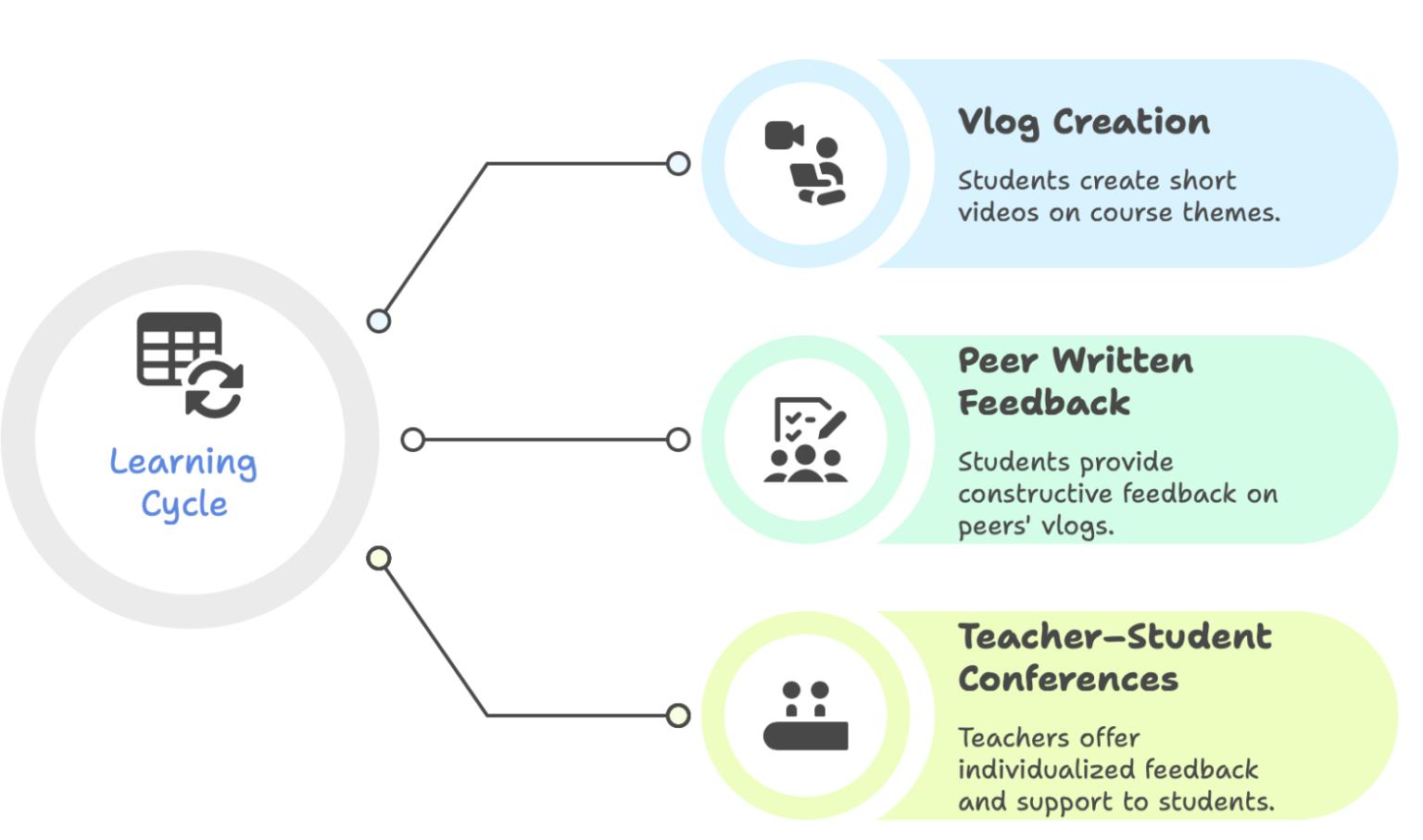
Collection & Analysis
Data sources included: (1) pre- and post-speaking tests rated by two native English speakers; (2) 3-minute in-class presentations; (3) three vlog entries; (4) vlog evaluators’ written feedback; (5) instructor-researcher field notes (Emerson et al., 2011); (6) end-of-semester student reflections and surveys; and (7) semi-structured interviews (Seidman, 2006).
A mixed-methods analytical framework was employed (see Table 1). Quantitative data consisted of pre- and post-speaking test scores, in-class presentation scores, and rubric-based evaluations of vlog performances. Inferential statistical analysis was conducted using pairedsamples t-tests to examine changes in speaking proficiency, supplemented by descriptive statistics to summarize performance trends, as commonly applied in repeated-measures designs (Field, 2024).
Regarding the quantitative data, the speaking assessment rubric was developed by the instructor-researcher based on the objectives of the vlog and presentation tasks. The rubric consisted of four criteria: (a) task completion involving the effective use of visual aids and avoidance of reading directly from scripts, (b) organization, (c) sentence fluency and vocabulary appropriacy, and (d) pronunciation and intelligibility, including stress, rhythm, and intonation. Each category was rated across five performance levels aligned with Common European Framework of Reference for Languages (CEFR) descriptors from A1 to C1. The
same rubric was also used for evaluating students’ three-minute in-class presentations in order to maintain consistency across speaking tasks.
As for the pre- and post-speaking tests, these assessments were designed primarily to examine students’ overall speaking progress throughout the course and to fulfill institutional course assessment requirements, rather than to function as a standardized proficiency examination. The tests were administered in a university computer classroom in a format that was practical and manageable within a regular Taiwanese EFL classroom setting. During the assessment, students individually responded to three open-ended speaking prompts related to personal experiences and perspectives. The questions asked for the following information:
1. Please describe a memorable learning experience you have had and explain why it was important to you.
2. What is one challenge students often face when learning English, and how can they overcome it?
3. Do you think technology is helpful for language learning? Why or why not?
4. What is one important goal you have for the future? Explain why this goal is important to you.
5. Describe a person who has influenced you. How has this person affected your life or learning?
6. What is one challenge you have faced as a student? How did you deal with it?
7. Describe a memorable trip you have taken. Why was it memorable?
8. Describe a time when you felt proud of yourself. What happened?
The questions were mainly explanatory and opinion-based, encouraging students to elaborate on their ideas and produce extended spoken responses rather than short answers. Students recorded their responses directly using the computers’ microphones within a limited response time. Each response lasted approximately one to one and a half minutes, and all responses were audio-recorded for later evaluation.
The same administration procedure and task format were followed for the pre- and post- tests although the specific prompts differed slightly in order to reduce memorization effects while maintaining comparable levels of familiarity and difficulty. To enhance scoring reliability, the recordings were evaluated independently by native-English-speaking raters using the same analytic rubric employed throughout the course.
To examine inter-rater reliability, ratings from the three evaluators were analyzed using an intraclass correlation coefficient (ICC). The results indicate moderate agreement among individual raters (ICC = .64), suggesting some degree of variation in scoring. However, reliability improved substantially when ratings were averaged across raters (ICC = .84), indicating good overall agreement. These findings suggest that the use of multiple raters enhanced the stability and trustworthiness of the assessment (Armstrong et al., 1997).
Qualitative data included instructor-researcher field notes, open-ended survey responses, and individual interviews. The open-ended survey questions focused on students’ general reflections on the project experience. The questions asked students to describe: (a) what they enjoyed most about creating the vlogs and why, (b) the challenges they encountered and how they addressed them, (c) any new skills or digital tools they learned during the project, (d) what they would do differently if repeating the project, and (e) advice they would give to future students participating in similar activities.
In addition, semi-structured individual interviews were conducted to gain deeper insights into students’ learning processes and perceptions. The interview protocol was provided to interviewees before the interview and consisted of several thematic sections, including:
a) students’ previous experiences and initial feelings toward English speaking and vlog recording,
b) perceived impacts on speaking performance in the areas of fluency, pronunciation, vocabulary use, and confidence),
c) learning strategies and preparation processes,
d) challenges encountered and coping strategies,
e) motivation, engagement, and self-reflection,
f) the role of peer and instructor feedback, and
g) students’ overall reflections on the benefits and limitations of the project.
The interviews also included follow-up questions to encourage elaboration and allow participants to provide concrete examples from their learning experiences. These semistructured interviews enabled the researchers to explore emergent themes while maintaining consistency across participants.
These data were analyzed thematically to identify recurring patterns related to learners’ speaking experiences, confidence, and engagement. Triangulation was used to cross-verify findings across data sources and analytical perspectives (Flick, 2018), thereby strengthening the overall validity and credibility of the qualitative inquiry (Johnson, 1997). Coding was conducted collaboratively by the instructor-researcher, an invited instructor, and a research assistant to enhance analytical reliability.
Table 1
Mixed-Methods Analytical Framework
Quantitative data
Sources of Data:
• Pre-and post-speaking tests
• 3-minute in-class individual presentation
• 3 vlog entries
Method of analysis:
Inferential statistics: a paired sample ttest and descriptive statistics.
Raters:
• Pre-and post-speaking tests were evaluated by two native-speaking evaluators.
• In-class individual speaking assessments were evaluated by the instructorresearcher and two invited instructors with a rubric.
Qualitative data
Sources of Data:
• Instructor-researcher’s observations in the form of field notes about the procedure
• Open-ended survey questions
• Individual interviews
Method of analysis:
• Thematic analysis of open-ended surveys, instructors’ observations, and individual interviews.
• Triangulation was used to cross-verify findings and themes from the sources of data.
• Coders: Instructor-researcher, an invited instructor, and an assistant.
• 3 vlog entries were evaluated by the instructor-researcher and two invited instructors to assess progress in such areas as content, the length of pauses, and repetitions.
Quantitative analysis revealed a statistically significant difference between students’ pre-test and post-test speaking scores. A paired-samples t-test showed that post-test scores (M = 74.51, SD = 3.40) were significantly higher than pre-test scores (M = 71.80, SD = 2.25), t(56) = 5.73, p < .001, with a medium-to-large effect size (d = 0.76), indicating a significant overall improvement in speaking performance over the semester.
Despite the relatively small numerical gain, the improvement was observed consistently across participants rather than being driven by a small number of high-performing individuals. In addition to the overall score increase, post-test performances were characterized by longer stretches of speech and fewer pauses, suggesting improvements in speaking fluency and discourse organization. Although individual variation persisted, the quantitative results demonstrate a clear upward trend in students’ speaking performance from pre-test to post-test.
Analysis across the three vlog task cycles revealed a clear developmental trajectory in students’ speaking performance. Descriptive statistics showed a gradual increase in mean scores across the three cycles, from 52.31 (SD = 15.02) in Vlog 1 to 53.78 (SD = 13.76) in Vlog 2, and 58.76 (SD = 13.28) in Vlog 3, indicating steady improvement and increasing consistency in performance. This pattern was further supported by external evaluators’ written feedback and rubric-based observations.
During the first cycle, evaluators consistently noted that many students relied heavily on written scripts, resulting in a formal, presentation-like delivery rather than a conversational vlog style. Frequent pauses, word-by-word pronunciation, and limited audience engagement were commonly observed, indicating constrained fluency and low authenticity in oral production.
Following the second vlog cycle, evaluators reported noticeable improvement in discourse organization and delivery. Many students demonstrated clearer openings and conclusions, smoother transitions between ideas, and more effective use of visual aids such as images or onscreen text to support explanations. Although pronunciation inaccuracies persisted, improvements were observed in rhythm, stress patterns, and overall speech flow. These qualitative observations align with the modest increase in mean scores observed in the second cycle.
By the third vlog cycle, evaluators observed that several students exhibited reduced dependence on scripts and increased confidence in spontaneous delivery. External feedback indicated enhanced control of intonation and more coherent organization aligned with task requirements. While certain recurring pronunciation errors remained, analysis across the three vlog cycles revealed a consistent pattern of increased fluency, more structured oral discourse, and greater audience awareness in students’ spoken performance, which is also reflected in the higher mean scores and reduced variability in the third cycle.
Table 2
Descriptive Statistics of Vlog Performance Across Cycles
To complement external evaluators’ observations, students’ self-reported perceptions were examined through end-of-semester questionnaires, open-ended survey responses, and individual interviews. Questionnaire items employed a five-point Likert scale and were analyzed descriptively to identify overall response patterns.
This section reports learners’ subjective experiences of speaking development, focusing on changes in confidence, awareness of speaking performance, perceived value of feedback, and overall acceptance of the vlog-based instructional design. Across subsections, quantitative trends are presented first, followed by qualitative excerpts that illustrate and contextualize these patterns.
Students’ self-reported responses indicate a clear increase in perceived speaking confidence following participation in the vlog project. As shown in Figure 2, 68.4% of the participants selected Agree or Strongly Agree with the statement that they felt more confident expressing their ideas and perspectives through a digital medium after completing the vlog tasks. This distribution suggests that a majority of students experienced increased confidence when using English in the vlog-based speaking activities.
Qualitative responses further illustrate how this confidence developed. Many students emphasized that the ability to rehearse and re-record their vlogs reduced the pressure typically associated with real-time oral presentations. One student noted, “I could record the video many times until I felt satisfied, so I didn’t feel as nervous as speaking in front of others”(「我可 以重錄很多次,直到自己滿意為 ,所以不像在大家面前講英文那麼緊張。」).
Another student similarly commented, “I liked that I could fix my mistakes before submitting the vlog”(「我喜 可以在交作業前把錯誤修 。」)
Several students also reported that repeated engagement in the vlog cycles contributed to a gradual sense of comfort when speaking English. Rather than feeling overwhelmed by immediate performance demands, learners described the vlog format as providing a supportive environment in which confidence could develop incrementally.
Figure 2
Students Perceived Changes in Speaking Confidence Following the Vlog Project
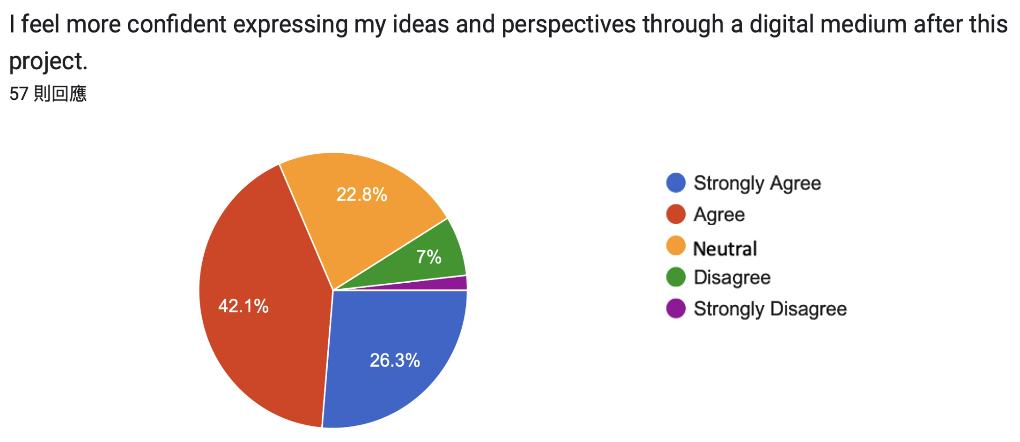
In contrast to confidence-related changes captured through the questionnaire, students’ heightened awareness of their own speaking performance emerged primarily from qualitative data, including open-ended survey responses and individual interviews. Rather than describing generalized improvement, many students demonstrated increased sensitivity to specific features of their oral production after engaging in repeated vlog cycles.
Students frequently reported that the process of watching their own recorded performances enabled them to notice aspects of their speaking that were difficult to monitor during real-time oral communication. One student reflected, “By watching my own vlog, I realized where I paused too much and where my pronunciation was unclear”(「看了自己的影片後,我才 發現自己停頓太多、發音也不太清楚。」). Another student similarly noted, “Recording the vlog helped me see my speaking problems more clearly”(「拍影片讓我更清楚看到自 己說英文的問題。」)
Several responses further indicated that awareness developed progressively across vlog cycles. Students described paying closer attention to speech flow, clarity of explanation, and delivery in later recordings, suggesting a shift from task completion toward more reflective selfevaluation. This emerging awareness was often framed not as immediate improvement, but as an increased ability to identify areas for future development.
Students’ perceptions of creativity and personal expression were examined through a questionnaire item focusing on whether the vlog format allowed greater freedom compared to
conventional oral presentations. As shown in Figure 3, 66.7% of the participants selected Agree or Strongly Agree with the statement that the vlog tasks enabled them to express their ideas more creatively and personally. This distribution suggests that most students perceived the vlog format as less restrictive than traditional speaking assignments.
Qualitative responses further illustrate how students experienced this sense of creative freedom. Several participants emphasized that the vlog tasks allowed them to personalize content, choose how ideas were presented, and adopt a more flexible speaking style. One student stated, “I enjoyed writing the script because I could express my own ideas more freely”(「我很喜 寫稿,因為可以比較自由地表達自己的想法。」). Another student similarly commented, “Making the vlog felt more creative than normal presentations”(「拍 vlog 比一般報告更 有創意。」).
Some students also noted that the opportunity to incorporate personal examples, visuals, or storytelling elements contributed to a more engaging speaking experience. Rather than strictly following a formal presentation structure, learners described the vlog format as encouraging experimentation and individuality in oral expression.
Figure 3
Students’ Perceptions of Creative Expression through Vlog Tasks
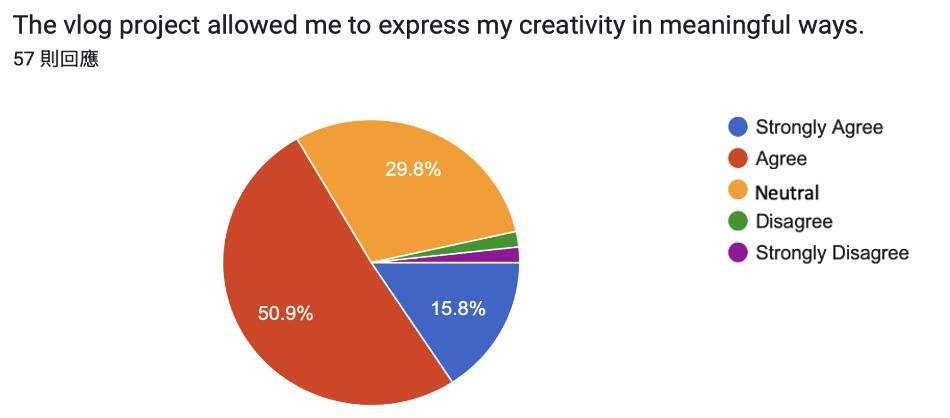
Students’ perceptions of feedback were examined through a questionnaire item focusing on the extent to which peer and teacher feedback supported their speaking development. As shown in Figure 4, 66.6% of the participants selected Agree or Strongly Agree with the statement that feedback on their vlogs helped them identify areas for improvement and refine subsequent performances. This distribution indicates that a clear majority of students perceived the feedback component as beneficial to their speaking development.
Qualitative responses provide further insight into how feedback contributed to students’ learning experiences. Many students reported that receiving comments from peers and the instructor encouraged them to pay closer attention to clarity, organization, and delivery in their spoken English. Acting as peer reviewers also appeared to promote more critical listening and self-reflection. One student explained, “I tried to explain my ideas more clearly because others would watch my video”(「因為會有別人看影片,所以我會更注意把想法講清楚。」).
Another participant similarly noted, “I wanted my vlog to be interesting for the audience” (「我希望我的影片對觀眾來說是有趣的。」)
Several students further indicated that the feedback process heightened their awareness of audience perspective. Knowing that their vlogs would be viewed and evaluated by others prompted learners to consider how effectively their ideas were communicated, rather than focusing solely on task completion.
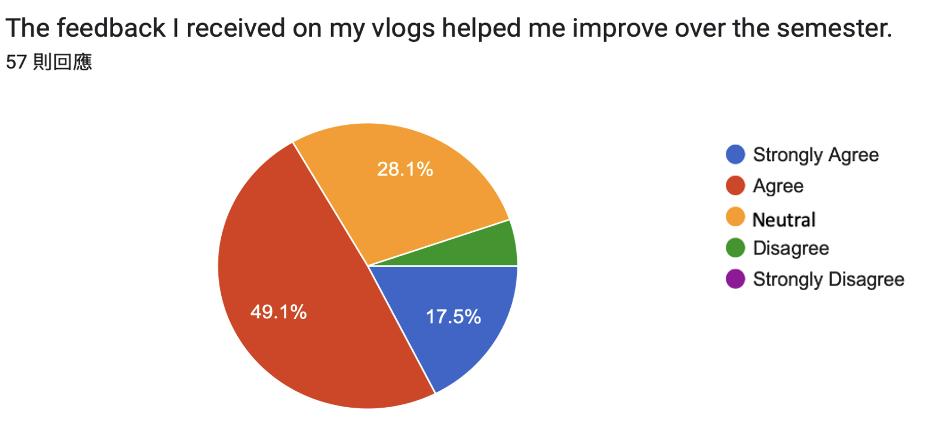
A further theme, although less frequently mentioned than confidence or engagement, related to enhanced content understanding through spoken explanation. Several students reported that the process of preparing and delivering vlogs required them to organize ideas and articulate course concepts in English, which in turn deepened their understanding of the subject matter. One student commented, “Because I had to explain the topic in English, I understood it more clearly” (「因為要用英文把主題講清楚,我反而比較懂這個內容。」) . Another student similarly reflected, “Making the vlog helped me remember the content better”(「拍 vlog 讓我對課程內容記得更清楚。」). These responses suggest that, for some learners, vlog-based speaking tasks also functioned as a means of consolidating content knowledge.
While many students reported positive experiences with the vlog project, a small number of responses reflected more neutral or negative perceptions, primarily related to time demands and technical challenges associated with video production. For example, one student noted, “Making the video took a lot of time” (「拍影片其實蠻花時間的。」) , while another commented, “I didn’t really enjoy the technical part of editing”(「我沒有很喜 剪輯影片 的部分。」) . These responses were reflected in a small minority of survey selections, indicating that negative perceptions were present but not dominant.
Students’ overall acceptance of the vlog project was further examined through a questionnaire item asking whether the activity should be retained in future courses. As shown in Figure 5, 47.4% of the participants selected Agree or Strongly Agree, indicating a moderate but not overwhelming level of support. This finding suggests a potential gap between students’ perceived learning benefits and their willingness to sustain the activity in future courses. Such a discrepancy may be partly attributed to the time investment and technical challenges reported above, pointing to the importance of balancing pedagogical effectiveness with practical feasibility.
From a sustainability perspective, this implies that while vlog-based tasks may be pedagogically valuable, their long-term implementation may require careful instructional design adjustments. For instance, providing a longer time frame for task completion may help reduce cognitive and technical pressure, allowing students to focus more on content articulation rather than production demands. Alternatively, reducing production complexity or offering additional technical support may further enhance students’ acceptance of the task.
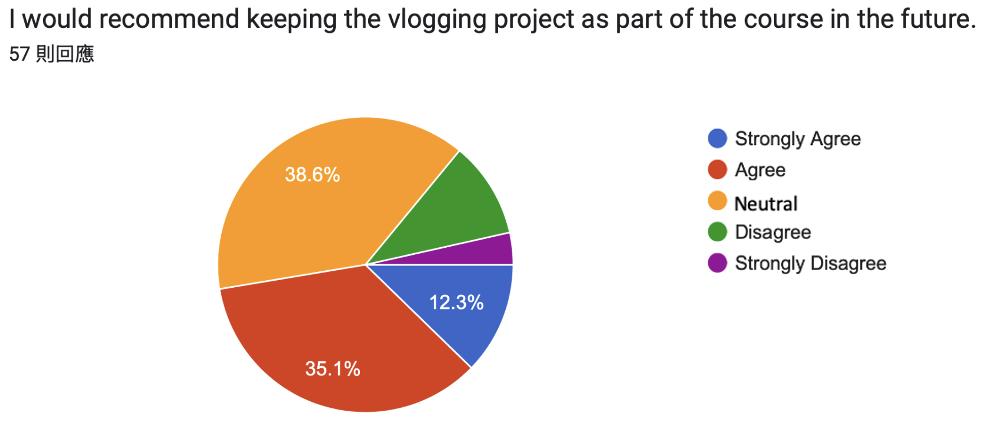
The findings of this study demonstrate that embedding a structured three-task cycle of vlogging within an English course for Business Management can effectively support the development of
EFL learners’ speaking proficiency. Beyond overall gains in fluency and discourse organization, the results reveal a progressive trajectory in learners’ oral production, moving from controlled, script-dependent speech toward more spontaneous and increasingly audienceoriented delivery across successive vlog cycles. This trajectory is evidenced by external evaluators’ observations of reduced script reliance, smoother transitions between ideas, and emerging audience engagement across the three vlog cycles
These patterns align with recent research emphasizing the role of authentic, productionoriented tasks in promoting meaningful spoken language use. Mishan (2017) argues that authenticity in contemporary language learning should be understood in relation to digital communication practices, where learners engage with language through purposeful, socially situated tasks rather than decontextualized classroom exercises. Similarly, Pinner (2019) emphasizes that authenticity is not simply a fixed quality of materials but is shaped by learners’ engagement, personal relevance, and communicative purpose. In the context of the present study, creating vlogs for a potential audience allowed students to move beyond controlled classroom speaking practice and use English to present ideas connected to business and selfanalysis themes. This interpretation is also supported by Jones (2022), who highlights that authenticity in language teaching materials and tasks depends on how learners interact with content, audience, and context. Furthermore, Lopez et al. (2020) show that authentic oral production tasks can support EFL learners’ speaking fluency by encouraging purposeful language use. Therefore, the vlog tasks in this study can be understood as authentic oral production activities that connected course content, digital communication, and audienceoriented speaking practice.
From a cognitive perspective, the gradual reduction in hesitation and increased speech continuity observed in later vlog cycles suggest that repeated engagement in vlog-based speaking tasks helped learners process and produce spoken English more efficiently. As indicated by the quantitative results, post-test performances were characterized by longer stretches of speech and fewer pauses, suggesting more efficient access to linguistic resources. Rather than reflecting mere practice effects, this shift suggests that repeated engagement in authentic oral production allowed learners to allocate fewer cognitive resources to form-level concerns and attend more to discourse organization and communicative intent. This finding aligns with recent task-based language teaching research, which emphasizes that meaningful, repeated task engagement can support fluency development by encouraging learners to use language for communicative purposes across multiple performance opportunities (Ellis et al., 2020). It also resonates with Grab’s (2025) argument that technology-supported oral communication practice can create additional opportunities for learners to improve their speaking performance in contemporary English-learning contexts. Consequently, the vlogging cycle appears to have facilitated a shift from careful linguistic monitoring toward smoother, more organized, and more audience-oriented professional delivery.
Importantly, learners’ reliance on scripts in early vlog cycles should not be interpreted solely as a pedagogical limitation. Instead, script use may be understood as a transitional scaffold that helps learners manage cognitive load and speaking anxiety during the initial stages of oral
production. Evaluator feedback from the first vlog cycle consistently noted heavy script dependence and presentation-like delivery, whereas later cycles showed a gradual shift toward more spontaneous speech. From a sociocultural perspective, such scaffolding can facilitate learners’ movement within their Zones of Proximal Development (Vygotsky, 1978). The observed reduction in script dependence over time suggests a gradual internalization of discourse patterns rather than abrupt gains in spontaneous speech, echoing previous findings in technology-mediated speaking contexts (Hsu, 2016). This suggests that the initial use of scripts served as a necessary foundation, providing the psychological security needed for learners to eventually take greater risks in their unscripted performance.
From an affective perspective, qualitative findings indicate that the integration of vlog creation with peer feedback and teacher–student conferences contributed to reduced speaking anxiety and enhanced learner confidence. Students’ open-ended survey responses and interview comments highlighted the anxiety-reducing effects of rehearsal and re-recording opportunities, which created a psychologically safe environment for oral practice These findings are consistent with previous studies showing that supportive speaking environments and formative feedback can positively influence learners’ emotional engagement and willingness to communicate. Wulandari (2019) notes that the iterative nature of digital production allows students to “save face,” while Kormos (2017) emphasizes that learners’ self-perceptions of speaking ability can influence their participation in foreign language classrooms. Together, these perspectives suggest that speaking tasks that allow rehearsal, self-monitoring, and gradual improvement may help learners participate more confidently in oral communication. In line with Pekrun and Goetz (2023) work on academic emotions, opportunities to rehearse, revise, and receive constructive feedback appear to have encouraged greater risk-taking in oral expression.
At the same time, students’ self-reports suggest that affective benefits did not automatically translate into unconditional acceptance of the instructional design. While many learners reported increased confidence and engagement, support for retaining the vlog project in future courses was moderate rather than unanimous. This pattern points to a productive tension between perceived learning value and practical considerations such as workload and technical demands. Rather than undermining the effectiveness of the instructional approach, this tension highlights the importance of balancing pedagogical benefits with feasibility when implementing technology-mediated speaking tasks in practice-oriented EFL courses.
Teacher–student conferences emerged as a particularly influential component of the instructional cycle, functioning as a form of mediated feedback that supported learners’ motivation and self-efficacy. Students’ interview data identified conferences as a key space for encouragement, clarification, and goal setting, allowing instructors to normalize difficulties and provide individualized guidance. This finding resonates with prior research emphasizing the role of dialogic feedback and conferencing in promoting learner autonomy and reflective learning. Winstone and Carless (2019) argue that effective feedback should be understood as a learning-focused process in which learners actively interpret, respond to, and use feedback for improvement. Similarly, Henderson et al. (2019) emphasize that feedback becomes effective
when students are provided with conditions that help them make sense of comments and apply them to subsequent learning tasks. Peñaflorida (2002) likewise highlights that such conferences allow for immediate negotiation of meaning, which empowers students to take ownership of their own speaking goals.
Compared with studies that examine vlog use as a standalone speaking activity, the present study highlights the pedagogical value of embedding vlogging within a coherent instructional cycle. While researchers such as Rahmawati et al. (2018) and Wulandari (2019) have demonstrated that vlogging can improve general speaking skills and motivation, their work often treats the vlog as an isolated technological intervention. In contrast, the results of this study suggest that the benefits of vlogging are maximized when it is integrated into a multistage process of outlining, performing, and reflecting. The convergence of quantitative gains in speaking performance, evaluator-observed developmental patterns, and learners’ selfreported affective growth including increased confidence and reduced anxiety, alongside qualitatively emergent metacognitive awareness of speaking performance, suggests that vlogging is most effective not as an isolated technological tool but as part of a structured learning ecology.
Despite the positive feedback from students and the encouraging test results, several limitations must be addressed. First, the absence of a control group limits the ability to make definitive causal inferences. This design choice was driven by the practical constraints of a singleinstitution, single-semester study, as well as a commitment to providing all students with equal access to innovative pedagogical tools. Consequently, while proficiency gains were evident, it remains difficult to isolate the effects of the vlogging cycle from other curricular factors. However, as an action-research case study, these results provide a viable foundation for refining future instructional activities.
Regarding researcher positionality, although students were informed that participation was voluntary and that they could withdraw at any time, the instructor’s dual role as researcher and evaluator may have introduced social desirability bias in student self-reports. In addition, the instructional cycle did not fully resolve persistent pronunciation difficulties. Given the time constraints of a single semester, the instructor prioritized discourse-level development over individualized phonetic correction, focusing instead on introducing self-improvement tools. Nevertheless, the systematic collection of common errors, such as mispronunciations of product, strengths, strategies, threats and so on, offers a clear roadmap for integrating targeted pronunciation mini-lessons in future classes.
Another limitation concerns the decision to limit peer feedback to written rather than oral comments. Although the researcher initially considered requiring students to provide oral feedback on their peers’ vlogs, requiring only written comments was ultimately adopted for both pedagogical and practical reasons. First, written peer feedback more closely reflected authentic digital communication practices, as viewers commonly respond to online videos by
leaving written comments rather than oral responses. In this sense, written comments aligned well with the real-world context of vlog viewing and interaction. Second, because the course was a two-credit general English course for non-English-major students, class time and students’ workload capacity were limited. Requiring oral comments in addition to the vlog tasks may have placed an excessive burden on participants. Moreover, many students’ speaking proficiency was not sufficiently advanced for them to provide detailed oral feedback confidently and effectively. In addition, some participants may have felt shy or uncomfortable giving oral comments directly to their peers, resulting in that feedback being limited in quality, sincerity, or depth. Therefore, after considering the instructional context, students’ language proficiency, and affective factors, it was decided to use written peer comments instead of oral feedback. Future studies may consider comparing written, oral and multimodal peer feedback to examine how different feedback modes influence students’ engagement, confidence, and language development.
Finally, the moderate sustainability finding, with 47.4% of students expressing support, underscores a productive tension between perceived learning value and technical workload. This figure provides a constructive baseline for modifying vlog activities to better balance pedagogical benefits with practical feasibility in subsequent semesters.
This teaching practice research contributes to the growing body of literature on technologyenhanced speaking instruction by demonstrating the pedagogical value of vlogging when it is systematically embedded within a structured and scaffolded instructional cycle. Rather than functioning as a standalone speaking activity, vlogging in this study was integrated into a threetask cycle involving repeated oral production, peer written feedback, and teacher–student conferencing. The findings indicate that this instructional design supported learners’ speaking development by fostering increased confidence, reduced speaking anxiety, and gradual improvement in oral fluency and discourse organization.
The technology-mediated nature of vlogging is important, as it supports authentic oral production while also reducing learners’ speaking-related anxiety. It is also important that the task cycle is thoughtfully sequenced and supported. The opportunity to rehearse, re-record, and reflect on oral output created a psychologically safe environment for speaking practice, while peer feedback and teacher–student conferences provided formative guidance that encouraged reflective learning. These features appear particularly beneficial in EFL contexts, where learners often experience anxiety and limited opportunities for extended oral production.
At the same time, learner responses suggest that perceived learning benefits did not automatically translate into unanimous acceptance of the instructional design. While a substantial proportion of students expressed support for retaining the vlog project in future courses, others reported more neutral or critical views, primarily due to time demands and technical challenges associated with video production. This nuance reinforces the need for
instructors to carefully calibrate the technological demands of tasks in ways that are manageable for learners while preserving pedagogical goals.
From a pedagogical perspective, the findings suggest that vlog-based speaking instruction is most effective when implemented flexibly and transparently. Instructors may consider offering clear guidance on technical requirements, providing options for task adaptation, or limiting the frequency or scope of video production to balance pedagogical benefits with feasibility. Rather than aiming for universal acceptance, instructors can view moderate learner endorsement as an indicator that vlog-based tasks hold meaningful instructional value while requiring careful contextual adaptation.
Overall, this study demonstrates that a structured, vlog-mediated three-task cycle can serve as a pedagogically grounded framework for supporting EFL learners’ speaking development across cognitive, affective, and social dimensions. Building on the identified limitations, future research may explore the longer-term impact of such instructional designs, comparative task configurations, or the integration of targeted pronunciation-focused interventions to address persistent phonological challenges. By situating vlogging within a coherent instructional ecology, EFL educators can make more informed decisions about how and when technologyenhanced speaking tasks are most productively employed.
The authors would like to express sincere gratitude for the financial support provided by the Ministry of Education (MOE), Taiwan, through the Teaching Practice Research Program. The authors also thank the vlog evaluators for their time, expertise, and valuable feedback, which contributed significantly to the completion of this study.
The content of this manuscript involved the use of ChatGPT (OpenAI) as a writing support tool to enhance clarity, logical structure, and consistency of academic terminology. Throughout the writing process, the authors collaborated with ChatGPT multiple times, including language polishing of drafts, formatting, and style adjustments. All AI-assisted content was reviewed, edited, and confirmed by the authors to ensure accuracy, appropriateness, and academic integrity.
Alamri, W. A. (2025). Evaluating the benefits and challenges of using authentic materials in EFL classrooms: A narrative review. Frontiers in Education, 10, 1611308. https://doi.org/10.3389/feduc.2025.1611308
Anagnostopoulou, A., Koutropoulos, A., Sipitanou, A. A., Kaliampos, G., Brinia, V., & Giannikopoulos, G. (2023). Authenticity of tasks in online ESL/EFL learning to foster critical and creative thinking skills. Cogent Education, 10(1), 2190429. https://doi.org/10.1080/2331186X.2023.2190429
Armstrong, D., Gosling, A., Weinman, J., & Marteau, T. (1997). The place of inter-rater reliability in qualitative research: An empirical study. Sociology, 31(3), 597-606. https://doi.org/10.1177/0038038597031003015
Bandura, A. (1977). Social learning theory. Prentice Hall.
Brown, H. D., & Abeywickrama, P. (2019). Language assessment: Principles and classroom practices (3rd ed.). Pearson Education.
Carless, D., & Boud, D. (2018). The development of student feedback literacy: Enabling uptake of feedback. Assessment & Evaluation in Higher Education, 43(8), 1315–1325. https://doi.org/10.1080/02602938.2018.1463354
Dewaele, J.-M., & Dewaele, L. (2020). Are foreign language learners’ enjoyment and anxiety specific to the teacher? An investigation into the dynamics of learners’ classroom emotions. Studies in Second Language Learning and Teaching, 10(1), 45–65. https://doi.org/10.14746/ssllt.2020.10.1.3
Dickson, H., Harvey, J., & Blackwood, N. (2018). Feedback, feedforward: Evaluating the effectiveness of an oral peer review exercise amongst postgraduate students. Assessment & Evaluation in Higher Education, 44(5), 692-704. https://doi.org/10.1080/02602938.2018.1528341
Double, K. S., McGrane, J. A., & Hopfenbeck, P. N. (2020). The impact of peer assessment on academic performance: A meta-analysis of control group studies. Educational Psychology Review, 32(2), 481–509. https://doi.org/10.1007/s10648-019-09510-3
Duff, P. A. (2014). Case study research on language learning and use. Annual Review of Applied Linguistics, 34, 233-255. https://doi.org/10.1017/S0267190514000051
Ellis, R., Skehan, P., Li, S., Shintani, N., & Lambert, C. (2020). Task-based language teaching: Theory and practice. Cambridge University Press. https://doi.org/10.1017/9781108643689
Emerson, R., Fretz, R., & Shaw, L. (2011). Writing ethnographic field notes (2nd ed.). University of Chicago Press. https://doi.org/10.7208/chicago/9780226206868.001.0001
Field, A. (2024). Discovering statistics using IBM SPSS statistics (6th ed.). Sage Publications.
Flick, U. (2018). Doing triangulation and mixed methods. SAGE Publications Ltd. https://doi.org/10.4135/9781529716634
Fuchs, C. (2021). Social media: A critical introduction (3rd ed.). SAGE Publications. Fulcher, G., & Harding, L. (Eds.). (2021). The Routledge handbook of language testing (2nd ed.). Routledge. https://doi.org/10.4324/9781003220756
Gao, X., Noroozi, O., Gulikers, J., Biemans, H. J. A., & Banihashem, S. K. (2024). A systematic review of the key components of online peer feedback practices in higher education. Educational Research Review, 42, Article 100588. https://doi.org/10.1016/j.edurev.2023.100588
Grab, M. O. (2025). Strategies for integrating Artificial Intelligence (AI) to improve and assess English oral communication skills. International Journal of Research in Education and Science (IJRES), 11(3), 533-552. https://doi.org/10.46328/ijres.1312
Guariento, W. & Morley, J. (2001). Text and task authenticity in the EFL classroom. ELT Journal, 55(4), 347-353. https://doi.org/10.1093/elt/55.4.347
Henderson, M., Phillips, M., Ryan, T., Boud, D., Dawson, P., Molloy, E., & Mahoney, P. (2019). Conditions that enable effective feedback. Higher Education Research & Development, 38(7), 1401–1416. https://doi.org/10.1080/07294360.2019.1657807
Hsu, H. C. (2016). Voice blogging and L2 speaking performance. Computer Assisted Language Learning, 29(5), 968–983. https://doi.org/10.1080/09588221.2015.1113185
Hyland, K. (2022). Teaching and researching writing (4th ed.). Routledge. https://doi.org/10.4324/9781003198451
Hyland, K., & Hyland, F. (Eds.). (2019). Feedback in second language writing: Contexts and issues (2nd ed.). Cambridge University Press. https://doi.org/10.1017/9781108635547
Johnson, R. B. (1997). Examining the validity structure of qualitative research. Education, 118(2), 282-292.
Jones, C. (2022). Authenticity in language teaching materials. In J. Norton & H. Buchanan (Eds.), The Routledge Handbook of Materials Development for Language Teaching (pp.65–77). Routledge. https://doi.org/10.4324/b22783-7
Kormos, J. (2017). The second language learning processes of students with specific learning difficulties. Routledge. https://doi.org/10.4324/9781315692371
Latifah, U., Mulyono, H., Zulaiha, S., Falah, Z. A., & Rosita, R. (2025). The impact of authentic materials on EFL learners’ speaking motivation and anxiety: A projectbased learning approach. Discover Education, 4, 430. https://doi.org/10.1007/s44217-025-00858-z
Lee, J. S. (2021). Informal digital learning of English: Research to practice. Routledge. https://doi.org/10.4324/9781003043454
Lee, J., & Butler, Y. G. (2020), Reconceptualizing language assessment literacy: Where are language learners? TESOL Quarterly, 54(4),1098-1111. https://doi.org/10.1002/tesq.576
Li, Y. (2022). Teaching mode of oral English in the age of artificial intelligence. Frontiers in Psychology, 13, 953482. https://doi.org/10.3389/fpsyg.2022.953482
Lopez, J. I., Becerra, A. P., & Ramirez-Avila, M. R. (2020). EFL speaking fluency through authentic oral production. Journal of Foreign Language Teaching and Learning, 6(1), 37-55. https://doi org/10.18196/ftl v6i1 10175
Martin, S., & Alvarez Valdivia, I. M. (2017). Students’ feedback beliefs and anxiety in online foreign language oral tasks. International Journal of Educational Technology in Higher Education, 14, Article 18. https://doi.org/10.1186/s41239-017-0056-z
Matthews, B. (2025). Artificial worlds and artificial minds: Authenticity and language learning in digital lifeworlds. Journal of Responsible Technology, 23, Article 100131. https://doi.org/10.1016/j.jrt.2025.100131
Mishan, F. (2017). Authenticity 2.0: Reconceptualising ‘authenticity’ in the digital era. In: A. Maley and B.Tomlinson (Eds.) Authenticity in materials development for language learning. (pp. 10-24). Cambridge Scholars Publishing.
Mohamad, A., & Saidalvi, A. (2020). Students’ perceptions on the use of English vlog within Youtube to enhance speaking skills. Presented in Virtual Symposium on Teaching and Learning, 1-6.
National Development Council. (n.d.). Blueprint for developing Taiwan into a bilingual nation by 2030. https://www.ndc.gov.tw
O’Malley, J. M., & Pierce, L. V. (1996). Authentic assessment for English language learners: Practical Approaches for Teachers. Longman.
Pasaribu, T. A. & Harendita, M. E. (2018). English language anxiety of pre-service teachers: Causes and coping strategies. LLT Journal: A Journal on Language and Language Teaching, 21(2), 134-147. https://doi.org/10.24071/llt.2018.210202
Pekrun, R., & Goetz, T. (2023). How universal are academic emotions? A control-value theory perspective. In K. R. Wentzel & D. B. Miele (Eds.), Handbook of motivation at school (3rd ed.). Routledge. https://doi.org/10.4324/9781003303473-7
Peñaflorida, A. H. (2002). Nontraditional forms of assessment and response to student writing: A step toward learner autonomy. In J. C. Richards & W. A. Renandya (Eds.), Methodology in language teaching: An anthology of current practice (pp. 344–353). Cambridge University Press. https://doi.org/10.1017/CBO9780511667190.049
Pinner, R. S. (2019). Authenticity in English language teaching: An exponential model Routledge.
Rahmawati, A., Harmanto, B., & Indriastuti, N. R. (2018). The use of vlogging to improve the students’ speaking skill. Edupedia, 2(1), 87. https://doi.org/10.24269/ed.v2i1.96
Razeq, A. H.-A. (2022). Use of authentic materials in English as a foreign language classrooms: Challenges, reasons, types and frequency. Journal of Educational Sciences, 20, 161–175. https://doi.org/10.29117/jes.2022.0092
Rowley, J. (2002). Using case studies in research. Management Research News, 25(1), 16–27. https://doi.org/10.1108/01409170210782990
Saputro, T. H., Tafsirudin, I. C., & Farah, R. R. (2020). The use of vlog in improving students’ oral language production: A case study. English Education: Jurnal Tadris Bahasa Inggris, 13(1), 135-158. https://doi.org/10.24042/ee-jtbi.v13i1.5298
Seidman, I. (2006). Interviewing as qualitative research: A guide for researchers in education and the social sciences (3rd ed.). Teachers College Press.
Solhi, M. (2024). The impact of EFL learners’ negative emotional orientations on (un)willingness to communicate in in-person and online L2 learning contexts. Journal of Psycholinguistic Research, 53, Article 26. https://doi.org/10.1007/s10936-024-10071-y
Su, Y. C. (2021). College students’ oral communication strategy use, self-perceived English proficiency and confidence, and communication anxiety in Taiwan’s EFL learning.
Educational Studies, 57(6), 650–669. https://doi.org/10.1080/00131946.2021.1919677
Tsou, W.-L., & Kao, S.-M. (2017). Overview of EMI development. In W.-L. Tsou & S.-M. Kao (Eds.), English as a medium of instruction in higher education: Implementations and classroom practices in Taiwan (pp. 3–18). Springer. https://doi.org/10.1007/978-981-10-4645-2_1
Tien, C. Y. (2018). English speaking anxiety in EFL university classrooms in Taiwan. European Journal of English Language Teaching, 4(2), 21-34. https://doi.org/10.5281/zenodo.1473161
Winstone, N., & Carless, D. (2019). Designing effective feedback processes in higher education: A learning-focused approach. Routledge. https://doi.org/10.4324/9781351115940
Wulandari, M. (2019). Improving EFL learners’ speaking proficiency through Instagram vlog. LLT Journal: A Journal on Language and Language Teaching, 22(1), 111-125. https://doi.org/10.24071/llt.2019.220111
Vygotsky, L. S. (1978). Mind in society. Harvard University Press. Vygotsky, L. S. (1987). Thinking and Speech. In R. W. Rieber, & A. S. Carton (Eds.), The Collected works of L. S. Vygotsky (Vol. 1), Problems of general psychology (pp. 39285). Plenum Press.
Yin, R. K. (2009). Case study research: Design and methods (4th ed). Sage Publication.
Corresponding author: Yu-Ting Lai
Email: yuting.estudio@gapp.nthu.edu.tw
Mark Preston S. Lopez Mountain Province State University, Philippines
Willow Pangket-Rosario Mountain Province State University, Philippines
Maria R. Coady North Carolina State University, USA
Research worldwide is increasingly documenting how schools and teachers respond to multilinguals’ linguistic repertoires through translanguaging pedagogies that affirm students’ languages and identities. Yet, scant empirical evidence examines how translanguaging works in multilingual contexts with indigenous learners in Asian countries. This work is theoretically framed by pedagogical translanguaging, particularly in relation to teacher-led strategies designed to support academic content mastery among English learners. Using convergent mixed methods that included surveys, interviews, focus group discussions, and observations of teachers’ instructional approaches in northern Philippine classrooms, this study captured teachers’ dispositions and perspectives. Findings from this work demonstrate that teachers’ translanguaging approaches and perspectives hold the promise of deconstructing and dismantling dominant narratives that counter the advantages of multilingualism. At the intersection of translanguaging and language inclusivity, teachers affirmed students’ identities as multilinguals. Further, the findings support previous research showing that teachers’ optimistic perceptions of translanguaging influenced their teaching methods that mirrored this framework. The pedagogical implications of this study inform recommendations for practitioners on asset-based instructional paradigms for teaching multilingual English learners.
Keywords: convergent mixed-method, English language teaching, English learners (ELs), pedagogical translanguaging, translanguaging, teachers’ perspectives
English has long symbolized progress and power, often serving as the medium of instruction in schools. Both monolingual and multilingual individuals view schools as key to English acquisition, though their attitudes toward this “language of power” differ. The tension between monolingual and multilingual pedagogies for English learners (ELs) is significant, especially amid narrow interpretations of the “science of reading” (Hopewell et al., 2022). This contrast situates students within issues of complex linguistic practices, multilingualism, and restrictive monolingual policies.
Filipino ELs are inherently multilingual (Libladilla, 2024; Tupas, 2025). Although English dominates as the medium of instruction, learners actively use their home languages with teachers and peers. They blend features of their home languages, such as Bontok, Kankanaey, and Applai, among others, with English and Filipino, creating integrated discursive practices that foster deeper, more meaningful learning. The intentional use of their linguistic repertoire is known as translanguaging.
Translanguaging has gained global attention in multilingual education (Oranga et al., 2025; Schissel & Seltzer, 2025; Tai, 2025; Vogel & Garcia, 2025; Wang & East, 2023). Educational contexts increasingly value multilingualism as a cultural and pedagogical asset (Moore et al., 2020; Rabbidge, 2019; Vaish, 2020). Tian et al. (2025) define translanguaging as the process by which multilingual individuals use all their linguistic resources fluidly to communicate, learn, and express themselves” (p. 12). More specifically, Schissel and Seltzer (2025) view pedagogical translanguaging as a strategic, intentional design of instruction and assessment by teachers that leverages the linguistic assets of bilingual students. In the same vein, García and Wei (2024) focus on translanguaging as a practical theory of language that prioritizes the internal perspective of the speaker over the external categories of ‘named languages’ (e.g., English, Spanish). In other words, rather than switching between separate internal boxes, translanguaging supports how bi- or multilingual learners select and deploy features from their personal repertoires to make meaning.
Despite its growing adoption, more empirical research is needed to understand translanguaging in diverse classrooms. Darvin (2019) calls for studies examining its paradigm-shifting potential in language teaching. Scholars note theoretical and practical gaps (Galante, 2020; Prilutskaya, 2021), particularly in Asian contexts where English retains sustained influence (Vaish, 2020). Research in Philippine classrooms remains limited (De Los Reyes, 2019; Macawile & Plata, 2022). Filipino emergent multilinguals, who navigate English as an additional language, encounter persistent literacy challenges exacerbated by the shifting demands of national curricular reforms (Libladilla, 2024; Tupas, 2025). While the multilingual turn has gained traction, scholarship remains disproportionately focused on instructional strategies, leaving a significant void in the empirical exploration of translanguaging within formal assessment frameworks (Gu et al., 2024; Schissel & Seltzer, 2025). Furthermore, despite the complex linguistic landscape of the Philippines, there is a critical need for updated documentation on the degree to which learners’ diverse linguistic resources are systematically leveraged within high-stakes academic settings (Rostandi et al., 2025).
To lend a critical perspective to the study, Bronfenbrenner’s (1979) Ecological Systems Theory was used to frame both the study’s context and data analysis. Applying Bronfenbrenner’s model to translanguaging allows viewing language not as a neutral skill but as a critical concern influenced by language policies and perspectives of language difference. In this regard, the home and the community, constituting a sort of macrosystem, are considered vehicles that affect English learners’ ecology. The curriculum, considered part of a broader exosystem and prescribed by educational leaders, equally influences the experiences of English learners and their teachers.
The academic literature on pedagogical translanguaging, the central focus of this article, details its application in contemporary educational settings. This discussion is particularly relevant given the persistent influence of accountability measures and monolingual ideologies in educational policies. Recent literature underscores the educational advantages of translanguaging across various educational settings and levels and emphasizes its role in social justice (e.g., Tian et al., 2025) and cognitive development (e.g., Tai, 2025) among multilingual learners. Translanguaging is increasingly viewed as an approach to inclusive education that modifies traditional monolingual teaching. (Tian et al., 2025). These monolingual ideas exacerbate the marginalization of minoritized speech communities, especially in multilingual countries where ELs bring with them a wealth of languages that they use to comprehend academic content. As an increasingly utilized pedagogy, translanguaging also views multilingual students as active agents who cultivate their identity through language. For instance, Wei (2018) describes translanguaging as a practical theory where the act of using one’s language repertoire is a way of claiming one’s identity rather than being a fractional speaker of multiple languages. Meanwhile, in post-colonial contexts, recent studies (e.g., Charamba, 2023; Ndhlovana & Charamba, 2023) contend that translanguaging is an effectual tool in facilitating multilingualism instead of the monoglossic ideology that advocates dominant languages over minoritized and indigenous ones.
Previous studies also examined translanguaging not only as a practice in political and social discourse (e.g., Mendoza, 2023), but also as having profound cognitive implications. Literature suggests that translanguaging acts as a cognitive scaffold that enhances ELs’ metalinguistic awareness when they access their full mental and language repertoire (e.g. Veerman et al., 2025). Additionally, learners achieve cognitive flexibility through frequent language switching inherent in multilingual classrooms, and such fluid linguistic spaces train the brain to adapt more quickly to changing environments (Özkara et al., 2025). Similarly, Gu et al. (2024) disclosed in their recent study that capitalizing on full language repertoires leads to higherorder thinking and critical analysis.
Additionally, current research frames translanguaging as a “heteroglossic ideology”. Grounded in Bakhtin’s (1981) concept, this ideology documents a major shift from viewing languages as separate boxes in the brain to seeing them as a single, fluid repertoire. In contrast with a monoglossic ideology, a heteroglossic ideology views language as a unified semiotic
repertoire, especially among multilingual learners. Recent research by Tian et al. (2021) suggests that allowing use of multiple languages in language classrooms disrupts the monolingual bias that often silences minoritized students. In the same vein, Otheguy (2025) highlighted the distinction between named languages, for example, English and Spanish, and the speaker’s internal idiolect. He argues that while named languages are constructs that may be used for political purposes, a speaker’s cognitive repertoire is unitary. In other words, multilinguals do not have separate monolingual systems but one integrated system of language features. For instance, when multilingual Filipino ELs translanguage, they select high-level features from their unitary repertoire, enabling them to communicate their ideas fluidly.
Literature on pedagogical translanguaging highlights its growing use in modern classrooms, despite the persistence of monolingual beliefs in education. Studies show its benefits across contexts. In their framework, Cenoz and Gorter (2021, as cited in Vogel & Garcia, 2025) apart pedagogical translanguaging as purposeful, carefully planned teacher-led strategies as distinguished from organic, spontaneous language fluidity often seen in social contexts. Their framework is rooted in student multilingualism, recognizing students’ languages as an integrated network rather than isolated silos. Apart from valuing students’ entire linguistic repertoire to plan for translanguaging as an instructional device, teachers must also design activities to make students metalinguistically aware of the similarities and differences between languages and further cultivate a comprehensive understanding of how languages work as a whole in academic settings. Simply put, pedagogical translanguaging (Cenoz & Gorter, 2021) recognizes the multilingual repertoire approach, which posits that, while languages exist as social constructs, they also serve as agencies that allow students to strategically navigate boundaries through cross-linguistic boundary language activities.
In a recent study conducted in a senior high school in the Philippines, teachers used translanguaging as a pedagogical resource to support low-proficiency students in activities such as participation, understanding new concepts, answering questions, and providing clarifications (Macawile & Plata, 2022). The study revealed that translanguaging serves as a valuable skill for learners, aiding students in meaning-making, problem-solving, and knowledge construction. Additionally, the teachers concurred that translanguaging is an empowering approach that challenges the perception that using one’s native language, such as Tagalog, signifies incompetence.
Nyimbili and Mwanza (2021) found that teachers who employed translanguaging as a pedagogy improved learners’ literacy performance by allowing them to use their languages freely, thereby fostering literacy development in their individual languages. Similarly, Omidire and Ayob (2020) reported that teachers who utilized translanguaging, such as incorporating translated audio recordings, enhanced students’ comprehension of lesson content. Moreover, students felt a greater sense of inclusion and identity affirmation when their home languages were used in the classroom. Overall, prior empirical work supports the academic literature on translanguaging, which emphasizes its role as a linguistically inclusive pedagogical approach to language teaching and learning (Prilutskaya, 2021) and a transformative bilingual practice that involves strategies for teachers to create “translanguaging spaces” that leverage students’
full linguistic repertoires (Tian and Lau, 2025, p. 197). However, as previously noted, further research is necessary to understand how students and teachers perceive and implement translanguaging in teaching and assessment, particularly in countries and multilingual contexts with diverse cultural histories, including colonial legacies such as those of the Philippines.
More specifically, further research is needed to examine how teachers and students perceive and apply translanguaging in instruction and assessment, particularly in multilingual contexts such as the Philippines. This study addressed these gaps by examining high school teachers’ instructional strategies and perceptions of translanguaging as a pedagogical resource. It sought to answer:
1. What instructional and assessment practices with English learners reflect pedagogical translanguaging?
2. How do teachers perceive pedagogical translanguaging as a resource for knowledge construction, meaning-making, problem-solving, and assessment?
3. How do teachers’ perceptions align with their instructional approaches?
The study used a convergent mixed-methods design (Creswell & Guetterman, 2025; Scarff et al., 2024) to integrate qualitative (n = 9) and quantitative (n = 34) data for reliable findings. This choice was influenced by the method’s complementary nature, which allows for valid and reliable findings through the integration of qualitative and quantitative data. The larger quantitative results from high school teachers were used to establish trustworthiness. A constructivist framework (Lincoln et al., 2023) guided the analysis of teachers’ translanguaging-informed instruction and assessment, and how their survey-quantified perceptions influence those dispositions. This approach is underpinned by a critical realist stance (Maxwell, 2012), recognizing a reality independent of perception while acknowledging the interpretive role of social constructs.
The study employed Bronfenbrenner’s (1979, 1986) Ecological Systems Theory. The microsystem is set in nine multilingual classrooms across two school districts in two northern provinces of the Philippines’ Cordillera region. These classrooms face challenges due to students’ diverse languages, cultures, and learning styles. Learners typically speak at least four languages: a home language (Bontok, Kankanaey, Applai), Ilokano (regional lingua franca), Filipino, and English, used for instruction under the Philippine Bilingual Education Policy. The mesosystem level encompassed the school-home-community relationship and its impact on teacher strategies. Learner homes, though tacitly, played a crucial role, as evidenced by teacher efforts such as home visits for struggling multilingual learners.
Two high schools in a province in the northern Philippines were selected as the study sites. The first school is the province’s largest public high school with 10 English teachers. The other school is the province’s largest private Catholic school with three English teachers. The two schools were also selected because of their sustainable partnership with the same university as two of the authors. Nine participants were purposefully recruited (Patton, 2015) using the following inclusion criteria: at least four years of teaching experience with multilingual learners, the presence of these learners in their classes, and willingness to be observed and interviewed. Of the nine, six came from the public school’s 14 English teachers, while three came from the private school’s three English teachers. Although the term English as a Second Language (ESL) is still commonly used in the Philippine setting, ELs was used throughout this paper to reflect the reality that English is often a third or fourth language—not a second—for many students.
All nine qualitative participants had 5-10 years of experience with multilingual learners and were highly proficient in English, Filipino, and their respective home languages. Five held a Bachelor of Secondary Education; four had a Master’s degree in English-related fields. Six taught Grades 9-10, and three taught Grades 11-12. For the quantitative phase, an additional 25 respondents were recruited via convenience (Memon et al., 2020) and snowball sampling (Parker et al., 2019), totaling n = 34. The teachers work on various projects under the academic and outreach partnership between the state university, where two of the authors are currently affiliated. These participants were demographically similar and primarily graduate students: two are pursuing an MA in English while three are pursuing a PhD in English Language Education in the same state university as the study’s context.
Qualitative data were collected through classroom observation, semi-structured interviews, and focus group discussions (FGDs). The main focus group questions that were asked included:
1. Describe your teaching practices with multilingual English learners; what are the main challenges and opportunities in terms of curriculum and pedagogy?
2. How do you integrate ELs’ home languages in teaching English?
3. To what extent do you allow students to use their language repertoire in class interactions and assessment?
4. What multilingual assessments do you employ in teaching?
A 40–60-minute passive participant observation per teacher was conducted, yielding field notes on instructional processes, interactions, and meta-linguistic strategies. Two of the three authors undertook the observation as complete observers (Creswell & Guetterman, 2025) and employed unstructured naturalistic observation to capture the fluid, spontaneous nature of
linguistic shifts. Observers focused on the teachers’ pedagogy that mirrors translanguaging. Specifically, the focal point of the observations rested on how teachers demonstrate the four domains of TL, namely knowledge construction, meaning-making, problem-solving, and assessment. Each observation was followed by a 30-minute post-observation conversation for clarification.
The authors developed an interview protocol, which was validated by a faculty member with qualitative research and expertise affiliated with a public university in the region. Participants were interviewed twice (30–40 minutes each) using the validated protocol, allowing them to shift their language repertoire. This generated 5.5 hours of verbatim transcribed data. Two rounds of FGDs were conducted. The first (1 hour 28 minutes, audio-recorded) was an unstructured peer conversation that allowed participants to share teaching conventions, primarily in English and other languages. The second served as member checking (respondent validation), during which confirmed emergent codes and themes were presented.
To probe the reasoning behind teachers’ instructional routines, the authors adapted a survey questionnaire based on qualitative findings and literature (Nambisan, 2014; Turnbull, 2018). This survey quantified teachers’ dispositions toward pedagogical translanguaging across four parameters: knowledge construction, meaning-making, problem-solving, and assessment (the latter added to align with the study’s goal). The 12-item survey used modified indicators, replacing specific languages with multiple languages and reflecting themes such as scaffolding and connecting schools/homes. The questionnaire underwent validation by two experts: (1) a faculty member specializing in English education at a private higher education institution in the region, and (2) a faculty member specializing in educational research at a local university. The construct validity statistical result, specifically the Exploratory Factor Analysis (EFA), produced a value of 1.00, indicating that the tool had ideal construct validity.
A constructivist grounded theory (Charmaz, 2023) and an inductive approach to coding were employed as the primary data analysis method, involving theoretical memos that explored how different codes relate to form a story or theory, and self-reflexive notes that documented personal feelings and breakthroughs in the data. A general inductive approach to qualitative analysis was guided by grounded theory’s coding logic but not its epistemological assumptions. After organizing three data sets, initial coding (Charmaz, 2014) was applied to each, yielding first-level codes. Focused coding (Charmaz, 2014) was then employed to group open codes into single categories or concepts. Axial coding reconnected fragmented data from open coding, identifying relationships between emergent categories from focused coding. Theoretical coding (Charmaz, 2014; Merriam & Tisdell, 2016) analyzed significant categories, integrating them into theoretical codes to develop a theoretical model consistent with constructivist grounded theory (Glaser, 1998). All authors coded and analyzed the raw data,
comparing codes to assess inter-rater reliability. Non-recurrent codes were eliminated. Finally, methodological triangulation complemented the rigorous data analysis.
Descriptive statistics of mean and standard deviation were used to analyze quantitative data on teachers’ perceptions of pedagogical translanguaging. While the sample size of 34 teachers is considered small, the specificity of the population justifies the limitation. Firstly, the teachers, who are all English teachers, belong to a specific field of expertise. Secondly, the population is homogeneous, as they all teach in high school and use the same curriculum. Memon et al. (2025) argue that in specialized educational circumstances, the quality and relevance of the respondents can outweigh the need for large-scale probability sampling. Subsequently, quantitative and qualitative results were integrated to achieve a more comprehensive, holistic understanding of a phenomenon than either approach could provide alone.
The study was approved by the University Research Ethics Committee, and the university administration approved its conduct. Research participants were requested to complete the Informed Consent Form and were explicitly informed of the study’s goals, their voluntary participation, and the guarantee of anonymity and confidentiality.
Teachers’ Instructional and Assessment Practices Reflecting Pedagogical Translanguaging
The study identified three prominent translanguaging uses: a) fostering interaction and meaning-making, b) providing culturally responsive and contextualized instruction, and c) integrating assessment as part of the learning process. There is also convergence between quantitative and qualitative findings, as their teaching techniques that demonstrate translanguaging are supported by their positive perceptions of it as a pedagogical resource.
Teachers recognized that multilingual learners need a conducive classroom environment to thrive. This involved creating opportunities for active participation and using learners’ full linguistic inventory for deeper understanding. To foster favorable possibilities, teachers employed multilingual scaffolding, advocated interaction, and affirmed students’ identities.
Scaffolding through Multilingual Communication. Teachers actively used codeswitching and translation to scaffold comprehension, especially when introducing complex concepts. They would explain a difficult English term or concept in Filipino or the local home lan sch guage, such as Kankanaey or Bontok and then transition back to English. This was not merely a direct translation but a strategic use of languages to build bridges between known and unknown linguistic and conceptual terrain. For instance, Anita (pseudonym) explained, “If I
see that they (students) are struggling with the grammar, I will give examples in Kankanaey, then I will transition to English so they can grasp the concept.” This was also evident during group work, where students were encouraged to discuss problems in their shared languages before presenting in English.
Encouraging Peer-to-Peer Multilingual Interaction. Teachers designed activities that naturally facilitated peer interaction in multiple languages. For example, during a debate, students would strategize in their home languages or Filipino before formulating arguments in English. This allowed them to consolidate their understanding and develop arguments before linguistic performance in English. Laura (pseudonym) noted,
I let them talk in whatever language they are comfortable with first, so they can really understand the topic, and then they can present in English. We have a multilingual reality in Mountain Province. When my students answer in their mother tongue or in other languages they are comfortable with, I affirm their responses with positive comments to avoid “language shaming,” which I perceive as a form of discrimination. An English-only classroom is a form of oppression and denies the multicultural expressions possible in a place of learning.
The teachers also employed alternative methods for oral interaction. According to the teachers, when students switched between multiple languages during oral or written activities, most used their home language (HL) or Ilocano, a regional lingua franca. This technique helps students better understand the subject by laying a foundation. Clara (pseudonym) explained,
On the notion that language is not a measure of intelligence, this is true… There are students who cannot speak English fluently, but if you let them answer in their home language or other languages, they give you the best answer. However, these students would not even volunteer to give their answers because of their fear that speaking their home language would lead to mockery or discrimination. So, I let them write their questions or answers on a piece of paper and read them. For their questions, I ask the class if anyone has an idea about the question. This gives or opens the class for discussion. I do not give the answers immediately; I want the class to answer first.
Affirming Linguistic Identities. Teachers intentionally created a classroom atmosphere where students felt comfortable using their home languages. This involved acknowledging and valuing students’ linguistic backgrounds. One teacher, Danica, prominently displayed a “Welcome” sign in multiple local languages. This validation encouraged students to engage more freely, reducing affective filters often associated with L2 learning. She shared, “When they know their language is welcome, they ask more questions and participate more. They are not afraid to make mistakes.”
Teachers skillfully integrated students’ cultural backgrounds and local situations into their lessons, making learning more relevant and accessible. To cultivate responsiveness and inclusivity, teachers made content culturally relevant, established school-home connections, and used multilingual resources.
Using Culturally Relevant Content. Teachers incorporated local folklore, historical events, and contemporary community issues into their English lessons. For instance, when teaching narrative writing, students were encouraged to write stories based on local myths or personal experiences from their community, even if drafting involved their home language. This not only made the content more engaging but also allowed students to connect new knowledge with their existing schemata. Sheena (pseudonym) explained how she used local stories: “It’s easier for them to understand character development when they can relate it to the stories they grew up hearing from their elders.”
Connecting School Learning to Home and Community Experiences. Teachers made conscious efforts to bridge the gap between academic language and everyday language used at home. This included discussions of home activities, family traditions, and community customs, and explicitly linking them to concepts taught in English. For example, when teaching descriptive adjectives, students were asked to describe local festivals or dishes from their homes. This practice enriched their English vocabulary and provided meaningful contexts for language use. Karen (pseudonym) often assigned tasks where students interviewed family members about local customs, which they then presented in English.
More importantly, three participants demonstrated nurturing positive relationships between the school, ELs’ homes, and their communities. This practice transcended the school and extended to the social and political dimensions of education. Three participants emphasized reaching out to the family members and community members of their struggling English learners. Carmen (pseudonym) narrated,
For learners who are not doing well in class, teachers visit them at home. Teachers conduct remedial sessions at the learners’ homes with parents present. This practice continued even after COVID-19. Those learners who are not participative in class are identified as struggling learners. We really use code-switching. We bring the materials with us when we visit the learners in their homes…We communicate with the parents so they will also participate. There are learners in Grade 7 who are still at the CVC level. This is because in our community, the classroom is where they only learn or hear English. Some do not have a TV or internet.
Integrating Multilingual Resources. Beyond simply allowing the use of home languages, some teachers actively encouraged students to bring in resources (books, songs, articles) in their home languages related to the topic, which were then discussed and connected to the English content. This expanded their knowledge base and recognized their linguistic
resources as valuable assets. For instance, in one classroom observation, the teacher used local literary works written in English as the primary text for reading comprehension. The teacher gave the class a pre-reading activity: a graphic organizer designed to help students recall local terms for material objects used in the text. In the first column, the teacher provided the English terms as used in the text, and in the next three columns, labeled “Bontok,” “Ilocano,” and “Filipino,” the students provided equivalent terms. This pre-reading activity allowed the teacher to assess students’ vocabulary while using English terms as a frame of reference for understanding the text.
In the subsequent collaborative activity, each group discussed a prompt question: “Discuss the popular and uncommon Igorot values implied in the text and compare these to Filipino values that you know are related.” The English teacher instructed the class that the activity should be ‘noisy,’ meaning they could use languages they were comfortable with and should not laugh at classmates who expressed themselves in the local dialect. Additionally, the teachers designed and developed localized, context-specific teaching materials. Laura (pseudonym) narrated,
In preparing my teaching materials, I create multiple versions in 4 local languages: the students’ home language (Bontok), the regional lingua franca (Ilokano), the national language (Filipino), and the official medium of instruction (English). These materials cater to all of my students in their preferred language. In capping the lesson, however, I focus more on target languages.
Teachers adopted assessments that recognized and leveraged their learners’ multilingualism, moving beyond traditional monolingual evaluation. Integration is evident in their assessment for understanding, their use of dynamic response formats, and their support for language metacognition.
Formative Assessment for Understanding, Not Just English Proficiency Teachers used various formative assessment strategies, including questioning, informal discussions and quick checks, that allowed students to demonstrate understanding using any language. The focus was on concept mastery, with language choice as a tool rather than a barrier. For example, during a science lesson, students could explain a process in Filipino or their home language to show comprehension before attempting to articulate it in English. Danica noted, “I don’t just check if they can speak English; I check if they actually understood the concept, even if they have to explain it in Kankanaey.”
Teachers offered assessment options that allowed students to respond in multiple linguistic formats, especially in the early stages of learning or for complex tasks. This could include written responses in a combination of languages, oral presentations with permitted code-switching, or even visual aids annotated in their home languages. For instance, for a project, students could present a diagram with labels in their
home language and then orally explain it in English. This reduced anxiety and provided a more accurate measure of content knowledge.
Metacognitive Reflection on Language Use. Teachers encouraged students to reflect on their own language learning process, including how they used different languages to understand and produce knowledge. This self-assessment fostered linguistic awareness and empowered students to strategically deploy their linguistic resources. For example, after a task, students were asked, "Which language helped you most to understand this concept?" or "How did using your home language help you explain this idea in English?"
The survey’s quantitative results provided insights into teachers’ perceptions of translanguaging across four key areas: knowledge construction, meaning-making, problemsolving, and assessment. A 5-point Likert scale was used (1 = Strongly Disagree, 5 = Strongly Agree). On a 5-point Likert scale, mean values between 3.41 and 4.20 were interpreted as “Agree,” or a positive perception, while values of 4.21 and above indicate “Strongly Agree” or a highly positive perception.
Table 1
Teachers’ Perceptions of Translanguaging as a Pedagogical Resource
A. Knowledge Construction
Translanguaging:
1. Allows students to activate prior knowledge. 4.70 0.46 Strongly Agree
2. Helps students connect new information to existing knowledge. 4.65 0.48 Strongly Agree
3. Facilitates the creation of new knowledge. 4.60 0.49 Strongly Agree
Over-all 4.65 0.48 Strongly Agree
B. Meaning-Making
Translanguaging:
1. Helps students understand complex concepts. 4.62 0.49 Strongly Agree
2. Supports students in expressing their ideas clearly. 4.55 0.51 Strongly Agree
3. Makes learning more personally relevant. 4.58 0.50 Strongly Agree
Over-all 4.58 0.51 Strongly Agree
C. Problem-Solving
Translanguaging:
1. Assists student in analyzing problems. 4.52 0.53 Strongly Agree
2. Enables students to generate solutions. 4.48 0.54 Strongly Agree
3. Helps students evaluate different approaches. 4.50 0.53 Strongly Agree
Over-all 4.50 0.53 Strongly Agree
D. Assessment
Translanguaging:
1. Provides a more accurate picture of content understanding. 4.50 0.53 Strongly Agree
2. Reduces anxiety during assessment. 4.40 0.56 Strongly Agree
3. Allows for diverse forms of assessment. 4.45 0.55 Strongly Agree
Over-all 4.45 0.55 Strongly Agree
Overall, the findings show a compelling case for the acceptance of translanguaging in high school classrooms. An overall mean of 4.45 (SD = 0.55) suggests a robust, unified consensus among teachers that moving between languages is not merely a support mechanism but a sophisticated pedagogical asset. The low overall SD of 0.55 indicates that these positive perceptions are consistent across the participant group, suggesting that the shift toward multilingual ideologies is becoming well-integrated into professional teaching standards.
The high mean for activating knowledge (4.70) under the knowledge construction domain identifies this as the entry point for translanguaging in the classroom—teachers are most comfortable and convinced of its power when it is used to bridge a student’s past identity with their current academic goals. The emphasis on translanguaging as a resource for knowledge construction proves that these educators value translanguaging for its academic utility. They recognize that for a multilingual learner, the path to the brain is most efficient when it is not restricted to a single linguistic lane. More importantly, data suggest that translanguaging is viewed as a transformative pedagogy. Instead of seeing languages as separate silos, these teachers view them as an integrated system.
The overall mean of 4.58 under the second domain of meaning-making supports teachers’ use of translanguaging as a cognitive and communicative tool. This domain is particularly critical, as it moves beyond simple translation and into the realm of conceptual mastery and identity. Findings further suggest that teachers recognize the cognitive ceiling that often occurs when students are forced to learn difficult subjects through a language they have not yet mastered. As a problem-solving resource, teachers view translanguaging as equally effective across all stages of the problem-solving cycle—from initial analysis to final evaluation. Additionally, findings provide empirical support for the idea that translanguaging is a strategic cognitive resource. For the teachers, problem-solving is not a monolingual act but a multilingual process.
The qualitative findings strongly affirmed the quantitative survey results, demonstrating a clear convergence between teachers’ positive perceptions of translanguaging and their actual teaching and assessment of students. The observed behaviors and interview responses provided rich context for the survey data, illustrating how teachers consciously and strategically employed translanguaging, driven by their belief in its efficacy.
Teachers expressed a firm belief that using multiple languages was crucial for student comprehension. This perception directly translated into their observed practice of multilingual scaffolding during instruction. For instance, Anita (pseudonym) articulated, “If I don’t use their language sometimes, they just won’t get it. English is new to some of them, but the concepts are important.” This aligns directly with the high mean score for “Translanguaging helps students understand complex concepts” (4.62) under the meaning-making sub-category. The teachers’ readiness to switch to a different language for clarification was a direct manifestation of this belief.
The teachers’ strong agreement that “Translanguaging makes learning more personally relevant” (4.58) was consistently reflected in their efforts to affirm students’ linguistic identities and encourage peer-to-peer multilingual interaction. They understood that allowing students to use their full linguistic repertoire in informal discussions not only facilitated understanding but also built confidence and a sense of belonging. Danica’s display of multilingual greetings in her classroom was a tangible example of this valuing, stemming from her perception that language is tied to identity.
Recognizing Cultural Relevance Fuels Ccontextualized Instruction. The perception that translanguaging aids in “connecting new information to existing knowledge” (4.65) was manifested in teachers’ culturally responsive instruction. Their use of local stories, community issues, and home experiences was a deliberate strategy to bridge the cultural and linguistic gap, making abstract English concepts tangible and relatable. Sheena’s approach of using local folklore exemplified this, directly stemming from her belief that students learn best when content resonates with their lived realities.
. The teachers’ high positive perception of “Translanguaging provides a more accurate picture of content understanding” (4.50) strongly influenced their flexible assessment methods. They acknowledged that forcing English-only responses might obscure a student’s true grasp of the subject matter. Their willingness to accept explanations in home languages during formative assessments, or allow mixed-language responses, was a direct consequence of their desire to genuinely measure comprehension rather than just English proficiency. Danica’s statement, “I
check if they actually understood the concept, even if they have to explain it in Kankanaey,” encapsulates this alignment between perception and practice. The observed use of flexible response formats and focusing on understanding over mere linguistic output during assessment directly corresponded to the quantitative findings.
Belief in Problem-solving Benefits Promotes Multilingual Ideation. The strong agreement that translanguaging helps students in “analyzing problems” (4.52) and “generating solutions” (4.48) translated into classroom drills in which students were encouraged to brainstorm and strategize in their preferred languages before formalizing their answers in English. This was particularly evident in group activities, where the teachers explicitly permitted the use of home languages as a tool for cognitive processing and collaborative problem-solving. This demonstrated their belief that multilingualism is a resource for higherorder thinking, not just for basic comprehension.
The findings of this mixed-methods study reveal a significant alignment between teachers’ internal pedagogical beliefs and their actual classroom behaviors. The observed convergence suggests that, for high school English teachers, translanguaging has transitioned from an informal fallback strategy to a deliberate, high-leverage pedagogical tool. The consistency in both data sets further identifies translanguaging as a vehicle for culturally sustaining pedagogy (Mendoza et al., 2024).
In essence, the qualitative data illuminated how teachers’ positive perceptions about translanguaging translated into concrete, deliberate instructional and assessment choices. There was a direct, observable link between what teachers believed about the benefits of translanguaging and how they applied it in their daily teaching, thereby affirming its role as a powerful pedagogical tool in their multilingual classrooms. To further highlight the convergence of qualitative and quantitative findings, selected themes and indicators that demonstrate consistency across them are presented in Table 2.
Table 2
Qualitative Findings
Quantitative Findings x s Theme 1:
Teachers scaffold learning for ELs through ESL methods that reflect translanguaging (TL)
Indicators Perceptions Practices
Translanguaging helps students connect new information to existing knowledge.
4.65 0.48 Strongly Agree:
A highly positive perception toward TL for knowledge construction
Analytical Integration
Translanguaging helps students evaluate different approaches.
Translanguaging helps students understand complex concepts
4.50 0.53 Strongly Agree:
A highly positive perception toward TL as resource for problem-solving
4.62 0.49 Strongly Agree:
A highly positive perception toward TL as a resource for meaning-making
Activating ELs’ prior knowledge by allowing them to access their language repertoire demonstrates a scaffolding strategy
Teachers employ elicitation, differentiated instruction and alternative methods for interaction, considered as scaffolding learning
As observed, teachers use graphic organizers, illustrations, and teacher-made videos in multiple languages which are reflective of scaffolding
Theme 2:
Teachers contextualize and localize content and materials via deployment of multiple languages and integration of localized perspectives
Convergence:
Quantitative and qualitative findings confirm consistency in teachers’ dispositions and habits
Convergence: Observation and teachers’ selfreported perceptions confirm a consistency
Convergence: Data sets support a consistent finding between what teachers perceive and what they do in the classroom
Translanguaging allows for diverse forms of assessment
Translanguaging provides a more accurate picture of content understanding.
4.45 0.55
Strongly Agree: A highly positive perception toward TL as a resource for low stakes assessment
Teachers use local literature written in English as text for comprehension; they develop contextualized assessment materials in multiple languages
Strongly Agree:
A highly positive perception toward TL as a resource for low stakes assessment
Teachers implement portfolio-based assessment where students used multiple languages in their outputs and integrate local ethnic art
Convergence: Use of translanguaging in assessment such as contextualization affirm teachers’ positive disposition
Convergence: Teachers’ use of translanguaging for assessment affirm their highly positive perceptions
The observed instructional styles—fostering interaction and meaning-making, providing culturally responsive and contextually relevant instruction, and integrating assessment into the learning process—align closely with the existing literature supporting the benefits of translanguaging. Teachers’ strategic use of code-switching and translation for scaffolding comprehension echoes the findings of Nyimbili and Mwanza (2021) and Omidire and Ayob (2020), who demonstrated improvements in literacy and comprehension when teachers employed translanguaging. The encouragement of peer-to-peer multilingual interaction aligns with the principles of collaborative learning, in which students leverage their full linguistic repertoire to construct understanding, as highlighted by prior research across various multilingual settings (e.g., Macawile & Plata, 2022; Nyimbili and Mwanza, 2021).
Furthermore, the teachers’ commitment to culturally responsive and contextualized instruction corroborates the view that effective pedagogy for multilingual learners must connect school learning to students’ lived experiences. By incorporating local folklore, community issues, and home languages, teachers are actively making learning personally relevant and accessible, a core tenet of culturally responsive teaching (Ladson-Billings, 2014) and constructivism (Vygotsky, 1978). This directly addresses the call for more empirical work on translanguaging in diverse cultural settings, particularly in Asian settings with colonial legacies, where the strategic use of local languages can counteract the persistent influence of English and other designated languages.
While the findings affirm established literature on translanguaging (e.g., Gu et al., 2024; Mendoza, 2023; Tai, 2025), a crucial finding is the integration of assessment into the learning process, moving beyond traditional monolingual evaluation (Schissel & Seltzer, 2025). This aligns with the argument that translanguaging allows for more authentic assessment of content understanding, as it reduces linguistic barriers and anxiety (Nambisan, 2014; Turnbull, 2018). The teachers’ flexibility in allowing students to demonstrate comprehension in any language or through varied response formats and to access their linguistic repertoire including their dialect considered as a minority language provides a more accurate picture of their conceptual grasp rather than merely their English proficiency. This finding reflects Cenoz and Gorter’s (2021) pedagogical translanguaging perspective, particularly in allowing students to use their linguistic repertory to improve the learning of academic content. This is particularly significant for Filipino ELs who navigate multiple languages simultaneously, offering a departure from restrictive monolingual assessment. Moreover, teachers’ use of authentic assessments fosters the sustainability of translanguaging in multilingual classroom spaces that support the further development of minority languages while also emphasizing English learners’ learning of additional languages like English.
The positive perceptions of teachers toward translanguaging as a pedagogical resource— particularly in facilitating knowledge construction, meaning-making, problem-solving, and assessment—provide strong empirical evidence supporting its efficacy. The high mean scores across all sub-categories indicate a broad consensus among the surveyed teachers that translanguaging is not merely a linguistic phenomenon but a powerful instructional strategy. This finding contrasts with earlier concerns about teacher resistance or lack of understanding regarding translanguaging in some contexts. Instead, it suggests that teachers in this Philippine setting recognize and embrace the cognitive and pedagogical advantages of leveraging students’ full linguistic repertoires. This finding aligns with Bronfenbrenner’s (1979, 1986) ecological model, which posits that classroom teaching is influenced by interactions within and between microsystems, including teacher to students and school- home relationships.
The most salient finding is the demonstrable convergence between teachers’ positive perceptions and their actual classroom teaching. This study found a direct link between teachers’ beliefs about the benefits of translanguaging and their implementation of it. For instance, their belief that translanguaging supports comprehension directly informed their practice of multilingual scaffolding. Similarly, their conviction that translanguaging provides accurate assessment drove their use of flexible, multilingual assessment strategies. This consistency suggests that these teachers are not merely using translanguaging incidentally, but rather as a deliberate, principled pedagogical approach informed by their understanding of multilingual learning. This strengthens the argument that cultivating positive teacher perceptions is key to successful implementation of translanguaging pedagogy.
This convergence also aligns with Cenoz and Gorter’s (2021) framework, which views various languaging dispositions, such as code-switching and translation, as manifestations of pedagogical translanguaging that enhance L2 learning. Whether providing explanations in home languages or allowing peer discussions in local languages, teachers’ approaches are not
arbitrary language mixing but strategic, deliberate, teacher moves to mediate learning. They leverage the psychological reality of multilingualism to activate prior knowledge, solve problems collaboratively, and construct deeper meaning, all of which contribute to English language acquisition in a linguistically inclusive manner.
The study also reinforces the importance of context, particularly Bronfenbrenner’s Ecological Systems Theory. The multilingual nature of the microsystem (classroom, teachers, peers) necessitates flexible language use. The mesosystem’s influence (home-school connections, community languages) further validates the need for culturally responsive pedagogy that bridges formal learning with students’ lived realities. The teachers’ efforts to connect with homes for struggling learners and to incorporate community circumstances indicate an implicit understanding of these ecological influences on student learning.
Despite the positive findings, challenges persist. While teachers demonstrated positive perceptions of their consistent use of translanguaging, the broader educational system in the Philippines still operates under policies that, although officially bilingual (Filipino and English), may not fully embrace translanguaging in practice. This can create tension for teachers trying to implement more inclusive language pedagogies within a system that may still value monolingual proficiency. Future research should explore policy implications and how systemic support can be provided to teachers who are effectively practicing translanguaging.
This study builds on existing knowledge of translanguaging in multilingual environments across global settings and diverse learning spaces. Findings highlight a breakthrough in knowledge: teaching English is no longer confined to a vacuum. English learners are taught through English, and their home languages are the very scaffolding that makes English meaningful, relevant, and evaluative. When teachers’ perceptions align with their teaching strategies for ELs, the classroom transforms from a space of linguistic restriction into one of conceptual and practical liberation. Ultimately, translanguaging, based on the study’s findings, is a common underlying proficiency (Cummins, 1984) in action. As evident in the teachers’ practices, translanguaging has moved past being just a nice idea and has become a living pedagogy.
Moreover, validation of intuitive pedagogy, in this case, pedagogical translanguaging, is buttressed by teachers’ linguistic responsiveness. The integrated findings suggest that when teachers employ a more flexible language policy for the classroom, they do not lose control. Rather, they acquire a more powerful cognitive bridge on which to build significant skills. The study reveals that teachers are finding permission in their own results to lean into what works for their students. For them, translanguaging is not used to address a deficit or what English learners lack in English standards. Instead, they use it to maximize learners’ assets. Because they see it as a resource for problem-solving and knowledge construction, they have transitioned from seeing it as a supplementary strategy to the perception that it may be vital to
academic success for Els. In other words, the study ushers in a perspective that reflects a dual change in beliefs about language learning and teacher practice, from monolingualism to multilingualism for generating greater comprehension and the affirmation for teachers to implement what they think works best for English learners.
Teachers’ use of translanguaging in teaching English learners actively presents a challenge to the English-only macrosystem through inclusive, identity-affirming habits. Through the lens of Bronfenbrenner’s model, the study recommends the following for English teachers. First, teachers may embrace a pedagogical shift from being language teachers to language facilitators. They could implement linguistic scaffolding as a standard and support multilingualism to deepen English learners’ cognitive engagements. Second, teachers could foster identity affirmation via content. To do this, they could intentionally select literature and media that reflect students’ specific cultural and linguistic backgrounds, thereby making the classroom a counter-space to English monolingual approaches.
Given the study’s findings on assessment, teacher training should include dedicated modules on designing and implementing multilingual and translanguaging assessments that accurately measure content understanding rather than merely English proficiency. This could involve exploring a range of formative and alternative assessment strategies that allow for flexible language use. One idea is to create platforms and communities of practice where teachers can share their experiences, challenges, and successes in implementing translanguaging. This peer learning and reflective practice can deepen their understanding and refine their skills.
In terms of local school policy, the authors also recommend that teachers move from tolerating translanguaging to formally endorsing it. Multilingualism is a reality in Philippine classrooms; school policies should encourage training workshops that build critical language awareness. These sessions could help teachers identify their own internalized biases regarding the popular use of English and other designated languages.
With the importance of the mesosystem, policies should encourage and support initiatives that build strong partnerships between schools, homes, and communities. The authors recommend formalizing or institutionalizing the mesosystem to encourage parent-teacher conferences in the home language. This practice disrupts the power dynamic where the school’s English-only environment excludes non-English-speaking parents from their child’s education. This could also ensure that linguistic and cultural resources from the home environment are integrated into the learning process.
Lastly, given the study’s methodological limitations, future research could employ methodological modifications, particularly by involving more respondents through random sampling to ensure generalizability. Future studies could also engage in more classroom observations that use both observation protocols and unstructured observation.
This study has several limitations. First, only one classroom observation per teacher was conducted, which may have introduced observer effects (the Hawthorne effect) and potentially influenced participants’ instructional behavior. Second, reliance on self-reported survey data poses risks, as teachers’ perceptions may not accurately reflect their actual teaching. However, the dataset was triangulated with the field notes from classroom observations. Third, sampling methods, both purposive and convenience, limit the generalizability of findings. Lastly, while translingual methods were used in data collection, it is essential to acknowledge the challenges in fully capturing and documenting this complexity.
Declaration of Generative AI and AI-assisted technologies in the Writing Process
The authors declare that they used Jenni AI to enhance very few portions of the manuscript, particularly in reducing words in the manuscript to comply with the journal’s word limitation and to check grammar and spelling only.
The authors would like to acknowledge the Department of Education and the public and private high schools for endorsing the study and allowing teachers to participate as its informants. No funding was received.
Declaration of Interest Statement
The authors declare that they have no competing interests.
Bakhtin, M. (1981). The dialogic imagination: Four essays. (C. Emerson & M. Holquist, Trans.). University of Texas Press.
Bronfenbrenner, U. (1979). The ecology of human development: Experiments by nature and design. Harvard University Press. https://doi.org/10.4159/9780674028845
Bronfenbrenner, U. (1986). Ecology of the family as a context for human development: Research perspectives. Developmental Psychology, 22(6), 723–742. https://doi.org/10.1037/0012-1649.22.6.723
Cenoz, J., & Gorter, D. (2021). Pedagogical translanguaging. Elements in language teaching https://doi.org/10.1017/9781009029384
Charamba, E. (2023). Pedagogical translanguaging as a panacea to the colonial monoglossic language ideology. Journal of Multilingual and Multicultural Development.
Charmaz, K. (2014). Constructing grounded theory (2nd ed.). Sage Publications. Charmaz, K. (2023). Constructing grounded theory (3rd ed.). Sage Publications.
Creswell, J. W., & Guetterman, T. C. (2025). Educational research: Planning, conducting, and evaluating quantitative and qualitative research (7th ed.). Pearson.
Cummins, J. (1984). Bilingualism and special education: Issues in assessment and pedagogy. Multilingual Matters.
Darvin, R. (2019). Creativity and criticality: Reimagining narratives through translanguaging and transmediation. Applied Linguistics Review, 11(4), 581–606. https://doi.org/10.1515/applirev-2018-0119
De Los Reyes, R. A. (2019). Translanguaging in multilingual third grade ESL classrooms in Mindanao, Philippines. International Journal of Multilingualism, 16(3), 302–316. https://doi.org/10.1080/14790718.2018.1472268
Galante, A. (2020). Pedagogical translanguaging in a multilingual English program in Canada: Student and teacher perspectives of challenges. System, 92, 102274. https://doi.org/10.1016/j.system.2020.102274
García, O., & Wei, L. (2024). Translanguaging: Leveraging theoretical shifts toward social change. In C. A. Chapelle (Ed.), The Encyclopedia of Applied Linguistics WileyBlackwell.
Glaser, B. (1998). Doing Grounded Theory: Issues and Discussions. Sociology Press.
Gu, M. M., Jiang, G. L., & Chiu, M. M. (2024). Translanguaging, motivation, learning, and intercultural citizenship among EMI students: A structural equation modelling analysis. International Journal of Intercultural Relations, 100, 101983. https://doi.org/10.1016/j.ijintrel.2024.101983
Hopewell, S., Escamilla, K., Ruíz-Martínez, M., & Zamorano, K. (2022). Designing and facilitating language interpretation experiences with 2nd and 3rd grade bilingual learners: Learning from teachers’ experiences. Bilingual Research Journal, 45(2), 140–158. https://doi.org/10.1080/15235882.2022.2106522
Ladson-Billings, G. (2014). Culturally relevant pedagogy 2.0: A.k.a. the remix. Harvard Educational Review, 84(1), 74–84.
https://doi.org/10.17763/haer.84.1.p2rj131485484751
Libladilla, L. (2024). Monolingual bias and the Filipino learner: English-only policies in Philippine education. Language and Society Review, 8(1), 34–48.
Lincoln, Y. S., Lynham, S. A., & Guba, E. G. (2023). Paradigmatic controversies, contradictions, and emerging confluences, revisited. In N. K. Denzin, Y. S. Lincoln, M. D. Giardina, & G. S. Cannella (Eds.), The SAGE Handbook of Qualitative Research (6th ed.). SAGE Publications.
Macawile, K. L. G., & Plata, S. M. (2022). Teachers’ perspectives on translanguaging as a Pedagogical resource in senior high school English classes. Journal of English and Applied Linguistics, 1(2). https://doi.org/10.59588/2961-3094.1022
Maxwell, J. A. (2012). A realist approach for qualitative research. Sage.
Memon, M. A., Ting, H., Cheah, J. H., Thurasamy, R., Chuah, F., & Cham, T. H. (2020). Sample size for survey research: Review and recommendations. Journal of Applied Structural Equation Modeling, 4(2), i–xx. https://doi.org/10.47263/jasem.4(2)01
Mendoza, L. E. (2023). Translanguaging in the multilingual language classroom. Advances in Educational Technologies and Instructional Design, 54–67. https://doi.org/10.4018/978-1-6684-8761-7.ch003
Merriam, S. B., & Tisdell, E. J. (2016). Qualitative research: A guide to design and implementation (4th ed.). Jossey Bass.
Moore, E., Bradley, J., & Simpson, J. (2020). Translanguaging as transformation: the collaborative construction of new linguistic realities. Multilingual Matters. https://doi.org/10.21832/9781788928052
Nambisan, K. A. (2014). Teachers’ attitudes towards and uses of translanguaging in English language classrooms in Iowa. https://doi.org/10.31274/etd-180810-3781
Ndhlovana, S. & Charamba, E. (2023). The efficacy of translanguaging in selected South African mathematics and science intermediate phase classrooms. Journal of Languages and Language Teaching, 11(3), 373-389.
https://doi.org/10.33394/jollt.v11i3.7904
Nyimbili, F., & Mwanza, D. S. (2021). Challenges Faced by Teachers and Leaners with Translanguaging in First Grade Multilingual Literacy Classrooms. International Journal on Studies in English Language and Literature, 9(3). https://doi.org/10.20431/2347-3134.0903003
Omidire, M. F., & Ayob, S. (2020). The utilisation of translanguaging for learning and teaching in multilingual primary classrooms. Multilingua, 41(1), 105–129.
https://doi.org/10.1515/multi-2020-0072
Oranga, J., Matere, A., & Njurai, E. (2025). Translanguaging practices in multilingual English language classrooms: Pedagogical implications and learner outcomes. Research Studies in English Language Teaching and Learning, 3(2), 412–423. https://doi.org/10.62583/rseltl.v3i2.84
Otheguy, R. (2025). Translanguaging and the Linguistic Capacity of Bilinguals. In W. Li, P. Phyak, J.W. Lee and O. García (Eds.), The Handbook of Translanguaging Wiley Online Library. https://doi.org/10.1002/9781394227167.ch6
Özkara B, Schneider R, Cedden G, von Stutterheim C, & Meyer P. (2025) The impact of bilingualism and code-switching on executive function performance. Frontiers in Pyschology, 16, 1-16. https://doi.org/10.3389/fpsyg.2025.1583441
Parker, C., Scott, S., & Geddes, A. (2019). Snowball sampling. In P. Atkinson, S. Delamont, A. Cernat, J. W. Sakshaug, & R. A. Williams (Eds.), SAGE research methods foundations SAGE Publications. https://doi.org/10.4135/9781526421036846067
Patton, M. Q. (2015). Qualitative research & evaluation methods: Integrating theory and practice (4th ed.). Sage Publications.
Prilutskaya, M. (2021). Examining pedagogical translanguaging: A systematic review of the literature. Languages, 6(4), 180. https://doi.org/10.3390/languages6040180
Rabbidge, M. (2019). Translanguaging in EFL contexts: A call for change. Routledge. https://doi.org/10.4324/9780429439346
Rostandi, U. D., Rohandy, F., & Wasik, A. (2025). Translanguaging practices among English, Indonesian, and Arabic: Enhancing a holistic approach to tafsir in an Indonesian interpretation classroom. Indonesian Journal of Applied Linguistics, 15(2). https://doi.org/10.17509/wn27c717
Scarff, C., Noble, C., Kumar, K., & Hu, W. (2024). Mixed methods research: The sum is greater than the parts. In E. Rees, A. Ledger, & K. Walker (Eds.), Starting research in clinical education (1st ed., pp. 99–106). Wiley-Blackwell. https://doi.org/10.1002/9781394391646.ch11
Schissel, J., & Seltzer, K. (2025). The handbook of translanguaging. In W. Li et al (Eds.). A critical translanguaging lens on assessment (pp. 349-364). Wiley. https://onlinelibrary.wiley.com/doi/10.1002/9781394227167.ch22
Tai, K. W. H. (2025). Translanguaging in Multilingual Education. The Encyclopedia of Applied Linguistics, 1–8. https://onlinelibrary.wiley.com/doi/10.1002/9781405198431.wbeal20391
Tian, Z., & Lau, S. M. C. (2025). Bilingual education and translanguaging. In W. Li, P. Phyak, J. W. Lee, & O. García (Eds.), The handbook of translanguaging. Wiley. https://doi.org/10.1002/9781394227167.ch13
Tian, Z., Paulsrud, K., & Toth, J. (2021). Enacting Translanguaging Pedagogy in Classrooms. Multilingual Matters.
Tian, Z., Schissel, J. L., Yin, C.-H., & McConnell, J. W. (2025). Translanguaging for Equity and Justice in Assessment: A Systematic Review. Education Sciences, 15(11), 1567–1567. https://doi.org/10.3390/educsci15111567
Tupas, R. (2025). Inequalities of multilingualism (2nd ed.). Multilingual Matters. https://doi.org/10.1093/oxfordhb/9780192869203.013.32
Turnbull, B. (2018). Is there a potential for a translanguaging approach to English education in Japan? Perspectives of tertiary learners and teachers. JALT Journal, 40(2), 101. https://doi.org/10.37546/jaltjj40.2-3
Vaish, V. (2020). Translanguaging in multilingual English classrooms: An Asian perspective and contexts. Springer. https://doi.org/10.1007/978-981-15-1088-5
Veerman, E., Danbury, E., Duarte, J., Volman, M., & Gaikhorst, L. (2025): A systematic review of empirical studies into multilingual pedagogies and their outcomes in primary education. Journal of Multilingual and Multicultural Development, 1-26. https://doi.org/10.1080/01434632.2025.2472862
Vogel, S., & Garcia, O. (2025). Translanguaging: Leveraging theoretical shifts toward social change. In C. A. Chapelle (Ed.), The Encyclopedia of Applied Linguistics WileyBlackwell. https://doi.org/10.1002/9781405198431.wbeal1488.pub2
Vygotsky, L. S. (1978). Mind in society: The development of higher psychological processes. Harvard University Press.
Wang, D. & East, M. (Eds.). (2023). Teaching Chinese in the anglophone world: perspectives from New Zealand. Springer. https://doi.org/10.1007/978-3-031-35475-5
Wei, L. (2018). Translanguaging as a practical theory of language. Applied Linguistics, 39(1), 9–30. https://doi.org/10.1093/applin/amx039
Corresponding author: Mark Preston S. Lopez
Email: markpreston819@gmail.com
Impact of the Imposter Syndrome on Second Language Learning among
Dayami Álvarez Ayala
Quevedo State Technical University, Ecuador
Yisell Vigoa Escobedo
Quevedo State Technical University, Ecuador
Paola Yadira Moreira Aguayo Universidad Estatal del Sur de Manabí, Ecuador
Second language learning in higher education takes place in contexts characterized by constant assessment, high communicative exposure, and academic internationalization, where affective variables influence the learning experience. Within this framework, the imposter syndrome is associated with persistent doubts about one's own competence, even in the presence of academic achievements, which can affect student participation and performance. The objective of this study was to analyze the recent literature on imposter syndrome and its academic, linguistic, and affective impacts on university students learning a second language, to identify associated factors, and to propose mitigation strategies. The study was conducted using Preferred Reporting Items for Systematic Reviews and Meta-Analyses (PRISMA). After the selection process, 19 studies were included in the qualitative synthesis. The results show that the imposter syndrome is associated with a lower self-perceived competence, reduced participation, and a lower willingness to communicate in the target language, triggering interaction with variables such as academic anxiety and emotional distress. Furthermore, its impact is primarily manifested in intermediate learning processes, such as self-regulation and academic decision-making, rather than in direct, quantifiable results. The phenomenon arises from the interface between personal, contextual, and institutional factors. The available evidence regarding mitigation strategies is limited and focuses on cross-cutting interventions, highlighting the need to strengthen longitudinal research in university language learning contexts.
Keywords: imposter syndrome, second language learning, academic anxiety, communicative participation, systematic review.
Second language learning in higher education has become a key component of academic training in a global context characterized by internationalization, student mobility, and the growing demand for language skills. In this scenario, proficiency in an additional language is linked to access to disciplinary knowledge, participation in international academic communities, and greater opportunities for professional development (Coffey & De Costa, 2023; Gregersen, 2020). However, the process of second language acquisition does not depend solely on cognitive or methodological factors but is also significantly influenced by affective and psychological variables.
In this regard, recent research has shown that factors such as language anxiety, self-efficacy, motivation, and perceived competence influence academic performance and student participation in language learning contexts (Al-Hoorie et al., 2025; Teimouri et al., 2022). Within this framework, the imposter syndrome has emerged as a relevant construct for understanding the experiences of students who, despite achieving objective goals, maintain persistent doubts about their abilities and fear being perceived as incompetent (Neureiter & Traut, 2016; Vaughn et al., 2020). This phenomenon tends to intensify in university contexts characterized by high academic demands and constant assessments (Cokley et al., 2024; StoneSabali et al., 2023).
Several studies have explored the relationship between the imposter syndrome and academic and linguistic difficulties, indicating that high levels of the imposter syndrome are associated with less oral participation, greater fear of making mistakes, and a negative self-assessment of competence in the target language (Ghelichli, 2022; Pákozdy et al., 2024). These effects impact academic performance, as well as students' emotional well-being and the development of their linguistic identity. Furthermore, evidence suggests that these perceptions can limit the willingness to interact in real-world communicative contexts, affecting the progressive development of language skills. In this sense, the phenomenon is linked to processes of constant self-evaluation that influence how students interpret their own learning.
From an affective perspective, the imposter syndrome has been linked to higher levels of anxiety, academic stress, and lower perceived self-efficacy (Javed & Bhatti, 2022; Kumar et al., 2022). Additionally, in higher education contexts characterized by cultural and linguistic diversity, these experiences can be intensified, particularly for students facing external demands in learning an additional language, such as institutional pressure to demonstrate proficiency, exposure to native or more fluent speakers, high-stakes academic assessments conducted in the target language, and limited access to meaningful communicative practice outside the classroom (Benson, 2022; Coffey & De Costa, 2023) . However, the available evidence is fragmented and dispersed across different disciplines, which limits the articulation of its academic, linguistic, and affective implications.
This fragmentation limits the formulation of evidence-based pedagogical guidelines and institutional strategies. Although some studies have proposed interventions aimed at strengthening self-efficacy and promoting psychologically safe learning environments, there remains little consensus on their effectiveness in university second language learning contexts
(Bravata et al., 2020; Cokley et al., 2024). This lack of consensus also hinders the transfer of findings to specific educational contexts, especially in environments where communicative demands are high (Dewaele et al., 2023; Ghelichli, 2022). Moreover, the diversity of theoretical and methodological approaches indicates the need for a systematic analysis of recent scientific production to understand the phenomenon in an integrated way (Stone-Sabali et al., 2023).
Despite the growing interest in the imposter syndrome in higher education, the existing evidence presents diverse disciplinary and methodological approaches, hindering an integrated understanding of its implications for second language learning (Bravata et al., 2020; StoneSabali et al., 2023). In this regard, a systematic literature review was deemed appropriate rather than an empirical study, as this approach allows for the critical identification, analysis, and synthesis of current scientific output, providing a broader and more structured view of the phenomenon (Page et al., 2021). Furthermore, this methodology is well-suited for recognizing common patterns, research gaps, and emerging trends in the field (Page et al., 2021).
Based on the above, the study was guided by the following research questions:
RQ 1: What academic, linguistic, and affective impacts of imposter syndrome are reported in university students learning second languages in higher education?
RQ 2: What personal, contextual, and institutional factors are associated with the presence of this phenomenon?
RQ 3: And what educational strategies are documented in the literature to mitigate its effects in this context?
These questions seek to address the phenomenon from a comprehensive perspective, considering both its manifestations and the conditions that favor its emergence. In this way, the aim is to articulate the different approaches identified in the literature and guide the analysis toward a more structured understanding of the research problem and possible solutions.
In response to this need, the present study aimed to analyze recent literature on the imposter syndrome and its academic, linguistic, and affective consequences with university students learning a second language, as well as to identify associated factors and educational strategies aimed at mitigating its effects. To this end, a systematic literature review was conducted following the criteria of the Preferred Reporting Items for Systematic Reviews and MetaAnalyses (PRISMA) protocol, considering articles indexed in Scopus and published between 2020 and 2025.
After the review of the significant studies is discussed, the methodology of the systematic review will be presented, followed by the results structured according to the academic, linguistic, and affective impacts of the imposter syndrome. Next, the findings will be presented as they relate to existing literature. Finally, the study's recommendations and conclusions are provided. This structure is aimed to facilitate a progressive presentation of the content, facilitating understanding of the research process and the results obtained.
The imposter syndrome, referred to in the field of psychology as imposter phenomenon, is understood as a persistent pattern of self-perception of intellectual fraud, accompanied by a tendency to attribute achievements to luck, extreme effort, or external factors, rather than to one's own competence (Rioja, 2025). However, recent literature shows that this conceptualization is not entirely homogeneous. In the study by Rodríguez Vera (2025), the phenomenon is analyzed as relevant in higher education due to its association with psychological distress, academic stress, and performance and retention trajectories. However, other approaches emphasize additional dimensions, highlighting the existence of the syndrome as a multifaceted and generally negative experience.
In this regard, a methodologically relevant aspect is that the studies differ in their conceptualization and the measurement tools employed, which directly influences the estimation of prevalence and the strength of association with outcome variables (Gisselbaek et al., 2026; Mak et al., 2019). This variability not only limits comparability between studies but also conditions the interpretation of findings, especially in diverse educational contexts (Gisselbaek et al., 2026). Furthermore, the diversity of instruments used reflects a lack of standardization in the measurement of the phenomenon, which introduces variances in the results reported across studies (Walker & Saklofske, 2023).
Internationally, interest in the phenomenon of the imposter syndrome has grown steadily in university contexts, both among students in specific disciplines and in groups subjected to high academic demands and competitive dynamics. For example, Díaz et al. (2025) report high levels of the phenomenon and its association with stress and perceived anxiety, reinforcing its relevance in academia. In contrast, the review by Gutiérrez et al. (2024) broadens this approach by linking the imposter syndrome to variables such as performance, well-being, and career decisions, incorporating factors such as perfectionism and academic identity. This convergence suggests that, although the methodologies differ in their emphasis, there is a consensus in considering the phenomenon as multidimensional and conditioned by personal and contextual factors.
Evidence from the period 2020–2025 consistently indicates that the imposter syndrome is prevalent in higher education and has implications that extend beyond the purely emotional. A recent study conducted on a European university campus reported a high proportion of students with frequent or intense feelings of being a fraud, along with significant associations with stress and anxiety (Chust, 2024). However, the reported values vary depending on the context, measurement instruments, and classification criteria, suggesting the need for caution in interpreting these results.
Along similar lines, Lezama (2023) argues that imposterism affects academic performance both directly and indirectly, impacting processes such as participation, self-directed learning, and the willingness to take academic risks. However, this argument is complemented by research that emphasizes the role of the university setting in shaping the phenomenon, particularly in environments characterized by constant evaluation, social comparison, and high communication demands. Consequently, imposterism cannot be reduced to an individual characteristic but must be understood as a situated experience that emerges from the interaction between the student and their academic environment.
A particularly relevant aspect for this study is that imposterism tends to intensify in contexts where performance is publicly evaluated or involves direct social interaction (Brauer et al., 2023). In the case of second language learning in higher education, this condition becomes even more significant, since the teaching process combines the development of communicative skills, especially speaking and writing, with formal assessments (Leeming et al., 2024). In this sense, it can be hypothesized that the phenomenon influences variables such as oral participation, linguistic self-monitoring, and fear of making mistakes, which could affect the willingness to communicate in the target language (Brauer et al., 2023; Wang et al., 2024). This interpretation points to a link between imposterism and processes inherent in applied linguistics, broadening its understanding beyond the exclusively psychological realm (Ghelichli, 2022; Teimouri et al., 2022).
The study of imposterism in second language learning in higher education still shows a limited body of scientific research, although interest in it has been growing in recent years (Ghelichli, 2022; Pákozdy et al., 2024). This relative scarcity contrasts with the extensive theoretical and empirical development surrounding variables such as language anxiety and self-efficacy in language learning, suggesting that the phenomenon of imposterism has been less explored within applied linguistics (Gregersen, 2020; Teimouri et al., 2022). This situation highlights an imbalance in research in the field, where certain affective dimensions have been extensively addressed, while others remain under development (Stone-Sabali et al., 2023). Consequently, a research area has been identified that aims to integrate imposterism within existing theoretical frameworks on language learning (Coffey & De Costa, 2023).
In this context, McCroskey and Richmond (1990) analyzed the relationship between willingness to communicate and affective variables. While this approach does not focus directly on imposter behavior, more recent research allows for a reinterpretation of these findings by indicating that communicative anxiety and perceived competence are key mediators in participation in the target language (Dewaele et al., 2023; Teimouri et al., 2022). In this sense, imposter behavior can be understood as a factor that intensifies these variables, indirectly affecting willingness to communicate.
Consequently, the relevance the imposter syndrome lies in its capacity to influence fundamental linguistic processes beyond general perceptions of competence (Ghelichli, 2022).
Specifically, evidence suggests the imposter behavior is marked by anxiety regarding communicating with more fluent speakers of the target language and the impression that one's linguistic ability is not sufficient (Ghelichli, 2022; Pákozdy et al., 2024). Because of the negative self-perception, students are reluctant to participate in class (Kumar et al., 2022; Vaughn et al., 2020). However, studies differ on the explanatory power of these variables, indicating the need for further development of integrative models that allow for a better understanding of these interactions (Dewaele et al., 2023; Stone-Sabali et al., 2023).
In addition to the above, recent literature has begun to link imposter behavior with approaches from positive psychology and performance in English as a Foreign Language learning contexts. For example, Aguilera Mulfo (2024) highlights the relationship between emotional factors and academic performance, which positions imposter behavior as a relevant variable in explaining learning outcomes. However, limitations persist regarding the organizational consistency of studies and the delimitation of the variables analyzed, reinforcing the need to systematize the available evidence.
From this perspective, analyzing these studies within a Preferred Reporting Items for Systematic Reviews and Meta-Analyses (PRISMA) framework allows the identification of which dimensions of performance have been assessed and the examination of the analytical assumptions that underpin these interpretations. This contributes to a more critical understanding of the phenomenon, especially in its articulation with established theories of second language acquisition. Likewise, this approach facilitates the identification of gaps in the literature and methodological inconsistencies that require attention in future research. In this way, a more structured approach to the study of imposterism in language learning contexts is fostered.
Recent international research agrees that the imposter syndrome cannot be explained by a single determinant, but rather emerges from the interaction between personal factors, contextual dynamics, and institutional conditions. In higher education, several studies have documented consistent associations between the imposter syndrome and traits such as maladaptive perfectionism, academic anxiety, and perceived stress (Cokley et al., 2024; Kumar et al., 2022). These findings suggest that the phenomenon is part of a profile of affective vulnerability characterized by high self-imposed standards and a tendency to attribute success to external factors.
However, these individual-centered positions are complemented by research that highlights the role of the academic context in shaping the phenomenon. Transdisciplinary studies have identified links between high levels of imposter syndrome and higher indicators of stress and generalized anxiety (Díaz et al., 2025; Stone et al., 2023). However, the strength of these associations varies depending on environmental conditions, indicating that the phenomenon is mediated by situational factors such as exposure to evaluation, social comparison, and communicative demands.
Along these lines, it has been noted that among postgraduate and doctoral students, imposter behavior can intensify during periods of high academic visibility, such as progress presentations or the defense of final theses (Gutiérrez et al., 2024; Rodríguez, 2025). This pattern is particularly relevant for second language learning, where the presentation of oral and written productions is a central component of the learning process. Consequently, a convergence is observed between the conditions that favor imposter behavior and the characteristics of language teaching environments.
From an institutional perspective, several studies indicate that certain academic cultures can both reinforce and mitigate the phenomenon. In particular, contexts characterized by constant evaluation, error-focused feedback, and limited socio-emotional support are associated with a greater self-perception of incompetence (Cokley et al., 2024; Stone et al., 2023). However, these effects are not uniform, as they also depend on specific pedagogical practices and classroom climate, highlighting the need to consider the phenomenon from a multiscalar approach that integrates individual, circumstantial, and institutional dimensions.
The imposter syndrome has been addressed in the literature from various perspectives, with the academic context being one of the most relevant for developing interventions. Contemporary reviews identify strategies focused on psychoeducation, normalizing the experience, strengthening social support, and modifying institutional practices (Bravata et al., 2020; Cokley et al., 2024). Taken together, these approaches agree that mitigating the phenomenon cannot be limited to individual interventions but requires adjustments to the educational environment. However, studies differ in the scope and sustainability of these strategies, suggesting that their effectiveness depends largely on the environment in which they are implemented.
Brief classroom interventions have also been described that aim to raise awareness of the phenomenon and strengthen students' sense of belonging (Stone-Sabali et al., 2023). In the field of second language learning, where communicative exposure is constant, these approaches are particularly relevant. For example, practices such as formative feedback, the pedagogical use of errors, and spaces for metacognitive reflection have been identified as potentially useful for reducing self-perceived incompetence. However, the available evidence is inconclusive, as cross-sectional designs predominate, and there are limitations in the instruments used to assess the phenomenon, making it difficult to establish causal relationships or measure the long-term impact of interventions.
In this regard, some recent studies in the field of second language acquisition have highlighted the role of emotional variables such as enjoyment and anxiety in learning, suggesting that interventions focused on the emotional climate of the classroom can indirectly contribute to mitigating imposter behavior (Dewaele et al., 2023). However, these approaches do not always address the phenomenon explicitly, demonstrating a fragmentation in the literature and the need to integrate these approaches within a broader analytical framework.
Therefore, the reviewed evidence shows that methodological inconsistency and a dispersion of approaches limit the comparability of results and hinder the identification of mitigation strategies with solid empirical support. This situation is most pronounced in the field of second language learning, where interventions do not always explicitly address the symptoms of the imposter syndrome and tend to focus on related affective variables, such as anxiety or enjoyment. Consequently, there is a need for an consolidative synthesis that allows for the articulation of these approaches and a systematic examination of which strategies have been evaluated, under what conditions, and to what extent.
Based on a comprehensive analysis of the reviewed literature, three convergent contributions are identified. First, the imposter syndrome is positioned as a recurring occurrence in higher education, with significant implications for psychological well-being and learning processes. Second, in the field of second language learning, the imposter syndrome is linked to mechanisms that affect linguistic performance, particularly through communicative anxiety and perceived incompetence. Third, the literature reveals the existence of various intervention proposals aimed at mitigating the phenomenon, although with varying levels of empirical support.
However, these contributions have significant limitations. On the one hand, studies tend to approach the existence of the syndrome from partial perspectives, hindering a thorough understanding of its academic, linguistic, and affective dimensions. On the other hand, there is marked methodological heterogeneity that limits the comparability of results and the generalizability of findings. Additionally, in the specific case of second language learning, empirical evidence remains incipient and fragmented, especially regarding the effectiveness of intervention strategies.
In this context, the main gap identified lies in the absence of a systematic synthesis of recent literature, from 2020–2025, focused on university students learning second languages, one that integrates in an articulated manner the impacts of the imposter syndrome, associated factors, and mitigation strategies. In response to this need, the present systematic review, based on the PRISMA protocol, aims to offer a transparent, rigorous, and reproducible analysis of the literature indexed in Scopus, contributing to a more structured understanding of the syndrome and the identification of future lines of research.
This research was conducted through a systematic literature review, conducted following the PRISMA guidelines, recognized for its rigor, transparency, and traceability in the processes of identifying, selecting, evaluating, and synthesizing scientific sources (Page et al., 2021). This design was chosen because it allowed for the collection and critical analysis of available evidence on the imposter syndrome in university students learning second languages, a field characterized by dispersed research across higher education, educational psychology, and
applied linguistics. This methodological choice proved relevant for identifying common patterns, research gaps, and mitigation strategies documented in the literature.
The review was guided by the research questions. These questions allowed a more accurate characterization of the scope of the analysis and facilitated a suitable organization of the review around clearly defined dimensions of the phenomenon. They also guided the selection of studies and the structuring of the results, enabling a systematic interpretation of the available evidence.
No human participants were selected because the informants were the selected scientific studies included in the final corpus of analysis. These studies addressed, directly or indirectly, the imposter syndrome, second language learning, academic anxiety, self-efficacy, willingness to communicate, and other affective factors associated with university performance for English learners. The population analyzed in these studies consisted primarily of university students and second language learners from diverse cultural, linguistic, and institutional backgrounds. This diversity of contexts allowed for the incorporation of heterogeneous perspectives on the phenomenon, enriching the understanding of its manifestations in different educational environments. It also facilitated the identification of common patterns and variations based on the characteristics of the analyzed setting.
The systematic literature search was conducted primarily in the Scopus database, due to its multidisciplinary coverage and relevance in the fields of education, educational psychology, and applied linguistics. Other academic sources were also considered when they provided direct relevance to the research topic. The search period prioritized publications from 2020 to 2025 to ensure the timeliness of the evidence analyzed. This timeframe allowed the analysis to focus on recent research, reflecting the current state of knowledge in the field. It also helped identify emerging trends and contemporary approaches in the study of the imposter syndrome in second language learning contexts.
For information retrieval, English search terms related to the study's central variables were used: imposter syndrome, imposter phenomenon, second language learning, foreign language learning, higher education, university students, academic anxiety, self-efficacy, and affective factors. These terms were combined using Boolean operators (AND, OR, NOT) to broaden or narrow the results based on the relationship between imposter syndrome, second language learning, and higher education. Adjustments were also made to the search combinations to optimize the precision and relevance of the retrieved records. This strategy stimulated the identification of studies relevant to the research objective and ensured broad and systematic coverage of the available literature.
The inclusion criteria considered studies that explicitly addressed the imposter syndrome or closely related phenomena, analyzed university students or second language learners in higher education, presented empirical results, systematic reviews, or methodologically sound theoretical analyses, were published in indexed journals or recognized academic sources, and were preferably published between 2020 and 2025. Duplicate studies, non-peer-reviewed
works, popular science documents, publications without academic support, research focused exclusively on other educational levels, and studies without a direct relationship to second language learning or associated affective variables were excluded.
The selection process was carried out in four phases, following the PRISMA prototype: identification, screening, eligibility, and inclusion. In the identification phase, records obtained through the search strategy were compiled. Subsequently, during the screening segment, titles and abstracts were reviewed to discard duplicate or irrelevant studies. In the eligibility stage, the full texts of potentially relevant studies were analyzed. Finally, in the inclusion step, the final corpus of research that met the established criteria was compiled.
The information extracted from the selected studies was organized using an analysis matrix that included authorship, year of publication, country or context, methodological design, sample, main variables, and relevant findings. An integrative thematic synthesis was applied to analyze the data, aiming to identify recurring patterns, conceptual categories, relationships between variables, and methodological differences among the studies. The analysis was structured around three main axes: academic impacts, linguistic effects, and affective implications of the imposter syndrome. In addition, associated personal, contextual, and institutional factors were considered, as well as documented educational strategies for mitigating it.
Regarding ethical considerations, approval from an ethics committee was not required because the research did not involve direct intervention with human participants or the collection of primary data. The study was based exclusively on the analysis of previously published scientific literature. Nevertheless, the ethical principles of academic research were respected through the responsible use of sources, proper citation of authors, transparency in the selection criteria, and fidelity in the interpretation of the included studies.
A systematic search of the Scopus database identified 272 records related to imposter syndrome and second language learning in higher education. After removing 131 duplicate records, 141 studies were obtained for the initial screening process. This procedure allowed for the cleaning of the database and ensured the inclusion of unique records relevant to the analysis.
In the screening phase, through a review of titles and abstracts, 85 studies were excluded because they did not meet the established inclusion criteria, primarily because they corresponded to other educational levels, did not address second language learning, or did not present relevant empirical evidence. As a result, 56 articles were selected for full-text evaluation. This stage facilitated the systematic filtering of potentially relevant studies, ensuring coherence with the research objectives and questions posed.
During the eligibility phase, a detailed analysis of the full texts was conducted, leading to the exclusion of 37 additional studies. The main reasons for exclusion included a lack of specific focus on imposter syndrome in university contexts, the absence of a direct relationship with second language learning, and methodological limitations that prevented their inclusion in the comparative analysis. Nineteen studies were included in the qualitative synthesis, all of which met the established inclusion criteria. The complete selection process is presented in Figure 1, according to the PRISMA flow diagram.
1
PRISMA Flowchart of the Study Selection Process.
Records initially identified: 272
Records examined by title and abstracts (n = 141)
Records deleted before screening: Duplicate records deleted (n = 131)
Excluded records (n = 85)
Articles reviewed in full text (n = 56)
Articles excluded after full reading (n =19)
Reports evaluated to determine eligibility (n = 37)
Excluded reports: Did not specifically address the imposter phenomenon (n = 4) Due to lack of connection with second languages (n = 9) Methodological limitations (n = 5)

Study reports included for analysis (n = 19)
Following the selection process, the 19 included studies were analyzed based on their methodological characteristics and major variables. Table 1 presents a summary of these studies, including authorship, context, design, sample, variables analyzed, and main findings. The studies comprise empirical research, systematic reviews, and theoretical analyses, allowing for a broad approach to the phenomenon. This methodological diversity fosters a comprehensive understanding of the imposter syndrome in higher education contexts by incorporating different analytical approaches and levels of evidence. It also facilitates the identification of common patterns and relevant differences among the studies considered.
Author(s) and year
Aguilera (2024)
Al-Hoorie et al. (2025)
Benson (2022)
Bravata et al. (2020)
ChustHernánde z (2024)
Coffey & De Costa (2023)
Cockley et al. (2024)
Country / context Design
Sample
Latin America Quasiexperimental EFL university students imposterism, speaking Gamified intervention offers improvements in oral participation
International Systematic review L2 Studies motivation, selfdetermination Motivational variables interact with affect
Europe Theoreticalempirical University students autonomy, learning environment The physicalsocial context influences L2 experience
International Systematic review Various populations prevalence, predictors High prevalence and association with anxiety
Spain Quantitative University students academic stress
Stress impacts performance and wellbeing
International Analytical editorial L2 Research emotion, creativity Emotions shape language learning
USA Theoreticalanalytical University students concept of imposterism Phenomenon as a
DíazParra et al. (2025)
Ghelichli (2022)
Gregersen (2020)
Gutiérrez et al. (2024)
Javed & Bhatti (2022)
Kumar et al. (2022)
Lezama (2023)
Pákozdy et al. (2024)
Rodríguez Vera (2025)
StoneSabali et al. (2023)
Teimouri et al. (2022)
multifaceted construct
Ecuador Quantitative University students stress, performance Stress correlates with academic performance
Iran Quantitative EFL university students L2 anxiety, communicative disposition Anxiety reduces willingness to communicate
International Theorist L2 Studies linguistic anxiety Dynamic anxiety affects performance
Latin America Theoretical review Higher education retention, academic factors Emotional factors influence retention
Pakistan Correlational Clinical students self-efficacy, performance Perceived trust influences performance
International Quantitative University students imposterism, gender, achievement Relationship with perfectionism and achievement traits
Latin America Analytical Higher education imposterism, teaching Impact on training processes
Europe Quantitative University students imposterism, self-efficacy Association with lower well-being
Spain Quantitative University students psychological resources Personal resources measure performance
International Bibliometric Scientific literature evolution research Sustained growth of the countryside
International Metaanalysis L2 Apprentices grit, perseverance Affective variables
Vaughn et al. (2020)
predict achievement
USA Quantitative University women imposterism, motivation Impact on academic motivation
Concerning the first research question, the analyzed studies conclude that the imposter syndrome is consistently associated with various dimensions of academic performance in higher education. In particular, a decrease in self-perceived aptitude is reported, even among students with objectively satisfactory academic records, which aligns with the multidimensional conceptualization of the phenomenon proposed by Cokley et al. (2024). This pattern is observed in different university contexts, demonstrating the constancy of the experience across diverse academic populations. Therefore, the findings indicate that the syndrome biased perceptions tend to influence how students interpret their achievements and cope with academic demands.
Several quantitative studies show that high levels of imposter behavior are related to actions such as avoidance of evaluative situations, procrastination, and reduced seeking of academic support (Kumar et al., 2022; Vaughn et al., 2020) . However, these effects are not uniformly reflected in final grades, which validates studies indicating that the impact of this phenomenon occurs primarily in intermediate learning processes, such as self-regulation, time management, and academic decision-making (Chust-Hernández, 2024; Díaz-Parra et al., 2025).
In this regard, while some studies emphasize indirect effects on performance, others underscore the sway of the academic context in intensifying the phenomenon. For example, research focused on graduate students reports higher levels of self-doubt regarding academic belonging in high-exposure situations, such as presentations or defenses. (Gutiérrez et al., 2024; Rodríguez Vera, 2025). Such convergence suggests that imposterism is not limited to an individual trait but is configured in interaction with the evaluative demands of the university environment.
Regarding the linguistic dimension, the results show a consistent relationship between the imposter syndrome and a lower willingness to communicate in the target language. Studies accede that students with higher levels of imposter syndrome participate less in oral activities, exhibit greater fear of making mistakes, and tend to negatively evaluate their linguistic competence, even when their performance is comparable to that of their peers. This pattern is noted in different learning contexts, suggesting a cross-cutting influence of the phenomenon on foreign language communication. In addition, the evidence substantiates that faulty perceptions brought on by imposterism can limit the frequency and quality of interaction, affecting the progressive development of communicative skills.
These findings concur with established theories in second language acquisition, particularly those related to communicative anxiety and perceived competence (Ghelichli, 2022; Teimouri et al., 2022). Within this framework, some studies highlight the role of anxiety as a mediating variable, while others emphasize linguistic self-efficacy as the central explanatory factor. This duality reflects different theoretical approaches to understanding student behavior in communicative contexts. Taken together, these perspectives tend to situate imposterism within a broader system of affective variables that influence language learning.
Comparative evidence shows that, although both approaches agree on the relevance of affective variables, they differ in the explanatory weight assigned to each. This divergence suggests the need for integrative models that point to understanding imposterism as a phenomenon that interacts with multiple emotional dimensions of language learning. Moreover, the variability in the results indicates that the impact of the syndrome may depend on specific characteristics of the educational context and the student’s profile. This reinforces the importance of considering the trend from a contextualized perspective.
Notably, the impact of imposterism increases in contexts of public assessment. In university language classrooms, where oral production is visible and subject to comparison with other students and diverse models of excellence, the awareness of constant evaluation is associated with self-censorship and excessive monitoring. This pattern is associated with findings in the literature on dynamic language anxiety (Dewaele et al., 2023), reinforcing the idea that an individual’s sense of being a fraud is embedded within a broader emotional framework.
Considering the affective dimension, the reviewed studies assent in pointing to an association between imposter syndrome and higher levels of academic anxiety, perceived stress, and lower psychological well-being, in line with previous systematic reviews (Bravata et al., 2020). This relationship is consistently observed across different university contexts and disciplines, demonstrating the enduring nature of the emotional component in the imposter experience. In particular, some studies report that self-perception of fraud is linked to emotions such as insecurity, shame, and fear of social evaluation, which influence how students cope with academic demands and may serve as a mental block to continued learning. Evidence indicates that these emotional states are associated with lower participation in academic activities and difficulties in learning regulation, reinforcing their role as relevant factors in university performance among second language learners. In the context of second language learning, this dynamic becomes more complex due to constant communicative exposure, which contributes to intensifying the emotional experience associated with the phenomenon.
However, comparative analysis reveals that these effects take on specific characteristics in second language learning. Specifically, constant exposure to communicative situations introduces a social dimension that tends to aggravate feelings of inadequacy. In educational situations, some studies highlight the relationship between imposterism and sentiments such as shame and insecurity, while others emphasize its link to fear of social evaluation. This diversity
of viewpoints reflects the complexity of the unique syndrome in environments where linguistic performance is visible and frequently assessed by others. It also suggests that the student's affective experience is mediated by contextual factors that influence their interpretation of their own abilities.
This convergence suggests the existence of a recurring perceptual model in which anxiety reduces communicative practice, limiting linguistic development and reinforcing the estimation of incompetence. Although the evidence does not establish direct causal relationships, the results consistently point to the central role of the emotional component in the experience of imposterism in language learning contexts. In this sense, the interaction between emotions and linguistic performance is a key element for understanding the persistence of the phenomenon. Furthermore, these findings highlight the need for analytical approaches that integrate affective and pedagogical dimensions in the study of second language learning.
As regards the second research question, the evaluated studies identify a structure of associated factors organized into three interrelated levels: personal, contextual, and institutional. This organization reflects the complexity of the imposter syndrome, demonstrating that its manifestation is not due to a single determinant, but rather to the interaction of multiple dimensions that shape the student's academic experience in higher education. This classification facilitates the comparative analysis of the studies by illustrating how the findings may be grouped into coherent categories. That organization, in turn, fosters a more systematic understanding of the phenomenon in different educational contexts.
At the individual level, studies agree on the presence of traits such as maladaptive perfectionism, low self-efficacy, and attributional styles that minimize one's own merit (Kumar et al., 2022; Pákozdy et al., 2024). These elements are associated with a tendency to interpret achievements as the result of external factors, contributing to the self-perception of fraud. However, while some approaches consider the negative traits to be the main determinants of the phenomenon, others interpret the same characteristics to exist as part of a vulnerability profile that interacts with external conditions, introducing nuances to their explanatory weight. This difference in theoretical approaches suggests that individual factors should be analyzed in relation to the context in which they manifest. Consequently, their influence cannot be understood in isolation, but rather in interaction with other dimensions of the educational environment.
At the contextual level, dynamics of social comparison, constant exposure to evaluation, and intense communicative demands are identified. These conditions are especially relevant in second language learning, where performance is publicly observable and frequently evaluated in interaction with others. The evidence presented in the studies suggests that these environments foster the activation of constant self-evaluation processes, which are associated with higher levels of self-doubt and a reluctance to take part in conversations or presentations
in the target language for fear of shaming, embarrassment, and overt correction by a teacher. Because the interactive nature of language learning deepens the fear of inward and outward evaluation, the effects of imposter behavior may be amplified under select circumstances. Such factors highlight the importance of context in understanding the phenomenon.
Institutional factors, for their part, include performance-oriented academic cultures, errorfocused feedback practices, and limited socio-emotional support (Cokley et al., 2024). The aforementioned characteristics of the educational environment can intensify a dearth of selfefficacy in students who already exhibit individual traits associated with the phenomenon. The evidence indicates that institutional conditions not only influence the emergence of imposter behavior but also its persistence over time. In this sense, the institutional environment acts as a framework that can either reinforce or mitigate the student's experience. Therefore, it is significant to consider these variables in the analysis of this phenomenon.
Integrating these levels shows that the imposter syndrome can be understood as a situated experience, the manifestation of which depends on the interaction between individual characteristics and conditions of the academic environment. A multiscalar outlook permits the articulation of the findings of the reviewed studies and offers a broader framework for interpreting the variations observed in different higher education contexts. Such an assessment also facilitates the identification of relationships between variables that would not be evident from a unidimensional approach. In this way, a multiscalar exploration of the imposter syndrome contributes to a more complete and structured understanding of the phenomenon in the educational setting.
Contemplating the third research question, the reviewed studies identify various strategies aimed at mitigating imposter syndrome in higher education. These include psychoeducational interventions, guided discussion spaces, strengthening self-efficacy, and adjustments to faculty feedback practices (Bravata et al., 2020; Cokley et al., 2024). These strategies focus primarily on recognizing the phenomenon, normalizing the experience, and developing personal resources that foster a more accurate perception of one's own competence. Correspondingly, the evidence indicates that these interventions tend to be implemented in educational contexts that promote peer interaction and reflection on shared academic experiences, which is associated with improvements in variables such as academic confidence and a sense of belonging.
However, the evidence has significant limitations. While some studies report positive effects on variables such as sense of belonging and academic confidence, others point to the predominance of cross-sectional designs and the absence of longitudinal evaluations. This methodological difference makes it difficult to compare results and estimate the long-term impact of the interventions. Furthermore, the diversity in the application contexts and the instruments used introduces variability in the reported results. Consequently, the available
evidence is limited in its ability to draw generalizable conclusions about the effectiveness of these strategies.
In the field of second language learning, the data are even more limited. Although pedagogical strategies such as formative feedback, the use of error as a teaching resource, and the promotion of positive emotional climates in the classroom have been proposed (Dewaele et al., 2023), these do not always explicitly address imposterism. This fragmentation suggests the need for research that systematically integrates the linguistic and emotional dimensions of the phenomenon. Similarly, it highlights the weak connection between applied linguistics approaches and studies on imposterism in higher education, reinforcing the importance of developing proposals that jointly consider the emotional and pedagogical aspects of language learning.
Taken together, the results demonstrate that the imposter syndrome is a multidimensional phenomenon with interrelated academic, linguistic, and affective implications in higher education. Its impact is not limited to direct academic outcomes but also manifests in intermediate learning processes, communicative participation, and the student's emotional experience. This perspective leads to a greater understanding of the phenomenon beyond traditional performance indicators, incorporating dimensions that influence the student's educational trajectory. Principally, it highlights the need to consider learning as a holistic process in which cognitive and emotional factors converge.
In addition, the evidence analyzed shows that the phenomenon is conditioned by personal factors, contextual dynamics, and institutional conditions, reinforcing the need for integrated approaches to its study. Finally, although intervention proposals exist, methodological heterogeneity and limited evidence in second language learning contexts highlight the need to strengthen empirical research through longitudinal designs and experimental approaches. In this sense, the consolidation of more systematic lines of research could contribute to a better understanding of the evolution of the phenomenon and the effectiveness of mitigation strategies. This, in turn, fosters the development of more robust approaches for analyzing and comprehending the many facets of imposterism in higher education.
The results of this study demonstrate the predominance of cross-sectional designs in research on imposter syndrome in higher education, which limits the understanding of its evolution over time. In this regard, opportunities are identified for the development of longitudinal studies that would allow for the analysis of the phenomenon's progression, particularly among second language learners, where communicative participation and academic trajectory are dynamically shaped. Furthermore, the heterogeneity in the measurement instruments observed in the reviewed studies indicates the need to move toward more consistent methodological
criteria in order to promote the comparability of results and strengthen the empirical basis of the field.
From a pedagogical and institutional view, the findings show that imposter syndrome is influenced not only by individual characteristics but also by the conditions of the academic environment. In this context, the reviewed evidence highlights the importance of educational practices that incorporate formative feedback, opportunities for reflection on emotional experiences, and strategies that reduce comparative assessments. Similarly, studies agree that academic environments that balance rigor with support are associated with more sustainable learning experiences. The indicated elements can be considered in the design of pedagogical strategies aimed at addressing the emotional dimensions of learning in university language contexts.
The current review integrated recent information on the imposter syndrome in higher education and its relationship to second language learning. The studies analyzed show that the phenomenon is associated with interrelated academic, linguistic, and affective impacts, particularly on self-perceived competence, willingness to communicate, and the emotional experience of learning. The ensuing results demonstrate that the imposter syndrome affects intermediate processes of academic performance, such as participation, self-regulation, and decision-making, especially in contexts characterized by public evaluation, rather than quantifiable academic results. The knowledge revealed by the review of multiple studies facilitated an analysis of the phenomenon at a level that transcends traditional academic performance and highlights its influence on the dynamics of learning.
The data denotes that the imposter syndrome is a multidimensional phenomenon. Individual factors, such as perfectionism and self-efficacy, are intertwined with social comparison dynamics and characteristics of the academic environment, including performance-oriented institutional cultures. This convergence reflects the interaction between personal and contextual dimensions in the higher education learning experience. Similarly, it suggests that the manifestation of the phenomenon depends on specific environmental conditions, which introduces variability in its expression across different educational contexts.
When pondering the effects of the syndrome, the results suggest the importance of incorporating the affective component into the analysis of second language learning in higher education, as well as considering the conditions of the academic environment in understanding the phenomenon. Th outcomes revealed in the studies that were examined highlight the need to strengthen the development of longitudinal research designs that allow for examining the evolution of imposter syndrome and evaluating interventions in university contexts. Future lines of research toward more integrative approaches that consider both emotional and pedagogical variables are indicated by the research.
Among the study's limitations are the methodological heterogeneity of the included works and the predominance of cross-sectional designs, which restricts the possibility of establishing causal relationships. These conditions should be considered when interpreting the results and generalizing the findings to other educational contexts. Also, the variability in measurement instruments introduces differences in the results reported across studies.
The synthesis presented in the current study offers an interconnected view of the imposter syndrome in second language learning in higher education, highlighting its multidimensional nature and its relationship with academic, linguistic, and affective variables. This contributes to a more structured understanding of the phenomenon and establishes a foundation for future research in higher education.
Aguilera Mulfo, L. F. (2024). De impostores a hablantes competentes: EVA gamificado para potenciar el speaking en inglés [From impostors to competent speakers: Gamified VLE to enhance English speaking]
Al-Hoorie, A. H., Oga-Baldwin, W. L. Q., Hiver, P., & Vitta, J. P. (2025). Self-determination mini theories in second language learning: A systematic review of three decades of research. Language Teaching Research, 29(4), 1603-1638. https://doi.org/10.1177/13621688221102686
Benson, P. (2022). Autonomisation, individualisation and uses of space: Mapping out individual language learning environments. Recherches en didactique des langues et des cultures, 1(19–1). https://doi.org/10.4000/rdlc.10398
Brauer, K., Barabadi, E., Aghaee, E., Alrabai, F., Elahi Shirvan, M., Sendatzki, R., & Vierow, L. M. (2023). Impostor Phenomenon and L2 willingness to communicate: Testing communication anxiety and perceived L2 competence as mediators. Frontiers in Psychology, 13. https://doi.org/10.3389/fpsyg.2022.1060091
Bravata, D. M., Watts, S. A., Keefer, A. L., Madhusudhan, D. K., Taylor, K. T., Clark, D. M., Nelson, R. S., Cokley, K. O., & Hagg, H. K. (2020). Prevalence, predictors, and treatment of impostor syndrome: A systematic review. Journal of General Internal Medicine, 35(4), 1252–1275. https://doi.org/10.1007/s11606-019-05364-1
Chust-Hernández, P. (2024). Estrés académico en estudiantes universitarios: Principales estresores, predictores y análisis de las intervenciones para su reducción [Academic stress in university students: Main stressors, predictors, and analysis of interventions for its reduction].
Coffey, S., & De Costa, P. (2023). Guest editorial: Emotion and creativity in language learning research and teaching. The Language Learning Journal, 51(5), 559–563. https://doi.org/10.1080/09571736.2023.2251711
Cokley, K., Harris, K., Hall, S., & Singletary, M. (2024). An overview of the impostor phenomenon: Definitional and theoretical considerations. In K. Cokley (Ed.), The impostor phenomenon: Psychological research, theory, and interventions. (pp. 45–60). American Psychological Association. https://doi.org/10.1037/0000397-003
Dewaele, J.-M., Botes, E., & Greiff, S. (2023). Sources and effects of foreign language enjoyment, anxiety, and boredom: A structural equation modeling approach. Studies in Second Language Acquisition, 45(2), 461–479. https://doi.org/10.1017/S0272263122000328
Díaz-Parra, J., Curipallo-Peralta, N., Rojas-Avilés, H., & Parra-Muñoz, J. (2025). La influencia del estrés académico en el rendimiento de los estudiantes de educación básica de la Universidad Central del Ecuador [The influence of academic stress on the performance of basic education students at the Central University of Ecuador]. Cátedra, 8(2), 78–92. https://doi.org/10.29166/catedra.v8i2.7909
Ghelichli, Y. (2022). Foreign language anxiety and willingness to communicate: High level vs. low level Iranian EFL learners. Journal of Applied Linguistics Studies, 1(1), 1–9. https://doi.org/10.12792/JMTI.8.1.1
Gisselbaek, M., Seyour, M., Saxena, S., Berger-Estilita, J., LaDonna, K. A., Elia, N., & Savoldelli, G. L. (2026). Rethinking the impostor phenomenon: An umbrella review of concept, context and interventions. Medical Education, 60(6), 607–624. https://doi.org/10.1111/medu.70076
Gregersen, T. (2020). Dynamic properties of language anxiety. Studies in Second Language Learning and Teaching, 10(1), 67–87. https://doi.org/10.14746/ssllt.2020.10.1.4
Gutiérrez, R. C., Rivas, H. P. N., & López, E. L. (2024). Reflexiones teóricas del fenómeno de la deserción académica en la educación superior [Theoretical reflections on the phenomenon of academic dropout in higher education]. Revie - Revista de Investigación y Evaluación Educativa, 11(2), Article 2. https://doi.org/10.47554/revie.vol11.num2.2024.pp88-109
Javed, M. Q., & Bhatti, U. A. (2022). Students’ performance in clinics and self-perceived Confidence in performing Endodontic procedures: A correlation study. Pakistan Journal of Medical Sciences, 39(1). https://doi.org/10.12669/pjms.39.1.6870
Kumar, S., Kailasapathy, P., & Sedari Mudiyanselage, A. (2022). It’s my luck: Impostor fears, the context, gender and achievement-related traits. Personnel Review, 51(9), 2222–2238. https://doi.org/10.1108/PR-03-2021-0149
Leeming, P., Vitta, J. P., Hiver, P., Hicks, D., McLean, S., & Nicklin, C. (2024). Willingness to communicate, speaking self-efficacy, and perceived communicative competence as predictors of second language spoken task production. Language Learning, 74(4), 917–949. https://doi.org/10.1111/lang.12640
Lezama, C. R. Q. (2023). El síndrome del impostor en relación con la enseñanza: Limitantes, factores y consecuencias para alcanzar un aprendizaje integral [The impostor syndrome in relation to teaching: Limitations, factors, and consequences for achieving comprehensive learning]. Revista Cientifica Disciplinares, 2(3), 25–25.
Mak, K. K. L., Kleitman, S., & Abbott, M. J. (2019). Imposter Phenomenon Measurement Scales: A Systematic Review. Frontiers in Psychology, 10 https://doi.org/10.3389/fpsyg.2019.00671
McCroskey, J. C., & Richmond, V. P. (1990). Willingness to communicate: Differing cultural perspectives. Southern Communication Journal, 56(1), 72–77. https://doi.org/10.1080/10417949009372817
Neureiter, M., & Traut-Mattausch, E. (2016). An Inner Barrier to Career Development: Preconditions of the Impostor Phenomenon and Consequences for Career Development. Frontiers in Psychology, 7. https://doi.org/10.3389/fpsyg.2016.00048
Page, M. J., McKenzie, J. E., Bossuyt, P. M., Boutron, I., Hoffmann, T. C., Mulrow, C. D., Shamseer, L., Tetzlaff, J. M., Akl, E. A., Brennan, S. E., Chou, R., Glanville, J., Grimshaw, J. M., Hróbjartsson, A., Lalu, M. M., Li, T., Loder, E. W., Mayo-Wilson, E., McDonald, S., … Alonso-Fernández, S. (2021). Declaración PRISMA 2020: Una guía actualizada para la publicación de revisiones sistemáticas [PRISMA 2020 Statement: An updated guide for reporting systematic reviews]. Revista Española de Cardiología, 74(9), 790-799. https://doi.org/10.1016/j.recesp.2021.06.016
Pákozdy, C., Askew, J., Dyer, J., Gately, P., Martin, L., Mavor, K. I., & Brown, G. R. (2024). The imposter phenomenon and its relationship with self-efficacy, perfectionism and happiness in university students. Current Psychology, 43(6), 5153–5162. https://doi.org/10.1007/s12144-023-04672-4
Rioja, A. P. (2025). Tus tres aliados: Cómo superar el síndrome del impostor [Your three allies: How to overcome the impostor syndrome. Kabo&Bero Ediciones.
Rodríguez Vera, M. A. (2025). Recursos psicológicos implicados en el rendimiento académico y permanencia en educación superior [Psychological resources involved in academic performance and persistence in higher education]
Stone-Sabali, S., Bernard, D. L., Mills, K. J., & Osborn, P. R. (2023). Mapping the evolution of the impostor phenomenon research: A bibliometric analysis. Current Psychology, 42(36), 32097–32109. https://doi.org/10.1007/s12144-022-04201-9
Teimouri, Y., Plonsky, L., & Tabandeh, F. (2022). L2 grit: Passion and perseverance for second-language learning. Language Teaching Research, 26(5), 893–918. https://doi.org/10.1177/1362168820921895
Vaughn, A. R., Taasoobshirazi, G., & Johnson, M. L. (2020). Impostor phenomenon and motivation: Women in higher education. Studies in Higher Education, 45(4), 780–795. https://doi.org/10.1080/03075079.2019.1568976
Walker, D. L., & Saklofske, D. H. (2023). Development, factor structure, and psychometric validation of the imposter phenomenon assessment: A novel assessment of imposter phenomenon. Assessment, 30(7), 2162–2183. https://doi.org/10.1177/10731911221141870
Wang, H., Patterson, M. M., & Peng, A. (2024). Predictors of second language willingness to communicate among US undergraduate students: Classroom social climate, emotions, and language mindset. Language Teaching Research, 13621688241237214. https://doi.org/10.1177/13621688241237214
Corresponding author: Dayami Álvarez Ayala
Email: alvarezayaladayami@gmail.com
Comparing One-Way and Two-Way Listening Strategies of University English Learners in General and Specific English Contexts
Wei-Chi Pan
Wenzao Ursuline University of Languages, Taiwan
Mu-Hsuan Chou
Wenzao Ursuline University of Languages, Taiwan
Listening is a strategic and context-sensitive skill, yet research has predominantly examined strategy use in non-interactive listening with limited attention to how learners adapt strategies across one-way and two-way listening in different instructional contexts. This mixed-methods study investigated differences in listening strategy use among 384 Taiwanese university students enrolled in English for General Purposes (n = 195) and English for Specific Purposes (n = 189) courses and examined relationships between strategies used in one-way and two-way listening. Participants completed a modified questionnaire adapted from two established listening strategy instruments. Exploratory factor analyses confirmed the underlying constructs, and group differences were examined using multivariate analyses of variance. Semi-structured interviews with 20 participants were analyzed to contextualize quantitative findings. Results indicated that learners in English for Specific Purposes courses reported significantly greater use of problem-solving and planning-evaluation strategies in one-way listening, and higher use of getting-the-gist and phonological and non-verbal strategies in two-way listening. Correlation analyses further revealed strong positive relationships between key strategies across listening modes, suggesting an interconnected strategic repertoire. Interview findings indicated that instructional orientation and communicative demands shaped learners’ strategic choices. These findings highlight the importance of differentiating listening instruction according to interactional demands and course contexts and contribute to a more context-sensitive understanding of strategic listening development in an English as a foreign language setting
Keywords: EFL learners, English for general purposes; English for specific purposes, listening strategies, one-way listening, two-way interactive listening
Listening plays a central role in language learning by providing essential input for comprehension and subsequent language use (Rost, 2024). In higher education EFL contexts, students are commonly enrolled in English for General Purposes (EGP) or English for Specific Purposes (ESP) courses, with both developing communicative competence but differing in instructional orientation. English for General Purposes (EGP) focuses on general communication across everyday topics, whereas English for Specific Purposes (ESP) addresses academic or workplace-specific needs through specialized content and authentic tasks (Basturkmen, 2022; Hyland, 2022). In each context, listening competence is fundamental for understanding spoken input and participating in communication (Goh & Vandergrift, 2021; Rost, 2024).
Listening is inherently strategic, requiring learners to regulate attention, interpret input, and resolve comprehension difficulties under time pressure. To manage these demands, learners employ cognitive and metacognitive strategies to process input and monitor understanding (Cohen & Henry, 2020; Goh & Vandergrift, 2021). A substantial body of research has examined strategy use in successful listening and the effects of strategy instruction, showing that strategic awareness supports listening performance (Fathi et al., 2020; Goh & Hu, 2014; Tan et al., 2024). However, much of this research has focused on broadly defined or noninteractive listening contexts, leaving unclear how learners adapt their strategies across different listening modes and instructional settings.
Listening tasks differ in their interactional demands. In one-way, non-interactive listening such as lectures or recorded input, learners must process information independently and rely heavily on metacognitive processes such as monitoring and problem-solving (Goh & Vandergrift, 2021; Vandergrift, 2003). In contrast, two-way interactive listening requires learners to process input while responding, negotiate meaning, and maintain conversational flow, making interactional and socio-affective strategies more central (Nakatani, 2006; Vandergrift & Cross, 2018). These contrasts suggest that strategy use varies across listening modes and may be developed by instructional context.
Despite these insights, relatively limited research has systematically examined how learners in EGP and ESP contexts differ in their use of listening strategies across both one-way and twoway listening tasks. Given that ESP settings typically involve more task-specific and interactionally demanding communication, it remains unclear whether learners in EGP and ESP contexts deploy strategies differently. Therefore, the study aimed to (1) compare EGP and ESP learners’ use of listening strategies in one-way and two-way listening tasks, and (2) examine the relationship between strategic behavior across these listening modes. By exploring both group-based variations and cross-mode associations, this study sought to provide a more integrated account of how listening strategies are shaped by instructional context and communicative demands.
Listening strategies are deliberate cognitive, metacognitive, affective, and social actions that learners use to enhance comprehension, retention, and interpretation of spoken input while promoting self-regulation and autonomy in listening development (Bao & Guan, 2026; Cohen & Henry, 2020; Goh & Vandergrift, 2021; Vandergrift, 2003). These actions help learners manage the complexity of real-time listening by enabling them to plan before listening, monitor their comprehension during listening, and evaluate their performance after listening. In EFL contexts, where learners may have limited exposure to authentic spoken English, strategic listening plays an important role in helping students compensate for gaps in linguistic knowledge and concentrate on the meaning of the spoken input. Therefore, examining learners’ strategic listening behavior can provide valuable insight into how they process spoken input across various instructional contexts.
Listening strategies are commonly categorized as metacognitive, cognitive, and socio-affective (Goh, 2018; Lynch & Mendelsohn, 2020; Vandergrift, 2007; Wah, 2019), reflecting a framework originally established in earlier research that continues to inform contemporary studies of listening processes. Metacognitive strategies involve planning, monitoring, and evaluating listening processes while cognitive strategies involve processing linguistic input through bottom-up and top-down mechanisms. Socio-affective strategies address emotional regulation and interactional support during listening. Research has consistently shown that effective listening depends on the coordinated use of these domains (Goh, 2018; Pintrich, 2002; Tan et al., 2024; Vandergrift, 2003; Yang, 2009).
Although the effectiveness of listening strategy instruction has been widely supported, findings are not entirely consistent across contexts. Empirical and classroom-based studies have shown that strategy instruction can improve listening comprehension across various EFL contexts (AlShammari, 2020; Fathi & Hamidizadeh, 2019; Graham, 2017; Kobayashi, 2018; Nogueroles López, 2017; Yeldham, 2016), while recent review and meta-analytic evidence further supports its overall effectiveness (Bozorgian & Shamsi, 2023; Chang, 2024). However, its effectiveness may vary depending on contextual and learner-related factors (Goh & Vandergrift, 2021). Such variability is also evident in empirical research. Fathi et al. (2020) reported improvements in performance and reductions in anxiety but found no significant effect on self-efficacy, suggesting that not all dimensions of listening development respond equally to this type of instruction.
Recent research has examined how learners’ strategic listening behaviors use varies across diverse learning environments and contexts, highlighting the role of instructional design and interactional demands in determining strategic behavior (Deregözü, 2021; Irgin & Erten, 2020; Madarbakus-Ring, 2020). In addition, research examining strategy use across different learner groups and contexts has produced mixed results. Piamsai’s (2014) study found that proficient and non-proficient learners showed significant variation in their use of listening strategies,
providing early empirical evidence for proficiency-related variation that remains relevant in more recent context-dependent investigations (Deregözü, 2021; Madarbakus-Ring, 2020). At the same time, findings have not always been consistent, suggesting that differences in strategy use across learner groups may not be uniformly observable across contexts.
However, relatively limited research has systematically examined how learners in distinct instructional environments, such as EGP and ESP, deploy strategies across both non-interactive and interactive listening modes. The study addressed this gap by adopting a framework that differentiates between one-way and two-way listening contexts, and examines strategy use across EGP and ESP learners.
Drawing on the classic distinction between transactional and interactional language use (Brown & Yule, 1983), one-way listening can be understood as transactional, non-reciprocal, and noncollaborative, focusing on understanding spoken input without immediate interaction (Nation & Newton, 2009; Rost, 2024). Activities such as lectures, broadcasts, and listening tests require learners to process information independently and regulate comprehension without external feedback (Buck, 2001; Goh & Vandergrift, 2021). Rather than passive reception, one-way listening involves active meaning construction supported by cognitive and metacognitive processes such as planning, monitoring, and evaluation (Goh & Vandergrift, 2021; Rost, 2024). To examine strategic regulation in such contexts, Vandergrift et al. (2006) developed the Metacognitive Awareness Listening Questionnaire (MALQ), which conceptualizes listening as an active, self-regulated process and includes five dimensions: planning–evaluation, directed attention, problem-solving, mental translation, and person knowledge. The MALQ has been widely used to investigate relationships between metacognitive strategy use and listening performance in non-interactive settings.
Empirical research has shown that metacognitive awareness significantly predicts listening performance (Goh & Hu, 2014; Kök, 2018; Tan et al., 2024; Vandergrift et al., 2006), and higher-proficiency learners tend to use regulatory strategies more effectively (Kafia, 2021; Piamsai, 2014; Ummah & Arifani, 2021). Strategy instruction has also been found to enhance listening proficiency and strengthen aspects of metacognitive awareness (Bozorgian & Shamsi, 2023; Huang, 2025; Phomprasert, 2024). However, findings are not entirely consistent, as learners’ strategic behavior appears to vary depending on contextual factors such as instructional setting and learner characteristics (Deregözü, 2021; Zarrabi, 2020).
These variations suggest that metacognitive regulation use is situational rather than fixed. Despite extensive research on one-way listening, relatively limited attention has been paid to how learners in EGP and ESP contexts may differ in their strategy deployment during noninteractive listening tasks. This gap highlights the need for a more systematic comparison of strategic listening behavior across instructional contexts, particularly in relation to one-way listening performance.
Two-way interactive listening is reciprocal and dialogic, involving the co-construction of meaning through turn-taking, negotiation, and real-time feedback (Clark, 1996; Rost, 2024; Young, 2019; Taguchi, 2024). Unlike one-way listening, it requires listeners to monitor interlocutors’ responses and maintain interactional flow, making it a dynamic and contextspecific process.
To examine strategic behavior in such contexts, Nakatani (2006) developed the Oral Communication Strategy Inventory (OCSI), which identifies multiple strategy types, including negotiation for meaning, fluency-maintaining, gist-based, and less active strategies. Although not explicitly based on the metacognitive–cognitive–socioaffective framework, these categories reflect regulatory, processing, and interactional dimensions central to dialogic listening.
Empirical research indicates that higher-proficiency learners tend to use negotiation and gistbased approaches more effectively, whereas lower-proficiency learners rely more on reductionoriented or less active behaviors (Chou, 2023; Hsieh, 2014; Nakatani, 2006). Performanceoriented studies further show that comprehension breakdowns may arise from mental translation, lexical segmentation difficulties, and challenges in managing speech rate (Ozcelik et al., 2019), while qualitative work highlights the co-regulatory and sociocultural nature of interactive listening (Huang, 2020). However, findings are not entirely consistent, as strategy use appears to vary depending on contextual factors such as task demands, interactional pressure, and learner characteristics.
These variations suggest that interactive listening strategies are not uniformly applied across contexts but are shaped by both communicative demands and learner-related variables. Despite these insights, existing research has largely focused on proficiency and cultural differences, with relatively limited attention to how learners in EGP and ESP contexts may differ in their strategy utilization.
Collectively, prior research indicates that listening strategy use is influenced by proficiency, assignment demands, and contextual factors. While metacognitive regulation has been extensively examined in one-way listening and interactional strategies in two-way listening, findings across studies have not always been consistent, and these domains have largely been investigated separately. While previous studies have examined listening strategies in either non-interactive or interactive contexts, relatively limited research has explored the relationships between strategy use across these listening modes. In addition, although strategy use has been widely investigated, fewer studies have examined learners’ perceptions of their strategic behavior and the factors influencing their strategy choices. Moreover, relatively little research has directly compared learners across instructional contexts, such as EGP and ESP, or examined how strategy use operates across both non-interactive and interactive listening modes. To address these gaps, the study investigated group-based variation in strategy use across learner groups, examined relationships between one-way and two-way strategies, and explored
learners’ perceptions of their strategic behavior across contexts. Accordingly, the study was guided by the following research questions:
1. Do students taking EGP and ESP courses differ in terms of their overall use and specific types of strategies for one-way listening?
2. Do students taking EGP and ESP courses differ in terms of their overall use and specific types of two-way interactive listening strategies?
3. What is the relationship between learners’ use of one-way listening strategy factors, including problem-solving, directed attention, person knowledge, mental translation, and planning-evaluation, and two-way listening strategy factors, including negotiation for meaning, getting the gist, phonological and non-verbal strategies, scanning, and less active strategies?
4. What are EGP and ESP students’ perceptions of their strategic behavior and its underlying influences in one-way and two-way listening contexts?
The participants were 384 undergraduate students enrolled in English for General Purposes (EGP) and English for Specific Purposes (ESP) courses at a university in Taiwan, including 195 students in the EGP group and 189 in the ESP group. Their English proficiency levels ranged from A2 to B2 and above according to the Common European Framework of Reference for Languages (CEFR), an internationally recognized framework that categorizes language proficiency from A1 (beginner) to C2 (advanced). In this study, EGP students were primarily at the A2–B1 levels, whereas ESP students were generally at the B1–B2 levels.
Participants consisted of university students from intact EGP and ESP classes within a university program, reflecting a convenience sampling approach in which participants were selected based on practical criteria such as accessibility, availability, proximity, or willingness to participate (Etikan et al., 2016). They were undergraduate students with a typical age range of 18–22 years, representing different year levels across the program. Both male and female students were included, with approximately 115 male students and 269 female students. ESP participants were students enrolled in an English for Workplace course focusing on professional communication skills. Participants came from a range of academic disciplines across the university. Proficiency levels were not matched across the two groups and were not considered a control in the statistical analysis.
The study adopted a mixed methods research design incorporating both quantitative and qualitative approaches (Creswell & Plano Clark, 2018; Riazi & Amini Farsani, 2024). A total of 384 university students completed a combined self-report questionnaire comprising 47 items. The questionnaire was adapted from two established instruments: the Metacognitive Awareness Listening Questionnaire (MALQ; Vandergrift et al., 2006), consisting of 21 items assessing
one-way listening strategies, and the Oral Communication Strategy Inventory (OCSI; Nakatani, 2006), consisting of 26 items measuring strategies used in two-way interactive listening contexts. Items were retained in their original form as much as possible to preserve the construct validity of the original instruments.
The questionnaire was translated into Mandarin Chinese using a forward–backward translation procedure to ensure linguistic and conceptual equivalence. The original English version was translated into Chinese by the researcher, and a bilingual coauthor independently backtranslated the Chinese version into English. Discrepancies between the original and backtranslated versions were discussed and resolved. A pilot test was conducted with a group of students similar to the target population, and minor revisions were made to improve clarity and comprehensibility. All items were presented in a bilingual format and rated on a six-point Likert scale ranging from 1 (Almost never) to 6 (Almost always). Exploratory factor analysis was conducted to examine construct validity. Internal consistency reliability for the retained factors ranged from .64 to .86 for one-way listening strategies and from .53 to .87 for two-way listening strategies, indicating generally acceptable reliability. This instrument was designed to address Research Questions 1–3 by measuring learners’ reported use of one-way and twoway listening strategies and examining group-based variations and relationships across strategy types. The full list of questionnaire items is provided in Appendix A and Appendix B, which present the items corresponding to each identified strategy factor for one-way and two-way listening, respectively.
To complement the questionnaire findings, semi-structured interviews were conducted with 20 participants, including 10 students from the EGP group and 10 from the ESP group, to gain deeper insight into their listening experiences and the ways they approached listening tasks. Interview participants were selected using purposive sampling to ensure representation from both groups. Purposive sampling involves the deliberate selection of participants who possess relevant qualities, knowledge, or experience related to the research purpose (Etikan et al., 2016). Selection criteria included completion of the questionnaire, willingness to participate, and the ability to reflect on listening experiences. In addition, participants were selected to represent variation in self-reported strategy use and proficiency levels. The interview protocol was developed by the researcher based on the study’s research framework and questionnaire constructs, particularly the metacognitive and interactional listening strategy dimensions derived from the MALQ and OCSI. The interviews were designed to address Research Question 4, which examined learners’ perceptions of their strategic behavior and its underlying influences in one-way and two-way listening contexts. Interviews were conducted using openended questions about students’ difficulties in one-way and two-way listening contexts, such as lectures, recorded materials, conversations, and discussions. Sample prompts included questions such as “What difficulties do you usually experience when listening to lectures or recorded materials?” and “How do you try to understand meaning when you do not catch every word?” Follow-up probes were used to elicit clarification and concrete examples, including “Can you give an example?”, “What do you usually do in that situation?”, and “Why do you think that strategy works or does not work?” These prompts and probes were intended to encourage participants to elaborate on their strategy use, decision-making processes, and
affective experiences in varied listening contexts. The interviews were conducted in the researcher’s office at the university, taking approximately 10–15 minutes each, and were audiorecorded with participants’ consent, transcribed verbatim, and translated into English for analysis.
Since the original questionnaire items were modified for different language learners, two respective exploratory factor analyses (EFA) were first used to evaluate the MALQ from Vandergrift et al. (2006) and the OSCI from Nakatani (2006), to reduce the large number of interrelated variables to smaller, coherent sets of variables. Following this, a multivariate analysis of variance (MANOVA) was conducted to distinguish mean differences between the participants’ course type, EGP and ESP, on the dependent variables, listening strategies. The interview data were analyzed using thematic analysis. The transcripts were read repeatedly to ensure familiarity with the data. The initial codes were developed by the researcher and were guided by the interview questions and the corresponding strategy factors derived from the questionnaire framework. This coding approach was used because the interviews were designed to explain and elaborate on the quantitative questionnaire findings, particularly how students understood and applied listening strategies in one-way and two-way contexts. Patterns across participants’ responses were then identified and organized into broader themes that reflected how students explained their strategic behavior and the influences on their listening strategy use in one-way and two-way contexts. Representative excerpts were selected to illustrate key themes and to provide explanatory depth to the quantitative findings.
This study was conducted in accordance with institutional ethical guidelines for educational research. Because the study was conducted in regular class contexts as part of course-related learning and reflection activities, formal institutional approval was not required under the local instructional context. Participation was voluntary, and informed consent was obtained from all participants before their questionnaire and interview data were used for research purposes. Students were informed that their participation would not affect their course grades or academic standing, and all data were collected anonymously. No students declined to participate in the questionnaire phase. For the interview phase, only students who voluntarily agreed to participate were interviewed.
A total of 21 listening strategies from the Metacognitive Awareness Listening Questionnaire (MALQ) were subjected to principal component analysis (PCA) using SPSS version 27. To refine the scale and increase the total variance explained (Pallant, 2020), items with communality values that were below .5 and factor loadings below .3 were deleted. This resulted in the deletion of Questions 1, 5, and 12, leaving 18 items for the second round of the PCA
with varimax rotation. The initial PCA revealed ten components with eigenvalues greater than 1. However, based on theoretical interpretability and examination of the scree plot, a fivecomponent solution was retained, explaining 66.12% of the total variance. The rotated solution revealed the presence of simple structure, with all components showing a number of strong loadings and all variables loading substantially on one component. The interpretation of the five components followed Vandergrift et al. (2006): Problem-Solving Strategies (Factor 1), Directed Attention Strategies (Factor 2), Person Knowledge Strategies (Factor 3), and Mental Translation Strategies (Factor 4), and Planning-Evaluation (Factor 5). Another 26 items from the Strategies for Coping with Listening Problems from the Oral Communication Strategy Inventory (OSCI) were subjected to principal component analysis (PCA). Items with communality values below .50 and factor loadings below .30 were removed. This resulted in the deletion of Questions 25, 27, 31, 33, 35, and 36, leaving 20 items for the second round of the PCA with varimax rotation. The initial PCA yielded six components with eigenvalues greater than 1, accounting for 69.77% of the total variance. However, based on theoretical interpretability and the clarity of the factor structure, a five-component solution was retained. The excluded component (Word-oriented Strategies) showed limited interpretability and weaker loadings. The final five factors were interpreted following Nakatani (2006): Negotiation for Meaning while Listening (Factor 1), Getting the Gist (Factor 2), Phonological and Non-verbal Strategies (Factor 3), Scanning Strategies (Factor 4), and Less Active Strategies (Factor 5).
A one-way MANOVA was conducted to examine differences in the use of one-way listening strategies between EGP and ESP students. The dependent variables comprised five strategy factors, and the independent variable was course type (EGP vs. ESP). The multivariate effect was statistically significant, Wilks’ λ = .96, F(5, 378) = 3.55, p = .004, partial η² = .05. Followup univariate analyses with a Bonferroni-adjusted alpha level of .01 indicated that ProblemSolving (Factor 1) and Planning–Evaluation (Factor 5) were statistically significant. In both cases, ESP students reported higher mean scores than EGP students. Detailed univariate results are presented in Table 1.
Table 1
MANOVA Results for One-Way Listening Strategy Factors
Note. η² = partial eta squared. Levene’s tests for equality of variances were non-significant for all variables (p > .05).
A one-way MANOVA was conducted to examine differences in the use of two-way interactive listening strategies between EGP and ESP students. The dependent variables comprised five strategy factors, and the independent variable was course type (EGP vs. ESP). The multivariate effect was statistically significant, Wilks’ λ = .94, F(5, 378) = 4.66, p < . 001, partial η² = .06. Follow-up univariate analyses with a Bonferroni-adjusted alpha level of .01 indicated that Getting the Gist (Factor 2) and Phonological and Non-Verbal (Factor 3) were statistically significant. In both cases, ESP students reported higher mean scores than EGP students. Detailed univariate results are presented in Table 2.
Table 2
MANOVA Results for Two-Way Listening Strategy Factors
Note η² = partial eta squared. Levene’s tests for equality of variances were non-significant for all variables (p > .05).
Relationships Between One-Way and Two-Way Listening Strategies
There were strong positive correlations among students’ use of Problem-Solving, Directed Attention, Planning–Evaluation, Negotiation for Meaning while Listening, Getting the Gist, and Phonological and Non-Verbal strategies, with correlation coefficients ranging from r = .53 to .70 (p < .01), indicating that frequent use of one strategy was associated with frequent use of others (see Table 3). Person Knowledge was not significantly related to most of the other strategies, except for Problem-Solving (r = −.17, p < .01), Planning–Evaluation (r = −.11, p < .05), and Less Active Strategies (r = .26, p < .01). In addition, moderate to weak positive correlations were observed among the remaining listening strategies, with coefficients ranging from r = .10 to .49 (p < .01). Overall, the results indicate that strategies for one-way and twoway listening were interrelated to varying degrees.
Table 3
Correlations Between One-Way and Two-Way Listening Strategies
1. PS –
2. DA .54** –
3. PK -.17** -.09 –
4. MT .44** .30** -.05 –
5. PE .57** .42** -.11* .30** –
6. NM .53** .45** .02 .38** .34** –
7. GG .70** .35** -.08 .36** .40** .53** –
8. PN .54** .42** -.09 .24** .41** .53** .55** –
9. SC .44** .38** -.10* .23** .46** .45** .45** .46** –
10. LA .20** .05 .26** .16** .10* .49** .24** .20** .21** –
Note PS = Problem-Solving; DA = Directed Attention; PK = Person Knowledge; MT = Mental Translation; PE = Planning–Evaluation; NM = Negotiation for Meaning; GG = Getting the Gist; PN = Phonological and NonVerbal; SC = Scanning; LA = Less Active. *p < .05. **p < .01.
To examine learners’ explanations of strategy deployment in one-way and two-way listening tasks across EGP and ESP contexts, thematic analysis was conducted. Participants from both groups reported using strategies such as prediction, contextual inference, and clarification to guide comprehension. However, notable differences emerged across three major themes, which help explain the quantitative patterns observed in RQ1 and RQ2.
Learners in English for General Purposes (EGP) frequently emphasized monitoring accuracy and attending to linguistic details in one-way listening tasks, treating listening as a process requiring control and evaluation. For example, as Interviewee No. 9 explained, “I treat listening like a fill-in-the-blank test. If I hear a word I don’t understand, I put it into a temporary mental slot. I don’t panic. I wait and see if the next sentence helps me figure it out.” Such an explanation indicates structured monitoring and delayed confirmation. Likewise, Interviewee No. 13 stated, “I always evaluate my comprehension percentage. If I feel I only understand maybe 70 percent, I will analyze what I missed, especially if the accent is unfamiliar.” These all demonstrate that during one-way listening, EGP learners viewed listening as something to measure and correct, with their explanations focusing on avoiding errors and confirming accuracy.
In contrast, ESP learners focused on keeping up with the message in one-way listening tasks, even when certain parts were unclear. Interviewee No. 7 explained, “If there is a word I don’t understand, I just set it aside to maintain flow. I only translate important sentences. If I stop at
every word, I will lose the important message.” Similarly, Interviewee No. 3 stated that she would “infer meaning from context without stopping,” using “rhythm and intonation to infer meaning” instead of trying to understand every word. These responses suggest that ESP learners in non-interactive listening tasks relied on problem-solving and gist-based processing strategies to maintain comprehension.
In two-way listening, EGP learners often described using clarification when understanding failed. Interviewee No. 20 stated, “When I miss something important, I will just request repetition or ask for a definition. I don’t want to guess and be wrong.” Similarly, Interviewee No. 12 explained, “If I don’t understand, I will apologize first because I don’t want to look rude. Then I repeat what I heard and ask if I’m correct. It’s safer.” Based on these responses, it is clear that interactive strategies were used to address misunderstandings and prevent mistakes. As for ESP learners, they were more engaged in interactive listening. Interviewee No. 14 said, “When I hear an unknown word, I treat it like a placeholder. I keep listening. If the next sentence explains it, I understand. If not, then I decide whether I need to ask.” Instead of giving up immediately, he waited and monitored the conversation. Interviewee No. 4 stated, “I emphasize strategy over hearing. I don’t try to catch every word. I focus on the overall direction. If I understand the direction, I can respond.” Using gestures and facial expressions was also reported among several ESP learners to make the speaker slow down or manage tone changes to convey importance. Negotiation and nonverbal strategies among these interviewees were defined as ongoing processes rather than merely repair tools.
In the interviews, learners explained how their strategic engagement was influenced by variables such as language proficiency, prior exposure, and task characteristics. Several participants differentiated between passive hearing and deliberate regulation. Interviewee No. 4 stated, “I emphasize strategy over hearing,” while Interviewee No. 9 described listening as “a filing system,” explaining that he mentally categorizes information and temporarily stores unknown words until meaning becomes clear. Active monitoring while engaged in tasks was also reported by Interviewee No. 7, who assessed his “comprehension percentage”, and by Interviewee No. 13, who analyzed missed parts after listening. These accounts highlight listening as an active, self-regulated process that includes planning, monitoring, and adjusting.
Learners also mentioned their strategies for meeting instructional expectations and for managing affective conditions. Participants from the ESP program frequently referred to fieldspecific vocabulary, as explained by Interviewee No. 3, who noted that “professional fields are harder because of vocabulary,” and Interviewee No. 11 explained that technical terminology required “more deliberate effort.” Furthermore, several EGP learners emphasized avoiding mistakes and maintaining politeness during interaction. For instance, Interviewee No. 12 stated that apologizing before clarification felt “safer,” and Interviewee No. 20 stressed not wanting
to “guess and be wrong.” Emotional and physiological factors were also mentioned: Interviewee No. 13 acknowledged that “anxiety is a barrier”; Interviewee No. 15 relied on “willpower” to stay focused; and Interviewee No. 7 monitored breathing and heart rate. All these indicate that strategic behavior was decided by perceived task stakes, communicative norms, and individual regulation capacities rather than by listening mode alone.
To summarize, learners’ strategic listening goes beyond techniques, as it also involves meeting task demands and communicative expectations. Although both groups reported deploying cognitive, metacognitive, and socio-affective strategies in one-way and two-way contexts, these strategies were used differently regarding purpose and priority. Learners in EGP classes focused on monitoring, confirmation, and error avoidance, whereas learners in the ESP program concentrated on supporting coherence, tolerating uncertainty, and managing conversational flow, reflecting distinct orientations toward listening across instructional contexts.
The findings of this study suggested that ESP learners’ greater use of problem-solving and planning–evaluation strategies in one-way listening tasks reflects stronger engagement in metacognitive control and self-regulated processing. Within models of self-regulated learning (Pintrich, 2002), planning, monitoring, and evaluation function as regulatory mechanisms that enable learners to allocate attention, manage cognitive load, and adjust comprehension strategies in response to task demands. ESP learners’ higher frequency of these strategies aligns with research on metacognitive awareness and listening performance (Goh & Vandergrift, 2021; Vandergrift et al., 2006), while also suggesting that strategic competence may be formed by instructional orientation rather than proficiency alone.
This interpretation is further supported by qualitative findings. While EGP learners tended to emphasize monitoring comprehension accuracy and confirming linguistic details, ESP learners focused on maintaining continuity of meaning, setting aside unfamiliar words, and prioritizing overall message flow. Such a pattern aligns with the view that listening is an active and interpretive process (Field, 2009), a perspective that continues to inform contemporary research on listening comprehension. In ESP contexts, discipline-specific listening and task-based, goaldirected processing are frequently accentuated, which may foster greater strategic autonomy and more conscious regulation of comprehension. The contrast between accuracy-oriented monitoring and continuity-oriented regulation suggests that instructional orientation may influence how learners approach comprehension in one-way listening. At the same time, the lack of significant differences in the MALQ dimensions of person knowledge and mental translation indicates that affective self-perceptions and word-level processing tendencies may remain relatively stable across instructional contexts. This supports a context-sensitive model of strategy deployment (Deregözü, 2021; Madarbakus-Ring, 2020), in which regulatory dimensions of listening appear more responsive to pedagogical variation than affective selfperceptions. Thus, one-way listening in ESP settings may be associated with stronger
metacognitive engagement, consistent with theories of self-regulated and strategic language learning (Goh & Vandergrift, 2021; Pintrich, 2002; Vandergrift, 2003).
From a pedagogical perspective, these findings suggest that EGP contexts may benefit from more explicit support for metacognitive regulation in one-way listening tasks. Given that ESP learners reported frequent use of planning and problem-solving strategies, teachers in EGP contexts may consider incorporating opportunities for learners to articulate listening goals, anticipate content based on topic cues, and reflect on how they manage comprehension difficulties. These align with metacognitive awareness frameworks in listening instruction (Goh & Vandergrift, 2021; Vandergrift et al., 2006) and have been shown to support more strategic engagement (Bozorgian & Shamsi, 2023; Chang, 2024). In listening tasks, in addition to focusing on answer accuracy, teachers may emphasize the process of comprehension regulation to encourage learners to discuss how they monitor meaning, manage unknown vocabulary, and adjust their interpretations during breakdowns in understanding. While previous research has established the role of metacognitive strategies in listening performance (Goh & Vandergrift, 2021; Vandergrift et al., 2006), the study extended this line of work by demonstrating that such strategies are not only proficiency-related but also shaped by instructional context (EGP vs. ESP).
The findings of the study suggested that ESP learners’ greater use of getting-the-gist and phonological and non-verbal strategies reflects a stronger reliance on inferencing and multiple communicative cues in interactive listening. Within Nakatani’s (2006) OCSI framework, these strategies represent learners’ ability to integrate linguistic and paralinguistic information to manage meaning during real-time interaction. Two-way listening is inherently dialogic and coconstructed (Clark, 1996; Rost, 2024; Vandergrift, 2007), requiring learners to attend to conversational flow and interpret shifts in tone, rhythm, and interlocutor responses.
These findings align with previous research indicating that learners in interactive contexts tend to rely on negotiation-oriented and gist-based strategies (Chou, 2023; Hsieh, 2014), while also suggesting that instructional orientation, rather than proficiency alone, may shape these strategic tendencies. This interpretation is further supported by qualitative findings. Learners in ESP settings stressed delaying clarification, monitoring conversational flow before intervening, and using tone and facial cues to interpret meaning. In contrast, EGP learners tended to rely more on immediate clarification, often as a response to lexical uncertainty.
The contrast suggests that interactive listening strategies may serve different functions across instructional contexts. In EGP settings, clarification appears to function primarily as a repair mechanism to ensure accuracy, whereas in ESP contexts, it is integrated into a broader process of interactional management and meaning negotiation. These patterns align with dialogical models of listening that conceptualize comprehension as co-regulated alignment (Huang, 2020) and further indicate that strategy deployment is sensitive to pedagogical context (Deregözü, 2021; Madarbakus-Ring, 2020). Thus, instructional environments may influence whether
learners prioritize word-level accuracy or discourse-level coherence, although they do not fully determine interactive listening competence.
From a pedagogical perspective, these findings suggest that interactive listening competence may be shaped not only through exposure but also through the design of learning environments that support discourse tracking, inferencing, and negotiation of meaning. While ESP instruction may place greater emphasis on maintaining conversational flow and interpreting paralinguistic cues, EGP contexts may benefit from more explicit engagement with negotiation-for-meaning strategies and interactional alignment. Although metacognitive regulation remains central in one-way listening (Vandergrift et al., 2006), two-way contexts require additional cognitive and socio-interactional coordination, including inferencing, turn management, and paralinguistic interpretation (Huang, 2020; Nakatani, 2006; Goh & Vandergrift, 2021). Incorporating interactive listening tasks within a self-regulated learning framework (Pintrich, 2002) may support learners in setting goals, monitoring interlocutor alignment, and reflecting on shifts between word-level decoding and discourse-level meaning construction. While prior studies have highlighted the importance of negotiation and gist-based strategies in interactive listening (Chou, 2023; Hsieh, 2014; Nakatani, 2006), the present findings extend the perspective by showing that these strategies may serve different functional roles depending on instructional context.
The correlational patterns observed in the study suggested that regulatory and interactional listening strategies form an interconnected system rather than functioning independently. Strong positive associations among problem-solving, directed attention, planning–evaluation, negotiation for meaning, getting-the-gist, and phonological and non-verbal strategies indicate that learners who actively engage in one type of strategic processing are also more likely to employ others across listening contexts. The pattern highlights the integrated nature of strategic competence, in which metacognitive regulation and interactional processing operate in coordination.
However, a distinct pattern emerged for the “Less active strategies” factor, which showed weaker and less consistent relationships with other strategy types. This factor reflects learners’ tendency to adopt passive or avoidance-oriented behaviors during listening and interaction, such as refraining from participation or not attempting to repair communication breakdowns. As such, it appears to function differently from more active, engagement-oriented strategies, as it does not directly contribute to meaning construction or interactional management. Rather than representing ineffective strategy use alone, the identified factor may capture a qualitatively distinct behavioral tendency characterized by reduced engagement in strategic processing. Similarly, the interpretation is consistent with research highlighting that effective listening depends on the active coordination of metacognitive and cognitive strategies to regulate comprehension and interaction (Goh & Vandergrift, 2021; Vandergrift et al., 2006).
These findings further suggest that differences between EGP and ESP learners identified in one-way and two-way listening reflect variation within a shared regulatory framework rather than the use of entirely separate strategy systems. Learners who engage in metacognitive control in non-interactive contexts also appear more likely to employ inferential and negotiation-oriented strategies during interaction, supporting the view that planning, monitoring, and problem-solving are transferable components of strategic competence (Goh & Hu, 2014; Pintrich, 2002; Vandergrift et al., 2006). This pattern indicates that strategic regulation may operate across listening modes, linking comprehension processes in both noninteractive and interactive contexts. Qualitative findings reinforce this interpretation. Learners who described deliberate, meaning-oriented regulation in one-way listening frequently reported similar orientations toward discourse tracking and inferential adjustment in two-way interaction. Such a consistency suggests that strategic behavior is not task-specific but reflects broader regulatory tendencies that can be applied flexibly across listening conditions.
At the same time, person knowledge was weakly associated with critical regulatory strategies and only slightly associated with less active listening, suggesting that learners’ confidence and self-perceptions play a more peripheral role in strategic regulation. Accordingly, a weak correlation indicates a functional disconnect between declarative metacognitive knowledge (awareness of affective self-perceptions, such as confidence and anxiety) and procedural metacognitive regulation (the execution of strategies). As noted by Fu et al. (2023), person knowledge may function as a relatively stable trait that is not consistently aligned with the context-dependent nature of regulatory action.
Consequently, although learners in both instructional contexts identified anxiety and confidence concerns in interviews, these did not consistently translate into active strategic behavior. This suggests that affective awareness serves primarily as a diagnostic resource but does not inherently trigger the procedural steps required for effective task management (Fathi et al., 2020).
Pedagogically, these findings highlight the importance of helping learners understand when and how to apply appropriate regulatory strategies. Rather than focusing solely on affective reflection, instruction should explicitly guide learners in linking emotional awareness to strategic action. For example, teachers may incorporate structured prompts to help learners respond to identified emotional barriers with appropriate strategies. Such scaffolding can help learners move from passive awareness to more effective and adaptive strategic engagement.
All the present findings are considerably consistent with metacognitive listening research demonstrating that regulatory dimensions cluster and jointly predict listening performance (Goh & Hu, 2014; Vandergrift et al., 2006), while extending empirical work on listening strategy integration by demonstrating that such regulatory coordination transcends both noninteractive and interactive listening contexts and may be directed by instructional orientation (Deregözü, 2021; Madarbakus-Ring, 2020). Overall, listening competence emerges as a coordinated yet context-sensitive system in which regulatory and inferential mechanisms form a cohesive core, whereas socio-affective perceptions function more peripherally within the
broader architecture of strategic listening. While earlier research has typically examined listening strategies within either non-interactive or interactive contexts, the study contributed to the literature by demonstrating that these strategies function as an integrated system across listening modes.
The integration of quantitative and qualitative findings suggests that listening strategy use operates as an integrated and context-sensitive system. While the quantitative results demonstrate systematic differences and relationships across one-way and two-way listening strategies, the qualitative findings further explain how learners interpret and adapt these strategies in response to task demands and instructional contexts. This convergence indicates that strategic competence involves not only the use of individual strategies but also the flexible coordination of regulatory, cognitive, and interactional processes across listening modes.
While these findings clarify context-sensitive listening strategy deployment across one-way and two-way tasks, this study has several limitations. First, strategy use was measured through self-report instruments, which capture perceived awareness rather than real-time behavior and may be influenced by shared-method variance. Second, the internal consistency of the “Less active strategies” factor was relatively low, which may limit the reliability and interpretability of findings related to this construct, particularly given its passive and context-dependent nature. Third, as the data were collected at a single time point, the results reflect associations rather than causal relationships. Fourth, proficiency levels were not matched or statistically controlled across the EGP and ESP groups, which may have influenced the observed differences in strategy use; therefore, it is difficult to determine the extent to which these differences are attributable to instructional context rather than underlying proficiency variation. Finally, the qualitative component was conducted within a single institutional context with a limited sample, which may constrain generalizability. Future research may incorporate process-oriented measures, longitudinal or experimental designs, proficiency controls, and more diverse samples to further validate these findings.
Based on the findings of this study, several recommendations can be made for pedagogy, future research, and methodology. First, the observed differences in strategy use between EGP and ESP learners suggest that instructional practices may benefit from more explicit support for both metacognitive and interactional listening strategies, particularly in EGP contexts. Such support may help learners develop more flexible and context-sensitive listening competence. Second, future research should adopt longitudinal or intervention-based designs to examine how instructional environments influence the development and coordination of listening strategies over time. Given the relationships identified between one-way and two-way listening strategies, such approaches may help clarify how strategic competence evolves across contexts. Finally, future studies may benefit from incorporating performance-based measures, such as
real-time listening tasks or observational data, to complement self-report instruments and provide a more comprehensive understanding of strategy use.
Although the distinction between one-way and two-way listening is conceptually clear, relatively few studies have examined how learners coordinate strategy use across both modes in different instructional contexts. Addressing this gap, the study compared EGP and ESP learners’ strategy use in one-way and two-way listening and examined their strategic decisionmaking. The findings of the study suggested that listening strategies operate as a coordinated regulatory system across non-interactive and interactive contexts. While ESP learners reported greater use of problem-solving, planning–evaluation, getting-the-gist, and phonological and non-verbal strategies, EGP learners emphasized accuracy-oriented and lexical-level monitoring. In contrast, affective dimensions, such as person knowledge, showed weaker integration with other strategies. Overall, listening competence may be understood as an integration of metacognitive and interactional regulation shaped by instructional orientation rather than as isolated, mode-specific skills. This study contributed by demonstrating crosscontext coordination between one-way and two-way listening strategies and by showing that instructional orientation is associated with distinct patterns of strategy use. These findings suggest that listening instruction may benefit from supporting learners’ adaptive regulatory capacity across diverse communicative contexts. Finally, the findings should be interpreted in light of certain limitations, including the reliance on self-report measures and the crosssectional design. Future research may adopt longitudinal or experimental designs to further examine how listening strategy use develops over time and how instructional interventions can support learners’ adaptive strategy use across different listening modes. In conclusion, the study highlighted the importance of viewing listening strategy use as a dynamic and contextsensitive process.
Al-Shammari, H. G. (2020). The impact of strategy instruction on Iraqi EFL learners’ listening comprehension and metacognitive strategy use. MEXTESOL Journal, 44(4), 1–12. https://www.mextesol.net/journal/index.php?page=journal&id_article=22013
Bao, D., & Guan, C. (2026). Listening strategies. In J. I. Liontas & M. DelliCarpini (Eds.), The TESOL encyclopedia of English language teaching. Wiley. https://doi.org/10.1002/9781118784235.eelt0588.pub2
Basturkmen, H. (2022). Current trends in ESP research in the Asia Pacific region. World Englishes, 41(4), 512–522. https://doi.org/10.1111/weng.12601
Bozorgian, H., & Shamsi, E. (2023). A review of research on metacognitive instruction for listening development. International Journal of Listening, 39(3), 1–16. https://doi.org/10.1080/10904018.2023.2197008
Brown, G., & Yule, G. (1983). Discourse analysis. Cambridge University Press. https://doi.org/10.1017/CBO9780511805226
Buck, G. (2001). Assessing Listening. Cambridge University Press. https://doi.org/10.1017/CBO9780511732959
Chang, A. C.-S. (2024). The effect of listening instruction on the development of L2 learners’ listening competence: A meta-analysis. International Journal of Listening, 38(2), 131–149. https://doi.org/10.1080/10904018.2022.2074851
Chou, M.-H. (2023). Strategies for interactive listening in modern foreign language learning. Language Awareness, 32(1), 169–191.
https://doi.org/10.1080/09658416.2022.2047194
Clark, H. H. (1996). Using language. Cambridge University Press. https://doi.org/10.1017/CBO9780511620539
Cohen, A. D., & Henry, A. (2020). Focus on the language learner: Styles, strategies and motivation. In N. Schmitt & Rodgers, M. (Eds.), An introduction to applied linguistics (3rd ed., pp. 165–189). Routledge. https://doi.org/10.4324/9780429424465-10
Creswell, J. W., & Plano Clark, V. L. (2018). Designing and conducting mixed methods research (3rd ed.). SAGE Publications.
Deregözü, A. (2021). The use of listening comprehension strategies in distance language education. English Language Teaching, 14(10), 62–73.
https://doi.org/10.5539/elt.v14n10p62
Etikan, I., Musa, S. A., & Alkassim, R. S. (2016). Comparison of convenience sampling and purposive sampling. American Journal of Theoretical and Applied Statistics, 5(1), 1–4. https://doi.org/10.11648/j.ajtas.20160501.11
Fathi, J., & Hamidizadeh, R. (2019). The contribution of listening strategy instruction to improving second language listening comprehension: A case of Iranian EFL learners. International Journal of Instruction, 12(2), 17–32. https://doi.org/10.29333/iji.2019.1222a
Fathi, J., Derakhshan, A., & Torabi, S. (2020). The effect of listening strategy instruction on second language listening anxiety and self-efficacy of Iranian EFL learners. SAGE Open, 10(2). https://doi.org/10.1177/2158244020933878
Field, J. (2009). Listening in the Language Classroom. Cambridge University Press. https://doi.org/10.1017/CBO9780511575945
Fu, Y., Wang, M., Min, S., Zhou, S., & Pan, X. (2023). Exploring the relationship between metacognitive awareness and Chinese EFL learners’ listening skills. Frontiers in Psychology, 14, 1148610. https://doi.org/10.3389/fpsyg.2023.1148610
Goh, C. C. M. (2018). Metacognition in second language listening. In J. I. Liontas (Ed.), The TESOL encyclopedia of English language teaching. Wiley. https://doi.org/10.1002/9781118784235.eelt0572
Goh, C. C. M., & Hu, G. (2014). Exploring the relationship between metacognitive awareness and listening performance with questionnaire data. Language Awareness, 23(3), 255–274. https://doi.org/10.1080/09658416.2013.769558
Goh, C. C. M., & Vandergrift, L. (2021). Teaching and learning second language listening: Metacognition in action (2nd ed.). Routledge. https://doi.org/10.4324/9780429287749
Graham, S. (2017). Research into practice: Listening strategies in an instructed classroom setting. Language Teaching, 50(1), 107–119. https://doi.org/10.1017/S0261444816000306
Hsieh, A. F.-Y. (2014). The effect of cultural background and language proficiency on the use of oral communication strategies by second language learners of Chinese. System, 45(1), 1–16. https://doi.org/10.1016/j.system.2014.04.002
Huang, A. (2020). The dialogical nature of language use in interactive listening: Revisiting meaning in context. Language Awareness, 29(1), 21–40. https://doi.org/10.1080/09658416.2019.1686509
Huang, S.-H. (2025). Exploring the impact of metacognitive strategy instruction on listening comprehension and metacognitive awareness among low-proficiency EFL learners. Instructional Science, 53, 1223–1241. https://doi.org/10.1007/s11251-025-09735-6
Hyland, K. (2022). English for specific purposes: What is it and where is it taking us? ESP Today, 10(2), 202–220. https://doi.org/10.18485/esptoday.2022.10.2.1
Irgin, P., & Erten, İ. H. (2020). Exploring the role of strategy instruction: Young learners’ listening performance and strategy use. Eurasian Journal of Applied Linguistics, 6(3), 415–441. https://doi.org/10.32601/ejal.834676
Kafia, A. A. (2021). The effect of intrapersonal differences among different factors of metacognitive awareness of L2 listening on undergraduate EFL Bangladeshi learners. Indonesian EFL Journal, 7(2), 143–148. https://doi.org/10.25134/ieflj.v7i2.4947
Kobayashi, A. (2018). Investigating the effects of metacognitive instruction in listening for EFL learners. Journal of Asia TEFL, 15(2), 310–328. https://doi.org/10.18823/asiatefl.2018.15.2.4.310
Kök, İ. (2018). Relationship between listening comprehension strategy use and listening comprehension proficiency. International Journal of Listening, 32(3), 163–179. https://doi.org/10.1080/10904018.2016.1276457
Lynch, T., & Mendelsohn, D. (2020). Listening. In N. Schmitt & M. Rodgers (Eds.), An introduction to applied linguistics (3rd ed., pp. 223–239). Routledge. https://doi.org/10.4324/9780429424465-13
Madarbakus-Ring, N. (2020). Learner attitudes, strategy awareness and strategy use in process-based listening. LEARN Journal: Language Education and Acquisition Research Network Journal, 13(1), 118–137. https://eric.ed.gov/?id=EJ1242969
Nakatani, Y. (2006). Developing an oral communication strategy inventory. The Modern Language Journal, 90(2), 151–168. https://doi.org/10.1111/j.1540-4781.2006.00390.x
Nation, I. S. P., & Newton, J. (2009). Teaching ESL/EFL listening and speaking. Routledge. https://doi.org/10.4324/9780203891704
Nogueroles López, M. (2017). Listening strategies instruction: Effects on Hong Kong students’ general strategic behaviour. Asian-Pacific Journal of Second and Foreign Language Education, 2(1), Article 6. https://doi.org/10.1186/s40862-017-0029-8
Ozcelik, H. N., Van den Branden, K., & Van Steendam, E. (2019). Listening comprehension problems of FL learners in a peer interactive, self-regulated listening task. International Journal of Listening, 1–14. https://doi.org/10.1080/10904018.2019.1659141
Pallant, J. (2020). SPSS survival manual: A step by step guide to data analysis using IBM SPSS (7th ed.). Open University Press. https://doi.org/10.4324/9781003117445
Phomprasert, J. (2024). Metacognitive approaches for low-proficiency EFL undergraduate students: Enhancing listening comprehension in co-regulated environments. Journal of Humanities and Social Sciences for Sustainable Development, 7(2), 82–90. https://ssrujournal.com/index.php/hsssru/article/view/50
Piamsai, C. (2014). An investigation of the use of listening strategies and listening performance of proficiency and non-proficiency language learners. PASAA, 47, Article 6. https://doi.org/10.58837/CHULA.PASAA.47.1.6
Pintrich, P. R. (2002). The role of metacognitive knowledge in learning, teaching, and assessing. Theory Into Practice, 41(4), 219–225. https://doi.org/10.1207/s15430421tip4104_3
Riazi, A. M., & Amini Farsani, M. (2024). Mixed-methods research in applied linguistics: Charting the progress through the second decade of the twenty-first century. Language Teaching, 57(2), 143–182. https://doi.org/10.1017/S0261444823000332
Rost, M. (2024). Teaching and researching listening (4th ed.). Routledge. https://doi.org/10.4324/9781003390794
Taguchi, N. (2024). Listening and pragmatics. In E. Wagner, A. O. Batty, & E. Galaczi (Eds.), The Routledge handbook of second language acquisition and listening (pp. 174–187). Routledge. https://doi.org/10.4324/9781003219552
Tan, S., Abd Samad, A., & Ismail, L. (2024). The influence of meta-cognitive listening strategies on listening performance in the MALL: The mediation effect of learning style and self-efficacy. SAGE Open, 14(2). https://doi.org/10.1177/21582440241249354
Ummah, F., & Arifani, Y. (2021). The relationship between metacognitive listening strategy used by proficiency level and their listening comprehension for eleventh grade in SMA Negeri 1 Gresik. Journal of English Teaching, Literature, and Applied Linguistics, 3(2), 34–43. https://doi.org/10.30587/jetlal.v3i2.2257
Vandergrift, L. (2003). Orchestrating strategy use: Toward a model of the skilled second language listener. Language Learning, 53(3), 463–496. https://doi.org/10.1111/14679922.00232
Vandergrift, L. (2007). Recent developments in second and foreign language listening comprehension research. Language Teaching, 40(3), 191–210. https://doi.org/10.1017/S0261444807004338
Vandergrift, L., & Cross, J. (2018). Cognitive listening strategies. In J. I. Liontas (Ed.), The TESOL encyclopedia of English language teaching. John Wiley & Sons. https://doi.org/10.1002/9781118784235.eelt0582
Vandergrift, L., Goh, C. C. M., Mareschal, C. J., & Tafaghodtari, M. H. (2006). The metacognitive awareness listening questionnaire: Development and validation. Language Learning, 56(3), 431–462. https://doi.org/10.1111/j.1467-9922.2006.00373.x
Wah, N. N. (2019). Teaching listening skills to English as a foreign language students through effective strategies. International Journal of Trend in Scientific Research and Development, 3(6), 883–887. https://www.ijtsrd.com/papers/ijtsrd29246.pdf
Yang, C. (2009). A study of metacognitive strategies employed by English listeners in an EFL setting. International Education Studies, 2(4), 134–139. https://doi.org/10.5539/ies.v2n4p134
Yeldham, M. (2016). Second language listening instruction: Comparing a strategies-based approach with an interactive, strategies/bottom-up skills approach. TESOL Quarterly, 50(2), 394–420. https://doi.org/10.1002/tesq.233
Young, R. F. (2019). Interactional competence and L2 pragmatics. In N. Taguchi (Ed.), The Routledge handbook of second language acquisition and pragmatics (pp. 93–110). Routledge. https://doi.org/10.4324/9781351164085-7
Zarrabi, F. (2020). Investigating the relationship between learning style and metacognitive listening awareness. International Journal of Listening, 34(1), 21–33. https://doi.org/10.1080/10904018.2016.1276458
Corresponding author: Wei-Chi Pan
Email: 99615@gap.wzu.edu.tw
Appendix A
Questionnaire Items for One-Way Listening Strategies
Factor 1 – Problem-Solving Strategies (α = .86)
Q20. I used the general idea of the text to help me guess the meaning of the words that I didn’t understand.
Q21. When I guessed the meaning of a word, I thought back to everything else that I had heard to see if my guess made sense.
Q16. I used the words I understood to guess the meaning of the words I didn’t understand.
Q18. I used my experience and knowledge to help me understand.
Q17. As I listened, I compared what I understood with what I knew about the topic.
Q19. As I listened, I quickly adjusted my interpretation if I realized that it was not correct.
Factor 2 – Directed Attention (α = .81)
Q7. When my mind wandered, I recovered my concentration right away.
Q8. I tried to get back on track when I lost concentration.
Q6. I focused harder on the text when I had trouble understanding.
Factor 3 – Person Knowledge (α = .70)
Q11. I felt that listening comprehension in English was a challenge for me.
Q10. I found that listening in English was more difficult than reading, speaking, or writing in English.
Q9. When I had difficulty understanding what I heard, I gave up and stopped listening.
Factor 4 – Mental Translation (α = .75)
Q13. I translated in my head as I listened.
Q15. I translated word by word as I listened.
Q14. I translated key words as I listened.
Factor 5 – Planning–Evaluation (α = .64)
Q2. Before listening, I thought of similar texts that I might have listened to.
Q4. As I listened, I periodically asked myself whether I was satisfied with my level of comprehension.
Q3. After listening, I thought back to how I listened, and about what I might do differently next time.
Questionnaire Items for Two-Way Listening Strategies
Factor 1 – Negotiation for Meaning While Listening Strategies (α = .87)
Q43. I ask for repetition when I can’t understand what the speaker has said.
Q42. I make a clarification request when I am not sure what the speaker has said.
Q41. I ask the speaker to use easy words when I have difficulties in comprehension.
Q40. I ask the speaker to slow down when I can’t understand what the speaker has said.
Q44. I make it clear to the speaker what I have not been able to understand.
Q23. I try to catch every word that the speaker uses.
Factor 2 – Getting the Gist Strategies (α = .85)
Q30. I anticipate what the speaker is going to say based on the context.
Q26. I pay attention to the first part of the sentence and guess the speaker’s intention.
Q28. I guess the speaker’s intention based on what he/she has said so far.
Q24. I guess the speaker’s intention by picking up familiar words.
Factor 3 – Phonological and Non-Verbal Strategies (α = .79)
Q34. I pay attention to the speaker’s rhythm and intonation.
Q37. I pay attention to the speaker’s pronunciation.
Q39. I pay attention to the speaker’s eye contact, facial expressions, and gestures.
Factor 4 – Scanning Strategies (α = .75)
Q46. I especially pay attention to interrogatives when I listen to WH-questions.
Q22. I pay attention to the first word to judge whether it is an interrogative sentence or not.
Q47. I pay attention to the subject and verb of the sentence when I listen.
Factor 5 – Less Active Strategies (α = .53)
Q45. I only focus on familiar expressions.
Q38. I use gestures when I have difficulties in understanding.
Academic Lecturers’ Perceptions of English as a Lingua Franca in the Eurasian Context
Nesrin Neslihan Kocuk Istanbul Nisantasi University, Turkey
Pınar Başkan Marmara University, Turkey
Seyfi Kenan Marmara University, Turkey
English has traditionally been taught as a foreign or second language. However, the rise in nonnative speakers confirms its status as English as a Lingua Franca (ELF). As universities evolve into multicultural hubs, the perception of English significantly shapes pedagogical approaches. This study investigated intensive language program curricula and materials, specifically evaluating how lecturers perceived the role of ELF within their academic contexts. While existing literature mainly targets primary and secondary education, this research incorporated cross-cultural perspectives by selecting five public university lecturers from Bulgaria, the Czech Republic, Croatia, Hungary, and Turkey. Adopting an in-depth qualitative case study method, semi-structured interviews were conducted centered on three lesson plans, each incorporating elements of various English(es). Four main themes consisting of materials, practices, exercises, and assignments were identified and analyzed using MAXQDA software. The findings revealed a geographic divergence in pedagogical preferences. Participants from Turkey, Bulgaria, and the Czech Republic demonstrated a greater inclination toward implementing ELF-oriented lesson plan, whereas lecturers from Croatia and Hungary favored a second language-oriented approach. Interestingly, despite varying levels of openness, none of the participants expressed an interest in fully adopting a purely ELF-based lesson plan. The demand for high-level academic skills and the dominance of foreign materials restricted the implementation of ELF-based practices in higher education. However, a consensus emerged on prioritizing communicative competence and diverse accents to reflect the global reality of English. This study highlighted the need for flexible curricula bridging the gap between formal accuracy and practical usage.
Keywords: English language education, English as a Lingua Franca, awareness of English as a Lingua Franca, intensive English language curricula
Globalization does not only occur with people's interaction. It is related to people's need to develop themselves in a certain area and the meeting of these needs. The role of English has been a substantial tool in fulfilling this need. The concept of social context has also played an active role in both globalization and the use of English as a communication bridge. The internationalization of national economies and the transformation of universities into transnational institutions appear to be inevitable (Gimenez & Passoni, 2016).
By definition, ELF is the form of English used as a contact language between people who do not share a mother tongue, and speakers who use English to communicate with a speaker with a different mother tongue are ELF users (Timyam, 2024). Although traditional nomenclatures such as English as a Foreign Language (EFL) persist in educational settings, the common language framework arguably reflects the current linguistic reality more accurately. In the contemporary globalized world, ELF has gained significant prominence as a means of boundaryless and deterritorialized international communication whose standards often fall under the scope of intelligible speech (Correia, 2024). The number of people whose native language is not English is increasing day by day. With the influence of the internationalizing world and media, the ELF theme has started to be used more every day. In addition, the number of English lecturers at the university level who adopt the ELF premise is also increasing.
The manner in which English is perceived as a lingua franca also affects teaching techniques and methods. Instead of adhering to monolingual norms, interlocutors engage in a dynamic synthesis of disparate linguistic resources, collaboratively tailoring their communication to meet the specific demands of intercultural interaction. This study aimed to provide a critical and original contribution to the field by exploring how experienced university lecturers conceptualize English through an ELF lens. Its distinctiveness stemmed from its contextspecific approach, which moved beyond generalities to reveal how English-medium instruction is uniquely negotiated and reshaped within the current reality of diverse settings in academia.
The comparative focus on five specific countries was grounded in the necessity of exploring the multicultural dimensions of English, which is increasingly shaped by its non-native speakers who now outnumber native speakers worldwide. By analyzing these diverse contexts, this study aimed to identify cross-cultural patterns, similarities, and divergences in pedagogical approaches, thereby providing a more comprehensive understanding of how language and culture mutually inform one another in various educational landscapes. In the literature, there are comparative studies between native and foreign English teachers, English teacher candidates and intensive language program students from the same country. The study employed a dual-methodological approach. It analyzed lesson plan designs alongside semistructured interviews centered on ELF. The following research question served to guide the study toward achieving these objectives:
How do experienced non-native English-speaking lecturers (NNELs) perceive and integrate ELF principles into their instructional designs, specifically within the following pedagogical domains as reflected in the lesson plans?
a)Selection and adaptation of teaching materials
b)Development of integrated language skills
c)Implementation of classroom practices
d)Design of assessment and assignments
To comprehensively address the main research question, this study focused on how experienced academic lecturers perceived and integrated ELF principles across four interrelated pedagogical domains. These sub-areas were highly significant because they deconstruct the broad theoretical concept of ELF awareness into concrete, observable instructional realities as reflected in the lecturers' lesson plans. By systematically analyzing the qualitative data, lesson plan interviews, across these four dimensions, this study revealed the practical nuances of how lecturers translated ELF norms into their daily pedagogy. Ultimately, this detailed analysis informs the reader by providing actionable insights into how higher education professionals in the Eurasian context navigated linguistic diversity, adapted their teaching strategies, and fostered effective communication in internationalized classrooms.
English is used in many domains, including economic, medical and educational sciences. While it is taught in many countries as a foreign language, it is also used as a contact language with people from all around the globe (Aydın & Karakas, 2021). Given its diverse applications across different contexts, several classifications have been proposed to define the global status of the language. McArthur (1987) divides the world into eight regions and has proposed a detailed categorization based on standards and standardization to demonstrate the existence of English as an international language.
According to Moody (2026), McArthur chose to model variability as spokes of a tire radiating outward from a center of World Standard English. Moving away from the center, McArthur notes that there are regional standards such as American Standard English, British and Irish Standard English and regional standardizing varieties like East Asian Standardizing English, South Asian Standardizing English. Farther from the center, McArthur places varieties that might represent vernaculars in the same vein as Black English Vernacular, Welsh English and Japanese English). Also, Bilal et al. (2023) emphasize that McArthur’s model utilizes a wheel metaphor to illustrate geographical divisions, where English varieties exhibit increased levels of specificity and distinctiveness as they diverge from the core toward the periphery.
Following McArthur’s visualization, each linguistic variety maintains a strictly linear relationship with its predecessor along a spoke that leads back to the core. The term World
Englishes (WE) opens the possibility that there may be local varieties of English. These are languages of non-native speakers and are immune to the decisions of native speakers. Yesilbursa and Damar (2020) remark that the interpretation of the term ELF is not respectively clear and strong as the above-mentioned interpretations of WE. While the concept of ELF maintains its validity, researchers often compare this concept with frameworks such as English as a Second Language (ESL), English as an International Language (EIL) and English as a Native Language (ENL). This traditional categorization of users of English is progressively becoming unclear, and it is now difficult to determine to which category English speakers across the world belong.
The global distribution of English is characterized by distinct sociopolitical and functional categories, primarily distinguished by historical colonial influence. In countries that had previously been occupied by the United Kingdom (UK), such as Nigeria and India, English has been taught as a part of the curriculum. Conversely, countries that were never settled by English speaking countries such as Turkiye and various European countries, EFL is utilized for instrumental purposes such as international trade and education. Also, Bilal et. al (2023) argue that the interplay of historical, socio-political, and cultural forces continually shapes the linguistic landscape, and any encompassing model should reflect this ever-evolving reality. The status of Standard English (SE) is increasingly questionable according to Aykut-Kolay (2022), who suggests that its traditional definition based on native-speaker usage no longer aligns with the reality of new English varieties emerging across the globe. As English continues to expand and change, future models will necessarily transform to capture the intricate tapestry of WE.
Being used as native, second/third, and a foreign language, English is presently the lingua franca to the entire world. It is being used by more than two billion people around the world for international communication with native and non-native English speakers (Kırkgöz & Geylani, 2020). Beyond traditional geographical and colonial categorizations, ELF functions as a fluid and borderless bridge, facilitating international communication among more than two billion speakers globally. Unlike rigid models that compartmentalize linguistic varieties, the ELF paradigm emphasizes the language's role as a shared medium that transcends nativespeaker norms and national boundaries. By serving as a vital link between diverse multilingual communities, ELF fosters a holistic and inclusive linguistic landscape where English is no longer confined to specific territories but operates as a common, evolving tool for global interaction (Jenkins, 2015; Seidlhofer, 2011). Simply, ELF emerged within the paradigm of World Englishes, but it then transformed itself organically through its users.
In general, the term awareness can be associated with the state of being conscious. This concept, which is based on relativity, also means that an individual accepts an externally sourced situation from their inner world. Awareness of the ELF means that teachers should be in control of the situation. The less pressure from education directors, parents and sponsors, and from high stakes testing, the greater the possibility of deviation from the dominant EFL
teaching style. (Sifakis, 2018). Although ELF has gained validity, what may be defined as classical and traditional accents continue to prevail in English language classrooms. Known widely as Received Pronunciation (RP), this particular brand of pronunciation is synonymous with standard British English. Beyond its phonetic characteristics, it is recognized as BBC English and functions as a marker of social prestige and formal language competence (Archer, 2022; Rose & Galloway, 2019).
. posits that pedagogical approaches should reflect the role of English as a communicative lingua franca. He emphasizes that successful ELF interaction requires speakers to cultivate an awareness of how the language functions in global contexts. Kohn (2016) suggests that to achieve this, individuals must align their evaluation of ELF communication with their subjective criteria for success and communicative fulfillment. Recognition of English's position as the global lingua franca requires a significant re-evaluation of common beliefs and assumptions regarding many aspects of English language teaching, from teaching methodologies and materials to language curricula, testing and assessment (Deniz et al., 2020).
IF the concept of ELF is endorsed by a multicultural society; there should exist factors that will facilitate and sustain communication within it. But also, Oztürk (2021) mentioned that English language teaching activities and English language teacher training programs all over the world are carried out according to the native - speaker standards and EFL models.
Within the domain of English language pedagogy, ELF awareness has been conceptualized as a critical framework for equipping learners with the requisite competencies, strategic tools, and sociolinguistic perspectives for effective global interaction. However, as Sifakis et al. (2020) contend, the practical implementation of this approach may present significant pedagogical challenges, the nature of which often fluctuates according to the specificities of the instructional context.
Intelligibility is of paramount importance in different aspects of language, such as phonological, pragmatic, and lexical-grammatical, and this has nothing to do with the norms of native English speakers (Deniz, 2017). Research on ELF shows that mutual intelligibility often depends on explicitness, clarity, and collaboration. Speakers utilize shared contextual knowledge, meta-discourse, and interactional strategies, practices that remain neglected in conventional language instruction (Boonsuk Y., 2026). It is important to note that learner language is not necessarily a diversion from native speaker English but primarily a stage in the language learning process and should be allowed as long as it conforms to research-based norms of ELF. For example, learners’ pronunciation that deviates from SE should be accepted if it is intelligible (Cekic & Demiröz, 2020).
Dincer and Yesilyurt (2020) argue that the prediction that English will ramify into unintelligible varieties, result in the decay of standard language systems, or lose its international power scope due to widespread localized forms is not plausible. This prototype is inherently parallel to ELF-aware pedagogy, as it prioritizes successful communication and learner agency over traditional adherence to standardized linguistic models. Pedagogy that reflects ELF-awareness also brings about a fresh perspective about the teaching of language skills in the EFL context. As for speaking, comprehensible pronunciation is of prime importance. Rather than focusing on the form and meaning dichotomy, it is helpful to encourage learners to discover and adopt a more phenomenological perspective empowering them as the owners of English for international communication (Cekic & Demiröz, 2020).
As a case study is a methodological research approach used to generate an in-depth understanding of a contemporary issue or phenomenon in a bounded system (Coombs, 2022), it appeared to be the appropriate choice for exploring ELF awareness. One obvious feature of a case study is that it investigates a phenomenon in its natural context, in a real-life setting (Martinsuo & Huemann, 2021). Because of the nature of this study, a qualitative case study design was implemented. The rationale for selecting this design went beyond merely facilitating interview data collection. Rather, a case study design permits an in-depth, holistic exploration of a contemporary phenomenon within its real-life context (Yin, 2018). Given the complex and context-dependent condition of lecturers' perceptions of ELF in the Eurasian higher education context, this model provided the necessary framework to rigorously analyze how these perceptions shape, and are shaped by, their unique academic environments.
A dual-methodological approach was employed to ensure comprehensive data collection. Participants first critically analyzed three researcher-designed lesson plans, followed by semistructured interviews (see Appendix A). Lesson plan analysis was used as the primary data source instead of direct classroom observations. This strategic choice was made to mitigate the observer paradox. Well known in other fields as the “observer effect”, Labov (2023) referred to it as the “observer’s paradox” since it can never be solved completely. In 1972 Labov, suggested that the presence of a researcher can inadvertently influence the natural behavior of participants, potentially compromising the authenticity of the data. Lesson plan analysis was chosen to avoid the performance pressure associated with live observations. This allowed the study to focus more accurately on the participants' actual pedagogical intentions and curricular designs. Thus, the pedagogical naturalness of the setting was preserved while permitting a detailed elicitation of the participants’ professional perceptions and instructional preferences.
The design of the study facilitated an in-depth capture of the lecturers' instructional rationales. Consequently, it offered a clear insight into how participants perceived and implemented ELF. Semi-structured interview questions were specifically designed to elicit participants’ expanded perspectives.
A notable oversight exists in the current literature regarding the comparative analysis of ELF awareness among lecturers from diverse cultural backgrounds. To address this gap, the present study aimed to explore and compare the ELF awareness of non-native English-speaking lecturers affiliated with various universities across different countries. Selection criteria included at least ten years of teaching experience in public universities to ensure extensive pedagogical expertise among the participants. Furthermore, participants were chosen from various geographical locations to incorporate diverse regional cultural elements into the study.
To maintain confidentiality, the names of the institutions and the participants are anonymized. The institutions consisted of one well-established public university in Turkiye and several comparable public universities across the European Union. Despite being in different geographical regions, all selected universities shared similar structural characteristics, such as a strong emphasis on research and a long history of English language education. The diversity in international backgrounds combined with the shared institutional framework of public universities allowed for a comprehensive analysis of how ELF awareness was applied in similar academic environments.
The participants of this study were English language lecturers working in intensive language programs at the university level in five different countries. To ensure anonymity, participants were given a pseudonym that was derived from the countries in which they were based and worked. Written according to the first two letters of the countries, the pseudonyms were used as nicknames given by the researcher. Therefore, the letters of the assigned names were BU for Bulgaria, HU for Hungary, TR for Turkey, CR for Croatia and CZ for The Czech Republic Ethical approval for this research was granted by the researcher’s host university ethics board. In addition to ensuring data anonymization, the researcher obtained voluntarily informed consent from each participant, adhering to all standard ethical protocols for human subject research.
Table 1
Participating Lecturers’ Background Information
Participating Lecturer
BU 48 Female Bulgaria 25 -English Philology (BA and MA) -Intercultural Communication (PhD)
CR 35 Female Croatia 13 -English and Croatian Language and Literature (BA and MA) -Linguistics (PhD)
CZ 49 Female Czech Republic 28 -English Language and Literature Teaching (BA and MA)
HU 58 Female Hungary 33 -English Language and Literature (MA) -Linguistics (PhD)
TR 53 Female Turkey 30 -English Language and Literature (BA)
Table 1 indicated that all participants possessed over 10 years of experience, with teaching tenures ranging from a minimum of 13 years (Lecturer CR) to a maximum of 33 years (Lecturer HU). All participants were over 30 years of age and actively taught at a university. In addition, each participating lecturer was a non-native English speaker who was teaching in their own country. Regarding their educational backgrounds, all participants held a Master’s degree in English, apart from Lecturer TR. While educational background was not a primary selection criterion for this study, the advanced academic qualifications of the participants significantly enhanced the depth and credibility of the findings. The fact that most of the instructors held Master’s or Doctoral degrees suggested a high level of theoretical engagement with linguistic concepts. It is important to note that in this specific higher education context, the lecturers who possessed undergraduate or master’s degrees were primarily employed as applied language instructors. In the Eurasian higher education context, particularly within applied language schools and vocational departments, the role of a language lecturer is highly practice oriented.
Awareness of ELF and its essential issues constitute a multifaceted framework that integrates language teaching methodologies, material development, and the shifting perceptions of educators. By incorporating these diverse elements, an appreciation for the constantly evolving landscape of global English use emerges. To assess the pedagogical inclinations of ELF-aware
lecturers, three distinct lesson plans based on EFL, ESL, and ELF frameworks were developed by the researcher. The lesson plans underwent a peer-review process by specialists in English language teaching (ELT) and curriculum development. The materials were further developed and improved based on the expert insights and recommendations provided during the review phase. The lesson plans were disseminated to the participants, and they were given a week for analysis. Subsequently, the participating lecturers were interviewed via Zoom to obtain their views and preferences regarding the lesson plans.
In the selection of thematic content, a deliberate spectrum was established to include topics ranging from ELF-conducive to those traditionally perceived as ELF-distant. Given the diverse backgrounds of the participants, particularly those specializing in English for Specific Purposes (ESP), themes with broad pedagogical relevance were prioritized. The selection of five core themes was based on their prevalence in general ELT contexts and their inclusion in the coursebook utilized in the researcher’s own classes. These themes included Sports and Competition, Travel, Online Shopping, Climate and Environment, and Health and Food. The theme of Sports and Competition was ultimately selected for the final instrument, as its perceived neutrality provided a versatile platform for integrating creative and instructional designs. Qualitative data derived from the semi-structured interviews on lesson plans were processed and themed using MAXQDA software to ensure systematic analysis. The instructional materials for the study consisted of three distinct lesson plans, each meticulously designed to represent a specific pedagogical paradigm. The primary objective was to observe how participants’ ELF awareness influenced their evaluation of these varying models.
Each of the lesson plans was developed to consider different teaching environments. Lesson Plan 1 was designed for contexts where English exposure is limited including Turkey, Hungary, and Bulgaria. This plan prioritized communicative output. It integrated multicultural elements by featuring diverse global sports and styles. To address the lack of daily English exposure, the plan emphasized speaking and listening exercises centered on local sentence structures and pragmatic strategies, such as asking for and providing explanations. Lesson Plan 2 was modeled after native-speaking environments such as Australia and the UK, and the plan utilized native-speaker benchmarks. Given that ESL students can practice English outside the classroom, the pedagogical focus shifted toward academic writing and formal spoken discourse. Lesson Plan 2 was heavily structured, aiming for native-like proficiency as the ultimate learning outcome. Lesson Plan 3 diverged from native-speaker norms by prioritizing functional intelligibility and pragmatic effectiveness. It featured interactions between nonnative speakers and explicitly incorporated ELF-related elements such as code-switching and strategic communication. The goal was to present English as a versatile tool for international interaction rather than a rigid linguistic system.
The semi-structured interview questions were designed to elicit deep insights into the participants’ pedagogical evaluations and their alignment with ELF principles. The questions were structured into two distinct sections to ensure a comprehensive understanding of the
lecturers’ perspectives. A draft of the questions with no specific categorization was prepared and totaled twenty-five in all. The initial interview questions were analyzed by the same experts who reviewed the lesson plans. Based on their evaluative feedback, the instrument was refined to create the final interview questions During the second drafting phase, the research instrument was refined by eliminating redundant queries and organizing the interview into two distinct categories. Given that teacher perspectives are inherently rooted in subjective perception, the semi-structured interviews served as a critical tool to triangulate theoretical awareness with practical classroom applications. This approach aimed to provide empirical evidence regarding how and to what extent ELF awareness was translated into concrete instructional practices.
The first section aimed to elicit participants’ immediate reflections and general attitudes toward the three lesson plans. These questions prompted lecturers to critically evaluate the plans based on instructional feasibility, relevance, and contemporary pedagogical standards. By requiring participants to specify which plans they would adopt or reject in their own contexts, this section uncovered the underlying values and patterns guiding their teaching preferences. The second section shifted the focus toward pedagogical adaptation and content analysis. In this phase, participants were encouraged to assume the role of curriculum designers, suggesting specific additions or omissions for each plan. This detailed feedback provided empirical evidence of how lecturers prioritize various language skills and activity types. Moreover, by identifying the most practical exercises, the interview illuminated the nexus between the participants' theoretical awareness and their classroom expectations of English learners. Overall, this twotiered questioning strategy enabled the researcher to move beyond superficial opinions, providing a comprehensive map of the participants’ professional agency and their conceptualization of effective English language teaching.
The lesson plans and semi-structured interview questions, which were refined and validated by ELT and curriculum design experts, served as the primary instruments for this study. Given the rigor of this expert validation process, a pilot study was deemed unnecessary. The finalized lesson plans were subsequently distributed to the participants, who were given one week for a comprehensive review prior to the data collection phase. For the systematic processing of the qualitative data, the interviews were transcribed and analyzed using MAXQDA analysis software (Rädiker & Kuckartz, 2020). This analytical process culminated in the identification of four overarching themes and their respective sub-themes, as presented in the table below. This hierarchy reflects the transition from raw participant discourse to structured pedagogical constructs.
Table 2
Semi-Structured Interviews – Themes
Lesson Plan Semi-Structured Interview - Main Themes and Sub-Themes
1.Teaching materials: General Perceptions of Lesson Plans
a.Currency
b.Applicability
2.Classroom Practice: Perspectives on Integrated Skills within Lesson Plans
a.Pronunciation and Accent
b.Grammatical Accuracy
c.Productive Competence
3.Class Practice: General Perspectives of the Exercises
a.Learner Needs
b.Content of Four Skills in Exercises
4.Interconnection Between Assignments and Extracurricular Activities
a.Communicative Competence in Assignments
b.Writing Skills in Assignments
c.Grammar Competence in Assignments
During the preparation, organization, and exploration of the data, the aim was to systematically organize the interviews in the MAXQDA project and to familiarize oneself with the contents. To ensure the credibility and accuracy of the findings, member checking was conducted by sharing the interview transcripts and initial thematic interpretations with the participants. The analysis followed a rigorous multi-stage process to ensure the reliability and validity of the emerging themes. The data were analyzed using a question-by-question approach. During this phase, the researcher performed an initial reading of the participants’ responses to identify recurring patterns, significant statements, and relevant conceptual points. Key segments of the texts were highlighted and categorized into preliminary codes. According to Rädiker and Kuckartz (2020), in the methodological literature, the terms codes and concepts are often used in connection with categories, but the use of these terms is not uniform. Through an iterative process of constant comparison, these initial codes were grouped based on their conceptual similarities. Redundant or overlapping codes were merged, while distinct categories were refined to better represent the participants’ pedagogical perspectives.
When asked about their initial impressions, the participants generally acknowledged that the lesson plans were comprehensive and shared the same core content, while focusing on different skills and language functions. However, despite this initial appreciation of the materials' detailed scope, a closer pedagogical examination revealed significant critical feedback. As they evaluated the structural design and methodology, several participants raised concerns regarding the logical flow and traditional nature of specific plans.
For me, except for lesson plan 1, the others were too focused on classical teaching. I would use them as my guide, of course not 100%. (Lecturer CR) Lesson plan 3 – seems a bit disjointed, I don’t see any logic in the order of activities listed (Lecturer BU)
Regarding the participants’ comparative evaluations of the lesson plans, a divergence of opinion was observed concerning the contemporary relevance of the materials. Specifically, three participants (BU, HU, and CZ) categorized Lesson Plan 3 as outdated. In contrast, Lecturer TR argued against the concept of a single current lesson plan, emphasizing instead the flexibility to select various exercises from different plans based on student needs. Furthermore, Lecturer CR identified both Lesson Plans 2 and 3 as obsolete. Furthermore, Lecturer CR identified both Lesson Plans 2 and 3 as obsolete. “I think we don’t have a current lesson plan here because we can choose to do different exercises and different approaches depending on our students’ skills and our purpose” (Lecturer TR).
During the interviews, participants were asked to indicate a lesson plan that they would and would not implement. Lecturer CR stated that two of the lesson plans were out of date, but that she would still use all three lesson plans as a guide.
If I had to put it in order: first I would have to choose the criteria. Let’s continue with the results:3-1-2. All of them are applicable but for now I think this is my command. If you asked me this at a different time my answer would be different. Because it is a productive skill in terms of the effort that the student has to put in (in Lesson Plan 3). Again, as I said, writing is important, but I think it is also very important in terms of finding a useful lesson that every student speaks. (Lecturer CR)
The table below provides summary information on the ranking of participating lecturers’ lesson plans according to their applicability to teaching.
Table 3
Order of Lesson Plans
Ordering the lesson plans in terms of applying in the classrooms: Criteria
Lecturer TR 1-3-2
Lecturer CR 3-1-2
Participating Lecturer BU 1-2-3
Lecturer CZ 1-2-3
Lecturer HU 3-1-2
Student-centered activities
Results of lesson plans
Engaging exercises and autonomy
Teaching style and skill-focused lesson plans
Results of lesson plans
This table indicated that although Lecturers CZ and BU have the same order of applicability, their underlying criteria differed; BU focused on autonomy and exercise types, while CZ emphasized teaching styles and skill-orientation. A higher level of alignment was observed between Lecturers CR and HU, who shared both the same ranking and a common focus on lesson outcomes. Conversely, Lecturer TR provided a divergent ranking, prioritizing the integration of student-centered activities as the primary criterion.
In the detailed examination phase, the distribution of linguistic skills was identified as a dominant thematic category. The research sought to evaluate participant evaluations regarding both receptive and productive skill sets across the various lesson plans. During the process, the lecturers specifically addressed the efficacy of integrated skill approaches within the curricula.
You always set your goal and know the outcome of the lesson, you know what they (students) will learn, but even if it is a grammar lesson or a writing session, a communicative goal should always be integrated into the lesson. (Lecturer TR)
Pronunciation and Accent
In evaluating the skill-based focus of the materials, lecturers identified Lesson Plan 1 as the most communicative, providing extensive opportunities for language production. Given the lecturers’ primary objective of maximizing speaking practice, there was a consensus that this plan most effectively aligned with their pedagogical goals.
My students need change so I might have a group of students who need more practice in pronunciation. So maybe I focus more on communication skills (lesson plan 1) and when I am in class, I look at their speaking skills. This might be something completely new for all the students, or it might be if you have a mixed ability class so for this lesson plan 1 might include everything but it might include more students actively practicing their speaking skills and learning other subjects. We teachers should do this. (Lecturer CZ)
Participating lecturers touched upon the style and importance of grammar in the lesson plans. Participating lecturers BU and CR also stated that error correction was necessary but not needed to include in the lesson plan, as indicated in the following quote.
I will skip the concept of error correction in Lesson Plan 2 because on the one hand, I disagree with the view that the model that English language learners should emulate should be the native speaker model, which I believe should [not] be the only language model. There is a problem with the concept of the native language. (Lecturer CR)
The analysis revealed that participating lecturers prioritized student productivity throughout the lessons. Although Lesson Plan 2 was not initially ranked among the top choices, there was a consensus that its design was detailed and well-structured, despite requiring some refinement. Specifically, Lecturer BU noted that the plan successfully engaged students in dialogue creation and that the integration of video materials positively influenced their pronunciation.
In terms of the structure of the second plan, everything is clear, detailed, understandable, and logical. It will be comprehensive, versatile, and I think effective. I liked the fact that the students were involved in creating dialogues and watching videos. I think the error correction part could have been better. Yes, it is important, but I don't see the need to mention it. (Lecturer BU)
Regarding exercise design, there was a broad consensus among participants that all activities must align with the lesson plans. Specifically, Lecturer CZ emphasized that exercises should be tailored to the individual needs of the students.
In the exercises, I think it really depends on how much time you have for a particular language aspect of a piece of grammar or whatever. And what you need to learn about them depends on what the students need... (Lecturer CZ)
Participants TR and HU expressed that there were two things they liked about brainstorming lesson plans based on students’ needs and emphasizing productive skills, as exemplified in the following excerpt.
I think I am not sure in which lesson, but I would brainstorm, for example some students would not want to speak or participate. If it is a speaking lesson, I would say the most practical one is of course lesson plan 1. But if we only focus on the exercises and their results related to the lesson; I think lesson plan 3 has more production part. Lesson plan 2 focuses on a specific group of students, so all the exercises are designed for them, and their productive aspects are targeted more. (Lecturer TR)
When the exercises in the lesson plans were examined in detail, the participating lecturers focused on the skills included in the content of the exercises. Lecturer BU pointed out that the exercises should prepare the student for the next skill rather than focusing on practicing a single element, as seen in the following excerpt. “The exercises should make them (students) think,
talk, prepare the ground for the listening part and then turn back to the student and direct them to speak” (Lecturer BU).
Regarding Lesson Plan 1, participants reached a consensus that the exercises effectively facilitated speaking practice and the application of grammatical structures. Specifically, Lecturer HU noted the consistent focus on oral production throughout the lesson. However, the participant suggested diversifying the current tasks by incorporating alternative exercise types, as illustrated in the following excerpt.
I wanted to see more different types of exercises in this course. I think the exercises are one-dimensional. The course is based on discussion-speaking and listening, but maybe a more concrete exercise could be added to the evaluation exercises section. I don’t know the needs of the students, but it would be more suitable for the student rather than creating a dialogue. (Lecturer HU)
Regarding Lesson Plan 2, Lecturer CZ stated that the practice stages follow each other to develop students’ skills and by adding context, it would be more suitable for the students’ levels as indicated in the following excerpt.
Lesson plan 2, it seemed like when they had the basic dialogue that you were working on and they had to develop it, I liked that part. I would have liked it better if they had given a bit more context at the beginning, I would have added a bit more to that part. They could work on the context a bit more because they were B2. (Lecturer CZ)
Regarding Lesson Plan 3, three lecturers (TR, CZ and HU) liked the different types of exercises during the lesson, except for the correct pronunciation part. Each of the participants stated that correct pronunciation was not necessary, as seen in the following quote. “Apart from the correct pronunciation, I think the lesson plan has 3 exercises for me” (Lecturer CR).
Regarding the role of homework, there was a consensus among participants that out-of-class assignments are essential for reinforcing learning. Lecturers emphasized that homework should serve as a functional practice, enabling students to apply their knowledge independently. This perspective was further supported by the following excerpt. “I think you need to practice the skill of giving some kind of homework every day” (Lecturer HU).
Regarding the formulation and assessment of the lesson plans generally, lecturers made more comments outside the interview questions about the higher education outputs and what university lessons give students to complete more academically skilled and corrected assignments and practices. “They are university students, so they need to achieve a skill where they write error-free on their essays, texts, assignments. We university lecturers evaluate university students on their academic writing” (Lecturer HU). “Based on the outputs of the
lessons, one of them being B2 level of writing, academic writing skills are still important” (Lecturer TR).
Lecturers emphasized the communicative aspect of the assignment in Lesson Plan 1. On the other hand, almost all the participants stated that the assignment needed to be enhanced. “The homework part is really good; they have to do some research but maybe instead of doing research they can make a presentation so they can work on their presentation communication skills” (Lecturer TR).
Lecturer CR expressed the difficulty of writing articles due to the increasing problem of using artificial intelligence, as stated in the following excerpt.
When I look at the homework, I think I could make it a bit more specific so that they don’t have the chance to use ChatGPT and the like. Maybe I would have them write an article about e-sports, so that they can add broad skills to the article writing. I also think it’s a good thing to summarize at the end of the lesson. (Lecturer CR)
Participants generally maintained a neutral stance toward Lesson Plan 2, though Lecturer BU expressed a divergent opinion. A consensus emerged regarding the need for curriculum adaptation, specifically through task revision. While the grammar components were wellreceived, the vocabulary integration was perceived as lacking clear pedagogical intent, as illustrated in the following excerpts.
I would like to do a writing assignment using the same grammar that is given to those who are taught vocabulary and with a little research maybe don’t choose what you want but give each student one sport (Lecturer TR)
This was the only lesson plan that had 2 separate assignments, which I couldn’t understand why. For vocabulary, students could have practiced grammar in their first assignment anyway. (Lecturer BU)
To investigate the ELF-related perceptions and awareness of experienced English language instructors, semi-structured interviews were utilized to elicit reflections on lesson plans designed through ELF, EFL, and ESL lenses. The study posited that even when a baseline of ELF awareness is present, a lecturer’s conceptualization and implementation is often mediated by external constraints. These include pedagogical materials, learner-specific needs,
institutional curricula, and broader academic requirements, all of which shape the practical application of ELF principles in the classroom.
Initial evaluations of the three lesson plans revealed a consensus among participants that each design emphasized distinct language skills. Regarding the temporal relevance of the materials, most of the lecturers identified Lesson Plan 3 as being significantly outdated, with the notable exception of Participant TR. Interestingly, Participant CR demonstrated a divergent perspective by perceiving the ELF-oriented lesson plan as modern and current, whereas most other participants questioned its relevance. Furthermore, instructional preferences varied; while Participant CR expressed a willingness to utilize the provided lesson plans as a primary guide, the remaining participants favored a synthetic approach, opting to integrate elements from multiple designs rather than implementing a single plan in its entirety. It was seen that only Lecturer CR would use the lesson plan as a guide in the implementation part, and the other participants wanted to combine the lesson plans and not implement a single lesson plan completely. When the results of the study conducted by Deniz et al. (2020) are examined, it is seen that although the participants accepted ELF, they resisted giving ELF- based lessons. No such resistance was found in this study. Lecturer CZ stated that lesson plan 1 was the most interesting and that the lesson plan was suitable for her own style of expression, reinforcing that it was closer to ELF.
The examination of lesson plan rankings revealed a common trend among the participants. Despite having different evaluative criteria, participants BU and CZ established an identical ranking by prioritizing the ELF-based lesson plan. From Lecturer BU’s perspective; the exercises in the ELF plan were more engaging and promoted learner autonomy, highlighting the contemporary relevance and student-centered nature of the ELF approach. Similarly, CZ’s preference for the ELF plan, based on its focus on communicative skills, underscored the importance of the approach’s interactional quality. Participant TR also ranked the ELF-based plan first, citing student-centered activities as the primary criterion, thereby demonstrating a perspective similar to that of Participant CZ. Qualitative analysis of the lesson plans revealed a consensus among participants that the ELF plan effectively prioritizes and reinforces speaking skills through targeted activities.
Furthermore, while Kohn (2016) mentions that certain professionals harbor doubts regarding the concept of “teaching incorrect English” within the ELF framework, no such concerns were observed among the participants of this study. On the contrary, the error correction section in the ELF lesson plan was deemed unnecessary by all lecturers. This finding suggested that the participants perceived traditional error correction as an invitation to “imitate native speakers.” By frequently placing plans that emphasize formal correction at the end of their rankings, participants reinforced their stance against this native-normative approach. Additionally, it
underscored the necessity of recognizing non-native speaker ideologies within the field of English language education.
Regarding exercise design, a broad consensus emerged among participants that all classroom activities must maintain strict alignment with the overall lesson objectives. A significant finding was the emphasis on pedagogical flexibility; for instance, Lecturer CZ highlighted that exercises should not be static but rather tailored to the specific linguistic needs and multiple intelligences of the students. This perspective suggests that the effectiveness of an exercise is determined by its responsiveness to the learner's profile. In general, each participant had a common opinion that each stage in the ELF lesson plan reinforced communicative skills and invited the student to the subject. Each participant found it positive that sports from different countries/cultures were given and thought that teaching such a subject in this way would be fun.
It is obvious that international students use English for communication both in and outside of class. As Gimenez and Passoni (2016) stated, universities have also become international institutions in internationalization. A focal point of the discussion involved the prioritization of student-centered brainstorming and productive skills where students can relate to and apply to their lives. Participants TR and HU underscored that aligning lesson plans with student needs are essential for overcoming barriers to participation. Specifically, the choice of a lesson plan appeared to be a strategic decision based on whether the instructor aims for general communicative practice or intensive output production. These findings align with Seidlhofer’s (2005) conceptualization of intelligibility, which posits that English language instruction should prioritize international intelligibility to mitigate communication breakdowns. Consequently, the implementation of classroom practices must center on fostering communicative competence within the context of global interaction.
The lecturers’ evaluations regarding the role of homework highlight the strategic importance of out-of-class assignments in reinforcing the learning process. There was a clear consensus among the lecturers that homework should not be a mechanical repetition but rather a functional practice that enables students to apply acquired knowledge independently. In this context, Lecturer HU’s emphasis on the consistency of assigning daily tasks supports the notion that the learning process must extend beyond the physical boundaries of the classroom. When examining the structure of the assignments within the lesson plans, it is evident that Lesson Plan 1 prioritizes communicative competence. However, participants noted that the current assignments do not fully realize their potential and require further enhancement. For instance, Lecturer TR’s suggestion to transform an individual research-based task into a presentationbased activity indicates that homework should evolve from mere information gathering toward developing “presentation and communication skills.” This reflects a pedagogical awareness that assignments should be outcome-oriented rather than solely content-driven.
A critical theme that emerged in the discussion of assignment design is the impact of technological advancements, specifically Artificial Intelligence (AI), on academic production. The concerns raised by Lecturer CR regarding the use of ChatGPT and similar tools suggest that the reliability of traditional writing assignments is being questioned. Consequently, the recommendation to direct students toward more specific and localized topics such as an article on regional sports can be interpreted as a pedagogical defense mechanism aimed at encouraging student creativity while reducing dependency on AI.
The comments of the lecturers about Lesson Plan 2 emphasize the necessity of maintaining pedagogical coherence between grammar and vocabulary integration in assignments. Despite a generally neutral stance from the participants, significant revisions were proposed regarding the structure of the tasks. Feedback from Lecturers BU and TR revealed that presenting grammar and vocabulary as two separate, disconnected assignments created a logical gap in the learning sequence. Specifically, Participant BU observed that vocabulary practice could be seamlessly integrated into the initial grammar assignment. This observation reiterated the importance of an integrated approach in material design. These findings suggest that assignments must be optimized and simplified to serve a clear pedagogical intent rather than merely fulfilling curriculum requirements. Overall, the views of the lecturers are consistent with the perspective of Deniz, et al. (2020), who argue that acknowledging the status of ELF necessitates a comprehensive re-evaluation of established pedagogical paradigms. Such a shift shows the need to reconsider core elements of ELT, ranging from instructional methodologies and materials to curriculum design, as well as the frameworks for testing and assessment.
This research demonstrated that participating lecturers possessed a foundational awareness of the ELF paradigm and largely endorsed its pedagogical principles. Their prioritization of student productivity and communicative skills over traditional teacher-centered models signaled a decisive shift toward dynamic, interaction-oriented methodologies. The key findings highlighted a significant departure from traditional native-speaker norms. Contrary to previous studies suggesting that lecturers resist ELF due to concerns over linguistic accuracy, this study revealed a proactive rejection of formal error correction in favor of communicative effectiveness.
The findings also revealed a complex landscape where concepts like SE, EFL, and ESL still influence instructional material selection. However, the rise in ELF-informed awareness remained evident in the participants’ overall teaching techniques. The study identified a pedagogical defense mechanism against AI, where lecturers employed localized assignment topics to maintain academic integrity. Ultimately, these results indicated that experienced lecturers favor a 'synthetic approach' that blends ELF principles with pedagogical flexibility.
The study further concluded that the alignment between lesson design and higher education standards was primarily governed by academic output demands. Assignments reflected institutional expectations and performance metrics rather than being solely independent
pedagogical decisions. The results pointed to a critical intersection between ELF-aware practices and established requirements, necessitating a balanced curriculum that addressed both communicative goals and academic standards.
While the current research provided significant insights, it was subject to certain limitations that should be considered. The study was limited to experienced lecturers working in higher education across a specific geographic cluster, namely Turkey, Hungary, Bulgaria, Croatia, and the Czech Republic. The data collection was restricted to the participants’ evaluations of lesson plans regarding ELF, meaning that the findings reflect their documented responses rather than direct classroom observations or broader longitudinal data.
This study provided a comparative baseline for examining the awareness and perspectives of experienced lecturers across diverse Eurasian contexts, including Bulgaria, Czechia, Hungary, Croatia, and Türkiye. Due to the multinational scope of the analysis, classroom observation was not feasible in this research. Future studies could employ observation techniques to triangulate classroom practices with the data obtained from surveys and semi-structured interviews. Quantitatively, expanding the sample size would yield more comprehensive results and contribute significantly to the existing literature.
Regardless of the extent to which lecturers possess ELF-aware perspectives, their classroom and extracurricular practices may be constrained by the influence of other institutional stakeholders. To address this, comprehensive studies on language policy should be conducted at the higher education level to enhance the ELF awareness of all administrative and academic stakeholders, including level, curriculum, and department coordinators. The curriculum and instructional materials should be redesigned to be ELF-friendly. Specifically, materials should move beyond the traditional native to non-native interaction models and include authentic interactions between non-native speakers, thereby reinforcing the conceptualization of ELF.
The author would like to acknowledge the use of artificial intelligence (AI) tools in the preparation of this manuscript. ChatGPT (OpenAI) was used for language editing purposes only. All AI-edited text was thoroughly reviewed and revised by the author to ensure accuracy, clarity, and adherence to the accepted standards. No AI tools were used for other purposes, including data analysis, study design, or interpretation of results. The author takes full responsibility for all aspects of the final text.
Archer, G. (2022). The effects of prestige model familiarity on students’ perceptions of and interactions with diverse English accents. In V. G. Sardegna, & A. Jarosz (Ed), Theoretical and Practical Developments in English Speech Assessment, Research, and Training, Second Language Learning and Teaching, 67–85. Springer International Publishing. https://doi.org/10.1007/978-3-030-98218-8_5
Aydın, F., & Karakas, A. (2021, April). Turkish EFL teachers’ awareness about ELF and the underlying ideologies behind their (non)-awareness . The Reading Matrix: An International Online Journal, 21, 72–88.
Aykut-Kolay, C. (2022, August). English Language Teaching (ELT) Students‟ Attitudes towards World Englishes (WE): Insights from Turkey. Journal of Language and Education Review, 1(2), 12–25.
Bylal, M., Shadyd, A., Iqbal, Z., Ashgar, I. (2023). Global Englyshes and the reymagynyng of language models: A crytycal revyew. InternatMonal Journal of LMnguMstMcs and Culture, 4(2), 55–75.
Boonsuk, Y. (2026, February). When EFL meets ELF: negotiating intelligibility and intercultural communication in ASEAN EMI classrooms. Language Awareness, 1–31. https://doi.org/10.1080/09658416.2026.2626503
Cekic, A., & Demiröz, H. (2020). Reflections of the Use Of English as an International Language on ELF Instruction and EFL Teacher Training. S. Çelik, & E. Solak (Ed.), World Englishes and Culture in English as Foreign Language (EFL) Education, 75–91. Vizetek.
Coombs, H. (2022, September). Case study research: single or multiple. Southern Utah University, s. [White Paper]. https://doi.org/10.5281/zenodo.7604301
Correia, R. C. (2024). Can Portuguese language policy keep up? Balancing the sociolinguistic tightrope and the rise of ELF. Focus on ELT Journal, 50–75. https://doi.org/10.14744/felt.6.3.4
Denyz, E. B. (2017). IntellMgMbMlMty and the ELF paradMgm: A study on non-natMve perceptMons. [Unpublyshed Doctoral Dyssertatyon].
Deniz, E. B., Özkan, Y., & Bayyurt, Y. (2020). ELF-awareness in Pre-service English Language Teacher Education: A Case Study from Turkey. Hacettepe Üniversitesi Eğitim Fakültesi Dergisi, 35(2), 270–284. https://izlik.org/JA79DG54WC
Dincer, A., & Yesilyurt, S. (2020). The Future of World Englishes. S. Çelik, & E. Solak (Ed.), World English and Culture İn English as Lingua Franca (EFL) Education, 244–261. Vizetek.
Gymenez, I., & Passony, T. (2016). Internatyonalyzatyon of hygher educatyon and Englysh language teachyng. RevMsta BrasMleMra de LMnguístMca AplMcada, 16(4), 580–600. https://doy.org/10.1590/1984-639820169877
Jenkins, J. (2015). Global Englishes 3rd Edition: A resource book for students. Routledge. https://doi.org/10.4324/9781315761596
Kırkgöz, Y., & Geylani, Y. (2020). Language Varieties and ELT. In S. Çelik, & E. Solak (Ed.), World Englishes and Culture in English as A Foreign Language( EFL) Education, 15–30. Vizetek.
Kohn, K. (2016). A ELF curryculum for the Englysh classroom pedagogycal. In M. Dewey (Ed.), EnglMsh as a LMngua Franca: PerspectMves and prospects, 25–40. De Gruyter.
Labov, W., & Sankof, G. (2023). Elements in Sociolinguistics. Cambridge University Press & Assessment. https://doi.org/10.1017/9781009340922
Martinsuo, M., & Huemann, M. (2021). Designing case study research. International Journal of Project Management, 39(5), 417–421. https://doi.org/10.1016/j.ijproman.2021.06.007
McArthur, T. (1987). Models of English. The English Languages, 78–101. Cambridge University Press.
Moody, A. (2026). Language models and the tyre metaphor: A crMtMcal analysMs. Oxford Unyversyty Press.
Oztürk, G. (2021). Teacher traynyng and the natyve speaker myth: A global perspectyve. InternatMonal Journal of ApplMed LMnguMstMcs, 31(1), 55–70.
Rädiker, S., & Kuckartz, U. (2020). Focused Analysis of Qualitative Interviews with MAXQDA Step by Step. MAXQDA Press.
Rose, H., & Galloway, N. (2019). Global Englishes for Language Teaching. Cambridge University Press. https://doi.org/10.1017/9781316678343
Seidlhofer, B. (2005). English as a lingua franca. ELT Journal, 59(4), 39–41. https://doi.org/10.1093/elt/cci064
Seidlhofer, B. (2011). Understanding English as a Lingua Franca. Oxford University Press. https://doi.org/10.1002/9781405198431.wbeal0243
Syfakys, N. (2018). The pedagogy of ELF awareness. Routledge. Sifakis, N. C., Tsantila, N., Masina, A., & Vourdanou, K. (2020). Designing ELFaware lessons in high-stakes exam contexts. ELT Journal, 73(4), 463–472. https://doi.org/10.1093/elt/ccaa031
Timyam, N. (2024, December). Noun Phrases in ELF Authors’ Academic Writing. LEARN Journal: Language Education and Acquisition Research Network, 17(2), 320–343. https://doi.org/10.70730/YEBO5586
Yesilbursa, A., & Damar, E. A. (2020). World Englishes and Cultural Context. In S. Çelik, & E. Solak (Ed.), World Englishes and Culture in English As Foreign Language (EFL) Education, 1–14. Vizetek.
Yin, R. K. (2018). Case Study Research and Applications: Design and Methods. Sage.
Corresponding author: Nesrin Neslihan Kocuk
Email: nesrinneslihankocuk@gmail.com
General Questions
1-What were your first thoughts when you were analyzing the lesson plans?
2-Among these 3 lesson plans, do you have a lesson plan that you would never carry out in your own lessons? If so, why?
3-Among these 3 lesson plans, do you have a lesson plan that you would carry out in your own lessons? If so, why?
4-Which lesson plan do you think is the most outdated one?
5-Which lesson plan do you think is the most applicable for teaching English language?
Detailed Questions
1-If you could add or omit anything from the Lesson Plan 1, what would it be?
2-If you could add or omit anything from the Lesson Plan 2, what would it be?
3-If you could add or omit anything from the Lesson Plan 3, what would it be?
4-If you could highlight any part of the lesson plan (1,2, or 3), what would it be?
5-Could you please give your thoughts about the exercises in the lesson plans?
6-Which lesson plan do you think has the most practical exercises?
Learner Engagement and Confidence in Mixed-Ability University English as a Foreign Language Classrooms: A Teacher-Centered Analysis with Student Perspectives
Hesborn Ondiba
Tokyo University of Science, Japan
Eliud Kiprop
Lakeland University Japan, Japan
Augusto Vundo
Bunkyo Gakuin University, Japan
Mixed-ability instruction is a common feature of university English as a Foreign Language (EFL) classrooms in Japan, yet it presents challenges for promoting equitable participation and positive affective experiences among students with differing proficiency levels. Two key dimensions of this challenge are learner engagement, reflecting active participation, and learner confidence, reflecting students’ self-perceived competence. In mixed-ability contexts, these dimensions may not develop in parallel. This study examined the extent to which engagement and confidence functioned as distinct yet interrelated dimensions in mixed-ability Japanese university EFL classrooms. A qualitative-dominant mixed-methods design was adopted, integrating semi-structured interviews with 25 instructors, classroom observations, and a student perception survey administered to one mixed-ability class (N = 28). Qualitative data were analyzed thematically, and quantitative survey data were analyzed descriptively and exploratorily to examine relationships among engagement, confidence, and perceived inclusion. Quantitative results indicated that engagement was strongly associated with perceived inclusion (r = .71, p < .01) and remained relatively high across proficiency levels. Confidence, however, showed greater variability and was closely linked to self-perceived proficiency, with large effect size differences between lower and higher proficiency students (d = 1.27). Exploratory regression analysis further showed that perceived inclusion accounted for additional variance in engagement beyond confidence (R² = .55). These findings suggest that engagement and confidence are separate but interrelated affective dimensions. Engagement was more closely associated with perceived inclusion, while confidence was linked to self-perceived proficiency. The study emphasizes the exploration of affective processes shaped by instructional practices rather than causal relationships. This highlights the importance of classroom practices that foster inclusive participation and sustained confidence development in heterogeneous EFL contexts.
Keywords: affective factors, EFL teaching practices, English as a Foreign Language, learner engagement, learner confidence, mixed-ability
University-level English as a Foreign Language (EFL) classrooms are often characterized by substantial variation in learners’ linguistic proficiency, prior learning experiences, and communicative abilities. In higher education, such diversity frequently results in mixed-ability classes formed through institutional constraints and placement practices rather than pedagogical choice (Arai, 2025; Purnamaningwulan & Purwanto, 2025; Robson, 2025). In the Japanese higher education context, placement testing may play a limited role in creating fully proficiency-based groupings, with institutional and administrative factors frequently shaping class composition (Kanno, 2020; Robson, 2025). While mixed-ability groupings can offer opportunities for peer learning and exposure to diverse perspectives, they also pose challenges for sustaining active participation and ensuring equitable learning opportunities. These challenges are particularly evident when learners experience anxiety or reduced confidence due to perceived mismatches between their proficiency level and course expectations (Arai, 2025). Consequently, instructors must manage classroom environments in which students’ engagement and confidence may develop unevenly. This raises important questions about how these affective dimensions function in mixed-ability EFL classrooms.
Research in EFL contexts has shown that learner engagement and willingness to communicate are closely linked to classroom participation (Salbas & Ekmekci, 2024), with affective factors such as confidence and perceived inclusion playing a central role in shaping how learners engage in interaction (Li & Dewaele, 2021; Lin & Wang, 2025; Yang & Rui, 2025). However, empirical findings also suggest that engagement and communicative confidence do not always develop in tandem. Learners may participate visibly in classroom activities while still experiencing hesitation, nervousness, or limited confidence in communication (Salbas & Ekmekci, 2024; Wang et al., 2025). Although a growing body of research has explored instructional strategies for promoting engagement, such as collaborative tasks, differentiated instruction, and supportive classroom climates (Bhandari et al., 2025; Shao et al., 2020; Siacor et al., 2024), relatively little attention has been paid to how engagement and confidence function together as related yet separable affective processes in mixed-ability university EFL classrooms. Furthermore, many prior studies rely on single data sources, limiting insight into how instructional practices, learner perceptions, and classroom interaction intersect in practice. This limitation highlights the need for more integrated examination of these constructs.
The Japanese university EFL context provides a particularly relevant setting for examining engagement and confidence in mixed-ability classrooms. English courses in Japanese higher education are commonly organized as mixed-ability classes and emphasize communicative competence and collaborative interaction, making differences in learners’ confidence and selfperceived ability especially salient (Kanno, 2020; Robson, 2025). Despite the prevalence of such instructional arrangements, research has not sufficiently examined how engagement and confidence are fostered and experienced within these classrooms. Emerging work further suggests that learners’ perceptions of social inclusion may play a unique role in sustaining engagement, particularly where confidence varies (Hiver et al., 2024; Li & Dewaele, 2021; Li et al., 2025), however, the relative contributions of confidence and perceived inclusion remain underexplored in university EFL contexts.
This study examined the extent to which learner engagement and confidence function as a distinct yet interrelated dimensions in mixed-ability university English classrooms in Japan using a qualitative-dominant, convergent mixed-methods design (Creswell & Plano Clark, 2023). It combined teacher interviews, classroom observations, and an exploratory student perception survey to investigate instructional practices, classroom interaction, and learners’ experiences of participation, confidence, and inclusion. Rather than focusing on proficiency gains or performance outcomes, the study analyzed affective processes as they emerged through pedagogical design and classroom interaction. By integrating teacher and student perspectives, it offered a nuanced account of how engagement and confidence function as related yet separate dimensions, and where they converge or diverge in mixed-ability university EFL settings.
Mixed-ability instruction is widely documented in university EFL contexts, particularly in institutions where student placement is determined by administrative policy rather than the proficiency-based needs of the students (Arai, 2025; Robson, 2025). Such classrooms bring together learners with diverse linguistic abilities, learning histories, and communicative readiness, creating pedagogical conditions that differ substantially from more homogeneous instructional settings. As a result, in Japanese university EFL classrooms, instructors are often required to address varied learner needs simultaneously within a single classroom environment, where mixed-ability groupings frequently exist in an effort to meet utilitarian need rather than those of EFL learners.
Empirical research has identified both benefits and challenges associated with mixed-ability EFL instruction. Differentiated and interaction-oriented approaches can promote peer support and collaborative participation, enabling learners at different proficiency levels to contribute meaningfully to classroom activities (Bhandari et al., 2025). At the same time, mixed-ability groupings may intensify affective pressures, particularly for lower-proficiency learners who experience communication-related unease, self-doubt, or unfavorable social comparison when interacting alongside more capable peers (Arai, 2025). These findings suggest that the effectiveness of mixed-ability instruction cannot be evaluated solely in terms of observable participation but must also account for learners’ affective experiences.
Learner engagement has been identified as a key factor influencing participation and persistence in EFL learning (Hiver et al., 2024). Engagement is commonly conceptualized as learners’ active involvement in instructional activities, including behavioral participation, sustained attention, and interaction with peers and tasks (Siacor et al., 2024). In EFL contexts, higher engagement has been associated with increased classroom participation and expanded interactional opportunities (Lin & Wang, 2025). In this study, engagement is approached as a
primarily behavioral and social construct, whereas confidence is hypothesized as a more internal, self-evaluative affective dimension. Research indicates that instructional practices such as collaborative tasks, supportive classroom climates, and differentiated activities can foster engagement by providing multiple pathways for learner participation (Bhandari et al., 2025; Siacor et al., 2024). For example, Lin and Wang (2025) reported that learners who perceived themselves as more engaged were more likely to take part actively in classroom interaction. However, engagement as an observable construct does not fully capture learners’ internal affective readiness to communicate.
Confidence in EFL learning refers to learners’ self-perceived ability to use the target language and their readiness to take communicative risks during interaction (Yang & Rui, 2025). Closely related is willingness to communicate (WTC), which reflects learners’ situational inclination to initiate communication in the second language and is closely tied to affective conditions in the classroom (Lin & Wang, 2025). Although engagement, confidence, and willingness to communicate are interrelated, research indicates that they do not always develop in parallel. Learners may display high levels of behavioral engagement while simultaneously experiencing low confidence or hesitation toward communication, revealing a divergence between observable participation and internal affective readiness (Wang et al., 2025).
Recent studies have shown that learners may display high levels of behavioral engagement while simultaneously experiencing low confidence or limited willingness to communicate. Wang et al. (2025), for instance, identified learner profiles characterized by active task participation coupled with hesitation toward oral communication, highlighting a divergence between visible engagement and internal communicative readiness. Learners’ emotional experiences, including anxiety, enjoyment, and confidence, play a central role in shaping both engagement and willingness to communicate (Yang & Rui, 2025). These findings underscore that observable participation does not necessarily reflect learners’ affective states.
Engagement and Confidence in Mixed-Ability University English as a Foreign Language Classrooms
In mixed-ability EFL classrooms, the relationship between engagement and confidence becomes particularly complex. While instructional tasks and classroom organization may encourage participation, affective challenges such as nervousness and self-doubt often persist, especially for learners who perceive themselves as less proficient than their peers. Research suggests that even in classrooms where engagement appears high, confidence and willingness to communicate may remain unevenly distributed across learners (Wang et al., 2025). Teachers’ pedagogical decisions play a central role in shaping classroom climates that either mitigate or exacerbate these affective pressures. Differentiated instruction and collaborative learning structures can support engagement, but their effects on learners’ confidence are less consistent and more dependent on individual perceptions and classroom dynamics (Arai, 2025; Bhandari et al., 2025). This tension highlights the importance of examining engagement and confidence together, rather than treating them as interchangeable indicators of successful participation.
In the Japanese university EFL context, these dynamics take on particular significance. While mixed-ability instruction is common and communicative participation is emphasized (Kanno, 2020; Robson, 2025), empirical research has rarely examined how engagement and confidence interact within these classrooms. Previous studies have tended to focus on either instructional practices or learner perceptions in isolation, limiting understanding of how pedagogical decisions and affective experiences converge in practice. While prior research has established the importance of engagement and confidence as distinct yet interrelated affective dimensions of second language learning (Dewaele & Li, 2020; Mercer & Dornyei, 2020; Zhang et al., 2020), relatively limited research has examined how these constructs are jointly fostered and experienced in mixed-ability university EFL classrooms, with existing studies tending to examine these dimensions separately (Hiver et al., 2024; Wang et al., 2025; Yang & Rui, 2025). Evidence indicates that engagement and confidence do not always develop in parallel, particularly in heterogeneous instructional contexts (Li et al., 2025; Wang et al., 2025; Yang & Rui, 2025). Moreover, much of the current research has tended to rely on limited or single data sources, constraining understanding of how instructional practices, classroom interaction, and learner perceptions align (Hiver et al., 2024).
This study adopted a qualitative-dominant, convergent mixed-methods approach (Creswell & Plano Clark, 2023). By integrating teacher interviews, classroom observations, and an exploratory student perception survey, the study triangulates instructional practices, observed interaction, and learner-reported experiences. This design enabled examination of both visible participation and less observable affective dimensions of engagement and confidence within authentic classroom settings.
The study addresses the following research questions:
1. How do university EFL instructors conceptualize EFL learner engagement and confidence in mixed-ability classrooms?
2. What common instructional practices do university EFL instructors report as commonly used to support student engagement and confidence in mixed-ability university EFL classrooms?
3. How do students in mixed-ability university EFL classrooms experience engagement, confidence, and classroom participation?
4. In what ways do teacher-reported practices and student-reported experiences converge or diverge in shaping engagement and confidence in mixed-ability classrooms?
The research design of this study was a qualitative-dominant, convergent mixed-methods design (Creswell & Plano Clark, 2023) intended to examine how engagement and confidence were conceptualized, enacted, and experienced in mixed-ability university EFL classrooms in Japan. Because affective processes in EFL learning are context-sensitive and shaped through
classroom interaction (Li et al., 2022), the study prioritized in-depth exploration of instructional practice rather than hypothesis testing. Qualitative methods constituted the primary analytic strand. Semi-structured interviews and classroom observations were used to investigate how instructors structure participation, interpret learner affect, and respond to proficiency differences in practice. This strand was weighted more heavily in sampling scope, analytic depth, and interpretive emphasis, consistent with qualitative-dominant mixed-method designs in which qualitative findings provide the central explanatory framework (Maxwell, 2022).
A small-scale student perception survey was included as a complementary strand to incorporate learner perspectives and support cross-source comparison. The survey was not calculated to yield statistically generalizable claims but to identify descriptive patterns and relational trends that could clarify or extend qualitative interpretations. Quantitative and qualitative data were analyzed separately and integrated during interpretation to generate meta-inferences regarding convergence, complementarity, and divergence across data sources (Creswell & Inoue, 2025). Operationally, “qualitative-dominant” in this study referred to a design in which qualitative findings guided interpretation, while quantitative results served a supportive and contextualizing function. This design was selected to develop a nuanced understanding of engagement and confidence as classroom-embedded affective processes rather than to establish causal relationships (Li et al., 2022; Maxwell et al., 2022).
The study targeted EFL instructors working in an EFL program at Japanese universities, where they taught English communication and integrated skills courses to undergraduate students. These courses emphasized communicative competence, including speaking, listening, and collaborative interaction, and routinely incorporated pair and group work as part of regular instructional practice. As is institutionally typical in Japanese university EFL programs, classes were composed of students with varying English proficiency levels rather than streamed by ability. Class sizes typically ranged from 25 to 35 students, reflecting standard enrollment patterns in Japanese university English courses.
Semi-structured interviews were conducted with 25 university English instructors teaching mixed-ability EFL classes across multiple Japanese universities, including both national and private institutions. Participants were recruited through professional networks and voluntary participation. Teaching experience ranged from approximately 3 to 25 years (M ≈ 11 years). The sample included both native and non-native English-speaking instructors with experience teaching English communication and general integrated skills courses. In this study, teachers were treated as expert informants, providing reflective insights into instructional decision-
making, classroom dynamics, and perceived learner affective responses across diverse institutional contexts.
Student data were collected from one second-year integrated English skills course consisting of 32 undergraduate students. This class was selected as a representative mixed-ability EFL classroom within the researchers’ teaching context, allowing for in-depth, naturalistic observation of engagement, confidence, and participation. The course combined speaking, listening, reading, and writing activities and was organized as a mixed-ability class. Students were placed together despite differences in English proficiency, which were institutionally determined based on scores from a university-administered Test of English for International Communication Institutional Program Test (TOEIC-IP) conducted at the beginning of the academic year. The TOEIC-IP served as a diagnostic placement tool rather than an entrance examination. Students self-reported their English proficiency levels as low, medium or high for descriptive and exploratory analytical purposes. Participation in the student perception survey was voluntary and anonymous, and students were informed that their responses would not affect their grades or course standing. All participants were aged 18 or older. The student sample was treated as providing a contextually grounded account of learner affective experience within a mixed-ability classroom, offering insights that might be transferable to similar EFL contexts while complementing the broader cross-institutional teacher data.
Semi-structured interviews were conducted with the 25 participating instructors between October and December 2025, either in person or online, depending on availability and location, following established qualitative interviewing approaches (Brinkmann & Kvale, 2018; Kallio et al., 2016). Each interview lasted approximately 30–45 minutes. The interview protocol was developed by the researchers and informed by key constructs identified in the literature on learner engagement, confidence, and mixed-ability instruction. The interview protocol was organized around four core domains aligned with the study’s research questions: (1) instructors’ conceptualizations of learner engagement and confidence in mixed-ability classrooms; (2) instructional strategies used to promote participation and support affective development; (3) perceived relationships between engagement, confidence, and student proficiency; and (4) challenges associated with managing affective differences among learners.
Given the qualitative and exploratory nature of the study, the interview protocol was designed as a flexible guiding framework rather than as a formally validated instrument; therefore, formal piloting or statistical validation was not conducted. This approach is consistent with qualitative research practices in which semi-structured interviews are used to allow depth, flexibility, and context-sensitive exploration of participants’ perspectives (Kallio et al., 2016). Teachers were invited to describe how they recognize engagement and confidence in practice.
For example, interviewees were asked, “How do you identify when students are engaged but not confident?”, to explain specific pedagogical approaches such as collaborative tasks, differentiated instruction, and feedback strategies, and to reflect on how these practices influenced student participation. All interviews were conducted individually and were led by the researchers using a consistent semi-structured format. The same interview guide and question sequence were used across all sessions to support consistency between in-person and online formats. Online interviews were conducted in real time using video conferencing, and participants were asked to respond independently. All interviews were audio-recorded with participants’ consent, transcribed verbatim, and anonymized prior to analysis to ensure confidentiality.
Classroom observations were conducted between October and December 2025 across six mixed-ability university EFL classes taught by the authors during regularly scheduled instructional sessions. Each class was observed across multiple sessions to capture variation in instructional phases, task types, and interactional patterns over time. Observations were conducted as part of practitioner-based classroom inquiry, allowing documentation of naturally occurring instructional practices and interactional dynamics related to engagement, confidence, and perceived inclusion.
A structured observation checklist was developed prior to data collection to guide systematic documentation. The checklist was developed by the researchers and informed by key constructs identified in the literature on learner engagement, confidence, and classroom interaction. The observation checklist was informed by exemplars derived from the literature on engagement and confidence reviewed in this study. The checklist focused on four domains: (1) instructional structure and task sequencing such as whole-class instruction, pair work, group tasks; (2) teacher practices including scaffolding, encouragement, and normalization of error that were aimed at supporting engagement and confidence; (3) participation patterns across students; and (4) observable affective indicators, including hesitation, voluntary risk-taking, peer support, silence, or withdrawal. Given the qualitative-dominant and exploratory nature of the study, the checklist was designed as a guiding framework for systematic observation rather than as a formally validated instrument. As such, formal piloting or statistical validation was not conducted.
During each session, the instructor-researcher recorded structured field notes using the checklist, noting key instructional episodes and participation dynamics. To enhance consistency across observations, the same checklist and a common observation protocol were used throughout all sessions. Immediately following each lesson, notes were expanded and supplemented with analytic memos to document emerging interpretations, particularly instances where visible engagement appeared to diverge from indicators of confidence. Because observations were conducted in the researchers’ own classrooms, reflexive awareness was maintained throughout the process. Field notes prioritized descriptive documentation of
interactional events and instructional practices rather than evaluative commentary. Identifying information was not recorded, and observational data were anonymized prior to analysis.
A short student perception survey was administered during regular class time in December 2025 and required approximately 7–10 minutes to complete. The instrument was a brief, researcher-developed questionnaire informed by established models of learner engagement and confidence in the EFL literature, designed for exploratory triangulation with the interview and observation data. The survey items were developed based on established constructs of learner engagement and confidence identified in the EFL literature and aligned with the study’s research questions to capture both behavioral and affective dimensions of student experiences in mixed-ability classrooms. Prior to full administration, the survey was piloted with a small group of students to assess clarity, relevance, and comprehensibility. Minor revisions were made based on the pilot feedback to improve item wording and overall coherence.
The survey consisted of three Likert-scale subscales assessing engagement (4 items), confidence (4 items), and perceived inclusion (3 items), using a 5-point response format ranging from 1-strongly disagree to 5-strongly agree. a widely used approach for measuring attitudes and perceptions (Joshi et al., 2015; Likert, 1932). Items were written to reflect students’ perceptions of classroom participation and affective experience in mixed-ability interaction. Sample questions for each segment included, engagement: “I participate actively in class activities”; confidence: “I feel confident speaking English in this class”; and inclusion: “I feel accepted and included during pair/group work”. To ensure clarity and minimize language-related response bias, all survey items were translated into Japanese, and students were allowed to respond to the open-ended questions in Japanese. The survey also included open-ended questions asking students to describe (1) factors that supported their participation and (2) factors that made participation difficult. Background items captured year level and selfrated English proficiency as low, medium, or high for descriptive analysis.
Prior to administration, students were informed of the purpose of the study and that participation was voluntary and unrelated to course grades. Surveys were completed individually during class time without names or identifying information and collected immediately after completion. Students who chose not to participate remained in class without penalty. Responses were stored securely, and Japanese open-ended responses were translated into English for analysis prior to thematic coding.
Qualitative analysis constituted the primary analytic strand of this qualitative-dominant mixedmethods scheme. Interview transcripts, classroom observation field notes, and open-ended survey responses were analyzed using thematic analysis following Braun and Clarke’s (2006)
six-phase framework. Analysis began with repeated reading of transcripts and field notes to achieve familiarity with the data. Initial codes were generated inductively through line-by-line coding, focusing on patterns related to engagement, confidence, perceived inclusion, and instructional practices in mixed-ability classrooms. Coding was conducted manually and proceeded iteratively. The coding process was conducted by the researchers, who engaged in collaborative coding and regular discussions to review, refine, and agree on emerging codes and themes, thereby enhancing consistency and interpretive rigor.
As analysis progressed, codes were continuously compared across interviews, observations, and student responses using constant comparison to identify recurring patterns and variations. Analytic memos were written throughout the process to document emerging interpretations, track instances of convergence and divergence across data sources, and maintain reflexive awareness of potential researcher bias. Codes were then reviewed and refined, with related codes grouped into broader candidate themes. Themes were examined for internal coherence and conceptual distinctiveness before being finalized. The resulting thematic structure, comprising overarching themes, subthemes, and representative codes across data sources, is presented in Table 1. These themes formed the primary interpretive framework of the study.
Survey data were analyzed descriptively using Statistical Package for the Social Sciences (SPSS) (Version 31.0.1) to complement and contextualize the qualitative findings. Prior to substantive analysis, internal consistency reliability was calculated with Cronbach’s Alpha for each scale. Descriptive statistics including means and standard deviations were computed for engagement, confidence, and perceived inclusion. Pearson correlation coefficients were calculated to examine relationships among constructs, with statistical significance set at p < .05.
An exploratory hierarchical regression analysis was conducted to examine the relative contributions of confidence and perceived inclusion to engagement. Confidence was entered in Model 1, followed by perceived inclusion in Model 2 to assess incremental variance explained. Assumptions of normality and multicollinearity were examined and found to be within acceptable limits. Self-rated proficiency was treated as a descriptive moderator rather than an explanatory variable. Group comparisons and effect sizes were determined for exploratory purposes.
Table 1
Summary of Thematic Analysis: Themes, Subthemes, and Representative Codes
Theme Subtheme Representative Codes (Across Data Sources)
1. Structuring Engagement Through Collaborative Interaction
2. Confidence as Uneven and Proficiency-Sensitive
Task design and participation structure
Distributed participation
Engagement independent of proficiency
Pair work, group tasks, rotating partners, structured discussion prompts
Broad participation, turn-taking support, peer scaffolding
Active lower-level students, participation despite hesitation
Self-perceived ability Fear of mistakes, comparison with peers, linguistic self-doubt
Hesitation during public performance
Slow confidence development
3. Perceived Inclusion as a Buffer for Engagement
4. Pedagogical Tensions in Mixed-Ability Classrooms
Avoiding volunteering, speaking softly, reliance on scripts
Gradual risk-taking, reassurance needed, repeated practice
Psychological safety Acceptance of errors, non-judgmental atmosphere
Peer support Helping weaker students, collaborative encouragement
Social belonging Feeling included in group work, comfort with classmates
Balancing challenge and support Differentiation difficulty, managing proficiency gaps
Emotional labor of teaching Monitoring affect, encouraging reluctant learners
Engagement–confidence divergence
Visible participation with internal anxiety
Following separate qualitative and quantitative analyses, findings were integrated during interpretation to generate meta-inferences regarding the relationship among engagement, confidence, and perceived inclusion in mixed-ability classrooms. Consistent with the qualitative-dominant design, qualitative themes provided the primary interpretive context. Quantitative results were used to clarify, extend, and contextualize the themes rather than to independently test hypotheses.
Integration focused on three analytic functions commonly identified in mixed-methods research (Creswell & Plano Clark, 2023):
1. Convergence – Identifying patterns consistently supported across interviews, observations, and survey findings.
2. Complementarity – Using quantitative results to elaborate or refine qualitative interpretations.
3. Divergence – Examining discrepancies between observable participation and selfreported affective experience.
Through this process, qualitative insights guided explanation, while quantitative patterns provided corroboration and nuance. This integrative approach enabled examination of both visible participation and less observable affective processes within authentic classroom settings.
All procedures involving human participants followed established ethical guidelines for educational research. Informed consent was obtained from all participants, who were informed of the study’s purpose, the voluntary nature of participation, and their right to withdraw at any time without penalty. All data were anonymized, and no identifying information was collected or reported. Interview recordings and transcripts were securely stored and accessible only to the researchers. Although formal institutional ethical approval was not required, all procedures adhered to standard ethical principles for research involving human participants.
Thematic analysis of the 25 semi-structured teacher interviews generated three interrelated themes reflecting instructors’ conceptualizations of engagement, confidence, and mixed-ability instruction:
(1) engagement as structured participation, (2) confidence as slower to develop, and (3) the emotional labor of mixed-ability instruction.
Across interviews, teachers consistently described learner engagement as something that could be intentionally structured through task design. Engagement was conceptualized primarily as visible participation in classroom interaction rather than as an internal affective state. Collaborative activities, particularly pair and small-group tasks, were repeatedly identified as central mechanisms for broadening participation across proficiency levels. One instructor, (T3), explained: “If I ask questions to the whole class, only the confident students respond. But in pairs, everyone talks. Even the quiet students will say something.” Another teacher, (T7), emphasized the reduced pressure of collaborative formats: “Group work reduces pressure. Students don’t feel like they are being judged by the whole class.”
These accounts suggested that engagement was viewed as socially distributed and responsive to classroom structure. Teachers frequently framed engagement as pedagogically malleable. By adjusting participation formats, rotating partners, or providing structured prompts, they
believed that participation could be broadened even in heterogeneous classrooms. Importantly, instructors noted that engagement could appear relatively stable across proficiency levels when collaborative formats were consistently used. As one participant, (T5), stated: “They may not speak perfectly, but they are engaged. They are trying.” Thus, engagement was primarily posited as observable and structurally facilitated, rather than as dependent on linguistic accuracy or self-confidence.
In contrast to engagement, confidence was described as more fragile, unevenly distributed, and closely tied to learners’ self-perceived proficiency. Teachers frequently distinguished between visible participation and internal affective readiness. One instructor, (T15), observed: “Some students are active in group work, but you can see they are still unsure. They hesitate before speaking.” Another informant, (T9), commented: “Lower-level students often compare themselves to stronger classmates. That affects their confidence more than their willingness to participate.” These reflections suggested that teachers perceived engagement and confidence as related but different constructs that did not necessarily develop in parallel.
Whereas engagement could increase relatively quickly through task design, confidence was described as gradual and resistant to short-term intervention. Several instructors described deliberate efforts to support confidence development, including normalizing errors, emphasizing effort over accuracy, and allowing alternative participation formats. Nevertheless, many acknowledged the slow trajectory of confidence growth: “Engagement can increase quickly with task design. Confidence takes much longer.” Confidence was therefore framed as a deeper self-evaluative process shaped by comparison, apprehension, and accumulated classroom experience rather than by immediate instructional structure alone.
A third theme concerned the sustained emotional and cognitive demands placed on instructors in managing mixed-ability classrooms. Teachers described ongoing tension between providing sufficient support for lower-proficiency learners and maintaining appropriate challenge for higher-proficiency students. One instructor, (T21), explained: “If I simplify too much, stronger students get bored. If I raise the level, weaker students withdraw.” Differentiation was described as cognitively demanding and time intensive. Beyond task design, instructors emphasized the need for continuous affective monitoring. As one teacher, (T9), reflected: “You are always watching who is quiet, who looks anxious. It’s not just teaching content, it’s managing emotions.” These accounts highlight the relational and emotional dimensions of mixed-ability instruction. Teachers experienced the divergence between engagement and confidence as a persistent pedagogical tension requiring sustained attentiveness to both participation patterns and students’ affective states.
Classroom Observations
Across observed sessions, lessons typically followed a structured sequence of brief whole-class instruction or modelling lasting approximately 5–10 minutes, followed by extended pair or small-group interaction lasting 15–25 minutes, and concluding with selective whole-class reporting. Collaborative phases consistently occupied the largest proportion of class time. Teachers frequently employed rotating partners, guided discussion prompts, and scaffolded worksheets to structure interaction. This sequencing pattern appeared to function as a participation-expanding mechanism. Whole-class segments were generally teacher-led, and participation was limited to a small subset of volunteers. In contrast, collaborative phases visibly broadened verbal participation across students.
Participation during whole-class questioning was concentrated among a limited number of students, typically four to six individuals per class. During reporting phases, higher-confidence students were more likely to volunteer extended responses. However, during pair and smallgroup tasks, verbal participation became more evenly distributed. Most students were observed producing spoken turns, though speech length, fluency, and complexity varied substantially. Rotating partner structures appeared to reduce fixed participation hierarchies, enabling lowerproficiency students to engage with multiple peers across sessions. These patterns suggested that task structure played a significant role in shaping participation distribution.
Observable indicators of confidence-related hesitation were most visible during public performance phases. These included soft voice volume, delayed responses, reliance on written scripts, avoidance of eye contact, and seeking confirmation from peers before speaking. In contrast, during pair work, students demonstrated greater willingness to attempt extended turns, even when marked by self-correction, laughter, or pauses. Peer scaffolding, such as prompting vocabulary or rephrasing statements, was frequently observed. These affective indicators suggested that visible engagement did not uniformly correspond to confident language use, particularly in higher-stakes interactional formats.
Observation data revealed repeated instances where students displayed active participation alongside visible hesitation. For example, lower-proficiency learners were often verbally active in pair tasks but avoided volunteering during whole-class reporting. In several sessions, students who participated consistently in small groups became silent when invited to speak publicly. These patterns illustrated real-time divergence between engagement as behavioral participation and confidence as affective readiness. Such divergence was not isolated but recurrent across observed classes, suggesting that engagement and confidence operated as related but dissimilar processes within mixed-ability instructional settings.
Student survey findings are presented to describe affective patterns within a mixed-ability university EFL classroom. As shown in Table 2, all scales demonstrated acceptable to good internal consistency (Cronbach’s α = .78–.85), indicating that the measures were sufficiently reliable for interpreting the results.
Table 2
Internal Consistency Reliability of Student Survey Scales (N = 28)
Descriptive statistics for engagement, confidence, and perceived inclusion are presented in Table 3. Overall, students reported relatively high levels of engagement and perceived inclusion, while confidence scores were lower and more variable across participants.
Table 3
Descriptive Statistics for Student Engagement, Confidence, and Perceived Inclusion (N = 28)
Pearson correlation results (Table 4) showed that engagement was strongly positively associated with perceived inclusion and moderately associated with confidence. Confidence and perceived inclusion were also moderately correlated, indicating related but distinct affective experiences.
Table 4
Pearson Correlations Among Engagement, Confidence, and Perceived Inclusion (N = 28)
Variable 1 2 3
1. Engagement —
2. Confidence .62 —
3. Perceived Inclusion .71 .58 —
Note. p < .01
As shown in Table 5, higher-proficiency students reported greater confidence and engagement than lower-proficiency peers, although engagement remained moderate across all groups.
Table 5
Engagement and Confidence by Self-Rated English Proficiency Level
As shown in Table 6, effect sizes (Cohen’s d) indicated that proficiency-related differences were larger for confidence than for engagement, particularly between lower- and higherproficiency students.
Table 6
Effect Sizes for Engagement and Confidence by Proficiency Level
Open-ended survey responses provided complementary qualitative insights into these patterns. Students frequently identified collaborative activities, peer support, and a supportive classroom atmosphere as facilitating participation. In contrast, apprehension about making mistakes and perceived proficiency gaps were commonly cited as barriers, particularly affecting confidence rather than willingness to engage.
As shown in Table 7, confidence was a significant predictor of engagement. When perceived inclusion was included, the explanatory power of the model increased, indicating that perceived inclusion accounted for additional variance in engagement beyond confidence. In Model 1, confidence emerged as a significant predictor of engagement, accounting for approximately 38% of the variance in engagement scores (R² = .38, p < .01). This result indicates that students who reported higher confidence also tended to report higher levels of classroom engagement. However, confidence alone did not fully explain variation in engagement across learners.
When perceived inclusion was added in Model 2, the overall explanatory power of the model increased substantially (ΔR² = .17, p < .01), with the full model accounting for approximately 55% of the variance in engagement (R² = .55). In this model, perceived inclusion emerged as a significant predictor of engagement (β = .49, p < .01), while the standardized effect of confidence was reduced (β = .28, p < .05), though it remained statistically significant.
Table 7
Hierarchical Regression Analysis Predicting Student Engagement (N = 28)
Note. Model 1: R² = .38. Model 2: R² = .55. ΔR² = .17, p < .01.
These results indicated that learner confidence was positively associated with engagement, but that perceived inclusion accounted for additional variance in engagement beyond confidence. The reduction in the standardized coefficient for confidence following the inclusion of perceived inclusion suggests that part of the observed relationship between confidence and engagement overlaps with learners’ reported perceptions of inclusion. The models highlighted differences in the relative contributions of individual affective factors and classroom-related perceptions to student engagement within this sample.
Integration of interview, observation and survey data revealed a consistent pattern. Engagement in mixed-ability university EFL classrooms was relatively high and strongly linked to perceived inclusion. Confidence, in contrast, varied more across learners and was closely tied to self-perceived proficiency. Across strands, the two constructs were related but did not develop at the same rate. All data sources converged on the role of collaborative interaction. Teachers described pair and group work as key participation structures. Observations confirmed broader verbal participation during collaborative phases. Survey results and open-ended responses also highlighted peer support and classroom climate as central to engagement. At the same time, the data clarified the limits of engagement-focused structures. Participation expanded in low-risk contexts but narrowed during whole-class reporting. Observable hesitation indicated that active participation could co-exist with low confidence. Thus, visible engagement did not always signal affective readiness.
The regression analysis reinforced this difference. While confidence predicted engagement, perceived inclusion explained additional variance beyond confidence. This finding aligned with qualitative evidence showing that participation is shaped not only by self-perceived ability but also by classroom climate. Inclusion appeared to buffer engagement even when confidence remained fragile. Overall, collaborative and inclusive structures supported participation across proficiency levels. However, confidence developed more gradually and remained sensitive to self-evaluation. Engagement was structurally responsive, whereas confidence required deeper and sustained affective support.
The findings indicated that learner engagement in mixed-ability university EFL classrooms operates as a socially mediated process. It is closely associated with classroom climate and interactional conditions. Proficiency differences remained evident across students. However, engagement levels were relatively high across proficiency groups. The strong association between engagement and perceived inclusion suggested that students’ willingness to participate is linked to their sense of belonging. When students feel included, they are more likely to engage. This pattern helps explain why engagement remained stable even when selfreported confidence differed across learners.
From this perspective, engagement emerges through perceptions of acceptance, safety, and mutual support. It does not depend solely on confidence in linguistic accuracy. Research in EFL contexts shows similar patterns. Supportive peer relations and reduced affective threat increase classroom participation (Mercer & Dornyei, 2020; Ye, 2024). Students’ open-ended responses highlighted peer support and collaborative activities. Teachers’ observations also emphasized the importance of a supportive classroom atmosphere. Sociocultural research further supports this view. Engagement develops through peer collaboration and teacher
mediation (Poehner & Leontjev, 2023). Interactional environments that lower affective barriers promote broader participation. In mixed-ability settings, such environments allow students with different confidence levels to participate meaningfully. These findings suggest that engagement is pedagogically flexible. It responds to instructional design and classroom structure rather than to proficiency alone. This interpretation aligns with recent work showing that classroom conditions can shape engagement independently of stable learner characteristics (Li et al., 2025).
In contrast to engagement, confidence showed greater variation across learners. It was closely linked to proficiency differences. Students at all levels participated in classroom activities. However, self-assurance in using English developed more slowly, especially among lowerproficiency learners. Interview data reflected this pattern. Teachers consistently described confidence as less responsive to instructional adjustments than engagement. Participation could increase through task design. Confidence, however, appeared more gradual and unstable. This difference highlighted the need to treat engagement and confidence as separate, though related, affective dimensions. Engagement responds to classroom structure and interactional format. Confidence develops through learners’ self-evaluations, tolerance of error, and management of angst (Dewaele & Li, 2020; MacIntyre & McGillivray, 2023). Collaborative activities may encourage participation. They do not automatically change deeper perceptions of linguistic ability.
Teachers also described sustained effort in supporting less confident students. They reported ongoing monitoring, reassurance, and scaffolding. These accounts suggest that confidence requires long-term, intentional support beyond task organization alone. Prior research emphasizes consistent teacher care and repeated low-risk opportunities as key conditions for developing confidence over time (Li et al., 2022).
The regression analysis clarified the distinction between engagement and confidence. Confidence was related to engagement, but perceived inclusion explained additional disparity beyond confidence. Participation was therefore shaped not only by self-beliefs about ability but also by feelings of social acceptance. Engagement can be sustained even when learners feel uncertain about their competence. Students who feel included are more willing to participate despite low confidence. Research on classroom interaction supports this view, showing that engagement depends strongly on classroom climate and peer relationships (Dao & Sato, 2021; Hiver et al., 2024).
However, high levels of observable engagement may conceal ongoing confidence-related struggles. Students may participate in collaborative tasks while still experiencing hesitation or uneasiness (Dewaele & Li, 2020). Engagement and anxiety can co-exist. Perceived inclusion appears to buffer the short-term effects of low confidence. Yet this does not ensure long-term
growth in self-assurance. Confidence develops gradually through repeated experiences of success (MacIntyre et al., 2020). Inclusive practices can expand participation, but they do not automatically reshape deeper self-evaluations.
The findings showed that mixed-ability university EFL classrooms can promote engagement and inclusion through collaborative and supportive practices. Structured pair and group work can expand participation across proficiency levels. However, confidence remains a key challenge, especially for lower-proficiency learners. Engagement-focused strategies should therefore be paired with explicit confidence-building practices. These may include scaffolding risk-taking, offering individualized feedback, and providing low-pressure participation formats. The findings also highlighted the emotional demands of mixed-ability instruction. Teachers described the need to monitor group dynamics and students’ affective states continuously. Sustaining inclusive participation requires attentiveness beyond task design alone. Professional development should therefore address both instructional techniques and the emotional and relational aspects of teaching in heterogeneous classrooms (Zhao & Wang, 2024).
This study had several limitations. The student survey was conducted in a single mixed-ability class with a small sample size. This limited generalizability and restricted the strength of statistical analysis. Proficiency levels were self-reported and institutionally assigned rather than independently measured. This may have affected the accuracy of proficiency comparisons. Classroom observations were also limited in scope and duration. As a result, interactional patterns across different contexts could not be examined extensively.
These limitations suggest directions for future research. Longitudinal studies would help clarify how confidence develops over time in mixed-ability classrooms. Such designs could also examine how sustained pedagogical support influences affective growth. Research involving multiple classes and institutions would allow for broader comparison across contexts. Future studies could also include objective measures of language proficiency and participation. Combining these with self-reported affective data would provide a more comprehensive understanding of engagement and confidence in heterogeneous EFL settings.
The findings lead to several recommendations for practice and institutional support in mixedability university EFL contexts. Instructors should continue using collaborative and interaction-oriented approaches. These practices support engagement and perceived inclusion across proficiency levels. However, engagement alone is not sufficient. Confidence-building strategies should be included deliberately. These may involve low-risk participation formats, individualized feedback, and explicit normalization of errors.
The results also showed that confidence requires focused attention as a separate affective dimension. Professional development should therefore address more than classroom techniques. It should also prepare instructors to manage the emotional and relational aspects of mixed-ability teaching. Teachers need practical tools to support learners’ self-assurance over time. Because confidence changes more slowly than engagement, sustained and intentional affective support is necessary to promote equitable participation in heterogeneous classrooms.
This study examined how engagement and confidence operated in mixed-ability university EFL classrooms in Japan through a qualitative-dominant mixed-methods design. The findings demonstrated that engagement and confidence functioned as related but distinct affective dimensions that do not develop in parallel in heterogeneous instructional contexts. Collectively, these findings addressed the study’s research questions by clarifying how instructors conceptualize engagement and confidence, how participation is structured pedagogically, how students experience these affective processes, and where teacher practices and learner perceptions converge or diverge.
Engagement emerged as a socially mediated process shaped by collaborative interaction and learners’ sense of inclusion. It remained relatively stable across proficiency levels and was strongly associated with perceived inclusion. Confidence, however, was more unevenly distributed and closely tied to learners’ self-perceived proficiency, highlighting its vulnerability in mixed-ability settings. The distinction between observable participation and internal affective readiness represents an important conceptual clarification for research on EFL classroom dynamics.
Pedagogically, the findings confirm the value of collaborative and inclusive structures for broadening participation while underscoring that engagement alone does not guarantee confidence development. Sustained and intentional affective support is necessary to strengthen learners’ self-assurance over time. Methodologically, the study illustrates how a qualitativedominant mixed-methods approach can illuminate both visible classroom interaction and less observable affective processes. Overall, equitable participation in mixed-ability EFL classrooms depends not only on structuring engagement, but also on deliberately fostering learner confidence.
Arai, Y. (2025). Exploring flow as the consequences of placement decisions in an EFL speaking course. Language Testing in Asia, 15(1), 13. https://doi.org/10.1186/s40468-025-00347-y
Bhandari, B. L., Bhandari, L. P., & Baguinat, N. S. (2025). English language teachers' practices of differentiated instruction in mixed-ability classrooms. Journal of Languages and Language Teaching, 13(2), 912–923. https://doi.org/10.33394/jollt.v13i2.13573
Braun, V., & Clarke, V. (2006). Using thematic analysis in psychology. Qualitative Research in Psychology, 3(2), 77–101. https://doi.org/10.1191/1478088706qp063oa
Brinkmann, S., & Kvale, S. (2018). Doing interviews. https://doi.org/10.4135/9781529716665
Creswell, J. W., & Inoue, M. (2025). A process for conducting mixed methods data analysis. Journal of General and Family Medicine, 26(1), 4–11. https://doi.org/10.1002/jgf2.736
Creswell, J. W., & Plano Clark, V. L. (2023). Revisiting mixed methods research designs twenty years later. Handbook of mixed methods research designs, 1(1), 21–36. https://doi.org/10.4135/9781529614572.n6
Dao, P., & Sato, M. (2021). Exploring fluctuations in the relationship between learners’ positive emotional engagement and their interactional behaviours. Language Teaching Research, 25(6), 972–994. https://doi.org/10.1177/13621688211044238
Dewaele, J. M., & Li, C. (2020). Emotions in second language acquisition: A critical review and research agenda. Foreign language world, 196(1), 34–49.
Hiver, P., Al-Hoorie, A. H., Vitta, J. P., & Wu, J. (2024). Engagement in language learning: A systematic review of 20 years of research methods and definitions. Language teaching research, 28(1), 201–230. https://doi.org/10.1177/13621688211001289
Joshi, A., Kale, S., Chandel, S., & Pal, D. K. (2015). Likert scale: Explored and explained. British journal of applied science & technology, 7(4), 396–403. https://doi.org/10.9734/bjast/2015/14975
Kallio, H., Pietila, A. M., Johnson, M., & Kangasniemi, M. (2016). Systematic methodological review: developing a framework for a qualitative semi‐structured interview guide. Journal of advanced nursing, 72(12), 2954–2965. https://doi.org/10.1111/jan.13031
Kanno, M. (2020). Maintaining and enhancing students' collaborative learning in a Japanese EFL higher education context. Journal of Education, Innovation and Communication, (3), 91–106. https://doi.org/10.34097/jeicom_SP_june2020_4
Li, C., & Dewaele, J. M. (2021). How classroom environment and general grit predict foreign language classroom anxiety of Chinese EFL students. Journal for the Psychology of Language Learning, 3(2), 86–98. https://doi.org/10.52598/jpll/3/2/6
Li, C., Dewaele, J. M., Pawlak, M., & Kruk, M. (2025). Classroom environment and willingness to communicate in English: The mediating role of emotions experienced by university students in China. Language Teaching Research, 29(5), 2140 –2160. https://doi.org/10.1177/13621688221111623
Li, S., Hiver, P., & Papi, M. (Eds.). (2022). The Routledge handbook of second language acquisition and individual differences. Routledge. https://doi.org/10.4324/9781003270546
Likert, R. (1932). A technique for the measurement of attitudes. Archives of psychology. Lin, J., & Wang, Y. (2025). Exploring Chinese university students’ foreign Language enjoyment, engagement and willingness to communicate in EFL speaking classes. Humanities and Social Sciences Communications, 12(1), 1–13. https://doi.org/10.1057/s41599-025-04948-z
MacIntyre, P. D., & McGillivray, M. F. (2023). The inner workings of anxiety in second language learning. Annual Review of Applied Linguistics, 43, 88–104. https://doi.org/10.1017/S0267190523000065
MacIntyre, P. D., Mercer, S., & Gregersen, T. (2020). 2 Dynamics in language learning psychology. Complexity perspectives on researching language learner and teacher psychology, 10. https://doi.org/10.2307/jj.22730471.5
Maxwell, J. A. (2022). Interactive approaches to qualitative research design. In U. Flick (Eds.), The SAGE handbook of qualitative research design, 41–54. SAGE. https://doi.org/10.4135/9781529770278.n4
Mercer, S., & Dornyei, Z. (2020). Engaging language learners in contemporary classrooms Cambridge University Press. https://doi.org/10.1017/9781009024563
Poehner, M. E., & Leontjev, D. (2023). Peer interaction, mediation, and a view of teachers as creators of learner L2 development. International Journal of Applied Linguistics, 33(1), 18–32. https://doi.org/10.1111/ijal.12444
Purnamaningwulan, R. A., & Purwanto, A. R. (2025). Differentiated instruction strategies to enhance EFL learning in A mixed-proficiency seventh-grade classroom. Journal of English Language Studies, 7(1), 1–22. https://doi.org/10.31849/elsya.v7i1.22076
Robson G. (2025). Working with Mixed Level English Classes. 観光学研究, 24, 91–100.
Salbas, H., & Ekmekci, E. (2025). The impact of classroom environment on students' willingness to communicate in foreign language learning. International Journal of Educational Research, 129, 102517. https://doi.org/10.1016/j.ijer.2024.102517
Shao, K., Nicholson, L. J., Kutuk, G., & Lei, F. (2020). Emotions and instructed language learning: Proposing a second language emotions and positive psychology model. Frontiers in psychology, 11, 2142. https://doi.org/10.3389/fpsyg.2020.02142
Siacor, K. H., Ng, B., & Liu, W. C. (2024). Fostering student motivation and engagement through teacher autonomy support: A self-determination theory perspective. International Journal of Instruction, 17(2), 583–598. https://doi.org/10.29333/iji.2024.17232a
Wang, Y., Wu, H., & Wang, Y. (2025). Engagement and willingness to communicate in the L2 classroom: Identifying the latent profiles and their relationships with achievement emotions. Journal of Multilingual and Multicultural Development, 46(8), 2175–2191. https://doi.org/10.1080/01434632.2024.2379534
Yang, H., & Rui, Y. (2025). Transforming EFL students' engagement: How AI-enhanced environments bridge emotional health challenges like depression and anxiety. Acta Psychologica, 257, 105104. https://doi.org/10.1016/j.actpsy.2025.105104
Ye, X. (2024). A review of classroom environment on student engagement in English as a foreign language learning. Frontiers in Education, 9, Article 1415829.
https://doi.org/10.3389/feduc.2024.1415829
Zhang, X., Dai, S., & Ardasheva, Y. (2020). Contributions of (de) motivation, engagement, and anxiety to English listening and speaking. Learning and Individual differences, 79, 101856. https://doi.org/10.1016/j.lindif.2020.101856
Zhao, X., & Wang, Y. (2024). EFL teachers’ perceptions of emotional exhaustion and associated regulation strategies: a phenomenological analysis. Innovation in Language Learning and Teaching, 1–15.
https://doi.org/10.1080/17501229.2024.2391377
Corresponding author: Hesborn Ondiba
Email: hondiba@gmail.com
Anastasiia Zaprudnova
Shanghai International Studies University, China
Chunxiang Wu
Shanghai International Studies University, China
To successfully deal with foreign language discourse, a learner requires a set of competences. The present study employs statistical methods to examine the relationship between Chinese as a second language (CSL) learners’ intertextual competence and their reading comprehension ability, namely Pearson correlation. In addition, it explores whether exposure to the target language environment outside the classroom influences these variables. The sample of this study consisted of 30 foreign students obtaining their Master of Teaching Chinese to Speakers of Other Languages (TCSOL) in two partner universities: Changchun university in mainland China and Ryazan State University in Russia. According to the language used outside the classroom, the participants were divided into two groups with and without Chinese language immersion, respectively. Other educational conditions were viewed as common due to a cooperation agreement that required all participants to receive training from educators of the same Chinese university. The data collection procedure included specially designed reading tests with open-ended and closed-ended questions. The participants were asked to read 10 short texts and mark cases of intertextuality, explaining their source and meaning. A set of multiplechoice questions was then used to check their understanding of these texts. The results indicated the existence of a distinct correlation between intertextual competence and reading comprehension, indicated by a .87 Pearson coefficient. Descriptive analysis further proved that the inability to recognize cases of intertextuality resulted in failure to grasp the full understanding of the Chinese text. Moreover, learners exposed to the target language outside the classroom, in a CSL format, had a significantly higher level of intertextual competence. This suggests the need for classroom activities to facilitate intertextual competence development for the learners lacking such an environment.
Keywords: CSL learners, intertextual competence, language education, reading comprehension, second language acquisition
One of the most urgent problems facing the global community at the present stage of its development is to achieve a new, modern quality of higher education. The main task of which is to overcome the gap between the requirements that the professional sphere has for young specialists and the results or learning outcomes of their higher education. In response to this social demand the previous content-centered education model has recently been replaced by an outcome-based education (OBE). Within the framework of OBE, educational programs started to formulate their final goals as sets of competences and performances, specifically exit outcomes, which a learner is supposed to master throughout the course of the educational process in order to be successful in future life and chosen profession.
This approach suggests that curriculum content and curricular activities should be designed based on the specific skills students will need in their future career (Willis & Kissane, 1997). This raises the question of specification of long-standing exit criteria in every educational program. For future specialists in the sphere of intercultural communication and second language acquisition, educators widely agree that target language proficiency alone is no longer sufficient to deal with the foreign language discourse that constitutes one of the key objects of their professional practice. Special attention should be devoted to the development of a broader range of additional integrated professional competences, including sociolinguistic and pragmatic competences (Council of Europe, 2020), extra-linguistic and strategic competences (PACTE Group, 2003), and competences in research and in information acquisition (International Organization for Standardization, 2018), among others.
Since intertextuality is now viewed as a basic constituent principle of discoursivity and textual communication, two new concepts closely related to it have recently emerged in educational research and professional standards for the sphere of intercultural communication. Research on the elements and impact of discoursivity has led to the creation of the learners’ “intertextual thesaurus” (Krasnykh, 2012; Kuzmina, 2008; O’rinova, 2025; Samsonova, 2016; Solomina, 2008; Wang, 2020) and the learners’ intertextual competence (Arnold, 2019; Bachman, 1990; Blinova, 2019; Fairclough, 1992; Jenkins, 2025; Kuzmina, 2018; Wang, 2020). According to Wang (2020), “the intertextual thesaurus is a cognitive phenomenon—a place and method for storing the lifelong knowledge/information acquired by a linguistic personality” (p. 175). Its core consists of widely circulated texts with aesthetic value, such as classical literary works, religious texts, and knowledge related to important social and historical events. Intertextual competence, in turn, refers to one’s ability to utilize their intertextual thesaurus, in order to decode and encode intertextual symbols in the process of textual communication (Kuzmina, 2018). This includes, among other things, the ability to find intertextual elements at different levels of text formation, determine their role in the author’s context, and make associative connections with other verbal and non-verbal sources to adequately assess the author’s position and their individual style (Samsonova, 2016).
Scholars generally recognize that there is a relationship between Chinese as a second language (L2) learners’ reading competence and relevant background knowledge (Cheng & Li, 2005; Hou, 2009; Lu, 2011; Tai, 2015), including L2 learners’ knowledge of previously encountered texts or their intertextual competence (Arnold, 2019; Blinova, 2019; Lunkova, 2011; Yang et
al., 2023). However, Chinese international education still lacks statistical data to prove the existence of such a relationship, because the available research is mainly based on observation and focuses on Chinese L1 learners. Empirical-experimental studies based on representative samples of Chinese L2 learners could cast new light on the relationships between certain competences and performances in the process of second language acquisition and foreign language communication. This can be viewed as a necessary precondition for future curriculum development of Teaching Chinese to Speakers of Other Languages (TCSOL) within the framework of OBE.
Considering the seven standards of textuality introduced by De Beaugrande and Dressler (1981), the advanced learner’s interpretation and analysis of authentic language discourse can be viewed as inseparable from the notion of intertextuality. The latter is described by the scholars as subsuming the ways in which the production and reception of a given text depend upon the participants’ knowledge of other texts. De Beaugrande and Dressler (1981) used the term intertextuality which was invented by Kristeva (2024) in The Revolution in Poetic Language, first published in 1986. Impressed by the ideas articulated in Bakhtin’s (1975) work, Kristeva used the word L’intertextualité ‘intertextuality’ to describe what Bakhtin called the dialogical and polyphonic nature of the text, and defined it as conscious and unconscious reference to other texts, including citations, references, allusions, etc.
Kristeva introduced three coordinates to describe this discursive relationship: writing subject, recipient, and external texts. According to Kristeva, the three form two intersecting axes: the relationship between the writing subject and the receiver forms the horizontal axis, while the relationship between the text and external texts forms the vertical axis (see Figure 1). To describe the latter, she invented the term intertextuality. By turning attention to the dialogical relationship between texts, Kristeva managed to “break the closed nature of the text, restore attention to factors outside of texts, and construct new links between texts, authors, readers, and even society, history, and culture” (Li, 2018, p.158).

One’s ability to construct such links between texts is primarily limited by their intertextual thesaurus. The notion of intertextual thesaurus and its role in the process of textual external texts

communication were analyzed in research works conducted by Krasnykh (2012), Kuzmina (2008), O’rinova (2025), Samsonova (2016), Solomina (2008), Wang (2020), and others. From the point of view of structure, one’s intertextual thesaurus consists of a relatively stable core and a less stable periphery. The core of the intertextual thesaurus is represented by strong texts that have stood the test of time and become cultural symbols, possessing enduring reproducibility and reinterpretability within a specific national culture. The periphery of the intertextual thesaurus of a linguistic personality consists of texts that are actively referenced by native speakers of the given culture for a relatively short period of time. Usually, these texts are relevant only at the given stage of society’s development. As a cognitive phenomenon, the intertextual thesaurus is dynamic by nature in that everyone's intertextual thesaurus continuously forms, expands, and evolves throughout their lives. Besides, each era and each generation brings into the body of precedent texts new elements that are somehow significant to it, which after maintaining their relevance for a certain period of time, can either lose their relevance and be forgotten or enter the core of intertextual thesaurus as significant markers of their time (Piégay-Gros, 2002).
Intertextual competence, in turn, encompasses one’s abilities to activate their intertextual thesaurus and establish connections to external texts to either encode (writing performances) or decode (reading performances) information in the target language discourse, what may be termed the writer’s intertextual competence and the reader’s intertextual competence correspondingly (Yudaeva, 2019). In composing any new text, the writing subject often unconsciously—draws upon pre-accumulated linguistic and extra-linguistic experiences. By selectively mobilizing intertextual sources from one’s personal reading history or the shared knowledge of a given community, the writer can enhance the authority, persuasiveness and expressive impact of their discourse. Consequently, intertextuality emerges as an inherent feature of authentic texts, reflecting the interplay between individual and collective textual memories (Wang, 2020).
It is essential to note that a text functions not as an endpoint with statically residing meaning. A text is first and foremost a communicative medium that initiates a dialogical exchange between the writing subject and the recipient. And it is the recipient who plays a leading role in reconstructing textual meaning through active engagement with the writer and external texts. Solomina (2008) argues that for such dialogical engagement to be productive, the recipient must possess corresponding decoding abilities, including the ability to recognize intertextual elements at different levels of textual structure, understand their role in context, make associations between a given text and other texts, and thus fully grasp the author’s intention and style, which she collectively calls the reader’s intertextual competence. The abovementioned performances can be developed by means of enriching the learners’ literary background as well as through their acquaintance with types of relationships between texts.
In applied linguistics and educational research, an increasing number of researchers are recognizing that successful textual communication cannot be achieved if the participants fail to consider intertextuality (Bachman,1990; Fairclough, 1992; Jenkins, 2025; Wang, 2020; Yang et al., 2023). As observed by Arnold (2019), meaning reconstruction is inevitably shaped
by the recipient’s prior knowledge and intertextual competence level and communicative success should not be measured by the mere preservation of textual information, but by its productive transformation as well. In this sense, effective reading comprehension occurs when the recipient’s intertextual competence overlaps with the writer’s intertextual thesaurus presented in the text and thus can foster a meaningful, generative dialogue between them.
Furthermore, Bachman’s (1990) research indicates that learners with strong intertextual competence are better equipped to handle complex polyphonic texts, grasp logical relationships and implied meanings between texts, and consequently demonstrate higher performance in reading and writing. Moreover, intertextual competence helps learners more accurately understand and use the target language in intercultural communication, avoiding misunderstandings and conflicts caused by cultural differences (Byram, 1997). As can be seen, this competence goes beyond the comprehension of individual texts by learners and encompasses multiple dimensions, including linguistic, cultural, and cognitive aspects (Jenkins, 2025).
These findings offered new insights and approaches for educators. As a result, a number of researchers have proposed various educational activities and teaching strategies to enhance learners’ intertextual competence, such as intertextuality-aware reading instruction (Khaghaninejad, 2014) and writing instruction (Hu & Shen, 2021), contextual and contrastive analyses (Zinin, 2018), specially designed reading exercises (Korotkikh et al., 2010; Solomina, 2008), and recontextualization of discourse (Goldman & Bloome, 2005). These teaching methods aim to help learners establish connections between texts, deepen their understanding of discourse, and improve their cross-cultural communication skills.
However, current educational research on intertextual competence has certain limitations. Although some studies (Blinova, 2019; Wang, 2020), have proposed an experiential methodology to measure learners' intertextual competence, the question of its assessment still lacks a comprehensive solution. Furthermore, in the existing research little attention has been given to the challenges associated with L2 learners’ intertextual competence development in multilingual settings. The roles of supportive environments, dominant languages, and authentic language materials in fostering this process remain underexplored. Additionally, research focusing on CSL learners’ intertextual competence remains very limited. The present study aimed to partially overcome these limitations. By combining Blinova’s (2019) experimental methodology, Wang’s (2020) associative experiment approach, and a traditional reading comprehension test form, the research study proposed a practical means to measure the level of CSL learners’ intertextual competence and examine its association with reading comprehension. In addition, the study explored whether external factors such as exposure to the Chinese language and culture outside the classroom influenced the development of CSL learners’ intertextual competence.
Seeking to interpret the type of relationship between intertextual competence and reading performance among CSL learners and to explore the influence of external factors on the development of the former, the research project articulated the following research questions:
1. Is CSL learners’ intertextual competence level associated with their reading comprehension ability?
2. Is the development of CSL learners’ intertextual competence related to their exposure to the Chinese language and culture outside the classroom?
3. Do demographic factors, including target language proficiency, gender, and age influence CSL learners’ intertextual competence development?
Proceeding from the hypothetical assumption that there is a relationship between CSL learners’ intertextual competence and their comprehension ability in the process of dealing with authentic texts in Chinese, the researchers employed a correlational study design, following the methodology for the context of educational research, suggested by Cohen et al. (2003). First, a bivariate correlation analysis was used to assess the relationship between CSL learners’ intertextual competence level and their reading comprehension ability, which were chosen as the two basic correlated variables X and Y correspondingly. Several subsequent subgroup analyses further explored how CSL learners’ intertextual competence level correlated with external factors, such as learners’ exposure to the Chinese language and culture outside the classroom, their Chinese language proficiency level, gender, and age. All statistical procedures were conducted using IBM SPSS Statistics (ver.30.0.0.0), for capabilities of this computer package met the requirements of statistical methods in experimental studies (Tabachnick & Fidell, 2019).
Participants
The participants for this study were selected from first- and second-year students enrolled in graduate programs at two partner universities—one in mainland China and the other in Russia—all majoring in teaching Chinese. A total of 30 participants were randomly chosen, following the exclusion of those who did not meet the selection criteria. As a result, the final sample size included fifteen students from Changchun University, China, further referred to as CCU, and fifteen students from Ryazan State University named for S.A. Yesenin, Russia, further referred to as RSU. The participants came from six countries: Armenia, Poland, Russia, Ukraine, Uzbekistan, and Vietnam.
Participant selection was based on the following criteria: 1) their major and level of education, 2) their native language, and 3) their Chinese proficiency level. In accordance with the first criterion, all participants were students within the Master of Teaching Chinese to Speakers of Other Languages program. This criterion guaranteed that the sample was homogeneous and
representative. All participants had an equal level of education in the form of a bachelor’s degree and were engaged in the process of Chinese as a second language acquisition. The second criterion demanded that only native speakers of non-character languages be selected for the study. This criterion helped to avoid any cross-linguistic transfer in L2 acquisition and a possible facilitation effect in Chinese reading comprehension as might be expected among Japanese or Korean L1 speakers. For this purpose, the participants from Armenia, Russia, Ukraine, and Uzbekistan were selected among RSU students and the participants from Poland, Russia, and Vietnam were selected among CCU students. According to the third criterion, the selected participants were intermediate-to-advanced level learners who had passed a Chinese Proficiency Test (HSK) Level 4 or above. This criterion was aimed at excluding participants with insufficient language proficiency which could prevent them from dealing with authentic language materials chosen for the reading test.
To answer research question 2 and explore the relationship between the exposure to language and culture outside the classroom and intertextual competence level, the participants were divided into two groups: CSL learners studying in China (students from Changchun University) and CSL learners studying outside China (students from Ryazan State University named for S.A. Yesenin, Russia).
To measure the intertextual competence level (variable X) and reading comprehension ability (variable Y) among different groups of CSL learners, a reading test with both open-ended and closed-ended questions was specially designed (Appendix A). The elaborated assessment tool included three parts: 1) a demographic section, including questions about age, nationality, mother-tongue, and Chinese proficiency level; 2) an intertextual association-identification section, constructed based on the testing methods suggested by Blinova (2019) and Wang (2020); 3) a traditional reading comprehension test with multiple-choice questions compiled in accordance with the indicators and testing principles of two key Chinese language proficiency frameworks, namely Chinese Proficiency Standards for International Chinese Language Education (GF0025-2021) and Chinese Proficiency Test (HSK).
The demographic served two purposes. First, to collect data necessary for subsequent subgroup analyses. And second, to exclude the participants who did not meet the study’s selection criteria.
The reading materials included ten short texts of intertextual nature, approximately 120–150 words each. To ensure assessment objectivity, the materials were selected from different functional styles, including modern Chinese literature, newspaper articles, political speeches, TV interviews, social media posts and other authentic discourse sources available at Beijing Language and Culture University Chinese Corpus (BCC) (n.d.). The main criterion for the selection was presence of vivid intertextuality, such as quotations, references, and allusions, in the text. Source domains of intertexts included ancient Chinese, Greek and Roman mythology, Chinese classical literature, world classical literature, and encyclopedia knowledge. The texts in the reading test contained 22 samples of intertextuality belonging to 14 sources, such as 潘
金莲 [Pan Jinlian], “窦娥 ” [Dou E], 小白菜 [Case of Xiao Baicai], 盘古 [Pangu], 女娲 [Nüwa], 伏羲 [Fuxi], 牛郎 女 [The Cowherd and the Weaver Girl], 兔墩墩 [Rabbit Dun Dun],君子处事 [A Gentleman’s Conduct], 名不正 言不 [If a Name Is Not Righteous, Speech Will Not Be Smooth],人类命运共同体 [Community of Shared Future for Mankind],
尔尼雪夫斯基的《怎么办?》[Chernyshevsky’s “What to Do?”], 奥斯特洛夫斯基的《 钢铁是怎样炼成的》[Ostrovsky’s “How the Steel Was Tempered”],特洛伊木马 [Trojan Horse].
The open-ended questions were intended to diagnose CSL learners’ abilities to detect both explicit and implicit markers of intertextuality within a given context, to connect these to relevant external sources and to correctly interpret their meaning in light of the relationship between the source and the current context. Additionally, learners’ ability to generate culturally appropriate associations was used as an auxiliary criterion to better evaluate the learners’ responses.
Ten sets of multiple-choice questions were carefully articulated in the last section to reflect three levels of textual understanding. The deep understanding option required full comprehension of the text, including its intertextual dimension, the surface understanding option reflected comprehension that ignores intertextuality. The latter presents a plausible but incorrect option, having similar wording but different meaning.
To ensure the reliability and validity of the research instrument (Bachman & Palmer, 2013; Dörnyei & Taguchi, 2010; Dörnyei & Dewaele, 2022), three senior experts in TCSL were invited to evaluate the test materials prior to the data collection procedure. For this purpose, an expert evaluation form (see Appendix B) with an original 5-point Likert scale was developed. The evaluation criteria covered the following aspects: 1) alignment of the test content with the study's objectives; 2) representativeness of the selected materials; 3) balance between explicit and implicit intertextual examples; 4) diversity of functional styles; 5) appropriateness of the text difficulty for the target learners; 6) clarity of instructions; 7) adequacy of multiple-choice options; 8) overall quality of the instrument. An open-ended comment column was provided at the end of the form for additional suggestions.
The evaluation results showed that the Aiken's V coefficient for all eight evaluation criteria exceeded the value of 0.75, indicating strong agreement among experts regarding the content validity of the test (Dörnyei & Dewaele, 2022). Subsequently, these data were put into IBM SPSS Statistics (ver.30.0.0.0) to calculate the Cronbach's Alpha coefficient and find out the reliability of the research instrument. The Cronbach's Alpha value was 0.87, which confirmed “well-developed scales” and high reliability of the instrument (Dörnyei & Taguchi, 2010).
Based on the experts’ constructive feedback in the comment column, minor revisions were made to the initial version of the test. First, two experts recommended including one or two control texts without intertextual markers to identify learners' false-positive responses. This suggestion was implemented by revising Text 3 (Appendix A), which was substituted by a new piece containing pseudo-intertextuality markers. Second, some experts noted that the multiplechoice options for Text 9 and Text 10 were semantically similar and did not clearly differentiate between deep and surface understanding. To address this, the corresponding sentences were rephrased to enhance conceptual contrast. One of the experts also suggested providing bilingual instructions to help the participants understand the task more accurately. This recommendation was adopted in the final version.
Data collection took place in classroom settings at the International Education College of Changchun University and the Institute of Foreign Languages of Ryazan State University named for S.A. Yesenin in December 2024 in strict accordance with the ethical considerations. First, the participants were given the texts and were asked to identify any references to other texts while reading. They were instructed to mark (circle or underline) these references and briefly explain their choices, including 1) the source of reference, 2) the meaning of reference, and 3) possible associations after each text. After finishing this part, the participants were asked to complete a multiple-choice questionnaire based on the content of the texts they had just read. This section was handed to the participants as a separate sheet to avoid possible interference between the two tasks.
The objectives of this stage were: (1) to measure the correct identification rate of intertextual symbols among CSL learners and examine its impact on reading comprehension—whether ignoring or misunderstanding intertextuality leads to misinterpretation of the entire discourse or whether learners can still grasp meanings without knowing the original source and meaning of intertext; and (2) to analyze whether the correct identification rate correlates with learners’ extracurricular language and cultural environments, their Chinese proficiency level, age, or gender.
Prior to data collection, ethical approval and written consent were obtained from the institutional authorities of the International Education College of Changchun University and the Institute of Foreign Languages of Ryazan State University named for S.A. Yesenin. All participants received detailed information regarding the study's purpose, procedures, and potential risks, and provided voluntary informed consent. They were assured of their right to withdraw from the study at any time. To protect participants’ privacy, all data were anonymized, and personal identifiers were replaced with codes in the dataset and subsequent reporting.
Changchun University in China and Ryazan State University named for S.A. Yesenin in Russia were selected because they are partner institutions. In 2010, they jointly established the Confucius Institute at Ryazan State University, and in 2019, signed an agreement for joint Masters Teaching Chinese to Speakers of Other Languages programs. Under this agreement, teachers from Changchun University are regularly sent to Ryazan State University to deliver Chinese classes for this program. Thus, it can be concluded that CSL learners at both institutions are exposed to similar teaching methods and materials. The main difference lies in their extracurricular environments: students from Changchun University are exposed to Chinese language and culture outside the classroom, whereas students from Ryazan State University named for S.A. Yesenin lack this target language and culture environment.
Prior to statistical analyses, all answer sheets collected from the participants were screened for blank or incomplete samples, which were discarded as invalid samples. Valid samples were checked twice to ensure objectivity. Thirty samples satisfying the criteria were randomly chosen among them to serve as the sample. The quantitative data was further analyzed using descriptive and inferential statistical methods available at the interface of IBM SPSS Statistics (ver.30.0.0.0). The Pearson correlation was chosen to assess the relationship between CSL learners’ intertextual competence, and their reading comprehension ability. Independentsamples t-test, Spearman’s correlation and other procedures were conducted to examine the impact of other factors on the participants’ intertextual competence.
The values of CSL learners’ intertextual competence level (variable X) were measured by the correct identification rate of intertextual samples, their sources, and their meanings as identified by the learners during reading. To provide a comprehensive assessment of CSL learners’ intertextual competence, a multi-component scales approach was adopted to meet internal consistency reliability requirements (Bachman & Palmer, 2013). Within this approach, three subcomponents of intertextual competence were evaluated with the research tool: 1) the number of correctly detected examples of intertextuality out of 22; 2) the number of correctly recognized sources of intertexts out of 14; 3) the number of correctly interpreted meanings of intertextual references out of 22. A composite total score (maximum 58 points) was calculated as the sum of all three sub scores, serving as an indicator of CSL learners’ overall intertextual competence level. The results are shown in the table below.
Legend: CCU – participants from Changchun University, China; RSU – participants from Ryazan State University named for S.A. Yesenin, Russia
Descriptive statistics, shown in Table 2, revealed that the sample had a mean M = 24.53, with standard deviation SD = 11.82. These values indicated that the participants had developed an overall moderate level of intertextual ability. Nevertheless, there were significant individual differences observed among them, ranging from the minimum score of 9 points and the maximum score out of 58.
Table 2
Descriptive statistics of CSL Learners’ Intertextual Competence Scores
Further examination of the distribution pattern revealed a Skewness coefficient of .40 (standard error SE = .43) and a Kurtosis of -1.09 (standard error SE = .83). According to the criteria proposed by George and Mallery (2019), these data suggested an approximately symmetric distribution with a relatively flat peak and absence of extreme outliers as illustrated in Figure 2.
2
Distributional Properties of CSL Learners’ Intertextual Competence Scores
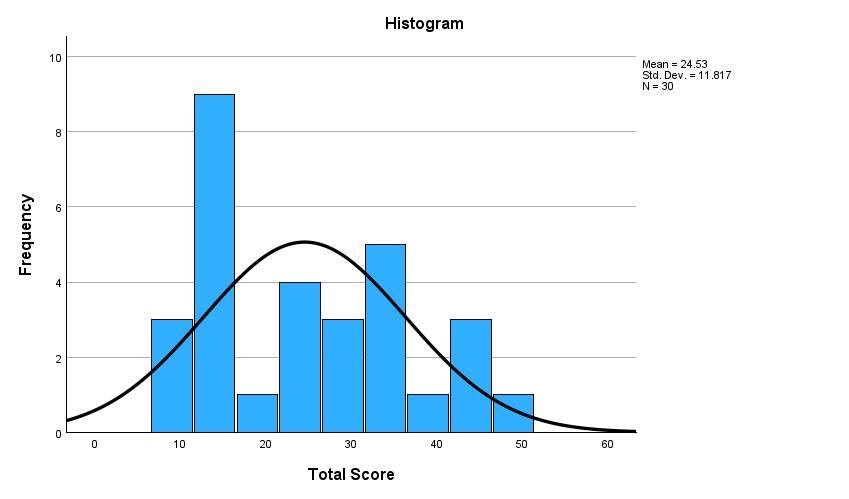
As shown in Figure 2, despite the considerable individual variation, the majority of results indeed fell within the range of 12 and 36 points, which meant that the sample met the necessary requirements and was suitable for subsequent inferential testing1 .
1 |Skewness| < 0.5 indicates approximate symmetry of distribution; 0.5 ≤ |Skewness| < 1.0 indicates moderate skewness; ≥1.0 indicates severe skewness (George & Mallery, 2019)
The values of the reading comprehension ability (variable Y) among CSL learners were measured by scores for understanding the texts (Appendix A). After completing the intertextuality identification task, the participants took a multiple-choice comprehension test consisting of 10 questions—one per text. Each question offered three options: one reflecting an accurate interpretation of the text supported by a recognition of intertextual cues; one reflecting surface understanding; and one indicating a fundamental misreading of the text's meaning. Each correct deep understanding answer was awarded 2 points, surface understanding received 1 point, and wrong understanding earned 0 points, with the maximum possible score of 20 points. The following table presents the individual reading comprehension results of 30 participants:
Table 3
CSL Learners’ Reading Comprehension Scores After Answering Multiple-Choice Questions
Legend: CCU – participants from Changchun University, China; RSU – participants from Ryazan State University named for S.A. Yesenin, Russia
As with variable X, the scores gained by the participants in the reading comprehension part of the test were analyzed with the preliminary focus on central tendency and distribution pattern of the variable. Descriptive statistics in Table 4 showed that the sample had a mean score M = 13.20 with standard deviation SD = 4.23, where individual scores ranged from minimum score of 6 points to maximum score of 19 points (out of total 20). This illustrated moderate-to-good overall performance of the participants in grasping the meaning of the target-language discourse.
Table 4
Descriptive Statistics of CSL Learners’ Reading Comprehension Scores
The values of Skewness = -0.18 (standard error SE = .43) and Kurtosis = -1.41 (standard error SE = 0.83) suggest a nearly symmetrical pattern with a relatively flat-topped distribution without extreme outliers (see Figure 3), confirming that the observed span and distributional properties align with assumptions about parametric correlation and group-comparison analyses.
Figure 3
Distributional Properties of CSL Learners’ Reading Comprehension Scores
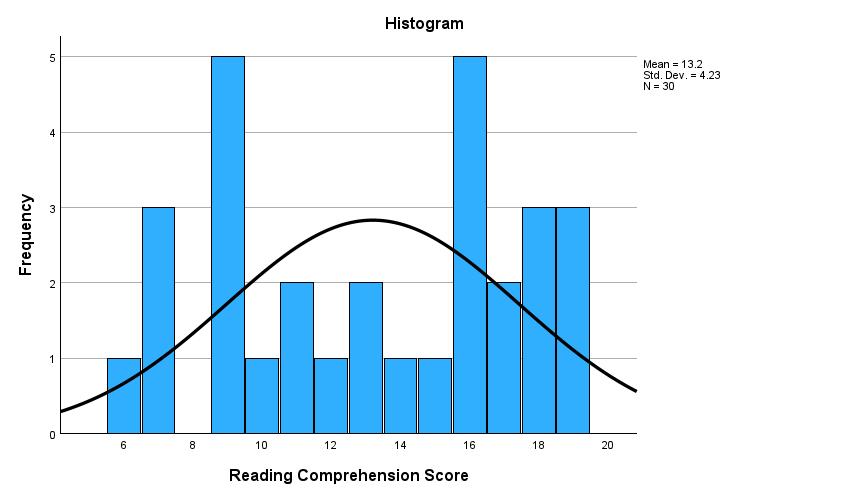
Bivariate Correlation Analysis
To examine the relationship between CSL learners' intertextual competence level (variable X) and their reading comprehension ability (variable Y), a bivariate Pearson correlation analysis was conducted between CSL learners’ intertextual competence scores (M = 24.53, SD = 11.81)
and their reading comprehension scores (M = 13.20, SD = 4.23). The collected data in this instance addressed Research Question 1.
Table 5
Descriptive Statistics of CSL Learners’ Intertextual Competence Level and Reading Comprehension Ability.
Taking into consideration the prerequisites for a bivariate correlation analysis formulated by Field (2018) and Tabachnick and Fidell (2019), assumptions on linearity and normality of variables, as well as absence of extreme outliners were verified through corresponding descriptive statistics and visual diagnosis (Table 6).
Table 6
Preliminary Diagnosis of Pearson Correlation Assumptions
Linearity
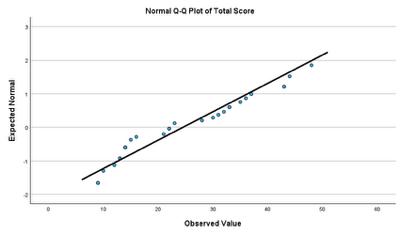
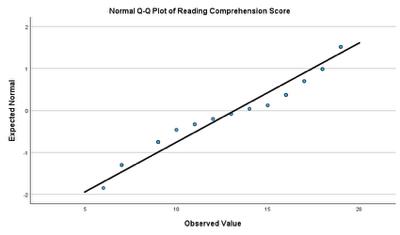
No strong deviation No strong deviation yes
Field (2018)
Field (2018)
Tabachnick & Fidell (2019)
Cohen et al. (2003)
Distribution pattern
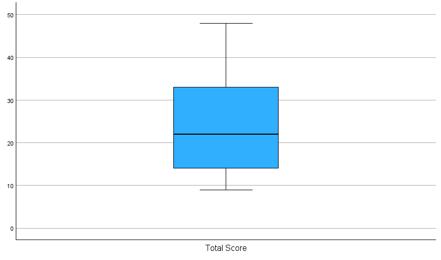
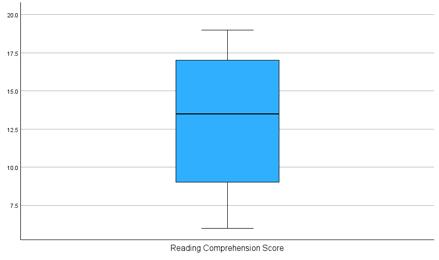
No extreme outliers No extreme outliers yes
Tabachnick & Fidell (2019)
The exploratory data analysis conducted on the two continuous variables X and Y proved that both variables meet the approximate normality requirement proposed by Field (2018), that is |
Skewness |<2; |Kurtosis| < 7. Although on the Shapiro-Wilk normality test, both variables indicated mild violations of normality (p < .05), yet the use of Pearson's r was deemed appropriate based on multiple converging criteria. First, the values of Skewness and Kurtosis for both variables fall well within the recommended thresholds, indicating near-symmetric distributions without severe deviations from normality. It was decided to follow Tabachnick and Fidell’s (2019) suggestion to use this standard for reference only, with the main focus on the values of Skewness and Kurtosis, supplemented by graphical diagnosis of the samples. Second, visual inspection of the scatter plots further indicated a clear linear trend of the two variables, without obvious curve trends or clustering phenomena. There were no extreme outliers observed in the box plots either, further confirming the robustness of the data distribution and suitability for correlation testing. Third, methodological literature suggests that Pearson's r is relatively robust to minor violations of normality, particularly when sample distributions are symmetric and the sample size is moderate (Schmidt & Hunter, 2015; Tabachnick & Fidell, 2019). In summary, based on multidimensional evidence, summarized in Table 6, Pearson correlation coefficient was assessed as suitable for examining the relationship between intertextual competence and reading comprehension level of CSL learners.
To avoid potential errors in the following calculations, data processing was completed with the help of IBM SPSS Statistics (ver.30.0.0.0). The results indicated the existence of a very strong positive linear relationship between the variables, indicated by a Pearson coefficient of r = .87, p < .001. Figure 4 illustrates this relationship: the bivariate scatterplot of intertextual competence scores (X-axis) against reading comprehension scores (Y-axis) with a linear regression line generated by IBM SPSS Statistics indicates that for every one-point increase in intertextual competence, reading comprehension score increases by approximately 0.31 points. The coefficient of determination R² = 0.759 reveals that 75.9% of the variance in reading comprehension is explained by intertextual competence, reflecting a very strong linear relationship.
Figure 4
Correlation Between CSL Learners’ Intertextual Competence Scores and Reading Comprehension Scores
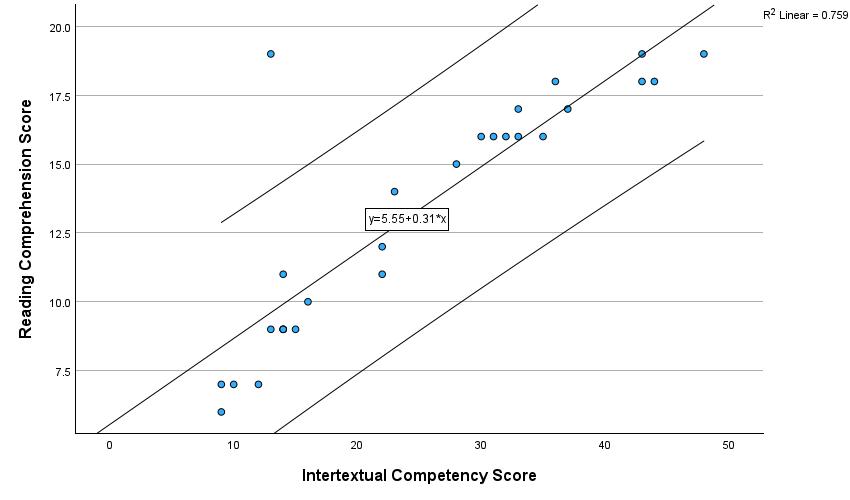
As can be seen from the figure, the data points are tightly clustered around the regression line, supporting the robustness of the Pearson correlation (r = 0.872, p < 0.001), which further confirms the existence of a distinct correlation between learners’ intertextual competence level and their reading comprehension ability. In practical terms, CSL learners who were able to identify more intertextual elements and correctly attribute them to their sources showed superior performance in grasping the rhetorical, cultural, and ideological functions embedded in the authentic Chinese texts.
Qualitative analysis confirmed that learners with lower intertextual competence scores (e.g., RSU8, RSU14) frequently selected wrong options dealing with multiple-choice questions, showing fundamental misinterpretations of the texts such as interpreting 特洛伊木 [Trojan Horse] literally as a toy, which suggests a link between limited intertextual thesaurus and challenges in textual interpretation. Whereas learners with high intertextual scores (e.g., CCU11, CCU15) tended to select options reflecting deep understanding of the discourse, linking intertextuality to broader themes. An example would be correctly treating 人类命运共同体 [A community with a shared future for mankind] as a political conception introduced by Xi Jinping in 2025. At the same time, the examples of several learners (notably CCU1, CCU11, CCU15, and RSU15) with high Chinese proficiency level (HSK 6), achieved high scores for reading comprehension test despite incomplete understanding of intertextual cases. This indicates that advanced linguistic proficiency allows some learners to infer meaning contextually, even without explicit knowledge of intertextual references.
Still, for the majority of participants failure to recognize intertextuality directly led to surface or wrong interpretations of the entire texts. These errors consistently resulted in wrong understanding responses, confirming that intertextual awareness is foundational to accurate discourse interpretation.
To answer research questions 2 and 3 and investigate how CSL learners’ intertextual competence level correlates with external factors (such as linguistic and cultural environment, Chinese language proficiency level, age, gender, etc.) subsequent subgroup analyses using independent-samples t-test, Spearman’s correlation and other descriptive statistics procedures were conducted.
To investigate the effect of exposure to the Chinese language and culture outside the classroom on CSL learners' intertextual competence development, the participants of this study were divided into two groups. The first group, designated CCU1 - CCU15, consisted of students studying in China. These participants formed the immersion group with rich exposure to authentic linguistic and cultural environments supported with media, conversations, and social practices. The second group, designated RSU1 - RSU15, consisted of students studying outside of China. These participants formed the non-immersion group with limited exposure beyond formal classroom instruction.
Taking group membership (CCU vs. RSU) as the independent variable and the total score of CSL learners’ intertextual competence level as the dependent variable, an independent-samples t-test was conducted to examine mean differences in intertextual competence of the two groups. Levene’s test confirmed the homogeneity of variances (F = 1.20, p = .283), justifying the use of the standard t-test formula (> 0.05) (Tabachnick & Fidell, 2019). The results revealed notable differences between the two groups of CSL learners, as shown in Table 7 and Figure 5.
Table 7
Intertextual Competence of CSL Learners With and Without Extracurricular Exposure to the Chinese Language and Culture
Group of CSL learners
CCU group – with extracurricular exposure to the Chinese language and culture
RSU group – without extracurricular exposure to the Chinese language and culture
On average, learners with regular exposure to the Chinese language and culture outside the classroom (CCU) scored nearly twice as high on total intertextual competence as learners from the non-immersive environment (RSU) (M1 = 32.33 vs. M2 = 16.73), t (28) = 4.79, p < .001.
Figure 5
Mean Scores Across Intertextual Competence Subcomponents Among CSL Learners With and Without Extracurricular Exposure to the Chinese Language and Culture
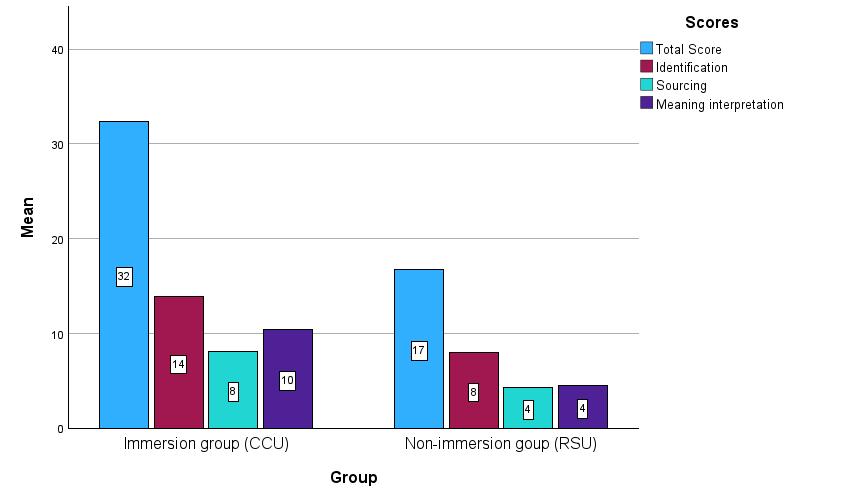
As shown in Figure 5, CSL learners from the immersion group (CCU) significantly outperformed CSL learners from the non-immersion group (RSU) across all dimensions of
intertextual competence, including in the identification, sourcing, and interpretation rate scores.
The overall effect size was exceptionally large (Cohen’s d = 1.75), far exceeding the threshold for a “large” effect (d ≥ 0.80) (Cohen, 1988). This confirms that authentic linguistic and cultural environment outside the classroom has a profound impact on CSL learners' intertextual competence development. Immersion facilitates intuitive recognition of cultural references through repeated exposure in media, conversation, and social practices. These findings make the authors suggest that virtual immersion through Chinese social media, video blogs, and other channels may bridge this gap for non-immersive learners.
To explore potential moderators of CSL learners’ intertextual competence, additional analyses examined the effects of their language proficiency. The Chinese Proficiency Test, also known as Hanyu Shuiping Kaoshi (HSK), is an international standardized test aimed to assess the Chinese language proficiency of non-native speakers. It serves as a mandatory requirement for academic admission and professional employment in China.
According to the selection criteria, all participants have passed the Chinese Proficiency Test (HSK) Level 4. This indicates that all participants reached a proficiency level equivalent to Level Four of Chinese Language Proficiency Scales for Speakers of Other Languages (Office of Chinese Language Council International, 2008) and Level B2 of Common European Framework of Reference for Languages (Council of Europe, 2020), enabling them to discuss a wide range of topics and communicate with native speakers with considerable fluency.
Consequently, the sample was divided into three groups: HSK Level 4 (n = 18), HSK Level 5 (n = 8), and HSK Level 6 (n = 4). Taking into consideration the small size of these three groups and that the HSK proficiency level is an ordinal variable, it was decided to use Spearman’s correlation test to assess its association with intertextual competence scores (Table 8).
Table 8
Results of Spearman’s non-parametric correlation between CSL learners’ intertextual competence and HSK levels
A moderate, positive, and statistically significant correlation was found, indicated by Spearman’s rho ρ = .460, p = .011 (two-tailed), n = 30, suggesting that higher language proficiency levels are associated with greater intertextual competence, though the relationship accounted for only about 21% of the variance in intertextual scores (R² = .212). While this suggests a meaningful link, it also implies that formal proficiency certification alone does not fully capture intertextual awareness – supporting the argument that contextual immersion plays a complementary, and possibly stronger, role.
While HSK level correlated moderately with CSL learners’ intertextual competence, its correlation with the reading comprehension ability proved to be much stronger, indicated by a higher value of Spearman’s rho ρ = .682, p<.001) (Table 9).
Table 9
Results of Spearman’s Nonparametric Correlation Between CSL Learners’ Reading Comprehension and HSK Levels
Participant’s HSK level Reading Comprehension Score
Spearman's rho Participant’s HSK level
Qualitative analyses of answer sheets revealed that some CSL learners with advanced language proficiency (HSK 6) were able to accurately grasp the meaning of the text even if they ignored its intertextuality or failed to correctly attribute its source. In contrast, HSK 4 learners exhibited a sharp decline in comprehension whenever intertextuality was not recognized, highlighting their dependence on explicit information. This suggests that advanced learners can compensate some limitations of their intertextual thesaurus relying on syntactic, semantic, and pragmatic cues which help them to reconstruct meaning.
Other Demographic Factors
To answer research question 3, the association of CSL learners’ intertextual competence with demographic variables was tested. These tests did not reveal any meaningful associations with the participants’ intertextual competence level.
Taking gender (male vs. female) as the independent variable and the total score of CSL learners’ intertextual competence level as the dependent variable, mean differences in
intertextual competence of the two groups of learners were examined. The sample was presented by 21 females (70%) and 9 males (30%). The mean difference between the two groups was only ΔM = .29 points, indicating no significant gender disparity (Table 10).
Table 10
Results of the independent-samples T-test between male and female CSL learners
Participant’s
Similarly, results of an independent-samples t-test2 (t (10.76) = -0.05, p = .961) revealed no statistically significant difference in intertextual competence between different gender groups. Effect size 3 (Cohen’s d = -0.024; Hedges’ g = -0.023) also confirmed the absence of a meaningful effect. These findings suggest that such demographic variable as gender does not influence intertextual competence development in this sample of CSL learners.
The age distribution of the participants in the sample was 21-27 years old (M=23.55, SD=1.76). Age, as a continuous demographic variable, had to be tested for its impact using parametric correlation and regression models to avoid information loss caused by grouping operations (MacCallum et al., 2002). Taking this into consideration, this study used Pearson correlation analysis to examine the strength of the linear correlation between age and the total score of intertextual competence. The results are shown in Table 11.
Table 11
Results of the Pearson correlation analysis between CSL learners’ age and intertextual competence scores (obtained through IBM SPSS Statistics, version 30.0.0.0)
Pearson
IC Total Score - Age
95% Confidence Intervals (2-tailed)a
As it can be seen from Table 12, Pearson’s correlation analysis revealed no statistically significant association between CSL learners’ age and their intertextual competence scores: r(28) = .247, p = .295, 95% CI [–.220, .621]. Given the wide confidence interval and nonsignificant p-value, it can be concluded that age cannot be associated with intertextual competence in this sample of CSL learners.
2 p > 0.05 → accept the null hypothesis, i.e. “there is no statistical difference between the two groups” ()
3 Cohen’s d = 0.2 is a small effect, d = 0.5 is a medium effect, and d = 0.8 is a large effect (Cohen, 1988)
This study set out with the intention of examining the relationship between intertextual competence and reading comprehension ability among CSL learners. An additional goal was to explore the influence of a mosaic of external factors such as exposure to the Chinese language and culture outside the classroom, Chinese language proficiency level, and some demographic variables on this competence development, including age, gender, and target language proficiency.
The process of textual communication and meaning making is significantly influenced by the reader’s ability to recognize intertextuality at different levels of discourse and make associations between the main text and extra texts to fully comprehend the underlying messages and cultural references embedded within the text. Learners who fail to acknowledge these intertextual links often risk misunderstanding or oversimplifying the intended meaning, as authentic texts are rarely self-contained but instead exist in dialogue with other works, genres, and social contexts.
The results of the bivariate correlation analysis undertaken in this study indeed revealed a very strong positive linear relationship (r = .87, p < .001) between CSL learners’ intertextual competence level and reading comprehension ability. Those learners who were able to successfully identify, source, and interpret intertextual references, such as allusions to classical myths, literary characters, political concepts and cross-cultural metaphors demonstrated much more accurate and nuanced understanding of foreign-language discourse, while misrecognition or ignorance of intertextual cues frequently led to surface-level or fundamentally incorrect interpretations of texts, confirming that intertextuality is not a merely decorative characteristic but rather a constitutive one.
These findings align with and empirically reinforce long-standing theoretical frameworks in second language acquisition and teaching Chinese to speakers of other languages. As Hou (2009) argues, the fluency of CSL learners’ reading comprehension process largely depends on information networks stored in their memory. Such networks integrate linguistic knowledge with sociocultural schemata and inferential reasoning. The obtained data show that CSL learners with limited intertextual thesaurus, when encountering references to literary archetypes, cultural symbols or genre-specific conventions, must operate with fragmented or incomplete information networks, which results in frequent comprehension breakdowns and diminished inferential accuracy.
This also supports the observation of Cheng and Li (2005) that without sufficient background knowledge, CSL learners tend to oversimplify and generalize the meaning of complex polyphonic discourse, staying at surface-level interpretation without accessing deeper layers of comprehension. Furthermore, these results resonate strongly with those conducted within the context of schema theory suggesting that comprehension arises from the interaction between textual input and the reader’s pre-existing knowledge structures, the so-called schemas (Lu, 2011). One’s intertextual thesaurus can be viewed as a subset of cultural schema. When
learners encounter intertextual references, the latter overlap with the entities stored in learners’ knowledge structures, and when matches are found, a rich network of associations is instantly activated in their brains which scaffolds learners’ deeper understanding. In contrast, learners lacking any match with their schema treat intertextuality superficially, often ignoring it as distractive. As Tai (2015) emphasizes, effective reading involves not just decoding words but transforming and organizing information through active cognitive engagement.
On the question of factors influencing CSL learners’ intertextual competence development, the subgroup analysis of this study further demonstrated that exposure to the Chinese language and culture outside the classroom had a profound impact on learners’ intertextual competence development. Learners studying in an immersive environment in China significantly outperformed their counterparts studying outside of China, indicating an extremely large practical difference. These findings highlight the value of supportive and comprehensible environments in L2 acquisition (Krashen, 2009). Environments in which learners view outside of the classroom what may have been shown in the classroom help CSL learners to acquire an additional language naturally, principally because of comprehensibility. They supply valuable sources of authentic materials that are challenging, yet culturally relevant and understandable. These findings align with the results reported by Li (2014), who provides empirical evidence that immersive contexts have facilitative effects on L2 reading development. Learners studying CSL in immersive environments benefit from frequent interactions with authentic discourse that often refers to important social and historical events and widely circulated narratives that shape collective memory of the Chinese. This sort of interaction with it naturally fosters the development of CSL learners’ intertextual competence.
Addressing the third research question in this study, the results showed that there is a moderate correlation between CSL learners’ intertextual competence and their Chinese proficiency level (ρ = .46), which was notably less predictive than the role of linguistic environment. This is partially inconsistent with the results reported by Yang et al. (2023) who found out that L2 proficiency was the strongest predictor of the students’ intertextual abilities. However, this can be explained by the fact that their research focused on writing abilities of L2 learners, where language proficiency can considerably limit learners’ performances.
However, advanced learners (HSK 6) exhibited a unique ability to infer meaning contextually even when they failed to identify specific intertextual sources, suggesting that high linguistic proficiency can partially compensate for gaps in intertextual thesaurus and help with intuitive recognition of embedded references. These results are in line with those of Ellis (2002), who found that through massive exposure, advanced learners develop a certain language sense that allows them to predict and interpret meaning from context with high accuracy. Nevertheless, this compensatory mechanism was rare and inconsistent across lower-proficiency learners.
Finally, such variables as gender or age of participants showed no significant effect on the ability to recognize and interpret intertextual references, indicating that intertextualcompetence-related skills are more closely tied to linguistic experience than to demographic
characteristics. These results support previous research of Wu (2012) and Khaghaninejad (2014), who did not find any connection between L2 learners’ gender and their reading results.
This suggests that targeted educational activities emphasizing extensive reading and authentic language use may foster the development of intertextual competence among CSL learners lacking immersive linguistic environments. Qualitative observations also suggest that integrative motivation and genuine interest in Chinese culture may play a mediating role in developing intertextual competence. Future studies could explore affective and motivational factors in greater depth.
This study provides robust empirical evidence for a strong positive relationship between intertextual competence and reading comprehension among learners of Chinese as a second language, with a Pearson correlation coefficient of r = .87 (p < .001). The findings substantiate long-standing theoretical claims — rooted in schema theory, sociocultural theory and discourse analysis – that effective reading in the target language is not merely a matter of lexical and syntactic decoding but fundamentally hinges on the learner’s ability to recognize, interpret, and contextualize intertextuality embedded within authentic discourse. Crucially, the obtained data demonstrate that failure to identify such references frequently results in surface-level or erroneous interpretations, thereby compromising overall textual understanding. This confirms that intertextuality functions as a constitutive dimension of meaning-making in authentic contexts (Khaghaninejad, 2014).
Moreover, the study reveals that exposure to the Chinese language and culture outside the classroom operationalized here through immersion in a Chinese-speaking environment exerts a profound influence on the development of intertextual competence of Chinese as a second language learners. Learners studying in China performed nearly twice as high as their non-immersed peers across all subcomponents of intertextual competence measured, including identification, sourcing, and interpretation. This pattern can be traced regardless of learners’ language proficiency level: both immersion and non-immersion groups are represented by advanced, professionally trained learners who have moved well beyond the conventional boundaries of early second language acquisition, yet the immediate linguistic environment still emerges as the decisive factor in shaping their intertextual competence. This finding underscores the irreplaceable role of authentic, context-rich linguistic input in building the cultural and intertextual schemata necessary for advanced literacy in a second language.
From a pedagogical standpoint, these findings carry significant implications for curriculum design and instructional practice in Teaching Chinese to Speakers of Other Languages. They suggest an urgent need for classroom activities to facilitate intertextual competence development for the learners lacking immersion environment. First, intertextuality should be explicitly taught as a core component of reading instruction. Educators must move beyond vocabulary and grammar and develop professional knowledge and expertise to raise the
intertextual consciousness of L2 learners and help them gain access to a deeper meaning of the text (Khaghaninejad, 2014). It is strongly advisable to include canonical cultural references, historical and literary allusions in reading instruction, thereby helping CSL learners enrich and expand their intertextual thesaurus and navigate culturally complex texts. Second, authentic materials, including literature, media, political speeches, and social discourse, should be integrated into curricular activities to expose CSL learners to naturally occurring intertextual phenomena. This could partially compensate for the lack of immersive environment, where L2 learners read a wide range of authentic materials for real communicative purposes, such as public notices, text messages and emails from Chinese friends, and others (Li, 2014). At the same time, it is very important to provide L2 learners with reading materials which are diverse and engaging in order to enhance their participation (Saito, 2025). Third, students who lack immersive environments should be encouraged to continuously acquire new background knowledge across diverse domains and broaden their horizons, expand their intertextual thesaurus and further develop their cultural literacy. These measures could support and enhance the cultivation of CSL learners’ intertextual competence and help them achieve a high level of performance in intercultural communication when engaging with target-language discourse.
Several limitations of the present study must be acknowledged. One of them is a relatively small sample size, consisting of 30 CSL learners, which limits the statistical power and generalizability of the findings. While future studies with larger and more diverse samples would help validate these results, implementing this type of research design on a large scale may be challenging. Maintaining uniform educational conditions across larger groups of learners could present significant difficulties.
Another limitation is that this study focused primarily on CSL learners’ immersion contexts and their formal language proficiency, however, it did not account for individual-level factors that might interact with the development of intertextual competence. Future research could examine the association of learners' personal motivation, reading habits, and attitudes toward the target language with their intertextual competence development.
Finally, future research should build on these findings by exploring the longitudinal development of intertextual competence, investigating the role of targeted instructional interventions. Experimental or quasi-experimental designs could test the efficacy of specific instructional interventions—such as intertextual annotation tasks, cross-textual mapping exercises, or digital storytelling projects—in fostering learners’ intertextual competence.
The authors extend their gratitude to the educators at Changchun University and Ryazan State University for their assistance in the data collection procedure for this research, as well as the CSL learners of these universities for their contributions in completing the questionnaires.
The authors sincerely thank the editor and reviewers of IAFOR Journal of Education for their valuable comments and detailed recommendations, which significantly improved the quality of the final version of this manuscript.
Arnold, I. V. (2019). Semantika. Stilistika. Intertekstual'nost': Sbornik statei [Semantics. Stylistics. Intertextuality: Collection of articles] [in Russian] (P.E. Bukharkin, Ed.). Flinta.
Bachman, L. F. (1990). Fundamental considerations in language testing. Oxford University Press. https://doi.org/10.2307/329499
Bachman, L. F., & Palmer, A. S. (2013). Language assessment in practice: Developing language assessments and justifying their use in the real world. Oxford University Press.
Bakhtin, M. M. (1975). Voprosy literatury i estetiki: Issledovaniya raznykh let [Problems of literature and aesthetics: Studies of different years] [in Russian]. Khudozhestvennaya Literatura.
Beijing Language and Culture University. (n.d.) Beijing Language and Culture University Chinese Corpus (BCC). https://bcc.blcu.edu.cn/
Blinova, O. A. (2019). Intertextual competence: An experimental study of advanced L1 Russian learners of English. In 11th International Conference on Education and New Learning Technologies (pp. 6006–6069). Palma, Spain. https://doi.org/10.21125/edulearn.2019.1462
Byram, M. (1997). Teaching and assessing intercultural communicative competence Multilingual Matters.
Cheng, R. J., & Li, X. X. (2005). Laihua liuxuesheng hanyu yuedu nengli de peiyang [Cultivating Chinese reading ability of international students in China] [in Chinese]. Shehui Kexue Luntan [Social Science Forum], (4), 102–103.
Cohen, J. (1988). Statistical power analysis for the behavioral sciences (2nd ed.). Lawrence Erlbaum Associates. https://doi.org/10.4324/9780203771587
Cohen, L., Manion, L., & Morrison, K. (2003). Research methods in education (5th ed.). Routledge Falmer. https://doi.org/10.4324/9780203224342
Council of Europe (2020). Common European framework of reference for languages: Learning, teaching, assessment Companion Volume. Council of Europe Publishing. De Beaugrande, R., & Dressler, W. U. (1981). Introduction to text linguistics. Longman. https://doi.org/10.4324/9781315835839
Dörnyei, Z. & Taguchi, T. (2010). Questionnaires in second language research: Construction, administration, and processing (2nd ed.). Routledge. https://doi.org/10.4324/9780203864739
Dörnyei, Z. & Dewaele, J. M. (2022). Questionnaires in second language research. Construction, administration and processing (3rd edition). Routledge - Taylor & Francis. https://doi.org/10.4324/9781003331926.
Ellis, N. C. (2002). Frequency effects in language processing: A review with implications for theories of implicit and explicit language acquisition. Studies in Second Language Acquisition, 24(2), 143–188. https://doi.org/10.1017/s0272263102002024
Fairclough, N. (1992). Discourse and text: Linguistic and intertextual analysis within discourse analysis. Discourse & Society, 3(2), 193–217. https://doi.org/10.1177/0957926592003002004
Field, A. (2018). Discovering statistics using IBM SPSS statistics (5th ed.). SAGE Publications.
George, D., & Mallery, P. (2019). IBM SPSS statistics 26 step by step: A simple guide and reference (16th ed.). Routledge. https://doi.org/10.4324/9780429056765
Goldman, S., & Bloome, D. (2005). Learning to construct and integrate. In A. F. Healy (Ed.), Experimental cognitive psychology and its applications (pp. 169–82). Washington, DC: American Psychological Association.
Hou, L. (2009). Lun liuxuesheng de hanyu yuedu nengli ji peiyang [On international students' Chinese reading ability and its development] [in Chinese]. Shandong Shifan Daxue Xuebao (Renwen Shehui Kexue Ban) [Journal of Shandong Normal University (Humanities and Social Sciences Edition)], 54(2), 154–157. https://doi.org/10.16456/j.cnki.1001-5973.2009.02.027
Hu, G., & Shen, Y. (2021). Chinese university teachers’ perceptions and practices regarding plagiarism: knowledge, stance, and intertextual competence. Ethics & Behavior, 31(6), 433–450. https://doi.org/10.1080/10508422.2020.1776616
International Organization for Standardization. (2018). Translation services — General requirements and recommendations (ISO Standard No. 18841:2018).
Jenkins, T. (2025). The intertextuality of Black American spoken word and African griot tradition: From the motherland to America (English Edition). Lexington Books. https://doi.org/10.5040/9781978746848
Khaghaninejad, M. S. (2014). Introducing intertextuality-aware instruction as a novel approach of teaching reading passages in EFL context. Journal of Pan-Pacific Association of Applied Linguistics, 18(1), 65–83.
Korotkikh, G. I. (2010). Formation of innovative competences of university students in foreign language teaching. Vestnik of Kemerovo State University, (2), 131–134.
Krashen, S. D. (2009). Principles and Practice in Second Language Acquisition. Pergamon Press.
Krasnykh, V. V. (2012). Culture, cultural memory and linguo-culture: Their main functions and role in cultural identification. Vestnik Tsentra Mezhdunarodnogo Obrazovaniya Moskovskogo Gosudarstvennogo Universiteta. Filologiya. Kul’turologiya. Pedagogika. Metodika, 3, 67–74.
Kristeva, J. (2024). The Revolution in Poetic Language. Columbia University Press. https://doi.org/10.7312/kris21459
Kuzmina, N. A. (2008). Intertekstual'nyi tezaurus sovremennoi yazykovoi lichnosti (na materiale pis'mennykh tekstov SMI, KVN i intellektual'nykh igr) [Intertextual thesaurus of the modern language personality (based on written media texts, KVN and intellectual games)] [in Russian] [Doctoral dissertation, Omsk State University].
Kuzmina, N. A. (2018) Intertext: Tema s variatsiiami: Fenomeny yazyka i kultury v intertekstualnoi interpretatsii [Intertext: Theme with variations: Phenomena of language and culture in intertextual interpretation] [in Russian]. URSS Publishing.
Li, L. (2014). Language proficiency, reading development, and learning context. Frontiers: The Interdisciplinary Journal of Study Abroad, 24(1), 73–92.
https://doi.org/10.36366/frontiers.v24i1.337
Li, W. H. (2018). Zhongxi wenxue wenben lilun fanchou bijiao yanjiu [Comparative study of Chinese and Western literary text theory categories] [in Chinese]. Zhongguo Shehui Kexue Chubanshe [China Social Sciences Press].
Lu, Y. W. (2011). Tushi lilun shijiao xia zhongya liuxuesheng hanyu yuedu nengli peiyang [Cultivating reading ability of CSL learners from Central Asia from the perspective of schema theory] [in Chinese]. Xiandai Yuwen (Yuyan Yanjiu Ban) [Modern Chinese (Language Research Edition)], (1), 134–135.
Lunkova, L. N. (2011). Intertekstual’nonst’ khudozhestvennogo teksta: original i perevod [Intertextuality of Literary Texts: Original and Translation] [in Russian] [Doctoral dissertation, Russian University of Peoples' Friendship [RUDN]].
MacCallum, R. C., Zhang, S., Preacher, K. J., & Rucker, D. D. (2002). On the practice of dichotomization of quantitative variables. Psychological Methods, 7(1), 19–40. https://doi.org/10.1037/1082-989x.7.1.19
Office of Chinese Language Council International. (2008). Chinese language proficiency scales for speakers of other languages. Foreign Language Teaching and Research Press.
O’rinova, Z. J. (2025). Research on the issue of intertextual thesaurus and intertextual competence. American Journal of Philological Sciences, 5(05), 158–162. https://doi.org/10.37547/ajps/Volume05Issue05-42
PACTE Group. (2003). Building a translation competence model. In F. Alves (Ed.), Triangulating Translation: Perspectives in Process Oriented Research (pp. 43-66). John Benjamins. https://doi.org/10.1075/btl.45
Piégay-Gros, N. (2002) Introduction à l'Intertextualité. Collection Lettres supérieures. [Introduction to intertextuality. Collection of letters] [in French]. Nathan université.
Saito, A. (2025). Motivation and Engagement in Extensive Reading: Insights from EFL Learners at a Science University. IAFOR Journal of Education. 13, 43–68. https://doi.org/10.22492/ije.13.1.02.
Samsonova, N. V. (2016). Intertekstual’nyi podkhod k analizu khudozhestvennogo proizvedeniya v starshikh klassakh [An intertextual approach to the analysis of literary works in senior secondary school] [in Russian] [Doctoral dissertation abstract, Irkutsk State University].
Schmidt, F. L., & Hunter, J. E. (2015). Methods of meta-analysis: Correcting error and bias in research findings (3rd ed.). Sage Publications. https://doi.org/10.4135/9781483398105
Solomina, N. V. (2008). Intertekstual’nyi tesaurus sovremennoi yazykovoi lichnosti (na materiale pis’mennykh tekstov SMI, KVN i intelektual’nykh igr) [The intertextual thesaurus of the modern language personality (based on written texts from mass media, KVN, and intellectual games)] [in Russian] [Doctoral dissertation, F. M. Dostoevsky Omsk State University].
Tabachnick, B. G., & Fidell, L. S. (2019). Using multivariate statistics (7th ed.). Pearson.
Tai, Q. E. (2015). Jin liushi nian lai duiwai hanyu yuedu jiaoxue yanjiu zongping [A review of extensive reading teaching in teaching of Chinese to foreigners in the past six years] [in Chinese]. Chuxiong Shifan Xueyuan Xuebao [Journal of Chuxiong Normal University], 30(4), 48–50. doi: CNKI:SUN:CXSZ.0.2015-04-009 (CNKI database)
Wang, Q. Y. (2020). Zhengzhi yuyanxue shiyu xia eluosi guojia lingdaoren zhengzhi yanjiang wenben de huwenxing yanjiu (2000 –2018) [An intertextuality study of Russian leaders' political speeches (2000–2018) from the perspective of political linguistics] [in Chinese] [Doctoral dissertation, Dalian University of Foreign Languages]. https://doi.org/10.26993/d.cnki.gslyc.2020.000002
Willis, J. & Kissane, B. (1997). Outcome-based education: Origins and implications. Curriculum Perspectives, 17 (3), 1–6.
Wu, M. J. (2012). Cong caici celüe kan ou-mei xuesheng hanyu yuedu nengli fazhan guocheng [Examining the development of Chinese reading ability among European and American students through word-guessing strategies] [in Chinese]. Yunnan Shifan Daxue Xuebao (Duiwai Hanyu Jiaoxue yu Yanjiu Ban) [Journal of Yunnan Normal University (Teaching and Research of Chinese as a Foreign Language)], 10(6), 1–8.
Yang, R., Hu, G. & Lei, J. (2023). Understanding Chinese English-major students’ intertextual competence and contributing factors. Assessment & Evaluation in Higher Education, 48(5), 657–671. https://doi.org/10.1080/02602938.2022.2102137
Yudaeva, O. V. (2019). The role of intertextual competence in understanding the meaning of a modern literary text. Vestnik Adjunkta, (4), 7.
Zinin, S. A. (2004). Vnutripredmetnye svyazi v izuchenii kursa literatury v starshikh klassakh [Intrasubject connections in the course of Literature at senior secondary school] [in Russian] [Doctoral dissertation, Moscow State Pedagogical University].
Corresponding author: Anastasiia Zaprudnova
Email: mrs.zaprudnova@gmail.com
Appendix A
Specially Designed Assessment Tool
汉语二语学习者互文能力的研究
A Study on Intertextual Competence of Chinese Second Language Learners
性别: 年 : 国籍: 母语: Gender Age Nationality Mother tongue
水平: 部分成 : 交际用语: HSK level HSK Reading results Languages used for communication
就读的学校名称:
目前就 的 : 年 : Name of Your University Major Course
的同学:
你好!
非常感 你愿意参加 次 。 注意,本次 采用不 名方式开展。 得的数据都用于科 学目的(在A. Zaprudnova博士研究框架内)。参与是自愿的。你可以随 停止参加。
Dear Student!
Thank you very much for participation in this survey. Please be informed, that all data are collected anonymously and used exclusively for scientific purposes (within the framework of A. Zaprudnova’s PhD research). Participation is voluntary. You can stop performing at any time.
第一部分
Part 1
下面的短文,一
注意文本中有没有关 到其他文本,包括 面与口 。如果有 就用笔把相关的内容圈出来。你可以圈出 、句子、甚至段落。如果圈出任何部分, 在短 文下方指出引用的来源或作者等相关信息。 不要借助网 。
Please read the following passages and try to find connections to other texts (written and oral) in them. If there is a part which mentions another text (“an extra text inside a text”), circle the relevant part with a pen. You can circle a word, a sentence or even a paragraph. When you circle any part, please explain the source or author of the “extra text” below. If there are no such connections, leave the text and spaces below clear. Please do not use the internet.
在几千年历史长河中 , 中国人民始终心怀梦想、不懈追求 , 我们不仅形成了小康生活 的理念 , 而且秉持天下为公的情怀 , 盘古开天、女娲补天、伏羲画卦、神农尝草、夸
父追日、精卫填海、愚公移山等我国古代神话深刻反映了中国人民勇于追求和实现梦 想的执着精神。
引用的来源:
引用的意思:
你的 想:
短文二
为规范公司的组织和行为,维护公司、股东和债权人的合法权益, 根据《中华人民共和国公司法》和有关法律、法规规定, 结合公司的实际情况,特制定本章程。
引用的来源:
引用的意思:
你的 想:
短文三
十年前我喝茶为了解渴。现在喝茶,是为了听水开的声音、看叶舒展的姿态。有 人说,‘茶如人生,先苦后甘’。可我觉得,甘苦从来不是先后,而是并存。就像这 杯茶,苦中有香,静里有动,急不得,也等不得。
引用的来源:
引用的意思:
你的 想:
短文四
这是我第一次来索契,但我对索契早有所闻。我年轻时多次读过《钢铁是怎样炼 成的》这本小说,奥斯特洛夫斯基就是在索契完成了这部著作。传说普罗米修斯曾经 被禁锢在索契的群山之中,索契保留着不少罗马帝国、拜占庭帝国的遗迹,这足以说 明索契是一个历史悠久的文化名城。
引用的来源:
引用的意思:
你的 想:
短文五
我 得她是小白菜,她前夫 她是潘金 ,她 自个儿冤得像 娥, 不就成仨人
了?
引用的来源:
引用的意思:
你的 想:
短文六
要做这一篇文章,才下笔,便感到万分的困难了。第一是文章的名目。孔子曰,名不
正则言不顺。这原是应该极注意的。传的名目很繁多,而可惜都不合。
引用的来源:
引用的意思:
你的 想:
短文七
从孔子那里我读到 颗爱心;在孟子那里我读到一股正气;从墨子那里我读到
腔热血;在韩非那里我读到 双冷眼。
引用的来源:
引用的意思:
你的 想:
短文八
此次系列新品是以北京 民俗中的 典兔子形象兔 意点,形成具有民族特色 的兔墩墩。 上将具有兔 明特征的服 和兔耳朵等与冰墩墩 合形成兔墩墩,体 了中国 吉祥文化幸福安康的美好祝愿。
引用的来源:
引用的意思:
你的 想:
短文九
10年来,构建人类命运共同体的理念不断丰富和发展,实践稳步推进,观念日益 深入人心。越来越多国家和人民认识到,这一理念符合全人类共同利益,反映了世界
人民追求和平、正义、进步的心声,汇聚了各国人民共建美好世界的最大公约数,对
于推动各国团结合作、共创人类美好未来具有重要意义。
引用的来源:
引用的意思:
你的 想:
短文十
他不知道究竟应该怎么做才好。他终于决定密切注意。他倒要看看,这个特洛
伊木马命中注定仍然不过是徒有其壳呢,还是图谋摧毁已经成为兰德尔一生中最重要
、最牢固的堡垒 他的家庭、他的理智,甚至他的身份本身。
引用的来源:
引用的意思:
你的 想:
第二部分
Part 2
出与所 内容一致的一 。 不要更正上一部分的答案。
Please choose one sentence that is consistent with the content you have read. Please do not correct your answers in the previous part.
短文一
A. 中国 史悠久,文化丰富
B. 中国古代文学中有很多英雄
C. 中国人 大梦想,努力工作,永不放弃
短文二
A. 是中国公司章程的典型开
B. 作者在介 中国公司法的基本内容
C. 一位企 家在分享自己的管理
短文三
A. 中国茶文化 史悠久, 得外国朋友了解和体
B. 作者通 喝茶的 ,表达了 生活 奏和心 化的思考
C. 喝茶有很多好 ,比如 人安静、提高注意力
短文四
A. 索契是一座革命思想形 生的主要城市
B. 索契曾 包括在 帝国和拜占庭帝国
C. 索契是一座文化底 深厚的 史名城
短文五
A. 位主人公用了三个不同的名字来介 自己
B. 位主人公兼有三种互相 立的身份
C. 大家都在背后 可怜的主人公
A. 写一篇文章,要听孔子的
B. 名不可随意取的
C. 有很多方式 一个名字
短文六
短文七
A. 些古代思想家的 点完全不同,甚至互相矛盾
B. 作者通 些哲学家,形成了 中 文化的整体理解
C. 不同思想家代表了中国 文化中互 的价 度
短文八
A. 新品的兔子是北京 民俗的 典象征
B. 兔墩墩 合了 典兔子形象的和奥运会吉祥物的特征
C. 兔墩墩的 是 了推广北京的 代文化。
短文九
A. 近十年来,各国之 的 争日益激烈,构建人类命运共同体的理念 以推
B. 构建人类命运共同体的理念已 得到了全球所有国家的 可和支持
C. 构建人类命运共同体的理念反映了世界人民 和平、正 和 步的渴望
短文十
A. 特洛伊木 是城堡中的原有装 ,被主人公重新 了
B. 特洛伊木 在 里比 一种表面无害、 危 的 藏威
C. 个木 是 人用来攻 城堡的武器
Results obtained through Expert Evaluation Form for Research Instrument Validation
1 = “strongly disagree”
2 = “disagree”
3 = “neither agree nor disagree”
4 = “agree”
5 = “strongly agree”
Evaluation aspect
1. Clarity of test objectives
2. Representativeness of materials
3. Balance of intertextual types
4. Diversity of functional styles
5. Appropriateness of difficulty
6. Clarity of instructions
7. Adequacy of multiple-choice options
8. Overall quality of the testing instrument
*Calculated with WPS Excel
Preserving Local Cebuano Vocabulary: Pedagogical Responses to Language Shift Challenges
Therese G. Cuizon
University of the Philippines Cebu, Philippines
Magnolia A. Laus
University of the Philippines Cebu, Philippines
This study explored the importance of preserving local Cebuano vocabulary in an upland community in Cebu Province, Philippines. It aimed to mitigate the language shift caused by globalization, urbanization, modernization, and the focus on English and Filipinos in schools. A total of 148 local words were identified through archival research and interviews. These words were grouped into six categories: Agriculture, Food, and Livelihood; Domestic Life and Household Practices; Social Relations, Community Life, and Built Spaces; Traditional Tools, Technologies, and Material Culture; Environment, Geography, and Local Ecology; and Beliefs, Rituals, and Cultural Expression. Many younger residents are already unfamiliar with vocabulary related to tradition and rural life, partly because schools use different languages. This weakens their cultural identities and local language skills. The study recommends integrating local Cebuano vocabulary into the classroom to reconnect students with their heritage and promote cultural continuity. Schools are essential for preserving the local language, especially as families struggle amid social and economic change. Recent policy changes emphasize other tongue-based multilingual education. Moreover, this study urges the inclusion of the Cebuano vocabulary in the curriculum to enhance learning and protect community heritage. Integrating local vocabulary is vital for sustaining language skills and supporting relevant education.
Keywords: culturally responsive pedagogy, educational language policy, language preservation, lexical attrition
The Philippines has many languages, shaped by its culture, geography, and history. The languages vary significantly across regions and communities, and even within a single community, there are subtle linguistic differences. Despite this linguistic richness, notable shifts in language have emerged in the country, particularly in the declining use of and familiarity with local languages among youth. Globalization, media exposure, urbanization, and a preference for English, especially among youth, have been identified as factors contributing to the significant decline in the use of and familiarity with local languages. Generation Z (Gen Z) Filipino college students were found to prefer English because of its perceived advantages in global mobility and employability, as well as its dominance in digital spaces, which reinforces it as a legitimate mode of communication (Lamorinas et al., 2025). These dynamics position English as a functional language and a symbolic marker of social and economic capital.
Institutional practices in the educational sector accelerate this linguistic transition, as schools prioritize English over regional vernaculars as the primary medium of instruction. Consequently, this institutional preference significantly influences learners’ linguistic attitudes and practices, as schools serve as key sites for language socialization. English is also expected to maintain its dominant status in the years ahead, remaining deeply embedded in the country’s social fabric (Parpa et al., 2024), unless deliberate interventions are implemented to enhance the status of local languages.
This language problem is neither new nor merely contemporary but can be traced back to the institutionalization of English in the Philippine educational system during the American colonial period, a process that reflects the transfer of a dominant foreign language to the locals. Early educational surveys, such as the Monroe Survey (1925) and the United Nations Educational, Scientific and Cultural Organization (UNESCO) Survey (1949), attributed the weakness of the Philippine education system to its dependence on English as the language of instruction, which, despite its use, led to poor mastery of the language and a lack of reading comprehension. A century later, the country faced the same crisis. The continued institutional preference for English in instructional resources and assessment has reinforced the marginal position of Filipino and other local languages in education (Lamorinas et al., 2025), a problem reflected in the country’s poor performance in international large-scale assessments such as Programme for International Student Assessment (PISA) and The Trends in International Mathematics and Science Study (TIMSS).
The Philippine education system has long been expected to play a key role in both local language preservation and promotion, as reflected in Republic Act No. 10533 (Enhanced Basic Education Act of 2013), also known as the K-to12 Law, which mandates the use of Mother Tongue-based Multilingual Education (MTBMLE) from kindergarten to Grade 3. This law also encouraged the use of regional languages, including Cebuano, as a medium of instruction to develop strong literacy and preserve cultural heritage. However, Republic Act No. 12027 was passed in October 2024, reverting the medium of instruction to Filipino and English and the discontinuation of MTBMLE, citing its failed implementation due to the centralized governance structure of the Department of Education. With the reversal of the previous law
Filipino and English were proposed to be the primary languages of instruction, consigning regional languages to auxiliary roles (Second Congressional Commission on Education [EDCOM 2], 2025). This policy shift has generated backlash from academics, cultural advocates, youth, and advocacy groups regarding the use of the mother tongue, who argue that this act is a step backward that undermines the 1987 Constitution’s key provision on education and cultural rights (Cardinez, 2024; Contreras, 2025; Sampang, 2024).
Despite the MTBMLE policy underscoring the importance of using students’ first language (L1) in instruction, schools have often become settings where local languages do not fully flourish, as classroom language practice continues to favor English. This leaves students unfamiliar with vocabulary that reflects their immediate cultural environment, limiting opportunities for culturally responsive and meaningful language learning because learners having difficulty relating classroom language to their lived experiences. When instruction overlooks local vocabulary, language education risks becoming abstract and detached from students, reinforcing the perception that local languages are less valuable or legitimate than global languages, such as English. This reflects the dominant standard language ideologies maintained by educational institutions which implicitly favor English as a language of intellect, progress, and academic legitimacy while positioning local languages as non-academic or unsuitable for formal learning (Sah, 2024). Consequently, schools may inadvertently contribute to the erosion of local linguistic knowledge rather than serving as an environment for its transmission and continuity.
The effect of this language shift is evident in Cebuano. Although it remains widely spoken, younger generations are increasingly gravitating toward global languages, reducing their familiarity with Cebuano (Dreisbach & Demeterio, 2020). Local vocabulary plays a crucial role in transmitting cultural and historical knowledge, social practices, and communal identity, as each word carries the community’s shared meanings and lived experiences. When these terms are no longer used, they are not only a loss of language but also a loss of collective memory, which raises concerns about the sustainability of local linguistic knowledge and the role of education in its preservation (Banguis et al., 2025). In addition, many existing studies on Philippine languages have focused primarily on language preference, policy implementation, or general language attitudes (Velasco, 2024; Zeng & Li, 2023), paying less attention to the pedagogical potential of locally grounded vocabulary as a language-teaching resource.
This gap highlights the need to examine how local Cebuano terms are utilized and comprehended and how they may be positioned within language education to support their preservation or risk of complete erosion. Thus, this study sought to answer the following questions:
1.What local Cebuano terms are present in Barangay Lataban, and how may these terms be categorized according to semantic domains?
2.How familiar are the community members with the identified terms and their perceived meanings?
3. What implications do the findings have for language education and local language maintenance?
By situating local Cebuano terms within language education, this research aimed to contribute to the ongoing conversation on the maintenance and promotion of local languages and the role of schools in sustaining linguistic and cultural continuity.
Language shift refers to the process by which a group of people transitions from using its local language to adopting another language, typically perceived as more important or advantageous. As a result, intergenerational transmission of the original language declines, leading to reduced usage. This process has been observed in many multilingual societies worldwide with UNESCO estimating that half of the world’s 7,000 languages are at risk of extinction. For example, in the Andean region of South America, indigenous languages such as Quechua have experienced significant displacement by Spanish due to historical colonial policies and ongoing social pressure in urban centers (Mannheim, 1991). The widespread attrition of traditional Chinese vernaculars like Teochew in Singapore (Saravanan & Hoon, 1997), and Saraiki’s reduced intergenerational transmission in Pakistan (Riaz et al., 2021) serve as unfortunate samples of traditional languages in regression. For instance, in Vanuatu, a multi-island nation in the South Pacific, the adoption of new languages over traditional ones increasingly threatens the survival of local languages (Forsyth, 2025; UNESCO, 2024).
English is a universal language, and its status as a global lingua franca is a critical driver of this shift. Given its dominance in education, science, and the digital economy, it exists as coveted linguistic capital (Zhang et al., 2025). Among youth, English is preferred for its career advantages and as a primary medium of communication on social media platforms, such as YouTube, TikTok, and Instagram (Lamorinas et al., 2025; Slimane, 2024). In the Philippines, Gen Z college students favor English over Filipino because of its global reach and prevalence in instructional materials (Lamorinas et al., 2025). Similar patterns occur in the United Arab Emirates, where students code-switch Arabic and English, which correlates with reduced Arabic acquisition and lower academic performance (Mzeil, 2025). In Kenya, secondary school students use their mother tongue sparingly, favoring English for both social and formal domains (Kimani, 2019).
The language shift in the Philippines began during the colonial period under Spanish rule, and later, English was imposed as an administrative and educational medium during the American Period (Gonzales, 2003). The American occupation, 1898–1946, institutionalized an Englishonly policy, making it the language of the government, education, and socioeconomic mobility, reinforcing its prestige in Filipino society. With its powerful assimilation ideology, the state marginalized its own native languages. Even after independence, the 1978 Bilingual Education
Policy (BEP) and the 2008 MTBMLE attempted to revive local languages. However, English remained the dominant language (Zeng & Li, 2023).
Contemporary pressures, such as digital and social media platforms and global career prospects, amplified the language shift and elevate English as a practical language choice. In specific communities, such as Chavacano speakers in the Zamboanga Peninsula and Cebuano speakers in Kidapawan City, younger generations favor English or Filipino over their local languages, accelerating the decline of the heritage language (Genuino, 2005), and signaling vocabulary disappearance (Payao & Sosas, 2025). Another study on the level of Cebuano language competence of pupils in the city revealed that 94% of the respondents whose supposed first language is Cebuano are not proficient in naming body parts, 43% are not proficient in naming fruits and vegetables, and more than 20% are poor and very poorly proficient in counting numbers in Cebuano due to being early bilinguals at a time when the use of the mother tongue in school was limited and because of the inundation of technology (Grengia, 2025).
The consequences of this shift include loss of linguistic diversity, erosion of cultural identity, and diminished intergenerational transmission of heritage languages (Lugo, 2024; Khan et al., 2025). While code-switching can foster creativity and bilingual competence, persistent dominance of English risks marginalizing minority languages and weakening the sociocultural fabric that they sustain (Zarif et al., 2025; Zhang et al., 2025). Mosely, as discussed by Azarm (2025), noted that the decline of languages may contribute to economic marginalization, reduced transmission of linguistic knowledge, and weakened willingness among younger generations to sustain these languages. Azarm (2025) further argued that this resulted in weakened cultural attachment, loss of self-identity, and disconnection from traditional values and practices. Similarly, Awal (2024) emphasized in his study the sociocultural consequences of language loss, particularly the weakening of cultural identity and heritage among affected communities. In the context of globalization, Ruxshonaxon (2025) further explained that language loss may result in identity fragmentation, cultural disconnection, and the erosion of traditional knowledge systems.
Schools act as ideological machines that, through curriculum and standards as defined by governmental entities, tend to legitimize standard languages and exclude local tongues. Woolard and Schieffelin (1994) argue that institutional discourse frames dominant languages as markers of competence, economic mobility, and modernity, thereby shaping students’ minds and perspectives on what counts as valid knowledge. In the Philippines, this philosophy is replicated regularly. A study on the interplay between language ideology and the mother tongue revealed that teachers’ beliefs about MTBMLE strongly dictated how the policy was enacted and that those who viewed English as a gateway to global opportunity tended to accommodate or negotiate the policy rather than fully implement the mother tongue instruction in the classroom (Parba, 2018; Velasco, 2024). Parba (2018) concluded that the persistence of an
English-only policy undermined the perceived legitimacy of the MTBMLE, with teachers invoking English to signal academic rigor.
An empirical study revealed that educators employed code-switching or bridging strategies to spotlight English, while lowering the mother tongue to peripheral activities. This study further explained that MTBMLE in the Philippines, rather than promoting bilingualism, primarily benefited English-language teaching and remained monolingual in nature (Perfecto, 2020). Likewise, students in linguistically diverse classrooms tended to favor Tagalog over their local language as the medium of instruction, believing that these languages better equipped them to participate in society. However, this practice also led to a decline in engagement with native languages (Ponce & Lucas, 2021). The combined effect of these factors was to create a classroom climate that marginalized the local language, reducing it to an optional extra, thereby diminishing students’ confidence in their linguistic heritage and accelerating the language shift. In a study on modeling languages, it was found that speakers’ preferences or language ideology can outweigh prestige, allowing a less esteemed variety to survive or even dominate. This suggests that, although English enjoys high institutional prestige and regional languages have lower status, it is possible the local language can persist with robust models and students’ preferences for their native language (Rosillo-Rodes et al., 2023).
A growing body of international literature on mother-tongue instruction and culturally responsive pedagogy underscores the educational benefits of grounding learning in a student’s mother tongue and cultural context. International bodies such as UNESCO have long advocated for mother-tongue instruction, arguing that this would support inclusive education, cognitive development, and the preservation of language diversity (UNESCO, 2022). Several studies on Mother Tongue-Based Multilingual Education repeatedly show its effectiveness in improving comprehension, fostering learning engagement and metacognition, and enhancing students’ academic performance when used as the primary medium of instruction in subjects such as English and mathematics (Bularon, 2025; Casinillo, 2022; Lomangco, 2025).
In a study on the use of Sinugbuanong Binisaya as a medium of instruction, it was found that it aligns better with students’ cognitive frameworks, improves their problem-solving comprehension, and reduces the mental translation barrier that often leads to students’ failure in English-led math classes (Palingcod et al., 2025). Similarly, students are more motivated and engaged when using the original Cebuano stories because of their emotional and cultural familiarity with the language (Jaca & Soledad, 2022). The importance of macro skills for development through vernacular stories is documented in a bridging program for HanunuoMangyan students, in which translated fables make lessons culturally relevant and cognitively accessible (Marasigan, 2025). The mother tongue is also positively correlated with performance in Filipino, math, and science because it reinforces scaffolding theory, which creates a cognitive infrastructure for other subjects (Simbre & Cabigas, 2025).
Although there is extensive research on MTBMLE, only a limited number of studies have systematically used community-specific vocabulary as teaching resources. Most studies have focused on language policy, material ability, or language attitudes, leaving a gap in understanding of how locally derived terms can be integrated into the curriculum to sustain cultural heritage. Filling this gap would enable the evaluation of community-specific vocabulary as a pedagogical tool.
This study used an exploratory descriptive qualitative (EDQ) research design because of its appropriateness for studies that aim to document and describe phenomena that are underexamined or context-specific, particularly when meanings are grounded in the participants’ lived experiences (Sandelowski, 2000). Local Cebuano terms were examined by documenting their composition and semantic domains, exploring their perceived familiarity among community members, and identifying their implications for language education.
The study was conducted in Barangay Lataban, a small upland community in the municipality of Liloan, Cebu, Philippines. The site was selected for its history traceable to the colonial period, particularly that of Liloan, an old Spanish pueblo (Municipality of Liloan, n.d.), and for its use of Cebuano terms unique to its community, which remain undocumented in formal educational materials. The barangay has also undergone observable social and economic changes over time, including a gradual shift from predominantly agrarian practices toward more contemporary commercial and residential standards. This is reflected in the municipal zoning classification, which designates portions of the area as residential, commercial, planned urban development, and mixed-use zones (Municipality of Liloan, 2009). It is essential to note Barangay is capitalized when referring to the official administrative unit or proper noun, while lowercase usage is retained only when used generically.
Two groups of participants were included in this study and were selected through purposive sampling (Tajik et al., 2025). First, 11 community elders served as key informants and were selected based on the following criteria: long-term residency and knowledge of the community’s language, history, and cultural practices. They also provided foundational data on local Cebuano terms, including their meanings, contextual uses, and historical significance, which formed the core corpus of the terms. Second, five community youth leaders were selected to determine the perceived familiarity, use, and relevance of local terms among younger generations. These youth leaders played active roles in the community and are at the intersection of traditional and contemporary knowledge and practices.
Basic demographic characteristics, including age, years of residence, and language spoken, collected to contextualize participants’ responses are found in Table 1. Pseudonyms were used for all participants to ensure confidentiality. The informants represent both older and younger generations within the community, which allowed the study to examine the intergenerational
differences in familiarity and transmission of local Cebuano terms. The older participants had lived in Barangay Lataban for several decades and possessed extensive familiarity with the identified terms, while the youth provided insights into the contemporary familiarity and relevance of the terms among the younger members of the barangay.
Table 1
Data were drawn using three complementary qualitative methods: archival records, semistructured interviews, and self-administered questionnaires. First, local archival research drew on documents, photos, and other resources related to barangay tourism, history, and culture to identify and compile a preliminary list of Cebuano terms, which provided the foundation for the subsequent interview process. Second, semi-structured interviews were conducted with community elders, guided by an interview protocol to elicit participants’ explanations of the meanings, uses, and contexts of the identified terms. This process allowed participants to elaborate on the historical and cultural meanings and their own lived experiences associated with vocabulary. Interviews were conducted in Cebuano to ensure authenticity, allowing informants to express themselves naturally. The researchers are fluent Cebuano speakers and one is a resident of Barangay Lataban, which facilitated direct communications, comprehension, and interpretation of responses without the need for external translation. And, third, a self-administered qualitative questionnaire was distributed to the youth participants using Google Forms. It consisted of open-ended questions designed to elicit participants’ familiarity with the terms. Participants were allowed to respond in Cebuano, Filipino, English,
or a mixed code to minimize language constraints. The use of online questionnaires was deemed appropriate given the participants’ work and study commitments, while still allowing reflective and narrative responses comparable to those in interviews.
The researcher-made interview guide and online survey questionnaire were validated by four content reviewers (CVI = 1.00, Acceptable). Minor revisions in wording and sequencing were made following the reviewers’ feedback to ensure that the questions were comprehensible. Furthermore, data collection continued until data saturation was reached, the point at which no new local Cebuano terms, meanings, or thematic insights emerged from subsequent interviews and questionnaire responses.
Data were analyzed through inductive thematic analysis following the phases outlined by Braun and Clarke (2006). The researcher conducted the coding and the thematic analysis of the interview transcripts, questionnaire responses, and archival notes through repeated reading and familiarization with the data. Initial codes were generated inductively, reviewed, and organized into broader themes that informed the categorization of terms by semantic domain and their application in language education. To ensure consistency, the coding decisions were repeatedly reviewed against the participants’ responses and the contextual meanings of the identified terms, and the codes and thematic analysis were reviewed by the research adviser as a thirdparty reader to ensure the analytical process was accurate.
Ethical considerations were observed throughout the study. Participants were informed of the study’s purpose and provided consent before the interviews were conducted. Anonymity and confidentiality were maintained, and the community’s knowledge was respected faithfully, accurately, and respectfully, representing the meanings and interpretations of the participants. Ethical approval was obtained in accordance with the institutional research guidelines before data collection.
The researchers acknowledged their positionality as Cebuano speakers with cultural and social ties to Barangay Lataban. One of the researchers is a resident of the community. The researcher’s background as a local resident influences her understanding of the barangay’s context and nuances. While it provided enhanced insight into the study, it also created an insider position that required careful, reflexive awareness to avoid assumptions and overgeneralizations rooted in personal experience. To mitigate this, data triangulation was employed through multiple data sources, and participants’ own explanations and interpretations of terms were prioritized, guided by recurring patterns in the data. Reflexivity was maintained throughout the data collection and analysis to ensure faithful representation of the community’s perspectives and values.
The study identified 148 local Cebuano terms used in Barangay Lataban. These terms were organized and analyzed by semantic domain, understood as groups of words that share related meanings and aspects of human experience, such as social, cultural, environmental, and material life. Figure 1 shows the local terms gathered and categorized into six semantic domains, including domestic life and household practices, traditional tools, technologies, material culture, agriculture, food, livelihoods, environment, geography, local ecology, social relations, community life, and built spaces, beliefs, rituals, and cultural expression. This categorization was based on their primary function, meaning, and cultural relevance within the community context. Therefore, it is not rigid but contextual, as these terms may overlap across different domains due to their multifunctional, symbolic, and socially embedded roles in the community life of Barangay Lataban.
Figure 1
Local Cebuano Terms in Lataban According to Semantic Domains
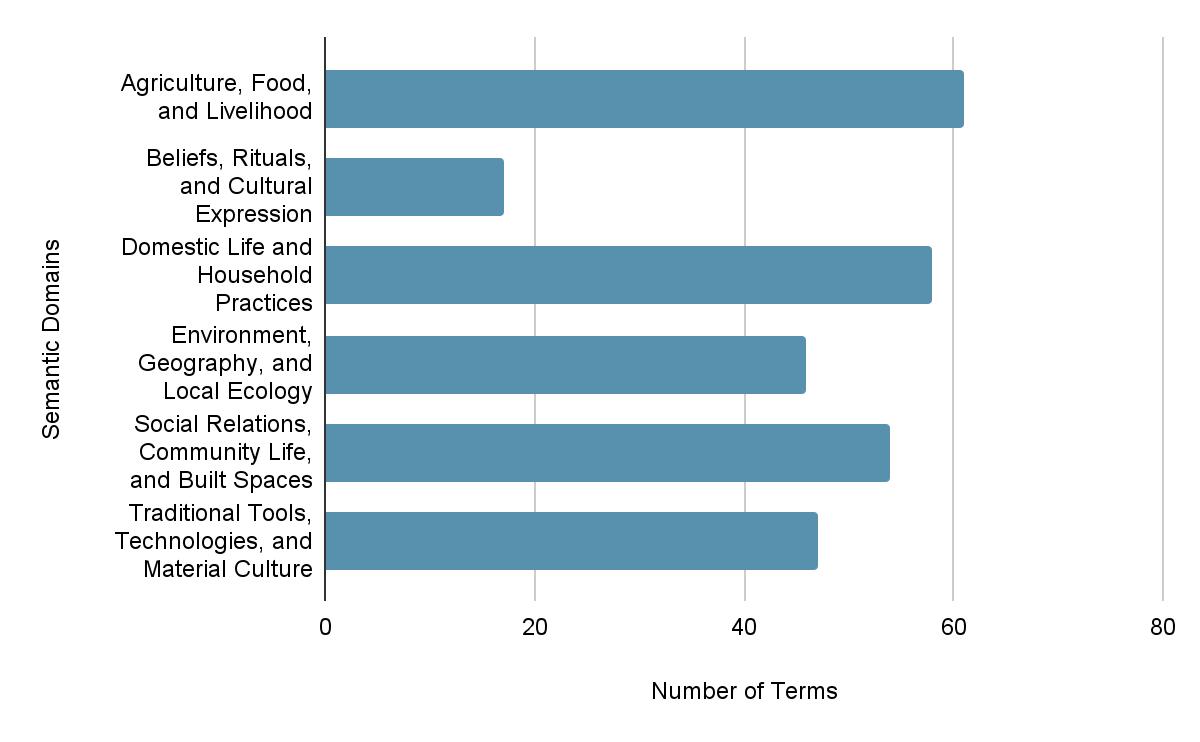
Figure 1 shows that aspects of community life are prominently encoded in the local Cebuano language. The results show that local terms are heavily concentrated in domains related to everyday subsistence, domestic practices, and community life, while there are comparatively fewer terms under beliefs, rituals, and cultural expressions. Agriculture, food, and livelihood emerged as the most dominant semantic domain, with 61 terms related to food production, farming practices, crops, livelihood activities, and subsistence processes. Terms such as alayon (traditional system of mutual cooperation), lusong (mortar), bani (pounded banana used as pig feed), budyong (large seashell), buli (palm tree), daro (traditional blade-like tool for tilling soil)
galingan sa bato (stone grinder), ligis (round wooden implements used to crush cacao beans), lila (purple-colored papaya), lupo (the process of stripping, drying, and smoothing the inner fibers of the buli), lusak (act of processing or preparing crops, particularly pounding or mashing bananas), and mais (corn) reflect the historically agrarian character of Barangay Lataban, and demonstrate how the Cebuano language encodes knowledge that is relevant to the survival, labor, and economic life of the community. This data also suggests that agricultural and foodrelated knowledge remains linguistically salient, as it tends to persist longer because it is tied to everyday routines, survival, and practical interactions (Fishman, 1991; Hornberger, 2002). This domain also underscored the role of the local language as a repository of ecological and livelihood knowledge, functioning as a facilitator language for daily subsistence activities (Nuncio, 2020).
Figure 2
Examples of Terms Related to Agriculture, Food, and Livelihood


The prominence of domestic life and household practices mirrors the home as a critical site of cultural continuity. Terms such as borneyo (metal pot used in preparing sikwate or traditional hot chocolate), tadyaw (traditional water storage), kaban (traditional wooden storage containers typically for clothes), hungot (traditional drinking vessel or container), kudkuran (traditional tool for grating or scraping), and sung-agan (traditional stove) document the daily routines related to food preparation, storage, lighting, and interaction within the household, showing that culture is practiced not only through public rituals but also through ordinary and repetitive domestic practices. However, modernization and the introduction of commercially produced goods and appliances have altered household routines, leading to a shift in vocabulary and usage. While some terms remain familiar, others only serve as reminders of what they once represented.
Similar to the domestic and agricultural domains, terms under traditional tools, technologies, and material culture, such as takumbo (jar or container cover), pasong (carved wooden or stone basin), petromax (kerosene lamp), makina de mano (old manual sewing machine), parol de combate (a type of lamp), kingki (kerosene-powered lamp smaller than petromax), and bangguran (traditional tool for threshing corn), reflect the locally developed technologies that once supported household labor, farming, or communal activities. These traditional tools are
seldom used nowadays, as they have largely been replaced by mechanized, more modern alternatives. This trend aligned with patterns of technological displacement observed in other cultures, in which the adoption of modern industrial technologies often leads to the decline of traditional material culture and the eventual loss of associated lexicon (Alsaleh, 2024). This shift not only alters daily practices but also impacts intangible cultural heritage, as language and material culture are closely intertwined (UNESCO, 2021). The decreasing frequency of use of these traditional implements thus signals both a material and linguistic transformation in contemporary society.


Borneyo Tadyaw
The domains of social relations, community life, and built spaces encoded not only physical spaces but also their social meanings within the community. The presence of place-based names such as sitios (Balingasao, Sunshine, Ilihan, and Curvada), puroks (Kaymito, Mangga, Pinya, Saging, and Tambis), and communal buildings reveals that the history, memory, and social relations are etched in the spatial vocabulary of locals. This helps build and sustain the community’s identity, even as its functions have evolved and its meanings have faded over time. Similarly, the domains of environment, geography, and local ecology not only highlight the natural landscape but also suggest how it has influenced the community’s history and lifestyle. These terms refer to landforms such as the Lataban Hills, water sources such as Katawan Lake and Tabay Kabeting, vegetation such as lila and apali, and other ecological features.
In the least concentrated domain, beliefs, rituals, and cultural expression suggests that communal practices carry symbolic and identity-based meanings, such as chapels, communal celebrations, bayle (a community dance), wakes, and beliefs in supernatural entities. Unlike previous categories, these communal practices and beliefs are typically activated during specific events rather than daily, suggesting a decline in communal rituals as modern lifestyles reshape the community’s belief systems. These cultural expressions are often most vulnerable to social change, especially when they are no longer reinforced through regular communal practices such as bayle
The tension between the prevalence of these terms and their waning familiarity has significant implications in language education. Incorporating these local Cebuano terms into the school curriculum allows students to reconnect with local knowledge systems and bridge the gap between linguistic heritage and the contemporary experiences of people in the barangay. This approach challenges policies that favor foreign languages, such as English, over regional dialects, while supporting students’ cultural identities by valuing their community’s experiences as a vital learning resource. Such a process makes it easier for them to learn new ideas as they are not required to mentally translate abstract concepts from a language that is not their own.
This study identified 148 local Cebuano terms, yet the findings indicate that levels of familiarity and perceived meanings vary significantly and are dependent on age, lived experiences, and locals’ engagement with the practices these terms represent. The interview data revealed that the 11 older community members, the key informants in this study, generally demonstrated strong familiarity with these terms, particularly those related to agriculture, traditional tools, and domestic practices. They were not only able to define these terms but also to provide rich contextual explanations for each by sharing their lived experiences. They were able to share personal anecdotes, their own encounters, and past recollections of the terms being explored, illustrating how their linguistic knowledge was related to their practical experiences. For instance, Leonor, 65 and Liway, 71, who both grew up doing farm work in each of their families’ uma or farm, shared how farmers back in the day would practice alayon or ayon (cooperative labor system) where they would work in rotation and take turns helping each other finish farm work; they would use a budyong (Figure 3) to call these farmers involved to signal that they are starting the day’s work, or when Leonor recalled not being allowed to go to sleep on Monday nights when they were young unless they were able to weave and produce buyot (basket), which was to be sold the following day, Tuesday, in the merkado or taboan (marketplace) because it was market day, which was located in the present-day Lucio Tanjay Gym or Lataban Covered Court.
In contrast, all five younger participants showed limited familiarity with many of the terms, especially those associated with their way of life in past decades, such as agricultural practices, traditional household technologies, and even ritual or community practices that are no longer part of their daily routine. This phenomenon is not surprising, as younger generations are not exposed to them and are leaning toward modern practices. This observation aligned with findings that Cebuano vocabulary is eroding and shifting across generations (Payao & Sosas, 2025). A study of intergenerational language preference shift among Cebuanos also found that the younger generation has limited Cebuano vocabulary and prefers English for formal communication (Dreisbach & Demetrio, 2020).
There are three factors that contribute to this limited familiarity: economic, sociocultural, and the language shift resulting from institutional practice and other forces. Younger residents pursue education outside the barangay and later on their employment due to limited job
opportunities in the locality. This urban migration and labor shift expose workers to new dialects and urban vocabularies that differ from the vernaculars of their places of origin, creating gaps in terms of familiarity (Huang et al., 2023). This would lead to diminishing opportunities for the intergenerational transmission of knowledge of local vocabulary through shared work and daily interaction. Knowing that they have found it to be of least relevance socially and materially in the present times, it was difficult to sustain the use of these vocabularies. Terms such as budyong, alayon, and bayle were no longer observed in their original forms. While religious practices remain relevant within the community’s fabric, customs such as manabtan may seem unfamiliar to younger generations. These vocabularies are susceptible to erosion. Consequently, without structured intervention, cultural knowledge embedded in language may gradually be lost.
There is also a recurring pattern in the distinction between recognizing terms and functional knowledge. All five younger participants recognized certain terms. However, they lacked a deep understanding of the historical and cultural nuances behind them. For instance, Nelly, 21, mentioned, ‘usa ana kay ang pasi madunggan nako siya mostly sa mga tigulang and familiar siya pero di nako ma-distinguish unsa na siya’’ (One example is the word pasi, I usually hear it from the elderly. It feels familiar, but I cannot distinguish its specific meaning). Younger members of the community would even ask elders about the terms and heritage, as they are not completely knowledgeable about them. This suggests that some of the terms persist on a passive level, but are not actively used or understood in practice. There is only a partial familiarity with them, which can be described as language attrition. When intergenerational transmission weakens due to urban migration, changing livelihoods, and reduced household language practices, lexical items that encode cultural practices, oral histories, and ecological knowledge become dormant (Libago & Adriano, 2024; Payao & Sosas, 2025).
A decline in the familiarity of local Cebuano terms in the barangay was most prominent for terms related to agriculture, traditional items, and technologies. Despite the numerical dominance of the Agriculture, Food, and Livelihood domains and Domestic Life and Household Practices in the previous findings, it did not necessarily indicate active familiarity or regular use among the younger generations. Although food is often considered to be the heart of one’s culture, and food production and communal life are sustained through agricultural practices, many of these terms were reported by the informants as less familiar to the youth, which they attributed to changes in living conditions, particularly the livelihood patterns brought about by modernization and industrialization. Different studies have attributed this to urbanization (Jansen, 2013) and labor migration due to economic insecurity (Kamwangamalu, 2013), which leads to the declining participation of younger community members in agricultural work, as in Nepal and Northern Ghana (Sunam et al., 2024; Vercillo & Frayne, 2025).
Local terms are at risk of becoming linguistically dormant as livelihoods shift away from farming, tools and practices become obsolete, and opportunities for the intergenerational transmission of agricultural vocabulary diminish. This aligns with research showing that lexical items linked to decreasing practices are particularly vulnerable to language attrition. Similar
patterns of language erosion are evident among other indigenous Philippine groups. For example, Ata‑Manobo speakers reported diminished use of the native lexicon, increased reliance on loanwords, and stigma attached to speaking the tribal language, all of which accelerate lexical attrition (Bangilon & Daga-as, 2025; Libago & Adriano, 2024).
Nevertheless, place names or terms associated with places and built spaces such as sitios (smaller, typically rural, territorial division within a barangay) and puroks (a zone or subdivision within a barangay, comparatively smaller than sitios) and landmarks were familiar to both older and younger respondents, although there are instances where the origin of terms or etymology is unclear to them. The data suggest that the younger generation’s vocabulary is shrinking towards general terms. As expressed, "general terms nalang ang nahibaw-an" (their knowledge is limited to general terms) and "do not know most of the terms except for the names of properties and puroks.” Of note, spatial vocabulary remained familiar to both types of respondents and was more enduring than other domains, as it served as a community marker of belonging and orientation. Members’ identities are reinforced by spatial vocabulary because it is embedded in everyday navigation and social references.
With spatial terms serving such an intrinsic role in individuals’ identities, origin stories of some place names, including the myths of Lataban and Balingasao emerge. It is common in barangays to hear stories about aswang (commonly known as wakwak), a mythical creature that flies at night to prey on humans, especially children, pregnant women, and sick people. It is believed that Balingasao comes from the words bali (reverse) and ngasao (reverse for aswang), so this is alleged to be where many aswang can be found. One of the respondents also mentioned that the name Lataban, which some locals believe derives from the word taban, (to elope). Apparently, during wartime, women in the village would run away with their soldier lovers. Even though the true origins are unknown to many, people have created stories that are now widely accepted as the backgrounds of these places.
There has been an observed reliance on English, and the constant exposure of the younger generations to the media has significantly contributed to the language preferences of many youths. However, eleven older informants, such as Andres, 53, expressed their concerns about this decline, citing that to preserve the heritage of the past, people must not only know it but also hold it in value. Similarly, 71 said that when she asked her grandchildren for a particular kitchen implement, like kudkuran or bangguran, they would ask back what it was because they had no idea what it was. Younger members of the community showed less familiarity with these traditional household items and ritual practices because, unlike in the past, they are no longer part of everyday routines. Youthful informants have reported that technology and modern interests, such as social media and sports, have become major competitors for youth attention, and that this modern lifestyle is actively displacing traditional vocabulary. This finding indicates that language shift does not occur abruptly but through gradual changes in language preference, vocabulary use, and domain-specific communication shaped by education, modernization and the evolving social environment.
The findings further suggest that the decline in familiarity with local Cebuano vocabulary extends beyond simple lexical attrition and reflects a broader process of language and cultural transformation. As younger generations become less familiar with such vocabulary, intergenerational transmission of localized language may also weaken. These vernacular terms matter because they carry cultural meanings, historical experiences, environmental knowledge, and the community-specific ways of understanding daily life. Hence, the disappearance of regional-specific language and dialects would contribute to weakened cultural continuity and identity formation particularly with the younger community members. Previous studies have emphasized that the language loss may result in erosion of cultural memory, traditional knowledge systems, and community identity (Awal, 2025). In this study, the terms associated with agriculture, livelihood, household practices, and local beliefs were among the less familiar to the younger participants, suggesting that vocabulary degeneration may also reflect broader transformations in community life and everyday cultural experiences. Therefore, preserving the local vocabulary is not merely a matter of maintaining the words but also one of sustaining the cultural and historical knowledge, and the social meanings embedded in each of them.
This decrease in familiarity with local Cebuano terms does not reflect a lack of linguistic richness but rather the weakening of the social context that once sustained their use in the community. The gap between linguistic heritage and the contemporary lived experiences of Latabanons has important implications for language education. Without deliberate schoolbased interventions, such as integrating local terms into curricula, fostering narrative activities, and providing community‑driven language resources, the cultural knowledge secure in these vocabularies risks gradual loss (Abingosa et al., 2025). When these locally grounded terms are reintroduced in the classroom, they can serve as a space for revitalizing cultural knowledge that is no longer transmitted through everyday practice in the barangay. This not only bridges the gap between the two generations, young and old, but also positions the local language as neither obsolete nor a meaningless source for culturally responsive language learning.
Drawing on findings on the composition of local vocabulary and the degree of familiarity across generations, this study positions local Cebuano terms as a valuable linguistic and cultural resource that is highly underutilized in formal education. The results suggest that many local terms remain embedded in the community’s language repository, yet they are not actively transmitted through everyday classroom practice, particularly among the younger generation. A type of disconnect between students’ lived linguistic environment and the language of the classroom is perpetuated. When schools prioritize a foreign language, such as English, or, to a lesser extent, Filipino, this only marginalizes local languages and creates several challenges for students (Gülle, 2025; Parba, 2018). It also creates the perception that the local language is less suitable for academic use, reflecting what studies describe as standard language ideology, in which dominant languages are constructed as intellectually legitimate, while local languages are positioned as informal or lacking (Ponce & Lucas, 2021; Velasco, 2024). Studies have also argued that policies that create the English ideology continue to challenge the legitimacy of heritage languages (Parba, 2018). Consequently, when schools offer limited opportunities for
authentic vernacular language use, learners forego reinforcement, leading to the gradual erosion of vocabulary, as observed in the Saudi EFL context (Fraidan & Alaamri, 2025).
Integrating local Cebuano terms into classroom instruction offers a way to challenge this hierarchy by legitimizing students’ linguistic and cultural knowledge and backgrounds. Terms related to agriculture, domestic life, tools, and community spaces can serve as entry points for teaching, including vocabulary development, reading comprehension, oral storytelling, and contextualized grammar instruction. Rather than treating the local language as an auxiliary, it must be treated as foundational and functional as an anchor for meaning making, allowing students to connect abstract language to what is socially and culturally familiar to them and to their immediate realities. This aligns with culturally responsive pedagogy, which emphasizes using students’ cultural knowledge and experiences as the foundation for effective classroom instruction (Gay, 2018).
However, when the local language is not used in school, it can lead to cultural alienation, in which students feel they must abandon their home identity to succeed academically, affecting their sense of belonging and even language anxiety. It may also increase students’ cognitive load. Extra energy will need to be expended translating their thoughts from their mother tongue into the classroom language before they can answer questions or decode new concepts. This language gap doubles the burden of grasping new concepts, making learning more complex. Over the years, students who acquire only a limited amount of knowledge fall behind not due to lack of intelligence but because new learning will require comprehension of what has already been missed. Especially in the Philippines, where English proficiency is low, students experience reduced comprehension, a higher cognitive load, and poorer performance in reading and mathematics (Igarashi et al., 2024). This concept is reflected in the Matthew effect in literacy, where linguistic and cultural capital translate into higher scores on standardized classroom assessments written in a favored language, and those who score lower are limited in access to scholarship, honor programs, and, later, high-paying career paths.
Additionally, the pedagogical value of local vocabulary lies not only in its communicative function but also in how these terms encode the community’s historical, ecological, and social memory. Learning about language helps students connect with local words that convey knowledge and identity, a concept supported by Hornberger’s (2002) biliteracy framework, which emphasizes that learning to read and write is most effective when it incorporates students’ first language and local context, rather than relying solely on the rules of the dominant language. It promotes additive biliteracy, in which all languages are seen as assets and learning a second language does not mean losing the first, while native languages are given more space to reclaim their power in the classroom. In this manner, local Cebuano vocabulary can serve as an important tool for both teaching and learning a language. Hornberger (2002) noted that, in the ecology of language, particularly in language evolution, one language evolves in relation to others, and one person does not learn a second language in a vacuum but with knowledge from the first language, as they are part of a single, developing system.
This suggests that schools may serve as alternative sites for transmitting local linguistic knowledge, especially as traditional avenues of intergenerational learning, such as those within the household, have weakened due to urban migration and changing livelihoods and lifestyles (Osborne, 2020; Ponce, 2022). Classroom-based engagement, in which local Cebuano terms can be integrated through discussions, narratives, or contextual vocabulary activities, can help prevent these terms from becoming linguistically dormant. (Parba, 2018; Velasco, 2024). Although the practice may not fully restore the everyday use of these terms, awareness, recognition, and cultural significance are critical for maintaining and preserving them.
Considering the recent policy shift that deprioritizes MTBMLE, the use of local Cebuano terms in pedagogy is even more significant. Despite the dominance of English and Filipino in instructional settings, local vocabulary can serve as a resource to support comprehension, affirm students’ identities, and foster inclusivity. Instead of viewing local languages such as Cebuano as competing with global languages, this study underscores the role of Cebuano, a local dialect, in enriching language education by grounding students in their immediate cultural environment. Contextualization and a meaningful learning experience for students, where learning a language would not be completely foreign to them, but rather relational, would be the result.
The findings of this study show that local Cebuano terms are not simply remnants of the past or repositories of memories, but they hold pedagogical potential for creating meaningful, context-sensitive language instruction. Integrating these terms into language education can contribute not only to vocabulary development but also to the broader goal of sustaining linguistic and cultural continuity within a local community.
This study was limited to Barangay Lataban in Liloan, Cebu, and therefore reflects the linguistic and cultural context of a single community. The nature of this study, which is localized and qualitative, limits the generalizability of the findings to other Cebuano–speaking communities with different sociolinguistic and socioeconomic conditions. The number of participants was also relatively small and intended to provide depth of contextual understanding rather than broad statistical representation. The researcher’s positionality also presented potential limitations, as the researcher is a Cebuano speaker with social and cultural ties to the community, and although reflexive practices are employed, complete detachment from insider perspectives may not be fully possible. In addition, the youth participants’ familiarity with terms was based on self-reported responses, which may not fully capture actual language use across contexts and situations.
Based on the findings and their educational implications, this study proposes strengthening of the context integration of the local Cebuano vocabulary of Barangay Lataban within the basic education curriculum as a means to support language maintenance amid the recent policy shift
that prioritizes Filipino and English in the classroom. This would allow students to learn and encounter local vocabulary in a meaningful academic context while preserving their culture. Using the domains identified in this study as an organizing framework for selecting terminology, teachers may prioritize domains that are highly culturally relevant and less familiar, thereby supporting intergenerational transmission. Schools may also collaborate with local community elders and cultural bearers to document and explain terms, which can take the form of glossaries or short narratives, and contextualized learning materials that may be incorporated into classroom activities. Professional development programs may also benefit teachers by training them to implement culturally and responsive and multilingual pedagogical strategies, particularly to address language ideology and the cognitive load surrounding language choice in the classroom.
This study examined the local Cebuano terms in Barangay Lataban and analyzed their semantic composition, perceived familiarity, and implications for language education. The findings revealed that while local Cebuano remains embedded in the community’s everyday life, familiarity with these terms is declining among the younger generations. This reflects the broader sociolinguistic shift influenced by urbanization, modernization, and the continued privileging of English in formal educational institutions. This intimate relationship between social life and language suggests that language vitality is tied to the continued practice of the activities and cultural forms these terms represent, both in the household and in school settings. Although schools are critical sites of language preservation, they may contribute to the marginalization of local languages through implicit language ideologies that privilege global and national languages. When local vocabulary, such as Cebuano terms, is excluded from instruction, it detaches students from their own cultural context and creates the perception that it is non-academic or irrelevant.
By documenting and categorizing local Cebuano terms from Barangay Lataban, this study contributes to ongoing discussions on language maintenance and culturally responsive pedagogy, and on the role of schools in sustaining linguistic diversity, especially amid the implementation of RA 12027, which prioritizes English and the Filipino language. This demonstrates that local vocabulary is not merely a cultural heritage but also a meaningful pedagogical resource that bridges language learning with students’ lived realities. In the Philippines, with shifting language policies and global economic and social pressures, recognizing and integrating local linguistic knowledge remains significant for both cultural continuity and education.
Abingosa, D., Bokingkito, P., Pasandalan, S. N., Alovera, J. R. G., & Otano, J. (2025). Digitizing the Higaonon language: A mobile application for Indigenous preservation in the Philippines. Informatics, 12(3), 90. https://doi.org/10.3390/informatics12030090
Alsaleh, A. (2024). The impact of technological advancement on culture and society. Sci Rep 14, 32140 (2024). https://doi.org/10.1038/s41598-024-83995-z
Awal, A. (2024). Endangered languages: A systematic qualitative study of socio-cultural impacts and revitalisation. Sustainable Multilingualism, 25(1), 65–101. https://doi.org/10.2478/sm-2024-0013
Azarm, R. (2025). Forgotten tongues: Assimilation of language endangerment and revitalization. Journal of Student Research, 14(1). https://doi.org/10.47611/jsrhs.v14i1.8532
Bangilon, I., & Daga-As, J. (2025). A qualitative exploration of the Ata Manobo tribal leaders’ perseverance on overcoming language erosion. Psychology and Education: A Multidisciplinary Journal, 46(8), 1084–1104. https://doi.org/10.70838/pemj.460807
Banguis, R. M., et al. (2025). Mapping the ethnolinguistic vitality of the Subanen language: Socio-economic influences on language attitudes and sustainability. Cogent Arts & Humanities. https://doi.org/10.1080/23311983.2025.2553171
Braun, V., & Clarke, V. (2006). Using thematic analysis in psychology. Qualitative Research in Psychology, 3(2), 77–101. https://doi.org/10.1191/1478088706qp063oa
Bularon, E. D. (2025). Mother tongue-based instruction: Effects on learners’ performance. Sprin Journal of Arts Humanities and Social Sciences, 4(2), 47–54.https://doi.org/10.55559/sjahss.v4i2.472
Cardinez, M. (2024, October 14). “Step backward”: Why advocates are calling for repeal of mother tongue law. Interaksyon. https://interaksyon.philstar.com/politicsissues/2024/10/14/285409/step-backward-why-advocates-are-calling-for-repeal-ofmother-tongue-law/
Casinillo, F. D. (2022). Effectiveness of mother tongue based (MTB) instruction in the performance of Grade I pupils in Math. International Journal of Advanced Multidisciplinary Studies, 2, 18–29. https://www.scirp.org/reference/referencespapers?referenceid=3582924
Contreras, A. (2025, July 9). RA 12027 and the assault on linguistic justice: Why the Constitution is not optional. The Manila Times. https://www.manilatimes.net/2025/07/10/opinion/columns/ra-12027-and-the-assaulton-linguistic-justice-why-the-constitution-is-not-optional/2146438
Dreisbach, J. L., & Demeterio, F. P. A., III. (2020). Intergenerational language preference shift among Cebuanos on the Cebuano, Filipino, and English languages. LLT Journal: A Journal on Language and Language Teaching, 23(2), 220–240.
https://doi.org/10.24071/llt.v23i2.2581
Fishman, J. A. (1991). Reversing language shift: Theoretical and empirical foundations of assistance to threatened languages (Multilingual Matters Series: 76).
https://doi.org/10.2307/jj.33169466
Forsyth, G. a. L. (2025). Language endangerment in Vanuatu: Bislama likely does pose a threat in the world’s most language-diverse country. Humanities and Social Sciences Communications, 12(1). https://doi.org/10.1057/s41599-025-05866-w
Fraidan, A. A., & Alaamri, A. (2025). Mitigating lexical attrition in Saudi EFL learners: The role of digital practices and bilingual contexts. World Journal of English Language, 15(8), 55. https://doi.org/10.5430/wjel.v15n8p55
Gay, G. (2018, January 26). Culturally responsive teaching: Theory, research, and practice (3rd ed.). Multicultural Education Series. https://eric.ed.gov/?id=ED581130
Genuino, C. F. (2005). Language extinction in process across Chabacano communities: A sociolinguistic approach (Publication No. CDTG003925) [Doctoral dissertation, De La Salle University]. Animo Repository. https://animorepository.dlsu.edu.ph/etd_doctoral/87/
Gonzales, A. (2003). Language planning in multilingual countries: The case of the Philippines. In Conference on Language Development, Language Revitalization and Multilingual Education in Minority Communities in Asia (pp. 6–8). SIL International, Mahidol University, UNESCO. https://www.sil.org/resources/archives/65457
Grengia, V. (2025). Cebuano language vitality: The case of Generation Z pupils. Global Scientific Journals, 13(1). https://www.globalscientificjournal.com/researchpaper/Cebuano_Language_Vitality_ The_Case_of_Generation_Z_Pupils.pdf
Gülle, T. (2024). English medium instruction in higher education: Global trends, challenges, and the call for multilingual approaches. English Studies at NBU, 10(1), 73–94. https://doi.org/10.33919/esnbu.24.1.5
Hornberger, N. H. (2002). Multilingual language policies and the continua of biliteracy: An ecological approach. Language Policy, 1(1), 27–51. https://doi.org/10.1023/a:1014548611951
Huang, L., Liang, X., Li, L., Xiao, H., & Xie, F. (2023). Influence of language use on migrant workers’ willingness to urban settlement-based on the CLDS 2016 survey data. PLoS ONE, 18(11), e0294906. https://doi.org/10.1371/journal.pone.0294906
Igarashi, T., Maulana, S., & Suryadarma, D. (2024). Mother tongue-based education in a diverse society and the acquisition of foundational skills: Evidence from the Philippines. Labour Economics, 91, 102641. https://doi.org/10.1016/j.labeco.2024.102641
Jaca, C. A., & Soledad, G. G. (2022a). Lesson exemplars using original Cebuano stories in teaching mother tongue-based multilingual education (MTBMLE). International Journal of Education Culture and Society, 7(1), 1. https://doi.org/10.11648/j.ijecs.20220701.11
Jansen, S. (2013). Language maintenance and language loss in marginalized communities: The case of the bateyes in the Dominican Republic. International Journal of the Sociology of Language, 2013(221). https://doi.org/10.1515/ijsl-2013-0024
Khan, H., Parveen, N., Qadir, A., & Rashid, S. (2025). Code-switching, cognitive load, and identity negotiation: A psycholinguistic study of bilingual youth in urban Pakistan. Journal of Applied Linguistics and TESOL (JALT), 8(3), 2533–2540. https://doi.org/10.63878/jalt1278
Kimani, R. W. (2019, September 1). Assessment of language shift among the youth in Nairobi County, Kenya. https://karuspace.karu.ac.ke/entities/thesis/8633c15d-617e47e0-8bc0-3cec9cd3a1c1
Kamwangamalu, N. M. (2013). Rural-urban and south-north migrations and language maintenance and shift. International Journal of the Sociology of Language, 2013(222). https://doi.org/10.1515/ijsl-2013-0031
Lamorinas, D. D., Luna, L. A., Lai, M. N. D., Magno, J. M., Saporno, R. N., Reyes, R. B. D., & Chavez, J. V. (2025). A general perspective on the factors influencing the low preferences of Gen Z college students towards the Filipino language. Forum for Linguistic Studies. https://doi.org/10.30564/fls.v7i3.8482
Libago, M. a. R., & Adriano, T. (2024). Language maintenance against all odds among AtaManobo natives in Talaingod: A multiple case study. Psychology and Education: A Multidisciplinary Journal. https://doi.org/10.5281/zenodo.11058895
Lomangco, S. H. (2025). MTBMLE classroom interactions: A pedagogical analysis of language functions among Meranaw Grade 1. International Journal of Language and Literary Studies, 7(6), 37–60. https://doi.org/10.36892/ijlls.v7i6.2051
Lugo, K. M. (2024). The bilingual styles of young Puerto Rican adolescents online. International Journal of the Sociology of Language, 2024(286), 53–85. https://doi.org/10.1515/ijsl-2023-0024
Mannheim, B. (1991). The Language of the Inka since the European Invasion. University of Texas Press.
Marasigan, L. G. (2025). MTB–MLE of Suyot–Hanunuo Mangyan: An instructional aid. Journal of Natural Language and Linguistics, 3(1), 41–47. https://doi.org/10.54536/jnll.v3i1.2400
Mzeil, A. H. (2025). The deleterious impacts of code-switching and code-mixing among teenagers and secondary school students in the UAE. International Journal of Innovative Research and Scientific Studies, 8(3), 1435–1441. https://doi.org/10.53894/ijirss.v8i3.6819
Municipality of Liloan. (n.d.). History. https://liloan.gov.ph/index.php/history
Municipality of Liloan. (2009). Ordinance No. 2009-07: An ordinance revising the zoning regulations of the Municipality of Liloan, Cebu and providing for the administration, enforcement and amendment thereof. https://share.google/9RMHM8M4YKA0jkghB
Nuncio, R. V., Pontemayor, F. B., Monforte, J. A., & Lumigis, D. K. a. V. (2020). Analyzing the lexical variation of Filipino, Bicol, and Cebuano terms within the context of livelihood. https://ejournals.ph/article.php?id=16005
Osborne, D. (2020). Codeswitching practices from “other tongues” to the “mother tongue” in the provincial Philippine classroom. Linguistics and Education, 55, 100780. https://doi.org/10.1016/j.linged.2019.100780
Palingcod, J. E., Duterte, M. K. C., Rodis, I. E., Padillo, G. G., Añora, H., & Manguilimotan, R. P. (2025). Experiences of parents and teachers of Sinugbuanong Binisaya as a medium of instruction in math subject for Grade 2 learners. Zenodo. https://doi.org/10.22161/ijels.103.54
Parba, J. (2018). Teachers’ shifting language ideologies and teaching practices in Philippine mother tongue classrooms. Linguistics and Education, 47, 27–35. https://doi.org/10.1016/j.linged.2018.07.005
Parpa, J., Dacuno, A., & Pontillas, N. (2024). Issues on English in Philippine society as input to language planning: Voices from first year university students. International Journal of Social Science and Human Research, 7(1). https://ijsshr.in/v7i1/59.php
Payao, J. L., & Sosas, R. (2025). Intergenerational analysis of Cebuano language in Kidapawan City. Advance Journal of Education and Social Sciences, 10(5), 168–191.
Perfecto, M. R. G. (2020). English language teaching and bridging in mother tongue-based multilingual education. International Journal of Multilingualism, 19(1), 107–123. https://doi.org/10.1080/14790718.2020.1716771
Ponce, B. (2022). Narratives of the Mamanwa in Southern Leyte. In VSU-PH. ALETHEIA Printing and Publishing House. https://www.academia.edu/88443080/Narratives_of_the_Mamanwa_by_B_Ponce
Ponce, A. R. C., & Lucas, R. I. G. (2021). Language attitudes in linguistically diverse contexts: Implications for mother tongue education programme in Central Mindanao, Philippines. Journal of Multilingual and Multicultural Development, 45(5), 1581–1595. https://doi.org/10.1080/01434632.2021.2002341
Rosillo-Rodes, P., Miguel, M. S., & Sánchez, D. (2023). Modeling language ideologies for the dynamics of languages in contact. Chaos: An Interdisciplinary Journal of Nonlinear Science, 33(11). https://doi.org/10.1063/5.0166636
Ruxshonaxon, P. (2025). Language loss and cultural identity in a globalized world. Yangi O’zbekistonda Tabiiy Va Ijtimoiy-gumanitar Fanlar Respublika Ilmiy Amaliy Konferensiyasi, 3(8), 134–140. https://doi.org/10.5281/zenodo.17017765
Riaz, M., Gill, A., & Shahbaz, S. (2021). Language attrition and its impact on culture - A case of Saraiki in Dera Ghazi Khan Region. Global Language Review, VI(III), 56–64. https://doi.org/10.31703/glr.2021(VI-III).06
Sah, P. K. (2024). Teachers’ beliefs and reproduction of language ideologies in Englishmedium instruction programs in Nepal. International Journal of Bilingualism, 28(4), 701–718. https://doi.org/10.1177/13670069241236701
Sampang, D. (2024, October). Solon slams new law ending mother tongue instruction for pupils. INQUIRER.net. https://newsinfo.inquirer.net/1992068/solon-slams-new-lawending-mother-tongue-instruction-for-pupils
Sandelowski, M. (2000). Whatever happened to qualitative description? Research in Nursing & Health, 23(4). https://doi.org/10.1002/1098-240X(200008)23:4<334::AID-NUR9>3.0.CO;2-G
Saravanan, L. W. V., & Hoon, J. N. L. (1997). Language shift in the Teochew community in Singapore: A family domain analysis. Journal of Multilingual and Multicultural Development, 18(5), 364–384. https://doi.org/10.1080/01434639708666326
Second Congressional Commission on Education. (2025). Fixing the foundations: A matter of national survival (EDCOM II year two report). Congress of the Philippines. https://edcom2.gov.ph/publications/year2report/F
Simbre, E. M., Cabigas, M. E. A., & De Oro City Philippines, D. R. 1. C. (2025). MTBMLE as a mode of instruction and pupils’ academic performance. International Journal of Multidisciplinary Research and Analysis, 8(3). https://doi.org/10.47191/ijmra/v8-i03-15
Slimane, H. K. (2024). Digital linguistic landscapes: Unveiling youth code-switching in computer-mediated communication. DOAJ https://doi.org/10.48734/akofena.n012.vol.2.26.2024
Sunam, R., Sugden, F., Kharel, A., Sunuwar, T. R., & Ito, T. (2024). Unpacking youth engagement in agriculture: Land, labour mobility and youth livelihoods in rural Nepal. Journal of Agrarian Change, 25(1). https://doi.org/10.1111/joac.12611
Tajik, O., Golzar, J., & Noor, S. (2025). Purposive sampling. International Journal of Education and Language Studies, 1(1), 1–9. https://doi.org/10.1186/s40862-024-00299-5
UNESCO. (2021, November 18). The Global Action Plan of the International Decade of Indigenous Languages is presented at UNESCO and living heritage is mobilized UNESCO Intangible Cultural Heritage. https://ich.unesco.org/en/news/the-globalaction-plan-of-the-international-decade-of-indigenous-languages-is-presented-atunesco-and-living-heritage-is-mobilized-13348
UNESCO. (2022, February 18). Why mother language-based education is essential. UNESCO News. https://www.unesco.org/en/articles/why-mother-language-basededucation-essential
UNESCO. (2024, March 5). Multilingual education, the bet to preserve indigenous languages and justice. UNESCO News. https://www.unesco.org/en/articles/multilingual-education-bet-preserve-indigenouslanguages-and-justice
Velasco, Y. P. (2024). The interplay between language ideologies and Mother Tongue-Based Multilingual Education (MTBMLE) policy implementation in the Philippines. The Asia-Pacific Education Researcher, 34(2), 765–775. https://doi.org/10.1007/s40299-024-00894-7
Vercillo, S., & Frayne, B. (2025). Urban–rural migration, young people, and agricultural development in northern Ghana. In J. Crush, A. Chikanda, & S. Ramachandran (Eds.), New directions in South-South migration (pp. 189–208). Springer. https://doi.org/10.1007/978-981-97-9715-8_11
Woolard, K. A., & Schieffelin, B. B. (1994). Language ideology. Annual Review of Anthropology, 23(1), 55–82. https://doi.org/10.1146/annurev.an.23.100194.000415
Zarif, I., Hammad, S., & Seemab, S. (2025). Semantic shift in English loanwords used by Pakistani Urdu-speaking community on social media. ACADEMIA International Journal for Social Sciences, 4(1), 863–870. https://doi.org/10.63056/acad.004.01.0138
Zeng, J., & Li, X. (2023). Ideologies underlying language policy and planning in the Philippines. Humanities and Social Sciences Communications, 10(1), Article 394. https://doi.org/10.1057/s41599-023-01911-8
Zhang, Y., Wu, Y., Chen, Y., & Zhang, H. (2025). The impact of English usage on social media on college students’ interpersonal communication intentions: A dual mediating model of language confidence and English cultural identity. Frontiers in Psychology, 16, Article 1692474. https://doi.org/10.3389/fpsyg.2025.1692474
Corresponding author: Therese G. Cuizon
Email: tgcuizon@up.edu.ph
& Reviewers: Volume 14 – Issue 1
The IAFOR Journal of Education would like to thank the following for their contributions and hard work in the selection and peer review for this issue of the journal.
We would like to thank the Editor, Melinda Cowart for her dedication and joy over the last few months. Special thanks also to the two Associate Editors for their willingness to review more than the required number of manuscripts and for their valuable input. Finally, thanks to all the reviewers. Your dedication and assistance are greatly appreciated.
Editor
Dr Melinda Cowart, Professor Emerita, Texas Woman’s University (TWU), USA
Associate Editors
Dr Hasan Al-Wadi, University of Bahrain, Bahrain
Dr Murielle El Hajj Nahas, Lusail University, Qatar
Senior Reviewers
Dr Najwa Saba ’Ayon, Rafik Hariri University, Lebanon
Dr Shiao-Wei Chu, National Pingtung University, Taiwan
Dr Saadia Elamin, University of Khartoum, Sudan
Dr John Michael Villar Faller, FPT University, Vietnam
Dr Yuemin He, Northern Virginia Community College in Annandale, Virginia, USA
Dr Habsah Hussin, Universiti Putra Malaysia, Malaysia
Dr Andrew Leichsenring, Tamagawa University, Japan
Dr Eleni Meletiadou, London Metropolitan University, UK
Dr Leonardo Munalim, The Philippine Women's University, Philippines
Dr Claudia Sánchez, Texas Woman's University, USA
Dr Bethe Schoenfeld, Western Galilee College, Israel
Dr Meliha Simsek, University of Health Sciences, Turkey
Dr Chi-Shing TSE, Chinese University of Hong Kong, Hong Kong, China
Reviewers
Dr Rena Alasgarova, Baku Oxford School, Azerbaijan
Dr Matea Butkovic, University of Rijeka, Faculty of Medicine, Croatia
Dr Eugenia Charoni, Flagler College, Florida, USA
Dr Maia Chkotua, International Black Sea University, Georgia
Dr Rogela A. Flores, Cebu Technological University, Philippines
Anele Gobodwana, University of South Africa, South Africa
Dr Suhair Safwat Hashim, University of Sulaimani, Iraq
Dr May Olaug Horverak, Birkenes Learning Centre, Norway
Dr. Reza Kafipour, Shiraz University of Medical Sciences, Shiraz, Iran
Dr. Sally Kondos, American University in Dubai in the United Arab Emirates
Dr Niina Kovalainen, Laurea University of Applied Sciences, Helsinki Finland
Dr Ana Marie J. Matalines, Davao del Sur State College, Digos, Davao del Sur, Philippines
Dr Asma Melouah, University Yahia Fares of Medea, Medea, Algeria
Dr Nourreddine Menyani, Tofail University, Morocco
Karem Abdelatif Ahmed Mohamed, King Khalid University, Saudi Arabia; & Sadat Academy for Management Sciences, Egypt
Dr Abdelaziz Mohammed, Al-Baha University, Albaha, Saudi Arabia
Dr Hema Rosheny Mustafa, Universiti Teknologi, Malaysia
Dr Linh D Nguyen, Roi Et Rajabhat University, Thailand
Dr Daisy Pacayo-Acoritay, Visayas State University, Philippines
Dr Chandra Mohan Vasudeva Panicker, Lincoln University College, Petaling Jaya, Selangor, West Malaysia
Dr Urarat Parnrod, Songkhla Rajabhat University, Thailand
Dr Kari Stunell, University of Bordeaux, France
Dr Miguel Varela, Academic Bridge Program, Qatar
Dr Michinobu Watanabe, Komazawa University, Tokyo