IOT: THE FUTURE OF TRANSPORTATION SYSTEMS
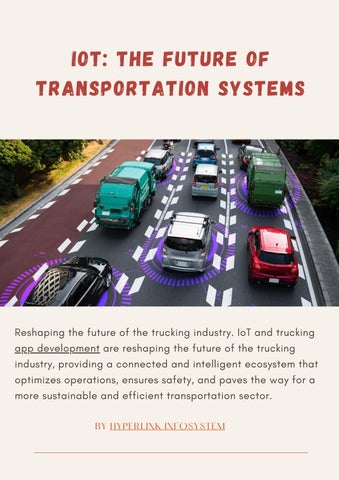
Reshaping the future of the trucking industry. IoT and trucking app development are reshaping the future of the trucking industry, providing a connected and intelligent ecosystem that optimizes operations, ensures safety, and paves the way for a more sustainable and efficient transportation sector. BY HYPERLINK INFOSYSTEM
How IoT is Changing the Future of the Trucking Industry Security First The fact that autonomous cars and AI-driven trucks are safer for everyone is the strongest justification for their introduction. Long-distance routes that need continuous, intense concentration and attention present risks to both the truck driver and other road users. Reliable and accurate AI systems lessen the likelihood of accidents while relieving the drivers themselves of some of the stress. There is a recruiting problem affecting the trucking sector. According to U.S. Xpress CEO Eric Fuller, "The driver situation is about as bad as I've ever seen in my career," he told Yahoo Finance. Because it's a difficult profession, fewer individuals are drawn to it. At the same time, the need for haulage is rapidly increasing. More autonomous vehicles will not only improve worker safety but also aid with capacity problems. Currently, human drivers are still required in the cockpit of autonomous vehicles. However, entirely autonomous truck fleets are certainly imaginable in the future as robot systems get better at navigating their routes.
The Importance of Time Geopolitical problems like this are far from the only difficulties confronting freight and haulage at the moment, since market needs are changing swiftly and shipments are increasing in line with those changes. There are around 493,730 trucking companies in America, according to an estimate by the Federal Motor Carrier Safety Administration (FMCSA). Even now, truckers make up the majority of small company owners in the US. Therefore, it becomes vital to track the number of statistics in real time as this business develops. Businesses' fleet managers and truck owners place a premium on factors including the load on the trucks, the time needed for loading and unloading cargo, traffic on the routes, and real-time vehicle tracking. Even now, the bulk of US small business entrepreneurs are truck drivers. These issues have made trucking the top target for those trying to upend the industry, which has had a significant effect on how vehicles function. Like so many other significant enterprises in transition, the Internet of Things (IoT), artificial intelligence (AI), and robotics are guiding the way and providing astounding solutions to everincreasing difficulties.
For the purpose of data collection and communication, IoT has joined a network of actual physical objects, appliances, automobiles, and other goods with sensors, electronic monitors, actuators, GPS receivers, RFID systems, beacons, and so forth.
It has offered a number of potential ideas for the creation of potent new applications and systems in the field of transportation and trucking. It's not difficult to envision the rest of the automobile sector catching up once an AI-driven, long-haul business is established. Unbelievable changes are being made in the trucking sector thanks to IoT-based technologies. They guarantee greater operational efficiency, improved security, and more transparency, all of which eventually result in increased profit margins. Trucks with sensors attached move through various routes and give data to decision-makers at various transmission hubs for insights that aid in getting better results. Here's a closer look at how IoT and AI technology are changing the trucking business and how justin-time logistics can help the sector.
Swiftly, Swiftly! IoT-connected vehicles also assist drivers in doing their duties more quickly and safely, ending the seemingly never-ending lines at petrol stations worldwide and accelerating food delivery and other necessities. IoT relieves drivers of paperwork by electronically informing fleet managers about delivery schedules, loading weights, and other operational data. Additionally, drivers can be made aware in advance of detours, off-duty hours, traffic times, inclement weather, and other pertinent information. They can also receive assistance with troubleshooting when a problem arises without needing to tote heavily used, dog-eared manuals.
Keeping It Fresh Sensitive cargo, such as live plants and flowers or perishable commodities that must be delivered quickly, has long caused problems for the whole business. IoT technology has the ability to autonomously alter conditions for such cargo, such as humidity and temperature. A timely and well-preserved delivery, both of which are essential for continually delighted clients, may be ensured by using the optimum routes, taking into account road conditions, construction zones, and accidents. Customer satisfaction has already grown as a result of the capacity to track individual products in the home package delivery sector (UPS and FedEx). Advances in AI and IoT will make it possible to use the same capability in commercial transportation.
This company more than any other needs all the trust it can muster to ensure a long and prosperous future. Every second counts in terms of logistical success rates due to the growth of just-in-time and last-mile delivery services. Robots have already achieved considerable advances in efficiency and time-saving techniques, whether they are working with humans in warehouses or independently and totally automated.
Unlimited Potential Without a doubt, robots, IoT, and AI have already enabled and will continue to support disruption in the trucking industry, assisting business owners in saving time and money while remaining on top of a fast-evolving and sometimes unexpected market. The technological advancements that are data-driven and tech-focused have sparked the present digital transformation in transportation. All signs point to the industry serving as a leading indicator for the development of automated transportation and logistics. Even if many of the technical breakthroughs envisioned for the trucking sector are still in their infancy, it is evident that the industry has reacted favorably and has been fast to accept the most recent IoT innovations.
Helping Enterprises Benefit From IoT Via Mobile App Development
Conclusion IoT and trucking app development are reshaping the future of the trucking industry, providing a connected and intelligent ecosystem that optimizes operations, ensures safety, and paves the way for a more sustainable and efficient transportation sector. Trucking app development, facilitated by expert app development companies and mobile app development companies, plays a pivotal role in leveraging the full potential of IoT for the trucking industry. Companies willing to embrace these technologies, hire app developers, and invest in IoT-powered trucking apps are positioning themselves at the forefront of the evolving industry landscape.
Contact Information For any questions or clarifications, please reach out to Hyperlink InfoSystem: Phone: +1 309 791 4105 Email: info@hyperlinkinfosystem.com Website: https://www.hyperlinkinfosystem.com