11
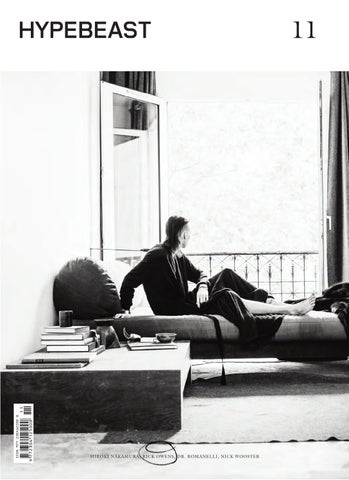
HIROKI NAKAMURA, RICK OWENS, DR. ROMANELLI, NICK WOOSTER
ISSUE 11
RESTORATION
PUBLISHER Kevin Ma CREATIVE DIRECTOR Jörg Haas MANAGING EDITOR Alexander Lendrum EDITOR Cody Horne DESIGN Number 04 –JP Haynie –Davis Ngarupe number04.com CONTRIBUTING EDITORS Arthur Bray Josh Davis Eddie Eng Petar Kujundzic Ambrose Leung Arby Li Robert Marshall, Jr. Daniel Sandison EDITORIAL ASSISTANTS Ashleigh Kim Hasse Lemola Clarance Leung Gavin Yeung Helena Yeung EDITORIAL INTERNS Michelle Lee Laura Ng COPY EDITOR Peter Suh GUEST EDITORS Kandice Che Gary Warnett Joy Yoon
ADVERTISING Carolina Benavente Gems Ip Joyce Kan Huan Nguyen Josh Parker Tiffany Shum Stephen Yu SPECIAL THANKS George Bamford Michael Banovsky Josh Bonifas Stanley Cheng Kenneth Deng Taren Dolbashian Chris Gibbs Kazuya Hisanaga Naoyuki Inoue Takahiro Ito Luke Mayes Mark McNealy Haruchika Mitsui Osamu Onuma John Pangilinan Charis Poon Andrew Pulig Richard Weston Kate Yeung Fetisch Shriro (H.K.) Ltd. CONTACT magazine@hypebeast.com 12th Floor 10-16 Kwai Ting Road Kwai Chung Hong Kong PRINTING Asia One Printing Limited in Hong Kong All Rights Reserved. ISSN 977-230412500-0 HYPEBEAST.COM
010
FEATURE
011
ISSUE 11
RESTORATION
EDITOR’S LETTER
015
DR. ROMANELLI
026
NICK WOOSTER
036
RICK OWENS
048
IN LOVE WITH PLACES...
072
NUTS ART WORKS
098
THUNDERS
106
VISVIM
120
ISSUE 11
012
TABLE OF CONTENTS
LEN HIGA
132
FILSON
142
SSSI
152
AFSHIN BEHNIA
166
VINTAGE ROLEX
180
THE MA-1 FLIGHT JACKET
190
GUIDE: DOWNTOWN LA
206
DIRECTORY
220
RESTORATION
013
ISSUE 11
RESTORATION
014
EDITOR'S LETTER
HBM#11-Editor's Letter
EDITOR'S LETTER
When I joined HYPEBEAST Magazine a little over a month ago, I could only imagine where this road would lead me, us as an editorial team, and consequently this issue. With our “restoration” theme set, the possibilities widened over many transcontinental conference calls. An array of features, interviews, styling shoots and product highlights, as well as potential contributors, reached challenging proportions. Even though my professional work has taught me to always factor in a fair share of “wishful thinking,” I was pretty confident that we would manage to produce a good number of these stories. What we actually achieved, thanks to the help of so many highly motivated people, exceeds my own cautious expectations by far. You have already seen the cover and I'm assuming there is no need to emphasize how exciting it was for us to get Rick Owens on board for our featured story, with an accompanying styling shoot at the acclaimed designer’s home in Paris. This was one of many stops on our global expedition that took us from LA to New York over to London, Berlin and Tokyo. We traveled the globe to gather insights from a wide range of people with diverse cultural backgrounds, examining the concept of restoration in a wider context. We explored the idea of renewal – on artifacts from the past, or reviving old, yet still valid concepts in art and design, adapting them for the present and conserving them for the future. Personal accounts are what we value and as you will see, we found just the right people to discuss our subject with. There are a few familiar names such as Dr. Romanelli, Nick Wooster and Hiroki Nakamura, as well as some folks who have worked tirelessly behind the scenes, connecting the dots between cultural mainstays in their own unassuming ways. With all of them we touched upon very personal experiences, great anecdotes and received equally captivating photos to illustrate these narratives. Now is the time to turn the page and do a bit of exploring yourself. Enjoy your discoveries and our new layout with a few graphic novelties along the way.
Jörg Haas Creative Director
015
ISSUE 11
RESTORATION
DRX "FELIX THE CAT" LAB COAT
The king of customized designs returns with another fetching rendition for 2015 fall/winter. Looking again at Felix the Cat – a mascot of pop culture which first came to popularity in the 1920s – for inspiration, the Lab Coat is reconstructed from T-shirts and fleece, and features artwork from ERMSY. Romanelli commissioned the Paris-based artist to illustrate cartoon renderings of the troublesome feline across the coat’s front panel, where Felix is found hanging off the coat’s lapel while also running in vicious circles. Priced at $1,250 USD, the limited edition "Felix the Cat" Lab Coat is available exclusively from Opening Ceremony.
016
FEATURE
017
ISSUE 11
CHRISTOPHER RAEBURN “REMADE” BOMBER
RESTORATION
Following the release of a bomber jacket constructed from reclaimed German military snow camouflage ponchos, Christopher Raeburn unveils this vibrant and utilitarian iteration of the classic menswear staple. Part of the 2015 fall/winter ‘Raft’ collection – and the London-based designer’s continuing REMADE series – the bomber is constructed from a life raft and is endowed with reflective paneling and grosgrain handles, while also being emblazoned with the original warning lettering. Crafted in England and limited to 50 individually numbered pieces, the jacket retails for $1,080 USD.
018
FEATURE
019
ISSUE 11
RESTORATION
BUNNEY “ALPHABET SERIES” & “ZODIAC SERIES” PINS
Bunney is a London-based jewelry brand founded in 2009, and has cultivated a following for its beautifully simple silver pieces. Made in various workshops around England, including the iconic Jewellery Quarter in Birmingham, the items boast a nostalgic warmth of something restored to all its glory. Offering subtle personalization, Bunney’s “Alphabet Series” pins are hand-engraved in a traditional English typeface. Available in both 23mm and 34mm diameters, the pins are comprised of sterling silver and are exclusive to Dover Street Market Ginza and London respectively. Its “Zodiac Series” features classic woodcut style horoscopes upon 23mm sterling silver plates, intricately hand-engraved to the most minute detail and available at select stockists worldwide.
020
ISSUE 11
HASSELBLAD 503CW MEDIUM FORMAT CAMERA
RESTORATION
Swedish company Hasselblad has been making 6x6 medium-format film cameras since the late ‘50s, and its last iteration is this: the 503CW. Originally released in 1996, the 503 is a fully mechanical camera – no batteries are required for it to function. The modular body allows for nearly all components to be interchangeable; lenses, film magazine, even the waist-level viewfinder can be swapped for a more modern viewfinder at eye-level. These days Hasselblad have introduced digital models of their 6x6 medium-format formula, but classic models like the 503CW or the 500CM before it, if found in excellent condition, are still highly coveted by collectors and professional photographers alike.
022
ISSUE 11
VISVIM MINIE HUNTING JKT “DMGD MOLESKIN” INDIGO
RESTORATION
Although the MINIE HUNTING JKT itself is not that old, the jacket is full of functional artifacts that have served their purposes for over a century. It’s not the 100% cotton shell, hemp-blend corduroy collar, Riri zippers, wood buttons or reinforced panels that make this jacket. The story instead lies somewhere among the array of pockets – the “poacher’s pocket/pouch” to be exact. This large pocket was used decades ago by hunters in England to store small game. As poaching is illegal, the hunters could easily sneak past estate gamekeepers by way of this secret compartment, and to prevent any suspicion due to a saggy jacket, these poaching pouches were supported by straps anchored to the armpit and back seam. In the case of the MINIE HUNTING JKT, strips of linen run down to the poacher’s pocket and are secured with quick-access brass clips. Although most likely the least used pocket in the jacket, it receives its share of commendation for simply keeping the story of an expendable and overlooked pocket alive.
024
ISSUE 11
THE RESTORATION ISSUE
RESTORATION
026
INTERVIEW
Finding New Context WORDS BY ALEXANDER LENDRUM
For many mad scientists – or perhaps the more popularly known Dr. Victor Frankenstein – the act of dissection, experimentation and reconstruction is what satisfies the heart of their passion. That desire to understand where something came from and what further potential it has pulsates through their veins in a way many may never come to experience. Curiosity is human nature, however it takes a certain level of drive and focus to build a career from it.
DR. ROMANELLI PHOTOGRAPHY BY JA TECSON
027
ISSUE 11
RESTORATION
Californian native Darren Romanelli was born with the same geist as the mad scientists we hear about. Without truly understanding – nor needing a reason to – Darren found a deep desire to explore his interests to the nth degree; to anatomize, analyze and reimagine a project. During his years in college, Fashion played the muse for his fascination, and from then on, Darren Romanelli came to be known as “Dr. Romanelli,” subsequently naming his brand the abbreviated “DRx” in 2000. Through his brand, Darren worked on projects which allowed him to delve into a myriad of fabrics and garments from other brands, and through collaboration, he singlehandedly crafted new pieces that can be argued as an elevated product; the best pieces from several merged into one coherent item of style. Adjacent to his passion for breaking down and building up new narratives for clothing, Darren also had a thirst for coffee. On top of that, he also loved the idea of creativity, so he put the two together in 2012 to create The Pancake Epidemic, a café and creative safe haven that started off as a place for him and his staff, but quickly developed into a think-tank sanctuary for family, friends and likeminded others. His official pursuit for creativity came 11 years before, when Darren helped start the network agency StreetVirus. Operating as a marketing hub that seeks out the perfect match of tastemaker and brand, StreetVirus offers the tools needed for creative exchange which serves as somewhat of an extension of the doctor himself. Darren Romanelli’s love for in-depth exploration and creativity inspired our own deeply vested interest in the same two things, which is why we sat down with him at his office in Los Angeles to do a bit of dissecting ourselves. We wanted to open up Darren’s head to better understand his personal reasoning behind what he does, why someone finds interest in seeking out his own version of something already established, and what he personally gains from doing so. In our bid to figuring out how his mind works, we were able to piece together an interview that describes a man with the utmost sense of curiosity, with a little bit of madness thrown in.
AL
DR
Starting from the beginning, where did the act of repurposing fabrics originate from? Why do you find it interesting? It sort of just happened. Creating original gear for myself was appealing to me in college, and I was intrigued by the idea of recycling and remixing fabrics; the unknown of what the future will hold. I’ve always had this fascination of playing with storytelling. Reinterpreting, deconstructing and resurrecting these fabrics gave them new context. Has your initial approach to new projects changed over the years? How so? Can you describe how you used to creatively explore a project to how you do so now? In the beginning, I was figuring out who I was as a creative, trying to absorb as much as I could. These days, my approach is more structured. The project incubation stage is incredibly layered, and more effort goes into the planning process than I could have ever imagined earlier in my career. The truer I am to my gut and my intuition, the better the project turns out. I’m finding my best creative work comes from a place of being inspired. In understanding the way you work, how do you envision whether certain materials, colors or styles work well together? What goes on in your mind when you start off with multiple items/fabrics to work with? That’s an interesting question, because for me, when I’m going into a collection, I’ll have existing piles of vintage pieces that I’ll pull inspiration from. Usually there’s an anchor piece to carry each creation – or a main textile in my eyes – then I accentuate it with different pieces of vintage and leather, which come together in the midst of designing. It’s hard to describe, but usually I’ll envision in my head how everything will piece together once it’s laid out. So why do you research and destroy, to then rebuild? What’s the mentality behind this? I’m a collector. I’ve always collected things my whole life, whether it was Air Jordans or 501s, art, watches, books, clothing, Grateful Dead memorabilia. There are so many things that I’ve personally enjoyed the process of collecting. Having a goal, looking for it, collecting it, finding different variations, to me, that process is so important. The idea of destroying that collection, whatever it may be,
028
INTERVIEW
029
ISSUE 11
RESTORATION
030
INTERVIEW
ander Pincus’s Atlantic Yachting business. It was a challenge to clean, cut up and reconstruct the material – some dated back to the late ‘80s – but I was drawn to the idea of it being distressed by the sun and sea. I pulled inspiration from its initial life as a sail and made a blazer short suit and a backpack with sheer striped lining. What do you currently find most challenging for you? How does it compare to what you used to find most challenging earlier on in your career? Time. More than anything, there’s just not enough time. I’m presented with so many great projects and opportunities that I have to be selective and smart about what I take on, since I want to have time for my kids and time for my brand, DRx. Moving to the bigger picture of what you do, you have a lot of inspirationally creative ventures under your belt, from the Romanelli brand to the marketing agency StreetVirus to the creative house The Pancake Epidemic. What does it mean to you to be “creative?” To me, being creative is tapping into your inspiration on the daily, going deep and almost getting lost in it. It’s the idea of recognizing your creativity, getting to know it and building with it. It’s what I chase everyday: that rush of locking in. At TPE, we’ve created a safe place to be creative. Whether we’re rotating the art collection, working on playlists or enjoying coffee, I’m inspired and I like to think my staff are inspired. There’s a feeling everyone can tap into here at the office; you’d be surprised how authentic the creativity feels to us as an agency. I look at what Eames built with their office in Venice way back in the day. It was such a unique environment, and I remember reading about it and being inspired by how there were no boundaries behind their approach to chairs. They embraced ideas. We’re the same way with how we approach branding and storytelling. Talk to us about StreetVirus and how it connects influencers and tastemakers alike with brands to rejuvenate their image, making them relevant to consumers. I always talk about the moment of impact – being able to research what consumers are wearing at that moment, what they’re drinking, what they’re listen-
then reimagining it, recycling, and reintroducing it; I love it. I like the notion of before and after, experimenting and deconstructing something that involved so much time and energy collecting. There’s that mad Frankenstein element that goes into my approach to projects and products. I approach life with a very similar curiosity and determination. Before, DRx Romanelli was specific to clothing or products, but now it’s more about space as a whole and personalizing environments. I like to think of myself as an alchemist: I take a room at the agency and turn it into a lab experiment. Having worked with numerous brands, talk to us about the process behind going into the archives, breaking apart products and tapping historic items to rebuild them, and the reward/satisfaction you gain from doing this. There’s something attractive about working with a brand that has over 100 years of history. The research phase is intensive so there has to be passion from day one. There’s something to be said about journeying into a company’s archives, deconstructing its identities, seeing how something is so classic yet disconnected, but with the right recipe, can be so relevant again. To me, that process and dialogue is interesting. What are some of your favorite brands and materials to work with and why? It usually boils down to vintage military for me. The distress, the wear and tear, and story behind it is amazing. I’ve always loved denim, specifically Japanese Boro and vintage Levi’s. You can tell so much about someone’s personality from the jeans they wear: the natural distress, where the fade stems from, and the aging. It’s so interesting to me. Whether it’s Levi’s or Carhartt, there’s so much history there. I’m fascinated by the iconography as well. I’m also drawn to vintage sport as a whole: vintage ski apparel, old jerseys, vintage Nike, Coca Cola streetwear, early Polo, COMME des GARÇONS, visvim and Double RL. From all of your projects, what is the most unconventional repurposed fabric that you have enjoyed working with? What was its history? Nick Wooster invited a handful of designers to create capsule collections for PROJECT WOOSTER, and I sourced a bunch of old sails from Captain Alex-
031
ISSUE 11
RESTORATION
032
INTERVIEW
033
ISSUE 11
RESTORATION
034
INTERVIEW
ing to, and what art is on their walls. I don’t think we set forth to do what we do, it’s something that came organically from our practice as marketers and branders. What we’ve created here is a little pocket of culture and we’re super protective of it, constantly developing it, and pushing ourselves to pull off challenging projects. From this approach, an electricity is formed, a dialogue, that to me is invaluable – authentically attracting tastemakers. This creative exchange is what’s critical for me to keep the energy relevant, especially to me living in Los Angeles. The city is bubbling right now and we’re in for a big chapter here with the arts. We couldn’t be exploding at the seams at a better time. It’s the perfect setup for us to really do important work. For DRx, why are you drawn to the medical aesthetic that you incorporate into a lot of your work (even your name)? Everyone called me “Dr.” growing up because of my initials. It was a natural fit and I ran with it. I liked the idea of prescriptions working as collections. It sounds cliché but performing surgery on vintage clothing, resurrecting them and bringing them back to life, the medicinal side of fashion to me sounded very relevant at the time. I don’t tap into it as much as I did, but there’s still something interesting to me about a medical aesthetic. How is The Pancake Epidemic doing? How important has its space been in bringing creatives together and inspiring them to come up with ideas/creative opportunities? Initially, I created the space to inspire myself and my employees. We began to invite people to stop by. People invited their friends and it spiraled into this weekly Friday coffee grinder. We did it religiously every Friday for a year, but it’s more sporadic now. It was never meant to be a think tank, more an idea to craft a space for my community, which was the perfect fusion of contemporary art, brands and coffee. That’s been the mix. When we began, there wasn’t an outlet to be creative and connect, especially in LA, so it’s a great way to break bread each Friday morning and spark dialogue among my friends. What are you currently learning about? For me, I’m learning about being more present. Being more aware of my surroundings instead of getting
lost in the vortex; I’m stepping out and observing it. Before, I’d get lost more and more in the moment – now I can better flow with it, I’m more aware. Simplifying what’s happening around me. Are there any future ventures that we can look forward to from you? Pancake Epidemic 2.0 is popping off in the fall. It’s going to be a consumer facing café and its location will be announced soon. We’ve also been working on reintroducing Felix the Cat for DreamWorks and I have a DRx Romanelli x Cali Thornhill DeWitt release at UNITED ARROWS with Poggy, as well as an upcoming collection with SURFER Magazine.
035
ISSUE 11
RESTORATION
Words by JOSH DAVIS
Photography by OLI MCAVOY
The Irony of Being Nick Wooster
036
FEATURE
Despite the precision of his groomed mustache, the tactical swoop of his iconic pompadour, and his perpetually clenched jawline, Nickelson Wooster would much rather be called “Nick.” Well, it’s hard to know what to call Nick in terms of titling; he’s something of a sartorial cascade flow. From his beginnings in advertising over 30 years ago, he’s been the clothing buyer at Barneys New York, the fashion and design director at Neiman Marcus, and consistently, an effigy of suave street style for a generation of menswear. Maybe that’s why at this juncture, he refers to himself as something of a “free agent”; confined to neither high fashion nor vintage tastes, but roaming freely through aesthetics until he finds something that fits his vision. “I mean the reality is that at this stage of my life – and not planning it in any shape or form – I found myself interested in working with a variety of different people. So I’m not tied down to any one particular thing,” he confidently noted.
037
ISSUE 11
RESTORATION
This perspective is necessarily tied to observing fashion’s often dizzying consumption rate. We know there is a tendency for fashion labels to devour street-level aesthetics – dropped crotches, allover logo T-shirts, red-murdered footwear – until they are tired. And, as we also know, fashion steps over tired trends as if they never existed. What Nick understands, firmly, is that in a volatile, rapidly changing industry, personal fashion must be dependent on staples. Staples can range from various patterns to silhouettes, but are all tenacious; they work in any situation, over time, forever. That’s where Nick Wooster comes in: he is a great restorer of things; a trendsetter with a secret recipe of flipping classics into conspicuously refreshing items. Nick’s résumé is comprised of various projects ranging from footwear to full-on tailoring. Within these though, he believes that everyone’s wardrobe should be based around dependable items and color palettes. What Nick deems as “classic” is actually quite specific: “In order for anyone to have what I would call a good or a useful wardrobe, [they would] have to start with basic building blocks. For me, that’s things like dark navy or grey suits, brown and black wingtips, a perfect crocodile belt, [the] right kind of bag…” he mentioned before listing off a pea coat and camel coat for good measure. “Once you have all of those basics covered, then you can layer on whatever you want. Because at the end of the day, trendy items are going to come and go.” According to Nick, there are also “new” classics, such as Rick Owens’ seasonal drop-crotch shorts or Common Projects’ low-top trainer. This tells us that while Nick believes in a certain standard precedent, none of the essentials are restricted to old-school producers. In Nick’s own work – take his recent collaborations with Lardini, GREATS Brand and UNITED ARROWS – he collages iconic motifs, cleverly reworking a pattern here, a silhouette there, until it’s something unrecognizably more. The UNITED ARROWS collaboration is emblematic of this: the collection is centered on the bright blue and grey seersuckers. The two colorways, while under the same umbrella, clash across trousers, blazers, and a pair of slip-ons. It’s radically disparate, but that’s the point. “When those kinds of things are paired with something different, [it gives] it new light.” Nick doesn’t want to be matchy-matchy; essentials coordinate themselves. All this talk of seersucker shorts, both navy and grey suits, crocodile leather belts, and pea coats as mere “building blocks” might conjure thoughts of a lengthy receipt totaling someone’s mortgage. And, given his taste, one might imagine Nick’s portfolio of work to be encased in full-grain Italian leather and hand bound with fine silk threads. However, Nick is also the first to contend that he reveres luxury as much as price-point pieces – for him, it’s all about context. As with materials, he explains that silhouettes themselves should be matched according to their function: “I believe that something is better than nothing,” he mentioned, minding his Midwestern 038
FEATURE
039
ISSUE 11
RESTORATION
040
FEATURE
041
ISSUE 11
RESTORATION
sense of modesty – it hails from Salina, Kansas. “I think it’s good to buy low and buy high,” he continued. He went on to make an example through footwear. “You could buy $400 USD Common Projects leather sneakers ‘cause they’re beautiful. But, sometimes the $59 USD Vans canvas version is cooler to wear with something more expensive. So the canvas sneaker takes on new meaning when it’s paired with something else.” That’s somewhat gracious coming from Nick, who’s sometimes called WoostGod, here revealing himself as a relatable purveyor of all things “cool” – be that high-end or fast fashion. Despite this pragmatic approach to dress code, make no mistake about Nick’s affinity for the finer things. To him, it’s not that luxury pricing makes the clothing quality, but he recognizes that many good things happen to be priced higher. A huge part of this discussion involves materials. While obviously having an encyclopedic knowledge of material swatches, Nick relies on a citable set of fabrics: fox flannel from the oldest mills in England, Harrison Tweed, seersucker and Horween Shell Cordovan are among them. “Those fabrics will last in your closet way longer than any of the other new angled, technical fabrics,” said Nick. “If you are discerning about what the materials are, I believe you can get longer utility out of them.” This ideology is familiar which ties back to Nick’s notions about practicality –
042
FEATURE
the high-quality piece will ultimately return its value over the course of the years. “To me, that’s how clothes and materials are interesting, because they can go through all the cycles of fashion, [then] get pulled out 30 years later and be cool.” Having items in his consistent rotation from three decades ago is an impressive testament to Nick’s ability to pick out timelessly relevant pieces. It’s also a sheer feat of experience. We can trace this back to around 1982, when a young Nick graduated from Kansas University and moved to New York City. His Bachelors in Journalism translated to a career in advertising, but was traded in for a more junior position as an assistant department manager at Saks Fifth Avenue. From there, Nick moved over to Barneys to assume the role of assistant buyer. You could say that Nick cut his teeth during these formative years, but given his notorious wanderlust, it’s hard to pinpoint exactly which experiences transformed him from a Midwestern would-be reporter to the renowned sartorial icon that he is today. We get the feeling that this eminence precedes Barneys, Saks, or even Kansas University; Nick might’ve just been born with taste. Definitively though, Nick learned to revere his elders somewhere along the way. This plays directly into his affinity for the practical classics, in that Nick both senses and understands the value of time’s natural
043
ISSUE 11
RESTORATION
044
FEATURE
045
ISSUE 11
RESTORATION
046
FEATURE
passage. He cites COMME des GARÇONS founder Rei Kawakubo and Chanel and Fendi head Karl Lagerfeld as examples of longevity. “The reason they are able to do what they have today is because they have surrounded themselves with young, creative, interesting talent,” he reflected. The relationship between the future and the past is intimate – almost indiscernible – to Nick Wooster; he’s a believer in small egos on both ends. This means on a personal level as well; “Why [are] young people interested in me?” He petitioned in our conversation. “I don’t get it.” Self-deprecating as he may seem sometimes, Nick is also confident in his vision for the direction of men’s fashion. His rule of thumb? “The reality is you adapt or die,” he says bluntly. Having seen the rise and fall (and rise) of a myriad of fashion companies, Nick argues that brands must consider the consumer first in order to remain relevant. Like good leather or a well-worn pair of denim jeans, brands too must change (subtly, in the best case) as they mature, adapting to their target wearers. “What are the ultimate things that will resonate with your audience?” he posited. “[This has] to be considered first, and it’s really like trying to get into the head of – and surrounding yourself with – the people that are the audience.” At the time of our conversation, former Club Monaco design lead Aaron Levine had just left his post at the Ralph Lauren Corporation’s retailer to head up menswear design at Abercrombie & Fitch – which was at the time enduring a loss period that saw it publicly trading at a historic six-year low. Former CEO Mike Jeffries arguably hurt the brand’s already fragile, static image when Business Insider unearthed Jeffries’ comments that Abercrombie was only meant for “cool kids – the attractive all-American kid with a great attitude and a lot of friends.” These sentiments, in conjunct with the brand’s refusal to produce sizes above large until 2013, cut out Levine’s work. The aforementioned changelessness is exactly what Nick believes design teams should avoid. He cited Levine as the proper man for the job: “He’s one of the people I respect the most in this business today. I think he’s got a big task ahead of him but if there’s anyone capable of doing it, I would put my money on him.” Levine’s sense of adaptation, which saw Club Monaco rise successfully during his four-year tenure, is emblematic of Nick’s own design principles. Again, for Nick, authenticity trumps all. “[For example:] I don’t skate, but if I were to do a skate line I would talk to my friends who [do]… I think that many brands and many people still have this misconceived idea that they can dictate [what’s] going to be [cool].” Through reliance on classic materials, Nick Wooster reinvigorates the paradigm of silhouettes, while also representing a new wave of thought for business models in the future. As a tastemaker that turned 55 in 2015, Nick has mastered the formula for creating hits. Setting new trends is easy – you just have to use the past.
047
ISSUE 11
RESTORATION
Rick Words by JOY YOON Photography and Styling by OWENSCORP
Owens What is He Selling and Why Are We Buying? 048
FEATURE
049
ISSUE 11
RESTORATION
050
FEATURE
051
ISSUE 11
RESTORATION
CHANGE. It creeps or forces its way into our lives in many forms. At times, it is hard to embrace, often pushing us beyond our comfort zones, but it dictates everything in some way or another. Avoiding it suggests the absence of creativity and the inability to progress. To quote French author and Nobel Prize winner, Andre Gide, “Man cannot discover new oceans unless he has the courage to lose sight of the shore.” In fashion, season after season we are at the mercy of change. Designers wrangle with the preferential shifts of colors, silhouettes and hemlines in an attempt to capture the essence of the au courant and the attention of editors and critics – most importantly, the consumers. However, not all designers are created equal, and Rick Owens’s notions of change are disparate to that of the industry. He focuses on consistency, an extremely anti-fashion ideal. His collections marginally deviate from one season to the next, giving them an aura of timelessness. He shuns the dogmatic beliefs of rapid transformation and approaches his alterations with tact and thoughtful precision. For some, to be constant is to lack vision, resulting in stagnation and breeding creatures of habit. But when the biggest creature of all just happens to be Owens, you soon find that his perception of change spotlights his unconventional beginnings and universal appeal. Rick Owens grew up in a small town in Central California with his parents – John and Connie. From an early age, his father force-fed him a controlled diet of classical literature and music, art, philosophy and religion, exposing him to “things he couldn’t grow out of.” Owens’ sheltered existence led to his alienation amongst his peers in conservative Porterville, and would remain one of his core memories in life. After high school, he moved to Los Angeles. “LA was the closest big city,” says Owens. “Moving to New York would have been overly ambitious, and Paris was as much an option as the moon.” Heavily influenced by conceptual artist Joseph Beuys, he studied fine art at the Otis-Parsons Art Institute. However, after two years he dropped out to pursue pattern-making, “a learnable craft,” at a trade college. His decision to leave, influenced by self-doubt, caused him to second-guess “the intellectual rigor and imagination” art required. This overestimation also led to an error in regards to the advantage of the whole
schooling progress. “The community you create influences your direction later… I’ve always wanted to be the heroic loner dedicated to my craft and rejecting connections. But now I’d probably be a parent who wanted my kids to be in the best schools with the best opportunities,” he says. “Nevertheless, I’m glad I picked fashion – it might be more hardcore.” Upon completion, Owens found himself knocking off well-known fashion designers in factories around the city. An ironic turn of events considering how much counterfeit Rick Owens there is. “It delights me when I see that I infected the world in my small way,” he says. A few years later, he would accept a job cutting patterns at a sportswear company owned by Michèle Lamy. Lamy would become his employer turned lover, and transition into his best friend, muse and wife. She would be Owens’s catalyst, and their relationship, much like his time spent in the knockoff business, would be instrumental and formative. Following a natural progression, presumably influenced by his mother – a gifted seamstress – Owens transitioned into fashion design. However, he quickly dispels this notion. “Mothers didn’t teach their sons to sew in my family,” he says matter-of-factly. “I must have learned through osmosis.” And in 1994, he designed the first collection of his eponymous brand – which would be revered for its hard-edged softness – in his bedroom at the Chateau Marmont. It was quickly picked up by one of the most pioneering retailers in Los Angeles, Charles Gallay. Soon Maxfield and Barneys came calling, then Vogue. “It was André Leon Talley who saw my clothes in the windows at Henri Bendel in NYC,” recalls Owens. “He found my number to arrange an appointment to show my clothes to Anna Wintour.” In 2001, Wintour proposed the idea of a fashion show, which Owens “semi-reluctantly” agreed to do. “My hesitation was about exposing my very narrow aesthetic to the voracious appetite of the runway arena – I knew that doing one show meant doing them for the rest of your life,” he says. “If you do just one and stop, you end up looking like a loser. So I thought what the hell, you only live once and jumped in.” During this time, Owens’s business also faced a significant change. It had grown too large to continue producing in his home studio. However, instead of selling his company to a fashion conglomerate, which was de rigueur, he
052
FEATURE
053
ISSUE 11
RESTORATION
054
FEATURE
signed with EBA, an Italian sales agency – a decisive move that would secure his future independence. Shortly after winning a CFDA award, Owens accepted the role of Creative Director at Révillon Frères, a centuries-old Parisian fur company. In 2003, he relocated to Paris with Lamy, “hell-bent on making it work” and successfully “knocked the stuffing and the stuffiness out of furs,” according to fashion critic Suzy Menkes. Although he left when the company was sold in 2006, the time he spent there was invaluable. “I didn’t realize how significant my Révillon gig was until later,” says Owens. “I didn’t realize that it would give me a different kind of credibility within the fashion world.” With his duly earned credibility, Owens, along with Lamy, now own and operate their multimillion-dollar company – OwensCorp, which has increased its revenue by 200% in the last five years. He does not employ marketing, has never advertised; he does four shows a year, and his clothes do not react to trends, yet he manages to captivate the global markets like no one else. How? To understand Owens’s brand and its progression is to appreciate Owens and his fundamentals. To analyze them is to delve into the world inhabited by freaks and weirdos; luckily, I’m one of them. For Owens, each road traveled highlights the abnormality of his less-than-conventional yet inspirational career trajectory. Owens’s challenging upbringing and his father’s cultural teachings became the foundation that would influence everything in his world. It instilled within him an appreciation and contextualized understanding for the classics, and a desire to learn and grow. His “sensitive” nature would also form a fascination with male dominance, aggression and heroic desires. His prolific overindulgence in drugs and alcohol with Lamy was markedly poignant. Brought about by an equal mixture of shame and his earliest recollections of rejection, it spawned a fear within him. The combination, aided by drugs and drink, nearly pushed him over the edge. However, he found salvation and rebirth with Lamy’s suggestion of going to the gym – replacing chemical highs with endorphins. His sobriety and the shift from Gallay to Maxfield coincided with a change in the quality of his fabrics, moving into more high-end pieces and labyrinthine designs. This vast visual disparity against the jean-centric landscape of Los Angeles allowed him to penetrate its
laid-back fashion sphere, garnering the attention of the global fashion community. Each of Owens’ steps, from the past to present, echoes that of the Noble Eightfold Path. Admittedly this is a leap considering he is not remotely religious. Hypothetically speaking, as he was taught Buddhism as a child, Owens’s life has thus far followed the cessation of suffering and the achievement of self-awakening. By unwittingly going down this path, Owens – to some extent – embodies the right view, right aspiration, right speech, right action, right livelihood, right effort, right mindfulness and right concentration. He comprehends the knowledge of aging and death, the ending of good and bad. He fully accepts the wretchedness and self-destruction of his former life, embracing its decay, desolation and destitution. He cultivates self-control and mindfulness and through growth has ended cravings for the unnecessary. He does not cling, and has let go of being something he is not. Owens also avoids preventable disorder, hence his palette choices. “When I look at the world, I see a lot of clutter. Colors just become banal or sentimental to me. A lot of color just reminds me of a supermarket,” says Owens. “But that’s just me – maybe I’m just not dynamic enough to withstand a lot of it.” Owens’s vision is singular, and his dedication is unwaveringly Zen. His notoriously strict regimen of work and exercise also acts as extra assurance of his character. Although he’s more monk-like in action rather than actuality, Rick Owens is fashion’s unofficial spiritual guide. His cultish fans, dubbed “fashion monks” even follow an ethos they’ve imagined rather than what he has created. “Well, I put it out there,” he says. “I wanted to suggest restraint, modesty, self-acceptance, tolerance, self-improvement – and if just the slightest hint of that was absorbed and re-released, that’s not such a bad thing.” His reality is “a private utopia that is an aesthetic ideal,” of his creation, yet, over time, his tastes and philosophy have become our own. Beyond the acceptance of his draped drop-crotch shorts and distressed leather jackets, people have adopted his consistency. “It’s evolution,” says Owens. “The current state of fashion is responding to the moment. Some areas of fashion became something else and don’t feel right anymore, while other elements are starting to surface as we speak.” We’ve seen this change in his
055
ISSUE 11
RESTORATION
056
FEATURE
open heart makes everything more beautiful.” It is this appreciation of the imperfect that is also evident in his waxworks. Their presence in his stores is a poignant reminder that this is “a very personal expression by a self-invented monster.” Hip-hop and shifting views towards sex, gender and clothes have similarly corresponded in the upsurge in his popularity. Thanks to artists like Jay Z, A$AP Rocky, and Kanye West wearing his gear and dropping his name in their songs, Rick Owens has relevance and access to a wider audience in an untapped market. The ever-growing tribe of Owens has taken his grunge-glamour concept and created subcategories of their own – health goths, streetwear and skater goths, all of which are still unequivocally Rick Owens. And although it’s more than just the clothes we identify with – it’s a particular style and a set of beliefs – wearing them best conveys this ideology. Owens does this on a
“uniforms,” which have moved beyond the confines of high fashion. Rick Owens has morphed into a lifestyle brand, which according to Owens “makes more sense.” Owens’s widespread resonance amongst generations is attributed to his garments’ abilities to tap into our needs without compromise. The distressed nature of his clothes dispels the fear of the new and personifies affection with its worn-in softness. They are purposefully crafted to work with our bodies, eliminating the need for self-manipulation, which is pandemic within fashion. He avoids the traditional and easily defined, instead offering us an experience rather than just a single facet. But most importantly, his clothes do not demand perfection and neither does Owens. “I like proposing things that might not be considered beautiful, but if held at the right angle under the right light with the right attitude, they are,” he says. “I think an
057
ISSUE 11
RESTORATION
daily basis without fail. It is Rick Owens creating Rick Owens, wearing Rick Owens, and projecting Rick Owens. All very Inception. Granted, the fundamentals of Rick Owens may be democratic in theory, but his prices are not. Therein lies the rub. The acceptance he offers feels like a false proposition when faced with the dilemma of buying a $300 USD T-shirt or a $7,000 USD leather jacket. Should belonging cost this much? It is debatable, like all things, especially in fashion’s fake reality, where acceptance is no more real than Owens's straightened, raven-colored hair. But it’s a credit to him when his price tags do very little to abate his appeal. Owens knows what he’s selling; he doesn't deny it. And through the honesty of his clothes – his seams, drapes and cuts – he’s created a special language that communicates with his audience. Maybe it’s because his story isn’t one that becomes obsolete at the end of each season like with other designers. Instead, he grants us the opportunity to be a part of his continuous journey, creating an intimacy that goes beyond posting selfies on Instagram or videos on Snapchat. “You have to strike a nerve with a lot of people four times a year and keep this call and response relevant,” says Owens. “Sure it’s commerce, but it’s also a conversation. I feel like I am participating fully in the world around me and using everything I was ever born with or learned.” Unlike other designers, Owens does not employ mood boards or sketches at the start of each of his chapters. Instead, he begins with toiles (tester copies) of past styles, which he manipulates and studies, corrects and aligns, takes photos of, and sketches over or pieces together. His ability to cut and read patterns separates him from his contemporaries, as he skillfully takes the building blocks of fashion and transforms them. It is an art he has already mastered yet continues to perfect in hopes of finding new combinations of elements that reveal untold secrets to him. He draws inspiration from his mind’s eye to create a reflection of each previous season. He reflects upon his history of damage, the center of his creative output, for direction. Focusing on moments of beauty and despair from before his sobriety – pivotal in his creative development – Owens taps into an emotion that is solely his. This type of insular inspiration could easily be perceived as ego since Owens looks to his work for guidance above all others. But instead it reveals his
desire to study and accept his mistakes, allowing him to appreciate his successes and grow. A part of that success and growth comes from his extraordinary relationship with his wife, Michèle Lamy. Theirs is one forged through the understanding and acceptance of their strengths and weaknesses. They are yin and yang, hard and soft, fear and curiosity. While he demands and expects exactness, she allows room for expression and waits for magic – he’s got the logic, and she’s got guts, but together they are a formidable team. Lamy’s influence on Owens has helped him step out of his comfort zone. However, this in no way makes him a good collaborator. Not with Lamy or his longtime associate and Creative Director of LOVE Magazine, Panos Yiapanis. “Panos and Michèle are people I trust to add a flourish that will always excite me,” he says. “But I’m a terrible listener.” As for staying grounded, according to Owens, his ego gets the best of him every day. “There’s a constant conversation in my head telling myself, ‘Why do you have to be such a cunt,’ and then ‘well, I forgive you for being a cunt,’” he says, which goes back and forth from forgiveness to various levels of realizations of cuntiness and vanity. “This goes on all day… And whenever I read an interview I’ve done I always sound so self-satisfied and douchey.” Regardless of his selfdom, Owens understands the fortuitous nature of his circumstance and takes full advantage of it. He is one of the few designers that has never outsourced production or in-sourced a single design. His is not an atelier system with a team of young designers. Rick Owens is not Chloé, and you won’t find a Phoebe Philo-Stella McCartney situation here. Instead, he embraces the speed and pressures of fashion, rarely succumbing to its exhaustive deadlines, finds balance and purpose in it all, and happily designs every product from every line bearing his name; “I wouldn’t have it any other way.” Even with all he’s accomplished, Owens still asks himself, “Do I really believe in this?” A difficult question to answer when faced with deadlines, momentum and clouded by one-sided assessments, but he does as best he can. “It takes focus and a certain amount of arrogance to say, ‘Fuck it – this is what feels right to me now…’” he affirms with sincere brutality. “I was probably supposed to say something that takes people who buy my stuff more into consideration, but if
058
FEATURE
059
ISSUE 11
RESTORATION
I start thinking about what people want too much, I get disoriented.” This story is not ours and the journey has never been about us – not in the slightest. It is all about Owens and his exercise in purity. With absolute creative freedom, he makes whatever, whenever and whichever way he wants. Isn’t this why we love him? It’s all about his ability to stay on his own path, block out all others, stop questioning and focus on what’s important, and learn from mistakes while maintaining personal indulgences. His unflinching sense of self is what makes him so remarkable and surprisingly relatable. Owens’s job has always been to “ruthlessly ensure each collection evolves in a logical way”– which suggests exactness in all he does, but in the end, it’s still just a guessing game. “I’m going with my gut,” he says. “Wish me luck.”
060
FEATURE
061
ISSUE 11
RESTORATION
062
FEATURE
063
ISSUE 11
RESTORATION
064
FEATURE
065
ISSUE 11
RESTORATION
066
FEATURE
067
ISSUE 11
RESTORATION
068
FEATURE
069
ISSUE 11
RESTORATION
070
FEATURE
071
ISSUE 11
THE RESTORATION ISSUE
RESTORATION
072
FEATURE
Townes: Beautiful, Timeless Pieces INTERVIEW BY MORITZ VON USLAR
I chose the abandoned Berlin Tempelhof airport as the location for this story because it gives me the type of feeling I get when visiting ancient places like the pyramids or Pompeii – lost in time, in space… This place has witnessed drama and joy and stories from many different times. People have traveled to distant places from this harbor of past civilizations. It’s the ideal setting for the selection of beautiful vintage clothes featured in this shoot.
SHOKO KAWAIDA PORTRAIT BY ANDRE ENGELHARDT
073
Photo: SHINYA KATO, Clothing credits—Garment left: JUNYA WATANABE X POINTER JACKET Garment Middle: HELMUT LANG, Garment Right: US VINTAGE 40'S, Hunting Jacket On Chair: YOHJI YAMAMOTO RESTORATION ISSUE 11
074
FEATURE
That is also the concept of my shop Townes: beautiful, timeless pieces from different places; from Tokyo to Paris via Vienna. Yohji, COMME des GARÇONS, Helmut Lang and sometimes label-less pieces discovered and inspired by old masters like [Johannes] Vermeer inside this colossal landscape of stone in the heart of Berlin – a city that traditionally pushes boundaries between male and female.
MvU: Among the three classic Country Outlaws between the years 1968-70 – Merle Haggard, Willie Nelson and Kris Kristofferson – who’s your favorite? SK: Kris Kristofferson. MvU: Was it a welcome revolution when white Converse Chucks broke the dictation of cowboy boots in the world of country in 1969? SK: Yes and no.... to me only real cowboys look cool in those boots. I can't really imagine Willie Nelson running and playing in cowboy boots – that's not happening – but Willie singing the Grand Ole Opry in Chucks? That I can imagine.
MvU: Do you think that Rick Rubin has killed the natural spirit of Johnny Cash?
The Berlin style is people from all over the world wearing jeans and sneakers looking for the next party.
SK: Quite the opposite. He brought out the core of Johnny Cash. Black became darker... something like that – an epic album!
MvU: Dressing with dignity, how exactly does it work?
MvU: What is your message to the bearded men of Berlin Mitte? SK: It’s long enough. When I moved here a few years ago there were many people with big beards, but I haven't really seen big beards in Berlin Mitte in a while now.
SK: Attitude is the key. With attitude you can work pretty much any outfit. MvU: Is Barack Obama the most elegant man on Earth? SK: Yes, he’s definitely the most elegant man on television. Him and Roger Sterling.
MvU: What's worse, a man's suit worn too tight or too big?
MvU: Which song should be played at your funeral? SK: “I Will Always Love You” by Dolly Parton.
SK: Really? Is that so? And I thought I was the only one.
SK: Too tight. A man's suit has to fit! And if it doesn't, I prefer oversized. I like oversized clothes. Too tight is rarely a good idea – and definitely not for a man's suit.
MvU: Musically, are you a conservative?
MvU: What occasions would allow grown men to wear shorts?
SK: Yes, definitely conservative… with an open mind.
SK: The seaside, but not beyond the boardwalk – and soccer of course! Best worn by Arjen Robben.
SK: A Yves Saint Laurent original 'Le Smoking' with a white tuxedo shirt plus black bow tie. I might bring a trunk filled with outfits to change into. I’m prepared for all occasions – you never know, right?
MvU: Why is it that Japanese girls are the most fanatical country fans?
MvU: What words would you choose to celebrate the wardrobe of Dolly Parton? SK: Like trailer truck tramp glamour. I remember she said, “it costs so much to look this cheap.” She is a hustler!
MvU: After five years of living in Germany, is there such thing as a typical German style for you? SK: It seems that wealthy Germans dress understatedly and prefer showing off through their cars.
075
MvU: What would you wear at your own funeral?
Photo Assistant: ALEXANDER MALECKI, Clothes: TOWNES SHOP, BERLIN, Location: BERLIN TEMPLHOF RESTORATION ISSUE 11
In Love With Places I've Never Been To
076
077
078
079
080
T shirt: VAN GOGH MUSEUM, Trouser / Wrap skirt: ISSEY MIYAKE
Dress: CHLOÉ BY KARL LARGERFELD
081
082
Fur Coat: CHRISTION DIOR
Vintage Sequin Cardigan, Velvet Jacket: MAISON MARGIELA, Skirt:YOHJI YAMAMOTO DEVORÉ
083
084
Sheer vest: DESIGNER UNKNOWN, Denim: HELMUT LANG, Tattoos: MARC BRANDENBURG
Skirt: COMME DES GARÇONS, Painted Denim: RAF SIMONS, Shirt: ZEGNA BY STEFANO PILATI, Shoes: ADIDAS ORIGINALS
085
086
Shirt: COMME DES GARÇONS, Parachute Jacket: HELMUT LANG
Wool T shirt: YOHJI YAMAMOTO, Trouser: YOHJI YAMAMOTO
087
088
Dress and Bolero: YOHJI YAMAMOTO, Shoes: ADIDAS ORIGINALS
Sweat shirt: HELMUT LANG, Trouser: COMME DES GARÇONS
089
090
Quilt: RAF SIMONS
White Bomber Jacket: HELMUT LANG, Sheer Shirt: HELMUT LANG, Skirt: YOHJI YAMAMOTO +NOIR
091
092
T Shirt: PRODIGY, Denim: LEVI‘S, Velvet Jacket: COMME DES GARÇONS
Sweat Shirt: YALE UNIVERSITY, Reflective Trouser: HELMUT LANG
093
094
T-shirt: PRODIGY
095
096
Oversized Hand knit Coat: DESIGNER UNKNOWN, Tank: ANN DEMEULEMEESTER
LOOKS
Fashion Editor: SHOKO KAWAIDA Photographer: RONALD DICK
MODEL CREDITS
BENJAMIN, STEFFEN AND AMÉLIE from IZAIO Management
NICOLAUS from NESTMODEL Management
ROBBI G from TOMORROWISANOTHERDAY
NIKO, SASCHA & TOBIAS
097
ISSUE 11
RESTORATION
Bringing the best of both the past and the present has been the mission for NUTS ART WORKS – the eponymously named painter and brand – since it was conceptualized in 1994. “The purpose of a sign is to attract customers to the establishment, which will hopefully allow it to sell things. I personally like to show the store in its best light. Even if the store sign is really nice, there’s no real attraction to the store,” says NUTS. When the sign painter made the voyage from his birthplace of Aomori to Tokyo in 1974, he started his journey in the craft as a hobby. Little did he know that a few friends interested in his passion of drawing would kickstart a studio within Tokyo’s Meguro district. Photography by DAIGO YAMAMOTO
Words by ARBY LI
Nuts Art Works 098
FEATURE
099
ISSUE 11
RESTORATION
While store signs are ubiquitous to the point that you don’t pay any attention to them at times, NUTS ART WORKS has mastered the craft of subtly piquing your curiosity, luring you to investigate the establishment further. NUTS and his team have spent years honing their craft, making everything by hand – from the frames to all the rusting details – which give the signs an authentic vintage look. A lot of the aging techniques used were learned through trial and error to find the perfect method in creating that traditional-looking store sign. As the process goes, depending on the size of the work, the team will use a projector to cast an image on to a blank canvas and go freehand from there. Other times might call for a stencil. The distinct appeal of NUTS ART WORKS lies in evoking memories from the past and tapping into the human nature of preserving things that may look out of place in the contemporary world. Maybe that’s the beauty of it – a juxtaposition between the now and of days gone by; a culmination of the best of both. To achieve this, some of the signs are purposefully done in a somewhat imperfect manner, as if to mimic the styles from previous generations, when techniques weren’t as refined. For Yusuke Takagi of Japanese clothing brand OLD JOE, the appeal for the old-age style was “not only just signs, but anything really from the pre-war era that hasn’t necessarily been manufactured on a large scale. From these pieces, you can really feel the passion and effort that’s 100
FEATURE
been put into it, and it’s almost sentimental. I also like things that were made mid-century, that have a certain modernity to them.” When you think of Japan along the lines of fashion, labels such as visvim, WTAPS and NEIGHBORHOOD will probably come to mind, all of which arguably have a strong penchant for vintage Americana motifs over the course of many years. It should then be of little surprise that they noticed NUTS at an early stage and thus became part of a core group of street-rooted brands that began to collaborate. WTAPS’ Tetsu Nishiyama caught on early when he “was introduced to [NUTS] at a friend’s garage over 10 years ago. His style back then was painting with one shot (paint) but aside from that, I have never seen a painter with his style so it was really surprising.” The natural synergy between the forces is undeniable, and it’s inherently tied by a fascination for past relics. NUTS goes on to reveal that “some streetwear labels like WTAPS and OLD JOE have shown interest in my work, and asked whether they could use my designs for their T-shirts. That’s kind of how collaborations come about and it’s all pretty natural. When it comes to choosing who you work with, I think it’s pretty obvious.” Shinsuke Takizawa of NEIGHBORHOOD describes, “I met them quite a long time ago. I don’t remember exactly when but the first time we worked together, I asked him to do a sign-style painting on my Ford 101
ISSUE 11
RESTORATION
102
FEATURE
103
ISSUE 11
RESTORATION
104
FEATURE
Roadster. I wanted ‘The Filth and The Fury’ painted onto the side of my car. I liked his style because it’s not simply a commercial advertisement sign, but some form of an expression.” Unlike painted designs on motorcycles and tattoo parlor signs that NUTS started with, there is also a similar approach when it comes to creating something for a fashion brand. “I try to design the sign in a way that matches the interior of the store. Sometimes the owner wants the logo, sometimes he doesn’t. It’s really just case by case,” NUTS explains. The culmination of all these impressive signs have led to a first-ever full-scale exhibition in Tokyo, where rich archives spanning over 17 years of work were brought back to life for all to admire. Unfortunately, none of the works displayed throughout the exhibition were on sale, which would have been a disappointment to many as the amount of effort to make these modern artworks look immaculately vintage by hand was nothing short of phenomenal.
105
ISSUE 11
THE RESTORATION ISSUE
RESTORATION
106
INTERVIEW
Rebel and Reinvent WORDS BY GARY WARNETT
Punk may arguably have just been a fleeting moment, but its impact on British streetwear is indelible. It takes a veteran with a progressive mindset to unite the past and the present without descending into picture postcard nostalgia, a skill set that Peter “Barnzley” Armitage has in abundance. Bred in Barnsley in the north of England, he moved to London at the start of the 1980s, and set off on a hyperactive career path.
THUNDERS PHOTOGRAPHY BY JULIA GRASSI
107
ISSUE 11
RESTORATION
Commercial Street in east London and surrounded by cafes and drab garment wholesale storefronts, THUNDERS has maintained a deliberately low profile that doesn’t cede to the current wave of constant digital contact. It’s not Luddite by any means — there’s Facebook and Instagram pages, but online shopping on Barnzley’s terms is by Skype, wandering virtually through the shop with your pick of jukebox tune in the background. Part retailer, part gallery and part social club, THUNDERS is an appropriate name, given the proprietors’ knack for being in the eye of the storm. Barnzley confesses that he runs it like a man cave right now – it even has its own record label. Crossed Swords’ inaugural season includes UKmade outerwear, mohair knits and pared-down cord bondage pants with RIRI zips at the crotch. Featuring a combination of Tank Girl-meets-sex imagery alongside the art of the like-minded Toshio Nakanishi, the collection feels like the perfect summation of Barnzley’s mindset. Kinky synthetics meet natural fibers. It’s untethered but not unwearable. Mudd Club affiliate Robert Hawkins’ art fits in, as does a rare western outing for Takeshi Hosoya’s PEEL&LIFT (whose “Craftsman-made for outcasts and perverts” tagline seems like a fair summary). There’ll be a website eventually, but the man behind this space would rather that you made the effort to visit and are then rewarded with a sense of discovery.
From early days at seminal boutique BOY, time spent around the World’s End store (which had just switched from its Seditionaries incarnation) and affiliations with key clubbing crowds at now-defunct spots like the Wag, Maximus, and the city’s outpost of Peter Gatien’s Limelight chain, Barnzley witnessed several seismic stylistic shifts. A member of the original London chapter membership of the International Stüssy Tribe, Barnzley styled for early Japanese streetwear publication Takarajima and i-D magazine in its 1985 to 1990 heyday, thus leading multiple zeitgeist moments throughout the 1980s. Screen printing his own Chanel and Louis Vuitton tees with an appropriately punk insolence and selling them in the mid-1980s, he was integral to bootleg and homage culture, while accidentally making the Smiley face design into a symbol of acid house decadence — the same scene that made him a creative director of sorts for the Rhythm King record label. Whether it was slanging secondhand Seditionaries gear to a crowd that included Hiroshi Fujiwara and Jun Takahashi, dealing in deadstock basketball shoes procured from dusty NYC stockroom pilgrimages before the boom at Acupuncture (though he’s keen to assert that he left “before the embarrassing footwear episode,” wherein the store spawned its own footwear line that shifted hundreds of thousands of pairs throughout the mid to late 1990s), and running the popular People’s Wardrobe brand (which was stocked in Barney’s and Fred Segal), Barnzley’s fingerprints on London fashion are permanent (other achievements include co-founding Zoltar the Magnificent with Dan Macmillan), and working with Delaware’s masters of type, House Industries, to create the short-lived but much-loved House 33 line. Then there’s the brands associated with him that are fleetingly mentioned, like Activist (with Westwood’s son and Agent Provocateur founder Joe Corré), Door Dog and Terrorist. Having ended his tenure at A Child of the Jago with Corré – a brand fascinated with the past and present of outfit design, and complete with its own in-house magazine, The Daily Terror – Barnzley is onto the next one. Ever reinventing, but retaining the age-old habits — a keen eye for detail and branding, a knack for just getting it done rather than gabbing about plans — the latest iteration of Barnzley’s worldview is the THUNDERS store and its in-house Crossed Swords line. Located on
GW
PB
Did you work immediately after moving down to London? I was about 15 or 16 and I was just around a load of people my age and we didn’t really do anything — we’d just go out every night. We never paid to get in anywhere. People used to give you free drinks and I used to stay at Matthew Ashman’s flat — he was the guy from Bow Wow Wow — and everybody used to live in squats and stuff. Having a career and a job was so far away from people’s minds. We used to want to sleep all day and go out all night. You’d end up getting fed. There was always food around or you’d shoplift a big thing of pasta.
108
INTERVIEW
109
ISSUE 11
RESTORATION
110
INTERVIEW
clothing company: you need an idea, then you want to make clothes — you need to learn how to make patterns. Okay, I’ll do a bit of a drawing and have some patterns made. Then you need to find some fabrics, then somebody to sew it for you. It’s like a big jigsaw puzzle and I actually enjoy it. The whole punk thing is just a thing that happened a long time ago and who the hell cares? But the ‘do it yourself’ bit is quite good. What impact did the original streetwear brands have on you? I’ve never had a normal job. The only thing I’ve been able to do is have a nose for where I can get stuff made. It’s formed from the basic streetwear thing — I thought that shit was amazing when I first saw it, like Stüssy when it first came out with the Chanel T-shirts. But it’s the same as graffiti. I found that it’s an amazing thing, but a lot of it all looks the same and I always went to the trade shows and saw a load of guys with caps and shorts and all the usual stuff that only had a tiny point of difference — I used to think, “Why would anybody buy that because it looks the same as that and that and that?” So I thought we should do something that doesn’t look the same as what everybody else does. You always seem to be cooking up something — do you bore easily? It seems like I’ve got a new thing up and going. I think a lot of it is because I have absolutely no interest in business; sitting around picking around with a calculator. What I do have interest in is making nice clothes, making nice artwork and music — the creative side. How did the idea for THUNDERS emerge? Was it inspired by Johnny Thunders from the New York Dolls? No. It was accidental. I thought it was a good word, then by total coincidence I met this guy who had the original neon lights from the Royal Court Theatre where Joe Orton put on plays. We didn’t have many letters left so it was a lot like Scrabble. I looked at what he had left and one of the only things we could make out of everything was THUNDERS. I went a bit on instinct, so I named the shop that. It was literally a sign. [Laughs] It fit in the windows perfectly. Remembering back, it maybe kind of came from this soul singer Johnny Thunder, who had this song called “I’m Alive.” You should check that tune out.
What was your first job in the city? My first job in London was at BOY for Steph Raynor. I used to print a few T-shirts at their warehouse with this guy called Dylan and they basically used to screen print all of the Seditionaries T-shirts down there. We’d go down after work and print stuff there and that’s how the Chanel T-shirts came about. How did you make your Japanese connections? Well, I used to do styling for the magazines and I did some merchandising for Toshio Nakanishi when he formed the band Melon. It was this Chanel-inspired design. I made some MA-1s, T-shirts and caps for them around 1986. He also recorded as Tycoon To$h and so I did some distribution for the Major Force records in the UK. I did a huge shoot on Major Force clothing for i-D too. The first time I went to Japan, there wasn’t a lot of streetwear branding out there, though Hysteric Glamour was there. How much did punk influence your creative outlook? I was very young when the punk thing happened and I wasn’t in London. You get people saying, ‘This thing ended here! And this thing started then!’ It never really happened like that. There was always loads of other music floating around — disco and reggae and all that. There was a lot of fun that people don’t really talk about — a lot of people did speed so nobody really went to sleep. Just talking shit and bunking into pop cultures. Would you consider what you’re making now to be streetwear? Do you know what? I think it is. It’s funny how streetwear became this really big business. It’s hilarious. Now it’s mostly about brands, but I pretty much remember in the early 1980s, it wasn’t necessarily about branding. Alright, people would wear a tracksuit that was by adidas or whatever, but the MA-1 jacket is a classic example of that. You wouldn’t be thinking about the brand. The cutoff down jackets didn’t need to be Goose Country or whatever. I never realized that the clothes we wore to go to clubs or ripped up and put back together had anything to do with fashion — I thought fashion was something old ladies would wear. Do you think you use a punk aesthetic in your work time and time again? Not really. But I think there’s a ‘do it yourself’ mentality to what I do. Practically, say you want to start a
111
ISSUE 11
RESTORATION
112
INTERVIEW
113
ISSUE 11
RESTORATION
114
INTERVIEW
115
ISSUE 11
RESTORATION
116
INTERVIEW
117
ISSUE 11
RESTORATION
we’ve got a THUNDERS range coming too. I’ve just got a bunch of good shapes for clothes that I’d wear myself. I think it might be a bit confusing having two labels and it’s all very new, so I’ll see how it goes. It’s a bit of the stuff I liked about Zoltar and Jago, plus more. At the factory in Bolton, Upender makes real workwear for country folk, so there’s loads of shapes — great shapes to experiment with in different fabrics. I don’t look at blogs and what people wear, so a lot of the ideas come from music — listening to it and looking at the mad clothes people wear on reggae album covers. I’m getting some pieces made in Japan too. How have people reacted to THUNDERS so far? You’ve been very quiet on the digital front, whereas other stores would have been shouting about their venture by now. I think people are a bit taken aback by our non-corporate attitude to this. People have these stressy sales targets and I don’t want that here. There’s no massive pressure on everybody. Downstairs here it’s a bit of a work in progress — there’s a projector down here to show films like a cinema and we can make mixtapes down here too.
Who else is involved in the project? After I left A Child of the Jago, I wasn’t really into the fancy dress thing. Me and Joe had a thing going for years about making things and dressing up, but it’s a completely different time now and I managed to have a year off after I left there. I had been kicking ideas together for ages with my friend Upender, who has a factory in Bolton. You can’t do things on your own and you need people to do things with. We’re also doing it with a guy called Elvis who I used to do the People’s Wardrobe thing with. It was bit like getting the band back together — like Spinal Tap or something, because I remembered having a good time with them. The branding is very strong — are the swords a Westwood reference? A little bit. When we did the Zoltar thing, it was stuff that had been on the drawing board with House Industries for a while. I spoke to Andy and the House guys and they tidied it up. They are really good at branding. So they did the thing with the three swords. It’s crazy that you can go to Shake Shack and see House’s work in the lettering, or come here and see it on a label. How did you make that connection? We get on really well. I used to work as a buyer for this Japanese company and I bought Emigre, which was House’s magazine, and there were ads in the back that mentioned stick-on goatee beards — it was a spoof ad. I called up to buy T-shirts and I asked about buying the goatee beards too. They put me on speakerphone like, “We’ve got this mad English guy here!” And Andy Cruz became a bit of a pen pal from then on. Then they did a load of things for People’s Wardrobe with these military fonts that ended up in the Smithsonian museum. When I did the Zoltar thing, I got them to do the branding for us. Does being friends with your manufacturer give you extra creative freedom? It’s a friend of mine that I’ve known for ages who is a partner on the project — I know him from going to punk rock concerts, so it’s not like I’m working with some factory and some weird bloke who just wants to give minimum amounts. With Crossed Swords, are you making clothes for yourself? Pretty much. We’ve got the Crossed Swords thing and
118
INTERVIEW
119
ISSUE 11
THE RESTORATION ISSUE
RESTORATION
120
INTERVIEW
This Is What I Do, This Is My Life WORDS BY JÖRG HAAS
There is no denying that I have inherited the collector’s gene prevalent in my family. Over a period of many decades, my great uncle accumulated not only an extensive collection of expressionist art but also anything and everything that he and his wife came across during their excursions to all corners of the globe. My grandmother did the same on a smaller scale, and my parents are equally active collectors, so it is not surprising that I am active in building an archive of my own “stuff.” As for all of us, I believe that it is the stories connected to these things that we find enchanting.
HIROKI NAKAMURA PHOTOGRAPHY BY DAIGO YAMAMOTO & RAVI SIDHU
121
ISSUE 11
RESTORATION
these feelings from. It is interesting to me and kind of my project to find out why. The objects that you collect are mostly things that people throw away. Why do you think people discard these things? I have five suitcases that I travel with and sometimes at customs and immigration they stop me and ask me to open them. And when I open the suitcases, there are a bunch of old clothes from the 18th century. These items are like treasure to me but for someone else they are trash. I find it really nice to be surrounded by all of these objects that have meaning – they have a special value to me, rather than just a product for sale. Even rugs or Indian moccasins are things I have a lot of love for. It is something I enjoy, get inspired by and hopefully I can make something that gives similar love to other people. And for later generations? The jeans I'm wearing, for example, are made from denim that I recently developed, called “dry denim.” It is a cotton that I got from Okayama, but I’m inspired by vintage denim from the U.S. In Japan, there are so many manufacturers that are making similar “vintage-style” products, but I wasn't satisfied when I compared them to the authentic materials. I wanted to know why – aside from not being able to achieve the same feeling through modern production techniques. I use a special treatment to take out all of the moisture and oil from the cotton. So when you touch the fabric it feels really dry. Old denim from the ‘50s or ‘60s, which I love, has been washed with strong American washing machines and dried over 2,000 times.The California sun also keeps the denim extremely dry. As for the denim we developed, my size is 34, but we actually sew them as a size 42 before shrinking it through a treatment which takes out all the moisture. You cannot control the procedure because the shrinkage is so great. Why do you think people used to keep things for much longer than we do today? Back then people thought the life cycle of a product was much longer. I don't think they had the concept of throwing things away easily. They passed things down to the next generation; even I wore my sister's denim. I was born in 1971, and it was normal.
They prevent us from letting go – the memories of a holiday trip, a nice day spent exploring a city, or the moment of a great, unexpected find. In a way, these objects also inspire and remind us of past experiences, motivating us to make new ones. One person with many such stories to tell is visvim's founder Hiroki Nakamura. Besides his extensive knowledge in the fields of ancient textiles and manufacturing techniques, as well as their modern alternatives, Hiroki has built an archive of artifacts spanning centuries and many different cultures. When I visited the visvim showroom in Paris – the brand was showing its Spring/Summer 2016 collection – I was greeted by an almost museum-like setup, with multiple panels showing a small fraction of the vintage clothing, accessories, illustrations and artifacts that Hiroki has collected so far. They represent the creative sparks that lead him to designing and producing his collections. In the following interview, Hiroki tells us about his love for these objects, how they feed into his design philosophy, as well as shed light on a few of the anecdotes connected to his finds. When listening to Hiroki and looking at the scope of his work, one wonders if there are clone versions of Hiroki roaming the planet, which says a lot about his amazing team who play an essential role in making all of it happen.
JH
HN
How do you explain your fascination with vintage objects and artifacts? Obviously, things in the past weren't made for commercial reasons. I discovered that these objects are so much more powerful because they were designed for a purpose. They have so much more power and that speaks to me. I enjoy having them around me. They inspire me and I want to make things that have meaning for myself. If something is made for a reason, not just to be sold, it has a stronger feeling to me. Since I was little, I have been collecting vintage stuff. I go to flea markets or vintage shops and I get strong feelings from these places and items. When I started my own brand, I wanted to know how I could make products similar to objects that I get
122
visvim Spring/Summer 2016, Paris
INTERVIEW
123
ISSUE 11
RESTORATION
Yes! I do use programs like Illustrator. But when using the computer, I don't want to take advantage of reducing my work. I can still draw everything by hand, scan it and send it from California to Tokyo on the same day. That's taking advantage of modern technology. But I still have to draw it. I don’t use copy and paste. Sending my drawings from California to Japan used to take days, but now I can send the files digitally and they arrive almost at the same time. I think it is very important for a creative to choose how he is going to use technology. Again, I really appreciate modern technology. I really think we need it. But how we are using it and how we are approaching the process to make something is key. You have a lot to tell, a lot of stories to the items that you collect. They're all out there. Do you write them down? [Laughs] No, I don't. But I am showing the things on the boards here in Paris [at the showroom decorated with multiple panels of artifacts that build the inspirational basis for the upcoming visvim collection on display – Spring/Summer 2016]. For this collection, I wanted to share the objects, both modern and vintage pieces, as well as my sketches to show where I get my inspiration and how it is related to the output. By showing these processes, our supporters and customers can enjoy our products more. Do you put a lot of these vintage objects, pieces of furniture, and displays in your shops? Yes, like the fixtures in this showroom. Nine years ago in New York, I found a whole set of fixtures from a menswear boutique. They were open to selling them to me. They were so big that I had to use two 40-foot containers to ship them from New York to Japan. They were made during 1915 and were in perfect condition. In fact, these rotating fixtures inspired these fixtures here in Paris. The mechanism was patented in Germany and are really well-made from iron-cast and worked perfectly. They are double the height of the ones we have here. At the time, I thought “wow, I have never seen anything like this,” and was wondering why no one used these fixtures in clothing shops today. I wanted to restore them but I had no idea when I was actually going to use them. So I sent them to Tokyo by boat and people
I didn't want to but my mother and my grandmother said “you should wear them.” But now, everything is disposable. Even a camera. When you bring it to the shop, they can't fix it. I like old cars because I can fix them. I want to live with an object for a long time that gives me joy. I'm not denying modern technology or modern products, but I still enjoy the old way of life too. So I am taking advantage of both. Where do you get these items from? While I travel, for instance, when I'm here [Paris, France], in Munich [Germany], or on the West Coast [U.S.] where I spend most of my time. In Japan, I often go to the flea market in Kyoto, the old city, but I also take advantage of modern technology – eBay. The internet is the best! For example, I’ve worked on my motorcycle project for six months – a 1928 Indian Chief. I can't imagine doing it without the internet. That would have probably been a lifelong project. And even with what we’re doing here, this [visvim] production, sales, my lifestyle, without modern technology…forget it. We couldn't do it. But I'm really interested in how I can use modern technology to tweak our lifestyle. It doesn't have to be disposable. I can still enjoy these kinds of products, this type of production, and design process. I really appreciate modern technology. There are different approaches towards vintage objects. As with your motorcycle, I remember you mentioning that you'd like to keep it like you found it. I want to restore it so I can ride it. I'm also really charmed by the fact that it was customized by an individual, giving these things character and a personal touch. I do make stuff and I do know a lot about modern manufacturing, which is one of my challenges – to add a personal feeling to the individual product through modern manufacturing processes. So that's why we use natural dyes instead of industrial ones. People get attached to unique, individual products. For example, there is live bacteria in indigo that adds character to each product. I'm mixing modern technologies and processes with traditional methods to make something unique. Your personal touch? Only that I can't touch every single product but the bacteria can [laughs]. I was surprised to see the graphics on the current T-shirts drawn by hand by this incredible artist…
124
INTERVIEW
125
visvim Spring/Summer 2016, Paris
RESTORATION ISSUE 11
126
INTERVIEW
one said anything but this is “wow.” I'm trying to put that “wow” into my product. So that's what I like and that's what I do. How does Japan come in to this, because it seemed for a while that you were focused on North America? For Spring/Summer 2011, I did a Japanese theme for the first time. I grew up in Japan but sometimes I was too close to my own culture. I couldn't listen to here [points to heart] as there was too much information in my head. I liked the Japanese style but I wasn't sure. I thought, “Does it look like my uncle, does it look like my grandfather – does it look too close?” But then I thought, “OK, I have to come up with a new approach.” If I listen to my heart, how can I make it look different enough for Japan – because I have Japanese supporters. For supporters overseas it would be easier but it was key for me to tweak it, but not too much. There is a fine line and when I found that line, I thought, “I can do this.” Since I was 17, I traveled outside of Japan. I traveled and traveled and found good stuff, but i’ve always wanted to do something Japanese somehow. In 2011, I was ready to do it. A lot of inspiration always came from Japan like indigo, denim, worker's clothing and old sashiko techniques, and so since then – our first collection in 2011 – our supporters in Japan started to also like it. They had no hesitation –– they do ‘kimono,’ and have lost the old preconception that they might look like their grandfather or uncle. So now I think, “No more” [laughs]. Is there a difference between how people value vintage items in Japan, the U.S., or Europe? Yes, as I said, if people are too close, they take it for granted. They don't think it is so important. Sometimes I go to the flea market in Kyoto and there is a bowl that's 200 years old for $5 USD. If you found something like that in America, it would probably be at least $200 USD. And you have the same vice versa within the U.S. and Europe? Japan, Germany and even Italy have a lot of history, you see a lot of old stuff – people have somehow lost the perspective of how old these things are. That's what I feel. For me, it is important to listen to my heart. Sometimes when speaking to a vintage antique dealer, they
thought I was out of my mind because it was so expensive just to ship them. Buying the fixtures wasn't expensive, but the shipping... I also found a safe in the building, an old American safe from the 1800s, similar to what you see in cowboy movies. It was gigantic but I didn't think about how heavy it was. I thought Ok, I'll buy the safe. The price was OK but bringing it from the fourth floor down to the ground floor was a whole different story. This safe weighed two tons. I still can't find a space for it because it’s too heavy for modern buildings. We also bought this piece of furniture nine years ago and started restoring it with a Japanese carpenter. Now, we put these displays into our store because I like to use them. They are usable. Yes, some people say “they aren't smooth,” but they still work fine. They are beautiful and they are made better than modern fixtures. I think this is inspiring. If you took all of the products out of your shop, there would still be a lot to look at – the furniture and the objects. Is there a reason for this? It is a commitment to myself to make a strong product, strong enough that it can compete with the furniture. If I make a product that doesn't have a strong feeling, I think it would be unbalanced. The furniture is handmade by craftsmen, and if the product isn't made to the same standards, then it is out of balance. Well the furniture is from a time where the products were made by hand so it makes sense that it’s high quality. It is a good reminder that we have to make nice products that last a long time. Out of interest, why did you want the safe in the first place? It is important for me to train myself not to think with my head but with my heart. For example, when I saw this umbrella some five years ago in New York, I didn't think. My reaction was more like, “Wow.” I wondered “where does this ‘wow’ come from?” It comes from down here [points to heart]. It wasn't expensive and I thought I'm going to use it. I didn't know the story about it but for me, it is very important to have this “wow” feeling. Once I have that feeling, then I will start to analyze where it comes from. What makes me feel like that? Why is this umbrella “wow?” There is no brand name, no explanation, no
127
ISSUE 11
RESTORATION
Yeah, you know I'm always looking for inspiration. It could be a wooden floor, a wooden pole, fixtures, clothing, or textiles. Textiles are my passion now. I learned so much from old textiles, but sometimes on eBay, I might find something that I want and I will chat with my wife and tell her, “I really want this, I can use it for work.” And then sometimes I will miss it because it is eBay and I get outbid. But you can always say to your wife that you need it for work. [Laughs] Yes, but when I miss out on some items, I will say to my wife, “Oh damn, I missed that, I really wanted that.” She usually replies with “maybe it is not for you. Maybe it is meant for someone else.” And I agree with that. I mean there is enough in the world for everybody. As you said, there's so much in the world. Do you see an end or do you think it is endless? I really like getting inspired, and I want to see more. Vintage items are the result; the output of the past. And there has been so much output… Of course among these vintage things, there is stuff that doesn't speak to me. There are so many more options out there that it is virtually limitless. So do you get rid of things? Like daily things or also some of your collection pieces? I don't mind using things and I also want to share them. If I use a textile for my store as decoration, it sometimes gets damaged [points to vintage oriental rug on floor]. Everybody in this room can enjoy these textiles. Even I use it, and if it is damaged, I will fix it. Sometimes, I give things to people who can appreciate them. Earlier you said your inspiration and motivation is to create products that have meaning. What do you think will happen to the products that you make? Do you think they will be found? I get a lot of joy from products. I like old, vintage clothing, but I really enjoy wearing my own clothing. If it is how I want it to be and how I want it to look, for me, it is important that I can enjoy it. If in a hundred years’ time, someone finds a jacket made by visvim that's based on a jacket from the 19th century, what do you think people would think? Would it be strange to them? Let me show you something [we walk through the showroom to look at one of the display panels that hold
persuade me to purchase the item saying that the product is from the Victorian era or Navajo. I listen to them, but it's more important to listen to my heart. How do you divide your finds between your personal collection and putting something in a showroom? It is very hard. My wife is also into vintage stuff and she likes to decorate our home with pieces from the collection. The next day I'll be like, "Can I take this for the office” or “can I take this to the shop?" So for me, if I'm excited, I believe that my team and supporters will get excited. This is what I do, and this is my life. That is why I'd like to share my excitement with my team and supporters. What are some of your highlights? The furniture for the visvim store – that is a project that spans over eight to nine years. I bought the furniture and shipped it over from New York. I rented a warehouse in the suburbs of Tokyo and hired a full-time carpenter to work on restoring it. When we found the new store on Omotesando, which opened last June, I knew this is the place I want to use it for. I'm quite happy with those fixtures and also the floor – we use salvaged wooden flooring from the United States. How did you find that? [Laughs] By accident, through the carpenter that I have been working with since the beginning. He actually based the fixtures in the showroom on the furniture I found in New York. I was really excited back then, and when I showed him these pieces, he also got excited. I told him that I wanted to make something now and show it in Paris. What you see here [displays in the showroom] is his work. Mr. Fukatsu unfortunately passed away five years ago, but his son is working for us now and took over his dad's project and finished the restoration for the fixtures. A while back, his father called me and said, “My son went into this church next to his kindergarten, and they said they are going to tear it down. Mr. Nakamura, are you interested in this wooden floor?” I said “yes, I'm coming today” [laughs]. That was probably six or seven years ago. I was like, “OK, I'm going to buy it and then donate some money to the church.” So was there ever a moment when there was something that you couldn't get because it was just too expensive or too difficult to ship maybe, or is there something that you're still looking for?
128
visvim / little cloud coffe, Tokyo
INTERVIEW
129
visvim Spring/Summer 2016, Paris RESTORATION ISSUE 11
130
INTERVIEW
So when getting inspiration from something old – and for all of us getting inspiration from anything, I don't mind having any young designer get inspiration from my product – the key for me is to push my product from here [box] to here [concho-decorated cowboy belts]. And if the final product is going to be a new standard, ta-da! I did something. [We walk over to another panel that holds several pairs of vintage Native American moccasins] And hopefully this [points to a vintage pair of moccasins] will be my new standard [shows the redesigned FBT Moccasin for Spring/Summer 2016]. Hopefully someone will find this story, this interview, in which you tell your story. Because I don't think the cowboys knew anything about those boxes. No. Someone might get inspired by this and won't know anything about the origin. It goes on and it is OK that you get inspired by other things. The key is how you want to push your product and make something new – a new standard. Only time will tell. If my jacket is not good enough, then it will not set a new standard. … And it might not end up in a vintage store in New York in 150 years? [Laughs]
several artifacts. In this case is a wooden box with studs, Native American Indian medicine bags and belts, and 19th and mid-20th century cowboy belts]. This is a really cool story my friend from New York told me and I’d like to share it with you. It is about this box. When the first settlers, Europeans, came to the American continent, they arrived in the East and then crossed the continent. They kept their nice jewelry and important documents in a box, a treasure box. And, of course, they came across Indians. For the Indians, this box and the papers inside it didn't mean anything. But they wanted to have the rivets [that the boxes were decorated with]. When they saw the rivets they thought, “That's the coolest stuff we've ever seen!” [Hiroki points to a pamphlet depicting a number of illustrations of Indian Chiefs] These Chiefs wanted to get love and attention from girls and other people so they decided to put these rivets from the box – conchos – onto their belts. This is another example [Hiroki holds up a bag]. It is a medicine bag from the 1830s, and when you look at it, it is so beautiful. This is an original box that the settlers brought to America, and similar to the belt, the rivets from the box were turned into embellishments for this bag. And then the cowboys, who were also going towards the West to hunt buffalo, saw the Indians and thought “wow, those Chiefs are so good looking – I want to get that.” They also wanted to get attention from girls and so they decided to make their own version by putting the conchos on their belts. So this is a cowboy belt from around 1900s [holds it up] and these concho belts became really popular among cowboys. And this is a 1950s belt [holds it up] which became a special part of menswear during that time. So, as you see it is so interesting to see and learn about the inspiration behind things. The motivation for the Indians and cowboys was to get love, to make themselves look good. It took probably 200 years, but it came from a box to cowboy belts. Do you see what I am getting at? The influence carries on – it changes slowly. When you make something, it is very important to understand where it comes from. For me, when I saw these items, I didn't know the story or how it came from one another, but the design I thought was so strong.
131
ISSUE 11
THE RESTORATION ISSUE
RESTORATION
132
INTERVIEW
The Past was Meant to be Rebuilt WORDS BY ALEXANDER LENDRUM
Life on the road promotes the notion of freedom, an ethos that all bikers and drivers embody not only when they’re burning rubber, but through all facets of their life. Much of this freedom can be found in the bikes themselves, especially when it comes to a custom job. Len Higa is an automotive fabricator and rebuilder, and with that comes the freedom of crafting something completely new from what once was and turning it into something unique.
LEN HIGA PHOTOGRAPHY BY JOHN PANGILINAN
133
ISSUE 11
RESTORATION
This is what Higa does as a trade, and it’s what he’s always loved doing since his childhood back in Mililani, Hawaii together with his biggest influence: his older brother Travis. From building with LEGO® to pursuing the same adventurous activities as his brother growing up, Higa found himself at the golden mecca of motors, Southern California, to turn his hobby of building bikes and cars into a career and lifestyle. Through that journey, Len started his own custom bike shop, Oni Motorworks, that focuses on building and customizing café racers – the lightweight younger brother of sports bikes with an emphasis on speed and handling. While it is inevitable that skills of a trade are picked up from peers and mentors – Len is no exception from the number of other auto shops he has worked at – it is his own innate talent and unique style that mark the importance of his work as a bike builder. He humbly carries his success and accolades – multiple Born-Free guest builder invitations and awards including “Best Original” and “Best Café Racer,” as well as the “1st Place Japanese Award” for the Let it Ride show – which take a back seat to the true pride he holds: his work. We met Len at his brand new gig, Sleepers Speed Shop, in sunny Costa Mecca to learn about the act of restoration and how it’s done professionally within the automotive industry. Greeted by the slender, Hawaiian-born Japanese man with an obviously modest disposition, he took us around the new shop – the space still has a few unfinished corners – where a handful of worked-on Porsches rest, each clad in its own unique, vintage aesthetic. Servicing Porsches, we were told, is Sleepers’ speciality, however it was the three custom Café Racers positioned along the walls of the garage and office that were our focus. Each bike was clearly an old model, yet they all sported a fresh and distinct look that could be attributed to Len’s handiwork. After showing me elements of the construction of his three bikes, we went to Len's office in the newly renovated space where I began asking Len about his passion for bikes and cars, the process of fabrication and restoration, and lastly, where the act of destroying and rebuilding is going.
AL
To get right into it, how did you get into cars and bikes and being a fabricator and builder? A big influence of mine was my older brother Travis. He’s four years older than me and is always into interesting stuff. I followed him through skateboarding and BMX, and then he got into cars and motorbikes and started racing them, which also got me into that. We weren’t well off or anything so we had to learn how to fix our own rides. We had to learn how to weld because we crashed a lot, I mean, from just being in races and what not. So it was out of necessity? Yeah, and as we got older it just turned into something more for us. It wasn’t only about the car and the bike itself. We were finding fabrication to be an art form and we really enjoyed that aspect. It also got me to move to California because there’s more going on here and there are more influential people around. It’s kind of the hub for motorcycles and cars. When did you actually start realizing that you liked the art of fabrication, the aesthetics of it? In retrospect, I’ve always liked the same style of things as a kid but didn’t realize it until around 2005. I worked for the concept car studio Gaffoglio Family Metalcrafters and we were building a lot of concept cars for OEM manufacturers like Toyota, Nissan, Honda, Chrysler Group (now FCA US LLC), Ford and more, as well as prototypes for Icon Aircraft. During off-seasons we’d also restore a lot of old hot rods. The father of one of the owners was part of this company called the Alexander Brothers from Detroit who built a lot of iconic cars from the ‘50s at the store. So it was a mix of working with like-minded people and learning the craft and techniques from the old timers as well. We were also building modern cars – models to be released five years later – so we learned all aspects of fabrication. I started doing a lot of my own work out of there and I think I honed in on my own style and what I liked. So you turned a childhood hobby into a skillset. I think so. I’ve always liked building. I mean, I love LEGO®. I still love LEGO®. Honestly, I think it really helped out, even to this present day. Can you introduce what automotive fabrication is to people that don’t know? How do you describe the act of fabrication?
LH
134
INTERVIEW
135
ISSUE 11
RESTORATION
136
INTERVIEW
custom so when you build them custom, you can either make your own parts or get something from a bike that’s already made. Sometimes it’s not meant for your bike, but you can still add it on and it’ll serve as a perfect compliment. I like that a lot better. I can’t say it’s harder or easier but to me, restoration is a lot more tedious. Some of these bikes are produced within only one year and maybe sometimes only 500 units, but a lot of those bikes are gone now or some of the parts are rusted so it’s hard to get the same finish as the golden days. But is it exciting finding pieces like you said that are so limited? That are one-offs? Is that the interesting aspect of restoration? Yeah, it’s the hunt. It’s like a flea market. That’s what I love, going to the flea market or going to estate sales. Sometimes you just never know what you’re going to uncover. I’ve been to estate sales looking for furniture and found some real bitchin’ motorcycle parts. Like I mentioned, building a custom bike is really fun when you’re sourcing out parts that aren’t meant for the bike but will compliment it. Where do you normally go to source? Japan has a few good spots, but a lot of the guys out there hold on to a lot of their stuff. They won’t let it go, they’re collectors, they’re maniacs, which is really cool. Maybe they won’t sell it but you’ll get to see some of their collection. Aside from California, I’ve found a few sources from the UK as well. They’re more willing to sell but they’re pretty expensive. California still has a lot of guys who have their private collections and you’ll meet them at swap meets. You just make that connection and sometimes they’ll let you go through their warehouse and that to me is where the treasure is at. Is it easy to work on an old part that you find? A lot of the older bikes and older parts are meant to be fixed, they’re meant to be worked on so it is actually easy to take it apart, rebuild it and put it back together. It’s a shame that we live in a disposable world nowadays where a lot of stuff is meant to be used and thrown away. For old motorbike parts, they’re meant to be tinkered with. A lot of parts, even electrical parts, are made to be able to be taken apart and worked on. For someone that doesn’t know what café racer culture is, how would you describe it?
Fabrication involves welding metals, TIG welding mostly, and machining parts. What I really love is hand forming which is where you shape metal into forms such as gas tanks and seats. To me it’s always challenging, and I always learn something new no matter how long I’ve been doing it. It’s tough learning the structure, even the properties of metal. It’s like getting a piece of paper and turning it into a dome. It’s not the easiest thing to do. Some things have to shrink, some things have to stretch, so it’s challenging. How much of the trade did you learn from others versus what you taught yourself? Well my older brother learned it from some coworkers when he worked at an auto-shop, and I learned a lot of welding and machining techniques off of him, but it wasn’t until I moved out to California and got all the jobs here that I learned my own style. Alyasha Owerka-Moore is also a big influence of mine and he’s well known in the fashion world as well. Aside from my parents and my brother, he’s been a major influence in my work. How would you describe your style? It’s a hard question. It’s pretty simplified, minimalistic. I like that feeling. However, there’s also a little bit of a nostalgic feel to my work. It’s hard to describe... So when you actually do the act of restoring or fabrication, what do you find is the most interesting aspect of that process? A couple of things, like it’s pretty interesting when I start to tear apart engines from some of these older bikes. It makes you think, they had that technology back then? I think we’re still using some of that technology to this day. And as far as fabricating goes, I still love hand-forming and shaping all the metals to get the desired shape I’m looking for. That process takes a while for me. For some people it might be quicker, but I’ll usually sculpt it in foam first just to get the shape that I want and take templates off of that. I’ll then make a wooden template and shape the metal around that. From there, I’m usually pretty close to where I want it. Which would you say is harder: restoring or fabricating? Or are they two completely different concepts to compare? They are two pretty different things and I’m going through them both at the moment. Most of my bikes are
137
ISSUE 11
RESTORATION
138
INTERVIEW
139
ISSUE 11
RESTORATION
spired style, mixed in with a little ‘60s rock ’n' roll, but we’re mainly going to be concentrating on Porsches – both vintage and modern Porsches. We feel there’s a void in the market as far as the style we want to present with the cars that we’re building. We hope to offer the same quality of work as well. We have really good guys on board. Our technician has about four years of experience with Porsche. Mark has about 15 years of experience, and also builds bikes. We started talking about the idea randomly and an opportunity presented itself, and here we are. Can you tell me where the name came from? It’s another transition from Oni Motorworks. I did this Oni Motoworks T-shirt back in 2006 of a sleeper, which is a high performing vehicle with an unassuming exterior, and we’ve always liked the concept of being a sleeper. We were just throwing names back and forth and it just hit us. As we were talking about design, we thought we could make the “e”’s look like sleepy eyes. I went to my good buddy Alyasha Owerka-Moore and he helped us out with the final design of the logo. Do you have any future projects that are coming up? I’m in the midst of a restoration project right now. Aside from making gas tanks and custom parts, I’m also going through production for my own grips. What about with the shop? As far as with Sleepers, we’re still setting up the shop and bringing in more cars. We have a few car projects for SEMA, which is the biggest aftermarket automotive trade show in Vegas. We have one product, which is just basically a shift knob for the vintage Porsche but is influenced by Eames. Well, I shouldn’t say Eames, it’s like a mid-century modern print but we made it as a sort of shift pattern. Do you think that in the future, when this era becomes “vintage,” the restoration of automotives will be different? Yeah, I think it will be different. For instance, panels are plastic now, they crack and don’t have the shelf life. Certain things now don’t have as long a shelf life as the older stuff because of the way they were built. So in the future they won’t be able to restore as we do now? We’re human, I think we’ll find a way to start restoring them. That’s what we do.
It started in London and it was these guys just racing to these different cafés on their British bikes, but since then a lot has changed. There’s even a television show titled Cafe Racers, and that’s kind of crazy to think. For me, it’s the equivalent of what a chopper is to a lot of Harleys and American bikes. It’s not as chopped up, but a lot more functional. It’s maybe what the original street bikes are now – the super bikes. Is it easier or harder for you now that the scene has grown so much? There’s so much going on in the café racer scene, not only in California but all over, which has made it harder as far as finding parts and bikes. I want to say that since the television show came out, prices have hiked for vintage bikes in general. Because of the demand... Yeah, everyone wants to get into it. It’s what I love to do and I love the bikes but sometimes it does get frustrating. I’ll find that parts that I used to beable to get for $500 USD, and are now priced at $2,000 USD. Would you say that’s a challenge of what you do now? The fact that the demand and prices are going up? You know it’s a catch-22 because parts are harder to find and the bikes are a little more expensive, but sometimes I’ll get a new client knowing they probably saw the Cafe Racers show or picked up a magazine. I really appreciate that. Where do you see the future going for the café racer culture? Is it gonna expand even more? I think it’s going to expand. What we just spoke about has been going on for the last three to five years, but now guys are getting more dialed. A lot of them build themselves and their bikes are coming out a lot more clean, and a lot more rideable. Not only are bikes looking cool now, but everyone is wanting them to perform well too. So I think it’s here to stay. If you can get a vintage-looking bike, dial it and ride it everyday, to me, that’s a perfect world. Introduce the new shop you’re working at, Sleepers Speed Shop. Well, Mark McNealy, who used to work at Tru-Speed Autosport, and I recently started Sleepers. It’s quite different from Oni Motorworks, where I used to work, which focused mainly on café racers. The style is similar and we hope to keep that vintage-in-
140
INTERVIEW
141
ISSUE 11
RESTORATION
There is something rewarding about having second-hand possessions, especially when they are used in the ways intended. It is not fair to compare brandnew products with pre-owned ones because they offer up completely different qualities and emotions. For instance, the smell of a new car versus the lifetime stories of a vintage watch – both fulfilling experiences but with dissimilar significance. Regardless, the nostalgic value of used items is priceless when attached to personal recollections that transform objects into material extensions of its owner.
SAVING NOSTALGIA
Words by CODY HORNE Photography by JEREMY LEE
Filson Restoration Department 142
FEATURE
143
ISSUE 11
RESTORATION
144
FEATURE
Furthermore, it takes a certain level of appreciation to seek out items with pre-existing marks and scratches that serve another legacy. These fragments of the past have a special aura which resonate with certain individuals, leaving their imagination to wander about the origin. Unfortunately, as father time’s restraint inevitably catches up, the dilemma of retirement or restoration becomes a reality for most material things. For Seattle-based outdoor purveyor Filson, these sentiments are highly relatable, which is why it set up a Restoration Department to protect its storied bags. Established during the late 19th century, C. C. Filson was a man at the right place at the right time. During the height of the Klondike Goldrush, thousands of prospectors passed through Seattle, Washington in search of clothing and equipment as a means to survive the punishing journey up north towards Yukon. Equipped with a passion for the outdoors and an admirable work ethic, Filson hit the ground running by designing and manufacturing a slew of outdoor products at his own mill, including wool apparel and blankets, knitwear, footwear and sleeping bags. The operation eventually outgrew the Gold Rush and expanded into other fields such as the timber industry, in turn producing staple silhouettes that remain among its best selling items today. Fast forward a century, Filson is a heritage brand built on the same traditions and core values from when it first opened up shop. All of its products are still produced in the Emerald City, the main difference being its behemoth 57,400 square-foot headquarters, which opened its doors a couple of years ago. Today, Filson focuses on offering a wide range of everyday outdoor wear, alongside speciality clothes for sports such as hunting, fly fishing and shooting, and its products appeal to a broad range of consumers outside of the outdoor realm. It channels its efforts solely on creating timeless 145
ISSUE 11
RESTORATION
146
FEATURE
147
ISSUE 11
RESTORATION
and functional products, embracing its identity and aesthetic without worrying about trends or fads – you don’t have to be a hunter, angler, explorer or miner to appreciate Filson’s quality products. When someone utters “Filson,” one of the first things that springs to mind are the tan-colored waxed canvas bags with contrasting leather straps, which only get better with age – typically, it takes up to several months of daily use to break these bags in. Consequently, creating one-of-a-kind bags with supple vintage-worn twill, repurposed materials and signature embellishments, has become the bread and butter of the Restoration Department. This resourceful approach invigorates bags with “their own story” for those who can appreciate the nostalgic value. “We’ve found several interesting things when deconstructing the bags. A total of $7.63 USD in change shaken out of returned bags, not to mention feathers, shotgun shells, and plenty of dog hair,” said one of the two expert craftsman at Filson’s Restoration Department. The Restoration Department is a reflection of the brand’s stubbornness and speaks volumes to its commitment to quality products that last a lifetime or two. In an effort to learn more, we visited Filson’s Restoration Department, nestled away at its headquarters in Seattle, Washington, and sat down with the craftsmen that have been working on this project since its inception in 2014.
WHAT ARE SOME OF THE BIGGEST CHALLENGES WORKING WITH WORN MATERIALS?
A frequent challenge is keeping the shape of a pattern piece while mending large holes that could run the width of the bag. Methodical movement across the fabric, often moving left to right and assuring the proper tension as it moves under the sewing machine are key. Another challenge is reattaching beautiful original leather to the bag and ensuring each stitch falls back into the original needle holes. If a needle hole is missed, you risk the chance of weakening the leather by putting more holes in it. Most of the original leather used on FRD bags have been stretched or shrunken over time and it is difficult to find a consistent stitch length to match the existing holes in the leather.
WHAT DOES THE RESTORATION PROCESS ENTAIL?
A batch of 15-30 bags are photographed and assigned a bag number, with a repair card that is created with the “before” photos of the bag. The bags are then deconstructed to their original base pattern pieces, taking note of the wear and what needs to be replaced. Leather evaluation comes next, where used leather in good 148
FEATURE
149
ISSUE 11
RESTORATION
150
FEATURE
condition is found to replace the leather parts on the bag. The bags are then taken to the sewing floor where color palettes are assigned for each bag by choosing complementary thread color and patching fabric. The fabric is repaired first, and the leather pieces are then added and replaced on the back. Finally, all parts are joined back together and the interior seams are bound with Tin Cloth.
HOW MANY PEOPLE ARE INVOLVED AND HOW LONG DOES IT TAKE TO RESTORE THESE ONE-OF-A-KIND BAGS?
The Restoration Department is a team of 2. It takes 2-3 hours to complete a bag; they are restored one at a time, rather than in batches. On average, the department can complete 22 FRD bags a week.
TALK ABOUT THE DETAILS THAT GO INTO EACH BAG. HOW DO YOU CREATE THE WEATHERED FABRICS THAT EFFORTLESSLY BLEND WITH THE PRODUCT? WHAT INSPIRED THE DISTINCT STITCHING/REINFORCEMENT SEEN ON ALL OF THE PIECES?
The bags come to Filson with their own patina; nothing is done to them beyond re-waxing when needed and conditioning the leather. The style of abstract and durable stitching initially began in our luggage repair department. FRD developed their own repair style with a cleaner version of the previous repair stitch. It is streamlined into an essential horizontal stitch to anchor the tear, followed by a perpendicular zig-zag stitch that reinforces the backing fabric to the original fabric. This mimics darning. You’ll find a few different stitch methods used on various FRD bags. Some are more discreet reinforcements than others, with stitching that is parallel to the grooves of the twill or running a continuous stitch between two repairs side by side.
ARE THERE CERTAIN SKILLS THAT ARE NEEDED WHEN WORKING ON RESTORING FABRICS?
Attention to detail and understanding in fabric wear, future wear and stress points are needed. It is a ‘measure twice and cut once’ type of job since the materials are one of a kind.
DOES THE RESTORATION DEPARTMENT HAVE ANY UPCOMING/FUTURE PROJECTS THAT YOU’D LIKE TO SHARE?
Small batches of unique FRD products will be made exclusively for Filson retail stores. 151
ISSUE 11
SPRING SUMMER STONE ISLAND
RESTORATION
SSSI
152
Jacket: STONE ISLAND, Dungarees: RICHARD & COSMO WISE, Shirt: NIGEL CABOURN, Bag: RAF SURPLUS
153
154
Jacket: STONE ISLAND, Felix Woll Trouser: OTHER/shop, Lining: STONE ISLAND, Shirt: STEFAN SCHNEIDER
155
156
Jacket: STONE ISLAND, Shirt: NIGEL CABOURN, Bag: RAF SURPLUS, Dungarees: RICHARD & COSMO WISE
157
158
Mock Neck Knit: O. BALLOU, George Workers Shirt: OTHER/shop, Jacket: RICHARD & COSMO WISE
(Cont’d from left page) Farm Pant & Braces: NIGEL CABOURN, Painted Flatcap: LIAM HODGES
159
160
Overall’s: RICHARD & COSMO WISE, Gilet: LOU DALTON, Coat: KIKO.KOSTADINOV, Ring: THE GREAT FROG
Overall’s: COSMO AND RICHARD WISE, Coat: KIKO.KOSTADINOV
161
162
Seibert T-Shirt: DICKIES, Unlined Farm Vest: NIGEL CABOURN, Tenzing Jacket: NIGEL CABOURN, Flat Cap: STYLIST’S OWN
Ike Jacket: LIAM HODGES, Gilet: STONE ISLAND, Painted Parka: LIAM HODGES
163
164
Rebuilt Combat Pant: NEEDLES (From Goodhood), Made In England MIE LTT, Boot: DR. MARTENS, Shirt: OTHER/shop
LOOKS
Stylist: LAW Photographer: ELLIOT KENNEDY
ASSISTANT
MODEL CREDITS
OLU OGUNNAIKE
PETER MNYCH AMCK
165
ISSUE 11
RESTORATION
Story by AFSHIN BEHNIA
There is a cliché in Alfisti circles – Alfa Romeo enthusiasts – that says “you don’t find an Alfa, the Alfa finds you.” As I think about the 11 Alfa Romeos that I’ve accumulated over the past eight years, I’m amused by the fact that I sought out only three of them. The other eight really did find me.
The Unlikely Restoration 166
FEATURE
167
ISSUE 11
RESTORATION
This was especially true with the 1956 Alfa Romeo Giulietta Berlina rust bucket project car that somehow found its way into my garage back in January of 2011. How I ended up with this car still baffles me. The first generation Berlina was never a model I thought about much, let alone was interested in owning. Furthermore, I had never done a restoration project. In fact, they scared me, and being impatient, I would rather just buy a car that has already been restored so I can drive it right away – let someone else suffer through the process, I thought.
A VIRUS SPREADS
How did a restoration averse guy end up buying a rusty old example of a model that didn’t interest him? Well, the short answer is that when it comes to matters of Alfa Romeo, reason is rarely a factor. In order to find out, we’ll need to go back a few years to the summer of 2009. I had just purchased a 1965 Alfa Romeo Giulia Sprint Speciale (one of the three Alfas that I actually searched for), and during my inaugural visit to Santo’s Italian Car Service to have the Giulia SS checked out, I met Manuel Minassian. Meeting Manuel was the beginning of the end of automotive normalcy for me. Having been obsessed with cars all my life, I always imagined I would someday have a collection of four or five special cars – maybe even eight if I were to go really crazy. Not once did I ever consider anything of the scale of what Manuel introduced me to. Manuel invited me over to his warehouse, and as he rolled up the door, the light swept across a sec168
FEATURE
tion of what seemed to be an endless lot of cars parked back-to-back and side-to-side. There were about 80 cars in total. Eighty! Most were Alfa Romeos, and many were in need of total restoration. As I got to know Manuel, I slowly learned that in addition to his stash at the warehouse he had multiple projects happening simultaneously in various parts of the U.S. – a dozen Alfas up in Seattle being restored, a GTA Junior in Michigan, not to mention several projects across different shops in Los Angeles, Riverside, and The Valley. He knows just about all the mechanics, body shops and machine shops in Southern California. I was amazed. I didn’t really understand it, but I was amazed. Though his obsession is rather extreme, it did make me realize that the possibilities are much vaster than I had imagined. Why should one limit the number of their cars to the number of parking spaces available at home? Just get a warehouse. Why pass up on a great deal just because it’s 3,000 miles away? Simply wire the money and have them ship the car. And why let a poor, neglected Alfa end up in the junkyard? Buy it for cheap and bring it back to life. It was with this new perspective that I purchased my next Alfa Romeo sight unseen, a 1956 Giulietta Spider from Florida and had it shipped to Los Angeles. At about the same time, Manuel purchased a 1955 Giulietta Berlina. This was the first time I saw a Giulietta Berlina in person. It was cute. Certainly not very sporty looking – it is a family sedan, after all. We did a couple of drives together, Manuel in his ‘55 Berlina and me in my ’56 Spider, pretending we were living in ’50s Rome, driving down to the Amalfi Coast. On these drives, the Berlina really grew on me, with its column shifter, the Art Deco-inspired airplane adorning the hood, and its surprising performance. With the bug firmly planted, one day when I was visiting Manuel, he took out his iPad and pulled up an ad for a ‘56 Berlina on the Alfa Romeo forums, and said “you should get this.” It was to be my car. As I said, it was a complete rust bucket. I politely explained to Manuel that restoration projects are not my thing and that I rather not start now. “But look,” he reasoned, “It’s complete. It comes with all the parts and is in running condition. All it needs is new metal, paint, interior and suspension.” “That’s all it needs? No thanks,” I thought to myself. He continues, “It’s advertised at $7,000 USD, I bet you can get it for $6,000 USD, and I’ll help you oversee the restoration. Don’t worry.” With that I figured, “Why not?” A few emails and phone calls later, I struck a deal with the seller at $6,000 USD, plus $250 USD to trailer it down to Los Angeles from San Francisco. It looked bad in the photos and much worse in person. How anyone would even think of restoring this was beyond me, but it was too late. The car was mine. On the plus side, it did come with several contain169
ISSUE 11
RESTORATION
170
FEATURE
171
ISSUE 11
RESTORATION
ers full of hard-to-find parts and a set of four additional, slightly less rusty doors. And it was indeed in running condition. In fact, just for giggles (and perhaps foolishly), soon after I received the car I took it out on a 50-mile drive without having done anything to it. Wondering if I’ll make it back home, looking down through holes in the floor, and seeing the asphalt flash by was a novel experience.
MEET SANJAY
It was now time to plan the restoration. I had no idea where to begin, but fortunately Manuel already had a body shop in mind for this project. He had recently discovered a shop an hour and a half north of Los Angeles in the vast suburb known as Lancaster that mainly specialized in restoring big American cars from the ’30s and ’40s. We had seen the results of his craft on an acquaintance’s Giulietta Spider and were impressed by his excellent metal and paint work, and baffled by how little he charged. So the decision was made, and an appointment was set for the shop owner to come pick up the car. On the day of the pickup, Manuel came over to my house to help with the handoff. The shop owner arrived with a huge diesel dually pulling a trailer. The man, a big, burly, red Scotsman immediately assessed the Berlina and said, “Oh, this is nothing. I’ve restored cars in way worse conditions than this.” In order to protect the innocent, let’s call him Sanjay. We proceeded to explain to Sanjay how we would like the car restored, what kind of paint we’d like, the need to fix the chrome, and mentioned some Alfa Romeo-specific details as well. His worrisome response to everything was “yeah, no problem,” without taking down any notes. He wasn’t even interested in going through the bins of spare parts I had, or to inquire about them. Had it not been for the beautifully restored Giulietta Spider that I had seen as an example of his work (and for Manuel’s supervision), I would have had serious reservations letting Sanjay take the Berlina. After the walkthrough, I asked the big questions: “How much, and how long?” His response was troubling on three levels: the figure was too round, too low, and seemingly pulled out of thin air – and certainly not based on anything he wrote down. As for the timeframe, his “six weeks” estimate felt almost insulting. I tried to reason with Sanjay, and said something like, “Six weeks sounds very aggressive. I don’t mind if it takes longer, as I’m in no hurry. I’d rather have it done right than done fast. Are you sure six weeks is right?” Both Manuel and I were practically begging him to give us a longer estimate, but our pleas were falling on deaf ears. By this point, I had resigned myself to the idea of jumping into this unknown world with both feet and hoping for the best. After a 172
FEATURE
173
ISSUE 11
RESTORATION
174
FEATURE
handshake with Sanjay and a thick envelope full of my cash deposit, I watched the Berlina being trailered off.
TIME IS RELATIVE
Fast forward 12 months to spring of 2012. “I never said six weeks, that’s ridiculous,” was by now an all too familiar phrase. Oh, there was progress being made, make no mistake. The Berlina was stripped to bare metal (wherever there was metal to begin with that is), and some new metal work had been done. New floors were installed, for example. But we were 12 months in, the engine and all the guts were out of the car, and all we had was a bare rolling shell – a far cry from its original estimate of one and a half months. I wasn’t mad or disappointed, however. In fact, the extra time gave me a chance to hop over to Turin during one of my Italian trips in order to visit Trinchero and purchase OEM upholstery that is period correct to the Berlina. I never took his “six weeks” estimate seriously to begin with. As long as progress was being made, I was OK with it within reason, but 12 months was now beginning to go beyond reasonable. Throughout this time, I would make the occasional one-and-a-half hour drive to Lancaster to check up on the progress and have a friendly chat with Sanjay. During one such visit with Manuel, we were discussing the sad condition of the chrome. Sanjay explained that he needed to send all of it out to a chrome shop, and that it would cost an extra $750 USD. Manuel and I looked at each other and laughed. “Only $750 USD?” we asked in astonishment. “Including all the bumpers? That’s impossible!” we said. Again, Sanjay stood by his word and insisted that because he sent so much work to his chrome guy, he got special rates. Still, we were talking about all the chrome trim and the bumpers. Anywhere else, this was going to be a job costing a few thousand dollars.
WHEN GUILTY, DENY EVERYTHING AND GO ON THE OFFENSIVE
A month went by, and I got an angry call from Sanjay: “Your chrome is done and I need you to send me a check for $3,500 USD.” I thought for a second and decided that $3,500 USD sounded reasonable for the chrome work that needed to be done, but I was going to take this opportunity to point out to Sanjay that he continued to make promises he couldn’t keep. It had been over a year, and we were still far from completion. Not one to admit to mistakes, Sanjay took on the offensive and denied ever having quoted $750 USD, and accused me of not wanting to pay for the work. He ended the call by saying that he didn’t want to work on my car anymore, and that I should come pick it up.
175
ISSUE 11
RESTORATION
176
FEATURE
177
ISSUE 11
RESTORATION
I tried – uselessly – to call him back to calm him down, but my calls were not picked up. I then called Manuel, who by now had several other projects with Sanjay, and recounted what happened. He played the middleman and was able to bring Sanjay to his senses. For the rest of the project, Sanjay refused to talk to me, and Manuel kindly managed the situation and took control of the project from there on out.
WOULD I DO IT AGAIN?
In the end, this “six week” restoration took about 30 months to complete, with the agony of not being able to communicate directly with Sanjay towards the latter part of the experience. The end result, however, was beautiful. The metal work was impeccable, and the Grigio Alba single-stage paint looked fantastic on the model. A few minor fit and finish issues remained, some of which Manuel had already addressed, and the wipers and front “whisker” chrome spears were missing. Otherwise, what I had now was a beautiful, rare, sporty Alfa Romeo sedan that almost looked like it just rolled off the assembly line.
SO WAS IT WORTH ALL THE EFFORT?
To answer this question, consider the following: there are maybe a dozen first generation Giulietta Berlinas in the U.S., and mine is undoubtedly the best example here. And though it did take 30 months to complete, the total cost including the initial purchase of the car came to be less than what it would have cost to buy a great example from Italy and ship it to the U.S. Most importantly, driving it is an absolute charm. The Berlina is much lighter than it looks and the 1,300cc engine mated to a column shifter is perfect for this car. In the end, the restoration troubles are easily forgotten, and I am definitely glad that Manuel talked me into taking on this project.
ABOUT THE CAR YEAR:
1956 MAKE: Alfa Romeo MODEL: Giulietta Berlina COLOR: Grigio Alba (dawn grey) ENGINE:
1300cc twin cam 4-cylinder 52 bhp at 5,500 RPM CARB: 1 solex downdraught singlechoke OUTPUT:
TRANSMISSION: Column mounted 4-speed manual PAINT: Singlestage enamel UPHOLSTERY: OEM upholstery sourced from Trinchero in Torino, Italy
178
FEATURE
179
ISSUE 11
RESTORATION
WHY I LOVE VINTAGE – AND WHY I LOVE VINTAGE ROLEX
Vintage means a lot of different things to a lot of different people – so let’s first start by defining the term “vintage.” My definition of a vintage watch is any watch manufactured prior to the ‘80s.
Words by HAMILTON POWELL Images courtesy of CROWN & CALIBER and FOURTANÉ
VINTAGE ROLEX Predating the Quartz Crisis 180
The Rolex “Paul Newman” Daytona is one of the most coveted watches among collectors.
FEATURE
181
ISSUE 11
RESTORATION
These watches predate the invention of the quartz watch – movement powered by an electronic oscillator that is regulated by a quartz crystal – which some argue forever hindered the creativity and craftsmanship of the Swiss watch industry. Dubbed “the Quartz Crisis,” many Swiss manufacturers in the mid-‘70s were facing fierce competition from quartz watches being manufactured in Asia. In response, many of these Swiss manufacturers pivoted from their traditional mechanical watch production, and reluctantly embraced quartz watch production. Those who didn’t faced extinction. The result were some of the ugliest and least creative watches ever produced. In my opinion, the years just prior to the Quartz Crisis – namely the ‘60s and early ‘70s – were the peak of craftsmanship and creativity. This period was defined by the incredible engineering of watch movements, as well as beautiful and often bold watch dials sometimes marked by orange or red hands. I believe these years were the best the watch industry ever had. Of particular note in this period of time was the creativity displayed by Rolex. During the ‘60s and ‘70s the watches produced by Rolex were beautiful not only on the outside, but also on the in. The watches during this period have resulted in a cult following of collectors and were worn by famous individuals whose names have now become attached to specific models of these watches such as the Steve McQueen Explorer or the Paul Newman Daytona.
182
FEATURE
WHAT YOU SHOULD KNOW ABOUT VINTAGE ROLEXES
People collect vintage Rolexes for a number of reasons. Here are a few: RARITY: Modern-day Rolexes aren’t all that rare. By some estimates,
Rolex produces over 600,000 units per year. However, that wasn’t always the case. There are particular vintage models of Rolex which are rarer than others. For instance: the Bubbleback Rolexes produced in the ‘30s. While old, they aren’t very rare and therefore can be purchased for anywhere between $2,000 USD to $5,000 USD. On the other hand, many of the Daytonas produced in the ‘60s are extremely rare and therefore very valuable. At a recent Christie’s auction, 50 Daytonas were sold for a cumulative amount of $13 million USD. What makes these watches rare are often small, seemingly esoteric attributes such as the uncommon hands, original paperwork, provenance or hard-to-see writing on the dial. Sometimes the case type can affect rarity as well. 183
ISSUE 11
RESTORATION
184
FEATURE
A Rolex always looks good on the wrist – just like this vintage GMT Master with a “Coke” bezel.
185
Rolex GMT Master II 16713
Rolex Paul Newman Daytona 6239/0
Rolex Dato Compax 4768
Rolex Vintage Semi Bubbleback 6084 RESTORATION ISSUE 11
186
FEATURE
INVESTMENT: Many individuals collect vintage Rolexes because they deem
them to be a profitable investment. This certainly can be true, but one must be careful with this idea. The vast majority of Rolexes depreciate, as opposed to appreciate. Many of our clients are disappointed when they learn the Rolex they purchased five years ago is worth less than the retail price they paid. Chosen carefully though, it is possible to find a great vintage Rolex which will appreciate in the future. LOOK: Though it may go against modern watch collecting to say this, it
must be said. It is OK to buy a watch because you simply like the way it looks. Many watch collectors justify their purchases by spouting off detailed technical information about the watch’s movement, history and provenance. However, the quality of looking darn good on your wrist (as is the case with many vintage Rolexes) is reason enough to purchase such a timepiece.
THE RESTORATION PROCESS
Servicing vintage Rolexes involves a rigorous process before it can be sold. AUTHENTICATION: The first step is to authenticate the watch. Fake watches
are now harder to spot than they have ever been. So hard, that sometimes even the most experienced watchmaker must fully examine a watch under a microscope in order to determine its authenticity. Those manufacturers who illegally produce these fake watches have become experts at production. Not only is the watch itself authenticated, but the parts on the watch are as well. This includes exterior parts such as the hands, dial and bezel, as well as the interior parts within the movement of the watch. INSPECTION: The watch is then tested for accuracy as well as water resis-
tance. Expensive equipment is used for both of these tests. Many individuals who purchase a vintage watch fail to think about these things until it is too late. An accidental jump into a pool can otherwise ruin an expensive investment in a vintage watch. RESTORATION: Watchmakers then restore the watch into as new a con-
dition as possible. This usually involves a full service which is similar to overhauling the engine of a car. The watch is completely disassembled (usually over 100+ parts) and then cleaned in a high-tech cleaning machine, which ensures all dust and old lubricant is removed from the watch. Once cleaned, the parts are then reassembled and oiled. The watchmaker then adjusts certain parts of the watch in order to establish as accurate of a beat as possible. Industry standards usually require the watch to only gain or lose roughly six seconds per day. This can be difficult with an older vintage watch but it is possible.
187
ISSUE 11
Watches are very complex machines that fit together like a puzzle. Depending on its complications, a watch could have hundreds of individual parts.
RESTORATION
REFINISHING: Most owners of vintage watches like the decade’s
worth of nicks and dings on the watch. It tells a story and reminds its wearer of the provenance of the watch. Therefore, it is important to keep the exterior of most vintage watches in its original state. One of the best aspects of owning a vintage Rolex is that you aren’t the original owner. There is undoubtedly a great story behind the watch. Such is the case with a recent client at Crown & Caliber – a marketplace for sellers and buyers of pre-owned luxury watches – who wanted to sell his vintage Paul Newman reference 6239 Rolex Daytona, an incredible watch and very coveted in the collector world. What made it even better, however, was the story behind the watch. The watch was a college graduation present in 1970 from a father to his son. Many years after receiving the watch as a gift, the current owner wore the watch to a car race at a track in Braseltown, Georgia. He had a special pass which allowed him access to the professional racecar drivers on the course that day, one of which was Paul Newman himself. The owner struck up a conversation with Newman, and during the course of the conversation, Newman noticed the owner’s reference 6239 and said “I have one of those.” Newman often wore a Rolex Daytona reference 6239 with a white dial, black registers 188
Our watchmakers are experts at taking apart watches of all kinds – these are some of the tools they use for our 41-point inspection and servicing.
FEATURE
and minute track. The watch’s unique design and its association with Paul Newman make the Rolex Paul Newman Daytona one of the most coveted Rolex watches. Regardless of your definition of vintage, it is agreeable that through advancements in technology or design changes, watches from a particular period will eventually go through some sort of update. Thirty years from now, the Rolex watches that are easily accessible will be harder to get a hold of, making them valuable in their own right. Details that vintage collectors despise from today's current Rolexes will probably be of interest to future collectors for the very same reason. The key is maintaining something that’s thought to be long forgotten. Protecting a watch from the one thing it is meant to tell: time. With each year that passes comes many unforeseeable circumstances that for better or for worse, decrease the supply of a specific timepiece. Wear and tear, decommissioned parts, accidents, improper storage, misplaced watch box and paperwork, these are all plausible outcomes that can inadvertently happen over time. These watches all have moving parts and beating hearts. They all share stories of their owners and have been through their own accounts much like us. The trick is to keep these watches as close to their prime as possible; you're never going to find a vintage Rolex like it was from the dealership, but at the same time, you want to save it from the morgue. 189
ISSUE 11
THE RESTORATION ISSUE
RESTORATION
190
INTERVIEW
From Military to Civilians WORDS BY AMBROSE LEUNG
At the mention of the words “flight jacket,” why is it that more often than not, the image of a tight-waisted, sage green nylon jacket appears? The jacket you are picturing is the MA-1 bomber jacket — a jacket developed over half a century ago. Having since gone through a series of updates, followed by its successor the CWU 45/P (Cold Weather Uniform), the original MA-1 jacket, and its functional design elements, continues to act as the blueprint for all future iterations.
THE MA-1 FLIGHT JACKET PHOTOGRAPHY BY STANLEY CHENG PORTRAIT COURTESY OF ALPHA INDUSTRIES ILLUSTRATIONS BY POK LI
191
ISSUE 11
RESTORATION
Indeed, you cannot talk about the MA-1 jacket, for both military and civilian use, without mentioning Alpha Industries. Conceived just 13 years after the inception of the U.S. Air Force, the company started off in 1959 making flight jackets in the basement of a factory in Knoxville, Tennessee. Shortly afterwards, Alpha Industries struck gold by securing a large government contract and since then it has garnered over half a decade in flight jacket expertise; this made Alpha Industries the authority when it came to the MA-1 jacket. In 1970, the decision from Alpha to adapt the MA-1 for civilian wear was approved and this greatly helped with the circulation of the jacket. It was a smart move in two rights: Firstly, the MA-1 was meeting demands and this inadvertently prolonged its life cycle, and secondly the switch required minimal alteration in converting it for everyday, civilian wear. For example, the CVC (Combat Vehicle Crewman) jacket shares many similarities and is a distant cousin to the MA-1, but it includes a back yoke and retrieval strap opening in the event that a soldier would need to be pulled out of an inoperable vehicle. Although a detail like this is highly functional in military situations, including it to a civilian use version would be in excess, but at the same time, omitting it would not do the jacket any justice and hurt its authenticity. The MA-1 was simply the perfect platform to work off of, which is clearly shown in the number of collaborations and copies seen throughout the years. It is also worth mentioning that, while we’ve seen many MA-1 flight jackets over the years and a wide spectrum of personalities wearing them, there remains a certain disdain from those serving duty and veterans. A sort of unwritten rule about how it’s sacrilegious for civilians to be wearing both new and old military garb, with veterans arguing that a uniform is earned and intended only for those who take the military oath. After all, many of us would not even consider impersonating a police officer, why a marine or fighter pilot? To make a clear distinction of the more fashion-driven releases, Alpha has gone on to produce jacket colors that steer away from traditional sage green; incorporating colors like maroon, replica blue, black and new silver to the lineup, and at the same time offering a true NOMEX mil-spec version. Regardless on your stance, it’s very seldom that the largest supplier of a particular jacket to the military is also the same supplier to the everyday civilian consumer. To learn more on the subject and its origins, we needed
But why the MA-1? Why haven’t other flight jackets like the L-2B, the more advanced CWU-36/45, or even its predecessor the B-15, shared similar mainstream attention and fame? The success of the MA-1 can be attributed to a handful of factors, but to narrow it down, two crucial circumstances paved the way for its decades of circulation: the demand for an updated uniform brought on by the engineering advancements in aircrafts, and its seamless adaptability for civilian use. There’s no mistaking that the A-2 jacket is not an iconic piece of outerwear, but in terms of performance, the bulky construction of the heavy goatskin and horsehide jacket was becoming antiquated in the mid1930s as open cockpits were being phased out in favor of enclosed ones; new advancements in engineering produced faster fighter jets that could fly at much higher altitudes. This was the first major call for innovation in the flight jacket. With the smaller, more compact cockpits demanded by the advanced streamlined planes, a more comfortable, lightweight and responsive jacket was required – such was the B-15. Ditching leather for synthetics, the B-15 is basically an unrefined version of the MA-1, sharing a similar pocket layout, storm flap, and knitted cuffs and waistband. Where the MA-1 and B-15 distinctly differ can be seen in the large mouton fur collar, radio wire loops and triangular oxygen mask tabs. Again, set in motion by technological advancement, in both the oxygen delivery system and radio communications device (the two were consolidated into the pilot’s helmet), the B-15 was stripped of unnecessary bulk, thus giving birth to the definitive MA-1. More congruent with the times than past iterations, the MA-1 requires some 57 separate sewing operations to complete; eight of which are relegated to the pencil/utility pocket. Although it was first and foremost made for military use, the jacket was refined to a point where civilians were aware of its origins, but because of its agreeable construction that could not be overtly attributed to the air force, it was an instant success. Being tried and tested by the military also unconsciously acted as a reassurance for quality and performance (the jacket fared well against the elements) while evoking a sense of “manliness” for the wearer – the sage green that was intended to help pilots blend in with the trees reinforced this. This coolness factor is what catapulted the MA-1’s popularity amongst subcultures and civilian use.
192
INTERVIEW
193
ISSUE 11
RESTORATION
to go to the source. In a special interview with Alpha Industries’ CEO Mike Cirker, we hoped to find out more about what the brand has been doing with the jacket for all these years, and how they’ve been able to maintain its relevance till today. We’ve also sat down with Cirker to go through some of our favorite flight jackets to date and discuss some of the more notorious reproductions that have shaped our culture.
AL
ufacturing when a large Department of Defense (DOD) vendor went under suspension and Alpha was awarded the MA-1 contract in 1963, of which we never let go. This expertise in manufacturing the MA-1 brought Alpha to a new level as the premier supplier of flight jackets to the DOD. As the ‘60s progressed and America’s involvement in the Vietnam War increased, so did Alpha’s business. With a wide range of military outerwear staples available to choose from, why is it that the MA-1 remains such an iconic and popular piece? Like many other military-born designs that crossed over to the fashion world, the MA-1’s popularity stands out because of its functionality and its simplicity in design that appeals to a vast majority of lifestyles out there. Like the blue jean, or even the little black dress, people are comfortable in the basics. Brands will trick out the basics during this trend or the next, but nothing stands the test of time like the original. What were the greatest improvements from the B-10 to B-15 then onto the MA-1? Can you talk about the significance of the nomenclature? Both the B-10 and B-15 flight jackets were designed as replacements for the leather and sheepskin jackets of the 1930s and early 1940s. The B-10 was a cotton flight jacket while later revisions of the B-15 introduced nylon. The B-15 was actually the first nylon flight jacket, which was heavier than the B-10. In terms of color, the B-10 was done in the military’s olive drab color only while later revisions of the B-15 introduced the sage green. Also, the B-10 used shearling for the collar while the B-15 used mouton. When you ask about the B-15 to the MA-1, there are differences there as well. The collar went from the mouton to the knit collar due to the issues with the parachute harness worn by aviators. The early MA-1s had some features from the B-15s such as the USAF insignia, the oxygen mask clip, and the communication wire snap tabs but those were dropped in later revisions of the MA-1. As I mentioned before, one of the key features of the MA-1 is the reversible orange lining which was not done with the B-15 flight jacket. In terms of the nomenclature, something like the CWU 45/P stands for Cold Weather Uniform. MA-1 and B-15 aren’t as defined. When you look at our old
MC
Talk to us about the MA-1 bomber jacket’s history, its characteristics and its influence on Alpha Industries. The MA-1 stands today as the most iconic and recognizable flight jacket in military aviation history. It was first introduced in the mid-1950s and was worn by U.S. Air Force and Navy pilots and ground crews. Basically the U.S. military took a look at what was working and what needed improvements on the B-15 bomber jacket, and used that to define the requirements for the MA-1. For example, the mouton collar of the B-15 was done away with on the MA-1 because they found it interfered with the parachute harness worn by aviators. The jacket was used for many years by various branches of the armed forces before being replaced by the CWU 45/P for some divisions. It was worn by some ground crews through the 1990s. The jacket went through seven revisions, but I would say some of the key characteristics are the silhouette itself, knit cuffs, collar, waistband, and of course the orange lining that servicemen used to increase their chance of rescue. They would reverse the jacket so that the orange lining was on the outside making them more visible from the air. Another favorite feature is the zippered utility/pencil pocket, originally called the cigarette or pencil pocket, which is featured on the left sleeve of the jackets. All of our flight jackets have this iconic pocket with our signature “Remove Before Flight” tag. As for the company, the MA-1 is the style that really put us on the map. Alpha was a small, family-owned business subcontracting raincoat and shirt man-
194
INTERVIEW
195
ISSUE 11
RESTORATION
196
INTERVIEW
contracts from the U.S. government, they refers to it as “Jacket, Flying Man’s Intermediate, Type MA-1,” but again, it isn’t really spelled out anywhere. The MA-2 differs in terms of collar, pockets and cuts. Why do you think it hasn't quite caught on like the MA-1 for civilian use? We know the MA-2 as the CWU 45/ P. Why it hasn’t caught on like the MA-1 is a good question. There are some differences in the construction of the two jackets which might be a reason for the preference for the MA-1. The CWU 45/P has a different collar than the MA-1 and also has a higher pocket placement. Many forget that this jacket was intended for the military use, and like much military garb, has found its way into pop culture. Aside from the fire-resistant material NOMEX, how does the actual militaryspec issued jacket stack up to the ones worn on the streets? Alpha’s current MA-1 is the most comparable to original military spec that I’ve seen. The government regularly updates its specifications as technology and experience progress. Alpha’s Flight Nylon 66 meets very similar test standards to the original, as does the shell and lining colors used. The only significant modification over the years has been to the fit. Our fashion “Slim Fit” model is cut for the fashion-conscious or contemporary city walker, whereas the Alpha “CORE” MA-1 remains true with a short waist and small shoulder pattern dictated by the military at one time. Over time, various subcultures — whether it be punks, mods or skinheads — have adopted the MA-1 in one way or another. Why do you think that is? What are your thoughts on the cyclical trend? The MA-1’s popularity stands out because of its functionality and simplicity in design that appeals to a vast majority of lifestyles out there. Many groups adopt military style in an attempt to exude the very characteristics of the military: speed, power, strength and character. In the world of fashion, we have seen the MA-1 popularity ebb and flow through the decades. Every brand from luxury on down is carrying some version of the MA-1 because it is so trendy. However, the MA-1 is not just a trend of the moment for us. We will continue to reinterpret this classic bomber forever.
What are your favorite variations on the MA-1? Could you list out some highlights from other brands and manufacturers? I see MA-1s everywhere today, but naturally I get excited about the authentic brands. The Real McCoys shop in Japan released an MA-1 based off the 31st Bomber Squadron in a really cool stormy grey color while keeping authentic trims like the squad patch, leather oxygen tab, and an acetate lining. Buzz Rickson is another brand I constantly watch — they are a true leader in authentic aviation gear. They have released historical iterations of the MA-1, L-2 and B-10/B-15 series from which we sometimes draw our creative interpretations from. Lastly I would recognize brands like uniform experiment, DSquared2 and McQueen who are a true testament to how we all are pushing each other to new creative heights by constantly reinterpreting the blank canvas. Throughout the years, new technology, methods and materials have come to fruition within the apparel industry. Can you give us a breakdown in the comparisons between what’s remained in the construction of the MA-1 jacket from the beginning, and what’s new, and why either are important? We here at Alpha pride ourselves on being experts when it comes to flight jackets, especially the MA-1. With our core MA-1 flight jacket, we do our best to make sure it looks the same as it did in the late 1950s. We want to pay tribute to the military specifications that were developed over the years. The MA-1 has always had the same general look – knit rib cuffs, waistband and collar, nylon shell and utility/ pencil pocket. There are several ways we have improved on it. First, we have a consistency in how the jackets are produced that in the early years of military production wasn’t always possible due to the lack of availability of materials. Today all our MA-1 flight jackets have the same SPI (stitches per inch), pockets and water-resistant shell. We changed the wool fill to a polyester fill to make the garment much lighter, and also altered the knit rib to polyester instead of wool, which was often scratchy. The arm flexibility has also been improved with arm shirring. And as I mentioned before, we have created new fits for different types of consumers.
197
ISSUE 11
The MA-1 would not be complete without its zippered utility/pencil pocket, or as it was originally called, the “cigarette/pencil” pocket.
RESTORATION
changed as the U.S. began significant operations in Vietnam. The Utility Fatigue Shirt evolved into the Tropical Jungle Jacket with more pockets and better positioning for easier access. The jacket was constructed of a new material, ripstop, and could be adjusted at the waist with a button closure. Soon to follow was the advent of the use of camouflage patterns for specific theaters of operations and missions, a practice that continues today. Back in the ‘70s, Alpha Industries had to market its produced-for-military products to the commercial market to keep its production lines running. What are the comparisons between advertising for the commercial market then, and now where it’s obviously easier to market due to military wear being very sought after within casual fashion? As early as the 1960s, Alpha was selling surplus products from DOD contract overruns to the commercial market. To distinguish government-issued from commercial products, Alpha substituted the traditional single solid bar on the label with the
Can you give us a more generalized comparison between the old tech/methods/materials and the new with military wear as a whole? In essence, the same advances we see in technology in general translate to advances in the equipment and apparel that is issued to American airmen and soldiers. Flight jackets and field coats are now constructed with more resilient materials that perform better and last longer. In the past, fabrics, zippers and trims were all based on the availability of goods, but now we are able to keep more consistent with colors, quality and treatments. The materials are warmer, stronger, more water-resistant and have enhancements such as the fire resistance of NOMEX. They can handle the use and abuse heaped upon them by servicemen in extreme environmental conditions. Uniform gear has been modified to have more utility value. As the military learns more about the needs of the servicemen and women, they evolve to meet them. A great example is how the specifications
198
INTERVIEW
199
ISSUE 11
RESTORATION
200
INTERVIEW
201
THE NORTH FACE PURPLE LABEL DOWN
BUZZ RICKSON’S X BEAMS
UNIFORM EXPERIMENT X ALPHA INDUSTRIES RESTORATION ISSUE 11
202
STUDIO D’ARTISAN **NO
CARHARTT WIP
LEE STORM RIDER X ALPHA
INTERVIEW
203
With no connection to Nike, this infamous bomber had its moment thanks to social media platforms like Tumblr. You can often see one or two floating around fashion week.
World gone mad, indeed. The BAPE MA-1 is inspired by the US Air Force in more way than one. In fact, the insignia pays direct homage to the American Volunteer Group, the Flying Tigers and is a nod towards old fighter plane nose art.
Like light to flies, when Kanye’s YEEZUS tour merch dropped, hypebeasts flocked to get their hands on it. The Bomber was one of the harder to get key pieces.
RESTORATION ISSUE 11
204
INTERVIEW
new 3-Line Bar. Little did they know, this minor modification would become the cornerstone of Alpha’s brand identity for years to come. Consumers around the world come to recognize the 3-Line Bar as an identifier of the real, military-grade product, as opposed to other commercial knockoff brands competing in the surplus market. If someone wanted the real thing, they knew to get the 3-Line Bar jacket. This recognition of authenticity became the basis for all marketing initiatives henceforth. Today, many brands make the same types of products, so we focus our marketing toward those who care about quality and authenticity. Are there any old pieces/models that Alpha Industries is planning to restore back into the market? Alpha is in the business of reinterpreting old models for the contemporary market. Alpha’s large archive, with an on-staff archivist, is like a premier military vintage store. We have countless pieces of Alpha and non-Alpha labeled products from military history, some of which didn’t even make it past the government approval phase. In addition, we have a library full of military apparel books, and are connected into the underground vintage trade. Alpha’s archive, and access to extremely rare historical pieces, is the holy grail for designers, and this all influences Alpha’s fashion collections. Keep an eye out for our reinterpretations of the B-9, B-10, Tanker Jacket, Navy Deck Jacket, and maybe even a souvenir jacket. Can you highlight some of the collaboration products Alpha Industries has worked on? What was that process like for AI and what are some of the favorites? Alpha has done many different MA-1 collaborations and special versions in the past. We enjoy working with the design and production teams to reinterpret the classic military jacket. Over the years Alpha has done custom flight jackets for music tours and artists, movies, flight teams and sporting events. For collabs we have partnered with brands such as Palladium, Stussy, Burton, Ben Sherman, uniform experiment, Billionaire Boys Club and BAPE. What do you envision the future holds for the MA-1? I am confident the future will hold the same as the past; a continuous cycle of reinterpretations with new fabrics, trims and purpose, periodically disrupted by
the markets’ demand for the classic original sage with Emergency Orange. Alpha will continue to reinterpret this classic bomber for years to come. If Alpha Industries could bring back one thing from the past that simply isn’t around anymore, what would that be? Old school hardware suppliers like Scovill, Conmar, and Crown used special machinery of the day to produce the zippers and snaps found on vintage bomber jackets. These factory machines do not exist anymore as far as I know, making it impossible to develop exact replicas.
205
Photography by TAIYO WATANABE
Words by KANDICE CHE
RESTORATION ISSUE 11
Guide to Downtown Los Angeles
206
FEATURE
Southern California’s Downtown Los Angeles has made a comeback - it’s been revived into a cultural mecca, filled with the vibrant history of old Los Angeles that balances out all of its modern additions. This part of town has also become uncharacteristically pedestrian-friendly from the rest of the car-centric city, where you'll see all its inhabitants bob and weave through a grimy and densely packed array of old buildings, meticulously vintage bars, and a budding restaurant scene. Here, we list our picks of the best places to eat, drink, and shop all within walking distance, so ditch the traffic and enjoy the balmy weather.
ACNE STUDIOS A.P.C. BLENDS OAK TANNER GOODS AUSTERE
ACE HOTEL VERVE COFFEE BADMAASH GUISADOS DTLA EIGHTYTWO WOLF & CRANE
207
ISSUE 11
855 S. Broadway Los Angeles, CA 90014 Tel: +1 213 243 0960
ACNE STUDIOS
RESTORATION
Swedish fashion house Acne has descended upon Downtown Los Angeles, swathing its residents in Scandinavian chic. The store occupies a stainless steel and glass space in the iconic 1930s Art Deco-inspired Eastern Columbia building. Inside, the brand’s latest men’s and women’s ready-to-wear clothing, accessories and shoes take center stage on the sales floor, alongside a large mushroom sculpture installation by Carsten Holler – a Stockholm-based artist and friend of Acne’s creative director and co-founder, Johnny Johansson. The space also houses Johansson’s favorite Stockholm coffee shop, il Caffé.
208
Jean Touitou’s effortlessly stylish brand, A.P.C., has brought its steady flow of no-nonsense and minimal clothing to a space on the edge of the Historic Core in Downtown Los Angeles. This marks the second store in Touitou’s California expansion, and here you’ll find his signature pared-down aesthetic in an equally matched showroom. Designed by French architect Laurent Deroo, the light and open space creates a reassuringly simple presentation of its men’s and women’s wardrobe staples, accessories and collaborations.
209
125 W. 9th St. Los Angeles, CA 90015 Tel: +1 424 252 2762
A.P.C.
FEATURE
ISSUE 11
725 S. Los Angeles St. Los Angeles, CA 90014 Tel: +1 213 626 6607
BLENDS
RESTORATION
Founders Tak Kato and Mike Toe set out to create a sneaker store that resonates with their upbringing in Japan. Their objective gave rise to a total of four BLENDS boutiques on the West Coast. Situated in a cavernous 2,500-square-foot space, BLENDS DTLA curates a high-quality selection of exclusive sneakers and brands such as COMME des GARÇONS, Danish streetwear brand Wood Wood, Nike x UNDERCOVER, Red Wing Shoes, Carhartt WIP, DSPTCH and more.
210
Across the street from the Ace Hotel, OAK is the first West Coast outpost for the NYC-based men’s and women’s clothing, accessories and lifestyle brand. Known for its minimal and uncomplicated approach to design, the store features sleek monochromatic interiors and houses a curated blend of the eponymous OAK Collection, alongside some of its favorite designers like Golden Lane, Saturdays, Journal and Laura Siegel.
211
910 S. Broadway Los Angeles, CA 90015 Tel: +1 213 622 4600
OAK
FEATURE
ISSUE 11
860 S. Broadway Los Angeles, CA 90014 Tel: +1 213 265 7480
TANNER GOODS
RESTORATION
Portland, Oregon-based leather goods manufacturer and retailer Tanner Goods opened its second flagship store in LA, offering a retail experience that integrates pieces of the manufacturing process into the shop floor. The store reflects elements of the culture and geography surrounding the brand with Art Deco architecture and mid-century sensibilities. Tanner Goods features clothing, accessories and hard goods, some of which include collaborations with Danner Boots, Gitman Brothers, Snow Peak and other quality-focused manufacturers.
212
Curated like a magazine, Austere is a dynamic showroom for Scandinavian design and innovation. Founder Fredrik Carlström has created an evolved retail space that stems from the heart of what’s become known as Scandinavian design – the belief in the transformative power of well-designed environments. Several times a month, Austere hosts companies and the world’s best creative talent to showcase their cutting-edge ideas, alongside a highly-curated assortment of houseware, clothing and accessories from brands like Louis Poulsen, Iittala and People People.
213
912 South Hill St. Los Angeles, CA 90015 Tel: +1 844 287 8373
AUSTERE
FEATURE
ISSUE 11
929 S. Broadway Los Angeles, CA 90015 Tel: +1 213 623 3233
ACE HOTEL
RESTORATION
Though much of the original touches of the 1927 United Artists Theatre building remains intact, the Ace Hotel in Downtown Los Angeles is a reimagined hub. This 182-room landmark is a hotel, venue, restaurant and bar, filled with a relentless energy from the creative tribes that pass through. Inside, each hotel room is carefully outfitted with exclusive Pendleton blankets and wings+horns bathrobes. Upstairs, the rooftop bar and pool offers fresh-crafted cocktails alongside live DJs and unbeatable views.
214
The Verve Coffee Roasters café is a tranquil break in a row of concrete industrial buildings: planter-lined walls filled with lush, cascading foliage and wooden tables in their natural finish are occupied by city dwellers who sit in the aromas of their brews and pour-overs. But if a shot of espresso pulled from a Kees van der Westen machine isn’t appealing, Verve’s menu also includes Juice Served Here, which has a selection of 23 cold-pressed juices to choose from.
215
833 S. Spring St. Los Angeles, CA 90014 Tel: +1 213 455 5991
VERVE COFFEE
FEATURE
ISSUE 11
108 W. 2nd St. #104 Los Angeles, CA 90012 Tel: +1 213 221 7466
BADMAASH
RESTORATION
In a town where Indian food is relatively underrepresented, Badmaash has exploded onto the scene in a slew of spices and flavors. Meaning “badass� in Hindi, the establishment skillfully combines the flavors of Indian street food with culinary precision, serving a number of traditional Indian foods from fragrant curries to tandoori-grilled meats and offering a number of American and Canadian favorites with Indian flair, such as the Spicy Lamb Burger with Mint-Cilantro Mayo and Jicama Slaw, and their famous Chicken Tikka Masala Poutine.
216
Originating in Boyle Heights, this laidback taco joint is the third installation in a slowly growing empire. Bringing the comfort of homestyle cooking right into Downtown Los Angeles, all the tacos are made to order – filled with traditional braised meats that are simmered with chilies and served in handmade corn tortillas. Here, you can choose from a selection of 16 taco variations, but when in doubt, order the taco sampler and wash it down with horchata topped off with Stumptown cold brew.
217
541 S. Spring St. #101 Los Angeles, CA 90013 Tel: +1 213 627 7657
GUISADOS DTLA
FEATURE
ISSUE 11
707 E. 4th Place Los Angeles, CA 90013 Tel: +1 213 626 8200
EIGHTYTWO
RESTORATION
EightyTwo is LA’s modern spin on the classic arcade or barcade, where childhood pastimes are the perfect pairings for alcoholic beverages. The bar features a craft-cocktail program alongside a rotating collection of 40 restored arcade and pinball machines from the ‘70s through ‘90s. Though lines form early on tend to get long, nothing beats playing rounds of Street Fighter II and Galaga with a drink in tow. Don’t forget your quarters.
218
Wolf & Crane is Little Tokyo's watering hole and derives its name from the 3,000-year-old Aesop fable. Its drink program consists of Japanese whiskies, spirits from micro-distilleries and craft beers. Many of Wolf & Crane’s cocktails are inspired by the highball, a popular Japanese drinking trend. But for those who prefer something other than their mixed offerings like the Uptown, with rye whiskey, cherry liqueur, Angostura bitters and cola, there’s always their extensive Yamazaki and Hibachi collection to neatly sip on.
219
366 E. 2nd St. Los Angeles, CA 90012 Tel: +1 213 935 8249
WOLF & CRANE
FEATURE
ISSUE 11
RESTORATION
DIRECTORY ACE HOTEL acehotel.com
THE GREAT FROG thegreatfroglondon.com
OLD JOE BRAND oldjoe.jp
ACNE STUDIOS acnestudios.com
GIORGIO ARMANI armani.com
ONI MOTORWORKS onimotorworks.com
ADIDAS adidas.com
GUISADOS guisados.co
OTHER/shop other-shop.com
ALFA ROMEO alfaromeousa.com
HANES hanes.com
THE PANCAKE EPIDEMIC thepancakeepidemic.com
ALPHA INDUSTRIES alphaindustries.com
HASSELBLAD hasselblad.com
PETROLICIOUS petrolicious.com
ANN DEMEULEMEESTER anndemeulemeester.be
HELMUT LANG helmutlang.com
RAF SIMONS rafsimons.com
A.P.C. apc.fr
ISSEY MIYAKE isseymiyake.com
RALPH LAUREN ralphlauren.com
AUSTERE austere.co
KARL LAGERFELD karl.com
RICK OWENS rickowens.eu
BADMAASH badmaashla.com
KIKO.KOSTADINOV kikokostadinov.com
ROLEX rolex.com
BLENDS blendsus.com
LEVI’S levi.com
RONALD DICK ronalddick.com
BUNNEY bunney.co.uk
LIAM HODGES liamhodges.co.uk
SLEEPERS SPEED SHOP sleepersspeedshop.com
COMME des GARÇONS comme-des-garcons.com
LOU DALTON loudalton.com
STEPHAN SCHNEIDER stephanschneider.be
CHRISTIAN DIOR dior.com
MAISON MARGIELA maisonmargiela.com
STONE ISLAND SHADOW PROJECT stoneisland.com
CHRISTOPHER RAEBURN christopherraeburn.co.uk
MARC BRANDENBURG marcbrandenburg.de
STREETVIRUS streetvirus.com
CROWN AND CALIBER crownandcaliber.com
NEEDLES goodhoodstore.com
TANNER GOODS tannergoods.com
DICKIES dickies.com
NICK WOOSTER nickwooster.com
TOWNES townes.de
DR. MARTENS drmartens.com
NIGEL CABOURN cabourn.com
VERVE COFFEE ROASTERS vervecoffeeroasters.com
DRx drromanelli.com
NUMBER 04 number04.com
VISVIM visvim.tv
EIGHTYTWO eightytwo.la
NUTS ART WORKS nutsartwork.com
WOLF & CRANE wolfandcranebar.com
FILSON filson.com
OAK oaknyc.co
YOHJI YAMAMOTO yohjiyamamoto.co.jp
FOURTANÉ fourtane.com
O.BALLOU oballou.com
YVES SAINT LAURENT ysl.com
220
11