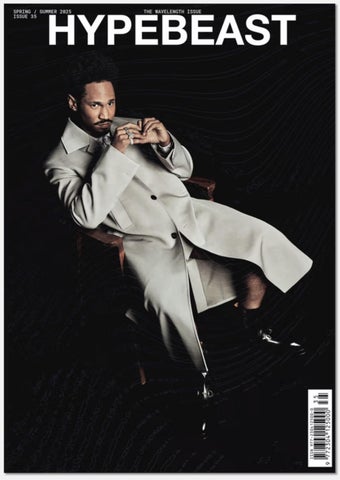
EDITOR’S LETTER
WORDS BY KEVIN E. WONG There’s a lot of trial and error involved when it comes to finding ourselves. Musicians spend years developing their sound. Designers start half a dozen brands before being picked up by a retailer. It takes a lot of doing the wrong things to finally arrive at something that feels right. I’ve learned the same idea can be applied to relationships. One of the most important lessons to digest in this industry (or really, any industry) is that it’s very rarely just about ourselves. It’s about the people we surround ourselves with. Having the right crew could mean decades-long friendships honed to the point where these people can almost read your mind. It could mean just meeting someone in a coffee shop with eerily similar ideas and viewpoints. But when you know, you know. It’s not often I feel like I’m on the same wavelength as someone else. Maybe I’m just weird… but it’s not the easiest thing for me to connect with people or to feel understood. So to see these relationships in the following pages play out in full, amidst the process of creating something inimitable, is really special. To the unique individuals who not only have inner circles on their wavelength, but have garnered massive audiences, true fandoms, who pick up what they’re putting down— I take my hat off to you. That feeling of being seen, of successfully translating who you are to an audience the size of the world: you can’t pinpoint what exactly makes it so. Maybe the act of putting something out there is a connection in itself. Maybe art, music, clothing— whatever it happens to be— has the power to put people on the same wavelength. It’s hard to say. What I can say is this: a wavelength is felt, not seen. Let’s just call it magic.
2
MASTHEAD
EDITOR-IN-CHIEF Kevin E. Wong DEPUTY EDITOR Zach Sokol ART DIRECTOR David Wise / Forthcoming Studio FEATURES EDITORS Ross Dwyer, Noah Rubin GRAPHIC DESIGNER Phuong Le CREATIVE PROJECT MANAGER Gabriella Koppelman EDITORIAL OPERATIONS DIRECTOR Marc Wong EDITORIAL COORDINATORS Samantha Su, Crystal Yu CONTRIBUTING WRITERS Jamier Boatman-Harrell, Logan Fairbrother, Nico Gavino, Paul Heavener, Dylan Kelly, Philip Maughan, Noriaki Moriguchi, Andrea Sacal-Romano, Paul Thompson CONTRIBUTING PHOTOGRAPHERS Kemka Ajoku, Devon Corman, Pierre David, Marc Deitz, Asato Iida, Derek Kwok, Liam MacRae, Gabriel Moses, Sabrina Poei, Karim Belka Semi, Sismatyc, Hong Taesik, Ivan Tamayo, Aus Taylor, Ko Tsuchiya, Scotty Tsunami CONTRIBUTING CREATIVES Guillermo Andrade, Lauraine Bailey, Kevin Chen, Von Ford, Mimi G., Alexa Hernandez, Donya Hodge, Rose Marie Johansen, Holly MacDonald, Donté McGuine, Adona Ohanesian, The Scott Edit, Valeria Semushina, sub, Eri Wakiyama, Barry White SPECIAL THANKS Adam Barakat, Audible Treats, Jivana Basra, Lesley Baptiste, Laura Bologna, Anna Aesook Chae, Doug Chappell, Jules de Chateleux, Moon Choi, Maude Churchill, Division, Ella Dror, Anthony Ferrieres, Aidan Gibney, Milena Gorum, Hand Of God, Angela Heredia, Javier Hernandez, Rosa van Heusden, Heison Ho, Katja Horvat, HPLA, Hubble Studio, Tommy Hubert, Albert Huong, Henrietta Hutchon, Julius Ignacio, Aren Johnson, Darren KarlSmith, Sandra Kolodziej, Maggie Landon, Janet Lau, Lede Company, Leftside Creative, Angel Leota, Walker Lewis, Nick Llanton, Veronica Lovati, Alexandre Marchal, Catriona McCormick, Jacob Nicholas, North of Now, Brian T. Nguyen, Kyle Ng, Oakley, Gilles Okane, Orienteer, Vasun Pachisia, Brice Partouche, Vincent Petion, Albert Piedrahita, Kyle Reyes, Olivia Roth, Amrik Sahota, George Sampson, Sophie Schieli, September MGMT, Neil Serda, Nina Schims, Colin Sims-O’Grady, Chris Snodgrass, Giulia Spinelli, Elana Staroselsky, Warner Music UK, Tom Wiltshire, Alice Wills, Tyler Wu, XL Recordings FOUNDER Kevin Ma ADVERTISING Huan Nguyen, USA Anthony Esponda, USA Steven Appleyard, EMEA Tiff Shum, APAC Advertise@Hypebeast.com Hypebeast.com/advertise
CONTACT Hypebeast Hong Kong Limited 40/F, Cable TV Tower No.9 Hoi Shing Road Tsuen Wan, New Territories Hong Kong +852 3563 9035 Magazine@Hypebeast.com
PRINTING Asia One Printing Limited In Hong Kong All Rights Reserved ISSN 977.230412500-0 13th Floor, Asia One Tower 8 Fung Yip Street Chai Wan, Hong Kong +852 2889 2320 Enquiry@Asiaone.com.hk PUBLISHER Hypebeast Hong Kong Limited April 2025 © 2025 Hypebeast Hypebeast® is a Registered Trademark of Hypebeast Hong Kong Limited
4
Ch. 1 016— 047 A.Presse Salehe Bembury Eri Wakiyama Liberal Youth Ministry
16 24 32 40
Ch. 2 050— 131 XLIM District Vision Pa Salieu sub Greg Ross 424
50 62 74 88 104 116
6
Ch. 3 132— 231 Kaytranada Feid Willy Chavarria Sexyy Red Playboi Carti Oakley O Thongthai
134 152 168 180 192 208 224
Ch. 4 232— 255 American Hi-Fi Bars Eri Wakiyama’s Sketchbooks Phantom Ranch
ISSUE NO. 35
234 240 248
7
IMAGES COURTESY OF REMAGINE
“Starting Bigger” Hybrid Derby Shoes by Remagine
Remagine operates at the intersection of nostalgia and imagination. The emerging Chinese shoe brand explores this concept by combining two familiar design elements in a post-modern effort to construct newness. Its “Starting Bigger” silhouette — showcased in a “Wheat” colorway — turns heads by fusing details from Timberland’s iconic 6-Inch Boot and ASICS’ ever-popular GEL-KAYANO 14 runner. This metamorphosis is displayed most prominently in its transition from cowhide suede on its super-sized toebox to synthetic mesh on its heel. $415 REMAGINE.ONLINE
8
PRICE UPON REQUEST SUPREME.COM
IMAGE COURTESY OF SUPREME
Artbook Shelf Speakers & Amp by Supreme x OJAS
Set foot in any of Supreme’s 17 flagship stores from New York to Nagoya, and you’ll hear crisp, high-fidelity audio booming through a bespoke OJAS sound system. The audio company’s Brutalist design language and focus on reproducing sound in its most transparent form have made its products the darling of hi-fi bars and dance clubs the world over. And now you can have a Supreme x OJAS system in your own abode, thanks to the duo’s collaborative artbook shelf speaker set and accompanying amp. The Supreme x OJAS speakers and amp feature a custom Hammertone Red steel enclosure with a textured print. Passive 8” coaxial speakers feature a frequency response from 40 Hz-18 kHz, 96 dB sensitivity, and 8 ohms nominal impedance. The two-channel amp utilizes a Tripath TA2024 chip, while logos on the set are minimal: both speakers feature a metal badge on the side while a printed embellishment graces the amp, enhancing your music experience in subtle-but-powerful fashion.
IMAGES COURTESY OF SATISFY
TheROCKER by SATISFY
$280 SATISFYRUNNING.COM
10
Paris-based SATISFY is dedicated to unlocking the elusive “runner’s high” by crafting performance wear that feels grounded and human — a sharp contrast to the cold, clinical approach of most mainstream athletic brands. Blending advanced technology with an edgy, punk-rock ethos, SATISFY stays one step ahead of even the most advanced running gear on the market today. The brand has brought that energy to a swath of footwear collaborations with the likes of HOKA, norda, and Crocs over the years, and now, for the first time, it’s releasing its own original trail running silhouette, aptly named TheROCKER. Featuring in-house tech like a Rippy™ 66 Monomesh upper, Euforia™ Super Foam midsole, and a Vibram TuneLug™ outsole — plus details like an asymmetrical lacing system and an earthy color scheme — TheROCKER is ready to roll across any and all terrain, while maintaining the tasteful irreverence that’s at the core of SATISFY’s brand ethos. ISSUE NO. 35
11
IMAGES COURTESY OF BYREDO
Infra Luna 2.0 Lamp by Byredo Rosy lig htin g a n d a so othin g sce nt: Byredo’s Infra Luna 2.0 knows how to set the mood. The multi-sensory lamp, made in collaboration with French designer and light artist Benoit Lalloz, is an amalgamation of the Swedish fragrance company’s olfactory expertise and Lalloz’s eye for effective illumination — and at $2,590, it’s the ultimate interior flex.
suspe n d ed a b ove a case specifically designed for Byredo’s signature smoked black glass candles. Engineered with an innovative heating function, the filament melts the candle wax into liquid from above, creating an invisible nimbus of satisfying aroma via the blushing gleam. All you’ll need to perfect the scene is a quality vinyl record.
Inspired by insects’ shimmering bodies, the sculptural light design exudes a soft pink hue from a halogen bulb, which is
$2,590 BYREDO.COM
12
IMAGES COURTESY OF SIGMA
BF Camera by Sigma
Japanese camera manufacturer Sigma’s new BF camera model homes in on what the brand calls “radical simplicity” — and, with its mirrorless full-frame setup, it’s a powerful tool for capturing moments in exceptionally high resolution. Aesthetically, the camera draws its core inspiration from the foundational composition of early photographic devices like the camera obscura. However, it’s crafted from a singular aluminum ingot, and Sigma touts it as the world’s first true unibody camera, offering both durability in its makeup and a futuristic appeal in its material. The sleek look of the design is bolstered by its stripped-back interface, while a high-resolution screen displays the frame free of distractions with quick access to settings focused on five essential elements of shooting: shutter speed, aperture, ISO, EV compensation, and color mode. Released with nine lenses in matching colors, the BF Camera offers expansive creative potential suited to the user’s needs.
$1,999 SIGMAPHOTO.COM ISSUE NO. 35
13
DEL
Chapter 1
LTA
WORDS BY NOAH RUBIN TRANSLATION BY NORIAKI MORIGUCHI PHOTOGRAPHY BY KO TSUCHIYA
A.PRESSE
16
SUBTLETY AS DISRUPTION
A.PRESSE’S KAZUMA SHIGEMATSU IS DOUBLING DOWN ON HIS SOPHISTICATED APPROACH TO BOTH STYLE AND BRAND EXPANSION.
Like a musician uneasy with the word “music” or an artist wary of the word “art,” A.Presse mastermind Kazuma Shigematsu resists the word “fashion” to describe his brand— and he has a point. Shigematsu and his team of designers fuse the familiar with a fresh modernity so cleverly understated that A.Presse’s burgeoning appeal feels almost paradoxical. Shigematsu likes to think of A.Presse as an “editorial department” — a stark contrast to the personality-driven approach of many brands in the space. His linguistic hesitation isn’t just a critique of the fashion industry or the act of designing itself. It hints, rather, at the meticulously constructed world he and his team must inhabit to conjure their classic yet contemporary menswear. A.Presse’s subtle, American-influenced design language is showcased in its museum-like concrete retail space in Tokyo — hard to find were it not for the long lines Shigematsu’s drops consistently draw, a rarity for a brand of its caliber and lofty price point. Denim staples and quarter-zip tops are flanked by generously cut trousers, fisherman sweaters, and coats with clear military roots. These low-key-sounding, vintage-inspired silhouettes are anything but, as each item’s fabric, stitching, and overall execution is brimming with excruciating detail that rewards those with a keen eye for exquisite precision. Dig a little deeper and Shigematsu’s complicated relationship to the word “fashion” starts to make even more sense, especially in the context of his background and approach. A.Presse, which launched in 2021, is the first brand he has overseen in its entirety. Previously, he worked in sales and production, helping execute and distribute labels like Daiwa Pier39 and Weekend to renowned retailers in Japan and beyond. That experience on the business side may explain his deliberate, slow-growth strategy, one that favors trunk shows and pop-ups to introduce new pieces to retailers and customers alike. 2025 will be a pivotal year for A.Presse as the brand navigates whether its novel approach to style — both philosophically and pragmatically — can propel its status from soughtafter Japanese label to global powerhouse on the rise. The outlook is promising: after being named “Best Clothing Line of 2024” by the ever-perceptive team at Blackbird Spyplane, A.Presse will soon be available at numerous top-tier US stockists, led by perennial favorite UNION LA. On the deepest level, Shigematsu says he doesn’t just design — he aims to “design without designing,” not merely seeking timelessness but striving to transcend time itself. This mindset is immediately apparent in the look and feel of each garment in the brand’s near-impossible-to-acquire collections. A.Presse is about more than just great style, it’s clothing suffused with an enlightened philosophical perspective.
18
“THE CONCEPT OF DESIGNING WITHOUT DESIGNING IS WHAT I’M MOST CONSCIOUS OF… I SEE IT AS CREATING A SENSE OF SLIGHT DISSONANCE.”
ISSUE NO. 35
19
“I BELIEVE THAT WHAT WE CREATE SHOULDN’T BE CONFINED TO THE PRESENT MOMENT—IT SHOULD BE SOMETHING THAT TRANSCENDS TIME.” A.PRESSE OPERATES WITH A SOMEWHAT MUTED AESTHETIC. WHY DO YOU THINK SIMPLICITY RESONATES WITH TODAY’S AUDIENCE? People are exhausted by external validation. In a capitalist economy, “likes” have become a new form of currency, encouraging individuals to operate like media entities. More and more, people are beginning to feel that this comes at a significant cost. Rather than being shaped by others, they feel the need to shape themselves, which naturally leads to a preference for simplicity. YOUR DESIGNS INCORPORATE MODERN ELEMENTS INTO CLASSIC AMERICAN MENSWEAR. HOW DO YOU STRIKE THAT BALANCE IN YOUR DESIGN PROCESS? ARE THERE ANY ITEMS OR PERIODS THAT HAVE PARTICULARLY INFLUENCED YOU? I’m not fond of the way the word “fashion” is commonly used today, but I do believe that people always have a certain mood or feeling. This feeling isn’t centered around individuals. It emerges from the flow of the world itself, which is different from fleeting trends. Since clothing is worn by people living in the present, I do consciously consider the “now.” However, I also believe that what we create shouldn’t be confined to the present moment — it should be something that transcends time. I’ve learned from classic craftsmanship, culture, and historical context, so I make sure not to lose sight of those influences. That’s why I avoid exaggerated expressions of a specific era. I’m particularly influenced by the mid-century period and earlier. I believe that all true originals existed before the 1960s, with roots tracing back even further. Each decade, including the 1950s, has its own unique appeal, but ultimately, everything happening today is a repetition of the past. History has never been interrupted, so the deeper you trace it, the more you realize that clothing, politics, religion, and economics are all interconnected, shaping the way we think about design. YOU’VE MENTIONED YOUR APPRECIATION FOR FRENCH VINTAGE BRANDS LIKE HERMÈS AND CHARVET. HOW DO THEY INFLUENCE YOUR WORK? Even if the country is different, the perspective remains the same. Of course, environments and cultures vary, and their historical roots differ as well, but I view them all from a neutral standpoint.
22
THE FW24 COLLECTION MARKED A.PRESSE’S EXPANSION INTO THE US MARKET. WHY DID YOU CHOOSE THAT MOMENT TO MAKE THAT LEAP? WHAT EXCITES YOU MOST ABOUT SHOWCASING YOUR COLLECTION AT UNION IN LOS ANGELES? We were able to establish our foundation in Japan by opening our flagship store in Tokyo, creating a space where I can communicate what I want people to feel—not just through words but through the environment itself. With that in place, it felt like the right time to take on the challenge of expanding overseas. Regarding UNION, I’m most excited about the opportunity to work with them. The store’s owner, Chris Gibbs, takes a different approach from us, and he personally connects with UNION’s customers in a way that brings fresh insights and learning experiences. While we come from different backgrounds, there are aspects we can both relate to. At the same time, working with them allows me to gain perspective that I wouldn’t have had if I stayed in Japan. That’s what makes this collaboration so exciting. WHAT ROLE DOES JAPANESE CRAFTSMANSHIP PLAY IN SHAPING THE IDENTITY OF A.PRESSE? I believe that having strong technical skills allows us to deliver value to people without needing to provide detailed explanations. THE FW24 COLLECTION FEATURES PIECES LIKE SHERPA-LINED SUEDE COATS AND LEATHER-TRIMMED LINER JACKETS. HOW DO YOU APPROACH DESIGNING SUCH ICONIC STAPLES WITH A FRESH PERSPECTIVE? WHAT DO YOU KEEP IN MIND IN ORDER TO CREATE ITEMS THAT WILL BE CHERISHED FOR A LONG TIME? Fundamentally, I focus on “not designing” from the vintage pieces that serve as our base. The concept of design without designing is what I’m most conscious of. It’s a very subtle approach and difficult to explain in words, but I see it as creating a sense of slight dissonance.
ISSUE NO. 35
I believe the key to long-term wearability is starting with designs that are inherently universal — ones that already have a certain level of recognition among people. A.PRESSE STARTED WITH THE IDEA OF CREATING CLOTHING YOU’D WANT TO WEAR EVERY DAY. HOW HAS THAT VISION EVOLVED SINCE THE BRAND’S LAUNCH? When I first started the brand, I would style pieces mixed with vintage clothing, but now that we have expanded, our range is big enough to create full outfits within the brand. I see that as an evolution. HOW DOES A.PRESSE NAVIGATE THE INTERSECTION OF FUNCTIONALITY AND FASHION? I believe it comes down to values — what one seeks in clothing, why they choose to wear it, and where they place importance. Ultimately, no matter the approach, I feel that it all falls under fashion. THE THEME OF THIS ISSUE OF THE MAGAZINE IS “WAVELENGTH.” ARE THERE ANY DESIGNERS OR BRANDS YOU RESONATE WITH? DO YOU SEE ANY BRANDS THAT SHARE A.PRESSE’S ARTISTIC SENSIBILITY, EVEN IF THEIR AESTHETICS DIFFER? Miyoshi Ryo from everyone. While there may be differences in output and business approach, I believe we share the same aesthetic sensibility. WHAT’S NEXT FOR A.PRESSE? DO YOU HAVE ANY PLANS FOR NEW DESIGN DIRECTIONS OR COLLABORATIONS? Starting with the FW25 season, we have many plans for further global expansion. However, our priority is to ensure that we can properly present our brand in each country and its unique environment as we launch one step at a time.
23
WORDS BY ROSS DWYER
PHOTOGRAPHY BY SCOTTY TSUNAMI
BEYOND THE BLUEPRINT
24
Salehe Bembury’s zeitgeist-defining designs have set a new creative standard for footwear collaboration. ISSUE NO. 35
25
“They say that the first time you die is when you transition, and the second is when your name is mentioned for the last time,” says Salehe Bembury, tilting his head as a ray of Los Angeles sunlight filters through his beard. “I’d like to never die that second time.” He pauses, then shifts in his chair. His left hand — inked with a Statue of Liberty tattoo — rests in plain sight as he adjusts the light blue Bandulu-embroidered Carhartt T-shirt that sits comfortably on his shoulders. Then, as if resolving his thought, he adds, “I think a lot of the things I’ve accomplished in my career haven’t been done before.” To Bembury, stagnation is death. Much like the organic, nature-inspired forms and bold shapes that characterize his signature aesthetic and design language, he’s in a constant state of evolution. The driving forces behind this state? A genuine curiosity, a tireless work ethic, and a commitment to redefining what a great footwear designer can be. The pantheon of footwear royalty is populated with names like Tinker Hatfield (the man responsible for the Air Jordan 3 and Air Max 1) and Steven Smith (who’s created icons including the Reebok Instapump Fury, New Balance 550, and YEEZY BOOST 700). But, what sets Bembury apart from his peers is his path to that realm. While most designers grow their status at one of several major footwear brands, Bembury has worked independently for the past five years after nearly a decade at companies ranging from Cole Haan to YEEZY and Versace. These days, he doesn’t go to the brands; the brands come to him. Since releasing the first project under his name in 2020 — the Salehe Bembury x New Balance 2002R “Peace Be the Journey”—that independence has resulted in culture-defining collaborations with brands including New Balance, Moncler, and Crocs. It’s the last of these names with whom he created what may be his most recognizable piece of footwear: the Pollex Clog, a fingerprint-inspired foam silhouette that went from clever curiosity to cultural staple, becoming one of the most zeitgeist-defining silhouettes of the 2020s, thus far. “The Pollex was a new design that maintained a balance between being recognizable and polarizing,” he says. “In 2025, you could see a stylish person wearing it on the streets of Paris, your mom wearing it while gardening, or the grill guy at the bodega wearing it, and none of those settings would come as a surprise. I believe that a popular shoe’s lifespan is about 10 months, but once or twice a decade, you’ll have a new design that breaks all the rules before becoming a staple. That’s what the Pollex is, and I’m proud it’s stepped into that timeless status.” On the wall behind Bembury is a textile piece by Portuguese artist Vanessa Barragão. Its biomorphic shape and rich textures seem like they could evolve and expand at any given moment. The piece, imbued with a feeling of newness and possibility, is an apt metaphor for Bembury’s career. After all, he’s the designer redefining what footwear partnerships can be in the modern world. With a PUMA collaboration, a career retrospective book, and more yet-to-be-revealed projects—including his own footwear brand—on the way, Bembury’s evolution isn’t slowing down any time soon.
26
WHAT’S BEEN INSPIRING YOU AS OF LATE? My footwear career is entering its 15th year, and the story I’ve been telling over the last few years has primarily been one of the outdoors. But in my recent work with PUMA, the conversation is about hoops. That’s something I grew up watching, playing, and worshipping. It was the foundation that motivated me to pursue footwear, and now I’m getting to play with different products and design lines through it. It’s an entirely new environment for me. HOW DOES IT FEEL TO DIP INTO THE BASKETBALL MARKET FOR THE FIRST TIME, ESPECIALLY DURING WHAT’S ARGUABLY THE MOST ENJOYABLE PERIOD FOR BASKETBALL FOOTWEAR WE’VE SEEN IN THE LAST DECADE? I’m constantly working on something, and I don’t have the luxury of stopping and appreciating such moments. However, a friend recently said, “Do you realize you became a footwear designer because of your love of basketball? And now, in the last few months, you’ve signed a contract to create a line of basketball footwear, signed a signature athlete for that line [Indiana Pacers guard Tyrese Haliburton], and designed a shoe for that signature athlete? You’ve realized that dream.” I had to stop and acknowledge that because it hadn’t clicked. It was extremely full circle. THERE ARE A LOT OF DESCRIPTIONS OF YOUR DESIGN LANGUAGE — ORGANIC SHAPES, NATURAL FORMS — OUT THERE. HOW WOULD YOU DESCRIBE YOUR DESIGN LANGUAGE, AND WHAT’S THE PROCESS BEHIND IT? When my PUMA project was revealed, for example, there were a lot of news articles to the tone of “Salehe is doing a running shoe.” In my mind, I was just working on a dope shoe. I realize that shoes exist within categories and, just as frequently, are not used for their intended purpose. While I respect those categories, I’m paying more attention to shape, color, and positioning. Though that silhouette exists in the running space, it’s more about the shape I can achieve and the colors I can play with.
ISSUE NO. 35
27
28
THERE’S A FANTASTIC ELEMENT OF WHIMSY IN YOUR DESIGNS. WHERE DOES THAT COME FROM? I think it’s because I have more and more confidence to take chances with new projects. Once you have some hits under your belt, you can afford to be more experimental. A popular and divisive example from early in my career is the Cole Haan Lunargrand [which debuted in 2012]. It was a dress shoe that felt like a sneaker and had the visual identity of sport, but at the same time, it was a serious Oxford. Teetering on that pyramid where one side is too polarizing and the other too boring can make for some fascinating creations. BECAUSE YOU KNOW YOU HAVE THAT TRUST WITH YOUR AUDIENCE, WHAT’S YOUR BAROMETER OF SUCCESS FOR A RELEASE? My barometer for success has shifted. Independent creative collaborations amongst brands are, by design, low-quantity productions. Intrinsically, that makes them “hype” because the demand outweighs the supply, creating a conversation and an aftermarket value. That’s a space that I came up in as a consumer. When I began my time as an independent designer, I was part of that space, too, simply because of the scarce quantity of my projects.
30
“IT’S ABOUT THE SHAPE I CAN ACHIEVE AND THE COLORS THAT I CAN PLAY WITH.”
DO YOU CARE ABOUT HYPE? I’d almost argue that I’ve graduated from hype to some extent. I come from and love it; my work will always exist in that sphere. But when you’re trying to build businesses, in the case of my basketball work with PUMA, or creating franchises and getting royalties in the case of Crocs, you have to maintain a balance of business numbers and the hype conversation. My projects now are more about equity, royalties, building businesses, and franchises—all things that almost organically go against hype. SO ONCE YOU RISE PAST A CERTAIN POINT, IT’S MORE ABOUT ESTABLISHING A DESIGN LANGUAGE AND LEAVING A LEGACY, RIGHT? Exactly. Personal goals change as well. There was a time when releasing a shoe and having it sell out in a minute was my primary goal. But I’m hardwired to accomplish something and then move to the next goal, so now the goals are more to the tune of building a business or having my own business. I’m in a place where I’ve had enough wins that brands damn near let me do what I want to do, within a reasonable cost, of course [laughs]. THE PARTNERSHIPS WITH ALL THESE BRANDS ARE NON-EXCLUSIVE. THAT’S PROBABLY EASY NOW BECAUSE OF YOUR STATURE, BUT WAS IT A CHALLENGE IN THE PAST? HOW DID YOU APPROACH IT? I’ve always found my reputation regarding my ability to work with different brands interesting because my partnerships all have non-competes. One way to work around that is to put things in categories. New Balance is lifestyle running, PUMA is basketball, and Crocs is unique. I want to ensure my partnerships live in different spaces and speak to various consumers. My Moncler sneakers are $1,000, while my Crocs are $85, but they all get the same amount of attention, and I make sure the storytelling is different. So if you’re looking at something I make with Moncler, it doesn’t feel like something I’d make with PUMA, or something I’d make with Crocs. IT SEEMS IT’S ESSENTIAL THAT YOUR WORK NOT CANNIBALIZE ITSELF. Absolutely. I’ve been working on a book about the last 15 years of my career, and what’s interesting is that most of my audience knows me for one or two things. To some people, I might be the Crocs guy, and they have no idea that I worked for Versace, or there’s someone in Milan that’s like, “Oh, that’s the Versace guy,” but has no idea that I worked at YEEZY. I’m excited about the book because it’ll show the audience everything I’ve been a part of. Getting more people familiar with the total span of my work is really important to me. YOU’VE HAD A LOT OF MEMORABLE MOMENTS WORKING AS YOUR OWN ENTITY OVER THE LAST FIVE YEARS. WHICH WOULD YOU SAY WAS THE MOST IMPACTFUL ON CULTURE AT LARGE? My Pollex Clog with Crocs. It changed how people viewed Crocs as a brand, and it expanded to other areas of their business. Usually, when you introduce something new, it’s very niche—and, in fairness, the Pollex Clog was niche at first. But it got absorbed into the lexicon quickly. WHAT’S NEXT? DO YOU CURRENTLY HAVE A NORTH STAR GOAL IN MIND? My own footwear brand. I’m working towards that goal, and I’ll just leave it at that for now. ANY FINAL WORDS OF WISDOM YOU’D LIKE TO SHARE? The most common conversation I have with creatives of all ages and success levels is whether or not to “ask.” I’d love for whoever’s reading this to leave with the motivation to ask. The worst thing that can happen is you’re told no; if you’re told yes, it can change your life. Most of the time, the people around you are happy to help you. Don’t be scared. Ask.
ISSUE NO. 35
31
INSOMNIA ILLUSTRATIONS ARTIST ERI WAKIYAMA’S INSTINCT-DRIVEN ILLUSTRATIONS ARE HER BEST FRIENDS, A MEANS TO COMMUNICATE, AND AN UNDENIABLE FAVORITE OF THE FASHION WORLD.
32
ARTWORK BY ERI WAKIYAMA WORDS BY ZACH SOKOL
LEFT: EEVVEE (Ee6) RIGHT: Dark & stormy, a very dark story 2021 ACRYLIC ON CANVAS H48xW48IN (2 canvases, H24xW18; 2 canvases, H18xW24)
ISSUE NO. 35
33
Artist Eri Wakiyama doesn’t chase opportunities. They find her. She’s a beacon for serendipity, noting that she “never planned for any of this to happen… I didn’t think my career was possible.” Rather, both her practice and numerous bonafides have come naturally, a process akin to “breathing or eating.” Whether it’s Miu Miu, Supreme, COMME des GARÇONS, or Fucking Awesome, brands, fashion designers, and even plush toy companies have sought out Wakiyama’s perfectly imperfect, instinct-driven visual language — one that she struggles to define herself. “I describe my work in my own self-created dictionary. I used to call my art ‘crawling drawlings,’ which I guess is just how I pronounced ‘drawing’ with an L,” she says. “I have a ton of random words and phrases that are solely in the dictionary of my own world.” The neologism is apt, as Wakiyama renders surreal and emotive women, fantasy creatures, and anthropomorphic objects (strawberries, mushrooms, etc.) in spritely, imagined universes. Each artwork feels like the visualization of a diary entry. The imagery and text that often fill her margins is scrawled with a palpable urgency that recalls waking from a dream (or nightmare) and rushing to get it all down on paper.
“I LIKE TO DREAM.”
34
“DRAWING WAS ONE OF MY FIRST FRIENDS AND A MEANS TO COMMUNICATE.”
LEFT TO RIGHT: ILL BE YOUR MIRROR (MY DEMON CHILD & I) 2021 ACRYLIC ON CANVAS H24xW18IN BAD BREAKFAST 2021 ACRYLIC ON CANVAS H24xW18IN Head shot 2021 ACRYLIC ON CANVAS H24xW20IN
ISSUE NO. 35
35
36
LEFT: Free in the field 2021 ACRYLIC ON CANVAS H30xW24IN RIGHT: GRAPHIC AND CHARACTER ILLUSTRATIONS FOR SKY HIGH FARMS WORKWEAR SS25 COLLABORATION 2024 INK, PAINT, AND DIGITAL TOP TO BOTTOM: SHY SHROOMIEZ STRAWBABY, “YOU NEVER LISTEN TO ME” SLEEPY SHOOPZ STRAWBABIEZ
ISSUE NO. 35
37
Born in Japan and raised in Cupertino, California, Wakiyama is now based in Brooklyn after a long stint in the Lower East Side. She operates out of her apartment, where she converted her master bedroom into a studio. Most days, she prefers to draw sitting on the floor. “The spontaneity of my brain is too sporadic,” she says. “I feel like I need to live in my studio because sometimes I think of something at 2am and need to do it then or else it might take me another month to get the juices flowing again.” She thrives in these “zombie hours,” embracing the solitude and stillness of the night, with her three cats — Hedi, Ace, and Ganja — as her only companions. A long-time insomniac, she keeps a nocturnal schedule and notes that “the cats are the perfect amount of company… unless the small one is running through my paint palette and leaves footprints of acrylic all over the place.” Trained at Parsons, Wakiyama’s early career seemed destined for fashion design, but the 2008 recession altered that trajectory. “I simply didn’t think that drawing could become something I could
38
“I WANT TO DRAW THE EMOTION YOU GET WHEN YOU SEE FIREWORKS FIRSTHAND.”
do for a living,” she admits. That changed with an unexpected email from Miu Miu, commissioning her for a collaboration. “I was so confused,” she recalls, but it was “definitely pivotal and one of the most major-est things that’s come my way. It’s still kind of a miracle to me.” Seeing her designs come to life on runway models was “freaking magical,” and it cemented her reputation in both the art and fashion worlds. Since then, Wakiyama has collaborated with major brands like Heaven by Marc Jacobs, Nike, Vivienne Westwood, Ugg, Calvin Klein, and K-pop phenom NJZ (formerly known as NewJeans), among others. Still, that doesn’t mean she has a calculated career path. “I can’t give myself goals because it’s too much pressure for me,” she says. “However, I like to dream and I go for things if my gut feeling tells me so. I really believe things that happen naturally are the best and are meant to be.” Wakiyama’s creative M.O. is deeply personal, shaped by her struggles with anxiety, depression, and insomnia. “Drawing was one of my first friends and a means to communicate. I really kept it sacred to myself as a ‘thing.’” She has always kept notebooks filled with loose sketches and text, not necessarily for art, but as a form of self-preservation. “I love re-reading and digging up old work,” she says. “It’s always recognizably me for sure. It gives me relief and hope when I revisit my past self — same person, but different at the same time.” She’s reluctant to dive into the backstories or narratives behind her art, instead simply stating that she’s trying “to evoke a feeling.” To her, fireworks are a fitting metaphor. “They’re always so crazy to watch, yet you don’t feel the same when you photograph them. I want to draw the emotion you get when you see fireworks firsthand.”
LEFT: how i wonder what you are 2022 ACRYLIC ON CANVAS H24xW18IN RIGHT: PORTRAITS OF NJZ MEMBERS (FORMERLY “NEWJEANS”), COMMISSIONED FOR CUSTOM PERFORMANCE OUTFITS 2024 OIL, CRAYON, AND OIL PASTEL
At the core of her ethos is a belief that an artist’s voice should never reach a finish line. “To me, an ‘artistic voice’ is like my identity, something innate and close to my heart,” she says. “Finding my artistic voice (identity) should never end. If you are too comfortable, it’s probably best to move along.” That philosophy, coupled with her trust in fate unfurling organically, has manifested an illustrious career that continues to evolve. Whether sketching on the floor of her Brooklyn apartment, collaborating with fashion’s elite, or letting inspiration flow in the quiet hours of the night — sometimes with a cat running through her paint — Wakiyama and her work never stay still. ISSUE NO. 35
39
LIBERAL YOUTH MINISTRY
REBEL THREADS
WORDS BY ANDREA SACAL-ROMANO
PHOTOGRAPHY BY IVAN TAMAYO
40
In a wild fusion of streetwear and dark fantasy, Guadalajara’s Liberal Youth Ministry channels the rebellious spirit of punk and the eerie allure of David Lynch.
Sitting in the cool comfort of his Guadalajara loft, Antonio Zaragoza is in his element. Dressed in black from head to toe, the young Mexican designer’s daily uniform is a product of uneasy life experiences. Whether growing up in a nursing home, or expressing his inner fascination with pitch-black punk aesthetics, Zaragoza has been through thick and thin on his journey of self-discovery. His brand, Liberal Youth Ministry, too, is a fascinating creative reflection of these experiences, exploring Mexico’s old-school punk scene with a modern edge, stimulated by key motifs of vintage fashion and iconic sportswear aesthetics.
Importantly, Zaragoza’s brand is at the forefront of Latin America’s revolutionary creative scene. Brands are popping up on every corner of every city with enough inspiration to fuel an autonomous, avant garde fashion economy. In Guadalajara, Liberal Youth Ministry leads the charge, finding effortless harmony in disparate influences that range from David Lynch’s surrealist cinema and Rei Kawakubo’s sculptural mastery to Mexico’s diehard football culture. After becoming one of the first Mexican brands to present at Paris Fashion Week in 2023, Liberal Youth Ministry has recently taken a step back for a structural rebuild, trimming down its collections and building a more concise design language — one influenced by the dramatic and eerie characters that haunt Zaragoza’s endless imagination.
ISSUE NO. 35
41
HOW DID LIBERAL YOUTH MINISTRY FIRST COME TO LIFE? I started the brand in 2016. It was born from a need to express my passions through clothing, and it serves as a vehicle to talk about the things I like, but also about the things that I don’t like. The brand’s concepts have strengthened over the years, constantly focusing on themes of disobedience, rebellion, and anarchy. My approach to fashion came from a very early perspective when I discovered the power of clothing through music, counterculture, and social movements like punk, grunge, and shoegaze. HOW DID YOU BEGIN LEARNING ABOUT FASHION? HOW DID YOU ENTER THE WORLD OF DESIGN? Most of what I’ve learned about fashion has been selftaught. I’m very obsessive, and I immerse myself in a topic when I get obsessed with it. I began studying a lot of fashion history on my own. On a technical level, university helped me create clothes, but above all, when I finished classes, I would work all afternoon sewing. Then, I left school and studied with a tailor for about a year and a half, so it was a mix of different mechanisms to learn about my craft. WHAT WERE YOU FOCUSED ON BEFORE LAUNCHING LIBERAL YOUTH MINISTRY? Experimentation of form. It was a bit modernist. I still see images of my school work, and I realize that I worked a lot with neoprene because it seemed like a material that could give you very interesting shapes. It was straightforward in its construction, and despite being so simple, it created these very avant-garde proposals. So, the majority of the garments that I designed throughout school were very dark, in practically allblack tones. It was more of an investigation of form rather than creating an aesthetic result.
I began my research to start the brand and found parallels in my references to the work of Undercover and Raf Simons. Both have perhaps made collections inspired by the work of David Lynch. So, I began to understand what tendencies my brand would follow. At that time, I was 22 years old and couldn’t afford Undercover or Raf Simons. I started to formulate something significant for the brand: the creation of concept garments and a specific aesthetic identity as a deep reflection of my character and references. That’s when the identity of Liberal Youth Ministry began to form. WHAT PERSONAL EXPERIENCES ARE REFLECTED WITHIN THE IDENTITY OF LIBERAL YOUTH MINISTRY? I started to work with the archetypes of the rebellious character: ripped jeans, leather jackets, and spiked collars. Something important to mention is that for part of my childhood, I lived in a nursing home, so I was exposed to specific moments of isolation and surrealism. I think that is why I gravitate to David Lynch’s films. It’s as if this isolation empowered me, but it also helped me understand the power of identity.
“ISOLATION EMPOWERED ME, BUT IT ALSO HELPED ME UNDERSTAND THE POWER OF IDENTITY.” ISSUE NO. 35
43
“MY APPROACH TO FASHION CAME FROM DISCOVERING THE POWER OF MUSIC, COUNTERCULTURE, AND SOCIAL MOVEMENTS LIKE PUNK, GRUNGE, AND SHOEGAZE.”
44
WHAT IS YOUR RELATIONSHIP TO LIBERAL YOUTH MINISTRY’S KEY THEMES OF PUNK, VINTAGE, AND SPORTSWEAR? I experienced the theme of rebellion in my adolescence when the emo movement and subculture was powerful here in Mexico. I encountered rebellion through clothing — the classic story where your father forces you to dress a certain way. I had this ritual when I arrived at school, and I would transform myself into what I was at that moment. I painted my nails and my eyes. So, that sense of rebellion is a translation of my adolescent experiences. There is a branch of the brand that talks about anime or a caricatured vision of fashion, and it deeply reflects my childhood. For example, the video games I was exposed to in this stage of isolation made me feel like I was living in this dreamlike or surreal world. There are explicit references to Otomo Katsuhiro movies or Pokémon, Yu-Gi-Oh!, and to the different FIFA games that come out annually for PlayStation. I played those games with my father and brother, so I channeled all those experiences into the sportswear and fantasy elements in my collections. HOW WOULD YOU DESCRIBE THE CREATIVE COMMUNITY IN GUADALAJARA? It’s a kind of cradle. I have seen, especially in art, exciting works born from people close to me like Gabriel Rico and José Dávila. There is this whole movement of artists within [the studio and workshop space] Cerámica Suro, so I feel that it is a city that focuses a lot on the production of local artists. I can see different workshops connected to currents of craftsmanship or avant-garde styles, which generate a significant art production movement. For example, my brand is totally manufactured in our studios, so I think there is a very interesting connection there. WHAT OTHER MEXICAN OR GLOBAL BRANDS DO YOU FEEL CONNECTED TO? It is very evident in my work that there is a closeness with COMME des GARÇONS, rooted in the fact that they have supported me since 2019. They have beautiful chaos in creativity and business, and without one, the other doesn’t exist — and balance is important. I think it’s the brand I gravitate towards in an aesthetic, business, and personal sense. WHAT HAS YOUR EXPERIENCE BEEN AS ONE OF THE FEW LATIN AMERICAN BRANDS PRESENTING REGULARLY AT PARIS FASHION WEEK? It’s demanding once you get into it because you can’t stop and you feel the pressure of being present every season. My experience has been positive, but it is essential to mention that Spring 2024 was the last time I presented a digital catwalk within the framework of Paris Fashion Week because I needed to rethink the perspective of my brand. I decided to hit the brakes and restructure the brand so I could move forward and not compromise my ideals.
“I LIKE TO PLAY WITH STEREOTYPES, AS WELL AS SURREAL IMAGES.”
THAT’S MAJOR. WHAT WAS THE PROCESS OF REBUILDING LIKE FOR YOU? Between 2019 and 2024, I entered into this very intense mechanism of generating collections and experimenting; it allowed me to experiment with different concepts where every new collection was very different from the previous. After Spring 2024, though, there was a break in my work where I implemented a creative restructure. For Winter 2024, I presented the collection “Igor” and then decided to start from scratch. I rebuilt the brand and returned to its fundamental creative identity: rebellion. HOW DO YOU MAINTAIN COHESIVENESS AMONG YOUR SOCIAL MEDIA, LOOKBOOKS, AND WEBSITE? I do everything myself. I don’t know how arrogant it may sound, but in the end, if you’re going to do something, it has to come from inside your being. So, since 2020, I have photographed everything related to the brand myself. I give specific direction as to what I want for graphics. I also created the website, so it’s part of this same thread. I think there’s a personal artistic manifestation that gives oxygen to everything. WHAT IS YOUR PRIMARY FOCUS IN MARKETING AND CREATIVE DIRECTION? I like to play with stereotypes and surreal images. Living my adolescence in the United States influenced me with a sensibility, an American satire of decadence, that also connects with David Lynch’s cinema between dreams and nightmares. WHAT ARE YOUR PLANS FOR EXPANSION IN THE NEXT FEW YEARS?
Something I’ve learned in the last year is to support my creativity and ideals. I have found calm, and within that, I discovered many positive aspects that I hadn’t had time to experience because I was in a frenzy of production and projects. Now, I give each project the space to grow, and instead of looking for a hundred stores or thousands of people to collaborate with, it is fundamental to give myself space and make better products for my audience.
THE Chapter 2
ETA
XLIM R I S
With its cinematic approach to fashion, XLIM’s 12-person collective is rewriting the narrative of contemporary design.
50
I N G ACTION WORDS BY NICO GAVINO
PHOTOS BY HONG TAESIK
ISSUE NO. 35
51
Founded in 2021 by Dohee Kim as a collective of “creators,” Seoul-based XLIM uses cinematic terminology like “Episodes” and “Synopses” to name its ever-growing breadth of collections. Borrowing from Kim’s time studying film at university, the language captures an ethos of continuous change and evolution. Combining technical functionality with distinctive patinated finishes, XLIM’s garments straddle the tension between the futuristic and the familiar. In XLIM’s recent Episode 7 collection, nylon is weathered with crackled wax coatings, natural fibers like linen coexist with performance fabrics, and gauzy panels are paired with opaque textiles. The brand also began incorporating craft-forward home goods, including Episode 7’s rusticated dinnerware and Episode 6’s upcycled denim-covered vases. Kim says these tendencies reflect a core philosophy of “making the familiar feel new and the unfamiliar feel natural.” Proudly citing contemporaries like HYEIN SEO, POST ARCHIVE FACTION, JiyongKim, and JUNTAE KIM, the founder sees XLIM as part of a greater whole, encompassing South Korea’s burgeoning creative scene. “We continue to evolve within this same wave, striving to present fresh work that embodies the essence of Korea
52
while pushing creative boundaries,” he says. More than being merely centered on fashion, Kim says his practice is about “conveying the essence of XLIM through various mediums.” In a similar vein, Kim emphasizes that rather than being the fruit of his sole efforts, XLIM is a product of the many who contribute to its ongoing story. “It’s never about one person’s design or success,” he says. “It’s always about what we’ve built together.” ISSUE NO. 35
53
“IT’S ALWAYS ABOUT WHAT WE’VE BUILT TOGETHER.”
54
CAN YOU TELL US MORE ABOUT THE MEANING BEHIND XLIM’S NAME AND THE BRAND’S CREATIVE INTENTIONS? XLIM is a name created by combining X with LIM — short for limit—to represent the idea of pushing beyond boundaries and exploring endless possibilities. It’s not just about fashion, it extends into lifestyle and everyday experiences, all shaped in a way that feels uniquely ours. At the heart of XLIM is the philosophy of “making the familiar feel new and the unfamiliar feel natural.” Everything we create is built on this idea, offering fresh yet effortlessly-immersive experiences. RATHER THAN PLACING AN INDIVIDUAL AT THE FRONT OF THE BRAND, XLIM IS SELF-DESCRIBED AS A GROUP OF “CREATORS.” HOW MANY MEMBERS ARE IN THE COLLECTIVE, AND HOW DOES THE COLLECTIVE ASPECT INFORM THE LABEL’S APPROACH TO DESIGN? I don’t think of XLIM as solely “my” company simply because I founded it. I truly believe that both XLIM and I are here today because of the many individuals who have contributed along the way. This belief is fundamental to me. XLIM comprises 12 members, divided into four teams: design, operations, development, and content. While we have these defined roles, we come from different generations and diverse backgrounds. That’s why we strongly emphasize open discussions, ensuring that every creation reflects a mix of our perspectives. This collaborative process is something I deeply value. When a project is completed, it’s never about one person’s design or success. It’s always about what we’ve built together. HOW HAVE THE BRAND’S ROOTS IN SEOUL INFLUENCED XLIM’S VISUAL IDENTITY? WHAT ELSE HAS INFORMED THE COMPANY’S AESTHETIC APPROACH? Seoul is the fastest-changing city I’ve ever experienced. Having traveled to many countries and gained various experiences, I’ve realized there’s no place like Korea — where change happens so quickly, and it doesn’t take long to get accustomed to it. This rapid pace is a great source of motivation for me, and I think it’s one of the most distinctly Korean cultural traits. That’s why, at XLIM, we focus on the main “Episodes” and use “Synopses” to continuously release various products, keeping things fresh and providing our audience with a sense of novelty. COULD YOU TELL US MORE ABOUT YOUR USE OF THE TERMS “EPISODES” AND “SYNOPSES” TO DESCRIBE YOUR COLLECTIONS? I studied film before starting the brand, and it was there that I first encountered the terms. They were the most fitting when it came to explaining something in detail. In today’s world, we constantly need to offer new experiences because people crave novelty and want to feel continuous change and evolution.
ISSUE NO. 35
55
“WE TRY REFLECT STIMULI A FLOW O ”
56
TO T NEW AND THE OF TIME. ISSUE NO. 35
57
“AT THE HEART OF XLIM IS THE PHILOSOPHY...
58
...OF MAKING THE FAMILIAR FEEL NEW AND THE UNFAMILIAR FEEL NATURAL.” 59
TECHNICAL GEAR AND WORKWEAR ARE AT THE CORE OF MOST OF YOUR COLLECTIONS. CAN YOU DISCUSS THE BRAND’S INTEREST IN EXPLORING THIS REALM OF DESIGN? WHAT MAKES YOUR APPROACH TO WORKWEAR DISTINCT FROM OTHER LABELS EXPLORING THESE TROPES? Rather than simply following external trends or focusing on aesthetics, we wanted to design practical clothing that brings a new kind of joy and experience to those who wear it. We reinterpret technical gear and workwear in a way unique to XLIM, offering both familiar and refreshing designs. This approach gives people a natural opportunity to blend function and style in their everyday lives. To support this vision, we develop our own fabrics, allowing us to create innovative designs from the ground up. YOU OFTEN COMBINE DURABLE TECHNICAL FABRICS WITH DELICATE MATERIALS LIKE TRANSLUCENT GAUZE AND MESH. WHERE DOES THIS DYNAMIC APPROACH TO MATERIALITY STEM FROM, AND WHY DOES MIXING MATERIALS LIKE THIS APPEAL TO YOU? At XLIM, we wanted to incorporate functional elements like breathability into our designs in a way that feels unique to our brand. The reason that we combine technical fabrics with delicate materials is to create that distinctiveness. When people wear our pieces, the functional aspects may feel familiar, but the combination will give them a sense of something new and unexpected. These elements are what make XLIM’s aesthetic stand out.
60
CAN YOU HIGHLIGHT A FEW FAVORITE DESIGNS FROM THE PAST COUPLE YEARS AND EXPLAIN HOW THEY REPRESENT XLIM’S OVERALL AESTHETIC AND CREATIVE MISSION? The dinner set and vase that we recently released are some of my favorites. I wanted them to blend naturally into people’s homes and spaces. Our focus has always been on creating not just fashion, but also items that can be part of everyday life — things that people can see and use in their daily surroundings. This has been a key goal of ours with every new episode we create. HOW DOES XLIM BALANCE BUILDING UPON THEMES FROM PREVIOUS “EPISODES” WHILE DRAWING FROM NEW SOURCES OF INSPIRATION? Before creating each episode, we have a lot of discussions with the team. We talk about recent experiences that have left an impression on us, and what we’re currently interested in. Through these conversations, we gain new ideas and inspiration. Social and cultural changes, along with personal experiences, have a significant impact on us. While respecting the themes and designs we’ve created in the past, we also try to reflect new stimuli and the flow of time. Our approach is to preserve the essence of what we’ve done while slowly introducing new elements to evolve. IT’S BEEN FOUR YEARS SINCE XLIM WAS FOUNDED, BUT THE BRAND HAS GARNERED FANS ACROSS THE GLOBE AND EVEN OPENED ITS FIRST STORE IN SEOUL IN 2024. WHAT Q UA LI T IES D O YO U T HIN K M A K E X LIM P O P U L A R INTERNATIONALLY? It’s not just about fashion but about conveying the essence of XLIM through various mediums. I’d love to take our store in Seoul further by transforming it into a space that combines fashion with a bar or cafe. It would be more than just a place to shop — it would be a space where people can experience the culture of XLIM firsthand. IS THERE ANYTHING YOU’D LIKE TO ADD ABOUT XLIM, ITS ARTISTIC AMBITIONS, AND THE FUTURE OF THE LABEL? One of my main goals is to partner with some of my favorite restaurants, but not only in the traditional sense of creating clothing. I want to collaborate with them on new menus and pair them with XLIM’s unique dinner sets, creating a new way for people to engage with our brand. It’s not just about making products; it’s about integrating our creations into everyday life and fostering a deeper connection with people. By offering experiences through food and conversation, I hope to share XLIM’s philosophy in a more personal way, continuing to expand the brand beyond fashion.
ISSUE NO. 35
61
WORDS BY ROSS DWYER
PHOTOS BY ASATO IIDA
DISTRICT VISION
views its brand as a “toolkit” for a holistic, healthy lifestyle — and communicates that ethos through made-in-Japan eyewear and premium running apparel.
THROUGH THE LOOKING GLASS LOOKING
ISSUE NO. 35
63
According to District Vision co-founders Tom Daly and Max Vallot, eyewear can be a physical and emotional shield. “When it’s sunny, you need it. When it’s rainy, you need it,” says Daly. “If you’re running the Hawaii Marathon and you don’t have sunglasses, you’re fucked, but you’re also fucked if it starts raining during your run and you don’t have a shield.” The emotional component? “You and I have both run the New York City Marathon,” Daly says, gesturing in my direction. “So you know how awkward it is when you’re gasping for breath at the final push, and you make direct eye contact with someone. The foundation of emotional protection is removing that unintentionally awkward layer of interaction.” Daly and Vallot are near-reverential when discussing what they call “running eyewear.” To them, the term signifies a looking glass into—and an aegis for—the soul. That animating
64
principle is reflected across District Vision’s products and the brand’s overall creative and technical approach. District Vision’s sunglasses boast aerospace-grade titanium frames and shatterproof polycarbonate lenses treated with anti-reflective and oleophobic coatings. If that sounds sophisticated, it is. District Vision frames manifest the brand’s holistic approach to wellness, which stems from Daly and Vallot’s belief that mental well-being is the foundational benefit of every form of physical exercise—and that running is the central practice of individuals who abide by such a mindset. Founded in 2016, District Vision was among the first of a new generation of boutique running brands. Instead of following in the footsteps of the dominant players in the space
66
“WE INCREASINGLY CONSIDER RUNNING A CORE, PRIMAL PRACTICE THAT INFORMS AN ACTIVE, HEALTHY WAY OF LIFE AND DISTRICT VISION AS THE TOOLKIT TO LIVING THAT LIFE.” ISSUE NO. 35
67
(or immediately pumping itself full of venture capital to grow the businesses), District Vision blazed its own trail by offering a precise combination of function and fashion, with the latter always informed by the former’s demands. Its founders’ professional pedigree also aided the label. Daly previously worked at Acne and Vallot at Saint Laurent—while brand’s handscrawled “DV” logo was created by graphic artist Filip Pagowski, best known for the iconic COMME des GARÇONS PLAY heart logo. Besides ever-expanding eyewear and apparel offerings, the brand’s other superpower lies in its slow, intentional approach. The co-founders spent more than two years prototyping District Vision’s first eyewear release, and even now, a decade in, they prioritize mindfulness, intention, and patient, sustainable growth over maximum reach. “It takes 10 years to do anything well,” says Vallot. “You can build faster, but it won’t be real, and it won’t have a solid foundation.”
ISSUE NO. 35
69
“PEOPLE WANT ...
WHY WAS EYEWEAR THE INITIAL MEDIUM YOU CHOSE TO PRESENT YOUR BRAND TO THE WORLD? Tom Daly: Most people use sunglasses as a social construct. They’re a tool that indicates people should leave you alone, a shield of sorts. If you’re out for a run, you’re likely doing the most challenging thing you’re going to do all day, and you might not want people to see you doing that challenging thing because you might not look your best. Running wasn’t a sport with a wardrobe until about 10 years ago. As that ethos progressed, running became classified as a sport requiring a “kit,” like baseball or basketball. People started leaning into that, and at the time, our obsessions were centered around eyewear and madein-Japan quality. We knew there wasn’t an approach like that in the market and figured we could bring it. We wanted to be very nerdy about it: to iterate, develop, and grow slowly over a long period, which wasn’t something anyone else in the sphere was doing. And we were naive, too, which was important [laughs]. WHAT SORT OF RUNNER WEARS DISTRICT VISION? Max Vallot: Our understanding of our customers keeps evolving. For the first three years, it was the person Tom described. Someone who got into running, started taking it seriously, and wanted to dress the part. The first significant shift we saw in our customers was around COVID in 2020, when everyone started spending more time outdoors.
70
After that shift, running wasn’t primarily driven by the person who was part of a running crew or signing up for marathons anymore. It was someone who wanted to be outside, to run for two or three miles, and maybe hike. We moved our base of operations from New York to California around then and started seeing running more as part of a holistic lifestyle rather than a linear, isolated activity. We increasingly consider running a core, primal practice that informs an active, healthy way of life and District Vision as the toolkit to living that life. HOW DO YOU TURN THAT LIFESTYLE INTO A PRODUCT, ESPECIALLY IN THE PERFORMANCE SPHERE? TD: We find ourselves using “analog technology” as a descriptor a lot these days. If you look at fabric and material usage in running gear today, the brands pushing the envelope often combine natural and synthetic materials. People want the best technological solution but also want to “feel” the run. The same mindset causes automotive manufacturers to attach engine sounds to their electric cars. People want the eco-friendly performance of that silent engine, but they also want the nostalgia of a classic combustion engine. MV: There’s also been a considerable emphasis on minimizing distractions while running. It’s become synonymous with peace of mind. But when you lean too far into that, you risk losing the “feel.” Why do we like the sound of an engine? Why do we like the crackles and pops of vinyl? If you cut out all the distractions, you feel nothing. So, the feeling of imperfection articulates our life experiences, especially as we start and conclude a practice.
...
HOW HAS THE DEFINITION OF A “RUNNING BRAND” CHANGED SINCE DISTRICT VISION WAS FOUNDED? MV: It’s almost become a new brand category. When we started District Vision 10 years ago, there were maybe two other brands that we could say were in our sphere. We recently had to put together a non-compete list for the next chapter of our partnership with New Balance, so I asked the people on our team to put together a list of our contemporaries — and it was shocking to see how many brands there were. Obviously, not all these brands will last, but it’s amazing that so many creative talents are channeling their ideas through the medium of running. Today, we’re both a sports brand and a fashion brand. It’s interesting to see how technical products redefine fashion. WHEN CREATING AND CONCEPTUALIZING YOUR PRODUCTS, DO YOU STAY UP ON OTHER BRANDS IN THE SPHERE? TD: We all learn from one another. Anyone who says they don’t is a liar [laughs]. That’s what’s beautiful. No brand is an island. If you look at the legacy California outdoor brands and legacy sports brands, they’ve done a fantastic job laying the groundwork. We aren’t competing because we’re so different. We also have confidence in sticking to our guns and living in our vision instead of being offended by a competitor’s success. The independent brands all have respect for each other. WHAT MIGHT FUEL OR INFLUENCE THE NEXT WAVE OF BRANDS IN YOUR SPHERE, AND HOW DOES IT FEEL THAT THOSE BRANDS MAY BE LOOKING UP TO YOU? MV: The previous generation of brands was the private equity generation. They came from a time when tech money and the tech mindset started informing how fashion and sports brands were built. Now, we’re seeing a response to that with brands that put authenticity above everything. People don’t want to see the same Instagram ads, the same “best practice” design shapes that have been done a million times already. They want to see character and imperfection. They want to see and know the founders of brands: what they think and do, and how they
interact with their community. That’s what we were founded on, and the next step on the roadmap for us is to open our own stores to communicate that message even further. TD: The parallel I like to draw is that growing up in Europe, I’d always go to the same coffee shop, and the same guy would make my coffee. He made a great cup, but that was his main goal: working at his craft as best he could. He didn’t want to try to franchise his shop and take over the world. I call that “classical shopkeeping,” and that’s how I like to look at District Vision. Our primary goal is to make the best product we possibly can. NOW THAT YOU’RE IN THE BUSINESS OF RUNNING, HOW DO YOU ENSURE THAT RUNNING REMAINS A PERSONAL PASSION AS WELL? DO YOU SEPARATE IT FROM YOUR WORK ON THE BRAND? TD: That’s the struggle when your passion becomes work. What we’ve realized over the last 10 years running half marathons, marathons, and trail ultramarathons while operating a business in that same domain was the importance of staying true to the roots of why we started running: because it was fun and because it was a journey of progression. We allowed our personal relationships with the sport to remain fluid. We chose to see how running could serve us in the present moment instead of putting rigidity and standards on it. MV: I’ve gotten into surfing, yoga, dancing, and many different practices. They all start feeling fresh, playful, and exciting, but with time you want to be good at it. And that’s where the ego snaps in. You go from that child discovering something for the first time to a competitive teenager, and then after a while, you realize that mindset defeats the whole purpose of the activity. I’m not against competition, but I think you want to be mindful of where in your life you want to compete and where you want to play. So, I think I’ll compete in the business sector and approach running as play and open-ended research.
“NO BRAND IS AN ISLAND. WE ALL LEARN FROM ONE ANOTHER. ANYONE WHO SAYS THEY DON’T IS A LIAR.”
72
ISSUE NO. 35
73
FREEDOM
Pa
Salieu
OF SOUND
74
WORDS BY ZACH SOKOL PHOTOGRAPHY BY KEMKA AJOKU STYLED BY HOLLY MACDONALD HAIR AND MAKEUP BY LAURAINE BAILEY
Pa Salieu FaceTimes me from the back of a black car, weaving through London streets on a late January afternoon. He’s wrapping up last-minute errands because in roughly 24 hours, the musician will board an 8-hour flight to Gambia, where he spent a large chunk of his youth. The trip looms large for Salieu. It’s a milestone, an interlude, and a hero’s homecoming all at once. Nearly seven years ago, Pa Salieu got embroiled in legal troubles that still haven’t fully
waned. It’s a traumatic, complicated story, one he’s discussed in interviews at length, but is essential to understanding the British-Gambian MC’s circuitous path towards stardom—and the roadblocks that nearly robbed him of greatness. In 2018, Salieu’s best friend Fidel Glasgow was fatally stabbed outside a bar in their UK hometown, Coventry. Salieu and others pursued one of the perpetrators of the attack, and Salieu hit the man with a branch and broke a bottle in an act of self-defense. Over the four years that followed, Salieu experienced success and additional tragedy in equal measure: He was shot in the head in a separate incident, released his breakout single “Frontline” and debut mixtape Send Them to Coventry, and won BBC’s “Sound of 2021” award. He was becoming one of the UK’s most exciting rappers to watch, with a reputation for smoothly spitting over diverse production ranging from two-step and UK drill, to Afrobeats and more. He was even the subject of a documentary that followed him to Gambia, his first visit since childhood, as he performed in front of 30,000 people. Things were looking up.
76
Just a few months later, however, Pa was sentenced to 33 months in jail for his role in the retaliation that followed Glasgow’s murder. His pulsing career came to an abrupt halt, the carpet pulled out from under him by the institutional Powers That Be. In late 2024, Salieu was released from prison after serving just under two years. Though it sounds apocryphal, he went straight to the studio, prison issues in tow, and recorded the mixtape Afrikan Alien for Warner Records UK. The release was a triumphant, fully-realized comeback that delved deeper into his Gambian roots sonically, while lyrically explored his incarceration and feelings of being an outsider—an alien—in the UK. As he noted on the standout “YGF” (or, “Young Great and Free”): “I’ve never seen myself for a while, appalling/Dealing with death had me moving brazy/Dealing with the trial really had me faded.” He followed the mixtape with
“King Steps,” a massive single produced by Disclosure, accompanied by a striking music video widely regarded as one of the year’s best. But as Salieu notes while speeding around London traffic, “I’m not fully free… Since I started making music, I have not been free.” He means this in a legal sense, quickly clarifying that he learned how to feel liberty from an emotional and spiritual perspective while locked up, regardless of his physical setting. In other words, he’s still on probation, and as a result, can only visit Gambia for a week. Still, he intends to get the most out of the trip, squeezing three weeks’ worth of experiences into one. That includes visiting his family’s home to eat superkanja, a Gambian okra stew that is his all-time favorite, and performing in front of 25,000 people— reaffirming his status as one of the most prominent African artists making moves today. During his jail stint, Salieu says he wrote eight notebooks’ worth of lyrics, approximately 300 songs. He also began penning an autobiography, drafted a biopic script, and incubated designs for an upcoming clothing brand inspired by the aesthetics of prison called OTSS, or “Only the Strong Survive.” He intends to drop the label’s initial collection before the end of 2025, which will coincide with the release of his debut full-length album. Salieu is counting his blessings while also staying hungry as hell. Despite the setbacks and government-imposed restrictions, he expresses unflinching gratitude and optimism. “I just came out of jail, and guess what’s happening this year? I hear some planets are aligning. You know why? Because I’m outside.”
HOW DID YOU SPEND THE HOLIDAYS THIS YEAR? DID YOU HAVE ANY NEW YEAR’S RESOLUTIONS? My celebration has been more about reflection. I missed a lot of New Year’s Eves and Christmases — two of each. I feel like I just came out the Tardis, on my Dr. Who time traveling vibe. So I’ve just been reflecting: What have I learned from jail? What have I learned in the last two years? I’m working on changing myself. I’m also working on my first proper album, so I’m putting my whole heart into it right now. That’s what I want to get done this year. It’ll be out after October. I KNOW YOU WROTE AT LEAST EIGHT NOTEBOOKS FULL OF LYRICS, APPROXIMATELY 300 SONGS, WHILE INCARCERATED. ARE YOU USING ANY PRE-WRITTEN SONGS FOR THE NEW RECORD, OR WILL IT BE ALL NEW MATERIAL? It’ll have some of the pre-recorded songs. The studio, the booth, can be a form of stress relief. So all through being on bail, all through everything, I’ve just been writing and recording for me. I make music because I want to make music—nothing else. Now it’s become a lot of material. I’m trying to go for an ‘80s kind of sound with my record, so there’s a lot to choose from. ARE THERE ANY PARTICULAR INSPIRATION POINTS FROM THE ‘80S? Synths and soul stuff. I’ll say Steve Monite. A lot of old African tunes influenced me. People like Papa Wemba, an old-school Congolese artist. If you don’t know him, you’re gonna get to know him, and you’re going to fall in love! I also fell in love with Johnny Cash in jail — songs
78
ISSUE NO. 35
81
“I DON’T BELIEVE IN GENRE. MY GENRE, IF I HAD ONE, WOULD BE ‘FREEDOM OF SOUND.’”
like “Highway Man” and “A Boy Called Sue.” I wrote a full list, which includes old-school Sene-Gambian artists like Omar Pène, Youssou N’Dour, and Adama Seca. There are a lot of inspiration points, and I’m combining them all into one. CAN YOU TELL ME ABOUT YOUR TASTE WHEN IT COMES TO PRODUCTION AND PICKING BEATS? I don’t believe in genre. My genre, if I had one, would be “Freedom of Sound.” When people are like, “What’s your favorite album?” I don’t know because I come from the Spotify era. I have the freedom to go from this tune to another tune to the next tune — from this sound to that sound. I think it’s part of my generation; not having a genre. I’m just taking in the time I’m in, which is “Freedom of Sound.” I’m spiritually free, so my music reflects that. YOU’RE PERFORMING FOR OVER 25,000 PEOPLE IN GAMBIA ON JANUARY 18TH. YOUR LAST VISIT WAS IN 2021, BUT SO MUCH HAS HAPPENED SINCE THEN — JAIL, THE RELEASE OF AFRIKAN ALIEN, THIS MASSIVE SINGLE WITH DISCLOSURE. WHAT ARE YOU EXPECTING THE RESPONSE TO BE FROM THE AUDIENCE THIS TIME? I just expect vibes. I realized during my first show in London after jail that when I put my shades on, I become something else on stage. The nerves go, and I see no crowd. I just hear vibes. I’m an introvert and if it wasn’t for jail, I swear I wouldn’t be so comfortable with performing the way I can perform now. In jail, you’re forced to accept yourself. You’re forced to look at yourself and love yourself because you’re alone. I’ve realized it’s done a lot for me. And what you can expect from me this year is just sick — level up, level up. ARE THERE PLACES YOU’RE GOING TO VISIT ON THIS TRIP THAT YOU HAVEN’T BEEN TO BEFORE? I’m walking with lions, one million percent [laughs]. There’s one girl I know from Gambia whose granddad was an old-school artist named Demba Conta. She’s setting up a meet-up with local artists. I did a similar pop-up and Q&A thing in Nigeria, with everyone speaking their minds, talking music, and discussing what more could be done to help the people of Africa. It will be wholesome and very intimate. I want to stay in Gambia for more than a week, but I can’t because I’m not fully free. I will make it feel like I’m there for longer — get three weeks’ worth of experiences and vibes in one week. WHEN YOU SAY YOU’RE NOT FREE, YOU MEAN PROBATION, CORRECT? WHEN DOES THAT END? Yeah. It ends in September. First time in my life I can actually get a passport! I’ll be traveling more as soon as probation ends. Bye! I can’t wait to have full freedom. Since I started music, I have not been fully free. When I released my single “Frontline,” I was on bail. It’s been nearly four years since my legal troubles started. I went to jail, I came out, I’m now on bail. I’m lucky they’re letting me go to Gambia before probation ends because it’s for work, but it’s still not on my own code. So I can’t wait till September. It’s my time to actually be free. YOUR ARTIST STATEMENT FOR AFRIKAN ALIEN MENTIONS THAT PART OF THE MIXTAPE RESPONDS TO POLITICAL CORRUPTION IN AFRICA, THE UK, AND ELSEWHERE. FOR THOSE UNFAMILIAR, WHAT IS CORRUPTION LIKE IN GAMBIA RIGHT NOW? Corruption is leaders claiming to give funds to help the people, but then they give the minimum and leave the rest for themselves. A lot of things aren’t the way they should be. Right now, my generation is suffering and Gen Z makes up something like 70% of Africa now. Our voice is very important. We are the future, bro. The kids of Africa will be traveling around the world and people need to understand that this is very serious and very deep. After my song “Frontline” came out, they named a road in Gambia after it. So I’m just saying influence is deep and we’re not going to live for a very long time. We’re humans, it’s just the way it is. So you have to ask yourself, “What are we leaving there? What kind of consciousness are we leaving?” Talking about all these subjects is very, very important. Like female genital mutilation, bro, I don’t stand for that! But I know my voice, if I speak about it, it will push something. We have to speak about certain things, especially politics, not inter-politics. I think music can be more powerful than politics.
ISSUE NO. 35
83
I KNOW YOU’RE STARTING A CLOTHING BRAND CALLED ONLY THE STRONG SURVIVE, AND THAT IT WAS INSPIRED BY YOUR TIME IN SOLITARY. HOW DOES THAT TRANSLATE AESTHETICALLY? OTSS! It is similar to how I describe my music. No genre! Freedom of Sound. So I describe OTSS as “Freedom of Choice.” When I was in jail, inmates wore a lot of dry-fit material, like Under Armor. So I’m just preeing the way people are wearing things. Obviously, there are “prison issues” as well, which are just gray shirts, gray bottoms. After six months, you can get a parcel with your clothes. I was seeing what kind of clothes people were wearing once they had that choice, and if they did get clothes they were always Under Armor. So I’m in my cell, two days into solitary, and I have nothing to do. I asked for five pieces of paper. I started looking at everything in the cell. There were dents in the door from the previous inmate. He set fire to the cell, too, so there were little burn marks on the door. The burn, the dent, everything else — I said, “Oh shit, that looks like a sick design. That would be sick for a shirt, or part of the bottoms for trackies.” Then I started looking at the cell door, the lights. I’ve never seen windows like this outside prison. So I started using everything I saw in the cell as inspiration. I was drawing everything because I ain’t got no phone, no camera. Then I reconstructed it to what I want OTSS to look like. There will be six or seven different looks. IS THIS GOING TO BE AN ONGOING PROJECT? DO YOU WANT TO DO ANNUAL RELEASES OR IS IT JUST GOING TO BE THIS INITIAL SIX-STYLE DROP? I’m an impatient person, but when it comes to ideas, I’ve got ADHD. I want to do this, then I’ll do that, then I’ll do that. I wouldn’t finish anything because I wanted to do everything, but I gained a lot of patience in jail. So now I’ve learned to take my time with things. 70-80% of the visualization and conception of OTSS was done in jail. I didn’t know how to design before jail. I just had a notebook, which I filled with a lot of designs, lyrics, movie scripts, and an autobiography [laughs]. So now it’s about having patience and working with what I’ve got. I have so much material, bro. I have so much creativity and intent. That’s all I need. It just makes me see everything straight. It makes it even more real to me. I’m trusting the process. IT SOUNDS LIKE YOU’VE TAKEN THESE ROADBLOCKS AND TURNED THEM INTO STRENGTHS. WHETHER IT’S ADHD OR THE SYSTEM HOLDING YOU DOWN, YOU CONVERT IT AND MAKE IT PART OF YOUR ARMOR. I realize no one can hold me down no more and it was all just an illusion. It’s only me that can hold myself down. When it affects me, I stop. And when I stop, my blessings stop. WHAT OTHER FASHION TRENDS OR BRANDS OR DESIGNERS EXCITE YOU RIGHT NOW? Remember, I just stepped out of a time capsule. I was looking at my bro’s shoes the other day and I was like, “Shit, where did you get those from?” He said the model came out in 2023. Ah… I was not around in 2023. So everything I’m seeing since I was released from jail has been inspiring. Even going to Africa and seeing people integrate, like locals showing each other their designs. I look at fashion like music, the Freedom of Sound idea I’d mentioned earlier. It’s the same with fashion: Freedom of Choice. If it looks alive, I’ll wear it and make it even more alive.
86
WILL THERE BE ANY PARTICULAR COLLABORATORS ON THE NEW ALBUM YOU CAN TELL ME ABOUT? Life’s always connected me naturally with people on the same wavelength. Definitely Backroad Gee. And this is my brother KG from Nottingham [points to friend in the car]. He’ll be on the album. This is going to be a family vibe. Everyone is on a common wavelength. Our whole hearts go into this because we understand the whole intention. It has to be straight blessings and good energy. WHAT’S YOUR FAVORITE FOOD TO EAT WHEN YOU’RE BACK IN GAMBIA? Superkanja! That’s okra stew. You know the lyrics from my song “Ya Zee”: Break Magi in my superkanja (ya zee!)/I’m in the back smoking super ganja (ya zee). Ya! Ya! Ya! It’s true. WHERE’S THE BEST PLACE TO GET SUPERKANJA IN GAMBIA? My grandma’s house. God rest her soul. Her eldest daughter is the woman of the house now. But she lost her eyesight while I was in jail. So she’s blind now, but she’s got the kids and everyone is looking after each other. I can’t wait to go to her house and all eat together, some superkanja and break magi. I won’t smoke super ganja though, because it’s my family house. They don’t do that. They don’t even touch alcohol. LAST QUESTION: DO YOU BELIEVE IN ASTROLOGY? Astrology? Me, believe in astrology?! Listen, you see, my tribe is called the Serer tribe. We used to read the stars before the alphabet. Swear to God, bro. Before telescopes, we used to read the stars. That’s one of the main things that’s known about my tribe. I’m a Cancerious! That’s the word I like to use when I say my sign; I don’t like the word cancer. So, Cancerious, yes! DO YOU BELIEVE IN “SATURN RETURN”? YOU’RE 27 AND ABOUT TO ENTER THAT PHASE. IT’S A BIG PERIOD OF GROWTH, EVOLUTION, AND SETTING UP YOUR FUTURE. Yes. I’m literally evolving every day. And guess what? I just came out of jail, and guess what’s happening this year? I hear some planets are aligning; they’re aligning with the fifth planet. You know why? Because I am outside. The scientists won’t say this, but they’re aligning because I’m here.
ISSUE NO. 35
87
THE BLACK BOX Interdisciplinary architecture studio sub has spent years designing spaces that reflect the anxieties of our time—now, they’re thinking about what comes next.
TEXT BY PHILLIP MAUGHAN IMAGE COURTESY OF SUB
ISSUE NO. 35
89
In the lack of attention economy, it’s a miracle that shared cultural moments still happen at all. Yet since 2017, the Berlinheadquartered architecture studio sub has been constructing richly prophetic worlds in which some of contemporary culture’s most unforgettable events have played out. Helmed by designer Niklas Bildstein Zaar, the studio’s vertigo-inducing projects include major interventions across fashion, music, art, commerce, and architecture. Sub is the connective
90
tissue that unites Balenciaga’s enigmatic runway shows — recall the minimalist restaging of the European Parliament for Spring 2020, or the sense-annihilating indoor blizzard for Winter 2022 — with the album art and visual packaging for Travis Scott’s Utopia, or the exhibition design for the 2025 Venice Biennale of Architecture. Each serves both the client and the zeitgeist. “A lot of those projects were relevant because of their timing,” explains Zaar, speaking from the studio’s home base. “We wanted to
know: Could we capture the ebbs and flows of popular culture, interpret them, and format them in a spatial way — be that for an exhibition, fashion show, or stage design?” In October 2024, artist-musician power couple Holly Herndon and Mat Dryhurst opened The Call at London’s Serpentine Gallery. The show guided visitors through an exhibition that explored the training of a human-AI voice model, complete with resplendent gold and white sculptures by sub that blended church chandeliers,
pipe organ parts, and the whirring fans of Nvidia GPUs. Also in the world of art, March 2025 saw the continuation of the studio’s creative partnership with artist Anne Imhof: a series of haunting exhibition layouts that began with SEX at London’s Tate Modern in 2019, leading to DOOM: HOUSE OF HOPE which just opened at New York’s Park Avenue Armory. Recently, sub has been examining individual and societal responses to the ongoing deluge of AI-produced media and speculating on its implications for
the coming decade of creative practice. The spread of machine intelligence — of both good and bad slop — raises existential questions about our identity as human beings. “When intellectual labor becomes free,” Zaar asks, “who are we?”
Or, in AI safety parlance, “machine interpretability.” It’s an attempt to deconstruct what makes sub’s work so resonant — as a series of points of convergence in a fragmenting world — and to speculate what comes next, both for the studio and for culture-at-large.
As the binary between real and fake, software and self, disintegrates — and in full knowledge that all creative work will be classified and regurgitated by the next generation of models — this print-first portfolio is an exercise in introspection. ISSUE NO. 35
91
NARRATIVE ENVIRONMENTS
92
Perhaps the simplest way to get a feeling for what sub does is to head for your nearest fashion capital and enter its Balenciaga flagship store. The studio leads the brand’s architecture program and has produced a legion of retail environments and temporary activations for the fashion house — an object lesson in synthetic disorder composed of tarnished concrete, smoky glass vitrines, moulded steel, and pneumatic doors. In a sense, sub is many companies under a single, small roof. “To be relevant in your messaging and design propositions today, you need to be fluent in multiple technologies and formats of
operating,” Zaar says. It’s not that architecture, scenography, or interior design are given priority — but that architecture is a profoundly immersive medium for storytelling. “Spaces are how we historically embed our histories in an attempt to transmit them to future generations,” he adds. “We spent a great deal of time making synthetic versions of patina, chiseling down concrete to look worn, spilling resins on the floor so it looks like a temporary stain. In our research, we go to these cities and document distresses and anomalies that exist in public space, then try to build them into the stores. We put a lot of labor into ISSUE NO. 35
generating these seemingly-discarded spaces — ironically, far more than if we’d used materials conventionally perceived as luxurious.” An uncanny thrill is produced by entering one of sub’s ateliers, exhibition spaces, or boutiques, each of which employs a highly synthetic representation of decay. It’s all intentional — down to the dirt and rust. The work could be considered a commentary on the era that produced it, deploying stylized bleakness to confuse the basic incentives of consumerism, creating luxury spaces that appear counterintuitively uninhabitable.
93
96
ISSUE NO. 35
97
RITUAL SPACES
98
Like a mythical beast absorbing appendages from more than one creature, sub’s exhibition designs for the artist Anne Imhof are themselves a bricolage in which guest, performer, art object, and setting are all equal players in a larger game. At related-but-distinct shows in the Palais de Tokyo, Castello di Rivoli outside Turin, and Amsterdam’s Stedelijk Museum, sub either reconstructed or directly imported features of civic infrastructure — graffitied window panes from a derelict bank close to the Castello di
Rivoli appeared in the Palais de Tokyo show, for example — including crowd control barriers and stone plinths to guide visitors and structure the performances. Nothing in these environments is incidental. If it’s there, it matters. Inside, live audiences interact with performers whose activities can seem lethargic, spontaneous, or indifferent, but are in fact led by precise protocols. The uncertainty produced in such a space — filled with municipal ejecta — is somehow ISSUE NO. 35
both banal and foreboding, like queuing in a visa office to cross the river Styx. The effect is a heightened amplification of Imhof’s defining themes—domination and submission, alienation, rebellion, and ruinous decay. It’s impossible to avoid the butterflies — the sign that a modern ritual is taking place (not unlike sitting in a hospital waiting room or standing in line outside a club). Things have happened here before. Things are about to happen now.
99
COMPLEX SYSTEMS
100
In the past, Zaar has stated an affinity for massively multiplayer online role-playing games (MMORPGs) — vast worlds in which landscapes, enemy creatures, outfits, lore, and NPCs are discovered, assessed, and reorganized in tandem with others. Balenciaga’s Winter 2024 runway in Paris’s Dome des Invalides welcomed audiences into such a world, opening with a clear allusion to the ineluctable primacy of all things virtual. On arrival, the walls and floor resembled an interior from one of the brand’s boutiques — with long shadows and receding daylight creeping over the bruised stone. But as the show began, it became
clear the audience was surrounded by screens — by backdrops that appeared to be edited in realtime, as though the whole thing took place in a colossal game engine. Next came generative AI cityscapes, a collage of user-generated content, biophilic point clouds, and, finally, white noise. Images are no longer the stable source of meaning they once were. One way to capture attention is to present familiar sights in unfamiliar settings. For Balenciaga’s Winter 2020 presentation, sub brought potent, irrational forces like solar flares and bad weather into the tightly controlled environment of a runway set. They ISSUE NO. 35
half-submerged the bleachers that guests were expected to perch on (perhaps an echo of the remarkable photographs from 2019 of soaked tourists wading through a flooded Venice with their LV bags held aloft). Maybe we can identify a counterpart in Spring 2023, when figures in latex masks strode across the floor of the New York Stock Exchange. Human and natural systems became completely intertwined — and the stability of one affects the other. It wouldn’t be unfair to suggest the mindless speculation and hysterical mimicry of Wall Street can at times make luxury fashion seem rational and modest by comparison.
101
WHAT COMES AFTER?
In their work to date, sub has been committed to analyzing the infernal chatter, patterns of behavior, semantics, and online interactions that power culture. They take their findings and build physical nodes out of them — edifices that seduce us because we know them and are being forced to stop and take a closer look. Because the work is always so of-the-moment, it makes clear how the world has moved on. Today, billionaires direct governments out in the open. Isolationist nativism is considered common sense. One phase of capitalism has ended. It feels like something else has begun.
The tension among what we see, what we believe, and what we know will continue. Sub, too, will keep on making work that feeds back on the present — equally reshaped by new technologies and their effects. In the past, Zaar has used the metaphor of a black box to explain sub’s presiding interests, looking to the hidden realm where contemporary values, trends, sentiments, and semantics are processed to output something new. Of course, today the analogy has manifested in the “latent spaces” that are the mathematical reactor cores inside AI products like Midjourney, Claude, and Open AI’s GPT.
How to respond? “The spaces we design have the core function of communicating an idea. A lot of the work we’ve done with Balenciaga was about capturing the bleakness of this capitalist realist world we all inhabit. As we now fast forward, we’re arguably living in the bleakness we were formerly portraying in this emergent, under-the-surface way,” says Zaar. “I think the era of critique is over. Irony is dead. We need to be more propositional. That way it becomes less about cleverly leaning back in your chair and reconfiguring different materials. I think we’re at a point where we need to reimagine where we want to be.”
It’s possible that navigating a world of machine intelligence and scaled-up power struggles will demand work that is a little less critical and more propositional: A platform where questions of agency and identity can be reworked. “We talk about latent space, which is an abstract concept,” says Zaar. “But we still call it a space — and that’s important. It’s something you embody or inhabit. As we try to understand how artificial intelligence operates, it becomes a mirror to ourselves. It becomes an opportunity to reflect on our own behaviors in this vastly complex space that is the world at large.”
102
ISSUE NO. 35
103
WORDS BY NOAH RUBIN
104
NOT BOXED
PHOTOS BY MARC DEITZ
I
N G R EG R O S S GREG ROSS HAS SEEN THE INDUSTRY FROM THE INSIDE—AND HE’S CHOOSING TO CARVE HIS OWN PATH, ONE METICULOUSLY-CRAFTED PIECE AT A TIME.
ISSUE NO. 35
105
Fashion can be exhausting, especially when it’s force-fed at the unhinged, hyperspeed pace of the internet. Fortunately, at least one designer agrees— and he’s countering the chaos in meticulously-executed style. Greg Ross’s resistance to the fashion industry’s endless churn isn’t just a creative stance; it’s a mindset, in part shaped by his unusually fated entry into the apparel business. Just over a decade ago, Ross, then a second-year student at Otis College of Art and Design in LA, interned at the notably fabulous, crystal-applique-forward fashion house Libertine. The experience gave him a foundational understanding of the fashion world’s inner workings and, more importantly, led to a chance connection with fellow intern Elizabeth Hilfiger—yes, that Hilfiger. The two became friends, and their connection ultimately led to Tommy Hilfiger taking notice of Ross’s nascent design aesthetic. Tommy then set up a face-to-face meeting for young Mr. Ross with Kanye West just months before Yeezy Season 3’s release. It began a near-decade-long collaboration with West and his brand, during which Ross both shaped and absorbed the aesthetic and approach of Yeezy’s golden era. Many of the looks synonymous with Yeezy began as sketches in Greg Ross’s notebook, and he carries the same one-step-ahead approach into his eponymous label, launched in 2023. His signature mix of soft-to-the-touch washed jersey, big, boxy shoulders, cropped sweatshirts, distressed fabrics, and motorcycle jacket-type cuts continue to influence his eye-catching silhouettes. More than just designing clothes, Ross aims to use his platform as a commercial and creative commentary on the inescapable noise of fashion weeks, overhyped collabs, and generalized social media frenzy. Though fashion at large has caught up to many of his early ideas, Ross is not content to rest on his laurels. And his latest capsule is proof—showcasing his distinct eye for fabric, color, and cut in an era overflowing with ephemeral trends.
106
“I feel like so many brands have so many clothes…
...and it’s exhausting.”
ISSUE NO. 35
107
108
ISSUE NO. 35
109
110
You turned a lot of heads with your first couple collections, but you’ve been relatively quiet lately. Why is now the right time to drop your next capsule? GREG ROSS So many brands have so many clothes, and there are constant shows and seasons. There’s just so much shit, always. I don’t want to be constantly shoving clothes in everyone’s faces. That’s what every brand does, and it’s exhausting. Definitely, but aren’t there downsides to that approach? Especially when it comes to dollars and cents? My brand can come off as inconsistent, and I hate that, but I don’t just do this all day. I’ve been working on a lot of Travis Scott projects with my friend Peri Rosenzweig and I do stuff with Drake and his stylist Drew Ferguson, too. I’m constantly trying to make money for this so I can pay for that. I think a lot of designers have to deal with that give and take, and it’s stressful. I’m not trying to come off like another one of these brands that floats around and is just putting out clothes to no one. I don’t even know who buys a lot of them. In LA, everyone either has a brand or is thinking about doing one. To that point, when we’re in this world where there’s so much noise, what are the deeper levels of what defines a Greg Ross piece aesthetically? How do you approach that? With Greg Ross, I focus a lot on color and texture, and I pick fabrics with a lot of intention. I also spend a lot of time trying to ensure things look good on someone. A lot of brands’ products look so cheap. I try to do the opposite of that. What’s your creative process like when you’re working on a collection? I go to stores all the time. I go to the Balenciaga store. I go to Ferragamo. I’m very nosy. I want to look at everything. I touch everything. When I go to a store, I really examine every brand that I’m interested in. I don’t like when things feel too new, so I like my brand’s garments to feel like they already have a story to them.
ISSUE NO. 35
“If you really want it, you’ll figure out a way.”
NOAH RUBIN
Do you like to take something that’s super new-looking and distress it, or do you like to take something that already has that vibe and enhance it? I do both. It’s easy for me to make something look old because I work with wash houses in LA, and they can make something look old in a day. Before, I would buy old things and alter them. I just like it when things are already lived in, you know? Totally. Do you remember the first time you wanted to make your own clothing? One of the first things I wanted to make was a hoodie because I’ve never liked new hoodies. Even when I was in high school, I would buy all my hoodies from the thrift store. At one point, I really liked the fit of this old Philadelphia Eagles football team hoodie and I cropped it. This was a long time before it was cool to crop all your shit. I wore it to school every day and eventually spilled plaster on it. It looked disgusting, so I wanted to recreate it. We actually did kind of recreate it at Yeezy by cropping an old Carhartt hoodie that Kanye really liked. That style got recreated for one of our collections.
111
112
“I focus a lot on color and texture and
“I don’t like when things feel too new.”
wash and I pick fabrics with a lot of intention.”
ISSUE NO. 35
What was working at Yeezy like? It was hard to be at Yeezy for a long period of time. I learned to have a lot of grit and tenacity, as well as how to put up with a lot of stuff. It was a very competitive atmosphere. You have to be really determined to get something done there. That time has helped me immensely with my brand because I just don’t give up if the first thing doesn’t work. If you really want it, you’ll figure out a way. That’s how Yeezy was. How did you and Kanye initially connect? I was going to Otis College of Art and Design in 2013, and I started interning for this LA brand called Libertine. It’s a really crazy, over-thetop brand; everything’s covered in crystals. When I worked there, I met Elizabeth Hilfiger — Tommy Hilfiger’s daughter — who was interning there, too. We became close friends, and I used to work on projects at her house. We would make clothes because she had a little sewing room. We would just have fun and make stupid shit and hang out after work or on the weekend. Her dad came by one day just to say hi. I was wearing a Kanye merch hoodie cause I had just seen him at FYF Fest and her dad came and said, “Oh, I’m actually connecting with Kanye tonight. He wants me to give him some advice on Yeezy.” And I was like, “Oh, that’s cool.” Then Elizabeth said, “Oh, Greg really likes Kanye.” The weekend af ter that, Elizabeth told me Kanye wanted to talk to me. Her dad had shown him some of my designs and he liked what he saw. I was so not prepared. It was not something I was ever expecting to happen.
113
What was that first meeting like? Really weird. It was right before Yeezy Season 3. I had no experience with anybody from Yeezy and I didn’t know what to expect. I had to drive to Calabasas and the meeting was in a very blank corporate building, no signage on it, nothing. There was a girl there, I think she was a receptionist. She was like, “Oh, yeah, well, Kanye or Alistair [Carr, the Yeezy creative director at the time] will come back in a while.” Finally, Kanye showed up. He had looked at my Tumblr, and he really liked it and he liked my sketches and everything. And he said, “I think you should just start today.” And I was like, “OK, cool.” Then Alistair came, and he and Kanye reviewed my portfolio. Kanye was like, “What do you think?” They were both sitting in front of me. And Alistair was like, “No, I think he’s too inexperienced. I don’t think we need anybody like that right now.” I was so devastated, and then Kanye was like, “I like him, he’s staying, he’s going to start today.” And then Alistair just said, “OK,” and walked away. So I started that day. I stayed there till 10pm to print reference photos. Kanye wanted me to start printing ideas, sketching things, and showing him references for accessories and shoes. I came back every day. Nobody told me what time to be there. Nobody told me if I should be there. Nobody told me anything. I just started putting up ideas and waiting for him to come around and look at them.
“It does suck to be involved in this industry sometimes...
114
There are a lot of young folks who look at designers like you, hear your story, and get excited. Do you have any advice for people in terms of how to move in the fashion world? I’m not the best advice giver, and I can definitely come off as very negative towards this industry. I think that if you can stay genuine, it’ll give you a perspective that a lot of people don’t have. If I were just starting, I would have to shut off everything that’s going on around me. It does suck to be involved in this industry sometimes, but it also can be really rewarding.
...but it also can be really rewarding.”
ISSUE NO. 35
115
4
2
4
S
S
2
5 DIRECTION + PHOTO: AUS TAYLOR
ASSIST CREATIVE: AREN JOHNSON POLAROID: KARIM BELKA SEMI STYLING: GUILLERMO ANDRADE AND VALERIA SEMUSHINA ASSISTANT: ADAM BARAKAT EXECUTIVE PRODUCER: HPLA
Chapter 3
Waves of Rhythm
Kaytranada
Words by Jamier Boatman-Harrell Styled by Von Ford Makeup by Alexa Hernandez Hair by Barry White
134
Full look: Bryan Jimenez Rings: Chrome Hearts Bracelet: Armani
136
Whether we inspect the behavioral mechanisms that propel the cosmological motions of the universe or the spiritual shifts within us, the wave is nature’s most fundamental rhythm. One either learns the power of its force—or drowns beneath it. For the two-time Grammy-winning artist Kaytranada, success—as producer, DJ, and now singer—has been predicated on a profound understanding and manipulation of how the waves flow. This mastery has been both self-evident and continuously evolving throughout his career, as reflected through his production’s maturation. Sonic alchemy appears on the track “Feel a Way,” from 2024’s TIMELESS, where his adroit ears transmute the quotidian into gold. It is a seemingly effortless feat in chopping samples to fit his swinging grooves. Here, he takes an innocuous sound, a dragof-a-joint, from an obscure Jack Margolis record and transforms it into a slinking percussive loop. This is the kind of aural latticing that might be lost on casual listeners, but in perceiving its sonic nature, one realizes how each part of the whole is important — where, in this instance, the sample texturally accentuates the song’s salient and hazy ambiance. Throughout Kaytranada’s process, sounds are expertly flipped, stretched, and run through an effect bus, ultimately becoming his LPs or loosies. Those recordings are then tightly curated onto unassuming flash drives. Tracks are spun on CDJs from a sleek, lectern-like station; his DJ sets become gatherings where the 32-year-old, Port-au-Princeborn artist can commune with the energy his music stirs in the crowd. His sets unfold as an emotionally-pendulous journey. Bodies in the crowd ripple in waves and screams as his careful choreography guides every listener’s pulse to his whim. That is craft at work.
“I’m in an acceptance mood, taking things for how they are.” If it truly takes ten years to become a renowned household name, Kaytranada’s fifteen-plus have turned him into a cultural fixture. Even a cursory search reveals how trusted he is in the industry, evidenced by an extensive list of credits: from Kali Uchis and PinkPantheress to Mach-Hommy, Aminé, and many other titans. But you don’t even need to look; just listen. Whether you’re a diehard fan or not, his influence on modern music is ubiquitous. That’s not to say he has single-handedly created “the sound.” He’s undeniably a product of his upbringing on the internet, shaped by torchbearers like J Dilla and Madlib. But rest assured, if you hear a bouncy, staccato bass line accented by bright, jazzy synth chords, Kaytranada is likely the foundational driver behind those “type beats.” Yet, even as he appears culturally buoyant, seemingly steady while the industry is engrossed with what’s en vogue, his emotional buoyancy is another story. Kaytranada, or the public-facing persona many know, is informed by Louis Kevin Celestin, the person. And artistry is nothing without introspection. In conversation, Kaytranada describes TIMELESS as one of his most expressive and unencumbered projects to date, explaining that achieving solidity as an artist required an evaluation of his ongoing relationship with existentialism. And through this reflection, Kaytranada learned to embrace what we can’t control — that we must surrender to the flow of uncertainty. ISSUE NO. 35
137
138
Full look: Willy Chavarria Shoes: Armani Rings: Chrome Hearts Bracelet: Armani
First off, congrats on the three latest Grammy nods. You’ve been nominated eight times now. How do you mentally process that? What’s changed since your first nominations? I feel good. I’m not putting all my attention on it, though, because it’ll be disappointing if I lose. I’m nominated alongside some heavy hitters, and it’s a toss-up. But they’re all amazing peers. Whoever wins, it’ll make sense. So yeah, I’m not trying to put my heart into it. Whatever happens, I’m not going to overreact. The core of that sounds like radical acceptance, which reminds me of a Creole proverb I learned: “Dlo pa janbe trou.” To me, it feels like it’s about resilience and understanding that we can’t control all hardships, but we can control how we move through them. TIMELESS has that feeling. Yeah, I saw that when I was making this album — especially across the years since Bubba. The pandemic and moving to LA coincided with so many changes. Big life changes. I had to accept that when it comes to making music, it doesn’t have to be so important that I feel a need to prove myself or stand out against other albums. I was overthinking a lot while making TIMELESS, wondering, “How can I top my last one?” It got ridiculous. Eventually, I realized I really don’t care. I’m just going to express how I felt in those times. That time of evolution and acceptance — giving up control and letting things be—translates into the album. I’m in an acceptance mood, taking things for how they are. That’s connected to a quote from you about how it was hard to be yourself in your salad days while still innovating. What parts of your earlier self did you hold onto, and what did you let go of to embrace this evolution? Like I said, I had a lot of controlling thoughts—overthinking and comparing myself to my peers. That kind of thinking kills creativity: How can I be better than everybody else? That felt ridiculous, but you see how a generation was influenced by people like Kanye saying he and his music are better than everyone else. It led people to believe they needed to think the same. I realized that was a manipulation tactic: Why do I need to be better? Therapy showed me a lot: self-discovery, selflove. I always loved myself, but I never knew it was so important to care for yourself in that explicit way. That wasn’t taught to me. After winning a Grammy in 2021, I went through things I didn’t comprehend until therapy. I just had to go through a lot of old traumas.
140
“Nobody else has the melodies or ideas I have for my own music.”
Full look: Gucci Rings: Chrome Hearts Bracelet: Armani
ISSUE NO. 35
141
144
Full look: Prada Rings: Chrome Hearts Bracelet: Armani
ISSUE NO. 35
145
146
I get it, especially in a Black family. The idea is to be great first, then worry about trauma later — or not at all. Perfectionism creeps in. Eventually, we realize we can’t keep measuring ourselves against everyone else. We need our own standard, our own lane. Yeah. Growing up Haitian, my mom was always like, “You can do better than that. I was top of the class, so you can be too.” But I had trouble in school — bad grades, shy, found it boring. No matter how hard I tried, getting an A was tough. My mom would say, “Why can’t you get an A-plus? Why come back with a C-minus or B-plus?” It was always, You can do better. That bled into my music. I had to break myself from those chains. I feel that. My mom used to say, “This is an A household.” I think sometimes our close collaborators can become a chosen family. That can bring “family-like” clashes. TIMELESS has a lot of collaborators — a broad spectrum of voices. Despite that, it’s cohesive. How did you maintain harmony while navigating creative disagreements?
“I had to find my expression through my beats.”
That definitely happened. Early on, I struggled to give feedback to artists. I wasn’t great at saying, “Hey, try this.” Sometimes I didn’t trust my ideas, or I wasn’t sure I had the idea. So I’d let them do their thing while I made the music. It still felt collaborative, but I got a bit more comfortable speaking up by the end of creating the album. I’m shy, and sometimes I feel my ideas aren’t the best. Maybe I’m still healing from past trauma where collaborators told me my ideas sucked. That shattered me and made me not want to speak up. But sometimes their ideas are better — so it’s about merging ideas. I never want it 100% me or them. I’d rather have a 50/50 approach to show it’s truly collaborative. From a listener’s perspective, it’s hard to imagine you struggling with that, especially with the album’s cohesive flow. And it also marks the return of your brother Lou Phelps as a featured artist. Family can be comforting but also tricky. How did that relationship influence you two musically this time around? It’s been a journey. There were moments when we disagreed. As The Celestics, our second project was Supreme Laziness. Around that time, I was blowing up with my electronic stuff, but Lou was still trying to “make it.” In a family, there can be entitlement. He assumed it would be easy—just drop an album, it’ll go fine.
ISSUE NO. 35
147
But headlines made it seem like it was just Kaytranada and his brother. That bothered him — and me. I wanted him to have his own shine. Early on, it was easy to give him my opinions, but he’d shut them down, wanting to prove himself. So I’d think, Never mind, do you. Even if I said, “I’d change this idea,” he’d get defensive. That was something we had to go through. During the pandemic, he had an epiphany: “Damn, man, all this time you were trying to help me be better.” Subconsciously, I agreed. He wasn’t on my previous albums either, though he wanted to be, which was a scandal for my mom. She asked, “Why not put your brother on?” But it didn’t feel right until now. Lou was ready, and “Call You Up” was just a demo of his that I grabbed for the album. This journey took understanding, communicating better, and maturity. We still collaborate. The Celestics haven’t broken up. Lou’s always been around. In both of your growth processes, you saw that family is family, and we just need to let them have space to be them. Exactly. Lots of patience and maturity. There’s a vulnerability in that which extends to TIMELESS and its danceability. I told a homie some tracks feel like “crying while dancing on the dance floor.” How’d you balance emotional weight while giving people something to move to? Life experiences, plus my favorite disco and boogie songs are often heartbreak anthems that are still upbeat. “You broke my heart, but I’m going to be okay,” type songs. Think heavy instrumentation, bass, strings, drums—like seven or eight minutes, giving you a breakdown that feels so emotional. That’s what inspired me. That was always my type of music. I’ve always loved danceable sad songs, with big chords and heavy drums but also a vulnerable message. Also, on TIMELESS, I explored more R&B, so some songs lean purely that way. That emotion also comes through on “Stepped On,” where you follow in the footsteps of J Dilla and Madlib’s Quasimoto by putting your voice on the track. What made you express yourself that way — where you’re even more vulnerable than being behind the track? Pure self-expression. Nobody else has the melodies or ideas I have for my music, except maybe my brother. My beats are upbeat, but I don’t always want house-style vocals. Sometimes I want it off-grid, like Raekwon or Q-Tip. In today’s industry, people are often on the beat or even ahead of it, so I decided to do it myself.
“I wanted that formula for my vocals: no rigid approach, just expression.”
Also, as a Black gay man, I asked, What would I sing about? On “Stepped On,” I wrote about a breakup and my personality as a yes-man — just feeling stepped on. The lyrics came easily. Being on tour with The Weeknd pushed me, too. I thought, I’m going to try to write a song for The Weeknd to challenge myself. During Bubba, I had demos singing with Thundercat playing bass; I wasn’t confident, but everyone said, “You sound good, Kevin.” I was like, really? Eventually, outside compliments—and compliments from somebody I was dating — pushed me to take it seriously. Now I have more demos stashed. “Stepped On” was my test to see if people would like it, and it worked.
150
In previous interviews, you’ve mentioned referencing punk, new wave, noise and genres known for being subversive and pushing sonic and cultural boundaries. How did they become tools for you to push your own or society’s boundaries? In those genres, you don’t need a perfect singer. It’s purely self-expression, often dark, nighttime vibes. I found a link to some sub-genres of hip-hop — Dilla, Black Milk, Madlib—because they’d sample synthy new wave tracks, making them sound funky, electronic, but still hip-hop. When I started searching for those samples, I really listened and realized, They’re just expressing themselves with synths and drum machines. They’re not trying to stand out by doing something over-the-top or calling in extra producers. They’re just being themselves. That was inspiring. I wanted that formula for my vocals: no rigid approach, just expression. Right, it’s about letting go of those boundaries. In a way, you’re paying homage to new wave/noise’s ethos: Get on a track, say what you need to say, and move on. Exactly. TIMELESS is like a time capsule. Listening to those ‘80s and ‘90s artists, they’d just make an album—12 songs, here’s how I feel. It could be their best album, their worst, or mid. Who cares? It’s how they express themselves. I want my future albums to be that way, too. Not, Oh my God, gotta create the biggest album and do the biggest rollout. No, just express yourself. Don’t overthink it. Frankie Knuckles once quoted Robert Owens, saying, “Give me roses while they’re dead because I can’t use them when I lay.” As an artist whose evolution has been visible, do you think you’re getting the recognition you deserve, or is it too early to call? I’m still learning. I also feel not everyone hears what I’m doing — listeners can be lazy, skimming tracks too fast, creating quick judgments. So a part of me feels I have something to prove, but at the same time, I don’t. Music is self-expression. I do it for myself and the people who are waiting for more — not for those who don’t like it.
ISSUE NO. 35
151
F E I D
Witnessing the glory of Feid in his home city of Medellín, as the reggaeton star performed one of the biggest, most extravagant concerts of his career.
ALL GREEN
EVERYTHING WORDS BY ZACH SOKOL PHOTOS BY SISMATYC AND ZACH SOKOL
I
I’ll be honest: I had only heard a couple songs by the reggaeton don before I accepted an offer to fly to Medellín to watch him perform in front of 70,000 people three nights in a row.
The moment you step off the plane at José María Córdova International Airport in Colombia, it’s impossible to ignore: The musician Feid isn’t just a national treasure; he’s the sonic manifestation of the country’s youth culture itself. His presence is everywhere, from suitcases, glasses, and t-shirts emblazoned with “Ferxxo” stickers, referencing Feid’s nickname, to street vendors lining the sidewalks with bootleg merch. His unmistakable reggaeton anthems boom from passing cars in an endless loop, and just beyond the terminal, a towering 50-foot billboard cements his status. Feid is more than an artist here — he’s a movement.
ISSUE NO. 35
I say this with more than a hint of shame: In 2024, Feid was the 10th most-streamed artist in the world, and a number of his tracks were the most played in all of Latin America. He’s been nominated for 10 Latin Grammys, and he won Best Reggaeton Performance in 2024 for his song “Perro Negro” with Bad Bunny. The 32-year-old Colombian artist has also written multiple Billboard-topping hits for J Balvin, including the 2016 globe-dominating smash “Ginza.” As if that wasn’t enough, he’s collaborated with every major player in the reggaeton MVP league, from Balvin and Bunny, to Rauw Alejandro, Karol G, Maluma, and Ryan Castro. Music critics like Robert Christgau, Chuck Klosterman, and Jon Caramanica have all posited that there is no monoculture anymore. This suggests that in an era of globalization, the infinite jukebox offered by streaming technology—and countless subcultures and subgenres waning and waxing at an increasing clip — even South America’s
153
“It’s
not
all
people
sharin
called
Feid
about
me,
it’s
ng
a
dream
d,
Fer x xo,
about
on
a
the
lot
of
project
F e r x x o c a l i p s i s .”
biggest musicians don’t necessarily become household names elsewhere. Feid may have more than a billion streams on singles like “Luna” and “Feliz Cumpleaños Ferxxo,” but that doesn’t mean he’s being played on Hot 97 in New York. Maybe I’m just making excuses to hide my age. Now, in my early thirties, I could be getting too complacent, trapped in algorithmically-driven filter bubbles and “taste neighborhoods.” Sure, I like Colombian post-dubstep producer Verraco, or the Bronx-raised, techno-cumbia hybrid DJ hellotones. But I’m not a native Spanish speaker, and when it comes to pop music, I only know the crossover successes by virtue of their press coverage — Rosalia, Bad Bunny, J Balvin, etc. Statistically, Feid is as big as any of these artists. But he’s just starting to grace the covers of US-based magazines and the lineups of festivals like Governor’s Ball, where he’s headlining this spring. The man born Salomón Villada Hoyos is an undeniable superstar back home, but remains a relative newcomer to gringo ears. When I first discussed a Feid interview with his publicist — and, later, my de facto fixer in Medellín — Albert Piedrahita, he repeatedly stressed that a Zoom chat wouldn’t cut it. I had to come to Colombia, he said, and witness firsthand that Ferxxo is a movement, one that could very soon be embraced the world over. The concert took place at a stadium, Estadio Atanasio Girardot, home to football clubs Atlético Nacional and Independiente Medellín. The venue typically has a capacity of 45,000, but Feid’s team worked with the government to extend the space by an additional 25,000 seats each night. I was told again and again that the three-night suite was expected to be such a spectacle that people flew in from
ISSUE NO. 35
all over the continent just to witness the glory — the event for reggaeton lovers throughout all of LATAM. It’s alleged that this was the biggest show in the history of Medellín, if not all of Colombia. Further (or Furxxther), the shows would coincide with Las Velitas, the unofficial start of the Christmas season, when Colombians place candles and paper lanterns on windowsills, sidewalks, streets, and parks as a symbolic tribute to the Virgin Mary and her Immaculate Conception. The stadium shows weren’t just a homecoming, but an extension of one of Medellín’s most significant holidays. In effect, it was to be a spiritual spectacle that Feid and his team were treating with meticulous devotion. As the musician told me later, “This day, Las Velitas, is the most nostalgic one for me.”
II
The Fexxo revolution is green—all green everything. From his merch and live show visuals, to his G-Wagon and grills, Feid’s universe and brand identity are unapologetically verdant. He has an official partnership with Marvel to create The Green Man, a comic he writes himself and the entertainment juggernaut’s first collaboration with a Spanish-speaking artist. And true to his government name, Feid is now a Global Ambassador for Salomon
155
“I AM FROM THIS CITY — AND I WANT THE WORLD TO UNDERSTAND THAT.”
156
Sportstyle, marking the company’s first full-fledged partnership with a musical artist. His debut shoe collab, the XT-4 “FXXOMOR,” was naturally in a neon green colorway. At Estadio Atanasio Girardot, every fan was wearing at least a pop of green for the first stadium show. There were giant green inflatable cartoon versions of Feid, rendered with giant grins and a gold tooth, scattered across the compound, as well as lime, emerald, and olive-hued art installations showcasing the artist’s various releases and brand collaborations. Underneath the venue was a sprawling maze of corridors, where more than a hundred staffers prepared in a frenzy for the three-hour-plus concert, including pyrotechnic experts, jacked security guards with Marine-like stoicism, and Feid’s family and coterie of collaborators (often one and the same). Everyone sported at least one big green sticker with some variation of an anime character and the word “FERXXO.”
ISSUE NO. 35
Inside the artist’s actual green room was a green air hockey table, six green arcade machines, and lots of green neon signage. There, I spoke with Sky Rompiendo, the Colombian producer, DJ, and songwriter who has won six Latin Grammys himself. He’s been friends with Feid since middle school, and last year the two released the collaborative record LOS 9 DE FERXXO Y SKY ROMPIENDO. I asked Sky if he sees Feid as part of the next wave of Colombian artists poised for a global crossover, carrying the torch lit by stars like J Balvin. “If you think about South America, Medellín might be the main city that people look up to, music-wise,” Sky explained. “I feel like every new generation here has something fresh to offer. And people across the world are finally starting to realize we have gold — and that we, the Feid team, have unique gold. Feid has different gold than Balvin has. He has green gold. He might even be a leprechaun.”
157
158
ISSUE NO. 35
159
160
“WHEN SOMEBODY IS AUTHENTIC, IT’S GOING TO FIND ITS NICHE. BUT IN THIS CASE, THE NICHE HAPPENS TO BE THE WHOLE CITY — AND EVENTUALLY THE WHOLE WORLD.”
Feid’s green gold manifests sonically in a myriad of ways. While he notes that he grew up in Colombia with “all this Puerto Rican influence,” his aim is to “keep the roots of Puerto Rican reggaeton and try to always create something new in the beat.” This translates into his signature “sentimental reggaeton” style (sometimes called “sad boy perreo”) where lovelorn ballads rest on top of production not typically found in the genre: hip-hop-style 808s, synths, Afrobeats, smooth tech-house, and more. Feid regularly incorporates local Colombian slang into his lyrics, too, such as “Hey mor” and “chimba” (meaning cool) to pay homage to his native country. Plus, it’s worth noting that his music and visual universe have a distinct sense of humor. He has lyrics, for example, that paint him as both a lover in the doghouse and simultaneously a dog in heat. His music videos take the disposition even further. One that comes to mind is “PPCP,” which features close-up shots of strippers smoking weed juxtaposed with a group of nuns blurred as though mandated to comply with local censors. The album cover for LOS 9, too, features three fisheye photos of Feid and Sky alongside Taz from Looney Tunes where the three mess around with dynamite and get their Acme-induced comeuppance. “A lot of reggaeton artists are focused on being cool — who’s the craziest dresser, or who has the craziest music videos,” Feid told me later. “But for me personally, it’s about being myself with my music.” The recurring caricature of Feid with an oversized, devilish grin couldn’t be more on point: The man is a cartoon come to life. This is reflected to the umpteenth degree in his pupil-dilating live shows that embrace maximalism and soulfulness in equal measure.
III
Before every concert, Feid’s whole camp engages in a pre-show prayer, usually followed by a shot of Aguardiente — the anise-flavored liqueur popular in the Andean region. On the first night of his stadium shows, the team prayed longer than usual due to the sheer scale of the event. “We always put everything in God and le fe [faith],” the artist explained. “And this show is special because my parents are here and it’s a holiday. But I’m ready. Once we get the prayer in, it’s just a deep breath and boom.” Showtime. Feid makes it sound easy and stress free. While his artist persona is outsized, he’s modest and easygoing — almost carefree — in conversation. The truth is that the concert was, bar none, the most grandiose and swaggering performance I’ve ever witnessed. It kicked off with a sleight-of-hand: Feid snuck into a box as if he were Houdini’s assistant and was discreetly rolled through the crowd before slipping under the behemoth stage. There, he popped out of the trunk wearing a mask
ISSUE NO. 35
161
“Feid
He
has
might
and hoodie before swapping the fit for his signature white Oakleys, snapback hat, and a custom black-and-green tactical vest made by the Colombian brand 747. The stage featured modular stacks of scaffolding that stood over 300 feet tall, resembling a halfway-built skyscraper. Inside the structure were platforms at varying heights, and close to a dozen LED screens positioned to cover every angle of the oval-shaped arena. The whole stage was dark and the pre-show DJs paused their sets as Feid secretly climbed his way to the top. The 70,000 concert goers collectively held their breath, aware that the sensory respite signaled that things were about to explode… literally. After an almost deafening silence, church-like organs began emanating from the speaker stacks followed by what sounded like Gregorian chanting. The screens lit up with black-and-green animations depicting a dystopian society of people seemingly under despotic rule. Military trucks pulled by barking Rottweilers sped by lines of people awaiting a grim fate. Close-ups of green pupils blinked everywhere. As the organs reached a crescendo, the myriad screens displayed a composite image of a child who suddenly grinned with Feid’s monster teeth. The chanting got faster and the imagery responded in kind: Smirking child, a cartoon of Feid, guard dogs, and then an apocalyptic landscape: FERRXOCALIPSIS. The visuals transformed from 2D to 3D as the stage cameras focused on Feid standing atop the scaffolding’s highest platform. He started rapping the opening bars of “Alakran”: La’ chimbitas, ¿a ver, dónde están? / Que pelen la’ nalguita como chin-chan / Se sientan en la silla del huracán / Viper, viper, no confía en na’, ey.
162
unique
even
gold —
be
Then, a deep breath and BOOM: fireworks exploded round after round, bursts of flames shot into the air, confetti rained down, and decibels surged as spotlights locked on to the superstar as he appeared seemingly from nowhere. The audience responded with a scream that matched the scene’s intensity, evoking the frenzied excitement of fans watching The Beatles play the Washington Coliseum in 1964. For the next three hours and twenty minutes, Feid never stopped moving, nor did the deluge of pyrotechnics, lasers, and green-tinged chaos of his LED-driven simulacra. Medellín wanted an extravaganza worthy of Las Velitas and they got just that: A concert longer than most Grateful Dead shows, more gunpowder than NYC’s East River on the Fourth of July, and no fewer than six surprise guests— including Rauw Alejandro, Miky Woodz, Maisak, Sech, Ryan Castro, Yandel, and ATL Jacob. (Nights two and three would feature appearances from Majid Jordan, J Balvin, Bad Bunny, Karol G, Maluma, and others). Hell, his guitarist even had a custom Fury Road-style axe that unleashed balls of fire. “Here I can sing songs that I haven’t sung on the tour because we’re in Medellín,” Feid said to the sea of fans. This wasn’t exactly a surprise, as the set list confirmed he performed over 50 tracks each night, from bigger hits like “Luna” and “Perro Negro,” to deeper cuts like “Tengo Fe” and “Ey Chory.” Throughout the musical melee, Feid was in perpetual motion — embracing something between a skip and a jog. He told me later that “I jump a lot because that’s the way I get people to connect with my energy,” adding that his
a
— green
gold.
l e p r e c h a u n .”
164
outfits were chosen specifically to aid his continuous kinetics. On top of rocking his collaborative Salomons, Feid later changed into a breathable Stone Island shirt, and kept his white Oakleys on all night to protect his eyes from cornea-eviscerating LEDs. “The more comfortable I can feel when I’m performing, the better.” By the time the marathon concert ended, close to 2am, confetti was sticking to his sweat-covered skin.
IV
On night two, I met a representative from the Guiness Book of World Records in an official-looking uniform (including a GBOWR nametag) who was there to confirm another milestone for Feid. Each night, he broke the record for the greatest distance traveled during a live musical performance on stage — more than 10 kilometers. “This achievement is the result of teamwork, passion, and dedication. Today, you’ve shown that every step counts,” said the rep upon presenting him the official certificate. The teamwork nod was on point. As Feid emphasized multiple times during our interview, “It’s not all about me, it’s about a lot of people working together, sharing a dream, on the project called Feid, Ferxxo, Ferxxocalipsis. I always tell my crew, ‘I want to be the bridge for you guys to make your dreams come true, too.’” This ethos was reflected in the comedown after each whirlwind performance, where the team lined the corridors leading up to the green room and chanted a victory song as every performer and crew member made their way backstage: Mira como mueve los hombritos! Y como se llama usted? (“Look at how he moves his shoulders! And what’s your name?”) One by one, each passerby shouted their name, did a little dance, then received overjoyed bear hugs from dozens of people. Feid came last, and the love hit an apex — cheers, daps, jokes, more hugs. After, the entire team, including Feid’s family, gathered for arepas con huevo and sopa de costilla as they went over the show highlights. “For me, it’s all about giving peace to people,” Feid explained. “It’s not like I’m selling feelings, but yes, the music is like I’m transferring emotions to the people. And those feelings translate better in person. You have to live with me in the moment and you’ll get it. That’s why you needed to come to Colombia to truly understand my thing.” And Las Velitas represents the city at its most triumphant, the people experiencing a collective high. “When you feel that energy — people out on the streets, eating chicharon, drinking cervezas and aguardiente, it’s something that I’m not afraid to show the world.” Feid said. I am from this city — and I want the world to understand that.”
ISSUE NO. 35
165
V
I may have been unenlightened to the Ferxxo movement when I landed in Colombia, but 72 hours later I was a full convert. If I were a gambling man, I’d put it all on green and wager that the rest of the world will soon follow. While munching on an arepa, Sky Rompiendo put it best: “Feid represents a generation. He represents a lot of people, a lot of Latinos, that live what he sings, that have been through what he sings. He represents a lot of what we have and they identify with him.” He continued: “It’s an authenticity thing, and when somebody is authentic, it’s going to find its niche. But in this case, the niche happens to be the whole city… and eventually the whole world.”
166
WORDS BY DYLAN KELLY
CULT OF CHAVARRIA
PHOTOS BY DEVON CORMAN
Willy Chavarria’s radical approach to masculinity, identity, and representation is redefining what it means to be an American fashion powerhouse.
168
170
Willy Chavarria is the reigning sovereign of American men’s dressing — he’s taken home the CFDA’s Menswear Designer of the Year trophy for two consecutive years — but as he sits down for our conversation, he’s fresh off the plane from his Paris Fashion Week debut. “From a business standpoint, Paris is night and day with American fashion,” the 58-year-old MexicanAmerican designer says bluntly of his transatlantic venture. “And I want the business to be huge.”
Becky G, NLE Choppa, and Gabbriette, it was the pinnacle of a decade’s worth of breakthroughs for the label. Inside Paris’ American Cathedral, the spectacle was spiked with Chavarria fixtures: his toying with queerness and masculinity (flamboyant velvet blazers), his fashioning the Chicano experience (Sunday Mass suits with pearl rosary beads), his subversive sportswear (a raunchy adidas collaboration), his flirtations with fame (J Balvin’s mid-runway performance), and his romantic eye (rosy broaches). The result was just as tantalizing as its eight-legged title.
No one should be surprised that Chavarria, the provocative style purveyor behind a macho suiting revolution and a politically-charged push for LGBTQ+, Latinx, and immigrant representation in fashion (and a fountain of more starry flexes, like Colman Domingo’s flowering Met Gala look and the official collection for Kendrick Lamar’s Super Bowl LIX halftime show), has his sights set on global domination.
Chavarria takes his business seriously, but it’s abundantly clear that he’ll never swap a check for his integrity. “I'm so honored that I'm able to touch people through my work and that people can enjoy my brand, people can write about my brand, people can feel things through my brand,” he says. “It's the most beautiful thing I could ever imagine.”
The designer’s Paris show, dubbed “Tarantula,” celebrated his brand’s 10th birthday, and before an audience that included
One day at a time, Chavarria is expanding his empire in the name of authenticity.
WHAT DOES A DAY IN THE LIFE OF WILLY CHAVARRIA LOOK LIKE RIGHT NOW? It starts early, it ends late, and it’s always a new adventure. I’ve got a really strong team, and everyone’s very dedicated to the work, to outdoing the quality of our last collection, and leveling up every season. It’s exciting. FROM AN OUTSIDER’S PERSPECTIVE, IT’S CLEAR THAT YOUR TEAM IS ESPECIALLY CONNECTED. BEING BACKSTAGE AT A WILLY CHAVARRIA SHOW IS LIKE WATCHING A FAMILY WELCOME A NEW BABY. WHAT DOES IT TAKE FOR EVERYTHING TO WORK FOR YOU? There are a lot of different factors. One of them is a belief that hard work is valuable and that it pays off. Another is loyalty: loyalty to one another and loyalty to the brand philosophy. We’ve had people start as interns and then join us full-time for years, or we’ve had friends work with us on a project basis, and we’ve seen that blossom into so much more. As we grow, we can bring more people into the fold. DO YOU HAVE ANY RITUALS THAT KEEP YOU AND YOUR TEAM FOCUSED? Well, we burn a lot of white sage, and we burn a lot of Palo Santo. That’s very much a tradition, and it happens daily. It’s about cleansing the air and creating good energy in the studio space. It’s very important that we manage the climate to make sure it doesn’t turn into chaos. There’s a level of consideration that all of the employees have. I CAN ONLY IMAGINE THE OFFICE FUMES ON THE DAY YOU RECEIVED THE CALL FROM THE FÉDÉRATION DE LA HAUTE COUTURE ET DE LA MODE [THE GOVERNING BODY FOR THE FRENCH FASHION INDUSTRY]. HOW DID PARIS FASHION WEEK ENTER THE PICTURE? Well, it’s a longer process than one might think because you don’t just suddenly go to Paris. It’s more that Paris has to become familiar with you, and Paris has to want you. We started visiting Paris a year before the show so we could acclimate to the fashion scene there, make appointments with stylists, and get to know the groundwork of Paris — all so we could be invited to show there. We submitted our application with the Fédération, which is tedious and methodical. You have to show your business numbers and your business growth plan. So when we got the call, not only were we elated that we got invited to Paris, but also that we got the most amazing time slot: 6pm on a Friday.
ISSUE NO. 35
171
174
HOW MUCH NOTICE DID THEY GIVE YOU? That was about two months before the show. SO, AFTER YOUR SECOND CONSECUTIVE CFDA MENSWEAR DESIGNER OF THE YEAR WIN? Yes. HOW DID THAT SECOND WIN FEEL? It was such a great honor and so encouraging on so many different levels. The fact that I won during the election process really spoke volumes about how we view American fashion. It's the fashion leaders who vote for the CFDA Awards, so it meant that the industry's biggest players saw my portfolio as the strongest, most relevant work in American fashion at the time. It's no secret that all of my work is about promoting human dignity and social justice. It resonated in a way that is quite emotional for me and everybody who sees themselves in my brand. WHAT IS IT ABOUT YOUR BRAND THAT MAKES PEOPLE FEEL SO DEEPLY? There's an authenticity to my brand that is not always easy for larger brands to capture because being truly authentic often means taking many high risks. As a small brand, I can still take those risks, and I haven't really suffered repercussions from them. There are larger brands that can't take a stance on politics because they're afraid to lose customers, but I’ve only gained customers by sharing my views. IT’S WILD TO HEAR YOU CALL YOURSELF A SMALL BRAND WHEN YOU’VE WON AMERICAN FASHION’S MOST-COVETED TROPHY TWO TIMES OVER, SHOWN IN PARIS DURING ONE OF THE MOST SOUGHT-AFTER TIME SLOTS, AND CONSISTENTLY ATTRACTED GLOBAL STARS TO YOUR FRONT ROW EACH SEASON. WHAT DO YOU CONSIDER TO BE A “LARGE BRAND,” AND IS THAT SOMETHING THAT YOU WANT YOUR NAMESAKE LABEL TO BECOME? It is. It's funny. With fashion, so much of it is perception. There's the way the brand impacts people, and then there's the business side. The two develop together, but the business still has so much room to grow. I want it to be another Tommy Hilfiger or another Gucci. I see it as a house that can grow even long after I'm gone. So while the message is very strong and the business is good, I think about it five years from now and how much larger I want it to be. And if we have another conversation five years from now, I'll still talk about it getting bigger. I WOULD ASSUME YOUR ONGOING ADIDAS COLLABORATION IS HELPING AMP UP BUSINESS. HOW DID YOU APPROACH WORKING WITH SUCH A MAMMOTH SPORTSWEAR LABEL? adidas has always played a role in my life. Whether I saw the kids in my community styling their oversized football jerseys with baggy jeans, or club kids wearing tracksuits for techno parties in my rave culture days, I was always aware of adidas’ intense cultural influence. But I hadn't seen adidas really capture the American essence in a while, other than the huge Run-D.M.C. moment in the ‘80s. I really wanted to tap into that and show this American way of wearing the brand. The collaboration is very much about empowering the people who are wearing these clothes as we go into this next phase of the reality that we're living in. We have to be strong. Masters of our own identities.
ISSUE NO. 35
175
“LOVE IS AT THE CORE OF EVERYTHING THE BRAND STANDS FOR… I LOVE LOVE”
ISSUE NO. 35
177
“BEING TRULY AUTHENTIC OFTEN MEANS TAKING MANY HIGH RISKS.”
THERE IS A TOUGHNESS TO YOUR DESIGN ETHOS, AND THERE’S ALSO AN ENDEARING TENDERNESS. WATCHING VALENTINA FERRER WALK YOUR RUNWAY WHILE HER PARTNER, J BALVIN, STOLE THE SHOW WITH AN INTIMATE SOLO PERFORMANCE WAS QUITE A LOVING SPECTACLE. WHAT ROLE DOES ROMANCE PLAY IN THE WILLY CHAVARRIA UNIVERSE? Love is at the core of everything the brand stands for. Being Mexican-American, I have this romantic passion where, honestly, everything is romanticized for me. I love love. And the cast in Paris was one of my favorites ever. Like, Indya Moore … She doesn't do stuff right now. So when she reached out and said that she wanted to walk my show, I just melted. I wanted to have a strong trans presence, but I didn't want to make a big deal out of it. I just wanted representation for all types of identities and sexualities. WHAT DO YOU LOOK FOR IN A WILLY CHAVARRIA MODEL? It's somebody who knows how to endure struggle and then comes out on top and lives to be stronger and more resilient. That usually comes through in their attitude. In that, there's a really positive lesson for others to learn from. WILL WE EVER SEE YOU BACK ON NEW YORK’S RUNWAY? I'm definitely not saying goodbye to New York. New York is my home. My brand is a New York brand. New York has given me so much love. I will show in New York again for sure. NOW THAT YOU’RE BACK IN TOWN, CAN YOU TELL ME A LITTLE BIT ABOUT WHAT YOU'RE WORKING ON NEXT? I'm working on the next season. Well, actually, I have to start working on that. Thanks for reminding me. HOW DO YOU START BUILDING YOUR MOOD BOARD FOR A NEW SEASON? It always starts with a conversation about what we’re feeling. I'll sit with my team, and we'll talk about the world, the state of affairs, how we feel right now as people, and what we need to say. How do we want to touch people? I’m giving the team a little bit of time before we discuss Spring 2026. HOW DO YOU HOPE YOUR BRAND EVOLVES? I want the brand to evolve with the times. I know that sounds cliché, but I want the brand to evolve with the way that, culturally, we evolve as a people. WHAT WILL NEVER CHANGE ABOUT WILLY CHAVARRIA? I want my label to continue to address the changing needs of society, and I will always want to connect with people on a personal and emotional level.
178
ISSUE NO. 35
179
R A U N C H Y ,
SEXYY R
A
W
A
N
D
T
H
E
180
From “Pound Town” to worldwide domination, Sexyy Red is proving she’s no one-hit wonder.
WORDS BY NOAH RUBIN PHOTOS BY LIAM MACRAE
R G
U
N A ISSUE NO. 35
N
I M 181
N
G E
Sexyy Red isn’t just fashionable—she's fashionably late, too. And for a rap diva whose star rises higher by the day, is there any other way to be? The LA Arts District photo studio where I’m supposed to interview Sexyy on this sunny February afternoon isn’t the worst place to hold court, either, and the extra time gives me a moment to reflect. Sexyy’s world moves fast— chart-dominating singles, A-list collaborations, and headline-grabbing moments unfold faster than fans (and haters) can keep up. As if that wasn’t enough, the 26-year-old St. Louis native is also a mother of two who handles her art, her aspirations, her business, and her home life in a seemingly-impossible balancing act that continues to propel her pop culture rise at breakneck speed. Need proof? Her recent single featuring Bruno Mars, “Fat Juicy & Wet” is testament to her crossover appeal—using her uniquely “Sexyy” energy to create must-listen songs that even her detractors can’t help but enjoy. After the track’s release in late January 2025, it quickly shot into the top 10 not just in the US, but in Japan, Sweden, and Australia, as well. The video for the song, which features fellow Mars collaborators Lady Gaga and ROSÉ, also racked up nearly 30
182
million views in its first month alone. “Fat Juicy & Wet” is far from Sexyy’s first taste of breakout success, though. Her 2023 Tay Keith-produced single “Pound Town” turned the internet on its head and made Sexyy an overnight superstar. With bass-heavy beats, unapologetically raunchy lyrics, and the now-iconic hook “my coochie pink, my bootyhole brown,” Sexyy didn’t just go viral—she imprinted herself in pop culture’s DNA. She also proved she isn’t just an entertainer—she’s a liberator, unafraid to indulge in forbidden fun and filthy pleasures. “Pound Town” made her 2023 mixtape Hood Hottest Princess a smash hit. And she followed that success with 2024’s similarly acclaimed In Sexyy We Trust. That record included the hit “SkeeYee,” which was notable not only as an infectious catchphrase but also ISSUE NO. 35
183
for its ability to bridge the gender gap. Numerous viral videos featured the song in male-dominated spaces in what felt like an unprecedented embrace of a female-centered track. Teams and athletes like the Baltimore Orioles, the Ole Miss football team, UFC fighter Bobby Green, and NFL receiver Stephon Diggs used the song as the soundtrack for grand entrances and celebrations. “SkeeYee’s” brand of crossover appeal has become a signature of Sexyy Red’s rise. She doesn’t just make hits—she makes moments, tapping into a raw, unfiltered energy that resonates far beyond her core fanbase. And while her style is unmistakably her own, it also carries echoes of past trailblazers. Bits and pieces of 2 Live Crew, golden era Gucci Mane, Chief Keef, Trina, and Project Pat all find their way into Sexyy Red’s potent potion. Maybe that’s why superstars continue to flock to Sexyy. Not only has she collabed with Nicki Minaj and Megan Thee Stallion on her own songs and remixes, but she’s also hopped on tracks with everyone from Tyler, The Creator (“Sticky”), to Drake and SZA (“Rich Baby Daddy”). Back at the photo studio, the anticipation of Sexyy’s arrival is punctuated by a jarring noise
184
that breaks the silence. A massive, 30-foot-high garage door groans open, revealing the LA sky that’s now faded from day to night. A Ferrari 458, painted in blazing Rosso Corsa (Italian racing red), rolls into the studio—a slow-moving tribute to wealth, power, and beauty. Almost on cue, from the opposite end of the studio, Sexxy makes her similarly stunning entrance and heads straight to her dressing room. I follow her inside and for the hour that follows, we talk all things Red as she simultaneously curates her wardrobe and meticulously directs her makeup artist’s every move—all while enjoying a thick slice of Prince Street pepperoni pizza. WHAT’S YOUR CONNECTION TO THE COLOR RED? HAS IT ALWAYS BEEN YOUR THING, OR DID IT BECOME PART OF YOUR IDENTITY OVER TIME? It's either you love red or you love blue. Rihanna had red hair in the “Man Down” video and I definitely liked how that looked… I even had red hair back when I was in middle school. I HEARD YOU WERE KIND OF A PUNK ROCKER BACK IN THE DAY. WHAT ARE SOME OF YOUR FAVORITE BANDS FROM WHEN YOU WERE IN THAT ERA? I like Green Day, I like Pink, I like Avril Lavigne… You would be surprised at the stuff I like. WOULD YOU DO A RECORD WITH GREEN DAY? Man, I definitely would do a record with Green Day. I like that kind of stuff. That's fresh. I just listen to all the genres. SPEAKING OF ALL THE GENRES, YOUR SINGLE WITH BRUNO MARS “FAT JUICY & WET” MADE SOME SERIOUS NOISE. WAS MAKING THAT RECORD A FUN EXPERIENCE? Yeah, Bruno, he's crazy. We had talked on the phone and he came to the table with the idea. I liked it and then we recorded it in the studio. It was something different. How picky are you when it comes to producers and beats? Do you spend a lot of time listening to music and finding the right track? Yeah, I do. I spend a lot of time listening to beats. If I can hear a song in my head, like if lyrics pop up in my head to the beat, then I'll be like, Okay, I can work with this. But if I'm just listening to the beat and nothing is popping up… NEXT!
ISSUE NO. 35
YOU’RE PART OF THIS WAVE OF WOMEN RUNNING RAP RIGHT NOW. IN YOUR EYES, WHAT SETS YOU APART? WHAT’S SEXYY RED’S UNIQUE STAMP ON THE GAME? I ain't got no filter. I just don't know when I'm saying something crazy, so I guess that's it. SPEAKING OF THE GLORIOUS LADIES OF RAP, IF YOU WERE STRANDED ON A DESERT ISLAND AND COULD ONLY HAVE ONE FEMALE RAPPER BY YOUR SIDE, WHO’S MAKING THE CUT? Recently I've been hanging out with Latto and GloRilla. It's between them two. They’re fun. IF YOU WERE STUCK ON THAT ISLAND WITH THEM, WHAT WOULD BE SEXXY’S SURVIVAL SUPERPOWER? Probably rapping to the mermaids. THAT'S AN IMPORTANT SKILL. YOU'LL BE LIKE, “YO, GET US SOME FISH!” Yeah. Gotta get in with the mermaids. Then they’d hook us up. DO YOU EVER WATCH SURVIVAL REALITY SHOWS? Hell yeah. I used to watch them back in the day. That stuff is totally crazy, like Naked and Afraid. Who does that? They're crazy. FACTS. ON THE TOPIC OF SURVIVAL SKILLS, YOU POPPED UP AT A WWE MATCH A WHILE BACK. ARE YOU A WRESTLING FAN? My team approaches me with ideas like this from time to time. When they presented WWE, I immediately was like, “Yeah, I would do that.”
185
“
R
H
O
S P I C Y, H ' M STYLING: DONTÉ MCGUINE STYLING ASSISTANT: ADONA OHANESIAN MAKEUP: THE SCOTT EDIT HAIR: MIMI G. CREATIVE CONSULTANT: LESLEY BAPTISTE
186
1ST CAMERA ASSISTANT: WALKER LEWIS 2ND CAMERA ASSISTANT: GILLES OKANE PRODUCTION ASSISTANT: JIVANA BASRA SPECIAL THANKS: HUBBLE STUDIO
FULL LOOK: DSQUARED2 JACKET: ENTIRE STUDIOS SUNGLASSES: TALENTS OWN JEWELRY: TALENT’S OWN
W
Y O
E
D S
T
,
T-SHIRT: MOWALOLA
SHORTS: PURPLE
BOOTS: TIMBERLAND
O U
K N O W A
T
S A Y I N G ? ” “RED IS HOT AND SPICY, YOU KNOW WHAT I’M SAYING?”
ISSUE NO. 35
187
JACKET: RASHHIIID
PINK SET: HELLSTAR
SHOES: AMIRI
SUNGLASSES: DSQUARED2
“ G O T TA
GET
I W THE
N I
T
H
M E R M A I D S .”
THERE’S AN ELEMENT OF THE WWE THAT'S OBVIOUSLY THEATRICAL. DO YOU SEE YOURSELF EXPLORING ACTING MORE AS YOUR CAREER CONTINUES TO EVOLVE? I could portray any kind of character. I could be an alien. I can do whatever. Do you believe in aliens? DEFINITELY. I KIND OF BELIEVE HUMANS ARE ALIENS. I do too. I think my ancestors were aliens. You know, I'm Aries and Aries are from Mars. FOR SURE. MARS IS ARIES' RULING PLANET. YOU KNOW, MAYBE THAT'S WHY YOU LIKE THE COLOR RED. Exactly. It's in me. Red is hot and spicy, you know what I'm saying? I DO! LET'S TALK A LITTLE BIT MORE ABOUT HOW YOU INCUBATED YOUR OTHERWORLDLY SENSE OF STYLE. YOU USED TO WORK IN HAIR. WHAT WAS YOUR NAME, BACK THEN, TRILL RED? TAKE US BACK TO THE TRILL RED ERA — WHAT WAS THAT TIME LIKE FOR YOU? I used to be doing everybody's hair — braids and glue ins — out of my house. I used to be known for dressing pretty and having all the clothes and shoes and stuff. I was just into the ladies' fashions. But I also used to hate it because all my friends would make me do their hair. We'd be just hanging out and they’d be like, “Can you do my edges?” I’d be like, “No, I'm off work. Leave me alone, bro. For real.” NOW THAT YOU HAVE SUCH A BIG PLATFORM, TELL ME ABOUT SOME OF THE BOSS LADY MOVES YOU’RE MAKING IN THE HAIR AND BEAUTY WORLD. I want to get a salon and I want to do everything: clothes, nails, hair, makeup, lashes, waxing, whatever. One stop shop. Just go to different rooms, you know? I want to be the first one. I think it would be fun. Also, lip gloss… YEAH, YOUR NORTHSIDE PRINCESS LIP GLOSS LINE IS NEXT LEVEL. I FEEL LIKE YOU’RE THE ONLY PERSON IN THE BEAUTY WORLD THAT CAN PULL OFF PRODUCT NAMES LIKE “COOCHIE JUICE,” “PUSSYHOLE PINK,” AND “GONORRHEA.” BESIDES X-RATED NAMES, WHAT MAKES A GOOD LIP GLOSS? The glitter, shine. Shit like that. I just like how mine is. I just put certain stuff in it that I would like, you know? DEFINITELY. SO, BEYOND ROCKING GREAT LIP GLOSS, DRESSING FABULOUS, AND HAVING GREAT HAIR, WHAT DOES “SEXY” REALLY MEAN TO YOU REGARDING HOW YOU EXPRESS YOURSELF? Sexy is confidence. It's high self-esteem. It’s basically feeling yourself. Just kind of like can’t tell you nothing. DO YOU FEEL LIKE PEOPLE MISUNDERSTAND WHAT SEXY IS? Yeah, they can. BECAUSE IT'S NOT JUST ABOUT PHYSICAL BEAUTY? No, it's not. It's about how you feel for real. Because you could be ugly, but if you feel like you're sexy, can’t nobody tell you nothing. That's called confidence.
AND CONFIDENCE IS SEXINESS. Exactly. ARE THERE DOWNSIDES TO BEING SO SEXY THOUGH? TOO MUCH ATTENTION? WHAT’S THE WEIRDEST DM YOU'VE EVER GOTTEN FROM A FAN? Dick pics. For real. SO YOU'VE SEEN SOME WEIRD DICKS IS WHAT YOU'RE SAYING? THE DICKS THEMSELVES OR THE FACT THAT IT WAS A DICK PIC? The dick theyself. OKAY. WHAT MAKES A WEIRD DICK? It was looking nasty. Bumps all on it… like big bumps. DO THESE GUYS HAVE GAME? OR THEY'RE JUST SENDING UNSOLICITED DICK PICS? He was trying to be nasty. They don't got no game. NOT EVEN LIKE A FUNNY COMMENT? Sometimes they send funny stuff in my DMs and I write them back and laugh or something. WHAT DOES IT TAKE TO MAKE SEXYY RED LAUGH IN THE DMS? You gotta say the right thing. You never know. You catch my eye and I'll be like, “Oh, that was funny.” And I click on it and let them know I’ve seen it. I’ll let them know I laughed. WHAT'S SOME ADVICE YOU HAVE FOR YOUNG KIDS WHO SEE WHAT YOU'RE DOING AND ASPIRE TO BE ON YOUR LEVEL? Just be yourself and stick to what you know, no matter what you want to do. But you never know. Sometimes you might want to do something, and then that doesn't even be your calling. THAT’S KIND OF HOW RAPPING — AND BECOMING SEXYY RED — CAME TO YOU TOO, RIGHT? IT WASN’T SOME BIG MASTER PLAN, JUST FATE DOING ITS THING? Yep. I feel like I'm blessed. I never thought I had it in me to do any of the things that I'm doing. I shock myself. ESPECIALLY IN TERMS OF YOUR GRIND… Period. I've always been a hustler. Whatever I can sell, I'm selling it. Alright? No lie, I'd sell you too. WHAT'S YOUR PRODUCT DESCRIPTION FOR ME? HANDSOME GENTLEMEN OF A CERTAIN AGE? Will do whatever. He’s looking for the hoes, no doubt. YOU KNOW TOO MUCH! ANYTHING YOU'D LIKE TO BIG UP OR SHOUT OUT BEFORE WE WRAP UP? Shout out my lip gloss brand Northside Princess. Shout out to my kids. Shout out my mama. Shout out my hood. Shout out to Northside. Shout out the Aries. New album coming soon.
“GOTTA GET IN WITH THE MERMAIDS.” ISSUE NO. 35
191
FUTURE GENESIS
WORDS BY PAUL HEAVENER
50 YEARS IN, OAKLEY AND ITS COLLABORATORS REFLECT ON THE BRAND’S EVOLUTION
192
In 2002, as a sophomore in high school, I needed Oakley’s X-Metal Juliets. More specifically, I was hunting the Brushed Nickel frames with the Plasma lenses and spent all summer working to buy them. The euphoria I felt unboxing my pair was a sign of the times. Whether or not we realized it then, Oakley was (and is) embedded in countless core millennial cultural memories, and is an inseparable part of the era’s style identity. Michael Jordan and Dennis Rodman on a championship run. Brad Pitt in Fight Club; Wesley Snipes in Blade. Ato Boldon at the Sydney Olympics. The list goes on. And, back then, wearing a pair was a chance to feel some of that magic—to touch the same zeitgeist wave. Our Oakley fixation in the contemporary traces its roots directly back to that era, when wrap-around frames adorned with a rainbow of Iridium lenses and Oakley oval “O” logos etched into polished metals were both fixtures of the brand’s edgy designs. Today, those lines and model names are the stuff of fashion legend: Eye Jacket, X-Metal, Penny, and Over the Top only scratch the surface of the eyewear institution’s library. In those years, the absence of smartphones and social media meant less sharing and less visual noise, and that information isolation meant more stylistically defined subcultures. But even then, Oakley was unavoidable no matter what interests you gravitated towards. For years, it seemed like all of us, representing every group—skaters, ravers, runners, snowboarders, and rappers—were under the Oakley spell. Until we weren’t. From the late aughts to the mid-2010s, the brand seemed to disappear. “Oakley got so popular that it became uncool for a long time, because it was very ‘bro,’” reflects Kyle Ng, founder of lifestyle brand Brain Dead and head of Oakley Factory Team, the company’s experimental project that focuses on resurfacing and revamping choice archival items. “But through the dormant years, the brand was relooked at as having the most progressive designs out there. Now both subcultures and the mainstream love them.” With an identity so firmly pegged to the ‘90s and Y2K, it was inevitable for Oakley to reappear as part of the trend cycle. In the late 2010s, as Gen-Z discovered early aughts style and began unearthing Millennial relics, deadstock pairs of X-Metal Romeo, Juliet, and Mars frames started showing up on marketplaces with asking prices hundreds of dollars over their original MSRPs. The hype returned, ushered in by a generation too young to fully recall Oakley’s ‘90s conquest. And, as they showed off their rare finds and moodboards built from archival brand imagery, Millennials were also reminded of a brand that we collectively loved. After a long hiatus, Oakley was back, and its collaborations were flying off the racks. Fashion kids chased after the Vetements Spikes 400 frames and posted the Juergen Teller-shot Palace Thermonuclear Protection lookbook to their Instagram Stories. Travis Scott became an avid collector. Balenciaga flipped the logo. Then, NBA All-Star Jaylen Brown announced a new brand deal. ISSUE NO. 35
193
194
“Beyond its legacy of boundary-pushing designs, disruptive nature, and futurist visions—which align perfectly with some of my core brand values—Oakley’s collaborative commitment to advancing sports, uplifting culture, and aiding the community are a few key reasons that drove my interest in the partnership,” noted Brown. Brown’s partnership announcement came in February, leading up to Oakley’s 50th anniversary this July. As the milestone approaches, Oakley has been reflecting on the influence of its revolutionary designs from decades past, while committing itself to introducing new pieces that ambitiously seek to represent the design and cultural innovation of the next 50 years. Choice examples include the angular Plantaris eyewear silhouette and the futuristic Latitude apparel collection. “The past should inspire the future; it shouldn’t repeat it. What you will start to see as we move forward is a strong evolution of the language,” remarks Brian Takumi, VP of Brand Soul, whose role is to ensure Oakley retains its brand DNA. As Oakley charts its path from now through 2075, it’s clear the brand isn’t trying to distance itself from the past. The team is proud of releases like Trenchcoat, E Wire, and Half-X, but they’re also reminding themselves that there’s more work to be done, more adaptation to be embraced. “If you always do what you’ve always done, you always get what you always got. We need to constantly be forcing ourselves to look at what’s next,” says Takumi. “A good example would be the Jacket family of eyewear. When you look at Plantaris, it takes some of that silhouette and evolves it with more future-forward design language. It’s not a complete departure. You can start seeing how we build off our past and look to the future.” In the following pages, we dive into the continuity of the brand’s vision in celebration of its forthcoming 50th anniversary. To get there, we tap in with its present-day collaborators and designers, and, with their insights, contemplate Oakley’s myriad achievements—past, present and future.
OUT OF THE ARCHIVES: KYLE NG & OAKLEY FACTORY TEAM KYLE IS THE CO-FOUNDER AND CREATIVE DIRECTOR OF BRAIN DEAD AND HEADS UP OAKLEY FACTORY TEAM, AN ONGOING COLLABORATIVE PROJECT THAT REINTERPRETS ICONIC OAKLEY MODELS FOR THE PRESENT.
YOU’RE A SUBCULTURES GUY. WHAT’S YOUR PERSPECTIVE ON OAKLEY’S ROLE WITHIN ‘90S AND EARLY ‘00S SUBCULTURES? Oakley’s design language has resonated with so many subcultures, from sports to the avant-garde. The futuristic functional design has inspired all types of creatives for years. Oakley just did what they wanted. During the ‘90s, postmodernism was the wave, allowing people to be playful with design language. Oakley was a child of that. HOW DID FACTORY TEAM COME ABOUT? I’m a collector of Oakley, and I grew up with it. But I also love sports and design, and inherently, the brand speaks to me. The Factory Team project came about by my love and collection of Oakley vintage footwear.
ISSUE NO. 35
195
196
CAN YOU DESCRIBE WHAT OAKLEY FACTORY TEAM IS AND ITS GUIDING PRINCIPLES? Oakley Factory Team is a puzzle piece within the whole body of our work. We’re huge fans of Oakley, so Factory Team is a way for us to tell stories inspired by its past, present, and future, as well as express our perspective of the legendary brand. We are so inspired by the futuristic design of what Oakley has created, and we believe that even the heritage models are lightyears ahead of their time. We want to explore the Oakley design language even deeper. WHAT IS THE PROCESS LIKE BUILDING A COLLECTION FROM ARCHIVAL PIECES? WHAT ARE YOU LOOKING FOR WHEN YOU SELECT EACH PIECE? DO YOU HAVE A PERSONAL FAVORITE? Products should physically make you feel a certain way when you see them. They need to be desirable and not overly considered. It’s an emotional reaction, not a psychological one. I chose the styles that really interested me, and tweaked them to fit with what we felt would make them work in today’s world. The IBEX is very special to me because it’s the shoe we designed from scratch. It is a representation of where Oakley can go. WHAT GOAL DO YOU HOPE TO REACH THROUGH THE PROJECT’S LIFESPAN? We have no end game. As long as there are stories to be told with the project, we’re excited to work on it!
“PRODUCTS SHOULD PHYSICALLY MAKE YOU FEEL A CERTAIN WAY WHEN YOU SEE THEM.” —KYLE NG
ISSUE NO. 35
197
HERE’S HOW TO SEE. HERE’S W DIFFERENCE BETWEEN OAKL WOULD TAKE TEN YEARS. TH AVAILABLE AT A STORE NEAR PROTECTION REPORT TO T LOCATION IMMEDIATELY. ARM RAZOR BLADES. WHY BUY SUN SHOT? INTRODUCING A LIMIT NOTHING. RE-INTRODUCING A TO NOTHING. THE WORLD IS ALW TIRED OF WAITING. FAST IN T YOU WANTED IN GOGGLES AN THEM YOURSELF. THIS IS WHAT IRIDIUM TO AIR. INTRODUCING JUST ALONG FOR THE RIDE. AT YOU? THE EVOLUTIONARY AVAILABLE IN 23 SPECIES. W SUNGLASSES. TECHNOLOGY W
WHO TO SEE. TO EXPLAIN THE LEY AND ORDINARY EYEWEAR HESE SUNGLASSES ARE NOT R YOU. FOR THERMONUCLEAR THE NEAREST AUTHORIZED M YOURSELF WITH A PAIR OF NGLASSES WITH LENS ALREADY TED SELECTION OF NEXT TO A LIMITED SELECTION OF NEXT LWAYS EVOLVING. WE ARE JUST THE LIFE LANE. EVERYTHING ND LESS. BUT YOU CAN BUILD T HAPPENS WHEN YOU EXPOSE G SUNGLASSES THAT AREN’T DOES ANYTHING JUMP OUT Y PROCESS CONTINUES. NOW WE CARRY THE BEST NAME IN WITHOUT ADULT SUPERVISION.
200
BRICE IS THE FOUNDER AND CREATIVE DIRECTOR OF SATISFY, A RUNNING BRAND THAT LOOKS TO REDEFINE THE HISTORICALLY PERFORMANCE-ORIENTED SPORT BY INTRODUCING NEW CULTURAL PERSPECTIVES TO IT.
CAN YOU REMEMBER THE FIRST OAKLEY PRODUCT THAT CAUGHT YOUR EYE? I came from skateboarding, snowboarding, fashion, and music. Those worlds shaped my approach to creativity. Oakley was everywhere when I was growing up, but the first time it really caught my eye was on the slopes. As a kid, I remember seeing someone wearing the Eye Jacket while snowboarding, and it just looked different — futuristic, almost alien. It wasn’t just another piece of equipment; it felt like something from another world. TELL US ABOUT THE SATISFY CUSTOMER. DO YOU GET THE IMPRESSION THEY HAD A SIMILAR RELATIONSHIP TO OAKLEY THAT YOU DID? SATISFY attracts a different kind of runner. Not just the purists chasing times, but people who see running as part of a bigger picture, something that connects to music, fashion, and subculture. They’re from all over — Tokyo, LA, Paris, New York — but their mindset unites them. They care about design, performance, and storytelling. Many of them grew up in the same world I did and in that world, Oakley wasn’t just sportswear; it was a symbol of pushing things forward. WHAT ABOUT OAKLEY IN THE PRESENT MAKES IT A FIT FOR THE SATISFY BRAND? We approach SATISFY like a music label or a skateboard brand, bringing a DIY energy and community-based approach. We work with the best materials, obsess over every detail, and never compromise on design. The goal is to create gear that doesn’t just perform, but also resonates with people beyond running. Everything we do is rooted in technical innovation, but it also has to feel effortless. Oakley gets that balance. They’re constantly evolving, rethinking materials, pushing the limits of optics and form. That kind of relentless pursuit of innovation is what makes them such a strong partner for us. So when we collaborate with Oakley, it feels natural, like bridging two things that were always meant to intersect.
ISSUE NO. 35
201
202
HOW DO YOU APPROACH THE PRODUCT SELECTION AND DESIGN OF YOUR OAKLEY COLLABORATIONS WITH BOTH PERFORMANCE AND FASHION FACTORS IN MIND?? When we select products, we think about what a runner actually needs, but we also think about silhouettes, materials, and how the piece lives beyond the run. The eyewear has to shield you from glare, feel weightless, and stay put. But it should also look like something you’d wear all day, not just while training. That’s how we approach every decision — through the lens of function and feeling. YOUR MOST RECENT COLLABORATION FEATURED THE OAKLEY PLANTARIS FRAMES. TELL ME ABOUT THEM. Oakley has decades of experience in optics and material innovation, things we wouldn’t be able to develop at the same scale. Good running eyewear should disappear when you wear it. It shouldn’t bounce, fog up, or distort your vision. The Plantaris nails that. It’s ultra-light, wraps perfectly to the face, and the optics are crystal clear in different light conditions. But beyond function, it has an edge. It looks different. Not just another pair of sporty wraparounds, but something with attitude. That balance is why we chose it. It’s pure Oakley, but it also feels unmistakably SATISFY. WHAT DO YOU HOPE YOUR CUSTOMERS ARE DISCOVERING THROUGH EACH OF THE COLLABORATIVE DROPS? Every drop is an opportunity to rethink what performance looks like. It’s not about following the same formulas. It’s about giving people gear that enhances their experience while staying true to who they are. If a runner puts on a pair of our Oakleys and feels faster, freer, or more like themselves, we’ve done our job.
“OAKLEY WASN’T JUST SPORTSWEAR; IT WAS A SYMBOL OF PUSHING THINGS FORWARD.” —BRICE PARTOUCHE ISSUE NO. 35
203
204
INNOVATION IN FOCUS: NIC GARFIAS NICK IS OAKLEY’S VP OF DESIGN. SINCE 2011, HE’S BEEN TRANSLATING OAKLEY’S ICONIC BRAND LANGUAGE INTO ITS NEXT GENERATION OF EYEWEAR AND LIFESTYLE PIECES.
HOW WOULD YOU DESCRIBE OAKLEY’S DESIGN PHILOSOPHY AND AESTHETIC? I think about philosophy, yes, but I would never begin with just aesthetics. If we are doing it correctly, we are considering all aspects—function, emotion, and aesthetics. Did I mention the fourth aspect? Not following the rules. But, when I think about design philosophies throughout time that resonate with Oakley, most of them stem from a functional need and the enhancement of human performance—i.e. what is the problem that we need to solve? Great designs center on functionality—solving the problem at hand for the wearer. Only then do we move on to aesthetics. That said, aesthetics are a huge part of the process because they do play a part in the psychosomatics of performance. Our designs help athletes perform, but they also have to look like they do, meaning they can’t just be fast, they have to look fast, too. HOW DO YOU TAP INTO THE POWER OF OAKLEY’S EXISTING DESIGN IDENTITY WITHOUT GETTING STUCK IN IT? We’re not here to recreate the past because that’s not how you build a future. To look back at what we did in the ‘90s and recite old models is stagnation. However, using the ethos and the lineage from the past as a guide to evolve our future will always include those recognizable DNA strands. WHERE DO YOU SEE THE BRAND’S DESIGNS GOING FROM HERE? I think we’ll always be focused on innovation. If we go back to the aspects that represent our design philosophy, innovation has to be at the very top when considering our focus for the future. New materials and engineering are the result. Style is a bad word in our vocabulary. Charles Eames said, “The extent to which you have a design style is the extent to which you have not solved the design problem.”
ISSUE NO. 35
205
206
“WE’RE NOT HERE TO RECREATE THE PAST BECAUSE THAT’S NOT HOW YOU BUILD A FUTURE.” —NIC GARFIAS FROM YOUR POSITION WITHIN THE COMPANY, AND AS A FAN OF THE BRAND, WHAT IS OAKLEY’S PLACE WITHIN THE CULTURAL LANDSCAPE TODAY, AND WHERE DO YOU WANT TO TAKE IT FROM HERE? At one time we may have pigeonholed ourselves into a singular consumer. We’ve changed our perspective and—with some self realization as a brand—we’ve become better listeners. We’ll always be innovation leaders, but now that’s accompanied by an approach that focuses more on individual consumers, rather than our own assumptions. WHAT ROLE DO COLLABORATIONS PLAY IN FURTHERING OAKLEY’S BRAND IDENTITY AND DESIGN LANGUAGE? Collaborations are extremely important for us. But we have to be very selective about the brands we partner with. It needs to be a steady balance and a very meaningful, relevant connection. I personally enjoy partnerships with brands that have opinions about design and experience with the design process. Then, it is truly a collaborative effort at the highest level of creativity. WHAT ARE YOUR HOPES FOR THE BRAND IN THE FUTURE, WHETHER IT’S PRODUCT INNOVATION, A DREAM BRAND YOU WANT TO COLLABORATE WITH, OR A DESIGN YOU WANT TO RE-INTRODUCE? We have a lot of projects that have never seen the light of day. Brilliant solutions and elegant executions, but they’re just not ready for the world yet. I would love to see these great ideas come to fruition before relaunching something we’ve already done.
ISSUE NO. 35
207
Carti Obscura
Five years after his magnum opus shattered rap, Playboi Carti returns to survey the ruins.
I
When the people at Hypebeast asked me to write an essay on Playboi Carti and explained that it would run opposite a series of original photos, the notion that there would be new portraits of the nearly skeletal 29-year-old auteur draped in fabrics sure to be billowy, expertly chosen, and astronomically expensive was almost unbelievable. For someone whose influence is so ubiquitous, Carti himself is strangely scarce. Few musicians have his interest in or eye for fashion; fewer still can tweak and twist their bodies in such a way that can seem at turns vampiric or downright pellucid. And, somehow, it seems odd that we would be able to capture an image of the man at all. His white-hot masterpiece, Whole Lotta Red, is without question the defining rap record of the decade so far — the common ancestor for a half-dozen different subgenre offshoots and many more careers. The particular way he conflates ad-libs and main vocal tracks, the de- and reconstruction of language within his verses, even the irrepressible energy he projects in his frequent stage-whisper asides have become a lingua franca for otherwise divergent groups of young rappers all the way from Carti’s native Atlanta to the far reaches of Scandinavia. Until now, WLR, released on Christmas of 2020, was his most recent studio LP. Even his smattering of excellent follow-up singles were mostly kept off of digital streaming platforms, leaving vultures to pick at carcasses strewn across YouTube, Soundcloud, and Instagram Live. And so the vacuum was filled by rumors: Carti is in Toronto; he’s back home in Atlanta; he’s at the top of one of the more serpentine roads in the Hollywood Hills; he’s holed up in a cave near Paris like a bat that owns a lot of Rick Owens. Producers hint in interviews that they’ve been brought in to help him flesh out a new sound, or refine an old one. Release dates for a Whole Lotta Red sequel come and go, come and go. Pre-order links and whispers of tour plans vaporize almost as soon as they appear. A friend summarizes the phenomenon best, posting a picture of a still-standing World Trade Center to his Instagram story with the caption “9/11 if Carti said it was happening.” Then, at once, the wait was over. In the early-morning hours of March 14th, MUSIC (more often referred to by the title Carti had teased, I AM MUSIC), finally materialized — 30 tracks that run more than 75 minutes but do not sprawl so much as move in concentric circles, spending most of their orbit in the half-decade of hip-hop that Carti shaped, then poking, at least intermittently, into the unknown. It’s at moments eerily familiar and at others truly alien. MUSIC seems, at the time of this writing, like a pulse that will jab Carti into the true main vein of pop culture: a run supporting The Weeknd on his stadium tour will surely be followed by a swath of solo headlining dates; the merch will be inescapable; the LP will dictate even the parts of summer radio programming that it does not itself comprise. And yet, instead of each new discrete moment of exposure bringing Carti more fully into view, they instead seem to make him more opaque. This is not a file of surveillance videos — imagine instead a stack of transparency sheets from an old overhead projector, slightly askew such that the borders blur and the details grow fuzzy. He’s here. He isn’t.
209
Words by Paul Thompson Photos by Gabriel Moses
Playboi
II
Carti was born the day 2Pac died: September 13th, 1996. (That this became something of a joke on the rap internet speaks to both the reverence with which fans almost immediately treated Carti and the way real-world tragedy now effortlessly collapses into ones and zeroes.) He was raised in South Atlanta, began uploading tracks to Soundcloud in his early teens, then kicked around the fringes of Awful Records and the A$AP Mob, respectively, before and after a move to New York City. In short order, he was signed to Interscope Records just as the major labels were becoming newly flush with streaming cash. Even then, he was elusive. Fans — young, largely male, hyperfluent in the language and symbology of the internet — clamored for the release of songs that were previewed in vanishingly brief snippets and lived (until Interscope was ready to issue them) under a variety of titles and in wildly unpredictable fidelity, on YouTube and what was left of the old file-sharing networks. Across rap’s history, this bureaucratic purgatory has ensnared a shocking amount of great music, held up due to clearance issues, executive apathy, or any number of other factors. Whatever the animating force might have been, for Carti, the ephemerality seemed to become part of the larger project. In the spring of 2017, his debut mixtape — the cover art for which is, aptly, the same photo produced twice over — embraced the sense that a whole style, even a radically new one, could be assembled with what seemed to be the auxiliary elements of old ones. Playboi Carti was led and characterized by “Magnolia,” the minimal, menacing Pi’erre Bourne-produced single that had long rattled around message boards and Twitter group chats, usually titled some variation of “Hide It In My Sock.” The song builds tremendous momentum despite, or perhaps because of, the fact that most of the vocals could be mistaken for things Carti would mumble in the booth as he was clearing his throat while preparing to rap in earnest. The self-titled release was followed just a year later by Carti’s “debut” album (a meaningless contractual distinction), Die Lit. This time Bourne handled an even greater share of the production, which helped thread together an array of songs that, without the hint of a shared sonic syntax and such careful sequencing, could otherwise be read as a string of disconnected genre experiments. Like his early collaborator, Lil Uzi Vert, Carti took to describing himself as a rockstar: stage diving on the album cover and making the mosh pits/broader chaos of his live shows not just the organizing logic for his songs, but often their very text. The two-and-a-half years between Die Lit and Whole Lotta Red were defined by a series of leaks, canonized almost immediately by his increasingly cultish fanbase. (There are metrics by which Carti’s Yung
210
Carti
Nudy collaboration — unfortunately titled “Pissy Pamper” and never properly released — could be seen as one of the most significant songs of the late 2010s.) Carti’s opacity is such that it’s unclear whether these leaks caused significant delays and/or wholesale changes in aesthetic direction, or were simply excised from an otherwise static album-in-progress. In any event, the wait for WLR bred comic levels of impatience, only to be rewarded with a staggering work of sonic and emotional dynamics. Doing away with the primary-producer model, Carti roped in a cadre of newcomers, including F1lthy, widely credited as one of rage rap’s forefathers. The result is something that sounds, when it isn’t so heavy as to bludgeon a skull, like a buzzsaw cutting through a GameBoy Advance. That Christmas, I reviewed WLR for Pitchfork, where it was stamped with the prestigious Best New Music seal. To this day, I get messages from strangers who are livid with me for the score itself (8.3) being, in their estimation, not high enough. In Carti’s absence, Whole Lotta Red has only grown more essential — a Rosetta Stone for five years of experimentation and refinement, influencing an entire industry’s worth of rappers and producers. Imagine, again, that stack of projector transparencies. Now imagine them being peeled away, one by one, by artists and A&Rs who would go on to build entire songs, albums, and even careers off of a single element of that record. Naturally, the alchemy has not been recreated; where imitators have pulled strings one at a time, Carti makes marionettes milly rock. Fitting, since the puppeteer spends most of his time off stage.
III
The drought between Whole Lotta Red and MUSIC made it seem like the prior gaps in Carti’s catalog had been mere blips. This time, the signal-flare promo singles were released with more evident intention, but still held off of DSPs. Fans cataloged Carti’s every move with familiar diligence, but a new nihilism had set in: the album, the tour, the next round of merch — none of it was ever coming, they joked. He’s in Houston, now, or maybe London; he’s in Marrakech; he’s in the studio with Pi’erre again; he’s trying new designer drugs with Kanye; he’s bulking up for Milan’s fashion week; he’s slimming down for New York’s. What was clear, however, was that he was rapping with as much force and intuition as ever, his vocal elasticity, uncanny sense of rhythm, and slyly outré imagery in perfect ensemble. See “Different Day,” which is delivered like a breathless, middle-of-the-night account of a terrible dream; see “H00DBYAIR,” which, mercifully, made the final cut and imagines that the creative explosion of circa-2014 Atlanta rap took place, instead, in hell.
211
JACKET: CUSTOM COWHIDE MADE BY JAGGER HARVEY IN COLLABORATION WITH ROSE MARIE JOHANSEN CUSTOM SHORTS: CHROME HEARTS SUNGLASSES: ANNA BOLINA BOOTS: TIMBERLAND
VINTAGE TRACKSUIT: PROCELL
SHOES: PRADA
BRACELET: CHROME HEARTS
218
CUSTOM CROC JACKET MADE BY JAGGER HARVEY IN COLLABORATION WITH ROSE MARIE JOHANSEN WHITE T-SHIRT: PROCLUB VINTAGE JEANS: PROCELL BOOTS: TIMBERLAND BELT: CHROME HEARTS
220
ALL JEWELRY: ARTIST’S OWN
Playboi
MUSIC is not the paradigm-warping force that Whole Lotta Red was, either for Carti or for rap writ large. It ingests and spits out far more varied and interesting sounds than just the rage and rage-adjacent rap that exists in WLR’s wake, but the sound palette, tempos, and guiding sensibilities are similar enough that you’d expect it to be received as an extension rather than reinvention. And while it justifies its length and seldom drags, the LP as a whole lacks the inevitable, irreducible quality of its best songs, letting MUSIC drift, at times, dangerously close to .zip file territory. Fortunately, even when caught flat-footed, Carti is able to collect himself and exert almost unbelievable amounts of gravity. The relative retread “OLYMPIAN” is salvaged immediately by “OPM BABI,” a delirious inversion of soul-sample song mechanics. That the A-list features (Future, The Weeknd, Travis Scott, Kendrick Lamar) are almost superfluous only underscores Carti’s marquee status. If not uniformly engrossing, MUSIC is at least frequently hypnotic. Sometimes it even makes that bent toward hypnosis literal: On “Cocaine Nose,” what sounds like the chirp from a W. Bush-era Nextel phone echoes under the chorus, like a sonar looking for Instagram models. That’s far from the only relic of the past that Carti repurposes here. DJ Swamp Izzo, a fixture on the mixtape circuit that helped break many of those same 2014-vintage Atlanta artists, hosts MUSIC, his bark littering tracks and injecting them with his frantic, towel-me-off urgency. But contrary to what he says at the beginning of “Munyun,” you do not have to be living “under a rock” to be unfamiliar with him — you might simply be under 30. This plays differently than when, for his 2021 album Call Me If You Get Lost, Tyler, the Creator enlisted DJ Drama to host and cast the LP as a mixtape from his Gangsta Grillz series. Where Tyler was mining nostalgia, Carti seems more interested in collapsing time altogether. In this process of collapsing time, he also dubiously revives the soft fuzz of early 2010s popular EDM. MUSIC is often as delirious as Whole Lotta Red, but it is seldom as heavy. Carti could never be accused of complacency, but there are stretches of MUSIC where he never quite reaches a point of catharsis or release. While there’s “Cocaine Nose,” as well as explicit reference to molly, it’s ketamine — the original title of a song that appears here as “K Pop” — that is probably the most apt drug analog, known for its soft and dissociative effects. On “Fine Shit,” the chorus’s final line (“Don’t say you’ll die for me, lil’ bitch, just die”) sounds less like a dare or provocation and more like permission to embrace a long-awaited conclusion. And still, MUSIC is too idiosyncratic to stay forgettable. The stabs of choral vocals that punctuate “Crush.” The flitting between vocal registers on “Rather Lie.” The way he contorts his vocals around Kendrick’s ad-libs on “Mojo Jojo” to make it sound like the LA legend is simply another one of his alter-egos. All of these flourishes make the album, immediately and obviously, unlike dispatches from any of
222
Carti
his peers or his children. When he quips, also on “Mojo Jojo,” that he has “a house… everywhere,” the hitch in his delivery alone conveys more personality than many allegedly career-defining singles. Speaking of defining a career: Despite those ties to the past, and despite its title, MUSIC makes little attempt to encompass Carti’s entire time in the public eye. Not that it should — his appeal has always been tied up in the sense that he was rap’s creative vanguard, always moving forward, sketching out blueprint specs for those who would follow him. Having achieved that sort of clairvoyance on his last record, it’s natural that fans would look to Carti’s new one for what rap might sound like as we inch toward 2030. Instead, he seems more interested in scrambling the source code for what currently populates our feeds, making the smooth, infinite scroll slightly more jagged. Toward that end, even the cadences that sound borrowed from Carti’s contemporaries are given new lilts, a different bounce; this is not a new language, but a reminder of the still-untapped potential of one we’ve already learned. After all, MUSIC is ultimately an exercise in synthesis. And for everything that it is, one thing MUSIC is not is particularly revealing, at least in lyrical terms, especially about Carti’s time away. What kept him, what he endured, what drew him back? I offer this as a value-neutral observation; it’s unlikely Carti would be a more interesting artist if he were writing longform, literal autobiography. (One recalls how, on WLR’s “Stop Breathing,” he opens a verse “Ever since my brother died…” but, instead of launching into a narrative vignette, stutter-steps and clips the phrase into a mini-hook.) When I began writing this piece, there was a notion that Carti might answer a few questions — not sit for a full interview, but offer some responses through an intermediary. So began a truly bizarre process, Russian nesting dolls of emails and text message threads involving various publicists, managers, and editors in every possible permutation. Until the last moment, it was technically possible that an audio file would somehow pop up — a specter in my Gmail to be transcribed, parceled out, and explained — a man begged and bargained with for explanation and explication. But, I kept thinking, for what?
223
Creative Direction / Styling by Rose Marie Johansen Consultant: Katja Horvat Production: DIVISION EP: Alice Wills Stylist Assistant: Donya Hodge Lighting Director: Darren Karl-Smith Post-Production House: Hand of God Production Service: North of Now Films Special Thanks: Erin Larsen and Jules de Chateleux
224
ISSUE NO. 35
C
E
D
AS TOLD BY CHANYAPORN “O’ THONGTHAI
I
225
-
O
U
T
O
S
I
S IMAGERY COURTESY OF O THONGTHAI
A
11 years ago, Bangkok-born, London-based designer Chanyaporn “O” Thongthai started a jewelry label for a decidedly personal reason: she couldn’t source any jewelry she liked. Since then, her O Thongthai brand has become known for its statement-making, playful-yet-sophisticated designs that blend modern aesthetics with traditional craftsmanship and quality stones.
Her pieces have been worn by celebrities from Bella Hadid to A$AP Rocky, featured in major fashion publications, and showcased in leading luxury retailers worldwide, including Dover Street Market London and Browns. Now, as the brand celebrates a decade in business, it’s released a new anniversary collection — with precious metals and gems selected to honor aspects of Thongthai’s
native Thailand, such as rice fields and oases. Below, Chanyaporn Thongthai breaks down some of her favorite pieces from the collection, emphasizing her dedication to empowering local creativity and the cultural significance of Thai craftsmanship.
Page 224: Henson Necklace (with stones) For this style, I added different green shades and shapes of tourmaline to the chain for something that’s fun and layerable. It’s adjustable, up to 10cm, so it can be worn as a choker as well. I envision someone wearing earrings and a vintage T-shirt with it.
228
Bespoke Signet Rings I started my bespoke service with these ring designs. They’re an extension from my classic signet ring, which is what people know my brand for. It began with sterling silver and an oval-shaped opaque stone before expanding into versions with a colored stone in the middle. There are also iced-out versions, both with and without diamonds. ISSUE NO. 35
229
The Henson Necklace I created this design for Matthew Henson, A$AP Rocky’s stylist, almost 10 years ago, so I named it after him. I love Matthew’s simple-yet-elegant style, so the piece offers a timeless design with a bit of that diamond sparkle. It’s something you can wear every day for the rest of your life.
230
Evil Eye Ring In this new collection, 18k yellow gold represents the soil — the foundation of life — while various shades of green stones, such as emerald, tourmaline, and tsavorite, evoke the lush rice paddies of Thailand. Diamonds symbolize water, essential for growth. This design features a unique combination of elongated marquise and oval shapes (or moval), reflecting the concept of an oasis or the nurturing presence of water in the rice fields. ISSUE NO. 35
231
GAM Chapter 4
ARTWORK BY ERI WAKIYAMA, 2015 (WITH PHOTOGRAPHY BY REBEKAH SEOK)
MMA
ANALOG AMERICA:
WORDS BY ROSS DWYER IMAGE COURTESY OF FEATURED SPACES
A GUIDE TO HI-FI LISTENING BARS
These hi-fi bars are creating spaces for focused listening in an overstimulated world.
234
What does it mean to listen? Listening, in its purest form, is not merely hearing a sound or a piece of music and letting it drift through your consciousness before it blows away in the cacophony of modern, endlessly plugged-in life. Listening is hearing something with thoughtful intention. Letting what you hear wash over you fully, immersing yourself in a soundscape where all that matters is the here and now. At a time where music is increasingly omnipresent — more playlists, less intention, often little more than an overlooked soundtrack to daily life — hi-fi listening bars offer patrons an opportunity to sink into music, to treat listening as an active act and focus keenly on the present moment. These listening bars are spaces to gather, yes, but ones where the key goal is not dancing or socializing, instead focusing attention on the sounds emanating from a high-end audio system. The genesis of modern-day listening bars stems from kissatens, a Japanese phrase that translates to “tea-drinking shops.” Though kissatens first came into existence in the early 20th century as a more tranquil alternative to bars and cafes, they grew vastly in popularity after World War II, when jazz, then America’s dominant musical form, began to grow deep roots in Japanese culture, due to the American occupation of the country post-war. At the time, vinyl records were prohibitively expensive, and kissatens offered the average citizen a place to listen to the latest records from greats like Miles Davis, John Coltrane, and Art Blakey on quality, often hand-built audio systems — all while enjoying a no-frills selection of tea, coffee, small plates, and eventually beer. Today, “Japanese-inspired” listening bars have begun to proliferate globally due to a desire for experiential outings, an increasing appreciation for hi-fi system aesthetics and quality, and, frankly, a chance to take a break from the hustle and bustle of modern life. Though these new “listening bars,” with their pricey craft cocktails, special events, and endlessly Instagrammable interiors are a far cry from the humble kissatens that they sprung from, the main goal remains the same: to experience beautiful sound in a relaxed, hushed environment. To really listen.
ISSUE NO. 35
235
PHOTOGRAPHY BY ERIC COLEMAN AND PABLO AGUILAR / GOLD LINE
Here are 10 listening bars across the US that reimagine what the aural experience can be, ranging from small and reserved establishments that channel the true spirit of jazz kissatens, to large, experiential systems that are evolving the entire concept of listening bar culture.
2
Shibuya Hi-Fi 4912 Leary Ave NW, Seattle, WA
1
Dante’s Hi-Fi 519 NW 26th St, Miami, FL
Founded by esteemed DJ, producer, poet, archivist, and journalist Rich Medina and bolstered by his 10,000-plus-strong LP collection, Dante’s Hi-Fi is a staple of Miami’s tony Winwood neighborhood. The establishment prides itself on “hi-fi sound with a low-fi approach,” and boasts a custom-built analog sound system with Klipsch speakers, vintage Cary tube amplifiers, and a Master Sounds rotary.
236
PHOTOGRAPHY BY JORDAN NICHOLSON
Tucked amongst breweries and restaurants in the Emerald City’s Ballard neighborhood, Shibuya Hi-Fi offers both a bar area with a nightly DJ residency and a proper listening room that hosts multiple focused listening sessions a week. With its 1976 Klipschorn floorstanding speakers, the space strives to highlight the masterpieces created by artists as wide-ranging as Fela Kuti and Frank Ocean.
PHOTOGRAPHY BY ILL GANDER
3
All Blues 87 Walker St, New York, NY
4
Founded by Yuji Fukushima—who’s also behind renowned outfitter Blue In Green — All Blues offers a vibe that’s more akin to a traditional kissaten than many other new hi-fi bars. Patrons are politely asked not to speak in a voice above a whisper and instead fully sink into the experience provided by All Blues’ combination of craft cocktails and its high-end JBL speaker system powered by McIntosh amplifiers. You might even hear a reel-to-reel tape being played if you’re lucky.
Public Records 233 Butler St, Brooklyn, NY
Housed in a mammoth building in Brooklyn’s Gowanus neighborhood, Public Records offers five different venues within its compound, ranging from a full-on concert setting to The Nursery, an outdoor event space. However, it’s the “Upstairs” bar that offers the most pure listening experience. With a DJ setup in the middle of the room, “Upstairs” provides crystal-clear sound through its bespoke OJAS sound system, centered around a quartet of massive, brutalist black-and-grey speakers.
5
Gold Line 5607 N Figueroa St, Los Angeles, CA
Established by Stone’s Throw Records founder Chris “Peanut Butter Wolf” Manak, Gold Line is a staple for audiophiles in the City of Angels. The bar is stocked with selections from Manak’s mammoth record collection, and visiting DJs must select from the titles on hand (they can play their own records too, but on one condition: those records are absorbed into Gold Line’s permanent collection after their set). Though Gold Line is less concerned with patrons’ volume levels than some other establishments, you can always hear the music in lucid fashion, thanks to its Altec Lansing speakers and McIntosh amps.
ISSUE NO. 35
237
PHOTOGRAPHY BY JOSH PRUITT / IVYWILD VISUALS
6
Equipment Room 1101 Music Ln, Austin, TX
PHOTOGRAPHY BY DANIEL GAHR
“Profound Sound” is the guiding principle of Austin’s Equipment Room. The establishment takes that point literally from an equipment perspective via a mixture of custom Klipsch speakers, McIntosh amps, and even SIVGA headphones, available upon request for those who want to delve further into the music. This setup is bolstered by a custom menu that combines Equipment Room’s Texas roots with Japanese kissaten inspiration and its tucked-away location: the venue is in the Hotel Magdalena’s basement, where the “equipment room” used to be.
7
esp 1029 Santa Fe Dr, Denver, CO
esp shares a name with a pivotal record in Miles Davis’ oeuvre—the first to feature Davis’ Second Great Quintet —and, much like that record, it’s a unique experience focused on experiential harmony. With a “less is more” ethos espoused in its untouched patina walls, carefully curated selection of natural wines, and low-wattage Class A tube amps, esp aims to create an inviting atmosphere that enables patrons to fully immerse themselves in the experience.
238
8
Bar Shiru 1611 Telegraph Ave #100, Oakland, CA
A Bay Area staple, Bar Shiru’s high ceilings and craft cocktails may not immediately scream kissaten, but the ethos behind the establishment does. No parties larger than six are allowed without a reservation, (so as not to disrupt the atmosphere), the musical selections are focused on jazz, soul, blues, and world music (with all records played front to back), portraits of jazz legends line the walls, and music is piped in on Line Magnetic, DeVore, and Dynaudio speakers.
9
xo 709 W 17 St, Kansas City, MO
With an emphasis on natural wine, cocktails, and Japaneseinspired small plates from its James Beard Award-nominated chef Johnny Leach, plus its tucked-away feeling (blink and you’ll miss it on the drive by), xo is a Midwest beacon of hi-fi culture. The music taste is also wide-ranging: on a given night, you’ll hear anything from Brian Eno to Herbie Hancock.
10
Charis Listening Bar 3317 S Morgan St, Chicago
The newest establishment on this guide, Charis Listening Bar is based in Chicago’s Bridgeport neighborhood and based on three key principles: affordable drinks, friendly vibes, and, of course, high-fidelity audio. The last of these principles is aided by Chicago staple 606 Records, who, besides providing the sound selections, also sells a curated selection of records at the bar.
ISSUE NO. 35
239
INSIDE THE MIND OF ERI WAKIYAMA
WORDS BY ZACH SOKOL
ARTWORK BY ERI WAKIYAMA
The artist shares an inside look at her workin-progress illustrations, including sketches, stray thoughts, and rules for how to thrive creatively.
Artist Eri Wakiyama struggles with sleep, as she notes in her artist portfolio feature earlier in this issue. Despite being a longtime insomnia sufferer, her illustrations are decidedly dreamy — with quixotic landscapes and fanciful characters filling her bold canvases. Still, as the illustrator explains in a 10-step mantra culled from her sketchbooks, you still have to “sleep sometimes” to create art as compelling as hers. Over the last decade and a half, Wakiyama has built a prolific portfolio and distinct visual vernacular that has led to collaborations with cultural luminaries like Vivienne Westwood, NJZ (formerly known as NewJeans), Supreme, Nike, and many others. But before she can create lush acrylic-on-canvas work, or illustrations that adorn Miu Miu dresses, her ideas gestate in her notebooks — which are filled with sketches, stray lyrics, poems, and more. For her, “inspiration is something that happens by chance, timing, or accident — and these notebooks full of loose drawings and writing help me keep track of that.” Wakiyama honed her “artistic voice” by journaling, a keepsaking process that serves as a form of self-preservation and self-reflection. “I gotta say, I love re-reading and digging up old work. It’s always recognizably me for sure. It gives me relief and hope when I read my past self — same person, but different at the same time.” Below, Wakiyama offers a peek behind the curtain by showcasing her sketchbooks. They highlight not just her works-in-progress and stray thoughts, but also her guiding philosophies of art-making. This is a snapshot of how her brain works, the initial sparks of her inimitable creativity.
240
ISSUE NO. 35
241
242
ISSUE NO. 35
243
244
246
ISSUE NO. 35
247
PHANTO RANC Phantom Ranch finds elegance in the unfinished.
WORDS BY NOAH RUBIN PHOTOGRAPHY BY DEREK KWOK
248
OM PUNCHED CH UP The piercing sound of an industrial-strength pneumatic stapler isn’t something typically associated with high fashion, but for designer Akasaka Kozaburo it’s a perfect fit. With Phantom Ranch, his latest project, Kozaburo is turning expectations upside down — in aesthetics and process alike. As such, the brutal sonic experience of a turbo-charged stapler assembling high-concept apparel is right at home in the Phantom Ranch experience. Phantom Ranch isn’t Kozaburo’s first rodeo with upending expectations. A Central Saint Martins and Parsons School of Design graduate, the Tokyo-born-and-raised designer first made waves in the fashion world as part of the VFILES Runway initiative in late 2015. He quickly followed that early success by winning the prestigious LVMH Karl Lagerfeld/Special Jury Prize in 2017. Most recently, he was a finalist for the lauded CFDA/Vogue Fashion Fund in 2023. But accolades are only part of the story. Right out of grad school, he served a two-year design tenure in the menswear department at Thom Browne before launching his eponymous label KOZABURO, infusing the line with Japanese character and an undeniable rock ‘n’ roll-meets-streetwear appeal. Now, with his Phantom Ranch project, the designer is bringing the philosophical concepts he’s been toying with for the last decade to life in an even more raw and tangible way. Mottainai: the Japanese principle of respecting resources and minimizing waste. Kintsugi: the art of repairing broken objects with gold or silver lacquer, embracing imperfection. And wabi-sabi: a reverence for the beauty of the worn or unfinished. These time-tested philosophical concepts don’t just inspire Phantom Ranch. They define it. The brand debuted with a denim installation at UNIQLO’s Soho flagship in Manhattan, followed by a recent collaboration with Travis Scott’s Cactus Jack, creating one-of-a-kind reconstructed hats, as seen on these pages. With the Phantom Ranch AW25 collection on its way, the brand’s stapled-together aesthetic is expanding into overcoats, bombers, and jackets, too — further proof that Kozaburo’s vision is only getting louder, one thunderously pounded industrial staple at a time. Below, the mastermind behind these Frankensteined sartorial gems breaks down the label in his own words.
ISSUE NO. 35
249
250
WABI-SABI
Wabi-sabi is all about finding beauty in imperfection. Wabi translates to “subdued austere beauty,” while Sabi means “rusted patina.” There’s a spirit in discarded items, and I want to honor that through my brands. The name itself is partly inspired by Georgia O’Keeffe’s Ghost Ranch in New Mexico, where I imagine a utopian field of these disposed materials could find new life and meaning.
STAPLING
Staples add an industrial, unpolished quality that feels real, almost like a nod to workwear and the American frontier spirit. There’s something raw and immediate about the effect they provide — kind of like how faded denim tells a story over time. They have their own aesthetic, one that turns something ordinary into something unexpected.
SUSTAINABILITY With the product itself—and with our process—we try to show how discarded clothes still have value and purpose. Anybody can embrace the concept of upcycling; in our case, we just layered it with a traditional Japanese twist.
ISSUE NO. 35
251
252
ISSUE NO. 35
253
PERSONALITIES Our aesthetic resonates with a diverse range of individuals who appreciate bold, unique, and thoughtfully-crafted pieces. Michèle Lamy is a good fit for our aesthetic, and in the past, celebrities like Big Sean, 2 Chainz, and Young Thug have worn our designs, too.
DIY SPIRIT
I have a strong belief that creativity, craft, and curiosity are necessary for a fruitful life, and this project attempts to embody that conviction. There should be more space to allow for self expression using fashion, and I try to follow what comes naturally and spiritually in how I approach my designs.
254
HANDWRITING Each item we make is not mass-producible, and the handwritten label adds to its longevity, making it a timeless piece that carries the mark of its maker in a way that can’t be imitated. I want to capture an invaluable, one-of-a-kind moment.
EVOLUTION
One of our earliest collaborations was with UNIQLO. We did a window display at their Soho flagship store. Then, we showcased a live performance of constructing hats with Cactus Jack. In the AW25 collection, we experiment more with upcycling and stapling jackets, bombers, and overcoats instead of just caps. For us, it really is about adapting to different mediums and audiences.
ISSUE NO. 35
255
DIRECTORY
424 fourtwofour.com
MOWALOLA mowalola.com
ALPHA INDUSTRIES alphaindustries.com
OAKLEY oakley.com
AMIRI amiri.com
OJAS ojas.nyc
ARMANI armani.com
O THONGTHAI othongthai.com
BRYAN JIMENÈZ bryanjimenezny.com
PURPLE purple.com
BYREDO byredo.com
PRADA prada.com
CHROME HEARTS chromehearts.com
RASHHIIID rashhiiid.com
DIOR dior.com
REMAGINE Remagine.online
DISTRICT VISION districtvision.com
SALEHE BEMBURY salehebembury.com
DSQUARED2 dsquared2.com
SIGMA sigmaphoto.com
ENTIRE STUDIOS entirestudios.com
STONE ISLAND stoneisland.com
GREG ROSS Gregross.online
SUB sub.global
GUCCI gucci.com
SUPREME supreme.com
HELLSTAR hellstar.com
TIMBERLAND timberland.com
KOZABURO kozaburo.com
WILLY CHAVARRIA willychavarria.com
LIBERAL YOUTH MINISTRY liberalyouthministry.com
XLIM xlim.link
LONGINES longines.com
256