
Build a GBS where AI agents execute end-to-end global business processes and humans stay in control


“In just a couple of years, this will not be experimentation, this will be GBS.
Uli Erxlebe Founder & CEO, Hypato
hypatos.a

For years, Global Business Services (GBS) teams have used traditional automation technology to improve individual tasks and streamline workflows. But the truth is, it was never designed to deliver the kind of end-to-end process autonomy required to operate at scale or drive sustained business value.
Agentic AI represents a seismic shift in what’s possible.
By combining reasoning, context-awareness, and systemic learning, agentic systems within a GBS operating model finally deliver on the vision of fully autonomous, end-to-end process execution, along with an operational model that changes GBS from a cost center into a true driver of business value.
To lead the charge on agentic adoption, GBS leaders must understand the key principles underlying this technology, including
How to identify agentic GBS solutions and evaluate their capabilities
How agentic systems should integrate with existing technology and enterprise governance structures
How to prepare their teams to work and thrive in an Agentic GBS world
In this whitepaper, we outline the path to a true Agentic GBS operating system, the capabilities to prioritize in agentic solutions, and how to position GBS as the key driver of agentic adoption across the wider enterprise
GBS Voice
"Agentic AI will reshape business models, supply chains, decision-making processes, labour structures, and executive responsibilities.
Organizations that move early will gain a strategic advantage. Those that hesitate will find it increasingly difficult to compete in an economy shaped by intelligent automation.
Kieran Gilmurra
AI Thought Leade Author of “How to Build an Agent













For decades, GBS has been viewed in one light: as a support function with limited influence on strategy or business outcomes.
While GBS leaders have invested heavily in automation to remove manual work and push the function to deliver more strategic value, true process automation has remained elusive.
The result for GBS employees has been a manual workload as heavy as ever. And the continued perception in other business departments that GBS has little to contribute beyond operations
GBS Voice
“The pressure around Agentic AI is real. Cost is often the initial driver; executives hear how others are reducing expenses, and naturally, the C-suite wants to capture similar gains. But the greater value, and where urgency is truly building, lies beyond cost savings.
It’s in unlocking deeper insights, elevating customer experience and intimacy, and creating the agility to scale with speed and precision when the business demands it.
Steve Rudderha Head of Global Business Services, Carrie


A key problem with traditional automation solutions is scalability. Legacy technologies, like OCR (optical character recognition) and RPA (robotic process automation), can automate individual tasks within a process, but they’re rules-driven and highly specific to each use case.
For example, you can deploy an RPA bot to handle one step in the accounts payable (AP) process, like three-way matching. But that bot will still be unable to process any documents that contain exceptions to its carefully coded, rules-based logic.
Extending automation to the next step requires building or deploying a new bot. One that requires a new set of rules for how to handle exceptions, and that presents new integration challenges to merge its outputs with the rest of the tech stack.
Each automation step in a traditional solution also operates in isolation. There’s no continuity between tasks, no oversight. So any issues that arise still have to be escalated to a human for manual review and resolution, eating into both time and resources.
The result is a huge set of interrelated problems that make achieving true GBS scale nearly impossible
Which multiplies complexity, manual work, and is difficult to scale
Messy data that is trapped within individual departments or retained only by specific employees and lost when they retire
The inability to lessen manual work prevents GBS from focusing on business outcomes such as CX and revenue enablement
Reliance on low-cost labor, high attrition and the need for rapid, digital upskilling
Political instability, sanctions and regulations making traditional location strategy unpredictable
An Agentic GBS Model offers several distinct advantages over a traditional shared services structure that make it a perfect antidote for the automation ceiling GBS faces. AI agents are capable of autonomous exception handling and adaptation to changing workflows.
They can hold context for the additional steps in a process and reason through potential paths to move it forward. They can integrate with multiple systems and workflows, triggering follow-up action as needed while operating within a GBS execution and governance model.
The result is that Agentic GBS solutions change how automation functions: Instead of “reactive and rules-based,” automated workflows become proactive and autonomous, with agents capable of independently resolving exceptions and moving processes forward across end-to-end GBS processes.
It’s worth pointing out, however, that a true Agentic GBS solution doesn’t simply mean deploying a few agents to handle parts of a process. That may be the starting point of some solutions, but the end goal should be bigger: an autonomous system that spans entire process pillars, like P2P or H2R within a governed Global Business Services operating model
GBS Voice
“RPA automates routines. AI understands the work.
Uli Erxlebe Founder & CEO, Hypato


Powered by advances in large language models, machine learning, and natural language understanding, individual agents in the agentic GBS model function as “digital workers.” They can reason, make decisions, and take action independently. They operate under human-defined instructions, thresholds, and accountability, ensuring decisions remain explainable and auditable
In a recent interview with SSON (Shared Services & Outsourcing Network), Caroline Basyn, Chief Digital and IT Officer at the Adecco Group, succinctly sums this fusion up as
“...a seamless blend of people and intelligent automation, building an organization where humans and AI agents work side by side, each doing what they do best.”
The end result is a true Agentic GBS operating system: a self-learning agentic automation layer that orchestrates processes across multiple functions and supports GBS talent to shift their focus to strategic, value-adding work. For the organization, this translates into a new operational model that breaks through the automation ceiling and unlocks
Increased efficienc
Reduced cost
Optimized process outcome
Better use of resource
Increased support for data-driven decision-makin
Large-scale multiplication of the value that GBS delivers
The diagram below shows the evolution of the model from shared services to Agentic AI
Unprocessed transaction



Transactions processed in ERP/CRM/ECM syste

As agentic technology grows in popularity, some vendors are offering “agentic solutions” that are essentially sophisticated chatbots or LLM wrappers incapable of autonomous reasoning and decision-making.
As Gartner summed up in a recent analysis: "Many vendors are contributing to the hype by engaging in agent washing.” This means the rebranding of existing products as Agentic AI, such as AI assistants, robotic process automation (RPA) and chatbots, without substantial agentic capabilities. Gartner estimates only about 130 of the thousands of agentic AI vendors are real."2
A true Agentic GBS solution should offer evidence of adaptability and learning, goaldriven autonomy, reasoning and decision-making, and the ability to handle even complex exceptions both at the task and process level.
2 - Gartner Predicts Over 40% of Agentic
One of the biggest limitations of traditional automation is the fact that, in the rare cases where processes can be successfully automated at scale, it usually comes with the trade-off that those processes must be highly rules-based. The room for exceptions is virtually non-existent. Which means as soon as the system faces anything unexpected, the process grinds to a halt while the issue is escalated to a human worker.
Agentic AI functions differently. It can be deployed to enact standardized processes, but retains the ability to act flexibly as conditions change. This capability is reliant on two things
Context-awareness: The agent being able to contextualize tasks within the framework of a broader process (i.e., invoice intake relative to the broader P2P process), an
An agentic system: Individual agents forming part of a larger, interconnected system that spans the entire process or multiple processes. Standalone agents can add value, but they won’t deliver on the promise of fully Agentic GBS
In addition, Agentic AI can actually improve your process by immediately showing you where the process breaks. As Erxleben states
“If the agent cannot make a decision, it will explain why — and that’s where true improvement begins.
Automation at scal
True Agentic GBS systems facilitate automation at scale by deploying multiple agents across multiple steps in a process. But the agentic system discussed in the previous section isn t just about having dozens of agents operating across separate parts of a larger process.
Instead, GBS leaders should look for evidence of agentic architecture, a platform-based approach where individual agent efforts are coordinated across the broader process by other agents.
These “master agents” form a layer that governs interlinked processes by tracking
Which agents run, and whe
Process completion status and bottleneck
An inventory of available agents and capabilitie
Issues that need to be escalated, an Instances where processes aren’t complying with policy
This coordination system ensures that process steps are completed efficiently and flexibly, with escalations handled by human supervisors as needed
To drive autonomy, Agentic GBS systems must be able to self-learn as processes change. Unlike RPA, truly agentic systems adapt to new circumstances or can be easily retrained or configured to handle them as needed. It is important however to ensure your AI Agents are learning the right things. So human employees must be very active in the initial set-up
Finally, Agentic GBS systems can’t operate as a “black box”. Transparency around decision-making is key, and agents must log their decisions in a way that’s auditable and explainable in natural language. In other words, human coworkers must be able to interrogate decisions easily and shape future agent behavior to conform with business best practices
GBS Voice
“While the neural networks inside an LLM are complex, the actions of an agent are fully observable. A secure agentic platform logs every thought (chain-ofthought), every tool it requests, and every output it generates. With the right governance, an AI Agent actually provides more consistent auditability than a human employee, because it creates an immutable, timestamped record of exactly why it made a decision and what data it used.
Vasil Sultano
Head of Information Security, Hypato

Agents should also incorporate built-in governance and compliance models, rooted in both company policy and external regulations. That means awareness of overarching legislation, such as SOX (Sarbanes-Oxley Act of 2002) and IFRS (International Financial Reporting Standards)
But agentic systems also need to be tailored to industry-specific requirements. For example, compliance for finance reporting, data residency rules, and regulations regarding segregation of duties. Having those capabilities in place ensures the suitability of Agentic GBS solutions for regulated industries, and it preserves transparency as agents (and their decision-making space) become increasingly complex
The core design of agentic systems is only one half of the equation. To succeed with agentic, GBS teams must also re-evaluate their own core structure, shifting to a truly “agentic-native” approach to operations. This requires an honest look at current structures and answering questions like
How should agentic systems be deployed to maximize success
How do we integrate business-specific knowledge with automation
How do agents blend with the broader tech stack
For most GBS teams, building out their own solution is not viable. A more reasonable approach is to buy a prepackaged agentic system, or to partner with a vendor to deploy a bespoke one.
The next question is where to start with agentic deployments. Which process step, which pain point, etc. This is where GBS leaders have to be careful. The temptation is to treat this tech the same way as previous generations of automation technology i.e. a single-point solution to an established pain point. But that approach sells agentic short
A truly Agentic GBS solution, even an “out-of-the-box” one, should already come equipped with the capabilities to handle a process end-to-end. Part of that means “swarms” of agents operating right from the start. Think of these as agent teams that are already prompted with the standard context for a given process and capable of handling it in full. All that should be needed is to adjust them to meet the specifics of your process landscape
While Agentic systems are largely self-learning. It’s important that they learn the right things. This means that at least at the beginning, humans need to be involved in their setup. Part of this involves distilling knowledge from subject matter experts into agentic systems (incidentally also solving the issue of siloed expertise). And part of it is a governance issue — assigning the employees responsible for updating the system with the right guidelines. As Erxleben states
“You don’t want agents to learn just anything. You want them to learn the right things.
The result is autonomous decision-making that remains controllable and explainable. And that can be updated to accommodate changing requirements, without having to painstakingly reprogram brittle, rules-based bots
One of the biggest advantages of agentic over legacy technologies is the fact that agents understand unstructured language and context. They can read and interpret data from sources like emails and PDFs. They can restructure messy or ambiguous inputs into logical, coherent, and actionable data. And they can interact with GBS employees through a natural language “question and answer” interface.
For the GBS team, this means an automation system that is far easier to extract data from and instruct than ever before. It also means that anyone in the GBS team can work with automation.
This enables a true blend of the human and digital workforce. Teams are empowered to work seamlessly across processes and maximize efficiency, tapping into and shaping agentic capabilities as needed

To function as intended, Agentic GBS solutions must support deep, bidirectional integrations with key software such as your ERP and Master Data Management software.
As the agentic ecosystem extends over broader processes (like P2P and R2R), agents also need access to additional systems. For example, customer relationship and contract lifecycle management tools (CRM/CLM), product description databases, tax tools, etc.
Under a traditional automation model, this would require embedded rules and logic inside of core platforms. But agentic systems fundamentally change how enterprise systems are integrated by possessing these 4 features that differ from non-agentic solutions
Agentic systems place the intelligence layer outside core systems (like ERP), interacting with those tools through lightweight, reversible integrations that provide far more agility to switch between systems or implement new workflows
The fact that agents learn from human feedback and process outcomes means that they don’t require ongoing ERP changes to adapt to new document types, vendors etc
Unlike traditional automation, agents also treat humans as part of the system, learning from human colleagues and refining behavior based on human feedback. This capability makes agentic AI uniquely suited to executing on knowledge-heavy processes, rather than purely rules-based ones
Agents can be deployed incrementally across processes, enabling teams to prove value fast then scale as needed
The preceding sections provide a solid grounding in agentic capabilities and how to “sort the wheat from the chaff” when it comes to solutions. But once a solution has been selected and it’s time for deployment, the two most important questions to answer are

Which use cases should GBS leaders start with

How long will it take an agentic investment to reach ROI
Some of the best use cases for Agentic GBS are the same ones where older automation tech is currently used. Processes within P2P or O2C, for example, are great first targets, and many vendors suggest automating process steps within these pillars and then building out across other high-priority areas.
The difference that agentic brings is in the degree to which processes become end-to-end touchless. In Accounts Payable (AP), for example
AI can already deliver over 95% touchless automation rates in some GBS
(a massive improvement on the 20-30 STP a tool like RPA delivers.)
It’s worth reiterating that automating individual sub-processes is just an initial step. The end goal is a high touchless rate across the entirety of the P2P, O2C, R2R, or H2R process
3 - Agentic Process Automation: Beyond The 'Happy Path' Proble
For most GBS teams, P2P is the perfect starting point for agentic transformation
Firstly, because the steps within P2P are fairly standardized
Secondly, because there’s a high degree of business value in enabling a largely autonomous P2P process (efficiency, cost savings, etc.)
Within P2P, AP is often the best bet for initial agentic implementations. Working through the AP process, at each stage, there is an agent handling the specifics needed to complete that step. A coordinated swarm handles intake, enrichment, matching, tax validation, compliance checks, and final posting; all orchestrated by a master agent. The system takes the transaction all the way from input to final post; often without ever needing a human’s intervention
While P2P may be a strong starting point, the promise of agentic extends far beyond the usual automation use cases. Examples of how agents could be used within other super-processes include
Extracting data from customer complaints or returns, including identifying the reason for issues, product and customer data enrichment, credit proposals, and even logistics instructions (O2C)
Completing employee onboarding tasks, including extracting identity and tax data for records, enriching master HR data, and validating data (H2R)
Cross-functional process support, such as extracting contract terms and enriching master data for both the procurement and sales teams when new contracts are formulated, as well as tracking obligations, renewals, and risk for both teams
The question of agentic ROI is a salient one for any GBS leader. In many cases, past automation investments have failed to live up to expectations, either delivering lower-than-expected returns or creating value in a way that’s difficult to quantify.
Agentic GBS enables a switch in focus. Instead of legacy metrics (e.g., cost per invoice), agentic systems can measure how process outcomes contribute to business value. For instance
Cost-to-serve per €1 billion in transactions processed, and how this aligns with budget objectives
Number of employees redeployed from execution to higher-value work, and the resulting impact in time saved and cycle-time reduction
Working capital impact and reduction in DSO
Legacy GB
Cost per FT
Transactions per FT

SLA Adherenc
First-Time-Right Rat
Exception Handling Tim
Cost Savings Yo
Process Cycle Tim
AI Native GB
Cost per $1B processed
% Straight-through-processing
Mean time to decision
Agent decision accuracy
Auto-Resolution Rate
Working Capital Impact
Real-Time Intelligence
GBS Voice
According to 53% of survey respondents, GBS is still primarily seen through the lens of traditional value metrics. This old-school approach positions GBS as a service provider reacting to customer demand, rather than as a strategic enabler of broader organizational change.
This perception, while grounded in operational excellence, doesn t fully reflect the evolving opportunities for GBS to drive digital business transformation and be an economic contributor to the organization.
Barbara Hodg
Global Editor, SSON Research & Analytics
Source: GBS as the Engine of Digital Transformation Repor


When setting your targets for Agentic success, Hypatos recommends looking for solutions that deliver according to the following benchmarks
A good agentic solution will deliver ROI withi 6 month
Savings in the range o $ for every dollar spent
STP rate
Best-in-class solutions deliver At leas 60% ST out-of-the-box.
Climbing t 90 or above within three months
In the case of exceptions, agentic solutions should provide enough context and problem-solving to
Reduce manual intervention times t 1-2 minutes
Note that these aren’t benchmarks associated with some hypothetical future.
These are the values your vendor should be able to deliver now. If a prospective vendor can t deliver to these standards, it s worth shopping around for a better solution
One of the toughest challenges most GBS leaders will face in implementing agentic technology is leading their team through the change. For many workers, there’s at least some trepidation around AI and whether it will eliminate jobs in the workplace.
Data from the Pew Research Center shows that
Aroun 52 of employees are worried about AI’s future workplace impacts
33 say the technology makes them feel overwhelmed.
Leaders need to make the case for agentic tools as aides that enhance productivity, rather than replacements for human labor. Positioning them as a relief to rising workloads rather than just another technology they need to learn
GBS Voice
"The most successful technology transformations in business history have been led by executives who focused on core business principles. Steve Jobs didn’t need to be a chip designer to envision the iPhone. Jeff Bezos didn’t need to be a database engineer to architect Amazon’s marketplace.
Similarly, executives don’t need to understand the intricacies of neural networks to make strategic decisions about AI agents.
That said, they do need a clear mental model as to what agents can do and how they create value. You’d never hire someone without knowing what they’re good at. So don’t deploy AI agents without understanding their architecture.
Kieran Gilmurra
AI Thought Leade Author of “How to Build an Agent

The agentic model also requires GBS teams to recognize a fundamental shift in responsibility. Agentic systems are designed to replace hours of manual drudgery. But those systems still require governance. So, as agents take over more of the execution, human roles move towards owning how work is done and how this matches up to key business drivers.
In practice, this means GBS teams become responsible for defining and maintaining the “work instructions” that agents follow, as well as validating and continuously improving agent outputs. The work becomes evaluative with humans focusing on understanding whether process issues represent data gaps, poor instructions, or real process changes. What GBS leaders must make clear to their teams is that, in this shift, their roles change from process execution to designing and governing how agents execute processes
In the Agentic GBS future, the north star metric is simple.
100 of employees actively using AI, and a growing percentage capable of configuring or contributing to agents that automate recurring work
Naturally, this scenario comes with fundamental shifts in what GBS roles will look like in the future. The table below summarizes these changes across key GBS roles, and highlights the core work of each in an AI-native landscape
Current Role → Future Role with AI Agent
GBS Leadership (Head of GBS / Chief Automation Officer
Tower Leads → Process Domain Owners (Heads of Accounts Payable, Accounts Receivable, Reporting etc.
Global Process Owners (GPOs) Knowledge Architect
Operations Managers / Delivery Leads
→ Automation Orchestrator
Moves from managing labor and service delivery to orchestrating a global automation ecosystem. Focus is on strategic enablement, AI adoption, business partnering, and maximizing automation ROI
Their role becomes less about daily ops and more about defining process intent, KPIs, and governance parameters that agents follow. They act as “product owners” of AI-driven processes
Instead of designing manual workflows, GPOs curate and continuously improve the knowledge base, rules, and instructions that AI Agents use.
Manual processing disappears. These roles focus on exception handling, escalation governance, agent performance monitoring, and feedback loop management
AI Agent
Transformation & Automation Teams → Agent Engineering Teams
Governance & Compliance Roles → AI Risk & Ethics Officer
IT Managers/CIOs → Value Partner
Instead of building RPA bots or scripts, teams now design, train, and deploy AI Agents, curate prompts, manage context retrieval pipelines, and encode SME knowledge into reusable instructions.
Compliance shifts to continuous auditing of agent decisions, explainability validation, bias detection, and monitoring adherence to policy constraints
Their focus moves from workflow automator to digital workforce architect, working with the GBS leader to ensure the security of AI Agents.
As agentic GBS technology takes hold across industries, GBS is uniquely positioned to lead the charge. GBS leaders already have experience piloting and experimenting with new technologies. Meanwhile, the process-driven work and standardized procedures of the GBS function make it the ideal proving ground for agentic adoption.
This is one of the most exciting aspects of agentic transformation. By pioneering agentic GBS solutions, GBS teams become the architects of how work will be redefined across business units. And they shift themselves to the forefront of a transformation that will reshape enterprise in the years to come
GBS Voice
“The true power of GBS lies in how boldly it is positioned within the organization. When elevated to a multi-functional global capability that champions end-to-end process excellence, GBS becomes the catalyst for unlocking the full promise of Agentic AI. Because real transformation is not driven by technology alone, it is powered by people and processes.
With 70% of AI-driven value rooted in how we work and who we empower, GBS stands at the forefront of turning intelligent technology into meaningful impact.
AJ Wijesingh
SVP Core Business Transformation & GBS, Ecola


For GBS leaders, Agentic GBS finally delivers on the promise of true, end-to-end process autonomy. With agentic systems, GBS gains a self-learning automation layer that completes processes intelligently and autonomously using swarms of context-aware agents. The result is a fundamental shift in the way the GBS function operates and a new model for delivering value to the broader business.
To capture this value, focus on the following as you start evaluating agentic options
Anchor on end-to-end valu
Agentic systems within GBS should deliver end-to-end process automation, not point solutions
Evaluate solutions based on agentic criteri
An agentic solution requires autonomy, reasoning, and context-awareness, paired with systemic learning, built-in governance, and end-to-end platform orchestration
Look for enterprise-grade integration and functionalit
Agentic systems should offer full integration with existing tech stacks and the possibility for cross-functional deployments
Prioritize value metrics and clear RO
KPIs should be focused on demonstrating value from process outcomes, rather than process steps. Expected ROI should be crystal clear from the outset
Prepare teams for human-in-the-lead wor
This includes addressing concerns around the role of AI and upskilling and training teams to work with agents as digital coworkers
Design your Agentic GBS Blueprint with Hypatos

Hypatos enables The Agentic GBS with AI agents that execute end-to-end processes across P2P, O2C, H2R, and R2R, making decisions within human-set boundaries and scaling operations without headcount growth.
We put process ownership in the hands of business leaders, elevating organizations from support provider to business partner. Results: 90%+ straight-through processing, 6-9 month ROI, and 20x productivity gains.
Trusted by enterprises in Europe and North America, with hubs in Berlin, Miami, and New York, and teams across 15+ countries.
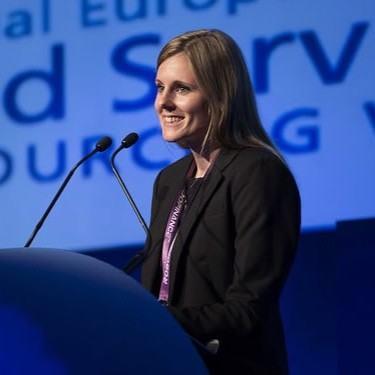
Autho Sally Fletche Head of Thought Leadership & Community at
Hypato
Contact u A A

Corporate Headquarters:
Hypatos GmbH c/o Mindspace Zimmerstraße 78, 10117 Berlin, German