Agentic accounts payable: The Architecture of Zero-Touch Finance

Written for: GBS Leaders, CFOs, AP Directors, and Shared Services Executives
hypatos.ai




Agentic accounts payable: The Architecture of Zero-Touch Finance
Written for: GBS Leaders, CFOs, AP Directors, and Shared Services Executives
hypatos.ai
AP automation has hit a wall, not a technology wall, but an architecture wall. The answer is not better bots. It is a fundamentally different kind of reasoning.
For the past decade, enterprises have measured AP progress in characteraccuracy percentages and invoice-per-FTE ratios. These metrics have improved. The underlying economics have not.
The reason is structural. Every major AP automation platform on the market today, regardless of how it markets itself, is built on a deterministic foundation. Rules, templates, confidence thresholds, and human review queues. When the system encounters something it was not explicitly programmed to handle, it stops. A human picks it up. That human is your cost.
This paper argues that the automation ceiling most enterprises have hit is not a temporary limitation waiting to be patched. It is a design constraint baked into the architecture of legacy systems. Closing the last 30–40% of the exception gap requires not an upgrade, but a rethinking.
Agentic AP is that rethink. An AI Agent does not follow a script. It reasons. It retrieves context from your ERP, validates vendor identity, interprets semantic meaning, and makes decisions; including drafting vendor communications, resolving price discrepancies, and flagging anomalies, with near-zero human intervention.
The central argument:
Most enterprises believe they have high AP automation. They are measuring the wrong thing. Invoice capture rates and character accuracy are not the same as process autonomy. True autonomy is measured by straight-through processing (e.g., the percentage of invoices that complete the full P2P cycle without a human touch). For most organizations, that number is well below 50%.
A precise, defensible definition of what 'agentic' actually means in a finance context, and how to use it to evaluate any vendor claim.
A four-era framework for understanding where AP automation has been, where it is now, and where it is going.
A breakdown of the five AP workflows where autonomous reasoning via agentic AI delivers the fastest and most measurable ROI.
A 12-question vendor evaluation framework, a tool you can take into an RFP or demo.
A five-lever ROI model for building your internal business case.
A 90-day implementation roadmap from first audit to full autonomous operations.
The GBS and BPO leaders who will define the next decade of back-office performance are not waiting for their current vendors to catch up. They are asking a different question: not 'how do we automate more tasks?' but 'how do we make outcomes autonomous?'
This paper is designed to help you answer that question, and act on it.






Most AP leaders believe they have high automation. They are measuring the wrong thing.
The gap between 'captured' and 'processed' is filled by people. Inside almost every GBS organization is what we call a Shadow Back Office, a layer of human labor whose primary function is to do what the automation stack cannot. These are not highly paid strategic analysts.
They are experienced clerks whose job is to move data between systems, resolve discrepancies, make judgment calls, and push invoices through queues.
When asked about their automation rate, many AP leaders estimate 70%+. However, this number typically refers to how many invoices are successfully captured and digitized without manual data re-entry. It is a real metric. It is also deeply misleading.
Digitization is not automation. Capturing data from an invoice is the first step in a multi-step process. The question is not whether you can read the invoice, it is what happens next. Can the system validate the vendor against your ERP? Can it complete a three-way match when the description on the invoice does not precisely match the PO line? Can it resolve a price discrepancy, route for approval, handle a foreign currency conversion, and post to the ledger, all without human intervention?
For the vast majority of enterprises, the answer is no. Not because the technology does not exist, but because the architecture of their current systems was never designed to handle these downstream decisions autonomously. SSON Research & Analytics data reveals that although Agentic AI ambition is high and “half the market right now is hoping for 20 to 50% productivity increase,” the same market percentage has achieved 10% improvement at best.
This disconnect between touchless invoice processing and actual end-to-end automation, demonstrates why.
In a 100,000-invoice-per-month environment, even a 5% exception rate generates 5,000 manual interventions. At an average fully-loaded cost of $8–12 per manual touch (including review, correction, escalation, and audit trail), that is $40,000–60,000 per month in hidden labor cost, on top of your automation license fees.
This cost is invisible on the P&L because it does not appear as an 'AP automation' line item. It appears as headcount. It appears in overtime. It appears in the 'reconciliation' bucket. The Shadow Back Office is the price of automation that was never truly autonomous.
The industry's obsession with 'accuracy rates' 98%, 99%, 99.5% obscures a fundamental problem. Character-level accuracy and process-level success are not the same thing.
Consider this: 99%-character accuracy on a line-item invoice still produces a failed three-way match if the system does not understand that 'HP 14-inch Notebooks x10' on a purchase order and '10x HP Laptops' on the
supplier invoice refer to the same product. The characters are accurate. The semantic meaning is lost. A human has to intervene.
Agentic systems are not measured by character accuracy. They are measured by straight-through processing rate, the percentage of invoices that complete the entire P2P cycle without a human touch from receipt to payment posting. This is the metric that correlates with actual cost reduction, and it is the one most legacy vendors prefer not to discuss.
The most damaging structural problem with Human-in-the-Loop (HITL) systems is not their immediate cost. It is their scaling behavior. HITL architectures scale linearly with volume. Every new invoice, every new vendor, every new subsidiary or region adds proportionally to the exception load, and therefore to the headcount required to manage it.
This is precisely the trap that BPO providers and GBS leaders discover when they win a new client or expand to a new market. The contract economics assumed a certain exception rate. The reality is higher. And because the system cannot reason through the new edge cases, new people must be hired to handle them.
The 'Human-in-the-Loop' model was never automation. It was augmentation, making manual work slightly faster. True automation is defined not by how efficiently humans perform tasks, but by how rarely they need to perform them at all.
The word 'agentic' is rapidly becoming a marketing term. Before it loses all meaning, this section establishes a clear, testable definition that you can use to evaluate any vendor claim, including ours.
An AI Agent, in the technical sense, is a system that combines three distinct capabilities: perception (reading and understanding its environment), reasoning (deciding what to do given the context), and action (taking steps that change the state of the world).
In an AP context, this translates to specific, observable behaviors.
The agent understands language in context, not just characters in position. It recognizes that 'Bill To' and 'Invoice Recipient' mean the same thing. It understands that a '10% line-item variance' is a discrepancy requiring resolution, not just a number. It can distinguish a credit note from an invoice without being told which document type it is looking at.
The agent can call external systems to retrieve information it needs to make a decision. When it encounters an unknown vendor, it queries the ERP, not a human. When it needs to verify a tax ID, it checks the relevant registry. When it needs the payment history for a reconciliation, it pulls the data directly. A system that requires human intervention to access supporting information is not an agent; it is a very capable form reader.
The agent does not merely flag, it acts. It resolves rounding errors. It drafts dispute communications. It posts matched invoices to the ERP. It identifies master data anomalies and proposes consolidations. When it cannot act, it produces a reasoned recommendation that a human can approve with a single click, not a problem they must diagnose from scratch.
The distinction between these two operating models is the clearest single indicator of whether a system is genuinely agentic. In a Human-in-the-Loop model, the human is part of the processing chain. The system does what it can, then hands off. The human does what the system cannot, then hands back. Every exception requires human cognitive effort, they must understand the problem, investigate the context, make a decision, and record the outcome.
In a Human-on-the-Loop model, the human is an auditor, not an operator. The agent processes the transaction end-to-end, including the exceptions. The human reviews the agent's reasoning log and approves or overrides. The cognitive load is entirely different, and so is the time cost. Reviewing a reasoned decision takes seconds. Diagnosing and resolving an exception from scratch takes minutes.
When your current system encounters an invoice it cannot match, what happens next? If the answer involves a human opening a screen, investigating the problem, and making a decision, that is HITL, regardless of how the vendor markets it. A genuine agent tells you what it found, what it concluded, and what it did, and asks for your sign-off, not your labor.
Zero-shot capability as the baseline test
One of the clearest architectural indicators of a genuine agentic system is zero-shot performance, the ability to process documents it has never seen before, without pre-training on samples.
Legacy systems require 500–1,000 sample invoices per vendor format to achieve acceptable accuracy. This creates a months-long onboarding runway for every new supplier, subsidiary, or region. For BPO providers onboarding new clients, this is a direct margin cost.
An agentic system built on LLM reasoning understands document concepts, what an invoice is, what line items represent, what a tax ID looks like, what 'total due' means, without being taught. It processes a document from a vendor it has never encountered with the same accuracy as one it has processed a thousand times. Zero-shot is not a feature; it is evidence of architectural maturity.
The failure point of nearly every legacy three-way match implementation is string comparison. The system looks for exact or near-exact text matches between the invoice, the purchase order, and the goods receipt. When descriptions differ, as they almost always do in practice, the match fails and a human must intervene.
A semantic matching system understands equivalence. It knows that '10x HP Laptops' and '10 units HP 14-inch Notebooks' are the same product for reconciliation purposes. It knows that 'Freight' and 'Shipping Costs' represent the same cost category. It knows that a unit price discrepancy within a defined tolerance range, with a consistent vendor history, is an auto-approvable variance rather than an escalation.
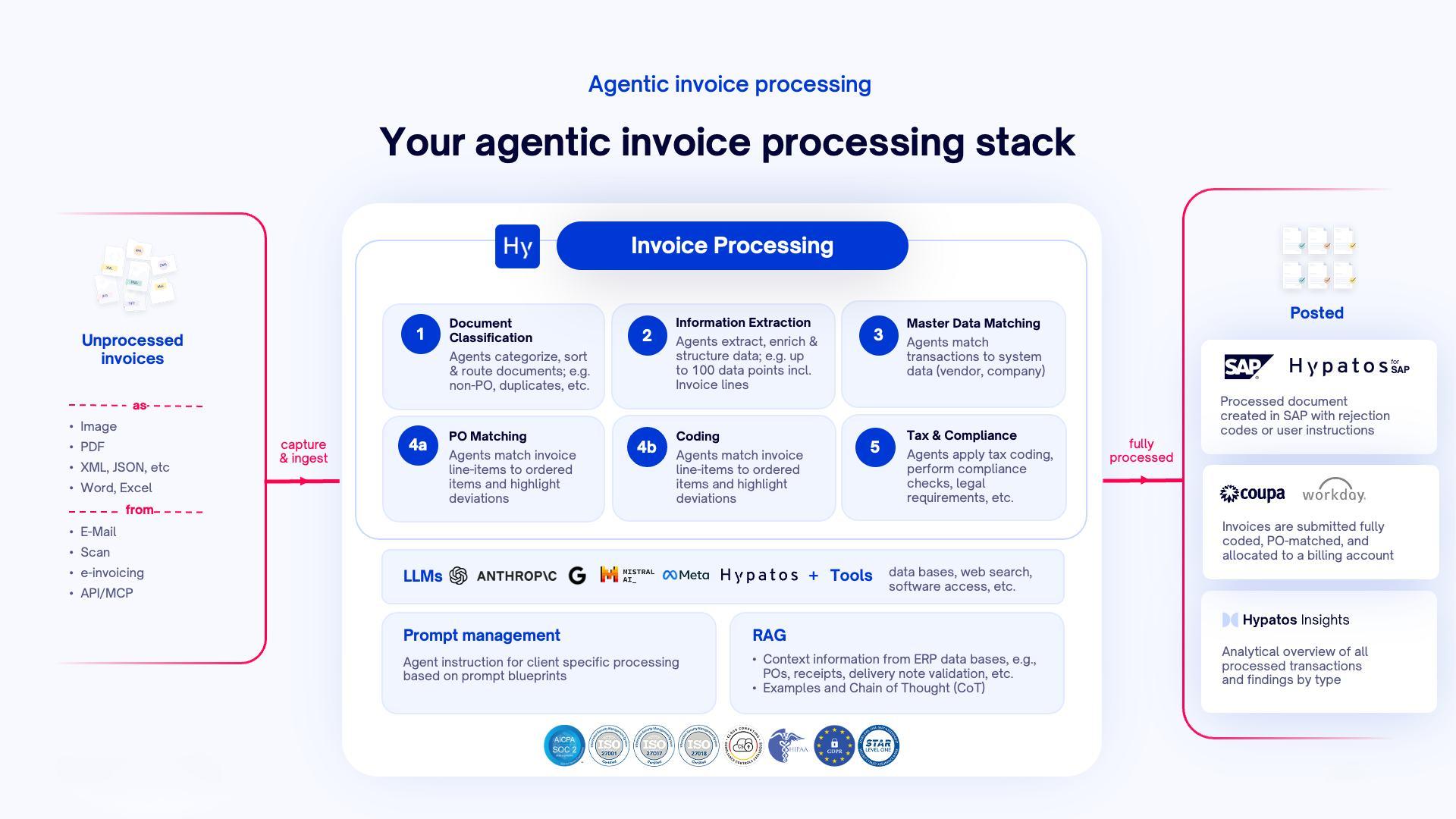
This is not a minor efficiency improvement. It is the capability that collapses the exception queue, because the majority of exceptions in a typical AP environment are caused not by genuine errors, but by semantic mismatch between systems that were never designed to talk to each other. This diagram below demonstrates how Hypatos AI Agents process invoices:
“Agentic GBS is not about productivity tools anymore. It’s about agent teams acting as co-workers, handling entire end-to-end processes, learning from human experts, and continuously taking over standard work autonomously.”
Uli Erxleben
Founder & CEO,
Hypatos

Two of the biggest perceived barriers to implementing Agentic AI in GBS are “lack of clear business use cases” and “data quality, access, or governance constraints.” In fact, data collected at a recent SSON and Hypatos webinar showed that nearly 60% of respondents were hampered by their data quality.
What do you see as the biggest barriers to implementing agentic AI in Global Business Services?
58%
Luckily, master data management and cleansing is just one of the ways Agentic AI can assist your AP function. The five areas below represent the highest impact, fastest return opportunities for agentic deployment, the places where the gap between current automation and true autonomy is widest, and the cost of that gap is most visible.
The holy grail of AP automation is a fully autonomous three way match, invoice against purchase order against goods receipt, resolved without human intervention. Legacy systems achieve this for the easy cases and fail on everything else. The everything else is typically 25–40% of invoice volume.
An agentic three way match system resolves discrepancies by reasoning about them. It understands semantic equivalence between line item descriptions. It applies configurable tolerance logic to price variances. It accounts for partial deliveries and split POs. It identifies pattern based discrepancies, a vendor who consistently invoices slightly above PO price, and flags them for strategic review rather than routing every instance to a clerk.
85–95%+
Impact: Straight through processing rates of on previously exception heavy match workflows.
In a traditional AP environment, every exception looks the same to the system: an invoice that did not clear automatically. A human must open it, read it, understand why it failed, find the relevant context (often across multiple systems), make a decision, and document their reasoning.
An agentic triage system categorizes exceptions by type and severity before any human sees them. It resolves the ones it can autonomously, rounding errors, known vendor formatting quirks, recurring tolerance patterns. For the ones that require human judgment, it presents not just the exception but its full investigation: what it found in the ERP, what the vendor history shows, what it recommends, and why.
60–75% Impact: reduction in exception-handling labor; remaining exceptions resolved in seconds rather than minutes.
Price mismatches, missing documentation, and delivery discrepancies typically generate back-and-forth email exchanges between AP staff and vendors, manual, time-consuming, and inconsistently executed across teams.
An agentic dispute system drafts these communications automatically. When it identifies a price discrepancy, it generates a professional dispute email citing the specific PO reference, the invoiced amount, the expected amount, and the required correction, ready for one-click approval and send. When a vendor queries payment status, the agent retrieves the current processing state and drafts an accurate response, including any blocking conditions the vendor needs to resolve.
Impact: Near-elimination of manual vendor communication time; faster dispute resolution cycles; improved vendor relationships.
ERPs accumulate corrupted data over time, duplicate vendor records created by different teams, inconsistent naming conventions, inactive vendors that were never deactivated, missing tax IDs. This master data pollution is a primary cause of downstream matching failures and a significant audit risk.
An agentic system identifies master data anomalies as a byproduct of its processing work. When it encounters two vendor records that appear to represent the same entity, it flags them for consolidation. When it processes a payment to an address that does not match the vendor's registered tax ID, it raises a compliance alert. These are not standalone data quality projects, they happen continuously, as a natural consequence of agentic processing.
Impact: Continuous master data improvement; reduced duplicate payment risk; stronger audit posture.
Early payment discounts, typically 1–2% for payment within 10 days, represent millions of dollars in recoverable value for largevolume AP operations. They are also systematically lost in environments with long exception queues, because invoices that sit in a queue for 7–10 days waiting for human resolution miss the discount window.
An agentic AP system eliminates the queue lag. Invoices are validated and matched in hours, not days. Payment terms are read and interpreted automatically, and discount-eligible invoices are flagged for priority processing. The financial value of this single capability frequently exceeds the full cost of the agentic platform in the first year.
Impact: Recovery of of available early payment discounts, previously lost to processing lag.
For GBS leaders and BPO providers, the Agentic AP value proposition is not primarily about cost reduction, it is about operating model transformation. The organizations that win the next decade of business services will be those that break the linear relationship between transaction volume and headcount.
Every BPO contract and every GBS business case has, at its core, a cost-pertransaction assumption. That assumption is built on a staffing model. When volume grows, a new client, a new subsidiary, a market expansion, the headcount model grows with it. This is the linear scaling trap.
The trap is not visible during steady-state operations. It becomes acute during growth. A BPO that wins a new client adding 50,000 invoices per month to their existing volume does not add 50% more revenue, they add 50% more operational complexity, 50% more exception volume, and the corresponding headcount to manage it. Margins compress with every growth event.
In the Agentic operating model, the relationship between volume and headcount changes from linear to near-flat. Adding 50,000 invoices per month to an agentic AP environment adds compute cost, not people cost. The agent handles the new volume with the same accuracy and speed as the existing volume, because its reasoning capability does not degrade with scale.
This changes the org chart. The AP team in an agentic model is not a processing team, it is an oversight team. Their job is not to resolve exceptions; it is to configure resolution logic, audit the agent's reasoning, manage vendor escalations that require relationship judgment, and identify strategic opportunities in the spending data the agent is continuously processing.
The talent required for this work is different. The clerks who previously spent their day in exception queues can be redeployed to working capital analysis, vendor relationship management, and strategic sourcing. This is not a headcount reduction story (though that is often the result). It is a capability elevation story.
In a typical HITL AP operation, the blended cost per manually-touched transaction is $8–15. Agentic processing reduces this to $1–3 per transaction, with the cost improvement concentrated precisely in the highcomplexity, high-cost exceptions that have historically been unautomatable. For a BPO processing 500,000 invoices per month with a 20% exception rate, the addressable saving is $7–12 per exception, on 100,000 exceptions. That is $700K–$1.2M in recoverable monthly margin.
Note: Benchmarks are indicative ranges based on documented enterprise deployments. Actual results vary by invoice complexity, vendor mix, and ERP environment.
The AP automation market is saturated with 'AI' claims. Every legacy OCR vendor has added an LLM marketing layer. Every RPA platform has announced an 'agentic' roadmap. Use these 12 questions in your RFP, vendor briefings, or live demos to cut through the claims and test the architecture.
These questions test whether the system can act on its own, or whether it is fundamentally a work routing system that still depends on human decision making.
Question
Can the system resolve a price mismatch without human intervention?
What you are testing, and what to listen for
Ask for a live demo. Show a price discrepancy within a defined tolerance. Watch what happens. A bot escalates. An agent resolves it and logs its reasoning.
The questions are organized into four categories that mirror the four layers of genuine agentic capability. A vendor that cannot answer confidently and specifically in any category is telling you something about their architecture.
These questions expose whether the underlying system is truly reasoning or merely executing rules with a better interface.
What percentage of exceptions does the system resolve end-to-end today, not flag, but resolve?
Does the system draft vendor communications, or does it ask humans to draft them?
This is the autonomy rate, which is distinct from the automation rate. Push for a specific number from a reference customer. Vague answers indicate low actual autonomy.
Agentic systems act, not just inform. If the system produces a completed draft that requires only one click approval, it is acting. If it produces an alert that tells you to write an email, it is not.
Integration questions
These questions reveal whether the system is designed to exist within your operational environment or alongside it. Can you demonstrate zero-shot processing on our own data today?
How many samples are required to add a new document format?
What happens when the document layout changes mid-stream?
Any vendor with genuine LLM native architecture should be able to process documents it has never seen with high accuracy on Day 1. A request for 'sample data to train on' before the demo is a red flag.
Zero shot systems require zero samples. Template based or ML retrained systems require hundreds or thousands. The number they give you reveals the architectural generation.
An agentic system adapts in real time. A template based system breaks and requires human intervention and retraining.
Does the system call your ERP directly to validate data, or does it rely on exports?
How is every automated decision logged and retrievable for audit?
Native ERP integration means the agent can retrieve live data at the moment of processing. Export dependent systems have a lag built into their accuracy, they are working with yesterday's data.
A genuine agentic system produces a 'reasoning log', a traceable record of what data it retrieved, what it concluded, and what it did. This is essential for audit and for building internal confidence in the system.
How is data residency and processing location controlled?
Especially relevant for regulated industries and cross-border operations. Understand exactly where data flows before, during, and after processing.
Agentic AP creates value across five distinct levers.
A credible business case captures all five. These questions test whether the vendor is willing to be held accountable for results, and whether their SLA structure reveals the true operating model.
Is the SLA structured around extraction accuracy or straightthrough processing rate?
What happens when the system fails to process an invoice?
Accuracy SLAs measure the input. STP-rate SLAs measure the output. A vendor who will only commit to accuracy is telling you they are not confident in their downstream autonomy.
The answer reveals the exception model. Does a human inherit a completely unprocessed invoice, or does the agent hand off its partial findings, context, and recommendation? The latter is autonomous-first. The former is HITL.
The mistake most AP transformation business cases make is treating automation as a headcount reduction story. While FTE cost reduction is real, it is typically the smallest component of total value, and the hardest to get CFO approval on. The five-lever model reframes the conversation around financial performance and risk management outcomes that resonate at the executive level.
Can you connect us with a reference customer at similar volume and complexity?
The most important question. Credentials from production deployments at comparable scale, in a comparable ERP environment, with quantified STP and ROI outcomes, are the only conclusive evidence.
“Businesses have a tendency to buy automation rates. Which drives me crazy! They need to move away from buying the automation rate to focusing in a much more detailed way on the business impact


The most direct lever: reducing the human labor required to process invoices. In agentic deployments, this shows up not as mass layoffs but as capacity creation, existing AP headcount handling significantly higher invoice volume without additions or being redeployed to higher-value analytical work.
Exceptions are the highest-cost transactions in any AP environment. They consume disproportionate labor time, generate audit risk, strain vendor relationships, and slow cash cycles. Legacy automation often reduces the easyinvoice processing cost significantly while leaving exception costs unchanged.
Quantification approach: Identify your current exception rate and average cost per exception (including all downstream labor: investigation, communication, reprocessing). Model the reduction at your target autonomy rate.
This lever is consistently undervalued in business cases, despite being highly calculable and frequently the largest single value component.
Dynamic discounting programs (1/10 net 30 is common) offer 1–2% discounts for payment within 10 days. In HITL environments, invoices in exception queues regularly miss this window. In an agentic environment, matched invoices are ready for payment in hours. At $500M in annual spend with a 30% discounteligible portion and a 1.5% discount rate, the recoverable value from full capture is $2.25M per year, often more than the total platform cost.
Lever 4
Manual AP processes have well-documented vulnerability to duplicate invoices and vendor fraud. Human reviewers miss patterns across large transaction volumes. Agentic systems analyze every transaction against the full invoice history, identifying duplicates, anomalous payment patterns, and vendor identity mismatches that would evade individual human review.
Vendor relationships are the hardest ROI component to quantify and the most frequently overlooked. Slow payment cycles, unanswered status queries, and disputed invoices damage supplier relationships, affecting payment terms, supply chain reliability, and the vendor s willingness to offer preferential pricing.
Agentic AP systems respond to vendor inquiries automatically, resolve disputes faster, and pay on-time (or early) consistently. The downstream impact is measurable in improved payment term negotiation, reduced supply chain disruption costs, and higher supplier satisfaction scores.
Structure your ROI model with two scenarios: conservative (based on documented reference deployments at your volume tier) and expected (based on your own exception analysis). Lead with Levers 2 and 3, exception elimination and discount capture, as they are the most credibly quantifiable and often exceed the platform cost on their own. Layer in Levers 1, 4, and 5 as strategic upside. Frame the total as: 'Net positive in 12 months, transformative in 36.
“(When deploying Agentic AI) I look at the organization and see where our problem areas are… and either the operating cost is too high, or my employee acquisition is difficult. So, the thought is about not where AI can be incorporated easiest. It is where, as an organization, the pain is biggest.”
Quantification approach: Industry benchmarks suggest duplicate payments represent 0.1–0.5% of AP spend in manual-heavy environments. At $500M in spend, that is $500K–$2.5M in recoverable value annually. CK Taneja AI Strategist, Northern Trust (GBS Rewired Podcast)


phased implementation blueprint that de-risks the transition
Before deploying any technology, you need to understand your actual exception landscape, not the one your current system reports, but the one that exists in your people s workflows. These are different.
What are the biggest challenges your organization faces in the implementation and maintenance of AI Agents?
38% Ensuring data quality, privacy, and compliance
31% Integrating AI agents with existing legacy systems
19% Scaling AI solutions across multiple business units or geographies
12% Securing leadership buy-in and change management support
0% Managing ongoing training and performance optimization
The most common objection to agentic transformation is not the technology, it is the perceived data complexity and integration challenge. This 90-day roadmap is designed to make that objection obsolete.
The transition to agentic AP is not a big-bang ERP replacement. It does not require ripping out existing systems. It is an intelligence layer that sits above your current technology stack, initially running in parallel, progressively taking over more of the decision-making workload. The 90-day structure is designed to build internal confidence at each stage before expanding scope.
The shadow audit maps every point in your AP process where a human is required to make a decision or move data between systems. This includes the obvious exception queue, but also the less visible interventions: the clerk who knows to check a specific field manually because the system gets it wrong, the supervisor approval that happens via email outside the workflow, the monthend reconciliation that three people spend two days on.
Identify the service line or process with the highest volume of human interventions.
Map each intervention type: what triggers it, how long it takes, what the human does, what system they interact with.
Quantify: volume per month, fully-loaded cost per intervention, average resolution time.
Prioritize: identify the top 5–10 intervention types by ROI potential, these are your first agentic deployment targets.
With the shadow audit complete, deploy the agentic system against your highest-ROI target use case, typically semantic three-way match on a defined invoice segment, or exception triage on a specific invoice category.
Critically, run this in parallel with your existing process for the first two weeks. Do not use the agent s decisions as the operational record. Use them as a comparison: where does the agent agree with the human? Where does it disagree? Where is the agent faster? Where does its reasoning expose a systemic issue in your master data or PO structure?
Select a representative invoice segment (minimum 1,000 invoices per month for a meaningful signal).
Establish ongoing monitoring: weekly STP rate reviews, exception pattern analysis, model feedback loop.
Configure ERP integrations and approval logic in Week 1. Redefine team roles: from exception resolvers to autonomous system auditors.
Run parallel processing Weeks 2–4: agent and human process the same invoices independently.
Measure: STP rate, exception accuracy, average processing time, human override rate.
Review: identify patterns in human overrides, these reveal configuration refinements, not system failures.
An STP rate of 80%+ on your pilot segment, with human override rate below 5%, is a strong signal for full deployment. If your override rate is higher, the investigation almost always reveals a master data issue (missing vendor records, inconsistent PO formats) rather than a model accuracy problem, and fixing those issues improves not just the agent but your entire AP operation.
Full scale deployment Days 61–90
With pilot results validated, expand deployment to the full invoice population. This is not a single cutover event, it is a progressive handover where the agent takes on progressively more of the exception resolution workload while humans focus on the strategic oversight layer.
Expand to full invoice volume across all vendor types.
Integrate remaining ERP modules and approval workflows.
Retire or consolidate the exception queue management process.
Unprocessed transactions

Transactions processed in ERP/CRM/ECM system









The companies that define the next decade of GBS performance will not be those with the best automation; they will be those who first treat autonomous finance as a strategic capability rather than a cost reduction project.
The argument in this paper is not that agentic AI will replace AP teams. It is that the definition of what an AP team does is changing, and the organizations that manage this transition deliberately will gain a structural advantage that compounds over time.
When the exception queue is eliminated, the AP function transforms. It becomes a data-rich, real-time window into spending patterns, vendor relationships, supply chain health, and working capital dynamics. The people who used to manage the queue are now positioned to manage those insights, if their organization gives them the tools and the mandate to do so.
Agentic AP is the foundation of that transformation. It is not a product category. It is an architectural commitment: to systems that reason, not just execute; that act, not just alert; that own outcomes, not just tasks.
When your AP team encounters an invoice exception today, what percentage of their cognitive effort is spent understanding the problem versus solving it? In a legacy HITL environment, the ratio skews heavily toward understanding — because the system hands off a problem, not an analysis. In an agentic environment, that ratio inverts. The system hands off an analysis, a recommendation, and often a completed action. The human's role becomes judgment and governance, not investigation and execution.
The transition to autonomous AP is not risk-free, but it is significantly de-risked by the architectural properties of genuine agentic systems: zero-shot processing that does not require months of upfront training, parallel deployment that validates performance before full handover, and reasoning logs that make every automated decision auditable and reversible.
The organizations waiting for certainty before acting will find the decision made for them by competitors who have already decoupled their operating cost from their transaction volume, and are now using the reclaimed capacity to drive strategic advantage.
Arrange a call to build your Agentic GBS Blueprint with Hypatos. This includes, assisting you in identifying the most powerful usecases, establishing the roles, governance and the factors needed to make this project a success.
Scan to book a meeting
Hypatos enables The Agentic GBS with AI agents that execute end-to-end processes across P2P, O2C, H2R, and R2R, making decisions within human-set boundaries and scaling operations without headcount growth.
We put process ownership in the hands of business leaders, elevating organizations from support provider to business partner. Results: 90%+ straight-through processing, 6-9 month ROI, and 20x productivity gains.
Trusted by enterprises in Europe and North America, with hubs in Berlin, Miami, and New York, and teams across 15+ countries.