HYLA HYLIGHTER FEBRUARY 2026
"The greatest glory in living lies not in never falling, but in rising every time we fall" - Nelson Mandela
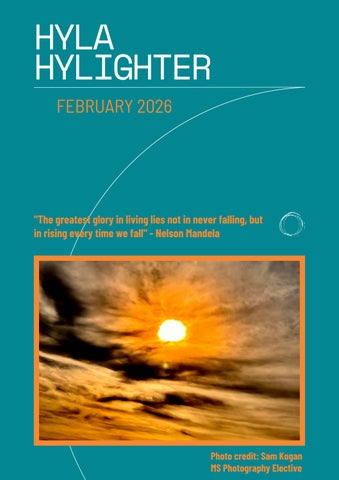
Photo credit: Sam Kogan MS Photography Elective
1
Head’s Hylights
2
Curriculum Insights
3
Rising Voices
4
Educator Insights
PAGE 02
PAGE 03
PAGE 05
PAGE 06
5
Learning Together
6
Photo Collage
PAGE 8
PAGE 9
HYLA HYLIGHTER
CONTENTS
HEAD’S HIGHLIGHTS Dear Hyla Friends and Families,
Kris smiled as she listened and shared how much she appreciated hearing that reflection from someone who still has relatively fresh eyes on the school. After more than twenty years at Hyla, it can be easy to overlook just how special that culture is. Yet she sees it every day in the ways students understand and accept one another. A few minutes later the candidate asked another question: What gets kids excited at Hyla? Again, Caroline and Kris agreed: “So much,” they said. Students get excited about the experiential and handson learning, whether on a larger scale such as Exploration Week or in everyday classroom experiences like projects, performances, and science labs. And, “Students get excited, when you [teachers] are excited.” The relationships teachers at Hyla have with students makes the learning with them so much fun. This conversation was still in my mind the next morning as I visited both middle school and upper school science classes. What I observed reflected exactly what Caroline and Kris had described: Student enthusiasm and curiosity. Intellectual engagement alongside collaboration and care. Not just learning, but students who care deeply about learning and about one another. As you read through this issue of the Hylighter, I hope you see and hear those same themes. You will find them in Tabor Houghtaling’s Rising Voices reflection on leadership, where she writes that leadership is not about having all the answers but about asking better questions and creating spaces where others feel empowered to step forward. You will see them in the creative energy of our arts and music classrooms and in the insights our teachers share about what it means to guide students as they discover what they are capable of. And you will see them in the everyday moments captured in these pages. Students experimenting, collaborating, performing, creating, and discovering new interests. When Tabor shares the phrase she lives by, “Be where your feet are,” I could not help but think about how fitting that sentiment is for our community. At Hyla, students and teachers are visibly present with their work, their questions, and with one another. I feel incredibly proud that these students and teachers get to be where their feet are. Right here at Hyla. Warmly, Suzanne
2
Caroline leaned forward, excited to answer. She shared that she has worked at several schools before coming to Hyla, all of which had school mottos. But what is special about Hyla’s, We Take Care of Each Other, is that it is directly connected to how people actually are here, both the students and the adults. And that taking care of each other really does happen culturally.
HEAD’S HYLIGHTS
Recently, Kris, Caroline, and I had the pleasure of participating in an interview for our Middle School Science and HyLab teaching position. I love meeting new and passionate educators, but I especially appreciate learning about them through the questions they ask of us. This candidate asked several thoughtful questions, including one that asked Caroline and Kris to describe Hyla’s culture.
CURRICULUM INSIGHTS
Education with a Purpose
CURRICULUM INSIGHTS
SNAPSHOT: MIDDLE SCHOOL ELECTIVES BY: ERIK
3
SNAPSHOT: MIDDLE SCHOOL SPANISH BY: MERCEDES In Spanish class during January, our focus was on making grammar less scary and much more doable. Students learned that grammar isn’t about being perfect—it’s about communicating. Grammar is the glue that holds words together; without it, we only have vocabulary, but with it, students can express ideas clearly and understand others with confidence. One of the most exciting realizations for students is that Spanish grammar is not as foreign as it first appears. English and Spanish are grammar cousins. Both languages use subjects and verbs, follow familiar sentence patterns, and change verb forms to show time. As students work with highfrequency verbs like ser, estar, and ir, they discover they’re not learning a completely new skill—they’re building on what they already know from English. That “aha” moment makes Spanish feel approachable and empowering. As one student shared, “Once you learn the formula, conjugating verbs in Spanish is actually easy.” Read more on our blog.
On the first day of “Finding Light in the Darkness”, a long-block photography elective, Middle School students filtered into the top floor of the Upper School campus. They were enthusiastic and eager to first learn about photography principles and then take to the surrounding sidewalks and local parks to to practice their skills and create their own art. While this time of year is often extra damp and dark, we were blessed with many sunny days to balance out the rainy ones, allowing students to capture a wider breadth of contrast and perspective in our surrounding environment. The primary objective of this elective was to give students a basic understanding of photography skills through which they could creatively capture images that reflect the unique ways in which they experience the world around them. Read more on our blog.
SNAPSHOT: UPPER SCHOOL APERTURE: STUDIO ART BY: HANNAH The spring semester in Studio Art has officially started, and the room already feels like a working art studio:busy, focused, and full of works-in-progress! I started the semester by establishing expectations for how we use the space, how we work, and how we support each other as artists. From day one, the focus is on treating the studio like a real creative workspace: respecting tools and materials, keeping our areas clean and organized, and practicing what we call “Always Be Knolling”: organizing our items in progress so they’re more visually appealing. These routines might seem small, but they’re foundational to building a studio culture where everyone can do their best work. In Studio II, especially, students have a lot of ownership: they choose materials, set timelines, document their process, and work toward a final portfolio that makes up a significant part of their semester grade. .Read more on our blog
SNAPSHOT: MIDDLE SCHOOL MUSIC BY: BOBBY One of the guiding ideas behind our music curriculum is balance. Playing music requires technical skills: basic instrumental technique, rhythmic accuracy, sight reading, time-keeping, and more. These fundamentals matter, and we practice them intentionally. At the same time, music is not meant to live only in exercises and drills. From day one, we strive to get students immersed in real musical experiences where they can play together, feel groove, and hear the immediate result of their efforts. The goal is for students to experience music not as something they are preparing for, but something they are already doing. To support this, our classes often move between focused skill-building and ensemble work that is rooted in real music the students enjoy. A short technique exercise might immediately show up inside a groove, a song, or a group arrangement. Artist and song choice can be hugely important here. Read more on our blog.
Learning with
PURPOSE
RISING VOICES TABOR HOUGHTALING CLASS OF 2027
WHAT’S SOMETHING PEOPLE MIGHT BE SURPRISED TO LEARN ABOUT YOU? RISING VOICES
Something people might be surprised to learn about me is that I’m a certified scuba diver. Being underwater is easily one of my favorite things, it is such a different world! It has taught me a lot about respect for the ocean and how important it is to protect the environments we are lucky enough to explore.
5
FAVORITE QUOTE OR MOTTO YOU LIVE BY? I recently learned this quote and completely fell in love with it “Be where your feet are” because I think it reminds us to stay present instead of getting caught up in what is next or what has already happened. When I focus on the here and now I feel more grounded, more grateful, and more definitely more intentional with how I show up each day.
WHAT’S YOUR PROUDEST MOMENT AS A STUDENT SO FAR? While Hyla has definitely given me so many moments to be proud of academically and beyond, my proudest moment has honestly been falling in love with learning itself. At some point I realized, it stopped being about grades or achievements and became about curiosity and growth. I understood that I genuinely want to understand the world more deeply and that has been the most meaningful accomplishment of all.
WHAT ARE YOUR DREAMS FOR THE FUTURE? I am not completely sure what specific job I want yet but I do know that I want my work to matter. My dream is to be part of something that creates a meaningful and lasting impact. No matter which path I take, I hope it pushes me to grow, keeps my curiosity , and gives me the chance to make a difference beyond just myself.
WWHAT DOES BEING A LEADER MEAN TO YOU? For me, leadership starts with being aware of yourself, of others, and of the way you impact the world around you. It is about recognizing that every choice you make such as how you speak, how you listen, how you show up, shapes the people and spaces around you. I have learned that leadership is not necessarily having all of the right answers, but rather it is about asking better questions, especially around equity, sustainability and the long-term impact you can make. Leadership is much more than making decisions, it is deeply rooted in building connections. Most importantly, leadership is about living your values no matter who is or is not watching you. For me, leadership is not about leading from the front of the group, but rather helping others to create an environment where they feel empowered to step forward.
CHIRS SOLDEVILLA PERFORMING ARTS 6-12 How would you describe your classroom? A place that is safe to explore.
What’s one lesson (academic or life) you hope every student takes from your class? We are more capable than we tend to give ourselves credit for.
What's one tradition or routine in your classroom that your students love? If you are late for my class, the first time you have to sing why you were late. The second time, you have to add dance moves. Third time, you get to take your song and dance to the office. The kids run to get to class on time and watch the clock to see if someone has to sing (including me). No one has ever made it to three times.
If you could sum up your teaching philosophy in a sentence, what would it be? Don’t let someone waste their creativity on coming up with reasons why NOT to do something. Guide them to put that energy into exploring what they are actually capable of.
What does student success look like to you? Many times, it’s just them actually stepping onto the stage in front of people. After that, everything else just adds to the success. Every win over anxiety is a huge stepping stone towards greater accomplishments.
EDUCATOR INSIGHT
How do you hope your students remember you years from now? As someone who positively influenced their growth.
HANNAH WRIGHT VISUAL ARTS 6-12
Describe your classroom in three words. Busy, Creative, Vibrant
7
EDUCATOR INSIGHT
What's one tradition or routine in your classroom that your students love? I play different music in class every day, especially in my Upper School classrooms. One comment I received this year was that students always love that I’m playing something different. I loved that feedback because I hadn’t thought much about it beyond playing something that felt like good working music and that I wanted to listen to that day. It has also opened up a really fantastic opportunity for my students to introduce me to music they think I’d like based on what I’m playing. I’ve been introduced to some really fantastic music because students have wanted to share.
If you could sum up your teaching philosophy in a sentence, what would it be? Make stuff, reflect honestly, and don’t panic when it gets weird.
If your classroom had a mascot, what would it be and why?
EDUCATOR INSIGHT
Funnily enough, my classroom already has a mascot: a mop called Moppy. I didn’t choose it, and I don’t think anyone who knows me would choose a cleaning tool to represent the spirit of my teaching. My Clean Crew created the mascot and has nurtured the tradition of Moppy for two years now. If I were choosing a mascot, I would probably choose C-3PO. I have a great clapper-style one that plugs into an outlet and will randomly talk while others are talking, but it doesn’t always work when it’s supposed to. That feels like a more accurate representation of the experience in the art room.
LEARNING TOGETHER
ON FEBURARY 5TH, WE INVITED MEGAN KENNEDY FROM THE UW RESILENCE LAB TO OUR HYLA HOSTS: SPEAKER SERIES. THIS EVENT WAS THE FIRST IN PERSON HYLA HOSTS SINCE COVID. WE ENJOYED HAVING OUR COMMUNITY BACK TO TOGETHER IN PERSON TO LEARN TOGETHER. MEGAN SHARED MANY WONDERFUL IDEAS AND STRATEGIES ABOUT WELLNESS. WE LOOK FORWARD TO HOSTING ANOTHER SPEAKER SOON! IN THE MEANTIME, CHECK OUT SOME OF THESE RESOURCES ON RESILENCE AND WELLNESS.
Books: Minful Self-Compassion for Burnout by Kristin Neff and Christopher Germer. Websites: Be Real Center for Child & Family Well BeingUniversity of Washington
Life at
HYLA
HYLA SCHOOL
HYLASCHOOL.ORG