ACTFL RECOGNITION
USING FAKE IDENTIFICATION
World Languages Teacher Bin He recieved national recognition.
A4
DOLLY PARTON: A TRIBUTE
The school community discusses the various uses of fake IDs and their broader effects.
B1-B2
A look at Parton’s legacy as an artist, businesswoman and philanthropist.
C2
THE HARVARD-WESTLAKE
Wednesday, Oct. 7, 2026
Studio City
Volume 36, Issue 2
hwchronicle.com
PSUPP leader removed
New cameras installed
By H.)).h He)di0.r .)d Ri(. I(er
By A))( D2
A Senior Leader was removed from the school’s Peer Support Program (PSUPP) after being caught with illicit substances on the annual PSUPP retreat on Sept. 25. Peer Support Leader Winston*, who asked to remain anonymous due to PSUPP rules surrounding confidentiality, said the decision to bring drugs on the trip was not a good one. “I don’t think it’s a good idea that they brought [substances] to retreat,” Winston said. “It was a stupid decision and sets a bad example for other kids because it normalizes the usage of drugs at school events in general, which can lead to addiction.” All Peer Support Leaders and Trainees are required to sign the organization’s code of ethics, which includes to “serve as positive role models by mantaining healthy lifestyles,” according to the Peer Support Code of Ethics. Peer Support Trainee Maia Blackman ’28 said she understands why removal may be necessary under circumstances that cause direct harm to other people. “At the end of the day, Peer Support is supposed to be a safe place, so I understand removal when it [compromises] creating a safe space, which is the utmost important thing,” Blackman said. “However, if it’s breaking a rule but doesn’t cause harm to other people, I think it’s a little unfair to completely remove them from the program.” Two other PSUPP leaders were removed prior to the school year as punishment for an unrelated disciplinary infraction. Peer Support Coordinator Evan Daneshrad ’27 said the loss of three leaders has impacted the dynamic of the program. “It sucks because we were already down two leaders at the start of the year, and now we’re down three,” Daneshrad said. “It makes it a bit di1cult to have good groups, make them cohesive and to have enough to begin with. But, we’ve [Peer Support Coordinators] remained optimistic throughout the whole thing, and we’re still trying our best to make it a good year for Peer Support.” *Names have been changed.
DAVID CHUNG/THE CHRONICLE
NICHE.COM
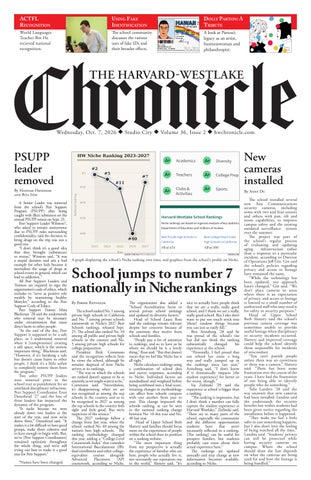
A graph displaying the school’s Niche ranking over time, and graphics from the school’s profile on Niche.
School jumps to number 7 nationally in Niche rankings By Birdie Re()*ld,
The school ranked No. 1 among private high schools in California and No. 7 among private schools nationwide in Niche’s 2027 Best Schools rankings, released Sept. 25. The school also ranked No. 10 among all public and private high schools in the country and No. 5 among private high schools for college preparation. President Rick Commons said the recognition re-ects how he views the school, although he remains skeptical of how Niche arrives at its rankings. “The way in which the schools are ranked doesn’t appear to be as scientific as we might want it to be,” Commons said. “Nevertheless, it’s disappointing when we are not recognized as among the top schools in the country, and so to be recognized in 2027 as among the top schools in the country feels right and feels good. But we’re suspicious of the science.” The 2027 rankings follow a change from last year, when the school ranked No. 40 among the nation’s best high schools. The ranking methodology changed this year, adding a “College-Level Coursework Index” that considers International Baccalaureate (IB), dual enrollment and other collegeequivalent courses alongside Advanced Placement (AP) coursework, according to Niche.
The organization also added a “School Accreditation Score to several private school rankings and updated its diversity factors.” Head of School Laura Ross said the rankings remain relevant despite her concerns because of the attention they receive from schools and families. “People pay a lot of attention to rankings, and so to have us be where we should be is a lovely thing,” Ross said. “But that doesn’t mean that we feel like Niche has it all right.” Niche calculates rankings using a combination of school data and survey responses, according to Niche. Individual factors are standardized and weighted before being combined into a final score, meaning changes in methodology can affect how schools compare with one another from year to year. This change impacted the schools ranking, as can be seen in the national ranking change between No. 10 this year and No. 40 last year. Head of Upper School Beth Slattery said families should focus more on the experiences of people within the school than its position on a ranking website. “The most important thing from my perspective is actually the experience of families who are here, people who actually live it, not necessarily our reputation out in the world,” Slattery said. “It’s
nice to actually have people think that we are a really, really good school, and I think we are a really, really good school. But I also don’t want to put too much stock into [these] random things because you can just as easily fall.” Ben Arinsburg ’28 said he was proud of the school’s rise but did not think the ranking substantially changed his experience at the school. “Personally, I feel proud that our school has come a long way and really jumped up in the rankings since last year,” Arinsburg said. “I don’t know if it dramatically impacts [the student experience] for better or for worse, though.” Isa Zielinski ’29 said the experience at school is bigger than a ranking. “The ranking is impressive, but I don’t think a number can fully capture the student experience at Harvard Westlake,” Zielinski said. “There are so many parts of the school, especially the community and the different opportunities students have that aren’t necessarily re-ected in a ranking. [The ranking] can be useful for prospect families, but students probably care more about their actual experience here.” The rankings are updated annually and may change as new information becomes available, according to Niche.
The school installed several new Axis Communications security cameras, including some with two and four sensors and others with pan, tilt and zoom capabilities, to improve campus safety and the existing outdated surveillance system over the summer. The project was part of the school’s regular process of evaluating and updating aging infrastructure rather than a response to a particular incident, according to Director of Operations Jeff Gin. Gin said the school’s policies regarding privacy and access to footage have remained the same. “While the technology has been updated, our approach hasn’t changed,” Gin said. “We don’t place cameras in areas where there is an expectation of privacy, and access to footage is limited to a small number of authorized staff who may need it for safety or security purposes.” Head of Upper School Beth Slattery said the school’s previous camera coverage was sometimes unable to provide useful footage when disciplinary or security incidents occurred. Slattery said improved coverage could help the school identify those responsible for incidents of misconduct. “You can’t punish people unless there was an eyewitness or there was a camera,” Slattery said. “There has been some frustration over the course of the years. I have had the frustration of not being able to identify people who do something.” Talia Landres ’28 said she was unaware that new cameras had been installed. Landres said she understands the security benefits but wishes students had been given notice regarding the installation before it happened. “They make me feel a little safer in case something happens, but I also don’t love the feeling of being watched all the time,” Landres said. “Students’ privacy can still be protected while having security cameras on campus. Where the school should draw the line depends on what the cameras are being used for and how the footage is being handled.”
A2 Ne$s
Oct. 7, 2026
The Chr()icle
inbrief LAHSO brings local taco truck to campus COMMUNITY EDITION
Seniors go through annual ring ceremony
The Class of 2027 gathered on Ted Slavin Field for Senior Ceremony on Sept. 13. During the annual tradition, students dress in formal attire and receive class rings in front of parents and faculty. Students who purchased class rings received them during the ceremony, while other students received pins or rings purchased outside of school. Following the ceremony, students took pictures with their friends and classmates. The event marked one of the first senior traditions of the school year and gave the class an opportunity to gather together at the start of their final year. - Sophia Jeon
Students ask peers to Homecoming Homecoming Quad asks began on Sept. 23 and led up to Oct. 2, the Friday before Homecoming. At the beginning of every school year, Prefect Council helps students plan public Homecoming asks on the Quad. This year, 19 asks were arranged. Popularized by early 2000s teen culture and reality TV shows, the trend of “promposals” turned traditional asks into many creative, high-energy public spectacles. Our campus saw that enthusiasm firsthand as the remaining Quad asks occurred throughout last week. - Meya Lei
By D,-i. Ch/)0 Latin American and Hispanic Student Organization (LAHSO) held a food catering event featuring a taco truck on the Quad during lunch on Sept. 18. 1e truck served tacos, tostadas, drinks and churros to students and faculty. LAHSO leader Emmanuel Cole ’27 said he was pleased that they were able to exceed their pro2t goals. “We sold over 400 tacos and raised over $2,000,” Cole said. “We are very proud of this because it exceeded what we originally planned to raise. We’re really proud that we were able to raise so much money.” 1e Coalition for Humane Immigrant Rights (CHIRLA), a nonpro2t organization, was founded in Los Angeles in 1986, dedicated to supporting the rights of immigrants and refugees. CHIRLA serves all immigrant groups, but much of its community organizing, outreach and
advocacy supports Hispanic and Latino families throughout the United States. 1eir mission is to help foster a society in which immigrants achieve equality, according to chirla.org. Cole said the mission of CHIRLA re3ects that of LAHSO, making CHIRLA the ideal partner for the fundraiser. “CHIRLA is dear to people that are a part of LAHSO, and thus they’ve tended to be our go to organization partner with fundraisers,” Cole said. “We strive to promote immigrant stories, and CHIRLA’s mission of advancing the civil rights of immigrants and refugees aligns with our ideals.” LAHSO leader Isabel Bautista ’28 said she was delighted that the team could present their culture to the school. “I was very happy with the number of faculty and sta4 who came out to support us,” Bautista said. “1is was an opportunity for us to share our culture through traditional foods and bring our community together.”
AJ MARTIN/CHRONICLE
Students line up for authentic food on the quad, brought by LAHSO club.
AI Board fosters student-teacher discussions By A/.re5 W()0 1e school launched an Student Arti2cial Intelligence (AI) Advisory Group, which gives 12 students, chosen from more than 50 who applied, a voice in how the school handles its AI policies. 1e group works alongside a faculty committee discussing the same AI policies, giving suggestions from a student perspective. 1e group meets twice a month on Tuesdays at lunch and others are able to share opinions through open forums and surveys. Associate Director of Teaching and Learning Maggie 1ompson, who leads the group, said the selection process was competitive. “We were not able to have everybody join the group,” 1ompson said. “Even if you are not selected for the group, even if you forgot to apply for the
group and you have opinions, there will still be opportunities to bring your voice in.” Feliciano Serrano ’28, a member of the group, said the 2rst meeting focused on how students and teachers utilize AI. “We talked about how students use AI and how teachers use AI,” Serrano said. “We talked about how there’s very minimal transparency in terms of AI usage between teachers and students.” 1ompson said student input is essential for shaping AI policy. “We couldn’t have schools without students,” 1ompson said. “Understanding where students are [helps] the adult group to make recommendations to Ms. Ross, Ms. Slattery, Mr. Commons and Mr. Wimbish at the Middle School.” Serrano said he wants the
group to focus on AI literacy rather than policing students. “1e biggest thing that needs to be done is just general AI literacy.” Serrano said. “It’s becoming more and more apparent that AI will have a place in everybody’s work3ow, no matter what job they’re doing.” 1ompson said students want speci2c AI rules, but the technology changes too fast for any one rule to last. “1ere seems to be a student hunger for speci2c rules for themselves and their teachers,” 1ompson said. “And what’s really hard [is that] one rule might be totally outdated tomorrow.” Serrano said the Honor Code upholds academic integrity and ensures students do not use AI in ways they are not allowed. “1ere isn’t necessarily a prob-
lem with having Claude doing the work for you,” Serrano said. “1e biggest problem is that you’re putting your name on Claude’s work. My name a6rms my honor. And when you put your name on something that you don’t stand by, that you haven’t formulated, that you haven’t thought about, then that is dishonorable.” 1ompson said the group will also ask students what they most want from the school’s education, given how much the world is changing. “‘Knowing that the world you’re graduating into is a world you couldn’t have imagined when you started seventh grade, what are the things that students feel are the most important about the Harvard Westlake experience?’” 1ompson said.
School introduces intramural sports program for students By S(7hi, Je()
GYAN ZINN/CHRONICLE
Two students play basketball at the first intramural meeting in Taper Gym.
The school introduced its inaugural intramural sports program for the 2026-27 school year. The program offered ultimate frisbee in the fall, and will offer basketball, team handball, flag football and dodgeball throughout the rest of the year. The athletic program heads at the school will lead and facilitate the program. They shared their plans and welcomed all students to participate and sign up in an all-school assembly on Aug. 31. Baseball Program Head Jared Halpert, one of the intramural sports facilitators, said he hopes the new program will create an inviting setting for students to take a break from school and try something new. “We hope to cultivate an environment of sportsmanship and competition,” Halpert said. “We want everyone to [participate] and for [the program] to be a safe environment where everyone can feel like
they have a place. Whenever you can offer the collective an opportunity to get on a sports field, exercise and break the monotony of school, it’s fun.” Gali Kreiz ’28 said she thinks the new program will be a good chance for people to make friends and have hobbies that allow them to take a break from schoolwork. “It’ll give [students] more time to be together and interact with people that they don’t know,” Kreiz said. “They can bond over different sports. Rather than just doing homework all day, they can actually be with people and form connections. I don’t do a sport in school because it’s too much of a time commitment, but the intramural sports would definitely be less demanding and give people like me a chance to participate.” Jack Davis ’29 said he believes the new program will bring students together across grades and provide a space
where anyone can try a sport with low stakes, compared to a varsity sport. “By offering intramural sports at the school, everyone is given the chance to get involved and just have fun,” Davis said. “You don’t have to be on a varsity team or be super serious about the sport to play. It’ll also bring people from different grades and friend groups together and make the school community feel more connected overall.” Maia Blackman ’28 said she hopes the program will create opportunities for the students to come together as a community. “It would be really cool if we could have something like the dodgeball tournament at the middle school, where everyone gathers during communal free time to watch the sport, ” Blackman said. “That way, even students who are not playing [intramural sports] could still be involved by watching and supporting their friends and peers.”
Oc,. 7, 2026
hwchr%nic().c%m/n)ws
N)ws A3
inbrief GLOBAL EDITION
New Paramount settlement clears major hurdle for Warner Bros. deal Paramount reached a settlement with 12 states over an antitrust lawsuit challenging its proposed $81 billion acquisition of Warner Bros. Discovery. The settlement removes a major legal obstacle to the deal, but state officials emphasized that it does not mean they support the merger, according to Reuters. - Risha Sampath
U.S. Senate rejects resolution to end war in Iran MADISON SHEN/CHRONICLE
Seniors earn National Merit recognition after being selected as 2027 semifinalists By M-.is%n Sh)n
nalists. Selected seniors can apply using the NMSC’s Online Scholar/e National Merit Scholarship ship Application (OSA) to become Corporation (NMSC) announced one of 15,000 0nalists competing over 16,000 semi0nalists nation- for the National Merit Scholarship. wide in the 2027 National Merit Approximately 6,700 scholarships Scholarship Program, including will be o1ered for the 0nalists, 45 members of the Class of 2027, which recipients will be able to on Sept. 9. Representing less than receive. Lucas O’Connor ’27 said 1% of U.S. high school he wasn’t noti0ed he seniors, California stuwas named a semi0naldents were required to ist and was caught o1 achieve a score index of -guard when he initally 220 or higher on the Prefound out. liminary SAT (PSAT)/ “I found out from National Merit Scholone of my friends that arship Qualifying Test they release the [semi(NMSQT) to be named 0nalist] list in a newsa semi0nalist, approxipaper,” O’Connor said. L. W%%. mately four points less “I was surprised beMargaux than the Class of 2026, cause I know my score according to Compass Shchlumberger ’27 wouldn’t have quali0ed Prep. Index scores are last year, but the threshcalculated by doubling a student’s old was lowered because the test reading and writing score, adding was harder this year.” their math score and dividing the Margaux Schlumberger ’27 said total by 10. having taken the SAT gave her a Over 1.3 million students took head start while preparing for the the PSAT/NMSQT in October PSAT, and she credited the school’s 2025 to qualify to become semi0- academic rigor for her strong per-
formance on the reading and writing section. “I actually took the SAT before taking the PSAT,” Schlumberger said. “/at de0nitely played a role while preparing for the test because I had already experienced a di1erent version of the same test, and I was comfortable with the format. /e expectation of comprehension when you’re reading a passage in our classes is on par with or higher than what’s on the test. /at also makes a difference when testing.” Camille Ahart ’27 said the school’s rigorous curriculum helped her prepare for the test. “Having taken Harvard-Westlake’s math classes made the math section feel easier than if I had gone to another school with a di1erent curriculum,” Ahart said. “/e English section’s questions are more of a toss-up, but the school prepared us well for those questions, too.” Head of School Laura Ross said the school’s semi0nalist numbers re2ect the strength of its student
body and academic program, however, a standardized test is only one benchmark of a student’s ability. “/e results are certainly a re2ection of the students that come to Harvard-Westlake,” Ross said. “We take strong students and challenge them to grow and be even better. A standardized test is one indicator and students show their incredible thinking in lots of di1erent ways, but the results are a re2ection on the quality of what we o1er strong students.” While Schlumberger said she’s grateful for the recognition, it doesn’t change her perspective on her academic abilities. “[/is award] doesn’t change how I see myself as a student,” Schlumberger said. “I try hard not to judge my intellectual abilities based on standardized tests. /ere’s so much more to intelligence than test results, especially because they are just a snapshot of one day of your academic journey. It’s nice to get the positive feedback, but my score doesn’t dictate who I am as a person.”
The Senate rejected a resolution asking President Trump to end the U.S. war with Iran 49-50. The majority of Republicans were in support, while Rand Paul, Susan Collins, Lisa Murkowski, and Thom Tillis, joined Democrats in support of withdrawing U.S. forces. John Fetterman was the only Democrat that voted against it, according to NBC news. - Elle Davis
Trump bans 3 outlets President Donald Trump barred media outlets CNN, MS NOW and Politico from the White House on Sept. 18, according to NBC News. The following morning, reporters from the three organizations were denied entry to the White House and had their credentials confiscated. Trump announced the ban in a Truth Social post and said it was because the media outlets allegedly reported fake news. - Emma Bing
Peer Support gathers for retreat By M-..3 W3n%(.s Peer Support Senior Leaders and Junior Trainees attended their annual retreat at the Oaks Camp and Conference Center in Lake Hughes from Sept. 25-27. Peer Support Coord Evan Daneshrad ’27 said that the retreat allowed him to make connections with people he would never have interacted with otherwise. “The group activities forced you to get closer with each other,” Daneshrad said. “By the end of it, I knew everyone, half of whom I had never spoken to before. The retreat let me become friends with people I otherwise would have never known.” Peer Support Coord Stella Jurado ’27 said the leaders and trainees were able to create closer connections with one another that wouldn’t have been achievable at school. “Every single activity on the retreat enabled a deeper level of closeness because of how
vulnerable you had to be,” Jurado said. “In the middle of the school day at lunch, you’re not going to talk about something that, for example, is going on at home, but on retreat, you can talk about something serious and not have it be weird.” Daneshrad said his favorite activity on the trip was an anonymous reflection. “The best part for me was when everybody got in a circle and people had to tap someone who made them laugh, but you had your eyes closed, so you couldn’t see who was tapping you,” Daneshrad said. “It made you feel good without being awkward.” Peer Support Trainee Leica Achache ’28 said she enjoyed all the activities that fostered teamwork skills. “My favorite moment was an activity where we each got separated into teams, and we had to tape a boat together only using one roll of duct tape,” Achache said. “It was really fun to build the boat and laugh about it.”
Jurado said she most enjoyed a game that brought her closer with students she had never met before. “My favorite activity was musical chairs,” Jurado said. “There was an inner circle and an outer circle, and people were partnered up, walking and dancing in different directions. When the music stopped, you would have to find your partner and hug them, do a wheelbarrow or some other crazy action. But the catch was that they made the pairings random. I was put with someone that I’ve never talked to before, and now we’re really good friends.” Achache said the retreat taught her to think more attentively and that she cherished the collective bonding that happened on the trip. “A theme during the retreat was that everything wasn’t as much about the outcome as it was about the experience,” Achache said. “It did exactly what Peer Support was supposed to do: bring us closer.”
PRINTED WITH PERMISSION OF MAIA BLACKMAN
Students pose for a picture in front of the sunset at annual retreat.
A4 News
Oct. 7, 2026
The Chr()icle
ACTFL gives award to Chinese teacher By J,c1 H()Upper School World Languages Teacher Bin He, who teaches Chinese, received the 2026 Nelson Brooks Award for Excellence in the Teaching of Culture from the American Council on the Teaching of Foreign Languages (ACTFL). .e ACTFL is a national organization representing more than 13,000 world language educators who provide leadership to world language education. Each year, the organization awards the Nelson Brooks Award to a teacher who has made signi2cant contributions to the classroom and beyond, according to their website. He said his teaching extends beyond surface-level traditions. “Culture is not just about daily life, but also traditions that we pass along from generation to generation,” He said. “.at is why my understanding of teaching culture is much broader.” He said seeing his students apply what they learned in class to
real-world situations showed him the value of his teaching. “I had a student [Robert Hinton ’24], who was selected for the Taiwan National Basketball Team alongside his brother [Adam Hinton ’21],” He said. “Before the interview, they contacted me, and they told me, ‘I feel very comfortable dealing with interaction because you have taught us a lot.’ I felt really proud to see my students implement things we have done in class to help them navigate their conversations, careers and future.” World Languages Teacher and Department Head Veronica Cherry said the He’s recognition exempli2es the department’s broader goal of purposeful teaching of world languages. “[He’s] recognition re3ects the school’s collaborative and creative environment,” Cherry said. “We are proud that Mr. He’s work represents the department’s commitment to meaningful language learning, cultural understanding and human connection.”
PRINTED WITH PERMISSION OF BIN HE
Chinese Teacher Bin He discusses new curriculum and policies with others at a World Language teachers workshop.
New principles reinstated to curriculum this year By G,445 Lehrer An accreditation team visited the school in March 2026 as part of its annual re-accreditation process. The procedure is intended to ensure consistent quality in education while evaluating the school’s progress and areas for yearly improvement. President Rick Commons said that he, with the help of
others, was able to use the selfstudy to find improvements for the school, and then which were subsequently presented to faculty and students. “Ms. Ross, the leadership team and I spent a fair amount of time over the summer working on how to crystallize the things that came from our self study and the accreditation response,” Commons said. “We
[composed] the findings, which are vast and numerous, into three themes that we felt were most important important and called them “Visions 2026.” We then presented them to our faculty and staff at the opening faculty and staff meeting in August, and then at the State of the School presentation that took place just a couple weeks ago.” Based on the feedback from
the accreditation process, administrators created a self-study and used it along with feedback from their team to create enhancements for the school. This year, the administration created “Visions 2026,” which consists of three principles: Evolution of Excellence, Culture of Integrity and the Exceptional People. Upper School Dean Sharon Cuseo said the new concepts
will help with the school growth and development. “We have been a very traditional school that defines a lot of things more narrowly than we could,” Cuseo said. “Anything that might expand our understanding of what excellence means or infuse integrity into more aspects of the student experience is going to be better for everyone.”
Prefect Council arranges annual Activities Fair for club recruiting By Be, W()-
GYAN ZINN/CHRONICLE
Students at the Activities Fair stand in front of the HW Turkish Club table.
Prefect Council hosted the annual Activities Fair on Sept. 17. .e fair gave club leaders a chance to recruit new members and allowed students to sign up for clubs they found interest in. Girls Who Code Advisor Juan Lopez said he felt proud to represent a club with a long legacy and appreciated connecting with new students. “.is club has a lot of history and can bring a lot of new generations to coding,” Lopez said. “Essentially, it’s a frontier kind of club that’s breaking the mold and changing perspectives on what tech is supposed to be. It’s traditionally very male-dominated, but in this case, we are saying that anybody can code. We welcome anyone interested, and no experience is necessary.”
Women of Color leader Nina Sawyer ’27 said the fair brought a strong turnout from new members, with many younger students participating in the activities and spending time at the event. “We have a lot of new signups today,” Sawyer said. “I met a lot of new sophomores, and the atmosphere of getting to be around fellow clubs and a/nity groups was really fun.” Sophomore Prefect Mila Goor ’29 said she enjoyed how the fair brought di0erent grades together and gave students a chance to spend time with people they might not normally interact with. “It’s so cool,” Goor said. “It really integrates the di0erent grades and gives a good vibe. Everyone’s walking around, checking out the tables and talking with new people.”
Alice Lee ’29 said she was surprised by the number of clubs available to join and the range of interests. “I didn’t know there were so many di0erent fun clubs representing di0erent interests — there are 105,” Lee said. “I’ve checked out more than 20 so far, and I’m still deciding which ones to commit to.” Rayne Witzer ’28 said this year’s fair had a stronger turnout and better organization than last year’s fair, with more students attending and activities running more smoothly throughout the event. “It’s a lot better in terms of people showing up,” Witzer said. “.e sign-ups are much more organized — I see a lot of sheets, notes, and fun setups. Club leaders are doing such a great job being energetic and fun.”
Juniors and sophomores will take the PSAT on Oct. 14 at 8 a.m. Students will be assigned testing rooms, with room assignments provided on .ursday, Oct. 9.
Football, 2eld hockey, volleyball, water polo, robotics and 3ag football teams will compete during Homecoming on Oct. 10 alongside food trucks, carnival rides and games.
POLLYANNA CONFERENCE
To build stronger, kinder and more inclusive cultures, school communities will come together for the Pollyanna Conference on Oct. 24 at the Middle School.
11/5-6
TESTING
HOMECOMING GAME
10/24
PSAT
10/10
10/09
UPCOMING EVENTS UPPER SCHOOL FALL PLAY
The school’s theater company will present its upcoming fall play, “Clue,” on Thursday, Nov. 5 from 4 to 6 p.m. and Friday, Nov. 6 from 7 to 9 p.m. in Rugby Auditorium.
O.3. 7, 2026
,-.,$/0i.l%../1/0%-2
N%-2 A5
New Head Fanatics declared By Ma4i2/0 S,%0
CLAIRE LEE/CHRONICLE
Tuition increased by $13,600, or nearly 33%, over the past seven years, from $41,300 in 2020–21 school year to $54,900 in 2026–27 school year.
School tuition increases 4.6% to $54,900 as a result of inflation and rising curriculum costs By Clai$% L%% &e tuition for the 2026–27 school year rose 4.6%, from $52,500 to $54,900. &e increase helps cover faculty salaries, student wellness programs, higher utility and insurance costs and the opening of River Park. President Rick Commons said a small portion of the tuition increase is to support River Park. “We’re raising additional money to fund operations through capital fundraising that goes to endowment, and we moderately accounting for increased operational expenses at River Park year by year,” Commons said. “&e school has been accumulating reserves that assist with the expenses in River Park.We are continuing to fundraise, and there is modest increase in tuition that is associated with River Park expenses.”
Ted Ok ’29 said he hopes the school will direct its spending toward what is essential. “Spending money on River Park was a little bit unnecessary,” Ok said. “We were already Division I in basketball, and I don’t want Harvard-Westlake to spend any money on anything beyond what’s absolutely necessary. I am still content with River Park, though.” Tuition has risen substantially over the past two decades. Private National University tuition increased 102%, or 26% after inflation, according to U.S. News & World Report, while NAIS school tuition rose over 100%, or 28% after inflation, from 2004 to 2024, according to the Southern Association of Independent Schools. Chief Financial O(cer David Weil ’93 said the school’s tuition remains in the lower half compared to other independent
schools, with the majority of the school’s budget being funded by the tuition. “Our tuition is in the bottom quartile, depending on who you include in it,” Weil said. “We focus on ensuring the budget, 80% of which comes from tuition, best serves the Harvard-Westlake community.” Jack Ja)e ’81 (Isabelle ’31) said higher tuition reflects how the school o)ers far more resources than it did when he was a student. “I remember tuition [when I attended the Harvard School for Boys] being in the $5,000 to $6,000 range,” Ja)e said. “&e o)erings, buildings, faculty and programs have certainly improved since then, so there’s much more to pay for now than when I was there. Also, the rise in tuition reflects the increased demands for support systems, mental health care and human development. &ere’s much more foundational support for
the students, beyond just pure academic faculty, that didn’t exist in my day.” Controller Brian Bouchey said tuition funds nearly all of the school’s expenses. “Tuition is far and away our largest revenue item,” Bouchey said. “If expenses like teacher salaries or utilities rise faster than inflation, that adds pressure to raise tuition to cover costs.” Director of Financial Aid Greg Gonzalez said the increase in financial aid grants minimizes impact on families’ expenses. “Tuition grants are recalculated every year based on a family’s income and assets,” Greg said. “We always make sure to meet 100% of need, so tuition increases do not aa)ect families receiving financial aid. We appreciate every family’s commitment to supporting our school community.”
Prefect Council named Mateo Atluri ’27, Kendall Clark ’28, Sports Section Editor Jackson Hubbard ’27, Nia Nadanarajah ’28 and Terry Ok ’27 the school’s 2026-2027 Head Fanatics on Sept. 24. Head Fanatics build school spirit at athletic events and coordinate with the Athletics Department and Prefect Council. &is year’s Head Fanatics ran unopposed, a change to the election process Prefect Council had to navigate during campaigning. Sophomore Prefect Sophia Hamideh ’29 said limited publicity surrounding the role may have contributed to the smaller applicant pool. “A lot of the sophomores didn’t know what a Fanatic is or how it works,” Hamideh said. “Making Fanatics a [more publicized] role could be helpful in gaining more applicants.” Nadanarajah said the smaller candidate pool meant Fanatics had to work harder to convince the student body of their importance. “&e term Head Fanatic doesn’t carry as much weight as it did in the past,” Nadanarajah said. “One of our biggest challenges while running was gaining respect and aura around the role.” Atluri said his goals as Head Fanatic extend beyond the games. “&e football and basketball games have great attendance, but less popular sports don’t get as much attention,” Atluri said. “Sports give students a way to disengage from the competition and stress of school.” Ok said running for Head Fanatic gave him a chance to step outside his comfort zone. “Being a Fanatic is a way for me to show who I am to people who I wouldn’t normally talk to,” Ok said. “Head Fanatics help create environments at student events and games that allow the school community to have as much fun as possible.”
Students and faculty showcase talents at schoolwide inaugural talent show By M%ya L%i Community Time Leadership Committee (CTLC) hosted the school’s first talent show, “Harvard-Westlake’s Got Talent,” in Taper Gymnasium on Sept. 28. Students and faculty performed acts including music, rhythmic gymnastics, line dancing and DJing, which a panel of faculty judges evaluated. Upper School Performing Arts Teacher and Director Sabrina Washburn, a member of CTLC, said the showcase allowed community members to share talents that may not be visible in everyday school life. “[CTLC] wanted to showcase aspects of people that others don’t always see,” Washburn said. “Folks could show o) something we wouldn’t see just passing them in the halls.” Senior Prefect Jasiri Johnson ’27 hosted the show, which was judged by Upper School
Performing Arts Teacher Chris Sullivan, Upper School Dean Nia Kilgore and Head of Upper School Security Earl Saunders. Sullivan said he enjoyed seeing the community and their talents. “I loved seeing the community and their talents,” Sullivan said. “I thought the whole concept was brilliant and well executed. &e performers were amazing and the crowd was so supportive. I hope it becomes an annual event.” Colin Hong ’29, who played the harp, said he valued the chance to perform despite having little preparation time. “I had very little time to prepare,” Hong said. “I had three days, so I repeatedly practiced the harder parts of my piece.” Olympia Papadopoulos ’29, who performed rhythmic gymnastics, said she relied on her passion for choreography and years of training in dance. “Rhythmic gymnastics is my passion, and years of muscle
memory made this performance possible,” Papadopoulos said. “&e dance was made on the spot, as choreography is one of my favorite things to compose.” Upper School Science Teacher Jesse Reiner, who performed a harmonica solo, said he chose the instrument for its sound. “My past experience playing harmonica told me that it would sound very good in the gym from such a huge room,” Reiner said. “I just practiced at home to work out more or less what I wanted to play since I improvised around a specific theme.” Stevie Durbin ’28 said he appreciated the diversity of the acts and admired the confidence of the performers. “I was really impressed with all of the acts,” Durbin said. “I thought it was really brave of the performers to perform in front of such a big crowd. I enjoyed getting to know di)erent sides of people that I wouldn’t have otherwise known about.”
GYAN ZINN/CHRONICLE
Mathematics Teacher Adam Varney line dances with fellow colleagues.
A6 Ne3,
O12. 7, 2026
The Chroni1le
Residents discuss local impact Studio City residents and local employees discuss the school’s presence in the neighborhood, focusing on business, tra0c and community connection.
SOPHIA JEON/THE CHRONICLE
Sportsmen’s lodge entrance sign on Coldwater Canyon, near the Equinox Gym Studio City.
By Sophi% Jeon %nd Birdie Reynold,
the business for sure,” Federman said. “Everyone seems polite, bubbly and friendly. .ere A student poll of the school are rowdy kids sometimes. .e found that 59% of respondents dudes can be rowdy. But, overall, believe the school is perceived neg- everyone’s friendly.” Federman said students’ behavatively by the Studio City community, compared with 20% who said ior does not generally create probit is perceived positively and 21% lems for employees, despite the who said the community is indif- store’s small space. “It’s easy to be disruptive since ferent toward the school, according to a Chronicle poll. Students the store is so compact, the aisles were more divided when describ- are very narrow and there’s not ing the school’s relationship with much room in there, therefore Studio City: 57% described it as its not necessarily the fault of the somewhere in the middle, while students,”Federman said. “Teen23% described it as positive and agers have energy. You all have energy, so that’s really all it 20% as negative. Lukas is. It’s never a problem.” Magna ’28 said there is Chelsea Moore, a disconnect between an employee at Alfred students and the Studio Coffee on Ventura City community. Boulevard and Cold“People de-nitely water Canyon, said the view us as spoiled and school’s students also annoying, but that’s have a signi-cant effect every private school,” on the coffee shop’s Magna said. “Honestly, L. Wood business despite limitno one views us positiveLukas ed interaction between ly or they just don’t care. Magna ’28 students and employees. Being deeply involved “Mainly, the students order in the [Studio City] community isn’t always a priority because we’re on the app for pickup,” Moore here to focus on school. Because of said. “.ere’s not a huge interthat, it’s understandable that the action most of the time. And relationship between the school even then, although a lot of and the surrounding community kids are ordering on the app, is somewhat separate and divided.” students impact business in a Sean Federman, a worker at huge way.” Moore said the number of stuErewhon Studio City, said students contribute to the store’s dents visiting the business changes depending on whether school business daily. “I see a lot of students come is in session. “We will literally drop off from in, so the students are buying lunch and drinks, and it helps 12 p.m. to 2 p.m., or whenever
SOPHIA JEON/THE CHRONICLE
Front of Alfred Coffee on Ventura Boulevard, people sitting outside at tables doing work.
you guys have a break,” Moore said. “.en it’s busy again, especially because we get a lot of teachers and parent customers.” Jeanie, a Studio City resident who has lived in the area for 46 years, said the school’s presence hashad a more limited effect on her personal life. “I am affected by the impact of the egress and the ingress into your school,” Jeanie said. “But other than the kids I know who go there, I don’t feel anything either way about the school. I don’t feel like it’s part of my community.” .e resident said tra0c has become a signi-cant concern, especially when commuting to their work. “.e tra0c is horrible,” Jeanie said. “I work over the hill and am affected by the Harvard-Westlake tra0c daily. I’m always caught in the bottleneck on the way up.” Welly Yang, another Studio City Resident, said the presence of students in the neighborhood can contribute positively to community as a whole. “Students are what makes society,” Yang said. “.at’s what makes culture. Young people are awesome as long as they’re not being disruptive. But in general, it’s great. I love seeing young people around.” Yang said that students’ physical presence in the neighborhood can also help create a stronger senses of the community. “Having people on foot in any community just adds to the
SOPHIA JEON/CHRONICLE
Lane student traffic on Ventura Boulevard and Coldwater Canyon passing Ralphs the way to the Upper School.
feeling and value of communi- a booth at the farmers market, ty,” Yang said. “Proximity is key. and they could say, ‘We’re HarBumping into people randomly vard-Westlake students. We’re is a huge part of what makes a here to help Studio City and the community feel like an actual community.’ In order to improve part of the studio city community. their reputation, it’s important to In contrast, Jeanie said the interact with different business school’s location has not translat- home owners and the Studio City ed into a strong community and bond between members.” Yang the school and said involvement I don’t feel that the in the neighborStudio City. “.e whole school cares that they’re hood could give reputation of the part of the Studio City students a more school is bigger community.” direct connection - Long term Studio City to local residents. than this community,” Jeanie Community resident Jeanie “Just continue said. “I don’t feel to support the that the school local businessnecessarily cares that they’re part es,” Yang said. “I don’t know if of the Studio City community. Harvard-Westlake does this, but It’s nice when we see the track Campbell Hall does it, but orgaand -eld kids running around, nizing trash pickup days would be but I wouldn’t say it’s part of the cool. You could organize a class to community on a whole.” go clean up the river. It would be Jeanie said community in- cool to see students in action, acvolvement could include part- tually rolling up their sleeves and nerships with local organizations doing menial but visible things. and opportunities for students to .ese efforts could help students work directly with residents. demonstrate their commitment “It’s on the school to go to the surrounding community out there and reach out to the through tangible, intentional acpeople, and to create a posi- tions. It would also give students a tive image for the community,” chance to engage directly with the Jeanie said. “.ey could have neighborhood beyond the school.”
“
BIRDIE REYNOLDS/CHRONICLE
Chronicle poll on students about their opinions on the school by the community.
Oc6. 7, 2026
h1ch&-.2cl$.c-4/.$15
N$15 A7
Hoco tickets sold on quad By Ma725-. Sh$.
EMMA BING/CHRONICLE
Road blockers and signs close the rightmost lane and sidewalk on Whitsett Avenue at Valley Spring Lane, where River Park construction is underway.
River Park construction results in Whitsett Avenue lane closure, creating traffic in the area By Gabby L$h&$&
River Park, the school’s 17 acre sports and recreation facility, is scheduled to be available for use in early 2027. The site will be accessible to the school, as well as members of the Studio City community. The sports complex is arranged to have multiple athletic premises, (elds and gymnasiums. The most recent update of the construction is the shutdown of a single lane on Whitsett Avenue. The lane is closed from Valley Spring Lane to just before the (re station on Valleyheart Drive. The closure has a)ected students and faculty due to increased traffic. Head of Communications and Strategic Initiatives Ari Engelberg
’89 said the closure will leave a lasting positive impact on not only the campus but also the surrounding area. “This is a public bene(t of the project,” Engelberg said. “The sidewalk and landscaping is outside the walls and gates of the campus. The closure is so the school can demolish the old, buckled sidewalk on the west side of Whitsett and replace it with a new, smooth, wider sidewalk that also has new trees. It’ll all be about 150 yards distance in total.” The closure is estimated to last approximately two months, resulting in six remaining weeks of unavailability on Whitsett Avenue. Workers have been replanting trees and repairing the sidewalk as part
of the construction e)ort. Though the landscaping does temporarily a)ect the number of lanes on Whitsett, as well as the sidewalk on the street, it will go on to provide a long-term bene(t for the facility, according to the River Park Construction Hotline. Upper School Dean Nia Kilgore said she has been a)ected by the construction on her commute to work, but she is no longer bothered by it as much as she once was. “Because the street has been reduced to one lane, it does take a lot longer to turn onto my route on the way to school,” Kilgore said. “Depending on what time you choose to leave, it can take several minutes to make that turn. Initially it was a problem, but because
it’s temporary, I feel like I haven’t been too bothered by it. It’s not unsightly or anything, but it has snarled traffic a little bit.” Kilgore said the construction has produced noise within the surrounding neighborhood. “You can hear drills and power tools,” Kilgore said. “[The community] is pretty used to drowning it out, mostly because we have to. The noise isn’t particularly any louder than street traffic because there’s always been some, just not related to the closure. [There are] (re stations across the street too, so there’s always noise during an emergency.” The team is hoping to (nish the project by the end of the 2026-27 school year.
Prefect Council sold Homecoming dance tickets on the quad during lunch for $60 per ticket from Sept. 24 through Oct. 1. Junior Prefect Diya Desai ’28 said the council increased the price by $5 because of new additions to the dance. “Tickets were $55 last year, so we increased the price by $5,” Desai said. “The new Homecoming ticket price accounts for the total cost of the food, set up, DJ and improvements we have made. We also added a second photo booth to reduce long lines, and we are also improving the overall experience with better decorations and food.” Desai said the biggest challenge the council faced was getting students to buy their tickets early. “Everyone loves buying their tickets last minute,” Desai said. “Between trying to coordinate with their friends and homecoming dates and being busy, everyone ends up leaving buying their tickets to the second week, or even sometimes after we (nish selling.” Tudor Hampole ’28 said she bought her ticket earlier because she wanted to avoid a possible price increase. “I didn’t want to get stressed out about the possibility of prices going up,” Hampole said. “The table’s right on the quad, and it’s easy to buy the ticket.” Kyle Henderson ’27 said he plans to attend the dance but has not yet bought his ticket because he was waiting to ask someone to go with him to the dance (rst. “I saw the stand on the quad, but I had a strong desire to wait to buy my tickets until after I asked,” Henderson said. “I do plan on going to Homecoming because it is a really good experience for a high schooler to interact with kids in a nonstressful school environment.”
LAHSO brings in guest speaker By Jac, H-./
In honor of Hispanic Heritage Month, the Latin American and Hispanic Student Organization (LAHSO) hosted Dr. Laura Chavez-Moreno for a speaker event in Ahmanson Lecture Hall on Sept. 18. After earning her Ph.D. from the University of WisconsinMadison School of Education, Chavez-Moreno became a professor at the University of California, Los Angeles in the Departments of Chicana/o & Central American Studies and Education. Chavez-Moreno is also an award-winning researcher and the author of “How Schools Make Race: Teaching Latinx Racialization in America,” according to UCLA. LAHSO Leader Emmanuel Cole ’27 said Chavez-Moreno emphasized the importance of teaching about race and culture. “One of the professor’s messages was that teaching about race, due to the extent to which it is politicized, is very difficult in the current landscape of higher education,” Cole said. “Professor Chavez-
Moreno believes an equal amount of work should be put into learning about race and our cultures as into learning about other subjects.” LAHSO Advisor and Assistant Director of Learning Center Ray Visaiz said Chavez-Moreno’s talk provided insight on the ways in which school environments have the capacity to signi(cantly in0uence student experiences. “Her scholarship encourages us to examine how schools shape students’ understanding of race, identity and belonging,” Visaiz said. “This is especially relevant to Harvard-Westlake students, whose experiences are in0uenced by the curriculum they encounter, the resources available to them and the ways they are represented within the school community.” Nina Sawyer ’27 said the discussion of bilingual education stood out to her. “My biggest takeaway from her talk was how she examined bilingual programs,” Sawyer said. “I’ve been a part of a bilingual program, so this new critical framework that she examined bilingual programs
under was revolutionary for me, especially seeing that, sometimes, they can create more polarization rather than bring people together.” Abraham Mendez ’29 said the event gave him a new and di)erent perspective on the intersection between education and identity. “The event did change my understanding of the role schools play in shaping identity,” Mendez said. “Affinity groups have both positive and negative aspects, allowing us to connect with people who share our heritage while also highlighting our di)erences. It made me think about how racial backgrounds can shape the way we see ourselves and others.” Visaiz said the event prompted students to re0ect on representation within the school community. “Her work challenges us to consider if all students feel seen, valued and included,” Visaiz said. “By bringing these conversations to campus, LAHSO helps students re0ect more critically on issues of representation and belonging.”
SASKIA HILL/CHRONICLE
Guest speaker Dr. Laura Chavez-Moreno talks to LAHSO event attendees.
A8 News
Oct. 7, 2026
The Chr()icle
Hollywood Hits
Editor-In-Chief Riya Iyer ’27 and Felicia Duan ’27 crafted up The Chronicle’s crossword puzzle for this issue. See if you can !nd all the words down and across! DOWN:
1. Olden days anaesthetic 2. Greek letter used for angles 3. 1942 “White House” -lm starring Ingrid Bergman 4. Christopher and Valentine are examples, for short 5. A member of an Islamic sect 6. ,ings you should return post-shopping 7. Ancient Greek personi-cations of curses 8. Car brand mentioned in opening lyrics to Gracie Abrams’ “I Love You, I’m Sorry” 9. Made more fair 10. An American, colloquially speaking 11. Jazz singer-songwriter Fitzgerald 12. One whose office might reside in the student lounge 16. Suit accessory 21. ,ing to do in the footnotes or end of a paper 22. A dark wood featured in the title of 1982 McCartney-Wonder collaboration 24. Refuse -rmly 27. Street performer with nothing to say 28. 1939 “Drama Teacher” -lm starring John Wayne 29. Carry around something heavy 30. 60 across is an example of one 31. __-of-the-moment 32. Pre-x denoting -lm 33. Katy Perry hit from 2013 34. A boat for Noah 37. Opposite of right ACROSS:
1. Abbreviations placed at the end of lists 5. Healing indicator 9. Looked at, warily perhaps 13. ,is or ___ 14. Aesop’s character who -nished second 15. A parking option 17. Law in thermodynamics which allows for addition of enthalpies
20. A piece of LAX info 21. 1941 “State Member’s Kandy” -lm starring Orson Welles 23. Close relatives to 14 across 25. Seinfeld’s winged protagonist 26. Tardy, in other words 27. Lack of vanity 31. Pianist’s drill
18. Tehran’s country
33. What california doesn’t get a lot of
19. Zhou ___ (-rst premier of the PRC)
35. Found towards the end of a shoe
36. What we wear on Wednesdays 37. Like a bad apple 38. Info to analyze 39. Slangy term for an older person 40. Tool for an autumn chore 41. Hospital summoner 42. Nuclear energy producer 45. A kind of wolf, in fantasy 46. Actor Philip with a star on the Hollywood Walk of Fame 47. What Nolan or Peele does 50. 1946 “Long Nap” -lm
starring Humphrey Bogart 55. Common “meal” for the morning 56. Comes in cubes or granules 57. Mathematician Turing 58. Baja resort, brie.y 59. Foreboding signs 60. 25 years from now, anno domini 61. Potentially idolatrous image 62. A British fool 63. To be, as the Romans would say 64. A greeting at sea
• Answers on C4
S
T R S C A S
A
C E
T C T R
C R A C
I
O E
E W H U N R T N T
P D E M
I
W O R O W R A
38. Counterpart to truth 41. Criminal suspect 43. Beachside locale 44. Craving for a drink or knowledge 45. A nickname for a daschund 47. Bargains 48. Not to be spoken of 49. Like a cold stare 50. General of Chinese take-out 51. Feature on a camel 52. “,e Hungarian Rome” 53. Equivalent 54. AI models 58 Secretive U.S. org.
Strands Satire reporter Matteo Rabizadeh ’28 designed this issue’s Strands. Find the theme words hidden in the letter grid by connecting adjacent letters in any direction. Every letter is used exactly once, and one special spangram crosses the board to reveal the puzzle’s overall theme. Try -nding all the theme words to complete this issue’s puzzle.
Theme:
Movie Magic
• Answers on C4
Opi#io# The Chronicle • Oct. 7, 2026
Studio City • Vol. 36 • Issue 2 • Oct. 7, 2026 • hwchronicle.com
Editors-in-Chief: Hannah Hendifar, Riya Iyer Print Managing Editors: Donna Enayati, Tali Gurule, Holden Kim, Angel Song
EDITORIAL
Digital Directors: Donna Enayati, Tali Gurule Presentation Managing Editors: Emmeline Chan, Jean Park, Nicole Um, Jake Yoon Executive Editors: Jack Fener, Charlotte Fowkes, Kara Jazaeri, Chloe Kim, Nicole Um News Editors: Kara Jazaeri, Abby Ryan News Reporters: David Chung, Anny Du, Jack Hong, Sophia Jeon, Halyn Kim, Claire Lee, Gabrielle Lehrer, Meya Lei, Birdie Reynolds Opinion Editor: Hailey Kramar Opinion Reporters: Katelyn Kim, Lauren Kvamme Features Editors: Mila Detmer, Rebecca Vitti Features Reporters: Ila Bakaya, Grace Choen, Claire Lee, Maddy Wynholds A&E Editors: Audrey Herrera, Sophie Lee A&E Reporters: Emma Bing, Phoebe Sun Sports Editors: Jackson Hubbard, Jake Yoon Sports Reporters: Lucas Lee, Gyan Zinn Satire Editor: Jack Fener Satire Reporters: Rowan Green, Matteo Rabizadeh Director of Marketing: Claire Lee Digital Sports Editor: Jack Turetzky Multimedia Editors: Katelyn Kim, Lauren Kvamme Art Director: Audrey Herrera Photography Director: Gyan Zinn Illustrators: Emma Bing, Audrey Herrera, Birdie Reynolds, Ava Rossen, Phoebe Sun, Bea Wong Layout Assistants and Staff Writers: Tara Anand, Hunter Chang, Amelia Choi, Elle Davis, Jolie Ding, Cooper Eisen, Max Friedman, Adrian Fu, Saskia Hill, Evan Ho, Mason Kim, Trevor Kim, Alice Lee, Jessica Lee, Meya Lei, Kasra Maghami, Jack Manuel, Ellie Oh, Ayla Rahmani, Milan Ramesh, Charlie Sherwood, Melody Wang CEO of HW Media: Holden Kim Director of HW Media: Jen Bladen Chronicle Adviser: Billy Montgomery HWTV and Broadcast Adviser: Max Tash Assistant Adviser: James Lane
Publication Information: Founded in 1990, The Chronicle is the Harvard-Westlake Upper School’s student-led newspaper. Now in its 36th year, The Chronicle strives to report stories accurately and to uphold journalistic integrity. The newspaper is published seven times per yearand distributed to students, parents, faculty and staff. The Chronicle also publishes online and regularly features editorials, student contributions and alumni input. We are members of the California Newspaper Publishers Association and the Private School Journalism
ILLUSTRATION BY EMMA BING
Rethink conflict in your friendships
Friendship breakups are rarely delivered through a formal announcement. More than ever, it is merely an unanswered text, an empty seat or a group chat that suddenly goes quiet. “Iced out,” “exiled,” “dropped:” these words have entered the daily vocabulary of many of the students navigating and witnessing the increasingly temporary nature of social exclusion. Often, things will return to normal within a few weeks. But the transience of this social cancellation does not make it harmless. Being deliberately excluded is damaging to both the isolated and the isolator, and it should not be normalized or accepted. On a broader scale, cancel culture surrounding influencers on social media has normalized temporary silent treatment and exile, making it seem like a reasonable and effective form of accountability. And the so-called “crime” is often small and inconsequential, maybe a questionable glance or an overly direct tone in an interview. In reality, the tendency of viewers to briefly punish those that show up on their feeds for mere missteps through hate comments, unfollows and video exposés, before forgetting and moving onto a new controversy within days, accomplishes little — least of all genuine remorse or growth. The latest trend on social media #protectyourpeace reflects this mentality. This cultural shorthand presents cutting people off as the ultimate form of self-care, and even a form of self-protection. Whether someone annoyed you, disappointed you or made you uncomfortable, a simple and immediate removal of their presence from your life, often with no conversation or explanation, is the
simplest and most friction-less solution. The “protecting your peace” mindset is a poor philosophy for navigating interpersonal relationships due to its failure to prioritize community — which, as imperfect as it often is, is essential to our identity and ful(llment as human beings. Though many people want this village, they are often unwilling to be a villager because it is not easy nor friction-less. Part of it means a commitment to our close relationships and, thus, a willingness to work through disagreement. It is important to acknowledge this is not an argument for lenience or for tolerance of unacceptable behavior in friendships. Holding friends accountable for their actions is crucial. However, do so through clear communication. Friendship is a two-way street, and if you are upset at your friend, it is often your responsibility to explain that to them. With that transparency can come genuine reflection, growth and, if you choose, forgiveness. We are all human. Our friends will make mistakes, misunderstand us and occasionally fail to meet our expectations. They are not people we have curated to (t every one of our standards. Ultimately, that may be something to be grateful for: it is a gift to have people in our lives that will challenge us, broaden our perspectives and bring unexpected qualities to our lives. Protecting your peace should not come at the expense of meaningful relationships. While distance may feel easier when faced with discomfort, creating a space where people can voice different perspectives is often the only answer.
ABOUT US
LETTERS TO THE EDITOR:
OUR VALUES:
The Harvard-Westlake Chronicle believes in upholding principles of integrity, transparency and objectivity. We are an independent, student-run newspaper that is committed to accountability in every facet of our publication, while simultaneously platforming student voices. The Chronicle strives to be a diverse and inclusive community that welcomes all who wish to contribute. We aim to accurately represent our school community and provide a variety of perspectives on the topics we cover.
EDITORIALS:
Unsigned editorials represent the majority opinion of staffers and are written by the Editorial Board, which is composed of the Editors-in-Chief, Managing Editors and Section Editors.
ADVERTISING:
Looking to place an advertisement in our paper? Questions pertaining to advertisements may be directed to Director of Marketing Claire Lee (clee5@hwemail. com). Publication of an advertisement does not imply endorsement of the product or service by the newspaper or school.
Letters may be submitted to chronicle@ hw.com or mailed to 3700 Coldwater Canyon Ave., Studio City, CA 91604. Letters must be signed and may be edited to conform to Chronicle style, space and format. We are committed to uplifting the voices of marginalized or underrepresented individuals and groups in accordance with our efforts to promote diversity, equity and inclusion.
PUBLICATION AWARDS:
) NSPA Pacemaker Winner - CSPA Gold Crown Winner
UPDATES AND CORRECTIONS:
Though we always strive to be as accurate as possible, staff members identify inaccuracies and receive feedback from readers. The Chronicle publishes corrections when we discover a factual error within a piece. We will continue to uphold transparency even in the face of mistakes following the publication of each issue.
MEMBERSHIPS:
- Columbia Scholastic Press Association - National Scholastic Press Association - Quill and Scroll Honor Society
A10 Opi%i.%
The Chr.%i,le
O,t. 7, 2026
Public Filming Should Require Consent By Kately% Kim
0
witness it happening right in front of me: a YouTube guide to editing, titled “How to Edit ANYTHING You Want.” 1e editor’s hands 2y over the keyboard rapidly until they create the perfect masterpiece: chopping up clips, adding music, distorting expressions. 1e story suddenly conveys an entirely di3erent narrative. And the person that was filmed lost control of how they would be portrayed even before the editing process; that loss of autonomy began the moment they were recorded without knowing how the footage would be used. 72% of U.S. adults are at least somewhat worried about being secretly recorded in public, and 85% are in favor of a law requiring smart glasses to show a visual indicator when recording, according to Security.org, a consumer safety and security website. Filming strangers in public is no longer about the art of videography. Instead, the increased normalization of filming without consent has turned recording into a form of social power. When somebody is hidden behind a camera, an unavoidable power dynamic is present. Videographers choose what moments to capture and what context is included — all while staying within the law. 1e “Kuleshov e3ect” demonstrates how dramatically context can in2uence the way audiences interpret footage. Faces that initially received neutral emotional ratings were perceived negatively when edited alongside frightening scenes and positively when paired with happy ones, according to PubMed. Even if the face never changed, editing
alone can alter the meaning audiences attach to filmed subjects. 1at control becomes more dangerous when the purpose of content is mockery. Humiliation is a harrowing way of exercising power over another person, distinguishing it from ordinary shame because it is in2icted by another party, according to PubMed. Social media normalizes the imbalance between entertainment and violation. An expression, outfit or few seconds of behavior can be removed from its original context and routinely circulated because viewers find someone else’s discomfort entertaining. What might once
The increased normalization of filming without consent has turned recording into a form of social power. have been an awkward moment witnessed by a few people can now be replayed and reposted by users on the internet, while the person behind the camera receives fame and profit. 1e increase in attention on the person being filmed can lead to relentless cyberbullying. Among people who experienced online harassment, 75% said their most recent experience occurred on social media, while 39% said their most recent incident involved someone purposefully embarrassing them, according to the Pew Research Center. It’s fair to acknowledge that there are generally lower expectations of privacy in public spaces. Photography, journalism or other
digital film media depend on being
able to record public events, and it is unnecessarily di5cult to require consent from every person in frame. Some might find these videos of themselves funny and harmless, embracing the memes and even profiting from them — but there are also those who don’t. Currently, it is legal to record in public under rights to freedom of speech and expression under the First Amendment, according to FindLaw. Yet, what people are legally allowed to do does not always align with what is respectful or ethical. Legality should not be the only standard for acceptable behavior. 1e problem with public filming is not a passerby incidentally captured in the background of a photograph or news report; it is that it often becomes targeted content, where an unsuspecting stranger becomes the subject of a video specifically so an online audience can judge them. With easier access to smartphones making it possible to film any
moment, the necessity of creating a stronger culture revolving around consensual recording becomes more important than ever. People should not have to fear seeing their face as the spotlight of the next big Instagram reel. Creators should normalize asking permission before posting videos centered on strangers, and social media platforms should respond more aggressively to targeted harassment and nonconsensual content. It is neither fair nor right to assume that one’s presence in a public space is automatic permission to disregard individual dignity in favor of content.
ILLUSTRATION BY EMMA BING
Advocate Changing Unreasonable Tipping Standards By Laure% Kvamme
T
he white tablet swivels toward me as I am confronted with four escalating percent options jumping toward my fingertips. I feel like a game show contestant racing against a timer as I have to choose between 20%, 25%, 28% and 30%. Wait, 30% for a coffee? Beneath the percentages, “No Tip” and “Custom Tip” are noticeably smaller, requiring me to look past the prominent options and deliberately tap lower on the screen. With the employee watching and people waiting behind me, I lock onto the four large percentage boxes. I cannot bring myself to select the cheapest option, but 30% feels excessive, so I settle for one of the middle options. The employee smiles while handing me the coffee, and I wonder if the choice was really mine. Digital tipping interfaces should be replaced with transparent automatic service charges because choice architecture manipulates customers into higher tips. Behavioral economists coin tipping as “choice architecture,” a purposeful design in which
ILLUSTRATION BY PHOEBE SUN
people are subtly influenced to make certain choices by
restricting options, according to economists Richard Thaler and Cass Sunstein’s 2008 book “Nudge.” The way choices are presented can steer human behavior. Research shows that introducing a digital tipping interface increased the proportion of tipping by 38 percent despite the service being the same, according to Michigan Journal of Economics. By designing the choices that are presented, users can be manipulated in a particular direction. Customers will opt for the most convenient route and select a preloaded amount, which requires less effort and time than putting thought toward a customized choice. Anchored to the preloaded option, users are nudged toward the middle option because of social anxiety since choosing the lowest option feels uncomfortable. Higher default tip options can anchor customers to larger amounts, especially when they are reluctant to choose the lowest option, according to a 2019 Harvard study. The study highlighted an instance where a certain restaurant in Cambridge inputted higher tipping suggestions in the preloaded
options and received 12% more in tips, demonstrating that manipulating the options the user confronts leads to a different outcome. A a society, we have culturally agreed that certain services warrant tipping, but that it should be voluntary. In the past, adding tips to paper checks left by servers made tipping feel more optional and in the customer’s control. Choice architecture has succeeded in elevating tip amounts, but consumers report that they feel manipulated and dissatisfied with the payment experience, according to the Journal of Hospitality and Tourism. Customers can sense the influence of the design and feel aggrieved, even if they cannot consciously identify the manipulation. . The tipping interface makes an otherwise easy transaction feel influenced by social pressure. Tipping is not expected to disappear, and this is not an argument that it should , but customers need to reclaim their agency. One way to achieve this is to replace digital tipping prompts with an automatic service charge disclosed transparently before
the transaction. The pressure now shifts to the business to decide the appropriate amount, while customers judge whether the amount is something they are willing to accept or go elsewhere. This solution eliminates social anxiety and judgment. The cost is transparent and honest, as the automated procedure is not designed to achieve an outcome from engineered choices. The goal is not to give customers more choices, but to make the choice they have less manipulated. Teenagers make choices within designed environments constantly during their daily lives, but recognizing how systems influence behavior should become part of financial literacy. Understanding these subtle pressures can help consumers separate genuine preferences from choices shaped by interface design. Becoming aware of choice architecture does not eliminate personal responsibility; instead, it gives people the tools to make more intentional decisions. The next time you’re at a coffee shop and the white tablet swivels toward you, recognize the engineered design, breathe and make the choice your own.
hw(h)*n,(-..(*//*0,n,*n
O(1. 7, 2026
We need the DSA
Reject socialist policy
By K2,s*n M2)452/2 2n6 B.24 C2)1w),7h1
By J*n2h G2.19
A
head of the midterms, issues such as affordability, healthcare and rising costs of living stand out as major concerns for Americans, according to a report by Brookings Institution. Establishment politicians from both sides have proposed methods to address these challenges, but voters are increasingly feeling that politicians are not responsive to their needs. But one increasingly popular group promises to deliver a new vision for politics that departs from the depressing outlook of the status quo: “Workers Deserve More!” This slogan captures the core ideology of the Democratic Socialists of America (DSA). The DSA is a political and activist organization with the core mission of moving the current economic system away from an exploitative capitalist machine towards a more representative and egalitarian one. In practice, this vision translates into policies such as universal healthcare, affordable housing, living wages, a wealth tax and a federal job guarantee. Objections to these programs tend to revolve around concerns with inflation, increased federal spending and capital flight, which all harm innovation and economic competitiveness. But when put under scrutiny, none of these objections hold up. Take, for example, inflation. The basic premise of this argument is that paying workers abysmal wages is justifiable because a living wage
would cause a “wage-price spiral” where companies increase prices to bear the cost of the wage increase. Notwithstanding the obvious moral repugnance of this position, it is just factually incorrect. Wage growth is not correlated with inflation, according to the Australia Institute. Economic losses are offset by increases in worker productivity, and inflation is currently outpacing wage growth, which makes the situation much more dire. There is major concern from Democrats and centrists that the politics of the DSA are too radical. In their minds, the goal of the left should be defeating Republicans by appealing to the moderate voter. This view is deeply misguided beause radicalism is more popular. Trump won all seven swing states in the 2024 election, and the Republicans ended 2024 with a majority in both the House and the Senate. They did not win by appealing to moderate voters, but by promising to deport all immigrants, ban abortion and restrict trans rights. If the left wants to build a stronger coalition, it should not assume that moving toward the center is the only path to electoral success. Instead, the left should offer policies that are ambitious enough to give voters a reason to believe their lives could fundamentally improve: universal healthcare, living wages and more. Democrats should give voters a positive vision of what a more egalitarian society could look like.
T
he Democratic Socialists of America (DSA) have studiously avoided making any statement on ideology. Their website, despite excellent graphic design, offers few clues. The organization prides itself on its big-tent approach. A wide variety of opinions are welcome, from their Marxist-Leninist co-chair to relative moderates trying to #SaveTheWhales. Evaluating the DSA is tricky, as any statement on the group broadly can be explained as the excitements of its left fringe. The best approach is to look at that underwritten program. The best summation of the DSA I can find is as follows: “The world is in chaos, but for the bosses, it’s all going according to plan,” according to their website. There are other words for this group, notably the “criminal class of billionaires and war profiteers,” or simply “They.” Socialism relies on this: the Great They, the people who make life hard, who pull the strings and who control the economy. The world is ruled through the evil actions of a minority. They control a system that is not flawed but maliciously evil, and the Great They can only be unseated through class struggle: the clear, violent dichotomy between Them and Us. The DSA’s electoral talking points come first. Here we have brief sentences about universal healthcare, the Green New Deal, abortion, racial equality and the four day workweek, according to their website. It is the sexy
stuff, vague promises without any specifics. The four-day workweek, for one, has been a demand ever since they successfully agitated for a five-day workweek. None of this comes out of any moral conviction. It is tactical, in the same way that Trump’s “No Tax on Tips” was a cynical political crapshot. And hidden at the back is a set of blunt declarations: End Citizens United, Abolish the Senate and Abolish the Independent Executive Branch. In all of this, there is apathy to the American legal system, faithlessness in the effectiveness of law and the Constitution and the belief that only direct action can make change. Take the least objectionable: End Citizens United — an explicit call to overturn a Supreme Court decision by bluntly stepping around constitutional separation of powers for the sake of utopiabuilding. If They built the system, then We have a right to destroy it. If there is a dichotomy in modern America, it is between those who still value the law and those who see illegal violence as the only way of reaching goals. Both the current administration and the DSA are in the second category. Neither has faith in institution, rules-based systems and both believe that they must usher in a Golden Age through any means necessary. This is incompatible with rulesbased democracy, and should be rejected by anyone who calls themselves a liberal.
O0,n,*n A11
STATS AND FACTS Do you think Democratic Socialism would benefit the United States of America? Yes: 59.9% No: 40.1%
Do you think democratic socialism poses risks to the American economic system? Yes: 72.2% No: 27.8%
*152 students polled
Reform DEI from assumptions of homogeny to constructive disagreement By I-2 B28252
A
s I tear my eyes away from the intriguing studentdrawn geometric diagrams on the wall, the projector in front of me displays a grid of a!nity groups, each confined to its own brightly colored box. Reds, yellows, greens and logos fill the screen in neat rows. My Sophomore Advisory leaders buzz around the podium, detailing the exciting a!nity groups we could be a part of. It seems as though each culture on the board can be summed up in a single symbol and neatly organized into a box. Diversity, equity and inclusion (DEI) should not be driven by false assumptions of intercultural sameness. If they aim to achieve inclusion, a!nity groups need to start being places to share varied perspectives. Shared identity should begin the conversation, not determine what every student is expected to believe. A!nity groups have the potential to create substantial positive impact. 79% of independent schools have a!nity groups, according to the National Association of Independent Schools. #ey can help create a culture of inclusion and belonging and combat systems built to exclude minority groups. A!nity groups create this culture through allyship and mentormentee bonds fostered by a shared identity, according to Princeton University. Yet, this same sense of shared identity that can create belonging can also create pressure to present a community as more unified than it
actually is. Students entering these spaces seeking solidarity may worry that challenging a dominant view will make them seem disconnected from their own community. Meanwhile, leaders may hesitate to introduce conflict and nuance into a space meant to provide support. #ose concerns help explain why a!nity groups gravitate towards consensus. Yet, avoiding disagreement can function as another form of exclusion. When one experience dominates, students who do not share
Shared identity should begin the conversation, not determine what every student is expected to believe. it may feel less able to speak openly. At one major multiethnic university, membership in ethnic organizations was associated with a decreased sense of common identity and social inclusiveness, according to PubMed. For example, India alone contains more than a billion people with thousands of languages, various religions and diverse political traditions and histories, according to Pew Research Center. A Punjabi Sikh, a Tamil Christian and a Bengali Hindu might all share the experience of being South Asian in the United States while sharing little else culturally. Can that truly be summed up in a lotus?
Calling a room “South Asian” might be logistically convenient, but assuming that students who enter it share a consistent cultural experience erases the nuance DEI programs claim to value. Psychologists often refer to this underlying tendency as essentialism, or the tendency to assume that members of a social group share the same underlying nature. Racial essentialism has been associated with increased stereotyping and racial prejudice, according to the National Institutes of Health. Avoiding that kind of simplification does not require schools to stop celebrating cultural identity. It requires them to pair celebration with acknowledgment of internal di%erences. #e school already creates meaningful opportunities to celebrate culture. At the Multicultural Fair, a!nity groups share music, food, games and performances with the broader school community. #ese moments give students an accessible way to encounter traditions outside their own. #e next step is to make a!nity spaces just as willing to discuss what cannot fit on a plate or a stage: disagreement within communities, conflicting traditions and the di%erent ways students relate to the same identity. #e school encourages a!nity group leaders to engage in “robust discussions” and “intersectional courageous conversations” through the Student Leadership: Inclusion, Diversity and Equity program (SLIDE), according to the school’s Curriculum Guide. Many a!nity groups already hold discussions
ILLUSTRATION BY PHOEBE SUN
and debates. #e question is whether those conversations make room for students who challenge assumptions shared by most of the group. A discussion can include disagreement while still treating one perspective as the norm. If an a!nity space presents one experience as representative of an entire identity, students whose experiences di%er may have less opportunity to participate in the conversations those groups were designed to create. #e school community functions because of our pride and sense of belonging. Our a!nity groups were founded to foster that community and diversity. With the
gift of a diverse student population, we should acknowledge the complexity within cultures instead of flattening them into symbols that are visually appealing on a screen. A!nity groups should make room for disagreement, conflicting traditions and students whose relationship with their identity di%ers from the majority view. Group leaders should educate their peers and mediate active discussions about issues a%ecting their communities. Inclusion cannot stop at giving every identity its own box. It must give the people inside those boxes room to disagree about what belongs there.
Community (e Chronicle • Oct. 7, 2026
PRINTED WITH PERMISSION OF CITY OF SANTA MONICA STAFF
PRINTED WITH PERMISSION OF CITY OF SANTA MONICA STAFF
Standing water on the sand near the Santa Monica Pier the morning after Hurricane Marie’s high tide, leaving pools across the sand.
An aerial view of Santa Monica Beach shows the Ocean Way Festival’s original production perimeter (green) and its new, expanded perimeter (blue). High tide reached the area between the two borders.
City Officials Cancel Ocean Way Festival Plans By Maddy Wyno)d0
(e Santa Monica City Council (SMCC) announced the cancellation of the 2026 Ocean Way Festival on Sept. 11. (e event, which would have taken place on Sept. 26-27 and hosted singer-songwriter Olivia Dean and the band (e Killers, was supposed to take place on Santa Monica Beach. (e event was called o- due to beach erosion, according to a statement issued by the City of Santa Monica. SMCC Councilmember Dan Hall said the city comprehensively assessed how recent natural disasters a-ected the beach before canceling the festival. “We had our own city engineers, drones, safety experts and
more out surveying the aftermath of the weather that had come in,” Hall said. “(e high water line, which is the estimated highest point that the waves of high tide will reach, had actually moved 96 feet landward from the initial estimates. So what El Niño and Hurricane Marie e-ectively did was shrink the usable space for the festival quite signi1cantly.” SMCC Councilmember Ellis Raskin said the City Council considered the intricacies of beach stability before coming to their conclusion. “What people might not know is that beaches are always changing and evolving,” Raskin said. “(e stability of the beach is more complicated than just drawing a line between the tide and the dry
sand. Ultimately, the shoreline erosion made it so that it would not be safe to proceed with the festival given the conditions on the beach.” Julia (omas ’27, who considered attending the festival, said the event’s cancellation is unfortunate for students planning to go. “It would de1nitely be disappointing [to have the concert canceled after planning to attend],” (omas said. “It could have been cool to experience the festival with friends, especially being able to see artists that you probably wouldn’t see otherwise.” James Parmet ’27 said smaller festivals like Ocean Way give lesser-known performers a chance to exhibit their skills. “With festivals like these, the
biggest bene1t is for smaller artists,” Parmet said. “Ocean Way could have been [a small artist’s] chance to get their name out there, especially because Los Angeles is a big music area.” (e 2026 Ocean Way Festival planned to feature 22 performers, six of whom had fewer than one million monthly listeners on Spotify, according to Time Out Los Angeles. Goldenvoice, the LA-based concert promotion company known for setting up Coachella, was in charge of organizing Ocean Way. Parmet said while he understands prioritizing keeping the festival’s attendees safe, he wanted Goldenvoice and the City Council to 1nd an alternative to canceling the event.
“Obviously, the safety of people is the most important,” Parmet said. “However, I would have wished that [the organizers] tried to move the event to a di-erent venue, rescheduled it or tried to mitigate the cancellation in some other way.” Raskin said SMCC and Goldenvoice plan to bring the festival to Santa Monica next year, and hopes its return will help revitalize the city. “What’s really exciting about our relationship with Goldenvoice is that they’ve indicated that they’re going to be coming back again next year,” Raskin said. “Having these types of events gives people something to look forward to and can help reengage people with Santa Monica’s culture.”
Phone Policy Sparks Debates By C)air, L,,
(e cell phone policy, which requires students to keep their phones in their backpacks from 8 a.m. to 3 p.m., has entered its second year, according to an email sent by administration on Aug. 21. (e only exception to the rule is when students receive permission to use their phones in Student A-airs Coordinator Michael Plourde’s o.ce. (e administration also asked parents to avoid texting students during school hours. Evelyn Liang ’28 said preventing students from contacting parents is unreasonable. “At least we can keep our phones in our bags in case of an emergency, but to call our parents, we have to go to Mr. Plourde,” Liang said. “It’s insane that we’re not even allowed to text them, and if you do, your phone gets taken away.” Upper School History Teacher Erik Wade said he saw more students socialize after
the implementation of the new phone policy. “What I’ve seen in the past is that a lot of students were just [hunched over] their phones, staring at them before class started,” Wade said. “Especially because I’m a Harkness [discussion-based] teacher, engagement and community building are really important, so I’ve liked this change. Before, it was phones everywhere and phones falling out of pockets, but now my students can just focus on being present.” (e policy also utilizes Opal, a screen-time management and productivity app, to limit students’ phone use during the school day. (rough the partnership with Opal, selected apps are automatically blocked after students check in with the iHW app and remain blocked until 3 p.m. Karina Ferrie ’29 said the policy with Opal seems redundant but is understandable. “[(e new phone policy]
didn’t do much,” Ferrie said. “Having to download Opal is a hassle, but I do understand why they implemented it.” Upper School English Teacher Lisa Rado said social media is designed to be addictive and can leave students feeling insecure as they compare themselves to others online. “Congress has approached various tech companies and demanded limits placed on the number of hours that young people can be on social media,” Rado said. “(at’s not because [anyone is] trying to deprive you of joy. It is just not healthy. I am someone who can self-regulate, and even I feel the addictive element of it. People go on Instagram, and next thing you know, an hour’s gone by. But the worst part is the way in which all the messages there are targeted to make you feel somehow not enough or that other people are having this great life that you’re not having. And that accumulates.”
GYAN ZINN/CHRONICLE
Students check their phones at the outdoor tables on campus. The cell phone policy requires phones to stay inside bags from 8 a.m. to 3 p.m.
Features The Chronicle • Oct. 7, 2026
IDK, Officer • Continued on B2 • Continued on B2
ILLUSTRATION BY PHOEBE SUN
B2 F%at,$%-
Oct. 7, 2026
T.% C.$o0i1l%
Students and faculty address the social influences, motivations and risks surrounding the decision to obtain fake identi(cations. By Clai$% L%%
ready getting one, I might as well.” 47.4% of underage drinkers who purThe clock inches toward midnight as chased their own alcohol with fake identi(Mirabelle* and her friend sink into the cation reported obtaining their IDs online couch, their faces illuminated by the soft through group orders, social media and glow of cellphone light. Friends post online overseas vendors, according to the videos of flashing lights, crowded rooms National Library of Medicine. Upper School Counselor Brittany Bronand people holding up champagne glasses as they count down to the new year. son said social media may influence the Mirabelle wants to go out too, but growing prevalence of fake IDs, as students there’s just one problem: she doesn’t view posts of people using fake IDs, makeing them seem more common have a form of fake identi(caand accessible. tion (ID). That night, the two “There are a lot of people decide they want to get fake posting on Instagram and TikIDs. Mirabelle said the main Tok about what they’re able factor behind getting a fake to use their IDs for and what ID was a fear of missing out they’re able to get away with, (FOMO) on experiences her so I’m sure that has some infriends and peers were having. fluence on students,” Bronson “As my friends got older, a L. Woo2 said. “It’s di)erent from my lot of them wished for a shift Britanny perspective because I’m older from parties to real clubs, and I Bronson and I don’t see that content, wanted to have that experience with them,” Mirabelle said. “Even for but I imagine students see it more often. my friends that initially didn’t want new When people see others using fake IDs IDs, the fact that we were all getting and getting away with it, it can make it them together spurred them into want- seem more normal and influence more ing one as well, just because they didn’t students to want one.” Mirabelle said having a fake ID want to be left out of plans. FOMO is a huge factor for most teen-related events taught her independence and allowed because most people feel the need to be her to create new friendships she might not otherwise have made. one with the crowd.” “Instead of waiting for someone at More than one in four students said they have a fake ID, according to a school to throw a party, my friends and I decided we wanted to have indepenChronicle poll. Jade,* who has used a fake ID to get dence to go out wherever we wanted into clubs, said fake IDs allow students when we wished,” Mirabelle said. “Alto take part in social experiences and though there are negative connotations nights out with friends that they might surrounding these kinds of activities, it’s taught me and my friends how to otherwise miss out on. “Fake IDs are very important for the balance that independence with safety high school experience, especially be- and making smart choices. I would nevcause everyone is going to have to go er use my ID recklessly. It also helps us out at one point,” Jade said. “When branch out to meet new faces beyond everyone has equal access to alcohol or just schoolmates.” Ivan* said he obtained a fake ID drugs, it brings people together and lets more of us share the same experience. I mainly so he would have the option to know many people who had fake IDs, go out if he ever chose to, though he has and they were able to access [events] that I wouldn’t have been able to experience before.” Ivan* said the idea of getting a fake ID began to feel less serious once one of his friends decided to order one, making the choice seem more normal and less risky to him. “My friend was doing a group order, so I decided to get one too because I got a good deal,” Ivan said. “I wasn’t thinking of it as a big decision. I just (gured that since my friend was al-
not actually used it yet. how much easier they are to get and how “I got a fake ID this summer just in much harder it is to tell whether someone case I go out or buy stu), but I haven’t is using a fake ID. I would hope students used it,” Ivan said. “I was kind of excited, are thinking about the rami(cations of but I have not really thought much about what could happen to them if they end it [since buying it].” up with a legal record or get arrested. Bronson said students feel peer presAnd if they use it in a way that puts othsured into getting fake IDs without er students at risk, that is a huge issue.” fully considering the consequences. Sonali Muthusamy ’28 said although “Peer pressure plays a major role in she understands why some of her peers students’ decisions to get fake IDs,” choose to get fake IDs, the risks and ilBronson said. “When legality outweigh the ap people hear, ‘So-andpeal, and she has no plans so has a fake ID,’ they to obtain one herself. Even my friends start thinking if they “I personally wouldn’t should be having a who didn't want fake IDs get or want to get [a fake fake ID too. I wish at first ended up wanting ID],” Muthusamy said. “I that students would one because we were all have mixed feelings about think more about it, but mine are a little getting them together.” the consequences. more negative because it’s A lot of people just illegal. I understand why —Mirabelle* think fake IDs are so people have one. Some cool and hear stories of my friends have fake of people being able to get away with IDs and use them to go out to clubs or it. But if you get caught, that is huge. get alcohol. But in general, I do think it Thinking about the long-term conse- is wrong, and if people have one, they quences and impacts, it’s hard because shouldn’t embrace it or treat it like it’s developmentally, the teenage brain isn’t normal. They should be careful with it really trained to be like, ‘Oh, if I do this, and use it as little as possible.” I could go to jail.’” President Rick Commons said the Possessing a fraudulently altered or school prohibits the use of fake IDs, and fraudulently obtained ID is illegal. In students found with alcohol or drugs on California, using or possessing a fake ID or o)-campus will face consequences can be charged as a misdemeanor, which under the school’s policies. can carry up to one year in county jail and “We have very clear rules about alco a (ne of up to $1,000, or a felony, which hol and drugs on campus,” Commons can carry up to three years in state prison said. “They are not permitted, and there and (nes up to $10,000, according to the will be severe consequences if students USC Department of Public Safety. are seen with alcohol and drugs on or Head of School Laura Ross said fake o)-campus. The school has taken disIDs have been present at every school she ciplinary action against students previhas worked at throughout her career, but ously [for the use of alcohol or dugs], they have become much easier for stu- especially where dangerous situations dents to obtain and far more di*cult to have occurred.” detect in recent years. Bronson said the dangers of using a “Every school I’ve ever been at, peo- fake ID go beyond getting caught, since ple have had fake IDs,” Ross said. “This students may end up in environments isn’t a new phenomenon. What’s new is meant only for adults. “There’s a reason why there are laws that require minimum ages in order to do certain things or go to certain places, and it’s really for safety and protection,” Bronson said. “If you’re 15 or 16 years old, but going to a club that’s 21 and up and being surrounded by adults, people just don’t care sometimes. You can look young, but people could be like, ‘Well, you are in this club, so whatever.’ So it’s just letting them into possible dangerous situations.”
“
*Names have been changed. ILLUSTRATION BY PHOEBE SUN
O(2. 7, 2026
h'(h)on,(-..(o//0.123).s
F.123).s B3
Students, faculty and parents weigh the benefits and the disadvantages of longdistance relationships in high school. By M1556 W6nho-5s
choice for their relationship because of their age. As the sound of campers’ squeals and “I was young, so it just didn’t make laughter crescendos and the familiar sense,” Mosley said. “It’s not like we were smell of pine tree sap wafts across adults and able to book flights. Not even a the grounds of Camp Alonim, Lucas full week after sophomore year started, we O’Connor ’27 pauses. Standing still, agreed that the relationship wasn’t going to he takes in the place that has filled his work out, so we ended up deciding to be summers with his favorite memories for friends instead. However, when you’re older, as long as he can remember. Suddenly, you have the ability to travel more often. he is jolted out of his thoughts as his Therefore, [long distance relationships] can girlfriend, who he hasn’t seen in over be worth it.” half a year, flings her arms around him Abraham Mendez ’29 is in a relationship in greeting. with a student attending Westridge O’Connor said despite their School for Girls, which is over inability to be together in person an hour away from the school. often, their relationship did not Mendez said his age presents a change from how it had been new challenge for his relationship when they were long-distance. because he and his partner cannot “I hadn’t seen her in over drive to each other yet. five months, but it didn’t feel “Younger high school students at all awkward or different,” might face a unique challenge if O’Connor said. “It didn’t feel they don’t have their license,” L. Woo5 like I was seeing a different person Mendez said. “I’m fortunate than I was talking to on the Lucas O’Connor ’27 enough that my parents are phone. It was a sweet, not super very supportive of me, so they’ll momentous situation. It just felt natural.” drive me to her house most of the time. Approximately 10.9% of high school But sometimes, they’ll be busy, and so students reported being in a long- then I can’t see [my girlfriend]. Other distance relationship, according to the people also might have stricter parents International Journal of Adolescence who aren’t open to driving them, which and Youth. In comparison, 9.7% of could pose an even greater challenge.” couples at the school are in a longMaren Lakey ’29 said teenagers in high distance relationship, according to a school have a harder time forming emotional Chronicle poll. O’Connor said living far connections because they are still undergoing away from each other has not stopped brain development and growth. him and his girlfriend from spending “It’s hard to get to a point with another valuable time together. person where it’s purely about the “We’re still able to talk to each connection and not about spending time other, and we get creative on things with each other all the time,” Lakey said. to do online together,” O’Connor “When you’re in high school, you’re in said. “For example, we made a puzzle a mental state that’s still developing, so the other night. My point is that [the long-distance can be complicated. When relationship] works the same way as it you’re older and more mature, you can would in person. Just because we’re not have a more emotional relationship.” in the same place all the time doesn’t Mendez said while there are upsides mean we’re not supporting each other to attending the same school as your and developing the relationship.” partner, it can actually reduce Chloe Mosley ’28 was in a your proactivity to coordinate relationship in 2025 that ended seeing each other outside of shortly after her boyfriend moved school. to New Jersey. Mosley said long “Being long-distance distance was not the best makes seeing each other more special, and going to school together can be a double-edged sword,” Mendez said. “When you’re seeing each other every day, it can take initiative away from planning time to see each other outside of school. Comparatively, I could name
ILLUSTRATION BY PHOEBE SUN
all of the times we went out and all of the Bronson said external judgement highlights of them. The distance just makes on her first long-distance relationship, it more memorable.” which happened before the relationship Stephen Reynolds (Birdie ’28) is an with her current husband, mostly came Australian guitarist, songwriter and from her partner’s side. founding member of the punk rock “My first long-distance boyfriend band The Surrogate. He met his future got criticism from a lot of his friends,” wife, Sarah Reynolds, on tour in New Bronson said. “He lived in Detroit, York, but had to leave shortly after for which was a much bigger city than the tour’s following international shows. Kalamazoo, where I’m from. He had Stephen Reynolds said the lack of ability so many girls that he was close with, so to communicate all the time gave each his friends were like, ‘Man, there are so partner the opportunity to think more many girls. Why are you dealing with clearly about the relationship. that when you can have someone right “Part of the reason we stayed together in front of your face?’” and got married was that we had this Similar to Bronson’s boyfriend, time apart,” Reynolds said. “You see O’Connor said people around him a person differently when you’re with struggled to agree with his decision to stay them, but not seeing them every day. It in a long-distance relationship. was important for us to spend time apart “I wouldn’t say it’s judgement or because you have to think about what criticism, but a lot of people found it hard you want out of life. Long distance can to understand why I do it,” O’Connor give you that clarity and perspective.” said. “But if I didn’t really like her, I Upper School Counselor Brittany wouldn’t be putting this much effort Bronson said the key to a long-distance into a relationship. So [those types of relationship is communication. comments] don't affect our relationship.” “If you really do want [a long-distance Brockway said the prospect of being relationship] to work out, making sure long-distance should not be what ends that you’re both on the same page is very a relationship. important,” Bronson said. “You have to “Going long distance in a relationship have clear communication of what you should never be a deadline,” Brockway want your relationship to look like, and said. “A lot of people don’t even give you have to have a certain amount of long distance a chance, and that shows trust in that person.” that they should never have been in a Mendez said going long-distance with relationship in the first place. The main a relationship places much more emphasis reason they were in it wasn’t because on trust, communication they cared about each and affection than an other, but because in-person relationship they wanted to be in a In a long-distance would need to have. relationship.” relationship, if you don’t “Communication is O’Connor said people key to it all,” Mendez have trust in each other, should participate in longsaid. “Being respectful of then you don’t have much." distance relationships for each other’s boundaries however long works for — Abraham Mendez '29 them, both practically and being able to put trust in each other is and emotionally. crucial. Especially in “You should be with a long-distance relationship, since you the people you want to be with for as long aren’t together all the time, if you don’t as it makes sense for your life,” O’Connor have that trust in each other, then you said. “If you like this person, but you have don’t have much.” to travel a long distance, and because of Around 22% of individuals in a that you’re not getting enjoyment out of it, long-distance relationship cheat on then you shouldn’t do it. People shouldn’t their partner, compared to 20% of feel obligated to stay in a relationship if it men and 13% of women in the general doesn’t work for them.” population of the United States, Long-distance relationships have according to the General Social Survey. nearly a 60% success rate, according to Lakey said infidelity can be an extremely Vogue. Brockway said the people are concerning factor in the success of a what make a relationship successful, not long-distance relationship. the circumstances. “Ultimately, cheating would be a really “Long-distance can either break or big worry,” Lakey said. “This fear can lead build trust,” Brockway said. “But if to a lot of stress and uncertainty, so the you know deep down in your heart that relationship usually doesn’t last very long. you’re in it because you truly want to be, I honestly don’t know if there are any pros only the best can come from [a longto a long-distance relationship.” distance relationship]. It just stems from O’Connor said trust is not inherent the right people being together.” to being long-distance with your partner, Bronson said long-distance relationships rather, it is a reflection of the actual are di%cult, but they can build important connection between the two people instead. life skills, too. “If I was ever in a position where I “At the end of the day, it’s a couple’s didn’t trust [my girlfriend], I wouldn’t decision,” Bronson said. “It does take be dating her,” O’Connor said. “I good work ethic, effort and trust. But don’t think the concern about trust or there are benefits. You will grow in boundaries is an issue regarding long your communication skills and ability distance, it’s an issue regarding your to love and care for people. It’s hard, relationship with the person. Those but not impossible, and it doesn’t hurt things are going to come up anyways.” to try.”
“
The
B4 Features
The Chronicle
Students and counselors reflect on how pandemic-era school closures shaped those who were preteens at the time.
SociAl
DilemMa
Oc
ct. 7
h-ch%()ic,e.c(.//eatu%es By Au0%e1 W()2 a)0 Bea W()2 At his new school, Tanner Benjamin ’28 spent recess swinging pool noodles in slow arcs to keep six feet between classmates. Masks fogged up glasses in the California heat and the school week was split in two — there were two days of mu3ed voices behind cloth masks and three days of staring into a grid of muted classmates on a laptop screen. Benjamin was starting 4fth grade without a single familiar face, and 5ursday — one of his two in-person days — was the only chance he had all week to make a friend. “[5e return to in-person school during COVID] was really hard,” Benjamin said. “Having to go from normal life to a completely di6erent world felt weird. During recess, all we were allowed to do was play with pool noodles so everyone was far apart. I was really just looking forward to seeing people once a week.” Schools nationwide shut down in March 2020 and stayed closed for roughly two years, sending home students who were then in third through 4fth grades. 5ey now make up the Upper School’s sophomore, junior and senior classes. Ronald Dahl, a developmental scientist at UC Berkeley, said ages 9 to 11 are when habits and social skills with long-term e6ects begin to take shape, according to 5e Hechinger Report. Sacha Wiley ’27 said the disruption 4rst manifested in how she made friends. “I didn’t really have a strong friend group [when I started middle school],” Wiley said. “I didn’t know anybody who went from my elementary school to my middle school, so I had to make a lot of friends, and we were kind of getting used to interacting with people again.” Kids at these ages learn to calibrate their feelings and navigate uncertain social situations largely through trial and error, according to Dahl. For months during COVID, virtual interactions replaced the daily conversations preteens relied on to build interpersonal skills. Wiley said she now sees the e6ects of this in how her peers handle con7ict. “People don’t know how to socialize as much anymore,” Wiley said. “Fights have always existed in high school and middle school, but especially now it’s exacerbated because people don’t know how to mediate and resolve con7ict. 5at comes up a lot in interpersonal relationships.” Beau Cartwright ’27 was in 4fth grade at a public school when COVID hit. She
said many of her classmates stopped showing up to online class. “Kids didn’t want to stay on Zoom, kids wouldn’t go to Zoom,” Cartwright said. “I was one of eight people out of my [class of ] 30 that actually went to class.” 5e pandemic also interrupted how adolescents learn to regulate emotion under stress, a process in which the prefrontal cortex’s connections with the amygdala, the brain’s t h reat-detec t ion center, become more adult-like, according to a 2013 study in the Proceedings of the National Academy of Sciences. 5e same study found that chronic stress, such as the pandemic, can reshape that circuitry by 7ooding the brain with cortisol. Cartwright said the lockdown years cut into her social life far more than her schoolwork. “[Being isolated] de4nitely impacted me more so socially,” Cartwright said. “I didn’t socialize a lot during COVID. It was my mom, my dad, my younger brother and me, and everyone was working from home, so it would be two people on Zoom at the same time. But when I went to middle school, they started this system of pods, where you had like a community that you traveled with and ate with. And you were with these people pretty much all of the time, which helped.” Head of Peer Support and Upper School Counselor Tina McGraw ’01 said some students reported more anxiety and lower motivation in the years after returning to campus, though the e6ects were not the same for everyone. “In the year or two after we returned to in-person school, some students did report that they were struggling more with motivation and anxiety compared to before,” McGraw said. “5e time away from in-person learning was disruptive to many students and could have interrupted certain processes in development. We would
Featu%es B5
expect that the potential impact varied from person to person depending on many individual variables.” Alli Firtel ’27 said COVID a6ected learning through both the di8culty of online school and the isolation that came with it. “ COVID a6ected learning for students, especially younger students,” Firtel said. “It is not only the di8culty of being online and not having your full focus, but also the added stress levels and the learning isolation.” A 2022 Stanford University study o6ered some of the 4rst physical evidence that pandemic-era stress altered the structure of adolescent brains according to Stanford Report, the university’s news site. In the study, psychology professor Ian Gotlib and his team compared 163 MRI scans of Bay Area adolescents, ages 13 to 17, taken either before or after the 2020 shutdowns. 5e post-lockdown scans showed the participants’ brains to appear several years older than they actually were. Gotlib said the 4ndings raised new questions about the pandemic’s lasting e6ects on teens’ brains. “We already know from global research that the pandemic has adversely a6ected mental health in youth, but we didn’t know what, if anything, it was doing physically to their brains,” Gotlib said in news releases covering the study. “It’s also not clear if the changes are permanent. Will their chronological age eventually catch up to their ‘brain age’?” Gotlib planned to keep following the same group of teens to f ind out. In January 2025, the National Assessment of Educational Progress (NAEP) released 2024 resu lts showing t hat four t h a nd eight h graders’ reading and math scores remain below pre-pandemic levels, as reported by The Hechinger Report. Reading scores continued to show a sharp decline between 2019 and 2022 and again in 2024. In eighth grade math, the gap between the highest- and lowest-performing groups grew to be the
largest in the history of the test. Between 2022 and 2024, the top 10-25% of students recovered about a quarter of their pandemic setbacks, while the learning losses of the bottom 10% grew 70% larger. On the board overseeing NAEP, Professor Martin West from the Harvard Graduate School of Education has pushed back on the assumption that kids should simply “bounce back.” In his analogy, he argues that learning loss behaves less like an injury recovery and more like a missed retirement contribution. In other words, there is no evidence that kids who fell behind in learning trajectory during the pandemic will automatically catch up on their own. Not every 4nding points to lasting damage, however. While 70.7% of 331 adolescents aged 12 to 16 showed a real increase in psychosocial problems during the 4rst year of the pandemic, a smaller group of 9.7% showed no negative change at all and even reported an increase in prosocial behavior, according to a 2021 study led by Ieva Daniunaite of Vilnius University. Wiley, who was in elementary school when schools closed in March 2020, said her feelings about being home shifted in the 4rst weeks of lockdown. “I thought it was going to be fun, because [it would be] a new experience to get to stay home, and I had the stress of being at school,” Wiley said. “None of the dread even set in for me until a few months in, where I actually missed seeing people. But I was happy at 4rst. I thrived academically online because I could work at my own pace.” Tanner Benjamin ’28, who started 4fth grade at a new school during the pandemic, sees his class as set apart in a di6erent way. “5e class of 2028 is di6erent than the other classes across all of America— and the world,” Benjamin said. “I don’t know exactly what it is, but it feels like everyone is very, very specialized in a certain thing, and that is because they were able to focus on that thing during the quarantine.” Cartwright said staying on track during those years took a di6erent kind of e6ort. I had to do a lot of work to keep myself academically motivated,” Cartwright said. “I was reading a lot and doing separate work on my own, because I had to prepare for ISEEs [private school entrance exams]. It was a time in my life where I had to be self-motivated to stay caught up with all the things.”
ILLUSTRATIONS BY BEA WONG AND EMMA BING
B- Fea.u0es
The Ch0%ni12e
O1.. 7, 2026
ILLUSTRATION BY EMMA BING
Students and faculty with experience in the entertainment industry discuss the complex realities of acting beyond the spotlight. By Madis%n Shen
commercials, said that rejection rarely has anything to do with talent. A stranger’s eyes catch Kendall Clark “I had to learn early on that not get’28, lingering a beat too long as she push- ting a role or a callback does not speak to es her cart past Clark in the aisle of her my ability to act, but to what the casting local Ralph’s. Clark notices the stare, but directors and what the production wanted doesn’t think much of it until the woman as that character,” Murphy said. “I had to turns around and walks back towards her. cope with not getting a role I thought was She asks if Clark perfect for me bewas on “Grey’s cause, most of the Anatomy.” Clark time, it’s a reason confirms it, suryou can’t control prised that someone that causes you to recognized her in not get that role. public, and watches It’s not you being the woman reach a terrible actress. for her phone, It’s your hair color, asking for a photo height or somebefore Clark can thing you just can’t even respond. For change. It’s simply Clark, the moment not what directors feels surreal. Havwere looking for at ing only appeared that moment.” briefly in the show, Working actors Clark said her inscored significantly teraction was one higher on measures of the few times she of grit, a psychohas been recognized logical trait tied to in public, which perseverance and PRINTED WITH PERMISSION OF KENDALL CLARK she attributes to long-term passion, how rarely she talks than both student about her work. actors and non-actors. Both professional “I don’t bring acting up,” Clark said. “I and student actors also scored significantdon’t talk about my work that much because ly higher than non-actors on openness, a it doesn’t feel like that big of a deal to me personality trait tied to curiosity and cresince I’ve been acting for so long. I’m not in ativity, according to the National Library a lot of shows that people our age watch, so of Medicine. people don’t recognize me that often.” Clark said staying in the industry has deClark said she began modeling as a baby, pended on chance and relationships just as but it wasn’t until she was 5-years-old that much as persistence. she decided she wanted to star in television “When I was seven, I booked my first shows and commercials. job as an extra in ‘Stranger Things’,” Clark “I started modeling when I was a baby, and I still model to this day,” Clark said. “I was watching an episode of ‘Jessie’ on Disney Channel when I told my mom, ‘I want to do that.’ My mom made it happen. I started [taking] acting classes, and I got a manager early on, which was lucky.” For many actors, however, rejection comes more often than success, regardless of experience. It can take up to 99 commercial auditions to book a single job, according to a study conducted by Backstage, an entertainment industry publication. 53.3% of students said they perceive the entertainment industry to be a glamorous job, according to a Chronicle poll. Upper School History and Interdisciplinary Studies and Independent Research Teacher Lilas Lane worked professionally as an actress for over a decade before coming to the school. Lane said navigating rejection required both realistic expectations and a genuine passion for acting. “There’s a lot of rejection,” Lane said. “You’re doing really well if you get one out of 10 jobs. That means nine times you’re getting rejected before you get a job. Actors have to have this ‘I won’t be happy unless I do this’ kind of [mindset] and a willingness to deal with rejection.” Elliot Murphy ’27, a student actress who has been featured in three short films and 10
said. “I got pretty lucky because usually thetic,” Hodgkins said. “You have to listen, people spend a lot of time auditioning, but connect with other people, have a wild curithe directors liked my look. I got most of osity about humanity and have a passion to my jobs by networking, and I credit a lot of be creative. That has never left me because that to my mom. Growing up, I was a social once you do that, you just feel free.” person, and in the entertainment industry, Ella Temple ’27, who previously atthat’s what [directors] were looking for, so it tended the school from seventh grade to all worked out.” 10th grade and has since transferred to Field Hockey Idyllwild Arts Program Head Academy, said Sue Hodgkins dancing has said that while also taught her working as an skills o,-stage. actress, her “Dancing has favorite part helped me find about being in the confidence the industry was to make misworking with takes and allow the other people myself to do in her group. that without it “I thought being harmful,” acting would be Temple said. “If about creating you mess up, something with you just have to a lot of people,” keep going and Hodgkins said. make sure your “Out of everyface doesn’t show thing I’ve done, it. It has helped whether it was me build confiPRINTED WITH PERMISSION OF KENDALL CLARK a television dence because a commercial, a lot of the time, if film or a play, the best part is working I’m doing a complicated dance and I make a with a bunch of people to create some- mistake, people don’t even realize it.” thing that ends up being a collaborative Lane said the instincts she developed as project. A lot of the time, it always ends an actor show up in her classroom while up being better than I thought it would teaching her students. be because of the suggestions and ideas “I get to use my acting skills in the classother people bring up.” room,” Lane said. “There’s a feeling that Hodgkins said acting required a specific comes up when you’re on stage or when set of emotional skills that she still relies you’re acting, where you can feel the energy on today. in the room. I get the same energy from my “You have to be vulnerable and empa- students that I get from doing a play.” Temple said people often misunderstand what draws performers to the industry in the first place. “I’ve been very lucky in my community where I’ve had a lot of people that love theater for the humanity of it,” Temple said. “I’ve been fortunate to work in crowds that appreciate this form of the art, but I also have been in environments where people see acting as like having a spotlight. I perform for the passion of it and the hope of inspiring others and telling important stories that might change lives, rather than accolades.” Murphy said the key to surviving the harsh realities of the entertainment industry is for actors to love acting more than they want it to work out. “You have to remember why you act,” Murphy said. “You have to do it for the right reasons and enjoy the process of auditioning. You have to be happy, even if you don’t get the role, because chances are you’re not going to. It’s important for people to remember that if they’re doing it for the money, it’s not going to work out. There are so many actors and actresses out there that it’s better to connect with them than to try and compete.” PRINTED WITH PERMISSION OF KENDALL CLARK
O2t. 7, 2026
h12hroni2le.2o3/4e%t6re,
Fe%t6re, B7
Students discuss the escalation of drinking from experimentation to dangerous blackouts. By Sophi% Jeon %nd Birdie Re*nold, Bright white lights hit Willow*’s eyes as she awakes to an IV in her arm and the steady beeping of a monitor beside year for me to start drinking her. A pounding headache lingers, mimicking the rhythm of the music from the consistently,” Odette said. “In eighth I would Halloween party the night before. -at sometimes drink. Sophomore year, I would night, Willow had been drinking with drink always.” Among high school students that friends before blacking out. Her friends called 911, and she was taken to the hospital. drink, about 40% of them report binge Blackouts occur when a person remains drinking, which is de.ned as consuming conscious while drinking but is unable to four or more drinks within a few hours, form new memories of events that occur according to the Centers for Disease during the period in which they are in- Control and Prevention. Odette said she sometimes drinks to toxicated, according to the National Lifeel more positive and enjoy herself at parties. brary of Medicine “I went to a [party] at 27.2% of underage the start of summer, and aldrinkers have experithough I wasn’t depressed, enced an alcohol-related blackout within the Then I went to bed I wasn’t that happy either,” Odette said. “I wanted previous three months, and my head kept to drink to be happy, not and nearly one-third spinning. I didn’t because I thought it was a of those who reported having blackouts said want to throw up in good idea. I just wanted to get drunk and have a fun they occurred at least my sleep and die.” time with my friends. For monthly, according to I use alcohol to have the National Library —Jude* me, fun and have a distracof Medicine. tion because being drunk Willow said she had is objectively more fun little experience drinking before the Halloween party and over- than not being drunk.” More than one-third of juniors reestimated her own tolerance. “It was my junior year and I was really ported being drunk or high within the excited about this Halloween party,” Wil- previous 30 days, and more than twolow said. “At this point in my life, I had thirds said that substance use was a drunk three or four times before, and for common way of coping with stress some reason, I got it in my head that my caused by academics, college tolerance was four or .ve shots, which was admissions and other asjust false. Later, when I woke up in the pects of school life, achospital, I was really scared, and when cording to the Frontiers I saw my parents, I knew I was in so in Psychology. Willow said the presmuch trouble.” Willow said she faced consequences sure she felt at school from her parents at home after leaving the contributed to alcohol hospital, and she drank less out of fear of use as a coping mechanism. repeating what happened. “You’re thrown into a “Obviously, my parents were really mad,” Willow said. “I was put on a ban high-intensity environment from going out to see my friends for a really young at the school,” while. For the next two years, I never went Willow said. “On top of that, past the point of being tipsy, with some ex- you’re also feeling a lot of really ceptions, but I never got close to throwing strong emotions all the time because you’re up because I was so scared from what hap- constantly being pulled in a million di/erent directions by school, sports, extracurpened that night.” As students progress through school, riculars, friends and family. -ere are all the percentage of students who drink these huge expectations that are placed steadily increases, with 11% of eighth on you, and sometimes, the only way graders, 24% of sophomores and 41% of you feel like you can escape is by going seniors engaging in alcohol use, according out and having a good time.” -e internal pressure to .t in can have a to the National Institute of Health. Odette* said her drinking became stronger e/ect on teenager’s drinking habmore frequent as she moved through its than hazing from their peers, according to the Hazelden Betty Ford Foundation, an high school. “Ninth grade was the true gateway organization dedicated to alcohol preven-
“
tion and treatment. Simon* said pressure to drink is often due to internal rather than external peer pressure, in contrast with common preconceptions. “I’ve never seen peer pressure in real life, which is odd because I know most people accredit peer pressure to being the reason for everything going overboard, such as blacking out and overdosing,” Simon said. “99% of peer pressure is someone telling themselves they have to do something. In actuality, teenagers think [drinking] is cool because adults drink a lot. We’re going to try to embody those norms because it’s cool to act older than you are.” Teenagers who perceive substance use as common among their peers may be more likely to use alcohol themselves, according to Ember Recovery. For females, there is an additional risk of blacking out more easily because di/erences in average body weight can lead to peak blood alcohol levels higher than those in males, according to the National Institute on Alcohol Abuse and Alcoholism. Willow said some girls view severe intoxication as typical and normal behavior when drinking. “-ere is de.nitely a normalization, especially with girls, that feeling nauseous is just the right level of intoxication that you’re supposed to be,” Willow said. “Being .ve drinks in and stumbling around can feel like peak drunk, especially for girls because we have such a low tolerance, and that’s super unhealthy. Everyone knows blacking out and throwing up is unhealthy, but we tend to push our limits and end up putting ourselves in dangerous and vulnerable positions. When we think, ‘It’s no big deal, I’ll just have that extra shot,’ it can end up having terrible outcomes.” Odette said she woke up the morning after over drinking and could not remember hours of the night. “I literally don’t remember anything that happened, but I woke up, and my mom was brushing my hair,” Odette said. “My two friends were next to me in my bed, and I was in pajamas and no makeup because I cried it all o/. I literally just woke up and was like, ‘What the fuck is happening?’ It was out of a movie. It was really scary.” Odette said the blackout did not change her perspective of the party. “I still had so much fun,” Odette said.
“Even the day after, I still looked back and thought it was such a fun party. Even if I get drunk and throw up, it doesn’t really ruin the party for me.” Jude* said he has blacked out around .ve or six times and that drinking heavily sometimes makes him scared to go to sleep. “I keep trying to fall asleep, and everything is spinning, so I go to the bathroom to throw up more,” Jude said. “-en I go to bed, and my head kept spinning. I didn’t want to throw up in my sleep and die.” While clear expectations and having open talks with their parents can in0uence teenagers’ decisions to drink, permissive parenting can lead to heavier drinking among teenagers, according to the National Institutes of Health. Simon said parents should focus on open communication rather than complete prevention of teenage drinking. “To ignore or attempt to prevent your kid from engaging in drinking, especially in Los Angeles, is just stupid,” Simon said. “A large part of our grade drinks, so if you’re a parent and you just try to prevent that, all you’re doing is giving your kid a chance to hide it from you, as opposed to monitoring it and being open with your kid. -at’s what my parents have done with me, and I think that’s been pretty good.” Upper School Counselor Tina McGraw ’01 said parents play an important role in shaping how teenagers view and approach alcohol. “Parents should help their children by setting clear boundaries and expectations around not drinking,” McGraw said. “It’s helpful when parents can calmly discuss why drinking isn’t appropriate for teens. If parents allow teens to drink in their homes or purchase alcohol for them, they can be held liable for any negative consequences that arise from that drinking.” Willow said habitual overdrinking can become part of how others teenagers perceive a person. “What people tend to remember is when it’s a repeated o/ense or if it’s the same person every weekend or every other weekend,” Willow said. “-at’s when it starts to become a part of who you are and how others see you. Over time, that behavior can overshadow other aspects of a person’s identity and shape how their peers perceive them. But it doesn’t have to be that way, and there is still time in your life to change how you’re perceived. -ose patterns aren’t permanent.” *Names have been changed
ILLUSTRATIONS BY AVA ROSSEN AND BIRDIE REYNOLDS
B8 Fe%tures
The Chron,c-e
Oct. 7, 2026
Terms of Service Students, faculty, and alumni evaluate shifting perspectives on military service and its signficance over the years. By I-% B%2%y% Upper School History Teacher and former Air Force Medic Sandra Brasda takes a deep breath, fighting the thin air of the Ecuadorian Andes. A 12-year-old girl with sparkling brown eyes stands in front of her, carefully sliding a pair of glasses up the bridge of her nose. For years, the legally blind girl had moved through a world blurred by a minus-10 prescription. Now, a wide grin lights up her face as verdant mountains began to sharpen into view. Brasda watches, beaming, as the little girl takes in colorful details for the first time. .e glasses were a small part of a humanitarian mission to provide healthcare to Ecuadorians in 2005. For Brasda, the moment has remained important. Brasda said re/ecting on helping the little girl on her mission still makes her emotional years later. “.e humanitarian mission would be the only time that these [Andean Ecuadorians] would receive healthcare for the year,” Brasda said. “For some of these people, that was the only time that they were receiving healthcare ever. I still get choked up thinking about that little girl, and I still have a photo of her. It was the most rewarding moment of my military career. Her pure joy was really amazing.” Avery Kim ’25, a second-year student at the U.S. Military Academy at West Point, said attending a military institution is a big decision to make, considering the variety of other ways to serve the country. “I encourage people to enlist if they are committed,” Kim said. “.ere are so many di0erent ways to be in the military that people overlook, whether it’s enlisted, National Guard, OCS [O1cer Candidate School] or any of the other options. Di0erent types of service match di0erent people. However, the military is great, but it’s not for everyone. .ere are plenty of other ways to serve your community that aren’t military service. Once you’ve considered those [aspects], you can decide whether it’s right for you.” West Point is the nation’s first military academy, and those who graduate earn a Bachelor of Science and are commissioned as second lieutenants, according to .e U.S. Military Academy at West Point. Ben Shapiro ’28, who hopes to attend West Point and pursue military service, said his interest began when he was young. “I’ve always generally been interested
in the military from a theoretical standpoint, since I was a little kid playing war games,” Shapiro said. “As I grew older, national security and the in/uence of policy became incredibly important to me. Also, the structured, disciplined nature of the armed services appealed to me. .rough those aspects, I shifted towards considering service specifically as an o1cer. .en, I discovered that West Point, a military college, is a community I want to be a part of.” Sarah Huang ’27 said while she has doubts about West Point, she is considering the institution. “When my mom brought West Point up, my initial reaction was that there was no way I would do it,” Huang said. “‘Why would I ever want to serve in the military?’ After looking more into it, I started to see it as an actual option. I realized there are many benefits I should consider, including the opportunity to be stationed across the world, in addition to essentially free tuition.” Kim said that while West Point can be a di1cult school for cadets, the community is constructive. “You have a lot of work to do, and you never have enough time to do it,” Kim said. “You have to learn to prioritize your time. Even if you are just a couple of minutes late to class, you are penalized for that. But it’s not all negative. People have great humor, and there’s a great community. It is also personally developmental [as] you become personally disciplined.” Brasda said that while her basic training felt purposeless in the moment, it taught her important skills such as intentionality and perseverance. “Basic training is a lot of marching, folding clothes, doing chores and these other tiny little tasks,” Brasda said. “.ey seem completely pointless at the time. You’re just scrubbing the /oor with a toothbrush. But the whole point of learning how to fold clothes, march and clean with a toothbrush is to learn detail. You’re learning how to pay attention, work with others, take orders and be patient.” In 2025, after years of recruitment shortfalls for the military, the U.S. Army reached its goal of 61,000 new soldiers four months ahead of schedule. However, a Department of War poll found that only about 11% of today’s youth indicated
a propensity to serve in the military, according to the U.S. Department of War. Mike Clark ’98, a Fighter/Attack Weaponry System O1cer for the U.S. Marine Corps, said he does not see today’s generation as less prepared for military service than those before it. “I don’t think any generation is better or worse suited for military service,” Clark said. “As far as I can tell, every generation of service members has been up to the challenges they’ve faced. Whenever anyone asks me about joining, I ask them what they want to do in life and how the military will help them achieve that.” Huang said the most common perspective on military service she notices among her peers is a lack of desire to be involved. “I wouldn’t necessarily say high schoolers view military service in a negative light,” Huang said. “But most wouldn’t want to personally involve themselves in the military. Most students do not want to go through the commitment of being a military o1cer.” After the Russo-Ukraine War escalated to a full-scale war on Feb. 24, 2022, millions of Ukrainians /ed while extensive U.S. military engagements began, according to EBSCO. Kim said having a personal desire to be involved in the military, which for him was cultivated by the war in Ukraine, is an important part of service. “Knowing the mission of why you joined is important,” Kim said. “For me personally, one thing that drew me to service was being able to look back and say that I stood up for something. When I was in ninth grade, the war in Ukraine began. I realized that there are still threats out there. It’s not like everyone can just lay down their arms and be safe. .at was in/uential to me, because by joining, you know that you’re making a di0erence. No one’s going to know your name individually, but you’re part of this bigger picture.” Head of Upper School Beth Slattery said the school aims to help students considering military service explore their interest in serving. “[Military service] is an incredibly honorable thing to want to do,” Slattery said. “We want to support those students who are thinking about those opportunities and career pathways. It is a di0erent process, similar to how the application
process to schools in the U.K. is di0erent. But we are a big place, where people have di0erent kinds of goals and dreams. I think it is our responsibility to try to make sure that people can pursue whatever their goals are.” In high school, Clark participated in a summer program at the Naval Academy. Clark said despite his initial uncertainty about joining the Air Force, the summer program helped prepare him for service. “All I remember was that I was unsure how long I’d want to serve in the military because I had never done it before,” Clark said. “However, because of the summer program I did at the Naval Academy, I had some sense of what it would be like once I got there.” Shapiro said as a member of the U.S. Naval Sea Cadets Corps, he found the most di1cult moment of his summer training to be fulfilling. “Over the summer, I did several trainings with the Sea Cadets,” Shapiro said. “.e highlight was when we were doing a field exercise, and we had handcu0 keys attached to our vests. While we were crawling around out on the field, someone lost their keys. We knew that if we didn’t find them, we were going to get messed up [the next] morning. It was 10 p.m., and we were all tired, but as a group, we made a decision to find it. It was a huge field, but with teamwork and field organization, we swept out the areas we were in with our /ashlight. It was like a needle in a haystack. Eventually we found that key. It might seem small, but it was probably the happiest we were that whole summer.” Brasda said the connections she made in the military were deeply impactful and remain some of the closest relationships in her life. “You learn camaraderie in the military, and your unit becomes a second family,” Brasda said. “My best friends in the world are the people that I was with back in the military.”
ILLUSTRATIONS BY EMMA BING
Arts &Entertainment The Chronicle • Oct. 7, 2026
In the Presence of Absence
up, my life has been a dual experience, defined not only by mainstream American Sophia Wong ’27 Growing culture but also by my native Taiwanese culture. Photography is a mirror that allows
Photography
me to understand my identity and connect with my heritage. In my project, “Between Two Worlds,” I re,ect on my first-generation experience and reinvent the stories of my heritage that have been erased or marginalized. I invite viewers to engage with others in a meaningful and intimate way, re,ecting on their own lives and identities in the process.--
Self-Portrait at 17 (photograph): “I used an outside material to manually manipulate the photograph, representing the loss of cultural identity and homogeneity of the immigrant experience.”
Grandma (photograph): “This image was constructed through the use of landscape pictures of a pre-colonial Taiwan. The fragmented portrait represents the process of healing and loss of indigenous culture.”
Flowers (photograph): “This picture to me can be seen both as a blossoming of creativity and a representation of the beauty of my culture and where I come from finally manifesting itself after years of erasure.”
after the birthday party Hannah Yang ’28
Poetry
Artist’s Statement: When I wrote this, I was in a writer’s block and was using various prompts to generate new poetry. My favorite kind of prompt was to take a random word and free-write with it, seeing what memories would crop up and where they would take me. In this case, the word “pink” transported me back to my childhood: I was seven years old and at my older sister’s 10th birthday party, where 15 other 10 and 11-year-olds duked it out in a backyard water balloon fight that lasted an hour. Afterward, while my sister and her classmates lounged inside and watched cartoons, I peeked out the window and saw my dad crouched down in the backyard, nimbly picking out the little scraps of neon latex from the dirt and woodchips. I joined him outside, and I recall his encouraging smile whenever I’d run back over with a small handful of popped balloons. If not for the writing prompt, I would’ve forgotten the precious memory, so I chose to enshrine it through poetry.
the balloons have died, latex skins curled up like shrimp shells in the sun. my father, hands thickening with their carcasses, combs the backyard. he finds laughter in their folds. i trail behind, fingers syrup-sticky, lollipop a pink moon dissolving on my tongue. when i hold up a balloon shriveling into a coppery tongue, he smiles like it’s jade—my father, who believes in the art of passing on what i’ve inherited, even when swallowed in its brittle, plastic core. who rescues every withered face from the backyard grass. who gathers them in a plastic bag, knotted into a softening heart, the way i’ve watched him sneak my favorite strawberry milk candies from the snack tray, wrapped in red paper, kept safe for the New Year.
Students first upload a photograph of their artwork. Finalists must later send in their original piece for the final judging.
THE SCHOLASTIC ART & WRITING AWARDS The competition opens on Oct. 1. Regional Gold Key recipients will advance to national judging, with results announced on March 31.
12/09
The New York Times Learning Network is o.ering seven student contests in writing, visual art, podcast and video. Its first competition opened on Sept. 16.
THE WATER REPLENISHMENT DISTRICT STUDENT ART CONTEST
12/01
THE NEW YORK TIMES LEARNING NETWORK
11/01
10/28
UPCOMING ART AND WRITING COMPETITIONS WHAT IT’S LIKE TO GROW UP IN 2026
The visual art competition opens on Oct. 28. Later contests will give students opportunities to create videos, write open letters and produce podcasts.
O/,. 7, 2026
A Tribute to Yayoi Kusama
A Tribute to Dolly Parton
By Emma Bi$g
A
fter a short battle with cancer, Dolly Parton, a superstar country singer who dazzled listeners across the country, died on Aug. 25. Parton was born into a large family in 1946 and learned how to make music from her mother throughout her adolescence, according to the Country Music Hall of Fame. By 1976, she was voted the Country Music Association’s Female Vocalist of the Year for the second consecutive time. Parton published over 3,000 musical titles throughout her lifetime, including hits such as the iconic “9 to 5” and “Jolene.” Hudson Phillips ’27 said many of Parton’s songs expressed her values of integrity, female empowerment and the importance of family. “Her songs supported doing the right thing and treating people how they deserve to be treated,” said Phillips. “‘9-5’ painted a picture of female workers in America in that time period and ‘Jolene’ talked about loyalty to a spouse, and there is something very
Ar,- . E$,er,ai$me$, C2
&0/&ro$i/1e./om/a.e
human in that vulnerability. ‘Coat of Many Colors’ talked about [Parton’s experience] being part of a poor family and how the love demonstrated by her mother’s sewing mattered more than any bullying.” Parton turned down the opportunity for Elvis Presley to cover her song “I Will Always Love You” because Presley’s manager demanded that he receive half of the publishing rights to the song, according to The Hollywood Reporter. History Teacher Jennifer Golub-Marcus said this decision exemplifies Parton’s position as a feminist role model. “She understood that maintaining the rights to her song in the long term was better,” Marcus said. “She was a visionary for women in business who needed somebody to look up to.” What defined Parton as a paragon of a celebrity, however, was her dedication to giving back to her community. Parton launched the Dollywood Foundation in 1988 in her home Sevier County, Tennessee,
aiming to decrease high school dropout rates by supporting educational opportunities, according to Billboard. Three years later, Parton furthered this initiative through the Buddy Program, in which Sevier County seventh and eighth graders paired up and were promised $500 each if both students finished high school . Grace Eisner ’28 said Parton was a role model for her due to her honesty. “I really like the way she was transparent about the things she stood for,” Eisner said. “She shaped my expectations for celebrities.” Marcus said her generosity stemmed from her recognition of how others drove her success. “She was just a unique combination of a rags-toriches story, somebody who always understood that being grateful was how one makes it in the world,” Marcus said. “[Parton] worked hard and was an incredibly strategic businesswoman, but she also understood that all the people around her helped her, and she gave back to the world in that way.”
By P&oebe Su$
J
apanese artist Yayoi Kusama, known for her contributions to modern art, died at 97 on Aug. 14. Kusama continued creating until her final days, leaving behind a career that stretched across painting, sculpture, installation, performance, film, fashion and writing. Born in Matsumoto, Japan, in 1929, Kusama began experiencing hallucinations as a child, in which patterns appeared to spread across objects, walls and her own body. She began translating these visions into her artwork, using repeated dots and net-like patterns that would later become central to her work. At 19, she studied Nihonga, a traditional form of Japanese painting, in Kyoto before moving to the United States in 1957. After settling in New York in 1958, Kusama began producing her “Infinity Nets,” large canvases composed of repeated marks that seemed to continue beyond the edges of the painting, according to the Hirshhorn Museum. Kusama’s early work continues to influence the school. Upper School Visual Arts Teacher Conor Thomp-
son recently incorporated her work into his Honors Senior Seminar: Drawing & Painting warm-up exercise that focused on abstract composition and patterning. Thompson said Kusama’s motif made her work especially suitable for the class. “We were doing a warm-up exercise on abstract composition and patterning, and Kusama’s work fit nicely with the prompt for the paintings,” Thompson said. “She uses abstract shapes and patterning in her early works, such as her series ‘Nets,’ one of which is prominently in the collection of Los Angeles County Museum of Art.” Thompson said Kusama’s willingness to experiment with abstraction and push the boundaries of traditional art forms offers younger artists an example of creative risk-taking. “I think the primary lessons Kusama teaches us have to do with experimentation and ambition,” Thompson said. “She fearlessly cultivated her own unique visionary style, melding abstraction, light, space and environmental art. She went beyond mak-
ing pictures into creating an all-consuming environments.” For Kusama, repetition was not simply decorative. She connected the repeated flowers, dots and nets in her work to hallucinations she had experienced since childhood and described creating art as a way of confronting those experiences. The Hirshhorn Museum also describes art-making as a form of therapy for Kusama, through which she reproduced the patterns she saw in order to gain control over them, according to MoMA. Drawing and Painting II student Abbey Herrera ’28 said the meaning behind Kusama’s identifiable art is what makes her pieces feel especially impactful. “What stays with me about Kusama is how something so recognizable came from such personal experiences,” Herrera said. “The dots and repetition seem simple at first, but once you understand where they came from, they feel much more meaningful. I think that direct connection is what makes her work stay with people.”
ILLUSTRATION BY PHOEBE SUN
C3 Arts & Entertainment
Oct. 7, 2026
REVIEW: BEYOND BLACK AND WHITE Just Here For The Boos By Phoebe Sun As Halloween draws closer, pop culture trends are beginning to reveal the costumes that will crowd the streets this year. ,is spooky season, inspiration is coming from some of the biggest breakout movies and popular TV series, giving fans plenty of recognizable characters to recreate. Many of these costumes are also easy to put together with pieces people may already have in their closets.
After becoming one of this year’s big breakout horror movies, “Obsession” is staking its place in 2026 costume inspiration. Nikki’s party out-t is simple enough to recreate while still being recognizable. For a more realistic horror effect, fake blood can be added to recreate her appearance later in the movie. ,e out-t has already started appearing on online costume boards and TikTok, making Nikki a likely Halloween choice this year.
ILLUSTRATION BY PHOEBE SUN
By Bea Won0 In Harper Lee’s classic coming-ofage novel “To Kill a Mockingbird,” she explores the difficult lesson of walking in someone else’s shoes. ,e novel, narrated by the adult Scout Finch, gives a re.ective perspective only found through age. Following her childhood in Alabama during the Great Depression, the story centers on a trial in which her father, Atticus, defends a Black man falsely accused of raping a white woman. Lee balances the solemn tone with humorous episodes that reveal the deeply .awed community of Maycomb, highlighting biases and prejudices toward people considered “different.” What makes the novel memorable was its use of sensory details that brought Maycomb to life and the lovable characters that are the heart of the story. ,rough the time frame of three years, readers can see Scout grow
from an innocent tomboy into a perceptive young girl, aware of the complexities of the world around her. She is a compelling protagonist because of her realistic portrayal; although backed with no malicious intent, she unconsciously mirrors the prejudices of the adults around her and, arguably, society at large. ,ere were moments I was startled to see such foul words come out of an innocent character whom we were made to love and root for. However, this realization humanized her for me as a reader; it is clear that she is not a perfect main character but a realistic child navigating a fractured world. ,rough the trial of Tom, the threat posed by the main antagonist Bob Ewell and her father’s lessons on empathy, Scout grows to realize that people cannot be cleanly divided into categories such as “good” and “bad.” She learns that those often shunned for their differences may prove surprising. Ultimately, the novel serves as a reminder
that true empathy is not black and white. Instead, it can be found when we look at the world through a more complex lens, addressing the gray area in between. Scout’s journey shows that growing up means learning to question the assumptions that once seemed obvious and realizing that understanding another person often requires patience, humility and the willingness to see beyond what a community has taught us to believe.
ILLUSTRATION BY PHOEBE SUN
Lucas Museum brings storytelling to LA By Ha23n Kim
“Off Campus” follows the relationships and drama surrounding Briar University’s elite college hockey team as they navigate love, friendship and adulthood. ,e protagonists’ out-ts, Dean’s and Allie’s, can also be easily recreated as a couple’s costume. In the show, Allie dresses as Jennifer Lopez in her iconic green Versace dress from the 2000 Grammys, while Dean goes as Maverick from “Top Gun” in an olive .ight suit. ,e costumes work as noticeable references on their own and as an Off Campus-inspired duo.
,e Lucas Museum of Narrative Art opened in Exposition Park, bringing more than 40,000 works centered on visual storytelling to Los Angeles Sept. 22. Founded by -lmmaker George Lucas and businesswoman Mellody Hobson, the museum explores how visual art tells stories across different periods and cultures. Designed by architect Ma Yansong, the museum includes two .oors of galleries, two movie theaters and a public library. Gardens and green space designed by landscape architecture -rm Studio-MLA surround the building and connect different areas of the campus. Abbey Herrera ’28, who visited the museum before its public opening, said the scale of the
building and its surrounding landscape shaped her -rst impression of the museum. “When I -rst arrived, the scale of the building and the architecture was unique,” Herrera said. “I was surrounded by all this greenery, and the gardens are really pretty. Everything connects, so you can go from the rooftop garden to the entrance.” Rather than organizing works primarily by artist or time period, the museum groups much of its collection around themes such as love or fantasy. Herrera said this structure allows visitors to compare works created in different periods. “It is very different from a classical art museum,” Herrera said. “,ere are classical paintings with modern paintings, so you can compare the genre of the paintings across the history.” ILLUSTRATION BY PHOEBE SUN
Daisy Chain Fields empowers women By Emma Bin0
With “Zootopia 2” still fresh in pop culture, Nick Wilde and Judy Hopps are also set to be a hot duo tume this year. Fox and bunny ears paired with clothing that matches each character’s signature style make the duo costume more simple to put together. ILLUSTRATION BY PHOEBE SUN
Olivia Rodrigo headlined her own Daisy Chain Fields music festival alongside a cast of other female artists on Aug. 29. Rodrigo organized the event in response to the 2022 Supreme Court decision to eliminate federal abortion rights by overturning Roe v. Wade, as well as attacks on universal health care. 45,000 people gathered in Irvine, California in front of the Dandelion Stage adorned with messages such as “I’m for Planned Parenthood” and “Bans Off Our Bodies.” Isabel Panageas ’28, who attended
the festival, said the shared feminist message and extreme weather conditions created an unexpected sense of unity. “I felt empowered because I was witnessing so many women coming together for this cause of protecting women’s rights,” Panageas said. “,ere was this sense of community that also came from [45,000] women who were all in extreme heat and fatigue to go see their favorite artists.” Although Lilith Fair faced criticism by the media, Daisy Chain Fields succeeded as an intergenerational, mainstream event while promoting
its values of reproductive rights, economic empowerment and gender equity. Attendee Naya Budhiraja ’28 said the festival’s cause made the experience more meaningful. “It felt great to contribute to a festival whose proceeds were going to nonprofits that I genuinely care about, support and benefit women nationwide,” Budhiraja said. “The overall atmosphere of the festival was truly so beautiful, and the performers and audience altogether created so many wholesome and empowering moments.”
Sat,%e The Chronicle • Oct. 7, 2026
ILLUSTRATION BY AUDREY HERRERA
Reviews: cafeteria By Matteo Rabizadeh
Here comes the review that nobody asked for: the cafeteria food! Because the school loves to assign us letter grades, the food will be reviewed using the same system. That way, the student body can compare themselves to food, just as we do to each other. The burgers are composed of delicious if not slightly soggy bread, quality tomatoes, cheddar cheese and crunchy, cyclospora-free lettuce. Overall, the individual components of the burgers taste amazingly fresh. However, reputable sources tell me that the patties are made of unethically sourced zombie meat. Therefore, I am forced to give the burgers a grade of Z for zombie. There is nothing better than a hot chocolate on a cold and rainy day. Through an independent investigation, I learned that the marshmallow toppings come directly from the Marshmallow Man himself. In an exclusive interview with this gluttonous monster, I found that the constant exploitation of his body for marshmal-
lows has a-icted him with mental depression, forcing him to take Lexapro daily. This gives the marshmallows an off taste, hence a mentally unhealthy F grade. La Croix is my favorite drink in the cafeteria. Since it has no sugar, it’s a great alternative to the overly sweet Sparkling Ice and flavorless Spindrift. It’s even better if you pronounce it like a plebeian as La Croy instead of La Qua, which is clearly the correct pronunciation. This gets an A, pronounced with a very thick and intolerably obnoxious French accent. The rotisserie chicken is a classic. Healthy, juicy and proteinfilled, it’s a fan favorite. Unfortunately, students have said that the chicken has occasionally made it onto their plates still clucking and alive. It gets an F for feathers. I hope that this review helped you find a lunch option that you can eat without fear, shame or nausea. If you keep my reviews in mind, you may reduce the need for a $200-an-hour tutor to help you choose between cafeteria foods. Thank you for reading this 100% truthful review!
Puzzle Solutions
ILLUSTRATON BY AUDREY HERRERA
How succeed as a sophomore By R!wa$ G%ee$
As the sun rises on a fresh year filled with the possibilities of doing the exact same three activities as last year, new faces appear on the school’s upper school campus. These faces are, of course, filled with terror, terror and extreme terror. But fear not! If you happen to be one of those new faces, we at The Chronicle are here to provide a guide for your first year on the upper school campus! We’re not going to lie to you. You will be shoved into a locker. At least thrice. But everyone knows that you have to have a minimum of four dents in your head to pass Precalculus, so just get that out of the way quickly. All you can do is accept it, and try not to say anything incriminating in the process.
Join as many clubs as you can. It’s great to get involved! Just make sure you don’t commit to anything at all so that you can pull out as soon as you get asked to do something. Protect your peace. You are going to have to let go of a lot of aspects of middle school. For example, at the Upper School, we don’t eat food, we melt in direct sunlight, we never blink, etc. Trust your instincts, as long as your instincts are telling you to lock yourself in the chapel during Directed Study. Don’t fall for the “English” trap. They’ll try to get you to write all these essays and stuff about if John was inherently malignant or if he was simply a product of his environment. I don’t even know what half those words mean, but writing an essay about it certainly doesn’t align with my Grindset
Mindset™. Just politely say you will abstain. The teachers seem to love that word. Remember to value your grades more than any human connection you make on campus. After all, having “friends” isn’t going to make you the next CEO of Palantir. Keep in mind that all teachers are constantly and unfairly judging you. If they give you a bad grade, it’s simply because they don’t like you! It’s always personal, so get as mad as you can. Overall, you got this! It’ll fly by, especially if you end up losing your memory from those aforementioned locker shenanigans. Besides the parts you won’t like, you’re going to love it! Don’t stress about it. But also lose your mind! Definitely stress about it. Welcome to the Upper School, greenie.
Strands Solutions:
S,o-./ The Chronicle • Oct. 7, 2026
“
GYAN ZINN/CHRONICLE
The Spirit Gap: Why Students Aren’t Showing Up By G!an Zinn
sports events in a given week. “It’s very di)cult to find the time Wide Receiver Ellis Robinson ’27 to take out of my day, especially when runs with the football toward the end an event is a whole afternoon,” Ellingzone as Head Fanatic Kendall Clark son said. “Especially when an event is a looks around and realizes there seems to whole afternoon. I’ve never been a really be almost nobody in the stands but her. big school spirit person with the schools She picks up the school %ag and swings I went to, so my attendance is usually it around in a last attempt to boost mo- limited to teacher appreciation or the rale among the few students still there occasional playo( game.” Varsity swimmer Zara Groves ’27 after school. said although her sport usually doesn’t For over a decade, the get much student engagement, school has elected students as she thinks support from an auHead Fanatics, who are tasked dience would positively a(ect with boosting school spirit at the swimmers, which could begames, events and assemblies. come more common with the However, this year there were opening of River Park. only five students in the run“Swimming is a very high ning, resulting in no election pressure, intense mental sport and positions freely given. The because it’s all individual,” five Fanatics are Mateo Atluri L. Wood Groves said. “Having that posi’27, Kendall Clark ’28, JackDylan tive reinforcement when you’re son Hubbard ’27, Nia NadanMcGinnis ’29 on the blocks or preparing to arajah ’28 and Terry Ok ’27. start really helps. I hope River 20% of students attend a sports event at least once every 2 weeks Park will help bring spectators because that is unrelated to to the sport they people want to see the new pool and all the new equipment.” play, according to a Chronicle poll. In 2022, the school was ranked No. Running back Dylan McGinnis ’29 said the lack of crowds at games makes 1 in the Los Angeles Top 25 Basketball him less likely to stay and watch a di(er- Student Section Rankings, according to studentsectionrankings.org, a blog that ent sport play after his practice. “I tend to be pretty tired after prac- ranks student sections based on their entice, so I usually skip out on the games ergy all throughout the U.S. The website said fanatics used the that day,” McGinnis said. “The times I do go to field hockey or volleyball games momentum of the basketball team to there is not a lot of energy there and not create their energy on the sidelines. “There was no excuse for the Hara lot of people, so it doesn’t make me revard-Westlake Fanatics, as they ally feel motivated to go to the games.” Clark said school spirit is currently had one of the best bassubpar even though the sports teams ketball teams in the have been largely successful in the starts country, going all the way to the Califorof their seasons. “Right now, [school spirit] is lack- nia Interscholastic ing,” Clark said. “People are not coming Federation(CIF)out to the games, people are not show- SS [Southern Secing their support and we need that to tion] Open Division change. Everyone needs to start showing Finals. According to more spirit as a community and we’ll be studentsectionrankings.org “The Fanatstronger than ever.” Upper School Science Teacher Ryan ics showed up every Ellingson said his grading schedule usu- home game and didn’t let ally prevents him from attending the Bronny James and Sierra Can-
yon of Chatsworth get in the way. The has a record of 9-3-1. Fanatics rocked it this season and for Clark said the Fanatics already have that, they are the Los Angeles Basketball systems in place to raise engagement at Student Section Champs!” the sporting events for fall. When reporting on the school’s 2022 “We are going to keep posting and basketball game,The Chronicle described promoting,” Clark said. “We want to hundreds of students in the gymnasium make it as fun as possible. We are gosupporting the team against its biggest ing to bring props and have fun music. rivals, the Sierra Canyon Trailblazers. Now, with our teams starting to be on The Wolverines took a narrow win, ad- the winning side of things, it’ll be more vancing the team to the fun to be at games, championship match in which will draw a lot the CIF-SS Tournament. more people in.” Everyone needs In 2026, student secAtluri said he wants tion rankings placed to build community. to start showing more the school in fourth “[Games] foster a spirit as a community place on their list of the sense of community,” and we'll be stronger Top 40 Southern CaliAtluri said.“You’re there fornia Winter Student than ever.” with friends.[Events] Sections. In the four give you the chance — Kendall Clark ’28 to see them outside of years, the Fanatics have dropped three spots, but school and feel like you still hold a strong posibelong in the school.” tion in the rankings for all the school spirit throughout all of Southern California. Alumna and Varsity volleyball outside hitter on the 2010 Division I Championship team Mileva Popovic ’11 said the strength of the school spirit improved her performance when she played. “We would fill the bleachers as a home side and the guests never really got into that unless it was a super big game,” Popovic said. “My class and the class above me always liked to show up for each other in their sport or activity. [School spirit] added to the excitement and fire of the team. As a team, we controlled the pace of the game, and when it’s quieter, the energy depends on you, so the students made it easier to create that energy.” The current fall sports have had undefeated or successful seasons thus far. The football team currently holds a 5-0 record, boys water polo has gone 18-10 and field hockey
“
EMMA BING, LUCAS LEE/CHRONICLE
D2 Spor)s
Oc). 7, 2026
The Chronic(e
Wolverines To Watch Avery Thompson
Rowan Green
Lucas Lee
Sports Reporters choose their picks for Fall athletes to spotlight. Here are their opinions on which players have been performing exceptionally this year. Gyan Zinn
Gabriel Lopez
with her teammates describing her as caring and approachable. She has helped cultivate a positve culture and team dynamic within the program, while simultaneously pushing the team to be stronger in competition. Hsu and the rest of the team hope to improve their ball-striking and overall standing as the season progresses, while also strengthening their mentality.
trained multiple days a week and competed in summer tournaments including the Futures Water Polo League Super Finals (FWPL), which is the premier championship showcase for club water polo teams across the United States. He also attended the Newport Summer Invite with the school’s club team, where they placed second out of the top eight ranked high schools in the Southern California pool. Jimenez has anchored the team during competitive matchups and brings energy to the team through his leadership and commitment. As the season progresses, Jimenez continues to put pressure on the opposing team’s offenses, helping the Wolverines remain competitive with a record of 7-0 as of September 21. He is playing his junior year as number 6, while consistently contributing to both sides of the ball.
Ollie Rauch
Parker Rockwell By Ollie Rauch
GYAN ZINN/CHRONICLE
Amada Rodriguez By Gabriel Lopez
and consistency through their first season.
Utility player and captain Amada Rodriguez ’29 has dominated the field in flag football’s inaugural season, leading the team with 14 touchdowns, 352 total yards, three interceptions and 32.8 yards per game. The team has played eight games and holds a 4-4 record. Rodriguez, a two-sport athlete, plays for one of the nation’s top club soccer teams, playing a key role against tough Mission League opponents. Rodriguez scored three touchdowns on offense, alongside seven flag pulls and two sacks on defense in a 66-0 win over Louisville School on Sept. 11. Her versatility has made her one of the team’s most important players on all three sides of the ball. As captain, Rodriguez has helped establish the team’s primary leadership
Mattea Pisani By Avery Thompson Defensive specialist Mattea Pisani ’27 has played a major role on the girls volleyball team this season. In just her second year on varsity, Pisani has established herself as one of the team’s key defensive players. With over 93 digs so far this season, her first touches on the ball consistently set up her team for success. Pisani’s serve has awarded the Wolverines with 26 aces so far. Her commitment to communicating with her hitters on every play helps create a supportive environment in which they can succeed. Most recently, Pisani helped lead the Wolverines in a five-set victory over rival team Marymount. The Wolverines are
ranked 5th overall in the California Interscholastic Federation (CIF) Southern Section rankings, according to MaxPreps. Pisani is committed to continuing her volleyball and academic career at the University of Chicago, and is someone to look out for as she continues to grow as a player. Chloe Hsu By Rowan Green Captain Chloe Hsu ’27 has been playing golf since the summer of her ninth grade year. A key contributor to the Girls Golf Program, Hsu is in her second year on the varsity team and has developed into a strong player with consistent, quality performances in both practice and competition. A reliable, dedicated and skilled member of the Girls Golf team, Hsu also shines off the course,
Linebacker Parker Rockwell ’27 has become a fixture on the Wolverines’ varsity football team. Wearing No. 55, the 6’2”, 196-pound senior anchors the defensive side of the ball while also giving the offense a reliable option at tight end. Now in his fourth year on varsity, Rockwell brings a rare combination of physicality and experience to the team. Despite his bigger frame, Rockwell has surprising speed, which allows him to play with the grit and intensity of a linebacker on defense while showing the elusiveness of a tight end on offense. On defense, he uses that combination to close quickly on ball carriers and shed blocks in the run game. On offense, he uses that same athleticism to outmatch defenders. In a Wolverine offense built around a heavy run game, Rockwell’s presence at tight end has proven especially valuable, opening up run lanes as a blocker while remaining a receiving threat. Combined with his production on defense, Rockwell has made his impact felt on the school’s season. Jesus Jimenez By Lucas Lee Utility Jesus Jimenez ’28 has heavily contributed to his team’s undefeated record after a long training period ahead of their fall season. Over the summer, Jimenez
Valentina Hernandez Ruiz By Gyan Zinn Valentina Ruiz ’27 has entered her final season as a Wolverine and her fourth season on varsity field hockey, bringing experience, leadership and consistency to the program. Known for her control and ability to create scoring opportunities, Ruiz continues to play a key role on both ends of the field, while remaining a reliable defender. In the 12 games this season, she has recorded 16 goals and four assists, totaling 36 points and averaging 1.3 goals and 3.0 points per game, according to MaxPreps. Her performance reflects her growth over her four years on varsity, where she has developed into a dependable player in high-pressure moments, including last year’s Tourament of Champions win against Newport Harbor. As the season progresses, Ruiz is expected to remain a key force the team’s success.
Mission League fall sports stats and standings TACKLE FOOTBALL STANDINGS
FIELD HOCKEY STANDINGS
DEL RAY LEAGUE
MISSION LEAGUE
Harvard-Westlake Crespi La Salle Salesian Bishop Alemany Venice Palisades St. Anthony
W 0 0 0 0 0 0 0 0
L 0 0 0 0 0 0 0 0
OVR PCT 5-0 1.000 4-1 .800 4-1 .800 3-2 .600 2-3 .400 2-3 .400 1-3 .250 0-5 .000
HOME 3-0 2-1 2-0 1-0 1-1 1-1 1-1 0-3
AWAY 2-0 2-0 2-1 1-2 0-2 1-2 0-2 0-2
Harvard-Westlake Edison Bonita Hunigton Beach Glendora ,ousand Oaks Newport Harbor Chaminade
W 3 2 1 1 0 0 0 0
L 0 0 1 0 0 0 0 1
OVR 9-3-1 13-1 3-10-3 14-2-3 5-2-1 2-7-1 3-5-2 2-7
PCT .731 .929 .281 .816 .688 .250 .400 .222
TACKLE FOOTBALL TEAM STAT LEADERS
HOME 4-0-1 6-0 2-1-1 5-0-1 3-0-1 1-4 3-3 1-3
AWAY 5-3 7-1 1-9-2 9-2-2 2-2 1-3-1 0-2-2 1-4
GIRLS VOLLEYBALL STANDINGS
BOYS WATER POLO STANDINGS
MISSION LEAGUE
MISSION LEAGUE
Sierra Canyon Marymount Harvard-Westlake Chaminade Notre Dame
W 5 4 4 1 0
L OVR PCT 0 26-1 .963 2 15-8 .652 3 15-11 .577 3 18-14-1 .561 6 15-7 .682
HOME 6-0 4-1 6-2 4-7 6-3
AWAY 20-1 11-7 9-9 14-7-1 9-4
Loyola Harvard-Westlake Crespi St. Francis Notre Dame
W 3 2 0 0 0
L 0 0 1 2 2
OVR 9-8 8-3 5-8 10-4 10-6
PCT .529 .727 .385 .714 .625
HOME 3-1 4-0 1-1 1-0 5-2
AWAY 6-7 4-3 4-7 9-4 5-4
Total Yards Per Game Kurtis Walter ‘27 Jordan Doi ‘27 Aaryan Mehdi-Williams ‘27 Ellis Robinson ‘27 August Sone ‘27
113.0 65.25 56.0 47.5 33.5
Total Touchdowns Kurtis Walter ‘27 Jordan Doi ‘27 Ellis Robinson ‘27 Dylan Fullmer ‘27 Aaryan Mehdi-Williams ‘27
3 3 3 1 1
Total Tackles Parker Rockwell ‘27 Jordan Doi ‘27 Noah Williams ‘29 AJ Spain ‘28 August Sone ‘27
29 24 17 15 14
Oc-o.er 7, 2026
hwchronicle.com/s,or-s
D3 S,or-s
Flag football beats Brentwood 18-13 By So,hi/ Jeon
LUCAS LEE/CHRONICLE
Varsity wide receiver and safety Dylan Fullmer ’27 stiff arms a defender on a kick return agianst Birmingham Community Charter High School
Football defeats Birmingham for their fifth win By L5c/s Lee
0e football team has been on a winning streak since their 1rst game of the year. With an overall record of 5-0 as of Sept. 30, the team has had their most successful season since their 2020 5-0 run. 0is year, the team’s head coach Dameon Porter is focusing on four new principles for the team to practice by: commitment, attitude, e4ort and toughness. Linebacker Noah Williams ’29 says that Porter’s pillars stay with him even outside the football 1eld. “0e pillars stand out to me because they’re always in my head and in2uencing decisions outside of football,” said Wil-
liams. “0e team has really begun strictly following the pillars, and our success has shown.” 0e team’s success is partially attributed to wide receiver Ellis Robinson ’27, who, in last year’s season, had a total of three touchdowns and is already on track to beat this season with two touchdowns in the 1rst 1ve games. Robinson said that he credits this year’s success to strength rooted in the team’s chemistry. “I’d describe the team’s season so far as successful and enjoyable,” said Robinson. “Camp really allowed us to come together and build relationships with each other, which we’ve built off of and use to have great
team chemistry.” “Last year, we were pretty inconsistent throughout games,” Robinson said. “My goals for the rest of the season are to maintain the pace we’re at right now, and to keep our foot on the gas and play hard every game, allowing the scores will re2ect our e4orts.” 0e team’s 5-0 start also marks a change from last season, in which the Wolverines 1nished with a 3-7 record. Porter said in his most recent interview on “Between the Lines,” the school’s interview series for head coaches, that their pillars provide structure to their mentality, even outside football. “Toughness is not unique to
football but also to every single aspect of life,” said Porter. “Using these pillars is found to be a foundational structure for everything we do.” Left guard Sebastian Ascorra ’27 said he de1nes the team’s success by the commitment they consistently put into the program. “I measure success by the amount of work we put in the o4 season,” said Ascorra. “I also measure our success by the amount of bonding we do during camp and summer lifting leading up to the fall season.” The Wolverines are playing their next game on homecoming against Crespi Carmiltte High School on Oct. 10.
The flag football team won their most recent game 41-0 at Ted Slavin Field against Flintridge Sacred Heart Academy on Oct. 2. This victory brings their overall record to 9-6. Linebacker Edie Himes ’28 said learning the sport together has helped the team grow closer. “It’s a great environment because we’re all new to the sport,” Himes said. “ We are all very accepting of each other’s mistakes, and there is something really special in learning from scratch as a team because it makes us closer, and everything feels like there is less pressure.” Quarterback Shiloh Chang ’29 said the beginning of the season has been exciting for her because the competitive, yet tightly knit, environment creates a fun atmosphere for playing flag football. “The start of flag football season has been really fun, especially getting to try a new sport with my friends,” Chang said. “Everyone on the team is really competitive, but we still have a lot of fun and joke around with each other.” Receiver and corner Haley Ryan ’27 said the team’s chemistry is evident on the field and that each player contributes something unique to the team. “Our team is made up of girls coming from all different sports, so everyone brings something different to the field,” Ryan said. “We’ve gotten so much closer already, and our chemistry shows every time we play a game.” 0e team will continue to prepare for the rest of the season and will play their next game against Alemany High School on Oct. 6.
Girls volleyball is 16-11 halfway through their fall season By So,hi/ Jeon
Girls volleyball is 16-11 after losing 3-0 against Sierra Canyon High School on Sept. 29. 0e team is currently ranked 6th in California and 44th in the country, according to MaxPreps. Middle Ruby Sampson ’27 said she has assumed new responsibilities and hopes to inspire the team to play at the highest level. “We are having lots of success, but also struggling to realize we can compete with some of the best teams in the country,” Sampson said. “I didn’t think that being a senior would feel any different than the previous years, but there is definitely leadership that you have to take on, and I love being a person anyone on the team can go to.” The team went 4-4 in the Durango Fall Classic in Las Vegas on Sep. 18-19. The tournament is the nation’s premier high school girls volleyball tournament and hosted teams across 13 states, according to Durango Fall Classic.
Outside hitter Brooke Cotter ’29 said that the team has been successful so far and has performed well against highly ranked teams at the tournament. “0is year, our team has been doing really well, and we’ve been getting to compete with some of the top teams in the country,” Cotter said. “We also just got back from Durango, a tournament in Vegas, where we got to play against really strong teams and ended up placing 12th out of 64 teams, which was a huge accomplishment for us.” Captain Mattea Pisani ’27 said her role involves supporting her teammates and helping the team perform under pressure. “Being a captain means serving my teammates in any way I can,” Mattea Pisani said. “I’ve learned that my leadership style is most effective when I put empathy at the center of it. In practice, we have been trying to simulate the pressures we will face in games so we can maintain our composure, intensity and discipline during crunch
time as we head into playoffs.” Libero Ashley Sakonju ’28 said the team works toward speci1c goals by re2ecting on their di3cult matches and working towards improvement. “Right now, our team is focused on closing out tight matches,” Sakonju said. “At the Durango tournament in Las Vegas, we battled through some really close matches against some of the top teams in the country. Experiences like these help us recognize our strengths and weaknesses and learn how to improve both individually and as a team. A realistic goal for this season is to 1nish top two in Mission League and qualify in the Division I for California Interscholastic Federation [CIF].” 0e team will play their next match against Chaminade High School on Oct. 6 and will begin playo4s on Oct. 20, where they will compete in Division I if they maintain their current CIF ranking of 11th.
LUCAS LEE/CHRONICLE
Libero Mattea Pisani ’27 serves arcoss the court against Notre Dame
D4 Sports
Oct. 7, 2026
The Chronicle
wolverines only Harry Siafaris
BY HARRY SIAFARIS My earliest interactions with water polo came during my summers in Greece. Every year, starting from when I was very little, I would travel there with my family and spend time in the water with my cousins, who were members of the Greek youth national teams. I was too young to understand what that meant. To me, they were just my cousins, and we were just playing in the water. I had no idea that those summers would be my first connection to a sport that would eventually become such a big part of my life. Back home in Los Angeles, though, water polo wasn’t part of my life yet. I played many sports. Primarily, I had spent years swimming, but I never really enjoyed it. When I was eight, my mom told me about a friend who was starting a water polo club and was looking for kids to join. I was immediately interested. More than anything, I was excited about the chance to stop swimming and try something I actually wanted to do. The beginning was not what I expected. For the first couple of months, I was the only player on the entire team. Practices were intense, and no group of teammates waited for me when I got there. Over the next couple of years, kids came and went, but I stayed. I got used to being on a small team that was constantly changing. I did not yet know where water polo would take me, but I knew that I loved it and wanted to continue playing. High school changed a lot for my water polo career. I was fortunate enough to get into HarvardWestlake, where I joined the water polo program. I went from a club where you could never guess who would be there on any day of the week to a place where the sport was more like a job with the same guys there every day, committed to it. The summer after my freshman year was also when I started playing with USA Water Polo, a program that also became a huge part of my water polo experience. That summer, I was selected for the Development National Team, which was my first time being with a group of guys who all had the same passion to represent our country. I was excited to be there, but I also quickly realized how much I still had to learn. Surrounded by players who were just as competitive as I was, every practice gave me another reason to get better.
After my sophomore year, I felt ready to take the reins from the graduating class, but that changed in March 2025 when I tore my UCL, the ligament in my elbow. Suddenly, something that had been such a normal part of my life was gone. Being injured was really difficult. For more than three months, I watched from the sidelines while my teammates continued playing and getting better. I had spent years trying to improve in the water, and now the only thing I could do was focus on getting healthy enough to return. It was especially difficult because that summer would have been an opportunity to make my debut on the international stage representing the United States in the 2025 17U Pan American Games. Not being able to travel with Team USA after working so hard was a big motivation for me to come back stronger than ever, this time eyeing the 2026 World Championships. When I finally came back, I appreciated playing in a way I hadn’t before. I came into my junior season healthy, more experienced and determined to make the most of it. I ended up playing some of the best water polo of my career and was honored to receive the 2025 Mission League MVP award. I was proud of the award, but honestly, being back in the pool with my teammates meant just as much to me. After my junior season, I committed to the University of Southern California. At the same time, I was dealing with a very different kind of disappointment. I had spent the entire year training with the USA Water Polo 18U team, hoping to make the World Championships roster. I trained with those players all year and thought I had a real chance to go. Instead, I was cut at the last possible moment. It was hard. After spending a year working toward the same goal, it was frustrating to come that close and not make the team. A few months later, however, I got another opportunity. I was selected to represent Team USA at the 16U World Championships in Croatia. Going from being cut from the 18U roster to putting on a Team USA cap in Croatia made the experience mean even more to me. We finished fourth, losing to Spain in a shootout in the semifinal and Serbia in another shootout in the third-place game. Although it was the best result Team USA has ever gotten at that level,
LUCAS LEE/CHRONICLE
my teammates and I were still bitter and thought we could have brought some hardware home. Now, I’m heading into my senior season, and water polo feels different again. I’m more comfortable in the pool than I’ve ever been. I understand the game better, I trust my teammates more and I know how to deal with things not going my way. We are currently 6-0 heading into the toughest stretch of our season, and I’m more excited for season than I can ever remember being. A big part of that is the seven seniors on our team. We have spent so much time together that it’s hard to separate water polo from our friendship. We practice together almost every day, lift together, travel together, get food in between practices together and spend entire weekends at tournaments together. Yes, our season is fall, but our club season is twice the length and we have to work just as hard. And for us, the players and coaches on our high school team are the same players and coaches on our club team, which just gives us triple the chemistry, memories and time spent together than an ordinary seasonal sport would. For a long time, I was always thinking about what came next: the next team, the next tournament, the next award and the next level. I still want to win, and I still want to get better. But now that I’m a senior, I’ve started thinking about something I didn’t really consider when I was younger: eventually, there won’t be another season with these same people. That is probably what I will miss most. Not the rankings or the awards, but the ordinary parts of playing: getting in the pool every afternoon, sitting next to my teammates on the bus, joking around in the team room, going bowling after practice and spending time with the same group of people who have been there through all of it. I started playing water polo because I wanted to stop swimming. I never could have imagined where it would take me. From playing with my cousins in Greece to being the only kid at my first club practice, from recovering from an injury to playing for Team USA, water polo has changed a lot for me. But more than anything, it has given me people and memories that I know I’ll carry with me long after my final game.