POLO
AUTUMN 2025
MAKING HISTORY
The Sladmore Gallery specialises in fine sculpture from maquette to monumental in scale Click the QR code to view details from our recent exhibition in Wellington, Florida which featured a collection of figurative, animalier and abstract highlights from both our modern and contemporary sculpture departments. We look forward to showing there again in Spring 2026.
Sladmore Gallery, 57 Jermyn Street, St James’s, London SW1Y 6LX +44(0)207 6291144 | contact@sladmore.com
HURLINGHAM
CONTENTS
HURLINGHAM MAGAZINE Publisher Roderick Vere Nicoll Executive Editor Peter Howarth Editor Jemima Wilson Designer Jason Morris Chief Copy Editor Holly Quayle Copy Editor Polly Rappaport Contributing Photographer Tony Ramirez
07_ P O N Y L I N E S Polo news from around the world 12_ K E E P I N G I T I N T H E FA M I LY Polo professional Santi Stirling on the running of Stirling Polo Experience
SHOW MEDIA Editorial Managing Director Peter Howarth 1-2 Ravey Street, London EC2A 4QP + 44 (0) 20 3222 0101 info@show.london show.london
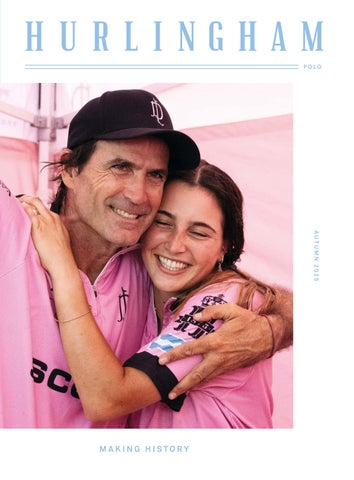
O N T H E C O V E R : A D O L F O C A M B I A S O A N D H I S D A U G H T E R M I A C E L E B R AT E A F T E R W I N N I N G T H E B R I T I S H O P E N P O L O C H A M P I O N S H I P F O R T H E C O W D R A Y G O L D C U P 2 0 2 5 . P H O T O C R E D I T : S N O O P Y. T H I S P A G E : S A M C H U R C H I L L
14_ A H E A D O F T H E G A M E Clinova polo patron Raja Karim discusses what’s new for Chukker App
HURLINGHAM MEDIA Sales +44 (0) 771 483 6102 magazine@hurlinghampolo.com; hurlinghampolo.com Printing Pureprint Group; pureprint.com
16_ Q ATA R’ S P O LO J O U R N E Y Fuad Al-Mudahka, director general of Qatar Polo Club, describes the Club’s vision for polo in the heart of the Gulf 18_ G A M E C H A N G E R COO of the charity Power of Polo, Katie Baines, on how using team sport and horses can change lives 20_ FO R C E FO R G O O D The Standing Rock Foundation launched at Guards Polo Club this summer 22_ DEVELOPING THE NEXT GENERATION Andrew Barlow, chair of the HPA’s Development and Coaching Committee, talks youth polo in the UK 24_ I S L A N D L I F E Jaime Rincón Gallardo reports on a vibrant polo event in Jamaica 28_150 Y E A R S O F H I STO RY The Hurlingham Polo Association is celebrating its 150-year anniversary 30_T H E L I N E O F T H E B A LL A new memoir by Dr Beh Chun Chuan is an inspiring story of achievement 32_ P L AY I N G FA I R Chief umpire for the HPA for 2025, Peter Wright, on the state of play in the UK
3
3 4 _L E V E LL I N G T H E F I E L D Stedham Polo Centre has been given new life through an ambitious project
4 6 _W I N N I N G F O R M U L A Park Place patron Andrey Borodin reflects on his team’s success this season
3 6 _T E A M S P I R I T The Segavas polo team were able to compete this season thanks to support from the Segavas family office
5 3 _ACT I O N Coronation Cup, Gold Cup, Queen’s Cup, Sotogrande Gold Cup, Pacific Coast Open and the French Open
3 8 _F R E S H A P P R OAC H Is modern polo limiting the ability of amateurs to improve their game?
6 6 _T H E O R I G I N A L G .O. A .T. A look back through history at Argentina’s first 10-goal player, Lewis Lacey
4 2 _L I V I N G T H E D R E A M Nick Clarke’s new property Tancredi in Argentina aims for family-friendly polo of the highest standard
Above: a guardsman at the Queen’s Cup final 2025 at Smith’s Lawn
If you would like to unsubscribe or change your postal address, please send an email with your old and new address to magazine@hurlinghampolo.com. Reproduction in whole or in part without written permission is strictly prohibited. While every effort is made to ensure the accuracy of the information contained in this publication, no responsibility can be accepted for any errors or omissions. All the information contained in this publication is correct at the time of going to press. The HURLINGHAM Polo magazine (ISSN 1750-0486) is published by Hurlingham Media. The magazine is designed and produced on behalf of Hurlingham Media by Show Media Ltd. The products and services advertised are not necessarily endorsed by or connected with the publisher. The editorial opinions expressed in this publication are those of individual authors and not necessarily those of the publisher. Hurlingham magazine welcomes feedback from readers: magazine@hurlinghampolo.com. Hurlingham is compliant with GDPR regulations.
follow @hurlinghampolo
HURLINGHAM
FOREWORD Adolfo Cambiaso is on the cover with his daughter Mia. They made history by being the first father-daughter combo to win the Gold Cup for the British Open. Adolfo also won with his son Poroto in 2020 – the only father-son combo. Adolfo has won the Gold Cup nine times, which is one less than the record-holder, Carlos Gracida, who he won his first Gold Cup with in 1991. Have a look at the Action pages to see how Adolfo’s team did it. Mia is also featured in the Love of My Life and One to Watch columns. The polo in England this summer was excellent. The teams, players, fields, weather and new rules all made a contribution. Maybe the biggest factor was how the new live-blocking rule opened up the game. In Talk, Peter Wright describes his role as chief umpire for the HPA, his approach to umpiring and how the new
rule has been a success in the UK. The fields were outstanding and English polo is lucky to have Stedham back. In Talk, Lorna Lopez explores the revival and long-term vision of the Stedham Polo Centre built by Kerry Packer 35 years ago. Polo is more competitive today and to reach a final and win is a feat. Andrey Borodin has won on both sides of the Atlantic this year. In Features, he reflects on his team’s success and the pros and cons of playing the high-goal in England and the US. Another positive result of the liveblocking rule is that the amateur on the team will have to be better with the ball. Have a look at Opinion where Scott Devon – who has played at all levels over four decades – has some insights and possible solutions. There are more articles, which I hope you will find interesting.
RODERICK VERE NICOLL PUBLISHER
4
KATIE BAINES has been working for Power of Polo since 2024 and has recently taken on the role of COO. She previously ran communications for the Yamaha MotoGP Team during the multiple world champion Valentino Rossi’s heyday, before a 10-year stint as an English teacher.
FUAD AL-MUDAHKA is director general of Qatar Polo Club and a leading sports figure in Qatar with over two decades of experience in the sector. As the first-ranked polo player for Qatar under the HPA, he has represented in international tournaments, including the British Universities Polo Championship in 2015.
EILEEN COHEN studies orthoptics at the Paris Faculty of Medicine. Since childhood she has spent her summers on the polo fields in Deauville. This year she is grateful to Matthieu Delfosse for entrusting her to lead coordination and communication of the tournament at the Deauville International Polo Club.
hurlinghampolo.com
JAIME RINCÓN GALLARDO is the managing partner at Acheron Partners, a Spanish head-hunting firm, and recently received his MBA at Ipade Business School. He is passionate about horses and is the fifth generation of polo players in his family. He currently lives in Mexico City with his wife, Sofía.
IMAGES OF POLO
CONTRIBUTORS
@ U S P O L OA S S N | U S P O L OA S S N G L O B A L . C O M
Welcome to St Barth
Mention code : HPOLO and get VIP amenities when booking ! 22 unique, independent, self-standing ultra-comfortable Villa Suites. Each one offering a private pool, large terrace and overlooking wonderful Toiny Bay. Le Toiny - Anse de Toiny, 97133 St. Barthélemy, French West Indies - (00 59) 0590 27 88 88 - www.letoiny.com - reservations@letoiny.com
hotelletoinystbarth
PONYLINES
7
Mia playing at the Poloplaying MiaGuards Cambiaso Club in 2025 at Guards Polo Club
ONE TO WATCH IMAGES OF POLO
MIA CAMBIASO
I grew up watching my dad Adolfo Cambiaso play polo, and I’ve been riding horses ever since. So it’s hard to say exactly when I actually began playing. It would be proper to say I’ve been playing my whole life. To me, polo is family. Polo has been part of all of us since we were very young – my dad, my brother Poroto and, most recently, my sister Myla. Beyond being a job, it’s what brings me together every day with my siblings and my dad. We’ve lived it since we
were born, and now, as we’ve grown up, we can continue sharing it all together. My most memorable game has to be the Gold Cup for the British Open final we just played in the UK, beating Kazak 9 to 8. Winning the British Open – achieving it as a woman, alongside my dad, and being granted the MVP and BPP awards, is a memory I’ll always carry with me. I would also add that every Argentine Women’s Open final has been incredibly special to me.
follow @hurlinghampolo
This year I’ve played at every level – from 4-goal tournaments all the way up to the highest, 22-goal men’s polo. To me, the perfect game would be playing any high-goal final, with a good team, and above all with a strong string of horses. Outside of polo I have my own horse breeding programme, Cría Colibrí, which I want to keep developing. I also work with a jewellery brand as an influencer.
PONYLINES
ALULA DESERT POLO 2026
NEW
S
On 16-17 January 2026, Saudi Arabia’s AlUla Desert Polo will return to the purpose-built sand arena and viewing terrace, set against the backdrop of AlUla’s dramatic rock formations. Since its inception in 2020, the event continues to attract world-class polo players – including 10-goalers Adolfo Cambiaso, his son, Poroto, and Pablo MacDonough, as well as top female players such as Nina Clarkin and Milly Hine.
Renowned international patrons and royalty from around the world are also key members of the teams, bringing a diverse mix of cultures together. Guests of the 2026 edition can look forward to front-row views of thrilling polo action, as well as exceptional hospitality, shopping and gourmet dining in the AlFursan Equestrian Village, and while exploring AlUla. Check out our guide to AlUla in our Spring 2025 issue.
8
CHESTERTONS POLO IN THE PARK
ALULA MOMENTS; THE ART OF POLO
Chestertons Polo in the Park 2025 delivered another unforgettable weekend at Hurlingham Park, drawing record crowds for three days of polo, entertainment and hospitality. The action on the field was fierce, with the much-anticipated international fixture on Friday 6 June, where Argentina overcame England to claim the Olympic Trophy. On Sunday, the tournament concluded in style with Abunayyan Holding Team Riyadh lifting the Chestertons Polo in the Park Trophy, defeating Arkham Team Punta Cana 10-5 in the tournament final.
hurlinghampolo.com
GOOD READ
HOOKED ON POLO V E N K AT E S H J I N D A L
M A R C O S C E R D E I R A ; A R G E N T I N E P O L O A S S O C I AT I O N
Growing up seeing his father play polo encouraged Venkatesh Jindal to try polo when he was 16. After a break from the sport, he is now playing again and is more passionate than ever The horses and the people involved in polo make it a very special community and a sport unlike any other. It’s also particularly special for me to be able to play with my father. The perfect game of polo for me is when both teams compete hard, play safe and have lots of fun. To win is an added bonus, but for me it’s winning the tight games that is most satisfying. For example, my most memorable polo game was an 8-goal league game in Delhi, which was super competitive and really fun. I’m now playing again after a long break of 10 years, and I hope to play across all levels, from low-goal to high-goal. We just bought an amazing new horse from La Dolfina named Eleonara. She is an absolute machine and gives me a lot of confidence. After playing polo at Yale University, I’ve mostly played in India, and I travelled to France and England this summer for the first time. I hope to play a lot more in Europe going forward as it’s been an incredible experience, and I hope to do a lot more in the low- and medium-goal in the UK next year. Playing in the Prince of Wales at Guards with Facundo Pieres was a dream come true. Facu has been a hero for me growing up, so to play alongside him is an incredible experience.
Never Unready is polo player Sam Morton’s fourth book and the second in the American Annandale series. It follows clan Johnston in Pennsylvania in the French and Indian War, Pontiac’s Rebellion, and the war for American independence. Alexander and Martha Johnston and their extended family members were part of a mass exodus from Scotland and Ireland that settled in Appalachia. The book explores the young lives of both George Washington, whose ambition was to become an officer in the British army, and Benjamin Franklin, who sought out an appointment in the British government. Washington became part of the worst military disaster of the 18th century for Great Britain and Franklin was rejected by both the British and later his own American colony. In the middle were the Scots of Appalachia whose roots in warfare and industry in Ireland and Scotland would serve them well in the coming bloodbath on the American frontier.
59 9
THE BIRTH OF POLO IN ARGENTINA One hundred and fifty years ago, Don David Shennan became a pioneer of polo in Argentina. Shennan owned the Negrette ranch in Ranchos (now General Paz) in Buenos Aires, where the first polo matches recorded were held (though it is believed that for some time “polo” had been played in Buenos Aires, on a land located in Caballito, adjacent to the current Ferro Carril Oeste club.) Negrette’s matches mark the starting point of the history of Argentine polo, the first of which was played on August 30, 1875, following an invitation made to a small nucleus of “players” from the Federal Capital. The event featured two teams called Ciudad and Campo, where the players of the latter scored three goals in a short period of time. Some of the men in Ciudad did not know the game, which implies the inequality of the match.
follow @hurlinghampolo
PONYLINES
CHUKKAS The HPA Stewards agreed in July that the Home Grown Player (HGP) Rule, introduced in the 12-goal VL in 2025, would be rolled out to include both the 15-goal and 18-goal VL in 2026. This rule specifies that each team must have at least one HGP other than the patron.
Paquito with his parents Rocío and Paco
Female players who have a right to work in the UK and hold a women’s handicap of 6 goals or more will be permitted to play in the 22-goal without the need to be a Home Grown Player, irrespective of their mixed handicap.
SADDLE UP WITH… PAQUITO DE NARVÁEZ
On 28 May at the polo offices at Palermo, the 102nd Ordinary General Assembly was held. Benjamín Araya was elected as the new president of the AAP. He replaces Delfín Uranga, who was in office between 2021 and 2025. Benjamín had 58 votes versus 56 for the runner up, Marcos Di Paola.
COUNTRY: ARGENTINA AGE: 17 HANDICAP: 8
10
The AAP has named fields 7, 9 and 11 of the Alfredo Lalor de Pilar Venue, with the names of three of the five champions of the Triple Crown of Argentine Polo: La Aguada (F7), La Dolfina (F9) and Ellerstina (F11). In 2023, Fields 1 and 2 were named as Coronel Suárez /Juan C. Harriott and Santa Ana/Francisco E. Dorignac, in permanent tribute to the teams that achieved the honourary AAP Triple Crown.
The 41st Harriman Cup brought together more than 500 Yale and UVa alumni at the Bethpage Polo Cup in New York on 6 September 6. UVa defeated Yale 7 -5. Garvy Beh was MVP and Liz Brayboy received the Harriman Cup Award.
When did you start to play polo? At my family’s ranch when I was five years old. I started riding first, then I picked up a polo mallet and started to stick and ball, then I began to play. What makes polo special for you? I grew up travelling with my dad, who also used to play. Polo has been a way of life for me since I was young, and I enjoy being around the horses. Who do you respect most in polo? I respect Adolfo Cambiaso, as he is 50 years old but he keeps on winning. What is your most memorable game? The final of the Gold Cup 2025. We were without Adolfo for two minutes at the end of the last chukka, and only up by one goal. It was intense! What level of polo do you play? This year I played high-goal polo in Florida and in the UK.
hurlinghampolo.com
Who is your favourite pony and why? My favourite horse is Rumba. I’ve been playing her since I was 12 and she has always been the best horse in my string. I like to play her when the match is tight, as I feel most confident when I’m riding her. What are your plans for the Argentine season? I’m playing in the Argentine Open with Benjamín Panelo, Juan Martin Zubia and Facundo Sola. We’ll try to do the best we can. I think we will be a competitive team. What was it like playing with Adolfo? Amazing. You learn something new every time you play with him. How does he get his teammates to play above their handicaps? He has always found ways to make his teammates play better – I don’t know how!
TONY RAMIREZ
Polo Club du Domaine de Chantilly has constructed the largest (160m x 75m) open air arena in Europe at a cost of €700,000. It has an automatic sub irrigation system. The club is hoping to host the Arena World Polo Championships in 2027.
BARRIÈRE DEAUVILLE GOLD CUP 2025 On the fields of the Deauville-La Touques racecourse, Juan Martín Zubia orchestrated play with remarkable precision. Alongside him, Gonzalo Ferrari impressed with his clinical finishing. Facing them, the Barrière team relied on the energy of the Zavaleta cousins. The tournament also showcased the experience of Guillermo Terrera and the tactical mastery of Alfredo Cappella. The final saw Talandracas once again overcome Barrière, and the team lifted a historic eighth Gold Cup – a record in Deauville.
H U B L O T G O L D C U P G S TA A D The 28th edition of the Hublot Polo Gold Cup saw Gstaad Palace, a team of four Swiss players including captain Markus Graeff, claim a memorable victory. In the sub-final, Nicolás Pieres steered Team Kielder Agro Group to a narrow 8-7 win over Team Hublot. The final started off cautiously, but momentum shifted in favour of Gstaad Palace, who took control and dominated over Team Albinati Aeronautics to lift the Gold Cup trophy. Martin Podestá Jr was top scorer of the tournament and MVP in the final. 11
JUSTINE JACQUEMOT; PIERRE-HENRI FLAMENT; TONY RAMIREZ
LOVE OF MY LIFE BY MIA CAMBIASO N A M E : D S A LT A M I R A SEX: MARE ORIGIN: ARGENTINA My dad, Adolfo Cambiaso, bought her as a four-year-old from Hugo Taylor. She’s daughter to Dolfina Popular, himself a son of El Durazno and the legendary Dolfina Cuartetera, and out of DS Gualta, a mare by Sportivo and Claret. She’s the complete package. She does everything well – she’s fast, powerful and has the strength to hold her own in every game. I’ve played her since she was young, and we’ve grown together. She’s the pony I feel most confident on – she gives me security and allows me to do everything on the field. Last year she played the Queen’s Cup and the Argentine Youth Open. This season she was part of the Royal Windsor Cup and then the Gold Cup, which I won together with my dad. It was even more special because I was named MVP, and DS Altamira received the Best Playing Pony award. She’s heading to the United States next, and afterwards she’ll return to Argentina. She’s definitely one of the horses that really makes me feel at my best on the field. I really look forward to breeding from her in the future.
follow @hurlinghampolo
TA L K
12
K E E P I N G I T I N T H E F A M I LY Stirling Polo was founded on my family’s legacy in the sport. I am a third-generation polo professional whose life has been shaped by this game. I studied equine business management at the Royal Agricultural University in Cirencester, and my career on the field has taken me to the highest level: I played the finals of the Queen’s Cup and
the British Gold Cup, and I am a four-time winner of the High-Goal Gold Cup in Sotogrande. I have also managed clubs, organised international tournaments and advised on projects that combine polo with real-estate and lifestyle developments. This combination of professional play and consultancy is what defines the way we lead
hurlinghampolo.com
Stirling Polo today: an organisation that delivers world-class polo in a way that is authentic and accessible. It all began with my grandfather, David Stirling, a cattle breeder and 10-goal polo player. My father David promoted and built the polo scene in Sotogrande as we know it today. My brother “Pelon” and my cousin “Jejo”
HELEN CRUDEN
Third-generation polo professional Santi Stirling describes how the Stirling Polo Experience combines the standards of world-class polo with the warmth and authenticity of a family organisation
Opposite: Thomas Enge having a lesson with Santi. This page, from top: Santi’s jack russell Pocho at the pool; Santi (left), Jejo Taranco and Pelon Stirling at the 2022 Coronation Cup
MARTINA LAFLUF; IMAGES OF POLO
need no introduction. Stirling Polo was born as a way of continuing our family legacy, tied to the countryside, horses and the sport that has always been part of our lives. It was not a predetermined path but rather a choice, to honour that foundation and keep building on it with what we offer today. Now, we continue that journey with a project that seeks to share polo in a close and authentic way, showing what life is like both on and off the field, always with the warmth and care that represent us. Stirling Polo Experience is not your typical Argentine polo holiday; it is our way of opening the doors to those who want to access polo at the highest level, without the traditional barriers that usually make it an exclusive world. Our model makes top-level polo accessible: we provide well-trained horses, professional players and an organisation built on experience at the top of the sport, but designed so that anyone can enjoy it. Whether for a few days or for a whole season, we bring together the standards of world-class polo with the authenticity of a family project. In Cañuelas, at the heart of Argentine polo, we welcome players and visitors who want to practise and improve their level, or simply enjoy a family-friendly and welcoming environment. We offer full polo weeks, tournament weekends, practice chukkas or private lessons, always adapting to what
follow @hurlinghampolo
each person is looking for or needs. With our team, we organise every detail so that the experience is complete. During the summer, we move to Punta del Este, where we organise and manage polo experiences for those spending the season there. We coordinate horses, logistics and tournament entries, as well as offering private lessons and practices for players of different levels. Together with our team, we also organise the official summer tournaments in Punta del Este, including the Uruguayan Open, the most important event of the season. It is a programme that combines the sport with the unique lifestyle of Punta del Este, in a relaxed and enjoyable setting. What we offer is a tailored entry into a world that is usually reserved for a privileged few. Every detail is designed with the professionalism of an organisation that has grown from within the sport, yet with the warmth of a family legacy. Each experience is customised, giving players the chance to discover polo at the highest level in a way that feels personal and authentic. Every experience we design is about living the sport as it is truly lived in Argentina and Uruguay. From the horses to the fields, from the competitive chukkas to the moments shared after play, we offer an immersion into polo’s unique lifestyle – one that blends authenticity and excellence.
13
TA L K
AHEAD OF THE GAME Clinova polo patron Raja Karim explains how he has used his expertise in blockchain to develop chukkerCoin. The new token is about to go live, and will be used to power the world’s number one polo app, Chukker App
GUTTER CREDIT IN HERE
14
hurlinghampolo.com
M AT I A S C A L L E J O
I first got into polo as my father was very passionate about horse racing and I wanted to continue the family involvement in equestrian sport. One day I called into the White Rose Polo Club in Yorkshire, which is close to where I grew up. I did a pro-am tournament there and I loved it, so I told the polo club I wanted to play the Queen’s Cup, and the rest is history. My main global base is in Chantilly, France, where I keep my horses, and this year I played in the Queen’s Cup at Guards and the French Open at Chantilly. When I’m putting a polo team together, I’m always looking at the team spirit and how I can get good chemistry between the players. I also like to have a mix of older, more experienced players, and younger emerging players, and to really get to know the players and what they want to achieve. So I have a lot of ingredients that I look for. If you get one component wrong, it can all backfire on you. As a kid I always loved Argentina – the asado, Buenos Aires, the football team – so that allows me to have a real connection with the players, as many hail from Argentina. I’ve always felt that you have to go off the polo field to build that deeper relationship as a team. So whether we go to see a movie, or go to a nice restaurant for dinner, I like to give my players the opportunity to do something a bit different and we have a lot of fun. I take all the 30-yard penalties for my team at every level, including the 22-goal. I’ve always taken penalties in other ball sports, so I’ve just transferred this over to polo. I enjoy it but it’s a big challenge, as there’s a lot of pressure to score! This year I was the highest-scoring patron in the Queen’s Cup, scoring 14 goals, and I scored 9 goals in the French Open. That’s 25 goals scored in 8 games this year. In the Queen’s Cup I scored the same amount of goals as Sapo Caset, and we were both based at Trippetts. For the past four years, my team Clinova has had a partnership with La Irenita, called Clinova La Irenita, which had Facundo Fernandez Llorente as our main player. This year we’ve joined forces with the main La Irenita team with Pablo MacDonough. We are also partnering with Hilario Ulloa’s La Hache along with Nachi du Plessis and Fran Elizalde. Clinova La Irenita La Hache is the joint second highest-ranking team in the Triple Crown.
My main business is an artificial intelligence search engine called Healthwords.ai, which is like ChatGPT but only for health, with a mission to transform self-care and wellness through advanced technologies. I’ve been working on it for eight years now and it’s one of the leading healthcare AI products. I do combine business and polo, as I bring a lot of our big clients to polo, and they love it. Using data from Healthwords.ai, we realised there was a gap in the UK hydration space so we launched O.R.S hydration tablets, used by both polo players and spectators. I am the co-founder of Chukker App 2.0, the world’s number one polo app. We have recently rebuilt the app to have a lot more features. Chukker App has a number of functionalities including live scoring, polo ponies, media, hire, play and the ability to connect with polo players. Chukker App also covers other equine sports such as equestrian, dressage and showjumping. The most important part of Chukker App 2.0 is the creation of a utility token called chukkerCoin to power the ecosystem of the app. chukkerCoin (cC) is a token available to use on Chukker App. With chukkerCoin, users can access marketplace services available on Chukker App. There will be a maximum token supply of 50 million chukkerCoins, with no more minted. A total of 30 million chukkerCoins will be reserved for the public sale (ICO), which starts on 15 October, 2025. You can buy by going to the base menu of Chukker App and clicking the chukkerCoin page or visiting chukkercoin.com
Opposite: Raja Karim. Left: Raja Karim with the Clinova La Irenita La Hache Polo Team for 2025: Hilario Ulloa, Francisco Elizalde and Pablo MacDonough. Below: the Chukker App logo
follow @hurlinghampolo
15
TA L K
QATAR’S POLO JOURNEY Fuad Al-Mudahka, director general of Qatar Polo Club, describes the Club’s vision, Qatar’s rising status as a polo destination, and how efforts across the region are paving the way for a vibrant, modern polo ecosystem
As polo gains momentum across the Middle East, the region is emerging as an exciting new chapter in the sport’s global evolution. With a deep-rooted equestrian culture, and a national vision that champions elite sport, the launch of the Qatar Polo Club (QPC) under the Ministry of Sports and Youth marks a significant milestone in Qatar’s history. From international appearances to local activations, the club’s ambition is already taking shape, highlighted by Team Doha’s debut at Chestertons Polo in the Park, held in London in June. Locally, QPC is also organising standout events such as the upcoming Polo AlMarsa taking place in Doha, Qatar in December 2025.
At its core, QPC represents a bold step forward in blending tradition with modern sporting excellence. Built on Qatar’s longstanding equestrian tradition and its investment in high-performance sport, QPC aims to introduce a fresh narrative around polo: one that is contemporary, accessible and deeply rooted in place. Our vision is to establish QPC not just as a club, but as a cultural and sporting institution that nurtures talent, hosts world-class events, and opens the doors of polo to a new generation in Qatar and the region. QPC is a national initiative under the Ministry of Sports and Youth, and this affiliation reflects
hurlinghampolo.com
Qatar’s commitment to sport as a driver of national development. QPC is not just about sport, it’s about cultural preservation, youth empowerment, and international visibility. Being rooted in a government mandate gives us the platform to elevate polo on a national and global scale, ensuring it aligns with Qatar National Vision 2030. We are currently in our foundational phase, and that’s an incredibly exciting place to be. We have built an operational ecosystem that includes youth development, coaching networks and international partnerships. There is a pipeline for player development, activated international training opportunities,
POLO ALMARSA
16
QPC
and established event platforms like Polo AlMarsa to help generate awareness. We’re actively building strategic partnerships. Qatar is a unique home for polo, as the country’s bond with horses is centuries old, woven into our history, culture and identity. Polo, long played in our historic times, is part of that proud equestrian tradition – a sport that reflects our heritage while continuing to inspire today. What truly sets Qatar apart is the way we combine this heritage with modern-day excellence. With year-round sunshine, world-class infrastructure and an unmatched spirit of hospitality, the country offers a beautiful and welcoming stage for international polo. Having already earned its place as a top destination for global sporting events, Qatar is now ready to bring the same energy, elegance and ambition to the world of polo. This is just the beginning of something truly special. Polo AlMarsa is taking place in December 2025, and marks a historic milestone as it will introduce polo to Qatar for the very first time through a public event. It’s also the first time Qatari polo players will play on their home soil after their country debuted on the world stage at Chestertons. Hosted at Old Doha Port on the pier, the matches will be played against the stunning backdrop of Doha’s skyline. The concept is innovative, yet it honours the sport’s prestige. Visitors can expect a mix of sport, fashion, art and culture, with curated experiences for both polo aficionados and new audiences. It’s also a way for us to introduce polo to a broader public. Events like Polo AlMarsa play a key role in bringing our vision to life. They help us generate excitement and introduce polo to new audiences in a way that feels relevant and rooted in Qatar’s culture. Polo AlMarsa also reflects the values of Qatar National Vision 2030, where sport is a driver of both social and economic growth. Through QPC, we’re building something lasting: a platform that nurtures homegrown talent and positions Qatar as a true polo destination. To develop homegrown talent, we’re actively engaging with schools and local riding academies to scout and support young riders. Our goal is to create a pipeline of Qatari and regional players who can compete at the
Opposite: the field at Old Doha Port. Below: grassroot players, from left: Bader Al Marri, Ahmed Al Badi, Ziad Abuissa, Fuad Al-Mudahka and Saleh Al Marri in Sotogrande
THE GRASSROOTS PROGRAMME IS O NE O F O U R P R O U D E S T ACHIEVEMENTS SO FAR
17
highest levels. We’re also working with seasoned professionals and coaches to ensure the next generation is equipped with the technical skills and superb sportsmanship that comes with the sport. Currently, we have eight players in training, preparing them to step onto the field with confidence at the Polo AlMarsa tournament in December. The grassroots programme is one of our proudest achievements so far. It focuses on nurturing young Qatari riders through structured coaching, mentorship and early competitive exposure. In June 2025, we sent Team Doha to Polo in the Park in London. It was their first international tournament
follow @hurlinghampolo
where they competed representing Qatar on one of polo’s most high-profile platforms. That experience was invaluable. It gave our players confidence, exposure and a sense of purpose. It also set the stage for what we’re building now. Looking ahead, we envision QPC as a premier polo institution in the Gulf, complete with world-class facilities, a thriving professional league, youth academies and global tournaments. Polo will be part of the region’s cultural and sporting narrative, not just as a luxury pastime, but as an accessible and competitive sport rooted in heritage. Polo AlMarsa is just the beginning.
TA L K
GAME CHANGER Katie Baines describes how the Power of Polo charity is using team sport and horses to change the lives of disadvantaged young people for the better
18
GEORGINA PRESTON
This page: Glen Gilmore with PoP participants Renee and Kaira. Opposite: PoP youth adviser Jhemar Jonas and his favourite pony
hurlinghampolo.com
Each June, a day’s polo takes place, with a bit of a difference. For five years now, Power of Polo (PoP), the charity that uses polo as a sport for change for those facing adversity, has held its Change Your Line Charity Cup on semi-finals day of the Out-Sourcing Inc Royal Windsor Cup at Guards Polo Club. The event celebrates the achievements of its participants and showcases its positive impact to the wider polo community. This year the 15 participants hailed from a range of backgrounds and charities including South Central Youth, which works with disadvantaged young people, and Alabaré, a national homelessness charity. While some of this year’s players had taken part in several Power of Polo courses in recent years, some had, incredibly, only ridden for a few days. One such rider was 19-year-old Brendan, who rode for the very first time in his life at Offchurch Bury Polo Club in April, during a course put together by PoP and Alabaré. ‘Being involved with Power of Polo has been truly life-changing for me,’ he said. ‘Getting outside, getting on a horse and learning to play has made me realise there’s still a spark in me that I didn’t think I had anymore. It’s made me see that I still have time to be more than I thought I could be.’ Power of Polo is unique in that it is the only charity using both team sport and horses to impact lives. While the concept of using sport for change is not a new one, the field of equine-assisted care is perhaps lesser known in polo. Nonetheless, it is a rapidly growing area and other equine spheres, in particular racing, are beginning to see how well-positioned they are to impact lives for the better. Former 8-goaler Glen Gilmore is an emphatic supporter of the charity. ‘The stories are incredible; there are so many positives,’ he says. ‘There’s one girl who talks about how she’s become so much more confident, and how her interaction with horses has improved her interactions with people. She’s started to believe in herself. I think polo has an opportunity here; Power of Polo means any club or team can run a charity polo experience that can improve people’s lives. It’s a no-brainer.’
Power of Polo’s formula means it can work with any club or polo school looking to develop charitable activities. It connects charity partners, and designs and runs bespoke programmes developing confidence and resilience in participants, empowering them to change their lives for the better. Like any charity, funding is a challenge, but this year PoP was given formal recognition as an HPA-Affiliated Association. Founder and CEO Katy Hayward sees this as a hugely positive step. ‘Power of Polo is about using what we’ve got in our sport – amazing places, people and horses – to improve people’s lives; it’s not about making players, although our participants always fall in love with horses and the sport! We’re so grateful to Anna Hall and the HPA for recognising that there is a real place for us here. Now we want to grow;
we want to work with more clubs, more charities and deliver new programmes.’ The true impact can be summed up by Jhemar Jonas who first rode a horse with Power of Polo in 2023 and now acts as a PoP youth adviser. ‘Horses have helped me level myself,’ Jonas reflects. ‘The environment I come from, there’s a lot of violence. What was astonishing for me was learning that, if I can communicate with such a big animal, that can hurt me if it wants, without violence, then why should I need violence anywhere else in my life?’ For more information about how you can get involved with Power of Polo, please contact Katie Baines at: katie.baines@powerofpolo.org.uk; powerofpolo.org.uk
19
POWER OF POLO MEANS ANY CLUB OR TEAM CAN RUN A CHARITY POLO EXPERIENCE T H AT C A N I M P R O V E P E O P L E ’ S L I V E S
follow @hurlinghampolo
TA L K
FORCE FOR GOOD The launch of the Standing Rock Foundation at Guards Polo Club united the polo world with Native American culture and heritage, writes Jemima Wilson
At the height of the UK summer polo season, a special event took place at Guards Polo Club, bringing together the polo community for a good cause, in support of Standing Rock Polo Team’s new charitable foundation. The mastermind behind this event was founder and patron of Standing Rock, Philipp Mueller who, through his value-driven initiatives rooted in a respect for the culture and beliefs of Native American tribes, has brought a new buzz and energy to polo.
From advocating the highest standards of horse welfare on and off the field, to celebrating sportsmanship by introducing the Standing Rock Fair Play Award to polo’s leading governing bodies around the world, and championing charity with the launch of the philanthropic Standing Rock Foundation, everything Standing Rock does is guided by the Seven Lakota Values – enduring principles of generosity, respect, kinship, compassion, fortitude, wisdom and spirituality.
hurlinghampolo.com
Indeed, the team is named after the Standing Rock Reservation, home of the Sioux Tribe, which straddles the border between north and south Dakota, and is where legendary leader Sitting Bull – a symbol of dignity and resistance – was tragically shot. For the launch of the Standing Rock Foundation, Mueller brought the polo world together on the evening of 28 June 2025 for a showcase of Native American culture and heritage. The soirée began with a drinks
S TA N D I N G R O C K
20
reception on the Guards Clubhouse lawn, during which guests were greeted by eight Native American performers from South Dakota, USA. The performers, dressed in magnificent regalia, wowed their audience with a mesmerising traditional performance of Indigenous music, singing, dancing and storytelling, before Mueller delivered a warm welcome expressing his heartfelt gratitude for the support of all the guests in attendance. Professor Manuel Menrath, an expert in Indigenous cultures in the US and Canada, also gave guests a brief but fascinating insight into the history of the Native Americans. Captivated from a young age by the Wild West and the story, bravery and then fate of the Native Americans, Mueller visited Native American reservations in South Dakota at the end of 2024 to see how Indigenous communities live today. ‘Seeing the contrast between the historical suffering and enduring spirit of these communities first-hand highlighted a need for action and solidarity,’ said Mueller. ‘It was following this powerful and emotional visit that I created the Standing Rock Foundation, inspired by the beliefs of Native American communities, particularly those of the Lakota Sioux – the tribe of Sitting Bull.’ Receiving a standing ovation for his announcement of the official launch of the Standing Rock Foundation, Mueller pledged commitment to supporting disadvantaged children and youth, preserving Indigenous cultures and traditions, responding to humanitarian and social needs and promoting respectful treatment of nature and animals, particularly in equestrian sports, through carefully selected initiatives that reflect Standing Rock’s core values and mission. Key focus areas for the foundation currently include: James’s Place, providing immediate mental health support to young men in suicidal crisis; Laureus Foundation Switzerland, using the power of sport to uplift disadvantaged children; Lakota Waldorf School in South Dakota, preserving Indigenous culture by integrating Lakota language and traditions into holistic, Waldorf-based education; Sands End Associated Projects In Action (SEAPIA) in London, empowering children and youth through after-school
IT WAS FOLLOWING THIS POWERFUL AND EMOTIONAL VISIT [T O S O U T H D A KO TA] T H AT I C R E AT E D T H E S TA N D I N G R O C K F O U N D AT I O N Opposite: Standing Rock Polo Team with Native American performers. From left: Pierandrea Müller, Xavier Little Head, Jack Hyde, Philipp Müller, Michael Spears, Nacho Gonzalez, Ruben Little Head Junior, Isidro Strada and Harry Muddle. Above: Philipp Müller delivering a speech at the Standing Rock Foundation launch; the Standing Rock Foundation logo
follow @hurlinghampolo
programmes combining education, creativity and sports; Bastifund, supporting Bastian (Basti) Fernandez, a young, polo-enthusiastic man whose life was changed by a serious horse-riding accident; One Nation Walking Together in Colorado Springs, delivering humanitarian aid and essential supplies to Native American communities across the western United States; and Caritas Children’s Hospital, Bethlehem in Palestine, providing essential paediatric care and life-saving surgeries as the sole exclusively paediatric hospital in the West Bank. Throughout the evening, guests enjoyed a thoughtfully curated four-course menu inspired by Native American culinary heritage before dancing the night away. The day before the event, the performers took part in a photoshoot at Flemish Farm, against the iconic backdrop of Windsor Castle. This magnificent photoshoot saw players in the Standing Rock Polo Team stand and ride alongside the Native Americans, creating not only a striking image, but a powerful symbol of unity and mutual respect. It is this strong sense of unity and reconciliation that is at the heart of the Standing Rock Foundation, with a passion to make a positive difference. For more information, please visit: standingrock.com/foundation
21
TA L K
22
DEVELOPING THE NEXT GENERATION THE ART OF POLO
Andrew Barlow, chair of the HPA’s Development and Coaching Committee, gives updates on youth polo in the UK and the Performance Pathway
Above: Andrew Barlow with the USA and England teams for the Buckmaster Trophy at the Beaufort International. Opposite: junior players in the Victor Futurum tournament
hurlinghampolo.com
After a very busy 2025 summer, there is much to celebrate and reflect on with youth polo in the UK, as well as recognising the challenges that face aspiring young British players – and the role that the HPA plays helping to shape their future polo ambitions and careers. The HPA Development and Coaching Committee works closely in partnership with The Pony Club and SUPA (Schools and Universities Polo Association) to provide tournaments, education and opportunities for beginners and the best alike. As the bedrock of junior polo, it is fantastic to see that the Pony Club is thriving again. Chaired by Justin Stanhope-White and with 75 teams competing in 2025, this is almost double from three years ago. Numbers are strong at all levels, with 19 teams competing in the Rocksavage and Hipwood levels (U18 and U14 respectively), and four-chukka matches being played at many private high-goal grounds as well as clubs due to the generosity and support of these organisations. The inaugural Under 16 Victor Futurum tournaments were held successfully at Guards and Cowdray in June and July. Here, two British players combined with overseas players on each of the four teams to create a very high standard playing on excellent fields. This hopefully sets the blueprint for future tournaments, providing opportunities for our young players to experience quality peer group polo and forge new relationships. On the international scene, a Young England team consisting of George Copcutt, Jake Coventry, Alfie Hyde and Robbie Slatter fought out a draw with Young USA for the Buckmaster Trophy at the Beaufort International. Following their winter tour to South Africa, the Young England women’s team comprising Isabel Fall, Alice Gregory, Jemima Walker and Beanie Bradley met their opponents again in a rematch at Guards Polo Club in late August where Young South Africa won the game 6-4. The traditional end-of-season Colts and Stagshead Trophies returned to Kirtlington Park in August, with four teams selected from the Performance Pathway and Pony Club. The Performance Pathway, which is overseen by a sub-group of the Development and Coaching Committee and chaired by Aurora Eastwood, was an initiative launched
two years ago with the generous support of Park Place and now has 38 players enrolled from the ages of 15-21 years. The third intake of new players in autumn 2025 sees the lower age reduced to 14 years and there is an exciting cohort of young players coming through the Pony Club. Aside from the range of mentoring, webinars, high-goal organisation visits, practices with professionals and all-round polo education provided, we have seen fantastic playing opportunities and support for our young players emerge; Tegan Bristow with Dubai, Mati Maldonado with Park Place, Mack McCaffery with Bangash and Leo Stuart with La Magdeleine. Hugh Bate was also selected as a Pathway player by the Segavas team to play the 15-goal season, winning the Harrison Cup at Cowdray. Atticus Burnett, recipient of the Ainsley Saddlery Performance Pathway Award, exemplifies the
programme’s impact, demonstrating growth both on and off the field. The Pathway has, to date, provided a recognised platform for a group of top British professionals and influencers to help identify and nurture our young talent. There is still a long way to go, and the programme will evolve over time and adapt to both opportunities and challenges that polo presents. A key learning for all concerned is how to educate our young players on what behaviours as well as skills are required to be successful in polo. One of the next key elements of the Pathway will be facilitating more opportunities for individuals and groups to play, train and work abroad in the winter. In summary, great progress is being made, and with the HPA’s new Home Grown Player rules being increased in 2026, this is also a sign that the future is looking brighter for our young players.
W E H AV E S E E N F A N TA S T I C P L AY I N G OPPORTUNITIES AND SUPPORT FOR O U R Y O U N G P L AY E R S E M E R G E
follow @hurlinghampolo
23
TA L K
ISLAND LIFE Jaime Rincón Gallardo describes how an event showcasing showjumping and polo talent in Jamaica was a resounding success for promoting the country’s vibrant equestrian culture
24
People don’t quite realise how rich Jamaican polo history is, dating back to 1882 when the British Army established the sport in the country at the West India Regiment Garrison Club. Shortly after this, in 1886, the Kingston Polo Club was founded by civilians at Knutsford Park, and in 1974 it moved to its present Caymanas location. Since then, polo has kept growing, with many clubs being established across the island. The most important clubs are the St Ann Polo Club, which is the oldest active polo field in the Caribbean; The Blue Hope Polo Club at Hanover, where they host the Hanover Charity Cup every year run by John G. Byles; and Chukka Cove Polo Club, owned by the Melville family. Jamaica has always had a very close and strong relationship with the British royal family, with several members having come and played polo in the country throughout the years. Lord Louis Mountbatten visited
several times, and on one occasion he even shipped horses to Jamaica. After that, Prince Philip the Duke of Edinburgh came to play alongside Prince Charles (now King Charles III) for the Commonwealth Games team in 1966. Prince Charles then went back in 1973 to play at Kingston Polo Club while he was with the Navy in Jamaica. Jamaica has also received many teams from all over the world, including when Mexico went to play in the 1970s, and my grandfather Sebastian and his brother Pablo were invited by the Hon. Dennis Lalor and Dr John Masterton to play at Kingston Polo Club. Teams have also been received from India, Barbados, the United States, England, Argentina and many more. The most prestigious players that have played in Jamaica have been Memo, Carlos and Ruben Gracida in the 1980s, plus Owen Rinehart, Tommy Wayman, Prem Singh and the Hipwood brothers, among others.
hurlinghampolo.com
Opposite, from left: Indian team – Kuldeep Singh Rathore, Jaime Rincón Gallardo and Angad Kalaan, Bianca McDaniel (VP at Sagicor), Tara Nunes (Sagicor CEO), Jamaica team – James Robertson, Jonathan Dougall and Charlie Chambers. Above: an aerial view of the field at Kingston Polo Club
25
follow @hurlinghampolo
TA L K
IT WAS MY FIRST T I M E P L AY I N G P O L O AT N I G H T A N D I T WAS A WONDERFUL EXPERIENCE
DACX PRODUCTIONS
Left: Jaime Rincón Gallardo and Jonathan Dougall (right). Below: post-match celebrations
Without the figures of Dr John Masterton, Harry Miller, Mr Chin and Dennis Lalor, Jamaican polo history would have been very different. Nowadays, thanks to the big efforts that Lesley-Ann Masterton Fong-Yee, Shane Chin, Mark Wates, Paul Lalor and John G Byles have put into the sport, polo has a great future for many years to come. My closeness with Jamaica started back in January 2013 when I first went to the island to spend a couple of months there to work and play polo. I was invited by Mark and Jason Wates (who won the US Open with Park Place in 2023 and is the first Jamaican in history to win this prestigious trophy), and I made some great friends. Now, 12 years later, this has been my fourth time on Jamaican soil. I was kindly invited by Heidi Lalor to be part of a special event called “A night under the stars” to play with an Indian team. It was my first time playing polo at night and it was a wonderful experience. The event was held on Sunday, 29 June at Kingston Polo Club, and is part of a very ambitious project led by Heidi (who is one of the most enthusiastic members of the equestrian community in the Caribbean) and Karen Kranenburg, to promote Jamaican showjumping and polo within and outside of the country. The event commenced around 7pm when the sun was going down and it started with
a showjumping exhibition between two teams: Jamaica and England. William Fox-Pitt, an Olympic medallist and one of the best eventing riders in history, was on the British side. The Jamaican team was led by Olympian Carlos Parro from Brazil and Samantha Albert from Jamaica, alongside some young Jamaican talent. When the showjumping event finished, the polo game started, with the Jamaican team led by James Robertson, one of the oldest members of Kingston Polo Club,
follow @hurlinghampolo
alongside Charlie Chambers and Jonathan Dougall. The Indian team was represented by Angad Kalaan and Kuldeep Singh Rathore (from Delhi and Jaipur respectively) and myself from Mexico. The game started with Jamaica leading the scoreboard with an amazing goal scored by James Robertson almost from the middle of the field. Afterwards, the Indian team reacted and were leading 5 goals to 2 at the end of the third chukka. At the start of the fourth chukka, the Jamaican team began to make an incredible comeback, managing to tie the game with a final score of 6-6. The match couldn’t end like this, so we went to a penalty shootout. In the first round, both teams scored, in the second, both missed; on the third attempt, India’s player Kuldeep Singh Rathore finally scored the winning goal. It was an exciting match full of adrenaline and intensity, and it was a pleasure to play on some extraordinary polo ponies. After the trophy ceremony, there was a dinner served by one of the most renowned chefs in Jamaica, followed by a lively party attended by over 800 guests. The event turned out to be a complete success – not only for the participants, attendees and sponsors, but especially for the organisers, who fulfilled their main objective of promoting Jamaica’s vibrant equestrian culture.
27
H U R L I N G H A M P O L O A S S O C I AT I O N ; I M A G E S O F P O L O
TA L K
28
hurlinghampolo.com
150 YEARS OF HISTORY As The Hurlingham Polo Association celebrates its 150-year anniversary, Storm Johnson reflects on how it remains instrumental in shaping polo into the unique and competitive sport we know today
Polo is widely regarded as the world’s oldest team sport, with a history spanning over two millennia. Originating in ancient Persia around the 6th century BC, it was first known as Chaugán and served as cavalry training before becoming a favoured pastime of Persian nobility. From Persia, the game spread widely: by the 6th century AD it reached India, where Mughal rulers embraced it as Sagol Kangjei, leading to Manipuri polo, while in China it became known as Liu Bo. The English name derives from the Balti and Tibetan words for “ball” – polo and pulu. The modern sport owes much to British colonialism. Tea planters in Assam formed the first polo club at Silchar in 1859, while the Calcutta Polo Club, founded in 1862, remains the world’s oldest surviving club. British officers soon introduced polo to England: in 1869, Edward “Chicken” Hartopp organised the first game on Hounslow Heath and the sport took off from there. Matches at Hurlingham began in 1874, and by 1875 the Hurlingham Polo Committee had published the first English rules, providing the foundation for international competition. Through the 19th century, polo spread across the globe with the British Empire. Officers carried it to Argentina (1875), Australia (1876), and the United States, where James Gordon Bennett Jr introduced it after witnessing play at Hurlingham. By the late 1800s, polo had become a formal sport for both military and civilians, with competitions such as the Champion Cup, Inter-Regimental, and Oxford vs Cambridge matches cementing its place in English sporting life.
T H E A S S O C I AT I O N C O N T I N U E S T O E V O LV E , ADAP TING TO THE CHANGING L ANDSCAPE OF THE S P O R T Opposite, from top: polo at The Hurlingham Club in London; from left – Carlos Gracida, James Beim, Mark Tomlinson, Nicholas Colquhoun-Denvers, Prince Philip, Arnaud Bamberger, Luke Tomlinson, Nacho Gonzalez and Jon Zammett in 2011
International contests soon followed. In 1886, England and the USA began competing for the Westchester Cup, which became one of America’s most anticipated sporting events of the 1920s and 30s. Polo was also played at five Olympic Games between 1900 and 1936, with Britain emerging among the most successful nations. It was the USA who first introduced handicaps in 1888, and by 1910, they were in use in England and India, having replaced the dreaded “Recent Form List” that excluded certain players from tournaments. The method of handicapping is largely unchanged today; committees still meet to make recommendations for every individual player, and the changing of a handicap (or not) can give rise to plenty of heated discussion!
follow @hurlinghampolo
The height restriction was initially set at 14hh, giving rise to the term “polo pony” which is still used today, but this was raised to 14.2hh in 1895 and abolished altogether after WWI, owing to a shortage of suitable horses. The HPA has played a central role in the sport’s governance since 1875, standardising rules and ensuring fair play. In 1903, the Hurlingham Polo Committee expanded to include representatives from the Services, the County Polo Association, and the three London polo clubs – Hurlingham, Ranelagh, and Roehampton. In 1925, the Committee was renamed and the Hurlingham Polo Association was born. Today, the HPA remains the sport’s leading authority, guiding affiliated associations worldwide. The Hurlingham Polo Association’s enduring legacy is testament to its dedication to the sport. From its inception in 1875 to its current role as a global authority, the HPA has been instrumental in shaping polo into the unique and competitive sport we know today. As polo continues to captivate enthusiasts around the world, the HPA remains at the forefront, steadfast in its mission to uphold the traditions and values of this remarkable equestrian pursuit. The association continues to evolve, adapting to the changing landscape of the sport through initiatives focused on player development, pony welfare and safety. Beyond administration, the HPA works to ensure that polo, once a training exercise for ancient cavalry, continues as a dynamic, international sport. As Sylvester Stallone once quipped, polo is ‘like trying to play golf during an earthquake’, a perfect reflection of its speed, skill and enduring thrill.
29
TA L K
THE LINE OF THE BALL
In his inspiring memoir, chairman and founder of BP Healthcare Group Dr Beh Chun Chuan reveals his extraordinary life journey, transforming a single medical laboratory in rural Malaysia into one of the country’s largest healthcare groups, while becoming an accomplished international polo patron
hurlinghampolo.com
IMAGES OF POLO
30
DR BEH EMPHASISES THE I M P O R TA N C E O F S TAY I N G T R U E TO ONE’S VA LUES his lifestyle. Now, he has an impressive supercar collection, global property portfolio and his own polo facility in Malaysia, as well as having horses based in multiple locations worldwide. He is also a member of the Argentina Horse Breeders Association, producing countless horses and cloned horses. Dr Beh is an advocate of living life to the full, while also giving readers a reminder that with wealth comes responsibility. His book explores how Dr Beh – a qualified medical microbiologist – founded and expanded BP; how he revolutionised Malaysian healthcare by integrating primary, secondary and tertiary care; how his company pivoted during the Covid-19 pandemic to provide critical testing services; and how the principles and life lessons he
IMAGES OF POLO
It is often assumed that patrons playing polo at the top level of the sport were born into privilege. However, despite forming teams and playing with some of the best polo stars in the world, including Adolfo Cambiaso, and bringing up his three sons and daughter to play polo competitively (in addition to entering the first-ever all-family team in the high-profile Snow Polo in St Moritz), Dato Beh, known as James in the polo world, came from surprisingly humble beginnings. Dr Beh’s story begins in the town of Bagan Serai, in rural Malaysia, where as the youngest of seven siblings, he helped his parents to sell tropical fruits in their small fruit wholesale business from a young age. Despite being more interested in playing outdoors and exploring nature than academia when he was at primary school, during his childhood years he developed real-world problem-solving skills, as well as learning the importance of turnaround time, which would later be crucial to his success in the healthcare sector. It was not until he made an eye-opening move to the city of Ipoh for secondary education, that he realised working hard and achieving good grades to earn a university degree would enable him to improve his financial circumstances and elevate
learned as a Boy Scout and polo patron have shaped his approach to business. The BP Healthcare Group investment portfolio now covers healthcare as the core business but also extends to other sectors such as integrated township developments, large property holdings, manufacturing and hydropower industries, as well as private equity investments. Throughout his memoir, Dr Beh emphasises the importance of following “the line of the ball” in business and in life – staying true to one’s values and making ethical leadership decisions, even when faced with challenges. His fascinating story demonstrates how passion, determination, perseverance and the ability to adapt and respond to change can create opportunities for exponential business growth, while positively impacting millions of lives. A must-read for entrepreneurs, healthcare professionals and anyone interested in the power of purpose-driven family business. Throughout the book, Dr Beh shares invaluable advice and insights into building a sustainable healthcare business, with many humorous and entertaining anecdotes along the way. The Line of the Ball is out on 4 November 2025
Opposite: Dr Beh with the Princess of Wales. Left: Garvey, James and Joevy Beh. Above: the cover of Dr Beh’s new memoir
follow @hurlinghampolo
31
TA L K
32
PLAYING FAIR THE ART OF POLO
Peter Wright describes his role as chief umpire for the HPA for 2025, his approach to umpiring and how the live-blocking rule has been a resounding success in the UK
hurlinghampolo.com
I H AV E A LWAYS B E E N A B E L IE V E R IN L E T T IN G T HE G A ME F L OW A ND O NLY C A L L IN G T HE F O U L S T H AT A R E A B S O L U T E LY NEC E S S A RY As the 2025 season started in the UK, I found myself in a different situation than I had for the 20 years previously. I had taken on the role of chief umpire for the HPA, a position that has been reintroduced after a five-year hiatus. The role has a fairly broad remit, from appointing all umpires for the Victor Ludorum season at 8-22-goal level, to assessing umpire performance at these levels and reviewing the overall capability of the current umpire group as a whole. A primary focus was on being the main point of contact for the high- and medium-goal teams with the aim of resolving any problems that they encountered on the field; whether that was the implementation of new rules and regulations, or specific plays in a game that needed clarification. All these tasks certainly have their challenges. With over 500 official matches at these levels, I was extremely pleased that there were very few days that were complicated by the weather or cancellations. Rescheduling can be particularly challenging, especially in such a compact and intense season. It is, of course, also not always possible to keep everyone happy all the time. Generally, the winning team is content and the losers (sometimes justifiably, sometimes not) are left not quite so satisfied. Fifty-fifty calls are especially open to interpretation. The side blown is invariably unhappy and, if not blown, then the opposition feels the same. I have always been a believer in letting the game flow and only calling the fouls that are absolutely necessary, or that truly advantage or disadvantage either team. Easier said than done in many circumstances! There will always be a certain element of human error, both by players and umpires. Likewise, I would not be a fan of the challenge system as used in the US reaching these shores. The fact that over 90 per cent of challenges are overturned is, I think, a good
indicator that it is not really necessary, notwithstanding the amount of time taken to come to a decision, further disrupting the flow of the game. Additionally, 2025 brought about the implementation of the ‘Impending the Primary’ rule (otherwise known as live blocking), which had recently been such a revelation in the Palm Beach season. I flew over to Florida in April to see it in-person and was pleasantly surprised how well it had been received. The polo was certainly more free-flowing and dynamic and was
definitely nicer both to play and watch. After much consideration and consultation between the HPA, committees and professional players, it was decided to incorporate it across all polo in the UK, and for me, and I believe the majority of people, it has been a resounding success. One aspect that I hadn’t fully considered was how much I would actually feel about not being out on the field umpiring. It was such a large part of my life for such a long time, and despite going out and umpiring the occasional domestic game, I have truly missed mounting up and testing myself out on the pitch. Finally, I would like to thank all the umpires here in the UK. As I stated earlier, the English season is extremely intense, and it is often difficult to maintain composure and a high level of professionalism under testing conditions. I believe that the group here has managed to achieve this, and I applaud you all.
Opposite: HPA chief umpire Peter Wright. Left: Serena Whitbread with Peter Wright at the International Day at Guards Polo Club in 2024
follow @hurlinghampolo
33
TA L K
LEVELLING THE FIELD Lorna Lopez explores the revival of Stedham Polo Centre and Gus Aguirre’s long-term vision for Stedham to host its own tournament
England’s first 40-goal match was played in Stedham in 2005. Some of the world’s leading polo players graced the affair. Memo and Carlos Gracida, Bautista Heguy, Nacho Heguy, Lolo Castagnola, Facundo Pieres, Marcos Heguy, Miguel Novillo Astrada and Adolfo Cambiaso were among those divided between Coombe Wines and Jaeger-LeCoultre teams. Stedham Polo Centre was relaunched in time for the 2025 British Polo Season and was immediately selected for participation in the Cowdray British Open Gold Cup with eight high-goal matches being played on the main pitches at Stedham. The Aguirre family are known for their deep-rooted passion and influence in polo. Their legacy spans decades of reach in the Philippines, Australia and England. Gus Aguirre is proud of the achievement, and grateful for the effort extended by lovers of the sport. ‘We’re not only bringing back polo to Stedham, we’re creating new memories to preserve a tradition. To be hosting the Gold Cup today is huge and surpassed my expectations of the place,’ he adds. With its storied past and renewed presence in English polo, Stedham aims to forge new traditions to write the next chapter in an ongoing legacy. ‘We are in the midst of finalising talks with Cowdray to have eight games of the British Open Gold Cup to be played again in Stedham,’ says Gus. ‘We are also in talks with the management of Guards Polo Club to potentially hold a few Queen’s Cup games in Stedham in June, and
hurlinghampolo.com
W E ’ R E N O T O N LY BRINGING BACK POLO TO STEDHAM, W E ’ R E C R E AT I N G NEW MEMORIES
Above: aerial view of the grounds. Opposite: Field 3 with the village of Stedham in the background
SARAH EBBETT
34
English polo circles’ calls for Stedham Polo Centre to be revived have been unexpectedly answered. The restoration of Stedham Polo Centre marks a powerful return to the heart of British polo culture. After being just a rare vacation destination for family and guests through the years, it has reawakened with purpose and vision. Gus Aguirre, of the Aguirre family, alongside key members of the British polo community, have led the revival of the club and the laborious process of restoring the fields’ surface and turf. The club was originally founded in 1989 by Australia’s most prominent business magnate and Ellerston patron, Kerry Packer. This involved converting 92 acres of farmland into a world-class polo facility. The creation of Stedham Polo Centre enjoyed a sizable budget, given the dollar exchange and the price of oil per barrel at the time, making it improbable that anyone could financially and successfully recreate such a club. Stedham has three world-class polo fields to ensure all-weather playability from the crowned nature of its fields. This is enhanced by drainage pipes underneath its playing surfaces to divert excess water to the river and a purpose-built reservoir holding almost eight million litres of water for irrigation during dry spells. The Financial Times refers to Packer and his Ellerston team as “transforming the sport’s traditional approach to grounds, horses and organisation. Packer’s fields became the world’s most envied and emulated”.
59
potentially, a few Aston Martin Prince of Wales games in August,’ he adds. Aside from collaborating with Guards and Cowdray, Stedham’s long-term vision is to host its own tournament, adding another 15- to 18-goal tournament to the English polo circuit. Working together with the clubs and teams in the Midhurst, West Sussex area can expand the polo calendar, while maintaining Stedham Polo Centre as a constant base for medium and high-goal practices. Stedham’s return positioned it to reclaim its place as a premier polo destination. As horses thunder across the same fields where legends have graced the country’s top tournaments, Stedham Polo Centre proves that some traditions are too valuable to let fade into history.
follow @hurlinghampolo
TA L K
TEAM SPIRIT
36
Our end-of-season team dinner in early August was a great reminder as to why Peter and Joe Savage have been so generous in their support of the Segavas polo team in both the 15-goal and 18-goal this season here in England. The dinner was a lively affair, full of banter and stories from some of our closest matches and, most importantly, it was huge fun – as the whole season has been – such that the evening captured the essence of what Peter and Joe are seeking to achieve from their support of the team. Segavas is a family office with a focus on acquiring and managing residential and commercial property portfolios on behalf of investors with a commitment to making change in real estate. Peter and Joe are both passionate about the game and are unusual in supporting a team as non-playing sponsors. For them, it is important that the team reflects the values and integrity of their own business and creates the opportunity to entertain their existing clients while also attracting new and like-minded investors. As such, it is incredibly important for the players to ensure they are fully integrated into the team on and off the field, and a key part of the team tent on match days. When Peter and I sat down at the end of last season to talk about a plan for 2025, he set out his objectives for the team. This started with enjoying the sport and having fun, facilitating opportunities for young English players to accelerate their careers in a way that enhanced the reputation of the Segavas brand, on and off the field. Naturally he wanted us to be competitive, but with the right behaviours and team spirit, win or lose. We had a great debate about the team composition and the levels we should be
playing, with Peter often asking the right questions as to whether the decisions we were making were consistent with the longer-term plan. Medium-goal polo in England is hugely competitive, with a number of well-established organisations, and hence it was right to set sensible expectations for the team. In both the 15-goal and 18-goal, Alfredo Bigatti was the key man to anchor a young team, experienced, a warrior teammate and also someone from whom the younger players would learn. Luke Wiles and Zac Beim joined the quartet as two young English four-goal players, with the experience of Nina Clarkin in the 18-goal and Hugh Bate in the 15-goal. Recruiting Hugh was a great opportunity for the team to support the HPA Pathway programme and give a young English
hurlinghampolo.com
MARK BEAUMONT
Nick Wiles reflects on how the support of the Segavas family office has enabled the Segavas polo team to compete this season, giving invaluable opportunities to young English players
37
zero-goal player the chance to play mediumgoal – and what a great job he did, coming into the team, grasping the opportunity, bringing energy and enthusiasm and some great goals at key moments. It felt, from the very first game in the Duke of Sutherland Cup at Cowdray, we had made the right decisions. The team tent had a great vibe, both Peter and Joe were totally immersed in the competitive tension of each game and a great support to the team, win or lose. Without doubt, both the 15- and 18-goal teams improved as the season went on and at both levels the teams were super competitive. For the 18-goal team it wasn’t a trophy-lifting season. However, for the 15-goal team, having qualified for the quarters of the Royal Windsor at Guards they went even better
by winning the Harrison at Cowdray and, as a result, the HPA Victor Ludorum 15-goal. Winning a trophy is, of course, great. But there are also some lessons to be learned from the approach Peter and Joe have adopted as non-playing sponsors. Putting together competitive teams with the right team spirit, and with the values and integrity they adopt in their own business, while enjoying the sport and having fun, has made this a fantastic experience for everyone associated with the Segavas team. The work the HPA is doing currently to support English players is commendable, but ultimately these players need help now to avoid being the lost generation, and it’s great to see an organisation such as Segavas providing this support. Plans are already underway for next season.
follow @hurlinghampolo
Opposite, from top: Luke Wiles (left) and James Harper in the final of the Harrison; Peter Barfoot (left) and pathway player Hugh Bate. Above: the Segavas team with players (from left) Hugh Bate, Luke Wiles, Alfredo Bigatti and Zac Beim
HE WANTED US TO BE COMPETITIVE, BUT WITH THE RIGHT BEH AV IOUR S AND TEAM SPIRIT
OPINION
38
La Dolfina/Catamount player Scott Devon. Opposite: Scott followed by Matt Coppola in the final of the 2025 US Open
hurlinghampolo.com
fresh approach Scott Devon explores how modern polo is limiting the ability of amateurs and patrons to improve their game, and how he is keen to experiment with new concepts at his polo facility in North Virginia in order to secure a positive and thriving future for the sport in the US
DAVID LOMINSKA
I L L U S T R AT I O N : P E T E R J A M E S F I E L D
I’ve been fortunate to have played polo for four decades at every level – all the way up to 26 goals and the recent US Open with my team La Dolfina/Catamount. I’ve been rated as high as 4 goals on grass, and am currently 0.5 on grass and 4 goals indoors at the age of 64. Most of our sport has improved in my opinion, because of professional umpires, better fields, faster horses and increased safety. However, one thing that has regressed noticeably is the skill level of the amateur players and the lack of non-Argentine higher-goal professionals. From my point of view, there isn’t an opportunity for the amateur players to play in the middle of the game in low-, medium- or high-goal polo. This limits players’ development in the play-making aspects of the game. The modern game has isolated the amateur and separates the amateur from the ball. Many professionals instruct their sponsors to take and follow the opposing sponsor from the front to the back of the game. This is tiring, let alone confusing as you are asked to play both forward and back. You mainly spend the game riding next to the other sponsor, never seeing action with the ball or understanding how to set plays, receive passes, or make passes to teammates. I believe that most patrons/ amateur players in general want to become better players and teammates. Today’s higher-level polo is in danger of appealing to “one and done’s” who are trophy hunting or just saying they experienced playing
39
follow @hurlinghampolo
OPINION
M A N Y A G R E E T H AT A N O P E N G A M E I S M O R E E N J O YA B L E T O P L AY A N D W AT C H , AND BETTER FOR THE SPORT IN GENERAL
North Wales Farm, Warrenton, Virginia
needed, and there is more action for spectators to enjoy. At the low-goal level, having a limit on one professional per team would mean the other players couldn’t be as easily isolated and would be forced to be included as play makers advancing their polo. It is difficult to go against the traditions of polo, but the current game makes it a bit of a joke at the highest level as to why there are amateurs playing if we want it to be considered a professional sport. There remains plenty of polo that can stay 4-on-4 as it is currently, but maybe it’s time to try one tournament as a 3-on-3 on all levels. Five-minute chukkas, 2 point perimeter long shots like basketball, and other things could be added. Even the traditions involved with professional NBA basketball and football amend their rules to enhance their games from time to time. At the highest levels, teams could have owners of franchises like the NFL, NBA, MLB, and soccer (as we call it in America). Polo has a lot more
hurlinghampolo.com
potential than ever before with drones filming the games, professional umpires, elite athletes, and hubs like NPC, UK and Argentina for truly professional polo, let alone affordable exposure with social media and games free on YouTube. At the lower levels, amateur players could improve by being more involved with learning how to make plays and pass to teammates. It might even be more affordable which is the main limiting factor in growing this great sport. I recently acquired an amazing 1,500-acre historical horse farm in Northern Virginia, called North Wales Farm, just an hour from Washington DC. We are adding two championship polo fields and have an equestrian centre with close to 100 stalls. It’s an exciting time to be involved with polo and with my facility in Virginia we will be able to experiment with some of the above concepts to help grow the experience of polo for all involved – from spectators, to amateurs and professional players.
M O R G A N M AY B AC H
40
in certain tournaments. Some amateurs are not ready to be on the field at that level for their safety and others, including the professionals. There are many top professionals that are currently utilising the better patrons. You can just see how their teammates go up in handicap with those top players to know who they are. The prime example being the greatest player of all time, Adolfo Cambiaso. At 50 years old, AC had a tremendous year – winning the US Open, CV Whitney and Gold Cup for the British Open. Most of his teammates’ ratings have gone up, if not all. I have a great admiration for his organisation and am excited to continue playing with La Dolfina/Catamount. We are planning to play the Diamante Cup in Argentina this autumn and the 16-goal next winter together with Mia Cambiaso, who had a great season in the UK, going up to 3 goals. As a member of the USPA High-Goal Committee I was instrumental in getting the non-pick rule on the knock-ins, which has now been successfully expanded to include the non-picks by a teammate turning the ball. The objective is to open the game up to more passing, but we aren’t there yet in my opinion. Many agree that an open game is more enjoyable to play and watch, and better for the sport in general. In my earlier days, the patrons could make a difference in the outcome by being more effective with the ball vs their opponent and were more involved that way. Bill Ylvisaker, the founder of Palm Beach Polo and a visionary, understood that polo needed to evolve towards professionalism to attract corporate sponsorship and television. He tried a 3-on-3 all professional polo exhibition on a shortened 200-yard outdoor field. His belief was that it would be the answer as to why polo would never advance beyond the current mix of amateur and professional players. It unfortunately wasn’t supported by the professionals at the time. There are some advantages that remain for 3-on-3 polo, however, such as less expense of hiring only one or two pros, more teams, less horses per team, or a limit on how many horses can compete. Less land is
T
ARENA POLO INTERNATIONAL DAY
ETS ON SAL K E IC
SAVE THE DATE! 2
5
D
EC
E M BER 20
SATURDAY 17 JANUARY 2026
ENGLAND V USA
THE INTERNATIONAL TEST MATCH
FOR THE BRYAN MORRISON TROPHY
An aerial view of the Tancredi property
58
Living the dream Nick Clarke explains why his love of horses and adrenaline keeps him playing polo, and why his new property in Argentina is a haven for family-oriented polo of the highest standard
hurlinghampolo.com
59
y late mother was Irish and she always loved horses, as did my older sister, who did eventing and hunting. When my sister was younger, she blackmailed the whole family and refused to come out of her room until she got a pony. It was my sister who initially got me interested in horses, but when I was hacking out on our first pony all those years ago, I never envisioned I would end up playing polo. I come from Wilmslow in Cheshire and my parents were both classical musicians in the Hallé orchestra in the north of England. They had no money, but a lot of passion for music. My uncle –
JOSE DONOSO
M
David Clarke – was a famous racing car driver in the 1950s and 1960s, so that’s where I get my need for adrenaline from. I used to play tennis and a friend of mine was at university with one of the Grace sisters, and he got me into polo. I couldn’t really afford it or understand what the game was back then, but I found myself standing on boxes and trying to hit a ball, then I progressed onto horses, and it appealed to me as I have good hand-eye coordination and I loved being around the horses. After university I started working as a mining and oil engineer, which involved a lot of travel to Asia, so I didn’t do
follow @hurlinghampolo
IT’S HARD TO COMPETE AGAINST THE VERY BEST TEAMS WITHOUT H AV ING A BIG O R G A N I S AT I O N , BUT I DID THE BEST I COULD
44 60
much polo for a long time as I was busy working. But when I met Jose Donoso he was around 4 goals (he went up to 8 goals) and he really transformed my polo from being fun weekend low-goal polo to getting me into serious polo around 20 years ago. In 2002, my team Careyes started having success at mediumgoal polo, winning the Royal Windsor Cup in 2002 out of 27 teams, with Hurlingham Polo Magazine’s publisher, Roderick Vere
Nicoll. In polo you find lifelong friends, and that is very important for me. In 2003, I won the Duke of Sutherland Cup. Our peak was venturing into high-goal polo and reaching the semifinals of the Gold Cup in 2012 and also winning the subsidiary final of the Queen’s Cup in 2016. I always liked to play against the top teams with exciting, up-and-coming players – such as Luke Tomlinson, James Beim and Jose. It’s hard to compete against the very best teams without having a big organisation, but I did the best I could with what we had. A lot of people told me that when I got to 50, and then 60 (I’m now 64!), I’d give up polo, but I’m still going, and playing practices. I’ve got a lot of horses, and though I’m not playing competitively at the moment, I still love finding good horses and spending time with horses. Indeed, there is a Churchill quote saying: “There is something about the outside of a horse that is good for the inside of a man.” For me, there is nothing better than being around horses and horse people. The adrenaline rush of polo also keeps me going. No matter what else has happened in my day, if I go and play four chukkas among friends, the focus and adrenaline makes me forget about everything else. Polo is also a way of life for me – every day I wake up, go to the stables, go to the gym and ride. The games are exciting – I enjoy the preparation and arriving at a beautiful field. It gives me an incentive to look after myself. I’m also short on time as I have a lot of business projects keeping me extremely busy, so playing four chukkas in one hour fits into my life. My son, Orson, is very keen on polo and he’s currently playing 12- and 15-goal tournaments, so now my main priority is supporting him and watching him play. Orson’s interest in polo
hurlinghampolo.com
I M A G E S O F P O L O ; A N I TA V O L L E N W E I D E R
This page, from top: Jose Donoso and Nick Clarke; Jose with Orson Clarke. Opposite: the Scaliscro estate in the Outer Hebrides
and his eagerness to keep improving his polo was a key reason for me to buy our own place in Argentina and to set up Don Tancredi after all my years of playing and being involved in the sport. I’ve played polo in many places around the world, but Argentina is the pinnacle of professionalism and the highest standard in the sport. Don Tancredi is right next to Ellerstina, so it’s in a prime polo location and a real polo hub. It’s a beautiful property with three polo fields including a match field, lovely modern stables and we have a large house there as well. I named the property Don Tancredi, as Tancredi is Orson’s middle name, and it originates from Sicily and a famous novel called The Leopard, by Italian writer Giuseppe Tomasi di Lampedusa. Tancredi was a cheerful, loving character in the book and we decided it would be an interesting name. I wasn’t especially looking to buy a place in Argentina, but I had been staying next door to Don Tancredi, and I remember looking over the fence at the land, which was pretty run down, and envisioning what I could do with it. When it came up for sale, I ended up buying it. And now it’s a dream. I wanted a place where I could spend time in the winter with Orson and our friends, and I plan to spend two or three months of the year at Don Tancredi, but when I’m not there it will be
available to rent. It’s a very family-oriented set up, where we play polo and have asados, with enough space for 10-12 guests to stay. There are around 60 stables in total and we have also started a breeding programme there with 10 embryos. In England I had a few fantastic mares, and I transported them to Argentina and they are now used for breeding there, and they are very happy. We started by knocking down the house and rebuilding it, and we built state-of-the-art stables, as well as a full-size competition field and two other fields. We’ve also built a very good exercise track, which is quite hard to find in Argentina. We planted an orchard and a kitchen garden. It really is an enchanting place that you don’t want to leave once you’re there. When I’m not playing polo, my main business is in energy and mining investments. I also sing and play guitar and I’m currently recording an album, which will be released on Spotify and Apple Music. Another project I’m excited about is developing a 10,000-acre estate in Scotland called Scaliscro, on the Isle of Lewis, in the Outer Hebrides. The main house is now finished after five years of renovation work, and it will soon be open for groups to book the whole property and take part in country pursuits around the estate. But more about that another time!
SIM CANETTY-CLARKE
Opposite: CC Armstrong leading Baby Jesi whose pedigree includes Mr Prospector and Danzig. Above right: Stewart Armstrong. Right: Adolfo Cambiaso on all-American Chocolate, who won Best Playing Pony in the 2013 Argentine
follow @hurlinghampolo
Andrey in the 2025 Queen’s Cup semi final. Opposite: the Queen’s Cup winning team: Rufino Bensadón, Andrey Borodin, Hilario Ulloa and Rosendo Torreguitar
47
Winning Formula Having won both the US Gold Cup 2025 at the NPC and the Queen’s Cup 2025 at Guards Polo Club, Park Place patron Andrey Borodin reflects on his team’s success this season and explains the pros and cons of playing the high-goal seasons in both the UK and America
THE ART OF POLO
P
ark Place has had a very successful year, but I wouldn’t say we have done anything particularly different than in previous years. As usual, we tried to be as well-mounted as possible, and we found the right combination of players, particularly in the United States. I think everyone enjoyed playing more than in previous years and, although it might seem counterintuitive, sometimes when you take the pressure off and push yourselves a bit less, you achieve more success. You also need some luck on your side. In the US the climate, the fields and the umpiring are different. Even how the ball rolls and how you hit it is slightly different. I would say everyone in America is playing one goal above their handicap, compared to players in the UK, who often
have to play in challenging weather conditions when the ground is wet and more difficult to play on. It’s easier to play polo in the US than in the UK, due to the more favourable climate and ground. Despite this, there are more 22-goal teams playing in the UK than in America currently, and I believe this is largely because England is becoming more and more international when you look at how many patrons come to play in England from abroad. Travelling from Europe or Asia to play in America is a very long way, but I find it is beneficial to play in America before the English season for a number of reasons. Firstly, it makes the season longer, and after playing in America for a few months in the spring you can then come over to England in very good shape and you don’t
follow @hurlinghampolo
48 60
Left: Andrey with daughter Varvara Borodina on a video call after the 2025 USPA Gold Cup win. Opposite: Andrey and Hilario Ulloa after winning the 2025 Queen’s Cup semi final
hurlinghampolo.com
AGUS FONDA; THE ART OF POLO
SCORING A GOAL IN THE QUEEN’S CUP FINAL AND WINNING THE COVETED TROPHY WAS AN INCREDIBLE FEELING
have to train so hard before the English high-goal starts. The only disadvantage is the additional cost of playing in both countries. When it comes to the atmosphere of playing in the UK versus in the US, in the US the new National Polo Center (NPC) is amazing, with huge crowds coming to watch. On Sundays the NPC is always full of spectators, and the level of comfort and hospitality is second to none. However, playing in the Queen’s Cup final at Guards Polo Club is very prestigious, and there is also a huge atmosphere and packed grandstand, although I try to block out the noise and buzz of the crowds. Every professional athlete needs to be able to isolate themself from what is going on around them. I felt some nerves before this year’s Queen’s Cup final game – it’s hard not to when you see all the people around the club house and the performances happening on the field before the game – but once the game started I was fully focused on the match. Scoring a goal in the Queen’s Cup final and winning the coveted trophy was an incredible feeling. But often, people say, the journey is more rewarding than the final result, and I would say Park Place’s journey to winning the Queen’s Cup final was more interesting than the win itself. I had played in the Queen’s Cup final three times before, and this year’s final felt particularly intense. It was very demanding for all four players on both teams, and in the end, there was only one goal between us and the La Dolfina Marqués De Riscal team, who played fantastic polo. What made the difference between us winning and losing was having a bit more luck on our side and having each Park Place player going into the game giving absolutely 100 per cent of their ability on the field. Usually it is loud on the field, with players shouting, but this year it was not as loud as all the players were concentrating so much on what they had to do. After playing in so many finals, throughout the match we were not thinking so much about lifting the trophy at the end of the game, we were thinking about how we were playing and how the team was doing in the moment. Regarding umpiring, I don’t think there is a big difference between umpiring in the UK and the US, but players are able to challenge the decision of an umpire in the US, which can mean the umpire’s decision is overruled. The umpires use replays to check that the correct decision has been made, which I think is very important, as the wrong umpire’s decision can cost a team a game, or even a tournament. This year in the UK, I didn’t like that sometimes when umpires consulted the third man, they only listened to what the third man had to say, without going to review the play on the TV screen, where they could see exactly for themselves what happened. Now
GUTTER CREDIT IN HERE
The 2025 US Open Gold Cup winning team (from left): Mariano “Peke” Gonzalez Jr, Hilario Ulloa, Andrey Borodin and Louis Hine
50 62
IF YOU H AV E THE RIGHT P L AY E R S A R O U N D Y O U , Y O U C A N E X P E C T A G O O D R E S U LT which I think is a great development, making polo more flowing and beautiful to watch. When it comes to horses, you have to invest in a good string of ponies. We provide some ponies for the team, and at the start of the season we decide which will be played by who. Two or three really top horses can add a lot to a player’s string. I have a couple of my favourites that I am excited about, which I played in the Queen’s Cup and the Gold Cup, who are still quite young but very talented. We have started breeding some horses in the US but the results are still to be seen, as the oldest pony in our breeding programme is just turning five. We will see in a few years if the programme is a success or not. In the UK we were the best team in the Queen’s Cup, yet we didn’t make it out of the league stage in the Gold Cup, which shows how small the margin is between the tournament champion and the teams that don’t progress from the league stages. The standard is so high that, even for the world’s top horses and players, playing in consecutive high-goal tournaments is very tough. But we relish the challenge.
hurlinghampolo.com
AGUS FONDA
we have replay technology available, I don’t think the third man should be given so much power. At the 22-goal level, naturally, as an amateur player, I prefer to play against other amateurs in my position, not a professional player. Because even an amateur with the same handicap as a professional will not be as skilled and strong as the professional. However, injuries happen and sometimes a professional will have to sub in for an amateur patron. Some patrons contribute a lot of experience to a team, as they have been playing polo for many years and understand the tactics and strategy of the game and can give good advice to the team. On the other hand, younger patrons don’t necessarily have as much experience, but they are passionate and hungry to win and can add a lot of energy to the team dynamic. As the 22-goal gets more competitive, players are using patrons more – a good incentive for patrons to keep improving. As a patron, you live for the moments when your pros pass the ball to you and you score a goal. Hilario Ulloa has been playing incredibly well in the past few years, especially this season, and I haven’t asked him what exactly he has been doing differently, but I think the whole team was a bit more relaxed this year and enjoying the game more. If you have the right players around you, you can expect a good result. The rule change of no blocking has also helped us, as I feel Hilario was one of the first team captains who really understood how to play with the new rule. I like riding at speed, and the new no-blocking rule has made the game faster, more open and safer,
B E S P O K E S I LV E R S M I T H S
Unique Designs Hand Crafted Special Commissions Replica Trophies Silver & Bronze Models
TELEPHONE +44 1892 535109 MOBILE +44 7973 824 464 EMAIL:SANSON@BEZANTLTD.CO.UK WWW.BEZANTLTD.COM
ACTION THE LATEST POLO ACTION FROM AROUND THE WORLD
53
From left: JP Gannon, Marcelo Camargo, Louis Hine and Max Charlton in the Coronation Cup
THE ART OF POLO
THE ACTION 54_ C O R O N AT I O N C U P England took victory against Brazil in the Coronation Cup. The event also marked 150 years of polo for the home team
5 8 _Q U E E N ’ S C U P Andrey Borodin’s Park Place team triumphed against La Dolfina/Marqués de Riscal in a strong championship final at Guards Polo Club
6 2 _PAC I F I C C OA ST O P E N La Karina edged ahead over Carbenella in the final chukka to take the crown in its first Pacific Coast Open, delighting the California capacity crowd
56_ G O L D C U P Cowdray Park Polo Club saw Adolfo Cambiaso winning the British Open for the ninth time, and making history by winning with his daughter
6 0 _S OTO G R A N D E G O L D C U P Amanara Polo Team defeated Dos Lunas in a fast-paced game that took a few twists before a thrilling outcome to one of the highlights of the polo calendar
6 4 _F R E N C H O P E N David “Pelón” Stirling led Octogone to a 9-6 victory against Kazak, while the women’s event saw Augustinus Bader defeat Samasphère
follow @hurlinghampolo
ACTION C O R O N A T I O N C U P, G U A R D S P O L O C L U B , U K , 2 6 J U LY 2 0 2 5
CORONATION CUP England dominated the international game against Brazil in a Coronation Cup clash celebrating 150 years of polo, reports Storm Johnson
54
THE ART OF POLO
Opposite: the England team, from left: Louis Hine, Ollie Cudmore, Max Charlton and Tommy Beresford. Above, from left: Marcelo Camargo and Tommy Beresford
hurlinghampolo.com
In a celebration of 150 years of polo in England, the home team played a blinding match to scoop victory over Brazil in a game at Guards Polo Club. A packed crowd watched England claim the Coronation Cup in emphatic style, with legendary author Jilly Cooper among the spectators. Marking the sport’s historic roots, the teams were led onto the field by riders from the King’s Royal Hussars and the Royal Lancers in a display organised by Simon Ledger, echoing the first recorded polo match in England, played in 1874 on Hounslow Heath between those same regiments. England started with a two-goal advantage, featuring Louis Hine (5), Ollie Cudmore (5), Max Charlton (6) and captain Tommy Beresford (7) as the team lineup. Brazil, led by JP Ganon (7), fielded Rodrigo Andrade (8), Pedrinho Zacharias (8) and Marcelo Camargo (2). From the first throw-in, England came out firing. Within 15 seconds, Beresford got the break and sent the ball to Max Charlton, who opened the scoring with a powerful goal against a strong ride-off from Zacharias. Louis Hine followed up with a slick goal on his brother’s ex-racehorse, Secret Applause. A penalty conversion by Beresford, another lightning goal from Hine and a massive 80-yard strike from Charlton closed the first chukka at a stunning 7-0. Brazil responded in the second chukka, with goals from Zacharias and Ganon narrowing the gap to 7-2. But England didn’t flinch, with a booming shot from Charlton keeping them ahead with the score at 8-2. The third chukka saw more of the same: Hine, Beresford and Charlton added four more goals, stretching the lead to 12-2. England’s precision and teamwork overwhelmed Brazil, who couldn’t keep up with the pace or power of the home side despite some great efforts. Beresford added the only goal of the fourth chukka before Brazil rallied in the fifth, with a superbly angled goal from Brazilian ace Andrade making it 13-3. Louis Hine answered immediately for England with another, even tighter angle. Cudmore added a smooth goal, before Hine again scored off a rebound to make it 16-3 heading into the final chukka. Brazil showed grit in the last stretch. Andrade
I N A M AT C H PA C K E D W I T H S K I L L , S P E E D A N D S P E C TA C L E , E N G L A N D L I F T E D T H E C O R O N AT I O N C U P
55
struck early, followed by goals from Camargo and Zacharias, closing the match at 16-7. Despite their late push, Brazil couldn’t dent England’s commanding lead. In a match packed with skill, speed and spectacle, England lifted the Coronation Cup in this historic 150th year. The HPA were delighted to have Jilly Cooper present the prizes, including signed copies of her classic works to the captains of each team. Other prizes included a four-night stay in the Sagrado Valley for each player on the winning team courtesy of Explora, and a £1,000 personal shopping experience from the new range of Hurlingham Polo 1875 clothing at Liberty London. Lovelocks Glow Worm, played by Louis Hine, won the Explora Best Playing Pony Award, with Hot Poppy, an eight-year-old mare owned by Tommy Beresford winning the Emerson & Watson Best Playing RoR prize.
follow @hurlinghampolo
The Rufino Laulhé MVP Trophy was awarded to Louis Hine, presented by Gaston Laulhé. The Gabriel Donoso Trophy was awarded to Marcelo Camargo. Prizes were also presented for the Whitbread Tankard, where Young Argentina took victory in a rematch after 2024’s win by Young England, coming out the winners 7-5.5. The Young England team was led by Ned Hine (5) with Will Harper (4), Zac Beim (4) and Alfie Hyde (3), against Young Argentina with Chulo Guerrero (6), Manuel Prado (4), León Donoso (5) and Felix Toccalino (2). The standout star of this match was 15-year-old León Donoso, picking up the Explora prizes for Most Valuable Player and Best Playing Pony with Flojura Pulpera. Zac Beim picked up the Emerson & Watson Best Playing Retrained Racehorse with Totzo – a 12-year-old mare who raced for Paul D’Arcy before turning her hoof to polo.
ACTION C O W D R AY G O L D C U P, C O W D R AY PA R K P O L O C L U B , 2 0 J U LY 2 0 2 5
GOLD CUP
56
The British Open tournament at Cowdray Park Polo Club is regarded as one of the three Grand Slams of polo, alongside the US and Argentine Opens. Eighteen of the world’s best high-goal polo teams started the competition back in June, with the final culminating in a thrilling match between French team Kazak – Sebastien Aguettant, Chris Mackenzie, Nico Pieres and Francisco Elizalde, who made their team debut in the competition – and Argentina’s La Dolfina/Scone (LDS) with a lineup of Adolfo Cambiaso, Mia Cambiaso, Hugo Taylor and Paco de Narvaez. LDS won by the slimmest of margins with a final score of 9-8 in a match full of thrills and spills. The 18 teams who entered were drawn into two leagues of five and two leagues of 4. The four semifinalists of the Queen’s Cup were put at the top of each league. The league stages saw some surprising knockouts, with
three-time winner King Power and 2025 Queen’s Cup winner Park Place falling short of the quarters. Competing against past winners were some newcomers including Kazak, Gaston Polo Team, Aureus and Calatagan. The Cowdray Gold Cup had its debut broadcast on ESPN, exposing the tournament to more viewers than ever before. ‘U.S. Polo Assn. is proud to support one of the top tournaments in the world and help bring the excitement of the 2025 British Open Polo Championship for the Cowdray Gold Cup to millions of viewers through ESPN for the first time,’ said J. Michael Prince, president and CEO of USPA Global, which manages and oversees the multi-billion-dollar U.S. Polo Assn. brand. ‘This broadcast marks a powerful moment for the sport of polo and aligns with our long-term commitment to increasing access and exposure of the sport and our
hurlinghampolo.com
global sports brand in the UK, one of our fastest-growing markets, around the globe.’ The match was 5-3 to LDS at half-time, before the final three chukkas saw high drama with numerous stoppages for player injuries. A fall resulting in three broken fingers for Adolfo Cambiaso meant he had to be replaced by Tommy Panelo for the final two minutes, with the score at 9-7. Even more dramatically, the collision that caused his injury was deemed a foul by Cambiaso who was given two yellow cards. LDS had to play a man down for two minutes. Kazak scored a penalty, bringing the score to just one behind the leaders. Despite fast and furious play, Kazak couldn’t manage to level and LDS lifted the Gold Cup. Adolfo Cambiaso played – and won – his first British Open final 34 years ago in 1991 and is the only player to have won it playing on a team with two of his children (10-goalrated son, Poroto, in 2020, and now with his daughter, Mia). Mia Cambiaso, aged 23, is the fourth female player in history to make a Gold Cup final, the third female winner and the first Argentine woman to have won the major. On Sunday she was awarded Most Valuable Player, and her mare, DS Altamira, won the Best Playing Pony prize. ‘It’s very special. My ninth Gold Cup, and to do it with my daughter, Mia, is incredible. I am so proud of her – the first Argentinian woman to lift a Gold Cup. It was a fantastic polo match and I want to thank my whole team for all their hard work, and especially David Paradice, a great friend whose support means everything to us,’ beamed Adolfo Cambiaso. Cowdray Park Polo Club managing director Martine Hartridge commented: ‘We couldn’t have asked for a better, more exciting finale to what’s been another huge Gold Cup for the British Open…’
IMAGES OF POLO
Adolfo Cambiaso won the British Open for the ninth time and made history by winning with his daughter, Mia, playing for La Dolfina/Scone, reports Sarah Hames
MARK BEAUMONT; IMAGES OF POLO
57
DESPITE FAST A N D F U R I O U S P L AY, KAZAK COULDN’T MANAGE TO LEVEL AND LDS LIFTED THE GOLD CUP Opposite, from left: Paco de Narvaez and Francisco Elizalde fight for the ball in the final. Above: Hugo Taylor (left) on the ball had an outstanding Gold Cup. Right: winners Mia Cambiaso, Adolfo Cambiaso, Paco de Narvaez and Hugo Taylor
follow @hurlinghampolo
ACTION Q U E E N ’ S C U P, G U A R D S P O LO C LU B , U K , 1 5 J U N E 2 0 2 5
QUEEN’S CUP Diana Butler describes how Andrey Borodin’s team earned their place in Queen’s Cup history
Andrey Borodin’s Park Place team captured the Queen’s Cup on the fifth time of asking. They beat La Dolfina/Marqués de Riscal 9-8 in an outstanding final on The Queen’s Ground at Guards Polo Club. A delighted Borodin received the coveted trophy from Laurent Feniou, managing director of Cartier UK, while his captain, Hilario Ulloa, was named the Most Valuable Player. Ulloa also stepped forward with his grooms to receive the Best Playing Pony prize for his nine-year-old chestnut mare, Why Not I’m Easy. A thrilled Ulloa was in a reflective mood in his post-match interview with Guards TV. ‘I have been sitting here a bunch of times on the other side, the crying side, so it has been a tough journey. We had a lot of pressure today, but we had our own pressure, as we
have had so many years fighting. It was so nice when the final bell rang. ‘I owe so much to Park Place, to Andrey and Tatiana. They knew we were doing a good job as we were always fighting at the last stages, so it was just a matter of time before this result was going to come. I am so happy for them and for the group of people that we have here. I am so proud of my teammates, too... We started from a really tough bracket but the team, game after game, started improving. We always felt more confident. Probably today wasn’t our best game but it was a mental final, and we had to win it.’ Park Place had squeaked into the last eight, thanks to some sharp shooting from Ulloa in the League Three penalty shootout. This seemed to inspire Park Place, who got
hurlinghampolo.com
stronger as the competition got tougher. Ulloa’s teammates, the young Argentines, Rufino Bensadon and Rosendo Torreguitar, delivered some memorable performances alongside the experienced nine-goaler. Park Place started the match confidently with a 3-0 lead. Not surprisingly, the young and super-talented La Dolfina/Marqués de Riscal team (Luis Aznar, Lucas Criado, Rufino Merlos and Adolfo Cambiaso Jr) came back strongly in the second chukka with three goals. Although Borodin, clearly determined that this was his year, scored a valuable goal at the start of this chukka, which kept his team ahead by one (4-3) on the bell. Some lovely play, interspersed with penalties, were the hallmarks of this match. And with the scores at 8-8 going into the
IMAGES OF POLO
58
sixth chukka, it was still anyone’s game. With La Dolfina/Marqués de Riscal fielding the top scorer of the tournament, Poroto Cambiaso, the packed grandstands were hoping for an extra chukka, but Ulloa had other ideas, firing through the winner before the final bell. Although Park Place rightly celebrated an impressive achievement, the final was tinged with sadness. The polo community was still coming to terms with the sudden death of the Aureus patron, Sunjay Kapur, a few days earlier. All the teams wore black armbands and both games on this day started with a minute’s silence. Kapur had been playing in his team’s sub-semifinal match when he was taken ill. Aureus’s opponents had been Sujan Indian Tigers, and they took to the field in an emotional sub final against La Dolfina/Scone. A fast-paced game on The Duke’s Ground, Sujan Indian Tigers won the contest 12-9, with the Tigers’ Juan Martín Zubía being named the Most Valuable Player.
Opposite: MVP Hilario Ulloa on the ball in the final. Above: a flying Rosendo Torreguitar scores in the final
59
ACTION S O T O G R A N D E G O L D C U P, AYA L A P O LO C LU B , S PA I N , 3 0 A U G U ST 2 0 2 5
60
The Gold Cup Final saw Amanara Polo Team defeat Dos Lunas with a score of 13-9 in a fast-paced game that kept spectators on the edge of their seats right until the end of the game. This win also marked Amanara’s second major title of the season at Ayala Polo Club, following their Sotogrande Silver Cup victory earlier in August. ‘For the second year in a row, U.S. Polo Assn. had the incredible honour of being the Official Apparel Sponsor of the Sotogrande Gold Cup,’ said J. Michael Prince, president
SOTOGRANDE GOLD CUP The 2025 Sotogrande Gold Cup Final saw Amanara Polo Team defeat Dos Lunas with an impressive comeback in the second half, reports Jemima Wilson
and CEO of USPA Global, the company that manages the multi-billion-dollar U.S. Polo Assn. brand. ‘Europe and Spain are important and growing for our brand, and this premier tournament allows us to strengthen our authentic connection to the sport while reaching new fans in a region where the sport and lifestyle intersect so beautifully.’ The last day of the 54th International Polo Tournament left us with a final to remember, reaffirming Sotogrande in the highest category of polo worldwide. At the start of the match, it was Dos Lunas who achieved the first differences, especially from the driving of Antonio Heguy, who added a goal, so that the advantage was 7 to 3 at the end of the second chukka. Amanara tried to settle into the game as the minutes went by, with Bartolomé Castagnola’s performance fundamental for these effects. While they cut the deficit to 2, a goal by Antonio Heguy on the last play of the third chukka brought the score to 8-5 at halftime. But the second half was totally different from the first, seeing an Amanara team that provided its best polo of the season, with fundamental contributions from Beltrán Laulhé in the comeback, Bartolomé Castagnola in driving, Lorenzo Chavanne in terms of goals and Martin Romualdez, who replaced the injured Nicky Sen and at the end of the fifth chukka, scored a goal that brought the difference to 12-8 in favour of Amanara. In the last chukka, and although Antonio Heguy managed to score quickly, Bartolomé Castagnola ended up sentencing the fight in favour of Amanara. Thus, Amanara closes a season that includes a title in the Silver and Gold Cups, something that has not been achieved since 2022, when Dubai achieved the same feat. For Castagnola it was the second title, while for Chavanne and Laulhé it was the first High Handicap Gold Cup title.
Opposite: MVP Bartolomé Castagnola dominated the final. Below: team Amanara (from left): Martin Romualdez, Beltrán Laulhé, Bartolomé Castagnola and Lorenzo Chavanne
hurlinghampolo.com
MARGU CROTTO
The Sotogrande 22-goal is played from 28 July to 30 August and comprises three tournaments. The sport’s top players, polo ponies and teams from around the world come to compete in southern Spain. This annual event is considered the pinnacle of Spanish polo, attracting world-renowned players, including Bartolomé and Jeta Castagnola, Poroto Cambiaso, Polito Pieres, Hilario Ulloa, Tomas Panelo and Pablo MacDonough, to name a few, making it a highlight of the international polo calendar.
ACTION PACIFIC COAST OPEN, SANTA BARBARA POLO & RACQUET CLUB, USA, 31 AUGUST
©DAVID LOMINSKA
62
hurlinghampolo.com
PACIFIC COAST OPEN In a test of endurance, La Karina edged ahead in the final chukka to clinch its first Pacific Coast Open, reports United States Polo Association
On Sunday, 31 August, La Karina (Brian Boyd, Nicolas “Nico” Escobar, Felipe “Pipe” Vercellino, Carlos “Carlitos” Gracida Jr) battled Carbenella (Ben Soleimani, Santiago “Santi” Torres, Ignacio “Nacho” Badiola, Ignacio “Iñaki” Laprida) in the high-stakes championship match of the West Coast’s premier polo event, the U.S. Polo Assn. Pacific Coast Open (PCO), hosted by Santa Barbara Polo & Racquet Club (SBPRC) in Carpinteria, California. Fuelled by a capacity crowd, the apex of the high-goal season proved a test of endurance. Matching each other stride for stride until the final chukka, the team in blue leaned on the experience and accuracy of reigning champion Vercellino to clinch La Karina’s first PCO title. Kicking off Sunday’s Southern California showdown, two goals from Torres in the opening chukka gave Carbenella a 2-1 edge. Shifting the momentum, contributions from La Karina’s Vercellino and Escobar propelled the blue team to its first lead, 3-2. In a high-scoring third period, Laprida led Carbenella from the penalty line, but a dominant response from Vercellino sent the teams into the break tied 6-all. Neck-and-neck throughout the fourth chukka, back-to-back goals from Torres restored Carbenella’s lead, 8-7. Two goals from Vercellino briefly put La Karina ahead once more, but a Penalty 2 from Laprida ended the fifth chukka in another tie. Breaking the deadlock in the final minutes of play, two crucial conversions off the mallet of Vercellino ultimately delivered La Karina the 12-10 victory. Leading La Karina with nine goals in the final, Felipe “Pipe” Vercellino was named Most Valuable Player for the second consecutive year. Vercellino’s latest victory marked his fourth (2017, 2019, 2024) PCO
63
B R E A K IN G T HE D E A D L O C K IN T HE F IN A L MIN U T E S O F P L AY, T WO C R U C I A L C O N V E R S I O N S O F F T HE M A L L E T O F V E R C E L L IN O U LT IM AT E LY D E L I V E R E D
Opposite: La Karina’s Brian Boyd takes a shot. Above: team La Karina, from left: Carlos “Carlitos” Gracida Jr, Felipe Pipe Vercellino, Brian Boyd and Nicolas Nico Escobar
follow @hurlinghampolo
title, with fellow 2017 Farmers & Merchants Bank teammate Nicolas “Nico” Escobar claiming his second victory. Brian Boyd and Carlos “Carlitos” Gracida Jr etched their names onto the five-foot trophy for the first time, with Gracida Jr proudly joining his Hall of Fame father, Carlos Gracida, and uncle, Guillermo “Memo” Gracida Jr. Best Playing Pony was awarded to Ignacio “Iñaki” Laprida’s Biceps Slash (GT Argos x Moro Ferrari). The 8-year-old mare played in the second and fifth chukkas and made a brief return in the sixth.
ACTION O P E N D E F R A N C E B A R N E S , P O L O C L U B D U D O M A I N E D E C H A N T I L LY, F R A N C E , 2 1 S E P T E M B E R 2 0 2 5
FRENCH OPEN David “Pelón” Stirling showed true resilience and determination to lead Octogone to a 9-6 victory against Kazak in an eventful final, reports Pascal Renauldon
Founded by Patrick Guerrand-Hermès and a group of shareholders in 1995, and managed since then by Philippe Perrier, the Polo Club du Domaine de Chantilly is the largest polo club in Europe and has been hosting the renowned French Open since 2001, attracting the world’s best players to this prestigious tournament. This year, 8-goal Uruguayan player Pelón Stirling was the star of the tournament, and a large crowd gathered for the final of the 25th Open de France Barnes, undoubtedly attracted by the Pelón effect. However,
Stirling offered much more than just a sporting spectacle, and although he suffered a nasty fall in the second chukka, clearly injuring his shoulder, he refused to give up, and despite the pain, he got back on his horse and led the team of his French captain, Alexis Morange, to victory. The men’s final got off to a slow start despite three spectacular goals from Simon Prado in the first half, giving Kazak (Sébastien Aguettant, Ramon Collardin, Simon Prado and Francisco Elizalde) an early lead. Octogone then began to fight back
before Stirling fell. ‘It was on a part of the field that was still wet,’ Stirling recounted. ‘I wanted to turn right, but my mare stumbled and I fell, hitting my shoulder and head on the ground.’ Serious or not, after receiving treatment, he bravely got back in the saddle and played his part, scoring three of his team’s nine goals. This included the sixth goal in the fourth chukka, which created the first break in favour of Octogone. ‘It wasn’t a question of forgetting the pain; it was more that the whole team made a huge effort. Everyone played very well,
JUSTINE JACQUEMOT
64
hurlinghampolo.com
PASCAL RENAULDON
Opposite: MVP Pélon Stirling in the final. Below: MVP Paloma Lauro and Hope Arellano (right)
everyone gave their all. It was this team spirit that enabled us to win, because we were up against a great team,’ Stirling said. Louis Hine, the second-highest scorer in the tournament with 34 goals, shone in attack for Octogone and scored four goals, while Justo Laulhé was solid and scored an improbable goal from nearly 50 metres. Captain Alexis Morange also played a key role, providing the cohesion needed for Octogone to prevail. Best Playing Pony was awarded to Open Big Sister from the Ellerstina Z stud farm, ridden by Fran Elizalde (Kazak), with Pelón Stirling receiving the MVP award for the final. Team Octogone was presented with the Standing Rock Fair Play Award, demonstrating exceptional conduct, sportsmanship and horsemanship throughout the competition. In the women’s competition, Argentina’s Lía Salvo skilfully directed her Augustinus Bader players (Paloma Lauro, Mendoza Houben, Ambre Ploix and Lía Salvo) to pull off a stunning 7-5 win, claiming their first-ever victory in Chantilly against the formidable American Hope Arellano and her team, Samasphère, (Megan Kawohl, Kitana Saint Cyr, Fátima Balzano and Hope Arellano) regarded as the tournament favourites. After a closely contested start (3-3, then 4-4 at half time), Lía Salvo’s intelligent play made the difference. Always well positioned and ever present in recoveries, she was able to organise and distribute the ball, perfectly fulfilling her role as playmaker. The balanced distribution of goals reflects the team’s cohesion: two for Salvo, two for Paloma Lauro, two for Ambre Ploix and one for Mendoza Houben, who scored her first goal of the tournament at the perfect moment. Paloma Lauro, who played particularly well, was voted MVP of the final.
65
THE WHOLE TEAM M A D E A H U G E E F F O R T. E V E R Y O N E P L AY E D V E R Y W E L L , E V E R YO N E G AV E THEIR A LL
On the other side, Hope Arellano impressed once again, scoring several superb goals, including one after an impressive reverse shot. However, the American, who had been unstoppable until then, missed a few penalties at the end of the game. Next to her, Fátima Balzano was solid, working hard to keep Samasphère in the game.
follow @hurlinghampolo
Finally, another factor came into play: Brieuc Rigaux’s cavalry. Thanks to his horses, Lía Salvo and her teammates were able to maintain their speed and stamina until the very end. For Lía, winning her third title at Chantilly felt like revenge for her defeat in last year’s final: ‘This victory means a lot to me. Chantilly is a bit like a second home. I was hungry for victory this year, and I was fortunate to be well mounted, thanks to Brieuc Rigaux’s horses. My role was mainly to defend and distribute, because I knew all my teammates could score. And they did – we won as a team, and that’s what makes me happiest.’ BPP was awarded to Pokémon, played by Hope Arellano and owned by Julien Reynes, and MVP was presented to Augustinus Bader’s Paloma Lauro.
ARCHIVE
THE ORIGINAL G.O.A.T. Josh Casper looks back to the first real polo ambassador and Argentina’s first 10-goal player, Lewis Lacey
66
After the match, Edward, Prince of Wales, invited by the victorious Americans to sip from the Westchester Cup, could not help but to observe, ‘America had a team of Laceys’. In 1928, Tommy Hitchcock described Lacey as the greatest back in polo prior to competing against his Argentine team at the inaugural Cup of the Americas. Lacey then captained the British side at the 1930 International. Lewis Lacey’s impact on the polo world is best reflected in a shirt. Fifty years before Ralph Lauren launched Polo in 1971, Lacey innovated collared shirts with crests showing a poloist in full gallop. ‘We talk a lot about Cambiaso, we talk a lot about Facu Pieres,’ explained Pepe Santamaria, vice president of Argentina’s Hurlingham Club. The first real polo ambassador was Lewis Lacey.’ ‘I won’t say we have today the players to defeat the United States,’ said Lacey in 1939. ‘We have some comers… they will soon be heard from.’ Prophetic words from the original greatest of all time.
hurlinghampolo.com
PEPE
The Spring cover of Hurlingham depicted Adolfo Cambiaso with fist pumped in the air in jubilation. The title simply said, “The G.O.A.T.” Adolfo had won back the US Open title from his son, Poroto, polo’s youngest 10-goal player, ever. Like every Argentine great, father and son have competed on the Lewis Lacey Field at Argentina’s Hurlingham Club, where the seeds were sown by Lacey’s own father, who emigrated from British Canada to Argentina to run the grounds in 1889. Lewis Lacey was Argentina’s first 10-goal player. In 1922 Lacey put Argentinian Polo on the map by winning England’s Hurlingham Champion Cup, then crossing the pond to win the US Open, a feat not again accomplished for 50 years. Lacey was spellbinding at the 1924 International at Meadow Brook, after recovering from a dislocated shoulder, to ride back for the British. ‘We Britishers present thanked providence for Lacey,’ wrote Frederick Griffin. ‘He put up the greatest fighting game on behalf of a beaten team.’
S A N TA M A R I N A
Above: Lewis Lacey (left) and Roberto Cavanagh at the final of the 1937 Argentine Open at Palermo
Congratulations to Adolfo Cambiaso and the La Dolfina organization on an outstanding year, with major wins at the 2025 British Open Polo Championship for the Cowdray Gold Cup and the 2025 U.S. Open Polo Championship
@USPO L OASSN | USPASH OP.COM
OUR INTERESTS AND THOSE OF OUR CLIENTS ARE ALIGNED.
FULLY ALIGNED. Carmignac invests the majority of its equity in its funds. The funds in which our clients invest. Therefore, we only win if our clients win. Why not talk to your wealth manager?
CARMIGNAC UK Ltd Registered in England and Wales No.14162894. CARMIGNAC UK Ltd is Authorised and Regulated by the Financial Conduct Authority (FRN:984288). 2 Carlton House Terrace, London SW1Y 5AF, UNITED KINGDOM – www.carmignac.com – Phone: +44 (0) 207 360 6100, Fax: +44 (0) 207 360 6116.