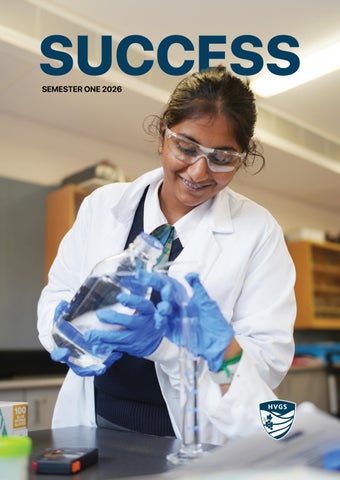
SUCCESS SEMESTER ONE 2026
CONTENTS From the Principal
03
Shaping Thinkers For A Complex World
04
Tomorrow Man / Tomorrow Woman - Strength, Redefined
06
Having a YARN
07
First & Lasts Series - Ralph Maier & Greg Robinson
08
Project Solo - Quiet Excellence
10
School in an AI World
12
Maths Accelerator - Depth Over Speed
14
Endeavour Program - What We Take, What We Leave
16
Alumni Stories: Mila Wawszkowicz & Greg Lidbury
18
4
6
7
8
12
14
16
18
Success is a Hunter Valley Grammar School publication. Editor Hannah-Louise Stretton 42 Norfolk Street Ashtonfield NSW 2323 PO Box 458 East Maitland NSW 2323 P: 02 4934 2444 E: communityrelations@hvgs.nsw.edu.au www.hvgs.nsw.edu.au
FROM THE PRINCIPAL
Students as drivers of their learning Written by Principal, Rebecca Butterworth
My son is currently learning to drive and it is far more enjoyable than I imagined it would be! I am delighted to see him "in the driver's seat", finding the learning purposeful and focusing so intently on his goal. As educators, we want our students to be in the "driver's seat" when it comes to their learning. As parents we also want our students to be "effective drivers"; that is, young people who "know how to successfully manage their engagement and drive their learning". We want this for young people not only so they can fully and actively participate in the learning process at school, but so they can develop the learning competencies they need for life. Recently, I had the pleasure of speaking with Amy Berry from EngagEd Consulting. Amy Berry has developed the Engagement Continuum and works with schools to build understanding of the strategies that move students (and staff) along the continuum. Over many years I have watched students deeply engage in our school productions. They know what they want to achieve as a team: an excellent production that is inclusive, joyful and entertaining. There is no doubt that at times some students avoid rehearsals, withdraw a little as assessments take over, or participate more passively than actively. However, our productions consistently have all the right ingredients to foster active engagement. There is a clear goal, the challenge is "just right" to allow every student to contribute, and the rehearsal process provides ample opportunities for feedback and selfassessment in relation to their goals. I could name a range of co-curricular experiences at HVGS - from aerobics and rugby to the Symphony Orchestra, Stage Band and Tournament of Minds, among many others - where active
engagement is tangible and ever present. Likewise, I see that in our trip programme, particularly the Endeavour Programme, and through our Student Councils and student leadership opportunities. Across these experiences, HVGS students participate, invest and drive their learning. Our goal at HVGS is to see equal levels of engagement within the classroom for all students. It might not be in every lesson, but it is imperative that students see their learning as purposeful and move beyond withdrawing and participating to truly investing in and driving their learning. What this looks like needs to be developmentally appropriate. As Amy Berry says, "passive disengagement is just as detrimental to learning and wellbeing as more active forms of disengaging". We all know, as teachers and parents, the disruptors in classrooms who are at the extreme end of disengagement, and whose behaviours are visible and impactful. In the same way, we can spot the avoiders and, with a little more work, spot the withdrawers. However, we need to be concerned about the students who passively disengage "because it is often a blind spot for teachers and therefore the student does not attract the support and attention they may need to help them get engaged in learning."
Passive disengagement is just as detrimental as more active forms of disengaging. These students might appear to be coasting along, perhaps doing well in terms of their academic achievement. However, they are likely underachieving, and the reasons for this need to be explored. At HVGS this is why feedback on students' approaches to learning is equally important - perhaps even more important - than the grades on their reports. How students approach their learning - their capacity for critical and creative thinking, effective collaboration and communication, and their demonstration
of curiosity - are the signs we need to investigate to better understand their level of engagement. James Anderson has undertaken ground-breaking work on the concept of "learnership". Anderson argues that in education we have increasingly focused on the craft of teaching at the expense of a deep focus on the craft of learnership across our school communities. Building on Carol Dweck's work around growth mindset, Anderson identifies eight categories that shape a learner's mindset, including their approach to challenge, response to setbacks, attitude towards effort, willingness to embrace feedback, response to mistakes, openness to support and the success of others. For students and adults to be at the high-growth end of the continuum, they need to intentionally focus on the craft of learnership. This points to the crucial need for schools to build resilience alongside critical thinking; to help students approach feedback, challenges and setbacks with curiosity; and to be open to collaborating and communicating with a diverse range of people. It is by focusing on the craft of learning that we build active engagement in our classrooms. As an IB World School, we have a mandate to do just this. At the centre of each of the IB curriculum models is the learner and the IB Learner Profile. Regardless of the age of the child, the IB demands of schools a student-centred, holistic focus on learnership as well as the craft of teaching. We all want our children to drive their engagement in learning. None of us want our children to disengage or become passive consumers and participants in learning. The IB programmes are a key tool by which we can deepen learner engagement in our schools and prepare students for a world where they need to be lifelong learners who are constantly honing the craft of learnership.
SUCCESS 2026
| 3
EXCELLENCE IN HOLISTIC EDUCATION
IDENTITY
Shaping thinkers for a complex world How HVGS students are learning to navigate complexity, consider multiple perspectives and think beyond the obvious answer
In a world overflowing with information, the challenge is no longer finding answers. It's knowing what to do with them. How do we decide what information to trust? How do we understand perspectives different from our own? How do we navigate issues that don't have clear solutions or straightforward answers? These are the kinds of questions increasingly shaping the world beyond school gates. They are also the kinds of questions our International Baccalaureate Diploma Programme (IBDP) students are becoming comfortable exploring. Spend time speaking with the School's IB cohort and one thing becomes clear: while the programme is often recognised for its academic rigour, students are just as likely to talk about perspective, discussion and curiosity as they are assessments or results. Across subjects as varied as Global Politics, Psychology, Physics, Mathematics, Music, Languages and Literature, students are encouraged to engage deeply with ideas, examine issues from multiple viewpoints and make connections between what they are learning and the world around them. For Year 11 student Dana, who previously studied within the IB system overseas before moving to Australia, that approach is one of the programme's defining features.
4
| HUNTER VALLEY GRAMMAR SCHOOL
"It's very open to perspective," she says. "It's not a linear way of thinking." That openness appears in different ways across the curriculum. In Psychology, students explore why people think and behave the way they do. In Global Politics, they examine issues through competing viewpoints and stakeholder perspectives. In Literature, there is rarely a single interpretation to be found. Even in subjects like Physics and Mathematics, students are encouraged to think beyond formulas and consider how ideas apply beyond the classroom. For Year 11 student Senuk, that shift has changed the way he approaches learning. "It's more about the hows and the whys what caused things and what the effects are - rather than the literal meanings of things," he explains. "We go conceptual, and I feel like that's really important to understand different perspectives and be able to acknowledge them." At the heart of the programme is the idea that learning should be active rather than passive. Students are encouraged not simply to absorb information, but to question it, test it and build upon it. Rather than being handed conclusions, they are challenged to develop their own understanding through inquiry, discussion and reflection.
Theory of Knowledge (TOK), one of the IB's core components, perhaps embodies that philosophy most clearly. Rather than asking students what they know, TOK asks how they know it. Who decides what counts as knowledge? Can knowledge ever be truly objective? How much do personal experiences influence what we believe to be true? "It's basically asking, 'How do we know what we know?'" Dana says. The questions themselves are often more important than arriving at a neat answer. That can be confronting. It can also be empowering. Students describe learning environments where discussion plays a central role, where ideas are shared openly and where hearing different perspectives is considered just as valuable as expressing their own. For Ainsley, that collaborative element has become one of the most rewarding aspects of the experience. "I feel like it's really nice to be able to communicate and talk about our ideas," she says. "Because the classes are smaller, everyone feels connected." Year 11 student, Akshara, believes those conversations are helping students develop skills that extend well beyond school.
"My communication skills have definitely developed because I'm able to effectively express the ideas that I'm thinking. "We're learning how to communicate with others, express what we're thinking and be open to taking in other people's opinions as well." The ability to engage with different viewpoints is a recurring theme throughout the cohort. So too is the ability to make connections. Rather than viewing subjects as separate silos, students frequently describe seeing ideas overlap and reinforce one another. A concept explored in one classroom reappears in another. A discussion in Literature sparks thinking in Global Politics. A scientific principle helps explain something observed in everyday life. For Odette, that interconnectedness has been one of the most unexpected outcomes of the programme. "I'll be talking about something in English and find links to Global Politics or Mathematics.” "Being able to bring ideas together from different subjects is something I've never experienced before." Students also acknowledge that this style of learning comes with challenges. The workload is significant. Expectations are high. Independent learning,
organisation and time management are essential. Yet when students describe what makes the programme demanding, they rarely begin with the volume of work. Instead, they talk about the depth of thinking required.
People think it's harder. But it's not necessarily harder. It's just a different way of thinking. "It's not just this and this equals that," says Mishka. "It's more how we think and why we think what we think." For Mishka, one of the biggest shifts has been moving away from learning solely for assessment outcomes. "It lets me focus more on my learning rather than focusing on trying to get a mark from day one," she says.
"We'll be better able to adapt and overcome challenges in our future endeavours." Perhaps that is why students are quick to challenge one of the most common assumptions about the IB. People often describe it as a harder pathway. The students themselves see it differently. "People think it's harder," says Dana. "But it's not necessarily harder. It's just a different way of thinking." And perhaps that's the real story of this cohort. Not simply what they are learning, but how they are learning. To ask questions. To examine perspectives. To communicate ideas. To connect knowledge across disciplines. To navigate complexity with confidence. In a world that rarely offers simple answers, those may be some of the most valuable skills of all.
"It's not just learning to regurgitate information." That sentiment is echoed by Linton, who believes the skills developed through the programme will prove valuable long after students leave school. "Since we're learning all these analytical skills and being able to understand different perspectives, I think we'll be able to translate those skills into the real world," he says.
SUCCESS 2026
| 5
IDENTITY
INCLUSION AND BELONGING
The Courage to Speak
Inside the Tomorrow Man / Tomorrow Woman workshop The rooms were quiet at first. Not silent - but cautious. Groups of students sat in circles across the Cameron Centre, Lecture Theatre and adjoining spaces, unsure exactly where the conversations ahead might lead. For many, it was unfamiliar territory. A school day that asked less about performance and more about honesty. As part of the Tomorrow Man/Tomorrow Woman workshops, students in Years 9-12 stepped away from the usual structure of classes and into facilitated conversations surrounding identity, pressure, relationships and emotional wellbeing. The sessions, split into boys’ and girls’ groups, were intentionally designed to create environments where students could speak openly about the expectations they carry - both from others and from themselves. And slowly, the rooms began to shift. Conversations deepened. Students listened. Some shared openly. Others simply sat with the relief of hearing thoughts they had quietly carried themselves. Across the sessions, recurring themes emerged. For some students, it was the pressure to appear unaffected. For others, it was the exhaustion of comparison, expectation or trying to hold everything together. While the conversations differed between groups, the underlying emotions were often strikingly similar: fear of judgement, the desire to belong and the challenge of vulnerability. “Programs like Tomorrow Man/Tomorrow Woman are important because they help students build emotional awareness and language around experiences they may not otherwise discuss,” said HVGS Psychologist, Mrs Peita Harper. “To witness young people step into vulnerability, share and support each other was a privilege. Emotional intelligence is something that requires practice, reflection and courage -
6
| HUNTER VALLEY GRAMMAR SCHOOL
particularly for young people navigating increasingly complex social and academic pressures.” For Head of Psychology, Dr Jeanette Lightfoot, the value of the program lies in creating a space where those conversations can happen. "Programs such as Tomorrow Man and Tomorrow Woman allow students to explore identity, relationships, wellbeing and resilience in a safe and highly engaging environment," she said. "I love that HVGS continues to provide meaningful opportunities for students to explore identity, connection and belonging, where vulnerabilities can be shared, honoured and well supported. Unhelpful stereotypes are challenged with honesty and courage, helping young people build confidence, self-awareness and authentic relationships." Importantly, the workshops were not about ‘fixing’ students. They were about creating space. Space for students to pause. Space to reflect. Space to recognise that strength and vulnerability are not opposites. Throughout the day, wellbeing staff remained available to support students who required additional care or follow-up conversations, reinforcing our broader commitment to wellbeing beyond the classroom. Because while academic rigour remains an important part of education, so too does the ability to communicate honestly, empathise with others and seek support when needed. And like any discipline, those skills take practice. In a world that often rewards certainty, speed and performance, Tomorrow Man/ Tomorrow Woman asked students to do something far more human. To listen. To reflect. And, when they were ready, to speak.
Strength and vulnerability are not opposites.
IDENTITY
INCLUSION AND BELONGING
More Than Just Having a Yarn Built with intention and grounded in connection, the Yarning Circle is becoming a place for listening, learning and gathering together. Beneath the gum trees, conversation feels different. There are no desks. No front of the classroom. No walls enclosing the discussion. Instead, students and staff gather in a circle, sometimes with a fire, surrounded by sandstone, birdsong and the quiet movement of nature around them. The newly expanded Yarning Circle has been intentionally designed as more than just an outdoor learning space. It is a place for storytelling, reflection, difficult conversations and connection - a space grounded in Indigenous ways of knowing and built to bring people together. For the Head of Aboriginal & Torres Strait Islander Education, Mark Miles, that sense of purpose was central from the beginning. “This space was always about creating opportunities for people to come together differently,” he says. “Not just to learn, but to listen.” Built around the existing Yarning Circle, the expanded area now creates a larger and more functional gathering space for students and staff across the ELC, Junior School and Senior School. It is used for Aboriginal Education, outdoor learning, Jr Aboriginal Education Consultative Group (AECG) meetings, Smoking Ceremonies, celebration and quieter, mentoring more personal conversations. But its significance extends beyond function. “There’s something about sitting around a fire,” Mark reflects. “People open up. Conversations become more honest.
In Aboriginal culture, gathering around the fire has always been a way to share stories, work through challenges and connect with one another.” That understanding shaped the vision for the space - not simply as somewhere to teach, but somewhere to gather with intention. In many ways, the Yarning Circle represents a different way of thinking about education itself. One that moves beyond the traditional fourwall classroom model and reconnects learning with nature, relationship and community. Some lessons, after all, are not designed for rows of desks. Importantly, the space was never intended to be for one group alone. “It’s a united space,” says Mark. “A space for everybody.” That sense of care extended into every stage of the design process. Working alongside Mark and the Jr AECG, members of the Grounds Maintenance team, Simon Brookman and Andy Martin helped ensure even the smallest details remained thoughtful and connected to Country. Nothing was accidental.
It's a united space. A space for everybody. The sandstone seating was sourced from Darkinjung Country, chosen not only for its practicality, but for the connection it creates to land and
place. The positioning of the circle itself - settled amongst the gum trees - was equally deliberate, allowing the natural environment to become part of the experience. “It was important that we listened,” Simon says. “Every detail had meaning behind it, and we wanted to make sure that meaning stayed part of the space.” Future plans for the area include the development of a bush tucker garden in consultation with the Jr AECG, continuing to evolve the Yarning Circle as a living space for cultural learning and connection. More than a physical addition to the campus, the Yarning Circle reflects a commitment to creating spaces where people feel seen, heard and connected - where learning begins not only with speaking, but with listening.
SUCCESS 2026
| 7
EXCELLENCE IN HOLISTIC EDUCATION
HUMAN CENTERED & SUSTAINABLE SYSTEMS
First and Last Series Ralph and GREG Ralph Maier For Ralph Maier, some of the most important moments at HVGS happened long before anyone realised it. The first time Ralph Maier met Kate Gill, she wasn't a Matilda. She was a Year 4 student with a football at her feet. Ralph remembers seeing something in her even then - the passion, discipline and determination that set her apart. "I remember telling her she would play for Australia." Years later, she would go on to represent the Matildas 86 times! For Ralph, it remains one of those moments that captures the privilege of teaching: seeing potential before the rest of the world catches up. Over 35 years at Hunter Valley Grammar School, there have been countless moments like that. Not necessarily famous ones. Just important ones. A School you could grow with When Ralph arrived in 1990 for his first full-time teaching role, HVGS was still finding its feet. The campus was smaller. The student body was smaller. The future was still taking shape. What excited him wasn't what the School was. It was what it could become. As the years passed, Ralph watched that potential become reality.New buildings appeared. Learning spaces expanded. Sporting facilities evolved. Today, he jokes that he works in "a resort - one without a pool."
8
For many staff, school and home are separate worlds. For the Maiers, they became one.
Be yourself, be happy and treat everyone with respect.
While Ralph taught, daughters Kathleen, Sarah and Emily grew up as HVGS students. The School became part of family life, woven into sporting commitments, friendships and everyday conversations around the dinner table.
Not even the football field that bears his name.
That may be why, when asked when HVGS started feeling like home, Ralph doesn't point to a single milestone.
And the quiet belief that if you invest in them long enough, they often become far more than they first appear.
He simply says everyone made them feel welcome. From school leaders to maintenance staff, everyone played a part. "HVGS is a special place." The last that hasn’t happened yet Most "lasts" arrive with a sense of finality. Ralph's haven't. Officially retired, he still teaches casually. Students are still excited when they see him. Staff still stop for a chat. He still drives through the gates and feels proud to be part of the community. Perhaps that's why his favourite reminder isn't hanging on a wall. It's out on the oval. Seeing students run across the Ralph Maier Football Field is still a surreal experience. Not because his name is on it. But because it represents something bigger. "It reinforces that I have contributed in some tangible way at this wonderful school." What matters most
Yet while the physical environment transformed, the thing he remembers most is the spirit of the place. People helping people. Students knowing teachers. Staff willing to pitch in wherever they were needed.
Ask Ralph what he hopes students remember and the answer isn't about sport, success or achievement. It's much simpler.
More than a workplace
After 35 years, that's the thread running through his story. Not the buildings that were built. Not the positions he held.
| HUNTER VALLEY GRAMMAR SCHOOL
The people.
"Be yourself, be happy and treat everyone with respect." Ralph Maier
Greg Robinson Before he taught a lesson, led a team or stepped into the Principal's office, Greg Robinson sat in the Hunter Valley Grammar School car park and watched the school day begin. It was late 2003, during a visit before officially commencing his role. Students moved through the campus, staff greeted one another and the school settled into its rhythm.
What stayed with him wasn't the buildings or facilities. It was the feeling. "What struck me then, and on many occasions since, was the 'vibe' of the place," Greg says. "Friendly, welcoming students and staff, and a feeling difficult to describe - caring and calm perhaps; a real community 'together' feeling." More than twenty years later, it is still the first thing he talks about. Arriving from a career in government schools across Australia and France, Greg found himself stepping into a very different environment. The Cameron Centre was still under construction, the School was preparing for its next stage of growth and there was an unmistakable sense of possibility in the air. Yet what impressed him most was not the physical environment, but the people within it. Names still come quickly to mind. Denise Wheeler. John Guy. Margaret Finucane. Sharon Cashen. Kris Horan. Martin Schlaeger. Mike Clapper. Jenny Crossman. The colleagues who welcomed him, guided him and helped him find his place in a new context. "Really, right from the start," he says when asked when HVGS began to feel like home.
Greg Robinson
I am not the writer of the story for these people; I guide them in the craft of writing their own story. It is a philosophy reflected across the School's growth during his time. New facilities emerged, learning programs evolved and spaces such as the Senior Centre and Treetops became part of everyday school life. Both began as concepts Greg championed and both now continue to serve future generations of students. Yet for all the visible change, Greg believes the most important things remained remarkably constant. The care shown towards students. The strength of community. The sense that people genuinely want one another to succeed. Perhaps that is why his final moment in an official leadership role didn't happen at a farewell assembly or in an office. Instead, it happened late at night at Sydney Airport. Having accompanied students on another European tour and farewelled them onto their coach, Greg watched them leave before quietly turning away himself. "That was it," he recalls.
Over the next two decades, Greg would help guide countless students and staff through their own journeys.
"I walked away after waving them off and thought… my official role had come to an end. It was the strangest feeling."
Ask him what made him most proud and he doesn't point to a title, a building or a particular achievement. Instead, he talks about creating opportunities.
It is a fitting final image.
"My 'why' at HVGS has largely revolved around working hard to make opportunities available so that people can achieve their goals," he says.
And when Greg reflects on what he hopes remains, it isn't a building, a program or a title.
"I am not the writer of the story for these people; I guide them in the craft of writing their own story."
Not a leader standing at the centre of the story, but someone focused on helping others continue theirs.
It is the continuation of the culture that first caught his attention all those years ago. That unmistakable feeling of a place where people belong.
SUCCESS 2026
| 9
INCLUSION AND BELONGING
IDENTITY
EXCELLENCE IN HOLISTIC EDUCATION
Finding their own voice How Project Solo is helping students discover confidence, resilience and a new definition of success. There is a moment before every solo performance when everything becomes very quiet. The accompanist is ready. The audience settles. There is nowhere to hide. No section to blend into. No conductor to follow. Just one student, one instrument and countless hours of practice. For many young musicians, it is one of the most vulnerable moments they will ever experience. It is also where some of the greatest growth begins. Project Solo, introduced by the Music Faculty in 2024, was created to give dedicated student musicians the opportunity to challenge themselves beyond the ensemble setting. More than simply another performance opportunity, it is designed to develop artistry, confidence and the unique skills that come with standing on stage alone. "It is not just another opportunity to perform," Director of Music, Mr Johnston Parkinson says.
"It is a solo concert experience designed for the most dedicated music soloists at HVGS to hone their soloistic and artistic abilities, stage presence, musical collaboration and audience rapport." Across the performances, audiences experience an extraordinary range of music. Classical works sit alongside Jazz, Folk, contemporary pieces and music from around the world, each chosen because it means something to the student performing it. Before each performance, students introduce their piece, sharing the stories, emotions or ideas that inspired their choice. The result is a concert that feels deeply personal, with every performance revealing something about the musician behind it. For Year 9 student, Joslyn K, Project Solo was an opportunity to discover what she was capable of. "I think it is really important to learn how to perform on your own with no one to catch you but yourself if you fall," she says. "I also wanted to improve my confidence when performing alone." That challenge quickly became one of the program's greatest rewards. "From Project Solo I have gained more confidence and now performing on my own is much less intimidating." Year 7 student Shitong (Angela) G experienced something similar. "The challenging part was trying not to be so nervous," she says. "If you make a mistake while playing solo it would be obvious." Yet rather than focusing on perfection, she discovered resilience. "I learned that I can be resilient. Preparing for Project Solo can be
10
| HUNTER VALLEY GRAMMAR SCHOOL
pressuring, but the performance itself was a fun experience." For Year 6 student, Olivia J, the experience was about embracing something unfamiliar. Although she wasn't alone on stage, performing with an accompanist taught Olivia a different kind of confidence: trusting another musician while taking responsibility for her own performance. "Project Solo gives people a chance to have a challenge and give their confidence a boost," she says. "I think that is one of the most important things to go as far as you can go." While every student's journey looks different, Johnston says they all develop qualities that extend far beyond music. "The motivation and inspiration to prepare thoroughly, consistently and purposefully normalises the challenges of solo performance," he explains. "It develops resilience, intention, planning and pacing."
Those are qualities that serve students well not only in music, but across their academic studies, sport and everyday life. Just as importantly, Project Solo is quietly reshaping what success in music can look like. For Angela, success is communicating the emotion she hopes her audience will feel. For Joslyn, it is becoming better than she was the last time she performed. For Olivia, success began with something wonderfully simple. "My first success in playing the flute was probably playing my first note." That perspective sits at the heart of the HVGS Music Program. Rather than celebrating only the loudest performances or the biggest stages, Project Solo recognises the quieter moments of growth - the hours of practice, the willingness to take risks and the courage to perform despite uncertainty. "Success in music is about being the best you can be," Johnston says. "Music is better together, even in the solo context." It is a reminder that no solo performance is ever truly a solo journey.
Music is better together, even in the solo context. Behind every student stands a community of teachers, accompanists, families and peers, each helping to nurture the confidence to step onto the stage. Because while only one musician may stand beneath the spotlight, they never stand there alone.
SUCCESS 2026
| 11
EXCELLENCE IN HOLISTIC EDUCATION
CONNECTED AND FLOURISHING COMMUNITY
Standing Still Is Not an Option
AI can't experience real life events and the human thinking can be a lot easier to relate to than AI.
How conversations around AI at HVGS are prompting deeper questions about learning, thinking and future readiness. The students admitted it almost cautiously. Yes, they were using AI. Not to cheat. Not to avoid thinking. But to clarify ideas, unpack questions and better understand where to begin. And perhaps that was the most confronting part of the conversation. While many adults are still debating whether artificial intelligence belongs in education at all, students are already navigating it daily - thoughtfully, creatively and often with far more nuance than they are given credit for.
Professor Emeritus John Fischetti
More than a shortcut For the students involved in the panel discussion, AI is not a future possibility. It is already part of everyday learning. Some use it to generate practice questions before an exam. Others use it to break down complex concepts, refine ideas or help navigate unfamiliar topics. For Joslyn, AI has become a tool that helps her spend less time searching and more time learning.
blindly embracing AI. They are actively weighing its benefits against its risks and considering where human thinking still matters most. As our Principal, Rebecca Butterworth reflected following the discussion, students appear to be using AI "to help them think, not to think for them." That sentiment was echoed repeatedly throughout the responses.
Earlier this year, education expert Emeritus Professor John Fischetti visited HVGS to lead discussions with students, staff and families around the future of schooling in an AI-driven world. What unfolded was less a conversation about technology itself and more a reflection on what meaningful learning should look like now.
"It has saved me a lot of time searching for information and meant that I could focus more on the depth of the subject."
When asked what skills would matter most in the future, the focus quickly shifted away from technology itself.
Yet what emerged from the student responses was not an enthusiasm for replacing learning with technology. In fact, many were quick to identify the limitations.
"Knowing how to ask the right questions and then how to interpret the answers." - Joslyn
The discussion raised questions that extend well beyond the classroom. How do schools prepare students for jobs that may not yet exist? What skills will matter most in a world where information is instantly accessible? And how do we ensure technology enhances learning rather than replacing it?
Harrison believes AI becomes problematic when students stop thinking for themselves.
These were questions students were already considering.
12
- Harrison, HVGS Student
| HUNTER VALLEY GRAMMAR SCHOOL
"When AI does the whole assessment or task for you then you're not thinking or learning and not pushing yourself to your max in your learning." The students' responses revealed something encouraging: they are not
For Harrison, the value of human thinking comes down to something AI simply cannot replicate. "AI can't experience real life events and the human thinking can be a lot easier to relate to than AI." What emerged was not a generation looking for shortcuts. It was a generation trying to understand where technology fits - and where it doesn't.
Rethinking learning The student reflections closely mirrored conversations taking place among staff. For Classroom TAS Teacher, Ms Kim Monaghan, one of the key messages from Professor Fischetti's visit was that education must evolve alongside the world students are entering. "We are preparing students for a world that is vastly different to the one in which we and their parents grew up in and that we need to be bold when providing them with an education to match this new and exciting world." Rather than fearing AI, Kim believes educators should approach it with curiosity. "I should not be afraid of AI and new forms of education, but rather curious."
What remains human?
Looking ahead
For Head of Year - Stage 5 and Classroom Languages Teacher, Mr Kent Burgin, AI is prompting educators to ask deeper questions about the purpose of learning itself.
Ultimately, the conversations sparked by Professor Fischetti's visit were never just about artificial intelligence.
Rather than focusing solely on what AI can do, Kent believes schools must consider what remains uniquely human.
About preparing young people not simply for examinations, but for a future that continues to change at extraordinary speed.
"What can the student do as a learner that AI cannot and how can learning be designed to ensure that AI is a tool that supplements learning rather than a replacement for it?"
What emerged from both students and staff was a shared understanding that artificial intelligence is about far more than new technology. It is prompting schools to rethink how learning is designed, how understanding is demonstrated and how students continue to engage deeply with knowledge in an age of instant information.
For Kent, the answer lies in designing learning experiences that are intentional and authentic, ensuring students continue to grapple with ideas, develop their own understanding and grow through challenge. He also believes some of the most important skills of the future may be the most human ones. "Probably relational skills. Modes of building trust, dealing with conflict and establishing connection. These are things of which AI is incapable but are central to the establishment and maintenance of human societies." While AI continues to evolve, Kent believes education must continue to prioritise what it has always been about at its core: human development.
They were about curiosity. About adaptability.
The challenge is not simply embracing AI, but ensuring it enhances learning without replacing the thinking, questioning and intellectual struggle that underpin genuine understanding. As technology evolves, schools must continue to cultivate the distinctly human qualities of curiosity, critical thinking, creativity, ethical judgement and meaningful connection. As Emeritus Professor Fischetti reminded the HVGS community: "Standing still is not an option."
That curiosity is already reshaping classroom practice. Rather than relying on tasks centred around finding the right answer, Kim believes learning should encourage students to engage in deeper thinking and develop their own perspectives. "It means that we are needing to create and design tasks that are less around question and answer and more defined by deep and challenging thoughts that AI cannot complete on its own without the student disseminating knowledge and providing an opinion. AI is now a tool rather than an end product." For Kim, the challenge is not whether AI belongs in education, but how it is used with purpose. "It has a place but needs to be supported by verbal discussion and dialogue to ensure understanding."
SUCCESS 2026
| 13
INCLUSION AND BELONGING
EXCELLENCE IN HOLISTIC EDUCATION
The Right Kind of Challenge Inside our Maths Accelerator Program, students are discovering that excellence in Mathematics is not about moving faster - it is about thinking more deeply, embracing complexity and learning alongside equally driven peers.
The Maths Accelerator classroom is quiet. Not in the way that suggests disengagement, but in the way that comes when students are deeply focused. Heads are bent over pages. Calculations unfold carefully across workbooks. Every now and then, students pause to compare methods or quietly check their thinking with the person beside them. There is a calmness to the room. A shared sense of purpose. For a program built around acceleration, the most striking thing about the Maths Accelerator classroom is not the speed. It is the depth of thinking. “Sometimes we compare our methods of how we solve it,” Year 9 student Isla said. “It’s good.” It is not the kind of Mathematics class many people imagine when they hear the word ‘acceleration’. The new Maths Accelerator Program is not simply about moving faster. It is about creating the right environment for students who are ready to think more deeply, wrestle with complexity and engage with Mathematics in a more challenging way. For some students, that challenge is exactly what they had been looking for.
14
| HUNTER VALLEY GRAMMAR SCHOOL
Thomas, one of the Year 9 students in the inaugural cohort, describes feeling excited when he was invited into the program. “I really enjoy Maths,” he says. “I thought I was learning new stuff before, but it was a bit slow compared with what I can learn.” Now, he says, each lesson feels different. “I can challenge myself each day with new stuff to learn.” The program currently sees selected students complete Years 9 and 10 Mathematics content in a compressed pathway designed to balance rigour with long-term success. Unlike many accelerated programs that begin later and compress content more aggressively, we intentionally start earlier and spread the learning in a way that still allows students to fully engage with sport, music, co-curricular life and their wider studies. For Head of Mathematics, Angela Roughan and Director of Curriculum, Chris Wyatt, that balance matters. “We wanted a program that challenged students, but also allowed them to thrive across the board,” Chris said. The goal is not simply to produce students who finish Mathematics early. Instead, the program has been designed to build deep understanding, confidence and future readiness - whether students
ultimately pursue the HSC or the IB Diploma Programme. That future focus is already beginning to shift how students see themselves as learners. Bonnie says being surrounded by equally motivated peers has changed the way she approaches learning. “When you’re put in the right environment, it changes so much,” she says. “Sitting in a class that’s really challenging me - I really enjoy that. It doesn’t always
feel comfortable, but at the end you know you’re gaining so much out of it.” The students speak less about competition and more about curiosity. They talk about solving problems, pushing through difficult concepts and learning how to think differently. Ryan admits he initially felt nervous about joining the program. “It sounded like a really great opportunity, but it also seemed a little stressful,” he says. Now, however, the challenge has become his favourite part. “It is challenging work,” he says. “That’s probably the bit that excites me the most.” That idea - that challenge can be motivating rather than discouraging - sits at the centre of the program. Students are encouraged to persist through uncertainty, explain their reasoning and seek multiple ways to solve problems. Sometimes that means asking teachers for help. Sometimes it means discussing solutions with classmates, revisiting notes or talking problems through at home. For Thomas, it is the process itself that makes Mathematics appealing.
When you're put in the right environment, it changes so much. “With Maths, there’s always a logical answer,” he says. “I like finding out solutions for problems.” That mindset is something Angela says the program intentionally nurtures. Rather than focusing solely on speed, students are asked to engage with increasingly sophisticated concepts while developing the independence and resilience needed for senior study and future STEM pathways. Importantly, the program also remains flexible. Students are not locked into one pathway or pressured to remain if the pace no longer suits them. New students demonstrating strong capability can still enter the program later, and students can move back into mainstream classes if needed. “It’s about putting students in the right learning environment,” Angela said.
“Everyone else in the class has the same goals as me,” she says. In many ways, that sense of belonging may be one of the program’s most significant outcomes. Because while acceleration is often associated with speed, the students themselves describe something different. They describe challenge. They describe curiosity. They describe learning how to persist when answers do not come immediately. And perhaps most importantly, they describe discovering that they are capable of more than they first thought. “Your mind’s actually able to take in more information than you think it is,” Bonnie says. Inside the Maths Accelerator classroom, excellence is not measured by how quickly students move. It is measured by how deeply they are willing to think.
That philosophy has helped shape a classroom culture where students feel supported to take risks, ask questions and push themselves further. For Isla, one of the most enjoyable aspects has simply been learning alongside students who share similar goals.
SUCCESS 2026
| 15
EXCELLENCE IN HOLISTIC EDUCATION
INCLUSION AND BELONGING
BEYOND THE POSTCARD What students discover when they step beyond their own world. It's easy to remember the destination.
"I believe that I have become a much more respectful and knowledgeable person."
The red sands of Central Australia. A village in Vietnam. A classroom in Fiji. A township in Africa. The Great Barrier Reef. What is harder to capture is what students bring home with them. For some, it's a greater appreciation for cultures different from their own. For others, it's confidence, resilience or a new understanding of what service really means. Often, it's simply a shift in perspective. That is the purpose of the Endeavour Program. While each experience looks different, every trip is designed to move students beyond observation and into participation - encouraging them to engage with communities, environments and ideas in ways that can't be replicated in a classroom. Director of Experiential Learning & CoCurricular, Nicole O'Brien says the goal has never been travel for travel's sake. "It's not just enough to learn and to know," she says. "There's a responsibility on us as humans and as a community to not just be aware, but to do something with that knowledge." While the destinations vary, the common thread is meaningful engagement. In Vietnam, students worked alongside local communities to help build homes. In Fiji, they coached and taught local students. In Central Australia, they immersed themselves in First Nations culture and history. Other groups found themselves contributing to environmental conservation projects, supporting local organisations or confronting realities very different from those they experience at home.
16
The service itself looks different in every setting. The learning often doesn't. For Year 10 student Zahra, travelling to Vietnam reinforced the value of showing up and contributing in person. "Experiencing things first hand can be more powerful than contributing to something through a screen," she says. "Actually being a part of the building process, putting in that effort and seeing how the family reacted was a very touching moment." Emma found the handover of the completed house particularly powerful. "Seeing their reactions to what we had done was so meaningful and will stick with me far longer than any shopping. It was a new feeling to have made such a difference in people's lives." For students in Fiji, service often became a pathway to connection. Ashton reflects on "teaching the kids how to play touch and building strong connections with each of them," while Claudia recalls meeting and interacting with local students in the classroom as one of her most memorable experiences. Across the program, students repeatedly spoke about the impact of working alongside people rather than simply learning about them. Many also found themselves challenged in unexpected ways.
| HUNTER VALLEY GRAMMAR SCHOOL
The Endeavour Program feedback revealed recurring themes of homesickness, language barriers, physical exertion, cultural differences and navigating unfamiliar environments. Yet students overwhelmingly described these moments as some of the most valuable parts of the experience. For Scarlett, travelling through Central Australia offered a new perspective on culture and connection. "It has made me realise the amount of different belief systems and how regardless of what we believe, we are all connected in some way," she reflects. The experience also challenged her to become a better listener. "I feel like I am going to be a much more open-minded person and it will probably allow me to be a much more wellrounded person as well, because I will be able to just listen." Xavier describes returning with a deeper appreciation for Aboriginal culture and the significance of places such as Uluru and Kata Tjuta.
"It has made me realise the amount of different belief systems and how regardless of what we believe, we are all connected in some way." "I believe that I have become a much more respectful and knowledgeable person." For students who travelled to Africa, the experience often prompted reflection on education, opportunity and gratitude. One student described gaining "a lot of appreciation for the education and the opportunities I have," while another reflected on how cultural immersion changed the way they viewed their own circumstances and privilege. Despite the different destinations and experiences, a common theme emerged across every trip: perspective.
Students returned with a greater appreciation for the opportunities available to them, a deeper understanding of different cultures and communities, and a stronger sense of how even small actions can make a meaningful difference. These themes consistently emerged throughout the Endeavour Program feedback, alongside gratitude, connection and service. Perhaps that's why the Endeavour Program is about more than where students go. It's about what happens when learning moves beyond the classroom and into the real world. The destinations will change from year to year. The lessons often don't. Students return with a little more confidence, a little more gratitude and a broader understanding of the communities, cultures and environments that shape our world. They leave with memories of places.
"Experiencing things first hand can be more powerful than contributing to something through a screen."
But perhaps more importantly, they leave with a deeper understanding of people - and of their own capacity to contribute, connect and learn from others.
SUCCESS 2026
| 17
CONNECTED AND FLOURISHING COMMUNITY
MILA WAWSZKOWICZ ICZ (Class of 2022)
A L U M N I
At 18 years old, Mila Wawszkowicz boarded a plane bound for the United States, leaving behind family, friends and everything familiar in pursuit of an opportunity she wasn't entirely sure would work out. What she did know was that she wanted to give it a go. A passionate basketballer throughout her time at HVGS, Mila's talent and commitment to the sport opened doors she never expected. While still in Year 10, conversations with American college recruiters began to transform what had once felt like a distant dream into a genuine possibility. A visit to the United States in 2021 confirmed it. After touring several universities, Mila found herself drawn to the University of San Diego and committed soon after. Two years later, she made the move overseas to begin life as a student-athlete.
18 | ALUMNI SUCCESS 2026
There were unforgettable moments. Competing in packed stadiums and playing against some of the best collegiate athletes in the country delivered experiences few young Australians ever encounter. "It was so loud I couldn't even hear my teammate next to me." But the moments that shaped her most happened away from the court. Just weeks after arriving, Mila broke her foot. Far from home and navigating a different healthcare system, she suddenly found herself dealing with setbacks and responsibilities on her own. "I had scans and was put in a boot before my parents even woke up because of the time difference. I just wanted a hug from Mum." The experience challenged her in ways basketball never could, teaching
resilience, independence and confidence in her own ability to adapt. In 2024, Mila returned home to continue her studies in finance at the University of Newcastle. While her path shifted, basketball remains an important part of her life and she continues to play semiprofessionally, having played with the Maitland Mustangs, and now the Perry Lakes Hawks in Western Australia. Looking back, Mila sees her journey not as a story about sport, but about being willing to embrace opportunity, even when the outcome is uncertain. Her advice to current students reflects that mindset: "Take risks, chase your goals and don't be afraid to step out of your comfort zone." Because sometimes the most valuable lessons aren't found in the destination, but in having the courage to take the first step.
Greg Lidbury (Class of 1994)
For Greg Lidbury, some of life's biggest opportunities arrived when things didn't go according to plan. After leaving HVGS in 1994, Greg headed to university before realising it wasn't the right fit. He worked a variety of jobs while pursuing his passion for rugby, but a serious leg injury in 1996 forced him to rethink his future. During recovery, he enrolled at Metford TAFE to study Stock and Station Agency and Real Estate, setting the course for a career that continues today. In 1997, he joined his father's business, Bowe & Lidbury, at the Maitland Saleyards and, by 2001, had taken over the family business himself. As one of HVGS's foundation students, Greg remembers a school that was still finding its feet. "Being part of a small, developing school meant we were encouraged to try everything. It gave us opportunities we might not have had elsewhere." Whether it was rugby union, rowing, athletics or co-curricular activities, Greg says students were often called upon to step outside their comfort zones. "I even ended up rowing thanks to Mr Bond," he laughs. Some of his strongest memories come from the people who helped shape those years. Lorraine
Being part of a small, developing school meant we were encouraged to try everything. It gave us opportunities we might not have had elsewhere. Keith, his Year Advisor from 1990 to 1994, taught students how to make better decisions, while Denise Wheeler brought plenty of humour to Economics classes. Fellow student Nick Brideson was, in Greg's words, "a problem solver and a mischief maker."
There were challenges too. "I caught the bus with a lot of students from established schools in Maitland who thought us private school kids were easy targets. Let's just say the khaki uniform wasn't a great colour to fly under the radar." Looking back, Greg says those experiences taught him resilience and the importance of standing up for himself and his younger brother. Outside school, rugby remained a constant. He played for the Maitland Blacks for many years, including three First Grade grand finals, and still treasures the letters of encouragement sent by retired teacher, John Guy before each decider. Today, Greg and his wife Cindy have four children, all of whom have attended HVGS - a connection that has spanned generations. His advice to current students remains much the same approach that has guided his own life. "Appreciate the opportunities HVGS offers, give everything a red-hot go and enjoy your time at school - it's short." "And stay in touch with your friends. Friendships take effort after school, but they're worth it."
ALUMNI SUCCESS 2026
| 19
42 Norfolk Street Ashtonfield NSW 2323 PO Box 458 East Maitland NSW 2323 P: 02 4934 2444 E: communityrelations@hvgs.nsw.edu.au www.hvgs.nsw.edu.au