INSTITUTE FOR THE HUMANITIES UNIVERSITY OF MICHIGAN Annual Report
20 25
20 26
TABLE OF CONTENTS Letter from the Director
4
Reciprocity in the Humanities
6
Shifting Roots; Better Writing, Less Waste
7
Eat Off Art
8
Humanistic Inquiry: Satisfaction and Possibility
10
The Hear, Here Series
11
Faculty Fellows
12
Investing in the Humanities During Difficult Times
14
Graduate Student Fellows
15
Scholars at Risk
16
Summer Faculty Fellows
17
Public Humanities Internship
19
From Campus to Capitol: Humanities Advocacy in Action
22
Humanities Film Series
24
Gallery
27
Cardboard, Crates, and Scissor Lifts
38
Curating Scholarship
41
Flyways & Bird Walks
42
Staff
44
Humanities Event Grants
45
Affiliates
46
About the Institute for the Humanities
48
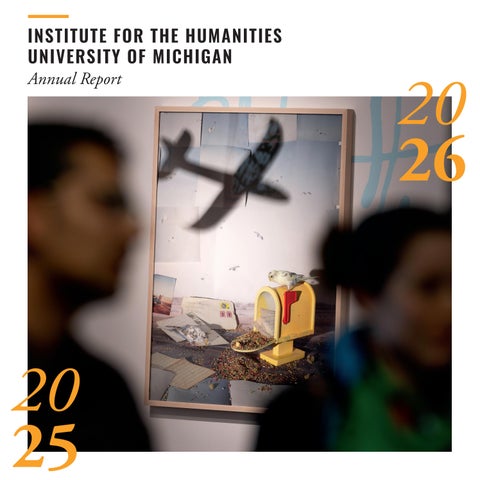
Cover: Correspondents, 2024 by Sheida Soleimani
dear friends,
LETTER
from the director
Despite the proliferation of technologies that promise immediate access to information and instant communication across the globe, feelings of angst, division, and alienation are on the rise. This sense of digital loneliness reflects a curious paradox: the hyper-connectivity made possible by digital tools too often leaves us feeling unfulfilled and isolated. While technology enables us to cross borders and cover vast distances in our digital lives, our societies continue to feel increasingly fractured and isolated. These developments are felt more deeply, perhaps, at a time when the United States is celebrating the 250th Anniversary of the Declaration of Independence, just as we enter into what promises to be a highly contentious, era-defining election season. In this moment, we are reminded that democracy depends not merely on a well-informed citizenry but on a society that cultivates humanistic values. The Institute for the Humanities funds scholarly and creative projects that explore the diverse histories and cultures that define the human experience. As a hub for humanities research on campus, we provide fellowships for U-M faculty, graduate students, and visiting scholars. We take U-M’s responsibilities as a public university seriously by extending programs to area high schools, community organizations, and arts institutions. All of our events are free and open to the public. We host esteemed scholars, artists, and industry leaders. We embrace open inquiry and the free exchange of ideas. In the pages that follow, you will learn more about the tremendous research that the most recent cohort of faculty and graduate students has done as part of the institute’s faculty and graduate student fellowships. In addition, you will catch a glimpse into the Institute for the Humanities Gallery exhibitions that, each in its own way, reflected a world in constant motion; including birds in flight, migratory tracks left in the sand, and people on the move, even as the very ground beneath them shifted underfoot. Much of our programming focused on the importance and beauty of place amid the environmental and ecological challenges
4
we face. As always, the undergraduate Public Humanities Interns continue to amaze. Both individually and collectively, they created a slate of deeply meaningful programming that enriched the institute. But, as I mentioned in my inaugural letter last year, we do not do this work alone. I want to extend special thanks to the Institute for the Humanities staff for making this work possible. I would also like to thank the various groups and units on campus with whom we partnered this year, including the University of Michigan Museum of Art (UMMA), the Marsal Family School of Education, the Initiative for Democracy & Civic Empowerment, the Arts Initiative, the Michigan Institute for Data & AI in Society (MIDAS), the Digital Inquiry, Speculation, Collaboration, and Optimism (DISCO) Network, and the Office of the Vice President for Research (OVPR) among others. And a special thanks to our donors.They, along with these partners, have helped make the vision and mission of the Institute for the Humanities possible. In an environment that has increasingly called into question the value of the humanities and even the university system writ large, I am proud of the work the Institute for the Humanities has done this year. In reflecting back over the year, I am encouraged by the way that our work has cultivated humanistic values, groundbreaking research, discussion, and debate. Thank you for a wonderful year. We look forward to seeing you next year. In October, we will host Lonnie G. Bunch III, Secretary of the Smithsonian Institution. In addition, 2027 marks the institute’s 40th Anniversary. We hope you will join us for what promises to be a signal year. Best Wishes, –Jason Young, director Mary Fair Croushore Professor of the Humanities 5
RECIPROCITY IN THE HUMANITIES This year, we launched a new collaboration with Rackham Graduate School to offer humanities-focused internships for U-M graduate students. The inaugural 2026 cohort are working at one of three community partners: Progressive Art Studio Collective, Prison Creative Arts Project, and African American Cultural and Historical Museum of Washtenaw County. Grounded in the idea of reciprocity, the program emphasizes mutual exchange between students and community partners, highlighting how humanities training can meaningfully contribute beyond the university while also being shaped by community knowledge and experience. The program provides funded, facilitated opportunities for graduate students to apply their humanistic skills in new contexts, contribute to organizations addressing vital community needs, and develop new professional experiences and perspectives. By working directly with community partners, students are encouraged to expand their understanding of where humanities knowledge can live and how it can support public engagement, collaboration, and social impact. 2026 RECIPROCITY IN THE HUMANITIES INTERNS Jasmine Ehrhardt, PhD candidate, American Culture and Digital Studies Internship: Prison Creative Arts Project Irene Mora, PhD candidate, History and Women’s and Gender Studies Internship: African American Cultural and Historical Museum Eryn Talevich, PhD candidate, Anthropology Internship: Progressive Art Studio Collective
6
1
Pulitzer Prize-winning journalist offered sustainable options to decrease waste
SHIFTING ROOTS hair is the garden we wear
BETTER WRITING, LESS WASTE
In his book Total Garbage: How We Can Fix Our Waste and Heal Our World, journalist Edward Humes employs engaging investigative storytelling to link our waste crisis to bigger issues in the humanities like ethics, community, culture, and our relationships with each other and the environment. We invited him to campus to talk about his writing process and how the everyday choices we make and the systems we rely on contribute to the overwhelming problem of waste.
Tzu Poré (L) and Kahn Santori Davison
In October, we connected Detroit barber and artist Tzu Poré with writer Kahn Santori Davison to talk about Poré's project Shifting Roots. The project fuses symbolic hair design, ritual healing, and fine art into one unified ecosystem of transformation. Through intentional grooming, visual storytelling, and community activation, this initiative presents identity as terrain—where hair becomes soil, and fine art becomes the bloom. At events at the U-M Detroit Center and here in Ann Arbor, Poré shared how his cultural roots shape his work in the garden, on canvas, and as a trained barber/cultural griot.
Edward Humes
7
EAT OFF ART (FOR 3 DAYS) with edreys and alexa wajed
In celebration of National Poetry Month, the Institute for the Humanities hosted a series of writing workshops in April. The series kicked off with a conversation led by Edreys and Alexa Wajed, founders of Eat Off Art, a creative design agency based in Buffalo, NY. While we expected they’d expound on how they counter the notion of a starving artist and how their experiences have translated into a thriving lifestyle, what a room full of students, faculty, artists, poets, and staff received was wisdom packaged in sensitivity. Edreys and Alexa’s vivid stories of trial and triumph made the questionand-answer segment feel like an intimate gathering of comrades. The audience’s laughter, tears, and spontaneous polling created an atmosphere that carried beautifully into the two days of workshops that followed. The poetry and creative writing workshops were grounded in the expertise of artistic practice, storytelling, and the unique human experience that we share. A student reflected on how much she “enjoyed how they utilized mindfulness before starting each session.” Alexa opened each session with a reflection period accompanied by soft sounds, creating a sense of calm that eased anxieties and encouraged openness. Participants were encouraged to jot a “hobby, snack, and an object” on Post-it notes and place them on the wall. Everyone obtained three Post-its and used those words to write a haiku (a traditional Japanese form of poetry). Edreys leaned into his love of hip-hop and his love of words to motivate the unique poems that were generated from the prompts. Before long, folks were on their way to writing a second poem! The University of Michigan community received more than we’d anticipated from our time with Edreys and Alexa. They filled our cups and reservoirs with satisfaction. The uplifting energy of Eat Off Art demonstrates what it means to center humanity and kindness in practice.
Edreys and Alexa Wajed
8
Creative Writing Workshop.
9
JENNIFER DOMINIQUE JONES
2025-26 Jean Yokes Woodhead Faculty Fellow
humanistic inquiry: satisfaction and possibility At the welcome event for the 2025-2026 cohort of graduate and faculty fellows, Director Jason Young asked us, “What does the humanities mean to you?” While the passage of several months has faded the particularities of my response, I do remember that my offering was sterile and trite. Reflecting on the past year, I was reminded that humanistic inquiry is worthwhile, in part, because of the profound satisfaction of thinking deeply with others in novel ways. For seven months, fellows gathered in the institute’s common room, clustered around a long table or sitting in rows of chairs, to engage colleagues’ written or presented work. While our attention was focused on one offering at a time, our conversations often addressed broader questions and conundrums: How might scholars utilize particular prose, genres, and mediums to engage with readers within and beyond our fields and disciplines? What ethical considerations should scholars and writers attend to when representing historical and contemporary violence, harm, and erasure? These exchanges unfolded across two registers— orally during our seminars and faculty Hear, Here talks and digitally in a Google document we populated with references to relevant scholarship, fiction, and films. Together, we forged an intellectual community through the shared pleasure of asking compelling questions, highlighting a submerged idea or theme, troubling epistemic assumptions, and, most importantly, seeking to support each other. I found the invitation to focus my attention on the worlds, materials, and human/non human actors my colleagues elucidated a welcome balm in a world constantly curating a lack of sustained focus. Emboldened by my peers, I decided to share snippets of my creative research projects. One, titled Black Peninsulas, merges reflections about historical research methods with creative writing techniques. Drawing upon actual historical materials, this collection explores multifaceted facets of Black life in nineteenth and twentieth century Michigan, inviting readers to reconsider the boundaries between history, fiction, memory, and rumor. Sharing this work surfaced multiple arts practices among us and has enlivened my desire to explore new modes of inquiry, ones that blur and exceed the limits of conventional scholarly work. –Jennifer Dominique Jones is an associate professor of history and women’s and gender studies.
10
THE HEAR, HERE SERIES
sparking dialogue around emerging humanities research
14
academic disciplines represented by our fellows
“Hear, Here: Humanities Up Close” is an annual lecture series that offers faculty fellows an opportunity to share their inprogress research in a supportive public forum. Each faculty fellow presents a short talk drawn from their current fellowship project, followed by an open Q&A. For attendees, it's a chance to engage directly with ideas in the humanities and get a glimpse into the creative process behind scholarly work.
2025–26 HEAR, HERE LECTURES "Radical Care: Stories of Women Leaders in Corrections," Francine Banner "Black Girlhood Unfolded: Reclaiming Puberty Narratives in a Digital Archive," Rona Carter "Afterlives of Revolution: Political Passions in Post-revolutionary Nicaragua," Luciana Chamorro "The Crafty Birdmen of Poa Mecca," Nachiket Chanchani "The (In)Visible Acquisitions of Ann Allen Shockley," Jennifer Dominique Jones "Translating the Frontier: Just War and Free Circulation on the Roads of Colonial Mexico," Daniel Nemser "Regions of the Mind: 19th-Century Travel Writing and Neurodiversity," Ittai Orr "Fabricating Law: Materialities and Criminal Courts in Colonial Indonesia,” Sanne Ravensbergen"
11
faculty
FELLOWS
FRANCINE BANNER
DEMET BOLAT
JENNIFER DOMINIQUE JONES
DANIEL NEMSER
NORMAN FREEHLING VISITING FACULTY FELLOW; BEHAVIORAL SCIENCES, U-M DEARBORN, "Assumptions of Risk: Gender, Complicity, and Culpability"
JEAN YOKES WOODHEAD FACULTY FELLOW; HISTORY AND WOMEN’S AND GENDER STUDIES, "The (In) Visible Acquisitions of Ann Allen Shockley: An Black Feminist Biography"
12
WILLIAM AND SALLY SEARLE VISITING RESEARCH FELLOW SOCIOLOGIST AND FEMINIST SCHOLAR, Examination of the political, institutional, and epistemological effects of antigenderism on academia in Turkey
JOHN RICH FACULTY FELLOW ROMANCE LANGUAGES & LITERATURES, "The Great Circulation Machine: Imperial Logistics and Fugitive Practice in the Iberian Empire"
RONA CARTER
DIGITAL SCHOLARSHIP FACULTY FELLOW; PSYCHOLOGY, "Black Girlhood Unfolded: Reclaiming Puberty Narratives in a Digital Archive"
LUCIANA CHAMORRO
HUNTING FAMILY FACULTY FELLOW ANTHROPOLOGY, "Afterlives of Revolution: Political Attachments in Post-Revolutionary Nicaragua"
NACHIKET CHANCHANI
HELMUT F. STERN FACULTY FELLOW HISTORY OF ART, "Of Vessels and Values: The Arts of Survivance at a Crossroads of Asia"
“ ITTAI ORR
NORMAN AND JANE KATZ FACULTY FELLOW; ENGLISH LANGUAGE & LITERATURE, "Before IQ: The Construction of Cognitive Difference in Antebellum American Literature"
SANNE RAVENSBERGEN
[FELLOWS] SEMINARS CREATED A SAFE, SUPPORTIVE, AND SCHOLARLYFRIENDLY ENVIRONMENT IN WHICH FELLOWS, EACH OF THEM A STRONG INTELLECTUAL IN THEIR OWN RIGHT, COULD OPENLY DISCUSS THE DOUBTS, QUESTIONS, AND STILL-DEVELOPING ASPECTS OF THEIR WORK.” –2025-26 Faculty Fellow
STEELCASE FACULTY FELLOW HISTORY, "Materialities and Criminal Courts in Colonial Indonesia"
13
MAYA DAY
2025-26 James A. Winn Faculty Fellow
investing in the humanities during difficult times The Institute for the Humanities has not only revealed to me what it means to be a scholar in an interdisciplinary context, but also what it means to be part of a community invested in the humanities during difficult times. I’ve learned how to speak across differences and hear these differences rhyme and resonate with my own work. I have realized that those in even the most disparate fields can have more similarities with my scholarship than I previously thought. Across disciplines I have seen us share similar investments in a desire to ethically and rigorously think with difficult material in difficult times. On a professional level, the Institute provided invaluable training on being a colleague. I came into the seminar struggling with the invisible rulebook of communicating on a scholarly level—asking questions at lectures, giving feedback on a colleague's work, and the confidence that comes along with these tasks. These worries were assuaged as soon as I stepped in the seminar room through an atmosphere of support and creativity from both professors and fellow graduate students. Each fellow presented a model of thinking with each other that shaped me into a better listener and contributor to scholarly conversation. I have grown more confident in my scholarly voice through their support and example. In addition to our seminars, I have been deeply impacted by the investment in the arts from the Institute. The Curating Scholarship Workshop with Amanda Krugliak, for instance, became a rare training in awe and attention. A group of faculty and students from around the University found beauty in window displays, a door on the street, and work from visiting artists at the Institute. To pay attention and find beauty in small everyday details felt rare in these days of constant distraction. Experiences like this are why I am grateful for the ecosystem of creative thinkers the Institute provides and especially to the staff who make this culture of creativity possible. –Maya Day is a PhD candidate in English language and literature.
14
graduate student
FELLOWS
MAYA DAY
JAMES A. WINN GRADUATE FELLOW ENGLISH LANGUAGE AND LITERATURE "Poetic Relations: Communal Readings of Poems and Poetic Readings of Community in the PostWar United States"
MIX MANN
DAVID AND MARY HUNTING GRADUATE FELLOW; HISTORY, "She Feels Like Home: Black Women and Queer Domesticity, 1859–1950"
ANA GUIMARÃES
MARY FAIR CROUSHORE GRADUATE FELLOW; ROMANCE LANGUAGES AND LITERATURES, "The Fiction of Dwelling"
DANIEL VARELA CORREDOR
A. BARTLETT GIAMATTI GRADUATE FELLOW; ANTHROPOLOGY AND HISTORY, "Property and Family Practices among Afro-Colombian Miners in the Colombian Chocó, 1851–1935"
ALANNA HEATHERLY
SYLVIA "DUFFY" ENGLE GRADUATE FELLOW; CLASSICAL STUDIES, "The Hermeneutics of Pain in the Roman Empire (1st–3rd c. C.E.): Pain and Identity Formation"
LAI WO
MARC AND CONSTANCE JACOBSON GRADUATE FELLOW; ANTHROPOLOGY "The Intimate Risks of Agrarian Futures: Moral Ambivalence within Gendered Labor Migration between Hong Kong and East Java"
JULIANNA LOERAWIGGINS
DAVID AND MARY HUNTING GRADUATE FELLOW; AMERICAN CULTURE, "Wild Tongues that Lash: Race, Citizenship, and Gender in Latina Stand-Up Comedy"
QINGYI ZENG
WILLIAM AND SALLY SEARLE GRADUATE FELLOW; COMPARATIVE LITERATURE, "Refracting Species in Modern and Contemporary East Asia"
15
SCHOLARS AT RISK
advancing academic freedom through global partnership
Launched in early 2025, the Scholars at Risk (SR) program reflects the Institute for the Humanities' commitment to advancing academic freedom and the vital role of the humanities in times of crisis. Developed in partnership with the Academy in Exile (AiE) at TU Dortmund University in Germany, the program supports scholars whose research and civic engagements have placed them at risk in their home countries. SR offers one year of residency at the University of Michigan-Ann Arbor and another year supported by AiE at Tu Dortmund or the University of Duisburg-Essen creating continuity for scholars to sustain their work. The need for programs like SR is both clear and growing. For the 2025-26 academic year AiE received 258 applications from scholars across 28 countries indicating the profound and global need for programs that support scholars who have been persecuted in and/or exiled from their home country due to their scholarly work or activism. Through this collaboration, the institute not only offers refuge, but also affirms the importance of sustaining critical inquiry, intellectual exchange, and scholarly communities across borders. In January 2026, the institute welcomed sociologist and feminist scholar Demet Bolat as its inaugural William and Sally Searle Visiting Research Fellow in the SR program. Bolat’s work focuses on the effects of anti-gender movements on academic life in Turkey, particularly how feminist scholars navigate constraints on research and develop new strategies for knowledge production. Her work bridges academic research and public engagement, including collaboration with feminist collectives working to make research more accessible. While at U-M, Bolat is an active participant in the institute’s fellowship program and is affiliated with the Department of Women’s and Gender Studies. She contributes to the weekly fellows seminar, delivers public lectures, teaches, and engages with faculty and students across campus. Her presence exemplifies the program’s dual mission: to support scholars at risk and to deepen the university’s engagement with the most pressing social and intellectual challenges of
“
THE ABILITY TO ENGAGE WITH SCHOLARS FROM ACROSS HUMANITIES DISCIPLINES HAS BEEN EXTREMELY FRUITFUL IN TAKING MY SCHOLARLY WORK IN NEW AND EXCITING DIRECTIONS." –2025-26 Faculty Fellow
16
DEMET BOLAT
WILLIAM AND SALLY SEARLE VISITING RESEARCH FELLOW SOCIOLOGIST AND FEMINIST SCHOLAR, Examination of the political, institutional, and epistemological effects of antigenderism on academia in Turkey
faculty fellows
SUMMER 2026
SIGRID ANDERSON
ANDREA GONDOS
SUMMER FACULTY FELLOW JUDAIC STUDIES, "Jewish Magic, Gender, and the Body Premodern in East-Central Europe"
LAUREN GWIN
SUMMER FACULTY FELLOW ENGLISH, "Swamp Land: A Personal History of Place"
NOOSHIN HAKIM
RAEVIN JIMENEZ
KARYN LACY
AARON TURNER
MARIYA ZILBERMAN
SUMMER FACULTY FELLOW DISABILITY STUDIES AND ENGLISH "Entirely in the Hands of the Female': Plausible Deniability and the Nineteenth-Century Contraceptive Underground"
SUMMER FACULTY FELLOW HISTORY, "Expanse: Historical Imagination in Africa's Distant Past"
SUMMER FACULTY FELLOW SOCIOLOGY, "Reproducing Black Middle-Class Culture"
SUMMER FACULTY FELLOW ART & DESIGN, "Seen, of Light and Legacy"
SUMMER FACULTY FELLOW ART & DESIGN, "When the Ground Gives Way"
SUMMER FACULTY FELLOW ENGLISH, "Impossible Light"
17
Public Humanities Intern Jewell Mason at Open Mic Night
18
PUBLIC HUMANITIES INTERNSHIP The Public Humanities Internship empowers undergraduate students to turn their academic experiences into meaningful public engagement. Through collaborative projects, event planning, and communitycentered initiatives, interns gain hands-on experience applying humanities skills in professional and public settings while strengthening leadership, communication, creative problem-solving abilities, and their understanding of the humanities' enduring value to society.
INTERNS GAIN EXPERIENCE IN: • Real-World Application of Humanities Skills: Interns discover how humanities knowledge and critical thinking apply to professional and community settings beyond the classroom. • Collaborative Experience: Interns work closely with a team of fellow interns to design and execute meaningful humanities-related projects. • Leadership Development: Each intern takes ownership of at least one project or event, building confidence in decision-making, problemsolving, and project management. • Event Planning & Execution: Interns gain hands-on experience in organizing, coordinating, and hosting events, from initial concept to successful implementation. • Marketing & Outreach Skills: Interns learn how to develop and implement effective promotional strategies for events, including social media engagement, digital marketing, and audience outreach.
“
THE INTERNSHIP ALLOWED ME TO EXERCISE HUMANITIES SKILLS IN A VERY DIFFERENT CONTEXT THAN I PREVIOUSLY HAD IN MY STUDIES—I WAS PARTICULARLY ABLE TO HONE MY SKILLS IN STORYTELLING AND CRITICAL REFLECTION.” –2025-26 Public Humanities Intern
19
public humanities
INTERN PROJECTS
ART, LABOR, AND CLASS: A CONVERSATION WITH NARSISO MARTINEZ Leads: Matthew Robinson & Taylor Horsfall
This event featured award-winning artist Narsiso Martinez and explored how creative expression can illuminate the experiences of working-class communities. Participants had the opportunity to engage directly, creating a space for conversation, insight, and deeper engagement with the human stories behind essential labor.
DANCING ACROSS THE GLOBE Leads: Jewell Mason & Zoë Tracey
For a fun study break during the week of finals, the Public Humanities Interns collaborated with Los Salseros Azules and Leim Irish Dance student organizations on a night of cultural appreciation through dance. Participants learned the basics of salsa and Irish dance and had the opportunity to watch Los Salseros Azules perform.
THE WATERMELON WOMAN Leads: Adesewa Ojo & Zoë Tracey
Part of the Humanities Film Series, this film screening was followed by a conversation on the film’s themes, resonances, and cultural significance with professors SaraEllen Strongman and Lydia Kelow-Bennett (Afroamerican and African Studies) and graduate student Sydney Tunstall (English and Women’s and Gender Studies), moderated by Symone Campbell.
20
AN EVENING OF ZINE CREATION Leads: Adesewa Ojo & Taylor Horsfall
This event invited attendees to learn about zine creation practices and the opportunity to create their own. Sweetland faculty member Shelly Manis gave a minilecture on the history of zines and facilitated a hands-on workshop that prompted participants to create zines related to media, resistance, and fandom.
THE TELLING Leads: Serenity Moore & Gianna Limarvin Featured in the Michigan Daily, this event centered the power of storytelling as a means of exploring identity, culture, and shared experience. Participants were able to reflect upon and share their own stories of identity through poetry, creative prompts, and discussions that allowed space for understanding what it means to be human through reflection, narrative, and community.
VOICES IN UNIFORM Leads: Gianna Limarvin & Paige Cook An evening of storytelling, memory, and oral history brought ROTC cadets together to explore how the humanities can preserve military experience. Retired Navy Commander Doreen Fussman and retired U.S. Army Lieutenant Colonel Jan Malaikal introduced cadets to the fundamentals of oral history. Participants then practiced interviewing one another, leaving with a new appreciation for oral history as a way to preserve their own family, unit, and service stories.
BLIND DATE BOOK SWAP Leads: Paige Cook & Zoë Tracey
This Valentine’s Day-inspired gathering invited students to bring a favorite book to exchange with someone new. Attendees wrapped their books using provided materials and added a handwritten note sharing why they chose it, turning each swap into a small act of storytelling and connection.
10
academic disciplines represented by our interns
MANY MANIFESTATIONS OF HOME Leads: Taylor Horsfall & Gianna Limarvin
This interactive workshop invited participants to reimagine home beyond the limits of budget, building codes, or even physics. Through a Q&A with professor Mireille Roddier (Architecture) and creative exercises in drawing, writing, and conversation, attendees explored how identity, memory, history and power shape what home means—and who gets to feel at home.
MOSAICS AND MEMORY
Leads: Jewell Mason & Taylor Horsfall This event included a short guest lecture from professor Christiane Gruber (History of Art) on the history of Islamic mosaics in the Dome of the Rock. Participants made their own paper mosaics and concluded with the celebration of Iftar during one of the nights of Ramadan.
HUMANITIES TRIVIA
DINNER WITH HUMANITIES GRAD STUDENTS
Leads: Serenity Moore & Matthew Robinson
Leads: Gianna Limarvin & Zoë Tracey
“Women in the Humanities” trivia brought together U-M community members to celebrate Women’s History Month, while testing their knowledge and learning new facts about women in the humanities.
This intimate dinner created a casual space for undergraduate students considering graduate school to connect with current humanities graduate students and GSIs. Over food and conversation, participants were able to ask candid questions about the graduate school application process, funding, research, and day-to-day life as a graduate student.
OPEN MIC NIGHT
Leads: Jewell Mason & Taylor Horsfall In celebration of National Poetry Month, the interns invited students to share poetry, music, comedy, storytelling, and everything in between, or simply to come and enjoy a welcoming, laid-back atmosphere filled with good energy, supportive listeners, and a diverse lineup of local talent.
21
FROM CAMPUS TO CAPITOL SERENITY MOORE
humanities advocacy in action
2025-26 Public Humanities Intern
Serenity Moore (L) and Zoë Tracey
As part of the public humanities internship, I had the opportunity to travel to Washington, D.C. this year for National Humanities Advocacy Day and the annual meeting of the National Humanities Alliance. Like me, you might be wondering what National Humanities Day actually is. I didn’t know what to expect, so I was pleasantly surprised by how eye-opening of an experience it turned out to be.
Humanities Advocacy Day brings together people from universities, museums, and cultural organizations across the country to meet with members of Congress and their staff to advocate for continued federal humanities funding. It is organized by the National Humanities Alliance, which was established in 1981 to fight proposed cuts to the National Endowment for the Humanities. On the first day, attendees participated in informational sessions to deepen our understanding of the issues we would be advocating for on Capitol Hill. These included Title VI, which funds international education and foreign language learning; Fulbright-Hays, which supports research, training, and global study opportunities for educators and students; and the National Archives and Records Administration (NARA), which is responsible for preserving historical
22
records. These sessions showed how the humanities are deeply connected to innovation, ethics, and communication across every field. The NHA made the preparation process seamless by providing attendees with informational sessions, folders outlining key details about congressional staff, clear talking points, and defined advocacy goals. In preparation for our meetings, attendees were divided by state and met to discuss the following day’s plan. The conversations were surprisingly natural, supportive, and collaborative. I felt like I was doing something in my college career that mattered and aligned with the change I hope to see. One of my biggest takeaways was realizing that advocacy isn’t inaccessible; it’s a right. Bryan Whitledge, a public services librarian at Central Michigan University’s Clarke Historical Library, shared this and it really stayed with me. Bryan had attended advocacy day numerous times before, so I attended a meeting with him to learn all that he knows. He taught me a lot about the National Archives and the importance of keeping the archives up-to-date, which ensures the irreplaceable federal records that document American history, protect legal rights, and ensure government transparency are protected and preserved. Bryan also reminded me that I have a right and a responsibility to speak up for the ideals I believe in. Though I had never considered myself someone who could engage in political conversations, he and the advocacy day experience completely changed that. I plan to honor my right moving forward. –Serenity Moore is a rising senior majoring in communication and media with a minor in writing.
22
public humanities
INTERNS
PAIGE COOK
TAYLOR HORSFALL
GIANNA LIMARVIN
JEWELL MASON
SERENITY MOORE
ADESEWA OJO
MATTHEW ROBINSON
ZOË TRACEY
MAJORS: HISTORY, AMERICAN CULTURE
MAJOR: COMMUNICATION AND MEDIA MINOR: WRITING
MAJOR: ARCHITECTURE MINOR: ASIAN STUDIES
MAJOR: HISTORY MINOR: WRITING
MAJOR: INTERNATIONAL STUDIES
MAJOR: BIOPSYCHOLOGY, COGNITION, AND NEUROSCIENCE
MAJOR: HISTORY MINOR: RELIGION
MAJOR: GLOBAL HEALTH AND ENVIRONMENT
23
Humanities
FILM SERIES
This year, we invited movie goers to experience cinema not only as art and storytelling, but also as a starting point for conversation. Each screening in the series was paired with a conversation among filmmakers, artists, scholars, and community members, creating space to think critically and reflect collectively on the questions the films raise.
2025–26 FILMS A Night of Insect Encounters: Films by Catherine Chalmers Conversation: artist/filmmaker Catherine Chalmers; Leslie Raymond, Ann Arbor Film Festival; and IH arts curator Amanda Krugliak. Collapsed Walls (dir. Hakim Belabbes, 2022) Conversation: filmmaker Hakim Belabbes and Said Hannouchi (Middle East Studies).
A Night of Insect Encounters
The Watermelon Woman (dir. Cheryl Dunye, 1996) Conversation: SaraEllen Strongman (Afroamerican and African Studies), Lydia Kelow-Bennett (Afroamerican and African Studies), and graduate student Sydney Tunstall (English and Women's and Gender Studies). Moderated by Symone Campbell. This Is Not a Film (dir. Jafar Panahi, 2011) Conversation: artist Sheida Soleimani, Matthew Biro (History of Art), moderated by IH arts curator Amanda Krugliak. All That Breathes (dir. Shaunak Sen, 2022)
Tacos and Trivia All That Breathes
24
Conversation: Michigan Bird Club members Maryn Cunningham and Emerson Laverty, moderated by IH arts curator Amanda Krugliak.
18
stories from director Hakim Belabbes' own childhood memories told in Collapsed Walls Filmmaker Hakim Belabbes and Said Hannouchi at the Collapsed Walls
25
Penny W. Stamps Lecture by Kaloki Nyamai
26
GALLERY innovative exhibitions and arts programming
For over two decades, the Institute for the Humanities Gallery has been a hub for the exchange and interchange of ideas across disciplines through the lens of the arts and humanities. The gallery hosts 4–5 nationally and internationally recognized artists yearly in short-term residence. It serves as a classroom as well as an exhibition space, with faculty from across disciplines integrating our exhibitions into their syllabi. Up to a dozen scheduled classes per exhibition visit the gallery for a direct engagement structured and led by the curator. Participants include students from all three U-M campuses, as well as local high schools, youth organizations, and other regional universities.
35
U-M and high school classes engaged with the gallery in 2025–26
Arts curator Amanda Krugliak also offers a class and various workshops each year. The class Provocations and Other Acts exposes undergraduates to the arts, humanities and museum practices as catalysts for social justice. The Curating Scholarship Workshop, for faculty and graduate students, provides an opportunity to explore exhibition strategies as ways to further their research and make their work more accessible to audiences beyond the academy. Each Curating Workshop invites one or two nationally recognized artists as additional presenters, who share their own multidisciplinary practices as resources.
27
CONIFER TREES, BARK BEETLES, AND FIRE Catherine Chalmers ABOUT THE EXHIBITION
RELATED EVENTS
Catherine Chalmers’s debut Michigan exhibition Conifer Trees, Bark Beetles, and Fire was a visual exploration into the dramas unfolding in America’s western forests. Incorporating imagery and materials gathered during her many years of living and doing fieldwork in the Sierra Nevada and Rocky Mountains, Chalmers reveals the fragile interplay among trees, insects, and wildfire, prompting a deeper awareness of our indelible human imprint within a broader ecosystem. Both matter of fact and wildly imaginative, Chalmers’s work is future forward and expansive—a meditation on the unseen forces reshaping alpine ecosystems.
• Penny Stamps Speaker Series: "An Artist’s Journey into the Wild" with Catherine Chalmers • Opening Reception with Catherine Chalmers • Complex Communities: A Conversation on the Imperiled Forest Ecosystems of the Western United States. With Catherine Chalmers and Dr. Stella Cousins, moderated by Amanda Krugliak • A Night of Insect Encounters: Films by Catherine Chalmers • Bark Beetles & Bagels with LSA Sustainability • WCBN-FM Living Writers guided exhibition tour with T Hetzel • Studio visits with the Stamps School of Art & Design MFA students • 8 class visits to the exhibition
ABOUT THE ARTIST Catherine Chalmers is an artist and filmmaker whose work explores the intersection of art, nature, and environmental engagement. She holds a B.S. in Engineering from Stanford University and an M.F.A. in Painting from the Royal College of Art in London. Her work has been exhibited internationally at institutions including MoMA PS1, MASS MoCA, The Drawing Center, and Kunsthalle Vienna, and featured in publications such as The New York Times and Artforum. Chalmers’s films have received awards at SXSW, Natourale Film Festival, and the Ann Arbor Film Festival. A 2010 Guggenheim Fellow, she lives in New York City.
28
Catherine Chalmers is the Jean Yokes Woodhead Visiting Artist at the Institute for the Humanities.
Mountain Pine Beetle Lifecycle (top view), 2025 by Catherine Chalmers
29
14
new artworks created for Narsiso Martinez’s exhibition Best Used By, featuring portraits of local Southeast Michigan food industry workers 30
BEST USED BY Narsiso Martinez
ABOUT THE EXHIBITION Narsiso Martinez's art practice is informed by his experience as a farmworker, spending summers picking produce in Washington state to pay for college and then art school, where he witnessed firsthand the frequent mistreatment of migrant farmworkers and the poor living conditions provided for them. Martinez’s multilayered portraits on produce boxes and paper grocery bags honor the workers and their endless labor within the context of the food industry, from farm to table. Continuing in the tradition of great Mexican muralists like Orozco, Rivera, and Siqueiros, Martinez’s drawings, paintings, and installations shine a light on the working class, bringing attention to the human cost of capitalism and the hard labor behind a $2 trillion U.S. food industry.
ABOUT THE ARTIST Narsiso Martinez is a Los Angeles-based artist whose work examines labor, migration, and the experiences of farmworkers. After immigrating to the United States from Mexico at age 20, he earned degrees from Los Angeles City College and California State University, Long Beach, where he received an MFA in painting and drawing and the Dedalus Foundation MFA Fellowship. Martinez’s work has been exhibited internationally and is held in major museum collections, including LACMA, the Hammer Museum, MFA Houston, and the Buffalo AKG Museum. In 2023, he received the Frieze Impact Award. He is represented by Charlie James Gallery.
RELATED EVENTS • Penny Stamps Speaker Series: "Field Work, Art, and Labor in America" with Narsiso Martinez • Opening Reception with Narsiso Martinez • Close to Home: A Conversation on the Experiences of Migrant Farmworkers with Narsiso Martinez and Dr. Lisbeth Iglesias-Rios, moderated by Amanda Krugliak • Cardboard Reliquary: A Portraiture Workshop with Narsiso Martinez • Art, Labor, and Class: A Conversation with Narsiso Martinez • Studio visits with the Stamps School of Art & Design MFA students • 8 class visits to the exhibition
31
TUKILILE VAA Kaloki Nyamai ABOUT THE EXHIBITION Kaloki Nyamai is a multidisciplinary artist based in Nairobi. His practice explores Kenya's histories and collective memory, blending Kamba traditions with contemporary narratives. Using acrylic paint, rope, photo transfers, and stitched yarn, his free-hanging immersive works blur the boundaries between painting, sculpture, and installation. Nyamai likens the formal act of stitching to symbolically unifying a wounded or fractured community. The sheer physicality and expansiveness of his constructions command rooms and reclaim spaces—they are refusals of the flat and singular narratives often used to represent Kenya’s history and post-colonial identity.
ABOUT THE ARTIST Kaloki Nyamai (b. 1985, Kitui, Kenya) is a Nairobi-based multidisciplinary artist working across painting, sculpture, and installation. Drawing on historical narratives and contemporary social realities, his large-scale mixed-media works examine memory, identity, and cultural transformation. Nyamai studied Interior Design at the Buruburu Institute of Fine Arts before pursuing painting full time. His work has been exhibited internationally, including solo exhibitions at the Norval Foundation, James Cohan Gallery, and Galerie Barbara Thumm. He has also participated in major biennials such as the Venice Biennale, Dakar Biennale, and Sharjah Biennial. His work is held in prominent international collections.
RELATED EVENTS • Penny Stamps Speaker Series: "Reclaiming Spaces" with Kaloki Nyamai • Opening Reception with Kaloki Nyamai • Community Walk from UMMA to IH with Kaloki Nyamai • Awakening: A conversation with artists Kaloki Nyamai and Ebitenyefa Baralaye • Studio visits with the Stamps School of Art & Design MFA students • 8 class visits to the exhibition
32
425+ SQ. FT
of painted canvas included in Kaloki Nyamai’s IH exhibition Tukilile Vaa
Tukwatane Kimwe, 2024 by Kaloki Nyamai
33
16
birds photographed in Sheida Soleimani’s exhibition Flyways 34
FLYWAYS
Sheida Soleimani ABOUT THE EXHIBITION Iranian-American multidisciplinary artist, activist, professor, and bird rescuer Sheida Soleimani explores themes of migration, political exile, queerness, and environmental crisis through the wildly imaginative scenarios she first stages in her studio. These elaborate tableaux—which often include live animals, props, even her parents—are then photographed by the artist, all part of her hybrid process of rich visual storytelling. The compositions included in Flyways are evocative of Soleimani’s family history and migration, often featuring images of injured birds (in 2018, Soleimani founded Congress of the Birds, a wild bird rehabilitation center in Rhode Island). This profound shift in Soleimani’s photography to incorporate elements of her bird rescue practice results in a revolutionary body of work steeped in compassion and tenderness, and articulated in a completely original visual language.
ABOUT THE ARTIST Sheida Soleimani is an artist, educator, and licensed wildlife rehabilitator whose work examines power, environmental crisis, queerness, migration, and care. The daughter of Iranian political refugees, Soleimani draws on archival materials, props, and sculptural elements to create visually lush, politically incisive tableaux. She works across various mediums, investigating themes such as oil politics and human rights abuses, confronting the systems of violence linking the SWANA region and the United States, unraveling their implications in American culture. Her work has been the subject of numerous international solo exhibitions and is held in permanent collections of the Solomon R. Guggenheim Museum, the Museum of Fine Arts, Boston, the Pennsylvania Academy of the Fine Arts, and Cranbrook Art Museum. Khoy, 2021 by Sheida Soleimani
RELATED EVENTS • Penny Stamps Speaker Series: "What a Revolutionary Must Know" with Sheida Soleimani • Opening Reception with Sheida Soleimani • Wings & Warm Treats: A Campus Gallery Tour and Bird Walk With Dr. Tim McKay, LSA Associate Dean for Undergraduate Education, Sam Kocurek, Office of Campus Sustainability and LSA, and Amanda Krugliak
• This Is Not a Film (2011) film screening preceded by short film Wave (2025) by artist Sheida Soleimani and followed by Q&A with Soleimani, U-M History of Art Professor Matthew Biro, and Amanda Krugliak • Gallery Tour & Bird Walk with Amanda Krugliak and the Michigan Bird Club • Acolyte in the Bird-while: A poetry reading and book signing with Keith Taylor
•A ll That Breathes (2022) Film Screening Followed by a Q&A on campus bird safety with Michigan Bird Club members Maryn Cunningham and Emerson Laverty • S tudio visits with the Stamps School of Art & Design MFA students • 12 class visits to the exhibition
35
MOMENTARY LANDSCAPE Diane Lavoie
ABOUT THE EXHIBITION Diane Lavoie’s large-scale textile artworks are made entirely from up-cycled materials and are often placed in direct visual conversation with the natural landscape. Through the artist's choice of materials and visual subject matter, the springtime installation Momentary Landscape is intended to emphasize important work surrounding sustainability, climate change, and environmental issues through the arts. The project unfolded during exam week, offering students and visitors a restorative, reflective, and joyful experience through public art installation.
ABOUT THE ARTIST Diane Lavoie is a North American visual artist based in Berlin, Germany. Her art represents a dialogue between the natural and artificial world, and explores the boundaries between reality and perception. Lavoie creates largescale, textile representations of natural environments in contrast and connection with the actual environs surrounding them. She holds an MFA in painting from California State University, Long Beach and a BFA in illustration from Massachusetts College of Art. Her work has been exhibited internationally and is held in private and public collections in the U.S. and Europe.
RELATED EVENTS • Opening Reception and Artist Talk with Diane Lavoie
36
37
CARDBOARD, CRATES, AND SCISSOR LIFTS
reflections from a gallery coordinator
ED DIVEN
As the Gallery Coordinator, one of my primary goals each year is to provide the visiting artists with a streamlined and fulfilling residency experience. Making this happen, however, involves many months (if not years) of preparation and planning before the artwork even arrives on campus. This behind-the-scenes work regularly includes researching student engagement opportunities, managing the shipping timeline, assisting curator Amanda Krugliak with planning events, material inventory and budget tracking, extensive correspondence with the artist and curator in selecting artwork, and finalizing the exhibition design, as well as other, more peculiar tasks that inevitably arise from art projects. During the late fall, Los Angeles-based artist Narsiso Martinez spent three eventful weeks on campus, creating his signature portraits of farmworkers and food industry workers on cardboard produce boxes. Given the time limitations of his residency, it was imperative to secure art materials in advance of his arrival, which in this case were excess produce boxes from local grocery stores. Ultimately we collected over fifty boxes that had been used to transport strawberries, apples, pears, watermelons, and sweet potatoes. While we inquired with a number of local grocery stores, most of the boxes ended up coming from The Produce Station and Argus Farm Stop, who became generous partners on the project. Our first installation of the winter term was a massive unstretched canvas by Kenyan artist Kaloki Nyamai. The painting was so long that it could not be fully unrolled inside the gallery. Once it was suspended from the gallery ceiling, the bottom half of the piece had to be folded and draped in order for it to fit inside the space, which is how Kaloki often installs his larger pieces. The 10-foot long crate in which it was transported also posed a significant logistical challenge in terms of handling and storage, necessitating an extensive investigation into available space on campus. Ultimately we were able to work with UMMA for crate storage, as they were partners on the project and were able to make room at their offsite facility.
38
“
ONE OF MY FAVORITE ASPECTS OF COLLABORATING CLOSELY WITH ARTISTS IS GETTING TO TAKE ON THE ROLE OF STUDIO ASSISTANT DURING THE RESIDENCY PERIODS, WHICH SIGNIFICANTLY ALTERS MY ROUTINE AND OPENS ME UP TO NEW WAYS OF THINKING…” The final gallery exhibition of the year was with Providence-based artist Sheida Soleimani. Per Soleimani’s request, the installation required large-scale recreations of her mother’s drawings painted throughout the gallery and the neighboring Osterman Common Room. IH Arts Curator Amanda Krugliak and I decided to paint these murals ourselves, which lent the installation an added personal touch and served as a productive project over spring break. One of my favorite aspects of collaborating closely with artists is getting to take on the role of studio assistant during the residency periods, which significantly alters my routine and opens me up to new ways of thinking, informing how I approach problem solving in the future. Finally to close out the year, we opened an arresting pop-up installation by Berlin-based artist Diane Lavoie, featuring three upcycled textile tapestries suspended in the atrium of our building. Originally planned as an outdoor installation on campus, the extended application process and subsequent approval restrictions ultimately forced us to relocate the work to the Institute. Following many months of outdoor planning and direct coordination with the artist, this location pivot required a total rethinking of the context for the installation as well as separate approval from the building fire marshals. We eventually applied a flame retardant spray to the textiles and reserved a 26-foot scissor lift so that U-M facilities staff could reach the atrium ceiling to install the artwork. In the end, the indoor installation allowed for the artwork to fully transform the physical space of the Institute itself and served as a wonderful coda to the school year. Even though the specific needs of each project vary from year to year and are often hidden from view, the behind-the-scenes work is always rewarded when the installation is complete and the room is fully transformed. To be part of that spatial metamorphosis is a privilege, and I am continually grateful for the opportunity to assist so many fantastic artists in realizing their artistic vision on campus. –Ed Diven was the gallery coordinator from August 2023–May 2026. Thank you, Ed, for your exceptional dedication to the gallery and the institute. In just two and a half years, you made a lasting impact that will not be forgotten. We will miss you and wish you all the best as you begin your next chapter in New York City.
To Be Heard opening reception.
39
40
40
SUPPORT THE GALLERY
Amanda Krugliak
CURATING SCHOLARSHIP
Curating Scholarship is a three-day workshop that introduces graduate students and faculty to the process of translating research into visual exhibitions, exploring both conceptual and logistical aspects of curation. Led by Institute for the Humanities Curator Amanda Krugliak, the workshop includes guest presentations and the opportunity to meet with the curator for a one-on-one session to discuss the exhibition potential of their own work.
PRESENTERS • Joan Linder, Artist and Professor of Art, University at Buffalo SUNY • Mary Mattingly, Artist • Alison Rivett, Director of Operations, U-M Arts Initiative • Ricky Weaver, Artist and Assistant Professor of Art & Design, University of Michigan • Félix Zamora-Gómez, Program Coordinator for Engagement, U-M Arts Initiative
For over two decades, the Institute for the Humanities Gallery has been a unique meeting place, a hub for the exchange of ideas across disciplines through the lens of the arts and humanities. It is a modest streetside gallery on the first floor of the South Thayer Building on main campus. Amidst the daily routines of faculty, staff, and students to and from meetings and classes, it changes the way we see things. The gallery has gained national attention for its curated shows each year. Gifts in any amount can help to ensure that our gallery continues a tradition of exhibitions that showcase the synergies between the work of humanities scholars and creative artists. Our exhibitions feature emerging as well as established artists, often with an emphasis on social justice issues. Fully funding the gallery would ensure not only the future of our exhibition program, but also enable the institute to expand its outreach. A gift to endow the gallery would provide a naming opportunity.
HOW TO GIVE One of the easiest ways to support the humanities is through an outright gift to the Institute for the Humanities. The University of Michigan makes giving such gifts very easy through its secure gift website (https:// giving.umich.edu/um/make-a-gift). Enter fund number 700976 in the search field to support the gallery in perpetuity. To discuss establishing an endowment or bequest in detail please contact the institute at humin@umich.edu or 734.936.3518. 41
gallery outreach
FLYWAYS & BIRDWALKS Every year, the Institute for the Humanities Gallery looks for points of connection between visual arts, scholarship within the university, and the challenges of the world outside. Sometimes, this overlay results in something close to serendipity as the small and unexpected ways people spend time together and the depth of their shared experiences become the highlight of a project. In Spring 2026, the gallery presented Iranian-American multidisciplinary artist, activist and bird rescuer Sheida Soleimani’s exhibition Flyways. The timely exhibition was a continuation of Soleimani’s Ghostwriter series, in which the artist explores her parent’s own personal stories of exodus from Iran into the United States as political refugees in the early ‘80s. Soleimani is a licensed bird rehabilitator and founder of Congress of the Birds, a non-profit bird rehabilitation center in Rhode Island, and many of her compositions include images of injured birds. As part of Flyways, the IH Gallery collaborated with the innovative Jenna Steele, Sustainability Coordinator in LSA Facilities and Operations. Steele had the great idea to host two special events that combined gallery tours of Flyways led by the IH Arts Curator with campus bird walks led by members of the Michigan Bird Club and other campus bird safety advocates. These events included the U-M community and the broader public. Both events began at the Institute, which included the Gallery tours and light refreshment. Sam Kocurek, from LSA and the Office of Campus Sustainability, and Dr. Tim McKay, Associate Dean of Undergraduate Education in LSA, led the first campus bird walk. They discussed the many new initiatives on campus focused on bird safety, as well as the storied history of the peregrine falcons now perched atop North Quad and the Bell Tower. Visiting artist Sheida Soleimani
42
50
bird lovers who participated in the gallery tour/bird walk events.
We learned that window strikes and building collisions are the second leading cause of bird deaths on campus and nationwide. Advocacy for improved bird safety at U-M has led to the use of alternative building materials and innovative methods in new campus constructions to avoid these dangers. Michigan Bird Club member and undergraduate student Juan David Cortés Echeverria led the second bird walk through Nichols Arboretum, pointing out the thriving bird and wildlife, and the hidden nests in the trees above, despite the still lingering winter weather. Michigan Bird Club members Maryn Cunningham, Emerson Laverty, and Elizabeth Lawson helped us organize and facilitate all related programs. All of these remarkable people were so generous with their time and efforts. They were inspiring in their unconditional care for birds and the natural world, and their ongoing commitment to environmental issues. In many ways, these more personal gatherings and conversations underscored the artist's deeply responsive practice both as a storyteller and as a bird rescuer. Both share the throughline of care for other species, and for one another. It is fundamental to our humanity. We don’t care simply because we should, we care because we can.
LSA Associate Dean of Undergraduate Education Tim McKay
43
institute for the humanities
STAFF
SHAUNDA BUNTON
ED DIVEN
ANNA FEENY
STEPHANIE HARRELL
AMANDA KRUGLIAK
MAKAYLA WHITSELL
SHERI SYTSEMAGEIGER
JASON YOUNG
ASSISTANT DIRECTOR, COMMUNITY PROGRAMMING AND ENGAGEMENT
ARTS CURATOR AND ASSISTANT DIRECTOR, ARTS PROGRAMMING
44
GALLERY COORDINATOR
SOCIAL MEDIA CONTENT CREATOR AND GRAPHIC DESIGNER
ADMINISTRATIVE COORDINATOR
CHIEF ADMINISTRATOR
ASSISTANT DIRECTOR, UNDERGRADUATE ENGAGEMENT AND MARKETING
DIRECTOR, INSTITUTE FOR THE HUMANITIES AND MARY FAIR CROUSHORE PROFESSOR OF THE HUMANITIES
humanities event
GRANTS
The Institute for the Humanities cosponsors a wide variety of faculty and graduate student projects in the College of Literature, Science, and the Arts and the broader university—all of which serve to strengthen intellectual and cultural life on campus and beyond. The events we fund through humanities event grants must have a component open to the public, thus supporting our mission to bring the voices of the humanities to public life and underscoring the university’s commitment to life-changing education and expanding the boundaries of learning for everyone.
2025–26 HUMANITIES EVENT GRANTS “Law, Slavery, and Freedom: Writing Atlantic History from the Bottom Up" "Cloud Policy: Spectral Traces and Analog Imprints" with Jennifer Holt "Vulture" Dance Performance 2025 Charles F. Fraker Graduate Conference Conference: "New Ways of Analyzing Variation 53" Juan Llamas-Rodriguez Scholar Lecture & Visit: "Playing with 'the Migrant’s Voice' in Digital Game Cultures" A.E. Stallings Public Lecture/Reading and Author Interview Conference: "The Matter of Location: Placemaking and Material Culture in the Early Modern Spanish World" 30th Annual Exhibition of Artists in Michigan Prisons
"Back in Bahia: The Repatriation Journey of Afro-Brazilian Art from Detroit to Salvador" Comparative Literature Intra-student Faculty Forum (CLIFF) 2026 The Annual Werner Grilk Lecture: "Nora Krug: The Artist as Witness" Queer/Trans History Conference 2026 Hmayaran Exhibit & Haidostian Lecture Indonesian Cultural Festival 2026 The Era Footwork Collective Artist Residency "Heirloom" Multidisciplinary Performance "Homerathon Poetry Night" Vanessa Miseres Lecture and Workshop
"Exploring Local Afro Dance" Latine Research Week 2025: "Raíces y Presencia: Growing a Legacy Together" American Culture 90th Anniversary Symposium
45
AFFILIATES INSTITUTE FOR THE HUMANITIES EXECUTIVE COMMITTEE
NONDISCRIMINATION POLICY STATEMENT
Stephen A. Berry, American Culture, History
The University of Michigan, including the Ann Arbor, Dearborn, Flint campuses as well as Michigan Medicine, as an equal opportunity employer, complies with all applicable federal and state laws regarding nondiscrimination. The University of Michigan is committed to a policy of equal opportunity for all persons and does not discriminate on the basis of race, color, national origin, age, marital status, sex, sexual orientation, gender identity, gender expression, disability, religion, height, weight, or veteran status in employment, educational programs and activities, and admissions.
Sueann Caulfield, History, Residential College Kristie Dotson, Philosophy, Afroamerican and African Studies Aida Levy-Hussen, English Language and Literature Ashley Lucas, Theater & Drama, Residential College, English Language and Literature, Art & Design Erik Mueggler, Anthropology Damani J. Partridge, Anthropology and Afroamerican and African Studies Catherine Sanok, ex officio; Rackham Associate Dean, Academic Programs and Initiatives; English Language and Literature, Women's and Gender Studies Arthur Verhoogt, ex officio; LSA Associate Dean, Humanities; Classical Studies
Inquiries or complaints may be addressed to the Equity, Civil Rights and Title IX Office (ECRT), 2030 Administrative Services Building, 1009 Greene Street, Ann Arbor, Michigan 48109-1432, 734-763-0235, TTY 734-647-1388.
Jessica Walker, Afroamerican and African Studies, American Culture Jason Young, ex officio; Director, Institute for the Humanities; History
THE REGENTS OF THE UNIVERSITY OF MICHIGAN
WWW.LSA.UMICH.EDU/HUMANITIES 202 S. Thayer Street, Suite 1111
Jordan B. Acker, Huntington Woods
Ann Arbor, MI 48104-1608
Michael J. Behm, Grand Blanc
734.936.3518
Mark J. Bernstein, Ann Arbor Paul W. Brown, Ann Arbor
CONNECT WITH US!
Domenico Grasso, ex officio Sarah Hubbard, Okemos Denise Ilitch, Birmingham Carl J. Meyers, Dearborn Katherine E. White, Ann Arbor
46
@UofMHumanities
UMHumanitiesInst
@umichhumanities
1,385
scans of our event QR codes 47
ABOUT THE UNIVERSITY OF MICHIGAN INSTITUTE FOR THE HUMANITIES Research into the human condition—how we live in the world and how we live with each other—is vital to the cultivation of a just and equitable society. At the nstitute for the Humanities, we facilitate work that examines humanities traditions broadly across space and time, deepens synergies among the humanities, the arts, and disciplines across the university, and brings the voices of the humanities to public life. Each year we provide fellowships for Michigan faculty, graduate students, and visiting scholars who work on scholarly and artistic projects. We also offer a wide array of public and scholarly events, including public lectures, workshops, discussions, and art exhibitions. Since 1987, when Arthur Miller read from his memoir Timebends at our inauguration, the institute has granted fellowships to over 500 Michigan faculty, Michigan graduate students, and visiting faculty and artists. The Institute for the Humanities: • Encourages fellows to talk and debate, informally and formally—all in an effort to reach beyond the assumptions of a given discipline • Promotes innovative teaching in the humanities, encouraging fellows to add perspectives from other disciplines to the courses they teach • Brings nationally known scholars, artists, and performers to Michigan to participate in programs, conferences, and fellowships • Offers programs reaching out to university and public audiences. • Brings together those who create—artists, musicians, actors, writers—with those who analyze these art forms. The University of Michigan is located on the territory of the Anishinaabe people. In 1817, the Ojibwe, Odawa, and Bodéwadmi Nations made the largest single land transfer to the University of Michigan, ceded in the Treaty of Fort Meigs, so that their children could be educated. We acknowledge the history of native displacement that allowed the University of Michigan to be founded. Today we reaffirm contemporary and ancestral Anishinaabek ties to the land and their profound contributions to this institution.