Reconciliation Action Plan Innovate
July 2026- July 2028
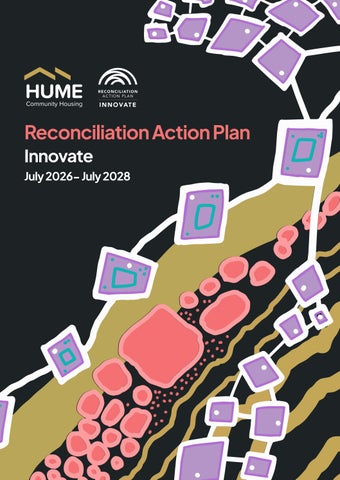
Acknowledgement of Country Hume Housing acknowledges the diversity, strength and knowledge of the Traditional Custodians of the lands on which we work and recognises their continuing connection to the land and waters. We pay our respects to Elders past and present, and extend this respect to all Aboriginal and Torres Strait Islander peoples. ‘Step by Step’ Artist Tyson Jolly 2024. Acrylic on canvas. Raymond Terrace NSW.
2
The Artwork Hume Housing commissioned this original artwork after participating in an Indigenous Cultural and Intellectual Property (ICIP) program with Australia’s oldest and largest private Indigenous‑owned legal and consulting firm Terri Janke and Company. We worked with artist Tyson Jolly to ensure we followed a transparent and sensitive acquisition process. ICIP refers to Indigenous peoples’ rights to self-determination. Cultural heritage includes all aspects of cultural practices, traditional knowledge, resources and knowledge systems developed by Indigenous people as part of their Indigenous identity.
The Cultural Story ‘Step by Step’ tells a story of continuous journeying across Country in search of a safe and stable home. The painting reflects the lived experiences of many Aboriginal people - moving through challenges, connecting with culture and building community. The square motifs represent man-made structures like housing and services, while the colour palette draws from Hume Housing’s identity, symbolising our role in supporting this journey. The artwork acknowledges the strength, resilience and partnerships that help create a sense of belonging and place.
3
Contents Our Vision for Reconciliation
05
From Our CEO 06 Statement from the CEO of Reconciliation Australia
07
About Hume 08 Our Reconciliation Action Plan
10
Case Studies 12 Relationships 16 Respect 18 Opportunities 20 Governance 22
4
Our Vision for Reconciliation Our vision for reconciliation is to ensure that Aboriginal and Torres Strait Islander communities have access to quality, affordable housing that meets their unique needs and aspirations. Through listening, self-determination, and walking alongside Aboriginal and Torres Strait Islander customers and employees, we will strive to achieve positive social outcomes through authentic relationships, safe and secure housing, meaningful employment and quality support programs. We strive to lead initiatives and services that prioritise stability, respect and cultural safety in every aspect of housing services.
5
From Our CEO At Hume, we exist to provide opportunities for all people to prosper. We do this by developing housing options and standing alongside our customers to help them secure and maintain a tenancy they can build a life around. To do that well, we must recognise inequality and injustice and be proactive about what we can do to support Aboriginal and Torres Strait Islander people to achieve the outcomes that matter to them. Our Innovate Reconciliation Action Plan is part of how we act on that commitment and contribute to reconciliation nationally. Through this RAP, we are deepening our relationships with Aboriginal and Torres Strait Islander communities, Elders and representative organisations who share our commitment to reconciliation, respect and opportunity for all. It supports our strategic plan and guiding principles and sets out practical actions that will shape how we work, both within Hume and across the communities we are proud to serve.
We implemented our Reflect RAP in 2021, our first step towards developing a deeper understanding of the rich history, living cultures and enduring connection to Country of Aboriginal and Torres Strait Islander peoples. Since then, we have built strong foundations through good governance, leadership and employee engagement. This has included cultural awareness training, recognition and celebration of significant cultural events, and the development of our RAP Development Group into a full RAP Committee, supported by working groups focused on specific initiatives.
As a community housing provider, we recognise the profound connection between Country, culture, family and home. We want Aboriginal and Torres Strait Islander customers to experience Hume as a culturally safe organisation and to have a genuine voice in shaping the services and housing outcomes that affect their lives.
We have strengthened our relationships with Aboriginal and Torres Strait Islander employees, kept the wider organisation informed about our RAP activities, and worked to bring all our people with us in recognising the cultural events and dates that matter to Aboriginal and Torres Strait Islander communities.
Our Senior Leadership Team is genuinely engaged in developing and delivering this RAP. The RAP Committee has Executive sponsorship, and our Aboriginal Social Outcomes Leader serves as our RAP Champion. Aboriginal and Torres Strait Islander employees are invited and supported to contribute, while recognising that responsibility for delivering reconciliation belongs to all of us.
This work matters deeply to me, and to all of us at Hume. Reconciliation isn’t a destination we arrive at and move on from. It requires us to keep listening, learning and acting, and to hold ourselves accountable for the commitments we make. I’m proud of how far we’ve come, while recognising there is much more for us to do. I look forward to what this next chapter of our journey will bring. Brad Braithwaite, Chief Executive Officer
6
Statement from the CEO of Reconciliation Australia Reconciliation Australia commends Hume Community Housing (Hume) on the formal endorsement of its second, Innovate Reconciliation Action Plan (RAP). Since 2006, RAPs have provided a framework for organisations to leverage their structures and diverse spheres of influence to support the national reconciliation movement.
These learnings extend to Hume using the lens of reconciliation to better understand its core business, sphere of influence, and diverse community of staff and stakeholders.
With over 5.5 million people now either working or studying in an organisation with a RAP, the program’s potential for impact is greater than ever. Hume continues to be part of a strong network of more than 3,000 corporate, government, and not-for-profit organisations that have taken goodwill and transformed it into action.
The RAP program’s emphasis on relationships, respect, and opportunities gives organisations a framework from which to foster connections with Aboriginal and Torres Strait Islander peoples rooted in mutual collaboration and trust.
The four RAP types — Reflect, Innovate, Stretch and Elevate — allow RAP partners to continuously strengthen reconciliation commitments and constantly strive to apply learnings in new ways.
This Innovate RAP is an opportunity for Hume to strengthen these relationships, gain crucial experience, and nurture connections that will become the lifeblood of its future RAP commitments. By enabling and empowering staff to contribute to this process, Hume will ensure shared and cooperative success in the long-term.
An Innovate RAP is a crucial and rewarding period in an organisation’s reconciliation journey. It is a time to build the strong foundations and relationships that ensure sustainable, thoughtful, and impactful RAP outcomes into the future.
Gaining experience and reflecting on pertinent learnings will ensure the sustainability of Hume’s future RAPs and reconciliation initiatives, providing meaningful impact toward Australia’s reconciliation journey.
An integral part of building these foundations is reflecting on and cataloguing the successes and challenges of previous RAPs. Learnings gained through effort and innovation are invaluable resources that Hume will continuously draw upon to create RAP commitments rooted in experience and maturity.
Congratulations Hume on your second Innovate RAP and I look forward to following your ongoing reconciliation journey. Karen Mundine Chief Executive Officer Reconciliation Australia
7
About Hume Hume Community Housing is a Tier 1 Community Housing Provider (CHP) regulated by the National Regulatory System for Community Housing. Hume Housing is also a registered National Disability Insurance Scheme (NDIS) provider. Hume’s core business is to provide a continuum of housing options including temporary and transitional housing, through to community and affordable housing and specialist disability accommodation (SDA). We build new properties and are experts in tenancy sustainment and management services across NSW. We take a Housing First approach, providing safe, secure and sustainable housing. We then work with our customers to determine their housing options and support them to secure and maintain their rental tenancy.
8
Hume Housing is strategic in its approach to delivering and growing its housing services and programs. Hume abides by four strategic ambitions: affordable, safe and suitable homes; proactive, customer-centred services; sustainable impact for people and communities; and thriving and resilient organisation. We create real solutions that change people’s lives. Hume Community Housing’s sphere of influence is wide-ranging and culturally diverse and includes our employees, Board of Directors, community partners, our customers and their families, commercial partners including investors and developers, industry peak bodies and elected representatives at all levels of government.
30
4674
8568
Years of experience
Properties
Customers
04
178
14
Office Locations
Staff
14 Aboriginal and/or Torres Strait Islander employees
We operate largely across the Hunter region and Western Sydney, with four NSW offices in Fairfield, Telopea, Maitland and Raymond Terrace.
9
Our Reconciliation Action Plan At Hume Housing we work to provide opportunities for all people to prosper. To do this, we must recognise inequality and injustice. We must be proactive in what we can do to support Aboriginal and Torres Strait Islander people to succeed and prosper on their terms. This second Innovate Reconciliation Action Plan will contribute to the national reconciliation movement by building strong relationships, respect and opportunities within our organisation and the community. The RAP will support our strategic plan and guiding principles and include practical actions that will drive our contribution to reconciliation, both internally and in the communities in which we operate. Hume’s Executive Leadership Team (ELT) holds collective accountability for the delivery of this RAP. RAP commitments will be embedded in the performance expectations of all ELT members, and progress against actions and deliverables is a standing item at ELT meetings. The ELT will review RAP performance at least annually and ensure that adequate resources, authority and organisational prioritisation are in place to meet our commitments to reconciliation. Hume has several senior leaders involved in the RAP Committee. This includes Laura Pollard, Chief Customer Officer, Jenna Nadiotis, General Manager of Specialist Housing and Impact, Meagan Prabhakar, General Manager Communications and Engagement and Scott McPhillips, General Manager SDA Growth.
10
Internal Involvement Name
Position
Clinton McEntyre
Aboriginal Social Outcomes Leader / RAP Champion (ASOL)
Laura Pollard
Chief Customer Officer (CXO)
Meagan Prabhakar
General Manager, Communications and Engagement (GM Comms)
Scott McPhillips
General Manager, SDA Growth
Jenna Nadiotis
General Manager, Specialist Housing and Impact (GM SH&I)
Karlie Cook
Manager, Housing and Impact (Mgr H&I)
Mattea McIntosh
Manager, Customer Contact (Mgr CC)
Nigel Woudsma
Tenancy Sustainment Coordinator
Jess Cowan
Neighbourhood Coordinator
Teresa Murray
Housing Options Officer
Jessica Molina
Neighbourhood Officer
Colin Martyn
Neighbourhood Officer
Lucy Andrews
Manager, Strategic Projects
Maddison Goodridge
Community Cohesion Officer
Jonathan Goodall
Community Cohesion Officer
Janine Nwachukwu
Team Leader, CSO Housing
Louise Cowan
P&C Senior Business Partner
Kiara Saunders
Customer Service Officer
Katie Seers
Customer Service Officer
Linda Browne
Communications Specialist
External Involvement (Involved in the development of initiatives, and establishment of external partnerships, but not directly involved in the RAP working group) Organisation
Key Contact
Hume Aboriginal Customer Reference Panel
23 participants (Hume manages and facilitates)
CHIA Aboriginal reference Group (LLA)
Multiple members (Adam West)
CHP RAP Collaboration Committee
Multiple CHP Representatives (Hume manages and facilitates)
Reconciliation Maitland
Multiple Members & Aboriginal Elders (Sonia Anderson)
Gandangara LALC
Rebecca Savage and Trudy Healey
Tharawal LALC
Alison Croall
Worimi LALC
Andrew Smith
Mindaribba LALC
Tara Dever
Karuah LALC
Marook Perry and Tyson Jolly
Warlga Ngurra (Aboriginal SHS and DV Service)
Belinda Reed
Ungooroo
Taasha Layer
Wahroonga
Aunty Di Ball
The Hume RAP Committee is accountable to the Executive Leadership Team and the Board. The Committee includes representatives from across the organisation, including seven Aboriginal and Torres Strait Islander employees. Hume is also strengthening relationships with Aboriginal and Torres Strait Islander customers to support meaningful external advice and customer voice.
Reconciliation journey. We introduced cultural awareness training and celebrations of key cultural events, which have lifted our shared understanding of Aboriginal and Torres Strait Islander people. The RAP Development Group transitioned and expanded to a RAP Committee with smaller working groups established to focus on specific deliverables. Hume maintained good engagement with our Aboriginal and Torres Strait Islander employees. RAP activities were regularly reported to the wider organisation and every effort made to engage all employees in significant events and dates on the Aboriginal event calendar. Hume launched its first Innovate RAP in 2022, building on the foundations established through the Reflect RAP. Through that work, we strengthened relationships with Aboriginal and Torres Strait Islander employees, customers, Aboriginal Community Controlled Organisations and Local Aboriginal Land Councils. We also expanded Aboriginal employment, increased cultural capability and established initiatives designed to improve outcomes for Aboriginal and Torres Strait Islander customers. While we have made significant progress, some actions require additional time to fully implement and embed. This second Innovate RAP builds on the achievements of our previous RAPs and carries forward important initiatives that remain in progress. It reflects our commitment to continuous improvement and to working in partnership with Aboriginal and Torres Strait Islander peoples to create meaningful and lasting impact for customers, employees and communities.
Hume Housing implemented our first Reflect RAP in 2021. This plan set out our first vision for developing a deeper understanding of Aboriginal and Torres Strait Islander histories and cultures. We have built the foundations through governance, leadership and employee engagement for our 11
Case Studies Aboriginal Spend Hume has had a big focus on building relationships with external Aboriginal-owned businesses. In 2025 the procurement policy was updated to ensure that there was a better governance structure in place to ensure the right businesses were targeted.This meant the definition of Aboriginal-owned was updated and new thresholds were introduced, allowing our team to procure directly from Aboriginalowned businesses. Hume has encouraged all staff through promotion and support at all-staff meetings, updates and ongoing communications. Hume’s procurement from Aboriginal-owned businesses increased significantly over the reporting period, growing from $6.3k in 2023 to $125k in FY25/26.
$125k
$27.7k
$26.9k
2024
2025
$6.3k
2023 Aboriginal Spend
12
2026
Tyson Jolly Artwork In 2024 and 2025, Hume looked towards a brand refresh that included a new Aboriginal artwork in the design. To ensure that Hume was taking the right steps forward, we first engaged Terri Janke and Company to assist with the process. It is understood that Indigenous Cultural and Intellectual Property (ICIP) is not often acknowledged, and many Aboriginal artists have been taken advantage of in the past by other organisations. Terri Janke and Company assisted Hume to get all legal foundations in place to protect both Hume and the artist we engaged. Hume found Tyson Jolly through an application process. Tyson is a local Aboriginal artist and Worimi man living on Country. He is local to our Port Stephens Office where we planned for the new artwork to be placed. We arranged for Tyson
to talk to our Hume team through a workshop to encourage conversation for the artwork to tell a story based on Hume’s work and community support. We also invited Aboriginal people from the local area to meet Tyson to discuss their experiences as tenants of Hume properties and community members living on Worimi Country. Tyson designed a beautiful piece of artwork. We continue to engage Tyson on the use of the artwork. We have delivered an artwork unveiling that included our partners, Hume staff, the artist and members of the community. We are excited to communicate the message of the importance of engaging local Aboriginal artists to tell a local story when commissioning an Aboriginal artist.
13
Aboriginal Employment
In 2024, Hume appointed its first Aboriginal Social Outcomes Leader to strengthen our reconciliation initiatives and improve outcomes for Aboriginal and Torres Strait Islander customers. The role has supported new partnerships, informed policy and service improvements, and increased opportunities for Aboriginal voices to contribute to organisational decision-making. Key achievements include establishing an Aboriginal employee reference group, creating a Community Housing Provider RAP collaboration network, strengthening relationships with Aboriginal organisations and stakeholders, and providing cultural advice on customer and development initiatives. The Aboriginal Social Outcomes Leader has also led the Aboriginal Customer Reference Panel, which now has 23 members. Planning was completed and engagement commenced in September 2025 to capture lived experience and ensure Aboriginal voices inform future policy, service and process development. The role has also supported the development of the draft Aboriginal Engagement Framework and draft Aboriginal Employment Strategy for the People and Culture team.
14
Clinton McEntyre, ASOL
National Reconciliation Week
Hume Community Housing has hosted the annual Maitland National Reconciliation Week event for four years, bringing together local services, community members and supporters to build cultural awareness, strengthen relationships and create a welcoming, culturally safe environment.
CEO Brad Braithwaite and Chief Customer Officer Laura Pollard attended, and more than 25 Hume staff volunteered. The event reflected Hume’s commitment to shared responsibility for reconciliation and to creating spaces in which Aboriginal and Torres Strait Islander peoples are valued and celebrated.
At the 2026 event, themed All In, Uncle Richard delivered an Acknowledgement of Country. Performances included Symphony, a Wiradjuri woman, and Jarrod Mackie, a Wiradjuri man and recipient of the Donovan Family Encouragement Award and Trophy at the Tamworth Country Music Festival. Students from St Joseph’s College, Lochinvar, and their Aboriginal dance teacher, Worimi and Wonnarua woman Hilary McEntyre, also performed cultural dances.
15
Relationships Providing opportunities for people to engage, connect, participate, collaborate and develop shared experiences is central to Hume’s vision of vibrant and connected communities. Strong, respectful and meaningful relationships with Aboriginal and Torres Strait Islander communities, employees, customers and stakeholders help us work effectively together towards shared goals. Hume’s ongoing cultural awareness program, delivered with trusted partners, supports employees to apply a cultural lens to their work and achieve better outcomes for the Aboriginal communities we serve.
Action
Deliverable
Timeline
Responsibility
Establish and maintain mutually beneficial relationships with Aboriginal and Torres Strait Islander stakeholders and organisations.
Seek opportunities for support giving initiatives and charitable programs
July 2028
ASOL
Seek opportunities to support Aboriginal students and their educational outcomes
July 2028
ASOL
Develop and implement an engagement plan to work with Aboriginal and Torres Strait Islander stakeholders and organisations and incorporate into Hume’s Stakeholder Engagement Plan.
July 2026
ASOL
Consult with Aboriginal and Torres Strait Islander stakeholders and organisations on the draft Aboriginal Engagement Framework for working with Aboriginal and Torres Strait Islander organisations
July 2026
ASOL
Circulate Reconciliation Australia’s NRW resources and reconciliation materials to our employees and external stakeholders
May 2027
GM Comms
RAP Committee members to participate in an external NRW event.
May 2027
GM SH&I,
May 2028
GM Comms
Encourage and support employees and leaders to participate in at least one external event to recognise and celebrate NRW.
May 2027
Mgr (H&I)
Organise at least one NRW event each year.
May 2027
Build relationships through celebrating National Reconciliation Week (NRW).
May 2028
May 2028 Mgr (H&I)
May 2028 Register all our NRW events on Reconciliation Australia’s NRW website.
May 2027 May 2028
16
Mgr (H&I)
Promote reconciliation through our sphere of influence.
Develop and implement an employee engagement strategy
December 2026
People and Culture
Communicate our commitment to reconciliation publicly through regular engagement, social media and support of Aboriginal organisations
July 2026 May 2027
GM Comms
Explore opportunities to positively influence our external stakeholders to drive reconciliation outcomes.
July 2028
GM Comms, ASOL, GM SH&I
Promote positive race relations through antidiscrimination strategies.
Strengthen Hume’s relationships with Aboriginal and Torres Strait Islander customers.
Collaborate with RAP organisations and other like-minded organisations to develop innovative approaches to advance reconciliation. Execute and lead on the CHP RAP Committee meetings.
July 2028
ASOL
Continue to conduct a review of HR policies and procedures to identify existing anti-discrimination provisions, and future needs.
July 2028
People and Culture
Continue to communicate existing anti-discrimination provisions in policy for our organisation.
July 2028
People and Culture
Continue to engage with Aboriginal and Torres Strait Islander employees and/or Aboriginal and Torres Strait Islander advisors to consult on our anti-discrimination policy.
July 2028
People and Culture
Educate senior leaders on the effects of racism.
December 2026
Chief Executive Officer
Explore culturally appropriate welcome and practice for new Aboriginal and Torres Strait Islander customers
December 2027
People Leaders, ASOL, People and Culture
Identify and support Aboriginal employees to be customer advocates
December 2026
People Leaders
17
Respect Hume believes that respect is central to developing strong relationships between Aboriginal and Torres Strait Islander people and other Australians. We will do this by providing opportunities for our employees, customers and other stakeholders to understand and have pride in cultures and histories; acknowledge the impact of history and share learnings as well as celebrating culture and successes of communities working together.
Action
Deliverable
Timeline
Responsibility
Increase understanding, value and recognition of Aboriginal and Torres Strait Islander cultures, histories, knowledge and rights through cultural learning.
Implement and review Hume’s Cultural Learning Plan.
July 2026
People and Culture
Consult local Traditional Owners and/or Aboriginal and Torres Strait Islander advisors to enhance our Cultural Learning Plan especially to better understand the local communities. Ongoing internal consultation with Aboriginal and/or Torres Strait Islander staff.
December 2026
People and Culture
Develop, implement, review, and communicate a cultural learning strategy document for our staff.
December 2026
People and Culture
Provide opportunities to all staff to participate in formal and structured cultural learning.
December 2026
People and Culture
Continue to increase employee understanding of the purpose and significance behind cultural protocols, including Acknowledgement of Country and Welcome to Country protocols.
July 2028
People and Culture, ASOL, GM Comms
Review and update cultural protocol document, including protocols for Welcome to Country and Acknowledgement of Country.
July 2027
GM Comms
Invite a local Traditional Owner or Custodian to provide a Welcome to Country or other appropriate cultural protocol at significant events each year.
July 2028
GM Comms
Include Hume’s new Acknowledgement of Country at the commencement of important meetings.
July 2028
GM Comms
Hume’s RAP Committee to participate in an external NAIDOC Week event.
July 2027
CXO
Promote and encourage participation in external NAIDOC events to all employees.
June 2027
People and Culture
Demonstrate respect to Aboriginal and Torres Strait Islander peoples by observing cultural protocols.
Build respect for Aboriginal and Torres Strait Islander cultures and histories by celebrating NAIDOC Week.
18
Improve Hume’s cultural responsiveness in housing management and the delivery of services.
Ensure services are demonstrably accessible and result in positive outcomes through the capture and analysis of relevant data and reports at least annually for Aboriginal and Torres Strait Islander customers.
December 2027
GM SH&I
Strengthen our consultative capability with Aboriginal and Torres Strait Islander customers regarding customer experience and inclusion in developing culturally appropriate materials, activities and improved services.
July 2028
ASOL GM SH&I
Review and enhance Hume’s tenancy management policies and procedures to ensure they respect customers’ choices and preferences, provide culturally responsive practices and support positive housing outcomes while adhering to the Residential Tenancies Act.
July 2027
ASOL
19
Opportunities Hume understands that access to meaningful opportunities is essential for our customers to prosper and for our organisation to thrive. • Increasing our efforts to improve access to Hume vacancies by Aboriginal and Torres Strait Islander communities • Using Hume’s Social Procurement Policy • Understanding the needs of our Aboriginal and Torres Strait Islander employees and fostering their professional development • Ensuring employees have the tools to perform their roles effectively.
Action
Deliverable
Timeline
Responsibility
Improve employment outcomes by increasing Aboriginal and Torres Strait Islander recruitment, retention, and professional development.
Build understanding of current Aboriginal and Torres Strait Islander employees to inform future employment and professional development opportunities.
September 2027
People and Culture
Engage with Aboriginal and Torres Strait Islander employees to consult on our recruitment, retention and professional development strategy.
September 2026
People and Culture
Develop and implement an Aboriginal and Torres Strait Islander recruitment, retention and professional development strategy within the overall recruitment framework
December 2026
People and Culture
Advertise job vacancies to effectively reach Aboriginal and Torres Strait Islander stakeholders.
December 2026
People and Culture
Continue to develop and communicate opportunities for procurement of goods and services from Aboriginal and Torres Strait Islander businesses to employees, such as utilising Supply Nation to source supplies of goods and services
December 2026
General Manager Assets, Office Manager, Comms Mgr, GMH&I
Continue to develop new commercial relationships with Aboriginal and/or Torres Strait Islander businesses.
July 2028
General Manager Assets, Office Manager, Comms Mgr, GMH&I
Review, update and improve our Aboriginal and Torres Strait Islander procurement strategy
July 2027
Legal Team
Increase Aboriginal and Torres Strait Islander supplier diversity to support improved economic and social outcomes.
20
Increase social outcomes for Aboriginal and Torres Strait Islander communities.
Explore ways to enhance recognition of family, kinship and cultural responsibilities in service decisions and practices.
July 2028
ASOL, Mgr CC, People and Culture
Strengthen referral pathways to culturally responsive services and networks that respond to Aboriginal and Torres Strait Islander customer needs and include these pathways in the Stakeholder Engagement Plan.
July 2028
GM SH&I
Facilitate and support Aboriginal and Torres Strait Islander customers to obtain employment through Hume’s Employment and Training Program, including the cadet program.
July 2027
People and Culture
Seek out opportunities to support the housing needs in Aboriginal communities.
July 2028
Strategic Projects Manager
Seek out opportunities to support Aboriginal Community Controlled Organisations and Local Aboriginal Land Councils to deliver quality housing services
July 2028
ASOL
21
Governance Hume tracks progress against this RAP through a set of measurable indicators, covering Aboriginal employment, supplier diversity, cultural awareness participation, customer satisfaction and cultural safety, housing outcomes and policy development. These indicators are reported to the ELT and Board annually. The full indicators framework is maintained as a companion document to this RAP.
Action
Deliverable
Timeline
Responsibility
Establish and maintain an effective RAP Committee to drive governance of the RAP.
Maintain Aboriginal and Torres Strait Islander representation on the RAP Committee and continue to review and develop membership.
July 2028
GM SH&I, ASOL
RAP Committee meets every two months to drive and monitor RAP implementation and review progress annually
July 2028
ASOL
Maintain, review and apply our Terms of Reference for our RAP structure
July 2028
ASOL
Develop strong relationships with Aboriginal and Torres Strait Islander customers to form a meaningful Advisory group
July 2026
ASOL
Continue to ensure RAP commitments have adequate resources for RAP implementation.
July 2026 June 2027
CXO GM H&I
Continue to engage our senior leaders and other employees in the delivery of RAP commitments.
July 2028
CXO ASOL
Continue to maintain appropriate systems to track, measure and report on RAP commitments.
July 2028
ASOL GM SH&I
Maintain an internal RAP Champion from the Leadership Team.
July 2028
ASOL
Contact Reconciliation Australia to verify that our primary and secondary contact details are up to date, to ensure we do not miss out on important RAP correspondence.
July 2027
ASOL
Complete and submit the annual RAP Impact Survey to Reconciliation Australia.
July 2027
ASOL
Provide appropriate support for effective implementation of RAP commitments.
Build accountability and transparency through reporting RAP achievements, challenges and learnings both internally and externally.
22
Continue our reconciliation journey by developing our next RAP.
Explore ways in which the Board can take a lead in Aboriginal and Torres Strait Islander inclusion and strategic direction.
Report RAP progress to all employees and senior leaders quarterly at the Hume all-staff meetings
March 2027 August 2027 November 2027 March 2028 June 2028
RAP Committee (Shared)
Publicly report our RAP achievements, challenges and learnings annually.
June 2027
GM Comms
Participate in Reconciliation Australia’s biennial Workplace RAP Barometer.
April 2028
GM SH&I
Submit a traffic light report to Reconciliation Australia at the conclusion of this RAP.
June 2028
ASOL
Hume tracks progress against this RAP through a set of measurable indicators, covering Aboriginal employment, supplier diversity, cultural awareness participation, customer satisfaction and cultural safety, housing outcomes and policy development.
July 2027
ASOL
Register via Reconciliation Australia’s website to begin developing our next RAP.
January 2028
ASOL
Consult internally and externally on a draft RAP before submitting to Reconciliation Australia for final sign-off
June 2028
ASOL
Submit draft RAP to Executive and RA for endorsement
June 2028
ASOL
Assess impacts on Aboriginal and Torres Strait Islander inclusion and service delivery through strategic planning and collection of measurable indicators.
December 2027
ASOL
Engage the Board in regular reporting of Aboriginal and Torres Strait Islander outcomes.
December 2026 June 2027 December 2027 June 2028
CXO
23
Primary Contact Name: Clinton McEntyre Position: Aboriginal Social Outcomes Leader Phone: 0431 166 593 Email: Clinton.mcentyre@humehousing.com.au Secondary Contact Name: Laura Pollard Position: Chief Customer Officer Phone: 0491 666 790 Email: Laura.Pollard@humehousing.com.au