CALL FOR STUDENT STRIKE
THE FIGHT TO SAVE OSAP




Feds increase minimum wage
Students working part-time set to benefit
Parthvi Indravadan Patel Senior Reporter
Starting April 1, 2026, Canada’s federal minimum wage will increase to $18.15 per hour, up from $17.75 last year, according to Employment and Social Development Canada.
The annual adjustment, made each April, is designed to keep pace with inflation and provide greater certainty and security to more Canadians.
For many students balancing academics and part-time work, the raise comes at a critical time, as living costs and tuition continue to climb.
The federal minimum wage applies to workers in federally regulated industries, including international and interprovincial transportation, telecommunications, and banking.
Students working in these sectors, such as part-time bank tellers or call centre representatives, will see an immediate increase in their pay.
If a province or territory sets a higher minimum wage, federally regulated employers must pay that higher rate. Ontario’s minimum wage is currently $17.60.
For students like Maya Singh, a first-year business student at the University of Toronto who works
part-time at a bank, the increase is a relief.
“Even a small boost makes a huge difference when you’re budgeting for tuition, rent, and groceries,” Singh said. “Part-time jobs are often how we cover the essentials, so any increase helps reduce financial stress.”
work experience without feeling like I’m being undervalued.”
According to Employment and Social Development Canada, the federal minimum wage is adjusted annually based on Canada’s Consumer Price Index (CPI). In 2025, the CPI rose 2.1 per cent, prompting this year’s increase.
“WORKING WHILE STUDYING CAN BE EXHAUSTING, BUT A FAIR WAGE MAKES IT MORE MANAGEABLE, ”
Similarly, Liam O’Connor, a student at Conestoga College who works as a delivery driver, said that the raise provides more than just extra cash.
“It’s not only about the money in your pocket,” he said. “Knowing that my wage adjusts with inflation gives me a sense of security, especially when balancing schoolwork, rent, and other bills.”
For Sofia Chen, working at a telecommunications company, the raise may encourage more students to explore part-time opportunities in federally regulated sectors.
“Working while studying can be exhausting, but a fair wage makes it more manageable,” Chen said. “It motivates me to continue gaining
- Sophia Chen
By rounding to the nearest five cents, the government ensures that wages keep pace with inflation while remaining practical for employers to implement.
Student workers represent a growing portion of those impacted by minimum wage changes. Parttime employment allows students not only to support themselves financially but also to gain valuable skills that may benefit their future careers.
“Minimum wage jobs teach time management, customer service, and teamwork,” O’Connor said. “That experience can be as valuable as the money earned.”
While some students rely on scholarships or family support,
Humber Et Cetera is the Humber Polytechnic journalism program laboratory newspaper. It is created by journalism students in the Advanced Diploma and Post Graduate programs. Et Cetera serves to inform the Humber community and give its readers well-rounded coverage on the things that matter to them.
Kossak
many balance their studies with multiple part-time jobs. The increase to $18.15 per hour may seem modest, but it can cover essentials like transportation, textbooks, or even a small emergency fund.
For students like Singh, O’Connor, and Chen, the wage hike is more than just a number, it’s a tangible improvement to their quality of life and ability to focus on school without constant financial worry.
As students across Canada prepare for the new academic term, the federal minimum wage increase serves as a reminder of the ongoing challenges of balancing work, school, and living expenses.
For those in federally regulated jobs, it’s a timely boost that helps ensure their efforts are fairly compensated.

Canada’s federal minimum wage rises to $18.15 per hour on April 1, 2026, a 2.25 per cent increase for workers in federally regulated sectors.
HUMBERETC/ STEPHEN CHAMBERLAIN

Students want provincial strike
Rage at Queen’s Park grows over OSAP
Peter Bhagoutie, Jordan Pestana Dos Santos HumberETC News
Hundreds of Ontario post-secondary students and their allies called for student organizers to begin student strikes across the province.
The March 24 rally at Queen’s Park was also joined by high school students protesting changes to the Ontario Student Assistance Program that will increase the loans portion of OSAP to 75 per cent and cut grants to a maximum of 25 per cent, beginning in in the fall.
Students are angry about the changes that would likely increase education debt for most students.
“Fight Ford, prepare a student strike,” read one banner as members of the Revolutionary Communist Party kicked off demands and chants through their megaphone.
“Doug Ford is not going to stop here,” said Lilah Pareto, member of the Revolutionary Communist Party. “He’s going to cut healthcare. He’s going to keep going. We need to draw the line in the sand and push it as far back as possible.”
Another protest is planned across the province for March 28, including Queen’s Park.
Ontario Green Party Leader Mike Schreiner said the changes are “just wrong.” He was
supporting students who were struggling to make ends meet and now face student debt for an education.
“The premier’s priorities are so misplaced,” he said. “He’s finding billions of dollars to build this stupid tunnel under the 401, his fantasy island to build a convention centre in Lake Ontario.
“Now he wants to buy the island airport, and he says there isn’t money for students,” Schreiner said. “That is wrong. It’s just an example of how the premier, over and over again, is all about how to make the wealthy and well-connected richer on the backs of low and middle-income students.”
Other opposition party leaders, including the NDP’s Marit Stiles, mixed with the protesters, arguing that OSAP is essential to students.
“You do not want to live with a lifetime of debt,” she told the crowd. “We cannot afford Doug Ford and his OSAP cuts.”
She said high school students are turning down offers from post-secondary schools.
Stiles said the party is demanding that OSAP be reinstated and that interest on loans be rescinded in future.
Courtney Martin, youth co-chair for the Greens, said she was supporting the party and students.
“We’re helping spread the word and get Doug Ford to reverse the cuts and even change completely to 100 per cent grants,” Martin said.
Schreiner agrees.
“Well, we should forgive interest on all student loans, and we should have the OSAP program be 100% grants and not loans because we don’t want students graduating with debt,” he said.
Students had slowly trickled in for the demonstration to fight for
their right to the education OSAP had once promised, without piling massive lifelong debts.
Prior to students assembling, statues and front entrances were guarded, covered and barricaded to prevent the damage made by protesters during the March 4 protest. Toronto Police had a large presence, but there were no heated confrontations or any incidents of vandalism.
Province-wide demonstrations are also planned for April 25, 2026.


Humber Et Cetera has won a Gold Crown Award in the College Hybrid News category from the Columbia Scholastic Press Association.
The Crown Awards are considered the organization’s top honour, recognizing overall excellence among student publications across print and digital platforms.
Humber Et Cetera was recognized alongside student publications such as Indiana Daily Student at Indiana University and The Ithacan at Ithaca College, highlighting its ability to compete with top journalism programs across North America.
It marks the second consecutive year Humber Et Cetera received the distinction.
“We’re really excited to win the Gold Crown for the second year in a row,” said Lara King, a professor and coordinator in Humber’s journalism diploma program. “It recognizes the hard work that the students put in.”
King said the publication reflects the collaborative efforts of students across both the advanced diploma and post-graduate programs, producing timely content for both print and online audiences.
“Journalism is needed now more than ever,” she said. “Our students are dedicated to the craft.”
Mike Wise, a journalism professor and program coordinator for the post-graduate program, said the award also highlights the work behind the publication’s production.
“This is an incredibly rewarding honour, and it speaks to the hard work of the Advanced Diploma students who put the paper together last year,” Wise said.
Wise noted Et Cetera’s strength in both print and digital formats helped distinguish it in the hybrid category.
Report by Rosemary Jaramillo, Culture Editor
KAUR Lara King journalism prof is excited about Gold Crown win.
A large crowd of student protesters descended on Queen’s Park on March 24 to rally agianst OSAP cuts announced by the Ontario government.
HUMBERETC/ PETER BHAGOUTIE

Fashion designs using scrap denim
Kayleigh Ainsworth HumberETC News
Shawanna Charles stitches sustainability into every seam, marking each design with a denim Canadian flag to show its origin and commitment to slow fashion.
Charles said the detail reflects both identity and transparency as her brand expands beyond Canada and fast fashion norms.
“I was getting a lot of orders from the U.S., so I felt like I should indicate where it’s actually made,” she said. “I didn’t want to write Made in Canada, so the flag felt like the best way to show that.”
Shawanna Charles, a first-year fashion arts and business student at Humber Polytechnic, transforms discarded denim into new fashion pieces.
Charles said she began creating designs during the COVID-19 lockdown to pass the time and has since grown the work into her own business, shawanna.
Charles officially launched her brand in 2024, producing bags, clothing and accessories using recycled denim.
“I hope people see it is pos-
sible to create a circular fashion industry instead of a linear one,” she said.
Canadians throw away about 500 million kilograms of clothing and other textiles each year, according to Environmental Defence.
Karen Wirsig, senior program manager for plastics at Environmental Defence, said synthetic materials are a major contributor to the problem.
damage or fabric blends.
“A lot of things are interwoven with polyester nowadays, so I can’t always use them,” she said.
Sandra Leutri, manager of sustainability at Humber’s Office of Sustainability, said student action plays a role in environmental change.
continue recycling.”
The United Nations has identified fast fashion as a major contributor to global waste, linking overproduction to environmental damage.
Camara Rainford, a close friend of Charles since 2021, met her while working at an organic grocery store in Kensington Market.
“I WANT TO BUILD A FASHION COMMUNITY IN TORONTO. IT’S NOT A TREND, IT’S A LIFESTYLE..”
“A growing amount of our clothing is made from plastic, which comes directly from oil and gas,” Wirsig said.
She said these materials also create pollution during use.
“All this synthetic clothing gives off fibre microplastics, in particular when we wash them,” she said.
“These fibres enter wastewater systems and eventually make their way into lakes and rivers.”
Charles said sourcing usable denim presents challenges because she only uses 100 per cent cotton.
She collects materials from donations, friends and thrifted items, but often rejects garments due to
Rainford said Charles’ work ethic stands out.
- Shawanna Charles
“Every single small change matters,” Leutri said.
She said overconsumption remains a central issue in the overproduction of polyester clothing.
“Everything is polyester these days, and polyester is plastic,” she said. “So we’re just wearing plastic.”
Charles challenges this issue by using only 100 per cent denim in her designs. She said she works to minimize waste at every stage of production.
“I use those little scraps of fabric to stuff my teddy bears,” she said. “I’m always looking for ways to
“If she wants it to happen, it will happen,” they said. “She’s determined and optimistic.”
Rainford said Charles remains resilient under pressure.
“No matter what’s thrown her way, she can deal with it,” Rainford said. “Her positivity is insane to me. I really respect it.”
Before entering the fashion program, Charles studied film, where she developed an interest in storytelling. She said that perspective now shapes her design process.
“Every single piece I make has a story tied to something happening in my life,” she said.
Charles said she left film because she wanted creative independence.
“I felt like at the end of the day, I didn’t really have anything for myself,” she said. “So I thought, why not start something of my own?”
Running the business independently presents challenges. Charles manages design, production and promotion while balancing school.
“Being a one-woman team is really challenging,” she said. “Everything is on me.”
Charles plans to expand her brand through a runway show and eventually open a boutique in Toronto.
“I want to build a fashion community in Toronto,” she said. “It’s not a trend, it’s a lifestyle.”
In a world where clothing is worn and thrown away, Charles proves that what we discard still has a future.
If clothing can be remade, why do we throw it away?
Charles shares her designs on Instagram (@shawannadotca) and TikTok (@shawanna.ca), and sells her creations through her website, shawanna.ca.
Shawanna Charles, a first-year Fashion Arts and Business student, shows off her designs made with 100 per cent denim. She sells her creations through her website, shawanna.ca
COURTESY/SHAWANNA CHARLES
Toronto backs snow shovelling plan
Luis Miguel S. De Castro Senior Reporter
Toronto city council has approved a plan to develop a paid pool of emergency snow shovellers, but debate at city hall revealed ongoing concerns about enforcement and how the program will work in practice.
Council voted to adopt the proposal this week, directing city staff in coordination with Local 416 and multiple city departments to design a “surge capacity” sidewalk shovelling program modelled after cities like New York, Minneapolis, and Montreal, with a target rollout by the 2026-2027 winter season.
The motion passed 17 to 9, with a separate amendment to include Local 416, the union representing many municipal workers, passing by a wider margin.
Despite the approval, some councillors argued the city is over-
looking the root of the problem.
“The core problem is sharing the workload,” said Coun. James Pasternak, pointing to property owners and institutions that fail to clear sidewalks despite existing obligations.
“Unless there’s a better enforcement regime and a better public education system, we will not solve it.”
those areas were missed.
“This would be individuals living on a street who would take it upon themselves to shovel sidewalks during certain snow events,” Myers said.
motorized wheelchairs, canes, or seniors?” he asked.
City staff said the program has not yet been fully developed, and details, including oversight, accessibility requirements, and enforcement, will be addressed as part of the planning process.
“WE CAN CONTINUE TO LOOK AT GOOD IDEAS TO EMPOWER TORONTONIANS TO GET PAID TO ROLL UP THEIR SLEEVES AND BE PART OF SOLUTIONS, ” - Coun. Amber Morley
Questions were also raised about how the program would be implemented and monitored.
Coun. Jamaal Myers pressed city staff on whether individuals would be responsible for clearing sidewalks in their own neighbourhoods and what would happen if
He also raised concerns about maintaining accessibility standards for seniors and people with disabilities.
“Would these individuals also be held to that standard to make sure that the work done would be passable for individuals with
Supporters of the motion say the initiative is meant to supplement existing services during extreme weather.
“We saw more snow this past winter than we’ve seen in many winters,” said Coun. Amber Morley, describing the difficulty of clearing “mountains and mountains of ice blocks” across the city.
Morley said the city needs to adapt to more frequent severe storms.
“We can expect them to continue, and we can continue to look at good ideas to empower Torontonians to get paid to roll up their sleeves and be part of solutions,” she said.
She added that the program would only be activated when the city’s current capacity is overwhelmed.
“We’re not looking to completely upend how we do snow removal in this city,” Morley said. “But to increase our capacity when it’s needed and ensure that people have safe and accessible access to our city, especially those that are disabled or have mobility challenges.”
City staff are expected to report back with a detailed plan before next winter, as councillors continue to weigh whether the program will improve response times or add new challenges to the system.


People walk through significant snowy weather in downtown Toronto as a major winter storm with accumulations of five to eight centimetres per hour in the region on Jan. 25, 2026.

Artemis II launches April 1 for a 10-day voyage
Stephen Chamberlain
Senior Reporter
Jeremy Hansen, who grew up near London, Ont., is living out his boyhood dream of being an astronaut. He’ll be the first Canadian to circle the moon.
Canadian astronaut Jeremy Hansen thanked his family, friends and colleagues in a Facebook post in advance of the Artemis II space launch set for April 1. “My hope is that Canadians everywhere come together to watch this mission unfold,” Hansen said in the video posted the day before the launch. Hansen will be the first Canadian to fly to the moon and back. A statement on the Canadian Space Agency’s (CSA) website says Artemis II will be the first crewed mission to the Moon since 1972.
Jeremy Hansen, who grew up near London, Ont., says in a CSAposted video that he was always fascinated by space.
“I looked at a photograph of Neil Armstrong standing on the Moon, and I wanted to see what it would be like to leave this planet and look at it from beyond,” he said in the video. Colonel Hansen joins crew members Commander Reid Wiseman, Pilot Victor Glover, and
Mission Specialist Christina Koch as a mission specialist on board NASA’s Orion spacecraft, which will be launched atop the Space Launch System rocket.
According to the CSA, the mission’s objectives are to confirm all spacecraft systems operate as designed with the crew aboard in a deep space environment, a critical step in establishing a sustainable human presence on the Moon and preparing for future missions to Mars. The trajectory of the 10-day journey to the dark (technically, it’s not always dark) side of the moon includes an initial loop-deloop around Earth twice, making crucial checks along the way before setting course for the big space rock in the sky. At the far end of the moon, the Orion will reach a maximum distance of approximately 370,000 kilometres from Earth before returning via a gravity-assisted free-return trajectory. The capsule will splash down in the Pacific Ocean off San Diego.
CSA, is close enough that the Moon will appear roughly the size of a basketball held at arm’s length. The crew could also become the first humans to see, with the naked eye, portions of the Moon’s far side never directly observed before.
Jeff Spaulding, a test director
back to the Moon since the 1970s.”
Despite the excitement, many steps must go right before the countdown. One potential issue that could derail the entire launch is the threat of a fluffy cloud.

with NASA’s Exploration Ground Systems, laid out the minutiae of preparation, such as the exact times for propellant loading, at a news conference at Kennedy Space Center in Florida a day before the final countdown.
On flight day six, the crew is expected to fly between 6,400 and 9,700 kilometres from the lunar surface, which, according to the
“Our team has been working amazingly hard through these weeks and months trying to get this vehicle ready,” Spaulding said. “People are excited and ready to go on this first chapter on our way
Mark Burger, Launch Weather Officer, said conditions are currently forecast at 80 per cent clear to go, with a 20 per cent probability of a weather violation during the two-hour window. The leading concern, he said, is the one that sounds the most benign, the cumulus cloud, because of the lightning potential. “You walk outside, most days, you’ll see a puffy, what looks like a cotton ball out there,” Burger explained. “If that cotton ball gets more agitated and it grows throughout the depth of the atmosphere, that’s when it starts triggering our so-called standoff distances that could cause an issue for launch.”
The standoff distances can reach as far as 10 miles between the rocket’s flight path and the edge of the cloud. The good news, Burger said, is that the moisture in the atmosphere above the Cape is relatively shallow, limiting how high those
clouds are likely to grow. Other weather issues are wind speeds and changes in wind direction. Solar flares could also cause problems, and NASA is monitoring a flare that erupted on March 30.
Burger said the flare is not directed toward Earth and that it is not a concern at the moment.
However, the “sun is an entity that almost has a mind of its own,” Burger said.
Spaulding was asked at the end of the press briefing what moment in the countdown feels most real.
“When we’re inside of one minute, that’s when it first really starts to hit home,” he said. “You can hear a pin drop in that firing room as you count from ten down to zero.” For Hansen, as the countdown approaches, it is a matter of Canadian pride.
“I hope Artemis II gathers all generations of Canadians united by curiosity, pride, and a shared sense of wonder because when we aim high and work together, we can achieve incredible things in space and here on Earth,” he said in his Facebook post.
The Artemis II crew will attempt to launch their 10-day voyage once again on April 1, 2026, at 6:24 p.m. EDT and will be streamed live by NASA.
Astronaut Jeremy Hansen speaks about his upcoming Artemis II mission taking place in April, 2026 during an event at the Canadian Space Agency, in Longueuil, Que., on Oct. 16, 2025.
CP PHOTO/GRAHAM HUGHES
Yellow summer moon in Ontario with a dark blue sky.
HUMBERETC/STEPHEN CHAMBERLAIN
Layoffs loom for Humber’s faculty, staff
Union locals bracing for cuts as uncertainty grows
Stephen Chamberlain Senior Reporter
The union says it wasn’t notified of the pending layoffs as required by the collective agreement.
Humber’s instructors and support workers face the stark reality of fiscally uncertain times. Faculty and support staff will face layoffs in the coming days, says Humber’s President and CEO Ann Marie Vaughan in an email to staff sent Tuesday.
In a bid to remain fiscally viable, Humber called on staff to participate in the Voluntary Employee Exit Program (VEEP).
Humber’s president thanked those who participated in VEEP and said that although the program had robust participation, it wasn’t enough to offset the projected budget shortfall for the 2026-2027 year.
The number of people who accepted the VEEP and the number of employees who need to be cut were not released in the email.
The process for the involuntary layoffs will proceed in conjunction with the relevant collective agreements, the statement said.
The message also confirmed upcoming departures from Humber’s senior leadership team, including the vice-president, integrated planning and strategy; the vice-president, inclusion, belonging and student experience; and the vice-president, administration and chief financial officer.
An interim executive structure will take effect on March 30 to allow for leadership focus and continuity, Vaughan wrote.
She acknowledged the “emotional toll” of these difficult times, both now and in future, for faculty and support staff. She praised staff for their ongoing kindness and professionalism shown to colleagues and students.
“The strength of Humber has always come from its people, and that remains true now,” Vaughan said at the end of the email.
OPSEU Local 562 sent an email
“As a result, we must still proceed with involuntary employee reductions,” Vaughan said in the email.
response to members the following day, saying they are disappointed and angry that the college is proceeding with the involuntary layoffs, especially since Humber has enjoyed strong local enrolment, additional funding from the Ontario government and many years of budget surpluses.
The local said they were not consulted by the college through the College Employment Stability Committee (CESC) as part of the VEEP rollout, sidestepping the college’s obligation under Article 28 of the collective agreement.
Milos Vasic, the faculty local president, told Et Cetera the point of the CESC is to explore whether people identified for layoffs can be placed elsewhere in the college.
OPSEU said in its email that its attempts to meet with the college’s administration through CESC had been denied.
Vasic was at Queen’s Park yesterday protesting the changes to the OSAP funding model when he got a call from Vaughan.
“This is what they do all the time,
like with myself and the other support staff union president, we get, like, five to 10 minutes’ warning before major stuff happens,” he said.
said he had to “hightail up to Humber” from the rally.
He went into the meeting and “she just kind of confirmed the kind of whatever you want to call it, the bloodletting or the rapture,” he said.
Vasic wasn’t exactly blindsided, since he could see what was happening at other colleges across the province, but the hope at Humber was that the VEEP would be the “silver bullet” to fill the financial gap. Transparency seems to be the biggest issue with the college and the union.
For example, the union has been told there is a financial gap, but the actual shortfall amount in dollars and cents has not been shared, leaving union reps without a strategy.
“Their target is not people, but money, like how much money they’re saving,” Vasic said. “That’s what’s in their minds.”
Vasic says the main problem is the consistent underfunding.
“The fact that this is happening now at Humber with rising enrolment, like that, just tells you how messed up and perverse the funding formula is,” he said.
The local president said the government is basically starving colleges and universities.
“And for what end, I mean, realistically, I think the system is eventually going to be privatized, if Doug Ford gets his way,” he said.
Vasic questioned what a privatized Humber would look like and speculated that there would probably be a reduced workforce.
“There are gonna be consequences to the quality of education,” he said. “I mean, it’s just, it’s inevitable.”
Impacts on programs, services and students will be added as they become known.
In the email, members were advised to update their CVs and to email their dean about plans for their particular programs in a bid to force the administration to be more transparent.

Anne Marie Vaughan, president and CEO of Humber Polytechnic, handing a certificate to a grad student, during a ceremony. She sent the email
New gov’t funding cuts harm student futures
The federal government is moving forward with plans to cut billions in spending across departments. These cuts include programs that support science, tourism, harbour improvements, journalism, foreign aid, and more.
The conversation behind these decisions is largely focusing on budgets and efficiency, but behind those numbers are decisions that will transform access to opportunity, particularly for students entering an already uncertain economic landscape.
The proposed reductions, which affect more than 80 departments and amount to roughly $31 billion in cuts, are being framed as a necessary step toward fiscal sustainability. Managing public finances responsibly is important. However, not all spending cuts are equal, and the areas that lose funding will ultimately determine who feels the impact the most.
OPINION
For students, those consequences may not be immediate or obvious.
With cuts to research funding, this can limit academic opportunities. Reductions in public services can affect transit or community support systems that many students rely on. Changes in public-sector employment can also narrow entry-level pathways for recent graduates, particularly those in fields that depend on government hiring.
broader economic environment matters as much as tuition costs.
When governments shift spending priorities, they are also shaping the future, especially in the workforce. Investments in education, research and public services
and reallocate resources. But the scale of the cuts and the number of departments affected raises important questions about what is being prioritized in the process.
At the same time, government spending is increased in areas like defence, raising questions about its priorities.
“THE SCALE OF THE CUTS AND THE NUMBER OF DEPARTMENTS AFFECTED RAISES IMPORTANT
QUESTIONS ABOUT WHAT IS BEING PRIORITIZED,
”
The effects come at a time when many students are already stretched thin, from managing rising living costs, housing instability and a competitive job market. For those balancing school with part-time work, or planning to transition into full-time employment, the
are not just expenses; they are part of a long-term strategy to support economic growth and stability. Reducing funding in these areas risks limiting the very opportunities that students are told to work toward.
The federal government framed these reductions as part of a broader effort to manage spending
Recent data from Statistics Canada shows that youth unemployment rose to 14.1 per cent in February, with employment among young people declining by 47,000. In that context, shifting resources away from sectors like education, research and tourism, areas that directly support student pathways, does little to address the challenges young Canadians are already facing.
Education, research, and public-sector employment are not
isolated systems. They are directly tied to how students gain experience, find work and build financial stability after graduation.
When funding in these areas is reduced, the effects are not abstract.
They shape the opportunities available to young people entering the workforce.
If spending reductions weaken those systems, the consequences will extend far beyond government balance sheets.
It will shape who has access to opportunities and who is left navigating an increasingly narrow path forward.
At a time when young people are already facing economic uncertainty, decisions limit opportunity, and risk worsens that instability. Fiscal responsibility matters. But it should not come at the cost of narrowing the path forward for the very generation expected to carry the economy into the future.
Social media influencers have killed romance

Loving someone has become so difficult with apps providing misguided advice about relationships.
People use social media every day. Platforms like TikTok and Instagram have become spaces where people often go to find answers about life, including relationship advice.
Relationships are hard to navigate. Most of the time, first relationships fail because no one knows how to maintain them. That’s why content creators stepped up with advice about relationships.
I remember seeing a content posting about how men would lose interest after three months. This was called the three-month rule. The creator suggested you can’t love someone deeply before those
three months pass.
At the same time, I was in the early stages of talking to someone and thought it could be an actual relationship, which is what that “rule” stuck with me.
But that relationship never moved beyond the talking stage, and after two months, he stopped talking to me without any reason.
So technically, that three-month rule is wrong, but it wasn’t that simple.
Rather than enjoying my time with him, I found myself waiting to see if he would lose interest in me. I told myself not to believe in that rule, but I kept looking for signs, hoping to prove it wrong.
When I said I blame social media for making it difficult to love someone, it’s not because this advice is proven to be right or wrong, it’s because people are unable to make their own decisions about their own relationships and are relying on the social media messages from strangers to give them personal advice.
I saw creators on TikTok making content and telling their audience that if their partners don’t text them fast enough, they don’t really like you, or don’t have time for you.
This got me wondering, why did romance become manipulated?
A 2024 academic study by Kakembo Aisha Annet from the Fac-
ulty of at Kampala International University, Uganda, explored the impact of social media on modern relationships, including its influence on relationship expectations.
Her research shows that social media comes with a built-in comparison culture, and the inability to filter your social media intake can set up unrealistic expectations for relationships.
People post about their relationships on the internet. It’s their way to appreciate their partners. However, it’s good to remember they only post what they want people to see.
This kind of content is not harmful, but it can create insecurity and comparison if someone makes these posts their “standard.”
Annet said in her study that
the more something becomes a standard, the more likely it also becomes a norm. And when it becomes a norm, people will strive to adapt these norms in their personal lives.
People are then relying on public judgment from social media to reassert their own value system, Annet’s study found.
Today, it seems too easy for people to let strangers on the internet persuade them how to have romantic relationships.
Love is different for everyone. I believe it’s supposed to be personal and something that develops and is discussed between the people involved.
It might feel scary and frustrating when communications with our partners break down or
when we are trying to decide if the relationship should move forward or not, but relationship advice on the internet is not the answer. It’s normal to ask for relationship advice but pay attention to who you ask. Having someone we trust is better than seeking advice from strangers who know nothing about us.
Although it is disappointing, that person might not be the one for you, and that’s more than fine. Being single might be better than spending the rest of your life with someone who isn’t right for you or doesn’t respect you.
You are allowed to have standards. But let it be your standards. Giovanna Apelabi, she/her, is a reporteratHumberEtCetera.She isajournalismstudent.

Giovanna Apelabi

Canada’s new defence strategy is a bold one Canadian sovereignty in the Arctic is crucial

Canada is disentangling itself from the United States with the release of its new defence industrial strategy in February. Canada’s new policy will benefit many job seekers across the country and appease many within the defence community.
The strategy aims to invest $470 billion into the Canadian military over the next 10 years and create jobs in the industrial sector.
This is a step in the right direction for Ottawa’s foreign policy, as the Trump administration’s rhetoric and our domestic industry require it.
Prime Minister Mark Carney’s government is working more closely with European allies like the United Kingdom and Sweden on the plan. This includes a potential purchase of Sweden’s Saab Gripen fighter jets and advancing the Canada-UK Economic and Trade Working Group with London.
Former prime minister Pierre Trudeau pursued an independent foreign policy during the Cold War. He affirmed our strong ties with our southern neighbour.
“Canada is not only a close friend and neighbour of the United States of America, but also an ally in NATO and NORAD,” he said during a visit to the U.S.S.R. in 1971. Christian Leuprecht, a political science professor at Queen’s University, told Humber
Et Cetera he has a cautious optimism about the strategy.
“When you have a minority government, you always think about getting re-elected. So this was the easiest way to justify spending a lot of money. [Canada] is going to say to allies that, if you [can] agree to a deal, then we’re going to buy [from] them,” he lamented.
His position is valid, as this strategy is influenced by Carney’s minority government, and his need to make Canada look strong in the face of a volatile U.S. administration.
The Carney government’s new policy also emphasizes the build-buy-partner approach, a new procurement strategy aimed at building military equipment in Canada.
On this, Leuprecht thought it was a superficial notion.
“We’re going to say to allies that, if you could agree to a deal, then we’re going to buy (from) them…But most of our companies don’t have sales, so we’re going to pick up foreign-made products,” he told me over the phone.
Carney’s new policy plans to produce jobs for Canadians “across the entire supply chain,” both in blue-collar and white-collar roles, while touting the $7.4 billion it brought to Canada’s GDP in 2022 alone.
Still, Canada is the only non-European country to join the program. Leuprecht, a German by birth, praises the agreement.
“It will build our relationship with the European Union. It will allow for agreements with European companies and European procurement,” he said.
“We’ve neglected trade with Europe since 1971. And we’ve become even more dependent on the U.S. afterwards,” Leuprecht said.
Canada is doing its best to disentangle itself from our biggest trading partner, and the defence industrial strategy is evidence of that.
JacobPeacock,he/himisaseniorreporter at Humber Et Cetera. He is a post-graduate journalismstudent.

Prime Minister Mark Carney’s historic announcement in Yellowknife last week was welcomed by the North.
Carney, who was born in Fort Smith, N.W.T., said that northerners have been patient. He said that previous governments had developed cautiously and “lacked the scale of ambition and the depth of strategy worthy of this vast region and its peoples.”
In response to geopolitical concerns, particularly President Donald Trump’s threats to Canada’s autonomy, Carney was firm in his government’s commitment to Canada’s North.
“We will no longer rely on others to defend our Arctic security or to fuel our economy,” Carney said. “We’re taking full responsibility for defending our sovereignty.”
The $35 billion investment will include upgrades to Arctic airports, military bases, new and improved hangars, and ammunition and fuel facilities. Primary and secondary military support sites will be built in Whitehorse, Resolute, Cambridge Bay and Rankin Inlet.
The Prime Minister’s Office said that some previously announced initiatives are being referred to the Major Projects Office
to be expedited.
These include the long-awaited 800-kilometre-long Mackenzie Valley Highway, which will connect Yellowknife to Inuvik, the Grays Bay Road and port, which is a 230-kilometre all-season road that will connect Nunavut to Grays Bay and the Arctic Economic and Security Corridor, which is a 400-kilometre all-season road through the mineral-rich Slave Geological Province Corridor and ending at the Nunavut border.
The Taltson Hydro Expansion is another project being expedited by the government, which will result in substantially increased power being generated for northern communities, and especially, the Slave Geological Province.
These investments are much needed, as stringent economic times are causing many major northern businesses to leave. Notably, Imperial Oil, which has been operating in the Sahtu region for more than a century, will wrap up oil production later this year.
Three northern diamond mines are also winding down operations. The decrease in the price of diamonds and implementation of heavy tariffs, in addition to the lack of infrastructure and high cost of transport, have made it economically unviable to continue to operate in the North. As these are some of the main employers in the N.W.T., many northerners have been concerned about what a future without these companies will look like.
With the planned all-season highways and roads, future businesses and mining concerns will have the opportunity to operate more profitably, providing jobs and securing futures for northerners and other Canadians.
Ann Camille Snaggs, she/her is a senior reporter at Humber Et Cetera. She is a post-graduatejournalismstudent.

Prime Minister Mark Carney announced his plan to defend the Canadian Arctic regions. THE CANADIAN PRESS/ADRIAN WYLD
The new Canadian defence spending calls for buying more European and less American.
COURTESY/SAAB
Ann Camille Snaggs
Jacob Peacock
North Etobicoke deserves better rapid transit


Before the Line 6 Finch West LRT could disappoint North Etobicoke residents, options for rapid transit were few. Now, that is looking to change for the better. However, these proposed changes will take two decades to be fully completed.
In a community consultation meeting on March 5, the City of Toronto unveiled a plan to introduce a mixed-use transit-oriented community near the Woodbine Racetrack. This new plan includes a new GO Station currently under construction. The project also hopes to introduce new busi-
nesses, housing, cycling paths and nature preserves.
The broader North Etobicoke community, on the other hand, has been expecting these changes for some time, especially residents living in the Woodbine neighbourhood.
Twenty years is by no means a short time. This means that current residents will only see some improvement in the Woodbine community. At least future generations of residents will be able to enjoy these changes, provided they can afford the housing costs. These new plans must be implemented quickly and efficiently. This will not only benefit the community, but also institutions like Humber Polytechnic as well. It could reduce commute times and increase registrations.
Samuel Baptiste, senior transportation planner for the city, said this plan will connect more transit lines and make transfers easier as well. “This is part of the city that for a long time has gone without rapid or, as we call it, high-order transit,” he said. “The LRT is the first step. Getting this future Woodbine GO Station will be the next step.”
He said that combining both
the GO Station line and the LRT will make transit easier and enable more people to take rapid transit to Pearson Airport.
Baptiste said this planned study will run for a year, and the construction will take longer.
“Typically, with plans of these sizes, we’re talking about 15, 20 years,” he said. “So, it’s not something that’s going to happen right away. It’s going to take time.”
John Jemmott has been a resident in the Woodbine community for 15 years. He thought that this plan was one that was long overdue. He also floated the idea that the city must introduce more entertainment options along with these plans.
“I guess also there’s not a whole lot of opportunities for entertainment, and just staying around the area,” he said. “So, I basically never hang about in the area I live (in), so I end up going to other places, downtown, midtown, Mississauga, Scarborough.”
Although he was hopeful, he was also disappointed that this new plan was only being implemented now. “There will be some opportunities in the next couple of decades, that’s true,” he said. “Which is a long time, but I guess for the people coming in afterwards,
it’ll be even better. I’m sure I’ll get to enjoy some of it.”
Jemmott said communities like Woodbine are not being vocal enough about their demands, and that may be why this plan was only being implemented now.
“Scarborough, I guess, has been a lot more vocal about their needs,” he said. “And so, they’re getting a lot of new options put in now. And to some degree, even though some new stuff has happened, it feels a bit of an afterthought.”
Jemmott was one among many who echoed these sentiments. Although Line 6 has certainly made it easier for some to access parts of North Etobicoke, it is by no means rapid. Despite promises of transit priority signals and faster travel times, many community members complain, unfortunately not loudly enough, that they need faster public transit.
The fact that the lands near the racetrack are being improved for transit-oriented communities is a good idea. However, much more needs to be done to make it easier for residents to access rapid transit.
Improving rapid transit should be the first step. More entertainment options should be the next
step. Unused or languishing lands need to be repurposed for the community to use.
“North Etobicoke is one of the least served, I think, by rapid transit,” Jemmott said, reiterating Baptiste’s point. “I usually have to drive everywhere. It’s usually more convenient to drive. But when I do take transit, it’s not rapid transit.”
It is good that the city is finally paying more attention to a section of its map that seems to have gone unnoticed in terms of development. Their first efforts with the Line 6 were less than promising. If these plans are to come into effect, it will drastically improve access to transit for the Woodbine community.
This need not, as Jemmott said, be an afterthought. After all, with plans of tunnels underneath Highway 401 and rapid railways from Toronto to Montreal, the city can afford to improve the Etobicoke infrastructure.
It is up to the residents now to be more vocal about their demands. Demand better, if not for themselves, then for future generations.
Adrian Peries, he/him, is a is a senior reporter at Humber Et Cetera.Heisapost-graduatejournalism student.
Air Canada scandal highlights French language politics

One can’t help but wonder if beleaguered Air Canada CEO, Michael Rousseau and his team had debated long and hard before they finally made a most ill-advised decision to deliver an English-only message of condolence with French subtitles to grieving Quebec families.
This, after an Air Canada Jazz flight from Montreal crashed into a fire truck on the tarmac just after landing at LaGuardia International Airport last week. The two pilots,
Captain Antoine Forest and First Officer Mackenzie Gunther, were killed, and several crew members and passengers were injured. One of the pilots was a French-speaker from Quebec.
It is well known that, despite his French surname, Rousseau does not speak French. He is, of course, well aware that this fact has caused controversy in Quebec, where the official language is French.
There was an outpouring of discontent in 2021 after Rousseau delivered a speech to the Montreal Chamber of Commerce entirely in English. There were several complaints to the Commissioner of Official Languages, followed by apologies, letters to Deputy Prime Minister Chrystia Freeland, and a commitment by Rousseau to learn French.
This was five years ago.
would think that after five years, he would be able to at least read a prepared French statement.
Air Canada, with headquarters in Quebec, has a bilingual policy. The following statement is on its website: “We are the only airline in Canada with official languages obligations under the Official Languages Act (OLA), and we have honoured those
“AT THIS TIME OF BEREAVEMENT, IT MUST FEEL LIKE ROUSSEAU ADDED INSULT TO INJURY.”
myself adequately in French.”
Frankly, he did not express himself that well in English either. He was obviously reading the statement. He showed little emotion, and there were a few odd mispronunciations.
Rousseau had to have known this backlash was coming, based on what happened five years ago. One wonders how this did not factor into his decision. Why didn’t he read even a few sentences in French? He could have had the words written phonetically to help him with the pronunciation.
- Ann Camille Snaggs
obligations with steadfast commitment for more than 50 years.”
Having a CEO who does not speak French clearly goes against their own policy.
It’s no wonder Quebecers are angry and feel disrespected. At this time of bereavement, it must feel like Rousseau added insult to injury. One
A statement by Air Canada said, “Despite his efforts, his ability to speak French does not allow him to convey such a sensitive message as effectively as he would have liked in that language.” Rousseau also issued a written apology that said, “Unfortunately, I am still unable to express
Perhaps Rousseau felt he was between a rock and a hard place. He may have thought that if he read a French statement and did it poorly, he would have been met with derision. Perhaps Quebecers would have been annoyed by his accent and mispronunciations. But at least they would have concluded that he was at least trying and had learned from his past mistakes. Instead, Rousseau’s actions show arrogance and a lack of respect for Quebecers, their culture and their official language.
Rousseau took what he may have thought was the safer, less embarrassing option: read the statement almost entirely in English, with French subtitles. Why he chose to start with Bonjour and end with Merci is anyone’s guess.
Prime Minister Mark Carney expressed disappointment, saying Rousseau showed a lack of empathy. The Québec National Assembly and the Bloc Québécois demanded his resignation. Rousseau was summoned to Ottawa to explain his actions before the Commission on Official Languages.
On Monday, a week after that regrettable English-only condolence message, Rousseau announced he will retire later this year, bringing his two-decade career with Air Canada to a close. All of this could have been avoided if he had put his customers first and deigned to read a few sentences in French.
Ann Camille Snaggs, she/her is a senior reporter at Humber Et Cetera. She is a post-graduate journalismstudent.
Adrian Peries
Ann Camille Snaggs



Unsettling pro-life protest at Humber
Opposing views on abortion collide at North campus
Emma Randall HumberETC News
A small but vocal anti-abortion group, Canadian Centre for Bio-Ethical Reform (CCBER), staged a protest at Humber Polytechnic’s North campus.
It drew a counter protest from pro-choice students at Humber and the University of GuelphHumber on Monday, March 16.
The anti-abortion group set up its signs, depicting fetuses and misinformation on abortions, as well as pamphlets that criticized abortion.
“They have vulgar signs, which a lot of people are upset about and it’s not even necessarily true,” said Ciara Morris, a first-year media and communications student at Guelph-Humber.
Pro-choice protesters said the images on the posters crossed a line at campus, where students may have had an abortion, or personal issues with the graphic images.
“To see that, when you’re trying to get to class, it’s disturbing,” Morris said.
The Canadian Centre for
Bio-Ethical Reform did not agree to an interview.
While some students acknowledged the group’s right to protest, they questioned the method and the impact of the posters and pamphlets.
“I’m all for education, and I think it’s important to spread awareness,” Morris said. “But it feels more like a shock factor than education.”
holding signs, and that’s exactly what the other group is doing.”
The perceived inconsistency left students frustrated.
“It’s disgusting,” Morris added.
Not all students align themselves fully with the protest, instead expressing frustration on how the issue is handled.
Abby Trapani, an esthetics
and having to deal with that is a lot,” she said.
She referenced the graphic images on the signs, making it difficult to see the message behind it.
“You’re also throwing a banner with a bloody fetus in my face, I don’t want to talk to you, that’s not my way of doing things,” she said.
“THEY HAVE VULGAR SIGNS, WHICH A LOT OF PEOPLE ARE UPSET ABOUT AND IT’S NOT EVEN NECESSARILY TRUE,”
Other protesters raised concerns about how campus policies were being enforcedduring the protests.
Evan Lane said they were not allowed to hold counter-protest signs by the Humber security guards, while the anti-abortion demonstrators could continue with theirs.
“They told us we weren’t allowed to hold signs because we’re not approved demonstrators, even though we go here,” he said. “But the policy they cited doesn’t say anything about
management student, said she believes the conversation around abortion is much more complex.
“Our focus is on the wrong thing, it’s not great, it’s the start of a life, but there’s a better way to do it, there are other options,” she said.
Trapani said the approach by the anti-abortion group felt overwhelming in a campus environment.
“It’s strange, there are so many different points you could take, I’m here to get my studies done,

between the building and the bus loop. We expect the group not to obstruct sidewalks outside of the building.”
Some students feel the response was insufficient.
“People have a right to protest, but not speaking out against this sends the message that our emotional safety isn’t as important,” Morris said.
- Ciara Morris
Prochoice students also questioned if Humber was doing enough to protect those affected by the display, referencing the email sent out to students the day before.
The email said:
“To the Humber Community, The Canadian Centre for Bio-Ethical Reform anti-abortion group has indicated they plan to hold small outreach events at Humber this week. This includes:
NORTH CAMPUS: Tuesday, March 17 from approximately 2 p.m. to 3 p.m. on the east side of the Learning Resource Commons
“It didn’t feel like it came from a place of care; it felt like an obligation,” she said, referencing the email.
By 3:15 p.m., both groups had dispersed, with the CCBER group staying after its permitted time.
In an email follow-up, Evan Lane said Humber security gave the anti-abortion demonstrators a five-minute grace period to pack up the demonstration.
“This, to me, honestly felt permissive of their message and hypocritical after they told us we could not counter-demonstrate. They ended up leaving close to 3:14, 14 minutes beyond their permitted time,” Lane said in the email.

A anti-abortion protester holds a poster with graphic images at the bus terminal on Humber North campus.
HUMBERETC/LAURA RODGERS
Sarah Margoli holds a ripped-up anti-abortion pamphlet at the protest.
HUMBERETC/LAURA RODGERS

Program changes leave residents frustrated about cost Toronto to swap out faulty water meters
Laura Rodgers HumberETC News
Etobicoke resident Dawn Millar is frustrated.
After receiving an estimated water bill every other billing cycle for the past year, Millar said she received a letter in the mail saying her data transmitter was being replaced and she now has to send the city her meter readings.
This situation left Millar confused and upset that the responsibility to submit water readings now fell on her unless she wanted to continue to get estimated readings, she said.
“I find it annoying and inconvenient that this type of thing is happening, they clearly have known about it for a while,” Millar said. “From what I understand, these were supposed to last much longer than they did.”
Starting in April 2026, the City
of Toronto will begin a three-year program to replace about 470,000 water meter transmission units, or MTUs.
An MTU is the device that sends water usage data to the city for billing. While the water meters themselves still work, many transmission units have failed, preventing automatic readings.
in an email that customers could submit manual water meter readings through the City’s online portal or call 311 and select option ‘1’ when prompted.
Millar said she works full-time
amount of my bills do every year,” she said. “Then I have to do more or pay somebody else to do more.”
The City said in its email response that it uses the estimate
“I FIND IT ANNOYING AND INCONVENIENT THAT THIS TYPE OF THING IS HAPPENING, THEY CLEARLY HAVE KNOWN ABOUT IT FOR A WHILE. FROM WHAT I UNDERSTAND, THESE WERE SUPPOSED TO LAST MUCH LONGER THAN THEY DID.”
- Dawn Millar
and has children, so remembering to submit a water reading is not a fair and realistic request.
The City sent out a news release that said the failure was related to batteries inside the MTUs, despite the transmitters being supposed to last 20 years.
The City refused an interview with Humber Et Cetera but replied
“You’re being tasked with something, and it’s not your fault,” she said. “With life being so expensive, and then their solution is just, “well, you can either submit a metre reading, otherwise we’ll just guess it,” Millar said.
“It’s frustrating, because my salary doesn’t go up, but the
of the resident’s past water usages and any differences between estimated and actual consumption will be reconciled once a reading is received, or the MTU is replaced.
“I’m irritated about potentially being overcharged, which I feel like I might be. If I’m being undercharged on the other side of that, for the next three years, I don’t want to have to owe them
money at the end of the day,” she said.
Millar said it shouldn’t be her responsibility; it is the City’s problem.
Dr. Darko Joksimovic, a civil engineering professor at TMU who specializes in urban water systems, said the expected battery life of many sensors, including smart water meters “has not lived up to the expectations and initial claims.”
He said as a Toronto resident, the meter in his house had reported unrealistically high readings in September 2024. He contacted 311 and got a visit that fixed the issue several months later, he said.
The City said the issues had been popping up since 2023 and the program is a temporary fix while Toronto prepares to transition to a newer smart meter system later this decade.
Water meter data transmitter at a resident’s home in Etobicoke. Personal Information hidden. It is expected that 470,000 water meters in Toronto leaving toronto residents frustrated.
HUMBERETC/LAURA RODGERS
Federal funding timeline passes, questions for care rise Time’s up on nurse practitioner funding
Mason Kossak Senior Reporter
The province is not expected to meet the federal government’s April 1 deadline to publicly fund nurse practitioner services, leaving patients paying out of pocket.
The federal government issued a directive in January 2025 requiring provinces to publicly fund medically necessary services provided by nurse practitioners by April 1, 2026. The directive mirrors a change Ontario Health Minister Sylvia Jones spent years lobbying Ottawa to make mandatory.
With less than a week until the deadline, the province has no implementation plan and no public timeline.
“They simply don’t want to act and are comfortable with Ontarians paying for health care using their credit card instead of their OHIP card,” said Dr. Adil Shamji, Ontario’s Liberal health critic and MPP for Don Valley East.
The Ontario Ministry of Health did not respond to a request for comment.
More than 2.5 million Ontarians have no family doctor or nurse practitioner. Private-pay NP clinics have emerged to fill the gap, charging patients directly for care that would be free if delivered by a physician under OHIP.

Michelle Acorn, CEO of the Nurse Practitioners’ Association of Ontario, said the province has not communicated its next steps, even to her organization.
“Without clarity from the province, it’s difficult for nurse practitioners to plan for sustainable care delivery, and for patients to know
what their access to care will look like moving forward,” Acorn said.
In Kingston, Maryanne Green has been running GreenNPC, a private-pay NP clinic, since the province turned down her funding application in 2023. Her clinic charges patients $1,800 a year for primary care membership, or $225
a month for urgent care access.
“To be honest, I never expected the Ford government to meet the deadline,” she said.
Green applied again when the province issued a second expression of interest for public funds in September 2025. That call, unlike the open process in 2023, was restricted to inviteonly applicants.

Green said she reached out to the Ministry of Health to ask whether GreenNPC would be included.
“I did not receive a response,” she said.
Despite the cost, Green said her clinic has never turned a patient away.
“I’m a health-care professional first.
A business owner, second,” she said.
“Fees are necessary to continue operations, but I will always prioritize the needs of the patient over expedited billing.”
Shamji said the delay is a reversal of the government’s own stated position.
He introduced a private member’s bill in 2024 that would have restricted pri-
vate billing by nurse practitioners. The Conservatives voted it down.
“My legislation, and now the federal government’s interpretation letter, have proved them wrong,” Shamji said.\
He said that this could have been resolved 18 months ago.
Under the Canada Health Act, the federal government can make dollar-for-dollar deductions from provincial health transfers for extra-billing after the deadline passes. Ottawa levied $62.2 million in deductions across six provinces for similar violations in March 2025.
Green said she has no confidence that the current government will act.
“It is obvious, in six years of this Ford government, that this is not the team capable of reforming OHIP,” she said.
Shamji agreed that the window for action is closing.
Acorn said the urgency is clear regardless of what the province decides.
“With growing demand and gaps in access, timely implementation of funding models is critical to improving care for Ontarians,” Acorn said.
The federal enforcement mechanism for NP-specific extra-billing takes effect in April 2027, giving Ontario a window before financial penalties begin, but whether the province uses that time to act remains unclear.
Maryanne Green, a Registered Nurse Practitioner, has been running a private-pay NP clinic since the province denied her funding application.
COURTESY/MARYANNE GREEN
Queen’s Park is expected to miss the April 1 deadline to publicly fund nurse practitioner services, leaving patients vulnerable.
THE CANADIAN PRESS/DON DENTON

Laptop displays the ChatGPT logo, in front of an unplugged older computer monitor and keyboard, sitting off to the side of a desk, showing
AI took the chips and displacing workers
Mason Kossak Senior Reporter
Niam Radia is now paying four times as much for RAM. He is also paying someone less to answer his phones.
The owner of GamerTech Toronto, a PC building and repair store in Vaughan, Ont, has watched memory chip prices surge over the past year while rolling out AI tools to handle work his staff used to do.
“We have an AI chatbot on our live chat that now handles all of the incoming live chat requests on our website, and only gets handed off to a human when required,” Radia said. “Emails are often rewritten using AI to make them more polished, as that also requires less work from our customer support rep.”
AI data centres run on high-bandwidth memory, or HBM, built for the demands of machine learning. HBM and standard consumer RAM share the same production lines. For every bit of HBM manufactured, approximately three bits of conventional DRAM capacity are lost.
“This also ties into the RAM shortage caused by the increase in AI use, which has definitely caused a major market shift,” Radia said. New chip capacity is expected to arrive in late 2027.
Three companies control between 93 and 95 per cent of
global DRAM supply: Samsung, SK Hynix and Micron. SK Hynix’s entire 2026 HBM allocation is fully committed to AI customers. DRAM prices surged 172 per cent throughout 2025. DDR5 spot prices quadrupled since September of that year. Contract prices rose 90 per cent in the first quarter of 2026 compared to the fourth quarter of 2025.
In February, SK Hynix Global Public Relations spokesperson Beomsun Sean Park said the company is accelerating production to meet surging demand. The company will “continue to make strategic investment decisions based on a comprehensive assessment of customers’ mid-tolong-term demand,” Park said.
price increases of 15 to 20 per cent for 2026. Gartner projects entrylevel laptops under US$500 will be financially unviable within two years.
Canada produces no memory chips. It absorbs price increases set by manufacturers elsewhere and has no leverage in the supply chain. A 25 per cent U.S. tariff on Canadian goods compounds the pressure. U.S. Commerce Secretary Howard Lutnick has threatened 100 per cent tariffs on Sam-
“JOBS INVOLVING
CLERICAL,
to run the store itself. We are still a small company, so we’re not really looking at downsizing.”
The share of Canadian businesses using AI to produce goods or deliver services doubled in a single year, from six per cent to 12 per cent between 2023 and 2025, according to Statistics Canada. The Conference Board of Canada found in 2024 that 57.4 per cent of Canadian jobs are highly exposed to AI-driven disruption.
CODING, WRITING, AND DIGITAL CONTENT CREATION ARE JUST SOME OF THE JOBS POTENTIALLY MORE VULNERABLE TO AI, ”
- Tahsin Mehdi
Tahsin Mehdi, a senior research economist at Statistics Canada who co-authored the agency’s key studies on AI occupational exposure, said the range of workers facing disruption is wide.
AI over the past year, only about six per cent reported reducing their workforce because of it. Four per cent said they increased employment. Mehdi said the more common shift may be harder to count.
“It’s possible that AI may be reshaping tasks and workflows within jobs without actually eliminating them entirely, at least on a large scale,” he said.
Ottawa announced a program in Budget 2025, called TechStat, to begin tracking how AI affects the labour force. It is not yet operational.
The Yongin Cluster fab Phase 1 cleanroom opening has moved up three months, from May 2027 to February 2027. Park did not address when consumer supply conditions would ease.
Micron chief executive Sanjay Mehrotra has said shortage conditions will persist beyond 2026. Partial normalization is not expected until late 2027. Major PC manufacturers, including Dell, Lenovo and HP, have announced
sung and SK Hynix unless they build them in the U.S. Those costs pass directly to consumers.
Radia has not cut staff. He has started using AI to build Shopify applications, replacing software his store was paying high monthly fees to use. But the customer-facing layer of the business runs differently now.
“Some of the roles have changed a little bit,” Radia said. “We have less time spent on customer support, but we still need people like PC builders and repair technicians
“Jobs involving clerical, coding, writing, and digital content creation are just some of the jobs potentially more vulnerable to AI,” Mehdi said.
“There’s a lot more going on in our economy than just AI,” he said. “Competing economic forces, everything from the pandemic aftershocks to immigration, inflation, and tariffs, make it challenging to say whether the trends we’re seeing now is being caused solely by AI or whether they reflect a culmination of economic forces.”
Among businesses that adopted
Canada is funding $2 billion in AI over five years. The government signed a $240-million deal with Toronto-based AI firm Cohere to deploy AI tools across the public service and plans to cut 40,000 federal positions, citing AI as a savings tool.
Radia said the gap he sees is not resistance to the technology, but a lack of information about what it can do.
“Companies either don’t realize its full potential, or are too hesitant to start making big changes,” he said. “Small business owners aren’t being told about AI’s real benefits and how they can directly assist with business operations. More training and educational content about how AI can be used to assist would definitely help out.”
outdated technology in the modern day.
HUMBERETC/MASON KOSSAK
Latin Night showcase highlights talents
Olivia Masztalerz HumberETC Culture
Kelsley Grant’s journey with music has brought him many accomplishments as a musician before his time as a program coordinator of Humber’s illustrious program.
Grant has performed with many other renowned musicians, and has been nominated twice for trombonist of the year with the National Jazz Awards. He was also the musical director of the JAZZ.FM91, and now shares his talent and expertise with music students at Humber.
Grant is one of the organizers who helped organize the Latin Night showcase night at Lakeshore Campus and the program coordinator for the Certificate Music Program. He explains the strong connection he has with the Latin bands.
“As a young musician, those were some of the first real gigs I played with great Latin in Montreal and in New York,” Grant said. “Just to be in those clubs and to see the way the people love the music and to feel that connection with such a part of the culture of those countries, the dance and that music is really connected to the people.”
Grant said he loves the music and it has great energy.
He said the Latin culture that is represented is Brazilian and Cuban and it’s “just a celebration of those cultures.”
Grant said it’s not only about the
student performers in the showcase, held on Thursday, March 19 at the Recital Hall in Humber Cultural Hub. It also a chance to show the community more of what the music program offers.
“It’s to highlight the versatility of the Humber music faculty and just how many great ensembles and different kinds of ensembles we have. It’s to really highlight the versatility and the broadness of the musical spectrum that we cover in the Humber musical program,” he said.
“It’s also great for the other students to be able to come and watch their peers perform. So, it’s a really nice kind of unification bringing everybody together.”
“Just to hear the way they grow and to hear what they can do is always exciting to me. So I always feel a real sense of pride in watching how hard they’re willing to work and watching how much they can grow in a couple of years,” he said.
First-year student Katharine Cresswell plays trombone in the salsa ensemble. She’s been playing the instrument for a year and a half, but she joined the ensemble just at the last minute.
playing the drums for six years. He usually plays a drum kit of straight-up drums, but the salsa ensemble is hand percussion, which inspired him to work harder.
“I was put in the ensemble based on my private-lessons teacher last year, who is one of the ensemble leaders in the Latin Night. I think that’s why I was put in the salsa ensemble,” Lee said.
Lee says that “when we come to the ensemble, it’s like we all have to help each other and that grows connections with each other.”
“IT’S TO REALLY HIGHLIGHT THE VERSATILITY AND THE BROADNESS OF THE MUSICAL SPECTRUM THAT WE COVER IN THE HUMBER MUSICAL PROGRAM, ” - Kelsley Grant
Grant sees the performance as an opportunity for the musicians to see one another’s talent, and that strengthens the students’ connection.
“It’s funny how the students generally really like to support each other. A lot of these ensembles rehearse on their own behind closed doors, so I think when they get to perform publicly, other students get to hear what their peers can do,” he said.
Grant says he is proud of what the students have achieved, and that really comes through when he hears them perform.
“The members of the ensemble were placed randomly, but yeah, we were asked to join the showcase last minute,” Cresswell said.
She found it interesting to hear how Latin music is the same and also different from salsa music.
“I think experiencing the different styles is just an informative experience. And it’s nice to experience other cultures as well because it’s a very nationalistic kind of music,” Cresswell said. “It’s just cool to feel that kind of emotion coming through.”
Jacob Lee, a second-year student, is part of the salsa ensemble, doing hand percussion and has been
“I feel like the longer we’re in this ensemble, the closer we feel to being comfortable when we’re playing together. So, when we have to do these performances, it’s like we’re just having fun.”
Sophia Cuni-Hall, a third-year student, said music has always been a huge part of her life. She grabbed the opportunity to be in the ensemble.
“I love performing so it’s always a good time, and I’m a part of the ensemble for my family,” she said.
Cuni-Hall says she is playing with this ensemble for her family, especially her grandfather.
“My grandfather is actually a Cuban singer. He was part of the Buena Vista Social Club, and he toured and released a bunch of music. I’m doing it for him and then my dad too, and because of my dad’s family,” she said.
Cuni-Hall talks about her experience of being able to perform in the salsa ensemble in front of the audience.
“A lot of times when I perform, I feed off the audience’s energy. It’s nice to be able to share my love for something with other people and see how they embrace it. A lot of times I inspire people, and they inspire me, so it’s just great to be in that space,” she said.
“I put a lot of emotion into it, so when I’m on stage, I try to put a story to the songs I’m singing,” Cuni-Hall said.
“When I’m on stage and performing, it’s like I’m telling the audience a story and a lot of times, depending on the song, depending on the emotion of the song, I’ve had a lot of people come up to me and tell me that the way I performed it and the way I told the story inspired them in their own lives.,” she said.
Deirdre Sansone came with her friend Larry Oke to watch the performance. She said she really liked the music and she danced a lot.
“They were all so good. The energy from the players and singers was fabulous, and you could really feel the joy when they’re up there performing.”
“It makes me want to get my clarinet out again,” Sansone said.
GO TO HUMBERETC.CA FOR MORE.

The Latin ensemble group’s dynamism on stage at Humber’s Lakeshore Campus on March 19 at he Recital Hall in Humber Cultural Hub. The event is a celebration of the Latin culture.
HUMBERETC/ OLIVIA MASZTALERZ

Lumière: Art of Light at Ontario Place
Mia Badju and Olivia Masztalerz HumberETC Culture
The transformation of Trillium Park into Lumière, The Art of Light turned Ontario Place into a free outdoor exhibition that explored motion, sound and time.
Among the featured artists, several Ontario-based creators offered different interpretations of the theme, “Rhythms of light: Motion, sound and time.”
Toronto-based composer Melissa Joakim creates work centred on light. With extensive experience in lighting and installation design, she said her piece, Moment, explores themes of mortality, change, and the passage of time.
“The whole theme for this festival this year is about the rhythm of time. I responded to that by thinking about the present. I think of it as a pinprick, a moment of time. That made me think about stars, how they form and come to life, and then sort of dissipate and reform into other stars. I thought that was a really good metaphor for the past, present, and future,” she said.
Joakim said that when she first started her journey in art, she did not know what she wanted to do.
“I went in, I saw a puppet show,
and I was like, I am going to make puppets. I am really bad at sewing and doing props. I tried it in a wholesome way. I found that I am in the right building, but I am just in the wrong room,” she said.
She said it was through interacting with other aspects of music that she found her style.
“When I started my actual career, it took a while to find my footing as a lighting designer. I did a lot of different things in terms of theater production, technical management. I did a lot of apprenticeships and assisting. You find that your artistic voice is something that takes a long time to develop. If you develop it too quickly, I think you get kind of locked into a style,” she said.
Signal Path features a field of sound flowing through a custom speaker originally built with repurposed church bells. Hagos said her work focuses on combining a sound wave of memories.
Hagos said a lot of her work focuses on the attempt to take attributes of travel, light, sound, and
said.
Queer Indigenous artist Tyler Burey creates work reflecting queer identity, intimacy, and the body. His installation, We Move Together explores the symbolism of dance, which he took part in from a young age. Burey said he blends reflection, sound, and light in his work.
“IT’S DAUNTING TO SORT OF PUT SOMETHING SO PERSONAL OF YOURSELF OUT INTO THE PUBLIC FOR EVERYBODY TO SEE. BUT IT IS ALSO EXTREMELY REWARDING AS WELL.
- Tyler Burey
resurface memories she has of her mom from her childhood. She said it was the first time she ever used sound sculpture.
Joakim said it took about 50 hours of work to create the piece, including research, programming, and the fabricator’s time setup.
Toronto-based composer and multisensory sound sculpture artist Wintana Hagos said her piece has interactive sounds with shifting light and music that move together in harmony.
Hagos’ piece Blueberry Babies
“I used a deconstructed speaker, so a speaker concept, and that was cool. I was like, this is sick. It just made me realize you can really expose a lot. We just went on a hunt for different materials, thinking how we could make speakers this time around, this one being considered ceremonial, and so the use of church bells was a perfect fit. That is how we did that. I have always wanted my work to be exposed in that way,” she
At night, the sculpture transformed into a vibrant display of colour and light, revealing the inner workings of the installation. Burey said it is his third year having his work featured in Lumière.
Burey said he went to OCAD University in 2019 and graduated in 2024, and since then, he’s been working as a full-time artist.
He said self-expression has an influence on most of his work.
“Movement and dance is something that is a very common theme within my work. It’s something that exemplifies self-expression to me. I find those types of situations where dance is involved, where I am able to be my most authentic self,” he said.
Burey said authentic work helps people connect more deeply with the pieces on display.
“People have an easier time connecting when you are saying something authentic about yourself, whether or not it be about my queer identity or my indigenous identity or any other aspect. I find that it is with that root of authenticity that allows people in,” he said.
He said the fear of putting yourself out there is something he experienced, but it brought him closer to the community.
“It’s daunting to sort of put something so personal of yourself out into the public for everybody to see. But it is also extremely rewarding as well. I think that what has driven me to continue doing it is exactly that, is the amount of people that it does resonate with, even though it is something that sometimes you just exist within your realm, it also exists with so many other people,” he said.
Jennifer Rong, who said this is her third time at Lumière, said she had a great experience.
“All the stuff that they have here is really fun, and it’s a nice thing to do in the winter, and it’s often interactive too. I found this year there are even more aspects to the event, so I really enjoyed that,’’ Rong said.
The exhibit, located at 955 Lakeshore Blvd. W., ran from Feb.16 to March 27.
Queer and Indigenous artist Tyler Burey creates work reflecting queer identity, intimacy and the body at Lumière: The Art of Light show in Trillium Park from Feb. 16 to March 27.
HUMBER ETC/MIA BADJU

Thrift for Purpose event helps charity
Students sell pre-loved clothing to raise funds for youth
Giovanna Apelabi HumberETC Culture
A student-organized event, Thrift for Purpose, was held at Humber North campus’ e-concourse on March 30 by event management students as part of the event execution class.
Organizer Ashley Grieco said that Thrift for Purpose is a great way to do an event on a budget while promoting sustainability around the campus.
“We collected used clothing
from our friends, family, faculty, and we could make money on something that we didn’t have to buy or put any money into,” she said.
Grieco said items were priced at $5 to accommodate the student budget and raised about $1,400.

“I think we’re gonna get a lot of sales, because students are on a budget,” Grieco said.
First-year film and television student Simmon Fitzsimmons-Nicolas said she came to see if there’s any cute, affordable clothes.
“My whole outfit is thrifted right now, so if there’s any cute clothes any where I’m going to want to go get them, especially if they’re cheap,” Fitzsimmons-Nicolas said.
Fitzsimmons-Nicolas said she loves pre-loved clothes rather than brand new ones.
“I kind of like it when they’re pre-loved just because they’re lived in,” she said.
Same thoughts from a thirdyear film and television student Hayley Matthews said she has been getting all of her clothes from a thrift store since high school.
“I think it’s just a really sustainable thing to do in your everyday life, instead of buying fast fashion and things like that,” Matthews said.
Thrift for Purpose raise funds
for Youth Without Shelter. Greico said the leftover clothing will be given to the Salvation Army.
“I think it’s really great,” Matthews said. “Again, other thrift places, stores, they always take a cut of what you’re paying, even if they say it’s for a charitable thing.”
She believes that knowing the purpose behind the event enforces students to take a look around.
First-year supply chain management student Fiona Rutayisire said she thinks that it gives people more reasons to buy items from the event.
“You get more reasons to buy because you know you’re doing good twice,” Rutayisire said. “So it’s really impactful. I love that.”
Grieco said she hopes students will “really understand what they’re supporting” and understand the impact the charity has on the homeless youths.
“It’s kind of like you get something, and you’re giving at the same time. That’s why we named it Thrift for Purpose,” she said. Grieco said that over $1400 was raised for Youth Without Shelter.
A student looking on the jeans rack at the Thrift For Purpose event hosted at Humber Polytechnic North campus’ E-concourse on March 30. A sustainable way to help youth in need.
HUMBERETC/GIOVANNA APELABI
Repair cafe encourages to fix, don’t toss
Parthvi Indravadan Patel HumberETC Culture
Students, staff, and community members gathered at Humber Polytechnic’s North campus on Tuesday for a hands-on Repair Cafe focused on fixing broken items instead of throwing them away.
The event was organized by Humber’s Office of Sustainability in partnership with campus groups and Repair Cafe Toronto.
Invited participants to bring in items such as electronics, small appliances, clothing, jewelry, and bicycles for free repairs by skilled volunteers.
“This is actually the second year we are hosting a Repair Cafe on campus,” said Gabi Hentschke, sustainability communications and engagement coordinator. “It’s such a neat idea utilizing people’s skills to fix items and give them a new life.”
Hentschke said the initiative was inspired by library and IDEA Lab staff who had previously participated in similar events and wanted to bring the concept to Humber.
“We have so many highly skilled people at Humber,” she said. “We have staff, professors, and students all collaborating and helping to fix items for free. It’s about sustainability, but also about community building.”
Participants brought a wide variety of items, including lamps, microwaves, computers, bags, and clothing. The range of repairs depends largely on the expertise of volunteers and the tools available.
Volunteer Brigitte Lialias, a retired Toronto District School Board worker, said the event is an opportunity to share lifelong skills while encouraging younger generations to rethink consumption habits.
“I’ve always been a sewer, my father was a tailor,” she said. “I think young people should know that they can repair things, as opposed to just throwing them out and getting new things.”
Lialias said that common repairs include broken zippers, torn seams, and loose pockets, issues that are often simple to fix but frequently lead to items being discarded.
“It’s to be sustainable,” she said. “We just don’t want to keep filling up the landfills. If something can be fixed, I think it’s a good thing.”
Ken Vickerson, a retired professor from OCAD University, also volunteered at the event, specializing in jewelry repairs. He has been attending repair cafes for nearly a decade.
“This is one of many events that I attend, I go to three to five of these a month,” he said.
Vickerson said that watches are among the most common items he repairs, particularly battery replacements. He added that many younger people are unfamiliar with repair culture.
“They’re used to if something breaks, they throw it away and buy a new one,” he said. “We want to show the younger generation that you don’t have to throw it away, you can fix the old one.”
Vickerson said repair success rates at these events can reach 75-80 per cent, underscoring the potential impact of community-based repair initiatives.
Beyond fixing items, the Repair Cafe also serves as a learning space. Some students attend not only to repair their belongings but also to observe experienced volunteers and gain hands-on skills.
Hentschke said the event has already seen strong engagement early in the day, with turnout appearing higher than last year.
“People understand what a Repair Cafe is now,” she said. “There’s more awareness, and we’re seeing more people come in with items to fix.”
The event is currently held annually, with organizers aiming to build on its success through partnerships with campus groups and external organizations.
At its core, the Repair Cafe pro-
motes a simple but impactful message: repairing items instead of discarding them can reduce waste, save money, and strengthen community connections.
As interest grows, events like this show a shift toward more sustainable habits, one repair at a time.
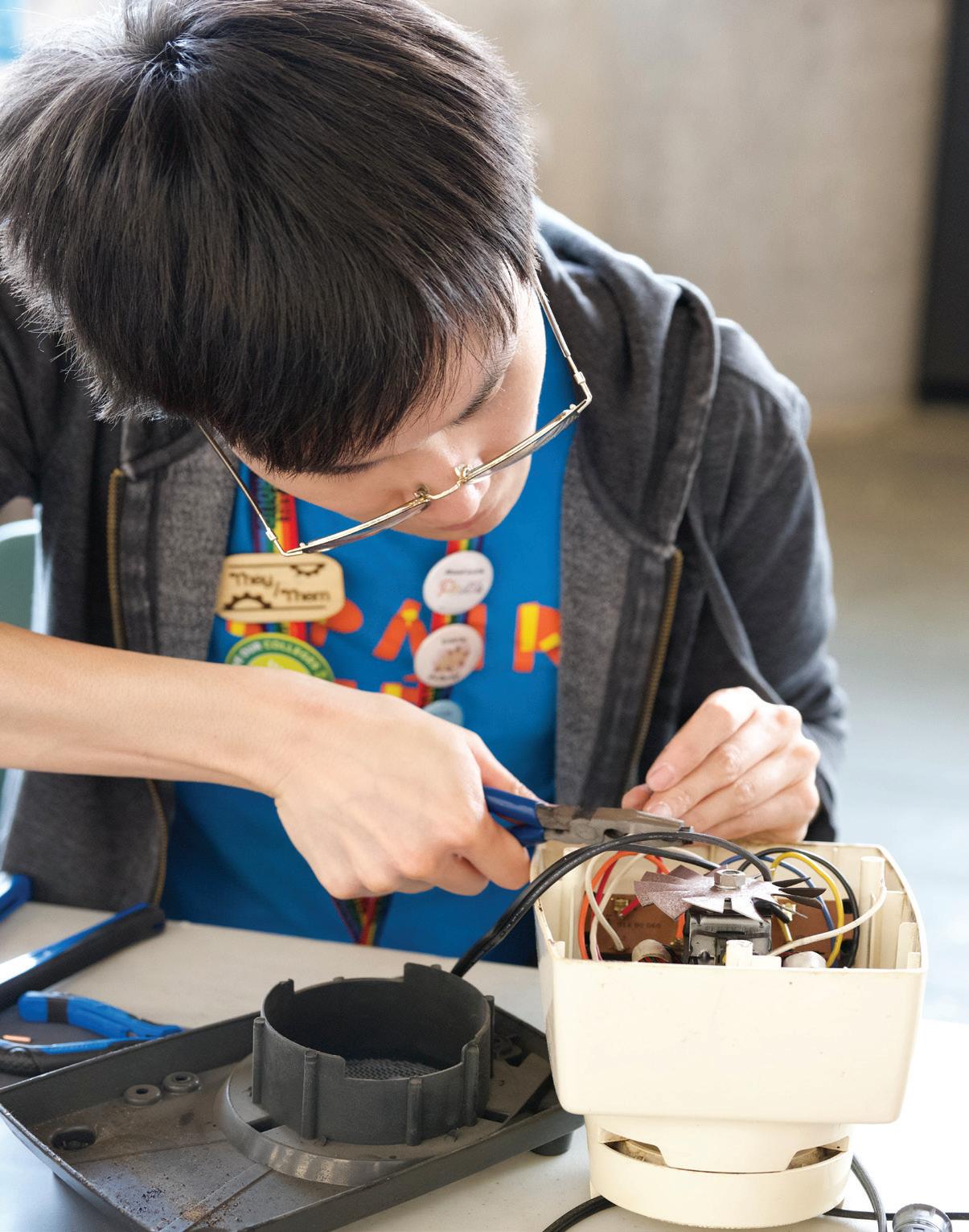
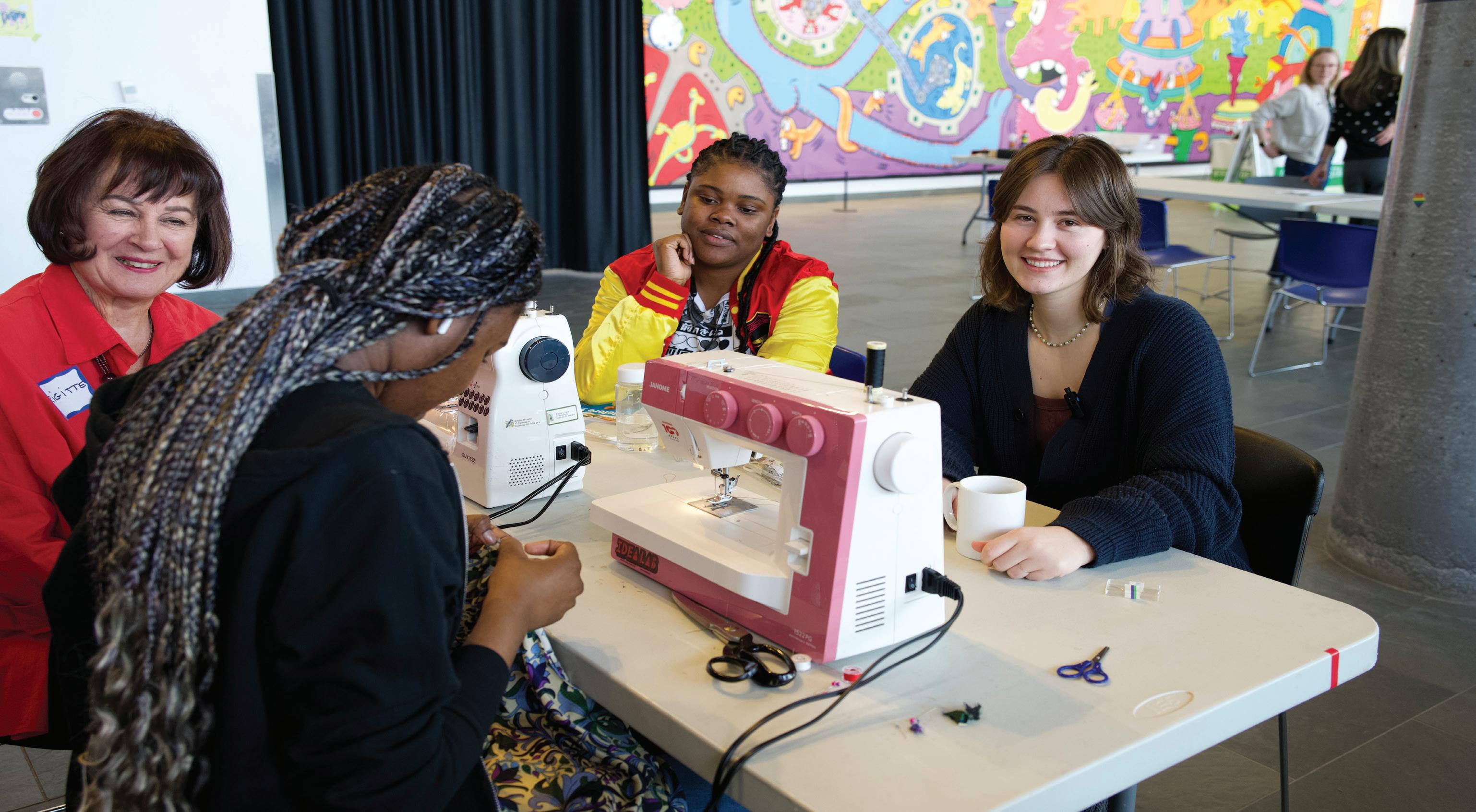
Anna Kiroplis waits for her item to be fixed as the volunteer works on it at Humber’s Repair Cafe on March 24 which is focused on fixing broken items instead of throwing them away.
HUMBERETC/LAURA RODGERS
Fixer Joseph Chan said it is in his personality to help people on March 24.
HUMBERETC/LAURA RODGERS
Boys of Summer hold high hopes for October
One game, one win is how close the Toronto Blue Jays were to breaking their 33-year championship drought after losing one of the most exciting and stressful Game 7s in history to the juggernaut Los Angeles Dodgers. The loss ended the season, but with raised expectations in 2026, the Blue Jays will contend again.
The Jays broke an eight-year winless playoff drought, and after going worst to first, they won their first division title in a decade in a stacked American League East.
The Jays believe they can win it all this season, as evidenced by the front office’s contract extensions for President Mark Shapiro, GM Ross Atkins, and Manager John Schneider.
Around the same time last year, fans were unsure if star Vladimir Guerrero Jr. would stay after the team had a hard time re-signing him. They ended up securing him
with a 14-year, $500 million contract, and he proved his worth in the postseason. He hit an impressive eight home runs, .397 average, .494 on-base percentage (OBP), and provided elite defence on first base. For Toronto to contend, the Jays need him playing at the same elite level.
After a long off-season full of roster moves, the 2026 season is very encouraging. The front office made pitching depth a muchneeded priority and brought in potential ace Dylan Cease from San Diego on a seven-year $210 million deal, Cody Ponce, Tyler Rodgers, Eric Lauer, and Max Scherzer. These additions make the team much stronger on paper. The moves didn’t end there; they also brought in Japanese infielder Kazuma Okamoto on a $60-million four-year deal after batting a solid .327 with the Yomiuri Giants. Although overseas success doesn’t always translate to immediate success, he will be a big part of the Jays’ return.
But the off-season also came with big losses. Star shortstop Bo Bichette headed to New York to join the Mets, and pitcher Chris Bassitt left for the Baltimore Orioles. Bichette’s leadership and consistency will be hard to replace, and both traits are pivotal in a tough AL East where every error

can matter in the long run. Toronto will also be short of some major firepower in the pitching rotation due to injuries to start the season. Young star Trey Yesavage, who was a big part of the postseason run after sitting in the minors, will miss time with a shoulder injury. Shane Bieber will be out for a while with an elbow issue, as will Jose Berrios. The Jays’ rotation will start thin and will look to its new depth to hold things together.
One more major injury is
Anthony Santander, who is making his contract look worse every day. He will miss five months with a torn labrum. He is coming off a mediocre season for his fiveyear $92.5 million contract, and the front office will be hoping for a strong bounce-back season when he returns.
The Toronto Blue Jays are a World Series contender, and they have the talent to bring the trophy back. The lineup is deeper, the pitching is stronger, and the team has the October experience. They
are no longer the surprise team; they have become a threat. In a long 162-game season, they will need the middle of the lineup to maintain the hot bats, which will be on the shoulders of Addison Barger and Ernie Clement, who broke the postseason hit record. The pitching will need to hit a new level this year with the new additions, and most importantly, the team needs to stay healthy. Anything less can lead to a step backwards in a season where expectations are higher than ever.
Esports rockets into final season victory
Luca Agostino
HumberETC Sports
Humber defeated Saginaw Valley State University (SVSU) 4-1, in a best-of-seven Midwest A, National Esports Collegiate Conference (NECC) Rocket League Division match-up.
Humber Rocket League now finishes with a 2-5 record on the season
Player Evan “Vidhawk rl” Hutt led the way for Humber with two hat-tricks. Teammate Noah “Noah1127” Mossini said this is not anything new.
“In my opinion, it’s nothing out of the ordinary. This guy’s the GOAT,” he said.
The first game went to Humber who came out with a strong, firstgame dominating performance and scored four goals, three of them from Hutt.
The next game was a close, intense battle with Saginaw taking the victory.
Saginaw carried this momentum
into the start of Game 3, scoring early, but then the tables turned.
Humber stomped on Saginaw’s great start when it scored three
unanswered goals and took the win.

ited the team’s ability to play with some confidence despite some early adversity.
“But besides that, once we started playing, a little more confidently, and a little more sure of what we were doing, and especially playing more together, that’s when we realized we could just get the ball wherever we wanted to go,” he said.
Humber won Games 4 and 5 and closed out the series with 5-1 victories, and Hutt secured his second hat-trick in Game 4.
Although it is Humber’s second win of the season, it will be their last as the team did not make the playoffs.
Hutt is very proud of his teammates this season and the friendships that they have made.
“I’m proud of everyone for kind of a lot of things, but mostly off the field, I think we’ve actually gotten to know each other, on a decent level, and that, regardless of what happens, we’ll stay friends outside of Rocket League,” he said.
Toronto Blue Jays Ernie Clement mobbed by teammates after hitting a game-winning RBI single in opener.
THE CANADIAN PRESS/FRANK GUNN
Marco Moretto HumberETC Sports
Coach Eric “Rice” Buchyns cred-
Humber Polytechnic’s Rocket League team, from left, Evan Hutt, Eric Buchyns, Noah Mossini win final game.

O Canada, goalless draw against Tunisia
Alexandra Shank Senior Reporter
The anticipation among soccer fans was electric. Two teams that qualified for the World Cup were meeting in a friendly match at the recently renovated BMO Field in Toronto.
But lightning, thunder and heavy rain postponed the match between Group B Canada, showcasing their new black away jersey, and Group F Tunisia for about 90 minutes.
And in the end, it ended with a nil-nil draw.
It was an unofficial taste of the FIFA World Cup, a chance for Canadian supporters to rally behind their team just 72 days from the main event.
FIFA ranks Canada 30th, while its opponent, Tunisia, holds 44th spot.
Temporary stands were added to the pitch, allowing for 46,000 fans compared to the usual 30,000 seats.
Canadian coach Jesse Marsch shook up the defensive starting lineup, giving opportunities to new debuts to start in the highly anticipated friendly match.
Among the changes from Saturday’s Iceland friendly match, which ended in a 2-2 draw, include Ralph Priso as centre-back, replacing Kamal Millar. Following Tajon Buchanan’s red card in the match against Iceland, Liam Millar started as left wing. Canadian keeper Maxime Crépeau started his 30th cap for his country, and Marcelo Flores made his first start appearance in the right wing position.
The match remained goalless, but the changes to the backfield improved their defensive play in possession and maintained better control of the game.
The Canadians earned four yellow cards
as the game grew more intense with critical tackles and defending.
Nevertheless, the team took advantage of the space given by Tunisia’s defender, but the Canadians didn’t accomplish much with the 14 shots on goal, six of which were on target.
The Canadians had the opportunity to shoot more, but lacked shots on target. Holding the ball in front of the 18-yard box and the lack of one-time shots prevented Canada from capitalizing on key moments in lifting the game out of a goalless draw.

For the Canadian centre back substitute, Priso, his debut match came to a short end when he got injured at the 26th minute while preventing the Tunisian player on the wing from making a pass.
One of the few opportunities for a goal in the match was for Tunisia, who capitalized on the free ball opportunity on their side of the pitch after Canada was unable to obtain possession.
A long pass down the field in the 34th minute led to a Tunisian two-player breakaway opportunity, forcing Canadian midfielder Liam Millar to track back from the other side of the field and make a cru-
cial block in the Canadian keeper’s box, preventing Tunisian left winger Elias Saad from scoring in the match.
Canada held their own against Tunisia, known as the Eagles of Carthage, showcasing their defensive changes from Saturday’s friendly match against Iceland and embracing resilience in keeping a shutout.
As Canada continues to fix their mistakes defensively, the team continues to focus on working to capitalize on its scoring opportunities and taking more shots on target rather than looking for a pass.
FIFA qualifiers spots were officially locked on March 31. Italy failed to qualify for the third time in a row, losing 4-1 in penalties to Bosnia and Herzegovina, officially filling in the playoff team in FIFA Group B. Bosnia and Herzegovina officially joins FIFA Group B with Canada, Switzerland, and Qatar.
Canada plays Bosnia and Herzegovina at BMO Field on June 12 as part of the group stage of the World Cup. Canada plays Qatar on June 18 and the Swiss on June 24 in Vancouver.
Canada’s defender Alistair Johnston, centre, during a training session on March 24, 2026, at the BMO Training Ground in preparation for matches against Iceland and Tunisia in Toronto.
THE CANADIAN PRESS/EDUARDO LIMA
Scaffolding stands at Toronto FC’S BMO Field as new seating is built ahead of the 2026 FIFA World Cup in June.
THE CANADIAN PRESS/CHRIS YOUNG
HUMBER ET CETERA SPORTS