publisher & managing director Evelyn Wong
CONTENTS
Jan-Jun 2026
editor-in-chief Aditi Sharma Kalra deputy editor Tracy Chan
12
english sub-editor James Foster graphic design Julia Li advertising sales Karen Yung Sally Hui Lody Wong delegate sales Gloria Yam Mandy Chan Kristy Cheng Kelly Chan circulation Deborah Quek marketing Cyrus Ching event production Selina Kwok Kery Tuah event services Chiyan Lam Hedy Chao Niki Shek office manager Irene Wong
Human Resources Online is published half-yearly by Lighthouse Independent Media Ltd. Printed in Hong Kong by Apex Print Ltd. Subscription rates are available on request, contact the Circulation Manager by telephone: +852 2861 1882 / +65 6423 0329 or by email to: subscriptions@humanresourcesonline.net
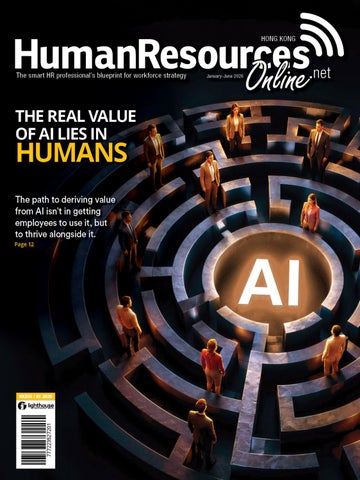
HR LEADERS, HOW DO YOU UNLOCK REAL VALUE FROM AI ADOPTION?
In this feature, Tracy Chan talks to two seasoned HR leaders in Hong Kong to discuss why many organisations are still struggling to realise the full value of AI.
SUITE TALK
ANITA FUNG, MANAGING DIRECTOR, GREATER CHINA, LEVI STRAUSS & CO.
The leader shares the critical shifts in mindset, capabilities, and talent strategies required to steer an iconic brand in one of the world’s leading retail markets.
18
DISCLAIMER: The views and opinions expressed in Human Resources Online are not necessarily the views of the publisher.
Singapore: Lighthouse Independent Media Pte Ltd 100C Pasir Panjang Road, #05-01, See Hoy Chan Hub, 118519 Tel: +65 6423 0329 Fax: +65 6423 0117
To subscribe call: +852 2861 1882 / +65 6423 0329 or email: subscriptions@humanresourcesonline.net
2 – Editor’s Note 6 – Snapshot 8 – Whitepaper 10 – HR by Numbers 38 – People Issues 40 – Last Word
EVENTS HOW TECH-POWERED TEAM BUILDING TURNS PRESSURE INTO INNOVATION
4
KEY TAKEAWAYS FROM TRANSFORM TALENT HONG KONG 2026
28 EVENTS
At this one-day conference, over 200 HR and talent leaders explored how to balance AI-powered innovation, business agility, and people-centric leadership to build future-ready workforces.
COPYRIGHTS AND REPRINTS. All material printed in Human Resources Online is protected under the copyright act. All rights reserved. No material may be reproduced in part or in whole without the prior written consent of the publisher and the copyright holder. Permission may be requested through the Hong Kong office.
Hong Kong: Lighthouse Independent Media Ltd 15/F, Golden Star Building, 20-24 Lockhart Road, Wanchai, Hong Kong Tel: +852 2861 1882 Fax: +852 2861 1336
EVENTS
Regulars
FEATURE
BEYOND THE “LAZY WORKER” MYTH: ARE LEGACY SYSTEMS FAILING TO REWARD YOUNG TALENT?
Meet the winners of the Employee Experience Awards 2026, Hong Kong.
32
22 H1 2026 « Human Resources Online Hong Kong «
1
EDITOR’S NOTE
EMBRACING CHANGE WITH GRATITUDE Dear readers, I am writing this column for the very first time, and I do so with great excitement. My career transition comes at a time of significant change in the wider world of work. Through all my conversations with HR leaders from different industries, one truth has consistently stood out: change is constant, and the question is about how we prepare ourselves to navigate it. One of the most prominent shifts shaping the HR profession in recent years has been the rise of artificial intelligence (AI). We have discussed at length how AI is transforming the way we work, as well as how it impacts the way organisations manage, develop, and deploy talent. Yet, while AI has been increasingly applied in workplaces, many organisations continue to struggle with bringing out its full potential. In our cover story, I had the privilege of speaking with two seasoned HR leaders in Hong Kong to explore what we may be missing in this equation. “Few companies spend quality time to redesign the organisation holistically. This gap is where the value leaks,” says Kris Lui, a global HR leader. Echoes Sarah Cheuk, Head of People at Fano: “A successful AI integration requires a careful balance between technology, people, and time.” Turn to page 12 to discover their insights, along with practical advice on how organisations can realise the full value of AI. The luxury fashion and retail sector is one amongst many sectors that is undergoing a profound transformation driven by economic uncertainty, evolving consumer behaviours, and intense eCommerce competition. In this edition’s Suite Talk column, Anita Fung, Managing Director, Greater China, Levi Strauss & Co, shares her perspectives on leading the iconic brand through its strategic acceleration journey in one of the world’s most dynamic and complex retail markets. Head to page 4 to read the interview.
Elsewhere in this issue, our Editor-in-Chief, Aditi Sharma Kalra, and Southeast Asia Deputy Editor, Priya Sunil, speak with HR leaders across the region to understand how organisations are responding to changing employee needs and expectations. From finding meaningful ways to reward and retain Gen Z talent, to addressing the emerging trend of ‘job hugging’, their conversations offer valuable lessons for today’s people leaders. Find these stories on pages 22 and 38 respectively. As part of our ongoing commitment to supporting and celebrating the HR community, HRO was proud to bring back two of our flagship events to Hong Kong: the Transform Talent conference and the Employee Experience Awards. Catch highlights from both events on pages 18 and 32. For myself, I am deeply grateful for the guidance, encouragement, and support I have received throughout my journalism journey. My manager, teammates, and the many HR leaders and professionals I have had the privilege of meeting and interviewing have all played a significant role in shaping who I am today. Stepping up from senior journalist into the role of Deputy Editor is more than a change in title. It is a humbling reminder for me to keep learning, growing, and contributing to this people-centric industry that I am honoured and proud to be part of. Enjoy the read.
Tracy Chan Deputy Editor, North Asia
2
» Human Resources Online Hong Kong » H1 2026
THIS ARTICLE IS BROUGHT TO YOU BY AIRPORT AUTHORITY HONG KONG
BEHIND THE WIN: AIRPORT AUTHORITY HONG KONG ELEVATES EMPLOYEE EXPERIENCE THROUGH DIGITAL INNOVATION AND FAMILY-FRIENDLY SUPPORT Guided by its ‘5Cs’ values, Airport Authority Hong Kong is demonstrating that operational excellence and employee wellbeing can go hand in hand. programme was designed to balance employee needs with operational realities through clear eligibility criteria and practical implementation guidelines. The response has been overwhelmingly positive, with employee feedback recognising the effort made to provide greater flexibility, stronger family support, and an enhanced sense of being valued and supported.
Responsible for the operation and development of Hong Kong International Airport, Airport Authority Hong Kong (AAHK) faces a unique workforce landscape. With around 2,700 employees supporting highly customer-facing, round-the-clock airport operations, balancing employee wellbeing with operational excellence requires careful planning and innovation. Guided by its ‘5Cs’ values – ‘Caring, Commitment, Creativity, Continuous Improvement, and Collaboration’ – AAHK has built a holistic employee experience strategy that supports employee wellbeing, workplace effectiveness, and longterm organisational success. Digital transformation and family-friendly initiatives are among the key measures underpinning this strategy, ensuring employees feel valued while enabling the organisation to operate efficiently and sustainably. It is therefore no surprise to see AAHK was recognised at the recent Employee Experience Awards 2026, winning two gold awards in the categories of Best Digital Transformation Strategy and Best Family-Friendly Initiatives. What’s more, by virtue of its consistent excellence in elevating employee experience, AAHK was also named as one of the winners of the newly introduced Triple Crown of Employee Excellence honour. Supporting employees through every life stage Rooted in a caring approach, AAHK has long offered a comprehensive range of benefits and family-friendly initiatives that go above and beyond statutory requirements, to support not only employees but also their families. These include extended medical coverage for spouses and children, marriage leave, breastfeeding-friendly policies, staggered working hours, childcare-related facilities, and family-focused activities. Building on this foundation, AAHK further launched its ‘Early Parenthood Support Programme’ in 2026 to better support employees during one of life’s most demanding stages. The new initiative specifically focuses on parents of children under one year old, recognising the importance of early parent-infant bonding and intensive caregiving. The initiative offers three tailored work arrangements: parental sabbatical leave, part-time work sharing, and hybrid work arrangements. Importantly, the
Driving digital transformation with employees at the centre Beyond supporting employees’ priorities, AAHK is also committed to continuous improvement by leveraging digitalisation to enhance the overall HR experience. Rather than pursuing isolated technology projects, AAHK has embarked on a structured, multi-year HR digitalisation journey aligned with its people strategy and business needs. The transformation spans the entire employee lifecycle, from attracting talent to engaging and developing employees. An e-recruitment system has shifted the recruitment processes online, improving efficiency, streamlining manager workflows, and enhancing the candidate experience. The company’s preboarding and onboarding journeys have also been digitalised, enabling a smoother and more mobile-friendly experience for new hires. To support continuous learning, AAHK’s ‘eLearning’ platform provides access to a wide range of online courses, enabling employees to learn at anytime and anywhere, while encouraging them to take ownership of their development journey. At the heart of the transformation is the ‘Employee Self Service (ESS) Portal’, which now enables most daily HR services to be delivered digitally and managed directly by employees. Combined with the ‘Manager Self Service Portal’ and HR analytics dashboards, it gives leaders easier access to workforce information and actionable workforce insights, enabling more informed decision-making across key HR priorities. The availability of these tools is matched by efforts to give employees time to adopt the new ways of working. AAHK has supported the transition through structured training, clear communication, and ongoing user support. By actively listening to feedback and continuously refining the tools, AAHK ensures that all digital solutions remain practical, user-friendly, and closely aligned with employees’ day-to-day needs. Continuing to put people first Looking ahead, AAHK plans to deepen its HR digital transformation journey by exploring AI-powered capabilities to further simplify processes, enhance selfservice solutions, and deliver more personalised employee support. Meanwhile, its commitment to introducing innovative and flexible policies that help employees thrive at different life stages will remain firmly in place. By combining technology, care, and continuous improvement, AAHK is demonstrating that operational excellence and employee wellbeing can go hand in hand – creating a workplace where people can thrive both professionally and personally.
H1 2026 « Human Resources Online Hong Kong «
3
WORK LIFE » Leadership
As a seasoned leader with more than 25 years of experience across Asia Pacific’s luxury fashion and retail industry, Anita Fung has joined LS&Co as Managing Director for Greater China at a pivotal time for the brand. As the company accelerates its DTC (direct-to-consumer)-first strategy, advances its premiumisation agenda, and deepens its engagement with fashion-forward consumers, Fung firmly believes in the power of people to bring a brand’s values and identity to life. “The energy a brand projects externally is a reflection of what people feel internally,” she affirms. In this exclusive interview with HRO’s Tracy Chan, Fung shares her vision for driving Levi’s® next phase of growth in Greater China, and discusses the leadership, talent, and cultural priorities that will help build a more agile and consumer-centric brand in one of the world’s most dynamic retail markets. Read the full interview below.
Anita Fung Managing Director, Greater China Levi Strauss & Co. (LS&Co.)
4
You have joined at a time of significant strategic acceleration in Greater China. From a leadership perspective, what are the most critical people and capability shifts required to successfully execute a DTC-first strategy in this market? A DTC-first strategy is about closing the distance between the brand and the consumer – not just what they buy, but how they engage, express themselves, and form a lasting relationship with the brand. In Greater China, where we are undergoing a deliberate refresh to reclaim our denim authority, it demands a different kind of organisation. Three shifts matter most. First, moving from channel-centric to consumer-centric. Mainland China is one of the most digitally advanced retail markets in the world – consumers on RedNote (小红书) or Tmall (天猫) are already highly sophisticated, and they expect a seamless experience whether they encounter the brand online or in-store. Retail, eCommerce, merchandising, and marketing must operate as one team, working towards the same consumer outcome. Second, building digital and insight capability as a core leadership competency – not just a functional tool. Teams that translate signals into action quickly will have a decisive edge here. Third, and most importantly: fan obsession. At LS&Co, we are becoming a more DTC-first denim lifestyle company – and that is already delivering more consistent growth, a larger addressable market, and higher profitability. The unlock is being more scientific about identifying our most valued customers and building genuine relationships with them, online and offline. Our frontline teams are at the heart of that.
» Human Resources Online Hong Kong » H1 2026
Our ‘Behind Every Original’ pop-ups with the ROSÉ x Levi’s® collaboration – in Taipei and our first immersive activation in Mainland China in Chengdu – are a good example of fan-building done right: culturally rooted, community-led, and anchored in denim craft. And finally, AI: not to replace people, but to remove low-value work so teams can spend more time serving fans. That is the playbook – simple, focused, and directly relevant to what we do every day in Greater China. Omnichannel success often depends as much on mindset as on technology. How are you thinking about breaking down the silos between the retail, digital, and supply chain teams to create a truly integrated consumer experience in Greater China? The honest answer is that it starts with shared accountability – every function aligned to the same consumer outcome, not their own channel metric. What makes this especially pressing in Greater China is that eCommerce here is not catching up to the rest of the world – it is leading it. Chinese consumers are already years ahead in how they discover, evaluate, and purchase across platforms. The bar for integration is higher, and the cost of a disjointed experience is greater. A bigger and better fleet of stores in the right city locations matters enormously – but only when those stores are fully joined up with eCommerce to deliver a seamless and consistent experience that feels unmistakably Levi’s® at every touchpoint. One of our explicit commitments this year is to operate as one Greater China team – clean ownership, fewer handoffs, faster decisions, and a shared standard of execution across all four markets (Mainland China, Hong Kong, Taiwan, and Macao). When structure and mindset align, the consumer experience follows. As LS&Co pushes further into premiumisation, how does this shift influence the type of talent you need, particularly at the frontline and leadership levels? Premiumisation is visible in the product, but it is felt through the people. On the frontline, it means shifting from transactional to intentional. Every interaction should reflect the quality and authenticity consumers expect from the brand. Our ‘Behind Every Original’ pop-up experience showed what that looks like in practice – store teams trained to lead community panels and engage genuinely on denim craftsmanship, not just process a sale. That does not happen without deliberate investment in capability and culture. In Greater China specifically, we are also focused on winning over women – and that requires
Leadership WORK LIFE
teams who can deliver a compelling experience for her whether she is shopping online or in-store, bringing styling to life head-to-toe, and presenting a product offer that feels personal and relevant. Strong branding, the right in-store and digital experience, and the right product – those three things together are how we win over women. For leadership, I need people who are both commercially sharp and deeply culturally attuned – who can hold the brand’s heritage with conviction while evolving how it shows up for a new generation of Chinese consumers. Greater China has a genuine opportunity to position Levi’s® as a premium denim authority. That ambition has to be lived by the leadership team first. As a leader, how do you balance decisiveness with agility, especially when guiding teams through rapid change and uncertainty? Decisiveness and agility are not in tension – they depend on each other. The balance comes from being clear on what is fixed and what is flexible. Our strategic anchors are non-negotiable: denim authority, premiumisation, and winning over women. How we execute against those – which cities and doors we prioritise, how we sequence our store fleet upgrade, and how we show up culturally in a given season – that is where the flexibility lives. In Greater China, agility means staying close to the consumer, empowering teams to act quickly, and adapting executions without losing strategic direction. When teams understand the “why” behind the decisions, they move faster and with more confidence – and that clarity is something I hold myself accountable for. DTC and omnichannel models generate vast amounts of consumer and performance data. How do you ensure leaders and teams use data to inform decisions without losing the human judgement and creativity critical in fashion and retail? Data tells you what is happening. It rarely tells you why, or what to do next. The risk is that teams start treating metrics as strategy – and that is where creativity gets squeezed out. Data should sharpen human judgement, not replace it. In fashion, the most important signals are often emotional and cultural – how a consumer feels in our clothes, what a brand represents at a particular cultural moment, what will resonate before it shows up in the numbers. Those things do not live in a dashboard. At LS&Co, we use digital signals and platform data to inform store briefs, pop-up timings, and assortment priorities. But the creative and cultural judgement that makes those decisions land still has to come from people. The strongest brands
combine analytical rigour with emotional intelligence. In Greater China, where culture moves fast and consumer taste is increasingly sophisticated, that balance is not optional – it is the competitive edge. Beyond commercial performance, what indicators from a culture, talent, and organisational-health perspective will tell you that you’ve successfully positioned LS&Co for its next chapter in Greater China? Commercial performance tells you where you landed. Culture and talent indicators tell you whether it is sustainable. The signal I watch most closely is clarity – whether people across the organisation can articulate where we are going and understand how their role connects to that vision. When that clarity exists, you see it in retention, initiative, collaboration, and execution quality. I also watch talent development closely: are we growing internal leaders, retaining high performers, and attracting people genuinely excited by what this brand can become? And agility – how quickly teams can read, decide, and act. When you have those three things running well, commercial performance tends to follow. To wrap up on a stylish note – give us an idea into which fashion trends across the decades you loved most, and why? The 1990s, without question – and not just because that’s when I fell in love with fashion. It was a decade of genuine tension and confidence: minimalism and maximalism both making an argument, tailoring meeting streetwear, and denim sitting right at the centre of it all. What Levi’s® represented in the ’90s – democratic, rebellious, iconic – is something that still resonates deeply with how I think about the brand today. The best fashion has always had a point of view, and I find myself most drawn to the eras where that conviction shows. H1 2026 « Human Resources Online Hong Kong «
5
WORK LIFE » Snapshot ... s with e t u in 15 m
TI T A H L B D OF HR A T E E S GLOBAL HEA OGY AND
OL ECHN FOR T ERATIONS ED OP RTER D CHA R A D STAN
Sitting at the intersection of people and technology, Seetal Bhatti shares with Umairah Nasir how she is rethinking the workforce strategy in the age of AI; the importance of creating more inclusive pathways for women in technology; and why understanding and supporting different expressions of ambition matters more than ever.
In your role leading HR for technology and operations, how do you hope to reshape the workforce strategy and work design in the AI era? This is a huge agenda for us at the bank, and for most organisations right now. It is not about incremental change. It is about a transformation starting with principles, and we are taking an approach which looks at a blank sheet of paper. We are calling it ‘zero-based design’. We are imagining what work will look like in the future and working back from there. It requires us to think about the human and digital interaction fundamentally and differently; and think about the way work needs to evolve in order to deliver on our strategic ambition. We ask questions such as: What are our clients’ expectations in the future? How should work be designed to meet those expectations at the scale required? Thereafter, we think about the best ways to bring technology and people together. That means being clear about the work itself, the skills we need now and in the future, skills that are constantly evolving – and adopting a more dynamic approach to planning, including preparing for what we cannot yet foresee. It also means being more agile in how we build, redeploy, and acquire skills. Finally, it also means being thoughtful about how we develop our people to handle uncertainty in the future, but also encouraging them to embrace the learning opportunities that come with introducing AI into the organisation.
6
» Human Resources Online Hong Kong » H1 2026
As someone who advocates for women in leadership, what deliberate actions have you taken to uplift the participation and progression of women in environments such as tech and operations that are typically male dominated? In my experience, technology – more than operations – can be particularly male dominated. I am just getting started here at Standard Chartered, but in the past my approach has been multi-faceted: creating inclusive environments and diversifying pipelines for technology roles. It has been about building diverse pipelines by really understanding the talent base within your organisation, digging deep to find the existing diversity, and then looking at roles – such as in operations – where there is more diversity, and creating pathways for that talent to move into technology. An example of that is from my previous organisation. We took people from our contact centres, where the need for those roles was declining, and trained them as cybersecurity specialists. That meant moving a diverse population into a less diverse role, but it was a successful pivot for them from a career perspective. The next piece is making sure that leaders are accountable. They must be clear on where the organisation stands and on the value it places on inclusion and diversity. They need to understand – from a data‑driven perspective – how they are performing against that ambition, know that they are personally accountable for creating a more diverse and inclusive environment, and have that accountability baked into the performance management system.
What kind of culture are you striving to build within your own HR team, and how does it reflect your personal leadership style or philosophy? I always talk about a culture that is high ambition, high integrity, and high collaboration. When you get those three ingredients right, you create inclusive cultures that are high performing – that fits very well with the values that we have here at Standard Chartered. You build that through role modelling, an alignment with the value system of the organisation, the way you select leaders who are in leadership positions, and how you reward and recognise the behaviours in the system.
What’s one leadership myth you secretly enjoy proving wrong? I think one is the idea that leaders always have the answer and that you can command and control from the top. Maybe it was the case in a less complex world 10 to 20 years ago, but it has not been the case for a long time, and it certainly is not as we move into the future. The future is very uncertain. It is very ambiguous, so the role of a leader is to be a calm and steady role model who sets direction, is curious, and cultivates the workforce. A sense of calm and ability to be resilient and to succeed through change (are important as well). I think it is about setting a clear direction and enabling others to solve problems at scale. So, the myth is that we have all the answers – we don’t. The other myth, and one that I have been thinking about a lot more recently, is about the ambition gap for women in senior leadership roles. There’s a lot being talked about now in terms of the complexity of senior leadership roles and the diminishing pipelines of women that aspire to be in CEO roles or CHRO roles. However, I think that has been misread. The reality is there are still many ambitious women out there, but they express it differently. They express it in terms of intent to have an impact, rather than pursuing a particular role for the sake of a status. Thus, I think that it is a myth that women are not ambitious. Women are very ambitious, but we need to listen to their ambitions differently.
THIS ARTICLE IS BROUGHT TO YOU BY ATKINSRÉALIS
BEHIND THE WIN: HOW ATKINSRÉALIS IS NURTURING TECHNICALLY STRONG AND LEADERSHIP-READY ENGINEERING TALENT ACROSS THE EMPLOYEE LIFECYCLE By combining structured leadership development, AI-enabled career growth, and a culture of belonging, AtkinsRéalis is equipping employees to thrive in an evolving world of work. membership guidance, new graduates are equipped with the knowledge, networks, and practical experience needed to accelerate their professional development. For managers, the ‘Manager Essentials Programme’ focuses on strengthening core people-leadership capabilities. Covering areas such as emotional intelligence, team building, and leading hybrid teams, its modular and flexible design allows managers to apply learning directly to real-world scenarios, enhancing both team engagement and performance.
Engineering organisations today are navigating rapid digital transformation, rising sustainability expectations, and intensifying competition for talent. At the same time, as new generations enter the workforce, their expectations are shifting towards meaningful work, structured career pathways, and holistic wellbeing. Rethinking how to attract, develop, and retain talent, while preparing the next generation of leaders to thrive in an evolving industry, has therefore never been more critical. To address these challenges, AtkinsRéalis has moved beyond traditional onboarding models to adopt a more holistic and connected approach to talent development. By focusing on capability building, employee engagement, and long-term growth, the organisation is strengthening its leadership pipeline while enabling employees to navigate increasingly dynamic career journeys. This forward-looking strategy has earned AtkinsRéalis recognition at the recent Employee Experience Awards 2026, with a gold award in Best Graduate Training Programme, and a bronze in Best Leadership Development Strategy. Building leadership capability across every career stage At the core of AtkinsRéalis’ approach is the organisation’s global Employee Value Proposition (EVP), built around five pillars: ‘Purposeful Impact’, ‘Global Community’, ‘Transformative Capabilities’, ‘Careers Without Boundaries’, and ‘Thriving Together’. Developed through extensive research and employee insights, the EVP reflects what employees value most, while reinforcing a culture where everyone can thrive. One key priority for AtkinsRéalis is nurturing technically strong and leadership-ready engineering talent across all stages of the employee lifecycle. For youth stepping into the workforce, the ‘Early Careers Programme’ offers a structured pathway that combines technical training with leadership exposure spanning engineering, sustainability, and digital transformation disciplines. New joiners are also supported through a buddy system during their first six months to ensure smooth onboarding and integration. Combined with chartership and
Turning insight into action through digital innovation To further enable personalised career growth, AtkinsRéalis has introduced AIenabled platforms that bring greater transparency and agility to talent development. For example, the digital tool ‘Skills Trawler’ helps visualise employee capabilities across the organisation, while enabling employees to explore projects and opportunities aligned with their skills and career aspirations. On the other hand, the ‘Opportunity Marketplace’ offers personalised development recommendations for learning, mentorship, and career opportunities. Together, these tools are helping the organisation move towards a more skillsbased approach, while empowering employees to take ownership of their growth. Supporting wellbeing through belonging and psychological safety Underlying these initiatives is AtkinsRéalis’ commitment to creating an inclusive environment where employees feel supported, valued, and a sense of belonging. “Every employee and engineer in our organisation, every design and decision they make will directly impact public safety and quality of life,” explains Cindy Chiu, HR Director – Asia, AtkinsRéalis. To support this responsibility, AtkinsRéalis places strong emphasis on employee wellbeing – both professionally and personally. The organisation fosters a transparent and psychologically safe environment where employees feel comfortable speaking up, sharing ideas, and raising concerns early. Initiatives such as a 24/7 global ‘Employee Assistance Programme’ reinforce trust and support mental health resilience, while the global programme ‘Different Makes A Difference’ recognises the uniqueness of every employee. Looking ahead, AtkinsRéalis remains focused on bringing its EVP to life through locally relevant programmes and initiatives, ensuring the employee experience resonates across different markets while supporting long-term organisational growth. “Ultimately, by creating a culture built on trust, openness, and wellbeing, we enable our teams to navigate challenges effectively while maintaining the highest standards of safety and quality,” affirms Cindy. As James Cullens, Chief Human Resources Officer, puts it, the organisation’s commitment to its people is simple: “As we grow, you grow.”
H1 2026 « Human Resources Online Hong Kong «
7
WORK LIFE» Whitepaper
TOXIC WORKPLACES STILL AFFECT WORKERS AS LEADERSHIP TRUST REMAINS A CHALLENGE
United States – A toxic workplace remains a reality for the majority of employees, with nearly seven in 10 workers (68.9%) saying they have experienced one at some point in their careers, according to iHire’s newly released 2026 Toxic Workplace Trends Report. Based on a survey of 1,220 workers in the US, the report found that while this marks a slight improvement from 75.9% in 2025, workplace toxicity continues to have far-reaching consequences for employee wellbeing, retention, and employer reputation. At the heart of the issue, once again, is leadership. Among respondents who have experienced workplace toxicity, four in five (79.1%) attributed it to unethical, unaccountable, or unsupportive leaders, while 72.1% pointed to poor communication from leaders and managers – the top two drivers for the second consecutive year. Meanwhile, 17.2% said their managers rarely or never model respectful and professional behaviour. The impact is significant. Nearly half (47.6%) of respondents said they had quit a job because of a toxic work environment. Beyond turnover, workplace toxicity is also taking a toll on employees’ mental health. More than four in 10 workers (43.2%) said they frequently experience burnout, while almost one-third (32.4%) admitted they had cried at work because of toxic workplace experiences. The effects extend beyond an organisation’s walls. More than six in 10 respondents (61.9%) said they had shared their negative workplace experiences with others, and over a quarter (26.2%) said they had actively discouraged potential candidates from joining a company they viewed as toxic – highlighting the reputational risks organisations face when workplace issues go unresolved.
8
» Human Resources Online Hong Kong » H1 2026
At the same time, the findings suggested that many employees still lack confidence in HR’s ability to address workplace issues. Among respondents who witnessed toxic behaviour, 38.8% chose not to report it, with close to half (45.1%) saying they did not believe HR or leadership would take meaningful action. Even among those who did raise concerns, more than half (51.4%) said nothing was addressed or resolved. Overall, 41% of respondents said conflict always or often goes unresolved within their organisation. The report also explored the role of AI in shaping workplace culture, finding that employees remain divided. Nearly half (48.8%) said they were neutral or unsure about AI’s impact on company culture. Among those with a positive view (18.9%), the biggest benefits cited were increased productivity (64.9%) and improved quality of work (55.4%). However, 9.5% believed AI was having a negative effect, with more than half (52.6%) saying it removes the human element from workplace interactions, making collaboration more difficult.
THIS ARTICLE IS BROUGHT TO YOU BY AVNET HONG KONG
BEHIND THE WIN: AVNET BUILDS A FUTURE-READY WORKFORCE THROUGH LEARNING, WELLBEING, AND AIPOWERED TALENT INNOVATION By integrating learning, career growth, wellbeing, and AI-enabled talent practices, Avnet is creating an employee experience that empowers its people to thrive in an increasingly complex world of work. The Academy combines digital platforms, physical learning experiences, and hybrid delivery models to create a flexible learning environment. Complemented by a dual internal faculty approach with leadership-led programmes and expert-driven knowledge sharing, it ensures rapid capability building and consistent learning quality. A defining feature of the Academy is its emphasis on business ownership. Key initiatives are co-designed and co-owned by business leaders and the L&D team, ensuring learning remains closely aligned with evolving organisational priorities and real-world business needs. For Avnet, a global technology distributor and solutions provider with a 105-year legacy, success depends not only on technology and service excellence, but also on the strength of its people. “We are committed to building a high-performance culture that embodies Avnet’s core values, across APAC,” affirms Welcome Wang, Vice President, Human Resources APAC, Avnet. “Our people strategies focus on inspiring and engaging our people, enabling and growing our talent, and driving HR effectiveness.” To navigate a rapidly changing business landscape, Avnet has built an integrated people ecosystem that brings together learning and development (L&D), career growth, wellbeing, commitments to corporate responsibility, and AI-enabled talent practices. Not only has this approach strengthened Avnet’s people strategy, it has also earned industry recognition, with the company taking home two gold, two silver, and one bronze awards at the recent Employee Experience Awards 2026. A structured development ecosystem Recognising that future business success depends on continuously growing workforce capabilities, Avnet has repositioned L&D as a strategic enabler of business transformation and long-term employee growth. At the centre of this strategy is its ‘Structured Career Framework’, built around three interconnected pillars: leadership, commercial, and fundamental capabilities. Together, they provide employees with a clear and scalable development pathway across different career stages. Leadership development forms a cornerstone of the framework. Aligned with Avnet’s ‘Global Leadership Development Framework’ which has been localised for Asia, employees are supported through differentiated learning journeys that cater to talent at every level, from individual contributors to senior executives. Avnet also continues to strengthen commercial and foundational skills through structured, self-paced, and role-relevant learning opportunities, enabling employees to continuously build capabilities for the future. A culture of continuous learning Supporting this career development strategy is Avnet’s ‘In-House Learning Academy’, which serves as a central hub for professional development and knowledge sharing across Asia.
AI-empowered talent acquisition Beyond development, Avnet is also applying technology to enhance how talent is identified and hired. One example is its custom-built ‘AI CV Matching Tool’, designed to automate initial candidate screening with industry-specific precision. By mapping candidate experience against Avnet’s industry taxonomy, the tool supports faster and more accurate talent identification while maintaining data security within the organisation’s ecosystem. Importantly, human judgement remains central to the hiring process. Standardised behavioural interviews, calibration reviews, and feedback-driven assessments ensure recruitment decisions continue to prioritise fairness, quality, and cultural fit. Employee wellbeing and purpose at the centre Underlying Avnet’s employee experience strategy is a commitment to helping employees thrive both professionally and personally. Its ‘THRIVE’ framework takes a holistic approach to wellbeing, covering four dimensions: mind and body, connection, money, and career. Meanwhile, principles of corporate responsibility are embedded throughout the employee experience through a broader commitment to ‘People, Planet, and Possibilities’, encompassing wellness, health, data security, equity and inclusiveness, and community impact. Looking ahead, Avnet will continue strengthening AI-enabled workforce intelligence, enhancing career pathways, deepening wellbeing initiatives, and embedding principles of corporate responsibility into everyday employee experiences. “Amidst the rapid rise of AI, we are leveraging emerging technologies to strengthen our commitment towards employees, particularly through our ‘THRIVE’ wellbeing framework, corporate responsibility initiatives, and learning ecosystem,” emphasises Wang. “We engage the right talent and ensure that they can contribute at work, and can achieve their goals, grow, and thrive in our organisation. Our people management approach is globally aligned to ensure consistency towards fostering the best employee experience.”
H1 2026 « Human Resources Online Hong Kong «
9
WORK LIFE » HR by Numbers
DEMAND FOR AI ROLES REBOUNDS ACROSS HONG KONG According to PwC’s 2026 Global AI Jobs Barometer, which analysed more than one billion job advertisements worldwide across six continents, every sector in Hong Kong recorded growth in the share of AI jobs in 2025 compared to 2024.
AI job postings surged
50% year-on-year
The
professional services sector
in 2025.
recorded the largest increase, with its share of AIrelated roles rising by 2.1 percentage point in 2025.
AI user roles dominated the AI-related job market, doubling with around
Globally, jobs requiring AI-augmented skills – such as judgement, creativity, and leadership – are expanding
6,900 new positions in 2025.
10 » Human Resources Online Hong Kong » H1 2026
8x faster than the overall job market.
THIS ARTICLE IS BROUGHT TO YOU BY OCBC HONG KONG
BEHIND THE WIN: OCBC PUTS PEOPLE FIRST THROUGH LISTENING AND PURPOSEFUL ACTIONS Through open communication, employee recognition, and future-focused development, OCBC is creating a workplace where employees feel valued, empowered, and equipped to thrive. Recognising employees’ contributions is equally important. To reinforce a culture of appreciation, OCBC Hong Kong has introduced ‘Staff Appreciation Week – From Aspiration to Appreciation’, where leaders personally thank employees through recognition activities and engagement events. Other initiatives such as ‘OCBC Praise’, ‘PVA Awards’, and ‘Spot-On Awards’ further celebrate individual and team achievements while reinforcing the Bank’s values and collaborative culture.
In an increasingly competitive banking landscape, attracting, engaging, and developing talent has become just as important as serving customers. The challenge has been amplified by rapid digital transformation, intense competition for technology talent, evolving employee expectations, and the growing need for cross-border capabilities in the Greater Bay Area (GBA). Rather than addressing these challenges with standalone initiatives, OCBC Bank (Hong Kong) Limited (“OCBC Hong Kong”) has adopted a holistic ‘People First Strategy’ centred on employee connection, capability development, recognition, communication, leadership, wellbeing, and employer branding. At the core of this approach is a simple principle: listening and acting with purpose. This people-first approach has been validated at the recent Employee Experience Awards 2026, where OCBC Hong Kong took home two gold and one silver awards. Further underscoring its commitment to employee experience, the Bank was also named one of the Triple Crown of Employee Excellence winners. Turning employee insights into meaningful action A key strength of OCBC Hong Kong’s people strategy is its commitment to understanding employees’ evolving needs through a structured listening framework. The Bank combines annual engagement surveys, regular pulse surveys, and employee lifecycle surveys to track trends and gather timely feedback across key moments that matter, enabling leaders to respond quickly to emerging needs and concerns. Meanwhile, through initiatives such as ‘MindsConnect’, ‘Fireside Chats’, townhalls, and multiple divisional listening channels, employees can engage with senior leaders directly, share perspectives, and contribute ideas in an open and trusting environment. Importantly, the organisation focuses not only on collecting feedback, but also on closing the loop through tangible action to foster trust, transparency, and inclusiveness across the organisation.
Building capabilities for the future Alongside employee engagement, OCBC Hong Kong places equal emphasis on continuous learning and future-focused development. One flagship initiative is the ‘GBA Immersion Programme’, designed to develop GBA-ready, AI-enabled talent through three pillars: immersion, integration, and impact. Through the four-month capability-building experience, participants gain first-hand exposure to GBA market dynamics, cross-border opportunities, digital innovation, and leadership perspectives through company visits in Mainland China, executive engagement, and cross-functional collaboration. These immersive learning experiences are complemented by the Bank’s efforts to strengthen digital confidence across its workforce. Focused on AI, digital, and data (ADD), OCBC Hong Kong has introduced initiatives such as ‘ADD Learning Day’ and offers more than a thousand learning programmes. Together, these initiatives support the Bank’s broader ‘Asia Shift ‘, ‘Tech Shift ‘, ‘Franchise Shift ‘, and ‘Net-Zero Shift’ strategies. Creating a workplace where employees can thrive Beyond listening, recognition, and development, OCBC Hong Kong is also committed to investing in initiatives that support employees throughout their career journeys. With digital tools that simplify day-to-day work, flexible benefits, wellbeing initiatives, diverse leave arrangements, and meaningful CSR events, the Bank strives to create a workplace where employees feel supported today while being empowered for tomorrow. Looking ahead, OCBC Hong Kong remains focused on enhancing employee experiences, fostering a culture of respect and appreciation, strengthening regional talent mobility, building future-ready capabilities, and deepening its focus on AI, digital, and data. Through these efforts, the Bank aims to future-proof its workforce and prepare employees for the future of banking. As Cindy Leung, Managing Director, Head of Human Resources, Hong Kong & Macau, OCBC Bank (Hong Kong) (pictured lower left), emphasises: “To build the bank we need for the future we want, we start with our people – listening deeply, acting with purpose, and empowering them to thrive in a changing world.”
H1 2026 « Human Resources Online Hong Kong « 11
FEATURE » AI
HR leaders:
How do you unlock real value from AI adoption? Employees are already using AI tools, but the path to justifying AI’s real value requires more than just tools. HRO’s Tracy Chan talks to two seasoned Hong Kong HR leaders about what it takes to turn AI adoption into meaningful business and people outcomes.
A
typical day at work begins. You arrive at your desk to find your AI assistant greeting you with a prioritised list of tasks, summaries of overnight updates, and dozens of email responses drafted on your behalf. What once sounded like science fiction is increasingly becoming part of everyday working life. Yet a critical question remains: is AI genuinely helping us work more effectively or is it simply adding another layer of work through multiple rounds of reviews, corrections, and rework? Today, the debate around AI has fundamentally shifted. The question is no longer whether employees should use AI – they already do; nor is it whether AI will replace humans – most would agree it will not. Instead, the challenge facing HR leaders is how AI should be used to empower employees so they can realise the full value of the technology and drive positive organisational outcomes. Recent global research by Workday suggested many organisations in Hong Kong are still falling short. While employees are saving meaningful time with AI tools, much of that benefit is being lost to rework – fixing mistakes, rewriting content, and double-checking outputs from generic tools. More alarmingly, only 38% of employees doing the most rework said they are getting access to skills training, while 88% of organisations in Hong Kong reported that fewer than half of their roles had been updated to reflect AI capabilities. These findings point to a clear disconnect between AI adoption and workforce readiness, leaving many employees inadequately supported to use AI effectively.
12 » Human Resources Online Hong Kong » H1 2026
To understand why some organisations are translating AI investment into business value while others are struggling, HRO spoke to two seasoned Hong Kong HR leaders who have been actively embedding AI into their organisations.
Why AI adoption alone is not enough “Most companies go wrong by focusing on just buying and learning AI tools and platforms as an IT roll-out, while expecting immediate financial and productivity returns overnight,” says Kris Lui, a mission-driven and business-oriented global HR leader. Most business leaders, she says, understand that AI is a must-have instead of a nice-to-have to accelerate growth, and most organisations see AI as an enabler for all functions and people instead of just one function or an elite group of people in the company. However, few have looked at the overall organisational and talent structures to help maximise the value.
AI FEATURE
H1 2026 « Human Resources Online Hong Kong « 13
FEATURE » AI
Sarah Cheuk
“AI adoption is not a destination; it is a continuous journey of learning, refining, and evolving, and the organisations that embrace this mindset are the ones that will thrive.”
“Reinvest the time AI saves for your people. Lead with trust to enable people to experiment and grow with the company in order to create a win-win situation.”
Kris Lui
“Few companies spend quality time to redesign the organisation holistically – from the business strategy to the implied work and structure, process and systems, people capability, rewards, and culture,” she says. “This gap is where the value leaks. It echoes the Workday study which showed that nearly 40% of the time AI saves is lost to rework because people run 2026 tools inside 2015 jobs.” Sarah Cheuk, Head of People at Fano, echoes those views and shares that one of the most common pitfalls she has observed is the temptation to push AI implementation too aggressively in the pursuit of immediate ROI. “While the enthusiasm is understandable, sustainable AI adoption requires more than just deploying the right tools. It demands equal attention to your people’s skills, readiness, and buy-in across the organisation,” she emphasises. Another frequent misstep companies usually make, Cheuk cautions, is assuming AI can replace everything. She notes “the reality is more nuanced”. “A successful AI integration requires a careful balance between technology, people, and time. Organisations that take the time to identify where AI genuinely adds value, and where human judgement remains irreplaceable, are the ones that unlock its true potential.” She reiterates it is less about racing to automate, but more about thoughtfully augmenting how people work.
AI works best when people make the decisions While Cheuk works for a locally based AI company, and Lui is a big fan of AI, both HR leaders have been trailblazers in embedding AI into their daily workflow.
14 » Human Resources Online Hong Kong » H1 2026
One of the earliest and most impactful experiments at Fano was integrating an AI-powered meeting note-taker into the performance appraisal and interview processes. “What surprised me most was just how transformative the experience was,” recalls Cheuk, sharing the internal team’s time was freed up from the burden of manual note-taking, allowing HR and the interviewers to be fully present in real conversations. “Our HR colleagues and interviewers can engage more meaningfully with candidates and employees, and focus on what truly matters – the human dialogue. The depth and quality of our discussions noticeably improved.” On the other hand, Lui has been using AI since 2019 when she served as the Asia Pacific Human Resources Vice President at Vertiv, a global company offering critical digital infrastructure. The purpose of using AI, she says, is to give employees more quality time to add value to their work and families – a key factor in attracting and retaining capable talent. “The first workflow that we ran was to use a robot called ‘Alice’ to call and attract thousands of candidates to our recruitment events so as to
AI FEATURE
hire a very high target of fresh graduates in China,” Lui remembers. Being able to talk to people naturally like humans, robot Alice successfully invited candidates to the event, while saving 4,000 man hours from the talent acquisition team who then pivoted to do more high value business partnerships with business leaders and universities. “What surprised me was the humanoid technology and that it could be trained easily at a low cost. It really added high value to our employee engagement and growth,” Lui says. Reflecting on their early adoption of AI, both leaders concur human decision-making is what brought out the true value of the technology. “Like any AI solution, the technology is not 100% perfect, and there are moments where outputs need to be validated,” Cheuk says. “We have addressed this by establishing a clear review process where colleagues verify content whenever questions arise, treating AI as a powerful assistant rather than a replacement for human judgement.” Lui adds: “No matter how well trained the AI was, a human in the loop was still needed at a certain stage to ensure the desired outcome was delivered
consistently. It was great that my team was very technologically advanced and we learned, adjusted, and excelled. “AI scales at the speed of capability and trust, not licences. Build the people, and the tool delivers.”
Setting the right context to get people ready Research increasingly suggests the biggest barriers to AI success are no longer technological. Instead, organisations continue to struggle with the preparedness of their people. According to the AI Readiness in Workplace Survey by the Hong Kong Productivity Council in 2025, 88% of employees in surveyed companies have already used AI tools in their day-to-day work.
H1 2026 « Human Resources Online Hong Kong « 15
FEATURE » AI
Yet, a lack of AI expertise and training, as well as employee readiness gaps, continue to be prominent hurdles in practice. Cheuk believes building the right context with courage and an open mind is the first step to empowering teams to use AI effectively and confidently. Equally important is transparent communication with the stakeholders throughout the journey. “Organisations that are willing to embrace new technology – and proactively explore how it can enhance their operations – position themselves far ahead of those that hesitate,” she says. “Beyond technical know-how, what matters most is creating an environment where people feel safe to experiment, ask questions, and share both wins and frustrations. When employees understand the ‘why’ behind the change and see how it benefits their day-to-day work, adoption becomes a genuine win-win rather than a top-down mandate.” And a genuine confidence across a team, Cheuk believes, is reinforced by pairing with hands-on exposure, peer learning, and a culture that celebrates curiosity. While equipping people with AI skills is important, Lui notes that human skills are those that give a true competitive advantage to enable teams to not only learn AI, but to also grow and thrive sustainably. “The scarce skill isn’t prompting. The competitive advantages that humans still have are inspirational leadership, strategic thinking, collaboration, communication, authentic creativity, and ethical judgement,” she says. “How can they know when a confident answer is quietly wrong? Comprehending business context and complex people dynamics matter more than tool fluency. People still check AI output as carefully as a colleague’s by exercising sound judgement.” As such, she is focused on equipping people with best-in-class learning, hands-on experimentation, and open-mindedness to fail in an environment that advocates psychological safety. “AI tools become obsolete very quickly. I treat them like toys. Make the learning experience fun and fulfilling. Productivity will then come.”
AI is not one person’s responsibility As organisations grapple with AI transformation, another question has been raised: Who owns the responsibility for the change? HR, IT, or the emerging role of the chief AI officer? Successful AI adoption, Lui argues, cannot be delegated to a single executive. “If a company creates a chief AI officer role and expects the job holder to lead and transform all AI-related matters in the whole company, the company over-simplifies the matter,” she says. Like hiring a transformation officer, Lui indicates that organisations cannot and should not expect that person to drive the whole company’s transformation alone. “AI is everyone’s accountability and agility. All functions and people across all levels and markets should identify the need to explore, experiment, learn fast, adjust, and excel,” Lui says. 16 » Human Resources Online Hong Kong » H1 2026
“For example, HR knows the best about what the business needs and their pain points. They have the highest interest and required knowledge to explore the right tools. “If you rely on the chief AI officer to do so, it will increase the internal transaction time and lots of time and energy will be spent on aligning priorities across functions in the company. By the time the decision is made, the technology will have evolved to the next phase. Then the company will always be in catch-up mode.” Instead, Lui suggests organisations should create a role called ‘chief agent officer’ – an agent (agentic AI) reporting to the CEO and managing all agents in all functions. “Some new companies are going in that direction of organisation design. HR’s role is to lead the organisation design and capability building to design a future-ready organisation to accelerate business growth,” she says. “We should partner with business leaders to decide the future business strategy and then design the required organisation capability accordingly.”
Final advice The verdict is clear – success in AI adoption will depend not on technology alone, but on how effectively organisations rethink how work gets done while empowering people to work alongside it. “AI is an equaliser – it comes once in a generation and everyone starts at the same line regardless of your age, seniority, gender, and nationality,” Lui affirms. “The world is full of possibilities. The winners won’t be those with the most tools, but those who redesign the business strategy and the corresponding organisational capability to deliver it phase by phase.” Cheuk encourages the HR fraternity: “Don’t be afraid of the challenges ahead. Yes, there will be uncertainties, false starts, and moments of doubt, but that is the nature of any meaningful transformation. “As long as you approach the journey with adaptability, an open and positive mindset, and a commitment to growth, you will find that these challenges become the very catalysts that propel you and your organisation to the next level.”
THIS ARTICLE IS BROUGHT TO YOU BY HONG KONG-SHENZHEN INNOVATION AND TECHNOLOGY PARK (HSITP)
BEHIND THE WIN: HSITP IS SHAPING A NEW GENERATION OF ‘I&T ARCHITECTS’ FOR THE GREATER BAY AREA’S INNOVATION FUTURE Cross-boundary collaboration, immersive learning, and a shared innovation culture are empowering Hong Kong-Shenzhen Innovation and Technology Park to cultivate leaders capable of turning cross-boundary cooperation into meaningful impact.
Situated within the Hetao Shenzhen-Hong Kong Science and Technology Innovation Co-operation Zone (the Hetao Co-operation Zone), HSITP is envisioned as a strategic bridgehead for innovation, policy experimentation, and crossboundary collaboration, supporting the development of an international hub to promote innovation and technology (I&T) for Hong Kong and the Greater Bay Area. Delivering on the goal requires more than physical infrastructure. As Hong Kong-Shenzhen Innovation and Technology Park Limited (HSITPL) has expanded rapidly while preparing the Company for the country’s 15th Five-Year Plan, it recognised the need to cultivate not only a workforce capable of operating beyond traditional roles, but also the culture, mindset, and capabilities required to support a world-class innovation ecosystem. In response, HSITPL set out to develop employees as ‘I&T Architects’ – leaders capable of translating the corporate goals into meaningful impact on the ground. This transformation journey was recognised at the recent Employee Experience Awards 2026 Hong Kong with a silver award in the Best Culture Transformation and Change Management category. Building a shared cross-border culture A cornerstone of HSITP’s strategy is the belief that world-class innovation requires shared culture and collaboration across borders. To support this vision, HSITPL and Shenzhen-Hong Kong Science and Technology Innovation Cooperation Zone Development Co., Ltd. (SH-STIC) have jointly established the ‘Hetao Joint Talent Task Force’, a pioneering crossboundary working group dedicated to talent development, learning, and cultural integration across Hong Kong and Shenzhen parks. The ‘Hetao Joint Talent Task Force’ was designed to move teams across both parks beyond parallel operations and towards active collaboration. Through joint planning, shared learning experiences, and common talent development objectives, employees from both parks continue to exchange ideas, as well as build trust and synergy across geographical boundaries.
Transforming learning through immersion To further strengthen talent capabilities and cultivate a growth mindset, HSITPL has moved away from traditional classroom-based training and introduced an ‘Experience-Led Change’ learning framework with SH-STIC, immersing employees in real-world innovation environments. Under this framework, employees participate in visits and exchanges with leading organisations including Tencent, BYD, HAECO, and the Hong Kong International Aviation Academy. These experiences provide employees with first-hand exposure to innovation in action, operational excellence, technology adoption, and organisational transformation. Importantly, these engagements go beyond conventional study tours. They provide bilateral exchange platforms where employees actively introduce HSITPL’s vision to potential partners, transforming training programmes into opportunities for relationship building and ecosystem development. Feedback so far has showed that participants gained greater confidence, engagement, and sense of purpose. To support sustainability, HSITPL has also launched a ‘Train the Trainer’ programme, certifying internal trainers from both parks to become ‘Learning Champions’ responsible for promoting continuous learning and transferring institutional knowledge. Championing shared success Through the orchestration of these programmes, Vincent Ma, Chief Executive Officer of HSITPL, emphasised that HSITPL has successfully reshaped its organisational culture and ethos. “We firmly believe that talent is never compelled but always self-motivated,” he said. “We are actively fostering an environment where every individual embraces the same spirit of urgency and purpose – taking proactive ownership, striving for excellence, and generating enduring value for Hetao.” Yinxiao Wu, Chief Executive Officer of SH-STIC, also expressed hope that Hetao will continue to empower talent, fostering an environment where every innovative idea can flourish, and every dedicated professional can contribute to a more dynamic and prosperous future. Winnie Lai, Director of HR & Corporate Services of HSITPL, concluded: “We are redefining our role in Human Resources management. By fostering employee engagement, HR is cultivating a culture, ethos, and mindset that harmonises our employees’ self-interest with strategic objectives, ensuring the Company’s mission is actively actualised across every level.” As the Lok Ma Chau Loop continues to take shape, HSITP remains focused on preparing a new generation of I&T Architects while fostering a shared culture of innovation, collaboration, and purpose across the Hetao Co-operation Zone, guided by the motto of “Wait for Nothing, Never Slow Down, and Seize Every Moment”.
H1 2026 « Human Resources Online Hong Kong « 17
‘People don’t resist change – they resist change without context’ – key takeaways from Transform Talent Hong Kong 2026
T
o navigate this evolving landscape for HR professionals, Human Resources Online’s Transform Talent Hong Kong 2026 brought together more than 200 HR and talent leaders at Kerry Hotel, Hong Kong on 10 June. Through a candid fireside chat, insightful panel discussions, and practical case studies, attendees explored how to balance AI-powered innovation, business agility, and people-centric leadership to build futureready workforces. Event report by Tracy Chan.
COMMUNICATING CLEARLY ON THE ‘WHY’ BEHIND CHANGE In a world of constant change, one key to leading people through transformation is having a clear vision and direction, and communicating both effectively. Kicking off the day was an opening fireside chat with Ivan Zenović, Group Chief People & Communications Officer, Bluebell Group. Moderated by Tracy Chan, Deputy Editor, North Asia, Human Resources Online (HRO), Zenović reflected on Bluebell Group’s own transformation journey and emphasised that people don’t resist change – they resist change without context. “In any kind of big shift or movement, there has to be a ‘why’. It’s the ‘why’ for individuals: What does it mean for you? How is this transformation going to change your work? How is it going to impact and improve your daily life?” And to support any transformation, he believes that leaders have to unlearn the traditional ways of working, along with breaking down silos, and shifting from micromanagement to empowering people to unlock their own creativity and collaboration. 18 » Human Resources Online Hong Kong » H1 2026
GLOBAL MOBILITY AS A STRATEGIC TALENT AND CULTURE LEVER The first panel discussion of the day, moderated by Vivian Lung, Director of Talent & Culture, Carlyle & Co. Hong Kong, explored how strategic workforce mobility can help organisations build leadership pipelines, accelerate development, and strengthen culture across markets. At Philip Morris International, Ilaria (Quintini) Gregotti, Vice President, People & Culture, East & Southeast Asia, Pacific & PMI Global Travel Retail, shared that mobility has evolved beyond a succession-planning tool into a targeted development strategy for highpotential talent. “What has changed dramatically is that we now plan a lot more. We try to plan the assignments around that (employees’ longterm development), so in some cases we have massively accelerated people,” she said. Meanwhile, Johnson Wong, Chief of Staff, Plaza Premium Group, highlighted that while international assignments come with costs, they deliver longterm returns for both employees and organisations. “Moving people around is part of the development process. It forms a company culture
GOLD SPONSOR
SILVER SPONSOR
EXHIBITORS
EVENT PARTNER
of developing people, and also helps develop skill sets and brings culture to new locations,” he said. Adding a mobility partner’s perspective, Jay Arcega, Director of Business Development, Sirva, noted that mobility has shifted from a transactional process to a strategic workplace enabler. Organisations must focus on the full employee experience and provide support. “HR professionals need to help manage expectations or thinking from the employees, so employees can focus on the work they need to do.” Wrapping up the discussion, Lung said: “Mobility is no longer just a support function. It’s becoming a core lever for how organisations build capability and stay competitive.”
BUILDING A COMMUNICATION-READY WORKFORCE Another challenge many global organisations face is ensuring employees can communicate effectively across cultures, markets, and functions. Drawing attention to the hidden costs of miscommunications, George Loup, Business Development Director, TutorABC, noted that employees and leaders do not always say exactly what they mean, especially in international business environments. To close the communication gaps, he suggested that organisations should first identify whether their challenges are internal or customer-facing, and then design flexible learning programmes rather than adopting a onesize-fits-all approach. Loup also highlighted the growing role of AI in personalising learning journeys. “But we still believe that person to person learning is unbeatable,” he stressed. He concluded by encouraging organisations to evaluate communication readiness through three lenses: confidence, clarity, and capability.
WHY INTERNAL MOBILITY IS STILL UNDERUTILISED Mukta Arya, CHRO, Asia Pacific, Société Générale, argued that internal mobility is one of the most underutilised approaches for both talent acquisition and retention. From a business perspective, internal mobility can reduce hiring costs, shorten onboarding times, preserve organisational knowledge, and improve retention. Rather than relying solely on external recruitment, Arya encourages organisations to create systematic processes that make internal opportunities visible and accessible to all employees, not just to highpotential talent. She also stressed that successful mobility programmes rely on a growth mindset, effective career conversations, and supportive managers who view talent movement as beneficial for the organisation rather than a loss for their own teams. “Managers need to be rewarded for supporting movement and not be penalised for it. The organisation also needs to support them in refilling that position,” she said.
RETAINING TALENT WITH EMOTIONAL VALUES While organisations believe they are doing enough, why do talented employees still leave? And what makes them stay? Answering this question was Elly Ching, Head of HR – HKTW & Regional Benefits, Nobel Biocare. Using examples from her company, Ching argued that talent management is a shared responsibility for HR and people managers. “I need everyone in the system to trust the system of the organisation, because if you don’t trust it, you don’t own it, and if you don’t own it, your employees will leave,” she said.
While competitive pay remains important, Ching stressed that employees are more likely to stay when they can see a “future” within the organisation. “The reason why they say there is no future is because, sometimes, there are big disconnects or very fast distances between the company strategy, the directions, and themselves.” She also highlighted the importance of emotional value in the workplace, including a sense of identity and belonging, and genuine feedback and acknowledgment.
FROM HR REPORTING TO BUSINESS DECISION-MAKING WITH PEOPLE DATA Opening with a provocative question – “Is HR a cost centre?” – James Wong, Regional Head of Human Resources, Marks & Spencer Asia, Al-Futtaim, challenged HR professionals to rethink their role in driving business outcomes. Using a case study focused on store managers, he demonstrated how people analytics can be combined with business data to inform tangible talent decisions. Wong believes that HR should move beyond reporting metrics and dashboards, and instead, leverage people data in the context of business priorities to influence decision-making and improve performance.
H1 2026 « Human Resources Online Hong Kong « 19
BUILDING A FUTURE-READY WORKFORCE AMIDST CONSTANT CHANGE
“My final recommendation is always start by understanding what matters to the business, then try to connect your people data with the business context,” he said. “Keep the model simple so that people will use it; convert insights into actions, and actions must be supported by stakeholder buy-in; and finally, AI cannot be a judgment of our decision – we should leverage AI to scale our support.”
MOBILISING TALENT FOR CREATING VALUE After the lunch break, Cassady Winston, People Director, Asia, Aurecon, challenged conventional thinking around long-term workforce planning, arguing that traditional five-year strategies are becoming less relevant in an increasingly dynamic business environment. Instead, organisations need adaptive leadership, agile strategies, and the ability to mobilise talent quickly to where it can create the most value. “Velocity to mobilise talent is actually the most important thing that I want to leave you with,” he said. Winston also cautioned that organisational friction, including silo mentalities, talent hoarding, excessive processes, and unclear priorities, can slow decision-making, limit talent mobility, and ultimately reduce enterprise performance. To close the session, he left delegates with two thought-provoking questions: “Is it easy to understand which positions add the most value and are the most critical in your organisation? And do you have your top talent focused in those positions? If the answer is no, then the question is why?”
LEADING TRANSFORMATION WHILE RUNNING THE BUSINESS For transformation to succeed, what gets in the way and how to overcome it? Drawing on his experience as both a consultant and an in-house HR leader, Henry Ding, Vice President, Human Resources Solutions, Shangri-la Group, said the tension between running today’s business and building tomorrow’s is where most of the troubles come from. Comparing transformation to “renovating a car while driving it”, he argued that efforts often stall due to gaps in three areas: clarity, capability, and commitment. Organisations need a clear view not only of why change is happening, but also on the pace and volume of change, while ensuring employees have the capacity to absorb and adapt. “There are always a few things to check before you accelerate: is the direction clear? Are we setting the right speed and the pace? Do people really understand what to expect next? Is our foundation solid? And last, but not least, have we given our passengers real evidence this journey is worth being on?” Ding said. 20 » Human Resources Online Hong Kong » H1 2026
Workforce transformation is about creating an ecosystem that enables both talent and organisations to thrive today while preparing for tomorrow. In a panel discussion moderated by HRO’s Chan, Lisa Yeow, Regional Director, People & Organisation, Chanel North Asia, and Jeffrey Wu, Talent Lead, Woolworths International, stressed that leaders play a critical role in helping employees navigate uncertainty by connecting organisational priorities with individual purpose, fostering psychological safety, and creating an environment where teams can innovate within clear guardrails. “Just saying to someone: ‘Please share your opinion’ doesn’t mean it is going to happen,” Yeow shared. “We need to create platforms in many different ways that encourage that voice. And when we get the voice and the suggestions, we take action and share those actions, so people can really see.” Echoing the importance of empathetic leadership, Wu highlighted the need to empower teams to take accountability for their work with the leaders’ support, creating that psychological safety. “If leaders can create a framework while giving teams some freedom within it, that can unlock creativity with the pace of change of technology,” he said. “Your team will drive that creativity; leaders are there to give them that empowerment.”
FROM AI EXPERIMENTATION TO RESPONSIBLE TRANSFORMATION Concluding the power-packed day was Cissy Ho, Director, Talent Management, Asia, AECOM, who explored how HR can move beyond AI experimentation to drive meaningful business and talent outcomes. Ho emphasised the choice for HR leaders is not whether AI will shape talent decisions, but whether HR will shape how AI is used. “The real challenge is not whether we use AI or not,” she said. “It’s actually how to strike the balance between augmentation and control, because AI in HR is fundamentally a test of trust, transparency, management throughout the whole change, and how we demonstrate leadership.” While AI can improve efficiency, provide deeper insights, and enhance decision-making, Ho stressed that human judgment must remain at the centre of key talent decisions. “The real transformation is about how we are leading the transformation through AI by concentrating on the decisions that matter, embedding AI into our talent workflows, and maintaining a human-centred decision-making approach,” she said. “I do believe that HR can move from a more sporadic experimentation to an orchestrated effort that amplifies the business impact.”
THIS ARTICLE IS BROUGHT TO YOU BY SOCIETE GENERALE
BEHIND THE WIN: SOCIETE GENERALE TURNS CAREER MOBILITY INTO A CATALYST FOR GROWTH AND LEADERSHIP More than a talent practice, internal mobility has become a cornerstone of Societe Generale’s people strategy, helping employees grow across functions, geographies, and career stages while strengthening organisational resilience. experiences. On the platform, employees can document their ambitions, competencies, and experience, while receiving personalised suggestions for internal opportunities and recommended learning pathways to close skill gaps. Complementing the platform is the ‘Internal Mobility Space’, which provides employees with resources, guidance, and tools to support their career journeys. The impact has been significant. Internal hiring rates have increased substantially, resulting in strengthening talent retention, preserving institutional knowledge, and reducing reliance on external recruitment.
In today’s banking landscape, organisations face a dual challenge: building future-ready capabilities while retaining talent in an increasingly competitive market. For Societe Generale, the answer lies in a simple belief: people strategy and business strategy have to be interconnected. This philosophy underpins the bank’s focus on leadership development, internal mobility, skills growth, inclusion, and AI readiness. Rather than reacting to disruption, Societe Generale is proactively investing in the capabilities needed for the future of work while creating meaningful career opportunities as well as a supportive and caring workplace for its people. This integrated approach earned Societe Generale four awards – two gold, one silver, and one bronze, at the recent Employee Experience Awards 2026, across multiple categories spanning leadership development, career development, capability development, and family-friendly initiatives. Making career mobility a reality At Societe Generale, internal mobility is more than an aspiration – it is embedded into the employee experience. The bank actively promotes geographical, functional, and short-term crossbusiness opportunities, enabling employees to broaden their skills, gain diverse experiences, and build long-term careers within the organisation. To ensure employees’ expectations are well understood, career development conversations are formally integrated into the annual performance management process, creating space for employees to discuss career aspirations, express mobility interests, and define development plans with their managers. HR business partners also conduct regular career interviews to better understand employee ambitions and identify growth opportunities. Supporting these efforts is the bank’s ‘ACE’ tool, an internal competency and skills repository designed to enhance employees’ learning and career development
Developing leaders for tomorrow Alongside career development, leadership development forms a key pillar of Societe Generale’s integrated talent strategy. The bank has adopted a multi-fold approach covering employee development initiatives including regional programmes and offerings at the headquarters. Together, these programmes support employees across different career stages, leadership levels, and development needs. Leadership development has also been closely linked to succession planning. High-potential employees are identified through talent reviews and nominated for programmes tailored to their level, ensuring a strong pipeline of future leaders. Preparing employees for an AI-enabled future Recognising the growing role of artificial intelligence (AI) in banking, Societe Generale has invested heavily in building AI capability across the organisation. To accelerate adoption, the bank introduced comprehensive training programmes, leadership sponsorship, AI ambassadors, dedicated communities, and mandatory learning objectives. Together, these initiatives help employees build confidence in using AI responsibly and effectively while accelerating broader AI adoption. Supporting growth through inclusion and flexibility Beyond development, the bank continues to support employees in balancing career ambitions with personal priorities. Flexible working arrangements, employee engagement initiatives, wellbeing programmes, anti-discrimination efforts, and gender pay equity measures all reflect Societe Generale’s broader commitment to inclusion, fairness, and quality of life at work. Looking ahead, Societe Generale plans to continue strengthening leadership capabilities, expanding AI adoption, and further enhancing career mobility opportunities. The goal remains clear: stronger talent, better decisions, and greater impact.
H1 2026 « Human Resources Online Hong Kong « 21
FEATURE » YOUNG TALENT
BEYOND THE “LAZY WORKER” MYTH: Are legacy systems failing to reward young talent?
Speaking to HR and rewards leaders Tommy Loy, Samuel Quek, Nazrul Effendy, and Niren Srivastava, Priya Sunil explores why Gen Z and younger Millennials are not rejecting hard work – but questioning whether their efforts are still being fairly recognised through pay, progression, and career opportunities.
F
Tommy Loy Head of People and Capability
Anko Sourcing Asia (Kmart and Target Australia)
or years, the short-hand critique of Gen Z and younger Millennials has been familiar: they do not want to work hard. They are demanding, impatient, quick to leave, and vocal about what they want from work. But across many Asian workplaces, that story may be a little too convenient. Younger employees are still putting in long hours. They are learning quickly, adapting to new technologies, taking on stretch assignments, and navigating workplaces that are changing faster than ever. But what has shifted is not necessarily their willingness to work hard, but their expectations of what work should lead to. Priya Sunil speaks to HR leaders Tommy Loy, Samuel Quek, Niren Srivastava, and Nazrul Effendy on why the ‘lazy young worker’ label misses the mark – and how organisations can better connect effort with rewards, progression, and retention.
The myth of the “lazy” younger worker Tommy Loy, Head of People and Capability, Anko Sourcing Asia (Kmart and Target Australia), understands where the perception comes from – but believes it misses the point.
22 » Human Resources Online Hong Kong » H1 2026
“The idea of giving 100% effort and simply working really hard is a little ‘old school’. Younger employees understand that results are what count. It is not about working hard, it is about working smart,” he says. He recalls a recent discussion with his team about creating an organisational chart. A younger team member suggested populating the data in Excel, then using AI to plot the reporting relationships. “So, I think they are working in an environment where it is not about working hard in the traditional sense. It is about finding the most productive – and perhaps the shortest – way to achieve what they want to achieve. That, in itself, is hard work because you have to be creative,” he says. That view is echoed by Samuel Quek, Compensation & Rewards Lead, International, McDonald’s Corporation, who calls the stereotype “certainly an untrue and unfair statement”.
YOUNG TALENT FEATURE
Nazrul Effendy General Manager, Total Rewards
PETRONAS
Niren Srivastava Group Chief Human Resources Officer
Motilal Oswal Financial Services
“I have met many young workers who are very driven and passionate about what they want to do. In every generation, there are all kinds of people, and we sometimes focus more on the negative ones who don’t want to work hard.” What this current group stands out in, he adds, is not avoiding work, but rethinking how work gets done. For Nazrul Effendy, General Manager, Total Rewards, PETRONAS, the issue is less about work ethic and more about whether the effort still feels meaningful. “I think that view is a bit too simplistic, and honestly, often unfair. From what I see, younger employees are willing to work hard. The real question they ask is whether that effort actually leads somewhere meaningful. “In the past, the link between effort and reward felt clearer. Work hard, stay loyal, and you would usually see steady progress. Today, that connection feels less obvious. People can put in long hours, but still feel progression is slow or recognition is inconsistent.” That disconnect, he adds, is often mistaken for a lack of commitment. “So, what sometimes gets labelled as a ‘lack of work ethic’ is often frustration with systems that don’t feel fair or transparent anymore.” Niren Srivastava, Group Chief Human Resources Officer, Motilal Oswal Financial Services, makes a similar point: “Younger professionals today are not avoiding hard work, they are questioning whether hard work translates into meaningful growth, recognition, and quality of life. If an employee can deliver meaningful output in five to six focused hours, there is no reason to glorify exhaustion.”
When seniority still shapes the system In many Asian workplaces, the promise of hard work has long been tied to tenure. Stay long enough, prove your loyalty, accumulate experience, and progression will come. That model has not disappeared. Nor, the interviewees say, should it be dismissed completely. Loy is clear that seniority is not only an Asian issue. But in Asia, he says, hierarchy and respect for experience can be more deeply ingrained. “We grew up with the mindset of: ‘Your father said so’ or ‘you respect your elders’. So, hierarchy is still very much there.” Therefore, for HR, the challenge is not to erase seniority, but to rebalance it. Loy believes fixed pay can still reflect the years of experience, but variable rewards should more directly reflect outcomes. “The bonus component or short-term incentive should be based more clearly on output and results. If a younger team member, or a younger group of team members, can produce outstanding results compared to a more senior group, then it is fair for the short-term incentive to be weighted more towards them.” His organisation, he adds, has already experimented with a different approach. In one team, rewards are based purely on whether the target has been achieved. If it has, each member receives a defined amount, regardless of whether they are 25, 30, or 65.
From ‘waiting your turn’ to proving impact Other leaders also see a gradual shift away from tenure as the dominant marker of readiness. Samuel Quek “There is no false dichotomy: a more tenured employee can still grow by Compensation & Rewards focusing on skills and merit and a less tenured employee can also stagnate by Lead, International focusing on clocking time,” Quek says. McDonald’s “Continued transformations are a pressure point for companies that hold a Corporation strong position on seniority and hierarchy. Therefore, there is a shift happening in that companies are taking a keener look at skills and merit over tenure.”
He has seen this shift play out in organisations that are increasingly willing to place younger talent into leadership roles based on impact rather than age. The business case, he adds, is also becoming harder to ignore. “Research has shown that organisations which measure on impact are more performance-driven and generate more total shareholder returns compared to other organisations. There is also increased productivity, motivation, and retention using pay for performance versus pay for tenure.” Meanwhile, Nazrul describes the shift as a rebalancing rather than a rejection of tenure. “Traditionally, many Asian organisations leaned heavily on seniority and time in role. What I’m seeing now is a gradual shift. It’s not a complete move away from tenure, but more of a rebalancing. Skills, impact, and adaptability are becoming just as important. “Where younger employees struggle is when progression feels like simply waiting your turn. In today’s market, that’s harder to accept, especially when talent has more options and mobility.” With that in mind, he believes tenure still matters, “as experience brings real value”, but on its own, it is no longer enough. He puts it simply: “Tenure gets you a seat at the table. Performance and capability determine whether you move forward.” Niren, at the same time, says: “Earlier, authority came just from tenure. Today, credibility comes from capability, adaptability, and the ability to create impact. Younger employees expect progression to be linked to contribution and skills, not just years spent in the system.” Still, he believes the future will be driven by meritocracy, while balancing institutional wisdom with performance-driven growth opportunities. “The real opportunity lies in creating career paths where younger professionals can showcase their capabilities, while still benefiting from the guidance and maturity of experienced leaders. That balance is critical for retention.”
H1 2026 « Human Resources Online Hong Kong « 23
FEATURE » YOUNG TALENT
The AI complication: Productivity without a clear reward model
Where effort and reward actually break down For Nazrul, the breakdown between effort and reward does not begin when bonuses are paid or ratings are finalised. It begins much earlier when expectations are unclear. “First, expectations are often not as clear as we think. It’s not just about setting goals, but explaining what ‘good’ really looks like. Without that, people can work very hard, but still miss the mark, especially when different managers interpret performance differently.” The other breakdown point is inconsistent assessments. “Second, an assessment can feel subjective. Some judgement is inevitable, but without clear benchmarks and consistent standards, outcomes can feel uneven. One manager may emphasise results, another behaviours; some focus on recent wins, others on consistency over time.” But the biggest issue often lies in communication. Nazrul shares: “When managers aren’t able to clearly articulate why someone received a certain rating or reward, employees struggle to connect their effort to the outcome. That’s where trust starts to erode. “For younger employees especially, transparency and ongoing feedback really matter. If they don’t understand how decisions are made, they disengage quite quickly.” Niren concurs that performance systems fail when high performance is not clearly defined or communicated. “The disconnect begins when organisations don’t clearly define and communicate what high performance actually looks like. Many younger employees are putting in effort, but they also want to understand how performance decisions are made, what differentiates top performers or how compensation and career progression are truly linked to outcomes.” The annual appraisal cycle, in this context, may feel too slow and too opaque for a generation accustomed to faster feedback loops. “Younger employees do not want to wait for an annual appraisal conversation. They expect regular feedback, coaching, and developmental conversations. The organisations that make performance systems simpler, transparent, and data-driven will be able to build trust with younger talent,” Niren says. Loy also places a heavy responsibility on managers, noting that while processes matter, a manager’s judgement, fairness, and communication are what make a system feel credible. “The human element – the ability to be a good manager – is what makes the process less subjective. The mechanics of the process will always have limitations.”
24 » Human Resources Online Hong Kong » H1 2026
The debate over effort and reward is becoming even more complex as AI enters everyday work. If AI helps an employee complete part of a task, should that affect how their contribution is valued? Loy’s view is clear: AI will increase productivity and take away certain work that humans currently do manually; so, from a headcount perspective, adjustments will be needed. “But I do not think that changes individual pay. Wage costs may go down because the company has invested in technology and AI, but I do not think we should move towards saying, ‘AI now does 20% of your job, so we will only pay you for 80%’.” For him, that would be the wrong compensation strategy. “If you still have 100 people and then you ask all 100 people to accept 80% pay, that creates an unhappy workforce. The better approach is: if you are very sure that you now need 80 people instead of 100, then you combine workloads and let 20 people go. The remaining 80 should still receive 100% of their pay or even higher because the team is now smaller and carrying more responsibility.” This places greater pressure on HR and business leaders to plan manpower carefully. The risk, he adds, is over-hiring now and being forced into more painful workforce decisions later if AI delivers productivity gains faster than expected.
The middle manager as a translator If younger workers are more direct, more agile, and more willing to challenge systems, the middle manager becomes a crucial bridge. Loy describes middle management as one of the toughest roles in a career, as they must act as filters and translators – not shutting down younger employees’ ideas, but helping shape them into something senior leaders can understand and act on. The first job is to filter what is truly unacceptable, ridiculous, or naive. At that age and experience level, some ideas will be naive, and you may need to explain why something is not possible – almost like telling a child, ‘life is not like that’. “But at the same time, you may also get the most brilliant ideas from that generation because they have no baggage.” The skill lies in the repackaging. This, he says, is what marks a strong mid-level leader. “That is the skill of mid-tier managers: turning an idea into something valid and digestible for senior people, especially those who may not be familiar with the technology or concept being discussed.”
YOUNG TALENT FEATURE
What needs to change to keep younger talent? For Loy, one of the most urgent changes is to decouple some rewards from the base salary. Younger employees, he says, understand that senior colleagues may earn a higher fixed pay. What they struggle to accept is when an exceptional performance still produces a smaller bonus simply because their base salary is lower. For HR and total rewards leaders, Quek says this requires a more careful look at when tenure is used in talent and compensation decisions. Rather than relying on time served as a default measure, tenure should be applied with discernment, especially when assessing progression, rewards, or potential. Instead, he believes organisations should focus more intentionally on recognising, developing, and rewarding younger talent in ways that are personalised and meaningful to them. This could take the form of recognition, rewards, mentoring, or development pathways, depending on what the organisation can offer and what the individual values. The outcome, he says, should be “a highly personalised interaction and experience between the leadership and younger talent”. For him, one of the most powerful interventions is belief before proven success. “What young people need is not someone who celebrates them when they are already successful and known, but someone who believes in them when they are on their journey towards that. An intangible belief can go a long way, and I’m always looking out for the next young talent who I can believe in.”
From annual reviews to continuous conversations Nazrul believes companies need to rethink the fundamentals of performance, reward, and career systems. First, he says, performance management must move beyond annual cycles. “Younger employees expect more regular check-ins and coaching, not a once-a-year conversation. That also means managers need to shift from evaluators to coaches.” Rewards also need to be broader than salary alone. “Salary still matters, but it’s no longer the full picture. Flexibility, wellbeing, and purpose have become baseline expectations, especially in many Asian markets today.” Finally, career paths need to reflect how younger employees actually want to grow. “The traditional ladder doesn’t resonate as strongly anymore. Younger employees are looking for opportunities to build skills, move across roles, and grow faster, sometimes in non-linear ways.” Niren’s response echoes Nazrul’s, particularly on the need for skills-led careers, continuous learning, wellbeing, and trust. He says career systems need to move away from rigid timelines and become far more skills-led, giving younger professionals clearer visibility on how they can grow and how strong performances can translate into greater opportunities. Beyond career growth, Niren adds that wellbeing can no longer be treated as a ceremonial talking point. Employees are increasingly assessing whether an organisation allows them to build a sustainable life, not just a successful career. Additionally, he believes culture and trust are also becoming key differentiators, especially for younger employees who want to feel valued beyond their immediate output.
Differentiating for top young talent While transparency and fairness matter, Loy also believes organisations need to be sharper in identifying and investing in high-potential younger talent. He is blunt about differentiation. “At some point, I would rather have two really strong talents and invest in them than have 10 mediocre talents. The company’s ‘cake’ is only so big. To some extent, we need to be ruthless to say
that 80% of the cake goes to this 2%, and the rest will only share that 20%.” While he notes this may sound harsh, he believes organisations must recognise that top young talent is visible not only internally, but externally as well. “If I can identify someone as high-potential, young, smart, and hardworking – and you do not often get all three – then any other experienced HR person can probably see it too. That means other companies can see it as well.” This is where legacy reward systems can become risky. If high-potential young employees see their contribution is recognised more slowly than their market value, they may not wait for the organisation to catch up. Loy’s view is that companies need to be more comfortable with differentiating rewards. “I tell my peers and managers go ahead and differentiate. It is OK to give someone 10% and someone else 2%. You do not have to feel guilty.” For younger talent, the message rings true: if organisations want them to stay, they need to see that an exceptional contribution can lead to exceptional recognition – even if they are early in their careers.
Food for thought: The future of hard work is not about hours The emerging picture is not of a generation unwilling to work, but of a generation less willing to accept vague promises. The challenge, therefore, is not to convince younger employees to work hard, but to modernise the systems around them so that hard work feels worth it. As Loy aptly puts it, younger employees “are simply not going to work hard in the same way we did”. They will question low-productivity efforts. They will challenge opaque systems. They will compare what organisations say about merit with what they actually reward. And if the link between effort, fairness, and progression remains unclear, they may not stop working hard – they may simply take that effort somewhere else.
H1 2026 « Human Resources Online Hong Kong « 25
THIS ARTICLE IS BROUGHT TO YOU BY PHILIP MORRIS ASIA
BEHIND THE WIN: PHILIP MORRIS IS TRANSFORMING THE FUTURE THROUGH CULTURE, PEOPLE, AND CARE Philip Morris International’s (PMI) bold journey to a smoke-free future is shaped by its people, inspired by leaders, and supported by an empowering workplace. As a PMI subsidiary, Philip Morris Asia Limited shows how culture, care, and innovation create a future-ready workplace. Together, We Are Game Changers” – guide PMAL’s daily decisions, behaviours, and leadership, aligning its people with the business goals. Making care a cornerstone of its culture, PMAL’s human-centred engagement strategy ensures inclusive policies and initiatives are rolled out consistently. Culture comes alive through immersive experiences, storytelling, and peer-led initiatives – from the ‘PMI DNA Activation Campaign’, the ‘PMI DNA Awards’, or the vibrant office transformation at Two Taikoo Place. These thoughtfully-curated initiatives fuel transformation, empower employees, and support their physical, mental, and emotional wellbeing.
At Philip Morris International (PMI), transformation is more than a vision – it is a lived and shared experience. Guided by the belief that when employees thrive, business thrives, PMI is committed to creating a workplace where every voice matters, every idea counts, and every individual feels empowered to make a difference. As the proud recipient of three accolades at the recent HR Excellence Awards in Hong Kong, Philip Morris Asia Limited (PMAL), a subsidiary of PMI, demonstrates how converging culture, care, and innovation can cultivate a resilient, purpose-driven, and future-ready workplace. “Hong Kong is more than a city – it’s a talent hub and a launchpad for global careers at Philip Morris,” says Krista Tse, Director P&C China, HK & Macau Cluster, Philip Morris Asia Limited. “We celebrate this moment with over 300 Hong Kong-based colleagues across Hong Kong Market, Regional Headquarters, Global Travel Retail, as well as our Electronic Product Development Center – while being part of a global network of 83,000 colleagues in 170+ countries, with opportunities to grow across roles and geographies. This achievement is a powerful testament of what happens when everyone plays a part in shaping a culture that truly matters.” Smoke-free commitment and innovation Globally, PMI is committed to delivering a smoke-free future, developing and focusing on smoke-free products (SFPs) as better alternatives to traditional cigarettes. This bold vision is powered by innovation and technology – and Hong Kong plays a pivotal role in this transformation. Hong Kong Team, as part of the Greater Bay Area (GBA) R&D hub, drives the production of related electronic devices to create seamless integration with Innovation & Technology development in GBA, establishing an ecosystem that fosters talent, knowledge exchange, and technological advancement across the region. Culture by design, not by default PMI’s transformation is anchored in its cultural framework ‘PMI DNA’, co-created with employees globally. Its three core values – “We Care, We Are Better
26 » Human Resources Online Hong Kong » H1 2026
Leadership as a catalyst At PMI, leadership drives change by role-modelling the company’s core values, embracing challenges, and fostering collaboration. With thousands of People & Culture leaders worldwide, PMI operates like a global learning space for HR innovation – allowing experiment, quick learning, and sharing what works across markets. This size, scale, and global reach mean real career growth for people who want to make a difference locally and internationally. “And because learning is in our DNA, we invest in it – big time,” Tse explains. “From corporate training to capability-building programmes, and revamped early careers initiatives, we are committed to building a multigenerational workforce equipped for the future.” PMI is also preparing to leverage AI – not as a buzzword, but as a tool to make work more human. Its proximity to Shenzhen, a global tech hub, gives PMI access to cutting-edge technology. From smarter hiring to better workforce planning, the company is exploring how AI can help understand and support people. Its goal is clear: leadership ensures these tools help people, not replace them. “At PMI, People & Culture isn’t a back-office function – it is a strategic partner because our leaders help us push boundaries, stay relevant, and deliver solutions that matter. We’re not just along for the ride – we’re helping drive the future,” Tse affirms. About PMI in Hong Kong PMI has a long-standing presence in Hong Kong, having served as its Asian Regional Headquarters for nearly 40 years since 1971. Today, PMI employs around 300 highly skilled professionals in Hong Kong across diverse functions, including engineering, finance, and commercial operations. The continuous growth of PMI in Hong Kong is poised to help the city to bring in further talents especially on the R&D and hi-tech front.
THIS ARTICLE IS BROUGHT TO YOU BY FWD GROUP
BEHIND THE WIN: FWD GROUP EMPOWERS EMPLOYEES TO THRIVE THROUGH A CULTURE OF WELLBEING Guided by its belief that wellbeing and performance go hand in hand, FWD Group has embedded holistic wellbeing into the everyday employee experience through its flagship ‘FWD LiveLife’ programme. needs. These featured mental health awareness campaigns to build emotional resilience and normalise conversations, parenting-focused programmes, discussions on youth mental health and multigenerational caregiving, and the annual ‘FWD Talent Camp’ which celebrates employees’ diverse talents and creativity. Employees also had accessed to expert-led sessions on preventive healthcare topics such as migraine awareness, eye care, breast cancer, cervical cancer prevention. These enabled employees not only to learn, but also to take proactive steps towards better health and wellbeing. “Our colleagues should feel equipped to navigate the realities of work and life, while knowing they are building a meaningful career at FWD,” says Chow.
As a pan-Asian life and health insurer serving approximately 40mn customers across 10 markets, FWD Group (“FWD”) understands the importance of helping people live well and extends this commitment beyond customers to encompass employees as well. Believing that employees perform at their best when they feel healthy, fulfilled, and supported, FWD strives to foster a caring workplace culture that combines an innovative, entrepreneurial spirit with a strong sense of community and purpose. The organisation’s commitment to employee wellbeing has earned industry recognition, with FWD taking home a silver award in the Best Employee Wellness Strategy category at the recent Employee Experience Awards 2026. Embedding wellbeing into everyday work At the heart of FWD’s wellbeing strategy is ‘FWD LiveLife’, a programme launched in 2021 to help employees lead healthy and fulfilling lives both inside and outside the workplace. “At FWD, we believe wellbeing and performance go hand in hand,” affirms Julie Chow, Group Chief Human Resources Officer, FWD Group. “We strive to create an environment where people feel genuinely cared for, respected, and able to thrive sustainably, enabled by our FWD LiveLife programme, which offers holistic support across five pillars.” Underpinned by the company’s brand promise to “celebrate living”, the programme focuses on five pillars: emotional health, physical health, purpose and meaning, social connectedness, and financial wellness. Together, these pillars aim to raise awareness, encourage engagement, inspire sustainable behaviour change, provide accessible tools, foster support networks, and embed wellbeing into company culture. Now in its fifth year, FWD LiveLife continued to deliver a series of signature initiatives in 2025 to support employees across different life stages and wellbeing
Fostering connection, purpose, and belonging Beyond health initiatives, FWD LiveLife places strong emphasis on fostering meaningful connections and strengthening employees’ sense of belonging and purpose. Through partnerships with social enterprises in initiatives such as the ‘Step It Up Challenge’ and World Mental Health Day activities, FWD LiveLife integrates social impact into employee wellbeing. By creating opportunities for employees to make meaningful contributions to society, it further reinforces the ‘purpose and meaning’ pillar of FWD LiveLife. Leading wellbeing from the top A key differentiator of FWD LiveLife is its strong leadership involvement. Senior leaders, including the executive team, actively participate in wellbeing initiatives throughout the year, demonstrating that wellbeing is a shared organisational commitment rather than a standalone HR initiative. The programme’s impact has been equally significant, contributing to a continued upward trend in overall health and wellbeing scores, a stronger sense of belonging and engagement, and greater motivation to pursue long-term wellbeing. Its success lies in embedding wellbeing into the organisation’s culture and aligning it with broader HR priorities, including diversity, equity, and inclusion, learning and development, recognition, rewards, flexible work, as well as engagement with customers and communities. As FWD continues to evolve FWD LiveLife through ongoing employee listening, Chow concludes: “When our people – our greatest asset – experience both care and opportunity, they can bring their best selves to work every day and truly thrive alongside the organisation.”
H1 2026 « Human Resources Online Hong Kong « 27
SPONSORED FEATURE » TEAM BUILDING
MISSION POSSIBLE:
How tech-powered team building turns pressure into innovation
HRO’s recent team-building experience with Steam Building taught us that a growth mindset, empathy, team appreciation, and a proactive attitude are key ingredients for building a winning team. Report by HRO’s Tracy Chan.
E
About Steam Building Found in 2018, Steam Building has established itself as a trusted partner to over 100 organisations across Hong Kong, Singapore, Taiwan, Vietnam, and Mainland China. Serving clients in both the public and private sectors, as well as NGOs, the company crafts engaging and
effective programmes that empower professionals from diverse industries and functions to build the confidence and capabilities needed to thrive in a fast-evolving digital landscape. Check out more information and contact details via https://www. steambuilding.asia/.
28 » Human Resources Online Hong Kong » H1 2026
veryday workplace challenges can sometimes feel like ticking time bombs – small ones may cause minor disruptions, but the big ones can be catastrophic. Act fast, or the backlash could shake the entire team. That is when you need a neutraliser. But here is the catch: a bomb neutraliser doesn’t work alone. It takes a whole village to untangle the wires – and communication is key. Well, after that worrisome setting to the scene, the good news is that everything impossible can be possible if you have the right tools and, most importantly, the right team. That was the spirit behind HRO’s recent team-building experience on 9 December 2025 – except instead of protective gear and shields, our team wielded AR glasses, VR headsets, and a growth mindset.
TEAM BUILDING SPONSORED FEATURE
Hosted at a spacious venue in Kwun Tong under the expert guidance of Steam Building, the day kicked off with a photo styling challenge. Teams paired up to snap professional or playful shots – think Barbie vibes or office chic – proving that creativity thrives when boundaries blur. This was followed by the next challenge: turning “impossible” into “possible” within minutes. From the ‘Chopstick Challenge’ to the high-stakes ‘24’ game – where teams had just 12 minutes to plan and 12 to execute – the clock was ticking, and creativity and team alignment were the only currency. The moment of truth was when the teams needed to transport a “neutraliser” to defuse a dangerous radioactive bomb without crossing the red line. The stakes? Miss the mark, and we would be out of the dinner party. Suddenly, collaboration wasn’t optional – it was about survival (and a sumptuous dinner!). Technology added a futuristic twist to this activity. VR games tested our teammates’ emotional intelligence and multilingual communication, revealing how frustration can spike when teammates can’t speak the same language – literally or virtually. Yet, as teams helped each other fix headsets and navigate menus, empathy became the ultimate tech upgrade, and somehow, we all found ourselves speaking the same language of ‘problem solving’. Crucially, the day wasn’t just about fun. Steam Building’s signature approach – blending experiential learning with cutting-edge tech like AI, drones, and robots – underscored how team building can double as upskilling. These experiences helped us strengthen our digital confidence, adaptability, and readiness for ongoing digital transformation in the workplace.
The key to resolving the puzzle wasn’t adrenaline – it was mindset. We were reminded that success isn’t measured by results alone, but by effort, process, and attitude. That is where the concept of a growth mindset came alive. By the end, the room buzzed with reflections: How did you feel? What inspired you? What made you succeed? What did you learn? Answers circled back to the same truths: • Innovation emerges when time is short, resources are scarce, and minds stay open. • Respect, trust, and care are essential for team cohesion across departments, languages, and cultures. • Appreciation should be timely, sincere, and specific. After all, the ultimate goal of the activities was to create experiences that mirror real-world challenges – where technology amplifies human connection, and humility, collaboration, and effective communication become the superpowers of modern work. A huge kudos to all team members for making the day truly meaningful – and heartfelt thank you to the Steam Building team for their professional insights and humour, and for hosting us so graciously!
H1 2026 « Human Resources Online Hong Kong « 29
THIS ARTICLE IS BROUGHT TO YOU BY PRIMECREDIT LIMITED
BEHIND THE WIN: HOW PRIMECREDIT’S CARING CULTURE FOSTERS STAFF SUPER STICKINESS A culture of caring and togetherness lies at the heart of PrimeCredit’s staff experience strategy, supporting staffs’ wellbeing, growth, and sense of belonging both at work and beyond. Complementing these initiatives are flexible working arrangements, flexi leave, wellness workshops, and other supportive programmes that enable staffs to excel at work while enjoying fulfilling personal lives.
With nearly five decades in the finance industry, PrimeCredit has built its reputation as one of Hong Kong’s leading consumer finance companies. Behind its business success lies a strong belief that staff wellbeing, talent engagement and development are essential to long-term organisational performance. In recent times, faced with economic uncertainty, intensified talent competition, rapid technological disruption, and growing pressure on staff wellbeing, PrimeCredit has prioritised enhancing its workplace experience, ensuring every staff feels supported both professionally and personally. Whilst adhering to its two core principles: ‘Enjoy Work • Enjoy Life’ and ‘Caring and Togetherness’, PrimeCredit has thus reaffirmed its commitment to putting people first while cultivating a collaborative, empathetic, and inclusive organisational culture where every team member is treated like family. This commitment has not gone unnoticed. PrimeCredit recently earned two gold trophies at the Employee Experience Awards 2026 for its outstanding stafffriendly workplace and high-impact engagement initiatives. Supporting staff through 360° wellbeing As a strong advocate of staff wellbeing, PrimeCredit has developed ‘PCL Wellness+’, a holistic framework covering six dimensions of wellness: physical, emotional, social, intellectual, environmental, and financial wellbeing. The strategy is supported by a dedicated wellness working team, direct staff feedback, active participation from management, and strong leadership commitment. To bring this framework to life, PrimeCredit launched its flagship initiative ‘PCL Health Month: 360° Health Programme’, seamlessly integrating healthy habits into the staff daily work. Diverse activities included health talks, body composition analysis, health coaching consultations, fitness classes, fruit days, as well as meridian and acupoint massage. The programme achieved a resounding high staff participation and positive feedback. PrimeCredit’s commitment extends to staffs’ families as well. Through its ‘Staff Caring Programme’, both staffs and their immediate family members have confidential access to professional counselling services to help navigate personal challenges. The ‘Children Tertiary Education Award’ also provides financial support when staffs’ children begin their tertiary education journeys, firmly reinforcing the Company’s family-oriented culture.
30 » Human Resources Online Hong Kong » H1 2026
Fostering belonging through care and purpose Beyond wellbeing, PrimeCredit places equal emphasis on staff engagement. Through the ‘Staff Relations Working Committee’, the Company maintains ongoing and direct dialogue with staffs across different departments and levels, ensuring its initiatives remain relevant, inclusive, and responsive to staff needs. To foster staffs’ social network, PrimeCredit offers a vibrant mix of initiatives, ranging from volunteer programmes and community activities to festive celebrations, interest classes, and team-building events. Staffs are also encouraged to participate in community caring, through offering volunteering leave and reward programmes. These combined efforts have cultivated a powerful sense of belonging and loyalty, reflected in an impressive average staff tenure of 11 years and consistently low attrition rates compared with market benchmarks. Investing in future-ready talent Recognising the impact of technological disruption on the financial industry, PrimeCredit has earmarked continuous learning as a key pillar of its staff experience strategy. Through ‘PCL Academy’, the Company actively equips its staffs with the skills needed through a variety of talent development programmes, including onboarding curriculum, individual learning and development plans, leadership development pathways, management training, professional workshops, and graduate trainee programmes, supporting professional growth at every stage of their careers. Looking ahead, PrimeCredit is committed to further enhancing support for mental, emotional, and physical wellbeing through highly personalised wellness initiatives and optimised hybrid work flexibility. The Company will also expand AI literacy through a structured curriculum and leverage advanced analytics to design personalised development plans that address skill gaps and further equip the workforce. Robust performance metrics and ongoing communication with all stakeholders will also be in place to track outcomes and receive continuous feedback. Ultimately, all of these initiatives perfectly echo PrimeCredit’s promise, “We Get You. We Have Got Your Back” – a commitment that extends beyond customers to its staff. As Thomas Yu, Chief People Officer of PrimeCredit, emphasises: “To navigate today’s ‘BANI’ (brittle, anxious, nonlinear, incomprehensible) world, we must reshape our culture – by prioritising holistic wellbeing, championing workplace flexibility, and embracing diverse perspectives.”
THIS ARTICLE IS BROUGHT TO YOU BY UOB HONG KONG
BEHIND THE WIN: HOW CARE, GROWTH, AND TRUST POWER UOB HONG KONG’S PEOPLE-FIRST STRATEGY At UOB Hong Kong, a people-first strategy is more than an HR initiative – it serves as a business enabler that strengthens workforce resilience, capability, and engagement while supporting long-term performance.
Amidst ongoing market volatility and intense competition for talent, UOB Hong Kong recognises that sustained performance depends not only on sound business strategies, but also on a resilient, capable, and engaged workforce that can navigate uncertainty and support the Bank’s evolving business priorities and growth ambitions. Deana Ku, Head of Human Resources, Greater Bay Area, UOB (pictured left), said: “Our ‘People-First Strategy’ is more than an HR initiative. It is a key enabler of our long-term success, reflecting our commitment to fostering a culture of ‘Care, Growth, and Trust’. By supporting our people to build resilience, strengthen their capabilities, and realise their full potential, we are creating a workplace where both our people and our business can thrive.” The impact of this philosophy was validated at the recent Employee Experience Awards 2026, where UOB Hong Kong earned recognition in both Best People-First Strategy and Best Employee Wellness Strategy categories. Putting care into action For UOB Hong Kong, care begins with creating an environment where employees can perform sustainably while balancing their professional and personal responsibilities. To support this goal, the Bank has introduced flexible practices including ‘Flexi Two’, ‘Family Care Leave’, and remote working arrangements, giving employees greater flexibility to manage work, family, and personal commitments. These initiatives are reinforced by a holistic wellness framework built around four pillars: physical, mental and emotional, financial, and social wellbeing. Rather than standalone activities, wellness is delivered through a structured and proactive approach. Throughout the year, employees have access to initiatives ranging from mental resilience programmes and mindfulness support to fitness challenges, financial planning education, and social engagement activities. The Bank also launched its dedicated ‘Wellness Channel’ to promote awareness, encourage participation, and make wellbeing resources more accessible. These efforts have supported workforce stability, employee engagement, and sustainable performance.
Equipping employees for growth Capability development is another central pillar of UOB Hong Kong’s people strategy. The Bank has adopted the 70/20/10 learning model, combining on-the-job experiences, exposure opportunities, and structured education and workshops. Through learning, coaching, experiential development, and purpose-driven career opportunities, employees are equipped with the skills, knowledge, and mindset needed to succeed. One highlight initiative has been ‘Project Coaching’. By embedding coaching principles into day-to-day work and project management, teams have strengthened leadership, improved execution effectiveness, and enhanced their ability to drive business outcomes. Beyond technical capability building, UOB Hong Kong also focuses on helping employees connect personal purpose with organisational values through initiatives such as ‘The UOB Way’ cultural workshop, which has been completed by more than 90% of the workforce. Building trust through listening and recognition Trust is the third pillar underpinning the Bank’s people-first culture. To strengthen employee engagement, UOB Hong Kong moved away from traditional annual engagement surveys and introduced a work-anniversarybased listening approach designed to capture employee feedback more frequently and meaningfully. Recognition initiatives such as ‘UOB Appreciation Months’ and the ‘Better U Festival’ further reinforce a culture where employees feel valued, heard, and empowered. Leadership sponsorship has been critical to the people strategy’s success, with senior leaders visibly participating in and championing wellbeing, engagement, and development initiatives across the organisation. Looking ahead, UOB Hong Kong will continue to strengthen managerled engagement and wellbeing, supported by enhanced business coaching capabilities and robust measurement frameworks to ensure sustainable workforce performance and resilience. Ultimately, the Bank aims to further embed care, growth, and trust into everyday employee experiences and management practices. Through these efforts, the ambition is to sustain a people-first workplace characterised by greater resilience, stability, productivity, and engagement in an ever-evolving business environment.
H1 2026 « Human Resources Online Hong Kong « 31
AWARDS PARTNER
OUR EMPLOYEE EXPERIENCE CHAMPIONS FOR 2026 This year saw a new achievement revealed – the Triple Crown of Employee Excellence, which recognises organisations that have consistently delivered exceptional workplace experiences. Report by Tracy Chan.
S
weeping up four gold, seven silver, and one bronze, Sands China emerged as the Grand Winner at Human Resources Online’s Employee Experience Awards 2026, Hong Kong, held on 26 June at Hotel ICON. Bringing together more than 160 HR leaders and professionals from across Hong Kong and Macao, the prestigious awards ceremony and gala dinner celebrated organisations that placed people at the heart of their business strategies and created workplaces where talent could grow, thrive, and succeed. The introduction of the Triple Crown of Employee Excellence award was among the highlights of this year’s ceremony. This exclusive honour is reserved for organisations that have won at least one award for three consecutive years at the Employee Experience Awards, recognising sustained excellence, innovation, and commitment to elevating the employee experience over time. Along with its Grand Winner title, Sands China was named one of the inaugural recipients of the Triple Crown of Employee Excellence. Other recipients included Airport Authority Hong Kong; Cordis, Hong Kong; HK Express Airways; HKT; and OCBC Bank (Hong Kong). In addition, Sands China distinguished itself across multiple categories, taking home gold awards for Best Diversity, Equity and Inclusion Strategy; Best Rewards and Recognition Programme; Best Recruitment Journey; and Best Talent Sourcing and Attraction Strategy, as part of an impressive haul of 14 accolades. As with each year, the awards were adjudicated by an esteemed panel of senior HR leaders. Some of the other organisations that impressed the judges included Chinachem Group, FWD Group, and Société Générale. Human Resources Online extends its sincere appreciation to all the judges, finalists, winners, and attendees for making the celebration a success. We would also like to thank our Awards Partner, Nespresso, for its support in energising Hong Kong’s HR community. Finally, our heartfelt congratulations go out to all the winners and finalists for raising the bar for workplace excellence and setting new benchmarks in the employee experience.
32 » Human Resources Online Hong Kong » H1 2026
PANEL OF JUDGES 2026 Jessica Tse
Wicky Cheng
David Lim
Head of People
Global Director, Talent Learning and Organizational Development, Global HR
Executive Vice President, People
AS Watson
Sindy Law Director Human Resources
Atlas Air Inc.
Sunju Lee
Fresenius Medical Care
Vivian So Director of People
HK Express
Human Resources Director, Asia Pacific
Jodi Kwok
Michelle Cheung
Hong Kong Aircraft Engineering Company
Associate Director, Talent Development
Thierry Kun
Edward Hung
Longchamp
Balenciaga Asia Pacific
CHOW TAI FOOK JEWELLERY
General Manager, Human Resources
Head of Human Resources Business Partner - Asia Pacific
Human Resources Director, Hong Kong and Macau
Cindy Leung
Morna Lee
OCBC Bank (Hong Kong)
DKSH
Head of Human Resources & General Administration
Head of Human Resources, Hong Kong & Macau
PVH Asia Pacific
Echo Yang Director, Talent and Culture, APAC
Rosewood Hotel Group
Kira Li Director, Human Resources
Schneider Electric Asia Pacific
Iris Chau Director of People & Culture
The Repulse Bay
Joan Lee Head of Human Resources
Wallem Group
Kelvin Yu Head of HR, IT, Admin & Engineering
Yan Oi Tong
Fortune Pharmacal Co.
H1 2026 « Human Resources Online Hong Kong « 33
BEST CULTURE TRANSFORMATION AND CHANGE MANAGEMENT
BEST EMPLOYEE COMMUNICATION STRATEGY
GOLD
GOLD
GOLD
HKT
HK Express Airways
ISS Facility Services
SILVER
BRONZE
SILVER
BRONZE
Hong Kong-Shenzhen Innovation and Technology Park
Bravo Media
Sands China
Chinachem Group
BEST CAPABILITY DEVELOPMENT PROGRAMME
BEST LEADERSHIP DEVELOPMENT STRATEGY
GOLD
GOLD
OCBC Bank (Hong Kong)
Société Générale
SILVER
BRONZE
SILVER
BRONZE
Sands China
Société Générale
Sands China
AtkinsRéalis
BEST LEARNING AND DEVELOPMENT PROGRAMME
BEST CAREER DEVELOPMENT PROGRAMME
GOLD
GOLD
Hong Kong Broadband Network
Société Générale
SILVER
BRONZE
SILVER
BRONZE
Bank Julius Baer & Co.
CTF Life
Avnet Hong Kong
Cordis, Hong Kong
BEST ENGAGEMENT PROGRAMME
BEST EMPLOYEE-FRIENDLY WORKPLACE
GOLD
GOLD
PrimeCredit
PrimeCredit
SILVER
BRONZE
SILVER
BRONZE
Colliers International (Hong Kong)
Sands China
Sands China
Bravo Media
BEST USE OF RECRUITMENT TECHNOLOGY TOOLS
BEST TALENT SOURCING AND ATTRACTION STRATEGY
GOLD
GOLD
The Hong Kong Police Force
Sands China
SILVER
BRONZE
SILVER
BRONZE
Hong Kong Broadband Network
Avnet Hong Kong
The Hong Kong Police Force
HK Express Airways
34 » Human Resources Online Hong Kong » H1 2026
BEST PEOPLE-FIRST STRATEGY
BEST EMPLOYEE WELLNESS STRATEGY
GOLD
SILVER
GOLD
SILVER
Vita Green
OCBC Bank (Hong Kong)
MTR Corporation
FWD Group
SILVER
BRONZE
SILVER
BRONZE
UOB Hong Kong
Polymer Capital
Sands China
UOB Hong Kong
BEST TALENT ASSESSMENT AND SELECTION
BEST ESG STRATEGY
GOLD
GOLD
Avnet Hong Kong
Chinachem Group
SILVER
SILVER
Sands China
Avnet Hong Kong
BEST IN-HOUSE LEARNING ACADEMY
BEST EMPLOYER BRANDING
GOLD
GOLD
Avnet Hong Kong
HK Express Airways
SILVER
SILVER
HKT
Sands China
BEST FAMILY-FRIENDLY INITIATIVES
BEST IN-HOUSE RECRUITMENT TEAM
GOLD
GOLD
Airport Authority Hong Kong
OCBC Bank (Hong Kong)
SILVER
SILVER
Société Générale
HK Express Airways
BEST DIVERSITY, EQUITY AND INCLUSION STRATEGY
BEST GRADUATE TRAINING PROGRAMME
GOLD
GOLD
Sands China
AtkinsRéalis
H1 2026 « Human Resources Online Hong Kong « 35
BEST COMMUNITY AND SOCIAL IMPACT ENGAGEMENT
BEST DIGITAL TRANSFORMATION STRATEGY
GOLD
GOLD
Cordis, Hong Kong
Airport Authority Hong Kong
BEST REWARDS AND RECOGNITION PROGRAMME
BEST WORKFORCE INNOVATION
GOLD
GOLD
Sands China
SJM Resorts
BEST ONBOARDING EXPERIENCE
BEST RECRUITMENT JOURNEY
GOLD
GOLD
Bravo Media
Sands China
TRIPLE CROWN OF EMPLOYEE EXCELLENCE
Airport Authority Hong Kong
Cordis, Hong Kong
HK Express Airways
HKT
OCBC Bank (Hong Kong)
Sands China
36 » Human Resources Online Hong Kong » H1 2026
THIS ARTICLE IS BROUGHT TO YOU BY SANDS CHINA
BEHIND THE WIN: SANDS CHINA CULTIVATES AN AUTHENTIC EMPLOYEE EXPERIENCE BUILT ON GROWTH, WELLBEING, AND BELONGING “For us, employee experience is not one programme or one moment. It is built over time through how consistently we listen to, care for, and invest in our people,” affirms Paulo Cheong, Senior Vice President of Human Resources at Sands China. The impact has been significant. In 2025, more than 37,000 participations were recorded across wellbeing activities, reflecting strong engagement in initiatives designed to support employees at every stage of life.
For Sands China, creating memorable experiences starts with its people. Bringing together more than 28,000 team members of over 52 nationalities across more than 1,400 roles, the Macao-based integrated resort operator has focused on building an authentic employee experience guided by an employee value proposition (EVP) that reflects what employees themselves value most. At the heart of its employee experience strategy is a firm belief: “Our people are, and will always be, our greatest strength, and they remain central to our company’s strategy,” affirms Paulo Cheong, Senior Vice President of Human Resources, Sands China. This genuine commitment to its people has contributed to Sands China’s strong performance at the recent Employee Experience Awards 2026, where it earned accolades across 12 categories, received the Triple Crown of Employee Excellence honour, and was crowned the coveted Grand Winner. “These awards matter not merely as recognition of our achievements,” says Cheong. “But also because they remind us of our responsibility to keep building a workplace where people feel supported, respected, and able to grow.” Building a culture of wellbeing and care Employee wellbeing is deeply embedded in Sands China’s culture, focusing on four dimensions: physical health, mental wellbeing, family and social connections, and personal growth. Through its ‘Because We Care’ company culture and ‘Work Life 360’ benefits programme, the company takes a holistic approach to helping team members maintain balance in their work, family, and social lives, and promoting wholeperson wellbeing. Recognising that a diverse workforce cannot be served through a one-sizefits-all approach, Sands China has focused on personalisation, technology-enabled wellbeing support, and cultural transformation. Examples include AI-powered health screening initiatives, 24/7 ‘Healthy Corners’ equipped with basic health assessment devices, family-friendly benefits such as ‘Child Care Leave’ and ‘Parenthood Support Shift’, and ‘The Golden Age Programme’, which supports team members as they transition into life after their careers through tailored activities, benefits, and lifelong team member discounts.
Fostering connection through communication Equally important is ensuring employees feel informed, heard, and connected. Operating around the clock across multiple properties and languages, Sands China has transformed employee communication beyond simple information-sharing to foster greater alignment, accessibility, and trust across a large and dispersed workforce through a set of strategic platforms. Through integrated bilingual digital and face-to-face channels, including the internal website ‘myNET’, the mobile platform ‘myApp’, focus groups, engagement surveys, and executive fireside chats, Sands China ensures team members can access information, share feedback, and connect their daily work to the organisation’s wider purpose. Developing talent for the future Believing that people are its greatest strength, Sands China places significant emphasis on helping the workforce build long-term careers and capabilities. Through the ‘Sands China Academy’, team members have access to diverse training programmes, professional development opportunities, and both vertical and horizontal career pathways. In 2025 alone, each team member received approximately 66 hours of paid training on average. A reward-based learning platform launched in 2026 now attracts around 2,000 participants daily. All these efforts highlight the company’s commitment to supporting the continuous growth and development of its team members. Beyond traditional learning, Sands China has expanded leadership and specialist development initiatives, including fast-track programmes, cross-functional exposure opportunities, AI upskilling efforts, and partnerships with educational institutions in Macao and overseas. These initiatives are designed to build future-ready capabilities, while creating diverse development pathways for employees. Looking ahead, Sands China plans to further expand opportunities for self-directed learning, strengthen AI capabilities among managers, deepen partnerships with educational institutions, and continue investing in employee wellbeing and development. As Cheong explains: “A great employee experience starts with making people feel genuinely valued, often in the smallest details. “For us, employee experience is not one programme or one moment. It is built over time through how consistently we listen to, care for, and invest in our people.”
H1 2026 « Human Resources Online Hong Kong « 37
OPINION » People issues
STABILITY VERSUS SATISFACTION: IS ‘JOB HUGGING’ THE NEW THREAT TO HR? SUCCESS CAREER Security MONEY
We try to make sense of this new phenomenon where people are clinging to their jobs in fear of losing them, rather than because they are satisfied in their workplace.
I
n a world where everything around us seems to be changing, would it surprise you to know that employees are clinging on to what makes them feel most secure – that is, their jobs? Well, as it so happens with most trends, this one caught on once a name was given to it: ‘job hugging’. It has been described as a trend where employees are staying in their current role, despite being dissatisfied with various aspects, simply because leaving a job at the current time is/feels
38 » Human Resources Online Hong Kong » H1 2026
too risky. So, instead of job hopping, some employees are job hugging instead, proving that stability beats uncertainty. To make sense of this development, Aditi Sharma Kalra spoke to HR expert, Kameel Vij, Intrepid Group Asia, to see if this is a passing fad, as well as what the broader implications could be.
People issues Opinion
First things first, Vij confirms she is seeing more people cling to roles for stability rather than for reasons of passion or career development. She explains: “With headlines full of restructurings and hiring freezes, many workers are making a clear trade off: they are giving up growth and satisfaction in exchange for the stability of staying in their current roles.” Understandably so, given the current sentiment globally around economic uncertainty, and particularly in Southeast Asia, around hiring slowdowns. With plenty of companies also upping their investments in AI, the risk of roles being disrupted can be worrying, especially for those who have not yet been able to use AI to improve their productivity. A thread on Reddit referenced anxieties around the current job market early this year, with contributors sharing the following: – “I’m hugging till I can hop.” – “I can’t imagine anybody making any sort of radical course-changing decisions in these current times.” – “Most folks are pragmatic. Career goals, market demand, and overall skill will determine how long to stay with a particular employer.”
Implications for HR leaders
“The big risk is misreading low attrition as a healthy sign,” Vij shares, when it comes to what this trend could mean for HR and workforce planning.
“HR leaders could be sitting on a quiet buildup of disengagement and burnout which drags performance now and could flip into a sudden wave of resignations once confidence in the job market returns – and we know these (things) often happen in waves.” Waves indeed, as many of us will remember what happened when the ‘Great Resignation’ created problems, with workers resigning in droves once pandemic restrictions and threats were lifted. So, while current workforce data may indicate things as stable, or even stagnant, for employers this may be the start of the next big wave of employee disgruntlement. We asked Vij if there are ways for people managers to identify job huggers in their teams. She tells managers to watch for “solid, but shrinking” behaviour: that is, people who meet expectations, but avoid stretch work, internal moves, or honest career development talks. She adds: “If someone seems more relieved by stability than excited by growth, that’s a cue for a candid and empathetic one-on-one about what’s keeping them stuck.” Also, perhaps addressing the matter with a job hugger is not about pushing them to move out, but more about unlocking their value if they have decided to stay. What are the reasons they are unhappy that they have not shared before? There is an opportunity here to provide passage in terms of internal mobility. Example, short-term transfer assignments, which allow your talent to trial a new role for, say, three months. As you all tackle this trend in your organisation, we hope you can convert your static talent into strategic talent – good luck!
H1 2026 « Human Resources Online Hong Kong « 39
LAST WORD
MID-YEAR RECAP: LEGAL UPDATES FOR HR PROFESSIONALS IN HONG KONG From compensation and talent attraction, to workplace safety, here’s a round-up of the developments that will impact HR’s priorities in 2026, and beyond. Labour law updates Hong Kong’s new ‘468’ rule for the continuous contract requirement came into effect on 18 January 2026. On the other hand, the Statutory Minimum Wage (SMW) rate has been increased to HK$43.1 per hour, with effect from 1 May 2026. Under the Minimum Wage Ordinance (MWO), the SMW applies to all employees, regardless of their employment type and whether they are employed under a continuous contract as defined in the Employment Ordinance (EO). However, the SMW does not apply to live-in domestic workers, student interns, and work experience students as specified in the MWO, and persons to whom the EO does not apply. Meanwhile, the monthly wage threshold for recording employees’ working hours under the EO has also been revised. Employers are now required to keep a record of the total hours worked in a wage period if an employee earns less than HK$17,600 per month. Talent attraction From 1 January 2026, the number of eligible universities/institutions in the updated aggregate list under the Top Talent Pass Scheme has been expanded to 200. The Technology Talent Admission Scheme has also been enhanced. The enhancement measures include: • Streamlined application procedures that allow technology companies and eligible talent to submit applications for quotas and visas/entry permits in parallel. • Removal of the requirement of engaging in research and development in 14 designated technology areas. • A new dedicated application channel for the Hong Kong-Shenzhen Innovation and Technology Park to provide one-stop assistance to its tenants and incubatees in application and subsequent follow-up action. To better protect local employment priority while maintaining sufficient manpower to support social and economic developments, the Labour Department (LD) has implemented enhanced measures under the Enhanced Supplementary Labour Scheme on 16 June 2026. Among the changes is a tiered vetting mechanism for labour importation. Industries subject to Tier 2 vetting are now required to adhere to a stricter manning ratio of three full-time local employees for every imported worker. Employers must also conduct six weeks of local recruitment and attend a job fair every two weeks during that period at LD-designated job centres to interview jobseekers in person. Occupational safety and health Following the earlier digitalisation of medical certificates (commonly known as sick leave certificates) and attendance certificates, Hong Kong’s Hospital Authority has replaced paper maternity/sick leave certificates and maternity
40 » Human Resources Online Hong Kong » H1 2026
leave certificates with digitally signed electronic versions as of 24 April 2026. Under the new arrangement, maternity/sick leave certificates issued by doctors, and maternity leave certificates issued by midwives, will be provided in electronic form with a digital signature, carrying the same legal effect as traditional manually signed paper certificates. Patients may use them for sick leave applications or as proof of consultation, and can print copies when necessary. Hong Kong also implemented a smoking ban at all construction sites from 17 July 2026. Under the amended regulations, smoking at a construction site constitutes an offence. Occupational Safety Officers from the LD are empowered to issue fixed penalty notices carrying fines of HK$3,000. Contractors and subcontractors must take all reasonable steps to ensure that no person smokes or carries a lighted specified smoking product; or uses a naked light for lighting a specified smoking product in a construction site. Failure to comply may be liable upon conviction to a maximum fine of HK$400,000. Where smoking at a construction site creates a catastrophic fire risk, the LD may invoke additional enforcement action. Proprietors may be fined up to HK$3mn and sentenced to six months’ imprisonment; and employees may be fined up to HK$150,000 and sentenced to six months’ imprisonment. Proposed legal changes HR should watch The Mandatory Provident Fund Schemes Authority has proposed raising the Mandatory Provident Fund (MPF) income thresholds to a minimum HK$10,500 and a maximum HK$40,000. If approved, the maximum mandatory MPF contribution for both employers and employees will rise to HK$2,000 per month. The HKSAR Government has also proposed a two-tier surcharge mechanism for overdue MPF contributions. Under the proposed mechanism, employers who fail to settle outstanding mandatory contributions and the first-tier surcharge of 5% in full within 120 days from the contribution day, will be subject to a second-tier surcharge equivalent to 10% of the outstanding amount. In addition, the Labour and Welfare Bureau has proposed to establish a new work injury compensation framework for digital platform workers engaged in food and goods delivery services.