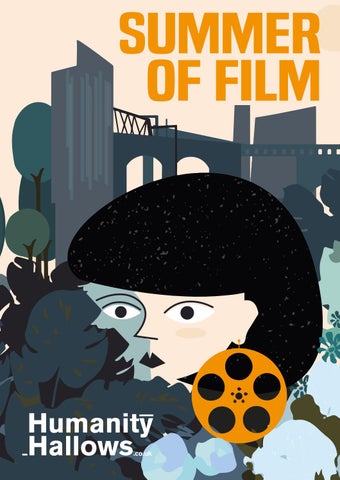
Summer of Film
Humanity Hallows, Manchester Metropolitan University’s official student magazine, is a Student Media project based in the Faculty of Arts and Humanities. For information on upcoming features, advertising opportunities and more. contact: Natalie Carragher (N.Carragher@mmu.ac.uk)
contributors Editor-in-Chief - Jack Holmes Head of Design - Rachel Cook Illustration & Cover - Kamila Kasperowicz Content - Grace Atkinson, Miles Casey, Corey Davies, George Haigh, Mike Hibbert, Jack Holmes, Charlie Jordin, Matthew Richardson and Evelyn Sweeney Editors - Mahdi Azmi, Natalie Carragher, Rachel Cook, Corey Davis, Zac Gardiner, Jacqueline Grima, George Haigh, Charlie Jordin & Shannon Sumner Printed by - MMU Print Services
CONTENTS SOFIA COPPOLA A closer look at the inspiring film director
TELLING TALES Introducting the brand new International Film & Audio Documentary Festival
FIRE HOUSE Interview with Director Keith Myers
MSA FILM FESTIVAL Full coverage from the Festival’s debut at HOME cinema
MANCHESTER FILM CULTURE Manchester’s up-and-coming film culture
TRIPLE SIX FESTIVAL Highlights from AMC cinema’s debut horror film festival
OATS STUDIOS Introducing Neil Blomkamp’s new independant studio
3 7 9 16 27 28 35
SOFIA Coppola Sofia Coppola made history this year, becoming the first women in 56 years to win the prestigious Cannes Best Director Award for her films which can only be described as Masterpieces.
3
A CloSER LOOK This summer, film director Sofia Coppola made history as the first woman since 1961 to win the prestigious Best Director Award at Cannes. Coppola won the award for her latest film The Beguiled, starring Kirsten Dunst, Nicole Kidman, and Colin Farrell. The film focuses on an all-female boarding school during the American Civil War. Coppola’s debut film, The Virgin Suicides, also starred Dunst and after the film was made, Dunst and Coppola continued working together, resulting in an 18year actor/director collaboration. The Virgin Suicides however, remains Coppola’s finest work, and is one of the most significant films of the ‘90s due to its dreamy cinematography and emotionally raw, often uncomfortable, exploration of taboo subjects includins suicide. Coppola’s filmography radiates with a unique femininity that is unfortunately rarely seen in American cinema due to the lack of prominent female directors in Hollywood. Unsurprisingly, her career has been tinged with sexism from the very beginning. Working in the male-dominated world of film, she has repeatedly been a target for unfair criticism. Fellow filmmaker Vincent Gallo once claimed that she “likes any guy who has what she wants. If she wants to be a photographer, she’ll fuck a photographer. If she wants to be a filmmaker, she’ll fuck a filmmaker.” His comments refer to her 9-year marriage to fellow director Spike Jonze. Gallo’s scathing character assassination reflects the treatment of her as a filmmaker and the lack of respect she often receives; it is difficult to imagine the same being said about a male counterpart. However, her work has not escaped controversy.
Coppola’s best-known film, Lost in Translation, was criticised for its depiction of Japanese people and she has been repeatedly lambasted for the lack of diversity in her films. Her latest film, The Beguiled, which is based on the 1966 novel by Thomas P. Cullinan, has been criticised for focusing on ‘rich white women.’ While it is undeniable that all filmmakers should make much more of an effort to embrace diversity, it seems unfair to criticise Coppola alone. The majority of cinema’s most iconic directors – Martin Scorsese, Woody Allen, Stanley Kubrick, Tim Burton for example – all have had mostly white, male casts in their films. Recently, Elizabeth Banks openly criticised Steven Spielberg over the lack of female leads in his films, only to apologise days later. Although, it is surely worth noting that of his 31 films, only three have a female lead. Coppola’s films usually have a female lead, and in contrast, only two of her seven films feature a male lead. The Virgin Suicides is a masterpiece in melancholy. The film follows the lives of the five Lisbon sisters, imprisoned by their highlystrung parents and forbidden to socialise with the opposite gender. The sisters are a source of unrelenting fascination to the neighbourhood boys, who obsess over them, analysing every detail they can find. When the youngest sister commits suicide at the beginning of the film, the remaining sisters’ lives are thrown into disarray. The film has the capacity to resonate with a female audience of any age; the girls’ bedrooms are strikingly feminine and impersonal, their bathroom overflowing with makeup and tampons. These are just some of the details a female director may emphasise that a male director may miss, surely because they will have experienced it themselves. Charlie Jordin
4
The Virgin Suicides is overwhelmingly relatable, which can make it a vexatious watch, whether it is the depression Cecilia feels, which is shrugged off as teen angst or the self-destructive behaviours exhibited by Lux. The cast certainly look the part for the characters they are depicting, which emphasizes the authenticity of the film. The film is also oddly poetic and poignant, highlighted by the visionary cinematography. In one scene, Lux loses her virginity in the school field to the school’s heartthrob Trip. When she wakes up, she is completely alone. Trip explains that he ‘didn’t care how she got home… I liked her a lot. But out there on the field… it was just different then.’ They never see each other again and the scene is reminiscent of many young women’s first heartbreak. She was also left in a scenario that, to many women, would be a nightmare: vulnerable and alone at night. Lux returns home and is met with more hostility, this time from her hysterical parents. She begins to become more promiscuous, sleeping with random men on the roof of her house, perhaps an attempt to find the tenderness Trip didn’t provide. The film ends in tragedy, with many questions left ambiguous, much like the nature of suicide. The boys spent so much time observing and analysing the girls that they no longer see them as people, but as projected images of their desires, perfect in every way. If the girls didn’t have to live up to such rigid expectations of femininity, perhaps the calamity could have been averted. It could be argued that the film glamorises suicide, but this is an issue that will inevitably arise when a film approaches the subject of suicide, being it is such a difficult topic to examine. In retrospect, the film remains one of the most unique and underrated films of both its epoch, and Coppola’s body of work. It is an example of how a feminine approach to filmmaking can result in a masterpiece, transcending the usual ‘chick-flick’ archetypes.
The Virgin Suicides is currently available to watch on Netflix.
“An example of how a feminine approach to filmmaking can result in a masterpiece.�
telling tales Telling Tales, an international film and audio documentary festival held in Manchester at the end of June, brought filmmakers and film-fanatics from all across the world to celebrate the relationship between audio and film.
The Festival’s intrinsic beauty was rooted in how it showcased films from both established professionals and upcoming student filmmakers, allowing future filmmakers to interact and learn from the old guard. Lisa Gold, a Lecturer at Manchester Metropolitan University who organised and supported the event, said: “I couldn’t have been prouder of how the Festival’s first year went. There were so many wonderful films, both film and audio, for attendees to enjoy, I do not know how the judge was able to pick a winner!” “Some of the entries were stunning, the level of entry was very high. I certainly hope the audience enjoyed it as much as I did.” Discussing why audio documentaries, seldom seen in international film events, were included in the festival, Lisa explained that: “Audio documentaries are an important form of documentary. They are often overlooked, so I wanted to give them their rightful place in the festival.”
Natalia Guerrero’s The Silent Wound, winner of the Grand Prize Audio Award, exemplified why audio documentaries were right to be included. The audio-doc investigated the impact of the Columbian civil-war on male soldiers, with a focus on how genital mutilation can leave long-lasting mental repercussions. Demonstrating how documentaries can heavily influence our emotions, A Call From Water Tank 6, which won the Grand Prize Film Award, by Emmi van den Boom and her team, told the story of a South Sudanese business woman and mother, Grace, who was unwillingly forced into a refugee camp. Focusing on a crisis which was overlooked by the mainstream media, the Dutch filmmaker explained the importance of documentaries to international discourse: “We’re just very grateful we got to tell Grace’s story, as there’s no coverage of this in the media at all.” Head to the official Telling Tales Festival website to find out more and how you can get involved when it returns in 2018. Miles Casey
www.telling-tales-festival.com
7
FIRE HOUSE Creative visionary Keith Myers talks about his virtual reality expedition into the iconic London Road Fire, screened at this year’s Manchester School of Art Film Festival.
9
MSA FILM FESTIVAL REVIEW Firstly, could you tell us a little about what Firehouse is about? The film is about the history of London Road Fire Station. It focuses on the firemen and workers at London Road and the community that were there to support the fire station for about 80 years, protecting the Manchester and Greater Manchester areas. How did you come to be involved with this film? I took this project on because I’m specialising in virtual reality, so I was seeking something that would allow me to tell an interactive, immersive story using archive footage. I was invited to apply for this project through Jenny Walker, someone who previously worked at Manchester Metropolitan University. I put forward some ideas about how I could use virtual reality to take the viewer on a journey through the history of the place, which was the starting point. It’s an iconic building in the Manchester area and there’s a lot of work put in by MMU to promote the fire station, but I feel like I’ve done something quite unique here. Would you refer to your work as a documentary then? It’s a film that allows the viewer to learn about the history of the building, so you can select different locations, so I’d say it’s an interactive documentary.
Do you feel like you have a personal connection with the London Road Fire Station? History has always interested me. I think it’s good to tap into the local community, so it’s been an amazing chance to get involved with something which has massive cultural heritage in Manchester. It’s interesting that not a lot of people know about the fire station, which is near Piccadilly train station. If you walk past you’ll notice it’s an enormous Edwardian piece of architecture. When you walk through the doors, you’re suddenly immersed with these old apartments, control rooms and engine houses, which is fantastic. What is it about the Fire Station that interested you to make the film? The fire station itself trained people from all around the world, which makes it so unique. People came from Iraq, Iran, Trinidad and Tobago, Uganda, South Africa, Kuwait- the list just goes on and on. The training service was so good that it was unparalleled, so people went back to their home countries and were seen as important figures. Before Manchester became the metropolis it is today, it was very industrial and no one lived in the city centre, so there were lots of dangerous situations for the firemen. This is a listed building so they’re going to keep the internal structure, but it’s been disused now for 30 years.
10
Did you find producing a film using virtual reality difficult to accomplish in such a busy year?
consider that hundreds of people overseas were coming over here to train for the fire service, they were welcomed in to Manchester.
Filming in virtual reality presents a lot of different challenges. The technology is very new, and because of that, there’s a lot of different editing tools out there that do different things, but not one that does everything, and that’s just in post-production. In terms of making the film, you have to approach VR in a completely different way; you have to think about user experience, how the camera is their eyes and how viewer transitions work.
You’ve been working in the Manchester School or Art with people including Christiane Hitzemann and Loran Dunn. Has this been important for the way you’ve learnt about filmmaking?
Had you worked with virtual reality before Firehouse? I’ve worked projects workedonon projects with the BBC the BBC lastlast summer, which whichtaught taught me aa lotlotabout abouttheir their methodologies andand editing ininVR. alsoalso VR.I’veI’ve worked on project ona aVRVR project for the of of theEuropean EuropeanCity City Science, which was an which was an immersive experience experience through the the scientific scientific history history ofofManchester. Manchester.
I’d say so, yeah. It has provided students with a platform to better themselves, but to have the support of industry professionals helps provide certain advice. They’re both practitioners, which is important. They understand the challenges that people don’t notice, such as things that go wrong, scheduling that doesn’t work, the funding that you can’t raise and the contacts that you can’t make. However, they know how to get around these things and plan it properly. It really gives you the confidence to go out and reach new heights in terms of networking, and it’s a model that the school or art should implement throughout, and maybe this is a precursor that the screen school has planned.
“The message is that any community can work together.”
The film deals with cultural identity and diversity. What would you like people to take away from the film? I think the message is that any community can work together. When people were training together alongside each other, there was no cultural barrier in place to prevent them from working together in protecting this city. So it doesn’t really matter what your background is, Manchester is a place of multicultural identity throughout the services, so when you
Where did you source the archive footage used in the film? Jenny Walker who I mentioned earlier, has been instrumental in allowing me to work on this project. If it wasn’t for her I wouldn’t have had a meeting with the North West Film Archive, who’ve been really supportive as well. The archive material has really enriched this project and has allowed the viewer to understand what life was and to get a visual sense of the training activities and the incidents around Manchester.
11
And finally, with so much attention directed towards Manchester at the moment following the recent tragic events at the Manchester Arena, do you feel as though Firehouse represents the Manchester spirit of a diverse community which stands together? I think recent events have proved that we are in an increasingly fast-moving, politically unstable world and as a society we sometimes feel lost in all of that because of events that are totally beyond our control. Everyone is affected by what has happened in some sort of way, so for me, the film shows that a community really can come together and function to bring about a greater goal. It’s obviously quite a bit different to what has happened recently, but I think comparatively, a lot of the firemen in the film talk about the IRA bombing in 1996, and how the fire station and control rooms were on lockdown. It’s more horrific now than ever, but what was going on at London Road with the firemen gives a beacon of hope for the future. People put themselves at risk and some of these firemen were killed, so I think it shows you how important such a service is to our society. George Haigh
MSA FILM FESTIVAL “When Manchester School of Art (MSA) collaborate to do anything, it’s a pretty safe bet to be a good show, so when the MSA Film Festival screened at HOME, I couldn’t wait to see what was on offer.”
SCREENING ONE - Grace Atkinson
16
“This screening was a brilliant display of talent, and the level of skill and creativity was absolute. Keep an eye out for these names, it won’t be the last you see of them!”
Lets Not Cry Over Spilt Milk
Inseminate
Harry Longstaff and his crew’s short film Let’s Not Cry Over Spilt Milk, is a great example of how a well-chosen title can lift a film into all sorts of dimensions. The opening shot of a hanging man, legs dangling just into view, brought out laughs amongst the audience. This dark humour continues, and the hanging dad becomes a feature of the house, trousers around his ankles, after all ‘he’s not going anywhere’. This humour is spiked with long and, at points, laborious dialogues about hindsight and David Foster Wallace’s Infinite Jest, which, between tryingly philosophical and cleverly touching – ‘he was a spilt man’. This is a film balance between a very real human experience and a post-modern selfconscious take on its own art form, tied together with a quintessential British sense of humour.
The opening scene of Inseminate gives the audience a sense of what is to follow. Here, the protagonist is whipping her lover, what we quickly gather to be an affair. It’s a story of a woman’s abandonment by her lover, who pays her for sex, and her attempt to regain control and security from him. The title of Ryan McNulty’s film describes an unapologetically graphic scene, where the protagonist ‘steals’ and ‘inseminates’ herself with the semen of her sleeping lover. At this point, the young girls in front of me shielded their eyes, embarrassed. I personally liked the unflinchingly long and bold scenes in this film, and found that it opened an interesting question of power, of right and wrong and of female subjectivity.
17
Eden
Drifting Away
Callum Latimer’s Eden depicts a man’s journey through the wilderness of the River Eden. The title does not only name the river, but enters a conversation about beginnings and the internal journey of the protagonist. The film depicts a hunt for meaning during what seems an existential crisis - ‘do you just watch as time washes by?’ Voice-overs of poetry and literary meditations provide a sense of the protagonist’s internal struggle. Long shots of the multiple landscapes of his journey give a beautiful sense of time, and provides space for the audience’s contemplation. The marriage between natural landscape and internal growth is done seamlessly and without cliché.
Set in 1954, Aynoa Alvarez Wautiez’s Drifting Away is a touching tale of two pen pals, one in the UK and the other in Algeria. The two exchange gifts and letters, until the break out of the Algerian war. These shots between England and Algeria are impressively constructed and the attention to detail made for a convincing setting. One connection I found beautifully subtle was woodwork - the boy sending a hand carved toy as a gift to England, and the girl, now an adult, shown carving wood in her workshop. After years of estrangement, the two are re-united in England, both with their own lives and families. This film was a touching end to the screening and a beautiful tale of unity.
18
“I’ve always loved a short film for two reasons: first, because the chosen subject often needs to make a quick and lasting impression, and therefore makes for an enjoyable watch. Secondly, because the ways in which this said impression is made has to involve a level of creativity in order to work within its limited time frame.”
The Service
Times Up
The second MSA Film Festival screening opened with The Service, directed by Annabelle Marshal. Set in the future, it tells the story of James and the quest into his own memory. The concept is reminiscent of Charlie Brookers Black Mirror, as James visits an uncomfortably sterile clinic in order to re-visit the virtual reality of his own memories. ‘Has he had the detachment?’ the doctor asks, and I began to wonder if the film wanted to make us aware our own detachments from reality in modern society. This was a very haunting and dark story and the visuals were gritty, tight, and real, which made for an incredibly gripping film.
In Time’s Up, Karim Al-haj Ali takes a classic tale of death-comes-to-visit and transforms it into a poignant film about the comatose nature of contemporary living. The protagonist, bored in a vacant life between his dingy house and his ‘empty’ bar, befriends death, depicted as a haunting man in a black suit. The shots are sharp and overlapping, and the dialogue is fractured, repetitive, and contradictory (‘How to remember. I can’t remember. I remember’). The light piano (Chopin, Nocturnes Op. 9) creates a sense of philosophical sophistication. The simple concept was well executed, resulting in a thoughtful and entertaining short film.
Carl Austen-Behan
Mirage
Carl Austen-Behan directed by Jacob Buffet gives a beautifully intimate insight into the Lord Mayor’s life. In this interview, he tells us of his dismissal from the RAF due to his sexuality, which Austen-Behan regards as an early passion of his. Years later in 2002, he was approached by the RAF as Lord Mayor, asked for advise on ways to introduce the LGBT community into the RAF. A beautifully circular example of how society has ‘come a long way in 20 years’. The notion of progress is a resolute depiction made from the film, especially about Manchester. The mayor celebrates the LGBT community’s growth and acceptance over time, and the ‘collaborative’ nature of Manchester in which he is so proud of.
Nathan Islam’s Mirage is a deeply dark and brilliantly artistic film about women and their demons presented through Chloe, held hostage in a grotty basement. The opening shot introduces the key aspect to the film, Chloe’s obsessive creation of small, shapeless sculptures. The sound of Chloe’s fingers moulding the clay is heightened, hyper-sensuous and eerie. The film gets darker, when Chloe dresses herself up and sits on the bed, while projections of hands grab and faces lick in squeamishly crisp and carnal audio. The image of young girls with dolls is a brilliant gateway into a more general conversation of female captivity amongst the every-day. Her freedom is a courageous moment of strength and bravery, a step into a free identity.
19
MSA Film FESTIVAL “The shorts shown at the second screening of the Manchester School of Art Film Festival were phenomenal and revealed the immense talent and potential of Manchester Met filmmakers. Keep an eye out for these filmmakers in the future.�
SCREENING two - evelyn sweeney
20`
The keeper The Keeper begins with an elderly man, Alfred, who imagines stories as a method of dealing with stress for the passing of, what we can only assume is a friend or family member. Directed by Antony Morris, it’s a short film that gives the audience very little in terms of structure and which opens up the narrative for the audience to interpret. Combined with James Johnson’s outstanding visuals, a captivating soundtrack and impressive acting, it certainly set the bar high as it showcased the school’s raw talent.
msa short film REVIEWs I am flesh
Lizzie’s Law
Out of the 10 shorts, I Am Flesh had the most captivating narrative. Directed by Jack Silverwood, this sci-fi film follows the story of a human clone, Leika. It questions how far humanity will go and does so incredibly on such a small budget, with its fantastic sets and props looking immensely realistic. Receiving awards for Best Screenplay, Best Camera Operation and Best Sound, it’s safe to say that the awards were well deserved.
Directed by Sophie Ibbotson, Lizzie’s Law covers the difficult subject of sexual assault from an interesting perspective that isn’t often explored. It provides an outsider’s look into the events that unfolded and shows how Lizzie exacts her own justice despite the victim not wanting to prosecute. It’s a film that can make the audience feel uneasy at times but this is very clearly the intention of the film and allows the viewer to question the crime and the very real justice system that the film portrays.
molly and lexi’s multiverse odyssey This fun-filled short follows Molly the Cat and Lexi the Dog as they’re doing their basic chores before they’re suddenly sucked into a different dimension and find themselves under the control of higher beings. Although it focuses on the themes of chaos, animator and writer Matthew Richardson still leaves room for humorous moments, getting quite a few laughs out of the audience. Paired with the adorable origami style and Zac Gardiner’s sound design, the whole viewing was a delightful watch.
time for tea The surrealist short film Time for Tea is directed by Toby Garside. The audience meets Eleanor as she finds herself trapped in a strange place surrounded by a bunch of bizarre characters. With a great twist, the audience witnesses her attempt to escape. With fantastic acting, costumes, lighting and settings, it’s an incredibly theatrical piece. Although it is a film centred around madness, it highlights many critical social issues, with the Capitalist and Communist pigs being a key highlight.
the last word
ever after
The Last Word is a psychological drama following a couple as they deal with the issues involved in a modern relationship. Alex Moore took the opportunity to truly develop a narrative by focussing on the characters’ flaws more so than their actions, providing the audience with more of a greater understanding of the plot. Callum Kilgarriff’s sound design was also a noteworthy aspect of the film.
This is a sweet tale of a strained relationship between a mother and daughter as they learn to understand each other. We follow Ruby after the recent passing of her father as she recounts the stories he would read to her. The realistic family drama is directed by Sophie Ibbotson and explores the themes that, unlike in the fairy tales, no-one is purely good or evil; everyone has a bit of both in them.
23
msa short film REVIEWs
gaia Joel Porter’s combination of spoken word and wonderful visuals aim to impact the audience and encourage them to consider the four elements and the effect mankind has on the planet. The film was nominated for 8 awards and won 3 (Alumni Award, Best Cinematography and Best Editing) and it’s clear to see why. If this is what we can expect from Porter’s career then it’s clear he’s going to go far.
verbalize Directed by Danny Brown, Verbalize follows the story of John as he awakens in a dark living room, unaware of why he is there. His fragmented memories and surroundings lead him to believe that he is either stuck in a virtual reality or experiencing an unusual LSD trip. Supported by a man known as “The Overseer”, John must figure out why he is trapped in this room and how he can escape. A fascinating concept, the film continues to surprise and entice the audience throughout. Director of Photography Toby Garside fuels the film with stunning camerawork supported by the setting and the rest of the crew’s great work.
the fleece, the tie and clarke Jordan Simpson’s The Fleece, The Tie and Clarke shows two men conducting an interview alongside an impatient and ruthless barista. The acting in this short is spectacular, the script is intense and Porter’s skilful cinematography shines through again. The structure and pace of this film is remarkable and its ability to convey a gripping tale in such a short amount of time is highly commendable.
25
OUT NOW
By Students. For Students. Pick up your copy on campus or read online. Interested in getting involved? Visit www.humanityhallows.co.uk/work-with-us
FILM culture George Haigh
As Manchester continues to cement its status as the cultural hub of the North West, the city appears to be have flourished into something that’s moving swiftly out of the shadow of London. Look no further than organisations such as HOME, or events such as the Manchester International Festival, that both work endlessly to provide increasingly accessible culture. The key word here is accessible, as communities impacted by austerity find themselves with even less disposable income, which of course, has an impact on film, theatre, and the arts. Recently, it was announced that the Odeon cinema located in the Printworks building would be closing down, and subsequently rebranded as part of Vue cinemas. Shortly after, the Manchester Evening News revealed that Odeon would remain in the city centre, poised to take over the indigenous multiplex AMC cinemas in the Great Northern warehouse. While all of this may initially seem unrelated to the accessibility of culture in Manchester, there is cause for concern in how audiences are
having to reach further into their pockets as a means of going to their local cinema. Whilst the AMC doesn’t offer as much diverse content as neighbouring HOME does, the price of a £7.50 adult ticket is still cheaper than Vue, who charge £8.99 for their screenings. While HOME is the most expensive at £9 for adults, their £5 subsidised student tickets and consistent range of alternative and independent cinema appeals to a wider demographic of people in Manchester. There’s certainly nothing wrong with having more commercial, blockbuster films being the selling point of multiplexes, and there’s something inherently escapist about films such as Spiderman: Homecoming or War of the Planet of the Apes, two of summer’s biggest movies. The point, however, is that in a democratic society, culture is paramount to bringing people together. Sure, streaming services allow people to access this with a click of a button, but making going to the cinema more expensive hardly feels like we’re heading in the right direction.
27
triple six Highlights from this year’s debut Horror festival, Triple Six, hosted by ‘UK Horror Scene’ and ‘Slaughtered Bird’ and screened at AMC Cinemas.
28
quarries - charlie jordin The first feature film of the festival, Quarries, is a female-dominated thriller following a group of women on a tumultuous hike as they are stalked by a group of red-necks. Directed and co-written by Nils Taylor and starring Nicole Marie Johnson, who also co-wrote the film, Quarries takes place in an American backwater in a popular hiking spot. Reminiscent of the eerie atmosphere in True Detective, Kat, the main character, is covered in bruises from her abusive exboyfriend and is taking part in the challenging hike to find peace of mind. Each of the female characters also joined the journey to escape some sort of personal demon, ranging from a prescription pill addiction to relationship
issues. The well-rounded female characters are definitely a highlight; unfortunately, it is a rarity to see a group of women in the horror genre who aren’t highly sexualised or victimised. The film is a good example of how modern horror has shifted from supernatural monsters to more believable antagonists. For example, one of the stalkers and main antagonists is Kat’s abusive ex-boyfriend. There are moments in the film however that feel disjointed: the sweeping shots of rural America feel confused and out of place with the violent action scenes. Nonetheless, it is a refreshing take on the usually male-dominated thriller genre and is an exciting watch that will keep your attention from start to finish.
29
rats - corey davies The screening of short film, Rats began with opening words by some of the films crew, and their passion is unsurprising, it’s a herculean effort to make a high quality short film and they’re often a passion project for the people behind them. At a run time of fifteen minutes Rats is towards the longer end of short films on the festival circuit, but still packs a lot of classic horror into that time; as soon as it starts it puts the viewer on edge, building tension expertly throughout. Viewers may find themselves gripped by some heart-in-throat moments as if something is coming into the theatre with them, the film making every slight movement, even off the screen, feel ominous and threatening. There are rumours director, Mark Logan, wanted to make an anthology out of the series, and it shows. There’s an almost staggering amount of exposition in a very short space of time. There’s also some superfluous story with the protagonist’s wife (Jessica Messenger), that the film could have lost without suffering, it may even have given the film a slightly tighter storyline. Messenger and Nicholas Vince (playing the protagonist), both give solid performances that perhaps deserved the shorts focus, rather than watering
down both parts to squeeze everything in. One other issue faced by Rats was the potential to go in a different direction with how their monster was shot. The special effects creating the eldritch horror were admirable, and led to a couple of solid jump-scares. But jump-scares don’t require a clear view of the monster to work. The single most unsettling moment in the film was Vince opening the door to see something in the room: an out of focus, humanoid creature; but clearly not human in a very subtle way. Most importantly, this shot made the monster infinitely scarier than it was once there was a clear view of it. Logan, builds some seriously Lovecraftian vibes; making use of Lovecraft’s standard tropes: a knowledge seeker new to the location (Vince); a knowledgeable local with thinly veiled supernatural connections (Laurence R. Harvey); a set that was both old and unsettling (shooting on set at Warwick Castle); and an ancient horror. This gave the film a classic feel, and since Lovecraft hasn’t had much film exploration in recent years, it also felt new, making the film an overall success, despite one or two missteps that can be put down to nothing more than aiming high.
The unkindness of ravens - jack holmes
Triple shown us us some Triple Six SixFestival Festivalhas has shown some real gems, but TheThe Unkindness of Ravens real gems, but Unkindness of blend of blend psychological horror and horror gory, Ravens of psychological hallucination-filled storyline wasstoryline a and gory, hallucination-filled particular stand out. was a particular stand out. The film is directed by Scottish indie filmmaker Lawrie Brewster, who’s on hand to introduce the film along with lead actor Jamie Scott Gordon. Brewster and Gordon have created a gripping horror that works as an “exploration of an exsoldier coming to terms with what happened to him back in his time in the army” that often feels like the greatest hits of psychological horror. The film splits into two distinct styles between its first and second halves: the first is very much a psychological horror; with the second half closer to Hellraiser, with some gory torture scenes to match. In the director’s own words “From the middle point it goes really fucking mental”, which is certainly true. We’re talking large desert landscapes with ancient towering landmarks. It includes “tortured souls” trapped as slaves to an army of ‘entities’, that may well
all be vivid hallucinations of the protagonist’s broken mental state. It’s the film’s early, eerier scenes that stayed with me after the screening, rather than the gore of the movie’s second half, and the film covering such different aspects of horror will attract as many viewers as it may put off. One wide shot of the moorland gives us our first real look at our ‘monster’ in all its horrifying glory, matching its slow advancement with the relenting sound of a whistle played throughout. These tense shots are particularly harrowing, and they’re the main source of terror in the film’s first half. The design of The Unkindness of Ravens creatures is an impressive feat: a mixture of a seventeenth/eighteenth century plague doctor and a medieval knight. In fact, the practical effects throughout the film are brilliantly realistic. The same sadly can’t be said for scenes in which the film mixes its real world setting with CGI, which was the only real time I felt detached from the movie’s world. Scenes set entirely in a CGI setting worked fine, although, by the point in the film where they’re primarily
31
used, the film focuses more on a sense of wonder, than fear, and making the scenes feel realistic is less important to its narrative. Aside from Brewster as director, Jamie Scott Gordon is a draw in himself. Starting strong, the actor dominates the screen wonderfully after coming face to face with his doppelganger. His performance genuinely makes you care for the truly awful situations we see his character meet with, and as his doppelganger, he’s often as eerie as the film’s more monstrous non-human horrors. That is if the doppelganger is human at all, or even real.
particular scenes, something which separates the first and second halves of the movie, which I interpreted as symbolic of his constant struggle to overcome the events the character had witnessed, which could never just be cured, merely dealt with, for the rest of his life. Other viewers may take the scene at its face value. Either way, The Unkindness of Ravens was one of the most impressive films screened at Triple Six Festival. Not only is it an enjoyable watch while you’re sitting in the cinema, but it also stays with you, and has you dissect what you’ve seen. Where other films are happy to entertain you for a matter of hours, The Unkindness of Ravens manages to do so for several days. Triple Six Festival has shown us some real gems, but The Unkindness of Ravens blend of psychological horror and gory, hallucinationfilled storyline was a particular stand out.
“one of the most impressive films I had the pleasure of catching”
If you can’t tell, I’m still deciding just what each scene in The Unkindness of Ravens actually stands for. It’s a fun side to the viewing experience, as you spend your time deciding whether the entire film takes place in a mentally ill man’s psyche, or if there really is a horde of terrifying transforming creatures coming to claim his soul. It also extends to
Tone Death
- Matthew richardson
Perfectly sandwiched in between two very dark and serious films is the more light-hearted Tone Death. This horror comedy follows a wannabe techno-music producer in his mid-40s (Roger Armstrong), who believes he has developed a sound that will take human consciousness “out of their body to the next level”. He begins to test his theory using a homemade booth on unsuspecting subjects, with the help of his best friend, (John Hickman) leading to deadly consequences. Tone Death is a horror comedy mockumentary that has its tongue firmly in cheek, while at its heart poses a simple question: What extremes would you go to for something you believed in? The majority of the film is seen through the lens of a documentary filmmaker who is hired to document Roger’s making of an album. As events unfold, the story becomes about a modern day, techno fanatical Geordie Frankenstein, in which a man’s unhinged dedication to creating the perfect musical frequency to release human consciousness becomes sinister and deadly. As Roger’s unsteadiness develops, so too does his agitation with John, who acts as the Igor of the film. The best laughs in the film come
from John and Roger’s interactions, which feel natural and authentic, with John being the Ying to Roger’s Yang until the climax, where the viewer starts to see deterioration in their friendship. The supporting cast themselves serve as plot points in the story and don’t particularly stand out, with the exception being a hilarious drunk (played by the film’s special effects artist Stephen Robertson), who almost steals the show in the few scenes he is in. Talented camera work and editing in the film must also be complemented, as it overcomes the more logistical and financial barriers that often impact low-budget indie horror. Effective editing techniques include a glitch effect when Roger’s audio frequencies reach their maximum intensity, and after a cut to black, the result is revealed. This gets across how dangerous Roger’s sound is to the viewer with great impact and little cost.
Tone Death is a comical watch; the audience were constantly laughing and engaged with the story. I also recommend this for aspiring filmmakers looking for original stories made on a small budget and for the viewers who appreciate dark humour and the mash-up of genres.
33
oats studios Oats Studios, it seems, is an experimental sci-fi anthology, free from the stifling nature of big budget studio interference and the shackling nature of their focus on franchises and sequels. Mike Hibbert
35
When Ridley Scott decided to take back the reins of his Alien franchise and helm Alien: Covenant, the news was met with varying degrees of enthusiasm. Although some were delighted to have the director of the original masterpiece back on board, others (correctly) pre-empted a George Lucas-esque self-sabotage by a man who has no idea what made his original creation great. Others were disappointed because Ridley’s return meant that the long-rumoured Alien 5, directed by Neil Blomkamp (District 9, Elysium, Chappie) was officially dead in the water. There is, however, a silver lining to Blomkamp’s dismissal: Oats Studios. Blomkamp’s Alien sequel, ditched for another Alien prequel/ Prometheus sequel, was apparently green-lit in 2015, although Scott more recently said that there was never actually a script, only a pitch from Blomkamp. It seems that Blomkamp, lauded for his South African based, postcolonial sci-fi social commentaries, had jumped the gun when he shared on Instagram a piece of Alien concept art with the caption: ‘Um … So I think it’s officially my next film. #alien.’ He was also reported as having secured Sigourney Weaver, who would be returning as the iconic Ellen Ripley. “Speaking to Sigourney Weaver, when we were doing Chappie, she set off a bunch of thoughts in my head — I had come up with an idea that didn’t have Sigourney, it was a different idea… I spent all of the shooting time with her, it was like, holy shit, that could actually be really interesting… I basically developed an entire movie and I did all of this artwork as well.’ On the 11th November last year, Oats Studios YouTube
channel posted a couple of shorts, around ten to fifteen seconds each, which seemed to mock the idea of the then campaigning current President of the United States, Donald Trump. The channel then went quiet until recently, when the first of a couple of teaser trailers were posted. Then came Rakka, the twenty-two-minute short film that was being teased. Blomkamp’s breakout hit of 2009, District 9, was based on the six minute short, Alive in Joburg, which garnered attention online and led to a feature-length film. The hope is that Oats Studios will allow for shorts and ideas to develop and be picked up for feature films down the line, in a similar fashion to District 9. Blomkamp described it as “How do I create these smaller vignettes of ideas that I just feel like expressing that are unconnected and untethered to discussions that I find really uncreative, about audience testing and sitting in theatres in Southern California waiting to get your scorecard back.” your scorecard Blomkamp went on to describe how Oats intends to take advantage of its residence on YouTube and the interactive creator/audience relationship. How this will manifest, we will have to wait and see. Blomkamp has also claimed that, sound files, 3D models and other materials from Oats Studio’s output will be made accessible to fans to then create their own films and projects. Rakka has Blomkamp’s signature style written all over it. Alien invaders have taken over Earth and rather than being segregated into ghettos like the Prawns from District 9, the occupying aliens prevail in destroying and subjugating the human race.
36
Once the scene is set the short introduces Nosh and Amir. Nosh is a pyromaniac, an outcast in the old world but a necessity in the new. He has become essential in aiding earth’s guerrilla forces in taking on their oppressors. Amir, on the other hand, is a failed experiment, tossed aside by the invaders after being cruelly augmented. He must also use his new powers to find a calling within the resistance. Blomkamp’s trademark allegories are on show as well his eye for brilliant sci-fi effects, both practical and CGI: a clear indicator of what is to be expected from Oats Studios. We’ll never see Neil Blomkamp’s Alien 5, which is a shame because what we got instead was a forgettable mess. However, the concept of Oats Studios is far more exciting than another instalment of a franchise that hasn’t been interesting since 1986. How Oats Studios will make enough money online to sustain itself is a mystery, but any attempt to develop and take advantage of new platforms in filmmaking is commendable and exciting. Hopefully, this anthology will have measurable effects on the film industry.
All rights reserved. No part of this publication may be reproduced in whole or in part without the explicit permission of the publisher. The views and opinions expressed within this publication do not necessarily represent the views or opinions of Manchester Metropolitan University. Email: HumanityHallows.Editor@gmail.com Telephone: 0161 247 1951 Address: Humanity Hallows, Manchester Metropolitan University, 212 Geoffrey Manton Building, Manchester, M15 6LL