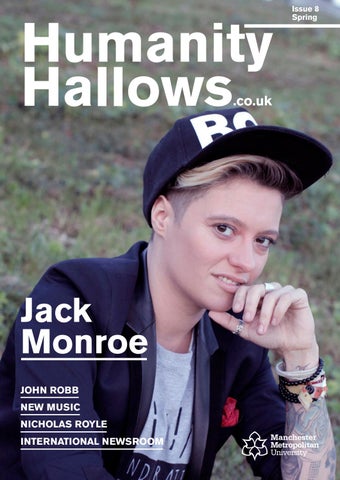
Humanity Hallows .co.uk
Jack Monroe JOHN ROBB NEW MUSIC NICHOLAS ROYLE INTERNATIONAL NEWSROOM
Issue 8 Spring
BOOK NOW: 0161 832 1111 MANCHESTERACADEMY.NET METROPOLIS X TOGETHER FRIDAY 26TH JANUARY MANCHESTER ACADEMY
KING NO-ONE
WILEY
SATURDAY 17TH MARCH ACADEMY 2
WEDNESDAY 21ST FEBRUARY ACADEMY 2
MÖNGÖL HÖRDE
SATURDAY 27TH JANUARY MANCHESTER ACADEMY
JAMIE LENMAN
SATURDAY 3RD FEBRUARY ACADEMY 3
TUESDAY 17TH APRIL ACADEMY 2
TRIVIUM
FRIDAY 26TH JANUARY ACADEMY 2
STEVE AOKI
UGLY KID JOE
FRIDAY 20TH APRIL MANCHESTER ACADEMY
KING GIZZARD AND THE LIZARD WIZARD
THE FRATELLIS
THURSDAY 22ND FEBRUARY / MCR ACADEMY
FRIDAY 23RD MARCH MANCHESTER ACADEMY
MOOSE BLOOD
THE MAGIC GANG
SALAD
DAMAGE
LARKINS
SATURDAY 3RD MARCH MANCHESTER ACADEMY
WILKINSON DJ SET FT. MC AD-APT
FRIDAY 23RD MARCH ACADEMY 2
FRIDAY 23RD MARCH CLUB ACADEMY
SATURDAY 3RD FEBRUARY / ACADEMY 2
HOPSIN
TUESDAY 6TH MARCH ACADEMY 2
RAT BOY
SATURDAY 21ST APRIL ACADEMY 2
PHOENIX
SUNDAY 25TH MARCH MANCHESTER ACADEMY
NO HOT ASHES
FRIDAY 9TH FEBRUARY MANCHESTER ACADEMY
SATURDAY 21ST APRIL ACADEMY 3
SATURDAY 31ST MARCH ACADEMY 2
SKINDRED
SUNDAY 22ND APRIL MANCHESTER ACADEMY
THE SMITHS LTD
DON BROCO
TURBOWOLF
METROPOLIS X RELAPSE
AS IT IS
DECLAN MCKENNA
YO LA TENGO
LEWIS CAPALDI
FEEDER
MISTERWIVES
ADORE DELANO
THE DEAD DAISIES
MACHINE HEAD
FRIDAY 16TH FEBRUARY MANCHESTER ACADEMY
FRIDAY 16TH FEBRUARY ACADEMY VENUES
FRIDAY 16TH FEBRUARY CLUB ACADEMY
SATURDAY 28TH APRIL ACADEMY 3
FRIDAY 9TH MARCH ACADEMY 3
SATURDAY 10TH MARCH ACADEMY 2
SATURDAY 10TH MARCH MANCHESTER ACADEMY
FRIDAY 6TH APRIL MANCHESTER ACADEMY
SATURDAY 7TH APRIL ACADEMY 3
THURSDAY 12TH APRIL ACADEMY 2
KELELA
SUNDAY 18TH FEBRUARY ACADEMY 2
RUSS
MONDAY 12TH MARCH MANCHESTER ACADEMY
facebook.com/manchesteracademy
PLASTIC HOUSE
SATURDAY 17TH MARCH ACADEMY 3 @mancacademy
FRIDAY 25TH & SATURDAY 26TH MAY MANCHESTER ACADEMY
FRIDAY 13TH APRIL CLUB ACADEMY
MO GILLIGAN: THE COMEDIAN
THURSDAY 15TH MARCH ACADEMY 2
MONDAY 19TH FEBRUARY ACADEMY 2
THURSDAY 10TH MAY MANCHESTER ACADEMY
LITTLE COMETS
DVSN ALVVAYS
MONDAY 30TH APRIL ACADEMY 2
SATURDAY 9TH JUNE / MCR ACADEMY
LOTTO BOYZZ
SATURDAY 14TH APRIL ACADEMY 2
FAT FREDDY’S DROP SATURDAY 3RD NOVEMBER MANCHESTER ACADEMY
FOR UP TO DATE LISTINGS OR TO subscribe to our mailing list visit MANCHESTERACADEMY.NET
Humanity Hallows
w
.co.uk elcome to Humanity Hallows, Manchester Metropolitan University's official student magazine.
This issue is packed with great articles, features and interviews, all produced, written and designed by Manchester Met students. As well as our brilliant cover interview with food writer and campaigner against poverty Jack Monroe, we have an interview with music journalist and The Membranes vocalist John Robb, a feature on the ever-popular 'My Favorite Murder' podcast and a guide to all the great places to eat and drink in Manchester’s very own Northern Quarter. We're also bringing back your regular favourites including our book corner, film previews and student recommendations of quirky and exciting places our vibrant city has to offer... If you're a Manchester Met student looking to get involved in a new project this year, we are looking for writers, illustrators, filmmakers, photographers, designers on an ongoing basis to help make Humanity Hallows an informed, inspiring and opinionated collection of student voices and talents that make our city brilliant. All current students and alumni are invited to get involved. For more information turn to page 43. JACQUELINE GRIMA STUDENT EDITOR-IN-CHIEF Humanity Hallows, Manchester Metropolitan University's official student magazine, is a Student Media Office project based in the Faculty of Arts and Humanities. For information on upcoming features, advertising opportunities and more, contact: N.Carragher@mmu.ac.uk NATALIE CARRAGHER STUDENT MEDIA OFFICER
/HumanityHallows
@HumanityHallows
@HumanityHallows
STUDENT EDITOR-IN-CHIEF JACQUELINE GRIMA STUDENT MEDIA OFFICER NATALIE CARRAGHER PRINT EDITORIAL ZAHRA ARSHAD, GRACE ATKINSON, JESSICA AURIE, LEXI BICKELL, CAMPBELL BISHOP, TIFFANY BOWMAN, ALEX BUTLER, NATALIE CARRAGHER, BENJAMIN CASSIDY, PIERANGELLY DEL RIO MARTINEZ, JACQUELINE GRIMA, NEIL HARRISON, KIERAN HEPWORTH, CASS HYDE, DARRAGH KEMPSON, DAVID KEYWORTH, LUCILLE MAZEL, EMILY OLDFIELD, SIMONE RICHARDSON, MIRIAM SABBAH, SHANNEN SEABY, MELIZA SESTITO, SIMRAN KAUR TAKHI, NADIA TIRA ILLUSTRATION CATHERINE PLAYER, ROWAN THORP, LE HA THU DESIGN NATALIE CARRAGHER, SEAN O'MAHONEY, NICK STONE, ROSALIE WOOD COVER PHOTOGRAPH FOX FISHER
Shot of the Issue Photography Competition Winner: Ben Macwhinnie Runner up: [Left] Ellie Walmsley Runner up: [Right] Edgar Scukins To get involved and be in with the chance of winning a ÂŁ100 voucher, tag us in your images of our beautiful city on Twitter or Instagram using @HumanityHallows #HumanityHallowsMCR and email HumanityHallows.Editor@gmail.com. A shortlist will be announced via social media, with selected images put to a social media vote. The winner will be announced in the next issue of Humanity Hallows, out April 2018. This competition is open to Manchester Metropolitan University students only. Closing date 6 April, 2018. For full terms and conditions visit www.humanityhallows.co.uk
Humanity Hallows
.co.uk
Issue 8, Spring 2018 Email: HumanityHallows.Editor@gmail.com Telephone: 0161 247 1951 Address: Humanity Hallows, Manchester Metropolitan University, Geoffrey Manton Building, M15 6LL Humanity Hallows is distributing 5,000 copies at Manchester Metropolitan University campus and across Manchester. Advertise with us A wide range of advertising packages and affordable ways to promote your business are available. Get in touch to find out more. All rights reserved. No part of this publication may be reproduced in whole or in part without the explicit permission of the publisher. The views and opinions expressed within this publication do not necessarily represent the views or opinions of Manchester Metropolitan University.
6
Northern Quarter: Not so hidden gems you need to check out.
10
Fake News: Jack Monroe leads the fight against fake news.
13
MCR Spotlight: Introducing a spot of class.
14
Interview: John Robb
17
Introducing: The Dealer App
18
'My Favorite Murder': We take a closer look at the fans of everyone's fave true crime podcast.
20
We speak producer/director Louise Malkinson
22
Dragging Politics Out: Donna Trump and Eva Serration tell us about Manchester’s Queer culture
PHOTOGRAPH: MEL BUTLER
Contents
26 We meet the students studying abroad 28
Manchester meets the Netherlands in this year's International Newsroom
31
Hidden Histories
32
Interview: Nicholas Royle
PHOTOGRAPH: FOX FISHER
24 Music: Unmissable acts heading to Manchester this spring
34 Sci-fidelity: Bluedot Festival returns to the North West 35
Book Corner
35
In Cinemas
36
5 minutes with... Andy Harmon
37
A student guide to... final year
39
Fashion: On screen icons
40
Creative Collaboration: A Light In The Darkness
42
Comment: We need to talk about the influence of social media
43
Get involved: Join the Humanity Hallows team
PHOTOGRAPH: LEE BAXTER
38 Wellbeing: 5 natural remedies for spring
Unique Places to Explore in Manchester's Magnificent Northern Quarter Between Piccadilly Gardens and Ancoats, not far from the Arndale Centre and Shudehill, is Manchester’s Northern Quarter an area alive with art, culture, independent traders and, of course, some of the liveliest cafÊs and bars in the city. We have compiled a list of the most student-friendly, quirky and exciting venues this vibrant area has to offer.
PHOTOGRAPH: NEIL HARRISON
WORDS & ILLUSTRATION: SEAN O'MAHONEY
FOOD & DRINK Manchester's Northern Quarter is home to some of the best places to grab a cuppa and a snack. Here are a few places that offer something a bit different from your usual greasy spoon...
Foundation Coffee House
Ziferblat
One of the NQ’s larger venues, this is the perfect place for a special occasion. It has a great space to hire and friendly staff which give this place a personal atmosphere.
At Ziferblat, all you pay for is the time. At 8p per minute, everything else is free. You can eat and drink as much as you want (within reason). With dozens of teas, cakes and delicious bagels to chose from, this place is definitely worth a try, especially with a 23% student discount.
Rating: 3/5
Porter + Cole
Chapter One
A quirky combination of coffee lounge, bar and lifestyle store, Poerter + Cole is situated across from the Holiday Inn Express. It's worth a visit just for their delicious collection of indulgent cakes.
A café and bookshop where you can while away the hours reading, drinking tea and coffee or treating yourself to a slice of cake. With its amazing atmosphere and hipster vibe, this is a place that everyone should try at least once.’
Rating: 3/5
Rating: 5/5
Rating: 3/5
Cat Café Located between Porter + Cole and Zifferblat, is Manchester's Cat Café. Here you pay £6 for half an hour (with a 10% student discount) surrounded by a clowder of cats. This price includes unlimited hot and cold drinks. Each cat also has their own profile on the ‘Cat Café’ website and the venue hosts movie nights for £15. Every cat lover’s dream. Rating: 3/5
SOMETHING STRONGER If you're looking for something a little stronger than tea and coffee, the NQ has lots to offer. Twenty Twenty Two Twenty Twenty Two offers great cocktails, a game of ping-pong and beautiful graffiti. What more could you ask for? Rating: 4/5
Dive NQ Located next to the well-known Afflecks, Dive NQ is the place for cocktails, food and sports and is also available for private hire. A chilled subterranean club with a great atmosphere.
Lost in Tokyo This bar would have the crowds walking straight past with little notice. But those who do venture down the small stairs will find a cool venue offering drinks with an oriental theme. Perfect for anyone who likes all things Japanese. Rating: 4/5
Pen & Pencil Open during the day for great reasonably-priced food, Pen & Pencil also hosts club nights on a Friday and Saturday. Great for indulging in a cocktail with friends. The brick and wood interior offers a real Northern Quarter atmosphere. Rating: 3/5
Rating: 3/5
The Millstone Unlike the other bars on this list, this is a Traditional British pub. Nothing special, right? Wrong! The Millstone is also a hotel (‘Little Northern Hotel’) with 15 rooms. Rating: 2/5
SHOPPING The Northern Quarter is well-known for its hipster vibe and quirky shops filled with vintage clothes, art and culture galore on offer.
windows. Inside you'll stumble across a quirky display cabinet offering an array of trinkets and, if you are very lucky, high quality finds. Rating: 3/5
Bags of Flavour
Fred Aldous This multi-story building is packed with everything an artist might need for painting, drawing, craft, jewellery making, modelling, woodcraft and more. The best part is that they offer a 10% student discount.
Not a place to easily stumble upon, Bags of Flavour is located next to a small block of houses opposite the Manchester Craft and Design Centre. As the name suggests, the place does sell bags, clothing, shoes and a random assortment of other collectables.
Rating: 2/5
Rating: 4/5
Real Camera Co.
Afflecks
A place for photography fans. Not only do Real Camera Co have reasonably-priced modern DSLR bodies and lenses, but they also hsve a wide variety of vintage lenses.
Next up is the legendary Afflecks; a forever changing, four-floor building filled to the brim with merchants. Catering for the needs of just about everyone, Afflecks offers clothes, badges, jewellery, fancy dress, crystals, vinyls, collectables and so much more. If you have not been to the NQ before, this is the first place to check out.
Rating: 3/5
RSPCA
Rating: 5/5
Just next to the Manchester Craft and Design Centre, this small charity shop is one of two located within the NQ. If you are looking for something unique or retro, vintage dresses are often displayed in the front
MUSIC As vinyl makes a massive comeback, the Northern Quarter is the ideal place to go shopping for your favourite 33s and 45s.
Vinyl Revival A small shop with a cosy vibe, Vinyl Revival is great for classics, from a variety of artists and genres. Rating: 2/5
Oxfam A charity shop is possibly not the first place you would think of when it comes to buying vinyl, but this Oxfam offers quite a selection. Take a close look and you could pick up some rare finds. Rating: 3/5
Vinyl Exchange A brilliant place to find both new and old vinyl, this store also has bargain trays where you can add to your collection for just a few quid. Rating: 3/5
Piccadilly Records
Empire Exchange (Emporium)
One of the best places in the Northern Quarter to buy the newest vinyl, Piccadilly is great if you are a fan of current music. If you are looking for something more retro, simply ask at the counter and you might be lucky. Rating: 3/5
Another store that the masses remain oblivious to is Empire Exchange. Located on Newton Street, this moderately sized collectibles shop is filled with a variety of old items, books and more importantly, vinyl. Rating: 5/5
Selfridges Exchange Square
MCR SPOTLIGHT
We're shining a spotlight on Manchester's beloved gems to help you explore the more civilised options on offer in your adopted city...
I
n 1906, Harry Gordon Selfridge arrived in London from Chicago with his heart set on opening his dream store. With his revolutionary understanding of publicity and the theatre of retail, Selfridges flourished under the direction of its charismatic Chief. The only store to be named the Best Department Store in the World three times, Selfridges today is more than just the sum of its products - it's a shopping experience that promises to surprise, amaze and amuse its customers by delivering extraordinary customer experiences. And, to this day, as Harry Gordon Selfridge said, 'Everyone is welcome'. At the heart of the city centre, Selfridges Exchange Square, boasts one of the North’s most impressive collections of designer wear, accessories, contemporary
fashion and beauty. Across its four floors shoppers can discover the most exclusive, unique and diverse range of products. Highlights include its outstanding beauty hall which is home to some of the world’s most famous brands including Charlotte Tilbury, Mac, Bobbi Brown and Jo Malone, and the accessories floor which showcases some of the most renowned designers and a number of Selfridges exclusive products. In addition, the store’s two eateries – Gran Café and Botegga – from the San Carlo group, provide the perfect spot for a coffee, drink, lunch or brunch. Selfridges’ second store in the city is located within intu Trafford and also boasts an eclectic mix of designer brands, high street fashion, world renowned beauty brands and luxury accessories.
Upcoming Events This Chinese New Year and Valentines Day the Selfridges mantra of surprise, amazing and amusing all customers will reign across the store with special events, installations and a number of additional services including complimentary personalisation of gifts. For more information visit: www.selfridges.com/GB/en/features/info/ stores/manchester-exchangesquare www.selfridges.com/GB/en/features/info/ stores/manchester-trafford
Selfridges Exchange Square & Trafford, Manchester selfridges.com/yellow
Balenciaga, Chanel, Gucci, Hermès, Louis Vuitton, Off-White, Saint Laurent, Tiffany and Co.
selfridges.com/yellow
PHOTOGRAPH: FOX FISHER
INTERVIEW
JACK MONROE Jack Monroe talks ‘fake news’, the internet's underbelly and what it's like to work as a journalist today facing anti-intellectualism.
INTERVIEW: GRACE ATKINSON
J
ack Monroe is an award-wining campaigner, columnist and author, and has written for The Guardian, The New Yorker, The Echo and Huffington Post. Jack came into the public eye following the popularity of their blog ‘Cooking on a Bootstrap’, followed by best-selling book A Girl Called Jack: 100 Delicious Budget Recipes. Jack has since released several books of ‘austerity recipes’, and has become an important figure in various UK campaigns against poverty and hunger. In 2017, Jack went on to win a Twitter libel case against columnist Katie Hopkins in a row over tweets about damage to a war memorial. Grace Atkinson interviews Jack at a recent 'Engaging the Humanities' lecture at Manchester Met, to gain an insight into the toll fake news has on society, and how the columnist has personally tackled its effects. Named Collins' Word of the Year 2017, ‘Fake news’ has become an epidemic. Why has it become so prevalent in 2017? "I think social media makes it very easy to share fake news, also, we’re at a point where anything can be thrown up online for anyone to read and digest. "News is given equal weight and equal prominence on search engines and social media, regardless of its source.” Jack reflected on the 2016 US presidential campaign and how 20 of the most shared news stories were from ‘fake news’ sites, with these sites receiveing a lot more traffic than reputable ones. "That’s what we’re up against. Fake news has now overtaken the real news. There’s a real underbelly of the internet, including places like 4chan and Reddit." Jack reveals how exploring this underbelly can be an important technique for journalists looking for the truth and those keen to understand different views. "There’s some gory shit out there but it’s interesting to me as a reporter. I
“ FAKE NEWS DOES HAVE A PRICE, THAT PRICE IS USUALLY A HUMAN ONE. ’’ read 4chan, I read Bright Bot. I have to because you can’t take one set of views critically without looking at the group of people who will be absorbing it in a completely different way. You have to understand your opposition in order to understand your own position. My friends are horrified! They say ‘I can't believe you read Bright Bot,’ and I’m like ‘I just hold my nose and go in'." Is Jack surprised that these sites remain more influential compared to the reputable ones? "I’m not surprised because they are a very well oiled machine of chaos. There is no audit trail [for them], then, all of a sudden, these things will explode onto the internet and suddenly lots of different sources, or lots of different people, are saying the same thing. They become, not credible, but believable, because they’re coming from so many different directions and I think that’s what they call ‘shit posting’. It becomes very hard to then separate fact from fiction when the fiction is being given to you as fact from so many different directions." Click-monetising has changed the whole landscape of journalism in general and we’ve started to see trusted sights going down that ‘click bait’ route. Has
verifying become harder? "Yes, I think it’s gotten harder. As I say, if you can apply basic critical thoughts to news articles then fine, but sometimes it's one o’clock in the morning, or you're tired, or maybe you want to believe what’s in front of your eyes, or it's presented in a really believable manner, or it's from a news source that used to be trust worthy and has slid downhill. So it does become harder. " Some of the dangers show clear cause and effect, for instance spikes in hatecrime, but what does Jack think of other dangers fake news has created, such as ‘the anti-expert’ and ‘the anti intellectual’ movement? "Well, like Micheal Gove said, I think the public are sick of experts, that’s because these days we’re all experts, everything is just a Wikipedia or a Google away. But, when Wikipedia and Google aren’t reliable, what are you going to be an expert in? You’re just regurgitating other people’s shit basically. "There seems to be no place anymore for genuine critical thought. For example, you see that with Arron Banks arguing with Mary Beard on Twitter about Roman history, and you're looking at it like, it's Mary Beard! Why are you trying to school
16
well I must have been in a coma because I only remember fucking Devon in a caravan!" There was a time when celebrities could chose to ignore false allegations without impacting too heavily on how they were perceived. Jack has updated her approach with the times. "Now, if you don’t respond to something, you're accepting it as part of the truth, you're accepting it as part of the narrative. If somebody says something that’s not true about you and you don’t respond to it, it’s then played as that your not denying the
allegations and then that is implying that you are indorsing the allegations. When do you say ‘this isn’t true’? When do you defend yourself? When does it look like your overly defending yourself? It's this little tight-rope that you’ve got to walk all the time and you’re like, what am I supposed to do here? No one gave me the handbook! All I wanted was to make recipes from beans! You can check out Jack's blog at cookingonabootstrap.com
PHOTOGRAPH: TRUST FOX PHOTOGRAPHY PHOTOGRAPH: FOX FISHER
Mary Beard on roman history? Jack argues there's no respect for genuine expertise anymore. "People think they can be an expert with just a couple of Googles or a couple of clicks. I think it's great that so much information is so readily available to us, but we have to be very critical about what we take as fact." Jack reveals a complicated relationship with social media, as an avid user, while also strongly rejecting the notion that "anything goes". In Jack's libel case against Hopkins, the defence’s argument, that: 'People don’t believe what they read on Twitter, that somehow Twitter is the wild west' was challenged. The final decision showed Twitter should not be 'excluded from the operation of the law'. "Things that are said anywhere can have real world consequences. Things that are said anywhere have the ability to alter your belief system, alter your perception, re-enforce things that you may already think, or may not think. They can change your direction of thought. We are some product of everything we’ve ever seen, thought, think, every decision we’ve made, and we're not always going to have our critical barriers up. We are not always going to be able to defend against everything. So I think that everything that is said, everywhere, has the potential to chip away. I have a terrible habit of replying to people who lie about me on Twitter and they can be people with no followers, but still I’m like: it’s a lie and it's out there as a lie and I must defend myself against it because otherwise I accept it and it becomes a part of the narrative. "I think there are so many lies and so much fake news in the world that it’s impossible to counter all of it, but I am personally picking up the shield for myself. It's something I will happily defend myself against, because I can. I can actually verify that, no, I wasn’t born a man, or any of the other rumours that they like to spread about me. There are things that get said about me that are phenomenal, like people say my dad's a millionaire. Or Edwina Currie sat there on a debate show with me once trying to make out that my parents were loaded saying ‘but you went on holidays to Tenerife as a child’ and I’m like,
Short Courses in English and Creative Writing
Creative, Literature & Film, Gothic
Postgraduate units taught by practising writers and world leading researchers that can be taken as stand-alone courses or with assessment for formal Masters accreditation. Courses include: Teaching Creative Writing Media Skills Crime Fiction Historical Fiction Writing About Relationships Creative Writing Summer School
Time Space Body Rise of the Gothic Twentieth-Century Gothic Post-Millennial Gothic
For further details, dates and costs, and to apply: mmu.ac.uk/english/course/short or contact: postgradenglish@mmu.ac.uk
PHOTOGRAPH: KARIN ALBINSSON
JOHN ROBB
INTERVIEW: EMILY OLDFIELD
He’s a singer and bassist, boss of music magazine Louder Than War, the first person to interview Nirvana, coined the term ‘Britpop’ – and lives in Hulme, where he has for the past 20 years. It’s John Robb.
Y
ou may have seen John Robb around Manchester – wearing his trademark black skinnies, a selection of Creepers or Doc Martens, dark blazer and mohawk-styled hair. He also runs and trains regularly, is a passionate vegan (and has endorsed vegan Doc Martens amongst other things) - and is fundamentally, a lover of music and often known as an icon of punk. John was born in Fleetwood in 1961 and grew up in Blackpool – playing in bands there before coming to Manchester aged 23. Inspired by the DIY nature of punk music and culture at the time, John formed The Membranes 1977 – a band in which he played as bassist. Since they split in 1990, he formed and fronted Goldblade, releasing a number of tracks including the single ‘City of Christmas Ghosts’ with shared vocals from punk icon/ frontwoman of X-Ray Spex Poly Styrene. And John has plenty to talk about. Not only did The Membranes reform in 2010, but he’s been on a European tour with them, has been part of a number of live interview events including at the Gothic Manchester Festival, has written a range of books including The North Will Rise Again – Manchester Music City from 1976 to 1996 – and is now writing a book about ‘Goth’. So, where do we begin? You are from Blackpool. Do you think growing up there in the 1960s and 70s influenced your music taste? “Where you grow up is always going to be a part of you, even if the experiences weren’t always positive. Growing up in Manchester would have been easier – there was an existing music scene to be part of. In Blackpool there was a scene, but there was a struggle with venues and getting places to perform. We had to approach church halls and tell them that folk-style musicians were coming to play. Presumably they had a shock when we rocked up playing punk! “I think that quality music can come from anywhere – it’s about the individuals involved and if they have a drive to finish things off. People often romanticise certain moments in music history as a time that really influenced them – take David Bowie’s 1972 performance of ‘Starman’ on Top of the Pops, in which he wore makeup, costume etc. Growing up, to me, as to many people at the time – popular music culture had an impact; even the bands on Top of the Pops like Slade, Mud. I remember being young and watching A Hard Day’s Night, the film featuring The Beatles, and being mesmerised – the lives of musicians! I thought it looked great. “There was good music scene in Manchester in particular – and we always felt a bit of a satellite in Blackpool. But, there was
a band signed to Factory Records called Section 25 – actually one of Ian Curtis’ favourite bands. Turned out they used to live not far from us at all in Blackpool and people like Tony Wilson would call round at theirs, though we didn’t know it at the time!” Do you see yourself as a self-made musician? “Well when I was learning, you couldn’t just look up tabs on the internet – you had to try and work it out for yourself. I remember hitting a bass for like an hour thinking – ‘This has to make music’; it’s completely the spirit of DIY. In that light, when I make The Membranes records still today, it’s in a style that is very much my own– I don’t necessarily follow ‘musical rules’ and make things up that don’t always fit. Lots of musicians do it like that, Jah Wobble (formerly of Public Image Ltd) is the same – I interviewed him at Louder Than Words Festival 2017 which we held at The Principal hotel on Oxford Street. “I like all kinds of music though – including electronic – I’m not a flag waver for guitars. I’m hoping myself to get involved on a project which works in stark, dark electronica. Progress in music isn’t limited – whether people want to sound more like bands in the past or create something different… if people can stand there in front of tunes being played and it makes them feel brilliant, what’s not to like about it? “What matters is that musicians stay true to what they want to do. The battlefield changes shape – and yes, it is difficult to make a ‘living’ in music, but brilliant stuff comes out of it.” You’re also a writer and interviewer. What is a particularly memorable experience for you in this area? “I’ve done a lot, but the best are the interviews with instant rapport – there’s just a spark. Patti Smith was like that. It was with an audience of about 600 people in Sheffield in the afternoon and I just wondered – what is it going to be like? We sat down and she said: ‘talk about anything you want’. It went from there… she talked about her former lover, she cried, she even got flirtatious. The audience were open-mouthed. I want to be careful as an interviewer though, I like to keep that empathy, I can’t just be cold and clinical – that’s why I see myself as a writer and interviewer rather than a journalist.” You give the impression of being a ‘jack of all trades’ – do you think that is what is needed to survive as an artist? Do you see yourself as a musician or as an artist?
"I always think of myself as someone who makes music first – I love being in a studio, machine-gunning ideas, trying things like ‘let’s play it backwards!’ and all that. All day I think of music and writing music. It’s strange really that more people seem to know me for being on telly… music is what I do. “I love doing it – but there a lot of things to think about, to organise, especially when it comes to gigging and touring. Sometimes people come up to me and say – ‘It’s fantastic that you’re so DIY’ – and I’m like yeah... but it’s hard work! “In the 70s and 80s there seemed to be so much more money in music… labels used to sign like 100 bands with money in the deal, taking their chances on the hope that one would make it big. Now there isn’t the money for musicians like that – but as we were always on the DIY type scene, we were used to getting by on what we had. And we still do. It’s the love for music. You really have to be into it to be in it now. I’ll play with anyone – and I don’t like the term ‘support bands’ – I much prefer ‘playing with’. We’re all in it for each other.”
were perhaps 20 bands getting on in the city, now there might be 20 bands on one street alone! “It’s always changing too – as along the lines of what Manchester City Council leader Richard Leese said... 'Manchester is never finished'. I’m still proud of being from Blackpool, I still get that sense of nostalgia when I go back – and there are great opportunities in Manchester – but ultimately I don’t look up to or down upon any city. People often talk about a ‘rivalry’ between Manchester and London, or act like they are completely separate worlds. What we really could be celebrating are the possibilities of connection… as it’s not that far away at all really when you think about it; just over two hours away on a train. Compared to the distance between some American cities, which involve whole flights, London and Manchester have capacity to be close.”
Do you think young people can still make an impact in music? “Young people have a lot of power, a lot more than they may first think. And they deserve respect. Just like in music and talking about music... There may be older people who have been listening to music for years, but it doesn’t necessarily mean that they ‘know more’. Sometimes they ‘know less’, get stuck their own preferences. Young opinion is refreshing. “Post-Brexit, the under 25s are an interesting generation – a generation which has realised that in the vote, they were largely fucked over by the older generation. It seems weird to me that the generation that grew up through and were even part of punk are actually often the conservative ones! “The surge of young people getting behind Corbyn this year – it was great to see that wave of optimism, people making that decision for themselves. It was amazing just to watch him at Glastonbury, the crowd was absolutely enormous and loving it. He went to speak at the Billy Bragg stage afterwards, seemingly thinking it would be quieter – and it was heaving again! Why Manchester? “It has a great music culture – it did and still does. There are actually more and more possibilities – as whilst in the 1970s there
artists seem to be creating quite soppy, weepy tunes... women seem to have a much better hand on it. “Some people seem to dismiss tracks by saying ‘the vocalist can’t sing’ – things like that. But when you think of a lot of the bands that have come out of Manchester, most of them don’t have amazing singers – it’s about the attitude, the atmosphere. Atmosphere is what I want to create myself as a musician. For example, on the upcoming Membranes album, a lot of the themes are on nature and I remember thinking to myself ‘I want to create an atmosphere of green, a bit damp, like I’m in the middle of a forest!’ Ha, it must be a bit of a nightmare for the people working with me… but we all get on with it.” What is punk and is punk still relevant? “If you try and define punk, you’re out of the conversation straight away. People embody it as they want to. It’s a bit like ‘goth’ – often used as a retrospective term. People don’t like being labelled. In a way, punk was a space where people could do what the fuck they liked... everywhere and nowhere. There’s actually an argument that Manchester was built in the vision of punk and postpunk…when you look at the city, it looks like The Hacienda – the straight lines, the angles, the type of design. Rather than ‘We built this city on rock and roll’… Manchester’s version would be; ‘we built this city on punk and postpunk.’ We should do a cover!” Plans for the future?
In our age of ‘oversaturation’ – so much music online, new bands emerging all the time. How do you approach and keep up with modern music? “The first thing is not to worry – you won’t hear everything. The second is to appreciate that there is always something going n, and from that, brilliant music arises and can be discovered. At the moment I’m really getting into some South African post-house Techno, for instance – this guy called D_KNOW. I listen to a range of genres and try to listen to new stuff every day. One thing I do find though, is that women seem to be much better at pop music than men. A lot of male
“It’s been a busy year but I’m always up for doing more musically. In 2017 The Membranes toured with The Sisters of Mercy and that was brilliant. Crowds of two to three thousand people every night and great audience responses – we sold over 500 CDs. Gigs have been great for the last two years and we’re planning a double album because there’s so much stuff. In January, we’ll start recording … there’s even a choir involved, though it’s a little like herding cats, getting people all together in one place. “I also think that veganism is going to explode in 2018, and I’ve done a lot of related stuff – like endorsing the vegan Docs and being the vegan judge for the Manchester Food and Drink Awards. There are a number of places in Manchester that do some really nice food; HOME, The Indian Tiffin Room, I get a lot from The Eighth Day… and I feel it’s going to get even better.” PHOTOGRAPH: MEL BUTLER
Introducing: The Dealer App Meet the app offering half price food at Manchester restaurants while helping the homeless.
WORDS: PIERANGELLY DEL RIO
A
ccording recent reports, Manchester has the highest number of rough sleepers in the country, only falling behind Brighton and two inner London boroughs. In response, Mayor of Greater Manchester Andy Burnham, has promised to end rough sleeping entirely by 2020. Meanwhile, as the situation persists, an app aims to help the homeless while offering its users the best discounts from Mancunian restaurants. The Dealer App aims to revolutionise the way discounting works in Manchester by allowing restaurants owners to manage their promotions easily and successfully. Through the app, restaurant owners can change their promotions in real time, focus them on specific times of the day or days of the week and cap the number of people that are eligible to receive each offer. In exchange, app users can get juicy discounts as, contrary to the way in which other discount apps work, the minimum in discount offer in The Dealer App is 20% off and the vast majority of vendors regularly list deals at 30%, 40% and 50%. This poses the question: if we get you 50% off your lunch, will you give £0.50 back to charities fighting homelessness? For every deal that is redeemed on the app, a pop up appears asking the users if they would be willing to give back a small fraction of the saved money. This sum will go to the charities
14min
Afflecks
1,020 Likes Afflecks Like
fighting rough sleeping in Manchester. Users have the option to choose between giving £0.50 back to charity or pass on a smile instead. With this system, The Dealer aims to incorporate the action of giving and supporting the homeless a regular practice in our weekly lives. The collected funds are passed directly onto a selection of chosen characters. Currently, The Dealer supports seven homeless charities across the UK, with the chosen Manchester charity being Mustard Tree. For every £10 collected, Mustard Tree is capable to provide with £160 worth of food for family and individuals in need. The Dealer doesn't stop at homeless charities; they are
42 min
Afflecks
Afflecks
also hoping to raise additional funds for those services affected by government cuts. The innovative concept has been well received and under a hundred restaurants have already signed up. Among them is this year’s winner at the Manchester Food and Drink awards, Bundobust. The immediate step to follow this successful reception is expansion, targeting other cities and industries. The Dealer App is available to download on both the Android and Apple stores. Use referral code MMUDEAL to earn free food!
Afflecks 6min
6min
811 Likes Afflecks Comment
Like
669 Likes Afflecks Comment
Like
886 Likes Afflecks Comment
Like
Comment
19 min
Afflecks
488 Likes Afflecks Like
Comment
The Number One True Crime Podcast And Their Manchester Fans Ahead of a My Favorite Murder's sold-out Manchester date, Cass Hyde explores why everyone is so hooked.
M
y Favorite Murder, the LA-based true-crime podcast hosted by Karen Kilgariff and Georgia Hardstark, has grown into world-renowned cult since it’s launch just under two years ago. Each week, Karen and Georgia tell each other a true crime story, signing off with their catchphrase, "Stay sexy, don’t get murdered." The podcast, however, is far from a detailed true crime expose, with the hosts spending the first half of each episode chatting about anything and everything. Since it began, the podcast has shot up the iTunes Comedy Podcast charts, gaining half a million downloads per episode. The show’s hardcore fans, known as Murderinos, have taken it to their hearts, making everything from fanart of Georgia’s cats, to merch designed around lines from the show. Some even get tattoos. Murderinos are also invited to share the own “hometown murder” stories, which are retold by Karen and Georgia in their own 'minisodes'. Now, the podcast is touring all over the world with the pair telling the audience some true-crime stories from each location they visit. Their Manchester date, at the Albert Hall, quickly sold out. Humanity Hallows spoke to Manchester-based fans about the show and their love of true-crime entertainment. Robyn Gee, a 23-year-old Manchester Met art history student from Rossendale, caught the true-crime bug from her stepmum. “My stepmum was super into true-crime when I was younger and there were a lot of true-crime books around the house. As I got older, I started doing research and watching documentaries; then my mum showed me her obsession and it kind of just grew from there.
Jess Lewis, a 30-year-old netball coach from Stalybridge, first heard about the podcast from her sister. “I was out running with my sister, Helen, and she said 'Oh, I’ve heard this podcast. I think you’d really like it. It’s called My Favorite Murder.' I said alright, and didn’t think anything of it. But since she sent me the link I’ve been hooked ever since.” Naomi Newman, a 32-year-old science administrator from Trafford, had the podcast recommended to her by a friend.
podcasts, which was primarily led with My Favorite Murder as the absolute pinnacle of things. She kept recommending it and I was like 'Yeah, I’ll get round to it at some point', and then did and lost hours of my life.” When asked why they enjoyed the podcast so much, the same answer kept coming back: Karen and Georgia. “I like their relationship”, said Naomi. “I like how they talk about 1,200 different things that aren’t anything to do with murder. I know some people get really annoyed at that, but I could listen to them talk about anything. I just think it’s an honest and true depiction of female friendship.” Jess explains why she thinks the dynamic works so well: “Karen is a really good storyteller. She’s very to the point, whereas Georgia tells you how she’s feeling. Georgia is the reactor, but Karen is the better storyteller. I think that’s why it works well.” Laughing, she adds, “Usually, I’m feeling what Georgia’s feeling.” It seems obvious that true-crime fans like the subject partly because of the sense of mystery, with unsolved cases, such as the Zodiac Killer and JonBenét Ramsey, generating hundreds of books, documentaries and podcasts. Another reason why people are interested in true-crime may seem less obvious. A 2010 study published by Social Psychological and Personality Science found that more women are fans of true-crime than men. The potential reasons for this are many, with one of the them being that many women can relate to the violence against women and to the victims themselves. “I think one of the reasons the podcast is particularly appealing to women, is that even if you don’t acknowledge it in your day-to-day life, there is a potential looming threat over your entire existence,” said Naomi.
“I think one of the reasons the podcast is particularly appealing to women, is that even if you don’t acknowledge it in your day-today life, there is a potential looming threat over your entire existence.” She said: “I’ve got a good friend whose super into true-crime, to a very extreme extent. She found this whole world of true-crime
Jess explained why these groups are important: “I think it’s really nice that people have been able to get in contact. They’re able to help people to feel part of something where you feel you can talk about these things without being looked at funny." “It’s weird when you hear people in the main group when they talk about your hometown murder,” adds Robyn. “They could be Americans chatting about this murder that just happens to be in your tiny little village. It’s just strange to me.” Meanwhile, Naomi thinks people build their own small communities around the podcast. She said, "It’s very much a thing that I’ve gone to friends, 'This is a great podcast. You should listen to this!' It’s mostly women, although there are a couple of men, who get super enthused about it. Nobody likes it a bit. You’re either totally on board or you’re totally not.” Although, for many, true-crime is a taboo subject, some have family and friends who they can share this macabre interest with. Jess talks about the podcast with her sisters. She said: “I have four sisters and three of them are pretty cool about stuff like this, so we just don’t mention it in front of the other one. Three of us live quite close together, so we talk about it quite a lot, which is really nice. We’ll go out for a run together and we’ll just be chatting away.” With Karen and Georgia performing a live
date in Manchester at the Albert Hall in May, this is not only a chance for murderinos to see the pair. It’s also a chance to see other fans of the podcast. Naomi thinks it will be interesting to see people in the same place: “Obviously, at the moment, it’s very much online, certainly for Manchester. I have a friend in London who has been to some of the murderinos meet-ups and she’s loved it. She said it’s just a group of, again, mostly women, who just get together and cackle and talk about cats and murder.” Jess, meanwhile, feels that people enjoy the live shows for different reasons. “I think some of it is actually to meet other people. So other people in the community can meet other murderinos, but also just to be a part of it. It’s also to show Georgia and Karen that we appreciate what they’re doing and to hear their perspective, an American perspective, on our crimes.” “This is something I enjoy listening to in my own kitchen, it would be great to listen to in person,” Naomi adds. “I think I would go see Karen and Georgia even if I didn’t think anyone else was going to be there; I’d still be signed up. This is going to be a hilarious evening.”
PHOTOGRAPH: MANDEE JOHNSON & JOSEPH SCHWARTZ
“The fear of violence is in the day-to-day lives of women. Even if you are not directly in fear of it, it is built into you. Don’t walk in the park after dark, that’s not safe to do! You’ll probably be fine, is the reality of it, but you might not be. So, for women, the podcast is a funny way of looking at this.” Another reason for this is that many podcasts give advice about how to potentially get out of situations involved in true-crime. One of My Favorite Murder’s most popular quotes is “Fuck Politeness”, meaning you shouldn’t be afraid to be rude to someone and go with your gut if a situation doesn’t feel right. Jess elaborates on this idea: “I like how they talk about instinct and how instinct can tell you a lot about a person, and quite a lot of the time, you’re right. When it comes to true-crime, I love it when you have a police officer who goes 'This doesn’t feel right', and then goes and investigates that and how things can be developed for there. That’s what I love about true crime.” The community that has built up around the podcast has become a huge part of its appeal. Facebook groups have been set up all over the world for fellow Murderinos to discuss the podcast, hometown murders and true-crime cases as they happen. The My Favorite Murder Podcast Facebook group has nearly 170,000 members. Even the much smaller UK-based group, MFM Great Britain, has over 1,300 members.
Visually Arresting A cross between Scandi-Noir and fly-on-the-wall documentary, The Detectives is a visually arresting, true crime tour-de-force. INTERVIEW: CASS HYDE
T
he first series of The Detectives aired in 2015, focusing on Greater Manchester Police’s (GMP) investigation into historic sexual abuse. The three-part series was met with critical acclaim, with the series even being nominated for a BAFTA for Best Factual Series. A second series, The Detectives – Murder On The Streets, returned in September, this time focusing on GMP’s Major Incident Team (MIT). While the series is filled with intriguing characters and immersive cinematography, Operation Romford, an investigation into the brutal murder of Daniel Smith, forms the backbone of the series. Having been found in a homeless camp under railway arches in the city centre, the 23-yearold’s body had been badly beaten and then set alight. With no witnesses and no CCTV, the case takes months to solve. We spoke to the series’ producer/director Louise Malkinson about The Detectives and her career as a filmmaker. Louise got her first glimpse of filmmaking whilst working for a community arts company
making documentary projects with young people in deprived areas of Leeds. “They would go out on the streets with some of the kids and get them involved, and those photography projects ended up being turned in film. So, it was by working within that world and doing those initial community arts-type docs that I kind of decided that that was something I wanted to do.” From this, Malkinson has made various kinds of institution-based documentaries over her career, ranging from the police and prisons, to the army and the NHS. But, her first break into crime documentaries was based around Holloways women’s prison. “What was really fascinating for me was the girls I was talking to, they’d say to me all the time, “I’d rather be in prison than being outside. I prefer being inside of prison than outside of prison”. That just couldn’t get my head around that. So, as a result of that, I then wanted to make a film about both the inside and outside of prison to show how their life outside made them want to be in prison.“ Once she had made a few prison-based documentaries, production companies began
to approach her because of her invaluable skillset. “It’s quite a difficult environment to work in, you have to understand the difficulties of working in a prison, the potential problems, working with vulnerable people. So, when Strangeways came up, it was really key to have someone who knew that world. Obviously, it was Strangeways, it’s a Category A prison, so I jumped at the chance to do that one.“ Before a series like The Detectives can be made, the production team have to negotiating access with their subject before researching and filming can begin. “The access to Greater Manchester Police itself is done by the production company, so Minnow Films, who makes The Detectives, had previously worked done a series of The Detectives. So, as a production company, they would approach the press office with an idea and say “Now, we want to come in and make a series on the murder team”. Then that will go through the channels at Greater Manchester Police’s press office to see if it’s relevant from them at this time and if they can accommodate having a film crew in. Then, it will be signed off by the chief of police. Then, at the point, that’s when I would come in.” Once access was agreed for The Detectives, Louise and her film crew needed to do nearly three months of research before cameras started rolling. “When a job comes in for the murder teams, everything just happens instantaneously. So many things going on. People are send off to do the forensics, they might go off to do door to door, they do CCTV, work with the family liaison officers – all these different things going on at once. Unless you understand exactly what’s going to happen, you need to know it beforehand, so you can know where to send the cameras, what you’re going to do, what to film, what not to film.” “For that side of thing, it’s essential, but it’s about people getting to know you. It’s about them being comfortable with you being around, understanding what we’re going to do, so they’re comfortable with it. “ “For me as well, it’s really important for me to find out who the really interesting people are to film with. The really good characters. With police work, it’s difficult because you can’t go, “OK. That job’s interesting. Can Emily do it?”. It doesn’t work like that. Sometimes, a job comes in and it wouldn’t necessarily be a person who would want to be filmed, so if they don’t want to be filmed, we can’t film with them. A lot of things have to slot into place.” In this second series of The Detectives, the murder of Daniel Smith tackles the sensitive issues of drug addiction, family breakdown and homelessness. As a teenager, Daniel had fallen out with his mother, left home and spent seven years sleeping rough. When his body was found, Head of MIT, Detective Supterintendent Jon Chadwick, said “they are never going to get over it”. It was, therefore, important that the film crew handled the case
with care. “It’s really difficult. It’s so sensitive, particularly when families and victims of crimes are concerned. With The Detectives, we had a really great relationship with the family liaison officers. They would talk to the families initially and say that they had a film team working with them making a series for BBC 2. They gave them a bit of background and they would open the door for us, so from those introductions, we’d go see them.” “The first bit of filming with Sarah and Beatrice [Daniel’s mother and grandmother respectively] was the antecedent, where you would talk about Daniel’s life, but I’d seen a lot of them before that first filming period. Just so they feel comfortable with us and trusted us.” “The family stuff is always the hardest because you want to talk to people at what
a skeleton crew. “It was really important because the police get to know who you are. On this shoot, there were four of us and we worked in that same team. There is not loads of people running and they don’t know who’s who. Everybody becomes integrated into the environment. We were a close team within ourselves, but we were a very close team with the police as well. So, you’d have that intimacy in a small team that you don’t have when there are loads of you.” One the most striking aspects of the series is the stylised cinematography. Louise said it was important to make the series visually special from the outset. “Series director, Dan Vernon, brought a real creative vision to the series. His technical ability is unbelievable. Everything was shot of prime lens [which have a fixed focal point and cannot zoom]. It was really important to us that it had a special feel and that it was beautifully shot.” With the shoot lasting nearly a year, the edit for The Detectives was a major challenge. “The edit for something like this was hugely complicated and took an awful long time. We’ve got hours and hours and hour and hours and hours of footage. We wanted to have a number of complex cases spread over four episodes. It was complicated because you had to intercut the stories, but not confuse the audience. They’re very complex cases with a lot going on, so that was a challenge. We have post-it notes everywhere It was a long edit, but it’s a fun bit, I love the edit.” Having achieved something truly special with The Detectives, what is Louise’s advice for people trying to break into the filmmaking industry? “I would say find out who the people are who are making the documentaries that you enjoy and the things that you like to watch. Find out about the production companies who are making those types of films around where you are and just try and get your foot in the door.” “I think experience is everything, so if you can get some time with a production company on a shoot, carrying tripods, making some tea, whatever it might be, it’s invaluable. Absolutely invaluable. And there’s loads of production companies in Manchester. Find out what’s happening and see if you can get some work experience.”
“You want to talk to people at what must be the most horrendous time of their life. I think for a lot of the families involved, they were very keen that people would see how the police got to the truth.” must be the most horrendous time of their life. I think for a lot of the families involved, they were very keen that people would see how the police got to the truth. I think it was important for them that people saw how much work the detectives put into finding out what happened to their loved one.” While the series tackled difficult issues, the crew had to film many harrowing scenes. As a result, this forced the film team to bond. “It was really important that the team looked out for each other and we were able to finish the day and go home. Two of the guys came up from London and they had a house in Manchester. The Associate Producer lives in Manchester. We’d go off and have something to eat afterwards. The closeness of our team was really important because of the things you were witnessing, even the emotional stuff with the families, it does take its toll on you.” With the crew filming over the course of a year, Louise felt it was important to keep it to
Dragging Politics Out
INTERVIEW: ALEX BUTLER
Donna Trump and Eva Serration, two Queens from Manchester’s thriving drag scene, tell us about Manchester’s Queer culture and explain why politics and drag are so closely intertwined.
W
e exist in an age where the word 'Queer' sparks a discussion more often about the contents of your trousers, than the actual meaning of the word. Superficially obsessed with the political nuances of what is between people's legs, we are often guilty of forgetting the art and inspiration that the queer community continues to provide. Drag, the transgressive art form, elevated from the days where it was dusty old men in bars shouting bingo numbers, into a fully fledged movement. A movement which has reached into our very own homes, through the television screen, and continues to dominate the club scene with its influential, referencing, and mocking take on the political scene. Speaking to the Manchester Metropolitan University alumni Donna Trump, and the ferocious Eva Serration, we ask them, who, what, when, where, why, and the hell is that? So, lets start with what is Drag? Donna Trump: “Woah, the age-old question! It depends on what you think it is, it’s one of those personal experiences. For me it’s expression, an identity of liberation; it’s a journey of discovery that you share with people. And, just for the readers, it’s not just female impersonation! It really isn’t!”
Eva Serration: “Drag initially meant, in Shakespearian times, dressed as girls. Drag has now come to mean, an exaggerated caricature of gender; it’s now more about the performance than the gender.” And Queer? D: “Someone who is Queer isn’t just someone who is LGBT+; it’s someone who is able to see from a different point of view other than their own. I mean why put Queer in a box? We aren’t an old handbag that you take out on special occasions; we are what we are. I mean I still don’t know what it is; it’s not black or white, red or blue, or salt or sweet. You can’t define it, it doesn’t work!” E: “Well it’s easier to answer that now, because we now have the word Cis. Which is considered the normality, queer doesn’t conform to that; it’s homosexuality; its drag; anything that is the “other” that elevates it to art. Queer is Transgressive!” How did Donna Trump come to be? D: “It was a stumbling into drag really; I moved to a city and I felt alone. Eventually I heard about Cha Cha Boudoir; it took me a while to actually go. One time I stood outside for two hours, saw all these wonderful creatures and went home.
I finally had the courage to go at Pride, I watched the show and left without speaking to anyone! I then started going more often, then I actually started talking to people; people were asking me, “Who the f*ck are you?” and eventually it just happened. I never intended to be a drag queen, ever! The name came, well everyone thought it came from the infamous orange man in the White House, but it didn’t; it had something to do with it. My drag dads and me came up with the name (yes, I have drag dads, not a drag mother, same sex parenting).” Eva, how did you come to be, and where did Theresa Dismay come from? E: “I was a performer before I started in drag. I was a fire performer, which is simply, I set things on fire and twirled around for your amusement, for 10 years! That’s when I started to get a little tired; I had felt like I had peaked. I have always toyed with drag; I didn’t want to be fishy (feminine), I wanted to be sort of like the Asian version of Babs from League of Gentlemen. It was only after I saw drag on TV and went to Cha Cha Boudoir, and was given the opportunity to perform. After seeing that, I understood that it wasn’t just dancing and lip-syncing it was actual storytelling, almost like a live-action meme. Once I had seen that, I hooked onto it, and realised I had something to offer.
Eva Serration as a name came from Hellraiser 2, meaning to gut and disembowel. It was after I was asked to do a Theresa May character for a club night, and with everything that was going on in the world, it was surprisingly easily. She has all these slogans that are easy to make fun of, and with her makeup, you emphasise the imperfections and give her lizard contacts.” Why do you think Drag should be political? D: “Why not? Drag for me is not a man dressing as a woman; it is not about going on stage and trying to be feminine. Drag is historically topical; it’s pop culture, and you can’t deny that we live in very political time right now, and people will see it as political turmoil, but nowadays people are more politically aware. Look at current government! My drag has never always been just about politics, it’s hard to digest, no one talks politics at the party. My drag was, and still is largely animals. Animal Farm was a big book for me, and very political as well. Using animals to discuss politics, people could discuss more freely.” E: “Well, as long as LGBT rights are subject to parliamentary debate, it should be political. As children, we are bullied, so when we grow up instead of rejecting what made us outcasts we embrace it. We should be allowed to express and display to others, to encourage people. As for entertainment, there is always room for satire, I was brought up on Spitting Image, and so political figures have always been, to me, a source of comedy. Drag is also an amazing way to talk about politics; it’s an amazing form, it’s easy to digest. Politics is boring, and drag is entertaining!”
"When I perform, it’s not about me, yes, it is me delivering it, but like a painting, once you hang it on the wall it belongs to an audience and what they take from it, regardless if they love it or hate it.” E: “Going back to what I said, as long as our rights are debated in any political sphere it will always be relevant. Queer art is a response to what is going on politically in the world. I remember doing a show as Mulan; it was about racism in the gay scene, gays in the military, and aimed to be a fun show! Queer will always be relevant and even more so with the rise of the far right, there is almost a correlation.” In your recent #Metoo performance in Birmingham you threw big shade at Trump, was there a particular message you wanted to get across? E: “Politics in general is something I am a lot more aware of now, particularly in the art form that I’m in now; you have to be, you have to know your audience. Particularly, that performance was a difficult one for me, I wanted it to be raw, I wanted to discuss women’s issues in the current climate and not be patronising. This is something we need to discuss, so with shock value and comedy, it became a talking point that enters people’s cafés, their living rooms, their parties!
The routine wasn’t for me to gain attention; it was for the issue to gain attention.” In your performance Jeremy Whorebyn versus Theresa Dismay, was there a political message you wanted to get across? E: “Well not really. Personally, I wanted Jeremy to win. That particular show was a wrestling theme, and for me it was wish fulfilment, Jeremy got to win. First and foremost, I wanted to make this entertaining; it was all about using drag as a medium for a political fantasy.” Lastly Donna, how do you like your Covfefe? D: “Umm, three sugars, a dash of milk, glittery foam and a side order of orange chocolate. Can’t be called Donna Trump without a bit of orange in my life...” And Eva, do you believe you can bring leather trousers back into vogue? E: “Despite the potential for reduced mobility, I say challenge accepted!”
What do you see for the future of Queer arts in a world where the support for the far right is rising?
“Queer will always be relevant and even more so with the rise of the far right, there is almost a correlation.”
PHOTOGRAPHY: LEE BAXTER
D: “There will always be politics in there, whether it’s the main thing or the underlying part. There is no way to be queer and not be political. Gay people are no longer the underdog, it’s now Trans people, and fighting for Trans rights, and people who identify as non-binary. We need to support one another. Art is something we can access."
Unmissable Acts
PHOTOGRAPH: KACIE TOMITA
MUSIC
M
anchester welcomes a jam-packed schedule full of chart-topping acts from all music genres this spring. Meliza Sestito rounds up a selection of the best.
KHALID | Manchester Academy, February 17 Khalid is an up and coming American R&B singer and song writer. Aged only 19, he already has hits such as ‘Young, Dumb and Broke’ and ‘Silence’ with producer Marshmello, which dominated the music scene in 2017. He is proving to already be a massive success, possibly why tickets to see him start at £42 and are almost sold out! IMAGINE DRAGONS | Manchester Academy, March 3 With a UK number 1 album and 3 UK top 10s, Imagine Dragons are definitely one not to miss. They’ll be playing songs from their new album, Evolve, as well as all the classics such as ‘Radioactive’, ‘On Top of The World’ and their new single ‘Thunder’ at Manchester Arena. Tickets start from £42.57 on SeeTickets. EVERYTHING EVERYTHING | 02 Apollo, March 9 Manchester based indie rock band Everything Everything head to Manchester this Spring. Known for their unique style and use of electric and with four albums under their belt, they have been widely critically acclaimed. Tickets start from £22.70 on Ticketmaster. FALL OUT BOY | Manchester Arena, March 29 American rock band Fall Out Boy formed in 2001 and besides a brief hiatus from 2009-2012, have dominated the rock scene ever since. Each album they’ve released is known for having a different experimental sound and their new album, Mania, is no exception. Headling the Manchester Arena, they will without a doubt put on an unforgettable show. Be quick! This show is almost certain to sell out. Tickets start from £37.10 on Ticketmaster. WALK THE MOON | 02 Ritz, April 5 Walk The Moon exploded onto the popular music scene in 2014 with their debut single Shut Up & Dance reaching Number 4 in the UK Official Charts. Having seen them perform myself I can assure you, there’s never a boring moment, they know exactly how to get the crowd moving. Tickets start from £21 on Ticketmaster. SOLD OUT? No problem, just don’t use ticketing tout websites! Try fan-to-fan resale sites, where tickets must be sold for face value or less. Your purchase will be protected so you've got less chance of getting ripped off!
PHOTOGRAPH: PHOEBE OLDENDORP
“The Exchange Experience Was The Best Four Months Of My Life.”
INTERVIEW: ZAHRA ARSHAD
W
ith more and more students opting for study abroad exchanges, we talk to students about their time away and invite them to share their experiences. Francesca Paolini, a third year 3-Dimensional design student, tells us about her exchange to Portugal. "I've always wanted to study abroad. I knew that it would be eye-opening and fun. The exchange experience has been the best four months of my life, I have enjoyed everything about it! I really wanted another opportunity to broaden my experiences and live new cultures, people, languages, differences, meet new people, and enhance my English skills." What is the biggest thing you've learnt from this experience? "I have learnt how to make new friends and be more independent. The most useful was learning to be independent abroad, adapting to a different culture and country, discovering different ways of thinking and approaching the kind of environment I study and work within." What's the best thing about studying abroad?
"Learning from a different perspective. I'm studying a creative degree, so this meant I got to experience working through the practical side from a completely different approach. This has inspired my working practice at Manchester Met incredibly." What was the hardest thing you had to face on the exchange? "The hardest thing I had to face was to adapt to certain living styles. For example, older buildings don't have heating systems and weather was very cold and grim!" Julian Grunwald is studying his first year of a Masters degree in Information and Communications. He tells us what he's learnt during his exchange at Manchester Met. "I have learnt that Manchester is super nice and that the exchange process is great for personal growth. The most useful thing I’ve learnt is how to write academic essays in English. I have improved soft skills and I have a higher self confidence, especially when talking in a foreign language." What is your favourite part studying away from home? "My favourite part of studying away from home is the freedom
and extra-curricular activities. What did you hope to take back with you once you had finished your exchange? "I hoped to take back strong friendships with the people that were strangers when I first came here, higher intercultural competence and enhanced English skills." Did you face any challenges during your time? "There actually was nothing that was really hard for me, as I am a person who very easily adapts to new environments. At times in the beginning it was not easy to figure out completely what was required in which unit that I am taking and how precisely I will be graded, but besides that I can't think of any huge challenges." Phoebe Oldendorp, a second year Film and Media student, shares her experiences of studying in Canada. "I have learnt so much about myself during my time in Canada and I’m now a much more independent and open-minded person. The most useful thing that I’ve learnt so far is that budgeting is the most important thing when travelling!" What has been your favourite part about studying away from home?
"Meeting amazing people! It has given me valuable life skills that I wouldn't have otherwise obtained. It has also pushed me to be more independent and budget my money properly." Knowing what you know now, what piece of advice would you have given yourself before going on the exchange? "I would tell myself to bring warmer clothes, have a budget planned out beforehand, learn about the area you're living in, and to explore your more options in terms of accomodation." Tell us a funny story from your abroad experience. "When I first got to Canada, I didn't understand how the public transport system worked. So one day I spent an hour on a bus that brought me right back to the location that I had caught it at." What was the best cultural experience you have encountered? "The most cultural experience I’ve encountered is going to Niagra Falls. It was breath-taking. mmu.ac.uk/international/ exchange
Uniwide Languages mmu.ac.uk/uniwide
Enhance your CV, become a global citizen, and train your brain through language learning
ENGLISH AS A FOREIGN LANGUAGE modern standard arabic
classical latin
URDU
mandarin chinese
FRENCH ITALIAN
SPANISH JAPANESE
GERMAN
INTERNATIONAL NEWSROOM U
ncertainty is never the best starting point for new collaborations, but the United Kingdom’s precarious relationship with the EU hasn’t deterred academics from the Hogeschool Utrecht in the Netherlands from developing links with Manchester Metropolitan University though their inspiring documentary festival, CampusDoc and the innovative International Newsroom project. In this era of political polarisation, fake news, and foreign influence (on elections), what could be more important than asking students from different backgrounds, countries and curriculum areas to collaborate on a short journalism project to help build some shared understanding of the issues that face all of us. Sport, crime, pollution and the acceptance of different communities were just some of the topics covered within the project this year. The International Newsroom programme will be shown on Dutch television (RTV Utrecht) and online from February 2018. Read on for more.
Photography: Lawrence Brannon
A Welcome Collaboration Tom Green reflects on Manchester Metropolitan latest international exchange programme featuring guest lectures, student film screenings and practical sessions.
W
hile politicians in Europe bicker like children over our long and drawn out Brexit deal, life for the rest of us must go on. The potential damage to our relations, both working and in general, across the border, was what worried me the most about the result of the EU referendum - but the warm welcome we received on a short trip to the Netherlands in November restored my faith for the time being. Arriving at the Hogeschool Utrecht to meet fellow journalism students for two days of collaboration, it was refreshing to see the similarities between us and them, again, both on a working and personal level. Of course, the topic of Brexit wasn’t to be ignored and it wasn’t long before we were quizzed on which way we had voted back in 2016. I do find it sad that we feel we must approach people we have only known for five minutes almost apologetically, but then, that’s the ‘British way’ so they keep telling us. “Don’t
be mad at me, I voted Remain”, I plead after probably one too many bottles of La Chouffe.
With its many quirky alleys, intriguing architecture and of course the canals, Utrecht is a very nice city; one that is both similar and immensely different to Manchester in equal
measure. While we all seem to be in agreement that the weather is equally terrible in both cities, it is hard not to notice how ‘green’ Utrecht both feels and looks. You can scarcely imagine a field full of sheep on Oxford Road, but on the doorstep of the Hogeschool, nobody bats an eyelid. We learn that Utrecht is in fact one of the ‘greenest’ cities in Europe, and given it seems every man and his dog commutes on a bicycle, it is hardly surprising. The topic of pollution becomes recurrent after we discover that Manchester and Utrecht are clearly at opposite ends of the spectrum. The Dutch students appear shocked at our descriptions of Oxford Road and the continual congestion it holds. However they appear as excited to visit Manchester as we are to welcome them. Long live Europe. Perhaps they can bring their bikes.
INTERNATIONAL NEWSROOM
Photography: Lawrence Brannon
Crime prevention
Martha Wilson explores the differences between crime in the Netherlands and the UK.
E
ven though I had not visited the Netherlands before, I knew there were differences in they way our countries dealt with crime and rehab. It is hard to say definitively whether crime in Manchester is on the rise, but through social media sites, such as Facebook, there have been more reports. When speaking to the Dutch students it was apparent that crime rates in Utrecht were not very high, particularly amongst students. The Dutch Justice Ministry said that between 2011 and 2015 inmates in Dutch prisons dropped by 27 percent. The prison rates are so low that Norway and Belgium have ‘leased’ jail spaces from the Netherlands. The reason for this is that there is a huge focus on not prosecuting victimless crime and on rehabilitation, such as job skill programmes and shorter sentences. In contrast, a report from the UK Ministry of Justice said that between 1990 and 2016 crime rates have risen on average by 3.5 percent each year. This is largely due to reoffenders and extended sentences for misbehaviour whilst in prison. There is less focus on rehabilitation and prisons in the UK are set to be transformed to keep up with the increasing inmate numbers. We decided that this was such an interesting contrast in the way that crime
rates and punishment differ, and it seemed perfect to explore within the International Newsroom platform. The focus on students made it very close to home for us and we wanted to look at ways that the local communities try to make a difference. A third year University of Manchester student started a petition in October 2017 to make Fallowfield safer for students. Matt Harvison took the initiative to do something about the growing number of burglaries and muggings that take place in the area. "I saw on Facebook that basically every day for the past few weeks there's been more and more burglaries. These robbers are preying on vulnerable students. "A friend of mine got robbed today in broad daylight whilst they were in the house. It's not something we can combat ourselves, we need support from the police and the Mayor." It is true that the crime rate in Fallowfield is high, with 133 crimes being reported to the police in August 2017 alone. Matt told us "Obviously the public sector is under massive strain at the moment with budget cuts and our city is massive. But even little things like police knocking on doors and giving tips on how you can make your home safer and things to do in an emergency would make all the difference." This initiative has had lots of support: when the petition ended it had almost 10,000 signatures and was presented to the Deputy Mayor of Manchester, Beverley Hughes. Similarly, the Netherlands has decided
to combat crime through citizen support. The Dutch government wanted to involve citizens in their own safety and security working alongside the police. According to the Netherlands Times, nationwide home burglaries have decreased by 14 percent, pickpocketing has decreased by 13 percent and muggings by 12 percent. Though the crime rates in the Netherlands and particularly Utrecht are low, awareness about crime is still necessary. ‘Burgernet’ is an app that allows police to send a message to participants via mobile phone asking them to look out for the person or vehicle involved. It has been described as ‘the next generation of a digital community policing solution.’ Currently, it has 1.5 million participants throughout the country and on average ten per cent of reports leads to arrests. Both Utrecht and Manchester have demonstrated the effectiveness of preventing and combatting crime through citizen support. It was interesting to compare the crime rates and prevention schemes that both cities have undertaken. It will be very interesting to continue the International Newsroom project and speak to the Deputy Mayor of Manchester to talk about the petition and see what will happen from it in 2018. Similarly, it will be great to see the difference Burgernet is making as it is such an innovative idea.
INTERNATIONAL NEWSROOM
Eredivisie Flops: A Myth? Kieran Hepworth assesses the validity of one of football's most reknowned clichés...
T
he Eredivisie has long held strong ties with the Premier League. This is particularly evident at Manchester United, where Ruud van Nistelrooy, Daley Blind and Memphis Depay have all experienced varying degrees of success since the turn of the century. The case of the now-departed Depay is not an uncommon one. It is an example of perhaps one of the longest-standing clichés in modern football: Eredivisie players are destined to flop in the Premier League. History is only likely to enhance the legacy of Ruud van Nistelrooy as one of football’s greatest contemporary finishers while Robin van Persie and Luis Suarez both followed his lead upon arrival in England, dominating the goal scoring charts and winning golden boots. Wilfried Bony’s impact at Swansea after a move from Vitesse Arnhem earnt a £25million transfer the Manchester City. Arjen Robben’s stint at Chelsea was as hair-raising as it was injury-hit. More recently, Blind and Georginio Wijnaldum have arrived in England after prolonged stays in the Eredivisie with Ajax and PSV Eindhoven respectively and proven astute acquisitions. For all the success of these imports, there is still the spectre of a Mateja Kežman or an Afonso Alves – a golden boot winner in the Netherlands who would fail to complete more than one season in England before departing again. Many Eredivisie players deemed to have ‘flopped’ can point to some mitigating circumstances. Depay is already successfully reviving what we must remember is a fledgling career in Ligue 1 with Lyon and may go on to reach the heights he once looked destined for. Tottenham Hotspur’s Vincent Janssen has had the unfortunate luck of joining a side where Harry Kane reigns supreme. Jon Dahl Tomasson’s short spell at Newcastle in the late 1990s was almost immediately doomed by the departure of Les
Ferdinand and injury troubles of Alan Shearer. He later went on to Champions League glory with AC Milan. The curious case that is Jozy Altidore has only ever really come close to replicating his Eredivisie numbers in the MLS. Players that leave the Netherlands for elsewhere in Europe prior to England do seem to fair better. Rafael van der Vaart’s, at the time, left-field move to Hamburg, preceded moves to Real Madrid and then Spurs, where he became a fan favourite. Nigel de Jong walked a similar path to Hamburg, before earning a move to Manchester City and forming part of their 2011/12 title-winning vintage. More recently, Virgil van Dijk left Groningen for a spell at Celtic before stepping south of the border to establish himself as one of the league’s better centre backs at Southampton. He looks set to join a Champions League outfit this January with City and Liverpool sniffing around. An intriguing new trend is that the Netherlands now appears to be developing into something of a finishing school for young English players. Nine players now account for a 4.7% share of Eredivisie rosters. Liverpool’s and U20 World Cup Player of the Tournament Dom Solanke spent the 2015/16 season on loan at Vitesse. There were more minutes in the Eredivisie for players that were members of this summer’s England U20 and U21 squads than there were minutes in the much-maligned Checkatrade Trophy last season. Granted these were all accountable to Chelsea’s Lewis Baker, who also impressed at Vitesse and is now on loan at Middlesbrough. Closer to home, Manchester United’s Matthew Willock, eldest brother of Chris (Benfica) and Joe (Arsenal), is currently on loan at FC Utrecht. If the style of football in the Eredivisie really is so unsuited to the Premier League, why are England’s top sides entrusting its clubs to develop their players?
The Hidden History Of Our Great City
PHOTOGRAPH: SEAN O'MAHONEY
WORDS: CAMPBELL BISHOP
M
anchester has been at the centre of so much history the industrial revolution, the campaign for democracy and women's suffrage, the splitting of the atom, the two world wars, and the proliferation of popular music being just a few examples - but what really characterises the city is how understated it is about all of this. Time after time Manchester has facilitated world-changing events. It has been home to some of the most famous names in world history. Yet, you could pass through the city on an ordinary day and easily avoid all reference to the often pivotal role that the city has played. However, look further and you'll be surprised at how much you can find out. Here are just a few examples.
PETERLOO PLAQUE On 16 August 1819 a crowd of 60,000 gathered in St Peter's Fields - St Peter's Square today - to push for the right to vote. It was a peaceful protest that ended in bloodshed as the cavalry was unleashed on the crowd. There were 15 deaths and over 600 injuries. A simple red plaque at the Free Trade Hall on Peter Street commemorates the incident, a milestone on the road to democracy. The bicentenary approaches and meaningful commemorations are planned. THE PORTICO LIBRARY This hidden gem, located in a side entrance to the Bank pub on Mosley Street, is the oldest subscription library in the country and has been a centre of study for a fair few famous names. John Dalton, Elizabeth Gaskell, Robert Peel, Charlotte Bronte, Charles Dickens and Ernest Rutherford are joined by recent popular figures such as Eric Cantona, Val McDermid and Guy Garvey. ANITA STREET TERRACED HOUSES For those who prefer history from below, this block of humble terraces has played its own important role in the city’s history. Built in the late 19th Century, in the industrial district of Ancoats, this apparently modest housing represented a giant stride in the improvement of social conditions. This district was notorious as a sprawling slum and Engels was among its many critics. The slums and the factories have long since gone, but these pretty little properties are
testament to gradual improvements in living conditions THE REFORM CLUB The Liberal Party was once one of the great national parties, a natural party of government, and this was its headquarters on King Street. Political giants such as William Gladstone (four times Prime Minister), David Loyd-George, and Winston Churchill once graced this institution, giving speeches on the balcony of this flamboyant gothic structure to eager crowds in the street below. THE BRITANNIA HOTEL ENTRANCE A huge historic hotel on Portland Street, and once the height of luxury, the Britannia also houses a touching war memorial. In the hotel's opulent entrance is its tribute to all the employees who died in the First World War; this really gives a flavour of the scale of loss in this terrible conflict. The memorial is complete with a detailed sculpture, making it one of the finest examples in the city. THE SURVIVOR POSTBOX In 1996 an IRA bomb ripped apart the centre of Manchester - mercifully, nobody was hurt. Much of the Arndale shopping mall was destroyed and has since been replaced. Corporation Street was a sea of rubble with shopfronts smashed and debris spewed onto the street but the historic and reliable postbox was barely tainted. This letterbox became a symbol of Manchester's defiance and it can still be used to this day.
NICHOLAS ROYLE INTERVIEW: BENJAMIN CASSIDY
N
icholas Royle is a well-respected member of Manchester’s growing author community. A prolific writer, he has produced prize-winning work. Royle is a keen supporter and advocate of new writing, supporting up and coming authors. he is regularly found at many of Manchester’s monthly literary events. Speaking to Humanity Hallows, Royle discusses his new book, Manchester’s libraries, and offers opinions and advice about the writing process and the difficulties writers may face. He also comments on the reputation of Manchester, both as a city, and growing literary centre, following the successes of a number of small presses, in recent years, including his own... Your recently released short story collection Ornithology has been described as treading ‘the line between literary and genre’. Do you agree
with this description? How has your writing style changed as your career has developed? "I don’t disagree with that description. It’s a difficult line to tread, because you run the risk of the literary crowd thinking you’re too weird and the genre people thinking you’re a bit up yourself. But you don’t choose what you write. Well, I don’t. I write what I feel I have to write. I write better these days than when I started out. You’d hope that’s the case. I look back at my early stuff and see myself making all the mistakes I warn students about. Telling, not showing. Misusing semicolons." The book features mention of suburbs in outer Manchester such as Didsbury. Tell us about your relationship with the stories’ settings. "I always – or almost always – write about places I
INTERVIEW
know well, or that I visit and spend some time in. The only time I didn’t, I wasn’t happy with the results. I don’t really see the point in writing a story set in, say, Northampton, if I haven’t been there and had some experience of it. But if I go and get a feeling for it and something sets me off, then I’ll write a story set there. So most of the stories in Ornithology are set in Manchester, either in town or, more usually, in Didsbury. A couple take place in a house I used to live in and one is set in the flat where I live now. One is set in my girlfriend’s flat in London, a couple in the west of Ireland, where I’ve spent quite a bit of time, and one, the longest, in Paris, where I lived for a year when I was a student."
this kind of thing."
Manchester was recently named the UNESCO City of Literature. With writers such as Anthony Burgess, Elizabeth Gaskell and Poet Laureate Dame Carol Ann Duffy connected to the city, and small presses such as Comma and Carcanet thriving, are you surprised that it has taken so long for Manchester’s literary community to gain recognition? What do you think this title will bring to the North West writing world?
Earlier this year you featured on BBC Radio 4, your programme Late Returns described as ‘a love letter to libraries’. As a long-term supporter of libraries, how do you see the future of the ones in Manchester?
"I remember when I moved back to Manchester in 2003, after living in London for twenty years, there was some discussion in the media about whether Manchester or Birmingham was Britain’s second city, and Mancunians’ response to that was that it was a meaningless discussion because Manchester was Britain’s first city. Manchester’s symbol is the worker bee and its reputation as a hive of literary activity has been growing steadily over the past decade. Comma Press and Carcanet have helped this to happen, as well as the Manchester Writing School and the Centre For New Writing, and the International Anthony Burgess Foundation, and the Manchester Literature Festival and the Manchester International Festival. The Unesco award will mean more events and things going on." You teach on the MA and MFA in Creative Writing at Manchester Writing School, home to the UK’s largest English and Creative Writing postgraduate community and over 85 published graduates. What place do MAs and MFAs have in the current literary world? Is writing a natural ability or can it be taught? "I believe you either have it or you don’t, but if you have it – if you can write – then a good MA or MFA can help you write better. Of course writing can be taught. Just as drama and art and music can be taught. I’ve never really understood the suspicion that some folk have of creative writing and its becoming a subject that can be taught in universities and other institutions. Do you have to have an MA or an MFA if you want to get published? Of course not. Will it help? It might and often does. If you’re on a good MA/MFA course and you mention it in your approach letter to an agent, it can make a difference. Agents have told me they pay attention to
The school has links with many literary and cultural organisations and events across the city. What activities and opportunities can Manchester offer an emerging writer? "When we put events on at the Burgess Foundation we always invite a couple of MA students along to read. There are numerous regular reading nights such as Verbose, Bad Language, Lit Up, The Other Room etc. These tend to offer open-mic slots, which can be a great way to get a bit of exposure and experience reading in public."
"I don’t want to tempt fate by conjecturing on the fate of our libraries, in case I inadvertently close them all down. I did a lot of my growing up in Central Library in the 1970s and early 80s, not all of it reading books. I recently edited a novel, Zero Hours, by Manchester Writing School graduate Neil Campbell, which Salt will publish in the spring. Lots of libraries in that. Didsbury, Wythenshawe. Neil worked at both of them." You are editor of independent press Nightjar, regularly releasing short story chapbooks by writers such as Manchester’s Neil Campbell. What can fans expect from Nightjar in 2018? "Honestly, I did not know you were going to ask me about Neil Campbell when I mentioned him in the previous answer. Neil did write a brilliant story for Nightjar called ‘Jackdaws’, now out of print. Currently there are two stories available by Claire Dean, who has taught in the Writing School. Coming up later in the year will be a very affecting story by Mike Fox called ‘The Violet Eye’, and others to be announced." What projects are you currently working on in your own writing? "I have another new collection due out in the spring from Swan River Press. I’ve been writing a couple of new stories for that. I’m working on a new novel and I’m translating a French novel. And I have to write a Joy Division story before the end of the month." What are you reading? "I’m reading my colleague Monique Roffey’s latest novel, The Tryst, and I’m still working my way through short story magazines and anthologies and collections published during 2017 for Best British Short Stories 2018 (Salt)."
Sci-fidelity One of Europe’s most unique festivals returns to the North West this summer. WORDS: NEIL HARRISON
T
he award-winning Bluedot Festival returns to Jodrell Bank Observatory this summer with a stellar line-up of music, entertainment and scientific wonder.
2018 headliners The Chemical Brothers, The Flaming Lips and Future Islands compliment a ground-breaking programme of live science experiments, expert talks and immersive artworks for one of the most unique festival experiences in Europe. The festival’s brand new four day, family-friendly format will kick off with a spectacular Blue Planet in Concert feature, performed by the Halle Orchestra. This very special show combines live music against a backdrop of remarkable footage from the original Blue Planet 2001 television series. Elsewhere, the biggest Bluedot line-up to date also includes Public Service Broadcasting, Gary Numan, Little Dragon, Roni Size, Gilles Peterson, Unkle, Booka Shade, The Orb, Adrian Sherwood, Henge and tonnes more. Festival Director, Ben Robinson says: “Heading into our third year we really wanted to go above and beyond and we’re absolutely delighted to announce Blue Planet in Concert for our new Thursday night opening. “Our mission is to not only erode the boundaries between science, culture, art and technology but to also highlight the beauty and fragility of our planet Earth, and what a better way to achieve this by opening proceedings with such a remarkable and enlightening spectacle. It’s going to be truly incredible and a real festival highlight. “To be able to offer to these curious minds the return of The Flaming Lips is one thing but to set the stage for The Chemical Brothers to showcase their innovative and ever evolving artistry as both musical innovators and purveyors of
world class light and visual stage productions is a true honour and will be a weekend not to miss.” With science, art and culture at the heart of the Bluedot experience, this year’s programme will once again provide unique experiences for the whole family with a series of talks from an incredible lineup including Professor Jim Al-Khalili, Professor Alice Roberts, physicist and engineer Libby Jackson, Professor Dave Goulson and TV presenter and author Dallas Campbell. The full line-up is still to be announced, but this year’s comedy offering includes the sublime David O’Doherty, Cassette Boy, Simon Munnery, Gary Delaney, Jess Fostekew and more, whilst the rich culture programme includes talks, screenings and Q&As from the likes of Michael Cumming, A.C Grayling, Jana Winderen, Jez Riley French, Dawn Scarfe, Sonia Levy, Jo Langton, Heather Ross, Emily Richardson, Phoebe Riley Law and Greta Santagata. Director of the Jodrell Bank Discovery Centre, Professor Teresa Anderson MBE, says, “The science and culture programme at Bluedot is going from strength to strength. This year we are delighted to welcome some of the UK’s best-known scientists and writers, discussing the latest developments in areas ranging from quantum biology to wildlife conservation.” Professor Tim O’Brien, Associate Director of the Jodrell Bank Centre for Astrophysics added: “Bluedot has quickly established itself as a standout science festival. A unique opportunity to combine a love of music with curiosity about the universe, and all taking place alongside the fabulous Lovell Telescope - itself a symbol of humanity’s ingenuity and will to explore. It’s going to be another classic.” For more information and to purchase tickets, visit discoverthebluedot.com
BOOK CORNER
Liccle Bit By Alex Wheatle
In Cinemas Films hitting the big screen this spring
WORDS: NADIA TIRA
Liccle Bit's short height and nickname are the least of his problems as his unrequited love for the most beautiful girl in school and the gang wars raging in the neighborhood threaten to turn his world upside down. Wheatle's YA novel is a colourful story which deals with serious topics like race, class and the difficulties of growing up, with honesty and lots of humour. [Pierangelly Del Rio]
I Am Behind You By John Ajvide Lindqvist
A perfect camping holiday turns into a nightmare when a group of families in Sweden wake up to see their campsite replaced by a place of endless grass and no sun. This unlikely scenario unleashes a psychological horror story that will keep the reader guessing until the very end and thinking about this story long after they have put the book down. [Pierangelly Del Rio]
Shibboleth By Michael Donaghy
Michael Donaghy died at the age of fifty. Suddenly. As skilled a musician as he was a poet, it’s perhaps unsurprising that his first full collection manages to somehow fuse the two together. The poems in Shiboleth exploit the possibilities of music in language. Donaghy writes both intelligently and with sensitivity that few can rival, and even fewer surpass. [Benjamin Cassidy]
Beneath the Skin By Caroline England
Beneath the Skin deals with the darker aspects that exist behind modern suburbia. Secrets, too powerful to remain secret, but, yet, so powerful they must... in some ways the book deals as much with the nature of secrets as the secrets which it so wonderfully conceals. Caroline England’s first novel is full of grit and suspense. Brilliantly readable, from another of Manchester’s rising authors. [Benjamin Cassidy]
All the Money in the World
Director: Ridley Scott Released: 5 January, 2018 Starring: Mark Wahlberg, Michelle Williams and Christopher Plummer The true story of the 1973 kidnapping of John Paul Getty III and the fierce attempts made by his mother to convince his grandfather John Paul Getty, the richest man in the world, to pay the ransom.
Coco
Director: Lee Unkrich Released: 19 January, 2018 Voiced by: Anthony Gonzales, Gael Garcia Bernal and Benjamin Bratt In this new Disney film, Miguel, a boy who dreams of becoming a musician, enters the Land of the Dead, to end his family’s ancestral ban on music.
Downsizing
Lady Bird
Director: Greta Gerwig Released: 16 February, 2018 Starring: Saoirse Ronan, Laurie Metcalf and Timothée Chalamet This Oscar-buzzed film revolves around the coming-of-age story of a seventeen-year-old girl living in Sacramento, in the early 2000s.
A Wrinkle in Time
Director: Ava DuVernay Released: 23 March, 2018 Starring: Chris Pine, Reese Witherspoon and Oprah Winfrey The film adaptation of the children’s book classic by Madeleine L’Engle, recounts the adventures of a girl, her brother and her friend throughout space, while searching for her missing father.
Proud Mary
Director: Alexander Payne Released: 19 January, 2018 Starring: Matt Damon, Christoph Waltz and Kristen Wiig A couple realise that, to save the planet and lead a more affordable lifestyle, they have to shrink themselves.
Director: Babak Najafi Released: 23 March, 2018 Starring: Taraji P. Henson, Jahi Di’Allo Winston and Danny Glover Mary is a hitwoman whose life is turned upside-down when she meets a young boy at a professional job that goes terribly wrong.
Phantom Thread
Ready Player One
Director: Paul Thomas Anderson Released: 2 February, 2018 Starring: Daniel Day-Lewis, Lesley Manville and Vicky Krieps In 1950s England, an acclaimed dressmaker leads a tedious life, until a young, strong-willed woman appears in his life, becoming his muse and lover.
Black Panther
Director: Ryan Coogler Released: 16 February, 2018 Starring: Chadwick Boseman, Michael B. Jordan and Lupita Nyong’o The new addition to the Marvel Cinematic Universe delves into the journey of T’Challa, the Black Panther, to his home country to claim his right to the throne, after his father’s death.
Director: Steven Spielberg Released: 30 March, 2018 Starring: Tye Sheridan, Olivia Cooke and Simon Pegg Based on the best-selling novel, by Ernest Cline, set in 2040, the story revolves around a world tournament, launched when the owner of the biggest virtual reality company dies.
Wonderstruck
Director: Todd Haynes Released: 6 April, 2018 Starring: Oakes Fegley, Julianne Moore and Michelle Williams The story of a young boy is tangled with the tale of little girl living 50-years-ago, as both try to figure out the mysterious connections uniting them.
5
minutes with...
Andy Harmon PHOTOGRAPH: HALA AL-GHANIM
Andy Harmon, chair of Manchester Met’s LGBT+ society, has recently been pushing forward a passionate campaign to secure student liberation officer posts within the Students’ Union. Humanity Hallows caught up with Andy to find out more. INTERVIEW: Simran Sahiba Kaur Takhi
What are Student Liberation Officers and why do we need them? "The name sort of gives off the idea that it’s a more philosophical-related role but it’s not like that at all. Liberation officers serve as vital representatives for specific communities. The National Union of Students (NUS) have liberation officers representing students who belong to LGBT+, disabled, black, trans and female communities. These officers are paid a full-time wage to represent these students at a national level. Liberation officers serve to represent historically marginalised students in relation to any decision-making bodies within the university. They would be able to act as the first point of contact for those who experience discrimination." Why are they so important? "Student unions exist for the most marginalised students. What we are finding is that the most active and the most engaged members of the student union are those that come from marginalised backgrounds. It’s important that liberation roles exist so that the voices of marginalised students are at the table when it comes to decision-making processes. "Having individual posts is essential. Currently, liberation officers would fall under the remit of community officers or activity officers. I see this as problematic in the sense that the activities and community
officers aren't there to take up liberation issues specifically. Community officers make sure sports and societies are run effectively. They represent students on academic boards, liaise with counsellors and MPs and tackle sustainability issues. "If we are working on the
itself, goes through all levels of the university and the student union. It goes right through to the governors who need to approve it. It would take a lot of time, effort and determination. "We also need to convince people within the student union itself that these roles are
“You can't be inclusive without certain voices at the table.” idea that we want someone to represent a community, with lived experience of structural discrimination within that community, what happens when a white, straight, cisgender male is appointed community officer? They wouldn't have that lived experience that people in those communities have and so their campaigns can’t be as effective." What are the current barriers that need to be overcome in order for the liberation posts to be created? "A lot! Constitutionally, there is nothing that says that parttime officers can exist. It says that student staff can exist but not part-time officers. Creating these posts means a constitutional change which, in
required and that they do serve a purpose. We need to argue a case for these roles in order to have an even more effective, inclusive and accessible campaigning arm of the students’ union. You can’t be inclusive without certain voices at the table. "What is particularly concerning is that even though we have societies for a whole different wealth of cultures but we're still not representing everyone. We have a feminism society and we have the LGBT+ society, but what we don’t have is a student group or student body for disabled students. This needs to change. The only ways we can over overcome that is if a group of disabled students create a society or by having officers that are enshrined in the constitution who we can actually
say are our disability representatives. What inspired you to campaign for this cause? "A lot of the work I’ve done as part of the LGBT society as a committee member has been similar to the role of an LGBT officer. The only difference is that I have a social aspect and other things to look at. I envisioned the union having dedicated members of staff to make campaigns more inclusive and effective. It is also worth noting that we are a top 10 students’ union in terms of student membership. We are the only student union in the top 10 that doesn’t have these positions and, with such a diverse student community that we have, I think we should be looking at that. How can students support your campaign? Students can support the campaign by giving their input at the society meetings. I don’t think you necessarily have to be LGBT, disabled, part of the BAME community or anything like that. Student's voices can be helpful in terms of making sure that we are not provoking any sort of negative responses. Ultimately, we want those students to feel safe on campus at all times. I think that supporting and elevating the voices of marginalised students is a good think. If you think the students union isn’t being inclusive, use your voice and point this out."
A student guide... to final year Pierangelly Del Rio shows us that final year isn't something to fear...
F
or many students, university is the best time of their life. But sadly, it doesn't last forever. Despite the horror stories, final year doesn't have to be spent stressing out about deadlines and exams but rather, enjoying the experience of closing a cycle, overcoming challenges and producing your best work. Here's an overview of what to expect from your final year. Workload increases significantly but it's not the end of the world Assignments, exams, and the dissertations; it seems like too much for a single human being at times. Regardless, it's achievable. So many people have done it after all! The best thing to do is to work consistently rather than flat out. Highlight the important academic dates and work towards each of them every week, little by little. It's the perfect time to look for work experience. Getting your dream job is by no means easy. You might have heard that to get an internship you need years of experience in the industry. However, there are various, and short, work experience placements that will give you useful skills and will look great on your CV. It's also important to broaden your horizons and consider those opportunities which weren't
your first choice but will definitely make you more employable. Student services will come handy. Study skills sessions, careers drop-ins and extracurricular activities are designed to give students a hand, useful advice and experience whenever they need it. Talking to another person is always useful in terms of clarifying something you're unsure of. Time goes on flying. One day you' re on your first day of the term, attending the introductory lecture and then
Accelerate your Career and Employability The Manchester Met Careers Service provides support for all students including graduates for up to three years after leaving University. Our friendly team of experts run both drop-ins and bookable appointments. We also use our links with industry to organise events and workshops which enable you to meet employers and boost your employability skills. You can book these events and workshops on My Career Hub via the Careers website. Visit:
mmu.ac.uk/careers
before you know it you're mid-term, preparing to start your dissertation. Might be because you're getting older or there are so many things going on that it's hard to keep on track. Maintaining a social life can be hard. But, no matter how hard it is, it can't be neglected! You'll see less of your friends and the number of nights out will be reduced; replaced by study session. Not all has to be studying, though. Spending time with friends is important since having someone to talk to reduces your stress levels and, overall, it helps you enjoy your last bits as a uni student.
Fashion In Film: On Screen Style Icons And How To Replicate The Look Fashion Editor Miriam Sabbah looks to our favourite films for style inspiration.
W
ith its contagious soundtrack, adored characters, quirky catch phrases and envied wardrobe, it is no surprise that Grease was such a big hit. For those who haven't seen it, the musical tells the story of friendships and romances between a group of high school kids in the 1950s. For this installment of 'Fashion in Film' we're focusing on the protagonists, Sandy Olsson and Danny Zuko. When Sandy first arrives on the scene, she's sweet and innocent and dressed in the classic 50's swing skirt and cardigan. This look can come in handy when you need to wow at any special occasion. However this persona doesn't last long since you can never keep a bad girl down. Sandy's inner rebel comes out to play in her iconic skin-tight jumpsuit. Try this look for yourself, pairing it with a set of gold hoops and you'll definitely be the one to watch. Whether you are feeling like a leading lady or a badass chick, conquer the world in these iconic 50s fashions. Danny Zuko, is the high school bad boy and leader of the adolescent T-Birds. Danny is always seen rocking his white T, leather jacket and just enough hair product to pull off that iconic James Dean look. This is usually paired with either blue or black denim jeans. His bad boy image changes once he falls for his Australian sweetheart Sandy Olsson. After some inner bad boy struggles, he makes the effort to appeal to Sandy's good girl character. This couldn't be achieved without a quick makeover. In the end scene we see Danny sporting a Rydell High letterman sweater. Whatever the look you are going for, Zuko gives plenty of inspiration, so get shopping these looks that never go out of style. Ruffle Hem Bardot Jumpsuit, £27, Miss Selfridge; Hell Bunny Amelia 50s Skater Skirt £12, ASOS; Reclaimed Vintage Inspired Jacket, £150, ASOS;
5
NATURAL REMEDIES FOR SPRING
Can’t go out with your friends because of a cold that simply won’t go away? Struggling to get assignments done but feeling exhausted? If you are suffering from poor health, then we may have the answer for you with a selection of natural remedies that are easy to make using ingredients that might already be lurking in your kitchen cupboards. GARLIC & HONEY Garlic is a natural antiseptic which attacks the cold virus. If you are brave, put a small clove in your mouth and inhale the vapours of it into your throat and lungs. When the effect becomes too strong, munch it and swallow it with water. Alternatively, you can mix garlic with honey for a much better taste, making it easier to digest and increasing the benefits. This combination is not only effective against colds, but it can also be used to ease coughs, reduce blood pressure and to strengthen the immune system. For this recipe, you will need: 35 grams honey 10 garlic cloves An empty jar Cut the cloves in small pieces and pour the honey in the jar. Add the cut garlic. Put the jar in a dark place for a week then take a spoonful every morning before food.
GARGLING Salt water can help reduce throat pain, and eliminate allergens and bacteria. For a common cold or cough, dissolve ¼ to ½ teaspoon of salt in 230 millilitres of hot water. For a sore throat, salt water helps to neutralise the acids, which contribute to the restoration of your pH balance. Mix a cup of warm water and ¼ teaspoon of salt. For a stuffy nose, dissolve ¼ teaspoon of salt in a cup water. Put the mixture in a dropper and inhale the liquid through your nostril. Repeat it for each nostril using 2 or 3 drops each time. Just blow your nose and you will feel instantly better. For toothache, put 500 millilitres of water in a glass; a teaspoon of salt and one of bicarbonate of soda. Mix well and gargle.Salt water is also great for bad breath. Mix ¼ teaspoon of salt, 60 millilitres of water and a few drops of mint oil to make your own mouth-rinse. This mixture is to use in the morning after having eaten garlic and honey! TURMERIC A truly magical spice, turmeric is THE remedy to try this winter. Why not use it to make golden milk? This drink not only tastes delicious but also acts as an anti-inflammatory, antioxidant and an antiseptic. It can also detoxify the liver, reinforce the immune system and maintain healthy cholesterol levels.
This remedy is best combined with a healthy diet and, if you do have an important date, don’t forget to brush your teeth properly!
Ingredients:
GINGER, HONEY AND LEMON These three natural antibiotics can help strengthen your immune system and prevent winter sickness.
Almond milk (or any other milk alternative except soya) One teaspoon coconut oil ¼ teaspoon or more turmeric paste One teaspoon honey (optional)
To make a syrup: Put two teaspoons of ginger and the zest of a lemon in 10 centilitres of boiling water and leave to simmer for 15 minutes. Reduce heat and add 5 teaspoons of honey. Bring to the boil again until you have a thick syrup. You can also add some thyme for added vitamin A, D and calcium. Put in a watertight container and take a spoonful four times a day. You also can add water and mint leaves to the syrup to make a nourishing drink. This will keep fresh in your fridge for two or three months. ESSENTIAL OIL Eucalyptus is the best essential oil to fight colds. Take a drop of this oil with a spoonful of honey four or five times a day. Or, if you are struggling to breathe, you can purify the air with lemon, ravintsara and eucalyptus oil. You can find reasonably priced air purifiers online and in shops. You can also inhale essential oils such as 3 drops of peppermint
Mix all the ingredients except the honey in a saucepan on a low heat, stirring constantly. Do not boil. Add honey or, if you need some extra energy, add a few thin slices of fresh ginger. To make the turmeric paste you will need: ¼ cup turmeric powder ½ teaspoon milled black pepper ½ cup of water Mix all the ingredients in a small saucepan on a low heat, stirring constantly until you obtain a thick paste. Let cool before use. So, if you are fighting colds, coughs or feeling sluggish this spring, combining some natural remedies with a healthy and balanced diet will soon have you back in tip top condition!
WORDS: LUCILLE MAZEL EDITORIAL & ILLUSTRATION: ROSALIE WOOD
At the Chiaroscuro Restaurant Next week, same table, you’re waiting alone, shift manager crushes the guttering candle. A cleaner critiques an essay on Einstein. Outside late taxis are stranded at red. The waitress is on the last bus to Wythenshawe, stopping, starting, crying, beneath clouds and long-gone stars. Words: David Keyworth Illustration: Le Ha Thu
Finding the light I come from darkness The only thing I felt was pain and misery Life seemed so dull and lifeless Finding the light from a darkness Was something that I have felt It was rewarding and hard But I did it and I'm still here You can do the same And you may just find your light out of the dark Words: Zahra Arshad Illustration: Le Ha Thu
CREATIVE COLLABORATION
14th February Evening is no longer monochrome, birds trill like a choir rehearsing, in deciduous shrubs as if the dome of darkness could be lifted with a wing. This the date that the rate of electricity goes up but night is receding, dampness and rot will hibernate and the chill wind lose its razor bite. And above New Islington’s apartments, the moon is so silver, so cold and so luminous. Words: David Keyworth Illustration: Le Ha Thu
We Need To Talk About The Influence Of Social Media
WORDS: SHANNEN SEABY
A
t school we are taught how to read, how to write and how to count. We are taught the history of the world and geographical issues, but no one ever took the time to teach us the effects of social media. As a 22-year-old female studying at university, I for one would have hugely benefited from some social media awareness. The fact that social media back then was just starting to blow up, would have been the perfect opportunity for schools to address the negative influences it could have on young people’s lives. Now, almost ten years later social media has evolved and grown into one of the greatest communication sources of our time and there is no doubt that the presence of the internet has changed the manner in which we all interact and engage with one another. This is all well and good but it also sparks the question, how much do we really think social media effects and influences the younger generation today? Don’t get me wrong, I believe that social media is a great tool and I could list the countless number of positives that have affected the world we live in today. However, despite the obvious positives, social media has a lot of unspoken negatives. I’m going to put it out there and say that if you’re a girl aged between 13-25 you are more than likely going to feel insecure, unsure of yourself and have the least amount of self-confidence that you will ever have in your life-time. The saddest part about it is that every day we are exposed to what is believed to be the 'perfect' girl. Photos are plastered all over Instagram, Facebook, and Twitter to promote the latest 'Bikini Summer Body'.
Photos that are almost always photoshopped or edited until that person is completely unrecognisable, but we still immediately encourage this with a 'like' and our minds go into panic mode. We vigorously start comparing ourselves, our bodies, our faces, to those 'perfect' girls and begin to ask why don’t we look like that and where exactly are we are going wrong? I guess the truth here is that everyone is going to have their own insecurities and wishes they could twig a few things about themselves but ultimately we should always remember that it is how we choose to embody our insecurities and the steps that we should take to STOP comparing how we look to anyone else. When you ask young girls what their biggest insecurity is, many will say “not being enough”. Whether that is; not pretty enough, not smart enough, not talented enough. They simply do not feel enough. Enough for who? Themselves or other people? I recently asked 20 young girls between the ages of 14 – 22 if they ever compare themselves to other girls of a similar age on social media platforms. Worryingly 18 out of 20 said that they do. Everyday. This harrowing fact leads me onto how social media encourages eating disorders in young girls. Family members often make the mistake of telling us “You’ve filled out” or “A bit of weight makes you look really well”, this is NOT what we want to hear. This also goes for comments made on social media. They more than often are harmless yet why do they still make us feel horrendous about our appearance. A 2011 study from the University of Haifa examined 248 young women from the ages of 12 to 19 and found that more exposure to
social media contributed to higher rates of eating disorders and related concerns. Specifically, the more time these young women spent on Facebook, the more likely they were to struggle with, 'bulimia, anorexia, physical dissatisfaction, negative physical self-image, negative approach to eating and more of an urge to be on a weight-loss diet'. These facts and statistics are just one of thousands that contribute to how important raising awareness of social media is to young girls. I have to remind myself daily is that social media is always full of the best parts of people's lives, which is something we often forget but have to continuously keep in our minds. The reality of this is that no one is going to post a photo to Instagram looking incredibly sad or their 'worst angle' while quoting all of the negative things that have happened to them that day. It just isn’t what social media is used for. Something also worth remembering is that everyone is unique. We have different bodies, different lives and different minds. Where's the fun in everyone looking exactly the same? Instead of feeling inspired by a 'body goals' post, we are actually feeling put down and insecure, (which again I’ll admit to doing). However, what I have found is that obsessing over other people's photographs and how they look is immensely unhealthy and can have huge influences and impacts on your whole life. There is a huge amount of pressure on young girls to look a certain way and social media has heightened this but the important thing to remember is this is not REALITY.
How To Get Involved With Your Student Magazine Humanity Hallows is Manchester Metropolitan University's official online and print student magazine. We are currently recruiting for a number of volunteer roles and welcome applications and submissions from all Manchester Metropolitan University students. By Students. For Students. Humanity Hallows is a platform run entirely by student volunteers with a passion for journalism and a passion for Manchester. We aim to provide a safe and supportive space in which student volunteers can be creative and have their voices heard, while boosting their confidence – and their CV – with skills in journalism, editing, publishing, social media, design and more.
Freelance Contributors
We are looking for student writers, editors, social media marketers, illustrators, designers, filmmakers and photographers on an ongoing basis to help make Humanity Hallows an informed, inspiring, witty and opinionated collection of student voices and talents that make our city brilliant. If you have an idea for a submission, register your interest online and get in touch.
Editorial Team
We have a number of exciting opportunities for Manchester Met students to become members of the Humanity Hallows Editorial Team. Joining is a great opportunity for students to gain an insight into the world of media, to pick up genuine employability skills and contacts and meet new people.
Apply Online To register as a Freelance Contributor or apply to be considered for a Humanity Hallows Editorial, Design or Social Media Team position, visit www.humanityhallows.co.uk/work-with-us
Get in touch Online: www.humanityhallows.co.uk Email: HumanityHallows.Editor@gmail.com Telephone: 0161 247 1951 Facebook: facebook.com/humanityhallows Twitter/Instagram/Snapchat: @HumanityHallows
JOIN US L I S T E N AT H I V E R A D I O . C O . U K / fa c e b o o k . c o m /Hi v e R a d i o
@ H iv e R a d io M C R
@h iv e r a d io _ mc r
1.
Download The Dealer App and get discounts on food and drink at 100 venues around Manchester.
2.
Return some of these savings to charities in the local community, if you want to.
3.
Feel good . . . while you save.
Use your referral code to earn free food; who said there was no such thing as a free lunch!
MMUDEAL