Humanity Hallows .co.uk
MMU Student Press Office
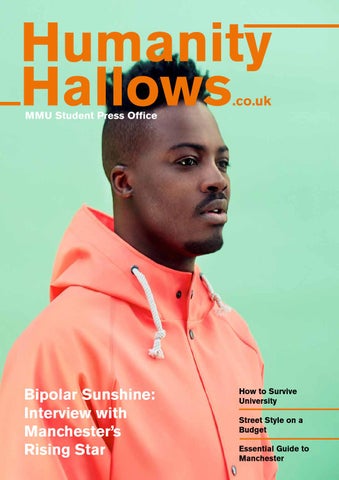
Bipolar Sunshine: Interview with Manchester’s Rising Star
How to Survive University Street Style on a Budget Essential Guide to 1 Manchester
2
Welcome... …to the first ever Humanity Hallows print magazine. If you’re new to university, we hope you enjoy the ride. If you’re new to Manchester, we hope you have a good umbrella. Although we’ve been loitering around online for a few years now, we’re really pleased that today, dear reader, you are able to pick us up and rifle through us. Before you proceed to enjoy the interviews, reviews, comment pieces and lifestyle features - all lovingly crafted and hidden amid these pages by MMU students - let me give you a bit of background on the whole Humanity Hallows thing. Created three years ago, HUMANITYHALLOWS.CO.UK is the primary website of the MMU Student Press Office. The Student Press Office, based in MMU’s HLSS Faculty, is a space in which all MMU students have the opportunity to express themselves, gain real world experience in journalism and online publishing, and help to shape and create the future direction of the increasingly successful HH brand. Best of all, every article and feature on our site and in this magazine, has been created by students, for students. If you’d like to know more about the Student Press Office and how you can get involved, there’s more info on page 19. Alternatively, you can check out HUMANITYHALLOWS. CO.UK/WORKWITHUS So there you have it. Please enjoy our first foray into the realm of physical tangibility and be sure to get in touch and let us know what you think. Cheers, Neil Harrison (Editor-in-Chief) The MMU Student Press Office is a Make a Difference project run by Student Media Officer Natalie Carragher. For more information on upcoming features, advertising opportunities and more contact N.Carragher@mmu.ac.uk
Contents 4
Essential Guide to Manchester
6 Erasmus: You’ve Got to Go Outside to Grow Inside 8 Life as a Mature Student 10 Welcome to the Warehouse Project 12 Real Life: The View from Up Here 14 Interview: Bipolar Sunshine 18 Style on a Budget 19 Join the Student Press Office 20 Ten Things Nobody Tells You about Freshers’ Week 21 How to Survive University Life 22 Dispatches from Campus: A Letter to America 25 Review: Mistborn Trilogy 26 Interview: Tara Guha 28 Creative 29 Comment 30 Life: Eat Well on a Budget 32 Manchester Secret Histories 34 Online: What TED Can Teach Us
3
3
The Essential Guide to Manchester
Words: Dan J Broadley Photography: Neil Harrison
Ah, Manchester – the capital of the North. The city has the largest student population in the UK and was ranked 26th in the New York Times “Top 52 Places to Visit in 2015” - the only UK city to appear on the list. Manchester is overflowing with culture and things to do and places to see. As a fresher, moving here can be both exciting and daunting. As someone who is now in his second year studying at MMU, I’ve been asked to put together a list of my top ten places to go/things to do in Manchester during your first year at university. Here are my suggestions … THE NORTHERN QUARTER This was a no brainer when I was asked to write about my favourite places in Manchester. The Northern Quarter was the first place that popped in to my head. Located next to Piccadilly Gardens and the Manchester Arndale shopping centre, the Northern Quarter offers plenty of vintage shops, cool bars and places to eat as well as some award-winning venues. Afflecks Palace is a must see here as an alternative shopping experience, as well as the Soup Kitchen and Night & Day Cafe, both offering dining, drinking, gigs and late nights out. MANCHESTER MUSEUM Located just down Oxford Road from MMU’s All Saints campus at the University of Manchester (who own and run the museum), the Manchester Museum displays work of archaeology, anthropology, natural history and tonnes more. It is the UK’s largest university museum and offers a great day out that may not always be the first thing that pops in to a fresher’s mind! The staff here definitely know their onions and are brilliant at telling you everything there is to know about the exhibitions. A word of caution - try to avoid days when there are private function, to see as much of the museum as possible!
4
4
ANTWERP MANSION This is no ordinary mansion. This is Antwerp Mansion! A renovated Victorian mansion located just down Rusholme’s ‘Curry Mile’ – it is a true music and arts haven! It may not be the fanciest place for a night out, but you’ll never forget your first night at Antwerp. By day, the mansion welcomes band practices and photo and film shoots and by night, turns into a party venue like no other. Outside they have a huge graffiti wall, which they welcome all to add to! MANCHESTER CENTRAL LIBRARY This is a truly stunning building. Even if you’re no bookworm, the Central Library is a site to see purely for its Neo-classical architectural beauty. Inside, however, is Manchester’s HQ for library and information services, offering much more than simply a big collection of books. The Henry Watson Music Library allows you to unearth original treasures or compose your own music; the state of the art media centre offers great creative software and gaming stations and there’s even a vintage poster shop!
THE PRINTWORKS
WHITWORTH ART GALLERY
Not too far from the Northern Quarter and just next to Victoria Station is the Printworks centre. This place has everything under one roof, from an ODEON cinema (with Europe’s second largest IMAX screen), the Bierkeller Entertainment Complex; described as “a real piece of Bavaria in the heart of Manchester”, Tiger Tiger for a disco night out and Manchester’s very own Hard Rock Cafe. Open from midday until 3am all week, you’ll end up here sooner or later during your first term.
Further down Oxford Road, just near the hospital is the Whitworth Art Gallery in the stunning Whitworth Park. (I say stunning, but like most of the UK, it’s only really stunning when it’s sunny). The art museum underwent a huge refurbishment which gave a vast amount of space for the gallery’s 55,000 items to be displayed. So, if you fancy pretending to be a snobby, artsy know-it-all for the day, head on down!
GORILLA/THE RITZ Ok, I’m cheating with this one because it’s two in one ... But they’re right across the road from each other, so who cares? Under the railway tracks on Whitworth Street West is Gorilla - a bar, kitchen, live venue and club. Just across the road from said tunnel is The Ritz, a 1500 capacity venue, which has been an integral part of Manchester’s unparalleled music scene for decades. Both these venues have provided me with some of my most memorable nights out in Manchester. Both attract huge bands and DJs as well as Gorilla offering top-notch food and drink. PARKLIFE MUSIC FESTIVAL Jointly organised by a number of groups including the Warehouse Project, the Parklife Festival is a great way to end your first year of uni. Situated in the 600 acre Heaton Park, the festival attracts over 140,000 people across a Saturday and Sunday. The line-up never fails to deliver world famous acts, from Disclosure to Snoop Dogg and Jamie XX to the Wu Tang Clan. So after a long hard year of lazing around for your first year of uni, blow off some steam at Manchester’s very own music festival!
CHRISTMAS MARKETS As of late September/October, people start saying, “ooh Christmas is just around the corner.” Well, it isn’t, but when it finally does arrive it’ll be during your first term in Manchester, which just so happens to be home of the award-winning Christmas Markets (running Saturday 14 November until Monday 21 December). Located mainly at Albert Square outside the Town Hall, the markets offer hundreds of stalls of mouth-watering international food, heart-warming beverages and gifts, crafts, clothes and toys off all shapes and sizes. So, unless you’re a grumpy old git, I expect to see you there. *So there you have it, my top ten places to see and things to do over the course of your first year at MMU. But believe me when I say that there is MUCH more to see than just my top ten, so get out there and explore the city for yourself.
5
5
Erasmus: “You’ve got to go outside to grow inside.” Words: Sara Lopes Photography: Neil Harrison
“Where to?” the employee at the travel agency asked. “Manchester,” she said, “Erasmus!” In 1987, someone had the idea to study in a university abroad for a short period of time. Maybe for new experiences, or even just to meet new teaching methods. But one thing is certain, that person forever changed the lives of many students. Now, 28 years later, thousands of students do this every year. Coming from all over the world, there are many who decide to do Erasmus. But do you think that you can imagine what Erasmus really is? It is not simple to face this challenge. Going to an unknown country where we do not know anyone is not easy. But this does not prevent students from doing so. We currently live in a world where we have to be more than just Portuguese, English or any other nationality. We should be proud of our origins, but we also need to become human beings of the world. I could tell you how a day is in the life of an Erasmus student but, instead, I will tell you about a girl that came to study abroad without having left her country before. Everything started two years ago. When she applied for the university she had in mind the possibility of doing Erasmus. Time passed and she decided to face this challenge. It was scary at first. Leaving friends and family behind wasn’t easy. But everyone always said that she was being very brave for deciding to go alone, wishing her the best of luck. As someone who lives in a small city in Portugal like her, coming to Manchester was a huge change. Going to another country, meeting new people, discovering new cultures and new ways of living. Everything is different. In fact, nothing in Manchester is like it is in Portugal. Manchester is known as a city where it’s possible to find a little bit of each nationality. It’s a small world inside a
6
6
city. There are Portuguese restaurants, Polish stores, Italian shops … “Everything is so different. It’s more exciting,” she said with enthusiasm. “I see a lot of new things. So many different nationalities and smells. I live close to a place called the Curry Mile and, in there, exists a huge range of Arabic and Indian shops and restaurants. Every time that I walk through that street, I always notice a different smell.” “The first week was the worst,” she said. Lost most of the time, and alone, she was starting to regret her decision. But something changed. She met another Portuguese girl and her enthusiasm started to grow again. “It was so good to hear someone talking in Portuguese! I did not see the girl often after that day but that was something that I just needed. I wasn’t afraid anymore,” she confessed…
‘‘Time passed and she decided to face this challenge. It was scary at first. Leaving friends and family behind wasn’t easy.” The classes started and she realised that the teaching methods in Manchester were very different from what she was accustomed to. All courses have practical parts. The students are no longer “locked” inside the rooms. The classes serve only as an aid, as a path to achieve something more. As a new student in Manchester, she knew that she needed to enjoy the experience as much as possible. The Erasmus program was only for three months and she wanted to make some friends. The opportunity appeared when she joined a self-defence course organised by one university society called SMART – Systematic Martial
Arts. Since the beginnings of universities, societies were also created. With numerous types of societies, each student can find a place to be. Film societies, English societies, volleyball societies … Manchester Metropolitan University has approximately 100 clubs and societies. SMART is only one of them and was the one she decided to join. “SMART is like a family,” she whispered. Systematic Martial Arts is more than just martial arts, “SMART is about helping each other and making real friends,” she confessed between smiles. Two-and-a-half months passed and she is now leaving Manchester. With sadness, she admits that she would like to stay for more time. “I feel that I didn’t do so many things. I wish I could stay but my family is waiting for me in Portugal. In my family, Easter is a big day and I can’t miss it,” she said. The plane is taking off and she looks at Manchester for the last time. “I will miss a lot of things, but mostly people. I have met amazing people and incredible friends.” Now, she can say that she has a lot of friends from different nationalities – English, Polish, French, German, and Chinese … She could be anyone. She could be you. But for now, she is me. And this is my story. Despite the fact that I was only here for two-and-a-half months, I can say that sometimes we need to go outside to grow inside. Erasmus is an experience that changes the way that we see the world. We no longer live in a small country … we live in a tremendous world, where there are thousands of different cultures, colours, foods, languages and people. And so, now? Do you think that you know what Erasmus is? Think twice if you answer is yes because Erasmus is not something to know, it is something to feel.
“Erasmus is an experience that changes the way that we see the world. We no longer live in a small country … we live in a tremendous world, where there are thousands of different cultures, colours, foods, languages and people.”
7
7
Life as a Mature Student Words: Jacqueline Grima
Every September, thousands of students from across the UK start undergraduate degrees at MMU. Most are experiencing the freedom of living away from home for the first time and thoroughly enjoying exploring the new friendship groups and social life that starting at a new university usually entails. Almost 7000 of MMU’s current student population, however, are classed as mature students. In other words, they are aged 21 or over at the start of their course, many having taken time out from their studies to work, decided to study towards a change in career or having returned to the university as postgraduates. With the right support, university life for mature students can be just as rewarding as it is for their younger counterparts. Going to university as a mature student can be a huge challenge, especially when studying later in life often involves juggling university commitments with other responsibilities such as working or raising a family. Alongside financial and time-management concerns, many older students also worry that they may struggle to keep up with what appear to be ‘new-fangled’ ways of learning, such as using the Moodle internet platform, and ‘fitting in’ with other, often younger, students with whom they might not have a great deal in common. As a result, mature students are often in danger of becoming isolated. The 21+ Mature Students’ Society at MMU is a great source of support for older students. Members of the society meet 8 up regularly and can often be
8
seen on their stall at the Fresher’s fair and open day events Activities on offer include social gettogethers, ‘getting-to-know-each-other’ events, museum or art gallery visits and expeditions around the Manchester area. Spouses and children are often included. Members of the group also regularly interact on their Facebook page.
“For mature students, settling in to life at university can often seem a daunting prospect.” In addition to the Mature Student Society events, the Humanities, Languages and Social Science Faculty’s Postgraduate Student Experience Tutor, Kate Johnson, regularly organises social events for postgraduate students across the faculty. Activities for 2014/15 included a private tour of the Manchester Museum (free cake included!), lunch at the International Society and a fantastic End-of-Year Celebration evening. Kate also offers one-to-one support and guidance on a range of matters including finance, disability, health and careers. For those students whose social life involves more than searching out the cheapest pint, there is a fantastic
range of cultural activities on offer in Manchester, a city with a fantastically rich cultural heritage. Places to visit include the Museum of Science and Industry, Manchester Art Gallery, the People’s History Museum and the Imperial War Museum at Salford Quays. For the sports lovers, there is also a National Football Museum and, for those willing to risk it, the frozen ski slopes of the Chill Factore. For families with children, the LEGOLAND Discovery Centre and the amazing Sea Life Centre, both near the Trafford Centre, are too good to be missed. Manchester is also very much a haven for theatre lovers with regular musical and comedy offerings at The Palace Theatre, the Opera House and The Lowry as well as a wide range of plays for every taste hosted at the Royal Exchange Theatre. For mature students, settling in to life at university can often seem a daunting prospect. However, much as it is for younger students heading out in to the big, wide world for the first time, embarking on a degree or postgraduate degree later in life can, with a little forward planning, be one of life’s greatest adventures. Contacts: Facebook facebook.com/groups/hlssmature Email mmu.mature.students@gmail.com Kate Johnson k.johnson@mmu.ac.uk
HOW CAN WE HELP YOU?
CAMPAIGNS
We exist to represent you and make sure your voice is heard on the issues that matter.
YOUR SPACE
This is where you’ll find a bar, shop, café and event space, lots of social seating areas and plenty of free, bookable meeting rooms, a dance and film studio, media suite and quiet study spaces. All for you.
OPPORTUNITIES
There is a huge range of clubs and societies on offer, no matter what your interests are.
ADVICE
A team of experienced and trained specialists on hand to offer support and totally confidential advice.
For more information on our services go to www.theunion.org
YOUR SECOND HOME
The Union building is at the heart of the Manchester campus. Our main hall space hosts loads of activities and events. Here’s our pick of Welcome events to get you in the mood.
OUR TOP PICKS
21
September
Comedy Central presents Russell Kane, Andrew Ryan & Marlon Davis Live at The Union
25
September
Regroup with SHIFT K3Y, Duke and Disciples 21:00-03:00 The Union
26
September
Band Night with The LaFontaines, The Carnabys plus local student bands 21:00-03:00 The Union
20:00-23:00 The Union
Find out more and buy tickets: theunionmmu.org/welcome
9
Welcome to the Warehouse Project Words: Jessica Carruthers
10
10
Whether you are new to Manchester or returning for another year, The Warehouse Project is a must on your agenda of fun things to do in this fabulous city. The Warehouse Project, also referred to as WHP, is a number of club nights hosting DJ’s and some live performances throughout the winter period, bringing life and soul to the cold, rainy weekends autumn and winter never fail to bring us. Sacha Lord and Sam Kendal are the brains behind the raves, founding The Warehouse Project in 2006 and giving us a glimpse into the legendary Madchester past, as like-minded revellers join together for one night. The nights have been confirmed to take place in Store Street for a second year running, literally beneath the streets, under Piccadilly station, where you will be transported to another world – raver’s paradise. This year we are in for a treat, as 2015 marks the 10 year anniversary for The Warehouse Project. This means Sacha Lord and Sam Kendal have bigger and better things up their sleeve and judging by the line-up, the 10th season of The Warehouse Project is going to be magical to say the least. New Order, Shy FX, Adam Beyer and MK are just a few of the many acts promised to fill the arches with sound in the legendary Store Street. Live acts are also expected from the likes of Jungle, leaving us spoilt for choice with 35 nights to choose from. As The Warehouse Project famously states, ‘For twelve weeks the city is ours’- so don’t hesitate, embrace the opportunity to experience Manchester at its finest. However, if for some bizarre reason you are unable to attend any of the many nights on offer, do not fear, this is Manchester, there is more to come believe me. Although The Warehouse Project is a unique experience in itself, there are still nights hosted at the likes of The Royal Albert Hall and Victoria Warehouse; as last year a selection of nights run by The Warehouse Project called ‘Transmissions’ were hosted at The Royal Albert Hall - Sacha and Sam obviously knew 12 weeks just wasn’t enough to satisfy our eardrums. So if this sounds good to you, believe me, it’s great and would be a crime to miss! So don’t hesitate and get a ticket. The full 2015 calendar and tickets can be purchased on their website www.thewarehouseproject.com
11
11
Real Life: The View From Up Here Words: Frankie Richardson Photography: Neil Harrison
“I can’t tell you how it started, decisions just kept getting made and I didn’t recognise the person I’d become. I can tell you when it changed though. I woke up in a hospital bed, in pain like I’d never felt before, and they brought me a photo. This tiny person all alone in another part of the hospital, all on his own with tubes sticking out of him in this tiny plastic box and suddenly I knew. I knew just how badly I’d fucked up.” At 25, Hazel was pregnant with her drug dealer’s baby. In fear for her life because of abuse from an expartner, estranged from her family and stuck in a cycle of drugs, sex, and desperation she hit rock bottom. Her story is at times sad, at times painful, but, ultimately, a joyful tale of the power of hope and hard work. A mature, intelligent, articulate woman with a bright smile and a quick laugh, she is in no way the stereotypical ex drug addict, homeless woman or feckless single mother. Neither would a casual glance ever reveal that hers is a past that truly is the stuff of nightmares, but as she tells her story, the shadows behind her eyes belie the smile on her face. Brutally raped and almost murdered at 15 by her 17 year old boyfriend in a patch of woodland a few hundred feet from her parents’ home, Hazel’s relationships with men were always tainted with violence and darkness. With a dark smile, she refers to that boyfriend as “a proper drowning 12puppies kinda kid.”
12
“I wasn’t a bad kid. Not violent or destructive or anything, but I always cared a lot more about going out with my mates than I did about school.” “But that was all I knew then. And then I just went from one to the next, always thinking they were better. They were never better, different definitely, but never better” “When I found out I was pregnant a light came on. I locked myself in the bedsit for two weeks and got off the drugs. But I had nothing, not even any furniture, just an old mattress on the floor and a kettle. So my mate tells me to move in with her and her son and I thought great, a safe home for my baby while I get on my feet, but she essentially stole all my money and used me to babysit while she went out getting wasted, and when it came to a head and I kicked off she told my ex where I was. So I was on the run again, 7 months pregnant.” What happened next is a deeply disturbing, harrowing ordeal that needn’t be relayed here, but culminated in ten hours of surgery and a baby born 11 weeks premature. “Everything I owned was in a bag at the bottom of my hospital bed. I had nowhere to go, and anyway the doctors were telling me I couldn’t possibly try to get up. “All I wanted to do was get up and start making moves, trying to find somewhere to live, a job, all the things I knew I needed to do for my
boy. But then the next day a social worker came to see me in intensive care and told me they were going to try to take him away. I hadn’t even seen him yet, just that photo, he didn’t even have a name. So I cried for about half an hour, and then I told this nurse to either fuck off and get me a wheelchair or fuck off out of my way and let me walk because I WAS GOING to the neonatal unit to see my baby and they weren’t gonna stop me.” She did go to the neonatal unit that day, and every day for the next three months, from 7 in the morning till 10 at night she cared for her child, all the time battling social services to prove that she could be a mum, and fighting her own body which was in recovery from massive trauma. “I kept telling myself not to pass out, not to cry, not to ask for painkillers. I knew that one sign of weakness would be enough for them to sign that form and I’d lose him forever.” An Independent Domestic Violence Advocate (IDVA) took on Hazel’s case and found her a place in a women’s refuge, a safe place for her to take the baby when he was strong enough to leave hospital. Her determined and tireless commitment to the care of her son inspired three members of nursing staff to write to social services confirming their absolute belief in her ability to be a parent to him.
“It was great but it was nowhere near over, I was still “homeless” because I was in temporary accommodation and social services were really determined. I was accused of all sorts, they took blood tests from my baby to try and prove I was on drugs throughout my pregnancy, but they came back negative. Then they said they’d been given information that I was working as a prostitute during my pregnancy. I wasn’t, but how the hell do you prove that? Then they said I couldn’t be trusted to keep him safe because my ex hadn’t been prosecuted for what he’d done to me, it was just fight after fight, meeting after meeting. All I wanted to do was concentrate on my boy, he was still really poorly, barely feeding, not gaining weight, it was the scariest time of my life.” The day her son was due to be discharged from hospital, social services called one final meeting. The nursing staff, two social workers, the IDVA, Hazel’s health visitor and two members of refuge staff all attended. “I remember saying goodbye to him before I went in. I thought this was it, they weren’t going to let him come home with me. I held him so tight and told him how sorry I was and how much I loved him, and I’d never stop being his mummy, no matter how much time or distance was between us. I just held him and told myself don’t cry, don’t cry, don’t cry, they’re watching you.” All the professionals at the meeting except the social workers themselves came out in support of Hazel. “They wanted to put him on the child protection register for emotional harm and neglect, and I’ll never forget the moment this nurse piped up and said ‘I will not put my name to that, she will not neglect that baby’ I will always love that woman for that.”
In the end, Hazel’s son was placed on the child protection register for six months as being at risk of emotional harm because of their homelessness and previous domestic violence. He was allowed to go home to the refuge with his mum. “I’ll never forget that first night, laying him in his moses basket and finally being able to cry. I cried like a baby … but I was so happy.” Hazel’s journey wasn’t over. She spent four months in the refuge until she found a suitable house where she still lives now with her little boy - now a happy, healthy three year old. She had counselling and cognitive behavioural therapy, and attended every self-improvement course she could find, followed by an access to higher education course. This summer she finished her first year at university. “I never get complacent. It’s brilliant, how far I’ve come in these three years. But I know if I ever let myself slip back it would take half that time to undo all the good work. I keep fighting every day to be the best me I can be, not just for myself, but for my boy. University has been incredible. I finally feel like a whole person, like I know who I am and where I want to be.” Does she have any regrets? “It probably sounds awful but no. Not a one. Every bad decision I made, every stupid mistake, every moment of madness, pain, misery, it all added up to put me where I am today. And I love the view from up here.”
“University has been incredible. I finally feel like a whole person, like I know who I am and where I want to be.” 13
13
Interview: Bipolar Sunshine Words: Elliot Morrow “Best spot in Manchester this is,” says Bipolar Sunshine, real name Adio Marchant. We’re standing outside Northern Soul Grilled Cheese on the edge of Manchester’s Northern Quarter, Marchant sporting a black puffer jacket, me in shorts and a t-shirt. “We played a good show last night. I need this.” We walk from Northern Soul to Marchant’s beloved stomping ground, Sunshine Studios. You’d be forgiven for missing the studios’ narrow black door, imperceptible within its colourful surroundings. “There’s no point going in to the studio room, we just threw everything in there last night when we got back. It’s a mess,” he admits. We pull some chairs out of the rubble and sit down in the corridor. The eldest son of Jamaican Mancunians, Marchant grew up in Parrs Wood, Didsbury as the days of The Hacienda and acid house drew to a14 close.
14
“Young me was wild, man. Manchester was very hot and you see the full spectrum of it all; the good, the bad and the ugly. I’ve seen all those things and that’s what’s shaped and played a massive part in my music and in my whole life aura – I’m just happy to be here some days.” He’d had dreams of a football career. “I got injured playing and thought scrap that. Then I went to university and realised I just didn’t like it. That was when I think I wanted to become a musician.” And from there, Kid British was formed, headed by Marchant and his two childhood friends Simeon McLean and James Mayer, along with producer Sean Mbaya. “[Kid British] helped me grow a lot. Before Bipolar Sunshine, there were four people with an even share and that doesn’t work in music; I realised that very quickly. You have to do shit by yourself, or work with people who know that your point of view is the
direction you want to go in.” People turned out to be just one person, a producer by the name of Jazz Purple, whom Marchant has partnered with since he began working under the Bipolar Sunshine pseudonym. “Yeah, we met pissed in some nightclub; just talking shit in the toilet. He said he could produce and I said I could sing, so I took his number. The next day I went to his house and we wrote ten songs in a day. The rest, as they say, is history!” I make a note – start networking in clubs. I felt the time was right to ask about the Bipolar Sunshine name. “With many bands I like, there’s always something controversial in the name or in what they do, and I wanted my name to be a talking point. With Bipolar Sunshine, both words play off of each other, which works really well for me to push it as an extension of my actual character.”
15
15
There must have been some offended listeners?
go on YouTube if I wanted to listen to that music.”
“I wouldn’t say offended. I’ve had people message me and I always explain to them that bipolar is not an actual disease. You can put other words around bipolar and it becomes whatever you’re trying to say. Usually, once I explain that, people understand my reasoning.”
But Marchant still loves where he grew up.
And Bipolar Sunshine has been a name very much in the spotlight over the last 18 months. Since the release of 2013’s Fire, Marchant has supported the likes of Haim, Bastille, Rudimental, Phoenix and Courteeners, as well as playing at a range of big-name festivals, including Glastonbury. How does someone cope with such a rapid rise? “It’s fine. I just lock myself in the studio.” Fair enough. As for Manchester, Marchant isn’t convinced that the city is ready for him yet. “London gets what we’re doing a lot more than Manchester. But only because Manchester is so heavily influenced by the old guard.” He points out the city’s obsession with finding the next Stone Roses or Oasis. “People are just basically feeding the hope of loads of shit bands who are trying to make that kind of music. We don’t need any more. I’d
16
16
“It is moving on though, slowly. It’s great to be a part of. None of us went to The Hacienda, we all go to Warehouse Project and Parklife now. It’s about that generation of people coming through and holding the points, not some 60 year-old guys.” That generation doesn’t just include those growing up in Manchester, but also those who make up Europe’s largest student population. “For students I can imagine it’d be great to come here. There are so many great places to go and so many nights that cater for every musical need. If they look further than Oxford Road when they’re here, they’ll come across some good nights.” And for a name growing so rapidly in stature, you’d be surprised at how often Marchant is seen out and about. We’d met before today, during a night of Hot Mess at Revolution on Deansgate Locks, although neither of us remembers it too clearly. What club nights does a born-and-bred Mancunian recommend to new students? “Maybe they should go to Hot
Mess! Soup Kitchen always does good nights. Selective Hearing. Love Dose. Antwerp Mansion. Islington Mill in Salford does some great nights too. There’s so much going on.” I notice that the sandwich from Northern Soul still hasn’t been touched. Two hours of sleep and 30 minutes of knowing food was only a foot away, ready to be eaten. He hasn’t complained once. I ask my final question: what do you want to say to new students coming to Manchester? “Bring plenty of paracetamol. Take the whole experience in. Have a wild time. Spend your money. Get in debt and never pay it off.” With that, Marchant gets up and grabs his MacBook from the studio before resting it on an amp. “You have to see this video. Funniest thing I’ve watched in a while.” He presses play and suddenly a man runs in to shot before taking a running leap on to a moose wading through a body of water. The sandwich sits on the floor, neatly wrapped in a paper bag. I’m not sure what else I expected. With a debut album dropping at the back-end of the year, and a new clothing line called Grey in the pipeline, Bipolar Sunshine probably won’t be name that fades into the background any time soon.
“Take the whole experience in. Have a wild time. Spend your money. Get in debt and never pay it off.�
17
17
Style on a Budget Words: Helena Tomlinson
Being the most stylish BNOC can be hard. Especially when your student loan doesn’t cover the rent and you end up working two jobs just to have some money for spends. However, buying key staple items for your wardrobe can make your money nightmare a fashionista’s dream. t’s not just about finding a bargain for your wardrobe. Sometimes investing in some longstanding items means you might have more money at the end of the week! Black and White Tees Black and White t-shirts are a musthave in your wardrobe. They will go with pretty much everything! No one likes a colour or a pattern clash but a plain black or white t-shirt can solve your worst nightmare. It’s up to you whether you buy a Primark or Topshop Princess tee but either way you need them in your life! Skinny Jeans Skinny jeans can be the answer to all your fashion problems! Any skinny jeans can be dressed up or down to fit the occasion. Got a job interview? Team a black pair with a smart shirt, blazer and a smart pair of shoes or heels. Going out with friends? Team with a crop top and add a kimono. Just at uni? Team with whatever you’re feeling! Skinny jeans are a staple of any wardrobe.
18
18
Hoodies A hoodie is not just about style but comfort too. Coming in all colours and patterns, they can be a gal’s best friend. When you have that day that’s not quite hot enough for the arms out, but is too hot for your winter coat, a hoodie can be your answer! Perfect for Autumn or Spring and can fold up to fit in any size bag. Also perfect for hangovers and just wanting to wear your comfy clothes.
Shoedrobe! Having your wardrobe staples are obviously important. But remember, fashion ends at your feet! Having a mix of shoes is a sensible idea. If you stick to a pair of heels, flats, sandals, work shoes and trainers, the rest of your shoes can be whatever you enjoy wearing the most. Nobody likes an outfit being spoilt by the wrong shoes! So make sure you’re prepared for all eventualities. LBD The Little Black Dress (LBD) has been a fashion must since Channel made it famous in the 1920s. However, LBDs come in all shapes and sizes. You can pick the best one for you, and that can be versatile for any occasion. Mini or Midi, Fitter or Skater, there’s an LBD out there for you! If you keep your wardrobe staples you can look 10/10 every time you walk out the door. Not only that, but any money you have left over can go on that dress you’ve been eyeing up in Topshop, those Nike Airs you’ve sold your soul for, or that impromptu night out you planned an hour ago. Remember we all like a bit of extra bit of money at the end of the day! See you on campus for my Humanity Hallows ‘Street Style’ feature throughout the year! Ciao x
Working with the Student Press Office is the ideal way for MMU Students to get that all important work experience while at university. We aim to provide a safe and supportive space in which students can be creative and have their voices heard, while boosting their confidence – and their CV – with skills in journalism, editing, publishing, social media and much, much more. Current and previous Student Press Office members have seen their work published in local and national newspapers, magazines and websites and have worked on numerous exciting enterprises such as festivals and documentaries. We are currently recruiting for a number of roles and welcome applications and contributions from all MMU students. If you are interested in working with Humanity Hallows, and the MMU Student Press Office, there are several ways that you can get involved and gain invaluable experience alongside your studies. Freelance Contributors: All MMU students are invited to send in freelance contributions to Humanity Hallows. Whether you want to review a gig or a film, report on an event or just get something off your chest, simply decide what you’d like to write
about and refer to our Blogging Guidelines at HumanityHallows. co.uk before sending in your work to humanityhallows.editor@gmail.com Editorial Team: We have 5 online features sections – HH UniLife, HH Voices, HH Sport, HH Ents and HH MCR. This means we now have a number of exciting new opportunities for MMU students to become members of the Humanity Hallows editorial team. As an editor you will ensure that our content is of the highest calibre and will be read by as many people as possible. You will source your own stories and write regular editorial articles as well working with our social media marketers to promote your own and others’ work. This is a great opportunity to gain an insight into the world of journalism, to pick up genuine employability skills and contacts and meet new people. Full training and support will be provided. Commissioned Journalists (Paid): Owing to the excellent work done by Student Press Officers over the past three years, Humanity Hallows is now a trusted and respected source of news among many MMU staff and students. As such, we often receive requests
from MMU departments for Student Press Office members to report on particular events happening in and around the university. Most of these commissioned articles represent opportunities for students to be paid to write for Humanity Hallows. In order to be considered for our pool of Commissioned Journalists, you must have submitted at least 3 freelance contributions (see above), including at least one example of reportage. We will then invite students whom we believe are suitable for the role to become Commissioned Journalists and get paid to write for us! Email N.Carragher@mmu.ac.uk to register your interest for any of the opportunities mentioned above. Social Media Marketers: If you love Twitter, Facebook, Instagram and social media in general then this is the role for you. The vast majority of our website traffic comes directly from our social media channels, therefore it is essential that we maintain a strong and lively presence and keep those views coming in! If you are interested in any of these positions, please send an email to N.Carragher@mmu.ac.uk stating your name, student number and year and 19 course of study.
19
Ten Things Nobody Tells You About Fresher’s Week Words: Eve Hebron
Tequila will become your worst enemy. Going out the night before your first 9am lecture and downing that extra shot of tequila to prove you’re a hard-core, party fiend, will be expected (we’ve all been there) but learn from my mistakes and say no if you’re not up for it. It may be a lot easier said than done, but remember: it’s unlikely you’ll make many new course mates reeking of sick and regret. Additionally, if you do end up getting to class the next morning, you’ll likely mistake the desk for a pillow and be remembered as the one who couldn’t handle their hangover. You will have to use a washing machine at some point. During the week, it’s likely your clothes will acquire a number of peculiar stains due to general stupidity. Whether you have alcopop, Abdul’s kebab, or some other less appetising mark splattered upon last night’s attire, you’re going to have to clean it up before your new friends, become your old friends. This being the case, you will actually have to use a washing machine at some point, (a device a lot more complex than you’d imagine) so don’t forget to separate those colours! Toast will become a staple part of your diet. Unless you’re lucky enough to have one of those housemates that insists on cooking a Christmas Dinner-style Sunday lunch for the flat each week, you’ll be living off toast. Despite there existing a range of things to place upon the toast, it does get a little depressing. This placed on top of two weeks of drinking (oh yes, they stretch it out that long), the pressure of trying to impress people, and making sure you don’t forget to call your Mum usually leads to 20 the legendary … Fresher’s Flu.
20
Make sure you pack the Berocca … Because you will get Fresher’s Flu, and when you do, you won’t want to ever set foot in a sticky-floored, booze-flowing, club again (until perhaps the following night.) Don’t worry though, this is the norm, and laying about all day in your pyjamas, feeling sorry for yourself whilst watching Netflix and drinking endless cups of tea, will hardly be a change to your daily routine. You’ll become pretty skint. Fast. By the end of the week, the endless supply of tinned soup your Mum packed will probably end up looking a little more appetizing than another meal of toast. However, when you’re hungover, a Nandos is all you can really bear It’s likely that at this stage, you’ll possess about a tenner (yes, you will end up getting too drunk and therefore buy a round of £1 jagerbombs in Fifth Ave for all your “new mates”). Upon discovering this, you will feel a little sick but don’t worry, discovering you have a lot less money than you thought you had will become a familiar feeling throughout your three years at university. It’s during these depressing times that it feels necessary to dip into your overdraft. Do not be tempted by those mesmerising zeroes! It’s only your first week! Fridge space is a precious thing. Anything your parents packed that belongs in the fridge (it will say on the back of the packet if you’re not sure …) will need to be placed there ASAP. However, due to people wanting their mixer chilled (something they’ll soon get over, don’t worry), their ketchup kept cold (this is definitely a CUPBOARD item … you WILL have this argument with someone), and the odd fool thinking biscuits belong in there, you WILL have to fight for fridge space. Prepare yourself.
Manchester is not only rainy, but very, very, cold. Wearing very little does seem to be the norm on nights out. However, prepare yourself for that blasted wind to strike from across the Pennines. No matter how heavy your beer jacket may be, you’re going to feel it, and your hair almost certainly won’t look the way it did before you left. The only choice you have is to (wo)man up and brace it like a proper Northerner. You will spend a day carrying around a bag full of “stuff”. It’s likely that as soon as you enter Fresher’s Fair, you’ll regret the experience. You’ll have all sorts. From free condoms to keyrings thrown your way and will be left wondering why you accepted half the stuff (except the condoms though, you never know, and it’s better to be safe than sorry!) but it’s a university rite of passage and they do give away free pizza (which you’ll be needing). Fire alarms will become a familiar thing. Thanks to individuals deciding to cook bacon whilst still drunk, be prepared to wake up at 6am on a regular basis. There’ll also be a fair share of fire alarm tests, which, unsurprisingly, tend to coincide with hangover lie-ins. Be grateful that halls staff are looking out for you, though. You’ll try super hard to impress (trust me, you will). At some point, you are going to pretend to like a band you actually despise in order to fit it. Just make sure it doesn’t become a habit. First year is a common time to express your newly found adult self, but don’t get carried away and become a full-on, paralytic waste man if you actually prefer early nights. Whether you’re energetic, lazy, funny, or any other random adjective, be yourself and you’ll be just fine.
How to Survive University Life Words: Ruth Hudson Photography: Neil Harrison
“Manchester oozes edge and embraces the individual. So, grab a friend and get lost in whatever you love the most.” Don’t steal any traffic cones, cherish the value of toilet paper, join a society, give your liver a break and read, a lot. These are just a few inescapable rules you must follow to survive the utterly insane, first few weeks of university. Step One: Step outside of your social comfort zone Having been plunged into a room full of strangers, the daunting experience of ‘who speaks first’ may have felt like taking a foul-tasting pill that’s imperative to swallow. And soon enough, asking people what course they are studying will become a sixth sense. The reality is, you have to accept the people you live with for who they are, or at least, find a way to endure a year of their company. Just don’t expect to have the same friends at university as you do back home because people of all different backgrounds are clustered in the same environment, as are you now. Join a society, or pursue your course to indubitably befriend like-minded people. As long as you stay impartial to the people you meet, you’ll be collecting friends like Pokémon cards. So, seize the days of talking to absolutely everybody, because after two weeks many freshers have already formed their main group of friends. Don’t be afraid to invite them for a drink or a meetup, they don’t bite. As a result, stepping outside of your social comfort zone will essentially boost your confidence in chatting to different people all the time, it’s what makes university “the time of your life”.
Step Two: Explore Manchester From the artisan cafes and niche vintage shops of the Northern Quarter, to The Museum of Science and Industry in Castlefield. Manchester’s Metropolitan jungle has a culture like no other, it oozes edge and embraces the individual. So, grab a friend and get lost in whatever you love the most. The more you explore, the more Manchester will feel like your second home. Step Three: Set yourself a budget. Whether or not you receive the maximum or the minimum student loan, setting yourself a budget will eliminate any future money troubles. Simply, calculate the income you receive in term one then, divide it by the number of weeks you’ll be living in Manchester- easy peasy! Just remember to consider the cost of food, travel and whatever it is you consider a ‘leisurely expense’. And, if the 20 minute hike from Oxford Road to the city centre becomes too strenuous, you can catch the free shuttle bus located opposite Nandos, just off Oxford Road. Just scour the streets for a top-notch bargain, and exercise the power of your Student card; you’ll soon consider Aldi your closest ally. Step Four: Make the most of your student loan Think of the ever-growing surge of student cuts as your Mr Motivator. With little hope of affording unpaid internships and facing the catch-22 of
applying for work experience, with the condition that you have experience. Yes, fuelling your year with potent doses of extra-curricular activities, and enhancing your academic stamina through invaluable work experiencesuch as the Student Press Office! - makes every penny count. And it’s these other ‘accomplishments’ that employers truly recognize. Whatever you decide to take up, you’ll reap some fruitful rewards. Step Five: Make mistakes and learn from them. Whether you want to erase a series of drunken events, or you receive a third in your first coursework assignment; first year is about making as many mistakes as you can. Yes, rookie errors are all part of a fundamental learning curve. So, when you approach second year you’ll be wiser than the great soul himself; experiencing is learning. The trick is not to care too much about what people think. Step Six: Do your washing up. By tackling the mountain of plates and abundance of tea-stained mugs, maintaining the cleanliness of the kitchen keeps everyone happy. So, you might want to save your mugs from the accidental science project you made, which led to the creation of life. Reality check: cultivating mould does not make you God.
21
21
Dispatches from Campus: A Letter to America I’ve got to say, I picked one of the best cities in the world to get an education in. Manchester has a vibrant and rich history that goes all the way back to its start in 79 AD as a Roman fort. Today, it’s the third most visited city in the UK after London and Edinburgh. My first trip to Manchester was back in 2010 when I was a Political Science undergraduate. It was love at first sight, which is why I came back for my Masters program. Unless you’re coming from Atlanta, Chicago, New York, L.A, or any of the other mega cities, Manchester might be the largest city you’ve ever lived in. It certainly was for me. Take a deep breath I know it can be a confusing, crowded, noisy place and it’s going to be scary at first, but if you take to heart this little guide I can assure you that in no time you’re going to be cheering on the Mighty Reds right along with the natives. Public Transportation Honestly, it frustrates me to no end that we are still so far behind Europe with public transport. Sure the big cities have subways and ELs (elevated trains), or decent buses, but for the rest of us it was a car or walking. And walking wouldn’t be bad if the nearest WalMart wasn’t ten miles from your house. I can tell you that hopping on a bus at your front door and jumping off right in front of your destination is going to spoil you rotten. Here are a few things to remember. Always carry change. Unless you’re buying a mega rider or day rider the drivers don’t carry enough to break that 20. Sometimes they will be nice and let you grab a free ride, but don’t count on every driver being that magnanimous. If you have an empty seat next to you someone is going to sit in it. You can give them the stink eye all you want, but they aren’t moving. So don’t freak out just go with it. If it bothers you that much stand up.
22
22
Cuisine Manchester is home to more nationalities than I can count, and for you that is an opportunity to sample some amazing food from every corner of the world. There are chain eateries, like Nando, ZiZis and Yo Sushi! and I recommend all of them, but I implore you to step out of your comfort zone and try something you’ve never eaten before. The famous and lively Curry Mile is just shop after shop of delicious food from India to the Middle East. More than anything explore every nook and cranny that Manchester has to offer you might discover a gem of a place that will soon become your favourite haunt. Shopping I’ve never been a shopper like my mom and my sister who think of spending money as an Olympic sport, but Manchester has turned me into one. In the city centre you have the Arndale Centre, the largest city centre shopping centre in the UK, which will become your go-to one stop shop for everything. Much like the malls we grew up with it caters to every budget, shape, size and palate imaginable. Bookstores, electronic stores, clothing stores, quick foods, a Lego store are aplenty in the Arndale. Primark, a godsend of a store if you ask me, carries everything from bathroom mats, to stockings, to makeup to clothing. If you are on a budget, Primark needs to become your best friend. With a couple of pounds in your pocket you can walk out with an entire outfit and spare change. If your tastes are more off the beaten track just a block up away from Primark is Afflecks Palace. Afflecks is four floors of booths and stalls dedicated to the alternative and nerd crowd. Costume shops, clothing boutiques, tattoo parlors and even an American candy store call Afflecks Palace home. Swing by Forbidden Planet just a few doors down for all your comic book and
geek memorabilia needs. If you like your shopping with a dash of ambience then the Trafford Centre is your poison. Rain It’s going to rain, a lot. Get used to it. Not that cute little misty rain made popular by romantic comedies either. This is prehurricane rain that is going to mess up your hair and ruin those cute little shoes you got on that summer vacation with your best gal pals. Your impulse to bring along that giant beach umbrella that you kept in the trunk of your car is well grounded but it’s not realistic here in Manchester. For one, the rain comes and goes like a fart in the wind. It’s here one-minute for two seconds then it’s gone, or it starts in the middle of the night and continues on till next week. You are going to be hopping on and off buses, running through the train station or squeezing down a dimly lit stairwell to the toilets. Footwear Sure, you’re going to see Mancunians dashing around in six inch heels, but they are born and bred for the life. We’re just tourist. Yeah, its easy to put on a pair of heels and get in your car drive to the building your class is in, strut to your class and then get back in your car and go home. In Manchester, you’re going to have to walk to your bus stop, wait for your bus, squeeze in where you can fit in, get off at your stop, walk to your building, and if you have a second class you might have to walk a couple of blocks to the next building then repeat this process to get back home. All of this is done on uneven asphalt and cracked concrete. On most days the sidewalk will be slippery with rain. Unless you’re a native New Yorker, you just haven’t been trained to properly deploy urban footwear tactics. most days the sidewalk will be slippery with rain. Unless you’re a native New Yorker, you just haven’t been trained to properly deploy urban footwear tactics.
In each of our forthcoming magazines, we will be asking international students to write about their time here at MMU. Here, Letitia Jones, an MA Creative Writing student from the USA, guides her fellow citizens through the magic of Manchester.
Public Bathrooms In the States we are rather pampered. At every stop and turn we have public bathrooms. Not all of them are hygienic, but they are there and that makes us feel comforted. Well you’re in Europe now buddy, and public bathrooms aren’t the norm. You might just run into the pay toilet. So always keep at least 30p on hand if you have to ‘go see a man about a dog’. If you have the bladder of a potty training toddler like me, you might have to plan your routes out according to the places that have public bathrooms. The city centre is American friendly with its horde of clean and accessible bathrooms, but in the out-laying areas bathrooms are scarce and hard to come by. Academics Here in the UK, professors expect you to be just as invested in your education as they are. However, they aren’t going to chase after you to make sure. There isn’t busy work and quizzes to make sure you’re picking up the material. You won’t have to turn in reflections on your course reading so the professor knows you’re actually doing the reading. Your professors and course tutors just expect you to get it done because you paid for the privilege to learn at university level. You aren’t going to have to write four research papers, take a mountain of quizzes, do a midterm, then a final paper and then a final exam. For the majority of your classes you will have either a final paper of 5,000 words or less and/or a final exam. That’s it, I swear. Now before you start doing your happy dance just remember that this does not mean the class is going to be a cakewalk and that you can slack off. In the US we’re used to packing our schedules to get the most out of
each semester in the hopes that we might be able to graduate early. For some odd reason in the UK students graduate in 3 years with the same about of knowledge we get in the States. Holidays I cannot stress this enough, travel as much and as far as you can. Take as many holidays as you can in the short time you have available. If you have to go without eating for a few days for the plane fare then sacrifice that Big Mac for the greater good. In four hours, on a plane, you can visit over 30 different countries. I know, it boggles the mind. In fours from Greensboro, North Carolina, I will still be in North Carolina. Manchester is a great transportation hub. Victoria and Piccadilly train stations are both located in the city centre with trains running to mainland Europe daily (you will have to change trains and stations in London in most cases), as well as the bus station. Manchester airport with flights to three continents every hour is accessible by train, tram and various buses. Register with a hostel website as well, hostelbookers.com is my personal favourite. It is easy, free and they run specials and discounts all the time. I’ve found highly rated hostels in major cities like Barcelona, Rome and Amsterdam, for less than a combo meal at KFC. And finally my last piece of advice is to just get out of your flat and explore Manchester. Along Oxford Road you will find museums, the Aquatic Centre, the beautifully restored Central Library, a playhouse and a variety of cuisines from around the world that will send your taste buds on a fantastic voyage.
23
23
Your course is more than what you do in the classroom! Make a Difference to yourself and others by getting involved. MMU Make a Difference offers Humanities, Languages and Social Science students a variety of opportunities to get involved in that not only makes a difference to the wider community and environment but also to themselves. Opportunities involve schools outreach programs, becoming an ambassador, the student press office, volunteering opportunities as well as variety of work experience and placements. Or why not create your own? We offer funding and training to make sure that your opportunity really does Make a Difference! To sign up to our Monthly Enrichment Newsletter email us at makeadifference@mmu. ac.uk including your name, student ID, course, year of study and personal email.
/MMUMakeaDifference @MMUMakeaDiff
24
Review: Mistborn Trilogy
Words: Rachel Rowlands
When I picked up the first book in the Mistborn Trilogy, The Final Empire, I didn’t really know what to expect. The size of the book was intimidating and although I do read fantasy, I usually read series that are on a much smaller scale. The Mistborn series had received a lot of glowing reviews online, so I had to give it a try. Well, I’m now adding my own sparkling review to the pile, because this trilogy is mind-blowing. I loved the series from the start. The plot grabbed my attention and refused to let go. The central theme hooked me from the beginning: the idea of the ‘villain’ winning and taking control of the world. It’s a great concept to begin with, but it evolves into so much more over the course of the trilogy. Sanderson is a master of foreshadowing. The twists and turns in the plot are absolutely genius and always unexpected. Details that I often thought had no significance were revealed to be huge game changers later on. The main characters were instantly likeable and relatable (Kelsier and Sazed were my personal favourites).
We get to see through the eyes of many different characters over the course of the series, as well, and watch them grow and develop. Sanderson devotes plenty of time to each of his characters, and it shows. I grew really attached to them, which only added to the tension whenever an intense battle scene took place. Speaking of battle scenes, Sanderson’s books are wonderfully balanced. There are scenes that are fast paced: wars, scuffles, riots, battles (Sanderson really excels in writing battle scenes.) Then there are slower scenes: conversations, balls/dances, and so on. Even during the slower scenes, I was never bored, which is a testament to how much I loved the story of Mistborn. There are some long-winded conversations, but I was so invested in the characters that I could read about them doing just about anything and it would be interesting! Sanderson explores some important themes in Mistborn including politics, religion, faith and what it means to be good or evil. I particularly enjoyed the themes of religion and faith. These
kinds of themes are usually difficult to pull off, but they work well in Mistborn. The fictional religions and theories about God that Sanderson puts forward are genius and really gave me food for thought. To add to that, the world building in this series is phenomenal. I can’t imagine the amount of work that must have gone into it. Everything came to life - I could picture the cities, the buildings, the different races (I especially loved the Kandra.) The magic system, if a little difficult to comprehend at first, was complex and unique. The Ars Arcanum section at the back of each novel was helpful when I felt confused or overwhelmed. I finished this series with my jaw hanging open. After putting down the final book, The Well of Ascension, I told a friend that The Mistborn Trilogy was the best series I’ve read since Harry Potter. And over a year later, I still feel the same way.
25
25
Interview: Tara Guha Words: Jacqueline Grima
In November last year, Tara Guha, from Hebden Bridge, North Yorkshire, was announced as the seventh winner of the Luke Bitmead Bursary, an annual award given by independent publishing house Legend Press to promising unpublished novelists. Tara’s debut novel, Untouchable Things, which beat over 300 hundred other entrants to the top spot, will be released in September 2015. Untouchable Things, which took Tara eight years to write while raising a family and working, tells the story of Rebecca Laurence, an actor. Rebecca’s life changes dramatically when she meets the charming and mysterious Seth Gardner who introduces her to what he calls his ‘Friday Folly’, a group of friends who meet up every week to celebrate their love of the arts. Unfulfilled and lonely, Rebecca finds herself captivated by the group and, in particular, by its leader, Seth. It is only as she becomes more involved, however, that she discovers that the relationships between the Folly’s members, along with each individual’s relationship with Seth, are not as innocent as they first appear. Will Rebecca find out the truth behind the Folly before her attraction to Seth becomes all-consuming? Part-suspense novel, part-psychological thriller, Untouchable Things is, by no means, the literary world’s equivalent of an easy-listening album. Its complex structure, divided into the acts and scenes of a play as opposed to traditional chapters, intense pace and changing tenses require immense concentration and commitment from the reader. The author’s use of literary references also demand a certain level of education. However, throughout the novel, Tara 26
26
Guha’s use of language is utterly compelling and her use of metaphor and characterisation bordering on brilliant. The story of Seth and Rebecca pulls the reader in and refuses to let go, each one of the characters of the Friday Folly soon becoming uniquely intriguing in their own right. In short, Untouchable Things is a real page-turner and each one of the eight years the author committed to the writing of this novel shines through on every page. Humanity Hallows asked Tara some questions about her journey to publication… Humanity Hallows: What inspired you to write the novel? Tara Guha: I’ve always been fascinated by groups and I wanted to explore the complex relationships that exist in a group setting. How much of ourselves do we bring into a group and how much of ourselves do we have to change or hide? Having been brought up across two very different cultures, I’m a natural chameleon, and, for me, there’s a constant tension in a group setting between personal integrity and the need to belong. HH: How difficult was it working the novel around your other commitments such as raising a family? TG: This one is definitely a game of two halves! Having my first child is what gave me the opportunity to start writing Untouchable Things in the first place, and, in this sense, the novel belongs to my daughters – I’d never have written it if I hadn’t had the time out of my day job to raise a family. To begin with, the balance of the two was remarkably easy – when the babies slept, I wrote. It
was a wonderful counterbalance to the absorptions of motherhood. Things got a lot trickier last year when I’d started working again and then won the Luke Bitmead Bursary. I’m now in the position familiar to so many women: a constant self-imposed guilt trip about not doing anything properly! Although the girls are no longer babies, they still require a huge amount of practical and emotional input and I’m forever struggling to give them enough time amidst work and writing commitments. HH: How did it feel to hear your name announced as the winner of the Luke Bitmead Bursary? TG: It was the single most shocking and unexpected moment of my life. I’m still not sure I’ve really come to terms with it! Usually when you achieve something big in life, there’s a part of you that is (secretly, at least) hoping for it or prepared for it. In the case of the Bursary, I didn’t even consider the possibility of winning. I was so thrilled to be shortlisted, and was just drinking up the whole experience of being there. HH: Do you have any plans for a second novel? TG: I am desperate to start writing again! I do have a plan for a second novel – and it will be something quite different, born more from my experiences of being brought up across two different cultures, and set in the uncertain social and political landscape of post-9/11. A crosscultural friendship will be at the heart of the novel – but that’s all I’m saying! Untouchable Things is available from Legend Press and Amazon from 1st September 2015.
“Usually when you achieve something big in life, there’s a part of you that is hoping for it or prepared for it. I didn’t even consider the possibility of winning.”
27
Creative:
The Literary Outsider Words: Louis Brierley Let’s step outside the box. The Outsider, as a character trope, has existed since before written history. Ancient South American folktales speak of the Coyote figure, a trickster spirit or spiritual guide offering new perspectives. Cross half the world to ancient Scandinavia, and the Viking Sagas tell of the meddler Loki, who, not quite a god, stands outside the pantheon, and yet whose schemes affect the whole world. Even traditional Christian belief includes the Serpent-figure, an evil and corrupting force who acts against God’s will: a guise of the fallen angel Lucifer, cast down from Heaven, envious of his Creator and jealous of humans. The figure of the Outsider, then, encompasses all human history. It serves as a cautionary tale, warning generations to follow the status quo, and to isolate and shun those who resist it. These tales paint the Outsider as a danger to society, a destructive force that will shake the foundations of that which has taken so long to build.
The Outsider is a tool to control the masses, presenting an ideological enemy that will unite the people in single hatred against that unknown Other, that invader, that violator. There are always parallels to be found between the theological figures and political goals: what better way to enforce your rule than to convince your subjects they are under threat? Adolf Hitler gained power this way. The Spanish Conquistadores and American colonists ran on the idea of an inhuman Outsider that may be exploited for maximum gain. And even today, tensions are engineered to produce a militant idealism: us versus them. On both sides of the border, the many are convinced that they are the ones under threat, and cling to their rulers like a benevolent shield, unaware that they are the sword. And all the while, the war economy pumps out money – money that reinforces the age-old structure, and keeps the same sorry faces appearing again and again, forever.
A City in the Eyes of a Stranger Words: Darragh Kempson A steady growl of passing cars and buses rouse me from a drowsy half sleep and leave me unexpectedly on edge. I’ve been to cities before but this one is different. The buildings are taller, the streets are longer, and the air is heavier. Surprisingly enough the weather is something beautiful. In all the open days and pre-university discussions the most mentioned thing was to have an umbrella. Now I stand at the edge of the street, umbrella in hand, wishing I hadn’t forgotten my sunglasses. Sod’s law I guess. People rush past me. Moving fast, but not running, much like the city breathing around me. Every footstep seems rushed but purposely so. Maybe that’s just city life. From what I have seen of Dublin back home some areas are very similar indeed, but this feels different. This city feels like it’s spinning faster, like the time ticks half seconds instead of full ones. I shut my eyes and shake the thought from my head. It’s probably just nerves. I nod and smile at people in passing, feeling rather self-conscious about the folded umbrella hanging from my wrist whilst desperately trying not to. This is day one on a long journey. Today I meet my future. Today I become a student on the path I picked way back when I 28 was tiny. Why on earth is my heart beating so quickly?
28
I walk with purpose past the park which I will see every day for the next academic year. People sit about on steps and stones, laughing, talking. They seem calm, ready, at ease with this city that surrounds us but comfortable in the oasis of green that the park provides. The closeness of something so similar to home both brings a smile to my face and new heaviness to my heart. I swallow and keep moving. Before long my hands have introduced me to strangers. People I will talk to, listen to, maybe even befriend. My smile sits strong on my face as I sit amongst them to listen to a lecture of welcome. When I leave the theatre I’m too preoccupied with a stranger who has decided to talk to me to notice that I’ve left an umbrella behind. Soon I’m in the park. I’m talking and laughing and home doesn’t seem a million miles away anymore. I can see it coming closer, I can feel this new life, this new city, bringing with it something I never even dreamed of having; a new home. Because as the day progresses, faces become people become friends and the city isn’t so lonely anymore. Maybe I am a stranger here but something tells me that if I hold on, just a little longer, this city will become my own. Manchester can be my home.
Comment: Perfect Government Words: Louis Brierley The historical emergence of democracy is often associated with the shift of the ownership knowledge from an elitist core to the common masses, elevating those below to stand beside their former betters in the march towards a brighter future. In modern times, everyone in the West has access to the knowledge they need to make a choice – choice of how they want their country to be run, and who they want at its head. Democracy is a beautiful dream, but have we actually accomplished it? In our country, the main political parties are supposed to present a wide array of viewpoints, different methods of government. But watch any election campaign (or any footage from the House of Commons), and it becomes clear that British politics is little more than a playground spitting contest, with actual policies swayed by public opinion to the point that the parties are are different in name alone. Even their electoral strategies are the same: blame other parties for past mistakes and unpopular policies while evading questions about your own policies. So, we live in a system wherein only those
born rich rise to leadership, so desperate for votes that they will wriggle and rubberneck to fit the popular niche despite the fact that every other party has already crammed itself in there. In other words, we are ruled by a popular ideal that all of us create but none of us control, made unstable by fallible humans possessing a very narrow range of world experience to the point of neither empathising with, nor respecting, nor even comprehending, those they are supposed to lead. When responsibility is given only to the entitled, the whole system begins to creak. Erasmus said, ‘In the land of the blind, the one-eyed man is king’. If so then, why are we ruled by the blind, those who cannot comprehend the issues faced by the majority? If knowledge is power, then why are idiots, perverts, and criminals making our laws? Because we let them, maybe. But that can’t be right: I haven’t said anything new. People have always spoken against the corrupt system. Then it can only be the fact of juxtaposition: we have been led to a point where we compare our democracy only with scales of extremism. Only the most violent are heard, while productive, new ideas are ignored. We
reckon this is the lesser of many evils – Utopia is a fantasy. We are living in the age of pessimism. Only the quiet minority have the gall to stand up and speak two important words: “Even so.” Perhaps the most important words in human history The government is corrupt, numb to the lives of those it is trying to protect, and a mockery to the very idea of Democracy? We live in a world where humans are still treated like animals, but it is unimportant because they are poor and far away? In a distant country, monsters march under a black banner, filling the rivers with innocent blood and destroying cultural artefacts, all in the name of a religion whose name translates to ‘Peace’? But we are powerless, small, and voiceless? We are cogs in a system that grinds away at our planet, filling the skies with poison and the oceans with so much waste that literal islands of toxic refuse now drift in their centres, killing any fish that swim near? Even so. We can do better. We can be the force of change. So speak up.
Catcalling Isn’t a Compliment Words: Rachel Stowers Even when I was in the middle of my emo phase, it happened. I could have worn a black bin bag and it still would have happened. “Oh, it’s harmless they’re trying to pay you a compliment! You should take it.” The problem is, it is not a compliment – it is a form of harassment, street harassment. Though you may not think of it when you’re looking at a girl and shouting words at her (yes that’s how it really looks to us) you’re aggressively asserting male dominance and dehumanising the person that you’re trying to ‘compliment’. A quick search online for ‘street harassment’ yields millions upon millions of results, one website that caught my eye was www.stopstreetharassment.org Full to the brim with statistics, some collated by the founder of the website herself. In her surveys she found that 99% of the women who had responded had experienced a form of street harassment, be it leering, whistling, vulgar and obscene gestures or having their paths blocked to name a few. I have spoken about this topic on countless occasions across innumerable social media platforms, and have always been met with the “feminazi” response. Because a woman standing up for her rights and wanting to feel safe when
walking alone is clearly comparable to that of the German National Socialist Workers Party who were responsible for one of the largest genocides in Europe. Really though, people who use that term just indicate themselves as people I should definitely, NEVER interact with. Catcalling, whilst being abhorrently obnoxious, in my mind lends itself to the documentaries of David Attenborough. The cat-caller, crying out into the surrounding environment, hoping that one of the surrounding suitors would hear and come running to them. I feel that, as a woman I can speak on behalf of most women and say one thing: This is not how it works, we are a part of the human race so treat us like a part of it, instead of the animal kingdom! We won’t take your leering and whistles as a compliment. Staying defensive is often key to avoiding altercations, but as soon as a stranger decides that it is acceptable to address me sexually and even aggressively I have no problem reacting accordingly, and by that I mean my alter-ego “Psycho-Rachel”, of whom many have heard but few have experienced. In more extreme cases, women are physically hounded and have no choice to use products such as pepper spray – but people don’t know where to buy things to protect themselves from
sexually motivated attacks. You can’t walk into a Superdrug or a Boots and purchase things like rape whistles or even pepper spray. But you can find condoms without having to go to a pharmacist in most shops these days, whereas female contraception and protection is much harder to acquire – unless you go to your doctor or a speciality store, you won’t find anything! Women are still to this day condemned for expressing their sexualities, men are applauded for exactly the same thing. It may not be easy to see just why an innocent cat-call can be threatening, and I feel that this is the main problem. Basically, what I’m trying to say is, don’t shout derogatory things at people that you don’t know – especially when they are walking alone. It is threatening, and frankly, scary. HAVE YOUR SAY Do you agree with our comment articles? Do you disagree, or want to add something? Continue the debate on Twitter @ HumanityHallows or on our Facebook page / HumanityHallows. To submit your own comment piece email 29 humanityhallows.voices@gmail.com
29
Life: Eat Well on a Budget Words: Jacqueline Grima
Everyone knows that a student’s diet consists mostly of instant noodles, baked beans and beer. And that a diet high in processed food and low in nutrition is almost as integral to student life as lectures and assignments. Right? Wrong! In fact, with all the brain power needed to not only pass a degree but, as is often the case, to survive night after night of burning the candle at both ends, there is possibly no more important a time in a young person’s life to ensure that they are eating properly. And by sticking to a few basic rules, even students on the most meagre of budgets, can achieve a balanced, nutritional diet. Plan ahead: Before you head off to the supermarket, gather your housemates together and plan a menu for the week e.g. Friday – curry, Saturday – Lasagne etc. Make a list of all the ingredients needed and stick to it. If you think you will be tempted to stray from it when walking around the supermarket, try shopping online. Many of the larger supermarkets charge as little as £1 for midweek delivery slots and, if it saves you money in the long run, it’s £1 well spent. Ditch the ready meals and takeaways: Many people think that cooking from scratch is more expensive than buying already-prepared meals
but, if you plan well, this couldn’t be further from the truth. Simple meals like pasta bolognese, curry or carbonara can be made from scratch almost for pennies and with less added salt and sugar than their ready-meal equivalents, they are much more nutritious. Of course, it’s great to have a treat every so often but next time you fancy a Friday night takeaway, why not get a group of friends together and have a go at creating your own? Making your own curry, pizza or chow mein will save you a small fortune, not to mention how much you will be helping the environment by foregoing all that surplus packaging. If you aren’t too confident in the kitchen have a look online for some simple recipes. Websites like allrecipes.co.uk and BBC Good Food have some great ideas for novice cooks. Think about where and when you shop: If you automatically buy all your groceries from one supermarket chances are you are going to spend more. Taking a bit of time to think about when and where you shop will save you £££s in the long run. For example, if you pass a local market or fruit and veg stall on your way home from lectures, shove a carrier bag in your rucksack and pick up the week’s fresh produce as you pass. The end of the day is a great time to shop as many supermarkets,
Spaghetti Carbonara
(Serves 4) 500g pack of ‘value brand’ dried spaghetti 1 pack of ‘value brand’ bacon 4 egg yolks (Don’t discard the whites as they can be used to make meringues!) 50g of fresh parmesan or Grana Padano cheese Black pepper to season
Chop the bacon into small pieces and fry until crisp. In the meantime, cook the spaghetti according to packet instructions. Lightly whisk the egg yolks. Drain the spaghetti and retain the cooking water in a jug. Return the spaghetti to the pan and add the bacon. The next stage has to be done quickly. Keep the spaghetti moving with a wooden spoon or spaghetti fork and quickly add the egg yolks and cheese. Keep stirring. The eggs may begin to look scrambled at this stage but don’t panic! Loosen the mixture with a few drops of the cooking 30 water, adding and stirring until you have a thick, glossy sauce. Season with the black pepper then put a lid on the pan and give the whole mixture a thorough shake. Serve immediately with a green salad.
and, in particular, smaller local stores, reduce items that are approaching their sell-by-dates. Often items, like bread and cakes, can be frozen to make them last longer. Fruit and veg can be lightly cooked or stewed before freezing and even fresh herbs can be made into herby ice-cubes that can be popped into casseroles or curries. Always make sure you follow freezing guidelines to avoid any upset tummies! Waste not want not: So, it’s tea-time and all you can find in the cupboards are an ounce of cheese, a couple of squashed tomatoes and a few pasttheir-best mushrooms. So, what do you do? You dash out for a takeaway, right? Wrong again! As long as you keep a supply of some basic store-cupboard ingredients to hand like flour, driedyeast and eggs, you’d be amazed at what you can create. Some flour, yeast, a bit of veg and some cheese and you’ve got yourself a fabulous, nutritious pizza. Or why not crack open a few eggs and make an omelette or frittata? Some bruised bananas, flour, eggs and a bit of sugar and you’ve got some very moreish banana bread. Again, have a look at websites like Love Food Hate Waste for more ideas. Here’s a couple of easy recipes to get you started:
Banana Bread 225g self-raising flour 175g caster sugar 100g marg or spread 3 tablespoons of milk 2 eggs, lightly beaten 3 very ripe bananas 1 teaspoon vanilla essence Mash the bananas then add to the rest of the ingredients and mix thoroughly. Tip the batter into a greased cake or loaf tin and bake at Gas mark 4 / 180 째C / 160 째C fan assisted for approximately 50 mins.
31
31
Manchester Secret The Monster Circus
Words: Neil Harrison
Roll up, roll up! As anyone from Manchester knows, if you want to see freaks, clowns and death-defying stunts, a Friday night at Piccadilly Gardens is probably your best bet. However, in the 1850s the real entertainment was to be found just around the corner, on Portland Street. On 20th January 1858, the Manchester Guardian reported on the coming together of a British and an American circus, to form one giant, transatlantic ‘Monster Circus’ –
32
“The circus in Portland-street has within the last few days been reopened, with a “monster” company and stud. Messrs. Howes and Cushing, of the United States Circus and Mr. William Cooke of Astley’s Ampitheatre, London, seem to have arranged to visit this city at the same time; and, judging from the advertisements … they resolved to perform together in the large wooden tent in Portland-street, trusting to the pecuniary results which such a
32
combination was likely to afford, by drawing crowded houses. “[T]he performers are so numerous that they could not all appear during one performance, unless it were to occupy something like an entire day. Each of the establishments seems to be so rich in clowns that a fresh one can be found for each act.” Like most circuses of the time, the Portland Street carnival involved numerous equestrian stunts and events. Moreover, in scenes not entirely dissimilar to a Wetherspoons’ smoking area, the Guardian tells us there was also “tightrope dancing”, a “scarf act” and a gentleman “of the stilts”. Whatever was on show, the event continued to attract huge crowds. The Manchester Weekly Times reported a few days later on 30th January, “The alliance entered into by England and America at the monster circus
… has received unmistakable marks of public approbation, and crowded houses assemble morning and evening to witness the laudable emulation between the representatives of the union jack and of the stars and stripes. The royal nuptials on Monday appeared to incline most of Her Majesty’s “lieges” to festivity, and a large number of visitors resorted to the united circus to enjoy the clever performances there provided for public gratification.” On the same day that the above article appeared, however, the circus closed “somewhat unexpectedly,” before moving across the Pennines to Leeds. Of course, you’re more likely to see a high-rise than a big top in Manchester city centre these days. But, if you ever should roll up to Piccadilly, be sure to call for a pint at a tiny little Portland Street pub – The Circus Tavern.
Histories: 1909: Fire at ‘Streets
‘Health and Safety’ – When you’ve finished groaning, what does the term conjure up? Mind-numbing meetings, meaningless information posters and pointless paperwork, probably. Precious time sacrificed to an omnipresent Hi-Vis god. For students on Manchester’s Oxford Road corridor, the occasional fire drill means nothing more than a midlecture (if you’re lucky, mid-exam) cigarette break. But what’s the alternative to this state-sponsored mollycoddling? What happens when the men in the protective glasses are not around to browbeat us into not maiming ourselves? On 8th February 1909, a huge fire engulfed a lodging house at 114 Grosvenor Street (just off Oxford Road) which was known as ‘Streets. The fire killed nine of the 280 men staying there that night. That so many of the men should have escaped alive from this highly populated ‘tinderbox’ seems miraculous considering the lack of even very basic safety regulation on the part of the establishment or the local authorities. “[T]he building from the point of view of safety was entirely unfitted for the housing of a large number of persons. There appear not to have been sufficient exits and there was no outside escape of the kind so
useful in the event of fire. The chief structural vices of the building, and those which were responsible for the loss of life, were the large amount of wood employed and the intricate network of cubicles. [T]he whole building was a human rabbit-warren so complicated that many of the inmates apparently did not know their way about. “The proprietor of the house in Grosvenor-street apparently made all the provision that was required of him, and it is not to be expected that he should do more. Nor, on the other hand, does the corporation appear more open to blame. It is an obvious duty for society to impose regulations for safeguarding its members when brought together in great numbers, but, as far as we can see, nobody has authority to insist upon precautions against fire being taken in common lodging houses.” The Manchester Guardian, Feb 9, 1909, p.6 Everyone could see the building was a death trap but nobody had any ‘authority’ to do anything. The Public Health Act of 1907 had given local authorities powers to regulate establishments such as ‘Streets, following a similar fire in Glasgow, but adopting the new powers was optional and Manchester failed to implement them despite having 157 registered lodging houses in the
area. Amid the tragedy and injustice of the fire, which was reported as far as Australia and the United States, emerged an amazing story of human courage. “[I]n all, nine lives were sacrificed. One of these … was the night manager of the lodging house. It was he who gave the alarm to the men sleeping on the ground floor. Then he went upstairs and was seen shaking the heavy sleepers. Men whom he awoke escaped, but he himself lost his life in trying to warn others. His body, blacked with smoke, was found later, on one of the upper floors. Suffocation rather than burning seems to have been the cause of death. His name was Charles Bird.” – The Manchester Guardian, Feb 9, 1909, Front Page By acting as an alarm himself, Charles undoubtedly saved many of the men staying at ‘Streets that night, sacrificing his own life in the process. Surely Mr. Bird deserves some kind plaque commemorating his brave deeds at the site of the fire today? As long as it doesn’t constitute a tripping hazard, of course. I know, I know, it’s health and safety gone mad … nanny state … blah blah …
33
33
Online: What TED Can Teach Us
Words: Teodora Busurca
People are moved by good content. In an era when we are drowning in waves of information and where daily trends and focuses are flooding our newsfeeds, we crave good content. We don’t have time to pay attention to all the messages that are being thrown at us, but we always seem to make time to indulge in creativity and resourcefulness. The truth is, we want to be changed by inspirational ideas and this is a key learning point that TED teaches us. Giving ourselves the freedom to create, we are given a pair of guardian wings that has the potential to change the world and make it a better place. Regardless of who we are - students, employees or even entrepreneurs – we should all first put a bigger price on our hearts than our minds. We should understand and embrace the beauty of human interaction, which is what makes us real. We would probably all like to believe that by the time we’re old and grey, we had made our slight contribution towards others’ development, peace of mind, or happiness. This is why TED
also teaches us the importance of caring, sharing and thinking beyond the goal of acquisition; caring about other people’s lives and sharing what might be inspiring and beneficial to them. Why? Because knowledge is empowerment, and sharing it would always trigger the right weapons that have the power to improve the world. Listening to TED talks, we would also learn the significance of forward-thinking content. People want to hear fresh ideas they can hang on to, wish for and relate to. They need to be reminded of how fast-paced the world we live in is. Otherwise, they might just get caught in a bind, feeling that the new advances are swirling around them, without slowing down to take them on board, too. For instance, a decade ago, we were queuing at the bank to fill in forms and apply for credit, whereas now we can go through the entire process in seconds and from behind a screen. Looking at how technology has progressed and judging by the fact that it is likely to follow the same upward trend in development, we should be prepared with both a forward-thinking life approach and a
willingness to embrace the evolution. Finally, TED teaches us the power of storytelling. People’s stories add that human touch that the current, modern-day lifestyle is often lacking, being a pivotal means of inspiration, education, bonding and sharing. Let’s all join the race to stay relevant, to care, and share every idea that is worth spreading!
Are you interested in becoming a HLSS Ambassador? We are looking for enthusiastic students to work on subject-based projects with schools and colleges for the Faculty of Humanities, Languages & Social Science at MMU.
If you are passionate about your subject and want to get some unique, well paid work experience that will enhance your skills and CV, working with young people in the local area, this is the role for you.
As a HLSS Student Ambassador, you will: • • • •
34
34
• Have the flexibility to work around your availability and to decide which projects and Receive student ambassador events you work on rates of pay • Receive full support and Receive an enhanced DBS check training from professional and child protection training educational practitioners to Develop a fantastic set of develop your skills and transferable skills and enhance confidence your CV • Develop a personal portfolio of Build and develop your own your skills and experience to subject knowledge present to future employers
35
The University for World-Class Professionals
MA Multimedia Journalism Visit our Postgraduate Fair in September, November, February or May. Find out more: mmu.ac.uk/infocomms/postgrad Or email: postgradinfocomms@mmu.ac.uk
36
Faculty of Humanities, Languages & Social Science