2ECOND THOUGHT A publication of the North Dakota Humanities Council
fall 17
on
[THE IN JUSTICE ISSUE]
1
IDEAS FUEL OUR DEMOCRACY It’s long been said that America is much more than a country; it’s an idea. Arguably one of the best ideas human beings have concocted in their storied history on this planet. But ideas need to be shared and nurtured, or they go out of fashion. As former National Endowment for the Humanities (NEH) chairman Bruce Cole said, “A nation that does not know why it exists, or what it stands for, cannot be expected to long endure. This is especially significant in a time of war. If we cannot define our liberties and our principles, how can we defend them?” He called this forgetting of founding principles “American amnesia,” and he made sure the NEH invested funds in combating it. The humanities (the study and preservation of history, ethics, the law, philosophy, literature, and anthropology) were of passionate interest to our Founding Fathers, who drew liberally from them when dreaming up their idea of America. In honor of their work, the NEH helped fund the Founders Online project, a free and open portal to the letters and papers of six Founding Fathers: George Washington, Benjamin Franklin, John Adams, Thomas Jefferson, Alexander Hamilton, and James Madison. This is just one of thousands of projects the NEH makes possible in every corner of our nation.
Cover art by Jessica Magnus-Rockeman.
IN JUSTICE
2 The Cop and the Criminal: An Unlikely Friendship
8 A Journey Through North Dakota’s Drug Court
Photo by Joleyn Larson, Mandan, ND
In North Dakota, the NEH works through the North Dakota Humanities Council (NDHC) to provide writing workshops for returning war veterans, distribute pop-up exhibits celebrating the 225th anniversary of the Bill of Rights to schools and libraries across the state, coordinate an ideas festival that brings some of the most innovative people in the world to North Dakota to talk about their groundbreaking ideas, help schools bring living history presentations to their classrooms, run book discussions in rural libraries, and fund the UND Writers Conference and Dickinson State University’s Theodore Roosevelt Symposium. These and hundreds of other programs funded by the NDHC in every corner of the state help citizens become more thoughtful and informed participants in our democracy. At the NDHC we believe the humanities are not a luxury for the rich and entitled. They are the inheritance our democracy passes from generation to generation. This issue of On Second Thought magazine celebrates our annual GameChanger Ideas Festival, which is an investment in public humanities education that ensures our democracy never loses its roots or its visionary leadership. This year, we will explore the idea of justice and ask how we can confront the many challenges facing our criminal justice system. I hope you can join us on September 23, 2017. Find out more at gamechangernd.com.
By Meg Luther Lindholm
14 Snapshot of Criminal Justice Reform in North Dakota
By Aaron Birst
GAMECHANGER IDEAS FESTIVAL THINKERS 20 The Mistake That Nearly Cost Me Everything
By Piper Kerman
28 The Hidden Forces of Crime Control
By Tom Gash
36 Black & Blue: The Making of Jinho “J. Piper” Ferreira’s Cops and Robbers
Brenna Daugherty Gerhardt Executive Director
By Dan Donlin & Tyler Auck
By Dawn Williams Ferreira
46 GameChanger Ideas Festival Schedule of Events
ON SECOND THOUGHT is published by the North Dakota Humanities Council. Brenna Daugherty Gerhardt, Editor Ann Crews Melton, Copy Editor To subscribe, please contact us: North Dakota Humanities Council 418 E. Broadway, Suite 8 Bismarck, ND 58501 800-338-6543 council@ndhumanities.org
ndhumanities.org Any views, findings, conclusions, or recommendations expressed in this magazine do not necessarily represent those of the National Endowment for the Humanities or the North Dakota Humanities Council.
[in justice]
[in justice]
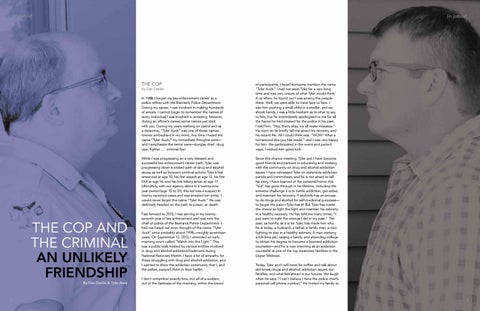
THE COP by Dan Donlin In 1988, I began my law enforcement career as a police officer with the Bismarck Police Department. During my career, I was involved in making hundreds of arrests. I cannot begin to remember the names of every individual I was involved in arresting; however, during an officer’s career, some names just stick with you. During my years working on patrol and as a detective, “Tyler Auck” was one of those names forever embedded in my mind. Any time I heard the name “Tyler Auck,” my immediate thoughts were— and I emphasize the terms were—burglar, thief, drug user, fighter . . . criminal foe! While I was progressing on a very blessed and successful law enforcement career path, Tyler was progressing down a wicked path of drug and alcohol abuse as well as frequent criminal activity. Tyler’s first arrest was at age 10, his first assault at age 15, his first DUI at age 16, and his first felony arrest at age 17. Ultimately, with our agency alone in a twenty-oneyear period (age 10 to 31), this kid was a suspect in twenty reported cases and was arrested ten times. I would never forget the name “Tyler Auck.” He was definitely headed on the path to prison, or death.
THE COP AND THE CRIMINAL AN UNLIKELY FRIENDSHIP By Dan Donlin & Tyler Auck
2
Fast forward to 2015; I was serving in my twentyseventh year of law enforcement and was now the chief of police of the Bismarck Police Department. I had not heard nor even thought of the name “Tyler Auck” since probably about 1998—roughly seventeen years. On September 12, 2015, I attended an early morning event called “March into the Light.” This was a public walk hosted by various entities involved in drug and alcohol addiction/treatment during National Recovery Month. I have a lot of empathy for those struggling with drug and alcohol addiction, and I wanted to show the addiction community that I, and the police, support them in their battle. I don’t remember exactly how, but all of a sudden, out of the darkness of the morning, within the crowd
of participants, I heard someone mention the name “Tyler Auck.” I had not seen Tyler for a very long time and was very unsure of what Tyler would think if, or when, he found out I was among the people there. Well, we were able to meet face to face. I saw him pushing a small child in a stroller, and we shook hands. I was a little hesitant as to what to say to him, but he immediately apologized to me for all the havoc he had created for the police in his past. I told him, “Hey, that’s okay, we all make mistakes.” He went on to briefly tell me about his recovery and his recent life. All I could think was, “WOW! What a turnaround this guy has made,” and I was very happy for him. We participated in the event and parted ways; I wished him good luck. Since this chance meeting, Tyler and I have become good friends and partners in educating and working with the community on drug and alcohol addiction issues. I have witnessed Tyler on statewide addiction panels and committees, and he is not afraid to tell his story. I have learned of the personal horror this “kid” has gone through in his lifetime, including the extreme challenge it is to battle addiction, get sober, and maintain his recovery. If anybody has an excuse to do drugs and alcohol for self-medicinal purposes— to forget the pain—Tyler has it! But Tyler has made the choice to fight the fight and maintain his sobriety in a healthy recovery. He has told me many times, “I just want to right the wrongs I did in my past.” The past, as horrific as it is for Tyler, has made him who he is today; a husband, a father, a family man, a man fighting to stay in a healthy sobriety. A man working a full-time job, raising a family, and attending college to obtain his degree to become a licensed addiction counselor—and he is now interning as an addiction counselor at one of the top treatment facilities in the Upper Midwest. Today, Tyler and I will meet for coffee and talk about old times, drugs and alcohol, addiction issues, our families, and what lies ahead in our futures. We laugh when he says, “I can’t believe I have the police chief’s personal cell phone number.” He invited my family to
3
[in justice]
[in justice]
I took great pride in my using and in my ability to consume more alcohol and drugs than anyone else around me. THE (EX-)CRIMINAL by Tyler Auck My life in addiction started from the time I was born. My family was damaged by the disease of addiction many generations before me, and it will continue for many generations to come. Growing up in a home where addiction ran rampant, l experienced physical abuse, verbal abuse, and pure mental torture as a young child. My young green eyes saw things that no child should ever have to experience. My innocence was taken from me one horrible moment at a time. Sometimes I look at pictures of myself as a child; I look into those innocent eyes and see the pain and feel the fear that still haunts me today.
Dan Donlin and Tyler Auck
his son’s birthday party; wow, what an unlikely friendship. Tyler tells me he looks up to me, but it is I who look up to Tyler. He has gone through more difficulty and struggles in life than I can even dream of, let alone have ever actually had to deal with. It is my honor to call Tyler Auck my friend. No one can understand the hell he and others like him have had to go through to make it where he is today. I’m glad he crawled out of hell screaming and fighting, because this man is making a positive difference. Now when I hear the name “Tyler Auck,” my immediate thoughts are: friend, success, integrity, compassionate, helper, credible, forgiver, family man, conqueror . . . hero! Tyler, friend, you are a positive role model and I couldn’t be any more proud of you than I already am.
DAN DONLIN is a lifelong Bismarck resident and has completed twenty nine years of service with the Bismarck Police Department. He is a graduate of St. Mary’s Central High School and the University of Mary. His law enforcement experience includes working in patrol, investigations, police youth bureau as public information officer, and fifteen years on the SWAT team. He is a 2003 graduate of the FBI National Academy and became chief of police for his hometown department in 2013. 4
In 1989, I tried my first drink, and it was the most amazing feeling in the entire world. I felt stronger than Superman, but in reality, I was so drunk that I couldn’t get up off the ground. This simple act of experimentation lit the fire of addiction in my soul, and I was instantly a full-blown addict. My disease progressed until it became stronger than life itself. After the alcohol, I tried marijuana, followed by pills, cocaine, and methamphetamine. You name it and I would do it. I took great pride in my using and in my ability to consume more alcohol and drugs than anyone else around me. Even before my first use I was involved in some simple assaults, vandalism, and lots of fights that I was never arrested for. But once chemicals were added to my system, all of the horrible violent behaviors escalated and had a negative impact on my life, my community, and everyone else who happened to get in the way of my addiction. My path of pain and destruction began early. At the age of 15 or 16, I was raped by an older woman because I was too drunk to defend myself. At 16, I received my first DUI and experienced a couple of alcohol-
and drug-related overdoses. By the time I was 17, I had already been arrested several times and was well known to law enforcement and the community as a thug and drug user. During this time my drinking escalated to expert level. I would wake up in the morning already shaking and craving some sort of chemical to ease the demons inside of me. I felt as if my choice to not use was taken away one second at a time. As I fell deeper into my hole of addiction and pain, I became desperate. I started to burglarize businesses as a way to fuel the fire inside of me for adrenaline and the high that I craved. I was slowly dying, and each day I tried harder and harder to help death along. During this time, “Dan Donlin” was a name that I heard often, because he was one of the lead detectives assigned to investigate me. I hated law enforcement, because they were hindering my ability to feed my addiction and trying to stop the rampage and chaos that was my life. In a sick and twisted way, I was enjoying it and was secretly proud of the fact that law enforcement couldn’t pin anything on me. But soon enough, my luck ran out. By the time I turned 18, I was facing several criminal charges, including burglary, assault, and theft of property. They were going to try me as an adult, and I was facing thirty-five years in prison. Somehow, I managed to slip by with house arrest and probation. Most would think that this would have been my rock bottom or a wakeup call, but it never even slowed me down. In 1994, I moved to Boulder, Colorado. I needed a fresh start, to get away from Bismarck, Dan Donlin, and all of the people and things that were out to get me. It also helped that I heard there were lots of drugs there, too. Once I was established in Colorado, things got worse for me. My addiction picked up right where it left off, and the violence and self-induced bad luck
continued. (For a long time, I was convinced that Bismarck Police Department called ahead and told them about me.) I was broken and out of hope. I ended up with a criminal record in Colorado and was forced to move back to Bismarck with a degree in LSD, marijuana, cocaine, heroin, and drug-dealing. In 2001, I married a girl back in Bismarck, and over the next seven years, our lives and relationship spun out of control. During this time, my violent behaviors started to slow but my disease became increasingly worse. My addiction tricked me into thinking that I had major medical problems, and over an eleven-year period, I had twelve surgeries. In reality, I probably only needed two; the others were just a way to get pain meds. My wife and I started to get meds from veterinarian clinics to feed our habit. Methamphetamine was also a huge part of our daily lives. I was hospitalized on a regular basis and lied, cheated, and sold drugs to get what I needed. By 2009, our marriage was over and the thoughts of suicide that plagued me early in life reared their ugly head, and I made yet another attempt to take my life by placing a gun in my mouth and pulling the trigger. For some reason, my higher power had other plans in store for me, and the gun failed to fire. During the divorce, I checked myself into treatment with the hope of saving my marriage. I had been through many treatment centers before, and inevitably, this one failed as well. I had not yet felt enough pain in order for me to stay sober. Over the next couple of years, I managed to put together about eleven months of sobriety, but I could not find peace or happiness. I crashed once again and went on a three-week violent, suicidal, meth-and-opiate-induced rampage. Finally, I had had enough, and on January 5, 2011, I checked myself into the Heartview Foundation. Since that cold, miserable, beautiful day, I have remained sober and in recovery with the help of so many wonderful people. In February 2011, I met the girl of my dreams, and we formed a beautiful relationship and married in 2012. We have a home that is filled with recovery. We have two children together, and my wife has one child from a previous relationship. It is such a beautiful gift to have a woman that I love so much, and to have her back and know that she has mine, even after learning about my past. My wife is in law enforcement, and on several occasions, we have run into my old friends. They ask if that’s the “side” I’m on now, and my response is “yes”! Today, I am ethical and law-abiding, and I support the love of my life and the Thin Blue Line. Over the next several years, I often thought about my life of destruction and the pain I had caused others. Then, on a cold day in early 2015, I was in a skid steer, clearing snow on the south side 5
[in justice]
The man who once built a criminal case against me is now one of my biggest supporters in life and in my recovery. of the state capitol when I saw a man walking into the building. My stomach got a sick feeling and my heart raced. My eyes zeroed in on Dan Donlin—the man that, so many years before, I had hated and despised. But this day was different. The hatred was gone, replaced with so much guilt and shame. I wanted to jump out of my machine and run to him, to tell him how sorry I was for all the chaos and damage that I had done to our community and to the Bismarck Police Department, but that particular day, I could not fight past the fear and shame and bring myself to do it. Then, in September 2015, I was asked to speak at the “March into the Light” recovery walk organized by Face It Together. It was dark and cold as my family and I huddled together around the shelter. In my head, I was rehearsing the few words I had prepared to say to the crowd. Suddenly Dan Donlin, chief of police, was introduced as the first speaker. My immediate thought was to run, but I couldn’t. I made a commitment to do this, and I was going to see it through. When Dan finished speaking, they called me up front, handed me the microphone, and I said, “My name is Tyler Auck, and I have been sober since January 5, 2011. Dan used to investigate me—Hi, Dan.” Through the darkness and the fear, I heard a voice say, “Hi, Tyler.” I finished speaking and walked through the crowd to shake the hand of the man that I once hated and feared. I was greeted with a big hug and the words, “I am proud of you, Tyler.” Then, we
walked. I pushed my little boy, Charlie, in a stroller and held my wife Amber’s hand as our daughter, Tess, walked next to us. We took a stand for recovery and the people still out there suffering from the disease of addiction. After the walk, we all stood around and talked to the man who was once one of my biggest enemies. That morning something very beautiful happened between a cop and an ex-criminal, and from that moment on we formed a wonderful friendship. We have coffee and talk about life, family, and what we can do as human beings to make a difference in our community. Dan and I joke around sometimes in disbelief that we have each other’s personal cell phone numbers. In 2016, Dan and his family came to my little boy’s second birthday. The man who once built a criminal case against me is now one of my biggest supporters in life and in my recovery. I’m proud that today he calls me “friend.” On May 27, 2017, I sit in front of my computer putting all of these thoughts down on paper as my beautiful family is in the background, giggling and full of life. I often say that my life is full of broken gifts. They may have been delivered to me in the ugliest, most horrifying package, but I wouldn’t change it for the world. Today, I am blessed with a beautiful family, great friends, over six years of recovery, and the privilege to intern at the Heartview Foundation to become a licensed addiction counselor and help people just like me and you. This story is more than just a criminal and a cop. It is about breaking down the barriers our communities face each day. It shows that change is possible, and no matter how far down the hole of addiction and pain we fall, there is hope! l TYLER AUCK was born and raised in Bismarck, ND. He graduated from Bismarck High in 1993. Tyler is attending Minot State University and will graduate with a bachelor’s degree in addiction studies in fall 2017. He is also currently an Addiction Counselor in training at the Heartview Foundation. Tyler has served on numerous opioid panels throughout the state to help combat the drug epidemic that is plaguing our communities. He is an inspirational speaker and a member of the ThinkND Blue Ribbon panel.
6
donating = loving Bringing you On Second Thought takes a lot of staff time and fundraising. If you love receiving this magazine, please consider becoming a member with a recurring monthly donation of your choice, priced between a cup of coffee and a good dinner.
monthly donation ♥ $7 / month ♥ $10 / month ♥ $25 / month ♥ $50 / month
one-time donation
give now
You can also become a one-time patron with a single donation in any amount.
Use the enclosed envelope to make your gift, or log on at ndhumanities.org
Visit ndhumanities.org and tell us what you think.
Each year the ND Humanities Council funds hundreds of events in communities across North Dakota. You might not remember
Or call 701.255.3360 to request a written survey by mail.
seeing our logo, but if the event involved lifelong learning in the humanities, it’s a good bet we helped make it happen. Because we exist to serve you, we want to hear from you. Take our survey and tell us what kind of programs and events you hope to see happen in your community.
7
[in justice]
[in justice]
A JOURNEY THROUGH NORTH DAKOTA’S
If you met Robert Stephens today, you would see a man who is friendly and outgoing with a stable job and a large, loving family. Yet for many years, his life took him to a dark place ruled by his addiction to drugs and alcohol. Stephens is one of thousands of people in North Dakota who has cycled in and out of prison because of crimes fueled by substance abuse. Yet prison couldn’t help him break free of his addiction or his drug-fueled crimes. What helped him finally kick his multiple drug habits and his criminal lifestyle was drug court. His journey is one that many drug offenders have followed. His story has a clear beginning, an agonizingly long middle, and a one-year ending, which has led him, fortunately, to a new beginning. THE BEGINNING Stephens’s addiction started with alcohol shortly after his twenty-first birthday. Always a loner, alcohol melted his shyness and helped him open up. “Really, alcohol was a stress reliever to calm my social anxiety,” he says. But the drinking, mixed with smoking pot, quickly became a necessity—one that made it hard for him to function normally. “Because I was out drinking all the time, I couldn’t get up for work. And it got to the point where I was just staying on friends’ couches all the time. I couldn’t pay bills,” he recalls. He began forging checks to pay for the rounds of nightly drinks while denying that his partying had morphed into a serious addiction. Denial is perhaps the toughest wall separating addicts from the help they need, according to Brenda Ross Phillips, an addiction counselor at Prairie St. John’s in Fargo. “Some people will say, ‘My life is going fine,’ and I’ll say, ‘Really? So, you’ve got charges, you don’t have a job, you’re couch surfing, and you think life is fine?’ They aren’t seeing what’s happening,” Phillips says.
By Meg Luther Lindholm
8
One day, Stephens took a new car out for a test drive, copied the key, and returned to the lot two weeks later to steal it. By the time the cops caught up with him, there were multiple
warrants for forged checks, breaking and entering, and theft. He was convicted and shipped off to the state penitentiary in Bismarck. Prison wasn’t all that hard once he adapted to the dull routine of life behind bars. And prison did nothing to steer him away from crime once he got out. The only difference was that he began committing bigger crimes to support a more serious drug habit that grew to include methamphetamines. His professional vocation became largescale drug-dealing. “I drove down to Minneapolis several times a week to pick up large quantities of meth and marijuana,” Stephens says. “I had to deal thousands of dollars of drugs a day to provide for my lifestyle—my addiction to drugs, my addiction to gambling, buying cars, taking people out to eat, going on trips with people—everything to provide everybody with an outlook that hey, my life was okay, without them knowing what was really going on.” In hindsight, Stephens knows he wasn’t fooling anyone. And inevitably, like a house of cards, his lifestyle collapsed with each new arrest and return to prison. “I was never good at being a criminal. I got caught for everything I did,” he says.
9
[in justice]
[in justice]
Approximately 75 percent of people in North Dakota’s prisons and jails suffer from a serious addiction. And North Dakota has the distinction of having the third-fastestgrowing rate of incarceration in the country. To emphasize the fact, he repeats, “I just wasn’t good at it.” The blinders he once wore are now gone. “Everybody gets caught. It’s just a matter of time. I don’t know any successful drug dealers. I don’t know any successful addicts. Eventually it [drugs/dealing] will lead you to jails, institutions, or death.” Clearly prison wasn’t serving its intended purpose of deterring his criminal behavior. The same is still true for many people convicted of drug crimes. In fact, the number of substance abusers who wind up in jail or prison has been skyrocketing in states across the country including North Dakota. According to Leann Bertsch, North Dakota’s Department of Corrections and Rehabilitation (DOCR) director, approximately 75 percent of people in North Dakota’s prisons and jails suffer from a serious addiction. And North Dakota has the distinction of having the third-fastest-growing rate of incarceration in the country. According to the Council of State Governments (CSG) Justice Center, North Dakota’s prison population grew 32 percent between 2005 and 2015, and its jail population grew 83 percent between 2006 and 2013. Bertsch puts the state’s recidivism rate at close to 40 percent. While not as high as the national average of 60 percent, it’s still high. Especially given the price tag of forty thousand dollars per year per prisoner. Probation with mandatory treatment 10
has also suffered under the strain of too few addiction counselors and too few probation officers—especially in rural areas. A survey of North Dakota judges conducted by the CSG Justice Center found that 70 percent of judges had sentenced low-risk, nonviolent substance abusers to prison in order to access treatment. Many of these were offenders who had violated the terms of their probation multiple times. This perfect storm of high cost and high recidivism is what prompted DOCR Director Bertsch and others to call for change. “What are we trying to effect by using incarceration?” Bertsch asks. “We want people to desist from crime, and sometimes prison or jail is not the answer to get those individuals to change that behavior. In fact, putting someone in prison actually increases the likelihood of committing more crimes. So, I really think that jails and prisons have become a default answer to a problem that’s very complex but has better solutions than incarceration.” This past spring, the North Dakota legislature voted to divert seven million dollars that would have gone toward more prison beds to increased drug treatment programs for offenders. The question now facing state government officials is how best to spend this money. PROBATION ON STEROIDS The program that worked for Stephens turned out to be drug court.
Drug court is an intensive, one-year probation program that offenders must apply to. Jennifer Hischer, Stephens’s probation officer, says the requirements and oversight offenders receive in drug court far outweigh what probation alone provides. “When you compare supervision of offenders who are in drug court to offenders that are on regular probation, the contacts are much greater in drug court,” Hischer says. “They’re seen by probation weekly. They’re drug tested anywhere between one and five times a week. They’re in treatment three nights a week. They see a judge weekly.” All of this on top of working full-time or being enrolled in school. Judge John Irby, who presides over one of Fargo’s two drug courts, refers to the program as “probation on steroids.” By the time Stephens was offered the chance to apply to drug court, he had been to prison seven times. He was completely fed up with himself and his life. He was tired of using drugs and committing crimes, and he was estranged from family members whom he dearly loved. He wanted to get off the merry-go-round of incarceration but didn’t know how. Then he was arrested again. “This would have been my eighth time back in prison,” he says. “I didn’t want to go and I wanted something to change in my life, and I had heard good things about the drug court program.” Drug court wasn’t created with serious repeat offenders like Stephens in mind. Rather it was intended as a diversion program for low-level drug offenders. However, the program’s success as demonstrated by high completion rates and low recidivism has led to its expansion. Now higher-level drug offenders like Stephens are encouraged to apply. North Dakota State University (NDSU) criminal justice professor Kevin Thompson says this is the right approach. “Drug courts should focus on high-level offenders, those most at risk to relapse. This is what saves the prison system money,” he says. “Low-level offenders would not be imprisoned
anyway, and many of them do not feel that they have a problem. High-level offenders know they have a problem.” As Stephens’s probation officer Hischer says, “Prison was probably easy for Rob. This [drug court] was going to be his challenge.” The drug court Stephens was assigned to is presided over by Judge Irby in Fargo. JUDGE JOHN IRBY’S DRUG COURT It’s Thursday afternoon in Fargo, and a group of about twenty-five drug offenders sit in Judge Irby’s drug courtroom waiting to report on their progress over the past week. Some have brought their children, who seem to know instinctively to use their quiet voices. At 4:00 p.m., like a well-scripted play, Irby enters from stage left and takes his place up on the bench. His tone is friendly if businesslike as he calls each offender up to the front of the room to sit at a table across from him and the other members of the drug court team. In addition to the judge, the team comprises a probation officer, an outpatient drug addiction counselor, and a mental health counselor. They have all met beforehand to discuss each offender’s progress over the past week. So again, like a well-scripted play, there are no surprises. The judge knows exactly who has stayed on and
strayed off the drug court program. He peers down at one young woman and asks with a hint of exasperation in his voice, “Well, why don’t you tell me what’s going on with you?” Sounding contrite, the woman acknowledges what he already knows. “I hung out with people I shouldn’t have and I ended up using,” she says. He asks if she wants to continue with the program. Her voice is meek yet firm. “I need to and I want to. It’s the only thing that’s going to keep me in check,” she replies. He doles out what she knows is coming—a sanction of two nights in jail, to which she willingly agrees. Offenders who have stayed on track with their program get prizes that he pulls out of a fishbowl, like fast food coupons and court fee waivers. “I like to think I’m there to encourage them to do what they need to be doing,” Irby says. “In the end, what I can do is dish out a measure of discomfort. I have told some I can’t make you responsible, I can make you
miserable. But for the most part, I view my role as trying to encourage them to comply with the program, to turn their lives around.” Thompson says the judge is often the glue who holds offenders accountable. “The judge is key. Each [offender] appears every week for the first three to four months before the drug court judge,” Thompson says. “With the right judge, these offenders get sucked into the process in a good way. It’s the first time they see a credible authority who cares about ‘me’ and my family.” NDSU assistant professor Andrew Myer agrees. “It’s not the punishment that counts—it’s the reinforcement of doing good things,” he says. This intensive regimen has led to a track record of success. According to Thompson, the recidivism rate nationally for drug court graduates is far lower than for prison. “Recidivism rates five years out with released [prison] offenders will normally be in the 50 to
With the right judge, these offenders get sucked into the process in a good way. It’s the first time they see a credible authority who cares about ‘me’ and my family.
Robert Stephens, right, and his dad at drug court graduation.
Robert Stephens and his drug court team.
11
[in justice]
60 percent range,” Thompson says. “With drug courts, we see recidivism rates about half this number at the five-year mark.” North Dakota’s rate of recidivism for drug court graduates three years out is about 20 percent, which is about half the state’s prison recidivism rate. In many cases, the conviction that led to drug court is effectively expunged after successful completion of the program. TRYING DESPITE HIS FEAR Stephens was hugely fearful about whether or not he could make it through the rigors of drug court. “I was nervous because I didn’t feel like I would do very well in the program,” he says. “It was a very strict program that requires a lot of commitment, and I’ve had a history in my life of giving up on things when they got tough. It seemed like a very daunting task at the beginning for a person who did not live by life’s rules very well.” Stephens’s drug court probation officer, Jennifer Hischer, also remembers how discouraged he was initially. “When I screened him for drug court, he was very down,” she says. “I remember specifically him telling me that he was a loner and AA or any meetings would never work for him, and he was just very negative about his chances for success here simply because he had tried and failed so many times before.” When asked why she felt he was a candidate for drug court given his record of failure, Hischer responded, “Probably because of his record of failure. I mean this is something that we hadn’t tried before, and he was willing to give it a try. And one of the things I like to stress to people is that I understand it sounds overwhelming and there’s nothing easy about this, but in the beginning, all we ask is that you just show up and you try. And he was willing to do that.” With Hischer’s encouragement Stephens worked hard at the program. 12
[in justice]
North Dakota’s rate of recidivism for drug court graduates three years out is about 20 percent, which is about half the state’s prison recidivism rate.
He attended support group meetings, outpatient counseling sessions, and drug court hearings. He submitted to frequent and random drug tests. He held down a full-time job and obeyed a nightly curfew. Along the way, he got a lot of support and encouragement from his drug court team and the other people in recovery with him. About halfway through the year-long program, Stephens noticed a change in himself. “That’s when things really started to click for me, with making new friendships in the program and spending a lot of time with a lot of my group mates from drug court, and doing things that didn’t require anything but me to have a good time. And the happiness and joy that I was getting out of doing those things really started opening my eyes to what life could be like without using,” he says. Hischer also noticed the shift in Stephens’s outlook. “I think with Rob, when I noticed the first real changes in him was when he started connecting with the community,” she says. “He got a really good sponsor. He started attending more meetings than we require and doing fellowship activities. And he just became excited about it. You know the people that we see succeed are the ones that really embrace that [involvement] and continue it long after drug court.” THE SOUTH DAKOTA EXPERIENCE To date, there are only five drug courts in North Dakota’s larger cities, but some criminal justice experts say there should be more. For guidance, North Dakota might consider South Dakota’s example. According to Greg Sattizahn,
South Dakota’s court administrator, the state’s criminal justice system once faced many of the same problems as North Dakota. “Judges were sending drug offenders to prison in order to get them out of their communities and to get treatment,” he says. Incarceration costs were rising, and recidivism was high. The state legislature decided to allocate more funds for community addiction treatment services for drug offenders. South Dakota court officials created more drug courts to serve as hubs through which to rehabilitate felony drug offenders, and the treatment infrastructure was expanded. The number of adult drug courts in South Dakota grew from one in 2007 to sixteen today. “They’re not everywhere, but there’s a pretty good distribution across the state in the medium to larger population centers,” Sattizahn says. But he points out that drug courts won’t work if the necessary treatment services aren’t in place. “These are treatment courts,” he says. Three years after graduation, the recidivism rate for drug court offenders in South Dakota is 16 percent, in contrast with a 40 percent recidivism rate for people released from prison over the same time period. Thompson advocates setting up more drug courts in North Dakota via teleconferencing. “We could fund teleconferences like the medical school does, where patients appear on a TV screen or Skype and talk about their recovery with a physician or nurse,” he suggests. “Drug courts could do the same thing in Carrington, Wahpeton, Grafton, and places where they could reach offenders. You could hold
hearings for five to ten people very easily this way.” There are limits to the drug court model. Because of the rigors involved, offenders must apply to be in the program. Hischer says more people could benefit from drug court, “but [they] have to be willing to do it. The court doesn’t ever just sentence someone to it. You have to apply and have a good understanding of the expectations. It’s not for everybody.” And there are critics of drug court who say that addiction is a public health problem that should not be treated within the criminal justice system. In a blog post for the Open Society Foundations, an organization chaired by George Soros, Margaret Dooley-Sammuli of the Drug Policy Alliance writes, “Incarcerating people
for a relapse—a predictable and normal part of drug treatment—flies in the face of public health principles. Denying opioid-dependent individuals access to what might be the most effective treatment for them, narcotic replacement therapies including methadone and buprenorphine, and then incarcerating them for failing to do well is unconscionable. Most drug courts are guilty of both.” Thompson responds that the laws have to change first. “Until we decide that drug use, possession, and distribution is not criminal [e.g., victimless crime],” he says, “we will continue to hold those who use these substances accountable criminally.” A NEW BEGINNING July 28, 2016, was one of the proudest days of Stephens’s life. That was the
day he graduated from drug court. Everyone who mattered most was there—his dad, his wife, his stepkids, his friends, and his sponsor. He feels that drug court literally saved his life. “My addiction brought me to the brink of suicide. If I didn’t do drug court, I honestly don’t think I would be here today,” he says. “Drug court has given me my life back.” l
MEG LUTHER LINDHOLM is a freelance radio/podcast writer and producer for outlets such as National Public Radio and Prairie Public Broadcasting. Since moving to Fargo from New York City in 2002, she has pursued projects that address social issues. Her most recent project, Journeys through Justice, funded by the North Dakota Humanities Council, focused on criminal justice reform in North Dakota.
alcohol, Discover Fargo/Moorhead vice — gambling, drugs, ey, an and prostitution — through the story of Melvina Mass the een African-American brothel owner in Fargo betw g a 2016 mid-1880s and 1911. See evidence collected durin as “the n salvage archeology project in the area then know 19th and hollow,” Fargoʼs Red Light District during the late early 20th centuries.
@Bonanzaville
1351 Main Ave. W., West Fargo, ND 58078 SPONSORED BY:
College of Arts, Humanities, and Social Sciences Department of Anthropology and Sociology Department of History, Philosophy, and Religious Studies
Mad am Mas sey ’s Cry sta l Pal ace 13
[in justice]
[in justice]
SNAPSHOT OF CRIMINAL JUSTICE REFORM IN NORTH DAKOTA
Nationwide, the last few decades have seen an increase in both jail and prison incarceration. North Dakota was no stranger to these effects and has also seen dramatic increases in incarceration, especially during the recent oil boom era. Based on an increasing demand for prison space, the North Dakota legislature has undertaken a number of criminal justice reforms in 2017. The legislature began this process by undertaking a data gathering process spearheaded by the Council of State Governments (CSG). The data collected from CSG reflect trends from both county jails and the North Dakota state penitentiary. The ultimate conclusion was the criminal justice system is a poor substitute for local mental health and chemical treatment options. CSG further concluded that if individuals could be kept out of incarceration, then the money spent by the government on incarceration could be redirected to treatment programs, which would then create better outcomes for the defendant and society in general.
By Aaron Birst
The criminal justice system is a poor substitute for local mental health and chemical treatment options.
In accordance with those principles, the legislature offered many bills in 2017 that contained modifications to North Dakota’s criminal justice statutes. The primary bills that accomplished these goals are found in House Bills 1041, 1269, 1270, and 1341. The thrust of these bills’ impact can be categorized as reduction to drug penalties and increased use of probation. House Bill 1041, for example, reduces all “personal use” drugs for first offenders to misdemeanors, regardless of the type of drug. Those engaged in manufacturing or distribution of drugs would also see a penalty level drop and reduced minimum mandatory sentences. Additionally, starting January 2018, almost all misdemeanor and C-felony (lowest felony category) offenses will be mandated probation only for first-time offenders. This means first-time offenders doing things such as heroin, aggravated assault, or low-level thefts could not be sentenced to any incarceration, at least initially. The legislature also appropriated seve million dollars for pilot treatment programs handled at the local level.
What effect these bills will have on criminal activity or the state’s or counties’ bottom lines is too early to tell. Regardless of the effects of such legislation, the ultimate question that must be solved is how society can maintain safety for its populations while at the same time making sure the underlying issues that may have caused or at least contributed to the unwanted conduct is addressed. l
AARON BIRST graduated with distinction in 2001 from the University of North Dakota School of Law. Currently, Birst is legal counsel for the Association of Counties. Additionally, he serves as the executive director for the North Dakota State’s Attorneys Association and works on a contract for the Department of Transportation to provide support to law enforcement and prosecutors in the area of traffic safety. Previously, Birst was a prosecutor in both Cass and Stutsman Counties, where he practiced criminal law.
14
15
think outside AUGUST 18-20 A THOUGHTFUL APPROACH TO OUTDOOR ADVENTURE IN NORTH DAKOTA
FIND YOURSELF GETTING LOST. Think Outside seeks to connect people with ideas and with the beauty of our natural landscape. Through guided discussions around campfires during the evenings and outdoor adventures during the day, we hope to build a community of adventurers who come to know both themselves and the beauty of the Peace Garden State.
Badlands Sense of Place Adventure August 18-20, 2017 Register at ndhumanities.org In the mid-1950s Edward Abbey took a job as a seasonal park ranger in what is now called Arches National Park in Moab, Utah, and from that experience he wrote Desert Solitaire. This work is considered by many a classic now—often compared to Thoreau’s Walden—and will serve as our conversation piece for Think Outside’s second annual Sense of Place weekend at Elkhorn Ranch Campground, August 18-20. Let yourself be provoked, impassioned, and inspired by the landscape, the experience, and the discussion of Abbey’s ideas around the campfire and while hiking. Some of his ideas might make you angry; others will move you with their beauty, such as: It seems to me that the strangeness and wonder of existence are emphasized here, in the desert, by the comparative sparsity of the flora and fauna: life not crowded upon life as in other places but scattered abroad in sparseness and simplicity, with a generous gift of space for each herb and bush and tree, each stem of grass, so that the living organism stands out bold and brave and vivid against the lifeless sand and barren rock. The extreme clarity of the desert light is equaled by the extreme individuation of desert life forms. Love flowers best in openness and freedom.
Join Tayo Basquiat, your intrepid facilitator for this experience, at Elkhorn Ranch Campground for a weekend of thinking about our sense of place, the landscape of the Badlands, and the book Desert Solitaire. Registration, schedule, packing list, and directions available at ndhumanities.org.
WITHOUT THE HUMANITIES, LIFE IS NOT LIFE.
History, philosophy, arts, and literature—the humanities teach us where we’ve been, who we are, and empower us to grow; they are the epitome of human expression. The humanities inspire the innovators of tomorrow by providing real knowledge for real-world reasoning. These skills allow us to gain new insights into everything from poetry and paintings to business models and politics.
Make an investment in yourself today and support the North Dakota Humanities Council!
RECENT DONORS GROUNDBREAKER $1,000 OR MORE James & Connie Hildebrand SUPPORTER $500 - $999 George & Cheryl Mizell ASSOCIATE $250 - $499 Barbara & Steven Andrist Thomas & Katie Hutchens David & Joan Locken Betty Mills Thomas A. Wentz In Memory of Janet Wentz CONTRIBUTOR $100 - $249 Paige & Joan Baker Madelyn Camrud William R. Caraher Kevin Carvell Marilyn G. Cunningham Robert Dambach Earl & Patricia Donaldson In Honor of Pauline & Donald Colquhoun Richard & Carolyn Edwards David & Karla Ehlis Russell & Glenda Fauske Sherill & John Fosland Kara Geiger Melissa Gjellstad Verlaine Gullickson Kate Haugen Gary & Laureen Hendricks Beth & Tim Huseth Rita Kelly Nancy Koupal Kimberlee S. Leite Nancy Lervik Russell & Joan Lorenz Dennis & Meryl Lutz Thomas & Michelle Matchie Michael McCormack Linda Opstad
Randy & Bridgette Readel Richard M. Rothaus Ed & Judy Ryen Bernhard Saltveit Stacy Schaffer Laura Schmidt-Dockter Twila Schrock Dave Solheim In Memory of Everett C. Albers Teresa Lyn Tande Ryan & Nicole Taylor Sarah M. Vogel Rande Zander FRIEND $99 AND BELOW Rhonda R. Allery Elizabeth Barber In Memory of Kathryn Bonnie (Fredenburg) Barber Judy & Coby Barstad Rita Bartholomew Geri Beckman In Memory of Patricia Hinkle Catherine L. Carlson Ron Carrick In Memory of Mary Carrick Jim & Hariett Davis Orrin DeLong Dora Diepolder Gloria Espeseth Pam Fisher Kenneth W. Foster Brenna & Thomas Gerhardt Bob Getz & Lona Daley Getz Tina Grumbo Bruce Hagen In Honor of Marilyn Pederson Judith Hammer Betty Haussler In Memory of George Haussler John S. Heinen Christi Kluzak Vita M. Kok
Dawn Kopp Lynette Lahren Howard W. Langemo Ann Crews Melton Michael M. Miller Jerry & Ellen Misialek Frances L. Muckenhirn Donna Murray Jane Nissen Linda Olson Leslie W. Peltier Mary & Robert Price Shirley Quick Mary Kay Keller Ralston In Memory of Tim Ralston Mildred Rothgarn Garnet Schatz Kayla A. Schmidt Royann Schmidt Elizabeth Sund Greg Sund Searle Swedlund Ralph Tack Robert Todd Carolyn & Dale Twingley Nick & Ene Vogel In Honor of Jane Ahlin Arnold & Donna Wallender Carole Watrel Marilyn Weiser Bob & Betty Wheeler In Honor of Pamela K. Burkhardt JoAnn Wittmayer In Memory of Judy Wittmayer
ndhumanities.org
[gamechanger thinkers]
[gamechanger thinkers]
PIPER KERMAN PIPER KERMAN is the author of the memoir Orange Is the New Black: My Year in a Women’s Prison published by Spiegel & Grau. The book has been adapted by Jenji Kohan into an Emmy Award-winning original series for Netflix. Piper works with nonprofits, philanthropies, and other organizations working in the public interest and serves on the board of directors of the Women’s Prison Association and the advisory boards of InsideOUT Writers and JustLeadershipUSA. She has been called as a witness by the U.S. Senate Judiciary Subcommittee on the Constitution, Civil Rights and Human Rights to testify on solitary confinement and women prisoners, and by the U.S. Senate Governmental Affairs and Homeland Security Committee to testify about the federal Bureau of Prisons. Piper has spoken at the White House on re-entry and employment to help honor Champions of Change in the field, as well as the importance of arts in prisons and the unique conditions for women in the criminal justice system. In 2014, she was awarded the Justice Trailblazer Award from John Jay College’s Center on Media, Crime & Justice and the Constitutional Commentary Award from The Constitution Project; the Equal Justice Initiative recognized Piper as a Champion of Justice in 2015.
18
Piper is a frequent invited speaker to students of law, criminology, gender and women’s studies, sociology, and creative writing, and also to groups that include the International Association of Women Judges, the American Correctional Association’s Disproportionate Minority Confinement Task Force, the National Conference of State Legislatures, the National Criminal Justice Association, federal probation officers, public defenders, justice reform advocates and volunteers, and formerly and currently incarcerated people. Piper is a graduate of Smith College. She lives in Columbus, Ohio, with her family.
Author of the memoir Orange Is the New Black: My Year in a Women’s Prison Serves on the board of directors of the Women’s Prison Association
19
[gamechanger thinkers]
[gamechanger thinkers]
After graduating from college, Piper Kerman fell in with a hard-partying, drug-dealing crowd. Ten years after she left it all behind, her past came back to haunt her. In her memoir, Orange Is the New Black: My Year in a Women’s Prison, she reveals the true story that landed her fifteen months in a federal prison.
THE MISTAKE THAT NEARLY COST ME EVERYTHING By Piper Kerman
20
International baggage claim in the Brussels airport was large and airy, with multiple carousels circling endlessly. I scurried from one to another, desperately trying to find my black suitcase. Because it was stuffed with drug money, I was more concerned than one might normally be about lost luggage.
West African drug lord. Maybe I should try to get through customs and run? Or perhaps the bag really was delayed, and I would be abandoning a large sum of money that belonged to someone who could probably have me killed with a simple phone call. I decided that the latter choice was slightly more terrifying. So I waited.
Dressed in suede heels, black silk pants, and a beige jacket, I probably looked like any other anxious 24-year-old professional, a typical jeune fille, not a bit counterculture, unless you spotted the tattoo on my neck. I had done exactly as I had been instructed, checking my bag in Chicago through Paris, where I had to switch planes to take a short flight to Brussels.
The next flight from Paris finally arrived — I spotted the suitcase. “Mon bag!” I exclaimed in ecstasy, seizing the Tumi before sailing through one of the unmanned doors into the terminal, inadvertently skipping customs. There I spotted my friend Billy waiting for me. I didn’t breathe until we had pulled away from the airport and were halfway across Brussels.
When I arrived in Belgium, I looked for my black rollie at the baggage claim. It was nowhere to be seen. Fighting panic, I asked in my mangled high school French what had become of my suitcase. “Bags don’t make it onto the right flight sometimes,” said the big lug working in baggage handling. “Wait for the next shuttle from Paris — it’s probably on that plane.” Had my bag been detected? I knew that carrying more than $10,000 undeclared was illegal, let alone carrying it for a
I graduated from Smith College, class of ‘92, on a perfect, sun-dappled New England day. While my more organized and goal-oriented classmates set off for graduate school programs or entrylevel jobs, I decided to stay on in Northampton, Massachusetts. A well-educated young lady from Boston with a thirst for bohemia, I had no idea what to do with all my longing for adventure. So I got an apartment with a fellow Smithie and a job waiting tables at a microbrewery. I bonded with
21
[gamechanger thinkers]
It all sounded dark, awful, scary, wild — and exciting beyond belief, a world about which I knew nothing.
[gamechanger thinkers]
fellow waitresses, bartenders, and musicians, all equally nubile and constantly clad in black. I ran for miles on country lanes, learned how to carry a dozen pints of beer up steep stairs, and indulged in numerous romantic peccadilloes with appetizing girls and boys. My loose social circle included a clique of impossibly cool lesbians in their mid-30s. Among them was Nora Jansen, a short, raspy-voiced Midwesterner who looked a bit like a white Eartha Kitt. Nora was the only one of that group of older women who paid any attention to me. One night over drinks, she calmly explained to me that she had been brought into a drug-smuggling enterprise by a friend of her sister, who was the lover of a major West African drug kingpin named Alaji. Nora was trafficking heroin into the U.S. and was being paid handsomely for her work. I was completely floored. Why was she telling me this? What if I went to the police? It all sounded dark, awful, scary, wild — and exciting beyond belief, a world about which I knew nothing. And while it wasn’t exactly love at first sight, for a 22-year-old in Northampton looking for adventure, Nora was a figure of intrigue. As if by revealing her secrets to me, Nora had bound me to her, and a secretive courtship began. Over the months that followed, we grew much closer. When she was in Europe or Southeast Asia for a long period of time, I all but moved into her house, caring for her beloved black cats, Edith and Dum-Dum. One day Nora returned home with a new white Miata convertible and a suitcase full of money. She dumped the cash on the bed and rolled around in it, naked and giggling. Soon I was zipping around in that Miata, with Lenny Kravitz demanding to know, “Are You Gonna Go My Way?” At the end of the summer, Nora learned that she had to return to Indonesia. “Why don’t you come with me, keep me company?” she suggested. Although I had been yearning to make a move to California, I had never been out of the United States, and the prospect was irresistible. I wanted an adventure, and Nora had one on offer. It was that simple. What would I need for my journey to Indonesia? I had no idea. I packed a small L.L. Bean duffel bag with a tank dress, blue jean cutoffs, some T-shirts, and a pair of black cowboy boots. I was so excited, I forgot a bathing suit. Adopting an air of mystery, I told my parents that I was traveling for an art magazine, then rebuffed any of their questions. Bali was a bacchanalia: days and nights of sunbathing, drinking, and dancing until all hours. Expeditions to temples, parasailing, and scuba diving offered other diversions — the Balinese scuba instructors loved the long-finned, elegant blue fish that had been tattooed on my neck while I was in New England. But the festivities were always punctuated by tense phone calls between Nora and her drug contacts. As a go-between for Alaji, she arranged to smuggle suitcases with heroin sewn into the lining into the States. It was up to her to figure out how to coordinate the logistics — recruiting couriers, training them on how to get through customs undetected, paying for their “vacations” and fees. The job required lots of flexibility and lots of cash. When funds ran low, I was sent off to retrieve money wires from Alaji at various banks — a crime itself, although I did not realize it. During a brief stay back in the States to visit with my very suspicious family, I received a call from Nora, who explained tersely that she needed me to fly out the next day,
22
carrying cash to be dropped off in Brussels. She had to do this for Alaji, and I had to do it for her. She never asked anything of me, but she was asking now. Deep down I felt that I had signed up for this situation and couldn’t say no. I was scared and agreed to do it. Nora met up with me in Europe, where things took a darker turn. Her business was getting harder for her to maintain, and she was taking reckless chances with couriers, which was a very scary thing. When Nora informed me that she also wanted me to carry drugs, I knew that I was no longer valuable to her unless I could make her money. Obediently I “lost” my passport and was issued a new one. She costumed me in glasses and pearls and told me to get a conservative haircut. With makeup she tried in vain to cover up the tattoo on my neck. A single phone call to my family would have rescued me from this mess of my own making, yet I never placed that call — I thought I had to tough it out on my own. Mercifully, the drugs she wanted me to carry never showed up, and I narrowly avoided becoming a drug courier. Still, it seemed like only a matter of time before disaster would strike. I was in way over my head and knew I had to escape. When Nora and I got back to the States right before Thanksgiving, I took the first flight to California I could get. From the safety of the West Coast, I broke all ties with Nora and put my criminal life behind me. It took me a while to get used to a normal life. I had been living on room service, exoticism, and anxiety for over six months. But several friends from college, now in the Bay Area, took me under their wing, pulling me into a world of work, barbecues, softball games, and other wholesome rituals. I immediately got two jobs, rising early in the morning to open a juice bar in the Castro, and getting home late at night after hostessing at a swank Italian restaurant across town. Finally I landed a “real” job at a TV production company that specialized in infomercials and worked my way up from Gal Friday to producer. I never talked about my involvement with Nora to new friends, and the number of people who knew my secret remained very small. As time passed, I gradually relaxed — I was feeling pretty damn lucky. Great job, great city, great social life. Through mutual friends, I met Larry, the only pal I knew who worked as much as I did in leisure-loving San Francisco. When I would crawl, exhausted, out of the editing room after hours, I could always count on Larry for a late dinner or later drinks. We shared a particularly
simpatico sense of humor, and he quickly became the most reliable source of fun that I knew. Within months we were an official couple, much to the shock of our skeptical friends. When Larry got offered a great magazine gig back East, I quit my beloved job to move back with him. More than four years after I parted ways with Nora, Larry and I landed in New York in 1998 — he was an editor at a men’s magazine, I worked as a freelance producer — and settled in a West Village walk-up. One warm May afternoon, as I worked from home in my pajamas, the doorbell rang. Within minutes, two customs officers were standing in my living room, informing me that I’d been indicted in federal court in Chicago on charges of drug smuggling and money laundering, and that I’d have to appear in court within the month or be taken into custody. The veins in my temples suddenly pounded as if I had run miles at top speed. I had put my past behind me, had kept it secret from just about everyone, even Larry. But that was over. I was shocked at how physical my fear was. I staggered uptown to Larry’s office and pulled him out onto the street. “I’ve been indicted in federal court for money laundering and drug trafficking.” “What?” He looked amused, as if perhaps we were participating in some secret street theater. “It’s true. I’m not making it up. I just came from the house. The Feds were there.” Larry was uncharacteristically quiet. He didn’t yell at me for not telling him I was a former criminal, didn’t chastise me for being a reckless, thoughtless, selfish idiot. He never once suggested that, as I emptied my savings account for legal fees and bond money, perhaps I had ruined my life — and his, too. He said, “It will all work out. Because I love you.” That morning was the beginning of a long, torturous expedition through the labyrinth of the U.S. criminal justice system. Confronted with the end of my life as I knew it, I closed myself off, telling myself that I would have to figure out a solution on my own. But I wasn’t alone — my family and my unsuspecting boyfriend came along for the miserable ride. My father arrived in New York, and we drove an excruciating four hours up to New England for an emergency family meeting at my grandparents’ home. I sat in their living room rigid with shame while they 23
[gamechanger thinkers]
questioned me for hours. What I had done was almost totally beyond their comprehension. Incredibly, my family said they loved me and would help me. Still, they doubted that a “nice blonde lady” like me could ever end up in prison. But my lawyer, referred to me by the biggest big-shot lawyer I knew, quickly impressed upon us the severity of my situation. My indictment in federal court for criminal conspiracy to import heroin had been triggered by the collapse of my ex-lover’s drugsmuggling operation. Nora was in custody, pointing fingers and naming names. Gently but firmly, my lawyer explained that if I wished to go to trial and fight the conspiracy charge, I would be one of the best defendants he had ever worked with, sympathetic and with a story to tell; but if I lost, I risked the maximum sentence, well over a decade in prison. If I pleaded guilty, make no mistake, I was going to prison under mandatory minimum sentencing beyond any judge’s control, but for a much shorter time. There were some agonizing conversations with Larry and my stillreeling family before I chose the latter. In October 1998, with Larry looking on, I stood tall, if pale, in my best suit in Chicago’s federal court building and choked out three words that sealed my fate: “Guilty, Your Honor.” But shortly after, my date with prison was postponed indefinitely after Alaji, the West African drug kingpin, was arrested in London and the U.S. tried to extradite him to stand trial. The Feds wanted me in street clothes, not an orange jumpsuit, to testify against him. There was no end in sight. I spent the next five years under federal supervision, reporting monthly to my “pretrial supervisor,” an earnest young woman with an exuberantly curly mullet and an office in the federal court building in Manhattan. Every now and then I was drug-tested — I always tested clean. My predicament remained a secret from almost everyone I knew — friends, colleagues, employers. I felt that I just had to gut it out quietly. My friends who did know were mercifully quiet on the subject as the years dragged on. I worked hard at forgetting what loomed ahead, pouring my energies into exploring New York with Larry and our friends. I needed money to pay my huge, ongoing legal
[gamechanger thinkers]
fees, so I worked as an online creative director with clients my hipster colleagues found unpalatable: big telecom and petrochemical firms, shadowy holding companies. With folks who knew nothing of my criminal secret and looming imprisonment, I was simply not quite myself — pleasant, but aloof, distant. Somewhere on the horizon was coming devastation, the arrival of Cossacks and hostile Indians.
On December 8, 2003, I stood in front of Judge Charles Norgle with a small group of my family and friends sitting behind me in the courtroom. Before he handed down my sentence, I made a statement. “Your Honor, more than a decade ago I made bad decisions, on both a practical and a moral level. I acted selfishly, without regard for others. I am prepared to face the consequences of my actions and accept whatever punishment the court decides upon. I am truly sorry for all the harm I have caused to others.”
As the years passed, my family began to believe that I would be miraculously spared. But never for a minute did I allow myself to indulge in that fantasy — I knew that I would go to prison. But the revelation was that my family and Larry still loved me despite my massive fuckup; that my friends who knew my situation never turned away from me; and that I could still function in the world professionally and socially, despite having ostensibly ruined my life. I began to grow less fearful about my future, my prospects for happiness, and even about prison.
I was sentenced to 15 months in federal prison, and I could hear Larry, my parents, and my friend Kristen crying behind me. We returned to New York where the wait continued, this time for my prison assignment. It felt oddly like waiting for my college acceptance letter — I hope I get into Danbury in Connecticut! The next closest federal women’s prison was in West Virginia, 500 miles away. When the thin envelope arrived from the federal marshals a few weeks after my sentencing, telling me to report to the Federal Correctional Institution in Danbury on February 4, 2004, my relief was overwhelming.
Ultimately, Britain declined to extradite Alaji to America and, instead, set him free. Finally, more than five years after I pleaded guilty, the U.S. Attorney in Chicago was willing to move forward with my case. To prepare for my sentencing, I wrote a personal statement to the court and broke my silence with more friends and coworkers, asking them to write letters to the judge vouching for my character. It was an incredibly humbling experience to approach people I had known for years, confess my situation, and ask for their help. I had steeled myself for rejection, knowing that it would be perfectly reasonable for someone to decline on any number of grounds. Instead, I was overwhelmed by kindness and cried over every letter, whether it described my childhood, my friendships, or my work ethic. Each person strived to convey what they thought was important and great about me, which flew in the face of how I felt: profoundly unworthy. Finally my sentencing date drew near. Larry and I again flew to Chicago where we hoped for a shorter sentence in light of the lengthy delay. At the advice of my lawyer, I wore a skirt suit from the 1950s that I had won on eBay, cream with a soft blue windowpane check, very country club. “We want the judge to be reminded of his own daughter or niece when he looks at you,” my lawyer said.
It was an incredibly humbling experience to approach people I had known for years, confess my situation, and ask for their help. 24
I didn’t know when I’d see any of my friends again or what I would be like when I did.
I tried to get my affairs in order, preparing to vanish for over a year. I had already read the books on Amazon about surviving prison, but they were written for men. About a week before I was to report, Larry and I met a small group of good friends at a bar for a very impromptu going-away. We had a good time — shot pool, told stories, drank tequila. Night turned into morning, and finally one friend had to say good-bye. And as I hugged him as hard and relentlessly as only a girl drunk on tequila can, it sank in on me that this was really good-bye. I didn’t know when I would see any of my friends again or what I would be like when I did. And I started to cry. I had never wept in front of anyone but Larry. But now I cried, and then my friends started to cry. We must have looked like lunatics, sitting in an East Village bar at three in the morning, sobbing. On February 4, 2004, more than a decade after I had committed my crime, Larry drove me to the women’s prison in Danbury. We had spent the previous night at home; Larry had cooked me an elaborate dinner, and then we curled up in a ball on our bed, crying. Now we were heading much too quickly through a drab February morning toward the unknown. As we made a right onto the federal reservation and up a hill to the parking lot, a hulking building with a viciouslooking triple-layer razor-wire fence loomed. If that was minimum security, I was fucked. Almost immediately, a white pickup with police lights on its roof pulled in after us. I rolled down my window. “There’s no visiting today,” the officer told me. I stuck my chin out, defiance covering my fear. “I’m here to surrender.” l Excerpted from Orange Is the New Black by Piper Kerman. Reprinted with permission of Penguin RandomHouse. Copyright© 2010 by Piper Kerman
MEET PIPER KERMAN
at the GameChanger Ideas Festival on September 23, 2017. Learn more at gamechangernd.com.
25
[gamechanger thinkers]
[gamechanger thinkers]
TOM GASH
TOM GASH is an adviser, researcher, and writer who helps people to think differently about the big challenges facing governments and societies worldwide. He is a senior fellow at the Institute for Government, an honorary senior lecturer at University College London’s Jill Dando Institute of Crime Science, and an expert adviser with the Boston Consulting Group, where he started his career. Tom’s work focuses on two areas. First, crime policy, a topic he advised on in the UK Prime Minister’s Strategy Unit in the mid-2000s and the focus of work with senior leaders in a range of geographies since then. Second, government effectiveness, the focus of much of his consulting work and of his research at the Institute for Government, which he joined as part of its set-up in 2008. Tom was the Institute’s director of research until August 2015 and led a range of high-profile studies examining how to improve public services. His first book, CRIMINAL: The Truth About Why People Do Bad Things (Penguin 2016) was shortlisted as a Sunday Times 2016 “Thought” Book of the Year and was described by the Times as “as enlightening about crime in modern society as any book that I have read.” Tom spends the majority of his time working with ministers, senior officials, and practitioners in governments internationally — and with charities and private companies who work with or are heavily affected by government policy. His work usually focuses on either crime and justice policy or government’s use of private and voluntary sector companies. Tom believes an informed public leads to better government and a happier society.
Author of CRIMINAL: The Truth About Why People Do Bad Things
He lives in London with his wife, Eliza, a health and fitness guru who runs Healthy Living London, and his son, Arthur, who is a professional sleep-stealing bundle of loveliness. For more information about Tom Gash, visit tomgash.com.
26
27
[gamechanger thinkers]
[gamechanger thinkers]
THE HIDDEN FORCES OF CRIME CONTROL By Tom Gash
The strange cases that reveal the truth about crime — and the forces that prevent it. THE DEATH OF A BILLION DOLLAR INDUSTRY They created hundreds or thousands of victims a day without even leaving their Brooklyn apartment. Abraham Romy and his girlfriend, Irina Bashkavich, simply left the $1,000 airwave scanner on their 14th floor window, and watched the cell phone numbers and matching serial numbers flood in.1 By the time they were arrested in 1996, they were in possession of the details of 80,000 phones and capable of committing fraud worth millions of dollars. The scheme was simple. First, scan the airwaves for phone identity numbers.2 Then, reprogram a stolen or cheap phone using these numbers: it requires some simple computer software to reprogram the chip. Finally, use the reprogrammed, ‘cloned’ phone to make calls — with the original owner of the phone picking up the bill. Sophisticated fraudsters programmed phones with multiple sets of stolen identity numbers in processes known as ‘stacking’ or ‘tumbling’.3 This meant that when the phone companies cut off service to one number, the cloned phones started using another account. Organised groups even set up call centres purporting to offer cheap calls overseas and used cloned phones to make the calls. The black market in cloned phones was vast. In the year Romy and Bashkavich were arrested, the US phone industry suffered notional losses of nearly a billion dollars.4 And the following year a Congress Subcommittee on Crime held a detailed evidence session on cellular telephone fraud, which highlighted the broader problems arising from the boom in cloned phones. First, Secret Service agents demonstrated the ease of cloning phones, stealing several committee members’ phone identities in real time.5 Then, DEA representative Anthony Bocchichio highlighted the problems caused by Latin American cartels. “If these criminal drug gangs have unfettered access to cloned cellular communications, they will be able to issue with impunity “death warrants” for U.S. law enforcement officers,” he said. And the FBI noted that while the local police had been cracking down on people selling stolen or cloned phones on the street, the problem had just kept growing. All the law enforcement agencies called for “urgent action” and new legislation. But well before new legislation was eventually enacted in 1998, the problem started to recede seemingly of its own accord. Policing tactics were unchanged too, yet the billion dollar
28
29
[gamechanger thinkers]
illegal industry started to disappear nearly as quickly as it had emerged. By the year 2000, the problem had shrunk to less than a tenth of its 1996 scale.6 THE POWER OF OPPORTUNITY Professor Ron Clarke turned his attention to the case after over three decades spent energetically producing study after study on crime, its causes and how to prevent it. Yet, when we speak, he says that the best way to understand it is to start, like he did, with suicide.7 Early in his career, Clarke was heading up a research section in the British Home Office when he spotted something. Between 1963 and 1975, suicides in England and Wales had fallen by a third, even though they were rising in many other countries. No one could explain the shift. But Clarke always advises looking at data very carefully – and when he looked at how people were killing themselves, he discovered an unexpected reason. In 1963, statistics show that the most popular means of committing suicide was using domestic gas. Forty percent of the five and a half thousand suicide victims in England and Wales chose this method, available to anyone who owned a gas oven. Sylvia Plath, the American-born poet was just one of those attracted by the ease and speed the method offered that year, leaving the oven of her London home turned on but unlit, and closing the doors and windows to speed her painless death. By the mid-70s however, the method went from being the most popular to one of the least. Hanging gained the top spot, and just a handful of people used domestic gas to end their lives. Many might have tried – but by that stage average carbon monoxide levels in domestic gas was too low to be effective. Carbon monoxide levels fell from over ten percent to less than one percent in the decade after 1963, first as a result of new manufacturing processes for oil-based gas, then due to the transition to North Sea gas, which is free from carbon monoxide. The gas supply changes were not designed to reduce suicides, nor did anyone expect them to. But they did – because only a tiny proportion of those who would have killed themselves using domestic gas previously switched to new methods. Overall suicides dropped from 5,588 in 1962 to 3,770 in 1972. “Suicide – like crime – has always been thought to have been driven by very deep motives – and for some people it is,” Clarke explains. “But for a very large number of people, the feelings of despair that lead to suicide are in fact rather short term and people get over them rather quickly unless they have an easy opportunity to kill themselves.” 30
[gamechanger thinkers]
Other methods of suicide were much less available than the gas that was pumped into every home. But they were also less attractive. Some, such as firearms, were hard to access in the UK and would result in unsightly scarring and gore that many were keen to avoid, particularly if they imagined loved ones finding their bodies. Other methods were simply less effective. As Clarke explains, “Pills don’t work anywhere near as well. If you put your head in the gas oven you are dead very quickly, in 20 or 30 minutes maybe. Whereas pills take a very long time and so people are often found and have their stomach’s pumped and you don’t die. They’ve got the same level of acceptability but maybe not the same level of availability as for gas.” The realisation that reducing opportunities for suicide could have such profound benefits posed a profound challenge to the entire research and policy community. Traditional explanations of shifts in suicide had focused on factors like poverty, inequality, family breakdown or health service provision. Yet in the years after this study, the finding that opportunity influences suicide rates has been replicated repeatedly. For example, a 1978 study of 515 people who had been prevented from jumping off San Francisco’s Golden Gate Bridge by the police or passers-by between from 1937 to 1971 found that just 6 percent had gone on to commit suicide by other means.8 Ken Baldwin miraculously survived the 250 foot drop from the same suicide hotspot and later said, “I instantly realized that everything in my life that I’d thought was unfixable was totally fixable—except for having just jumped.”9 Similarly, restrictions on selling pills in large volumes, reduced gun ownership, and the introduction of patrols and suicide barriers at jumping locations have all been highly successful. Suicide barriers reduce suicides at the site by an average of 86% and only a small proportion of these move to other locations nearby.10 THE BUSINESS OF CRIME PREVENTION “It was all about opportunity again”, says Clarke, highlighting the similar reasons for falling suicides in the UK and the plummeting rates of US mobile phone fraud thirty years later. In the late 1990s, Clarke met Rick Kemper, a senior analyst at the Cellular Telecommunications Industry Association (CTIA) by “pure chance.” And it was he who provided the detailed data that again revealed the true causes of the spectacular crime drop. The data Kemper shared with Clarke showed both the amounts of money that phone companies were losing to different types of fraud and the technologies phone companies were using. It was immediately apparent that after cloning and tumbling frauds sky-rocketed in the early 1990s, they introduced a range of new security protocols in an attempt to reduce the ease with which criminals could carry out their crimes. 11
We have had much more success in reducing crime by reducing criminal opportunities than we have by trying to reduce criminal propensities.
Two of the most effective security measures were radio frequency fingerprinting (RFF) and digital authentication. RFF allowed phone companies to check between five and twenty characteristics of the phone’s radio frequency emissions before permitting calls. This helped greatly — but unfortunately didn’t work when cloned phones were being used outside their home area (‘roaming’) as different phone companies generally used different RFF protocols. This is where authentication came in. Only possibly on digital handsets, authentication used algorithms to generate constantly changing keys that were exchanged between the phone and the network on an ongoing basis. If the keys didn’t match, calls couldn’t be made. This method worked even when cloned phones were used outside the area of their home network — because the phone companies finally got their act together and agreed to a common set of protocols. By the time government got around to introducing legislation to outlaw certain types of scanners and make possession of cloning equipment illegal in 1998, these new technologies were already widespread: 60 percent of major phone providers were using RFF and 70 percent were using digital authentication. Most were using additional security measures too. And where police ‘crackdowns’ failed, these measures succeeded — making a crime that was once possible for the average technologically savvy crook a challenge for even the most sophisticated fraudsters. As in the case of suicide, criminals rarely found other ways of causing similar damage. “The next most common form of phone scam was subscription fraud [using false identity documents to secure a phone contract]. It wasn’t as serious a problem and it hardly rose at all when phone cloning disappeared,” Clarke explains. And it’s unlikely that those
prevented from cloning phones sought out other crimes either. “The people who were doing this,” Clarke explains, “were knowledgeable about phones and had access to phones and knew what to do. Most of them didn’t have much knowledge about other types of fraud.” A NEW INDUSTRIAL REVOLUTION That opportunity plays such a big role in our behaviour poses a fundamental challenge to traditional theories of crime — and traditional policies. Those on the left have long said that crime is fundamentally caused by poverty and inequality and if these aren’t tackled, crime will remain. Those on the right meanwhile have said that the only way to prevent crime is to instill stronger moral values or, failing that, to scare people straight through tough punishments and sizeable police forces. As Clarke puts it, “Hardly anyone understands — whether they are politicians, public intellectuals, government policy thinkers, police or social workers — that focusing on the offender is dealing with only half the problem.”12 Yet the truth is that we have had much more success in reducing crime by reducing criminal opportunities than we had by trying to reduce criminal propensities. After crime rose rapidly from the 1960s to 1980s, businesses — realising the relative impotence of law enforcement — started to protect themselves from crime with increasing zeal. Dissatisfied with police responses to shoplifting, retailers introduced electronic tagging of items in our department stores and put small but valuable items such as razors or electronics in large packaging to reduce shop lifting. High-end watch companies and diamond producers introduced ways of certifying and authenticating their 31
[gamechanger thinkers]
products to avoid counterfeiting. Payphone and parking meter providers, fed up with having their phones vandalised by people trying to extract cash, introduced pre-payment solutions such as phone cards. And, more trivially, hotels made it impossible to steal a whole clothes hanger and have monogrammed their towels, simultaneously boosting brand awareness and ensuring light-fingered guests hold back from petty theft in anticipation of the embarrassment they will feel if the in-laws come to stay. Government organisations that at first glance have nothing to do with crime policy have also been designing their products and services with increasing care. Constant advances in bank-note production techniques have reduced counterfeiting, ticket gates at train and subway stations have reduced fare evasion, and toughened glass and better lighting have protected bus shelters from vandalism. Clarke points out that everywhere you look today organisations are making it “much harder to rip them off” Businesses are both leading the way and actively marketing products and services to citizens who want to protect themselves, providing the security lights and alarms that have contributed to falling rates of burglary across developed countries,13 and the anti-virus software that provides a measure of protection from cyber-crime. In some cases, however, businesses have needed a hefty nudge to make progress. In 1991, car crime was a serious and growing problem. 1.7 million vehicles were stolen in the US and around one in every fifty car-owning households had their car stolen that year. Yet despite the scale of the problem, few car companies invested heavily in improving security. After all, each theft meant an extra sale, paid for by insurance companies and ultimately the consumer. It was only pressure from government and insurers, who made sure owners of cars with weak security paid higher premiums, that eventually stimulated investment. As electronic mobilisers, central locking, toughened glass and vehicle trackers spread and older, less secure cars fell out of circulation, US vehicle thefts plummeted to a third of their peak levels. And only government reluctance to mandate the use of new security measures prevented an even greater success. European Union countries like the UK experienced deeper falls in car theft than the US.14 There, Margaret Thatcher rounded up the manufacturers and told them in no uncertain terms something needed to be done. Professor Gloria Laycock, then at the UK Home Office, led the creation of a Car Theft Index in the UK, which ranked cars according to how often they were stolen — increasing pressure on manufacturers of insecure vehicles and allowing consumers to factor security into their purchasing decisions. And in 1998, the European Union mandated that all new cars should be fitted with immobilisers. 32
[gamechanger thinkers]
Government pressure was similarly useful in stimulating the spread of ‘chip and pin’ technology for debit and credit cards. The technology makes it harder to produce fake and cloned credit cards and requires users to enter a secure code to make payments, rather than signing. The US has been reluctant to adopt the technology and has much higher rates of card fraud than countries where it is mandatory. New licensing laws, meanwhile, have imposed ‘good conduct’ conditions on licensed premises, nudging businesses to curb alcohol-related violence in urban centers. Venues always had some reason to care about violence in their premises - no one wants to clean up after a fight – but they also had strong incentives to sell more alcohol, even to heavily inebriated customers. They also didn’t pay for the police call outs and hospital bills that their lax management practices often caused, nor the fights and drug dealing instigated by the unregulated knuckleheads they hired as security staff even if they had criminal records. Receiving the Stockholm Prize in 2015, Clarke cited “some 100 or more successful crime reducing approaches” based on reducing or eliminating criminal opportunities.15 And when criminologists evaluate these crime prevention successes they rarely find that crime is simply pushed into other domains. Professor Kate Bowers examined 102 successful crime prevention programmes and found that in around a half of studies, crime was not displaced to neighbouring areas or different crime types.16 In a quarter of studies, there was some displacement – but this displacement was never complete, meaning they had still led to considerably less crime overall. Intriguingly, over a quarter of studies found that something else was happening. Rather than falls in crime in one place leading to increases elsewhere, they found that declines had ‘halo’ effects. Falls in crime spilled over into nearby areas. A growing band of criminologists therefore justifiably believe that a mystery that has been troubling policy makers and academics for decades has been solved. Overall crime rates, excluding online crimes, have fallen very dramatically in recent decades. While no one can be certain why, it seems highly plausible that what Clarke calls this ‘avalanche of security’ - which has produced new approaches to tackling high frequency crimes like car crime, burglary, fraud and violence should take much of the credit. A VERY UNGLAMOROUS APPROACH TO CRIME In 2016, the US presidential candidates offered the electorate starkly differing approaches to tackling crime. Hillary Clinton focused on jobs and education as the route to crime reduction, and reducing the number of young black men in prison by revising sentences for drug offenses. Donald Trump promised a ‘law and order’ approach, including increased police resources, vigorous use of stop and frisk, and more sever punishments. He also suggested that tighter immigration controls and broader economic reforms would reduce crime.
With the exception of gun control, no one mentioned the need to reduce easy opportunities for crime. And frankly, it’s easy to see why. Crime is an emotive issue, one that can be harnessed to make powerful arguments about human nature and moral values. Promising to persuade or force industry to reduce criminal opportunities is hardly emotionally appealing, even if it is highly effective. Admitting that each crime will require a tailored response is less alluring than suggesting a simple answer. And confessing that the criminal justice system has much less influence on crime than many think is hardly the way to show power and authority. l
ENDNOTES 1 http://www.nytimes.com/1996/07/03/nyregion/2-charged-in-theft-of-cellularphone-numbers.html 2 The two numbers required are the telephone number and the cell phone serial number 3 POST, Mobile Telephone Crime, Parliamentary Office of Science and Technology, June 1995
Admitting that each crime will require a tailored response is less alluring than suggesting a simple answer. And confessing that the criminal justice system has much less influence on crime than many think is hardly the way to show power and authority.
4 R. Clarke, R. Kemper and L. Wycoff, ‘Controlling Cell Phone Fraud in the US: Lessons for the UK ‘Foresight’ Prevention Initiative’, Security Journal Volume 14, Issue 1, pp 7–22, 2001 5 Hearing before the Subcommittee on Crime of the Committee on the Judiciary House of Representatives, 105th Congress. First session on cellular telephone fraud, September 11, 1997, US Government Printing Office, Washington 1997. 6 From accounting for a hefty four percent of total industry revenues in 1996, it went to costing less than 0.1 percent — a mere rounding error. 7 Author interview with R. Clarke, 16 June 2017 8 http://softenthefckup.spurprojects.org/getsilentgetheard/goldengatestudy.pdf 9 http://www.newyorker.com/magazine/2003/10/13/jumpers 10 http://bmjopen.bmj.com/content/bmjopen/7/5/e015299.full.pdf 11 R. Clarke, R. Kemper and L. Wycoff, ‘Controlling Cell Phone Fraud in the US: Lessons for the UK ‘Foresight’ Prevention Initiative’, Security Journal Volume 14, Issue 1, pp 7–22, 2001 12 R. Clarke, Stockholm Prize Acceptance Speech, 2015, https://www.youtube. com/watch?v=PBWKLpQq-p0 13 A. Tseloni et al, ‘Domestic burglary drop and the security hypothesis’, Crime Science 6:3, 2017 14 N. Morgan et al, Reducing criminal opportunity: vehicle security and vehicle crime, Home Office 2016, https://www.gov.uk/government/uploads/system/ uploads/attachment_data/file/489097/horr87.pdf 15 R. Clarke, Stockholm Prize Acceptance Speech, 2015, https://www.youtube. com/watch?v=PBWKLpQq-p0 16 R. Guerette and K. Bowers, ‘Assessing the extent of crime displacement and diffusion of benefits’, Criminology 47:4, 2009 33
[gamechanger thinkers]
[gamechanger thinkers]
J. PIPER
Hip-hop artist and law enforcement officer
JINHO “J. PIPER” FERREIRA is a rapper, actor, and writer from Oakland,
California. His alternative hip-hop band Flipsyde has toured internationally with artists such as Snoop Dogg, The Black Eyed Peas, Akon, The Game, and more. Flipsyde has written anthems for both the Winter and Summer Olympics. In 2009, J. Piper won the Creative Promise Award for screenwriters at the Tribeca Film Festival with his CIA thriller Walter’s Boys. Appalled by the death of Oscar Grant at the hands of BART police in Oakland, J. Piper payed his own way through a Bay Area law enforcement academy in the spring of 2010. He eventually graduated in the top percentile and delivered the commencement speech at graduation. Due to his performance at the academy, J. Piper was offered an opportunity to be the change he wanted to see. In January 2011, J. Piper became an Alameda County deputy sheriff. J. Piper joined the Youth and Family Services Bureau Crime Prevention Unit, and along with his coworkers, helped to create what ArtPlace describes as one of the most progressive units in the country. The paradox of being a member of the black community and a hip-hop artist, while simultaneously working in law enforcement, served as the inspiration to write Cops and Robbers, a solo performance about an officerinvolved shooting in which J. Piper plays nineteen characters. J. Piper wrote a screenplay version of Cops and Robbers and was accepted into the 2017 Sundance Screenwriter’s Lab.
Rambouillet sheep near Glen Ullin, N.D., State Historical Society of North Dakota (00090-0016)
34
35
[gamechanger thinkers]
On January 1, 2009, BART (Bay Area Rapid Transit) police officer Johannes Mehserle shot Oscar Grant, an unarmed man. Mehserle claimed he mistook his gun for his Taser. Reminiscent
THE MAKING OF JINHO “J. PIPER” FERREIRA’S COPS AND ROBBERS By Dawn Williams Ferreira
36
of the Rodney King beating, several people caught the police encounter on videotape, but Oscar Grant was killed. Staying true to the formula: the cop was white, the victim was black, and the black community was outraged. My husband, Piper, and I went to the protests. Journalist Davey D interviewed Piper amongst other Bay Area rappers. When the question about how to stop unnecessary violence against black people by the police came up, Piper responded that he wanted to be policed by people who knew him, knew the community, and cared about the community. If no one in law enforcement thought like us, how could we expect officers to act like we wanted them to act? My husband and I talked incessantly about how we could affect real change. It was like a game of logic—if racist, trigger-happy, dirty cops exist in America, and we could fire all of them, who would replace them? Piper remembers looking around at all of the protesters and thinking that he had never considered replacing them, nor did he believe anyone at the protest would replace them. If people who loved justice enough to protest brutality were not willing to become police officers, then it was highly probable the change we were searching for would not occur. Ultimately, this would mean all of our protesting was in vain. Piper does not like doing anything in vain. He is also extremely impatient. Wanting to see true change happen right now, along
If people who loved justice enough to protest brutality were not willing to become police officers, then it was highly probable the change we were searching for would not occur. 37
[gamechanger thinkers]
[gamechanger thinkers]
Piper becoming a cop would challenge the black community’s views on what a cop could be. with his background of being a martial artist and a communicator, he started exploring the notion of becoming a police officer. The idea of my husband, an internationally known hip-hop artist, being a cop was still too far-fetched. When we talked about him going into law enforcement, I had a tremendous fear regarding him risking his life. Along with that fear was a sinking feeling that my husband would be joining what I, and many of the people in our community, believed was a white, racist fraternity. Extremely protective of my husband, I felt that Piper would be bearing the burden of representing our community by himself. Knowing how talented and intelligent my husband is, I did not want him to be in a place where he would be a subordinate to an ideology that he did not believe in. People see the injustice in education and decide to become teachers. However, it seemed rare that a critique of law enforcement was countered with the revolutionary act of becoming a cop. During the days of the Jim Crow South, black people had their own schools, teachers, and principals. Some of the greatest black thinkers were nurtured, cultivated, and produced by black educators in segregated one-room schoolhouses. The focus of 38
desegregation was on the students and not the power structure of the schools. This meant thousands of black teachers and black principals lost their jobs and their collective knowledge and expertise were devalued and ignored. White teachers and white principals without knowledge of black history and culture were then responsible for educating and disciplining black students. Recognizing racial injustice, my first teaching job was at a school in the Central Valley where a racist gang called the Peckerwoods burned an effigy of a black girl who was running for student body president. It was an agricultural community with a mix of suburban and rural white families, the children of Latino immigrants, and a sprinkling of black families. I chose to teach at this particular school because I wanted to combat racism and negative stereotypes. I held myself to standards of excellence as I taught French and Spanish and took on extra-curricular activities that particularly served the black students and students of color. As the first black teacher in the school’s history, I received an anonymous death threat. I had seen the Ku Klux Klan ride horses on Fresno State University’s campus. I had gotten into debates with people who proudly displayed the Confederate flag while selling fruit on
the side of the road. Two white men in a truck tailed my car on the freeway and drove me off the road. I attended a district-wide diversity training with a majority of white teachers who had no idea why we were having the training because their lives were not affected negatively by racism. Because of my profound realization that educators needed to have an understanding of black children to teach them, I began to understand how important it was for police officers to understand the community that they policed. I did not think anyone was having the critical conversations about the justice system that we were having at home. Piper began to research the possibilities of joining a police academy. The application process can be six to eight months long entailing a grueling series of interviews; physical, psychological, and intellectual tests; and a stringent background check complete with a lie detector test. There is a 90-95% failure rate among applicants. If hired, applicants become “affiliates” and are paid to complete a police academy. Of those hired, about 20% fail the academy. The other option is to register as a “non-affiliate” for an academy and pay $5,000. The “non-affiliate” position is precarious. Failing means time, energy, and money
are lost. Success does not guarantee employment; it only means entering a pool with others who have completed the academy. Piper joined the Alameda County Sheriff’s Office (ACSO) Academy in Dublin, one of the most widely respected academies in the nation, as a non-affiliate. I thought the academy was fine because we believed that the knowledge that we gained became our family’s knowledge. I thought it would be good for Piper to get the training that police officers get but a part of me did not expect him to be hired. I knew that he had been arrested before. I knew that anyone who searched could find a YouTube video of him rapping with his shirt off in front of large marijuana plants on the Snoop Dogg tour. I knew that a large portion of Flipsyde’s material was extremely political. I was sure law enforcement agencies would shy away from hiring Piper. We talked to our family and friends and everyone thought we were crazy but no one was able to present a good enough argument for Piper not to do it. He went into a culture expecting the worst but found that some of the most unsuspecting people had his back. This included some instructors as well as academy members. Monday through Friday, all day for seven months, he ran miles, fought, drove, shot, studied the law, and studied policy. He met people who were so set on becoming police officers that they had sometimes gone through an academy in the past, failed, and tried again. Piper humbly took the academy on with everything he had, never mentioning that he was a hip-hop artist who had toured internationally. The videos would circulate later—after all, this was the police. People failed out weekly, generally due to issues with physical performance, academic showing, or character deficiencies. Piper went so hard physically that he tore his calf muscle halfway through but finished limping
to second overall. He studied so rigorously that our boys looked to him as an example of how to approach their own homework. Piper showed so much heart that his class elected him to deliver the commencement speech. In his memorized speech, he described the courage and bravery of those around him and what it meant to be a warrior. Piper reminded his classmates that the responsibility to serve and protect a community is paramount. He presented the notion of an ideal world where communities chose who policed them. The sheriff announced that it was the best commencement speech that anyone had ever given. I knew that Piper more than proved himself in the academy. I began to look at Piper being a public safety officer from a different angle. A true revolutionary puts his life on the line to change the system. Though some define revolutionary acts as writing or talking about change, Piper took action. Though he does not consider himself a revolutionary that is how I saw my husband. Piper would be carrying a gun, risking his life, and doing the work that we had been allowing a force of predominately white men from the outside to do. Yet, he would be performing these acts guided by a love for his community. He would be stepping up as a man who had made his share of mistakes and could mentor young black men. He would be able to discern his gun from his Taser. He would not be working in a community of people that he feared. Piper becoming a cop would challenge the black community’s views on what a cop could be. Shortly after graduation, ACSO informed Piper that he had earned the position of deputy sheriff. ASCO deputies work in many areas such as the courts, the Peralta colleges, the ports, the bus routes, the airport, the streets, and the jails. When deputies are hired, their first placement is in the jails. Here I was, just getting accustomed to the idea that my husband would be a law enforcement officer, and his first assignment would be as a jail guard.
This was difficult for me to accept because of my philosophical opposition to the prison industrial complex. The United States locks more of its population up than any other country in the world. The bloated California prison budget has nearly bankrupted the state. Stringent policies have filled prisons with people who have committed non-violent crimes. Though crime reports state that crime is on the decline, prisons are overcrowded. Incarceration has become a huge industry from which many families are destroyed and many entities profit. Prison populations allow small towns to claim higher populations and receive more government services. Pharmaceutical companies, phone companies, food companies, vending machine companies, and many other corporations benefit. Bail bond companies benefit. Health care professionals benefit. Mental health care providers benefit. Prison teachers and clergy members benefit. The foster care system benefits. Attorneys benefit. Now, Piper and I would also benefit. I felt conflicted but I firmly believed in my husband. I took solace in the fact that he was safer working in jails than on the streets and saw it as a steppingstone. What was initially a source of frustration for both of us later enlightened and renewed in us a sense of purpose because of our connection to a broken system. ACSO deputies typically work twelvehour shifts, four days on and three days off, then three days on and four days off. When cops first start out, they get the least desirable positions like Piper’s 5:00 p.m.-5:00 a.m. shift, every other Wednesday and every Thursday to Sunday. Our children and I would try our best to go through our morning rituals in silence, trying not to wake him. An hour to work and an hour back, Piper’s commute to and from work, added two hours to an already packed day. When Piper got off of work, he would call me in the morning and we would talk, making sure he made it home without falling asleep. 39
[gamechanger thinkers]
[gamechanger thinkers]
If the black community doesn’t want somebody like Piper to be the police, they don’t want anyone to be the police; which is an unrealistic solution to real problems.
40
The stories he brought home would challenge my belief that everyone could be rehabilitated. When we had been burglarized and my computer with the first iteration of my dissertation was stolen, I still believed that more employment and more social programs would solve the problem of crime entirely. Piper told me about people who actually deserved to be in jail. These were not political prisoners or people who had been wrongly convicted. He described a man who knowingly had HIV but continued to sodomize children. Piper told me about youngsters who laughed about shooting innocent bystanders and pimping young girls while they played cards. Some may have suffered from PTSD, but their attacks on others necessitated confinement, separation from the community. Piper explained that jails were segregated by crimes and by race. There was minimum, medium, and maximum security along with administrative isolations. He said that some people were brought in on charges for minor offenses but both inmates and deputies alike knew they were murderers that just hadn’t been caught yet. Inmates self-segregated just as most high school students did, but in jail it was to an extreme degree. Just eating lunch with someone from a different race could get an inmate severely beaten or slashed by members of his own race.
He would tell me when he came across one of my former students or a youth from juvenile hall that he used to counsel. They were literally a captive audience for any knowledge or advice he could provide them. He talked about the brilliance of the inmates who could freestyle rap and make a complex beat at the same time. However, it seemed that the demeaning aspects of jail were always left out of the verses. He saw inmates employ resourcefulness by assembling a shank using a Styrofoam plate, toilet tissue, and toilet water. While another created a fire using an outlet, pencil lead, and toilet tissue before passing the fire underneath a cell door. My husband opened up the cell door to find an inmate smoking a joint. Piper, the same artist who spoke out for the oppressed on a major record label, began to question when anyone complained about the lack of opportunities because he saw men in jail create something out of nothing on a daily basis. Looking at the numerous black bodies locked up, my husband could not help but think about slavery. The painful difference was that in the jail, many of the inmates were there more so because they had committed crimes against people who looked like them than because they were black. A large number of them had raped, killed, robbed, enslaved through drugs, or in some way violated other black people.
Three little boys under age six, Carlos Nava, Hiram Lawrence, and Gabriel Martínez Jr., were killed and Piper did not see the same uproar from the community that took place when a police officer killed Oscar Grant. Innocent babies’ lives were stolen because young men did not care about who received a bullet. Piper started to ask questions like, “How can we expect anyone to value black life when it appears as if black people don’t even value their own?” This angst led to his song “Act Like a Cop Did It” where he speaks to the community about having the same anger about gun violence perpetrated by members of the community as when it comes from the hands of police officers. Piper could sense that many other deputies were uneasy around him. They all knew his background. This could be a good thing because if there were racist jokes told or unnecessary uses of force, they would never occur around my husband. While Piper seems to be well-respected by some of the men and women that he works with, in many ways, I know that he must watch his back at all times. On one hand, I do not want him to get stabbed in the back by other cops who are jealous of his creativity and his connections in the community. If law enforcement officers cannot accept that my husband is a cop, they must be in policing for the wrong reasons. On the other hand, I do not want him
to be stabbed in the back by people from the community who are confused about his intentions. If the black community doesn’t want somebody like Piper to be the police, they don’t want anyone to be the police; which is an unrealistic solution to real problems. We had purchased our home in West Oakland as a way of taking action in our community before Piper became a cop. Piper’s mom lived three streets up from us and his uncle lived one street down from us. We built relationships with other neighbors. We attended neighborhood meetings. We picked up after people who disposed of their litter in our yard. We hired ex-convicts to do our landscaping. Piper made sure that people did not congregate on the corner in front of our house. I asked the neighborhood children how they were doing in school. We had seen the drug-dealing move from our block to the next one over. A few of my students lived down the street from us. They did Cutco demonstrations in our living room. They brought their babies over. We were the couple who lived in and served our community or, “our hood.” However, raising children in the ’hood is difficult. We taught our children not to use drugs but drug dealers posted on several corners. We taught our boys to respect women, but down the street, people pimped girls. Some youngsters did not go to school,
but we taught our boys to strive for academic excellence. At ten, our oldest son asked why grown men glared at him like they wanted him to put his head down. He was referring to the hard facial expression, the “mean mug” that black men directed toward other black men. Our youngest son asked why the scantily clad girl at the bus stop did not have a jacket on. On separate occasions, one of our family’s cars and our front gate were totaled because intoxicated youth were driving down the wrong side of the street. We had encountered a stray bullet that went through four walls of our home and witnessed a drive-by shooting that happened a block away. We were burglarized. Our computers and my husband’s gun were stolen. Every night when I kiss my children good night I tell them, “You’re loved. You’re warm. You’re far away from harm.” After the burglary, my children felt like I was a fraud. I had to explain to them that the thieves did not want to hurt us because they broke in when we were not home and that they must not have received the same kind of love that my children received. I cried myself to sleep. I was sure that there was someone who knew who did it but was reluctant to snitch. Our lives were vulnerable and filled with anxiety but after Piper became a full-fledged cop, being in West Oakland got harder. When an officer
commits to work for public safety, his or her whole family is committed too. As a family, we came to the realization that dinners together would be inconsistent. Dad would not make it to the boys’ games, performances, or parent-teacher conferences. There are no holidays off, so sometimes we took family trips and often attended social gatherings without him. Conversations with Piper would be succinct, only sharing the very good or very bad news. My husband was always concerned for our safety, but when he became a police officer, his anxiety grew even more pronounced. In part, because he received a police bulletin every week that let him know what crimes had been committed locally and who committed them. I remember attending a monthly read-in, which was a community gathering on a street corner in West Oakland not far from where baby Hiram Lawrence had been shot and killed. Elders and children accompanied by a DJ and drums congregated to inspire positively and celebrate literacy by telling their favorite stories. I was pregnant with our daughter and brought our sons to the event. Like the other community members in attendance, I had faith that an event like this could suspend the drug dealing and gun violence that plagued our community. Piper disagreed. He came by and told us to leave immediately. He knew the area, knew what the gangsters in the area were about, and believed that they would not hesitate to get 41
[gamechanger thinkers]
lethal. He chided me for putting our family in danger. I was upset that my husband did not want me to participate in community events and I felt like an adolescent girl who was told she was not allowed to go to the dance. I thought Piper was overly paranoid. After the next month’s read-in, a shooting took place. Gunshots flew, leaving a mother and her child ducking behind a car to avoid being shot. A strenuous work schedule meant that we were not together often and when I had to run the household by myself, Piper was constantly worried. He was concerned about me bringing groceries in too late or our children falling asleep in the car and taking too long to get in the house. If I did not answer my phone, he would think the worst had happened. Some of our neighbors were Piper’s former inmates. He began to see people on our block in two categories: those who committed crimes and those who were victims of crimes. Community members typically do not want to snitch because of an unspoken racial unity, and if it leads to the arrest of gangsters, they will live in fear of revenge. However, Piper is someone our community trusts and some neighbors wanted to tell him everything. Since police officers are the ones actually confronting and arresting the gangsters, the possibility of revenge is always present. On one occasion, our next-door neighbor flagged Piper down and told him that five young men had broken into another neighbor’s home. When Piper approached them he saw that at least one of them had a gun. They had no idea that Piper was an off-duty cop and that he might have to shoot. Luckily, he was able to talk them out of burglary. The situation was tense because it could have ended in a violent way. He was seconds away from killing them, when he employed his verbal skills. Here he was one against five and it could have easily ramped up to an officer-involved shooting directly across the street from our home. He glanced up and saw that 42
[gamechanger thinkers]
our boys were watching him the entire time from their bedroom window. Killing a person or being shot in front of our children was a situation that Piper wanted to avoid. Our days in West Oakland were numbered. Piper started to meet other cops who had similar experiences. These were cops from Oakland who tried to serve the same communities that they live in. This is what many people who criticize law enforcement, including me, have promulgated. It sounds good. It looks good on paper. The reality is that it is already difficult for families who are not cops’ families to live in the ’hood. For an officer’s family, choosing to live in a neighborhood with a high crime rate is similar to placing a target on you and your family’s back. It means living in an environment that is surrounded by people who participate in underground economies and despise law enforcement. In 2012, Piper was going into his second year as a public safety officer and the stagnant jail scene felt like a waste of his time. He longed to be on patrol where he felt like he would make more of an impact. My husband had long ago realized that the police were some of the most powerful people in the country. Cops can decide whether a person is going to live or die RIGHT NOW. If the report an officer writes is in line with the available facts and their agency’s use of force policy then the Supreme Court of the United States of America will stand behind them. With that realization Piper decided, if there were going to be any officers riding around our community, with guns, the training to use them, and the authority to decide whether people in our community were going to live or die right now, it should be him. In order to get to the streets, a deputy sheriff had to prove himself in the jails by taking overtime shifts, volunteering for ride-alongs, committing to a tremendous amount of study, and showing initiative in various areas. With a regular police agency, upon graduation from an academy, officers
enter a Field Training Officer (FTO) program where cops learn to police the streets, on the streets. The program is rigorous and if they fail, they are fired and the department has wasted thousands of dollars training them. The process is different for deputy sheriffs. Many deputy sheriffs will work their entire careers without ever being invited to participate in the FTO program. Only 50% of the deputies who make it to the FTO program pass, and failing the street program means returning to the jails or the courts. The elimination process for deputy sheriffs in the FTO program is more intense because if they fail the program, the sheriff’s office does not lose a deputy, they are simply sent back to their previous workstation and another is called out to try his or her luck. I could not support him in being eligible for an FTO program because I was immersed in working on my dissertation. I was on the verge of being timed out of my graduate program. I needed to finish my dissertation before May and I was pregnant with our third child, due in August. As I did my research on PTSD in urban classrooms, Piper was encountering a time of crisis for himself. We found ourselves trading off time with our children as if we were divorced. Every minute that he was off-duty, he was on-duty with our children. We both felt he was giving more to law enforcement than he was getting out of it and it seemed like the people he was risking his life to protect did not want his protection. During this extremely stressful time, he was boiling over with emotions and we could not find the time to sit down and talk anymore. With many of his brothers and confidantes deceased, he had very few people around him who could understand him. His art had always been his therapy yet he had little time for that. As a public safety officer who had chosen a profession to bring about change, Piper questioned whether or not art could create the type of change that was needed. I had
often told him that he needed to create his own one-man show. Somewhere in the madness, in the chaos, he listened and produced the masterpiece known as Cops and Robbers. It took Piper four days to write the play. It was a purging of all of the emotions that had built up surrounding his decision to go into law enforcement, the negative reactions of some of the people he attempted to protect, and the concern for the family he loved. Cops and Robbers is evidence of Piper’s profound knowledge of the various realms in his life. This one-man play is a culmination of Piper’s life experiences from growing up during the crack epidemic to becoming a police officer. He created 17 characters that represent law enforcement officers, the media, and the community. The community characters include young men who have been discarded by society and participate in underground economics. The community also includes a religious leader who echoes the voice of the critical race theorists who speak out against racism and shield some of the aforementioned young men. Another feature in the play is the African ancestor whose spirit is following the present-day generation in outrage, demanding accountability. After Piper had finished writing this one-man play, with twists and turns
like a movie, he tracked down a drama instructor he had taken a class with as a teenager. Ami Zins is a personable, kind-hearted, and generous soul whose strong commitment to social justice underscores her diligent work in the film and theater industry. When Ami and her husband, Lew Levinson, also a producer, director, and theater instructor, saw the play, they were, in their words, “blown away.” Ami felt that she had just seen a real story unfold in front of her eyes. The characters felt so genuine and honest. She was impressed with how Piper knowledgeably, non-judgmentally embodied each persona’s point of view. Never in all her years of theater had she seen an actor give such a complete portrayal of each character on a first read. Ami saw working on this play as a calling because of its power to transform the viewer. After keeping this project a secret for two months, Piper revealed the play to me, his family, and a select group of people. By this time, I had finished my dissertation and his play was the ultimate graduation gift. I was thankful that during a period of intense struggle, Piper managed to find an outlet for his frustration through his art. Cops and Robbers showed that Piper could change the way that people in the audience envisioned law enforcement. The play is not a stand-up comedy routine that allows the audience to
laugh off responsibility when they feel uncomfortable. This theatrical piece is confrontational, aggressive, and unapologetic. It shows Piper’s belief in the intellectual capacity of his audience. Piper has encapsulated a necessary link between the law enforcement, the media, and the black community—the ability to see a situation from different perspectives. Because of his unique position Piper was able to bring teachers, student, law enforcement officers, street hustlers, journalists, paramedics, and politicians to his play. The play conveys a message to a demographic that needs to hear the story and has the power to create change within law enforcement, the media, and the black community. Each character has a truth and by portraying such a plethora of characters, Piper lets everyone eavesdrop on the inner thoughts of someone who may hold a different opinion. Instead of launching into a reactionary debate, the audience is captivated, listening, and taking it all in. Cops and Robbers is more than a play; it is a gift to the community and a tool for change. l
Excerpted from Cops and Robers: The Past, The Present, and the Future by Dawn Williams Ferreira and Jinho “The Piper” Ferreira. Reprinted with permission of Pipedreamz Ent. Copyright © 2013 by Pipedreamz Ent.
“Cops and Robbers is a revolutionary look into the dysfunctional relationship between law enforcement, the media, and the black community. Centered on an officer involved shooting, writer/performer Jinho “J. Piper” Ferreira takes the viewer on an emotionally charged ride with unexpected twists and turns. J. Piper seamlessly travels through 17 characters, each with their own convictions, logic, and prejudices. Cops and Robbers takes no prisoners as it challenges the viewer to question all preconceived notions of “right” and “wrong.” – Game Changers Project
ONE DAY ONLY! September 23, 2017 ideas festival
gamechangernd.com
Belle Mehus Auditorium Bismarck, ND Tickets on sale now! 43
[gamechanger thinkers]
ERIC SCHLOSSER 2017 GameChanger Ideas Festival Emcee
As an investigative journalist, ERIC SCHLOSSER tries to explore subjects ignored by the mainstream media and give a voice to people at the margins of society. Over the years he’s followed the harvest with migrant farm workers in California, spent time with meatpacking workers in Texas and Colorado, told the stories of marijuana growers and pornographers and the victims of violent crime, gone on duty with the New York Police Department Bomb Squad, and visited prisons throughout the United States. His aim is to shed light on worlds that are too often hidden. And his work defies easy categorization, earning praise not only from liberal publications like the Nation, but also from Fortune, the Financial Times, and the National Review. Schlosser’s first book, Fast Food Nation (2001), helped start a revolution in how Americans think about what they eat. It has been translated into more than twenty languages and remained on the New York Times bestseller list for two years. His second book, Reefer Madness (2003), looks at America’s thriving underground economy. It was also a New York Times bestseller. Chew on This (2006), a New York Times bestselling children’s book, co-written with Charles Wilson, introduced young readers to the health effects of fast food and the workings of industrial agriculture.
44
Command and Control (2013) reveals the details of America’s effort, for the past seventy years, to prevent nuclear weapons from being stolen, sabotaged, or detonated by accident. Command and Control was a finalist for the 2014 Pulitzer Prize (History), a New York Times Notable Book and bestseller, a Time Magazine Top 10 Nonfiction Book, and won the Gold Medal Award (Nonfiction) from the 2013 California Book Awards. Schlosser has spoken on the subject of nuclear weapon safety at the United Nations, the US House of Representatives, the Parliaments of the United Kingdom, Sweden, and Norway, the Sandia National Laboratory, and the headquarters of the National Nuclear Security Administration. Schlosser’s next book, The Great Imprisonment (Tim Duggan Books/Crown, 2018), will describe how the United States came to have the largest prison system in the history of humankind—and how that system affects every one of us.
45
IN JUSTICE: RETHINKING AMERICA’S CRIMINAL JUSTICE SYSTEM
September 23, 2017
Belle Mehus Auditorium Bismarck, ND
Livestreamed at gamechangernd.com
The day’s events will be moderated by investigative journalist ERIC SCHLOSSER 8:00am REGISTRATION begins at the Belle Mehus 9:00am INTRO AND OPENING 9:15am TOM GASH 9:55-10:05am TOM GASH – Q&A BREAK 10:20am PIPER KERMAN – Keynote 11:00-11:10am PIPER KERMAN – Q&A BREAK
9:15am
10:20am
3:00pm
11:30am-12:15pm MEETING OF THE MINDS: Our highlighted speakers, Piper Kerman, Tom Gash, and J. Piper, come together for a round-table discussion to compare and contrast their views on the criminal justice system. 12:15-12:45pm BOOK SIGNING LUNCH Downtown Bismarck has plenty of quick, quality spots to catch a bite to eat — all within walking distance of the Belle Mehus Auditorium. 1:45-2:45pm LOCAL PANEL: Our community is full of individuals working to make our criminal justice system the best it can be. No one group can do it alone, and all have expertise in different areas. BREAK
ideas festival
3:00pm Performance of Cops and Robbers* written and performed by J. PIPER. This one-man play depicts 17 characters reacting to a cop shooting a possibly unarmed suspect. 4:30pm J. PIPER – Q&A 5:00pm CONCLUSION * “Cops and Robbers” entails a depiction of a police shooting and contains profanity. While the Ideas Festival seeks to expand our understanding of real world events and we feel this production has much to offer our attendees, we advise those attending with younger children or those who may find the content upsetting to use their own discretion before watching the performance.
46
47
subscribe to
on
2ECOND THOUGHT ndhumanities.org/mailing-list
follow us facebook.com/NDHumanities twitter.com/NDHUMANITIES instagram.com/ndhumanities
48
49
What We Do
FOSTER BETTER TEACHING. In a single year, more than 2,400 teachers participated in NEH-sponsored summer seminars, institutes, and workshops, enriching the classroom experience for an estimated 357,000 students across America.
BRING THE HUMANITIES TO ALL AMERICANS. NEH supports historical, literary, and cultural programs that touch large and small communities throughout the United States and its territories. PRESERVE OUR FOUNDING DOCUMENTS. By investing in the Papers of George Washington, Benjamin Franklin, and many others, NEH keeps our historical record intact for new generations of Americans. PROMOTE AMERICAN HISTORY. Through support of films such as Freedom Riders and The Roosevelts, and through seminars, exhibitions, and teacher training programs, NEH helps Americans understand their history and government from the Constitution to the modern era. SPARK INNOVATION AND RESEARCH. NEH grants spark the development of cutting-edge techniques to unlock secrets of the past, preserve the nation’s cultural artifacts, and promote scholarship on the human condition. STRENGTHEN LOCAL COMMUNITIES. Together with 56 state humanities councils, NEH makes grants that offer veterans, rural families, and Americans of all backgrounds access to educational programs that range from preschool readiness to lifelong learning. 03/17 50
LEVERAGE PRIVATE GIVING. NEH grants deliver critical seed money to early-stage projects that go on to attract private donations to see the work through to completion. NEH matching grants over the last 40 years have generated more than $4 billion for the humanities. STIMULATE LOCAL ECONOMIES. NEH and state humanities councils each year help fund thousands of projects, exhibitions, and films. An NEH grant brings financial benefits to a community by stimulating cultural tourism, creating jobs, and helping local businesses. DISCOVER IMPORTANT THINGS. With NEH grants, archaeologists found remnants of the original Jamestown fort, long thought to have been washed away. Historians at Emory University assembled the record of 12 million enslaved Africans and changed Americans’ understanding of the slave trade. SMALL INVESTMENT FOR LARGE IMPACT. For the cost of less than 50 cents per American, NEH grants highlight and support the humanities nationwide—including history, English, and civics—which are fundamental to learning and essential for full participation in a modern democracy.
@NEHgov 51
WELCOME THE NORTH DAKOTA HUMANITIES COUNCIL WELCOMES
THREE NEW BOARD MEMBERS
ERIC JOHNSON
SARAH VOGEL
Eric Johnson, M.D., is an associate professor at the University of North Dakota School of Medicine and Health Sciences in the Department of Family and Community Medicine. He serves as the assistant medical director for the Diabetes Center at Altru Health System in Grand Forks, North Dakota. A graduate of the University of Nebraska Medical Center, Johnson completed his residency in family medicine at the University of North Dakota-Fargo Program and is board certified in family medicine.
Sarah Vogel is a lawyer from Bismarck. In 1988 she was the first woman in the United States to be elected to lead a state Department of Agriculture. Her legal practice has been in North Dakota and nationwide and has centered on representing farmers and ranchers against unfair treatment by federal agencies, state agencies, and businesses. She is now semi-retired and working on a book about the 1980s farm crisis.
As well, Johnson serves on the American Diabetes Association Primary Care Advisory Group, as president of the American Diabetes Association ND Affiliate, and Board of Tobacco Free North Dakota. Johnson has publications on the areas of diabetes, tobacco-related disease, interprofessional education, liver disease, and oxidative stress in cardiovascular disease. “Service on the North Dakota Humanities Council Board is an honor I’m very enthused about. I’m excited to promote the humanities in everyday life for all North Dakotans.”
MARILYN FOSS Marilyn Foss was born and raised in Minot. She graduated with a B.A. from the University of North Dakota (UND) in 1973 and with a J.D. from UND in 1978. She has practiced law in Bismarck since 1978, mostly with clients in the banking industry. Previous employers include Bank of North Dakota (special assistant attorney general and loan officer), MDU (counsel), Office of the Attorney General (assistant attorney general) and Department of Banking and Financial Institutions (Commissioner). Foss has been in private practice in Bismarck since 1985 and currently serves as general counsel for the North Dakota Bankers Association. Foss has served as a member of several boards of directors, including for profit and nonprofit organizations. She has three adult children and seven grandchildren. Her interests include reading, arts and dance, travel, yoga, and politics. “It seems to me that one unfortunate aspect of the “technology” revolution is a lowering of regard for the humanities and liberal arts. Among other things, study of the humanities broadens our horizons, breeds respect for the ideas of others, teaches us how to recognize and work out problems, and teaches us how to communicate our ideas and findings to others. It seems to me that we need more study of humanities, not less. The Humanities Council is doing a wonderful job of reaching out to North Dakota citizens to increase awareness of the importance of the humanities in our society and in enriching our lives.” 52
“I’m delighted to join the Board of the North Dakota Humanities Council because I firmly believe the humanities are critical to enabling people to find meaning in our otherwise consumer-oriented lives; and for residents of this state to become good citizens of North Dakota and the United States.”
The calling of the humanities is to make us truly human in the best sense of the word. – J. Irwin Miller
We have ways of making you think. NDHC Board of Directors
Staff
CHAIR Carol Kapaun Ratchenski, Fargo VICE CHAIR Richard Rothaus, Bismarck Bethany Andreasen, Minot Elizabeth Birmingham, Fargo Marilyn Foss, Bismarck Melissa Gjellstad, Grand Forks John S. Heinen, Dickinson Eric L. Johnson, Grand Forks Ann Crews Melton, Bismarck Leslie W. Peltier, Belcourt Ken Schmierer, Ellendale Karel Solvak, Bismarck Elizabeth Sund, Minot Iris Swedlund, Velva Sarah Vogel, Bismarck
Brenna Daugherty Gerhardt, Executive Director Kenneth Glass, Associate Director Stacy Schaffer, Development Director Kayla Schmidt, Program Coordinator Freddie Campbell, Intern
The North Dakota Humanities Council is a partner of the National Endowment for the Humanities. The humanities inspire our vision of a thoughtful, respectful, actively engaged society that will be able to meet the challenge of sustaining our democracy across the many divisions of modern society and deal responsibly with the shared challenges we currently face as members of an interdependent world.
800-338-6543 council@ndhumanities.org
ndhumanities.org
53
NON-PROFIT ORG US POSTAGE
PAID
BISMARCK, ND PERMIT NO. 433
North Dakota Humanities Council 418 E. Broadway, Suite 8 Bismarck, ND 58501
Get informed. Be engaged. Change the world.
ideas festival
IN JUSTICE: RETHINKING AMERICA’S CRIMINAL JUSTICE SYSTEM September 23, 2017
Belle Mehus Auditorium Bismarck, ND
TICKETS ON SALE NOW gamechangernd.com