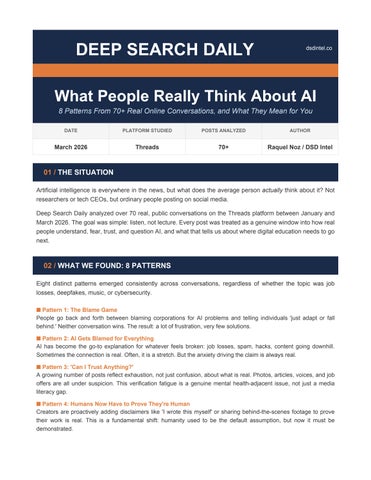
What People Really Think About AI
8 Patterns From 70+ Real Online Conversations, and What They Mean for You
01 / THE SITUATION
Artificial intelligence is everywhere in the news, but what does the average person actually think about it? Not researchers or tech CEOs, but ordinary people posting on social media.
Deep Search Daily analyzed over 70 real, public conversations on the Threads platform between January and March 2026. The goal was simple: listen, not lecture. Every post was treated as a genuine window into how real people understand, fear, trust, and question AI, and what that tells us about where digital education needs to go next.
02 / WHAT WE FOUND: 8 PATTERNS
Eight distinct patterns emerged consistently across conversations, regardless of whether the topic was job losses, deepfakes, music, or cybersecurity.
■ Pattern 1: The Blame Game
People go back and forth between blaming corporations for AI problems and telling individuals 'just adapt or fall behind.' Neither conversation wins. The result: a lot of frustration, very few solutions.
■ Pattern 2: AI Gets Blamed for Everything
AI has become the go-to explanation for whatever feels broken: job losses, spam, hacks, content going downhill. Sometimes the connection is real. Often, it is a stretch. But the anxiety driving the claim is always real.
■ Pattern 3: 'Can I Trust Anything?'
A growing number of posts reflect exhaustion, not just confusion, about what is real. Photos, articles, voices, and job offers are all under suspicion. This verification fatigue is a genuine mental health-adjacent issue, not just a media literacy gap.
■ Pattern 4: Humans Now Have to Prove They're Human
Creators are proactively adding disclaimers like 'I wrote this myself' or sharing behind-the-scenes footage to prove their work is real. This is a fundamental shift: humanity used to be the default assumption, but now it must be demonstrated.
■ Pattern 5: Fear Spreads Faster Than Facts
Viral AI scare posts follow a predictable formula: alarming claim + technical-sounding words + sense of urgency = thousands of shares. The formula works even when the facts don't hold up. Learning to spot this pattern is one of the most useful skills anyone can develop right now.
■ Pattern 6: A Small Group Gets It Right
A minority of users stood out. They cross-referenced multiple sources, questioned their own assumptions, and protected their personal data before engaging. These people represent exactly what good digital literacy looks like and can serve as role models for everyone else.
■ Pattern 7: 'If AI Takes All Jobs, Who Pays Taxes?'
This question came up organically in multiple conversations, from people with no policy background. It signals that the public is already thinking beyond personal impact and is ready for honest community conversations about AI and society.
■ Pattern 8: 'We've Seen This Before' vs. 'This Is Different'
Half the posts say 'technology always disrupts things, people adapt.' The other half say 'this time is genuinely different.' Both contain truth. The inability to hold both ideas at once leaves people stuck, unsure whether to panic, adapt, or push back.
03 / THREE MOMENTS THAT STOOD OUT
The Viral Cybersecurity Claim
One post went viral claiming that Claude AI had caused a major government cybersecurity breach in Mexico. It had all the ingredients: dramatic headline, technical-sounding detail, moral urgency. The post spread widely, but it did not hold up to basic verification. This is the fear template pattern in its purest form. Once you can recognize the formula, it becomes much harder to fall for it.
The Job Market Story That Hit Hard
One person shared their experience: three years of job searching, over 3,000 applications, and fewer than 100 interviews. They attributed this outcome to AI filtering systems. The replies split immediately between sympathy ('the system is broken') and tough love ('you need better skills'). Neither camp addressed the full picture. This moment captures how difficult it is to have productive conversations about AI displacement when a shared framework is missing.
The User Who Got It Right
One standout user, when encountering a suspicious AI claim, checked three separate platforms, avoided sharing any personal details, and documented exactly where the story fell apart before posting a conclusion. No drama, no assumptions. Just systematic thinking. This is the goal, and it is teachable.
The public is not uninformed; they are overwhelmed. People are processing real fears about real changes with very few tools to help them think clearly. The good news is that the skills needed to cut through AI confusion are learnable. Recognizing fear templates, verifying before sharing, and separating emotional reactions from factual evaluation are habits anyone can build. That is exactly what digital literacy programs and Human Firewall initiatives at libraries and community organizations are designed to teach.
05 / THINGS YOU CAN DO TODAY
1 . Pause before you share. If an AI headline feels alarming, that feeling is a signal to slow down, not speed up.
2 . Learn the fear template. A dramatic claim, fake-technical words, and an urgent call to action equal likely misinformation.
3 . Verify across platforms. One source is a starting point. Three sources with different perspectives is a conclusion.
4 . Protect your data first. Before engaging with any AI tool or suspicious link, ask: what am I handing over?
5 . Find your library. Libraries offer free, judgment-free digital literacy resources. Human Firewall programs are designed for exactly these moments.
Published: March 2026 | Research and analysis by Raquel Noz, DSD Intel | Based on the full study: Public Perception of Artificial Intelligence: A Qualitative Analysis of Social Media Discourse
This brief was produced for educational and public awareness purposes. All social media posts analyzed were publicly available and anonymized. This document was formatted with AI writing assistance. © DSD – Deep Search Daily • dsdintel.co • All rights reserved.