
Electric Vehicles Management for Carbon Neutrality in Europe
Horizon Europe—funded project under Grant Agreement no. 101056765
Words from the Project Coordinator



Dr. HUGO MORAIS IS A SENIOR RESEARCHER AT INESC ID AND AN ASSOCIATE PROFESSOR AT INSTITUTO SUPERIOR TÉCNICO
As we conclude the project, we are pleased to share an update on theproject'sachievements.
Through the effort of all EV4EU partners, we reached all the project targets: we have nowcompleted all 60 tasks, submitted 61 deliverables, published 62 scientific articles, including conference (40) and journal (22) papers, and 25 students have presented their bachelor/master dissertations.
Our social media presence, particularlyonLinkedInhascontinuedto grow, reaching 1700 followers, and we have attended or co-organized over126events.



In this period, the effort was focused on Final events to disclose the project’s achievements across allfourDemonstrators.
To achieve this, we hosted our final event at the Transport Research Arena(TRA) 2026 in Budapest. This was a key opportunity to present the results of the project and discuss the future of the developed solutions. The “EV4EU: From V2X Innovation to Implementation in Europe’s Energy System” Session, provided a platform to showcase the project’s ambitious 48-month journey. Above all, it brought the Consortium and key stakeholders together for a final discussion duringtheproject’slifecycle.
On the technical side, we were able to achieve all project goals defined during the preparation of the project. From the demonstration sites, to the regulatory frameworks it helped shape, EV4EU has shown that V2X is not a future concept - it is here, it is tested, and it isreadytoscale.
It was a true pleasure to work with such an incredible consortium. To everypartner, researcher, pilot site operator, and stakeholder who madethispossible:thankyou! Thiswasneverjustaproject. Itwas a collective effort to advance Europe’s energy and mobility transition, one bidirectional charger at a time.
I look forward to crossing paths withyouallinfutureendeavours!


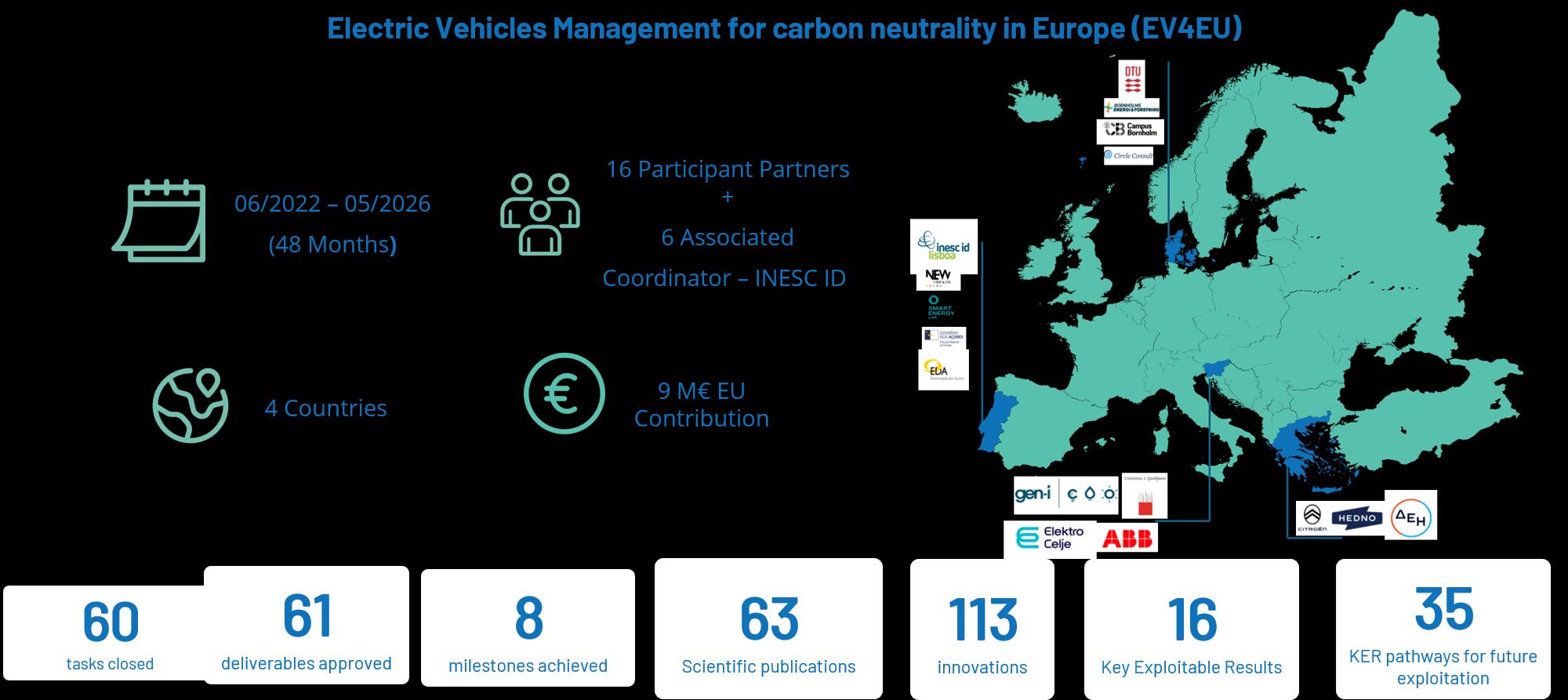
The EV4EU solutions and management strategies were tested in demonstrators installed in four EUcountries –Portugal, Slovenia, Greece and Denmark - proving the technical viability of smart andbidirectionalcharging.
In Portugal (São Miguel , Azores) the Demo featured test sites in homes,buildingsandcompanies;
In Slovenia the pilot integrated virtual power plant functionality and local market platforms across office buildings and schoolenvironments;
InGreece (Athens)the pilotfocused on providing flexibility services in public charging environments;
In Denmark operating at the DTU Risø Campus and Bornholm, the pilot applied a distributed control architecture to manage parking lotchargingclusters.

Portuguese Demo highlights by Samuel Matias(EDPNEW)
The Portuguese demonstrator successfully validated V2X technologies across three distinct environments: households, the LREC office building, and the EDA company campus. We implemented a diverse ecosystem including PV inverters, different electric installations and a fleet of over 40 electric vehicles, all coordinated through the EV4EU control architecture. We tested unidirectional smart charging and bidirectional energy flows using multiple hardwarefromdifferentvendors.
The demonstrator produced a wide variety of impactful results. Households achieved an average cost reduction up to 14% and increased renewable energy integrationbyupto21,9%.

Nonetheless, our journey was not without hurdles. A primary challenge was the lack of standardization across manufacturers, which required custom protocol-bridging and complex troubleshooting to secure reliable vehicle State of Charge data. User-wise, we also found that building participant trust through transparent communication is as critical as the technology itself.
Lookingto thefuture, themass-market adoption will require EU-wide standardization (such as ISO 15118-20), dynamic, flexibility-aware tariffs and a transparentandtailoredUIfordifferent users.

GreekDemohighlights byAntoniosKoutounidis (HEDNO)
The Greek EV4EU Demo in Koropi, Greece explored how electric vehicle charging can activelysupportasmarter,cleaner,and moreflexibleenergysystem.

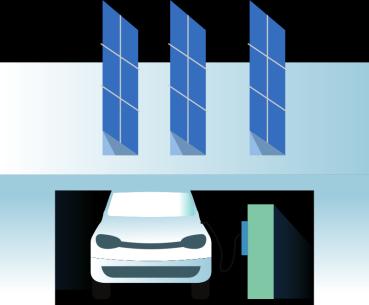
The demonstration brought together charging infrastructure, grid monitoring, digital platforms, forecasting tools, and user participation to test how EVs can interact more intelligently with the distributiongrid.
During the Demo, smart charging points were deployed in public locations across Koropi, supported by low-voltage grid monitoring equipment and the Open Vehicle-to-Everything Management Platform. The activities focused on Dynamic Distribution Tariffs and Flexible Capacity Contracts,twoflexibilitymechanisms designed to encourage charging when it benefits the grid and to manage demand during more constrained periods. Vehicle-toGrid concepts were also assessed through simulation, showing the future potential of EVs not only as consumers of electricity, butalsoasflexibleenergyresources.
The results were very encouraging. The Demo confirmed that the main technical components can operate together in real conditions, enabling communication between the grid operator, the charging platform, and the charging stations. Users successfully interacted with the system, charging sessions were recorded and managed, and smart charging actions were tested without interrupting the user experience. Simulations further showed that coordinated charging can reduce emissions, lower user costs, and increase flexibility, especially when combined with renewable energy and future bidirectional charging.
A key challenge was the still immature Vehicle-to-Grid market, particularly regarding the limited availability of compatible EVs and commercially mature bidirectional chargers.
Looking ahead, the Greek Demo provides a strong foundation for future smart charging services. It shows that EVs can become an important part of the energy transition, supporting renewable integration and more efficient grid operation. On a personal note, the Demo is a promising example of how collaboration between technology providers, grid operators, and users can turn innovative conceptsintopracticalsolutions.~

Danish Demo Highlights by Andreas Sorenson (CIrcle)
The EV4EU Danish Demonstrator operated across two distinct sites to test energy management methods in buildings and parking lots while integrating renewable energy production. The first location, the world-class SYSLAB facility at Risø, utilized six advanced, controllable chargers to test autonomous, behind-the-meter services. The second location, Campus Bornholm, is a major educational hub featuring high daily traffic, its own transformer station, and a 180kW rooftop solar plant. This site was equipped with six dualoutlet chargers identical to the technology at Risø, allowing the project to scale its smart charging and renewable integration methods in a high-use, real-world setting.
Upon reaching its conclusion, the demonstratorsuccessfully wrappedupits finalphasebyachievingapowerfuldual -mission impact: bridging the gap between cutting-edge energy research, commercial market deployment, and the education of Europe’sfutureengineeringworkforce.
The entrepreneurial viability of the EV4EU project was officially showcased in March at DTU Skylab’s Open Entrepreneurship event DTU’s premier living lab for matching state-of-the-art science with corporate partners. Following research activities that successfully demonstrated the viability and systemic benefits of distributed architectures, DTU launched Silent Consensus, a university spin-out established to take these concepts to the nextlevel.
While EV4EU validated distributed management, Silent Consensus takes this a step further by introducing a specialized, autonomous control method. The spin-out's algorithm enables multiple EV chargers to make individual powersharing decisions without the need for peer-to-peer communication, while still collectively reaching a consensus. This breakthrough directly addresses critical commercial barriers such as grid scalability and cybersecurity, marking a massive leap forward for nextgeneration smart charging infrastructure.

Slovenian Demo Highlights by Andreja Smole(GEN-I)
The Slovenian demonstrator, led by GEN-I together with the University of Ljubljana, Elektro Celje and ABB, successfully demonstrated how electric vehicles can become active flexibility resources for the power systemthroughVehicle-to-Everything
(V2X) technologies. Three demonstration sites were established in Velenje, Ljubljana, and Krško, combining V2X charging infrastructure, battery storage systems, virtual power plant (VPP) aggregation and local flexibility marketconcepts.Krškowas additionally integrated with the FlexIS platform, enabling advanced flexibility service activation andtesting.
A major focus of the demonstrator was real-world validation. Throughout the project, extensive testing was performed, including 327 flexibility tests, of which 267 were charging tests and 60 were discharging (V2G) tests. In total, more than 1,885 testing hours were completed, successfully validating both charging and discharging services under operational conditions. The demonstrator activated 622 kWh of negativeflexibility and218kWh of positive flexibility, proving that EVs can provide valuable grid support services and flexibility for futureelectricitymarkets.
The project successfully demonstrated the complete end-toend flexibility value chain - from EVs and V2X charging stations to aggregation, virtual power plant operation, local flexibility markets and DSO service activation. Theteamsuccessfullycarriedout controlled vehicle charging and discharging, integrated V2X charging stations into the VPP environment, validated localflexibility services, and tested automatic serviceactivationthroughFlexIS.
The Slovenian demonstrator delivered strong results against its KPIs, achieving 99.9% charging stationavailability,100%data
reliability, and a 92% flexibility forecasting accuracy. Beyond technical validation, the project contributed to several KERs. Looking ahead, the demonstrator provides a strong foundation for the commercialization of EV-based flexibility services and the future development of local and national flexibility markets. Real-world testing confirmed that V2X technology is technically viable today and can play an important role in building a more resilient, flexible and carbon-neutralenergysystem.
Measuring demonstrator performance by Matej Zajc (UniversityofLjubljana)
Demonstrators are the centrepiece of Horizon Europe projects, where developed technologies are put to the test: prototypes, algorithms and components are integrated into full working systems, and novel standards are checked for interoperability. They are also used for socio -technical investigations: real users are part of the loop, so that the solutions we build will not only be technically sound but will also improve people's everyday quality of life. In that sense, the demonstrators are the high point of the project'swork.
EV4EU operated four demonstrators in Portugal, Denmark, Greece and Slovenia, each testing Vehicle -to-Everything (V2X) management strategies in its own local context. To assess how well these solutions performed, we needed a consistent way to measure them: a structured set of Key PerformanceIndicators(KPIs).
The KPIs were the result of a dedicated methodology.
Building on the project's business models and business use cases, we combined a top-down perspective, KPIs derived from EV4EU's overall objectives, with a bottom-up approach, in which each partner defined indicators reflecting its role and local conditions. A harmonisation phase then aligned these across the project: comparing lists, merging duplicates, and setting asidewhatcouldnotbemeasured.
Because the demonstrators differ in regulatory frameworks, infrastructure, grid characteristics and data availability, their KPIs could not be fully generalised. Each set was tailored locally, while shared groups: technical, economic and market, environmental and social, and service-related, kept the framework coherent. Across the demos, three common themes emerged: flexibility, charging stations, and data. Each KPI was calculated from data actually measured at the demonstrators. The methodology follows an IoT architecture, collecting measurements at many pointsacrosseachsystem.Suchalevel of visibility is rarely available in real multi-actor services, where no single party can see the whole chain. Together with direct user feedback, this producedanunusuallycompletepicture.
Once calculated, the KPIs were interpreted by partners representing the different actors in the V2X value chain: system operators, aggregators, chargingoperatorsandusers. Theknowledge gathered at the demo level will help these local actors improve the visibility and interoperability of their own systems,supported bya rangeofflexibility tools, and it will feed the update of the project's business models and broader conclusions on the scalability and replicabilityofV2X.
In short, measuring demonstrator performance is how EV4EU turned four local pilots into transferable,evidence-basedinsights.
EU Strategic Innovations & MarketReadniss
Overcomingfuture obstacles
While higher commercial expectations forEVsare anticipated starting in 2027, the consortium highligted some critical challenges that must be addressed for mass deployment:
EV4EU delivered aportfolio of 113 innovations, including 82 breakthrough solutions approaching market readiness.The project also mapped out 16 KERs acrosstechnologiesandbusiness models. However, experts noted that widespread commercial deployment is heavily constrained by national regulatory frameworks Upon reaching its conclusion, the demonstrators successfully wrapped up its final phase by achieving a powerful dual-mission impact:bridgingthe gapbetweencutting-edgeenergy research, commercial market deployment, and the education of Europe’s future engineering workforce.
Regulation&Infrastructure:
A lack of harmonized regulation for bidirectional charging persists. Unified pricing and investments in street infrastructure are highly recommended.
User-Centricapproach:
System transparency must increase to build end-user trustregardingdataandtariffs.
Battery Degradation and Management:
Concerns over battery generate anxiety for clients. It is essential to overcome and remove this weight from the end-users’ shoulders.
TakingElectricMobilityastepfurther: theV2XCluster
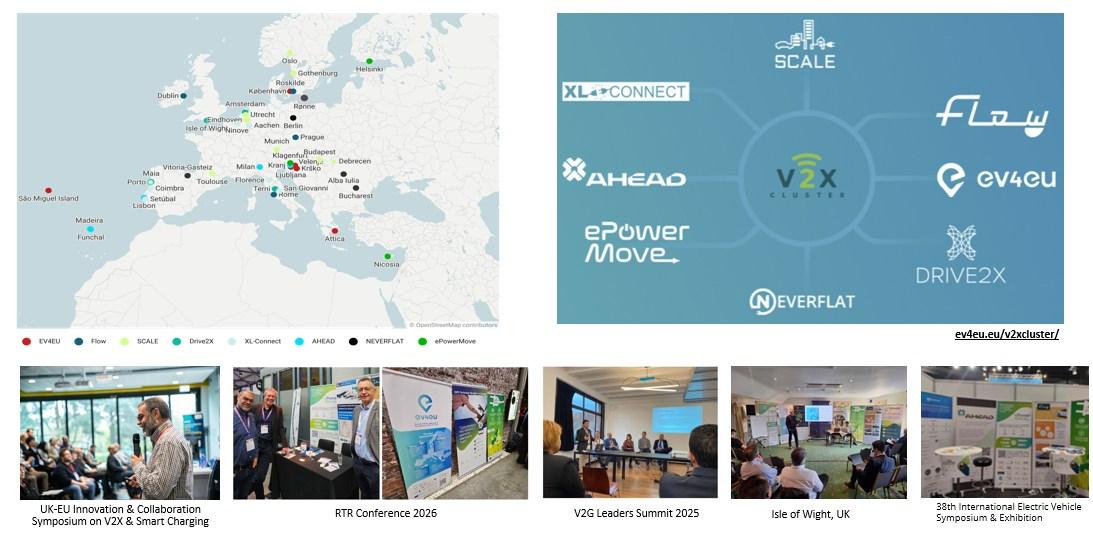
EV4EUis proud to be one of the V2X Cluster founding members - a collaborative initiative uniting Horizon Europe projects to accelerate the deployment of V2X technologies and foster smart, interoperable, and inclusive EV chargingsolutions.
Today, the cluster brings together eight cutting-edge Horizon Europe projects: EV4EU, DriVe2X, FLOW, SCALE , XL– CONECT, AHEAD, NEVERFLAT, and ePowerMove
Since its foundation, the Cluster has been actively supporting the EC´s vision for a digitalized, fully integrated electricmobilityecosystem. By driving cross-project collaboration and sharing knowledge through regular working meetings, EV4EU and cluster partners have been committed to accelerate the adoption of future-ready EV charging infrastructure across EU, ensuring a more sustainable and connectedmobilityecosystem.
4 4 12 48
Countries Demos Use Cases Month duration

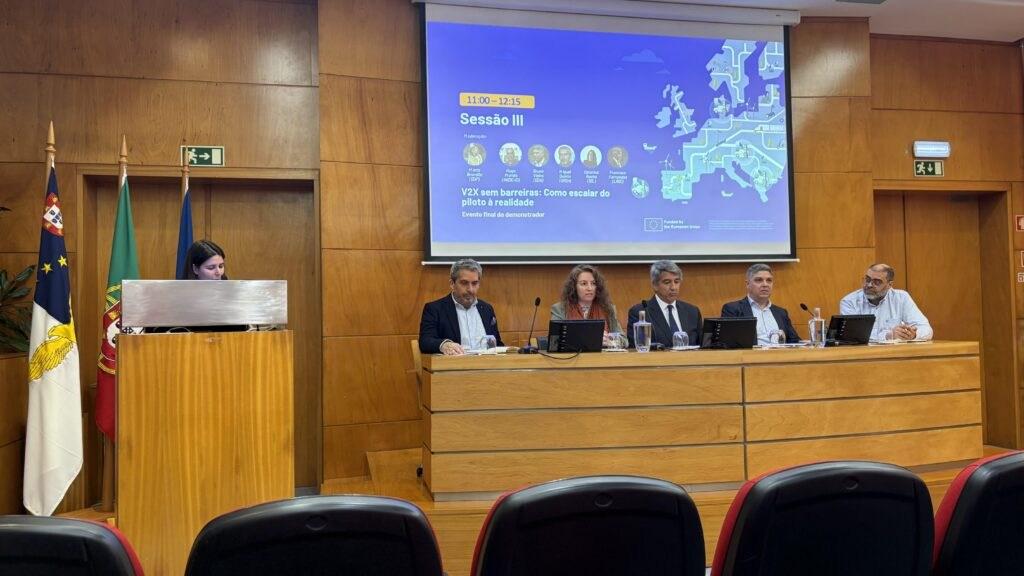
Under the theme EV4EU: From V2X Innovation to Implementation in Europe Portuguese project partners organized a one morning session at LREC facilities, to present the results of their research and real-world testing of V2X.

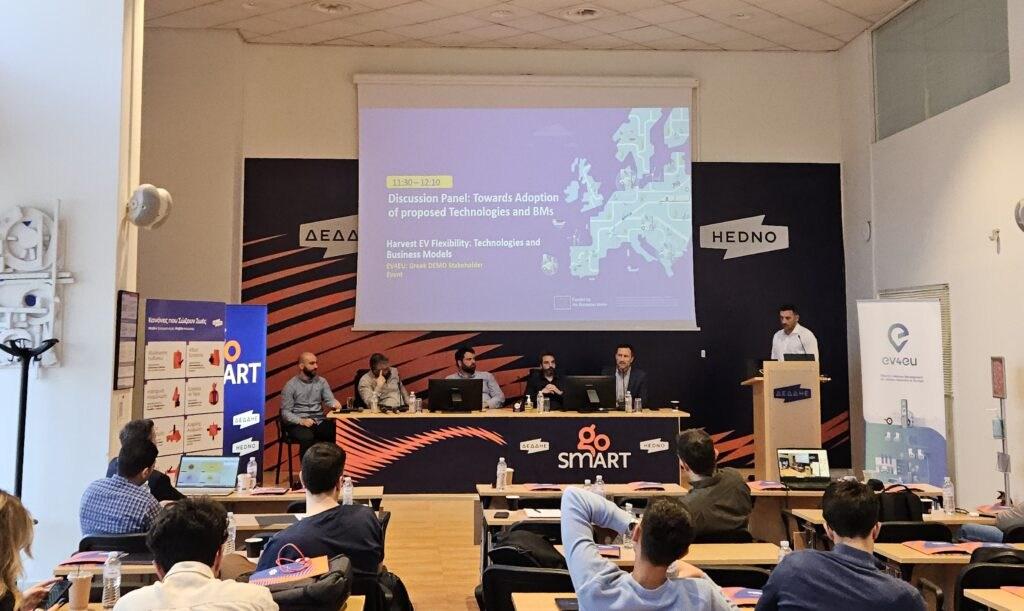
Industry leaders and experts gathered in Athens for the final EV4EU event in Greece, titled “Harvest EV Flexibility: Technologies & Business Models.” Organized by partners HEDNO and PPC, the session provided a platform to showcase results from the Greek pilot.
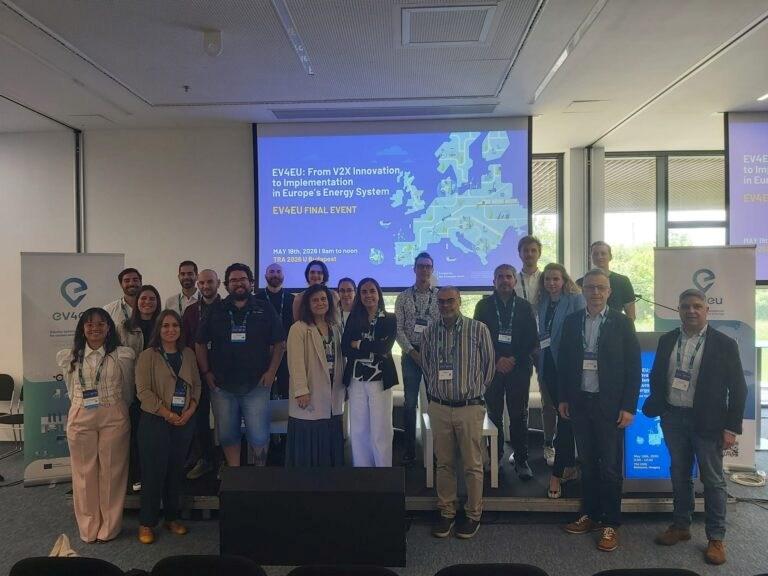
On May 19th, the EV4EU project reached a crucial milestone at the Transport Research Arena (TRA) 2026 in Budapest by presenting its results and discussing the future of its developed solutions.
Hosted at the Hungexpo Congress and Exhibition Center, the “EV4EU: From V2X Innovation to Implementation in Europe’s Energy System” Session provided a platform to showcase the project’s ambitious 48-month journey. Above all, it brought the Consortium and key stakeholders together for a finaldiscussion during the project’s lifecycle.
The goal of the meeting was clear, and thethree session panels aligned with the project’s core strategy: redefine and develop solutions to support the mass adoption of electric vehicles inEurope.

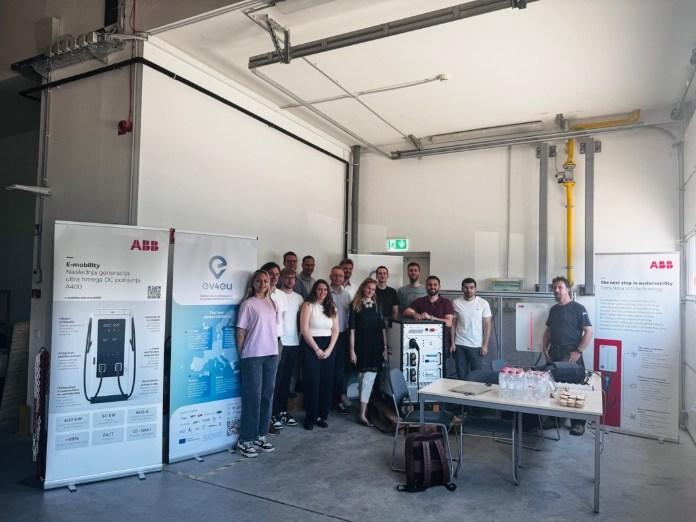
Team members from the University of Ljubljana, GENI, and ABB participated in a series of high-profile national conferences and events, marking the final activities of the project
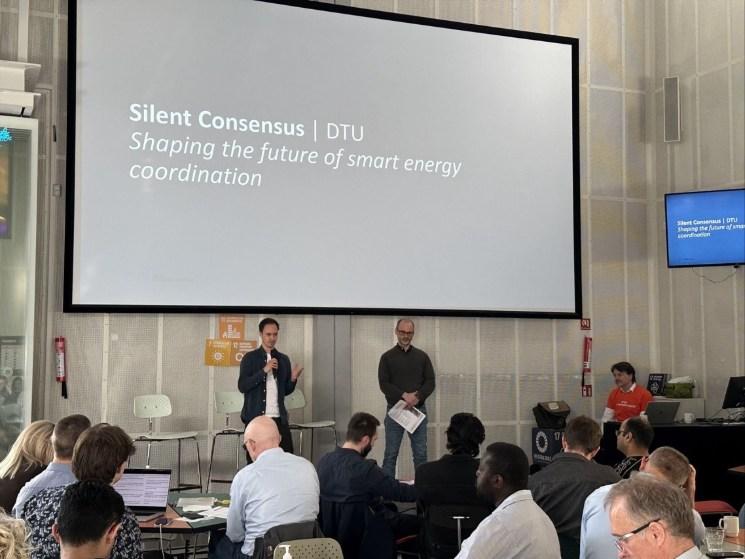
The Danish Demonstrator at Risø Campus Bornholm concluded with two major events that showcased both the commercial future and the educational impact of energy research at the Technical University of Denmark (DTU)., including the DTU Skylab’s Open Entrepreneurship event that presented the Silent Consensus, a Spin-Off based onthe EV4EU results.
Participant partners
Associated partners M€ EU Contribution
The video series "Let's Talk About Results" concluded in January, wrapping up with a total of 14 testimonial videos. The series highlighted the perspectives of each EV4EU partner institution, showcasing their contributions and key project outcomes. All testimonies are available on our Youtube playlist, and on our website under videos section.
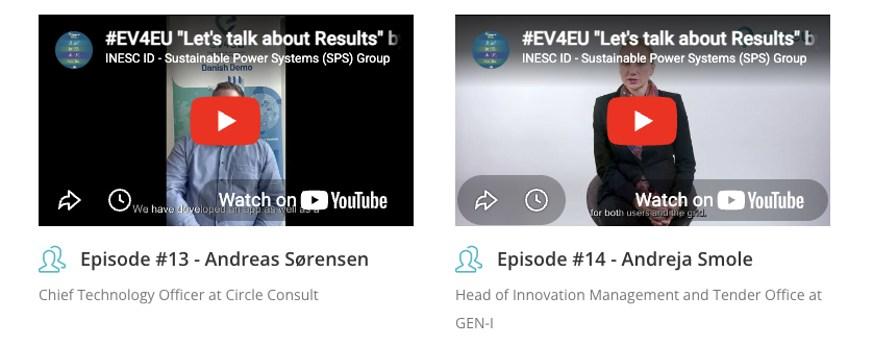
Episode #13 – Circle Consult
Meet Andreas Sørensen, Chief Technology Officer at Circle Consult, a Danish technology and engineering consulting firm that specializes in research and development, delivering end-to-end hardware and software solutions from initial concept through to finished product, including PCB design, embedded software, AI, and project management.
Episode #14 – GEN-I
Meet Andreja Smole, Head of Innovation Management and Tender Office at GEN-I, one of the fastest growing and most innovative companies on the European energy market, and the first Slovenia supplier of exclusively carbonfree electricity.
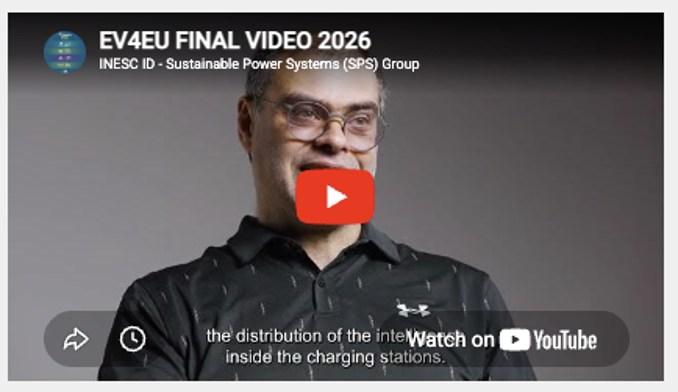
Checkoutourfinalvideotolearnallaboutthework developedundertheEV4EUproject!Takealookat theinnovativesolutionsandtoolswe’vecreated alongtheway.Fromourdemonstrationsitesinto theregulatoryframeworkswe’vehelpedshape, EV4EUhasproventhatV2Xisnotjustafutureconcept–itishere,tested,andreadytoscale.
EV4EU featured in Plug In Podcast (conducted in PT)
Hugo Morais was interviewed on Público Newspaper’s “Plug in” podcast about the future of e-mobility and grid integration.
EV4EU featured in EU Energy Projects Podcast
EV4EU was recently featured on the EU Energy Projects Podcast following its participation at ENLIT 2026.



More about EV4EU Publications, Deliverables and Events available at Resources - EV4EU
MESSAGE TO THE EV4EU CONSORTIUM
Dear EV4EU Consortium Partners, colleagues,
As our incredible journey comes to a close and on behalf of the Coordination team, I want to share a few words of gratitude to consortium partners that made it all happen. As project coordinator, I couldn't be prouder of what we have accomplished. It has been a privilege to lead such a brilliant consortium. Together, we didn't just test technology - we built the foundations for Europe’s e-mobility future. From the technological breakthroughs at our demonstration sites in Portugal, Greece, Denmark, and Slovenia, to our critical contributions toward shaping future regulatory frameworks, your hard work has proven that V2X is already a reality. What we achieved was a truly collective effort to accelerate the energy transitionone bidirectional charger at a time.
To every single partner: thank you. Your dedication, resilience, and collaborative spirit have been the true engine of this project.
To everyone who contributed, supported, or simply followed our work along the waythank you for being part of our journey!
The project may be ending, but our impact is just beginning. I look forward to seeing our work continue transforming Europe's mobility landscape.
Warmest regards,
Hugo Morais, EV4EU Coordinator




















Funded by European Union Horizon Europe research and innovation programme under grant agreement no. 101056765. Views and opinions expressed in this document are however those of the authors only and do not necessarily reflect those of the European Union or the European Climate, Infrastructure and Environment Executive Agency. Neither the European Union nor the grating authority can be held responsible for them.