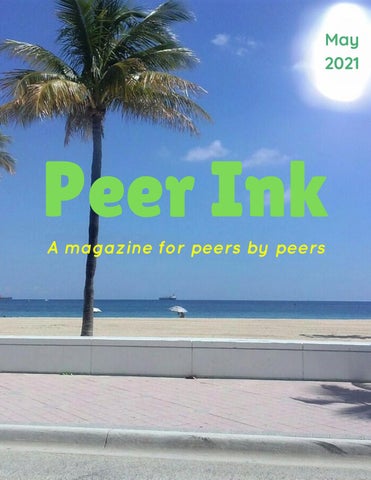
May 2021
Peer Ink A magazine for peers by peers
Editor's Note Dear Fellow Peers: , Wow! What can I say? I remember writing this for December’s issue thinking, oh, by May we will be back to normal. Boy, was I wrong! Yes, we have a vaccine for COVID, and I’ve had it. But, wow, what a year we have been through. During this time, a lot of people are going through challenges for jobs, school, living conditions and more. All of which can affect one’s mental health. This May, we need to Celebrate May as being National Mental Health Awareness Month! In this issue of PEER Ink, we’ve included articles more about nutrition and fitness to help you in taking the steps of getting mentally ready for the upcoming year. What I want you to think about this May is: What is your personal medicine? For those who don’t know, personal medicine is something that YOU do as your way to cope from something or use as a therapy. According to Wikipedia, personal medicine is defined as an activity that person does to obtain wellness, rather than something a person takes (i.e., medicine) for wellness. For example, for me, my personal medicine is listening to music (usually songs from Broadway musicals), swimming, writing plays, playing with Socs (my fur baby), or even going for a drive. After reading this issue, I want you to close your eyes and think to yourself, “What is my personal medicine?" For everything going on this last year and not sure what the future looks, this list will help you maintain your wellness as you move forward. With many changes going on in our society, so are we here at HUG ME Ink. Usually, our Peer Ink has been a hard copy publication. However, beginning in August 2021, we will be going digital. We surveyed many people who have read or have been interested in reading Peer Ink and many have requested and suggested it be online. Therefore, with this new transition, more people around the nation will have access to this publication. We will be using the web platform Issuu.com to host the magazine. However, we will only print hard copies of the magazine only if organizations request them through us. If your organization would like to get either 1) hard copies of Peer Ink magazine or 2) post cards to have on display that show how people can have access to Peer Ink, let us know and we will ship them to you. Also, on our new digital platform, we will have more pages for resource listings. So, if you want to have your company listed in our resources or would like to promote your organization by placing an ad, please let us know. We feel with how society has been changing to go more digital, it’s time for us to keep up with the pace as well.
One of big events for 2021 will be HUG ME Ink’s, PEER-A-PALOOZA, a mental health conference for peers by peers, September 24-25, 2021, virtually. We will be having more information on our website, www.hugmeink.org, over the next month. After so , many conferences in the mental health realm have been canceled, postponed or in limbo due to the epidemic, we felt we need to come together as a comm-UNITY once again. We are Peers! We fight for what we believe in! Thank you for all your support in these last several months and we hope you will join us in our journey with advocating and educating our nation on mental health awareness and bullying prevention through the arts. Sincerely, Nicholas Holstein Peer Ink Advisor and HUG ME Ink Executive Director
A few examples of my personal medicine...
HUG ME Ink, a nonprofit organization whose mission is to advocate and educate on mental health awareness through the arts., PEER INK: A Magazine for Peers by Peers, produced by HUG ME Ink. We're looking for original poems, stories, articles or art work for upcoming issues. Everyone is welcome to submit!
Deadlines for upcoming issues:
Cover Art By Name: Nicholas Holstein Age: 42 Caption: A beach view that is very soothing and yet an endless ocean of opportunities.
October 2021 Issue - Celebrating National Bullying Prevention Month and Mental Health Week: SEPTEMBER 24, 2021 December 2021 Holiday Issue: OCTOBER 29, 2021
Submission Guidelines If you are interested in submitting, please adhere to the following guidelines: ARTICLES & STORIES: Send as a Word doc and on any topic you feel would benefit peers to include wellness, health, peer specialist movement, etc. ARTWORK: Send artwork (photography, drawing, etc.) as JPEG or PNG file. POEMS: Send as a Word doc on any topic. With all submissions, please include a short bio and photo (optional), please send to hugmeink@gmail.com
Advertising Rates (Per issue)
DISTRIBUTION OPPORTUNITIES
Full Page: $200 3/4 Page: $150 Half Page: $100 1/4 Page: $50 Business Card: $30
Would you like copies of PEER INK to be displayed at your organization? For 2021, we'll be having 4 issues. Please let us know when you email us which issue(s) you'd be interested in receiving. Thank you, HUG ME Ink Staff and Board
Table of Contents Peer Support: A Personal Reflection ................................................................................................................. 1 Artful of Health ................................................................................................................................................................... 3 Wellness Journey: Becoming Self-Aware ................................................................................................... 5 A Discussion Regarding the Evolution of a Social Movement ................................................. 7 A Mother's Testimonial from a Parent Emotional CPR Training ............................................ 9 What is eCPR? .................................................................................................................................................................... 11 Saving My Own Life ...................................................................................................................................................... 13 Connecting Mental and Physical Health .................................................................................................... 16 Smells like Recovery .................................................................................................................................................... 18 Creative Corner .............................................................................................................................................................. 20
Staff Advisor Nicholas B. Holstein
Editor Jhordan Casillas
Co-Editor Sam Durgin
Publisher Shweiki Media
Contributing Writers
Contributing Poets
Bernadette Mullins Samantha Durgin Clotia McCrory Phil Kumin Kyle Kondoff Janet Wong Jacob Shaver Claire Layrisson Oryx Cohen
Tracy Kremer Timothy Wright Jennifer Randal-Thorpe
Contributing Artists Reagan Cabe William Castillo
Photographer Nicholas Holstein
All articles, poems, photographs, stories and con-tent are all property of HUG ME Ink and Peer Ink as well as each writer’s personal ownership. If you wish to use a photograph, article or any of the work in this magazine, please request in writing to HUG ME Ink at hugmeink@gmail.com your permission request or contact the author personally. No part of this magazine may be re-printed without written consent from HUG ME Ink.
1
Peer Support: A Personal Reflection Bernadette Mullins Upon getting my degree, a Bachelor of Science in Victim Studies, I was unaware that peer support was something of interest in the field of victim advocacy. Of the people in my graduating class who shared this degree, there were some aspiring counselors and social workers who were on their way to graduate school as well as fellow victim advocates who were ready to jump into whichever non-profit or police department that would hire them as advocates. During my four years of schooling, in which I took several psychology and counseling classes, peer support was never mentioned. At least, never by name, and I find this outrageous. Peer support is the backbone of every non-profit and program whose goal is to provide care and resources, whether we have realized it or not. Those that found the means to survive through peer support are the reason why we have so much more available to us now. Peer support bred warriors that craved action in a world filled with inaction, shaking ancient trees in an attempt to plant the seeds that would make tomorrow an easier place to live in. They have provided us the guidelines and practices to follow, establishing trauma informed care, client-centered care, best practices that vary with every target population, recognizing that no population should be treated the same because no traumas and mental health difficulties are the same. Or maybe I’m being too brash. Perhaps we have heard of peer support, just not with its current name. I remember hearing professors tell stories of fighting during the 60s and 70s, making sure that women experiencing domestic violence got the help they needed in a time where there was no help. There were networks of houses and people, some whom knew the pain of this kind of abuse and wanted it to stop. In my free time, I read books about the AIDs Epidemic and how those afflicted with the virus would create support groups for others who had the very same virus. Families were built to garner support for something that the average heterosexual community largely ignored until it was too large to plead ignorance. Even as recent as the 2000s, we saw college survivors of sexual assault provide a space for other survivors. They did this because there was no environment for these individuals, even with Title IX having been in place for almost 30 years at the time. Almost all the actions I’ve mentioned before have grown into something bigger, something with organization names and board members: The Clery Center, Take Back the Night Foundation, The Alamo Area Resource Foundation. These groups and more were started by people who wanted to help their peers.
2 Have we thanked those responsible for the ease we currently have? Nameless people have paved the way for laws and acts to be made for people like us. So that women and minorities can enjoy the freedoms and security that others enjoy, ensure our kids are okay, and walk down the street without fear of harm. Even when that harm comes upon us, when our kids are hurting, or when we don’t receive the resources we need, there are acts and laws for that, too. These unspoken heroes have paved the way for college degrees to be made specifically geared towards their cause – for someone like me, who can find resources for clients after just a quick Google search. There’s a lack of silence now regarding mental health and trauma, and while I do agree that it’s sometimes nothing louder than a hum or buzz, you can’t deny that it’s been getting louder over the past few years. It’s loud enough that regular people, you and me, have heard it and have maybe even heeded the call. Some heeded the call by voting to continue the good work being done in the legal arena, by representatives that try to understand our needs. Others heed the call by donating their time or resources to organizations like United Way, Haven for Hope, Planned Parenthood, and the dozens of other organizations in my town. Some people even dedicate their lives to this calling, either by educating the next generations or by holding out a hand to someone in need. A little over five years after I heard that buzz, unyielding in my brain during all that time, I found myself sitting at my computer and going through my work emails. I read through one of them and received the answer that I had been hoping for: “Yes, we work with clients that fall under the Victims of Crimes Act. Yes, we offer resources to survivors of domestic violence.” Yes, your client will be heard. And I smile, not really looking at the screen anymore, and I thank all the people that made this happen. Thank you for making this easier for our tomorrow.
Bernadette Mullins is the Peer Support Specialist at HUG ME Ink and is a Southside local. She received a Bachelor of Science in Victim Studies from Sam Houston State University in 2018 and has since been working with survivors of trauma in various fields. Her goal is to eventually continue her education in either the field of social work or art therapy, just as long as she gets to work with kids and teenagers. She has passions in playing video games, watching art-house romance movies in secret, painting, and buying books that she’ll eventually read once she finishes re-reading her old ones.
3
Artful of Health Samantha Durgin Art is a neurologically instigating, creation-sparking, powerful force of expression with a powerful connection to mental health. The act of viewing and creating art becomes a means for individuals to find new ways to care for their mental health. Research recognizes the increase in the release of mirror neurons when individuals view or create artwork. Increases in mirror neuron-releases directly reduce stress, boost social cognition, and enhance concentration. Taking time to examine or produce art provides the power to help your state of mind. Mirror neurons are nerve cells responsible for intense emotions and empathetic behaviors. The neurons are released when the demonstration of physical changes occur as one watches another human performing a familiar action. For instance, if you pick up a pen and begin drawing while watching someone else do the same, your brain will release neurons—mirror neurons. The intense emotions you experience typically are associated with feel-good emotions like happiness and relaxation. Therefore, art is a great way to provide a mental escape from the stressors of daily life. The production of intense emotions and empathy relates to the improvement of social cognition as well. As mirror neurons are released, there is also a development in social cognition. Social insight is pivotal in building healthy relationships and allows room for trust and comfort within any relationship. Socially cognizant individuals also develop the proper empathetic skills to be tolerant of how others live, act, and feel. When individuals are socially aware, assuming new relationships and generating a support system becomes an easier feat. Support systems are vital for everyone and incredibly so for those recovering mentally. Following a path towards mental recovery means a support system becomes imperative. The support may be in the form of one other person or an entire group. Having an activity such as art provides an opportunity for the inception of a support system. It is also an activity that continually maintains a common interest within a support system, ensuring a relationship’s longevity. Keeping a stable support system safeguards a safe environment one can turn to for comfort. No one should have to face loneliness and social discomfort, especially not when attempting to resolve stressors and move forward with their mental recovery. Even if art does not assist in creating a support system, it aids in improving concentration. Many artistic endeavors are tedious, require patience, or may require a focus on detail. Practicing patience assuages concentrating. The ease in concentration releases stresses and provides a mental space perfect for physical rejuvenation and relaxation.
4 As you practice art, adding breathing exercises may also improve your ability to concentrate and continue to provide stress relief. Keeping a controlled breath reflects physically as well as mentally. Keeping your heart rate steady squashes feelings of anxiety and provides a calmer state of mind circling back to improvements in concentration and breathing habits. If you are on the journey to bettering your mental health, pursuing art may end the search. The rewards are worth the process of adopting a new artistic hobby. Take care of your mental needs and take time to break away from your stressors to engage in an activity that reduces stress and allows you to concentrate on something novel. Enjoy the novelty and excitement of art, as it is a world of unlimited and imaginative possibilities. Sam Durgin graduated from Madison High where she developed her artistic abilities. Her passion lies within the arts. Sam almost always has either a paintbrush, pen, or a script in her hand as she loves to create and perform. To follow her artistic endeavors, follow her on Instagram: Sam D, @roxie_evermore
Saturday October 30th 6 PM - 10 PM Food Trucks
DJ
Live Entertainment
Community Resource Fair Costume Contest
Interactive Activities
Haunted House and more!
Confluence Park 310 W Mitchell St, San Antonio, TX 78204
5
Wellness Journey: Becoming Self-Aware Clotia McCrory I have been struggling with my weight ever since the end of high school, and I never paid much attention to my weight gain. When I look back now at pictures I can see the difference. My parents both suffered from chronic conditions like high blood pressure. My love and appreciation for wellness, and how it links to mental health, started February 2020. The year prior, I had lost my father to heart disease, diabetes and a number of other health issues. One day I was not feeling good and decided to go to the doctor. She informed me that my blood pressure was excessively high. I was also extremely overweight at that time, at 282lbs. When I look back now at my previous weight, I can honestly say my lack of mindfulness, uncontrolled stress and trauma were big factors in my poor health. Well, in February 2020 I made up in my mind to make a change after my doctor told me I was a type 2 diabetic. I started to take action and I researched everything on the topic. This research included reading articles and watching YouTube videos. I did not want to end up with all the negative things and so I made up my mind and decided to change my situation. It was not easy at all, but I was determined to make a change. I started with limiting sugar from my diet, so I cut sugary drinks, cookies, cakes, white flour and pasta. I started walking first just for a mile, and then as I built more stamina I increased my miles. Walking was enjoyable and it allowed my mind to relax. I could simply breathe and not concentrate on the daily stresses of life. As the weight started to fall off, I added more exercises at the YMCA like Body Combat, yoga and Zumba classes. My current weight is 207lbs and I want to lose another 40lbs. The journey has helped me appreciate being in the present moment. Though life comes with challenges, I believe we can overcome them if we are mentally prepared and self-aware. I discovered mindfulness, which is maintaining moment by moment of awareness of thoughts, feelings, and bodily sensations, and one’s surrounding environment. Overall, I understand that we hold the power to make great changes in our minds, hearts and souls. I am still on my wellness journey, and this is definitely a way of life. I want to inspire and continue to grow. I challenge myself daily to do better than I did the day before and now exercise and eating right is a way of life.
6 Before: 278lbs
After:199Ibs and counting...
Clotia McCrory (pronounced with a long -O-sound) J is 34 years old and married to her wonderful husband Ernest McCrory. She has lived in San Antonio, Texas her whole life, but also loves to explore and travel in her free time. She currently works as a Probation Officer. She loves learning about psychology, sociology, and mental health. She graduated from Texas A&M in 2012 with a bachelor's degree in Criminology and a minor in Psychology. She has also recently gained a new love for wellness and fitness.
7
A Discussion Regarding the Evolution of a Social Movement Philip A. Kumin For anyone privy to the dynamics of the discussion surrounding the manifest destiny of the mental patients’ movement one thing is clear; those founding activists who survive are aggrieved at the loss of their native movement. In almost any venue in which these activists air their grievances, there is an aggregate atmosphere of nostalgia and bitterness. The perceived loss of vitality of this movement of the 1970’s is mourned. For sure, that decade was a landscape fertile for the launching of social movements, including one of deinstitutionalized and disgruntled mental patients. What then comes next? If the psychiatric inmates’ movement was new, raw, and vital back then, it is diverse and modern today. Inevitably, and of necessity, the ranks of this movement have swelled and the exteriors of 1960’s and ’70’s radicalisms have dissipated. This evolution does not preclude authenticity, however. It was exciting to be in the midst of a new, moral imperative which fired activists to a frenzy, and it can be this way again. What I’m saying here is that the appeal of ex-inmate activism had at least as much to do with the era in which it occurred as it did the substance of the grievances. To clarify things even further, when we talk about the vitality of the patients’ movement in the 1970’s what comes to mind is the rage with which activists delineated their complaints. These complaints were intertwined with styles of protest popular in the 1970’s, styles which have changed since then. It may be that surviving veteran activists mistake differences in style for a dearth of fervor on the part of today’s generation of antipsychiatry activists. I don’t believe this to be true at all as the mental health system of today revolves just as tightly around the flawed medical model paradigm as it was doing in the 1970’s. Patients unquestionably continue to suffer. In 1978, activist Judi Chamberlin wrote her book, On Our Own: Patient Controlled Alternatives to the Mental Health System. The book articulated and codified the philosophies of the mental patients’ movement and became, in effect, a bible thereafter. In 2019, we are seeing embellishments and implementations of the blueprint therein. One such development has sprung from the fact that in contrast to the 1970’s, it is now more practical for mental patients to attend school and acquire college educations. Indeed, there is a growing pool of graduates who are former inmates.
From the antipsychiatry movement’s point of view, it’s also an established fact that the results of any scientific studies dealing with mental health issues which are conducted by researchers who are not themselves former patients, are skewed in favor of the Establishmentarian medical model point of view. Because those researchers have a lot of academic credentialing and respectability, what they announce is instantly believed and accepted by the public. Former inmate, Dr. Nev Jones, a researcher at the University of South Florida, is one such beneficiary of the new access to an academic life for former mental patients. Dr. Jones is now spearheading an effort to encourage other patients who are considering grad school to become researchers too. The intent of this plan is to accrue a pool of researchers who are former patients, who will then counter the opportunistic distortions of non-patient researchers.
Phil Kumin, 68, has been an activist in the mental patients’ liberation movement since 1985. He is not one of the founding activists of this movement which began in the early 1970’s. He lives alone in the downtown Baltimore neighborhood of Mt. Vernon. He has never been married and he has no children.
8
9
A Mother's Testimonial from a Parent Emotional CPR Training Janet Wong I think Emotional CPR can benefit me greatly as a mother, a daughter, a wife, a neighbor, a friend, and generally as a compassionate human being. If we could all just take the time to be aware and connect with the feelings of those around us, especially people who might be experiencing some form of crisis be it small or large, we can potentially help others have a happier and healthier life. As a parent, eCPR will help me connect better with my own children, instead of just asking why they have not done certain things or telling them what exactly they needed to do, I will instead try to talk with them on a more personal nonjudgmental level to understand what might have happened to them throughout the day and their general wellbeing and feelings, and then encourage them to come up with their own ways that they believe to be helpful to achieve what they need to accomplish or resolve the problems at hand. Children turns into teenagers and then to young adults and later adults of this society, it is very important to treat their feelings with the same respect that you would with others, they might be even more sensitive and vulnerable but not knowing how to express those feelings in the right words, so we truly need to listen attentively and not talk down to them and scare them from opening up and connecting with us, it is crucial because if they can build that trust as young children and know how to connect with others during times of crisis, they can be better mentally prepared for the emotional challenges of the real world as teenagers and adults. The Parent eCPR training was an eye-opening and immensely valuable experience for me. The parents and trainers I had the pleasure to meet during those 3 weeks were all extraordinary folks. Many of which are survivors of incredibly challenging life experiences but are very willing to open up and share their feelings and encounters with the group, which is applaudable and speaks to the comfortable and trusting environment the trainers were able to create for all the participants to connect heart-to-heart. Participants have a wonderful time connecting during the sessions and come out with a sense of being empowered with useful tools to better help ourselves and others around us through crisis.
10 I would certainly recommend this training to others I know. I believe this would be a useful life skill for the whole community to have. Our society just don’t listen enough, we’re often just passers-by and by-standers to other fellow human’s experiences, and when we do talk with each other we don’t truly know how to communicate, much less “seeing” and “feeling” the emotion another person is going through. Emotional CPR can help change that, to have this practice immersed into our culture and everyday life will be invaluable. Emotional CPR will change how you handle difficult situations both for yourself and for helping others with crisis. You do not need to be a trained counseling or mental health professional to benefit from utilizing eCPR techniques to deepen day-to-day communications. You just have to be present and have the willingness to connect to your true inner feelings, respect the person in front of you and his/her/their experiences without imposing your own values and judgement during the joint exploration to find new hope and purpose. Give eCPR a try and you too will feel the difference.
11
What is eCPR? Oryx Cohen Emotional CPR (eCPR) is an educational program designed to teach people to assist others through an emotional crisis by three simple steps: C = Connecting P = emPowering, and R = Revitalizing. The Connecting process of eCPR involves deepening listening skills, practicing presence, and creating a sense of safety for the person experiencing a crisis. The emPowering process helps people better understand how to feel empowered themselves as well as to assist others to feel more hopeful and engaged in life. In the Revitalizating process, people re-engage in relationships with their loved ones or their support system, and they resume or begin routines that support health and wellness which reinforces the person’s sense of mastery and accomplishment, further energizing the healing process. eCPR is based on the principles found to be shared by a number of support approaches: trauma-informed care, counseling after disasters, peer support to avoid continuing emotional despair, emotional intelligence, suicide prevention, and cultural attunement. It was developed with input from a diverse cadre of recognized leaders from across the U.S., who themselves have learned how to recover and grow from emotional crises. They have wisdom by the grace of first- hand experience. For more information, to schedule an introductory workshop or a certification training in eCPR, or If you would like to be an eCPR Ambassador and help spread the word about this exciting program, send us an email via the contact form, or call 877246-9058.
12
What is emotional crisis? Crisis as Universal Experience Emotional crisis is a universal experience. It can happen to anyone, at any time. When we are exposed to this extraordinary situation, we develop amazing and creative ways to protect ourselves, To onlookers, these protective mechanisms may look very odd, even "crazy". To us, they have meaning. Through using eCPR we can better understand and overcome our fear of seemingly unusual behavior brought on by an emotional crisis. Through eCPR we learn how to form supportive connections that empower the person in emotional crisis so they are able to feel revitalized and quickly resume meaningful roles in the community. Oryx Cohen, M.P.A. Oryx is a leader in the international consumer/survivor/ex-patient movement. Currently he is the Director of the National Empowerment Center’s Technical Assistance Center. Oryx is featured in Agnes’s Jacket, a book by Gail Hornstein, where Oryx and fellow Freedom Center co-founder Will Hall are compared to the founders of Alcoholics Anonymous. Before coming to NEC, Oryx was the Co-Director of the Western Massachusetts Recovery Learning Community.
13
Saving My Own Life Kyle Kondoff My name is Kyle Kondoff, and I am a firefighter with Type 1 diabetes. I’ve been a firefighter and rescue worker for 10 years, but my diabetes story starts about 7 years ago on an oil rig, out in the middle of the Gulf of Mexico. I was on a confined space and rope rescue team for the workers on the rig. That’s when I first started experiencing frequent thirst, frequent urination, weight loss, and blurry vision. Even though I was trained as an EMT, I never understood that these were the most common signs of diabetes. I thought all of these symptoms could be explained away. I wasn’t the only one on the rig with blurry vision: we attributed this to the carbon monoxide from the equipment. I was eating all the time, but I was always one to eat a lot. Coworkers made comments how much I drank, but I attributed it to the dry mouth caused by the acid reflux pills I used, which also explained my many bathroom breaks. When my job was done on the rig, I would drive the 8-10 hours home to San Antonio and stop to go to the bathroom at least 6 times on the way. I lived this way for a year and a half. My next job was at a hospital back on the mainland. I was still thirsty all day long, and everyone knew that I could eat anybody under the table. It wasn’t until I confessed to a nurse that I had intermittent blurry vision that someone told me I might have diabetes. I thought she was crazy. I was 27 years old, 5’9″ and weighed 160 lbs. How could I have diabetes? I went home that night with a lot on my mind. The next day I purchased a blood glucose meter. The first reading was 394. I had just eaten some fast food not long before the test, so I decided to wait and test again. The second finger stick showed 402. I decided that I had to get to the emergency room. I regret going to the ER that day. They told me I had a Type 2 diabetes. They never gave me insulin. They never checked my ketones. They didn’t check my C-peptide or antibodies. I never saw a diabetes educator or endocrinologist. They sent me home with a prescription for metformin(a type 2 medication), instructions to call my doctor, and so many unanswered questions.
A few days later, at the doctor’s office, they told me my A1C was 9.4. Again I was given no insulin, but I was told that I needed to see a nutritionist, dentist, optometrist, and diabetes educator. I was overwhelmed.
14 After a couple of weeks of miserable high blood sugars, I scheduled another appointment. Luckily, my regular doctor, who had been on vacation earlier, was in. I explained everything that had happened in the last month. He took one look at me and said, “Kyle, there is no way that you are Type 2. We will run some tests to confirm that you are Type 1.” I was only beginning to understand the impact that T1D was going to have on my life. One of the first phone calls that I made was to one of my fire chiefs. I was so worried that I was not going to be able to do the job, a dream that I had been living for so long. He reassured me that I was good to come back to the fire house as long as I had my doctor’s approval. I started working in a South Texas oilfield as a firefighter in April 2016, but it wasn’t easy. Sleep was hard to come by, and the work days were long. I still didn’t know how much insulin to use, and I was still eating high carb. I had little energy, and my job performance suffered because of it. As a firefighter and rescue worker, I don’t have time to worry about my blood glucose. If I am constantly going through the rollercoaster BGs, I am not only putting myself at risk. I am also endangering others. Throughout the years, I have talked to quite a few other firefighters with diabetes. Everybody does their own thing when it comes to control and the job. One man told me that he runs his BG around 200, when he’s on shift, to avoid the chance of going low.
That may be safer in the moment, but I knew it would risk severe complications. Going low and going high are both dangerous. I was on the blood sugar rollercoaster, and I knew I had to get off. In December of 2016, I was finally approved for my first continuous glucose monitor (CGM) and an insulin pump, the Medtronic 630G. This changed everything for me. I had been waiting for this technology for a long time. During the first few months after my diagnosis, I researched all I could about Type 1 diabetes. I joined Facebook groups and talked to my local JDRF and ADA chapters. When I finally first saw my endocrinologist, he told me that he wanted to see how well I could manually control my T1D before he let me use the latest technology. I think back to that statement, and I wonder why that’s the thought process for so many medical professionals in the diabetes world. Why wouldn’t we want a device that helps measure our blood sugar every 5 minutes? Once I had a CGM, I was able to see what affected my blood sugar and what didn’t. I was surprised to see the types of foods that affected me the most. I discovered that most of my blood sugar spikes were caused by high carbohydrate meals.
15 I decided to start restricting my carbs to less than 100 grams/day. I received negative feedback right away from friends, relatives, and my medical team. I was told that I should not be restricting carbs, and that we need consistent carbs for fuel. My response was to show them how great my CGM graphs were looking. My blood sugar control was better than ever, but I was still looking for improvement. Even eating low carb, my blood glucose fluctuated a lot. As a firefighter, I frequently deal with intense situations that cause adrenaline spikes. At the same time, working hard can bring on lows, and I need to keep glucose tablets everywhere. Reducing carbs had made all of this easier to manage, but I thought I could do even better. My A1C was 7.4. My endo was happy that I had dropped 2 points since diagnosis, but we agreed that I should try to get it lower. Fast forward 5 years, and I can say that I have successfully been managing my disease. I have maintained a sub 5 A1C for 4 years now. My body feels great. I am fit. I am active. I am working 2 full time jobs. The burden that is diabetes has not been a huge problem for me. Why? It is because of my outlook on everything. I choose to not let diabetes define me. Of course, I deal with the disease everyday, but I don’t let it hold me back from doing what I love. I still eat a low carb/keto lifestyle, but I don’t have feelings of being shorted on my food choices. Many people with diabetes have suffered complications from the disease, some they don’t even know about. I have suffered very few, with my eyesight being one of them. I had to get glasses at my diagnosis because my vision was blurry. After years of care, I took off my glasses for the last time in March 2020. I no longer needed them. My vision had fixed itself because I was not eating the food that caused the blurry vision in the first place. For me, it’s about maintaining my active, healthy lifestyle. It is not about being a perfect diabetic. In fact, that is exactly what I tell people all the time. There is no such thing as a perfect diabetic. We all just do the best that we can every single day. Kyle Kondoff is a Type 1 diabetic firefighter that was diagnosed over 5 years ago. He has been a firefighter/EMT for 10 years. He lives in San Antonio with his wife Candice of 5 years. When not working, Kyle enjoys cooking, traveling with family, and spending time with his second family, the South Central Texas Chapter of JDRF. He has been following Dr. Richard Bernstein's LCHP lifestyle for over 4 years.
16
Connecting Mental and Physical Health Jacob Shaver Connecting mental and physical health can be both challenging and rewarding. Both ideas coincide with each other and if one is out of whack, odds are the other is too. People have this misconception of what it means to be physically healthy so I am hoping to give some clarification on what I believe it means to be physically healthy. When one is physically healthy, their mental health improves as well. “Look good feel good” is a philosophy that I whole heartedly agree with but what does it mean to look good? To start, I am a personal trainer with my own business, work at a gym, and also work for a global bank full time. I have a total of six years of training experience as well as a degree in kinesiology from the great Texas Tech University. I have seen a number of clients ages 13-76 with a lot of different ideas of what it means to be physically and mentally healthy so let's dive in. Working three jobs can be pretty stressful mentally. There never seems to be enough time in the day to work, exercise, and relax. The last word there is more important than people realize. Unless you’re a professional athlete or taking steroids, you need to rest and relax. The beauty of relaxing is that 1) it helps improve your mental state by actually winding down instead of going 100 miles per hour all of the time. And 2) it physically helps you by letting your body recover from the stress of whatever your situation may be. Regardless of fitness level, your body needs rest. Look at professional athletes. Basketball players take nights off while football players take a full week in between games to let their bodies and minds heal. The key note that you’ll notice in this piece is that relaxing, being physically, and mentally healthy are based on YOUR definition of what it should be. The media says we should look like this or feel this way but they don’t know. The body and mind are so complex that there is no way a cookie cutter look will work for the whole world. Being physically healthy is a bit of a loaded phrase. Is it being really buff and being able to lift 500 pounds? Is it being skinny with six pack abs and a chiseled jaw? Well, that’s up to you. Here’s my personal opinion: If you like the way your body looks and a doctor tells you that you have no ailments, you are healthy. Period. If you wear a XXL but have great vitals, no organ or structural damage, and actually FEEL good, you don’t need to change anything unless you WANT to. Each person has a different goal and that is how it should be. You don’t need to look like Arnold Schwarzenegger or Linda Hamilton to be healthy or “sexy”. Do you like what you see? Can you walk up the stairs and not want to faint because you’re so tired? If yes, great! You're off to an extraordinary start. Body modifications should only be done when you want to do them, not when the TV tells you to do them.
17 Now here is where mental health ties into the physical health. Due to the TV or magazines telling us how we should look, it’s easy to be hard on yourself and get a little down. Trust me, I know it’s difficult, but you don’t need to be a size zero unless you WANT to look that way. Don’t be sad or angry because you’re built differently than someone else. Each generation, bodies change and pick up different traits that are 100% unavoidable and that’s okay! It is exhausting thinking “I should look like Captain America because that’s what people want.” I’ll let you in on a little secret, if the people you’re with want you to look like that, and you don’t want to, they are not looking out for your mental or physical health. Our bodies can only do so much naturally so give it the credit it deserves. Push your limits but don’t get down because it doesn’t happen right away. Things take time so just be patient and keep pushing. Time...it controls everything doesn’t it? We feel so much pressure to work, have a social life, and still care of ourselves which is extremely hard. We need to take time to let our brains take a break. The brain literally works 24/7, 365 from birth to death and that takes its toll. If you generally don’t feel well and are tired, it’s OK to not exercise that day. Rest days are allowed, I promise. However, a rest day should not consist of sitting around all day eating potato chips. Go outside, enjoy the sun, do some yoga or stretching. You can stay active and still not push your mind and body passed their breaking point. I could go on about this for days if we had the time but sadly, we don’t. And that’s okay. The main thing I want everyone reading this to take away is: You are in control of your physical and mental health. Not your friends, not your mom, not the person on TV with $50,000 worth of plastic surgery, you. And if you need help, ask a professional. Asking for help is a very difficult step whether it’s for your body or your mind but speaking from experience, it is the ultimate stress reliever. Having someone physically, mentally, or spiritually guide you takes so much pressure off of you and really opens your mind to finding out what YOU want. Personal trainers are lucky enough to have a job where we get to change lives and get people as healthy as they want to be. Whatever that goal may be, there is always someone there to help. Jacob Shaver. Certified Nation Academy of Sports Medicine Trainer, mental health advocate, bachelors in kinesiology and online and in person training specialist.
18
Smells like Recovery Claire Layrisson When I was getting sober, I expected my world to fade from technicolor to pale as I put down the substances and activities that had for so long been integral to my life. With the stark understanding that all I had to change was everything, I became open to many new modes of coping and healing. Feeling irritable, unfocused and tired, I was looking for natural ways to effectively manage moods and regulate my energy, to stimulate and slow down as needed. As I incorporated clean eating, exercise, meditation, and more, I was thrilled to find my grim view of recovery was dead wrong. With each passing day I found healthy habits and safe hacks to restore vibrancy and vitality to everyday living. The rockstars in my recovery toolbox are essential oils. Powerful and pure, these aromatic plant extracts can brighten a mood, reduce stressful feelings, invigorate the body, relax us to a restful sleep and much more. Here are my top 5: Peppermint - cool and refreshing, invigorating Lemon - a natural mood elevator Lavender - soothes emotions and supports sleep Frankincense - lifts mood and calms tension Clove - popular for use in curbing cravings Claire Layrisson is a writer, peer support specialist, and certified health coach whose past life includes stints at the Washington Post, MTV, and as editor in chief of Playgirl magazine. She traded the fast lane for the carpool lane and got into clean living, and now loves to support people with their health through coaching, workshops, cleanses, and tips on enhancing recovery. She lives in New Orleans, Louisiana, with her family and many pets. Follow her on Instagram @recovery_essentials.
19
Alternatives 2021 Virtual Conference: Connecting, Organizing, Activating! Sponsored by the National Coalition for Mental Health Recovery
Held virtually over four non-consecutive days: July 8th, 10th, 15th ,17th We invite you to join us from wherever you are. Help us create a vibrant virtual learning community as we bring a variety of lived experience and ways of maintaining wellness; celebrate our skills, talents, and wisdom; and learn to use the power of our collective voice to influence and create policy, programming, and support. The Alternatives conference has been planned and implemented for more than three decades by individuals with lived experience of mental health conditions and substance use issues, and it is renowned for offering the latest and best information in the peer recovery/liberation movement. Come learn with us!
Workshops, Action Groups, & Keynote Speakers Alternatives 2021 will be a “working conference” In addition to a wide array of keynotes, workshops, and fun events, this year's conference participants will be able to join Action Groups to develop goals and specific steps in key priority areas. Advocacy Preventing Crisis Protecting Rights Promoting Social Justice and Social Inclusion Youth Empowerment Healing Through the Arts, Holistic Health, Wellness, and Spirituality Economic Empowerment Thanks to the generosity of our sponsors, the conference is free of charge to attend. Only a small fee for CEs Alternatives 2021 CEs (Continuing Education units) from the National Association of Social Workers (NASW). For further information & reservations: https://www.alternativesconference.org
Heartful Plea
The Battlefield Tracy Kremer
I have a caring heart, that loves the same as you. I am gentle, kind, and thoughtful, but sometimes people have no clue.
Once again, I have been deployed, over into enemy lines. My mind is overwhelmed, there are just too many signs.
My box is not built like yours, but I am learning to be ok with that. See I live outside of it, now please hear my chat.
I am in enemy territory, trying to win this battle once again. Fighting off all these urges, keeping myself from sin.
Do not judge me, for you would not last in my shoes. For I did not ask for this path, a journey filled with physical and emotional blues.
When is enough too much? When is it time to retreat? I feel it is time to surrender. I must come to my own defeat.
The struggles from childhood, continuing till this day. I just want to be at peace, with my thoughts put at bay.
I fought long and hard, I have the scars to prove it. Please do not think I am a coward, it’s just I do not fit.
Each day can have its own struggle, for instance, just to get out of bed. Not knowing what is in store, often makes me dread.
I judge myself just like the others, convincing myself I have no worth. Somedays I just sit and cry, wondering, hurting, questioning my birth.
Trauma has been in my life, but I will no longer let that define me. So please do not judge a book by its cover open me up because there is much to see.
If this was the life meant to be, then why did I just not die? Why was I even born? I think I would be better off up in the sky.
You just might be amazed to the similarities, we all have in this world as one. We are not that different from one another, So, no need to go jump the gun.
Is there such a place as Heaven? Does God truly exist? If so, why does he inflict such pain? Why wouldn’t he accept me if I cut my wrist?
I treat you as I would like to be treated, So, I would like the same in return. I just ask for a fair chance, I come with this plea; I so dearly yearn.
I want to reunite with the ones that loved me, but upon my arrival the gates would be closed. I would be exiled to hell below, what good is that I would be right back at another low.
I hope you heard my heart today, For my word is sincere. I truly do have compassion for you, honestly, you have nothing to fear.
So, each tours a battle, of this long-fought war. However, with the right help, hopefully, I can achieve, rise above and soar.
Tracy Kremer was born in 1974 in a small town In Pa. She has been battling mental illness since childhood but never realized the depth of it until she became an adult. Kremer love dabbling in art and poetry to help during trying times. Kremer has two Associate Degrees, but feels her true calling will be to work with other peers who battle mental illness.
20
21
22
Diagnosis Timothy Wright, LMSW What do you think? Does this look good on me? After 6 months it finally fits. Every curve of the spectrum makes everyone anxious to see me Every doctor wants me to change the way I look But I'm perfectly fine. I'm the whole reason your DSM changed It takes years to even get to know me. To know that I am not a fan of change So don't switch to silent sweet nothings Subtle signs of insincerity shows simply who you are Yeah I'm complicated You forgot comorbidity is my best friend Cognitive Behavioral Therapy is my enemy You try to "fix" me and I want none of it Keep me as I am I'm the complexities of the unsolved mysteries of the brain Every single aspect of me bears different for each person as my attitudes claw to the surface of reality, TV has diminished the importance of me Your solutions are provocative pills instead of precious protection because it's purposefully provided to the privileged and not the poor. Doctors never once question the conviction of their conscience as long as coins and currency are consistent. All I want is clarity. Sincerly, Diagnosis Timothy Wright is originally from San Diego, CA and went to school in Atlanta, GA at Morehouse College and Clark Atlanta University for Psychology and then Social Work respectively. He is currently a case worker/social worker at Christian Assistance Ministry and has been writing poetry consistently for about 4 years. He has produced one spoken word album entitled “Issues of the Heart” which is on Spotify, iTunes, other streaming platforms, and hard copy CD’s. The title for the May submission is entitled Diagnosis. He hopes you enjoy.
23 Reagan Cabe is from Schertz and a junior at Founders Classical Academy of Schertz. She plays volleyball and soccer for the school and is actively involved in her church’s youth group. She loves to draw and paint and has taken Art electives each year at Founders. After high school she plans to attend college, then law school.
24
Recovery Jennifer Randal-Thorpe Recovery for me is a journey, A wilderness, where most times you cannot see. One thing I know is that oppression, depression, suicidal thoughts, schizophrenia, borderline personality disorder, and obsessive compulsions can be overcome, but you must be willing to go through. There will be bumps, bruises, and possibly knockouts. But pick yourself up, dust yourself off, you must continue to be. Bipolar manias, depressing lows, bobbing you up and down just, like a child's seesaw. This road of recovery will never get the best of me. As I travel he releases the shackles that try to bind me, and I must always declare myself totally healed!
Jennifer Randal-Thorpe holds a Bachelor's Degree in Applied Sciences with a concentration in Nursing and Psychology. She also attained a Counselor in Training certification from the Louisiana Association of Substance Abuse Counselors and Trainers and is a Louisiana Peer Support Specialist, an Emotional CPR Educator, and a Hearing Voices Network Facilitator. She is currently the Chief Executive Officer of Meaningful Minds of Louisiana, Inc a peerdriven behavioral health agency. Jennifer is an active advocate in the state of Louisiana and is passionate about serving, saving, and celebrating others through their recovery or life circumstances.
25
26
William Castillo creates art and images to express his feelings and to better convey a better understanding of what they are. Another platform he is trying is Hater Wear, a brand Castillo is launching. The first pair of shoes is available for preorder today in a 10 style collections. The motto is "Bringing awareness to mental health issues through fashionforward products." He is also going to school for entrepreneurship and business management. He is also planning on taking a course to be certified in peer support.
27
28
HUG ME (Helping to Unite by Generating Mental Empowerment) Ink is a peer-led nonprofit organization increasing mental health awareness & recovery sustainability through the arts. We primarily focus on the performance arts such as drama and film as our avenue to promote mental health awareness. Founded in 2012, HUG ME Ink has come a long way since then. After over-coming challenges, HUG ME Ink became an official 501c3 organization in 2013 and as of February 2015, we became a part of the Peer Run Organization Project hosted by ViaHope. We are the ONLY non-profit organization in the state of Texas that ONLY uses the performing arts and film to advocate and educate the community on mental health awareness. We produce films and stage productions as a way to reach out to our community on mental illness, recovery, stigma and empowerment. We conduct workshops and host open mic nights to in-crease self-expression. One of our most popular outreach is focused YOUTH! We use the arts to create prevention tools when it comes to stop-ping bullying!
Classes Offered
Groups
Dance Dance via Zoom Encore Performing Arts Academy HMI Headliners
Art and crafts Peer to Peer Mental Health Support Business Boutique Peer to Peer Woman's Trauma Life Coaching
Events: Back to School Bash, Hall-O-Fest, Santa's Workshop and More! For more information on HUG ME Ink: Please visit www.hugmeink.org or email us at hugmeink@gmail.com