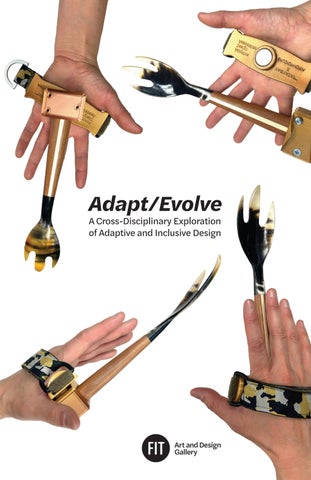
Adapt/Evolve A Cross-Disciplinary Exploration of Adaptive and Inclusive Design
The exhibition Adapt/Evolve reimagines the categories of adaptive and inclusive design. The toys, furniture, jewelry, fine art, and fashions on display challenge accepted ideas about designing for disability. Showcasing inclusive and imaginative solutions, Adapt/Evolve encourages audiences to envision a society where everyone can contribute. In preparation for the show, FIT convened a panel in July 2025 to discuss its themes: Eric Gottshall Fine Arts ’13, fabricator and designer of equipment for people with disabilities, Adaptive Design Association (ADA)* Fawz Kabra Curator, Art and Design Gallery Ethan Lu Assistant chair, Interior Design Tamara Morgan Community partnerships coordinator, Adaptive Design Association, which builds custom adaptations and challenges assumptions about disability
Amy Sperber MFA ’19, BFA ’97 Assistant professor, Fashion Design Barbara Weinreich Assistant professor, Interior Design Alex Joseph Fashion and Textile Studies ’15 FIT’s chief storyteller, booklet editor Cover: The Magnadapt, see p. 10. *Note that on other pages “ADA” refers to the Americans with Disabilities Act.
SECTION
1
Definitions and Examples
Alex Joseph: What exactly is adaptive design and how is it different from inclusive? Tamara Morgan: Adaptive is person-centered design. It’s about an individual and their unique need, and building with them in mind to create the best solution.
Cover: Adaptive Design Association
Ethan Lu: With adaptive design, first you understand someone’s disability, then you create something that adapts to them. Inclusive design is much broader: You’re trying to accommodate everybody without necessarily knowing exactly what would fit them best. You’re trying to cast the widest net. Barbara Weinreich: In 1990, Congress passed the Americans with Disabilities Act (ADA), which required that design of certain public things had to be able to accommodate a number of different disabilities. Since then, there have also been the terms “universal design” and “assistive design,” all intended to describe a way of approaching design that will be useful to a variety of people. Eric Gottshall: Adaptive is also marked by the ability for the design to shift over time with the client’s shifting needs.
1
Joseph: What’s an example? Gottshall: I built a floor sitter for a boy who was 18 months old. It’s a device that sticks a child’s legs straight out in front of them, puts their back up at 90 degrees, helps take some of the weight off of their core, and supports their head. We built in lots of additional supports. As his core strength started to improve, the therapists and his parents started removing the additional supports. After six or seven months, the floor sitter was no longer necessary because the boy had built up the core strength necessary for him to hold his body up. Sperber 3D modeled more than 100 avatars—many based on her FIT colleagues—to create forms that demonstrate the diversity of human bodies and lay the groundwork for better-fitting garments.
2
Sperber
Joseph: Amy, your 3D avatar project is a good example of inclusive design. The idea is that, generally speaking, standard fashion industry sizes don’t reflect the diversity of human bodies. How does your project address that problem? Amy Sperber: It was an attempt, because it’s definitely not the solution. Instead of just saying, “Oh, the avatars don’t work in these 3D modeling systems,” I wanted to make something that could improve the fit for all bodies. With support from the New York State Council on the Arts, I scanned 100 people to create a database of avatars reflecting a wide range of body types, ages, sizes, and mobility needs, and that work easily with programs like CLO3D. By using this database, designers can test fit, experiment with patterns, and design more inclusive, adaptive garments.
3
SECTION
2
Teaching Adaptive/ Inclusive
Joseph: How is adaptive taught at FIT, and how should it be taught? Weinreich: The tendency is to teach toward the standard or code. We want to prepare people—I’m talking about interior design right now—to understand ADA requirements. I think personally the best way to teach something like this is to get it outside of the required boxes and have more exposure to lived experience or to the joy of designing something that can be used in many ways. Joseph: How do you bring a design closer to lived experience? Weinreich: If you’re designing something—apparel, appliances, toys—you should have someone with a disability there at the beginning to share how they would use it, instead of imposing your vision on others. I would also say exposure to places like the Adaptive Design Association, where Eric and Tamara work. Lu: We actually did that. An Interior Design instructor brought her students to visit the association to see how they crafted things, and they took what they saw, and used [what they learned to] design chairs. 4
Smiljana Peros
Gottshall: Many of the designs were pretty fleshed out by the time they came into our shop, but the students came away with a basic ergonomic understanding of how different bodies fit in different rigid structures. Lu: [For another class], we brought in the manufacturer OFS, which has a showcase in the exhibition. They’re industry leaders in furniture for senior and medical designs, but when they came to mentor our students, OFS actually were not interested in those design practices. They said, “There is already a formula for those types of chairs.” They were much more interested in [teaching the] students [to find] out the quirks of each client. Some people prefer chairs that rock back Chair with recycling bin and prototypes and forth, and some people just get dizzy in rocking chairs. Some people prefer furry things. One student group imagined a client who was an environmentalist. They designed a chair that had a plexiglass case for recycling built into the back. Weinreich: The interesting thing about that class is that the prompt was not to necessarily design for a disability. It was to design something that was adaptive. So that goes back to how do you define adaptive? Is a chair that also acts as a recycling bin adaptive? Well, yes, if that chair is built in response to a user’s profile. It doesn’t have to be somebody with a disability.
5
Joseph: In other words, the pedagogical approach is— Weinreich: The methodology is to really listen and have empathy for the user. Another valuable thing about that is that it doesn’t silo disability. It’s a design approach that can be applied to anything.
Sperber: In the media, fashion is typically portrayed as thin and fabulous, reinforcing narrow ideals of beauty. I teach a course called Design for Innovation. Most fashion curriculum focuses on aesthetics—proportion, shape, and how textiles behave. But in this class, we start with a problem and ask: How can we solve it? What’s been done before, and can you offer a better interpretation? I remind students: Yes, everything has been done—but not by you, with your lived experience. That’s where new solutions emerge.
Sperber
Joseph: How does the approach look from the fashion design perspective?
Sperber: We developed buttons and closures in 3D design for [people with limited] fine motor skills. FIT had a town hall on adaptive, and the keynote speaker was the disability activist Estela Lugo. She said, “You want to know how it feels for me to get dressed? Put on oven mitts, because that’s me every day with the little fiddly closures.” So I made these, like, oven mitts. I ask the students to put them on and try to button or tie their shoes. It’s a way to teach empathy.
6
Joe Carrotta
Joseph: What’s an example of how you teach a specific problem?
Sperber adapted commencement regalia for Art Market Studies student Yi Liu ’25. Sperber removed the whole back panel of the gown so it would follow the line of Liu’s body and avoid “unfortunate bulges.” Tamara Morgan says she’s pleased to see an interest in adaptive. “As a little person—I’m 3-foot-2—I often have to wear clothing that is not suited to a 40-year-old woman, but maybe a 5- or 6-year-old, and not aesthetically what I’m looking for.”
7
Wendy Yothers, assistant professor, Jewelry Design, reimagined this cane handle as a “drunken” duck’s head. The surreal detail brings beauty and craftsmanship to this mobility aid, destigmatizing its medical quality via art and craft.
8
SECTION
3
“Beauty Is a Social Justice Issue”
Joseph: How important are stylishness and beauty for this category of design? Weinreich: Beauty is always important.
Richard Duane
Gottshall: Beauty and aesthetics are widely overlooked in the world of durable medical equipment, where things are created for a broad range of users. But a piece of equipment that is supposed to help somebody surmount an obstacle is aided by its aesthetic effect. We try to tailor the appearance of the solution we’re making to that person’s preference to make them feel good. Weinreich: Absolutely it’s a self-esteem issue, but it’s also not siloing somebody because of the way they use something. I mean, beauty is a social justice issue. It’s a human right. Think about the OXO peelers and can openers. Those are actually developed for people who are having mobility issues, but everybody loves them. They feel good and they’re gorgeous. Lu: The Magnadapt looks very steampunky—like retrofuturism. [See cover.]
9
Joseph: What’s the Magnadapt? Morgan: The Magnadapt was created for a gentleman named Phil who had a spinal cord injury and thus has limited mobility in his hands, wrists, and fingers. He loves to cook, but it’s very difficult for him to use kitchen utensils. When he came to us at Adaptive Design, he showed us a cuff with a magnetic attachment that he had been using for over 20 years that was broken, and asked if we could help him create something new.
Kabra: In curating this exhibition, I kept asking, How should we approach this? I’m always thinking about how someone will enter the space, how they’ll move through it, and what it feels like to stand in front of an object and read its label. And again and again, people reminded me that it also had to be visually compelling—a show that reflects the creativity and beauty of adaptive design. Weinreich: Yes, visually exciting! Just because it’s accessible doesn’t mean it has to be everyday. And also open to every user. We’re not trained to consider every aspect in architecture and industrial and interior design programs.
10
Adaptive Design Association
Gottshall: The old design started to break down because it wasn’t built to hold one single, specific utensil; it was kind of able to do it all. But the second Phil put any actual force onto it, the utensil would pop out. With the Magnadapt, each piece of cutlery fits perfectly because it has its own custom housing built in. It also allows Phil to swap out utensils, which was not the case with the previous device. He can put his palm flat on a surface, pull it back, detach the utensil, insert a new one, and now he’s gone from a fork to a knife or a knife to a screwdriver.
So hopefully this is a showcase and almost a laboratory, and we may make some mistakes, but we’ll learn. The exhibition in itself is kind of a design project. Kabra: The practice of exhibition making is always a learning process. Watching who comes in and how they move through a show has taught me a lot about inclusivity. For example, installers often hang work at the traditional standard—60 inches from the center of the piece to the floor. But I’ll say, “Lower, please—children will come too.” That small adjustment feels important. It’s a way of making sure different perspectives and bodies can engage with the work.
“If we’re truly considering inclusivity, we have to think broadly about who is not included, and how,” Kabra says. Adapt/Evolve features artist Alex Strada’s Mutual Aid Mobiles. These mobile sculptures are designed to distribute lightly used clothing and other items to unhoused people. Strada, the public artist-in-residence with the New York City Department of Homeless Services, encourages audiences to engage with the social and economic inequalities that result in homelessness.
12
Opposite: Alex Strada; This page: Smiljana Peros
Each spring, FIT Toy Design students partner with neurodivergent children to prototype adaptive toys. A panel of industry experts advises them. “Ready with Bo,” by Gowoon Li, comes with accessories and a chore chart to help the child practice preparing for their day. The spinning “jellyfish” in Ralph Attanasia’s “Jellyspinner” feature tags, which often appeal to children with autism.
13
Adaptive Design Association
The Adaptive Design Association re-envisioned a chair (pictured in the association’s workshop, and in use in Central Park) so that Morgan could scale Mount Kilimanjaro. (See back cover.) The first version, by the Israeli company Paratrek, was created for a paraplegic man. Association designers/fabricators Adam El-Sawaf, Gottshall, and Omer Zur reimagined it for Morgan, who is considerably smaller.
14
SECTION
4
Breaking Down Barriers
Joseph: How do we, as an institution and as individuals, work to break down barriers between so-called “abled” and so-called “disabled” people? Morgan: That’s such a profound question. Throughout my schooling, from grade school to graduate school, I often was the only student with a visible disability in my classes. That was a huge issue for me, and what happens is that the community keeps being further and further ostracized. The educational space from preschool all the way to academia is where the conversations need to start. Weinreich: An interesting thing about that too is, Tamara is talking about a visible disability. There are also nonvisible disabilities, and people don’t believe you, because you don’t look different. Haley Schwartz, Fashion Design ’22, who won the PETE Prize for designing a line of adaptive clothing, had multiple medical issues that were not visible. So she designed clothing that would allow her to live in the world without having to explain herself. Gottshall: I personally think that everybody exists on a spectrum to which the world either accommodates or does not. So rather than saying, “Someone is disabled,” say,
15
“Someone is being disabled by the built world around them.” This puts the onus on whoever is designing that built world, and challenges them to bring the folks who are not being accommodated to the table. Sperber: We should create more space at FIT for a student to say, for example, “I want to do my fashion collection on plus-size women in wheelchairs.” Instead of saying, “That’s not fashion,” we should automatically say, “How can we help you do that?”
r i g ht : In April 2025, Schwartz’s line appeared in a fashion show held for a nonprofit that helps people with gastrointestinal disorders. “The dress has hidden snaps in the shoulder and side seams that provide access to feeding tubes, insulin pumps, and other devices,” she says. “Since the front and back can be completely separated, it is ideal for caregiverassisted dressing, and doesn’t require the wearer, who may have a limited range of motion, to lift their arms above their head.” The line now sells at Walmart.com.
16
This page: AnnAnn Puttihanasorn; Opposite: Andrew Dunne
le f t : Schwartz’s prizewinning adaptive garments feature interior pockets, cord keepers, and hidden openings for women who use medical devices.
13
Accessibility Accelerator
Tamara Morgan of the Adaptive Design Association climbed Mount Kilimanjaro in August 2025 with the help of an extraordinary chair and a team of guides. Read about the chair on page 14.
Published as a companion piece to the exhibition Adapt/Evolve: Fashion Institute of Technology Art and Design Gallery A CROSS DISCIPLINARY EXPLORATION of ADAPTIVE and INCLUSIVE DESIGN CONTRIBUTORS
FACULTY
INTERIOR DESIGN, ID 316 STUDIO VI
INTERIOR DESIGN, DESIGN
TOY DESIGN
ALUMNI
Troy Richards Dean of Art & Design at FIT, Estela Lugo, Grace Jun Associate Professor at University of Georgia, OFS, Adaptive Design Association, Alex Strada, The High School of Fashion Industries
Wendy Yothers, Amy Sperber Assistant Professor at FIT
Valeria Arvelo, Vasiliki Malatos, Emily Moelis, Caralyn Pelini, Amalia Quiles, Nolan Parrish, Christina Halada, Lucas Nealon, Danielle Setta, Giavanna Tiesi, Ofir Lapid, Meghan Barnes, Yurong Tang, Aimee Trino, Julissa Lopez Valdez, Carla Smith, Paola Gonzales, Angel Ortiz Balbuena, Ellen Woodcock, Brittany Sharkey, Matthew Drago, Daubrusha Liberow
TECHNOLOGY IV
Ralph Attanasia, Gowoon Lee, Moonkyeong Kim, Ren Wang, Victoria McMaster
Haley Schwartz, FIT ‘22 Helya Mohammadian, FIT ‘04 Keith Kirkland, FIT ‘10 Kevin Santana, FIT’25
Chloe Papin, Manasi Salunkhe, Solana Saffen, Jalene Espinal Nieves, Ana Guerrero, Alexa Abreu, Julia Barillas, Morgan Dunlap, Maggie Albert, Jasmine Pak, Shanna Parra, EiSandi Kyaw, Jessica Liang, Danielle Feldman, Brooklyn Janelle
ADAPT / EVOLVE is a multidisciplinary exhibition that
considers various approaches to designing for accessibility as well as adaptive design’s relationship to culture and society. Fashion, jewelry, toy, and interior designs by FIT faculty, students, alumni, and invited designers and artists highlight creative new approaches to adaptive and inclusive design. The design objects and projects on view in Adapt/Evolve bring to light a network of care, interdependence, and access to good design for all, paving the way to a built world that supports everyone.
A SYMPOSIUM, taking place on October 16, 2025, accompanies the exhibition and brings together exhibitors, collaborators, and scholars to present and discuss adaptive and inclusive design.
ER 18– 26, 2025
fitnyc fit_artdesigngallery
September 18– October 26, 2025 Symposium Katie Murphy Amphitheatre October 16