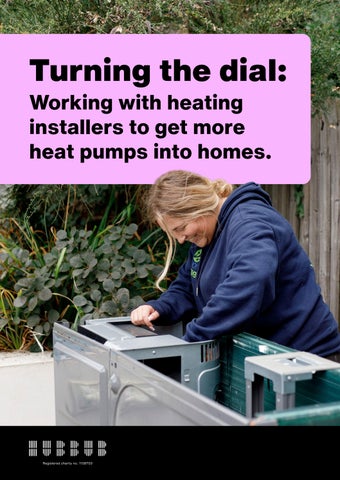
Turning the dial: Working with heating installers to get more heat pumps into homes.
What's in store? Key takeaways
4
1. The opportunity: heating installers as trusted messengers 8 2. What we heard: barriers to customer conversations
10
3. What we tested and how
11
4. What we found: five themes
13
5. Conclusion
24 26
I'll say, look, just trust it. You'll be absolutely fine. Just don't treat it as a gas boiler.” P.5 Heating Engineer, Hertfordshire
2
their trust in local tradespeople - like their plumber – who’ve already built rapport and expertise over time.
Around 14.5% of the UK's emissions come from the fuels we burn at home, mostly gas for heating and cooking, making it a key area to target to reduce emissions.1 While there’s broadly good understanding of how to reduce and conserve energy through turning off lights, or switching bulbs – when it comes to works that ‘retrofit’ our homes to make them more efficient – confidence and knowledge drops. Installing a heat pump for example, feels complex.
For many heating engineers, whilst they’re technically qualified, they aren’t always trained to navigate complex customer conversations and many still perceive demand as low. This project sought to bring the two together: equipping heat pump trained heating engineers with the tools they need to have better, more confident customer conversations on heat pumps.
To make these changes, households want trusted, independent advice to guide their decision, and naturally put
DESNZ, Provisional emissions data, April 2026: https://www.gov.uk/government/statistics/provisional-uk-greenhouse-gasemissions-statistics-2025/2025-uk-greenhouse-gas-emissions-provisional-figures-statistical-release
1
3
Key takeaways Heating installers are among the most trusted messengers for heat pumps - they’re an underutilised asset in helping households understand the clean energy transition. But anecdotally, many hold back from recommending them, or even push customers away from the technology. We wanted to understand why, and find out what methods of support could help increase confidence and willingness to have more positive conversations about heat pumps. Over seven months, we worked with a small cohort of twelve heat-pump-trained installers in a facilitated WhatsApp group, with a mix of discussion questions, polls and four online group sessions. Together, based on the insights they shared and live feedback, we co-designed practical communication tools, which the installers then tested in real customer conversations.
There'd be lads talking their customers out of a heat pump just because they don't understand it” P.5 Heating Engineer, Hertfordshire
4
What we heard: The barriers stalling heat pump conversations 1
Reputational risk:
I know that gas is reliable and I've got to defend my reputation.”
Installers take pride in their work, providing people with comfortable homes. Heat pumps felt unfamiliar and risky.
2
P.15 Heating Engineer, London
Home suitability myths: At the start of the project, just 3 of 12 installers agreed heat pumps can work in almost any home, despite evidence that they're suitable for the vast majority of UK properties.
3
Talking about cost:
Customer expectations shaped by gas boilers:
4
The difficulty of making an honest financial case for heat pumps.
Hot-to-touch radiators, instant heat, turning it ‘off’ made lowtemperature systems a more challenging customer transition.
People seem to have this misconception that heat pumps are always going to save money… the reality isn't that, because they're paying three times the amount per unit [of energy].” P.14 Heating Engineer, Buckinghamshire
5
What we learned through the project: 1. Peer support was highly valued: Talking to other installers in a small, facilitated group was the most valued element for most participants. It validated their shared experiences, which made customer conversations feel more worth it and created a counter-community to the sceptical norms that dominate much of the trade.
2. Identity shifted and confidence grew: The number of installers self-identifying as a "heat pump ambassador" rose from three to five of the final seven by project end. All seven installers who completed the project showed improved or maintained confidence that heat pumps "will work."
I’d say it was a little bit more positive in the fact that I don’t bow down quite as quickly as I used to [in conversation with customers].” P.14 Heating Engineer, Buckinghamshire
3. Tools work when co-designed and realistic:
This breaks things down in a really simple, easy to understand way”
Before the project most installers shared no resources with customers. The codesigned tools were used because installers had shaped and trusted them. All seven said the tools gave them useful things to say and helped customers understand heat pumps better.
P.6 Heating Engineer, London
4. Cost is structural, so communications can only go so far:
Heat pumps are a good technology, but currently a difficult sell in a gasdominated, high electricity cost market.”
Better language helps, but no communication tool can magically bridge the cost gap while electricity remains significantly more costly than gas.
P.13 Heating Engineer, Hertfordshire
6
5. The customer journey should focus on readiness over the hard sell:
Nobody has given me something like this before, it's helpful.”
Households need time, information and confidence to make a big decision like getting a heat pump. Raising awareness of clean heat and helping customers take practical steps towards a heat pump is the most practical approach. Happily, this perfectly fits the way many installers naturally work by building rapport over multiple jobs over time.
P.6, Heating Engineer, London
Thanks for that. It's very informative... the links are really good... there's finance options I wasn't aware of, and now I am, so I appreciate that.” Customer feedback
7
Recommendations We've outlined five practical recommendations which could help support heating engineers increase demand for clean heat:
1
Scale up peer support to increase social proof: Structured small peer communities with access to credible technical expertise could be relatively low cost and high impact.
• Government and funders: Invest in peer learning alongside technical training.
• Training providers: Embed cohort-based learning with ongoing access rather than one-off courses.
• Manufacturers and retailers: Use existing installer relationships to enable peer exchange, not just product knowledge transfer.
2
Embed communication skills into technical qualifications: Technical training produces qualified installers who aren't always equipped for customer conversations about heat pumps, installers should be given the communication tools to help increase household demand for clean heat.
• Government and training providers: Communication skills training
should include plain-English messaging, customer segmentation and incremental adoption framing plus a ready-to-go toolkit of resources.
• Manufacturers and retailers: Alongside technical guidance, give installers realistic, jargon-free, customer-facing content to use in conversation. Short videos could work well for a time-poor audience.
3
Address the cost barrier: Overcoming cost barriers would make heat pump adoption - and conversations - significantly easier for installers.
• Government: Reducing the electricity unit prices relative to gas is the single biggest lever available.
8
• Energy companies and lenders: Develop and advertise finance products that continue to make heat pumps cost comparable to boilers.
• Industry and Government: Explore the scale of poor-quality installations by other unaccredited tradespeople, which installers flagged as damaging trust in the technology and qualified engineers.
4
Create a free, co-designed communications toolkit and campaign: A major industry organisation should take ownership to maintain and expand the developed tools, taking a co-designed approach to build trust and buy in from installers, supported by an industry-wide communications campaign.
• Industry and Government: Coordinate a working group to agree ownership and a plan for maintaining the toolkit.
• Trade associations and industry bodies: Create a regular drumbeat of positive, realistic peer case studies across key channels.
• Manufacturers and retailers: Use trade counters and merchants to reach installers with peer-tested content e.g. QR codes, pop-up stands and informal Q&A opportunities work for this audience.
5
Measure household readiness, not just heat pump installations: A household having a heat pump plan is on the journey to clean heat.
• Industry and Government: Develop shared metrics for customer readiness alongside installation targets e.g. heat pump conversations, customer willingness and future installation plans.
• Businesses and installers: Track heat
pump conversations and customer plans, not just completed jobs. Continue to evolve best practice through industry working groups.
9
1. The opportunity: heating installers as trusted messengers The project sought to explore how heating engineers, as our frontline heating messengers, could be equipped to increase household awareness and drive demand for heat pumps.
Why this matters: According to Hubbub’s polling, and Home Advantage – our research project with 175 homeowners – there's a significant untapped willingness to consider a heat pump.2 However, we found that households need careful framing and steady support to see the change as a positive one. Crucially, homeowners consistently rank a local tradesperson they’ve known for years as one of their most trusted sources of advice on the energy transition. Our desktop research highlighted three major bottlenecks keeping this from happening:
• Lack of confidence and motivation among trained heat pump installers: Analysis from the Heat Pump Association showed that nearly four in ten of those who are trained don’t go on to install heat pumps straight away, suggesting a gap in confidence, support or demand.3
• Misinformation, myths and confusion: Industry partners and anecdotal evidence
indicated tradespeople may discourage households from choosing a heat pump. According to a Nesta survey of heat pump installers, many don’t believe a heat pump would heat a customer’s home to a sufficient standard, despite studies showing that heat pumps are suitable for almost all homes in the UK.4
• Perceived lack of customer demand: Many qualified installers underestimate
household appetite for low-carbon heating, and this discourages them from bringing it up in conversation. Hubbub’s research showed households were open to framing of getting “Heat Pump Ready”, taking a step-by-step approach to understanding the changes required in their home.
The research sought to explore this potential opportunity, specifically to find out: 1. What barriers prevent more tradespeople from recommending heat pumps over alternatives, and what are the beliefs that underlie these values? 2. Based on the barriers, and the beliefs that underly them, how can tradespeople be better supported to become positive ambassadors of heat pump technology?
10
Methodology - What we did: We brought together twelve installers working in the Southeast of England who contributed 10 hours of time over a seven-month, online research and co-design cohort. Seven installers completed the project with some dropping out for capacity or health reasons. Of our cohort, one was the only employee of their company and the other six had small businesses with less than 10 employees. The project used a range of methods to capture installer belief, confidence and behaviours:
1. WhatsApp Engagement: From October 2025 to April 2026 the heating engineers were part of a private WhatsApp group where questions explored their beliefs and framing around heat pumps and barriers their customers face. Hubbub moderated the group, creating polls and sharing content for them to discuss, as well as open questions to prompt written or voice note discussion. 2. Live Sessions: We conducted four live sessions, covering barriers to customer conversations, a co-design session to develop the resources and two sessions with training provider Warmur Academy to give the opportunity to increase technical knowledge. 3. Installer Interviews and Surveys: All installers carried out a pre and post project survey that explored their beliefs and confidence in engaging customers. Two one-hour long interviews were held with four members of the cohort to gain an in-depth understanding of the reasons behind their beliefs and to what extent they changed. (An extra interview was held with one member at the end of the project). 4. Customer Surveys: Installers shared the co-designed resources with their customer bases who completed a survey reviewing the tools and how effective they were in their perception of heat pumps. 15 customers gave feedback.
Hubbub, Home Advantage, 2025: https://issuu.com/hubbubuk/docs/home_advantage_opportunities_to_support_uk_househo Heat Pump Association, 2025: https://hpauk.org.uk/insights/building-a-skilled-and-active-heat-pump-workforce/ 4 Nesta, 2024: https://media.nesta.org.uk/documents/How_to_install_more_heat_pumps_1906.pdf 2 3
11
2. What we heard: Barriers to customer conversations 1. Responsibility and professional risk: Installers take pride in delivering reliable, cost effective, timely services for customers. Therefore, heat pumps introduce unfamiliar territory and a sense of risk. As one industry stakeholder said “the current system teaches people to be qualified, not competent.” Fear of leaving customers in cold homes, or with costly energy bills if the system is not designed correctly, reinforced a sense of risk, versus a perception of gas as the safe option. These concerns were noted as often amplified by negative media stories.
2. Home suitability misconceptions:
It's enormously difficult to retrofit it into a small, twobedroom terrace”
Many installers held beliefs about which homes can accommodate a heat pump, overestimating the need for radiator upgrades, insulation levels, and space requirements. At the start only three of twelve cohort members agreed heat pumps can work in almost any home, even though evidence shows they are suitable for the vast majority of UK properties. While installers noted customers often perceived them as loud, large and not suitable for their property type, considering it “new technology” despite their widespread use throughout Europe and in commercial buildings in the UK.
P.2 Heating Engineer Hampshire
I explained to them that if you were to look at a picture on Google of the City of London, on top of virtually every single building, you'll see these huge square units…”
3. Cost:
P.6 Heating Engineer, London
Cost is one of the biggest blockers to customer uptake of heat pumps, with installers saying customers ‘go quiet’ after being given quotes. Installers reported discomfort recommending
12
them if they perceived a customer couldn't afford the upfront investment or where they couldn’t make a case that it would ‘pay back’ in energy cost savings. One installer talked of building trust over time by helping to reduce existing running costs, such as by turning down the thermostat to evidence a low temperature system was possible.
People seem to have this misconception that heat pumps are always going to save money… the reality isn’t that because they’re paying three times the amount per unit.” P.14 Heating Engineer, Buckinghamshire
4. Customer habits and perception: Customers aren’t usually aware of the differences of having a low-temperature heating system, meaning installers must contend with expectations of hot-to-touch radiators and on-off blasts of heat. This mismatch in expectations increases installer anxiety about callbacks or complaints, reinforcing hesitancy to recommend heat pumps. Many installers were expert communicators, already adapting their style, messaging or using analogies and co-benefits, stating that talking about ‘SCOPS and COPS’ resulted in customers ‘glazing over’.
What makes it easy is actually when customers have done a little bit of their own research and they immediately understand that, OK, my rads won't be blaring hot, but that won't be a problem.” P.6 Heating Engineer, London
3. What we tested The insights phase deepened our understanding of installer barriers and beliefs, and where to focus support. We wanted the tools to reflect the cohort’s professional experience and have their buy in, so we built them together. As one installer put it, we let them in on the 'back end' of how communications are made. The programme moved through three phases. First, an insights deep-dive replaying the barriers identified through baseline surveys and interviews, discussing customer barriers and motivations. Second, a co-creation phase sharing our initial ideas and three broad customer profiles to help installers think about tailoring their approach (see
13
figure 1) and give feedback on wording, technical detail and how they might use them. Two Q&A trainer sessions ran alongside co-design. Then finally, the testing phase gave installers six final tools to test over twelve weeks (see table 1). Feedback was collected throughout via the WhatsApp group as they used the tools in real conversations. Figure 1: Customer profiles used to shape tools and prompt discussion
• Heat pump ready - actively interested homeowners with broadly suitable homes, who need reassurance to convert interest into action.
• Future adopters - homeowners who need home upgrades or a change in personal
circumstances first, who need a plan for getting heat pump ready and reasons why it's worth it.
• On the sidelines - those unable to install now (renters, short-term homeowners), who benefit from awareness and positive sentiment that may influence others over time.
Table 1: The six tools developed and their purpose
Tool
Purpose
Customer targeting
Key Things to Know About a Heat Pump
To address common misperceptions On the sidelines around heat pumps e.g. heat perception and normalise that the tech isn’t new
What to Expect Provide customers and installers with from a Heat Pump scannable immediate takeaways
Heat pump ready
Get Your Home To understand what it will look, feel Heat Pump Ready and sound (plus cost) like to shift awareness and expectations
Future adopters
Talking about Costs FAQ
A script for how to answer common or tricky customer questions on cost
All but especially ‘heat pump ready’
Heat Pumps 101
An infographic highlighting key facts to overcome misconceptions e.g. how they provide a constant gentle heat and are widely used in Norway
All but most likely on the sidelines/ future adopters
We encouraged Installers to treat these as flexible conversation aids; using them as sources of wording, framing, and structure, rather than strict scripts to be adhered to word-for-word, or as ready-to-go resources to share directly with customers. The focus was firmly on communication, helping installers who already hold the technical knowledge feel more confident and equipped to bring heat pumps into conversations they might otherwise have avoided, whilst handling more difficult conversations.
14
4. What we found: Five key themes 1. The power of peer support: Installers found unexpected value in the peer community, with shared experiences providing validation that strengthened their confidence and persistence in having heat pump conversations with customers. Being a heating engineer can be a lonely profession as a large proportion are sole traders. As one of our participants put it “[we] kind of live a very solitary life as heating engineers." P.2 Heating Engineer, Hampshire. The peer element of the project was one of the most consistently highly valued. It provided value in three key ways:
a. Social connection through shared frustrations The most immediate impact was validation. Installers found it meaningful to hear their challenges were shared, from cost to support schemes and customer expectations.
"It's quite reassuring. I'm not the only one... It's been quite nice seeing that it's not just me that feels that the industry's got a problem." - P.14 Heating Engineer, Buckinghamshire
Trust in peer voices also shaped how installers received information. The cohort placed high value on insight coming from people who understood and lived their day-to-day reality, as opposed to marketers, manufacturers or policy organisations.
b. Normalising positive attitudes within a sceptical trade Participants felt that the wider heating installer industry remains generally sceptical and negative about heat pumps. In fact, a cohort poll rated fellow installers as harder to influence than customers. Because of this background noise, participants found real value in discussing heat pumps within a more open-minded and positive group. Participant 5 (Hertfordshire) described how they are often approached at trade counters by sceptical tradespeople, who want to tell them that heat pumps "don't work”. This attitude is something P.5 actively tries to challenge and reflected in their final interview that being part of the programme made them feel far more encouraged to keep challenging misinformation. This peer-to-peer influence played out directly in the Whatsapp group. When disagreements arose, installers politely corrected and challenged each other, often sharing external links to demonstrate their point. One such example was around how
15
much electricity is generated from renewable sources vs gas, in the UK. Having the counter arguments come from fellow trades people helped that information land better, challenge outdated information and normalise overall pro-heat pump sentiment. However, one of the more experienced participants noted that peer discussion sometimes cut both ways, occasionally reinforcing negative views of heat pumps. The expert training session with Kimbo from Warmur Academy was noted as particularly valuable because it came from someone with credible, practical expertise allowing for discussion, rather passive listening or having a promotional angle. Overall, this suggests that installer training benefits enormously from a group dynamic provided it is well-facilitated to capitalise on trusted peer relationships.
2. Identity and confidence grew and behaviour began to follow The project set out to shift not just what installers say to customers but ideally how they see themselves, as active advocates for the technology, not reluctant or passive recommenders.
a. Identity shifted towards becoming ambassadors
Reputation is critical to heating installers; it defines whether they decide to recommend a heat pump, challenge a customer’s expectation or take on a job. Underneath almost every practical objection sat a belief about what good looks like, about risk, or value for money, often carried over from a career spent around gas boilers. Figure 2 shows that installers' biggest fear was leaving a customer out in the cold. “My reputation's worth more than just putting something in to make money... I'm 90% reputation” - P. 9 Heating Engineer Surrey. We asked the cohort at the start and end of the project whether they considered themselves a heat pump ambassador and if they’d encourage people to adopt them. For the final cohort this rose from three to five of seven self-identifying as an ambassador (71%). The baseline survey with the larger cohort showed seven of twelve (58%) selfidentified as an ambassador. Early indications were that this may be beginning to shift into behaviour change with
16
5 of 7 (71%) of installers self-identified as a heat pump ambassador by the end of the project
the average share of heat pump installations across the cohort increasing from around 10% to 17%, though the sample is small, the timeframe short and seasonal, external factors make this difficult to isolate. However, four of seven increased how much they were actively trying to overcome people’s barriers and convince them of a heat pump’s value. Installers noted how they shifted behaviour by actively sharing the resources, bringing up heat pumps in more conversations and initiating conversations with a wider range of customers. Figure 2: Poll: What’s your biggest fear (if any) from installing a heat pump, when it comes to the customer? (Six participants voted, multiple choice) Customer’s house will be cold or uncomfortable Complaints could affect my reputation Complaints could cost me money to fix Customer won't save money None of these Other 0
1
2
3
4
5
6
b. Increased confidence helped shift identity At the outset of the project, installers stated they were already confident talking to customers about switching to a heat pump, despite there being a range of knowledge and experience within the group. Eleven of twelve said they were confident in the pre-survey, for example, (though this could be due to pride and not wanting to admit knowledge gaps). Confidence on addressing noise, disruption and space concerns for example, was already high. The WhatsApp discussion showed installers were already knowledgeable enough to critique the resources on accuracy grounds.
• Some installers were able to shift their identity because they experienced a shift in knowledge and confidence.
• All seven installers showed improved or maintained confidence that heat pumps "will work" - one moved from not confident to very confident.
• One installer shifted from advocating for hydrogen to embracing heat pumps. • Two installers moved from unlikely to likely to recommend a heat pump. • One installer changed from believing heat pumps are only effective in new builds, to believing they work in most homes if insulated well.
17
"There's huge stigma around (heat pumps) ... they can't do this house because it's ventilated, it's old, it's Victorian. Who cares? it's just heating." - P.14 Heating Engineer, Buckinghamshire. At scale, one participant theorised that confidence was a barrier for many installers, arguing 20% of current boiler sales could have been heat pumps, based on customer willingness, but were talked down by unconfident installers who lacked knowledge.
c. Behaviour and communication began to follow As confidence grew, installers increasingly trialled the resources, and saw a shift in behaviour, mostly around their communications with customers. Figure 3 shows everyone in the cohort agreed the project gave them useful things to say in customer conversations, and useful tools to approach talking about heat pumps, as well as helping their customers to better understand heat pumps. “I’d say it was a little bit more positive in the fact that I don’t bow down quite as quickly as I used to.”- P. 14 Heating Engineer, Buckinghamshire Interviews backed this up, with installers saying while the resources were not technically revelatory (as aimed at customers) they were practically useful, particularly for framing, phrasing and to answer difficult questions (see theme three for examples). One installer interviewed noted how some of the responses he received from customers were more positive than he was expecting, with a customer noting how informative they were - which gave the sense of an improved level of customer service. "I’m trying to keep communication in their terms so that [the customer] can actually get their head round it." - P. 2 Heating Engineer, Hampshire
Figure 3: Final survey sentiment on the impacts of the taking part Q: To what extend do you agree or disagree with the following statements: Useful things to say in customer conversations
2 strongly agree
Useful tools to approach talking about heat pumps
3 strongly agree
4 agree
Helped customers understand heat pumps better
3 strongly agree
4 agree
More likely to initiate conversations with customers
2 strongly agree
5 agree
5 agree
Improved my understanding of heat pumps
1 strongly agrees
Changed my opinion on heat pumps
1 strongly agrees
0
1
2
3
4
5
Number of installers that agree out of seven
18
6
7
3. Tools work when co-designed, adaptable and realistic Before this project, most installers rarely shared no resources with customers, bar quotes. Existing materials were seen as incomplete, overly optimistic or simply not built with real installer conversations in mind. By involving installers in shaping the tools from the start, the resources that emerged were ones they trusted enough to use and adapt: the right message, for the right customer, in the installer's own words.
a. Co-designing built trust
Pre-project tools: I don't
Early WhatsApp group conversations share any info at present. and interviews made it clear the group It's difficult to recommend a rarely sent any supporting materials to particular resource as they customers, relying on sharing information in conversations, mostly when prompted are all missing something.” by a customer. By being asked to feed into the materials P. 2 Heating Engineer, Hampshire directly, the cohort weren't just acting as proofreaders but building something they trusted enough to use. Installers were able to challenge content that didn't reflect their reality. The clearest example of this was during the live feedback session, where quotes about the average cost of a heat pump installation caused active debate across the group about the most accurate and realistic figure to use. By validating the feedback shared by the installers, and adapting our messaging, we were able to reinforce the value placed in their own knowledge and expertise. One installer interviewed, even said he’d be interested to see and comment on more communications material, showing demand for co-creation.
I also think your approach was good in the sense that you sort of took on board comments that were made, and you factored that into the materials you produced, which I think gave a sense of value to the project.” - P.6 Heating Engineer, London b. Communication structure, not sales scripts Installers mostly don’t see themselves as salespeople, and hesitance around talking about heat pumps came partly from a reluctance to feel like they were ‘pushing’ something on a customer. Therefore, there was a need for materials not to read as ‘sales scripts’ that felt impersonal or didn’t allow flexibility to adapt to what the installer thought was the best option for the customer.
19
When designing the materials we opted for designed digital leaflets, FAQs and a useful links index. Installers could either share toolkit items directly with customers or pick and choose information and phrases to use in their conversations.
I issued [the cost script] to all guys in team, as thought it’s 'quite good'. Adapted it, as disagreed with costs for houses we work in (would be much higher).”
“These documents provide useful prompts for topic discussions with homeowners rather than being standalone leaflets I think”
P14. Heating Engineer, Buckinghamshire
– P.17 Heating Engineer, Berkshire What participants valued most was not polished, finished resources but ones they could make their own. Installers adapted materials to suit their style, their customers, and their own experience.
c. Tools worked best when tailored to the customer
To be honest, some of the responses I got were more positive than I was expecting. And if I knew that was the case, I would have probably done something myself a lot sooner.
Table 1 shows how the tools were designed for customers at different stages of considering a heat pump awareness and willingness. Positive feedback consistently pointed to simplicity and adaptability as the qualities that made tools useful in practice. A recurring theme across feedback was that credible framing involved realistic messages that didn’t overpromise, especially on cost. Generic or overly optimistic content was more likely to be disregarded or edited out.
People really do seem to appreciate having something physical in their hands that they can look at.”
P.6 Heating Engineer, London Where installers did share materials with customers, the responses were often more positive than they anticipated. This is particularly notable, given that perceived low customer receptiveness is one of the barriers the programme set out to address, and suggests there may be a gap in how installers perceive customer receptiveness, and how receptive customers truly are. The tools that performed best shared the same qualities: simple, realistic, and adaptable to the installer's own voice and who they were speaking to. In the final survey:
20
• 6 out of 7 installers rated "Key Things to Know" as helpful, with two rating it very helpful.
• Five installers used both "What to Expect from a Heat Pump" and "Get Your Home Heat Pump Ready" - all rated them helpful, with three out of five rating them very helpful.
• Fewer installers reported using the more knowledge-building resources, but those who did found them particularly valuable for deepening their own confidence rather than sharing directly with customers.
"Customers like the broad base of knowledge and feel [more] confident that I have a deeper knowledge of this technology which builds on trust." - P.9 Heating Engineer, Surrey, on Heat Pumps: Key Things to Know. The tools that performed best across both categories shared the same qualities: simple, realistic, and adaptable to the installer's own voice and who they were speaking to. The same tools could even fit both functions as customer-ready materials, or installer-confidence building tools that give them a natural way into a conversation they might otherwise have avoided.
d. Expert trainer sessions provided reassurance and myth busted in a ‘safe space’ The trainer session addressed specific misconceptions that were linked to manufacturer guidance, outdated training, or commercial caution rather than genuine technical limits of heat pumps. For example:
Common misconception
Trainer response
Large heat pumps require a three-phase electricity supply
The trainer noted that single-phase units up to around 25kW are now available, making this an outdated belief.
A heat pump must match the kW Oversizing based on a like-for-like swap (e.g. rating of the boiler it replaces replacing a 30kW combi with an 8kW heat pump “just to do the hot water”) leads to excessive cycling, poor efficiency, and reinforces the idea that heat pumps “don't work as well”. Hot water won't be “hot enough” A question installers say comes up constantly, rooted in the belief that lower flow temperatures mean a worse domestic hot water experience.
“A kilowatt is a kilowatt... it doesn't matter whether it comes from an electric heater, a gas heater, an oil heater, a heat pump, or a gas boiler... So, to say that some houses aren't suitable is silly, because any house is suitable for a heat pump.” - Kimbo, trainer The trainer’s approach was to simplify heat pump physics into “magic triangles” of ratio
21
diagrams that let installers work out flow rates, pipe sizes and energy requirements without scientific calculations or geometry. The aim being to build confidence through building up bite-sized knowledge. The training was popular among the group, especially helping less experienced installers feel better equipped to handle technical design challenges and more Heat pumps are a good confident explaining this to customers. One had completed the training before, technology, but currently and another went on to do his full course. a difficult sell in a gasInstallers interviewed noted how it ‘cuts dominated, high electricity fluff’ and was practical.
cost market. The toolkit here does a good job explaining how heat pumps work and setting expectations around comfort, design and efficiency.”
The online format of sessions, run in the evening after the working day, also worked well for this audience and is something other training or knowledge sharing programmes should replicate. Participant 9 (Heating Engineer, Surrey) reflected that "the evening timings of these sessions work well when you have a full day of work."
P.5 Heating Engineer, Hertfordshire
This highlights that training should prioritise practical, jargon-light methods over academically “complete” technical training and should explicitly normalise not knowing things yet.
Even with a well-designed system achieving a COP of 3–4, the current electricityto-gas price ratio means running costs are often broadly similar to, or higher than, those of a modern gas boiler. When you factor in the higher upfront installation cost and the additional system requirements, the overall financial case isn't always strong enough to make it an immediate or obvious choice for many homeowners already on gas.”
4. Systemic barriers remain strong, especially on cost Despite equipping installers with better language and confidence, the project consistently found that cost operates as a structural barrier that communication tools alone cannot overcome, alongside other systemic barriers.
a. The cost loop: upfront price and running costs reinforce each other The cost challenge combines upfront and running costs which are intrinsically
P.13 Heating Engineer, Hertfordshire
22
linked. Customers facing a high upfront installation cost naturally hope to recover that through lower running costs. But with electricity prices currently far higher than gas, that case is hard to make for most. To achieve the efficiency needed, installers recommend system improvements such as new radiators, pipework or better insulation, but this can push the upfront cost even higher still. Cost was emotive during the co-design phase, and installers further adapted copy to manage expectations on cost, talking about average or potential savings. The Boiler Upgrade Scheme (BUS) grant was acknowledged as a positive driver of current demand for heat pumps. But conversations around this often hinted towards a feeling that the grant was over-inflating manufacture prices. This reflected installers’ scepticism toward government and industry efforts to support adoption, born from how difficult the cost conversation remains in practice.
b. Disruption compounds the cost barrier The disruption of retrofit installations compounded the cost issue, particularly for older housing stock. Participant 14 (Buckinghamshire) described a customer who was, in principle, an ideal candidate: "This is the kind of client that can afford it, would go for it, but the logistics are unacceptable." Customers who begin a conversation open to a heat pump, can be put off by the full picture of what installation involves, not just the unit cost but the associated works, pipework, cylinder, emitters, and disruption. One symptom of this was the anecdotal emergence of a lower-cost but higher-risk shortcut: customers using builders or other trades, rather than qualified installers to reduce upfront spend. Poor installations not only affect individual customers but feed the wider perception that heat pumps "don't work”. Most installers had this concern, which made some less willing to recommend them at all. This links to a theme of professional pride and integrity that ran through the data. Several installers described being unwilling to recommend a heat pump when they could not honestly defend the costs to their customer. Participant 13 (Hertfordshire), for example, described a conversation with a well-informed customer that concluded with a boiler being fitted, not because of any failure of communication, but because gas was a more cost-effective option. Some installers described quietly stepping back from the conversation with customers they perceived as financially stretched, not wanting to push a product they couldn't in good conscience recommend. While the continued cost-of-living pressures have made some customers more interested in reducing gas dependency it has also made others more cautious about large capital expenditure on home renovations. Participant 6 (London) observed a reduction in overall uptake during the programme, with customers holding back decisions and waiting for further government announcements on grants. Installers also pointed to wider challenges in the system, including the paperwork that comes with accreditation schemes. A few mentioned the cost and admin of MCS certification as an extra burden, especially for sole traders. We did not look into this in depth, as our focus was on communications. MCS has told us it is working to ease this
23
admin burden through its redeveloped installer scheme, which is now being rolled out. The scheme puts more weight on the outcomes installers achieve rather than the boxes they tick, with simpler requirements and a new Quality Risk Model to guide how often assessments happen.
5. Customer conversation over conversion Heat pumps are a big decision that households need time, information and confidence to make. Therefore, the project focused on building that journey: raising awareness of clean heat and helping customers take practical steps towards a heat pump, even if the switch itself is still years away.
a. Customers and the readiness gap The customer survey circulated by installers to their own customers confirmed this picture. While a small sample of 15 respondents, only four were actively exploring getting a heat pump. Nine described themselves as open but not yet ready. This is likely not apathy but a reflection of the significance of changing a whole home heating system, the costs, disruption, uncertainty and all the effort needed to overcome the status quo. Installers spoke of how customers in these conversations did not need a hard sell, they needed information and confidence to move along this journey. However, signs are promising, over half of customers said they were more willing to consider a heat pump after the conversation with the installer. Further research could explore the impact of installer conversations on customer willingness. Figure 4: Customer survey Q: To what extent do you agree with this statement: ‘The conversation with the
installer changed how willing I am to install a heat pump’ (N=15)
Agree
4 strongly agree
Neither agree nor disagree
4 neither agree or disagree
Disagree
6 agree
1 disagree
0
1
2
3
4
5
6
7
8
9
10
b. What adoption looks like in practice Rather than asking customers to make an immediate decision, the most effective conversations focused on practical next steps: understanding what changes a heat
24
pump would require over time. For example, a customer who flatly rejected a heat pump was still willing to discuss lowering their boiler flow temperature or talk about other ways to cut bills, making the conversation less divisive and moving them towards low temperature heating. Bringing in Energy Performance Certificates (EPCs) and increasing public understanding of the move to clean heat could be useful additions here. The "Get Your Home Ready" resource was designed with this approach in mind. One installer began including it in standard customer paperwork when quoting for a boiler replacement, not as a pressure tactic, but as a gentle nudge. As one installer described it:
We do need to re-educate people and get their temperatures down... then the adoption to a heat pump is going to be easier... you can then say to people, right, well, you've had your boiler running at X temperature for three years now. Why don't we make the next step?” P.14 Heating Engineer, Buckinghamshire A gradual approach also addresses installers fear of reputational risk from pushing a heat pump on a customer or a home that isn't ready. Framing conversations around readiness removes that pressure, allowing installers to leave resources, raise and revisit the topic may help build confidence with lower stakes and is more likely to win round more cautious or sceptical installers than a focus on direct sales or conversions.
c. This built on skills installers already had This built on a trend and skill many installers already had: the ability to build trust and customer relationships for the long term, demonstrating reliability and gradually moving customers towards lower temperature heating. The project helped participants verbalise this instinct and gave them a set of tools to work with. Installers' existing ability to read a customer's home and attitudes (honed through years of professional practice) is precisely the skill needed to identify who is ready for a heat pump installation and who needs a broader conversation first. Positioned as a mark of expertise rather than a sales technique, this readiness approach fits naturally with how good installers already think about their work.
d. Redefining what success looks like However, this also means the measure of success needs to change if the customer journey is about conversation over conversion. The number of heat pumps installed in the next quarter is too narrow especially given the needed lead time to develop trust and convert to sales. For example, this pilot project focussed on willingness over installations, given its four-month run time.
25
5. Conclusion To read the project's recommendations, see page 8. Heating installers are often highly trusted. Customers let them into their homes, listen to their expertise and act on what they say. In a transition as complex and personal as switching from gas to clean heat, that trust is a valuable and under-used asset. The right support for installers could be key to unlocking the change we need. Pride and professional reputation are major identity drivers for installers - at the end of the day, they just want to keep their customers warm, comfortable, and financially sound. Because heat pumps are still an unfamiliar technology wrapped in complex costs, they can feel like a direct threat to that hard-earned professional identity. This project has shown that peer support was the most valued element for installers: it reduced isolation, normalised positive attitudes and built confidence, though peer forums need care to avoid misconceptions and tackle scepticism. Identity shifted too, with more installers seeing themselves as ‘heat pump ambassadors’ by the end than at the start. Confidence and knowledge grew for many, sometimes in subtle ways. Behaviour shifts ranged from sharing resources more proactively to raising heat pumps with customers they might have left previously to choose a boiler before. Communication tools worked when they were realistic, adaptable, and built with installers rather than handed to them. Installers aren't salespeople, and they don't want to sound like them. What they valued was structured assets or honest framing for conversations they already wanted to (or were) having. Cost and disruption remain as structural barriers that communication tools alone cannot bridge, though they can help set expectations. Difficulty making the financial case for a heat pump is something installers feel acutely. This project tested the customer journey as incremental steps. Most customers aren't ready to switch tomorrow, but many are curious or open to a trusted tradesperson helping them understand what the transition looks like. Installers are well placed to play this role, which fits naturally with how many in this project already think about their work and their customers. Yet heating installers are also busy people who are rarely at a desk. Their demands range from customer satisfaction to quality control, training, paperwork and often the pressures of running a small business. Conventional engagement is unlikely to work with this group, and our cohort rated installers as harder to influence than customers on heat pumps. Solutions need to meet installers where they already are via trade counters, installer influencers and existing training. It needs to be easy, made a social
26
norm and feature at timely touchpoints. Crucially, support needs to have their buy in, be co-designed and peer tested. The greatest immediate opportunity lies with installers already trained as heat pump installers, both to make them more active and create social proof to others not yet trained. The right support, embedded at scale from peer communities to realistic messaging and communication skills embedded in training, plus a market where the financial case is easier to make, could help create a pro-heat pump norm rather than an exception.
I do think that we do need to push to engineers more than consumers because we are the ones that can keep chomping away at the bit.” P.14 Heating Engineer, Buckinghamshire
27
Thank you Let's chat: hello@hubbub.org.uk
This research was kindly funded by the MCS Foundation.