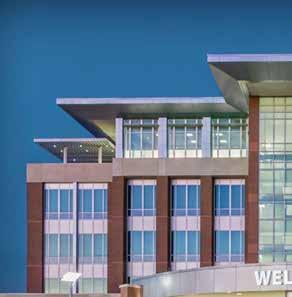
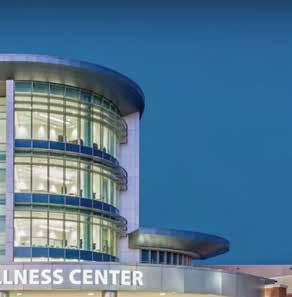
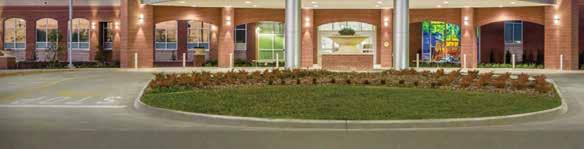
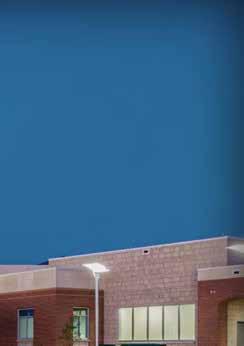
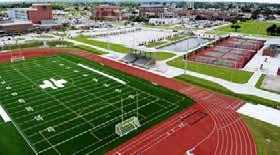
Sports Complex – Built to NCAA standards; includes a multi-purpose field with 8-lane track, tennis courts, beach volleyball and outdoor basketball court.
Fitness Center – State-of-the-art facility equipped with the latest technology and programs, aquatics, gymnasium and more; Certified and a top-ranked facility in the nation by the Medical Fitness Association; More than 1M visits since opening.
Playground & Education Initiative – Addressing childhood obesity through nutrition education and new playground equipment for numerous area elementary schools.
Sports – Keeping athletes safe by providing athletic trainers in high schools as well as Nicholls State University; Helping athletes grow and excel in sports through formation of competitive youth volleyball and swim teams.
Wellness Education – Numerous and expanding programs for individuals and families on subjects like nutrition, weight management, diabetes, CPR and more.
WellFit – Integrating wellness into clinical care to address specific health conditions like cancer, orthopaedic conditions, chronic pain and diabetes.
BISHOP
Most Rev. Simon Peter Engurait
DIRECTOR OF COMMUNICATIONS AND PUBLIC RELATIONS
Bevi Fontenot
EDITOR
Joe O’Sullivan
DESIGNER
Alaina Maiorana
COVER DESIGNER
Connor Mabile
BUSINESS MANAGER
Bill Barbera
ACCOUNTING
Rebecca Thibodeaux
CONTRIBUTING
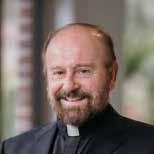
Fr. Scott Beslin
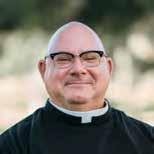
Fr. Rusty Bruce
Michelle Leblanc
Ken and Yolanda Trahan
PHOTOGRAPHERS
Serdave Duncan
Joe O’Sullivan
EMAIL US: communications@htdiocese.org VISIT US ONLINE bayoucatholic.org
drawing
Remembering Archbishop Fulton J. Sheen, Soon-to-Be-
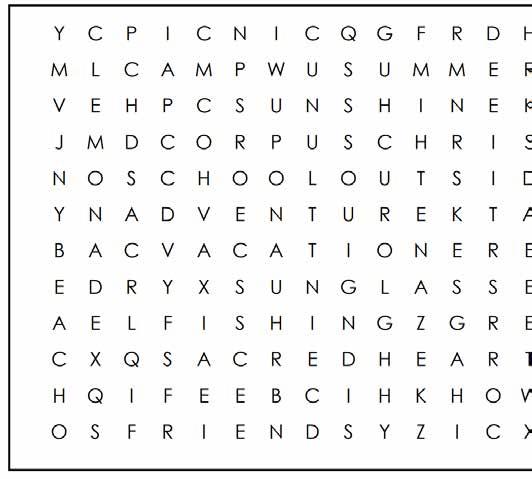
57 KIDS CORNER Coloring Page Word Search 59 CELEBRATING MILESTONES ACROSS OUR DIOCESE Parishes, Priests, and Deacons
66
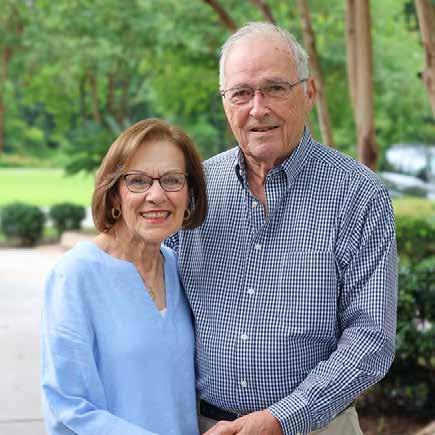
Ken and Yolanda Trahan on Mission, Memory, and the Fund that will Outlast Them
MISSED
VICTORY THROUGH THE CROSS
A SUMMER MESSAGE FROM BISHOP SIMON PETER
My dear brothers and sisters in Christ, as we continue through these summer months, for many people it is a time to exhale, rest, and relax. Summertime usually involves much-needed vacations and a break from the school routine. For many, summer also includes summer sports leagues and tournaments for many young people. More than anything, they are laser-focused on getting that ring, trophy, or medal at the end of the season. As this issue of the Bayou Catholic reflects on the theme of victory in Christ, I was drawn to reflect on a Christian understanding of victory as opposed to a worldly understanding.
We can pretty quickly see that for the Christian, our understanding of victory is radically di erent than what you might think. This is most clearly evident in the reality of the Cross, where Christ won for us our victory over sin and death and made us members of the family of God. Yet, through human eyes, that scene looks not like victory but a disastrous failure. The acclaimed Messiah ascended not a throne of power and victory, but rather a throne of su ering and crucifixion. He stood clothed with nothing but the wounds of his scourging, a crown of thorns forced into his head, receiving not shouts of acclaim but mockery and scorn. To the ignorant bystander, one would think that this looks like the end of a movement and the defeat of a revolutionary.
Yet by his life and especially his death, Christ reveals to each of us a very di erent message. Real victory does not and cannot come through human means, human victory, or by our own strength. Real victory comes through accepting our weakness and limitations, thereby allowing the power of God to work in us and through us. As long as we rely on our own e orts, power, or understanding, we limit what God can do in our lives. Jesus shows us that in Him and in Him alone do we find the ultimate source of victory. St. Paul most beautifully reflects on this in his second letter to the Corinthians when he says that “power is made perfect in weakness… for when I am weak, then I am strong” and therefore he will “boast all the more gladly in [his] weakness” (2 Cor 12:9-10).
Boasting in weakness runs counter to everything that our culture tells us about what is required for real victory. We are continually sold the narrative that to win, we have to be the best, the strongest, the most capable, and losing is a result of weakness and failure. With that understanding, so many people go through their lives weighed down by that burden that becomes so di cult to carry. To each one of us who feels that burden and that pressure, Christ brings a profound and new hope. To Jesus, your weakness is not a hindrance to him, nor does he love you any less because of your failure. On the contrary, when we bring our weakness and failure to Him, and surrender ourselves entirely into His power, we can and will see Him work in profound and even miraculous ways. By his su ering and death, He shows us that embracing weakness is actually the key to real victory. That is why, as St. Paul says elsewhere, “he humbled himself, becoming obedient to death, even death on a cross,” but goes on to say that “because of this, God greatly exalted him” (Phil 2:8-9).
My brothers and sisters, Christ won the victory for you already; you do not have to win it for yourselves. We do not have to accept the world’s narrative of what real victory entails nor all the pressures that come along with it. Just as resurrection comes through death, so Christian victory comes through embracing and surrendering our weakness. May the Lord give us the grace to do just that, so that we may experience the fullness of His victory in our lives.
Victoria por medio de la Cruz
Queridos hermanos y hermanas en Cristo: a medida que avanzamos en estos meses de verano, para muchas personas es un momento para tomarse un respiro, descansar y relajarse. El verano suele traer consigo unas vacaciones muy necesarias y un descanso de la rutina escolar. Para muchos, el verano también incluye ligas deportivas y torneos de verano para muchos jóvenes. Por encima de todo, están totalmente centrados en conseguir ese anillo, trofeo o medalla al final de la temporada. Dado que este número de Bayou Catholic reflexiona sobre el tema de la victoria en Cristo, me sentí impulsado a reflexionar sobre el concepto cristiano de la victoria, en contraposición al concepto mundano.
Enseguida nos damos cuenta de que, para el cristiano, nuestra concepción de la victoria es radicalmente diferente de lo que uno podría pensar. Esto se hace especialmente evidente en la realidad de la Cruz, donde Cristo nos ganó la victoria sobre el pecado y la muerte y nos convirtió en miembros de la familia de Dios. Sin embargo, a los ojos humanos, esa escena no parece una victoria, sino un fracaso desastroso. El aclamado Mesías no se sentó en un trono de poder y victoria, sino en un trono de sufrimiento y crucifixión. Se encontraba allí, vestido únicamente con las heridas de su flagelación, con una corona de espinas clavada en la cabeza, recibiendo no gritos de aclamación, sino burlas y desprecio. Para el espectador ignorante, se podría pensar que aquello parecía el final de un movimiento y la derrota de un revolucionario.
Sin embargo, con su vida y, sobre todo, con su muerte, Cristo nos revela a cada uno de nosotros un mensaje muy diferente. La verdadera victoria no llega ni puede llegar por medios humanos, ni como una victoria humana, ni por nuestras propias fuerzas. La verdadera victoria llega al aceptar nuestra debilidad y nuestras limitaciones, permitiendo así que el poder de Dios actúe en nosotros y a través de nosotros. Mientras confiemos en nuestros propios esfuerzos, en nuestro poder o en nuestro entendimiento, limitamos lo que Dios puede hacer en nuestras vidas. Jesús nos muestra que en Él, y solo en Él, encontramos la fuente última de la victoria. San Pablo reflexiona sobre esto de manera maravillosa
en su segunda carta a los Corintios, cuando dice que «la fuerza se perfecciona en la debilidad… pues cuando soy débil, entonces soy fuerte» y, por eso, «me gloriaré aún más gustosamente en [su] debilidad» (2 Cor 12, 9-10).
Presumir de la propia debilidad va en contra de todo lo que nuestra cultura nos dice sobre lo que se necesita para alcanzar una victoria auténtica. Constantemente se nos hace creer que, para ganar, hay que ser el mejor, el más fuerte, el más capaz, y que perder es consecuencia de la debilidad y el fracaso. Con esa idea en mente, muchísimas personas pasan por la vida agobiadas por una carga que se vuelve muy difícil de soportar.
A cada uno de nosotros que siente esa carga y esa presión, Cristo nos ofrece una esperanza profunda y renovada. Para Jesús, tu debilidad no es un obstáculo, ni te ama menos por tus fracasos. Al contrario, cuando le presentamos nuestras debilidades y fracasos, y nos entregamos por completo a su poder, podemos ver y veremos cómo obra de maneras profundas e incluso milagrosas. Con su sufrimiento y su muerte, nos muestra que aceptar la debilidad es, en realidad, la clave de la verdadera victoria. Por eso, como dice san Pablo en otro pasaje, «se humilló a sí mismo, haciéndose obediente hasta la muerte, y más aún, hasta la muerte en la cruz», pero añade que «por eso mismo Dios lo exaltó» (Fil 2, 8-9).
Hermanos y hermanas, Cristo ya ha obtenido la victoria por vosotros; no tenéis que ganárosla por vosotros mismos. No tenemos que aceptar la visión que tiene el mundo de lo que supone la verdadera victoria, ni todas las presiones que conlleva. Al igual que la resurrección llega a través de la muerte, la victoria cristiana llega al aceptar y entregar nuestra debilidad. Que el Señor nos conceda la gracia de hacer precisamente eso, para que podamos experimentar la plenitud de su victoria en nuestras vidas.
Chiến thắng Qua ánh giá
Anh chị em thân mến trong Chúa Kitô, khi chúng ta tiếp tục trải qua những tháng mùa hè này, đối với nhiều người, đó là thời gian để thở phào, nghỉ ngơi, và thư giãn. Mùa hè thường liên quan đến những kỳ nghỉ rất cần thiết và tránh khỏi việc thói quen ở trường học. Đối với nhiều người, mùa hè cũng bao gồm các giải đấu thể thao mùa hè, và các giải đấu dành cho nhiều bạn trẻ. Hơn bất cứ điều gì, họ tập trung vào việc nhận được chiếc nhẫn, danh hiệu hoặc huy chương vào cuối mùa thi giải. Khi ấn hành Bayou Catholic này, phản ánh về chủ đề chiến thắng trong Chúa Kitô, tôi đã được rút ra để suy niệm về sự hiểu biết Công giáo về chiến thắng trái ngược với sự hiểu biết thế tục.
Chúng ta có thể nhanh chóng thấy rằng đối với người công giáo, sự hiểu biết của chúng ta về chiến thắng hoàn toàn khác so với những gì anh chị em có thể nghĩ. Điều này thể hiện rõ nhất trong thực tại của Thánh giá, nơi
Chúa Kitô đã chiến thắng cho chúng ta là chiến thắng
tội lỗi và sự chết và biến chúng ta trở nên thành viên của gia đình Chúa. Tuy nhiên, dưới con mắt người đời, cảnh tượng đó trông không giống như chiến thắng mà là một thất bại thảm khốc. Đấng Mêsia được hoan nghênh đã lên ngôi không phải là ngai vàng quyền lực và chiến thắng, mà là ngai vàng của sự đau khổ và đóng đinh. Chúa đứng không mặc gì ngoài những vết thương do bị đánh đòn, một chiếc vương miện gai buộc vào đầu ngài, không nhận được tiếng hoan hô khen ngợi mà là sự nhạo báng và khinh miệt. Đối với người đi theo ngu dại, họ sẽ nghĩ rằng điều này trông giống như sự kết thúc của một phong trào và sự thất bại của một nhà cách mạng.
Tuy nhiên, qua cuộc sống của Chúa và đặc biệt là cái chết của Ngài, Đức Kitô tiết lộ cho mỗi người chúng ta một thông điệp rất khác. Chiến thắng thực sự không và không thể đến thông qua phương tiện của con người, chiến thắng của con người, hoặc bằng sức mạnh của chính chúng ta. Chiến thắng thực sự đến từ việc chấp nhận sự yếu đuối và giới hạn của chúng ta, từ đó cho phép quyền năng của Chúa hoạt động trong chúng ta và thông qua chúng ta. Miễn là chúng ta dựa vào nỗ lực, sức mạnh hoặc sự hiểu biết của chính mình, chúng ta sẽ giới hạn những gì Chúa có thể làm trong cuộc sống của chúng ta. Chúa Giêsu cho chúng ta thấy rằng trong Ngài
và chỉ trong Ngài chúng ta mới tìm thấy nguồn gốc cuối cùng của chiến thắng. Thánh Phaolô phản ánh điều này một cách tuyệt vời nhất trong bức thư thứ hai gửi tín hữu Côrintô khi ngài nói rằng “sức mạnh được biểu lộ trọn vẹn trong sự yếu đuối … vì khi tôi yếu, chính là lúc tôi mạnh.” và do đó ngài sẽ “cảm thấy vui sướng khi mình yếu đuối” (2 Cor 12:9-10).
Tự hào về sự yếu đuối đi ngược lại với mọi thứ mà văn hóa của chúng ta nói với chúng ta về những gì cần thiết cho chiến thắng thực sự. Chúng ta liên tục bán đứng câu chuyện rằng để giành chiến thắng, tôi phải là người giỏi nhất, mạnh nhất, có khả năng nhất, và thất bại là kết quả của sự yếu đuối và thất bại. Với sự hiểu biết đó, rất nhiều người trải qua cuộc sống của họ bị đè nặng bởi gánh nặng trở nên rất khó mang theo. Đối với mỗi người trong chúng ta, những người cảm thấy gánh nặng và áp lực đó, Đức Kitô mang lại một niềm hy vọng mới và sâu sắc. Đối với Chúa Giêsu, sự yếu đuối của anh chị em không phải là một trở ngại đối với Ngài, cũng không phải Ngài yêu anh chị em ít hơn vì sự thất bại của anh chị em. Ngược lại, khi chúng ta mang sự yếu đuối và thất bại của mình đến với Chúa, và đầu hàng hoàn toàn vào quyền năng của Ngài, chúng ta có thể và sẽ thấy Ngài làm việc theo những cách sâu sắc và thậm chí kỳ diệu. Qua sự đau khổ và cái chết của mình, Chúa cho chúng ta thấy rằng nắm lấy sự yếu đuối thực sự là chìa khóa để chiến thắng thực sự. Đó là lý do tại sao, như Thánh Phaolô nói ở nơi khác, “Người đã hạ mình xuống, vâng lời cho đến chết, chết trên cây thánh giá,” nhưng ngài tiếp tục nói rằng: “vì điều này, Chúa Cha đã tôn vinh ngài lên” (Phil 2:8-9).
Anh chị em thân mến, Chúa Kitô đã giành chiến thắng cho anh chị em; anh chị em không cần phải giành chiến thắng cho chính mình. Chúng ta không phải chấp nhận câu chuyện của thế giới về những gì chiến thắng thực sự đòi hỏi cũng như tất cả những áp lực đi kèm với nó. Giống như sự phục sinh đến từ cái chết, chiến thắng của Công giáo đến từ việc nắm lấy và đầu hàng sự yếu đuối của chúng ta. Cầu xin Chúa ban cho chúng ta ân sủng để làm điều đó, để chúng ta có thể trải nghiệm sự viên mãn của chiến thắng của Ngài trong cuộc sống của chúng ta.
BISHOP IS CONFERRED HONORARY DOCTORATE
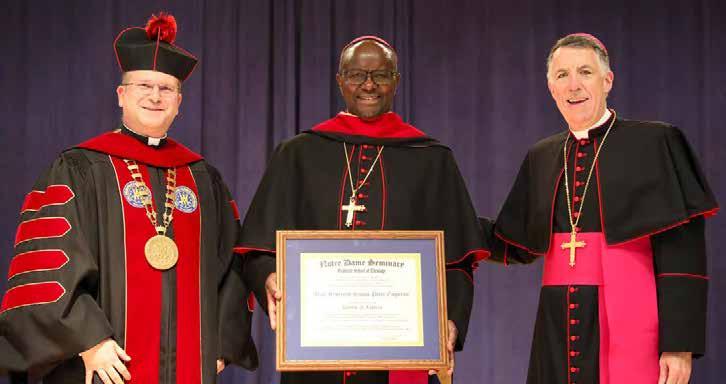
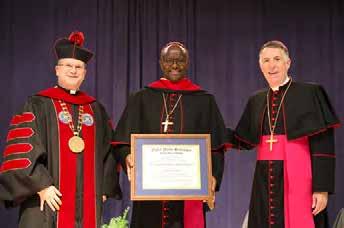
During the 2026 Commencement Exercises at Notre Dame Seminary on May 14, 2026, Bishop Simon Peter Engurait was conferred the honorary degree of Doctor of Letters in recognition of his dedication to priestly formation.
Fr. Josh Rodrigue, Rector, said, “Today, Notre Dame Seminary proudly honors Bishop Simon Peter Engurait—priest, shepherd, alumnus and witness to the providence of God, whose journey From Uganda to Louisiana stands as a testament to faith, perseverance and the universal mission of the Church.”
BISHOP SIMON PETER ADDRESSED THE GRADUATES:
“I cannot help but look back with gratitude on the six wonderful years of formation I spent here. Those years shaped me deeply intellectually, spiritually, pastorally and personally. Yet, during those years, I had no idea what the Lord had in store for me. I could not have predicted the path my life would take once I left these formative grounds—the responsibilities I would one day carry and the blessings and challenges
that would come my way. Looking back now, I see more clearly that God often prepares us quietly and patiently before we understand where he is leading us.” He added, “If you remain open and available to God, he can accomplish extraordinary things through ordinary people. Our lives are shaped in the ordinary decisions of each day. The future you dream about begins with how you live today.”
Pictured with Bishop Simon Peter are Fr. Josh Rodrigue, Rector of Notre Dame Seminary, and Archbishop James Checchio of the Archdiocese of New Orleans.
“
The future you dream about begins with how you live today.
COURTESY OF NOTRE DAME SEMINARY
A MESSAGE FROM OUR DIRECTOR
Ah, summer. A season of sunshine, family gatherings, vacations, and a little extra time to slow down and enjoy God’s many blessings.
This summer is especially meaningful as our nation celebrates its 250th anniversary. It is a perfect time to reflect on the freedoms we enjoy as Americans and to give thanks for the many blessings God has bestowed upon our country.
As Catholics, however, every celebration points us to an even greater victory. Throughout the Easter season, we rejoiced in Christ’s victory over sin and death—the victory that won our salvation. While our culture often celebrates success, achievement, and independence, the Gospel reminds us that our greatest hope and ultimate victory are found in Jesus Christ.
That victory is not just something we remember. It is something we live. Throughout our nation’s history, Christians have brought Christ’s love to others through schools, hospitals, charitable works, and dedicated service. You can see that same faithful witness alive today in the Diocese of HoumaThibodaux.
In this issue, you’ll read vibrant stories of faith—from young people growing closer to Christ, to parish communities celebrating the joyous reopenings of their churches. You’ll see our people answering God’s call in both ordinary and extraordinary ways. These stories remind us that Christ is at work among us, and His victory continues to bear fruit in our communities.
As we celebrate with family and friends this Fourth of July, let us pray for the unity, healing, and renewal of our nation, especially as we continue to entrust ourselves to the Sacred Heart of Jesus. May we never lose sight of the victory that matters most: Christ’s triumph over death and His promise of eternal life.
May you have a blessed, joyful, and faith-filled summer.
BEVI FONTENOT Director of Communications & Public Relations
YOUTH AND MISSION
IDENTITY, ACCOMPANIMENT, AND ENCOUNTERING JESUS
BY: BEVI FONTENOT AND JOE O'SULLIVAN
One of my strongest desires as a bishop is to walk closely with the young people of our diocese,” Bishop Simon Peter has said, “to listen to them, encourage them, and help them know that they belong to the Church.” This year, the Diocese of Houma-Thibodaux is putting that desire into action.
The commitment is concrete. In the last issue of Bayou Catholic, the Bishop announced that half of this year’s Bishop’s Appeal would go directly to young people: 25% to the O ce of Catholic Schools and 25% to youth ministry. But the heart of the e ort isn’t the dollars. It’s a desire to ensure every young person knows they are seen, valued, and welcomed in the life of the Church.
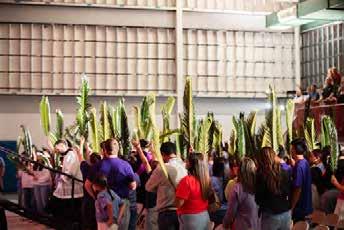
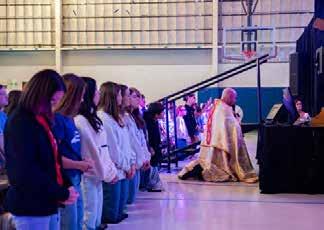
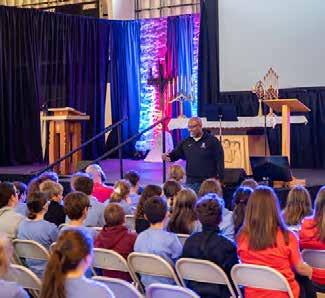
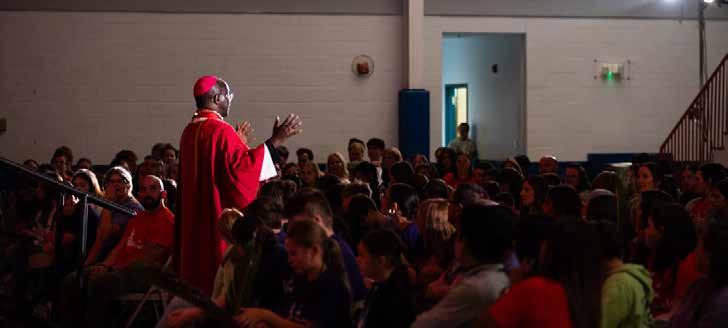
He said this in anticipation of the Youth Rally on March 28 at St. Bernadette Parish in Houma, sponsored by Lift 3:16. It was one of the first opportunities for the Bishop to, in his words, “gather the young Church from every corner of the diocese and speak to them directly as a spiritual father.”
During Bishop Simon Peter’s pastoral visits earlier this year, many parish communities expressed a desire for stronger youth formation and a more vibrant diocesan-wide youth ministry. It had been years since the diocese hosted a large youth event with the Bishop in attendance, making this year’s rally a meaningful new chapter for young people in our diocese. The need was clear, and Bishop Simon Peter responded with a renewed commitment to walking alongside the youth of the Church.
The event was a success, attended by teens from across our diocese. Headliners included Kris Frank, Brian Greenfield, and Katie McGrady, a gifted Catholic speaker who recently served as the emcee for the dialogue between Pope Leo XIV and the thousands of young people at the National Catholic Youth Conference.
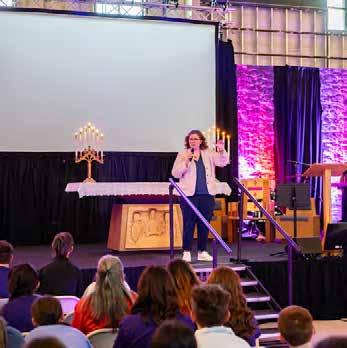
Using Saint Carlo Acutis as inspiration, McGrady shared three key points with the teens to know who they are in Jesus Christ. Know what you are doing, where you are headed, and who is going with you. “Sanctity isn’t a concept; it’s real,” she said.
Local speaker and teacher Elaine Beyer also o ered the teens five “stones” to use for defense against evil. Foster holy relationships, use Scripture as a sword, spend time with the Lord in prayer and adoration, think of Confession as a place of victory, and focus on the Eucharist to survive in this broken world.
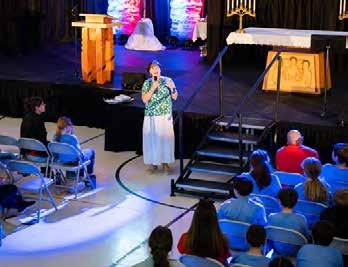
Sadie Bonvillain, spiritual director and Houma local, taught teens an acronym to help them identify whether they’re hearing from God or the enemy. “There are two voices that
we usually hear in our thoughts,” she explained, “the voice of the Holy Spirit and the voice of the un-holy spirit: the enemy.” The enemy’s voice, she said, spells “ID.” The “I” stands for isolation and inadequacy: “He wants to keep you home and alone.” The “D” is for doubt, discouragement, and despair, the tools the enemy frequently uses to keep us stuck.
Her point, as with other speakers that day, was to drive home a message about our identity. The more we listen to the enemy, the more we forget who we are. And if we forget who we are, we lose our way, we lose hope, and we lose touch with God. The two voices we hear—God’s and the enemy’s—are like a tug-of-war over our identity. That’s why our teens need their families, their parishes, teachers, coaches, leaders, mentors, speakers—and time to connect, learn, and receive through events like the Youth Rally.
Brian Greenfield o ered a similar message. “Even when we cannot hear Him, He is there, urging us to stay with Him, to listen, to trust Him.” And though it’s hard to hear sometimes, “Accept how loved you are.”
April Rosas, 15, a student at South Lafourche High School in Cuto , resonated strongly with Brian’s message. “He made me feel heard.” Recognizing the short attention span of most teens, she said, “He understood how teens are nowadays…he knew how to get our attention.”
Rosas enjoyed the youth rally and shared words of encouragement for other teens to get involved in youth ministry events. “Take the opportunity. It’s never too late to learn something new and expand our faith and knowledge about Him. He gave us everything; why not give him a day of our lives to get closer to Him?”
This year’s youth rally o ered a first glimpse of the renewal taking place across the diocese through youth ministry—and, more importantly, within the hearts of young people themselves. That’s the true mission.
As JJ Hussem from the O ce of Parish Support points out, “mission is not simply a program, an event or a parish initiative,” but “participation in the very life and work of Jesus Christ.” When asked what teens are spiritually hungry for, the answer was clear: “Young people are searching for authentic relationships, belonging, purpose, stability, and hope.” They are looking for “meaningful encounter and genuine witness in a world that’s becoming more virtual.”
“Accompaniment” is a word that has been gaining traction, notably because Pope Francis explicitly called attention to it in Evangelii Gaudium, an apostolic exhortation on the proclamation of the Gospel in today’s world. “The Church will have to initiate everyone—priests, religious, and laity—into this ‘art of accompaniment’” (169).
For adults, teenagers can seem like an utter mystery. It can be di cult to discern what they want, or what will help them become interested in their faith. But for Hussem, it doesn’t have to be so complex: “Young people often respond not first to polished programming, but to adults who are present, joyful, prayerful, and invested in their lives.”
That’s what accompaniment is all about. “The Church responds best not by competing with entertainment, but by o ering what the world cannot give: authentic encounter with Jesus Christ [and] real community.”
That kind of transformation does not come from a flashy event alone, but from relationship—especially a relationship with Jesus Christ through His Church. And cultivating that relationship requires the involvement of the entire faith community. As Hussem explained, “The Church consistently teaches that forming young people is a shared responsibility requiring collaboration between families, parishes, schools, and the wider Christian community.” In many ways, it truly takes a village.
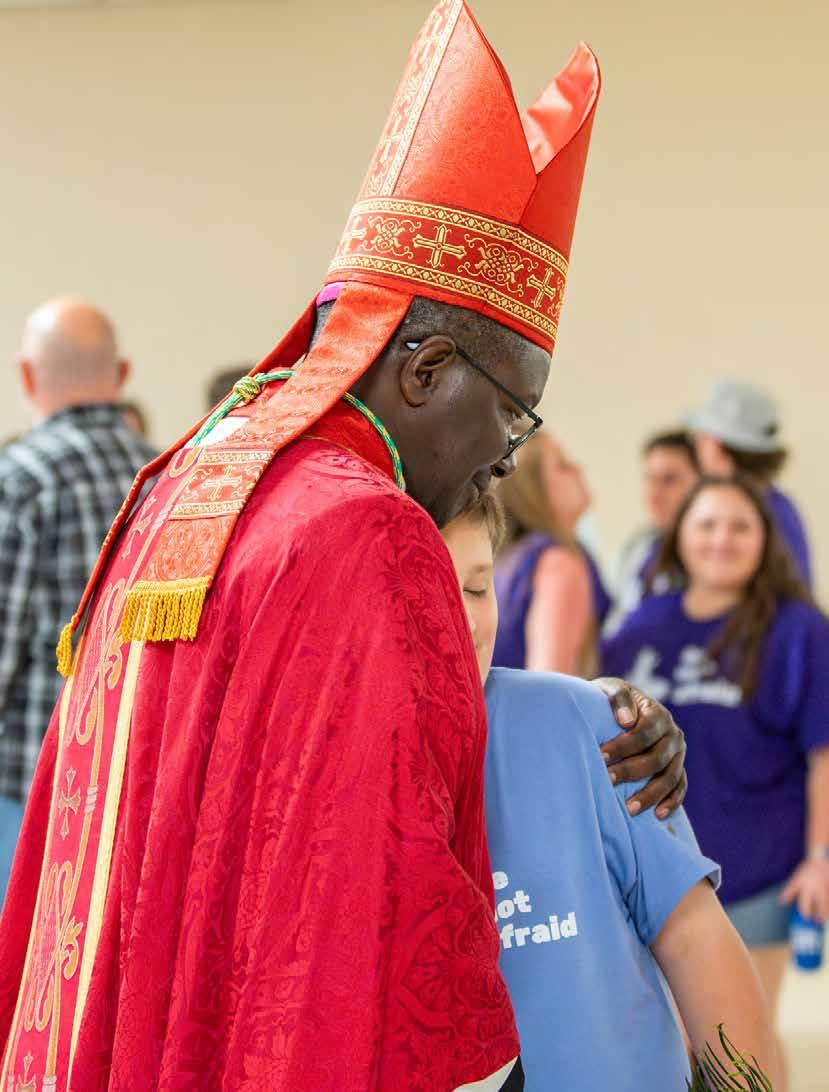
Be not afraid
WELCOMING OUR NEW SUPERINTENDENT OF CATHOLIC SCHOOLS
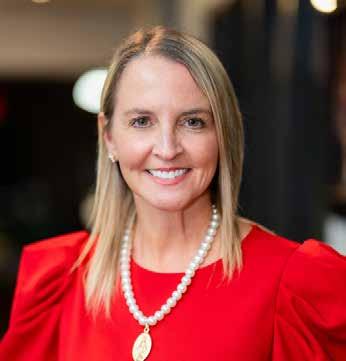
On July 1, the Diocese of Houma-Thibodaux welcomed a new leader in Catholic education, Amy Vaccarella, our new Superintendent of Catholic Schools.
A native of Patterson, Louisiana, and a longtime member of St. Joseph Catholic Church, Vaccarella brings more than two decades of experience in education, leadership, and ministry to the position. Her professional journey has included work as a teacher, district leadership, and most recently principal of Patterson High School, where she helped lead the school to significant academic growth and an “A” performance rating.
But beyond resumes and recognitions, those who know Vaccarella describe her as a woman deeply rooted in faith and service. At her parish, she has served as a lector, sacristan, parish council member, catechism teacher, and founder of a parish youth group. She has also served as Retreat Captain for the Women’s Silent Retreat at Our Lady of the Oaks in Grand Coteau.
Her predecessor, Dr. Mark Williams, expressed confidence in the future of Catholic schools under her leadership, noting that the ideal superintendent is someone with four qualities: “experience as a principal, a well-grounded temperament, a willingness to serve, and a strong faith.” He noted, “Amy has all of these,” adding that “there is no question that she has the skillset to be a strong superintendent.”
Vaccarella says she sees Catholic education not simply as a profession, but as a calling.
“Serving God through the education and formation of His children is a calling I hold close to my heart,” she shared. “I look forward to working alongside Bishop Simon Peter, our pastors, principals, teachers, and families to strengthen Catholic education by forming students in faith, academic excellence, and service. Together, we will continue building school communities where every child is known, loved, and encouraged to grow in Christ.”
As the Diocese of Houma-Thibodaux continues its mission of forming young people in faith, academic excellence, and service, the diocesan family joyfully welcomes Amy Vaccarella and asks for prayers as she begins this new chapter of leadership.
A BEAUTIFUL HOMECOMING
PARISHIONERS RETURN TO ST. ELOI CATHOLIC CHURCH
BY: BEVI FONTENOT
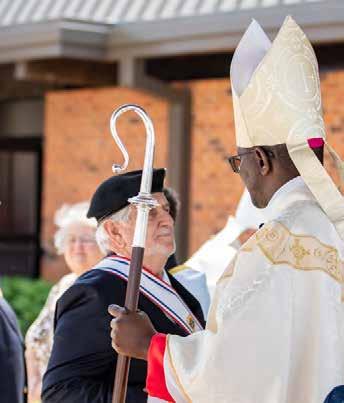
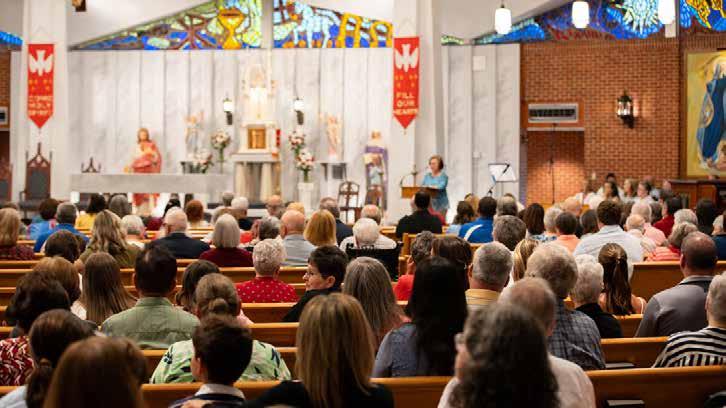
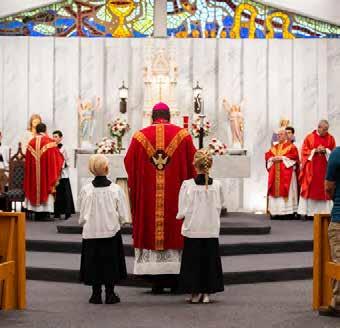
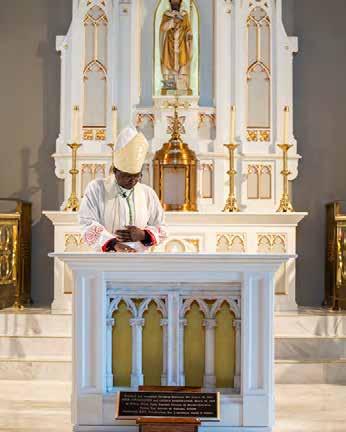
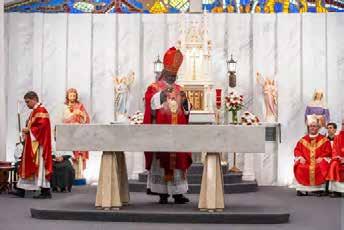
On Saturday, March 28, after nearly five years of posthurricane recovery, St. Eloi Catholic Church, located at 1335 Bayou Dularge Road in Theriot, reopened its doors to parishioners. Bishop Simon Peter Engurait consecrated the altar and rededicated the church at a special 10 a.m. Mass that Palm Sunday weekend.
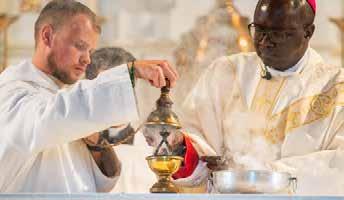
As a part of the new altar consecration, relics of St. Constantius of Perugia were sealed into the altar and Bishop anointed the altar with Holy Chrism.
“This is a place of unity and communion, where we gather as children of the Father,” said Bishop. “Monsignor Legendre said disasters will be everywhere and anywhere, and the important thing is the presence of God.”
The renovation of St. Eloi Catholic Church blends the parish’s rich history with its renewed future. Original
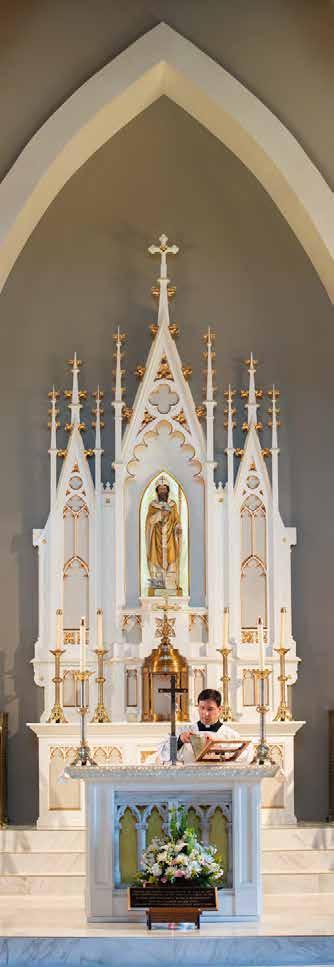
features—including pews, Stations of the Cross, and antique statues—have been preserved, while elements of the original American Gothic-style church have been reintroduced. These include a restored antique wooden high altar and pulpit from Iowa, sacred artwork and décor from Belgium, and a sandstone baptismal font from England. A new altar of sacrifice was constructed using marble from antique altar gates, and bronze gates from the former church have been incorporated into the sanctuary. A prominent crucifix now stands at the front of the church, o ering a visible reminder of Christ’s sacrifice.
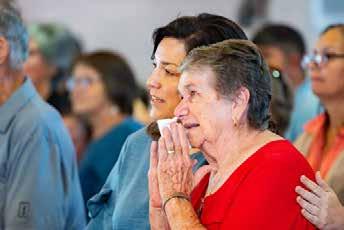
Lifelong parishioner Chad Bourg reflected on returning home: “There is a huge sense of relief to finally be back. Seven generations of my family have worshipped at St. Eloi, and we felt it was our obligation to ensure the church—spiritually and physically—could continue on Bayou Dularge. We can now celebrate the sacraments
in a place our ancestors left for us, a place that truly feels like home.”
For the past few years, St. Eloi’s Masses were celebrated in the Knights of Columbus 8779 building. The parish’s recovery began immediately after the storm under the leadership of Fr. Dean Danos, who ensured the continuation of Mass and sacraments while coordinating cleanup e orts until his retirement in May 2022.
Pastor Fr. Antonio M. Farrugia, who has served the parish since June of 2022, reflected on the journey: “The people of Dularge now rejoice to be back in church! May their witness of perseverance shine as a beacon of faith for those who may feel distant from Christ or His Church. We desire to welcome all—especially those who feel broken—that through the sacraments, they may encounter their own healing and restoration.”
Administrative assistant Amy Denton shared that, after years of uncertainty following Hurricane Ida, the parish is now in a place of gratitude and renewed hope. “We are still here, and with God’s grace we are ready to come back stronger than before,” she said.
Special thanks to the parish sta , building committee, reconstruction team, the Knights of Columbus, donors, parishioners, and volunteers who participated in the recovery and renovation process over the past few years.
Established in 1875, St. Eloi Parish traces its origins to the deep faith and perseverance of a bayou community. The parish was founded through the generosity of Marie Seraphine Thibodaux, who donated land in thanksgiving for the safe return of her sons from the Civil War. Named for St. Eloi, the patron saint of her late husband, the church was built by local families who first gathered for Mass in a plantation store before constructing a permanent structure from cypress harvested in nearby swamps. From its earliest days—marked even by a rainsoaked inaugural Mass—the parish has stood as a symbol of resilience, unity, and enduring faith in the region. The last Mass in that church was celebrated on November 13, 1971.
The current church structure was built in 1972, overseen by Msgr. Francis Legendre. It honored the original church by displaying preserved images and statues of the Sacred Heart, the Blessed Virgin Mary and St. Joseph. More than 400 parishioners gathered for the dedication of this church by Archbishop Phillip Hannan.
Masses at St. Eloi Catholic Church are celebrated Saturdays at 5:30 p.m., Sundays at 9 a.m., and Tuesday through Friday at 8:45 a.m.
“This is a place of unity and communion, where we gather as children of the Father.
IN GOD’S TIME
FATHER SCOTT BESLIN’S JOURNEY FROM TEACHING TO THE PRIESTHOOD
Editor’s note: This interview took place before Father Scott Beslin’s ordination to the priesthood, while he was still serving as a transitional deacon. He was ordained a priest of the Diocese of Houma-Thibodaux on June 6, 2026.
For readers who may not know you yet, tell us a little about where you’re from, your family, and the work you did before seminary.
I was reared in St. Martinville, Louisiana, although I have spent most of my life in Thibodaux. I come from a closeknit family; I am the youngest of four children, with siblings significantly older than I am. My parents, both now deceased, had a profound influence on my life and faith. They were people of strong work ethic and deep devotion, and their example continues to shape me.
I was formed in the Catholic faith from an early age, and parish life was always central to our family. In more recent
FR. SCOTT BESLIN better known as “Father Doc,” is the Parochial Vicar of St. Bernadette Catholic Church in Houma. He was ordained to the priesthood on June 6, 2026.
“I have come to see that God’s timing is both patient and precise.
years, my home parish has been St. Thomas Aquinas on the campus of Nicholls State University, which became a deeply formative spiritual home for me. Currently, I am serving at St. Bridget Catholic Church as a transitional deacon.
Before entering seminary, I spent thirty-three years teaching mathematics at Nicholls State University. That time in the classroom was a great joy and a true vocation in itself. I loved working with students, helping them grow not only in knowledge but also in confidence. Looking back, I see those years not as separate from my priestly vocation, but as an important part of God’s preparation for it.
Your journey to ordination has unfolded over time. How have you come to understand God’s timing in your life?
My journey to ordination has indeed unfolded gradually, and over time I have come to see that God’s timing is both patient and precise. From a young age, I sensed an attraction to the Church, but I did not fully understand it as a call to priesthood. Instead, the Lord led me into a long and fulfilling vocation in teaching. For many years, I believed that was the entirety of my path.
Only later did I begin to recognize that those years were not a detour, but part of God’s formation. In moments when the path was unclear, I have learned to trust that God was still at work, even when I could not yet see the direction. There were times of uncertainty and even hesitation, but with prayer and reflection, a deeper clarity gradually emerged.
What I have come to understand is that God does not rush. He prepares the heart over time, often through ordinary experiences. Looking back, I can see that each stage of my life—family, teaching, relationships, and even struggles— was shaping me for this vocation.
In that sense, nothing was delayed. Everything unfolded according to His providence, and I have learned to trust that His timing is always the right timing.
Was there a particular person or experience that helped you say “yes” more fully to the possibility of becoming a priest?
There was not a single dramatic moment, but rather a series of quiet and persistent invitations that helped me say “yes” more fully. Looking back, one of the most significant influences was my long association with the Catholic community at St. Thomas Aquinas on the Nicholls State University campus. Over the years, the priests who served there provided steady guidance, encouragement, and example. Their fidelity and joy in priestly life made a deep impression on me.
At the same time, my years of teaching placed me in close relationship with students, many of whom were discerning their own vocations. Accompanying them, listening to their questions, and encouraging their faith led me to reflect more seriously on my own calling. In a sense, I found myself asking the same questions I was inviting them to consider.
Caring for my parents during their final years was also a deeply formative experience. Walking with them through illness, o ering daily care, and ultimately being present at the very moment of my mother’s passing brought a profound awareness of the dignity of each human person and the sacredness of life’s final stages. It was a time marked by both su ering and grace, and it deepened my desire to be present to others in their most vulnerable moments.
Prayer played a central role. There was a growing interior sense—quiet but persistent—that the Lord was asking for something more. Over time, that invitation became more di cult to set aside. Rather than one decisive moment, it was a gradual deepening of trust.
Ultimately, saying “yes” came through recognizing that this call had been present all along, and that the Lord was simply asking me to respond more fully to it.
As your ordination approaches, what are you most looking forward to about serving the people of God?
As my ordination approaches, what I most look forward to is the opportunity to serve God’s people in a deeply sacramental and pastoral way. In particular, I am drawn to celebrating the Mass and preaching the Word, helping others to encounter Christ in a personal and transformative manner. The Eucharist has always been central to my life, and the thought of being an instrument through which the Lord nourishes His people is both humbling and deeply moving.
I also look forward to accompanying people in the ordinary and extraordinary moments of their lives— walking with them in times of joy, sorrow, uncertainty, and hope. Whether through pastoral visits, spiritual guidance, or simply being present, I hope to be a source of encouragement and a reminder of God’s love.
My years in teaching have shown me the beauty of helping others grow, and I see priesthood as a continuation of that mission, now in a more explicitly spiritual way. I look forward to fostering a sense of community, inviting others into deeper relationship with Christ and His Church.
Above all, I look forward to serving with humility, trusting that the Lord will work through me, even in my limitations, for the good of His people.
Many people fear they’re “too old” or “too late” to respond to God. What has your journey taught you about that fear?
My own journey has taught me that the idea of being “too late” is really a human way of thinking, not God’s. From our perspective, we tend to measure life in timelines and milestones, and it can be easy to feel that opportunities have passed. But God does not work according to our schedules. He works patiently, often preparing us over many years in ways we do not immediately recognize.
For a long time, I lived a full and meaningful life as a teacher, and only later did I come to understand that this, too, was part of my vocation. Those years were not lost time; they were formative. They shaped my mind, my heart, and my ability to relate to others. In hindsight, I can see that God was at work the entire time, even when I did not fully see where He was leading.
Fear of being “too old” often comes from comparing ourselves to others or from focusing on what we think we lack. But God calls each person uniquely, and at the right moment. What matters is not when we respond, but that we do respond.
My experience has taught me that it is never too late to say “yes” to God. His call is always timely, and His grace is always su cient.
CONGRATULATIONS TO FATHER SCOTT BESLIN
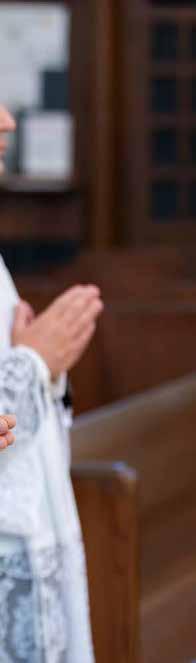
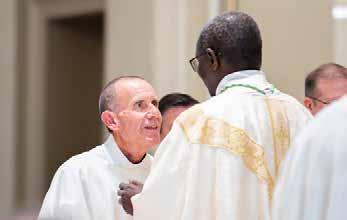
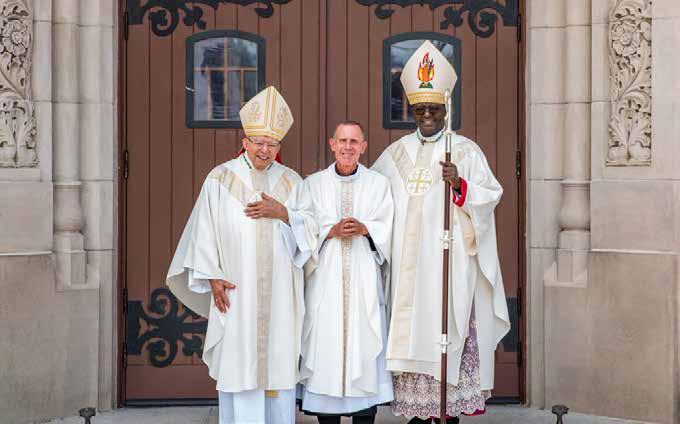
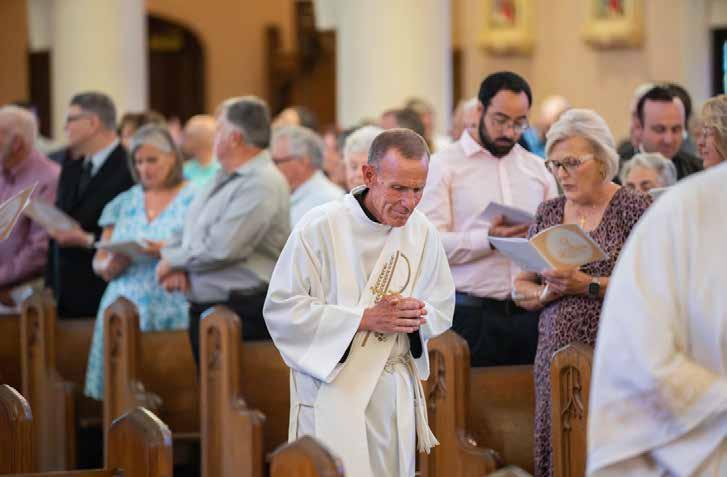
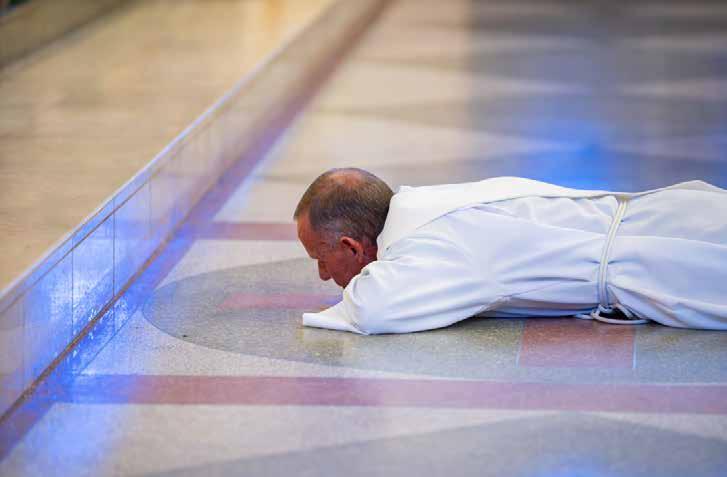
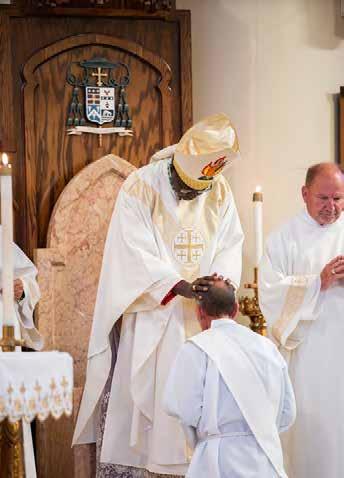
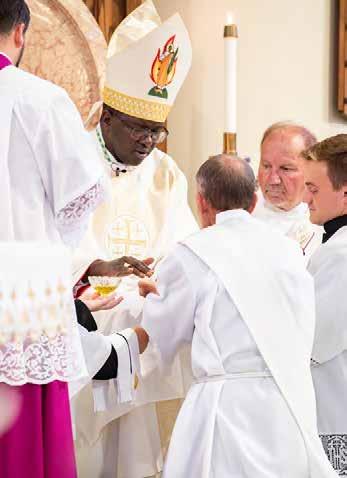
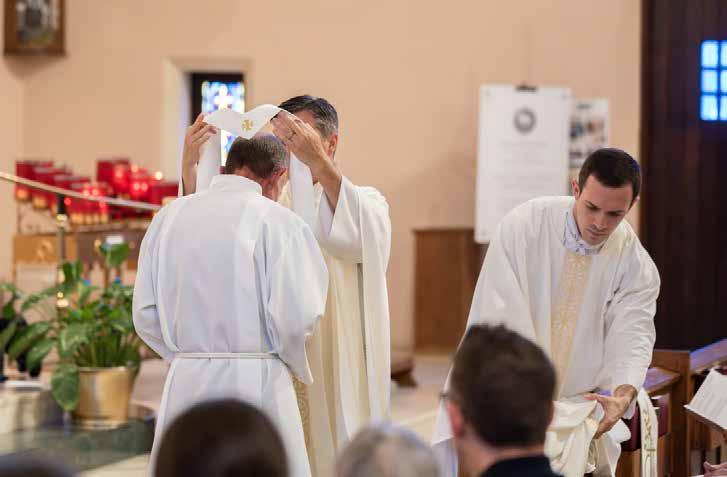
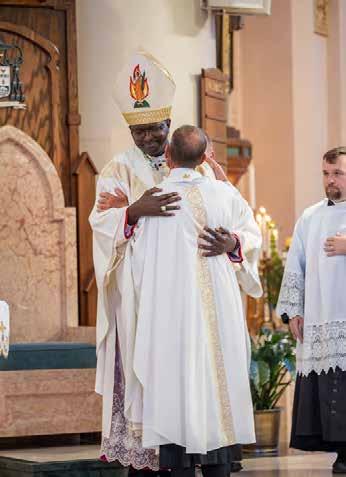
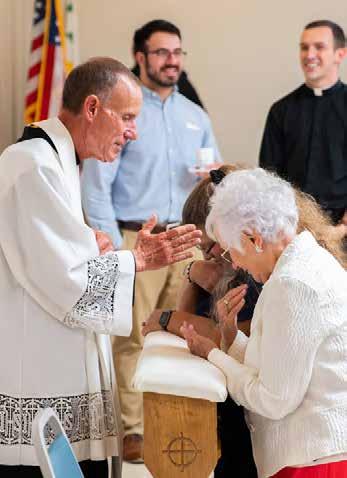
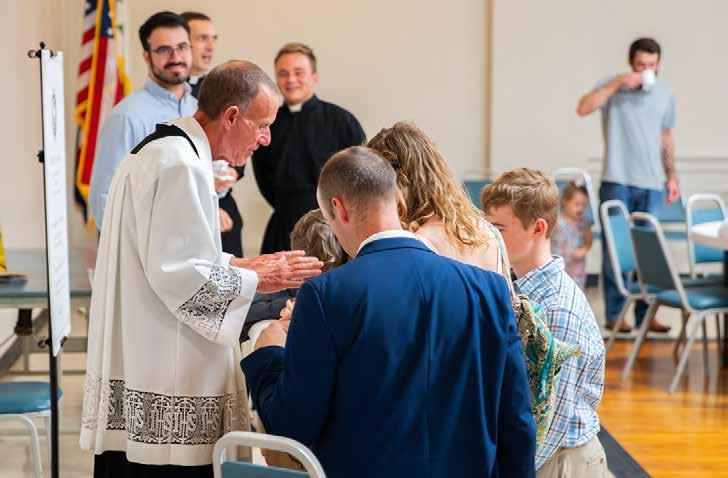
On Saturday, June 6, Father Scott Beslin was ordained to the priesthood at 10:30 a.m. at the Cathedral of St. Francis de Sales in Houma. He has been appointed by Bishop Simon Peter Engurait to serve as Parochial Vicar of St. Bernadette Catholic Church in Houma for a one-year term following his ordination.
In his homily at the ordination, Bishop reminded Father Scott: “The priesthood is not a reward for perfection or a sign of personal greatness. The people of God need a man who points beyond himself.” He added, “Remain close to Jesus. The people entrusted to your care will not simply see a priest; they will see Jesus Christ.”
Beslin was ordained to the diaconate in December of 2025 and was previously serving as a transitional deacon at St. Bridget Catholic Church in Schriever.
“My call to the priesthood has been present since my childhood, and the people of our diocese have been
overwhelmingly generous in my journey with their encouragement and prayers,” said Beslin. “Their support made it possible for me to say ‘yes’ to God’s call. This diocese is a special place, and it will be a joy to serve here.”
For the past five years, Beslin has been in priestly formation at Notre Dame Seminary in New Orleans. He previously taught mathematics at Nicholls State University in Thibodaux for 33 years. He earned his Doctorate and master’s degrees in Mathematics from the University of Southwestern Louisiana (now the University of Louisiana at Lafayette), and a bachelor’s degree in Mathematics Education.
Congratulations to Father Scott Beslin! Thank you for your yes.
GET TO KNOW THE ADVISORS OF MEYER FINANCIAL GROUP
Chris
Callahan, APMA® Financial Advisor
QWhat does building longterm relationships with clients mean to you?
Building long-term relationships means being a consistent and trusted resource for families through every stage of life. Financial planning is not a one-time conversation — it’s an ongoing process that evolves alongside a family’s goals, priorities, and circumstances. I value taking the time to truly understand what matters most to each client so we can create thoughtful strategies designed to support both their present needs and long-term vision for the future.
How do you help simplify the financial planning process for clients?
QWhat motivates you most in your career as a financial advisor?
QHow has your faith or personal background shaped your approach to serving others?
The financial world can often feel complicated and overwhelming, especially with the amount of information people are exposed to daily. Our approach is centered around bringing clarity and structure to that process. I work closely with clients to develop personalized strategies that align with their goals while helping them understand the reasoning behind each recommendation. I believe clients should feel educated, confident, and comfortable with the plan we build together.
What motivates me most is helping families feel prepared and confident about their future — not only helping them build and protect what they’ve worked hard for but also getting to watch clients enjoy the rewards of their hard work in retirement. There’s something incredibly rewarding about seeing clients reach a point in life where they can truly enjoy the years they spent planning for — whether that’s traveling, spending more time with family and grandchildren, giving back, or simply having the peace of mind to live comfortably and confidently. Financial planning goes far beyond investments — it’s about helping people create a life they’re excited about while navigating each stage with confidence. Knowing that the work we do can help provide both financial direction and lasting peace of mind for families is what continues to motivate me every day.
Faith, family, and community have always been foundational parts of my life, and they naturally influence the way I serve others. I believe in approaching each client relationship with integrity, compassion, and a strong sense of stewardship. Growing up and raising a family in South Louisiana has reinforced the importance of trust, hard work, and treating people the right way — values that continue to guide me both personally and professionally.
What do you love most about living and working in the Bayou region?
One of the things I appreciate most about the Bayou region is the strong sense of community and connection that exists here. People genuinely care about one another, and relationships are built on trust, faith, and shared values. Professionally, it’s incredibly rewarding to serve families in a community that places such a high value on relationships, tradition, and supporting one another through life’s milestones and challenges.
FOSTER GRANDPARENTS MAKE A DIFFERENCE
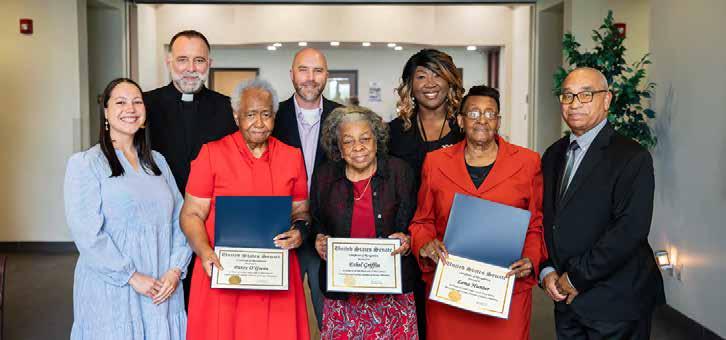
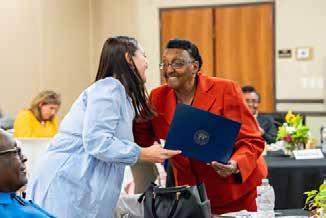
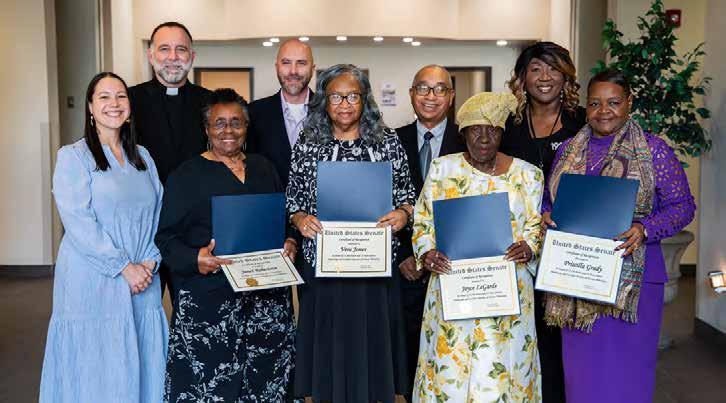
The Catholic Charities of Houma-Thibodaux Foster Grandparents Program held its 29th Annual Recognition Luncheon at the Pastoral Center on April 8 to celebrate more than 1,621,000 all-time volunteer hours!
Through the Foster Grandparent Program, adults age 55 and older in our community volunteer in schools and childcare centers—mentoring, tutoring, and supporting children who need it most. From helping with reading to simply being a caring presence, they make a lasting di erence in young lives. More than just volunteers, these “grandparents” build meaningful relationships and remind each child that they are seen, valued, and loved. The program is federally funded through AmeriCorps Seniors.
Congratulations to these foster grandparents who were recognized for their outstanding service over the years:
• Lena Hunter has served 26 years with 31,000 volunteer service hours.
• Paty O’Gwin has served 20 years with 23,800 volunteer service hours.
• Ethel Gri n has served 17 years with more than 20,500 volunteer service hours.
Also deserving of recognition were:
• Janet Robertson for 14 years and 18,400 service hours
• Vera Jones for 13 years and 17,200 service hours
• Priscilla Grady for 13 years and 17,100 service hours
• Alberta Hite for 13 years and 16,500 service hours
• Joyce LeGarde for 13 years and 16,300 service hours
• Verna Shanklin for 11 years and 14,100 service hours
• Eartha Johnson for 11 years and 13,500 service hours
• Emma Joseph for 10 years and 10,300 service hours
• Donna Johnson for eight years and 9,400 service hours
• Audrey Simmons for six years and 10,100 service hours
• Mary Ann Scott for six years and 10,000 service hours
• Jesse Mckenzie for six years and 9,500 service hours
• Brenda Washington for six years and 8,300 service hours
• Constance Tarleton for six years and 7,600 service hours
• Betty Davis for six years and 7,000 service hours
• Evelyn Walter for six years and 5,100 service hours
At the luncheon, a special memorial mention was made for Brenda Delco who served for nine years and provided more than 12,160 dedicated volunteer service hours to Hattie Watts Elementary School and Mount Era Baptist Church Summer Enrichment Program. She passed away on July 21, 2025.
Special thanks to Van Johnson, who has served as the program director since its inception in our diocese. He was recently named on the national board as the SouthCentral Region Representative. In this role, Johnson draws on his deep expertise to elevate community voices, advance meaningful progress, and strengthen collective impact. In addition, he serves as Parliamentarian for the board, helping to guide e ective governance and ensure strong, transparent decision-making.
Thank you again to our grandparents and to all who serve on the advisory board. Our diocese is grateful for these members of our community who continue to give of themselves in such a beautiful way.
Learn more about the program at catholiccharitiesht.org/ foster-grandparent-program.
WELCOME HOME
ST. MARY’S NATIVITY REOPENS ITS DOORS TO PARISHIONERS
BY: BEVI FONTENOT
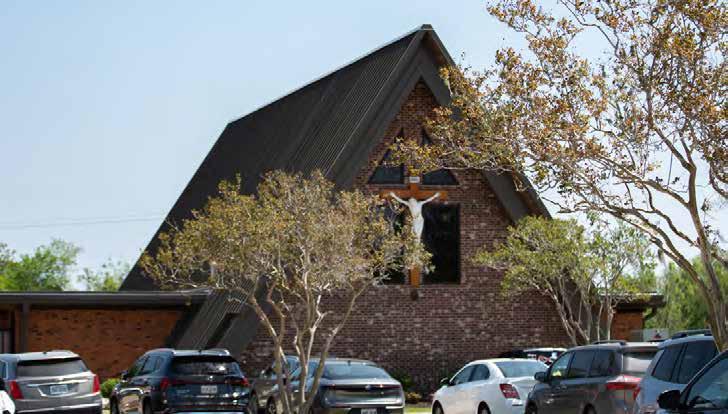
After nearly five years of recovery following Hurricane Ida, St. Mary’s Nativity Church, located at 3500 Highway 1 in Raceland, has reopened its doors to parishioners. The Blessing of the Altar and Rededication of the Church was celebrated by Bishop Simon Peter Engurait on Saturday, May 23, during the 4 p.m. Pentecost Vigil Mass.
“Today, we celebrate Pentecost and the coming of the power of God,” said Bishop. “Our challenge is to recommit ourselves to our relationship with God, and especially our confidence in Him to bring good out of anything and everything.
The renovation included extensive interior and exterior improvements while preserving historic elements of the church’s heritage. Interior updates feature a new ceiling, refinished drywall, a redesigned lighting system, and a new audio system, along with fresh paint, new carpeting, and brand-new oak pews. Additional upgrades include improvements to the HVAC system and the addition of a
third ADA-accessible restroom. Exterior work included a new roof and copper restoration on the steeple, and the rectory is currently being rebuilt.
While the church reflects a modern architectural style, many elements from the previous church have been preserved or restored to honor its historic roots. These include original light fixtures, murals by artist Milo Piuz, and life-size statues of St. Anne and the Sacred Heart of Jesus dating back to 1888. Other restored features include portions of the original high altar and tabernacle, a Marian shrine, and a restored pipe organ— now located in the nave—the only fully functional pipe organ in the diocese. Pictures of the old and new church can be found to the left wall of the main entrance, with a cross created from the old church pews.
In conjunction with the parish’s 175th anniversary, additional projects included the construction of a new Marian shrine using salvaged materials from the former
church and rectory, restoration of the Calvary scene in the cemetery, and beautification of the church grounds. The parish’s historic bell collection is also being restored, with five bells dating from 1856 to 1960 expected to ring again soon.
“The church has never looked better,” said parishioner Eric Ordoyne, who has deep family ties to the parish. “It’s light, bright, fresh, and welcoming—the perfect blend of the old and the new.” Reflecting on the aftermath of Hurricane Ida, he added, “There was water everywhere. We immediately began working to protect what we could. The roof was torn apart, copper stripped from the steeple, and the rectory’s columns lay on the ground—it was a very emotional experience. We did everything we could to salvage what was left.”
For several years, Masses and sacraments were held in the St. Mary’s Nativity School cafeteria next door. Pastor Fr. Joseph Tregre, who began his ministry at the parish in July 2024, played a key role in the renovation e orts. He succeeds Fr. Clyde Mahler, who guided the parish through the immediate aftermath of the storm. “I see God in the people of St. Mary’s parish,” said Fr. Mahler. “Through everything they’ve endured since Hurricane Ida, their faith and resilience have never wavered. Now, to see them return to their restored church is incredibly powerful.”
“I thank Fr. Clyde for the phenomenal job he did shepherding St. Mary’s in the immediate aftermath of Hurricane Ida and planning the renovations,” said Father Tregre. “I’m grateful to our parishioners for their patience, and I am excited to welcome them into our newly renovated church.”
Special thanks to the St. Mary’s Buildings Committee, Daughters of Mary’s Heart Ministry, Knights of Columbus, Eric Ordoyne, parish sta , and all the volunteers and donors who made this reopening possible. “They were a big help in preparing and beautifying our church for the reopening,” said Fr. Tregre.
Tracing its origins back to 1797, St. Mary’s Nativity Parish is one of the oldest parishes in the Diocese of Houma-Thibodaux. In its earliest years, the land was used for cemetery
purposes, leading to the formation of a corporation to maintain the property. The corporation, entitled “The Congregation of the Roman Catholic Church of Sainte Marie Pamela,” was inspired by Rev. Charles M. Menard to build a chapel. On August 3, 1850, the church was blessed by Fr. Menard under the patronage of the Nativity of the Blessed Virgin Mary. A substantial brick church was later constructed in 1876 under the pastorate of Rev. Eugene Vigroux, who personally directed the making of bricks from native clay and the cutting of cypress timber on the church property.
By 1965, St. Mary’s Nativity Parish had experienced significant growth, prompting the need for a larger church. A new, modern structure was designed in
keeping with the liturgical reforms of Vatican II. Its circular design was intentionally chosen to foster unity, closeness, and active participation among the faithful. The cornerstone was laid on March 25, 1966, and the church was formally dedicated by Archbishop Philip M. Hannan on January 15, 1967.
Weekend Masses at St. Mary’s Nativity Church are celebrated on Saturdays at 4 p.m., and Sundays at 8 a.m., 10 a.m., and 6:30 p.m. Weekday Masses are held Monday through Wednesday at 7 a.m., and on Thursday at 8:30 a.m. for the school Mass.
CELEBRATING OUR 250TH ANNIVERSARY
CONSECRATING THE UNITED STATES TO THE SACRED HEART OF JESUS
Our nation was founded on Christian values, and for 250 years the Church has helped shape its history. Catholics have served the American people since before the nation’s founding through schools, hospitals, and charitable ministries. That mission continues today, with nearly 1.7 million students1 in Catholic schools and one in six patients cared for in Catholic health facilities nationwide.2
This summer, Catholics across the United States joined the U.S. bishops in consecrating our nation to the Sacred Heart of Jesus, marking America’s 250th anniversary. Here in the Diocese of Houma-Thibodaux, we participated by offering more than 250 holy hours, entrusting our nation to the Heart of Christ.
To help us better understand the meaning and significance of this consecration, we sat down with Fr. Rusty Bruce to answer a few questions.
FR. RUSTY BRUCE
is the Director of the Office of Worship and the Pastor of St. Joseph Co-Cathedral in Thibodaux.
As America marks 250 years as a nation, the U.S. bishops invited Catholics to participate in something that went beyond a simple Fourth of July celebration: the consecration of our nation to the Sacred Heart of Jesus. But why do this? What is the di erence between celebrating a nation and consecrating it?
We consecrated our nation to the Sacred Heart of Jesus because we desire to entrust our country more fully to the Lord and to acknowledge that we belong ultimately to Him. In the Catholic tradition, consecration is a sacred act of dedication by which a person, place, or group of people are set apart for God’s purposes.
1 “National Data Highlights Strong Demand and Growing Diversity and Inclusion in Catholic Schools,” National Catholic Education Association, 2026.
2 “Facts & Statistics,” Catholic Health Association of the United States, 2026.
Throughout Sacred Scripture, consecration always carries this meaning of being “set apart” for God. The Jewish Temple, the altar, sacred vessels, priests, and the people of Israel were consecrated because they were no longer meant merely for ordinary use, but for divine worship. In the same way, this consecration of our nation is an act of faith in which we ask Christ to reign more deeply in our hearts, our homes, and our public life.
This is what makes consecration di erent from a mere anniversary celebration. Celebrating 250 years as a nation rightly invites us to look back with gratitude for the blessings and achievements that have shaped our history. But gratitude alone is not enough. A consecration allows us to do something more profound. It allows us to look upward to God and forward with hope, entrusting our future to His providence.
By consecrating our nation to the Sacred Heart of Jesus, we proclaim that before we are citizens of any earthly
nation, we are called to be citizens of the Kingdom of God. We recognize that true freedom and human dignity are ultimately rooted not in political power, but in the lordship of Christ. And while we gave thanks for the blessings of our nation’s history, we also humbly acknowledge that no nation can endure or flourish apart from the grace and mercy of God.
The U.S. bishops’ prayers for the consecration call us to reparation as well as gratitude. How should Catholics hold both in light of devotion to the Sacred Heart of Jesus?
As Catholics, we are called to love our country truthfully, and not blindly. Genuine love always includes both gratitude and honesty. We can and should give thanks for the many blessings, sacrifices, freedoms, and achievements that have shaped our nation, while also acknowledging the moments in our history where
human dignity was wounded and where we, as a people, have fallen short of God’s vision for the human person.
Acknowledging those failures does not erase or diminish what is good and worthy of celebrating. Mature love is capable of holding both truths together. As the saying goes, we do not “throw the baby out with the bathwater.” We can celebrate what is noble and life-giving in our national story while still recognizing that there is work left to do and healing still needed.
This is precisely why the consecration to the Sacred Heart of Jesus is so important. The Sacred Heart is the symbol of Christ’s divine love and mercy, a Heart wounded for humanity, yet still poured out for the salvation of the world. When we consecrate ourselves, or our nation, to the Sacred Heart, we are not claiming perfection. Rather, we bring both our gratitude and our wounds to Christ. We entrust to Him what is beautiful in our history, and we ask Him to heal and transform what has been sinful, broken, or unjust.
This consecration was therefore an act of humility and one of hope. It reminds us that no nation is saved by its own strength or achievements alone. Every person stands in need of God’s mercy. In placing our nation under the Sacred Heart of Jesus, an image of both God’s love for us and our love for Him, we ask that His love shape our future more deeply, so that we may become a people more committed to truth, justice, charity, and the dignity of every human person.
“Every person stands in need
of God’s mercy
CENTRAL CATHOLIC HIGH SCHOOL
Cash Baker
Ryan Bennett
Landon Billiot
Milee Breaux
Zeph Brinlee
Conner Daigle
Hannah Dalton
Ellie Domangue
Addison Grizza
Wayne Hebert
Parker Jennings
Aiden Kimmey
Lucille Kincade
Zowie Lacoste-Minyard
Dominic Lipari
Addison Loupe
Tylen Mingo
Bree Mitchell
Gabriella Morice
Kollin Nelson
Aiden Neylon
Laiah Porche
Landyn Ramagos
Emmy Robison
Zoie Scully
Max Simmons
Julia Sloane
Juliana Smith
Bryce Talbot
Brooke Templet
Drake Theriot
Ava Vaccarella
Ryan Valentine
Sophie Vining
Grant Wallace
Bryan Wiggins
LOCALLY OWNED SINCE 1974
E.D. WHITE CATHOLIC HIGH SCHOOL
CLASS OF 2026
Addison Abadie
Seth Andras
Cooper Andrews
Landen Arabie
Evan Arcement
Abby Arthurs
Grace Ayers
Landon Babin
Trey Babin
Allie Baldwin
Grant Barbera
Luke Barbier
Sydni Barrilleaux
Gabrielle Barrios
Maria Barrios
Cole Beaudean
Abby Becnel
Natalie Becnel
Cheyenne Benoit
Marcel Benoit
Gracie Bergeron
Kyndle Bernard
Cooper Bilello
Amaya Blanchard
Rebecca Blanchard
Emma Bourgeois
Khristopher Bourgeois
Jacob Bouvier
Bradley Braud
Nicholas Braud
Karsyn Breaux
Bonnie Buras
Georgia Carothers
Ryli Cazenave
Bethanie Charles
Seth Cheramie
Chloe Chiasson
Lila Collins
Virginia Conrad
Luke Cortez
Matthew Cortez
James Cundi , Jr.
Logan Curole
Thomas Daigle
Charles Dalmau
Emma Danos
Camille DeGravelle
Sarah DeGravelle
Molly Delatte
Charles Diedrich
Carter Douglas
Sophie Douglas
Charles Duet
Parker Dufrene
Noah Fangue
Ava Favalora
Alden Fields
Emory Freret
Sophia Giardina
Jose Gonzalez-Sanchez
Brayden Granier
Charlotte Gros
Reece Gros
Blake Guidry
Camryn Guidry
Lucy Guidry
Emmerson Hadaway
Katherine Harrison
Boyd Hebert, IV
Emma Hebert
Madison Hebert
Andre Himel
Mallorie Hingle
Luke Husbands
Ava Hymel
Parker Hymel
Logan Jo rion
Aimée Johnson
Harrison Jones
Sara Kearns
Madison Kees
Eli Lafaso
Ava LaHaye
Madison Landry
Olivia Landry
Andrew LeBlanc
Avery LeBlanc
Avery Ledet
Camille Ledet
Jonathan Lee
Van Lian
Ella Luminais
Robert Martin, VII
Allie Martinez
James Matassa, Jr.
Shaw Matherne
Miley Melancon
Andrew Molaison
Caroline Molaison
Emma Montgomery
Anna Morales
Ella Moreaux
Carter Myers
Chase Naquin
Callie Nethery
Annie Newchurch
Aiden Ockman
Alexis O’Connor
Luke Ohmer
Aaron Ortiz
Gary Palmer, III
Ty Panvelle
Julia Passman
Lucy Pearce
Joseph Picciola
Taylor Pinero
Matthew Plaisance
Caden Poché
Shaniyah Poindexter
Owen Porche
Jackson Riché
Madison Roger
Philip Rupe
Amelia Scorsone
Jillian Simon
Hudson Simoneaux
Georgie Speer
Hayes Tabor
Addison Talbot
Madisyn Taranto
Kaya Tezeno
Cloe Thibodaux
Elyse Toups
Rebecca Toups
Gabrielle Treland
Hayes Viator
Samuel Waguespack
Aubrey Walker
VANDEBILT CATHOLIC HIGH SCHOOL
Gracie Adams
Kinadee Adams
David Aguado
Anna Alevizon
Anneliese Angeron
Evan Arceneaux
Gabrielle Arceneaux
Noah Arceneaux
Carson Archer
Alexandra Ardoin
Lauren Baudoin
Evan Bennett
Jonas Bergeron
Luke Bertrand
Allie Besson
Mollie Bice
Alaina Blanchard
Clara Boquet
Jackson Boudreaux
Benjamin Bourgeois
Gracie Breaux
Jacob Breerwood
Maci Brunet
Claire Cazayoux
Christopher Celestin
Delanden Charles
Jayden Coleman
Levi Cosgrove
Devin DeHart
William DeRoche
Gabryel Douglas
Madyson Dubois
Shaylynn Dufrene
Kylie Dupre
Madison Ellender
Stephen Evans III
Corinne Fahrig
Nyla Falgout
Anna Faulk
Reece Gaudet
Samuel Gaudet
Annabelle Goodwin
Elizabeth Goodwin
Madison Gravois
Colleen Guidry
Spencer GuilbeauArmstrong
Brooklynn Halcome
Hudson Hazleton
Braxton Hebert
Jack Hebert
Mackenzie Hebert
Zachary Hebert
Audrey Henderson
Ethan Heney
Cylis Hill
Logan Himel
Parker Holliday
Isabella Jambon
Jace Jarveaux
Journee Johnson
Katherine Johnson
Alice Kelley
Matthew Kinnard
Aubrey Lagarde
Reese Landry
Henri Lapeyre
Marc Lapeyre
Jathan Lazard
Alayna LeBlanc
Demi LeBlanc
Kennedy LeBoeuf
Presley LeCompte
Thomas LeCompte
Malyn Lerille
Connor Lewis
Lauren Lirette
Renee Lirette
Cohen Luke
Jai Lyons
Madison Mackay
Azriel Malancon
Isabelle Martin
Chase Mazur
Kenlie McCorkel
John Michel
Ahmir Miles
Xabien Moses
Sophia Ourso
Chandlor Parfait
Leah Patterson
Harper Pitre
Lucia Pizzolato
Allie Ponti
Chandler Pregeant
Julia Pregeant
Jett Prosperie
Ava Rau
Emmy Rau
Alex Reddoch
Carter Richard
Max Richard
Morgan Richoux
Lucas Rieve-Hilse
Jackson Robichaux
Aaliyah Robinson
Kiridu Duarte Rodriguez
Grady Rogers
Hays Rutledge
Addison Schexnayder
Morgan Schexnayder
Aubree Seely
William Seibert
Luke Siddon
Ava Smith
Jace Smith
Ella Sonnier
Torin Sparrow
Dezi Starr
Tyanna Stewart
Julia Stipelcovich
Bryce Thibodeaux
Sydney Thibodeaux
Blair Thompson
Madden Toups
Trenton Townsen
Makaela Valdiviez
Callie Voisin
Braden Waalk
James Walker
Zuri Walker
Raigan Wolfe
U.S. DIOCESES SEE SURGE IN BAPTISMS, CONVERSIONS
WHAT’S DRAWING NEW CONVERTS?
BY: JOE O'SULLIVAN
This past Easter, Hallow—the popular Catholic prayer and meditation app—gathered data on conversions to Catholicism across the United States. What they discovered was a welcome and pleasant surprise. Dioceses are seeing a 38% annual increase on average in people entering the Church.1
It isn’t just us; the trend seems to be global. In France, conversions shot all the way up to 17,800.2 Even the bishops there were caught o guard. They’re now planning a major churchwide council to find out what’s driving the new conversions.
Here at home, the question is the same. While the experts mull over the data, the anecdotal evidence is very compelling.
Edward Trendowski, director of the O ce of Faith Formation for the Diocese of Providence, told the National Catholic Register that he noticed unusual interest in the Church and Church teaching. The woman who cuts his hair mentioned she was thinking about converting. She’d even started “reading the writings of St. Thomas Aquinas.”3
When even your local hair stylist picks up the medieval philosophy of St. Thomas Aquinas—not exactly a beach read—I mean, c’mon, there has to be something in the water, right?
Not everyone is convinced. Some reject the idea that a revival is happening, noting that 2026’s conversion numbers still fall short of where they were in the 1960s.4
Others, while not embracing the idea, are not rejecting it either. “I don’t know if I could call it a big revival at this point, but call back in three to five years and we’ll
let you know,” said Rev. Thomas Gaunt, who is the executive director for a research center at Georgetown University that studies the Catholic Church.5
Here in the Diocese of Houma-Thibodaux, the uptick may not have been as pronounced as in some dioceses, but the trend still pointed up. Is there something driving the change? Fr. André Melancon—pastor at St. Bernadette in Houma, soon to be rector at St. Francis de Sales Cathedral—noticed a pattern among converts: “Those who convert to Catholicism are often drawn by a recognition that the fullness of Truth resides within the Catholic Church. They encounter wisdom in the Church’s teachings and are inspired by a desire to embrace the fullness of the Christian life.”
It’s hard to tell exactly why many are joining the Church. Most research so far shows that people’s reasons for converting are highly personal, which can make it hard to see any patterns.
In 2026, Americans have more choices for their free time than there are items on a Cheesecake Factory restaurant menu. You can join a gym for anything, ranging from Yoga and Pilates to CrossFit and Body Combat. You can learn about virtually anything, whenever you want, with AI. And yet, with all the choices people have, many are finding the time to become Catholic.
1 ”Catholic Church Sees Massive Growth in New Members,” Hallow, 2026.
2 “Paris Archdiocese Convenes Council in Response to Historic Rise in Converts,” America, 2026.
3 “‘Something’s Happening’: Catholic Converts Surge in Many U.S. Dioceses,” National Catholic Register, 2026.
4 ”Despite an Increase in Adult Baptisms, We Are Not in a Catholic Revival,” Religion News Service, 2026.
5 “Catholic Revival Among Gen Z: What Young Adults Say About Returning to the Church,” Religion News Service, 2026.
While the reasons for joining the Church seem to be quite personal for people, it’s worth taking a minute to stop and ask: what is it that makes Catholicism unique? Because in a sea of choices, it stands to reason those things might be what’s attracting people to the Church. Whether or not they are, they’re worth celebrating on their own. They’re what makes our identity as Catholics rich, unique, and alive. Here are three, out of many more.
BEAUTY THAT IS EVER ANCIENT AND EVER NEW.
The Catholic Church has the Pantheon, where sunlight pours in through the dome’s circular oculus; it boasts the Gothic Chartres Cathedral in France that stretches into the sky, adorned with more than 4,000 sculptures; in our own diocese, exquisite marble altars shine, many recently rededicated.
As Pope Leo mentioned during his recent visit with young people in Monaco, “today, the faith faces challenges and obstacles, yet nothing can dim its beauty and truth. We can see this in the growing number of men and women of all ages who desire to know the Lord and ask to be baptized.”6
APOSTOLIC CONTINUITY AND PAPAL AUTHORITY.
We have scriptural evidence that Peter is the first pope, and the line has run unbroken ever since, making Leo the 267th pope. It’s comforting to know you’re a part
of the Church that Jesus Christ himself literally started. There are founders and then there are founders.
A 2,000-YEAR-OLD INTELLECTUAL TRADITION.
Some people need the arguments worked out before they’ll say they believe; for others, a single encounter with beauty or grace is enough to begin their journey into the heart of the Church. But for the ones who want the rigor, it’s hard to beat an unbroken line from Augustine to Aquinas to Catherine of Siena to John Paul II—a tradition that gave the world its first universities and open-to-all hospitals.
Even the late Steve Jobs once studied the organizational structure of the Catholic Church to see if he could glean anything for his own growing company, Apple. He observed how unique it was that any institution could last for 2,000 years. He “saw no reason why [Apple] should have over four layers of management” since the Catholic Church had, in his estimate, four layers—“five, if you count the highest order,” meaning God.7
Whether or not we ever pin down what’s behind the uptick, this is a good time to pause and celebrate what makes us unique. It might just be what’s drawing this modest but welcome wave of new conversions home.
6“Is There a Catholic Revival? Pope Leo Seems to Think So,” Religion News Service, 2026.
7Steve Jobs, Aspen International Design Conference, 1983.
One. Holy. Catholic. Apostolic.
WORDS FROM ROME
WISDOM FROM POPE LEO XIV
“Jesus’ freedom changes hearts, heals wounds, refreshes and brightens our faces, reconciles and gathers us together, and forgives and raises us up.”
- X Post | April 2, 2026
“There is no human experience that God does not redeem. When lived in union with the passion of the Lord, even su ering can become a path to holiness.”
- X Post | April 2, 2026
“It is precisely the hope that dwells in our hearts that gives us the strength to proclaim the victory of the risen Christ over evil and death.”
- Angelus | St. Peter’s Square | August 3, 2025
“Christ calls us to freedom. He does not want servants or clients, rather He seeks brothers and sisters to whom He can totally dedicate Himself.”
Want to hear more from Pope Leo XIV? Check out his new encyclical about human dignity in the age of AI: Magnifica Humanitas. Read it on the Vatican website.
- X Post April 20, 2026
“Christ conquered death, showing us the way back to the Father. And so that we too may walk this luminous and demanding path, sharing its beauty with the whole world, he has given us his Spirit, who animates and sustains us on our journey and in our mission.”
- Apostolic Journey of Pope Leo XIV to Algeria, Cameroon, Angola and Equatorial Guinea | “Mamã Muxima” Shrine, Angola | April 19, 2026
“No one is excluded from God’s love! With our unique pasts, mistakes, and su erings, each one of us remains precious in the Lord’s eyes. Jesus revealed this to us in His every encounter, gesture, and word. He loved us to the very end, showing us that he believed in the power of love to change even the hardest of hearts.”
- X Post | April 22, 2026
“You are part of a story of love—that of the Lord for His people—which began before you and does not end with you. You are part of it as unique and necessary pieces. You are part of it so that you may kindle a light, even amid the dense patterns of darkness.”
- X Post | May 8, 2026
“Jesus conquered death.. and we already begin to overcome it with him… each one of us comes to church with some fatigue or fear – at times small, at times bigger – and immediately we are less alone, we are together and we find the Word and the Body of Christ.”
- Homily of Pope Leo XIV | Shrine of Santa Maria della Rotonda, Albano | August 17, 2025
“When we seem to be sinking, overcome by adverse forces, when everything appears bleak and we feel alone and weak, Jesus is always with us, stronger than any power of evil. In every storm, He comes to us and repeats: ‘I am here with you: do not be afraid.’ With Him, we can get up after every fall and not allow ourselves to be stopped by any tempest. We therefore advance with courage and trust.”
- X Post | April 18, 2026
AHEAD OF HIS TIME
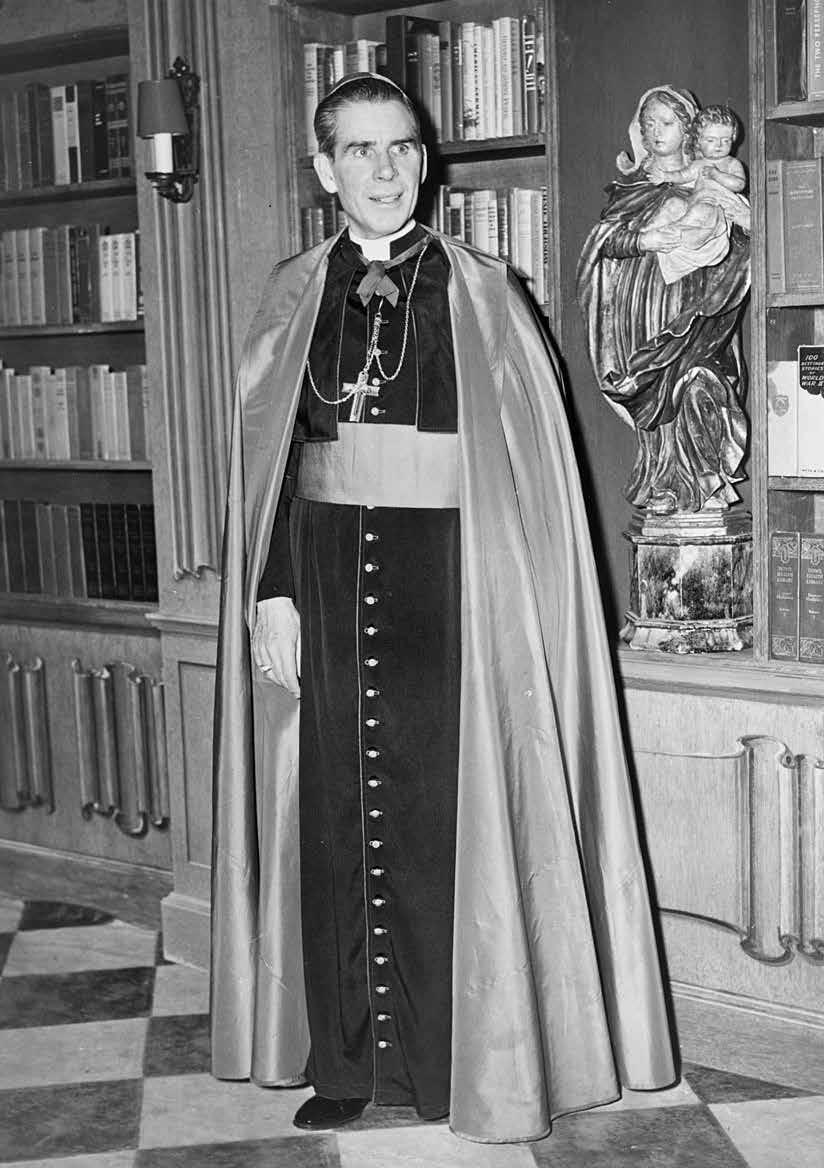
REMEMBERING ARCHBISHOP FULTON J. SHEEN, SOON-TO-BE-BLESSED
BY: JOE O'SULLIVAN
This past year, NBC Sunday Night Football set records with an average viewership of 23.5 million.1
If he were still alive, Archbishop Fulton J. Sheen might have jokingly asked you to hold his co ee. That’s because his popular TV show, Life Is Worth Living (1952-1957), drew upwards of 30 million viewers per week2—roughly 1 in 5 Americans alive at the time. He even took home an Emmy in 1953 for “Most Outstanding Personality.”3 When he won the award, he paid tribute to his “four writers—Matthew, Mark, Luke, and John.”4
This September, Archbishop Sheen will make headlines once again. Except he won’t be back on America’s TV screens. Instead, on September 24, 2026, he will be beatified in St. Louis, o cially becoming a “Blessed”—the final step before canonization as a saint.5
Who is this soon-to-be-Blessed, and why should we pay attention? Archbishop Sheen is perhaps more relevant than you may realize.
Born in 1895 in Illinois to Newt and Delia Sheen, Peter John “Fulton” Sheen was marked early by a deep devotion to the Blessed Virgin Mary. His own mother dedicated him to Our Lady at his baptism, a consecration he would renew at his first Communion. Once he became a bishop, he adopted as his episcopal motto Da per matrem me venire (“Grant that I may come to You through the Mother”). Throughout his priesthood and ministry as a bishop, Sheen frequently reminded his listeners of the power of Mary’s motherly intercession in our lives. He reflected this especially in his book The World’s First Love: Mary, Mother of God.
Sheen became interested in the priesthood at an early age. He entered the seminary as a young man, enrolling at St. Viator College in Illinois. It was there that he first started thriving in his studies. It was also where he received coaching in public speaking, a skill that would later enable him to more e ectively reach tens of millions of Americans from their living rooms.
Personal prayer was another major cornerstone in Archbishop Sheen’s life. During his time at major seminary formation in St. Paul, Minnesota, he often prayed in the chapel. He writes in his autobiography, Treasure in Clay:
“The big chapel in St. Paul’s Seminary would be locked by six o’clock… This particular evening during recreation, I walked up and down outside the closed major chapel for almost an hour. The thought struck me—why not make a Holy Hour of adoration in the presence of the Blessed Sacrament? The next day I began, and the practice is now well over sixty years old.”6
1 “Record-Setting Season as Sunday Night Football on NBC and Peacock Averages 23.5 Million Viewers,” NBC Sports, 2026.
2 “Biography of Fulton J. Sheen,” The Catholic University of America, 2026.
3 “Most Outstanding Television Personality, 1953,” Television Academy.
4 “Archbishop Fulton J. Sheen: Life Is Worth Living,” Marian Fathers of the Immaculate Conception, 2026.
5 For beatification, the Church ordinarily requires one approved miracle attributed to the candidate’s intercession. Pope Francis approved the miracle attributed to Archbishop Sheen in 2019, involving the medically inexplicable revival of a stillborn baby.
6 Fulton J. Sheen, Treasure in Clay, 1980.
In fact, when he died in 1979, Sheen was found before the Blessed Sacrament in his private chapel. It really was a lifelong, daily devotion, and he frequently attributed his inner strength and direction as a bishop to this holy habit. He both encouraged and helped spread this beautiful devotion, reminding us that time spent before Jesus in Eucharistic adoration brings peace, clarity, and calm.
Archbishop Sheen’s staggering popularity was never something he set out to achieve. When his show first aired, his network considered it a “sacrificial lamb,” figuring a program with “no potential”7 might as well fill a timeslot against far more popular competition. Instead, people took to Archbishop Sheen, and his popularity exploded.
Archbishop Sheen was happy to use whatever means were available to him to teach people about Jesus Christ and the teachings of the Catholic Church. Whether it was TV, radio, letters, or books, he considered it fair game. It’s a good reminder for the rest of us. No matter where you find yourself, or in what era you find yourself, use the tools at your disposal to spread the Gospel. You never know who—or how many—you might reach, and you might end up on quite a journey yourself!
This September, we remember Archbishop Fulton J. Sheen with fondness, recalling his courage, his brilliance, and his devotion to Our Lady and to Jesus, especially in the Blessed Sacrament.
And so, starting on September 24, let us o cially pray: Blessed Fulton Sheen, pray for us!
7 “Fulton J. Sheen,” Encyclopedia.com, 2018.
Grant that I may come to You through the Mother. “
ST. JOSEPH BENEDICTINE HIGH SCHOOL IN CHAUVIN A BRIEF BUT PROUD HISTORY
MICHELLE LEBLANC
is the Archivist of the Diocese of Houma-Thibodaux. The Archives and Records Center contains the diocese’s historical records and maintains school and church records for the diocese.
CATHOLIC HIGH SCHOOL IN CHAUVIN: A PROPOSAL
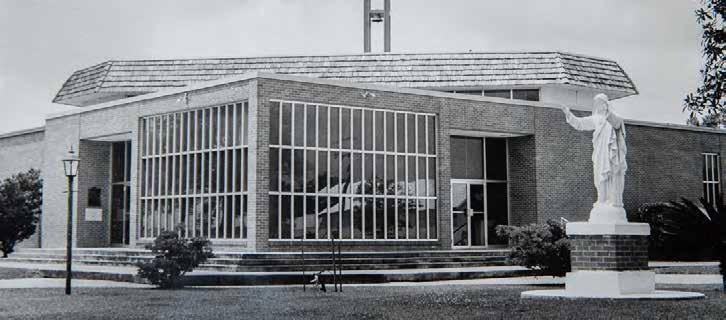
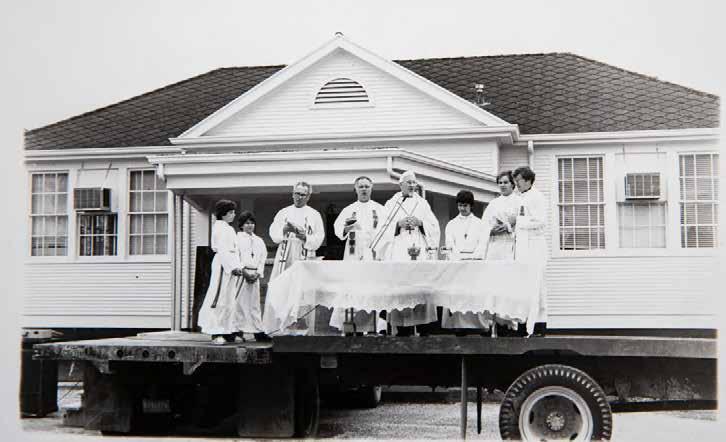
In 1956, Father Charles A. Pagliughi, founding pastor of St. Joseph’s Parish in Chauvin, Louisiana, wrote to Sister Anthelma, Provincial of the Sisters of St. Joseph in New Orleans, asking them to sta a proposed junior high school for the parish. There were no schools outside of Houma at the time. The St. Joseph Sisters wanted to come to Chauvin but couldn’t spare the four sisters needed until 1963. Father Pagliughi then wrote to Mother Patricia, O.S.B., of the Benedictine Sisters, who agreed to send two sisters to help open the school.
TWO BENEDICTINES COME TO CHAUVIN, LA
Sister Boniface Brunet, born in Bayou du Large, grew up in Houma and, after high school, attended St. Scholastica in Covington, Louisiana. Sister Brunet and Sister M. Johnette came to St. Joseph’s in Chauvin
to help open the St. Joseph Benedictine High School on September 3, 1958. Named after the Benedictine Sisters, the school consisted of one building with eight classrooms and a cafeteria.
ST. JOSEPH BENEDICTINE HIGH SCHOOL GROWS
St. Joseph’s opening class began with 50 students. In 1959, another freshman class entered, bringing the total to 100 in less than two years. By 1960, St. Joseph had grown to include grades nine through twelve and became a state-accredited high school. Sister Philippine became principal, leading a faculty of nine. She added seventh and eighth grades in 1961 and issued the first yearbook, Knight-Life, which was renamed Le Chevalier in 1962. The school grew to 300 students by 1962, and with that growth came the need for more room.
ST. JOSEPH’S HIGH SCHOOL GOES INTO DEBT
In 1965, a new building was constructed and subsidized by the Archdiocese. Father Allen Roy became pastor in 1966 and added a home economics
department and driver’s education. The faculty grew to seventeen, and the school added more activities: the Black Knight band, Math Club, Beta Club, National Honor Society, and Student Council. The school flourished under Father Roy’s guidance until 1969, when both the school and the church parish began to struggle. Unexpected fire damage to the rectory and an economic downturn in the oil and gas fields forced the parish to make hard decisions about what it could a ord to fund. The problems mounted: a sudden decline in oil royalties, a rise in public school teachers’ salaries that St. Joseph had to match, the loss of state aid to private schools, a cut in the Archdiocese subsidy program, poor shrimping seasons, and a decrease in the number of teaching Sisters.
THE BENEDICTINES LEAVE SCHOOL LEADERSHIP
In 1969, with the religious sisters leaving, William H. “Sonny” Jackson, the former head football coach, became the first lay principal of St. Joseph Benedictine High School and fought to keep it going. With Sister Lucy having left for Our Lady of Lourdes in Slidell, Jackson was paired with alumnus Gerald Picou as vice-principal.
The rising cost of education and living forced the St. Joseph Chauvin community to find new ways to fund the Catholic high school between 1969 and 1971. The Lagniappe on the Bayou festival was planned to help raise money for the school.
1972: ST. JOSEPH’S BENEDICTINE HIGH SCHOOL CLOSES
On March 21, 1972, the archdiocesan school board voted to close St. Joseph Benedictine High School, which served Little Caillou, Montegut, and Pointe-aux-Chenes. The school had an enrollment of 264 students in 1972, but after tuition rose from $350 to $400, only 143 students in grades seven through twelve signed up for the coming year. The higher cost, coupled with local economic di culties, made keeping the school open impossible.
LAGNIAPPE ON THE BAYOU FAIR: LASTING LEGACY
While St. Joseph in Chauvin had a history of parish While St. Joseph in Chauvin had a history of parish fairs from its earliest days, Lagniappe on the Bayou was created
to support and save the school. Under Monsignor Fred Brunet and a corps of talented, eager volunteers, the festival became a huge event, and the parish used the proceeds to pay o all of its church and school debt. The volunteers worked hard to support their parish while celebrating their Cajun heritage with food, music, and fun. Though Lagniappe on the Bayou was eventually cancelled by Bishop Boudreaux, the community it built and the money it raised carried the church parish through the lean years ahead.
CONCLUSION
St. Joseph in Chauvin has a long history of Catholic faith and community, one full of sorrow and struggle as well as joy and happiness. St. Joseph Benedictine High School was a fleeting dream for the people of Little Caillou, Montegut, and Pointe-aux-Chenes, and it deserves recognition, both for the faithful community who built it and for the dedicated religious and educators who supported the students and their families. The school lives on in the memories of its students, families, and faculty, in the stories they tell and share, and in the photographs, yearbooks, and student newspapers that remain.
FUN FACTS
• The mascot of St. Joseph Benedictine High School was a Black robed Knight who rode a horse named Midnite. The horse and mascot would even attend away football games.
• The first graduating class (1961) of St. Joseph Benedictine had 16 graduates, while the twelfth and final class in 1972 had 52.
• The graduating class of 1966 was unique, with one valedictorian, four salutatorians, and two honor graduates. The valedictorian was Diana LeBlanc, and the honor graduates were Nancy Portier and Karen Duplantis. The four salutatorians were Norma Domangue, Elaine LeBoeuf, Merril Lirette, and Ursula Portier.
• In 1969, St. Joseph Benedictine fielded a hard-working football team that developed a reputation for their long hours on the practice field.
• St. Joseph Benedictine High School was known for its “well-rounded sports program” of football, basketball, baseball, and track. Terrebonne parish honored the
school that year as district champions in football, basketball, and track. The Knights were also recognized for their baseball team at a time when no other local school in the league had one.
• In January 1972, it was decided that Holy Savior High School would close and in March of 1972, their rivals, the St. Joseph Benedictine High School, would close as well.
SOURCES:
1989 Parish Directory of St. Joseph Catholic Church
1964 Le Chevalier (Yearbook)
Clarion Herald Articles
Bayou Catholic Articles
THE 49TH ANNIVERSARY OF THE DIOCESE
BY: BEVI FONTENOT & JOE O'SULLIVAN
As the Diocese of Houma-Thibodaux looks ahead to its 50th Golden Jubilee next year, the faithful gathered at the Cathedral of St. Francis de Sales in Houma to celebrate the diocese’s 49th anniversary. Bishop Simon Peter Engurait celebrated the Mass and reflected on the generations of clergy, religious, and lay faithful whose dedication helped shape the diocese we know today.
Drawing from the words of Bishop Warren Boudreaux on the diocese’s first anniversary, Bishop Simon Peter returned to the image of the mustard seed—a tiny seed planted in faith that grows into a great tree, o ering shelter and rest to others. In much the same way, the Diocese of Houma-Thibodaux has grown from humble beginnings into a vibrant local Church, spreading the Gospel and serving the people of south Louisiana.
Yet, as Bishop Simon Peter reminded those gathered, “the Church is never finished,” and “the diocese is never a completed project.” The work of building God’s Kingdom continues in every generation.
Bishop Simon Peter noted, “At 49 years, we celebrate a magnificent past, but we are not called to merely admire our history; we are called to build upon it.” He encouraged the faithful to honor those who came before them while remaining committed to the mission entrusted to the Church today.
“Let us thank God for the past,” he said. “Let us embrace the responsibilities of the present, and more importantly, look to the future, full of hope.”
With that vision in mind, Bishop Simon Peter has asked each parish to compile and preserve its history as the diocese prepares for its Golden Jubilee. By gathering these stories and records, the diocese hopes to create a fuller account of its journey over the past five decades while inspiring future generations to continue the work that has been entrusted to them.
“As we approach our Golden Jubilee,” Bishop Simon Peter said, “this anniversary should fill us with renewed enthusiasm and determination to build further the Kingdom of God.”
As the diocese prepares for this milestone celebration, we give thanks for those whose faith, sacrifice, and perseverance laid the foundation before us. May their example inspire us to make our own contribution to the life of the Church, so that future generations may one day look back with the same gratitude we feel today.
Here we come, year 50!
M A K E M Y
H E A RT
YO U RS
ADVENTURE
BEACH CAMP
CORPUS CHRISTI FISHING
FRIENDS
LEMONADE
NO SCHOOL OUTSIDE PICNIC POOL DAY
POPSICLE REST
SACRED HEART
SUMMER SUNGLASSES
SUNSHINE VACATION
Throughout the Diocese of Houma-Thibodaux, our parish communities continue to carry forward generations of faith, prayer, and service. Some of our parishes trace their roots back to the early 1800s, each with its own story woven into the life of the Church along the bayous. Together, they form one Body of Christ, united in mission and rooted in the Gospel.
This year, several parishes across the diocese are celebrating milestone anniversaries, marking decades of faithful witness in their communities.
CHURCH PARISHES CELEBRATING MILESTONE ANNIVERSARIES
IN 2026
• St. Anthony of Padua—150 years (1876)
• Our Lady of Prompt Succor, Golden Meadow —110 years (1916)
• St. Charles Borromeo, Pointe-aux-Chenes —55 years (1971)
• Thanh Gia — 45 years (1981)
• Chapel of the Blessed Sacrament, Gibson —20 years (2006)
This year, we also honor priests and deacons of our diocese who are celebrating milestone anniversaries of ordination.
Through the sacraments, preaching, and daily acts of service, our clergy accompany the faithful through every season of life. Our priests stand in persona Christi at the altar, bringing Christ to His people through the Eucharist and the sacraments. Our deacons, called to ministries of charity, word, and service, faithfully serve the Church and help meet the spiritual and pastoral needs of our communities.
Whether ordained 10 years ago or 50, each has answered God’s call with generosity and dedication. We give thanks for their faithful witness and the many ways they continue to strengthen the life of the Church in our diocese.
PRIESTS CELEBRATING MILESTONE ANNIVERSARIES IN 2026
Fr. Glenn LeCompte
40 years
Ordained 1986
Fr. Carl Collins
35 years
Ordained 1991
Fr. Robert-Joel Cruz
30 years
Ordained 1996
Fr. Michael Bergeron
30 years
Ordained 1996, Retired
Fr. Mark Toups
25 years
Ordained 2001
Fr. André Melancon
15 years
Ordained 2011
Fr. Cody Chatagnier
10 years
Ordained 2016
DEACONS
CELEBRATING
MILESTONE ANNIVERSARIES IN 2026
• Deacon Harold Fanguy—50 years (retired, ordained 1976)
• Deacon Sam Burregi—30 years (retired, ordained 1996)
• Deacon Brent Bourgeois—20 years (ordained 2006)
• Deacon Lloyd Duplantis—20 years (retired, ordained 2006)
• Deacon Dennis Dupre—20 years (retired, ordained 2006)
• Deacon Jesse Lecompte—20 years (retired, ordained 2006)
We thank each of them for their faithful “yes” to God and for the many ways they continue to serve the people of the Diocese of Houma-Thibodaux.
Go, and make disciples.
JULY DAILY PRAYER
FOR PRIESTS, DEACONS, RELIGIOUS, AND SEMINARIANS
July 1: Bishop Simon Peter Engurait
July 2: Rev. Shenan Boquet
July 3: Seminarian Cain Lambert
July 4: Rev. Thomas R. Bouterie, retired
July 5: Deacon Timothy Vedros
July 6: Rev. Rusty Bruce
July 7: Deacon Raymond Bourg, Jr., retired
July 8: Msgr. Frederic J. Brunet, retired
July 9: Rev. Stephen Castille
July 10: Sister Maria Eugenia Leo Mendoza
July 11: Rev. Joseph Chacko, I.M.S.
July 12: Deacon James Brunet, Jr.
July 13: Rev. Cody Chatagnier
July 14: Rev. Dean Danos, retired
July 15: Rev. Evelio (Toto) Buenaflor, Jr., retired
July 16: Rev. Carl Collins
July 17: Rev. Van Constant
July 18: Sister Miriam Therese Mire, C.S.J.
July 19: Rev. Domingo (Ding) Cruz, retired
July 20: Rev. Robert-Joel Cruz
July 21: Very Rev. Vicente N. DeLa Cruz, MCL, JCL, V.F.
July 22: Seminarian Ethan Henry
July 23: Deacon Stephen Brunet
July 24: Rev. Wilfredo Decal, retired
July 25: Rev. Scott Dugus, retired
July 26: Jennifer Ely, Consecrated Virgin
July 27: Rev. Daniel Duplantis
July 28: Rev. Noas Kerketta
July 29: Rev. Msgr. Cletus Egbi
July 30: Deacon Sam Burregi, retired
July 31: Bishop Emeritus Sam Jacobs
AUGUST DAILY PRAYER FOR PRIESTS, DEACONS, RELIGIOUS, AND SEMINARIANS
Aug 1: Bishop Simon Peter Engurait
Aug 2: Deacon Joseph Bourgeois, Sr. retired
Aug 3: Rev. Gregory Fratt, retired
Aug 4: Rev. Antonio Farrugia
Aug 5: Deacon Timothy White
Aug 6: Rev. Picchignito Ferreira
Aug 7: Rev. Duc Bui
Aug 8: Deacon Larry Callais, retired
Aug 9: Rev. Alex Gaudet
Aug 10: Rev. Rholando (Rholly) Grecia
Aug 11: Seminarian Ethan Henry
Aug 12: Rev. Varghese (Joe) Josekutty
Aug 13: Sister Mary Bernadette Trang-Tien Nguyen, F.M.S.R.
Aug 14: Rev. Brice Higginbotham
Aug 15: Rev. Scott Beslin
Aug 16: Seminarian James Silk
Aug 17: Rev. Baby (Phillip) Kuruvilla
Aug 18: Rev. Stuart King
Aug 19: Deacon Michael Cantrelle, retired
Aug 20: Rev. Thomas Kuriakose
Aug 21: Rev. Brett Lapeyrouse
Aug 22: Rev. Joseph Lapeyrouse, JCL
Aug 23: Rev. Alexis (Alex) Lazarra
Aug 24: Rev. Peter Tai Le
Aug 25: Sister Jacinta Maria, LL
Aug 26: Rev. Glenn LeCompte
Aug 27: Rev. Scott Beslin
Aug 28: Very Rev. Eric P. Leyble JCL
Aug 29: Rev. Joey Lirette
Aug 30: Very Rev. P.J. Madden, retired
Aug 31: Bishop Emeritus Sam Jacobs
SEPTEMBER DAILY PRAYER
FOR PRIESTS, DEACONS, RELIGIOUS, AND SEMINARIANS
Sep 1: Bishop Simon Peter Engurait
Sep 2: Deacon Malcolm Andry
Sep 3: Rev. Clyde Mahler, retired
Sep 4: Rev. Picchignito Ferreira
Sep 5: Rev. John David Matherne
Sep 6: Sister Carmelita Centainni, MSC
Sep 7: Rev. Sabino (Benie) Rebosura II
Sep 8: Very Rev. André Melancon, V.G.
Sep 9: Very Rev. Thankachan (John) Nambusseril, V.F.
Sep 10: Seminarian Caleb Sylvest
Sep 11: Deacon Brent Bergeron
Sep 12: Rev. Ty Nguyen, retired
Sep 13: Sister Mary Benedict Son Thi Vu, F.M.S.R.
Sep 14: Rev. Roch Naquin, retired
Sep 15: Rev. Jean-Marie Nsambu
Sep 16: Rev. Alex Okiror
Sep 17: Sister Caterina Maria Adalaide Curth, M.T.
Sep 18: Rev. Charles Perkins, retired
Sep 19: Rev. Joseph Pilola
Sep 20: Rev. Matthew Prosperie
Sep 21: Deacon Daniel Bascle, retired
Sep 22: Rev. Patrick Riviere
Sep 23: Very Rev. Joshua Rodrigue
Sep 24: Seminarian Chad Cheramie, Jr.
Sep 25: Rev. James Rome
Sep 26: Kristin Niedbala, Consecrated Virgin
Sep 27: Rev. Mitchel Semar
Sep 28: Rev. Caesar Silva, retired
Sep 29: Deacon Brent Bourgeois
Sep 30: Bishop Emeritus Sam Jacobs
July 3: Feast of St. Thomas, Apostle
July 5: Fourteenth Sunday in Ordinary Time
July 11: Memorial of St. Benedict
July 12: Fifteenth Sunday in Ordinary Time
July 14: Memorial of St. Kateri Tekakwitha
July 15: Memorial of St. Bonaventure
July 19: Sixteenth Sunday in Ordinary Time
July 22: Feast of St. Mary Magdalene
July 25: Feast of St. James, Apostle
July 26: Seventeenth Sunday in Ordinary Time
July 29: Memorial of Sts. Martha, Mary, and Lazarus
July 31: Memorial of St. Ignatius of Loyola
Aug 1: Memorial of St. Alphonsus Liguori
Aug 2: Eighteenth Sunday in Ordinary Time
Aug 4: Memorial of St. John Vianney
Aug 6: Feast of the Transfiguration of the Lord
Aug 8: Memorial of St. Dominic
Aug 9: Nineteenth Sunday in Ordinary Time
Aug 10: Feast of St. Lawrence
LITURGICAL CALENDAR
Aug 11: Memorial of St. Clare
Aug 14: Memorial of St. Maximilian Kolbe
Aug 15: Solemnity of the Assumption of Mary
Aug 16: Twentieth Sunday in Ordinary Time
Aug 20: Memorial of St. Bernard
Aug 21: Memorial of The Queenship of Mary
Aug 23: Twenty-First Sunday in Ordinary Time
Aug 24: Feast of St. Bartholomew
Aug 27: Memorial of St. Monica
Aug 28: Memorial of St. Augustine
Aug 29: Memorial of the Passion of John the Baptist
Aug 30: Twenty-Second Sunday in Ordinary Time
Sep 3: Memorial of St. Gregory the Great
Sep 6: Twenty-Third Sunday in Ordinary Time
Sep 8: Feast of the Nativity of Blessed Virgin Mary
Sep 9: Memorial of St. Peter Claver
Sep 13: Twenty-Fourth Sunday in Ordinary Time
Sep 14: Feast of the Exaltation of the Holy Cross
Sep 15: Memorial of Our Lady of Sorrows
Sep 16: Memorial of St. Cornelius
Sep 20: Twenty-Fifth Sunday in Ordinary Time
Sep 21: Feast of St. Matthew, Apostle
Sep 23: Memorial of St. Pius of Pietrelcina
Sep 27: Twenty-Sixth Sunday in Ordinary Time
Sep 29: Feast of Sts. Michael, Gabriel, and Raphael
Sep 30: Memorial of St. Jerome
WHY CAN’T WE?
KEN AND YOLANDA TRAHAN ON MISSION, MEMORY, AND THE FUND THAT WILL OUTLAST THEM
KEN AND YOLANDA TRAHAN reside in Houma, where they have been active parishioners of Maria Immacolata for 20 years. Together they serve on the St. Vincent de Paul committee, among other ministries across the diocese. They are proud parents of Kimberly and her husband Robert, and grandparents to their three children.
When first approached to contribute to this article, we were a little uncomfortable sharing our personal views with the world, so to speak. After much prayer and discussion, we decided that if even one person is positively influenced by the article, our discomfort will be worthwhile.
Although we grew up in di erent cities, there were many similarities in the way we were both raised. Our parents, through their example, were instrumental in the development of our faith and our desire to help others in whatever way we can. We never missed Sunday Mass or Holy Days of Obligation. Girls wore dresses, and boys wore coats and ties. This is a reverence we wish we saw more of today. In the community, our parents were involved in volunteering, and on an individual basis, they took time to help those in need. These lessons have been an influence throughout our lives.
Shortly after moving to Houma, we began to take mission trips to Granada, Nicaragua. In 2008 we began working with the Haiti Mission, traveling to Jeremie, Haiti, where living conditions were even more di cult
than in Nicaragua. We continue to support the Haiti Mission because we have seen firsthand the improved quality of life that occurs when a community has wells for drinking water and houses to replace shanties. It is very humbling to compare how we live in the United States and how our brothers and sisters struggle in a third world country. It is only by the grace of God that we were born in the United States when we could just as easily have been born in Haiti. Our trips have had an immense impact on our desire to give to those in need both at home and abroad.
Our first real experience with endowed funds began around 1990. The Council for a Better Louisiana made a presentation to members of the Chamber of Commerce explaining how an endowed fund, dedicated to public education, is beneficial to a community. To encourage the establishment of such a fund, Community Co ee was o ering a matching grant as seed money.
Several business leaders discussed the value and possibilities of establishing an endowed fund. The Rotary Club of Houma was approached to provide
the initial funds to take advantage of the Community Co ee grant. The club members agreed, and the Terrebonne Foundation for Academic Excellence Fund was established. The purpose of the fund is to provide a permanent source of funding that goes directly to classroom teachers in support of creative learning grants. Beginning in 1999, Yolanda served as Executive Director of the foundation for fifteen years.
After retiring, Yolanda became involved with the Mother Teresa Women’s Giving Circle and actively participates today. We were both impressed by how much support the Women’s Giving Circle provided to so many local organizations, many of which we also support. When the St. Maximilian Kolbe Society was established to support our seminarians, Ken eagerly joined. Over time, we began to learn more and more about the many di erent entities served by the Catholic Foundation of South Louisiana.
We have always had a desire to help our priests and seminarians, so we always participated in the Annual Bishop’s Appeal but did not feel like our small contribution went very far in the big scheme of things. In the CFSL annual report, we saw the many endowed
funds dedicated to a specific purpose, and the lightbulb went o . Even knowing for many years the value of an endowed fund, it did not occur to us that we could establish our own fund. This was the kind of thing done by people who are much wealthier than we are. Then, the soul searching began. We had to ask ourselves, “Why can’t we do something, even if it is small?” The answer was, “Yes, we can.”
The process was easy. Fill out a few forms with CFSL and it’s done. We now have a perpetual fund to support our diocesan retired priests and the education of seminarians, which is important to us because if we have no priests, we have no Eucharist. Our goal is to make annual donations to our fund, and we encourage friends and family to use our fund for Memorials and Honorariums. As we were influenced by our parents, we hope that our example may encourage others to share the abundant gifts God has bestowed on everyone.
To learn how to get involved with the Catholic Foundation of South Louisiana, visit catholicfoundationsl.org or contact Amy Ponson at aponson@htdiocese.org.
IN CASE YOU MISSED IT
RECAPPING EVENTS FROM AROUND THE DIOCESE
On Thursday, April 2, the Diocese celebrated its annual Chrism Mass. This was Bishop Simon Peter’s first Chrism Mass as bishop. At this Mass, the Sacred Oils of Chrism, Catechumens, and the Sick were consecrated for use in all of our church parishes in the coming year, and our priests renewed their priestly promises.
At Easter Vigils across the Diocese of HoumaThibodaux, we welcomed more than 140 men, women, and children fully into the Catholic Church! Catechumens received all three sacraments, while Candidates already baptized were received into full communion through Holy Communion, Confirmation, or both. They remind us that faith is a journey we are all on together, and that our Church is growing and strong. Please keep them in your prayers.
Our Foster Grandparents Program held its 29th Annual Recognition Luncheon at the Pastoral Center on April 8. Together they celebrated more than 1,621,000 alltime volunteer hours! Through the Foster Grandparent Program, adults age 55+ in our community volunteer in schools, childcare centers, and hospitals, mentoring, tutoring, and supporting the children who need it most.
Theology on Tap is going strong. Our last event, on April 23, featured none other than Bishop Simon Peter Engurait himself. His talk, “Easter Joy: Life After Death,” was held at Ember Kitchen + Cocktails in Houma. Theology on Tap is our young professionals ministry, free and open to the public. We hope to see you at the next one!
The month of April was Child Abuse Prevention Month, marked at the Diocesan Pastoral Center with a special prayer service, this year led by Fr. André Melancon. In partnership with Prevent Child Abuse America, dioceses across the nation stand together in hope, vigilance, and prayer.
The St. Valerie Procession was on April 24 at the St. Joseph Co-Cathedral in Thibodaux. The firemen from the Thibodaux Volunteer Fire Department carried a relic of St. Valerie, their patron saint, to begin the procession before returning to the Co-Cathedral for the 9:30 a.m. Mass. We are grateful for our courageous firemen and their presence in our community. Thank you!
Bishop Simon Peter Engurait announced many new Pastoral Appointments on April 27. Let us pray for all of our priests, especially those moving to their new home parishes, that they may be comforted and guided by the Holy Spirit in their new appointments.
Congratulations to all of our high school graduates! On May 15 and 16, E.D. White, Vandebilt, and Central Catholic graduated more than 300 high school seniors. We are so proud of your hard work, perseverance, and accomplishments. As you prepare for what comes next, know that your Church family is praying for you and cheering you on. May God bless you as you begin this exciting new chapter!
The Diocese of Houma-Thibodaux named Amy Vaccarella as the new Superintendent of Catholic Schools! Amy begins her role on July 1, 2026. A native of Patterson, Louisiana, she brings more than 20 years of experience in education, spanning classroom teaching, school leadership, and system-level administration. Please join us in welcoming Amy to our diocesan family!
On May 18, Bishop Simon Peter Engurait was awarded the honorary degree of Doctor of Letters from Notre Dame Seminary in recognition of his dedication to priestly formation during the 2026 Commencement Exercises. Congratulations, Bishop Simon Peter! We are proud of you and grateful for the way you shepherd our diocese. Let us continue to pray for our Shepherd.
This summer, two of our diocesan churches joyfully welcomed their parishioners back home after long journeys of restoration and renewal. On Saturday, May 23, St. Mary’s Nativity Church reopened its doors to a newly renovated church, marking the end of a long recovery journey. Then on June 13, Holy Savior Catholic Church in Lockport celebrated the rededication of its altar and church after years of restoration. Bishop Simon Peter led the Mass at both celebrations, rededicating each altar before a packed church. We share in the joy of the parishioners of both St. Mary’s and Holy Savior, who have persevered in faith and hope these past years. Welcome home!
On May 25, Pope Leo XIV released his first encyclical, Magnifica Humanitas, reflecting on the dignity of the human person in the age of artificial intelligence. The Holy Father calls us to remain deeply human amid rapid technological change, reminding us that all technology must serve peace, human dignity, and the common good. Take time to read it and prayerfully reflect on its message for our world today, and stay tuned for more coverage on our socials and in the Bayou Catholic.
On May 30 and 31, Bishop Simon Peter Engurait traveled to the Detroit area to celebrate Mass with the local Ugandan Catholic community, honoring the Feast of St. Charles Lwanga and his companions, the Ugandan Martyrs. He celebrated first at Our Lady of Good Counsel Parish in Plymouth, then at Detroit’s Cathedral of the Most Blessed Sacrament, joined by the Uganda Catholic Community of Michigan choir. While there, he also visited with the Dominican Sisters of Mary, Mother of the Eucharist.
Second Harvest Food Bank celebrated the grand opening of St. Elizabeth of Hungary Community Kitchen in Houma on June 4. The new 4,500-square-foot facility is ready to serve up to 3,500 hot, nutritious meals a day for kids, seniors, and neighbors. We are grateful for their presence, service, and charity in building an ever more resilient Bayou!
On June 5, The Diocese of Houma-Thibodaux marked its 49th Anniversary with a special Mass at 5:30 p.m. at the Cathedral of St. Francis de Sales. It was a beautiful Mass, and a reminder that 50 years is right around the corner! Stay tuned for upcoming announcements regarding this special milestone for the diocese.
Father Scott Beslin, known as “Father Doc,” was ordained to the priesthood on Saturday, June 6 at 10:30 a.m. at the Cathedral of St. Francis de Sales in Houma. Let us welcome and pray for him as he begins this new chapter. We are grateful for his “yes” to God’s call.
On June 11, in anticipation of the 250th anniversary of the Declaration of Independence, U.S. Bishops consecrated the United States to the Sacred Heart of Jesus, the first time this had ever been done in our nation’s history. Our diocese took part in the nationwide novena observed from June 3 to 11, completing 250 hours of adoration ahead of the consecration. Let us continue to pray for our leaders in public service, and remember to take part proudly as Catholics in the public square.
On June 13, The Maximilian Kolbe Society held its inaugural men’s retreat at E.D. White Catholic High School, featuring Fr. Nick Ware of the Diocese of Lafayette and Paul George, a local Catholic speaker and author, along with Bishop Simon Peter and Bishop Emeritus Sam Jacobs. The retreat, “Reclaiming Kingship,” was a powerful day of faith, brotherhood, prayer, and spiritual renewal.
We are pleased to welcome Fr. Ronald Camet to the Diocese of Houma-Thibodaux! He will be serving as the new chaplain at the Thibodaux Regional Health Center. He is residing at St. Joseph Co-Cathedral in Thibodaux, and he is a priest of the diocese of Tagbilaran in the Philippines.
AROUND THE DIOCESE
On Friday, July 10, the Memorial Mass of St. Kateri Tekakwitha will be celebrated as an American Indian Cultural Mass at Holy Family Catholic Church in Houma. Devotions and cultural celebrations begin at 6 p.m., followed by Mass at 6:30 p.m. and a reception at 7:30 p.m.
On August 3, the O ce of Catholic Schools is observing its annual Teacher Convocation as our Catholic Schools make final preparations to welcome students back to school for the Fall. Let us pray for that the event might be fruitful for all teachers, students, and sta as they get ready for another school year.
The annual Novena in Honor of St. Anne will begin July 17 at 6:30 p.m. at the Calvary Grotto Shrine in St. Joseph’s Cemetery with a mass followed by prayers and meditation. Thereafter, prayer and meditation will begin each day at 6:30 p.m. The novena will close on July 26. Mass at St. Joseph Cemetery. All are invited to attend.
The Feast of St. Lawrence, celebrating the gift of the diaconate, will be observed on Monday, August 10 with Mass at 6 p.m. at St. Bridget Catholic Church in Schriever.
On Friday, August 14, St. Hilary of Poitiers Catholic Church in Raceland hosts the Solemnity of the Assumption of the Blessed Virgin Mary, an Acadian Cultural Mass in French. The Vigil Mass begins at 6 p.m., with cultural celebrations to follow at 7 p.m.
ADVERTISE WITH US
Be a part of our magazine! The Bayou Catholic is always looking for valued partners. If you’re interested, reach out to us at communications@htdiocese.org.
WRITE FOR THE BAYOU CATHOLIC
The Bayou Catholic is always adding voices to the magazine. If you’re interested in writing one of our columns, send us an email at communications@htdiocese.org.
STORY IDEAS
We’d love to hear your ideas. Don’t hesitate to write to communications@htdiocese.org.
here! Join us on a journey of faith, encouragement, and hope featuring voices from the Diocese of HoumaThibodaux. Tune in on your favorite podcast platform.
FOLLOW US ON SOCIAL MEDIA
@htdiocese
@htdioceseLA
Diocese of Houma-Thibodaux
As your dedicated partner in wellness for over 70 years, we are committed to providing comprehensive, compassionate