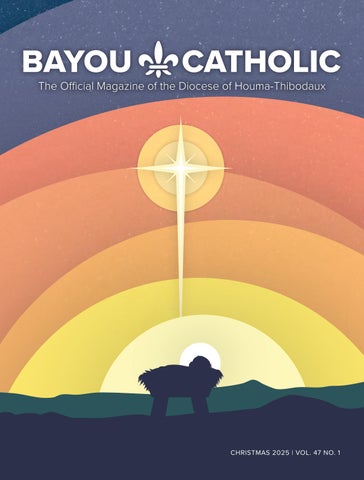
CHRISTMAS 2025 | VOL. 47 NO. 1 DIOCESE OF HOUMA-THIBODAUX | 1
You Deserve the Best in Health & Wellness Services, So We Built the Wellness Center
A $100M+ Investment in Your Well-Being Sports Complex – Built to NCAA standards; includes a multi-purpose field with 8-lane track, tennis courts, beach volleyball and outdoor basketball court. Fitness Center – State-of-the-art facility equipped with the latest technology and programs, aquatics, gymnasium and more; Certified and a top-ranked facility in the nation by the Medical Fitness Association; More than 1M visits since opening. Playground & Education Initiative – Addressing childhood obesity through nutrition education and new playground equipment for numerous area elementary schools. Sports – Keeping athletes safe by providing athletic trainers in high schools as well as Nicholls State University; Helping athletes grow and excel in sports through formation of competitive youth volleyball and swim teams. Wellness Education – Numerous and expanding programs for individuals and families on subjects like nutrition, weight management, diabetes, CPR and more. WellFit – Integrating wellness into clinical care to address specific health conditions like cancer, orthopaedic conditions, chronic pain and diabetes.
Leading the Way in Health & Wellness for Our Region
Thibodaux.com
4
CHRISTMAS 2025 VOLUME 47 NO. 1
BISHOP
Very Rev. Simon Peter Engurait DIRECTOR OF COMMUNICATIONS AND PUBLIC RELATIONS
Bevi Fontenot EDITOR
Joe O’Sullivan DESIGNER
Alaina Maiorana COVER DESIGNER
Connor Mabile BUSINESS MANAGER
Bill Barbera
ACCOUNTING SPECIALIST
Rebecca Thibodeaux CONTRIBUTING WRITERS
Fr. André Melancon Amber Moseley Michelle LeBlanc Shelby Ellis David Ponson Cindy Marino PHOTOGRAPHER
A CHRISTMAS MESSAGE FROM BISHOP SIMON PETER
12 RECLAIMING AND RENEWING OUR CATHOLIC IDENTITY A Pastoral Letter on Inaugurating Liturgical Renewal in the Diocese
communications@htdiocese.org VISIT US ONLINE
bayoucatholic.org
46 SERVING THOSE SERVING TIME The Heart Behind Prison Ministry
16 A LETTER FROM OUR NEW VICAR GENERAL
49 DISCERNING GOD’S WILL IN THE NEW YEAR How St. Ignatius Can Help Us Listen to God’s Voice
18 GRACE UPON GRACE The Williams Family Finds Joy in Grief
52 BEYOND THE HYPE A Catholic Look at Artificial Intelligence
24 FORTY YEARS OF LOVE Kenneth and Terri Chauvin’s Journey
56 BUILDING A LEGACY OF FAITH FOR TOMORROW David Ponson’s Family Story
28 HEART OF THE CHURCH From the Apostolic Exhortation of the Holy Father Leo XIV
60 CATHOLIC CHARITIES IN ACTION Nourishing our Neighbors in the Diocese
30 MORE THAN ENTERTAINED Home Alone and the Presence of Christmas
62 HEAVENLY RECIPES Pineapple Upside Down Cake
32 170 YEARS OF CATHOLIC EDUCATION The History of E.D. White Catholic High School 36 YOU ARE NOT ALONE Celebrating Christmas When Your Heart is Heavy
Serdave Duncan
EMAIL US:
42 LECTIO DIVINA The Shepherds at the Nativity
64 PRAYER AND LITURGICAL CALENDARS January February March 66 IN LOVING MEMORY OF FR. WILLIE TODD
38 CONSECRATION TO THE HOLY FAMILY PRAYER
67 IN CASE YOU MISSED IT Recapping Events Around the Diocese
39 KIDS CORNER Coloring Page Word Search
69 AROUND THE DIOCESE News Upcoming Events
A MESSAGE FROM OUR DIRECTOR
This Christmas, we celebrate the greatest gift of all: Christ’s presence among us. This issue features beautiful reflections for you and your families, including something special for the kids!
God’s love shines even in the darkest times. I want to especially thank Tanner and Maria Williams for their incredible courage in sharing their story for God’s greater glory.
Amid the joy of this season, the Holy Spirit reminded me that Christmastime can be heavy for those who carry grief, loneliness, or hardship. That’s why, in these pages, you’ll find profound testimonies of resilience, mercy, and grace—stories that show how
May you be inspired and encouraged as we welcome the light of Christ into our lives. -Bevi J. Fontenot Director of Communications & Public Relations
THE GIFT OF A SHEPHERD A CHRISTMAS MESSAGE FROM BISHOP SIMON PETER
My dear brothers and sisters in Christ, Merry Christmas! These days of both preparing for and celebrating the birth of our Savior in Bethlehem always fill my heart with great joy and hope. On that holy night, the Light of the World came into the darkness of our world to show us the human face of God. The mystery of the Incarnation reminds us just how close God desires to be with each one of us. As I celebrate my first Christmas as a bishop and shepherd of this diocese, I am naturally drawn to reflect on the shepherds in the Christmas story and the importance of the mission of the shepherd. The shepherds were the first to receive the news of the birth of the Savior. St. Luke recounts their experience when “an angel of the Lord appeared to them, and the glory of the Lord shone around them, and they were filled with fear” (Luke 2:9). Sensing their fear, the angel brought what must have been startling words to them: “Be not afraid; for behold, I bring you good news of a great joy which will come to all the people; for to you is born this day in the city of David a Savior, who is Christ the Lord. And this will be a sign for you: you will find a babe wrapped in swaddling clothes and lying in a manger” (Luke 2:1012). To these lowly shepherds God chose to bring the Good News that a Savior had come at long last! As I reflect on the shepherds and upon my role as a shepherd, I am inspired by their example and their trust. A shepherd must remain close to the flock entrusted to him. He cannot let them wander off but must guard, protect, and guide them. He gets to know them so that he can better understand where they need to go and how he can best shepherd them. The shepherds in the Gospel kept watch over their flock through the night, never relenting in this important duty. As I now serve as a shepherd to you, I am striving to imitate that example. Just as the shepherds remained close to their flock, even by night, and just as Jesus comes close to us in the mystery of the Incarnation, so I desire to be a shepherd who remains close to those entrusted to me. Much more than eloquent words or creative ideas, I am drawn to the importance of the ministry of presence and of closeness. As we move forward into this new season of our diocese, I find great hope in this gift God has given me. As I have now begun to
DIOCESE OF HOUMA-THIBODAUX | 5
visit parishes, school, and other ministries across our diocese, I am overwhelmed and humbled by the love and support I have been receiving from so many people. There is a real excitement at this new chapter that is palpable. God is doing many good things across our diocese, and I am privileged to have the opportunity to see it all unfolding. It is this gift and ministry of presence through which God will continue to draw us together as a diocesan family and move us forward as we follow His call as one body. I am also struck by the trust of the shepherds and their willingness to walk towards an unknown road without fully grasping the whole story. St. Luke tells us that “the shepherds said to one another, “Let us go over to Bethlehem and see this thing that has happened, which the Lord has made known to us.” And they went with haste, and found Mary and Joseph, and the babe lying in a manger” (Luke 2:15-16, emphasis added). The shepherds did not hesitate but rather went with haste to follow where God was pointing them. To live in such a way requires great trust, courage, and faith in the providence of God. As much as we try to predict what God will do, the reality is none of us have any idea what God has in store for us, whether as individuals, parishes, or as a diocese. But what we do know is that God has great things in store for us. If we are willing to walk into the unknown and unfamiliar with Him, He will not let us down. Through the mystery we celebrate in Christmas, He promises to each of us that He will stay close, fully uniting Himself to each of us as He takes on a human nature. This is especially true as we begin this season of liturgical renewal in our diocese. While I do not know what the future will hold, I am certain that as we draw closer to the Lord as we worship him in the liturgy, all things will be renewed by Him as a result. I invite each of us to commit to deepening our love for the liturgy and our experience of entering into each liturgical celebration we participate in. I am confident in the renewal that God will bring to our diocese as a result of following Him in faith and trust. My prayer is that, as we move forward together, remaining close to the Good Shepherd and longing to follow Him in all things, we will continue to see the good things God has in store. Then, like the shepherds, our response will be “glorifying and praising God for all that [we] heard and seen” (Luke 2:20). Know of my prayers for each of you and your families, especially during this Christmas season. May the Christ child be born anew in your hearts, filling you with unshakeable hope.
6 | BAYOU CATHOLIC
“
IF WE ARE WILLING TO WALK INTO THE UNKNOWN AND UNFAMILIAR WITH HIM, HE WILL NOT LET US DOWN.
DIOCESE OF HOUMA-THIBODAUX | 7
El regalo de un pastor Mensaje navideño del obispo Simón Pedro
8 | BAYOU CATHOLIC
Mis queridos hermanos y hermanas en Cristo, ¡Feliz Navidad! Estos días de preparación y celebración del nacimiento de nuestro Salvador en Belén siempre llenan mi corazón de gran alegría y esperanza. En aquella noche santa, la Luz del Mundo vino a la oscuridad de nuestro mundo para mostrarnos el rostro humano de Dios. El misterio de la Encarnación nos recuerda cuán cerca desea estar Dios de cada uno de nosotros. Al celebrar mi primera Navidad como obispo y pastor de esta diócesis, me siento naturalmente atraído a reflexionar sobre los pastores de la historia de Navidad y la importancia de la misión del pastor. Los pastores fueron los primeros en recibir la noticia del nacimiento del Salvador. San Lucas relata su experiencia cuando «un ángel del Señor se les apareció, y la gloria del Señor los rodeó de resplandor, y se llenaron de temor» (Lucas 2:9). Sintiendo su temor, el ángel les dijo unas palabras que debieron de sorprenderles: «No temáis, porque os traigo buenas noticias de gran alegría que serán para todo el pueblo: hoy, en la ciudad de David, os ha nacido un Salvador, que es Cristo el Señor. Y esto les servirá de señal: encontrarán a un niño envuelto en pañales y acostado en un pesebre» (Lucas 2:10-12). ¡A estos humildes pastores Dios eligió para darles la buena noticia de que por fin había llegado un Salvador! Al reflexionar sobre los pastores y sobre mi papel como pastor, me siento inspirado por su ejemplo y su confianza. Un pastor debe permanecer cerca del rebaño que se le ha confiado. No puede dejar que se alejen, sino que debe cuidarlos, protegerlos y guiarlos. Debe conocerlos para poder comprender mejor adónde deben ir y cómo puede pastorearlos mejor. Los pastores del Evangelio velaban por su rebaño durante toda la noche, sin descuidar nunca esta importante tarea. Ahora que soy su pastor, me esfuerzo por imitar ese ejemplo. Al igual que los pastores permanecían cerca de su rebaño, incluso de noche, y al igual que Jesús se acerca a nosotros en el misterio de la Encarnación, yo deseo ser un pastor que permanece cerca de aquellos que me han sido confiados. Mucho más que las palabras elocuentes o las ideas creativas, me atrae la importancia del ministerio de la presencia y la cercanía. A medida que avanzamos hacia esta nueva etapa de nuestra diócesis, encuentro una gran esperanza en este don que Dios me ha concedido. Ahora que he comenzado a visitar parroquias, escuelas y otros ministerios de nuestra diócesis, me siento abrumado y honrado por el amor y el apoyo que he recibido de tantas personas. Hay un entusiasmo real y palpable por este nuevo capítulo. Dios está haciendo muchas cosas buenas en toda nuestra diócesis, y tengo el privilegio de poder ver cómo se desarrollan. Es a través de este don y
ministerio de la presencia que Dios seguirá uniéndonos como familia diocesana y haciéndonos avanzar mientras seguimos su llamada como un solo cuerpo. También me impresiona la confianza de los pastores y su disposición a caminar hacia un camino desconocido sin comprender completamente toda la historia. San Lucas nos dice que «los pastores se dijeron unos a otros: “Vamos a Belén y veamos lo que ha sucedido, lo que el Señor nos ha dado a conocer”». Y fueron apresuradamente y hallaron a María y a José, y al niño acostado en el pesebre» (Lucas 2:15-16, énfasis añadido). Los pastores no dudaron, sino que se apresuraron a seguir el camino que Dios les indicaba. Vivir de esta manera requiere una gran confianza, valentía y fe en la providencia de Dios. Por mucho que intentemos predecir lo que Dios hará, la realidad es que ninguno de nosotros tiene idea de lo que Dios nos tiene reservado, ya sea como individuos, parroquias o como diócesis. Pero lo que sí sabemos es que Dios tiene grandes cosas reservadas para nosotros. Si estamos dispuestos a adentrarnos en lo desconocido y lo desconocido con Él, Él no nos defraudará. A través del misterio que celebramos en Navidad, Él nos promete a cada uno de nosotros que permanecerá cerca, uniéndose plenamente a cada uno de nosotros al asumir la naturaleza humana. Esto es especialmente cierto al comenzar esta temporada de renovación litúrgica en nuestra diócesis. Si bien no sé qué nos deparará el futuro, estoy seguro de que a medida que nos acercamos al Señor al adorarlo en la liturgia, todas las cosas serán renovadas por Él como resultado. Invito a cada uno de nosotros a comprometernos a profundizar nuestro amor por la liturgia y nuestra experiencia de entrar en cada celebración litúrgica en la que participamos. Confío en la renovación que Dios traerá a nuestra diócesis como resultado de seguirlo a Él, la fe y la confianza. Mi oración es que, a medida que avanzamos juntos, permaneciendo cerca del Buen Pastor y anhelando seguirlo en todas las cosas, sigamos viendo las cosas buenas que Dios tiene reservadas para nosotros. Entonces, al igual que los pastores, nuestra respuesta será «glorificar y alabar a Dios por todo lo que habían oído y visto» (Lucas 2:20). Sepan que rezo por cada uno de ustedes y sus familias, especialmente durante esta temporada navideña. Que el niño Jesús nazca de nuevo en sus corazones, llenándolos de una esperanza inquebrantable.
DIOCESE OF HOUMA-THIBODAUX | 9
Món quà của vị Chủ chăn Sứ điệp Mục Vụ Giáng Sinh của Đức Giám Mục Simon Peter 10 | BAYOU CATHOLIC
Anh chị em thân mến trong Chúa Kitô, Chúc Mừng Giáng sinh vui vẻ!! Những ngày chuẩn bị kỷ niệm sinh nhật Đấng Cứu Độ của chúng ta ở Bêlem luôn luôn lấp đầy trái tim tôi với niềm vui và hy vọng lớn lao. Vào đêm thánh vô cùng đó, Ánh sáng của Thế giới đã đi vào bóng tối của trần gian chúng ta để cho chúng ta thấy khuôn mặt nhân tính của Chúa. Bí ẩn của sự Nhập Thể nhắc nhở chúng ta rằng Thiên Chúa muốn gần gũi với mỗi người chúng ta như thế nào. Khi tôi kỷ niệm mừng Giáng sinh đầu tiên của mình với tư cách là giám mục và mục tử của giáo phận này, tôi tự nhiên bị thu hút để suy ngẫm về những người chăn chiên trong câu chuyện Giáng sinh và tầm quan trọng sứ mạng của người chăn chiên. Những người chăn chiên là những người đầu tiên nhận được tin vui về sự ra đời của Đấng Cứu Độ. Thánh Luca kể lại trải nghiệm của họ khi “một thiên sứ của Chúa hiện ra với họ, và vinh quang của Chúa chiếu toả chung quanh, khiến họ kinh khiếp hãi hùng” (Lc 2:9). Cảm nhận được nỗi sợ hãi của họ, thiên thần đã mang đến cho họ những lời lẽ đáng ngạc nhiên: “Anh em đừng sợ. Này tôi báo cho anh em một tin mừng trọng đại, cũng là tin mừng cho toàn dân: Hôm nay, Đấng Cứu Độ đã sinh ra cho anh em trong thành vua Đavít, Người là Đấng Kitô Đức Chúa. Anh em cứ dấu này mà nhận ra Người: anh em sẽ gặp thấy một trẻ sơ sinh bọc tã, nằm trong máng cỏ” (Lc 2:10-12). Đối với những người chăn chiên thấp hèn này, Đức Chúa đã chọn mang Tin Mừng Đấng Cứu Độ cuối cùng đã đến! Khi tôi suy ngẫm về những người chăn chiên và vai trò của tôi với tư cách là một người chủ chăn, tôi được truyền cảm hứng từ tấm gương và sự tin tưởng của họ. Một người chăn chiên phải ở gần đàn chiên được giao phó cho anh ta. Anh ta không thể để chúng đi lang thang nhưng phải canh chừng, bảo vệ và hướng dẫn chúng. Anh ấy hiểu chúng để có thể hiểu rõ hơn chúng cần đi đâu và làm thế nào anh ấy có thể chăm sóc chúng tốt nhất. Những người chăn chiên trong Tin Mừng đã canh chừng đàn chiên của họ suốt đêm, không bao giờ thờ ơ với nhiệm vụ quan trọng này. Khi tôi phục vụ như một người chăn chiên cho quý ông bà và anh chị em, tôi đang cố gắng bắt chước tấm gương đó. Giống như những người chăn chiên vẫn gần gũi với đàn chiên của họ, ngay cả vào ban đêm, và giống như Chúa Giêsu đến gần chúng ta trong mầu nhiệm Nhập Thể, vì vậy tôi mong muốn trở thành một người chăn chiên luôn gần gũi với những người được giao phó cho tôi. Hơn cả những lời hùng hồn hay những ý tưởng cao đẹp, tôi bị thu hút bởi tầm quan trọng mục vụ của sự hiện diện và sự gần gũi. Khi chúng ta bước vào mùa mới này của giáo phận, tôi tìm thấy hy vọng lớn lao trong món quà mà Chúa đã ban cho tôi. Khi tôi bắt đầu đến thăm các giáo xứ, trường học và các mục vụ khác trong giáo phận của chúng ta, tôi cảm thấy choáng ngợp và khiêm tốn trước tình yêu và sự hỗ trợ mà tôi đã nhận được từ rất nhiều người. Thực sự, có một sự phấn khởi ở chương mới này
và có thể đụng chạm được. Chúa đang làm nhiều điều tốt đẹp trên khắp giáo phận của chúng ta, và tôi rất vinh dự khi có cơ hội chứng kiến tất cả mọi sự diễn ra. Đó là món quà và mục vụ hiện diện mà qua đó Chúa sẽ tiếp tục đem chúng ta lại với nhau như một gia đình giáo phận và đưa chúng ta tiến lên khi chúng ta theo lời mời gọi của Ngài như một thân thể. Tôi cũng bị ấn tượng bởi sự tin tưởng của những người chăn chiên và sự sẵn sàng của họ để đi về phía một con đường vô danh mà không nắm bắt đầy đủ toàn bộ câu chuyện. Thánh Luca nói với chúng ta rằng “những người chăn chiên nói với nhau, “Chúng ta hãy đi qua Bêlem và xem điều này đã xảy ra, mà Chúa đã cho chúng ta biết.” Và họ vội vã ra đi, và tìm thấy Mẹ Maria và thánh Giuse, và hài nhi đang nằm trong máng cỏ” (Lc 2:15-16, nhấn mạnh thêm). Những người chăn chiên không ngần ngại mà vội vã đi theo nơi Chúa đang hướng dẫn họ. Để sống theo cách như vậy đòi hỏi sự tin tưởng, can đảm và niềm tin lớn lao vào sự quan phòng của Chúa. Nhiều như chúng ta cố gắng dự đoán những gì Chúa sẽ làm, thực tế là không ai trong chúng ta có bất kỳ ý tưởng nào về những gì Chúa có sẵn cho chúng ta, cho dù là cá nhân, giáo xứ hay giáo phận. Nhưng những gì chúng ta biết là Chúa có những điều tuyệt vời dành cho chúng ta. Nếu chúng ta sẵn sàng bước vào những điều chưa biết và không quen thuộc với Ngài, Ngài sẽ không làm chúng ta thất vọng. Thông qua mầu nhiệm mà chúng ta kỷ niệm vào dịp Giáng sinh, Ngài hứa với mỗi chúng ta rằng Ngài sẽ ở gần, hoàn toàn thông hiệp với mỗi chúng ta khi Ngài mang than phận con người. Điều này đặc biệt đúng khi chúng ta bắt đầu mùa canh tân phụng vụ trong giáo phận. Mặc dầu tôi không biết tương lai sẽ ra sao, nhưng tôi chắc chắn rằng khi chúng ta đến gần Chúa hơn, khi chúng ta thờ phượng Ngài trong phụng vụ, kết quả là tất cả mọi thứ sẽ được Ngài đổi mới. Tôi mời gọi mỗi người trong chúng ta cam kết làm sâu sắc thêm tình yêu của chúng ta đối với phụng vụ và trải nghiệm của chúng ta khi bước vào mỗi cử hành phụng vụ mà chúng ta tham dự. Tôi tin tưởng vào sự canh tân mà Chúa sẽ mang đến cho giáo phận của chúng ta như là kết quả của việc theo Ngài trong niềm tin và sự tin tưởng. Lời cầu nguyện của tôi là, khi chúng ta cùng nhau tiến về phía trước, ở gần Đấng Chăn Chiên Nhân Lành và khao khát đi theo Ngài trong mọi việc, chúng ta sẽ tiếp tục nhìn thấy những điều tốt đẹp mà Chúa gieo sẵn trong tâm trí. Sau đó, giống như những người chăn chiên, câu trả lời của chúng ta sẽ là “tôn vinh và ngợi khen Đức Chúa vì tất cả những gì họ đã nghe và thấy” (Lc 2:20). Hãy luôn nhớ rằng tôi hằng cầu nguyện cho từng anh chị em và gia đình, đặc biệt là trong mùa Giáng sinh này. Có thể Hài nhi Giêsu được sinh ra một lần nữa trong trái tim anh chị em, hầu lấp đầy anh chị em với niềm hy vọng không thể lay chuyển. DIOCESE OF HOUMA-THIBODAUX | 11
HOUMA-THIBODAUX
INAUGURATING LITURGICAL RENEWAL IN THE DIOCESE OF HOUMA-THIBODAUX
RECLAIMING AND RENEWING OUR CATHOLIC IDENTITY
A PASTORAL LETTER FROM MOST REVEREND SIMON PETER ENGURAIT, BISHOP NOVEMBER 29, 2025 Dear brothers and sisters in Christ, Peace be with you! We find ourselves once again beginning the First Week of Advent, which ushers us into a new liturgical year. The Church in her wisdom invites us to begin again, to renew our hope, to refocus our hearts, and to prepare with expectancy for the coming of the Lord. This Advent holds a special significance for me as this week marks the three-month anniversary of my episcopal ordination. As I continue to settle into the sacred ministry now entrusted to me as the sixth bishop of Houma-Thibodaux, I am struck by how providential it is that my own beginning coincides with the Church’s own sacred beginning. Moments of new beginnings are moments of grace. They invite us to listen more deeply to the promptings of the Holy Spirit and to allow the Lord to lead us where He desires. With Mary, we are invited to say, “Behold, I am the handmaid of the Lord; let it be to me according to your word” (Luke 1:38). Through much prayer and 12 | BAYOU CATHOLIC
reflection over these past months, I have listened and sensed a clear and gentle prompting from the Lord to which I invite us all to offer our “yes:” to inaugurate for our diocesan family an ongoing season of liturgical renewal. The liturgy is the public worship of God by the Church (cf. CCC 1069-1070). Through the liturgy, we, the people of God, participate in His work of redemption, whether through the Mass, the sacraments, or other sacred rites. The liturgy is the highest action of the Church and the source of her power. There is no other action of the Church more important than the celebration of the liturgy because it is there that we encounter the saving love of God (cf. Sacrosanctum Concilium 7). Therefore, this liturgical renewal cannot simply be about external practices and procedures, but about a deeper conversion of heart that renews the way we pray and the way we celebrate the sacred mysteries. In this way, we can allow the liturgy to more fully shape our identity as missionary disciples. The fruits and expressions of this renewal will unfold gradually over the coming years, always rooted in the Church’s rich tradition and always aimed at drawing us closer to Christ, apart from whom we can do nothing (cf. John 15:5). Over the course of the next few months, commissions will be established to enable the implementation of this renewal in a very intentional, practical, and wide-reaching way so that it may bear fruit—fruit that will last (John 15:16).
RENEWING OUR LOVE FOR JESUS IN THE EUCHARIST
At the heart of this season is a simple, profound desire: to fall in love again with Jesus, who gives Himself completely to us in the sacred Liturgy, and most especially in the gift of the Eucharist. Liturgical renewal cannot happen without Eucharistic renewal. The Lord is inviting us to rediscover the awe, the wonder, the silence, and the devotion that flow from a living Eucharistic faith. He is inviting us to worship Him with hearts that are fully His and to allow our lives to be shaped and transformed by what we celebrate at the altar.
South Louisiana has a great heritage of the Catholic faith. For generations our local Church has been sustained at the altar of the Lord, from which flows the “source and summit” of our Christian life in the Eucharist (cf. Lumen Gentium 11). Yet every generation must renew and reclaim its own love for our Eucharistic Lord. We must deepen our reverence and recommit ourselves to the sacred worship that God alone deserves. This is our moment to do just that.
GIVING THE LORD OUR VERY BEST IN THE SACRED LITURGY
In the sacred Liturgy, Heaven and earth meet. Angels and saints surround us and worship with us. Jesus Christ becomes truly present. Because of this mystery, we strive to offer God nothing less than our very best. During this season of Liturgical Renewal, we will work to cultivate reverence that reflects the holiness of the mystery before us, beauty that lifts our hearts to God, noble simplicity that reveals rather than distracts from the sacred, and prayerful participation that draws the faithful deeper into Christ’s sacrifice.
A RENEWAL OF SACRED MUSIC
A particular focus of this season will be sacred music, the musical prayer of the Church that gives voice to our worship. The Church teaches that sacred music is not merely an artistic addition but rather an integral part of the liturgy. Throughout this renewal, we will work to form, support, and equip parish music ministries to recover the rich treasury of sacred music the Church offers. I extend a special word of gratitude to our musicians and choir members. Your ministry is essential to the prayer of the Church. I promise you the support of your diocese as we strive together to renew our musical offering to the Lord.
DIOCESAN LITURGICAL CELEBRATIONS
Throughout this time of renewal, we will gather as the Mystical Body of Christ to worship our Lord in profound and public ways. You will be invited to participate in Eucharistic and other liturgical processions in our towns and parishes, large
DIOCESE OF HOUMA-THIBODAUX | 13
diocesan liturgies that unite our people around Jesus Christ our High Priest, and missions and catechesis on the importance and necessity of the Liturgy and how we can better incorporate it into our lives of faith. These moments will allow us to better know and proclaim to our neighbors that Jesus is truly among us in the Liturgy, walking with His people.
THAT CHRIST MAY BE OUR CENTER AGAIN
This season of Liturgical Renewal is not simply about improving practices or updating procedures. It is about conversion. While the liturgy is the most important action of the Church, it does not exhaust the entire activity of the Church and must be accompanied by evangelization, faith, and conversion (cf. CCC 1072). The Renewal is about returning, as a diocesan family, to the One who gives meaning to everything we do. If we succeed in placing the Liturgy again at the center of our lives, our homes, and our parishes, then everything else will be renewed: our vocations, our ministries, our mission, and our hope as a people.
“
THE RENEWAL IS ABOUT RETURNING, AS A DIOCESAN FAMILY,
A FINAL INVITATION
I invite every priest, deacon, religious, lay leader, family, and parishioner to enter this time of renewal with open hearts. The Lord desires to do something beautiful in us. May we allow Him total access to work as He desires. Let this be the season when we more fully recognize Jesus in His work of the Liturgy and when we rediscover who we are because we rediscover Whose we are. May Mary, Mother of the Church, accompany us. May St. Francis de Sales and St. Joseph, patrons of our diocese, guard us. And may Jesus Christ, our High Priest, transform us ever more fully into His missionary disciples. With paternal affection and confident hope, I impart my blessing.
+ Bishop Simon Peter Engurait Bishop of the Diocese of Houma-Thibodaux 14 | BAYOU CATHOLIC
TO THE ONE WHO GIVES MEANING TO EVERYTHING WE DO.
DIOCESE OF HOUMA-THIBODAUX | 15
HOUMA-THIBODAUX
WADING INTO THE SHALLOW WATER:
DISCOVERING MY NEW ROLE AS VICAR GENERAL BY: FR. ANDRÉ MELANCON, VICAR GENERAL
One of my favorite places in the world to go is Grand Isle. I love the peacefulness of the beach, and I love to swim in the gulf water. When I go swimming at the beach, I don’t begin by diving into the deep water. I start by wading in the shallow water, feet sinking gently into the mud, trying not to step on a crab, learning the terrain one careful step at a time. Over these past few weeks, as I have begun my new assignment as vicar general of the Diocese, this image has stayed with me. I am wading in, slowly discovering how God is asking me to serve in this new ministry. As many of you know, the vicar general is called primarily to be a support to the bishop. He is described as the bishop’s “other self”: A companion in ministry who assists the bishop in carrying out the pastoral, administrative, and spiritual responsibilities entrusted to him. Some days that support looks practical: helping coordinate projects, offering consultation, or making myself available for the countless decisions that cross his desk. Other days, support looks more contemplative, like standing beside him in prayer and listening with him for what the Holy Spirit is inviting our diocese to become. One of the blessings of serving with Bishop Simon Peter is his commitment to discernment. He does not rush into meetings or decisions. Instead, he leads from a place of deep listening. Frequently, before we speak about a sensitive issue or weigh a significant decision, we begin not with conversation, but in the chapel kneeling before the Blessed Sacrament. There, in that posture of prayer, we ask the Lord to speak first. We ask for wisdom, and the freedom to follow wherever Christ leads. This rhythm of prayer before action has already shaped the way I approach this new ministry. Though I am only about a month into this role, the opportunity to support Bishop Simon Peter has brought me great fulfillment and peace. There is a joy in being able to offer fraternal support to him, as he is giving so much of himself to shepherd our diocese. To walk with him, to pray with him, and to serve alongside him is both a gift and a responsibility that I do not take lightly. And yet, I know I am still in the shallow waters, learning the expectations, discovering the responsibilities, and discerning how God desires to use me in this ministry. But even in these early steps, the Lord is clear. He is telling me to stay close to the bishop, stay close to the people of our Diocese, and most importantly, stay close to Him. My hope is that as I continue to wade deeper into this new role, I will do so with a heart rooted in prayer, a spirit open to collaboration, and a willingness to serve wherever the Church needs me most. Please keep Bishop Simon Peter and me in your prayers as together we seek to follow Christ faithfully in service to the Diocese of Houma-Thibodaux. If these first days are any indication, the Lord is already at work, and the water, even in the unknown, is filled with grace.
“
THE WATER, EVEN IN THE UNKNOWN, IS FILLED WITH GRACE.
DIOCESE OF HOUMA-THIBODAUX | 17
GRACE UPON GRACE THE WILLIAMS FAMILY FINDS JOY IN GRIEF BY: BEVI FONTENOT
18 | BAYOU CATHOLIC
“For from His fullness we have all received, grace upon grace” (John 1:16). In December of 2024, Tanner and Maria Williams were preparing to celebrate Christmas with their two young children, Alice (2) and Abram (4 months). But their lives changed forever when Abram passed away. One year later, Tanner and Maria share their testimony of how the Lord met them in their deepest grief and carried them with His strength, grace, peace, and comfort through the hardest season of their lives.
A GUIDING STAR IN THE NIGHT
Christmas came shortly after Abram’s passing, and Tanner and Maria didn’t know how they could celebrate. But Maria knew one thing for certain: “We needed to keep Christmas alive for our 2 ½ year old.” Without being asked, friends and family decorated, wrapped gifts, and helped to create a quiet, intimate Christmas celebration at their home last year. This Christmas marks one year since Abram’s passing. “It will still be different this year because even in the happiest moments, he is missing,” Maria reflected. Their holidays look different now because they are different. They prioritize time together as a family of three. “It goes back to perspective and the people you are with,” Tanner said. They set boundaries and say no when they need to. More than ever, “it’s about knowing what you can handle.” Maria admits that it can be difficult to be fully present in large gatherings. “It’s hard to feel fulfilled in those settings anymore. It’ll never feel the same,” she explained. They hosted Thanksgiving this year, but Maria kept things simple. “We have to honor and protect our peace, and our family and friends understand,” she said. “Say only yes if you mean yes, and no if you mean no” (Matthew 5:37).
A REFINING FIRE
In their grief, Tanner and Maria found themselves encountering God in new and profound ways. “I thought I knew who Jesus was,” Maria said, “but this is a whole new understanding of who He is—His grace, His peace and the Holy Spirit.” Though she had believed in the Holy Spirit her whole life, she now feels His guidance vividly. “There are so many signs now. It’s unmistakable that it’s the Holy Spirit guiding me in what to say or do.” Maria also came to understand grace more deeply. Grace is defined in the Catechism as “the favor of God, the free and undeserved help that God gives us to respond to his call” (CCC, 1996). “Sometimes we think we have to earn our reward in Heaven,” she said, “but we don’t need to earn His gifts. We just need to accept them.” Tanner echoed that truth: “The price was already paid when Jesus died on that hill. Even though we fall short every day, the grace of Jesus washes us clean.”
DIOCESE OF HOUMA-THIBODAUX | 19
That grace didn’t just carry them; it reshaped their view of life and death. “I have so many reasons to live,” Maria said, “but knowing my son is there and that we all can be together again…it is so exciting.” Tanner feels that mission deeply. “We have someone there waiting for us,” he said. “We have to go above and beyond now to be better Christians.” He strives for that goal everyday, but he knows that he won’t be perfect. “I’m going to trip and fall, but I’ll get back up. I’ll lead my family the best way I know possible, and we’re going to get to Heaven.” “Though I have fallen, I will rise. Though I sit in darkness, the Lord will be my light” (Micah 7:8 ).
FAITH THAT KEEPS BURNING
By attaching their hope to God, Tanner and Maria are able to take steps forward. “What else could we hope in?” said Maria. She recalled the words of Simon Peter
20 | BAYOU CATHOLIC
in the Gospel of John, “Lord, to whom would we go? You have the words of eternal life” (John 6:68). They keep Abram’s memory alive every day, especially for Alice, who talks about him daily. “She makes us so happy,” Maria said, “and we see him through her. Her questions are a beautiful way to teach her about God.” Alice, who is now 3 ½ years old, continues to ask about Abram often. Maria reminds her that they will all be together again one day. “I tell her that she can talk to Abram and to Jesus at all times.” Tanner and Maria are both thankful to have each other to lean on and grieve with. “We can tell when it’s a good or bad day for each other,” she said. “Having a husband who is faith-filled and so similar to me…it’s God-sent. It has brought us closer together.” This past year has deepened their faith profoundly. Now, they are much more in tune to the movements of the
Lord and His Spirit. “I have a closer relationship with God and I’m grateful,” Maria said. “And in that sense, I can actually find joy inside of my grief.” Maria knows that grief moves in waves, and some days are better than others. “Sometimes you just need a good cry, and then you feel lighter.” She emphasizes that grief is not meant to be compared, but shared. “Everyone experiences loss differently,” she said. Daily life can also be challenge for her as she moves through grief. “I still need to pick Alice up, go to the store, and do ordinary things,” Maria explained. As she navigates the daily demands of life, she finds solace in a resource for grieving parents called Redbird Ministries and their podcast titled It’s Not for Nothing. Through it, she learned a challenging truth: She would have to acknowledge the impossible reality before her. “It’s hard to accept that your child is gone, but I have to live in it and accept this as reality.” She explained further, “I have to intentionally and cognitively embrace the truth and let it settle into my own reality, in my mind, body and soul.” This practice helps her in her day-to-day life. “When my mind starts to wander, that truth recenters me. It’s really the only way I put one foot in front of the other.” In the midst of her pain, Maria’s faith in God never wavered. And she credits her Catholic upbringing for that. “I’m thankful because I knew exactly where to turn. I couldn’t survive without God.” The adoration chapel has become a refuge for Maria, and she visited often in the early days of her loss. “It is a piece of heaven,” she shared. Tanner echoed Maria’s conviction of unwavering faith. “We aren’t going to be here forever, so let’s make the most of it. Now, water tastes sweeter. Joy tastes sweeter. You can’t appreciate that sweetness without knowing sorrow.” He knows God has a plan and purpose for our lives. “No matter what happens,” he said, “you have Jesus Christ. Who better to walk through suffering with you?” That’s why Christian music has been a lifeline for them. They both point to Brandon Lake’s “Gratitude,” Samantha Ebert’s “Flowers in the Valley,” and Phil Wickham’s “Homesick for Heaven” as standouts for God’s healing and peace. Maria intentionally surrounds herself with things that draw her closer to God. “Most days, I rather fill my mind with religious music, TV shows like The Chosen, or with prayer. My relationship with Jesus is different, and those things bring comfort.” And instead
DIOCESE OF HOUMA-THIBODAUX | 21
of spending time on social media, she chooses to stay focused and be present. “That’s big for grieving families...you need support, but you have to find it the right way.” Each day, Maria is also able to hold on to many signs of comfort and reassurance from the Lord. She recalls blessing Abram often when putting him down to sleep, whispering, “The Lord bless you and keep you.” She sees and hears this verse often now, a personal reminder for her that God is holding Abram—and them—in His arms. “It comforts me to know he’s okay, he’s with God, and God is in control,” she said. “With the Lord a day is like a thousand years, and a thousand years are like a day” (Peter 3:8). And Maria no longer worries that Abram was too young to know God. “After his death, I’d read the Bible and think, ‘What about Abram?’ He was too young to pray or understand. But now I realize that Abram knew God, because he knew unconditional love through his family.”
AN EMBER OF HOPE
This year, God has blessed the Williams with a special gift: Tanner and Maria are expecting their third child in April of 2026—an Easter baby. “Easter has always been my favorite holiday,” Tanner shared. “I get emotional thinking about what Jesus did for us. Having a baby at Easter time is God’s reminder of new life—of our salvation and redemption.” Maria recalled the moment she learned she was pregnant this past August. “It was immediate joy combined with immediate heartbreak,” she explained. “We were so excited but also overcome with grief all over again.” Still, she remains hopeful. “It will be very spiritual, very emotional, and very different this time,” Maria said. “It will be a full-circle moment to have a new life in the midst of it all.” Tanner and Maria continue to trust in God and His timing. “God has never failed us,” said Maria. “He has always shown up.” Somehow through her loss, she recognizes God’s hand in it all. Even his name—Abram Joseph—became a quiet confirmation of God’s closeness. Only later did they learn that Abram and Joseph represent the beginning and end of Jesus’ lineage. “There are so many God-winks,” she said. “It’s not just a coincidence.” Through it all, Tanner and Maria feel immense gratitude. The support that has surrounded them has made an impact to this day. “There are just no words to express our thankfulness,” said Maria. “There is power in prayer, and we still feel it. I wish we could pay it back.” 22 | BAYOU CATHOLIC
Now, Tanner feels called to reach out to others who have experienced the loss of a child. “God puts people in your life for a reason. Our lives were impacted by others, and now we can touch other lives in return.” Maria encourages anyone supporting a grieving family: “If God puts someone on your heart, reach out. Send a card or a text. Let them know they are not forgotten. Keep praying. You can’t just brush over grief.” To honor Abram, the Williams plan to continue a family tradition with a beach vacation each year on his birthday. And of course, that’s just one of the ways they plan to keep his memory alive. “You should never stop celebrating them,” Maria said. “They are your kids forever.”
“
YOU CAN’T APPRECIATE THAT SWEETNESS WITHOUT KNOWING SORROW.
A LIGHT THAT LEADS US HOME
Tanner and Maria will never be the same—and they don’t want to be. God’s purpose for their lives has never been clearer. Their deep surrender and unshakeable trust show that grief didn’t harden their hearts, it expanded them, drawing them closer to the heart of Christ. By God’s grace, they can hold space for gratitude even amid sorrow, recognizing every comfort and blessing that comes from Him. But their hope is not blind: It is rooted in the Resurrection—God’s promise that death is not the end. And like Abram’s memory, that steady flame cannot be put out. “God has given us this story,” said Maria, “and we choose to still praise Him and believe in Him despite our pain.” Tanner and Maria are living proof that it is possible to walk through darkness and find the light of Jesus there. Because joy and grief can go hand-in-hand. Faith and sorrow can coexist. And God can bring light into the deepest darkness, just as He did on that first Christmas night. It’s the same joy that Abram’s sister, Alice, loves to sing about in her favorite song—the joy she carries so freely because it’s “down in her heart.” This Christmas season, no matter what it holds, may Jesus Christ fill your hearts with His joy and surround you with His love, His presence, and His peace. DIOCESE OF HOUMA-THIBODAUX | 23
BY: BEVI FONTENOT
FORTY YEARS OF LOVE
KENNETH AND TERRI CHAUVIN’S JOURNEY On August 23, 1985, Kenneth and Terri Chauvin stood before God and vowed to love each other for a lifetime. Now, forty years later, with full hearts, they reflect on a marriage shaped by prayer, perseverance, and community—and God’s hand in it all.
ROOTED IN PARISH LIFE
Kenneth grew up near Holy Rosary Catholic Church in Houma, and that is where he first encountered how faith and family life work together. He watched his parents serve and volunteer in the parish community. “My dad was a lector and commentator, and my mom was in the Ladies Altar Society.” From the start, he was involved in the parish: “All of my sacraments were at Holy Rosary. And I grew up stuffing bulletins for Marilyn Null, serving as altar boy for masses, weddings, funerals, and serving Midnight Mass on Christmas Eve, because my Dad was there.”
24 | BAYOU CATHOLIC
Seeing his parents serve the Church and getting involved from a young age planted seeds that would shape the kind of man, husband, and father he would one day become.
A BLOSSOMING LOVE
Like many love stories, Kenneth and Terri had a chance meeting through their workplace, Terrebonne Bank and Trust, where he worked in computer programming and she worked as a secretary. Kenneth still remembers what first drew him to her: “Everyone loved Terri. She had a beautiful smile, beautiful eyes, and she was kind and friendly.” They would see each other at staff gatherings and always enjoyed talking to each other. From the beginning, he recognized something special about her. “I saw right away that Terri was a faith-filled woman,” he said, “and that’s what I had prayed for.” Kenneth
decided to ask her on a date—that was back in 1983— and they continued seeing each other from there.
going to get married,” said Kenneth confidently. “I knew Terri was the person I wanted to build a life with.”
Kenneth later switched to night shifts, and Terri would stop by with home-cooked meals. “She was quite the cook, and that definitely didn’t hurt,” he laughed. But it was truly Terri’s heart—and her family—that drew him in. “I felt a kindred spirit with her parents,” he said. “I could tell that our families shared the same values, like faith, hospitality, being together. It all just fit.”
After just over one year of dating, Kenneth asked Terri’s father for permission to propose. “Her dad wasn’t a man of many words,” Kenneth smiled. “I told him I loved her and wanted to marry her. He said, ‘Well, if y’all love each other, that’s okay with me.’ And that was that.”
Terri’s side of the story was similar. She remembers falling for Kenneth quickly, though she was cautious at first. “But meeting his family changed everything,” she said. “After that, I fell in love with all of them.”
GROWING IN GRACE TOGETHER
Kenneth and Terri were married at Holy Rosary Catholic Church, the parish that had shaped so much of Kenneth’s early life. Attending Mass there became central to their life together as a family.
Kenneth invited Terri to join him and his family at Mass each week, something she hadn’t been doing regularly even though she was raised Catholic. She could tell how much his faith meant to him. “Seeing how much he desired to go to church…something shifted in my heart,” she said. “His faith encouraged mine.”
Throughout the years, both Kenneth and Terri served the church in various ways by being extraordinary ministers, volunteering with youth ministry, helping with confirmation preparation, and more. Through it all, they always kept faith at the forefront.
Their romance grew as they spent more time together and with family. “I think we always just knew we were
Over the years, one prayer in particular became a pillar for their marriage: the Serenity Prayer. “Every carpenter has a tool they always go back to,” Kenneth said. “For us,
DIOCESE OF HOUMA-THIBODAUX | 25
that tool is the Serenity Prayer. It can be prayed daily, and it has carried us through every season of life together.”
BEARING FRUIT THAT WILL LAST
Kenneth and Terri raised their two children, Jude and Amie, in a home where faith wasn’t just spoken; it was lived. They brought them up to prioritize faith, family and church life. They sent them both to Catholic school, but it was their daily example that made the most impact. They instilled the importance of Mass and always went together as a family. “We always sat in the front pew with the kids,” Kenneth said. “They could see firsthand that our life was rooted in faith.” Kenneth also remembered having important conversations with the kids about the Church’s seasons, traditions, and prayers. “We wanted them to understand why we do what we do as Catholics,” he explained. One tradition especially dear to Kenneth is his annual silent retreat at Manresa, which he has attended for more than 40 years. A special moment for him was getting to bring his son, Jude, when he was a teenager. “It planted something in him,” Kenneth said. “And he still goes every year.” Terri echoed Kenneth’s passion to guide their children toward God. “As you get older, you realize you do need God,” she shared. “It’s always been important for us to show that to our children.” Their hearts are full seeing how their children have grown, and now they have three grandchildren. Their son Jude, 36, works as a Senior Network Administrator at Thibodaux Regional and is a devoted father to three boys, Conor, Calvin and Benson. Amie, 32, is a nurse and assistant professor at Nicholls State University. “We couldn’t be prouder,” said Kenneth. “We love our kids with a boundless love. And I couldn’t have asked for a better mother for my children or grandmother for my grandkids.” Their hope has always been to teach their children the importance of faith, humility, and selfless love—and they’ve done just that.
A GARDEN OF GRATITUDE
Over the years, Kenneth and Terri have grown together in faith, love, trust, and commitment. They pray together, 26 | BAYOU CATHOLIC
GOD, GRANT ME THE SERENITY TO ACCEPT THE THINGS I CANNOT CHANGE, THE COURAGE TO CHANGE THE THINGS I CAN, AND THE WISDOM TO KNOW THE DIFFERENCE. go to Mass regularly, and honor God’s presence in their lives. They both go to bed with a rosary in their hands. “We realize that everything we have—our family, our children, our health—it’s all given to us by God. None of it is from our own doing.” Kenneth continues to serve at Holy Rosary Catholic Church to this day as a member of the Knights of Columbus, alongside one of his brothers. “Being in the Knights connects me to memories of my dad, and it gives me time with my brother. It’s part of giving back to the church.” When asked what he admires most about Terri after four decades together, Kenneth didn’t hesitate: “She is the rock of our family. There is nothing she wouldn’t do for me, our kids, or our grandkids. She loves big. Her strength and her faith inspire me every day.” Terri showered compliments right back that can only be learned through experience. “He’s patient, thoughtful, and conscious of my feelings. And he really has a way of calming me when I feel upset. He’s a great man— everyone who meets him says it.” Like any couple, they’ve encountered challenges and tough times. But they’ve walked through them together. Terri believes in the words of their vows. She said a lasting marriage requires intentional effort from both spouses. “You both have to give 100%,” said Terri. “Let things go, focus on what matters, and always find your
AMEN. way back to each other. And be honest with each other in everything.” For Kenneth, patience and mutual respect are essential. “You have to look at the big picture, especially in difficult times. We’ve always worked to make things right.” “And it brings me joy to make her happy,” he added.
A BEAUTIFUL FUTURE
In the coming years, Kenneth and Terri look forward to retirement and spending more time with their grandchildren. They express a profound gratitude for their journey and God’s steady hand through it all. The older they get, the more they realize how precious each day really is. Kenneth shared, “I sometimes think about what life would be like without her—and I don’t take a single moment for granted. I am truly blessed to be married to her. We’ve had a lovely life.” Terri feels the same way. “I am very thankful to have Kenneth as my soulmate.” They’ve learned many things in forty years of marriage, but what they know the most is: God has been at the center of their lives, guiding, strengthening and blessing their marriage in every season. And for that, they are incredibly thankful.
DIOCESE OF HOUMA-THIBODAUX | 27
PRAYER
HEART OF THE CHURCH FROM THE APOSTOLIC EXHORTATION OF THE HOLY FATHER LEO XIV
DILEXI TE We invite you to read the first Apostolic Exhortation from Pope Leo XIV. Entitled Dilexi Te (“I Have Loved You”), it is addressed to all Christians on love for the poor. Its primary call is that love of Christ and love for the poor are intimately connected. We encourage you to read his message slowly, stopping to reflect on the parts that grab your attention, at a pace you’re comfortable with.
THE CHOICE OF THE POOR
16. God is merciful love, and his plan of love, which unfolds and is fulfilled in history, is above all his descent and coming among us to free us from slavery, fear, sin and the power of death. Addressing their human condition with a merciful gaze and a heart full of love, he turned to his creatures and thus took care of their
poverty. Precisely in order to share the limitations and fragility of our human nature, he himself became poor and was born in the flesh like us. We came to know him in the smallness of a child laid in a manger and in the extreme humiliation of the cross, where he shared our radical poverty, which is death. It is easy to understand, then, why we can also speak theologically of a preferential option on the part of God for the poor, an expression that arose in the context of the Latin American continent and in particular in the Puebla Assembly, but which has been well integrated into subsequent teachings of the Church. [12] This “preference” never indicates exclusivity or discrimination towards other groups, which would be impossible for God. It is meant to emphasize God’s actions, which are moved by compassion toward the poverty and weakness of all humanity. Wanting to inaugurate a kingdom of justice, fraternity and solidarity, God has a special place in his heart for those who are discriminated against and oppressed, and he asks us, his Church, to make a decisive and radical choice in favor of the weakest. 17. It is in this perspective that we can understand the numerous pages of the Old Testament in which God is presented as the friend and liberator of the poor, the one who hears the cry of the poor and intervenes to free them (cf. Ps 34:7). God, the refuge of the poor, denounces through the prophets — we recall in particular Amos and Isaiah — the injustices committed against the weakest, and exhorts Israel to renew its worship from within, because one cannot pray and offer sacrifice while oppressing the weakest and poorest. From the beginning of Scripture, God’s love is vividly demonstrated by his protection of the weak and the poor, to the extent that he can be said to have a particular fondness for them. “God’s heart has a special place for the poor... The entire history of our redemption is marked by the presence of the poor.” [13]
JESUS, THE POOR MESSIAH
18. The Old Testament history of God’s preferential love for the poor and his readiness to hear their cry — to which I have briefly alluded — comes to fulfillment in Jesus of Nazareth. [14] By his Incarnation, he “emptied himself, taking the form of a slave, being born in human likeness” (Phil 2:7), and in that form he brought us salvation. His was a radical poverty, grounded in his mission to reveal fully God’s love for us (cf. Jn 1:18; 1 Jn 4:9). As Saint
Paul puts it in his customarily brief but striking manner: “You know well the grace of our Lord Jesus Christ, that though he was rich, yet for your sakes he became poor, so that by his poverty you might become rich” (2 Cor 8:9). 19. The Gospel shows us that poverty marked every aspect of Jesus’ life. From the moment he entered the world, Jesus knew the bitter experience of rejection. The Evangelist Luke tells how Joseph and Mary, who was about to give birth, arrived in Bethlehem, and then adds, poignantly, that “there was no place for them in the inn” (Lk 2:7). Jesus was born in humble surroundings and laid in a manger; then, to save him from being killed, they fled to Egypt (cf. Mt 2:13-15). At the dawn of his public ministry, after announcing in the synagogue of Nazareth that the year of grace which would bring joy to the poor was fulfilled in him, he was driven out of town (cf. Lk 4:14-30). He died as an outcast, led out of Jerusalem to be crucified (cf. Mk 15:22). Indeed, that is how Jesus’ poverty is best described: he experienced the same exclusion that is the lot of the poor, the outcast of society. Jesus is a manifestation of this privilegium pauperum. He presented himself to the world not only as a poor Messiah, but also as the Messiah of and for the poor. 20. There are some clues about Jesus’ social status. First of all, he worked as a craftsman or carpenter, téktōn (cf. Mk 6:3). These were people who earned their living by manual labor. Not owning land, they were considered inferior to farmers. When the baby Jesus was presented in the Temple by Joseph and Mary, his parents offered a pair of turtledoves or pigeons (cf. Lk 2:22-24), which according to the prescriptions of the Book of Leviticus (cf. 12:8) was the offering of the poor. A fairly significant episode in the Gospel tells us how Jesus, together with his disciples, gathered heads of grain to eat as they passed through the fields (cf. Mk 2:23-28). Only the poor were allowed to do this gleaning in the fields. Moreover, Jesus says of himself: “Foxes have holes, and birds of the air have nests; but the Son of Man has nowhere to lay his head” (Mt 8:20; Lk 9:58). He is, in fact, an itinerant teacher, whose poverty and precariousness are signs of his bond with the Father. They are also conditions for those who wish to follow him on the path of discipleship. In this way, the renunciation of goods, riches and worldly securities becomes a visible sign of entrusting oneself to God and his providence.
DIOCESE OF HOUMA-THIBODAUX | 29
CULTURE
DR. AMBER MOSELEY
is a wife, mother and Senior Varsity Catholic Manager for FOCUS (the Fellowship of Catholic University Students). She and her family reside in De Soto, Missouri.
HOME ALONE AND THE PRESENCE OF CHRISTMAS Everyone loves a good Christmas movie. Some people celebrate Christmas in July with a film. Others curl up to watch their favorite Christmas flicks starting November 1. But why do we love Christmas movies so much? In short, it is because they provide a feel-good image of the life for which we strive: harmony with the people around us and with Christ. On Christmas day above all others, people seem to put aside their issues and come together to celebrate. There are several movies that bring this ideal to life, but I am going to go with the 1990 classic, Home Alone. Many of us are well aware of the plot line of this story, but if it has been a bit, here is a refresher. The McCallister family is headed to France to be with the rest of their extended family for Christmas. The night before they are to leave for the airport, eight-year-old Kevin blows up on his highly chaotic and dysfunctional family. He gets into a major fight with his mom, telling her some awful (yet not entirely unfounded) things and saying he 30 | BAYOU CATHOLIC
hopes he never sees any of his family again. As he settles to sleep in the attic, Kevin wishes that his whole family would disappear. Overnight the power goes out, leaving no alarms to wake the McCallisters. They all oversleep. A frenzy takes over the house as everyone rushes to get ready and out of the house before the airport shuttle leaves. They make the plane in time, but the reprieve lasts only briefly. Kevin’s mom has the sense they have forgotten something, and she soon realizes they have forgotten not something but someone: Kevin! Back at the McCallister residence, Kevin wakes up alone and truly believes he made his family disappear. At first, he is excited for his new freedom, to not be picked on, and not be told what to do. Kevin trashes his body with junk food, his mind with TV, and the house with a tarantula, among other things. Once the newness wears off, however, Kevin realizes he must step up and start taking care of himself and the house. He braves the basement and does laundry, and he shops for groceries.
Kevin thrives in this independence and feels like he is doing pretty well until the Wet Bandits show up. The Wet Bandits are burglars who plan to clean out the valuables from each house on the block, targeting his house as the holy grail. After a brief retreat underneath his parent’s bed, Kevin is determined to now become the protector of his home. “This is my house,” he reminds himself. “I have to defend it!” As many of us know, one of the most comical series of boobie traps soon awaits the unsuspecting burglars.
Fast forward a bit. Kevin has fought off the Wet Bandits with some help from the neighbor, and it is now Christmas morning. Kevin wakes up and, in hopeful anticipation, runs downstairs looking for his family, but no one is there. However, he walks around the house and circles back to the front to find his mom in the entryway. The rest of his family comes in right after. Everyone rejoices over Kevin’s safety and all is forgotten from the fight before…well, except for Buzz and his destroyed room!
Impressively, Kevin still finds time to prepare his home for Christmas. Keep in mind… he is 8. Kevin cuts down his own tree and decorates it; he cleans the house and brings out the Christmas dinnerware. In hope to receive his returning family, he prepares the way, just like we do in Advent to prepare the way for Christ to come.
Despite how difficult being with family can be, the presence of our families is what brings out the joy of Christmas. Being alone on Christmas does not feel right, and Kevin and his neighbor show us the pain that this loneliness can cause. With Christmas we are celebrating the Word becoming flesh—Christ being among us. It is about union with each other and ultimately with our God.
Each year as we celebrate Christ’s birth, we are also looking ahead and living our life in great anticipation for Christ’s final return. In waiting for the presence of Christ, life can be scary and lonely. Just like Kevin, we can be faced with trials that threaten to take away our peace. We see Kevin experience not only the trials of the Wet Bandits but also great loneliness. Even as he works up the courage to defend his house, he realizes that it is the presence of his family that truly makes it a home. There is a scene when Kevin is walking back to his house, and he sees a family gathered around the tree in their living room. He walks away sad. He then passes the Catholic church, where he hears music and enters, seeking comfort. He encounters the “scary” neighbor who is listening to his granddaughter rehearse. We learn that, due to a fight he had with his son, he is not allowed to see his granddaughter. Kevin is wise beyond his years and encourages the man to make up with his son, especially with the holidays coming. Kevin has grown a lot in these last few days, going from never wanting to see his family again to wishing for their return.
“
Christmas is the Church’s proclamation that God is not distant. In the Incarnation, he chose presence—real, embodied presence through the Eucharist. Jesus came to us in the ordinary—in a quiet, hidden stable. He is present in the same way through day-to-day life with our dysfunctional families. His presence does not end at Christmas though. Jesus remains present to us in His Body and Blood in the Eucharist, in His Word, in the quiet movements of our hearts, and in our families each day. So, this Christmas season, let us embrace our families and rejoice to have them with us, as Christ is with us. “Our Savior, dearly beloved, was born today: let us rejoice. For there is no room for sadness now that Life has come near.” -St. Leo the Great
CHRISTMAS IS THE CHURCH’S PROCLAMATION THAT GOD IS NOT DISTANT.
HOUMA-THIBODAUX
170 YEARS OF CATHOLIC EDUCATION:
THE HISTORY OF E.D. WHITE CATHOLIC HIGH SCHOOL MICHELLE LEBLANC
is the Archivist of the Diocese of HoumaThibodaux. The Archives and Records Center contains the dicoese’s historical records and maintains school and church records for the diocese. For questions or further research, please email archives@htdiocese.org
32 | BAYOU CATHOLIC
BACKGROUND
In 1845, Pere Menard watched as children from Catholic families began attending Protestant schools. It inspired him to act by building Catholic schools for Catholic families. After years of building churches, rectories, and helping in the Yellow Fever epidemic, Pere Menard turned his attention to schools. He wrote to Sister Theodora, Superior to the Sister of Providence of Terre Haute, Indiana, asking them to come and help form a Catholic school so that “young girls could receive a Christian education” (Pere Menard Journal, 1845 entry). Awhile later, after the price of the school had been agreed upon and purchased, Pere Menard suddenly received a letter that Sister Theodora was dying and that her death would “delay the convent by 18 months” and worse, her replacement “didn’t want to send the sisters to Louisiana” (Pere Menard, 1846 entry). Pere Menard kept looking for a new order to replace those sisters, contacting the Ursulines in New Orleans who also turned him down. He then approached Mother Therese, Superior of the Sisters of Mount Carmel. Mother Therese explained that the
sisters were poor and “would need a long time to pay for the property,” but Menard persisted. Borrowing the money himself, he began the construction of Mt. Carmel convent and school. After the girls’ education was settled, a fortuitous opportunity occurred with Mr. Shifferstein deeding Thibodaux College to Father Menard. The private boys’ school which had been founded in 1859 was given to Menard on July 18, 1861. He re-opened the school for a new school year on September 2, 1861, which he called St. Aloysius Academy. On May 2, 1872, Menard purchased property and re-located Thibodaux College and began putting out listings for boarder students almost immediately.
THE SISTERS COME TO THIBODAUX
The Congregation of the Sisters of Our Lady of Mount Carmel were known to the Lafourche area, having arrived in Plattenville in 1833 under the advice of Rev. Charles Boutelou. With Menard having already built the school, the Sisters of Mount Carmel came to Thibodaux at Pere Menard’s request. On October 1, 1855, the Mount Carmel Academy opened with 45 pupils, including both day students and boarders (Pere Menard, 1855 entry). During various Yellow Fever epidemics, the sisters would “put aside their role of teachers in order to alleviate the sufferings of their neighbors” (Centennial, 20). Their foundress, who believed her “primary function” was to “care for the sick” and “bury those who had none left to mourn them,” left a great example for the sisters stationed in Louisiana (Centennial, 20). During the Civil War, the Sisters “gave shelter to wounded and fatigued soldiers, regardless of uniform color” and shared “already-scarce supplies of food with those who had less or none” (Centennial, 20). When the Civil War concluded, the Sisters quietly resumed their teaching. The school grew and flourished before becoming a parochial school that began educating boys in primary grades beginning in 1910, before the school was eventually given back to the Sisters in 1926. The school grew and grew under the Sisters, becoming particularly large between the 1890s and 1950s, with Mount Carmel Academy being badly damaged in Hurricane Betsy in 1965. The damage to the buildings was heartbreaking for the Sisters, but they were invited to join the Sacred Heart Brothers at the new Thibodaux Central Catholic High School.
DIOCESE OF HOUMA-THIBODAUX | 33
ARRIVING TWICE: THE SACRED HEART BROTHERS
In July of 1891, the Brothers of the Sacred Heart accepted the offer of management for Thibodaux College. Many of the brothers lived and worked in Thibodaux for three years before they left in 1894 after their buildings were not repaired. In 1911, Rev. Alexander Barbier became St. Joseph’s new pastor and had a new building built for Thibodaux College in 1912. He asked the Brothers of Sacred Heart to staff the new school and they agreed, returning to Thibodaux after 18 years. Four brothers taught 100 boys for the 1912-1913 school year in grades fourth through twelfth. Father Barbier and the Brothers worked well together. It was noted that he appreciated the brothers and their “smooth running of Thibodaux College” (Plus Fifty, 299). The school grew by leaps and bounds with enrollment soaring and more brothers coming to help teach. The school soon boasted nine brothers and 330 students for the 1954-1955 school year. Starting in 1962-1963, with the opening of St. Joseph’s elementary school, the fourth grade was dropped with an additional grade being ceded to St. Joseph each year. This practice continued until the 8th grade, making Thibodaux College a high school, now with grades eighth through twelfth. By 1964, the interior of the school and brothers’ residence were both in poor shape. But with Archbishop Cody’s new school which had broken ground in the summer of 1964, change was in the wind for the brothers and the local Catholic families.
in memory of the Honorable Edward Douglass White, from Thibodaux, who served as a Supreme Court Justice from 1910-1921. E.D. White Catholic High School has continued developing and growing to this day, recognized still as an excellent school offering top-knotch College preparatory Catholic education in the Thibodaux area.
THE END OF AN ERA: WITHDRAWAL FROM THIBODAUX
Both the Sisters of Our Lady of Mount Carmel and the Brothers of the Sacred Heart left Thibodaux and E.D. White due to low numbers in their orders, thus leaving them unable to continue teaching and serving at E.D. White and in the local community. The presence of the Sisters and Brothers is still felt in the pride and faith they instilled in the local Catholic families, especially the generations of students from that tutelage. The missions of both religious orders were to foster Catholic education in local youth, but more importantly, to lead by serving the local people. That spirit of serving others still rings true today in the people of Thibodaux and E.D. White Catholic High School, which has become a lasting tribute to all the religious who served there—along with the generations of Catholic families who have, for the last 170 years, supported quality Catholic education.
WORKING TOGETHER TO FORM CATHOLIC EDUCATION IN THIBODAUX
Before Hurricane Betsy, Archbishop Cody had decided that a newer and larger Catholic high school was needed and set about arranging the building of Thibodaux Central Catholic, a high school that would include both boys and girls on the same campus. After Hurricane Betsy hit on September 5, 1965, it severely damaged both Thibodaux College and Mt. Carmel Academy, forcing the Archbishop to move up his timetable up by a year for opening this new school— with students beginning at the new school earlier than planned. TCCHS (as it became known) was divided into a boys’ and girls’ division with each having its’ own principal in charge of their educational program. The diocesan priest, appointed by the Archbishop, would be the chief administrator who would mainly handle the finances. In March of 1966, Archbishop Cody re-named the school Edward Douglas White Catholic High School 34 | BAYOU CATHOLIC
SOURCES: The Annals of the Church of St. Joseph (aka Pere Menard Journal), Parish of Lafourche, State of Louisiana 1842-1892 The Catholic Church in Louisiana by Roger Baudier The Brothers of the Sacred Heart in North America Echoes of Carmel. Published by the Sisters of Mount Carmel-New Orleans Mount Carmel Academy Centennial 1855-1955 Thibodaux, Louisiana Plus Fifty: Another Half-Century of Service 1947-1997 by the Brothers of the Sacred Heart
Southern Liturgicals “Where art and beauty embrace the sacred” Lafayette’s Newest Catholic Church Supply Store
Religious Goods, Books & Gifts Mother’s Day Gifts First Communion Gifts Clergy Gifts Catholic Gifts
Chapel Veils Large Selection of Rosaries Devotional Statues Hospital Pyx
Clergy Shirts and Collars Vestments Mass Kits 51% Altar Candles
Paschal Candles Triple Oil Stocks Chalices and Ciboriums
Devotional Candles Votive Candles 7 Day Candles Bibles Spirituality Books
Church & Priest Items
Altar Crucifix Liturgical Baptismal Items Candlestick Sets
Statues Home Altar Items Saint Socks Catholic Flags Spiritual Library Altar Linen Sets Church Size Statues Metalware Tabernacles
Visit us at 816A Harding Street, Oil Center, Lafayette
Phone: 337-456-5892 • www.southernliturgicals.com • Facebook: SouthernLiturgicals
Hours
10-6 M-F 10-3 Sat
DIOCESE OF HOUMA-THIBODAUX | 35
FEATURE
YOU ARE NOT ALONE CELEBRATING CHRISTMAS WHEN YOUR HEART IS HEAVY
36 | BAYOU CATHOLIC
SHELBY ELLIS
is a Mental Health Therapist at a behavioral health therapy practice. She grew up in and lives in Thibodaux, where she attends St. Genevieve Church.
The lights are up, the jingles are playing on the radio, and the chill is settled in… but you are not feeling the ‘Christmas Spirit.’ This is a time of year when we hope for joy as we celebrate our faith and the birth of Jesus, yet this is a notoriously difficult time as well. Our days are shorter and darker, the end of the year approaches, and it is filled with reminders about our losses and what is missing from our celebrations. It’s the time of year for tabooed grief, grief that feels unmentionable or invalid. Whether it is from the death of a loved one, a divorce, fallout in a relationship, job loss, or distance from family, you may not feel as though you can express or experience these sorrows around Christmas festivities. This past January, my family lost our beloved grandmother, Ray, and this holiday season has been full of quiet tears. For the first time, we will not see her red truck and cardinal Christmas decorations around our gatherings, but more notably, we will not see her. So many of us have felt like we had to muscle our way through the holiday season while deeply feeling the absence of someone or something. As a Catholic, you may feel the pressure to celebrate and be a joyful disciple. Everywhere you turn, there is a little manger that reminds us of Christ’s humble and redeeming birth. But then comes the guilt, shame, or even anger, when you do not feel that joy and triumph. “If only I had stronger faith, I wouldn’t still feel like this.” “I must be doing something wrong.” “A good Catholic wouldn’t be so crippled by this depression.” We have such a tendency to feel like failures when we experience negative emotions, or cannot find it in ourselves to get back on our feet quickly. And on the other hand, we may want so badly to not feel the discomfort or pain, that we push it down and away and out of sight. But God has never asked us to be emotionless, and Jesus Himself offered us His perfect example of how human and beautiful it is to feel and to grieve. When His dear friend Lazarus died, Jesus mourned and cried over him, even knowing that he would be resurrected that day, by His own hands. “Jesus wept… see how He loved him” (John 11:35-36). Belief and hope in heaven and the resurrection do not exempt us from feeling loss. I’ve heard that “grief is love with
nowhere to go.” And as I reflect on all of the people who I have loved and lost, this feels deeply true. If Christ Himself fell down in sorrow, we do not have to somehow be stronger than that. “There is an appointed time for everything... a time to weep, and a time to laugh; a time to mourn, and a time to dance” (Eccl. 3: 1, 4). When grief wells up in you, it is your love with nowhere to go. Give yourself time to weep and mourn, and give your love a safe place to land. Now, death is not the only grief that weighs heavily at this time of year. Many people are experiencing their first Christmas after divorce, or a broken relationship with family or friends, or with being far away from home and belonging. Maybe you have recently retired or experienced job loss and are grasping for purpose and direction. Maybe you have been betrayed. You are not alone, and even this lessrecognized grief is real and experienced by the One who knows you better than anyone. I can’t imagine that Jesus felt no hurt, anger, or deep suffering by the betrayal of Judas, or by Peter’s denial. You may not feel safe or comfortable discussing divorce and other hushed topics, for fear of judgment or misunderstanding. However, Jesus’ treatment of the woman at the well tells us all we need to know about how He feels about us, despite how anyone else does. He reveals Himself to the woman more deeply than He had to many who knew Him best and offered her hope and love. If you are struggling with the pain of something you feel you cannot discuss, you are not failing, and you are not a bad Catholic—you are human and beloved. So, what to do with this grief and pain? I have to remind myself often that my suffering does not have to be in vain or meaningless. What better way to feel close to Jesus, than to unite my suffering with His. On the cross, He felt all the pain and human emotion of the world, and He hung there alone. You may feel alone this Christmas, but you are in fact closer to Jesus than you could ever know. Your pain does not make you a failure, it is a reminder of the impact of love. If you cannot enter into the Christmas Spirit this year, know that this has no bearing on how faithful or what kind of disciple you are. We are guaranteed to suffer in this world, but that is not the end. “There is a time… to heal” (Eccl. 3:3).
DIOCESE OF HOUMA-THIBODAUX | 37
PRAYER
CONSECRATION TO THE HOLY FAMILY PRAYER On that first Christmas in Bethlehem, God chose to enter the world as a part of a family. Jesus, Mary and Joseph show us how the most ordinary things can become extraordinary through God’s grace. They are the perfect model of love, faith and obedience to God. We invite you to pray this Consecration Prayer with your family to dedicate yourselves to Jesus, Mary and Joseph and welcome them into your hearts and homes as models of virtue for your own domestic church. Consecrating your family to the Holy Family is an act of trust and a commitment to live in their example, following their guidance as you grow in faith together.
O Lord Jesus, you lived in the home of Mary and Joseph in Nazareth. There you grew in age, wisdom and grace as you prepared to fulfill your mission as our Redeemer. We entrust our family to you. O Blessed Mary, you are the Mother of our Savior. At Nazareth you cared for Jesus and nurtured him in the peace and joy of your home. We entrust our family to you. O Saint Joseph, you provided a secure and loving home for Jesus and Mary, and gave us a model of fatherhood while showing us the dignity of work. We entrust our family to you.
Holy Family, we consecrate ourselves and our family to you. May we be completely united in a love that is lasting, faithful and open to the gift of new life. Help us to grow in virtue, to forgive one another from our hearts, and to live in peace all our days. Keep us strong in faith, persevering in prayer, diligent in our work, and generous toward those in need. May our home, O Holy Family, truly become a domestic church where we reflect your example in our daily life. Amen. Jesus, Mary and Joseph, pray for us!
LET US PRAY LET US PRAY LET US PRAY LET US PRAY 38 | BAYOU CATHOLIC
KIDS CORNER
KIDS CORNER
COLOR YOUR OWN HOLY FAMILY
Generated using ChatGPT
DIOCESE OF HOUMA-THIBODAUX | 39
Name: _________________________________________________
Christmas S
S
S
D
G
U
F
H
S
C
S
L
E
I
G
H
A
H
H
W Q
P
H
I
W
R
I
W
H
T
C
G
P
G
A
M
R
O
I
E
J
O
N
F
A
S
W
R
Z
J
Z
C
Q
Y
E
N
L
S
S
O
L
G
I
N
B
E
I
E
U
B
W
R
I
K
A
Y
E
N
S
Y
E
R
K
E
B
S
P
K
C
H
N
O
L
T
N
M O
E
F
R
E
I
M
U
T
A
G
H
D
G
D
I
I
I
E
W
P
A
B
P
N
S
M M
P
Z
E
O O
Y
G
V
G
N
M
H
M
R
L
C
C
A
A
E
E
Z
Q
L
B
H
I
H
L
A
P
I
E
A
E
G
R
S
R
W
U
B
D
H
T
T
T
N
N
A
L
A
C
N
W
Y
T
F
A
M
I
L
Y
S
Y
C
T
E
W
Y
D
E
S
T
O M
H
S
A
N
T
A
P
J
Y
A
F
C
I
K
U
E
Created using the Word Search Generator on Super Teacher Worksheets (www.superteacherworksheets.com)
Find the following words in the puzzle. CHRISTMAS Words are hidden , FAMILY , and . CHRISTMAS FAMILY FIREPLACE FRANKINCENSE GINGERBREAD GOLD HOLY FAMILY
FIREPLACE FRANKINCENSE HOLY NIGHT GINGERBREAD JESUS GOLD JOSEPH HOLY FAMILY
LIGHTS MARY MYRHH NATIVITY
HOLY NIGHT JESUS JOSEPH LIGHTS REINDEER MARY SANTA MYRHH SLEIGH NATIVITY
SNOWMAN TREE WISEMEN
REINDEER SANTA SLEIGH SNOWMAN TREE WISEMEN
Today in the town of David a Savior has been born to you; he is the Messiah, the Lord.
Merry Christmas
www.cenac.com - 742 Hwy. 182, Houma-985.872.2413
DIOCESE OF HOUMA-THIBODAUX | 41
LECTIO DIVINA:
AN ANCIENT, SIMPLE METHOD OF PRAYER FOR EVERYONE
PRAYER
THE SHEPHERDS AT THE NATIVITY One of the coolest methods of prayer offered by the Church is Lectio Divina, which is a Latin phrase that means “Divine Reading.” It’s a simple form of prayer—accessible to anyone, not just priests and religious—that allows us to enter more deeply into Scripture so that God can speak to us more clearly. For this article, we’re going to reflect on the Nativity, and more specifically, the experience of the Shepherds on Christmas Eve night—the night that Jesus was born. It’s common for people to reflect on the Three Kings, and I love the three Kings—but let’s be honest, they get all the attention! There was an expected group on that first Christmas night that God chose to reveal His nearness to— shepherds keeping watch over their flock in the darkness. They were ordinary people doing ordinary work, yet they became the first to hear the news that would change history. Who are these shepherds, and what would it have been like for them to experience the Nativity without knowing they were walking into one of the world’s most beautiful and tender mysteries, the Nativity of our Lord? Let’s walk through the steps of Lectio Divina together so that you can pray with this passage. Note: If you find this method of prayer helpful, you can take the 4 steps that we trace here and apply them to other Scripture passages.
1. LECTIO (LATIN FOR “READ”)
Take a moment to settle your mind and quiet your heart. Take a deep breath. Notice God’s presence. Now read the passage from Luke slowly and attentively, as if you are hearing it for the very first time. Try to note as many details as you can. Scripture: Luke 2:8–20 And in that region, there were shepherds living in the fields nearby, keeping watch over their flocks at night. And an angel of the Lord appeared to them, and the glory of the Lord shone around them, and they were filled with fear. And an angel of the Lord said to them, “Be not afraid; for behold, I bring you good news of great joy which will come to all people; for to you is born this day in the city of David a Savior, who is Christ the Lord. And this will be a sign for you: you will find a baby wrapped in swaddling clothes and lying in a manger.” When the angels went away from them into heaven, the shepherds said to one another, “Let us go over to Bethlehem and see this thing that has happened, which the Lord has made known to us.” And they went with haste, and found Mary and Joseph, and the baby lying in a manger. And when they saw it, they made known the saying which had been told to them concerning this child; and all who heard it wondered at what
DIOCESE OF HOUMA-THIBODAUX | 43
the shepherds told them...And the shepherds returned, glorifying and praising God for all they had heard and seen, as it has been told them. Here are some details that are interesting: Their work locates them outside the city, in humble fields, emphasizing God’s choice to reveal the Savior to the outsiders, the overlooked, and the faithful. The angelic announcement interrupts a night of labor, highlighting that God meets people where they are— even in the ordinary, quiet, and difficult moments of life. They are watching their flock below the quiet night sky. They may be gathered around a fire, tired, maybe talking softly or sitting in silence. They are vigilant, ready, patient, and attentive. There is a stillness in the field—the kind of stillness where you can hear your own breath. What other details did you notice? What are the shepherds doing? Notice what stands out, and allow your imagination to bring the scene to life. Read the passage one more time. Don’t analyze it yet— simply let the Word rest in you. Let it begin to touch something inside.
2. MEDITATIO (LATIN FOR “MEDITATE”)
Now we’re ready for the second movement of Lectio Divina—meditation—the moment when we move from taking in the details of the passage to pondering what they mean, letting it sink from our head to our heart. Here, it’s appropriate to pause on a word that catches
your attention. If you feel yourself drawn to a particular word, sentence, or person in the scene, don’t rush through that. This second step of meditation is built for holy pauses. We’re not studying the passage like intellectuals or academics, instead we’re experiencing the scene like holy sons and daughters. Stay with what draws you into the scene, and continue inviting the Holy Spirit to reveal what He wants to show you. With that in mind, let’s return to the Gospel scene. Picture again the quiet fields outside Bethlehem, the weary shepherds underneath the starry sky, the sudden scene of the Nativity, and the humble parents, Mary and Joseph, holding the child Jesus in the manger. Don’t worry about “doing it right.” Simply notice what is stirring in your heart, and don’t feel like you need to accomplish anything. Maybe you have a feeling of gratitude, of wonder, or perhaps a question. Whatever surfaces here is what we’ll use for the next step: oratio.
3. ORATIO (LATIN FOR “PRAY”)
Oratio is the movement where everything that surfaced in the lectio and meditatio steps becomes our material for a conversation with God. After dwelling on the Nativity scene and noticing what stirs in your heart, this is where you begin to speak to the Lord. You are encouraged to pray to God not just about the scene, but from the scene. Maybe you are one of the shepherds in the scene, wondering what’s happening at this Nativity scene that, at once so sudden, is also
mysteriously peaceful. Perhaps the shepherds feel a sense of awe, wonder, or even fear at what’s happening. Maybe the scene brings forth a memory you have that’s happy, or even a memory that’s troubling for you. This is the time to relate that to God. Bring it all to Him in your own words. Oratio is not about being polished. If anything, it’s about being human—raw emotions and all. Let your heart and mind respond spontaneously, just like the shepherds probably did when they encountered the Nativity. We’re ready for the final step.
4. CONTEMPLATIO — REST
As this conversation slows and your words begin to quiet down, you may notice a simple awareness: He is here. You’ve poured over the passage, noting its many details, and now the Lord gently invites you to rest with Him. This leads us into the final step of Lectio Divina: contemplation. This is where we stop speaking, and we allow our hearts and minds to receive what the Lord has in store for us. It might be words, or it might be an image that the Lord inspires. If that’s the case, let it be. It doesn’t need to be analyzed or explained. Simply stay there. Maybe you find yourself kneeling near the manger, or standing a little ways back to take in the scene further, sensing that something sacred is happening before you. In contemplation, we don’t try to “do” anything with all of this—we simply remain present, allowing the Holy Spirit to stir in our minds and hearts. Like the shepherds
who eventually return to their fields “glorying and praising God,” contemplative prayer doesn’t mean we escape real life; it means we go back to it changed, even if only a little. After this time, you may feel invited to carry that quiet peace of His presence in the manger into the ordinary moments of your day: your commute, your work, your family, or your worries. In this final step of Lectio Divina, the mystery of the Nativity—God with us, God for us—begins to sink more deeply into your heart. In this way, the whole Nativity scene becomes present in your daily life, so that your life becomes a place where He is welcomed and adored. Rest in silence as long as you’d like, returning freely to any of the steps as you so desire.
CONCLUSION
As you rise from this time of prayer, give thanks to God for whatever He has stirred in your heart—whether it felt big and moving, or small and hidden. Ask God to help you carry that quiet awareness into the rest of your day. Remember that you can always return to this scene, or other scenes in Scripture, regardless of whether or not Christmas is near. Each time, the Lord may highlight something new, or simply deepen what he started. In this way, Lectio Divina becomes not just a one-time exercise, but a lifelong practice—a steady path by which Christ draws near to you. May our Lord draw you back again to His Word, until your whole life becomes a quiet “yes” to His presence.
“
CONTEMPLATIVE PRAYER DOESN’T MEAN WE ESCAPE REAL LIFE; IT MEANS WE GO BACK TO IT CHANGED, EVEN IF ONLY A LITTLE. DIOCESE OF HOUMA-THIBODAUX | 45
FEATURE
SERVING THOSE SERVING TIME THE HEART BEHIND PRISON MINISTRY BY: BEVI FONTENOT AND JOE O’SULLIVAN
“I WAS IN PRISON AND YOU CAME TO ME”: A LOCAL WORK OF MERCY 46 | BAYOU CATHOLIC
In 2007, Eric Duplantis was attending Mass one day in Napoleonville when he heard the Gospel. It would turn out to be providential. It was from Matthew 25:35-36: “For I was hungry and you gave me food, I was thirsty and you gave me drink, I was a stranger and you welcomed me, I was naked and you clothed me, I was sick and you visited me, I was in prison and you came to me” (emphasis added). Eric had heard that passage many times, but for some reason, he felt something different that day. He knew that the Church served the needs of the poor, but what about this prison thing? Sitting in church, Eric sensed the Lord placing a simple but strange invitation on his heart: “Go sit in front of the jail.” A little taken aback, but trusting, Eric drove
to the local jail and parked in front of it. That’s when he experienced a voice come over him, “If not you, then who?” Eric knew that God was asking him to bring His Word to those imprisoned. God was inviting him to begin a movement—a ministry of the Church— where volunteers would bring Jesus to those who needed it most. And that’s just what Eric did in that area for five years. “For me, I was just a nobody wanting to bring Jesus to somebody,” he shared. In 2012, Eric moved to Thibodaux, but he learned there was not an established prison ministry in this diocese. After checking with Fr. Vic at St. Joseph Co-Cathedral, Eric began going to the old Lafourche parish jail. “It wasn’t as easy to establish the ministry at first,” he explained, “but in 2014, Catholic prison ministry was allowed in the jail.” They started small, just with five ladies and five men. Eric credits Ms. Carol Boudreaux, who always treasured the ministry and helped him to formally establish it within the Church. Over time, the volunteer prison ministry took root across the Diocese of Houma-Thibodaux. An important work of mercy, but often a hidden one, the ministry is one of the greatest ways to reach the people in our community who need God the most. Today, the efforts operate under the leadership of Father Carl Collins, pastor of St. Joseph Church in Chauvin, who currently serves as the chaplain for the ministry. There are three groups in operation: • • •
A men’s group who visits the Lafourche Parish Correctional Complex in Thibodaux, led by Eric A women’s group visiting the Lafourche Parish Correctional Complex in Thibodaux, led by Melissa Pierce A women’s group who visits the Terrebonne Parish Criminal Justice Complex in the Ashland area of Houma, led by Judy Haydel
So how does it work? The jails are, of course, very strict in their rules to ensure safety for everyone. First, volunteers are subject to background checks and go through an orientation to get situated. With the leadership of Eric, Melissa and Judy, the groups organize themselves into pairs for each visit, as only two volunteers are allowed in at a time. A guard is present with them for the duration of the
visit. The pair prepares an exhortation based on Scripture, which are typically the readings from that day unless they discern otherwise. When appropriate, volunteers who are trained and commissioned as Extraordinary Ministers of Holy Communion are permitted to distribute the Holy Eucharist. Typically, Fr. Carl visits each prison once per month to offer Mass. The residents are invited to attend on a volunteer basis, with the number of participants typically ranging from a couple to as many as 20 on busier days. And no matter the number, the volunteers serve whomever God puts in front of them. Often, when it’s a small group, they sense that the Lord wants those few to receive a bit more individual attention and encouragement that day. Judy, a parishioner of Maria Immaculata Church in Houma, said that their group has been active for more than 20 years. When she first began working with the prison ministry, she admits she felt a little scared. But she was surprised to learn that the women are usually welcoming and very receptive. “The ladies are hungry for the Word of God. And they are loving. Most are very regretful of what they’ve done.” They are usually thankful that people are there to encourage them and lift them up. Melissa shares a similar experience with the women’s group in Thibodaux. Not only are the women generally receptive, but they have an opportunity to form relationships with those who are there for longer periods of time. “I think of this one lady,” Melissa said tearing up. “I remember her sitting on the side of me and she looked so defeated. And while Fr. Carl was saying Mass, it was on my heart the whole time to pray for this woman…that God would take her burdens.” Every week, Melissa noticed more light back into the lady’s face as she began to give her heart to the Lord. She approached Melissa one day after their session: “Your prayers worked, and I’m going home.” Moments like those affirm the work of their ministry. “Sometimes you think, I’m just going in for an hour and a half, what is it really doing?,” said Melissa. “But it means so much to them. Some of them don’t even have families who visit them.” Melissa recalls how her involvement with the ministry began. Her husband was going through the permanent diaconate program, and she was DIOCESE OF HOUMA-THIBODAUX | 47
praying for the Lord to show her what her calling was. “I really felt a calling for this from the start. I’ve been doing it for four years now,” she said. Listening to the stories of the residents, sharing faith, and praying together “behind bars” can be a profound spiritual experience for everyone in the room. “You think you are ministering to them, but in all reality, they are ministering to you,” said Melissa. “Just getting to know their stories and seeing how they eventually feel the love of God in their lives… it’s incredible.” Judy shared, “We get more out of it than what we give to them. “It’s a beautiful ministry, and it’s very rewarding.” Of course, it is understandable that many of the residents are not happy with their current situation. But Fr. Carl said there are times when they are so happy to see them. “They say, ‘I’ve been waiting for you.’ They come as they are, and they are coming for something.” Fr. Carl reminds the ministers that it’s important to see the people before them as children of God. “We need to respect them and their situations. We bring God’s light to them, and in giving and sharing faith together, that light of Christ shines through them.” Eric understands the assignment. “There’s a powerful grace from the Holy Spirit that we receive as ministers,” he explained. Even in the rougher parts of the jail, he describes the men as lambs of God. “They’re like children looking for something more powerful than what’s in themselves.” “Whatever you did for one of these least brothers of mine, you did for me” (Matt. 25: 40). Though our brothers and sisters in jail may be “out of sight and out of mind” for many of us, we must remember Jesus’ words. We invite you to pray if the Lord might be calling you to the beautiful work of the prison ministry in our diocese. “Allow the Lord to speak to you, and if you feel that calling, reach out,” said Melissa. To learn more about the prison ministry in our diocese, or to get involved, contact Father Carl Collins at ccollins@htdiocese.org or 985-594-5895.
“
YOU THINK YOU ARE MINISTERING TO THEM, BUT IN ALL REALITY, THEY ARE MINISTERING TO YOU
”
FEATURE
DISCERNING GOD’S WILL IN THE NEW YEAR
HOW ST. IGNATIUS CAN HELP US LISTEN FOR GOD’S VOICE
The New Year is a great time to start over and begin again. With Bishop Simon Peter having designated this upcoming year as a year of Liturgical Renewal, it feels like the right time to consider how we can start again in our personal lives, opening our hearts more fully to the Lord. We know there will be a lot of “noise” between now, New Year’s, and the end of the Christmas season: constant ads, self-help advice, and a thousand opinions about “the best way” to become a new you (hello, magazine covers!). But when it comes to starting again, where exactly do we… well, where do we start? How do we discern what decisions we should make? The world will offer all sorts of methods for trying to help. Some of those methods might even be helpful. But as Catholics, we’ve been given a great gift: a timetested way of noticing the movements in our hearts and souls so we can sort out when something is drawing us towards God, and when something is drawing us away from God. We’re talking, of course, about St. Ignatius of Loyola, the famous Spanish saint and founder of the Jesuits. Ignatius developed an extremely practical set of ‘rules’—guidelines that help us clarify our decisions so that, as far as possible, we can make spiritually sound choices that correspond to God’s will for our lives. After St. Ignatius of Loyola started the Jesuits, many people were coming to him to make retreats. Often, they were wrestling with life’s big questions: Should I become a priest? Should I enter religious life? What is
DIOCESE OF HOUMA-THIBODAUX | 49
God asking of me? To assist them, Ignatius composed what we now know as The Spiritual Exercises, which contain his Rules for the Discernment of Spirits—short, clear statements that help us notice when something is coming from the Holy Spirit, from our own spirit, or from the enemy. Ignatius’ retreat attendees were often discerning significant life decisions. But his rules can also help us with ordinary life decisions, like starting new habits, setting goals, or considering how the Lord is inviting us to grow this year in our spiritual life. There are many different rules that Ignatius articulated, but for the sake of this New Year’s reflection, let’s focus on only two of them: one that helps us set goals, and another that helps us persevere towards goals.
SPONGE OR ROCK?
In one of the most famous rules, Ignatius gives us an image of a sponge and a rock: In souls that are progressing to greater perfection, the action of the good angel is delicate, gentle, delightful. It may be compared to a drop of water penetrating a sponge. The action of the evil spirit upon such souls is violent, noisy, and disturbing. It may be compared to a drop of water falling upon a stone (Spiritual Exercises, no. 335). For those who are sincerely trying to grow closer to God, movements from the good spirit tend to have a certain “feel” to them: quiet, gentle, and peaceful—just like a drop of water dripping into a sponge. Movements from the evil spirit, on the other hand, are the exact opposite. They tend to feel harsh, loud, and agitating, like a drop of water that smacks against a rock. As you think about possible goals for the New Year, it can be helpful to keep the images of the sponge and the rock in mind. When you bring an idea to prayer, does it land like the drop of water on the sponge—quietly, gently, calmly? Or does it feel more like the drop of water hitting a rock—harsh, jarring, stirring up confusion instead of trust? If a new goal “lands” like the drop of water on a sponge, that may be a sign that you’re on the right track. If it feels more like the water on the rock, that is a good reason to pause, ask the Lord for light, and perhaps seek out counsel. Pay attention not only to the quality of the idea, but also to the spiritual movement that it produces in you.
NEVER MAKE A CHANGE IN A TIME OF DESOLATION
Once we’ve begun moving in a direction, the challenge will be to keep at it! As we know all too well, New Year’s goals can be finicky: easy to start and hard to maintain. This is where Ignatius provides another ultra practical and helpful guideline: “Rule #5.” In that rule, he writes that we should never make a change in a time of desolation, which is marked by interior heaviness, dry prayer, or
discouragement that pull us away from God. Instead, St. Ignatius advises, we should be “firm and constant” in the resolutions we made while we were in “consolation”— that is, when we were at peace, our head was clear, and we felt clearly drawn towards God.
PRAYERFULLY SETTING GOALS
If and when you sit down to set some goals for this upcoming year, think to yourself, sponge or rock? And when you do decide to make a change, set a new goal, or move in a new direction, remember rule #5 when the temptation arises to quit: never make a change in a time of desolation! As we celebrate the remainder of the Christmas season and look toward 2026, take some quiet time to pray at home, in Church, or perhaps in adoration: Lord, where are You inviting me to grow? What goals would draw me closer to You? Pay attention to the movements you feel when you consider an idea (sponge or rock), and once the calendar turns, remember, never make a change in a time of desolation.
DON’T DISCERN ALONE
If you are discerning major life decisions, such as a vocation, a job change, or a serious relationship, the Church strongly encourages you not to discern alone. Trained spiritual directors familiar with Ignatian Spirituality, as well as your local parish priest, can provide valuable direction when it comes to making those big decisions. There is so much more wisdom to glean from St. Ignatius and Ignatian spirituality. If you would like to learn more about Ignatian spirituality and the Rules for Discernment, a very accessible resource is IgnatianSpirituality.com, a Jesuit ministry of Loyola Press. Merry Christmas, Happy New Year—and don’t forget to pray and ask God what He desires for you in your life throughout 2026 and beyond! Important note: Ignatius’ rules are spiritual tools, not a substitute for professional help. If you are experiencing serious or prolonged depression, anxiety, or other mental health struggles, the Church encourages you to seek assistance from qualified professionals, alongside prayer and the sacraments.
DIOCESE OF HOUMA-THIBODAUX | 51
FEATURE
BEYOND THE HYPE A CATHOLIC LOOK AT ARTIFICIAL INTELLIGENCE
BY: JOE O’SULLIVAN
It’s hard to remember the last time there was this much hype about something. As Artificial Intelligence (AI) has taken the world by storm, an understandably huge range of reactions have found their way into the airwaves, and ultimately into our eardrums. It’s hard to know what to think. Is AI going to turn into some kind of Machine-God that performs all jobs better than all humans? That seems to be what some people predict (and you’re not going to believe this, but those same people are usually also interested in the financial success of AI). Maybe, though, AI already peaked and any improvements in the technology from here on out will be small and incremental—far from the impending doom scenario that news publications like to suggest (news sites, of course, want you to click on their articles to make more money from advertising). To some degree, we have probably all fallen prey at some point to the carefully curated news headlines that make you feel like one person whose job was replaced by AI means that all of our jobs will be replaced by AI—if not today, then probably tomorrow by 2 p.m. As is often the case, the truth is probably somewhere in the middle. It should be stated that, without doubt, AI is here to stay. That means it would behoove us to understand how this technology will impact our lives and what we, as Catholics, ought to think about it. On one hand, it’s exciting, but on the other hand, it can be kind of terrifying. It’s been a handful of years since ChatGPT was released in late 2022, so it’s worth taking a moment to stop and reflect. Where do we find ourselves—and in particular, where does the working world find itself—now that there has been time to adjust to what some have dubbed as the greatest innovation since the internet? While the initial release of ChatGPT, ChatGPT-3.5, was seen as a huge leap forward for AI, the most recent jump from ChatGPT-4 to ChatGPT-5 has been described by many experts as more of a small step than the revolution that was promised. Sure, it performed better on benchmark tests (like medical exams, the Bar exam, and so on), but it still appears far off from what people call “Artificial General Intelligence” (which is shorthand for technology that surpasses humans in intelligence and can even think on its own). Perhaps it wasn’t surprising what came next from the CEO behind the chatbot we’ve all come to know, love, or be a little afraid of, ChatGPT, after ChatGPT-5 fell well short of expectations. Shortly after its release, Sam Altman, the CEO behind ChatGPT, released a statement that was, quite honestly, pretty shocking. “As we roll out age-gating more fully and as part of our ‘treat adult users like adults’ principle, we will allow even more, like [mature content] for verified adults,” he announced on October 14 (about a month after the release of ChatGPT-5). 52 | BAYOU CATHOLIC
Did you catch that? ChatGPT will now explicitly allow this kind of content for verified adults. Many commentators saw this as a sign that the company is shifting away from its lofty promises about Artificial General Intelligence and towards whatever keeps users engaged—and paying. Whatever the strategic reason for that, one thing is clear from a Catholic perspective: the use of a powerful technology to produce and normalize the availability of mature content is absolutely not acceptable, even if it’s for “adults only.” That aside, cracks were starting to show in the promises that AI leaders had been making. Maybe AI was not about to replace us all. Predictions were probably over-hyped. Cal Newport, the New York Times best-selling author of Deep Work, a computer science professor at Georgetown University and a PhD in computer science from MIT, called this out on his podcast in August: “I think the Tech CEOs got way out over their skis and were being disingenuous… they scared and tricked a lot of people and that part wasn’t good.” So, AI isn’t quite the groundbreaking revolution that was promised, but it’s also clear that it can perform a lot of different tasks that do legitimately affect the workforce. As Catholics, how are we supposed to think about this? A good place to start is the Church’s long tradition of reflecting on work, technology, and human dignity. When Pope Leo XIV was elected, many noticed that he chose his name in continuity with the previous “Leo,” Pope Leo XIII. That earlier Leo wrote boldly and often about social issues, human dignity, and work—especially as the Church faced huge social shifts that were occurring as a result of the Industrial Revolution. Pope Leo XIII, who wrote mainly during the late 19th century, reminded the lay faithful frequently of a timeless truth: work is a good thing. Man should not be a slave to his work; rather, his relationship to work is very important and even sacred. Work is dignifying for man, and when we work, we also create. That’s one of our abilities as human beings that reminds us that we are made in the image and likeness of God: in a way, we are co-creators with him when we work. That means that Catholics should not be afraid to speak up when it comes to humane treatment in the workplace. And not just when it comes 54 | BAYOU CATHOLIC
“
AFTER ALL, AI WON’T DECIDE THE FUTURE OF THE CHURCH— THE SAINTS WILL.
to day-to-day working conditions, but also employment itself. “Workers are not to be treated as slaves; justice demands that the dignity of human personality be respected in them,” Pope Leo XIII wrote in 1891. It would make sense then that AI is top of mind for Pope Leo XIV, who has not been shy about making sure the impact of AI on our lives does not cheapen human dignity and labor. Writing on X, Pope Leo XIV advocated, “Technological innovation can be a form of participation in the divine act of creation… the Church therefore calls all builders of #AI to cultivate moral discernment as a fundamental part of their work—to develop systems that reflect justice, solidarity, and a genuine reverence for life.” He also strongly advocated to protect minors, writing, “Governments and international organizations have a responsibility to design and implement policies that protect the dignity of minors in this era of AI… that includes promoting ethical standards for the development and the use of AI.” As Catholics, we should heed his directive to ensure that AI developments respect human dignity and labor. We should especially work to safeguard minors. But in terms of regular, day-to-day jobs, it still seems like no one quite knows how to fully respect the dignity of work without also wondering from time to time, ‘…Is it okay if I use AI to help me? Is that wrong?’ It’ll probably take some time before we all know exactly how AI helps or hurts our relationship to work, but the principle to keep in mind as Catholics is clear: work is good and it’s dignifying for man to have it. It’s part of God’s plan in our lives, and therefore it’s important to protect our relationship to work. In time, maybe we will all find that AI helps us do more of the things that require human ingenuity, while also being able to perform tasks that previously required a lot of our attention (similar to how the calculator made it easier for us to do math). Regardless, it will be important over the coming years to optimize for one thing ahead of all the others (like money or progressing technology just because we can): the human dignity with which God made all of us. After all, AI won’t decide the future of the Church—the Saints will. SOURCES: https://www.reuters.com https://www.youtube.com https://www.vatican.va https://www.vaticannews.va
DIOCESE OF HOUMA-THIBODAUX | 55
HOUMA-THIBODAUX
BUILDING A LEGACY OF FAITH FOR TOMORROW
DAVID PONSON’S FAMILY STORY DAVID PONSON
is a Legacy Donor with the Catholic Foundation of South Louisiana. He and his with Amy, along with their three children, are parishoners at St. Hilary of Poitiers Catholic Church.
For as long as I can remember, St. Hilary of Poitiers Catholic Church has been part of my life story. It’s the place where I was baptized, received my First Communion, and was confirmed in my faith. I grew up serving as an altar server for years, learning the meaning of service and community at a young age. My parents were married at St. Hilary, and my mother faithfully served on the Pastoral Council. Together, my parents spent countless hours volunteering at our parish fair, La Vie Lafourchaise. As a child, I remember working the booths with them, greeting familiar faces, and feeling a deep sense of belonging. Those experiences shaped who I am today and why my wife, Amy, and I have chosen to leave a legacy gift through the Catholic Foundation of South Louisiana—a gift that will continue to support St. Hilary for generations to come. Our family’s connection to St. Hilary has come full circle. Today Amy and I are raising our three children—Michael (11), Abby (9), and Matthew (6)—in the same parish community that shaped my own faith journey. All three of our children were baptized at St. Hilary, and now Michael and Abby serve as altar servers, following in the same footsteps I once did. For us, St. Hilary isn’t just our parish—it’s our second home. It’s where we worship, grow, and find community. It’s where our children are learning the same faith and values that have guided our family for generations. And it’s where we’ve found a spiritual family that celebrates life’s joys and supports one another through life’s challenges. Amy and I often reflect on how fortunate we are to benefit from the stewardship of those who came before us. The parish we enjoy today exists because generations of faithful families invested their time, talent, and treasure into its growth. They built more than a church—they built a faith community. We realized that it’s now our responsibility to do the same for the next generation. That’s why we decided to create the Ponson Family Endowed Fund through the Catholic Foundation. Through our will, we made provisions not only to care for our children as our primary focus, but also to leave a portion of our estate to support St. Hilary of Poitiers Catholic Church in perpetuity. Our gift will become a lasting endowment that will provide annual financial support to the parish—forever. Leaving a legacy gift was, quite honestly, a no-brainer for us. It gave us peace of mind knowing that we could take care of our family first while also giving back to the church that has given us so much. Working with the Catholic Foundation made the process easy and straightforward. We didn’t have to make a large donation DIOCESE OF HOUMA-THIBODAUX | 57
today; instead, we simply included the Foundation and our parish in our long-term estate planning. This approach allowed us to make a transformational future gift without affecting our current financial security. The Catholic Foundation guided us every step of the way, ensuring that our wishes will always be honored. They helped us establish a fund that will be carefully managed and protected—guaranteeing that St. Hilary will continue to receive support long after we’re gone, regardless of who leads the parish or what changes come in the years ahead. For me, this gift is about gratitude and responsibility. I’m able to enjoy a vibrant parish today because others before me cared enough to give. They planted the seeds of faith and stewardship that we now enjoy. Amy and I feel called to do the same—to ensure that St. Hilary remains a thriving, faith-filled community for our children, and for theirs. When I see my children serving at the altar, just as I did, I’m reminded of the deep roots this parish has in our family. The church has been present in every major moment of my life—from my baptism to confirmation, and now through the sacraments of our children. It’s hard to overstate how much that means to us. Leaving a legacy gift is more than a financial decision; it’s a statement of faith. It’s about believing that what we love today—our parish, our faith community, our Church—will continue to grow and flourish long into the future. I share our story not for recognition, but as an encouragement. Each of us has the ability to make a difference. Whether your gift is large or small, planned giving allows you to leave a lasting mark of faith. By planning now, you ensure that your parish, school, or ministry will continue to thrive for generations to come. Our family’s hope is that others will prayerfully consider their own legacy. What better way to give thanks for all that God has done in our lives than to make sure the next generation has the same opportunity to encounter Him in a vibrant, welcoming Church community? St. Hilary has been home to my family for decades, and it’s our honor to help ensure that it will remain home for countless families after us. Together, we can all build a legacy of faith for tomorrow—one that reflects the love, generosity, and enduring spirit of our Catholic community. To learn more about how you can create a legacy for your parish or Catholic ministry, contact the Catholic Foundation of South Louisiana or visit www. catholicfoundationsl.org. 58 | BAYOU CATHOLIC
“
EACH OF US HAS THE ABILITY TO MAKE A DIFFERENCE.
”
DIOCESE OF HOUMA-THIBODAUX | 59
FEATURE
CATHOLIC CHARITIES IN ACTION
NOURISHING OUR NEIGHBORS IN THE DIOCESE As we celebrate the Nativity of our Lord, we are reminded that the Christmas story is one of humility and hope. It is a season where we are called to be the hands and feet of Christ to those around us. For Catholic Charities of the Diocese of Houma-Thibodaux, this mission is lived out daily through the fundamental act of feeding the hungry. Food insecurity remains a pressing issue for many in our bayou communities. To meet this challenge, Catholic Charities operates three food bank locations: the Good Samaritan Food Bank in Thibodaux, the Good Samaritan Food Bank in Raceland and the Catholic Community Center Food Bank in Galliano. While these sites are pillars of support, transportation barriers often prevent the most vulnerable from easily accessing these resources.
60 | BAYOU CATHOLIC
REACHING THE PERIPHERIES
In response to this need, Catholic Charities launched a vital new initiative in early 2025: the Good Samaritan Mobile Pantry. Designed to serve the entire diocese, the mobile pantry works by loading food from the closest brick-and-mortar food bank and transporting it directly to areas where travel is difficult for residents. The impact has been immediate and growing. Monthly distributions in the Chackbay community began in March, followed by the launch of service to Grand Isle in October. The mobile pantry is currently serving more than 100 families per month, bringing fresh food and hope to areas with limited access to food bank services. Looking toward the future, Catholic Charities is already planning to expand the mobile pantry service to the Morgan City area in 2026.
A COMMUNITY EFFORT FOR THE HOLIDAYS
The spirit of generosity was particularly visible this past November. Through an effort to ensure our neighbors could celebrate Thanksgiving with dignity, Catholic Charities distributed holiday meal boxes and fresh turkeys to 700 families who are regularly served through the food banks. This achievement was made possible through powerful partnerships. For the second year in a row, Catholic Charities partnered with local Catholic Schools to collect the necessary items to fill these holiday meal boxes. The response from our youth was inspiring. Seven Catholic Schools participated in the drive, collecting and sorting more than 7,500 pounds of food. Because of their hard work, families received vegetables, mashed potatoes and gravy, rice dressing mix, yams and dessert items. Complementing the students’ efforts, the business community and individual donors stepped up with incredible generosity. Through their contributions, $12,000 was collected to purchase the fresh turkeys and other support items needed for the distributions.
THE MISSION CONTINUES
While the holidays are a peak time for giving, the need to fight food insecurity in our community is a year-round effort. Donations often increase during the Thanksgiving and Christmas seasons, but the need for nutritional support remains steady during every month of the year. As we celebrate the Christmas season, we invite you to consider how you might share your time, talent or treasure to support this ministry. There are several ways to get involved: • • • • •
Donate Goods: You can donate food, cleaning supplies, and personal hygiene items to any of our food banks. Volunteer: There are volunteer opportunities daily to help prepare food boxes, pick up and sort retail donations, and assist with the distribution of food to those in need. Host a Drive: Consider conducting a food drive in your local community, parish, or business. Financial Support: Business and personal financial donations allow the food bank to source more food and reach more people efficiently. Prayer: Most importantly, please pray for those facing food insecurity, that their needs may be met and that they feel the love of God through our community.
You can get started by visiting catholiccharitiesht.org or calling the Catholic Charities office at 985-876-0490. May God bless you and your families this Christmas season as we work together to feed His sheep.
CULTURE
PINEAPPLE UPSIDE DOWN CAKE CINDY MARINO
is a parishioner at Sacred Heart in Morgan City. Happily retired after 38 years of dedicated service with the St. Mary Parish School Board, she lives in Berwick with her spouse, Joe Marino Sr., and is the proud mom of two sons and two grandchildren.
Pineapple Upside Down cake was a personal favorite of mine for a long time. It wasn’t until I tried my mother-in-law Rosie Marino’s version of this wonderful desert that I realized just how much I enjoyed it. There was something different about her cake. She shared that she always baked this cake in a black iron skillet, which made the butter and brown sugar crystallize in a most delicious way. Now, every time I enjoy a piece of this dessert, I have fond memories of Rosie and her love of cooking for others. She taught me so much over the years that I knew her, not only about cooking, but about life as well, and I do miss her dearly.
INGREDIENTS: • • • • • •
1 box of yellow cake mix 1 can of sliced pineapple-reserve juice Maraschino cherries Approximately 1 1/2 cups of brown sugar 8-10 pecan halves 3/4 stick of butter
VENLY RECIPES HEAVENLY RECIPES HE 62 | BAYOU CATHOLIC
DIRECTIONS:
Pre-heat oven according to box instructions. Put butter in a large (I use a 15-inch) black iron skillet. Melt the butter in the skillet, making sure to get some of the melted butter along the sides and bottom of the pan. Mix brown sugar into butter, making sure to get it well mixed in. If the mixture seems very wet, more sugar can be added. Place the pineapple slices in a circle around the skillet. Place a cherry in the center of each pineapple. Place pecan halves in any void space. Prepare cake mix according to box directions, using the pineapple juice from the can of sliced pineapple instead of water. If the juice does not equal the amount of water required for the cake mix, add water to equal the required amount of liquid. Pour the cake mix over the pineapple/sugar mixture and bake according to box instructions. Test for doneness using a toothpick, cake is done when the toothpick stuck into the cake comes out clean. Allow the cake to sit for approximately five minutes, then turn over onto a large round platter. Be careful not to get burned when turning the cake over. Enjoy!
EAVENLY RECIPES DIOCESE OF HOUMA-THIBODAUX | 63
PRAYER
JANUARY DAILY PRAYER
FEBRUARY DAILY PRAYER
FOR PRIESTS, DEACONS, RELIGIOUS, AND SEMINARIANS
FOR PRIESTS, DEACONS, RELIGIOUS, AND SEMINARIANS
Jan 1: Bishop Simon Peter Engurait
Feb 1: Bishop Simon Peter Engurait
Jan 2: Seminarian James Silk
Feb 2: Seminarian Scott Beslin
Jan 3: Rev. Baby (Phillip) Kuruvilla
Feb 3: Rev. Joey Lirette
Jan 4: Rev. . Stuart King
Feb 4: Rev. Stephen Castille
Jan 5: Deacon Michael Cantrelle, retired
Feb 5: Seminarian Cain Lambert
Jan 6: Rev. Thomas Kuriakose
Feb 6: Rev. Michael Bergeron, retired
Jan 7: Rev. Brett Lapeyrouse
Feb 7: Rev. Jean-Marie Nsambu
Jan 8: Rev. Joseph Lapeyrouse
Feb 8: Rev. Alex Okiror
Jan 9: Rev. Alexis (Alex) Lazarra
Feb 9: Sister Caterina Maria Adalaide Curth, M.T.
Jan 10: Rev. Peter Tai Le
Feb 10: Rev. Charles Perkins, retired
Jan 11: Sister Jacinta Maria, LL
Feb 11: Rev. Joseph Pilola
Jan 12: Rev. Glenn LeCompte
Feb 12: Rev. Matthew Prosperie
Jan 13: Seminarian Scott Beslin
Feb 13: Deacon Daniel Bascle, retired
Jan 14: Very Rev. Eric P. Leyble JCL
Feb 14: Rev. Patrick Riviere
Jan 15: Rev. Joey Lirette
Feb 15: Very Rev. Joshua Rodrigue
Jan 16: Very Rev. P.J. Madden, retired
Feb 16: Seminarian Michael Robichaux
Jan 17: Deacon Malcolm Andry
Feb 17: Rev. James Rome
Jan 18: Rev. Clyde Mahler, retired
Feb 18: Kristin Niedbala, Consecrated Virgin
Jan 19: Rev. Fernando Anaya Maida
Feb 19: Rev. Robert Rogers
Jan 20: Rev. John David Matherne
Feb 20: Rev. Mitchel Semar
Jan 21: Sister Carmelita Centanni, MSC
Feb 21: Rev. Caesar Silva, retired
Jan 22: Rev. Sabino (Benie) Rebosura II
Feb 22: Deacon Brent Bourgeois
Jan 23: Very Rev. André Melancon, V.G.
Feb 23: Rev. Carlos Talavera
Jan 24: Very Rev. Thankachan (John) Nambusseril, V.F.
Feb 24: Seminarian Chad Cheramie
Jan 25: Rev. Roch Naquin, retired
Feb 25: Rev. Mark Toups
Jan 26: Seminarian Caleb Sylvest
Feb 26: Rev. Mike Tran V.F.
Jan 27: Deacon Brent Bergeron
Feb 27: Rev. Joseph Tregre
Jan 28: Rev. Ty Nguyen, retired
Feb 28: Bishop Emeritus Sam Jacobs
Jan 29: Sister Mary Benedict Son Thi Vu, F.M.S.R. Jan 30: Rev. Roch Naquin, retired Jan 31: Bishop Emeritus Sam Jacobs
64 | BAYOU CATHOLIC
MARCH DAILY PRAYER FOR PRIESTS, DEACONS, RELIGIOUS, AND SEMINARIANS Mar 1: Bishop Simon Peter Engurait Mar 2: Deacon Gerald Belanger, retired Mar 3: Rev. Khoa Dang, CRM Mar 4: Rev. Augustine Ky Truong CRM Mar 5: Rev. Romeo (Billy) Velasco Mar 6: Rev. Osman Escorcia Mar 7: Rev. Jose Juarez Sandoval Mar 8: Rev. Ronilo (Ron) Villamor Mar 9: Rev. Davis Ahimbisibwe Mar 10: Very Rev. Jay L. Baker, MCL, JCL Mar 11: Rev. Michael Bergeron, retired
LITURGICAL CALENDAR Jan 1: Solemnity of Mary, the Holy Mother of God (Holy Day of Obligation) Jan 2: Memorial of St. Basil the Great and Gregory Nazianzen Jan 4: Solemnity of the Epiphany of The Lord Jan 5: Memorial of St. John Neumann, Bishop Jan 11: Feast of The Baptism of The Lord Jan 17: Memorial of St. Anthony, Abbot Jan 18: Second Sunday in Ordinary Time Jan 21: Memorial of St. Agnes, Virgin and Martyr
Mar 12: Rev. Paul Birdsall
Jan 24: Diocesan Patronal Feast of St. Francis de Sales
Mar 13: Deacon Lee Crochet
Jan 25: Third Sunday in Ordinary Time
Mar 14: Seminarian Cain Lambert
Jan 26: Sts. Timothy and Titus, Bishops
Mar 15: Rev. Shenan Boquet
Jan 28: Memorial of St. Thomas Aquinas
Mar 16: Rev. Thomas R. Bouterie, retired
Jan 31: Memorial of St. John Bosco, Priest
Mar 17: Rev. Rusty Bruce
Feb 1: Fourth Sunday in Ordinary Time
Mar 18: Deacon Martin Dickerson, retired
Feb 2: Feast of the Presentation of the Lord
Mar 19: Msgr. Frederic J. Brunet, retired
Feb 5: Memorial of St. Agatha
Mar 20: Rev. Stephen Castille
Feb 6: Memorial of St. Paul Miki and Companions
Mar 21: Rev. Joseph Chacko, I.M.S.
Feb 8: Fifth Sunday in Ordinary Time
Mar 22: Sister Mary Immaculata Man Nguyen, F.M.S.R
Feb 10: Memorial of St. Scholastica
Mar 23: Rev. Cody Chatagnier
Feb 14: Memorial of Sts. Cyril and Methodius
Mar 24: Rev. Dean Danos, retired
Feb 15: Sixth Sunday in Ordinary Time
Mar 25: Rev. Evelio (Toto) Buenaflor Jr., retired
Feb 18: Ash Wednesday
Mar 26: Rev. Carl Collins
Feb 22: First Sunday of Lent
Mar 27: Rev. Van Constant
Mar 1: Second Sunday of Lent
Mar 28: Deacon William Dunkleman
Mar 8: Third Sunday of Lent
Mar 29: Rev. Domingo (Ding) Cruz, retired
Mar 15: Fourth Sunday of Lent
Mar 30: Rev. Robert-Joel Cruz
Mar 19: Solemnity of St. Joseph, Spouse of the Blessed Virgin Mary
Mar 31: Bishop Emeritus Sam Jacobs
Mar 22: Fifth Sunday of Lent Mar 25: Solemnity of the Annuciation of the Lord Mar 29: Palm Sunday of the Passion of the Lord
DATES FROM THE USCCB LITURGICAL CALENDAR FOR THE DIOCESES OF THE UNITED STATES OF AMERICA 2025
IN LOVING MEMORY OF FR. WILMER “WILLIE” TODD NOVEMBER 27, 1938 - OCTOBER 12, 2025
With deep sadness, yet with firm hope in the Resurrection, we share that Rev. Father Wilmer “Willie” Todd passed away on Sunday, October 12, 2025, at Legacy of Lafourche Nursing and Rehabilitation. Born on November 27, 1938, he was 86 years old and had suffered from a long illness. His Funeral Mass was celebrated on Friday, October 17, at St. Joseph Co-Cathedral in Thibodaux, followed by burial in the Priest Mausoleum at St. Joseph Cemetery. “Father Willie” was ordained a priest on December 21, 1963, and served the people of what would become the Diocese of Houma-Thibodaux for more than 60 years. Over the course of his priesthood, he ministered in numerous parishes and was the founding pastor of St. Thomas Aquinas Catholic Church in Thibodaux. His assignments included: • Associate Pastor, St. Joseph, Chauvin (1964–1968) • Founding Pastor, St. Thomas Aquinas (1970–1979) • Pastor, Holy Cross (1979–1987) • Pastor, St. Bernadette (1987–1998) • Pastor, St. Genevieve (1998–2007) • Pastor, St. Luke (2002–2007) • Retired (2007–2014) • In Residence, St. Joseph, Chauvin (2014–2017) • Chaplain, Journey Hospice (Agape Care Group) (2009– 2022) • Chaplain, St. Joseph Manor (2022–2025) Father Todd served not only as a pastor, but in many other capacities as well. Over the years, he worked as a school counselor, served as principal of both Holy 66 | BAYOU CATHOLIC
Cross Elementary and Central Catholic High School, and sat on the boards of several community organizations, including Terrebonne General Medical Center. Father Willie was also a prolific writer. For many years, he wrote faith-based columns that ran in seven newspapers throughout the diocese. From those writings, he later published a book titled What a Life! Daily Readings for a Holistic Spiritual Life, drawn from his longrunning column “What a Life!” The book gathers a large selection of his roughly 800 articles into daily spiritual reflections. A digital copy is available through Blurb, and proceeds benefit the Catholic Foundation of South Louisiana, which supports the ministries, parishes, and schools of our diocese. Throughout his retirement, Father Willie remained a joyful and faith-filled priest who brought the light of Christ with him wherever he went. He continued to serve as a pastoral guide with unwavering dedication to the lay faithful and frequently stepped in to celebrate Mass and assist with other sacramental duties across the diocese. Please join us in praying for the repose of Father Willie’s soul, and for the consolation of his family, friends, and all who loved him. Eternal rest grant unto him, O Lord, and let perpetual light shine upon him. May his soul and the souls of all the faithful departed, through the mercy of God, rest in peace. Amen.
HOUMA-THIBODAUX
IN CASE YOU MISSED IT RECAPPING EVENTS AROUND THE DIOCESE ANNUAL BLUE MASS On September 24, our diocese honored all those in public safety at the annual Blue Mass. Special candles were lit for all deceased members of the sheriff’s offices, police departments, and fire departments in the past year. EUCHARISTIC CELEBRATION OF SAINTS LORENZO RUIZ AND PEDRO CALUNGSOD On September 28, our Filipino-American community gathered at St. Genevieve Catholic Church for the Eucharistic Celebration of Saints Lorenzo Ruiz and Pedro Calungsod. We welcomed Bishop Rey Betsabal from the Diocese of Sacramento who presided over the Mass. DEDICATION OF E.D. WHITE CATHOLIC HIGH SCHOOL WALKWAY The dedication of the E.D. White Catholic High School walkway was on October 3, honoring the legacy of Cardinal White and the Brothers who founded and led the school, especially in its early days, bringing generations of Cardinals formed in faith, scholarship, and service. HISPANIC FIESTA On October 4, our Hispanic Fiesta at the Pastoral Center observed a vibrant celebration of faith, culture, music, and food, highlighting the many gifts of our Hispanic Catholic community. ANNUAL RED MASS On October 8, our annual Red Mass brought together members of the legal and civic community to invoke the Holy Spirit’s wisdom and guidance in their service to justice.
MILESTONE MARRIAGE ANNIVERSARY MASS On October 11, the diocese celebrated couples in our diocese who celebrated milestone anniversaries this year by hosting a special mass at the Cathedral of St. Francis de Sales. Congratulations! One of these special couples is highlighted in our story on page 24. ST. LUCY’S 60TH CLASS REUNION On October 24, St. Lucy’s 60th class reunion gathered alumni to reminisce, reconnect, and give thanks for the friendships and formation they received through Catholic education. ST. ANTHONY’S IN BAYOU BLACK, 150TH ANNIVERSARY On October 26, St. Anthony’s in Bayou Black joyfully marked its 150th anniversary, thanking God for a century and a half of faith, family, and sacramental life on the bayou. CHRIST THE REDEEMER CHURCH RE-OPENING On November 1, the re-opening of Christ the Redeemer Church marked a joyful homecoming as parishioners returned to a beautifully renewed space for worship and community. #NEWSAINTNOVEMBER Throughout November, we celebrated the canonization of nine new saints plus a new “Doctor of the Church.” If you’re looking for a way to dive deeper in your faith, devotion to a saint is a great way to do that. To learn more about these amazing figures, head to our social media channels to find the posts about each of their courageous lives.
DIOCESE OF HOUMA-THIBODAUX | 67
THEOLOGY ON TAP On November 6, Theology on Tap continued with a beautiful talk on friendship by Fr. Matthew Prosperie at the ‘On the Rox Patio’ in Thibodaux. Stay tuned for more Theology on Tap events in 2026. MEMORIAL MASS OF ST. MARTIN DE PORRES On November 8, in observation of National Black Catholic History Month, the Memorial Mass of St. Martin de Porres was celebrated, invoking this humble saint’s intercession for healing, harmony, and deeper charity in our diocese. St. Martin was the first black saint of the Americas. AMERICAN INDIAN MASS OF THANKSGIVING On November 21, we celebrated the American Indian Mass of Thanksgiving, honoring the rich faith and culture of our Native American brothers and sisters, giving thanks to God for His blessings on our bayou communities. OUR SEMINARIANS TAKE NEXT STEPS On December 13, Deacon Scott Beslin was ordained to the transitional diaconate—his last step before priestly ordination. Also, in late October, seminarians Chad Cheramie and James Silk were instituted into the Ministry of Acolyte. This is the final ministry before being ordained to the diaconate. Please continue to pray for our seminarians. Check out our social media pages to find more coverage of these events and keep up with what’s to come.
68 | BAYOU CATHOLIC
HOUMA-THIBODAUX
AROUND THE DIOCESE YEAR OF LITURGICAL RENEWAL Bishop Simon Peter Engurait has inaugurated a diocesan-wide season of liturgical renewal, inviting all the faithful to deepen Eucharistic devotion, reverent worship, and sacred music so that Christ and the liturgy may once again stand at the center of our lives, parishes, and mission. Visit our website to learn more! #IGIVECATHOLIC 2025 UPDATE The #iGiveCatholic campaign this year was a huge success in our diocese, raising more than $1,140,904 from more than 2,000 donors! Our diocese was once again one of the most successful dioceses in the entire country. Your generosity enables everything that goes on in the diocese to continue—from keeping the lights on, to educating our youth, to feeding the poor. And that’s not just for today, but for generations to come. A big THANK YOU to everyone who participated! MARCH FOR LIFE January 19-23, 2026 Designed as a retreat, the pilgrimage encourages our youth to reflect on the dignity of all life. Please pray for our young people as they embark on this life-changing pilgrimage.
JUBILEE CLOSING MASS Closing of the Jubilee Year of Hope Sunday, December 28, 2025 Mass at 5:30 p.m. Cathedral of Saint Francis de Sales (Houma, LA)
NEW ARCHBISHOP NAMED IN NEW ORLEANS On November 18, Most Rev. James Checchio was installed as the new Archbishop of the Archdiocese of New Orleans. Let us pray for the new archbishop and our neighbors in New Orleans. INAUGURAL BAYOU REGIONAL ECUMENICAL PRAYER SERVICE In Observance of the Christian Unity Week Thursday, January 22, 2026 at 7 p.m. Saint Joseph Co-Cathedral (Thibodaux, LA) DIOCESAN PATRONAL FEAST DAY OF ST. FRANCIS DE SALES Celebration of the Principal Patron of the Diocese of Houma-Thibodaux Saturday, January 24, 2026 at 10:30 a.m. *Solemnity at the Cathedral & Feast in All Other Parish Churches (prior to the Vigil Mass)
DIOCESE OF HOUMA-THIBODAUX | 69
ADVERTISE WITH US Be a part of our magazine! The Bayou Catholic is always looking for valued partners. If you’re interested, reach out to us at communications@htdiocese.org.
WRITE FOR THE BAYOU CATHOLIC The Bayou Catholic is always adding voices to the magazine. If you’re interested in writing one of our columns, send us an email at communications@htdiocese.org.
STORY IDEAS We’d love to hear your ideas. Don’t hesitate to write to communications@htdiocese.org.
FOLLOW THE
The Bayou Catholic Podcast is here! Join us on a journey of faith, encouragement, and hope featuring voices from the Diocese of HoumaThibodaux. Tune in on your favorite podcast platform.
FOLLOW US ON SOCIAL MEDIA @htdiocese @htdioceseLA Diocese of Houma-Thibodaux
Your Partner in Good Health. At Terrebonne General Health System, we believe that health is a journey best traveled together. As your dedicated partner in wellness for over 70 years, we are committed to providing comprehensive, compassionate care tailored to your unique needs. From preventive services, primary and specialty care, to advanced treatments, we offer a full spectrum of healthcare solutions to keep you and your family healthy. Terrebonne is French for good earth, and Good Health here on the Good Earth sounds just right. Together, we can achieve a healthier, happier future.
Discover more at tghealthsystem.com
™
Terrebonne GENERAL HEALTH SYSTEM
72 | BAYOU CATHOLIC