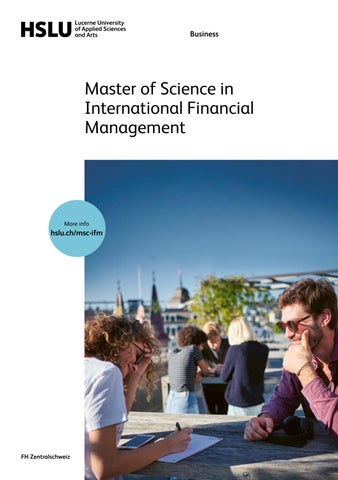

The Master of Science in International Financial Management at a Glance
Why choose our Master’s programme?
Our MSc in International Financial Management is the gateway into the finance world of international companies. Our Master’s programme offers an excellent education by preparing our graduates to excel in all areas relevant to becoming future CFOs. Our three majors, a minor in Data Science, various electives, and the flexibility of semester time models enable our students to tailor their studies to meet their individual needs.
Benefits of the Programme
– Excellent preparation for an international career in financial management
– Majors, minor and electives offer an individual specialisation
– AACSB-accredited business school; programme recognised by ACCA, CIMA, IMA and EXPERTsuisse
– Industry-recognised certifications such as the SAS Business Analytics Specialist
– High international exposure to prepare for the global marketplace
– Flexible programme with the ability to work and study at the same time
– Opportunity for a second degree with a partner university
– Our campus in Zug-Rotkreuz, Switzerland, in the heart of Europe
Entry requirements
A bachelor’s or similar university degree in Business Administration or any other related discipline of at least 180 ECTS, issued by a university or a university of applied sciences.
Additional:
– Certificate of C1 English level in the Cambridge ESOL (IELTS 6.0 – 7.0) or equivalent, and/or English mother tongue.
– At least 18 ECTS in the field of Financial Management. In case of missing Finance credits, students can enrol in corresponding online classes.
The number of places on the programme is limited. The programme management decides on admission after reviewing the complete application.
Application deadline: 30 June (autumn start) or 15 January (spring start). For applicants requiring a visa: 30 April (autumn start) or 30 October (spring start)
Start of the programme: Mid-September or mid-February
Class days: Monday and/or Tuesday, plus one to two block weeks per semester
Exchange semester abroad: 1st – 4th semester possible (participation voluntary)
Language of instruction: English
Tuition fee: CHF 800 per semester (CHF 1’300 for foreign students); application fee CHF 250
Duration of the course: 3 semesters (full-time) up to 10 semesters (part-time)
Campus benefits and information: hslu.ch/campus-business
Protected title: Master of Science in International Financial Management, Lucerne University of Applied Sciences and Arts/FHZ
Application form and information
T +41 41 757 67 86 hslu.ch/msc-ifm master.ifm@hslu.ch
Your Career and Work Opportunities
Excellent preparation for an international career in financial management
Today’s global marketplace is mainly looking for auditors, accountants, financial managers, and future CFOs with two specific qualities: a comprehensive knowledge of financial management, and the ability to perform in an international environment. Our programme nurtures the vital professional skills of management accounting, financial accounting (IFRS), risk management, auditing, corporate finance, digital finance, and data-driven decisionmaking, which allows our graduates to go on to work for international companies in Switzerland and abroad. Our Master’s programme is an excellent starting point for students who want to succeed in the field of financial management. We provide career planning to all our students. From the initial consultation to the actual job offer, the HSLU Career Service supports our students to launch a successful career.
High international exposure to prepare for the global marketplace
Our curriculum offers internationally aligned content, and we maintain intercontinental partnerships to provide our students with a global experience. Our students work on multinational issues and collaborate with students from different countries and cultures around the world. We also offer the possibility of studying a semester abroad without delaying graduation. Students who are interested can choose to study at one of the Lucerne School of Business’s partner universities or decide to organise their own semester abroad at a college of their choice.
Flexible programme with the ability to work and study at the same time Our programme’s flexibility provides students with the opportunity to integrate their studies into their daily lives. Classes take place on Mondays and/or Tuesdays, complemented by one to two block weeks per semester – leaving the rest of the week available for professional work. Students can work up to 80 percent alongside their studies, or up to 100 percent with a flexible work arrangement. Students may choose from different time models ranging from a full-time three-semester programme to part-time models of up to 10 semesters. If needed, students also have the option to put their studies on hold or to change the time model.
Programme with high academic and practical relevance
The aim of our Master’s programme is to prepare our students for financial management positions and to become future CFOs of international companies. Thus, we provide our graduates with a practical, research-based, internationally aligned education in accounting, corporate finance, business analytics, digital finance, performance management, and risk management. Elective modules such as Going Global, Business Planning and Know-how Transfer provide valuable insight into international companies and expose our students to practical challenges. Our faculty also includes practitioners who hold senior positions at well-known international companies in Switzerland and abroad.
Your Modules
Of the 90 ECTS students accumulate during their studies, 48 ECTS are mandatory modules that provide in-depth knowledge in accounting, corporate finance, risk management, tax and law, digital finance, and business analytics. 15 ECTS are elective modules, which students select from a broad portfolio, transfer from a semester abroad, or earn through a practical transfer from their work experience or internship. The remaining 27 ECTS are dedicated coaching and research modules, culminating in the Master’s Thesis. All mandatory modules take place in the autumn semester, all elective modules in the spring semester. The mandatory modules are organised in module blocks, three of which can be shifted between semesters. This allows students to spread their studies over two to five autumn semesters.
Majors and Minor
Students can specialise by combining defined elective modules with a corresponding focus in the Applied Research Project and the Master’s Thesis. The major is stated on the diploma. We offer:
– Major in Accounting
– Major in Corporate Finance
– Major in Performance Management
– Minor in Data Science
Within the Minor in Data Science, students can additionally obtain the SAS Business Analytics Specialist certificate, an industryrecognised qualification in data analytics.
A small selection of modules is briefly introduced below.
Business Analytics
Business Analytics introduces quantitative methods for analysing business data and developing data-based insights for strategic decision-making. Graduates learn about statistical concepts and analytical approaches that are becoming crucial for enterprises of all types and sizes as data availability increases.
Digital Finance
Finance must evolve from a backwardslooking reporting function into a forwardlooking, insightdriven partner that enables fast, confident decision-making. This module explores digital finance in an agile context – where data, analytics, and AI are enablers of better business outcomes. Through real-world use cases and an interactive block week, students design digital finance solutions, evaluate AI use cases, and develop a future-ready finance roadmap.
Enterprise Risk Management
The module introduces the concepts, tools, and techniques of modern enterprise risk management. Financial managers learn how to design and implement risk management systems, focusing on identifying and assessing risks throughout the organisation. Special emphasis is placed on risk valuation and aggregation, and on developing a comprehensive ERM concept for a specific company.
Project Management
Strong projects are the engine of finance transformation, yet many initiatives in

finance and controlling still fail due to unclear scope, weak stakeholder alignment, or the wrong choice between classical and agile approaches. This module equips students with a universal project management toolkit covering the phases of preparation, execution, and closure –and highlights where classical, agile, and hybrid approaches differ.
International Financial Reporting and Analysis
An important function of financial management is meeting financial reporting standards. A comprehensive knowledge of the predominant regulatory framework –
the IFRS – is therefore a given, but needs to be enhanced with the ability to understand local GAAP requirements and to integrate such information into a consolidated report.
Corporate Performance Management
Establishing management control and performance management systems in international and decentralised organisations is the key management support function of financial management. An integrated perspective on planning and control comprises financial performance as well as ecological and social dimensions and their interdependencies.
The importance of this degree in the working field






“The international focus of the Master’s programme was the key reason I applied. Collaborating with international students enriched the programme both academically and personally, and the small class size allowed for close interaction with the lecturers.”
Emilie Heinig Hansen (Denmark)
Graduated 2025
”The MSc IFM provided an ample opportunity for me to develop my skills & competencies to thrive professionally as well as personally.”
Maheshika Pereira (Sri Lanka)
Graduated 2017
“The key reason why I chose the IFM was mostly the high extent of flexibility given by the programme. In contrast to other Master’s, the MSc IFM provides different time models and, most importantly, enables to tailor-make the semester schedule to your personal needs.”
Claudia Jetschgo (Austria)
Graduated 2017
“Thanks to the MSc IFM, I got to know many new international friends with different viewpoints, broadening my own horizon. Also, the internationality of the programme taught me to think networked and out of the box, which ultimately helped me greatly in my career development.”
Marcel Greimel (Switzerland)
Graduated 2019
“Having a full-time finance position, the flexible time model of the MSc IFM programme enabled me to keep my role and is the main reason I chose this programme. Being taught in English was an additional benefit, which complements the international orientation of the programme as well.”
Jonathan Brandt (Switzerland)
Graduated 2021
“The MSc IFM programme equipped me with the skills and competencies needed in an international setting to comfortably study and research the current trends of our agile world.”
Mustafa Gezera (Egypt)
Graduated 2021
Lucerne School of Business
The Lucerne School of Business is part of the Lucerne University of Applied Sciences and Arts and Central Switzerland’s centre of excellence for advanced management education. With its teaching, research and consultancy services, the School of Business actively and effectively contributes to the development of a knowledge society. It trains specialist and executive staff and assists organisations and institutions in finding answers to current and future challenges in business and economics.
The School’s degree programmes include a Bachelor’s course in Business Administration, a Bachelor’s course in International Business Administration, and five consecutive Master’s programmes.
Finally yet importantly, the institution is one of the largest providers of post-graduate and further education programmes of all Swiss Universities of Applied Sciences.
The Lucerne University of Applied Sciences and Arts maintains close links to other universities and partners from industry and government. The School’s institutes are centres of excellence with a national and international reputation.


Lucerne School of Business
Bachelor’s and Master’s Secretariat
Walter-von-Moos-Promenade 1 6005 Luzern
T +41 41 228 41 30
master.ifm@hslu.ch hslu.ch/msc-ifm
instagram.com/hslu_luzern
linkedin.com/company/hochschule-luzern
Prof. Dr. Imke Keimer Head of Programme
Prof. Dr. habil. Stefan Hunziker Head of Programme