
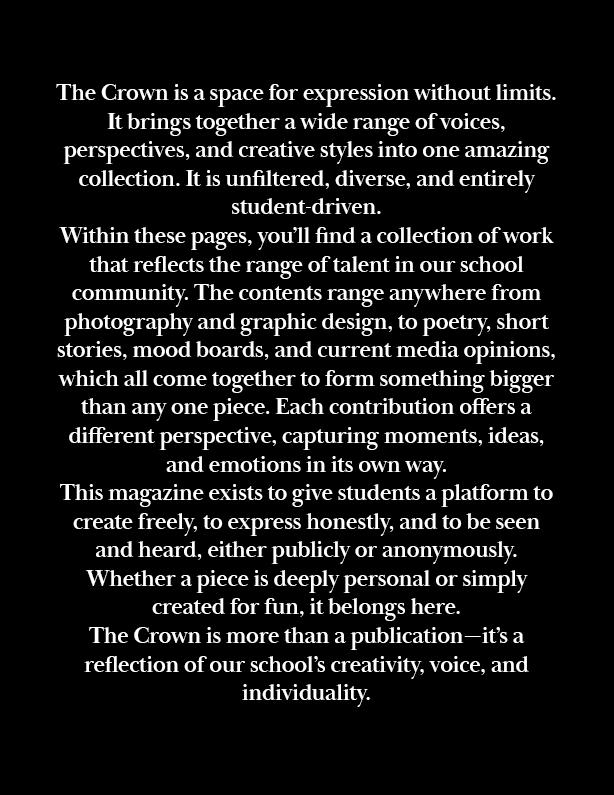
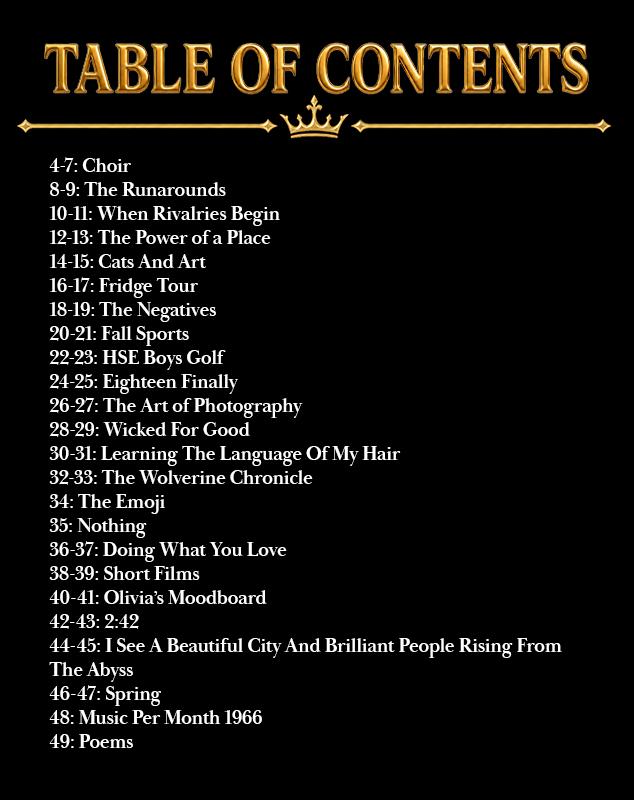
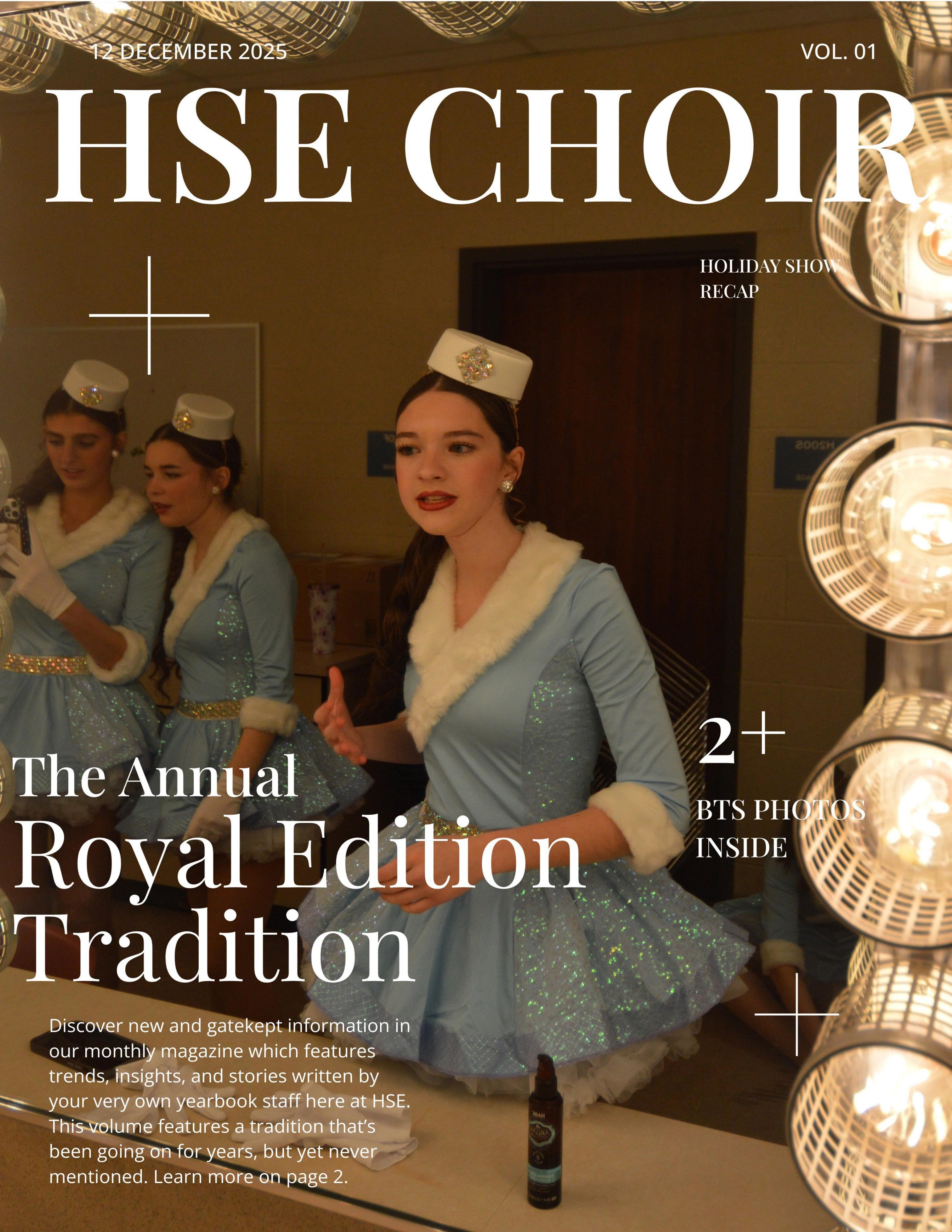
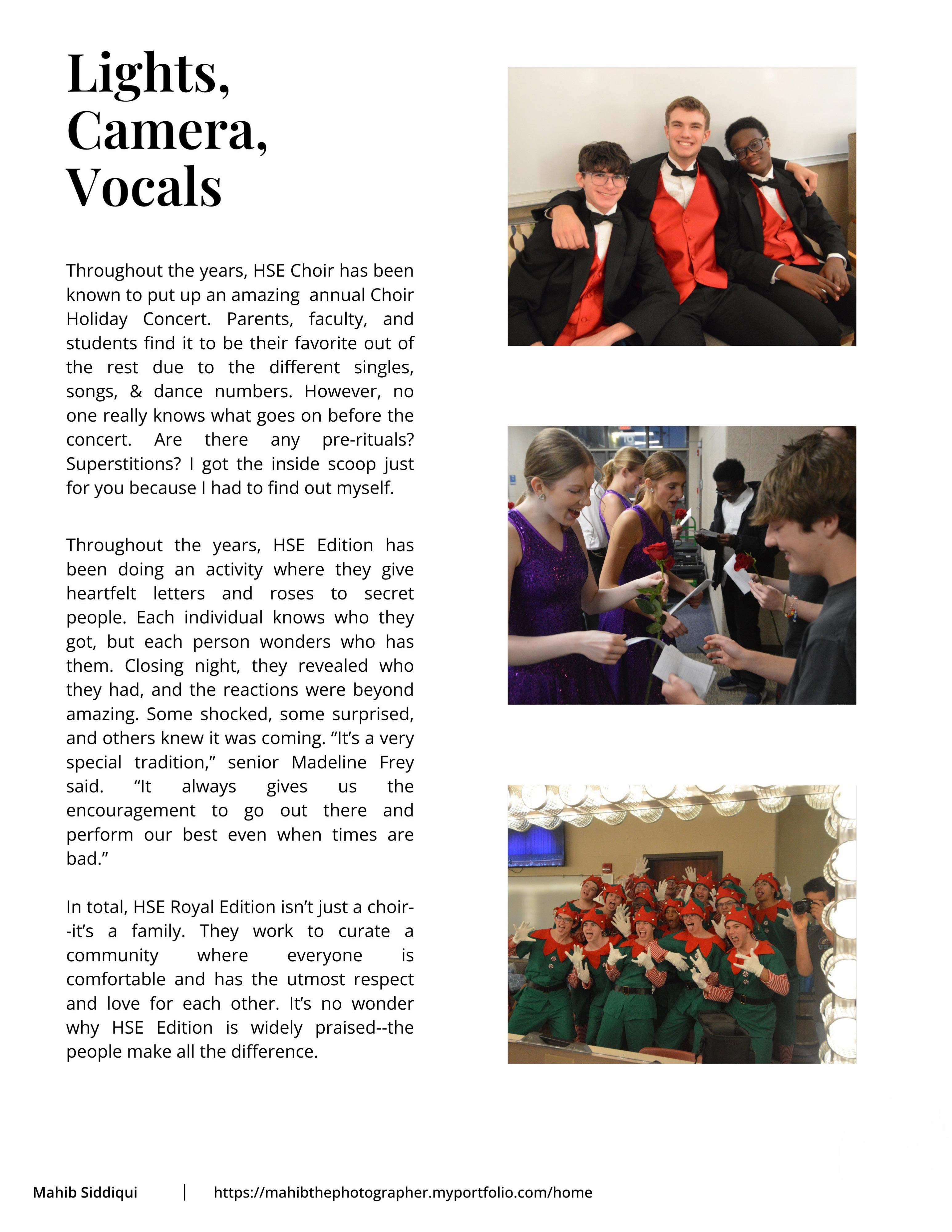

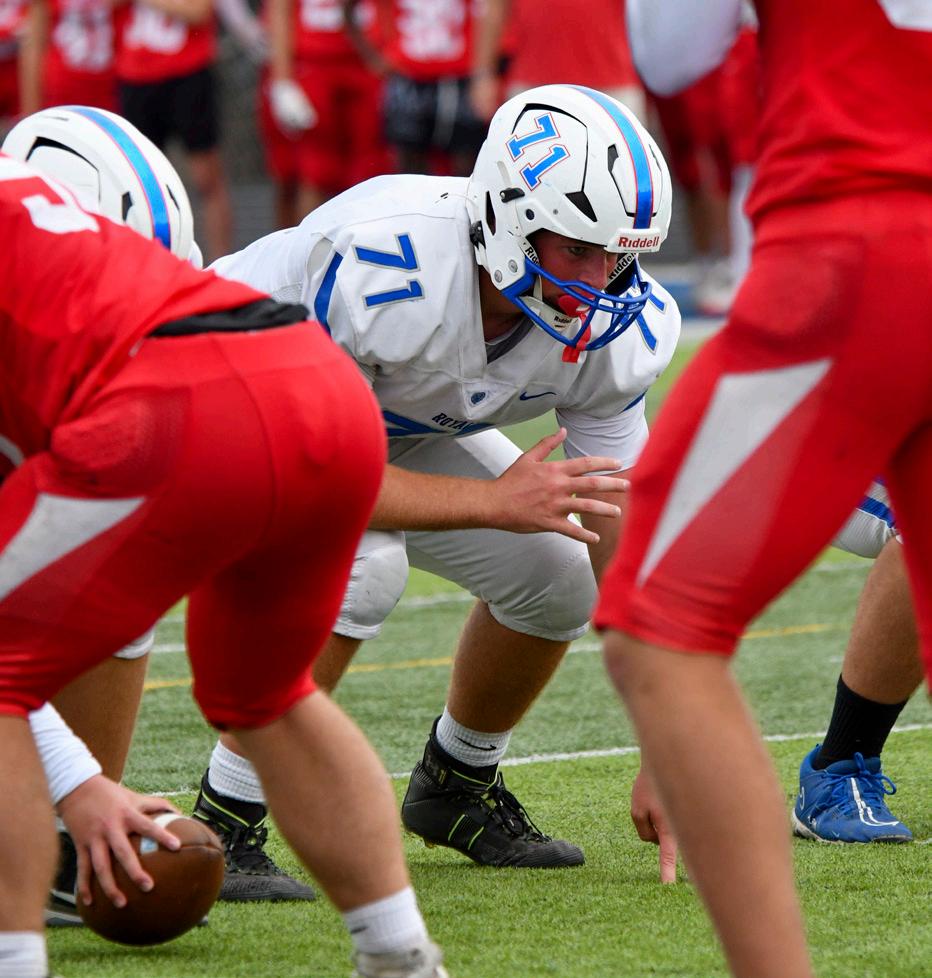
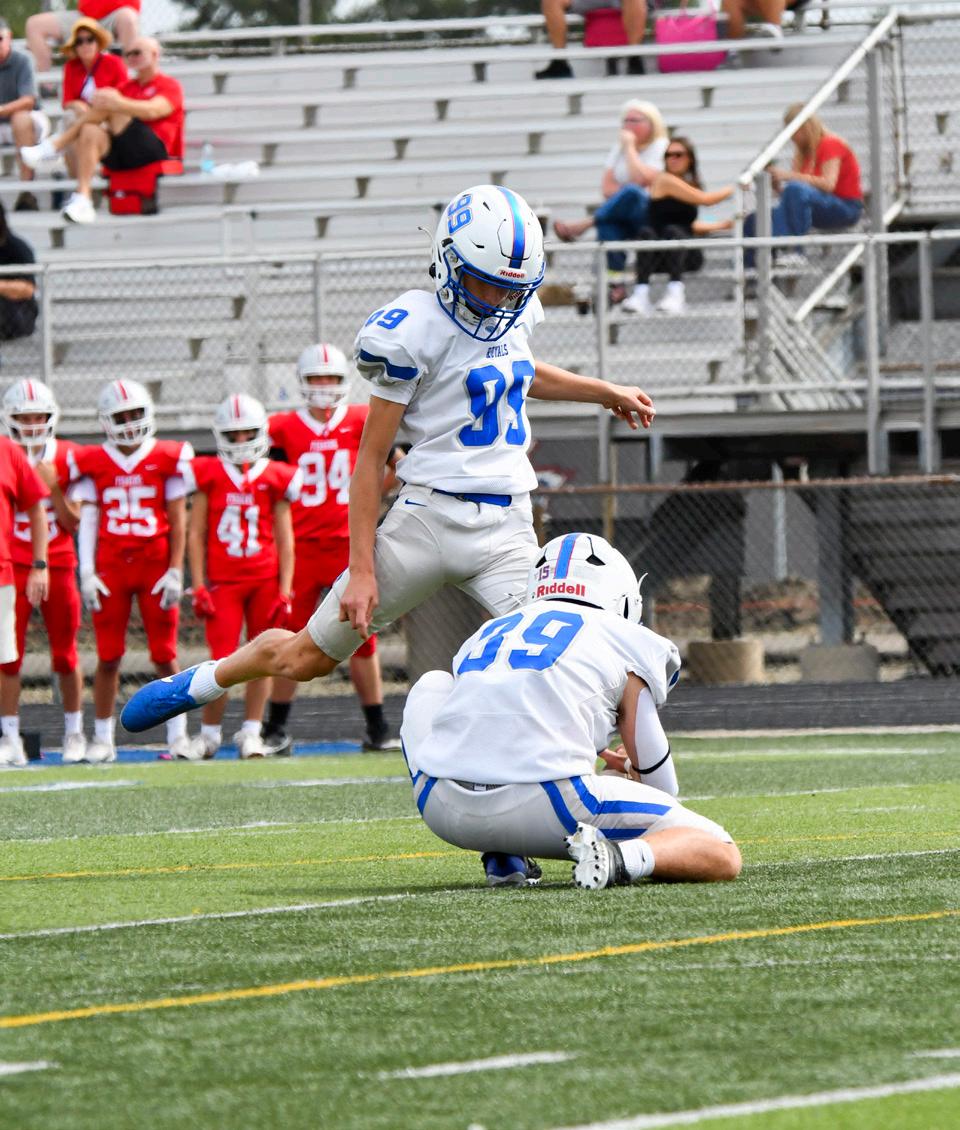
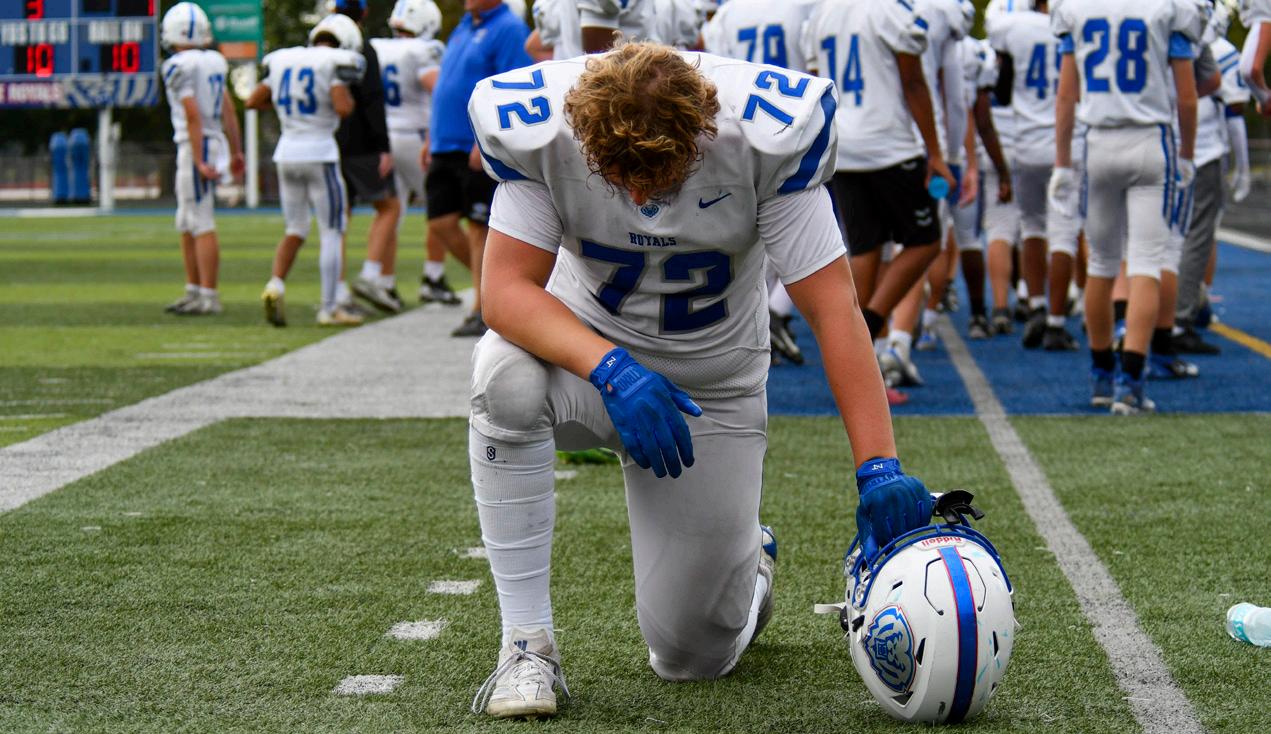
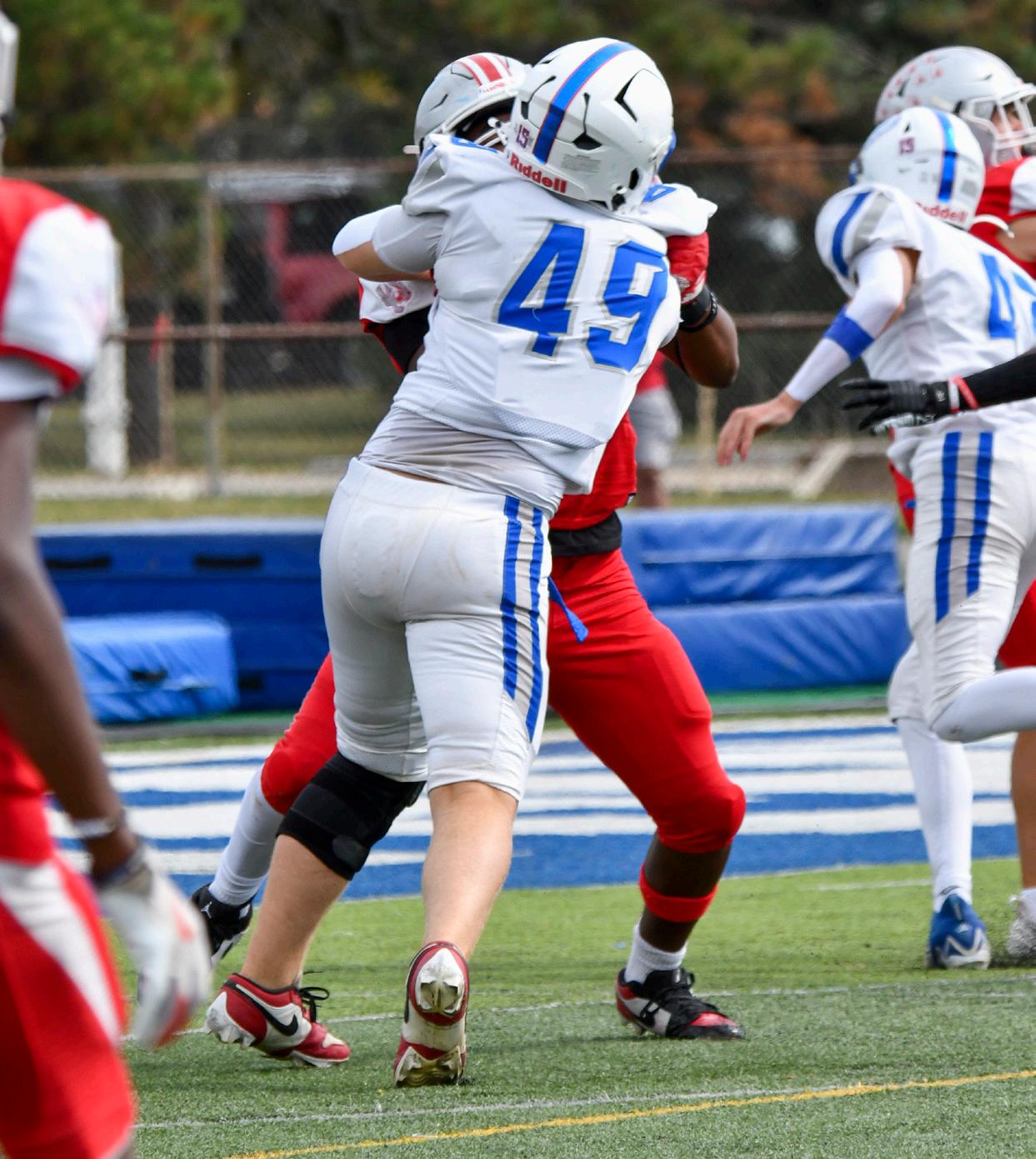
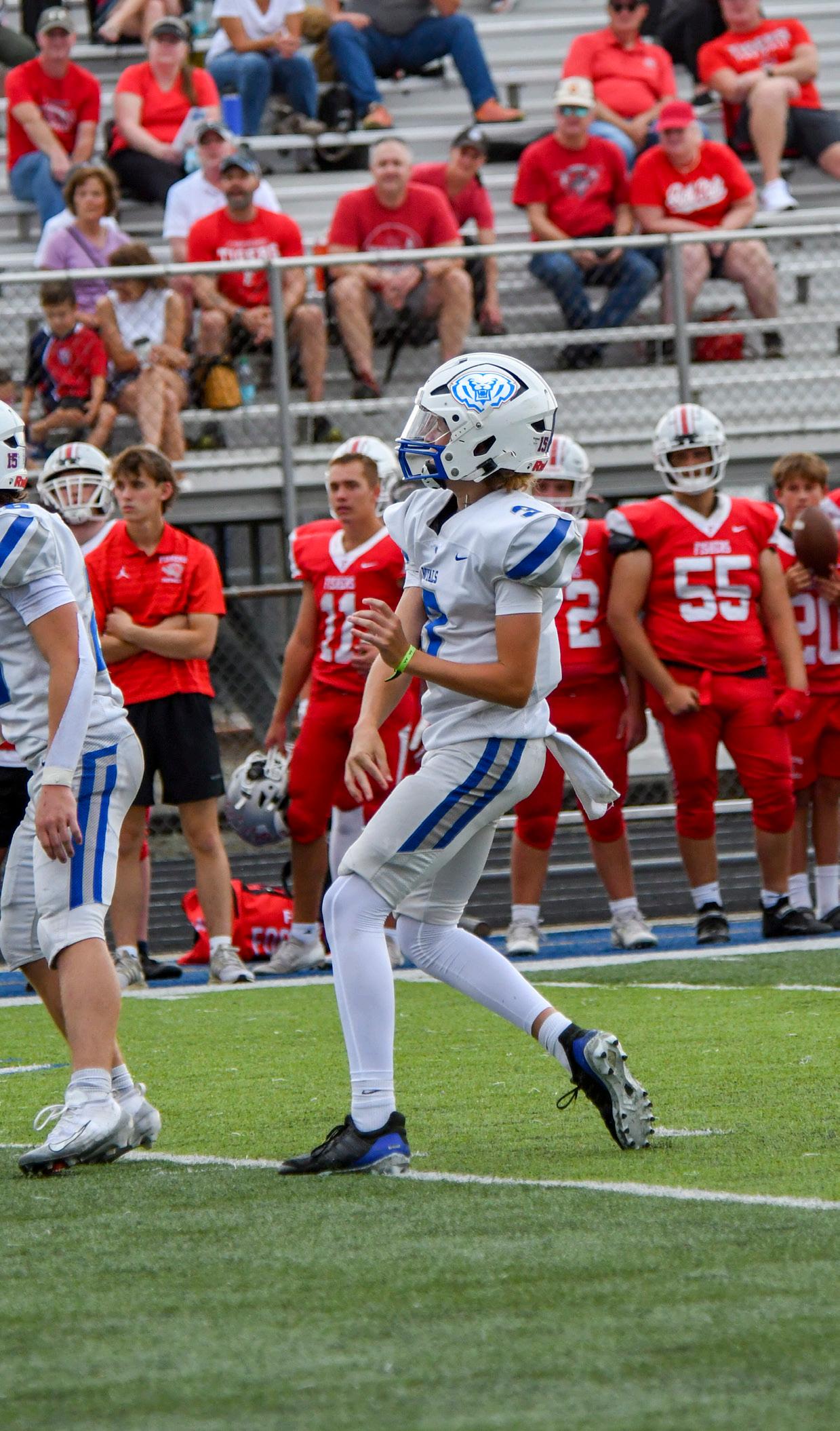
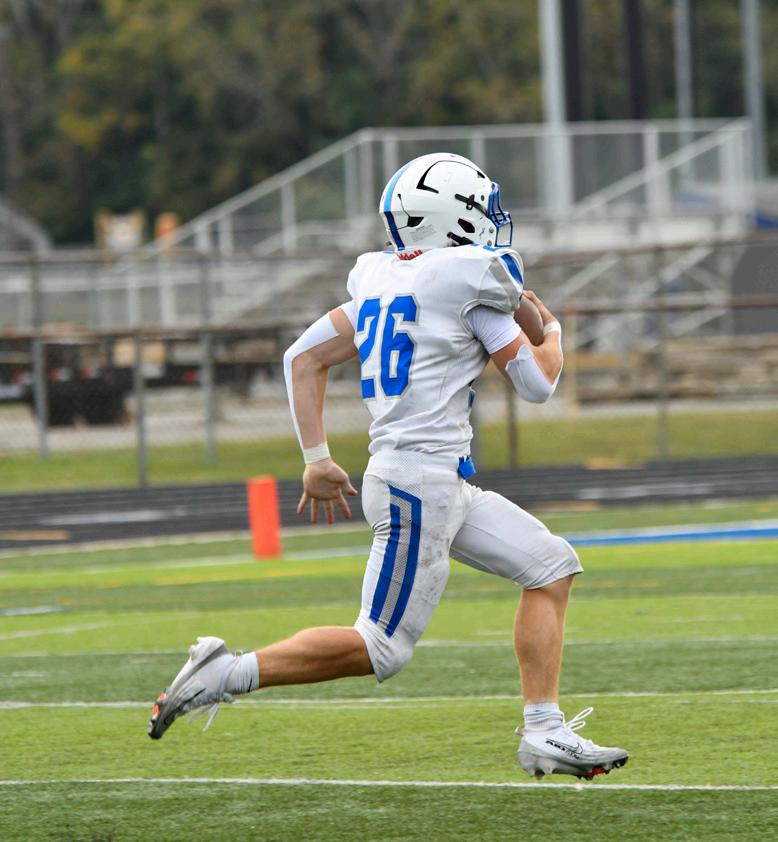
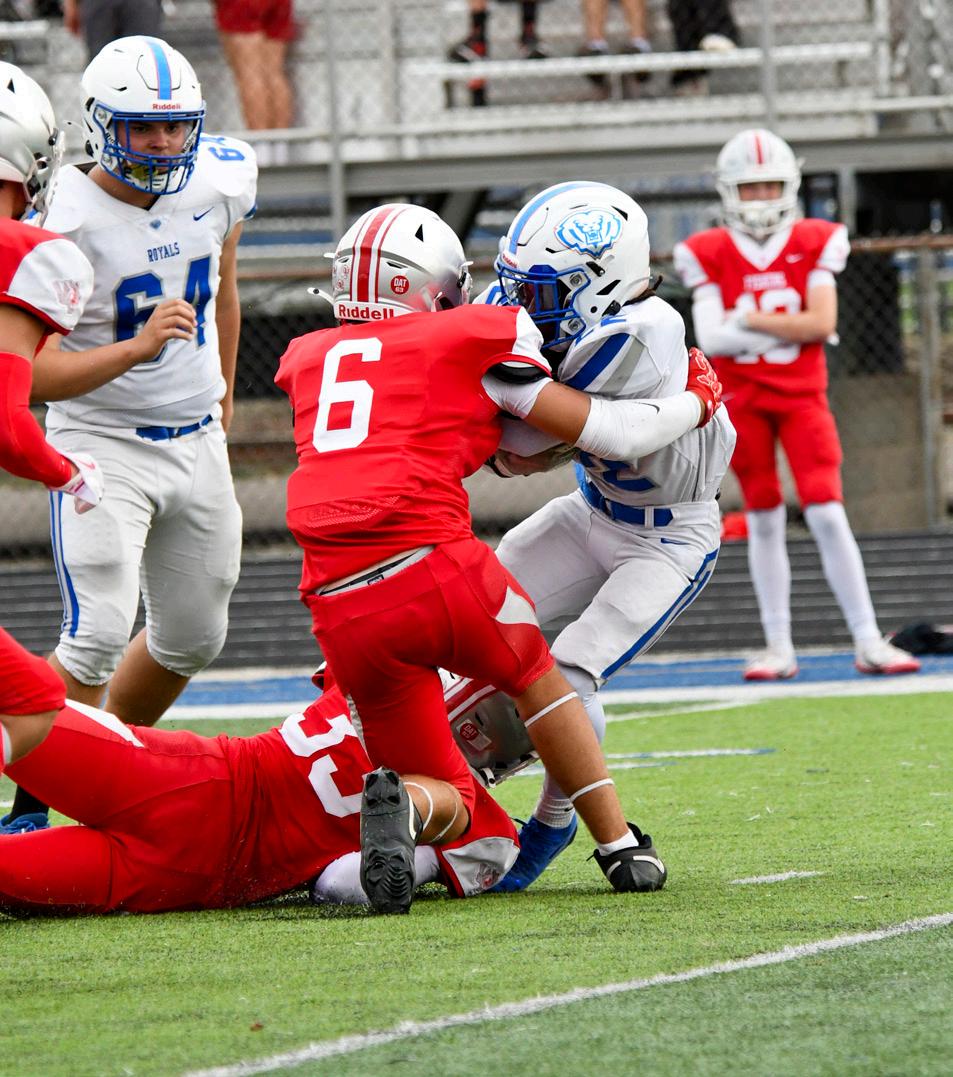
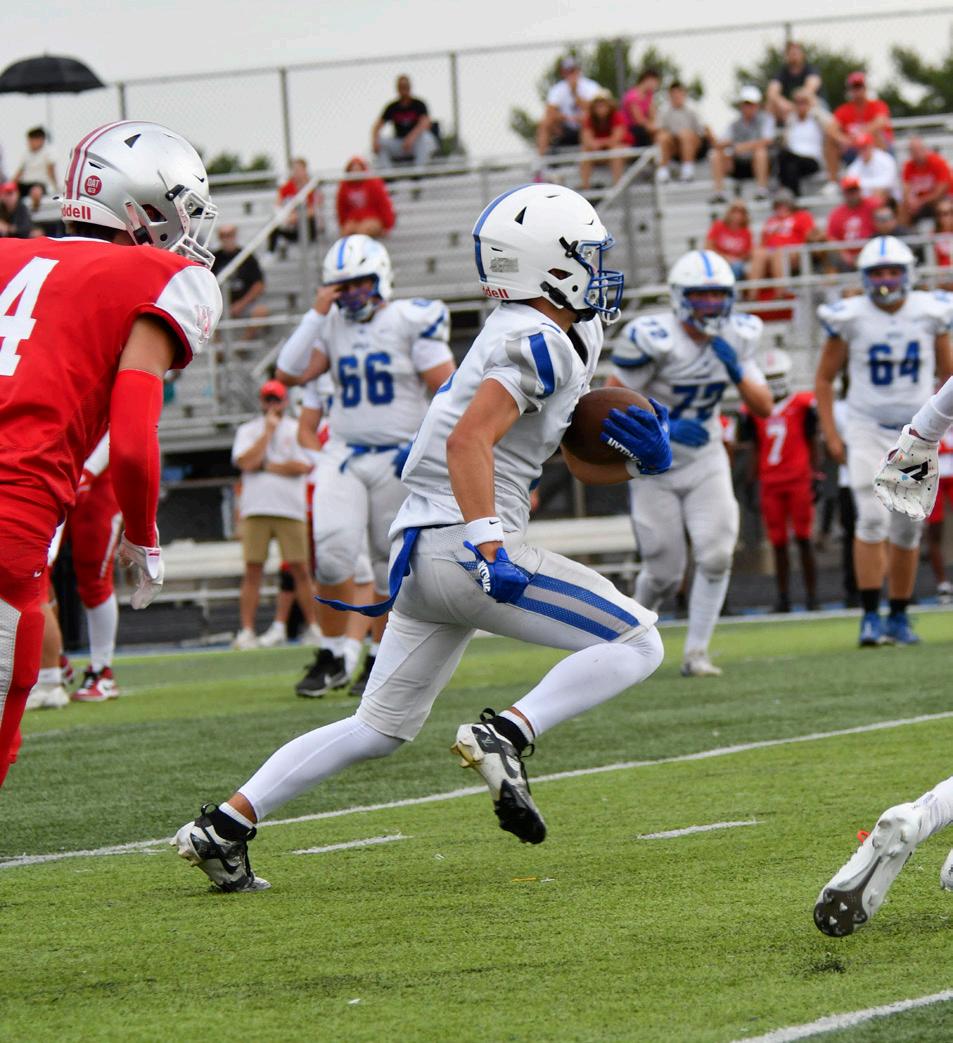
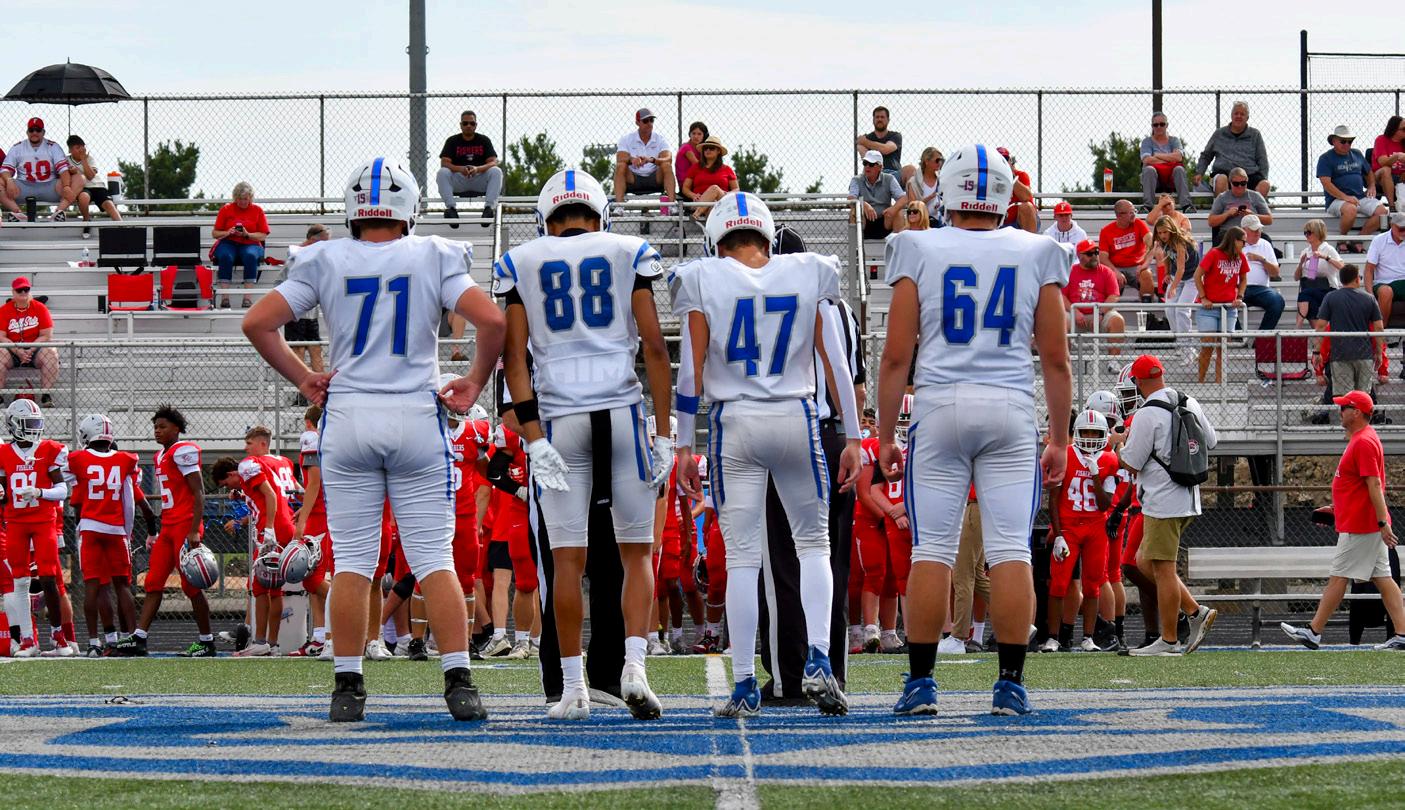
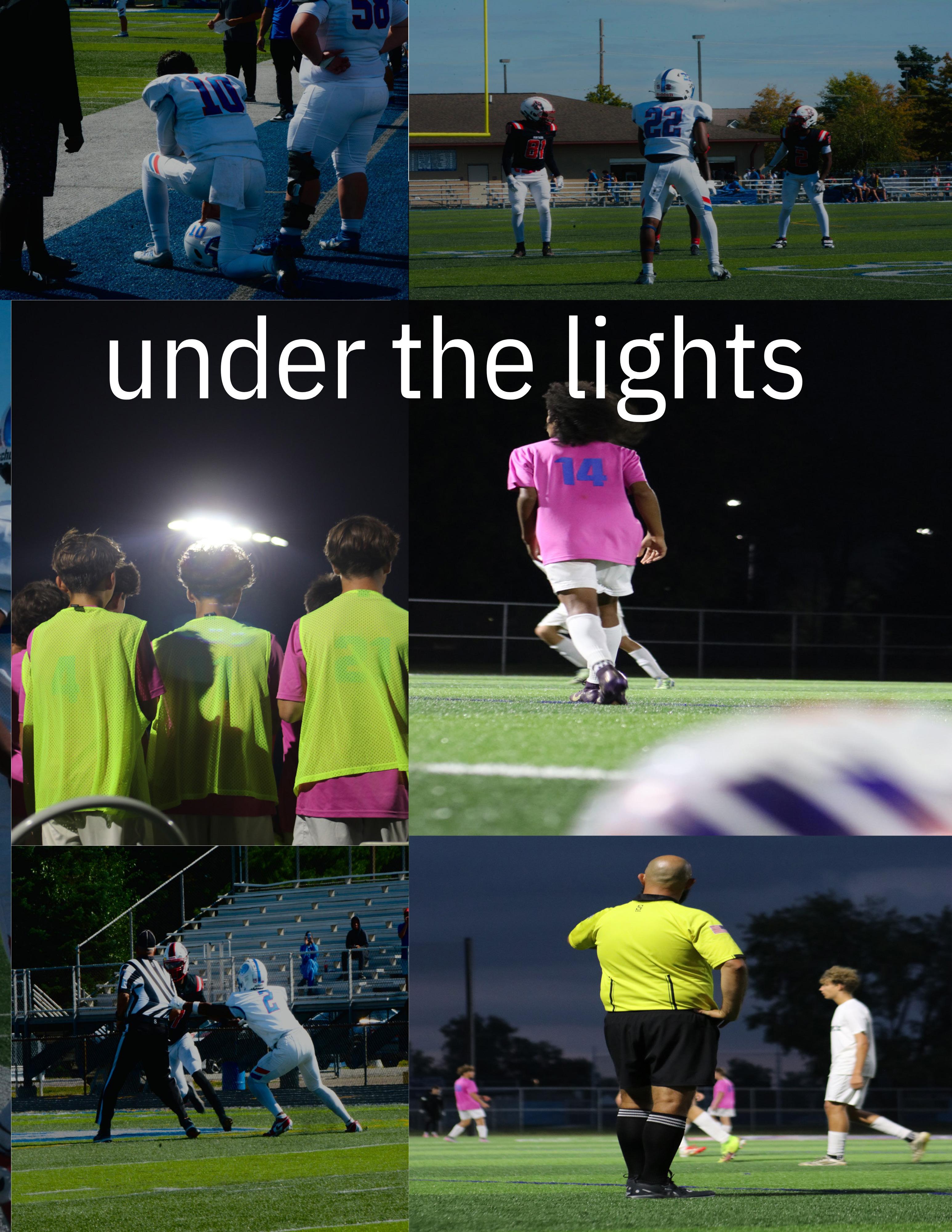
Freshmen step into traditon on their field. The first chapter of the four-year fight.
When taking these phoros, I wanted to focus on the contrasting colors of blue/white and red. I chose to highlight the intensity of a mudsock game, as it ties into the freshmans first experience of the rivalry. During the editing process, I tried to make the colors pop, along with making them sharp. I found that this combination made the photos look more intimidating. I really like how they came out, the angles, the action, and the atmosphere really pulled everything together.
BY ELLIOT SCHETZSLE


Act II of Wicked is notorious for being a sharp drop o from the Broadway musical’s Act I. With pacing issues, underdeveloped plots and characters, and no song that has quite captured the masses like Act I’s “Defying Gravity” any adaption of the act would face quite the challenge. Perhaps this is why Wicked: For Good added two original songs and revamped many of the original plots. It’s a valiant e ort and the movie is much better than its musical counterpart, it still can’t completely make up for Act II’s structural aws, and it fails to capture the magic that infused the rst Wicked. Addressing the elephant in the room: the largest issue in this movie is the writing and the only real solution would be to completely deviate from the canon of the musical. Wicked: For Good does improve on many of the aws even if it can’t completely x them. at being said, there are still some glaring aws in the writing that can’t be entirely blamed on faulty adaption material.
e rst of the two original songs, “No Place Like Home”, is a powerful song sung by Elphaba (Cynthia Erivo) as she tries to convince the Animals to remain in Oz as she nds many attempting to ee the Wizard’s growing crackdown on their rights. It is a good addition and is beautifully song by Cynthia Ervio. It helps place a lot more emphasis on the Animals than the musical did during its version of Act II, plus it serves to deepen Elphaba’s character and arc as she ghts to make Oz a better place. With the knowledge of the ending of Wicked, the song also serves to reinforce the tragedy of Elphaba’s ending when she is nally driven out of the only home she has known. Fieyro (Jonathan Bailey) makes the choice to join Elphaba on the run, motivated by a secret love he’s nurtured the past few years. As a character, Fieyro has

always lacked any sort of real depth, and this is still a huge problem in this movie. Him and Elphaba barely have any scenes in the rst movie. is, combined with the time gap make their entire relationship laughably underdeveloped through Wicked: For Good. Somehow, this movie makes their relationship even weaker than the original musical through the blocking of “As Long as Your Mine”. Elphaba and Fieyro’s only duet is supposed to be the culmination of all the years of their (apparently o screen) yearning. On stage it’s a passionate song which sells the audience on their relationship at least through their chemistry, even without any serious development. Having Elphaba and Fieyro sing the rst parts of the song away from each other undercuts any tension or seriousness that the song normally has. Cynthia Erivo and Jonathan Bailey are not to blame here though as ultimately the blocking of the song killed it before it even got the chance to live.
While the beginning of the movie does wonderful work with Elphaba’s character, the second half begins to slip away from its focus on Elphaba’s awed (but well intentioned) ght against the Wizard as well as the true tragedy of her ending. When Fiyero decides to run away with Elphaba, we see these other aspects of her character begin to slip away in favor of screentime for her and Fieyro’s relationship. Combining this with Glinda’s arc culminating in the second half of the movie Elphaba’s character almost seems to slip away from focus towards the end of the movie.
Like Elphaba, Glinda (Ariana Grande) also got material added for her in the movie. While, in my opinion, Glinda’s arc has always been the strongest part of Act II, the movie adds onto her arc for this movie. For the rst time (at least in the musical’s version of
canon) we see a glimpse into Glinda’s past, giving more weight to her obsession with obtaining other’s love and serving to make them feel better, disregarding her own feelings or what is truly “good”. ese ashbacks as well as the second new song, “ e Girl in the Bubble” help truly arc out Glinda’s transformation over this movie.
e addition of Glinda to the musical number “Wonderful” was largely celebrated by fans for a variety of reasons. It adds clarity to Elphaba’s decision to agree with the Wizard and showcases the depth of the relationship between the girls. I would like to add onto this praise from another angle because I think her inclusion in the number helps show just how similar Glinda is to the Wizard in the beginning of Wicked. Both are obsessed with others’ perceptions of them and will do anything to make the masses happy—even if it’s not the right thing to do. Adding her in this number and showing how similar her and the Wizard truly are only helping cement in the end just how much Elphaba changed her “for good”.
e relationships between Elphaba and Glinda has always been the central force of the musical, a er all it is “ e Untold Story of the Witches of Oz”. is is true of Act II of course, both girls are haunted by absence of the other, nally culminating in the tear jerking “For Good”. Yet, there are aws with Act II’s portrayal of the two. Between ghting over a man, a borderline misogynistically portrayed “cat ght”, and being separated for most of the events in Act II, there is some signi cant strain on the friendship that is central to the musical. e movie does a much better job than Act II here, with adding Elphaba seeing Glinda before her wedding and Glinda’s introduction into “Wonderful” their relationship is deepened from what the stage musical had. Cynthia Erivo and Ariana Grande do a brilliant job
of portraying these two as star-crossed with so much love for the other despite the hurt they also cause each other. eir performances, as well as bu ering out some of Act II’s pitfalls, serve to strengthen and re-centralize the relationship audiences fell in love with in the rst movie.
For all my criticism of the movie, Wicked: For Good does what should have been impossible: It manages to make Wicked Act II good while remaining mostly faithful to the source material. e small changes of Nessa (Marissa Bode) and Boq’s (Ethan Slater) storyline do wonders for the plot of the movie and get rid of the implication that Nessa’s greatest desire is for her disability to be xed. Marrissa Bode and Ethan Slater were both standouts for me in this movie, delivering incredible performances and adding depth to both Nessa and Boq’s characters.
Overall, it’s a movie with many stumbles. e color grading is still washed out and missing the charm that should come with such a magical world. Its writing is held back by its source material but still awed within itself. Michelle Yeoh’s singing is jarring compared to such other talented singers in the movie and her parts should’ve been either reassigned or spoken. at all being said: I loved it. Every actor in this deserves all their owers for the brilliant performances that this lm is full of. e commitment to practical locations is admirable and something I always love to see in lms. e plot changes are smart and well done—the only issue there is I wish there were more of them. Not to mention, that nal shot. If you haven’t seen Wicked: For Good yet, go buy a ticket immediately and enjoy. And, if you haven’t seen Wicked yet, what are you doing? While it doesn’t quite meet its predecessors greatness, Wicked: For Good brims with passion, tragedy, and ultimately love. 4/5 stars.

story by Mya Pyle
Imoved into the house on Belmont Drive when I was een. Moving from the West Coast to the at, wind-bitten Midwest wasn’t exactly my idea of a fresh start. But according to my parents, getting kicked out of my last school meant I needed one. ey said it would be slower here. Quieter. Better.
e neighborhood didn’t impress me much. Every house looked the same clean lawns, white fences, identical mailboxes. It felt staged.
Except for the house across the street.
It looked abandoned in a way the others didn’t. e porch sagged inward. Paint peeled in long strips. e upstairs windows were dark and hollow, like missing eyes.
e mailbox leaned sideways. Rusted numbers clung to the front. 14460 Belmont Drive. It felt like the house was staring back at me.
During the day, the house was just ugly.
at’s all.
Sunlight exposed everything the rot, the cracked shingles, the weeds swallowing the walkway. No movement. No sound. I even stood outside one a ernoon pretending to scroll on my phone, just to see if I’d imagined the light. Nothing.
No electricity. No curtains. No life.
By sunset, I felt stupid for thinking there had ever been anything else. at night, I stayed up later than I meant to.
When I looked over it was 2:42 am and the house across the street was glowing.
It was sudden. Warm and yellow in the upstairs window directly across from mine.
I froze. e rest of the house stayed dark. e streetlights hummed faintly. Everything normal.
Except that window. I stepped closer.
A girl stood there. She wasn’t moving. Her hair fell over her
shoulders, and she wore something pale that caught the lamplight. e room behind her didn’t look abandoned. e wallpaper had a faded oral pattern. A small rotary phone sat on a desk.
It didn’t look modern. It didn’t look ruined. It looked lived in.
She raised her hand slowly and pressed it to the glass. Not a wave.
Just… contact. en the light shut o . e house went back to being empty.
e next day, it was normal again.
No burn marks. No curtains. No signs anyone had ever been there. I asked my mom about it casually.
“Did someone used to live there?”
She shrugged. “A long time ago. Why?”
“No reason.”
I didn’t tell her about the girl.
e next night, I waited. I didn’t even pretend to sleep.
2:41. 2:42.
e light snapped on. She was closer this time. Her mouth was moving.
I stepped forward until my forehead almost touched the glass.
She pressed her palm at against the window and shook her head.
“Don’t.”
I could read it clearly. Behind her, something ickered. Orange. Faint at rst.
en brighter.
She turned around, panicked, like she heard something in her hallway.
I didn’t smell smoke.
I didn’t feel heat.
Everything on my side of the street was still. Quiet.
She turned back to me.
e orange glow grew behind her.
e clock beside my bed read 2:43.
e light went out.
e house across the street fell into darkness again.
In the morning, it was abandoned. Still rotting. Still silent. Like nothing had ever happened.
e third night, I almost didn’t look.
But 2:42 came whether I wanted it to or not.
e light turned on.
She was already at the window. Already terri ed.
e orange glow lled the room behind her now, licking up the walls.
She didn’t pound this time.
She just stared at me.
Like she was memorizing my face.
e ames rose higher behind her, but no re touched my street. No smoke crossed the road. No alarms sounded.
Only that room was burning. Only her and I knew it. She li ed her hand slowly.
I li ed mine.
For a second, our palms lined up through the glass and the dark stretch of street
e light went out.
e house went dark.
2:43 AM.
Silence.
In the morning, the house was empty. Like always.
But now, sometimes during the day, I catch myself wondering
If somewhere, at 2:42 in the morning, there’s a girl standing in a bedroom window, watching mine, waiting for the light to turn on.





d, and violets blue, all silver-white, s of yellow hue Do h delight, The








Truth trickles down my spine
Traces the outline of my shadow
While hope denies.
Festers and feeds into my desired
I know all must come to an end-
Yet I still hold onto hope
Whom I believed was my friend.
Soon enough my shadows will fade
Hope subsides
Truth overlays
Someone who lies
Someone who hurts you
Someone who turns you insecure
Someone who makes you feel small
Someone who can take your happiness
Someone who forces you to believe your less
Someone who hides the truth with false accusations
Someone who in the end, maybe you, holding false hope
Silence
There is an undefined safety in silence
Something is bound to happen
Yet in that moment-
The storm lay still
Small and fragile
Broken or chipped
Lined with unique imperfections
Pretty to look at Easy to keep
But what is their use
After the memory dies
Grief
Pools fill with chlorine
Oceans fill with sea
Cups fill with water
But eyes are empty.
Their contents have spilled. Rolling down blurs in the mirror
A Fishing Trip:
Happiness lingers
Tied by old fishing line.
Brittle and outraged
I decided it is fine.
I cast my pole, To fish for more,
I lose my grip,
My heart grows sore,
The line snapsIt escapes, swims away
Leaving me empty
No fish today
Comfort:
Sheets protect the mattress
From the person who lies in bed
Covers protect the person
Who lies down their head
Pillowcases protect
The soft squishy foam
But who protects the heart
When you feel all alone
Alone:
Suffer in silence
It’s easier that way
Better to burn
Then cool down and hate
-Lailante Erisman