October 2026
The Official Publication of the Hawaii Society of Certified Public Accountants
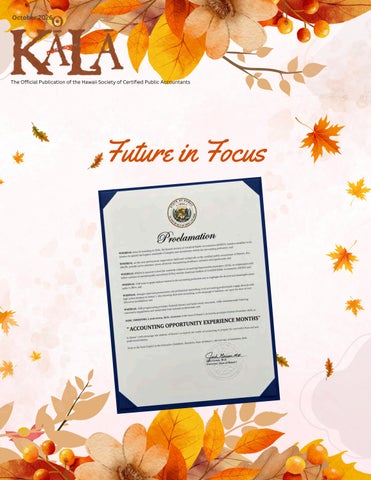
Future in Focus
October 2026 The Official Publication of the Hawaii Society of Certified Public Accountants
This Issue President’s Message . . . . . . . . . . . By Trisha Nomura
Officers President President-elect Vice President Secretary/Treasurer Assistant Secretary
Trisha Nomura Adrian Hong Chantal Mentzer Chad Funasaki Ryan Suekawa
AICPA Council Frank Kudo (Designated) Darryl Nitta (Elected) Trisha Nomura (At-Large)
Directors * 2026-2028 Grayson Nose Norman Okimoto Joel Peralto (Hilo)
Executive Director Kathy Castillo Administrative Assistant Debbie Cortes
Directors * 2025-2027 Ronald Heller Jill Ishimitsu Ed Nakano Darryl Nitta Natalie Taniguchi
Hawaii Society of CPAs 1000 Bishop Street, Suite 802 P.O. Box 1754 Honolulu, HI 96806 Tel: (808) 537-9475 E-mail: info@hscpa.org Web: www.hscpa.org
Immediate Past President Frank Kudo
Dear Mr. Paxton, Pay Your Taxes . . . . . . . . . . . . . . . . . . . . By Tom Yamachika
5
AI Disclosure is Not About the Tool . . . . . . . . . . . . . . . . . By Donny Shimamoto
6
The AI Question Changed. But Firms Are Missing It . . . . . . . . . By Marc T. Staut
8
HSCPA 66th Annual Conference . . . . . . . . . . . . . . . . . . . .
This publication is designed to provide general information only, and should not be used as a substitute for professional advice. The authors and editors disclaim any liability for any loss or damage resulting from the use of any information or advice herein. Although a reasonable attempt has been made to be accurate, neither the HSCPA nor the authors and editors can guarantee that all information contained herein is correct as of the date of publication. KALA (the Hawaiian word for money) is published periodically and is the official publication of the Hawai’i Society of Certified Public Accountants. Please direct all inquiries regarding editorial content to HSCPA, P.O. Box 1754, Honolulu, Hawai’i 96806.
KALA October 2026
4
10
Before you send the financials, Ask who is Asking . . . . . . . . . . . . . . By Arlene C. Guerrero
14
Norman’ Book Review . . . . . . . . . .
16
Meet the Pros Mixer . . . . . . . . . . . .
18
The Hawaii Retirement Savings Program . . . . . . . . . . . . . . By Adrian Hong
19
Adopt Ailo and Study Buddy . . . . . .
20
3
Once Once
Halloween arrives, Thanksgiving and Christmas seem to follow in a flurry, and before we know it, the year is over. For many CPAs, the last quarter of the year is a welcome opportunity to take a well-deserved vacation and catch up on CPE; it is also the perfect time to strengthen the relationships that will carry your firm through busy season. Before workloads intensify, consider having a “stay conversation” with each valued employee. A stay conversation is a one-on-one discussion that helps a manager understand what keeps an employee engaged, what could improve their experience, and what might entice them to leave. Used proactively, it can be an effective retention tool. I believe that an employee’s resignation should never come as a surprise. A stay conversation opens the door to discussing what employees want from their roles and whether their expectations can be met. Some needs may be beyond the firm’s ability to address, but knowing what they are gives you a chance to respond and prepare for the possibility that the employee may leave.
Here are a few tips for making these conversations productive:
think about what they would like to share.
Stay conversations do not need to be held with every employee. Prioritize the people whose contributions you especially value your “superstars” and strong
Encourage transparency and an open dialogue. It may take a few times before employees feel comfortable enough to give their honest opinions, but even being asked makes them feel appreciated. There is no required list of questions. Because you know your employees best, choose prompts that fit each person and use questions such as these to begin the conversation:
performers who show good potential. The goal is to invest attention where an open conversation could make the greatest impact. Explain the purpose of the discussion in advance. If an employee has never participated in a stay conversation, an unexpected meeting request may make them nervous. Let them know that you recognize their contributions and want to understand their experience. For the first meeting, I’ll often send the questions ahead of time and give the employee time to KALA October 2026
4
What excites you about your role right now? What parts of your role do you find the most challenging? What do you look forward to when you come to work every day? Which of your talents or skills are we currently underutilizing? Where do you see yourself in six months? What might tempt you to leave? What can I do to best support you? Continued on Page 9
TFH is t he ‘watc hdog’ for Haw aii taxpa yers’ money. To supp ort TFH’s m ission, p lease donate here.
Dear Mr. Paxton, Pay Your Taxes Hawaii has no shortage of celebrity property owners. What I mean is that there are famous people who own property — sometimes a lot of property — here in Hawaii even though said famous people might not live here. You might have heard of Larry Ellison or Mark Zuckerberg or Oprah Winfrey.Maybe even Roseanne Barr. And then there’s Ken Paxton. Yes, the Attorney General of Texas, candidate for Senator. He is the guy who, on behalf of Texas, sued Pennsylvania, Georgia, Michigan, and Wisconsin seeking to overturn their results in the 2020 presidential election. (The US Supreme Court tossed out his suit.). He also made news when four whistleblowers whom he fired won a $6.6 million judgment against his office for wrongful termination. (No skin off his back, though; Texas taxpayers wound up paying the tab.) According to reporting from a nonprofit, university affiliated news organization in Texas, Mr. Paxton owns some property on Maui through a “blind trust,” meaning that he owns it, but someone else manages it for him, to cut down on possible conflicts of interest in his current position. And the trust hasn’t paid his taxes.
According to Maui County property tax records, the real property tax for the first half of 2026 is due and unpaid. Some penalties and interest have been added.
underpaying taxes. In the federal system, you won’t see penalties this big because penalty stacking is limited. Not so under Hawaii’s tax laws.
The blind trust bought the property in October 2021. He’s had the property for a while and he had been paying property taxes on it until this year.
To make things worse (for him), there is no statute of limitations to block the assessment. The statute of limitations starts running only if an annual return is filed. With no returns filed, all past years are open for assessment.
But, as readers of this column know all too well, the tax burden doesn’t stop there. According to the Texas Tribune, the property was probably used a rental. Rental income is subject to our general excise tax, and perhaps our transient accommodations Tax if the rental was for fewer than 180 days. Yet, in the Hawaii database of tax licensees which lists people and entities registered for GET, TAT, withholding, and other tax types, there is no Esther Blind Trust, or any name resembling it, to be found. If there are GET and TAT taxes due and unpaid, the consequences may be severe. Folks who are required to file returns and pay taxes, but do neither, are routinely written up for 70% penalties. A 25% penalty is imposed for failure to file, another 25% for negligence, and another 20% for substantially KALA October 2026
5
And this trust won’t be able to shrug off the tax, penalties, and interest by simply saying that it doesn’t have money to pay them.The Texas reporting says that the trust currently owns at least 15 properties with a total worth of about $9 million. So, to our good friends at the Department of Taxation, we may have here some “low-hanging fruit.” Celebrities should be following the law. They should be an example for the rest of us. Sock it to ‘em, baby! Tom Yamachika is President of the Tax Foundation of Hawaii - the ‘watchdog’ that keeps an eye on Hawaii’s taxes. Tom is also the owner of Aloha State Tax, a small law firm with emphasis on State taxes. Prior to going solo and the TFH, Tom was a principal with Accuity LLP where he managed the tax consulting practice, including quality and risk management and practice development.
Tr a n s fo r m a ti o n Tr a n s f o r m a t i o n
AI Disclosure is Not About the Tool.
It is About the Trust. Clients may not need a list of every technology their accountants use, but they need confidence that AI risks are being managed. Nobody asks an accounting firm which tax software it uses. That observation led Adam Shay, CPA, to pose a timely question on LinkedIn: If clients have accepted technology as part of accounting work for decades, why should artificial intelligence require a different level of disclosure? Clients generally care about the result. They want accurate tax returns, clean books, reliable financial information, and sound advice. How accounting professionals produce those results has traditionally been their responsibility — not something clients are expected to investigate. AI, however, is testing that assumption. Shay points to a Karbon survey of 350 small-business owners and leaders who manage relationships with external accountants. According to the research, 89% want some transparency about how and when AI is used in their work, and 57% want full transparency. Meanwhile, only 21% of accounting firms have a documented AI policy or strategy. Accounting leaders can debate how much disclosre is appropriate. What they can no longer afford to do is avoid the question.
AI introduces a different kind of risk. Traditional accounting systems are generally deterministic and designed to automate defined tasks. When given the same data and instructions, they are expected to produce the same result. Errors can still occur because of faulty data, incorrect configurations, software defects, or user mistakes, but the system itself is intended to operate predictably. AI is generally more nondeterministic. Its output can vary, even when a user provides similar input and instructions. Generative AI can also produce information that sounds authoritative but is incomplete, misleading, or wrong. Highly publicized examples of AI hallucinations have made that risk visible to the public in a way that the risks associated with most other accounting technologies are not. Clients are not necessarily asking for disclosure because they want to inspect an accounting firm’s technology stack. They want enough information to assess the possibility that AI could contribute to inaccurate work or bad advice.
KALA October 2026
6
This does not mean accounting firms must identify every AI-enabled feature embedded in every platform they use. As AI becomes integrated into tax, audit, financial reporting, practice management, and productivity software, such an inventory may become both impractical and unhelpful. Clients do, however, need to understand how firms manage the risks those tools create.
Clients still expect human judgment. Shay also highlights an important distinction in the Karbon findings. Clients appear comfortable allowing AI to perform certain tasks, but they are less willing to place judgment and trust in its hands. According to Shay’s summary, 61% of respondents want the trusted adviser role handled entirely by a human, while 58% say the same about crisis management. Clients may accept AI identifying anomalies, processing information, or supporting routine work. They are less comfortable with AI interpreting a complicated situation, delivering difficult news, or guiding a consequential decision.
Tr e n d s
s Tr e n d That is not necessarily a rejection of AI. It is a reminder of what clients value most about their accountants. Clients do not turn to accounting professionals only for calculations. They rely on them for context, professional judgment, reassurance, accountability, and advice grounded in an understanding of their circumstances. AI may help professionals deliver those services more efficiently, but it cannot assume professional responsibility for them. “AI produced it” will never be an adequate explanation for incorrect advice.
Quality management provides the answer. The most productive response to clients’ concerns is not simply, “Yes, we use AI.” Nor is it a lengthy list of technologies. The stronger response is: “Yes, we use AI, and we have a system for managing its risks.” A good accounting firm has a strong system of service quality management. Policies, review procedures, documentation requirements, consultation protocols, and clear accountability help ensure that work is performed consistently and meets professional standards. Quality management is most commonly associated with audit, assurance, and tax services. However, its principles should also extend to client accounting services,
By Donny Shimamoto CPA.CITP, CGMA
Founder & Inspiration Architect Center for Accounting Transformation
consulting, and other advisory work — particularly when AI contributes to the service. The same principle applies beyond public accounting. Corporate finance teams, nonprofit organizations, government entities, and other accounting professionals may use AI to prepare analyses and support decisions. Their stakeholders may include executives, boards, investors, regulators, donors, or taxpayers, but those stakeholders still need confidence in the integrity of the work.
We use approved AI-enabled technologies to support portions of our work. We protect confidential information, review relevant AIgenerated outputs, apply professional judgment, and follow the accounting profession’s quality management and ethical standards. Qualified professionals remain accountable for the services and advice we provide.
Quality management should follow the risk, regardless of the service line or organizational setting. Organizations should know where AI is being used, what information may be entered into it, which tools are approved, and which outputs require human verification. They must also determine who reviews the work, who approves the final result, and how errors are reported and corrected.
Ultimately, the question is not merely whether AI was used. The better questions are whether the tool was appropriate, whether information was protected, whether the output was reviewed, and whether a qualified professional accepted responsibility for the result.
The real disclosure is accountability. AI disclosure does not have to sound like a warning. When handled well, it can demonstrate that an organization understands the technology, anticipates its risks, and has established appropriate safeguards. A clientfacing explanation might be simple:
KALA October 2026
7
The specific language should reflect the services performed, applicable requirements, and the organization’s actual practices.
The organizations that preserve trust will not necessarily be those that disclose the most or use AI the least. They will be those that can explain, clearly and confidently, how human professionals remain in control. Donny C. Shimamoto, CPA, CITP, CGMA, is the founder and Inspiration Architect for the Center for Accounting Transformation, which enables transformation by guiding professionals through the adoption and change required in order to step into the future of the accounting profession. He is also the founder and managing director of IntrapriseTechKnowlogies LLC, a Hawaiiheadquartered advisory-focused CPA firm.
The AI Question Changed But Firms Are Missing It.
By Marc T. Staut of Boomer Consulting, Inc.
Every
accounting firm leader I talk to right now is asking a version of the same question: “What are we actually getting from AI?”
The data backs up that sentiment. Inside Public Accounting’s latest Data Dive on IT spending found that more than 70% of firms increased their AI budgets over the past year, but 44% report no measurable impact from those investments.
Why you can’t answer the ROI question
Building the next generation of metrics
When a firm rolls out a new AI tool, almost nobody stops to answer a basic question first: how long did this task take before the tool existed? Without that baseline, you have nothing to compare against six months later, when a partner asks how the investment is paying off.
This conversation is happening inside our Managing Partner Circle this year. Firms in that community track a familiar set of metrics every year, including realization and utilization. Those numbers still matter, but on their own they no longer capture the return on investment (ROI) of a firm's AI investment.
In other words, nearly half of firms can't point to any evidence that their AI investment paid off. That's the question firm leaders are missing right now. You got the budget approved, partners signed off and team members started using the tools. So what do you have to show for it? For years, our advice to firms centered on adopting the tools and building the habit. Most firms have done that work. Firms of all sizes now use AI tools, and team members employ them during a normal week without thinking twice. Adoption isn’t the hard part anymore.
\\\\
The honest answer amounts to “it feels faster.” At that point, the tool functions as a glorified search engine. It might be helping, but you have no way to prove it, and that makes the next budget request a hard sell. In most cases, the technology exceeds expectations. The failure came earlier, when you skipped defining what success looks like before the purchase order went through.
Now, measurement is the hard part, and few firms do it. KALA October 2026
8
We're building a session for our next meeting to help members define the next generation of metrics built specifically to measure what AI gives back to a firm.
Consider working through those new metrics now, before you approve the next tool. Start with capacity returned. If a task used to take three hours and now takes one, your firm recovered two hours. But where did those two hours go? Ideally, they’ll go toward billable work, advisory conversations and business development rather than disappearing into email and meetings. Realization still applies, but to a new kind of time. If the recovered
Continued from Page 4
Continued from Page 8
Follow up on what was discussed so they know you listened and are taking appropriate action. Address what you can before busy season, communicate honestly about what cannot change, and revisit the items when workloads ease, perhaps in May. Closing the loop builds trust and helps both the employee and the firm stay on track.
hours convert into billable work, measure that the way you always have. If a team member spends that time on something you don't invoice directly, apply your standard billable rate to it anyway. That gives you a legitimate dollar figure for capacity you got back, even without a line item on an invoice.
Stay conversations do not need to be lengthy to make a meaningful difference, especially as you prepare for the most demanding time of year. A thoughtful conversation now can strengthen engagement, surface concerns early, and help your team enter busy season with greater trust.
Client outcomes count too. Faster review cycles, quicker turnaround on deliverables, and fewer errors caught after the fact are also returns on an AI investment, even if accounting for them takes more work than reading a report.
Have you implemented stay conversations at your firm? I would love to hear about your experience!
This is a leadership discipline, not an IT task Measurement isn’t an IT project. It’s a leadership discipline, and it has to start before the next tool purchase, not after. The ROI calculator inside the Boomer Knowledge Network (BKN) walks through the same framework in more detail. Firms that build this discipline over the next six to twelve months will get the most value out of what they've already bought. Everyone else will keep asking whether AI works without ever building the evidence to answer the question.
Marc Staut is the Chief Innovation and Technology Officer at Boomer Consulting, Inc., where he helps CPA firms build people-first technology strategies that fuel firm-wide innovation. Known for his widely followed “What’s in Your Bag?” series and a background that spans just about every role in an IT department, Marc brings empathy, humor and deep tech insight wherever he goes, from client engagements to national conferences.
Neighbor Island Members: We’re coming to see you!
KALA October 2026
9
tthh
HSCPA 66 Annual Conference November 13, 2026
8:30 am. to 3:00 p.m.
Lexy Kessler, past Chair of the AICPA, will deliver timely insights on the forces reshaping the profession. She will underscore priorities that are already front-and-center for firms and leaders: AI adoption, strengthening the talent pipeline, and recalibrating firm strategies to meet the demands of a rapidly evolving marketplace. Rohan Singhai of Miles Masterclass will show a live AI agent come together in Microsoft Copilot Studio, moving beyond chatbots into everyday workflows. Through audit, tax, advisory, and finance examples, you’ll see how AI agents automate repetitive tasks, support decisions, monitor exceptions, and free accountants to focus on judgment and insight. Market momentum, shifting indicators, and the big question on everyone’s mind — Where is the market heading next? — take center stage as Kalei Cadinha‑Pua‘a, president & CEO of Cadinha & Co., brings her signature clarity to the Conference. Attendees will get a front‑row look at the trends shaping investor behavior, the signals worth watching, and the industry growth forecasts that matter most for Hawai‘i businesses. The IRS is once again facing enormous challenges, from changing priorities to rescinded funding to hiring freezes. Practical advice “from the tax trenches” from Former Counselor to the IRS Commissioner Tom Cullinan and the Former Director of the Hawai'i Department of Taxation Kurt Kawafuchi on current and anticipated future IRS enforcement efforts impacting high-wealth individuals and their closely held or flow-thru entities. As a current chair of the Hawaii Council of Revenues, former tax director, former supervisor of the Attorney General's Tax and Charities Division, and former trial attorney of the Tax Division of the U.S. Department of Justice Tax Division, who had primary responsibility for Hawaii civil tax cases, Kurt will also discuss his perspective of the Hawaii Tax Department's and Governor's tax initiatives and policies, and what to expect in the future.
KALA October 2026
10
Learn Hard. Network Big. Eat Well. Repeat.
Meet Our Distinguished Speakers Lexy Kessler
Rohan Singhai
Kalei Cadinaha-Pua’a
Lexy Kessler is Past Chair of the AICPA and Association. She is a Partner in Aprio’s Assurance Services Practice.
Rohan Singhai brings over 14 years of experience at Deloitte across the United States and Australia, spanning tax, audit, and consulting.
exy has over 35 years of L experience in the public accounting industry with extensive experience serving government contractors.
He holds a Master’s in Professional Accounting from RMIT University and is accredited by CPA Australia.
Kalei is Vice Chairman, CEO, President & CIO at Cadinha & Co. Her career in investment management likely began on Christmas when she was in the 4th grade. Among the envelopes with cash from her grandparents was one from her father, Harlan. It contained a note stating, “You are the proud owner of 10 shares of BMY.” There would be no more roller skates.
Tom Cullinan Tom is a Shareholder in Chamberlain Hrdlicka's Atlanta office. He joined the firm from the IRS, where he served as the Counselor to the IRS Commissioner and then as the acting IRS Chief of Staff. Tom was a member of the IRS Commissioner’s core leadership team, where he advised the Commissioner on critical issues facing the agency, including the strategic plan and budget, staffing, internal operations, enforcement of tax laws and service to taxpayers.
Kurt Kawafuchi Kurt is the current Chair of the Hawaii Council of Revenues and was the former Director of Taxation, State of Hawaii, 20032010. ubsequent to serving as tax S director, Kurt was a Principal with Hochman, Salkin, Rettig, Toscher & Perez, PC until returning to Hawaii in 2016. He was also the Supervisor of the AG’s Tax & Charities Division, and a trial attorney with the U.S. Department of Justice Tax Division.
KALA October 2026
11
It’s
in
Hawaii Practices for Sale Honolulu Tax Clients - $418K gross revenue: Wellestablished with a loyal, long-standing client base. Revenue is tax-driven, supported by a solid fee structure. Hilo CPA Practice - $703K gross revenue: Revenue is nicely mixed between profitable tax (43%), acctng/bkpng (36%), and payroll (22%). Turn-key opportunity ideal for an experienced CPA. For more information, please call 1-800-397-0249 or visit www.APS.net to see listing details and register for free email updates. Thinking of Selling Your Practice? Accounting Practice Sales is the leading marketer of accounting and tax practices in the world. We have a large pool of buyers looking for practices as well as the experience to help you find the right fit for your firm and negotiate the best price and terms. To learn more about our riskfree and confidential services, call Ryan Pannell with The Holmes Group at 1-800-397-0249 or email Ryan@apsholmesgroup.com.
KALA October 2026
13
Before you send the financials, ASK who is asking What to do when a buyer approaches you client directly
By Arlene C. Guerrero of Xcllusive Business Brokers, Hawaii The email usually arrives forwarded. Someone wants to buy the business and has asked for three years of tax returns and the latest P&L. Can you send them over?
margins, and people who never meant to buy all look the same from the outside. The difference is how they answer a few questions.
It lands with you because you hold the numbers, at the moment your client is flattered, curious and least likely to ask questions.
A named person or company, with a track record and a reason for wanting this business. If the answer is vague, find out more before anything leaves your office. A competitor who receives your client’s customer mix and gross margin has been handed a free market study.
Most direct approaches are not malicious, but plenty are not serious. Genuine buyers, curious ones, competitors eyeing a rival’s
Who is actually asking?
KALA October 2026
14
Has anything been signed? No numbers should move before a confidentiality agreement is in place, reviewed by the client’s attorney. It sets out what the information can be used for, who can see it, and what happens to it if talks end.
Is the request in the right order? Serious buys accept a staged release: a summary first, more detail once there is a letter of intent, full rcords in due dilligence.
Someone who wants tax returns before making any offer is asking for the most sensitive documents at the least committed point.
Can they pay? Proof of funds or a lender's prequalification is a reasonable early ask. A first-time buyer with no financing lined up is a conversation, not an offer.
What happens to the documents if it goes nowhere? Agree that up front, in writing. Copies have a way of outliving the conversation.
Why owners get hur t when they go it alone The damage is slow. The buyer anchors a price in the first
conversation and every later discussion starts from their number. Concessions made in friendly phone calls reappear as terms. Months pass, attention drifts, results slip. Then the buyer steps back, leaving the owner with a distracted year and their financials in someone else's inbox. This is what an intermediary normally carries: qualifying the buyer, controlling what is released and when, and keeping the owner focused on the business. Without one, it falls to whoever holds the documents. Usually, that is you.
Why this matters here In a market this size, the person asking for the numbers may be a competitor down the road, or someone who knows them. A buyer
KALA October 2026
15
who walks away still walks away knowing. On the mainland, that can stay contained. Here it rarely does. Your client asked you to send the files. The most useful thing you can send back first is a question.
Arlene C. Guerrero, MSIE is a Business Intermediary and M&A Advisor with Xcllusive Business Brokers in Hawaii. She brings a double perspective to business transitions: a finance career that began managing accounts payable across three entities at one of San Francisco's largest corporate law firms, and hands-on experience owning and running businesses in trucking and food service. She works alongside CPAs and their clients across the islands. arlene@xcllusivebusinessbrokers.com ·(808) 600-5097 · xcllusivebusinessbrokers.com/forcpas
Norman’s BOOK BK REVIEW the Seven Principles for Making Marriage Work by John M. Gottman, Ph.D. and Nan Silver
As CPAs, we can’t help
ourselves—we love data. The more data, the better. And when that data stands the test of time, we are in heaven. Universally, every couple hopes their union will last forever, so when a book comes along offering definitive insights to increase the odds of lifelong happiness, it becomes a mustread. This is exactly that book, and it will make a profound, positive difference in your life. The strategies within are built on the analysis of several thousand volunteer research couples who were willing to reveal the most private aspects of their personal lives. As the authors note in the introduction: “countless readers across the globe tell us that the book’s strategies have enhanced, shielded or saved their relationship. We have received thank-yous from every imaginable type of couple, including newlyweds, traditional spouses, two-career partners, devoutly religious spouses, military couples, cohabitants, same-sex partners, not-yet-marrieds, divorced people looking toward the future, and counselors who work with all of the above.”
Each principle features highly reliable, validated questionnaires to help you assess your own relationship, alongside updated exercises designed to strengthen your bond.
Marriage Predictability The authors can predict whether a couple will stay married or get divorced by watching them interact for as little as 15 minutes with up to 91% accuracy. In a study of 130 newlywed couples, they had a 98% prediction rate of which couples would get divorced within seven years. Thanks to years of scientific data and analysis, the authors can identify what makes happily married couples different from everyone else.
their positive ones. They embrace each other’s needs, rather than create a climate of disagreement and resistance. The marriage is based on a deep friendship. These couples tend to know each other intimately – they are well versed in each other’s likes, dislikes, personality quirks, hopes and dreams. While no two marriages are alike, the authors’ research found that happily married couples consistently followed seven principles, whether consciously or not. Unhappy marriages, by contrast, fell short in at least one— and often several—of these areas. Mastering these seven principles can help strengthen and sustain a thriving marriage. The following are the seven principles for making marriage work.
Emotionally Intelligent Marriages Happy married couples thrive by keeping their negative thoughts and feelings from overwhelming
KALA October 2026
16
#1 Enhance Your Love Map Emotionally intelligent couples are intimately familiar with each other’s inner world—a quality the authors call having a richly detailed “love map.” From this deep knowledge grows not only love, but also the strength to weather the
storms of marriage. Getting to know your spouse more deeply and sharing your inner world with each other is an ongoing, lifelong process. #2 Nurture Your Fondness and Admiration Fondness and admiration are two of the most crucial elements in a rewarding and long-lasting romance because they are antidotes for contempt. Couples feel their partner is worthy of their honor and respect, and they truly cherish each other. On the flip side, if fondness and admiration are completely missing, reviving the relationship is impossible. #3 Turn Toward Each Other Instead of Away I really liked this one because, so often, when problems arise, people turn to friends, family, or coworkers for advice and support rather than turning to each other. Couples who engage in frequent interaction—whether over lunch, while watching the news, or simply sharing the moments of everyday life—tend to remain happier. They are connecting and attuning to each other by turning toward one another, while also building mutual trust. Couples who don’t are likely to lose their way. The authors emphasize that being helpful and supportive to each other will do far more for the strength and passion of your marriage than a two-week getaway to the Bahamas.
#4 Let Your Partner Influence You Based on following 130 newlywed couples for nine years, the authors found that men who allowed their wives to influence them had happier marriages and were less likely to divorce than men who resisted their wives’ influence. When a man is unwilling to share power with his partner, there is an 81% chance that the marriage will self-destruct. Why? In 85% of heterosexual marriages, the stonewaller is the husband. Unfortunately, it is a biological fact – men are more easily overwhelmed by marital conflict than are their wives. Men more than women tend to escalate a marital disagreement, and when they do, they are also more likely to put their marriage at risk. #5 Solve Your Solvable Problems The authors recommend that couples practice good manners and treat their spouses with the same respect they would offer a guest. When conflicts arise, they suggest a five-step model for resolving them while maintaining a loving relationship: (1) soften your start-up; (2) learn to make and receive repair attempts; (3) soothe yourself and each other; (4) compromise; and (5) process any lingering grievances so they don’t fester. #6 Overcome Gridlock When partners can’t find a way to accommodate perpetual disagreements, they become gridlocked. Breaking free requires
KALA October 2026
17
recognizing that gridlock often signals unspoken or unacknowledged dreams that each partner feels the other doesn’t understand or respect. In a happy marriage, neither spouse insists the other give up a dream or tries to manipulate them. Instead, they work as a team, honoring each other’s wishes and desires. The goal isn’t to win at your partner’s expense, but to find a way forward that respects both of your dreams. #7 Create Shared Meaning This section really resonated with me because it looked at marriage as creating an inner life together – a culture rich with symbols and rituals, and an appreciation for your roles and goals that link you and that lead you to understand who you are as a family. The authors identified the following four pillars of shared meaning which when couples build them together, they enrich their relationship and family life. (1) Rituals of connection. (2) Support for each other’s roles. (3) Shared goals. (4) Shared values and symbols.
Summary The authors note that one truth has remained unchanged between their first book in 1999 and this second edition in 2015: a deeply committed, romantic, and intimate partnership is life’s greatest gift. They hope this book will protect and strengthen your relationship, helping you build a life together filled with purpose and meaning.
October 26 5:00 to 8:30 p.m. Meet the Pros is HSCPA’s signature career‑connection event that brings Hawai‘i’s accounting professionals and students together for real conversations, real stories, and real inspiration. It’s designed to strengthen our future talent pipeline by giving students direct access to practitioners —and giving professionals a meaningful way to shape the next generation.
🌋✨
📣🌟 🌈🤲 🌟🔎 🌴🤗
Impact the future workforce — Hawai‘i faces a significant accounting talent shortage. Your presence helps students envision themselves in the profession and strengthens the long‑term pipeline. Share your story — HSCPA frames the event around “Your Story. Their Spark.” Students need real examples, not brochures. Your lived experience is what inspires them. Give back to the profession — It’s a simple, high‑impact way to support Hawai‘i’s accounting community and future CPAs. Spot emerging talent — Meet motivated students early—many attendees become interns, mentees, or future hires. Strengthen community ties — Connect with peers across firms, industries, and sectors while supporting HSCPA’s mission.
Be that Spark! KALA October 2026
18
By Adrian Hong, CPA
Something that may have flown under the radar of most small business owners in Hawaii is the creation of HRSP. Hawaii’s Acts 296 & 113 require businesses in Hawaii to provide their own retirement plans for workers or enroll their employees in the Hawaii Retirement Savings Program. The goal of the program is to provide employees with an option to save for retirement and to increase the rate of retirement savings.
Employees are automatically enrolled but can opt out and the default contribution rate is set at 5%.[1] Employers must notify employees of the program, register employees in the program, withhold contributions, and remit contributions. They must also maintain and update employee information in program’s portal. Employers are not required or permitted to make employer contributions to the HRSP.[2]
The State of Hawaii is projecting the Hawaiʻi Retirement Savings Program will launch in December 2026 but business owners should start planning now about whether they will participate or start their own retirement plans. Employers with at least one employee that do not offer a retirement plan must enroll their employees in the HRSP. HRSP is a state run Roth IRA program. Contributions are made through payroll deductions that the employer must facilitate.
If employers are required to participate and fail to do so once the Hawaii Retirement Savings Program is launched, they may face penalties. These penalties could be up to $5,000 per calendar year.
The time to start planning for compliance with the HSRP is now. It takes time to review what type of retirement plan works for both the business and its employees. It takes time to determine which vendors to use to run the retirement plan. It takes time to set up the retirement plan. Starting now means you won’t be forced into the HSRP when it launches. For more information on the Hawaii Retirement Savings Program (HRSP), please click on the following links:
Additionally, any eligible employee denied enrollment into the program may file a civil action against the employer for injunctive relief and the recovery of costs, including reasonable attorneys' fees. [3]
[1]
Martin, Mallory. “Hawaii’s Retirement Plan Rules Are Changing.” ProService Hawaii, 11 Feb. 2026, www.proservice.com/hawaiis-retirement-plan-rules-are-changing/. [2] “Hawaiʻi Retirement Savings Program.” State of Hawaiʻi Department of Labor and Industrial Relations, labor.hawaii.gov/hrsp/. Accessed 26 June 2026. [3] Ibid.
KALA October 2026
19
HRSP Website Gusto Article on Act 296 Proservice Article on HRSP Hawaii Act 113 Hawaii Act 296