Volume 16 : Issue 11
TM
www.HRProfessionalsMagazine.com
Highlights from SHRM
Fall Conferences
Measure Your
Benefits Plan
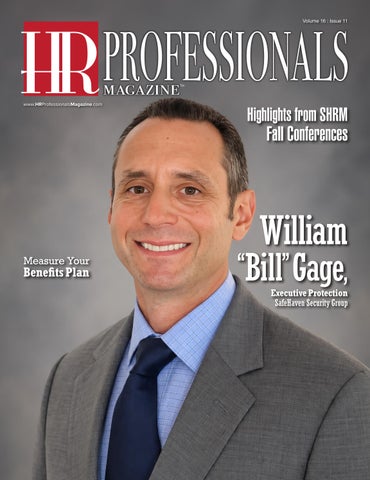
William ‘‘Bill’’ Gage, Executive Protection SafeHaven Security Group
Are You DROWNING in Employment Compliance Updates?
ons i s i ec fend e D D y g tl Make Hirin n e fi d You Can Con Data Facts’ background screening platform integrates a powerful compliance structure directly into your hiring workflow. You can expect instant-cleared results (when possible), customizable policy templates, and easy-to-interpret single action summaries. These legally-grounded elements drive consistent, defensible decisions. Don’t SINK because of ever-evolving laws and regulations. EMPOWER your team with compliance tools built to protect your hiring decisions.
REGISTRATION IS NOW OPEN
SHRM’s Annual Conference is now HR-X Live! The #1 HR conference has entered a new era. Award-winning main stage speakers. Thousands of HR peers. And for the first time, you leave with a SHRM HR-X Credential.
June 27-30, 2027 McCormick Place, Chicago
Curated. Connected. Credentialed.
Scan to register by Nov. 19 to save. Bringing your team? Save 10% or more.
WHAT PLAN GRADER LOOKS AT
01
PLAN DESIGN
HR Professionals Magazine is recognized by SHRM to offer Professional Development Credits (PDCs) for SHRM-CP® or SHRM-SCP® recertification activities.
02
EMPLOYEE C
The result is an easy-to-understand scorecar expert analysis of potential opportunities. It better starting point for the conversation: H we do better? Bringing Human Resources & Management Expertise to You
27%
of U.S. workers between 60-75 say they need to keep working. www.HRProfessionalsMagazine.com
Editor Cynthia Y. Thompson, MBA, SHRM-SCP, SPHR Publisher
The Thompson HR Firm, LLC Art Direction
Park Avenue Design Marketing and Social Media Specialist
Julie Nagem Project Specialist
Liz Rogers Photographer
Charles B. Thompson Webmaster
Leo Dimilo
Contributing Writers Richard Arnholdt William Brown John Clark Amy Schabacker Dufrane Tim K. Garrett Debra S. Gates Satish Kumar Misty McCraw
Contact HR Professionals Magazine: To submit a letter to the editor, suggest an idea for an article, notify us of a special event, promotion, announcement, new product or service, or obtain information on becoming a contributor, visit our website at www.hrprofessionalsmagazine.com. We do not accept unsolicited manuscripts or articles. All manuscripts and photos must be submitted by email to Cynthia@hrprosmagazine.com. Editorial content does not necessarily reflect the opinions of the publisher, nor can the publisher be held responsible for errors. HR Professionals Magazine is published every month, 12 times a year by the Thompson HR Firm, LLC. Reproduction of any photographs, articles, artwork or copy prepared by the magazine or the contributors is strictly prohibited without prior written permission of the Publisher. All information is deemed to be reliable, but not guaranteed to be accurate, and subject to change without notice. HR Professionals Magazine, its contributors or advertisers within are not responsible for misinformation, misprints, omissions or typographical errors. ©2026 The Thompson HR Firm, LLC | This publication is pledged to the spirit and letter of Equal Opportunity Law. The following is general educational information only. It is not legal advice. You need to consult with legal counsel regarding all employment law matters. This information is subject to change without notice.
4
www.HRProfessionalsMagazine.com
Features 3 SHRM’s Annual Conference is Now HR-X Live! 5 a note from the editor 6 William “Bill” Gage Profile 9 Choose Your 2027 Sailing! 19 Misty McCraw People HR Solutions 25 Introducing AI Sprint: A New Interactive Way to Build Your AI Skills 26 Meet the WTSHRM Executive Board Members
Talent Management and Recruiting 2 Are you DROWNING in Employment Compliance Updates? 7 SHRM-Memphis HR Excellence Awards November 12 8 Putting Out Fires the HR Way 13 Boost Your FMLA with Compliance Confidence
18 The Review Isn’t the Problem. The Other 364 Days Are.
Employment Law
22 What the World HR Congress Taught Us
27 Rainey Kizer Reviere & Bell – The Strength of Experience
Employee Benefits
30 Starbucks Settlement Adds to Growing Scrutiny of Corporate DEI Programs
10 Proven Weight Loss with Wegovy
31 Bass, Berry & Sims Listens and Responds
10 Is Your Benefit Plan Actually Competitive? 21 The Benefits Group – We do all the work!
SHRM 2026 Conferences Update
Ready to see what better look like?
28 Highlights from 2026 33 As Medication Costs SHRM Arkansas Climb, Employees are Conference in Hot Scan the QR code or visit plangrader.thebenefits.g Looking to HR Springs receive your personalized report. for Answers 32 Highlights from 2026 SHRM Georgia THE BENEFITS GRO Top Conference & Expo in Savannah Educational
Programs for HR Professionals
34 Highlights from 2026 HR Southwest Conference in Dallas
17 SHRM Certification – Choose the One That is Right for You 22 HRCI One
14 Does Your Organization Have an AI Philosophy?
24 Columbia Southern – 100% Online Degree
16 What Background Checks Should Employers Run On?
40 Graduate with More than a Master’s at WGU
HR Professionals Magazine is recognized by HRCI to offer professional recertification credits for HRCI activities.
a note from the editor
Hello SHRM Members
Across the U.S.!
This month we are celebrating our first anniversary since moving from a regional publication to a national publication beginning with our 2025 November issue. This month we are bringing you highlights from three exciting conferences. We begin with Georgia on September 30 – October 2. I know you will enjoy the highlights on Pages 32-33. Next, we turn the focus to SHRM Arkansas, as they celebrated their 40th anniversary in Hot Springs October 14-16. Be sure to catch the highlights on pages 28-29. We also have the highlights from the HR Southwest Conference in Dallas October 11-13 on Pages 34-35. We are wrapping up the SHRM fall conference season in Jackson, TN at the SHRM West Tennessee Conference at Union University on November 3. Watch for the highlights in our December issue. We hope to have highlights of the new SHRM Blueprint for I&D Conference in Nashville 15-18 in our December issue. We are excited to feature William “Bill Gage,” with SafeHaven Security Group on our November 2026 cover. Bill has spent his career protecting presidents and senior executives. He spent 12 years as a Special Agent with the United States Secret Service protecting the President, Vice President, and other senior leaders during thousands of missions throughout the United States and around the world including high-threat missions in Iraq, Afghanistan, and Israel, as well as some of the nation’s most complex security environments. We know you will enjoy reading about his exciting career. Please contact SafeHaven Security when you have a need for protection in high security situations for your own executives. It’s that time of year when the focus is on employee benefits planning and compliance. You will find solutions and insights from the 2026 SHRM Benefits Survey on their website, SHRM.org to help guide your employee benefits decisions. As you know, one of the most popular employee benefits this year is GLP-1 products that support employees with obesity. We are honored to have NovoNordiskWorks.com as a new sponsor. See their ad on page 10-12.
We hope you enjoy the fantastic highlights from the fall SHRM conferences in Georgia,Texas and Arkansas. I invite you to follow us on Facebook and LinkedIn so that you can receive our live videos with SHRM chapter leaders and top keynote speakers from the SHRM conferences. Here are the links for you: Like our Facebook page here: www.facebook.com/hrprofessionalsmagazine.com Connect with me on LinkedIn here: https://www.linkedin.com/in/cynthia-thompson-mba-shrm-scpsphr-325b8715/recent-activity/all/ Our December issue will feature the SHRM Foundation. The foundation elevates and empowers HR professionals as a force for social good so that all workplaces can prosper and thrive. They provide specialty certifications as well as scholarships to help HR professionals obtain their SHRM-CP and SCP. Watch your email for our complimentary webinars in November. All our webinars are pre-approved for both SHRM PDCs and HRCI Business Credit. If you are not currently on our email distribution list, please visit our website and click on “Subscribe.” Wishing you and your family a lovely Thanksgiving season.
Cynthia Y. Thompson, MBA, SHRM-SCP, SPHR cynthia@hrprosmagazine.com
Congratulations to Esther Waigwa, PHR Congratulations to Esther Waigwa on passing the PHR exam! She is Regional Human Resources Manager at Support Solutions, LLC, in Knoxville, TN. She has been with Support Solutions since 2021. Esther was previously a Certified Nursing Assistant with American Health Partners prior to being a Human Resources Training Coordinator with RHA Health Services.
www.HRProfessionalsMagazine.com
5
on the cover
Bill GAGE
“
”
WILLIAM
Executive Protection | Workplace Violence Prevention | Security Assessments For more than two decades, William “Bill” Gage has built his career around one fundamental responsibility: protecting people when the stakes are high. Bill has spent his career protecting presidents and senior executives. Today, he uses what he learned in those high-stakes environments to help organizations protect their own people. Bill spent 12 years as a Special Agent with the United States Secret Service, protecting the President, Vice President and other senior leaders during thousands of missions throughout the United States and around the world. His assignments included high-threat missions in Iraq, Afghanistan and Israel, as well as some of the nation’s most complex security environments. As a Team Leader for the Secret Service’s elite Counter Assault Team and a Lead Tactical Advance Agent for National Special Security Events, Bill specialized in anticipating what could go wrong—and building plans to protect people if it did. His responsibilities included active shooter response, threat suppression and protective planning at the White House and other locations visited by the President, Vice President and their families. He also served on two U.S. Congressional subcommittees related to continuity-ofoperations planning for the nation’s senior leaders. Today, Bill brings those lessons into the workplace. As Director of Executive Protection with SafeHaven Security Group, Bill helps organizations look at security through a practical, people-centered lens. His experience spans executive protection, security assessments, active shooter response and de-escalation— areas that increasingly intersect with the responsibilities of HR and organizational leadership. Bill has consulted with Fortune 50 companies on security assessments and has helped train thousands of financial institutions. He is a certified ALERRT Active Shooter instructor and has extensive experience training law enforcement and organizations in response, use of force and de-escalation. For HR professionals, Bill’s experience offers an important perspective: workplace safety isn’t only about responding to the worst-case scenario. It’s about recognizing risk, asking the right questions, preparing people and having a plan before a situation escalates. From concerning employee behavior or a difficult termination to threats against an executive or questions about how employees should respond during an emergency, Bill helps leaders move from “What would we do?” to “We’re prepared.” Bill has appeared on CNN, Fox News, ABC, BBC, NPR, and been featured by the New York Times, The Washington Post, The Economist, The Wall Street Journal, Newsweek. He has also made guest appearances and interviews on several national podcasts. He is frequently consulted by the media on national events related to executive protection and security. He holds a bachelor’s degree from the Virginia Military Institute and a master’s degree from Boston University.
6
www.HRProfessionalsMagazine.com
REGISTER NOW
https://shrmmemphis.starchapter.com/ meetinginfo.php?id=330&ts=1792606217
www.HRProfessionalsMagazine.com
7
Putting Out Fires the HR Way (Part one of a two-part series on best practices to handle emergencies and last-minute assignments) By DEBRA GATES
My dad was a firefighter. I remember seeing videos of him on the news running toward the flames while everyone else was running away. I think of HR professionals as being the firefighters of the company. When others are trying to run from the crisis, we are running into them, trying to find ways to help. We’ve all been there: it’s Friday afternoon, and you are walking out the door when the phone rings. You reluctantly answer and hear the panicked voice on the other end of the line. You are the HR Lady or Man. You are the go-to person for all things that need to be fixed. We are the heart of the company. We are the ones who are expected to drop everything and help. This is where we all want to be, or is it? Unfortunately, this role carries a heavy weight and sometimes causes us to experience stress and even burnout when the fires come too often and when they’re too big for us to put out. As a young HR professional, I was the person who had a hard time saying no or even asking, “Can this wait until tomorrow?” As I became more seasoned and with some gentle guidance from more senior professionals in my circle of support, I learned how to filter to keep me from becoming overwhelmed, stressed and burned out. Over the next few paragraphs, I will share wisdom from some seasoned HR professionals to help you navigate your firefighting and keep yourself in a healthy and productive space.
What Causes the Fires? There are many reasons for the fires. Sometimes it’s poor planning on the other person’s part, sometimes it’s poor planning on your part, and then you have the fires that are true emergencies (such as an injured employee) needing immediate attention. No matter the reason for the fire, we, as the person being asked to put them out, must find ways to filter them to determine how and when to put them out.
Determine What Needs Your Attention, What Can Wait, and When to Ask for Help I predominantly worked for small- to mid-sized family-owned businesses. In my HR roles, I reported to the CEO or the owner of the organization. Over time, I developed some ways to filter which fire to fight first. Here are some questions I asked myself or the person running to me for help in order to determine which direction to go: 1. At the root of every question you ask during this process is, “How will this impact the company?” 2. Does this have to be done today, or can it wait until tomorrow? Fight the most important fires first.
By asking these questions, you develop the skill to filter the work and create a balanced workload for you and those around you. You also help those running to you for help to stop and think through the reality of the immediate need versus what can wait until tomorrow.
Find Balance and Establish Clear Boundaries I had a manager who would text or leave voicemail messages in the middle of the night stating, “call me asap.” The first time he did this, I called him as soon as I saw the message. All he wanted was to get a job description written for a new position in his department. I explained to him that the message he left led me to believe someone had died on the overnight shift. The boundary I set with him was that he was to no longer leave messages during the night or tell me to call ASAP unless it was a true emergency. We then discussed what constituted an emergency. Needing a job description ASAP because he forgot to discuss the position with me may have been an emergency to him because he dropped the ball and forgot to tell me about it, but it was not to me. And there were other, more important things to take care of, such as the employee who was injured on the job at another location. Here is some more advice: 1. Give yourself some grace. We are human, and we can’t do everything. We have families to care for and, quite honestly, a life outside of work. When we find ourselves with competing priorities in the work-life area, we need to step back and remember that we can’t do everything for everyone all the time. We need to pick our fires to fight and ask for grace for the others. 2. Self-care is important. Remember that taking care of yourself is the best thing you can do for all in your life. We need to make sure we are not burning both ends of the candle. Taking time away from work to rejuvenate is as important as eating every day. This is also good for our families. This article just touched the tip of the iceberg. Keep in mind that every fire is not your fire to fight. Be courteous but firm when setting boundaries. Delegate when you can. Prioritize those fires that you do need to help battle. Do all this while taking care of yourself. Finally, don’t ever hesitate to stop and ask for help if it is needed. No one has to fight a fire alone.
3. Am I the right person to fight this fire? Do I have the right equipment? If you are not the person to fight the fire, delegate to the person or persons who are the right ones. 4. If you have competing fires, ask the person asking for help how important their fire is compared to the other fire. 8
www.HRProfessionalsMagazine.com
Dr. Debra S. Gates is an instructor with Western Governors University’s School of Business.
CHOOSE CHOOSE YOUR YOUR 2027 2027 SAILING SAILING
PROFESSIONAL PROFESSIONAL DEVELOPMENT DEVELOPMENT MEETS MEETS UNFORGETTABLE UNFORGETTABLE TRAVEL TRAVEL Three distinct cruise experiences. Outstanding HR education on every sailing. Three distinct cruise experiences. Outstanding HR education on every sailing.
MARCH 13-20, 2027 MARCH 13-20, 2027
APRIL 23-28, 2027 APRIL 23-28, 2027
MAY 14-21, 2027 MAY 14-21, 2027
HARMONY HARMONY OF OF THE THE SEAS SEAS
OASIS OASIS OF OF THE THE SEAS SEAS
VOYAGER VOYAGER OF OF THE THE SEAS SEAS
7 NIGHTS | PORT CANAVERAL 7 NIGHTS | PORT CANAVERAL San Juan, Puerto Rico | Samaná, Dominican San Juan,| Perfect Puerto Rico Dominican Republic Day |atSamaná, CocoCay, Bahamas Republic | Perfect Day at CocoCay, Bahamas
18.75 CREDITS SUBMITTED 18.75 CREDITS SUBMITTED
CONFERENCE SPEAKERS CONFERENCE SPEAKERS Jason Barrett Jason Barrett
Chrissy Bencivenga Chrissy Bencivenga Marty Bryson Marty Bryson JoDee Curtis JoDee Curtis Jacquilyn Ann Davis, CDP Jacquilyn Ann Davis, CDP Julie Doyle Julie Doyle Katrina Gooch Katrina Gooch Greg Kettner Greg Kettner Matt Kutz, PhD Matt Kutz, PhD Jason Lawson Jason Lawson David Miklas David Miklas Dr. Wendy Richard Dr. Wendy Richard Nicole Roberts Nicole Roberts Jamie Lewis Smith, PhD Jamie Lewis Smith, PhD Chad Sorenson Chad Sorenson
5 NIGHTS | FORT LAUDERDALE 5 NIGHTS | FORT LAUDERDALE Cozumel, Mexico | Perfect Day at CocoCay, Cozumel, MexicoBahamas | Perfect Day at CocoCay, Bahamas
16.75 CREDITS SUBMITTED 16.75 CREDITS SUBMITTED
CONFERENCE SPEAKERS CONFERENCE SPEAKERS Blake Babcock Blake Babcock
7 NIGHTS | SEATTLE 7 NIGHTS | SEATTLE Juneau | Skagway | Ketchikan, Alaska | Victoria, Juneau | Skagway | Ketchikan, Alaska | Victoria, British Columbia British Columbia
19.25 CREDITS SUBMITTED 19.25 CREDITS SUBMITTED
CONFERENCE SPEAKERS CONFERENCE SPEAKERS Indie Bollman Indie Bollman
Mercedes Dodd Mercedes Dodd
Mercedes Dodd Mercedes Dodd
Chris Dotson Chris Dotson
Val Grubb Val Grubb
Dr. Terah Henderson Dr. Terah Henderson
Kenston Henderson, Sr. Kenston Henderson, Sr.
Summer Jelinek Summer Jelinek
Jill Kopanis Jill Kopanis
Michael Karst Michael Karst
Shaina Lane Shaina Lane
Katrina Kibben Katrina Kibben
Michael Levin Michael Levin
Andrea Lewis Andrea Lewis
James Reid James Reid
Megan Nail Megan Nail
Karla Starr Karla Starr
Julius Richardson Julius Richardson
Casey Webster Casey Webster André Young André Young
THE THE SPEAKERS SPEAKERS ARE ARE READY. READY. YOUR YOUR CABIN CABIN IS IS WAITING. WAITING. Registration is open. Reserve your conference seat and stateroom with a Registration is open. Reserve your conference seat and stateroom with a $200 per person non-refundable deposit. $200 per person non-refundable deposit.
HRCRUISE.COM HRCRUISE.COM
SCAN TO EXPLORE SCAN TO EXPLORE Credits are being submitted to SHRM and HRCI. Speaker lineup and itinerary are subject to change. Credits are being submitted to SHRM and HRCI. Speaker lineup and itinerary are subject to change.
For adults with obesity, along with diet and exercise, lose weight and keep it off
with less weight vs before starting Wegovy®
Proven weight loss with Wegovy®, in a once-daily pill. AND SOME LOST EVEN MORE On average, adults achieved 14% weight loss
LOST ~33 Based on 235 lb starting weight
lb
About 1 in 4 adults lost 20% or more
LOST ~47 OR MORE
lb
Based on 235 lb starting weight In a 64-week medical study of 307 adults living with obesity, or with overweight and at least one weight-related medical problem, along with a reduced calorie diet and increased physical activity: • Adults taking Wegovy® pill lost an average of 14% body weight (~33 lb) vs 2.4% (~6 lb) taking placebo (not on medicine). Based on 235 lb (Wegovy®) and 231 lb (placebo) starting weights* ‒ 76% of adults taking Wegovy® pill lost 5% or more weight vs 31% taking placebo ‒ 60% of adults taking Wegovy® pill lost 10% or more weight vs 14% taking placebo ‒ 47% of adults taking Wegovy® pill lost 15% or more weight vs 6% taking placebo ‒ 28% of adults taking Wegovy® pill lost 20% or more weight vs 3% taking placebo *Results are from a 64-week medical study of 307 adults with obesity (BMI ≥30 kg/m2), or with overweight (BMI ≥27 kg/m2) and at least one weight-related medical problem, including high blood pressure or high cholesterol. Adults with type 2 diabetes were excluded. Patients were taking either Wegovy® pill or placebo. During the trial, 18% of adults in the Wegovy® group discontinued treatment compared with 25.5% of adults in the placebo group. BMI, body mass index.
What is Wegovy®?
Wegovy® (semaglutide) injection and Wegovy® (semaglutide) tablets are prescription medicines used with a reduced calorie diet and increased physical activity to: • reduce the risk of major cardiovascular events such as death, heart attack, or stroke in adults with known heart disease and with either obesity or overweight. • help adults with obesity, or some adults with excess weight (overweight) who also have weight-related medical problems to lose weight and keep the weight off. Wegovy® contains semaglutide and should not be used with other semaglutide-containing products or other GLP-1 receptor agonist medicines. It is not known if Wegovy® injection is safe and effective: • to reduce the risk of major cardiovascular events (death, heart attack, or stroke) in people under 18 years • to help children under 12 years of age lose weight and keep the weight off It is not known if Wegovy® tablets are safe and effective for use in people under 18 years of age.
Important Safety Information
What is the most important information I should know about Wegovy®? Wegovy® may cause serious side effects, including: • Possible thyroid tumors, including cancer. Tell your healthcare provider if you get a lump or swelling in your neck, hoarseness, trouble swallowing, or shortness of breath. These may be symptoms of thyroid cancer. In studies with rodents, Wegovy® and other medicines that work like Wegovy® caused thyroid tumors, including thyroid cancer. It is not known if Wegovy® will cause thyroid tumors or a type of thyroid cancer called medullary thyroid carcinoma (MTC) in people
• Do not use Wegovy® if you or any of your family have ever had a type of thyroid cancer called medullary thyroid carcinoma (MTC) or if you have an endocrine system condition called Multiple Endocrine Neoplasia syndrome type 2 (MEN 2)
Do not use Wegovy® if:
• you or any of your family have ever had a type of thyroid cancer called medullary thyroid carcinoma (MTC) or if you have an endocrine system condition called Multiple Endocrine Neoplasia syndrome type 2 (MEN 2) • you have had a serious allergic reaction to semaglutide or any of the ingredients in Wegovy® injection or Wegovy® tablets. See symptoms of serious allergic reaction in “What are the possible side effects of Wegovy®?” Wegovy® FlexTouch® pen: Do not share your Wegovy® FlexTouch® pen with other people, even if the needle has been changed. You may give other people a serious infection or get a serious infection from them.
Before using Wegovy®, tell your healthcare provider if you have any other medical conditions, including if you:
• have or have had problems with your pancreas or kidneys • have type 2 diabetes and a history of diabetic retinopathy • are scheduled to have surgery or other procedures that use anesthesia or deep sleepiness (deep sedation) • are pregnant or plan to become pregnant. Wegovy® may harm your unborn baby. You should stop using Wegovy® 2 months before you plan to become pregnant • are breastfeeding or plan to breastfeed. Breastfeeding is not recommended during treatment with Wegovy® tablets. It is not known if Wegovy® when received through an injection passes into your breast milk Tell your healthcare provider about all the medicines you take, including prescription and over-the-counter medicines, vitamins, and herbal supplements. Wegovy® may affect the way some medicines work and some medicines may affect the
Scan to see how much your employees can save
Actor portrayals
way Wegovy® works. Tell your healthcare provider if you are taking other medicines to treat diabetes, including sulfonylureas or insulin. Wegovy® slows stomach emptying and can affect medicines that need to pass through the stomach quickly.
What are the possible side effects of Wegovy®?
Wegovy® may cause serious side effects, including: • inflammation of your pancreas (pancreatitis). Stop using Wegovy® and call your healthcare provider right away if you have severe pain in your stomach area (abdomen) that will not go away, with or without nausea or vomiting. Sometimes you may feel the pain from your abdomen to your back • gallbladder problems. Wegovy® may cause gallbladder problems, including gallstones. Some gallstones may need surgery. Call your healthcare provider if you have symptoms, such as pain in your upper stomach (abdomen), fever, yellowing of the skin or eyes (jaundice), or clay-colored stools • increased risk of low blood sugar (hypoglycemia), especially those who also take medicines for diabetes such as insulin or sulfonylureas. This can be a serious side effect. Talk to your healthcare provider about how to recognize and treat low blood sugar and check your blood sugar before you start and while you take Wegovy®. Signs and symptoms of low blood sugar may include dizziness or light-headedness, blurred vision, anxiety, irritability or mood changes, sweating, slurred speech, hunger, confusion or drowsiness, shakiness, weakness, headache, fast heartbeat, or feeling jittery • dehydration leading to kidney problems. Diarrhea, nausea, and vomiting may cause a loss of fluids (dehydration), which may cause kidney problems. It is important for you to drink fluids to help reduce your chance of dehydration. Tell your healthcare provider right away if you have nausea, vomiting, or diarrhea that does not go away
• severe stomach problems. Stomach problems, sometimes severe, have been reported in people who use Wegovy®. Tell your healthcare provider if you have stomach problems that are severe or will not go away • serious allergic reactions. Stop using Wegovy® and get medical help right away, if you have any symptoms of a serious allergic reaction, including swelling of your face, lips, tongue, or throat; problems breathing or swallowing; severe rash or itching; fainting or feeling dizzy; or very rapid heartbeat • change in vision in people with type 2 diabetes. Tell your healthcare provider if you have changes in vision during treatment with Wegovy® • increased heart rate. Wegovy® can increase your heart rate while you are at rest. Tell your healthcare provider if you feel your heart racing or pounding in your chest and it lasts for several minutes • food or liquid getting into the lungs during surgery or other procedures that use anesthesia or deep sleepiness (deep sedation). Wegovy® may increase the chance of food getting into your lungs during surgery or other procedures. Tell all your healthcare providers that you are taking Wegovy® before you are scheduled to have surgery or other procedures The most common side effects of Wegovy® may include: nausea, diarrhea, vomiting, constipation, stomach (abdomen) pain, changes in skin sensations, headache, tiredness (fatigue), upset stomach, dizziness, feeling bloated, belching, low blood sugar in people with type 2 diabetes, gas, stomach flu, heartburn, and hair loss.
For additional information, please see Brief Summary of Information about Wegovy® on the following page. FLEXTOUCH, LIVE LIGHTER, WEGOVY, NOVO NORDISK, NOVO, and the Apis Bull Logo are trademarks owned by Novo Nordisk A/S. © 2026 Novo Nordisk Printed in the U.S.A. US26SEMT00414 November 2026
Brief Summary of Information about WEGOVY® (semaglutide) injection and WEGOVY® (semaglutide) tablets Rx Only This information is not comprehensive. How to get more information: • Talk to your healthcare provider or pharmacist • Visit www.novo-pi.com/wegovy.pdf to obtain the FDA-approved product labeling • Call 1-833-Wegovy-1 Do not share your pen WEGOVY® FlexTouch® or needles with other people, even if the needle has been changed. You may give other people a serious infection, or get a serious infection from them. What is the most important information I should know about WEGOVY®? WEGOVY® may cause serious side effects, including: • Possible thyroid tumors, including cancer. Tell your healthcare provider if you get a lump or swelling in your neck, hoarseness, trouble swallowing, or shortness of breath. These may be symptoms of thyroid cancer. In studies with rodents, WEGOVY® and other medicines that work like WEGOVY® caused thyroid tumors, including thyroid cancer. It is not known if WEGOVY® will cause thyroid tumors or a type of thyroid cancer called medullary thyroid carcinoma (MTC) in people. • Do not use WEGOVY® if you or any of your family have ever had a type of thyroid cancer called medullary thyroid carcinoma (MTC), or if you have an endocrine system condition called Multiple Endocrine Neoplasia syndrome type 2 (MEN 2). What is WEGOVY®? • WEGOVY® injection is a prescription medicine used with a reduced-calorie diet and increased physical activity to: • reduce the risk of major cardiovascular events such as death, heart attack, or stroke in adults with known heart disease and with either obesity or overweight. • help adults and children aged 12 years and older with obesity, or some adults with excess weight (overweight) who also have weight-related medical problems to lose weight and keep the weight off. • treat adults with metabolic dysfunction-associated steatohepatitis (MASH) with moderate to advanced liver scarring (fibrosis), but not with cirrhosis of the liver. • WEGOVY® tablets are a prescription medicine used with a reduced-calorie diet and increased physical activity to: • reduce the risk of major cardiovascular events such as death, heart attack, or stroke in adults with known heart disease and with either obesity or overweight. • help adults with obesity, or some adults with excess weight (overweight) who also have weight-related medical problems to lose weight and keep the weight off. • WEGOVY® contains semaglutide and should not be used with other semaglutide-containing products or other GLP-1 receptor agonist medicines. • It is not known if WEGOVY® injection is safe and effective: • to reduce the risk of major cardiovascular events (death, heart attack, or stroke) in people under 18 years. • to help children under 12 years of age lose weight and keep the weight off. • for the treatment of MASH in people under 18 years of age. • It is not known if WEGOVY® tablets are safe and effective for use in people under 18 years of age. Do not use WEGOVY® if: • you or any of your family have ever had a type of thyroid cancer called MTC or if you have an endocrine system condition called MEN 2. • you have had a serious allergic reaction to semaglutide or any of the ingredients in WEGOVY® injection or WEGOVY® tablets. See “What are the possible side effects of WEGOVY®?” for symptoms of a serious allergic reaction. Before using WEGOVY®, tell your healthcare provider if you have any other medical conditions, including if you: • have or have had problems with your pancreas or kidneys. • have type 2 diabetes and a history of diabetic retinopathy. • are scheduled to have surgery or other procedures that use anesthesia or deep sleepiness (deep sedation). • are pregnant or plan to become pregnant. WEGOVY® may harm your unborn baby. You should stop using WEGOVY® 2 months before you plan to become pregnant. • Pregnancy Exposure Registry: There is a pregnancy exposure registry for women who use WEGOVY® during pregnancy. The purpose of this registry is to collect information about the health of you and your baby. Talk to your healthcare provider about how you can take part in this registry or you may contact Novo Nordisk at 1-877-390-2760 or www.wegovypregnancyregistry.com. • are breastfeeding or plan to breastfeed. Breastfeeding is not recommended during treatment with WEGOVY® tablets. It is not known if WEGOVY® when received through an injection passes into your breast milk. You should talk with your healthcare provider about the best way to feed your baby while using WEGOVY®. Tell your healthcare provider about all the medicines you take, including prescription and over-thecounter medicines, vitamins, and herbal supplements. WEGOVY® may affect the way some medicines work and some medicines may affect the way WEGOVY® works. Tell your healthcare provider if you are taking other medicines to treat diabetes, including sulfonylureas or insulin. WEGOVY® slows stomach emptying and can affect medicines that need to pass through the stomach quickly. Know the medicines you take. Keep a list of them to show your healthcare provider and pharmacist when you get a new medicine. How should I use WEGOVY®? • If you take too much WEGOVY®, you may have severe nausea, severe vomiting and severe low blood sugar. Call your healthcare provider or Poison Help line at 1-800-222-1222 or go to the nearest hospital emergency room right away. Advice is also available online at poisonhelp.org. WEGOVY® Injection • Your healthcare provider should tell you which WEGOVY® product you will be using (for example – single-dose pen or syringe, single-patient-use pen, or tablets). • If you are prescribed a different WEGOVY® product at any point, make sure you receive new training for the new product and read the Instructions for Use that come with it. • WEGOVY® is injected under the skin (subcutaneously) of your stomach (abdomen), thigh, or upper arm. Do not inject WEGOVY® into a muscle (intramuscularly) or vein (intravenously). • Change (rotate) your injection site with each injection. Do not use the same site for each injection. • Use WEGOVY® 1 time each week, on the same day each week, at any time of the day. WEGOVY® Tablets • Take 1 WEGOVY® tablet by mouth on an empty stomach in the morning with water (no more than 4 ounces). Do not take WEGOVY® tablets with any other liquids besides water. • Do not split, crush, chew or dissolve WEGOVY® tablets. Swallow WEGOVY® tablets whole. • Do not take more than 1 WEGOVY® tablet each day. • After 30 minutes, you can eat, drink, or take other oral medicines. • If you miss a dose of WEGOVY®, skip the missed dose and go back to your regular schedule for the next dose.
What are the possible side effects of WEGOVY®? WEGOVY® may cause serious side effects, including: • See “What is the most important information I should know about WEGOVY®?” • inflammation of your pancreas (pancreatitis). Stop using WEGOVY® and call your healthcare provider right away if you have severe pain in your stomach area (abdomen) that will not go away, with or without nausea or vomiting. Sometimes you may feel the pain from your abdomen to your back. • gallbladder problems. WEGOVY® may cause gallbladder problems including gallstones. Some gallbladder problems need surgery. Call your healthcare provider if you have any of the following symptoms: • pain in your upper stomach (abdomen) • yellowing of skin or eyes (jaundice) • fever • clay-colored stools • increased risk of low blood sugar (hypoglycemia) in patients with type 2 diabetes, especially those who also take medicines to treat type 2 diabetes mellitus such as an insulin or a sulfonylureas. Low blood sugar in patients with type 2 diabetes who receive WEGOVY® can be both a serious and common side effect. Talk to your healthcare provider about how to recognize and treat low blood sugar. You should check your blood sugar before you start taking WEGOVY® and while you take WEGOVY®. Signs and symptoms of low blood sugar may include: • dizziness or light-headedness • sweating • shakiness • blurred vision • slurred speech • weakness • anxiety • hunger • headache • irritability or mood changes • confusion or drowsiness • fast heartbeat • feeling jittery • dehydration leading to kidney problems. Diarrhea, nausea, and vomiting may cause a loss of fluids (dehydration) which may cause kidney problems. It is important for you to drink fluids to help reduce your chance of dehydration. Tell your healthcare provider right away if you have nausea, vomiting, or diarrhea that does not go away. • severe stomach problems. Stomach problems, sometimes severe, have been reported in people who use WEGOVY®. Tell your healthcare provider if you have stomach problems that are severe or will not go away. • serious allergic reactions. Stop using WEGOVY® and get medical help right away, if you have any symptoms of a serious allergic reaction including: • swelling of your face, lips, tongue or throat • severe rash or itching • very rapid heartbeat • problems breathing or swallowing • fainting or feeling dizzy • change in vision in people with type 2 diabetes. Tell your healthcare provider if you have changes in vision during treatment with WEGOVY®. • increased heart rate. WEGOVY® can increase your heart rate while you are at rest. Your healthcare provider should check your heart rate while you take WEGOVY®. Tell your healthcare provider if you feel your heart racing or pounding in your chest and it lasts for several minutes. • food or liquid getting into the lungs during surgery or other procedures that use anesthesia or deep sleepiness (deep sedation). WEGOVY® may increase the chance of food getting into your lungs during surgery or other procedures. Tell all your healthcare providers that you are taking WEGOVY® before you are scheduled to have surgery or other procedures. The most common side effects of WEGOVY® in adults or children aged 12 years and older may include: • gas • dizziness • stomach (abdomen) pain • nausea • stomach flu • changes in skin sensations • feeling bloated • diarrhea • heartburn • belching • headache • vomiting • low blood sugar in people • hair loss • constipation • tiredness (fatigue) with type 2 diabetes • upset stomach Talk to your healthcare provider about any side effect that bothers you or does not go away. These ® are not all the possible side effects of WEGOVY . Call your doctor for medical advice about side effects. You may report side effects to FDA at 1-800-FDA-1088. How should I store WEGOVY®? WEGOVY® injection • Do not store WEGOVY® in the freezer or directly beside the refrigerator cooling element. • Do not freeze WEGOVY® and do not use WEGOVY® if it has been frozen. • WEGOVY® single-dose pen and single-dose syringe: • Store in the refrigerator between 36°F to 46°F (2°C to 8°C). • If needed, before removing the pen or syringe cap, WEGOVY® single-dose pen and single-dose syringe can be stored from 46°F to 86°F (8°C to 30°C) in the original carton for up to 28 days. • Keep WEGOVY® single-dose pen and syringe in the original carton to protect it from light. • Throw away the WEGOVY® single-dose pen or syringe if it has been frozen, has been exposed to light or temperatures above 86°F (30°C), has been out of the refrigerator for 28 days or longer, or after use. • WEGOVY® FlexTouch® single-patient-use pen: • Store in the refrigerator between 36°F to 46°F (2°C to 8°C). • After first use, store WEGOVY® FlexTouch® pen between 59°F to 86°F (15°C to 30°C) or in the refrigerator between 36°F to 46°F (2°C to 8°C) for up to 56 days. • Protect WEGOVY® FlexTouch® pen from excessive heat and light. • Keep the pen cap on when not in use. • Always remove and safely discard the needle after each injection. • Store WEGOVY® FlexTouch® pen without an injection needle attached. • Always use a new needle for each injection. • Throw away if the WEGOVY® FlexTouch® pen if it has been frozen, has been exposed to light or temperatures above 86°F (30°C), or has been out of the refrigerator for 56 days or longer. WEGOVY® tablets • Store WEGOVY® tablets at room temperature between 68°F to 77°F (20°C to 25°C). • Store tablets in the original closed WEGOVY® bottle until you are ready to take one. Do not store in any other container. • Store in a dry place away from moisture. Keep WEGOVY® and all medicines out of the reach of children. Marketed by: Novo Nordisk Inc., Plainsboro, NJ 08536 More detailed information is available upon request. Available by prescription only. WEGOVY® and FlexTouch® are registered trademarks of Novo Nordisk A/S. Patent Information: http://novonordisk-us.com/products/product-patents.html For more information, go to startWegovy.com or call 1-833-Wegovy-1. © 2026 Novo Nordisk All rights reserved. US26SEMO01332 July 2026
Boost Your FMLA Compliance Confidence Supervisors are often the first to hear about a leave request. Knowing what to say — and what to do next — matters. Get FREE FMLA training resources from the J. J. Keller® LEAVE MANAGER solution to help you respond with confidence, including guidance on: • What questions you can ask when an employee requests leave • How to recognize situations that may qualify for FMLA protection • What qualifies as a “serious health condition” under the law
AVOID COSTLY FMLA MISTAKES The average cost to defend an FMLA lawsuit is $80,000.
Designed specifically for front‑line supervisors, these practical resources help you handle leave conversations correctly and avoid costly mistakes — before they become compliance issues.
GET FREE FMLA TRAINING LeaveManager.com/FreeTraining 855-206-2983 www.HRProfessionalsMagazine.com
13
Your Organization Has an AI Strategy.
But Does It Have an AI Philosophy? By SATISH KUMAR
Artificial intelligence is entering nearly every corner of the workplace. Employees are experimenting with new tools, vendors are adding AI capabilities to existing systems, and leadership teams are looking for opportunities to improve productivity, reduce costs, and make better decisions. For many organizations, the question is no longer whether to use AI, but how quickly and extensively to adopt it. Yet amid the enthusiasm, one conversation deserves more attention. Before deciding everything AI can do for an organization, have we established what we believe AI should do? This distinction matters, and it gets to the heart of developing an organizational AI philosophy.
“ Before deciding everything AI can do for an organization, have we established what we believe AI should do?” Strategy, Policy, and Philosophy: What’s the Difference? Most organizations are familiar with developing technology strategies and policies. An AI strategy identifies opportunities, priorities, investments, and desired outcomes. An AI policy establishes rules about acceptable use, data security, privacy, and compliance.
14
www.HRProfessionalsMagazine.com
An AI philosophy addresses something more fundamental. It defines the organization’s beliefs about the relationship between people and artificial intelligence, the role of human judgment, and the principles that will guide decisions as technology evolves. Think of it this way: A strategy determines where you’re going. Policies establish the rules of the road. Your philosophy explains why you’ve chosen that direction and what matters along the way. Without that foundation, organizations risk making AI decisions one application, department, or vendor at a time, with little consistency in how they approach issues involving employees, customers, and organizational values.
Why HR Belongs in the Conversation AI is often introduced as a technology initiative, with IT and executive leadership driving decisions about adoption and investment. That’s understandable, but AI’s implications extend well beyond technology. Consider the questions emerging in today’s workplace. How much decision-making authority do we give AI? When is human review essential? How transparent will we be with employees about AI’s influence on decisions affecting their careers? What happens when an AI-generated recommendation conflicts with a manager’s judgment? These aren’t exclusively technology questions. They’re questions about organizational culture, trust, accountability, and how people
“ These aren’t exclusively technology questions. They’re questions about organizational culture, trust, accountability, and how people work together.” work together. HR brings an important perspective because it understands how organizational decisions translate into employee experiences. That makes HR a natural partner in shaping an AI philosophy, alongside executive leadership, IT, legal, and other stakeholders.
Five Questions to Start the Conversation Creating an AI philosophy doesn’t require a lengthy document or months of committee meetings. It begins with thoughtful conversations about a few fundamental questions. 1. What role do we want AI to play in our organization? Is AI primarily a tool for efficiency and automation, or do we envision it helping people become more capable, creative, and effective? Most organizations will want both, but how they balance those objectives matters. 2. Where must human judgment remain central? Not every decision carries the same consequences. Automating an administrative task is different from using AI to inform hiring, promotion, compensation, or termination decisions. Organizations need shared expectations about when people review, challenge, and ultimately own decisions. 3. What does responsible AI use mean to us? Privacy, fairness, transparency, accuracy, and security are familiar principles, but what do they mean in practice? An organization needs to define how those commitments shape the tools it selects, the information it shares, and the outcomes it monitors. 4. How will we prepare employees to work with AI? An AI philosophy also reflects what an organization believes about its responsibility to employees. Will AI adoption include opportunities to develop new skills? How will employees participate in identifying useful applications and raising concerns?
5. How will we know when our approach needs to change? AI capabilities are advancing rapidly, and today’s assumptions may not hold tomorrow. Organizations need to revisit their principles as technology, business needs, and employee expectations evolve.
From Conversation to Guiding Principles The answers to these questions can become a short set of organizational commitments. For example: · We use AI to enhance human capabilities, not to replace human involvement. · People remain accountable for consequential decisions, even when AI contributes information or recommendations. · We evaluate AI applications for accuracy, fairness, privacy, and potential unintended consequences. · We communicate openly about how AI is used and invest in helping employees use it effectively. These aren’t universal answers. Every organization needs principles that reflect its mission, values, workforce, and risk tolerance. The real test comes when those principles influence everyday decisions, from evaluating a new software application to deciding whether an AI-generated recommendation deserves a second look.
A Philosophy That Evolves With Technology An AI philosophy isn’t intended to slow innovation or create another layer of bureaucracy. Done well, it provides a foundation for making decisions more confidently and consistently, even as technology changes. Organizations will keep experimenting, investing, and discovering new AI applications. Some will work beautifully. Others will raise questions nobody anticipated. Having a shared philosophy won’t eliminate those challenges, but it gives leaders and employees a common basis for navigating them. The organizations that make the most of AI may not be the ones that adopt it fastest, but the ones that are clearest about why, where, and how they choose to use it.
Satish Kumar, TraineryHCM TraineryHCM.com Satish@Trainery.one
www.HRProfessionalsMagazine.com
15
By JOHN CLARK
Seasonal employees pose just as much risk as permanent staff. They need a consistent, compliant background screening process. Depending on the role, seasonal screening might need to include criminal records searches, employment, education, and license verifications, drug testing, and motor vehicle record checks. Employers hiring seasonal workers should conduct the same background checks they use for permanent employees, based on the responsibilities and risks of the position.
• Criminal Records Searches Run a county criminal search on every county the applicant has lived, worked, or studied in during the last 7 years. Run a National Criminal Database search to uncover potential “traveling crimes” you wouldn’t catch in a county search.
Do Seasonal Employees Need Background Checks? Yes! Seasonal employees should be screened according to the responsibilities and risks associated with their positions, just like permanent employees.
• Education Verification If the role requires a certification or degree, verify the applicant’s claims through a third party screener.
Temporary employees may only be with your company for a short while, but they pose just as much risk to your organization as your full-time, permanent team members. They can: • Provide poor customer service which could damage your company’s reputation. • Lack the skills and qualifications to perform the job. • Cause time-consuming conflicts with current staff. • Violate workplace drug and alcohol policies. • Steal merchandise, data, or company property. Which Background Checks Should Employers Use for Seasonal Workers? Background screening should be part of every new hire’s vetting process, whether they’re permanent employees or not. Depending on the position’s responsibilities, the background check may need these elements. • Identity Verification Searches Use services like Social Security number searches and identity document verifications to identify discrepancies or signs of fraud. Run them at the beginning of the screening process to help confirm the person being screened is who they claim to be. 16
www.HRProfessionalsMagazine.com
• Employment Verification Confirm key details of the applicant’s employment history like past employers, job titles, and dates of employment.
• Drug Screening Conduct appropriate drug testing the same way you handle permanent employees. • Motor Vehicle Records Search This information is priceless if the applicant will be driving for the organization or operating a company vehicle. Do Returning Seasonal Hires Need to be Screened Again? Maybe. Rescreening former hires depends on company policy, the position, and how much time has passed since their last background check. A previous screening only reflects information available at that time. Employers should establish a consistent, written rescreening policy for returning workers. How Can Employers Speed Up Seasonal Background Checks? Time to hire is crucial, we know. Employers can speed up seasonal background checks without sacrificing thoroughness with:
What Compliance Requirements Apply to Seasonal Employees? Seasonal employees are generally subject to the same federal background screening requirements as other employees. The Fair Credit Reporting Act (FCRA) establishes requirements for disclosure, authorization, and adverse action. Employers must also follow applicable state and local laws that may impose additional restrictions on the use of background information in hiring decisions. How Can Employers Get Prepared for Seasonal Hiring? Preparing for seasonal hiring before applications start arriving is the key to avoiding holdups and confusion. 1) Identify the positions you need to fill. 2) Determine which background checks are appropriate for each role. 3) Review screening and adverse action procedures. 4) Prepare the candidate authorization processes 5) Coordinate with the background screening provider ahead of anticipated hiring surges. Seasonal Hiring Moves Fast Don’t wait until seasonal hiring is underway to evaluate your background screening process. Review your seasonal positions now and identify the appropriate background checks for each role. A wellplanned, consistently executed process helps reduce hiring delays and maintains fair, compliant hiring decisions.
• A well-trained team. • Mobile-friendly authorizations. • Automated candidate reminders. • Pre-determined screening packages for seasonal positions.
John Clark Senior National Account Executive
• A background screening partner that offers efficient turnaround times, responsive support, and technology that keeps the process moving.
Advanced Technology. Experienced People. Trusted Background Screening Results. www.datafacts.com
jclark@datafacts.com | (413) 642-4374
The Review Isn’t the Problem. The Other 364 Days Are. By MISTY MCCRAW, PEOPLEPRO HR SOLUTIONS
Here’s a scene I’ve watched play out more times than I’d like to admit. A manager sits down with an employee for the annual review. Somewhere around page two, the manager brings up a missed deadline from March. The employee goes quiet, then asks the question that tells you everything: “Why am I just now hearing about this?”
Feedback while it still matters. If something went well, say so that day and be specific about what. If something went sideways, address it within a day or two, privately and calmly. Describe what happened, what it affected, and what you need going forward. Keep it about the work, not the person.
It’s a fair question, and most of the time the manager doesn’t have a good answer. They meant to say something. They were busy. They figured it would sort itself out. So, they saved it, the way a lot of us save hard conversations, for a meeting on the calendar where it felt like they were supposed to have it. By then it’s October. The employee feels ambushed, the manager feels like the bad guy, and nobody walks out of that room more accountable than they walked in.
Follow-up you can count on. This is where most managers fall down. They have the conversation and never circle back. If you agreed on a fix, put a reminder on your calendar and check in. Nothing teaches a team that commitments don’t matter faster than a manager who forgets them.
The Annual Review was Never Built for This Let me say up front that I’m not on a crusade to burn every review form in the country. Annual reviews still do a few things reasonably well. They create a record, they give pay decisions some structure, and they force everyone to step back and look at the whole year. What they don’t do well is hold people accountable. Accountability happens close to the moment. If a project slips on Tuesday, the useful conversation is on Wednesday, while both people remember the details and there’s still time to fix it. Eleven months later, you’re not coaching anymore. You’re reading from a file. Then there’s the recency problem everyone in HR knows about. Managers remember the last six weeks, not the first six months. The employee who had a rough spring and a strong fall gets a glowing review, while the one who carried the team through the first quarter and stumbled in September gets marked down. Neither review is really true. And when the review is the only formal checkpoint, it carries too much weight. People get nervous, managers get vague, and the whole thing turns into a negotiation over a rating instead of a conversation about the work.
What Everyday Accountability Actually Looks Like When I say “everyday accountability,” some managers hear “more meetings.” That’s not what I mean. Most of the teams I work with have plenty of meetings already. What they’re missing is clarity and followthrough in the conversations they’re already having. In practice, it comes down to a few habits. Clear expectations, written down. You can’t hold someone to a standard they’ve never seen. If “done” only lives in the manager’s head, the employee is guessing. A two-line note after a planning conversation (“Report to Dana by the 15th, vendor numbers included”) saves a lot of grief later. Short, regular check-ins. Fifteen minutes every week or two, built around three questions: What’s on track? What’s stuck? What do you need from me? That last one matters more than people think. Accountability runs both directions, and employees can tell when a manager asks it and means it. 18
www.HRProfessionalsMagazine.com
None of this is complicated. It’s just consistent, and consistency is exactly what gets squeezed out when a manager is also carrying a full workload of their own.
Where HR Fits In HR can’t have these conversations for managers, and honestly, we shouldn’t try. When HR steps in to deliver every piece of tough feedback, managers learn that accountability is somebody else’s job. Our role is to make it easier for them to do it themselves. That starts with training. A lot of managers got promoted because they were great at the work, not because anyone taught them how to give feedback or follow up. A little practice with a simple framework goes a long way. It also means taking an honest look at the systems we’ve built. If your review process asks managers to recall a full year from memory, give them an easy way to keep notes as they go. If check-ins aren’t happening, find out why. In my experience it’s usually time, confidence, or both. And when the annual review does come around, it should summarize conversations that already happened. If anything in it surprises the employee, that’s a signal for HR to pay attention to, not just the employee.
Make the Review the Easy Part The goal isn’t to get rid of the annual review. It’s to make it boring, in the best possible way. When managers set expectations, check in, and follow up all year long, the review becomes a recap instead of a reckoning. Employees know where they stand. Managers stop dreading the calendar invite. And HR spends a lot less time cleaning up conversations that should have happened months ago. If your organization is ready to make that shift, PeoplePro HR Solutions can help. We work with business owners, HR leaders, and people managers to build accountability habits that stick, from hands-on manager training to check-in tools and review processes that actually reflect the year. Reach out at www.peopleprohrsolutions.com and let’s talk about what’s working for your team and what isn’t. Misty McCraw leads PeoplePro HR Solutions, serving small and midsize business owners, HR leaders, and people managers. She’ll dig deeper into these ideas in her upcoming HR Professionals webinar, “From Annual Reviews to Everyday Accountability.”
MISTY McCRAW
(662) 326-0941 www.peopleprohrsolutions.com
Human Resource Services Human Resources & Safety Management Workplace Investigations Policy & Procedure Development & Implementation Training & Professional Development Compliance (Unemployment, EEOC, OSHA, FMLA, Notary, etc.) Strategic Leadership & Organizational Development Risk Management
Talent Aquisition Flat 10% Fee Free Replacement Guarantee Comprehensive Screening Permanent Placement Only Placement in Any Industry
Training & Development Workforce Training Professional Development Training HR Training for Non-HR Professionals Business Coaching Leadership Training
www.HRProfessionalsMagazine.com
19
THE BENEFITS GROUP | PLAN GRADER
Is Your Benefits Plan Actually Competitive? Now you can measure it.
Benefits decisions are often made with plenty of data - but surprisingly little context. PlanGrader gives HR leaders a clear, comprehensive look at how their current health plan stacks up against employers we have actually worked with and helped produce measurable outcomes.
▥
BENCHMARKED AGAINST REAL-WORLD OUTCOMES Not just a generic national average. Your report compares key plan features against similar-size groups from our own work giving you a more practical picture of where your plan is strong and where there may be room to improve.
WHAT PLAN GRADER LOOKS AT
01
PLAN DESIGN
02
EMPLOYEE COST
03
EMPLOYER CONTRIBUTION
04
COMPETITIVENESS
The result is an easy-to-understand scorecard with practical observations, benchmark comparisons and an expert analysis of potential opportunities. It is not a sales quote disguised as an analysis. It is a better starting point for the conversation: How does our plan really stack up - and where could we do better?
Ready to see what better looks like?
Scan the QR code or visit plangrader.thebenefits.group to receive your personalized report. THE BENEFITS GROUP • Benefits that feel like care. • thebenefits.group
(615)250-3334 will@benefits.place
www.HRProfessionalsMagazine.com
21
What the World HR Congress Taught Us Mauricio Reynoso, former president, NAHRMA and Dr. Amy Dufrane, NAHRMA’s newly appointed president at the 20th HR World Congress.
When HR leaders from around the world come together, one thing becomes clear: although our circumstances may differ, many of the challenges we face are remarkably similar. That was evident at the 2026 World HR Congress, held this September in Mexico City. Organized by the Asociación Mexicana en Dirección de Recursos Humanos A.C. (AMEDIRH) and the North American Human Resources Management Association (NAHRMA), the biennial event is hosted by the World Federation of People Management Associations (WFPMA). This year’s Congress brought together senior HR leaders, practitioners, academics, policymakers, and partners from around the globe. Over two days, attendees heard from HR and business leaders, including the CEO of Redbox and CHRO of Netflix, and exchanged perspectives on the issues shaping our profession. Among the topics discussed was the importance of international HR standards, an area WFPMA has supported since the inception of ISO/TC 260. These conversations reinforced the value of bringing together HR professionals from different countries to share expertise and address common challenges. This year’s Congress also marked an important milestone for me: I was honored to be named president of NAHRMA. Having previously served as secretary/treasurer, I’m excited for the opportunity to help strengthen collaboration among HR professionals across North America and beyond. One of my biggest takeaways from the Congress was the importance of keeping people at the center of organizational transformation. Technologies like AI and automation will continue to reshape how we work, but it’s people—through their leadership, skills, judgment, and adaptability—who will determine how successfully our organizations move forward. Coming together in person is important. Face-to-face conversations, whether during formal sessions or over a shared meal, strengthen professional connections and create opportunities for new relationships and partnerships. Not only is personal connection critical, but getting the chance to learn from experts and peers and to problem-solve collaboratively is invaluable.
22
www.HRProfessionalsMagazine.com
People as the heart of the organization was a pervasive theme at World HR Congress. Peck Kem Low, president of the WFPMA, said, “…skills requirements are evolving rapidly, workforces are becoming more diverse, multigenerational and globally connected while organizations face economic uncertainty, demographic changes, climate challenges, and rising expectations from employees and society.” She added that HR is becoming increasingly important, and the companies that succeed in the AI era will be those that create the most agile, engaged, resilient, and skilled workforces. Heads nodded in agreement as we are all seeing these fast-moving trends evolving around us. Peck Kem Low added that we must ensure that innovation strengthens, rather than undermines, human dignity and that this is both a business and a social imperative. The World HR Congress focuses on delivering meaningful value for attendees’ investment of time and travel. Bringing together HR leaders from around the world to address shared challenges and help shape the direction of our profession is central to that experience. As the new president of NAHRMA, I am excited to continue advancing these important conversations. I hope you’ll consider joining us in this important work. Watch this site for updates.
All learning. All HRCI certification products. All for one price. $1395 Advance your HR expertise with the new Master Certificate in Human Resources—now included with HRCI ONE. Earn 96 recertification credits. No exam required. A $2,499 value.
Explore HRCI ONE
SEE YOUR SAVINGS. Scan to compare online degree program costs
24
www.HRProfessionalsMagazine.com
AI is Moving Fast. Are You?
Introducing SHRM AI Sprint: A New Interactive Way to Build Your AI Skills
SHRM AI Sprint is a new virtual learning experience built around doing — not just watching. In each two-hour Sprint, you’ll tackle real HR scenarios with AI while an expert instructor and coach guide you along the way. If you want to lead the AI conversation in your organization instead of catching up to it, now’s the time to claim your place.
Scan to register shrm.org/aisprint-hrp
Reserve your seat for an upcoming SHRM AI Sprint today.
Meet the WT SHRM Executive Board Members
President
Vice President/President-Elect
Jackson, TN
Jackson, TN
Brian Forbis
Vice President - Membership
John Carbonell Jackson, TN
Treasurer
Susan Oswalt
Trhea Nixon
Lexington, TN
Jackson, TN
Secretary
At Large - Certification CLA Chair
Jackson, TN
Jackson, TN
Monique Merriweather
26
Past President
Rebecca Acred
www.HRProfessionalsMagazine.com
Jennifer Howell
At Large - Communications Chair
Loni Mantooth
T H E ST R E N GT H O F E X P E R I E NC E
As the issues facing employers and HR professionals become more frequent, challenging, and complex each year, you need a law firm that provides advice for your specific organization. For over 50 years, Rainey Kizer Reviere & Bell has advised businesses, non-profit organizations, and governmental agencies in all aspects of employment law. To learn how we can assist your organization, please contact us.
TENNESSEE MEMPHIS • JACKSON • NASHVILLE • CHATTANOOGA
Tennessee does not certify specialists in the area of employment law. Attorney Advertisement
raineykizer.com | 731.423.2414
HIGHLIGHTS
28
www.HRProfessionalsMagazine.com
www.HRProfessionalsMagazine.com
29
Starbucks Settlement Adds to Growing Scrutiny of Corporate DEI Programs By RICHARD ARNHOLT & TIM K. GARRETT
Key Takeaways
Although Starbucks is not resolving an FCA case, the settlement is particularly notable for federal contractors because the employment practices challenged by Florida overlap with practices DOJ has recently targeted through its Civil Rights Fraud Initiative.
· F ederal contractors face additional FCA risk. Recent DOJ settlements involving Accenture, Deloitte, and IBM show that alleged violations of antidiscrimination requirements can become False Claims Act (FCA) matters when contractors certify compliance with applicable contractual obligations.
On September 14, DOJ announced a $25 million settlement with Accenture resolving allegations that Accenture Federal Services falsely certified compliance with federal contractual anti-discrimination requirements while using race or sex in certain employment decisions. As we discussed in our recent post on the Accenture settlement, DOJ specifically alleged that the company used internal workforce composition goals and maintained training, mentoring, leadershipdevelopment, and educational programs for which participation was restricted based on race or sex.
·C ompanies should review how DEI goals operate in practice. Particular attention should be given to workforce targets, hiring and promotion decisions, executive compensation, mentorship and leadership programs, supplierdiversity initiatives, and other programs that may condition opportunities or benefits on protected characteristics. State and federal enforcement authorities continue to scrutinize corporate diversity, equity, and inclusion (DEI) programs, with a new settlement between Starbucks Corporation and the Florida Attorney General providing the latest example. On September 17, Florida Attorney General James Uthmeier announced that Starbucks agreed to pay $1 million and undertake several commitments to resolve a lawsuit alleging that Starbucks engaged in employment practices that violated the Florida Civil Rights Act through race- and sex-based goals, quotas, and preferences. The settlement comes amid increased federal enforcement involving similar practices, including recent FCA settlements involving federal contractors Accenture, Deloitte, and IBM.
Florida Challenges Starbucks’ Employment and DEI Practices The Florida Attorney General filed suit against Starbucks in December 2025, alleging that the company had used race- and sex-based preferences in its employment practices. According to the complaint, Starbucks had established demographic goals for its workforce, tied portions of executive compensation to diversity objectives, and offered certain mentorship and professional-development opportunities based on race or sex. Among other things, the state pointed to Starbucks’ previously announced goals of achieving at least 30% representation by “people of color” in corporate positions and at least 40% representation in retail and distribution center positions by 2025. Starbucks’ own 2023 Global Impact Report identified those representation goals for several categories of employees. The Attorney General alleged that these practices violated the Florida Civil Rights Act, which prohibits employment discrimination based on protected characteristics including race and sex. The allegations were not adjudicated, and Starbucks denied wrongdoing.
Starbucks Agrees to Nationwide Compliance Commitments Under the negotiated resolution, Starbucks agreed to comply with the Florida Civil Rights Act and not use race- or sex-based goals, quotas, or preferences in areas including hiring, promotion, compensation, executive compensation, mentorship programs, supplier selection, and board composition. Starbucks also agreed that it will not participate in organizations that require increasing the racial diversity of its board of directors. According to a spokesperson for the Attorney General’s Office, the agreement applies to Starbucks’ operations nationwide. The settlement also includes a continuing compliance component. Starbucks’ Chief Legal Officer must submit annual certifications of compliance for four years, and the company will pay $1 million to the Florida Department of Legal Affairs to reimburse the state for costs associated with the litigation. Importantly, the agreement contains no admission of liability or wrongdoing. Starbucks has also reportedly stated that the agreement does not require changes to its current programs or practices. 30
Federal Contractors Face FCA, State, and Whistleblower Exposure
·D EI scrutiny is occurring at both the state and federal levels. The Starbucks settlement shows that state attorneys general are also scrutinizing employment and corporate governance practices involving race- or sex-based goals, preferences, and participation requirements.
www.HRProfessionalsMagazine.com
That settlement followed a $21.5 million resolution with Deloitte in August involving similar allegations that Deloitte failed to comply with anti-discrimination requirements incorporated into its federal contracts while certifying compliance with those requirements. As we discussed in our post on the Deloitte settlement, the matter also demonstrates that potential exposure extends beyond federal FCA enforcement. Deloitte separately agreed to pay Florida and Indiana $1.2 million each to resolve parallel allegations under the states’ respective false claims laws. The underlying action was also brought as a qui tam lawsuit by the American Alliance for Equal Rights, which asserted claims on behalf of the federal government, Florida, and Indiana and received $4.78 million as its relator’s share of the federal and state settlements. Earlier this year, IBM agreed to pay more than $17 million to resolve FCA allegations involving its DEI practices, including allegations concerning demographic goals, diverse interview slates, compensation incentives, and certain race- or sex-restricted employee programs. Together, these actions demonstrate the multiple avenues through which DEIrelated employment practices may face scrutiny. Private employers may face direct enforcement under federal or state anti-discrimination laws, as illustrated by Starbucks, while federal and state contractors can face additional false claims exposure when contractual certifications incorporate anti-discrimination requirements. The Deloitte matter further demonstrates that such allegations may originate through private whistleblowers using federal or state qui tam provisions, rather than solely through government-initiated investigations.
What Companies and Federal Contractors Should Review Federal contractors should continue reviewing DEI and employment programs with particular attention to whether protected characteristics play a role in actual employment decisions or access to workplace opportunities. Areas warranting review include numerical workforce targets, hiring and promotion processes, executive compensation tied to demographic outcomes, internship and mentorship programs, leadership-development opportunities, supplier-diversity programs, and representations or certifications made to the government concerning compliance with anti-discrimination requirements. Not every diversity or inclusion initiative is necessarily unlawful. Programs focused on outreach, equal access, employee development, and creating a broadly inclusive workplace may present different legal issues than programs that use race, sex, or another protected characteristic to determine who receives an employment opportunity or benefit. But the Starbucks settlement, viewed alongside DOJ’s recent contractor settlements, shows that enforcement authorities are closely examining where employers draw that line. For federal contractors in particular, the consequences may extend beyond traditional employment-law exposure. As DOJ’s recent FCA resolutions demonstrate, an alleged discriminatory employment practice can become a government contracts compliance issue when the contractor has certified compliance with contractual anti-discrimination requirements.
GO CONFIDENTLY. Bass, Berry & Sims listens and responds with creative yet practical counsel. We stay on pace with the complex and rapidly evolving employment landscape, connecting your dynamic human resources needs to proactive strategies. Relationships, reliability, and respect – at the center of our Labor & Employment and Employee Benefits practices.
Stay up-to-date on the latest in HR Law. Visit our blog at bassberryhrlawtalk.com.
1
2
1 Lisa Hughes, State Council Director kicks off the SHRM Georgia State Conference & Expo at the Executive Breakfast 2 Tom Darrow & Teela Jackson talk to the group during the breakfast
3
4
3 Paula Humber, SHRM MCD gives a SHRM National update 4 SHRM Georgia Director Elect, Ron Williams; Janeann Allison, VP of Operations, State Director Lisa Hughes, Emily Dickens, Chief of Staff, Head of Government Affairs and Corporate Secretary for SHRM; Shirley Rijkse, SHRM MAC Representative; Paula Humber, SHRM MCD
5 32
www.HRProfessionalsMagazine.com
5 Monique Jenkins talks about the Student Case Competition and introduces the students who participated.
6
7
6 Registration & sign in is open!
7 The exhibitors are setting up
8
8 A die-hard HR Professional
9
10
9 One of our many standing room only sessions 10 Allatoona SHRM wins Chapter of the year working with soon to be released prisoners
11
12
13
11 Chapter Volunteer of the Year, Marqueshia Henry 12 Ann Burris HR Professional of the Year with Craig Southern & Shirley Rijkse, SHRM MAC Representative 13 A group of HR Professionals out bird watching
14 We couldn’t do this without our sponsors! www.HRProfessionalsMagazine.com
33
TS H G LI H IG H 34
www.HRProfessionalsMagazine.com
www.HRProfessionalsMagazine.com
35
GRADUATE WITH MORE THAN A MASTER’S Earn your master’s in HR management in a program aligned with SHRM and HRCI guidelines—and graduate with additional HR credentials. WGU’s master’s in HR management equips you with the skills and credentials to succeed. Along with your degree, you’ll earn a certificate in HR Technology and Analytics to enhance decision-making and have the opportunity to earn a SHRM Specialty Credential, strengthening your résumé before you even graduate.
Enrolling now. Scan for more information about the MSHRM and apply today.
Learn more. wgu.edu/mshrm
866.225.5948